

#crosschain
crosschain
310,211 views
2,527 Discussing
Hot
Latest

·
--
Cross-chain bridges let assets move between different blockchains, but do you know what they really rely on?
The key isn’t just transfer speed—it’s how the destination chain confirms that an operation on the source chain is genuine and valid.
Cross-chain bridge risks may include:
🔹 Vulnerabilities in the verification mechanism
🔹 Excessively centralized administrator privileges
🔹 Cross-chain messages being forged or executed more than once
🔹 Security issues involving smart contracts and external components
Before using a cross-chain bridge, verify its official address, technical design, audit scope, and asset custody arrangements. You may want to test it with a small amount the first time, but don’t treat a successful transfer as proof that it’s completely safe.
At its core, cross-chain technology isn’t just about moving assets—it’s about enabling different networks to verify one another securely.
What do you think is the most important issue cross-chain bridges need to address first?
#ONEANetwork #Web3 #CrossChain
Cross-chain bridges let assets move between different blockchains, but do you know what they really rely on?
The key isn’t just transfer speed—it’s how the destination chain confirms that an operation on the source chain is genuine and valid.
Cross-chain bridge risks may include:
🔹 Vulnerabilities in the verification mechanism
🔹 Excessively centralized administrator privileges
🔹 Cross-chain messages being forged or executed more than once
🔹 Security issues involving smart contracts and external components
Before using a cross-chain bridge, verify its official address, technical design, audit scope, and asset custody arrangements. You may want to test it with a small amount the first time, but don’t treat a successful transfer as proof that it’s completely safe.
At its core, cross-chain technology isn’t just about moving assets—it’s about enabling different networks to verify one another securely.
What do you think is the most important issue cross-chain bridges need to address first?
#ONEANetwork #Web3 #CrossChain
The key isn’t just transfer speed—it’s how the destination chain confirms that an operation on the source chain is genuine and valid.
Cross-chain bridge risks may include:
🔹 Vulnerabilities in the verification mechanism
🔹 Excessively centralized administrator privileges
🔹 Cross-chain messages being forged or executed more than once
🔹 Security issues involving smart contracts and external components
Before using a cross-chain bridge, verify its official address, technical design, audit scope, and asset custody arrangements. You may want to test it with a small amount the first time, but don’t treat a successful transfer as proof that it’s completely safe.
At its core, cross-chain technology isn’t just about moving assets—it’s about enabling different networks to verify one another securely.
What do you think is the most important issue cross-chain bridges need to address first?
#ONEANetwork #Web3 #CrossChain
2
7
·
--
🔗 Cross-chain technology connects different blockchains, but is it always safe?
Cross-chain technology enables assets and information to move between different networks, but it also introduces new security challenges.
Before using it, check these four things:
🛡️ Verification mechanisms: How does the system verify transactions on the source chain?
💰 Asset backing: How do tokens on the destination chain correspond to the original assets?
💧 Liquidity: After the assets arrive, can you exchange or withdraw them as usual?
🔍 Permission management: Who can control the cross-chain contracts and critical operations?
The value of cross-chain technology lies in interoperability, while its security depends on the underlying verification and risk-control mechanisms.
What do you think is the most pressing issue cross-chain technology needs to address?
#ONEA #Web3 #CrossChain
🔗 Cross-chain technology connects different blockchains, but is it always safe?
Cross-chain technology enables assets and information to move between different networks, but it also introduces new security challenges.
Before using it, check these four things:
🛡️ Verification mechanisms: How does the system verify transactions on the source chain?
💰 Asset backing: How do tokens on the destination chain correspond to the original assets?
💧 Liquidity: After the assets arrive, can you exchange or withdraw them as usual?
🔍 Permission management: Who can control the cross-chain contracts and critical operations?
The value of cross-chain technology lies in interoperability, while its security depends on the underlying verification and risk-control mechanisms.
What do you think is the most pressing issue cross-chain technology needs to address?
#ONEA #Web3 #CrossChain
Cross-chain technology enables assets and information to move between different networks, but it also introduces new security challenges.
Before using it, check these four things:
🛡️ Verification mechanisms: How does the system verify transactions on the source chain?
💰 Asset backing: How do tokens on the destination chain correspond to the original assets?
💧 Liquidity: After the assets arrive, can you exchange or withdraw them as usual?
🔍 Permission management: Who can control the cross-chain contracts and critical operations?
The value of cross-chain technology lies in interoperability, while its security depends on the underlying verification and risk-control mechanisms.
What do you think is the most pressing issue cross-chain technology needs to address?
#ONEA #Web3 #CrossChain
3
5
·
--
🔗 What is cross-chain, and why does Web3 need it?
Cross-chain technology enables asset transfers, messaging, and app collaboration between different blockchains.
But cross-chain does not mean absolute security.
⚠️ Cross-chain bridges may have smart contract vulnerabilities.
🔐 Validator and administrator privileges can pose risks.
💸 Fees, slippage, and liquidity can also affect the actual outcome.
Before using a cross-chain service, verify the official website, destination network, asset mechanisms, and transaction status.
What really matters in cross-chain is not just interoperability, but how to verify and ensure security.
What do you think is the biggest issue cross-chain needs to solve?
#ONEA #Web3 #CrossChain
🔗 What is cross-chain, and why does Web3 need it?
Cross-chain technology enables asset transfers, messaging, and app collaboration between different blockchains.
But cross-chain does not mean absolute security.
⚠️ Cross-chain bridges may have smart contract vulnerabilities.
🔐 Validator and administrator privileges can pose risks.
💸 Fees, slippage, and liquidity can also affect the actual outcome.
Before using a cross-chain service, verify the official website, destination network, asset mechanisms, and transaction status.
What really matters in cross-chain is not just interoperability, but how to verify and ensure security.
What do you think is the biggest issue cross-chain needs to solve?
#ONEA #Web3 #CrossChain
Cross-chain technology enables asset transfers, messaging, and app collaboration between different blockchains.
But cross-chain does not mean absolute security.
⚠️ Cross-chain bridges may have smart contract vulnerabilities.
🔐 Validator and administrator privileges can pose risks.
💸 Fees, slippage, and liquidity can also affect the actual outcome.
Before using a cross-chain service, verify the official website, destination network, asset mechanisms, and transaction status.
What really matters in cross-chain is not just interoperability, but how to verify and ensure security.
What do you think is the biggest issue cross-chain needs to solve?
#ONEA #Web3 #CrossChain
2
2

·
--
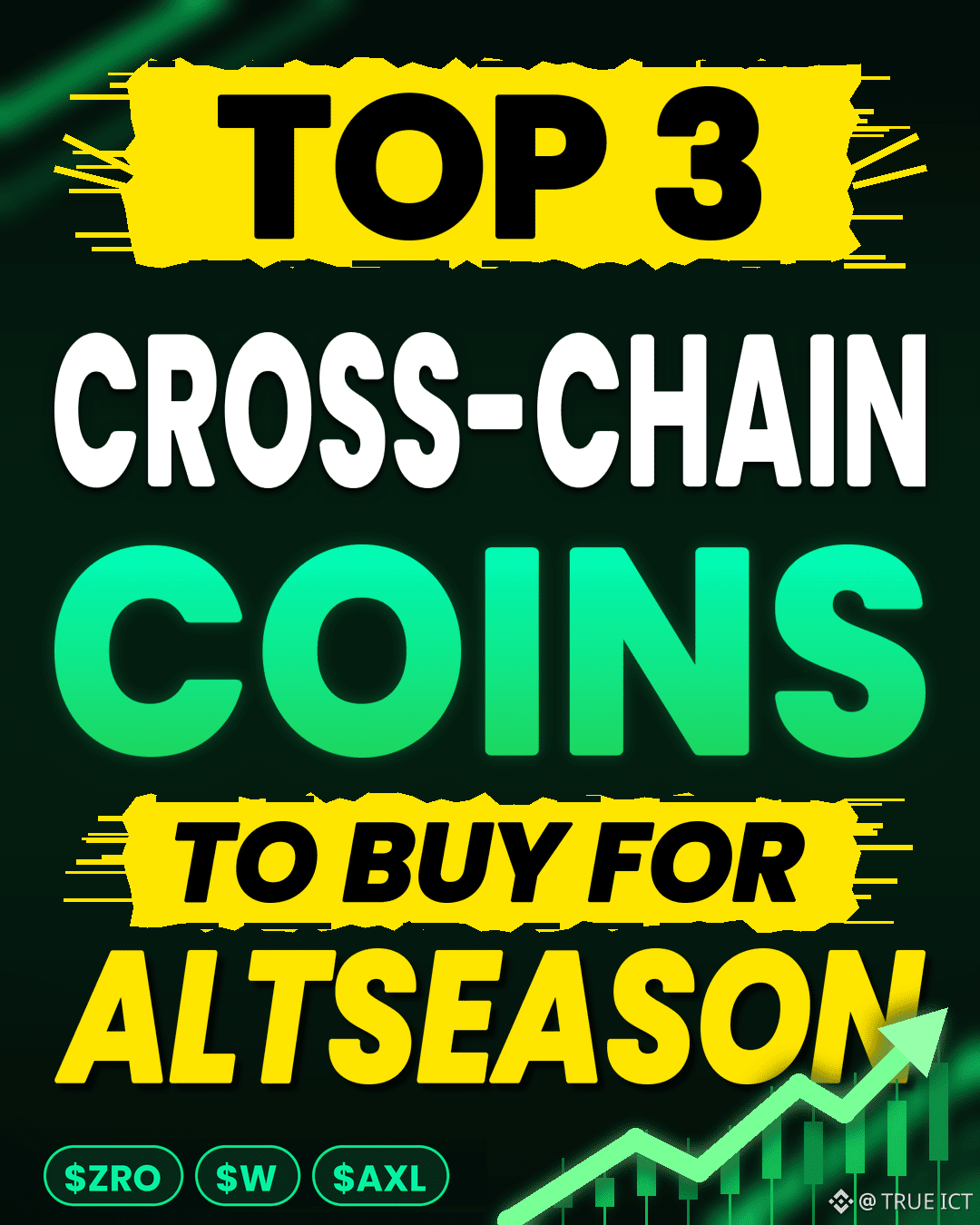
🌉 Top 3 Cross-Chain Coins to Watch
Crypto is multi-chain, and moving value between chains still matters:
1️⃣ $ZRO (LayerZero): omnichain messaging used by many apps and tokens.
2️⃣ $W (Wormhole): cross-chain messaging and transfers across many networks.
3️⃣ $AXL (Axelar): connects chains and lets developers send messages between them.
⚠️ Bridges are hack targets and token unlocks can pressure price. I check security record and supply schedule.
Which interoperability project wins? 👇
Not financial advice. DYOR.
#CrossChain #ZRO #Binance
🌉 Top 3 Cross-Chain Coins to Watch
Crypto is multi-chain, and moving value between chains still matters:
1️⃣ $ZRO (LayerZero): omnichain messaging used by many apps and tokens.
2️⃣ $W (Wormhole): cross-chain messaging and transfers across many networks.
3️⃣ $AXL (Axelar): connects chains and lets developers send messages between them.
⚠️ Bridges are hack targets and token unlocks can pressure price. I check security record and supply schedule.
Which interoperability project wins? 👇
Not financial advice. DYOR.
#CrossChain #ZRO #Binance
Crypto is multi-chain, and moving value between chains still matters:
1️⃣ $ZRO (LayerZero): omnichain messaging used by many apps and tokens.
2️⃣ $W (Wormhole): cross-chain messaging and transfers across many networks.
3️⃣ $AXL (Axelar): connects chains and lets developers send messages between them.
⚠️ Bridges are hack targets and token unlocks can pressure price. I check security record and supply schedule.
Which interoperability project wins? 👇
Not financial advice. DYOR.
#CrossChain #ZRO #Binance
1
1.4k

FOMO is directly challenging Pump.fun's dominance by launching a cross chain bridge and router designed for sub second execution. This move targets the massive demand for faster and cheaper meme coin trading. If FOMO delivers on its promise of superior pricing and speed, it could significantly fragment the current liquidity landscape and force existing platforms to upgrade their infrastructure to stay competitive.
#PumpFun #CrossChain ⠀
FOMO is directly challenging Pump.fun's dominance by launching a cross chain bridge and router designed for sub second execution. This move targets the massive demand for faster and cheaper meme coin trading. If FOMO delivers on its promise of superior pricing and speed, it could significantly fragment the current liquidity landscape and force existing platforms to upgrade their infrastructure to stay competitive.
#PumpFun #CrossChain ⠀
#PumpFun #CrossChain ⠀
12

·
--
Bullish
What does a cross chain swap really cost? Read this before your next move
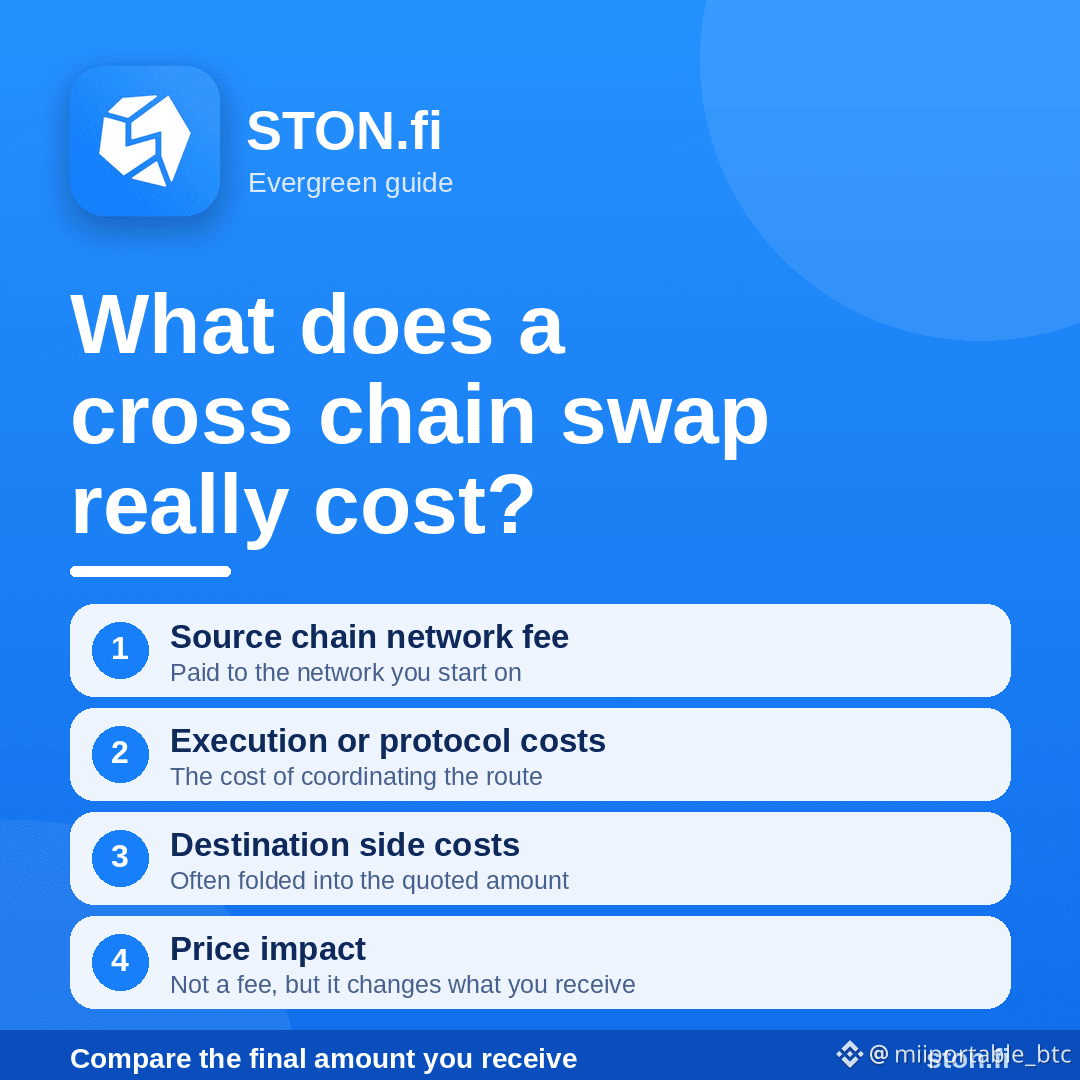
Moving value between blockchains costs more than a normal swap, because two networks do the work. The total is not one fee. It is made of four parts:
1. Source chain network fee. Paid to the network you start on, such as TON or Ethereum.
2. Execution or protocol costs. The cost of coordinating the route.
3. Destination side costs. Sometimes folded into the quoted amount.
4. Price impact. Not a fee, but it changes what you receive when your trade is large compared to liquidity.
The one habit that matters: compare the final amount you receive, not a single fee line. A low fee with high price impact can still cost more overall.
Quick checklist before you sign:
1. Confirm the source and destination networks.
2. Confirm the token you receive.
3. Check that your receiving wallet supports the destination network.
4. Read the final quote: amount received, fees, rate, and price impact.
5. Keep enough gas in the source chain's native currency.
6. Test with a small amount first for larger swaps.
7. Verify the address, because cross chain swaps cannot be reversed.
Example: on STON.fi's cross chain swap from TON to Base, the confirmation screen shows the exact amount you will receive along with fees and the final rate, according to the product page. Fees and speeds change, so always check the live quote on the day you swap. $GRAM
{future}(GRAMUSDT)
Try it here: https://ston.fi/cross-chain-swap-from-ton-to-base
Always type addresses yourself or use a trusted bookmark.
@stonfi @ton_blockchain #STONfi #CrossChain #TON #Base #defi
Educational content only, not financial advice. Do your own research.
What does a cross chain swap really cost? Read this before your next move
Moving value between blockchains costs more than a normal swap, because two networks do the work. The total is not one fee. It is made of four parts:
1. Source chain network fee. Paid to the network you start on, such as TON or Ethereum.
2. Execution or protocol costs. The cost of coordinating the route.
3. Destination side costs. Sometimes folded into the quoted amount.
4. Price impact. Not a fee, but it changes what you receive when your trade is large compared to liquidity.
The one habit that matters: compare the final amount you receive, not a single fee line. A low fee with high price impact can still cost more overall.
Quick checklist before you sign:
1. Confirm the source and destination networks.
2. Confirm the token you receive.
3. Check that your receiving wallet supports the destination network.
4. Read the final quote: amount received, fees, rate, and price impact.
5. Keep enough gas in the source chain's native currency.
6. Test with a small amount first for larger swaps.
7. Verify the address, because cross chain swaps cannot be reversed.
Example: on STON.fi's cross chain swap from TON to Base, the confirmation screen shows the exact amount you will receive along with fees and the final rate, according to the product page. Fees and speeds change, so always check the live quote on the day you swap. $GRAM
Try it here: https://ston.fi/cross-chain-swap-from-ton-to-base
Always type addresses yourself or use a trusted bookmark.
@STONfi DEX @Ton Network #STONfi #CrossChain #TON #Base #defi
Educational content only, not financial advice. Do your own research.
Moving value between blockchains costs more than a normal swap, because two networks do the work. The total is not one fee. It is made of four parts:
1. Source chain network fee. Paid to the network you start on, such as TON or Ethereum.
2. Execution or protocol costs. The cost of coordinating the route.
3. Destination side costs. Sometimes folded into the quoted amount.
4. Price impact. Not a fee, but it changes what you receive when your trade is large compared to liquidity.
The one habit that matters: compare the final amount you receive, not a single fee line. A low fee with high price impact can still cost more overall.
Quick checklist before you sign:
1. Confirm the source and destination networks.
2. Confirm the token you receive.
3. Check that your receiving wallet supports the destination network.
4. Read the final quote: amount received, fees, rate, and price impact.
5. Keep enough gas in the source chain's native currency.
6. Test with a small amount first for larger swaps.
7. Verify the address, because cross chain swaps cannot be reversed.
Example: on STON.fi's cross chain swap from TON to Base, the confirmation screen shows the exact amount you will receive along with fees and the final rate, according to the product page. Fees and speeds change, so always check the live quote on the day you swap. $GRAM
Try it here: https://ston.fi/cross-chain-swap-from-ton-to-base
Always type addresses yourself or use a trusted bookmark.
@STONfi DEX @Ton Network #STONfi #CrossChain #TON #Base #defi
Educational content only, not financial advice. Do your own research.
1
322

·
--
Article
Why Can the Same Stablecoin Exist on Multiple Networks? USDT, USDC and Cross-Chain Swaps ExplainedWhy does USDT or USDC exist on many blockchains? Learn how token contracts, networks and cross-chain swaps work, and how to send stablecoins safely.
Why Can the Same Stablecoin Exist on Multiple Networks USDT, USDC, and Cross-Chain Swaps Explained
You hold USDT in a TON wallet. A friend asks you to send USDT to their wallet, and their app shows USDT on Ethereum, Tron, Solana and others. Same name, same dollar value, but the app asks you to pick a network.
So if USDT is meant to represent one US dollar, why does it exist on several blockchains, and why can't you always send one version straight to another network?
The short answer is that a stablecoin's name and target value are only part of the story. Where the token lives, which contract issued it, and how it moves all matter.
Each blockchain is its own world
Every blockchain keeps its own ledger, with its own transaction rules, address formats and smart-contract environment. Ethereum, Tron, Solana and TON do not share a single database. A balance on one is invisible to the others.
Because of this, a stablecoin that wants to exist on several chains needs a presence on each one. There are three common models, and they are not the same thing:
Separate token deployments by the issuer. The issuer launches its own token contract on each supported chain.Native issuance on multiple chains. The issuer supports minting and redeeming directly on each network. Circle describes USDC as natively supported on many networks this way.Bridged or wrapped representations. A third party locks or tracks tokens on one chain and issues a stand-in on another. Circle publishes a "Bridged USDC Standard" for this situation, with the possibility of native issuance late
Models 1 and 2 often overlap. The key point is that two tokens with the same ticker are not automatically the same on-chain asset, and they are not interchangeable by default. Backing, redemption rights and risk can differ between versions, so don't assume they match.
USDT and USDC as real examples
USDT. Tether's integration guidelines list the protocols it supports, including Ethereum, Tron, Solana, BNB Smart Chain, Avalanche and TON, among others. The page describes tokens on its supported blockchains as equivalent: one on one chain equals one on another. That speaks to how the issuer treats them, though, not to whether you can send one directly into another.
USDC. Circle states that USDC is natively supported across 38 blockchain networks (as of June 2026, per its multichain page). It also runs a cross-chain transfer system called CCTP for moving native USDC between supported chains.
Here are some verified identifiers, taken from the issuers' own pages:
USDT on Ethereum: 0xdac17f958d2ee523a2206206994597c13d831ec7 (Tether)USDT on TON (jetton master): EQCxE6mUtQJKFnGfaROTKOt1lZbDiiX1kCixRv7Nw2Id_sDs (Tether)USDC on Ethereum: 0xa0b86991c6218b36c1d19d4a2e9eb0ce3606eb48 (Circle)USDC on Base: 0x833589fCD6eDb6E08f4c7C32D4f71b54bdA02913 (Circle)
Notice what these show. Each network has its own identifier. The ticker alone proves nothing, and neither does the price shown. A fake token can copy a name and logo. Always check the contract against the issuer's published list, because these details can change.
Networks, addresses, contracts and balances
Four terms get mixed up, so here they are separately:
Network: the blockchain itself (Ethereum, TON, Tron).Address: an account's identifier on that network.Token contract (or identifier): the on-chain program that defines the token and tracks balances.Balance: how much of that specific token an address holds on that specific network.
Having an address on one network does not mean the same asset exists at that location on another. STON.fi's own documentation notes the difference in formats: EVM chains use addresses starting with 0x, while TON uses a different format.
TON is a good example of how architectures differ. TON's documentation explains that a jetton is TON's counterpart to Ethereum's ERC-20 tokens, but built differently: each owner has a separate jetton wallet contract holding their balance, linked to a jetton master contract. Tether's USDT on TON is a jetton. Other networks use their own token standards, so don't assume every chain works like Ethereum.
Here is a hypothetical. A user holds USDT on Network A and picks Network B when sending. For this to work, the token must exist on both networks, the destination address must be valid on Network B, and the transfer route must actually support both networks. If any one of the three fails, the transfer can fail or, worse, the funds may land somewhere the recipient can't access.
Why network selection matters
A sending screen asking "which network?" is not a formality. Choosing wrongly can cause real problems:
The destination wallet or platform may not support that network.It may not accept that specific token version.The transfer mechanism may not connect those two networks.Fees are paid in a network's own asset, which you must hold.A successful transaction on the sending chain doesn't prove the recipient can use the funds as expected.
If something goes wrong, recovery depends on the receiving platform, the wallet and the transfer mechanism. Nobody can promise it's possible. Prevention is much easier:
Confirm the receiving wallet or platform supports the intended network.Verify the token's authenticity and network-specific identity.Match your sending network to the supported deposit network.Check fees and the asset needed to pay them.Verify the destination address and transfer route.Use a small test transfer when practical.Confirm receipt before sending a larger amount.
Transfers, bridges and cross-chain swaps
Three things are often confused:
A transfer within one blockchain moves a token between two addresses on the same network.A bridge or cross-chain transfer moves value between networks. In many designs, assets are locked on one side and a representation is issued on the other, though designs vary. Circle's CCTP, for example, works differently, moving native USDC between supported chains.A cross-chain swap exchanges one asset for a different asset delivered on another network, in one flow.
These can use different protocols, liquidity sources, fees and risks. Not all cross-chain swaps share one architecture, so check how a given route works.
Picture a user holding USDT on TON who wants a supported stablecoin on another blockchain. They need to specify the source asset, the destination network and the destination asset, then review the final details before signing.
Where STON.fi and Omniston fit
STON.fi is a decentralized exchange on TON. Omniston is its liquidity protocol. Its documentation describes it as a liquidity aggregation protocol for swaps on TON and for cross-chain swaps, collecting quotes from connected sources so users see competitive pricing.
For cross-chain swaps, STON.fi's documentation describes a Request for Quote (RFQ) model. Independent market makers called resolvers respond with quotes. The selected resolver provides the destination-side liquidity, and the two legs are linked by Hashed Timelock Contracts (HTLCs), which are on-chain agreements that use a shared secret and time limits. According to the documentation, the intended outcome is either settlement on both sides or a timed rollback, rather than a half-finished transfer. STON.fi's blog also states that this approach is not a wrapped-token bridge.
STON.fi's guide says cross-chain swaps are currently stablecoin-first and lists supported tokens across TON, Base, Ethereum, BNB Chain and Polygon as of June 2026. The list is expected to change, and the supported chain list in Omniston's technical documentation is broader than the app guide's, so always check the live interface for what's available today.
The broader lesson: fragmented networks and liquidity make life harder for users, and infrastructure that connects them can simplify the path. You still need to review the networks, tokens and details yourself. No tool can guarantee outcomes, speed or zero fees.
Common questions
Is USDT on TON the same on-chain asset as USDT on another network?
No. They are separate tokens on separate ledgers, each with its own identifier. Tether's guidelines treat its tokens across supported chains as equivalent in value.
Why can USDC exist on several blockchains?
Circle issues it natively on many networks, each with its own deployment, and a bridged standard exists for other cases.
Can I send USDT to any wallet displaying USDT?
Not safely. The wallet must support the specific network and token.
What happens if I choose the wrong network?
It depends on the receiving platform and mechanism. Recovery isn't guaranteed, so double-check first.
What's the difference between a bridge and a cross-chain swap?
A bridge moves value between chains, often through lock-and-issue designs. A cross-chain swap exchanges one asset for another delivered on a different chain.
Why verify a token contract or official listing?
Because tickers and logos can be copied. The contract identifier is what defines the token.
How can cross-chain swap infrastructure simplify things?
By combining routing, liquidity and settlement into one flow, so you don't have to manage each step yourself.
The takeaway
A stablecoin's name tells you what it aims to represent. Its network, token identity and transfer mechanism tell you how you can actually use it. Before moving funds, verify three things: the source asset, the destination network, and the destination asset. Tools like STON.fi and Omniston show how the industry is working to connect these networks, and your own checks remain the final safeguard.
Sources
Tether: Supported Protocols and Integration Guidelines
Circle: Multichain USDC
TON docs: Jetton: how it works, Jetton standard
STON.fi docs: How Omniston works
STON.fi guide: How to make a cross-chain swap
STON.fi blog: Omniston explained: how cross-chain swaps on TON work without a bridge
#crosschain #TON #usdt #usdc
Why Can the Same Stablecoin Exist on Multiple Networks? USDT, USDC and Cross-Chain Swaps Explained
Why does USDT or USDC exist on many blockchains? Learn how token contracts, networks and cross-chain swaps work, and how to send stablecoins safely.
Why Can the Same Stablecoin Exist on Multiple Networks USDT, USDC, and Cross-Chain Swaps Explained
You hold USDT in a TON wallet. A friend asks you to send USDT to their wallet, and their app shows USDT on Ethereum, Tron, Solana and others. Same name, same dollar value, but the app asks you to pick a network.
So if USDT is meant to represent one US dollar, why does it exist on several blockchains, and why can't you always send one version straight to another network?
The short answer is that a stablecoin's name and target value are only part of the story. Where the token lives, which contract issued it, and how it moves all matter.
Each blockchain is its own world
Every blockchain keeps its own ledger, with its own transaction rules, address formats and smart-contract environment. Ethereum, Tron, Solana and TON do not share a single database. A balance on one is invisible to the others.
Because of this, a stablecoin that wants to exist on several chains needs a presence on each one. There are three common models, and they are not the same thing:
Separate token deployments by the issuer. The issuer launches its own token contract on each supported chain.Native issuance on multiple chains. The issuer supports minting and redeeming directly on each network. Circle describes USDC as natively supported on many networks this way.Bridged or wrapped representations. A third party locks or tracks tokens on one chain and issues a stand-in on another. Circle publishes a "Bridged USDC Standard" for this situation, with the possibility of native issuance late
Models 1 and 2 often overlap. The key point is that two tokens with the same ticker are not automatically the same on-chain asset, and they are not interchangeable by default. Backing, redemption rights and risk can differ between versions, so don't assume they match.
USDT and USDC as real examples
USDT. Tether's integration guidelines list the protocols it supports, including Ethereum, Tron, Solana, BNB Smart Chain, Avalanche and TON, among others. The page describes tokens on its supported blockchains as equivalent: one on one chain equals one on another. That speaks to how the issuer treats them, though, not to whether you can send one directly into another.
USDC. Circle states that USDC is natively supported across 38 blockchain networks (as of June 2026, per its multichain page). It also runs a cross-chain transfer system called CCTP for moving native USDC between supported chains.
Here are some verified identifiers, taken from the issuers' own pages:
USDT on Ethereum: 0xdac17f958d2ee523a2206206994597c13d831ec7 (Tether)USDT on TON (jetton master): EQCxE6mUtQJKFnGfaROTKOt1lZbDiiX1kCixRv7Nw2Id_sDs (Tether)USDC on Ethereum: 0xa0b86991c6218b36c1d19d4a2e9eb0ce3606eb48 (Circle)USDC on Base: 0x833589fCD6eDb6E08f4c7C32D4f71b54bdA02913 (Circle)
Notice what these show. Each network has its own identifier. The ticker alone proves nothing, and neither does the price shown. A fake token can copy a name and logo. Always check the contract against the issuer's published list, because these details can change.
Networks, addresses, contracts and balances
Four terms get mixed up, so here they are separately:
Network: the blockchain itself (Ethereum, TON, Tron).Address: an account's identifier on that network.Token contract (or identifier): the on-chain program that defines the token and tracks balances.Balance: how much of that specific token an address holds on that specific network.
Having an address on one network does not mean the same asset exists at that location on another. STON.fi's own documentation notes the difference in formats: EVM chains use addresses starting with 0x, while TON uses a different format.
TON is a good example of how architectures differ. TON's documentation explains that a jetton is TON's counterpart to Ethereum's ERC-20 tokens, but built differently: each owner has a separate jetton wallet contract holding their balance, linked to a jetton master contract. Tether's USDT on TON is a jetton. Other networks use their own token standards, so don't assume every chain works like Ethereum.
Here is a hypothetical. A user holds USDT on Network A and picks Network B when sending. For this to work, the token must exist on both networks, the destination address must be valid on Network B, and the transfer route must actually support both networks. If any one of the three fails, the transfer can fail or, worse, the funds may land somewhere the recipient can't access.
Why network selection matters
A sending screen asking "which network?" is not a formality. Choosing wrongly can cause real problems:
The destination wallet or platform may not support that network.It may not accept that specific token version.The transfer mechanism may not connect those two networks.Fees are paid in a network's own asset, which you must hold.A successful transaction on the sending chain doesn't prove the recipient can use the funds as expected.
If something goes wrong, recovery depends on the receiving platform, the wallet and the transfer mechanism. Nobody can promise it's possible. Prevention is much easier:
Confirm the receiving wallet or platform supports the intended network.Verify the token's authenticity and network-specific identity.Match your sending network to the supported deposit network.Check fees and the asset needed to pay them.Verify the destination address and transfer route.Use a small test transfer when practical.Confirm receipt before sending a larger amount.
Transfers, bridges and cross-chain swaps
Three things are often confused:
A transfer within one blockchain moves a token between two addresses on the same network.A bridge or cross-chain transfer moves value between networks. In many designs, assets are locked on one side and a representation is issued on the other, though designs vary. Circle's CCTP, for example, works differently, moving native USDC between supported chains.A cross-chain swap exchanges one asset for a different asset delivered on another network, in one flow.
These can use different protocols, liquidity sources, fees and risks. Not all cross-chain swaps share one architecture, so check how a given route works.
Picture a user holding USDT on TON who wants a supported stablecoin on another blockchain. They need to specify the source asset, the destination network and the destination asset, then review the final details before signing.
Where STON.fi and Omniston fit
STON.fi is a decentralized exchange on TON. Omniston is its liquidity protocol. Its documentation describes it as a liquidity aggregation protocol for swaps on TON and for cross-chain swaps, collecting quotes from connected sources so users see competitive pricing.
For cross-chain swaps, STON.fi's documentation describes a Request for Quote (RFQ) model. Independent market makers called resolvers respond with quotes. The selected resolver provides the destination-side liquidity, and the two legs are linked by Hashed Timelock Contracts (HTLCs), which are on-chain agreements that use a shared secret and time limits. According to the documentation, the intended outcome is either settlement on both sides or a timed rollback, rather than a half-finished transfer. STON.fi's blog also states that this approach is not a wrapped-token bridge.
STON.fi's guide says cross-chain swaps are currently stablecoin-first and lists supported tokens across TON, Base, Ethereum, BNB Chain and Polygon as of June 2026. The list is expected to change, and the supported chain list in Omniston's technical documentation is broader than the app guide's, so always check the live interface for what's available today.
The broader lesson: fragmented networks and liquidity make life harder for users, and infrastructure that connects them can simplify the path. You still need to review the networks, tokens and details yourself. No tool can guarantee outcomes, speed or zero fees.
Common questions
Is USDT on TON the same on-chain asset as USDT on another network?
No. They are separate tokens on separate ledgers, each with its own identifier. Tether's guidelines treat its tokens across supported chains as equivalent in value.
Why can USDC exist on several blockchains?
Circle issues it natively on many networks, each with its own deployment, and a bridged standard exists for other cases.
Can I send USDT to any wallet displaying USDT?
Not safely. The wallet must support the specific network and token.
What happens if I choose the wrong network?
It depends on the receiving platform and mechanism. Recovery isn't guaranteed, so double-check first.
What's the difference between a bridge and a cross-chain swap?
A bridge moves value between chains, often through lock-and-issue designs. A cross-chain swap exchanges one asset for another delivered on a different chain.
Why verify a token contract or official listing?
Because tickers and logos can be copied. The contract identifier is what defines the token.
How can cross-chain swap infrastructure simplify things?
By combining routing, liquidity and settlement into one flow, so you don't have to manage each step yourself.
The takeaway
A stablecoin's name tells you what it aims to represent. Its network, token identity and transfer mechanism tell you how you can actually use it. Before moving funds, verify three things: the source asset, the destination network, and the destination asset. Tools like STON.fi and Omniston show how the industry is working to connect these networks, and your own checks remain the final safeguard.
Sources
Tether: Supported Protocols and Integration Guidelines
Circle: Multichain USDC
TON docs: Jetton: how it works, Jetton standard
STON.fi docs: How Omniston works
STON.fi guide: How to make a cross-chain swap
STON.fi blog: Omniston explained: how cross-chain swaps on TON work without a bridge
#crosschain #TON #usdt #usdc
Why Can the Same Stablecoin Exist on Multiple Networks USDT, USDC, and Cross-Chain Swaps Explained
You hold USDT in a TON wallet. A friend asks you to send USDT to their wallet, and their app shows USDT on Ethereum, Tron, Solana and others. Same name, same dollar value, but the app asks you to pick a network.
So if USDT is meant to represent one US dollar, why does it exist on several blockchains, and why can't you always send one version straight to another network?
The short answer is that a stablecoin's name and target value are only part of the story. Where the token lives, which contract issued it, and how it moves all matter.
Each blockchain is its own world
Every blockchain keeps its own ledger, with its own transaction rules, address formats and smart-contract environment. Ethereum, Tron, Solana and TON do not share a single database. A balance on one is invisible to the others.
Because of this, a stablecoin that wants to exist on several chains needs a presence on each one. There are three common models, and they are not the same thing:
Separate token deployments by the issuer. The issuer launches its own token contract on each supported chain.Native issuance on multiple chains. The issuer supports minting and redeeming directly on each network. Circle describes USDC as natively supported on many networks this way.Bridged or wrapped representations. A third party locks or tracks tokens on one chain and issues a stand-in on another. Circle publishes a "Bridged USDC Standard" for this situation, with the possibility of native issuance late
Models 1 and 2 often overlap. The key point is that two tokens with the same ticker are not automatically the same on-chain asset, and they are not interchangeable by default. Backing, redemption rights and risk can differ between versions, so don't assume they match.
USDT and USDC as real examples
USDT. Tether's integration guidelines list the protocols it supports, including Ethereum, Tron, Solana, BNB Smart Chain, Avalanche and TON, among others. The page describes tokens on its supported blockchains as equivalent: one on one chain equals one on another. That speaks to how the issuer treats them, though, not to whether you can send one directly into another.
USDC. Circle states that USDC is natively supported across 38 blockchain networks (as of June 2026, per its multichain page). It also runs a cross-chain transfer system called CCTP for moving native USDC between supported chains.
Here are some verified identifiers, taken from the issuers' own pages:
USDT on Ethereum: 0xdac17f958d2ee523a2206206994597c13d831ec7 (Tether)USDT on TON (jetton master): EQCxE6mUtQJKFnGfaROTKOt1lZbDiiX1kCixRv7Nw2Id_sDs (Tether)USDC on Ethereum: 0xa0b86991c6218b36c1d19d4a2e9eb0ce3606eb48 (Circle)USDC on Base: 0x833589fCD6eDb6E08f4c7C32D4f71b54bdA02913 (Circle)
Notice what these show. Each network has its own identifier. The ticker alone proves nothing, and neither does the price shown. A fake token can copy a name and logo. Always check the contract against the issuer's published list, because these details can change.
Networks, addresses, contracts and balances
Four terms get mixed up, so here they are separately:
Network: the blockchain itself (Ethereum, TON, Tron).Address: an account's identifier on that network.Token contract (or identifier): the on-chain program that defines the token and tracks balances.Balance: how much of that specific token an address holds on that specific network.
Having an address on one network does not mean the same asset exists at that location on another. STON.fi's own documentation notes the difference in formats: EVM chains use addresses starting with 0x, while TON uses a different format.
TON is a good example of how architectures differ. TON's documentation explains that a jetton is TON's counterpart to Ethereum's ERC-20 tokens, but built differently: each owner has a separate jetton wallet contract holding their balance, linked to a jetton master contract. Tether's USDT on TON is a jetton. Other networks use their own token standards, so don't assume every chain works like Ethereum.
Here is a hypothetical. A user holds USDT on Network A and picks Network B when sending. For this to work, the token must exist on both networks, the destination address must be valid on Network B, and the transfer route must actually support both networks. If any one of the three fails, the transfer can fail or, worse, the funds may land somewhere the recipient can't access.
Why network selection matters
A sending screen asking "which network?" is not a formality. Choosing wrongly can cause real problems:
The destination wallet or platform may not support that network.It may not accept that specific token version.The transfer mechanism may not connect those two networks.Fees are paid in a network's own asset, which you must hold.A successful transaction on the sending chain doesn't prove the recipient can use the funds as expected.
If something goes wrong, recovery depends on the receiving platform, the wallet and the transfer mechanism. Nobody can promise it's possible. Prevention is much easier:
Confirm the receiving wallet or platform supports the intended network.Verify the token's authenticity and network-specific identity.Match your sending network to the supported deposit network.Check fees and the asset needed to pay them.Verify the destination address and transfer route.Use a small test transfer when practical.Confirm receipt before sending a larger amount.
Transfers, bridges and cross-chain swaps
Three things are often confused:
A transfer within one blockchain moves a token between two addresses on the same network.A bridge or cross-chain transfer moves value between networks. In many designs, assets are locked on one side and a representation is issued on the other, though designs vary. Circle's CCTP, for example, works differently, moving native USDC between supported chains.A cross-chain swap exchanges one asset for a different asset delivered on another network, in one flow.
These can use different protocols, liquidity sources, fees and risks. Not all cross-chain swaps share one architecture, so check how a given route works.
Picture a user holding USDT on TON who wants a supported stablecoin on another blockchain. They need to specify the source asset, the destination network and the destination asset, then review the final details before signing.
Where STON.fi and Omniston fit
STON.fi is a decentralized exchange on TON. Omniston is its liquidity protocol. Its documentation describes it as a liquidity aggregation protocol for swaps on TON and for cross-chain swaps, collecting quotes from connected sources so users see competitive pricing.
For cross-chain swaps, STON.fi's documentation describes a Request for Quote (RFQ) model. Independent market makers called resolvers respond with quotes. The selected resolver provides the destination-side liquidity, and the two legs are linked by Hashed Timelock Contracts (HTLCs), which are on-chain agreements that use a shared secret and time limits. According to the documentation, the intended outcome is either settlement on both sides or a timed rollback, rather than a half-finished transfer. STON.fi's blog also states that this approach is not a wrapped-token bridge.
STON.fi's guide says cross-chain swaps are currently stablecoin-first and lists supported tokens across TON, Base, Ethereum, BNB Chain and Polygon as of June 2026. The list is expected to change, and the supported chain list in Omniston's technical documentation is broader than the app guide's, so always check the live interface for what's available today.
The broader lesson: fragmented networks and liquidity make life harder for users, and infrastructure that connects them can simplify the path. You still need to review the networks, tokens and details yourself. No tool can guarantee outcomes, speed or zero fees.
Common questions
Is USDT on TON the same on-chain asset as USDT on another network?
No. They are separate tokens on separate ledgers, each with its own identifier. Tether's guidelines treat its tokens across supported chains as equivalent in value.
Why can USDC exist on several blockchains?
Circle issues it natively on many networks, each with its own deployment, and a bridged standard exists for other cases.
Can I send USDT to any wallet displaying USDT?
Not safely. The wallet must support the specific network and token.
What happens if I choose the wrong network?
It depends on the receiving platform and mechanism. Recovery isn't guaranteed, so double-check first.
What's the difference between a bridge and a cross-chain swap?
A bridge moves value between chains, often through lock-and-issue designs. A cross-chain swap exchanges one asset for another delivered on a different chain.
Why verify a token contract or official listing?
Because tickers and logos can be copied. The contract identifier is what defines the token.
How can cross-chain swap infrastructure simplify things?
By combining routing, liquidity and settlement into one flow, so you don't have to manage each step yourself.
The takeaway
A stablecoin's name tells you what it aims to represent. Its network, token identity and transfer mechanism tell you how you can actually use it. Before moving funds, verify three things: the source asset, the destination network, and the destination asset. Tools like STON.fi and Omniston show how the industry is working to connect these networks, and your own checks remain the final safeguard.
Sources
Tether: Supported Protocols and Integration Guidelines
Circle: Multichain USDC
TON docs: Jetton: how it works, Jetton standard
STON.fi docs: How Omniston works
STON.fi guide: How to make a cross-chain swap
STON.fi blog: Omniston explained: how cross-chain swaps on TON work without a bridge
#crosschain #TON #usdt #usdc
1
84

·
--
Bullish
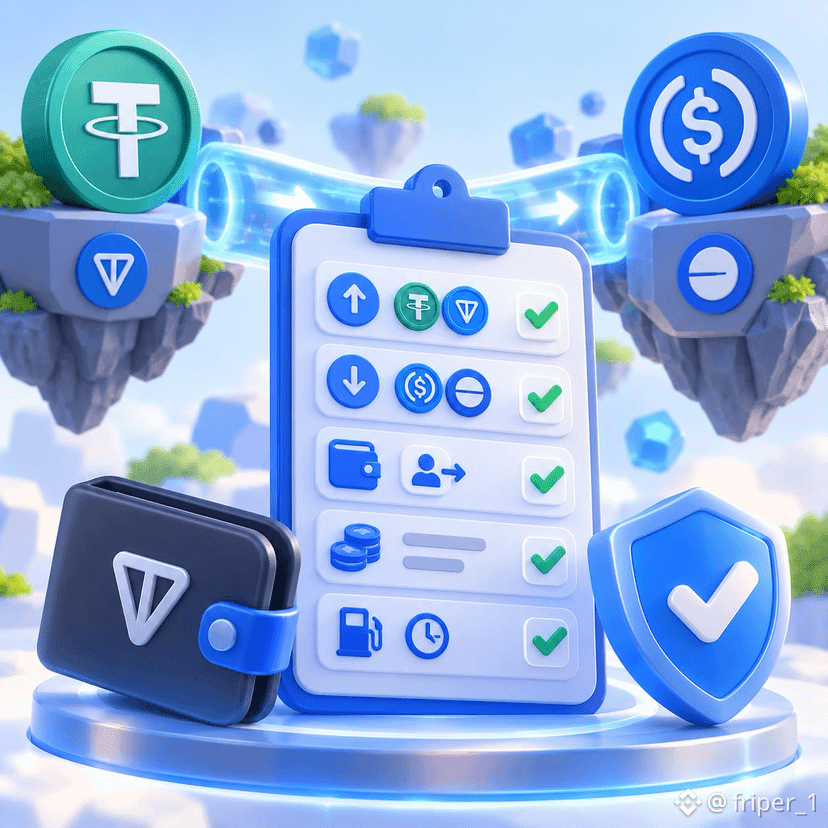
🔍 5 checks to make before a cross-chain swap
Cross-chain swaps are convenient. But this is the kind of transaction where one incorrect field can turn into a big problem.
Here’s the checklist I’d go through every time before tapping “Confirm” 👇
1️⃣ The network and token you’re sending
“USDT” isn’t just one asset. USDT on TRON, Ethereum, and TON are different things. Make sure the source is the one you actually have.
2️⃣ The network and token you’re receiving
Same thing on the other side. Need USDC on Base? Then it should say “USDC on Base,” not just “USDC.”
3️⃣ Recipient address
Check it character by character, or at least check the beginning and end. The right swap sent to someone else’s address is still a lost swap.
4️⃣ Final amount
Don’t focus on the flashy fee number—check the amount in the quote that will actually arrive in your wallet.
5️⃣ Gas and time
Make sure you have enough funds in your wallet to cover the sending network’s fee. A cross-chain swap involves two networks, so it may take longer than usual ⏳
🔄 And one last thing: quotes change.
👉 Sending USDT from TON to Base? Here’s a step-by-step guide:
https://ston.fi/how-to-send-usdt-from-ton-to-base
⚠️ This is a checklist, not a guarantee. Always check the current interface.
#CrossChain #DeFi #TON #STONfi #Crypto
🔍 5 checks to make before a cross-chain swap
Cross-chain swaps are convenient. But this is the kind of transaction where one incorrect field can turn into a big problem.
Here’s the checklist I’d go through every time before tapping “Confirm” 👇
1️⃣ The network and token you’re sending
“USDT” isn’t just one asset. USDT on TRON, Ethereum, and TON are different things. Make sure the source is the one you actually have.
2️⃣ The network and token you’re receiving
Same thing on the other side. Need USDC on Base? Then it should say “USDC on Base,” not just “USDC.”
3️⃣ Recipient address
Check it character by character, or at least check the beginning and end. The right swap sent to someone else’s address is still a lost swap.
4️⃣ Final amount
Don’t focus on the flashy fee number—check the amount in the quote that will actually arrive in your wallet.
5️⃣ Gas and time
Make sure you have enough funds in your wallet to cover the sending network’s fee. A cross-chain swap involves two networks, so it may take longer than usual ⏳
🔄 And one last thing: quotes change.
👉 Sending USDT from TON to Base? Here’s a step-by-step guide:
https://ston.fi/how-to-send-usdt-from-ton-to-base
⚠️ This is a checklist, not a guarantee. Always check the current interface.
#CrossChain #DeFi #TON #STONfi #Crypto
Cross-chain swaps are convenient. But this is the kind of transaction where one incorrect field can turn into a big problem.
Here’s the checklist I’d go through every time before tapping “Confirm” 👇
1️⃣ The network and token you’re sending
“USDT” isn’t just one asset. USDT on TRON, Ethereum, and TON are different things. Make sure the source is the one you actually have.
2️⃣ The network and token you’re receiving
Same thing on the other side. Need USDC on Base? Then it should say “USDC on Base,” not just “USDC.”
3️⃣ Recipient address
Check it character by character, or at least check the beginning and end. The right swap sent to someone else’s address is still a lost swap.
4️⃣ Final amount
Don’t focus on the flashy fee number—check the amount in the quote that will actually arrive in your wallet.
5️⃣ Gas and time
Make sure you have enough funds in your wallet to cover the sending network’s fee. A cross-chain swap involves two networks, so it may take longer than usual ⏳
🔄 And one last thing: quotes change.
👉 Sending USDT from TON to Base? Here’s a step-by-step guide:
https://ston.fi/how-to-send-usdt-from-ton-to-base
⚠️ This is a checklist, not a guarantee. Always check the current interface.
#CrossChain #DeFi #TON #STONfi #Crypto
51

·
--
Cross-Chain Bridges: Crypto's Most Critical — and Underappreciated — Infrastructure
Bridges do not get much attention in bull markets. Everyone is chasing returns, not thinking about the plumbing. But bridges are where the real risk lives — and where the real opportunity sits.
Over 2.5 billion dollars has been lost to bridge exploits since 2020. Ronin, Wormhole, Nomad. The pattern is consistent: bridges hold massive TVL in smart contracts that must be flawless, yet they sit at the intersection of two different security models. An attacker only need to find one gap.
But every multi-chain ecosystem depends on bridge quality. $ETH rollups need canonical bridges. $SOL DeFi users regularly bridge stablecoins across lanes. The demand is structural and growing.
The shift to trust-minimized bridges is the key development to watch. Light-client-based bridges verify consensus directly rather than relying on multisig federations. ZK-based bridges can cryptographically prove state transitions cross-chain with no trusted intermediary. This is the direction the industry must go — and the protocols that get there first will own critical financial infrastructure.
$BTC is watching from the sidelines — but Bitcoin DeFi via BitVM-style bridges could change the game entirely.
The bridge wars are far from over. The winners will be invisible infrastructure powering trillions.
#CrossChain #DeFi #BridgeSecurity #CryptoInfrastructure #Web3
Cross-Chain Bridges: Crypto's Most Critical — and Underappreciated — Infrastructure
Bridges do not get much attention in bull markets. Everyone is chasing returns, not thinking about the plumbing. But bridges are where the real risk lives — and where the real opportunity sits.
Over 2.5 billion dollars has been lost to bridge exploits since 2020. Ronin, Wormhole, Nomad. The pattern is consistent: bridges hold massive TVL in smart contracts that must be flawless, yet they sit at the intersection of two different security models. An attacker only need to find one gap.
But every multi-chain ecosystem depends on bridge quality. $ETH rollups need canonical bridges. $SOL DeFi users regularly bridge stablecoins across lanes. The demand is structural and growing.
The shift to trust-minimized bridges is the key development to watch. Light-client-based bridges verify consensus directly rather than relying on multisig federations. ZK-based bridges can cryptographically prove state transitions cross-chain with no trusted intermediary. This is the direction the industry must go — and the protocols that get there first will own critical financial infrastructure.
$BTC is watching from the sidelines — but Bitcoin DeFi via BitVM-style bridges could change the game entirely.
The bridge wars are far from over. The winners will be invisible infrastructure powering trillions.
#CrossChain #DeFi #BridgeSecurity #CryptoInfrastructure #Web3
Bridges do not get much attention in bull markets. Everyone is chasing returns, not thinking about the plumbing. But bridges are where the real risk lives — and where the real opportunity sits.
Over 2.5 billion dollars has been lost to bridge exploits since 2020. Ronin, Wormhole, Nomad. The pattern is consistent: bridges hold massive TVL in smart contracts that must be flawless, yet they sit at the intersection of two different security models. An attacker only need to find one gap.
But every multi-chain ecosystem depends on bridge quality. $ETH rollups need canonical bridges. $SOL DeFi users regularly bridge stablecoins across lanes. The demand is structural and growing.
The shift to trust-minimized bridges is the key development to watch. Light-client-based bridges verify consensus directly rather than relying on multisig federations. ZK-based bridges can cryptographically prove state transitions cross-chain with no trusted intermediary. This is the direction the industry must go — and the protocols that get there first will own critical financial infrastructure.
$BTC is watching from the sidelines — but Bitcoin DeFi via BitVM-style bridges could change the game entirely.
The bridge wars are far from over. The winners will be invisible infrastructure powering trillions.
#CrossChain #DeFi #BridgeSecurity #CryptoInfrastructure #Web3
22
·
--
Cross-chain interoperability is not a feature — it is the prerequisite for everything that comes next.
Right now, liquidity, users, and applications are fragmented across dozens of chains. $ETH handles settlement and DeFi complexity. $SOL owns high-frequency, low-latency activity. $BNB anchors exchange-native flows. None of these chains can win alone — and none of them need to.
The real opportunity sits at the protocol layer that connects them.
But not all interoperability is equal. The bridge hacks of 2021–2023 taught the market a brutal lesson: optimistic bridges with long fraud windows are capital inefficiencies waiting to be exploited. The shift is now toward message-passing layers secured by economic stake or zero-knowledge proofs — where the cost of corrupting the attestation exceeds what any attacker could extract.
Watch for three things:
1. Which interoperability protocols are capturing fee revenue, not just volume?
2. Which chains are the destination of cross-chain flows — not the source?
3. Which dApps are chain-agnostic by design, deploying wherever users are cheapest to serve?
Multi-chain is the permanent state of this industry. The infrastructure that routes capital across it safely is underpriced relative to its long-term strategic position.
Build your thesis around the connective tissue, not just the chains it connects.
#CrossChain #Interoperability #DeFi #MultiChain #CryptoInfrastructure
Cross-chain interoperability is not a feature — it is the prerequisite for everything that comes next.
Right now, liquidity, users, and applications are fragmented across dozens of chains. $ETH handles settlement and DeFi complexity. $SOL owns high-frequency, low-latency activity. $BNB anchors exchange-native flows. None of these chains can win alone — and none of them need to.
The real opportunity sits at the protocol layer that connects them.
But not all interoperability is equal. The bridge hacks of 2021–2023 taught the market a brutal lesson: optimistic bridges with long fraud windows are capital inefficiencies waiting to be exploited. The shift is now toward message-passing layers secured by economic stake or zero-knowledge proofs — where the cost of corrupting the attestation exceeds what any attacker could extract.
Watch for three things:
1. Which interoperability protocols are capturing fee revenue, not just volume?
2. Which chains are the destination of cross-chain flows — not the source?
3. Which dApps are chain-agnostic by design, deploying wherever users are cheapest to serve?
Multi-chain is the permanent state of this industry. The infrastructure that routes capital across it safely is underpriced relative to its long-term strategic position.
Build your thesis around the connective tissue, not just the chains it connects.
#CrossChain #Interoperability #DeFi #MultiChain #CryptoInfrastructure
Right now, liquidity, users, and applications are fragmented across dozens of chains. $ETH handles settlement and DeFi complexity. $SOL owns high-frequency, low-latency activity. $BNB anchors exchange-native flows. None of these chains can win alone — and none of them need to.
The real opportunity sits at the protocol layer that connects them.
But not all interoperability is equal. The bridge hacks of 2021–2023 taught the market a brutal lesson: optimistic bridges with long fraud windows are capital inefficiencies waiting to be exploited. The shift is now toward message-passing layers secured by economic stake or zero-knowledge proofs — where the cost of corrupting the attestation exceeds what any attacker could extract.
Watch for three things:
1. Which interoperability protocols are capturing fee revenue, not just volume?
2. Which chains are the destination of cross-chain flows — not the source?
3. Which dApps are chain-agnostic by design, deploying wherever users are cheapest to serve?
Multi-chain is the permanent state of this industry. The infrastructure that routes capital across it safely is underpriced relative to its long-term strategic position.
Build your thesis around the connective tissue, not just the chains it connects.
#CrossChain #Interoperability #DeFi #MultiChain #CryptoInfrastructure
95
·
--
Cross-Chain Network Effects: The Underpriced Growth Engine
Most analysts price blockchains as isolated platforms. That framework misses the compounding value of interoperability.
Network theory tells us that a network with N participants has roughly N-squared potential connections (Metcalfe’s Law). The moment two blockchains become credibly interoperable, their combined addressable liquidity doesn’t add — it multiplies. A smaller DeFi ecosystem on one chain and a larger one on $ETH that can atomically compose don’t just produce a larger combined opportunity. They produce something materially larger, because capital efficiency across both chains improves simultaneously.
This is why the race to own cross-chain infrastructure is strategically underappreciated:
• $DOT’s parachain model — shared security + XCM messaging — bets on sovereign chains staying connected at the protocol layer
• $BNB Chain’s opBNB + ZK bridge roadmap bets on hub-and-spoke with a dominant execution layer at the center
• Native asset bridges (canonical vs third-party) increasingly determine which chains capture sticky liquidity versus which merely borrow it
The key metric to watch isn’t TVL in isolation — it’s capital velocity across chains. Protocols that accelerate cross-chain settlement cycles attract the highest-frequency traders and market makers first. Retailers follow.
Interoperability isn’t a feature. It’s the moat.
#CrossChain #DeFi #Interoperability #Web3 #Crypto
Cross-Chain Network Effects: The Underpriced Growth Engine
Most analysts price blockchains as isolated platforms. That framework misses the compounding value of interoperability.
Network theory tells us that a network with N participants has roughly N-squared potential connections (Metcalfe’s Law). The moment two blockchains become credibly interoperable, their combined addressable liquidity doesn’t add — it multiplies. A smaller DeFi ecosystem on one chain and a larger one on $ETH that can atomically compose don’t just produce a larger combined opportunity. They produce something materially larger, because capital efficiency across both chains improves simultaneously.
This is why the race to own cross-chain infrastructure is strategically underappreciated:
• $DOT ’s parachain model — shared security + XCM messaging — bets on sovereign chains staying connected at the protocol layer
• $BNB Chain’s opBNB + ZK bridge roadmap bets on hub-and-spoke with a dominant execution layer at the center
• Native asset bridges (canonical vs third-party) increasingly determine which chains capture sticky liquidity versus which merely borrow it
The key metric to watch isn’t TVL in isolation — it’s capital velocity across chains. Protocols that accelerate cross-chain settlement cycles attract the highest-frequency traders and market makers first. Retailers follow.
Interoperability isn’t a feature. It’s the moat.
#CrossChain #DeFi #Interoperability #Web3 #Crypto
Most analysts price blockchains as isolated platforms. That framework misses the compounding value of interoperability.
Network theory tells us that a network with N participants has roughly N-squared potential connections (Metcalfe’s Law). The moment two blockchains become credibly interoperable, their combined addressable liquidity doesn’t add — it multiplies. A smaller DeFi ecosystem on one chain and a larger one on $ETH that can atomically compose don’t just produce a larger combined opportunity. They produce something materially larger, because capital efficiency across both chains improves simultaneously.
This is why the race to own cross-chain infrastructure is strategically underappreciated:
• $DOT ’s parachain model — shared security + XCM messaging — bets on sovereign chains staying connected at the protocol layer
• $BNB Chain’s opBNB + ZK bridge roadmap bets on hub-and-spoke with a dominant execution layer at the center
• Native asset bridges (canonical vs third-party) increasingly determine which chains capture sticky liquidity versus which merely borrow it
The key metric to watch isn’t TVL in isolation — it’s capital velocity across chains. Protocols that accelerate cross-chain settlement cycles attract the highest-frequency traders and market makers first. Retailers follow.
Interoperability isn’t a feature. It’s the moat.
#CrossChain #DeFi #Interoperability #Web3 #Crypto
71
·
--
Interoperability Is Crypto's TCP/IP Moment
The internet did not win because one network was best. It won because TCP/IP made all networks speak the same language. Crypto is approaching a similar inflection point.
Right now, value moves in silos. ETH liquidity stays on Ethereum. SOL ecosystem activity stays on Solana. BNB Chain users rarely interact with Polkadot. Each chain is a walled garden — productive inside, but isolated at the edges.
That changes when interoperability protocols mature into reliable, trust-minimized infrastructure. Not bridges that hold custody risk, but generalized message-passing layers that let contracts on one chain read state and trigger execution on another. When that layer settles, the unit of competition shifts from which chain wins to which apps build best on the connected whole.
The implications compound:
— Capital efficiency improves as liquidity becomes accessible across chains without fragmentation penalties
— Developer surface area expands because composability is no longer chain-local
— User experience converges toward intent-based UX where users stop thinking about chains entirely
$DOT parachain shared security and subnet messaging are early test beds for this connected-chain thesis. $ETH rollup bridging and canonical messaging layers are the other major thread.
The chains that win long-term won't just be fast or cheap. They'll be well-connected.
Infrastructure beats narrative. Always.
#CrossChain #Interoperability #Web3Infrastructure #CryptoThesis #BinanceSquare
Interoperability Is Crypto's TCP/IP Moment
The internet did not win because one network was best. It won because TCP/IP made all networks speak the same language. Crypto is approaching a similar inflection point.
Right now, value moves in silos. ETH liquidity stays on Ethereum. SOL ecosystem activity stays on Solana. BNB Chain users rarely interact with Polkadot. Each chain is a walled garden — productive inside, but isolated at the edges.
That changes when interoperability protocols mature into reliable, trust-minimized infrastructure. Not bridges that hold custody risk, but generalized message-passing layers that let contracts on one chain read state and trigger execution on another. When that layer settles, the unit of competition shifts from which chain wins to which apps build best on the connected whole.
The implications compound:
— Capital efficiency improves as liquidity becomes accessible across chains without fragmentation penalties
— Developer surface area expands because composability is no longer chain-local
— User experience converges toward intent-based UX where users stop thinking about chains entirely
$DOT parachain shared security and subnet messaging are early test beds for this connected-chain thesis. $ETH rollup bridging and canonical messaging layers are the other major thread.
The chains that win long-term won't just be fast or cheap. They'll be well-connected.
Infrastructure beats narrative. Always.
#CrossChain #Interoperability #Web3Infrastructure #CryptoThesis #BinanceSquare
The internet did not win because one network was best. It won because TCP/IP made all networks speak the same language. Crypto is approaching a similar inflection point.
Right now, value moves in silos. ETH liquidity stays on Ethereum. SOL ecosystem activity stays on Solana. BNB Chain users rarely interact with Polkadot. Each chain is a walled garden — productive inside, but isolated at the edges.
That changes when interoperability protocols mature into reliable, trust-minimized infrastructure. Not bridges that hold custody risk, but generalized message-passing layers that let contracts on one chain read state and trigger execution on another. When that layer settles, the unit of competition shifts from which chain wins to which apps build best on the connected whole.
The implications compound:
— Capital efficiency improves as liquidity becomes accessible across chains without fragmentation penalties
— Developer surface area expands because composability is no longer chain-local
— User experience converges toward intent-based UX where users stop thinking about chains entirely
$DOT parachain shared security and subnet messaging are early test beds for this connected-chain thesis. $ETH rollup bridging and canonical messaging layers are the other major thread.
The chains that win long-term won't just be fast or cheap. They'll be well-connected.
Infrastructure beats narrative. Always.
#CrossChain #Interoperability #Web3Infrastructure #CryptoThesis #BinanceSquare
56
·
--
Cross-Chain Growth: The Quiet Infrastructure Revolution
While price action grabs headlines, the most significant development in crypto right now is happening beneath the surface — cross-chain interoperability is maturing fast.
A year ago, moving assets between different ecosystems was friction-heavy and risky. Today, bridge protocols are processing billions in monthly volume with dramatically improved security models. This is a structural shift in how liquidity flows across the entire space.
What this means practically:
• DeFi TVL is no longer siloed — capital can chase the best yields across chains seamlessly
• dApp developers are building chain-agnostic from day one instead of retrofitting later
• User experience is converging toward crypto rather than which chain
$AVAX and $DOT have long championed interoperability as their core thesis — and the market is finally catching up to that vision. Meanwhile, $ETH layer-2 ecosystem is creating its own internal fragmentation problem that cross-chain infrastructure will ultimately need to solve.
The chains that win long-term will not just be the ones with the best tech — they will be the ones most composable with everything else.
Interoperability is not a feature anymore. It is the foundation.
#CrossChain #DeFi #Web3 #CryptoInfrastructure #Interoperability
Cross-Chain Growth: The Quiet Infrastructure Revolution
While price action grabs headlines, the most significant development in crypto right now is happening beneath the surface — cross-chain interoperability is maturing fast.
A year ago, moving assets between different ecosystems was friction-heavy and risky. Today, bridge protocols are processing billions in monthly volume with dramatically improved security models. This is a structural shift in how liquidity flows across the entire space.
What this means practically:
• DeFi TVL is no longer siloed — capital can chase the best yields across chains seamlessly
• dApp developers are building chain-agnostic from day one instead of retrofitting later
• User experience is converging toward crypto rather than which chain
$AVAX and $DOT have long championed interoperability as their core thesis — and the market is finally catching up to that vision. Meanwhile, $ETH layer-2 ecosystem is creating its own internal fragmentation problem that cross-chain infrastructure will ultimately need to solve.
The chains that win long-term will not just be the ones with the best tech — they will be the ones most composable with everything else.
Interoperability is not a feature anymore. It is the foundation.
#CrossChain #DeFi #Web3 #CryptoInfrastructure #Interoperability
While price action grabs headlines, the most significant development in crypto right now is happening beneath the surface — cross-chain interoperability is maturing fast.
A year ago, moving assets between different ecosystems was friction-heavy and risky. Today, bridge protocols are processing billions in monthly volume with dramatically improved security models. This is a structural shift in how liquidity flows across the entire space.
What this means practically:
• DeFi TVL is no longer siloed — capital can chase the best yields across chains seamlessly
• dApp developers are building chain-agnostic from day one instead of retrofitting later
• User experience is converging toward crypto rather than which chain
$AVAX and $DOT have long championed interoperability as their core thesis — and the market is finally catching up to that vision. Meanwhile, $ETH layer-2 ecosystem is creating its own internal fragmentation problem that cross-chain infrastructure will ultimately need to solve.
The chains that win long-term will not just be the ones with the best tech — they will be the ones most composable with everything else.
Interoperability is not a feature anymore. It is the foundation.
#CrossChain #DeFi #Web3 #CryptoInfrastructure #Interoperability
116

🚀 $ZRO SKYROCKETS AFTER WHALE INFUSION & CROSS‑CHAIN WIN! 💥
📊 Volume exploded from $73M to $200M, tearing through the weekly resistance like a shark on a scent trail. 🦈 The order flow shows relentless buying pressure, flipping the supply wall into fresh demand. ⚡ LayerZero just landed a marquee partnership with Anchorage, cementing its cross‑chain stablecoin backbone and pulling institutional credibility into the mix. 🌊 That validation could fuel another liquidity surge as smart money re‑allocates.
💬 Are you loading up on $ZRO while the wave of demand rolls in? 👇
⚠️ Not financial advice. Always manage your risk. 🛡️
🏷️ #ZRO #LongSetup #CrossChain #Crypto
🚀 🔥
🚀 $ZRO SKYROCKETS AFTER WHALE INFUSION & CROSS‑CHAIN WIN! 💥
📊 Volume exploded from $73M to $200M, tearing through the weekly resistance like a shark on a scent trail. 🦈 The order flow shows relentless buying pressure, flipping the supply wall into fresh demand. ⚡ LayerZero just landed a marquee partnership with Anchorage, cementing its cross‑chain stablecoin backbone and pulling institutional credibility into the mix. 🌊 That validation could fuel another liquidity surge as smart money re‑allocates.
💬 Are you loading up on $ZRO while the wave of demand rolls in? 👇
⚠️ Not financial advice. Always manage your risk. 🛡️
🏷️ #ZRO #LongSetup #CrossChain #Crypto
🚀 🔥
📊 Volume exploded from $73M to $200M, tearing through the weekly resistance like a shark on a scent trail. 🦈 The order flow shows relentless buying pressure, flipping the supply wall into fresh demand. ⚡ LayerZero just landed a marquee partnership with Anchorage, cementing its cross‑chain stablecoin backbone and pulling institutional credibility into the mix. 🌊 That validation could fuel another liquidity surge as smart money re‑allocates.
💬 Are you loading up on $ZRO while the wave of demand rolls in? 👇
⚠️ Not financial advice. Always manage your risk. 🛡️
🏷️ #ZRO #LongSetup #CrossChain #Crypto
🚀 🔥
9

·
--
Bullish
What Happens When a Cross Chain Swap Fails?
Moving crypto between blockchains raises an important question: what happens to your funds if the swap does not complete?
STON.fi addresses this through Omniston, a cross chain execution protocol that uses linked Hashed Timelock Contracts, also known as HTLCs.
Here is how the process works.
When a cross chain swap begins, the user's source asset can be locked in a smart contract. A resolver locks the corresponding destination asset in another contract. Both contracts are linked through a shared cryptographic condition.
If the required condition is fulfilled within the time limit, the swap can settle on both sides.
If the swap cannot complete and the required secret is not revealed before the timelock expires, the locked assets become refundable to their original owners.
This is the idea behind atomic settlement: the process is designed to prevent one side from completing while the other side remains permanently unsettled.
However, pending does not automatically mean failed, and refunds should not be assumed to happen instantly. Always check your transaction status before taking further action.
Before making a cross chain swap:
1. Confirm the source and destination networks.
2. Check the token, receiving address and expected amount.
3. Review the quoted rate and fees.
4. Keep your transaction hash.
5. Verify the transaction status if processing takes longer than expected.
Want to understand how a cross chain route works in practice?
Read STON.fi's guide to sending USDT from TON to Base:
https://ston.fi/how-to-send-usdt-from-ton-to-base
Understanding how a swap settles is just as important as understanding its price.
#STONfi #DeFi #CrossChain $BNB $BTC $ETH
What Happens When a Cross Chain Swap Fails?
Moving crypto between blockchains raises an important question: what happens to your funds if the swap does not complete?
STON.fi addresses this through Omniston, a cross chain execution protocol that uses linked Hashed Timelock Contracts, also known as HTLCs.
Here is how the process works.
When a cross chain swap begins, the user's source asset can be locked in a smart contract. A resolver locks the corresponding destination asset in another contract. Both contracts are linked through a shared cryptographic condition.
If the required condition is fulfilled within the time limit, the swap can settle on both sides.
If the swap cannot complete and the required secret is not revealed before the timelock expires, the locked assets become refundable to their original owners.
This is the idea behind atomic settlement: the process is designed to prevent one side from completing while the other side remains permanently unsettled.
However, pending does not automatically mean failed, and refunds should not be assumed to happen instantly. Always check your transaction status before taking further action.
Before making a cross chain swap:
1. Confirm the source and destination networks.
2. Check the token, receiving address and expected amount.
3. Review the quoted rate and fees.
4. Keep your transaction hash.
5. Verify the transaction status if processing takes longer than expected.
Want to understand how a cross chain route works in practice?
Read STON.fi's guide to sending USDT from TON to Base:
https://ston.fi/how-to-send-usdt-from-ton-to-base
Understanding how a swap settles is just as important as understanding its price.
#STONfi #DeFi #CrossChain $BNB $BTC $ETH
Moving crypto between blockchains raises an important question: what happens to your funds if the swap does not complete?
STON.fi addresses this through Omniston, a cross chain execution protocol that uses linked Hashed Timelock Contracts, also known as HTLCs.
Here is how the process works.
When a cross chain swap begins, the user's source asset can be locked in a smart contract. A resolver locks the corresponding destination asset in another contract. Both contracts are linked through a shared cryptographic condition.
If the required condition is fulfilled within the time limit, the swap can settle on both sides.
If the swap cannot complete and the required secret is not revealed before the timelock expires, the locked assets become refundable to their original owners.
This is the idea behind atomic settlement: the process is designed to prevent one side from completing while the other side remains permanently unsettled.
However, pending does not automatically mean failed, and refunds should not be assumed to happen instantly. Always check your transaction status before taking further action.
Before making a cross chain swap:
1. Confirm the source and destination networks.
2. Check the token, receiving address and expected amount.
3. Review the quoted rate and fees.
4. Keep your transaction hash.
5. Verify the transaction status if processing takes longer than expected.
Want to understand how a cross chain route works in practice?
Read STON.fi's guide to sending USDT from TON to Base:
https://ston.fi/how-to-send-usdt-from-ton-to-base
Understanding how a swap settles is just as important as understanding its price.
#STONfi #DeFi #CrossChain $BNB $BTC $ETH
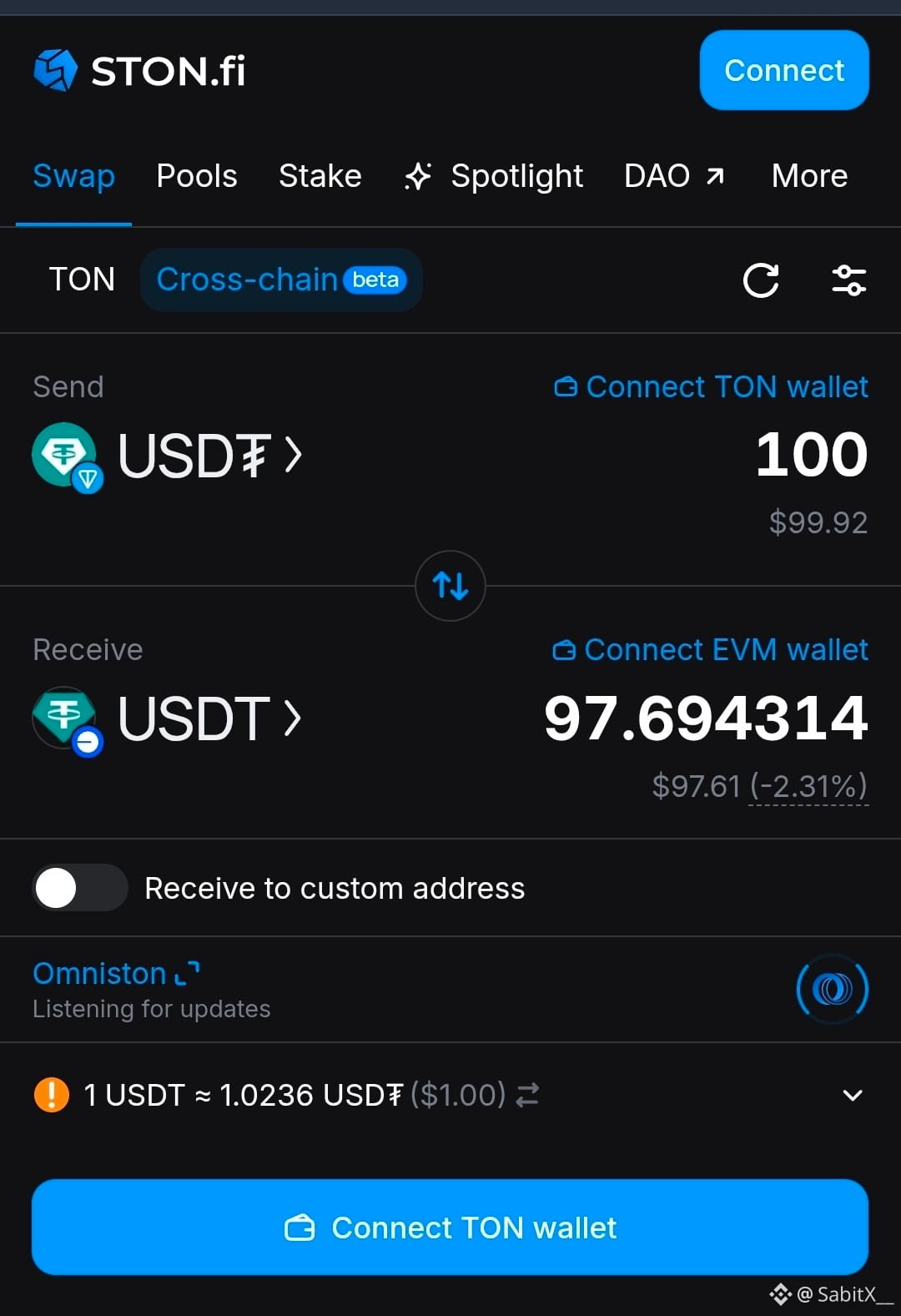
109
·
--
Cross-chain interoperability is graduating from a buzzword to critical infrastructure — and the protocols enabling it are undervalued by most market participants.
For years, blockchains existed as isolated economies. Value locked on one chain could not natively interact with liquidity elsewhere, and bridging meant trusting custodial workarounds that repeatedly failed at the worst moments. The exploits were not a bridge problem — they were an architecture problem.
The shift happening now is architectural. Messaging layers that pass cryptographic proofs rather than wrapped assets are replacing trust assumptions with math. When a protocol can verify state on another chain natively — without an off-chain oracle vouching for it — the security model changes fundamentally.
Why does this matter for capital allocation? Fragmented liquidity artificially suppresses depth across every chain. As interoperability matures, liquidity pooling across chains becomes possible, which directly improves execution quality, reduces slippage, and enables new yield strategies that were structurally impossible before. $DOT was early to this thesis architecturally. The rest of the ecosystem is now converging toward it.
The real value in cross-chain infrastructure does not accrue to one L1 winner. It accrues to whoever owns the messaging layer, the settlement guarantee, and the composability primitive underneath it all. That is the layer worth watching in this cycle.
$ETH $DOT $AVAX
#CrossChain #Interoperability #DeFi #CryptoInfrastructure #Blockchain
Cross-chain interoperability is graduating from a buzzword to critical infrastructure — and the protocols enabling it are undervalued by most market participants.
For years, blockchains existed as isolated economies. Value locked on one chain could not natively interact with liquidity elsewhere, and bridging meant trusting custodial workarounds that repeatedly failed at the worst moments. The exploits were not a bridge problem — they were an architecture problem.
The shift happening now is architectural. Messaging layers that pass cryptographic proofs rather than wrapped assets are replacing trust assumptions with math. When a protocol can verify state on another chain natively — without an off-chain oracle vouching for it — the security model changes fundamentally.
Why does this matter for capital allocation? Fragmented liquidity artificially suppresses depth across every chain. As interoperability matures, liquidity pooling across chains becomes possible, which directly improves execution quality, reduces slippage, and enables new yield strategies that were structurally impossible before. $DOT was early to this thesis architecturally. The rest of the ecosystem is now converging toward it.
The real value in cross-chain infrastructure does not accrue to one L1 winner. It accrues to whoever owns the messaging layer, the settlement guarantee, and the composability primitive underneath it all. That is the layer worth watching in this cycle.
$ETH $DOT $AVAX
#CrossChain #Interoperability #DeFi #CryptoInfrastructure #Blockchain
For years, blockchains existed as isolated economies. Value locked on one chain could not natively interact with liquidity elsewhere, and bridging meant trusting custodial workarounds that repeatedly failed at the worst moments. The exploits were not a bridge problem — they were an architecture problem.
The shift happening now is architectural. Messaging layers that pass cryptographic proofs rather than wrapped assets are replacing trust assumptions with math. When a protocol can verify state on another chain natively — without an off-chain oracle vouching for it — the security model changes fundamentally.
Why does this matter for capital allocation? Fragmented liquidity artificially suppresses depth across every chain. As interoperability matures, liquidity pooling across chains becomes possible, which directly improves execution quality, reduces slippage, and enables new yield strategies that were structurally impossible before. $DOT was early to this thesis architecturally. The rest of the ecosystem is now converging toward it.
The real value in cross-chain infrastructure does not accrue to one L1 winner. It accrues to whoever owns the messaging layer, the settlement guarantee, and the composability primitive underneath it all. That is the layer worth watching in this cycle.
$ETH $DOT $AVAX
#CrossChain #Interoperability #DeFi #CryptoInfrastructure #Blockchain
92

🚨🔥 Internet Computer brings native Solana integration without bridges! Game changer?
$ICP
📰 LATEST NEWS: On October 14, 2026, Internet Computer officially launched its direct Solana integration along with ckSOL, allowing ICP smart contracts to directly read and write to Solana.
💡 WHY IT MATTERS: Token bridges are often targets for hackers. This bridge-less integration allows ICP DeFi protocols to use native SOL securely without trusting middleman wrappers.
📊 FUNDAMENTALS: ICP aims to host entire web applications, social platforms, and enterprise software directly on-chain without traditional cloud providers like AWS.
⚠️ WHAT TO WATCH: Track the total value locked (TVL) in ICP DeFi apps using ckSOL over the coming weeks to see actual user adoption.
👀🔥 MUST WATCH COINS
🔹 $BLUR — Top gainer climbing +25.80% as NFT market trading activity spikes.
🔹 $CRWV — Top loser slipping -18.29% during a wider market retracement.
💬 Would you trust bridge-less token integrations over traditional bridges? Share your thoughts!
#InternetComputer #ICP #Solana #DeFi #CrossChain
{future}(CRWVUSDT)
{future}(BLURUSDT)
{future}(ICPUSDT)
🚨🔥 Internet Computer brings native Solana integration without bridges! Game changer?
$ICP
📰 LATEST NEWS: On October 14, 2026, Internet Computer officially launched its direct Solana integration along with ckSOL, allowing ICP smart contracts to directly read and write to Solana.
💡 WHY IT MATTERS: Token bridges are often targets for hackers. This bridge-less integration allows ICP DeFi protocols to use native SOL securely without trusting middleman wrappers.
📊 FUNDAMENTALS: ICP aims to host entire web applications, social platforms, and enterprise software directly on-chain without traditional cloud providers like AWS.
⚠️ WHAT TO WATCH: Track the total value locked (TVL) in ICP DeFi apps using ckSOL over the coming weeks to see actual user adoption.
👀🔥 MUST WATCH COINS
🔹 $BLUR — Top gainer climbing +25.80% as NFT market trading activity spikes.
🔹 $CRWV — Top loser slipping -18.29% during a wider market retracement.
💬 Would you trust bridge-less token integrations over traditional bridges? Share your thoughts!
#InternetComputer #ICP #Solana #DeFi #CrossChain
$ICP
📰 LATEST NEWS: On October 14, 2026, Internet Computer officially launched its direct Solana integration along with ckSOL, allowing ICP smart contracts to directly read and write to Solana.
💡 WHY IT MATTERS: Token bridges are often targets for hackers. This bridge-less integration allows ICP DeFi protocols to use native SOL securely without trusting middleman wrappers.
📊 FUNDAMENTALS: ICP aims to host entire web applications, social platforms, and enterprise software directly on-chain without traditional cloud providers like AWS.
⚠️ WHAT TO WATCH: Track the total value locked (TVL) in ICP DeFi apps using ckSOL over the coming weeks to see actual user adoption.
👀🔥 MUST WATCH COINS
🔹 $BLUR — Top gainer climbing +25.80% as NFT market trading activity spikes.
🔹 $CRWV — Top loser slipping -18.29% during a wider market retracement.
💬 Would you trust bridge-less token integrations over traditional bridges? Share your thoughts!
#InternetComputer #ICP #Solana #DeFi #CrossChain

43
·
--
Cross-chain interoperability is no longer a moonshot — it is quickly becoming the default infrastructure layer of crypto.
Here is the under-appreciated dynamic: every major L1 is now a hub, not a destination. $AVAX subnets talk to mainnet, $DOT parachains share relay-chain security, and $ETH rollups inherit base-layer settlement. The shift from isolated chains to composable networks is already well underway.
But raw message passing was just version 1. The real evolution in 2025-2026 is cross-chain intent protocols — where users express desired outcomes ("get me 500 USDT on chain B, best route") and solvers compete to fulfill them atomically. No bridge UX friction. No manual approvals across five tabs.
This intent-centric model has three structural consequences:
1. Liquidity fragmentation shrinks — solvers aggregate depth across venues
2. MEV migrates to solver competition, away from validator extractibility
3. Asset gravity shifts toward chains with reliable finality, because solvers price settlement risk into their bids
The chains winning on cross-chain intent flows will accumulate both TVL and fee revenue. Solver network size and cross-chain intent volume are early leading indicators — more signal-rich than bridged TVL alone.
The endgame is not one chain winning. It is one unified execution surface built on top of many.
#CrossChain #DeFi #CryptoInfrastructure #Web3 #Interoperability
Cross-chain interoperability is no longer a moonshot — it is quickly becoming the default infrastructure layer of crypto.
Here is the under-appreciated dynamic: every major L1 is now a hub, not a destination. $AVAX subnets talk to mainnet, $DOT parachains share relay-chain security, and $ETH rollups inherit base-layer settlement. The shift from isolated chains to composable networks is already well underway.
But raw message passing was just version 1. The real evolution in 2025-2026 is cross-chain intent protocols — where users express desired outcomes ("get me 500 USDT on chain B, best route") and solvers compete to fulfill them atomically. No bridge UX friction. No manual approvals across five tabs.
This intent-centric model has three structural consequences:
1. Liquidity fragmentation shrinks — solvers aggregate depth across venues
2. MEV migrates to solver competition, away from validator extractibility
3. Asset gravity shifts toward chains with reliable finality, because solvers price settlement risk into their bids
The chains winning on cross-chain intent flows will accumulate both TVL and fee revenue. Solver network size and cross-chain intent volume are early leading indicators — more signal-rich than bridged TVL alone.
The endgame is not one chain winning. It is one unified execution surface built on top of many.
#CrossChain #DeFi #CryptoInfrastructure #Web3 #Interoperability
Here is the under-appreciated dynamic: every major L1 is now a hub, not a destination. $AVAX subnets talk to mainnet, $DOT parachains share relay-chain security, and $ETH rollups inherit base-layer settlement. The shift from isolated chains to composable networks is already well underway.
But raw message passing was just version 1. The real evolution in 2025-2026 is cross-chain intent protocols — where users express desired outcomes ("get me 500 USDT on chain B, best route") and solvers compete to fulfill them atomically. No bridge UX friction. No manual approvals across five tabs.
This intent-centric model has three structural consequences:
1. Liquidity fragmentation shrinks — solvers aggregate depth across venues
2. MEV migrates to solver competition, away from validator extractibility
3. Asset gravity shifts toward chains with reliable finality, because solvers price settlement risk into their bids
The chains winning on cross-chain intent flows will accumulate both TVL and fee revenue. Solver network size and cross-chain intent volume are early leading indicators — more signal-rich than bridged TVL alone.
The endgame is not one chain winning. It is one unified execution surface built on top of many.
#CrossChain #DeFi #CryptoInfrastructure #Web3 #Interoperability
1
165
·
--
Cross-Chain Volume Is Quietly Signaling the Next Infrastructure Cycle
Most investors track TVL or price action. Fewer track cross-chain message volume — and that might be the bigger signal right now.
Every time a user moves an asset from one chain to another, they pay a fee, generate an on-chain proof, and create demand for the underlying settlement layer. As multi-chain usage normalizes, the aggregate cross-chain message count becomes a proxy for real economic activity — not just speculation.
What to watch:
1. Bridge fee revenue per protocol — sustainable fee generation separates infrastructure from hype.
2. Settlement finality time — the faster and cheaper a chain finalizes cross-chain proofs, the more composable it becomes as a hub.
3. Validator set diversity — chains that attract broad validator participation have stronger credibility as trust anchors.
$AVAX Subnets, $DOT Coretime auctions, and $BNB Chain each represent different architectural bets on who captures cross-chain coordination fees long-term. The highest-throughput EVM-compatible environments with native bridge infrastructure may have a structural advantage.
The winner may not be the chain with the most apps — it may be the chain that becomes the default routing layer for cross-chain economic activity.
That is a fundamentally different value proposition. Infrastructure compounds quietly.
#CrossChain #Interoperability #Crypto #BNBChain #CryptoInvesting
Cross-Chain Volume Is Quietly Signaling the Next Infrastructure Cycle
Most investors track TVL or price action. Fewer track cross-chain message volume — and that might be the bigger signal right now.
Every time a user moves an asset from one chain to another, they pay a fee, generate an on-chain proof, and create demand for the underlying settlement layer. As multi-chain usage normalizes, the aggregate cross-chain message count becomes a proxy for real economic activity — not just speculation.
What to watch:
1. Bridge fee revenue per protocol — sustainable fee generation separates infrastructure from hype.
2. Settlement finality time — the faster and cheaper a chain finalizes cross-chain proofs, the more composable it becomes as a hub.
3. Validator set diversity — chains that attract broad validator participation have stronger credibility as trust anchors.
$AVAX Subnets, $DOT Coretime auctions, and $BNB Chain each represent different architectural bets on who captures cross-chain coordination fees long-term. The highest-throughput EVM-compatible environments with native bridge infrastructure may have a structural advantage.
The winner may not be the chain with the most apps — it may be the chain that becomes the default routing layer for cross-chain economic activity.
That is a fundamentally different value proposition. Infrastructure compounds quietly.
#CrossChain #Interoperability #Crypto #BNBChain #CryptoInvesting
Most investors track TVL or price action. Fewer track cross-chain message volume — and that might be the bigger signal right now.
Every time a user moves an asset from one chain to another, they pay a fee, generate an on-chain proof, and create demand for the underlying settlement layer. As multi-chain usage normalizes, the aggregate cross-chain message count becomes a proxy for real economic activity — not just speculation.
What to watch:
1. Bridge fee revenue per protocol — sustainable fee generation separates infrastructure from hype.
2. Settlement finality time — the faster and cheaper a chain finalizes cross-chain proofs, the more composable it becomes as a hub.
3. Validator set diversity — chains that attract broad validator participation have stronger credibility as trust anchors.
$AVAX Subnets, $DOT Coretime auctions, and $BNB Chain each represent different architectural bets on who captures cross-chain coordination fees long-term. The highest-throughput EVM-compatible environments with native bridge infrastructure may have a structural advantage.
The winner may not be the chain with the most apps — it may be the chain that becomes the default routing layer for cross-chain economic activity.
That is a fundamentally different value proposition. Infrastructure compounds quietly.
#CrossChain #Interoperability #Crypto #BNBChain #CryptoInvesting
158
·
--
Cross-chain fragmentation is one of crypto most overlooked unsolved problems — and the projects building native interoperability will define the next infrastructure cycle.
Right now, the dominant approach is bridges. Lock assets on Chain A, mint wrapped tokens on Chain B. It works, but it is fragile: bridges have lost over $2.5 billion to exploits. Users are trusting centralized relayers, complex multisigs, and audited-but-not-guaranteed code. Every bridge hop adds counterparty risk most users do not even realize they are taking.
The alternative is protocols designed for interoperability at the consensus layer — not bolted on after the fact. $DOT parachains share finality through the Relay Chain, eliminating trust assumptions between parachain assets. $ADA partner chains and IBC integration aim for the same composability-first model. $BNB Chain cross-chain messaging via LayerZero and native BNB bridges are being rebuilt around institutional-grade settlement lanes.
The thesis: in the next infrastructure cycle, capital will price in the security of the interoperability layer — not just throughput or fee efficiency. Chains with consensus-level interoperability will attract stickier TVL and lower bridge-risk discounts.
The money is not in which chain wins. It is in which architecture makes cross-chain trust obsolete.
#CrossChain #Interoperability #Web3Infrastructure #CryptoInsights #DeFi
Cross-chain fragmentation is one of crypto most overlooked unsolved problems — and the projects building native interoperability will define the next infrastructure cycle.
Right now, the dominant approach is bridges. Lock assets on Chain A, mint wrapped tokens on Chain B. It works, but it is fragile: bridges have lost over $2.5 billion to exploits. Users are trusting centralized relayers, complex multisigs, and audited-but-not-guaranteed code. Every bridge hop adds counterparty risk most users do not even realize they are taking.
The alternative is protocols designed for interoperability at the consensus layer — not bolted on after the fact. $DOT parachains share finality through the Relay Chain, eliminating trust assumptions between parachain assets. $ADA partner chains and IBC integration aim for the same composability-first model. $BNB Chain cross-chain messaging via LayerZero and native BNB bridges are being rebuilt around institutional-grade settlement lanes.
The thesis: in the next infrastructure cycle, capital will price in the security of the interoperability layer — not just throughput or fee efficiency. Chains with consensus-level interoperability will attract stickier TVL and lower bridge-risk discounts.
The money is not in which chain wins. It is in which architecture makes cross-chain trust obsolete.
#CrossChain #Interoperability #Web3Infrastructure #CryptoInsights #DeFi
Right now, the dominant approach is bridges. Lock assets on Chain A, mint wrapped tokens on Chain B. It works, but it is fragile: bridges have lost over $2.5 billion to exploits. Users are trusting centralized relayers, complex multisigs, and audited-but-not-guaranteed code. Every bridge hop adds counterparty risk most users do not even realize they are taking.
The alternative is protocols designed for interoperability at the consensus layer — not bolted on after the fact. $DOT parachains share finality through the Relay Chain, eliminating trust assumptions between parachain assets. $ADA partner chains and IBC integration aim for the same composability-first model. $BNB Chain cross-chain messaging via LayerZero and native BNB bridges are being rebuilt around institutional-grade settlement lanes.
The thesis: in the next infrastructure cycle, capital will price in the security of the interoperability layer — not just throughput or fee efficiency. Chains with consensus-level interoperability will attract stickier TVL and lower bridge-risk discounts.
The money is not in which chain wins. It is in which architecture makes cross-chain trust obsolete.
#CrossChain #Interoperability #Web3Infrastructure #CryptoInsights #DeFi
171
Log in to explore more content
Join global crypto users on Binance Square
⚡️ Get latest and useful information about crypto.
💬 Trusted by the world’s largest crypto exchange.
👍 Discover real insights from verified creators.
Email / Phone number
Trending Topics
1
#BinancePick
3.2M views
155,837 Discussing
2
#EarningsSeason
5.4M views
26,159 Discussing
3
#AnthropicTTMRevenueGrewAbout1200%
39,643 views
481 Discussing
4
#AnthropicS1ExpectedToday
32,541 views
376 Discussing
5
#SouthKoreaReportedlyWeighsFourthCryptoTaxDelay
35,058 views
508 Discussing
6
#FranklinTempletonFilesForTwoDividendToBitcoinETFs
46,346 views
578 Discussing
7
#StrategyMSTRSurpassesNasdaqInMarketCap
35,739 views
404 Discussing
8
#CanadaProposesStablecoinRedemptionWithin3BusinessDays
1,464 views
37 Discussing
9
#ElectrumWalletBugLetRogueServersStealFunds
34,455 views
485 Discussing
10
#ArgentineCourtDismissesLIBRACaseAgainstMilei
51,249 views
610 Discussing