
#staking
staking
2.1M views
7,948 Discussing
Hot
Latest

Picture this: ETH keeps quietly disappearing from the liquid market while most traders are still staring at the next candle.
The pain is familiar. People chase $ETH after a breakout, panic on a pullback, and miss the bigger supply story happening underneath the chart.
Here’s the case study: when more ETH moves into staking and cold storage, it becomes harder to sell quickly. That means less immediate sell-side liquidity sitting on exchanges, which can create a more constructive setup if demand holds steady or rises.
We’ve seen versions of this before with $BTC during long accumulation phases: coins move off liquid venues, short-term supply tightens, and price reactions can become sharper when buyers step in. The difference with $ETH is staking adds another layer, because holders are not just storing coins, they are earning yield while reducing active float.
This does not mean price only goes up. It means the market structure changes. For traders comparing $ETH with assets like $SOL , the key question is whether demand can meet a shrinking liquid supply without turning into late FOMO.
What’s your take on ETH’s supply squeeze from here?
#Ethereum #Staking #CryptoMarkets
The pain is familiar. People chase $ETH after a breakout, panic on a pullback, and miss the bigger supply story happening underneath the chart.
Here’s the case study: when more ETH moves into staking and cold storage, it becomes harder to sell quickly. That means less immediate sell-side liquidity sitting on exchanges, which can create a more constructive setup if demand holds steady or rises.
We’ve seen versions of this before with $BTC during long accumulation phases: coins move off liquid venues, short-term supply tightens, and price reactions can become sharper when buyers step in. The difference with $ETH is staking adds another layer, because holders are not just storing coins, they are earning yield while reducing active float.
This does not mean price only goes up. It means the market structure changes. For traders comparing $ETH with assets like $SOL , the key question is whether demand can meet a shrinking liquid supply without turning into late FOMO.
What’s your take on ETH’s supply squeeze from here?
#Ethereum #Staking #CryptoMarkets

If you're still ignoring what happens when $ETH gets locked up in staking and cold storage, stop now.
The real pain in crypto is not just buying the wrong coin. It is chasing candles, getting shaken out, and then watching price move after the liquid supply is already gone. That is how traders end up donating to the market.
More ETH moving into staking and cold storage means less immediate sell-side liquidity, and that matters. It is the same kind of setup people watched in $BTC when supply on exchanges kept thinning, except ETH has its own twist with staking yield and a different holder base. Less float, more conviction, fewer easy exits for sellers.
Compared with $SOL or other high-beta names, ETH looks less like a pure momentum trade and more like a supply squeeze waiting for demand to show up. The market loves to front-run narratives, but it often underprices simple mechanics like locked supply. What’s your take on where this goes next?
#ETH #Crypto #Staking
The real pain in crypto is not just buying the wrong coin. It is chasing candles, getting shaken out, and then watching price move after the liquid supply is already gone. That is how traders end up donating to the market.
More ETH moving into staking and cold storage means less immediate sell-side liquidity, and that matters. It is the same kind of setup people watched in $BTC when supply on exchanges kept thinning, except ETH has its own twist with staking yield and a different holder base. Less float, more conviction, fewer easy exits for sellers.
Compared with $SOL or other high-beta names, ETH looks less like a pure momentum trade and more like a supply squeeze waiting for demand to show up. The market loves to front-run narratives, but it often underprices simple mechanics like locked supply. What’s your take on where this goes next?
#ETH #Crypto #Staking

🚨 Ethereum staking faces a 36-day activation backlog, delaying rewards for new depositors. With a 256 ETH-per-epoch gate, over $350k in daily rewards is effectively locked out. This bottleneck reduces net yield and may deter fresh staking inflows until cleared.
What happens when the queue finally clears?
#Staking
$ETH #TradingSignal #CryptoAnalysis
What happens when the queue finally clears?
#Staking
$ETH #TradingSignal #CryptoAnalysis


🔒 BINANCE $BNB STAKING: EARN REWARDS WITH YOUR CRYPTO! 💰
Staking is gaining attention as crypto users look for ways to potentially earn rewards while supporting blockchain networks.
💎 Stake supported assets
📈 Potential staking rewards
🔄 Different lock-up periods may be available
⚠️ Rewards and terms can vary, and crypto prices can be highly volatile $BTC
Always check the current APR/APY, lock-up period, and risks before staking.
Would you stake your crypto for long-term rewards? 👀$BTC
#Binance #Staking #BTC #BNB #CryptoNews
Staking is gaining attention as crypto users look for ways to potentially earn rewards while supporting blockchain networks.
💎 Stake supported assets
📈 Potential staking rewards
🔄 Different lock-up periods may be available
⚠️ Rewards and terms can vary, and crypto prices can be highly volatile $BTC
Always check the current APR/APY, lock-up period, and risks before staking.
Would you stake your crypto for long-term rewards? 👀$BTC
#Binance #Staking #BTC #BNB #CryptoNews

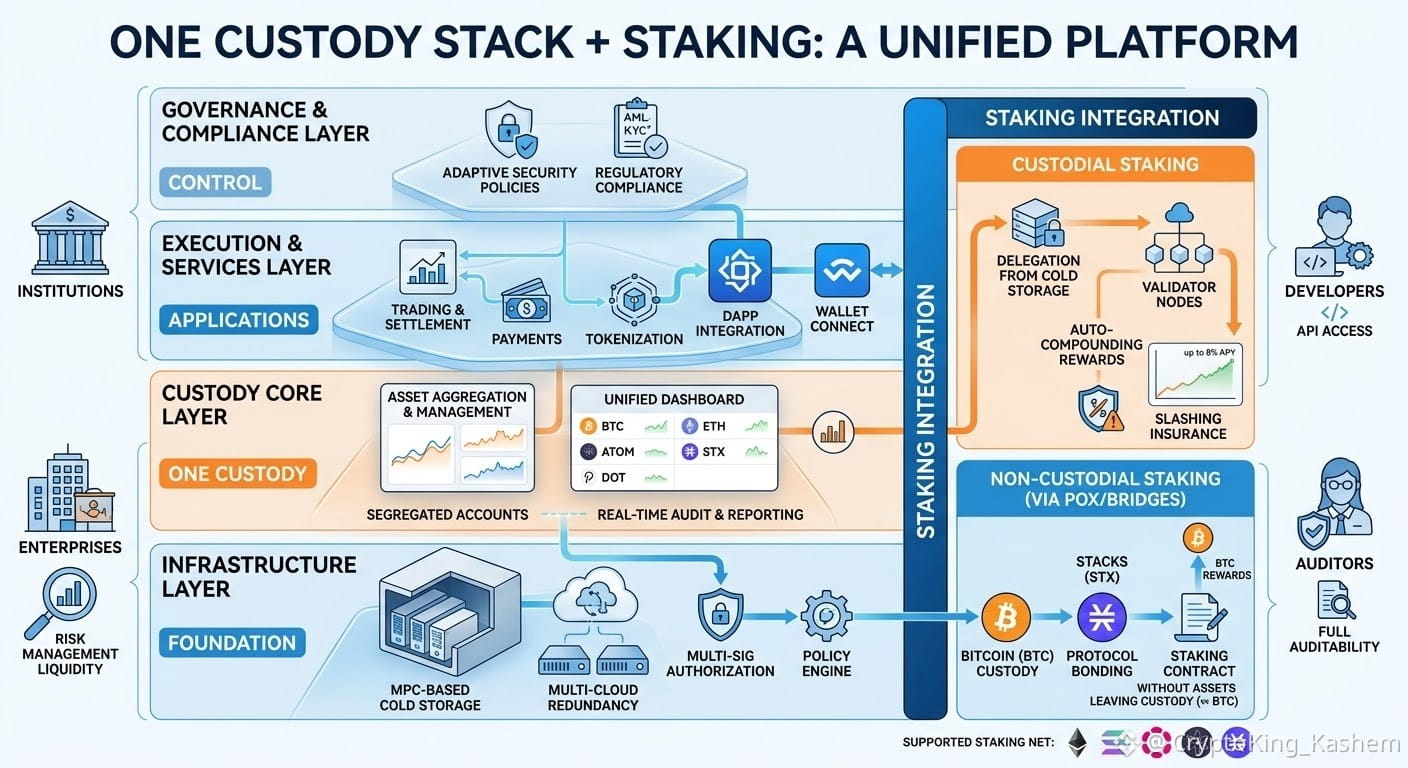
One Custody Stack + Staking? 👀
If a fund already holds a large $BTC or $ETH position with Coinbase Prime, the idea of moving those assets to another staking provider just to earn yield creates an obvious question:
Why add another counterparty and another security layer if you don’t have to?
Coinbase’s institutional staking product keeps staking within the same custody stack, with institutional-grade security, multi-region infrastructure, 24/7 support, and support for 15+ networks including $ETH , SOL, ADA, ATOM, AVAX and more.
What caught my attention is the focus on earning staking rewards without moving custody elsewhere. That could be a meaningful consideration for institutions managing large crypto positions.
Of course, there are still details to check — reward reporting isn’t available for every supported asset, and investors should understand the risks and terms before making any decision.
Personally, I think the bigger question is:
Would you rather keep your $BTC /$ETH in one trusted custody stack while earning yield, or move it to a separate staking provider? 🤔
Drop your opinion below 👇
DYOR. Not financial advice.
#BTC #ETH #Staking #Crypto #BinanceSquare
If a fund already holds a large $BTC or $ETH position with Coinbase Prime, the idea of moving those assets to another staking provider just to earn yield creates an obvious question:
Why add another counterparty and another security layer if you don’t have to?
Coinbase’s institutional staking product keeps staking within the same custody stack, with institutional-grade security, multi-region infrastructure, 24/7 support, and support for 15+ networks including $ETH , SOL, ADA, ATOM, AVAX and more.
What caught my attention is the focus on earning staking rewards without moving custody elsewhere. That could be a meaningful consideration for institutions managing large crypto positions.
Of course, there are still details to check — reward reporting isn’t available for every supported asset, and investors should understand the risks and terms before making any decision.
Personally, I think the bigger question is:
Would you rather keep your $BTC /$ETH in one trusted custody stack while earning yield, or move it to a separate staking provider? 🤔
Drop your opinion below 👇
DYOR. Not financial advice.
#BTC #ETH #Staking #Crypto #BinanceSquare

Staking Basics How It Works and Key Risks to Watch This video was produced with AI assistance it is not financial advice. Always do your own research DYOR . $ETH $SOL #Staking #CryptoEducation #CryptoTips

Why is everyone still treating $ETH treasury accumulation like a sideshow when the numbers are already telling the real story?
Most traders lose money because they chase headlines, buy FOMO candles, and then panic when momentum cools off. They miss the part that actually matters: who is accumulating, who is staking, and how much supply is getting locked away.
This company is now 97% of the way to its 5% ETH goal, and it has already staked around 87% of its holdings. That is not passive balance sheet management. That is a clear signal that the smart play in $ETH is not just holding spot, but putting capital to work while supply tightens.
The actionable takeaway is simple. Watch the accumulation targets, not the noise. Track staking ratios, not just price. And when a treasury keeps buying, keep your entries disciplined instead of chasing every $BTC -led move or every short-term dip in $ETH .
Where do you think this goes from here? #ETH #Crypto #Staking
Most traders lose money because they chase headlines, buy FOMO candles, and then panic when momentum cools off. They miss the part that actually matters: who is accumulating, who is staking, and how much supply is getting locked away.
This company is now 97% of the way to its 5% ETH goal, and it has already staked around 87% of its holdings. That is not passive balance sheet management. That is a clear signal that the smart play in $ETH is not just holding spot, but putting capital to work while supply tightens.
The actionable takeaway is simple. Watch the accumulation targets, not the noise. Track staking ratios, not just price. And when a treasury keeps buying, keep your entries disciplined instead of chasing every $BTC -led move or every short-term dip in $ETH .
Where do you think this goes from here? #ETH #Crypto #Staking

If you're still treating corporate $ETH accumulation like background noise, stop now.
A lot of traders lose money because they only wake up after the headline candle. By then, the easy entry is gone and everyone is suddenly an “early believer.”
This company is now 97% of the way toward its goal of holding 5% of all $ETH . Even more interesting, around 87% of its holdings are already staked, which means this is not just a treasury flex. It is yield strategy, supply squeeze narrative, and long-term conviction rolled into one.
We have seen versions of this movie before with $BTC treasury plays. The difference is ETH can be productive while it sits there, which makes the comparison with passive balance-sheet Bitcoin much more interesting. The question is whether this becomes a new corporate playbook, or just another cycle-specific flex.
Does staked $ETH on corporate balance sheets become the next serious treasury trend, or are markets already pricing the story too aggressively?
#Ethereum #Staking #CryptoInvesting
A lot of traders lose money because they only wake up after the headline candle. By then, the easy entry is gone and everyone is suddenly an “early believer.”
This company is now 97% of the way toward its goal of holding 5% of all $ETH . Even more interesting, around 87% of its holdings are already staked, which means this is not just a treasury flex. It is yield strategy, supply squeeze narrative, and long-term conviction rolled into one.
We have seen versions of this movie before with $BTC treasury plays. The difference is ETH can be productive while it sits there, which makes the comparison with passive balance-sheet Bitcoin much more interesting. The question is whether this becomes a new corporate playbook, or just another cycle-specific flex.
Does staked $ETH on corporate balance sheets become the next serious treasury trend, or are markets already pricing the story too aggressively?
#Ethereum #Staking #CryptoInvesting

Picture this: while retail traders were busy chasing speculative swings, one institutional player quietly executed a massive treasury playbook.
Most investors struggle with sitting on idle capital, constantly agonizing over exact exit timing while inflation chips away at their purchasing power during sideways markets.
The company is now 97% of the way toward its 5% $ETH accumulation goal, but the real narrative lies in what happens next. Instead of letting assets sit dormant in cold storage like traditional $BTC balance sheet reserves, they have already staked roughly 87% of their entire position.
This pivot creates a self-compounding yield flywheel that contrasts sharply with old corporate treasury models. While standard funds depend purely on spot appreciation, locking up vast amounts of $ETH for staking rewards simultaneously dries up liquid market supply and generates steady passive flow.
Do you think institutional yield generation will become the standard playbook over passive holding?
#Ethereum #CryptoTreasury #Staking
Most investors struggle with sitting on idle capital, constantly agonizing over exact exit timing while inflation chips away at their purchasing power during sideways markets.
The company is now 97% of the way toward its 5% $ETH accumulation goal, but the real narrative lies in what happens next. Instead of letting assets sit dormant in cold storage like traditional $BTC balance sheet reserves, they have already staked roughly 87% of their entire position.
This pivot creates a self-compounding yield flywheel that contrasts sharply with old corporate treasury models. While standard funds depend purely on spot appreciation, locking up vast amounts of $ETH for staking rewards simultaneously dries up liquid market supply and generates steady passive flow.
Do you think institutional yield generation will become the standard playbook over passive holding?
#Ethereum #CryptoTreasury #Staking





Crypto for Advisors: Ethereum staking is evolving in 2026 — more liquid staking options, smarter risk controls, and broader validator access are reshaping advisory playbooks. Staking ETH is no longer just about yield—it's a multi‑dimensional tool for liquidity, governance participation, and risk-adjusted returns. #Ethereum #Staking $ETH
🚨 A new Ethereum staking deposit proposal could reshape validator participation by enabling future key formats—though signature replacement still needs separate upgrades. This may lower entry barriers and diversify staking infrastructure over time. Watch for how this impacts long-term ETH supply dynamics and validator decentralization.
What does this mean for the future of ETH staking accessibility?
#Staking
$ETH #TradingSignal #CryptoAnalysis
What does this mean for the future of ETH staking accessibility?
#Staking
$ETH #TradingSignal #CryptoAnalysis

🚨 Ethereum devs propose a deposit contract overhaul to quantum-proof staking, allowing validator keys to grow to 8,192 bytes and retiring BLS signatures permanently. This upgrade aims to secure ETH staking against future quantum threats, signaling long-term network resilience. Smart money may view this as a foundational strength for ETH’s sustainability. Could this quantum-proofing boost ETH’s appeal as a core holding? #Staking
$ETH #TradingSignal #CryptoAnalysis
$ETH #TradingSignal #CryptoAnalysis


Passive income gains strategy
💰 Maximize your crypto earnings with passive income tools
Active trading isn’t the only option to grow your assets on Binance. For those who prefer a calmer approach, decentralized finance and savings tools offer excellent alternatives. ⚙️
🚀 Binance Earn: Lets you lock certain tokens to generate daily interest (Flexible or locked staking).
🌾 Launchpool: Perfect for accumulating new tokens for free by temporarily staking your BNB or FDUSD.
This is a great strategy to accumulate over the long term without the stress of live charts.
#PassiveIncome #BNBLUNCPOOL #BNB #Staking
💰 Maximize your crypto earnings with passive income tools
Active trading isn’t the only option to grow your assets on Binance. For those who prefer a calmer approach, decentralized finance and savings tools offer excellent alternatives. ⚙️
🚀 Binance Earn: Lets you lock certain tokens to generate daily interest (Flexible or locked staking).
🌾 Launchpool: Perfect for accumulating new tokens for free by temporarily staking your BNB or FDUSD.
This is a great strategy to accumulate over the long term without the stress of live charts.
#PassiveIncome #BNBLUNCPOOL #BNB #Staking

🔥 Good News for $GRAM Holders! 🚀
Today, I have some interesting news about $GRAM buy And trade here 👇🏼
According to TON Strategy, it generated around $15 million from staking GRAM in Q2, with an annualized return of approximately 17%. 📈
What’s even more interesting is that the company alone has 229.9 million GRAM staked, representing nearly 35% of all GRAM staked on the network. 🔥
These numbers highlight strong participation and confidence in the GRAM ecosystem.
📊 Tap on $GRAM to check the current price.
What do you think about staking? Are you staking your GRAM or not? 👇
#GRAM #TON #Crypto #staking #BinanceSquare
Today, I have some interesting news about $GRAM buy And trade here 👇🏼
According to TON Strategy, it generated around $15 million from staking GRAM in Q2, with an annualized return of approximately 17%. 📈
What’s even more interesting is that the company alone has 229.9 million GRAM staked, representing nearly 35% of all GRAM staked on the network. 🔥
These numbers highlight strong participation and confidence in the GRAM ecosystem.
📊 Tap on $GRAM to check the current price.
What do you think about staking? Are you staking your GRAM or not? 👇
#GRAM #TON #Crypto #staking #BinanceSquare




🚨 $ETH REFACTORS $104B STAKING ARCHITECTURE FOR QUANTUM IMMUNITY 🛡️
Ethereum researchers have drafted EIP-8394 to refactor the validator deposit contract, paving the way for post-quantum signature schemes. This structural upgrade removes hardcoded BLS key limitations across the entire network protocol. 📊
With over 42 million $ETH currently locked in validator contracts, core developers are actively securing institutional liquidity against prospective quantum attack vectors. 🔍 This proactive architectural shift protects long-term yield infrastructure well ahead of projected timelines.
Smart money prioritizes underlying network durability when establishing multi-year positions. 💡 How essential is post-quantum security to your long-term $ETH accumulation thesis? 👇
⚠️ Not financial advice. Always manage your risk. 🛡️
🏷️ #ETH #Ethereum #Staking #Crypto
🛡️ 👁️
Ethereum researchers have drafted EIP-8394 to refactor the validator deposit contract, paving the way for post-quantum signature schemes. This structural upgrade removes hardcoded BLS key limitations across the entire network protocol. 📊
With over 42 million $ETH currently locked in validator contracts, core developers are actively securing institutional liquidity against prospective quantum attack vectors. 🔍 This proactive architectural shift protects long-term yield infrastructure well ahead of projected timelines.
Smart money prioritizes underlying network durability when establishing multi-year positions. 💡 How essential is post-quantum security to your long-term $ETH accumulation thesis? 👇
⚠️ Not financial advice. Always manage your risk. 🛡️
🏷️ #ETH #Ethereum #Staking #Crypto
🛡️ 👁️


🔒 Staking Explained: How to Earn Crypto Just by Holding It
Ever heard people say "I'm staking my coins" and wondered what that actually means? Let's break it down. 👇
What is staking?
Staking is when you lock up your crypto to help support a blockchain network — and in return, you earn rewards. Think of it like a savings account, but instead of a bank, you're supporting the network itself.
How does it work?
Many blockchains (like Ethereum, Cardano, Solana) run on something called Proof-of-Stake (PoS). Instead of miners solving puzzles (like Bitcoin), validators are chosen to confirm transactions based on how much crypto they've staked. More stake = more chances to validate = more rewards.
The simple version:
1️⃣ You lock up your coins (either on-chain or through an exchange like Binance)
2️⃣ Your coins help secure/validate the network
3️⃣ You earn rewards over time — usually paid in the same coin
Why people stake:
✅ Passive income on coins you were holding anyway
✅ No need for expensive mining equipment
✅ Supports the network's security and decentralization
✅ Often better yields than a traditional savings account
Things to know before staking:
❌ Your funds may be locked for a set period (can't sell instantly)
❌ Rewards vary by coin — do your research on APY
❌ If the coin's price drops, your rewards don't offset that automatically
❌ Some networks have "slashing" risk if validators misbehave (rare for regular stakers, more relevant for node operators)
Bottom line:
Staking = putting your crypto to work instead of letting it sit idle. Not risk-free, but a solid way to earn yield if you're already planning to hold long-term.
Are you staking any coins right now? Which ones? Drop them below 👇
#Binance #staking #CryptoE #educational_post #Pos
Ever heard people say "I'm staking my coins" and wondered what that actually means? Let's break it down. 👇
What is staking?
Staking is when you lock up your crypto to help support a blockchain network — and in return, you earn rewards. Think of it like a savings account, but instead of a bank, you're supporting the network itself.
How does it work?
Many blockchains (like Ethereum, Cardano, Solana) run on something called Proof-of-Stake (PoS). Instead of miners solving puzzles (like Bitcoin), validators are chosen to confirm transactions based on how much crypto they've staked. More stake = more chances to validate = more rewards.
The simple version:
1️⃣ You lock up your coins (either on-chain or through an exchange like Binance)
2️⃣ Your coins help secure/validate the network
3️⃣ You earn rewards over time — usually paid in the same coin
Why people stake:
✅ Passive income on coins you were holding anyway
✅ No need for expensive mining equipment
✅ Supports the network's security and decentralization
✅ Often better yields than a traditional savings account
Things to know before staking:
❌ Your funds may be locked for a set period (can't sell instantly)
❌ Rewards vary by coin — do your research on APY
❌ If the coin's price drops, your rewards don't offset that automatically
❌ Some networks have "slashing" risk if validators misbehave (rare for regular stakers, more relevant for node operators)
Bottom line:
Staking = putting your crypto to work instead of letting it sit idle. Not risk-free, but a solid way to earn yield if you're already planning to hold long-term.
Are you staking any coins right now? Which ones? Drop them below 👇
#Binance #staking #CryptoE #educational_post #Pos
Log in to explore more content