
初晓链Lola
2.8k Posts

初晓链Lola
Report
Block User
关注加密市场和Web3。X: @LolaJiang2 // A self-media author, specializes in the cryptocurrency.

Creator Awards 2024

Creator Award Original Creator

原创之星
Open Trade

BNB Holder
Frequent Trader
5.8 Years
24 Following
22.6K+ Followers
27.0K+ Liked
4 Badges
Posts
Portfolio
All
Quotes
Videos
·
--
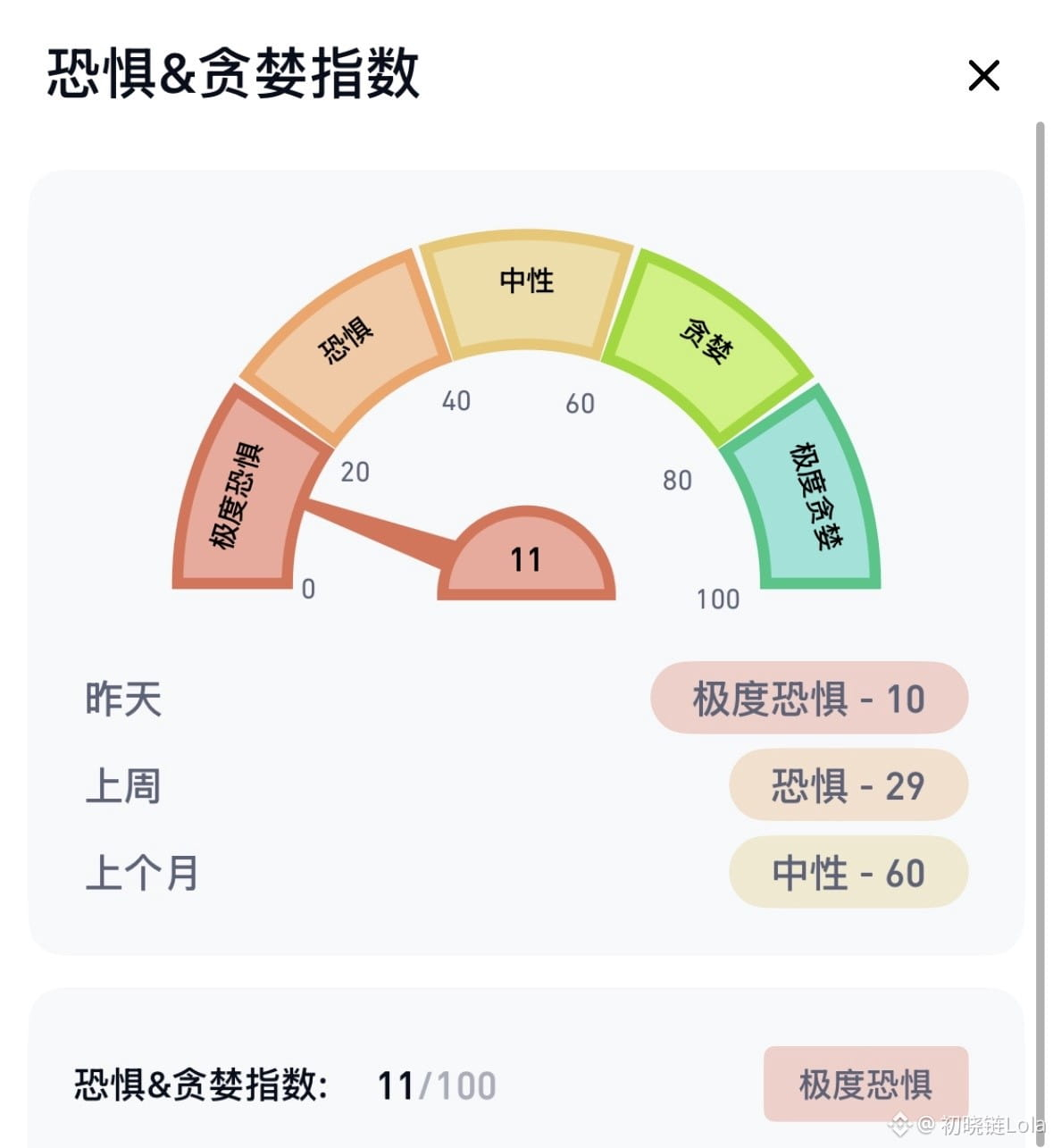
Today, #恐惧贪婪指数 is still at 11.
For 6 of the past 7 days, we’ve been in the extreme fear zone 🙈
The data is already this bad,
and it’s been this way for so many days that people are gradually becoming numb to it.
From the initial panic
to now treating it as normal, it feels a bit like “whatever happens, happens.”
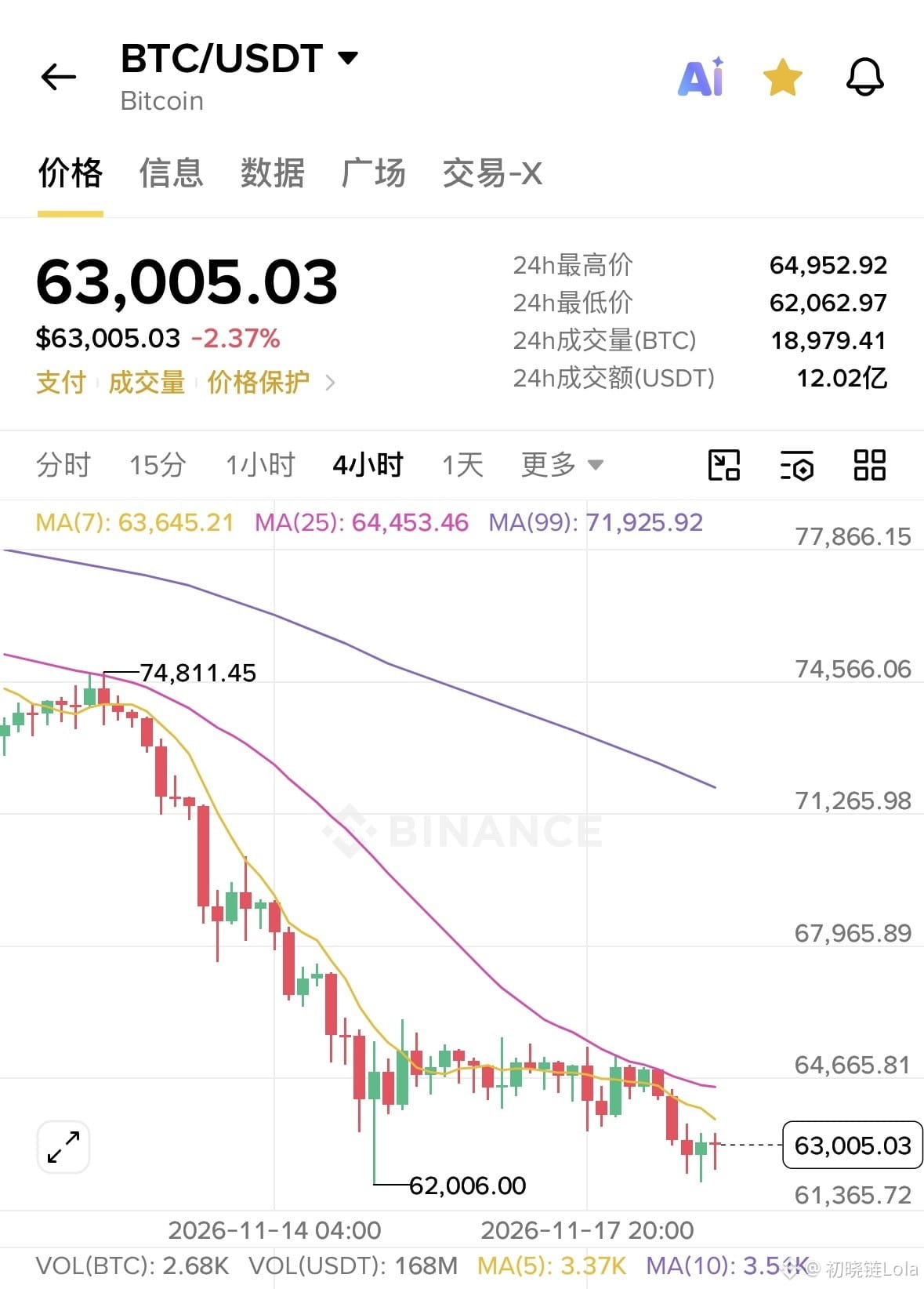
$BTC is still fluctuating around 62k.
It can’t seem to go up, and there’s a risk it could keep falling.
After the market has fallen so much, fear can become part of everyday life.
Some people have cut their losses and left,
some have given up and stopped checking the charts, while others are still waiting for a reversal.
But the market won’t start rising right away just because people are no longer afraid.
The true bottom often takes shape gradually when confidence is at its lowest.
Don’t try to guess when the rebound will come. Manage your position, keep some cash on hand, and be patient.
A bear market doesn’t test who can time the bottom most accurately, but who can hold on long enough.
While waiting for a reversal, make sure you’re still in the game.
#熊市预警
2
3.5k
·
--
Tokenized stocks could become the next major narrative
In the past, when we talked about blockchain,
we were mostly discussing $BTC , $ETH , and various #defi protocols.
Now a new direction is developing rapidly: bringing traditional financial assets onto the blockchain.
Stocks, #etf , bonds, and even more real-world assets are starting to explore tokenization through blockchain.
This is no longer just a concept.
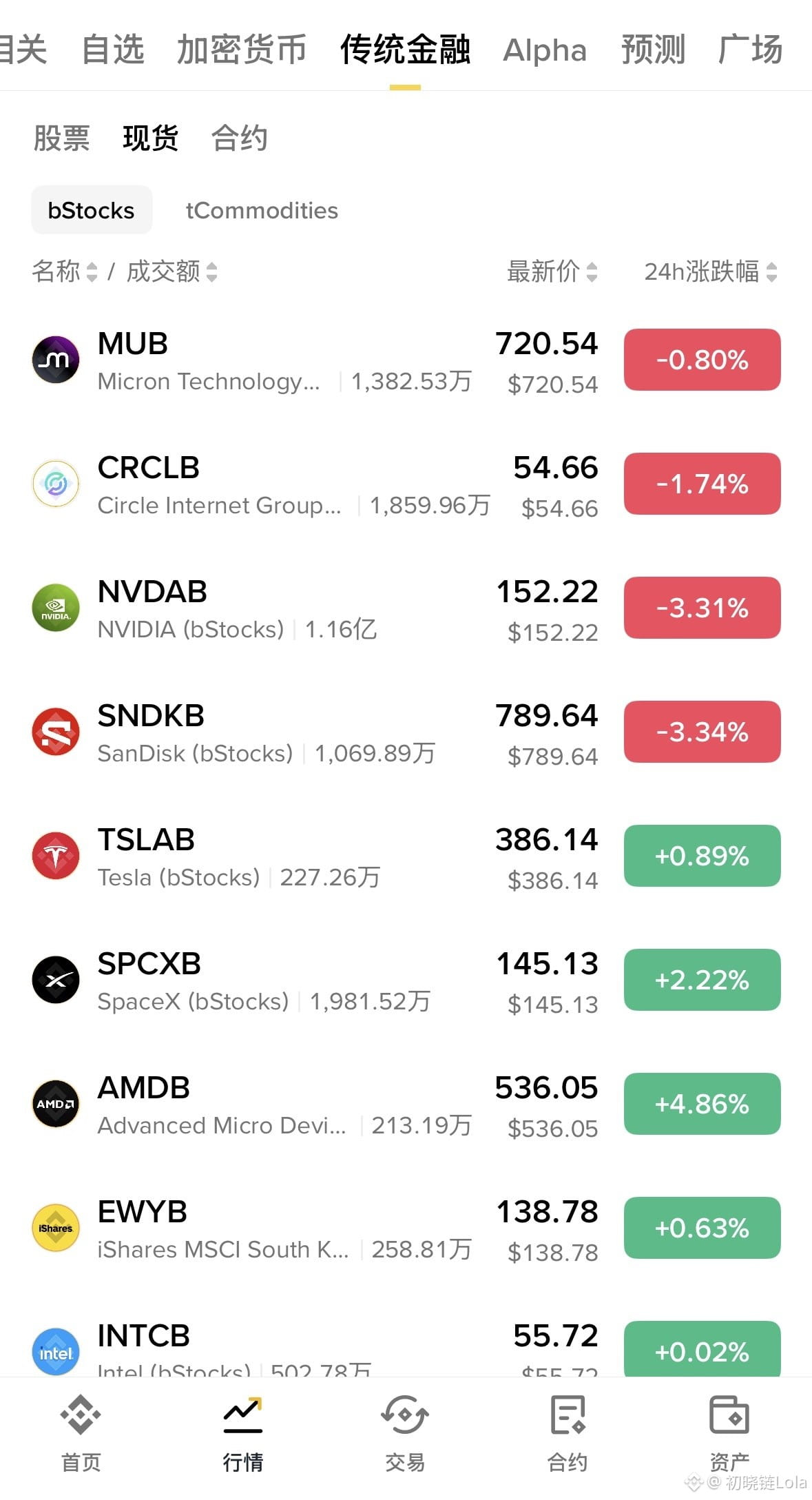
Take a look at Binance’s latest data.
On November 10, 2026, Binance disclosed that assets under management in the global tokenized stock market had reached $4.8 billion, up 164% from June.
Among these, #BStocks , launched by Binance, surpassed $1.5 billion in assets under management just 145 days after launch, making it the world’s largest tokenized stock issuer at present.
Of that,
about 56% of bStocks trading volume takes place outside regular U.S. stock market hours,
emerging and frontier markets account for about 70% of trading volume.
Gen Z makes up 46% of users, indicating that young, crypto-native users are entering traditional stock markets.
This means that
traditional stock markets have trading-hour restrictions, while blockchain can enable more flexible trading and circulation of related assets.
For users around the world, tokenized stocks could lower the barriers to participating in traditional financial markets and create more connections between stock assets and ecosystems such as DeFi and on-chain liquidity.
Tokenization does not mean direct ownership of stocks, nor does it mean that every product comes with shareholder rights such as voting or dividends.
The legal structures, asset custody, and redemption mechanisms also vary between issuers.
In the past, blockchain mainly reshaped the financial system for native digital assets.
In the future, it may connect traditional financial markets as well.
Crypto investors used to speculate on all kinds of altcoins, but memes lack lasting liquidity and also carry the risk of projects disappearing with investors’ money.
By contrast, bStocks are backed by real stocks, with lower risks of exit scams or price manipulation, and a more open and fair environment for participation. Everyone starts on an equal footing, and profits and losses depend on each person’s own ability.
Of course, risk and return always go hand in hand, and every investment market carries risk.

141
·
--
$BTC fell from $126,000 to around $62,000.
Some people think it’s already down by half and see an opportunity.
Others think it’ll keep falling to $50,000 and are waiting.
Both perspectives have their own logic.
When prices are rising, people worry they’ll buy too high.
When prices are falling, they worry they’ll keep falling.
It’s hard for ordinary people to buy right at the bottom.
If you’ve decided to hold for the long term,
making a plan to buy in installments ahead of time may be more important than trying to guess the bottom every day.
I’ve almost finished investing the amount I planned to,
so now I can only wait and see 😂
It could still fall another 10% or 20%, but I’ll have to live with the consequences of my own judgment.
I have no funds left to act, so I can relax and wait.
#定投BTC #熊市预警
1.1k
·
--
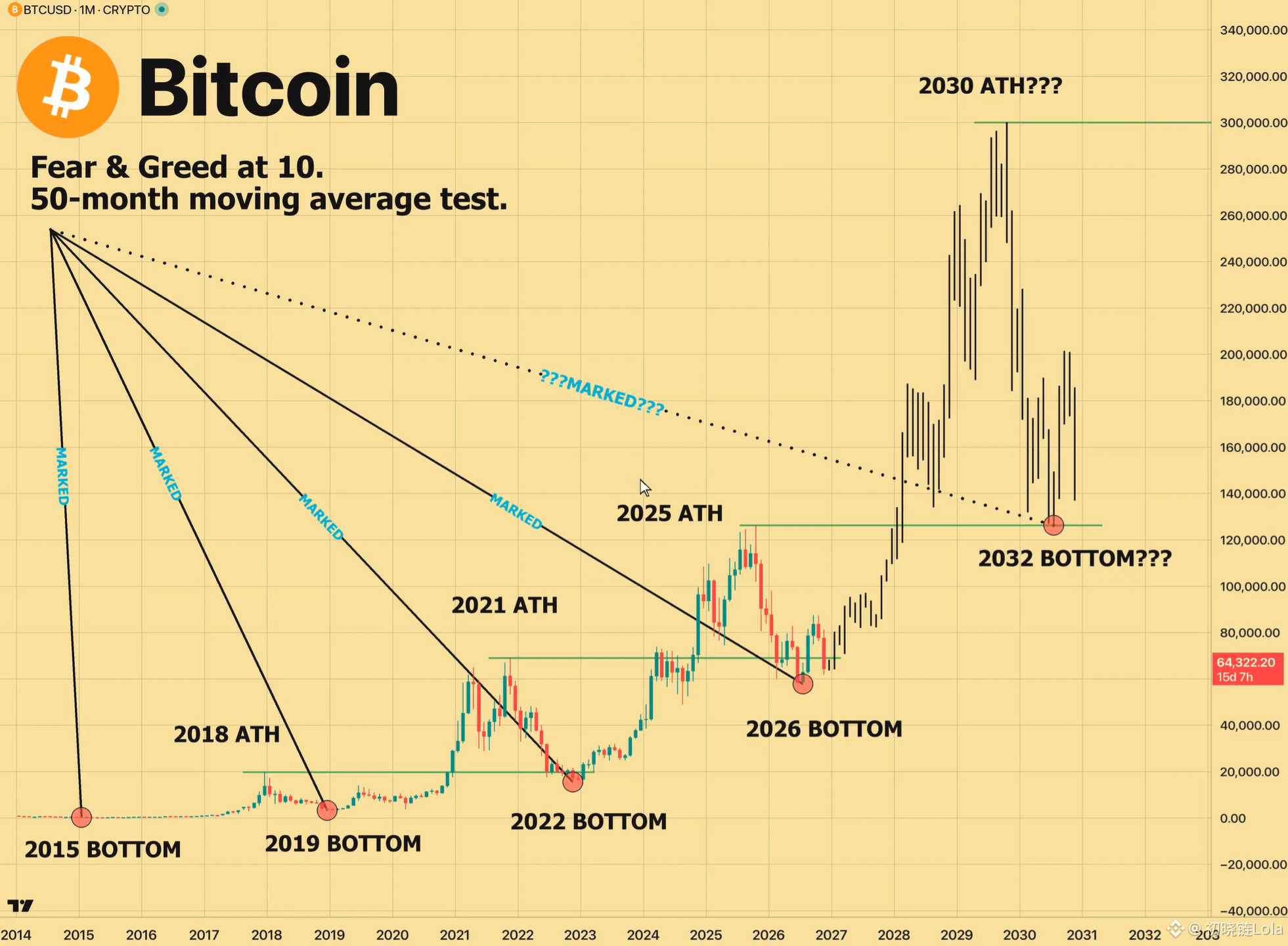
BTC has fallen below $63K again. Is the bear market really here?
$BTC has disappointed the market once again.
Today, BTC fell to $62,100,
more than 50% below its all-time high of $126,000.
The Fear and Greed Index is at 11, still in the extreme fear zone,
which also means investors' risk appetite is very low.
On its way down from the highs, the market has seen ETF outflows, a shift in macro expectations, changes in trading volume, and declining investor confidence.
The hardest thing now isn't predicting whether prices will rise or fall tomorrow, but figuring out how much longer this correction will last.
There's little point in trying to guess where the bottom is.
It's better to first consider how much of a drawdown your funds can withstand.
Some have cut their losses and left because they can't afford to lose more;
some have stopped dollar-cost averaging because they've run out of funds;
others are starting to look for the next opportunity to buy the dip and keep waiting.
What are you doing at this point in time?
#比特币走势分析 #熊市预警
1
1.6k
·
--
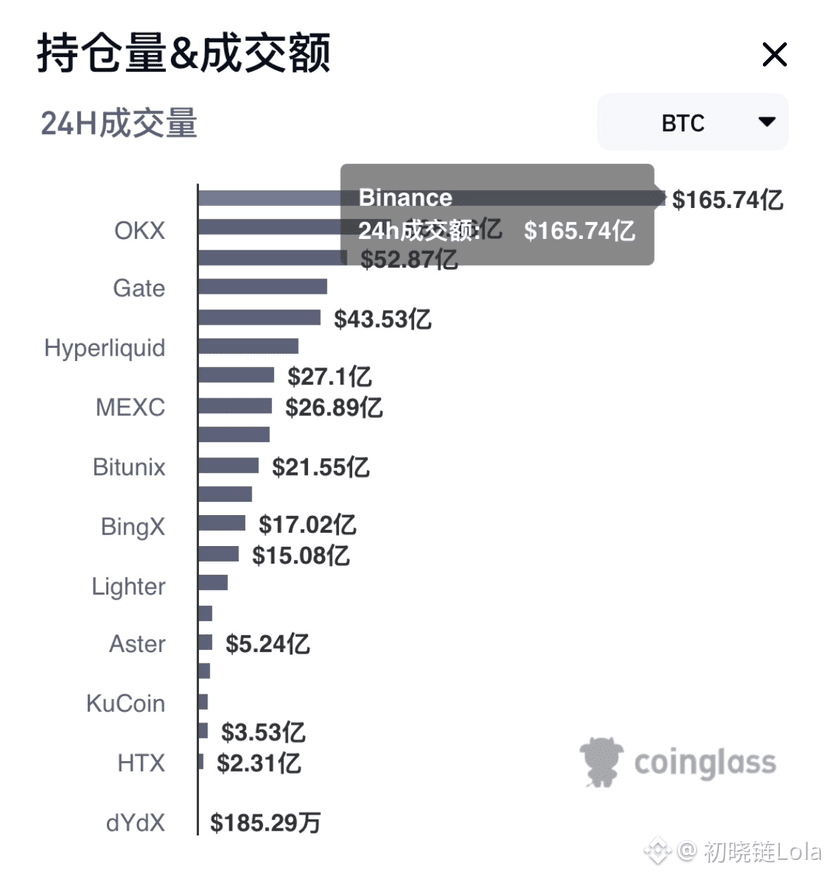
Keep an eye on the trading volume of $BTC over the past few days:
On November 14, total BTC market trading volume was about $43.7 billion;
On November 15, about $43.9 billion;
On November 16, about $41.8 billion.
It has stayed above $40 billion for several consecutive days.
BTC spot trading volume over the past 24 hours is currently about $5.7 billion, while futures trading volume is about $64 billion.
This shows that market activity remains very high, but futures trading volume far exceeds spot volume.
In a bear market, rising volume doesn't necessarily signal a rebound.
It could also reflect panic selling, leveraged liquidations, and capital rotating into different positions.
What’s really worth watching next is whether
BTC can gradually stabilize as trading volume increases.
That matters more than looking at trading volume alone.
Of course, the data is just a reference;
your own trading decisions determine the final outcome.
#币圈生存法则 #熊市预警
291
·
--
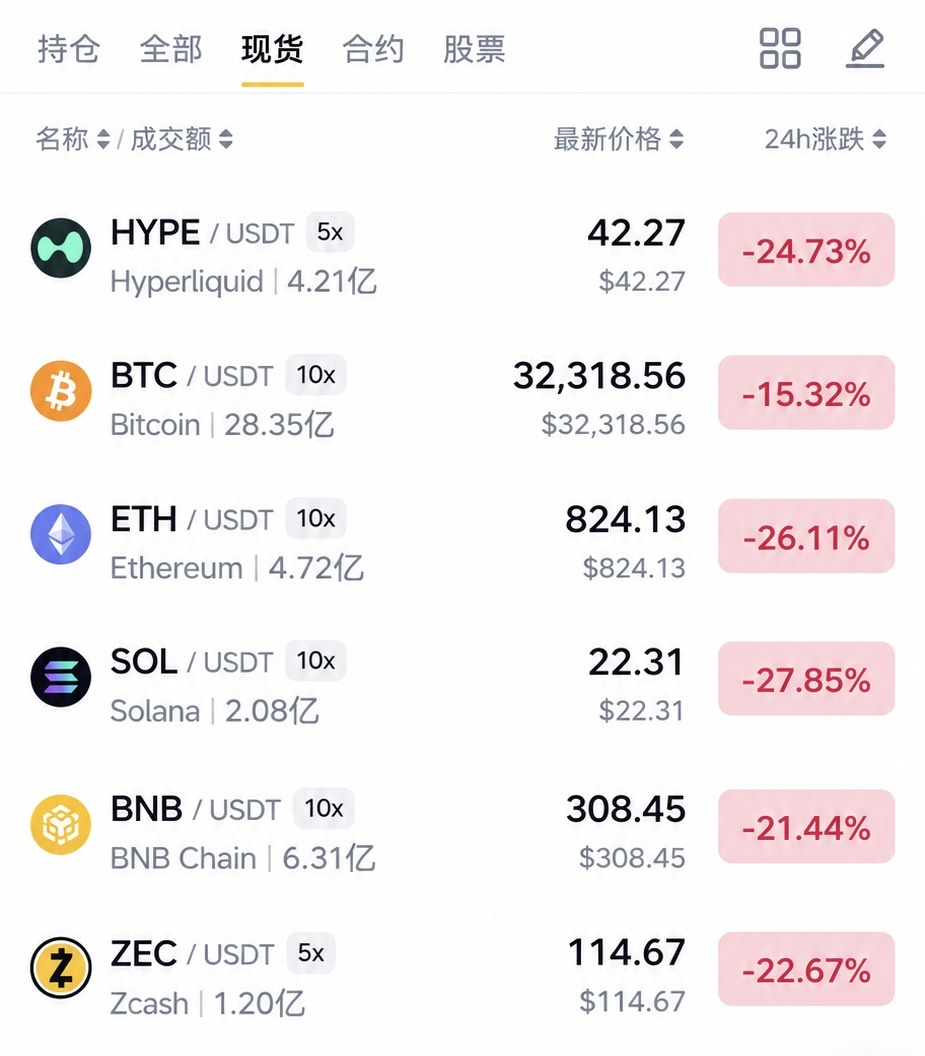
Some people joked that this bear market bottom must have been calculated by a master,
which looks pretty scary 🙈,
if it were $$BTC 32000, $$ETH 800,
how many people would still dare to buy?
I don't believe in predictions, but black swan events can happen in the market.
Participate over the long term using money you can afford to lose.
If it keeps falling another 10%, it would really hurt, and it would take much longer to regain confidence.
#熊市预警 #币圈周期
18
1
10
23.6k
·
--
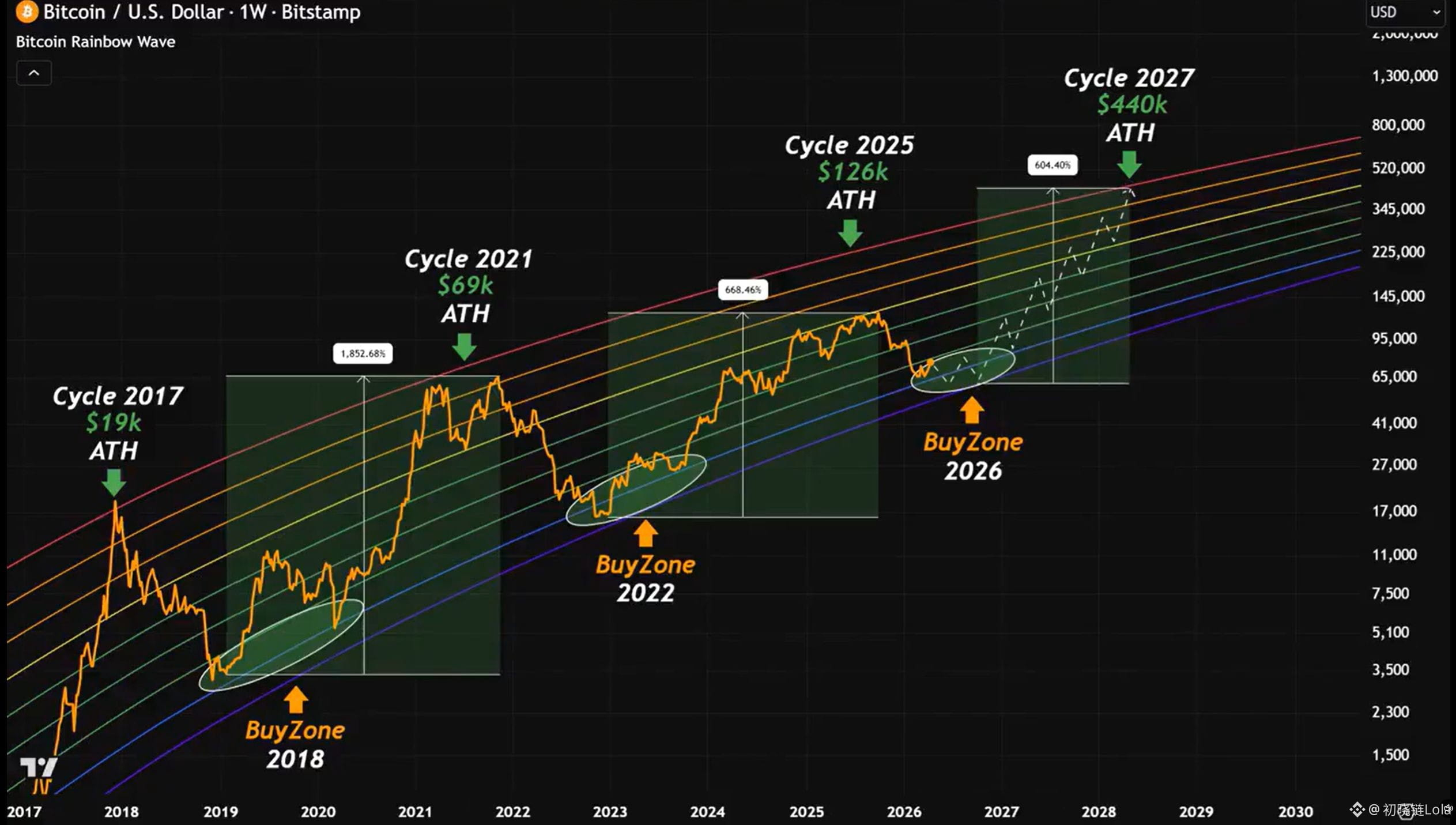
Many people like to study the bottom of every bear market.
In the previous bear market, $BTC fell from $69,000 to around $15,000,
so they think this cycle should see a similar decline.
The high in 2025 was $126,000. If it falls by 78%,
the bottom of this bear market could be $28,000.
That would be terrifying!
A 70% decline would put the price at $37,800,
a 65% decline at $44,100,
a 60% decline at $50,400,
a 55% decline at $56,700—which has happened before,
a 50% decline at $63,000, around the current price range.
History can only serve as a reference. No one can accurately predict the bottom of this cycle.
Those who guess correctly are just lucky; getting it wrong is the norm.
The macro environment, market participants, institutional structure, and liquidity are different in every cycle.
We can refer to the largest historical drawdowns, but we can't treat past prices as precise predictions.
Everyone can only act within the limits of their own understanding,
and our level of understanding today also determines our future returns.
Should we buy BTC in installments or stay on the sidelines,
or use leveraged futures to bet it all on one trade and get the ultimate experience?
Different choices lead to completely different lives.
#定投BTC #熊市预警
26
2
44
64.9k
·
--
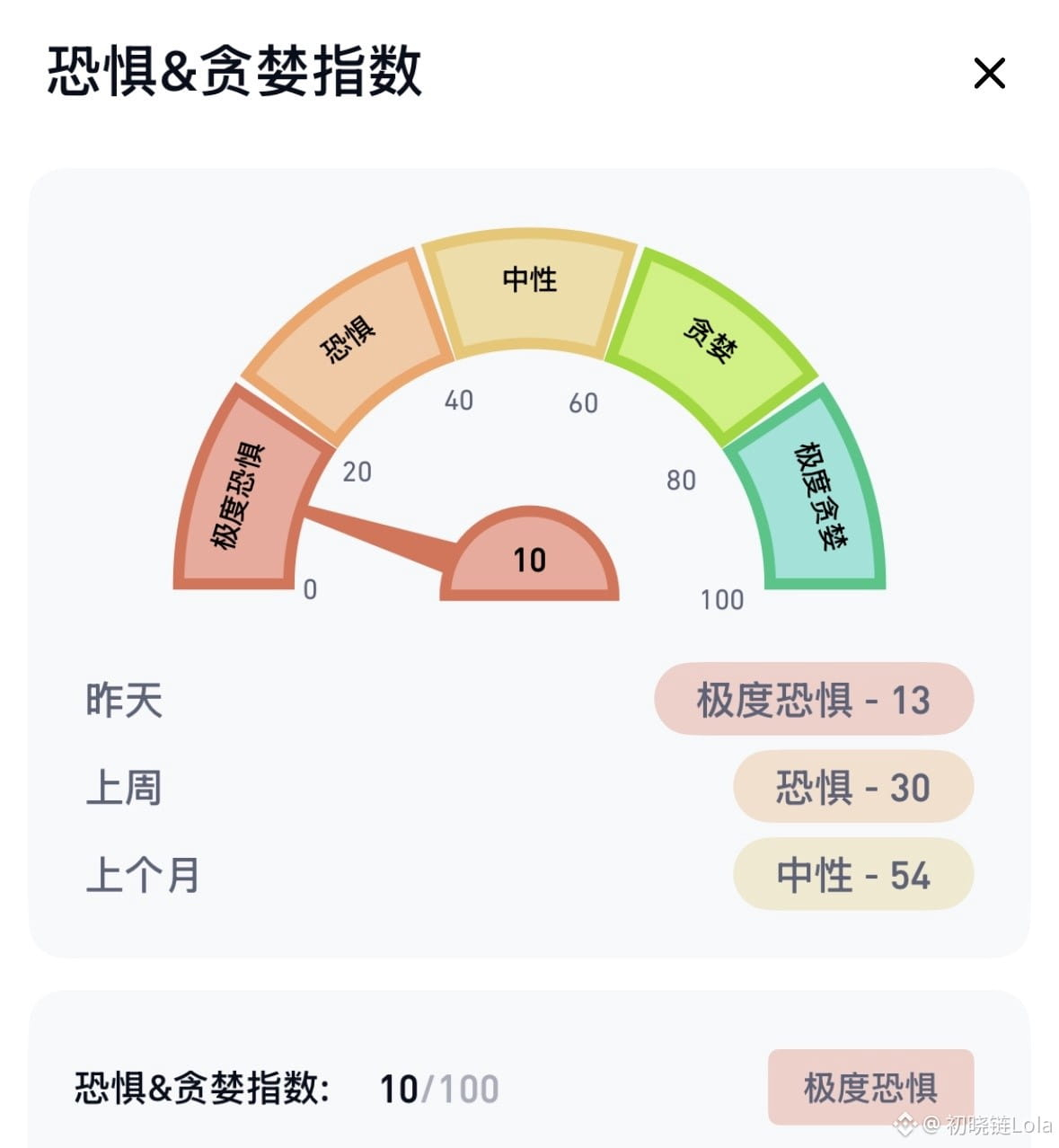
Today, #恐惧贪婪指数 is at 10, still in extreme fear.
Over the past 7 days, there have been 5 days of extreme fear and 2 days in the fear zone.
$BTC has been fluctuating around 64k.
It seems the market has gone quiet, and people aren't buying the dip anymore.
Some people may have been liquidated and lost everything on their futures positions.
Some people bought the dip at higher prices, and are now partially underwater.
In short, the market has returned to a lukewarm state.
Someone in the group asked: What's the biggest risk of buying BTC now?
Before buying, consider these 3 questions. Think them through before proceeding.
After buying, could you handle it if the price fell another 20%?
If the price moves sideways for six months or even a year, would you still have the patience?
If a better price comes along, will you still have funds available?
Buying BTC isn't hard.
The hard part is facing a continued decline after buying
and still sticking to your plan.
You need to consider not only the potential gains if the price rises, but also the cost of a decline.
#定投BTC
2
3
3.3k
·
--
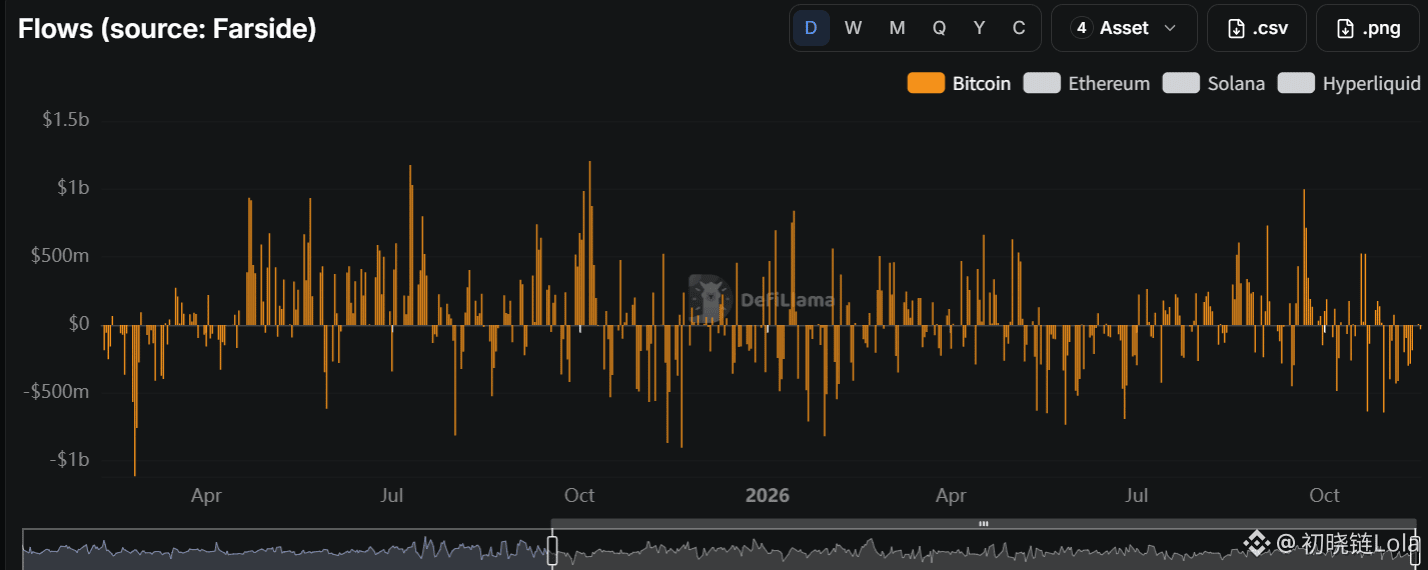
Since November, fund flows for U.S. spot $BTC #etf have been very unfavorable,
with net outflows for 7 consecutive trading days and cumulative outflows of about $2.1 billion in November.
Some institutions are reducing their risk exposure.
On November 16, #IBIT saw a small net inflow of about $7.9 million.
The data for the 17th hasn’t been updated yet.
I wonder if IBIT thinks the bottom is nearly in and a recovery may be coming?
Of course, it’s still too early to conclude that institutions have fully exited or are continuing to build positions.
Keep watching to see whether funds continue to flow in,
after all, one day of inflows doesn’t mean the trend has reversed.
For those already heavily invested in spot, all they can do now is wait for the market to recover.
They’re out of bullets, so there’s nothing they can do now.
Hold on and wait.
BTC+0.20%
IBITETF+1.03%
308
·
--
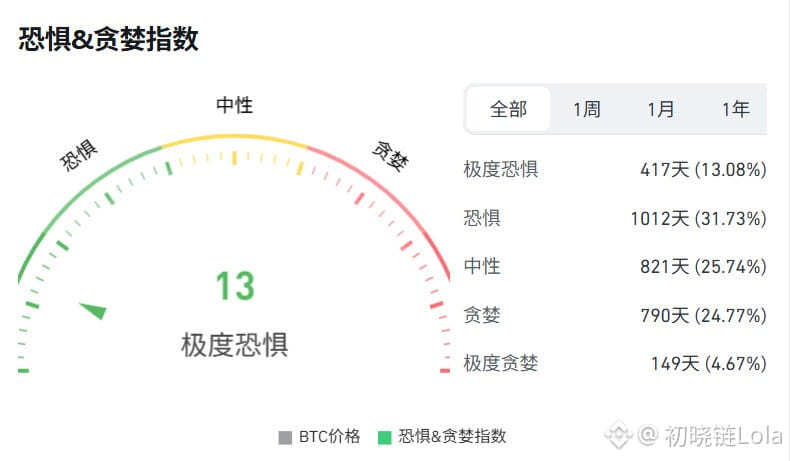
Today, #恐惧贪婪指数 is at 13,
up from yesterday, but the market is still in extreme fear territory.
$BTC is currently fluctuating around $64,500,
and after the sharp drop a few days ago, the market seems to have stabilized somewhat for now.
But a recovery in sentiment doesn't mean the market has reversed course.
Often, it takes time for the market to move from extreme fear toward recovery.
It's impossible to predict the bottom, so it's better to keep an eye on the data:
Can BTC hold its current price range?
Can ETF outflows gradually taper off?
Can spot buying pick back up?
Can market sentiment continue to improve?
After going through 2 bear markets, it feels like the challenges are everywhere.
It's not just a test of judgment, but also of patience and money management.
Don't rush to be optimistic after a one-day rebound, and don't lose all confidence after a single drop.
#币圈
688
·
--
Many people have a habit:
They see $BTC fall, and altcoins fall even more, so they think altcoins have become cheaper.
But a low price doesn't mean a low valuation.
When a token drops from $10 to $1, it looks 90% cheaper.
But if the project's revenue, users, liquidity, and market demand are also steadily declining,
then it may not be worth investing in.
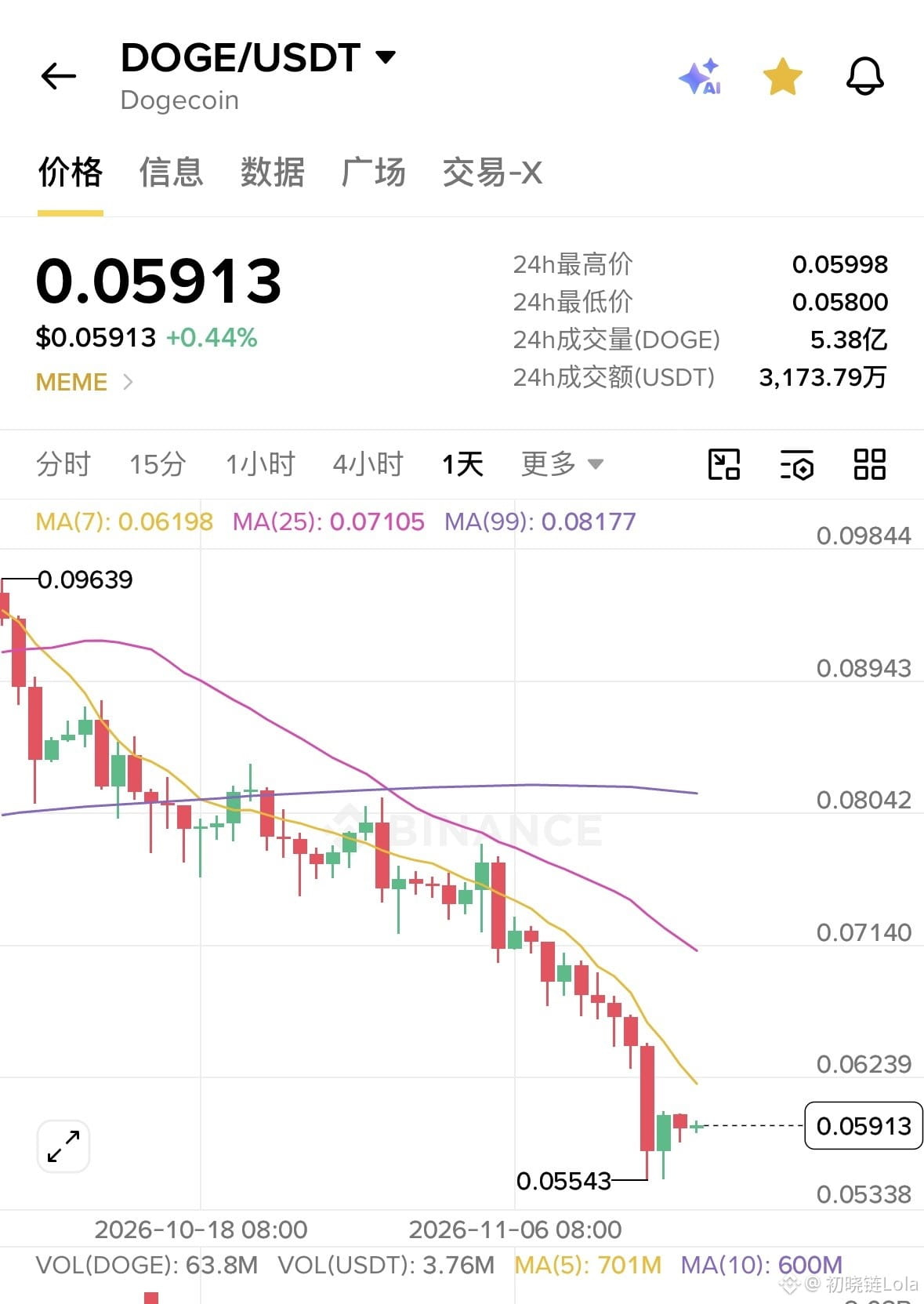
For example, the overall market has fallen significantly recently.
Some people are buying the dip on BTC, others on $DOGE or other altcoins,
thinking that altcoins will have more room to rebound in the future.
But that's not necessarily true—they may never recover.
It's better to accept lower returns than to take on more risk.
Some assets may never return to their former prices.
In a bear market, choosing the right assets is far more important than simply looking for low prices.
#熊市预警 #DOGE
4
6.2k
·
--
These past two days, $BTC has been extremely volatile,
leaving people trading futures contracts on a real roller coaster.
Some got rich overnight, while others were liquidated overnight.
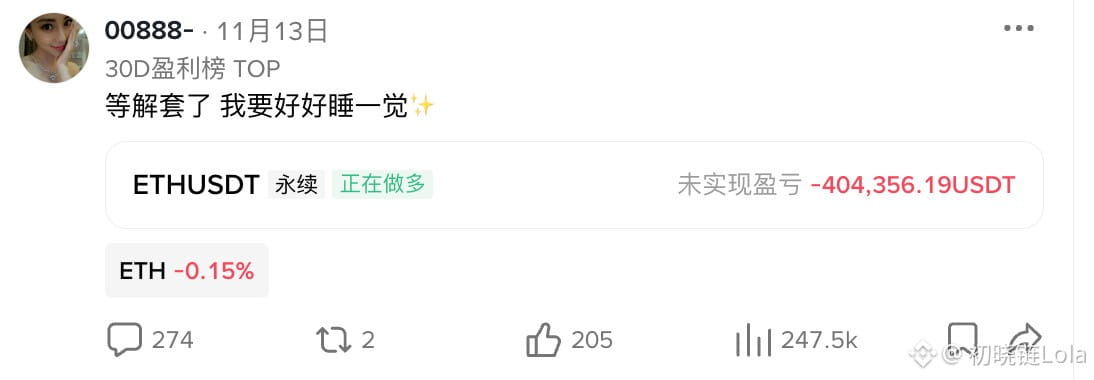
For example, I saw a trader go long on $ETH .
Judging from the screenshot, his unrealized loss has already reached $400,000.
He posted:
“Once I break even, I’m going to get a good night’s sleep.”
But that may just be wishful thinking.
When trading futures, getting the direction wrong means leverage can multiply your losses.
If the market keeps falling, the losses could grow even larger;
if the trend reverses, there may still be a chance to break even or even make a profit;
if he closes his position now, he’ll have to accept a real loss of $400,000.
He’s caught between a rock and a hard place.
Maybe he initially lost just $10,000 and couldn’t bear to admit defeat, thinking he just had to hang on a little longer to make it back.
But the losses grew from $10,000 to $50,000, then $100,000, and he kept holding on until they reached $400,000.
If he could turn back time, would he make the same choice again?
That’s the cruelest thing about futures trading:
when you’re making money, you always think you can read the market;
when you’re losing money, you always think the next candlestick will save you.
A few people really have made money trading futures, but most people only see the screenshots of profits,
not the people who got liquidated, held onto losing positions, and lay awake at night.
With spot trading, you can afford to wait—but futures may not give you that chance.
In any market, staying in the game longer matters more than making money faster.
#比特币连续六周下跌 #合约爆仓
490
·
--
$BTC fell to $64,500, but people who bought the dip with spot ran out of money
Today, #恐惧贪婪指数 is 11, in the extreme fear zone.
BTC has returned to around $64,500.
After several consecutive days of sharp declines, the market is showing signs of finding a floor.
A friend asked if now is a good time to buy the BTC dip.
I'm not sure either. I've been buying over the past few days, too.
When it fell from 69K to 68K, I bought some;
when it fell to 66K, I kept buying;
when it dropped to 65K, I thought it had probably fallen enough,
but little did I know it would go on to 64K, 63K, and even 62K.
The price is even lower now,
but I've run out of funds and have no chance to buy the dip again.
I can only stop buying and wait for the market to rebound.
That's the awkward part of buying the dip: when an opportunity comes, you may not be able to take it.
The crypto market was relatively stable today, with little movement up or down.
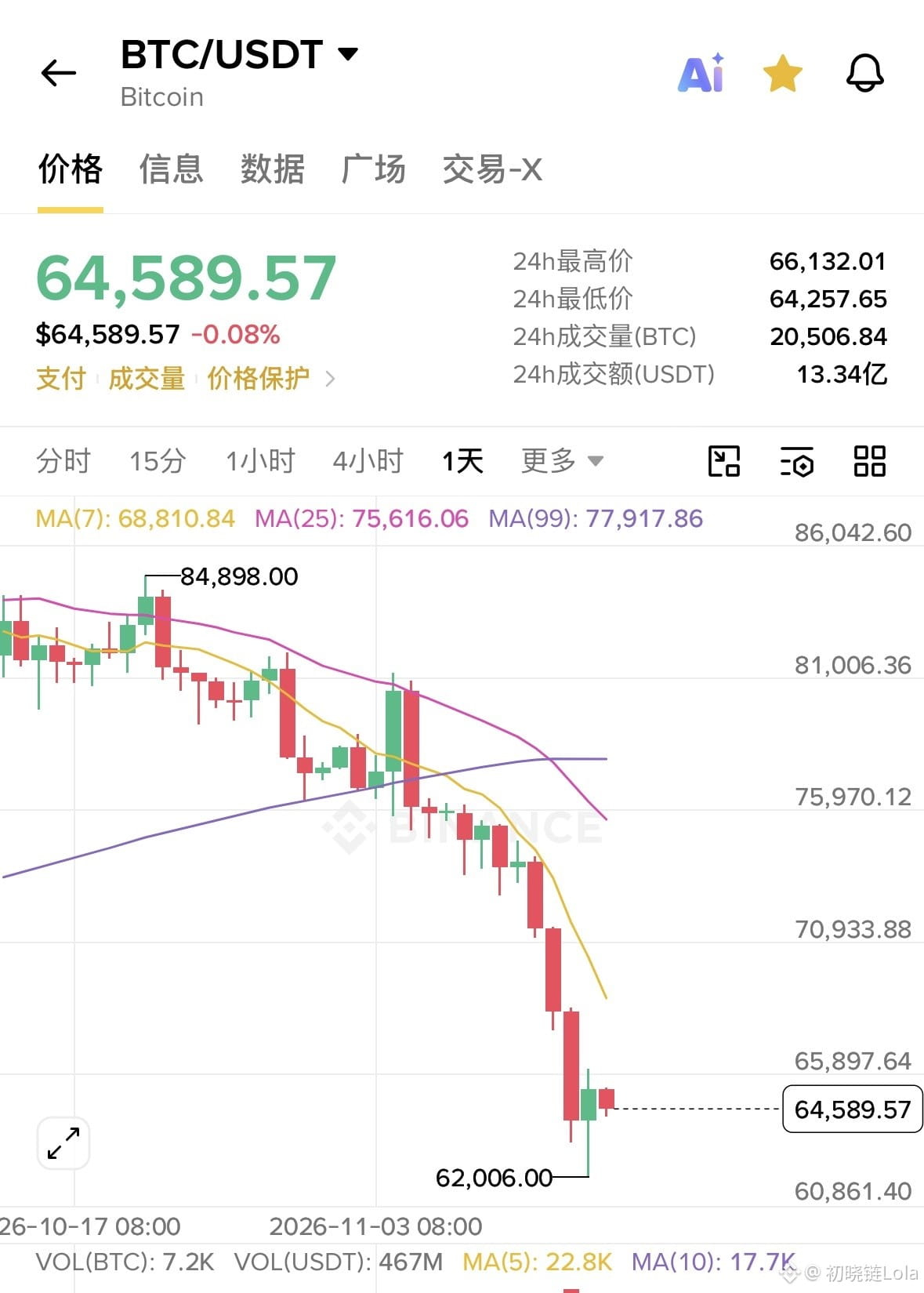
#ahr999囤币指标 is 0.31, a relatively low level.
BTC is currently priced at $64,500.
The cost basis for 200 days of dollar-cost averaging is $72,426.
The current price is 10% below the cost basis of those who have been dollar-cost averaging consistently.
Top influencer @heyi joked in a post that the drawdown is temporary and spot holders have nothing to fear.
Based on the figures she shared,
her assets have fallen by $100 million over the past 30 days.
With a balance of that size, changes in profit and loss are also very noticeable.
Those trading futures have experienced a real roller coaster over the past few days.
Get the direction right, and you could make a lifetime's worth of gains in two days;
get it wrong, and you could lose half a lifetime's savings in just two days.
This is about people holding spot in major coins and playing the long game.
If you've already built the position you planned,
you don't need to chase the rally just because of a short-term rebound.
If you haven't entered the market yet, you can consider building your position in stages instead of fixating on the absolute bottom.
If you still have funds available, try not to use them all at once.
If you're still unsure about the trend, staying on the sidelines is also a strategy.
The market doesn't give us advance warning before it falls,
and it won't tell us ahead of time when it will rebound.
When investing in BTC, you shouldn't only consider the purchase price;
you also need to consider your reserves and risk tolerance.
There's nothing wrong with taking it slow.
Being able to grow wealth gradually over time is a skill, too.
Did you buy the dip during this BTC downturn?
#币圈 #抄底最佳时机
$BTC fell to $64,500, but people who bought the dip with spot ran out of money
Today, #恐惧贪婪指数 is 11, in the extreme fear zone.
BTC has returned to around $64,500.
After several consecutive days of sharp declines, the market is showing signs of finding a floor.
A friend asked if now is a good time to buy the BTC dip.
I'm not sure either. I've been buying over the past few days, too.
When it fell from 69K to 68K, I bought some;
when it fell to 66K, I kept buying;
when it dropped to 65K, I thought it had probably fallen enough,
but little did I know it would go on to 64K, 63K, and even 62K.
The price is even lower now,
but I've run out of funds and have no chance to buy the dip again.
I can only stop buying and wait for the market to rebound.
That's the awkward part of buying the dip: when an opportunity comes, you may not be able to take it.
The crypto market was relatively stable today, with little movement up or down.
#ahr999囤币指标 is 0.31, a relatively low level.
BTC is currently priced at $64,500.
The cost basis for 200 days of dollar-cost averaging is $72,426.
The current price is 10% below the cost basis of those who have been dollar-cost averaging consistently.
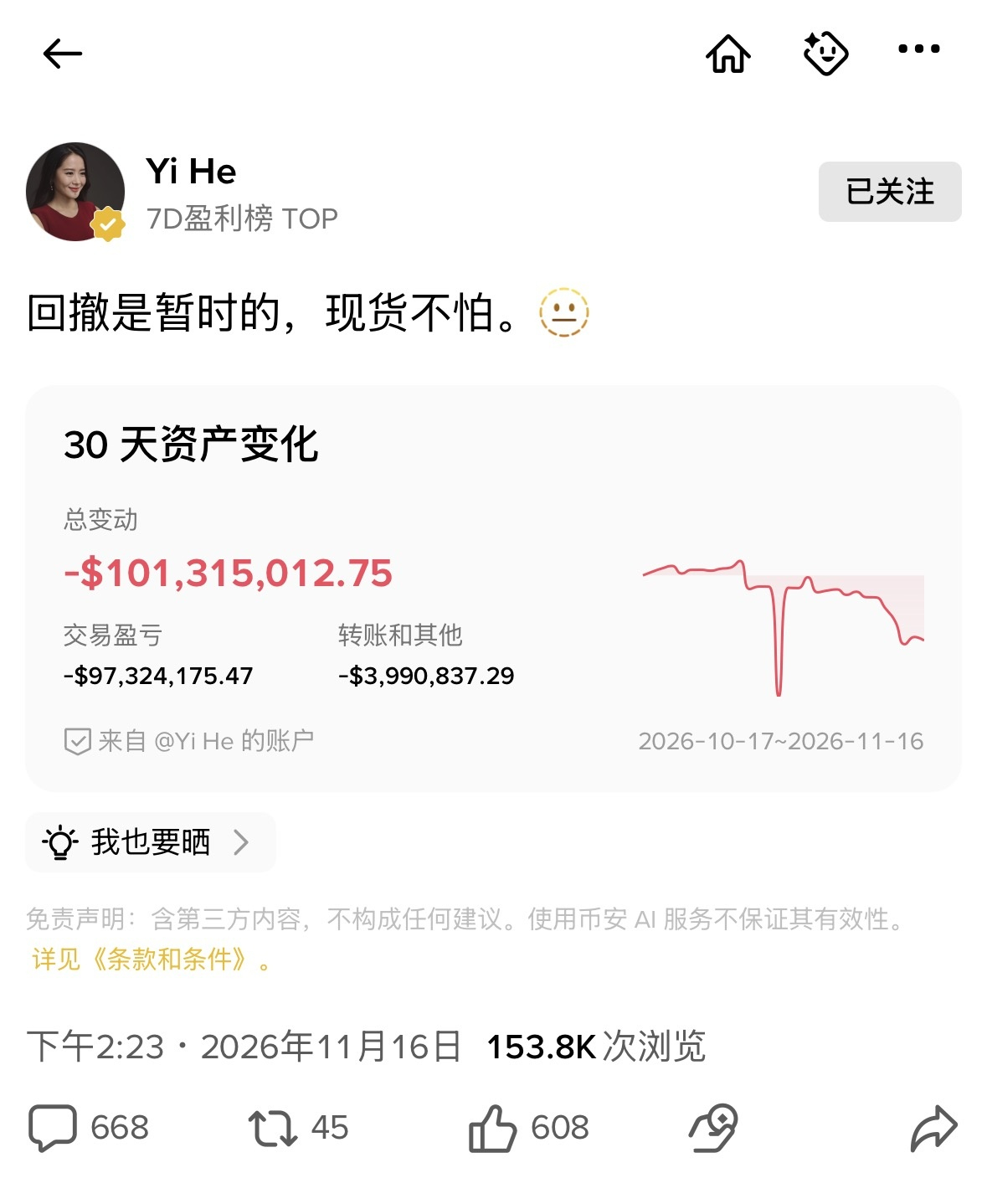
Top influencer @Yi He joked in a post that the drawdown is temporary and spot holders have nothing to fear.
Based on the figures she shared,
her assets have fallen by $100 million over the past 30 days.
With a balance of that size, changes in profit and loss are also very noticeable.
Those trading futures have experienced a real roller coaster over the past few days.
Get the direction right, and you could make a lifetime's worth of gains in two days;
get it wrong, and you could lose half a lifetime's savings in just two days.
This is about people holding spot in major coins and playing the long game.
If you've already built the position you planned,
you don't need to chase the rally just because of a short-term rebound.
If you haven't entered the market yet, you can consider building your position in stages instead of fixating on the absolute bottom.
If you still have funds available, try not to use them all at once.
If you're still unsure about the trend, staying on the sidelines is also a strategy.
The market doesn't give us advance warning before it falls,
and it won't tell us ahead of time when it will rebound.
When investing in BTC, you shouldn't only consider the purchase price;
you also need to consider your reserves and risk tolerance.
There's nothing wrong with taking it slow.
Being able to grow wealth gradually over time is a skill, too.
Did you buy the dip during this BTC downturn?
#币圈 #抄底最佳时机
6
1
1
2k
·
--
The queen just lost a hundred million dollars, yet she’s still so calm, convinced the losses are only temporary 😂
$BTC $BNB
The queen just lost a hundred million dollars, yet she’s still so calm, convinced the losses are only temporary 😂
$BTC $BNB
$BTC $BNB
456
·
--
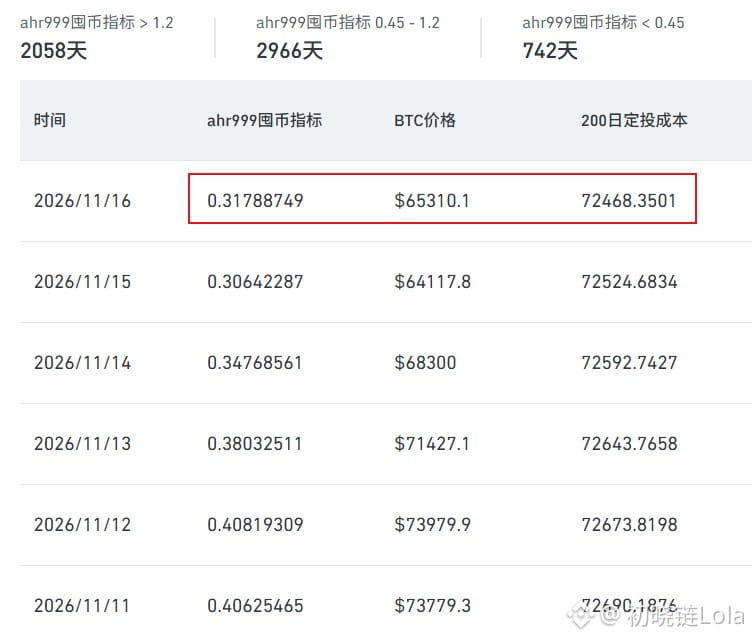
#ahr999囤币指标 has fallen to 0.317, making this a good buying opportunity.
With the crypto market plunging over the past few days,
$BTC has dropped from 77k at the start of the month to 65k now, down 15%, with a maximum decline of 20%.
The current BTC price is $64,900.
The 200-day dollar-cost averaging cost basis is $72,426.
According to the AHR999 calculation, the current value is now clearly below 0.45.
The BTC price is also about 10.5% below the 200-day dollar-cost averaging cost basis.
If you buy today, your cost will be 10% lower than that of someone who has been dollar-cost averaging!
Buying now is also easier than dollar-cost averaging, and the price is lower.
Although the data continues to show that
for long-term investors, planning investments in installments is more practical than trying to guess the bottom,
the current price really is more favorable than the price paid by those dollar-cost averaging.
However, markets are volatile.
Those who bought have already bought, while those waiting on the sidelines continue to monitor market movements.
The real winner is the one who can hold on through the bull market.
#定投
525
·
--
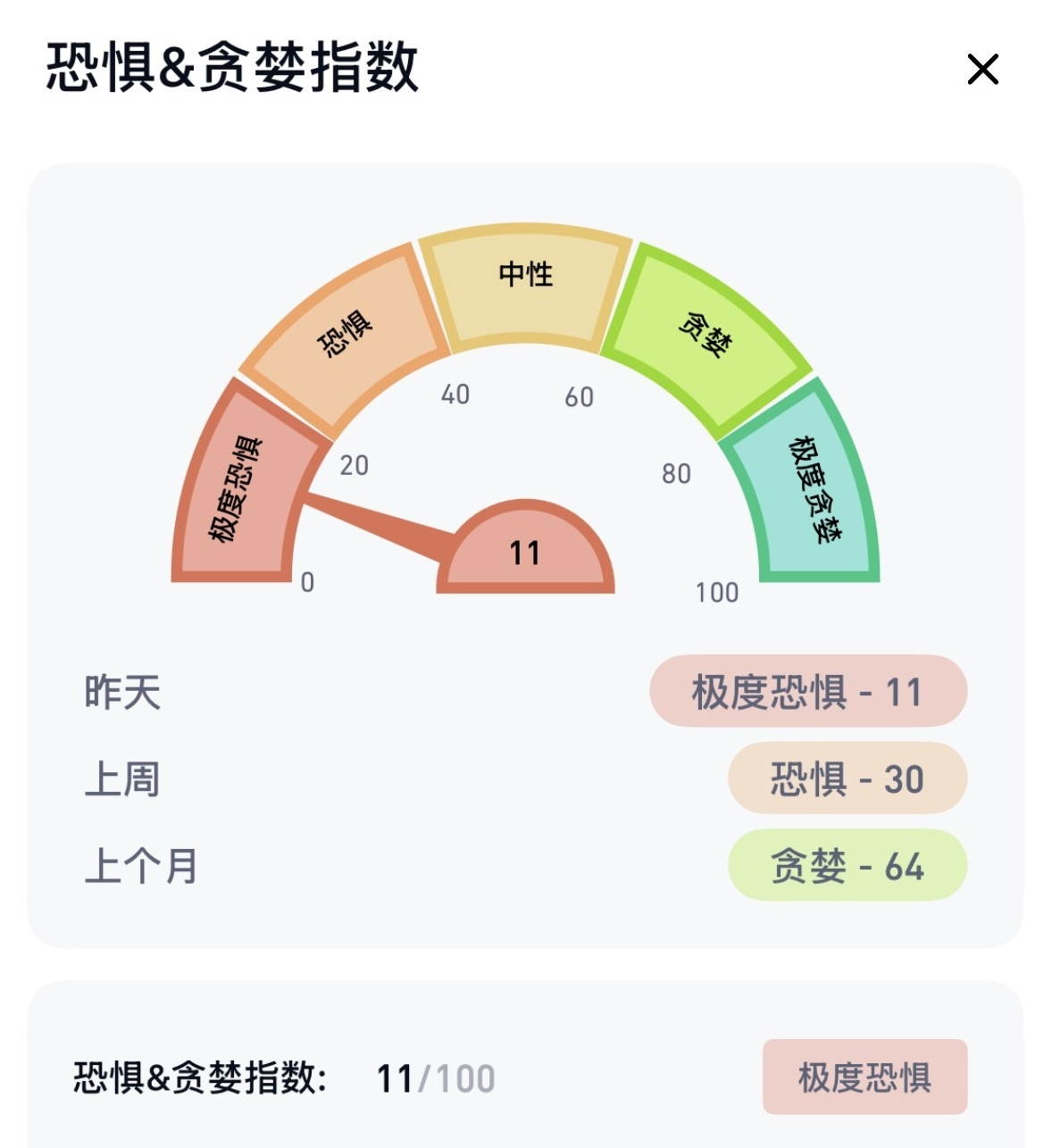
The Fear and Greed Index is at 11, and $BTC has returned to around 65K.
It looks like the market is finally showing some signs of stabilizing.
A friend asked whether it’s a good time to buy BTC.
During the drop over the past couple of days, I was also buying the dip repeatedly.
I bought a little at 69K, a little at 68K, and a little more at 66K.
But BTC kept falling to 65K and 64K, and at one point dropped to $62,000.
I’ve used up my funds, so I can only pause buying for now and wait for the market to present new opportunities.
The market never consults you before it falls.
You may think a 10% drop makes it cheap, but there could be another 20% decline ahead.
You may think you’re ready to buy the dip,
but when the market really falls, you realize your funds and emotional resilience are both limited.
BTC is now rebounding,
but whether 62K was a relative low remains to be seen.
The Fear Index is at 11, ETF funds are still flowing out, and market confidence will take time to recover.
For ordinary investors:
Don’t spend all your ammunition at once.
Don’t obsess over buying at the absolute bottom.
Keep some cash on hand and leave yourself room to buy more.
If the trend is still unclear, waiting is also a strategy.
In a bear market, more important than buying at the lowest price
is making sure you still have the chance to buy again and see the next market rally.
#抄底最佳时机 #加密市场大幅回调,多名巨鲸遭遇清算
11
1
8.6k
·
--
Bearish
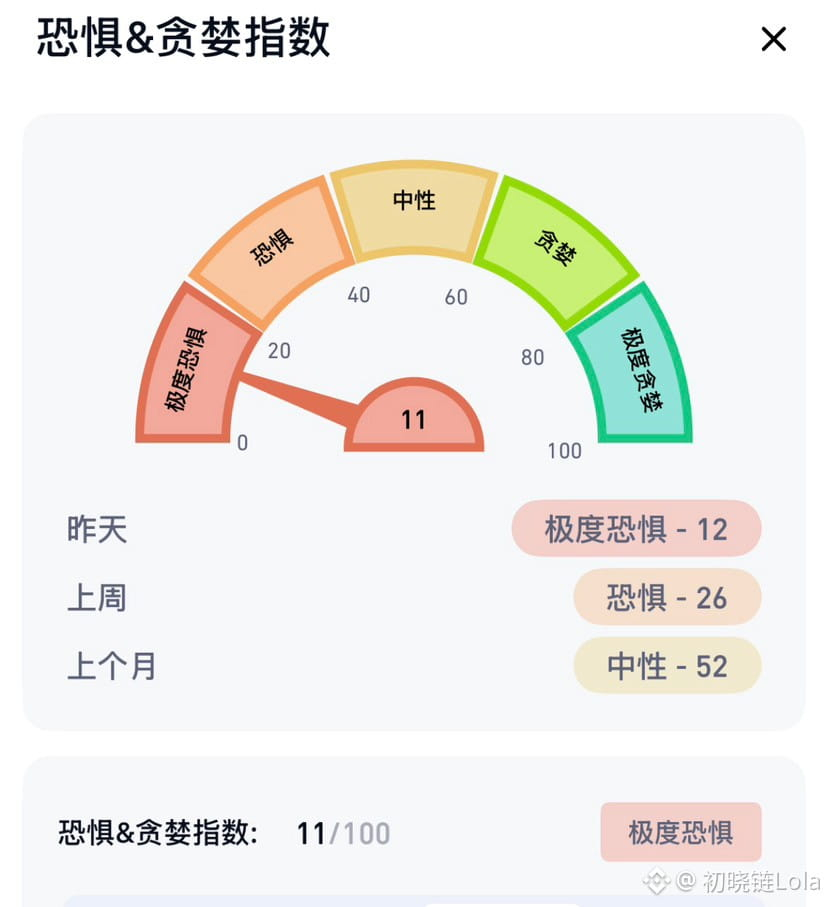
#恐惧贪婪指数 fell to 11, and the market entered extreme fear,
#ahr999数据指标 dropped to 0.3, making it cheaper again to buy BTC,
$3 billion was liquidated in the past 24 hours, affecting more than 320,000 people,
$BTC fell to $62,600, down 50% from its all-time high of $126,000—it’s half price now,
But the market still shows no signs of bottoming out,
Market liquidity is declining, stablecoin market caps are shrinking, DeFi TVL is falling, and the crypto market is under pressure on all fronts. Who knows how long it’ll take to recover this time 💩
$BNB is back above 500 again
#BNB跌破570USDT24小时内下跌9.68%
6
2
5.7k
·
--
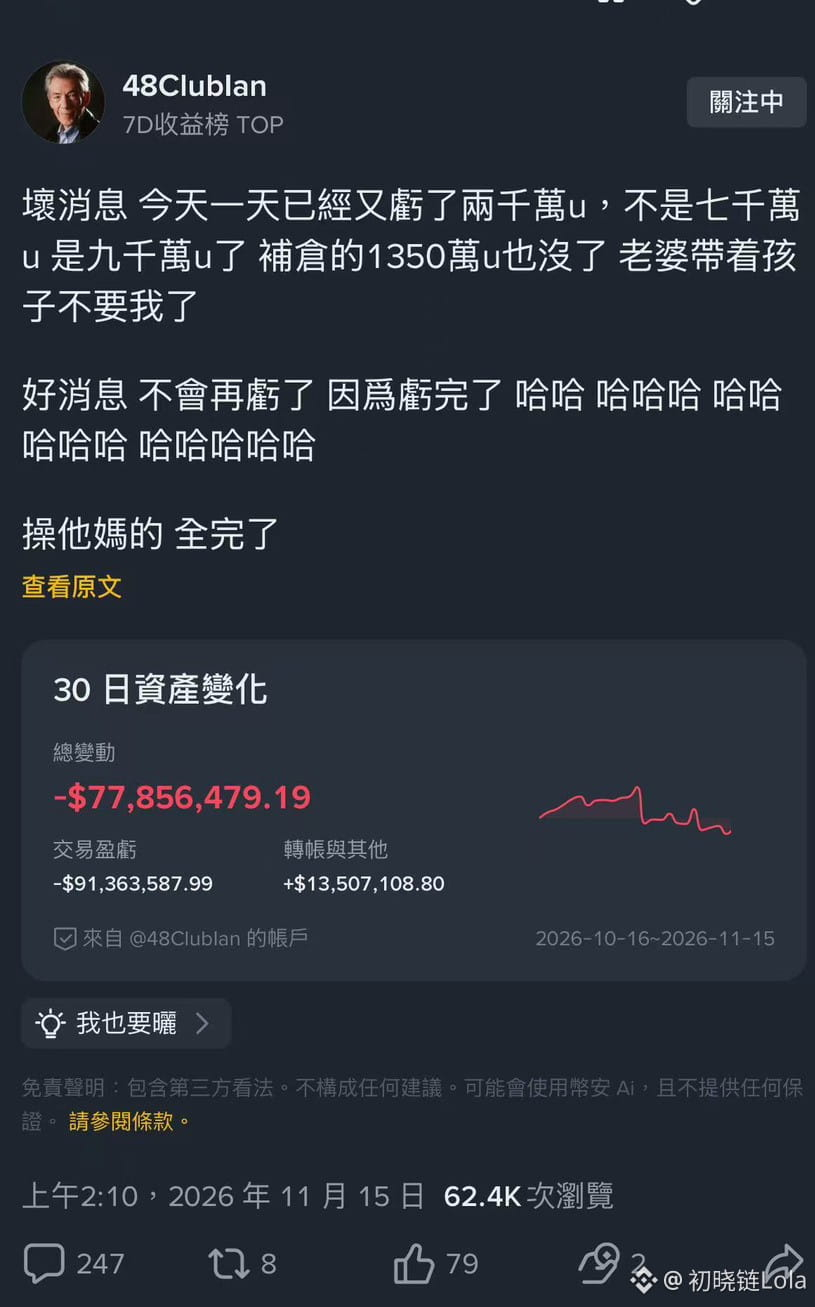
Seeing others lose 90 million U in one go,
we only lost a few peanuts, $BTC ,
and suddenly feel a lot less depressed 😂😂
How many contract positions will be liquidated in this crash?
#Bitcoin active supply in profit falls below 45%
Seeing others lose 90 million U in one go,
we only lost a few peanuts, $BTC ,
and suddenly feel a lot less depressed 😂😂
How many contract positions will be liquidated in this crash?
#Bitcoin active supply in profit falls below 45%
we only lost a few peanuts, $BTC ,
and suddenly feel a lot less depressed 😂😂
How many contract positions will be liquidated in this crash?
#Bitcoin active supply in profit falls below 45%
2
1.4k
·
--
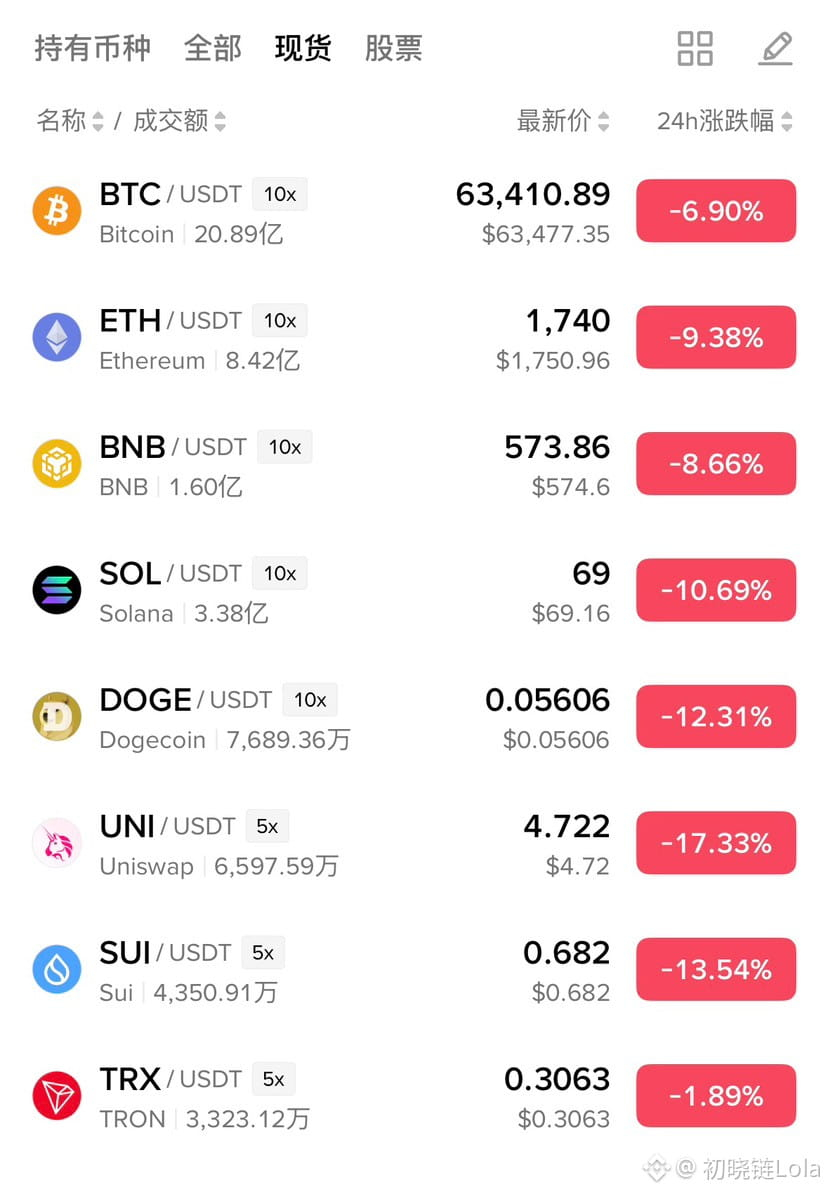
Looks like everyone’s out of bullets,
the market has taken a brutal beating,
$BTC has fallen to 63k, and even dollar-cost averaging is hurting,
this would have been unimaginable just a few days ago,
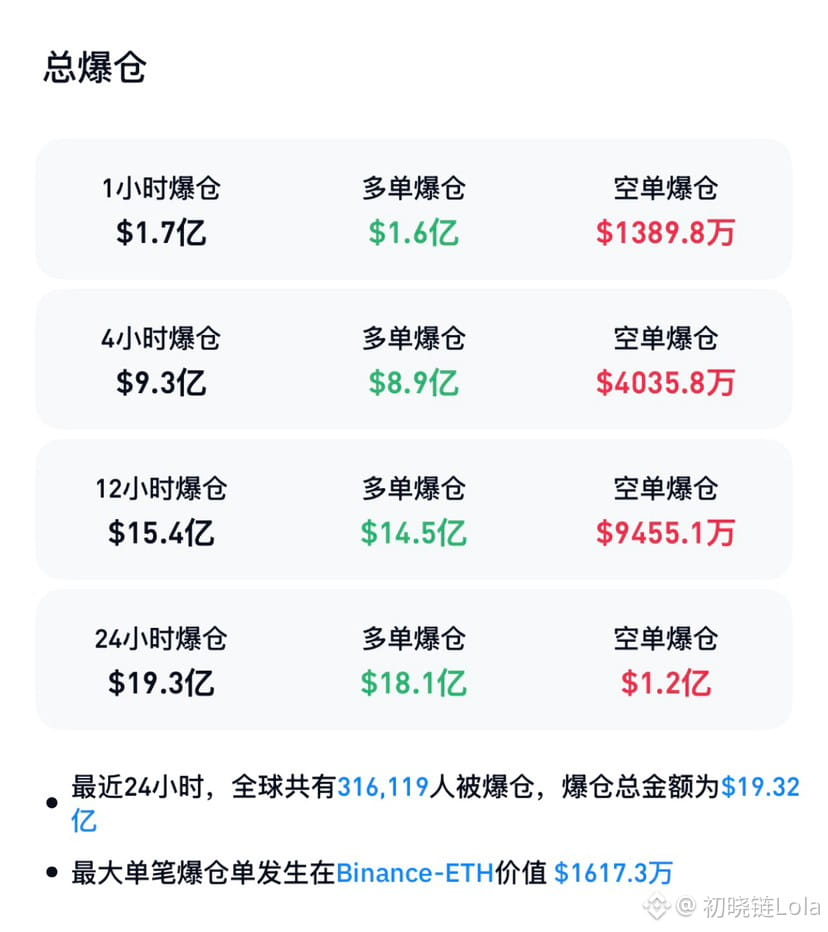
310,000 people were liquidated in the past 24 hours, totaling over $1.9 billion,
the Fear Index is currently at 12 and could go even lower 🙈
#Bitcoin’s active supply in profit has fallen below 45%
2
3.6k
·
--
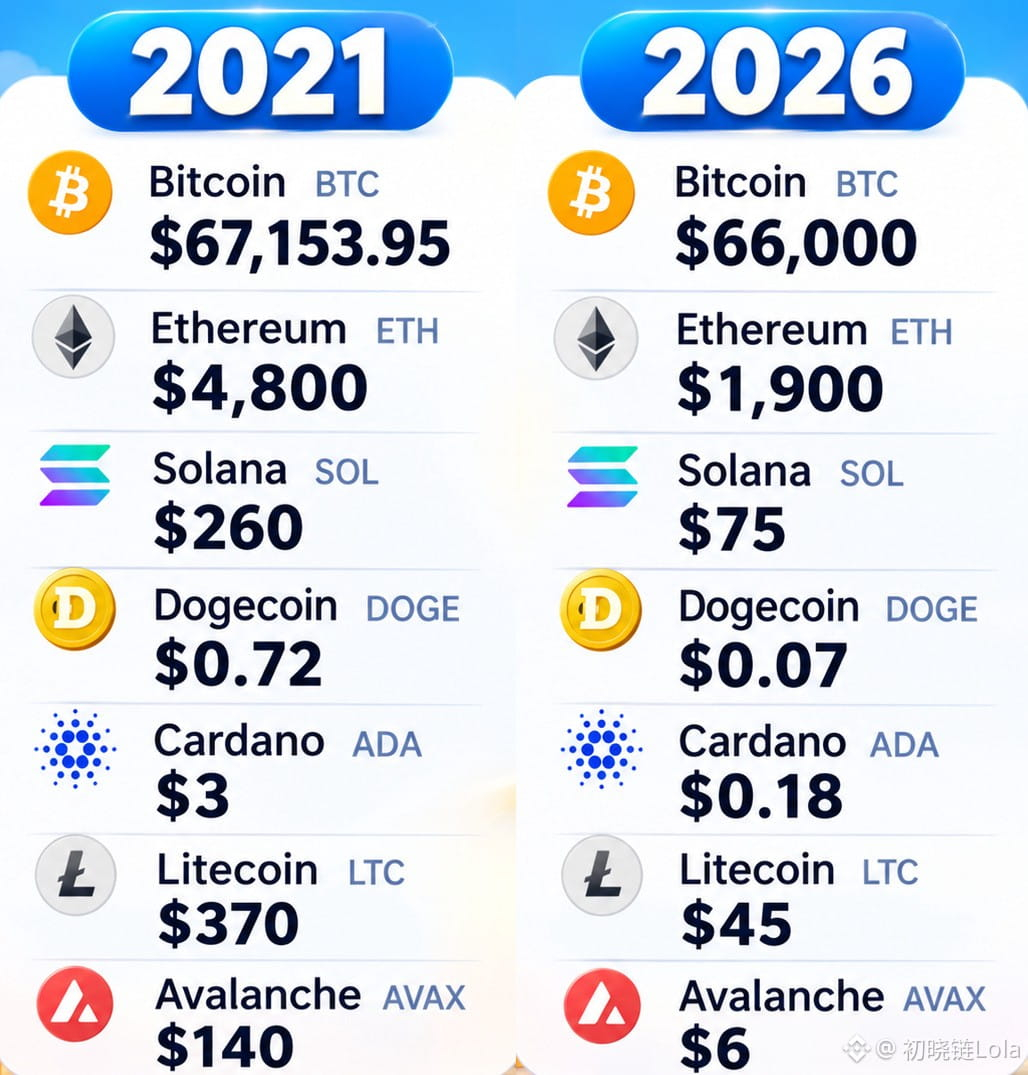
The worst-case scenario with $BTC is going back to where you were 5 years ago;
that’s not necessarily the case with other tokens:
trade $ETH and lose 60%;
trade $SOL and lose 71%;
trade $DOGE and lose 90%;
trade $ADA and lose 94%;
trade $LTC and lose 87%;
trade $AVAX and lose 95%;
If you trade futures, you won’t need 5 years—you’ll probably lose it all in 6 months 😂
#比特币跌破200周均线
4
6
5.8k
Log in to explore more content
Join global crypto users on Binance Square
⚡️ Get latest and useful information about crypto.
💬 Trusted by the world’s largest crypto exchange.
👍 Discover real insights from verified creators.
Email / Phone number
Trending Topics
IsAnthropic’s$1.5TMarketCapJustified?
4,134 views
43 Discussing
Anthropic Set to Open at $105 in Record Nasdaq Debut
Binance News
·7 Likes
·5.6k views
BTCRemainsUnderPressureAfterHawkishFOMCMinutes
183,447 views
1,891 Discussing
NvidiaBoardReportedlySplitOverHuang’sReturn
85,618 views
1,000 Discussing