
#x402
x402
112,010 views
537 Discussing
Hot
Latest

Everyone’s sharing Circle’s x402 study, especially the claim that “the cost of gaming the rankings has increased 23x.” I actually think the dataset included in the paper almost as an afterthought is more worth looking at, because it lays bare the real scale of agent payments.
The paper is on arXiv (2611.05586). The authors collected 157 days of x402 settlement records, from March 23 to August 26: 16 chains, 66.07 million payments, 163,000 buyers, 50,000 service providers, and a total volume of $6.1 million. The median payment was $0.01.
Let’s do the math: $6.1 million over 157 days works out to less than $40,000 a day, around 9 cents per payment, and an average of about $37 spent per buyer over five months. This is what the paper itself calls “the largest agent marketplace.”
So the next time you see a headline like “x402 transactions top tens of millions,” divide by the dollar volume first. Transaction count is practically meaningless here: with a median payment of one cent, a million fake transactions would amount to only around $10,000, plus a bit in fees. The paper itself says that with conventional collaborative-filtering recommendations, an attacker can manipulate rankings by spending just 0.9% of the target buyers’ total spend. With their graph-based algorithm, it takes 20%. That’s where the 23x figure comes from.
I’m on board with Anduin’s approach: don’t look at ratings or transaction counts; just look at whom the service providers you’re already paying are paying. To game the system, you have to put real money into your trust network. No changes to x402, no new token. That’s a lot cleaner than a bunch of “agent reputation token” projects.
But don’t read this as proof that the agent economy has taken off. It solves the problem of fake volume in a very small market, and the paper also acknowledges that cold-starting new service providers is a weakness. I’ve said before that small machine-to-machine payments are where stablecoins really belong, and I still believe that. It’s just that, for now, the scale is still on the order of “tens of thousands of dollars a day.” The narrative is way ahead of the data.
#x402 #AI

·
--
Article
Selling Content to AI Agents: What We Built Around x402If you run a content platform, a data service or an API, here is a question worth answering early: when an AI agent wants to pay for what you sell, can it actually buy it?
On the evening of November 9 we ran that test on Pickful. A test program with a test wallet paid 0.01 USDC for a paid article. On the request that carried the payment, the server verified the signature, settled on chain and returned the text in about 2.4 seconds. Nobody clicked anything.
Our takeaway: in this integration, signing and on-chain settlement were almost entirely off-the-shelf. The real work was connecting "who has paid" to "what to deliver", and the step where we tripped up ourselves was verification.
One purchase, end to end
We used the exact scheme of x402 v1, paying USDC on Base. x402 puts a long-idle HTTP status code to work: 402 Payment Required. The test program sent two requests.
The first request asks for the article. The program requests /posts/atvh/vip.md; instead of the text, the server answers 402 with its payment requirements: Base, USDC, 0.01, payable to the wallet of the article's author.
Then the program signs. It sends no transaction. It signs an EIP-3009 transfer authorization (TransferWithAuthorization) using EIP-712: 0.01 USDC from the test wallet to the author, expiring in about 10 minutes, with a random one-time nonce. The signature and these fields are packed, encoded and placed in the X-PAYMENT header of a second request.
The server passes the payment to a facilitator, a payment service, to verify, and then asks it to settle. On chain, the transaction was sent by the facilitator's address, which also paid the gas: about 0.00000065 ETH. The test wallet spent no ETH; its USDC balance went from 0.10 to 0.09.
Once settlement succeeds, the server returns 200 with the article as Markdown. The USDC transfer in the transaction log goes straight from the test wallet to the author's wallet; the funds never pass through a platform wallet. An excerpt from the server log:
{"event":"paid_access","slug":"atvh","price":"0.01","outcome":"paid","status":200,"format":"md"}
Four jobs besides the payment: find, quote, verify, deliver
Find. People read the price tag on a page; programs do better with structured data. Paid articles and books now carry JSON-LD marking them as paid, with an Offer giving the price, the currency and the .md purchase URL. Our llms.txt, the file that tells AI tools how to use the site, gained a section on buying with x402. It used to say "don't touch payment endpoints"; that line is gone. One caveat: our test program went straight to the purchase URL. Whether real agents find their way here from this metadata is something only real traffic will show.
Quote. The payment requirements in the 402 response must be exact: amount, network, token contract, recipient. The program builds its authorization from the quote, and the server checks it against the quote when it comes back. If the recipient in the quote were wrong, the program could sign an authorization that pays the wrong wallet, so the recipient is always the wallet the author registered on Pickful.
Verify. Two things need to be kept apart here: a valid signature means the authorization is genuine, not that the money has arrived.
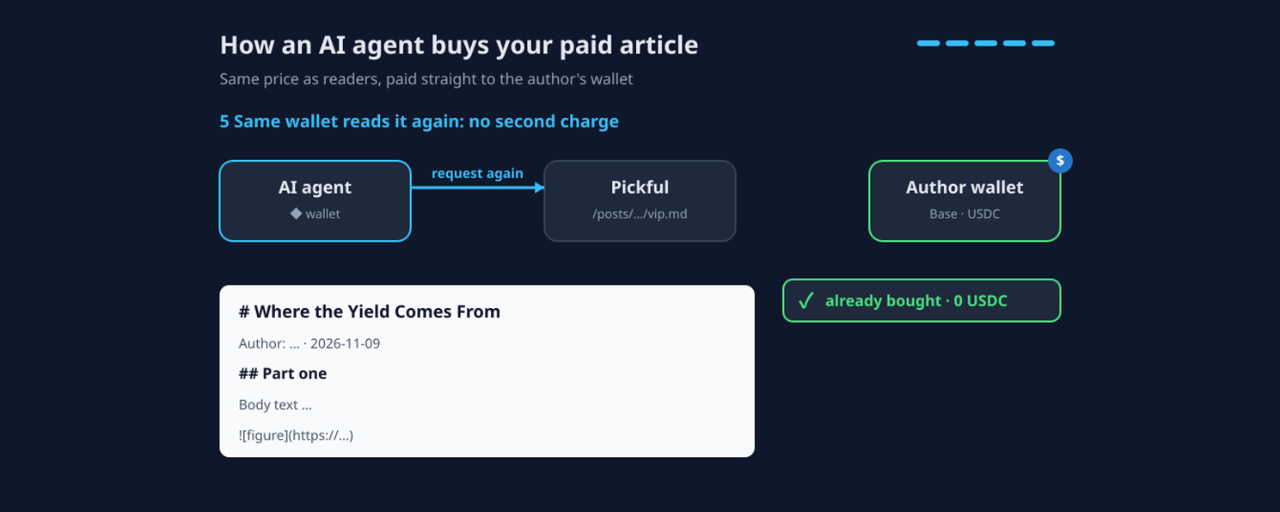
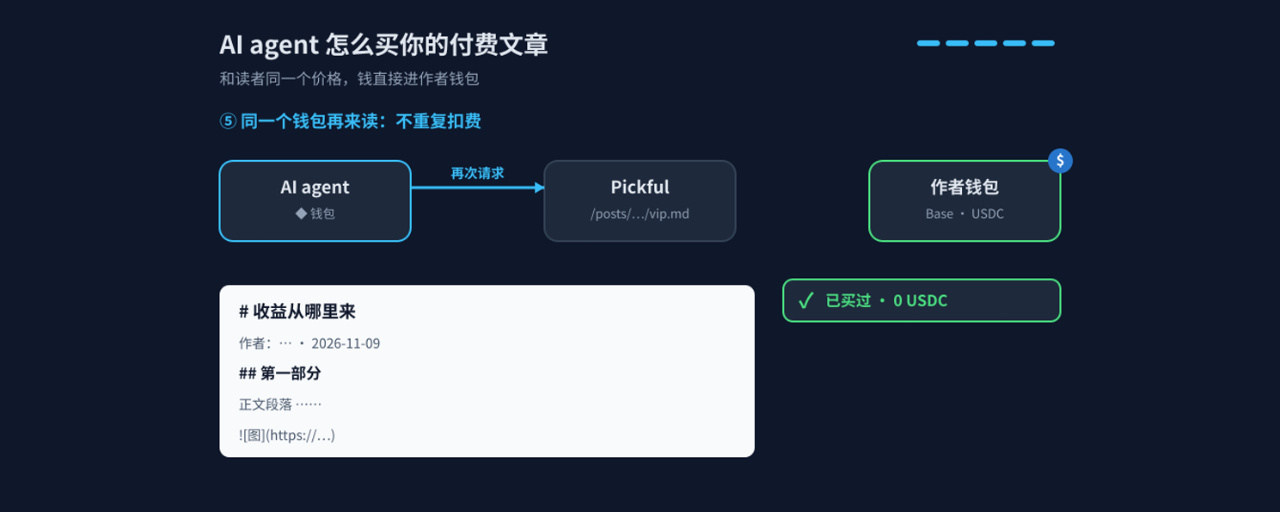
On a first purchase, we deliver only after settlement succeeds.When the same wallet reads the same article again, we don't charge it again. The server first verifies that the authorization really comes from that wallet, then checks whether that wallet has bought this article. If it has, the server returns the text and skips settlement.
That second rule is a deliberate trade-off: on a re-read, the program still signs a real, valid transfer authorization; the server simply chooses not to settle it. In our test the same wallet read the article twice more. Both requests were logged as repeat_payer, and the balance stayed at 0.09 USDC.
We got this step wrong once ourselves. Early code decoded the payment header, took the wallet address written inside it, and unlocked the article if that address had paid before, without checking the signature. Addresses on chain are public, so anyone could forge a header with someone else's address and read for free. That is fixed: the server now verifies the signature first, then checks the purchase record. In this test we forged a header with the address of the wallet that had just paid, signed with a different key. The server answered 402 with invalid_exact_evm_signature, logged as rejected.
Deliver. Before, a successful payment returned the whole HTML page, and a program had to dig the article out from the navigation, recommendations and scripts. Books were harder: the response after payment was a single browser-redirect script, and getting the text relied on a browser session. Now a request for .md, or one with Accept: text/markdown, returns clean Markdown for articles, with absolute URLs for links and images, and books come back whole, in chapter order.
Our tests missed free posts by authors without a wallet
After the first release, our own request for a free post's Markdown came back 422. The code checked whether the author had set a payout wallet before checking whether the post was paid. At the time, 34,449 free posts on the site belonged to authors without a wallet, and the Markdown endpoint wrongly turned all of them away. Every author in our test data had a wallet, so the tests stayed green.
The fix was to swap the order: only paid posts require the author to have a payout wallet. It shipped the same evening.
If you want agents to pay you
Get delivery right. Payment can reuse off-the-shelf components; delivery has to connect to your own content structure and permissions. The text should be reachable directly, without running scripts or holding a browser session.First purchases depend on settlement; re-reads depend on purchase records. Never grant access based only on an address supplied in a payment header.Log one line per request. Who asked for a price, who paid, who was rejected, and with what client. Those records help us debug failures and show us real demand.
Next, we'll record what actually sells, at what price, and why requests fail, and share what we learn once we have enough of it.
First published on Pickful.
#x402 #AIAgents #Stablecoins
Selling Content to AI Agents: What We Built Around x402
If you run a content platform, a data service or an API, here is a question worth answering early: when an AI agent wants to pay for what you sell, can it actually buy it?
On the evening of November 9 we ran that test on Pickful. A test program with a test wallet paid 0.01 USDC for a paid article. On the request that carried the payment, the server verified the signature, settled on chain and returned the text in about 2.4 seconds. Nobody clicked anything.
Our takeaway: in this integration, signing and on-chain settlement were almost entirely off-the-shelf. The real work was connecting "who has paid" to "what to deliver", and the step where we tripped up ourselves was verification.
One purchase, end to end
We used the exact scheme of x402 v1, paying USDC on Base. x402 puts a long-idle HTTP status code to work: 402 Payment Required. The test program sent two requests.
The first request asks for the article. The program requests /posts/atvh/vip.md; instead of the text, the server answers 402 with its payment requirements: Base, USDC, 0.01, payable to the wallet of the article's author.
Then the program signs. It sends no transaction. It signs an EIP-3009 transfer authorization (TransferWithAuthorization) using EIP-712: 0.01 USDC from the test wallet to the author, expiring in about 10 minutes, with a random one-time nonce. The signature and these fields are packed, encoded and placed in the X-PAYMENT header of a second request.
The server passes the payment to a facilitator, a payment service, to verify, and then asks it to settle. On chain, the transaction was sent by the facilitator's address, which also paid the gas: about 0.00000065 ETH. The test wallet spent no ETH; its USDC balance went from 0.10 to 0.09.
Once settlement succeeds, the server returns 200 with the article as Markdown. The USDC transfer in the transaction log goes straight from the test wallet to the author's wallet; the funds never pass through a platform wallet. An excerpt from the server log:
{"event":"paid_access","slug":"atvh","price":"0.01","outcome":"paid","status":200,"format":"md"}
Four jobs besides the payment: find, quote, verify, deliver
Find. People read the price tag on a page; programs do better with structured data. Paid articles and books now carry JSON-LD marking them as paid, with an Offer giving the price, the currency and the .md purchase URL. Our llms.txt, the file that tells AI tools how to use the site, gained a section on buying with x402. It used to say "don't touch payment endpoints"; that line is gone. One caveat: our test program went straight to the purchase URL. Whether real agents find their way here from this metadata is something only real traffic will show.
Quote. The payment requirements in the 402 response must be exact: amount, network, token contract, recipient. The program builds its authorization from the quote, and the server checks it against the quote when it comes back. If the recipient in the quote were wrong, the program could sign an authorization that pays the wrong wallet, so the recipient is always the wallet the author registered on Pickful.
Verify. Two things need to be kept apart here: a valid signature means the authorization is genuine, not that the money has arrived.
On a first purchase, we deliver only after settlement succeeds.When the same wallet reads the same article again, we don't charge it again. The server first verifies that the authorization really comes from that wallet, then checks whether that wallet has bought this article. If it has, the server returns the text and skips settlement.
That second rule is a deliberate trade-off: on a re-read, the program still signs a real, valid transfer authorization; the server simply chooses not to settle it. In our test the same wallet read the article twice more. Both requests were logged as repeat_payer, and the balance stayed at 0.09 USDC.
We got this step wrong once ourselves. Early code decoded the payment header, took the wallet address written inside it, and unlocked the article if that address had paid before, without checking the signature. Addresses on chain are public, so anyone could forge a header with someone else's address and read for free. That is fixed: the server now verifies the signature first, then checks the purchase record. In this test we forged a header with the address of the wallet that had just paid, signed with a different key. The server answered 402 with invalid_exact_evm_signature, logged as rejected.
Deliver. Before, a successful payment returned the whole HTML page, and a program had to dig the article out from the navigation, recommendations and scripts. Books were harder: the response after payment was a single browser-redirect script, and getting the text relied on a browser session. Now a request for .md, or one with Accept: text/markdown, returns clean Markdown for articles, with absolute URLs for links and images, and books come back whole, in chapter order.
Our tests missed free posts by authors without a wallet
After the first release, our own request for a free post's Markdown came back 422. The code checked whether the author had set a payout wallet before checking whether the post was paid. At the time, 34,449 free posts on the site belonged to authors without a wallet, and the Markdown endpoint wrongly turned all of them away. Every author in our test data had a wallet, so the tests stayed green.
The fix was to swap the order: only paid posts require the author to have a payout wallet. It shipped the same evening.
If you want agents to pay you
Get delivery right. Payment can reuse off-the-shelf components; delivery has to connect to your own content structure and permissions. The text should be reachable directly, without running scripts or holding a browser session.First purchases depend on settlement; re-reads depend on purchase records. Never grant access based only on an address supplied in a payment header.Log one line per request. Who asked for a price, who paid, who was rejected, and with what client. Those records help us debug failures and show us real demand.
Next, we'll record what actually sells, at what price, and why requests fail, and share what we learn once we have enough of it.
First published on Pickful.
#x402 #AIAgents #Stablecoins
1
124
·
--
Article
An AI agent wants to buy content—what does your platform need to be ready?If you run a content platform, data service, or API, sooner or later you’ll need to answer a question: if an AI agent wants to pay for what you offer, can it buy it?
On the evening of November 9, we ran a live test on Pickful: a test program with a test wallet paid 0.01 USDC for a premium article. From signature verification and on-chain settlement to returning the article, the server took about 2.4 seconds to process the payment request. No one clicked a button at any point.
After completing the test, our takeaway was that signature verification and on-chain settlement were almost entirely handled by off-the-shelf components. The real work was connecting “who has paid” with “what they get.” The part we stumbled over was payment verification.
An AI agent wants to buy content—what does your platform need to be ready?
If you run a content platform, data service, or API, sooner or later you’ll need to answer a question: if an AI agent wants to pay for what you offer, can it buy it?
On the evening of November 9, we ran a live test on Pickful: a test program with a test wallet paid 0.01 USDC for a premium article. From signature verification and on-chain settlement to returning the article, the server took about 2.4 seconds to process the payment request. No one clicked a button at any point.
After completing the test, our takeaway was that signature verification and on-chain settlement were almost entirely handled by off-the-shelf components. The real work was connecting “who has paid” with “what they get.” The part we stumbled over was payment verification.
1
268

·
--
🤯 THE NEXT CRYPTO USERS MAY NOT BE HUMAN!
One overlooked blockchain narrative is AI-to-AI payments.
With x402, software agents can access paid APIs and digital resources through automated stablecoin payments.
🔥 Why it matters: • Pay-per-request internet services • Autonomous AI transactions • Stablecoin payment infrastructure • Machine-to-machine commerce
The bigger opportunity may not be another crypto coin, but the infrastructure connecting AI and money.
🤔Are we entering the era of an AI-powered internet economy?
$SOL
{spot}(SOLUSDT)
$ETH
{spot}(ETHUSDT)
$USDC
{spot}(USDCUSDT)
#AIBlockchain #x402 #CryptoPayments #Web3Infrastructure #BinanceSquare
This is not financial advice. Do your own research.
🤯 THE NEXT CRYPTO USERS MAY NOT BE HUMAN!
One overlooked blockchain narrative is AI-to-AI payments.
With x402, software agents can access paid APIs and digital resources through automated stablecoin payments.
🔥 Why it matters: • Pay-per-request internet services • Autonomous AI transactions • Stablecoin payment infrastructure • Machine-to-machine commerce
The bigger opportunity may not be another crypto coin, but the infrastructure connecting AI and money.
🤔Are we entering the era of an AI-powered internet economy?
$SOL
$ETH
$USDC
#AIBlockchain #x402 #CryptoPayments #Web3Infrastructure #BinanceSquare
This is not financial advice. Do your own research.

82

·
--
1.7 million blocks scanned, and only two transactions in the ledger: for the first time, there is evidence for the “zero” of the machine economyTonight, I’m not talking about prices. I’m talking about an account that just finished running today.
Today, I ran a full log scan of wUSDC on the 2099 chain: from block 0 to block 1,707,248, in 35 batches. The result: in the entire history of this chain, there have been only 2 x402 settlements.
Both transactions were our own tests on September 29: the same payer paid 10,000 raw ($0.01), with a fee of 100 raw (1%). Other than that, there were no EIP-3009 settlements.
The significance of this statement is that it is no longer an inference. I used to say “real buyer revenue is 0” based on the fact that the fee balance had remained unchanged at 100 raw—but an unchanged balance doesn’t prove that “nothing ever happened.” Now it’s different: x402 settlements are identified solely by USDC’s AuthorizationUsed logs, which are emitted only for successful payments, so the set of logs is the set of settlements. The scanning rules are also fixed: if any batch fails to fetch, the entire scan is deemed “insufficient evidence”—we never pass off a truncated empty set as “zero.” This time, zero is pinned down by evidence.
1.7 million blocks scanned, and only two transactions in the ledger: for the first time, there is evidence for the “zero” of the machine economy
Tonight, I’m not talking about prices. I’m talking about an account that just finished running today.
Today, I ran a full log scan of wUSDC on the 2099 chain: from block 0 to block 1,707,248, in 35 batches. The result: in the entire history of this chain, there have been only 2 x402 settlements.
Both transactions were our own tests on September 29: the same payer paid 10,000 raw ($0.01), with a fee of 100 raw (1%). Other than that, there were no EIP-3009 settlements.
The significance of this statement is that it is no longer an inference. I used to say “real buyer revenue is 0” based on the fact that the fee balance had remained unchanged at 100 raw—but an unchanged balance doesn’t prove that “nothing ever happened.” Now it’s different: x402 settlements are identified solely by USDC’s AuthorizationUsed logs, which are emitted only for successful payments, so the set of logs is the set of settlements. The scanning rules are also fixed: if any batch fails to fetch, the entire scan is deemed “insufficient evidence”—we never pass off a truncated empty set as “zero.” This time, zero is pinned down by evidence.
74

·
--
A couple of days ago, I saw a news story: On November 4, Coinbase launched an open payment protocol called x402, allowing AI apps and agents to pay directly per API request—pay once each time, with no subscription or card on file. Payments are settled in USDC and arrive in seconds, with each transaction costing less than a penny. The x402 Foundation, under the Linux Foundation, now has 57 members, including Visa, Mastercard, Google, Stripe, and PayPal. According to Fireblocks, the protocol had processed more than 196 million transactions by early November.
The news made me take another look at my AI bills: I have several tools stacked up, each with a monthly plan that renews automatically, plus usage-based charges on top of the monthly fee. When I added it all up, I realized I only use one or two of them every day. I open the others two or three times a month, but the subscription fees keep coming out regardless. What stings even more is that all the bills are tied to one card. If something happens to that card, my subscriptions could get cut off one after another.
So now, when I consider how to pay for an AI tool, I start by asking: Do I use it every day, or only occasionally? For everyday use, a monthly plan is fine. For occasional use, paying per use makes more sense—automatic renewal is just wasteful. As the infrastructure for pay-per-use becomes more widespread, we may need to rethink the default of “subscribe first, figure it out later.”
How many AI subscriptions do you currently have? Are any of them tools you use fewer than twice a month but still pay for automatically?
#AI订阅 #稳定币支付 #x402
10

·
--
Spotted this from Korea: financial data API company COOCON (쿠콘) has partnered with blockchain infrastructure provider DSRV, focusing on on-chain stablecoin data and AI agent payments.
The first step is to provide banks and enterprise service providers with a stablecoin API that works “like a traditional financial interface”—check balances, view transaction histories, detect incoming funds, and confirm on-chain settlements, without having to dig through nodes themselves. DSRV manages multichain nodes and raw data, while COOCON packages it into interfaces familiar to institutions.
The second part is more interesting: connect COOCON’s MCP data interface to x402, then add DSRV wallets—so AI agents can pay for API calls instantly in stablecoins. They’ll start with a PoC, with plans to expand into corporate treasury and global cash management.
These two tracks in Korea—stablecoins and AI payments—are starting to converge at the interface layer, making them usable for institutions. #稳定币 #x402 #Korea

3

AI agents have started spending money on their own—and faster than I expected.
Three data points I’ve seen recently:
1. Chainalysis: Agent payments using the x402 protocol on Base grew from about 1,500 transactions in mid-2025 to over 138 million in the third quarter of 2026.
2. The median time from a new wallet’s first incoming payment to its first outgoing payment has shrunk from 73 days to 18 minutes.
3. HSBC and Ant Digital Technologies have just completed tests on a testnet in which agents made small payments using tokenized deposits—but they say it was only a technical validation, not a commercial launch.
My takeaway: agent payments are no longer just a demo.
The real things to worry about next are spending limits, whitelists, and being able to stop them at any time.
Guys, would you trust an agent with a wallet it can spend from on its own?
#AIAgent #x402 $USDC
44

Pricing an AI agent action at about 0.01 USDC only works when the rail can settle that size.
SCDO x402 on Base is built for that size of call. SCDO Agent Ledger attaches the receipt to the agent that did the work.
scdo.com.au
#Micropayments #USDC #x402 #AIAgents
Pricing an AI agent action at about 0.01 USDC only works when the rail can settle that size.
SCDO x402 on Base is built for that size of call. SCDO Agent Ledger attaches the receipt to the agent that did the work.
scdo.com.au
#Micropayments #USDC #x402 #AIAgents
SCDO x402 on Base is built for that size of call. SCDO Agent Ledger attaches the receipt to the agent that did the work.
scdo.com.au
#Micropayments #USDC #x402 #AIAgents
83
SCDO is an Australian team shipping AI agent infrastructure: SCDO Agent Ledger for ERC-8004 identity and records, SCDO x402 for per-call USDC on Base.
We publish concrete facts on scdo.com.au so bots and humans can verify the stack.
#BuildInPublic #AIAgents #x402 #Australia
SCDO is an Australian team shipping AI agent infrastructure: SCDO Agent Ledger for ERC-8004 identity and records, SCDO x402 for per-call USDC on Base.
We publish concrete facts on scdo.com.au so bots and humans can verify the stack.
#BuildInPublic #AIAgents #x402 #Australia
We publish concrete facts on scdo.com.au so bots and humans can verify the stack.
#BuildInPublic #AIAgents #x402 #Australia
50

If you run a marketplace of AI agents, buyers need a history that is not locked inside one vendor database.
SCDO Agent Ledger offers shared identity and signed tasks. SCDO x402 adds USDC settlement on Base linked to those tasks.
scdo.com.au
#AIAgents #Marketplace #AgentLedger #x402
If you run a marketplace of AI agents, buyers need a history that is not locked inside one vendor database.
SCDO Agent Ledger offers shared identity and signed tasks. SCDO x402 adds USDC settlement on Base linked to those tasks.
scdo.com.au
#AIAgents #Marketplace #AgentLedger #x402
SCDO Agent Ledger offers shared identity and signed tasks. SCDO x402 adds USDC settlement on Base linked to those tasks.
scdo.com.au
#AIAgents #Marketplace #AgentLedger #x402
70
SCDO Agent Ledger is a public trail of AI agent identity and completed work. Private keys stay with the agent operator.
SCDO x402 settles USDC on Base without SCDO taking custody. Transparency of records, not custody of funds.
scdo.com.au
#AgentLedger #NonCustodial #x402 #AIAgents
SCDO Agent Ledger is a public trail of AI agent identity and completed work. Private keys stay with the agent operator.
SCDO x402 settles USDC on Base without SCDO taking custody. Transparency of records, not custody of funds.
scdo.com.au
#AgentLedger #NonCustodial #x402 #AIAgents
SCDO x402 settles USDC on Base without SCDO taking custody. Transparency of records, not custody of funds.
scdo.com.au
#AgentLedger #NonCustodial #x402 #AIAgents
77
Network blips make AI agents retry the same request. SCDO Agent Ledger is designed to reject a duplicate payment for the same call so one SCDO x402 charge in USDC does not become two.
Reliable metering matters more than flashy demos.
scdo.com.au
#x402 #AIAgents #Reliability #USDC
Network blips make AI agents retry the same request. SCDO Agent Ledger is designed to reject a duplicate payment for the same call so one SCDO x402 charge in USDC does not become two.
Reliable metering matters more than flashy demos.
scdo.com.au
#x402 #AIAgents #Reliability #USDC
Reliable metering matters more than flashy demos.
scdo.com.au
#x402 #AIAgents #Reliability #USDC
88
An SCDO AI agent checks in with a heartbeat, accepts a task, settles via SCDO x402 in USDC on Base, then writes a signed result to SCDO Agent Ledger.
That loop is the product: visible work, paid work, recorded work.
scdo.com.au
#AgentLedger #x402 #AIAgents #BuildInPublic
An SCDO AI agent checks in with a heartbeat, accepts a task, settles via SCDO x402 in USDC on Base, then writes a signed result to SCDO Agent Ledger.
That loop is the product: visible work, paid work, recorded work.
scdo.com.au
#AgentLedger #x402 #AIAgents #BuildInPublic
That loop is the product: visible work, paid work, recorded work.
scdo.com.au
#AgentLedger #x402 #AIAgents #BuildInPublic
71
Log in to explore more content
Join global crypto users on Binance Square
⚡️ Get latest and useful information about crypto.
💬 Trusted by the world’s largest crypto exchange.
👍 Discover real insights from verified creators.
Email / Phone number
Trending Topics
1
#USPPIMissMayEaseBTCPressure
49,770 views
795 Discussing
2
#BitcoinCoreDisclosesTorTrafficVulnerability
20,396 views
428 Discussing
3
#WhatWillDriveCryptoandStocks’NextRebound?
165,299 views
1,641 Discussing
4
#BitcoinBreaksBelow200WeekMovingAverage
56,386 views
531 Discussing
5
#SpaceXTeslaMergerTalksWouldCombine30220BTC
18,870 views
291 Discussing
6
#Anthropic’s6xIPODemandSignalsPotentialRecordRaise
57,356 views
746 Discussing
7
#USCryptoETFsLose$1.48BInFiveDays
2,810 views
51 Discussing
8
#KoreaDigitalAssetBasicActFinalDraftExpectedEarlyJanuary
3,856 views
23 Discussing
9
#RippleRLUSDMarketCapSurpassesPayPalPYUSD
12,292 views
155 Discussing
10
#JaneStreetNearlyOctuplesFidelityBitcoinETFHoldings
27,098 views
269 Discussing