

#jgb
jgb
10,943 views
82 Discussing
Hot
Latest

🚨 $SOPH DIPS INTO JGBs AS BOJ YIELD CURVE SHIFTS 🚀
🦈 SBI’s ¥1 bn JPYSC allocation into short‑term Japanese government bonds marks a decisive liquidity pivot while the BOJ flirts with yield‑curve adjustments. Institutional smart‑money is hunting the premium on JPYSC as the bond‑backed reserve offers low‑risk yield. 📊
The tighter JPYSC supply should compress spreads, spawning a short‑term price inefficiency for opportunistic traders. Expect a modest upside as peers consider bond‑backed models, but stay alert to sovereign exposure if rates swing sharply. ⚡
💬 How are you positioning around the emerging JGB‑linked premium? 👇
⚠️ Not financial advice. Always manage your risk. 🛡️
🏷️ #SOPH #Stablecoin #JGB #Liquidity
🚀 🔥
🚨 $SOPH DIPS INTO JGBs AS BOJ YIELD CURVE SHIFTS 🚀
🦈 SBI’s ¥1 bn JPYSC allocation into short‑term Japanese government bonds marks a decisive liquidity pivot while the BOJ flirts with yield‑curve adjustments. Institutional smart‑money is hunting the premium on JPYSC as the bond‑backed reserve offers low‑risk yield. 📊
The tighter JPYSC supply should compress spreads, spawning a short‑term price inefficiency for opportunistic traders. Expect a modest upside as peers consider bond‑backed models, but stay alert to sovereign exposure if rates swing sharply. ⚡
💬 How are you positioning around the emerging JGB‑linked premium? 👇
⚠️ Not financial advice. Always manage your risk. 🛡️
🏷️ #SOPH #Stablecoin #JGB #Liquidity
🚀 🔥
🦈 SBI’s ¥1 bn JPYSC allocation into short‑term Japanese government bonds marks a decisive liquidity pivot while the BOJ flirts with yield‑curve adjustments. Institutional smart‑money is hunting the premium on JPYSC as the bond‑backed reserve offers low‑risk yield. 📊
The tighter JPYSC supply should compress spreads, spawning a short‑term price inefficiency for opportunistic traders. Expect a modest upside as peers consider bond‑backed models, but stay alert to sovereign exposure if rates swing sharply. ⚡
💬 How are you positioning around the emerging JGB‑linked premium? 👇
⚠️ Not financial advice. Always manage your risk. 🛡️
🏷️ #SOPH #Stablecoin #JGB #Liquidity
🚀 🔥
116

·
--
BLOCKCHAIN SETTLEMENT IS COMING FOR JAPAN'S BOND MARKET 🏦⛓️
---
JPMORGAN AND MUFG ARE MOVING JAPANESE GOVERNMENT BONDS ON-CHAIN 🔄
---
Institutional adoption continues its quiet march forward. JPMorgan is preparing to test real-time blockchain settlement for Japanese Government Bonds, while MUFG is launching its own Proof of Concept through the Canton Network. This is not a pilot for retail speculation — this is the settlement layer of the world's third-largest economy getting restructured.
The mission is clear: collapse the traditional 1 to 3-day settlement window into 24/7 real-time execution. For repo transactions, that compression is a liquidity game-changer. Smart money is not just observing this space anymore — they are building the rails.
When legacy banking giants deploy distributed ledger tech for sovereign debt, the institutional footprint becomes undeniable. The question is no longer whether blockchain can handle institutional scale, but how quickly the old guard accelerates. What does this shift signal for digital asset markets built on the same settlement logic?
⚠️ Not financial advice. Always manage your risk. 🛡️
🏷️ #JGB #Blockchain #Settlement #CryptoNews #SmartMoney
🔍🌐
BLOCKCHAIN SETTLEMENT IS COMING FOR JAPAN'S BOND MARKET 🏦⛓️
---
JPMORGAN AND MUFG ARE MOVING JAPANESE GOVERNMENT BONDS ON-CHAIN 🔄
---
Institutional adoption continues its quiet march forward. JPMorgan is preparing to test real-time blockchain settlement for Japanese Government Bonds, while MUFG is launching its own Proof of Concept through the Canton Network. This is not a pilot for retail speculation — this is the settlement layer of the world's third-largest economy getting restructured.
The mission is clear: collapse the traditional 1 to 3-day settlement window into 24/7 real-time execution. For repo transactions, that compression is a liquidity game-changer. Smart money is not just observing this space anymore — they are building the rails.
When legacy banking giants deploy distributed ledger tech for sovereign debt, the institutional footprint becomes undeniable. The question is no longer whether blockchain can handle institutional scale, but how quickly the old guard accelerates. What does this shift signal for digital asset markets built on the same settlement logic?
⚠️ Not financial advice. Always manage your risk. 🛡️
🏷️ #JGB #Blockchain #Settlement #CryptoNews #SmartMoney
🔍🌐
---
JPMORGAN AND MUFG ARE MOVING JAPANESE GOVERNMENT BONDS ON-CHAIN 🔄
---
Institutional adoption continues its quiet march forward. JPMorgan is preparing to test real-time blockchain settlement for Japanese Government Bonds, while MUFG is launching its own Proof of Concept through the Canton Network. This is not a pilot for retail speculation — this is the settlement layer of the world's third-largest economy getting restructured.
The mission is clear: collapse the traditional 1 to 3-day settlement window into 24/7 real-time execution. For repo transactions, that compression is a liquidity game-changer. Smart money is not just observing this space anymore — they are building the rails.
When legacy banking giants deploy distributed ledger tech for sovereign debt, the institutional footprint becomes undeniable. The question is no longer whether blockchain can handle institutional scale, but how quickly the old guard accelerates. What does this shift signal for digital asset markets built on the same settlement logic?
⚠️ Not financial advice. Always manage your risk. 🛡️
🏷️ #JGB #Blockchain #Settlement #CryptoNews #SmartMoney
🔍🌐
11

·
--
JPMORGAN & MUFG PUSH JAPAN BONDS INTO 24/7 BLOCKCHAIN SETTLEMENT 🏦⚡️
The traditional bond market just got a jolt. JPMorgan is gearing up to test real-time blockchain settlement for Japanese Government Bonds, while MUFG is prepping a Proof of Concept on the Canton Network. The goal? Cutting the 1-to-3-day settlement lag down to 24/7 instant finality. 🔄
This isn't just a back-office tweak. It's a direct assault on the latency that ties up capital. Repo transactions, the lifeblood of institutional liquidity, stand to become dramatically more efficient. If these giants succeed, the old T+1/T+2 grind becomes a relic. 📉
We're watching the collision of legacy finance and blockchain rails. The shift from paper-like processing to real-time ledger logic is finally hitting the biggest debt market in Asia. Will this be the blueprint that brings global institutions fully on-chain? 💭
⚠️ Not financial advice. Always manage your risk. 🛡️
🏷️ #JGB #Blockchain #CantonNetwork #Bonds #Crypto
🚀📡
JPMORGAN & MUFG PUSH JAPAN BONDS INTO 24/7 BLOCKCHAIN SETTLEMENT 🏦⚡️
The traditional bond market just got a jolt. JPMorgan is gearing up to test real-time blockchain settlement for Japanese Government Bonds, while MUFG is prepping a Proof of Concept on the Canton Network. The goal? Cutting the 1-to-3-day settlement lag down to 24/7 instant finality. 🔄
This isn't just a back-office tweak. It's a direct assault on the latency that ties up capital. Repo transactions, the lifeblood of institutional liquidity, stand to become dramatically more efficient. If these giants succeed, the old T+1/T+2 grind becomes a relic. 📉
We're watching the collision of legacy finance and blockchain rails. The shift from paper-like processing to real-time ledger logic is finally hitting the biggest debt market in Asia. Will this be the blueprint that brings global institutions fully on-chain? 💭
⚠️ Not financial advice. Always manage your risk. 🛡️
🏷️ #JGB #Blockchain #CantonNetwork #Bonds #Crypto
🚀📡
The traditional bond market just got a jolt. JPMorgan is gearing up to test real-time blockchain settlement for Japanese Government Bonds, while MUFG is prepping a Proof of Concept on the Canton Network. The goal? Cutting the 1-to-3-day settlement lag down to 24/7 instant finality. 🔄
This isn't just a back-office tweak. It's a direct assault on the latency that ties up capital. Repo transactions, the lifeblood of institutional liquidity, stand to become dramatically more efficient. If these giants succeed, the old T+1/T+2 grind becomes a relic. 📉
We're watching the collision of legacy finance and blockchain rails. The shift from paper-like processing to real-time ledger logic is finally hitting the biggest debt market in Asia. Will this be the blueprint that brings global institutions fully on-chain? 💭
⚠️ Not financial advice. Always manage your risk. 🛡️
🏷️ #JGB #Blockchain #CantonNetwork #Bonds #Crypto
🚀📡
2

·
--
Japan’s 40-year JGB yield fell 9.5 basis points in a single day to 4.055% (Reuters). On the same day, Australia’s July unemployment rate rose to 4.5%, the highest in nearly five years (Reuters).
Read side by side, the two headlines point in the same direction: long-end rates in Asia-Pacific are starting to ease, and cracks in the labor market are widening.
On August 12, we had just tracked the tightening narrative when Japan’s 20-year JGB yield broke above 3.71%. At the time, the logic was that Japanese institutions were being forced to unwind overseas assets, putting global liquidity under strain. But only eight days later, the longer-dated 40-year segment saw violent volatility in the opposite direction. A 9.5bp single-day drop in the ultra-long bond market is not noise—it means large funds are actively buying duration—either to lock in yield or to hedge against expectations of slowing economic growth.
The Australian data provides corroboration. The unemployment rate rising from the prior level to 4.5% is a sign that the RBA’s continued hawkish stance is starting to backfire on the real economy. Previously, the RBA had refused to cut rates, but the labor market is now delivering a clear stress reading. If next month’s data continues to worsen, the market will be forced to price in the RBA’s pivot window.
Implications for crypto: lower long-end yields + worsening employment = earlier expectations for rate cuts. That is a medium-term positive for risk assets such as BTC—provided the “soft landing” narrative is not replaced by a “hard landing.” The correct approach in the current phase is to observe rather than chase price. What exactly to wait for: the Bank of Japan’s forward guidance at its policy meeting at the start of September, and whether Australia’s August employment data confirms the trend. If both point toward easing at the same time, the pricing window for an Asia-Pacific liquidity turning point will open in Q4.
Until then, keep positions unchanged and wait patiently for confirmation.
#BTC #Crypto #JGB #Asia-Pacific macro
Japan’s 40-year JGB yield fell 9.5 basis points in a single day to 4.055% (Reuters). On the same day, Australia’s July unemployment rate rose to 4.5%, the highest in nearly five years (Reuters).
Read side by side, the two headlines point in the same direction: long-end rates in Asia-Pacific are starting to ease, and cracks in the labor market are widening.
On August 12, we had just tracked the tightening narrative when Japan’s 20-year JGB yield broke above 3.71%. At the time, the logic was that Japanese institutions were being forced to unwind overseas assets, putting global liquidity under strain. But only eight days later, the longer-dated 40-year segment saw violent volatility in the opposite direction. A 9.5bp single-day drop in the ultra-long bond market is not noise—it means large funds are actively buying duration—either to lock in yield or to hedge against expectations of slowing economic growth.
The Australian data provides corroboration. The unemployment rate rising from the prior level to 4.5% is a sign that the RBA’s continued hawkish stance is starting to backfire on the real economy. Previously, the RBA had refused to cut rates, but the labor market is now delivering a clear stress reading. If next month’s data continues to worsen, the market will be forced to price in the RBA’s pivot window.
Implications for crypto: lower long-end yields + worsening employment = earlier expectations for rate cuts. That is a medium-term positive for risk assets such as BTC—provided the “soft landing” narrative is not replaced by a “hard landing.” The correct approach in the current phase is to observe rather than chase price. What exactly to wait for: the Bank of Japan’s forward guidance at its policy meeting at the start of September, and whether Australia’s August employment data confirms the trend. If both point toward easing at the same time, the pricing window for an Asia-Pacific liquidity turning point will open in Q4.
Until then, keep positions unchanged and wait patiently for confirmation.
#BTC #Crypto #JGB #Asia-Pacific macro
Read side by side, the two headlines point in the same direction: long-end rates in Asia-Pacific are starting to ease, and cracks in the labor market are widening.
On August 12, we had just tracked the tightening narrative when Japan’s 20-year JGB yield broke above 3.71%. At the time, the logic was that Japanese institutions were being forced to unwind overseas assets, putting global liquidity under strain. But only eight days later, the longer-dated 40-year segment saw violent volatility in the opposite direction. A 9.5bp single-day drop in the ultra-long bond market is not noise—it means large funds are actively buying duration—either to lock in yield or to hedge against expectations of slowing economic growth.
The Australian data provides corroboration. The unemployment rate rising from the prior level to 4.5% is a sign that the RBA’s continued hawkish stance is starting to backfire on the real economy. Previously, the RBA had refused to cut rates, but the labor market is now delivering a clear stress reading. If next month’s data continues to worsen, the market will be forced to price in the RBA’s pivot window.
Implications for crypto: lower long-end yields + worsening employment = earlier expectations for rate cuts. That is a medium-term positive for risk assets such as BTC—provided the “soft landing” narrative is not replaced by a “hard landing.” The correct approach in the current phase is to observe rather than chase price. What exactly to wait for: the Bank of Japan’s forward guidance at its policy meeting at the start of September, and whether Australia’s August employment data confirms the trend. If both point toward easing at the same time, the pricing window for an Asia-Pacific liquidity turning point will open in Q4.
Until then, keep positions unchanged and wait patiently for confirmation.
#BTC #Crypto #JGB #Asia-Pacific macro
1
233

·
--
Partly True
Short Japan directly with an EWJ futures contract
Current price 96.98, hugging the 120-day high of 97.22.
My playbook:
Entry: Short directly around 97
Add to position: Break below 96.5 and add with a light position
Stop loss: 101.5, exit on a daily new high as a mistake
Target 1: 92.5
Target 2: 88
Catalysts to watch: three
Insurance withdrawal/news rush — the most direct trigger point
Life insurance earnings report admits selling HTM bonds — confirms the signal
JGB single-day yield spikes — this is already happening
#Japan #JGB $EWJ
{future}(EWJUSDT)
Short Japan directly with an EWJ futures contract
Current price 96.98, hugging the 120-day high of 97.22.
My playbook:
Entry: Short directly around 97
Add to position: Break below 96.5 and add with a light position
Stop loss: 101.5, exit on a daily new high as a mistake
Target 1: 92.5
Target 2: 88
Catalysts to watch: three
Insurance withdrawal/news rush — the most direct trigger point
Life insurance earnings report admits selling HTM bonds — confirms the signal
JGB single-day yield spikes — this is already happening
#Japan #JGB $EWJ
Current price 96.98, hugging the 120-day high of 97.22.
My playbook:
Entry: Short directly around 97
Add to position: Break below 96.5 and add with a light position
Stop loss: 101.5, exit on a daily new high as a mistake
Target 1: 92.5
Target 2: 88
Catalysts to watch: three
Insurance withdrawal/news rush — the most direct trigger point
Life insurance earnings report admits selling HTM bonds — confirms the signal
JGB single-day yield spikes — this is already happening
#Japan #JGB $EWJ
镰刀判官
·
--
Continuing to short Japan, I feel even more confident now.
The yen depreciation is just a starter; the real main course is this bomb in life insurance.
And the fuse for this bomb was lit another short length in the second quarter.
How big is the bomb? The latest data speaks
Japan’s four major life insurers—Nippon Life, Dai-ichi Life, Sumitomo Life, and Meiji Yasuda—latest disclosed Q2 results (as of end-June) show:
The unrealized losses on domestic bonds widened to 151.3 trillion yen, about $96 billion, increasing another 7% quarter over quarter
More importantly, the details:
Nippon Life has already booked an impairment of about 44 billion yen, while Meiji Yasuda booked 25.3 billion yen—this means some of their bond holdings have fallen to below 50% of cost value, triggering the impairment threshold.
On August 6, Japan’s Financial Services Agency issued a report specifically, clearly stating, "The widening of unrealized bond losses is affecting insurers’ financial accounting treatment and liquidity conditions," and that it is closely monitoring the situation.
The regulator’s stance has shifted from "monitoring" to "closely monitoring"—that’s a signal.
Why hasn’t it exploded yet?
Because life insurers’ accounting is based on "hold to maturity"—if they hold Japanese government bonds until maturity, the unrealized losses never get crystallized on the books.
As long as no one cancels their policies, the numbers remain just numbers on paper.
What they fear is policy surrenders.
Interest rates have kept rising, and the media has kept reporting losses—customers aren’t blind.
Once there’s a wave of surrenders → they need cash urgently → bonds get sold at a loss → paper losses become real losses → real losses trigger even more surrenders—this is the death spiral the market has been talking about.
The fuse has already been lit
This year in May, Japan’s 30-year JGB yield briefly surged to 4.17%, reaching a historical high since the introduction of this bond in 1999;
The 10-year also touched 2.8%, near a peak level in about 29 years.
And for life insurers, ultra-long JGBs are precisely a major investment target.
Even harsher is the political factor—Sanae Takaichi wants to expand fiscal spending.
The market worries that her policies will raise concerns about the Japanese government’s fiscal discipline, meaning rates can only be higher, not lower.
Old bonds get heavier layer by layer, while newly issued government bonds are still being added— the bomb is in the countdown.
What happens if it blows up
Life insurers cut losses → JGBs collapse → banks get blown up as well (Mitsubishi UFJ, and Sumitomo Mitsui each hold lots of JGBs) → Nikkei collapses.
This transmission chain isn’t imagination—it’s a crack that’s already starting to appear within Japan’s financial system.
#Japan $EWJ
The yen depreciation is just a starter; the real main course is this bomb in life insurance.
And the fuse for this bomb was lit another short length in the second quarter.
How big is the bomb? The latest data speaks
Japan’s four major life insurers—Nippon Life, Dai-ichi Life, Sumitomo Life, and Meiji Yasuda—latest disclosed Q2 results (as of end-June) show:
The unrealized losses on domestic bonds widened to 151.3 trillion yen, about $96 billion, increasing another 7% quarter over quarter
More importantly, the details:
Nippon Life has already booked an impairment of about 44 billion yen, while Meiji Yasuda booked 25.3 billion yen—this means some of their bond holdings have fallen to below 50% of cost value, triggering the impairment threshold.
On August 6, Japan’s Financial Services Agency issued a report specifically, clearly stating, "The widening of unrealized bond losses is affecting insurers’ financial accounting treatment and liquidity conditions," and that it is closely monitoring the situation.
The regulator’s stance has shifted from "monitoring" to "closely monitoring"—that’s a signal.
Why hasn’t it exploded yet?
Because life insurers’ accounting is based on "hold to maturity"—if they hold Japanese government bonds until maturity, the unrealized losses never get crystallized on the books.
As long as no one cancels their policies, the numbers remain just numbers on paper.
What they fear is policy surrenders.
Interest rates have kept rising, and the media has kept reporting losses—customers aren’t blind.
Once there’s a wave of surrenders → they need cash urgently → bonds get sold at a loss → paper losses become real losses → real losses trigger even more surrenders—this is the death spiral the market has been talking about.
The fuse has already been lit
This year in May, Japan’s 30-year JGB yield briefly surged to 4.17%, reaching a historical high since the introduction of this bond in 1999;
The 10-year also touched 2.8%, near a peak level in about 29 years.
And for life insurers, ultra-long JGBs are precisely a major investment target.
Even harsher is the political factor—Sanae Takaichi wants to expand fiscal spending.
The market worries that her policies will raise concerns about the Japanese government’s fiscal discipline, meaning rates can only be higher, not lower.
Old bonds get heavier layer by layer, while newly issued government bonds are still being added— the bomb is in the countdown.
What happens if it blows up
Life insurers cut losses → JGBs collapse → banks get blown up as well (Mitsubishi UFJ, and Sumitomo Mitsui each hold lots of JGBs) → Nikkei collapses.
This transmission chain isn’t imagination—it’s a crack that’s already starting to appear within Japan’s financial system.
#Japan $EWJ
1
327

🚨 $SOPH DIPS INTO JGBS WITH ¥1B RESERVE SHIFT 🚀
🦈 SBI’s ¥1 billion plunge of JPYSC into short‑term Japanese government bonds signals smart‑money hunting low‑risk yield as BOJ teeters on policy tweaks. 📊 The move cushions the stablecoin’s backing while the central bank’s wavering YCC hints at a rate uptick, making JGBs a fresh magnet for crypto‑backed reserves.
⚡ Tightening JPYSC liquidity could carve a premium on the token, sparking a chain reaction as peers eye bond‑backed buffers. 🌊 Expect the ripple to reshape reserve strategies across the sector.
💬 Are you reallocating your stablecoin exposure to ride this sovereign‑bond surge? 👇
⚠️ Not financial advice. Always manage your risk. 🛡️
🏷️ #SOPH #Stablecoin #JGB #Liquidity #Crypto
🦈 🚀
🚨 $SOPH DIPS INTO JGBS WITH ¥1B RESERVE SHIFT 🚀
🦈 SBI’s ¥1 billion plunge of JPYSC into short‑term Japanese government bonds signals smart‑money hunting low‑risk yield as BOJ teeters on policy tweaks. 📊 The move cushions the stablecoin’s backing while the central bank’s wavering YCC hints at a rate uptick, making JGBs a fresh magnet for crypto‑backed reserves.
⚡ Tightening JPYSC liquidity could carve a premium on the token, sparking a chain reaction as peers eye bond‑backed buffers. 🌊 Expect the ripple to reshape reserve strategies across the sector.
💬 Are you reallocating your stablecoin exposure to ride this sovereign‑bond surge? 👇
⚠️ Not financial advice. Always manage your risk. 🛡️
🏷️ #SOPH #Stablecoin #JGB #Liquidity #Crypto
🦈 🚀
🦈 SBI’s ¥1 billion plunge of JPYSC into short‑term Japanese government bonds signals smart‑money hunting low‑risk yield as BOJ teeters on policy tweaks. 📊 The move cushions the stablecoin’s backing while the central bank’s wavering YCC hints at a rate uptick, making JGBs a fresh magnet for crypto‑backed reserves.
⚡ Tightening JPYSC liquidity could carve a premium on the token, sparking a chain reaction as peers eye bond‑backed buffers. 🌊 Expect the ripple to reshape reserve strategies across the sector.
💬 Are you reallocating your stablecoin exposure to ride this sovereign‑bond surge? 👇
⚠️ Not financial advice. Always manage your risk. 🛡️
🏷️ #SOPH #Stablecoin #JGB #Liquidity #Crypto
🦈 🚀
106

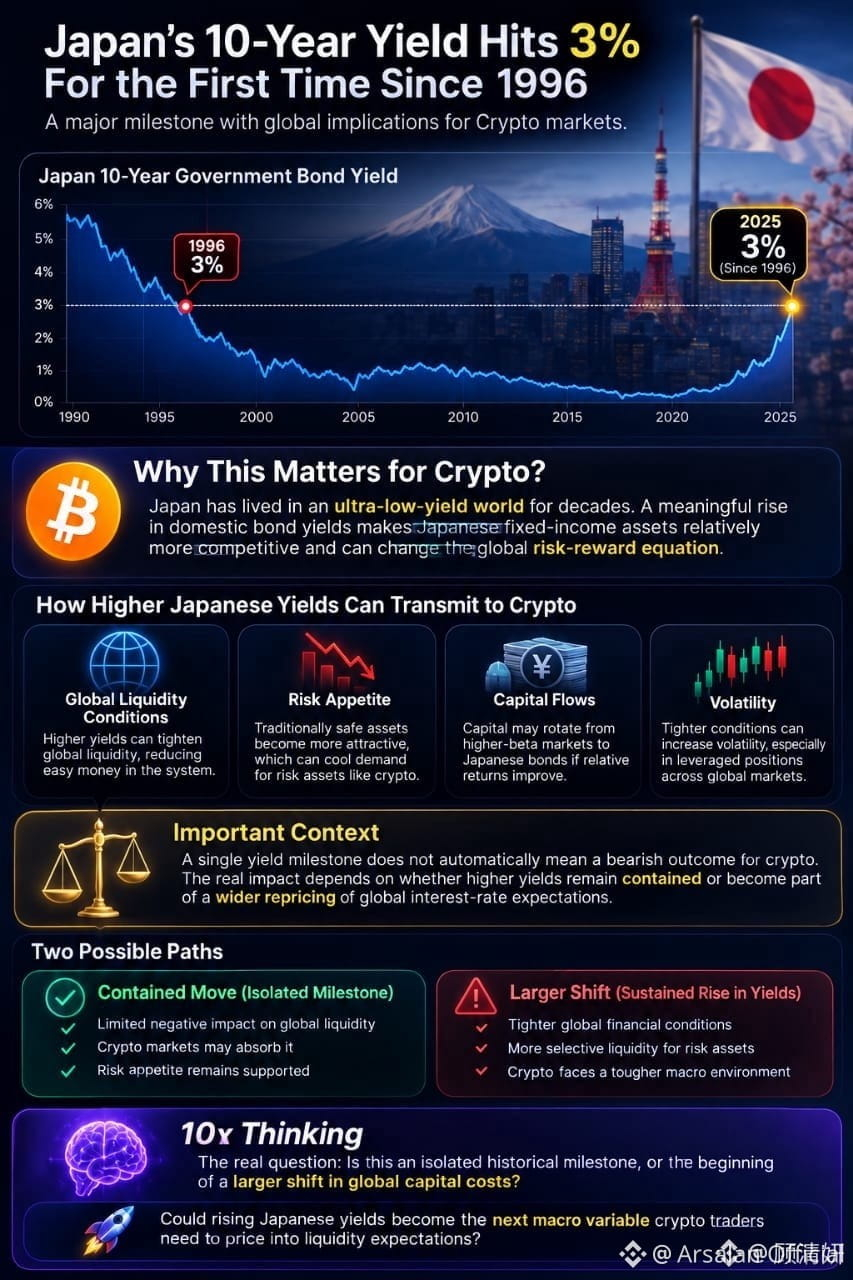
🇯🇵📈 Japanese government bonds at a new high: why it matters for the world?
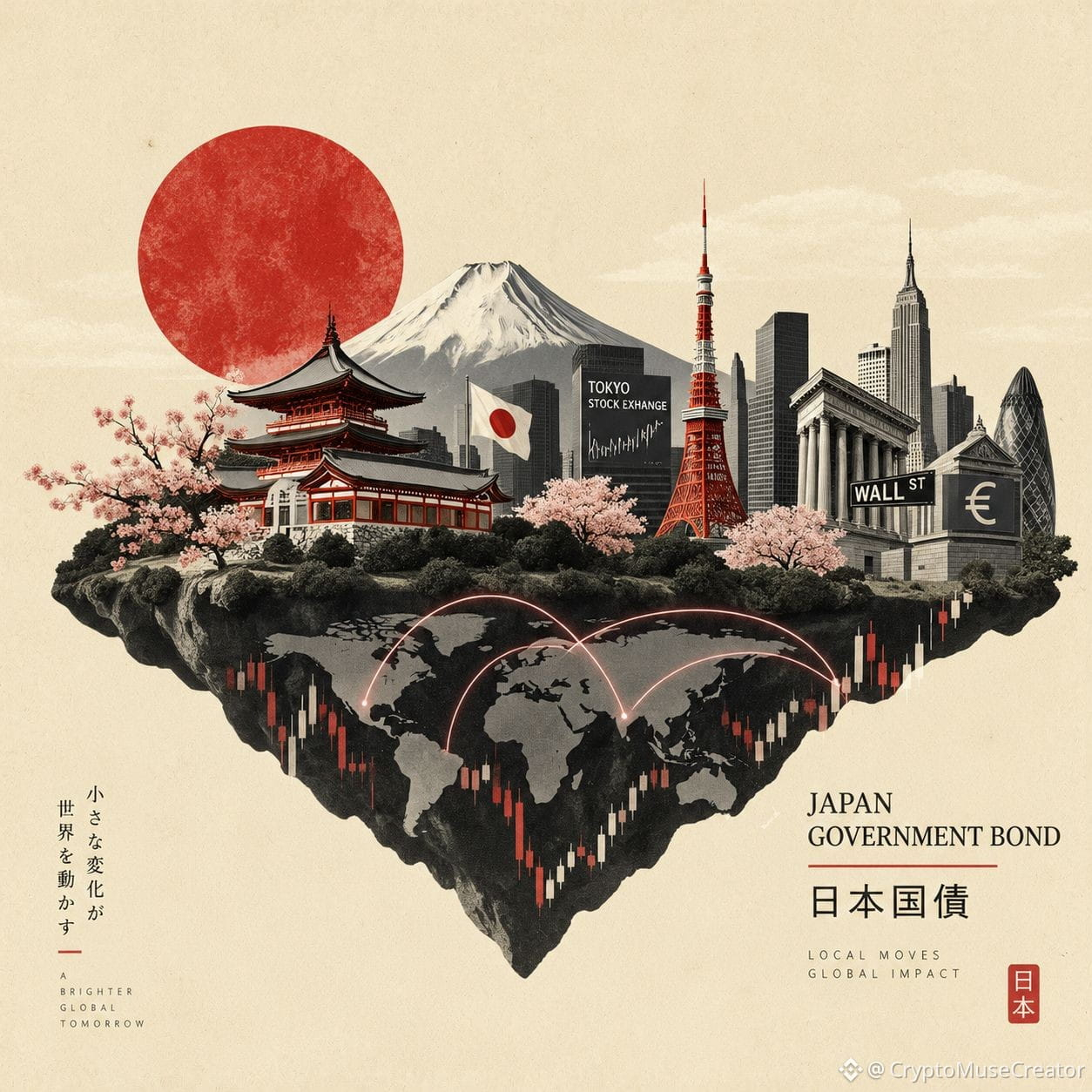
At first glance, the rise in JGB yields is a local story. But Japan is one of the world’s largest sources of global capital, so shifts in its bond market can have far-reaching consequences.
🔴 The 10-year JGB yield has reached 3%—a level not seen since 1996. The market is pricing in higher inflation and fiscal risks, as well as the possibility of further tightening in BoJ policy.
💴 Why does it matter?
If Japanese bonds become more attractive, Japanese investors may find it less appealing to put money into foreign bonds.
➡️ lower demand for US Treasuries and European bonds
➡️ potentially higher yields for them
➡️ more expensive funding worldwide
➡️ pressure on stocks and other risk assets
But this does not automatically mean a global crash. Japanese investors may simply change the structure of their portfolios rather than completely exiting international assets.
👀 What to watch: • JGB 10Y—whether it holds above 3%
• US Treasury 10Y/30Y
• BoJ decisions and rhetoric
• USD/JPY
• flows of Japanese capital into foreign bonds
#Japan #JGB #BoJ #Treasuries #Macro
🇯🇵📈 Japanese government bonds at a new high: why it matters for the world?
At first glance, the rise in JGB yields is a local story. But Japan is one of the world’s largest sources of global capital, so shifts in its bond market can have far-reaching consequences.
🔴 The 10-year JGB yield has reached 3%—a level not seen since 1996. The market is pricing in higher inflation and fiscal risks, as well as the possibility of further tightening in BoJ policy.
💴 Why does it matter?
If Japanese bonds become more attractive, Japanese investors may find it less appealing to put money into foreign bonds.
➡️ lower demand for US Treasuries and European bonds
➡️ potentially higher yields for them
➡️ more expensive funding worldwide
➡️ pressure on stocks and other risk assets
But this does not automatically mean a global crash. Japanese investors may simply change the structure of their portfolios rather than completely exiting international assets.
👀 What to watch: • JGB 10Y—whether it holds above 3%
• US Treasury 10Y/30Y
• BoJ decisions and rhetoric
• USD/JPY
• flows of Japanese capital into foreign bonds
#Japan #JGB #BoJ #Treasuries #Macro
At first glance, the rise in JGB yields is a local story. But Japan is one of the world’s largest sources of global capital, so shifts in its bond market can have far-reaching consequences.
🔴 The 10-year JGB yield has reached 3%—a level not seen since 1996. The market is pricing in higher inflation and fiscal risks, as well as the possibility of further tightening in BoJ policy.
💴 Why does it matter?
If Japanese bonds become more attractive, Japanese investors may find it less appealing to put money into foreign bonds.
➡️ lower demand for US Treasuries and European bonds
➡️ potentially higher yields for them
➡️ more expensive funding worldwide
➡️ pressure on stocks and other risk assets
But this does not automatically mean a global crash. Japanese investors may simply change the structure of their portfolios rather than completely exiting international assets.
👀 What to watch: • JGB 10Y—whether it holds above 3%
• US Treasury 10Y/30Y
• BoJ decisions and rhetoric
• USD/JPY
• flows of Japanese capital into foreign bonds
#Japan #JGB #BoJ #Treasuries #Macro
6
107

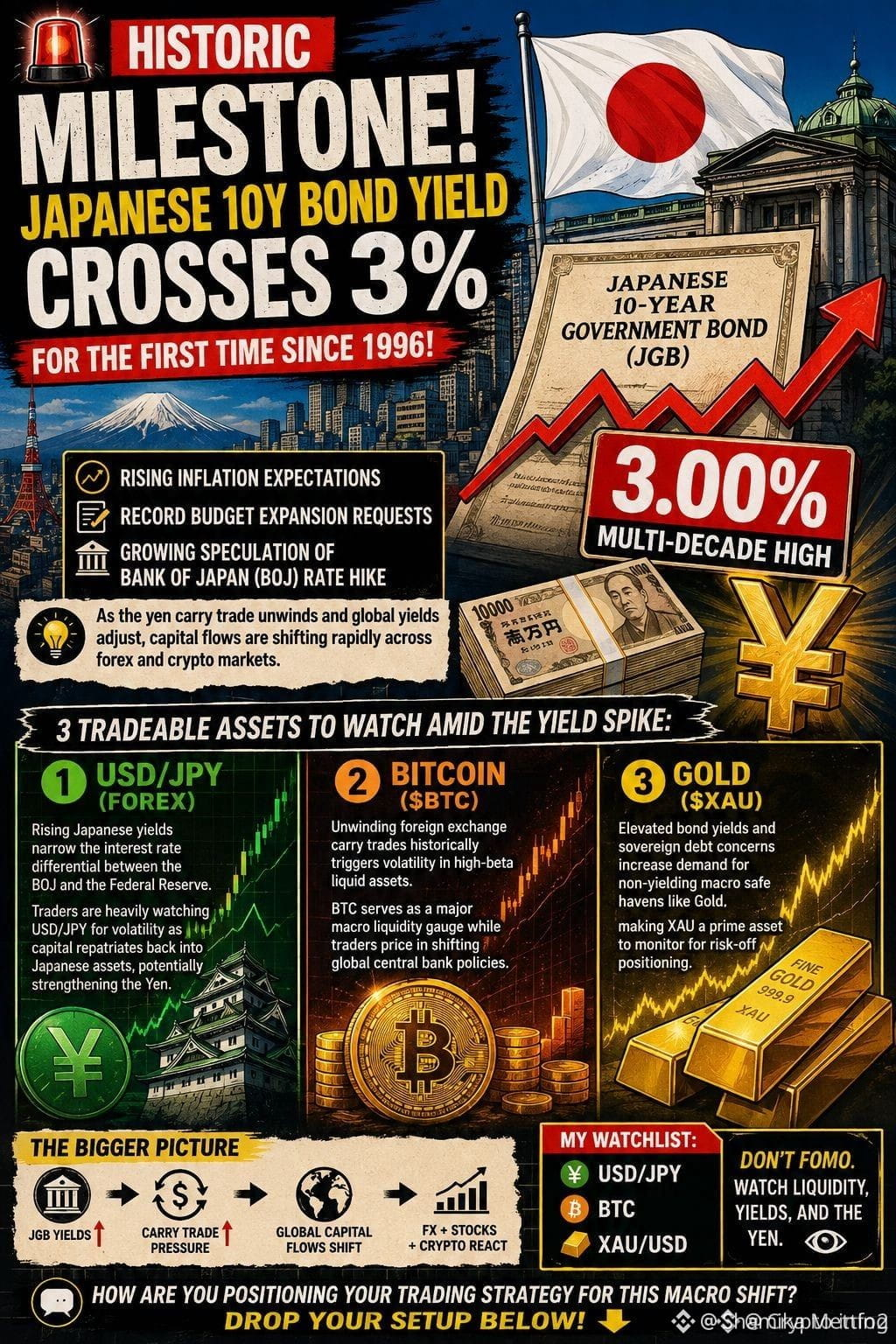
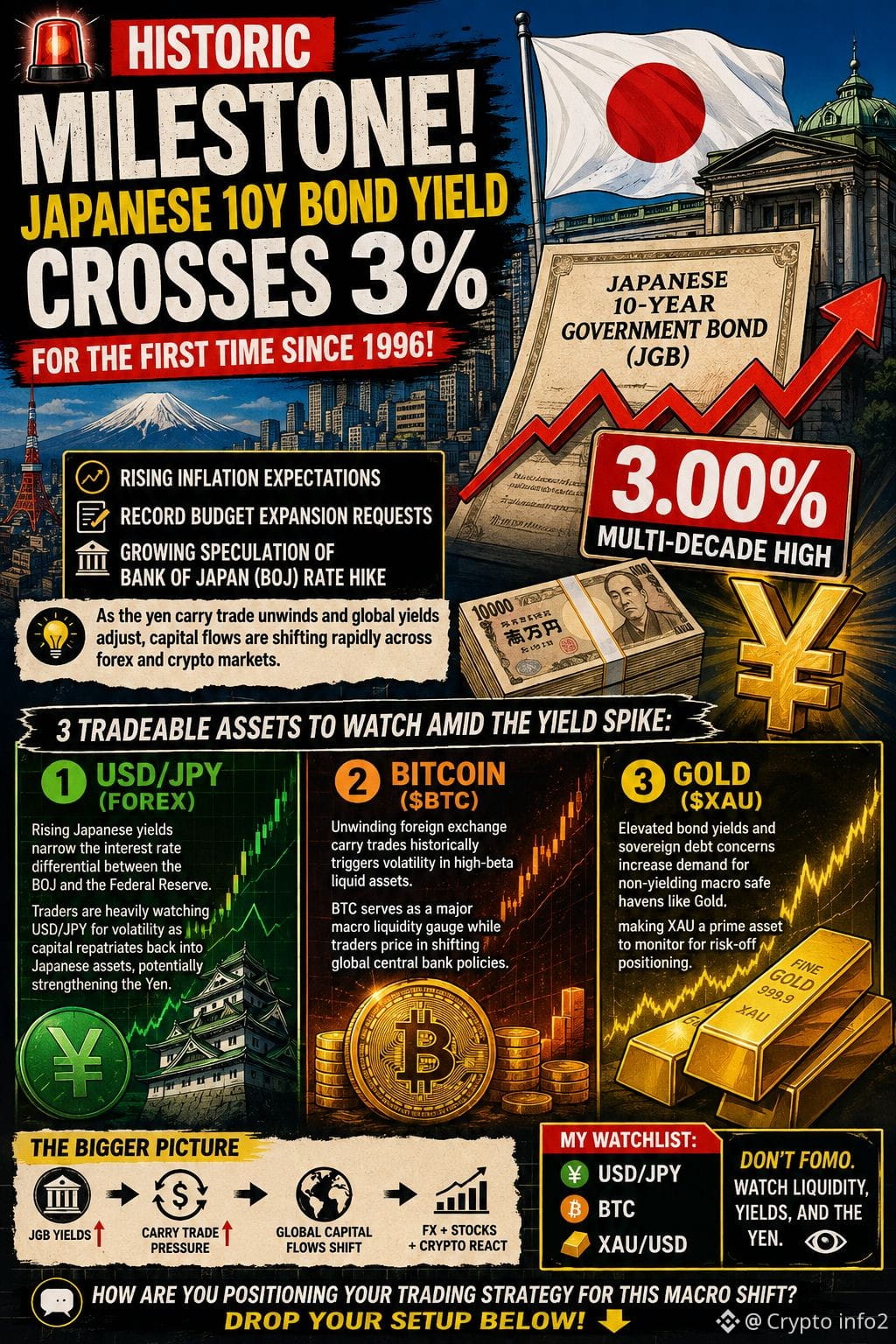
#japan10yyieldhits3%firstsince1996 🚨 A historic macro warning: Japan’s 10-year bond yield reaches 3%! 🇯🇵📈
Japan has surpassed a level we haven’t seen since 1996 — and these developments could have major implications for global markets. ⚠️
The 10-year bond yield (JGB) is around 3%, driven by rising inflation expectations, increased financial demand, and growing speculation about the possibility of another rate hike by the Bank of Japan (BOJ).
But this is the part that crypto traders should pay attention to 👇
💴 1. USD/JPY — watch the yen
Rising Japanese yields may narrow the interest-rate gap between the United States and Japan, which could encourage capital flows to return toward Japan and strengthen the yen.
₿ 2. BITCOIN — a liquidity barometer
If the unwinding of the yen carry trade continues, high-beta assets like BTC may see sharp swings as global liquidity gets repriced.
🥇 3. GOLD — safe haven
Higher government bond yields + debt concerns may push investors toward gold as a defensive macro asset.
This could become one of the most important macro ideas to watch this month. 👀
📌 My watchlist:
💴 USD/JPY
₿ BTC
🥇 XAU/USD
Don’t chase FOMO. Watch liquidity, yields, and the yen.
What’s your ranking/scenario for this macro shift? 👇
Please follow up
#Bitcoin #BTC #Japan #JGB
Click to trade below👇
$BTC $XAU
#japan10yyieldhits3%firstsince1996 🚨 A historic macro warning: Japan’s 10-year bond yield reaches 3%! 🇯🇵📈
Japan has surpassed a level we haven’t seen since 1996 — and these developments could have major implications for global markets. ⚠️
The 10-year bond yield (JGB) is around 3%, driven by rising inflation expectations, increased financial demand, and growing speculation about the possibility of another rate hike by the Bank of Japan (BOJ).
But this is the part that crypto traders should pay attention to 👇
💴 1. USD/JPY — watch the yen
Rising Japanese yields may narrow the interest-rate gap between the United States and Japan, which could encourage capital flows to return toward Japan and strengthen the yen.
₿ 2. BITCOIN — a liquidity barometer
If the unwinding of the yen carry trade continues, high-beta assets like BTC may see sharp swings as global liquidity gets repriced.
🥇 3. GOLD — safe haven
Higher government bond yields + debt concerns may push investors toward gold as a defensive macro asset.
This could become one of the most important macro ideas to watch this month. 👀
📌 My watchlist:
💴 USD/JPY
₿ BTC
🥇 XAU/USD
Don’t chase FOMO. Watch liquidity, yields, and the yen.
What’s your ranking/scenario for this macro shift? 👇
Please follow up
#Bitcoin #BTC #Japan #JGB
Click to trade below👇
$BTC $XAU
Japan has surpassed a level we haven’t seen since 1996 — and these developments could have major implications for global markets. ⚠️
The 10-year bond yield (JGB) is around 3%, driven by rising inflation expectations, increased financial demand, and growing speculation about the possibility of another rate hike by the Bank of Japan (BOJ).
But this is the part that crypto traders should pay attention to 👇
💴 1. USD/JPY — watch the yen
Rising Japanese yields may narrow the interest-rate gap between the United States and Japan, which could encourage capital flows to return toward Japan and strengthen the yen.
₿ 2. BITCOIN — a liquidity barometer
If the unwinding of the yen carry trade continues, high-beta assets like BTC may see sharp swings as global liquidity gets repriced.
🥇 3. GOLD — safe haven
Higher government bond yields + debt concerns may push investors toward gold as a defensive macro asset.
This could become one of the most important macro ideas to watch this month. 👀
📌 My watchlist:
💴 USD/JPY
₿ BTC
🥇 XAU/USD
Don’t chase FOMO. Watch liquidity, yields, and the yen.
What’s your ranking/scenario for this macro shift? 👇
Please follow up
#Bitcoin #BTC #Japan #JGB
Click to trade below👇
$BTC $XAU
1
72

·
--
#japan10yyieldhits3%firstsince1996 🚨 HISTORIC MACRO ALERT: Japan’s 10Y Bond Yield Hits 3%! 🇯🇵📈
Japan just crossed a level we haven’t seen since 1996 — and this could have major implications for global markets. ⚠️
The 10-Year JGB yield is around 3%, fueled by rising inflation expectations, expanding fiscal demands, and growing speculation of another BOJ rate hike.
But here’s where crypto traders should pay attention 👇
💴 1. USD/JPY — WATCH THE YEN
Higher Japanese yields could narrow the US-Japan rate gap, encouraging capital to flow back toward Japan and potentially strengthening the Yen.
₿ 2. BITCOIN — LIQUIDITY GAUGE
If the Yen carry trade continues unwinding, high-beta assets like BTC could experience sharp volatility as global liquidity gets repriced.
🥇 3. GOLD — SAFE-HAVEN PLAY
Rising sovereign yields + debt concerns could keep investors looking toward Gold as a defensive macro asset.
🔥 THE BIGGER PICTURE
Japan’s bond market isn’t just a local story.
JGB yields ↑ → Carry trade pressure ↑ → Global capital flows shift → FX + Stocks + Crypto react
This could become one of the most important macro themes to watch this month. 👀
📌 My watchlist:
💴 USD/JPY
₿ BTC
🥇 XAU/USD
Don’t FOMO. Watch liquidity, yields, and the Yen.
What’s your setup for this macro shift? 👇
#Bitcoin #BTC #Japan #JGB
CLICK TO BELOW TRADE👇
$BTC $XAU
{future}(XAUUSDT)
{future}(BTCUSDT)
#japan10yyieldhits3%firstsince1996 🚨 HISTORIC MACRO ALERT: Japan’s 10Y Bond Yield Hits 3%! 🇯🇵📈
Japan just crossed a level we haven’t seen since 1996 — and this could have major implications for global markets. ⚠️
The 10-Year JGB yield is around 3%, fueled by rising inflation expectations, expanding fiscal demands, and growing speculation of another BOJ rate hike.
But here’s where crypto traders should pay attention 👇
💴 1. USD/JPY — WATCH THE YEN
Higher Japanese yields could narrow the US-Japan rate gap, encouraging capital to flow back toward Japan and potentially strengthening the Yen.
₿ 2. BITCOIN — LIQUIDITY GAUGE
If the Yen carry trade continues unwinding, high-beta assets like BTC could experience sharp volatility as global liquidity gets repriced.
🥇 3. GOLD — SAFE-HAVEN PLAY
Rising sovereign yields + debt concerns could keep investors looking toward Gold as a defensive macro asset.
🔥 THE BIGGER PICTURE
Japan’s bond market isn’t just a local story.
JGB yields ↑ → Carry trade pressure ↑ → Global capital flows shift → FX + Stocks + Crypto react
This could become one of the most important macro themes to watch this month. 👀
📌 My watchlist:
💴 USD/JPY
₿ BTC
🥇 XAU/USD
Don’t FOMO. Watch liquidity, yields, and the Yen.
What’s your setup for this macro shift? 👇
#Bitcoin #BTC #Japan #JGB
CLICK TO BELOW TRADE👇
$BTC $XAU
Japan just crossed a level we haven’t seen since 1996 — and this could have major implications for global markets. ⚠️
The 10-Year JGB yield is around 3%, fueled by rising inflation expectations, expanding fiscal demands, and growing speculation of another BOJ rate hike.
But here’s where crypto traders should pay attention 👇
💴 1. USD/JPY — WATCH THE YEN
Higher Japanese yields could narrow the US-Japan rate gap, encouraging capital to flow back toward Japan and potentially strengthening the Yen.
₿ 2. BITCOIN — LIQUIDITY GAUGE
If the Yen carry trade continues unwinding, high-beta assets like BTC could experience sharp volatility as global liquidity gets repriced.
🥇 3. GOLD — SAFE-HAVEN PLAY
Rising sovereign yields + debt concerns could keep investors looking toward Gold as a defensive macro asset.
🔥 THE BIGGER PICTURE
Japan’s bond market isn’t just a local story.
JGB yields ↑ → Carry trade pressure ↑ → Global capital flows shift → FX + Stocks + Crypto react
This could become one of the most important macro themes to watch this month. 👀
📌 My watchlist:
💴 USD/JPY
₿ BTC
🥇 XAU/USD
Don’t FOMO. Watch liquidity, yields, and the Yen.
What’s your setup for this macro shift? 👇
#Bitcoin #BTC #Japan #JGB
CLICK TO BELOW TRADE👇
$BTC $XAU
1
3
1.7k

#Japan10YYieldHits3%FirstSince1996 🚨 **🇯🇵📈**
Japan’s benchmark **10-year government bond yield hit 3% on September 1, 2026**, its highest level since 1996. The surge reflects rising inflation concerns, fiscal worries, and growing expectations that the **Bank of Japan could raise rates further**. ([Reuters][1])
📌 **Why markets care:**
• 🇯🇵 Higher Japanese yields could attract domestic capital back into JGBs
• 💴 Rate-hike expectations may support the yen
• 🌍 Japanese investors could reconsider overseas bond investments
• 📉 Higher global yields may pressure stocks and risk assets
• 🏦 Japan’s debt-servicing costs face additional pressure
**Big picture:** Japan’s 10-year yield has **more than tripled in two years**, marking a major shift away from the country’s long era of ultra-low borrowing costs. ([kwsn.com][2])
#Japan #JGB #BondMarket #BOJ #Yen #InterestRates #GlobalMarkets #StockMarket #Economy #Finance #MarketNews
[1]: $BNB
{spot}(BNBUSDT)
$BTC
{spot}(BTCUSDT)
$ETH
{spot}(ETHUSDT)
#Japan10YYieldHits3%FirstSince1996 🚨 **🇯🇵📈**
Japan’s benchmark **10-year government bond yield hit 3% on September 1, 2026**, its highest level since 1996. The surge reflects rising inflation concerns, fiscal worries, and growing expectations that the **Bank of Japan could raise rates further**. ([Reuters][1])
📌 **Why markets care:**
• 🇯🇵 Higher Japanese yields could attract domestic capital back into JGBs
• 💴 Rate-hike expectations may support the yen
• 🌍 Japanese investors could reconsider overseas bond investments
• 📉 Higher global yields may pressure stocks and risk assets
• 🏦 Japan’s debt-servicing costs face additional pressure
**Big picture:** Japan’s 10-year yield has **more than tripled in two years**, marking a major shift away from the country’s long era of ultra-low borrowing costs. ([kwsn.com][2])
#Japan #JGB #BondMarket #BOJ #Yen #InterestRates #GlobalMarkets #StockMarket #Economy #Finance #MarketNews
[1]: $BNB
$BTC
$ETH
Japan’s benchmark **10-year government bond yield hit 3% on September 1, 2026**, its highest level since 1996. The surge reflects rising inflation concerns, fiscal worries, and growing expectations that the **Bank of Japan could raise rates further**. ([Reuters][1])
📌 **Why markets care:**
• 🇯🇵 Higher Japanese yields could attract domestic capital back into JGBs
• 💴 Rate-hike expectations may support the yen
• 🌍 Japanese investors could reconsider overseas bond investments
• 📉 Higher global yields may pressure stocks and risk assets
• 🏦 Japan’s debt-servicing costs face additional pressure
**Big picture:** Japan’s 10-year yield has **more than tripled in two years**, marking a major shift away from the country’s long era of ultra-low borrowing costs. ([kwsn.com][2])
#Japan #JGB #BondMarket #BOJ #Yen #InterestRates #GlobalMarkets #StockMarket #Economy #Finance #MarketNews
[1]: $BNB
$BTC
$ETH
1
89

Bitcoin trades sideways as global bonds plunge, with JGB hitting a 30-year high
- Global bond yields hit multi-decade peaks, with Japan’s 10-year JGB yield reaching the highest level in 30 years.
- Despite major swings in the bond market, Bitcoin price remains steady at around $78,000.
- Bitcoin’s resilience to global macro volatility suggests that buying demand and a store-of-value characteristic are present.
#BinanceSquare #CryptoNews #BTC #Macro #JGB
$btc
vlikevn Titanbot
Source: CoinTelegraph
Bitcoin trades sideways as global bonds plunge, with JGB hitting a 30-year high
- Global bond yields hit multi-decade peaks, with Japan’s 10-year JGB yield reaching the highest level in 30 years.
- Despite major swings in the bond market, Bitcoin price remains steady at around $78,000.
- Bitcoin’s resilience to global macro volatility suggests that buying demand and a store-of-value characteristic are present.
#BinanceSquare #CryptoNews #BTC #Macro #JGB
$btc
vlikevn Titanbot
Source: CoinTelegraph
- Global bond yields hit multi-decade peaks, with Japan’s 10-year JGB yield reaching the highest level in 30 years.
- Despite major swings in the bond market, Bitcoin price remains steady at around $78,000.
- Bitcoin’s resilience to global macro volatility suggests that buying demand and a store-of-value characteristic are present.
#BinanceSquare #CryptoNews #BTC #Macro #JGB
$btc
vlikevn Titanbot
Source: CoinTelegraph
103

·
--
#Japan
#blockchain
#JGB
Japan is leading a revolution in traditional finance by testing blockchain technology to settle its government bonds, a move aimed at increasing speed and reducing risk, thus giving greater legitimacy to digital assets globally. 🏦🚀
$BTC
{spot}(BTCUSDT)
#Japan
#blockchain
#JGB
Japan is leading a revolution in traditional finance by testing blockchain technology to settle its government bonds, a move aimed at increasing speed and reducing risk, thus giving greater legitimacy to digital assets globally. 🏦🚀
$BTC
#blockchain
#JGB
Japan is leading a revolution in traditional finance by testing blockchain technology to settle its government bonds, a move aimed at increasing speed and reducing risk, thus giving greater legitimacy to digital assets globally. 🏦🚀
$BTC

171
MUFG trials real-time blockchain payments for Japanese government bonds
- MUFG launches a real-time blockchain payment trial for Japanese government bonds (JGB).
- Use the Canton network to carry out on-chain transactions.
- Goal: demonstrate fast, transparent trading capability.
#BinanceSquare #CryptoNews #MUFG #JGB #CantonNetwork
$btc $eth
vlikevn Titanbot
Source: CoinDesk
MUFG trials real-time blockchain payments for Japanese government bonds
- MUFG launches a real-time blockchain payment trial for Japanese government bonds (JGB).
- Use the Canton network to carry out on-chain transactions.
- Goal: demonstrate fast, transparent trading capability.
#BinanceSquare #CryptoNews #MUFG #JGB #CantonNetwork
$btc $eth
vlikevn Titanbot
Source: CoinDesk
- MUFG launches a real-time blockchain payment trial for Japanese government bonds (JGB).
- Use the Canton network to carry out on-chain transactions.
- Goal: demonstrate fast, transparent trading capability.
#BinanceSquare #CryptoNews #MUFG #JGB #CantonNetwork
$btc $eth
vlikevn Titanbot
Source: CoinDesk
7

·
--
MUFG launches PoC with Digital Asset & Progmat for on-chain JGB repo settlement on Canton Network, targeting real-time 24/7 DvP to cut multi-day cycles. $BTC $ETH $SOL #Blockchain #MUFG #Canton #Tokenization #JGB
MUFG launches PoC with Digital Asset & Progmat for on-chain JGB repo settlement on Canton Network, targeting real-time 24/7 DvP to cut multi-day cycles. $BTC $ETH $SOL #Blockchain #MUFG #Canton #Tokenization #JGB
94
·
--
$BTC : JAPAN'S LARGEST BANK IS PUTTING SOVEREIGN BONDS ON CHAIN 🦈💥
Tokyo's financial titan MUFG is running JGB repurchase trades on-chain, pairing stablecoins with tokenized money market funds to slash settlement from days to real-time. 🦈 This isn't a sandbox experiment — it's Japan's biggest bank rebuilding the plumbing of its national debt market.
Traditional finance keeps proving the same point: the ledger wins. 💡 When sovereign bonds trade on distributed rails, the infrastructure narrative stops being speculation and becomes infrastructure reality. 📊 That's a bid for blockchain that no bear market can shake. The institutional gravity just shifted east.
💬 If Japan's government debt settles on-chain, how long before other G7 treasuries follow the same playbook? 👇
⚠️ Not financial advice. Always manage your risk. 🛡️
🏷️ #BTC #BlockchainAdoption #InstitutionalCrypto #JGB #CryptoNews
🦈 💎
$BTC : JAPAN'S LARGEST BANK IS PUTTING SOVEREIGN BONDS ON CHAIN 🦈💥
Tokyo's financial titan MUFG is running JGB repurchase trades on-chain, pairing stablecoins with tokenized money market funds to slash settlement from days to real-time. 🦈 This isn't a sandbox experiment — it's Japan's biggest bank rebuilding the plumbing of its national debt market.
Traditional finance keeps proving the same point: the ledger wins. 💡 When sovereign bonds trade on distributed rails, the infrastructure narrative stops being speculation and becomes infrastructure reality. 📊 That's a bid for blockchain that no bear market can shake. The institutional gravity just shifted east.
💬 If Japan's government debt settles on-chain, how long before other G7 treasuries follow the same playbook? 👇
⚠️ Not financial advice. Always manage your risk. 🛡️
🏷️ #BTC #BlockchainAdoption #InstitutionalCrypto #JGB #CryptoNews
🦈 💎
Tokyo's financial titan MUFG is running JGB repurchase trades on-chain, pairing stablecoins with tokenized money market funds to slash settlement from days to real-time. 🦈 This isn't a sandbox experiment — it's Japan's biggest bank rebuilding the plumbing of its national debt market.
Traditional finance keeps proving the same point: the ledger wins. 💡 When sovereign bonds trade on distributed rails, the infrastructure narrative stops being speculation and becomes infrastructure reality. 📊 That's a bid for blockchain that no bear market can shake. The institutional gravity just shifted east.
💬 If Japan's government debt settles on-chain, how long before other G7 treasuries follow the same playbook? 👇
⚠️ Not financial advice. Always manage your risk. 🛡️
🏷️ #BTC #BlockchainAdoption #InstitutionalCrypto #JGB #CryptoNews
🦈 💎
10

·
--
Bullish
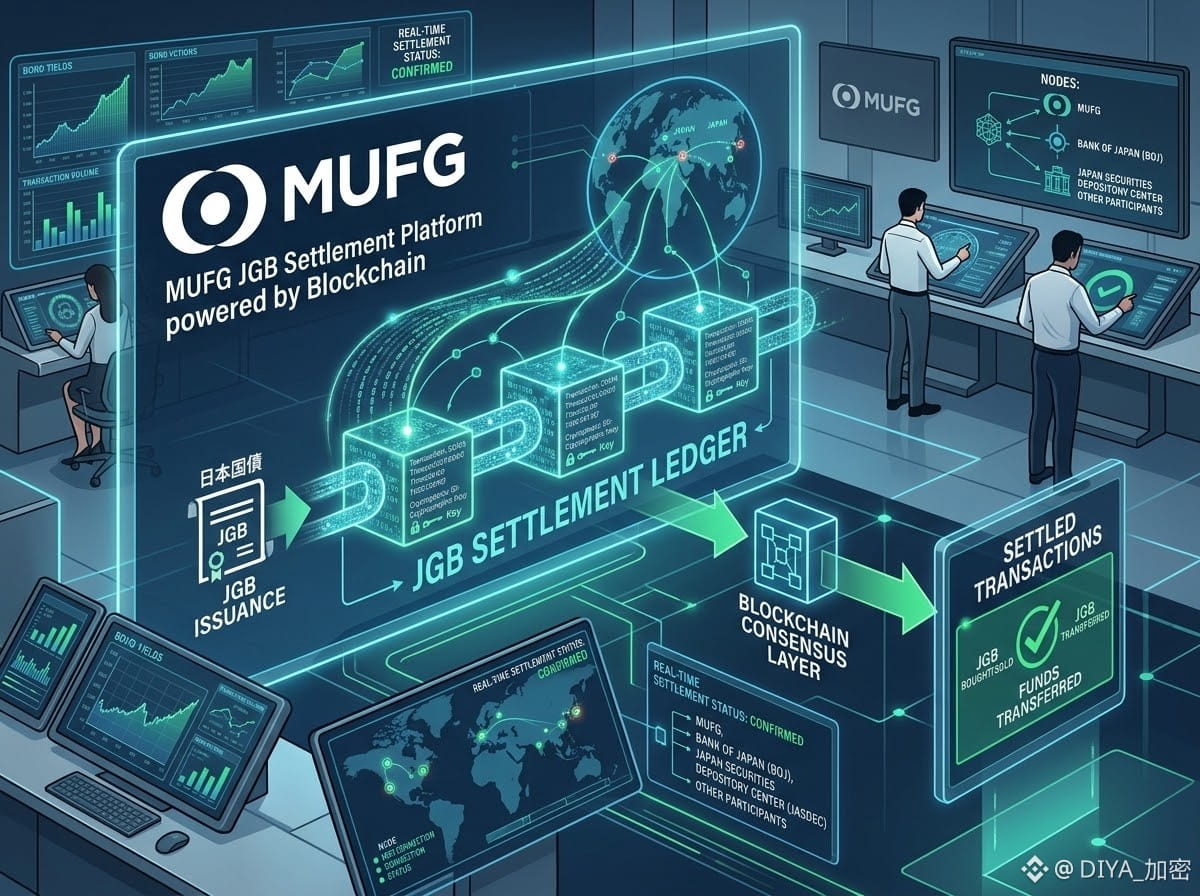
#MUFGToUseBlockchainForJGBSettlement
MUFG Turns to Blockchain for JGB Settlement
Japan’s MUFG is exploring blockchain technology for the settlement of Japanese Government Bonds (JGBs), highlighting the growing role of digital infrastructure in traditional financial markets.
Blockchain could help streamline settlement processes, improve transparency, and potentially reduce operational costs and settlement risks.
The move signals another major step toward integrating blockchain with Japan’s established financial system—and shows that institutional adoption is moving beyond crypto into core capital markets.
#JGB #Blockchain #Japan #DigitalAssets
{stock_us}(MUFG.US)
{future}(BTCUSDT)
{future}(NEIROUSDT)
#MUFGToUseBlockchainForJGBSettlement
MUFG Turns to Blockchain for JGB Settlement
Japan’s MUFG is exploring blockchain technology for the settlement of Japanese Government Bonds (JGBs), highlighting the growing role of digital infrastructure in traditional financial markets.
Blockchain could help streamline settlement processes, improve transparency, and potentially reduce operational costs and settlement risks.
The move signals another major step toward integrating blockchain with Japan’s established financial system—and shows that institutional adoption is moving beyond crypto into core capital markets.
#JGB #Blockchain #Japan #DigitalAssets
MUFG Turns to Blockchain for JGB Settlement
Japan’s MUFG is exploring blockchain technology for the settlement of Japanese Government Bonds (JGBs), highlighting the growing role of digital infrastructure in traditional financial markets.
Blockchain could help streamline settlement processes, improve transparency, and potentially reduce operational costs and settlement risks.
The move signals another major step toward integrating blockchain with Japan’s established financial system—and shows that institutional adoption is moving beyond crypto into core capital markets.
#JGB #Blockchain #Japan #DigitalAssets
MUFGUS+0.00%
376

🇯🇵 Japan Goes Full On-Chain: 24/7 Government Bond Trading is Coming!Japan is officially bridging the gap between traditional finance (TradFi) and blockchain. In a move that could redefine global capital markets, the Japanese government and major financial institutions are moving Japanese Government Bonds (JGBs) onto the blockchain.
We are witnessing the "Tokenization of Everything." When a G7 nation moves its national debt onto a distributed ledger, it’s no longer an experiment—it’s the new standard for global finance.
Are you bullish on RWA (Real-World Assets) for 2026? Let’s discuss how this impacts the broader crypto market below! 👇
#Japan #RWA #Tokenization #JGB #BinanceSquare
🇯🇵 Japan Goes Full On-Chain: 24/7 Government Bond Trading is Coming!
Japan is officially bridging the gap between traditional finance (TradFi) and blockchain. In a move that could redefine global capital markets, the Japanese government and major financial institutions are moving Japanese Government Bonds (JGBs) onto the blockchain.
We are witnessing the "Tokenization of Everything." When a G7 nation moves its national debt onto a distributed ledger, it’s no longer an experiment—it’s the new standard for global finance.
Are you bullish on RWA (Real-World Assets) for 2026? Let’s discuss how this impacts the broader crypto market below! 👇
#Japan #RWA #Tokenization #JGB #BinanceSquare
We are witnessing the "Tokenization of Everything." When a G7 nation moves its national debt onto a distributed ledger, it’s no longer an experiment—it’s the new standard for global finance.
Are you bullish on RWA (Real-World Assets) for 2026? Let’s discuss how this impacts the broader crypto market below! 👇
#Japan #RWA #Tokenization #JGB #BinanceSquare
80

·
--
Bullish
#japanbondyieldsrise
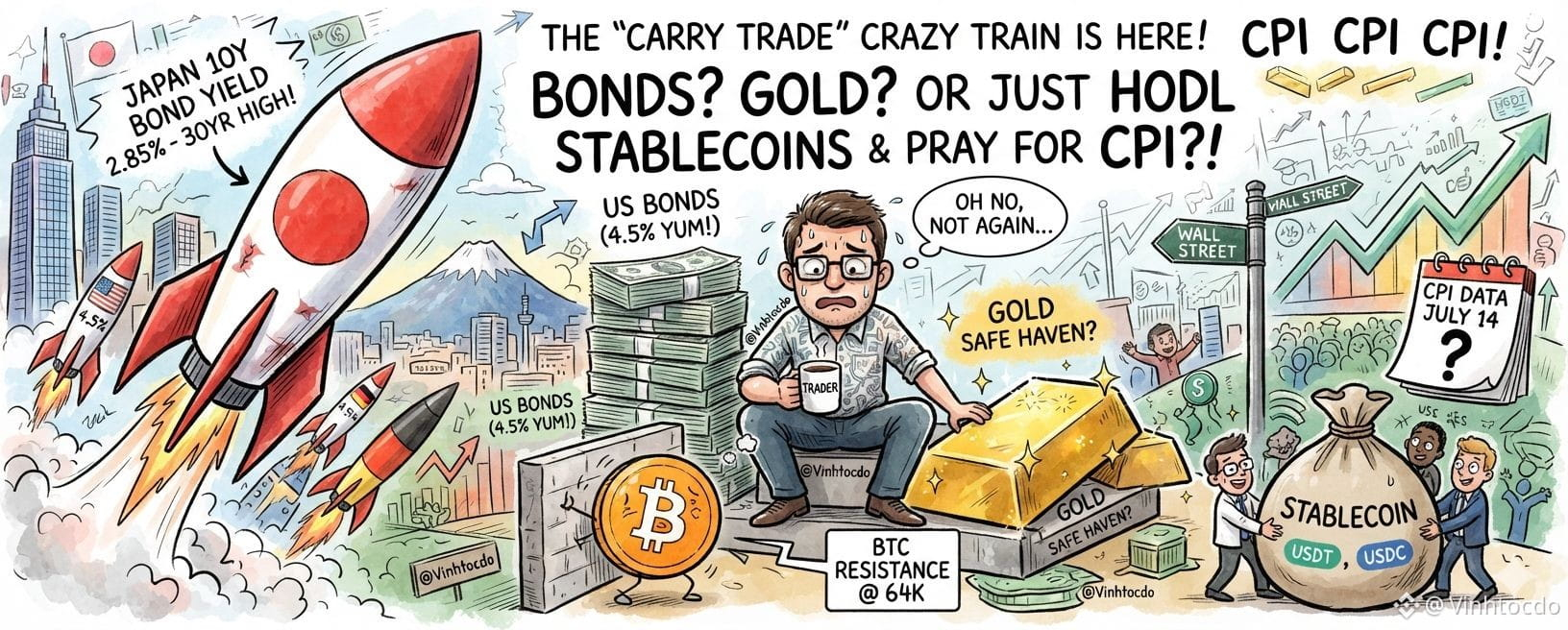
📈 Japanese Government Bond (JGB) yields jump to a record 30-year high (2.85%), dragging U.S. and German yields up too! When yields rise, cheap “Carry Trade” capital gets pulled back home, instantly stalling Bitcoin right around the 64k zone.
So which is safer for shelter right now: bonds or gold, folks? U.S. bonds are hitting 4.5%—that’s extremely tempting—but gold isn’t far behind.
What should we traders do? At times like this, stay calm, endure the loss, hold tight to stablecoins, and wait for the “final blow” from the CPI data on July 14! 😎
⚠️ This is not financial advice. Use code VINHTOCDO to support me, please!
#Japan #JGB #Binance #VINHTOCDO
$BTC
{future}(BTCUSDT)
$ETH
{future}(ETHUSDT)
$AIOT
{future}(AIOTUSDT)
#japanbondyieldsrise
📈 Japanese Government Bond (JGB) yields jump to a record 30-year high (2.85%), dragging U.S. and German yields up too! When yields rise, cheap “Carry Trade” capital gets pulled back home, instantly stalling Bitcoin right around the 64k zone.
So which is safer for shelter right now: bonds or gold, folks? U.S. bonds are hitting 4.5%—that’s extremely tempting—but gold isn’t far behind.
What should we traders do? At times like this, stay calm, endure the loss, hold tight to stablecoins, and wait for the “final blow” from the CPI data on July 14! 😎
⚠️ This is not financial advice. Use code VINHTOCDO to support me, please!
#Japan #JGB #Binance #VINHTOCDO
$BTC
$ETH
$AIOT
📈 Japanese Government Bond (JGB) yields jump to a record 30-year high (2.85%), dragging U.S. and German yields up too! When yields rise, cheap “Carry Trade” capital gets pulled back home, instantly stalling Bitcoin right around the 64k zone.
So which is safer for shelter right now: bonds or gold, folks? U.S. bonds are hitting 4.5%—that’s extremely tempting—but gold isn’t far behind.
What should we traders do? At times like this, stay calm, endure the loss, hold tight to stablecoins, and wait for the “final blow” from the CPI data on July 14! 😎
⚠️ This is not financial advice. Use code VINHTOCDO to support me, please!
#Japan #JGB #Binance #VINHTOCDO
$BTC
$ETH
$AIOT
204

🚨MUFG’s Blockchain Move Could Change Traditional Finance Forever — Here’s Why It MattersThe line between traditional finance and blockchain technology is becoming increasingly difficult to ignore.
A major development from Japan has put blockchain back in the spotlight after Mitsubishi UFJ Financial Group (MUFG) reportedly moved toward using blockchain technology for instant settlement of Japanese Government Bond (JGB) repo transactions. The reported plan targets commercial deployment as early as fiscal 2027 and could significantly change how institutions move collateral and settle transactions. �
BigGo Finance +1
This is not simply another blockchain experiment. It represents a potentially important step toward bringing tokenization, instant settlement, digital assets and traditional financial markets closer together.
🇯🇵 What Is MUFG Planning?
MUFG is reportedly exploring a blockchain-based system that could allow certain Japanese Government Bond repo transactions to settle almost instantly instead of relying on the traditional settlement process.
The Japanese repo market is enormous, with outstanding balances reported at around ¥270 trillion, roughly $1.7 trillion. Moving even a portion of this market toward blockchain-based settlement could have major implications for institutional finance. �
BigGo Finance
Today, financial markets often depend on settlement processes that require time between the execution of a transaction and its final completion.
Blockchain technology offers a different model.
Instead of relying on multiple disconnected systems, institutions can potentially use a shared digital ledger where ownership, transaction records and settlement information are synchronized.
That could help reduce settlement delays and improve capital efficiency.
⚡ Why Instant Settlement Matters
The biggest potential advantage is speed.
Traditional financial transactions can involve several parties, including banks, brokers, custodians, clearing systems and settlement institutions. Each participant may maintain its own records and processes.
Blockchain can potentially simplify this structure.
With near-instant settlement, institutions could potentially:
Move collateral faster
Reduce settlement delays
Improve capital efficiency
Lower certain operational risks
Increase transparency
Reduce reconciliation requirements
Potentially make markets more efficient
For a market worth trillions of dollars, even small improvements in capital efficiency can have a meaningful impact.
This is why MUFG’s reported move is much bigger than a simple technology upgrade.
It could represent a change in the financial infrastructure itself.
🔥 The Bigger Story: Tokenization
Perhaps the most important part of this development is not just blockchain settlement.
It is tokenization.
Tokenization means representing traditional assets such as bonds, securities or deposits in a digital format that can interact with blockchain-based infrastructure.
MUFG has already been working on digital-asset initiatives, including security tokens, tokenized deposits and blockchain-based financial infrastructure. Its own materials describe efforts around moving assets on-chain and improving payment infrastructure using blockchain technology. �
MUFG +1
That makes the latest reported JGB initiative part of a much larger trend.
The future financial system may not necessarily replace traditional assets with cryptocurrencies.
Instead, traditional assets could increasingly become blockchain-enabled digital assets.
💰 What About Stablecoins?
Another important piece of the story is the role of stablecoins and tokenized deposits.
For blockchain-based financial markets to operate efficiently, institutions need both sides of a transaction to work digitally.
Imagine a tokenized bond being transferred on-chain.
If the bond moves instantly but the payment still requires a traditional banking process, the entire transaction cannot achieve true atomic settlement.
That is why tokenized deposits and stablecoins are becoming increasingly important in institutional blockchain projects.
MUFG and other Japanese banks have already been exploring stablecoin-related initiatives, with MUFG Bank stating that participating Japanese banks are targeting live transactions involving a jointly issued stablecoin during fiscal 2026. �
MUFG Bank
This creates an interesting possibility:
Tokenized assets + blockchain settlement + digital money = a new financial infrastructure.
🌐 Why Crypto Investors Should Pay Attention
Some crypto investors may look at this news and think:
“MUFG is a traditional bank. What does this have to do with Bitcoin or crypto?”
The answer is: infrastructure.
The most important long-term crypto story may not be whether a particular coin goes up 10% tomorrow.
The bigger story could be whether blockchain technology becomes part of the global financial system.
If banks begin using blockchain for government bonds, securities, payments, collateral and settlement, then blockchain technology becomes increasingly integrated into the world's financial infrastructure.
That could create additional demand for blockchain networks capable of supporting:
high transaction volume + security + compliance + tokenized assets + institutional settlement.
This does not automatically mean that every cryptocurrency will benefit.
But it strengthens the broader argument that blockchain technology is moving beyond speculation.
📈 Is This Bullish for Blockchain?
Potentially, yes.
Institutional adoption is one of the strongest long-term narratives in the digital-asset sector.
When major financial institutions experiment with blockchain, they are effectively testing whether the technology can handle real-world financial activity.
The difference between a crypto project announcing a partnership and a major bank integrating blockchain into financial-market infrastructure is significant.
The latter could potentially demonstrate real-world utility at scale.
And Japan is becoming an especially interesting market to watch.
Financial institutions there have already been working on security tokens, tokenized deposits, stablecoins and blockchain settlement. MUFG's own strategy documents show continued work around digital assets and the on-chain transition of traditional assets. �
MUFG
🏦 Traditional Finance Is Slowly Moving On-Chain
For years, blockchain was mostly associated with Bitcoin, Ethereum, DeFi and speculative crypto markets.
That narrative is changing.
Now, banks and financial institutions are increasingly asking a different question:
“Can blockchain make our existing financial system faster and more efficient?”
That question could ultimately be more important than the original crypto narrative.
If blockchain can help institutions settle bonds faster, transfer collateral more efficiently, process payments continuously and tokenize traditionally illiquid assets, then the technology could become an important layer of the global financial system.
The transition will probably not happen overnight.
Regulation, cybersecurity, interoperability, liquidity and institutional risk management remain major challenges.
But the direction is becoming increasingly clear.
🔮 What Could Happen Next?
If MUFG successfully progresses toward its reported fiscal 2027 commercialization target, other financial institutions could watch closely.
A successful implementation could encourage:
More tokenized bonds
More blockchain-based repo markets
More institutional stablecoin usage
More tokenized deposits
More on-chain settlement infrastructure
Greater institutional blockchain adoption
The most important question will be whether blockchain-based settlement can move from pilot projects into large-scale production environments.
That is where the real test begins.
A proof of concept is one thing.
Processing billions or trillions of dollars in real financial transactions safely and reliably is something completely different.
🚨 The Real Crypto Signal
The biggest takeaway from MUFG's move is not that Bitcoin will immediately pump.
It is not a direct buy signal for any particular cryptocurrency.
Instead, it is a signal about the direction of financial infrastructure.
The world’s largest financial institutions are increasingly investigating how blockchain can be used for real-world financial assets.
That could eventually make tokenization and on-chain settlement one of the most important narratives in the next phase of digital finance.
Bitcoin may remain the flagship digital asset, but the broader blockchain ecosystem could benefit if traditional financial markets increasingly move on-chain.
The next major crypto cycle may therefore not be driven only by retail speculation.
It could increasingly involve banks, asset managers, tokenized securities, stablecoins and institutional blockchain infrastructure.
🚀 Final Thoughts
MUFG's reported blockchain initiative is a development worth watching closely.
Japan's financial sector is exploring ways to combine traditional assets with blockchain technology, while stablecoins and tokenized deposits could provide the digital settlement layer needed to make these systems practical.
If these experiments succeed, the impact could extend far beyond Japan.
It could help demonstrate that blockchain is capable of becoming a core component of global financial infrastructure.
For crypto investors, this is the bigger picture to watch:
Blockchain is no longer only competing with traditional finance. Traditional finance is increasingly beginning to build on blockchain.
And that shift could become one of the biggest stories in digital assets over the coming years.
#MUFG #Blockchain #JGB #Tokenization #crypto #Stablecoin #RWA #DigitalAssets #Bitcoin #Ethereum #BinanceSquare
🚨MUFG’s Blockchain Move Could Change Traditional Finance Forever — Here’s Why It Matters
The line between traditional finance and blockchain technology is becoming increasingly difficult to ignore.
A major development from Japan has put blockchain back in the spotlight after Mitsubishi UFJ Financial Group (MUFG) reportedly moved toward using blockchain technology for instant settlement of Japanese Government Bond (JGB) repo transactions. The reported plan targets commercial deployment as early as fiscal 2027 and could significantly change how institutions move collateral and settle transactions. �
BigGo Finance +1
This is not simply another blockchain experiment. It represents a potentially important step toward bringing tokenization, instant settlement, digital assets and traditional financial markets closer together.
🇯🇵 What Is MUFG Planning?
MUFG is reportedly exploring a blockchain-based system that could allow certain Japanese Government Bond repo transactions to settle almost instantly instead of relying on the traditional settlement process.
The Japanese repo market is enormous, with outstanding balances reported at around ¥270 trillion, roughly $1.7 trillion. Moving even a portion of this market toward blockchain-based settlement could have major implications for institutional finance. �
BigGo Finance
Today, financial markets often depend on settlement processes that require time between the execution of a transaction and its final completion.
Blockchain technology offers a different model.
Instead of relying on multiple disconnected systems, institutions can potentially use a shared digital ledger where ownership, transaction records and settlement information are synchronized.
That could help reduce settlement delays and improve capital efficiency.
⚡ Why Instant Settlement Matters
The biggest potential advantage is speed.
Traditional financial transactions can involve several parties, including banks, brokers, custodians, clearing systems and settlement institutions. Each participant may maintain its own records and processes.
Blockchain can potentially simplify this structure.
With near-instant settlement, institutions could potentially:
Move collateral faster
Reduce settlement delays
Improve capital efficiency
Lower certain operational risks
Increase transparency
Reduce reconciliation requirements
Potentially make markets more efficient
For a market worth trillions of dollars, even small improvements in capital efficiency can have a meaningful impact.
This is why MUFG’s reported move is much bigger than a simple technology upgrade.
It could represent a change in the financial infrastructure itself.
🔥 The Bigger Story: Tokenization
Perhaps the most important part of this development is not just blockchain settlement.
It is tokenization.
Tokenization means representing traditional assets such as bonds, securities or deposits in a digital format that can interact with blockchain-based infrastructure.
MUFG has already been working on digital-asset initiatives, including security tokens, tokenized deposits and blockchain-based financial infrastructure. Its own materials describe efforts around moving assets on-chain and improving payment infrastructure using blockchain technology. �
MUFG +1
That makes the latest reported JGB initiative part of a much larger trend.
The future financial system may not necessarily replace traditional assets with cryptocurrencies.
Instead, traditional assets could increasingly become blockchain-enabled digital assets.
💰 What About Stablecoins?
Another important piece of the story is the role of stablecoins and tokenized deposits.
For blockchain-based financial markets to operate efficiently, institutions need both sides of a transaction to work digitally.
Imagine a tokenized bond being transferred on-chain.
If the bond moves instantly but the payment still requires a traditional banking process, the entire transaction cannot achieve true atomic settlement.
That is why tokenized deposits and stablecoins are becoming increasingly important in institutional blockchain projects.
MUFG and other Japanese banks have already been exploring stablecoin-related initiatives, with MUFG Bank stating that participating Japanese banks are targeting live transactions involving a jointly issued stablecoin during fiscal 2026. �
MUFG Bank
This creates an interesting possibility:
Tokenized assets + blockchain settlement + digital money = a new financial infrastructure.
🌐 Why Crypto Investors Should Pay Attention
Some crypto investors may look at this news and think:
“MUFG is a traditional bank. What does this have to do with Bitcoin or crypto?”
The answer is: infrastructure.
The most important long-term crypto story may not be whether a particular coin goes up 10% tomorrow.
The bigger story could be whether blockchain technology becomes part of the global financial system.
If banks begin using blockchain for government bonds, securities, payments, collateral and settlement, then blockchain technology becomes increasingly integrated into the world's financial infrastructure.
That could create additional demand for blockchain networks capable of supporting:
high transaction volume + security + compliance + tokenized assets + institutional settlement.
This does not automatically mean that every cryptocurrency will benefit.
But it strengthens the broader argument that blockchain technology is moving beyond speculation.
📈 Is This Bullish for Blockchain?
Potentially, yes.
Institutional adoption is one of the strongest long-term narratives in the digital-asset sector.
When major financial institutions experiment with blockchain, they are effectively testing whether the technology can handle real-world financial activity.
The difference between a crypto project announcing a partnership and a major bank integrating blockchain into financial-market infrastructure is significant.
The latter could potentially demonstrate real-world utility at scale.
And Japan is becoming an especially interesting market to watch.
Financial institutions there have already been working on security tokens, tokenized deposits, stablecoins and blockchain settlement. MUFG's own strategy documents show continued work around digital assets and the on-chain transition of traditional assets. �
MUFG
🏦 Traditional Finance Is Slowly Moving On-Chain
For years, blockchain was mostly associated with Bitcoin, Ethereum, DeFi and speculative crypto markets.
That narrative is changing.
Now, banks and financial institutions are increasingly asking a different question:
“Can blockchain make our existing financial system faster and more efficient?”
That question could ultimately be more important than the original crypto narrative.
If blockchain can help institutions settle bonds faster, transfer collateral more efficiently, process payments continuously and tokenize traditionally illiquid assets, then the technology could become an important layer of the global financial system.
The transition will probably not happen overnight.
Regulation, cybersecurity, interoperability, liquidity and institutional risk management remain major challenges.
But the direction is becoming increasingly clear.
🔮 What Could Happen Next?
If MUFG successfully progresses toward its reported fiscal 2027 commercialization target, other financial institutions could watch closely.
A successful implementation could encourage:
More tokenized bonds
More blockchain-based repo markets
More institutional stablecoin usage
More tokenized deposits
More on-chain settlement infrastructure
Greater institutional blockchain adoption
The most important question will be whether blockchain-based settlement can move from pilot projects into large-scale production environments.
That is where the real test begins.
A proof of concept is one thing.
Processing billions or trillions of dollars in real financial transactions safely and reliably is something completely different.
🚨 The Real Crypto Signal
The biggest takeaway from MUFG's move is not that Bitcoin will immediately pump.
It is not a direct buy signal for any particular cryptocurrency.
Instead, it is a signal about the direction of financial infrastructure.
The world’s largest financial institutions are increasingly investigating how blockchain can be used for real-world financial assets.
That could eventually make tokenization and on-chain settlement one of the most important narratives in the next phase of digital finance.
Bitcoin may remain the flagship digital asset, but the broader blockchain ecosystem could benefit if traditional financial markets increasingly move on-chain.
The next major crypto cycle may therefore not be driven only by retail speculation.
It could increasingly involve banks, asset managers, tokenized securities, stablecoins and institutional blockchain infrastructure.
🚀 Final Thoughts
MUFG's reported blockchain initiative is a development worth watching closely.
Japan's financial sector is exploring ways to combine traditional assets with blockchain technology, while stablecoins and tokenized deposits could provide the digital settlement layer needed to make these systems practical.
If these experiments succeed, the impact could extend far beyond Japan.
It could help demonstrate that blockchain is capable of becoming a core component of global financial infrastructure.
For crypto investors, this is the bigger picture to watch:
Blockchain is no longer only competing with traditional finance. Traditional finance is increasingly beginning to build on blockchain.
And that shift could become one of the biggest stories in digital assets over the coming years.
#MUFG #Blockchain #JGB #Tokenization #crypto #Stablecoin #RWA #DigitalAssets #Bitcoin #Ethereum #BinanceSquare
A major development from Japan has put blockchain back in the spotlight after Mitsubishi UFJ Financial Group (MUFG) reportedly moved toward using blockchain technology for instant settlement of Japanese Government Bond (JGB) repo transactions. The reported plan targets commercial deployment as early as fiscal 2027 and could significantly change how institutions move collateral and settle transactions. �
BigGo Finance +1
This is not simply another blockchain experiment. It represents a potentially important step toward bringing tokenization, instant settlement, digital assets and traditional financial markets closer together.
🇯🇵 What Is MUFG Planning?
MUFG is reportedly exploring a blockchain-based system that could allow certain Japanese Government Bond repo transactions to settle almost instantly instead of relying on the traditional settlement process.
The Japanese repo market is enormous, with outstanding balances reported at around ¥270 trillion, roughly $1.7 trillion. Moving even a portion of this market toward blockchain-based settlement could have major implications for institutional finance. �
BigGo Finance
Today, financial markets often depend on settlement processes that require time between the execution of a transaction and its final completion.
Blockchain technology offers a different model.
Instead of relying on multiple disconnected systems, institutions can potentially use a shared digital ledger where ownership, transaction records and settlement information are synchronized.
That could help reduce settlement delays and improve capital efficiency.
⚡ Why Instant Settlement Matters
The biggest potential advantage is speed.
Traditional financial transactions can involve several parties, including banks, brokers, custodians, clearing systems and settlement institutions. Each participant may maintain its own records and processes.
Blockchain can potentially simplify this structure.
With near-instant settlement, institutions could potentially:
Move collateral faster
Reduce settlement delays
Improve capital efficiency
Lower certain operational risks
Increase transparency
Reduce reconciliation requirements
Potentially make markets more efficient
For a market worth trillions of dollars, even small improvements in capital efficiency can have a meaningful impact.
This is why MUFG’s reported move is much bigger than a simple technology upgrade.
It could represent a change in the financial infrastructure itself.
🔥 The Bigger Story: Tokenization
Perhaps the most important part of this development is not just blockchain settlement.
It is tokenization.
Tokenization means representing traditional assets such as bonds, securities or deposits in a digital format that can interact with blockchain-based infrastructure.
MUFG has already been working on digital-asset initiatives, including security tokens, tokenized deposits and blockchain-based financial infrastructure. Its own materials describe efforts around moving assets on-chain and improving payment infrastructure using blockchain technology. �
MUFG +1
That makes the latest reported JGB initiative part of a much larger trend.
The future financial system may not necessarily replace traditional assets with cryptocurrencies.
Instead, traditional assets could increasingly become blockchain-enabled digital assets.
💰 What About Stablecoins?
Another important piece of the story is the role of stablecoins and tokenized deposits.
For blockchain-based financial markets to operate efficiently, institutions need both sides of a transaction to work digitally.
Imagine a tokenized bond being transferred on-chain.
If the bond moves instantly but the payment still requires a traditional banking process, the entire transaction cannot achieve true atomic settlement.
That is why tokenized deposits and stablecoins are becoming increasingly important in institutional blockchain projects.
MUFG and other Japanese banks have already been exploring stablecoin-related initiatives, with MUFG Bank stating that participating Japanese banks are targeting live transactions involving a jointly issued stablecoin during fiscal 2026. �
MUFG Bank
This creates an interesting possibility:
Tokenized assets + blockchain settlement + digital money = a new financial infrastructure.
🌐 Why Crypto Investors Should Pay Attention
Some crypto investors may look at this news and think:
“MUFG is a traditional bank. What does this have to do with Bitcoin or crypto?”
The answer is: infrastructure.
The most important long-term crypto story may not be whether a particular coin goes up 10% tomorrow.
The bigger story could be whether blockchain technology becomes part of the global financial system.
If banks begin using blockchain for government bonds, securities, payments, collateral and settlement, then blockchain technology becomes increasingly integrated into the world's financial infrastructure.
That could create additional demand for blockchain networks capable of supporting:
high transaction volume + security + compliance + tokenized assets + institutional settlement.
This does not automatically mean that every cryptocurrency will benefit.
But it strengthens the broader argument that blockchain technology is moving beyond speculation.
📈 Is This Bullish for Blockchain?
Potentially, yes.
Institutional adoption is one of the strongest long-term narratives in the digital-asset sector.
When major financial institutions experiment with blockchain, they are effectively testing whether the technology can handle real-world financial activity.
The difference between a crypto project announcing a partnership and a major bank integrating blockchain into financial-market infrastructure is significant.
The latter could potentially demonstrate real-world utility at scale.
And Japan is becoming an especially interesting market to watch.
Financial institutions there have already been working on security tokens, tokenized deposits, stablecoins and blockchain settlement. MUFG's own strategy documents show continued work around digital assets and the on-chain transition of traditional assets. �
MUFG
🏦 Traditional Finance Is Slowly Moving On-Chain
For years, blockchain was mostly associated with Bitcoin, Ethereum, DeFi and speculative crypto markets.
That narrative is changing.
Now, banks and financial institutions are increasingly asking a different question:
“Can blockchain make our existing financial system faster and more efficient?”
That question could ultimately be more important than the original crypto narrative.
If blockchain can help institutions settle bonds faster, transfer collateral more efficiently, process payments continuously and tokenize traditionally illiquid assets, then the technology could become an important layer of the global financial system.
The transition will probably not happen overnight.
Regulation, cybersecurity, interoperability, liquidity and institutional risk management remain major challenges.
But the direction is becoming increasingly clear.
🔮 What Could Happen Next?
If MUFG successfully progresses toward its reported fiscal 2027 commercialization target, other financial institutions could watch closely.
A successful implementation could encourage:
More tokenized bonds
More blockchain-based repo markets
More institutional stablecoin usage
More tokenized deposits
More on-chain settlement infrastructure
Greater institutional blockchain adoption
The most important question will be whether blockchain-based settlement can move from pilot projects into large-scale production environments.
That is where the real test begins.
A proof of concept is one thing.
Processing billions or trillions of dollars in real financial transactions safely and reliably is something completely different.
🚨 The Real Crypto Signal
The biggest takeaway from MUFG's move is not that Bitcoin will immediately pump.
It is not a direct buy signal for any particular cryptocurrency.
Instead, it is a signal about the direction of financial infrastructure.
The world’s largest financial institutions are increasingly investigating how blockchain can be used for real-world financial assets.
That could eventually make tokenization and on-chain settlement one of the most important narratives in the next phase of digital finance.
Bitcoin may remain the flagship digital asset, but the broader blockchain ecosystem could benefit if traditional financial markets increasingly move on-chain.
The next major crypto cycle may therefore not be driven only by retail speculation.
It could increasingly involve banks, asset managers, tokenized securities, stablecoins and institutional blockchain infrastructure.
🚀 Final Thoughts
MUFG's reported blockchain initiative is a development worth watching closely.
Japan's financial sector is exploring ways to combine traditional assets with blockchain technology, while stablecoins and tokenized deposits could provide the digital settlement layer needed to make these systems practical.
If these experiments succeed, the impact could extend far beyond Japan.
It could help demonstrate that blockchain is capable of becoming a core component of global financial infrastructure.
For crypto investors, this is the bigger picture to watch:
Blockchain is no longer only competing with traditional finance. Traditional finance is increasingly beginning to build on blockchain.
And that shift could become one of the biggest stories in digital assets over the coming years.
#MUFG #Blockchain #JGB #Tokenization #crypto #Stablecoin #RWA #DigitalAssets #Bitcoin #Ethereum #BinanceSquare
10
Log in to explore more content
Join global crypto users on Binance Square
⚡️ Get latest and useful information about crypto.
💬 Trusted by the world’s largest crypto exchange.
👍 Discover real insights from verified creators.
Email / Phone number
Trending Topics
1
#ChinaMayLetAlibabaByteDanceBuyNvidiaChips
152 views
34 Discussing
2
#USChinaRelease$30BTariffCutProductLists
0 views
2 Discussing
3
#SKoreaFSCConsidersVirtualAssetMarketMaker
954 views
73 Discussing
4
#ChinaIndustrialProfitGrowthSlowsFourthMonth
2,186 views
101 Discussing
5
#BitwiseFilesFinalNEARSpotETFProspectus
105,077 views
1,589 Discussing
6
#BitgetHackerMoves$83MStolenXRP
36,912 views
171 Discussing
7
#SOLSpotETFWeeklyInflow$188M
23,751 views
137 Discussing
8
#DogecoinETFsPostBiggestWeekSinceLaunch
63,043 views
1,062 Discussing
9
#StrategyStriveAdd2305BitcoinThisWeek
158,215 views
2,298 Discussing
10
#TrumpRejectsIranHormuzReopening
136,345 views
1,736 Discussing