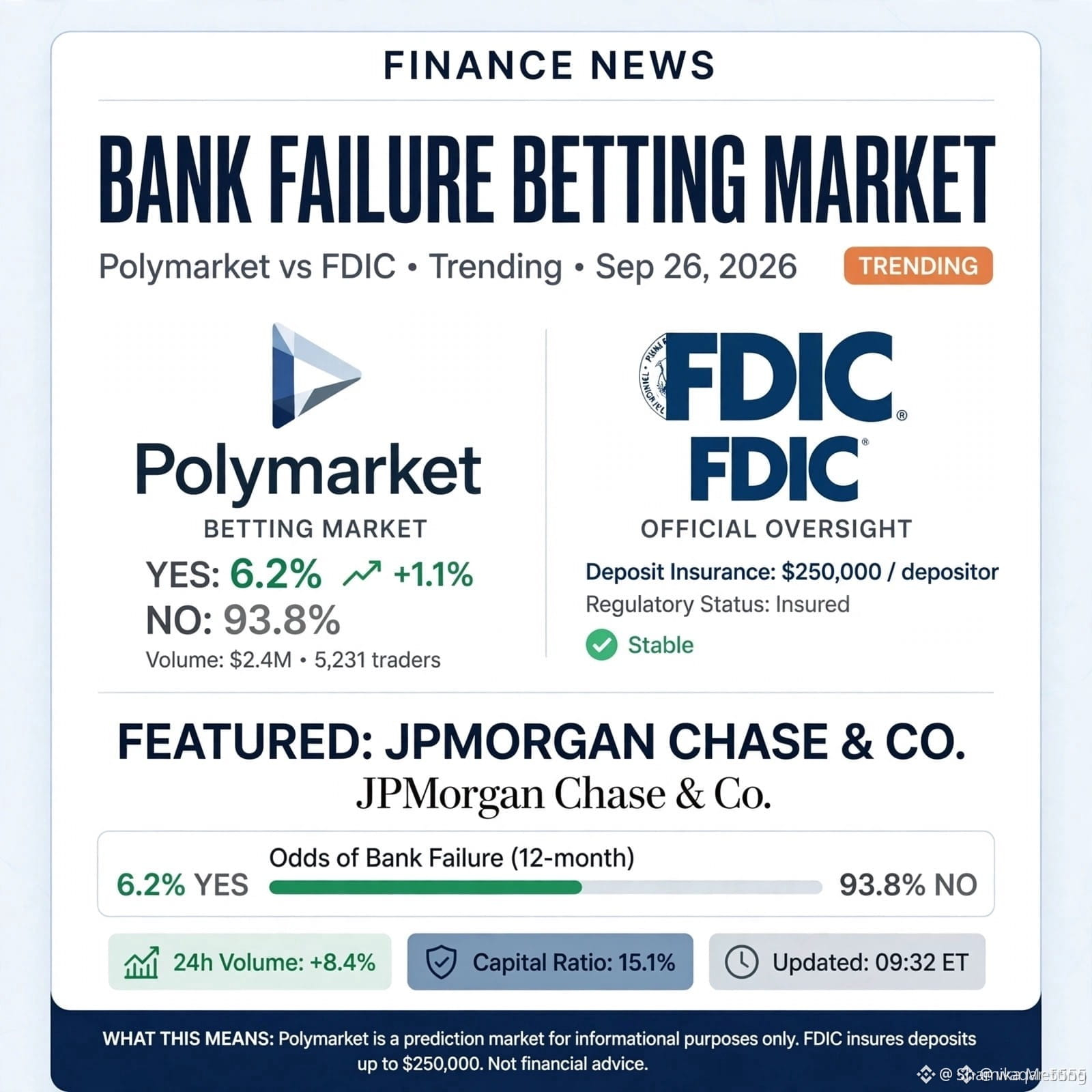
Binance Square
#fdic

fdic

98,723 views
228 Discussing
the voice studio
·
--
🚨 Polymarket’s bank-failure bets just caught the FDIC’s attention Prediction markets on Polymarket letting users wager on the failure of major U.S. banks — including $WFC.US , $JPM , and $BAC.US — are drawing scrutiny from FDIC officials and lawmakers. Current volumes are still tiny (recent year-end failure contracts saw only about $76,000 in trading). Polymarket says it bans U.S. users. Still, regulators are worried that if these markets grow, the public odds could amplify panic and potentially fuel real-world bank runs. Why it matters for crypto:
Prediction markets are becoming more influential. When they start pricing the health of systemically important banks, it raises bigger questions about information vs. incentive effects — and how platforms like Polymarket sit at the intersection of crypto, finance, and regulation. What to watch:
• Any formal regulatory pushback or pressure on these contracts 
• Whether volumes stay small or start climbing 
• How other prediction platforms handle similar sensitive markets Tiny markets can still shape narratives. The real question is whether transparent failure odds are useful signals… or a line regulators will try to shut down. Do you think betting on bank failures should be allowed on prediction markets, or is this a boundary that shouldn’t be crossed? #PolymarketBankFailureBetsDrawFDICConcern #Polymarket #FDIC #PredictionMarkets {future}(JPMUSDT) {future}(SPYUSDT)
🚨 Polymarket’s bank-failure bets just caught the FDIC’s attention

Prediction markets on Polymarket letting users wager on the failure of major U.S. banks — including $WFC.US , $JPM , and $BAC.US — are drawing scrutiny from FDIC officials and lawmakers.

Current volumes are still tiny (recent year-end failure contracts saw only about $76,000 in trading). Polymarket says it bans U.S. users.

Still, regulators are worried that if these markets grow, the public odds could amplify panic and potentially fuel real-world bank runs.

Why it matters for crypto:
Prediction markets are becoming more influential. When they start pricing the health of systemically important banks, it raises bigger questions about information vs. incentive effects — and how platforms like Polymarket sit at the intersection of crypto, finance, and regulation.

What to watch:
• Any formal regulatory pushback or pressure on these contracts

• Whether volumes stay small or start climbing

• How other prediction platforms handle similar sensitive markets

Tiny markets can still shape narratives. The real question is whether transparent failure odds are useful signals… or a line regulators will try to shut down.

Do you think betting on bank failures should be allowed on prediction markets, or is this a boundary that shouldn’t be crossed?

#PolymarketBankFailureBetsDrawFDICConcern #Polymarket #FDIC #PredictionMarkets

JPM-1.04%
BACUS-0.88%
WFCUS-0.33%
Article
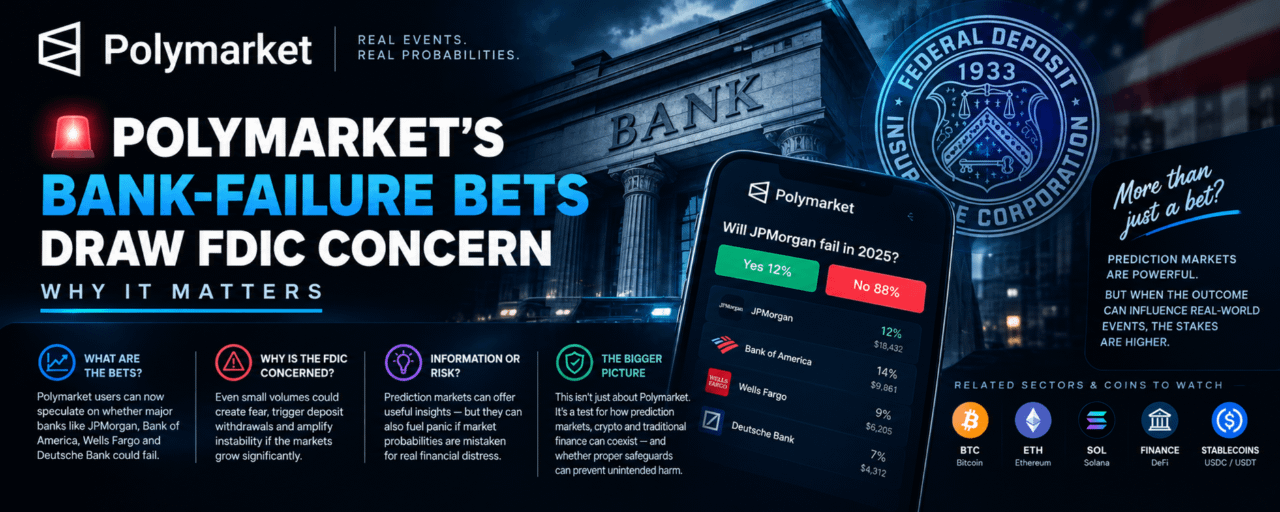
POLYMARKET BETS ON BANK FAILURES PUT FINANCIAL STABILITY IN FOCUS#polymarketbankfailurebetsdrawfdicconcern Prediction markets are moving into increasingly sensitive areas of finance — and this time, the focus is bank failures. Reports indicate that contracts on Polymarket allowing traders to speculate on whether major banks such as JPMorgan, Bank of America, Wells Fargo and Deutsche Bank could fail are attracting scrutiny from U.S. banking officials and lawmakers. 🏦 WHY IS THE FDIC CONCERNED? The contracts are currently relatively small. Reported trading volume on individual bank-failure contracts is often only in the hundreds or thousands of dollars, while contracts covering several major banks have accumulated roughly $76,000 in total volume. The concern is less about the market's current size and more about what could happen if these markets become significantly larger. Imagine a scenario where traders begin aggressively pricing a bank's failure. If depositors interpret that market activity as evidence that the bank is actually in trouble, they could potentially withdraw deposits. A sufficiently large wave of withdrawals could create liquidity pressure — turning a market signal into part of the problem it was supposedly measuring. That is the key concern surrounding these contracts. ⚖️ INFORMATION TOOL OR FINANCIAL RISK? There are two sides to the debate. Supporters of prediction markets argue that they can aggregate information from thousands of market participants and provide a real-time signal about financial risks. Critics worry that markets predicting the failure of a specific bank could create self-reinforcing fear, particularly when participants or observers mistake market probabilities for verified financial information. This distinction is extremely important: A prediction-market price is not the same thing as a regulator's assessment of a bank's financial condition. 🔐 WHAT ABOUT INSIDER INFORMATION? Another issue discussed by regulators is whether people with access to confidential information could trade these contracts. The FDIC maintains nonpublic information concerning troubled institutions. Reports say officials discussed the issue and concluded that existing ethics rules already prohibit employees from trading based on nonpublic information. 🌐 WHY THIS MATTERS FOR CRYPTO & PREDICTION MARKETS This story goes beyond banking. Prediction markets are becoming an important part of the broader digital-asset and fintech ecosystem. Platforms such as Polymarket have demonstrated that markets can turn questions about politics, economics, finance and world events into tradable probabilities. But the expansion also creates a difficult question: Where should prediction markets stop when the underlying event itself can influence the outcome? A market predicting rainfall doesn't normally cause rain. A market predicting the failure of a bank could, under certain circumstances, influence public perception and potentially deposit behavior. That's why bank-failure contracts are attracting more attention than ordinary event markets. 👀 THE BIGGER PICTURE The current reported volumes are relatively small, and the existence of these contracts does not establish that JPMorgan, Bank of America, Wells Fargo or other named banks are actually approaching failure. The contracts reflect traders' expectations, not an official FDIC determination. At the same time, the FDIC's concern highlights an important challenge for the next generation of prediction markets: More information can create better price discovery — but in financial markets, information can also influence behavior. The real test will be whether prediction markets can expand while maintaining strong safeguards against market manipulation, insider trading, misinformation and destabilizing feedback loops. 📌 My takeaway: Prediction markets are becoming increasingly relevant to finance, but betting on the failure of a specific financial institution is fundamentally different from betting on a sports game or economic statistic. The question isn't simply “What does the market predict?” It's also: “Could the prediction itself change what happens next?” #Polymarket #FDIC

POLYMARKET BETS ON BANK FAILURES PUT FINANCIAL STABILITY IN FOCUS

#polymarketbankfailurebetsdrawfdicconcern
Prediction markets are moving into increasingly sensitive areas of finance — and this time, the focus is bank failures.
Reports indicate that contracts on Polymarket allowing traders to speculate on whether major banks such as JPMorgan, Bank of America, Wells Fargo and Deutsche Bank could fail are attracting scrutiny from U.S. banking officials and lawmakers.
🏦 WHY IS THE FDIC CONCERNED?
The contracts are currently relatively small. Reported trading volume on individual bank-failure contracts is often only in the hundreds or thousands of dollars, while contracts covering several major banks have accumulated roughly $76,000 in total volume.
The concern is less about the market's current size and more about what could happen if these markets become significantly larger.
Imagine a scenario where traders begin aggressively pricing a bank's failure.
If depositors interpret that market activity as evidence that the bank is actually in trouble, they could potentially withdraw deposits. A sufficiently large wave of withdrawals could create liquidity pressure — turning a market signal into part of the problem it was supposedly measuring.
That is the key concern surrounding these contracts.
⚖️ INFORMATION TOOL OR FINANCIAL RISK?
There are two sides to the debate.
Supporters of prediction markets argue that they can aggregate information from thousands of market participants and provide a real-time signal about financial risks.
Critics worry that markets predicting the failure of a specific bank could create self-reinforcing fear, particularly when participants or observers mistake market probabilities for verified financial information.
This distinction is extremely important:
A prediction-market price is not the same thing as a regulator's assessment of a bank's financial condition.
🔐 WHAT ABOUT INSIDER INFORMATION?
Another issue discussed by regulators is whether people with access to confidential information could trade these contracts.
The FDIC maintains nonpublic information concerning troubled institutions. Reports say officials discussed the issue and concluded that existing ethics rules already prohibit employees from trading based on nonpublic information.
🌐 WHY THIS MATTERS FOR CRYPTO & PREDICTION MARKETS
This story goes beyond banking.
Prediction markets are becoming an important part of the broader digital-asset and fintech ecosystem. Platforms such as Polymarket have demonstrated that markets can turn questions about politics, economics, finance and world events into tradable probabilities.
But the expansion also creates a difficult question:
Where should prediction markets stop when the underlying event itself can influence the outcome?
A market predicting rainfall doesn't normally cause rain.
A market predicting the failure of a bank could, under certain circumstances, influence public perception and potentially deposit behavior.
That's why bank-failure contracts are attracting more attention than ordinary event markets.
👀 THE BIGGER PICTURE
The current reported volumes are relatively small, and the existence of these contracts does not establish that JPMorgan, Bank of America, Wells Fargo or other named banks are actually approaching failure. The contracts reflect traders' expectations, not an official FDIC determination.
At the same time, the FDIC's concern highlights an important challenge for the next generation of prediction markets:
More information can create better price discovery — but in financial markets, information can also influence behavior.
The real test will be whether prediction markets can expand while maintaining strong safeguards against market manipulation, insider trading, misinformation and destabilizing feedback loops.
📌 My takeaway:
Prediction markets are becoming increasingly relevant to finance, but betting on the failure of a specific financial institution is fundamentally different from betting on a sports game or economic statistic.
The question isn't simply “What does the market predict?”
It's also:
“Could the prediction itself change what happens next?”
#Polymarket #FDIC
206 Atlas:
Disagree. Relying on systemic collapse is a terrible strategy for consistent gains. Trade the structure, not just the crash.
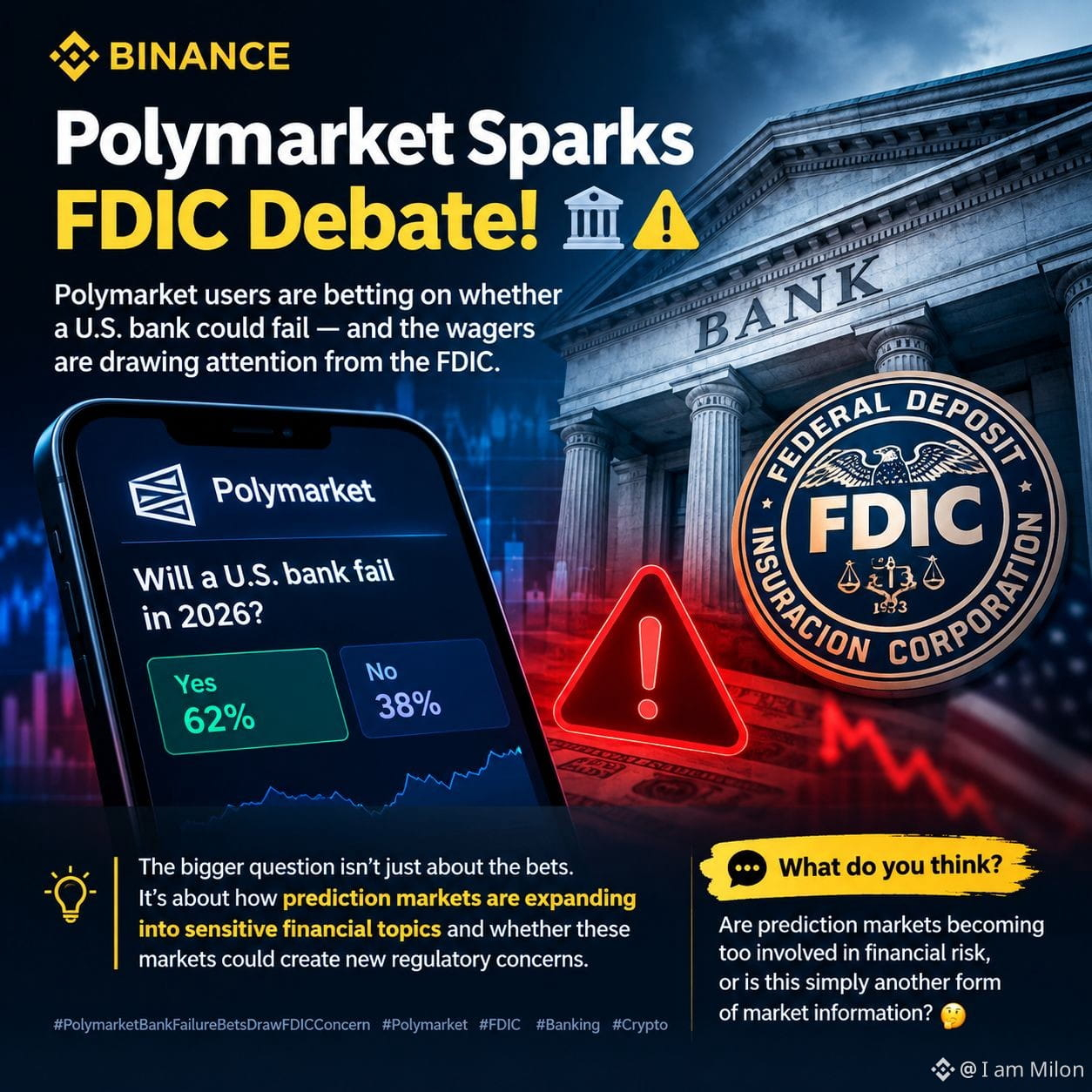
🚨 Polymarket Sparks FDIC Debate! 🏦⚠️ Polymarket users are betting on whether a U.S. bank could fail — and the wagers are drawing attention from the FDIC. The bigger question isn’t just about the bets. 👀 It’s about how prediction markets are expanding into sensitive financial topics and whether these markets could create new regulatory concerns. With bank stability always under the spotlight, this is definitely a topic worth watching. 🔥 What do you think — are prediction markets becoming too involved in financial risk, or is this simply another form of market information? 🤔 #PolymarketBankFailureBetsDrawFDICConcern #Polymarket #FDIC #PolymarketBankFailureBetsDrawFDICConcern

🚨 Polymarket Sparks FDIC Debate! 🏦⚠️

Polymarket users are betting on whether a U.S. bank could fail — and the wagers are drawing attention from the FDIC.
The bigger question isn’t just about the bets. 👀
It’s about how prediction markets are expanding into sensitive financial topics and whether these markets could create new regulatory concerns.
With bank stability always under the spotlight, this is definitely a topic worth watching. 🔥
What do you think — are prediction markets becoming too involved in financial risk, or is this simply another form of market information? 🤔

#PolymarketBankFailureBetsDrawFDICConcern #Polymarket #FDIC
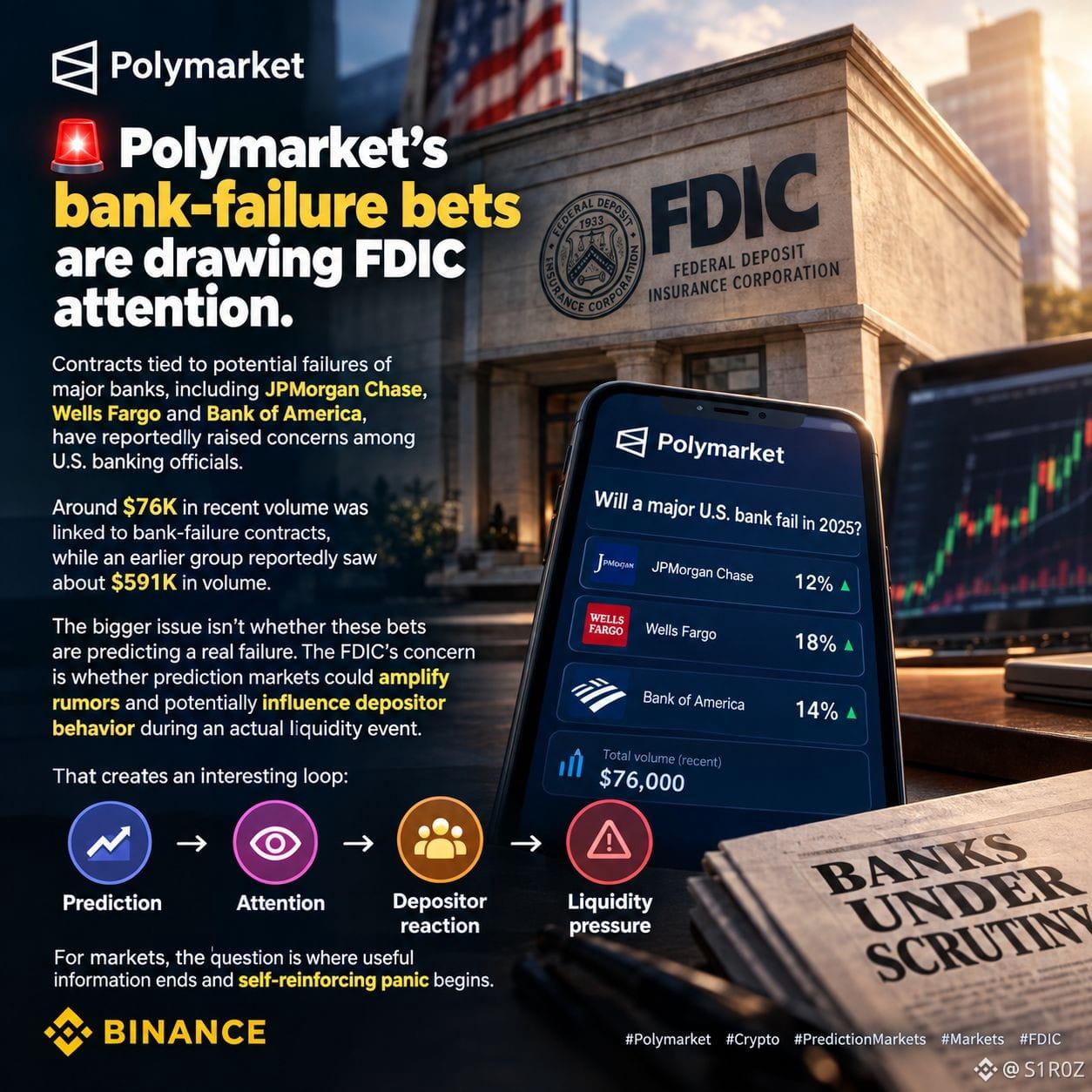
#PolymarketBankFailureBetsDrawFDICConcern
🚨 Polymarket bank-failure bets draw FDIC concern Prediction markets on the failure of Wells Fargo, JPMorgan, and Bank of America have raised flags with U.S. regulators. FDIC officials and lawmakers worry the contracts could grow and help spark real bank runs. Current volume remains small — about $76,000 on year-end failure bets. The platform bans U.S. traders. FDIC says existing ethics rules already block insiders from participating. Prediction markets under fresh regulatory heat. $POLYX {future}(POLYXUSDT) $SOL {future}(SOLUSDT) $ETH {future}(ETHUSDT) #Polymarket #FDIC #Banking #PolymarketBankFailureBetsDrawFDICConcern

🚨 Polymarket bank-failure bets draw FDIC concern

Prediction markets on the failure of Wells Fargo, JPMorgan, and Bank of America have raised flags with U.S. regulators.

FDIC officials and lawmakers worry the contracts could grow and help spark real bank runs.

Current volume remains small — about $76,000 on year-end failure bets.

The platform bans U.S. traders. FDIC says existing ethics rules already block insiders from participating.

Prediction markets under fresh regulatory heat.

$POLYX
$SOL
$ETH

#Polymarket #FDIC #Banking #PolymarketBankFailureBetsDrawFDICConcern

·
--
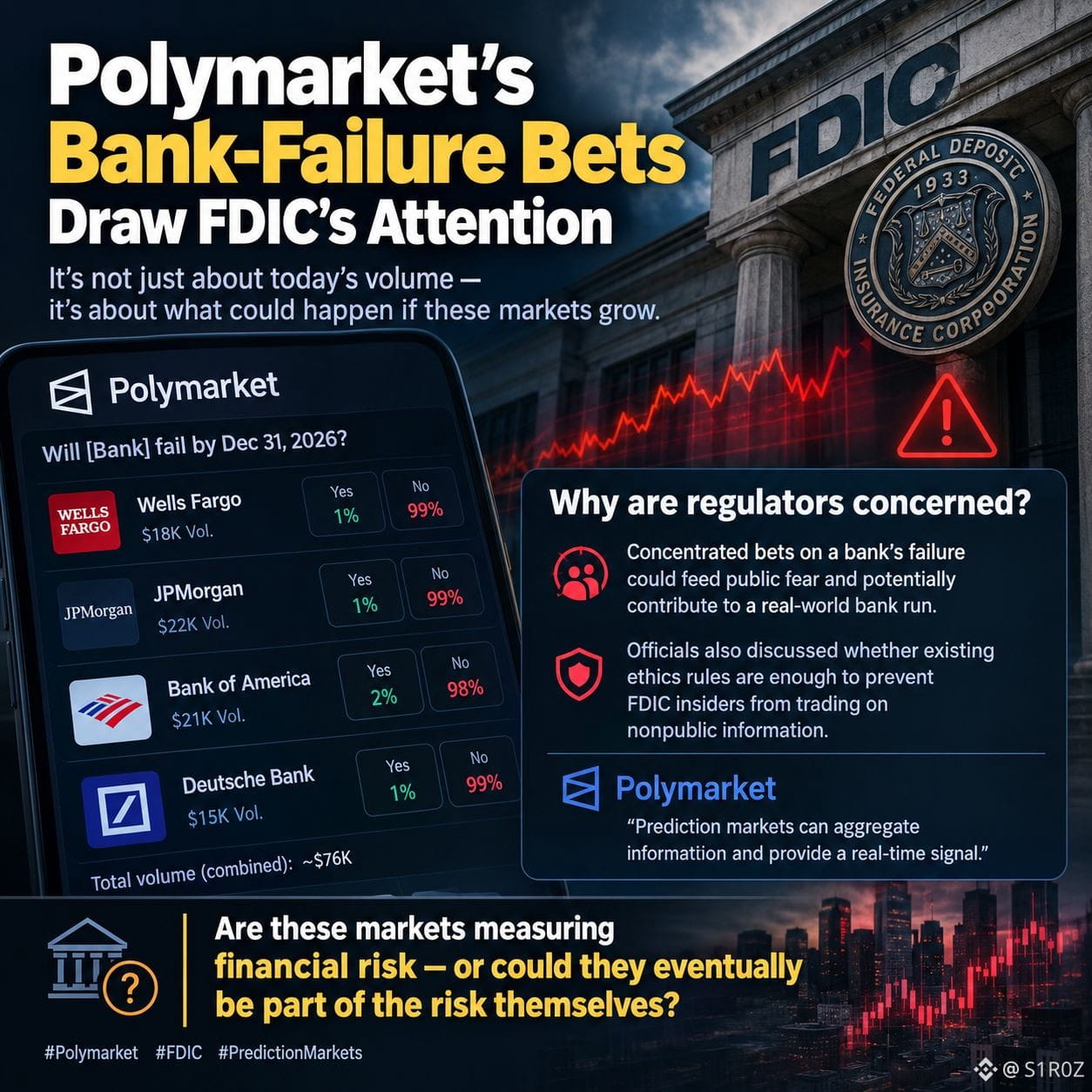
#polymarketbankfailurebetsdrawfdicconcern 🚨 Polymarket’s bank-failure bets just caught the FDIC’s attention — but the concern isn’t really about today’s trading volume. Polymarket currently has markets asking whether major banks such as Wells Fargo, JPMorgan, Bank of America and Deutsche Bank will fail by the end of 2026. The contracts are still tiny, with about $76K in combined volume across the current bank-failure markets. So why are regulators paying attention? According to Bloomberg, FDIC officials are concerned that if these markets grow, concentrated bets on a bank’s failure could feed public fear and potentially contribute to a real-world bank run. Officials also discussed whether existing ethics rules sufficiently prevent FDIC insiders from trading on nonpublic information. Polymarket argues prediction markets can instead aggregate information and provide a real-time signal. That creates a much bigger question: Are these markets measuring financial risk — or could they eventually become part of the risk themselves? #Polymarket #FDIC #PredictionMarkets

#polymarketbankfailurebetsdrawfdicconcern
🚨 Polymarket’s bank-failure bets just caught the FDIC’s attention — but the concern isn’t really about today’s trading volume.

Polymarket currently has markets asking whether major banks such as Wells Fargo, JPMorgan, Bank of America and Deutsche Bank will fail by the end of 2026. The contracts are still tiny, with about $76K in combined volume across the current bank-failure markets.
So why are regulators paying attention?

According to Bloomberg, FDIC officials are concerned that if these markets grow, concentrated bets on a bank’s failure could feed public fear and potentially contribute to a real-world bank run. Officials also discussed whether existing ethics rules sufficiently prevent FDIC insiders from trading on nonpublic information.

Polymarket argues prediction markets can instead aggregate information and provide a real-time signal.

That creates a much bigger question:
Are these markets measuring financial risk — or could they eventually become part of the risk themselves?

#Polymarket #FDIC #PredictionMarkets
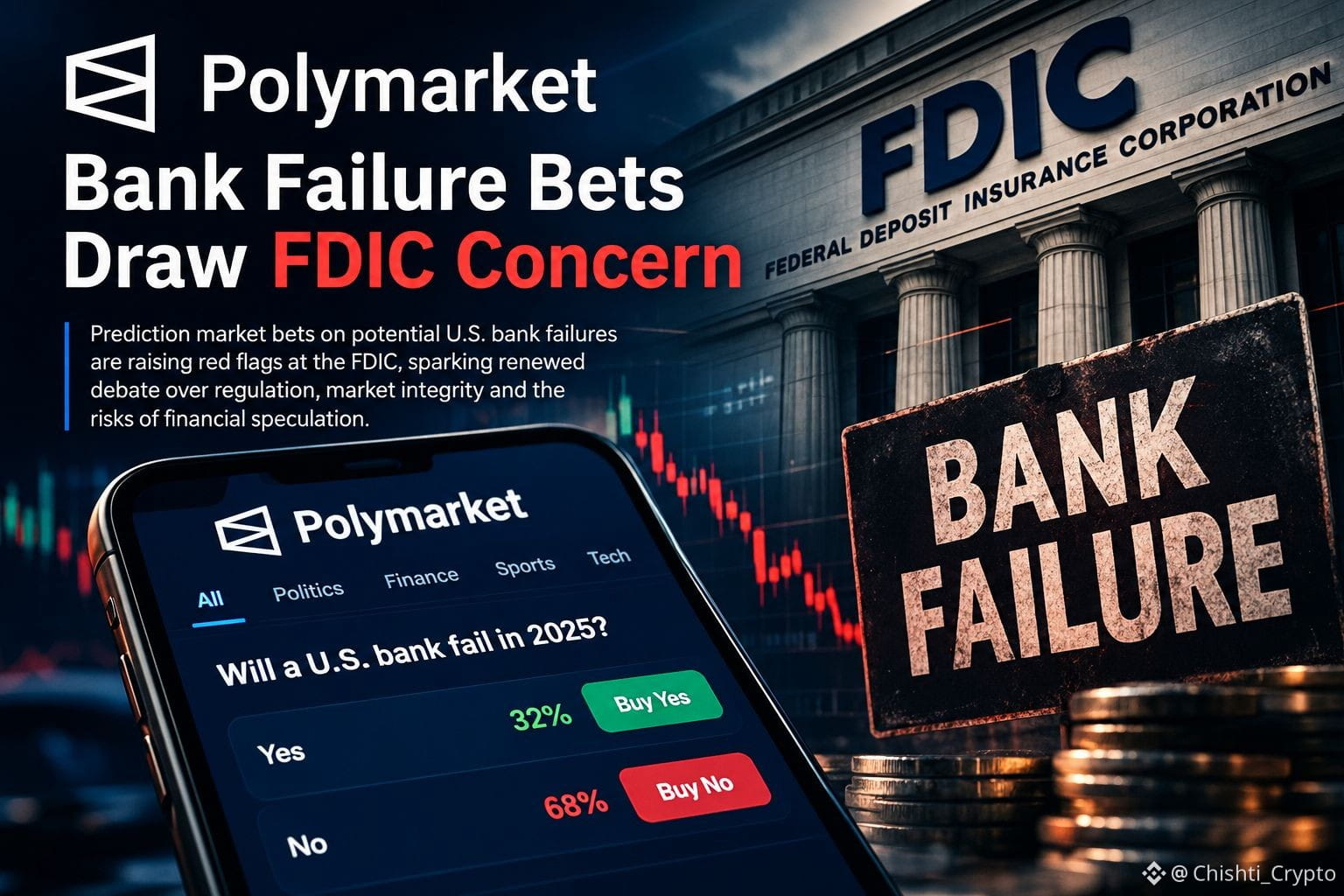
#PolymarketBankFailureBetsDrawFDICConcern 🚨 Polymarket is giving people the chance to bet on the failure of JPMorgan, Wells Fargo, and Bank of America — and the FDIC is worried! This is not a movie plot. This is happening now. Polymarket has markets: "Will JPMorgan fail by December 31?" Size: $76,000 in end-of-year bets, and $591,000 in July bets. The FDIC is watching because: - If traders bet heavily that a bank will fail, depositors notice and panic → a real bank attack/run - The FDIC has a “secret” list of “banks exposed to problems” — is there a risk of insider trading? - Unlike betting on a stock drop, this is a direct bet on failure Banks on the list: JPMorgan Chase, Wells Fargo, Bank of America, and Deutsche Bank. Polymarket says: "Provide real-time signals, and reduce fear" The FDIC says: "Is there any legitimate business benefit to betting on a bank collapse?" Prediction markets vs. the banking system — who will win? If this expands, could a $100 bet trigger a $1 billion banking run? What do you think? 👇 Please follow-up #PolymarketBankFailureBetsDrawFDICConcern $BTC #Polymarket #FDIC #Banking

#PolymarketBankFailureBetsDrawFDICConcern 🚨 Polymarket is giving people the chance to bet on the failure of JPMorgan, Wells Fargo, and Bank of America — and the FDIC is worried!
This is not a movie plot. This is happening now.
Polymarket has markets: "Will JPMorgan fail by December 31?"
Size: $76,000 in end-of-year bets, and $591,000 in July bets.
The FDIC is watching because:
- If traders bet heavily that a bank will fail, depositors notice and panic → a real bank attack/run
- The FDIC has a “secret” list of “banks exposed to problems” — is there a risk of insider trading?
- Unlike betting on a stock drop, this is a direct bet on failure
Banks on the list: JPMorgan Chase, Wells Fargo, Bank of America, and Deutsche Bank.
Polymarket says: "Provide real-time signals, and reduce fear"
The FDIC says: "Is there any legitimate business benefit to betting on a bank collapse?"
Prediction markets vs. the banking system — who will win?
If this expands, could a $100 bet trigger a $1 billion banking run?
What do you think? 👇

Please follow-up

#PolymarketBankFailureBetsDrawFDICConcern $BTC #Polymarket #FDIC #Banking

Polymarket Bets on a Bank Failure—Why Does It Attract FDIC Attention? Polymarket has recently seen a special kind of prediction market: people directly bet on whether a large bank will go bankrupt. The banks involved include JPMorgan Chase, Wells Fargo, Bank of America, Deutsche Bank, and others. At the moment, the contract sizes are actually quite small—some are only a few hundred to a few thousand dollars. The total trading volume for contracts tied to bank failures is about $76,000. But what truly draws regulators’ attention isn’t the current trading volume. Instead, it’s a more realistic question: As the market grows, could it end up causing a bank run? For example, if the market suddenly places a large number of bets on a certain bank “possibly failing,” and depositors see the news, it could trigger panic withdrawals. That would mean: Prediction risk → amplifies panic → funds flow out → liquidity pressure increases What was originally just a prediction could turn into a real risk. This is one of the reasons regulators such as the FDIC are paying attention to these contracts. But on the other hand, Polymarket’s stance is also very clear: Prediction markets can consolidate scattered information, helping market participants spot potential risks more quickly. So the question becomes: Is a prediction market truly “identifying risk,” or could it also “create risk”? This may become a problem regulators can’t avoid in the next phase of prediction markets. And this also shows that as platforms like Polymarket keep expanding, prediction markets are moving from a niche crypto-side activity into the realm of traditional financial regulation. Next, the focus is on: 👉 Will contracts related to bank failures be restricted? 👉 Will U.S. regulators introduce clearer rules? 👉 Can prediction markets continue expanding into financial risk areas? Predicting the future isn’t that hard—what’s difficult is: when more and more people believe this prediction, will it start to shape the future. #Polymarket #FDIC #polymarket银行倒闭押注引fdic关注

Polymarket Bets on a Bank Failure—Why Does It Attract FDIC Attention?

Polymarket has recently seen a special kind of prediction market:
people directly bet on whether a large bank will go bankrupt.
The banks involved include JPMorgan Chase, Wells Fargo, Bank of America, Deutsche Bank, and others.

At the moment, the contract sizes are actually quite small—some are only a few hundred to a few thousand dollars. The total trading volume for contracts tied to bank failures is about $76,000.
But what truly draws regulators’ attention isn’t the current trading volume.

Instead, it’s a more realistic question:
As the market grows, could it end up causing a bank run?
For example, if the market suddenly places a large number of bets on a certain bank “possibly failing,” and depositors see the news, it could trigger panic withdrawals.

That would mean:
Prediction risk → amplifies panic → funds flow out → liquidity pressure increases
What was originally just a prediction could turn into a real risk.
This is one of the reasons regulators such as the FDIC are paying attention to these contracts.

But on the other hand, Polymarket’s stance is also very clear:
Prediction markets can consolidate scattered information, helping market participants spot potential risks more quickly.

So the question becomes:
Is a prediction market truly “identifying risk,” or could it also “create risk”?
This may become a problem regulators can’t avoid in the next phase of prediction markets.
And this also shows that as platforms like Polymarket keep expanding, prediction markets are moving from a niche crypto-side activity into the realm of traditional financial regulation.

Next, the focus is on:
👉 Will contracts related to bank failures be restricted?
👉 Will U.S. regulators introduce clearer rules?
👉 Can prediction markets continue expanding into financial risk areas?
Predicting the future isn’t that hard—what’s difficult is:
when more and more people believe this prediction, will it start to shape the future.

#Polymarket #FDIC #polymarket银行倒闭押注引fdic关注
The U.S. Treasury, OCC, and FDIC have introduced draft rules that could require stablecoin issuers to adopt compliance frameworks similar to those used by banks. With the stablecoin market now worth around $320 billion, the proposal marks a major step toward tighter oversight and could significantly reshape digital asset regulation in the United States.   #Stablecoins #CryptoRegulation #UStreasury #OCC #FDIC $BTC $ETH $SOL
The U.S. Treasury, OCC, and FDIC have introduced draft rules that could require stablecoin issuers to adopt compliance frameworks similar to those used by banks. With the stablecoin market now worth around $320 billion, the proposal marks a major step toward tighter oversight and could significantly reshape digital asset regulation in the United States.

#Stablecoins
#CryptoRegulation
#UStreasury
#OCC
#FDIC
$BTC $ETH $SOL
⚠️ GAO Urges FDIC to Address Crypto Oversight Gaps The U.S. Government Accountability Office is calling on the FDIC to improve coordination with other regulators as stablecoin and blockchain oversight evolves. Key Highlights: ✅ GAO highlights regulatory gaps ✅ FDIC urged to improve coordination ✅ Stablecoin rules still developing ✅ Increased focus on crypto oversight The recommendation reflects growing scrutiny of how U.S. financial regulators manage emerging digital asset risks. Read more: https://cointopsecret.com #CryptoNews #FDIC #Stablecoins #CryptoRegulation #Blockchain #DigitalAssets #Finance #Policy #BinanceSquare #cointopsecret
⚠️ GAO Urges FDIC to Address Crypto Oversight Gaps
The U.S. Government Accountability Office is calling on the FDIC to improve coordination with other regulators as stablecoin and blockchain oversight evolves.

Key Highlights:
✅ GAO highlights regulatory gaps
✅ FDIC urged to improve coordination
✅ Stablecoin rules still developing
✅ Increased focus on crypto oversight

The recommendation reflects growing scrutiny of how U.S. financial regulators manage emerging digital asset risks.

Read more:
https://cointopsecret.com

#CryptoNews #FDIC #Stablecoins #CryptoRegulation #Blockchain #DigitalAssets #Finance #Policy #BinanceSquare #cointopsecret
Article
Bank Opposition to Stablecoin Rewards in the Clarity Act and What Could Affect Us UsersBanks are strongly pressuring against stablecoin rewards in the U.S. CLARITY Act, turning this issue into a central obstacle for the bill and future stablecoin yields. How the CLARITY Act treats stablecoin rewards: The Digital Asset Market CLARITY Act is a broad U.S. market-structure bill that includes strict rules for the yield of payment stablecoins. The current version under discussion in the Senate would prohibit digital asset platforms from paying interest or yield solely for holding payment stablecoins, as well as from disguising that interest as loyalty or promotional rewards that are economically equivalent to interest on bank deposit accounts. At the same time, the proposal explicitly preserves rewards tied to real activity, such as cashback for spending with stablecoins, fee reimbursements on transfers or remittances, or compensation for providing liquidity and collateral for trading, in cases where the capital is effectively at risk rather than remaining passively allocated. This change is intended to shift stablecoin income generation from a simple “hold and earn” APY to usage- and risk-assumption-based models.

Bank Opposition to Stablecoin Rewards in the Clarity Act and What Could Affect Us Users

Banks are strongly pressuring against stablecoin rewards in the U.S. CLARITY Act, turning this issue into a central obstacle for the bill and future stablecoin yields.
How the CLARITY Act treats stablecoin rewards: The Digital Asset Market CLARITY Act is a broad U.S. market-structure bill that includes strict rules for the yield of payment stablecoins. The current version under discussion in the Senate would prohibit digital asset platforms from paying interest or yield solely for holding payment stablecoins, as well as from disguising that interest as loyalty or promotional rewards that are economically equivalent to interest on bank deposit accounts. At the same time, the proposal explicitly preserves rewards tied to real activity, such as cashback for spending with stablecoins, fee reimbursements on transfers or remittances, or compensation for providing liquidity and collateral for trading, in cases where the capital is effectively at risk rather than remaining passively allocated. This change is intended to shift stablecoin income generation from a simple “hold and earn” APY to usage- and risk-assumption-based models.
·
--
Verified
#polymarketbankfailurebetsdrawfdicconcern 🚨 Polymarket’s bank-failure bets are drawing FDIC attention. Contracts tied to potential failures of major banks, including JPMorgan Chase, Wells Fargo and Bank of America, have reportedly raised concerns among U.S. banking officials. Around $76K in recent volume was linked to bank-failure contracts, while an earlier group reportedly saw about $591K in volume. The bigger issue isn’t whether these bets are predicting a real failure. The FDIC’s concern is whether prediction markets could amplify rumors and potentially influence depositor behavior during an actual liquidity event. That creates an interesting loop: Prediction → attention → depositor reaction → liquidity pressure For markets, the question is where useful information ends and self-reinforcing panic begins. $MARSCOIN $KMNO $2Z {spot}(2ZUSDT) {spot}(KMNOUSDT) {spot}(MARSCOINUSDT) #Polymarket #crypto #PredictionMarkets #markets #FDIC
#polymarketbankfailurebetsdrawfdicconcern
🚨 Polymarket’s bank-failure bets are drawing FDIC attention.
Contracts tied to potential failures of major banks, including JPMorgan Chase, Wells Fargo and Bank of America, have reportedly raised concerns among U.S. banking officials.

Around $76K in recent volume was linked to bank-failure contracts, while an earlier group reportedly saw about $591K in volume.

The bigger issue isn’t whether these bets are predicting a real failure. The FDIC’s concern is whether prediction markets could amplify rumors and potentially influence depositor behavior during an actual liquidity event.

That creates an interesting loop:
Prediction → attention → depositor reaction → liquidity pressure
For markets, the question is where useful information ends and self-reinforcing panic begins.
$MARSCOIN $KMNO $2Z
#Polymarket #crypto #PredictionMarkets #markets #FDIC
Article
Polymarket Bank Failure Bets Draw FDIC Attention🚨 Polymarket's bank failure bets are drawing FDIC attention. 🏦👀 Contracts tied to possible failures of JPMorgan, Wells Fargo and Bank of America have raised concerns among US banking officials. Reported volume remains relatively small: 💰 ~$76K in recent contracts 📊 Earlier contracts reportedly reached ~$591K So why the concern? The potential feedback loop: Prediction → Public attention → Depositor reaction → More pressure on a bank But there's an important distinction: ⚠️ These contracts are bets, not evidence that any named bank is failing. The bigger debate is about whether prediction markets simply reflect expectations or can influence the events they're measuring. For crypto traders, this is another example of prediction markets becoming part of the broader financial information landscape. 👀 Can prediction markets reveal financial stress early, or could they amplify fear during a real crisis? $KMNO $2Z $MARSCOIN #Polymarket {future}(MARSCOINUSDT) {future}(KMNOUSDT) {future}(2ZUSDT) #FDIC #Banking #Crypto #PredictionMarkets

Polymarket Bank Failure Bets Draw FDIC Attention

🚨 Polymarket's bank failure bets are drawing FDIC attention. 🏦👀
Contracts tied to possible failures of JPMorgan, Wells Fargo and Bank of America have raised concerns among US banking officials.
Reported volume remains relatively small:
💰 ~$76K in recent contracts
📊 Earlier contracts reportedly reached ~$591K
So why the concern?
The potential feedback loop:
Prediction → Public attention → Depositor reaction → More pressure on a bank
But there's an important distinction:
⚠️ These contracts are bets, not evidence that any named bank is failing.
The bigger debate is about whether prediction markets simply reflect expectations or can influence the events they're measuring.
For crypto traders, this is another example of prediction markets becoming part of the broader financial information landscape.
👀 Can prediction markets reveal financial stress early, or could they amplify fear during a real crisis?
$KMNO $2Z $MARSCOIN
#Polymarket
#FDIC #Banking #Crypto #PredictionMarkets

#PolymarketBankFailureBetsDrawFDICConcern Prediction markets are once again drawing attention as bets related to potential U.S. bank failures reportedly raise concerns at the FDIC. The discussion highlights a growing question around how prediction platforms handle sensitive financial events and whether markets based on real-world outcomes can create unintended risks. Polymarket has become a major platform for event-based trading, allowing users to speculate on outcomes across politics, finance, sports, and other areas. When the subject involves banking stability, however, the stakes can be significantly higher. The FDIC’s reported concern adds another layer to the debate over regulation, market integrity, and responsible access to financial information. As prediction markets continue expanding, regulators may face increasing pressure to clarify where legitimate forecasting ends and potentially problematic financial speculation begins. #Polymarket #FDIC #Banking #PredictionMarkets #Crypto #Finance $BTC {spot}(BTCUSDT) $SOL {spot}(SOLUSDT) $XRP {spot}(XRPUSDT)
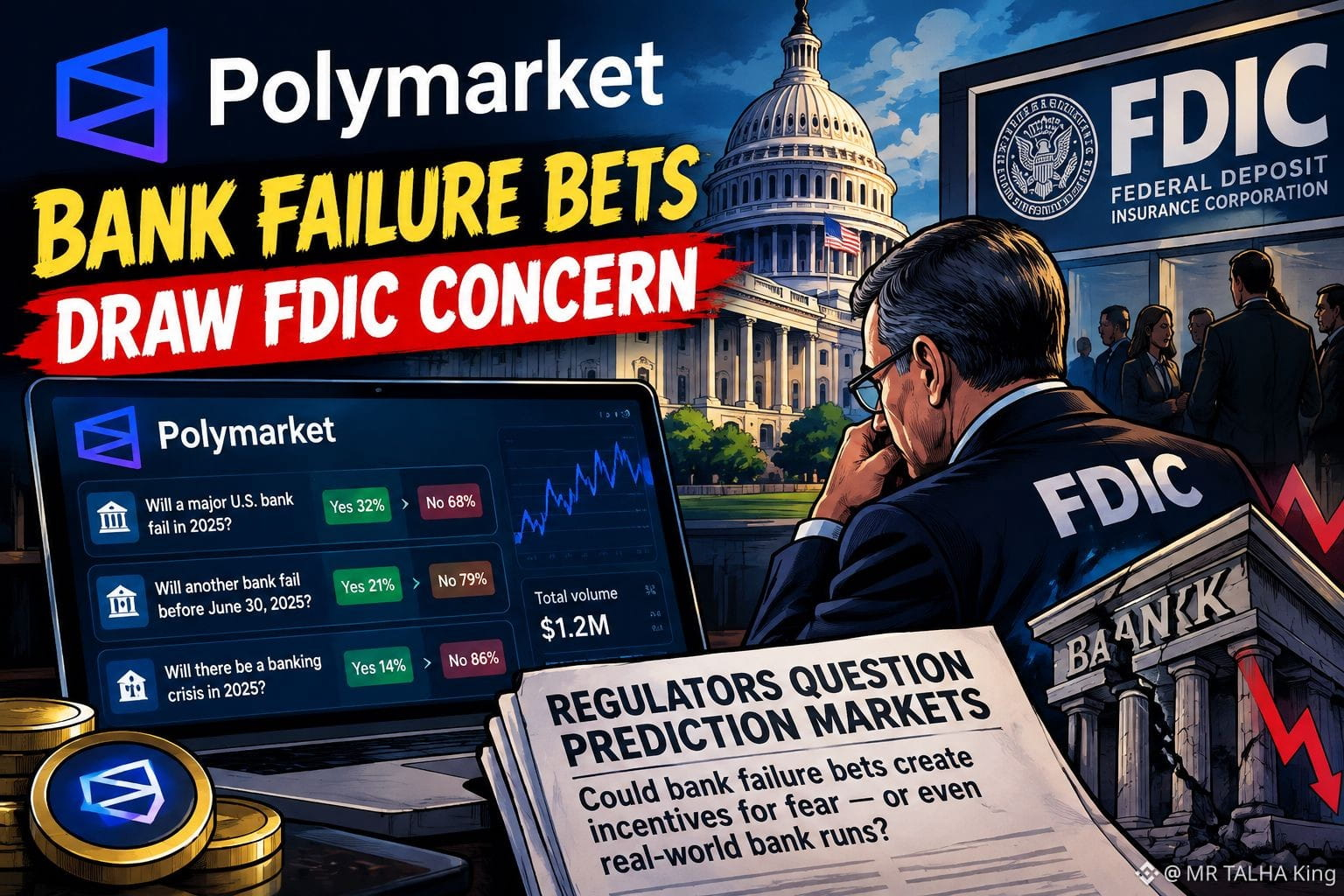
#PolymarketBankFailureBetsDrawFDICConcern
Prediction markets are once again drawing attention as bets related to potential U.S. bank failures reportedly raise concerns at the FDIC. The discussion highlights a growing question around how prediction platforms handle sensitive financial events and whether markets based on real-world outcomes can create unintended risks.

Polymarket has become a major platform for event-based trading, allowing users to speculate on outcomes across politics, finance, sports, and other areas. When the subject involves banking stability, however, the stakes can be significantly higher.

The FDIC’s reported concern adds another layer to the debate over regulation, market integrity, and responsible access to financial information. As prediction markets continue expanding, regulators may face increasing pressure to clarify where legitimate forecasting ends and potentially problematic financial speculation begins.

#Polymarket #FDIC #Banking #PredictionMarkets #Crypto #Finance

$BTC
$SOL
$XRP
🚨 #PolymarketBankFailureBetsDrawFDICConcern ⚠️ Polymarket contracts allowing traders to bet on whether major banks could fail are reportedly drawing attention from FDIC officials and lawmakers. The contracts involve institutions including JPMorgan, Bank of America and Wells Fargo. 💰 Recent year-end bank-failure contracts had around $76K in trading volume. ⚠️ The concern isn't simply the size of the bets — regulators worry that markets predicting specific bank failures could fuel fear, encourage speculation or potentially contribute to a bank run. 🔥 Prediction markets vs. financial stability — where should the line be? #Polymarket #FDIC #Banking #PredictionMarkets
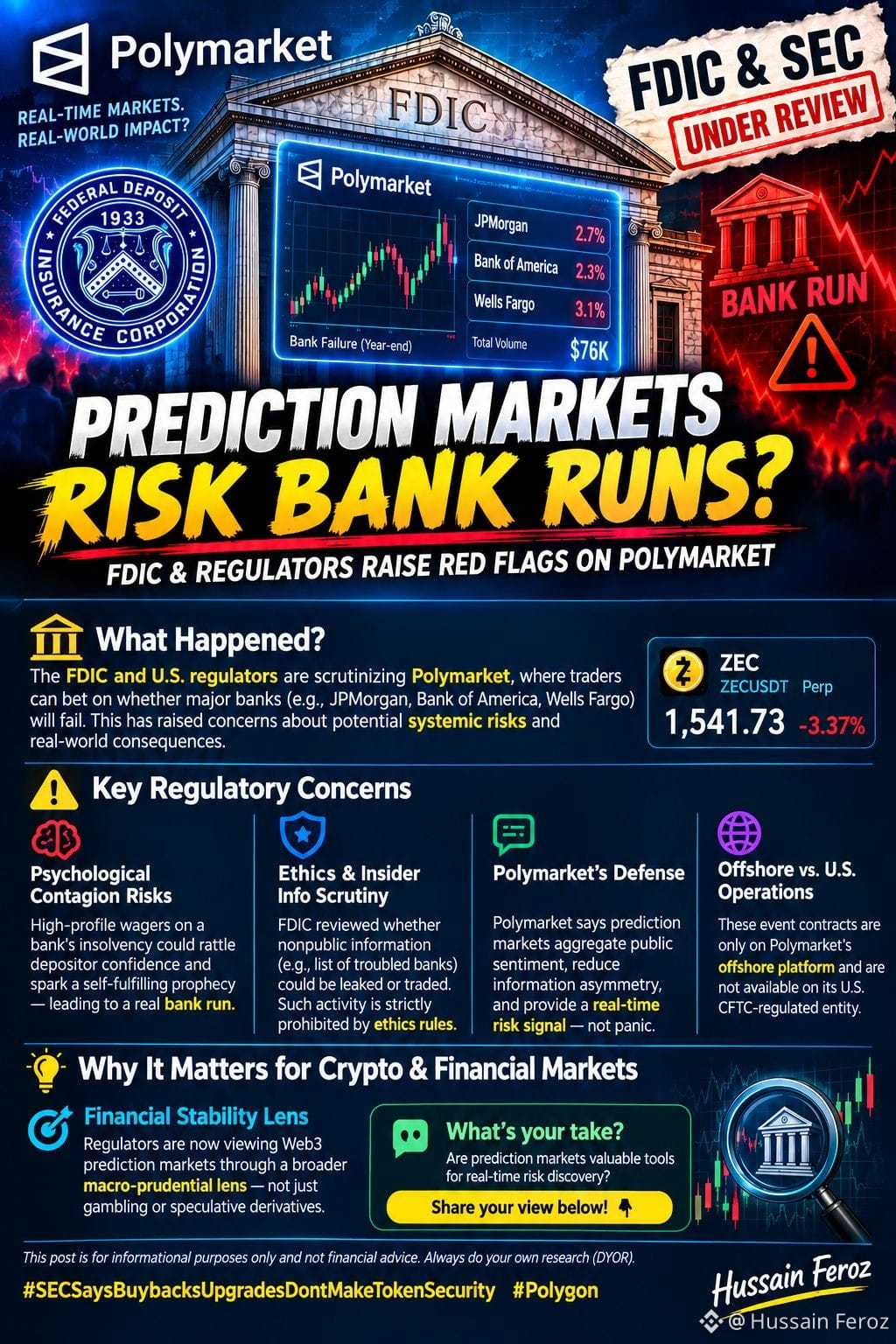
🚨 #PolymarketBankFailureBetsDrawFDICConcern ⚠️
Polymarket contracts allowing traders to bet on whether major banks could fail are reportedly drawing attention from FDIC officials and lawmakers. The contracts involve institutions including JPMorgan, Bank of America and Wells Fargo.

💰 Recent year-end bank-failure contracts had around $76K in trading volume.

⚠️ The concern isn't simply the size of the bets — regulators worry that markets predicting specific bank failures could fuel fear, encourage speculation or potentially contribute to a bank run.

🔥 Prediction markets vs. financial stability — where should the line be?

#Polymarket #FDIC #Banking #PredictionMarkets
Bitcoin Up or Down - September 26, 1PM-1:15PM ET

Bitcoin Up or Down - September 26, 1PM-1:15PM ET

1%Up99%Down
Volume $10,509.62
🚨 Polymarket’s Bank-Failure Markets Draw FDIC Attention Polymarket wagers on potential failures of major U.S. banks are reportedly attracting regulatory attention. Prediction-market activity is not evidence of imminent bank failure. The broader concern is whether visible betting markets could amplify negative sentiment or depositor anxiety during periods of financial stress. For crypto markets, watch liquidity, credit spreads, deposit flows, and broader systemic risk—not prediction markets alone. 📊 Follow for more market intelligence, crypto analysis, and breaking developments on Binance Square. ⚠️ Risk disclaimer: Informational content only. Not financial advice. DYOR. NFA. #market #FDIC #Polymarket #BinanceSquare #PolymarketBankFailureBetsDrawFDICConcern
🚨 Polymarket’s Bank-Failure Markets Draw FDIC Attention

Polymarket wagers on potential failures of major U.S. banks are reportedly attracting regulatory attention.

Prediction-market activity is not evidence of imminent bank failure. The broader concern is whether visible betting markets could amplify negative sentiment or depositor anxiety during periods of financial stress.

For crypto markets, watch liquidity, credit spreads, deposit flows, and broader systemic risk—not prediction markets alone.

📊 Follow for more market intelligence, crypto analysis, and breaking developments on Binance Square.

⚠️ Risk disclaimer: Informational content only. Not financial advice. DYOR. NFA.

#market #FDIC #Polymarket #BinanceSquare
#PolymarketBankFailureBetsDrawFDICConcern
·
--
Bullish
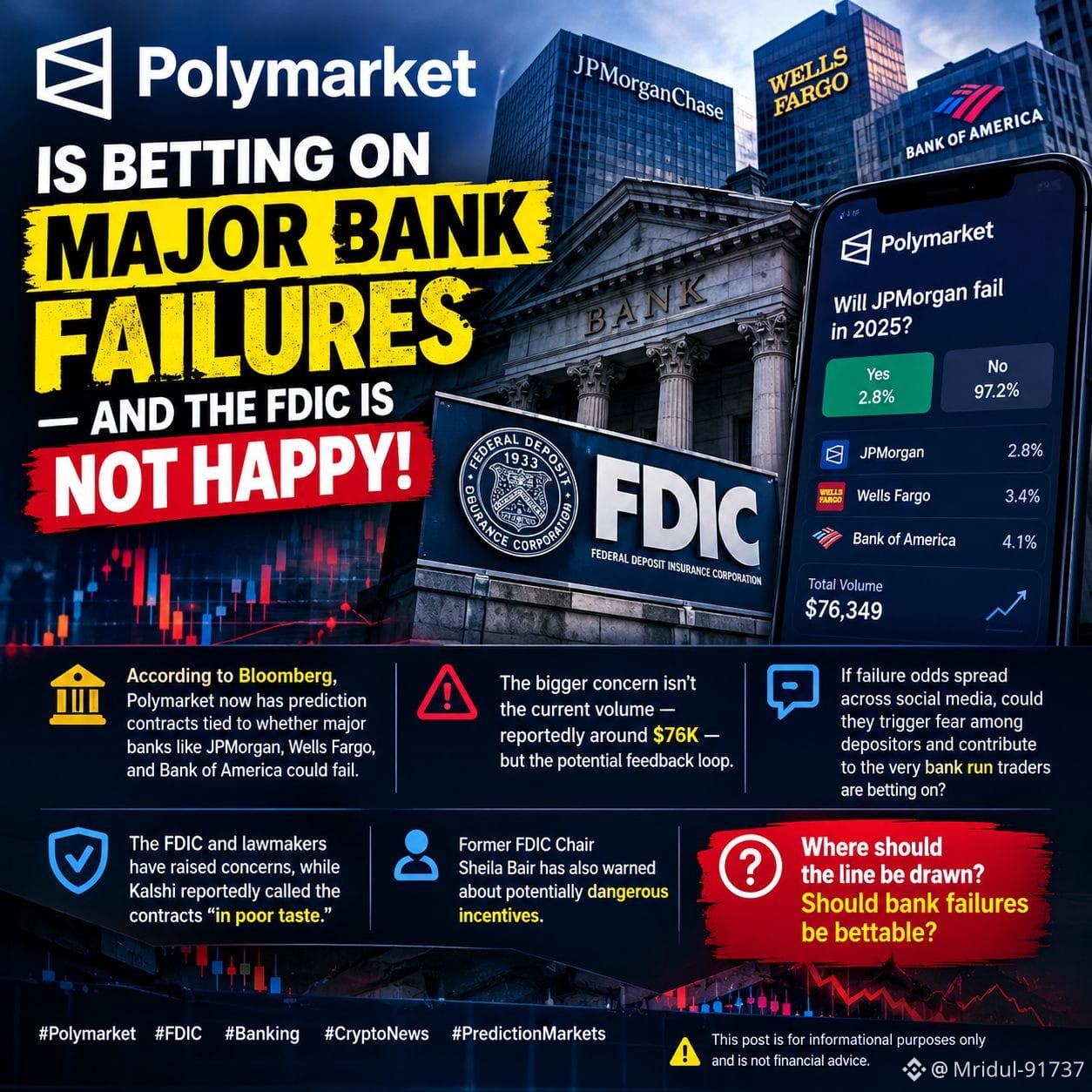
🚨 POLYMARKET IS BETTING ON MAJOR BANK FAILURES — AND THE FDIC IS NOT HAPPY. According to Bloomberg, Polymarket now has prediction contracts tied to whether major banks like JPMorgan, Wells Fargo, and Bank of America could fail. The bigger concern isn’t the current volume — reportedly around $76K — but the potential feedback loop. 👀 If failure odds spread across social media, could they trigger fear among depositors and contribute to the very bank run traders are betting on? The FDIC and lawmakers have raised concerns, while Kalshi reportedly called the contracts “in poor taste.” Former FDIC Chair Sheila Bair has also warned about potentially dangerous incentives. 💭 Where should the line be drawn? Should bank failures be bettable? ⚠️ This post is for informational purposes only and is not financial advice. #Polymarket #FDIC #BankingFailures #CryptoNews #PredictionMarkets
🚨 POLYMARKET IS BETTING ON MAJOR BANK FAILURES — AND THE FDIC IS NOT HAPPY.

According to Bloomberg, Polymarket now has prediction contracts tied to whether major banks like JPMorgan, Wells Fargo, and Bank of America could fail.

The bigger concern isn’t the current volume — reportedly around $76K — but the potential feedback loop. 👀

If failure odds spread across social media, could they trigger fear among depositors and contribute to the very bank run traders are betting on?

The FDIC and lawmakers have raised concerns, while Kalshi reportedly called the contracts “in poor taste.” Former FDIC Chair Sheila Bair has also warned about potentially dangerous incentives.

💭 Where should the line be drawn? Should bank failures be bettable?

⚠️ This post is for informational purposes only and is not financial advice.

#Polymarket #FDIC #BankingFailures #CryptoNews #PredictionMarkets
#polymarketbankfailurebetsdrawfdicconcern 🚨 POLYMARKET BANK FAILURE BETS DRAW FDIC CONCERN 🏦⚠️ Polymarket contracts tied to the potential failure of major banks are drawing attention from FDIC officials and lawmakers. The concern? Regulators are questioning whether these markets could create incentives that amplify fear or contribute to real-world bank runs if trading activity grows. 📊 Current year-end bank-failure contracts have attracted relatively modest volume, but the topic itself is raising a bigger debate around prediction markets, financial stability, and regulation. 👀 Banking sector + prediction markets = definitely a story to watch. DYOR. NFA. #Polymarket #FDIC #Banking #Finance $POL $BTC $ETH {spot}(ETHUSDT) {spot}(BTCUSDT) {spot}(POLUSDT)
#polymarketbankfailurebetsdrawfdicconcern
🚨 POLYMARKET BANK FAILURE BETS DRAW FDIC CONCERN 🏦⚠️
Polymarket contracts tied to the potential failure of major banks are drawing attention from FDIC officials and lawmakers.
The concern? Regulators are questioning whether these markets could create incentives that amplify fear or contribute to real-world bank runs if trading activity grows. 📊
Current year-end bank-failure contracts have attracted relatively modest volume, but the topic itself is raising a bigger debate around prediction markets, financial stability, and regulation.
👀 Banking sector + prediction markets = definitely a story to watch.
DYOR. NFA.
#Polymarket #FDIC #Banking #Finance
$POL
$BTC
$ETH
#PolymarketBankFailureBetsDrawFDICConcern 🔥 POLYMARKET’S BANK-FAILURE BETS DRAW REGULATORY SCRUTINY This isn’t a claim that any major bank is failing. The real issue is whether prediction markets could amplify financial panic. 🏦 What’s happening? FDIC officials are examining Polymarket contracts tied to potential failures of major banks like JPMorgan, Bank of America and Wells Fargo. Reported combined volume was only around $76K, but regulators are focused on the possible systemic impact. ⚠️ Why it matters: 🔹 Bank-failure bets could potentially affect depositor confidence. 🔹 Regulators are also concerned about the use of nonpublic information. 🔹 Polymarket argues these markets can act as real-time risk signals by aggregating information and sentiment. 🔹 The contracts are reportedly available through Polymarket’s offshore platform. 💡 The bigger signal: Prediction markets are evolving beyond speculation into potential real-time financial risk indicators. The key question: Do they detect risk — or amplify it? 👀 📌 A $76K market does not mean these banks are in trouble. DYOR — Information only, not financial advice. #Polymarket #FDIC #Banking #PredictionMarkets #Crypto #Web3 #FinancialMarkets {spot}(ZECUSDT)
#PolymarketBankFailureBetsDrawFDICConcern
🔥 POLYMARKET’S BANK-FAILURE BETS DRAW REGULATORY SCRUTINY
This isn’t a claim that any major bank is failing. The real issue is whether prediction markets could amplify financial panic.
🏦 What’s happening?
FDIC officials are examining Polymarket contracts tied to potential failures of major banks like JPMorgan, Bank of America and Wells Fargo. Reported combined volume was only around $76K, but regulators are focused on the possible systemic impact.
⚠️ Why it matters: 🔹 Bank-failure bets could potentially affect depositor confidence.
🔹 Regulators are also concerned about the use of nonpublic information.
🔹 Polymarket argues these markets can act as real-time risk signals by aggregating information and sentiment.
🔹 The contracts are reportedly available through Polymarket’s offshore platform.
💡 The bigger signal:
Prediction markets are evolving beyond speculation into potential real-time financial risk indicators.
The key question: Do they detect risk — or amplify it? 👀
📌 A $76K market does not mean these banks are in trouble.
DYOR — Information only, not financial advice.
#Polymarket #FDIC #Banking #PredictionMarkets #Crypto #Web3 #FinancialMarkets
Log in to explore more content
Join global crypto users on Binance Square
⚡️ Get latest and useful information about crypto.
💬 Trusted by the world’s largest crypto exchange.
👍 Discover real insights from verified creators.
Email / Phone number