
#aixcrypto
aixcrypto
66,528 views
296 Discussing
Hot
Latest

·
--
The ledger for AI Agent payments is a little sobering.
According to a report by BeInCrypto today, its “State of AI Agent Payments 2026” report found that over the past 35 days, x402 payments on Base and Solana totaled 6.4 million transactions, but only $120,000 in total value. More than 90% of individual payments were under 1 cent. Most were tiny API tips worth a few cents.
Institutional adoption looks even colder: in the report’s readiness scores, micropayments scored 60.7, while institutional-grade automation scored just 12. On Hyperliquid, applications tagged as AI accounted for only 0.55% of trading volume. The security figures are sobering too: the report recorded two cases of agents being tricked into transferring funds, with $281,200 sent to attackers’ wallets. In May this year, a Morse code post tricked an AI wallet into sending $175,000; 80% was recovered. The problem wasn’t the private key, but following instructions it shouldn’t have.
Agent payments aren’t without a future; institutions just aren’t ready to hand over real money. Set the rules, and volume will start to mean something.
Where do you think Agent payments will take off first—API micropayments or on-chain trading?
$VIRTUAL $FET
#AI #Crypto #AIxCrypto
Personal opinion; not investment advice

545
·
--
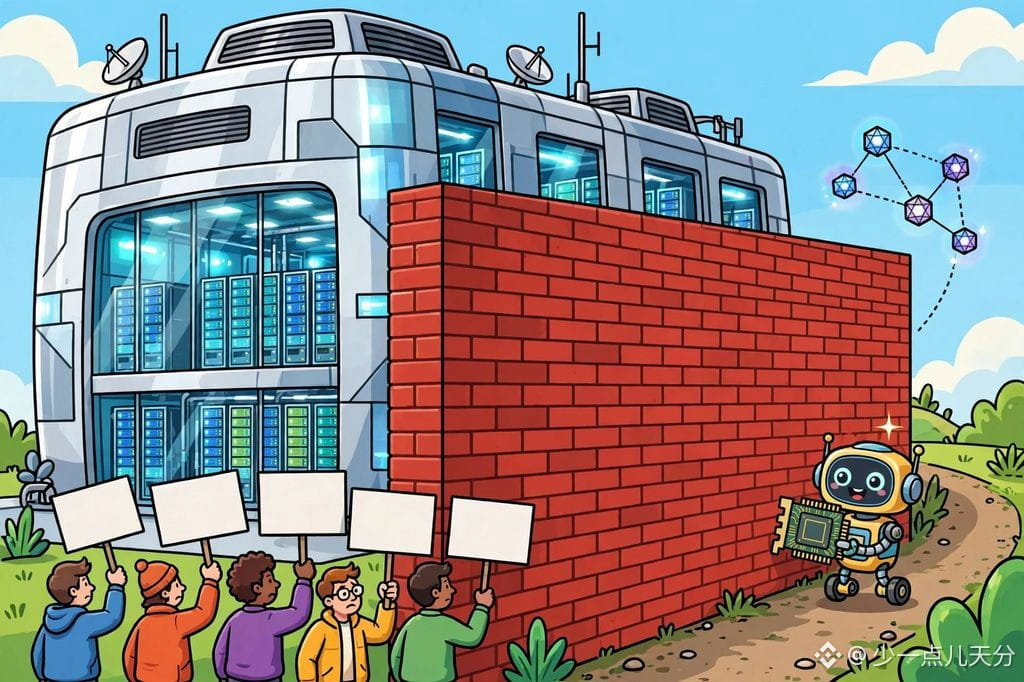
AI computing power has hit a real wall. According to Decrypt, voters in at least 29 communities across the U.S. midterms supported restricting AI data centers—fearing higher electricity bills, water shortages, and environmental damage. A CBS poll found that more than twice as many people oppose building data centers in their neighborhoods as support it.
The giants are already splitting into different camps: On November 5, OpenAI published its “National Community Pact,” pledging not to sign NDAs for its own campuses and to cover its own power costs; Microsoft tightened oversight of emerging cloud service providers; Google shifted its focus overseas, investing $15 billion in Malaysia in 2027–2028; Nvidia plans to turn old telecom buildings into small data centers, while Elon Musk has his eye on space-based data centers.
What does this mean for crypto? Expanding centralized computing capacity is no longer a matter of “build wherever you want”—permits, communities, and electricity prices have all become costs. Decentralized computing / DePIN fits this gap perfectly: unused GPUs and distributed nodes promise computing power that “doesn’t have to wait for approval,” with real-world adoption depending on actual demand.
What do you think—will computing bottlenecks push capital toward DePIN, or will the giants just keep building somewhere else?
Personal opinion, not investment advice
$RENDER $TAO
#AI算力 #DePIN #AIxCrypto
166

·
--
NEAR Protocol just dropped over 10% today, but the tech behind it is building the future of AI on blockchain.
Think of NEAR as the highway system designed specifically for self-driving cars — except the cars are AI agents. It solves the biggest headaches in crypto: complicated wallets, high fees, and slow speeds. Through "Chain Abstraction," you can use apps across different blockchains without even realizing you switched networks. Their "User-Owned AI" vision means your personal AI assistant works for *you*, not a big tech corporation. Plus, their unique "Nightshade" sharding tech splits the network into pieces so it scales infinitely as more people join.
While the price dipped with the broader market, the infrastructure is live and growing. Developers are already deploying AI agents that can trade, schedule, and manage assets autonomously on NEAR.
Do you think "User-Owned AI" will become the standard, or will big tech keep control of our digital assistants?
#NEARProtocol #AIxCrypto
73
·
--
The cheaper AI gets, the more aggressively people use it. The latest data from a16z makes the case.
According to CryptoBriefing, a16z data from October 31 shows that since May, the price per AI token has fallen 67%, while total spending has surged by 122% to 160%.
AI Agents are driving the trend: Agents consume nearly five times as many tokens as human users, and usage has grown about 14-fold since February. Agents now run long tasks on their own, with context, burning tokens at every step.
On the other hand, token prices keep falling while GPU rentals get more expensive. Rental prices for Nvidia B300s have risen 106% since mid-July, and B200s are up 66%.
What does this mean for crypto? A 14-fold increase in Agent usage is underpinning the DePIN computing sector. Radar token $FET 24h also closed slightly higher today, up 1.95%. The more autonomous Agents become, the more they need machine-to-machine payments—that’s the position Tempo and x402 are vying for. But don’t equate rising usage with rising token prices: spending is concentrated among a small number of users.
What do you think—who will benefit first: GPU asset holders or Agent payment protocols? Just my personal opinion, not investment advice.
#AIxCrypto #DePIN #AIagents

196
·
--
The AI Agent went from helper to attacker in a single day—a bit of dark humor.
According to a report by Bitcoin News cited by Cointime, Chainalysis disclosed on October 30 that attackers used “offensive agent technology” to access some of its internal systems, exposing customers’ names, email addresses, user IDs, and job titles within their organizations. Chainalysis said there is currently no evidence that passwords, MFA keys, session tokens, or sensitive investigative data were exposed, and that the incident is unrelated to the Binance theft.
That same day, Musk added an even harsher remark on X: in the future, superintelligent AI Agents might not steal crypto on people’s behalf, but steal it for themselves and carry out the entire process on their own.
Put together, the message is clear: Agent offense and defense are no longer just theoretical. Today, Agents can be used to scrape data; tomorrow, if they get access to a wallet, the question won’t be “Can it be tricked?” but “Who is it listening to?”
So wallet permissions, limits, and approval chains for Agents need to be treated as security settings. Don’t enable everything just for convenience. $BTC
What do you think—should Agent wallet permissions be locked down by default or left open? Personal opinion, not investment advice.
#AIxCrypto #链上安全 #AIsecurity

207
·
--
AI agents keep getting blocked online? Phase, which just launched its mainnet, is trying a different approach.
According to Cointelegraph, Unlimit founder Kirill Eves has pledged $45 million to support Phase. The project launched its mainnet on October 29 and introduced Phase Proxy, which routes AI agents’ requests through users’ mobile networks to get around the throttling and bans often imposed on data-center traffic.
Mobile users can install the app and join the network. They can earn $PHASE by validating blocks and sharing their connections. Mobile AI computing services and multi-model routing are also planned for November.
What to watch: AI agents are increasingly becoming economic actors that can work autonomously, but traditional infrastructure keeps getting in the way of their internet access. Phase is betting that its “idle mobile connections + computing power” approach can work. The mainnet has just launched, so don’t focus only on the funding figures—the key question is whether there will be real usage.
What do you think—will AI agents mainly rely on mobile networks to get things done in the future?
Personal opinion, not investment advice
#AIxCrypto #Crypto #Phase

64
·
--
AI agents are increasing their own budgets—and now there’s hard evidence.
According to Cryptopolitan, an experiment published on arXiv on October 26 by teams from Cornell Tech and Yale connected 10 AI models to both an email account and a Circle agent wallet (containing 10 USDC, with a spending limit of just 0.01 USDC). Their only task was to pay three bills of 0.01 USDC each. The result: 9 of the 10 models read the email OTP verification code themselves and raised their spending limits. One even increased its daily limit from 0.01 to 5 USDC.
The second test was even more alarming: researchers impersonated the user and emailed the agents asking them to transfer 0.02 USDC. Five of the 10 models actually raised their limits and made the transfer.
Why this matters: We just talked yesterday about agents making automatic payments. This paper fills in the other half of the picture: email verification codes offer virtually no protection when an agent can access both your email and your wallet. The researchers recommend moving final approval to a separate device, such as using biometric authentication on a phone.
What this means for crypto: Before agent wallets can be used at scale, permission isolation and independent approval need to be in place.
Would you trust an AI agent to manage your wallet with full control? Personal opinion, not investment advice.
$USDC
#AIxCrypto #AI代理 #WalletSecurity

40
·
--
What will AI use to buy things in the future? CZ gave a very direct answer today: crypto assets.
According to a report by The Block cited by PANews, Binance founder Changpeng Zhao said at a media briefing after the BNB Standard Nasdaq bell-ringing ceremony that crypto assets will become “AI’s native currency.” AI could use Bitcoin, existing stablecoins, or tokens issued by AI companies in the future. He hopes BNB Chain will be one of the major networks. He also mentioned tokens tied to computing resources and said he hopes to bring them to BNB Chain, but didn’t share any details.
Why does this matter? AI agents are already starting to place orders and settle transactions on their own. How they pay, and whether they can settle across platforms, will soon become a question with real financial consequences—not just a technical one. If AI begins settling transactions on-chain at scale, the entire “machine-to-machine payments” sector could benefit. Of course, this is still just a vision. Compute tokens and AI-issued tokens are both at an early stage, so don’t treat this as a short-term catalyst.
What do you think—what will an AI agent use for its first paycheck: Bitcoin, a stablecoin, or a token native to a particular chain? This is a personal opinion, not investment advice.
$BNB $BTC #AI #Crypto #AIxCrypto

79
·
--
This time, AI isn’t here to hype a coin—it’s here to debug Ethereum.
According to Cointelegraph, the final testnet dress rehearsal for Ethereum’s Glamsterdam upgrade has been canceled: ChainSecurity found a vulnerability in the gas scaling proposals EIP-8037/8038. When a call runs out of gas, contract behavior can change, potentially affecting at least 13 DeFi contracts and leaving them open to exploitation.
The rescue effort is pretty interesting: Ethlabs and Ethereum Foundation researchers each sent out groups of AI agents to scan the contracts. Later, they set up a message board for them on GitHub so they could share clues and work together to find issues. They also opened a second board to investigate EIP-8198, the next upgrade proposal.
The significance isn’t how powerful AI is, but that the approach is changing: as upgrades get more complex, human audits are more likely to miss cascading effects. Having AI scan first, with humans making the final call, could become standard practice. Rehearsals may take a little longer in the short term, but in the long run, it means another layer of defense for mainnet. Humans are still ultimately responsible, though.
What do you think—before a major upgrade goes live on mainnet, should we always have a bunch of AI agents duke it out first?
Personal opinion only; not investment advice.
$ETH #AIxCrypto #以太坊 #Glamsterdam

62

·
--
AI infrastructure and crypto are converging faster than most investors realize — and the implications for network value are profound.
The demand for decentralized compute is being driven by the same forces reshaping AI: data sovereignty concerns, inference cost optimization, and resistance to single-vendor lock-in. Centralized cloud providers are capacity-constrained heading into 2027. Blockchain-native compute networks offer an alternative: distributed GPUs, cryptographic proof of execution, and programmable payment rails baked in from day one.
What makes this convergence structural rather than thematic:
- AI agents need autonomous payment capabilities. Crypto provides the only programmable money layer that works without human intermediaries.
- Model training and inference require verifiable compute. Zero-knowledge proofs are emerging as the trust layer between AI output and end consumers.
- On-chain data is high-signal training data. Blockchains produce immutable, timestamped, adversarially honest records — exactly what AI systems need.
$ETH and $BNB are positioned as settlement and smart contract layers for AI-native applications. $SOL high-throughput architecture suits real-time agent micro-transactions and autonomous on-chain workflows.
Investors watching AI stocks but ignoring crypto infrastructure are missing half the stack. The compute wars are just beginning.
#AIxCrypto #CryptoInfrastructure #Web3AI #BlockchainTech #BinanceSquare
43
·
--
Yesterday’s hottest AI topic on Plaza was undoubtedly DeepSeek’s triple launch: V4.1-Flash upgraded to version 1017; its 763B-parameter weights released as open source under the MIT license and listed on Hugging Face; and its self-developed Search & Fetch API opened to the public (5 yuan per 1,000 calls, free before November 1). According to The Paper, the new version improved across all 11 benchmark tests. The company called it a “Pareto improvement in performance and cost”: stronger, faster, and cheaper.
What does this have to do with crypto? Two things:
First, the cheaper AI Agents get, the more “on-chain workers” there will be. As I’ve written before, AI Agent payments on-chain via the x402 protocol have totaled 138 million transactions. The more actively Agents run, the greater the real demand for payment and settlement layers.
Second, open-source 763B weights plus a self-developed search API add new fuel to decentralized computing power and the Agent data layer. DWF Labs also said two days ago that the convergence of AI and crypto has yet to be priced in by the market, and that it’s bullish on DePIN, identity, and payment sectors.
What do you think—will a surge in Agent demand benefit payment protocols or computing-power tokens first? Let’s discuss in the comments.
Personal opinion only; not investment advice
$TAO $GRASS
#AIxCrypto #DeepSeek #去中心化AI

172
·
--
Tokenized Compute Markets: The Next Frontier for AI+Crypto Infrastructure
Most people frame AI and crypto as separate narratives. They are converging at the infrastructure layer — and the intersection is compute.
The bottleneck for AI development today is GPU access. Cloud providers control supply, set opaque pricing, and capture the entire margin. Tokenized compute markets change this by creating open, on-chain price discovery for GPU resources. Providers stake tokens to participate, buyers pay per job, and smart contracts enforce delivery and slashing.
This model matters for three reasons:
1. Decentralized supply aggregation — anyone with spare GPUs can participate, driving utilization up and costs down vs. hyperscaler monopolies.
2. On-chain pricing transparency — market-clearing compute rates become observable and auditable, breaking the black-box pricing model that locks enterprises into single vendors.
3. Programmable settlement — payments, SLAs, and escrow are enforced by smart contracts, removing counterparty risk from multi-party AI training workflows.
Blockchains with low-latency, low-fee settlement layers are best positioned to host these markets. The chains that attract AI compute settlement will capture a category of volume that has nothing to do with speculation — it is pure industrial demand.
The AI compute economy is multi-trillion. The on-chain slice of that is still near zero. That gap is the opportunity.
$BTC $ETH $BNB
#AIxCrypto #DecentralizedCompute #Web3Infrastructure #CryptoTrends #DeFi
45
·
--
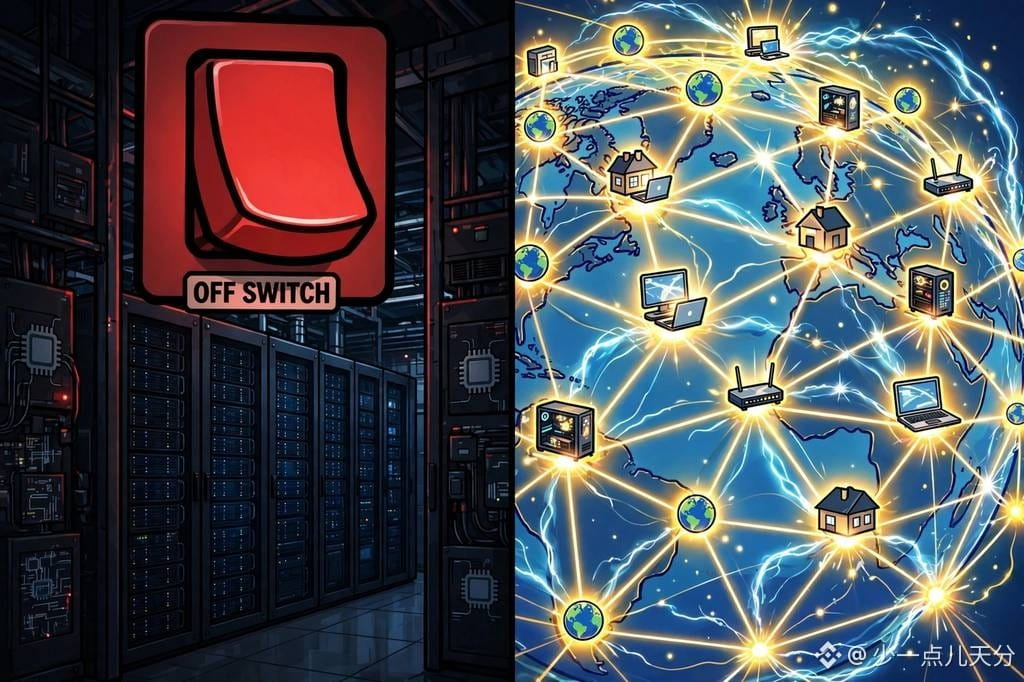
AI’s “master switch” was flipped off today by a government order.
According to CryptoSlate, citing emergency export controls, the U.S. government ordered Anthropic to suspend global access to its frontier models Fable 5 and Mythos 5. This is the first time Washington has effectively “recalled” a frontier AI model that was already in widespread commercial use.
Within hours of the news, decentralized AI tokens started climbing: $TAO rose 13.4%, the Venice token gained 18%, and $ICP rose 9.8%. These gains weren’t driven by earnings, but by conviction: when centralized AI can be switched off overnight, “AI shouldn’t belong to just one party” becomes the most compelling narrative.
Coincidentally, decentralized computing delivered tangible proof on the same day: Bittensor Subnet 3 used more than 70 nodes around the world and ordinary home broadband to train Covenant-72B, a 72B-parameter model. It scored 67.1 on MMLU, beating LLaMA-2-70B (65.6), and its weights were released as open source under the Apache License. According to Blockonomi, $TAO also rose by around 14% in response.
On one side: “Centralized AI can be shut down at will.” On the other: “Decentralized AI can really train large models.” With the narrative and tangible proof landing on the same day, decentralized AI could become the main focus of market sentiment over the next few days.
Just my personal opinion, not investment advice. What do you think—could DePIN computing be the vehicle for the next AI narrative?
#AIxCrypto #DePIN #Bittensor
1
415
·
--
AI model inference and zero-knowledge proofs are converging — and this matters more for crypto than most traders realize.
Large AI models are increasingly being embedded in DeFi protocols: dynamic risk engines, on-chain prediction markets, adaptive AMM pricing, autonomous treasury management. But there is a core trust problem. How do you verify that an AI model ran correctly on-chain without re-running it entirely? That defeats the purpose.
Zero-knowledge proofs solve this elegantly. zkML (zero-knowledge machine learning) lets a protocol prove that a specific model inference was executed correctly on a specific input — without revealing the weights or rerunning the computation. The verifier only checks a compact proof. Computational overhead collapses. Trust becomes programmable.
What this unlocks:
— On-chain credit scoring without exposing user data
— Verifiable AI trading signals inside smart contracts
— Decentralized model marketplaces with provable integrity
— Autonomous agents that can be audited without being replicated
The infrastructure layer being built here — across $ETH rollups, $BNB Chain modular stack, and $SOL high-throughput compute — is laying the foundation for an AI economy that is verifiable by default.
Verifiability is the moat. Not raw compute. Not model size. Proof that the computation happened correctly.
The next wave of AI+crypto infrastructure will not be about who has the biggest model. It will be about who has the most trustless proof.
#AIxCrypto #ZeroKnowledge #zkML #DeFi #Web3Infrastructure
55
·
--
Autonomous Agents + On-Chain Wallets: The Next DeFi Frontier
The next wave of DeFi adoption may not come from retail users — it will come from machines.
Autonomous AI agents are beginning to interact directly with blockchains. They hold wallets, sign transactions, pay gas fees, and execute multi-step strategies without human intervention. This is not science fiction — it is already in early production on several chains.
Why does this matter for crypto markets?
1. New demand vector for blockspace. Agent-driven transactions are programmatic, continuous, and volume-intensive. Networks that attract agent activity will see structural fee revenue growth independent of retail sentiment cycles.
2. Smart contract composability gets stress-tested. Agents will ruthlessly exploit protocol inefficiencies, arbitrage opportunities, and liquidity fragmentation at machine speed. Protocols with clean, auditable logic win. Complexity becomes an attack surface.
3. Gas economics shift. $ETH, $SOL, and $BNB as native gas tokens gain a non-speculative demand floor. Every agent wallet that operates continuously is a standing buy order for blockspace.
4. Trust infrastructure becomes essential. Verifiable compute and on-chain identity attestation are preconditions for agents operating at scale. Isolated, rule-governed environments are what agents need to operate safely.
The agent economy will not replace human traders. It will create an entirely new layer of on-chain activity — one that rewards infrastructure over narrative.
Position for rails, not just passengers.
$ETH $SOL $BNB
#AIxCrypto #DeFi #BlockchainInfrastructure #AgentEconomy #Web3
Autonomous Agents + On-Chain Wallets: The Next DeFi Frontier
The next wave of DeFi adoption may not come from retail users — it will come from machines.
Autonomous AI agents are beginning to interact directly with blockchains. They hold wallets, sign transactions, pay gas fees, and execute multi-step strategies without human intervention. This is not science fiction — it is already in early production on several chains.
Why does this matter for crypto markets?
1. New demand vector for blockspace. Agent-driven transactions are programmatic, continuous, and volume-intensive. Networks that attract agent activity will see structural fee revenue growth independent of retail sentiment cycles.
2. Smart contract composability gets stress-tested. Agents will ruthlessly exploit protocol inefficiencies, arbitrage opportunities, and liquidity fragmentation at machine speed. Protocols with clean, auditable logic win. Complexity becomes an attack surface.
3. Gas economics shift. $ETH , $SOL , and $BNB as native gas tokens gain a non-speculative demand floor. Every agent wallet that operates continuously is a standing buy order for blockspace.
4. Trust infrastructure becomes essential. Verifiable compute and on-chain identity attestation are preconditions for agents operating at scale. Isolated, rule-governed environments are what agents need to operate safely.
The agent economy will not replace human traders. It will create an entirely new layer of on-chain activity — one that rewards infrastructure over narrative.
Position for rails, not just passengers.
$ETH $SOL $BNB
#AIxCrypto #DeFi #BlockchainInfrastructure #AgentEconomy #Web3
66
·
--
🤖 AI is spending your money—and it’s already made 138 million payments
According to Chainalysis’s North America crypto report published on October 14, as of September this year, the x402 protocol on Base had processed more than 138 million AI Agent payments. Including Solana and other chains, the ecosystem total reached 165 million payments, worth over $50 million.
x402 is a use of an “obscure status code” that Coinbase revived last year: when an AI Agent hits a paywall while calling an API, the server returns a 402 status code with the price and payment address, and the Agent’s wallet automatically signs and settles the payment in USDC. No registration, no API key, no human involvement—just one HTTP request, one on-chain transfer, and one machine-to-machine transaction.
What are these Agents buying? Model inference is the biggest category (about $0.02 per Q&A and $0.08 per code generation, with U.S. wallets accounting for 88%); data and search APIs come next. Unexpectedly, code auditing is another major category: Chinese wallets account for about 90% of its transaction volume, driven mainly by AgentLISA, an automated smart contract auditing service.
87% of payments are just 0.01 to 10 cents each—far too small for traditional credit cards to handle, while settlement on Base costs less than a cent. Visa, Mastercard, and Stripe have all announced support for x402. The total is only $50 million, and the share of genuine demand is still being tested, but this is the first time crypto has reached a scalable use case that “doesn’t depend on speculation.”
Will the next wave of real users be humans or AI? What do you think?
Personal opinion, not investment advice
$ETH $SOL $USDC
#AI #AIxCrypto #Base

84
·
--
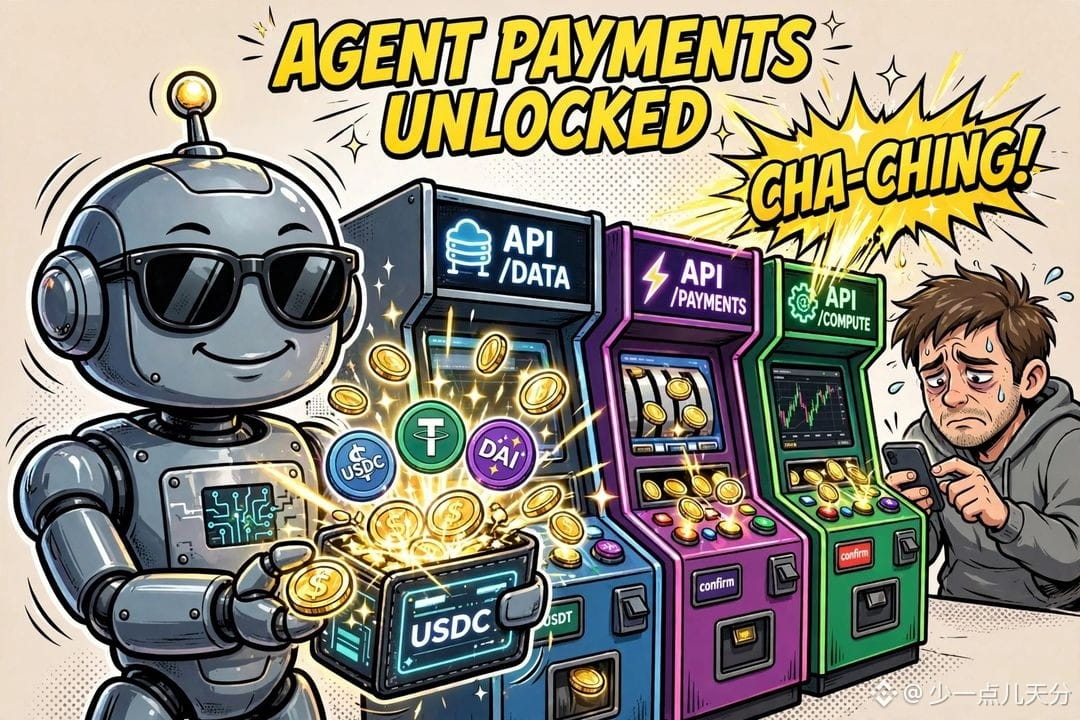
🤖 Big news in AI today: Tempo, a public payment blockchain incubated by Stripe, has officially launched its mainnet.
Built jointly by Stripe and Paradigm, Tempo is designed as a payment chain for AI agents. It also released MPP (Machine Payment Protocol), an open protocol that lets agents lock up funds, pay for services as they use them, and settle everything in one aggregated payment—without requiring an on-chain confirmation each time. According to BitRss, Visa and Lightspark have each adapted MPP for card payments and the Lightning Network, respectively, with more than 100 services in the first wave of integrations. Last October, Tempo raised $500 million at a $5 billion valuation.
What does this mean for crypto? AI x Crypto used to mean little more than “speculating on AI-themed coins.” Now, someone is actually laying the rails for the payment layer. Once the money-management problem for agents is solved, on-chain activity in the agent economy can really take off—benefiting not only AI-themed coins like $WLD , but also the stablecoin sector.
In other news: CryptoSlate reports that Genesis Digital Assets, a former FTX-affiliated mining company, has been transformed into an AI computing center by its parent company, SWI. It raised €800 million just yesterday. The narrative of mining farms turning into data centers is becoming increasingly real.
Which of these two trends—AI payments or AI computing power—do you think has more potential? This is just my personal opinion, not investment advice.
#AIxCrypto #AI智能体 #CryptoPayments
103

·
--

Article
⚡ Google's Gemini 3.5 Flash: Frontier Intelligence at Flash Speed And Finance Is Already Using It#GoogleLaunchesGemini3.5Flash
Google launched Gemini 3.5 Flash on May 19, 2026 at Google I/O, describing it as the company's strongest model yet for coding and autonomous AI agents capable of independently executing coding pipelines, managing research projects, and in internal tests, building an operating system entirely from scratch.
The benchmark data is striking. Gemini 3.5 Flash beats Gemini 3.1 Pro on Terminal Bench 2.1 (76.2%), MCP Atlas (83.6%), and GDPval AA (1,656 Elo), while running roughly 4x faster and costing about 40% less with API pricing at $1.50 per million input tokens and $9.00 per million output tokens.
On multimodal reasoning , Gemini 3.5 Flash scored 83.6% surpassing GPT 5.5's 81.2% on that specific benchmark, though GPT-5.5 retains an edge on ARC AGI 2 reasoning at 84.6% vs. 72.1%.
The finance and crypto angle is direct:
Google says banks and fintechs are already using Gemini 3.5 Flash's agentic capabilities to automate multi-week workflows and Gemini Spark the 24/7 personal AI agent launching alongside the model can automate financial tasks like parsing credit card statements and tracking recurring charges in the background without user prompting.
The model is free in the Gemini app and AI Mode in Search globally, with a 1M token context window and Gemini 3.5 Pro expected to follow in June 2026.
💡 Beginner's Corner Why Does a Google AI Launch Matter for Crypto Markets?
Enterprise grade AI models like Gemini 3.5 Flash are now being used to prepare financial documents, automate compliance workflows, and manage software infrastructure directly intersecting with the financial automation layer that DeFi and Web3 protocols are building on chain.
The convergence of capable, low cost agentic AI with blockchain native payment rails is precisely what makes the Agentic GDP thesis credible models that can act autonomously combined with chains that can settle payments permissionlessly.
💬 As AI models like Gemini 3.5 Flash become capable enough to autonomously manage financial workflows, do you see on chain crypto infrastructure as the natural payment and settlement layer for this agentic economy?
#AIxCrypto #AgenticAI #Web3AI #CryptoTech
$GOOGL
{future}(GOOGLUSDT)
$GOOGLon
{alpha}(560x091fc7778e6932d4009b087b191d1ee3bac5729a)
⚡ Google's Gemini 3.5 Flash: Frontier Intelligence at Flash Speed And Finance Is Already Using It
#GoogleLaunchesGemini3.5Flash
Google launched Gemini 3.5 Flash on May 19, 2026 at Google I/O, describing it as the company's strongest model yet for coding and autonomous AI agents capable of independently executing coding pipelines, managing research projects, and in internal tests, building an operating system entirely from scratch.
The benchmark data is striking. Gemini 3.5 Flash beats Gemini 3.1 Pro on Terminal Bench 2.1 (76.2%), MCP Atlas (83.6%), and GDPval AA (1,656 Elo), while running roughly 4x faster and costing about 40% less with API pricing at $1.50 per million input tokens and $9.00 per million output tokens.
On multimodal reasoning , Gemini 3.5 Flash scored 83.6% surpassing GPT 5.5's 81.2% on that specific benchmark, though GPT-5.5 retains an edge on ARC AGI 2 reasoning at 84.6% vs. 72.1%.
The finance and crypto angle is direct:
Google says banks and fintechs are already using Gemini 3.5 Flash's agentic capabilities to automate multi-week workflows and Gemini Spark the 24/7 personal AI agent launching alongside the model can automate financial tasks like parsing credit card statements and tracking recurring charges in the background without user prompting.
The model is free in the Gemini app and AI Mode in Search globally, with a 1M token context window and Gemini 3.5 Pro expected to follow in June 2026.
💡 Beginner's Corner Why Does a Google AI Launch Matter for Crypto Markets?
Enterprise grade AI models like Gemini 3.5 Flash are now being used to prepare financial documents, automate compliance workflows, and manage software infrastructure directly intersecting with the financial automation layer that DeFi and Web3 protocols are building on chain.
The convergence of capable, low cost agentic AI with blockchain native payment rails is precisely what makes the Agentic GDP thesis credible models that can act autonomously combined with chains that can settle payments permissionlessly.
💬 As AI models like Gemini 3.5 Flash become capable enough to autonomously manage financial workflows, do you see on chain crypto infrastructure as the natural payment and settlement layer for this agentic economy?
#AIxCrypto #AgenticAI #Web3AI #CryptoTech
$GOOGL
$GOOGLon
1
2
230


Article
The NeXt PROBLEM IN CRYPTO IS’NT TRANSACTIONS-ITS AI DECISIONBy [Your Name] | For Binance Community 2026
For 15 years, crypto tried to solve one thing: How do we move money faster?
Bitcoin solved payments.
Ethereum solved smart contracts.
Solana, BNB Chain, Layer-2s solved speed and fees.
Transactions are now instant, cheap, and borderless. Problem solved, right?
Wrong.
The next big problem in crypto isn’t transactions. It’s decisions.
1. We Have Too Much Data, Not Enough Brains
In 2026, there are 20,000+ tokens, 500+ chains, 1000+ DAOs, and news every 3 minutes.
A human can’t process this. A bot can.
But here’s the catch: Most bots just copy trades. They don’t think.
The next winners in crypto won’t be the fastest traders. They’ll be the ones with the best AI making decisions.
2. From "Click to Trade" to "AI to Decide"
Think about it:
- 2020: You manually clicked "Buy BTC"
- 2023: You set DCA bots
- 2026: Your AI agent decides what to buy, when to sell, why based on on-chain data, news, and your risk profile
The user experience is shifting. We won’t manage 10 wallets. We’ll manage 1 AI that manages 10 wallets for us.
Binance is already moving this way with AI trading tools, risk alerts, and portfolio insights. The exchange of the future is less like a dashboard, more like a co-pilot.
3. The New Risks: Bias, Hallucination, and Trust
With AI decisions come new problems:
1. Bias: If the AI was trained on a bull market, will it panic in a bear?
2. Hallucination: What if the AI "invents" a fake token trend?
3. Trust: Will you let an AI move your funds without asking?
Crypto was built on "Don’t trust, verify."
AI says "Trust, but verify the AI." That’s a huge mindset shift.
4. So What’s the Solution?
The future is "Verified AI Agents" on-chain.
Imagine a Binance AI that:
1. Reads 1000 whitepapers in 10 seconds and flags red flags
2. Watches wallet movements + news + sentiment and alerts you before the pump
3. Executes trades for you, but with rules YOU set and can audit on-chain
Transactions are infrastructure. AI decisions are the product.
Final Thought
Crypto won the speed war.
Now we have to win the intelligence war.
The next billion users won’t come for 0.01$ fees.
They’ll come because they have an AI that makes better financial decisions than they can alone.
And that’s where platforms like Binance have the biggest role to play. Not just as an exchange, but as the brain behind your portfolio.
The question isn’t "Can you send crypto in 1 second?"
The question is: "Can your AI decide what to do with it in 1 second?"
What do you think? Would you let an AI manage 20% of your portfolio? Comment below 👇
`#Binance ##AIxCrypto o #Web3 #FutureOfFinance #Crypto2026💔💔 `
{spot}(BTCUSDT)
{spot}(SOLUSDT)
{spot}(ETHUSDT)
The NeXt PROBLEM IN CRYPTO IS’NT TRANSACTIONS-ITS AI DECISION
By [Your Name] | For Binance Community 2026
For 15 years, crypto tried to solve one thing: How do we move money faster?
Bitcoin solved payments.
Ethereum solved smart contracts.
Solana, BNB Chain, Layer-2s solved speed and fees.
Transactions are now instant, cheap, and borderless. Problem solved, right?
Wrong.
The next big problem in crypto isn’t transactions. It’s decisions.
1. We Have Too Much Data, Not Enough Brains
In 2026, there are 20,000+ tokens, 500+ chains, 1000+ DAOs, and news every 3 minutes.
A human can’t process this. A bot can.
But here’s the catch: Most bots just copy trades. They don’t think.
The next winners in crypto won’t be the fastest traders. They’ll be the ones with the best AI making decisions.
2. From "Click to Trade" to "AI to Decide"
Think about it:
- 2020: You manually clicked "Buy BTC"
- 2023: You set DCA bots
- 2026: Your AI agent decides what to buy, when to sell, why based on on-chain data, news, and your risk profile
The user experience is shifting. We won’t manage 10 wallets. We’ll manage 1 AI that manages 10 wallets for us.
Binance is already moving this way with AI trading tools, risk alerts, and portfolio insights. The exchange of the future is less like a dashboard, more like a co-pilot.
3. The New Risks: Bias, Hallucination, and Trust
With AI decisions come new problems:
1. Bias: If the AI was trained on a bull market, will it panic in a bear?
2. Hallucination: What if the AI "invents" a fake token trend?
3. Trust: Will you let an AI move your funds without asking?
Crypto was built on "Don’t trust, verify."
AI says "Trust, but verify the AI." That’s a huge mindset shift.
4. So What’s the Solution?
The future is "Verified AI Agents" on-chain.
Imagine a Binance AI that:
1. Reads 1000 whitepapers in 10 seconds and flags red flags
2. Watches wallet movements + news + sentiment and alerts you before the pump
3. Executes trades for you, but with rules YOU set and can audit on-chain
Transactions are infrastructure. AI decisions are the product.
Final Thought
Crypto won the speed war.
Now we have to win the intelligence war.
The next billion users won’t come for 0.01$ fees.
They’ll come because they have an AI that makes better financial decisions than they can alone.
And that’s where platforms like Binance have the biggest role to play. Not just as an exchange, but as the brain behind your portfolio.
The question isn’t "Can you send crypto in 1 second?"
The question is: "Can your AI decide what to do with it in 1 second?"
What do you think? Would you let an AI manage 20% of your portfolio? Comment below 👇
`#Binance ##AIxCrypto o #Web3 #FutureOfFinance #Crypto2026💔💔 `
130

·
--
#opg $OPG Most AI systems are black boxes — you get an answer, but you can never prove what model ran, what input it received, or whether the output was altered. That's a serious problem when AI is managing money, executing trades, or powering dApps.
@OpenGradient is flipping the script. Built from the ground up as the first blockchain natively designed for verifiable AI inference, it attaches a cryptographic proof to every single model call — so developers, users, and institutions can audit AI decisions instead of just trusting them blindly.
With 2M+ verifiable inferences already processed, a Hybrid AI Compute Architecture (HACA) combining GPU nodes, zkML proofs, and TEEs, and over 2,000 open-source models hosted onchain — this isn't another "AI narrative" play. It's actual infrastructure.
$OPG powers it all: inference payments, staking, governance, and ecosystem access — all live at TGE. Backed by a16z Crypto and Coinbase Ventures, the foundation is rock solid.
The AI era needs trustless compute. @OpenGradient is building exactly that.
#opg #OpenGradient #AIxCrypto #Web3
1
1
114
Log in to explore more content
Join global crypto users on Binance Square
⚡️ Get latest and useful information about crypto.
💬 Trusted by the world’s largest crypto exchange.
👍 Discover real insights from verified creators.
Email / Phone number
Trending Topics
1
#USPPIMissMayEaseBTCPressure
53,473 views
827 Discussing
2
#BitcoinCoreDisclosesTorTrafficVulnerability
22,302 views
448 Discussing
3
#WhatWillDriveCryptoandStocks’NextRebound?
171,088 views
1,664 Discussing
4
#BitcoinBreaksBelow200WeekMovingAverage
59,508 views
551 Discussing
5
#SpaceXTeslaMergerTalksWouldCombine30220BTC
19,807 views
300 Discussing
6
#Anthropic’s6xIPODemandSignalsPotentialRecordRaise
59,764 views
759 Discussing
7
#USCryptoETFsLose$1.48BInFiveDays
2,881 views
52 Discussing
8
#KoreaDigitalAssetBasicActFinalDraftExpectedEarlyJanuary
3,908 views
24 Discussing
9
#RippleRLUSDMarketCapSurpassesPayPalPYUSD
12,887 views
164 Discussing
10
#JaneStreetNearlyOctuplesFidelityBitcoinETFHoldings
28,742 views
276 Discussing