
#tradingbots
tradingbots
395,487 views
1,435 Discussing
Hot
Latest

"My trading bot continues to generate profits! ⚡
✅ Ongoing profits for the NEAR/USDT pair
✅ Outstanding annual return (229%)
✅ Zero manual work
The results are here for you! If you want to get the bot settings and start copying these results, the link is in the bio
#spotGridadin #BinanceSquareTalks #TradingBots #CryptoPatience #NEAR🚀🚀🚀
✅ Ongoing profits for the NEAR/USDT pair
✅ Outstanding annual return (229%)
✅ Zero manual work
The results are here for you! If you want to get the bot settings and start copying these results, the link is in the bio
#spotGridadin #BinanceSquareTalks #TradingBots #CryptoPatience #NEAR🚀🚀🚀

🚨 CLEANUP AHEAD FOR $SUI AND SPOT TRADING PAIRS AS AUTOMATED BOTS FACE CUTOFF! ⚠️
📌 A major top-tier exchange is removing select low-volume quote pairs including $SUI and $LTC on August 21 at 03:00 UTC. Important distinction: this is order book pruning, not a complete token delisting, so your core holdings stay intact across primary market pairs.
⚡ The real danger lies in automated strategy execution. Grid bots and algorithmic systems tied to these pairs will shut down simultaneously, which could trigger execution friction or unexpected losses if left running. 🔍 Clear your pending limit orders and migrate your bot strategies to primary quote pairs ahead of the deadline.
💬 Are you adjusting your algorithmic setups now or letting your active spot positions run into the shift? 👇
⚠️ Not financial advice. Always manage your risk. 🛡️
🏷️ #SUI #TradingBots #SpotTrading #CryptoNews
💡 ⚡
📌 A major top-tier exchange is removing select low-volume quote pairs including $SUI and $LTC on August 21 at 03:00 UTC. Important distinction: this is order book pruning, not a complete token delisting, so your core holdings stay intact across primary market pairs.
⚡ The real danger lies in automated strategy execution. Grid bots and algorithmic systems tied to these pairs will shut down simultaneously, which could trigger execution friction or unexpected losses if left running. 🔍 Clear your pending limit orders and migrate your bot strategies to primary quote pairs ahead of the deadline.
💬 Are you adjusting your algorithmic setups now or letting your active spot positions run into the shift? 👇
⚠️ Not financial advice. Always manage your risk. 🛡️
🏷️ #SUI #TradingBots #SpotTrading #CryptoNews
💡 ⚡


Technical Analysis & Strategy (Spot Grid) 🤖
Title: How to optimize a Spot Grid Bot during market consolidation? 📊
When BTC or SOL oscillates in a sideways channel, manual trading becomes exhausting. That’s exactly where the Spot Grid comes in:
📈 Automatic Buy Low / Sell High: Set your range (e.g., 70$ - 96 on SOL) and let the bot accumulate micro-profits across the grid.
⚙️ Risk management: Prefer a moderate number of grids so you can keep a decent profit per grid after Maker/Taker fees.
Are you using the Spot grid or the Futures grid on Binance? 💭
#GridTrading #TradingBots #Binance #CryptoStrategy @Dusk
Title: How to optimize a Spot Grid Bot during market consolidation? 📊
When BTC or SOL oscillates in a sideways channel, manual trading becomes exhausting. That’s exactly where the Spot Grid comes in:
📈 Automatic Buy Low / Sell High: Set your range (e.g., 70$ - 96 on SOL) and let the bot accumulate micro-profits across the grid.
⚙️ Risk management: Prefer a moderate number of grids so you can keep a decent profit per grid after Maker/Taker fees.
Are you using the Spot grid or the Futures grid on Binance? 💭
#GridTrading #TradingBots #Binance #CryptoStrategy @Dusk

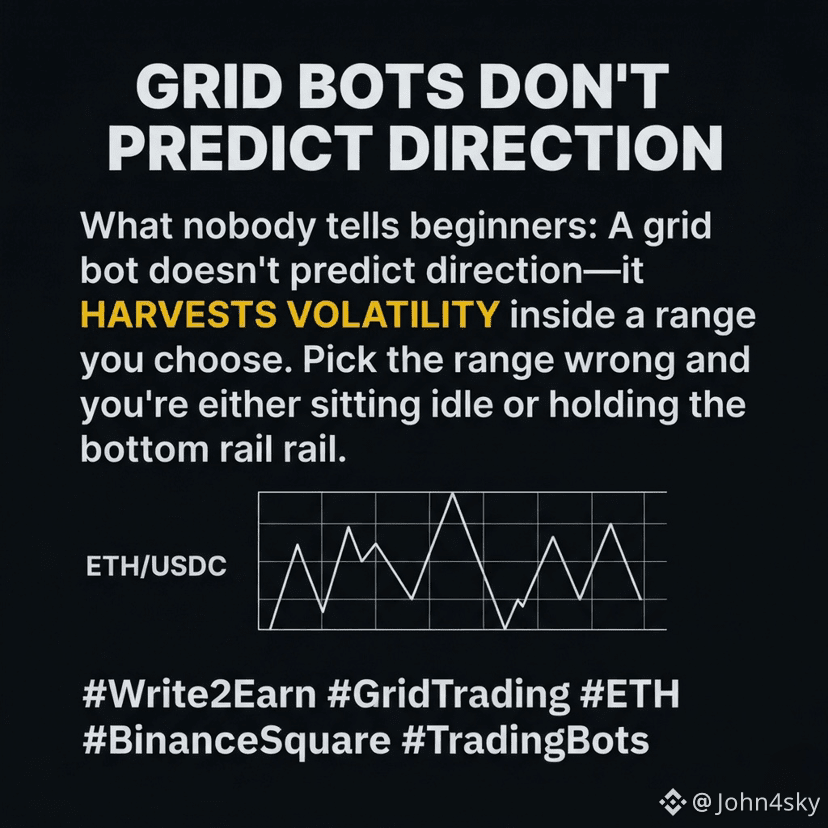
Set up my first grid bot on $ETH /USDC. What nobody tells beginners:
A grid bot doesn’t predict direction. It harvests volatility inside a range you choose. Pick the range wrong and you’re either sitting idle or holding the bottom rail.
What I got right: small allocation, treated it as tuition not income.
What I’d change: I underestimated how much grid count adds to fee drag.
Running grids on $ETH — what range width are you using?
#Write2Earn #gridtrading #BinanceSquare #TradingBots
A grid bot doesn’t predict direction. It harvests volatility inside a range you choose. Pick the range wrong and you’re either sitting idle or holding the bottom rail.
What I got right: small allocation, treated it as tuition not income.
What I’d change: I underestimated how much grid count adds to fee drag.
Running grids on $ETH — what range width are you using?
#Write2Earn #gridtrading #BinanceSquare #TradingBots

🤖 AI Trading Bots Don’t Predict the Market. They Execute a Strategy.
That distinction is easy to miss.
A lot of people hear “AI trading bot” and imagine software that can look at a chart and somehow know what happens next.
That’s not how it works.
An automated trading system analyzes market data and executes trades according to its strategy, rules, or model.
And that creates a very important question:
What happens when the strategy is wrong?
A bot can execute a bad strategy faster and more consistently than a human can.
That’s why automation should never be confused with guaranteed profit.
Before using any trading bot, I’d look at 5 things:
🔹 Strategy — What exactly is the bot trying to do?
🔹 Market conditions — Was the strategy designed for trends, sideways markets, volatility or something else?
🔹 Risk controls — How much capital is exposed? What are the loss limits?
🔹 Testing — Has the strategy been properly tested across different market conditions?
🔹 Security — What access does the bot have and how are your account/API permissions protected?
The biggest advantage of automation isn't that it can “beat the market.”
It's that it can help execute a defined strategy systematically, without requiring you to manually watch the market every second.
But remember:
Automation removes some human emotion from execution. It does NOT remove market risk.
If you can't explain what the bot is doing you probably shouldn't be trusting it with real capital yet.
📌 My takeaway:
Understand the strategy first.
Understand the risks second.
Automate only after that.
Binance provides AI and automated trading tools, but the responsibility for understanding and managing your risk remains with you.
What do you think?
AI trading bots: 👇
#Binance #TradingBots #RiskManagement
#MooDCirCuiT #Aeri
That distinction is easy to miss.
A lot of people hear “AI trading bot” and imagine software that can look at a chart and somehow know what happens next.
That’s not how it works.
An automated trading system analyzes market data and executes trades according to its strategy, rules, or model.
And that creates a very important question:
What happens when the strategy is wrong?
A bot can execute a bad strategy faster and more consistently than a human can.
That’s why automation should never be confused with guaranteed profit.
Before using any trading bot, I’d look at 5 things:
🔹 Strategy — What exactly is the bot trying to do?
🔹 Market conditions — Was the strategy designed for trends, sideways markets, volatility or something else?
🔹 Risk controls — How much capital is exposed? What are the loss limits?
🔹 Testing — Has the strategy been properly tested across different market conditions?
🔹 Security — What access does the bot have and how are your account/API permissions protected?
The biggest advantage of automation isn't that it can “beat the market.”
It's that it can help execute a defined strategy systematically, without requiring you to manually watch the market every second.
But remember:
Automation removes some human emotion from execution. It does NOT remove market risk.
If you can't explain what the bot is doing you probably shouldn't be trusting it with real capital yet.
📌 My takeaway:
Understand the strategy first.
Understand the risks second.
Automate only after that.
Binance provides AI and automated trading tools, but the responsibility for understanding and managing your risk remains with you.
What do you think?
AI trading bots: 👇
#Binance #TradingBots #RiskManagement
#MooDCirCuiT #Aeri
useful tool
100%
overhyped shortcut
0%
3 votes • Voting closed
🚀 How does the NEAR bot generate automatic profits amid market volatility? 📈 🤖
After nearly 23 hours and 24 minutes since the instant network bot (Spot Grid) for #NEAR🚀🚀🚀 started running, the bot continues to achieve excellent performance with steadily increasing profits thanks to its balanced strategy!
📊 The bot’s current key figures and statistics:
• Total Profit: 1.679 USDT (+2.13%) 🟢
• Network Profit (Realized): 0.327 USDT (+0.41%) ⚡
• Floating Profit: 1.352 USDT (+1.71%) 📈
• Expected Annual Return (ROI): 799.43% 🔥
• Total Investment: 78.664 USDT
• Current Balance: 80.343 USDT 💰
#TradingBots #spotGrid
#Write2Earn
https://app.binance.com/uni-qr/spotgrid?at=spotGrid&symbol=NEARUSDT&ref=966109474&opt=cz1ORUFSVVNEVCZkPW51bGwmZ3Q9QVJJVEgmZ2M9NiZscD0xLjQ1MCZ1cD0xLjc1MCZzdWw9MS43ODAmY3BzPWZhbHNlJmNzaT05OTI2MDk4JnR1PTAmaW09NzguNjY0MDAwMDA=
After nearly 23 hours and 24 minutes since the instant network bot (Spot Grid) for #NEAR🚀🚀🚀 started running, the bot continues to achieve excellent performance with steadily increasing profits thanks to its balanced strategy!
📊 The bot’s current key figures and statistics:
• Total Profit: 1.679 USDT (+2.13%) 🟢
• Network Profit (Realized): 0.327 USDT (+0.41%) ⚡
• Floating Profit: 1.352 USDT (+1.71%) 📈
• Expected Annual Return (ROI): 799.43% 🔥
• Total Investment: 78.664 USDT
• Current Balance: 80.343 USDT 💰
#TradingBots #spotGrid
#Write2Earn
https://app.binance.com/uni-qr/spotgrid?at=spotGrid&symbol=NEARUSDT&ref=966109474&opt=cz1ORUFSVVNEVCZkPW51bGwmZ3Q9QVJJVEgmZ2M9NiZscD0xLjQ1MCZ1cD0xLjc1MCZzdWw9MS43ODAmY3BzPWZhbHNlJmNzaT05OTI2MDk4JnR1PTAmaW09NzguNjY0MDAwMDA=

🧠 How to set up a Spot Grid Bot on Binance in 3 steps (Without being stuck to the screen)
If you don’t have time to trade all day, automation is your best ally. 🤖📈
Step by step to set it up today:
🔹 Step 1: Go to the Binance Trading section and select 'Trading Bots'.
🔹 Step 2: Choose 'Grid Spot' and pick a pair with high volatility like BNB or ETH.
🔹 Step 3: Use the AI’s automatic parameters or adjust the price range based on the current resistance.
The bot will buy low and sell high for you automatically within the range.
#BinanceEarn #TradingBots #bnb #IngresosPasivos #CryptoTutorial
If you don’t have time to trade all day, automation is your best ally. 🤖📈
Step by step to set it up today:
🔹 Step 1: Go to the Binance Trading section and select 'Trading Bots'.
🔹 Step 2: Choose 'Grid Spot' and pick a pair with high volatility like BNB or ETH.
🔹 Step 3: Use the AI’s automatic parameters or adjust the price range based on the current resistance.
The bot will buy low and sell high for you automatically within the range.
#BinanceEarn #TradingBots #bnb #IngresosPasivos #CryptoTutorial
🔥 ONLY 15 SPOTS AVAILABLE!
🤖 We’re opening access for 15 new users to join the AI Trading Bot system.
📊 The system is designed to automate trading and help users manage opportunities in the crypto market.
💰 Minimum starting deposit: $500 on your exchange account.
⏳ Limited spots available — first come, first served!
🚀 Ready to get started?
👉 Send “START” in DM to learn more and get access.
⚠️ Reminder: Crypto trading involves risk. Profits are never guaranteed, so only use funds you can afford to lose.
#Crypto #Trading #AITrading #Bitcoin #Binance #CryptoTrading #TradingBots
🤖 We’re opening access for 15 new users to join the AI Trading Bot system.
📊 The system is designed to automate trading and help users manage opportunities in the crypto market.
💰 Minimum starting deposit: $500 on your exchange account.
⏳ Limited spots available — first come, first served!
🚀 Ready to get started?
👉 Send “START” in DM to learn more and get access.
⚠️ Reminder: Crypto trading involves risk. Profits are never guaranteed, so only use funds you can afford to lose.
#Crypto #Trading #AITrading #Bitcoin #Binance #CryptoTrading #TradingBots


🤖 GRID TRADING IN 1 MINUTE: HOW IT WORKS & WHERE TO USE IT ⚙️📊
The Mechanics: Automates a set price range by creating a "grid" of limit orders. Every time the price dips, it buys; as it rebounds, it sells. It systematically automates "buy low, sell high" with zero emotion.
🎯 Where does it shine? In sideways or ranging markets. When prices bounce between support and resistance without a clear macro trend, the bot continuously extracts profit from local volatility.
⚠️ The Big Risk? Strong trends. In a market crash, it blindly keeps buying down into heavy losses. In a massive pump, it sells off your positions far too early.
Call to Action (CTA): Do you deploy bots during boring, range-bound markets, or do you strictly stick to manual trading? Drop your thoughts below! 👇🔥
#Binance #TradingBots #AlgorithmicTrading #CryptoEducation #GridBotVSManual
The Mechanics: Automates a set price range by creating a "grid" of limit orders. Every time the price dips, it buys; as it rebounds, it sells. It systematically automates "buy low, sell high" with zero emotion.
🎯 Where does it shine? In sideways or ranging markets. When prices bounce between support and resistance without a clear macro trend, the bot continuously extracts profit from local volatility.
⚠️ The Big Risk? Strong trends. In a market crash, it blindly keeps buying down into heavy losses. In a massive pump, it sells off your positions far too early.
Call to Action (CTA): Do you deploy bots during boring, range-bound markets, or do you strictly stick to manual trading? Drop your thoughts below! 👇🔥
#Binance #TradingBots #AlgorithmicTrading #CryptoEducation #GridBotVSManual


🧪 We Almost Paid $64/Month for Data. A Free Sample Killed It.
Quick story from the research process.
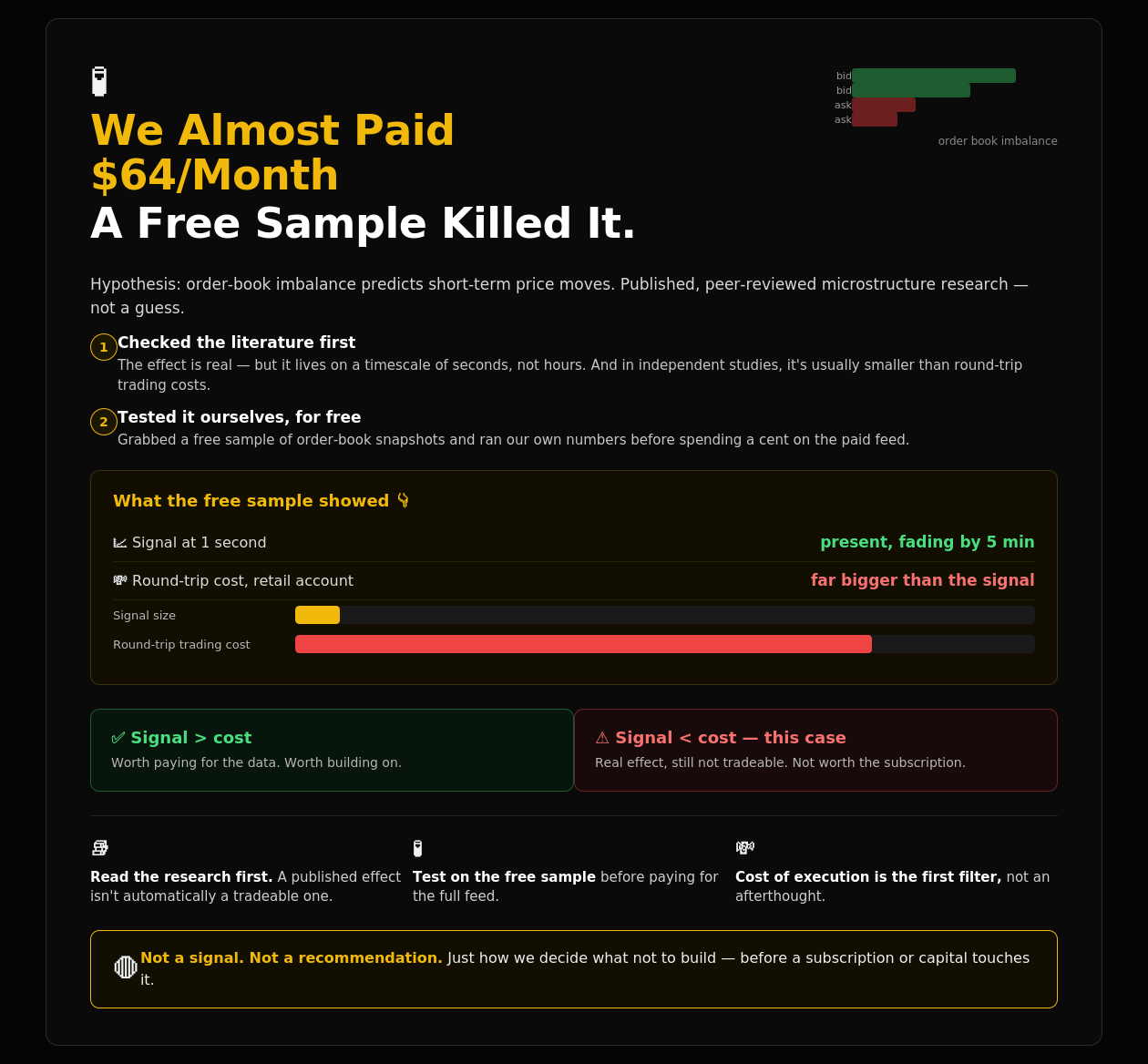
Hypothesis: order-book imbalance (more resting buy orders than sell, or vice versa) predicts short-term price moves. This isn't a guess — it's published, peer-reviewed market microstructure research.
Before subscribing to a paid data feed, two checks first:
1️⃣ Read the literature
The effect is real. But it lives on a timescale of seconds, not hours. In independent studies, it's usually smaller than round-trip trading costs.
2️⃣ Tested it ourselves, for free
Grabbed a free sample of order-book snapshots and ran our own numbers before spending a cent.
Result:
✅ The signal is there — strongest at 1 second, fading by 5 minutes
⚠️ The size: a fraction of what round-trip trading costs on a retail account
The math doesn't work. Not because the effect is fake — because it's real and too small to survive fees.
So we didn't subscribe. $64/month saved, and a clean "no" documented for next time.
Same discipline we apply to every bot strategy: real signal ≠ tradeable edge. Cost of execution is the first filter, not an afterthought.
🛑 No signals.
🛑 No copytrading.
🛑 No guaranteed anything.
Just how we decide what NOT to build.
What's something you almost paid for — a data feed, an indicator, a signal service — until a free sample talked you out of it?
Educational only. Not financial advice.
#TradingBots #CryptoBots #RiskManagement $BTC
$ETH
$SOL
Quick story from the research process.
Hypothesis: order-book imbalance (more resting buy orders than sell, or vice versa) predicts short-term price moves. This isn't a guess — it's published, peer-reviewed market microstructure research.
Before subscribing to a paid data feed, two checks first:
1️⃣ Read the literature
The effect is real. But it lives on a timescale of seconds, not hours. In independent studies, it's usually smaller than round-trip trading costs.
2️⃣ Tested it ourselves, for free
Grabbed a free sample of order-book snapshots and ran our own numbers before spending a cent.
Result:
✅ The signal is there — strongest at 1 second, fading by 5 minutes
⚠️ The size: a fraction of what round-trip trading costs on a retail account
The math doesn't work. Not because the effect is fake — because it's real and too small to survive fees.
So we didn't subscribe. $64/month saved, and a clean "no" documented for next time.
Same discipline we apply to every bot strategy: real signal ≠ tradeable edge. Cost of execution is the first filter, not an afterthought.
🛑 No signals.
🛑 No copytrading.
🛑 No guaranteed anything.
Just how we decide what NOT to build.
What's something you almost paid for — a data feed, an indicator, a signal service — until a free sample talked you out of it?
Educational only. Not financial advice.
#TradingBots #CryptoBots #RiskManagement $BTC
$ETH
$SOL
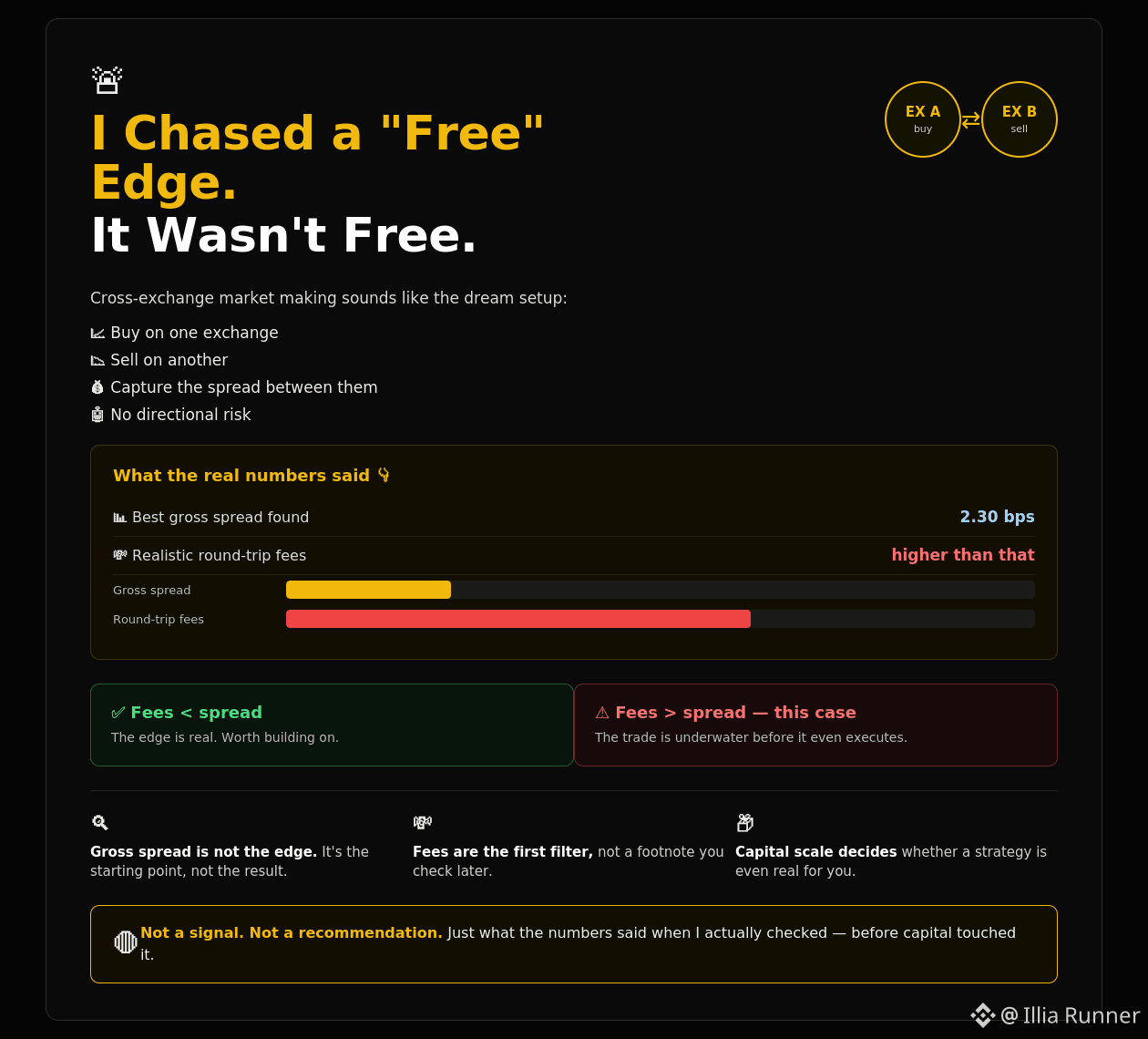
🚨 I Chased a "Free" Edge. It Wasn't Free.
Cross-exchange market making sounds like the dream setup:
📈 Buy on one exchange
📉 Sell on another
💰 Capture the spread between them
🤖 No directional risk
I tested it for real. Not backtested on hope — replayed against actual historical spreads across exchanges.
Best gross spread I could find: 2.30 bps.
Realistic round-trip fees on both legs: higher than that.
Before the trade even executes, the fee is already bigger than the edge.
The only way this works is VIP-tier fee rebates — the kind of volume tier that needs capital way beyond what a small account can bring.
So the strategy isn't wrong. It's just not accessible at this size.
This is the part people skip when they get excited about "arbitrage":
⚖️ Gross spread is not the edge
💸 Fees are not a footnote, they're the first filter
📦 Capital scale changes whether a strategy is even real for you
I'd rather find this out on paper than find it out live.
Not a signal. Not a recommendation. Just what the numbers said when I actually checked.
What's a strategy that looked clean on paper for you, until you priced in fees at your actual account size?
Educational only. Not financial advice.
#TradingBots #Hummingbot #CryptoBots $BTC
$ETH
$SOL
Cross-exchange market making sounds like the dream setup:
📈 Buy on one exchange
📉 Sell on another
💰 Capture the spread between them
🤖 No directional risk
I tested it for real. Not backtested on hope — replayed against actual historical spreads across exchanges.
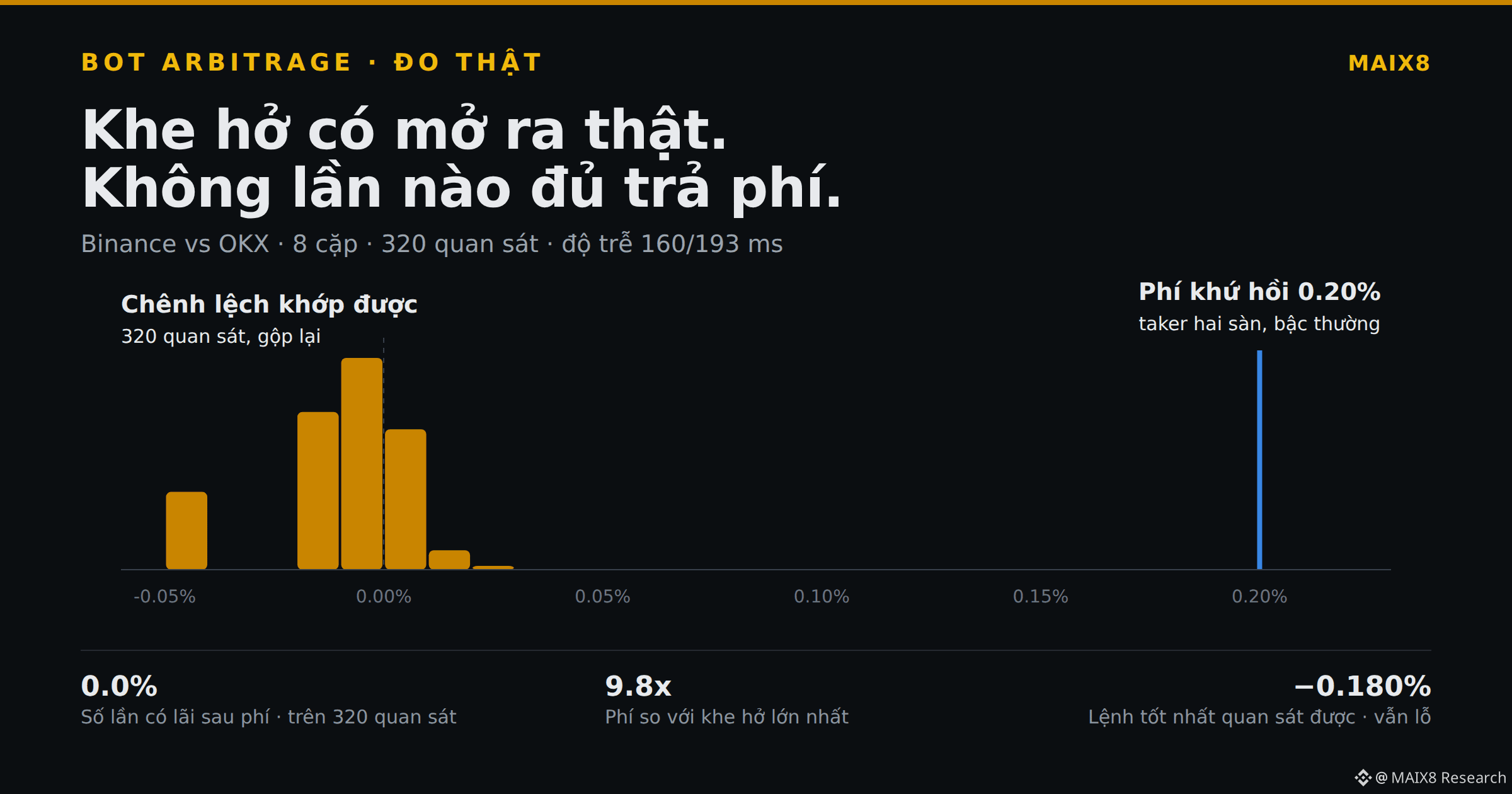
Best gross spread I could find: 2.30 bps.
Realistic round-trip fees on both legs: higher than that.
Before the trade even executes, the fee is already bigger than the edge.
The only way this works is VIP-tier fee rebates — the kind of volume tier that needs capital way beyond what a small account can bring.
So the strategy isn't wrong. It's just not accessible at this size.
This is the part people skip when they get excited about "arbitrage":
⚖️ Gross spread is not the edge
💸 Fees are not a footnote, they're the first filter
📦 Capital scale changes whether a strategy is even real for you
I'd rather find this out on paper than find it out live.
Not a signal. Not a recommendation. Just what the numbers said when I actually checked.
What's a strategy that looked clean on paper for you, until you priced in fees at your actual account size?
Educational only. Not financial advice.
#TradingBots #Hummingbot #CryptoBots $BTC
$ETH
$SOL
🚨 I Shut Down My Own Bot. On Purpose.
Not because it lost money.
Because green PnL was hiding the real story.
Here's the audit that killed it 👇
📊 Gross spread captured: $1.52
💸 Fees paid: $1.76
📉 Adverse selection cost: ~$15/day
Fees alone already beat the spread.
Adverse selection buried it.
The trap:
✅ Some days looked profitable
✅ Realized PnL on closed trades was green
🚫 But it was SOL price movement, not the bot
I ran 3 independent checks on the same account.
All 3 agreed: DESTROYED_EDGE.
Not "maybe underperforming."
Not "needs tuning."
Structurally negative before you even count directional luck.
My rule now:
If I can't tell whether PnL came from skill or from the coin moving — I don't trust the PnL.
🛑 No signals.
🛑 No copytrading.
🛑 No "just add more capital and it'll average out."
Just accounting truth before scaling.
Question for bot runners 👇
When your bot is green, do you separate:
A) Skill (spread captured vs fees)
B) Luck (coin price movement)
C) I don't separate them, PnL is PnL
D) Never thought about it this way
Educational only. Not financial advice. Never share withdrawal-enabled API keys.
#TradingBots #Hummingbot #CryptoBots $SOL
$BTC
$ETH
Not because it lost money.
Because green PnL was hiding the real story.
Here's the audit that killed it 👇
📊 Gross spread captured: $1.52
💸 Fees paid: $1.76
📉 Adverse selection cost: ~$15/day
Fees alone already beat the spread.
Adverse selection buried it.
The trap:
✅ Some days looked profitable
✅ Realized PnL on closed trades was green
🚫 But it was SOL price movement, not the bot
I ran 3 independent checks on the same account.
All 3 agreed: DESTROYED_EDGE.
Not "maybe underperforming."
Not "needs tuning."
Structurally negative before you even count directional luck.
My rule now:
If I can't tell whether PnL came from skill or from the coin moving — I don't trust the PnL.
🛑 No signals.
🛑 No copytrading.
🛑 No "just add more capital and it'll average out."
Just accounting truth before scaling.
Question for bot runners 👇
When your bot is green, do you separate:
A) Skill (spread captured vs fees)
B) Luck (coin price movement)
C) I don't separate them, PnL is PnL
D) Never thought about it this way
Educational only. Not financial advice. Never share withdrawal-enabled API keys.
#TradingBots #Hummingbot #CryptoBots $SOL
$BTC
$ETH

Salam aleykum...
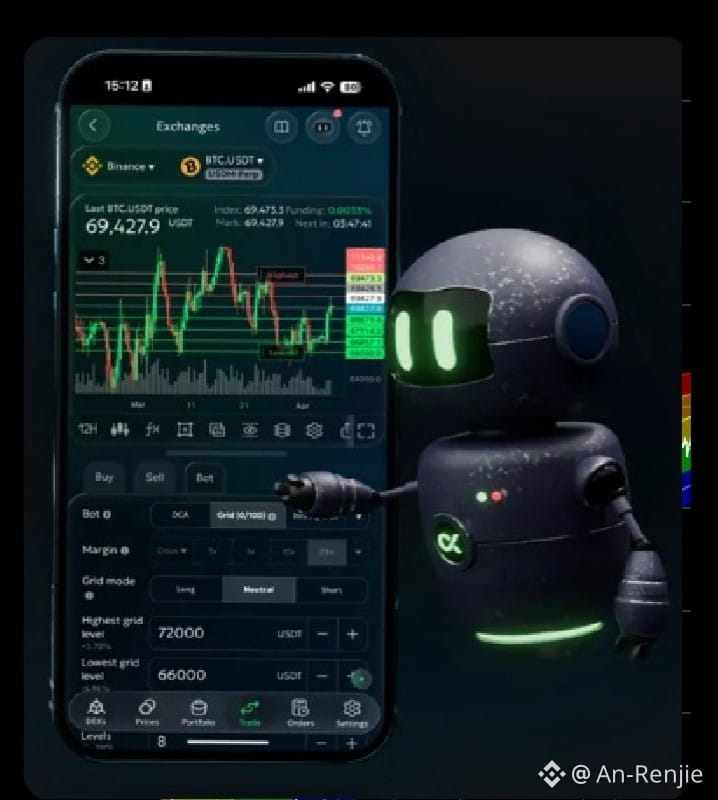
This is your big chance before the train leaves again. Invest $BTC now in Spot Grid, between 40K and 70K with 50 Geometric grids.
Buy below and sell above
#Binance $ETH #AnRenjie #cryptocurrency $SOL #TradingBots
This is your big chance before the train leaves again. Invest $BTC now in Spot Grid, between 40K and 70K with 50 Geometric grids.
Buy below and sell above
#Binance $ETH #AnRenjie #cryptocurrency $SOL #TradingBots

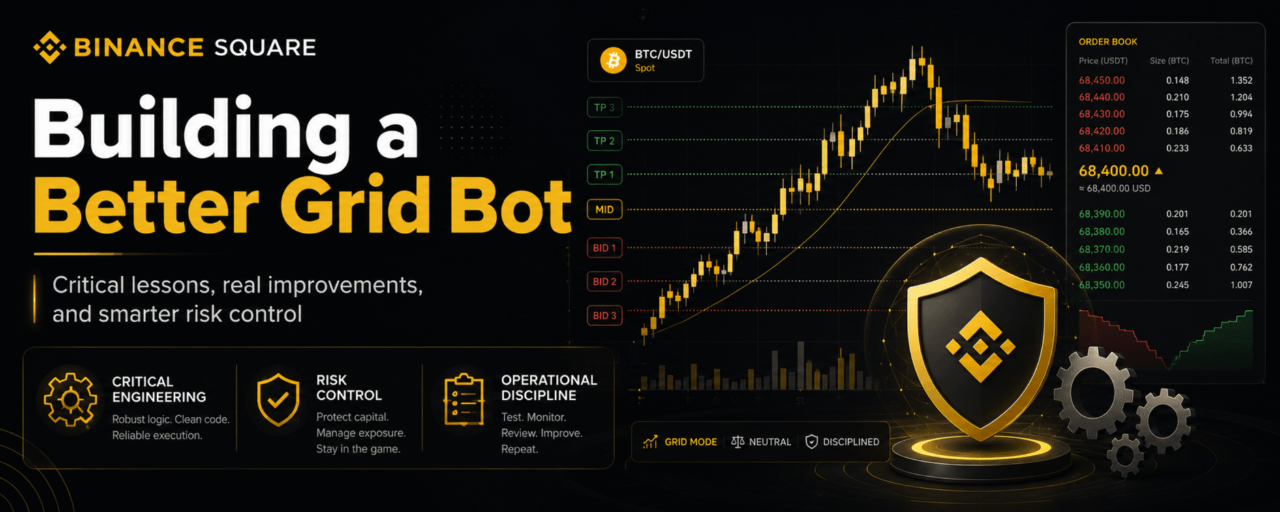

A Binance Futures bot can have the right signal and still place the wrong order.
I found this in the logs: 3 websocket reconnects in 41 minutes. Price data came back, but the bot’s position state was stale.
That is where duplicate orders begin.
My rule for Futures bots now:
1. Rebuild account state after every reconnect
2. Check current position before every new order
3. Track pending orders separately from filled positions
4. Block new entries if websocket timestamp is stale by more than 2 seconds
5. Log rejected signals, not only executed trades
Boring fix, real edge.
On Binance Futures, your signal is only half the system. The other half is knowing whether your bot is actually flat, partially filled, pending, stopped, or already exposed.
Most builders optimize entries first.
I’d rather fix state recovery before adding one more indicator.
Do you log reconnects and rejected signals, or only fills?
#Binance #Futures #TradingBots #RiskManagement
I found this in the logs: 3 websocket reconnects in 41 minutes. Price data came back, but the bot’s position state was stale.
That is where duplicate orders begin.
My rule for Futures bots now:
1. Rebuild account state after every reconnect
2. Check current position before every new order
3. Track pending orders separately from filled positions
4. Block new entries if websocket timestamp is stale by more than 2 seconds
5. Log rejected signals, not only executed trades
Boring fix, real edge.
On Binance Futures, your signal is only half the system. The other half is knowing whether your bot is actually flat, partially filled, pending, stopped, or already exposed.
Most builders optimize entries first.
I’d rather fix state recovery before adding one more indicator.
Do you log reconnects and rejected signals, or only fills?
#Binance #Futures #TradingBots #RiskManagement
A Binance Futures bot doesn’t need more signals first. It needs better reconnect handling.
I found this in the logs last week: websocket dropped for 27 seconds, the bot rebuilt late, then placed 2 duplicate orders because position state was stale.
That’s not a strategy problem.
That’s an execution problem.
Binance application:
If your bot trades Futures, it should rebuild state directly from Binance after every reconnect before it sends a new order.
Rule:
Signal state, order state, and position state must be separated.
Kill-switch:
If position cannot be verified after reconnect, pause trading, cancel stale pending orders, and send an alert.
My minimum reconnect checklist:
1. fetch current position
2. fetch open orders
3. check last fill
4. block new entries
5. rebuild local state
6. resume only after verification
It’s not glamorous, but it works.
Most builders optimize entries. I’d rather fix the part that stops one bad bot state from becoming account damage.
Do you test reconnects before live size?
#Binance #Futures #TradingBots #RiskManagement
I found this in the logs last week: websocket dropped for 27 seconds, the bot rebuilt late, then placed 2 duplicate orders because position state was stale.
That’s not a strategy problem.
That’s an execution problem.
Binance application:
If your bot trades Futures, it should rebuild state directly from Binance after every reconnect before it sends a new order.
Rule:
Signal state, order state, and position state must be separated.
Kill-switch:
If position cannot be verified after reconnect, pause trading, cancel stale pending orders, and send an alert.
My minimum reconnect checklist:
1. fetch current position
2. fetch open orders
3. check last fill
4. block new entries
5. rebuild local state
6. resume only after verification
It’s not glamorous, but it works.
Most builders optimize entries. I’d rather fix the part that stops one bad bot state from becoming account damage.
Do you test reconnects before live size?
#Binance #Futures #TradingBots #RiskManagement

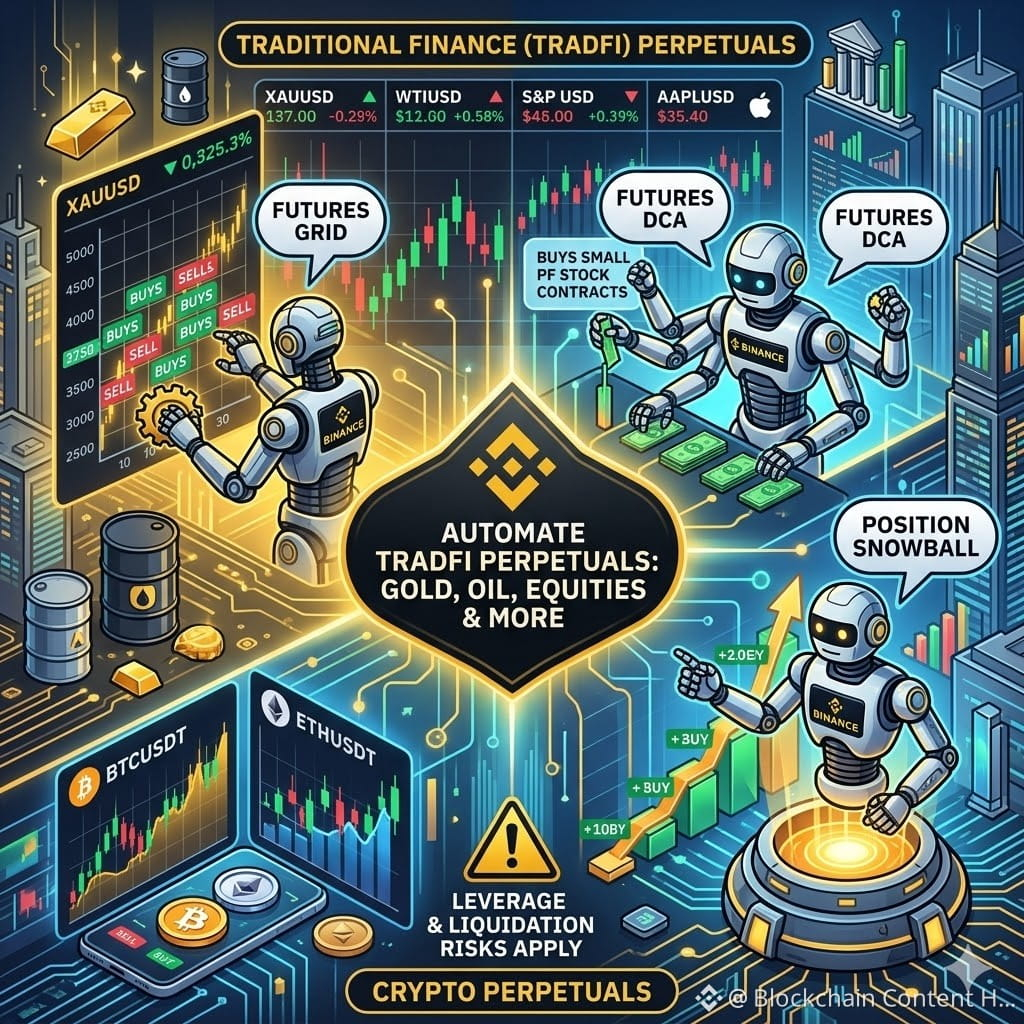
Binance Trading Bots Now Support TradFi Perps:
Binance expanded its Trading Bots — Futures Grid, Futures DCA, and Position Snowball — to support TradFi perpetual contracts, letting users automate strategies on traditional assets like commodities and equities, though leverage and liquidation risks still apply.
#Binance #TradingBots #TradFi #FuturesTrading
Binance expanded its Trading Bots — Futures Grid, Futures DCA, and Position Snowball — to support TradFi perpetual contracts, letting users automate strategies on traditional assets like commodities and equities, though leverage and liquidation risks still apply.
#Binance #TradingBots #TradFi #FuturesTrading

8 Bit🍊 has enhanced its Pumpfun trading bots by integrating secure natural language processing through Clawd, enabling voice-activated and persistent trading sessions. This upgrade introduces a more intuitive and seamless way for traders to interact with their bots, allowing commands and adjustments through natural language rather than manual inputs.
For BNB Chain traders, this innovation represents a step toward more accessible and user-friendly automated trading experiences. By supporting voice commands and maintaining persistent sessions, the bots can better adapt to dynamic market conditions while reducing the friction of continuous manual monitoring.
This addition highlights the growing trend of combining AI-driven natural language interfaces with decentralized finance tools, pushing the boundaries of how traders can engage with markets and manage strategies more efficiently.
#BNBChain #TradingBots #CryptoAI
For BNB Chain traders, this innovation represents a step toward more accessible and user-friendly automated trading experiences. By supporting voice commands and maintaining persistent sessions, the bots can better adapt to dynamic market conditions while reducing the friction of continuous manual monitoring.
This addition highlights the growing trend of combining AI-driven natural language interfaces with decentralized finance tools, pushing the boundaries of how traders can engage with markets and manage strategies more efficiently.
#BNBChain #TradingBots #CryptoAI


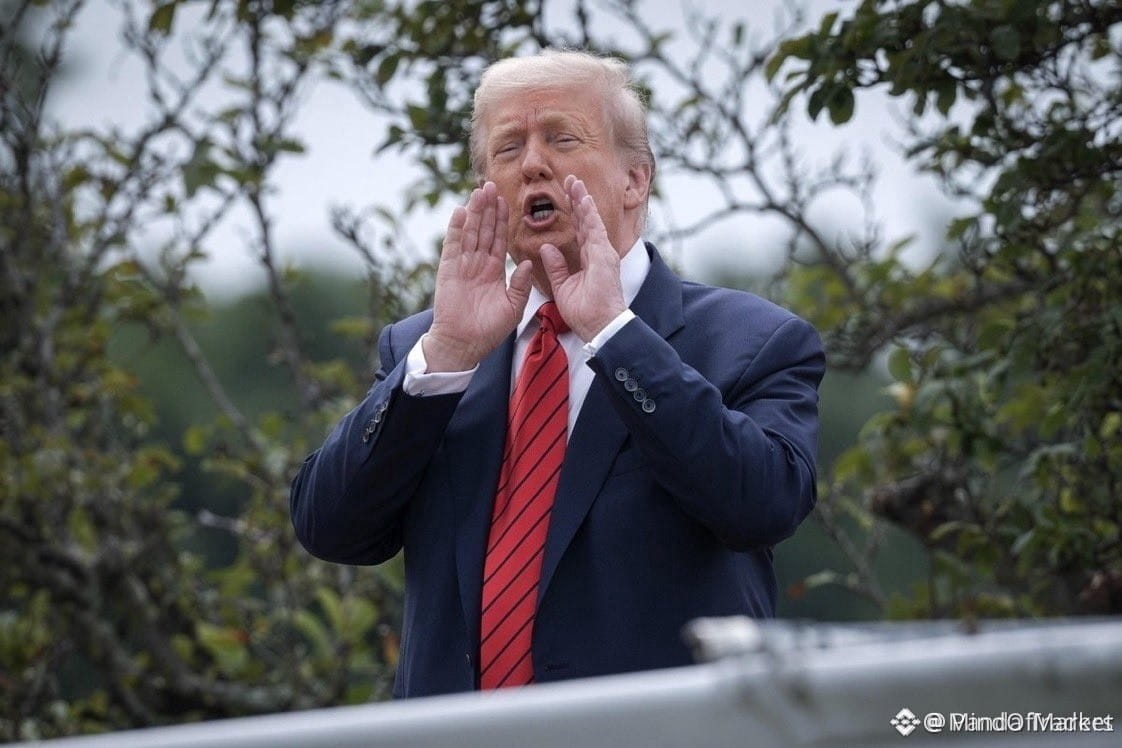
TRUMP'S TRUTH SOCIAL API JUST BECAME A MARKET MOVER FOR $TRUMP 🔥
Truth Social now feeds directly into Bloomberg terminals — bots are trading before humans finish reading. One post can swing crypto, equities, and commodities instantly. This isn't insider trading; it's faster access to the same public signal.
Retail reaction time is seconds. Institutional reaction time is milliseconds. That delta is getting compressed daily. Are you adapting your strategy to account for automated sentiment flow?
Not financial advice. Always manage your risk.
#TRUMP #CryptoNews #MarketMover #TradingBots
⚡
Truth Social now feeds directly into Bloomberg terminals — bots are trading before humans finish reading. One post can swing crypto, equities, and commodities instantly. This isn't insider trading; it's faster access to the same public signal.
Retail reaction time is seconds. Institutional reaction time is milliseconds. That delta is getting compressed daily. Are you adapting your strategy to account for automated sentiment flow?
Not financial advice. Always manage your risk.
#TRUMP #CryptoNews #MarketMover #TradingBots
⚡

Log in to explore more content