
Ginyu The Trader
73 Beiträge

Ginyu The Trader
Melden
Nutzer blockieren
Research & Market Insight
Trade eröffnen
Hochfrequenz-Trader
5.6 Jahre
195 Following
22 Follower
17 Like gegeben
Beiträge
Portfolio
Übersetzung ansehen
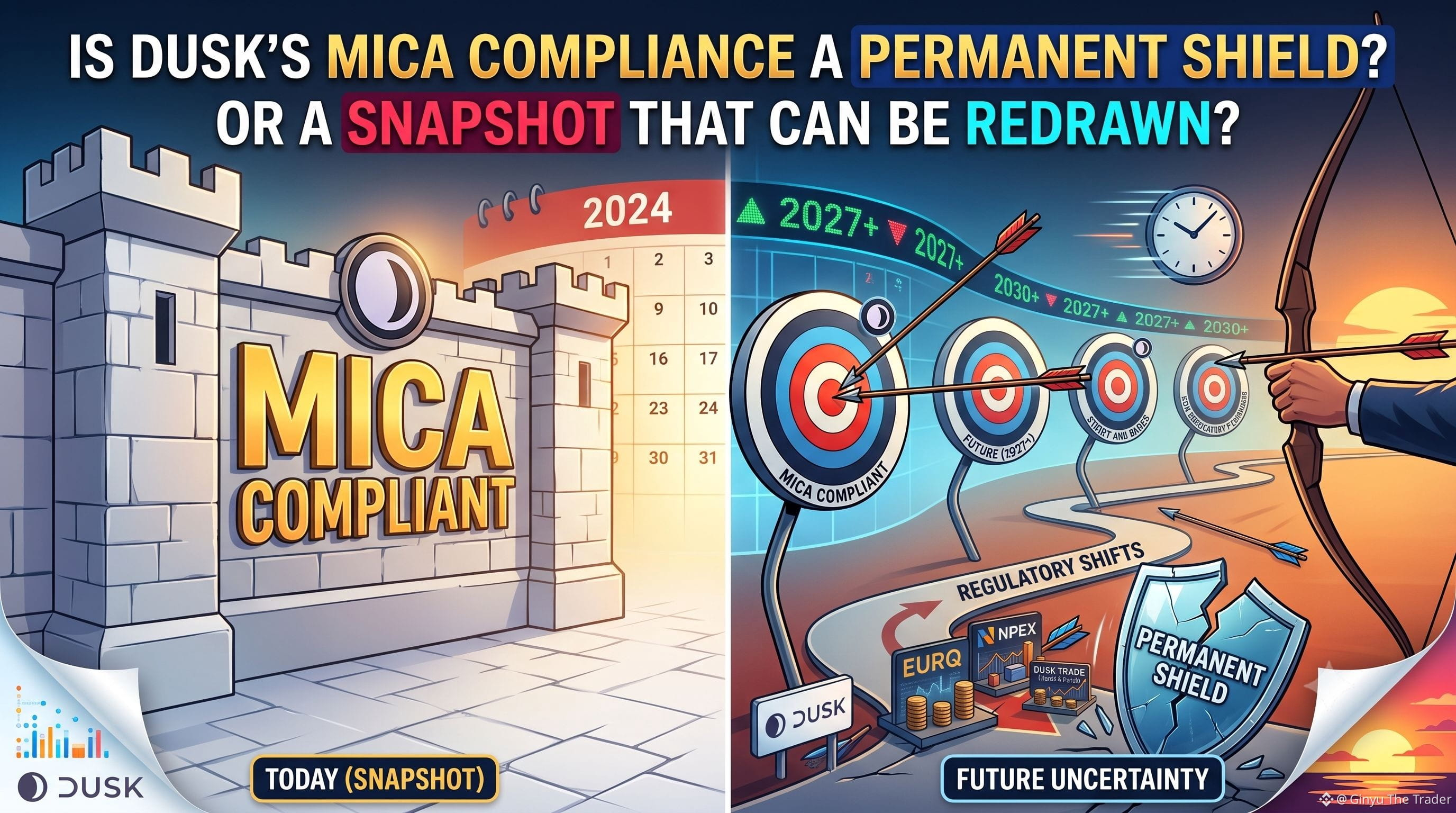
"Dusk is MiCA compliant, so it's regulator-proof." I've seen that logic used almost as a closing argument in threads about Dusk's long-term safety, and I understand the appeal. MiCA is real, binding EU law, not a marketing badge, and Dusk built genuine infrastructure around it: a compliant euro token in EURQ, securities work through NPEX's DLT Pilot Regime license, disclosure and settlement designed with MiCA's requirements in mind from the start. That's a real foundation, and it's more than most projects claiming regulatory alignment can point to when asked for specifics.
The gap in the logic is treating today's compliant status as a permanent shield rather than a snapshot of current rules. The same EU regulatory environment that gave Dusk its MiCA compliant framing is simultaneously moving in a stricter direction elsewhere: anti-money laundering rules advancing toward effectively banning privacy coin accounts across the EU by 2027, a category Dusk sits adjacent to even with Moonlight's public rail as a hedge. Rules that classify a chain as compliant one year can be rewritten the next, especially in a regulatory area as young and actively contested as crypto asset markets currently are across Europe.
I don't think this makes Dusk's compliance work meaningless, and I'd rather see a project building toward MiCA than ignoring it entirely. What I'd push back on is the certainty in "regulator-proof." Compliance is a moving target that has to be maintained continuously, not a status earned once and then locked in. Dusk's Moonlight model gives it more room to adapt than a pure privacy chain has, but adaptability isn't the same claim as permanent safety, and treating the two as identical overstates what MiCA compliance today actually guarantees about tomorrow. Products like Dusk Trade, meant to bring money market funds, bonds and other RWAs onto Dusk with real ownership and instant settlement, are exactly the kind of application that would feel a rule change first if the ground under MiCA ever shifts.
@Dusk_Foundation $DUSK #dusk
"Dusk is MiCA compliant, so it's regulator-proof." I've seen that logic used almost as a closing argument in threads about Dusk's long-term safety, and I understand the appeal. MiCA is real, binding EU law, not a marketing badge, and Dusk built genuine infrastructure around it: a compliant euro token in EURQ, securities work through NPEX's DLT Pilot Regime license, disclosure and settlement designed with MiCA's requirements in mind from the start. That's a real foundation, and it's more than most projects claiming regulatory alignment can point to when asked for specifics.
The gap in the logic is treating today's compliant status as a permanent shield rather than a snapshot of current rules. The same EU regulatory environment that gave Dusk its MiCA compliant framing is simultaneously moving in a stricter direction elsewhere: anti-money laundering rules advancing toward effectively banning privacy coin accounts across the EU by 2027, a category Dusk sits adjacent to even with Moonlight's public rail as a hedge. Rules that classify a chain as compliant one year can be rewritten the next, especially in a regulatory area as young and actively contested as crypto asset markets currently are across Europe.
I don't think this makes Dusk's compliance work meaningless, and I'd rather see a project building toward MiCA than ignoring it entirely. What I'd push back on is the certainty in "regulator-proof." Compliance is a moving target that has to be maintained continuously, not a status earned once and then locked in. Dusk's Moonlight model gives it more room to adapt than a pure privacy chain has, but adaptability isn't the same claim as permanent safety, and treating the two as identical overstates what MiCA compliance today actually guarantees about tomorrow. Products like Dusk Trade, meant to bring money market funds, bonds and other RWAs onto Dusk with real ownership and instant settlement, are exactly the kind of application that would feel a rule change first if the ground under MiCA ever shifts.
@Dusk $DUSK #dusk
The gap in the logic is treating today's compliant status as a permanent shield rather than a snapshot of current rules. The same EU regulatory environment that gave Dusk its MiCA compliant framing is simultaneously moving in a stricter direction elsewhere: anti-money laundering rules advancing toward effectively banning privacy coin accounts across the EU by 2027, a category Dusk sits adjacent to even with Moonlight's public rail as a hedge. Rules that classify a chain as compliant one year can be rewritten the next, especially in a regulatory area as young and actively contested as crypto asset markets currently are across Europe.
I don't think this makes Dusk's compliance work meaningless, and I'd rather see a project building toward MiCA than ignoring it entirely. What I'd push back on is the certainty in "regulator-proof." Compliance is a moving target that has to be maintained continuously, not a status earned once and then locked in. Dusk's Moonlight model gives it more room to adapt than a pure privacy chain has, but adaptability isn't the same claim as permanent safety, and treating the two as identical overstates what MiCA compliance today actually guarantees about tomorrow. Products like Dusk Trade, meant to bring money market funds, bonds and other RWAs onto Dusk with real ownership and instant settlement, are exactly the kind of application that would feel a rule change first if the ground under MiCA ever shifts.
@Dusk $DUSK #dusk
118
Teilweise korrekt
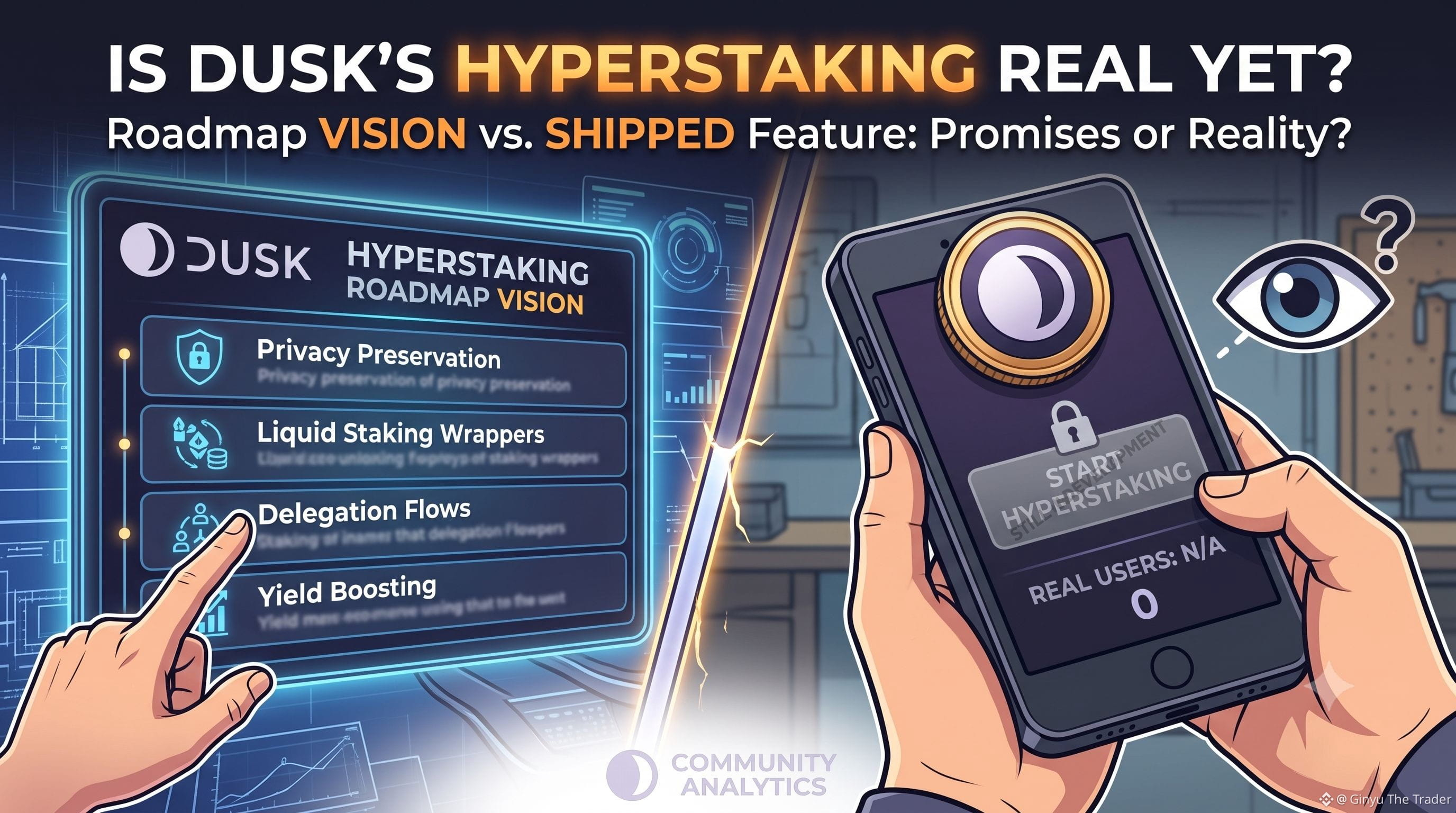
Hyperstaking wird in der eigenen Roadmap-Sprache von Dusk Network als etwas beschrieben, das nahe an Account Abstraction für Staking herankommt: eine Neuheit, die es Smart Contracts ermöglicht, Staking mit benutzerdefinierter Logik zu handhaben, und damit datenschutzfreundliches Staking, Delegation, Liquid-Staking-Wrapper, Affiliate-Programme und Yield-Boosting in einem einzigen primitiven Baustein zusammenführt. Wenn ich diese Liste lese, fällt mir auf, wie viel davon als „Unlocks“ und Möglichkeiten gerahmt wird – statt als bestätigte, ausgelieferte Funktionalität. Diese Unterscheidung verdient mehr Aufmerksamkeit, als sie in der Art, wie das Feature besprochen wird, normalerweise bekommt.
Programmable Staking ist kein Fantasiekonzept. Account Abstraction auf anderen Chains hat tatsächlich ähnliche Muster ermöglicht – es gibt also keinen Grund anzunehmen, dass die Version von Dusk Network technisch unplausibel wäre. Aber eine Roadmap-Beschreibung, die darauf abzielt, Vorfreude auf ein zukünftiges Quartal zu erzeugen, ist grundsätzlich eine andere Art von Aussage als ein ausgeliefertes Feature, das von echten Stakern genutzt wird – mit Liquid-Staking-Wrappern oder Delegations-Workflows in Produktion, unter realen Netzwerkbedingungen, in bedeutsamem Maßstab.
Ich versuche, diese Behauptungen in etwa so zu halten, wie ich jedes ehrgeizige technische Versprechen einer Gruppe einordne, die ihr zu verdanken historisch harte Kryptografie geliefert hat, aber auch historisch selbst gesetzte Termine verfehlt hat. Genau dieses Muster zeigt sich gerade: bei DuskEVMs Mainnet und seinem Hedger-Privacy-Modul – beides wurde versprochen, beides ist, wie ich schreibe, noch ausstehend. Hyperstaking könnte tatsächlich alles freischalten, was die Roadmap beschreibt. Es könnte aber auch in einer ersten, enger gefassten Version ankommen, die sich im Laufe der Zeit erweitert – so, wie die meisten ambitionierten Primitiven tatsächlich ausgeliefert werden. Solange ich nicht auf konkrete Implementierungen verweisen kann, die auf Dusk Network Mainnet ganz bestimmte Dinge tun – statt auf eine Aufzählung von Möglichkeiten – behandle ich die vollständige Vision in etwa zu gleichen Teilen als vielversprechend und als noch nicht bewiesen.
@Dusk_Foundation $DUSK #dusk
Hyperstaking wird in der eigenen Roadmap-Sprache von Dusk Network als etwas beschrieben, das nahe an Account Abstraction für Staking herankommt: eine Neuheit, die es Smart Contracts ermöglicht, Staking mit benutzerdefinierter Logik zu handhaben, und damit datenschutzfreundliches Staking, Delegation, Liquid-Staking-Wrapper, Affiliate-Programme und Yield-Boosting in einem einzigen primitiven Baustein zusammenführt. Wenn ich diese Liste lese, fällt mir auf, wie viel davon als „Unlocks“ und Möglichkeiten gerahmt wird – statt als bestätigte, ausgelieferte Funktionalität. Diese Unterscheidung verdient mehr Aufmerksamkeit, als sie in der Art, wie das Feature besprochen wird, normalerweise bekommt.
Programmable Staking ist kein Fantasiekonzept. Account Abstraction auf anderen Chains hat tatsächlich ähnliche Muster ermöglicht – es gibt also keinen Grund anzunehmen, dass die Version von Dusk Network technisch unplausibel wäre. Aber eine Roadmap-Beschreibung, die darauf abzielt, Vorfreude auf ein zukünftiges Quartal zu erzeugen, ist grundsätzlich eine andere Art von Aussage als ein ausgeliefertes Feature, das von echten Stakern genutzt wird – mit Liquid-Staking-Wrappern oder Delegations-Workflows in Produktion, unter realen Netzwerkbedingungen, in bedeutsamem Maßstab.
Ich versuche, diese Behauptungen in etwa so zu halten, wie ich jedes ehrgeizige technische Versprechen einer Gruppe einordne, die ihr zu verdanken historisch harte Kryptografie geliefert hat, aber auch historisch selbst gesetzte Termine verfehlt hat. Genau dieses Muster zeigt sich gerade: bei DuskEVMs Mainnet und seinem Hedger-Privacy-Modul – beides wurde versprochen, beides ist, wie ich schreibe, noch ausstehend. Hyperstaking könnte tatsächlich alles freischalten, was die Roadmap beschreibt. Es könnte aber auch in einer ersten, enger gefassten Version ankommen, die sich im Laufe der Zeit erweitert – so, wie die meisten ambitionierten Primitiven tatsächlich ausgeliefert werden. Solange ich nicht auf konkrete Implementierungen verweisen kann, die auf Dusk Network Mainnet ganz bestimmte Dinge tun – statt auf eine Aufzählung von Möglichkeiten – behandle ich die vollständige Vision in etwa zu gleichen Teilen als vielversprechend und als noch nicht bewiesen.
@Dusk $DUSK #dusk
Programmable Staking ist kein Fantasiekonzept. Account Abstraction auf anderen Chains hat tatsächlich ähnliche Muster ermöglicht – es gibt also keinen Grund anzunehmen, dass die Version von Dusk Network technisch unplausibel wäre. Aber eine Roadmap-Beschreibung, die darauf abzielt, Vorfreude auf ein zukünftiges Quartal zu erzeugen, ist grundsätzlich eine andere Art von Aussage als ein ausgeliefertes Feature, das von echten Stakern genutzt wird – mit Liquid-Staking-Wrappern oder Delegations-Workflows in Produktion, unter realen Netzwerkbedingungen, in bedeutsamem Maßstab.
Ich versuche, diese Behauptungen in etwa so zu halten, wie ich jedes ehrgeizige technische Versprechen einer Gruppe einordne, die ihr zu verdanken historisch harte Kryptografie geliefert hat, aber auch historisch selbst gesetzte Termine verfehlt hat. Genau dieses Muster zeigt sich gerade: bei DuskEVMs Mainnet und seinem Hedger-Privacy-Modul – beides wurde versprochen, beides ist, wie ich schreibe, noch ausstehend. Hyperstaking könnte tatsächlich alles freischalten, was die Roadmap beschreibt. Es könnte aber auch in einer ersten, enger gefassten Version ankommen, die sich im Laufe der Zeit erweitert – so, wie die meisten ambitionierten Primitiven tatsächlich ausgeliefert werden. Solange ich nicht auf konkrete Implementierungen verweisen kann, die auf Dusk Network Mainnet ganz bestimmte Dinge tun – statt auf eine Aufzählung von Möglichkeiten – behandle ich die vollständige Vision in etwa zu gleichen Teilen als vielversprechend und als noch nicht bewiesen.
@Dusk $DUSK #dusk
1
1
92
Teilweise korrekt
Übersetzung ansehen
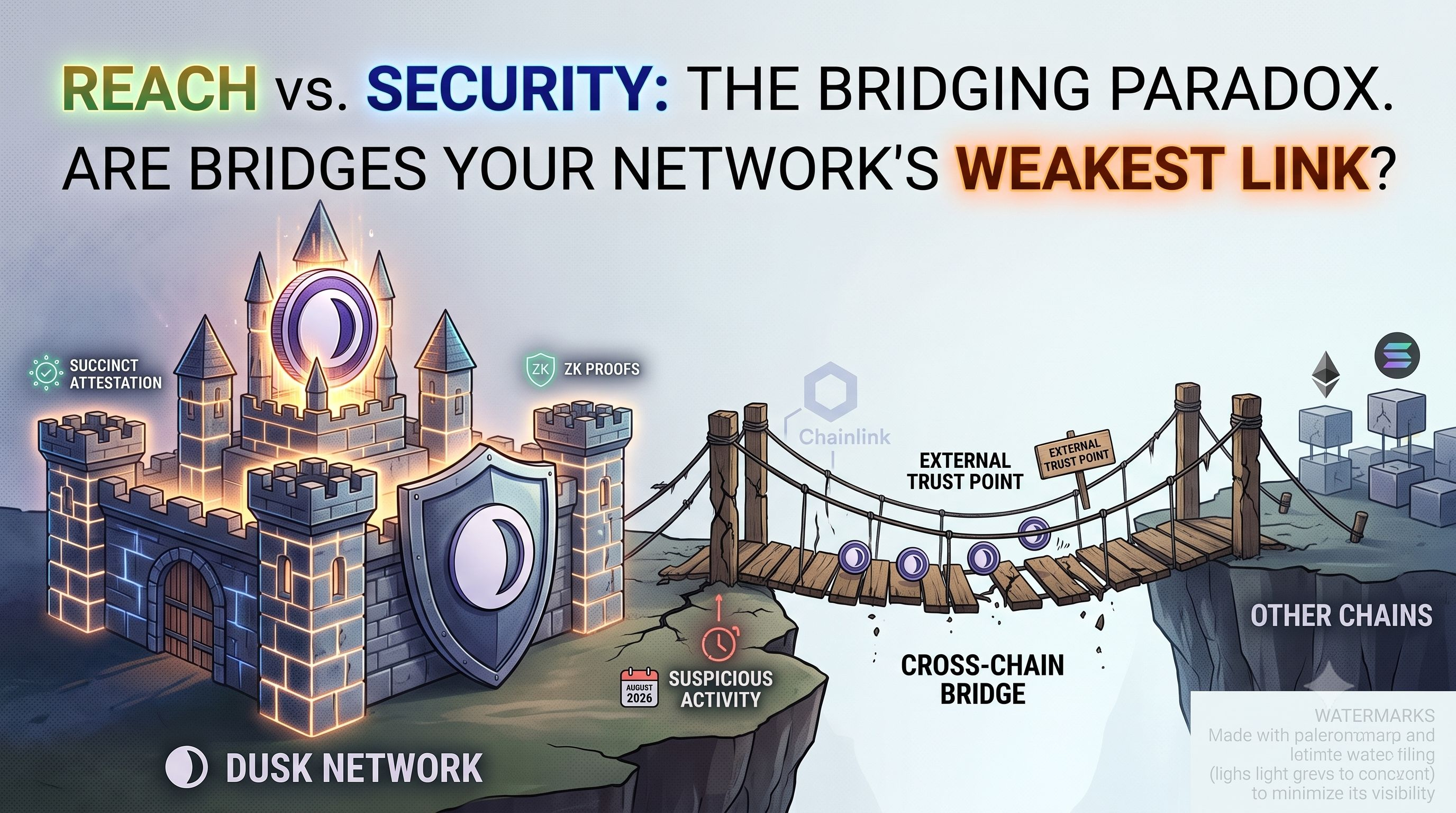
Every cross chain bridge in this industry carries the same uncomfortable truth: it is usually the least secure part of an otherwise secure system, because it has to trust something outside the system it is bridging into. Dusk Network's own base layer, Succinct Attestation for deterministic finality, zero knowledge proofs for confidential transactions, is genuinely hard to attack directly. The bridges connecting it outward, including the infrastructure recently paused after suspicious wallet activity in August 2026, are a different category of risk entirely, and I do not think that risk is unique to Dusk so much as it is unavoidable for any chain trying to be interoperable at all. The irony is hard to miss: the same bridge infrastructure now under review was meant to help carry the DuskEVM launch forward, tying the project's next milestone to a trust problem the rest of the industry has never fully solved either.
The Chainlink integration illustrates the tension well. Using CCIP to let DUSK move natively between Ethereum and Solana, and to eventually let NPEX settle a stated EUR 300 million or more of tokenized securities across chains, genuinely expands what the network can reach. It also means Dusk's security now partially depends on infrastructure it does not fully control, audited and reputable as Chainlink's design is. That is simply what interoperability costs. No bridge architecture in the industry today has a clean record proving this cost can be engineered away entirely rather than just reduced.
So is bridging fundamentally at odds with a security first brand, or just an honest trade every chain accepts once it wants reach beyond its own base layer? I lean toward the second answer, with a caveat: a project whose entire value proposition rests on trust has less room for error here than a general purpose chain does, and the August incident is a reminder of how thin that margin actually is.
@Dusk_Foundation $DUSK #dusk
Every cross chain bridge in this industry carries the same uncomfortable truth: it is usually the least secure part of an otherwise secure system, because it has to trust something outside the system it is bridging into. Dusk Network's own base layer, Succinct Attestation for deterministic finality, zero knowledge proofs for confidential transactions, is genuinely hard to attack directly. The bridges connecting it outward, including the infrastructure recently paused after suspicious wallet activity in August 2026, are a different category of risk entirely, and I do not think that risk is unique to Dusk so much as it is unavoidable for any chain trying to be interoperable at all. The irony is hard to miss: the same bridge infrastructure now under review was meant to help carry the DuskEVM launch forward, tying the project's next milestone to a trust problem the rest of the industry has never fully solved either.
The Chainlink integration illustrates the tension well. Using CCIP to let DUSK move natively between Ethereum and Solana, and to eventually let NPEX settle a stated EUR 300 million or more of tokenized securities across chains, genuinely expands what the network can reach. It also means Dusk's security now partially depends on infrastructure it does not fully control, audited and reputable as Chainlink's design is. That is simply what interoperability costs. No bridge architecture in the industry today has a clean record proving this cost can be engineered away entirely rather than just reduced.
So is bridging fundamentally at odds with a security first brand, or just an honest trade every chain accepts once it wants reach beyond its own base layer? I lean toward the second answer, with a caveat: a project whose entire value proposition rests on trust has less room for error here than a general purpose chain does, and the August incident is a reminder of how thin that margin actually is.
@Dusk $DUSK #dusk
The Chainlink integration illustrates the tension well. Using CCIP to let DUSK move natively between Ethereum and Solana, and to eventually let NPEX settle a stated EUR 300 million or more of tokenized securities across chains, genuinely expands what the network can reach. It also means Dusk's security now partially depends on infrastructure it does not fully control, audited and reputable as Chainlink's design is. That is simply what interoperability costs. No bridge architecture in the industry today has a clean record proving this cost can be engineered away entirely rather than just reduced.
So is bridging fundamentally at odds with a security first brand, or just an honest trade every chain accepts once it wants reach beyond its own base layer? I lean toward the second answer, with a caveat: a project whose entire value proposition rests on trust has less room for error here than a general purpose chain does, and the August incident is a reminder of how thin that margin actually is.
@Dusk $DUSK #dusk
79
Verifiziert
Übersetzung ansehen
Anyone who has traded any real size knows the discomfort of a public order book. Your position, your timing, your accumulation pattern, all visible to anyone watching, all usable against you. I do not think most onchain finance projects have taken that problem seriously. Dusk might be an exception.
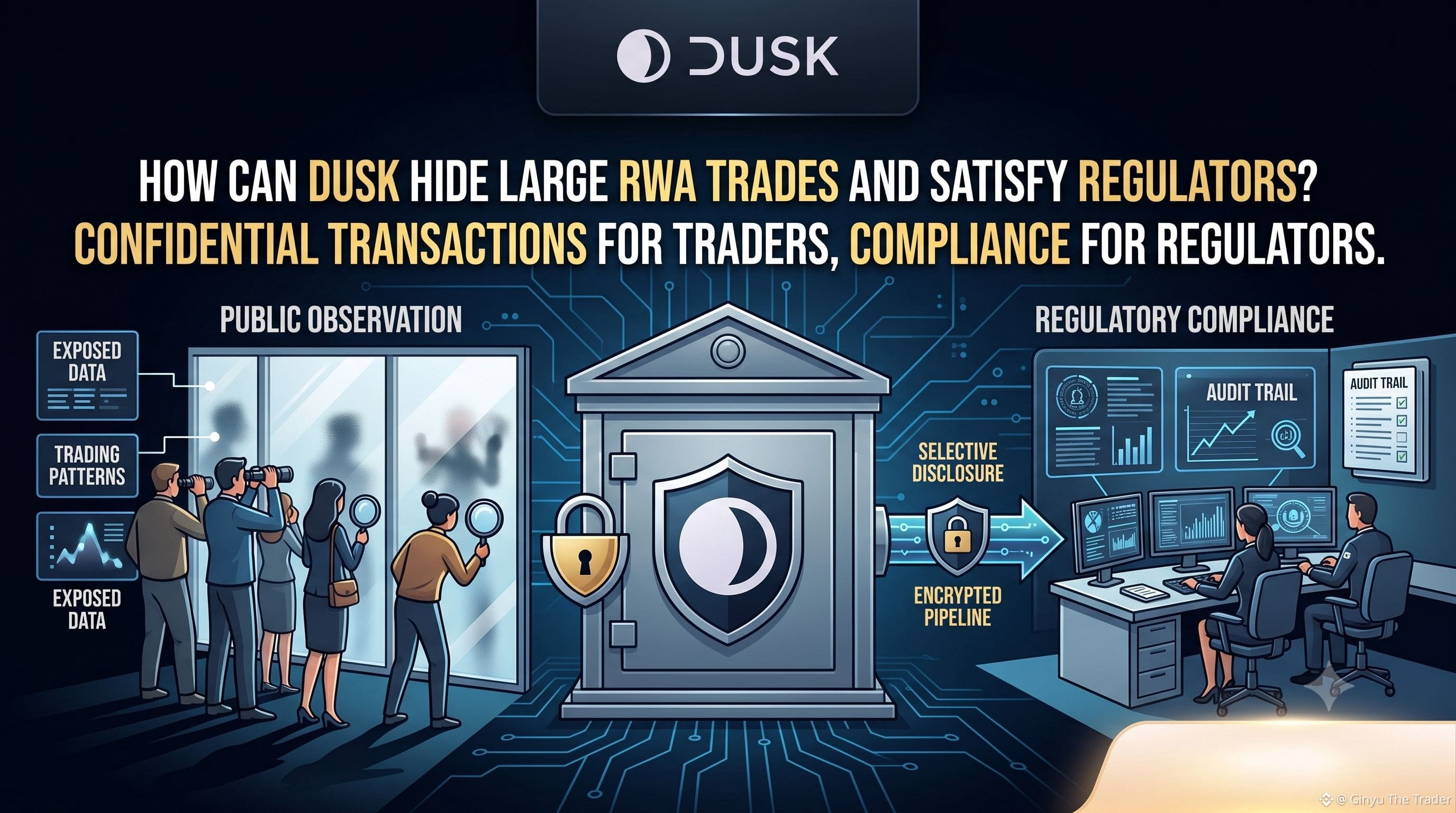
Hedger, the confidential transaction module built for DuskEVM, uses homomorphic encryption and zero knowledge proofs to keep balances and transfer amounts hidden while still letting the network verify every transaction is valid. Layered onto Dusk Trade, the neobroker Dusk is building for tokenized money market funds, ETFs, and bonds, that same confidentiality could extend to actual trading activity around real world assets, not just simple token transfers between two wallets. A large redemption or a fund rebalancing would not need to broadcast its size to every observer on chain the moment it happens, the way a fully transparent ledger forces it to today.
That is the appealing version of the story. The harder question is how much of that privacy regulators actually tolerate once real securities and real market surveillance requirements are involved. Public markets built their transparency rules for a reason, catching manipulation, insider trading, and settlement fraud, and selective disclosure has to satisfy those same concerns even while hiding information from ordinary observers. Dusk's answer is letting regulators see what they are entitled to see through disclosure mechanisms while the public sees less. Whether regulators accept that tradeoff at scale, for real securities rather than pilot programs, is not something engineering alone decides, no matter how elegant the cryptography underneath it is.
I think this is one of the more interesting open questions around Dusk Trade, not a settled feature.
@Dusk_Foundation $DUSK #dusk
Anyone who has traded any real size knows the discomfort of a public order book. Your position, your timing, your accumulation pattern, all visible to anyone watching, all usable against you. I do not think most onchain finance projects have taken that problem seriously. Dusk might be an exception.
Hedger, the confidential transaction module built for DuskEVM, uses homomorphic encryption and zero knowledge proofs to keep balances and transfer amounts hidden while still letting the network verify every transaction is valid. Layered onto Dusk Trade, the neobroker Dusk is building for tokenized money market funds, ETFs, and bonds, that same confidentiality could extend to actual trading activity around real world assets, not just simple token transfers between two wallets. A large redemption or a fund rebalancing would not need to broadcast its size to every observer on chain the moment it happens, the way a fully transparent ledger forces it to today.
That is the appealing version of the story. The harder question is how much of that privacy regulators actually tolerate once real securities and real market surveillance requirements are involved. Public markets built their transparency rules for a reason, catching manipulation, insider trading, and settlement fraud, and selective disclosure has to satisfy those same concerns even while hiding information from ordinary observers. Dusk's answer is letting regulators see what they are entitled to see through disclosure mechanisms while the public sees less. Whether regulators accept that tradeoff at scale, for real securities rather than pilot programs, is not something engineering alone decides, no matter how elegant the cryptography underneath it is.
I think this is one of the more interesting open questions around Dusk Trade, not a settled feature.
@Dusk $DUSK #dusk
Hedger, the confidential transaction module built for DuskEVM, uses homomorphic encryption and zero knowledge proofs to keep balances and transfer amounts hidden while still letting the network verify every transaction is valid. Layered onto Dusk Trade, the neobroker Dusk is building for tokenized money market funds, ETFs, and bonds, that same confidentiality could extend to actual trading activity around real world assets, not just simple token transfers between two wallets. A large redemption or a fund rebalancing would not need to broadcast its size to every observer on chain the moment it happens, the way a fully transparent ledger forces it to today.
That is the appealing version of the story. The harder question is how much of that privacy regulators actually tolerate once real securities and real market surveillance requirements are involved. Public markets built their transparency rules for a reason, catching manipulation, insider trading, and settlement fraud, and selective disclosure has to satisfy those same concerns even while hiding information from ordinary observers. Dusk's answer is letting regulators see what they are entitled to see through disclosure mechanisms while the public sees less. Whether regulators accept that tradeoff at scale, for real securities rather than pilot programs, is not something engineering alone decides, no matter how elegant the cryptography underneath it is.
I think this is one of the more interesting open questions around Dusk Trade, not a settled feature.
@Dusk $DUSK #dusk
72
Übersetzung ansehen
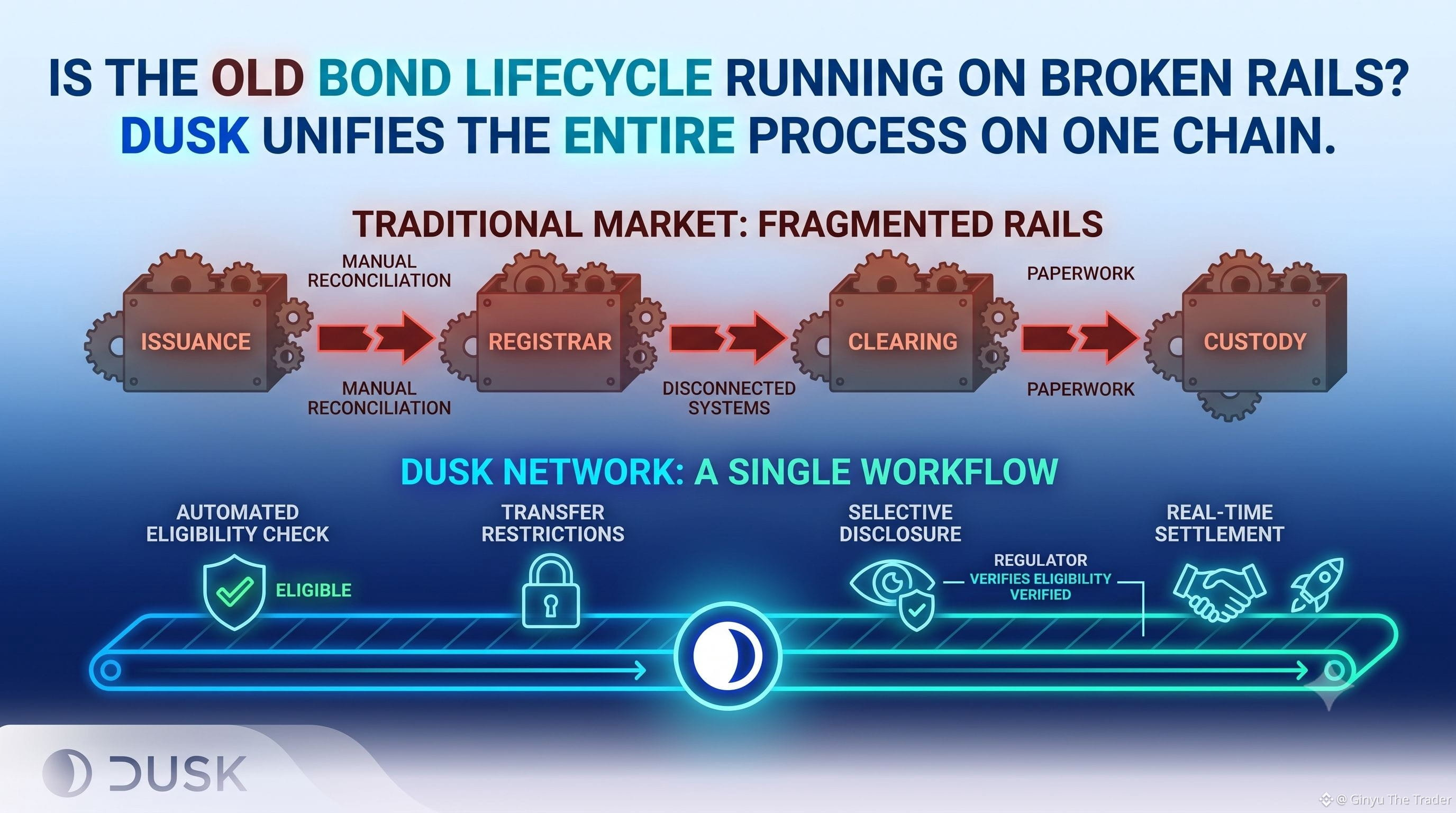
Picture the actual lifecycle of a regulated bond for a second, not the token, the whole process. Someone issues it. Investors get checked for eligibility. It changes hands over time. Disclosures get filed. Eventually it settles or matures. In traditional markets, that lifecycle runs across a handful of disconnected systems, a registrar here, a clearinghouse there, custody somewhere else, each reconciling with the others through processes that are slow largely because they were never designed to talk to each other in real time.
What Dusk Network is positioning itself to support is that entire lifecycle as one coordinated workflow instead. Eligibility, transfer restrictions, and disclosure requirements can live inside the asset's own onchain logic, with deterministic settlement handling the finality piece, rather than each stage living in a separate system passing paperwork to the next one.
Selective disclosure does real work inside that lifecycle too, not just at the settlement stage. A regulator verifying compliance, an auditor checking a disclosure filing, a counterparty confirming eligibility: each of those checks can happen against the same onchain record without exposing the full history to everyone else holding the asset, a meaningfully different starting point than most legacy registrars were ever built around.
That's a genuinely different design philosophy than most tokenization efforts, which usually digitize one piece of the lifecycle, issuance, say, while leaving everything else running on the old rails underneath it.
The honest caveat is that this only becomes real once institutions and venues actually build specific products on top of the capability, with the licensing and authorization to match. A unified workflow sitting unused is still just a specification. I'm curious to see the first full lifecycle, issuance through eventual settlement, actually run end to end on this rather than described in the abstract.
@Dusk_Foundation $DUSK #dusk
Picture the actual lifecycle of a regulated bond for a second, not the token, the whole process. Someone issues it. Investors get checked for eligibility. It changes hands over time. Disclosures get filed. Eventually it settles or matures. In traditional markets, that lifecycle runs across a handful of disconnected systems, a registrar here, a clearinghouse there, custody somewhere else, each reconciling with the others through processes that are slow largely because they were never designed to talk to each other in real time.
What Dusk Network is positioning itself to support is that entire lifecycle as one coordinated workflow instead. Eligibility, transfer restrictions, and disclosure requirements can live inside the asset's own onchain logic, with deterministic settlement handling the finality piece, rather than each stage living in a separate system passing paperwork to the next one.
Selective disclosure does real work inside that lifecycle too, not just at the settlement stage. A regulator verifying compliance, an auditor checking a disclosure filing, a counterparty confirming eligibility: each of those checks can happen against the same onchain record without exposing the full history to everyone else holding the asset, a meaningfully different starting point than most legacy registrars were ever built around.
That's a genuinely different design philosophy than most tokenization efforts, which usually digitize one piece of the lifecycle, issuance, say, while leaving everything else running on the old rails underneath it.
The honest caveat is that this only becomes real once institutions and venues actually build specific products on top of the capability, with the licensing and authorization to match. A unified workflow sitting unused is still just a specification. I'm curious to see the first full lifecycle, issuance through eventual settlement, actually run end to end on this rather than described in the abstract.
@Dusk $DUSK #dusk
What Dusk Network is positioning itself to support is that entire lifecycle as one coordinated workflow instead. Eligibility, transfer restrictions, and disclosure requirements can live inside the asset's own onchain logic, with deterministic settlement handling the finality piece, rather than each stage living in a separate system passing paperwork to the next one.
Selective disclosure does real work inside that lifecycle too, not just at the settlement stage. A regulator verifying compliance, an auditor checking a disclosure filing, a counterparty confirming eligibility: each of those checks can happen against the same onchain record without exposing the full history to everyone else holding the asset, a meaningfully different starting point than most legacy registrars were ever built around.
That's a genuinely different design philosophy than most tokenization efforts, which usually digitize one piece of the lifecycle, issuance, say, while leaving everything else running on the old rails underneath it.
The honest caveat is that this only becomes real once institutions and venues actually build specific products on top of the capability, with the licensing and authorization to match. A unified workflow sitting unused is still just a specification. I'm curious to see the first full lifecycle, issuance through eventual settlement, actually run end to end on this rather than described in the abstract.
@Dusk $DUSK #dusk
95
Verifiziert
Übersetzung ansehen
#dusk $DUSK @Dusk_Foundation
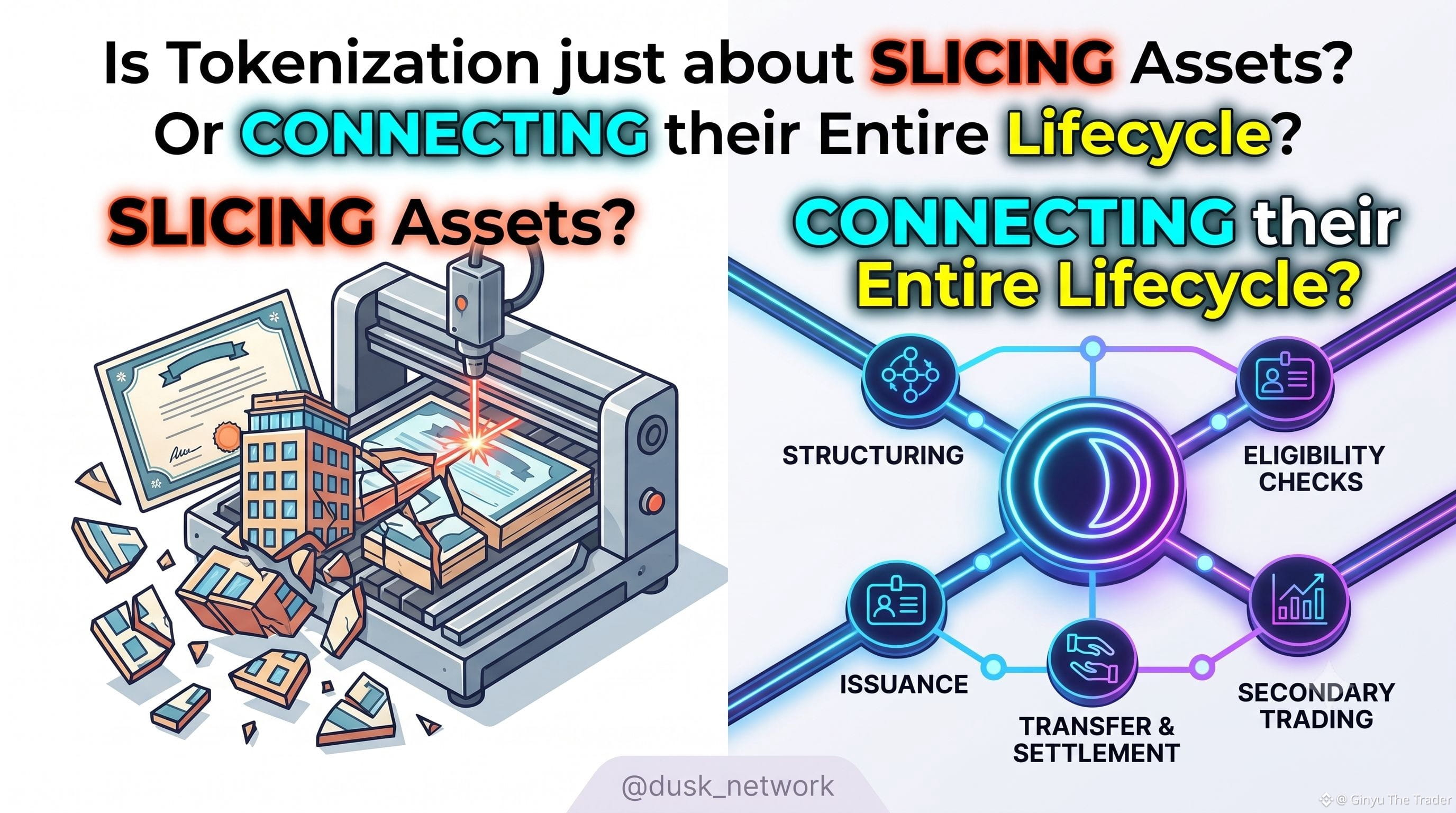
Most tokenization pitches lean hard on fractionalization, slice an asset into smaller pieces and liquidity magically follows. Dusk Network's own writing on the subject, published in August 2026, pushes back on that assumption directly, and I found the honesty refreshing enough to dig into.
The actual argument is that tokenization creates value by connecting a full ownership lifecycle, structuring, investor eligibility checks, subscription and issuance, transfer and settlement, servicing and corporate actions, and secondary trading, around one shared, controlled record instead of scattering it across separate systems that need constant reconciliation. Smaller unit sizes alone do not create investor demand or legal certainty, just smaller pieces of the same fragmented process.
One specific example is worth repeating: transferring shares in a Dutch private limited company still legally requires a notarial deed. A token representing that share does not remove that requirement, it has to sit alongside it, which is exactly the kind of detail that separates a serious tokenization framework from a marketing deck. The same document treats investor onboarding just as plainly, noting that verified eligibility can be referenced across issuance and transfer without re proving it each time, while the due diligence and sanctions screening behind that verification still sit squarely with accountable, licensed operators.
What I respect most is what the piece admits tokenization cannot do. It cannot decide which laws apply, replace the issuer or notary, or manufacture buyers and sellers where none exist. Compliance and liquidity still depend entirely on the institutions around the token, not the token itself. That is a rare admission from a project with an obvious incentive to oversell the technology, and it is exactly why I trust the rest of the claim more. Downstream, a neobroker venue like Dusk Trade is meant to be where that verified inventory reaches investors, not just where it gets structured.
#dusk $DUSK @Dusk
Most tokenization pitches lean hard on fractionalization, slice an asset into smaller pieces and liquidity magically follows. Dusk Network's own writing on the subject, published in August 2026, pushes back on that assumption directly, and I found the honesty refreshing enough to dig into.
The actual argument is that tokenization creates value by connecting a full ownership lifecycle, structuring, investor eligibility checks, subscription and issuance, transfer and settlement, servicing and corporate actions, and secondary trading, around one shared, controlled record instead of scattering it across separate systems that need constant reconciliation. Smaller unit sizes alone do not create investor demand or legal certainty, just smaller pieces of the same fragmented process.
One specific example is worth repeating: transferring shares in a Dutch private limited company still legally requires a notarial deed. A token representing that share does not remove that requirement, it has to sit alongside it, which is exactly the kind of detail that separates a serious tokenization framework from a marketing deck. The same document treats investor onboarding just as plainly, noting that verified eligibility can be referenced across issuance and transfer without re proving it each time, while the due diligence and sanctions screening behind that verification still sit squarely with accountable, licensed operators.
What I respect most is what the piece admits tokenization cannot do. It cannot decide which laws apply, replace the issuer or notary, or manufacture buyers and sellers where none exist. Compliance and liquidity still depend entirely on the institutions around the token, not the token itself. That is a rare admission from a project with an obvious incentive to oversell the technology, and it is exactly why I trust the rest of the claim more. Downstream, a neobroker venue like Dusk Trade is meant to be where that verified inventory reaches investors, not just where it gets structured.
Most tokenization pitches lean hard on fractionalization, slice an asset into smaller pieces and liquidity magically follows. Dusk Network's own writing on the subject, published in August 2026, pushes back on that assumption directly, and I found the honesty refreshing enough to dig into.
The actual argument is that tokenization creates value by connecting a full ownership lifecycle, structuring, investor eligibility checks, subscription and issuance, transfer and settlement, servicing and corporate actions, and secondary trading, around one shared, controlled record instead of scattering it across separate systems that need constant reconciliation. Smaller unit sizes alone do not create investor demand or legal certainty, just smaller pieces of the same fragmented process.
One specific example is worth repeating: transferring shares in a Dutch private limited company still legally requires a notarial deed. A token representing that share does not remove that requirement, it has to sit alongside it, which is exactly the kind of detail that separates a serious tokenization framework from a marketing deck. The same document treats investor onboarding just as plainly, noting that verified eligibility can be referenced across issuance and transfer without re proving it each time, while the due diligence and sanctions screening behind that verification still sit squarely with accountable, licensed operators.
What I respect most is what the piece admits tokenization cannot do. It cannot decide which laws apply, replace the issuer or notary, or manufacture buyers and sellers where none exist. Compliance and liquidity still depend entirely on the institutions around the token, not the token itself. That is a rare admission from a project with an obvious incentive to oversell the technology, and it is exactly why I trust the rest of the claim more. Downstream, a neobroker venue like Dusk Trade is meant to be where that verified inventory reaches investors, not just where it gets structured.
69
Übersetzung ansehen
#binancep2pantoan @Binance_Vietnam
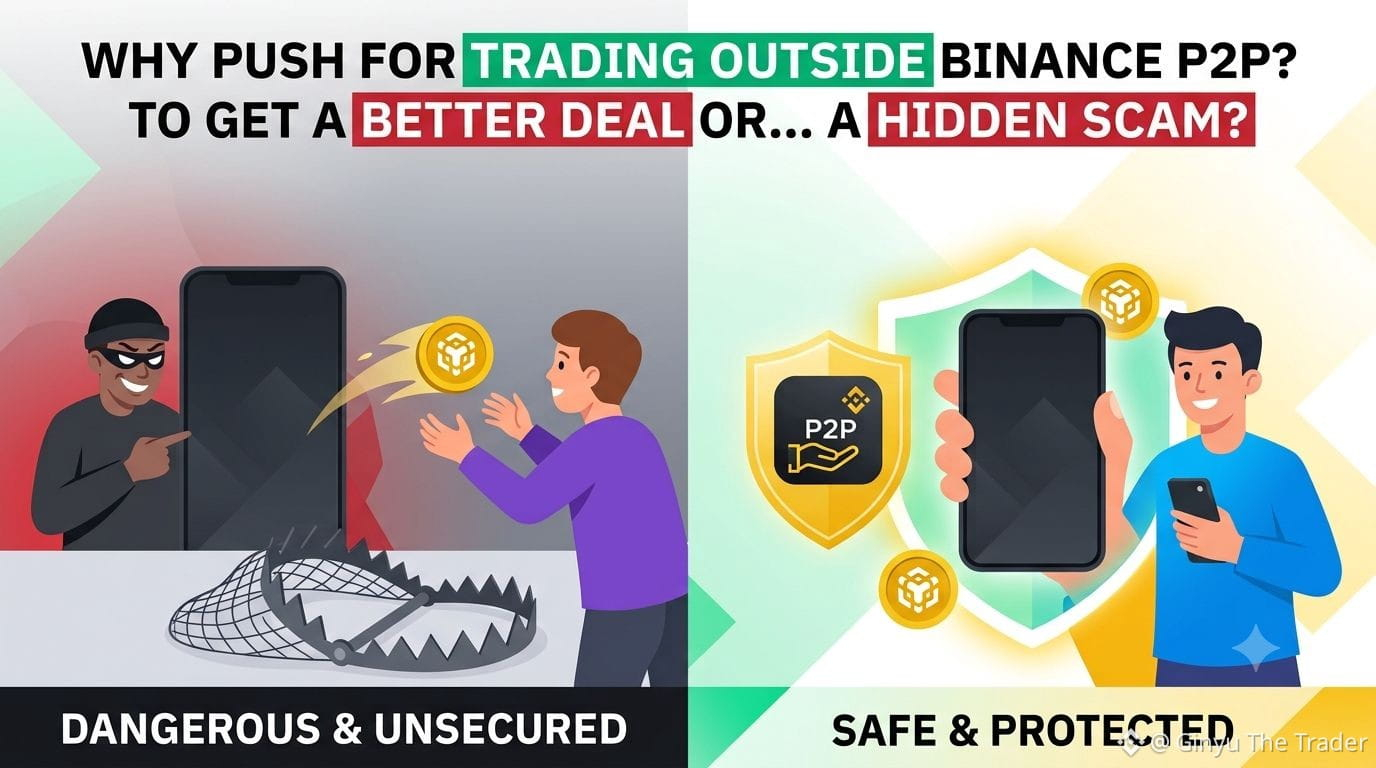
A trick I’ve noticed appearing quite often lately is the invitation to trade crypto outside Binance P2P, usually with the excuse of saving fees or getting a better price than the market. I want to break down why this is usually a trap, based on several times I’ve encountered similar offers.
Logically speaking, the fees on Binance P2P are not so high that they would justify taking on the risk of trading outside the platform. So whenever someone promises a significantly better rate, the first question I ask myself is: what’s the real motive behind this generosity?
In most cases I’ve observed, the scenario follows a familiar pattern. The scammer builds trust with a few friendly messages, sometimes even sending screenshots of supposed past transactions with other people to create a sense of credibility. Then, they push the victim to transfer money or crypto first, using reasons like “it saves time” or “we have to trust each other anyway.”
The common signs in these situations are always the same: there’s a reason to move away from Binance P2P, there’s pressure to act quickly, and one side is asked to transfer first without any protective mechanism in place. Without escrow, without recorded history, and without the ability to file a dispute, the loss almost always falls on the person who trusted the wrong party.
I’ve noticed that scammers often target newcomers - those unfamiliar with the standard process and more easily swayed by promises of attractive deals rather than sticking to the safe steps already established.
#binancep2pantoan @Binance Vietnam
A trick I’ve noticed appearing quite often lately is the invitation to trade crypto outside Binance P2P, usually with the excuse of saving fees or getting a better price than the market. I want to break down why this is usually a trap, based on several times I’ve encountered similar offers.
Logically speaking, the fees on Binance P2P are not so high that they would justify taking on the risk of trading outside the platform. So whenever someone promises a significantly better rate, the first question I ask myself is: what’s the real motive behind this generosity?
In most cases I’ve observed, the scenario follows a familiar pattern. The scammer builds trust with a few friendly messages, sometimes even sending screenshots of supposed past transactions with other people to create a sense of credibility. Then, they push the victim to transfer money or crypto first, using reasons like “it saves time” or “we have to trust each other anyway.”
The common signs in these situations are always the same: there’s a reason to move away from Binance P2P, there’s pressure to act quickly, and one side is asked to transfer first without any protective mechanism in place. Without escrow, without recorded history, and without the ability to file a dispute, the loss almost always falls on the person who trusted the wrong party.
I’ve noticed that scammers often target newcomers - those unfamiliar with the standard process and more easily swayed by promises of attractive deals rather than sticking to the safe steps already established.
A trick I’ve noticed appearing quite often lately is the invitation to trade crypto outside Binance P2P, usually with the excuse of saving fees or getting a better price than the market. I want to break down why this is usually a trap, based on several times I’ve encountered similar offers.
Logically speaking, the fees on Binance P2P are not so high that they would justify taking on the risk of trading outside the platform. So whenever someone promises a significantly better rate, the first question I ask myself is: what’s the real motive behind this generosity?
In most cases I’ve observed, the scenario follows a familiar pattern. The scammer builds trust with a few friendly messages, sometimes even sending screenshots of supposed past transactions with other people to create a sense of credibility. Then, they push the victim to transfer money or crypto first, using reasons like “it saves time” or “we have to trust each other anyway.”
The common signs in these situations are always the same: there’s a reason to move away from Binance P2P, there’s pressure to act quickly, and one side is asked to transfer first without any protective mechanism in place. Without escrow, without recorded history, and without the ability to file a dispute, the loss almost always falls on the person who trusted the wrong party.
I’ve noticed that scammers often target newcomers - those unfamiliar with the standard process and more easily swayed by promises of attractive deals rather than sticking to the safe steps already established.
62
Verifiziert
Übersetzung ansehen
#dusk $DUSK @Dusk_Foundation
I'm not going to write a series about Dusk Network and skip the bad news. On January 16, 2026, an attacker exploited Dusk Network's bridge connecting to the EVM ecosystem, and millions of DUSK tokens were stolen and moved onto BNB Smart Chain before the bridge got shut down.
As far as public reporting shows: the root cause traced to a compromised signing wallet used by the bridge service, not a flaw in Dusk Network's core consensus protocol, Succinct Attestation, or the settlement layer itself. That distinction matters technically. Bridges are notoriously the weakest link across almost every blockchain ecosystem, precisely because they require an external signing mechanism to move value between two systems that don't natively trust each other.
But I want to push back on treating it wasn't the core protocol as a full excuse. Dusk Network is trying to win the trust of banks and regulated asset issuers, people who tokenize hundreds of millions of euros through NPEX and expect institutional-grade security across the entire stack. A compromised signing wallet on infrastructure Dusk Network operates or endorses is still its problem to own publicly and fix, likely with multi-party computation or hardware security modules instead of a single signing key near that much value.
None of this touches the core pitch, either: confidentiality where it counts, transparency where it doesn't, proof on demand for a regulator, and settlement finality you can actually trust. But a bridge compromise still tests whether that broader promise holds up end to end, not just at the protocol layer.
What I actually want to see next isn't a press release calling this resolved. I want a public post-mortem with specifics, and evidence the bridge architecture changed, not just its branding. Institutions considering Dusk Network for real settlement will judge the response as closely as they judge the uptime since.
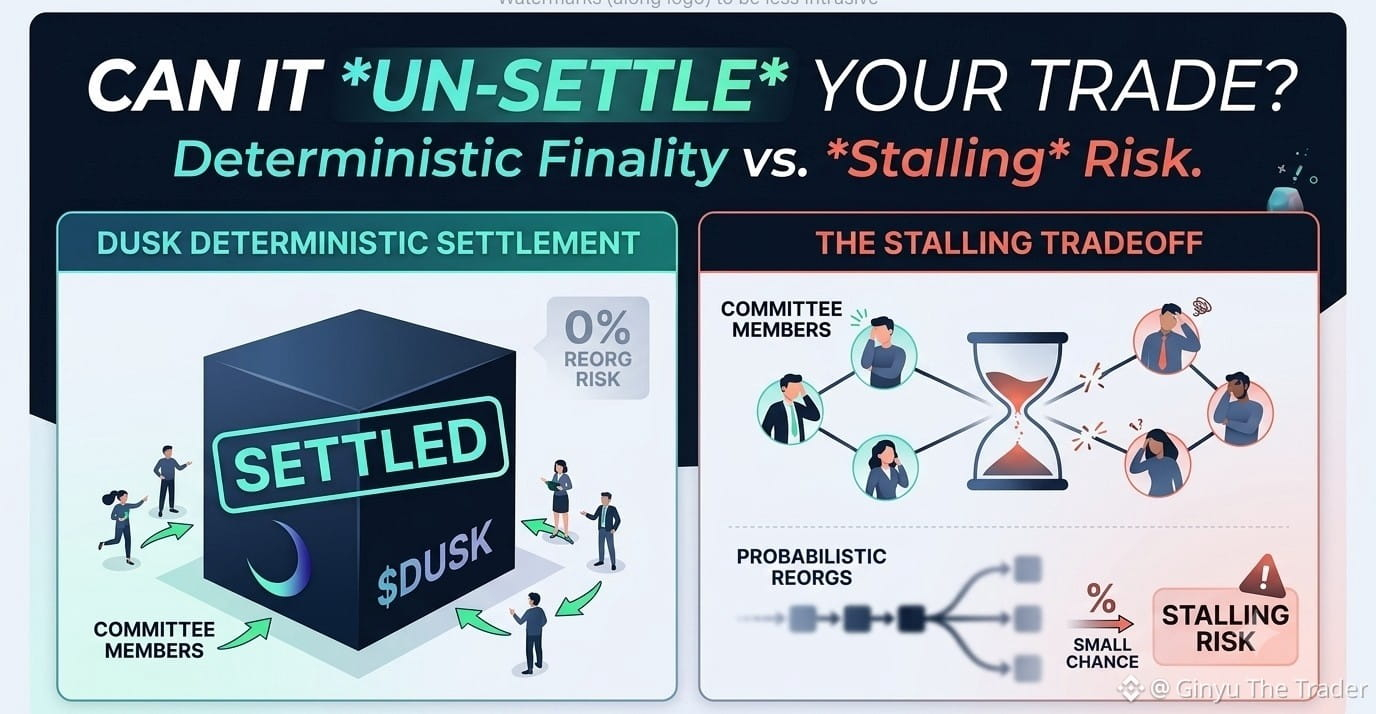
Calling one design superior ignores that both manage risk. Dusk Network accepted reorgs instead of liveness strain, a deliberate engineering choice.
#dusk $DUSK @Dusk
I'm not going to write a series about Dusk Network and skip the bad news. On January 16, 2026, an attacker exploited Dusk Network's bridge connecting to the EVM ecosystem, and millions of DUSK tokens were stolen and moved onto BNB Smart Chain before the bridge got shut down.
As far as public reporting shows: the root cause traced to a compromised signing wallet used by the bridge service, not a flaw in Dusk Network's core consensus protocol, Succinct Attestation, or the settlement layer itself. That distinction matters technically. Bridges are notoriously the weakest link across almost every blockchain ecosystem, precisely because they require an external signing mechanism to move value between two systems that don't natively trust each other.
But I want to push back on treating it wasn't the core protocol as a full excuse. Dusk Network is trying to win the trust of banks and regulated asset issuers, people who tokenize hundreds of millions of euros through NPEX and expect institutional-grade security across the entire stack. A compromised signing wallet on infrastructure Dusk Network operates or endorses is still its problem to own publicly and fix, likely with multi-party computation or hardware security modules instead of a single signing key near that much value.
None of this touches the core pitch, either: confidentiality where it counts, transparency where it doesn't, proof on demand for a regulator, and settlement finality you can actually trust. But a bridge compromise still tests whether that broader promise holds up end to end, not just at the protocol layer.
What I actually want to see next isn't a press release calling this resolved. I want a public post-mortem with specifics, and evidence the bridge architecture changed, not just its branding. Institutions considering Dusk Network for real settlement will judge the response as closely as they judge the uptime since.
Calling one design superior ignores that both manage risk. Dusk Network accepted reorgs instead of liveness strain, a deliberate engineering choice.
I'm not going to write a series about Dusk Network and skip the bad news. On January 16, 2026, an attacker exploited Dusk Network's bridge connecting to the EVM ecosystem, and millions of DUSK tokens were stolen and moved onto BNB Smart Chain before the bridge got shut down.
As far as public reporting shows: the root cause traced to a compromised signing wallet used by the bridge service, not a flaw in Dusk Network's core consensus protocol, Succinct Attestation, or the settlement layer itself. That distinction matters technically. Bridges are notoriously the weakest link across almost every blockchain ecosystem, precisely because they require an external signing mechanism to move value between two systems that don't natively trust each other.
But I want to push back on treating it wasn't the core protocol as a full excuse. Dusk Network is trying to win the trust of banks and regulated asset issuers, people who tokenize hundreds of millions of euros through NPEX and expect institutional-grade security across the entire stack. A compromised signing wallet on infrastructure Dusk Network operates or endorses is still its problem to own publicly and fix, likely with multi-party computation or hardware security modules instead of a single signing key near that much value.
None of this touches the core pitch, either: confidentiality where it counts, transparency where it doesn't, proof on demand for a regulator, and settlement finality you can actually trust. But a bridge compromise still tests whether that broader promise holds up end to end, not just at the protocol layer.
What I actually want to see next isn't a press release calling this resolved. I want a public post-mortem with specifics, and evidence the bridge architecture changed, not just its branding. Institutions considering Dusk Network for real settlement will judge the response as closely as they judge the uptime since.
Calling one design superior ignores that both manage risk. Dusk Network accepted reorgs instead of liveness strain, a deliberate engineering choice.
78
Verifiziert
#dusk $DUSK @Dusk_Foundation
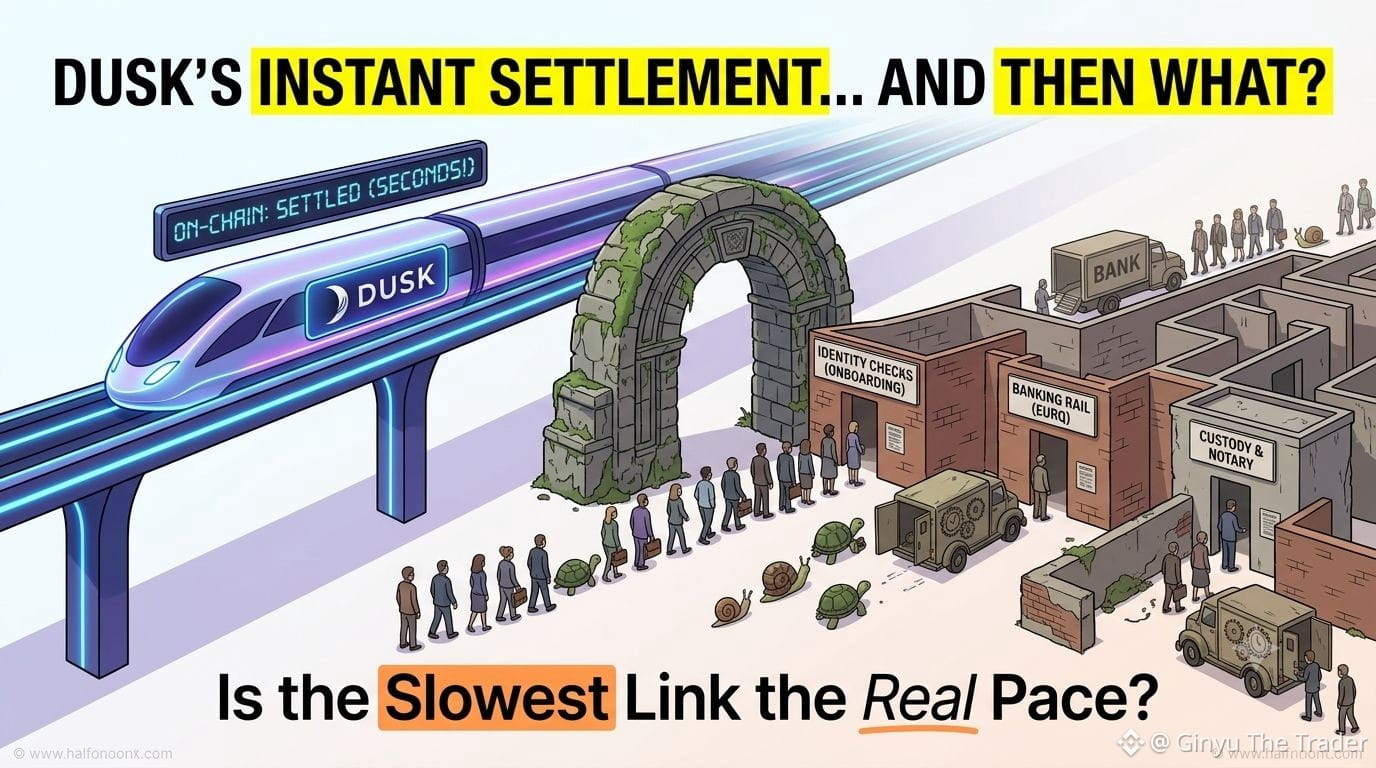
„Settlement in seconds instead of days“ ist die Zahl, die man am häufigsten über Dusk Network hört, und sie trifft ziemlich genau den Teil des Prozesses, den die Kette tatsächlich steuert. Sie sagt weniger, als es klingt, wenn es um den Prozess als Ganzes geht.
Sobald eine Transaktion die Konsensschicht von Dusk erreicht, finalisiert Succinct Attestation sie wirklich schnell – ohne die mehrtägigen Abwicklungszyklen, die traditionelle Wertpapiermärkte aus Gründen der Legacy-Betriebsabläufe weiterhin durchlaufen. Das ist eine legitime Verbesserung und die zentrale technische Errungenschaft hinter dem Pitch von Dusk Trade für regulierte Handelsplätze. Aber ein echter Wertpapierhandel umfasst mehr Schritte als der sofortige On-Chain-Abwicklungsaugenblick, und mehrere davon bewegen sich noch mit Vor-Blockchain-Geschwindigkeit.
Die Anlegerberechtigung muss geprüft werden, oft anhand der Onboarding-Prozesse, die über den eigenen Prozess eines lizenzierten Partners laufen. Die Zahlung muss außerdem tatsächlich stattfinden. Dunks eigene Zahlungs-Infrastruktur, mit Quantoz erstellt und um einen euro-denominierten elektronischen Geld-Token namens EURQ herum aufgebaut, existiert genau dafür, diese Lücke auf der Zahlungsebene zu schließen. Dennoch hängt sie von Bankinfrastruktur und Ausstellerprozessen ab, die nach eigenen Zeitplänen funktionieren – nicht nach denen von Succinct Attestation. Je nach Asset kann weiterhin ein Treuhänder- oder notarieller Schritt außerhalb der Kette erforderlich sein, so wie das eigene Material von Dusk Network es für bestimmte Unternehmensstrukturen anerkennt. Jeder dieser Schritte kann langsamer sein als die Sekunden, die DuskDS braucht, um einen Block zu finalisieren.
All das ist kein Nachteil für das Konsens-Engineering, das den Teil, den es adressiert, tatsächlich löst. Es ist eine Erinnerung daran, dass eine Schlagzeilen-Abrwicklungzeit nur eine Verbindung in einer längeren Kette beschreibt – und dass die langsamste Verbindung die reale Geschwindigkeit bestimmt, bis der umgebende Workflow mit dem Tempo aufholt, das die Basisschicht bereits leisten kann. Chainlinks Daten- und Cross-Chain-Infrastruktur, die Dusk für Interoperabilität und Marktdaten integriert hat, hilft dabei, einen Teil dieses umgebenden Workflows über Netzwerke hinweg zu synchronisieren. Sie bringt jedoch Identitätsprüfungen oder Bankprozesse nicht allein deshalb auf Sekunden-Niveau, weil die darunterliegende Settlement-Ebene bereits dort angekommen ist.
#dusk $DUSK @Dusk
„Settlement in seconds instead of days“ ist die Zahl, die man am häufigsten über Dusk Network hört, und sie trifft ziemlich genau den Teil des Prozesses, den die Kette tatsächlich steuert. Sie sagt weniger, als es klingt, wenn es um den Prozess als Ganzes geht.
Sobald eine Transaktion die Konsensschicht von Dusk erreicht, finalisiert Succinct Attestation sie wirklich schnell – ohne die mehrtägigen Abwicklungszyklen, die traditionelle Wertpapiermärkte aus Gründen der Legacy-Betriebsabläufe weiterhin durchlaufen. Das ist eine legitime Verbesserung und die zentrale technische Errungenschaft hinter dem Pitch von Dusk Trade für regulierte Handelsplätze. Aber ein echter Wertpapierhandel umfasst mehr Schritte als der sofortige On-Chain-Abwicklungsaugenblick, und mehrere davon bewegen sich noch mit Vor-Blockchain-Geschwindigkeit.
Die Anlegerberechtigung muss geprüft werden, oft anhand der Onboarding-Prozesse, die über den eigenen Prozess eines lizenzierten Partners laufen. Die Zahlung muss außerdem tatsächlich stattfinden. Dunks eigene Zahlungs-Infrastruktur, mit Quantoz erstellt und um einen euro-denominierten elektronischen Geld-Token namens EURQ herum aufgebaut, existiert genau dafür, diese Lücke auf der Zahlungsebene zu schließen. Dennoch hängt sie von Bankinfrastruktur und Ausstellerprozessen ab, die nach eigenen Zeitplänen funktionieren – nicht nach denen von Succinct Attestation. Je nach Asset kann weiterhin ein Treuhänder- oder notarieller Schritt außerhalb der Kette erforderlich sein, so wie das eigene Material von Dusk Network es für bestimmte Unternehmensstrukturen anerkennt. Jeder dieser Schritte kann langsamer sein als die Sekunden, die DuskDS braucht, um einen Block zu finalisieren.
All das ist kein Nachteil für das Konsens-Engineering, das den Teil, den es adressiert, tatsächlich löst. Es ist eine Erinnerung daran, dass eine Schlagzeilen-Abrwicklungzeit nur eine Verbindung in einer längeren Kette beschreibt – und dass die langsamste Verbindung die reale Geschwindigkeit bestimmt, bis der umgebende Workflow mit dem Tempo aufholt, das die Basisschicht bereits leisten kann. Chainlinks Daten- und Cross-Chain-Infrastruktur, die Dusk für Interoperabilität und Marktdaten integriert hat, hilft dabei, einen Teil dieses umgebenden Workflows über Netzwerke hinweg zu synchronisieren. Sie bringt jedoch Identitätsprüfungen oder Bankprozesse nicht allein deshalb auf Sekunden-Niveau, weil die darunterliegende Settlement-Ebene bereits dort angekommen ist.
„Settlement in seconds instead of days“ ist die Zahl, die man am häufigsten über Dusk Network hört, und sie trifft ziemlich genau den Teil des Prozesses, den die Kette tatsächlich steuert. Sie sagt weniger, als es klingt, wenn es um den Prozess als Ganzes geht.
Sobald eine Transaktion die Konsensschicht von Dusk erreicht, finalisiert Succinct Attestation sie wirklich schnell – ohne die mehrtägigen Abwicklungszyklen, die traditionelle Wertpapiermärkte aus Gründen der Legacy-Betriebsabläufe weiterhin durchlaufen. Das ist eine legitime Verbesserung und die zentrale technische Errungenschaft hinter dem Pitch von Dusk Trade für regulierte Handelsplätze. Aber ein echter Wertpapierhandel umfasst mehr Schritte als der sofortige On-Chain-Abwicklungsaugenblick, und mehrere davon bewegen sich noch mit Vor-Blockchain-Geschwindigkeit.
Die Anlegerberechtigung muss geprüft werden, oft anhand der Onboarding-Prozesse, die über den eigenen Prozess eines lizenzierten Partners laufen. Die Zahlung muss außerdem tatsächlich stattfinden. Dunks eigene Zahlungs-Infrastruktur, mit Quantoz erstellt und um einen euro-denominierten elektronischen Geld-Token namens EURQ herum aufgebaut, existiert genau dafür, diese Lücke auf der Zahlungsebene zu schließen. Dennoch hängt sie von Bankinfrastruktur und Ausstellerprozessen ab, die nach eigenen Zeitplänen funktionieren – nicht nach denen von Succinct Attestation. Je nach Asset kann weiterhin ein Treuhänder- oder notarieller Schritt außerhalb der Kette erforderlich sein, so wie das eigene Material von Dusk Network es für bestimmte Unternehmensstrukturen anerkennt. Jeder dieser Schritte kann langsamer sein als die Sekunden, die DuskDS braucht, um einen Block zu finalisieren.
All das ist kein Nachteil für das Konsens-Engineering, das den Teil, den es adressiert, tatsächlich löst. Es ist eine Erinnerung daran, dass eine Schlagzeilen-Abrwicklungzeit nur eine Verbindung in einer längeren Kette beschreibt – und dass die langsamste Verbindung die reale Geschwindigkeit bestimmt, bis der umgebende Workflow mit dem Tempo aufholt, das die Basisschicht bereits leisten kann. Chainlinks Daten- und Cross-Chain-Infrastruktur, die Dusk für Interoperabilität und Marktdaten integriert hat, hilft dabei, einen Teil dieses umgebenden Workflows über Netzwerke hinweg zu synchronisieren. Sie bringt jedoch Identitätsprüfungen oder Bankprozesse nicht allein deshalb auf Sekunden-Niveau, weil die darunterliegende Settlement-Ebene bereits dort angekommen ist.
76
#binancep2pantoan @Binance_Vietnam
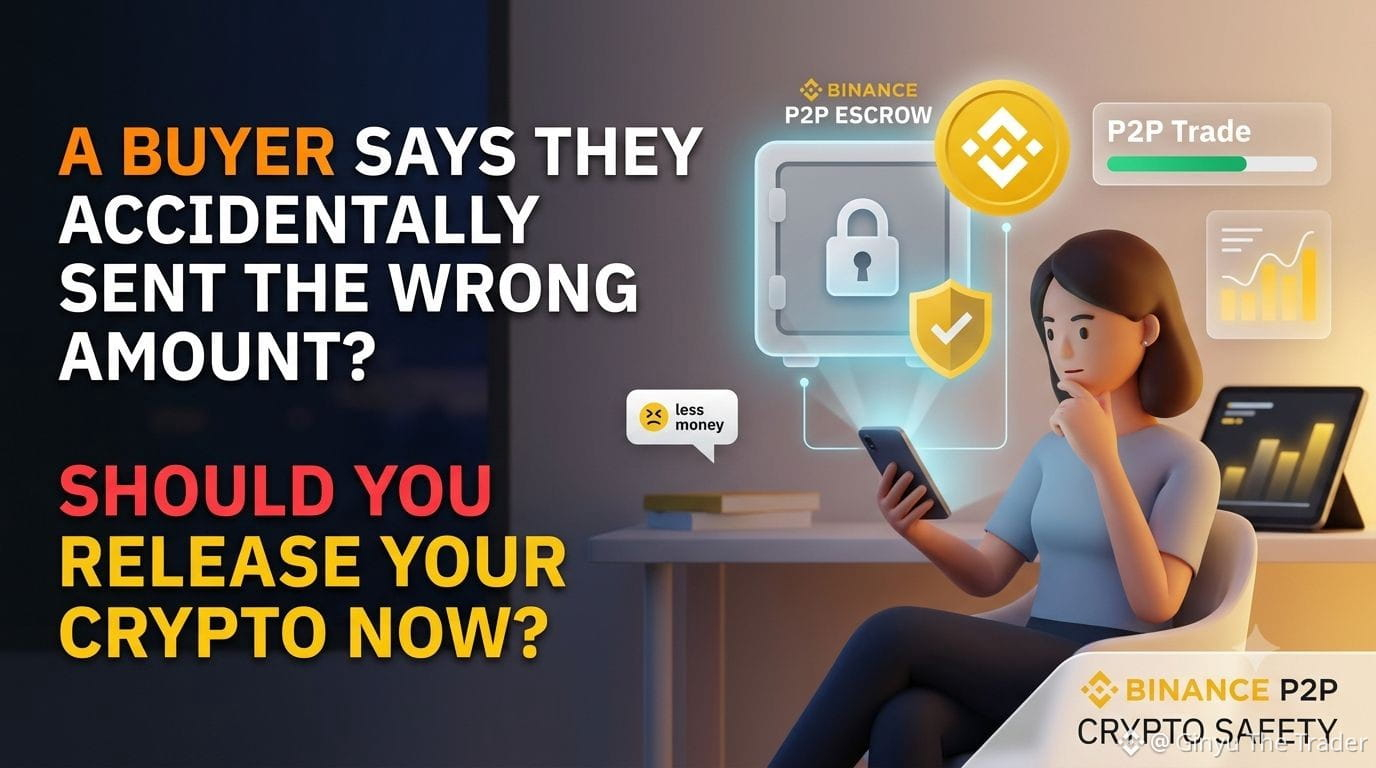
Ein Käufer erzählte mir, als wir mitten in einer Bestellung auf Binance P2P waren, dass er aus Versehen weniger als den vereinbarten Betrag gesendet habe und ich das gesamte Krypto-Asset trotzdem freigeben solle. Er versprach, die Differenz danach zu überweisen. Ich möchte erklären, wie ich damit umgegangen bin, denn der Impuls, mitten im Gespräch einfach jemandem zu vertrauen, ist stark – vor allem, wenn die Person sich entschuldigt und vernünftig klingt.
Binance P2P hält das Krypto-Asset im Treuhandkonto (Escrow), speziell damit ein Verkäufer in so einem Moment nicht nur auf Vertrauen angewiesen ist. Ich habe direkt mein eigenes Bankkonto geprüft und genau bestätigt, was tatsächlich eingegangen ist – und das stimmte überhaupt nicht mit dem überein, was der Käufer behauptet hatte, nicht einmal annähernd mit der Summe, die er beschrieben hat. Ich habe ruhig und über den Bestell-Chat hinweg genau erklärt, was ich auf meiner Seite sehen konnte, und ihn gebeten, einen Nachweis für die eigene Überweisung zu schicken, damit wir das vergleichen können.
Der Käufer konnte keine passende Bestätigung vorlegen, und die Bestellung musste schließlich einen Einspruch/Widerspruch (Dispute Appeal) durchlaufen, um korrekt gelöst zu werden. Binance Support hat das übernommen, indem sie den Chatverlauf und die Zahlungsnachweise beider Seiten überprüften. Meine eigene Bankbestätigung war dabei bereits vorbereitet und griffbereit – das machte den Prozess schnell statt stressig. Eine Behauptung wie „Ich habe den falschen Betrag gesendet“ ist auf Binance P2P ein häufiges Warnsignal, auf das man achten sollte. Die Lösung ist immer dieselbe: zuerst die eigenen Unterlagen prüfen, niemals die Geschichte anderer für bare Münze nehmen, und den Dispute-Prozess alles übernehmen lassen, was sich nicht direkt klären lässt.
Was mir danach geblieben ist, war die Ruhe, die die ganze Situation ausstrahlte – trotz des anfänglichen Drucks, einfach dem Wort des Käufers zu vertrauen. Escrow existiert genau für solche Momente, in denen Emotionen oder Eile jemanden sonst zu einer Entscheidung drängen könnten, die man später bereut. Ich zögere heute nicht mehr, um einen Nachweis zu bitten oder mir ein paar zusätzliche Minuten zu nehmen, um meine eigenen Unterlagen zu prüfen – selbst dann, wenn ein Käufer absolut aufrichtig klingt. Denn Aufrichtigkeit allein war nie ein Beleg für eine tatsächliche Überweisung auf Binance P2P.
#binancep2pantoan @Binance Vietnam
Ein Käufer erzählte mir, als wir mitten in einer Bestellung auf Binance P2P waren, dass er aus Versehen weniger als den vereinbarten Betrag gesendet habe und ich das gesamte Krypto-Asset trotzdem freigeben solle. Er versprach, die Differenz danach zu überweisen. Ich möchte erklären, wie ich damit umgegangen bin, denn der Impuls, mitten im Gespräch einfach jemandem zu vertrauen, ist stark – vor allem, wenn die Person sich entschuldigt und vernünftig klingt.
Binance P2P hält das Krypto-Asset im Treuhandkonto (Escrow), speziell damit ein Verkäufer in so einem Moment nicht nur auf Vertrauen angewiesen ist. Ich habe direkt mein eigenes Bankkonto geprüft und genau bestätigt, was tatsächlich eingegangen ist – und das stimmte überhaupt nicht mit dem überein, was der Käufer behauptet hatte, nicht einmal annähernd mit der Summe, die er beschrieben hat. Ich habe ruhig und über den Bestell-Chat hinweg genau erklärt, was ich auf meiner Seite sehen konnte, und ihn gebeten, einen Nachweis für die eigene Überweisung zu schicken, damit wir das vergleichen können.
Der Käufer konnte keine passende Bestätigung vorlegen, und die Bestellung musste schließlich einen Einspruch/Widerspruch (Dispute Appeal) durchlaufen, um korrekt gelöst zu werden. Binance Support hat das übernommen, indem sie den Chatverlauf und die Zahlungsnachweise beider Seiten überprüften. Meine eigene Bankbestätigung war dabei bereits vorbereitet und griffbereit – das machte den Prozess schnell statt stressig. Eine Behauptung wie „Ich habe den falschen Betrag gesendet“ ist auf Binance P2P ein häufiges Warnsignal, auf das man achten sollte. Die Lösung ist immer dieselbe: zuerst die eigenen Unterlagen prüfen, niemals die Geschichte anderer für bare Münze nehmen, und den Dispute-Prozess alles übernehmen lassen, was sich nicht direkt klären lässt.
Was mir danach geblieben ist, war die Ruhe, die die ganze Situation ausstrahlte – trotz des anfänglichen Drucks, einfach dem Wort des Käufers zu vertrauen. Escrow existiert genau für solche Momente, in denen Emotionen oder Eile jemanden sonst zu einer Entscheidung drängen könnten, die man später bereut. Ich zögere heute nicht mehr, um einen Nachweis zu bitten oder mir ein paar zusätzliche Minuten zu nehmen, um meine eigenen Unterlagen zu prüfen – selbst dann, wenn ein Käufer absolut aufrichtig klingt. Denn Aufrichtigkeit allein war nie ein Beleg für eine tatsächliche Überweisung auf Binance P2P.
Ein Käufer erzählte mir, als wir mitten in einer Bestellung auf Binance P2P waren, dass er aus Versehen weniger als den vereinbarten Betrag gesendet habe und ich das gesamte Krypto-Asset trotzdem freigeben solle. Er versprach, die Differenz danach zu überweisen. Ich möchte erklären, wie ich damit umgegangen bin, denn der Impuls, mitten im Gespräch einfach jemandem zu vertrauen, ist stark – vor allem, wenn die Person sich entschuldigt und vernünftig klingt.
Binance P2P hält das Krypto-Asset im Treuhandkonto (Escrow), speziell damit ein Verkäufer in so einem Moment nicht nur auf Vertrauen angewiesen ist. Ich habe direkt mein eigenes Bankkonto geprüft und genau bestätigt, was tatsächlich eingegangen ist – und das stimmte überhaupt nicht mit dem überein, was der Käufer behauptet hatte, nicht einmal annähernd mit der Summe, die er beschrieben hat. Ich habe ruhig und über den Bestell-Chat hinweg genau erklärt, was ich auf meiner Seite sehen konnte, und ihn gebeten, einen Nachweis für die eigene Überweisung zu schicken, damit wir das vergleichen können.
Der Käufer konnte keine passende Bestätigung vorlegen, und die Bestellung musste schließlich einen Einspruch/Widerspruch (Dispute Appeal) durchlaufen, um korrekt gelöst zu werden. Binance Support hat das übernommen, indem sie den Chatverlauf und die Zahlungsnachweise beider Seiten überprüften. Meine eigene Bankbestätigung war dabei bereits vorbereitet und griffbereit – das machte den Prozess schnell statt stressig. Eine Behauptung wie „Ich habe den falschen Betrag gesendet“ ist auf Binance P2P ein häufiges Warnsignal, auf das man achten sollte. Die Lösung ist immer dieselbe: zuerst die eigenen Unterlagen prüfen, niemals die Geschichte anderer für bare Münze nehmen, und den Dispute-Prozess alles übernehmen lassen, was sich nicht direkt klären lässt.
Was mir danach geblieben ist, war die Ruhe, die die ganze Situation ausstrahlte – trotz des anfänglichen Drucks, einfach dem Wort des Käufers zu vertrauen. Escrow existiert genau für solche Momente, in denen Emotionen oder Eile jemanden sonst zu einer Entscheidung drängen könnten, die man später bereut. Ich zögere heute nicht mehr, um einen Nachweis zu bitten oder mir ein paar zusätzliche Minuten zu nehmen, um meine eigenen Unterlagen zu prüfen – selbst dann, wenn ein Käufer absolut aufrichtig klingt. Denn Aufrichtigkeit allein war nie ein Beleg für eine tatsächliche Überweisung auf Binance P2P.
67
Übersetzung ansehen
#binancep2pantoan @Binance_Vietnam
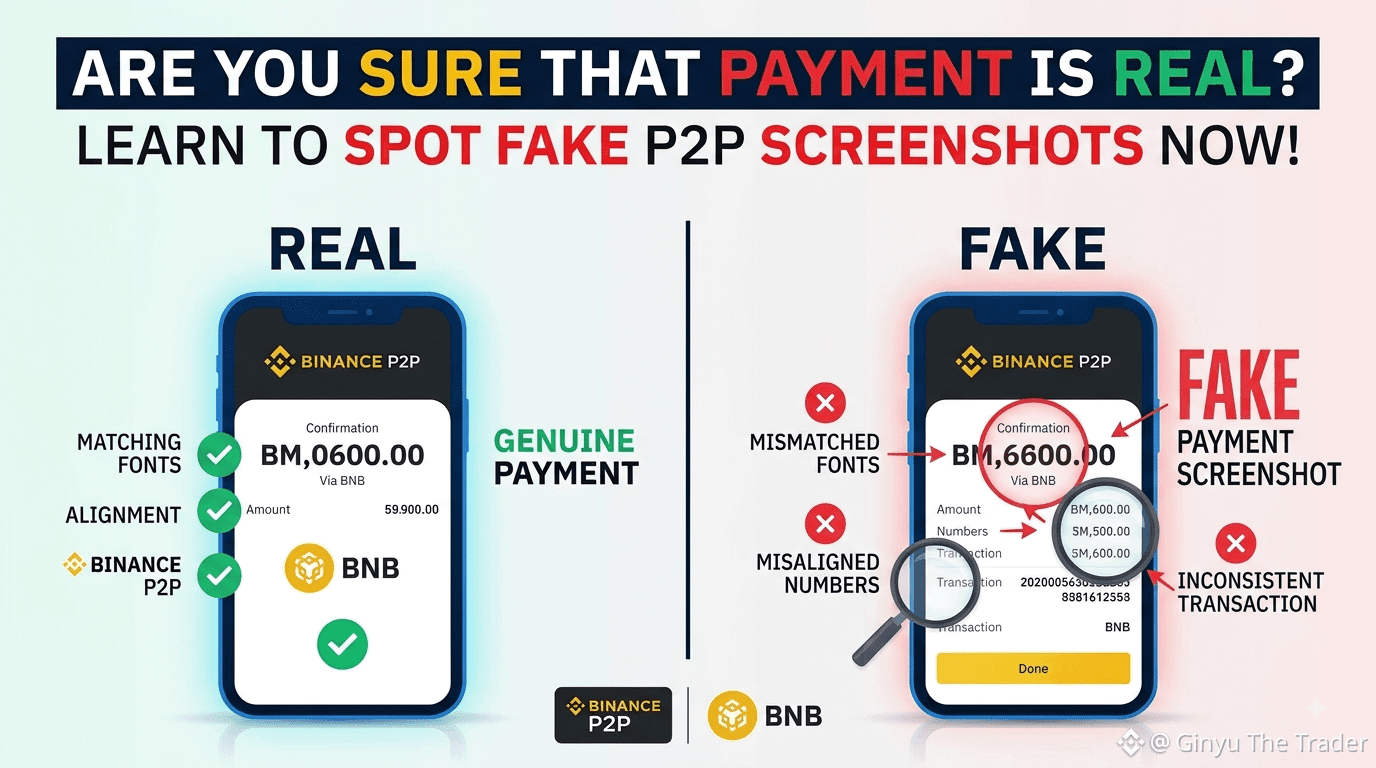
Two payment screenshots I received on Binance P2P looked nearly identical at a glance, except one was real and one had been edited. It took me longer than I'd like to admit to notice the difference, which is exactly why I stopped trusting screenshots as proof of anything at all.
Binance P2P's escrow exists precisely because payment claims made in chat aren't the same as payment actually confirmed. The signs of an edited screenshot aren't always obvious: fonts that don't quite match the rest of the interface, alignment that's slightly off, or numbers that don't add up when you check the math on fees and totals. Sometimes the giveaway is simpler, a transaction reference number that looks recycled from a template rather than something unique to your trade.
None of that matters as much as the one rule I follow now: I check my own banking app directly, every single time, before treating any payment as confirmed. A screenshot might match perfectly and still not reflect reality, so it was never reliable evidence to begin with, real or fake. If a buyer pushes back when I explain I need to verify independently, framing it as distrust or an insult, I treat that reaction itself as a red flag on Binance P2P.
I've also started asking a counterparty to send a fresh screenshot taken in the moment rather than accepting one that could have been saved earlier, since a live screenshot is much harder to fake convincingly on short notice. It's a small ask, but a genuine trader will do it without hesitation, and hesitation itself tells you something. Combined with checking my own bank app directly, that's been enough to catch every attempt so far before any crypto actually moved.
Since every account is KYC verified and the crypto stays locked in escrow until I actually confirm, there's no rush to trust an image over my own account. If I'm ever unsure whether something looks altered, I forward it to Binance support and let them review it properly instead of deciding alone.
#binancep2pantoan @Binance Vietnam
Two payment screenshots I received on Binance P2P looked nearly identical at a glance, except one was real and one had been edited. It took me longer than I'd like to admit to notice the difference, which is exactly why I stopped trusting screenshots as proof of anything at all.
Binance P2P's escrow exists precisely because payment claims made in chat aren't the same as payment actually confirmed. The signs of an edited screenshot aren't always obvious: fonts that don't quite match the rest of the interface, alignment that's slightly off, or numbers that don't add up when you check the math on fees and totals. Sometimes the giveaway is simpler, a transaction reference number that looks recycled from a template rather than something unique to your trade.
None of that matters as much as the one rule I follow now: I check my own banking app directly, every single time, before treating any payment as confirmed. A screenshot might match perfectly and still not reflect reality, so it was never reliable evidence to begin with, real or fake. If a buyer pushes back when I explain I need to verify independently, framing it as distrust or an insult, I treat that reaction itself as a red flag on Binance P2P.
I've also started asking a counterparty to send a fresh screenshot taken in the moment rather than accepting one that could have been saved earlier, since a live screenshot is much harder to fake convincingly on short notice. It's a small ask, but a genuine trader will do it without hesitation, and hesitation itself tells you something. Combined with checking my own bank app directly, that's been enough to catch every attempt so far before any crypto actually moved.
Since every account is KYC verified and the crypto stays locked in escrow until I actually confirm, there's no rush to trust an image over my own account. If I'm ever unsure whether something looks altered, I forward it to Binance support and let them review it properly instead of deciding alone.
Two payment screenshots I received on Binance P2P looked nearly identical at a glance, except one was real and one had been edited. It took me longer than I'd like to admit to notice the difference, which is exactly why I stopped trusting screenshots as proof of anything at all.
Binance P2P's escrow exists precisely because payment claims made in chat aren't the same as payment actually confirmed. The signs of an edited screenshot aren't always obvious: fonts that don't quite match the rest of the interface, alignment that's slightly off, or numbers that don't add up when you check the math on fees and totals. Sometimes the giveaway is simpler, a transaction reference number that looks recycled from a template rather than something unique to your trade.
None of that matters as much as the one rule I follow now: I check my own banking app directly, every single time, before treating any payment as confirmed. A screenshot might match perfectly and still not reflect reality, so it was never reliable evidence to begin with, real or fake. If a buyer pushes back when I explain I need to verify independently, framing it as distrust or an insult, I treat that reaction itself as a red flag on Binance P2P.
I've also started asking a counterparty to send a fresh screenshot taken in the moment rather than accepting one that could have been saved earlier, since a live screenshot is much harder to fake convincingly on short notice. It's a small ask, but a genuine trader will do it without hesitation, and hesitation itself tells you something. Combined with checking my own bank app directly, that's been enough to catch every attempt so far before any crypto actually moved.
Since every account is KYC verified and the crypto stays locked in escrow until I actually confirm, there's no rush to trust an image over my own account. If I'm ever unsure whether something looks altered, I forward it to Binance support and let them review it properly instead of deciding alone.
64
Verifiziert
Übersetzung ansehen
#dusk $DUSK @Dusk_Foundation
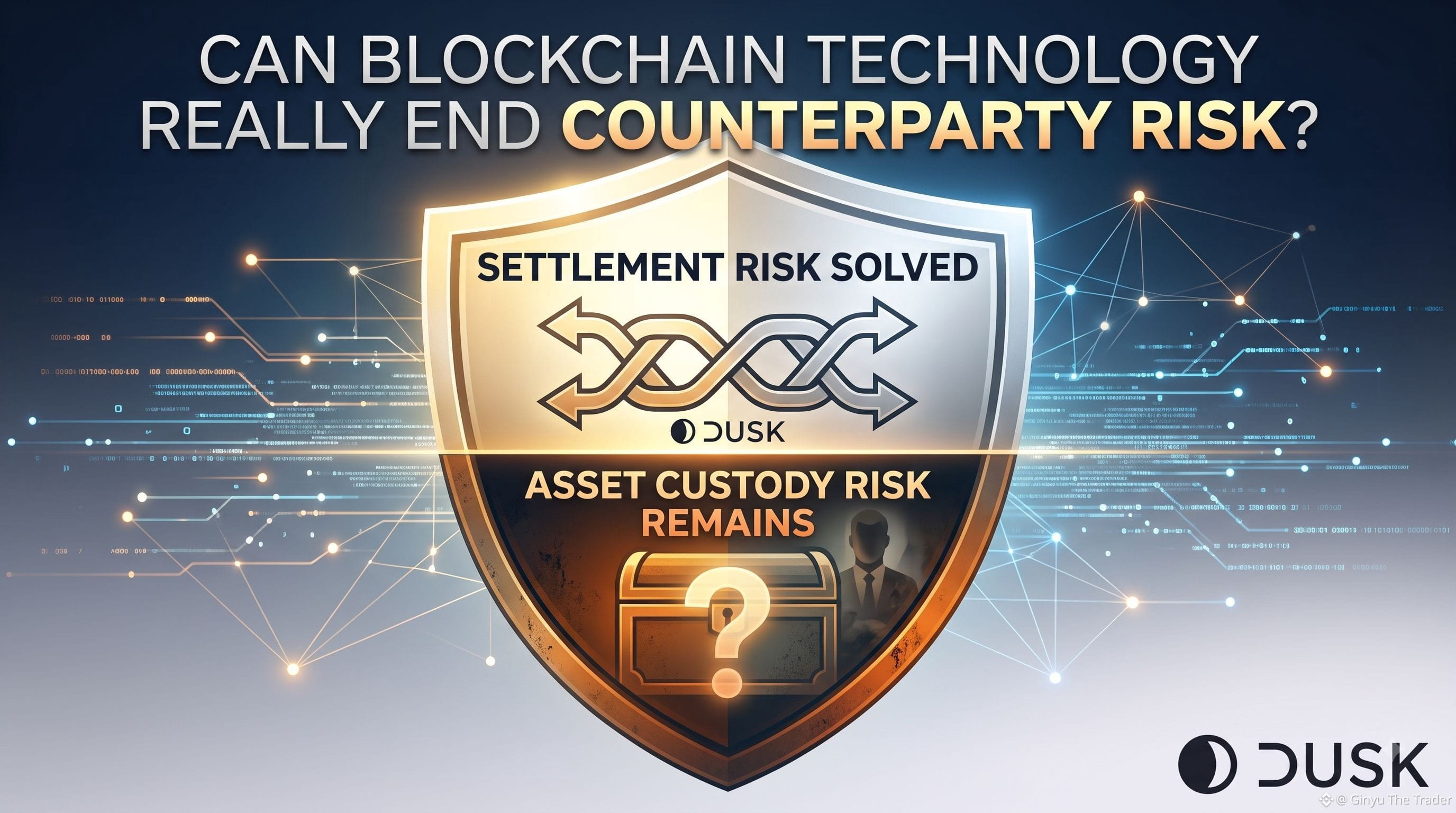
"Deterministic settlement eliminates counterparty risk" is a claim I keep seeing attached to Dusk Network. I understand why the line is attractive, and I think it is true in a narrower sense than it is usually presented, so let me separate the part that holds from the part that does not hold up.
Within the settlement transaction itself, the claim mostly holds up. Delivery-versus-payment-style atomicity, where the asset leg and the payment leg move together or not at all, genuinely removes the specific risk that one party delivers and the other fails to reciprocate, the exact exposure that forces traditional markets to hold margin during a multi-day settlement window, collateral requirements the industry reportedly spends something like $12.4 billion a year maintaining across clearing and settlement technology alone. Dusk Network's deterministic finality through Succinct Attestation makes that atomic pairing possible and immediate rather than probabilistic.
What it does not touch is a different layer of risk entirely: whether the tokenized asset genuinely, legally represents the real security it claims to. If an issuer misrepresents backing, a custodian mismanages the underlying asset, or the legal wrapper connecting the token to real-world ownership turns out to be weaker than assumed, no amount of settlement-layer determinism protects against that failure, because the token settled perfectly while representing something that was never quite what it claimed to be. Counterparty risk in the traditional sense is broader than settlement risk, and treating deterministic finality as a cure for all of it overstates what a consensus mechanism, no matter how well designed, can actually guarantee on its own. Traditional securities markets manage that exact custody risk through regulation, segregation requirements, and insurance schemes built up over decades, infrastructure a tokenized security still needs in some form even after the settlement layer itself stops being the bottleneck.
#dusk $DUSK @Dusk
"Deterministic settlement eliminates counterparty risk" is a claim I keep seeing attached to Dusk Network. I understand why the line is attractive, and I think it is true in a narrower sense than it is usually presented, so let me separate the part that holds from the part that does not hold up.
Within the settlement transaction itself, the claim mostly holds up. Delivery-versus-payment-style atomicity, where the asset leg and the payment leg move together or not at all, genuinely removes the specific risk that one party delivers and the other fails to reciprocate, the exact exposure that forces traditional markets to hold margin during a multi-day settlement window, collateral requirements the industry reportedly spends something like $12.4 billion a year maintaining across clearing and settlement technology alone. Dusk Network's deterministic finality through Succinct Attestation makes that atomic pairing possible and immediate rather than probabilistic.
What it does not touch is a different layer of risk entirely: whether the tokenized asset genuinely, legally represents the real security it claims to. If an issuer misrepresents backing, a custodian mismanages the underlying asset, or the legal wrapper connecting the token to real-world ownership turns out to be weaker than assumed, no amount of settlement-layer determinism protects against that failure, because the token settled perfectly while representing something that was never quite what it claimed to be. Counterparty risk in the traditional sense is broader than settlement risk, and treating deterministic finality as a cure for all of it overstates what a consensus mechanism, no matter how well designed, can actually guarantee on its own. Traditional securities markets manage that exact custody risk through regulation, segregation requirements, and insurance schemes built up over decades, infrastructure a tokenized security still needs in some form even after the settlement layer itself stops being the bottleneck.
"Deterministic settlement eliminates counterparty risk" is a claim I keep seeing attached to Dusk Network. I understand why the line is attractive, and I think it is true in a narrower sense than it is usually presented, so let me separate the part that holds from the part that does not hold up.
Within the settlement transaction itself, the claim mostly holds up. Delivery-versus-payment-style atomicity, where the asset leg and the payment leg move together or not at all, genuinely removes the specific risk that one party delivers and the other fails to reciprocate, the exact exposure that forces traditional markets to hold margin during a multi-day settlement window, collateral requirements the industry reportedly spends something like $12.4 billion a year maintaining across clearing and settlement technology alone. Dusk Network's deterministic finality through Succinct Attestation makes that atomic pairing possible and immediate rather than probabilistic.
What it does not touch is a different layer of risk entirely: whether the tokenized asset genuinely, legally represents the real security it claims to. If an issuer misrepresents backing, a custodian mismanages the underlying asset, or the legal wrapper connecting the token to real-world ownership turns out to be weaker than assumed, no amount of settlement-layer determinism protects against that failure, because the token settled perfectly while representing something that was never quite what it claimed to be. Counterparty risk in the traditional sense is broader than settlement risk, and treating deterministic finality as a cure for all of it overstates what a consensus mechanism, no matter how well designed, can actually guarantee on its own. Traditional securities markets manage that exact custody risk through regulation, segregation requirements, and insurance schemes built up over decades, infrastructure a tokenized security still needs in some form even after the settlement layer itself stops being the bottleneck.
81
Übersetzung ansehen
#binancep2pantoan @Binance_Vietnam
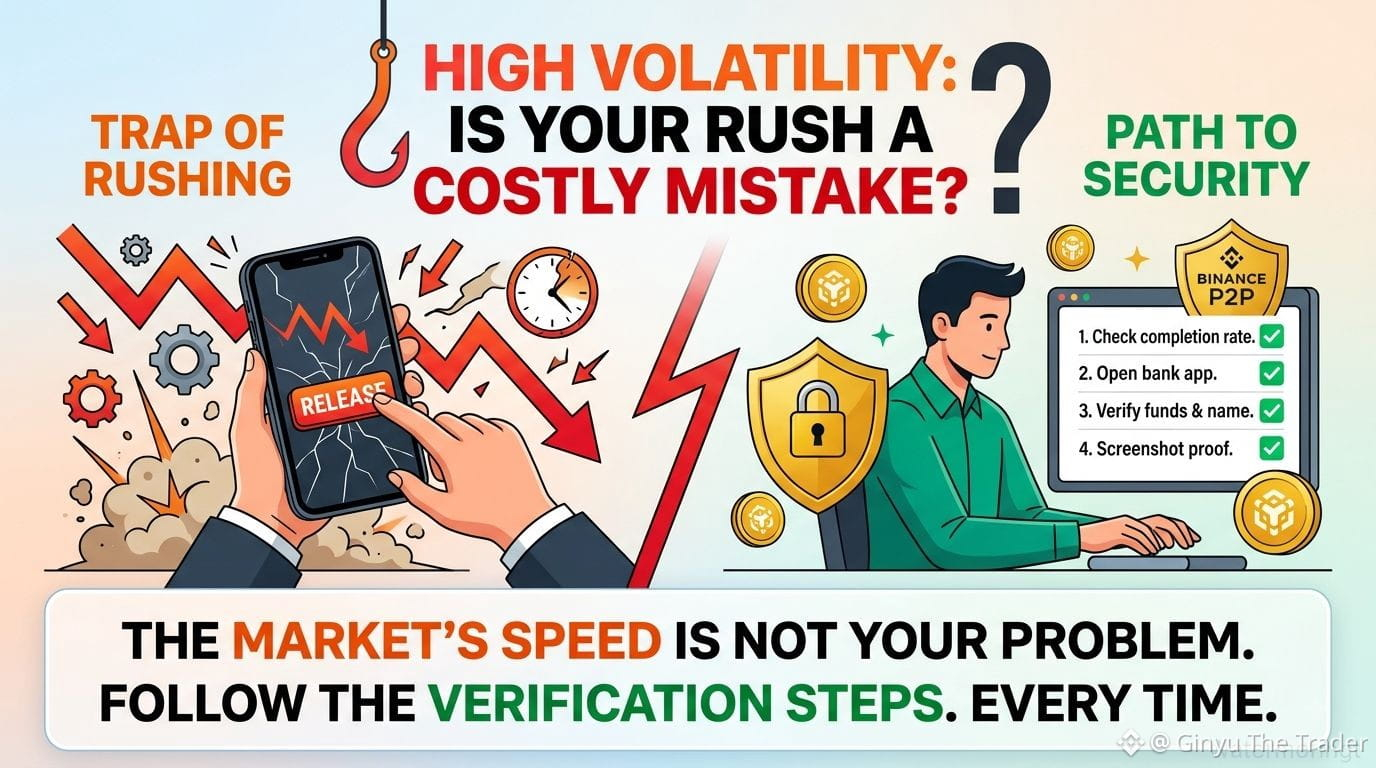
A high volatility day on Binance P2P is when the temptation to skip verification steps hits hardest, and I learned that the hard way during a sharp price swing last year. Binance P2P protects trades through escrow, holding a seller's crypto until the buyer's payment is confirmed, backed by mandatory KYC, an order specific chat, and a dispute appeal if Binance needs to step in and review a disagreement between two sides. That protection only holds while the trade stays fully inside Binance P2P, and it's worth remembering exactly on the days when everyone, including you, wants to move faster than usual for any reason. I check completion rate and order count before accepting, and volatile days are precisely when skipping that step, or waving off a red flag because things feel urgent, matters most and costs the most.
Prices were swinging fast enough that orders were filling within seconds, and I caught myself about to accept a request to release before actually opening my banking app to confirm the transfer had landed. The rate was moving, sure, but a mismatched payment or a fake screenshot costs far more than a missed price movement ever could in the end. I forced myself to slow down: confirm the name, confirm the balance in my own app, screenshot the proof, then release, exactly the same steps as any calm Tuesday afternoon. It cost me maybe a minute of price movement and saved me from a mistake I wouldn't have caught otherwise in the moment. My rule for volatile days now: the market's speed is not my problem, my checklist doesn't get shorter just because everyone else is rushing, and if a counterparty pressures me to skip a step because 'the price is moving,' that's a reason to slow down further, not less. I still screenshot the chat and the payment confirmation before closing the order too, volatile day or not, because a busy market is exactly when I'd want that record ready if a dispute ever needed it later.
#binancep2pantoan @Binance Vietnam
A high volatility day on Binance P2P is when the temptation to skip verification steps hits hardest, and I learned that the hard way during a sharp price swing last year. Binance P2P protects trades through escrow, holding a seller's crypto until the buyer's payment is confirmed, backed by mandatory KYC, an order specific chat, and a dispute appeal if Binance needs to step in and review a disagreement between two sides. That protection only holds while the trade stays fully inside Binance P2P, and it's worth remembering exactly on the days when everyone, including you, wants to move faster than usual for any reason. I check completion rate and order count before accepting, and volatile days are precisely when skipping that step, or waving off a red flag because things feel urgent, matters most and costs the most.
Prices were swinging fast enough that orders were filling within seconds, and I caught myself about to accept a request to release before actually opening my banking app to confirm the transfer had landed. The rate was moving, sure, but a mismatched payment or a fake screenshot costs far more than a missed price movement ever could in the end. I forced myself to slow down: confirm the name, confirm the balance in my own app, screenshot the proof, then release, exactly the same steps as any calm Tuesday afternoon. It cost me maybe a minute of price movement and saved me from a mistake I wouldn't have caught otherwise in the moment. My rule for volatile days now: the market's speed is not my problem, my checklist doesn't get shorter just because everyone else is rushing, and if a counterparty pressures me to skip a step because 'the price is moving,' that's a reason to slow down further, not less. I still screenshot the chat and the payment confirmation before closing the order too, volatile day or not, because a busy market is exactly when I'd want that record ready if a dispute ever needed it later.
A high volatility day on Binance P2P is when the temptation to skip verification steps hits hardest, and I learned that the hard way during a sharp price swing last year. Binance P2P protects trades through escrow, holding a seller's crypto until the buyer's payment is confirmed, backed by mandatory KYC, an order specific chat, and a dispute appeal if Binance needs to step in and review a disagreement between two sides. That protection only holds while the trade stays fully inside Binance P2P, and it's worth remembering exactly on the days when everyone, including you, wants to move faster than usual for any reason. I check completion rate and order count before accepting, and volatile days are precisely when skipping that step, or waving off a red flag because things feel urgent, matters most and costs the most.
Prices were swinging fast enough that orders were filling within seconds, and I caught myself about to accept a request to release before actually opening my banking app to confirm the transfer had landed. The rate was moving, sure, but a mismatched payment or a fake screenshot costs far more than a missed price movement ever could in the end. I forced myself to slow down: confirm the name, confirm the balance in my own app, screenshot the proof, then release, exactly the same steps as any calm Tuesday afternoon. It cost me maybe a minute of price movement and saved me from a mistake I wouldn't have caught otherwise in the moment. My rule for volatile days now: the market's speed is not my problem, my checklist doesn't get shorter just because everyone else is rushing, and if a counterparty pressures me to skip a step because 'the price is moving,' that's a reason to slow down further, not less. I still screenshot the chat and the payment confirmation before closing the order too, volatile day or not, because a busy market is exactly when I'd want that record ready if a dispute ever needed it later.
60
Übersetzung ansehen
#dusk $DUSK @Dusk_Foundation
Will Dusk Network's privacy model get treated the same way regulators are about to treat Monero? I don't think anyone can honestly answer that yet, and I'd be skeptical of anyone claiming otherwise with full confidence in either direction.
The EU's Anti-Money Laundering Regulation takes full effect on July 10, 2027, and Article 79 targets what the law calls "anonymity-enhancing coins" as a category, deliberately without naming specific tickers, leaving asset-by-asset classification to technical standards the European Banking Authority hasn't finished writing yet. The optimistic read for Dusk Network: its model pairs shielded transactions with selective disclosure to authorized regulators, plus a self-sovereign identity layer in Citadel built for exactly this kind of compliance workflow, structurally closer to compliance-friendly, optional-privacy designs than to Monero's default, no-exceptions anonymity. That distinction has already mattered in how markets and institutions treat those approaches differently elsewhere.
The less comfortable read: the regulation's language covers coins that obscure transaction information by default, and Dusk Network's Phoenix transactions are shielded by default, with disclosure sitting as an added layer on top rather than the baseline state. Whether regulators end up focused on the default state of a transaction, or on whether a genuine disclosure mechanism exists at all, is exactly the kind of edge case the EBA's still-unfinished technical standards are supposed to resolve.
I don't think Dusk Network's outcome here is guaranteed either way, and I'd trust the project less, not more, if its own messaging claimed certainty it doesn't have. This is a real open question, not a footnote, worth watching through actual technical standards rather than assumption.
#dusk $DUSK @Dusk
Will Dusk Network's privacy model get treated the same way regulators are about to treat Monero? I don't think anyone can honestly answer that yet, and I'd be skeptical of anyone claiming otherwise with full confidence in either direction.
The EU's Anti-Money Laundering Regulation takes full effect on July 10, 2027, and Article 79 targets what the law calls "anonymity-enhancing coins" as a category, deliberately without naming specific tickers, leaving asset-by-asset classification to technical standards the European Banking Authority hasn't finished writing yet. The optimistic read for Dusk Network: its model pairs shielded transactions with selective disclosure to authorized regulators, plus a self-sovereign identity layer in Citadel built for exactly this kind of compliance workflow, structurally closer to compliance-friendly, optional-privacy designs than to Monero's default, no-exceptions anonymity. That distinction has already mattered in how markets and institutions treat those approaches differently elsewhere.
The less comfortable read: the regulation's language covers coins that obscure transaction information by default, and Dusk Network's Phoenix transactions are shielded by default, with disclosure sitting as an added layer on top rather than the baseline state. Whether regulators end up focused on the default state of a transaction, or on whether a genuine disclosure mechanism exists at all, is exactly the kind of edge case the EBA's still-unfinished technical standards are supposed to resolve.
I don't think Dusk Network's outcome here is guaranteed either way, and I'd trust the project less, not more, if its own messaging claimed certainty it doesn't have. This is a real open question, not a footnote, worth watching through actual technical standards rather than assumption.
Will Dusk Network's privacy model get treated the same way regulators are about to treat Monero? I don't think anyone can honestly answer that yet, and I'd be skeptical of anyone claiming otherwise with full confidence in either direction.
The EU's Anti-Money Laundering Regulation takes full effect on July 10, 2027, and Article 79 targets what the law calls "anonymity-enhancing coins" as a category, deliberately without naming specific tickers, leaving asset-by-asset classification to technical standards the European Banking Authority hasn't finished writing yet. The optimistic read for Dusk Network: its model pairs shielded transactions with selective disclosure to authorized regulators, plus a self-sovereign identity layer in Citadel built for exactly this kind of compliance workflow, structurally closer to compliance-friendly, optional-privacy designs than to Monero's default, no-exceptions anonymity. That distinction has already mattered in how markets and institutions treat those approaches differently elsewhere.
The less comfortable read: the regulation's language covers coins that obscure transaction information by default, and Dusk Network's Phoenix transactions are shielded by default, with disclosure sitting as an added layer on top rather than the baseline state. Whether regulators end up focused on the default state of a transaction, or on whether a genuine disclosure mechanism exists at all, is exactly the kind of edge case the EBA's still-unfinished technical standards are supposed to resolve.
I don't think Dusk Network's outcome here is guaranteed either way, and I'd trust the project less, not more, if its own messaging claimed certainty it doesn't have. This is a real open question, not a footnote, worth watching through actual technical standards rather than assumption.
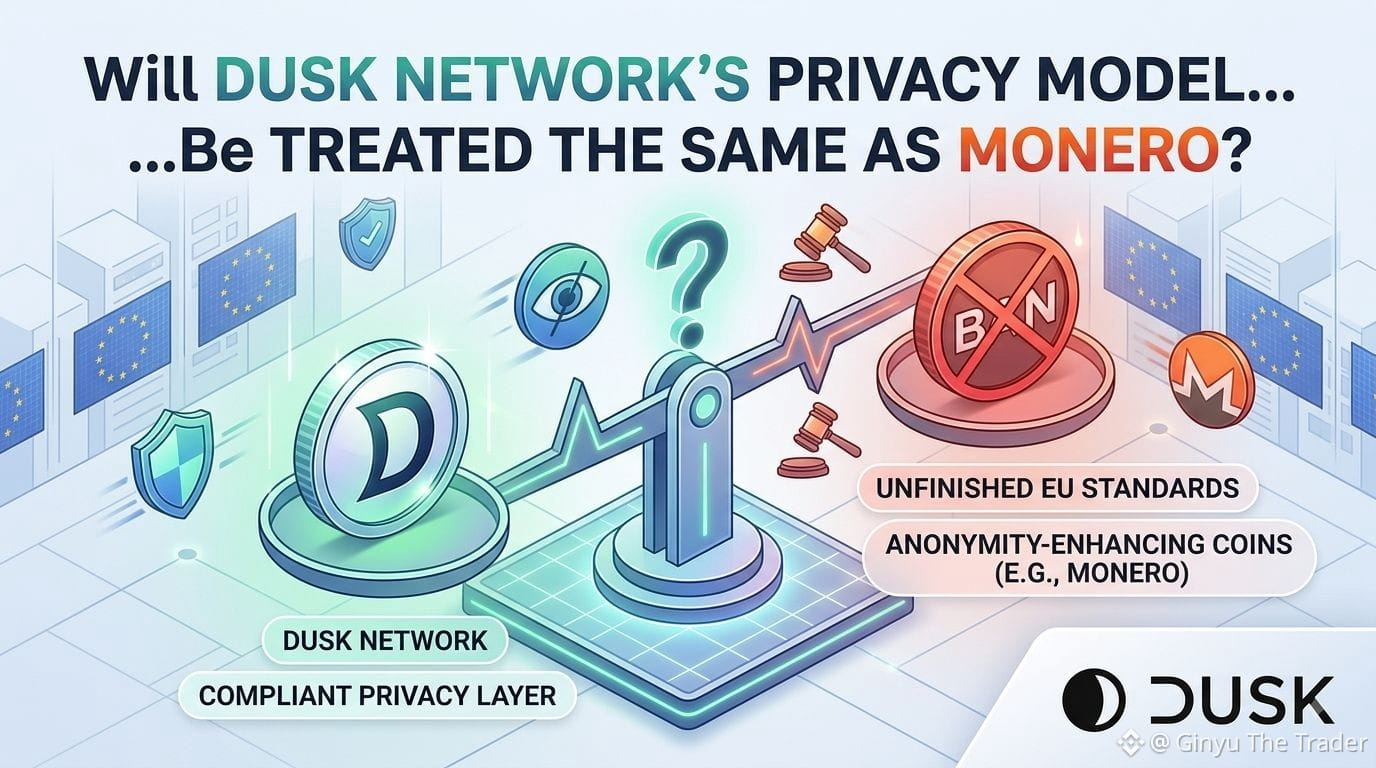
72
Verifiziert
#dusk $DUSK @Dusk_Foundation
Ich nahm an, dass das Staking im Dusk Network nur für Wallets und Node-Operatoren vorgesehen ist.
Stake Abstraction ändert den Eigentümer der Position.
Ein Dusk Smart Contract kann Einzahlungen akzeptieren, Staking erzeugen, Belohnungen empfangen und sie nach seinen eigenen Regeln verteilen oder reinvestieren. Das ermöglicht Staking-Pools, delegierte Dienste, Reward-Splits und Derivate, ohne dass jede Entscheidung in einem Offchain-Operator-Account getroffen werden muss.
Das Staking wird programmierbar. Ebenso wird das Risiko programmierbar.
Nutzer bewerten nicht mehr nur die Konsensleistung eines Bereitstellers. Sie sind zusätzlich auf die Buchführung des Vertrags, die Logik für Auszahlungen, die Zuweisung von Belohnungen, die Upgrade-Kontrollen und den Wiederherstellungspfad angewiesen. Ein perfekt funktionierender Validator kann einen Einzahler nicht vor einem Pool-Contract schützen, der Anteile fehlerhaft berechnet.
Dusk hält einige Protokollgrenzen bewusst explizit. Verträge stehen weiterhin vor der Mindestanlage von 1.000 DUSK. Die Aktivierung erfolgt an einer Epoch-Grenze nach der nächsten, üblicherweise zwischen 1 und 2 Epochen nach der Einreichung. Ein Vertrag kann die Staking-Funktion nicht so aufrufen, als wäre er ein Wallet. Die Gelder bewegen sich über den Transfer Contract und lösen den Stake Contract durch einen Contract-to-Contract-Transfer aus.
Dieser letzte Aspekt ist für mich entscheidend. Er bindet die Staking-Aktion an die tatsächliche Wertbewegung, statt der Vertragslogik zu erlauben, ein Staking anzukündigen, ohne dass die entsprechenden Mittel dazu passen.
Ich würde darauf achten, wie Anwendungen die Verzögerung zwischen Einzahlung und aktivem Staking darstellen. Ein unmittelbar ausgegebenes Pool-Token kann produktiv wirken, während das zugrunde liegende DUSK noch auf die Aktivierung wartet. Reward-Claims und Unstaking-Callbacks müssen ebenfalls mit den Nutzerständen synchron bleiben.
Stake Abstraction erweitert die Nützlichkeit von DUSK über direktes Staking hinaus. Es könnte Einzahlungen auch in einer kleinen Anzahl von Verträgen bündeln, falls Bequemlichkeit gegenüber Diversifizierung gewinnt.
Dusk hat die Konsensposition komponierbar gemacht. Der nächste Nachweis ist, dass Pool-Contracts in jedem Staking-Zustand Solvenz bewahren, Eigentum klarstellen und faire Ausstiege ermöglichen.
Durch Programmierbarkeit kann man manuelle Verteilung entfernen. Sie kann jedoch nicht die Notwendigkeit beseitigen, zu prüfen, wer das Programm kontrolliert.
#dusk $DUSK @Dusk
Ich nahm an, dass das Staking im Dusk Network nur für Wallets und Node-Operatoren vorgesehen ist.
Stake Abstraction ändert den Eigentümer der Position.
Ein Dusk Smart Contract kann Einzahlungen akzeptieren, Staking erzeugen, Belohnungen empfangen und sie nach seinen eigenen Regeln verteilen oder reinvestieren. Das ermöglicht Staking-Pools, delegierte Dienste, Reward-Splits und Derivate, ohne dass jede Entscheidung in einem Offchain-Operator-Account getroffen werden muss.
Das Staking wird programmierbar. Ebenso wird das Risiko programmierbar.
Nutzer bewerten nicht mehr nur die Konsensleistung eines Bereitstellers. Sie sind zusätzlich auf die Buchführung des Vertrags, die Logik für Auszahlungen, die Zuweisung von Belohnungen, die Upgrade-Kontrollen und den Wiederherstellungspfad angewiesen. Ein perfekt funktionierender Validator kann einen Einzahler nicht vor einem Pool-Contract schützen, der Anteile fehlerhaft berechnet.
Dusk hält einige Protokollgrenzen bewusst explizit. Verträge stehen weiterhin vor der Mindestanlage von 1.000 DUSK. Die Aktivierung erfolgt an einer Epoch-Grenze nach der nächsten, üblicherweise zwischen 1 und 2 Epochen nach der Einreichung. Ein Vertrag kann die Staking-Funktion nicht so aufrufen, als wäre er ein Wallet. Die Gelder bewegen sich über den Transfer Contract und lösen den Stake Contract durch einen Contract-to-Contract-Transfer aus.
Dieser letzte Aspekt ist für mich entscheidend. Er bindet die Staking-Aktion an die tatsächliche Wertbewegung, statt der Vertragslogik zu erlauben, ein Staking anzukündigen, ohne dass die entsprechenden Mittel dazu passen.
Ich würde darauf achten, wie Anwendungen die Verzögerung zwischen Einzahlung und aktivem Staking darstellen. Ein unmittelbar ausgegebenes Pool-Token kann produktiv wirken, während das zugrunde liegende DUSK noch auf die Aktivierung wartet. Reward-Claims und Unstaking-Callbacks müssen ebenfalls mit den Nutzerständen synchron bleiben.
Stake Abstraction erweitert die Nützlichkeit von DUSK über direktes Staking hinaus. Es könnte Einzahlungen auch in einer kleinen Anzahl von Verträgen bündeln, falls Bequemlichkeit gegenüber Diversifizierung gewinnt.
Dusk hat die Konsensposition komponierbar gemacht. Der nächste Nachweis ist, dass Pool-Contracts in jedem Staking-Zustand Solvenz bewahren, Eigentum klarstellen und faire Ausstiege ermöglichen.
Durch Programmierbarkeit kann man manuelle Verteilung entfernen. Sie kann jedoch nicht die Notwendigkeit beseitigen, zu prüfen, wer das Programm kontrolliert.
Ich nahm an, dass das Staking im Dusk Network nur für Wallets und Node-Operatoren vorgesehen ist.
Stake Abstraction ändert den Eigentümer der Position.
Ein Dusk Smart Contract kann Einzahlungen akzeptieren, Staking erzeugen, Belohnungen empfangen und sie nach seinen eigenen Regeln verteilen oder reinvestieren. Das ermöglicht Staking-Pools, delegierte Dienste, Reward-Splits und Derivate, ohne dass jede Entscheidung in einem Offchain-Operator-Account getroffen werden muss.
Das Staking wird programmierbar. Ebenso wird das Risiko programmierbar.
Nutzer bewerten nicht mehr nur die Konsensleistung eines Bereitstellers. Sie sind zusätzlich auf die Buchführung des Vertrags, die Logik für Auszahlungen, die Zuweisung von Belohnungen, die Upgrade-Kontrollen und den Wiederherstellungspfad angewiesen. Ein perfekt funktionierender Validator kann einen Einzahler nicht vor einem Pool-Contract schützen, der Anteile fehlerhaft berechnet.
Dusk hält einige Protokollgrenzen bewusst explizit. Verträge stehen weiterhin vor der Mindestanlage von 1.000 DUSK. Die Aktivierung erfolgt an einer Epoch-Grenze nach der nächsten, üblicherweise zwischen 1 und 2 Epochen nach der Einreichung. Ein Vertrag kann die Staking-Funktion nicht so aufrufen, als wäre er ein Wallet. Die Gelder bewegen sich über den Transfer Contract und lösen den Stake Contract durch einen Contract-to-Contract-Transfer aus.
Dieser letzte Aspekt ist für mich entscheidend. Er bindet die Staking-Aktion an die tatsächliche Wertbewegung, statt der Vertragslogik zu erlauben, ein Staking anzukündigen, ohne dass die entsprechenden Mittel dazu passen.
Ich würde darauf achten, wie Anwendungen die Verzögerung zwischen Einzahlung und aktivem Staking darstellen. Ein unmittelbar ausgegebenes Pool-Token kann produktiv wirken, während das zugrunde liegende DUSK noch auf die Aktivierung wartet. Reward-Claims und Unstaking-Callbacks müssen ebenfalls mit den Nutzerständen synchron bleiben.
Stake Abstraction erweitert die Nützlichkeit von DUSK über direktes Staking hinaus. Es könnte Einzahlungen auch in einer kleinen Anzahl von Verträgen bündeln, falls Bequemlichkeit gegenüber Diversifizierung gewinnt.
Dusk hat die Konsensposition komponierbar gemacht. Der nächste Nachweis ist, dass Pool-Contracts in jedem Staking-Zustand Solvenz bewahren, Eigentum klarstellen und faire Ausstiege ermöglichen.
Durch Programmierbarkeit kann man manuelle Verteilung entfernen. Sie kann jedoch nicht die Notwendigkeit beseitigen, zu prüfen, wer das Programm kontrolliert.
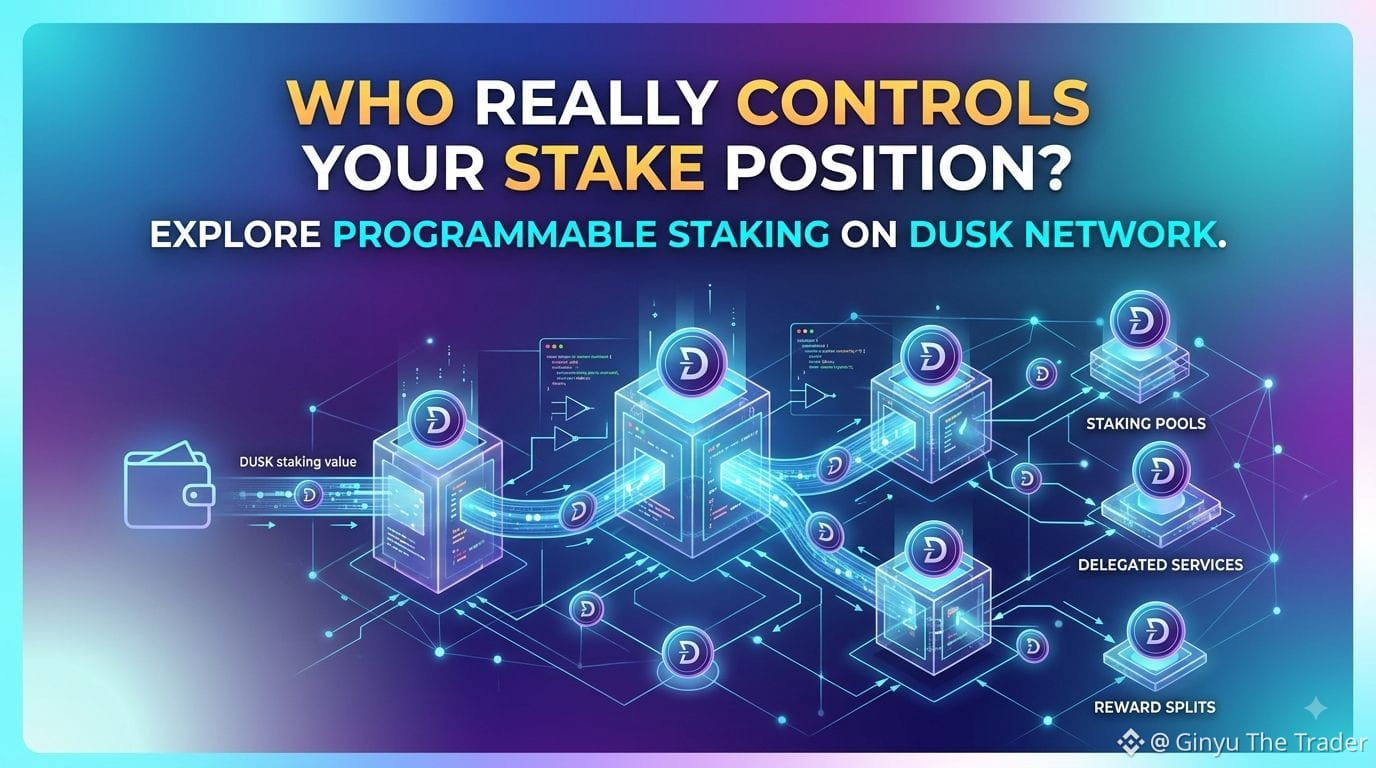
1
52
Übersetzung ansehen
#binancep2pantoan @Binance_Vietnam
New traders often assume Binance P2P protects them automatically from every kind of loss, and that single assumption can end up being costly.
The protections are real, but they work with the trader, not instead of the trader. KYC verification means every account belongs to an identity Binance can trace, which discourages a lot of bad behavior but does not physically stop someone from trying to scam another user through the chat. Escrow holds a seller's crypto until payment is confirmed, which is one of the strongest protections on the platform, but confirming that payment is still the seller's own responsibility, not something that happens automatically in the background. Checking a counterparty's profile matters for exactly this reason: account age, completion rate, and order history together give a much clearer picture than KYC status alone, since a verified identity can still belong to someone acting in bad faith. Support and the dispute process exist as a backstop, not a replacement for basic caution during the trade itself.
I have talked to newer traders who released crypto based purely on a payment notification, assuming that because Binance P2P is a protected system, nothing could really go wrong on their end. That is not how it works in practice. The platform structures the trade safely, but each side still has to do their part: verify the profile, confirm real payment before releasing, keep everything inside the chat, and archive proof of what happened. If a step ever feels uncertain, Binance support is there to help, and reaching out early is always better than assuming the system alone will catch a problem after the fact. Protection on Binance P2P is a partnership, not an autopilot. Understanding that distinction early would have saved me some uneasy moments as a newer trader, and it is the single idea I try hardest to pass along to anyone just getting started on the platform now.
#binancep2pantoan @Binance Vietnam
New traders often assume Binance P2P protects them automatically from every kind of loss, and that single assumption can end up being costly.
The protections are real, but they work with the trader, not instead of the trader. KYC verification means every account belongs to an identity Binance can trace, which discourages a lot of bad behavior but does not physically stop someone from trying to scam another user through the chat. Escrow holds a seller's crypto until payment is confirmed, which is one of the strongest protections on the platform, but confirming that payment is still the seller's own responsibility, not something that happens automatically in the background. Checking a counterparty's profile matters for exactly this reason: account age, completion rate, and order history together give a much clearer picture than KYC status alone, since a verified identity can still belong to someone acting in bad faith. Support and the dispute process exist as a backstop, not a replacement for basic caution during the trade itself.
I have talked to newer traders who released crypto based purely on a payment notification, assuming that because Binance P2P is a protected system, nothing could really go wrong on their end. That is not how it works in practice. The platform structures the trade safely, but each side still has to do their part: verify the profile, confirm real payment before releasing, keep everything inside the chat, and archive proof of what happened. If a step ever feels uncertain, Binance support is there to help, and reaching out early is always better than assuming the system alone will catch a problem after the fact. Protection on Binance P2P is a partnership, not an autopilot. Understanding that distinction early would have saved me some uneasy moments as a newer trader, and it is the single idea I try hardest to pass along to anyone just getting started on the platform now.
New traders often assume Binance P2P protects them automatically from every kind of loss, and that single assumption can end up being costly.
The protections are real, but they work with the trader, not instead of the trader. KYC verification means every account belongs to an identity Binance can trace, which discourages a lot of bad behavior but does not physically stop someone from trying to scam another user through the chat. Escrow holds a seller's crypto until payment is confirmed, which is one of the strongest protections on the platform, but confirming that payment is still the seller's own responsibility, not something that happens automatically in the background. Checking a counterparty's profile matters for exactly this reason: account age, completion rate, and order history together give a much clearer picture than KYC status alone, since a verified identity can still belong to someone acting in bad faith. Support and the dispute process exist as a backstop, not a replacement for basic caution during the trade itself.
I have talked to newer traders who released crypto based purely on a payment notification, assuming that because Binance P2P is a protected system, nothing could really go wrong on their end. That is not how it works in practice. The platform structures the trade safely, but each side still has to do their part: verify the profile, confirm real payment before releasing, keep everything inside the chat, and archive proof of what happened. If a step ever feels uncertain, Binance support is there to help, and reaching out early is always better than assuming the system alone will catch a problem after the fact. Protection on Binance P2P is a partnership, not an autopilot. Understanding that distinction early would have saved me some uneasy moments as a newer trader, and it is the single idea I try hardest to pass along to anyone just getting started on the platform now.
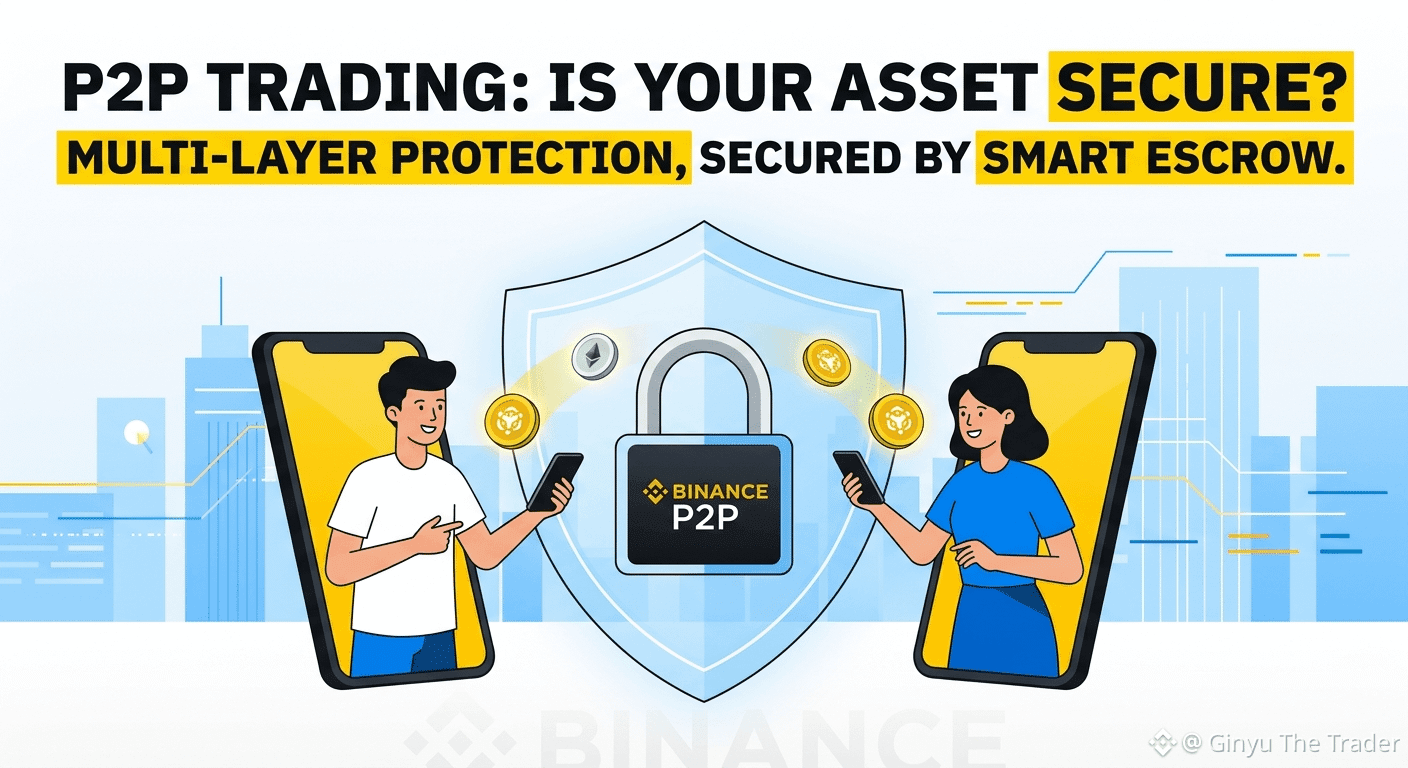
74
Verifiziert
Ich habe das aufschlussreichste AEGIS-Problem außerhalb des Zero-Knowledge-Beweises selbst gefunden. Ein Wert daneben war nicht vollständig kontrolliert.
Im Phoenix-Transaktionspfad von Dusk Network konnte ein Nutzer sich auf eine legitime max_fee festlegen, während die Ausführung dennoch Gebührenfelder verbrauchte, die nicht in dieselbe Sicherheitsgeschichte eingebunden waren. Feindliche Gas-Parameter konnten eine Rückerstattungsinflation auslösen oder Überläufe verursachen. Eine mutable Rückerstattungsadresse konnte den Wert umleiten.
Der Beweis war gültig. Die Transaktionssemantik war nicht vollständig damit verbunden.
Eine Gebühr ist nicht harmlose Metadaten, wenn der Rückerstattungspfad Werte erzeugen oder umleiten kann.
Das ist eine nützliche Warnung für jedes Privacy-Protokoll. Einen einzigen Satz perfekt zu beweisen sichert nicht automatisch benachbarte Felder ab, denen die Ausführung später vertraut. Das System muss den Beweis, die Signatur, die Gebührenberechnung, das Ziel und den Rückerstattungspfad zu einer einzigen Invariante binden.
AEGIS fügte geprüfte Multiplikation für gas_limit mal gas_price hinzu und verlangte, dass das Ergebnis dem bewiesenen max_fee entspricht. Dusk erzwang diese Prüfung zweimal: bei der Aufnahme in den Mempool und erneut innerhalb der VM-Ausführung. Außerdem band es die Rückerstattungs-Stealth-Adresse so ein, dass Manipulation die Transaktion ungültig machen würde.
Die zweite Prüfung ist das Detail, um das es mir geht. Ein böswilliger Block-Producer muss die Annahmen eines ehrlichen Mempools nicht respektieren. Wenn die Invariante nur am Netzwerk-Rand existiert, kann der Konsens dennoch eine Transaktion ausführen, die diese Randbedingung umgangen hat.
Ich würde nun nach demselben Verteidigungsmuster in Dusk suchen: günstige Ablehnung vor der Aufnahme, autoritative Validierung bei der Ausführung und Regressionstests, die jedes Feld rund um einen Beweis mutieren.
AEGIS hat die bekannten kritischen Pfade geschlossen. Die größere Frage ist, ob andere Dusk-Verträge Werte enthalten, die in einer Ebene „geprüft“ werden und in der nächsten nur vertraut.
Kryptografie kann genau das beweisen, was sie beweisen soll. Sicherheit hängt davon ab, dass Dusk nach der vollständigen Aussage fragt.
#dusk $DUSK @Dusk_Foundation
Ich habe das aufschlussreichste AEGIS-Problem außerhalb des Zero-Knowledge-Beweises selbst gefunden. Ein Wert daneben war nicht vollständig kontrolliert.
Im Phoenix-Transaktionspfad von Dusk Network konnte ein Nutzer sich auf eine legitime max_fee festlegen, während die Ausführung dennoch Gebührenfelder verbrauchte, die nicht in dieselbe Sicherheitsgeschichte eingebunden waren. Feindliche Gas-Parameter konnten eine Rückerstattungsinflation auslösen oder Überläufe verursachen. Eine mutable Rückerstattungsadresse konnte den Wert umleiten.
Der Beweis war gültig. Die Transaktionssemantik war nicht vollständig damit verbunden.
Eine Gebühr ist nicht harmlose Metadaten, wenn der Rückerstattungspfad Werte erzeugen oder umleiten kann.
Das ist eine nützliche Warnung für jedes Privacy-Protokoll. Einen einzigen Satz perfekt zu beweisen sichert nicht automatisch benachbarte Felder ab, denen die Ausführung später vertraut. Das System muss den Beweis, die Signatur, die Gebührenberechnung, das Ziel und den Rückerstattungspfad zu einer einzigen Invariante binden.
AEGIS fügte geprüfte Multiplikation für gas_limit mal gas_price hinzu und verlangte, dass das Ergebnis dem bewiesenen max_fee entspricht. Dusk erzwang diese Prüfung zweimal: bei der Aufnahme in den Mempool und erneut innerhalb der VM-Ausführung. Außerdem band es die Rückerstattungs-Stealth-Adresse so ein, dass Manipulation die Transaktion ungültig machen würde.
Die zweite Prüfung ist das Detail, um das es mir geht. Ein böswilliger Block-Producer muss die Annahmen eines ehrlichen Mempools nicht respektieren. Wenn die Invariante nur am Netzwerk-Rand existiert, kann der Konsens dennoch eine Transaktion ausführen, die diese Randbedingung umgangen hat.
Ich würde nun nach demselben Verteidigungsmuster in Dusk suchen: günstige Ablehnung vor der Aufnahme, autoritative Validierung bei der Ausführung und Regressionstests, die jedes Feld rund um einen Beweis mutieren.
AEGIS hat die bekannten kritischen Pfade geschlossen. Die größere Frage ist, ob andere Dusk-Verträge Werte enthalten, die in einer Ebene „geprüft“ werden und in der nächsten nur vertraut.
Kryptografie kann genau das beweisen, was sie beweisen soll. Sicherheit hängt davon ab, dass Dusk nach der vollständigen Aussage fragt.
#dusk $DUSK @Dusk
Im Phoenix-Transaktionspfad von Dusk Network konnte ein Nutzer sich auf eine legitime max_fee festlegen, während die Ausführung dennoch Gebührenfelder verbrauchte, die nicht in dieselbe Sicherheitsgeschichte eingebunden waren. Feindliche Gas-Parameter konnten eine Rückerstattungsinflation auslösen oder Überläufe verursachen. Eine mutable Rückerstattungsadresse konnte den Wert umleiten.
Der Beweis war gültig. Die Transaktionssemantik war nicht vollständig damit verbunden.
Eine Gebühr ist nicht harmlose Metadaten, wenn der Rückerstattungspfad Werte erzeugen oder umleiten kann.
Das ist eine nützliche Warnung für jedes Privacy-Protokoll. Einen einzigen Satz perfekt zu beweisen sichert nicht automatisch benachbarte Felder ab, denen die Ausführung später vertraut. Das System muss den Beweis, die Signatur, die Gebührenberechnung, das Ziel und den Rückerstattungspfad zu einer einzigen Invariante binden.
AEGIS fügte geprüfte Multiplikation für gas_limit mal gas_price hinzu und verlangte, dass das Ergebnis dem bewiesenen max_fee entspricht. Dusk erzwang diese Prüfung zweimal: bei der Aufnahme in den Mempool und erneut innerhalb der VM-Ausführung. Außerdem band es die Rückerstattungs-Stealth-Adresse so ein, dass Manipulation die Transaktion ungültig machen würde.
Die zweite Prüfung ist das Detail, um das es mir geht. Ein böswilliger Block-Producer muss die Annahmen eines ehrlichen Mempools nicht respektieren. Wenn die Invariante nur am Netzwerk-Rand existiert, kann der Konsens dennoch eine Transaktion ausführen, die diese Randbedingung umgangen hat.
Ich würde nun nach demselben Verteidigungsmuster in Dusk suchen: günstige Ablehnung vor der Aufnahme, autoritative Validierung bei der Ausführung und Regressionstests, die jedes Feld rund um einen Beweis mutieren.
AEGIS hat die bekannten kritischen Pfade geschlossen. Die größere Frage ist, ob andere Dusk-Verträge Werte enthalten, die in einer Ebene „geprüft“ werden und in der nächsten nur vertraut.
Kryptografie kann genau das beweisen, was sie beweisen soll. Sicherheit hängt davon ab, dass Dusk nach der vollständigen Aussage fragt.
#dusk $DUSK @Dusk
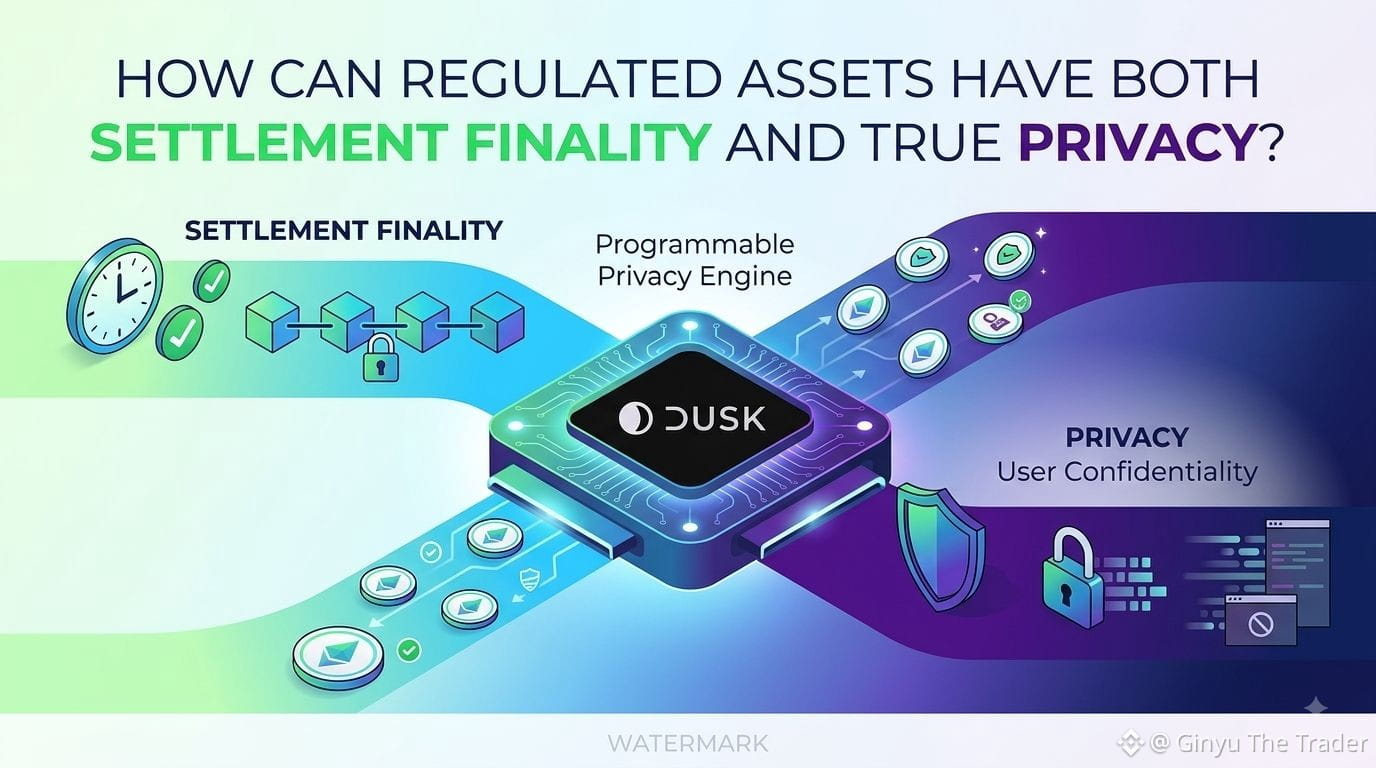
1
63
Übersetzung ansehen
#binancep2pantoan @Binance_Vietnam
Six months into trading on Binance P2P, I noticed something I hadn't expected when I started: a solid trading history doesn't just make offers get accepted faster, it actively lowers your risk with every completed trade. Binance P2P's foundation stays the same for every user, KYC verified identity, escrow protecting funds mid transaction, chat preserving every conversation, and appeals available if something breaks down, but a strong completion rate and order count layer real world trust on top of that baseline. Counterparties treat established accounts differently. They ask fewer unnecessary questions, they're less likely to attempt scams that depend on catching someone off guard, and other traders can see your track record the same way you check theirs before accepting an offer. None of this replaces the underlying protections, though. Even with hundreds of completed orders, I still confirm every payment myself before releasing crypto and I still keep the trade entirely inside Binance P2P rather than trusting reputation enough to cut corners.
Building that history took patience early on. I started with smaller trade amounts while I learned to read profiles and recognize red flags like rushed requests or mismatched payment names, and I only increased my typical order size as my own comfort and my counterparty screening habits improved. I kept every screenshot and chat log from those early trades the same way I do now, since good habits formed early don't need to be relearned later. I also learned to spot the same red flags experienced traders talk about, mismatched payment names, sudden urgency, and requests to move off Binance P2P, and a growing reputation never gave me a reason to stop checking for them. If a dispute ever came up in those first months, I knew Binance support was one appeal away, and knowing that made the learning curve far less intimidating than it could have been.
#binancep2pantoan @Binance Vietnam
Six months into trading on Binance P2P, I noticed something I hadn't expected when I started: a solid trading history doesn't just make offers get accepted faster, it actively lowers your risk with every completed trade. Binance P2P's foundation stays the same for every user, KYC verified identity, escrow protecting funds mid transaction, chat preserving every conversation, and appeals available if something breaks down, but a strong completion rate and order count layer real world trust on top of that baseline. Counterparties treat established accounts differently. They ask fewer unnecessary questions, they're less likely to attempt scams that depend on catching someone off guard, and other traders can see your track record the same way you check theirs before accepting an offer. None of this replaces the underlying protections, though. Even with hundreds of completed orders, I still confirm every payment myself before releasing crypto and I still keep the trade entirely inside Binance P2P rather than trusting reputation enough to cut corners.
Building that history took patience early on. I started with smaller trade amounts while I learned to read profiles and recognize red flags like rushed requests or mismatched payment names, and I only increased my typical order size as my own comfort and my counterparty screening habits improved. I kept every screenshot and chat log from those early trades the same way I do now, since good habits formed early don't need to be relearned later. I also learned to spot the same red flags experienced traders talk about, mismatched payment names, sudden urgency, and requests to move off Binance P2P, and a growing reputation never gave me a reason to stop checking for them. If a dispute ever came up in those first months, I knew Binance support was one appeal away, and knowing that made the learning curve far less intimidating than it could have been.
Six months into trading on Binance P2P, I noticed something I hadn't expected when I started: a solid trading history doesn't just make offers get accepted faster, it actively lowers your risk with every completed trade. Binance P2P's foundation stays the same for every user, KYC verified identity, escrow protecting funds mid transaction, chat preserving every conversation, and appeals available if something breaks down, but a strong completion rate and order count layer real world trust on top of that baseline. Counterparties treat established accounts differently. They ask fewer unnecessary questions, they're less likely to attempt scams that depend on catching someone off guard, and other traders can see your track record the same way you check theirs before accepting an offer. None of this replaces the underlying protections, though. Even with hundreds of completed orders, I still confirm every payment myself before releasing crypto and I still keep the trade entirely inside Binance P2P rather than trusting reputation enough to cut corners.
Building that history took patience early on. I started with smaller trade amounts while I learned to read profiles and recognize red flags like rushed requests or mismatched payment names, and I only increased my typical order size as my own comfort and my counterparty screening habits improved. I kept every screenshot and chat log from those early trades the same way I do now, since good habits formed early don't need to be relearned later. I also learned to spot the same red flags experienced traders talk about, mismatched payment names, sudden urgency, and requests to move off Binance P2P, and a growing reputation never gave me a reason to stop checking for them. If a dispute ever came up in those first months, I knew Binance support was one appeal away, and knowing that made the learning curve far less intimidating than it could have been.
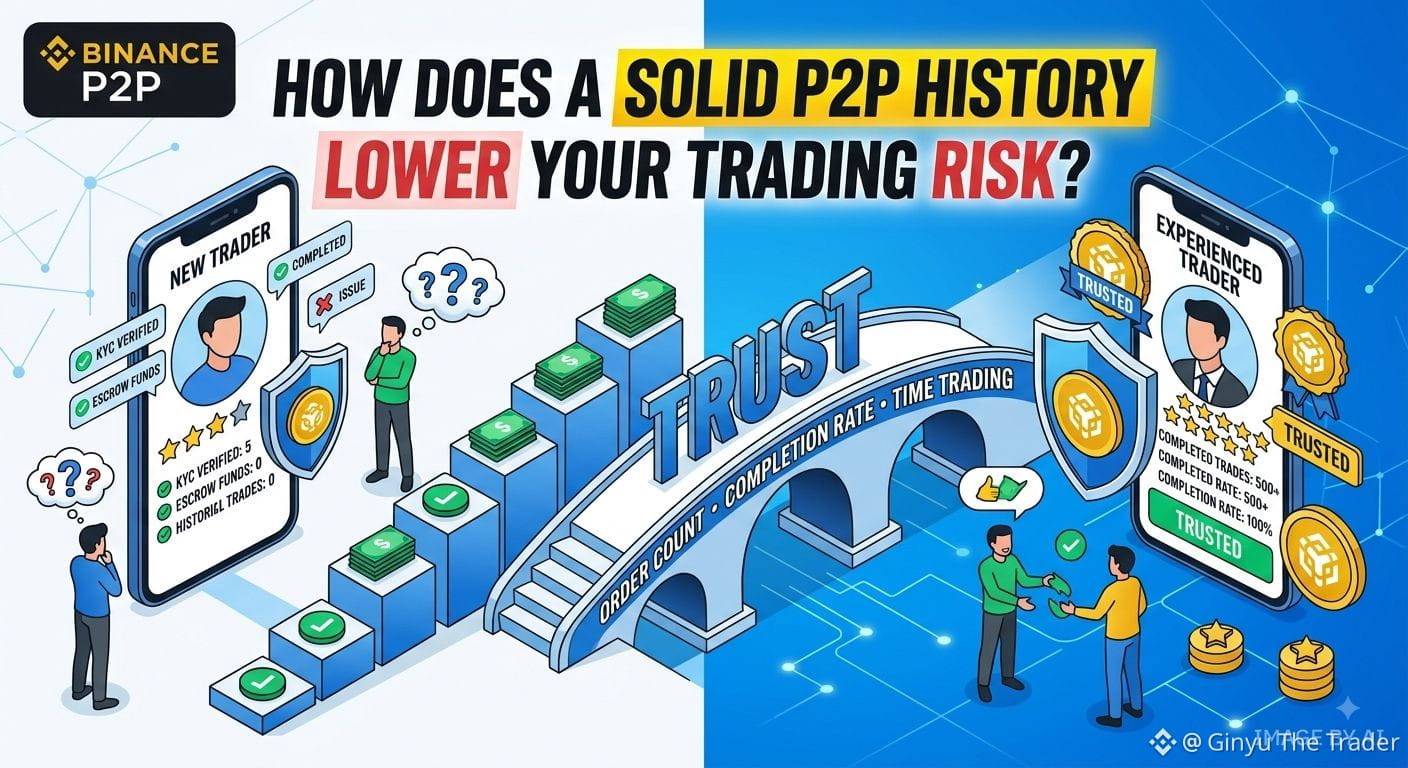
66
Verifiziert
Übersetzung ansehen
#dusk $DUSK @Dusk_Foundation
A lot of crypto's early identity was built on staying out of reach of regulators. Dusk is making the opposite bet. Dusk is a Layer 1 blockchain built for regulated financial markets, combining programmable privacy with compliance rather than treating them as enemies, enabling privacy where needed, transparency where useful, selective disclosure for authorized review, and deterministic settlement for tokenized RWAs and regulated securities. That philosophy carries into Dusk Trade, structured to operate as a regulated MTF and investment platform compliant with applicable EU regulations, and into Dusk's partnerships with EU licensed institutions like NPEX, an AFM regulated exchange planning to bring 300M+ EUR in assets onchain via Dusk.
This is a genuine bet, not a marketing line. If you believe crypto's long term value comes from operating outside traditional financial oversight, Dusk's entire model reads as a compromise, or even a retreat. If you believe regulated capital, pension funds, MMFs, institutional bond desks, is the larger and stickier pool of money, then compliance native infrastructure is the only door that actually opens.
I don't think this bet is naive, either, even though it runs against crypto's founding instincts. Regulated capital has always dwarfed the retail speculative pool that most of the industry chases, and if even a modest fraction of pension funds, MMFs, and institutional bond desks find a compliant onchain venue credible enough to actually use, that's a larger addressable market than most chains will ever meaningfully touch. Modest fraction is still doing a lot of quiet work in that sentence, though.
I don't think that question has a settled answer yet, and Dusk hasn't proven which side of it is right. What Dusk has done is commit fully to one side, build the architecture around it, and let the results, once DuskEVM mainnet and Dusk Trade are both live, make the argument instead of a whitepaper.
#dusk $DUSK @Dusk
A lot of crypto's early identity was built on staying out of reach of regulators. Dusk is making the opposite bet. Dusk is a Layer 1 blockchain built for regulated financial markets, combining programmable privacy with compliance rather than treating them as enemies, enabling privacy where needed, transparency where useful, selective disclosure for authorized review, and deterministic settlement for tokenized RWAs and regulated securities. That philosophy carries into Dusk Trade, structured to operate as a regulated MTF and investment platform compliant with applicable EU regulations, and into Dusk's partnerships with EU licensed institutions like NPEX, an AFM regulated exchange planning to bring 300M+ EUR in assets onchain via Dusk.
This is a genuine bet, not a marketing line. If you believe crypto's long term value comes from operating outside traditional financial oversight, Dusk's entire model reads as a compromise, or even a retreat. If you believe regulated capital, pension funds, MMFs, institutional bond desks, is the larger and stickier pool of money, then compliance native infrastructure is the only door that actually opens.
I don't think this bet is naive, either, even though it runs against crypto's founding instincts. Regulated capital has always dwarfed the retail speculative pool that most of the industry chases, and if even a modest fraction of pension funds, MMFs, and institutional bond desks find a compliant onchain venue credible enough to actually use, that's a larger addressable market than most chains will ever meaningfully touch. Modest fraction is still doing a lot of quiet work in that sentence, though.
I don't think that question has a settled answer yet, and Dusk hasn't proven which side of it is right. What Dusk has done is commit fully to one side, build the architecture around it, and let the results, once DuskEVM mainnet and Dusk Trade are both live, make the argument instead of a whitepaper.
A lot of crypto's early identity was built on staying out of reach of regulators. Dusk is making the opposite bet. Dusk is a Layer 1 blockchain built for regulated financial markets, combining programmable privacy with compliance rather than treating them as enemies, enabling privacy where needed, transparency where useful, selective disclosure for authorized review, and deterministic settlement for tokenized RWAs and regulated securities. That philosophy carries into Dusk Trade, structured to operate as a regulated MTF and investment platform compliant with applicable EU regulations, and into Dusk's partnerships with EU licensed institutions like NPEX, an AFM regulated exchange planning to bring 300M+ EUR in assets onchain via Dusk.
This is a genuine bet, not a marketing line. If you believe crypto's long term value comes from operating outside traditional financial oversight, Dusk's entire model reads as a compromise, or even a retreat. If you believe regulated capital, pension funds, MMFs, institutional bond desks, is the larger and stickier pool of money, then compliance native infrastructure is the only door that actually opens.
I don't think this bet is naive, either, even though it runs against crypto's founding instincts. Regulated capital has always dwarfed the retail speculative pool that most of the industry chases, and if even a modest fraction of pension funds, MMFs, and institutional bond desks find a compliant onchain venue credible enough to actually use, that's a larger addressable market than most chains will ever meaningfully touch. Modest fraction is still doing a lot of quiet work in that sentence, though.
I don't think that question has a settled answer yet, and Dusk hasn't proven which side of it is right. What Dusk has done is commit fully to one side, build the architecture around it, and let the results, once DuskEVM mainnet and Dusk Trade are both live, make the argument instead of a whitepaper.
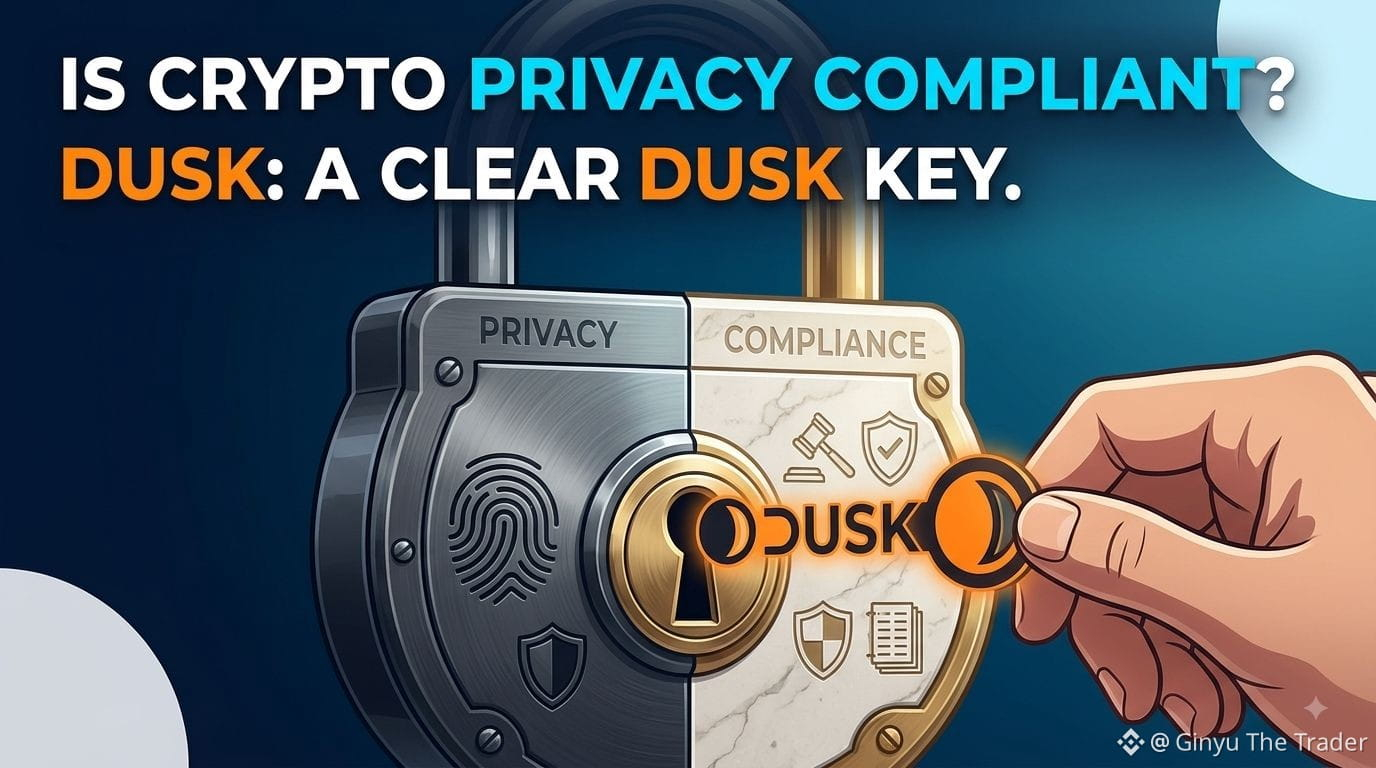
1
58
Übersetzung ansehen
#binancep2pantoan @Binance_Vietnam
Every word exchanged in a Binance P2P order chat becomes part of the record if a dispute ever happens, and once I understood that, it completely changed how I communicate during trades.
Binance P2P protects trades through KYC verification, an escrow system holding the crypto asset, and this built in chat, which exists specifically to keep every relevant detail documented in one place that both Binance support and either party can reference later during an appeal. I treat it accordingly. I state things plainly rather than assuming context, confirm details in writing even when they seem obvious, and avoid vague language that could be interpreted multiple ways if an agent ever has to read the conversation cold during a dispute.
A few habits that have served me well. When a counterparty agrees to something verbally, like confirming a detail in a voice note or a quick reply, I ask them to also type a short confirmation in text, since that is what actually gets reviewed later, and if anyone claims a payment has already gone through, I still confirm it directly in my own bank before relying on the chat message alone. I still verify the counterparty's completion rate and registered name early in the conversation rather than assuming good faith, and I avoid discussing anything unrelated to the trade itself, since a long, meandering conversation makes it harder for anyone, including future me, to find the relevant details quickly.
If a counterparty ever asks to continue the conversation somewhere outside the order chat, I treat that request itself as worth declining, regardless of the reason given. Legitimate trades have no need to leave a system built specifically to protect both sides with a timestamped, reviewable record.
Clear, complete, on platform communication is one of the simplest habits that makes Binance P2P safer, and it costs nothing extra to practice.
#binancep2pantoan @Binance Vietnam
Every word exchanged in a Binance P2P order chat becomes part of the record if a dispute ever happens, and once I understood that, it completely changed how I communicate during trades.
Binance P2P protects trades through KYC verification, an escrow system holding the crypto asset, and this built in chat, which exists specifically to keep every relevant detail documented in one place that both Binance support and either party can reference later during an appeal. I treat it accordingly. I state things plainly rather than assuming context, confirm details in writing even when they seem obvious, and avoid vague language that could be interpreted multiple ways if an agent ever has to read the conversation cold during a dispute.
A few habits that have served me well. When a counterparty agrees to something verbally, like confirming a detail in a voice note or a quick reply, I ask them to also type a short confirmation in text, since that is what actually gets reviewed later, and if anyone claims a payment has already gone through, I still confirm it directly in my own bank before relying on the chat message alone. I still verify the counterparty's completion rate and registered name early in the conversation rather than assuming good faith, and I avoid discussing anything unrelated to the trade itself, since a long, meandering conversation makes it harder for anyone, including future me, to find the relevant details quickly.
If a counterparty ever asks to continue the conversation somewhere outside the order chat, I treat that request itself as worth declining, regardless of the reason given. Legitimate trades have no need to leave a system built specifically to protect both sides with a timestamped, reviewable record.
Clear, complete, on platform communication is one of the simplest habits that makes Binance P2P safer, and it costs nothing extra to practice.
Every word exchanged in a Binance P2P order chat becomes part of the record if a dispute ever happens, and once I understood that, it completely changed how I communicate during trades.
Binance P2P protects trades through KYC verification, an escrow system holding the crypto asset, and this built in chat, which exists specifically to keep every relevant detail documented in one place that both Binance support and either party can reference later during an appeal. I treat it accordingly. I state things plainly rather than assuming context, confirm details in writing even when they seem obvious, and avoid vague language that could be interpreted multiple ways if an agent ever has to read the conversation cold during a dispute.
A few habits that have served me well. When a counterparty agrees to something verbally, like confirming a detail in a voice note or a quick reply, I ask them to also type a short confirmation in text, since that is what actually gets reviewed later, and if anyone claims a payment has already gone through, I still confirm it directly in my own bank before relying on the chat message alone. I still verify the counterparty's completion rate and registered name early in the conversation rather than assuming good faith, and I avoid discussing anything unrelated to the trade itself, since a long, meandering conversation makes it harder for anyone, including future me, to find the relevant details quickly.
If a counterparty ever asks to continue the conversation somewhere outside the order chat, I treat that request itself as worth declining, regardless of the reason given. Legitimate trades have no need to leave a system built specifically to protect both sides with a timestamped, reviewable record.
Clear, complete, on platform communication is one of the simplest habits that makes Binance P2P safer, and it costs nothing extra to practice.
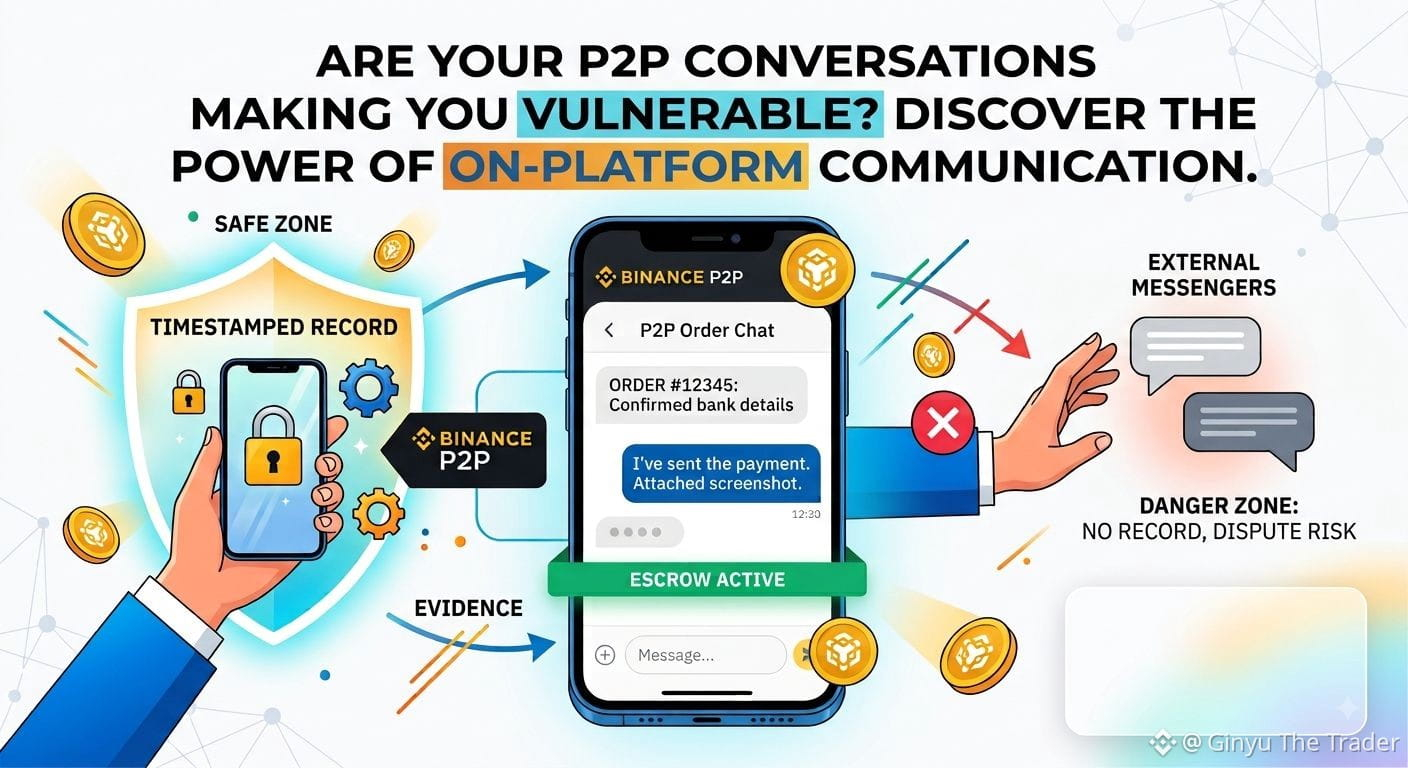
73
Anmelden und weiter Inhalte entdecken
Krypto-Nutzer weltweit auf Binance Square kennenlernen
⚡️ Bleib in Sachen Krypto stets am Puls.
💬 Die weltgrößte Kryptobörse vertraut darauf.
👍 Erhalte verlässliche Einblicke von verifizierten Creators.
E-Mail-Adresse/Telefonnummer
Trendthemen
HKMAPlansWholesaleCBDCByYearEnd
2,290 Aufrufe
141 Kommentare
#HKMAPlansWholesaleCBDCByYearEnd
🔥🇭🇰 HKMA CBDC — HANDELSRADAR IST AKTIV!
#HKMAPlansWholesaleCBDCByYearEnd
Hongkong treibt die Abwicklung von Wholesale-CBDC bis zum Jahresende 2026 voran. ⚡
🏦 24/7 digitale Abwicklung
💰 Tokenisierte Vermögenswerte + Einlagen
🌐 RWA-Übernahme als Story
🚀 Traditionelles Finanzwesen geht noch tiefer on-chain
👀 RWA + Tokenisierung + Zahlungsinfrastruktur — diese Narrative könnten frische Marktaufmerksamkeit anziehen.
🎯 Trade-Setup: Ausbruch → Retest → Volumenbestätigung
❌ Die erste grüne Kerze nicht jagen.
🛡️ Risiko managen + DYOR/NFA
Welches Narrativ bewegt sich zuerst? 👇
🔥 RWA | 💰 Tokenisierung | ⚡ CBDC
$IO $ONE $ARB
#HKMA #HongKong #Binance #trading
Shourov Saha-01
·2 Likes
·169 Aufrufe
NEARSurges26%Past$3.45
7,321 Aufrufe
83 Kommentare
BOJHikesRatesTo31YearHigh
18,928 Aufrufe
529 Kommentare