
BASTET MEME
142 Beiträge

BASTET MEME
Melden
Nutzer blockieren
Don't let your dreams one day be the foundation of investment, patience and restraint.
Trade eröffnen
Gelegenheitstrader
5 Jahre
36 Following
212 Follower
152 Like gegeben
Beiträge
Portfolio
Alle
Zitierungen
PINNED
·
--
Artikel
Übersetzung ansehen
Who Really Controls Your Crypto? The Security Question Every Investor Must AskImagine waking up one morning and discovering that your cryptocurrency is no longer accessible.
Your exchange account may still exist. Your balance may still appear on the screen. But what happens if the platform experiences a security breach, suspends withdrawals, or loses access to critical systems?
This raises one of the most important questions in the crypto industry:
Do you really own your crypto, or do you simply trust someone else to protect it?
The Difference Between Owning Crypto and Controlling It
When you keep your assets on a centralized exchange, the platform generally controls the private keys associated with its custodial wallets.
You have an account balance and the ability to trade, deposit, and withdraw, but you depend on the exchange's security systems, internal controls, and operational decisions.
This model offers convenience, liquidity, and fast trading. However, it also introduces risks:
Exchange security breaches.
Internal access vulnerabilities.
Withdrawal suspensions.
Operational failures.
Regulatory or liquidity-related restrictions.
On the other hand, self-custody gives users direct control over their private keys.
But there is a trade-off: if you lose your recovery phrase, expose your private key, or approve a malicious transaction, recovering your assets may be extremely difficult or impossible.
Neither model is completely risk-free.
Five Practical Steps Every Crypto Investor Should Take
1. Enable Strong Account Protection
Use an authenticator app or hardware security key where supported. Avoid relying exclusively on SMS authentication.
2. Secure Your Email Account
Your email is often the gateway to your financial accounts. Protect it with a unique password and strong two-factor authentication.
3. Activate Withdrawal Address Whitelisting
Where available, restrict withdrawals to previously approved wallet addresses.
4. Consider Self-Custody for Long-Term Holdings
Keep only the funds you need for active trading on exchanges. Consider a reputable hardware wallet for long-term storage, and securely back up your recovery phrase offline.
5. Verify Before You Trust
Check official announcements, proof-of-reserves information, security disclosures, and independent audit reports. Remember that proof of reserves alone does not necessarily establish that all customer liabilities are covered.
What Should the Future of Crypto Exchanges Look Like?
The solution is not to eliminate centralized exchanges. They remain important to liquidity, accessibility, and market infrastructure.
The real solution is to redesign how they protect customer assets.
Imagine a hybrid security model with:
Non-custodial options that allow users to maintain control of their assets.
Multi-party authorization for large withdrawals.
Independent security monitoring.
Automatic transaction delays when suspicious activity is detected.
Transparent proof of reserves and liabilities.
Regular independent security audits.
Clearly defined emergency protection mechanisms.
Under this model, compromising one employee account, one device, or one internal system should never be enough to authorize a catastrophic transfer.
A New Standard for Crypto Security
The industry should stop measuring security only by how much money an exchange can compensate after a disaster.
Real security means reducing the possibility of that disaster in the first place.
Investors deserve more than promises. They deserve transparency, accountability, and meaningful control over their assets.
The future of cryptocurrency should combine the convenience of centralized platforms with the ownership principles of decentralization.
Because in the end, the most important question is not how much crypto you own.
It is how much control you actually have over it.
Let's discuss:
If you could choose, which security model would you trust more?
A) Centralized exchanges with stronger protection and emergency reserves.
B) Non-custodial wallets where users control their private keys.
C) A hybrid system combining exchange convenience with direct user control.
Share your thoughts below. The future of crypto security should be shaped by informed investors, not just by the platforms that serve them.
Educational content only. Not financial or investment advice.
#Crypto
#Blockchain
#Web3
#DeFi
#CryptoEducation
$BNB
Who Really Controls Your Crypto? The Security Question Every Investor Must Ask
Imagine waking up one morning and discovering that your cryptocurrency is no longer accessible.
Your exchange account may still exist. Your balance may still appear on the screen. But what happens if the platform experiences a security breach, suspends withdrawals, or loses access to critical systems?
This raises one of the most important questions in the crypto industry:
Do you really own your crypto, or do you simply trust someone else to protect it?
The Difference Between Owning Crypto and Controlling It
When you keep your assets on a centralized exchange, the platform generally controls the private keys associated with its custodial wallets.
You have an account balance and the ability to trade, deposit, and withdraw, but you depend on the exchange's security systems, internal controls, and operational decisions.
This model offers convenience, liquidity, and fast trading. However, it also introduces risks:
Exchange security breaches.
Internal access vulnerabilities.
Withdrawal suspensions.
Operational failures.
Regulatory or liquidity-related restrictions.
On the other hand, self-custody gives users direct control over their private keys.
But there is a trade-off: if you lose your recovery phrase, expose your private key, or approve a malicious transaction, recovering your assets may be extremely difficult or impossible.
Neither model is completely risk-free.
Five Practical Steps Every Crypto Investor Should Take
1. Enable Strong Account Protection
Use an authenticator app or hardware security key where supported. Avoid relying exclusively on SMS authentication.
2. Secure Your Email Account
Your email is often the gateway to your financial accounts. Protect it with a unique password and strong two-factor authentication.
3. Activate Withdrawal Address Whitelisting
Where available, restrict withdrawals to previously approved wallet addresses.
4. Consider Self-Custody for Long-Term Holdings
Keep only the funds you need for active trading on exchanges. Consider a reputable hardware wallet for long-term storage, and securely back up your recovery phrase offline.
5. Verify Before You Trust
Check official announcements, proof-of-reserves information, security disclosures, and independent audit reports. Remember that proof of reserves alone does not necessarily establish that all customer liabilities are covered.
What Should the Future of Crypto Exchanges Look Like?
The solution is not to eliminate centralized exchanges. They remain important to liquidity, accessibility, and market infrastructure.
The real solution is to redesign how they protect customer assets.
Imagine a hybrid security model with:
Non-custodial options that allow users to maintain control of their assets.
Multi-party authorization for large withdrawals.
Independent security monitoring.
Automatic transaction delays when suspicious activity is detected.
Transparent proof of reserves and liabilities.
Regular independent security audits.
Clearly defined emergency protection mechanisms.
Under this model, compromising one employee account, one device, or one internal system should never be enough to authorize a catastrophic transfer.
A New Standard for Crypto Security
The industry should stop measuring security only by how much money an exchange can compensate after a disaster.
Real security means reducing the possibility of that disaster in the first place.
Investors deserve more than promises. They deserve transparency, accountability, and meaningful control over their assets.
The future of cryptocurrency should combine the convenience of centralized platforms with the ownership principles of decentralization.
Because in the end, the most important question is not how much crypto you own.
It is how much control you actually have over it.
Let's discuss:
If you could choose, which security model would you trust more?
A) Centralized exchanges with stronger protection and emergency reserves.
B) Non-custodial wallets where users control their private keys.
C) A hybrid system combining exchange convenience with direct user control.
Share your thoughts below. The future of crypto security should be shaped by informed investors, not just by the platforms that serve them.
Educational content only. Not financial or investment advice.
#Crypto
#Blockchain
#Web3
#DeFi
#CryptoEducation
$BNB
91
PINNED
·
--
Artikel
Übersetzung ansehen
Binance Security Crisis: Compensation Is Not Enough — We Need a Fundamental SolutionBinance's response to the recent security crisis, including asset recovery efforts, compensation measures, and the gradual restoration of withdrawals, represents important steps toward protecting users and maintaining confidence in the cryptocurrency ecosystem.
However, compensating victims after a major security breach is not a permanent solution. The real challenge is preventing unauthorized access and ensuring that no single compromised account, employee, device, or internal system can put billions of dollars at risk.
The cryptocurrency industry needs a fundamental change in its security model.
First, users should have the option to maintain direct control over their assets through non-custodial solutions, rather than relying entirely on centralized custody.
Second, large withdrawals and critical transactions should require approval from multiple independent security parties. No single employee, device, or compromised system should be able to authorize them alone.
Finally, a dedicated and independently monitored emergency protection fund should be maintained to help protect users in exceptional circumstances, with clear and transparent rules governing its use.
Binance has an opportunity to turn this crisis into a major step forward for the entire industry. Its strength should not be measured only by its ability to recover from a crisis, but by its ability to prevent the next one.
The goal should not simply be to build bigger compensation funds. It should be to build systems where catastrophic losses become significantly harder to execute in the first place.
Centralized exchanges can continue providing liquidity, convenience, and advanced trading services while adopting non-custodial options, stronger authorization mechanisms, and transparent security standards.
The fundamental principle is simple: Your assets should never depend on the security of a single account, employee, or company system.
The future of cryptocurrency must be built on prevention, transparency, and user control — not compensation after disaster strikes.
#BTC走势分析 #Binance #CZ #BNB_Market_Update #meme板块关注热点
$BNB
Binance Security Crisis: Compensation Is Not Enough — We Need a Fundamental Solution
Binance's response to the recent security crisis, including asset recovery efforts, compensation measures, and the gradual restoration of withdrawals, represents important steps toward protecting users and maintaining confidence in the cryptocurrency ecosystem.
However, compensating victims after a major security breach is not a permanent solution. The real challenge is preventing unauthorized access and ensuring that no single compromised account, employee, device, or internal system can put billions of dollars at risk.
The cryptocurrency industry needs a fundamental change in its security model.
First, users should have the option to maintain direct control over their assets through non-custodial solutions, rather than relying entirely on centralized custody.
Second, large withdrawals and critical transactions should require approval from multiple independent security parties. No single employee, device, or compromised system should be able to authorize them alone.
Finally, a dedicated and independently monitored emergency protection fund should be maintained to help protect users in exceptional circumstances, with clear and transparent rules governing its use.
Binance has an opportunity to turn this crisis into a major step forward for the entire industry. Its strength should not be measured only by its ability to recover from a crisis, but by its ability to prevent the next one.
The goal should not simply be to build bigger compensation funds. It should be to build systems where catastrophic losses become significantly harder to execute in the first place.
Centralized exchanges can continue providing liquidity, convenience, and advanced trading services while adopting non-custodial options, stronger authorization mechanisms, and transparent security standards.
The fundamental principle is simple: Your assets should never depend on the security of a single account, employee, or company system.
The future of cryptocurrency must be built on prevention, transparency, and user control — not compensation after disaster strikes.
#BTC走势分析 #Binance #CZ #BNB_Market_Update #meme板块关注热点
$BNB
122
·
--
Artikel
Übersetzung ansehen
What Happens to Your Crypto When War Breaks Out? A Survival Guide for Binance InvestorsImagine waking up tomorrow to news of a major global war.
Stock markets are falling. Oil prices are rising. Banks are facing uncertainty. Internet services may be disrupted. Millions of investors are asking the same question:
What happens to my cryptocurrency?
Bitcoin, Ethereum, stablecoins, and crypto exchanges operate in a global digital ecosystem. But that does not mean they are immune to geopolitical crises, financial panic, cyberattacks, or infrastructure failures.
For Binance investors, understanding these risks before a crisis is more valuable than trying to react after it begins.
Let's examine five critical questions.
1. What Could Happen to Bitcoin During a Global War?
Many people describe Bitcoin as digital gold.
However, there is an important difference: Bitcoin does not automatically behave like gold during a crisis.
In the early stages of a major geopolitical shock, investors may sell risky assets to obtain liquidity. This could create significant selling pressure across cryptocurrency markets.
Possible developments include:
Sharp Bitcoin price fluctuations.
Increased volatility in Ethereum and alternative coins.
Reduced market liquidity.
Sudden changes in investor sentiment.
Greater differences between buying and selling prices.
Bitcoin could recover later, but nobody can guarantee when or whether that will happen.
The lesson: Never assume that Bitcoin will automatically protect your portfolio during a war.
2. Are USDT and USDC Safe Havens During a War?
Stablecoins are often used by crypto investors to reduce exposure to price volatility.
But stablecoins are not the same as cash in your bank account.
They involve several risks:
The issuer's ability to maintain its reserves and redemption arrangements.
Potential freezing or restrictions affecting certain addresses.
Blockchain network outages or congestion.
Exchange withdrawal restrictions.
Banking and payment infrastructure disruptions.
Even if a stablecoin maintains its dollar peg, you may not be able to convert it into usable money when you need it.
Remember: Price stability does not guarantee access or liquidity.
3. What If Binance or the Internet Becomes Unavailable?
This is one of the most important risks investors should consider.
A global conflict could create disruptions affecting:
Internet connectivity.
Electricity infrastructure.
Banking services.
International payment systems.
Cryptocurrency exchange operations.
Blockchain network access.
A trading platform may remain operational while some users experience local connectivity problems.
Alternatively, an exchange could temporarily restrict certain services while addressing security or operational risks.
This is why investors should understand the difference between owning crypto through an exchange and controlling their own private keys.
An exchange provides convenience, but third-party custody introduces dependence on the service provider.
Self-custody provides direct control, but also makes the investor responsible for protecting private keys and recovery phrases.
Neither option eliminates every risk.
4. What If the Conflict Escalates to a Nuclear Attack?
This is an extreme hypothetical scenario, but it deserves serious consideration.
A nuclear attack could cause consequences far beyond financial markets.
Depending on the scale and location, possible effects could include:
Major electricity infrastructure damage.
Telecommunications and internet disruptions.
Banking and payment system interruptions.
Physical damage to data centers and network infrastructure.
Severe disruptions to transportation and supply chains.
Financial market closures or restrictions.
Bitcoin's blockchain is decentralized, but individual investors still depend on electricity, devices, internet access, network infrastructure, and functioning markets.
A decentralized blockchain does not mean every person can access it under every circumstance.
In such a scenario, personal safety, essential supplies, and reliable communication must come before cryptocurrency trading.
No digital asset should be treated as a guaranteed survival tool.
5. The Crypto Investor's Emergency Plan
Instead of trying to predict the next geopolitical event, investors should prepare for several possible disruptions.
Here is a practical checklist:
Before a crisis:
Avoid excessive leverage and highly risky Futures positions.
Never invest money needed for essential living expenses.
Consider distributing long-term holdings across appropriate custody arrangements.
Learn how to use a reputable hardware wallet before you actually need one.
Keep recovery phrases offline, secure, and separate from your devices.
Enable strong authentication and protect your email account.
Keep a reasonable amount of accessible emergency funds outside crypto.
During a crisis:
Avoid panic selling.
Do not make major decisions based on unverified social media reports.
Check official Binance announcements and network status information.
Avoid suspicious links claiming to offer emergency withdrawals or recovery services.
Do not rush into unfamiliar wallets or blockchain networks.
Avoid using leverage during extreme volatility.
After the crisis:
Verify your account balances and transaction history.
Confirm that withdrawal networks are operational.
Review your portfolio exposure and liquidity.
Reassess your investment strategy based on verified information.
Avoid rushing back into the market simply because prices have fallen.
6. The Biggest Mistake: Confusing Digital Ownership With Guaranteed Access
There is a critical distinction between owning a cryptocurrency and being able to access, transfer, or exchange it.
You may own Bitcoin on a blockchain, but still be unable to access it if you lose your recovery phrase or cannot connect to the network.
You may hold USDT, but still face restrictions when trying to redeem or convert it.
You may have a Binance balance, but temporarily lose access to trading or withdrawals during an operational disruption.
These are different risks, and a responsible investor should understand all of them.
Final Thought: Prepare for Uncertainty, Not Just Market Volatility
Nobody knows exactly how cryptocurrency markets would behave during a third world war or a nuclear conflict.
But one principle remains clear:
The best time to prepare your crypto emergency plan is before you need it.
Do not build your entire financial future around the assumption that exchanges will always be available, stablecoins will always be redeemable, or the internet will always work.
A smart investor does not simply ask:
"How much can I make if Bitcoin rises?"
A smart investor also asks:
"How will I protect my assets if the systems I depend on stop working?"
Let's Discuss
If a major global war started tomorrow, what would you do with your crypto holdings?
A) Keep them on Binance and continue monitoring the market.
B) Move long-term holdings to a personal hardware wallet.
C) Convert part of the portfolio into stablecoins.
D) Reduce crypto exposure and prioritize emergency liquidity.
E) Follow a diversified strategy combining several of these approaches.
Share your reasoning in the comments. Your perspective could help other investors prepare more intelligently.
Disclaimer: This article is for educational purposes only and does not constitute financial or investment advice. The scenarios discussed are hypothetical, not predictions. Always conduct your own research (DYOR) and assess your personal risk tolerance.
#Crypto
#Bitcoin
#Binance
#CryptoSecurity
#RiskManagement $BTC
What Happens to Your Crypto When War Breaks Out? A Survival Guide for Binance Investors
Imagine waking up tomorrow to news of a major global war.
Stock markets are falling. Oil prices are rising. Banks are facing uncertainty. Internet services may be disrupted. Millions of investors are asking the same question:
What happens to my cryptocurrency?
Bitcoin, Ethereum, stablecoins, and crypto exchanges operate in a global digital ecosystem. But that does not mean they are immune to geopolitical crises, financial panic, cyberattacks, or infrastructure failures.
For Binance investors, understanding these risks before a crisis is more valuable than trying to react after it begins.
Let's examine five critical questions.
1. What Could Happen to Bitcoin During a Global War?
Many people describe Bitcoin as digital gold.
However, there is an important difference: Bitcoin does not automatically behave like gold during a crisis.
In the early stages of a major geopolitical shock, investors may sell risky assets to obtain liquidity. This could create significant selling pressure across cryptocurrency markets.
Possible developments include:
Sharp Bitcoin price fluctuations.
Increased volatility in Ethereum and alternative coins.
Reduced market liquidity.
Sudden changes in investor sentiment.
Greater differences between buying and selling prices.
Bitcoin could recover later, but nobody can guarantee when or whether that will happen.
The lesson: Never assume that Bitcoin will automatically protect your portfolio during a war.
2. Are USDT and USDC Safe Havens During a War?
Stablecoins are often used by crypto investors to reduce exposure to price volatility.
But stablecoins are not the same as cash in your bank account.
They involve several risks:
The issuer's ability to maintain its reserves and redemption arrangements.
Potential freezing or restrictions affecting certain addresses.
Blockchain network outages or congestion.
Exchange withdrawal restrictions.
Banking and payment infrastructure disruptions.
Even if a stablecoin maintains its dollar peg, you may not be able to convert it into usable money when you need it.
Remember: Price stability does not guarantee access or liquidity.
3. What If Binance or the Internet Becomes Unavailable?
This is one of the most important risks investors should consider.
A global conflict could create disruptions affecting:
Internet connectivity.
Electricity infrastructure.
Banking services.
International payment systems.
Cryptocurrency exchange operations.
Blockchain network access.
A trading platform may remain operational while some users experience local connectivity problems.
Alternatively, an exchange could temporarily restrict certain services while addressing security or operational risks.
This is why investors should understand the difference between owning crypto through an exchange and controlling their own private keys.
An exchange provides convenience, but third-party custody introduces dependence on the service provider.
Self-custody provides direct control, but also makes the investor responsible for protecting private keys and recovery phrases.
Neither option eliminates every risk.
4. What If the Conflict Escalates to a Nuclear Attack?
This is an extreme hypothetical scenario, but it deserves serious consideration.
A nuclear attack could cause consequences far beyond financial markets.
Depending on the scale and location, possible effects could include:
Major electricity infrastructure damage.
Telecommunications and internet disruptions.
Banking and payment system interruptions.
Physical damage to data centers and network infrastructure.
Severe disruptions to transportation and supply chains.
Financial market closures or restrictions.
Bitcoin's blockchain is decentralized, but individual investors still depend on electricity, devices, internet access, network infrastructure, and functioning markets.
A decentralized blockchain does not mean every person can access it under every circumstance.
In such a scenario, personal safety, essential supplies, and reliable communication must come before cryptocurrency trading.
No digital asset should be treated as a guaranteed survival tool.
5. The Crypto Investor's Emergency Plan
Instead of trying to predict the next geopolitical event, investors should prepare for several possible disruptions.
Here is a practical checklist:
Before a crisis:
Avoid excessive leverage and highly risky Futures positions.
Never invest money needed for essential living expenses.
Consider distributing long-term holdings across appropriate custody arrangements.
Learn how to use a reputable hardware wallet before you actually need one.
Keep recovery phrases offline, secure, and separate from your devices.
Enable strong authentication and protect your email account.
Keep a reasonable amount of accessible emergency funds outside crypto.
During a crisis:
Avoid panic selling.
Do not make major decisions based on unverified social media reports.
Check official Binance announcements and network status information.
Avoid suspicious links claiming to offer emergency withdrawals or recovery services.
Do not rush into unfamiliar wallets or blockchain networks.
Avoid using leverage during extreme volatility.
After the crisis:
Verify your account balances and transaction history.
Confirm that withdrawal networks are operational.
Review your portfolio exposure and liquidity.
Reassess your investment strategy based on verified information.
Avoid rushing back into the market simply because prices have fallen.
6. The Biggest Mistake: Confusing Digital Ownership With Guaranteed Access
There is a critical distinction between owning a cryptocurrency and being able to access, transfer, or exchange it.
You may own Bitcoin on a blockchain, but still be unable to access it if you lose your recovery phrase or cannot connect to the network.
You may hold USDT, but still face restrictions when trying to redeem or convert it.
You may have a Binance balance, but temporarily lose access to trading or withdrawals during an operational disruption.
These are different risks, and a responsible investor should understand all of them.
Final Thought: Prepare for Uncertainty, Not Just Market Volatility
Nobody knows exactly how cryptocurrency markets would behave during a third world war or a nuclear conflict.
But one principle remains clear:
The best time to prepare your crypto emergency plan is before you need it.
Do not build your entire financial future around the assumption that exchanges will always be available, stablecoins will always be redeemable, or the internet will always work.
A smart investor does not simply ask:
"How much can I make if Bitcoin rises?"
A smart investor also asks:
"How will I protect my assets if the systems I depend on stop working?"
Let's Discuss
If a major global war started tomorrow, what would you do with your crypto holdings?
A) Keep them on Binance and continue monitoring the market.
B) Move long-term holdings to a personal hardware wallet.
C) Convert part of the portfolio into stablecoins.
D) Reduce crypto exposure and prioritize emergency liquidity.
E) Follow a diversified strategy combining several of these approaches.
Share your reasoning in the comments. Your perspective could help other investors prepare more intelligently.
Disclaimer: This article is for educational purposes only and does not constitute financial or investment advice. The scenarios discussed are hypothetical, not predictions. Always conduct your own research (DYOR) and assess your personal risk tolerance.
#Crypto
#Bitcoin
#Binance
#CryptoSecurity
#RiskManagement $BTC
127
·
--

Artikel
Übersetzung ansehen
Stop Guessing the Crypto Market: 3 Types of Analysis Every Investor Should UnderstandThe crypto market moves fast. Prices can rise sharply in hours, fall without warning, and change direction when investors least expect it.
But successful market analysis is not about predicting every move. It is about understanding the available evidence, identifying risks, and making decisions based on more than emotions.
If you want to understand where a cryptocurrency might be heading, you need to look at three important dimensions.
1. Technical Analysis: What Is the Price Telling You?
Technical analysis studies historical price movements and trading volume to identify possible market trends.
Here are five useful tools:
Support: A price area where buying interest has previously appeared.
Resistance: A price area where selling pressure has previously increased.
Moving Averages: Help identify the broader direction of a trend.
RSI: Measures the speed and strength of recent price movements.
Trading Volume: Helps evaluate whether a price movement has meaningful market participation.
For example, a cryptocurrency breaking above resistance with increasing trading volume may indicate stronger buying interest.
However, a breakout without sufficient confirmation can turn into a false signal.
Remember: Charts help you understand market behavior. They do not guarantee what happens next.
2. Fundamental Analysis: Does the Project Have Real Value?
A cryptocurrency should not be judged by its price alone.
Before evaluating a project, ask:
What problem does it actually solve?
Is there real demand for its technology?
Does it have a clear purpose and useful applications?
Are its tokenomics transparent?
Is the token supply concentrated in a small number of wallets?
Is the development team delivering on its roadmap?
A project with strong technology, genuine adoption, transparent tokenomics, and consistent development deserves deeper research than one relying entirely on marketing and hype.
A rising price does not automatically mean a project is becoming more valuable.
3. On-Chain Analysis: What Is Actually Happening on the Blockchain?
One of crypto's biggest advantages is transparency.
Public blockchain data can reveal activity that traditional financial markets do not always make available.
Useful indicators include:
Active Addresses: Are more people interacting with the network?
Transaction Volume: Is actual network activity increasing?
Whale Movements: Are large holders accumulating or distributing tokens?
Exchange Inflows and Outflows: Are assets moving toward exchanges or away from them?
TVL: How much capital is deposited in DeFi protocols?
But be careful: more transactions do not always mean more genuine users, and large wallet movements do not automatically predict a price increase or decrease.
Context matters.
The Smart Approach: Combine All Three
The strongest market research does not depend on a single indicator.
Imagine a cryptocurrency showing the following signals:
Its chart indicates an upward trend.
Its project is delivering real developments.
Its on-chain activity is growing consistently.
Together, these signals may provide a stronger research case than price movement alone.
But if the chart looks bullish while network activity is declining and token supply is becoming increasingly concentrated, that deserves further investigation.
A Simple Checklist Before Buying Any Cryptocurrency
Before making a decision, ask yourself:
Do I understand what this project does?
Is the current price movement supported by volume?
Are its fundamentals improving?
What does its on-chain activity reveal?
How much could I afford to lose if my analysis is wrong?
Never confuse a popular narrative with verified evidence.
Final Thought
The biggest advantage in crypto is not having the fastest reaction or discovering every new token first.
It is developing the discipline to separate real information from market noise.
Don't just watch the price. Understand the story behind it.
What do you trust most when analyzing a cryptocurrency?
A) Technical Analysis
B) Fundamental Analysis
C) On-Chain Data
D) A combination of all three
Share your perspective in the comments. Let's make crypto discussions more informed and useful.
Disclaimer: This article is for educational purposes only and does not constitute financial or investment advice. Always conduct your own research (DYOR) before making financial decisions.
#CryptoMarket
#MarketAnalysis
#TechnicalAnalysis
#FundamentalAnalysis
#OnChainAnalysis #BTC☀ #LearnFromMistakes
$BTC
Stop Guessing the Crypto Market: 3 Types of Analysis Every Investor Should Understand
The crypto market moves fast. Prices can rise sharply in hours, fall without warning, and change direction when investors least expect it.
But successful market analysis is not about predicting every move. It is about understanding the available evidence, identifying risks, and making decisions based on more than emotions.
If you want to understand where a cryptocurrency might be heading, you need to look at three important dimensions.
1. Technical Analysis: What Is the Price Telling You?
Technical analysis studies historical price movements and trading volume to identify possible market trends.
Here are five useful tools:
Support: A price area where buying interest has previously appeared.
Resistance: A price area where selling pressure has previously increased.
Moving Averages: Help identify the broader direction of a trend.
RSI: Measures the speed and strength of recent price movements.
Trading Volume: Helps evaluate whether a price movement has meaningful market participation.
For example, a cryptocurrency breaking above resistance with increasing trading volume may indicate stronger buying interest.
However, a breakout without sufficient confirmation can turn into a false signal.
Remember: Charts help you understand market behavior. They do not guarantee what happens next.
2. Fundamental Analysis: Does the Project Have Real Value?
A cryptocurrency should not be judged by its price alone.
Before evaluating a project, ask:
What problem does it actually solve?
Is there real demand for its technology?
Does it have a clear purpose and useful applications?
Are its tokenomics transparent?
Is the token supply concentrated in a small number of wallets?
Is the development team delivering on its roadmap?
A project with strong technology, genuine adoption, transparent tokenomics, and consistent development deserves deeper research than one relying entirely on marketing and hype.
A rising price does not automatically mean a project is becoming more valuable.
3. On-Chain Analysis: What Is Actually Happening on the Blockchain?
One of crypto's biggest advantages is transparency.
Public blockchain data can reveal activity that traditional financial markets do not always make available.
Useful indicators include:
Active Addresses: Are more people interacting with the network?
Transaction Volume: Is actual network activity increasing?
Whale Movements: Are large holders accumulating or distributing tokens?
Exchange Inflows and Outflows: Are assets moving toward exchanges or away from them?
TVL: How much capital is deposited in DeFi protocols?
But be careful: more transactions do not always mean more genuine users, and large wallet movements do not automatically predict a price increase or decrease.
Context matters.
The Smart Approach: Combine All Three
The strongest market research does not depend on a single indicator.
Imagine a cryptocurrency showing the following signals:
Its chart indicates an upward trend.
Its project is delivering real developments.
Its on-chain activity is growing consistently.
Together, these signals may provide a stronger research case than price movement alone.
But if the chart looks bullish while network activity is declining and token supply is becoming increasingly concentrated, that deserves further investigation.
A Simple Checklist Before Buying Any Cryptocurrency
Before making a decision, ask yourself:
Do I understand what this project does?
Is the current price movement supported by volume?
Are its fundamentals improving?
What does its on-chain activity reveal?
How much could I afford to lose if my analysis is wrong?
Never confuse a popular narrative with verified evidence.
Final Thought
The biggest advantage in crypto is not having the fastest reaction or discovering every new token first.
It is developing the discipline to separate real information from market noise.
Don't just watch the price. Understand the story behind it.
What do you trust most when analyzing a cryptocurrency?
A) Technical Analysis
B) Fundamental Analysis
C) On-Chain Data
D) A combination of all three
Share your perspective in the comments. Let's make crypto discussions more informed and useful.
Disclaimer: This article is for educational purposes only and does not constitute financial or investment advice. Always conduct your own research (DYOR) before making financial decisions.
#CryptoMarket
#MarketAnalysis
#TechnicalAnalysis
#FundamentalAnalysis
#OnChainAnalysis #BTC☀ #LearnFromMistakes
$BTC
57
·
--
Artikel
Übersetzung ansehen
Binance Security Incident: Stay Calm, Stay Informed, and Protect Your Crypto AssetsA Message to Every Binance User and Crypto Investor
The recent security incident involving Binance has understandably raised concerns across the cryptocurrency community. When an incident of this magnitude occurs, investors naturally ask three important questions:
Are my funds safe?
Can I still trust the platform?
What should I do to protect my investments?
These are reasonable questions, and they deserve clear, responsible answers rather than panic, speculation, or blind reassurance.
1. Understanding What Happened
On October 29, 2026, Binance disclosed a major security incident involving unauthorized withdrawals from its hot-wallet infrastructure, with an estimated impact of approximately $6.3 billion.
According to Binance's official updates:
The initial investigation indicated that a compromised engineer's laptop may have provided an entry point.
Further investigations uncovered additional security breach points.
Binance reported no evidence that wallet private keys had been leaked.
Approximately $3 billion in affected assets had been frozen through cooperation with industry partners.
Binance committed to covering the losses using its SAFU fund and corporate treasury.
The investigation is ongoing, and the complete technical explanation has not yet been published.
An important distinction: This incident involved Binance's wallet infrastructure. It does not mean that every individual user's account was hacked, nor does it mean that the underlying Bitcoin or blockchain networks have been compromised.
2. Should Binance Users Panic?
No. Panic is rarely a good financial strategy.
Binance has publicly committed to covering the losses associated with this incident, setting aside more than $6.34 billion in company funds according to its October 30 announcement.
This is an important commitment, but investors should distinguish between a company's public assurance and independently verifiable evidence.
The next important steps are:
Publication of updated Proof of Reserves.
Completion of the independent technical investigation.
Safe restoration of withdrawal services.
Transparent reporting on recovery efforts and security improvements.
Investors should follow these developments through official Binance announcements.
Trust should be supported by transparency, verification, and accountability.
3. How Can You Protect Your Binance Account?
Regardless of how secure an exchange may be, every investor should take personal responsibility for account security.
Here are essential precautions:
1. Enable Two-Factor Authentication (2FA)
Use an authenticator application or a hardware security key rather than relying exclusively on SMS verification.
2. Use a Strong, Unique Password
Never reuse your Binance password on email, social media, or other websites.
3. Activate the Anti-Phishing Code
This helps you identify genuine Binance emails and distinguish them from fraudulent messages.
4. Enable Withdrawal Address Whitelisting
Restrict withdrawals to previously approved wallet addresses whenever possible.
5. Review Your Account Activity
Regularly check:
Login history.
Recognized devices.
Active sessions.
API keys and their permissions.
Withdrawal history.
Immediately revoke anything you do not recognize.
6. Secure Your Email Account
Your email account is often a gateway to your financial accounts. Protect it with a unique password and strong two-factor authentication.
7. Never Share Verification Codes
Binance employees, support representatives, and legitimate security teams should never ask you to disclose your password, 2FA codes, or wallet recovery phrase.
4. Should You Keep All Your Crypto on an Exchange?
One of the most important lessons from this incident is that convenience and custody are not the same thing.
Centralized exchanges are useful for:
Trading.
Buying and selling cryptocurrencies.
Converting digital assets.
Managing short-term trading positions.
However, investors holding substantial amounts for the long term should consider using a personal self-custody wallet.
A hardware wallet can provide an additional layer of protection because the investor controls the private keys.
Remember:
Not your keys, not your coins.
However, self-custody also comes with responsibility. Losing your recovery phrase or exposing it to someone else can result in permanent loss of funds.
Never store your recovery phrase in screenshots, cloud notes, or messages.
5. What Should You Do During a Withdrawal Suspension?
If withdrawals are temporarily unavailable:
Do not panic.
Do not trust individuals claiming they can unlock your account.
Do not install unofficial applications.
Do not share your account credentials with anyone.
Follow official announcements regarding the restoration of services.
Once withdrawals are officially restored, verify the destination address carefully and consider making a small test transaction before transferring a larger amount.
Never make rushed decisions based on rumors or social media speculation.
6. A Lesson for the Entire Cryptocurrency Industry
This incident raises an important question that goes beyond Binance:
How can centralized exchanges guarantee that their internal systems, employee access, transaction authorization mechanisms, and customer assets remain protected?
The answer requires more than strong passwords and cold wallets.
The industry needs:
Independent security audits.
Strong internal access controls.
Multiple independent transaction approvals.
Transparent and regularly updated Proof of Reserves.
Clear separation between corporate assets and customer assets.
Public incident reports and accountability.
Security must protect not only private keys, but also every system and person capable of authorizing transactions.
7. Our Final Message to Binance Investors
Cryptocurrency is an evolving financial technology, and security incidents are a reminder that risks exist even within the largest platforms.
But one incident should not automatically be interpreted as the collapse of an entire industry or the failure of blockchain technology.
Be informed, not frightened.
Be cautious, not suspicious of everything.
Verify information before sharing it.
Protect your account before a problem occurs, not after.
And most importantly, never invest money you cannot afford to lose.
The future of cryptocurrency depends not only on innovation and market growth, but also on transparency, security, and the trust of its community.
Stay safe. Stay informed. Protect your assets.
Disclaimer: This article is for educational and informational purposes only. It is not financial or investment advice. Security incident details may change as Binance publishes further verified findings.
#BinanceReports80%Recoveryof$6.3BillioninLossesfromHackIncident #Binance #CZ #BTC #BNB $BTC
Binance Security Incident: Stay Calm, Stay Informed, and Protect Your Crypto Assets
A Message to Every Binance User and Crypto Investor
The recent security incident involving Binance has understandably raised concerns across the cryptocurrency community. When an incident of this magnitude occurs, investors naturally ask three important questions:
Are my funds safe?
Can I still trust the platform?
What should I do to protect my investments?
These are reasonable questions, and they deserve clear, responsible answers rather than panic, speculation, or blind reassurance.
1. Understanding What Happened
On October 29, 2026, Binance disclosed a major security incident involving unauthorized withdrawals from its hot-wallet infrastructure, with an estimated impact of approximately $6.3 billion.
According to Binance's official updates:
The initial investigation indicated that a compromised engineer's laptop may have provided an entry point.
Further investigations uncovered additional security breach points.
Binance reported no evidence that wallet private keys had been leaked.
Approximately $3 billion in affected assets had been frozen through cooperation with industry partners.
Binance committed to covering the losses using its SAFU fund and corporate treasury.
The investigation is ongoing, and the complete technical explanation has not yet been published.
An important distinction: This incident involved Binance's wallet infrastructure. It does not mean that every individual user's account was hacked, nor does it mean that the underlying Bitcoin or blockchain networks have been compromised.
2. Should Binance Users Panic?
No. Panic is rarely a good financial strategy.
Binance has publicly committed to covering the losses associated with this incident, setting aside more than $6.34 billion in company funds according to its October 30 announcement.
This is an important commitment, but investors should distinguish between a company's public assurance and independently verifiable evidence.
The next important steps are:
Publication of updated Proof of Reserves.
Completion of the independent technical investigation.
Safe restoration of withdrawal services.
Transparent reporting on recovery efforts and security improvements.
Investors should follow these developments through official Binance announcements.
Trust should be supported by transparency, verification, and accountability.
3. How Can You Protect Your Binance Account?
Regardless of how secure an exchange may be, every investor should take personal responsibility for account security.
Here are essential precautions:
1. Enable Two-Factor Authentication (2FA)
Use an authenticator application or a hardware security key rather than relying exclusively on SMS verification.
2. Use a Strong, Unique Password
Never reuse your Binance password on email, social media, or other websites.
3. Activate the Anti-Phishing Code
This helps you identify genuine Binance emails and distinguish them from fraudulent messages.
4. Enable Withdrawal Address Whitelisting
Restrict withdrawals to previously approved wallet addresses whenever possible.
5. Review Your Account Activity
Regularly check:
Login history.
Recognized devices.
Active sessions.
API keys and their permissions.
Withdrawal history.
Immediately revoke anything you do not recognize.
6. Secure Your Email Account
Your email account is often a gateway to your financial accounts. Protect it with a unique password and strong two-factor authentication.
7. Never Share Verification Codes
Binance employees, support representatives, and legitimate security teams should never ask you to disclose your password, 2FA codes, or wallet recovery phrase.
4. Should You Keep All Your Crypto on an Exchange?
One of the most important lessons from this incident is that convenience and custody are not the same thing.
Centralized exchanges are useful for:
Trading.
Buying and selling cryptocurrencies.
Converting digital assets.
Managing short-term trading positions.
However, investors holding substantial amounts for the long term should consider using a personal self-custody wallet.
A hardware wallet can provide an additional layer of protection because the investor controls the private keys.
Remember:
Not your keys, not your coins.
However, self-custody also comes with responsibility. Losing your recovery phrase or exposing it to someone else can result in permanent loss of funds.
Never store your recovery phrase in screenshots, cloud notes, or messages.
5. What Should You Do During a Withdrawal Suspension?
If withdrawals are temporarily unavailable:
Do not panic.
Do not trust individuals claiming they can unlock your account.
Do not install unofficial applications.
Do not share your account credentials with anyone.
Follow official announcements regarding the restoration of services.
Once withdrawals are officially restored, verify the destination address carefully and consider making a small test transaction before transferring a larger amount.
Never make rushed decisions based on rumors or social media speculation.
6. A Lesson for the Entire Cryptocurrency Industry
This incident raises an important question that goes beyond Binance:
How can centralized exchanges guarantee that their internal systems, employee access, transaction authorization mechanisms, and customer assets remain protected?
The answer requires more than strong passwords and cold wallets.
The industry needs:
Independent security audits.
Strong internal access controls.
Multiple independent transaction approvals.
Transparent and regularly updated Proof of Reserves.
Clear separation between corporate assets and customer assets.
Public incident reports and accountability.
Security must protect not only private keys, but also every system and person capable of authorizing transactions.
7. Our Final Message to Binance Investors
Cryptocurrency is an evolving financial technology, and security incidents are a reminder that risks exist even within the largest platforms.
But one incident should not automatically be interpreted as the collapse of an entire industry or the failure of blockchain technology.
Be informed, not frightened.
Be cautious, not suspicious of everything.
Verify information before sharing it.
Protect your account before a problem occurs, not after.
And most importantly, never invest money you cannot afford to lose.
The future of cryptocurrency depends not only on innovation and market growth, but also on transparency, security, and the trust of its community.
Stay safe. Stay informed. Protect your assets.
Disclaimer: This article is for educational and informational purposes only. It is not financial or investment advice. Security incident details may change as Binance publishes further verified findings.
#BinanceReports80%Recoveryof$6.3BillioninLossesfromHackIncident #Binance #CZ #BTC #BNB $BTC
133
·
--

Artikel
WENN DER TRAUM AUF DIE REALITÄT TRIFFTAm letzten Tag haben wir darüber gesprochen, wie BastetMeme gebaut wurde.
Keine große Team-Zuteilung.
Kein verborgenes Schatzversteck.
Keine Versprechen auf garantierten Reichtum.
Nur Transparenz, eine kleine Community und ein Traum.
Aber dann kam die Frage, die jedes Projekt irgendwann beantworten muss:
Kann eine gute Idee in einer Welt überleben, in der Aufmerksamkeit ihren Preis hat?
Wir haben auf die harte Tour gelernt, dass ein Projekt zu erstellen das eine ist.
Und Menschen dazu zu bringen, es zu bemerken, etwas anderes.
Wir teilten die Geschichte von Bastet.
Wir haben Inhalte erstellt.
Wir haben versucht, Gespräche zu beginnen.
Wir haben uns an die Crypto-Community gewandt.
WENN DER TRAUM AUF DIE REALITÄT TRIFFT
Am letzten Tag haben wir darüber gesprochen, wie BastetMeme gebaut wurde.
Keine große Team-Zuteilung.
Kein verborgenes Schatzversteck.
Keine Versprechen auf garantierten Reichtum.
Nur Transparenz, eine kleine Community und ein Traum.
Aber dann kam die Frage, die jedes Projekt irgendwann beantworten muss:
Kann eine gute Idee in einer Welt überleben, in der Aufmerksamkeit ihren Preis hat?
Wir haben auf die harte Tour gelernt, dass ein Projekt zu erstellen das eine ist.
Und Menschen dazu zu bringen, es zu bemerken, etwas anderes.
Wir teilten die Geschichte von Bastet.
Wir haben Inhalte erstellt.
Wir haben versucht, Gespräche zu beginnen.
Wir haben uns an die Crypto-Community gewandt.
98
·
--
Artikel
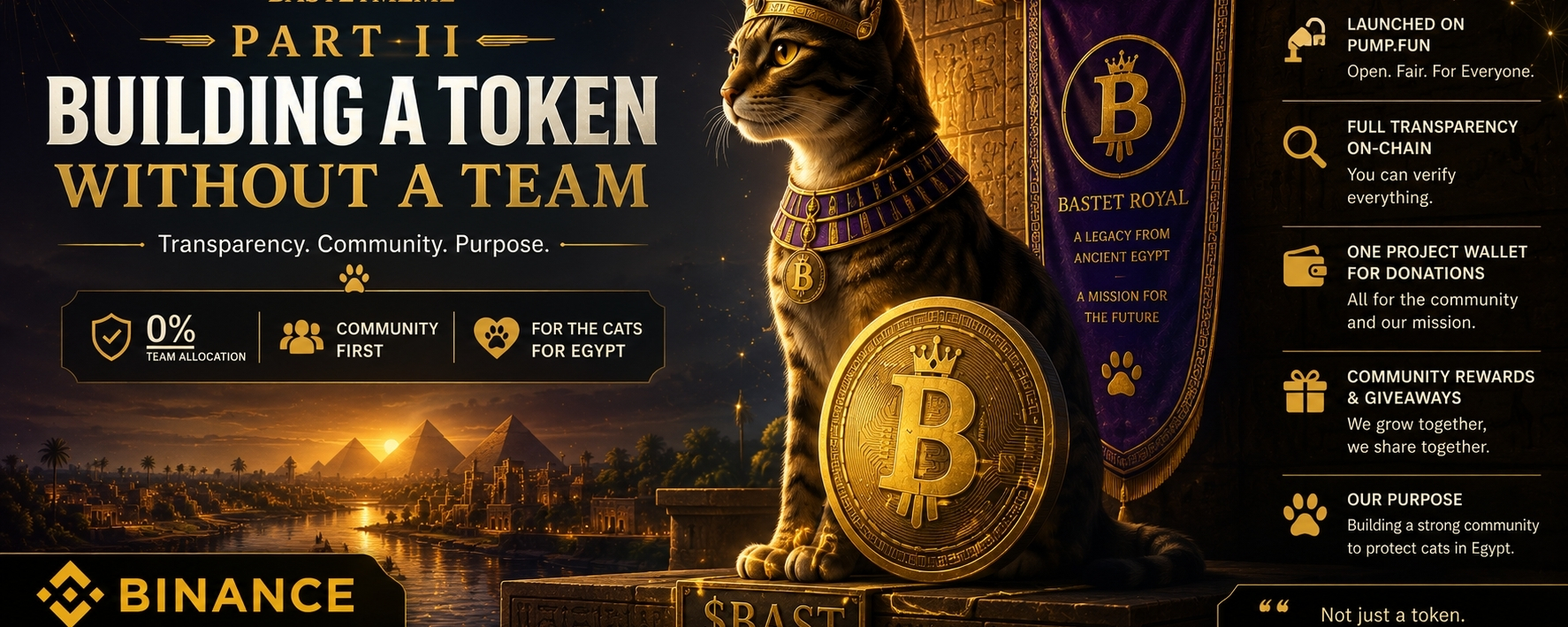
BASTETMEME — TEIL II
Ein Token Ohne Team BauenLetzten Freitag habe ich dir erzählt, wie BastetMeme begonnen hat.
Es begann mit einem Traum.
Aber ein Traum lässt sich leicht beschreiben.
Es zu bauen ist etwas anderes.
Als wir beschlossen, die Bastet-Idee in ein echtes Krypto-Projekt zu verwandeln, standen wir vor einer Frage, die jedes kleine Projekt irgendwann hat:
Wie baut man etwas, wenn man kein Vermögen im Rücken hat?
Unsere Antwort war einfach:
Bauen Sie es mit Transparenz. Bauen Sie es mit der Community.
Wir haben $BAST nicht mit einer traditionellen Team-Allokation erstellt.
Es gab keinen großen Prozentsatz, der für Entwickler, Gründer oder Insider reserviert war.
BASTETMEME — TEIL II Ein Token Ohne Team Bauen
Letzten Freitag habe ich dir erzählt, wie BastetMeme begonnen hat.
Es begann mit einem Traum.
Aber ein Traum lässt sich leicht beschreiben.
Es zu bauen ist etwas anderes.
Als wir beschlossen, die Bastet-Idee in ein echtes Krypto-Projekt zu verwandeln, standen wir vor einer Frage, die jedes kleine Projekt irgendwann hat:
Wie baut man etwas, wenn man kein Vermögen im Rücken hat?
Unsere Antwort war einfach:
Bauen Sie es mit Transparenz. Bauen Sie es mit der Community.
Wir haben $BAST nicht mit einer traditionellen Team-Allokation erstellt.
Es gab keinen großen Prozentsatz, der für Entwickler, Gründer oder Insider reserviert war.
61
·
--
Artikel
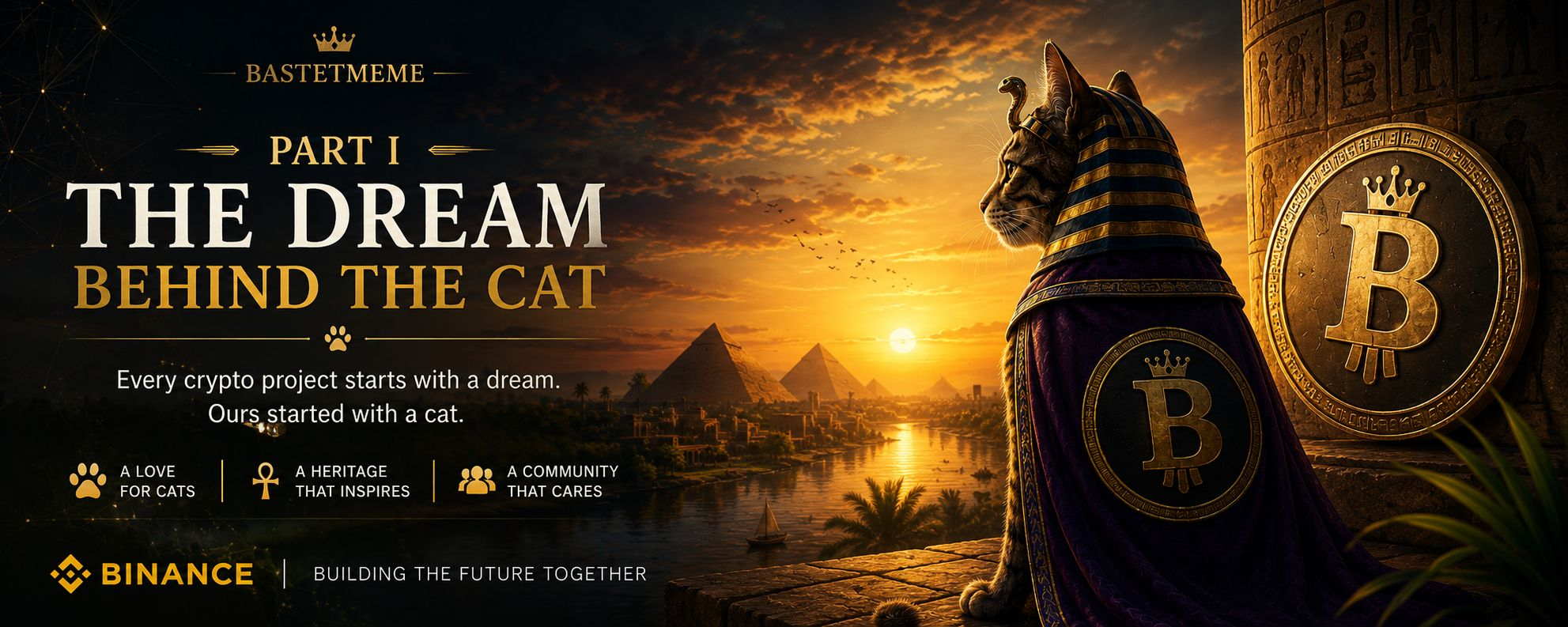
BASTETMEME — TEIL I
Der Traum hinter der KatzeJedes Krypto-Projekt beginnt mit einem Traum.
Manche Träume beginnen mit Geld.
Manche beginnen mit Ehrgeiz.
Unser Anfang war eine Katze.
Nicht mit einem Chart.
Nicht mit einem Marketingbudget.
Nicht mit dem Versprechen, reich zu werden.
Alles begann mit einer einfachen Frage:
Was, wenn eine Krypto-Community tatsächlich etwas Gutes für die Tiere tun könnte, die keine Stimme haben?
Ich habe schon immer Katzen und Tiere geliebt. Und ich war schon immer fasziniert von Krypto und Web3 — nicht nur, weil man damit handeln kann, sondern wegen der Idee dahinter: Menschen aus verschiedenen Orten können sich um eine Idee versammeln, ohne dass eine traditionelle Institution nötig ist, die sie zusammenbringt.
BASTETMEME — TEIL I Der Traum hinter der Katze
Jedes Krypto-Projekt beginnt mit einem Traum.
Manche Träume beginnen mit Geld.
Manche beginnen mit Ehrgeiz.
Unser Anfang war eine Katze.
Nicht mit einem Chart.
Nicht mit einem Marketingbudget.
Nicht mit dem Versprechen, reich zu werden.
Alles begann mit einer einfachen Frage:
Was, wenn eine Krypto-Community tatsächlich etwas Gutes für die Tiere tun könnte, die keine Stimme haben?
Ich habe schon immer Katzen und Tiere geliebt. Und ich war schon immer fasziniert von Krypto und Web3 — nicht nur, weil man damit handeln kann, sondern wegen der Idee dahinter: Menschen aus verschiedenen Orten können sich um eine Idee versammeln, ohne dass eine traditionelle Institution nötig ist, die sie zusammenbringt.
38
·
--
Bullisch
#fogo $FOGO
{future}(FOGOUSDT)
🔥
FOGO ist ein aufstrebendes Layer-1-Blockchain-Projekt, das für Hochgeschwindigkeitsleistung und skalierbare dezentrale Anwendungen konzipiert ist. Entwickelt, um ultraschnelle Transaktionen und geringe Latenzzeiten zu liefern, zielt es darauf ab, DeFi, Gaming und Plattformen der nächsten Generation im Web3 zu stärken. Kürzlich an großen Börsen gelistet, hat FOGO aufgrund seines mutigen Brandings und ehrgeizigen Fahrplans Aufmerksamkeit erregt. Obwohl es sich noch in der Anfangsphase befindet, kombiniert das Projekt technische Innovation mit wachsendem Interesse der Gemeinschaft und positioniert sich als dynamischer Mitbewerber im sich entwickelnden Krypto-Ökosystem.
#fogo $FOGO
🔥
FOGO ist ein aufstrebendes Layer-1-Blockchain-Projekt, das für Hochgeschwindigkeitsleistung und skalierbare dezentrale Anwendungen konzipiert ist. Entwickelt, um ultraschnelle Transaktionen und geringe Latenzzeiten zu liefern, zielt es darauf ab, DeFi, Gaming und Plattformen der nächsten Generation im Web3 zu stärken. Kürzlich an großen Börsen gelistet, hat FOGO aufgrund seines mutigen Brandings und ehrgeizigen Fahrplans Aufmerksamkeit erregt. Obwohl es sich noch in der Anfangsphase befindet, kombiniert das Projekt technische Innovation mit wachsendem Interesse der Gemeinschaft und positioniert sich als dynamischer Mitbewerber im sich entwickelnden Krypto-Ökosystem.
2
3
·
--
Bärisch
{future}(BTCUSDT)
Wir haben bereits gesagt, dass der Beginn des Anstiegs von Bitcoin auf den höchsten Punkt von einem vollständigen Zusammenbruch auf 60.000 und vielleicht mehr gefolgt wird!!
Ich unterstütze Pi$
Es ist die beste Investition, bevor es zu spät ist 🙂
Viele werden spotten, sich lustig machen und lachen und sagen
Ein weiterer Verrückter!!🚩🚩🚩
Aber die Zeit spricht zu uns
Das ist kein Investmentrat, sondern ein rotes Licht für diejenigen, die verstehen wollen 🚨🚨🚨
#pi
Ich unterstütze Pi$
Es ist die beste Investition, bevor es zu spät ist 🙂
Viele werden spotten, sich lustig machen und lachen und sagen
Ein weiterer Verrückter!!🚩🚩🚩
Aber die Zeit spricht zu uns
Das ist kein Investmentrat, sondern ein rotes Licht für diejenigen, die verstehen wollen 🚨🚨🚨
#pi

1
399
·
--
Künstliche Intelligenz ist nur ein moderner Verkaufsvertreter, der Sie zu großen Unternehmen und deren Projekten und Produkten führt, nicht mehr und nicht weniger.
Künstliche Intelligenz ist nur ein moderner Verkaufsvertreter, der Sie zu großen Unternehmen und deren Projekten und Produkten führt, nicht mehr und nicht weniger.
Elaouzi
·
--
Skandal um gefälschte Künstliche Intelligenz: Verkaufen uns 73% der Unternehmen "verbessertes ChatGPT"?
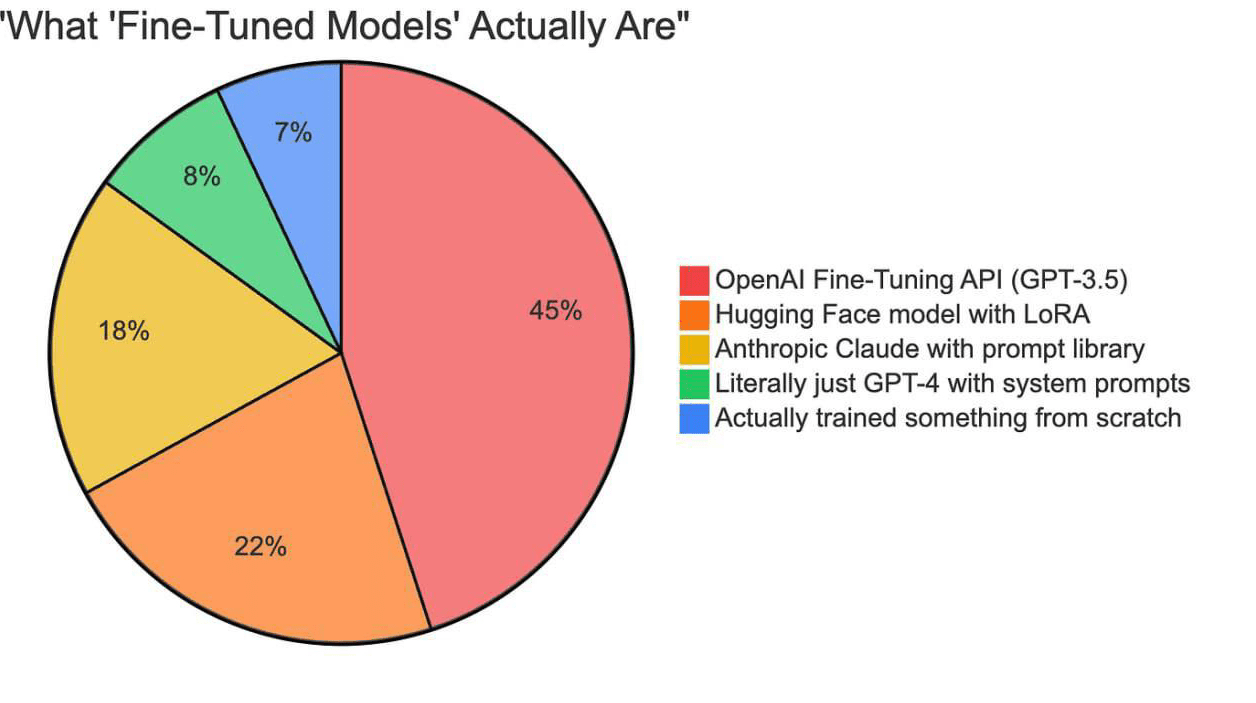
Liebe Follower, ich enthülle Ihnen die Wahrheit über den Künstliche Intelligenz-Markt, über die viele Menschen nicht sprechen wollen! Eine gründliche Analyse von über 200 Start-ups, die Finanzierung erhalten haben, hat gezeigt, dass die überwältigende Mehrheit (73%) hauptsächlich auf vorgefertigte Modelle von anderen Unternehmen angewiesen ist.
Ehrlich gesagt, was als "proprietäre und private Künstliche Intelligenz-Technologie" in vielen Produkten propagiert wird, ist nichts anderes als:
Ehrlich gesagt, was als "proprietäre und private Künstliche Intelligenz-Technologie" in vielen Produkten propagiert wird, ist nichts anderes als:
2
111
·
--

Artikel
Der ZeitverkäuferIn einer Stadt voller Träume, wo die Sterne hell am Nachthimmel leuchteten, gab es einen jungen Mann namens Ahmed, der eine seltsame und erstaunliche Idee hatte. Er beschloss, "Zeit" anstelle von Dingen zu verkaufen. Er verkaufte eine Minute seines Glücks, eine Stunde seiner Gedanken oder einen Tag seines Lebens. Er verkaufte Momente seiner Seele, und die Menschen kauften sie begierig.
Ahmed begann, Zeit zu verkaufen, und die Menschen begannen, bei ihm zu kaufen. Eine Person kaufte eine Minute seines Glücks, um ihren tristen Tag aufzuhellen, und eine andere kaufte eine Stunde seiner Gedanken, um eine Lösung für ein schwieriges Problem zu finden. Ahmed verkaufte Zeit zu hohen Preisen, aber die Menschen zahlten ohne Zögern.
Der Zeitverkäufer
In einer Stadt voller Träume, wo die Sterne hell am Nachthimmel leuchteten, gab es einen jungen Mann namens Ahmed, der eine seltsame und erstaunliche Idee hatte. Er beschloss, "Zeit" anstelle von Dingen zu verkaufen. Er verkaufte eine Minute seines Glücks, eine Stunde seiner Gedanken oder einen Tag seines Lebens. Er verkaufte Momente seiner Seele, und die Menschen kauften sie begierig.
Ahmed begann, Zeit zu verkaufen, und die Menschen begannen, bei ihm zu kaufen. Eine Person kaufte eine Minute seines Glücks, um ihren tristen Tag aufzuhellen, und eine andere kaufte eine Stunde seiner Gedanken, um eine Lösung für ein schwieriges Problem zu finden. Ahmed verkaufte Zeit zu hohen Preisen, aber die Menschen zahlten ohne Zögern.
Ahmed begann, Zeit zu verkaufen, und die Menschen begannen, bei ihm zu kaufen. Eine Person kaufte eine Minute seines Glücks, um ihren tristen Tag aufzuhellen, und eine andere kaufte eine Stunde seiner Gedanken, um eine Lösung für ein schwieriges Problem zu finden. Ahmed verkaufte Zeit zu hohen Preisen, aber die Menschen zahlten ohne Zögern.
10
·
--
Worte mehr als wunderbar
Worte mehr als wunderbar

Professor_MohammedEM
·
--
🌍🔥 Die Reise von Pi hat gerade erst begonnen!
Pioniere, wir leben die ersten Kapitel von etwas viel Größerem als nur einem weiteren Krypto-Projekt.
Die Geschichte von Pi basiert nicht auf Lärm oder leeren Versprechungen — sie basiert auf Vision, Geduld und Gemeinschaft.
Jetzt glauben einige Analysten, dass im Laufe der Zeit mehr als eine Billion Dollar in das Pi-Ökosystem fließen könnten.
Denken Sie einen Moment darüber nach — dieses Maß an Liquidität erschüttert nicht nur einen einzigen Token, sondern gestaltet die Landschaft der globalen Kryptowährungsadoption neu.

14
·
--
Ich bin der Meinung, dass jeder, der Informationen hat oder nicht, ohne Wissen urteilt. Ich hoffe, du überträgst keine Worte und Frieden; lies und suche selbst, bevor du urteilst.
Ich bin der Meinung, dass jeder, der Informationen hat oder nicht, ohne Wissen urteilt. Ich hoffe, du überträgst keine Worte und Frieden; lies und suche selbst, bevor du urteilst.
CRYPto tokens 89
·
--
Nachricht für die Besitzer von Pi-Währungs-Speichern
@yousif170: Betrug an allen, die dachten, der Preis sei 314.000 Dollar
✅ Ja, es hat sich tatsächlich gezeigt, dass Nikolas Koukalis oder das Gründungsteam der Pi Network-Währung mehr als 95% der gesamten Währung besitzen. Das macht das Projekt völlig unzuverlässig und verliert jegliche Glaubwürdigkeit als echte Kryptowährung.
🔹 Denn das bedeutet:
Die Währung ist vollständig zentralisiert — das heißt, die Entscheidung liegt in den Händen einer Person oder Institution und nicht in einem dezentralen Netzwerk wie es echte Währungen wie Bitcoin oder Ethereum behaupten.
69
·
--

Artikel
Bitcoin-Ausblick Q4 2025## Haupttreiber
1. Post-Halving Angebotsengpass (Auswirkungen der Halbierung 2024 intensivieren sich).
2. Globale Liquidität: Fed-Zinsentscheidungen (Senkungen = bullish).
3. Institutionelle Nachfrage: ETF-Zuflüsse, Unternehmensadoption.
4. Regulierung: Vollständige MiCA-Umsetzung (EU), politische Verschiebungen bei US-Wahlen.
5. Makro-Risiken: Inflation, Cyberangriffe, geopolitische Schocks.
---
### Preisszenarien
| Szenario | Wahrscheinlichkeit | BTC-Preisspanne | Katalysatoren
|---------------------|-----------------|---------------------|-----------------
Bitcoin-Ausblick Q4 2025
## Haupttreiber
1. Post-Halving Angebotsengpass (Auswirkungen der Halbierung 2024 intensivieren sich).
2. Globale Liquidität: Fed-Zinsentscheidungen (Senkungen = bullish).
3. Institutionelle Nachfrage: ETF-Zuflüsse, Unternehmensadoption.
4. Regulierung: Vollständige MiCA-Umsetzung (EU), politische Verschiebungen bei US-Wahlen.
5. Makro-Risiken: Inflation, Cyberangriffe, geopolitische Schocks.
---
### Preisszenarien
| Szenario | Wahrscheinlichkeit | BTC-Preisspanne | Katalysatoren
|---------------------|-----------------|---------------------|-----------------
1
28
·
--
Bullisch
Huma Finance ($HUMA);
Huma Finance ist eine dezentrale Finanzierungsplattform (PayFi), die traditionelle Finanzen (TradFi) mit dezentralen Finanzen (DeFi) verbindet. Ziel ist es, globale Zahlungen zu erleichtern, indem sofortige Liquidität auf der Blockchain bereitgestellt wird, mit dem Fokus auf einkommensbesicherten Krediten und schnellen finanziellen Abrechnungen. Die Plattform läuft auf dem Solana-Netzwerk, um Transaktionsgeschwindigkeit und geringe Kosten zu gewährleisten, und unterstützt Lösungen wie grenzüberschreitende Zahlungen und Echtzeit-Abrechnungen.
Zukunft von Huma Finance:
Schnelles Wachstum: Die Plattform hat ein erhebliches Wachstum mit PayFi-Transaktionen im Wert von 5,4 Milliarden Dollar in einem Jahr erzielt und zielt darauf ab, bis Ende 2025 10 Milliarden Dollar zu erreichen.
Partnerschaften: Sie arbeitet mit großen Akteuren wie Circle und Superstate zusammen, um Liquiditätsstrategien zu verbessern.
Marktpotenzial: Mit der steigenden Nachfrage nach DeFi-Lösungen, die mit traditionellen Finanzen verbunden sind, könnte Huma Finance eine vielversprechende Zukunft haben, sieht sich jedoch Risiken durch die Volatilität des Kryptowährungsmarktes gegenüber.
Herausforderungen: Ihr Erfolg hängt von der fortgesetzten Expansion, der Verbesserung der Benutzererfahrung und der Überwindung von regulatorischen und technischen Herausforderungen ab.
#HUMAFINANCE
$HUMA
Huma Finance ($HUMA );
Huma Finance ist eine dezentrale Finanzierungsplattform (PayFi), die traditionelle Finanzen (TradFi) mit dezentralen Finanzen (DeFi) verbindet. Ziel ist es, globale Zahlungen zu erleichtern, indem sofortige Liquidität auf der Blockchain bereitgestellt wird, mit dem Fokus auf einkommensbesicherten Krediten und schnellen finanziellen Abrechnungen. Die Plattform läuft auf dem Solana-Netzwerk, um Transaktionsgeschwindigkeit und geringe Kosten zu gewährleisten, und unterstützt Lösungen wie grenzüberschreitende Zahlungen und Echtzeit-Abrechnungen.
Zukunft von Huma Finance:
Schnelles Wachstum: Die Plattform hat ein erhebliches Wachstum mit PayFi-Transaktionen im Wert von 5,4 Milliarden Dollar in einem Jahr erzielt und zielt darauf ab, bis Ende 2025 10 Milliarden Dollar zu erreichen.
Partnerschaften: Sie arbeitet mit großen Akteuren wie Circle und Superstate zusammen, um Liquiditätsstrategien zu verbessern.
Marktpotenzial: Mit der steigenden Nachfrage nach DeFi-Lösungen, die mit traditionellen Finanzen verbunden sind, könnte Huma Finance eine vielversprechende Zukunft haben, sieht sich jedoch Risiken durch die Volatilität des Kryptowährungsmarktes gegenüber.
Herausforderungen: Ihr Erfolg hängt von der fortgesetzten Expansion, der Verbesserung der Benutzererfahrung und der Überwindung von regulatorischen und technischen Herausforderungen ab.
#HUMAFINANCE
$HUMA
195
·
--
Dies ist der Beginn eines starken Anstiegs des Bitcoin, um ein historisches Höchstniveau vor dem großen Zusammenbruch zu erreichen und den Bitcoin zum Tiefpunkt zu bringen 😂😂
Dies ist der Beginn eines starken Anstiegs des Bitcoin, um ein historisches Höchstniveau vor dem großen Zusammenbruch zu erreichen und den Bitcoin zum Tiefpunkt zu bringen 😂😂


حيتان العرب Arabicwhales
·
--
In den letzten 12 Stunden sind 8 Wallets aus der Satoshi-Ära nach 14 Jahren Stillstand aufgewacht und haben 80.000 $BTC im Wert von 8,68 Milliarden Dollar in neue Wallets transferiert! 😱
🔹 Zwei dieser Wallets haben Bitcoin im April 2011 zu einem Preis von 0,78 $ erhalten, die anderen im Mai 2011 zu einem Preis von 3,37$ — zu dieser Zeit betrug ihr Gesamtwert nur 217.8 Tausend Dollar!
🔹 Heute entspricht diese Menge 8,68 Milliarden Dollar, was einer Rendite von 39.800-fach entspricht! 🤯
📊 Ist das der Beginn eines massiven Verkaufs?
Teile deine Prognosen 👇

252
·
--
22
22

8_NovaMeme
·
--
BullischDas schwierigste Rätsel der Welt 📍📍📍📍📍🔥🔥🔥🔥🔥🔥
Nur die Menschen, die die Antwort nicht wissen, geben #answerthequestion werthequestion, derjenige, der die #Richtige Antwort gibt, wird der Gewinner #lockyquiz uiz $BTC $TRUMP $BTC TH
Nur die Menschen, die die Antwort nicht wissen, geben #answerthequestion werthequestion, derjenige, der die #Richtige Antwort gibt, wird der Gewinner #lockyquiz uiz $BTC $TRUMP $BTC TH


3
·
--
Nicht einmal Bitcoin und die Tage kommen
Nicht einmal Bitcoin und die Tage kommen

mras645
·
--
Dezentralisierung? Eine große Lüge 🤥
Nachdem die $200M-Marke im Netzwerk $SUI überschritten wurde, begannen sie, Transaktionen zu blockieren und Gelder einzufrieren 🚫💸
Die Maske ist gefallen, und wir haben die Wahrheit gesehen…
Das einzige, was wirklich dezentralisiert ist, ist Bitcoin 🟧
$SUI
$BTC
Nachdem die $200M-Marke im Netzwerk $SUI überschritten wurde, begannen sie, Transaktionen zu blockieren und Gelder einzufrieren 🚫💸
Die Maske ist gefallen, und wir haben die Wahrheit gesehen…
Das einzige, was wirklich dezentralisiert ist, ist Bitcoin 🟧
$SUI
$BTC

55
Anmelden und weiter Inhalte entdecken
Krypto-Nutzer weltweit auf Binance Square kennenlernen
⚡️ Bleib in Sachen Krypto stets am Puls.
💬 Die weltgrößte Kryptobörse vertraut darauf.
👍 Erhalte verlässliche Einblicke von verifizierten Creators.
E-Mail-Adresse/Telefonnummer
Trendthemen
USMidterms-WhatAreMarketsExpecting?
42,640 Aufrufe
475 Kommentare
Erdrutschsieg der Demokraten im Kongress erschüttert Trump-Wetten auf KI-Aktien und Kryptowährungen
Binance News
·4 Likes
·2.5k Aufrufe
USOctoberNFP-AreRateCutsStillPossible
220,540 Aufrufe
1,748 Kommentare
AMDBeatsExpectations-AINarrativeContinues
7,665 Aufrufe
181 Kommentare