
Idrees Official
5 Beiträge

Idrees Official
Melden
Nutzer blockieren
Web3 Growth Engine || Driving narratives, TGE campaigns, and market analysis for protocols.
2 Following
3 Follower
9 Like gegeben
Beiträge
Verifiziert
Artikel
Übersetzung ansehen
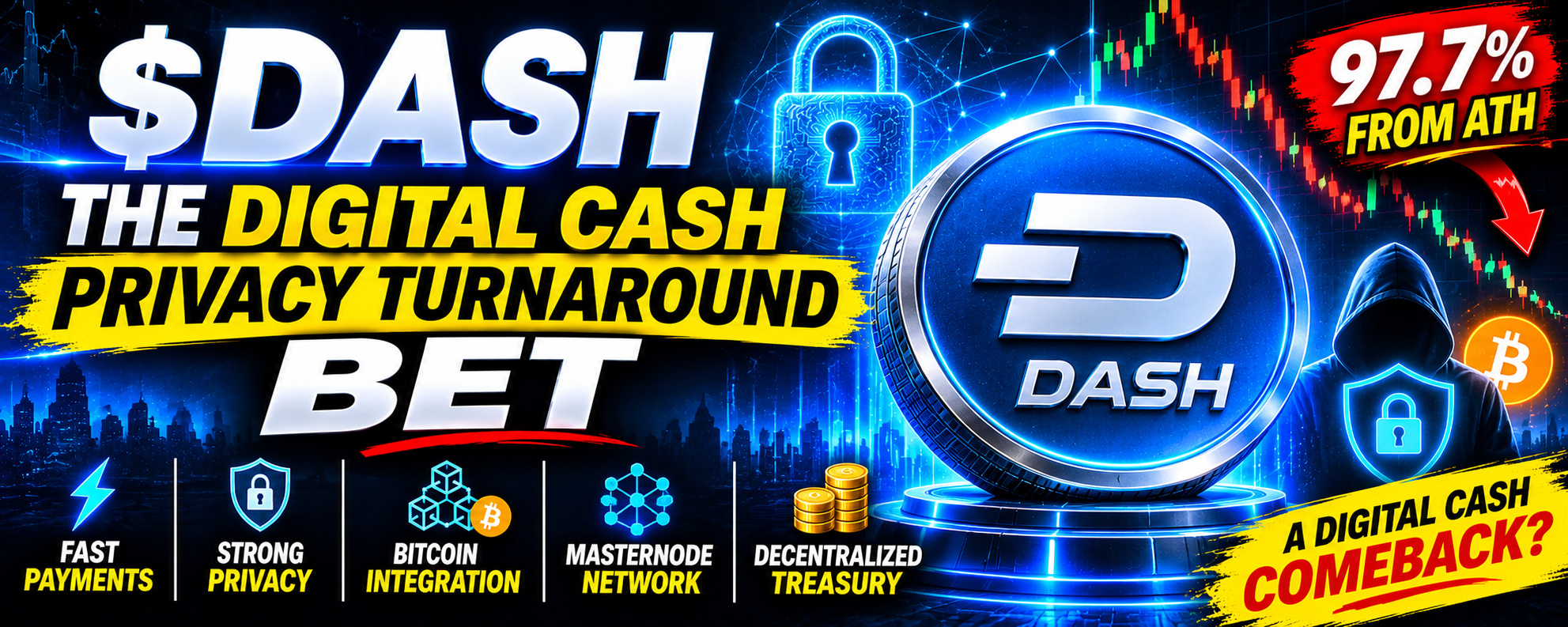
👀$DASH — THE DIGITAL CASH PRIVACY TURNAROUND BETA roughly $480 MILLION cryptocurrency.
⠀
Fewer than 13 MILLION coins circulating.
⠀
A payment network combining miners, masternodes, and a development treasury.
⠀
And a coin trading approximately 97.7% below its all-time high.
⠀
But here's the contradiction.
⠀
Dash has spent years building digital cash infrastructure.
⠀
Useful payment features still need users who repeatedly choose them.
⠀
Is $DASH an overlooked payments and privacy turnaround?
⠀
Or does an established network still struggle to create lasting monetary demand?
⠀
Let's examine the numbers.
⠀
01 | WHAT IS DASH?
⠀
Dash is a payments-focused cryptocurrency.
⠀
Its Core network combines proof-of-work mining with a second tier of masternodes.
⠀
InstantSend supports rapid transaction locking.
⠀
ChainLocks adds quorum-based protection against blockchain reorganizations.
⠀
The investment thesis is that digital cash should be fast, usable, and resilient.
⠀
But those qualities do not automatically establish an advantage customers will pay for.
⠀
Users already have alternatives.
⠀
The relevant question is why someone chooses DASH repeatedly, rather than merely testing a wallet.
⠀
Technical functionality creates an option.
⠀
Retained usage gives that option economic significance.
⠀
02 | THE NUMBERS THAT MATTER
⠀
November 19, 2026 snapshot:
⠀
DASH Price: ~$37.24
Market Cap: ~$480.43M
Reported FDV: ~$703.99M
Circulating Supply: ~12.898M DASH
Reported Current Total Supply: ~12.898M DASH
Tracker Maximum Supply: 18.9M DASH
Circulating / Tracker Maximum: ~68.2%
24H DASH Trading Volume: ~$42.23M
All-Time High: ~$1,642.22
Decline From ATH: ~97.7%
⠀
SUPPLY AND NETWORK FRAMEWORK:
⠀
Official documentation describes approximately 17.74M–18.92M eventual supply.
⠀
Budget utilization affects the final amount.
⠀
The documented block subsidy declines approximately 7.14% per year.
⠀
A regular masternode requires 1,000 DASH in collateral.
⠀
At the snapshot price, that represents approximately $37,240.
⠀
Exchange volume is not merchant payment volume.
⠀
Current total supply is not the same as final lifetime supply.
⠀
Those distinctions matter more than the unit price.
⠀
03 | PAYMENTS NEED MORE THAN SPEED
⠀
Fast confirmation improves the payment experience.
⠀
It does not solve every problem involved in spending cryptocurrency.
⠀
A customer still needs access to DASH.
⠀
A merchant needs reliable acceptance and settlement.
⠀
Both need a reason to prefer that process.
⠀
A volatile payment asset also creates a practical question:
⠀
How much exposure do users actually want to hold between transactions?
⠀
A network can facilitate payments while users minimize the time they hold its coin.
⠀
Therefore, rising payment activity does not guarantee proportional growth in monetary demand.
⠀
The stronger evidence is recurring usage alongside durable demand to hold or deploy DASH.
⠀
04 | THE PRIVACY THESIS HAS CHANGED
⠀
Dash's established Core privacy feature is CoinJoin.
⠀
That should not be confused with making every Core transaction confidential by default.
⠀
The newer development is Evolution.
⠀
An August 4 official announcement reported shielded transactions live on the Evolution mainnet, using Orchard-based zero-knowledge technology.
⠀
This materially updates the old description of Dash as offering only transaction mixing.
⠀
However, Core transactions, CoinJoin, and Evolution shielded activity remain distinct.
⠀
Investors should examine which payment path a wallet actually supports.
⠀
A privacy label is too broad to explain the implementation.
⠀
The user experience depends on the specific product.
⠀
05 | PRIVACY CAPABILITY IS NOT PRIVACY ADOPTION
⠀
Shipping confidential transactions is a technical milestone.
⠀
Commercial adoption requires additional evidence.
⠀
Are wallets making the feature accessible?
⠀
Do users return?
⠀
Can people fund and exit the system conveniently?
⠀
And does the experience remain usable under realistic conditions?
⠀
The August announcement itself distinguished mainnet availability from wallet support.
⠀
That illustrates why a network release should not be treated as universal product availability.
⠀
The investment case improves when confidential payments become a repeatable user habit.
⠀
A capability can be important without immediately changing the economics.
⠀
06 | WHAT MASTERNODE REWARDS REPRESENT
⠀
Masternodes provide network services and receive compensation.
⠀
They also participate in governance.
⠀
Collateral creates an incentive to maintain a valuable network.
⠀
But masternode income is not automatically profit funded by external customers.
⠀
It includes protocol subsidy.
⠀
An operator must also account for infrastructure expenses and the value of the collateral.
⠀
More DASH received can coexist with a decline in the position's dollar value.
⠀
Likewise, collateral is not permanently destroyed.
⠀
Official documentation states that moving it stops the node's participation and payments.
⠀
Investors should separate service compensation, operating costs, and total investment return.
⠀
A reward percentage cannot answer all three questions.
⠀
07 | THE TREASURY MODEL
⠀
Dash allocates part of its subsidy to a decentralized budget system.
⠀
The documented framework is approximately:
⠀
20% for miners.
⠀
60% for masternode rewards, including the Platform allocation.
⠀
20% for the governance budget.
⠀
Actual issuance depends partly on budget utilization.
⠀
This creates a recurring mechanism to fund development and ecosystem work.
⠀
It also creates a capital-allocation obligation.
⠀
Funding a proposal is an expense or investment by the network.
⠀
It is not evidence that the funded activity produced equivalent economic value.
⠀
The relevant questions are what was delivered, how much it cost, and whether users stayed.
⠀
Self-funding provides continuity.
⠀
Accountability determines its effectiveness.
⠀
08 | THE EVOLUTION EXPANSION
⠀
Dash Platform extends the project beyond basic coin transfers.
⠀
The Platform 5.0 release announcement described shielded token pools, application monetization, and expanded data-contract functionality.
⠀
That broadens the potential product set.
⠀
It also changes what investors need to monitor.
⠀
A release is different from activation.
⠀
Activation is different from wallet integration.
⠀
And integration is different from sustained usage.
⠀
The published 5.0 rollout explicitly depended on evonode signaling and epoch boundaries.
⠀
That is why a planned release date alone cannot prove every advertised capability is widely available.
⠀
The commercial test is whether applications attract recurring customers.
⠀
09 | THE NEXT PRODUCT TEST
⠀
The official roadmap listed further work on private contact requests, username payments, and application infrastructure.
⠀
Those directions address a real usability issue:
⠀
People generally prefer recognizable payment experiences to managing long addresses.
⠀
But roadmaps describe intended development.
⠀
They do not establish shipped functionality or adoption.
⠀
Investors should look for live releases, supported wallets, and repeat usage.
⠀
The most useful progress is a complete payment journey that works consistently.
⠀
A username can simplify the interface.
⠀
It cannot, by itself, create a reason to choose DASH over an existing payment method.
⠀
10 | THE VALUATION QUESTION
⠀
Using approximately 12.898 million current coins:
⠀
$50 DASH implies ~$645M current-supply valuation.
$100 implies ~$1.29B.
$250 implies ~$3.22B.
$500 implies ~$6.45B.
⠀
A return to $1,642.22 would imply approximately $21.18 billion.
⠀
These are valuation illustrations, not price targets.
⠀
Future issuance increases the denominator.
⠀
An old price peak therefore cannot be treated as a simple recovery destination.
⠀
The current thesis needs assumptions about monetary demand, payment adoption, and competitive relevance.
⠀
A low coin count does not make the asset inexpensive.
⠀
Scarcity matters only alongside demand.
⠀
11 | THE BULL AND BEAR CASE
⠀
THE BULL CASE:
⠀
Dash turns its payment features into recurring usage.
⠀
Evolution makes confidential transactions easier to access.
⠀
Applications create additional reasons to use the network.
⠀
Treasury spending produces measurable results.
⠀
And demand grows faster than circulating supply.
⠀
THE BEAR CASE:
⠀
Users prefer alternatives with stronger distribution.
⠀
Privacy capabilities attract attention but limited repeat activity.
⠀
Masternode incentives remain heavily dependent on subsidy.
⠀
Development funding produces insufficient commercial traction.
⠀
And the legacy brand fails to regain relevance.
⠀
Longevity demonstrates persistence.
⠀
It does not guarantee future market share.
⠀
12 | THE FINAL VERDICT
⠀
Dash has identifiable strengths.
⠀
Rapid payment functionality.
⠀
An established masternode system.
⠀
A recurring development budget.
⠀
And newer shielded capabilities on Evolution.
⠀
But the investment case remains conditional.
⠀
A roughly $480 million market capitalization.
⠀
Approximately $704 million in reported fully diluted value.
⠀
Continuing issuance.
⠀
And a need to prove that product development translates into sustained demand.
⠀
My assessment:
⠀
DASH is a digital cash and privacy turnaround thesis.
⠀
The decisive evidence is a growing group of users choosing it repeatedly because the experience solves a meaningful problem.
⠀
More features create possibilities.
⠀
Better wallets reduce friction.
⠀
Recurring payments demonstrate usefulness.
⠀
Durable demand determines the monetary value.
⠀
A 97.7% drawdown describes the distance from an old peak.
⠀
It does not establish how much of that value should return.
⠀
Bookmark this analysis before the next payments and privacy rotation.
⠀
Which has the strongest long-term digital cash thesis?
⠀
$DASH , $LTC , or $XMR ?
⠀
And can Dash turn its Evolution upgrades into lasting user demand?
⠀
Drop your view below.
{future}(DASHUSDT)
{future}(LTCUSDT)
{future}(XMRUSDT)
#DASH/USDT
👀$DASH — THE DIGITAL CASH PRIVACY TURNAROUND BET
A roughly $480 MILLION cryptocurrency.
⠀
Fewer than 13 MILLION coins circulating.
⠀
A payment network combining miners, masternodes, and a development treasury.
⠀
And a coin trading approximately 97.7% below its all-time high.
⠀
But here's the contradiction.
⠀
Dash has spent years building digital cash infrastructure.
⠀
Useful payment features still need users who repeatedly choose them.
⠀
Is $DASH an overlooked payments and privacy turnaround?
⠀
Or does an established network still struggle to create lasting monetary demand?
⠀
Let's examine the numbers.
⠀
01 | WHAT IS DASH?
⠀
Dash is a payments-focused cryptocurrency.
⠀
Its Core network combines proof-of-work mining with a second tier of masternodes.
⠀
InstantSend supports rapid transaction locking.
⠀
ChainLocks adds quorum-based protection against blockchain reorganizations.
⠀
The investment thesis is that digital cash should be fast, usable, and resilient.
⠀
But those qualities do not automatically establish an advantage customers will pay for.
⠀
Users already have alternatives.
⠀
The relevant question is why someone chooses DASH repeatedly, rather than merely testing a wallet.
⠀
Technical functionality creates an option.
⠀
Retained usage gives that option economic significance.
⠀
02 | THE NUMBERS THAT MATTER
⠀
November 19, 2026 snapshot:
⠀
DASH Price: ~$37.24
Market Cap: ~$480.43M
Reported FDV: ~$703.99M
Circulating Supply: ~12.898M DASH
Reported Current Total Supply: ~12.898M DASH
Tracker Maximum Supply: 18.9M DASH
Circulating / Tracker Maximum: ~68.2%
24H DASH Trading Volume: ~$42.23M
All-Time High: ~$1,642.22
Decline From ATH: ~97.7%
⠀
SUPPLY AND NETWORK FRAMEWORK:
⠀
Official documentation describes approximately 17.74M–18.92M eventual supply.
⠀
Budget utilization affects the final amount.
⠀
The documented block subsidy declines approximately 7.14% per year.
⠀
A regular masternode requires 1,000 DASH in collateral.
⠀
At the snapshot price, that represents approximately $37,240.
⠀
Exchange volume is not merchant payment volume.
⠀
Current total supply is not the same as final lifetime supply.
⠀
Those distinctions matter more than the unit price.
⠀
03 | PAYMENTS NEED MORE THAN SPEED
⠀
Fast confirmation improves the payment experience.
⠀
It does not solve every problem involved in spending cryptocurrency.
⠀
A customer still needs access to DASH.
⠀
A merchant needs reliable acceptance and settlement.
⠀
Both need a reason to prefer that process.
⠀
A volatile payment asset also creates a practical question:
⠀
How much exposure do users actually want to hold between transactions?
⠀
A network can facilitate payments while users minimize the time they hold its coin.
⠀
Therefore, rising payment activity does not guarantee proportional growth in monetary demand.
⠀
The stronger evidence is recurring usage alongside durable demand to hold or deploy DASH.
⠀
04 | THE PRIVACY THESIS HAS CHANGED
⠀
Dash's established Core privacy feature is CoinJoin.
⠀
That should not be confused with making every Core transaction confidential by default.
⠀
The newer development is Evolution.
⠀
An August 4 official announcement reported shielded transactions live on the Evolution mainnet, using Orchard-based zero-knowledge technology.
⠀
This materially updates the old description of Dash as offering only transaction mixing.
⠀
However, Core transactions, CoinJoin, and Evolution shielded activity remain distinct.
⠀
Investors should examine which payment path a wallet actually supports.
⠀
A privacy label is too broad to explain the implementation.
⠀
The user experience depends on the specific product.
⠀
05 | PRIVACY CAPABILITY IS NOT PRIVACY ADOPTION
⠀
Shipping confidential transactions is a technical milestone.
⠀
Commercial adoption requires additional evidence.
⠀
Are wallets making the feature accessible?
⠀
Do users return?
⠀
Can people fund and exit the system conveniently?
⠀
And does the experience remain usable under realistic conditions?
⠀
The August announcement itself distinguished mainnet availability from wallet support.
⠀
That illustrates why a network release should not be treated as universal product availability.
⠀
The investment case improves when confidential payments become a repeatable user habit.
⠀
A capability can be important without immediately changing the economics.
⠀
06 | WHAT MASTERNODE REWARDS REPRESENT
⠀
Masternodes provide network services and receive compensation.
⠀
They also participate in governance.
⠀
Collateral creates an incentive to maintain a valuable network.
⠀
But masternode income is not automatically profit funded by external customers.
⠀
It includes protocol subsidy.
⠀
An operator must also account for infrastructure expenses and the value of the collateral.
⠀
More DASH received can coexist with a decline in the position's dollar value.
⠀
Likewise, collateral is not permanently destroyed.
⠀
Official documentation states that moving it stops the node's participation and payments.
⠀
Investors should separate service compensation, operating costs, and total investment return.
⠀
A reward percentage cannot answer all three questions.
⠀
07 | THE TREASURY MODEL
⠀
Dash allocates part of its subsidy to a decentralized budget system.
⠀
The documented framework is approximately:
⠀
20% for miners.
⠀
60% for masternode rewards, including the Platform allocation.
⠀
20% for the governance budget.
⠀
Actual issuance depends partly on budget utilization.
⠀
This creates a recurring mechanism to fund development and ecosystem work.
⠀
It also creates a capital-allocation obligation.
⠀
Funding a proposal is an expense or investment by the network.
⠀
It is not evidence that the funded activity produced equivalent economic value.
⠀
The relevant questions are what was delivered, how much it cost, and whether users stayed.
⠀
Self-funding provides continuity.
⠀
Accountability determines its effectiveness.
⠀
08 | THE EVOLUTION EXPANSION
⠀
Dash Platform extends the project beyond basic coin transfers.
⠀
The Platform 5.0 release announcement described shielded token pools, application monetization, and expanded data-contract functionality.
⠀
That broadens the potential product set.
⠀
It also changes what investors need to monitor.
⠀
A release is different from activation.
⠀
Activation is different from wallet integration.
⠀
And integration is different from sustained usage.
⠀
The published 5.0 rollout explicitly depended on evonode signaling and epoch boundaries.
⠀
That is why a planned release date alone cannot prove every advertised capability is widely available.
⠀
The commercial test is whether applications attract recurring customers.
⠀
09 | THE NEXT PRODUCT TEST
⠀
The official roadmap listed further work on private contact requests, username payments, and application infrastructure.
⠀
Those directions address a real usability issue:
⠀
People generally prefer recognizable payment experiences to managing long addresses.
⠀
But roadmaps describe intended development.
⠀
They do not establish shipped functionality or adoption.
⠀
Investors should look for live releases, supported wallets, and repeat usage.
⠀
The most useful progress is a complete payment journey that works consistently.
⠀
A username can simplify the interface.
⠀
It cannot, by itself, create a reason to choose DASH over an existing payment method.
⠀
10 | THE VALUATION QUESTION
⠀
Using approximately 12.898 million current coins:
⠀
$50 DASH implies ~$645M current-supply valuation.
$100 implies ~$1.29B.
$250 implies ~$3.22B.
$500 implies ~$6.45B.
⠀
A return to $1,642.22 would imply approximately $21.18 billion.
⠀
These are valuation illustrations, not price targets.
⠀
Future issuance increases the denominator.
⠀
An old price peak therefore cannot be treated as a simple recovery destination.
⠀
The current thesis needs assumptions about monetary demand, payment adoption, and competitive relevance.
⠀
A low coin count does not make the asset inexpensive.
⠀
Scarcity matters only alongside demand.
⠀
11 | THE BULL AND BEAR CASE
⠀
THE BULL CASE:
⠀
Dash turns its payment features into recurring usage.
⠀
Evolution makes confidential transactions easier to access.
⠀
Applications create additional reasons to use the network.
⠀
Treasury spending produces measurable results.
⠀
And demand grows faster than circulating supply.
⠀
THE BEAR CASE:
⠀
Users prefer alternatives with stronger distribution.
⠀
Privacy capabilities attract attention but limited repeat activity.
⠀
Masternode incentives remain heavily dependent on subsidy.
⠀
Development funding produces insufficient commercial traction.
⠀
And the legacy brand fails to regain relevance.
⠀
Longevity demonstrates persistence.
⠀
It does not guarantee future market share.
⠀
12 | THE FINAL VERDICT
⠀
Dash has identifiable strengths.
⠀
Rapid payment functionality.
⠀
An established masternode system.
⠀
A recurring development budget.
⠀
And newer shielded capabilities on Evolution.
⠀
But the investment case remains conditional.
⠀
A roughly $480 million market capitalization.
⠀
Approximately $704 million in reported fully diluted value.
⠀
Continuing issuance.
⠀
And a need to prove that product development translates into sustained demand.
⠀
My assessment:
⠀
DASH is a digital cash and privacy turnaround thesis.
⠀
The decisive evidence is a growing group of users choosing it repeatedly because the experience solves a meaningful problem.
⠀
More features create possibilities.
⠀
Better wallets reduce friction.
⠀
Recurring payments demonstrate usefulness.
⠀
Durable demand determines the monetary value.
⠀
A 97.7% drawdown describes the distance from an old peak.
⠀
It does not establish how much of that value should return.
⠀
Bookmark this analysis before the next payments and privacy rotation.
⠀
Which has the strongest long-term digital cash thesis?
⠀
$DASH , $LTC , or $XMR ?
⠀
And can Dash turn its Evolution upgrades into lasting user demand?
⠀
Drop your view below.
#DASH/USDT
⠀
Fewer than 13 MILLION coins circulating.
⠀
A payment network combining miners, masternodes, and a development treasury.
⠀
And a coin trading approximately 97.7% below its all-time high.
⠀
But here's the contradiction.
⠀
Dash has spent years building digital cash infrastructure.
⠀
Useful payment features still need users who repeatedly choose them.
⠀
Is $DASH an overlooked payments and privacy turnaround?
⠀
Or does an established network still struggle to create lasting monetary demand?
⠀
Let's examine the numbers.
⠀
01 | WHAT IS DASH?
⠀
Dash is a payments-focused cryptocurrency.
⠀
Its Core network combines proof-of-work mining with a second tier of masternodes.
⠀
InstantSend supports rapid transaction locking.
⠀
ChainLocks adds quorum-based protection against blockchain reorganizations.
⠀
The investment thesis is that digital cash should be fast, usable, and resilient.
⠀
But those qualities do not automatically establish an advantage customers will pay for.
⠀
Users already have alternatives.
⠀
The relevant question is why someone chooses DASH repeatedly, rather than merely testing a wallet.
⠀
Technical functionality creates an option.
⠀
Retained usage gives that option economic significance.
⠀
02 | THE NUMBERS THAT MATTER
⠀
November 19, 2026 snapshot:
⠀
DASH Price: ~$37.24
Market Cap: ~$480.43M
Reported FDV: ~$703.99M
Circulating Supply: ~12.898M DASH
Reported Current Total Supply: ~12.898M DASH
Tracker Maximum Supply: 18.9M DASH
Circulating / Tracker Maximum: ~68.2%
24H DASH Trading Volume: ~$42.23M
All-Time High: ~$1,642.22
Decline From ATH: ~97.7%
⠀
SUPPLY AND NETWORK FRAMEWORK:
⠀
Official documentation describes approximately 17.74M–18.92M eventual supply.
⠀
Budget utilization affects the final amount.
⠀
The documented block subsidy declines approximately 7.14% per year.
⠀
A regular masternode requires 1,000 DASH in collateral.
⠀
At the snapshot price, that represents approximately $37,240.
⠀
Exchange volume is not merchant payment volume.
⠀
Current total supply is not the same as final lifetime supply.
⠀
Those distinctions matter more than the unit price.
⠀
03 | PAYMENTS NEED MORE THAN SPEED
⠀
Fast confirmation improves the payment experience.
⠀
It does not solve every problem involved in spending cryptocurrency.
⠀
A customer still needs access to DASH.
⠀
A merchant needs reliable acceptance and settlement.
⠀
Both need a reason to prefer that process.
⠀
A volatile payment asset also creates a practical question:
⠀
How much exposure do users actually want to hold between transactions?
⠀
A network can facilitate payments while users minimize the time they hold its coin.
⠀
Therefore, rising payment activity does not guarantee proportional growth in monetary demand.
⠀
The stronger evidence is recurring usage alongside durable demand to hold or deploy DASH.
⠀
04 | THE PRIVACY THESIS HAS CHANGED
⠀
Dash's established Core privacy feature is CoinJoin.
⠀
That should not be confused with making every Core transaction confidential by default.
⠀
The newer development is Evolution.
⠀
An August 4 official announcement reported shielded transactions live on the Evolution mainnet, using Orchard-based zero-knowledge technology.
⠀
This materially updates the old description of Dash as offering only transaction mixing.
⠀
However, Core transactions, CoinJoin, and Evolution shielded activity remain distinct.
⠀
Investors should examine which payment path a wallet actually supports.
⠀
A privacy label is too broad to explain the implementation.
⠀
The user experience depends on the specific product.
⠀
05 | PRIVACY CAPABILITY IS NOT PRIVACY ADOPTION
⠀
Shipping confidential transactions is a technical milestone.
⠀
Commercial adoption requires additional evidence.
⠀
Are wallets making the feature accessible?
⠀
Do users return?
⠀
Can people fund and exit the system conveniently?
⠀
And does the experience remain usable under realistic conditions?
⠀
The August announcement itself distinguished mainnet availability from wallet support.
⠀
That illustrates why a network release should not be treated as universal product availability.
⠀
The investment case improves when confidential payments become a repeatable user habit.
⠀
A capability can be important without immediately changing the economics.
⠀
06 | WHAT MASTERNODE REWARDS REPRESENT
⠀
Masternodes provide network services and receive compensation.
⠀
They also participate in governance.
⠀
Collateral creates an incentive to maintain a valuable network.
⠀
But masternode income is not automatically profit funded by external customers.
⠀
It includes protocol subsidy.
⠀
An operator must also account for infrastructure expenses and the value of the collateral.
⠀
More DASH received can coexist with a decline in the position's dollar value.
⠀
Likewise, collateral is not permanently destroyed.
⠀
Official documentation states that moving it stops the node's participation and payments.
⠀
Investors should separate service compensation, operating costs, and total investment return.
⠀
A reward percentage cannot answer all three questions.
⠀
07 | THE TREASURY MODEL
⠀
Dash allocates part of its subsidy to a decentralized budget system.
⠀
The documented framework is approximately:
⠀
20% for miners.
⠀
60% for masternode rewards, including the Platform allocation.
⠀
20% for the governance budget.
⠀
Actual issuance depends partly on budget utilization.
⠀
This creates a recurring mechanism to fund development and ecosystem work.
⠀
It also creates a capital-allocation obligation.
⠀
Funding a proposal is an expense or investment by the network.
⠀
It is not evidence that the funded activity produced equivalent economic value.
⠀
The relevant questions are what was delivered, how much it cost, and whether users stayed.
⠀
Self-funding provides continuity.
⠀
Accountability determines its effectiveness.
⠀
08 | THE EVOLUTION EXPANSION
⠀
Dash Platform extends the project beyond basic coin transfers.
⠀
The Platform 5.0 release announcement described shielded token pools, application monetization, and expanded data-contract functionality.
⠀
That broadens the potential product set.
⠀
It also changes what investors need to monitor.
⠀
A release is different from activation.
⠀
Activation is different from wallet integration.
⠀
And integration is different from sustained usage.
⠀
The published 5.0 rollout explicitly depended on evonode signaling and epoch boundaries.
⠀
That is why a planned release date alone cannot prove every advertised capability is widely available.
⠀
The commercial test is whether applications attract recurring customers.
⠀
09 | THE NEXT PRODUCT TEST
⠀
The official roadmap listed further work on private contact requests, username payments, and application infrastructure.
⠀
Those directions address a real usability issue:
⠀
People generally prefer recognizable payment experiences to managing long addresses.
⠀
But roadmaps describe intended development.
⠀
They do not establish shipped functionality or adoption.
⠀
Investors should look for live releases, supported wallets, and repeat usage.
⠀
The most useful progress is a complete payment journey that works consistently.
⠀
A username can simplify the interface.
⠀
It cannot, by itself, create a reason to choose DASH over an existing payment method.
⠀
10 | THE VALUATION QUESTION
⠀
Using approximately 12.898 million current coins:
⠀
$50 DASH implies ~$645M current-supply valuation.
$100 implies ~$1.29B.
$250 implies ~$3.22B.
$500 implies ~$6.45B.
⠀
A return to $1,642.22 would imply approximately $21.18 billion.
⠀
These are valuation illustrations, not price targets.
⠀
Future issuance increases the denominator.
⠀
An old price peak therefore cannot be treated as a simple recovery destination.
⠀
The current thesis needs assumptions about monetary demand, payment adoption, and competitive relevance.
⠀
A low coin count does not make the asset inexpensive.
⠀
Scarcity matters only alongside demand.
⠀
11 | THE BULL AND BEAR CASE
⠀
THE BULL CASE:
⠀
Dash turns its payment features into recurring usage.
⠀
Evolution makes confidential transactions easier to access.
⠀
Applications create additional reasons to use the network.
⠀
Treasury spending produces measurable results.
⠀
And demand grows faster than circulating supply.
⠀
THE BEAR CASE:
⠀
Users prefer alternatives with stronger distribution.
⠀
Privacy capabilities attract attention but limited repeat activity.
⠀
Masternode incentives remain heavily dependent on subsidy.
⠀
Development funding produces insufficient commercial traction.
⠀
And the legacy brand fails to regain relevance.
⠀
Longevity demonstrates persistence.
⠀
It does not guarantee future market share.
⠀
12 | THE FINAL VERDICT
⠀
Dash has identifiable strengths.
⠀
Rapid payment functionality.
⠀
An established masternode system.
⠀
A recurring development budget.
⠀
And newer shielded capabilities on Evolution.
⠀
But the investment case remains conditional.
⠀
A roughly $480 million market capitalization.
⠀
Approximately $704 million in reported fully diluted value.
⠀
Continuing issuance.
⠀
And a need to prove that product development translates into sustained demand.
⠀
My assessment:
⠀
DASH is a digital cash and privacy turnaround thesis.
⠀
The decisive evidence is a growing group of users choosing it repeatedly because the experience solves a meaningful problem.
⠀
More features create possibilities.
⠀
Better wallets reduce friction.
⠀
Recurring payments demonstrate usefulness.
⠀
Durable demand determines the monetary value.
⠀
A 97.7% drawdown describes the distance from an old peak.
⠀
It does not establish how much of that value should return.
⠀
Bookmark this analysis before the next payments and privacy rotation.
⠀
Which has the strongest long-term digital cash thesis?
⠀
$DASH , $LTC , or $XMR ?
⠀
And can Dash turn its Evolution upgrades into lasting user demand?
⠀
Drop your view below.
#DASH/USDT
1
2
960

Artikel
Übersetzung ansehen
🚨$WLD — THE PROOF OF HUMAN MONETIZATION BETA roughly $1 BILLION cryptocurrency.
⠀
Approximately 3.79 BILLION tokens circulating.
⠀
Around 2.9 MILLION tokens unlocking daily under the published schedule.
⠀
And a token trading approximately 97.8% below its all-time high.
⠀
But here's the contradiction.
⠀
Proving that someone is human could become valuable internet infrastructure.
⠀
That does not automatically make the associated token a valuable investment.
⠀
Is $WLD an overlooked bet on identity in an AI-driven world?
{future}(WLDUSDT)
⠀
Or can World ID succeed while token holders face difficult supply economics?
⠀
Let's examine the numbers.
⠀
01 | WHAT IS WORLD?
⠀
World is building an identity and financial network.
⠀
World ID provides credentials that applications can use to verify attributes such as unique humanness.
⠀
The Orb supports its biometric verification process.
⠀
World Chain provides blockchain infrastructure.
⠀
WLD is the associated token.
⠀
These components are related.
⠀
They are not interchangeable.
⠀
A successful identity product can create useful services without automatically producing proportional demand for WLD.
⠀
The investment thesis needs a clear connection between adoption, payments, and token economics.
⠀
A large problem establishes an opportunity.
⠀
The payment mechanism determines what holders capture.
⠀
02 | THE NUMBERS THAT MATTER
⠀
November 19, 2026 snapshot:
⠀
WLD Price: ~$0.2646
Market Cap: ~$1.00B
Initial-Supply FDV: ~$2.65B
Circulating Supply: ~3.792B WLD
Initial Token Supply: 10B WLD
Circulating / Initial Supply: ~37.9%
24H WLD Trading Volume: ~$205.82M
All-Time High: ~$11.82
Decline From ATH: ~97.8%
⠀
SUPPLY FRAMEWORK:
⠀
Published Aggregate Unlock Rate: ~2.9M WLD per day
Approximate 30-Day Unlock Amount: ~87M WLD
Illustrative Value at Snapshot Price: ~$23M
⠀
The FDV is calculated against the initial 10 billion tokens.
⠀
That figure should not be described as an unconditional lifetime maximum.
⠀
Unlocking also does not mean every token immediately enters the market.
⠀
Eligibility, distribution, and selling are different events.
⠀
03 | THE AI THESIS NEEDS A SECOND STEP
⠀
Bots, synthetic accounts, and impersonation create a potential market for human verification.
⠀
But identifying a problem does not establish that one solution will dominate.
⠀
Applications can evaluate multiple approaches.
⠀
Users can reject additional onboarding friction.
⠀
And customers can integrate a service without accepting every proposed price.
⠀
For WLD, the relevant sequence is:
⠀
Applications need verification.
⠀
They choose World ID.
⠀
They continue using it.
⠀
They pay under a working fee model.
⠀
And those payments create an identifiable benefit for the token.
⠀
Skipping the last steps turns an investment thesis into a narrative.
⠀
04 | VERIFIED PEOPLE ARE NOT PAYING CUSTOMERS
⠀
A cumulative verification count measures enrollment.
⠀
It does not establish monthly active usage.
⠀
App downloads do not establish retained users.
⠀
And users claiming distributed tokens do not establish that third-party applications are paying for verification.
⠀
The stronger commercial evidence would include:
⠀
Active verified users.
⠀
Repeat authentication.
⠀
Applications with recurring paid usage.
⠀
And customer retention after incentives.
⠀
These measurements answer different questions.
⠀
A growing identity network can be valuable.
⠀
Its commercial value becomes clearer when outside customers repeatedly pay for the service.
⠀
05 | THE WORLD ID FEE MODEL
⠀
Official materials describe World ID fees payable in WLD.
⠀
The intended structure charges applications while keeping protocol usage free for end users.
⠀
Credential issuers can receive credential fees.
⠀
A separate protocol fee supports the protocol.
⠀
That provides a potential connection between useful identity services and token demand.
⠀
But capability is not the same as activation.
⠀
A published pricing framework is not evidence of collected revenue.
⠀
The retrieved materials did not establish a current, verified recurring fee total.
⠀
Therefore, projected monetization should remain a future opportunity rather than be presented as existing earnings.
⠀
06 | FEES DO NOT AUTOMATICALLY MEAN BURNS
⠀
World's published framework allows different uses for fee income.
⠀
Credential issuers can determine how to use their portion.
⠀
Protocol fees may support operations or include a burn allocation.
⠀
That does not establish that every fee is destroyed.
⠀
It also does not create an automatic dividend for WLD holders.
⠀
The relevant verification is the active allocation mechanism.
⠀
How much was collected?
⠀
Who received it?
⠀
What was retained, distributed, or burned?
⠀
A potential burn mechanism improves the range of possible outcomes.
⠀
Executed, recurring burns establish the actual supply effect.
⠀
07 | THE JULY UNLOCK REDUCTION
⠀
The official schedule reduced aggregate daily unlocks by approximately 43% on July 24, 2026.
⠀
The published rate moved from around 5.1 million WLD to around 2.9 million.
⠀
That is a meaningful reduction in the pace of newly transferable supply.
⠀
It is not the end of vesting.
⠀
The reduced rate still represents approximately 87 million tokens over 30 days.
⠀
Investors should evaluate the remaining rate against demand rather than only celebrate the percentage reduction.
⠀
A smaller supply flow can improve conditions.
⠀
Its importance depends on how much of that flow becomes liquid and how buyers respond.
⠀
08 | UNLOCKED SUPPLY IS NOT CIRCULATING SUPPLY
⠀
World's official disclosures distinguish unlocked tokens from tokens in circulation.
⠀
An allocation can become transferable while remaining under an organization's control.
⠀
Tokens can then be distributed over time for different purposes.
⠀
That makes a single unlock percentage an incomplete picture of potential supply.
⠀
For investors, the useful monitoring includes treasury distributions, recipient balances, exchange-bound transfers, and changes in reported circulation.
⠀
An exchange transfer is not proof of a completed sale.
⠀
But it can change the immediate market context.
⠀
The correct approach follows actual movements.
⠀
It does not assume either that every unlock is sold or that retained allocations are irrelevant.
⠀
09 | TEN BILLION IS THE INITIAL FRAMEWORK
⠀
The whitepaper specifies an initial supply of 10 billion WLD.
⠀
Additional inflation can begin no earlier than July 24, 2038.
⠀
The default rate is zero.
⠀
Any future rate and allocation are subject to governance, with an annual limit of 1.5%.
⠀
That is different from a permanent, immutable 10 billion lifetime ceiling.
⠀
For the current investment horizon, the more immediate issue is distribution from the initial supply.
⠀
Only approximately 37.9% is classified as circulating in the quoted snapshot.
⠀
A long-term inflation provision and near-term circulating-supply growth are separate considerations.
⠀
Both need the correct timeframe.
⠀
10 | THE CHAIN AND VALUATION QUESTIONS
⠀
World Chain uses ETH as its native asset.
⠀
Payment conveniences involving WLD should not be confused with making WLD the underlying native gas asset.
⠀
Likewise, network transactions do not automatically create equivalent WLD purchases.
⠀
Using the initial 10 billion supply:
⠀
$0.50 WLD implies a $5B valuation.
$1.00 implies $10B.
$2.00 implies $20B.
$5.00 implies $50B.
$11.82 implies $118.2B.
⠀
These are initial-supply valuation illustrations, not price targets.
⠀
They show why returning to an old price requires more analysis than measuring the drawdown.
⠀
The denominator and circulating supply have changed.
⠀
The valuation needs demand capable of supporting them.
⠀
11 | THE BULL AND BEAR CASE
⠀
THE BULL CASE:
⠀
World ID becomes a useful verification layer.
⠀
Applications retain active verified users.
⠀
A working fee model attracts paying customers.
⠀
Protocol income produces measurable token demand.
⠀
And that demand grows faster than liquid supply.
⠀
THE BEAR CASE:
⠀
Enrollment produces limited repeat usage.
⠀
Applications resist fees or choose alternatives.
⠀
Hardware-based onboarding limits distribution.
⠀
User incentives support activity without establishing commercial demand.
⠀
And ongoing distributions outweigh the token's economic benefits.
⠀
A useful identity network can succeed operationally while its token remains a difficult investment.
⠀
The connection between the two must be demonstrated.
⠀
12 | THE FINAL VERDICT
⠀
World has an identifiable opportunity.
⠀
Human verification.
⠀
Identity credentials.
⠀
Application integrations.
⠀
And a proposed fee model connecting usage to WLD.
⠀
But the investment case remains conditional.
⠀
A roughly $1 billion market capitalization.
⠀
Approximately $2.65 billion against the initial supply.
⠀
Less than 40% of that supply classified as circulating.
⠀
And continuing daily unlocks alongside monetization that needs clearer evidence.
⠀
My assessment:
⠀
WLD is a proof-of-human commercialization thesis with a substantial supply-absorption test.
⠀
More verified people create network reach.
⠀
Repeated use demonstrates usefulness.
⠀
Paying applications establish commercial demand.
⠀
The active fee allocation determines how that demand benefits the token.
⠀
The decisive question is whether those benefits can grow faster than liquid supply.
⠀
A 97.8% drawdown does not answer it.
⠀
Neither does an AI headline.
⠀
Bookmark this analysis before the next identity and AI rotation.
⠀
Would you rather invest in the identity application, the verification infrastructure, or the associated token?
⠀
And what evidence would convince you that World ID adoption is becoming sustainable WLD demand?
⠀
Drop your view below.
#Write2Earn #Web3
🚨$WLD — THE PROOF OF HUMAN MONETIZATION BET
A roughly $1 BILLION cryptocurrency.
⠀
Approximately 3.79 BILLION tokens circulating.
⠀
Around 2.9 MILLION tokens unlocking daily under the published schedule.
⠀
And a token trading approximately 97.8% below its all-time high.
⠀
But here's the contradiction.
⠀
Proving that someone is human could become valuable internet infrastructure.
⠀
That does not automatically make the associated token a valuable investment.
⠀
Is $WLD an overlooked bet on identity in an AI-driven world?
⠀
Or can World ID succeed while token holders face difficult supply economics?
⠀
Let's examine the numbers.
⠀
01 | WHAT IS WORLD?
⠀
World is building an identity and financial network.
⠀
World ID provides credentials that applications can use to verify attributes such as unique humanness.
⠀
The Orb supports its biometric verification process.
⠀
World Chain provides blockchain infrastructure.
⠀
WLD is the associated token.
⠀
These components are related.
⠀
They are not interchangeable.
⠀
A successful identity product can create useful services without automatically producing proportional demand for WLD.
⠀
The investment thesis needs a clear connection between adoption, payments, and token economics.
⠀
A large problem establishes an opportunity.
⠀
The payment mechanism determines what holders capture.
⠀
02 | THE NUMBERS THAT MATTER
⠀
November 19, 2026 snapshot:
⠀
WLD Price: ~$0.2646
Market Cap: ~$1.00B
Initial-Supply FDV: ~$2.65B
Circulating Supply: ~3.792B WLD
Initial Token Supply: 10B WLD
Circulating / Initial Supply: ~37.9%
24H WLD Trading Volume: ~$205.82M
All-Time High: ~$11.82
Decline From ATH: ~97.8%
⠀
SUPPLY FRAMEWORK:
⠀
Published Aggregate Unlock Rate: ~2.9M WLD per day
Approximate 30-Day Unlock Amount: ~87M WLD
Illustrative Value at Snapshot Price: ~$23M
⠀
The FDV is calculated against the initial 10 billion tokens.
⠀
That figure should not be described as an unconditional lifetime maximum.
⠀
Unlocking also does not mean every token immediately enters the market.
⠀
Eligibility, distribution, and selling are different events.
⠀
03 | THE AI THESIS NEEDS A SECOND STEP
⠀
Bots, synthetic accounts, and impersonation create a potential market for human verification.
⠀
But identifying a problem does not establish that one solution will dominate.
⠀
Applications can evaluate multiple approaches.
⠀
Users can reject additional onboarding friction.
⠀
And customers can integrate a service without accepting every proposed price.
⠀
For WLD, the relevant sequence is:
⠀
Applications need verification.
⠀
They choose World ID.
⠀
They continue using it.
⠀
They pay under a working fee model.
⠀
And those payments create an identifiable benefit for the token.
⠀
Skipping the last steps turns an investment thesis into a narrative.
⠀
04 | VERIFIED PEOPLE ARE NOT PAYING CUSTOMERS
⠀
A cumulative verification count measures enrollment.
⠀
It does not establish monthly active usage.
⠀
App downloads do not establish retained users.
⠀
And users claiming distributed tokens do not establish that third-party applications are paying for verification.
⠀
The stronger commercial evidence would include:
⠀
Active verified users.
⠀
Repeat authentication.
⠀
Applications with recurring paid usage.
⠀
And customer retention after incentives.
⠀
These measurements answer different questions.
⠀
A growing identity network can be valuable.
⠀
Its commercial value becomes clearer when outside customers repeatedly pay for the service.
⠀
05 | THE WORLD ID FEE MODEL
⠀
Official materials describe World ID fees payable in WLD.
⠀
The intended structure charges applications while keeping protocol usage free for end users.
⠀
Credential issuers can receive credential fees.
⠀
A separate protocol fee supports the protocol.
⠀
That provides a potential connection between useful identity services and token demand.
⠀
But capability is not the same as activation.
⠀
A published pricing framework is not evidence of collected revenue.
⠀
The retrieved materials did not establish a current, verified recurring fee total.
⠀
Therefore, projected monetization should remain a future opportunity rather than be presented as existing earnings.
⠀
06 | FEES DO NOT AUTOMATICALLY MEAN BURNS
⠀
World's published framework allows different uses for fee income.
⠀
Credential issuers can determine how to use their portion.
⠀
Protocol fees may support operations or include a burn allocation.
⠀
That does not establish that every fee is destroyed.
⠀
It also does not create an automatic dividend for WLD holders.
⠀
The relevant verification is the active allocation mechanism.
⠀
How much was collected?
⠀
Who received it?
⠀
What was retained, distributed, or burned?
⠀
A potential burn mechanism improves the range of possible outcomes.
⠀
Executed, recurring burns establish the actual supply effect.
⠀
07 | THE JULY UNLOCK REDUCTION
⠀
The official schedule reduced aggregate daily unlocks by approximately 43% on July 24, 2026.
⠀
The published rate moved from around 5.1 million WLD to around 2.9 million.
⠀
That is a meaningful reduction in the pace of newly transferable supply.
⠀
It is not the end of vesting.
⠀
The reduced rate still represents approximately 87 million tokens over 30 days.
⠀
Investors should evaluate the remaining rate against demand rather than only celebrate the percentage reduction.
⠀
A smaller supply flow can improve conditions.
⠀
Its importance depends on how much of that flow becomes liquid and how buyers respond.
⠀
08 | UNLOCKED SUPPLY IS NOT CIRCULATING SUPPLY
⠀
World's official disclosures distinguish unlocked tokens from tokens in circulation.
⠀
An allocation can become transferable while remaining under an organization's control.
⠀
Tokens can then be distributed over time for different purposes.
⠀
That makes a single unlock percentage an incomplete picture of potential supply.
⠀
For investors, the useful monitoring includes treasury distributions, recipient balances, exchange-bound transfers, and changes in reported circulation.
⠀
An exchange transfer is not proof of a completed sale.
⠀
But it can change the immediate market context.
⠀
The correct approach follows actual movements.
⠀
It does not assume either that every unlock is sold or that retained allocations are irrelevant.
⠀
09 | TEN BILLION IS THE INITIAL FRAMEWORK
⠀
The whitepaper specifies an initial supply of 10 billion WLD.
⠀
Additional inflation can begin no earlier than July 24, 2038.
⠀
The default rate is zero.
⠀
Any future rate and allocation are subject to governance, with an annual limit of 1.5%.
⠀
That is different from a permanent, immutable 10 billion lifetime ceiling.
⠀
For the current investment horizon, the more immediate issue is distribution from the initial supply.
⠀
Only approximately 37.9% is classified as circulating in the quoted snapshot.
⠀
A long-term inflation provision and near-term circulating-supply growth are separate considerations.
⠀
Both need the correct timeframe.
⠀
10 | THE CHAIN AND VALUATION QUESTIONS
⠀
World Chain uses ETH as its native asset.
⠀
Payment conveniences involving WLD should not be confused with making WLD the underlying native gas asset.
⠀
Likewise, network transactions do not automatically create equivalent WLD purchases.
⠀
Using the initial 10 billion supply:
⠀
$0.50 WLD implies a $5B valuation.
$1.00 implies $10B.
$2.00 implies $20B.
$5.00 implies $50B.
$11.82 implies $118.2B.
⠀
These are initial-supply valuation illustrations, not price targets.
⠀
They show why returning to an old price requires more analysis than measuring the drawdown.
⠀
The denominator and circulating supply have changed.
⠀
The valuation needs demand capable of supporting them.
⠀
11 | THE BULL AND BEAR CASE
⠀
THE BULL CASE:
⠀
World ID becomes a useful verification layer.
⠀
Applications retain active verified users.
⠀
A working fee model attracts paying customers.
⠀
Protocol income produces measurable token demand.
⠀
And that demand grows faster than liquid supply.
⠀
THE BEAR CASE:
⠀
Enrollment produces limited repeat usage.
⠀
Applications resist fees or choose alternatives.
⠀
Hardware-based onboarding limits distribution.
⠀
User incentives support activity without establishing commercial demand.
⠀
And ongoing distributions outweigh the token's economic benefits.
⠀
A useful identity network can succeed operationally while its token remains a difficult investment.
⠀
The connection between the two must be demonstrated.
⠀
12 | THE FINAL VERDICT
⠀
World has an identifiable opportunity.
⠀
Human verification.
⠀
Identity credentials.
⠀
Application integrations.
⠀
And a proposed fee model connecting usage to WLD.
⠀
But the investment case remains conditional.
⠀
A roughly $1 billion market capitalization.
⠀
Approximately $2.65 billion against the initial supply.
⠀
Less than 40% of that supply classified as circulating.
⠀
And continuing daily unlocks alongside monetization that needs clearer evidence.
⠀
My assessment:
⠀
WLD is a proof-of-human commercialization thesis with a substantial supply-absorption test.
⠀
More verified people create network reach.
⠀
Repeated use demonstrates usefulness.
⠀
Paying applications establish commercial demand.
⠀
The active fee allocation determines how that demand benefits the token.
⠀
The decisive question is whether those benefits can grow faster than liquid supply.
⠀
A 97.8% drawdown does not answer it.
⠀
Neither does an AI headline.
⠀
Bookmark this analysis before the next identity and AI rotation.
⠀
Would you rather invest in the identity application, the verification infrastructure, or the associated token?
⠀
And what evidence would convince you that World ID adoption is becoming sustainable WLD demand?
⠀
Drop your view below.
#Write2Earn #Web3
⠀
Approximately 3.79 BILLION tokens circulating.
⠀
Around 2.9 MILLION tokens unlocking daily under the published schedule.
⠀
And a token trading approximately 97.8% below its all-time high.
⠀
But here's the contradiction.
⠀
Proving that someone is human could become valuable internet infrastructure.
⠀
That does not automatically make the associated token a valuable investment.
⠀
Is $WLD an overlooked bet on identity in an AI-driven world?
⠀
Or can World ID succeed while token holders face difficult supply economics?
⠀
Let's examine the numbers.
⠀
01 | WHAT IS WORLD?
⠀
World is building an identity and financial network.
⠀
World ID provides credentials that applications can use to verify attributes such as unique humanness.
⠀
The Orb supports its biometric verification process.
⠀
World Chain provides blockchain infrastructure.
⠀
WLD is the associated token.
⠀
These components are related.
⠀
They are not interchangeable.
⠀
A successful identity product can create useful services without automatically producing proportional demand for WLD.
⠀
The investment thesis needs a clear connection between adoption, payments, and token economics.
⠀
A large problem establishes an opportunity.
⠀
The payment mechanism determines what holders capture.
⠀
02 | THE NUMBERS THAT MATTER
⠀
November 19, 2026 snapshot:
⠀
WLD Price: ~$0.2646
Market Cap: ~$1.00B
Initial-Supply FDV: ~$2.65B
Circulating Supply: ~3.792B WLD
Initial Token Supply: 10B WLD
Circulating / Initial Supply: ~37.9%
24H WLD Trading Volume: ~$205.82M
All-Time High: ~$11.82
Decline From ATH: ~97.8%
⠀
SUPPLY FRAMEWORK:
⠀
Published Aggregate Unlock Rate: ~2.9M WLD per day
Approximate 30-Day Unlock Amount: ~87M WLD
Illustrative Value at Snapshot Price: ~$23M
⠀
The FDV is calculated against the initial 10 billion tokens.
⠀
That figure should not be described as an unconditional lifetime maximum.
⠀
Unlocking also does not mean every token immediately enters the market.
⠀
Eligibility, distribution, and selling are different events.
⠀
03 | THE AI THESIS NEEDS A SECOND STEP
⠀
Bots, synthetic accounts, and impersonation create a potential market for human verification.
⠀
But identifying a problem does not establish that one solution will dominate.
⠀
Applications can evaluate multiple approaches.
⠀
Users can reject additional onboarding friction.
⠀
And customers can integrate a service without accepting every proposed price.
⠀
For WLD, the relevant sequence is:
⠀
Applications need verification.
⠀
They choose World ID.
⠀
They continue using it.
⠀
They pay under a working fee model.
⠀
And those payments create an identifiable benefit for the token.
⠀
Skipping the last steps turns an investment thesis into a narrative.
⠀
04 | VERIFIED PEOPLE ARE NOT PAYING CUSTOMERS
⠀
A cumulative verification count measures enrollment.
⠀
It does not establish monthly active usage.
⠀
App downloads do not establish retained users.
⠀
And users claiming distributed tokens do not establish that third-party applications are paying for verification.
⠀
The stronger commercial evidence would include:
⠀
Active verified users.
⠀
Repeat authentication.
⠀
Applications with recurring paid usage.
⠀
And customer retention after incentives.
⠀
These measurements answer different questions.
⠀
A growing identity network can be valuable.
⠀
Its commercial value becomes clearer when outside customers repeatedly pay for the service.
⠀
05 | THE WORLD ID FEE MODEL
⠀
Official materials describe World ID fees payable in WLD.
⠀
The intended structure charges applications while keeping protocol usage free for end users.
⠀
Credential issuers can receive credential fees.
⠀
A separate protocol fee supports the protocol.
⠀
That provides a potential connection between useful identity services and token demand.
⠀
But capability is not the same as activation.
⠀
A published pricing framework is not evidence of collected revenue.
⠀
The retrieved materials did not establish a current, verified recurring fee total.
⠀
Therefore, projected monetization should remain a future opportunity rather than be presented as existing earnings.
⠀
06 | FEES DO NOT AUTOMATICALLY MEAN BURNS
⠀
World's published framework allows different uses for fee income.
⠀
Credential issuers can determine how to use their portion.
⠀
Protocol fees may support operations or include a burn allocation.
⠀
That does not establish that every fee is destroyed.
⠀
It also does not create an automatic dividend for WLD holders.
⠀
The relevant verification is the active allocation mechanism.
⠀
How much was collected?
⠀
Who received it?
⠀
What was retained, distributed, or burned?
⠀
A potential burn mechanism improves the range of possible outcomes.
⠀
Executed, recurring burns establish the actual supply effect.
⠀
07 | THE JULY UNLOCK REDUCTION
⠀
The official schedule reduced aggregate daily unlocks by approximately 43% on July 24, 2026.
⠀
The published rate moved from around 5.1 million WLD to around 2.9 million.
⠀
That is a meaningful reduction in the pace of newly transferable supply.
⠀
It is not the end of vesting.
⠀
The reduced rate still represents approximately 87 million tokens over 30 days.
⠀
Investors should evaluate the remaining rate against demand rather than only celebrate the percentage reduction.
⠀
A smaller supply flow can improve conditions.
⠀
Its importance depends on how much of that flow becomes liquid and how buyers respond.
⠀
08 | UNLOCKED SUPPLY IS NOT CIRCULATING SUPPLY
⠀
World's official disclosures distinguish unlocked tokens from tokens in circulation.
⠀
An allocation can become transferable while remaining under an organization's control.
⠀
Tokens can then be distributed over time for different purposes.
⠀
That makes a single unlock percentage an incomplete picture of potential supply.
⠀
For investors, the useful monitoring includes treasury distributions, recipient balances, exchange-bound transfers, and changes in reported circulation.
⠀
An exchange transfer is not proof of a completed sale.
⠀
But it can change the immediate market context.
⠀
The correct approach follows actual movements.
⠀
It does not assume either that every unlock is sold or that retained allocations are irrelevant.
⠀
09 | TEN BILLION IS THE INITIAL FRAMEWORK
⠀
The whitepaper specifies an initial supply of 10 billion WLD.
⠀
Additional inflation can begin no earlier than July 24, 2038.
⠀
The default rate is zero.
⠀
Any future rate and allocation are subject to governance, with an annual limit of 1.5%.
⠀
That is different from a permanent, immutable 10 billion lifetime ceiling.
⠀
For the current investment horizon, the more immediate issue is distribution from the initial supply.
⠀
Only approximately 37.9% is classified as circulating in the quoted snapshot.
⠀
A long-term inflation provision and near-term circulating-supply growth are separate considerations.
⠀
Both need the correct timeframe.
⠀
10 | THE CHAIN AND VALUATION QUESTIONS
⠀
World Chain uses ETH as its native asset.
⠀
Payment conveniences involving WLD should not be confused with making WLD the underlying native gas asset.
⠀
Likewise, network transactions do not automatically create equivalent WLD purchases.
⠀
Using the initial 10 billion supply:
⠀
$0.50 WLD implies a $5B valuation.
$1.00 implies $10B.
$2.00 implies $20B.
$5.00 implies $50B.
$11.82 implies $118.2B.
⠀
These are initial-supply valuation illustrations, not price targets.
⠀
They show why returning to an old price requires more analysis than measuring the drawdown.
⠀
The denominator and circulating supply have changed.
⠀
The valuation needs demand capable of supporting them.
⠀
11 | THE BULL AND BEAR CASE
⠀
THE BULL CASE:
⠀
World ID becomes a useful verification layer.
⠀
Applications retain active verified users.
⠀
A working fee model attracts paying customers.
⠀
Protocol income produces measurable token demand.
⠀
And that demand grows faster than liquid supply.
⠀
THE BEAR CASE:
⠀
Enrollment produces limited repeat usage.
⠀
Applications resist fees or choose alternatives.
⠀
Hardware-based onboarding limits distribution.
⠀
User incentives support activity without establishing commercial demand.
⠀
And ongoing distributions outweigh the token's economic benefits.
⠀
A useful identity network can succeed operationally while its token remains a difficult investment.
⠀
The connection between the two must be demonstrated.
⠀
12 | THE FINAL VERDICT
⠀
World has an identifiable opportunity.
⠀
Human verification.
⠀
Identity credentials.
⠀
Application integrations.
⠀
And a proposed fee model connecting usage to WLD.
⠀
But the investment case remains conditional.
⠀
A roughly $1 billion market capitalization.
⠀
Approximately $2.65 billion against the initial supply.
⠀
Less than 40% of that supply classified as circulating.
⠀
And continuing daily unlocks alongside monetization that needs clearer evidence.
⠀
My assessment:
⠀
WLD is a proof-of-human commercialization thesis with a substantial supply-absorption test.
⠀
More verified people create network reach.
⠀
Repeated use demonstrates usefulness.
⠀
Paying applications establish commercial demand.
⠀
The active fee allocation determines how that demand benefits the token.
⠀
The decisive question is whether those benefits can grow faster than liquid supply.
⠀
A 97.8% drawdown does not answer it.
⠀
Neither does an AI headline.
⠀
Bookmark this analysis before the next identity and AI rotation.
⠀
Would you rather invest in the identity application, the verification infrastructure, or the associated token?
⠀
And what evidence would convince you that World ID adoption is becoming sustainable WLD demand?
⠀
Drop your view below.
#Write2Earn #Web3
5
1.5k
Artikel
Übersetzung ansehen
$JUP — THE SOLANA FINANCIAL SUPERAPP BETA roughly $886 MILLION cryptocurrency.
⠀
More than $12 BILLION in monthly aggregator volume.
⠀
Approximately $6.5 MILLION in monthly protocol revenue.
⠀
And a token trading approximately 87% below its all-time high.
⠀
But here's the contradiction.
⠀
Jupiter has built useful products and a revenue-generating business.
⠀
Owning JUP still requires a separate argument about value capture, supply discipline, and execution.
⠀
Is $JUP an overlooked bet on Solana's financial infrastructure?
⠀
Or does a successful platform still face difficult token economics?
⠀
Let's examine the numbers.
⠀
01 | WHAT IS JUPITER?
⠀
Jupiter is a Solana-focused financial platform that began with swap aggregation.
⠀
An aggregator searches across trading venues to find routes for users.
⠀
Its broader product suite includes perpetual trading, lending, and other financial services.
⠀
The investment thesis is that controlling the customer interface can become valuable infrastructure.
⠀
Users arrive for execution.
⠀
They may stay for additional products.
⠀
But product adoption strengthens the token thesis only when it produces an identifiable economic benefit for JUP.
⠀
Platform growth and token appreciation are related questions.
⠀
They are not interchangeable.
⠀
02 | THE NUMBERS THAT MATTER
⠀
November 19, 2026 snapshot:
⠀
JUP Price: ~$0.26695
Market Cap: ~$886.11M
FDV: ~$1.832B
Circulating Supply: ~3.319B JUP
Reported Total Supply: ~6.862B JUP
Original Supply: 10B JUP
Circulating / Current Total Supply: ~48.4%
24H JUP Trading Volume: ~$32.36M
All-Time High: ~$2.04
Decline From ATH: ~86.9%
⠀
PROTOCOL FUNDAMENTALS:
⠀
DefiLlama TVL: ~$1.549B
30D Aggregator Volume: ~$12.781B
30D Perpetual Volume: ~$8.043B
30D Fees: ~$20.87M
30D Protocol Revenue: ~$6.46M
30D Holders Revenue: ~$4.02M
⠀
Volume categories measure different activities.
⠀
Fees, protocol revenue, and holders revenue also overlap economically.
⠀
They should not be added together as independent income streams.
⠀
03 | THE DISTRIBUTION ADVANTAGE
⠀
Jupiter's strategic opportunity is its relationship with users.
⠀
A trading interface can direct activity across multiple liquidity sources.
⠀
That creates opportunities to introduce additional services without acquiring every customer from scratch.
⠀
However, distribution is not a permanent monopoly.
⠀
Wallets, exchanges, competing aggregators, and specialist applications can capture the same customers.
⠀
Users can switch if execution, reliability, or pricing deteriorates.
⠀
The durable advantage must appear in retention and recurring monetization.
⠀
A large audience provides an opportunity.
⠀
Profitable repeat usage makes that opportunity economically meaningful.
⠀
04 | VOLUME IS NOT REVENUE
⠀
Aggregator volume measures the value routed through a service.
⠀
It does not mean Jupiter retains that value.
⠀
Underlying venues and liquidity providers perform important parts of the transaction.
⠀
Different Jupiter products also have different economics.
⠀
Perpetual trading activity should not be valued using the same assumptions as routed spot swaps.
⠀
Investors need to examine revenue by product and the durability of each contribution.
⠀
The strongest growth is not simply a larger volume headline.
⠀
It is more income earned without losing customers or taking disproportionate risk.
⠀
Product diversification matters most when it improves the quality of that income.
⠀
05 | THE JUP BUYBACK MODEL
⠀
Jupiter's published framework directs 50% of onchain revenue toward open-market JUP buybacks.
⠀
That provides a concrete connection between monetized activity and token demand.
⠀
But the percentage needs the correct denominator.
⠀
It is not 50% of trading volume.
⠀
It should not automatically be applied to every gross fee displayed by a tracker.
⠀
Revenue recognition and purchase execution can also occur at different times.
⠀
The useful verification is actual funded purchases measured over a consistent period.
⠀
A policy establishes the intended allocation.
⠀
Executed transactions establish the demand created.
⠀
Investors need both.
⠀
06 | BUYBACKS, HOLDINGS, AND BURNS
⠀
Jupiter's official statistics page reports approximately:
⠀
327 million JUP accumulated by the Litterbox Trust.
⠀
192 million JUP currently held.
⠀
Those figures measure different stages.
⠀
They should not be added together.
⠀
Nor should their difference automatically be classified as a new burn without checking the transaction history.
⠀
Jupiter previously burned 3 billion tokens.
⠀
DefiLlama's supply notes also record a later Litterbox burn of approximately 134.55 million JUP.
⠀
Purchasing tokens creates demand when the purchase occurs.
⠀
Holding them changes custody and available inventory.
⠀
Destroying them permanently changes supply.
⠀
Each action has a distinct economic effect.
⠀
07 | THE NET-ZERO CHANGE
⠀
The February 2026 Net-Zero proposal materially changed the supply framework.
⠀
DefiLlama records the proposal as passed.
⠀
Its measures included postponing Jupuary, pausing team reserve emissions, and changing the treatment of Mercurial allocations.
⠀
The published plan described using Jupiter's balance sheet to absorb eligible team sales and offset Mercurial sales.
⠀
That is a meaningful commitment.
⠀
It is also an implementation obligation.
⠀
Net-zero describes the intended net market impact.
⠀
It does not mean every remaining allocation has been destroyed or every token movement has stopped.
⠀
The practical test is actual distributions and matching purchases.
⠀
08 | THE UNLOCK QUESTION
⠀
Old JUP unlock calendars can now be misleading.
⠀
A previously scheduled distribution should not be presented as imminent without checking the revised policy.
⠀
Postponed allocations remain relevant because future governance can determine their use.
⠀
Paused emissions also differ from permanently canceled supply.
⠀
DefiLlama identifies several allocations remaining in protocol custody without a defined release schedule.
⠀
That reduces the usefulness of inventing a single next-unlock headline.
⠀
The better approach is to monitor governance decisions, custody balances, and actual changes in circulating supply.
⠀
Supply risk depends on what can enter the market and under which conditions.
⠀
A calendar alone cannot answer that.
⠀
09 | GOVERNANCE AND STAKING REWARDS
⠀
JUP connects holders to Jupiter's governance process.
⠀
The official dashboard reports approximately 1.17 billion JUP staked.
⠀
That is a participation measurement.
⠀
It is not permanently removed supply.
⠀
Likewise, a displayed staking yield should not be treated automatically as cash income generated by customers.
⠀
Investors need to examine the reward asset, funding source, distribution rules, and exit conditions.
⠀
Redistributing existing tokens differs from minting new ones.
⠀
But existing tokens can still become available to recipients willing to sell.
⠀
Governance influence, participation rewards, and buyback demand are separate parts of the investment thesis.
⠀
10 | THE VALUATION QUESTION
⠀
Annualizing $6.46 million of recent monthly protocol revenue gives approximately $77.5 million.
⠀
Against an $886 million market capitalization, that implies roughly 11.4 times annualized protocol revenue.
⠀
This is an illustrative comparison.
⠀
It is not a corporate earnings multiple.
⠀
It assumes the latest month is representative and does not establish distributable profit after all operating costs.
⠀
Using approximately 6.862 billion current total tokens:
⠀
$0.50 JUP implies ~$3.43B total-supply valuation.
$1.00 implies ~$6.86B.
$2.00 implies ~$13.72B.
$3.00 implies ~$20.59B.
⠀
These are valuation illustrations, not price targets.
⠀
Future burns and supply decisions can change the denominator.
⠀
11 | THE BULL AND BEAR CASE
⠀
THE BULL CASE:
⠀
Jupiter retains a valuable customer interface.
⠀
More users adopt monetized products.
⠀
Revenue becomes more diversified and durable.
⠀
Buybacks remain consistently funded.
⠀
Supply commitments are implemented transparently.
⠀
And product growth strengthens demand for JUP.
⠀
THE BEAR CASE:
⠀
Trading revenue contracts with market activity.
⠀
Competitors capture customers or compress margins.
⠀
Product expansion increases operational and security complexity.
⠀
Supply restrictions depend too heavily on continued discretionary support.
⠀
And platform success creates less token value than investors expect.
⠀
A successful application can still be an expensive token investment at the wrong valuation.
⠀
12 | THE FINAL VERDICT
⠀
Jupiter has measurable strengths.
⠀
Substantial user activity.
⠀
Multiple financial products.
⠀
Real protocol revenue.
⠀
And an established buyback framework.
⠀
Its revised supply policy also deserves more careful treatment than repeating an outdated dilution narrative.
⠀
But the investment case remains conditional.
⠀
A roughly $886 million market capitalization.
⠀
Approximately $1.83 billion in fully diluted value.
⠀
Less than half the current total supply classified as circulating.
⠀
And continuing dependence on revenue durability and policy execution.
⠀
My assessment:
⠀
JUP is a financial platform growth thesis with an identifiable token-demand mechanism.
⠀
The decisive evidence is sustained monetization that produces verifiable purchases alongside disciplined supply management.
⠀
More users create distribution.
⠀
More paid activity creates revenue.
⠀
Executed purchases create JUP demand.
⠀
Supply discipline determines how much of that demand benefits existing holders.
⠀
Bookmark this analysis before the next Solana DeFi rotation.
⠀
Which has the strongest long-term financial platform thesis?
⠀
$JUP , $RAY , or $HYPE ?
⠀
And can Jupiter turn its growing product ecosystem into sustainable token value?
⠀
Drop your view below.
#JUP #Ray #hype #CryptocurrencyWealth
$JUP — THE SOLANA FINANCIAL SUPERAPP BET
A roughly $886 MILLION cryptocurrency.
⠀
More than $12 BILLION in monthly aggregator volume.
⠀
Approximately $6.5 MILLION in monthly protocol revenue.
⠀
And a token trading approximately 87% below its all-time high.
⠀
But here's the contradiction.
⠀
Jupiter has built useful products and a revenue-generating business.
⠀
Owning JUP still requires a separate argument about value capture, supply discipline, and execution.
⠀
Is $JUP an overlooked bet on Solana's financial infrastructure?
⠀
Or does a successful platform still face difficult token economics?
⠀
Let's examine the numbers.
⠀
01 | WHAT IS JUPITER?
⠀
Jupiter is a Solana-focused financial platform that began with swap aggregation.
⠀
An aggregator searches across trading venues to find routes for users.
⠀
Its broader product suite includes perpetual trading, lending, and other financial services.
⠀
The investment thesis is that controlling the customer interface can become valuable infrastructure.
⠀
Users arrive for execution.
⠀
They may stay for additional products.
⠀
But product adoption strengthens the token thesis only when it produces an identifiable economic benefit for JUP.
⠀
Platform growth and token appreciation are related questions.
⠀
They are not interchangeable.
⠀
02 | THE NUMBERS THAT MATTER
⠀
November 19, 2026 snapshot:
⠀
JUP Price: ~$0.26695
Market Cap: ~$886.11M
FDV: ~$1.832B
Circulating Supply: ~3.319B JUP
Reported Total Supply: ~6.862B JUP
Original Supply: 10B JUP
Circulating / Current Total Supply: ~48.4%
24H JUP Trading Volume: ~$32.36M
All-Time High: ~$2.04
Decline From ATH: ~86.9%
⠀
PROTOCOL FUNDAMENTALS:
⠀
DefiLlama TVL: ~$1.549B
30D Aggregator Volume: ~$12.781B
30D Perpetual Volume: ~$8.043B
30D Fees: ~$20.87M
30D Protocol Revenue: ~$6.46M
30D Holders Revenue: ~$4.02M
⠀
Volume categories measure different activities.
⠀
Fees, protocol revenue, and holders revenue also overlap economically.
⠀
They should not be added together as independent income streams.
⠀
03 | THE DISTRIBUTION ADVANTAGE
⠀
Jupiter's strategic opportunity is its relationship with users.
⠀
A trading interface can direct activity across multiple liquidity sources.
⠀
That creates opportunities to introduce additional services without acquiring every customer from scratch.
⠀
However, distribution is not a permanent monopoly.
⠀
Wallets, exchanges, competing aggregators, and specialist applications can capture the same customers.
⠀
Users can switch if execution, reliability, or pricing deteriorates.
⠀
The durable advantage must appear in retention and recurring monetization.
⠀
A large audience provides an opportunity.
⠀
Profitable repeat usage makes that opportunity economically meaningful.
⠀
04 | VOLUME IS NOT REVENUE
⠀
Aggregator volume measures the value routed through a service.
⠀
It does not mean Jupiter retains that value.
⠀
Underlying venues and liquidity providers perform important parts of the transaction.
⠀
Different Jupiter products also have different economics.
⠀
Perpetual trading activity should not be valued using the same assumptions as routed spot swaps.
⠀
Investors need to examine revenue by product and the durability of each contribution.
⠀
The strongest growth is not simply a larger volume headline.
⠀
It is more income earned without losing customers or taking disproportionate risk.
⠀
Product diversification matters most when it improves the quality of that income.
⠀
05 | THE JUP BUYBACK MODEL
⠀
Jupiter's published framework directs 50% of onchain revenue toward open-market JUP buybacks.
⠀
That provides a concrete connection between monetized activity and token demand.
⠀
But the percentage needs the correct denominator.
⠀
It is not 50% of trading volume.
⠀
It should not automatically be applied to every gross fee displayed by a tracker.
⠀
Revenue recognition and purchase execution can also occur at different times.
⠀
The useful verification is actual funded purchases measured over a consistent period.
⠀
A policy establishes the intended allocation.
⠀
Executed transactions establish the demand created.
⠀
Investors need both.
⠀
06 | BUYBACKS, HOLDINGS, AND BURNS
⠀
Jupiter's official statistics page reports approximately:
⠀
327 million JUP accumulated by the Litterbox Trust.
⠀
192 million JUP currently held.
⠀
Those figures measure different stages.
⠀
They should not be added together.
⠀
Nor should their difference automatically be classified as a new burn without checking the transaction history.
⠀
Jupiter previously burned 3 billion tokens.
⠀
DefiLlama's supply notes also record a later Litterbox burn of approximately 134.55 million JUP.
⠀
Purchasing tokens creates demand when the purchase occurs.
⠀
Holding them changes custody and available inventory.
⠀
Destroying them permanently changes supply.
⠀
Each action has a distinct economic effect.
⠀
07 | THE NET-ZERO CHANGE
⠀
The February 2026 Net-Zero proposal materially changed the supply framework.
⠀
DefiLlama records the proposal as passed.
⠀
Its measures included postponing Jupuary, pausing team reserve emissions, and changing the treatment of Mercurial allocations.
⠀
The published plan described using Jupiter's balance sheet to absorb eligible team sales and offset Mercurial sales.
⠀
That is a meaningful commitment.
⠀
It is also an implementation obligation.
⠀
Net-zero describes the intended net market impact.
⠀
It does not mean every remaining allocation has been destroyed or every token movement has stopped.
⠀
The practical test is actual distributions and matching purchases.
⠀
08 | THE UNLOCK QUESTION
⠀
Old JUP unlock calendars can now be misleading.
⠀
A previously scheduled distribution should not be presented as imminent without checking the revised policy.
⠀
Postponed allocations remain relevant because future governance can determine their use.
⠀
Paused emissions also differ from permanently canceled supply.
⠀
DefiLlama identifies several allocations remaining in protocol custody without a defined release schedule.
⠀
That reduces the usefulness of inventing a single next-unlock headline.
⠀
The better approach is to monitor governance decisions, custody balances, and actual changes in circulating supply.
⠀
Supply risk depends on what can enter the market and under which conditions.
⠀
A calendar alone cannot answer that.
⠀
09 | GOVERNANCE AND STAKING REWARDS
⠀
JUP connects holders to Jupiter's governance process.
⠀
The official dashboard reports approximately 1.17 billion JUP staked.
⠀
That is a participation measurement.
⠀
It is not permanently removed supply.
⠀
Likewise, a displayed staking yield should not be treated automatically as cash income generated by customers.
⠀
Investors need to examine the reward asset, funding source, distribution rules, and exit conditions.
⠀
Redistributing existing tokens differs from minting new ones.
⠀
But existing tokens can still become available to recipients willing to sell.
⠀
Governance influence, participation rewards, and buyback demand are separate parts of the investment thesis.
⠀
10 | THE VALUATION QUESTION
⠀
Annualizing $6.46 million of recent monthly protocol revenue gives approximately $77.5 million.
⠀
Against an $886 million market capitalization, that implies roughly 11.4 times annualized protocol revenue.
⠀
This is an illustrative comparison.
⠀
It is not a corporate earnings multiple.
⠀
It assumes the latest month is representative and does not establish distributable profit after all operating costs.
⠀
Using approximately 6.862 billion current total tokens:
⠀
$0.50 JUP implies ~$3.43B total-supply valuation.
$1.00 implies ~$6.86B.
$2.00 implies ~$13.72B.
$3.00 implies ~$20.59B.
⠀
These are valuation illustrations, not price targets.
⠀
Future burns and supply decisions can change the denominator.
⠀
11 | THE BULL AND BEAR CASE
⠀
THE BULL CASE:
⠀
Jupiter retains a valuable customer interface.
⠀
More users adopt monetized products.
⠀
Revenue becomes more diversified and durable.
⠀
Buybacks remain consistently funded.
⠀
Supply commitments are implemented transparently.
⠀
And product growth strengthens demand for JUP.
⠀
THE BEAR CASE:
⠀
Trading revenue contracts with market activity.
⠀
Competitors capture customers or compress margins.
⠀
Product expansion increases operational and security complexity.
⠀
Supply restrictions depend too heavily on continued discretionary support.
⠀
And platform success creates less token value than investors expect.
⠀
A successful application can still be an expensive token investment at the wrong valuation.
⠀
12 | THE FINAL VERDICT
⠀
Jupiter has measurable strengths.
⠀
Substantial user activity.
⠀
Multiple financial products.
⠀
Real protocol revenue.
⠀
And an established buyback framework.
⠀
Its revised supply policy also deserves more careful treatment than repeating an outdated dilution narrative.
⠀
But the investment case remains conditional.
⠀
A roughly $886 million market capitalization.
⠀
Approximately $1.83 billion in fully diluted value.
⠀
Less than half the current total supply classified as circulating.
⠀
And continuing dependence on revenue durability and policy execution.
⠀
My assessment:
⠀
JUP is a financial platform growth thesis with an identifiable token-demand mechanism.
⠀
The decisive evidence is sustained monetization that produces verifiable purchases alongside disciplined supply management.
⠀
More users create distribution.
⠀
More paid activity creates revenue.
⠀
Executed purchases create JUP demand.
⠀
Supply discipline determines how much of that demand benefits existing holders.
⠀
Bookmark this analysis before the next Solana DeFi rotation.
⠀
Which has the strongest long-term financial platform thesis?
⠀
$JUP , $RAY , or $HYPE ?
⠀
And can Jupiter turn its growing product ecosystem into sustainable token value?
⠀
Drop your view below.
#JUP #Ray #hype #CryptocurrencyWealth
⠀
More than $12 BILLION in monthly aggregator volume.
⠀
Approximately $6.5 MILLION in monthly protocol revenue.
⠀
And a token trading approximately 87% below its all-time high.
⠀
But here's the contradiction.
⠀
Jupiter has built useful products and a revenue-generating business.
⠀
Owning JUP still requires a separate argument about value capture, supply discipline, and execution.
⠀
Is $JUP an overlooked bet on Solana's financial infrastructure?
⠀
Or does a successful platform still face difficult token economics?
⠀
Let's examine the numbers.
⠀
01 | WHAT IS JUPITER?
⠀
Jupiter is a Solana-focused financial platform that began with swap aggregation.
⠀
An aggregator searches across trading venues to find routes for users.
⠀
Its broader product suite includes perpetual trading, lending, and other financial services.
⠀
The investment thesis is that controlling the customer interface can become valuable infrastructure.
⠀
Users arrive for execution.
⠀
They may stay for additional products.
⠀
But product adoption strengthens the token thesis only when it produces an identifiable economic benefit for JUP.
⠀
Platform growth and token appreciation are related questions.
⠀
They are not interchangeable.
⠀
02 | THE NUMBERS THAT MATTER
⠀
November 19, 2026 snapshot:
⠀
JUP Price: ~$0.26695
Market Cap: ~$886.11M
FDV: ~$1.832B
Circulating Supply: ~3.319B JUP
Reported Total Supply: ~6.862B JUP
Original Supply: 10B JUP
Circulating / Current Total Supply: ~48.4%
24H JUP Trading Volume: ~$32.36M
All-Time High: ~$2.04
Decline From ATH: ~86.9%
⠀
PROTOCOL FUNDAMENTALS:
⠀
DefiLlama TVL: ~$1.549B
30D Aggregator Volume: ~$12.781B
30D Perpetual Volume: ~$8.043B
30D Fees: ~$20.87M
30D Protocol Revenue: ~$6.46M
30D Holders Revenue: ~$4.02M
⠀
Volume categories measure different activities.
⠀
Fees, protocol revenue, and holders revenue also overlap economically.
⠀
They should not be added together as independent income streams.
⠀
03 | THE DISTRIBUTION ADVANTAGE
⠀
Jupiter's strategic opportunity is its relationship with users.
⠀
A trading interface can direct activity across multiple liquidity sources.
⠀
That creates opportunities to introduce additional services without acquiring every customer from scratch.
⠀
However, distribution is not a permanent monopoly.
⠀
Wallets, exchanges, competing aggregators, and specialist applications can capture the same customers.
⠀
Users can switch if execution, reliability, or pricing deteriorates.
⠀
The durable advantage must appear in retention and recurring monetization.
⠀
A large audience provides an opportunity.
⠀
Profitable repeat usage makes that opportunity economically meaningful.
⠀
04 | VOLUME IS NOT REVENUE
⠀
Aggregator volume measures the value routed through a service.
⠀
It does not mean Jupiter retains that value.
⠀
Underlying venues and liquidity providers perform important parts of the transaction.
⠀
Different Jupiter products also have different economics.
⠀
Perpetual trading activity should not be valued using the same assumptions as routed spot swaps.
⠀
Investors need to examine revenue by product and the durability of each contribution.
⠀
The strongest growth is not simply a larger volume headline.
⠀
It is more income earned without losing customers or taking disproportionate risk.
⠀
Product diversification matters most when it improves the quality of that income.
⠀
05 | THE JUP BUYBACK MODEL
⠀
Jupiter's published framework directs 50% of onchain revenue toward open-market JUP buybacks.
⠀
That provides a concrete connection between monetized activity and token demand.
⠀
But the percentage needs the correct denominator.
⠀
It is not 50% of trading volume.
⠀
It should not automatically be applied to every gross fee displayed by a tracker.
⠀
Revenue recognition and purchase execution can also occur at different times.
⠀
The useful verification is actual funded purchases measured over a consistent period.
⠀
A policy establishes the intended allocation.
⠀
Executed transactions establish the demand created.
⠀
Investors need both.
⠀
06 | BUYBACKS, HOLDINGS, AND BURNS
⠀
Jupiter's official statistics page reports approximately:
⠀
327 million JUP accumulated by the Litterbox Trust.
⠀
192 million JUP currently held.
⠀
Those figures measure different stages.
⠀
They should not be added together.
⠀
Nor should their difference automatically be classified as a new burn without checking the transaction history.
⠀
Jupiter previously burned 3 billion tokens.
⠀
DefiLlama's supply notes also record a later Litterbox burn of approximately 134.55 million JUP.
⠀
Purchasing tokens creates demand when the purchase occurs.
⠀
Holding them changes custody and available inventory.
⠀
Destroying them permanently changes supply.
⠀
Each action has a distinct economic effect.
⠀
07 | THE NET-ZERO CHANGE
⠀
The February 2026 Net-Zero proposal materially changed the supply framework.
⠀
DefiLlama records the proposal as passed.
⠀
Its measures included postponing Jupuary, pausing team reserve emissions, and changing the treatment of Mercurial allocations.
⠀
The published plan described using Jupiter's balance sheet to absorb eligible team sales and offset Mercurial sales.
⠀
That is a meaningful commitment.
⠀
It is also an implementation obligation.
⠀
Net-zero describes the intended net market impact.
⠀
It does not mean every remaining allocation has been destroyed or every token movement has stopped.
⠀
The practical test is actual distributions and matching purchases.
⠀
08 | THE UNLOCK QUESTION
⠀
Old JUP unlock calendars can now be misleading.
⠀
A previously scheduled distribution should not be presented as imminent without checking the revised policy.
⠀
Postponed allocations remain relevant because future governance can determine their use.
⠀
Paused emissions also differ from permanently canceled supply.
⠀
DefiLlama identifies several allocations remaining in protocol custody without a defined release schedule.
⠀
That reduces the usefulness of inventing a single next-unlock headline.
⠀
The better approach is to monitor governance decisions, custody balances, and actual changes in circulating supply.
⠀
Supply risk depends on what can enter the market and under which conditions.
⠀
A calendar alone cannot answer that.
⠀
09 | GOVERNANCE AND STAKING REWARDS
⠀
JUP connects holders to Jupiter's governance process.
⠀
The official dashboard reports approximately 1.17 billion JUP staked.
⠀
That is a participation measurement.
⠀
It is not permanently removed supply.
⠀
Likewise, a displayed staking yield should not be treated automatically as cash income generated by customers.
⠀
Investors need to examine the reward asset, funding source, distribution rules, and exit conditions.
⠀
Redistributing existing tokens differs from minting new ones.
⠀
But existing tokens can still become available to recipients willing to sell.
⠀
Governance influence, participation rewards, and buyback demand are separate parts of the investment thesis.
⠀
10 | THE VALUATION QUESTION
⠀
Annualizing $6.46 million of recent monthly protocol revenue gives approximately $77.5 million.
⠀
Against an $886 million market capitalization, that implies roughly 11.4 times annualized protocol revenue.
⠀
This is an illustrative comparison.
⠀
It is not a corporate earnings multiple.
⠀
It assumes the latest month is representative and does not establish distributable profit after all operating costs.
⠀
Using approximately 6.862 billion current total tokens:
⠀
$0.50 JUP implies ~$3.43B total-supply valuation.
$1.00 implies ~$6.86B.
$2.00 implies ~$13.72B.
$3.00 implies ~$20.59B.
⠀
These are valuation illustrations, not price targets.
⠀
Future burns and supply decisions can change the denominator.
⠀
11 | THE BULL AND BEAR CASE
⠀
THE BULL CASE:
⠀
Jupiter retains a valuable customer interface.
⠀
More users adopt monetized products.
⠀
Revenue becomes more diversified and durable.
⠀
Buybacks remain consistently funded.
⠀
Supply commitments are implemented transparently.
⠀
And product growth strengthens demand for JUP.
⠀
THE BEAR CASE:
⠀
Trading revenue contracts with market activity.
⠀
Competitors capture customers or compress margins.
⠀
Product expansion increases operational and security complexity.
⠀
Supply restrictions depend too heavily on continued discretionary support.
⠀
And platform success creates less token value than investors expect.
⠀
A successful application can still be an expensive token investment at the wrong valuation.
⠀
12 | THE FINAL VERDICT
⠀
Jupiter has measurable strengths.
⠀
Substantial user activity.
⠀
Multiple financial products.
⠀
Real protocol revenue.
⠀
And an established buyback framework.
⠀
Its revised supply policy also deserves more careful treatment than repeating an outdated dilution narrative.
⠀
But the investment case remains conditional.
⠀
A roughly $886 million market capitalization.
⠀
Approximately $1.83 billion in fully diluted value.
⠀
Less than half the current total supply classified as circulating.
⠀
And continuing dependence on revenue durability and policy execution.
⠀
My assessment:
⠀
JUP is a financial platform growth thesis with an identifiable token-demand mechanism.
⠀
The decisive evidence is sustained monetization that produces verifiable purchases alongside disciplined supply management.
⠀
More users create distribution.
⠀
More paid activity creates revenue.
⠀
Executed purchases create JUP demand.
⠀
Supply discipline determines how much of that demand benefits existing holders.
⠀
Bookmark this analysis before the next Solana DeFi rotation.
⠀
Which has the strongest long-term financial platform thesis?
⠀
$JUP , $RAY , or $HYPE ?
⠀
And can Jupiter turn its growing product ecosystem into sustainable token value?
⠀
Drop your view below.
#JUP #Ray #hype #CryptocurrencyWealth
1
215
Anmelden und weiter Inhalte entdecken
Krypto-Nutzer weltweit auf Binance Square kennenlernen
⚡️ Bleib in Sachen Krypto stets am Puls.
💬 Die weltgrößte Kryptobörse vertraut darauf.
👍 Erhalte verlässliche Einblicke von verifizierten Creators.
E-Mail-Adresse/Telefonnummer
Trendthemen
IsAnthropic’s$1.5TMarketCapJustified?
10,768 Aufrufe
88 Kommentare
Anthropic dürfte bei Rekorddebüt an der Nasdaq bei 105 Dollar eröffnen
Binance News
·12 Likes
·14.8k Aufrufe
BTCRemainsUnderPressureAfterHawkishFOMCMinutes
243,229 Aufrufe
2,097 Kommentare
NvidiaBoardReportedlySplitOverHuang’sReturn
118,445 Aufrufe
1,133 Kommentare