
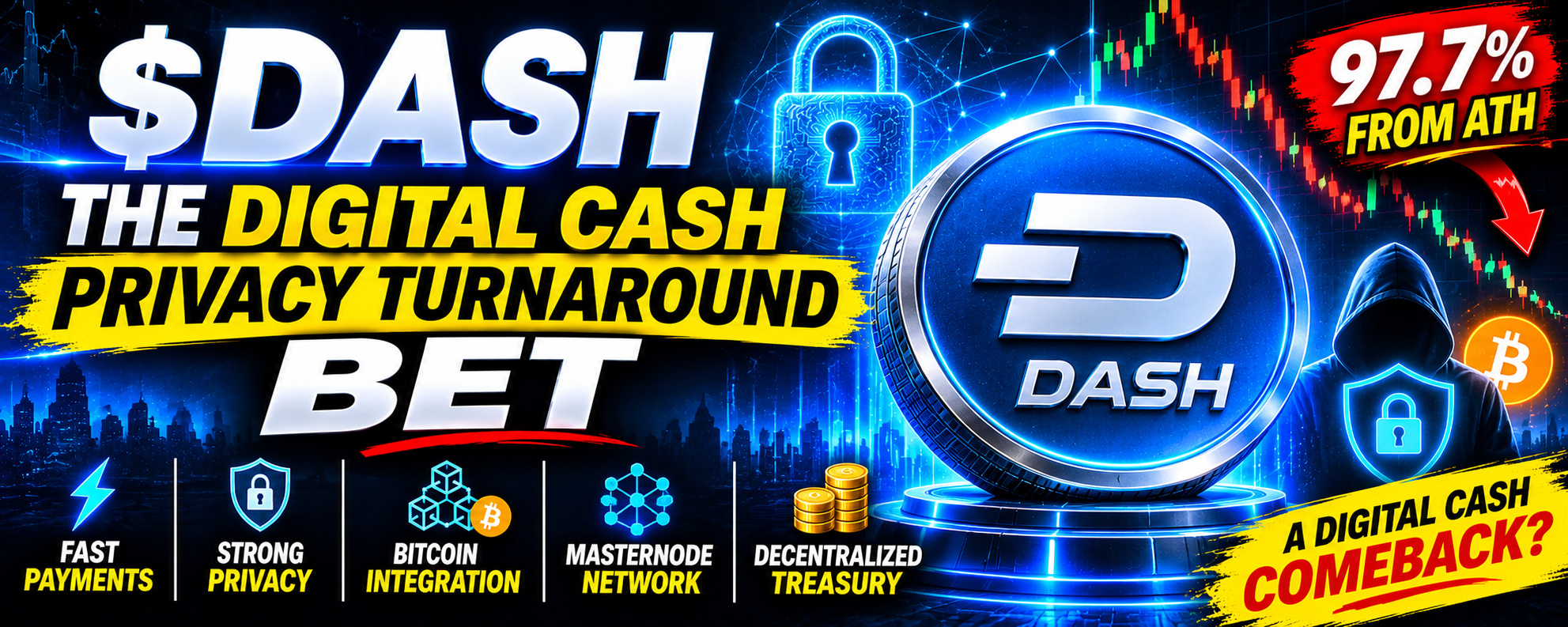

 A roughly $480 MILLION cryptocurrency.
⠀
Fewer than 13 MILLION coins circulating.
⠀
A payment network combining miners, masternodes, and a development treasury.
⠀
And a coin trading approximately 97.7% below its all-time high.
⠀
But here's the contradiction.
⠀
Dash has spent years building digital cash infrastructure.
⠀
Useful payment features still need users who repeatedly choose them.
⠀
Is $DASH an overlooked payments and privacy turnaround?
⠀
Or does an established network still struggle to create lasting monetary demand?
⠀
Let's examine the numbers.
⠀
01 | WHAT IS DASH?
⠀
Dash is a payments-focused cryptocurrency.
⠀
Its Core network combines proof-of-work mining with a second tier of masternodes.
⠀
InstantSend supports rapid transaction locking.
⠀
ChainLocks adds quorum-based protection against blockchain reorganizations.
⠀
The investment thesis is that digital cash should be fast, usable, and resilient.
⠀
But those qualities do not automatically establish an advantage customers will pay for.
⠀
Users already have alternatives.
⠀
The relevant question is why someone chooses DASH repeatedly, rather than merely testing a wallet.
⠀
Technical functionality creates an option.
⠀
Retained usage gives that option economic significance.
⠀
02 | THE NUMBERS THAT MATTER
⠀
November 19, 2026 snapshot:
⠀
DASH Price: ~$37.24
Market Cap: ~$480.43M
Reported FDV: ~$703.99M
Circulating Supply: ~12.898M DASH
Reported Current Total Supply: ~12.898M DASH
Tracker Maximum Supply: 18.9M DASH
Circulating / Tracker Maximum: ~68.2%
24H DASH Trading Volume: ~$42.23M
All-Time High: ~$1,642.22
Decline From ATH: ~97.7%
⠀
SUPPLY AND NETWORK FRAMEWORK:
⠀
Official documentation describes approximately 17.74M–18.92M eventual supply.
⠀
Budget utilization affects the final amount.
⠀
The documented block subsidy declines approximately 7.14% per year.
⠀
A regular masternode requires 1,000 DASH in collateral.
⠀
At the snapshot price, that represents approximately $37,240.
⠀
Exchange volume is not merchant payment volume.
⠀
Current total supply is not the same as final lifetime supply.
⠀
Those distinctions matter more than the unit price.
⠀
03 | PAYMENTS NEED MORE THAN SPEED
⠀
Fast confirmation improves the payment experience.
⠀
It does not solve every problem involved in spending cryptocurrency.
⠀
A customer still needs access to DASH.
⠀
A merchant needs reliable acceptance and settlement.
⠀
Both need a reason to prefer that process.
⠀
A volatile payment asset also creates a practical question:
⠀
How much exposure do users actually want to hold between transactions?
⠀
A network can facilitate payments while users minimize the time they hold its coin.
⠀
Therefore, rising payment activity does not guarantee proportional growth in monetary demand.
⠀
The stronger evidence is recurring usage alongside durable demand to hold or deploy DASH.
⠀
04 | THE PRIVACY THESIS HAS CHANGED
⠀
Dash's established Core privacy feature is CoinJoin.
⠀
That should not be confused with making every Core transaction confidential by default.
⠀
The newer development is Evolution.
⠀
An August 4 official announcement reported shielded transactions live on the Evolution mainnet, using Orchard-based zero-knowledge technology.
⠀
This materially updates the old description of Dash as offering only transaction mixing.
⠀
However, Core transactions, CoinJoin, and Evolution shielded activity remain distinct.
⠀
Investors should examine which payment path a wallet actually supports.
⠀
A privacy label is too broad to explain the implementation.
⠀
The user experience depends on the specific product.
⠀
05 | PRIVACY CAPABILITY IS NOT PRIVACY ADOPTION
⠀
Shipping confidential transactions is a technical milestone.
⠀
Commercial adoption requires additional evidence.
⠀
Are wallets making the feature accessible?
⠀
Do users return?
⠀
Can people fund and exit the system conveniently?
⠀
And does the experience remain usable under realistic conditions?
⠀
The August announcement itself distinguished mainnet availability from wallet support.
⠀
That illustrates why a network release should not be treated as universal product availability.
⠀
The investment case improves when confidential payments become a repeatable user habit.
⠀
A capability can be important without immediately changing the economics.
⠀
06 | WHAT MASTERNODE REWARDS REPRESENT
⠀
Masternodes provide network services and receive compensation.
⠀
They also participate in governance.
⠀
Collateral creates an incentive to maintain a valuable network.
⠀
But masternode income is not automatically profit funded by external customers.
⠀
It includes protocol subsidy.
⠀
An operator must also account for infrastructure expenses and the value of the collateral.
⠀
More DASH received can coexist with a decline in the position's dollar value.
⠀
Likewise, collateral is not permanently destroyed.
⠀
Official documentation states that moving it stops the node's participation and payments.
⠀
Investors should separate service compensation, operating costs, and total investment return.
⠀
A reward percentage cannot answer all three questions.
⠀
07 | THE TREASURY MODEL
⠀
Dash allocates part of its subsidy to a decentralized budget system.
⠀
The documented framework is approximately:
⠀
20% for miners.
⠀
60% for masternode rewards, including the Platform allocation.
⠀
20% for the governance budget.
⠀
Actual issuance depends partly on budget utilization.
⠀
This creates a recurring mechanism to fund development and ecosystem work.
⠀
It also creates a capital-allocation obligation.
⠀
Funding a proposal is an expense or investment by the network.
⠀
It is not evidence that the funded activity produced equivalent economic value.
⠀
The relevant questions are what was delivered, how much it cost, and whether users stayed.
⠀
Self-funding provides continuity.
⠀
Accountability determines its effectiveness.
⠀
08 | THE EVOLUTION EXPANSION
⠀
Dash Platform extends the project beyond basic coin transfers.
⠀
The Platform 5.0 release announcement described shielded token pools, application monetization, and expanded data-contract functionality.
⠀
That broadens the potential product set.
⠀
It also changes what investors need to monitor.
⠀
A release is different from activation.
⠀
Activation is different from wallet integration.
⠀
And integration is different from sustained usage.
⠀
The published 5.0 rollout explicitly depended on evonode signaling and epoch boundaries.
⠀
That is why a planned release date alone cannot prove every advertised capability is widely available.
⠀
The commercial test is whether applications attract recurring customers.
⠀
09 | THE NEXT PRODUCT TEST
⠀
The official roadmap listed further work on private contact requests, username payments, and application infrastructure.
⠀
Those directions address a real usability issue:
⠀
People generally prefer recognizable payment experiences to managing long addresses.
⠀
But roadmaps describe intended development.
⠀
They do not establish shipped functionality or adoption.
⠀
Investors should look for live releases, supported wallets, and repeat usage.
⠀
The most useful progress is a complete payment journey that works consistently.
⠀
A username can simplify the interface.
⠀
It cannot, by itself, create a reason to choose DASH over an existing payment method.
⠀
10 | THE VALUATION QUESTION
⠀
Using approximately 12.898 million current coins:
⠀
$50 DASH implies ~$645M current-supply valuation.
$100 implies ~$1.29B.
$250 implies ~$3.22B.
$500 implies ~$6.45B.
⠀
A return to $1,642.22 would imply approximately $21.18 billion.
⠀
These are valuation illustrations, not price targets.
⠀
Future issuance increases the denominator.
⠀
An old price peak therefore cannot be treated as a simple recovery destination.
⠀
The current thesis needs assumptions about monetary demand, payment adoption, and competitive relevance.
⠀
A low coin count does not make the asset inexpensive.
⠀
Scarcity matters only alongside demand.
⠀
11 | THE BULL AND BEAR CASE
⠀
THE BULL CASE:
⠀
Dash turns its payment features into recurring usage.
⠀
Evolution makes confidential transactions easier to access.
⠀
Applications create additional reasons to use the network.
⠀
Treasury spending produces measurable results.
⠀
And demand grows faster than circulating supply.
⠀
THE BEAR CASE:
⠀
Users prefer alternatives with stronger distribution.
⠀
Privacy capabilities attract attention but limited repeat activity.
⠀
Masternode incentives remain heavily dependent on subsidy.
⠀
Development funding produces insufficient commercial traction.
⠀
And the legacy brand fails to regain relevance.
⠀
Longevity demonstrates persistence.
⠀
It does not guarantee future market share.
⠀
12 | THE FINAL VERDICT
⠀
Dash has identifiable strengths.
⠀
Rapid payment functionality.
⠀
An established masternode system.
⠀
A recurring development budget.
⠀
And newer shielded capabilities on Evolution.
⠀
But the investment case remains conditional.
⠀
A roughly $480 million market capitalization.
⠀
Approximately $704 million in reported fully diluted value.
⠀
Continuing issuance.
⠀
And a need to prove that product development translates into sustained demand.
⠀
My assessment:
⠀
DASH is a digital cash and privacy turnaround thesis.
⠀
The decisive evidence is a growing group of users choosing it repeatedly because the experience solves a meaningful problem.
⠀
More features create possibilities.
⠀
Better wallets reduce friction.
⠀
Recurring payments demonstrate usefulness.
⠀
Durable demand determines the monetary value.
⠀
A 97.7% drawdown describes the distance from an old peak.
⠀
It does not establish how much of that value should return.
⠀
Bookmark this analysis before the next payments and privacy rotation.
⠀
Which has the strongest long-term digital cash thesis?
⠀
⠀
And can Dash turn its Evolution upgrades into lasting user demand?
⠀
Drop your view below.


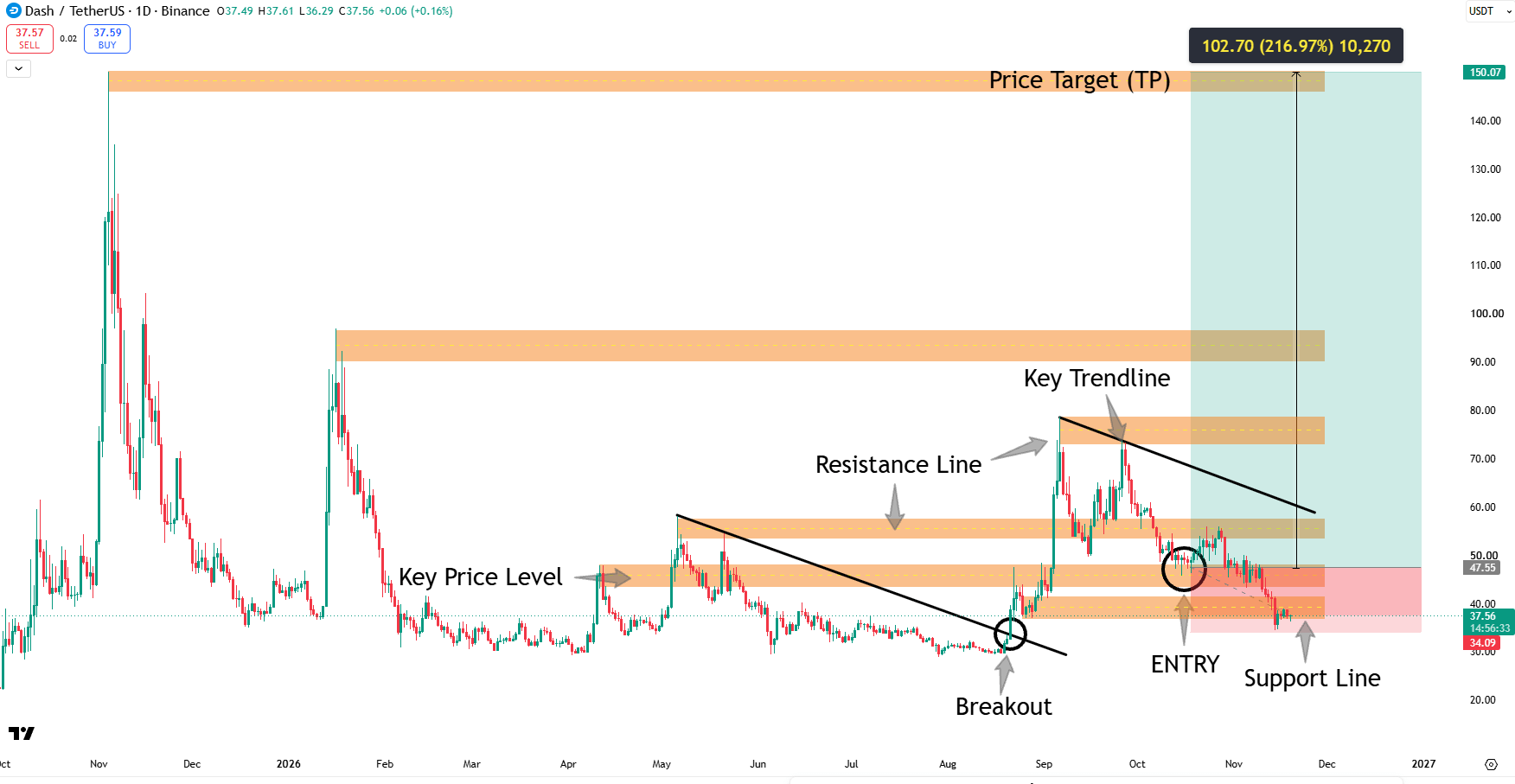
#DASH/USDT