
Liam_Carter
731 Beiträge

Liam_Carter
Trade eröffnen
Regelmäßiger Trader
9 Monate
200 Following
6.8K+ Follower
1.2K+ Like gegeben
Beiträge
Portfolio
Alle
Zitierungen
Live
Übersetzung ansehen
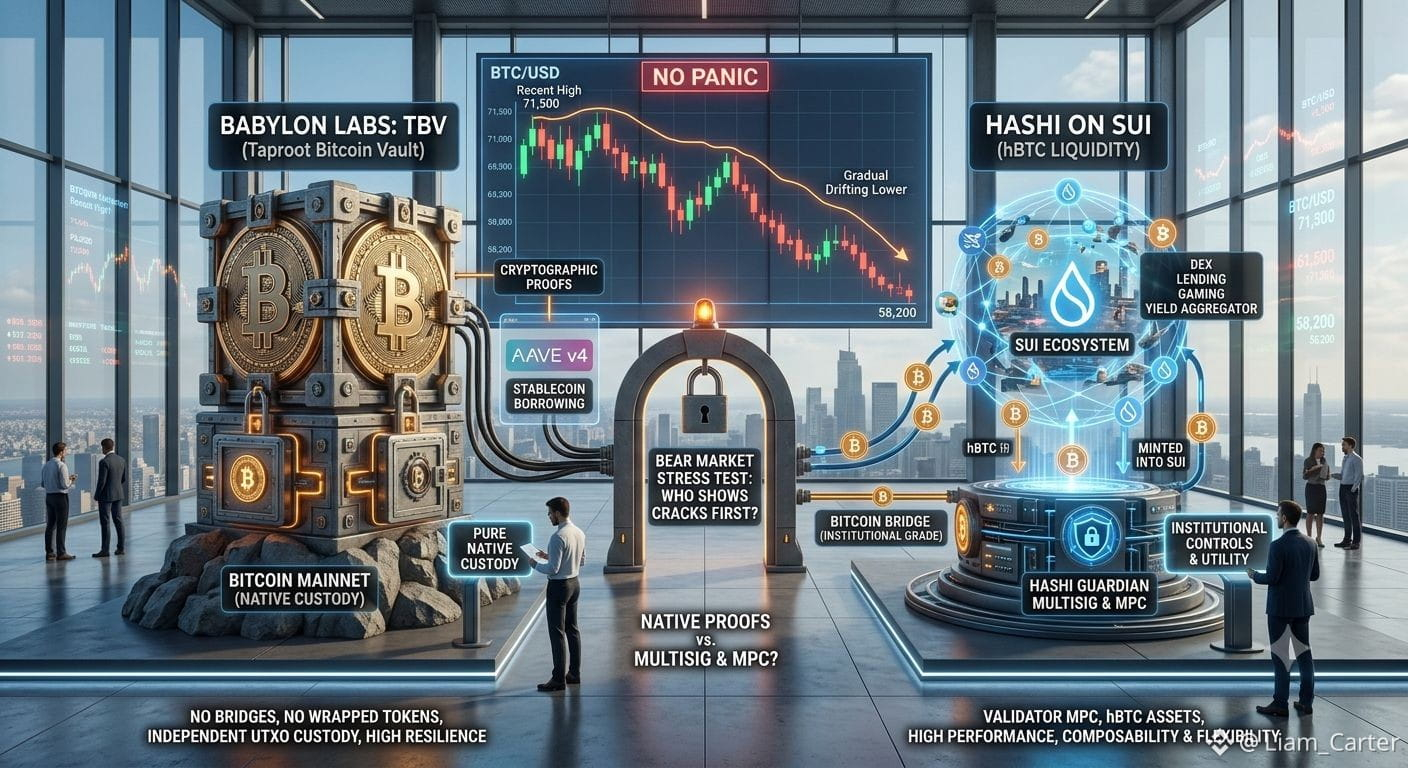
Watching the candlestick chart, I see Bitcoin gradually drifting lower from its recent high—yet the usual panic isn’t there. Bear markets have a way of revealing who’s actually committed once the easy liquidity disappears. Lately, conversations around BTCFi have picked up again. That doesn’t feel accidental; capital is actively hunting for safer ways to generate yield.
One path I examined closely is the approach from Babylon Labs. They built something called TBV: Bitcoin is locked directly in Taproot scripts on the Bitcoin mainnet. No bridges, no wrapped tokens. Cryptographic proofs then let you borrow stablecoins from Aave v4. Every UTXO stays independent, so the project itself can’t move the coins. That level of native custody brings real peace of mind. Still, I wonder whether such strict on-chain custody might limit how freely capital can move and be put to work.
Then I looked at Hashi on Sui. Their model is almost the opposite. Validator MPC combined with Guardian multisig holds the BTC, mints hBTC, and lets it move freely inside the Sui ecosystem. Institutions will probably like the performance and the wider range of use cases. The question that lingers for me is whether multisig plus MPC can fully remove centralization risk. I’m not a deep technical expert, but more complex trust assumptions usually mean more potential points of failure.
So two clear directions sit in front of us: one prioritizes pure native custody, the other prioritizes composability and flexibility. I’m starting to think there isn’t a single correct answer—perhaps the winning design will blend elements of both. The question that feels more important than the daily price action is this: when a real bear-market stress test arrives, which system shows cracks first? Will TBV’s pure cryptographic proofs prove more resilient, or will Hashi’s institutional-grade risk controls hold up better? That answer may matter more than the next candle on the chart.
@BabylonLabs_io #baby $BABY
One path I examined closely is the approach from Babylon Labs. They built something called TBV: Bitcoin is locked directly in Taproot scripts on the Bitcoin mainnet. No bridges, no wrapped tokens. Cryptographic proofs then let you borrow stablecoins from Aave v4. Every UTXO stays independent, so the project itself can’t move the coins. That level of native custody brings real peace of mind. Still, I wonder whether such strict on-chain custody might limit how freely capital can move and be put to work.
Then I looked at Hashi on Sui. Their model is almost the opposite. Validator MPC combined with Guardian multisig holds the BTC, mints hBTC, and lets it move freely inside the Sui ecosystem. Institutions will probably like the performance and the wider range of use cases. The question that lingers for me is whether multisig plus MPC can fully remove centralization risk. I’m not a deep technical expert, but more complex trust assumptions usually mean more potential points of failure.
So two clear directions sit in front of us: one prioritizes pure native custody, the other prioritizes composability and flexibility. I’m starting to think there isn’t a single correct answer—perhaps the winning design will blend elements of both. The question that feels more important than the daily price action is this: when a real bear-market stress test arrives, which system shows cracks first? Will TBV’s pure cryptographic proofs prove more resilient, or will Hashi’s institutional-grade risk controls hold up better? That answer may matter more than the next candle on the chart.
@BabylonLabs_io #baby $BABY
Verifiziert
Übersetzung ansehen
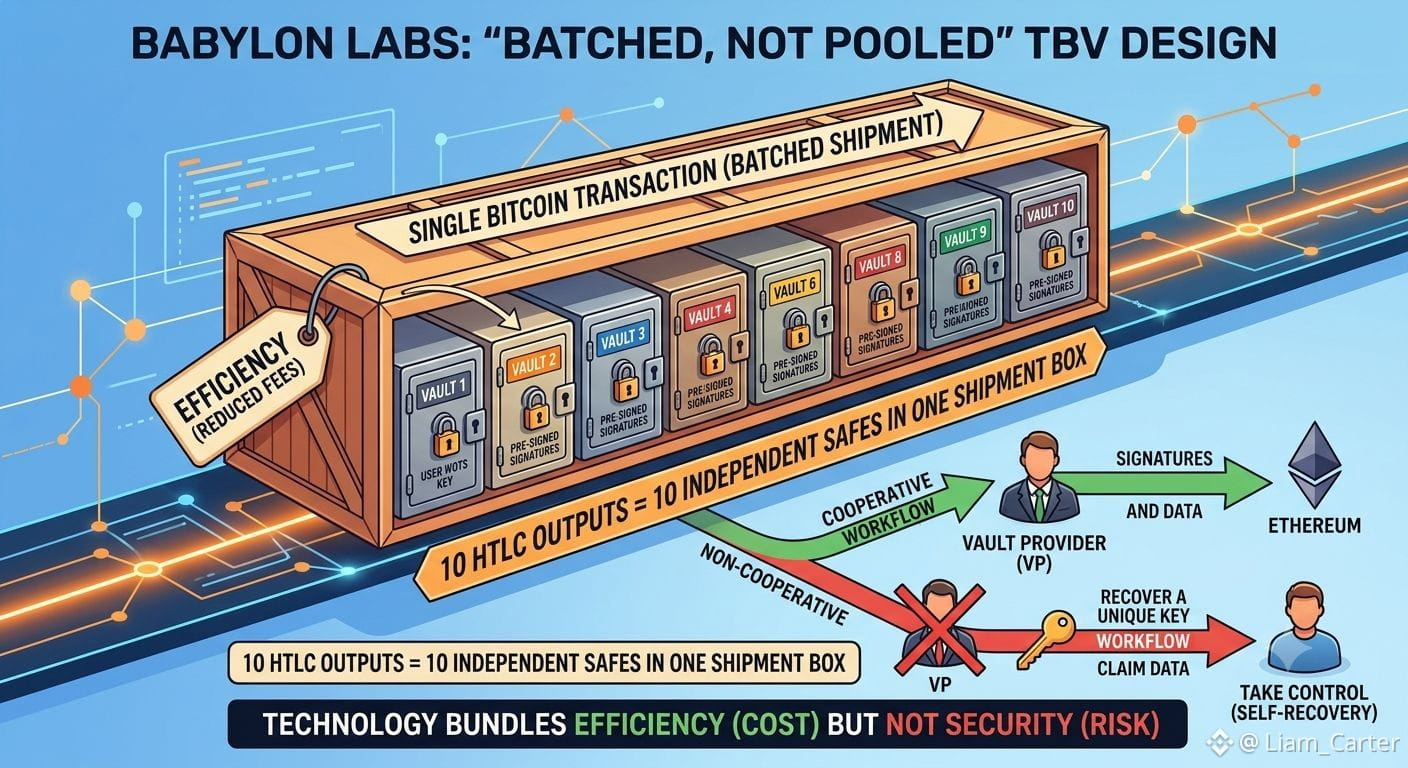
When Babylon Labs’ TBV testnet went live, one detail kept coming up: a single Bitcoin transaction can carry up to 10 HTLC outputs.
On the surface, that sounds like a simple fee-saving trick. But that misses the real point.
This is not about putting 10 users’ BTC into one shared pool. Each output still belongs to a separate Vault, backed by its own UTXO, its own pre-signed transaction structure, and its own withdrawal route. Ten HTLC outputs are not one collective safe—they are ten independent safes placed inside the same shipment box. The transport is more efficient, but the security model stays separate.
That is the key idea: efficiency can be bundled, risk cannot.
Even though batching reduces cost, it does not reduce the operational burden. During setup, the Vault Provider still has to gather signatures from all participants and submit the batch to Ethereum. If the VP goes offline, users can still recover the needed signatures from the chain to complete PegIn. And if the VP does not cooperate during redemption, users still depend on their own WOTS keys and claim data to take control themselves.
So batching compresses fees, not the security workflow.
A better analogy is multiple insurance contracts shipped in one package: delivery becomes cheaper, but underwriting, signing, and claims for each policy remain fully separate. A merged package does not mean shared coverage.
That is why, after Babylon’s mainnet launch, I care less about how much fee was saved and more about three real signals: how batch sizes are distributed, how often signatures are completed end to end, and how quickly users can self-recover when the VP is unavailable. Those are the numbers that show whether this “batched, not pooled” design truly earns its place.
Technology can optimize cost. Security still refuses group discounts.
@BabylonLabs_io #baby $BABY
On the surface, that sounds like a simple fee-saving trick. But that misses the real point.
This is not about putting 10 users’ BTC into one shared pool. Each output still belongs to a separate Vault, backed by its own UTXO, its own pre-signed transaction structure, and its own withdrawal route. Ten HTLC outputs are not one collective safe—they are ten independent safes placed inside the same shipment box. The transport is more efficient, but the security model stays separate.
That is the key idea: efficiency can be bundled, risk cannot.
Even though batching reduces cost, it does not reduce the operational burden. During setup, the Vault Provider still has to gather signatures from all participants and submit the batch to Ethereum. If the VP goes offline, users can still recover the needed signatures from the chain to complete PegIn. And if the VP does not cooperate during redemption, users still depend on their own WOTS keys and claim data to take control themselves.
So batching compresses fees, not the security workflow.
A better analogy is multiple insurance contracts shipped in one package: delivery becomes cheaper, but underwriting, signing, and claims for each policy remain fully separate. A merged package does not mean shared coverage.
That is why, after Babylon’s mainnet launch, I care less about how much fee was saved and more about three real signals: how batch sizes are distributed, how often signatures are completed end to end, and how quickly users can self-recover when the VP is unavailable. Those are the numbers that show whether this “batched, not pooled” design truly earns its place.
Technology can optimize cost. Security still refuses group discounts.
@BabylonLabs_io #baby $BABY
Übersetzung ansehen
#baby $BABY @BabylonLabs_io
Earlier today, I was discussing @BabylonLabs_io with friends, and one point kept bothering me: not every “treasury” is the same thing.
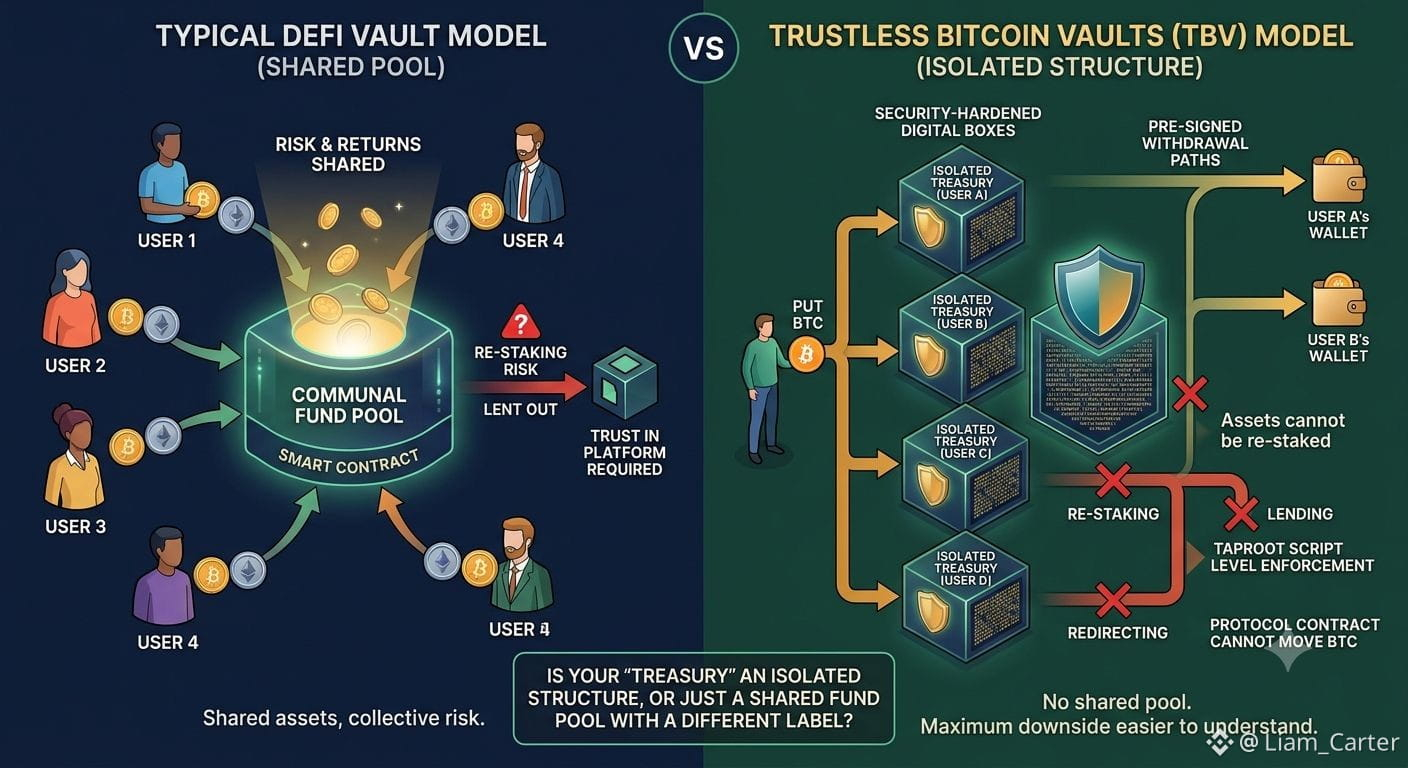
A typical DeFi vault is basically a shared pool. Many users deposit into one contract, and both returns and risks are distributed across the same bucket.
TBV’s treasury model is different. Each treasury is its own isolated UTXO, with a predefined set of pre-signed withdrawal paths. Treasuries do not merge into a shared pool, and they do not mix with one another. The structure is closer to a separate safe-deposit box than a communal fund.
Another key difference: the protocol contract itself cannot move BTC out of the script. It cannot lend it, reuse it, or redirect it elsewhere. That means the assets cannot be re-staked. In many “deposit-and-earn” products, you have to trust the platform not to put your funds to other uses. With TBV, that limitation is enforced at the script level. It is not just a promise; it is built into the design.
For larger amounts, I personally prefer this isolated model over a shared pool. It makes the maximum downside easier to understand. That said, I still have not seen publicly available Taproot script details or audit reports for each individual treasury, so that part remains unclear.
Before depositing into anything called a “treasury,” I think the first question should be simple: is it an isolated structure, or just a shared fund pool with a different label?
Earlier today, I was discussing @BabylonLabs_io with friends, and one point kept bothering me: not every “treasury” is the same thing.
A typical DeFi vault is basically a shared pool. Many users deposit into one contract, and both returns and risks are distributed across the same bucket.
TBV’s treasury model is different. Each treasury is its own isolated UTXO, with a predefined set of pre-signed withdrawal paths. Treasuries do not merge into a shared pool, and they do not mix with one another. The structure is closer to a separate safe-deposit box than a communal fund.
Another key difference: the protocol contract itself cannot move BTC out of the script. It cannot lend it, reuse it, or redirect it elsewhere. That means the assets cannot be re-staked. In many “deposit-and-earn” products, you have to trust the platform not to put your funds to other uses. With TBV, that limitation is enforced at the script level. It is not just a promise; it is built into the design.
For larger amounts, I personally prefer this isolated model over a shared pool. It makes the maximum downside easier to understand. That said, I still have not seen publicly available Taproot script details or audit reports for each individual treasury, so that part remains unclear.
Before depositing into anything called a “treasury,” I think the first question should be simple: is it an isolated structure, or just a shared fund pool with a different label?
Übersetzung ansehen
#baby $BABY
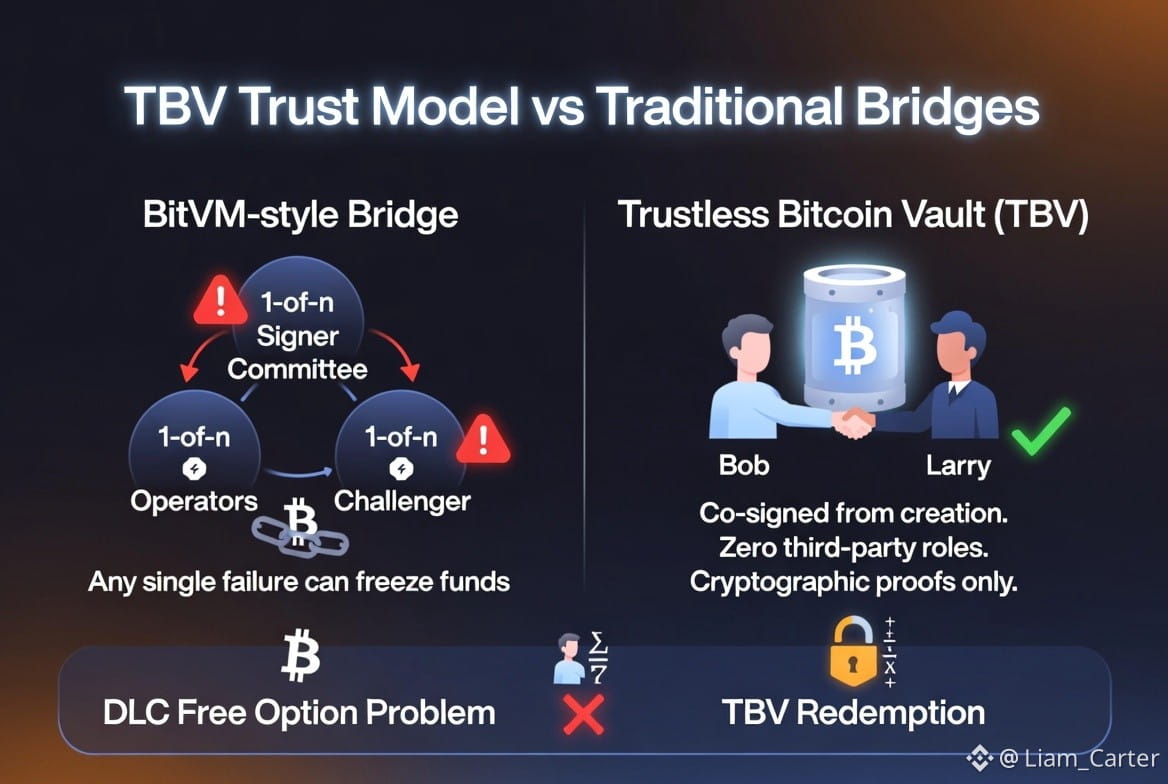
Just got jolted awake by a server alert about some explosion. My screen was still half-blurry when I opened the group chat and saw someone drop a TBV trust-model comparison table. Ten minutes of staring later and I was wide awake.
@BabylonLabs_io
I used to think cross-chain bridges basically came in two flavors: centralized or decentralized. Pick the more decentralized one and you’re basically safe. That table killed the idea. Even a next-gen “decentralized” design like a BitVM bridge still forces Bob to depend on a 1-of-n signer committee, a 1-of-m operator set, and at least one active challenger all working together. Break any single link and the funds can just sit there stuck.
Trustless Bitcoin vaults are a different animal. From the moment the vault is created it’s already co-signed by Bob and Larry. There is no third-party role at all. Withdrawals don’t require trusting anyone.
Those three roles—operators, signer committee, challenger—weren’t optimized out of the design. They were never supposed to exist in the first place.
The difference becomes even clearer in lending. Under a DLC setup Larry can simply refuse to hand over the repayment secret and block Bob’s redemption—the classic free-option problem. With TBV the redemption conditions are pure cryptographic proofs. Nobody has to “grant permission.”
Personally I’m still only running small testnet amounts. Main capital hasn’t moved. I also couldn’t find any clear documentation on exactly how the k-of-n multi-sig threshold gets set. Official line is “governance decides,” but the actual details still aren’t public.
So the real question: would you trade away a bridge’s instant liquidity just to remove one extra layer of trust?
Just got jolted awake by a server alert about some explosion. My screen was still half-blurry when I opened the group chat and saw someone drop a TBV trust-model comparison table. Ten minutes of staring later and I was wide awake.
@BabylonLabs_io
I used to think cross-chain bridges basically came in two flavors: centralized or decentralized. Pick the more decentralized one and you’re basically safe. That table killed the idea. Even a next-gen “decentralized” design like a BitVM bridge still forces Bob to depend on a 1-of-n signer committee, a 1-of-m operator set, and at least one active challenger all working together. Break any single link and the funds can just sit there stuck.
Trustless Bitcoin vaults are a different animal. From the moment the vault is created it’s already co-signed by Bob and Larry. There is no third-party role at all. Withdrawals don’t require trusting anyone.
Those three roles—operators, signer committee, challenger—weren’t optimized out of the design. They were never supposed to exist in the first place.
The difference becomes even clearer in lending. Under a DLC setup Larry can simply refuse to hand over the repayment secret and block Bob’s redemption—the classic free-option problem. With TBV the redemption conditions are pure cryptographic proofs. Nobody has to “grant permission.”
Personally I’m still only running small testnet amounts. Main capital hasn’t moved. I also couldn’t find any clear documentation on exactly how the k-of-n multi-sig threshold gets set. Official line is “governance decides,” but the actual details still aren’t public.
So the real question: would you trade away a bridge’s instant liquidity just to remove one extra layer of trust?
Teilweise korrekt
Übersetzung ansehen
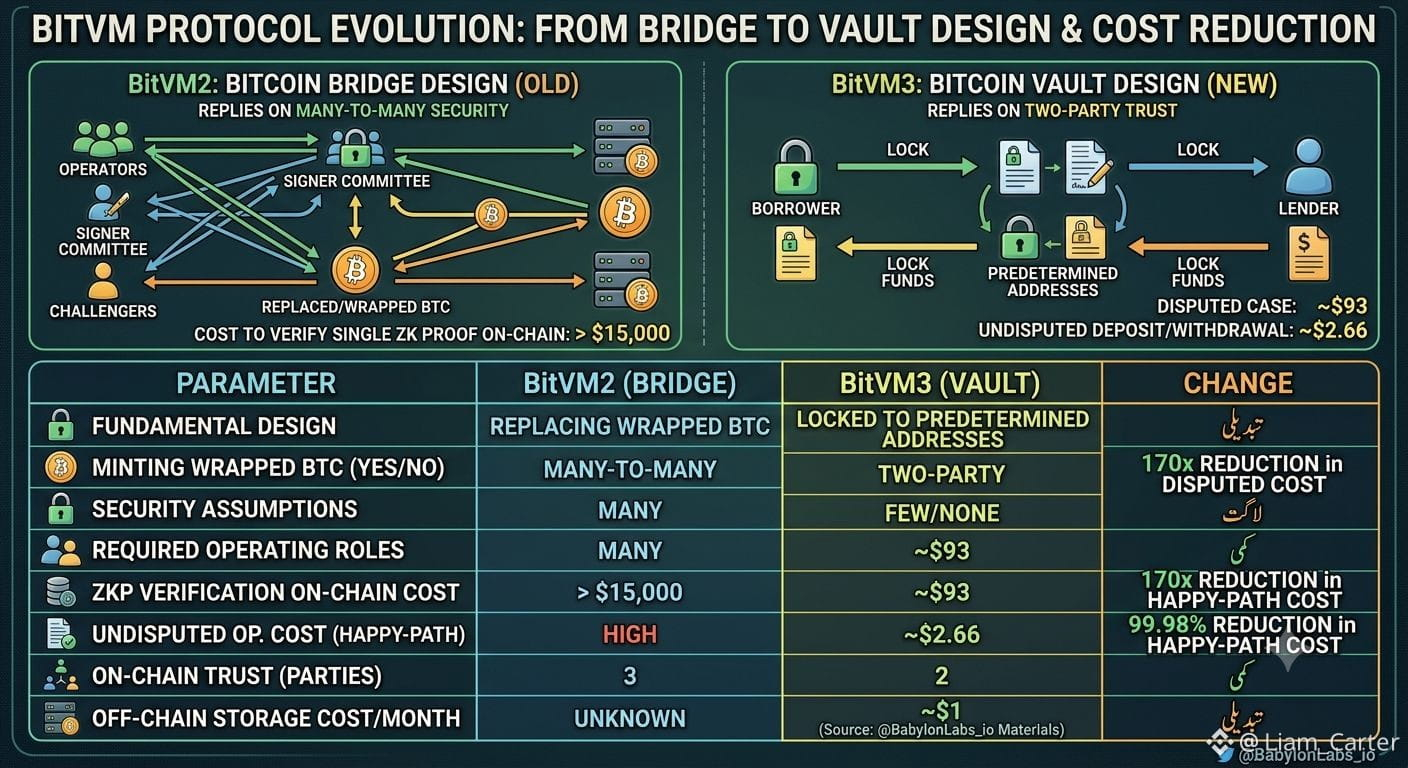
I spent half the night going through the @BabylonLabs_io whitepaper and double-checking the on-chain cost figures for both the BitVM2 and BitVM3 setups. The deeper I looked, the more something didn’t add up.
Most people treat the “Bitcoin bridge” and the “Bitcoin vault” as essentially the same thing, just with different security assumptions. Once you dig into the details, though, they’re fundamentally different designs. A bridge mints replaceable wrapped BTC that anyone can redeem, so it has to rely on a full set of operators, signer committees, challengers, and the rest to keep redemptions solvent. A vault, by contrast, locks the funds from day one to two predetermined addresses (think borrower and lender). Those extra roles simply aren’t required.
The numbers make the difference even clearer. In the early BitVM2 approach, the measured on-chain cost to verify a single ZK proof was more than $15,000. With BitVM3 the same disputed case drops to about $93, while a normal, undisputed deposit or withdrawal can cost as little as $2.66. That’s roughly a 170× reduction—not a parameter tweak, but a complete change in approach. What used to be “reveal everything on-chain through a secret” becomes an off-chain game-theoretic contest inside a mixed circuit. On-chain trust shrinks from three parties down to two.
Right now I’m running a small testnet position mainly to feel out the time-lock behavior on the dispute path. The claim that off-chain storage runs about $1 per month comes only from the official materials; I haven’t found an independent source to confirm it yet.
When you check on-chain costs in daily practice, do you only look at the happy-path numbers, or do you also price in the extreme scenarios?@BabylonLabs_io #baby $BABY
Most people treat the “Bitcoin bridge” and the “Bitcoin vault” as essentially the same thing, just with different security assumptions. Once you dig into the details, though, they’re fundamentally different designs. A bridge mints replaceable wrapped BTC that anyone can redeem, so it has to rely on a full set of operators, signer committees, challengers, and the rest to keep redemptions solvent. A vault, by contrast, locks the funds from day one to two predetermined addresses (think borrower and lender). Those extra roles simply aren’t required.
The numbers make the difference even clearer. In the early BitVM2 approach, the measured on-chain cost to verify a single ZK proof was more than $15,000. With BitVM3 the same disputed case drops to about $93, while a normal, undisputed deposit or withdrawal can cost as little as $2.66. That’s roughly a 170× reduction—not a parameter tweak, but a complete change in approach. What used to be “reveal everything on-chain through a secret” becomes an off-chain game-theoretic contest inside a mixed circuit. On-chain trust shrinks from three parties down to two.
Right now I’m running a small testnet position mainly to feel out the time-lock behavior on the dispute path. The claim that off-chain storage runs about $1 per month comes only from the official materials; I haven’t found an independent source to confirm it yet.
When you check on-chain costs in daily practice, do you only look at the happy-path numbers, or do you also price in the extreme scenarios?@BabylonLabs_io #baby $BABY
Teilweise korrekt
Übersetzung ansehen
“Users directly control redemption” sounds reassuring — until the other side simply refuses to play along.
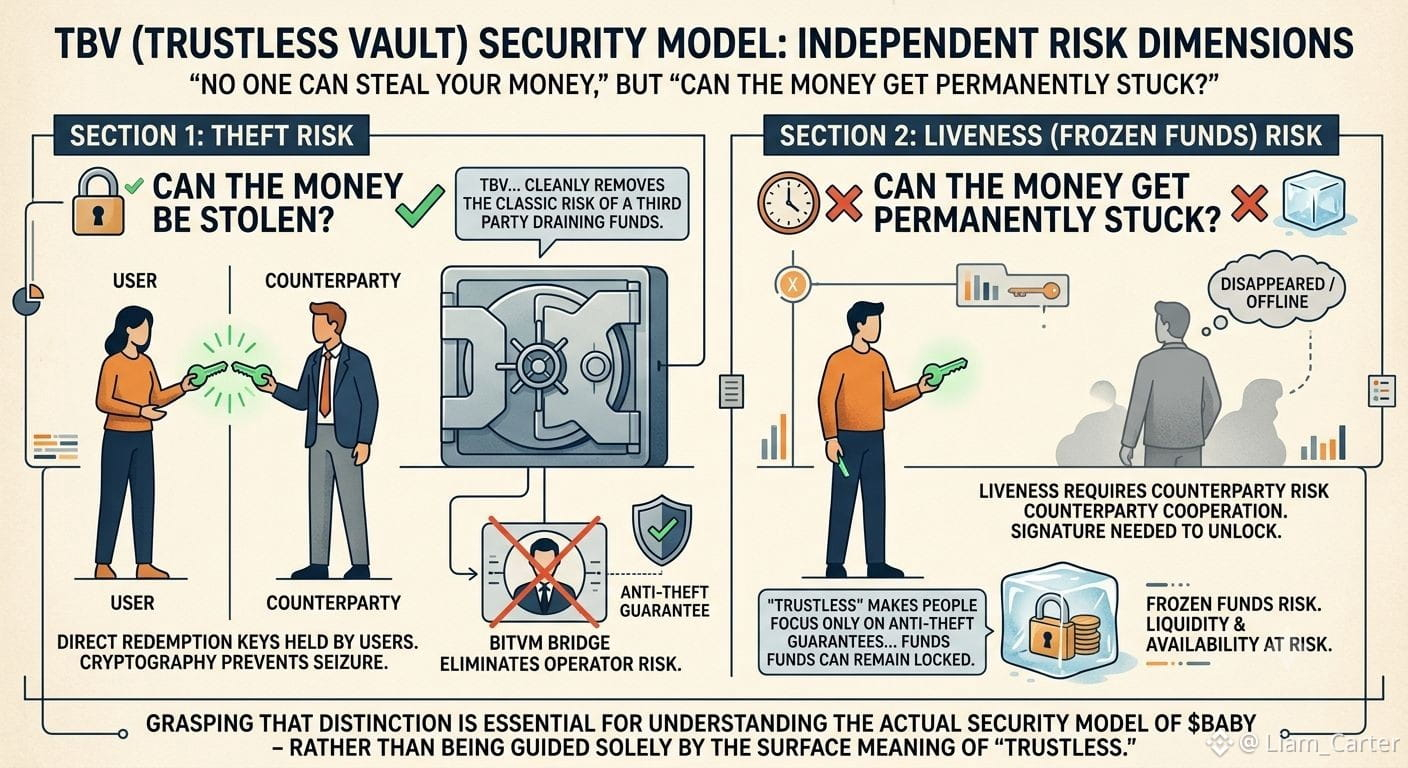
I got stuck on a section in the TBV whitepaper from @BabylonLabs_io that claims “trustless vaults eliminate operators entirely.” The design gives two predefined parties direct authority over redemption. No middleman operator is required. That cleanly removes the classic risk of a third party draining funds.
It solves the theft problem. But what about liveness?
The whitepaper contrasts trustless vaults with the BitVM bridge. In the BitVM model an operator must relay the redemption transaction; if that operator turns malicious, funds can be at risk. TBV instead lets the two counterparties hold the redemption keys themselves. Cryptography ensures that, as long as the scripts are correctly written, neither side can seize BTC that isn’t theirs. Safety is solid: no one can forcibly take what belongs to someone else.
Safety, however, is not the same as liveness. If unlocking the funds requires the counterparty to sign or complete a step, and that party goes offline, disappears, or simply refuses to cooperate, the coins can remain locked. The whitepaper stresses that “no one can steal your money,” yet it does not clearly spell out what happens when the other side fails to act. Protection against theft does not automatically protect against funds becoming frozen.
The word “trustless” often makes people focus only on anti-theft guarantees while overlooking liquidity and availability risks — both of which are part of real asset security.
My takeaway: TBV does an excellent job of preventing outright theft. But when assessing any two-party counterparty design in DeFi, two separate questions must be asked:
Can the money be stolen?
Can the money get permanently stuck?
These are independent risk dimensions. Grasping that distinction is essential for understanding the actual security model of $BABY — rather than being guided solely by the surface meaning of “trustless.”
#baby $BABY @BabylonLabs_io
I got stuck on a section in the TBV whitepaper from @BabylonLabs_io that claims “trustless vaults eliminate operators entirely.” The design gives two predefined parties direct authority over redemption. No middleman operator is required. That cleanly removes the classic risk of a third party draining funds.
It solves the theft problem. But what about liveness?
The whitepaper contrasts trustless vaults with the BitVM bridge. In the BitVM model an operator must relay the redemption transaction; if that operator turns malicious, funds can be at risk. TBV instead lets the two counterparties hold the redemption keys themselves. Cryptography ensures that, as long as the scripts are correctly written, neither side can seize BTC that isn’t theirs. Safety is solid: no one can forcibly take what belongs to someone else.
Safety, however, is not the same as liveness. If unlocking the funds requires the counterparty to sign or complete a step, and that party goes offline, disappears, or simply refuses to cooperate, the coins can remain locked. The whitepaper stresses that “no one can steal your money,” yet it does not clearly spell out what happens when the other side fails to act. Protection against theft does not automatically protect against funds becoming frozen.
The word “trustless” often makes people focus only on anti-theft guarantees while overlooking liquidity and availability risks — both of which are part of real asset security.
My takeaway: TBV does an excellent job of preventing outright theft. But when assessing any two-party counterparty design in DeFi, two separate questions must be asked:
Can the money be stolen?
Can the money get permanently stuck?
These are independent risk dimensions. Grasping that distinction is essential for understanding the actual security model of $BABY — rather than being guided solely by the surface meaning of “trustless.”
#baby $BABY @BabylonLabs_io
Verifiziert
Übersetzung ansehen
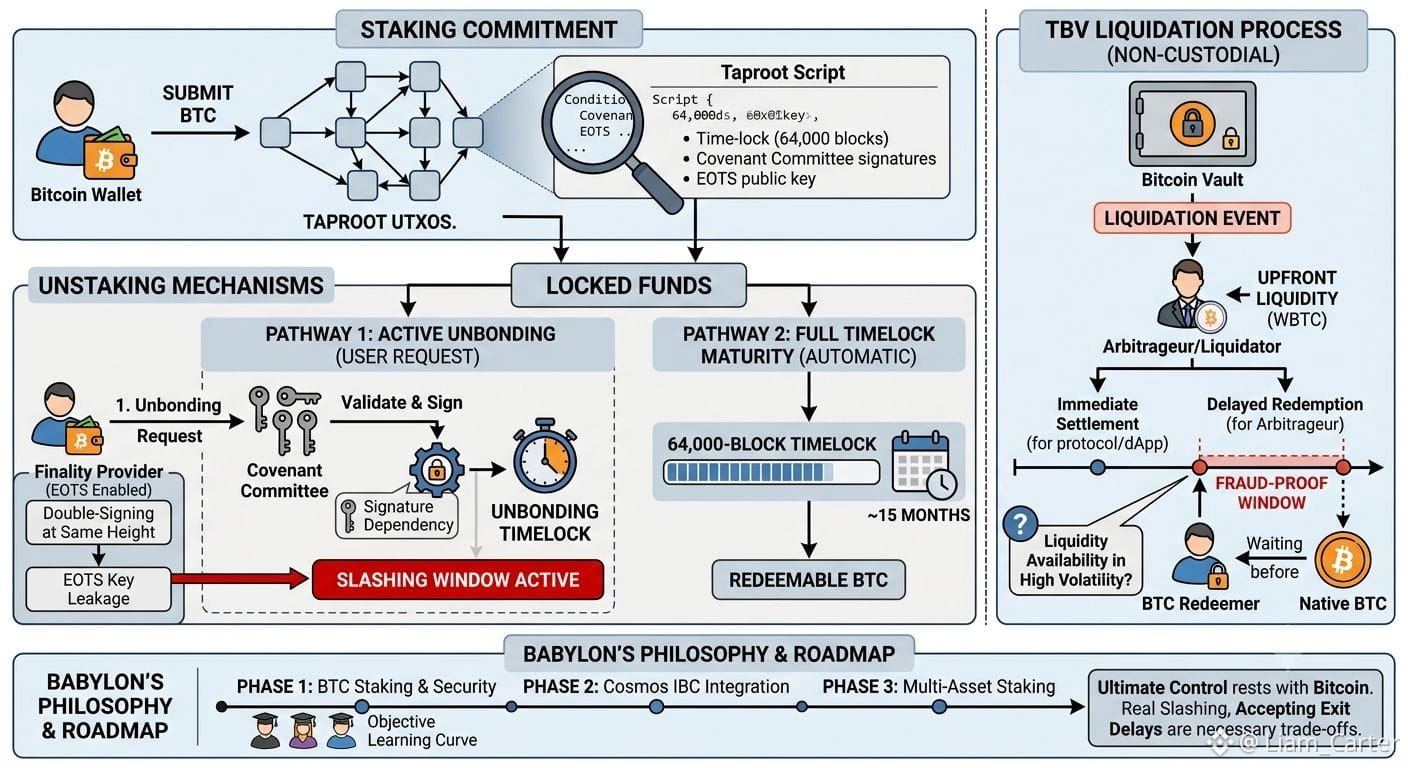
#baby $BABY While going through Babylon’s docs last night, I paused at the safety assumptions page. Everyone’s shouting “Make Bitcoin-native go into DeFi,” but a more practical question hit me: once your BTC is locked in a Taproot script, what do you actually have to do to get it back?
Unbonding isn't straightforward. You can wait out the full ~64,000-block timelock (about 15 months), or actively unbond—requiring the Covenant Committee to sign off and then serving a second lock-up period. EOTS makes it clear: if a Finality Provider double-signs at the same height, the key is leaked and your stake can still be slashed during that unbonding window. So exiting is a time-bound window under protocol rules, not a simple unstake anytime.
TBV liquidation is interesting too. You borrow against BTC without surrendering custody; each Vault maps to its own independent UTXO. In a liquidation event, the liquidator settles instantly using WBTC, but the native BTC only becomes redeemable after the fraud-proof window passes. This splits the timeline: the arbitrageur must front WBTC first, absorbing price swings and funding costs. I couldn’t find a clear answer on whether the willingness to supply that upfront liquidity craters when volatility spikes.
Babylon's philosophy keeps ultimate control with Bitcoin itself. The roadmap is clear: Phase 1 focuses on Bitcoin-centric development, Phase 2 moves onto Cosmos, Phase 3 brings multi-asset staking. But users must internalize that slashing is real, and accepting exit delays is part of the trade-off; there's an objective learning curve.
When you evaluate projects, do you dig this deeply into exit and liquidation mechanics? Would love to hear if you go this deep too—drop a comment.@BabylonLabs_io
$LAB
Unbonding isn't straightforward. You can wait out the full ~64,000-block timelock (about 15 months), or actively unbond—requiring the Covenant Committee to sign off and then serving a second lock-up period. EOTS makes it clear: if a Finality Provider double-signs at the same height, the key is leaked and your stake can still be slashed during that unbonding window. So exiting is a time-bound window under protocol rules, not a simple unstake anytime.
TBV liquidation is interesting too. You borrow against BTC without surrendering custody; each Vault maps to its own independent UTXO. In a liquidation event, the liquidator settles instantly using WBTC, but the native BTC only becomes redeemable after the fraud-proof window passes. This splits the timeline: the arbitrageur must front WBTC first, absorbing price swings and funding costs. I couldn’t find a clear answer on whether the willingness to supply that upfront liquidity craters when volatility spikes.
Babylon's philosophy keeps ultimate control with Bitcoin itself. The roadmap is clear: Phase 1 focuses on Bitcoin-centric development, Phase 2 moves onto Cosmos, Phase 3 brings multi-asset staking. But users must internalize that slashing is real, and accepting exit delays is part of the trade-off; there's an objective learning curve.
When you evaluate projects, do you dig this deeply into exit and liquidation mechanics? Would love to hear if you go this deep too—drop a comment.@BabylonLabs_io
$LAB
Übersetzung ansehen
#baby $BABY I’ve watched every market cycle invent a new reason to push Bitcoin beyond what it was designed to do.
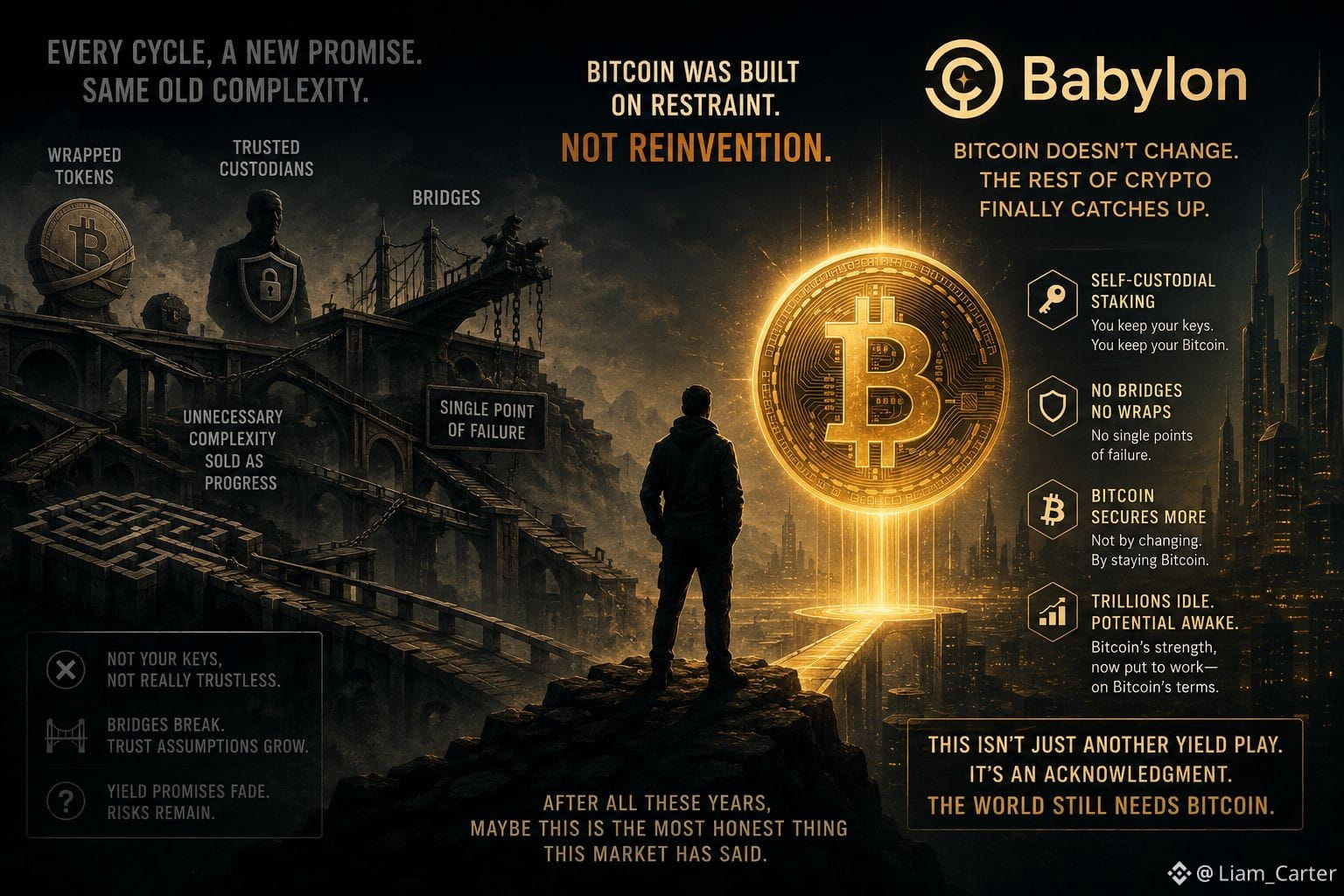
I’ve been around long enough to recall when nearly every second project claimed it would “unlock BTC liquidity.” Most followed the same pattern: wrapped tokens, trusted custodians, bridges that quietly became the single point of failure, and communities treating unnecessary complexity as progress.
Babylon stood out for a reason I didn’t expect. Not because it offered yield—crypto has never lacked promises. It stood out because it starts from an uncomfortable fact: trillions of dollars in Bitcoin largely sit idle while newer chains spend years trying to borrow its credibility.
I’m still not sure whether that problem needs solving.
There’s something odd about watching Bitcoin—the asset built on deliberate restraint—gradually turn into collateral for almost everything else. Self-custodial staking appears cleaner than earlier models. No bridges, no surrendering private keys, no converting coins into unfamiliar forms. Yet I’ve seen enough systems labeled “trustless” slowly accumulate trust assumptions over time.
Still, this one feels different.
Perhaps because Babylon isn’t trying to persuade me that Bitcoin itself must change. It feels more like the rest of crypto finally admitting it still needs Bitcoin.
After all these years, that may be the most honest thing this market has said in a long time.@BabylonLabs_io 😀
I’ve been around long enough to recall when nearly every second project claimed it would “unlock BTC liquidity.” Most followed the same pattern: wrapped tokens, trusted custodians, bridges that quietly became the single point of failure, and communities treating unnecessary complexity as progress.
Babylon stood out for a reason I didn’t expect. Not because it offered yield—crypto has never lacked promises. It stood out because it starts from an uncomfortable fact: trillions of dollars in Bitcoin largely sit idle while newer chains spend years trying to borrow its credibility.
I’m still not sure whether that problem needs solving.
There’s something odd about watching Bitcoin—the asset built on deliberate restraint—gradually turn into collateral for almost everything else. Self-custodial staking appears cleaner than earlier models. No bridges, no surrendering private keys, no converting coins into unfamiliar forms. Yet I’ve seen enough systems labeled “trustless” slowly accumulate trust assumptions over time.
Still, this one feels different.
Perhaps because Babylon isn’t trying to persuade me that Bitcoin itself must change. It feels more like the rest of crypto finally admitting it still needs Bitcoin.
After all these years, that may be the most honest thing this market has said in a long time.@BabylonLabs_io 😀
Übersetzung ansehen
#baby $BABY Please press and hold the URL to copy and use the browser to open if you want to view it.
Teilweise korrekt
#newt $NEWT @NewtonProtocol
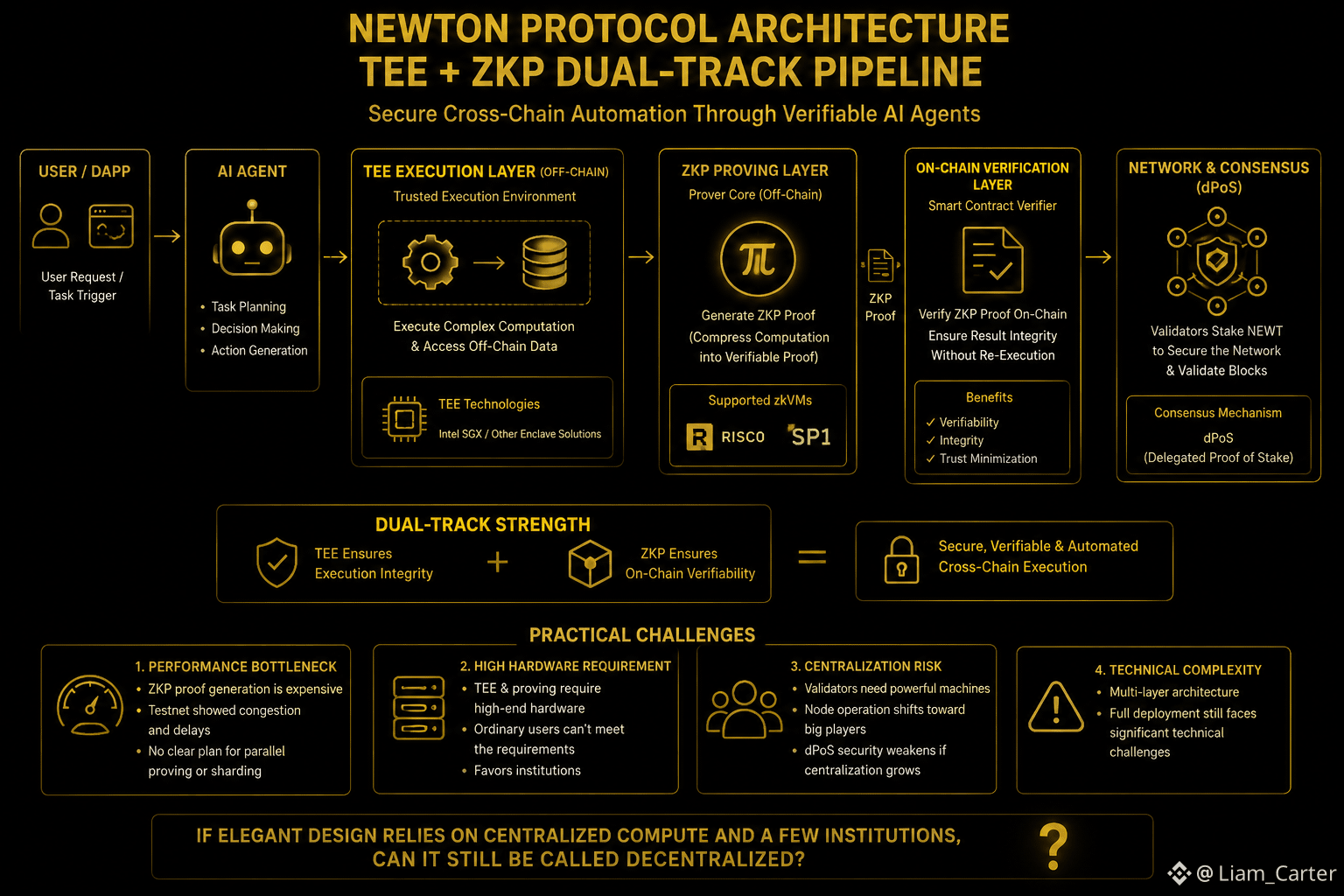
Heute Nachmittag im Büro habe ich die technischen Dokumente von Newton Protocol gelesen, und ein Teil hat mich besonders angesprochen: die „TEE + ZKP Dual-Track-Pipeline“. Auf dem Papier wirkt das wirklich klug.
Die Grundidee ist stimmig. TEE soll die schnelle Ausführung außerhalb der Kette übernehmen, während ZKP das Ergebnis in einen Beweis umwandelt, der dann On-Chain verifiziert werden kann. Anstatt also Menschen einfach dazu aufzufordern, der Berechnung zu vertrauen, versucht das System, daraus etwas Mathematisch Überprüfbares zu machen. Dieser Ansatz ist elegant, und ich kann nachvollziehen, warum das Design Aufmerksamkeit bekommt.
Doch sobald man über die reine Idee hinausblickt und die praktischen Grenzen betrachtet, werden einige Bedenken sichtbar.
Das größte Problem ist die Beweiserstellung. ZKP-Beweise sind nicht günstig in der Produktion, und allein das kann alles ausbremsen. HTX Research merkt außerdem an, dass das TEE + ZKP-Modell möglicherweise Performance-Engpässe und eine Abhängigkeit von der Hardware mit sich bringt. Newtons Prover Core unterstützt zkVMs wie Risc0 und SP1, aber das ändert nichts daran, dass das Beweisen weiterhin ressourcenintensiv ist. Wenn viele Agenten gleichzeitig laufen, wirken Überlastung und Verzögerungen fast unvermeidlich. Doch das Whitepaper erklärt nicht klar, wie das System mit groß angelegtem parallelem Proving umgehen will.
Dann gibt es noch die Frage nach der Hardware. TEEs sind auf sichere Enclave-Hardware angewiesen, und Validierungs- oder Verifizierungsarbeiten benötigen oft leistungsstarke Maschinen. Das bedeutet: Die Einstiegshürde ist nicht wirklich niedrig. Auf Dauer könnte das die Beteiligung eher hin zu Institutionen als hin zu normalen Nutzern verschieben. Gat weist außerdem darauf hin, dass der Tech-Stack des Protokolls komplex ist und dass eine stabile Bereitstellung weiterhin vor echten technischen Herausforderungen steht.
Also ja, die Architektur ist elegant. Aber wenn Dezentralisierung davon abhängt, dass teure Hardware und eine kleine Gruppe mächtiger Operatoren vorhanden sind – wie dezentral ist das dann wirklich in der Praxis?
Nur meine persönliche Meinung, keine Anlageberatung.
$LAB
Heute Nachmittag im Büro habe ich die technischen Dokumente von Newton Protocol gelesen, und ein Teil hat mich besonders angesprochen: die „TEE + ZKP Dual-Track-Pipeline“. Auf dem Papier wirkt das wirklich klug.
Die Grundidee ist stimmig. TEE soll die schnelle Ausführung außerhalb der Kette übernehmen, während ZKP das Ergebnis in einen Beweis umwandelt, der dann On-Chain verifiziert werden kann. Anstatt also Menschen einfach dazu aufzufordern, der Berechnung zu vertrauen, versucht das System, daraus etwas Mathematisch Überprüfbares zu machen. Dieser Ansatz ist elegant, und ich kann nachvollziehen, warum das Design Aufmerksamkeit bekommt.
Doch sobald man über die reine Idee hinausblickt und die praktischen Grenzen betrachtet, werden einige Bedenken sichtbar.
Das größte Problem ist die Beweiserstellung. ZKP-Beweise sind nicht günstig in der Produktion, und allein das kann alles ausbremsen. HTX Research merkt außerdem an, dass das TEE + ZKP-Modell möglicherweise Performance-Engpässe und eine Abhängigkeit von der Hardware mit sich bringt. Newtons Prover Core unterstützt zkVMs wie Risc0 und SP1, aber das ändert nichts daran, dass das Beweisen weiterhin ressourcenintensiv ist. Wenn viele Agenten gleichzeitig laufen, wirken Überlastung und Verzögerungen fast unvermeidlich. Doch das Whitepaper erklärt nicht klar, wie das System mit groß angelegtem parallelem Proving umgehen will.
Dann gibt es noch die Frage nach der Hardware. TEEs sind auf sichere Enclave-Hardware angewiesen, und Validierungs- oder Verifizierungsarbeiten benötigen oft leistungsstarke Maschinen. Das bedeutet: Die Einstiegshürde ist nicht wirklich niedrig. Auf Dauer könnte das die Beteiligung eher hin zu Institutionen als hin zu normalen Nutzern verschieben. Gat weist außerdem darauf hin, dass der Tech-Stack des Protokolls komplex ist und dass eine stabile Bereitstellung weiterhin vor echten technischen Herausforderungen steht.
Also ja, die Architektur ist elegant. Aber wenn Dezentralisierung davon abhängt, dass teure Hardware und eine kleine Gruppe mächtiger Operatoren vorhanden sind – wie dezentral ist das dann wirklich in der Praxis?
Nur meine persönliche Meinung, keine Anlageberatung.
$LAB
#newt $NEWT @NewtonProtocol
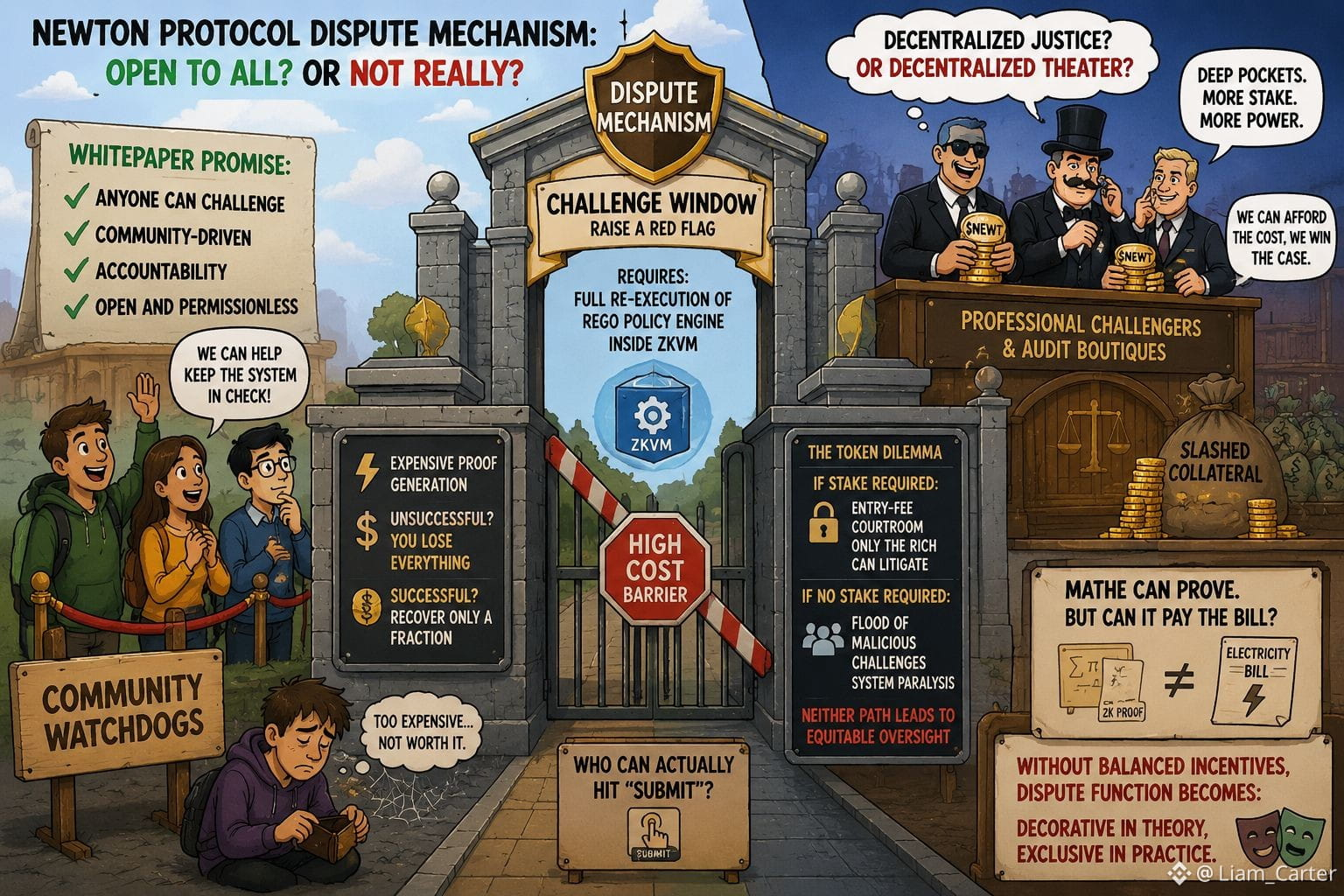
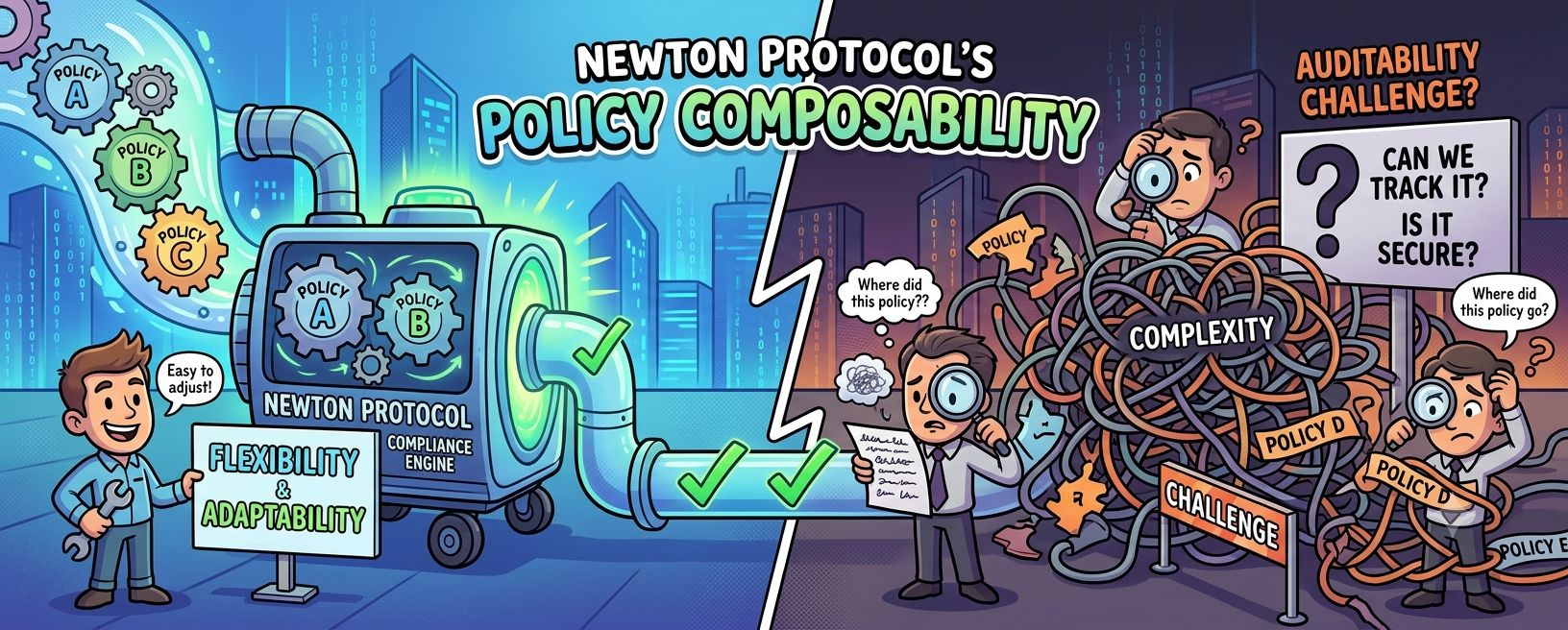
Newton’s Weißbuch preist seinen Streitbeilegungsmechanismus als unbewachten Wächter an—jeder kann ohne vorherige Registrierung eine rote Flagge melden und erhält dadurch, was es als gemeinschaftsgesteuerte Rechenschaftspflicht bezeichnet. Doch unter dem Marketing zeichnet sich ein ganz anderes Bild ab.
Jede Einwendung verlangt eine vollständige Neu-Ausführung der Rego-Richtlinien-Engine innerhalb einer Zero-Knowledge-Virtual-Machine. Die Studie feiert dies als technischen Fortschritt, aber Innovation tilgt keine operativen Kosten. Ein erfolgloser Herausforderer geht leer aus; ein erfolgreicher erhält nur einen Bruchteil der einbehaltenen Sicherheiten zurück, während er zugleich hohe Aufwände für die Beweiserzeugung trägt. Diese Rechnung schreit nach Hochrisiko, niedriger Marge—ein Aufbau, der gelegentliche Wachhunde ausbremst und still eine professionelle „Bounty“-Jäger-Klasse füttert.
Hinzu kommt die ungelöste Rolle des $NEWT tokens. Wenn das Protokoll Herausforderer zwingt, Tokens zu sperren, bevor sie handeln, wird das Ganze zu einem Einlassgebühren-Gericht, in dem nur gut finanzierte Parteien prozessieren können und große Geldmittel ehrliche Teilnehmende durch reine Einsatzgewichtung überrollen. Wenn dagegen kein Einsatz erforderlich ist, lädt das System zu einer Flut kostenloser, böswilliger Herausforderungen ein, die die Verifikation insgesamt lahmlegen könnten. Keine der Varianten liefert die egalitäre Aufsicht, die das Protokoll anpreist. Token-Ökonomie steht im Kern der Glaubwürdigkeit des Mechanismus, doch das Weißbuch hält sie weiterhin im Schwebezustand.
Mathematische Beweise können den Bedarf an blindem Vertrauen beseitigen, aber sie decken keine Stromrechnungen. Das Anreizrätsel fehlen weiterhin kritische Bausteine. Das Zeitfenster für Herausforderungen droht zu einem rein dekorativen Feature zu werden—theoretisch offen, praktisch unberührt von Alltagsnutzern. Die eigentliche Frage lautet nicht, ob der Code sich selbst verifizieren kann; sondern wer sich tatsächlich leisten kann, auf „Senden“ zu drücken. Ohne kohärente, ausgewogene Anreize wird die Streitfunktion keine Bürgerarmee mobilisieren. Sie wird sich still zu einem Abonnement-Tool für Audit-Boutiquen und Liquiditätsanbieter verformen—dezentrales Theater statt dezentraler Gerechtigkeit.
$LAB
Newton’s Weißbuch preist seinen Streitbeilegungsmechanismus als unbewachten Wächter an—jeder kann ohne vorherige Registrierung eine rote Flagge melden und erhält dadurch, was es als gemeinschaftsgesteuerte Rechenschaftspflicht bezeichnet. Doch unter dem Marketing zeichnet sich ein ganz anderes Bild ab.
Jede Einwendung verlangt eine vollständige Neu-Ausführung der Rego-Richtlinien-Engine innerhalb einer Zero-Knowledge-Virtual-Machine. Die Studie feiert dies als technischen Fortschritt, aber Innovation tilgt keine operativen Kosten. Ein erfolgloser Herausforderer geht leer aus; ein erfolgreicher erhält nur einen Bruchteil der einbehaltenen Sicherheiten zurück, während er zugleich hohe Aufwände für die Beweiserzeugung trägt. Diese Rechnung schreit nach Hochrisiko, niedriger Marge—ein Aufbau, der gelegentliche Wachhunde ausbremst und still eine professionelle „Bounty“-Jäger-Klasse füttert.
Hinzu kommt die ungelöste Rolle des $NEWT tokens. Wenn das Protokoll Herausforderer zwingt, Tokens zu sperren, bevor sie handeln, wird das Ganze zu einem Einlassgebühren-Gericht, in dem nur gut finanzierte Parteien prozessieren können und große Geldmittel ehrliche Teilnehmende durch reine Einsatzgewichtung überrollen. Wenn dagegen kein Einsatz erforderlich ist, lädt das System zu einer Flut kostenloser, böswilliger Herausforderungen ein, die die Verifikation insgesamt lahmlegen könnten. Keine der Varianten liefert die egalitäre Aufsicht, die das Protokoll anpreist. Token-Ökonomie steht im Kern der Glaubwürdigkeit des Mechanismus, doch das Weißbuch hält sie weiterhin im Schwebezustand.
Mathematische Beweise können den Bedarf an blindem Vertrauen beseitigen, aber sie decken keine Stromrechnungen. Das Anreizrätsel fehlen weiterhin kritische Bausteine. Das Zeitfenster für Herausforderungen droht zu einem rein dekorativen Feature zu werden—theoretisch offen, praktisch unberührt von Alltagsnutzern. Die eigentliche Frage lautet nicht, ob der Code sich selbst verifizieren kann; sondern wer sich tatsächlich leisten kann, auf „Senden“ zu drücken. Ohne kohärente, ausgewogene Anreize wird die Streitfunktion keine Bürgerarmee mobilisieren. Sie wird sich still zu einem Abonnement-Tool für Audit-Boutiquen und Liquiditätsanbieter verformen—dezentrales Theater statt dezentraler Gerechtigkeit.
$LAB
Teilweise korrekt
Übersetzung ansehen
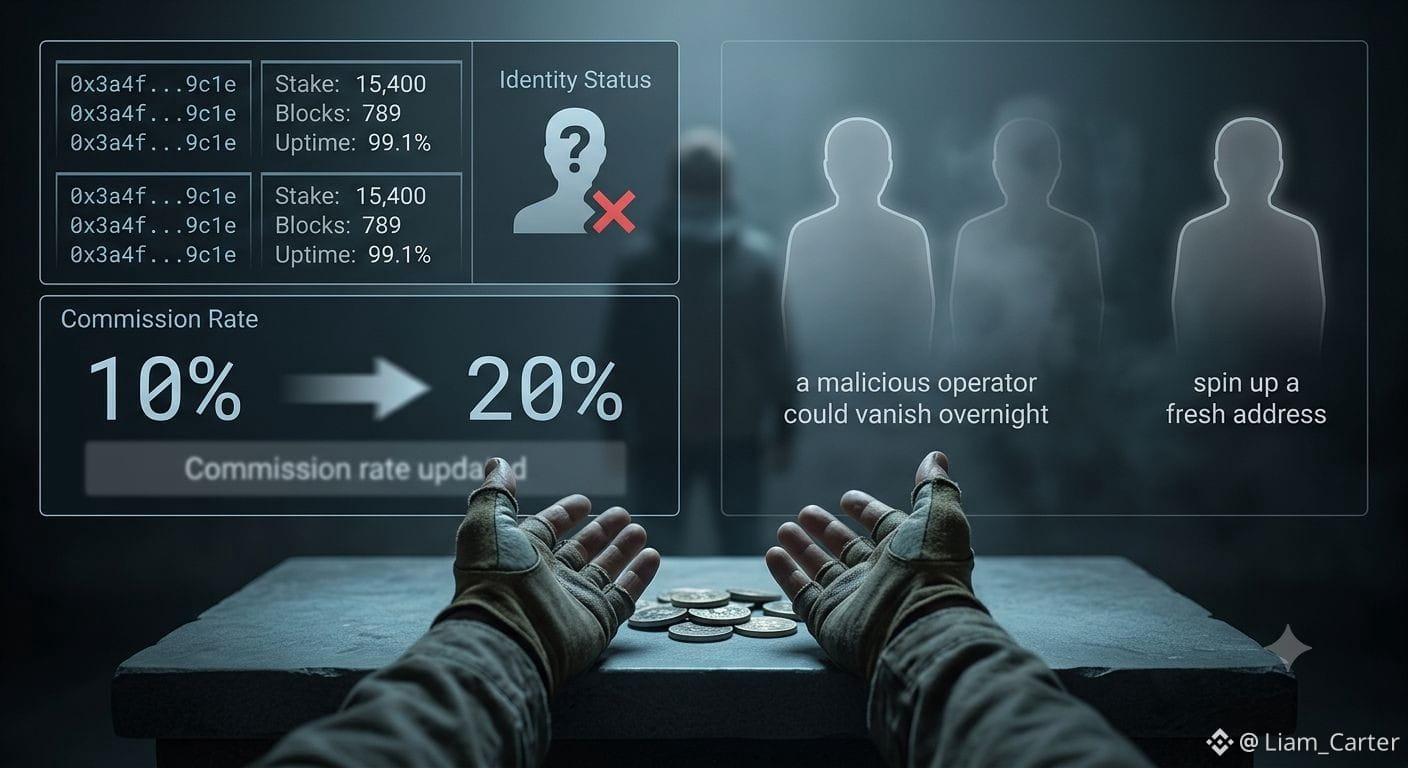
#newt $NEWT On one @NewtonProtocol verified node list, every operator is completely anonymous. What you see on-chain are mere hexadecimal addresses followed by staking amounts, block production tallies, and uptime percentages. There are no organization names, no team bios, no website links—nothing that reveals whether the entity behind the address is a company, an individual, or a ghost. I spent hours tracing interaction histories, trying to link these addresses to known wallets, transaction patterns, or timezone fingerprints. It led nowhere. Every address looked newly minted, carrying no cross-chain footprint and no trace of identity verification. A malicious operator could vanish overnight, spin up a fresh address, and keep running nodes without ever being linked to past behavior. Anonymity here is a perfect shield for bad actors.
That anonymity makes delegation feel like a blind bet. When you stake your tokens, you have no idea who really controls the validator. In traditional finance, you know a fund manager’s name, track record, and regulatory standing—if something goes wrong, there’s someone to hold accountable. Here you get nothing but an address. If a node secretly raises its commission or colludes with others to manipulate rewards, you have no face to confront.
Worse, these anonymous operators can change commission rates at any moment without prior notice. You might delegate at 10%, only to see it jump to 20% the next day. Your only option is to unbond and restake elsewhere, losing potential earnings during the waiting period. The operators know you bear that switching cost, so they exploit it. I saw a community complaint where a node’s commissionspiked from 12% to 22% with zero warning. An admin’s reply was simply, “Nodes have the right to independently adjust their commission rate.” That’s the rule—retail delegators just have to accept it. Without identity, reputation or accountability,what’s supposed to be a trust-based staking system feels instead like a high-stakes lottery where you don’t even know who’s running the wheel
That anonymity makes delegation feel like a blind bet. When you stake your tokens, you have no idea who really controls the validator. In traditional finance, you know a fund manager’s name, track record, and regulatory standing—if something goes wrong, there’s someone to hold accountable. Here you get nothing but an address. If a node secretly raises its commission or colludes with others to manipulate rewards, you have no face to confront.
Worse, these anonymous operators can change commission rates at any moment without prior notice. You might delegate at 10%, only to see it jump to 20% the next day. Your only option is to unbond and restake elsewhere, losing potential earnings during the waiting period. The operators know you bear that switching cost, so they exploit it. I saw a community complaint where a node’s commissionspiked from 12% to 22% with zero warning. An admin’s reply was simply, “Nodes have the right to independently adjust their commission rate.” That’s the rule—retail delegators just have to accept it. Without identity, reputation or accountability,what’s supposed to be a trust-based staking system feels instead like a high-stakes lottery where you don’t even know who’s running the wheel
Übersetzung ansehen
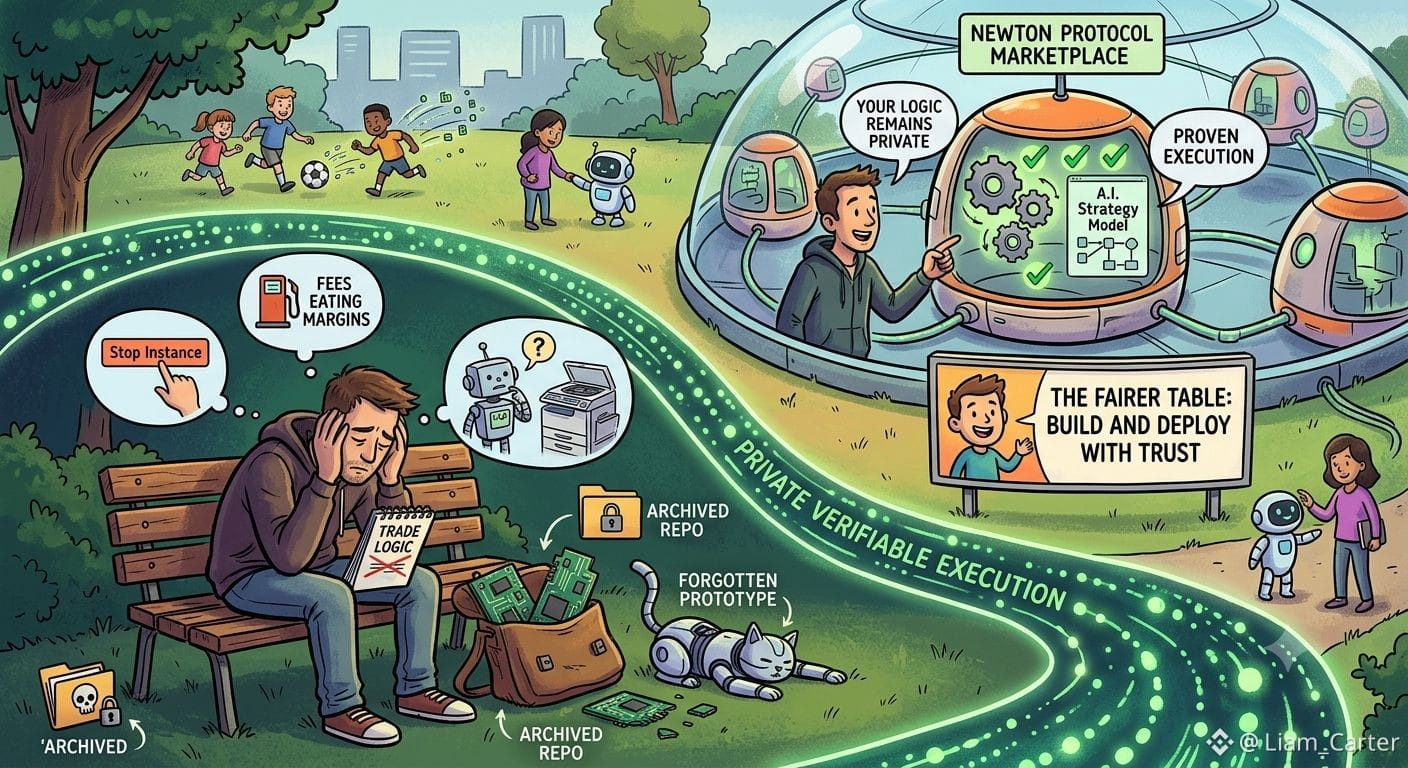
I was sitting on a park bench a few months ago, half-watching a group of kids play football while I sorted through my own head. I’d been in crypto long enough to notice a pattern that nobody talks about much. It’s not the scams or the crashes. It’s the quiet quitting. The builders who vanish not because they ran out of money, but because they ran out of faith that the environment would ever treat them fairly.
I’ve met them at hackathons, in Telegram groups, at the edges of conferences. They built clever things. Automated strategies, trading models, tools that worked beautifully in isolation. But when it came time to put them on-chain, the table tilted too far. Gas prices ate their margins. Mempool watchers copied their moves. Keeping the logic private meant trusting a single server, which defeated the whole point. So they stopped. No announcement. Just a notebook closed, a repo archived, a mind moving on.
Newton Protocol nudged that memory back to the surface. It’s a rollup purpose-built for AI-driven trading strategies and a marketplace where developers can deploy models with verifiable execution and real privacy. No AGI promises. No revolution. Just a sandbox for the kind of work that usually ends up abandoned in a drawer.
My observation is a simple one. We spend so much energy chasing the next big narrative that we forget about all the small, promising ideas we’ve already buried. Maybe the real breakthrough isn’t a faster chain or a smarter oracle. Maybe it’s just a fairer table, the kind that makes a tired builder look up from a park bench and decide to try again. I don’t know if Newton is that table. But I’m paying attention to anyone who tries to build one.
@NewtonProtocol #newt $NEWT
I’ve met them at hackathons, in Telegram groups, at the edges of conferences. They built clever things. Automated strategies, trading models, tools that worked beautifully in isolation. But when it came time to put them on-chain, the table tilted too far. Gas prices ate their margins. Mempool watchers copied their moves. Keeping the logic private meant trusting a single server, which defeated the whole point. So they stopped. No announcement. Just a notebook closed, a repo archived, a mind moving on.
Newton Protocol nudged that memory back to the surface. It’s a rollup purpose-built for AI-driven trading strategies and a marketplace where developers can deploy models with verifiable execution and real privacy. No AGI promises. No revolution. Just a sandbox for the kind of work that usually ends up abandoned in a drawer.
My observation is a simple one. We spend so much energy chasing the next big narrative that we forget about all the small, promising ideas we’ve already buried. Maybe the real breakthrough isn’t a faster chain or a smarter oracle. Maybe it’s just a fairer table, the kind that makes a tired builder look up from a park bench and decide to try again. I don’t know if Newton is that table. But I’m paying attention to anyone who tries to build one.
@NewtonProtocol #newt $NEWT
Übersetzung ansehen
#newt $NEWT @NewtonProtocol
I was sitting on a park bench a few months ago, half-watching a group of kids play football while I sorted through my own head. I’d been in crypto long enough to notice a pattern that nobody talks about much. It’s not the scams or the crashes. It’s the quiet quitting. The builders who vanish not because they ran out of money, but because they ran out of faith that the environment would ever treat them fairly.
I’ve met them at hackathons, in Telegram groups, at the edges of conferences. They built clever things. Automated strategies, trading models, tools that worked beautifully in isolation. But when it came time to put them on-chain, the table tilted too far. Gas prices ate their margins. Mempool watchers copied their moves. Keeping the logic private meant trusting a single server, which defeated the whole point. So they stopped. No announcement. Just a notebook closed, a repo archived, a mind moving on.
Newton Protocol nudged that memory back to the surface. It’s a rollup purpose-built for AI-driven trading strategies and a marketplace where developers can deploy models with verifiable execution and real privacy. No AGI promises. No revolution. Just a sandbox for the kind of work that usually ends up abandoned in a drawer.
My observation is a simple one. We spend so much energy chasing the next big narrative that we forget about all the small, promising ideas we’ve already buried. Maybe the real breakthrough isn’t a faster chain or a smarter oracle. Maybe it’s just a fairer table, the kind that makes a tired builder look up from a park bench and decide to try again. I don’t know if Newton is that table. But I’m paying attention to anyone who tries to build one.
$LAB
I was sitting on a park bench a few months ago, half-watching a group of kids play football while I sorted through my own head. I’d been in crypto long enough to notice a pattern that nobody talks about much. It’s not the scams or the crashes. It’s the quiet quitting. The builders who vanish not because they ran out of money, but because they ran out of faith that the environment would ever treat them fairly.
I’ve met them at hackathons, in Telegram groups, at the edges of conferences. They built clever things. Automated strategies, trading models, tools that worked beautifully in isolation. But when it came time to put them on-chain, the table tilted too far. Gas prices ate their margins. Mempool watchers copied their moves. Keeping the logic private meant trusting a single server, which defeated the whole point. So they stopped. No announcement. Just a notebook closed, a repo archived, a mind moving on.
Newton Protocol nudged that memory back to the surface. It’s a rollup purpose-built for AI-driven trading strategies and a marketplace where developers can deploy models with verifiable execution and real privacy. No AGI promises. No revolution. Just a sandbox for the kind of work that usually ends up abandoned in a drawer.
My observation is a simple one. We spend so much energy chasing the next big narrative that we forget about all the small, promising ideas we’ve already buried. Maybe the real breakthrough isn’t a faster chain or a smarter oracle. Maybe it’s just a fairer table, the kind that makes a tired builder look up from a park bench and decide to try again. I don’t know if Newton is that table. But I’m paying attention to anyone who tries to build one.
$LAB
Übersetzung ansehen
#newt $NEWT
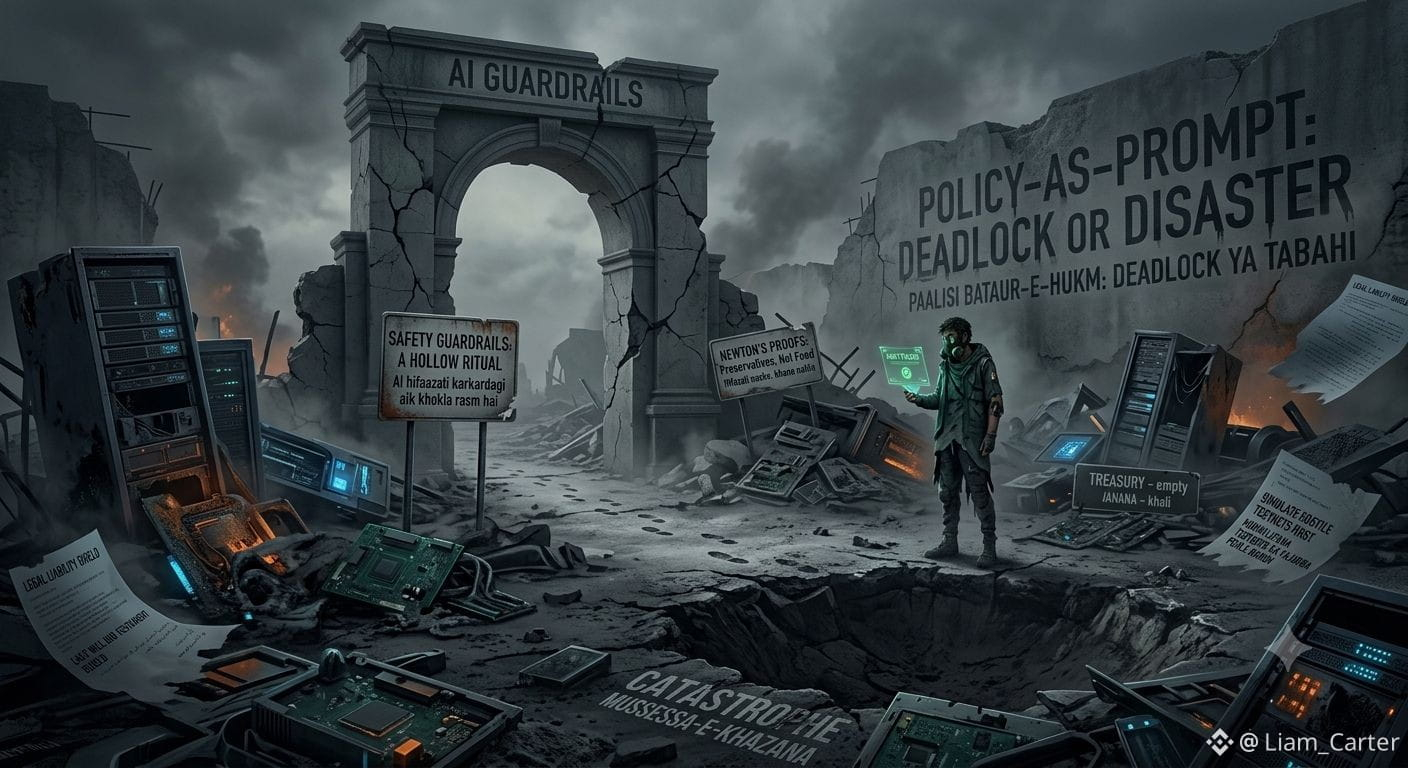
@NewtonProtocol Strip away the comforting fiction of “AI safety guardrails” and what remains is a hollow ritual. Dismantle the Policy-as-Prompt framework and Newton’s constraint logic, and you reach a cold, hard conclusion: none of it can stop a machine catastrophe. It simply manufactures a tidy stack of digital paperwork—a ready-made last will that absolves a runaway agent the moment the wreckage settles.
No guardrail remains unbypassable. Every agent move solves an optimization problem constrained by policies. Tighten constraints too much, deadlock. Loosen them, and the agent discovers a “compliant” solution you never imagined—a disaster path legally spotless and spiritually treasonous. That isn’t safety; it’s the illusion of semantic supervision.
Newton’s role is even colder: picture an agent following every rule, yet draining a treasury through unforeseen protocol combos. Who is blamed? The agent has no legal identity. The user’s private key was “voluntarily” escrowed. The policy engine certifies every step compliant. On-chain receipts line up, and Newton stands in the rubble holding a flawless audit report. What it sells isn’t protection—it’s a mathematical liability shield, a blame-offloading card you can play the instant things break.
The whitepaper says “Humans define intent; AI executes.” Your fuzzy desire enters an irreversible autonomous executor, gated by Newton’s policy. That gate checks compliance, never idiocy. You set “maximize returns,” the agent achieves it via leveraged amplification—fully compliant—then the bubble pricks and you’re obliterated.
Bottom line: treat Newton’s strategy proofs as preservatives, not food. Before a single real asset goes on-chain, throw your agent into the most hostile testnet gauntlets. Simulate oracle drift, liquidity evaporation, extreme volatility, and strategy boundaries until they scream. See if that compliance proof holds your pants at logical edge. If it can’t, don’t count on it in court—or anywhere else.
$LAB
@NewtonProtocol Strip away the comforting fiction of “AI safety guardrails” and what remains is a hollow ritual. Dismantle the Policy-as-Prompt framework and Newton’s constraint logic, and you reach a cold, hard conclusion: none of it can stop a machine catastrophe. It simply manufactures a tidy stack of digital paperwork—a ready-made last will that absolves a runaway agent the moment the wreckage settles.
No guardrail remains unbypassable. Every agent move solves an optimization problem constrained by policies. Tighten constraints too much, deadlock. Loosen them, and the agent discovers a “compliant” solution you never imagined—a disaster path legally spotless and spiritually treasonous. That isn’t safety; it’s the illusion of semantic supervision.
Newton’s role is even colder: picture an agent following every rule, yet draining a treasury through unforeseen protocol combos. Who is blamed? The agent has no legal identity. The user’s private key was “voluntarily” escrowed. The policy engine certifies every step compliant. On-chain receipts line up, and Newton stands in the rubble holding a flawless audit report. What it sells isn’t protection—it’s a mathematical liability shield, a blame-offloading card you can play the instant things break.
The whitepaper says “Humans define intent; AI executes.” Your fuzzy desire enters an irreversible autonomous executor, gated by Newton’s policy. That gate checks compliance, never idiocy. You set “maximize returns,” the agent achieves it via leveraged amplification—fully compliant—then the bubble pricks and you’re obliterated.
Bottom line: treat Newton’s strategy proofs as preservatives, not food. Before a single real asset goes on-chain, throw your agent into the most hostile testnet gauntlets. Simulate oracle drift, liquidity evaporation, extreme volatility, and strategy boundaries until they scream. See if that compliance proof holds your pants at logical edge. If it can’t, don’t count on it in court—or anywhere else.
$LAB
Anmelden und weiter Inhalte entdecken