#newt $NEWT @NewtonProtocol
Newton’s whitepaper promotes its dispute mechanism as an unguarded sentry—anyone can raise a red flag without prior sign‑up, delivering what it calls community‑driven accountability. But beneath the marketing, the numbers paint a very different picture.
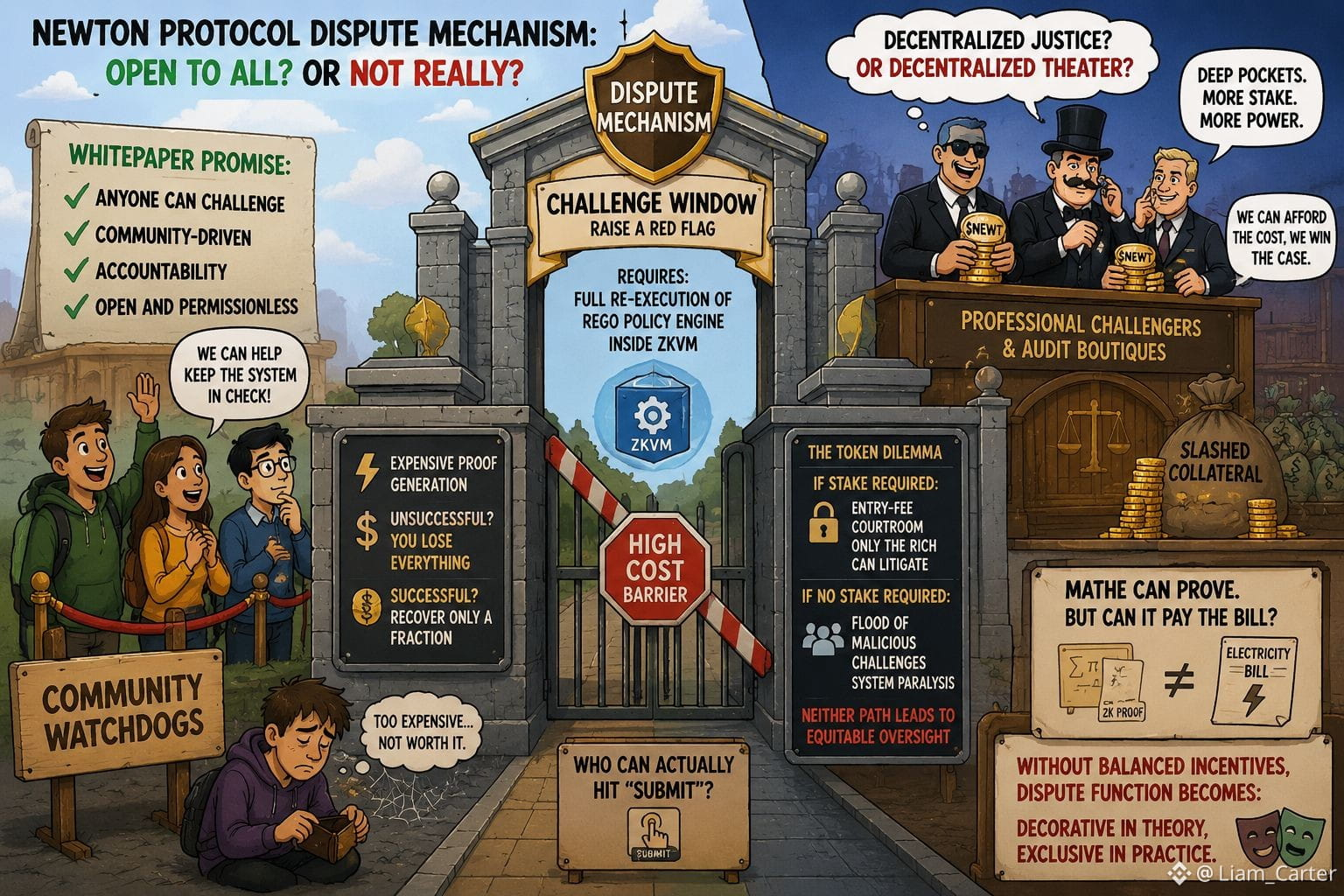
Every objection demands a full re‑execution of the Rego policy engine inside a zero‑knowledge virtual machine. The paper celebrates this as a technical leap, yet innovation doesn’t erase operational cost. An unsuccessful challenger walks away empty‑handed; a successful one recovers only a fraction of the slashed collateral while bearing heavy proof‑generation expenses. That calculus screams high‑stakes, low‑margin—a structure that starves casual watchdogs and quietly feeds a professional bounty‑hunting class.
Then there’s the unresolved role of the $NEWT token. If the protocol forces challengers to lock tokens before acting, the whole setup becomes an entry‑fee courtroom where only the well‑capitalized can litigate and deep pockets can overwhelm honest participants through sheer staking weight. If no stake is required, the system invites a flood of cost‑free, malicious challenges that could paralyze verification altogether. Neither fork delivers the egalitarian oversight the protocol advertises. Token economics sit at the heart of the mechanism’s credibility, yet the whitepaper keeps them in limbo.
Mathematical proofs can erase the need for blind trust, but they don’t cover electricity bills. The incentive puzzle is still missing critical pieces. The challenge window risks becoming a decorative feature—open in theory, practically untouched by everyday users. The true question isn’t whether the code can self‑verify; it’s who can actually afford to hit “submit.” Without coherent, balanced incentives, the dispute function won’t mobilize a citizen army. It will quietly morph into a subscription tool for audit boutiques and liquidity providers—decentralized theater rather than decentralized justice.
$LAB
Newton’s whitepaper promotes its dispute mechanism as an unguarded sentry—anyone can raise a red flag without prior sign‑up, delivering what it calls community‑driven accountability. But beneath the marketing, the numbers paint a very different picture.
Every objection demands a full re‑execution of the Rego policy engine inside a zero‑knowledge virtual machine. The paper celebrates this as a technical leap, yet innovation doesn’t erase operational cost. An unsuccessful challenger walks away empty‑handed; a successful one recovers only a fraction of the slashed collateral while bearing heavy proof‑generation expenses. That calculus screams high‑stakes, low‑margin—a structure that starves casual watchdogs and quietly feeds a professional bounty‑hunting class.
Then there’s the unresolved role of the $NEWT token. If the protocol forces challengers to lock tokens before acting, the whole setup becomes an entry‑fee courtroom where only the well‑capitalized can litigate and deep pockets can overwhelm honest participants through sheer staking weight. If no stake is required, the system invites a flood of cost‑free, malicious challenges that could paralyze verification altogether. Neither fork delivers the egalitarian oversight the protocol advertises. Token economics sit at the heart of the mechanism’s credibility, yet the whitepaper keeps them in limbo.
Mathematical proofs can erase the need for blind trust, but they don’t cover electricity bills. The incentive puzzle is still missing critical pieces. The challenge window risks becoming a decorative feature—open in theory, practically untouched by everyday users. The true question isn’t whether the code can self‑verify; it’s who can actually afford to hit “submit.” Without coherent, balanced incentives, the dispute function won’t mobilize a citizen army. It will quietly morph into a subscription tool for audit boutiques and liquidity providers—decentralized theater rather than decentralized justice.
$LAB