
Binance News
388.5k Beiträge

Binance News
 Offiziell verifiziertes Binance-Konto
Melden
Follow Binance News to stay on top of industry trends & news
9 Following
2.3M+ Follower
2.8M+ Like gegeben
Top
Antworten
Videos
·
--
Übersetzung ansehen
FOMC Watch | Fed Delivers First Rate Hike in Three Years, Dot Plot Points to One MoreThe Federal Reserve raised rates 25 basis points to a target range of 3.75%-4.00%, its first increase since July 2023 following five consecutive holds.The move matched expectations. The dot plot did not.The median projection points to one more hike in 2026, implying 50 basis points of total tightening this year.Markets Had Priced More Than the Fed Is SignallingThe gap between the projection and the positioning is the substance of this release.Bank of America forecast 75 basis points across September, October and December. RBC Capital Markets revised from rate cuts to three hikes. Markets priced roughly 3.5 hikes over the longer term, equivalent to about 87.5 basis points.The dot plot median sits below all of them.UBS called it correctly at 50 basis points by year-end. Jefferies also came in below consensus, with global economist Mohit Kumar arguing the first hike was a credibility matter while subsequent moves would depend on the war's duration and oil prices.Two weeks of repricing since Jackson Hole took the two-year Treasury yield from 4.20% to 4.61% and had traders hedging as much as 75 basis points. The Fed has now signalled less than that.Brooks Called the Setup ExactlyBrookings senior fellow Robin Brooks had described Wednesday as "a nightmare for Warsh" precisely because this outcome was the likely one."There's no way he can live up to all the hikes priced, so the press conference will likely disappoint markets," he said. "The Dollar is likely to fall and long yields likely to rise."The first half of that has been delivered. The dot plot did not live up to what was priced.Whether the second half follows is the open question. Brooks's reasoning was that a Fed seen as insufficiently hawkish invites bond investors to demand a higher risk premium, pushing long yields up even as the short rate rises.A JPMorgan scenario analysis made the same argument from a different angle: a hike without explicit hawkish guidance could lead investors to conclude policy remains too accommodative, prompting them to price more aggressive tightening ahead.The Curve Is the Test, Not the Price ReactionThe 10-year entered the decision at 5.04%, its highest since July 2007, with the 30-year at 5.40%, its highest since June 2007.Bitunix analysts framed the test before the announcement: if long-dated yields hold near current levels despite a tighter short rate, markets are pricing US inflation and fiscal risk separately from anything the Fed does.There is a clean reference. Friday's CPI produced a flattening — the two-year jumped six basis points while the 10-year held flat, reading as the market treating the Fed's response as adequate. Tuesday reversed it, with the 10-year rising 6.2 basis points against the two-year's 4.4.A flattening now would suggest the dot plot is being read as sufficient. A steepening would confirm Brooks and JPMorgan.Goldman and Citi Look Closer Than Bank of AmericaThe one-off camp has better support from this projection than the cycle camp.Goldman Sachs expected the hike without a clear signal of continued tightening, and still forecasts cuts in September and December 2027. Citigroup expected a pause afterward with cuts resuming in June 2027, and suggested Warsh might describe the move as a "calibration" rather than the start of a cycle.One more hike in 2026 is closer to a calibration than a cycle, though it is not quite either.Bank of America's argument was that failing to act when markets had priced hikes would damage credibility and lift long yields. The Fed acted — just less than the market wanted, which tests a version of the same proposition.Warsh Delivered the Signal Without Giving GuidanceThe projections resolve the structural problem Warsh created for himself.He used Jackson Hole to reject forward guidance, arguing it has "overstayed its welcome" and committing to "a discipline, not to a decision." That left him no mechanism for correcting market pricing he considered excessive.The dot plot supplies it impersonally. A median projection is not a commitment, and it carries no promise about what any individual meeting will deliver — but it moves expectations.The Wall Street Journal's Nick Timiraos had identified the bind: the Jackson Hole speech convinced investors a hike was likelier without telling them what would trigger one, leaving markets to fill the gap themselves. They filled it with more than he intended.The press conference is where he explains the threshold for the next move. BlackRock strategist Gargi Pal Chaudhuri flagged that as the item to watch, alongside whether rising oil prices have altered the Fed's policy response mechanism.Crypto Was Positioned for Something WorseBitcoin entered the decision just above $76,000 after the Clarity Act failed its Senate cloture vote 49-50.Talos recorded a 28% net buying tilt toward stablecoins ahead of the meeting, against an 8% average selling tilt around previous FOMC meetings. Bitcoin buying conviction fell to 3% from 10% and ether to 9% from 23%.Spot Bitcoin ETFs shed $450 million Tuesday, the heaviest single-day outflow since June 25, with more than $570 million in leveraged futures liquidated.Whether that sidelined cash returns to exchanges is the signal worth watching. Talos research analyst Cooper Duschang said money moving back onto exchanges after the announcement would indicate traders who spent the run-up defensive are preparing to put risk back on.The complication is that Bitcoin's correlations have broken down. CoinMarketCap data show its short-window link to the Dollar Index at +0.08 against −0.54 over 30 days, and to the S&P 500 at 0.43 from 0.75 in a single session.A weaker dollar would ordinarily support Bitcoin. At +0.08, that transmission currently runs at close to zero.
FOMC Watch | Fed Delivers First Rate Hike in Three Years, Dot Plot Points to One More
The Federal Reserve raised rates 25 basis points to a target range of 3.75%-4.00%, its first increase since July 2023 following five consecutive holds.The move matched expectations. The dot plot did not.The median projection points to one more hike in 2026, implying 50 basis points of total tightening this year.Markets Had Priced More Than the Fed Is SignallingThe gap between the projection and the positioning is the substance of this release.Bank of America forecast 75 basis points across September, October and December. RBC Capital Markets revised from rate cuts to three hikes. Markets priced roughly 3.5 hikes over the longer term, equivalent to about 87.5 basis points.The dot plot median sits below all of them.UBS called it correctly at 50 basis points by year-end. Jefferies also came in below consensus, with global economist Mohit Kumar arguing the first hike was a credibility matter while subsequent moves would depend on the war's duration and oil prices.Two weeks of repricing since Jackson Hole took the two-year Treasury yield from 4.20% to 4.61% and had traders hedging as much as 75 basis points. The Fed has now signalled less than that.Brooks Called the Setup ExactlyBrookings senior fellow Robin Brooks had described Wednesday as "a nightmare for Warsh" precisely because this outcome was the likely one."There's no way he can live up to all the hikes priced, so the press conference will likely disappoint markets," he said. "The Dollar is likely to fall and long yields likely to rise."The first half of that has been delivered. The dot plot did not live up to what was priced.Whether the second half follows is the open question. Brooks's reasoning was that a Fed seen as insufficiently hawkish invites bond investors to demand a higher risk premium, pushing long yields up even as the short rate rises.A JPMorgan scenario analysis made the same argument from a different angle: a hike without explicit hawkish guidance could lead investors to conclude policy remains too accommodative, prompting them to price more aggressive tightening ahead.The Curve Is the Test, Not the Price ReactionThe 10-year entered the decision at 5.04%, its highest since July 2007, with the 30-year at 5.40%, its highest since June 2007.Bitunix analysts framed the test before the announcement: if long-dated yields hold near current levels despite a tighter short rate, markets are pricing US inflation and fiscal risk separately from anything the Fed does.There is a clean reference. Friday's CPI produced a flattening — the two-year jumped six basis points while the 10-year held flat, reading as the market treating the Fed's response as adequate. Tuesday reversed it, with the 10-year rising 6.2 basis points against the two-year's 4.4.A flattening now would suggest the dot plot is being read as sufficient. A steepening would confirm Brooks and JPMorgan.Goldman and Citi Look Closer Than Bank of AmericaThe one-off camp has better support from this projection than the cycle camp.Goldman Sachs expected the hike without a clear signal of continued tightening, and still forecasts cuts in September and December 2027. Citigroup expected a pause afterward with cuts resuming in June 2027, and suggested Warsh might describe the move as a "calibration" rather than the start of a cycle.One more hike in 2026 is closer to a calibration than a cycle, though it is not quite either.Bank of America's argument was that failing to act when markets had priced hikes would damage credibility and lift long yields. The Fed acted — just less than the market wanted, which tests a version of the same proposition.Warsh Delivered the Signal Without Giving GuidanceThe projections resolve the structural problem Warsh created for himself.He used Jackson Hole to reject forward guidance, arguing it has "overstayed its welcome" and committing to "a discipline, not to a decision." That left him no mechanism for correcting market pricing he considered excessive.The dot plot supplies it impersonally. A median projection is not a commitment, and it carries no promise about what any individual meeting will deliver — but it moves expectations.The Wall Street Journal's Nick Timiraos had identified the bind: the Jackson Hole speech convinced investors a hike was likelier without telling them what would trigger one, leaving markets to fill the gap themselves. They filled it with more than he intended.The press conference is where he explains the threshold for the next move. BlackRock strategist Gargi Pal Chaudhuri flagged that as the item to watch, alongside whether rising oil prices have altered the Fed's policy response mechanism.Crypto Was Positioned for Something WorseBitcoin entered the decision just above $76,000 after the Clarity Act failed its Senate cloture vote 49-50.Talos recorded a 28% net buying tilt toward stablecoins ahead of the meeting, against an 8% average selling tilt around previous FOMC meetings. Bitcoin buying conviction fell to 3% from 10% and ether to 9% from 23%.Spot Bitcoin ETFs shed $450 million Tuesday, the heaviest single-day outflow since June 25, with more than $570 million in leveraged futures liquidated.Whether that sidelined cash returns to exchanges is the signal worth watching. Talos research analyst Cooper Duschang said money moving back onto exchanges after the announcement would indicate traders who spent the run-up defensive are preparing to put risk back on.The complication is that Bitcoin's correlations have broken down. CoinMarketCap data show its short-window link to the Dollar Index at +0.08 against −0.54 over 30 days, and to the S&P 500 at 0.43 from 0.75 in a single session.A weaker dollar would ordinarily support Bitcoin. At +0.08, that transmission currently runs at close to zero.
4
25
29.9k
·
--

Artikel
Übersetzung ansehen
AI TRENDS | Vitalik Buterin Rejects Claim That AI Hackers Will Collapse CybersecurityVitalik Buterin pushed back against the view that AI hackers will cause cybersecurity to collapse. He said cybersecurity is defensive by nature if it is handled seriously, and that he continues to hold crypto, about 90% of his net worth, as a bet on that view. According to PANews, Buterin said that if AI can prove the Navier-Stokes equations and Fermat's Last Theorem, it should also be able to prove that a program is secure as a mathematical theorem, even when the program is complex.
Buterin said the definition of security is itself complex and includes multiple attack scenarios such as forgery, replay attacks, server compromise, key leakage, and side-channel attacks. He said the definition is still smaller than the attack surface of the code and is easier to verify. He added that past efforts that only verified parts considered security-critical often failed.
Buterin said that with AI, the entire program must be verified, including the database, network, cache, and all other parts. He said this is not about good actors finding vulnerabilities before bad actors, but about writing code that is more resistant to attacks. He said this is the direction of Ethereum's development over the next few years. Buterin added that without this approach, blockchains, especially those that combine scalability and privacy features, will have no future.
AI TRENDS | Vitalik Buterin Rejects Claim That AI Hackers Will Collapse Cybersecurity
Vitalik Buterin pushed back against the view that AI hackers will cause cybersecurity to collapse. He said cybersecurity is defensive by nature if it is handled seriously, and that he continues to hold crypto, about 90% of his net worth, as a bet on that view. According to PANews, Buterin said that if AI can prove the Navier-Stokes equations and Fermat's Last Theorem, it should also be able to prove that a program is secure as a mathematical theorem, even when the program is complex.
Buterin said the definition of security is itself complex and includes multiple attack scenarios such as forgery, replay attacks, server compromise, key leakage, and side-channel attacks. He said the definition is still smaller than the attack surface of the code and is easier to verify. He added that past efforts that only verified parts considered security-critical often failed.
Buterin said that with AI, the entire program must be verified, including the database, network, cache, and all other parts. He said this is not about good actors finding vulnerabilities before bad actors, but about writing code that is more resistant to attacks. He said this is the direction of Ethereum's development over the next few years. Buterin added that without this approach, blockchains, especially those that combine scalability and privacy features, will have no future.
Buterin said the definition of security is itself complex and includes multiple attack scenarios such as forgery, replay attacks, server compromise, key leakage, and side-channel attacks. He said the definition is still smaller than the attack surface of the code and is easier to verify. He added that past efforts that only verified parts considered security-critical often failed.
Buterin said that with AI, the entire program must be verified, including the database, network, cache, and all other parts. He said this is not about good actors finding vulnerabilities before bad actors, but about writing code that is more resistant to attacks. He said this is the direction of Ethereum's development over the next few years. Buterin added that without this approach, blockchains, especially those that combine scalability and privacy features, will have no future.
4
3.2k
·
--

Artikel
Übersetzung ansehen
AI TRENDS | Apple Considers Reentering Server Market, Talks With Nvidia on Networking TechnologyApple is considering reentering the server market and has held talks with Nvidia about using networking technology, according to The Information, cited by Jin10. According to PANews, Apple plans to launch servers expected to go on sale in 2029, targeting the AI inference market.
AI TRENDS | Apple Considers Reentering Server Market, Talks With Nvidia on Networking Technology
Apple is considering reentering the server market and has held talks with Nvidia about using networking technology, according to The Information, cited by Jin10. According to PANews, Apple plans to launch servers expected to go on sale in 2029, targeting the AI inference market.
1
3.5k
·
--
Artikel
Übersetzung ansehen
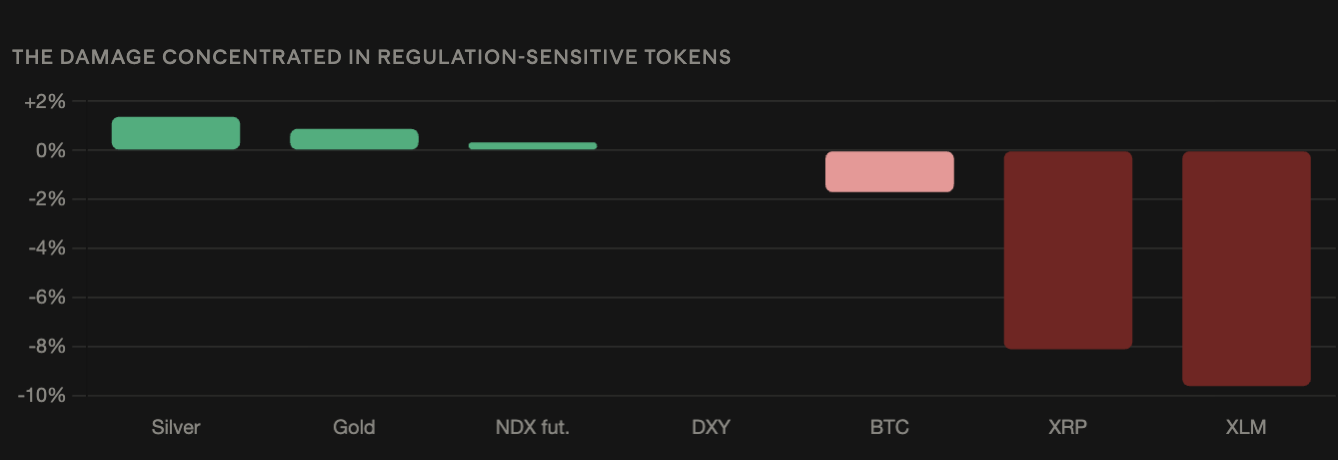
ETF News | Bitcoin ETFs Shed $450 Million in the Heaviest Outflow Since June After Clarity FailsUS spot Bitcoin ETFs shed $450 million Tuesday, per SoSoValue — the heaviest single-day outflow since June 25 — after the Senate declined to advance the Digital Asset Market Clarity Act.The vote garnered around 10 fewer than the 60 required. Among those opposing were seven Democrats who had spent months negotiating the text.Bitcoin trades at $75,965, little changed since midnight UTC after dropping following the vote. The CoinDesk 20 Index held its loss, down less than 0.1% after falling 4.6% Tuesday in its steepest decline since June 5.Seven Negotiators Voting No Is the DetailThe margin matters less than who produced it.Democrats who spent months working on the text voted against advancing it. That is not opposition to market structure legislation — it is a judgment that the ethics provisions governing officials profiting from digital assets were not resolved acceptably.The bill's failure effectively ends any prospect of market structure legislation clearing the Senate this year, with Congress expected to be under split control in January.Galaxy Digital CEO Mike Novogratz called it "18 months of work between our industry, dems and republicans" falling apart "on the 5 yard line."The Damage Concentrated in Regulation-Sensitive TokensBitcoin's 24-hour drop of 1.7% looks muted against the tokens most exposed to US regulatory treatment.Stellar fell 9.6% over 24 hours and XRP 8.1%. Among CoinDesk 100 constituents, 95 lost value.Both had been direct beneficiaries of the legislative push. XRP rose roughly 5% when the bill cleared Senate Banking in May, and its ETF complex had been the only consistent inflow category in recent weeks.Traditional markets were steady by comparison. Nasdaq 100 futures added 0.33%, gold rose 0.88% and silver 1.37%, with the Dollar Index unchanged — confirming this as a crypto-specific event rather than a macro one.$570 Million Liquidated, the Most Since August 22Forced deleveraging intensified as prices sold off.Leveraged futures positions worth more than $570 million were liquidated over 24 hours, the most since August 22 though still well short of the washouts seen in early February and early June.The taker long-short volume ratio flipped bearish, with shorts accounting for 51.5% of flow.Hyperliquid's trader long/short ratio pulled back slightly to 2.53 from 2.71 — the highest reading since early October 2025, when Bitcoin last traded above $120,000. More than two longs remain for every short, pointing to considerable bullish leverage still exposed if prices keep sliding.Open Interest Rose Into the DeclineThe positioning shift is the most informative derivatives reading.Bitcoin fell over 24 hours even as futures open interest ticked up to 688,000 BTC from 676,000. Price down with open interest up reads as traders adding bearish bets rather than closing longs.Bitcoin's 24-hour open-interest-adjusted cumulative volume delta is negative, indicating shorts executed aggressively at market rather than through passive limit orders. Perpetual funding rates still point to lingering optimism among some traders, which is the contradiction in the data.XRP showed the same pattern, dropping alongside a slight uptick in open interest. Its tally remains well below record highs, so overall positioning is light.XRP, ETH, TRX, DOGE, XLM and SHIB all carry negative 24-hour CVDs, implying aggressive derivatives selling. Funding rates are bearish for ETH, XLM, TRX, SOL, BCH, ADA and LINK.Options Disagree With ThemselvesSkew and volume point in opposite directions, which is worth flagging rather than resolving.Bitcoin one-week and one-month skews are positive and rising — one-week around 5.76%, one-month around 6.33% — indicating growing demand for downside protection. Ether skews point the same way.Volumes tell a different story. The most-traded Bitcoin options over 24 hours were mostly calls, led by the $79,000 strike. In ether, the top five were all puts.Bitcoin traders are paying up for puts while trading calls. That combination typically describes holders hedging existing spot exposure while speculative flow positions for a bounce.Implied volatility remains calm. The 30-day BVIV and EVIV indexes sit within recent ranges and well below year-to-date peaks, meaning traders are not pricing a volatility spike around the rate decision.Standard Chartered Put a $10 Target on ArbitrumArbitrum led over 24 hours, adding 16% after Standard Chartered forecast the token reaching $10 by the end of 2030 — roughly 70 times the current level.The bank cited revenue from Robinhood Chain and the growth of tokenized assets. Its near-term target is a more restrained $0.50 by year-end.Robinhood Chain has been generating over $2 million in daily revenue with 10% of flows directed to the Arbitrum ecosystem, and ARK Invest documented 20x revenue growth between August 22 and August 30.The Synapse Move Was a Squeeze, Not DemandSynapse more than doubled to $0.1787 with no apparent catalyst, and its composition is instructive.Futures volume reached $310.64 million over 24 hours against a market cap of just $41.18 million. Open interest equals 60% of the token's value, and the long/short accounts ratio on Binance sits at 0.93.Volume at more than seven times market cap with shorts outnumbering longs describes a short squeeze rather than spot demand. Moves built that way tend to retrace when the forced buying exhausts.Privacy Held Through the SelloffZcash added 6.9% to $1,186.75 to lead the sector, with Dash rising 2.9% — privacy remaining the month's most durable trade.Perpetuals exchange token Lighter climbed 6% to $4.27 and Raydium 5.4% to $1.30, both recovering ground from Tuesday's rout without returning to where they started the week.DeFi tokens AAVE, JUP and ETHFI all lost more than 2% despite ether.fi founder Mike Silagadze telling CoinDesk before the vote that "the U.S. is currently a very small market for ether.fi so honestly Clarity isn't much of an impact."That gap between stated exposure and price reaction suggests the selling was indiscriminate rather than targeted at genuine regulatory exposure.Attention Switches to the FedThe interest-rate decision lands later Wednesday, with an increase the base case going in.Bitunix analysts said the size of the move matters less than what happens to long-term Treasury yields afterward. If long-dated yields hold near current levels despite a tighter short rate, markets are pricing US inflation and fiscal risk separately from Fed policy.The 10-year sits at 5.04%, its highest since July 2007, and the 30-year at 5.40%.
ETF News | Bitcoin ETFs Shed $450 Million in the Heaviest Outflow Since June After Clarity Fails
US spot Bitcoin ETFs shed $450 million Tuesday, per SoSoValue — the heaviest single-day outflow since June 25 — after the Senate declined to advance the Digital Asset Market Clarity Act.The vote garnered around 10 fewer than the 60 required. Among those opposing were seven Democrats who had spent months negotiating the text.Bitcoin trades at $75,965, little changed since midnight UTC after dropping following the vote. The CoinDesk 20 Index held its loss, down less than 0.1% after falling 4.6% Tuesday in its steepest decline since June 5.Seven Negotiators Voting No Is the DetailThe margin matters less than who produced it.Democrats who spent months working on the text voted against advancing it. That is not opposition to market structure legislation — it is a judgment that the ethics provisions governing officials profiting from digital assets were not resolved acceptably.The bill's failure effectively ends any prospect of market structure legislation clearing the Senate this year, with Congress expected to be under split control in January.Galaxy Digital CEO Mike Novogratz called it "18 months of work between our industry, dems and republicans" falling apart "on the 5 yard line."The Damage Concentrated in Regulation-Sensitive TokensBitcoin's 24-hour drop of 1.7% looks muted against the tokens most exposed to US regulatory treatment.Stellar fell 9.6% over 24 hours and XRP 8.1%. Among CoinDesk 100 constituents, 95 lost value.Both had been direct beneficiaries of the legislative push. XRP rose roughly 5% when the bill cleared Senate Banking in May, and its ETF complex had been the only consistent inflow category in recent weeks.Traditional markets were steady by comparison. Nasdaq 100 futures added 0.33%, gold rose 0.88% and silver 1.37%, with the Dollar Index unchanged — confirming this as a crypto-specific event rather than a macro one.$570 Million Liquidated, the Most Since August 22Forced deleveraging intensified as prices sold off.Leveraged futures positions worth more than $570 million were liquidated over 24 hours, the most since August 22 though still well short of the washouts seen in early February and early June.The taker long-short volume ratio flipped bearish, with shorts accounting for 51.5% of flow.Hyperliquid's trader long/short ratio pulled back slightly to 2.53 from 2.71 — the highest reading since early October 2025, when Bitcoin last traded above $120,000. More than two longs remain for every short, pointing to considerable bullish leverage still exposed if prices keep sliding.Open Interest Rose Into the DeclineThe positioning shift is the most informative derivatives reading.Bitcoin fell over 24 hours even as futures open interest ticked up to 688,000 BTC from 676,000. Price down with open interest up reads as traders adding bearish bets rather than closing longs.Bitcoin's 24-hour open-interest-adjusted cumulative volume delta is negative, indicating shorts executed aggressively at market rather than through passive limit orders. Perpetual funding rates still point to lingering optimism among some traders, which is the contradiction in the data.XRP showed the same pattern, dropping alongside a slight uptick in open interest. Its tally remains well below record highs, so overall positioning is light.XRP, ETH, TRX, DOGE, XLM and SHIB all carry negative 24-hour CVDs, implying aggressive derivatives selling. Funding rates are bearish for ETH, XLM, TRX, SOL, BCH, ADA and LINK.Options Disagree With ThemselvesSkew and volume point in opposite directions, which is worth flagging rather than resolving.Bitcoin one-week and one-month skews are positive and rising — one-week around 5.76%, one-month around 6.33% — indicating growing demand for downside protection. Ether skews point the same way.Volumes tell a different story. The most-traded Bitcoin options over 24 hours were mostly calls, led by the $79,000 strike. In ether, the top five were all puts.Bitcoin traders are paying up for puts while trading calls. That combination typically describes holders hedging existing spot exposure while speculative flow positions for a bounce.Implied volatility remains calm. The 30-day BVIV and EVIV indexes sit within recent ranges and well below year-to-date peaks, meaning traders are not pricing a volatility spike around the rate decision.Standard Chartered Put a $10 Target on ArbitrumArbitrum led over 24 hours, adding 16% after Standard Chartered forecast the token reaching $10 by the end of 2030 — roughly 70 times the current level.The bank cited revenue from Robinhood Chain and the growth of tokenized assets. Its near-term target is a more restrained $0.50 by year-end.Robinhood Chain has been generating over $2 million in daily revenue with 10% of flows directed to the Arbitrum ecosystem, and ARK Invest documented 20x revenue growth between August 22 and August 30.The Synapse Move Was a Squeeze, Not DemandSynapse more than doubled to $0.1787 with no apparent catalyst, and its composition is instructive.Futures volume reached $310.64 million over 24 hours against a market cap of just $41.18 million. Open interest equals 60% of the token's value, and the long/short accounts ratio on Binance sits at 0.93.Volume at more than seven times market cap with shorts outnumbering longs describes a short squeeze rather than spot demand. Moves built that way tend to retrace when the forced buying exhausts.Privacy Held Through the SelloffZcash added 6.9% to $1,186.75 to lead the sector, with Dash rising 2.9% — privacy remaining the month's most durable trade.Perpetuals exchange token Lighter climbed 6% to $4.27 and Raydium 5.4% to $1.30, both recovering ground from Tuesday's rout without returning to where they started the week.DeFi tokens AAVE, JUP and ETHFI all lost more than 2% despite ether.fi founder Mike Silagadze telling CoinDesk before the vote that "the U.S. is currently a very small market for ether.fi so honestly Clarity isn't much of an impact."That gap between stated exposure and price reaction suggests the selling was indiscriminate rather than targeted at genuine regulatory exposure.Attention Switches to the FedThe interest-rate decision lands later Wednesday, with an increase the base case going in.Bitunix analysts said the size of the move matters less than what happens to long-term Treasury yields afterward. If long-dated yields hold near current levels despite a tighter short rate, markets are pricing US inflation and fiscal risk separately from Fed policy.The 10-year sits at 5.04%, its highest since July 2007, and the 30-year at 5.40%.
Abstimmung
Are you treating this ETF outflow as bearish?
Yes, I’m getting more defensive now
No, I’m HODLing through the noise
Meh, I’m waiting for better confirmation
It’s brutal, but fear feels like a buy cue
99 Stimmen • Abstimmung läuft
2
17
39.8k
·
--
Artikel
Übersetzung ansehen
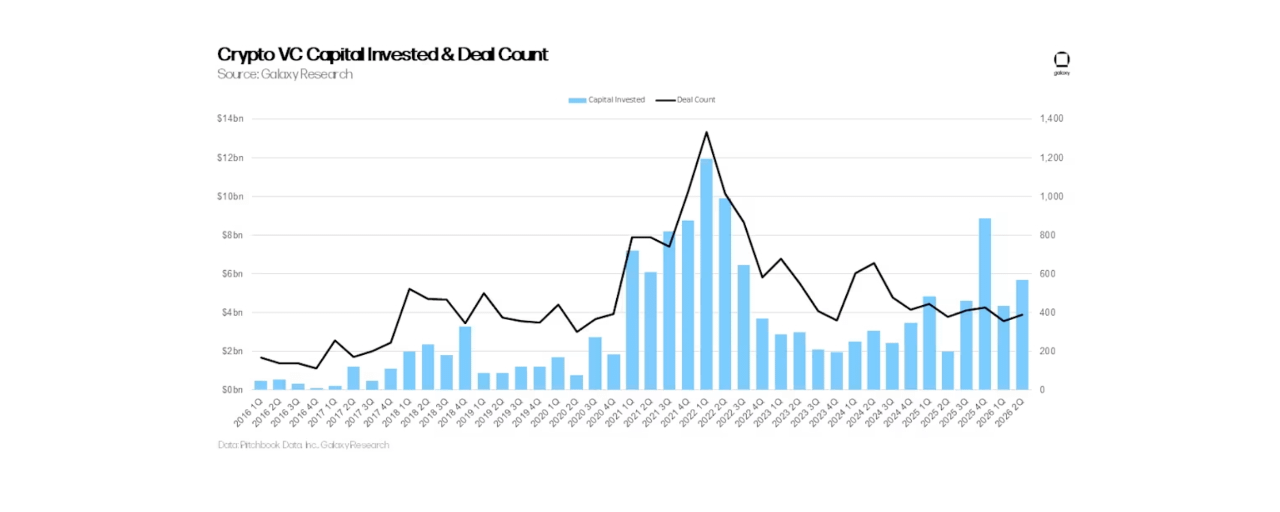
Crypto Venture Funding Rebounds to $5.6 Billion in Q2 2026, Galaxy Research SaysGalaxy Research said crypto venture capital activity recovered in the second quarter of 2026 after a weak first quarter. According to PANews, venture firms invested about $5.6 billion in 384 deals involving private crypto and blockchain companies, up 31% quarter over quarter in funding and 10% in deal count.
The report said the increase was driven mainly by later-stage financing. New fund formation remained difficult, with only five new crypto venture funds raising about $3.9 billion in the second quarter, the fewest newly formed funds in a quarter since the fourth quarter of 2019.
Based on the pace of investment in the first half of 2026, full-year funding is projected at about $20.037 billion. That would be slightly below the $20.3 billion recorded in 2025, but above most of the market downturn period in 2023 and 2024.
Later-stage deals accounted for about 77% of invested capital, while early-stage deals made up 15% and seed and pre-seed rounds accounted for the remaining 7%. U.S.-based startups received 73.5% of total funding and represented 39.1% of the 384 deals. Trading, exchange, investment, and lending companies led all sectors with about $3.523 billion across 51 deals.
Crypto Venture Funding Rebounds to $5.6 Billion in Q2 2026, Galaxy Research Says
Galaxy Research said crypto venture capital activity recovered in the second quarter of 2026 after a weak first quarter. According to PANews, venture firms invested about $5.6 billion in 384 deals involving private crypto and blockchain companies, up 31% quarter over quarter in funding and 10% in deal count.
The report said the increase was driven mainly by later-stage financing. New fund formation remained difficult, with only five new crypto venture funds raising about $3.9 billion in the second quarter, the fewest newly formed funds in a quarter since the fourth quarter of 2019.
Based on the pace of investment in the first half of 2026, full-year funding is projected at about $20.037 billion. That would be slightly below the $20.3 billion recorded in 2025, but above most of the market downturn period in 2023 and 2024.
Later-stage deals accounted for about 77% of invested capital, while early-stage deals made up 15% and seed and pre-seed rounds accounted for the remaining 7%. U.S.-based startups received 73.5% of total funding and represented 39.1% of the 384 deals. Trading, exchange, investment, and lending companies led all sectors with about $3.523 billion across 51 deals.
The report said the increase was driven mainly by later-stage financing. New fund formation remained difficult, with only five new crypto venture funds raising about $3.9 billion in the second quarter, the fewest newly formed funds in a quarter since the fourth quarter of 2019.
Based on the pace of investment in the first half of 2026, full-year funding is projected at about $20.037 billion. That would be slightly below the $20.3 billion recorded in 2025, but above most of the market downturn period in 2023 and 2024.
Later-stage deals accounted for about 77% of invested capital, while early-stage deals made up 15% and seed and pre-seed rounds accounted for the remaining 7%. U.S.-based startups received 73.5% of total funding and represented 39.1% of the 384 deals. Trading, exchange, investment, and lending companies led all sectors with about $3.523 billion across 51 deals.
1k
·
--
Artikel
Übersetzung ansehen
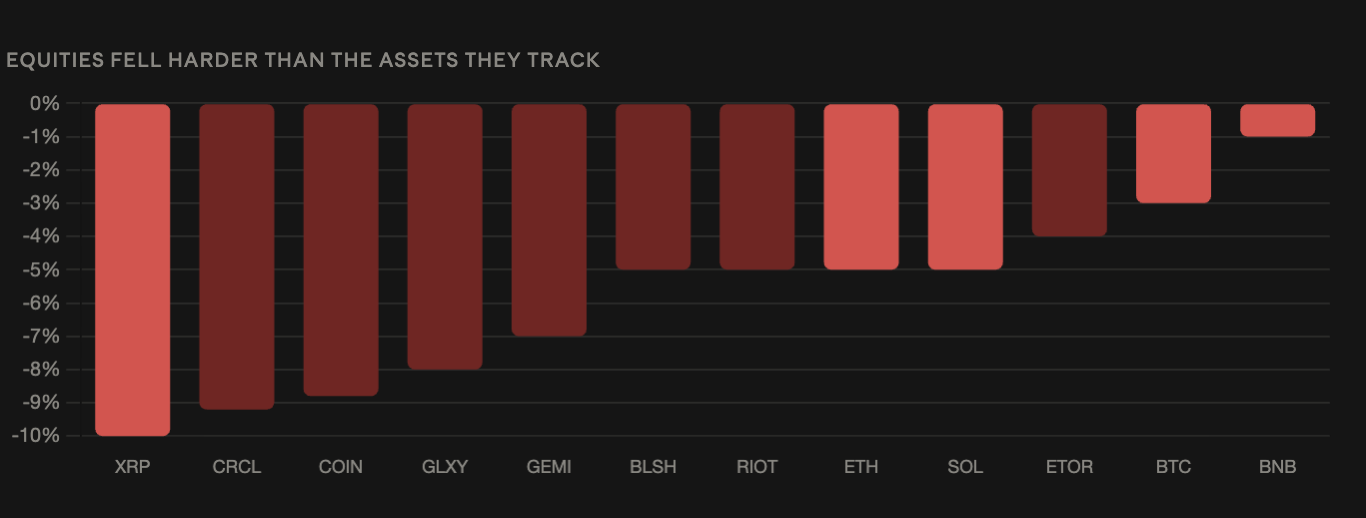
XRP News | XRP Sinks 10% on a 49-50 Cloture Vote as Crypto Equities Fall Harder Than TokensXRP dropped nearly 10% to $1.30 in Asian morning hours Wednesday, the worst performance among the majors, after the Senate failed to advance the Clarity Act.The bill went down on a 49-50 cloture vote, the procedural step requiring 60 senators to move legislation to debate. Multiple Republicans voted no.Ether was next hardest hit at nearly 5% lower to about $2,410, with Solana down 5% to just above $97 and Dogecoin down nearly 5%. Zcash and Hyperliquid's HYPE each fell close to 4%, and Bitcoin slipped nearly 3% to just above $76,000. BNB and Tron were mildest at about 1% each.Ethics Language Broke 600 Pages of CompromiseNegotiators produced more than 600 pages of compromise text. The provision that broke it was ethics language meant to stop senior government officials from keeping crypto business interests.Senator Elissa Slotkin explained her vote directly."The ethics provisions in this bill are simply too thin," she wrote. "President Trump, his children, and his Cabinet are making billions of dollars in the crypto space."She also said the Commodity Futures Trading Commission lacks the staffing to implement the law, and that the bill left gaps on money laundering and terrorist financing.Those are three separate objections, and only one concerns the president. The staffing and financial crime points would survive a change in administration, which matters for whether a future Congress can revive the framework unchanged.Equities Fell Harder Than the Assets They TrackThe damage concentrated in listed companies rather than tokens.Coinbase fell nearly 9% to $174.42 and Circle dropped more than 9% to $88.26, with Galaxy Digital down 8% and Gemini 7%. Bullish and Riot Platforms each lost 5%, eToro 4%, and Robinhood, MARA Holdings, CleanSpark, IREN and Core Scientific fell between 3% and 4%.Bitcoin lost under 3% over the same period.That inversion is the session's clearest signal. Crypto equities are the leveraged expression of US regulatory outcomes — their business models depend on operating in a defined legal framework, while a token can trade anywhere.Siebert Financial's Brian Vieten had made the point before the vote, arguing a failure could pull product launches and tokenization work forward into 2027 and 2028 rather than shelving them. LO:TECH's Adam Morgan McCarthy was more direct: "if it stalls I'd expect the crypto equities to give back more than BTC, given again the beta."Both were correct.Attention Moves to the Regulators the Bill Would Have BoundThe SEC is already working on its proposed Reg Crypto framework and rules for tokenized securities, which now becomes the only route to the certainty the industry wanted from Congress.Strategy's Michael Saylor took that position immediately: "Progress need not wait for Congress. With CLARITY stalled, I expect the SEC, CFTC, and Treasury to advance rules under existing law."Galaxy Digital's Mike Novogratz reached the same conclusion less enthusiastically, saying he has "faith that the SEC and CFTC will drive on with rules for the road and hopefully in time Congress will find a way to memorialize them."Agency rulemaking differs from legislation in a way that matters here. Rules made under existing authority can be unmade by a subsequent administration, which is precisely the durability problem Congress was meant to solve.Slotkin's staffing objection also applies. A CFTC without the resources to implement a statute is not obviously better positioned to write and enforce its own framework.Two Dates Now Matter More Than the VoteIndustry political action committees including Fairshake have to decide how to treat the senators who voted no before the November 3 election.A new Congress convenes in January 2027, expected under split control — which effectively ends any prospect of market structure legislation clearing the Senate this year.That sequencing turns the failure into a political question rather than a legislative one. Whether the senators who blocked it face consequences in November shapes what the next Congress is willing to attempt.The Fed Lands on a Market Already SellingThe Federal Reserve decides on rates later Wednesday with traders leaning toward a quarter-point hike.It arrives at a market that has just watched its legislative bid collapse and is already selling risk.Spot Bitcoin ETFs shed $450 million Tuesday, the heaviest single-day outflow since June 25, with more than $570 million in leveraged futures liquidated — the most since August 22.Talos recorded a 28% net buying tilt toward stablecoins ahead of the meeting, against an 8% average selling tilt around previous FOMC meetings.Bitcoin's correlations have broken down in the process. CoinMarketCap data show its short-window link to the Dollar Index at +0.08 against −0.54 over 30 days, with the S&P 500 correlation falling to 0.43 from 0.75 in a single session.Brookings senior fellow Robin Brooks expects the meeting to disappoint regardless: "There's no way he can live up to all the hikes priced, so the press conference will likely disappoint markets."The decision comes at 2:00 p.m. ET with Chair Kevin Warsh's press conference 30 minutes later.
XRP News | XRP Sinks 10% on a 49-50 Cloture Vote as Crypto Equities Fall Harder Than Tokens
XRP dropped nearly 10% to $1.30 in Asian morning hours Wednesday, the worst performance among the majors, after the Senate failed to advance the Clarity Act.The bill went down on a 49-50 cloture vote, the procedural step requiring 60 senators to move legislation to debate. Multiple Republicans voted no.Ether was next hardest hit at nearly 5% lower to about $2,410, with Solana down 5% to just above $97 and Dogecoin down nearly 5%. Zcash and Hyperliquid's HYPE each fell close to 4%, and Bitcoin slipped nearly 3% to just above $76,000. BNB and Tron were mildest at about 1% each.Ethics Language Broke 600 Pages of CompromiseNegotiators produced more than 600 pages of compromise text. The provision that broke it was ethics language meant to stop senior government officials from keeping crypto business interests.Senator Elissa Slotkin explained her vote directly."The ethics provisions in this bill are simply too thin," she wrote. "President Trump, his children, and his Cabinet are making billions of dollars in the crypto space."She also said the Commodity Futures Trading Commission lacks the staffing to implement the law, and that the bill left gaps on money laundering and terrorist financing.Those are three separate objections, and only one concerns the president. The staffing and financial crime points would survive a change in administration, which matters for whether a future Congress can revive the framework unchanged.Equities Fell Harder Than the Assets They TrackThe damage concentrated in listed companies rather than tokens.Coinbase fell nearly 9% to $174.42 and Circle dropped more than 9% to $88.26, with Galaxy Digital down 8% and Gemini 7%. Bullish and Riot Platforms each lost 5%, eToro 4%, and Robinhood, MARA Holdings, CleanSpark, IREN and Core Scientific fell between 3% and 4%.Bitcoin lost under 3% over the same period.That inversion is the session's clearest signal. Crypto equities are the leveraged expression of US regulatory outcomes — their business models depend on operating in a defined legal framework, while a token can trade anywhere.Siebert Financial's Brian Vieten had made the point before the vote, arguing a failure could pull product launches and tokenization work forward into 2027 and 2028 rather than shelving them. LO:TECH's Adam Morgan McCarthy was more direct: "if it stalls I'd expect the crypto equities to give back more than BTC, given again the beta."Both were correct.Attention Moves to the Regulators the Bill Would Have BoundThe SEC is already working on its proposed Reg Crypto framework and rules for tokenized securities, which now becomes the only route to the certainty the industry wanted from Congress.Strategy's Michael Saylor took that position immediately: "Progress need not wait for Congress. With CLARITY stalled, I expect the SEC, CFTC, and Treasury to advance rules under existing law."Galaxy Digital's Mike Novogratz reached the same conclusion less enthusiastically, saying he has "faith that the SEC and CFTC will drive on with rules for the road and hopefully in time Congress will find a way to memorialize them."Agency rulemaking differs from legislation in a way that matters here. Rules made under existing authority can be unmade by a subsequent administration, which is precisely the durability problem Congress was meant to solve.Slotkin's staffing objection also applies. A CFTC without the resources to implement a statute is not obviously better positioned to write and enforce its own framework.Two Dates Now Matter More Than the VoteIndustry political action committees including Fairshake have to decide how to treat the senators who voted no before the November 3 election.A new Congress convenes in January 2027, expected under split control — which effectively ends any prospect of market structure legislation clearing the Senate this year.That sequencing turns the failure into a political question rather than a legislative one. Whether the senators who blocked it face consequences in November shapes what the next Congress is willing to attempt.The Fed Lands on a Market Already SellingThe Federal Reserve decides on rates later Wednesday with traders leaning toward a quarter-point hike.It arrives at a market that has just watched its legislative bid collapse and is already selling risk.Spot Bitcoin ETFs shed $450 million Tuesday, the heaviest single-day outflow since June 25, with more than $570 million in leveraged futures liquidated — the most since August 22.Talos recorded a 28% net buying tilt toward stablecoins ahead of the meeting, against an 8% average selling tilt around previous FOMC meetings.Bitcoin's correlations have broken down in the process. CoinMarketCap data show its short-window link to the Dollar Index at +0.08 against −0.54 over 30 days, with the S&P 500 correlation falling to 0.43 from 0.75 in a single session.Brookings senior fellow Robin Brooks expects the meeting to disappoint regardless: "There's no way he can live up to all the hikes priced, so the press conference will likely disappoint markets."The decision comes at 2:00 p.m. ET with Chair Kevin Warsh's press conference 30 minutes later.
12
19k
·
--
Übersetzung ansehen
Whale’s 10x ZEC Short Is Liquidated After Price Rises Above $1,390A whale opened a 10x leveraged short on 8,120 ZEC at around $1,245 before the Federal Reserve’s rate decision was announced. According to Odaily, the position was fully liquidated about three hours later after ZEC climbed above $1,390, resulting in a loss of about $890,000.
Whale’s 10x ZEC Short Is Liquidated After Price Rises Above $1,390
A whale opened a 10x leveraged short on 8,120 ZEC at around $1,245 before the Federal Reserve’s rate decision was announced. According to Odaily, the position was fully liquidated about three hours later after ZEC climbed above $1,390, resulting in a loss of about $890,000.
2
2
5.6k
·
--
Übersetzung ansehen
Market News | One-Off Calibration or the Start of a Cycle: What Actually Divides Wall StreetThe Federal Reserve announces its rate decision and economic projections at 2:00 p.m. ET, with Chair Kevin Warsh's press conference half an hour later.Rate futures indicate roughly 90% probability of a 25 basis point increase, which would lift the target range to 3.75%-4.00%. A Reuters survey of 101 economists found 86 expecting that move.The disagreement is entirely about what it means.Bank of America Is the Most Hawkish at 75 Basis PointsThree houses expect two hikes this year. JPMorgan, Morgan Stanley, HSBC and Barclays all forecast 25 basis points in September and December.Morgan Stanley cites a slower pace of inflation decline, demand driven by AI investment, the second wave of energy price impacts, and the need to maintain policy credibility.Barclays previously predicted no change this year and adjusted after Warsh's Jackson Hole speech — a revision that happened weeks before the inflation data confirmed the case.Bank of America sits furthest out, forecasting increases in September, October and December for 75 basis points total. Its argument is about credibility rather than inflation: if the Fed stays inactive when markets have largely priced hikes, it could damage policy credibility and drive a significant rise in long-term Treasury yields.Goldman and Citi Call It a CalibrationThe opposing camp treats Wednesday as an adjustment rather than an opening move.Goldman Sachs expects the hike but no clear signal of continued tightening, with Warsh likely emphasising continued assessment of economic data. The firm still expects the Fed to cut once each in September and December 2027.Citigroup expects a pause after this hike with cuts resuming in June 2027. It anticipates a unanimous vote, or at most two dissents favouring no change, and thinks Warsh may describe the action as a "calibration" rather than the start of a cycle.That word choice is the whole disagreement compressed. A calibration is a level adjustment. A cycle is a direction.Chaudhuri Argues the Fed Should Not Hike at AllBlackRock strategist Gargi Pal Chaudhuri holds the minority view, arguing underlying inflation is cooling and the Fed should keep rates between 3.50% and 3.75%.Her framing of what to watch is more useful than the call itself. If the hike happens, she says investors should focus on how Warsh explains the threshold for the next one, and whether rising oil prices have altered the Fed's policy response mechanism.That second question is the underexamined one. An energy shock is inflationary and contractionary simultaneously, and how a central bank treats supply-driven inflation determines whether this becomes a cycle.Risk Dimensions CIO Mark Connors put it more bluntly, calling another hike "using a pitchfork to bail out our boat of inflation."JPMorgan Has Priced Three ScenariosThe bank quantified the equity reaction across outcomes.A hike as expected with wording that is not overly hawkish takes the S&P 500 up 0.25% to 1%.An unexpected hold sends long-term inflation expectations and Treasury yields higher, with the index falling 1.25% to 1.75%.Warsh implying rates must rise to a "substantially higher" level produces a 1% to 2% decline.The asymmetry is worth noting. The downside cases are roughly twice the magnitude of the upside case, and the worst outcome is a hold rather than excessive hawkishness — consistent with Hyperion Decimus' Chris Sullivan arguing a hold would leave investors wondering what policymakers see that markets do not.The Dot Plot Carries the InformationInstitutions are largely agreed on the 25 basis points. The main disagreement is whether it represents an independent adjustment or the start of a new round.That makes the dot plot, the voting results and Warsh's remarks more consequential than the rate change itself.Brookings senior fellow Robin Brooks expects disappointment regardless: "There's no way he can live up to all the hikes priced, so the press conference will likely disappoint markets. The Dollar is likely to fall and long yields likely to rise."Warsh also faces a structural problem. He rejected forward guidance at Jackson Hole, arguing it has "overstayed its welcome," which leaves him without a mechanism for confirming or correcting the path markets have built. The projections provide that signal impersonally, which may be the intended route.Citigroup's expectation of a near-unanimous vote matters here too. Dissents are the clearest public evidence of internal disagreement, and their absence would strengthen whatever the dot plot shows.Crypto Is Positioned DefensivelyBitcoin traded just above $76,000 after the Clarity Act failed its Senate cloture vote 49-50.Talos recorded a 28% net buying tilt toward stablecoins ahead of the meeting, against an 8% average selling tilt around previous FOMC meetings. Bitcoin buying conviction fell to 3% from 10% and ether to 9% from 23%.Spot Bitcoin ETFs shed $450 million Tuesday, the heaviest single-day outflow since June 25, with more than $570 million in leveraged futures liquidated.Bitcoin's correlations have broken down, which complicates reading any reaction. CoinMarketCap data show its short-window link to the S&P 500 at 0.43 from 0.75 and the Dollar Index at +0.08 against −0.54 over 30 days.JPMorgan's equity scenarios therefore transmit to Bitcoin considerably less than they normally would.
Market News | One-Off Calibration or the Start of a Cycle: What Actually Divides Wall Street
The Federal Reserve announces its rate decision and economic projections at 2:00 p.m. ET, with Chair Kevin Warsh's press conference half an hour later.Rate futures indicate roughly 90% probability of a 25 basis point increase, which would lift the target range to 3.75%-4.00%. A Reuters survey of 101 economists found 86 expecting that move.The disagreement is entirely about what it means.Bank of America Is the Most Hawkish at 75 Basis PointsThree houses expect two hikes this year. JPMorgan, Morgan Stanley, HSBC and Barclays all forecast 25 basis points in September and December.Morgan Stanley cites a slower pace of inflation decline, demand driven by AI investment, the second wave of energy price impacts, and the need to maintain policy credibility.Barclays previously predicted no change this year and adjusted after Warsh's Jackson Hole speech — a revision that happened weeks before the inflation data confirmed the case.Bank of America sits furthest out, forecasting increases in September, October and December for 75 basis points total. Its argument is about credibility rather than inflation: if the Fed stays inactive when markets have largely priced hikes, it could damage policy credibility and drive a significant rise in long-term Treasury yields.Goldman and Citi Call It a CalibrationThe opposing camp treats Wednesday as an adjustment rather than an opening move.Goldman Sachs expects the hike but no clear signal of continued tightening, with Warsh likely emphasising continued assessment of economic data. The firm still expects the Fed to cut once each in September and December 2027.Citigroup expects a pause after this hike with cuts resuming in June 2027. It anticipates a unanimous vote, or at most two dissents favouring no change, and thinks Warsh may describe the action as a "calibration" rather than the start of a cycle.That word choice is the whole disagreement compressed. A calibration is a level adjustment. A cycle is a direction.Chaudhuri Argues the Fed Should Not Hike at AllBlackRock strategist Gargi Pal Chaudhuri holds the minority view, arguing underlying inflation is cooling and the Fed should keep rates between 3.50% and 3.75%.Her framing of what to watch is more useful than the call itself. If the hike happens, she says investors should focus on how Warsh explains the threshold for the next one, and whether rising oil prices have altered the Fed's policy response mechanism.That second question is the underexamined one. An energy shock is inflationary and contractionary simultaneously, and how a central bank treats supply-driven inflation determines whether this becomes a cycle.Risk Dimensions CIO Mark Connors put it more bluntly, calling another hike "using a pitchfork to bail out our boat of inflation."JPMorgan Has Priced Three ScenariosThe bank quantified the equity reaction across outcomes.A hike as expected with wording that is not overly hawkish takes the S&P 500 up 0.25% to 1%.An unexpected hold sends long-term inflation expectations and Treasury yields higher, with the index falling 1.25% to 1.75%.Warsh implying rates must rise to a "substantially higher" level produces a 1% to 2% decline.The asymmetry is worth noting. The downside cases are roughly twice the magnitude of the upside case, and the worst outcome is a hold rather than excessive hawkishness — consistent with Hyperion Decimus' Chris Sullivan arguing a hold would leave investors wondering what policymakers see that markets do not.The Dot Plot Carries the InformationInstitutions are largely agreed on the 25 basis points. The main disagreement is whether it represents an independent adjustment or the start of a new round.That makes the dot plot, the voting results and Warsh's remarks more consequential than the rate change itself.Brookings senior fellow Robin Brooks expects disappointment regardless: "There's no way he can live up to all the hikes priced, so the press conference will likely disappoint markets. The Dollar is likely to fall and long yields likely to rise."Warsh also faces a structural problem. He rejected forward guidance at Jackson Hole, arguing it has "overstayed its welcome," which leaves him without a mechanism for confirming or correcting the path markets have built. The projections provide that signal impersonally, which may be the intended route.Citigroup's expectation of a near-unanimous vote matters here too. Dissents are the clearest public evidence of internal disagreement, and their absence would strengthen whatever the dot plot shows.Crypto Is Positioned DefensivelyBitcoin traded just above $76,000 after the Clarity Act failed its Senate cloture vote 49-50.Talos recorded a 28% net buying tilt toward stablecoins ahead of the meeting, against an 8% average selling tilt around previous FOMC meetings. Bitcoin buying conviction fell to 3% from 10% and ether to 9% from 23%.Spot Bitcoin ETFs shed $450 million Tuesday, the heaviest single-day outflow since June 25, with more than $570 million in leveraged futures liquidated.Bitcoin's correlations have broken down, which complicates reading any reaction. CoinMarketCap data show its short-window link to the S&P 500 at 0.43 from 0.75 and the Dollar Index at +0.08 against −0.54 over 30 days.JPMorgan's equity scenarios therefore transmit to Bitcoin considerably less than they normally would.
52
7
97
9.8k
·
--
Übersetzung ansehen
Circle Opens Arc Mainnet With More Than 100 Applications and 11 Founding ValidatorsCircle opened the public mainnet of its Arc Layer 1 blockchain on Wednesday. According to NS3.AI, more than 100 applications and over 100 institutional and ecosystem builders are available at launch.
Circle also completed the genesis mint of 10 billion ARC tokens, but it has not decided whether to launch the token publicly. BlackRock and Visa are among Arc's 11 founding validators.
Circle Opens Arc Mainnet With More Than 100 Applications and 11 Founding Validators
Circle opened the public mainnet of its Arc Layer 1 blockchain on Wednesday. According to NS3.AI, more than 100 applications and over 100 institutional and ecosystem builders are available at launch.
Circle also completed the genesis mint of 10 billion ARC tokens, but it has not decided whether to launch the token publicly. BlackRock and Visa are among Arc's 11 founding validators.
Circle also completed the genesis mint of 10 billion ARC tokens, but it has not decided whether to launch the token publicly. BlackRock and Visa are among Arc's 11 founding validators.
2
13
56.1k
·
--
Übersetzung ansehen
Revolut Hackers Demand $3 Million in Monero After Data BreachHackers behind a Revolut data breach demanded $3 million in Monero within 24 hours, according to the Financial Times. According to NS3.AI, the attackers threatened to sell stolen customer data to other criminal groups if Revolut refused to pay. At least 680 Revolut customer accounts were affected.
Revolut Hackers Demand $3 Million in Monero After Data Breach
Hackers behind a Revolut data breach demanded $3 million in Monero within 24 hours, according to the Financial Times. According to NS3.AI, the attackers threatened to sell stolen customer data to other criminal groups if Revolut refused to pay. At least 680 Revolut customer accounts were affected.
4
11k
·
--
Übersetzung ansehen
STOCKS | Intel CEO Says Memory Shortage Will WorsenIntel CEO Tan Lip-Bu said the memory shortage will worsen further. According to Sina Finance, he also said power supply and cooling technology will become core challenges in the semiconductor market.
At an AI infrastructure forum in Santa Clara, California, on the 15th, Tan said memory shortages were one of the industry problems he wanted startup founders entering AI infrastructure to solve. He said memory capacity is extremely limited, many projects have been delayed because they cannot secure enough memory, and memory prices have risen five to seven times. He added that it is difficult to obtain memory supply for mid- and low-end phones and laptops.
Tan also said power and cooling are difficult problems. He said low power consumption in some applications makes chip architecture design and interconnect technology very important, and that Intel is investing in air cooling, liquid cooling, and microfluidic cooling technologies.
He said Intel will continue its partnership with Nvidia and that companies cannot do everything themselves, but should focus on the areas where they are strongest and work with other firms that have advantages.
STOCKS | Intel CEO Says Memory Shortage Will Worsen
Intel CEO Tan Lip-Bu said the memory shortage will worsen further. According to Sina Finance, he also said power supply and cooling technology will become core challenges in the semiconductor market.
At an AI infrastructure forum in Santa Clara, California, on the 15th, Tan said memory shortages were one of the industry problems he wanted startup founders entering AI infrastructure to solve. He said memory capacity is extremely limited, many projects have been delayed because they cannot secure enough memory, and memory prices have risen five to seven times. He added that it is difficult to obtain memory supply for mid- and low-end phones and laptops.
Tan also said power and cooling are difficult problems. He said low power consumption in some applications makes chip architecture design and interconnect technology very important, and that Intel is investing in air cooling, liquid cooling, and microfluidic cooling technologies.
He said Intel will continue its partnership with Nvidia and that companies cannot do everything themselves, but should focus on the areas where they are strongest and work with other firms that have advantages.
At an AI infrastructure forum in Santa Clara, California, on the 15th, Tan said memory shortages were one of the industry problems he wanted startup founders entering AI infrastructure to solve. He said memory capacity is extremely limited, many projects have been delayed because they cannot secure enough memory, and memory prices have risen five to seven times. He added that it is difficult to obtain memory supply for mid- and low-end phones and laptops.
Tan also said power and cooling are difficult problems. He said low power consumption in some applications makes chip architecture design and interconnect technology very important, and that Intel is investing in air cooling, liquid cooling, and microfluidic cooling technologies.
He said Intel will continue its partnership with Nvidia and that companies cannot do everything themselves, but should focus on the areas where they are strongest and work with other firms that have advantages.
1
1
10
6.5k
·
--
Übersetzung ansehen
Aave to Launch RWA Lending Market on AvalancheAave will launch a dedicated real-world asset lending market on Avalanche, according to an announcement posted by Avalanche on X. According to ChainCatcher, the RWA Hub will let institutions borrow stablecoins against tokenized financial assets without selling their underlying positions.
Tether's USAT will serve as the market's core and provide the main source of U.S. dollar liquidity. Aave V4 on Avalanche has attracted more than $20 million in deposits in just two months since launch, and the RWA Hub is designed to extend that infrastructure into tokenized financial markets, allowing assets to be financed, collateralized, and used on-chain.
Aave to Launch RWA Lending Market on Avalanche
Aave will launch a dedicated real-world asset lending market on Avalanche, according to an announcement posted by Avalanche on X. According to ChainCatcher, the RWA Hub will let institutions borrow stablecoins against tokenized financial assets without selling their underlying positions.
Tether's USAT will serve as the market's core and provide the main source of U.S. dollar liquidity. Aave V4 on Avalanche has attracted more than $20 million in deposits in just two months since launch, and the RWA Hub is designed to extend that infrastructure into tokenized financial markets, allowing assets to be financed, collateralized, and used on-chain.
Tether's USAT will serve as the market's core and provide the main source of U.S. dollar liquidity. Aave V4 on Avalanche has attracted more than $20 million in deposits in just two months since launch, and the RWA Hub is designed to extend that infrastructure into tokenized financial markets, allowing assets to be financed, collateralized, and used on-chain.
7
11.2k
·
--
Antworten an
Blockonomi und 1 weitere Nutzer
Übersetzung ansehen
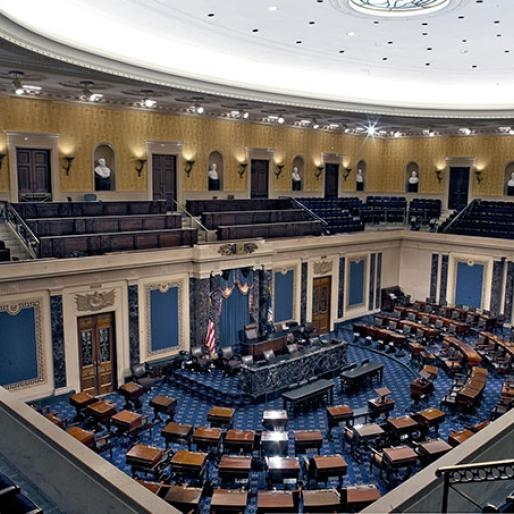
The CLARITY Act failed cloture Tuesday, 49-50, eleven votes shy of the 60 needed to advance. Bitcoin slid more than 5% and briefly broke below $75,000.
The sticking point was presidential ethics, with the market-structure substance largely settled:
Democrats refused language permitting President Trump's crypto holdings while his administration shapes the rules
Senator Warner helped write the AML provisions and still voted no, saying he could not support the bill in good conscience
Senator Lummis, the bill's chief GOP advocate, blamed Democrats for negotiating without intent to compromise — she exits the Senate after five-plus years on crypto legislation
The sector spent years and hundreds of millions lobbying for this framework. The return on that investment: regulatory clarity in Washington now runs through conflict-of-interest politics, with about 36 legislative days left before the new Congress.
The sticking point was presidential ethics, with the market-structure substance largely settled:
Democrats refused language permitting President Trump's crypto holdings while his administration shapes the rules
Senator Warner helped write the AML provisions and still voted no, saying he could not support the bill in good conscience
Senator Lummis, the bill's chief GOP advocate, blamed Democrats for negotiating without intent to compromise — she exits the Senate after five-plus years on crypto legislation
The sector spent years and hundreds of millions lobbying for this framework. The return on that investment: regulatory clarity in Washington now runs through conflict-of-interest politics, with about 36 legislative days left before the new Congress.
10
29.4k
·
--
Artikel
Übersetzung ansehen
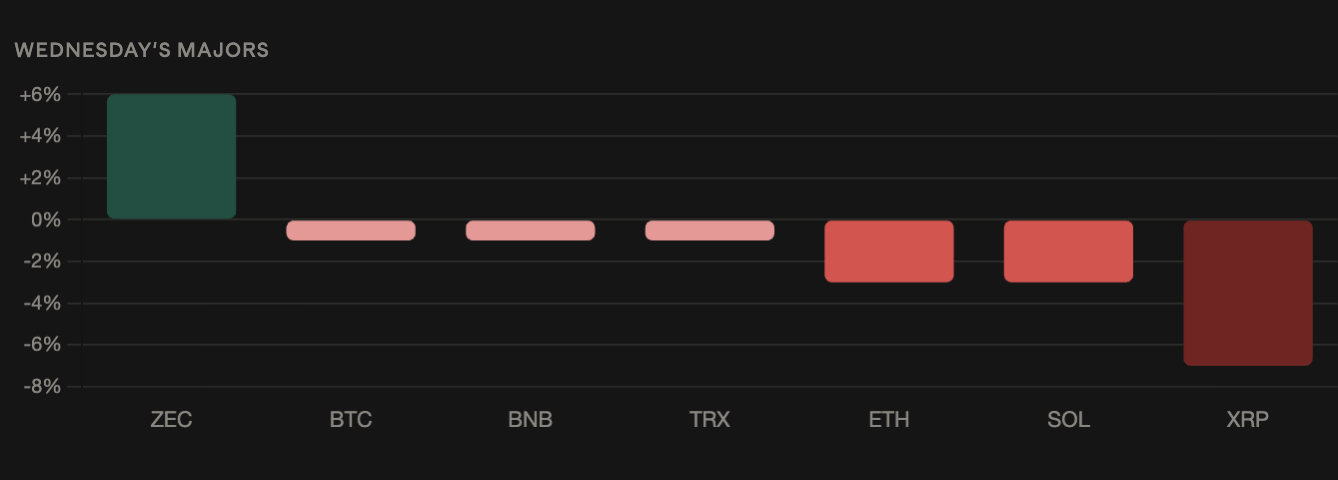
Altcoin News | Zcash Is the Only Major in the Green as Clarity's Failure Sinks the RestZcash rose nearly 6% to just above $1,200 in European morning hours Wednesday, the only major in the green. It is up 130% over 30 days and trades near its all-time highs from 2016.XRP led the decliners, down more than 7% to $1.29. Ether and Solana each fell about 3%, with Bitcoin, BNB and Tron all down roughly 1%.Bitcoin traded just under $76,000 after dipping below $75,000 on Tuesday, following the Clarity Act's failure in the Senate.The Divergence Tracks Regulatory ExposureThe split between Zcash and XRP is not random.XRP has been the most direct beneficiary of US regulatory progress this cycle. It rose roughly 5% when the bill cleared Senate Banking in May, its ETF complex has been the only consistent inflow category in recent weeks, and CME's share of its futures open interest climbed to around 17% from 10% in mid-August as offshore leverage drained.That positioning was built on legislation advancing. A 7% decline is that trade unwinding.Zcash carries the opposite exposure. A privacy coin's investment case does not depend on a US framework defining which agency regulates it, and for some holders it improves as legislative clarity recedes.Grayscale's ZCSH, the first US spot ETF for a privacy coin, holds over $414 million — a substantial spot bid relative to a futures open interest that had peaked at $2.4 billion before unwinding 20% earlier this month.Novogratz: 'Clarity Falls Apart on the Five Yard Line'Galaxy Digital CEO Mike Novogratz was blunt."Government feels broken," he wrote. "18 months of work between our industry, dems and republicans and Clarity falls apart on the 5 yard line."He assigned responsibility to both sides. "Republicans were afraid of putting real limits on a President's ability to profit from digital assets. Dems decided that this one industry is where they would fight a corruption battle. They were scared to be seen doing anything that could be perceived as being soft on the President."That describes the failure accurately. The provisions that sank the bill were ethics language about officials profiting from digital assets, not the market structure framework the industry wanted.Novogratz expects the agencies to proceed regardless: "I do have faith that the SEC and CFTC will drive on with rules for the road and hopefully in time Congress will find a way to memorialize them."Saylor and Coinbase Read It DifferentlyStrategy executive chairman Michael Saylor took the same position on agency action without the lament."Progress need not wait for Congress," he wrote. "With CLARITY stalled, I expect the SEC, CFTC, and Treasury to advance rules under existing law, banks to expand Bitcoin custody and loans against it, and more capital to favor Bitcoin and digital credit. GENIUS supports stablecoin adoption."Coinbase's Kara Calvert identified a different culprit."The banks did everything in their power to kill the Clarity Act," she said. "The big banks and the small banks worked together to hand Donald Trump a loss and stop financial innovation and competition in America, and they successfully put several Republicans on record as anti-crypto. This was not a zero-sum game, but they made it one."Those are not compatible accounts. Novogratz describes a bipartisan failure over ethics provisions; Calvert describes a banking lobby operation. The vote record on which Republicans broke ranks is the evidence that would distinguish them.Siebert Financial's Brian Vieten had argued before the vote that the outcome mattered less than traders assumed, since failure leaves US firms under the existing SEC and CFTC approach and could pull product launches and tokenization work forward into 2027 and 2028.Long Yields Matter More Than the HikeThe Fed decides later Wednesday with a quarter-point increase already priced.Bitunix analysts told CoinDesk the size of the move matters less than what happens to long-term Treasury yields afterward.If long-dated yields hold near current levels despite a tighter short rate, markets are pricing US inflation and fiscal risk separately from anything the Fed does next.That test has a clean reference point. Friday's CPI produced a flattening — the two-year jumped six basis points while the 10-year held flat, which read as the market treating the Fed's response as adequate. Tuesday reversed it, with the 10-year rising 6.2 basis points against the two-year's 4.4.The 10-year sits at 5.04%, its highest since July 2007, and the 30-year at 5.40%, its highest since June 2007.A steepening after the decision would confirm what Bitunix describes. A flattening would suggest the hike is being read as sufficient.Correlations Have Already Broken DownBitcoin's relationship with its usual reference points has weakened sharply, which complicates reading the reaction.CoinMarketCap data show its short-window correlation with the Dollar Index at +0.08 against −0.54 over 30 days, with the S&P 500 link falling to 0.43 from 0.75 in a single session and gold to 0.28 from 0.69.Head of research Alice Liu attributed it to the regulatory focus displacing macro drivers, warning that "the beta hedge that would have worked Monday is unreliable today, and today's FOMC reaction may be swamped by regulatory follow-through."Talos has recorded a 28% net buying tilt toward stablecoins ahead of the meeting, against an 8% average selling tilt around previous FOMC meetings. Bitcoin buying conviction dropped to 3% from 10% and ether to 9% from 23%.Whether that sidelined cash returns to exchanges after the announcement is the signal worth watching.The decision comes at 2:00 p.m. ET, with projections and Chair Kevin Warsh's press conference following.
Altcoin News | Zcash Is the Only Major in the Green as Clarity's Failure Sinks the Rest
Zcash rose nearly 6% to just above $1,200 in European morning hours Wednesday, the only major in the green. It is up 130% over 30 days and trades near its all-time highs from 2016.XRP led the decliners, down more than 7% to $1.29. Ether and Solana each fell about 3%, with Bitcoin, BNB and Tron all down roughly 1%.Bitcoin traded just under $76,000 after dipping below $75,000 on Tuesday, following the Clarity Act's failure in the Senate.The Divergence Tracks Regulatory ExposureThe split between Zcash and XRP is not random.XRP has been the most direct beneficiary of US regulatory progress this cycle. It rose roughly 5% when the bill cleared Senate Banking in May, its ETF complex has been the only consistent inflow category in recent weeks, and CME's share of its futures open interest climbed to around 17% from 10% in mid-August as offshore leverage drained.That positioning was built on legislation advancing. A 7% decline is that trade unwinding.Zcash carries the opposite exposure. A privacy coin's investment case does not depend on a US framework defining which agency regulates it, and for some holders it improves as legislative clarity recedes.Grayscale's ZCSH, the first US spot ETF for a privacy coin, holds over $414 million — a substantial spot bid relative to a futures open interest that had peaked at $2.4 billion before unwinding 20% earlier this month.Novogratz: 'Clarity Falls Apart on the Five Yard Line'Galaxy Digital CEO Mike Novogratz was blunt."Government feels broken," he wrote. "18 months of work between our industry, dems and republicans and Clarity falls apart on the 5 yard line."He assigned responsibility to both sides. "Republicans were afraid of putting real limits on a President's ability to profit from digital assets. Dems decided that this one industry is where they would fight a corruption battle. They were scared to be seen doing anything that could be perceived as being soft on the President."That describes the failure accurately. The provisions that sank the bill were ethics language about officials profiting from digital assets, not the market structure framework the industry wanted.Novogratz expects the agencies to proceed regardless: "I do have faith that the SEC and CFTC will drive on with rules for the road and hopefully in time Congress will find a way to memorialize them."Saylor and Coinbase Read It DifferentlyStrategy executive chairman Michael Saylor took the same position on agency action without the lament."Progress need not wait for Congress," he wrote. "With CLARITY stalled, I expect the SEC, CFTC, and Treasury to advance rules under existing law, banks to expand Bitcoin custody and loans against it, and more capital to favor Bitcoin and digital credit. GENIUS supports stablecoin adoption."Coinbase's Kara Calvert identified a different culprit."The banks did everything in their power to kill the Clarity Act," she said. "The big banks and the small banks worked together to hand Donald Trump a loss and stop financial innovation and competition in America, and they successfully put several Republicans on record as anti-crypto. This was not a zero-sum game, but they made it one."Those are not compatible accounts. Novogratz describes a bipartisan failure over ethics provisions; Calvert describes a banking lobby operation. The vote record on which Republicans broke ranks is the evidence that would distinguish them.Siebert Financial's Brian Vieten had argued before the vote that the outcome mattered less than traders assumed, since failure leaves US firms under the existing SEC and CFTC approach and could pull product launches and tokenization work forward into 2027 and 2028.Long Yields Matter More Than the HikeThe Fed decides later Wednesday with a quarter-point increase already priced.Bitunix analysts told CoinDesk the size of the move matters less than what happens to long-term Treasury yields afterward.If long-dated yields hold near current levels despite a tighter short rate, markets are pricing US inflation and fiscal risk separately from anything the Fed does next.That test has a clean reference point. Friday's CPI produced a flattening — the two-year jumped six basis points while the 10-year held flat, which read as the market treating the Fed's response as adequate. Tuesday reversed it, with the 10-year rising 6.2 basis points against the two-year's 4.4.The 10-year sits at 5.04%, its highest since July 2007, and the 30-year at 5.40%, its highest since June 2007.A steepening after the decision would confirm what Bitunix describes. A flattening would suggest the hike is being read as sufficient.Correlations Have Already Broken DownBitcoin's relationship with its usual reference points has weakened sharply, which complicates reading the reaction.CoinMarketCap data show its short-window correlation with the Dollar Index at +0.08 against −0.54 over 30 days, with the S&P 500 link falling to 0.43 from 0.75 in a single session and gold to 0.28 from 0.69.Head of research Alice Liu attributed it to the regulatory focus displacing macro drivers, warning that "the beta hedge that would have worked Monday is unreliable today, and today's FOMC reaction may be swamped by regulatory follow-through."Talos has recorded a 28% net buying tilt toward stablecoins ahead of the meeting, against an 8% average selling tilt around previous FOMC meetings. Bitcoin buying conviction dropped to 3% from 10% and ether to 9% from 23%.Whether that sidelined cash returns to exchanges after the announcement is the signal worth watching.The decision comes at 2:00 p.m. ET, with projections and Chair Kevin Warsh's press conference following.
9
13.1k
·
--
Übersetzung ansehen
ZEC Rises 12% as Garrett Jin Adds 5,000 Short PositionsZEC rose 12% today, and Garrett Jin increased his short position by 5,000 ZEC at an average price of $1,252.5, according to monitoring data. According to Foresight News, the entity now holds 37,760 ZEC short positions with an average short price of $665.8 and an unrealized loss of about $21.6 million.
The position is valued at about $46.74 million, and the added short position is worth about $6.26 million.
ZEC Rises 12% as Garrett Jin Adds 5,000 Short Positions
ZEC rose 12% today, and Garrett Jin increased his short position by 5,000 ZEC at an average price of $1,252.5, according to monitoring data. According to Foresight News, the entity now holds 37,760 ZEC short positions with an average short price of $665.8 and an unrealized loss of about $21.6 million.
The position is valued at about $46.74 million, and the added short position is worth about $6.26 million.
The position is valued at about $46.74 million, and the added short position is worth about $6.26 million.
3
15
34.3k
·
--
Artikel
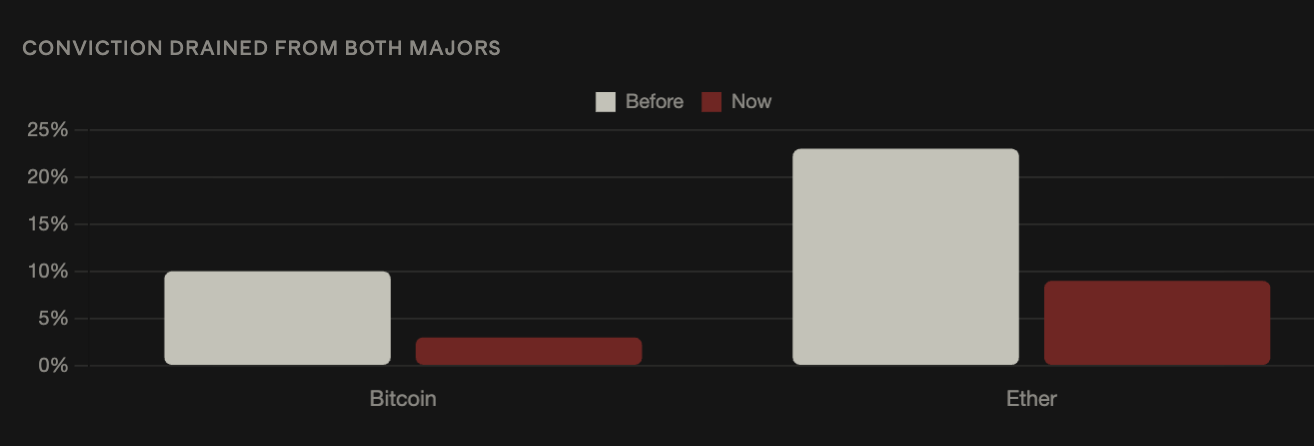
Marktnachrichten | Händler haben sich vor der Fed um 28% in Richtung Stablecoins verschoben und damit das übliche Muster umgekehrtBitcoin-Händler geraten weder in Panik wegen des für Mittwoch erwarteten Zinsschritts, noch gehen sie viele Risiken ein.Märkte preisen eine 92,5%ige Chance ein, dass die Fed die Zinsen zum ersten Mal seit drei Jahren anhebt, nachdem starke Beschäftigungsdaten und eine hartnäckige Inflation vorlagen. Bitcoin verbrachte 24 Tage zwischen etwa 76.000 und 80.000 US-Dollar, handelt bei 75.790 US-Dollar und weist eine Volatilität auf, die ein Monatstief erreicht.Der Stablecoin-Tilt ist ein 36-Punkte-Schwung vom NormalzustandTalos hat laut dem Research-Analysten Cooper Duschang vor dem Meeting einen 28%igen Netto-Kaufüberhang zugunsten von Stablecoins verzeichnet.
Marktnachrichten | Händler haben sich vor der Fed um 28% in Richtung Stablecoins verschoben und damit das übliche Muster umgekehrt
Bitcoin-Händler geraten weder in Panik wegen des für Mittwoch erwarteten Zinsschritts, noch gehen sie viele Risiken ein.Märkte preisen eine 92,5%ige Chance ein, dass die Fed die Zinsen zum ersten Mal seit drei Jahren anhebt, nachdem starke Beschäftigungsdaten und eine hartnäckige Inflation vorlagen. Bitcoin verbrachte 24 Tage zwischen etwa 76.000 und 80.000 US-Dollar, handelt bei 75.790 US-Dollar und weist eine Volatilität auf, die ein Monatstief erreicht.Der Stablecoin-Tilt ist ein 36-Punkte-Schwung vom NormalzustandTalos hat laut dem Research-Analysten Cooper Duschang vor dem Meeting einen 28%igen Netto-Kaufüberhang zugunsten von Stablecoins verzeichnet.
6
5.7k
·
--
KI TRENDS | Solana-Entwicklerteam Anza bringt SBPFv3-Bytecode-Format auf den WegDas Solana-Core-Entwicklerteam von Anza erklärte, dass es das neue Bytecode-Format SBPFv3 eingeführt habe, das nun in Solana-Programme integriert werden kann. Laut Foresight News löst SBPFv3 Systemaufrufe bereits zur Compile-Zeit auf, verwendet ein striktes ELF-Layout und richtet sich an den Upstream-eBPF-Standard an, womit Solanas Pflege eines separaten Bytecode-Variants beendet wird.
Im Rahmen des SIMD-0500-Vorschlags wird SBPFv3 im kommenden Agave-v4.4-Release zum einzigen bereitstellbaren Format. Anza sagte, dass Entwickler jetzt mit der Migration beginnen sollten, und die meisten Rust-Programme mit nur wenigen Befehlen neu gebaut werden können.
KI TRENDS | Solana-Entwicklerteam Anza bringt SBPFv3-Bytecode-Format auf den Weg
Das Solana-Core-Entwicklerteam von Anza erklärte, dass es das neue Bytecode-Format SBPFv3 eingeführt habe, das nun in Solana-Programme integriert werden kann. Laut Foresight News löst SBPFv3 Systemaufrufe bereits zur Compile-Zeit auf, verwendet ein striktes ELF-Layout und richtet sich an den Upstream-eBPF-Standard an, womit Solanas Pflege eines separaten Bytecode-Variants beendet wird.
Im Rahmen des SIMD-0500-Vorschlags wird SBPFv3 im kommenden Agave-v4.4-Release zum einzigen bereitstellbaren Format. Anza sagte, dass Entwickler jetzt mit der Migration beginnen sollten, und die meisten Rust-Programme mit nur wenigen Befehlen neu gebaut werden können.
Im Rahmen des SIMD-0500-Vorschlags wird SBPFv3 im kommenden Agave-v4.4-Release zum einzigen bereitstellbaren Format. Anza sagte, dass Entwickler jetzt mit der Migration beginnen sollten, und die meisten Rust-Programme mit nur wenigen Befehlen neu gebaut werden können.
2
2
6.5k
·
--
Robinhood wird das Arc-L1-Netzwerk von Circle für USDC-Einzahlungen und -Auszahlungen unterstützenRobinhood sagte, dass es in Kürze Arc unterstützen wird, das L1-Netzwerk, das von Circle aufgebaut wurde. Damit können Nutzer USDC direkt in unterstützten Netzwerken ein- und auszahlen. Laut Odaily ermöglicht die Funktion, USDC in das Netzwerk hinein und aus dem Netzwerk heraus zu bewegen, ohne separate Schritte zu verwenden.
Robinhood wird das Arc-L1-Netzwerk von Circle für USDC-Einzahlungen und -Auszahlungen unterstützen
Robinhood sagte, dass es in Kürze Arc unterstützen wird, das L1-Netzwerk, das von Circle aufgebaut wurde. Damit können Nutzer USDC direkt in unterstützten Netzwerken ein- und auszahlen. Laut Odaily ermöglicht die Funktion, USDC in das Netzwerk hinein und aus dem Netzwerk heraus zu bewegen, ohne separate Schritte zu verwenden.
1
6
20.1k
·
--
Tether wird zum bedeutenden Bullenfinanzierer, nachdem ein großer privater Goldvorrat aufgebaut wurdeTether ist zu einem bedeutenden Bullenfinanzierer geworden und stellt etwa 1,5 Milliarden US-Dollar an Finanzierung für einen führenden US-Goldhändler bereit, nachdem das Unternehmen einen der größten privaten Vorräte des Edelmetalls angehäuft hat.
Laut Bloomberg hat Tether die Finanzierung für einen führenden US-Goldhändler bereitgestellt, nachdem das Unternehmen eines der größten privaten Goldbestände der Welt aufgebaut hatte.
Tether wird zum bedeutenden Bullenfinanzierer, nachdem ein großer privater Goldvorrat aufgebaut wurde
Tether ist zu einem bedeutenden Bullenfinanzierer geworden und stellt etwa 1,5 Milliarden US-Dollar an Finanzierung für einen führenden US-Goldhändler bereit, nachdem das Unternehmen einen der größten privaten Vorräte des Edelmetalls angehäuft hat.
Laut Bloomberg hat Tether die Finanzierung für einen führenden US-Goldhändler bereitgestellt, nachdem das Unternehmen eines der größten privaten Goldbestände der Welt aufgebaut hatte.
Laut Bloomberg hat Tether die Finanzierung für einen führenden US-Goldhändler bereitgestellt, nachdem das Unternehmen eines der größten privaten Goldbestände der Welt aufgebaut hatte.
2
4.7k
·
--
Neue Adresse kauft 99.834 HYPE über FalconXEine neu erstellte Adresse kaufte vor zwei Stunden über FalconX 99.834 HYPE, im Wert von 7,72 Millionen US-Dollar. Laut Odaily wurde die Transaktion von Lookonchain verfolgt.
Neue Adresse kauft 99.834 HYPE über FalconX
Eine neu erstellte Adresse kaufte vor zwei Stunden über FalconX 99.834 HYPE, im Wert von 7,72 Millionen US-Dollar. Laut Odaily wurde die Transaktion von Lookonchain verfolgt.
3
17.2k
·
--
US-Repräsentantenhaus stimmt diese Woche nicht über Gesetzentwurf zur Aussetzung der Benzinsteuer ab, sagt Mike JohnsonLaut Wallstreetcn sagte der US-Sprecher des Repräsentantenhauses, Mike Johnson, dass das Repräsentantenhaus diese Woche nicht über einen Gesetzentwurf abstimmen werde, der die Benzinsteuer aussetzen soll, weil viele Abgeordnete nicht einer Meinung darüber sind, wie man mit den hohen Ölpreisen am besten umgehen soll. Der Zeitplan stieß bei den Mitgliedern des Freedom Caucus auf starken Widerstand; diese hatten eine Abstimmung über das Thema vor den Wahlen im Mittelfristzyklus angestrebt.
US-Repräsentantenhaus stimmt diese Woche nicht über Gesetzentwurf zur Aussetzung der Benzinsteuer ab, sagt Mike Johnson
Laut Wallstreetcn sagte der US-Sprecher des Repräsentantenhauses, Mike Johnson, dass das Repräsentantenhaus diese Woche nicht über einen Gesetzentwurf abstimmen werde, der die Benzinsteuer aussetzen soll, weil viele Abgeordnete nicht einer Meinung darüber sind, wie man mit den hohen Ölpreisen am besten umgehen soll. Der Zeitplan stieß bei den Mitgliedern des Freedom Caucus auf starken Widerstand; diese hatten eine Abstimmung über das Thema vor den Wahlen im Mittelfristzyklus angestrebt.
3
3.2k
·
--
Ein Wal, der mit Garrett Jin in Verbindung steht, stockt die ZEC-Short-Position aufOn-Chain-Daten zeigen, dass der Agent für den „1011-Insider-Whale“, Garrett Jin, nach einer Woche erneut zu einer ZEC-Short-Position hinzugefügt hat. Laut Odaily nutzt die Position einen 3x-Leverage, um 37.759,57 ZEC zu shorten, mit einem Positionswert von etwa 47,211 Millionen US-Dollar, einem nicht realisierten Verlust von mehr als 22 Millionen US-Dollar und einer Rendite auf das investierte Kapital von -140,22%.
Ein Wal, der mit Garrett Jin in Verbindung steht, stockt die ZEC-Short-Position auf
On-Chain-Daten zeigen, dass der Agent für den „1011-Insider-Whale“, Garrett Jin, nach einer Woche erneut zu einer ZEC-Short-Position hinzugefügt hat. Laut Odaily nutzt die Position einen 3x-Leverage, um 37.759,57 ZEC zu shorten, mit einem Positionswert von etwa 47,211 Millionen US-Dollar, einem nicht realisierten Verlust von mehr als 22 Millionen US-Dollar und einer Rendite auf das investierte Kapital von -140,22%.
3
6
19.8k
·
--
XRP fällt um fast 10%, nachdem der Senat das Clarity Act nicht voranbrachteXRP fiel um fast 10%, nachdem der Senat es verfehlt hatte, das Clarity Act voranzubringen, während Bitcoin um nahezu 3% nachgab. Laut NS3.AI wurde XRP am Mittwoch während der asiatischen Vormittagsstunden bei 1,30 $ gehandelt. Der Gesetzentwurf scheiterte bei einer Schlussabstimmung mit 49 zu 50 Stimmen.
XRP fällt um fast 10%, nachdem der Senat das Clarity Act nicht voranbrachte
XRP fiel um fast 10%, nachdem der Senat es verfehlt hatte, das Clarity Act voranzubringen, während Bitcoin um nahezu 3% nachgab. Laut NS3.AI wurde XRP am Mittwoch während der asiatischen Vormittagsstunden bei 1,30 $ gehandelt. Der Gesetzentwurf scheiterte bei einer Schlussabstimmung mit 49 zu 50 Stimmen.
3
32.4k
·
--
Tom Lee Says Buy This Dip As Dow Jones Drops 631 PointsFundstrat’s Tom Lee sagte, dass Wall Street überreagiert habe auf die Zinsentscheidung vom Mittwoch und den scharfen Kursrutsch als Kaufchance bezeichnet habe – nicht als Warnsignal. Laut BeInCrypto erwartet er, dass zyklische Werte, Finanzwerte, Energie, Technologie und Konsumgüter des nicht-zyklischen Bedarfs jede Erholung anführen werden, nachdem der Dow Jones Industrial Average um 631 Punkte bzw. 1,2% auf 51.461 gefallen ist. Lee verwies auf die Forschungen von Goldman Sachs zu nachlassenden Inflationsdruckkräften in den nächsten zwei Quartalen. Dan Greenhaus von Solus Alternative Asset Management sagte, die Reaktion wirke übertrieben, argumentierte jedoch, die Fed hätte die Zinsen nicht anheben sollen.
Tom Lee Says Buy This Dip As Dow Jones Drops 631 Points
Fundstrat’s Tom Lee sagte, dass Wall Street überreagiert habe auf die Zinsentscheidung vom Mittwoch und den scharfen Kursrutsch als Kaufchance bezeichnet habe – nicht als Warnsignal. Laut BeInCrypto erwartet er, dass zyklische Werte, Finanzwerte, Energie, Technologie und Konsumgüter des nicht-zyklischen Bedarfs jede Erholung anführen werden, nachdem der Dow Jones Industrial Average um 631 Punkte bzw. 1,2% auf 51.461 gefallen ist. Lee verwies auf die Forschungen von Goldman Sachs zu nachlassenden Inflationsdruckkräften in den nächsten zwei Quartalen. Dan Greenhaus von Solus Alternative Asset Management sagte, die Reaktion wirke übertrieben, argumentierte jedoch, die Fed hätte die Zinsen nicht anheben sollen.
1
383
·
--
KI TRENDS | Etherscan startet ArcScan-Blockchain-Explorer für ArcEtherscan sagte, es habe ArcScan gestartet – einen Blockchain-Explorer für das Arc-Netzwerk – mit der Browser-Adresse arc.etherscan.io und der Chain-ID 5042. Laut Foresight News ist der neue Explorer für Nutzer verfügbar, um auf die Arc-Blockchain zuzugreifen.
KI TRENDS | Etherscan startet ArcScan-Blockchain-Explorer für Arc
Etherscan sagte, es habe ArcScan gestartet – einen Blockchain-Explorer für das Arc-Netzwerk – mit der Browser-Adresse arc.etherscan.io und der Chain-ID 5042. Laut Foresight News ist der neue Explorer für Nutzer verfügbar, um auf die Arc-Blockchain zuzugreifen.
1
2
3.7k
·
--
Bonk Guys Portfolio fällt in 10 Tagen um 12,6 Millionen US-Dollar, Bestände bleiben unverkauftLaut Lookonchain-Monitoring verzeichnete Bonk Guy, auch bekannt als Unipcs, in den vergangenen 10 Tagen einen Rückgang seines Portfolios um 12,6 Millionen US-Dollar. Laut Odaily hat er PONS, USELESS oder MarsCoin nicht verkauft.
Bonk Guys Portfolio fällt in 10 Tagen um 12,6 Millionen US-Dollar, Bestände bleiben unverkauft
Laut Lookonchain-Monitoring verzeichnete Bonk Guy, auch bekannt als Unipcs, in den vergangenen 10 Tagen einen Rückgang seines Portfolios um 12,6 Millionen US-Dollar. Laut Odaily hat er PONS, USELESS oder MarsCoin nicht verkauft.
2
10.6k
·
--
Entwurf des UK-Finanzministeriums würde Krypto-Regeln für qualifizierende Stablecoin-Zahlungen einschränkenHM Treasury hat einen abschließenden Entwurf vorgelegt, der Teile des britischen Krypto-Regulierungsrahmens für qualifizierende Stablecoin-Zahlungen einschränken würde. Laut NS3.AI würde der Entwurf einige Überweisungen und Börsengeschäfte von den Verfahrensregeln ausnehmen.
Überweisungen, bei denen der Stablecoin zurückgegeben werden muss, könnten weiterhin als Darlehen oder Kreditaufnahme reguliert bleiben. Der Entwurf wurde nicht veröffentlicht und ist nicht in Kraft.
Entwurf des UK-Finanzministeriums würde Krypto-Regeln für qualifizierende Stablecoin-Zahlungen einschränken
HM Treasury hat einen abschließenden Entwurf vorgelegt, der Teile des britischen Krypto-Regulierungsrahmens für qualifizierende Stablecoin-Zahlungen einschränken würde. Laut NS3.AI würde der Entwurf einige Überweisungen und Börsengeschäfte von den Verfahrensregeln ausnehmen.
Überweisungen, bei denen der Stablecoin zurückgegeben werden muss, könnten weiterhin als Darlehen oder Kreditaufnahme reguliert bleiben. Der Entwurf wurde nicht veröffentlicht und ist nicht in Kraft.
Überweisungen, bei denen der Stablecoin zurückgegeben werden muss, könnten weiterhin als Darlehen oder Kreditaufnahme reguliert bleiben. Der Entwurf wurde nicht veröffentlicht und ist nicht in Kraft.
4
1.8k
·
--
Hyperliquid-Whale-Positionen erreichen 7,139 Milliarden US-Dollar, Coinglass-Daten zeigenCoinglass-Daten zeigen, dass sich die Whale-Positionen auf der Hyperliquid-Plattform derzeit auf 7,139 Milliarden US-Dollar belaufen. Die Long-Positionen betragen 3,375 Milliarden US-Dollar bzw. 47,27%, während die Short-Positionen 3,765 Milliarden US-Dollar bzw. 52,73% ausmachen. Laut ChainCatcher weisen Long-Positionen einen Gewinn von 232 Millionen US-Dollar aus, während Short-Positionen einen Verlust von 252 Millionen US-Dollar zeigen.
Eine Whale-Adresse, 0x5b5d..60, hält einen 5x-Cross-Margin-ETH-Short, der bei 2.296,09 US-Dollar eröffnet wurde. Die Position weist derzeit einen nicht realisierten Verlust von 11,0262 Millionen US-Dollar auf.
Hyperliquid-Whale-Positionen erreichen 7,139 Milliarden US-Dollar, Coinglass-Daten zeigen
Coinglass-Daten zeigen, dass sich die Whale-Positionen auf der Hyperliquid-Plattform derzeit auf 7,139 Milliarden US-Dollar belaufen. Die Long-Positionen betragen 3,375 Milliarden US-Dollar bzw. 47,27%, während die Short-Positionen 3,765 Milliarden US-Dollar bzw. 52,73% ausmachen. Laut ChainCatcher weisen Long-Positionen einen Gewinn von 232 Millionen US-Dollar aus, während Short-Positionen einen Verlust von 252 Millionen US-Dollar zeigen.
Eine Whale-Adresse, 0x5b5d..60, hält einen 5x-Cross-Margin-ETH-Short, der bei 2.296,09 US-Dollar eröffnet wurde. Die Position weist derzeit einen nicht realisierten Verlust von 11,0262 Millionen US-Dollar auf.
Eine Whale-Adresse, 0x5b5d..60, hält einen 5x-Cross-Margin-ETH-Short, der bei 2.296,09 US-Dollar eröffnet wurde. Die Position weist derzeit einen nicht realisierten Verlust von 11,0262 Millionen US-Dollar auf.
1
1
7k
·
--
Bitcoin (BTC) übertrifft 76.000 USDT mit einem Anstieg von 0,52 % in 24 StundenAm 16. September 2026, 18:43 Uhr (UTC). Laut den Marktdaten von Binance hat Bitcoin die Marke von 76.000 USDT überschritten und wird nun bei 76.286,882813 USDT gehandelt, mit einem in den letzten 24 Stunden auf 0,52 % eingegrenzten Anstieg.
Bitcoin (BTC) übertrifft 76.000 USDT mit einem Anstieg von 0,52 % in 24 Stunden
Am 16. September 2026, 18:43 Uhr (UTC). Laut den Marktdaten von Binance hat Bitcoin die Marke von 76.000 USDT überschritten und wird nun bei 76.286,882813 USDT gehandelt, mit einem in den letzten 24 Stunden auf 0,52 % eingegrenzten Anstieg.
1.6k
·
--
US-Aktien schließen niedriger, nachdem die Fed die Zinsen um 25 Basispunkte angehoben hat; Warsh sagt, die Inflation sei zu hoch, und das zu langeUS-Aktien haben höher eröffnet und sind dann abgedreht, nachdem die US-Notenbank (Fed) ihren Leitzins um 25 Basispunkte auf eine Spanne von 3,75 % bis 4,00 % angehoben hatte. Laut Sina Finance sagte Fed-Vorsitzender Kevin Warsh, er und seine Mit-Politiker seien mit dem aktuellen Tempo der Inflation nicht zufrieden und dass Preisstabilität der Hauptfokus des Fed-Mandats sei.
Der Dow fiel um 1,21 %, der S&P 500 verlor 0,44 % und der Nasdaq rutschte um 0,01 %. Intel stieg um 4,03 %, Ciena legte um 1,91 % zu, Coherent Corp gewann 6,81 %, Lumentum Holdings Inc. kletterte um 9,59 % und CoreWeave verzeichnete einen Zuwachs von 3,00 %.
US-Aktien schließen niedriger, nachdem die Fed die Zinsen um 25 Basispunkte angehoben hat; Warsh sagt, die Inflation sei zu hoch, und das zu lange
US-Aktien haben höher eröffnet und sind dann abgedreht, nachdem die US-Notenbank (Fed) ihren Leitzins um 25 Basispunkte auf eine Spanne von 3,75 % bis 4,00 % angehoben hatte. Laut Sina Finance sagte Fed-Vorsitzender Kevin Warsh, er und seine Mit-Politiker seien mit dem aktuellen Tempo der Inflation nicht zufrieden und dass Preisstabilität der Hauptfokus des Fed-Mandats sei.
Der Dow fiel um 1,21 %, der S&P 500 verlor 0,44 % und der Nasdaq rutschte um 0,01 %. Intel stieg um 4,03 %, Ciena legte um 1,91 % zu, Coherent Corp gewann 6,81 %, Lumentum Holdings Inc. kletterte um 9,59 % und CoreWeave verzeichnete einen Zuwachs von 3,00 %.
Der Dow fiel um 1,21 %, der S&P 500 verlor 0,44 % und der Nasdaq rutschte um 0,01 %. Intel stieg um 4,03 %, Ciena legte um 1,91 % zu, Coherent Corp gewann 6,81 %, Lumentum Holdings Inc. kletterte um 9,59 % und CoreWeave verzeichnete einen Zuwachs von 3,00 %.
2
11.1k
·
--
Yoink Front-Runnt Safe-Multicall-Exploit-Versuch und beschlagnahmt 2.882 rsETHEin Angreifer versuchte, eine Autorisierungslücke in einem Multicall-Vertrag auszunutzen, der von einer Safe-Multisig-Wallet freigegeben wurde, um etwa 2.900 rsETH zu verschieben. Laut ChainCatcher hat der automatische Trading-Bot „yoink“ die Transaktion im öffentlichen Mempool erkannt, etwa 47.000 US-Dollar an Gebühren gezahlt, um sie zu front-runnen, und 2.882 rsETH abgefangen, bevor er sie an eine andere Adresse weiterleitete.
BlockSec, Blockaid, SlowMist und AstraSec sagten, das Problem liege in einer vom Nutzer autorisierten Komponente und nicht im Kernvertrag von Safe. Der rsETH-Emittent Kelp DAO hat für die empfangende Adresse eine 24-stündige Pause angeordnet.
Yoink Front-Runnt Safe-Multicall-Exploit-Versuch und beschlagnahmt 2.882 rsETH
Ein Angreifer versuchte, eine Autorisierungslücke in einem Multicall-Vertrag auszunutzen, der von einer Safe-Multisig-Wallet freigegeben wurde, um etwa 2.900 rsETH zu verschieben. Laut ChainCatcher hat der automatische Trading-Bot „yoink“ die Transaktion im öffentlichen Mempool erkannt, etwa 47.000 US-Dollar an Gebühren gezahlt, um sie zu front-runnen, und 2.882 rsETH abgefangen, bevor er sie an eine andere Adresse weiterleitete.
BlockSec, Blockaid, SlowMist und AstraSec sagten, das Problem liege in einer vom Nutzer autorisierten Komponente und nicht im Kernvertrag von Safe. Der rsETH-Emittent Kelp DAO hat für die empfangende Adresse eine 24-stündige Pause angeordnet.
BlockSec, Blockaid, SlowMist und AstraSec sagten, das Problem liege in einer vom Nutzer autorisierten Komponente und nicht im Kernvertrag von Safe. Der rsETH-Emittent Kelp DAO hat für die empfangende Adresse eine 24-stündige Pause angeordnet.
2
3.4k
·
--
Zcash-Inhaber unterstützen den NU7-Upgrade-Vorschlag mit zwei Dritteln der stimmberechtigten StimmenUngefähr 2,4 Millionen ZEC nahmen an der Abstimmung zur Privatsphäre für Zcashs nächstes großes Netzwerk-Upgrade, NU7, teil. Das entspricht rund zwei Dritteln der Tokens, die für eine Stimmabgabe berechtigt waren. Laut Odaily unterstützten die Wähler die Verkürzung der Blockzeiten auf 25 Sekunden, die Beibehaltung des Bitcoin-ähnlichen Halving-Zeitplans sowie die Einführung von NU7 so bald wie möglich. Sie befürworteten außerdem, die erneute Ausgabe der unter dem Mechanismus zur Netzwerksnutzung erhobenen Gebühren bis Februar 2031 zu verschieben und Transaktionen zu deaktivieren, die mit dem veralteten Sprout-Privacy-System verknüpft sind.
Zcash-Inhaber unterstützen den NU7-Upgrade-Vorschlag mit zwei Dritteln der stimmberechtigten Stimmen
Ungefähr 2,4 Millionen ZEC nahmen an der Abstimmung zur Privatsphäre für Zcashs nächstes großes Netzwerk-Upgrade, NU7, teil. Das entspricht rund zwei Dritteln der Tokens, die für eine Stimmabgabe berechtigt waren. Laut Odaily unterstützten die Wähler die Verkürzung der Blockzeiten auf 25 Sekunden, die Beibehaltung des Bitcoin-ähnlichen Halving-Zeitplans sowie die Einführung von NU7 so bald wie möglich. Sie befürworteten außerdem, die erneute Ausgabe der unter dem Mechanismus zur Netzwerksnutzung erhobenen Gebühren bis Februar 2031 zu verschieben und Transaktionen zu deaktivieren, die mit dem veralteten Sprout-Privacy-System verknüpft sind.
2
10
18.5k
·
--
Binance Alpha startet DGrid AI (DGAI) Airdrop-Anspruch für berechtigte NutzerBinance Wallet gab auf X bekannt, dass Binance Alpha DGrid AI (DGAI) gestartet hat. Nutzer mit mindestens 240 Binance-Alpha-Punkten können den Token-Airdrop nach dem Prinzip „first come, first served“ über die Alpha-Eventseite beanspruchen. Anspruchsberechtigte Nutzer können 44 DGAI-Token beanspruchen, und die Punkte-Schwelle wird automatisch um 5 Punkte alle fünf Minuten gesenkt, falls das Ereignis noch nicht beendet ist. Das Beanspruchen des Airdrops kostet 15 Binance-Alpha-Punkte. Nutzer müssen die Geltendmachung innerhalb von 24 Stunden auf der Alpha-Eventseite bestätigen, andernfalls gilt der Airdrop als verfallen.
Binance Alpha startet DGrid AI (DGAI) Airdrop-Anspruch für berechtigte Nutzer
Binance Wallet gab auf X bekannt, dass Binance Alpha DGrid AI (DGAI) gestartet hat. Nutzer mit mindestens 240 Binance-Alpha-Punkten können den Token-Airdrop nach dem Prinzip „first come, first served“ über die Alpha-Eventseite beanspruchen. Anspruchsberechtigte Nutzer können 44 DGAI-Token beanspruchen, und die Punkte-Schwelle wird automatisch um 5 Punkte alle fünf Minuten gesenkt, falls das Ereignis noch nicht beendet ist. Das Beanspruchen des Airdrops kostet 15 Binance-Alpha-Punkte. Nutzer müssen die Geltendmachung innerhalb von 24 Stunden auf der Alpha-Eventseite bestätigen, andernfalls gilt der Airdrop als verfallen.
3
2.7k
·
--
Aster fügt USDC-Unterstützung für Ein- und Auszahlungen im Perpetual-Markt hinzuDie dezentrale Plattform für den Handel mit Perpetual-Futures-Kontrakten Aster teilte auf X mit, dass sein Perpetual-Markt nun USDC als Ein- und Auszahlungsinstrument unterstützt. Laut ChainCatcher trat die Integration mit Arc ab dem ersten Tag des Starts in Kraft.
Aster fügt USDC-Unterstützung für Ein- und Auszahlungen im Perpetual-Markt hinzu
Die dezentrale Plattform für den Handel mit Perpetual-Futures-Kontrakten Aster teilte auf X mit, dass sein Perpetual-Markt nun USDC als Ein- und Auszahlungsinstrument unterstützt. Laut ChainCatcher trat die Integration mit Arc ab dem ersten Tag des Starts in Kraft.
2
2.7k
·
--
Bitcoin (BTC) übertrifft 76.000 USDT mit einem engeren Rückgang von 1,28 % in 24 StundenAm 16. September 2026, 10:43 Uhr (UTC). Laut Binance-Marktdaten hat Bitcoin die Marke von 76.000 USDT überschritten und wird derzeit bei 76.008,976563 USDT gehandelt, mit einem in den letzten 24 Stunden engeren Rückgang von 1,28%.
Bitcoin (BTC) übertrifft 76.000 USDT mit einem engeren Rückgang von 1,28 % in 24 Stunden
Am 16. September 2026, 10:43 Uhr (UTC). Laut Binance-Marktdaten hat Bitcoin die Marke von 76.000 USDT überschritten und wird derzeit bei 76.008,976563 USDT gehandelt, mit einem in den letzten 24 Stunden engeren Rückgang von 1,28%.
1
3.7k
·
--
AKTIEN | Fed-SEP: Prognose für den Leitzins 2026 bei 4,1%, über den 3,8% vom JuniLaut Wallstreetcn prognostiziert das Summary of Economic Projections (SEP) der Federal Reserve den Leitzins der Fed (Federal Funds Rate) für 2026 mit 4,1% gegenüber 3,8% im Juni. Die Prognose für 2027 liegt bei 4,1% gegenüber zuvor 3,6%, für 2028 bei 3,9% gegenüber zuvor 3,4%, für 2029 bei 3,6% und die langfristige Prognose bei 3,2% gegenüber zuvor 3,1%.
AKTIEN | Fed-SEP: Prognose für den Leitzins 2026 bei 4,1%, über den 3,8% vom Juni
Laut Wallstreetcn prognostiziert das Summary of Economic Projections (SEP) der Federal Reserve den Leitzins der Fed (Federal Funds Rate) für 2026 mit 4,1% gegenüber 3,8% im Juni. Die Prognose für 2027 liegt bei 4,1% gegenüber zuvor 3,6%, für 2028 bei 3,9% gegenüber zuvor 3,4%, für 2029 bei 3,6% und die langfristige Prognose bei 3,2% gegenüber zuvor 3,1%.
1
6
10k
·
--
XRP-Spot-ETFs verzeichnen täglichen Nettozufluss von 3,5 Millionen US-DollarLaut SoSoValue-Daten verzeichneten XRP-Spot-ETFs an einem einzigen Tag einen gesamten Nettozufluss von 3,5 Millionen US-Dollar. Laut ChainCatcher meldete gestern nur der Franklin XRP ETF (XRPZ) einen Nettozufluss, ebenfalls in Höhe von 3,5 Millionen US-Dollar, wodurch sich sein kumulierter historischer Nettozufluss auf 483 Millionen US-Dollar erhöhte.
Zum Redaktionsschluss hielten XRP-Spot-ETFs insgesamt Nettovermögen in Höhe von 1,396 Milliarden US-Dollar, mit einer XRP-Nettovermögensquote von 1,7 %. Ihre kumulierten historischen Nettozuflüsse haben 1,716 Milliarden US-Dollar erreicht.
XRP-Spot-ETFs verzeichnen täglichen Nettozufluss von 3,5 Millionen US-Dollar
Laut SoSoValue-Daten verzeichneten XRP-Spot-ETFs an einem einzigen Tag einen gesamten Nettozufluss von 3,5 Millionen US-Dollar. Laut ChainCatcher meldete gestern nur der Franklin XRP ETF (XRPZ) einen Nettozufluss, ebenfalls in Höhe von 3,5 Millionen US-Dollar, wodurch sich sein kumulierter historischer Nettozufluss auf 483 Millionen US-Dollar erhöhte.
Zum Redaktionsschluss hielten XRP-Spot-ETFs insgesamt Nettovermögen in Höhe von 1,396 Milliarden US-Dollar, mit einer XRP-Nettovermögensquote von 1,7 %. Ihre kumulierten historischen Nettozuflüsse haben 1,716 Milliarden US-Dollar erreicht.
Zum Redaktionsschluss hielten XRP-Spot-ETFs insgesamt Nettovermögen in Höhe von 1,396 Milliarden US-Dollar, mit einer XRP-Nettovermögensquote von 1,7 %. Ihre kumulierten historischen Nettozuflüsse haben 1,716 Milliarden US-Dollar erreicht.
1
1.2k
·
--
Geldbörse, die mit Wintermute-Verbindungen in Verbindung gebracht wird, sammelt 5,8 Millionen USELESS-TokenEine Geldbörse, die vermutlich mit Wintermute in Verbindung steht, kauft seit dem vergangenen Monat weiterhin USELESS. Dabei wurden etwa 3 Millionen Tokens für 493.700 US-Dollar erworben und von einer separaten Geldbörse weitere 2,8 Millionen USELESS im Wert von 377.300 US-Dollar erhalten. Laut Odaily hält die Geldbörse nun etwa 5,8 Millionen USELESS, was 0,588% der gesamten Emission entspricht, und belegt den 27. Platz unter den größten Inhabern. Bonk Guy sagte, das Team für die Übernahme durch die USELESS-Community unterhalte keine Market-Making-Beziehung mit Wintermute, und es sei nicht bestätigt worden, ob die Adresse von Wintermute kontrolliert wird.
Geldbörse, die mit Wintermute-Verbindungen in Verbindung gebracht wird, sammelt 5,8 Millionen USELESS-Token
Eine Geldbörse, die vermutlich mit Wintermute in Verbindung steht, kauft seit dem vergangenen Monat weiterhin USELESS. Dabei wurden etwa 3 Millionen Tokens für 493.700 US-Dollar erworben und von einer separaten Geldbörse weitere 2,8 Millionen USELESS im Wert von 377.300 US-Dollar erhalten. Laut Odaily hält die Geldbörse nun etwa 5,8 Millionen USELESS, was 0,588% der gesamten Emission entspricht, und belegt den 27. Platz unter den größten Inhabern. Bonk Guy sagte, das Team für die Übernahme durch die USELESS-Community unterhalte keine Market-Making-Beziehung mit Wintermute, und es sei nicht bestätigt worden, ob die Adresse von Wintermute kontrolliert wird.
1
3k
·
--
AKTIEN | Nasdaq legt um 0,5 % zu, während Intel aufgrund der Äußerungen zur Zusammenarbeit mit SK Hynix steigtLaut Wallstreetcn stieg der Nasdaq um 0,5 %, der Dow Jones Industrial Average gewann 0,1 % und der S&P-500-Index legte um 0,3 % zu. Gleichzeitig stieg Intel um etwa 6 % und SK Hynix um etwa 3 %, nachdem SK Hynix erklärt hatte, dass seine US-Zusammenarbeit mit Intel noch nicht entschieden sei. Der Philadelphia Semiconductor Index stieg um 1,4 %. Speicherchip-Aktien entwickelten sich insgesamt deutlich nach oben: SanDisk legte um etwa 2 %, Western Digital um etwa 3 % und Seagate Technology um etwa 1 % zu. Auch die Kurse von Unternehmen aus dem Bereich optische Kommunikation stiegen, darunter Marvell Technology um etwa 2 %, Corning um etwa 2 %, Coherent um etwa 4 %, Credo um etwa 4 % und Lumentum um etwa 3 %.
AKTIEN | Nasdaq legt um 0,5 % zu, während Intel aufgrund der Äußerungen zur Zusammenarbeit mit SK Hynix steigt
Laut Wallstreetcn stieg der Nasdaq um 0,5 %, der Dow Jones Industrial Average gewann 0,1 % und der S&P-500-Index legte um 0,3 % zu. Gleichzeitig stieg Intel um etwa 6 % und SK Hynix um etwa 3 %, nachdem SK Hynix erklärt hatte, dass seine US-Zusammenarbeit mit Intel noch nicht entschieden sei. Der Philadelphia Semiconductor Index stieg um 1,4 %. Speicherchip-Aktien entwickelten sich insgesamt deutlich nach oben: SanDisk legte um etwa 2 %, Western Digital um etwa 3 % und Seagate Technology um etwa 1 % zu. Auch die Kurse von Unternehmen aus dem Bereich optische Kommunikation stiegen, darunter Marvell Technology um etwa 2 %, Corning um etwa 2 %, Coherent um etwa 4 %, Credo um etwa 4 % und Lumentum um etwa 3 %.
1
2
4.6k
·
--
Superseed L2 wird heruntergefahren, da das Ethereum-Bridge-Fenster schließtSuperseed sagte, dass seine Superseed L2-Chain heruntergefahren wird und das Zeitfenster zum Zurückbridgen nach Ethereum nun abgelaufen ist. Laut ChainCatcher hat das Team einen Snapshot des finalen Netzwerkstatus bei Block 31.688.848 erstellt.
Wallets, die mindestens 10.000 SUPR halten und das Bridging noch nicht abgeschlossen haben, können SUPR über ein Portal beanspruchen, das in den kommenden Wochen voraussichtlich online gehen wird. Superseed sagte außerdem, dass die erste Phase seiner neuen Anwendung bereits auf Ethereum live ist, mit weiteren Produkten, die für die Veröffentlichung geplant sind.
Superseed L2 wird heruntergefahren, da das Ethereum-Bridge-Fenster schließt
Superseed sagte, dass seine Superseed L2-Chain heruntergefahren wird und das Zeitfenster zum Zurückbridgen nach Ethereum nun abgelaufen ist. Laut ChainCatcher hat das Team einen Snapshot des finalen Netzwerkstatus bei Block 31.688.848 erstellt.
Wallets, die mindestens 10.000 SUPR halten und das Bridging noch nicht abgeschlossen haben, können SUPR über ein Portal beanspruchen, das in den kommenden Wochen voraussichtlich online gehen wird. Superseed sagte außerdem, dass die erste Phase seiner neuen Anwendung bereits auf Ethereum live ist, mit weiteren Produkten, die für die Veröffentlichung geplant sind.
Wallets, die mindestens 10.000 SUPR halten und das Bridging noch nicht abgeschlossen haben, können SUPR über ein Portal beanspruchen, das in den kommenden Wochen voraussichtlich online gehen wird. Superseed sagte außerdem, dass die erste Phase seiner neuen Anwendung bereits auf Ethereum live ist, mit weiteren Produkten, die für die Veröffentlichung geplant sind.
554
Krypto-Nutzer weltweit auf Binance Square kennenlernen
⚡️ Bleib in Sachen Krypto stets am Puls.
💬 Die weltgrößte Kryptobörse vertraut darauf.
👍 Erhalte verlässliche Einblicke von verifizierten Creators.
E-Mail-Adresse/Telefonnummer
Trendthemen
DotPlotSignalsOneMoreHikeIn2026
1,214 Aufrufe
43 Kommentare
💥$TRUMP — die Geschichte wird jetzt noch komplizierter.💥
Präsident Trump wirbt weiterhin für eine 5.000-Dollar „Trump-Dividende“ für jeden US-Erwachsenen, falls die Republikaner die Kontrolle über den Kongress behalten. Dafür wäre die Zustimmung des Kongresses erforderlich, und das könnte gut über 1 Billion US-Dollar kosten.
Doch hier kommt die Wendung: Das makroökonomische Umfeld hat sich gerade deutlich verschärft.
Die Fed hat die Zinsen bereits um 25 Basispunkte angehoben und die Zielspanne auf 3,75%–4,00% gebracht. Das neueste Dot-Plot deutet auf einen weiteren Zinsschritt im Jahr 2026 hin. Die Märkte müssen sich nun mit höheren Renditen, einem stärkeren Dollar und einer deutlich engeren Liquidität auseinandersetzen.
Zugleich hat der Senat es versäumt, das CLARITY Act voranzubringen. Damit bleibt die US-Krypto-Regulierung in der Schwebe und politisch verbundenen Tokens rückt erneut in den Fokus.
Damit wird der Aufbau rund um $TRUMP zu einer Drei-Wege-Erzählung:
💥Fiskalischer Stimulus → potenziell bullish für Risk Assets
💥Höhere Zinsen → bärisch für die Liquidität
💥Scheitern des CLARITY Act → höhere regulatorische Unsicherheit
Und nein: Aktuell gibt es keinen angekündigten Plan, die Dividende in TRUMP oder irgendeiner anderen Krypto auszuzahlen.
Wenn Händler jedoch beginnen, die Auszahlungserzählung mit Trump-nahen Tokens zu verknüpfen, könnte die Spekulation sehr schnell zurückkehren.
$TRUMP liegt nun an der Schnittstelle von Politik, Liquidität und Regulierung — genau dort, wo die Volatilität typischerweise explodiert. 👀
#dotplotsignalsonemorehikein2026 #FedRateWatch #FedHikes25BpsUSStocksClose #ZcashRises6% #CryptoVCFundingRebounds$5.6BInQ2
KimHotbae
·0 Likes
·587 Aufrufe
FedHikes25BpsUSStocksClose
4,345 Aufrufe
86 Kommentare
AaveToLaunchRWAMarketOnAvalanche
68 Aufrufe
11 Kommentare