
Stella 557
738 منشورات

Stella 557
إبلاغ
حظر المُستخدم
Crypto enthusiast sharing market insights, Binance updates, and Web3 discoveries. Always learning, always growing.
718 تتابع
2.2K+ المتابعون
574 إعجاب
منشورات
الكل
اقتباسات
Live
PINNED
·
--
مقالة
One thing I’ve learned from watching cryptoOne thing I’ve learned from watching crypto is that the projects making the most noise aren’t always the ones solving the most interesting problems.
That’s what made me look a little closer at DUSK.
The question that caught my attention was pretty simple: what happens when real financial assets move on-chain, but all the information connected to those assets can’t just be made public?
That’s where I think DUSK has an interesting approach.
DUSK is focused on regulated financial markets, where privacy, compliance, and transparency all have to work together. And honestly, I think that’s one of the harder problems for blockchain to solve.
Putting an asset on a blockchain is relatively easy to explain. The difficult part is creating an environment where financial institutions can actually use that technology without ignoring the rules and privacy requirements they already operate under.
That’s why I find the DUSK idea worth watching.
Of course, having good technology doesn’t automatically mean a project will succeed. Crypto has plenty of examples of promising ideas that never achieved real adoption. So I’m not looking at $DUSK as a guaranteed winner.
For me, the real question is much more practical:
Can DUSK turn its infrastructure into something that people and institutions genuinely use?
If it can, then the story becomes much bigger than another token or another blockchain narrative.
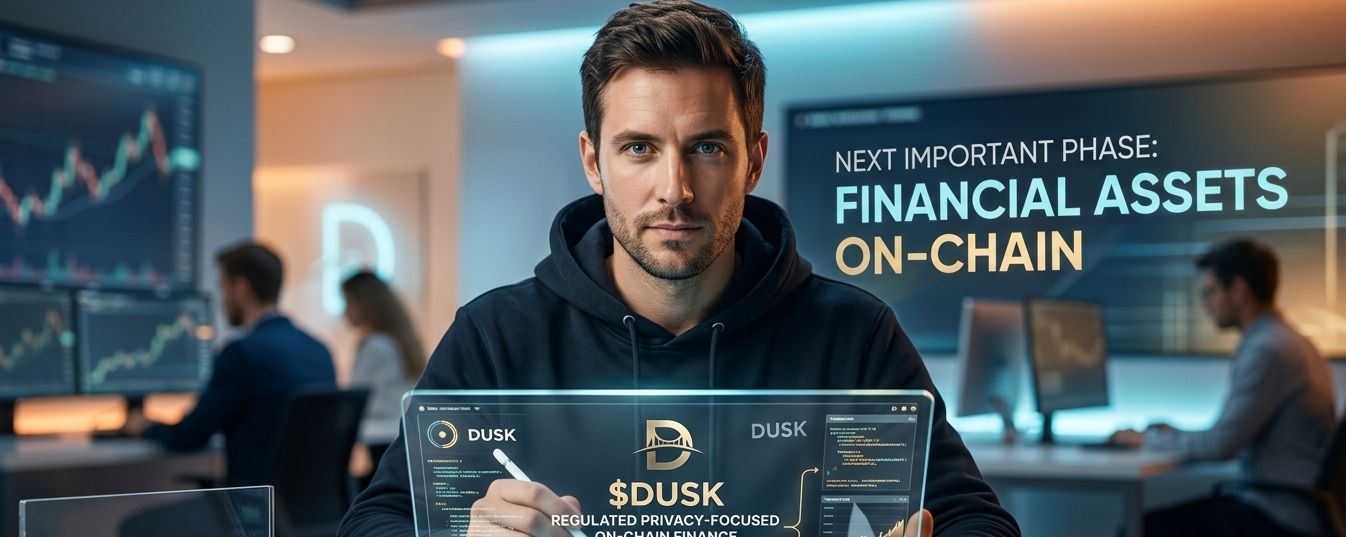
Maybe the next important phase of crypto won’t be about creating more speculative assets.
Maybe it will be about bringing the financial assets that already exist into a better on-chain environment.
That’s the part of DUSK I’ll be watching.
What do you think — is regulated, privacy-focused on-chain finance one of blockchain’s bigger opportunities?@Dusk_Foundation $DUSK #dusk
One thing I’ve learned from watching crypto
One thing I’ve learned from watching crypto is that the projects making the most noise aren’t always the ones solving the most interesting problems.
That’s what made me look a little closer at DUSK.
The question that caught my attention was pretty simple: what happens when real financial assets move on-chain, but all the information connected to those assets can’t just be made public?
That’s where I think DUSK has an interesting approach.
DUSK is focused on regulated financial markets, where privacy, compliance, and transparency all have to work together. And honestly, I think that’s one of the harder problems for blockchain to solve.
Putting an asset on a blockchain is relatively easy to explain. The difficult part is creating an environment where financial institutions can actually use that technology without ignoring the rules and privacy requirements they already operate under.
That’s why I find the DUSK idea worth watching.
Of course, having good technology doesn’t automatically mean a project will succeed. Crypto has plenty of examples of promising ideas that never achieved real adoption. So I’m not looking at $DUSK as a guaranteed winner.
For me, the real question is much more practical:
Can DUSK turn its infrastructure into something that people and institutions genuinely use?
If it can, then the story becomes much bigger than another token or another blockchain narrative.
Maybe the next important phase of crypto won’t be about creating more speculative assets.
Maybe it will be about bringing the financial assets that already exist into a better on-chain environment.
That’s the part of DUSK I’ll be watching.
What do you think — is regulated, privacy-focused on-chain finance one of blockchain’s bigger opportunities?@Dusk $DUSK #dusk
That’s what made me look a little closer at DUSK.
The question that caught my attention was pretty simple: what happens when real financial assets move on-chain, but all the information connected to those assets can’t just be made public?
That’s where I think DUSK has an interesting approach.
DUSK is focused on regulated financial markets, where privacy, compliance, and transparency all have to work together. And honestly, I think that’s one of the harder problems for blockchain to solve.
Putting an asset on a blockchain is relatively easy to explain. The difficult part is creating an environment where financial institutions can actually use that technology without ignoring the rules and privacy requirements they already operate under.
That’s why I find the DUSK idea worth watching.
Of course, having good technology doesn’t automatically mean a project will succeed. Crypto has plenty of examples of promising ideas that never achieved real adoption. So I’m not looking at $DUSK as a guaranteed winner.
For me, the real question is much more practical:
Can DUSK turn its infrastructure into something that people and institutions genuinely use?
If it can, then the story becomes much bigger than another token or another blockchain narrative.
Maybe the next important phase of crypto won’t be about creating more speculative assets.
Maybe it will be about bringing the financial assets that already exist into a better on-chain environment.
That’s the part of DUSK I’ll be watching.
What do you think — is regulated, privacy-focused on-chain finance one of blockchain’s bigger opportunities?@Dusk $DUSK #dusk
3
1
11
137
·
--
Why the Next Phase of Blockchain Could Be Defined by Privacy, Not Just Speed#Dusk $DUSK
scalability, lower fees, and higher throughput. Those improvements matter, but I think the next stage of adoption depends on something different—trust.
Public blockchains were designed to be transparent, and that transparency has helped create one of the most open financial ecosystems in history. Anyone can verify transactions, track wallet activity, and inspect on-chain data. While this is powerful, it also creates challenges for businesses, institutions, and organizations that cannot expose sensitive financial information to the entire world.
Imagine a company issuing tokenized securities, managing payroll, or settling large financial transactions on-chain. Complete transparency may not always be practical. Confidential business data, customer information, and trading strategies often require privacy while still remaining verifiable and compliant with regulations. That balance is one of the biggest challenges blockchain technology must solve.
This is why projects focused on privacy-preserving infrastructure have caught my attention. Instead of asking whether blockchain can become faster, they're asking whether blockchain can become practical for real-world finance.
As tokenization continues to expand—from stocks and bonds to real-world assets—the demand for secure and compliant infrastructure will likely increase. Financial institutions need technology that protects confidential information without sacrificing the benefits of decentralized verification.
The most exciting innovation isn't always the project creating the loudest headlines. Sometimes it's the technology quietly building solutions for problems that will become more important over the next decade.
Whether or not privacy-focused networks dominate the future, I believe one thing is becoming clear: mainstream blockchain adoption won't be driven by speculation alone. It will be driven by technology that businesses, regulators, developers, and everyday users can trust.
The future of crypto isn't only about moving assets on-chain. It's about doing it securely, responsibly, and with the confidence that sensitive information remains protected while transparency exists where it matters most.
That's why I believe privacy, compliance, and real-world utility deserve far more attention in the conversation about blockchain's next chapter.
#DUSK $DUSK #crypto #blockchain #Web3
@Dusk_Foundation
Why the Next Phase of Blockchain Could Be Defined by Privacy, Not Just Speed
#Dusk $DUSK
scalability, lower fees, and higher throughput. Those improvements matter, but I think the next stage of adoption depends on something different—trust.
Public blockchains were designed to be transparent, and that transparency has helped create one of the most open financial ecosystems in history. Anyone can verify transactions, track wallet activity, and inspect on-chain data. While this is powerful, it also creates challenges for businesses, institutions, and organizations that cannot expose sensitive financial information to the entire world.
Imagine a company issuing tokenized securities, managing payroll, or settling large financial transactions on-chain. Complete transparency may not always be practical. Confidential business data, customer information, and trading strategies often require privacy while still remaining verifiable and compliant with regulations. That balance is one of the biggest challenges blockchain technology must solve.
This is why projects focused on privacy-preserving infrastructure have caught my attention. Instead of asking whether blockchain can become faster, they're asking whether blockchain can become practical for real-world finance.
As tokenization continues to expand—from stocks and bonds to real-world assets—the demand for secure and compliant infrastructure will likely increase. Financial institutions need technology that protects confidential information without sacrificing the benefits of decentralized verification.
The most exciting innovation isn't always the project creating the loudest headlines. Sometimes it's the technology quietly building solutions for problems that will become more important over the next decade.
Whether or not privacy-focused networks dominate the future, I believe one thing is becoming clear: mainstream blockchain adoption won't be driven by speculation alone. It will be driven by technology that businesses, regulators, developers, and everyday users can trust.
The future of crypto isn't only about moving assets on-chain. It's about doing it securely, responsibly, and with the confidence that sensitive information remains protected while transparency exists where it matters most.
That's why I believe privacy, compliance, and real-world utility deserve far more attention in the conversation about blockchain's next chapter.
#DUSK $DUSK #crypto #blockchain #Web3
@Dusk
scalability, lower fees, and higher throughput. Those improvements matter, but I think the next stage of adoption depends on something different—trust.
Public blockchains were designed to be transparent, and that transparency has helped create one of the most open financial ecosystems in history. Anyone can verify transactions, track wallet activity, and inspect on-chain data. While this is powerful, it also creates challenges for businesses, institutions, and organizations that cannot expose sensitive financial information to the entire world.
Imagine a company issuing tokenized securities, managing payroll, or settling large financial transactions on-chain. Complete transparency may not always be practical. Confidential business data, customer information, and trading strategies often require privacy while still remaining verifiable and compliant with regulations. That balance is one of the biggest challenges blockchain technology must solve.
This is why projects focused on privacy-preserving infrastructure have caught my attention. Instead of asking whether blockchain can become faster, they're asking whether blockchain can become practical for real-world finance.
As tokenization continues to expand—from stocks and bonds to real-world assets—the demand for secure and compliant infrastructure will likely increase. Financial institutions need technology that protects confidential information without sacrificing the benefits of decentralized verification.
The most exciting innovation isn't always the project creating the loudest headlines. Sometimes it's the technology quietly building solutions for problems that will become more important over the next decade.
Whether or not privacy-focused networks dominate the future, I believe one thing is becoming clear: mainstream blockchain adoption won't be driven by speculation alone. It will be driven by technology that businesses, regulators, developers, and everyday users can trust.
The future of crypto isn't only about moving assets on-chain. It's about doing it securely, responsibly, and with the confidence that sensitive information remains protected while transparency exists where it matters most.
That's why I believe privacy, compliance, and real-world utility deserve far more attention in the conversation about blockchain's next chapter.
#DUSK $DUSK #crypto #blockchain #Web3
@Dusk
35
·
--
صاعد
The future of blockchain isn't just faster transactions.
It's giving businesses the confidence to move real assets on-chain without exposing sensitive information.
Innovation starts where trust exists.
@Dusk_Foundation #dusk $DUSK #blockchain
{spot}(DUSKUSDT)
The future of blockchain isn't just faster transactions.
It's giving businesses the confidence to move real assets on-chain without exposing sensitive information.
Innovation starts where trust exists.
@Dusk #dusk $DUSK #blockchain
It's giving businesses the confidence to move real assets on-chain without exposing sensitive information.
Innovation starts where trust exists.
@Dusk #dusk $DUSK #blockchain
33
·
--
{spot}(DUSKUSDT)
Everyone talks about scalability, but trust is what will define the next generation of blockchain.
Privacy and compliance aren't obstacles to innovation—they're what make real-world adoption possible.
Projects solving these challenges deserve attention.
@Dusk_Foundation #DUSK $DUSK #Crypto #blockchain
Everyone talks about scalability, but trust is what will define the next generation of blockchain.
Privacy and compliance aren't obstacles to innovation—they're what make real-world adoption possible.
Projects solving these challenges deserve attention.
@Dusk #DUSK $DUSK #Crypto #blockchain
Privacy and compliance aren't obstacles to innovation—they're what make real-world adoption possible.
Projects solving these challenges deserve attention.
@Dusk #DUSK $DUSK #Crypto #blockchain
24
·
--
Crypto adoption won't be driven only by memes.
The next wave may come from technology that businesses and institutions can actually use. Privacy, security, and compliance matter more than ever as blockchain evolves.
@Dusk_Foundation #DUSK $DUSK #blockchain
Crypto adoption won't be driven only by memes.
The next wave may come from technology that businesses and institutions can actually use. Privacy, security, and compliance matter more than ever as blockchain evolves.
@Dusk #DUSK $DUSK #blockchain
The next wave may come from technology that businesses and institutions can actually use. Privacy, security, and compliance matter more than ever as blockchain evolves.
@Dusk #DUSK $DUSK #blockchain
123
·
--
I've noticed that many blockchain projects compete on speed, but DUSK is taking a different direction. Its focus on privacy and compliance for regulated finance makes it stand out to me. If real-world assets continue moving on-chain, this could become an increasingly important area to watch. I'm interested to see how the ecosystem develops. @Dusk $DUSK #dusk
I've noticed that many blockchain projects compete on speed, but DUSK is taking a different direction. Its focus on privacy and compliance for regulated finance makes it stand out to me. If real-world assets continue moving on-chain, this could become an increasingly important area to watch. I'm interested to see how the ecosystem develops. @Dusk $DUSK #dusk
86
·
--
DUSK Is Focused on a Different Part of Blockchain's FutureWhen people discuss blockchain, the conversation often revolves around speed, low fees, or memecoins. While those topics attract attention, I think another challenge deserves just as much focus: how can financial institutions use blockchain while protecting sensitive information and meeting regulatory requirements?
This is where DUSK stands out to me.
Rather than trying to be everything for everyone, DUSK focuses on regulated on-chain finance. Its goal is to provide infrastructure where privacy and compliance can exist together. That matters because traditional financial markets cannot simply expose every transaction or every piece of confidential data on a public blockchain.
Another reason I continue following DUSK is that its direction feels practical. The discussion around tokenized real-world assets continues to grow, and if that trend expands, networks designed for regulated financial activity could have meaningful opportunities.
I also appreciate projects that keep building through different market cycles instead of relying only on hype. Sustainable development usually creates more confidence than short-lived excitement.
Of course, every cryptocurrency carries risk, and no project is guaranteed to succeed. This article reflects my personal opinion based on my own research and observations, not financial advice. I'll continue watching DUSK's progress because I believe its focus on privacy, compliance, and real-world financial applications makes it a project worth paying attention to.
@Dusk_Foundation $DUSK #dusk k
DUSK Is Focused on a Different Part of Blockchain's Future
When people discuss blockchain, the conversation often revolves around speed, low fees, or memecoins. While those topics attract attention, I think another challenge deserves just as much focus: how can financial institutions use blockchain while protecting sensitive information and meeting regulatory requirements?
This is where DUSK stands out to me.
Rather than trying to be everything for everyone, DUSK focuses on regulated on-chain finance. Its goal is to provide infrastructure where privacy and compliance can exist together. That matters because traditional financial markets cannot simply expose every transaction or every piece of confidential data on a public blockchain.
Another reason I continue following DUSK is that its direction feels practical. The discussion around tokenized real-world assets continues to grow, and if that trend expands, networks designed for regulated financial activity could have meaningful opportunities.
I also appreciate projects that keep building through different market cycles instead of relying only on hype. Sustainable development usually creates more confidence than short-lived excitement.
Of course, every cryptocurrency carries risk, and no project is guaranteed to succeed. This article reflects my personal opinion based on my own research and observations, not financial advice. I'll continue watching DUSK's progress because I believe its focus on privacy, compliance, and real-world financial applications makes it a project worth paying attention to.
@Dusk $DUSK #dusk k
This is where DUSK stands out to me.
Rather than trying to be everything for everyone, DUSK focuses on regulated on-chain finance. Its goal is to provide infrastructure where privacy and compliance can exist together. That matters because traditional financial markets cannot simply expose every transaction or every piece of confidential data on a public blockchain.
Another reason I continue following DUSK is that its direction feels practical. The discussion around tokenized real-world assets continues to grow, and if that trend expands, networks designed for regulated financial activity could have meaningful opportunities.
I also appreciate projects that keep building through different market cycles instead of relying only on hype. Sustainable development usually creates more confidence than short-lived excitement.
Of course, every cryptocurrency carries risk, and no project is guaranteed to succeed. This article reflects my personal opinion based on my own research and observations, not financial advice. I'll continue watching DUSK's progress because I believe its focus on privacy, compliance, and real-world financial applications makes it a project worth paying attention to.
@Dusk $DUSK #dusk k
88
·
--
مقالة
DUSK: When Privacy Meets the Future of On-Chain FinanceCrypto is moving beyond simple transactions and speculation. The next major opportunity could be bringing real-world financial markets on-chain — but doing that successfully requires more than speed. It requires privacy, compliance, security and reliable settlement.
That is where DUSK becomes interesting.
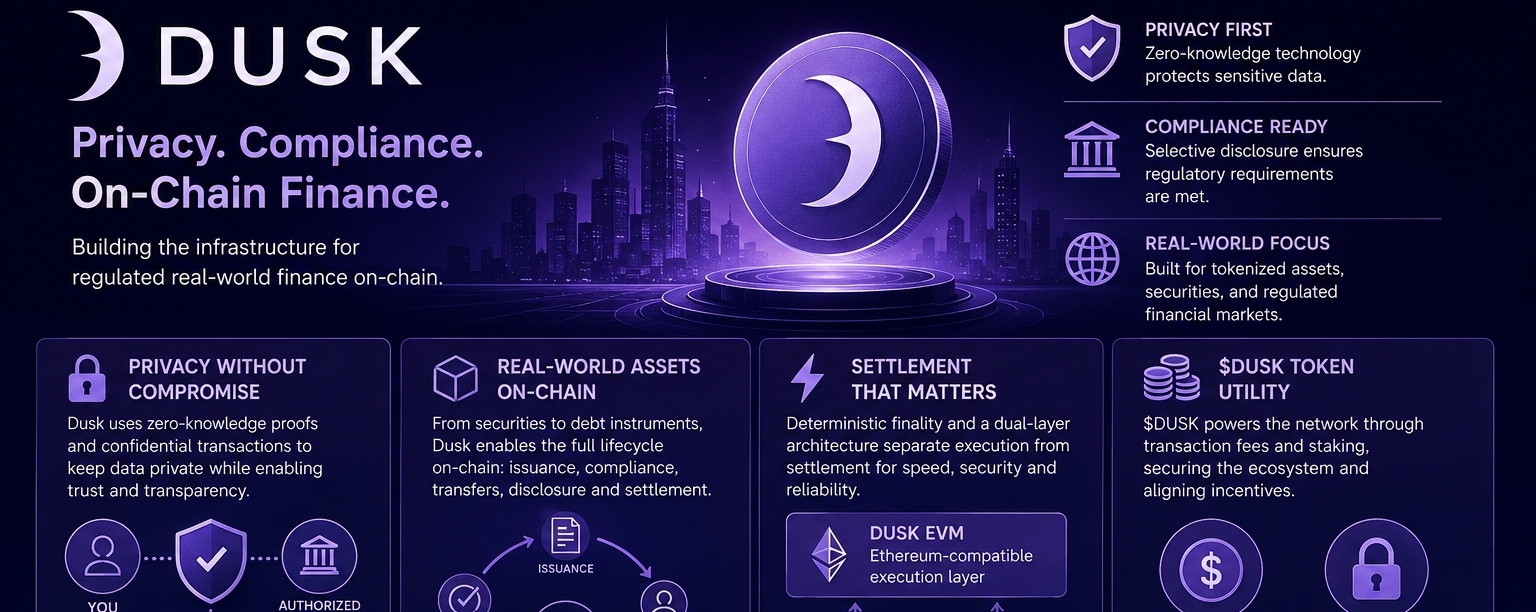
Dusk is a Layer-1 blockchain designed for regulated on-chain finance. Its infrastructure focuses on bringing digital securities and real-world financial assets on-chain while allowing sensitive information to remain private when necessary.
🔐 Privacy Without Losing Compliance
One of Dusk's most interesting ideas is that blockchain privacy does not have to mean complete anonymity.
Dusk uses zero-knowledge technology and confidential transaction models to protect sensitive information. At the same time, its architecture supports selective disclosure, meaning authorized parties can access the information they need without exposing everything publicly.
This could be especially important for financial institutions. Banks, funds and regulated businesses may want the advantages of blockchain without publicly exposing every transaction, position or sensitive market detail.
🌍 Real-World Assets On-Chain
Tokenization is becoming one of the biggest narratives in blockchain.
The basic idea is simple: financial assets such as securities, debt and other regulated instruments can be represented digitally and managed through blockchain infrastructure.
Dusk is building specifically around these kinds of workflows, including issuance, investor eligibility, controlled transfers, disclosure and settlement.
Instead of treating blockchain as only a place to trade cryptocurrencies, Dusk is aiming at a much larger financial infrastructure opportunity.
⚡ Settlement Matters
For financial markets, transactions need more than just confirmation — they need predictable settlement.
Dusk describes its network as providing deterministic finality and infrastructure designed for regulated market workflows. Its current architecture also separates settlement from execution, with DuskEVM providing an Ethereum-compatible path for developers while Dusk's native layers handle settlement and data availability.
That combination could make the network interesting to developers who want familiar EVM tooling while still accessing Dusk's underlying settlement and privacy capabilities.
🪙 What Is DUSK Used For?
DUSK is the native token of the network. It is used for transaction fees and staking, helping secure the Dusk network.
So the token is connected directly to the network's underlying activity rather than being only a branding asset.
👀 Why I’m Watching DUSK
The part that stands out to me is the combination:
Privacy + Compliance + Tokenization + Settlement
Many blockchain projects focus heavily on one narrative. Dusk is trying to connect several pieces that financial markets actually need.
Of course, having strong technology does not automatically guarantee adoption or price performance. Crypto remains highly volatile, and DUSK should be researched carefully before making any investment decision.
But if the future of finance increasingly moves on-chain, infrastructure that can balance transparency with privacy and innovation with regulation could become increasingly important.
For me, that is the real DUSK narrative.
Not just another crypto token.
A blockchain trying to build the infrastructure for regulated finance on-chain. 🌐
#dusk $DUSK @Dusk_Foundation
{spot}(DUSKUSDT)
DUSK: When Privacy Meets the Future of On-Chain Finance
Crypto is moving beyond simple transactions and speculation. The next major opportunity could be bringing real-world financial markets on-chain — but doing that successfully requires more than speed. It requires privacy, compliance, security and reliable settlement.
That is where DUSK becomes interesting.
Dusk is a Layer-1 blockchain designed for regulated on-chain finance. Its infrastructure focuses on bringing digital securities and real-world financial assets on-chain while allowing sensitive information to remain private when necessary.
🔐 Privacy Without Losing Compliance
One of Dusk's most interesting ideas is that blockchain privacy does not have to mean complete anonymity.
Dusk uses zero-knowledge technology and confidential transaction models to protect sensitive information. At the same time, its architecture supports selective disclosure, meaning authorized parties can access the information they need without exposing everything publicly.
This could be especially important for financial institutions. Banks, funds and regulated businesses may want the advantages of blockchain without publicly exposing every transaction, position or sensitive market detail.
🌍 Real-World Assets On-Chain
Tokenization is becoming one of the biggest narratives in blockchain.
The basic idea is simple: financial assets such as securities, debt and other regulated instruments can be represented digitally and managed through blockchain infrastructure.
Dusk is building specifically around these kinds of workflows, including issuance, investor eligibility, controlled transfers, disclosure and settlement.
Instead of treating blockchain as only a place to trade cryptocurrencies, Dusk is aiming at a much larger financial infrastructure opportunity.
⚡ Settlement Matters
For financial markets, transactions need more than just confirmation — they need predictable settlement.
Dusk describes its network as providing deterministic finality and infrastructure designed for regulated market workflows. Its current architecture also separates settlement from execution, with DuskEVM providing an Ethereum-compatible path for developers while Dusk's native layers handle settlement and data availability.
That combination could make the network interesting to developers who want familiar EVM tooling while still accessing Dusk's underlying settlement and privacy capabilities.
🪙 What Is DUSK Used For?
DUSK is the native token of the network. It is used for transaction fees and staking, helping secure the Dusk network.
So the token is connected directly to the network's underlying activity rather than being only a branding asset.
👀 Why I’m Watching DUSK
The part that stands out to me is the combination:
Privacy + Compliance + Tokenization + Settlement
Many blockchain projects focus heavily on one narrative. Dusk is trying to connect several pieces that financial markets actually need.
Of course, having strong technology does not automatically guarantee adoption or price performance. Crypto remains highly volatile, and DUSK should be researched carefully before making any investment decision.
But if the future of finance increasingly moves on-chain, infrastructure that can balance transparency with privacy and innovation with regulation could become increasingly important.
For me, that is the real DUSK narrative.
Not just another crypto token.
A blockchain trying to build the infrastructure for regulated finance on-chain. 🌐
#dusk $DUSK @Dusk
That is where DUSK becomes interesting.
Dusk is a Layer-1 blockchain designed for regulated on-chain finance. Its infrastructure focuses on bringing digital securities and real-world financial assets on-chain while allowing sensitive information to remain private when necessary.
🔐 Privacy Without Losing Compliance
One of Dusk's most interesting ideas is that blockchain privacy does not have to mean complete anonymity.
Dusk uses zero-knowledge technology and confidential transaction models to protect sensitive information. At the same time, its architecture supports selective disclosure, meaning authorized parties can access the information they need without exposing everything publicly.
This could be especially important for financial institutions. Banks, funds and regulated businesses may want the advantages of blockchain without publicly exposing every transaction, position or sensitive market detail.
🌍 Real-World Assets On-Chain
Tokenization is becoming one of the biggest narratives in blockchain.
The basic idea is simple: financial assets such as securities, debt and other regulated instruments can be represented digitally and managed through blockchain infrastructure.
Dusk is building specifically around these kinds of workflows, including issuance, investor eligibility, controlled transfers, disclosure and settlement.
Instead of treating blockchain as only a place to trade cryptocurrencies, Dusk is aiming at a much larger financial infrastructure opportunity.
⚡ Settlement Matters
For financial markets, transactions need more than just confirmation — they need predictable settlement.
Dusk describes its network as providing deterministic finality and infrastructure designed for regulated market workflows. Its current architecture also separates settlement from execution, with DuskEVM providing an Ethereum-compatible path for developers while Dusk's native layers handle settlement and data availability.
That combination could make the network interesting to developers who want familiar EVM tooling while still accessing Dusk's underlying settlement and privacy capabilities.
🪙 What Is DUSK Used For?
DUSK is the native token of the network. It is used for transaction fees and staking, helping secure the Dusk network.
So the token is connected directly to the network's underlying activity rather than being only a branding asset.
👀 Why I’m Watching DUSK
The part that stands out to me is the combination:
Privacy + Compliance + Tokenization + Settlement
Many blockchain projects focus heavily on one narrative. Dusk is trying to connect several pieces that financial markets actually need.
Of course, having strong technology does not automatically guarantee adoption or price performance. Crypto remains highly volatile, and DUSK should be researched carefully before making any investment decision.
But if the future of finance increasingly moves on-chain, infrastructure that can balance transparency with privacy and innovation with regulation could become increasingly important.
For me, that is the real DUSK narrative.
Not just another crypto token.
A blockchain trying to build the infrastructure for regulated finance on-chain. 🌐
#dusk $DUSK @Dusk
1
1
5
117
·
--
#dusk $DUSK @Dusk_Foundation 🌐 DUSK is quietly building where privacy, compliance and real-world finance meet.
The interesting part? It’s not just about crypto hype — it’s about making regulated assets work on-chain without sacrificing privacy.
That’s the kind of infrastructure I’m watching closely. 👀
@dusk_foundation $DUSK #dusk
#dusk $DUSK @Dusk 🌐 DUSK is quietly building where privacy, compliance and real-world finance meet.
The interesting part? It’s not just about crypto hype — it’s about making regulated assets work on-chain without sacrificing privacy.
That’s the kind of infrastructure I’m watching closely. 👀
@dusk_foundation $DUSK #dusk
The interesting part? It’s not just about crypto hype — it’s about making regulated assets work on-chain without sacrificing privacy.
That’s the kind of infrastructure I’m watching closely. 👀
@dusk_foundation $DUSK #dusk
4
4
124
·
--
Privacy isn't a feature—it's the future. Watching how $DUSK is building the next generation of Web3. #dusk
Privacy isn't a feature—it's the future. Watching how $DUSK is building the next generation of Web3. #dusk
1
194
·
--
مقالة
Why DUSK Could Shape the Next Era of Blockchain Innovation#dusk $DUSK @Dusk_Foundation
The blockchain industry has achieved incredible milestones, but one challenge remains unsolved for many networks: privacy without sacrificing trust. While public blockchains make every transaction visible, real-world finance often requires confidentiality. Businesses, institutions, and even individuals need a system where sensitive information stays protected while transactions remain verifiable. This is the problem that DUSK is working to solve.
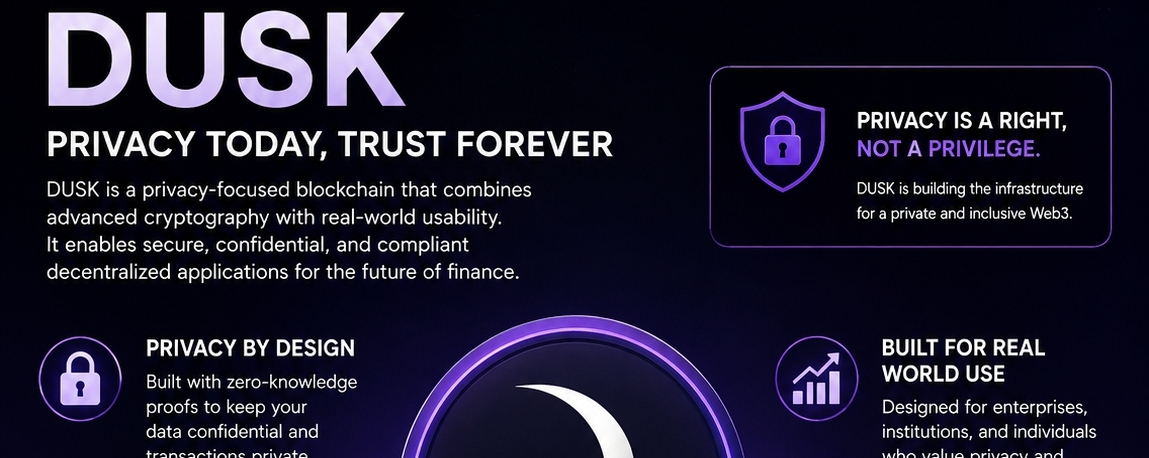
DUSK is more than just another Layer-1 blockchain. Its vision is to create a secure ecosystem where privacy, compliance, and decentralization work together. Instead of exposing every piece of financial data, DUSK leverages advanced cryptographic techniques to protect user information while preserving the integrity of the network. This balance is becoming increasingly important as blockchain technology expands into regulated industries.
Imagine a future where companies can issue tokenized assets, investors can participate securely, and institutions can interact on-chain without revealing confidential information to the public. That future requires infrastructure designed specifically for privacy, and DUSK is building toward that goal.
One of DUSK's standout features is its focus on confidential smart contracts. These allow developers to create decentralized applications that protect sensitive business logic and user data while remaining transparent enough to be trusted. This opens the door for use cases such as digital securities, tokenized real-world assets, private DeFi applications, and enterprise financial services.
Security is another pillar of the DUSK ecosystem. A blockchain is only as valuable as the trust users place in it, and DUSK aims to provide strong network security alongside efficient performance. As adoption grows, scalability and sustainability will become increasingly important, and DUSK continues to evolve its technology to meet these demands.
Beyond technology, DUSK represents a broader vision of digital finance. Privacy should not be viewed as a luxury—it should be a standard feature of the next generation of blockchain networks. As governments, institutions, and businesses continue exploring Web3 solutions, projects that combine innovation with practical utility are likely to stand out.
Every successful blockchain began with a clear mission. Bitcoin introduced decentralized money, Ethereum brought programmable smart contracts, and DUSK is focused on enabling privacy-first financial infrastructure. While the crypto market evolves rapidly, projects solving real-world problems often attract the strongest long-term attention.
The future of blockchain will not only depend on speed or low transaction costs. It will also depend on how well networks protect users, support businesses, and meet the needs of modern finance. DUSK is building with that future in mind, making it one of the projects worth watching as Web3 continues to mature.
$DUSK #dusk #blockchain #Privacy #Web3 #crypto @Dusk_Foundation
Why DUSK Could Shape the Next Era of Blockchain Innovation
#dusk $DUSK @Dusk
The blockchain industry has achieved incredible milestones, but one challenge remains unsolved for many networks: privacy without sacrificing trust. While public blockchains make every transaction visible, real-world finance often requires confidentiality. Businesses, institutions, and even individuals need a system where sensitive information stays protected while transactions remain verifiable. This is the problem that DUSK is working to solve.
DUSK is more than just another Layer-1 blockchain. Its vision is to create a secure ecosystem where privacy, compliance, and decentralization work together. Instead of exposing every piece of financial data, DUSK leverages advanced cryptographic techniques to protect user information while preserving the integrity of the network. This balance is becoming increasingly important as blockchain technology expands into regulated industries.
Imagine a future where companies can issue tokenized assets, investors can participate securely, and institutions can interact on-chain without revealing confidential information to the public. That future requires infrastructure designed specifically for privacy, and DUSK is building toward that goal.
One of DUSK's standout features is its focus on confidential smart contracts. These allow developers to create decentralized applications that protect sensitive business logic and user data while remaining transparent enough to be trusted. This opens the door for use cases such as digital securities, tokenized real-world assets, private DeFi applications, and enterprise financial services.
Security is another pillar of the DUSK ecosystem. A blockchain is only as valuable as the trust users place in it, and DUSK aims to provide strong network security alongside efficient performance. As adoption grows, scalability and sustainability will become increasingly important, and DUSK continues to evolve its technology to meet these demands.
Beyond technology, DUSK represents a broader vision of digital finance. Privacy should not be viewed as a luxury—it should be a standard feature of the next generation of blockchain networks. As governments, institutions, and businesses continue exploring Web3 solutions, projects that combine innovation with practical utility are likely to stand out.
Every successful blockchain began with a clear mission. Bitcoin introduced decentralized money, Ethereum brought programmable smart contracts, and DUSK is focused on enabling privacy-first financial infrastructure. While the crypto market evolves rapidly, projects solving real-world problems often attract the strongest long-term attention.
The future of blockchain will not only depend on speed or low transaction costs. It will also depend on how well networks protect users, support businesses, and meet the needs of modern finance. DUSK is building with that future in mind, making it one of the projects worth watching as Web3 continues to mature.
$DUSK #dusk #blockchain #Privacy #Web3 #crypto @Dusk
The blockchain industry has achieved incredible milestones, but one challenge remains unsolved for many networks: privacy without sacrificing trust. While public blockchains make every transaction visible, real-world finance often requires confidentiality. Businesses, institutions, and even individuals need a system where sensitive information stays protected while transactions remain verifiable. This is the problem that DUSK is working to solve.
DUSK is more than just another Layer-1 blockchain. Its vision is to create a secure ecosystem where privacy, compliance, and decentralization work together. Instead of exposing every piece of financial data, DUSK leverages advanced cryptographic techniques to protect user information while preserving the integrity of the network. This balance is becoming increasingly important as blockchain technology expands into regulated industries.
Imagine a future where companies can issue tokenized assets, investors can participate securely, and institutions can interact on-chain without revealing confidential information to the public. That future requires infrastructure designed specifically for privacy, and DUSK is building toward that goal.
One of DUSK's standout features is its focus on confidential smart contracts. These allow developers to create decentralized applications that protect sensitive business logic and user data while remaining transparent enough to be trusted. This opens the door for use cases such as digital securities, tokenized real-world assets, private DeFi applications, and enterprise financial services.
Security is another pillar of the DUSK ecosystem. A blockchain is only as valuable as the trust users place in it, and DUSK aims to provide strong network security alongside efficient performance. As adoption grows, scalability and sustainability will become increasingly important, and DUSK continues to evolve its technology to meet these demands.
Beyond technology, DUSK represents a broader vision of digital finance. Privacy should not be viewed as a luxury—it should be a standard feature of the next generation of blockchain networks. As governments, institutions, and businesses continue exploring Web3 solutions, projects that combine innovation with practical utility are likely to stand out.
Every successful blockchain began with a clear mission. Bitcoin introduced decentralized money, Ethereum brought programmable smart contracts, and DUSK is focused on enabling privacy-first financial infrastructure. While the crypto market evolves rapidly, projects solving real-world problems often attract the strongest long-term attention.
The future of blockchain will not only depend on speed or low transaction costs. It will also depend on how well networks protect users, support businesses, and meet the needs of modern finance. DUSK is building with that future in mind, making it one of the projects worth watching as Web3 continues to mature.
$DUSK #dusk #blockchain #Privacy #Web3 #crypto @Dusk
3
155
سجّل الدخول لاستكشاف المزيد من المُحتوى
انضم إلى مُستخدمي العملات الرقمية حول العالم على Binance Square
⚡️ احصل على أحدث المعلومات المفيدة عن العملات الرقمية.
💬 موثوقة من قبل أكبر منصّة لتداول العملات الرقمية في العالم.
👍 اكتشف الرؤى الحقيقية من صنّاع المُحتوى الموثوقين.
البريد الإلكتروني / رقم الهاتف
المواضيع الرائجة
BitcoinTops$80KThreeMonthHigh
120 مشاهدات
13 يقومون بالنقاش
🚀 #BitcoinTops$80KThreeMonthHigh and the bulls are officially out of hibernation! 🐻❌ BTC just smashed past 80,000 USDT like it was a cheap meme coin, fueled by a massive 8-day ETF buying streak.
With $2.8B flooding into ETFs this month, we aren't just squeezing shorts anymore—this is pure, institutional spot-buying power. So, what’s next? Is the $83K resistance the next stop, or are we blasting straight to the moon? 📈
What should traders do?
1️⃣ Stop checking your portfolio every 5 seconds (just kidding, do it).
2️⃣ Watch the $83K wall closely.
3️⃣ Don’t leverage your house; this rally is driven by spot, not crazy leverage!
⚠️ Not financial advice. Always DYOR!
New to the rocket ship? Register on Binance using code VINHTOCDO or click here: https://www.binance.com/register?ref=VINHTOCDO 💰
#BTC #BitcoinETF #VINHTOCDO #BullMarket
$BTC
$ETH
$BNB
Vinhtocdo
·4 إعجاب
·70 مشاهدات
KospiClosesAtRecordHigh
5,879 مشاهدات
235 يقومون بالنقاش
ChinaOpposesUSProposed7.5%Tariff
12,266 مشاهدات
358 يقومون بالنقاش