

pareeshayy
19 Bài đăng

pareeshayy
Báo cáo
Chặn người dùng
I am pareeshay 🎀🎀 New in Binance square... Content creator...
6 Đang theo dõi
0 Người theo dõi
2 Đã thích
Bài đăng
·
--
1
279
·
--
Xem bản dịch
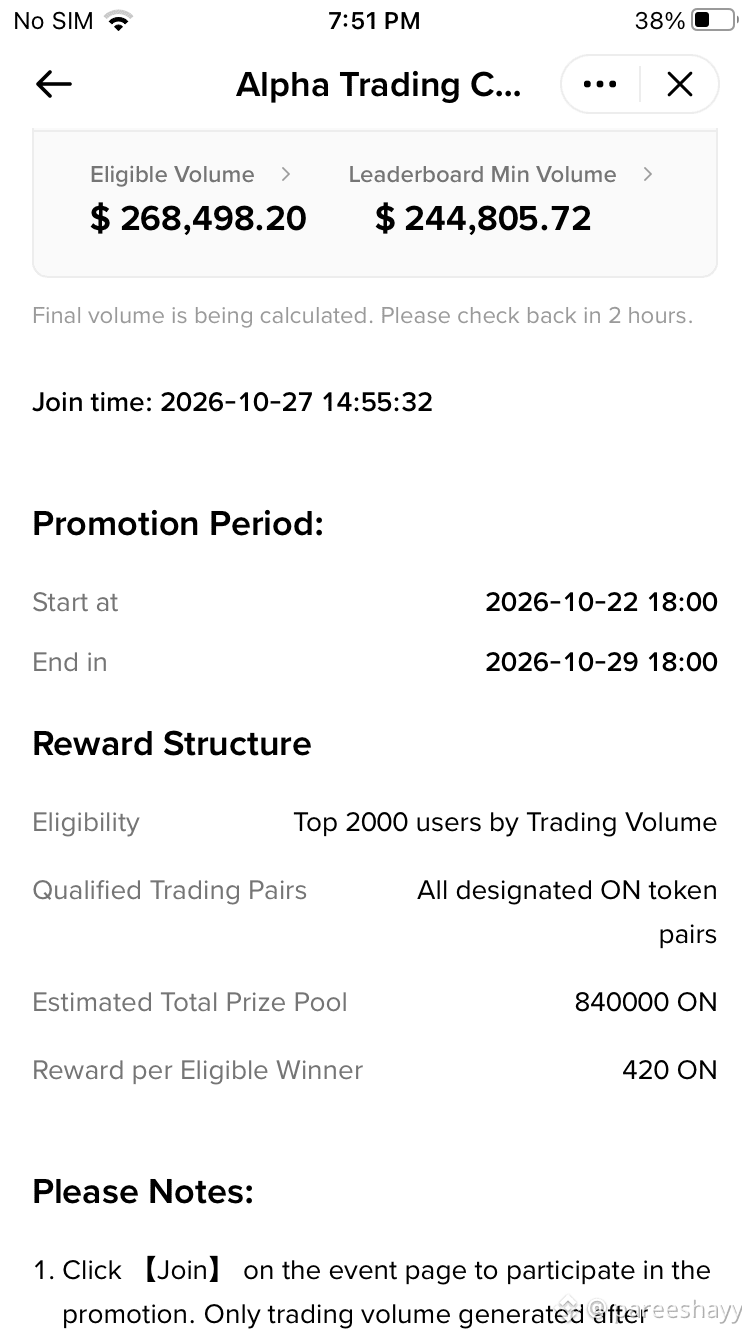
$ON when final leaderboard update my final rank 267k i am eligible anyone please tell me 😭
$ON when final leaderboard update my final rank 267k i am eligible anyone please tell me 😭
3
1
384
·
--
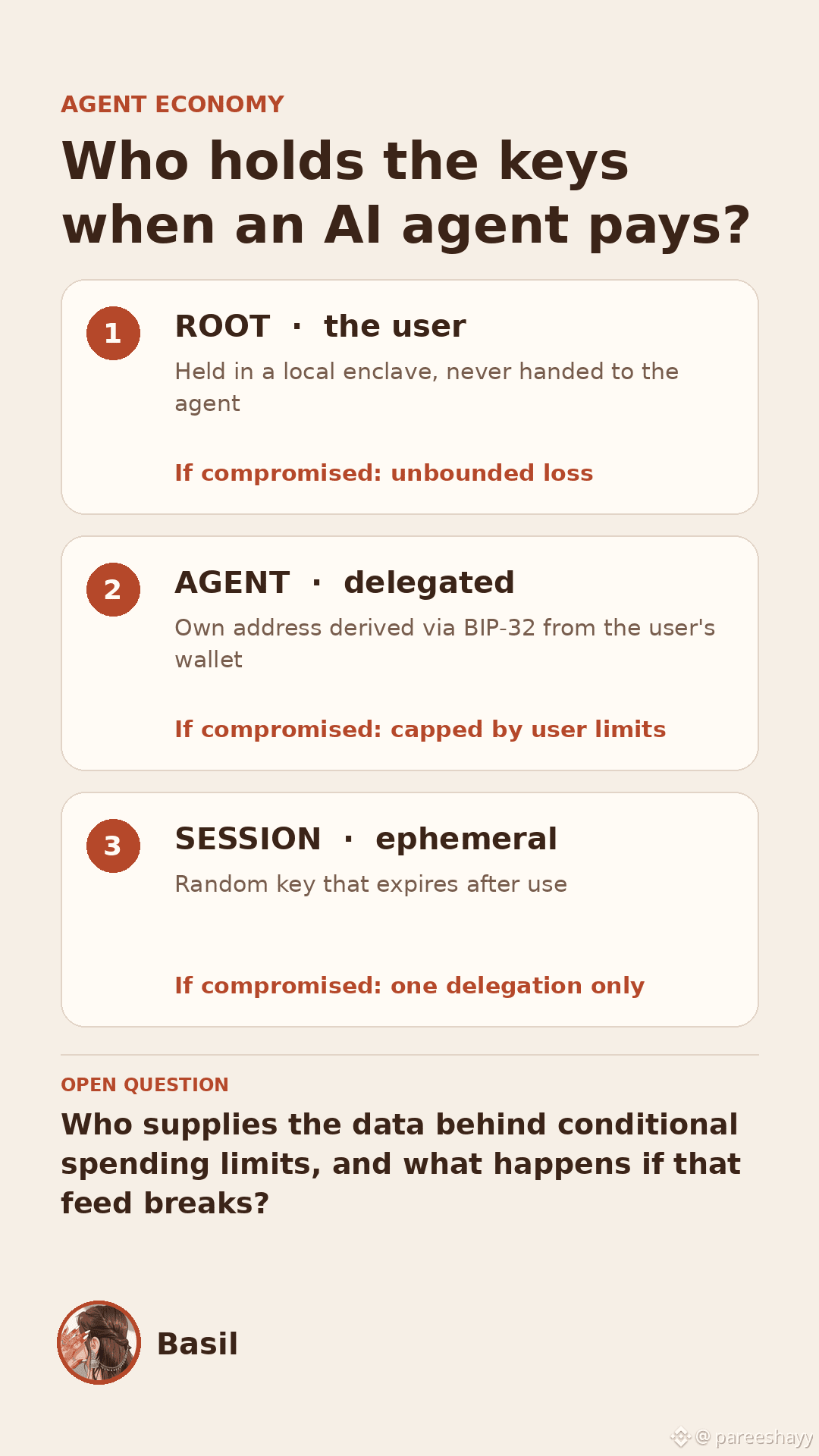
Hôm nay tôi đọc tài liệu dành cho nhà phát triển của Kite từ đầu đến cuối, và điều đọng lại với tôi không phải là tốc độ hay phí. Mà là cách quyền hạn được chia thành ba lớp. Người dùng nắm quyền tối cao, mỗi agent có địa chỉ riêng được tạo từ ví của người dùng thông qua BIP-32, và mỗi phiên hoạt động bằng một khóa ngẫu nhiên sẽ hết hạn sau khi sử dụng. Nếu một phiên bị xâm phạm, bạn chỉ mất một quyền ủy nhiệm. Nếu một agent bị xâm phạm, thiệt hại vẫn nằm trong giới hạn do người dùng đặt ra. Chỉ khóa tối cao mới có thể gây tổn thất không giới hạn, đó là lý do tài liệu luôn giữ khóa này trong một vùng bảo mật cục bộ.
Thiết kế thanh toán cũng tuân theo logic tương tự. Thay vì quyết toán mọi yêu cầu trên chuỗi, hai bên mở một kênh, trao đổi hàng nghìn bản cập nhật đã ký ngoài chuỗi, rồi đóng kênh bằng một giao dịch thứ hai.
Tài liệu nêu độ trễ dưới 100 ms với chi phí khoảng 1 USD cho mỗi triệu yêu cầu.
Đây là điểm tôi muốn tự kiềm chế sự hào hứng của mình. Tài liệu cũng mô tả các quy tắc có điều kiện, chẳng hạn như giảm hạn mức của một agent khi biến động tăng đột biến. Một quy tắc như vậy cần dữ liệu đầu vào từ bên ngoài, nhưng tôi không tìm thấy thông tin về bên cung cấp dữ liệu đó hoặc điều gì xảy ra nếu nguồn dữ liệu sai. Ngoài ra, các con số lớn trên testnet (hàng trăm triệu giao dịch) đến từ môi trường thử nghiệm, nên chúng ít cho biết về nhu cầu định kỳ trên mainnet, vốn đã ra mắt vào ngày 30 tháng 4 năm 2026.
Từ đây, tôi sẽ theo dõi: số lượng Agent Passport đang hoạt động trên KiteScan, tỷ lệ giao dịch của agent là thanh toán dịch vụ thực thay vì lưu lượng thử nghiệm, và liệu tài liệu có nêu nguồn dữ liệu đứng sau các hạn mức chi tiêu có điều kiện hay không.
Nền kinh tế agent chỉ hoạt động nếu một người có thể giao ví cho agent mà vẫn ngủ ngon. Điều đó phụ thuộc ít hơn vào tốc độ thanh toán của agent, và nhiều hơn vào cách các quy tắc vận hành khi dữ liệu đầu vào gặp trục trặc.
#KiteBBW $KITE @GoKiteAI #KiteBBW
Hôm nay tôi đọc tài liệu dành cho nhà phát triển của Kite từ đầu đến cuối, và điều đọng lại với tôi không phải là tốc độ hay phí. Mà là cách quyền hạn được chia thành ba lớp. Người dùng nắm quyền tối cao, mỗi agent có địa chỉ riêng được tạo từ ví của người dùng thông qua BIP-32, và mỗi phiên hoạt động bằng một khóa ngẫu nhiên sẽ hết hạn sau khi sử dụng. Nếu một phiên bị xâm phạm, bạn chỉ mất một quyền ủy nhiệm. Nếu một agent bị xâm phạm, thiệt hại vẫn nằm trong giới hạn do người dùng đặt ra. Chỉ khóa tối cao mới có thể gây tổn thất không giới hạn, đó là lý do tài liệu luôn giữ khóa này trong một vùng bảo mật cục bộ.
Thiết kế thanh toán cũng tuân theo logic tương tự. Thay vì quyết toán mọi yêu cầu trên chuỗi, hai bên mở một kênh, trao đổi hàng nghìn bản cập nhật đã ký ngoài chuỗi, rồi đóng kênh bằng một giao dịch thứ hai.
Tài liệu nêu độ trễ dưới 100 ms với chi phí khoảng 1 USD cho mỗi triệu yêu cầu.
Đây là điểm tôi muốn tự kiềm chế sự hào hứng của mình. Tài liệu cũng mô tả các quy tắc có điều kiện, chẳng hạn như giảm hạn mức của một agent khi biến động tăng đột biến. Một quy tắc như vậy cần dữ liệu đầu vào từ bên ngoài, nhưng tôi không tìm thấy thông tin về bên cung cấp dữ liệu đó hoặc điều gì xảy ra nếu nguồn dữ liệu sai. Ngoài ra, các con số lớn trên testnet (hàng trăm triệu giao dịch) đến từ môi trường thử nghiệm, nên chúng ít cho biết về nhu cầu định kỳ trên mainnet, vốn đã ra mắt vào ngày 30 tháng 4 năm 2026.
Từ đây, tôi sẽ theo dõi: số lượng Agent Passport đang hoạt động trên KiteScan, tỷ lệ giao dịch của agent là thanh toán dịch vụ thực thay vì lưu lượng thử nghiệm, và liệu tài liệu có nêu nguồn dữ liệu đứng sau các hạn mức chi tiêu có điều kiện hay không.
Nền kinh tế agent chỉ hoạt động nếu một người có thể giao ví cho agent mà vẫn ngủ ngon. Điều đó phụ thuộc ít hơn vào tốc độ thanh toán của agent, và nhiều hơn vào cách các quy tắc vận hành khi dữ liệu đầu vào gặp trục trặc.
#KiteBBW $KITE @KITE AI 中文 #KiteBBW
78
·
--
Xem bản dịch
#BinancePick i am done my today task everyone can join this hottested camapign
#BinancePick i am done my today task everyone can join this hottested camapign
·
--
Xem bản dịch
#BinancePick everyone join this campaign befire late
#BinancePick everyone join this campaign befire late
·
--
224
·
--
Xem bản dịch
#BinancePick when week 1 reward will be distribution?
#BinancePick when week 1 reward will be distribution?
51
·
--
Xem bản dịch
$ON compitation is afaired to participate .. i am leaving early 😅
$ON compitation is afaired to participate .. i am leaving early 😅
396
·
--
Xem bản dịch
#BinancePick everyone please join this campaign
#BinancePick everyone please join this campaign
·
--
Xem bản dịch
#BinancePick anyone recived first week payment 🥲
#BinancePick anyone recived first week payment 🥲
62
·
--
Xem bản dịch
#BinancePick somethig new intresting camapign live lets try.. everyone join
#BinancePick somethig new intresting camapign live lets try.. everyone join
·
--
Xem bản dịch
#dusk $DUSK @Dusk_Foundation Many people who look at Dusk's consensus layer ask one question first - how fast is it? I kept thinking that speed is the wrong place to start. The more interesting question is what the design is actually protecting against.
Succinct Attestation runs every block through three steps - Proposal, Validation, Ratification. A provisioner creates a candidate block. A randomly selected committee checks its validity. A second, separately selected committee confirms the validation outcome and finalizes it. Two independent committees, same block, same round.
What slowed me down reading this was the word "independently." Most PoS systems use one committee to propose and approve. Dusk uses two separate committees for validation and ratification, meaning a block needs agreement from two groups who were selected randomly and separately before it is ever considered final. A single compromised committee cannot push through an invalid block alone.
The randomness matters more than it first appears. Provisioners are selected through sortition - weighted by stake, but non-deterministic. Nobody knows in advance which specific nodes will form the next validation or ratification committee. That uncertainty is the security mechanism. An attacker cannot bribe or target a committee that does not yet exist.
The minimum stake to participate is 1,000 DUSK. That number is not arbitrary - it sets the economic floor for what it costs to become a provisioner and potentially influence committee selection. The higher the total staked, the more expensive it becomes to accumulate enough weight to matter.
What I find genuinely unresolved is the relationship between stake concentration and sortition outcomes over time. If a small number of large provisioners dominate the stake weight, the "random" selection starts producing predictable patterns. The cryptography holds, but the economic assumptions underneath it require watching.
#dusk $DUSK @Dusk Many people who look at Dusk's consensus layer ask one question first - how fast is it? I kept thinking that speed is the wrong place to start. The more interesting question is what the design is actually protecting against.
Succinct Attestation runs every block through three steps - Proposal, Validation, Ratification. A provisioner creates a candidate block. A randomly selected committee checks its validity. A second, separately selected committee confirms the validation outcome and finalizes it. Two independent committees, same block, same round.
What slowed me down reading this was the word "independently." Most PoS systems use one committee to propose and approve. Dusk uses two separate committees for validation and ratification, meaning a block needs agreement from two groups who were selected randomly and separately before it is ever considered final. A single compromised committee cannot push through an invalid block alone.
The randomness matters more than it first appears. Provisioners are selected through sortition - weighted by stake, but non-deterministic. Nobody knows in advance which specific nodes will form the next validation or ratification committee. That uncertainty is the security mechanism. An attacker cannot bribe or target a committee that does not yet exist.
The minimum stake to participate is 1,000 DUSK. That number is not arbitrary - it sets the economic floor for what it costs to become a provisioner and potentially influence committee selection. The higher the total staked, the more expensive it becomes to accumulate enough weight to matter.
What I find genuinely unresolved is the relationship between stake concentration and sortition outcomes over time. If a small number of large provisioners dominate the stake weight, the "random" selection starts producing predictable patterns. The cryptography holds, but the economic assumptions underneath it require watching.
80
·
--
Xem bản dịch
#dusk $DUSK @Dusk_Foundation Many people who look at Dusk for the first time reduce Phoenix and Moonlight to a simple toggle - private mode and public mode. I kept thinking that framing misses what is actually interesting about how these two models sit inside the same protocol.
Phoenix is not just "private." It is a completely different transaction architecture. Funds do not live in balances - they live as encrypted notes. When you spend, you consume existing notes and create new ones, proving with zero-knowledge proofs that no double spend happened and that the amounts add up, without revealing who sent what to whom or how much moved. The receiver sees the note. Nobody else does, unless you share a viewing key.
Moonlight works the opposite way - account-based, fully transparent, sender and recipient and amount all visible on-chain. The kind of model most people already understand from Ethereum.
What caught my attention is that both models settle through the same Transfer Contract on DuskDS. They are not separate chains or separate ledgers. A Phoenix transaction and a Moonlight transaction can both exist inside the same block, finalized by the same consensus round, without either model needing to know about the other's internal logic.
The part worth sitting with is what this means for regulated assets. A securities transaction might need full transparency for the regulator and full privacy from the counterparty. Phoenix viewing keys make selective disclosure possible - you reveal exactly what you must, to exactly who requires it, nothing more. Moonlight handles flows where transparency is the requirement by default.
What I find harder to answer is whether regulators will accept viewing-key-based disclosure as equivalent to traditional audit trails. The cryptography works. Whether the legal frameworks catch up is a different question entirely.
#dusk $DUSK @Dusk Many people who look at Dusk for the first time reduce Phoenix and Moonlight to a simple toggle - private mode and public mode. I kept thinking that framing misses what is actually interesting about how these two models sit inside the same protocol.
Phoenix is not just "private." It is a completely different transaction architecture. Funds do not live in balances - they live as encrypted notes. When you spend, you consume existing notes and create new ones, proving with zero-knowledge proofs that no double spend happened and that the amounts add up, without revealing who sent what to whom or how much moved. The receiver sees the note. Nobody else does, unless you share a viewing key.
Moonlight works the opposite way - account-based, fully transparent, sender and recipient and amount all visible on-chain. The kind of model most people already understand from Ethereum.
What caught my attention is that both models settle through the same Transfer Contract on DuskDS. They are not separate chains or separate ledgers. A Phoenix transaction and a Moonlight transaction can both exist inside the same block, finalized by the same consensus round, without either model needing to know about the other's internal logic.
The part worth sitting with is what this means for regulated assets. A securities transaction might need full transparency for the regulator and full privacy from the counterparty. Phoenix viewing keys make selective disclosure possible - you reveal exactly what you must, to exactly who requires it, nothing more. Moonlight handles flows where transparency is the requirement by default.
What I find harder to answer is whether regulators will accept viewing-key-based disclosure as equivalent to traditional audit trails. The cryptography works. Whether the legal frameworks catch up is a different question entirely.
81
Đăng nhập để khám phá thêm nội dung
Tham gia cùng người dùng tiền mã hóa toàn cầu trên Binance Square
⚡️ Nhận thông tin mới nhất và hữu ích về tiền mã hóa.
💬 Được tin cậy bởi sàn giao dịch tiền mã hóa lớn nhất thế giới.
👍 Khám phá những thông tin chuyên sâu thực tế từ những nhà sáng tạo đã xác minh.
Email / Số điện thoại
Chủ đề thịnh hành
TheoDõiFOMC
308,428 lượt xem
1,308 đang thảo luận
LÃI SUẤT: Warsh cho biết lạm phát vẫn còn quá cao và Fed sẽ không chấp nhận bất kỳ điều gì vượt quá mục tiêu 2% của mình.
- NHIỀU CUỘC ĐI LƯỢT TỶ LỆ HẠN CHẾ HƠN: Cục Dự trữ Liên bang (Fed) sẵn sàng hành động một lần nữa nếu cần thiết nhưng muốn có thêm dữ liệu kinh tế trước khi quyết định bước đi tiếp theo.
- TĂNG TRƯỞNG KINH TẾ: GDP quý 3 có khả năng tăng hơn 3%, trong khi đầu tư kinh doanh đang tăng với tốc độ gấp đôi con số.
- BIẾN ĐỘNG THỊ TRƯỜNG: Warsh cho biết anh ấy không ngạc nhiên trước sự biến động gần đây trên thị trường tài chính.
- NỀN KINH TẾ NÓNG BỎNG: Hầu hết các quan chức Fed không tin rằng nền kinh tế đang hoạt động quá nóng, bất chấp sự tăng trưởng mạnh mẽ.
- THAY ĐỔI CỦA FOMC: Fed dự định thay đổi lịch họp, dự kiến chỉ có sáu cuộc họp thiết lập chính sách mỗi năm từ năm 2028.
- ÁP LỰC CHÍNH TRỊ: Warsh từ chối phản hồi lại những chỉ trích của Trump và cho biết cuộc bầu cử giữa nhiệm kỳ sắp tới không đóng vai trò gì trong quyết định về tỷ giá.
Mối lo ngại lớn nhất là lạm phát vẫn còn quá cao ngay cả khi nền kinh tế tiếp tục tăng trưởng mạnh mẽ.
Warsh đã làm rõ rằng Fed sẵn sàng hành động một lần nữa nhưng không sẵn sàng cam kết tăng lãi suất thêm một lần nữa mà không có thêm dữ liệu.
#TheoDõiFOMC
Sherell
·0 lượt thích
·434 lượt xem
TinFed
373,813 lượt xem
1,033 đang thảo luận
UniswapA16zSeekDeFiExemptionFromIllinoisCryptoTax
5,448 lượt xem
349 đang thảo luận