
mikeskcv
28 Bài đăng

mikeskcv
Báo cáo
Chặn người dùng
5 Đang theo dõi
1 Người theo dõi
10 Đã thích
Bài đăng
·
--
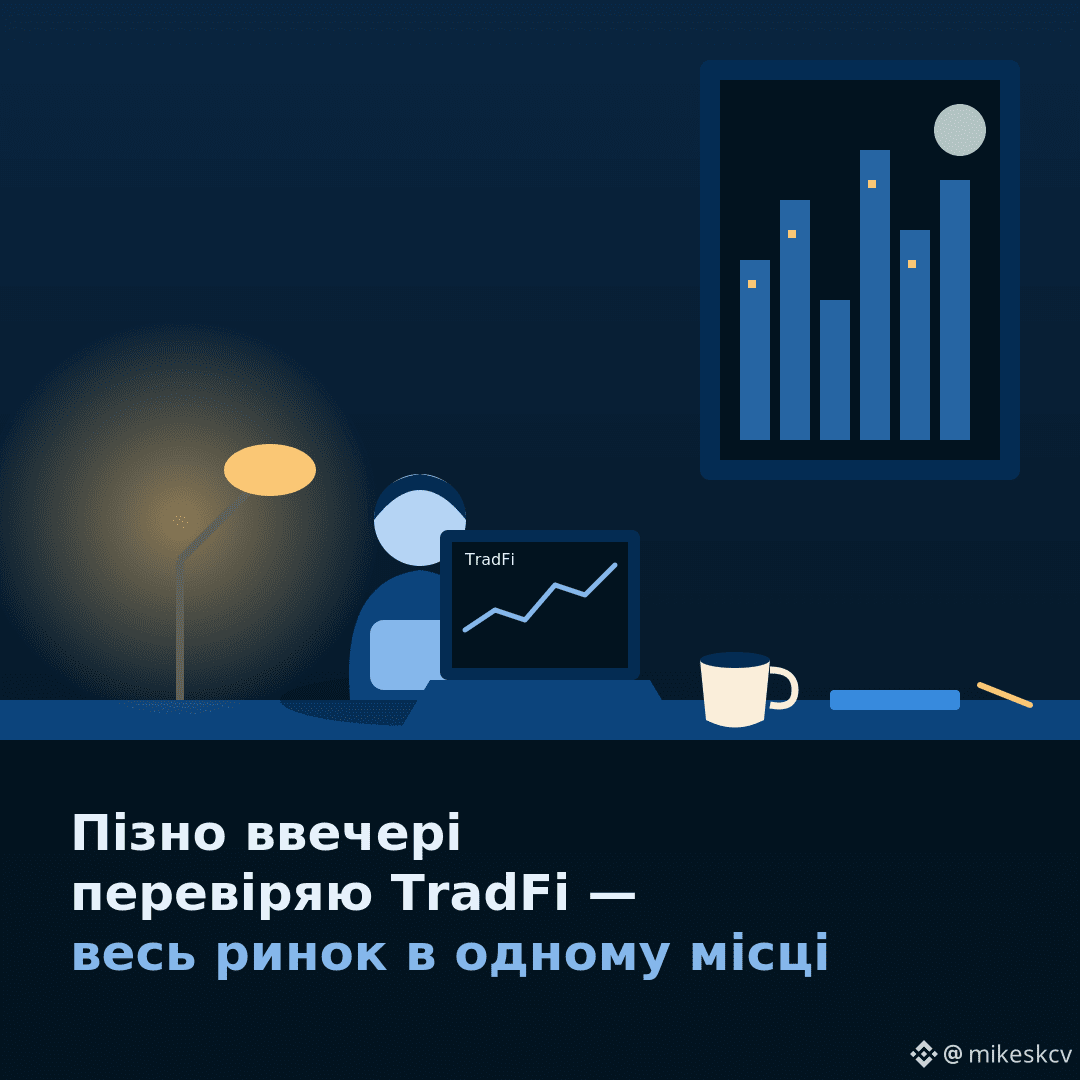
Lãi suất của ngân hàng trung ương lại một lần nữa xuất hiện trong tin tức, và thật thú vị khi quan sát các tài sản truyền thống phản ứng với điều đó. TradFi trên Binance thuận tiện ở chỗ không cần phải mở sẵn năm tab với các sàn giao dịch khác nhau — mọi thứ đều ở một nơi, và bức tranh thị trường được hình thành nhanh hơn.
#TradFi #Binance #CreateWithBinance #ринок
Lãi suất của ngân hàng trung ương lại một lần nữa xuất hiện trong tin tức, và thật thú vị khi quan sát các tài sản truyền thống phản ứng với điều đó. TradFi trên Binance thuận tiện ở chỗ không cần phải mở sẵn năm tab với các sàn giao dịch khác nhau — mọi thứ đều ở một nơi, và bức tranh thị trường được hình thành nhanh hơn.
#TradFi #Binance #CreateWithBinance #ринок
#TradFi #Binance #CreateWithBinance #ринок
113
·
--
Xem bản dịch
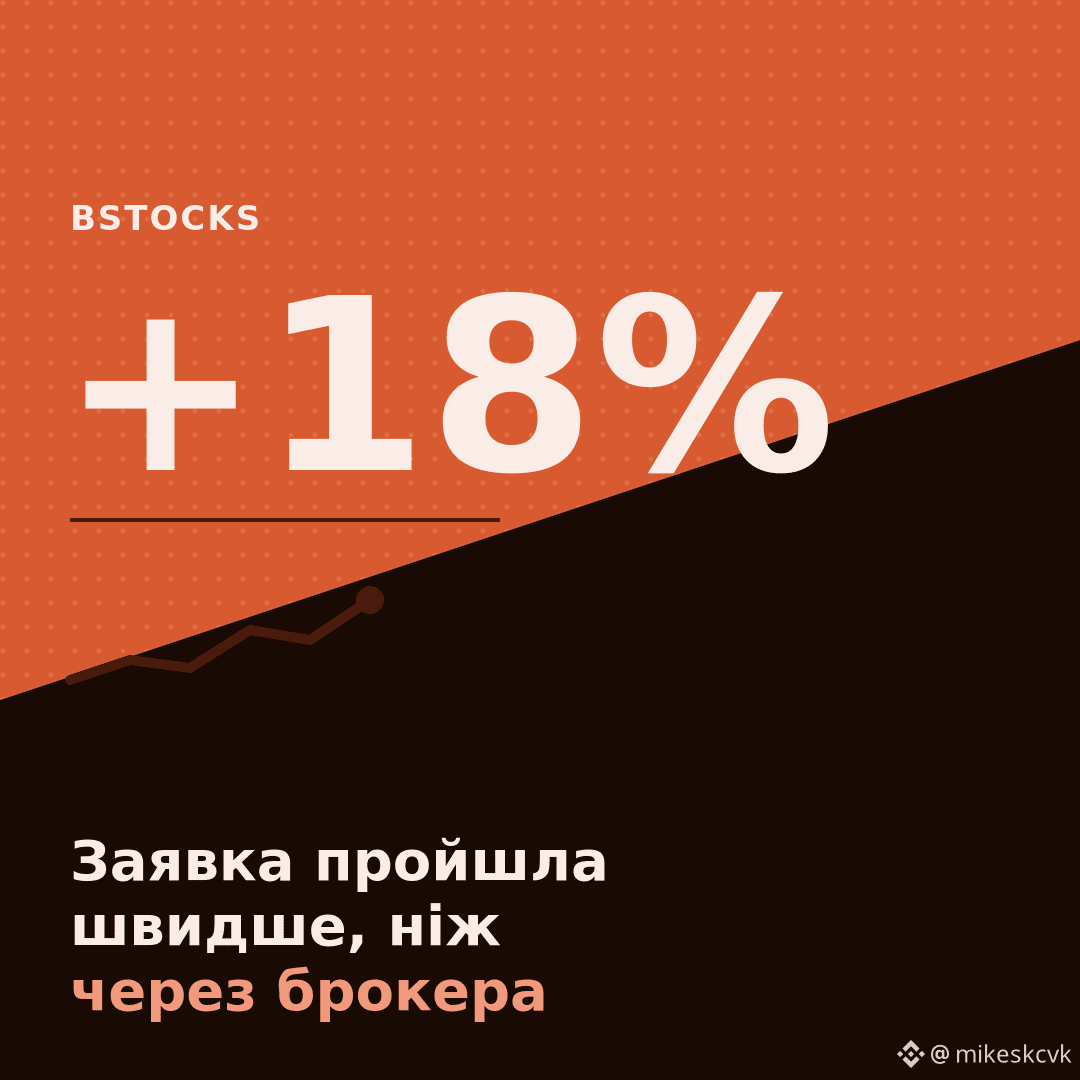
Спробував bStocks цього тижня. Купив невелику частку Apple — заявка пройшла швидше, ніж через звичайного брокера, і комісія приємно здивувала. Поки що плюс.
#bStocks #Binance #CreateWithBinance #інвестиції
Спробував bStocks цього тижня. Купив невелику частку Apple — заявка пройшла швидше, ніж через звичайного брокера, і комісія приємно здивувала. Поки що плюс.
#bStocks #Binance #CreateWithBinance #інвестиції
#bStocks #Binance #CreateWithBinance #інвестиції
181
·
--
Xem bản dịch
#termmax @termmax
What if the most interesting part of DeFi lending isn't the yield?
But who gets to choose the terms?
That's what I find interesting about TermMax.
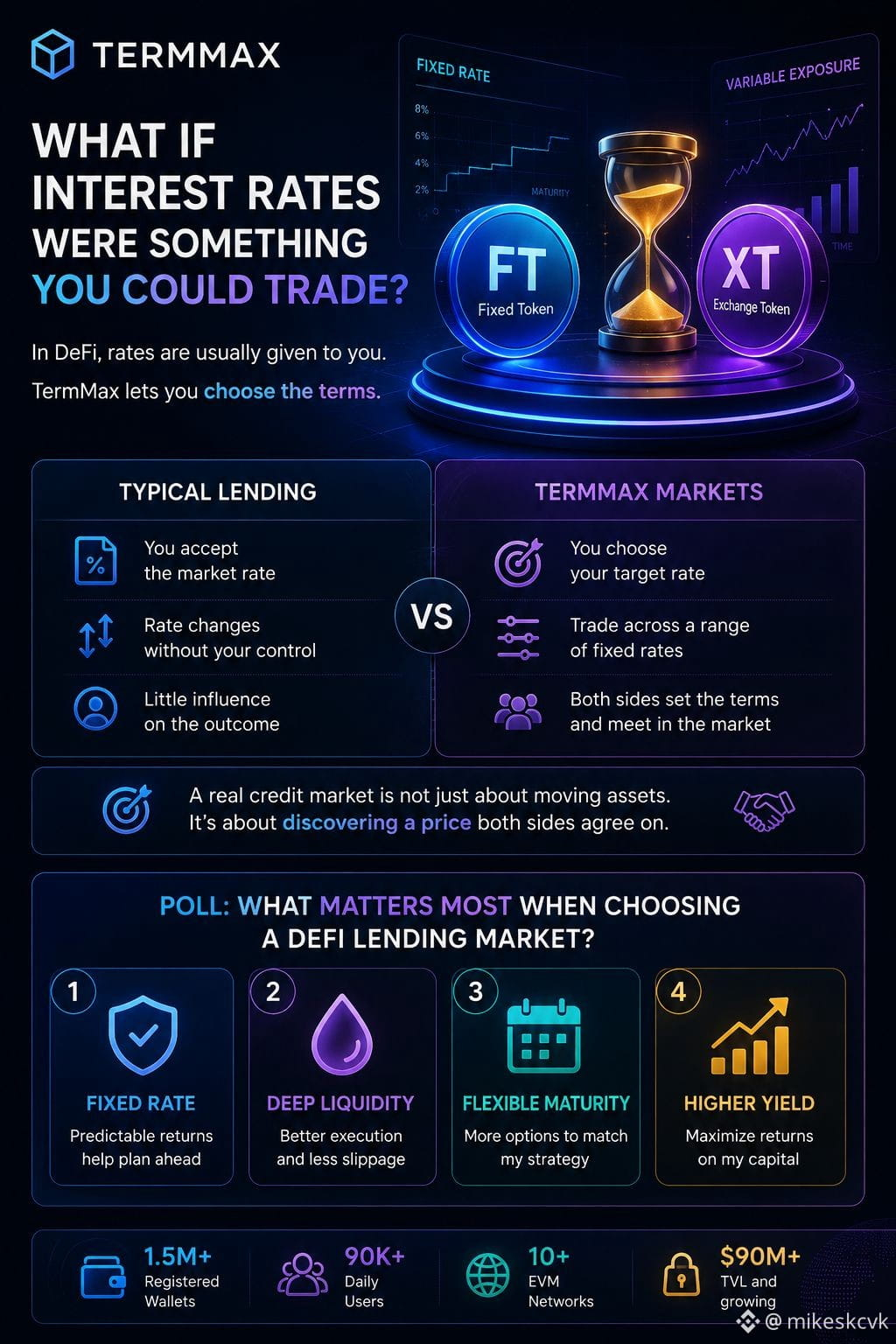
In a typical lending market, you mostly accept whatever rate the market is giving you.
But fixed-rate markets introduce another possibility.
A borrower can think:
“At what rate does this loan actually make sense for
me?”
And a lender can think:
“At what return am I comfortable locking my capital?”
Now the interest rate isn't just a number on a dashboard.
It's part of the negotiation.
That changes how I look at on-chain credit.
Because a real financial market isn't only about moving assets from A to B.
It's about discovering a price that both sides are willing to accept.
TermMax is experimenting with that idea on-chain.
And honestly, I think this is a more interesting question than chasing the highest APY:
Can DeFi create efficient markets for the price of time and capital?
That's what I'll be watching.
#termmax @TermMax
What if the most interesting part of DeFi lending isn't the yield?
But who gets to choose the terms?
That's what I find interesting about TermMax.
In a typical lending market, you mostly accept whatever rate the market is giving you.
But fixed-rate markets introduce another possibility.
A borrower can think:
“At what rate does this loan actually make sense for
me?”
And a lender can think:
“At what return am I comfortable locking my capital?”
Now the interest rate isn't just a number on a dashboard.
It's part of the negotiation.
That changes how I look at on-chain credit.
Because a real financial market isn't only about moving assets from A to B.
It's about discovering a price that both sides are willing to accept.
TermMax is experimenting with that idea on-chain.
And honestly, I think this is a more interesting question than chasing the highest APY:
Can DeFi create efficient markets for the price of time and capital?
That's what I'll be watching.
What if the most interesting part of DeFi lending isn't the yield?
But who gets to choose the terms?
That's what I find interesting about TermMax.
In a typical lending market, you mostly accept whatever rate the market is giving you.
But fixed-rate markets introduce another possibility.
A borrower can think:
“At what rate does this loan actually make sense for
me?”
And a lender can think:
“At what return am I comfortable locking my capital?”
Now the interest rate isn't just a number on a dashboard.
It's part of the negotiation.
That changes how I look at on-chain credit.
Because a real financial market isn't only about moving assets from A to B.
It's about discovering a price that both sides are willing to accept.
TermMax is experimenting with that idea on-chain.
And honestly, I think this is a more interesting question than chasing the highest APY:
Can DeFi create efficient markets for the price of time and capital?
That's what I'll be watching.
88
·
--
Xem bản dịch
#termmax @termmax
The most interesting TermMax update isn't the $TMX TGE.
It's something much less exciting at first glance:
App V2.
Why?
Because DeFi has a fragmentation problem.
One chain for this position.
Another chain for that vault.
Different interfaces.
Different orders.
Different liquidity.
You can have a great protocol and still make the user experience feel like managing five different accounts.
TermMax V2 is moving in the opposite direction.
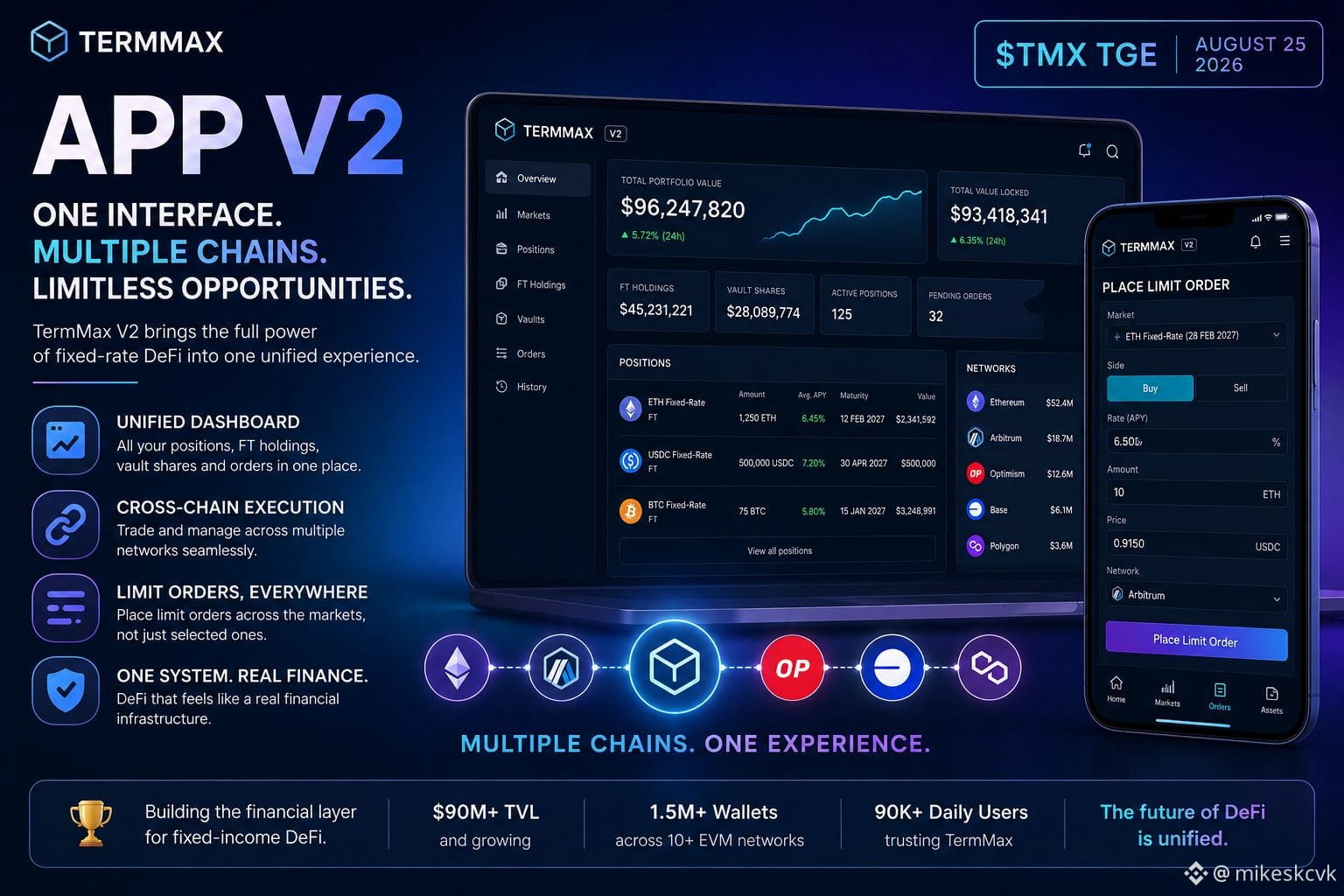
One interface for multiple chains.
One dashboard for positions, FT holdings, vault shares and orders.
And limit orders across the markets instead of restricting them to selected ones.
That might sound like a UX improvement.
I think it's more important than that.
If fixed-rate DeFi is supposed to become actual financial infrastructure, users shouldn't have to think about the underlying chain every time they make a transaction.
The chain should become the infrastructure.
The product should be the market.
And this is where TermMax gets interesting to me.
The next stage of DeFi may not be about adding more protocols.
It may be about making the protocols we already have feel like one financial system.
$TMX TGE is coming on August 25.
But I'm more interested in what happens after the infrastructure is already built.
#termmax @TermMax
The most interesting TermMax update isn't the $TMX TGE.
It's something much less exciting at first glance:
App V2.
Why?
Because DeFi has a fragmentation problem.
One chain for this position.
Another chain for that vault.
Different interfaces.
Different orders.
Different liquidity.
You can have a great protocol and still make the user experience feel like managing five different accounts.
TermMax V2 is moving in the opposite direction.
One interface for multiple chains.
One dashboard for positions, FT holdings, vault shares and orders.
And limit orders across the markets instead of restricting them to selected ones.
That might sound like a UX improvement.
I think it's more important than that.
If fixed-rate DeFi is supposed to become actual financial infrastructure, users shouldn't have to think about the underlying chain every time they make a transaction.
The chain should become the infrastructure.
The product should be the market.
And this is where TermMax gets interesting to me.
The next stage of DeFi may not be about adding more protocols.
It may be about making the protocols we already have feel like one financial system.
$TMX TGE is coming on August 25.
But I'm more interested in what happens after the infrastructure is already built.
The most interesting TermMax update isn't the $TMX TGE.
It's something much less exciting at first glance:
App V2.
Why?
Because DeFi has a fragmentation problem.
One chain for this position.
Another chain for that vault.
Different interfaces.
Different orders.
Different liquidity.
You can have a great protocol and still make the user experience feel like managing five different accounts.
TermMax V2 is moving in the opposite direction.
One interface for multiple chains.
One dashboard for positions, FT holdings, vault shares and orders.
And limit orders across the markets instead of restricting them to selected ones.
That might sound like a UX improvement.
I think it's more important than that.
If fixed-rate DeFi is supposed to become actual financial infrastructure, users shouldn't have to think about the underlying chain every time they make a transaction.
The chain should become the infrastructure.
The product should be the market.
And this is where TermMax gets interesting to me.
The next stage of DeFi may not be about adding more protocols.
It may be about making the protocols we already have feel like one financial system.
$TMX TGE is coming on August 25.
But I'm more interested in what happens after the infrastructure is already built.
1
82
·
--
Tăng giá
Xem bản dịch
#termmax @termmax
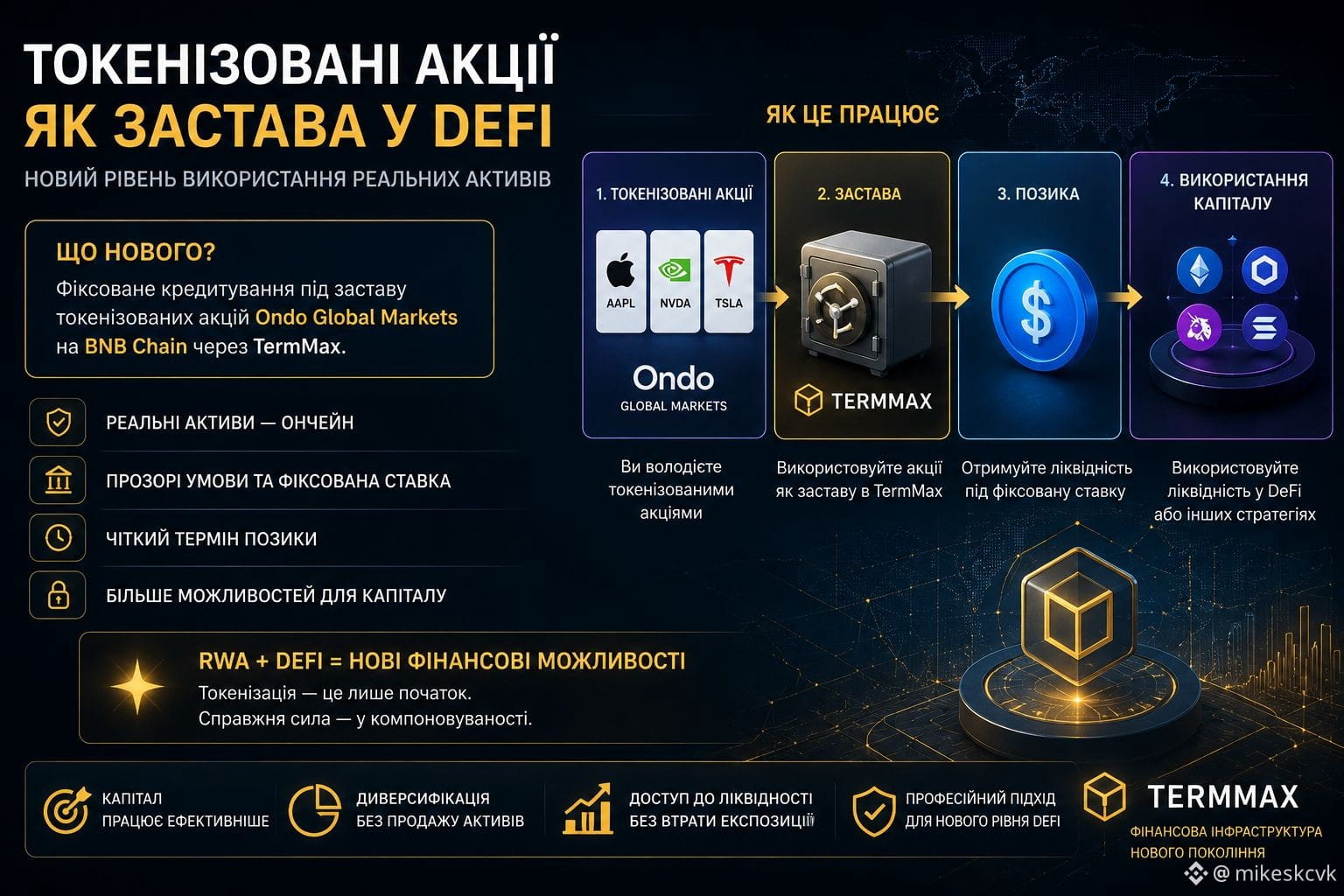
Більшість людей дивляться на токенізовані акції як на спосіб отримати доступ до традиційних ринків через блокчейн.
Але мені цікавіше інше питання.
Що, якщо такі активи можуть не просто лежати в портфелі?
Що, якщо вони можуть працювати як фінансовий інструмент?
Саме тут стає цікаво.
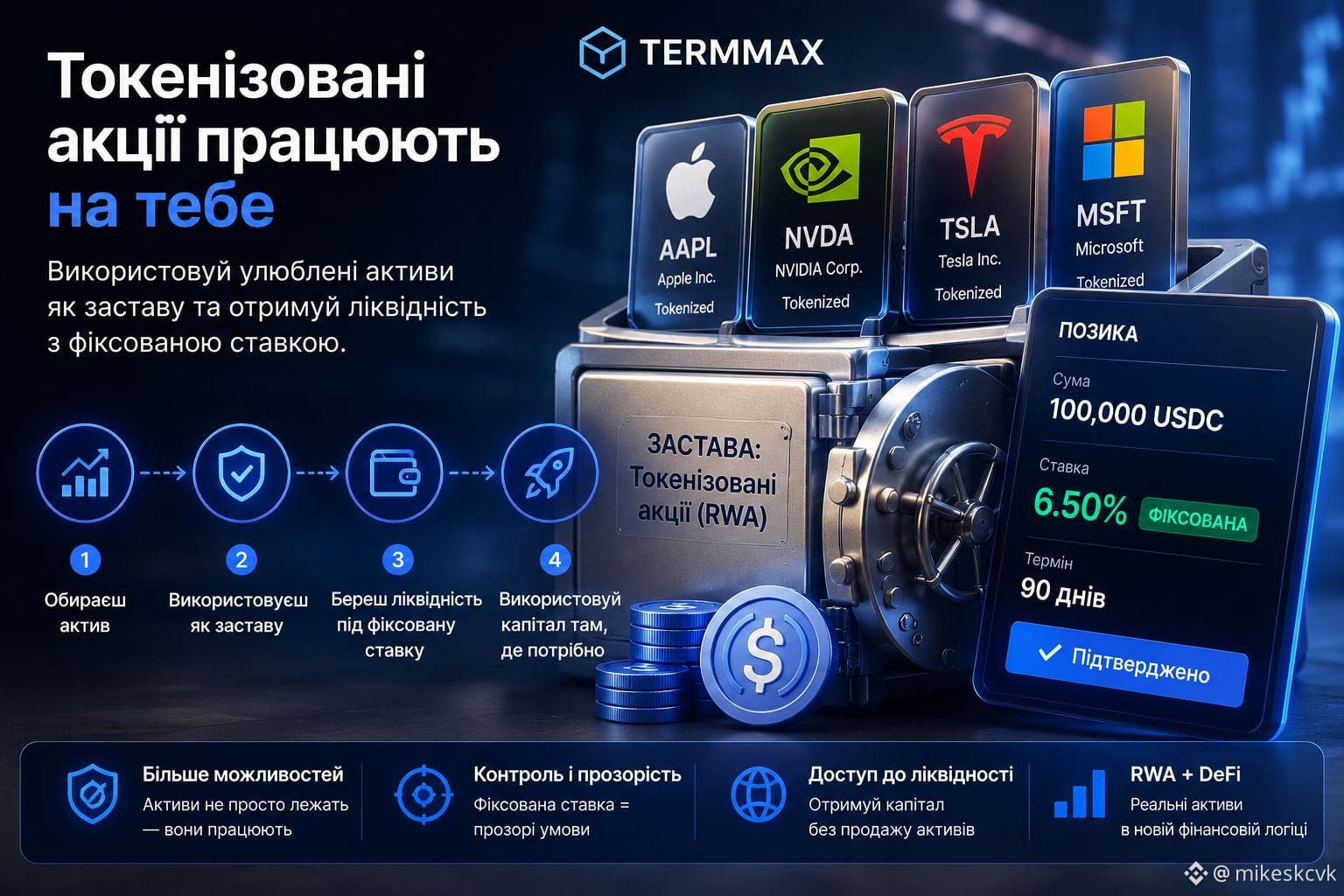
TermMax дозволяє використовувати токенізовані акції як заставу для отримання ліквідності під фіксовану ставку.
Тобто актив не просто відображає ціну акції.
Він стає частиною DeFi-екосистеми.
У результаті з'являється нова логіка:
📈 Тримаєш токенізовані акції
🔒 Використовуєш їх як заставу
💵 Отримуєш ліквідність
🚀 Використовуєш капітал в інших стратегіях
На мою думку, саме тут прихований справжній потенціал RWA.
Не в самій токенізації.
А в тому, що реальні активи починають взаємодіяти з DeFi так само гнучко, як криптоактиви.
І що більше таких сценаріїв з'являтиметься, то цікавішою ставатиме вся екосистема.
Токенізація — це лише перший крок.
Справжня цінність починається тоді, коли активи можна використовувати по-новому.
#termmax @TermMax
Більшість людей дивляться на токенізовані акції як на спосіб отримати доступ до традиційних ринків через блокчейн.
Але мені цікавіше інше питання.
Що, якщо такі активи можуть не просто лежати в портфелі?
Що, якщо вони можуть працювати як фінансовий інструмент?
Саме тут стає цікаво.
TermMax дозволяє використовувати токенізовані акції як заставу для отримання ліквідності під фіксовану ставку.
Тобто актив не просто відображає ціну акції.
Він стає частиною DeFi-екосистеми.
У результаті з'являється нова логіка:
📈 Тримаєш токенізовані акції
🔒 Використовуєш їх як заставу
💵 Отримуєш ліквідність
🚀 Використовуєш капітал в інших стратегіях
На мою думку, саме тут прихований справжній потенціал RWA.
Не в самій токенізації.
А в тому, що реальні активи починають взаємодіяти з DeFi так само гнучко, як криптоактиви.
І що більше таких сценаріїв з'являтиметься, то цікавішою ставатиме вся екосистема.
Токенізація — це лише перший крок.
Справжня цінність починається тоді, коли активи можна використовувати по-новому.
Більшість людей дивляться на токенізовані акції як на спосіб отримати доступ до традиційних ринків через блокчейн.
Але мені цікавіше інше питання.
Що, якщо такі активи можуть не просто лежати в портфелі?
Що, якщо вони можуть працювати як фінансовий інструмент?
Саме тут стає цікаво.
TermMax дозволяє використовувати токенізовані акції як заставу для отримання ліквідності під фіксовану ставку.
Тобто актив не просто відображає ціну акції.
Він стає частиною DeFi-екосистеми.
У результаті з'являється нова логіка:
📈 Тримаєш токенізовані акції
🔒 Використовуєш їх як заставу
💵 Отримуєш ліквідність
🚀 Використовуєш капітал в інших стратегіях
На мою думку, саме тут прихований справжній потенціал RWA.
Не в самій токенізації.
А в тому, що реальні активи починають взаємодіяти з DeFi так само гнучко, як криптоактиви.
І що більше таких сценаріїв з'являтиметься, то цікавішою ставатиме вся екосистема.
Токенізація — це лише перший крок.
Справжня цінність починається тоді, коли активи можна використовувати по-новому.
138
·
--
Xem bản dịch
Most people look at a lending protocol and ask:
“What's the APY?”
I think that's only half the story.
The other half is what happens to your capital while you're earning that APY.
Can you predict when the position ends?
Do you know exactly what you're lending into?
Can you build a strategy around a specific maturity?
That's the part of TermMax I find interesting.
Its approach treats lending more like an actual financial instrument: the position has defined terms and a maturity instead of being just another deposit sitting in a pool.
And this matters beyond retail DeFi.
If on-chain credit is ever going to attract serious capital, investors will need more than attractive yields.
They'll need products they can understand, price and plan around.
Maybe DeFi's next upgrade isn't another way to chase yield.
Maybe it's making lending feel more like a real financial market.
That's a much more interesting direction to me.
#termmax @termmax
Quick DeFi poll 👇
When you choose a lending opportunity, what do you care about MOST?
Most people look at a lending protocol and ask:
“What's the APY?”
I think that's only half the story.
The other half is what happens to your capital while you're earning that APY.
Can you predict when the position ends?
Do you know exactly what you're lending into?
Can you build a strategy around a specific maturity?
That's the part of TermMax I find interesting.
Its approach treats lending more like an actual financial instrument: the position has defined terms and a maturity instead of being just another deposit sitting in a pool.
And this matters beyond retail DeFi.
If on-chain credit is ever going to attract serious capital, investors will need more than attractive yields.
They'll need products they can understand, price and plan around.
Maybe DeFi's next upgrade isn't another way to chase yield.
Maybe it's making lending feel more like a real financial market.
That's a much more interesting direction to me.
#termmax @TermMax
Quick DeFi poll 👇
When you choose a lending opportunity, what do you care about MOST?
“What's the APY?”
I think that's only half the story.
The other half is what happens to your capital while you're earning that APY.
Can you predict when the position ends?
Do you know exactly what you're lending into?
Can you build a strategy around a specific maturity?
That's the part of TermMax I find interesting.
Its approach treats lending more like an actual financial instrument: the position has defined terms and a maturity instead of being just another deposit sitting in a pool.
And this matters beyond retail DeFi.
If on-chain credit is ever going to attract serious capital, investors will need more than attractive yields.
They'll need products they can understand, price and plan around.
Maybe DeFi's next upgrade isn't another way to chase yield.
Maybe it's making lending feel more like a real financial market.
That's a much more interesting direction to me.
#termmax @TermMax
Quick DeFi poll 👇
When you choose a lending opportunity, what do you care about MOST?
Higher APY
0%
Fixed maturity
0%
Liquidity
0%
Risk / security
0%
0 phiếu bầu • Cuộc bỏ phiếu đã kết thúc
56
·
--
Xem bản dịch
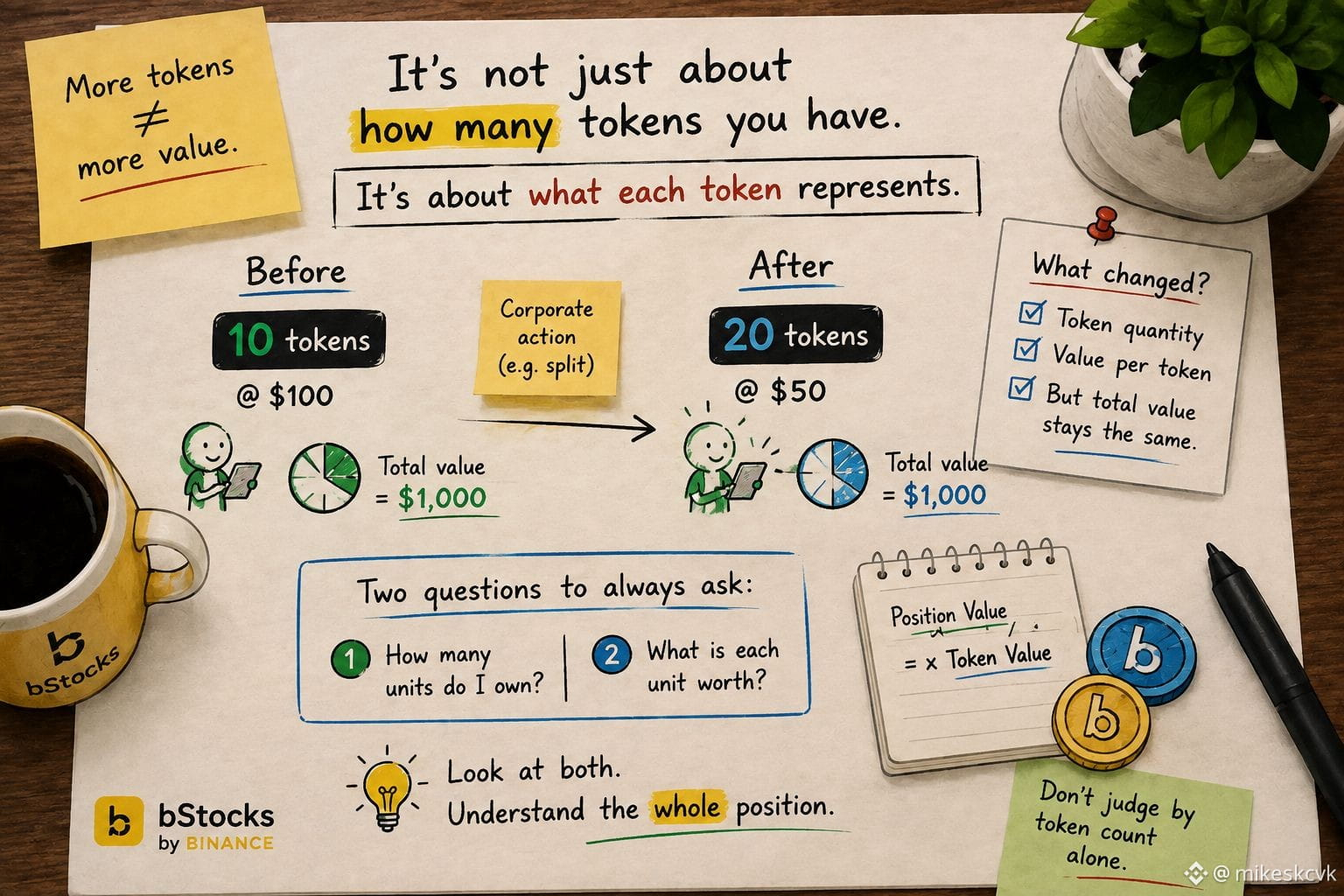
I used to think a bigger balance automatically meant a bigger position.
Then I started paying more attention to what one unit actually represents.
Imagine I have 10 tokens.
Later, I look again and see 20.
My first instinct would probably be:
“Nice. I doubled my position.”
But that conclusion can be completely wrong.
If a corporate action changes the unit structure, the number of tokens can change while the economic exposure is adjusted at the same time.
So the balance by itself isn't enough.
I now think about it as two separate questions:
How many units do I own?
and
What is each unit worth?
Those two numbers need to be looked at together.
Otherwise, a simple change in quantity can create a very misleading impression.
It's the same reason I don't judge a company by its share count alone.
More shares doesn't automatically mean more value.
The unit matters.
The price matters.
And the relationship between them matters even more.
That's a small detail, but it's exactly the kind of detail that can make a tokenized asset look confusing when nothing unusual actually happened to the underlying economic position.
Would you check the token quantity first, or the total position value first?
#bstockscis @BinanceCIS
I used to think a bigger balance automatically meant a bigger position.
Then I started paying more attention to what one unit actually represents.
Imagine I have 10 tokens.
Later, I look again and see 20.
My first instinct would probably be:
“Nice. I doubled my position.”
But that conclusion can be completely wrong.
If a corporate action changes the unit structure, the number of tokens can change while the economic exposure is adjusted at the same time.
So the balance by itself isn't enough.
I now think about it as two separate questions:
How many units do I own?
and
What is each unit worth?
Those two numbers need to be looked at together.
Otherwise, a simple change in quantity can create a very misleading impression.
It's the same reason I don't judge a company by its share count alone.
More shares doesn't automatically mean more value.
The unit matters.
The price matters.
And the relationship between them matters even more.
That's a small detail, but it's exactly the kind of detail that can make a tokenized asset look confusing when nothing unusual actually happened to the underlying economic position.
Would you check the token quantity first, or the total position value first?
#bstockscis @BinanceCIS
Then I started paying more attention to what one unit actually represents.
Imagine I have 10 tokens.
Later, I look again and see 20.
My first instinct would probably be:
“Nice. I doubled my position.”
But that conclusion can be completely wrong.
If a corporate action changes the unit structure, the number of tokens can change while the economic exposure is adjusted at the same time.
So the balance by itself isn't enough.
I now think about it as two separate questions:
How many units do I own?
and
What is each unit worth?
Those two numbers need to be looked at together.
Otherwise, a simple change in quantity can create a very misleading impression.
It's the same reason I don't judge a company by its share count alone.
More shares doesn't automatically mean more value.
The unit matters.
The price matters.
And the relationship between them matters even more.
That's a small detail, but it's exactly the kind of detail that can make a tokenized asset look confusing when nothing unusual actually happened to the underlying economic position.
Would you check the token quantity first, or the total position value first?
#bstockscis @BinanceCIS
1
1
99
·
--
Xem bản dịch
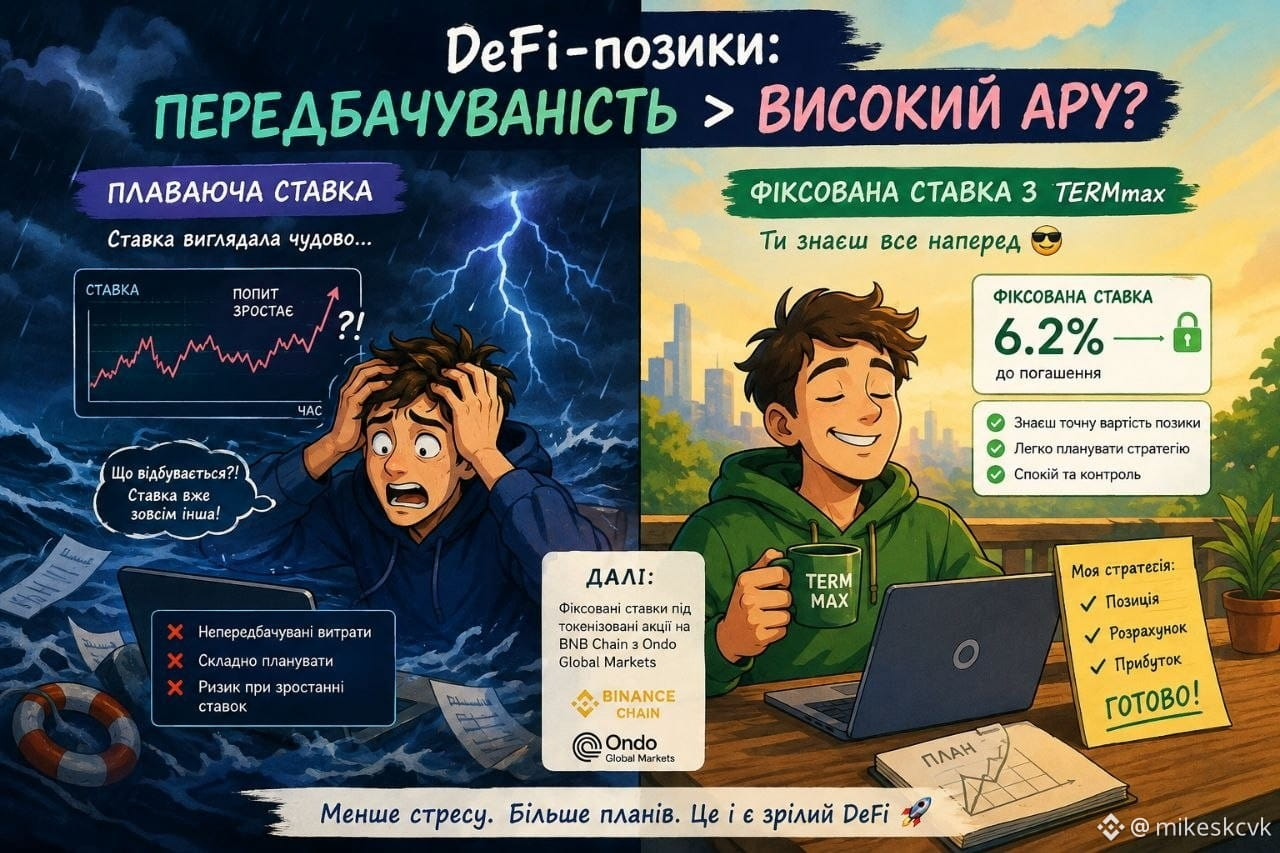
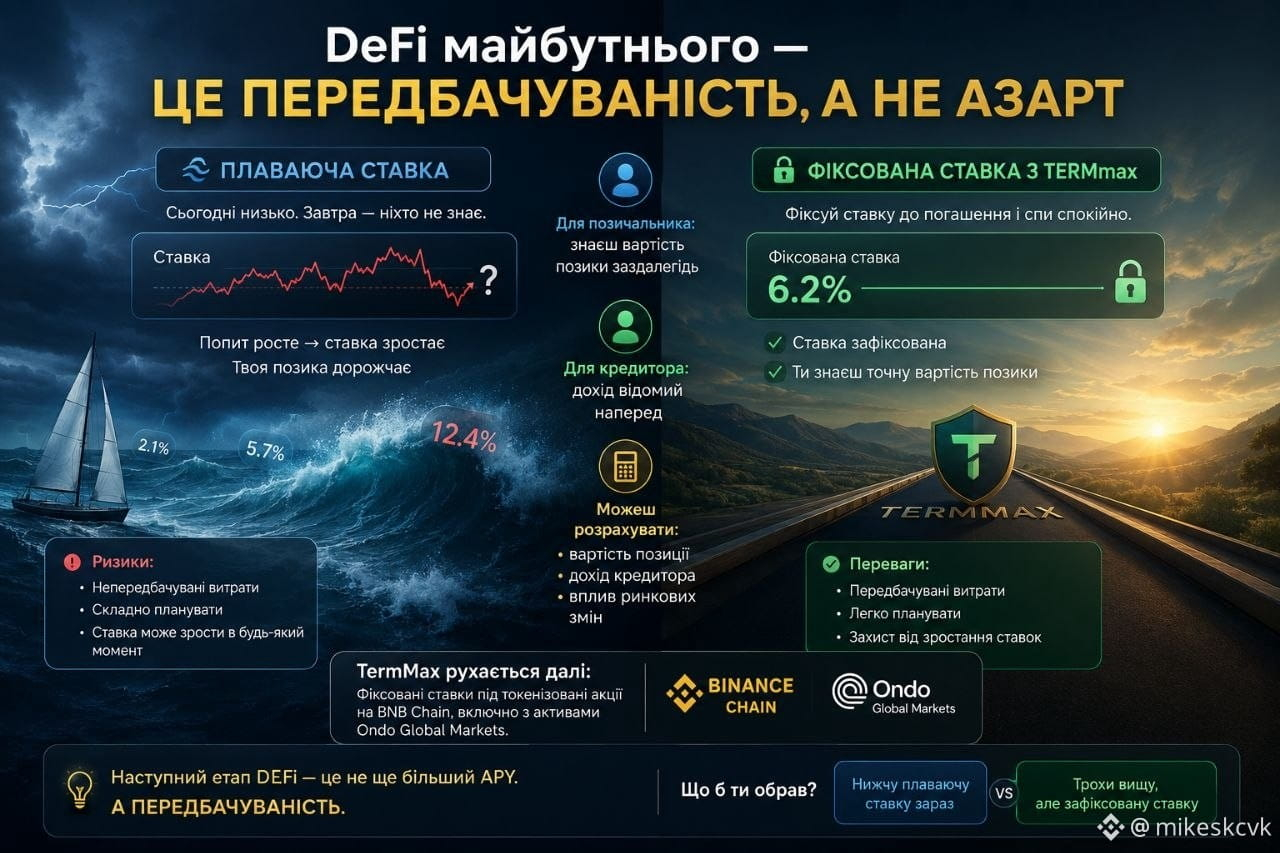
DeFi привчив нас до плаваючих ставок.
Поки тобі не знадобиться позика на кілька місяців.
Сьогодні ставка вигідна. Завтра через зміну попиту чи ліквідності вартість позики вже інша.
Саме тому мені цікавий TermMax.
Тут можна зафіксувати ставку до моменту погашення.
Для позичальника — зрозуміла вартість позики.
Для кредитора — прогнозований дохід.
І це особливо цікаво для більших стратегій, де важливо заздалегідь знати вартість капіталу.
Ще цікавіше, що TermMax рухається у бік RWA. Команда вже інтегрувала fixed-rate borrowing під токенізовані акції на BNB Chain.
Можливо, наступний етап DeFi — не максимальний APY.
А передбачуваність.
Що оберете: нижчу плаваючу ставку чи трохи вищу, але зафіксовану?
#termmax @termmax
DeFi привчив нас до плаваючих ставок.
Поки тобі не знадобиться позика на кілька місяців.
Сьогодні ставка вигідна. Завтра через зміну попиту чи ліквідності вартість позики вже інша.
Саме тому мені цікавий TermMax.
Тут можна зафіксувати ставку до моменту погашення.
Для позичальника — зрозуміла вартість позики.
Для кредитора — прогнозований дохід.
І це особливо цікаво для більших стратегій, де важливо заздалегідь знати вартість капіталу.
Ще цікавіше, що TermMax рухається у бік RWA. Команда вже інтегрувала fixed-rate borrowing під токенізовані акції на BNB Chain.
Можливо, наступний етап DeFi — не максимальний APY.
А передбачуваність.
Що оберете: нижчу плаваючу ставку чи трохи вищу, але зафіксовану?
#termmax @TermMax
Поки тобі не знадобиться позика на кілька місяців.
Сьогодні ставка вигідна. Завтра через зміну попиту чи ліквідності вартість позики вже інша.
Саме тому мені цікавий TermMax.
Тут можна зафіксувати ставку до моменту погашення.
Для позичальника — зрозуміла вартість позики.
Для кредитора — прогнозований дохід.
І це особливо цікаво для більших стратегій, де важливо заздалегідь знати вартість капіталу.
Ще цікавіше, що TermMax рухається у бік RWA. Команда вже інтегрувала fixed-rate borrowing під токенізовані акції на BNB Chain.
Можливо, наступний етап DeFi — не максимальний APY.
А передбачуваність.
Що оберете: нижчу плаваючу ставку чи трохи вищу, але зафіксовану?
#termmax @TermMax
131
·
--
Xem bản dịch
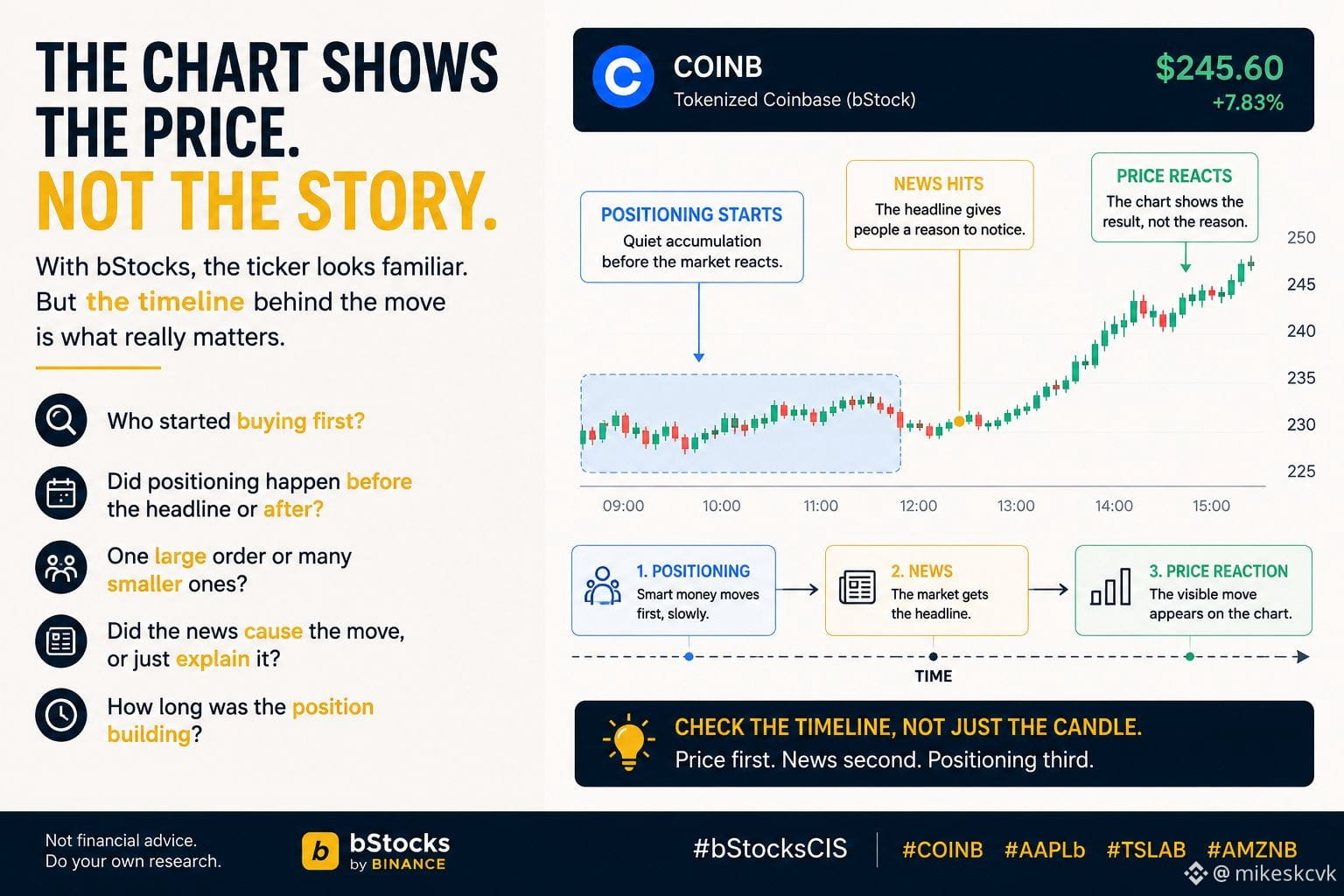
One thing I’ve started paying more attention to with tokenized stocks is the difference between what the chart shows and what actually happened before the chart moved.
Take #COINB as an example.
A sharp green candle can make it look like the market suddenly “decided” that the company was worth more.
But the candle only tells me where the market traded.
It doesn’t tell me: — who started buying first
— how long the position was building
— whether the move came from one large order or many smaller ones
— whether the price reaction happened before or after the headline
— or whether the headline simply gave traders a reason to notice the move.
That last part is easy to miss.
Sometimes the news is the explanation people remember, while the positioning happened much earlier.
And that changes how I read a chart.
Instead of asking:
“Why did #COINB go up today?”
I’d rather ask:
“What was already happening before today?”
For bStocks, I think this distinction is especially useful because the interface can make a traditional stock ticker feel very familiar. The familiar ticker doesn’t mean every piece of market information should be interpreted exactly like a normal brokerage position.
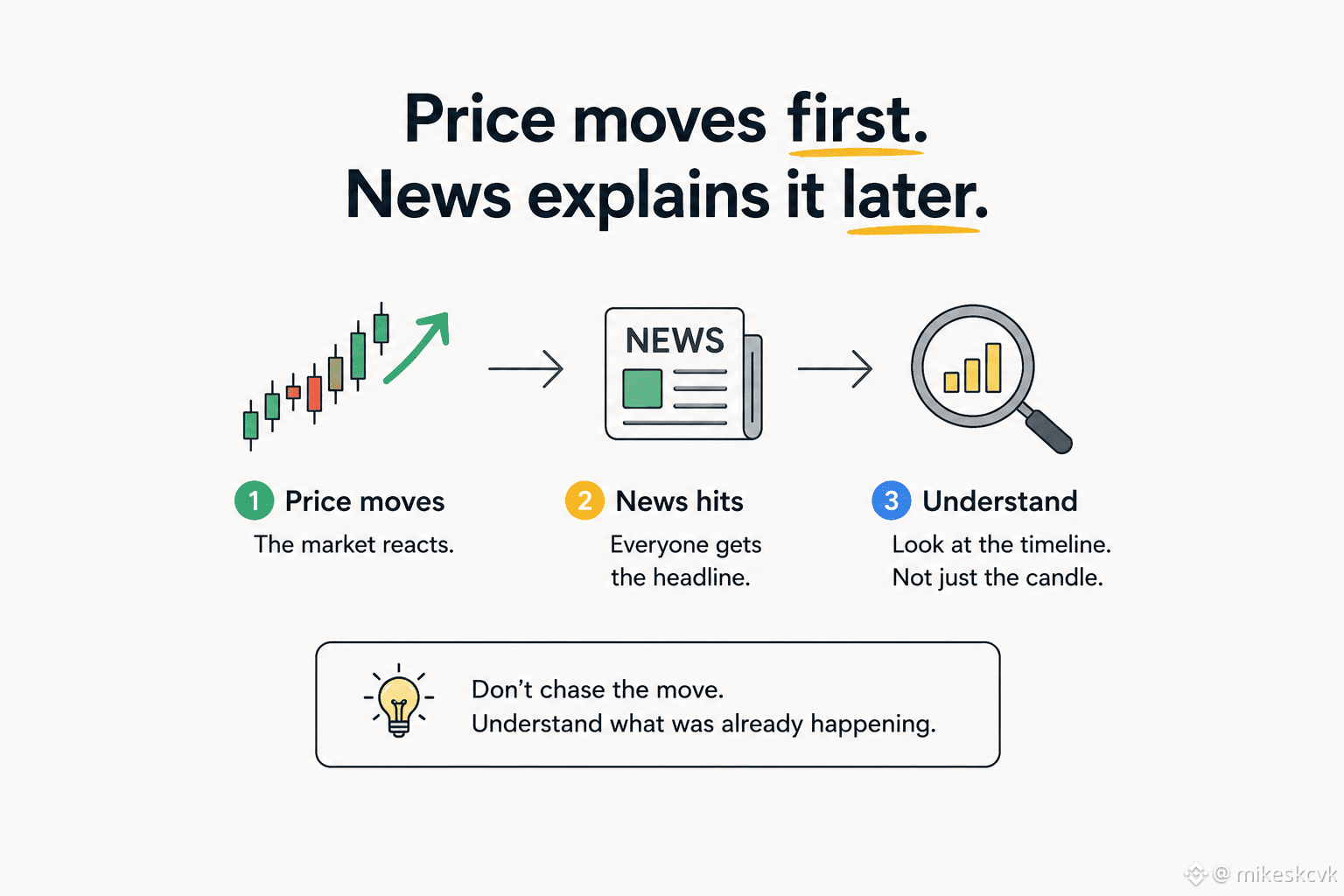
So now, when I see a big move, my first instinct isn’t to chase the candle.
I check the timeline.
Price first.
News second.
Positioning third.
The order matters more than I thought.
#bstockscis @BinanceCIS
One thing I’ve started paying more attention to with tokenized stocks is the difference between what the chart shows and what actually happened before the chart moved.
Take #COINB as an example.
A sharp green candle can make it look like the market suddenly “decided” that the company was worth more.
But the candle only tells me where the market traded.
It doesn’t tell me: — who started buying first
— how long the position was building
— whether the move came from one large order or many smaller ones
— whether the price reaction happened before or after the headline
— or whether the headline simply gave traders a reason to notice the move.
That last part is easy to miss.
Sometimes the news is the explanation people remember, while the positioning happened much earlier.
And that changes how I read a chart.
Instead of asking:
“Why did #COINB go up today?”
I’d rather ask:
“What was already happening before today?”
For bStocks, I think this distinction is especially useful because the interface can make a traditional stock ticker feel very familiar. The familiar ticker doesn’t mean every piece of market information should be interpreted exactly like a normal brokerage position.
So now, when I see a big move, my first instinct isn’t to chase the candle.
I check the timeline.
Price first.
News second.
Positioning third.
The order matters more than I thought.
#bstockscis @BinanceCIS
Take #COINB as an example.
A sharp green candle can make it look like the market suddenly “decided” that the company was worth more.
But the candle only tells me where the market traded.
It doesn’t tell me: — who started buying first
— how long the position was building
— whether the move came from one large order or many smaller ones
— whether the price reaction happened before or after the headline
— or whether the headline simply gave traders a reason to notice the move.
That last part is easy to miss.
Sometimes the news is the explanation people remember, while the positioning happened much earlier.
And that changes how I read a chart.
Instead of asking:
“Why did #COINB go up today?”
I’d rather ask:
“What was already happening before today?”
For bStocks, I think this distinction is especially useful because the interface can make a traditional stock ticker feel very familiar. The familiar ticker doesn’t mean every piece of market information should be interpreted exactly like a normal brokerage position.
So now, when I see a big move, my first instinct isn’t to chase the candle.
I check the timeline.
Price first.
News second.
Positioning third.
The order matters more than I thought.
#bstockscis @BinanceCIS
82
·
--
Xem bản dịch
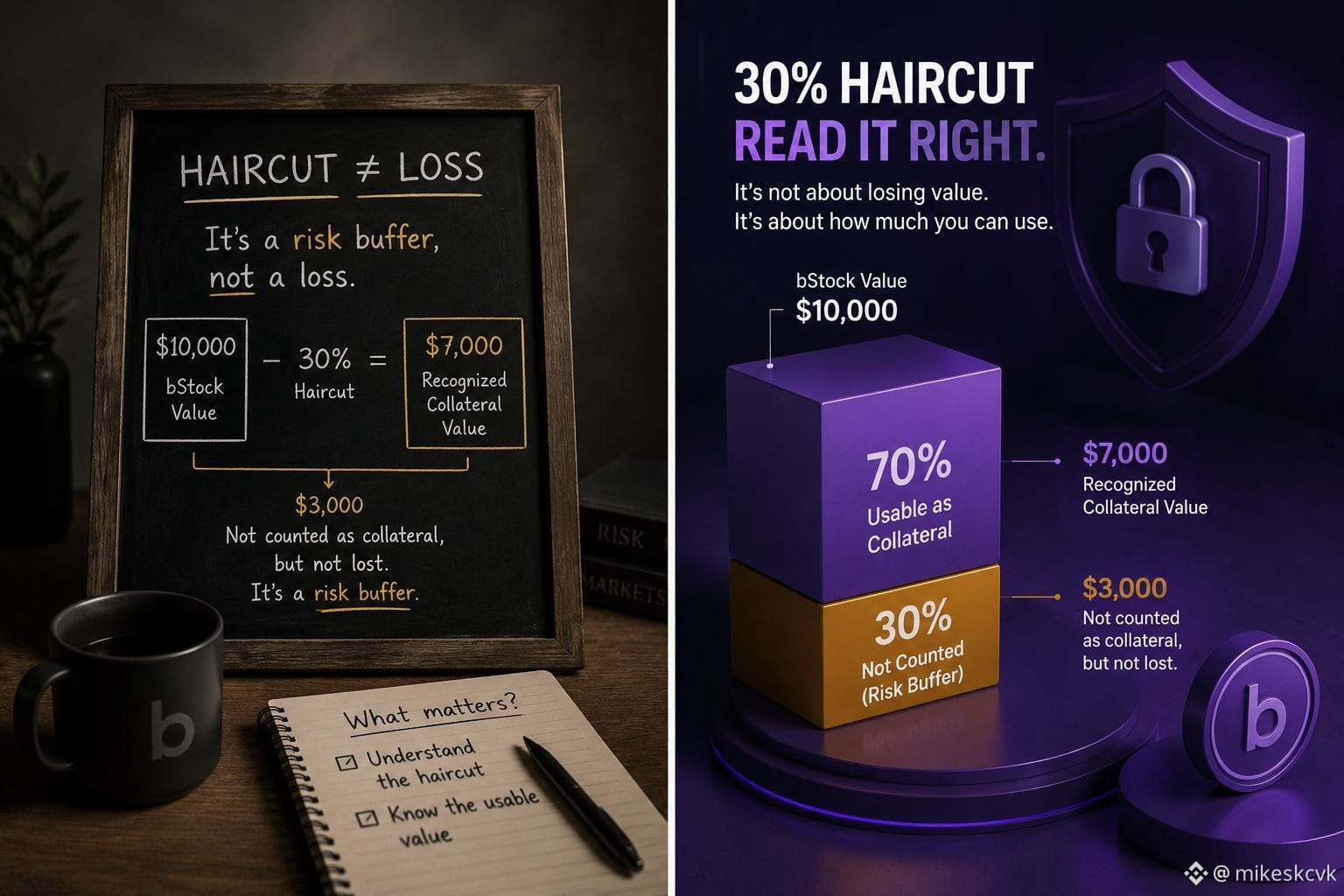
I used to read a collateral haircut as if it were a simple discount.
That was the wrong mental model.
Say a tokenized stock has a 30% haircut.
My first instinct would be:
“Okay, so 30% of the asset is basically gone.”
But that is not what the number is telling you.
The more useful question is:
How much of the asset’s value can actually be recognized as collateral?
If you have $10,000 of a bStock and the applicable haircut is 30%, the recognized collateral value is $7,000.
The remaining $3,000 hasn’t disappeared.
It simply isn't counted toward the collateral value under that haircut assumption.
That distinction matters because collateral calculations are about risk buffers, not about declaring part of an asset worthless.
And there is another detail I would check before doing any calculation:
What exactly is the haircut applied to?
The answer can depend on the asset, the relevant rules, and the specific collateral framework.
So instead of remembering:
“30% haircut = 30% loss,”
I now remember:
“30% haircut = 70% recognized collateral value.”
A small wording difference, but a completely different way to read the number.
For me, this is one of those bStocks concepts that becomes much easier once you stop thinking about the percentage as a “loss” and start thinking about it as a risk-adjusted collateral value.
Would you interpret a 30% haircut correctly without doing the calculation?
{spot}(NVDABUSDT)
$NVDAB
#bstockscis @BinanceCIS
I used to read a collateral haircut as if it were a simple discount.
That was the wrong mental model.
Say a tokenized stock has a 30% haircut.
My first instinct would be:
“Okay, so 30% of the asset is basically gone.”
But that is not what the number is telling you.
The more useful question is:
How much of the asset’s value can actually be recognized as collateral?
If you have $10,000 of a bStock and the applicable haircut is 30%, the recognized collateral value is $7,000.
The remaining $3,000 hasn’t disappeared.
It simply isn't counted toward the collateral value under that haircut assumption.
That distinction matters because collateral calculations are about risk buffers, not about declaring part of an asset worthless.
And there is another detail I would check before doing any calculation:
What exactly is the haircut applied to?
The answer can depend on the asset, the relevant rules, and the specific collateral framework.
So instead of remembering:
“30% haircut = 30% loss,”
I now remember:
“30% haircut = 70% recognized collateral value.”
A small wording difference, but a completely different way to read the number.
For me, this is one of those bStocks concepts that becomes much easier once you stop thinking about the percentage as a “loss” and start thinking about it as a risk-adjusted collateral value.
Would you interpret a 30% haircut correctly without doing the calculation?
$NVDAB
#bstockscis @BinanceCIS
That was the wrong mental model.
Say a tokenized stock has a 30% haircut.
My first instinct would be:
“Okay, so 30% of the asset is basically gone.”
But that is not what the number is telling you.
The more useful question is:
How much of the asset’s value can actually be recognized as collateral?
If you have $10,000 of a bStock and the applicable haircut is 30%, the recognized collateral value is $7,000.
The remaining $3,000 hasn’t disappeared.
It simply isn't counted toward the collateral value under that haircut assumption.
That distinction matters because collateral calculations are about risk buffers, not about declaring part of an asset worthless.
And there is another detail I would check before doing any calculation:
What exactly is the haircut applied to?
The answer can depend on the asset, the relevant rules, and the specific collateral framework.
So instead of remembering:
“30% haircut = 30% loss,”
I now remember:
“30% haircut = 70% recognized collateral value.”
A small wording difference, but a completely different way to read the number.
For me, this is one of those bStocks concepts that becomes much easier once you stop thinking about the percentage as a “loss” and start thinking about it as a risk-adjusted collateral value.
Would you interpret a 30% haircut correctly without doing the calculation?
$NVDAB
#bstockscis @BinanceCIS
96
·
--
Xem bản dịch
I keep seeing the same assumption:
“Tokenized stocks are just traditional stocks in another format.”
But if that were the whole point, the question becomes pretty simple:
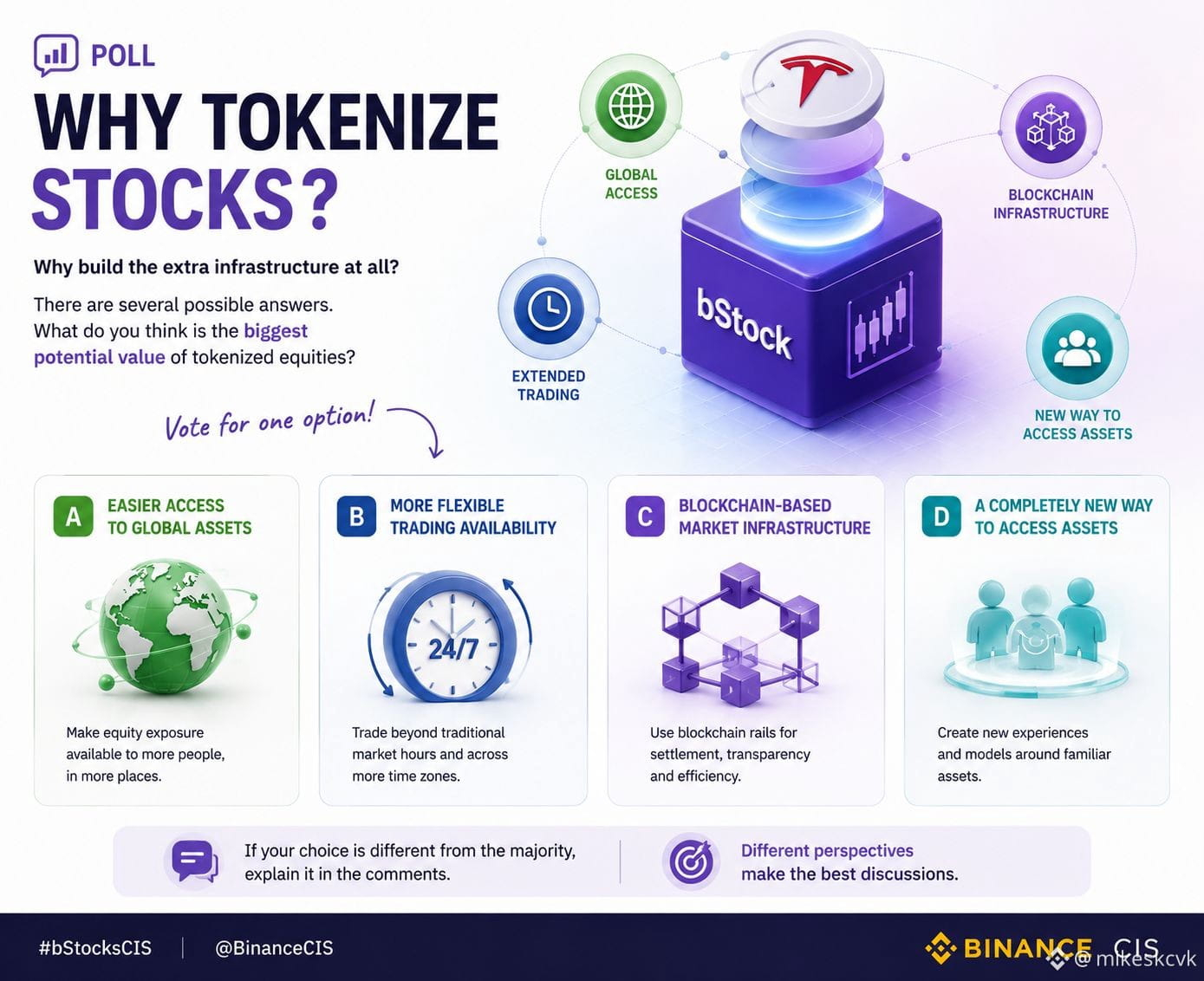
Why build the extra infrastructure at all?
There are several possible answers.
Maybe the biggest value is making equity exposure more accessible.
Maybe it is the ability to interact with markets through blockchain infrastructure.
May$be extended trading availability matters more.
Or maybe the real advantage is simply creating a different way for people to access familiar assets.
I don't think there is one universal answer.
So I'm curious what the community actually thinks.
What is the biggest potential value of tokenized equities?
A — Easier access to global assets
B — More flexible trading availability
C — Blockchain-based market infrastructure
D — A completely new way to access familiar assets
Vote for one.
And if your choice is different from the majority, explain it — that's probably where the interesting discussion starts.
#bstockscis @BinanceCIS
I keep seeing the same assumption:
“Tokenized stocks are just traditional stocks in another format.”
But if that were the whole point, the question becomes pretty simple:
Why build the extra infrastructure at all?
There are several possible answers.
Maybe the biggest value is making equity exposure more accessible.
Maybe it is the ability to interact with markets through blockchain infrastructure.
May$be extended trading availability matters more.
Or maybe the real advantage is simply creating a different way for people to access familiar assets.
I don't think there is one universal answer.
So I'm curious what the community actually thinks.
What is the biggest potential value of tokenized equities?
A — Easier access to global assets
B — More flexible trading availability
C — Blockchain-based market infrastructure
D — A completely new way to access familiar assets
Vote for one.
And if your choice is different from the majority, explain it — that's probably where the interesting discussion starts.
#bstockscis @BinanceCIS
“Tokenized stocks are just traditional stocks in another format.”
But if that were the whole point, the question becomes pretty simple:
Why build the extra infrastructure at all?
There are several possible answers.
Maybe the biggest value is making equity exposure more accessible.
Maybe it is the ability to interact with markets through blockchain infrastructure.
May$be extended trading availability matters more.
Or maybe the real advantage is simply creating a different way for people to access familiar assets.
I don't think there is one universal answer.
So I'm curious what the community actually thinks.
What is the biggest potential value of tokenized equities?
A — Easier access to global assets
B — More flexible trading availability
C — Blockchain-based market infrastructure
D — A completely new way to access familiar assets
Vote for one.
And if your choice is different from the majority, explain it — that's probably where the interesting discussion starts.
#bstockscis @BinanceCIS
76
·
--
Tăng giá
Xem bản dịch
A smaller market does not automatically mean an uninteresting market.
That is something I keep in mind when looking at tokenized equities.
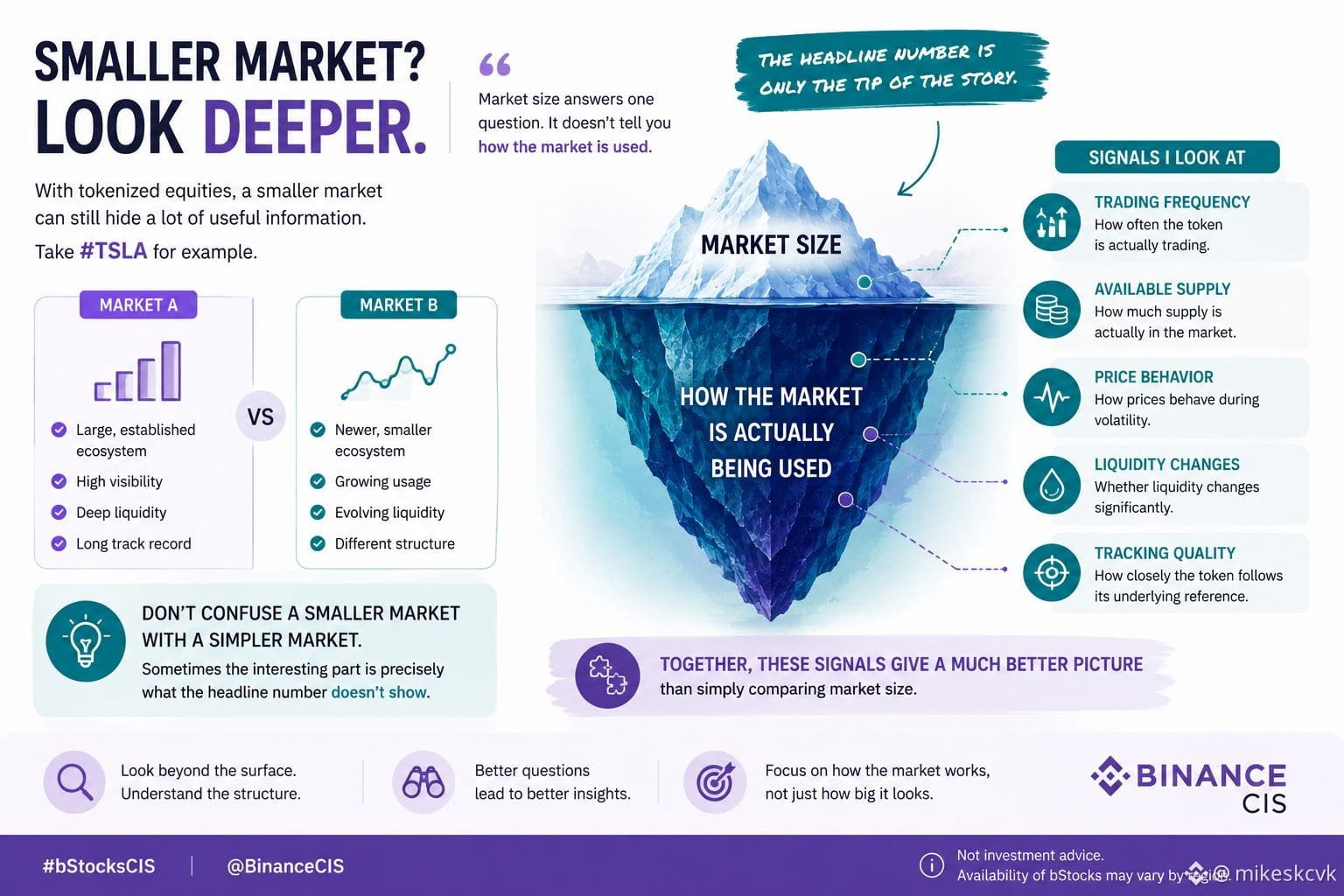
Imagine two markets showing almost the same underlying asset.
One has a huge established ecosystem.
The other is newer, smaller, and built around tokenized exposure.
It would be easy to look at the second one and say:
“Too small. Move on.”
But size answers only one question.
It doesn't tell me how the market is being used.
For example, with #TSLA I would rather look at several signals together:
→ how often the token trades
→ how much supply is actually available
→ how prices behave during volatility
→ whether liquidity changes significantly
→ how closely the token follows its underlying reference
None of these tells the whole story alone.
But together, they give a much better picture than simply comparing market size.
That is probably my biggest takeaway from studying bStocks:
Don't confuse a smaller market with a simpler market.
Sometimes the interesting part is precisely what the headline number doesn't show.
#bstockscis @BinanceCIS
A smaller market does not automatically mean an uninteresting market.
That is something I keep in mind when looking at tokenized equities.
Imagine two markets showing almost the same underlying asset.
One has a huge established ecosystem.
The other is newer, smaller, and built around tokenized exposure.
It would be easy to look at the second one and say:
“Too small. Move on.”
But size answers only one question.
It doesn't tell me how the market is being used.
For example, with #TSLA I would rather look at several signals together:
→ how often the token trades
→ how much supply is actually available
→ how prices behave during volatility
→ whether liquidity changes significantly
→ how closely the token follows its underlying reference
None of these tells the whole story alone.
But together, they give a much better picture than simply comparing market size.
That is probably my biggest takeaway from studying bStocks:
Don't confuse a smaller market with a simpler market.
Sometimes the interesting part is precisely what the headline number doesn't show.
#bstockscis @BinanceCIS
That is something I keep in mind when looking at tokenized equities.
Imagine two markets showing almost the same underlying asset.
One has a huge established ecosystem.
The other is newer, smaller, and built around tokenized exposure.
It would be easy to look at the second one and say:
“Too small. Move on.”
But size answers only one question.
It doesn't tell me how the market is being used.
For example, with #TSLA I would rather look at several signals together:
→ how often the token trades
→ how much supply is actually available
→ how prices behave during volatility
→ whether liquidity changes significantly
→ how closely the token follows its underlying reference
None of these tells the whole story alone.
But together, they give a much better picture than simply comparing market size.
That is probably my biggest takeaway from studying bStocks:
Don't confuse a smaller market with a simpler market.
Sometimes the interesting part is precisely what the headline number doesn't show.
#bstockscis @BinanceCIS
1
80
·
--
Xem bản dịch
I used to think that when evaluating a new financial product, the most important thing was understanding what exactly you are buying.
Now I'd add another question:
What happens around that asset after you buy it?
That's where tokenized stocks become much more interesting than a simple comparison with traditional markets.
An asset isn't just a price.
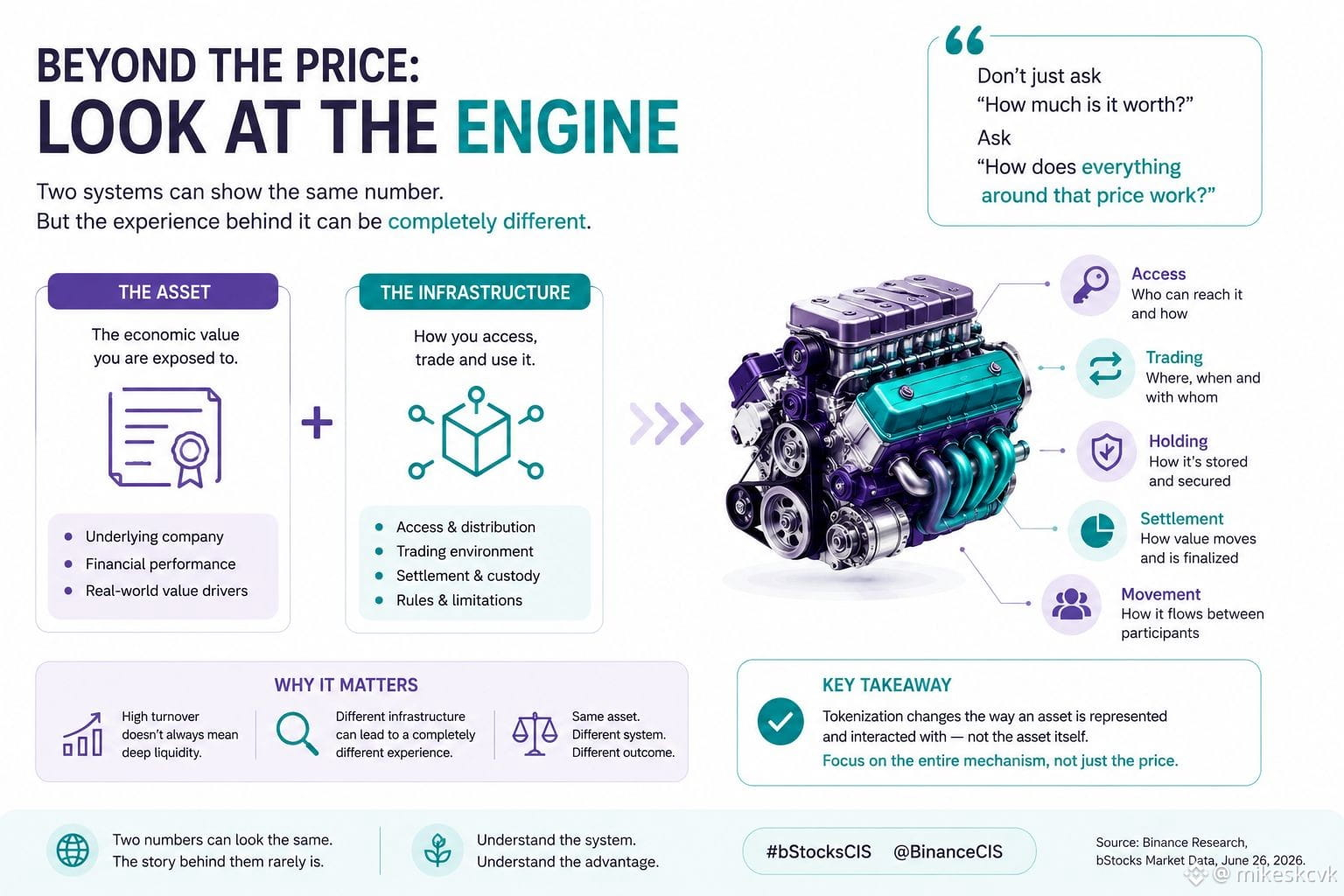
There is an entire process around it:
access → trading → holding → settlement → movement between participants
If you only look at the price chart, most of that story disappears.
So I try to separate two things.
The asset — what the economic value is connected to.
The infrastructure — how that asset is represented and accessed by the user.
Those are not the same thing.
And that's one of the parts of bStocks I find most interesting.
Tokenization doesn't magically change the underlying asset.
It changes the way that asset is represented and interacted with inside a different financial environment.
So my main takeaway is simple:
Don't evaluate a tokenized product only by asking:
“How much is it worth?”
Ask:
“How does everything around that price actually work?”
Two systems can display a very similar number on a screen while providing a completely different experience underneath.
And that's the difference I'm most interested in watching with bStocks.
@BinanceCIS #bstockscis
I used to think that when evaluating a new financial product, the most important thing was understanding what exactly you are buying.
Now I'd add another question:
What happens around that asset after you buy it?
That's where tokenized stocks become much more interesting than a simple comparison with traditional markets.
An asset isn't just a price.
There is an entire process around it:
access → trading → holding → settlement → movement between participants
If you only look at the price chart, most of that story disappears.
So I try to separate two things.
The asset — what the economic value is connected to.
The infrastructure — how that asset is represented and accessed by the user.
Those are not the same thing.
And that's one of the parts of bStocks I find most interesting.
Tokenization doesn't magically change the underlying asset.
It changes the way that asset is represented and interacted with inside a different financial environment.
So my main takeaway is simple:
Don't evaluate a tokenized product only by asking:
“How much is it worth?”
Ask:
“How does everything around that price actually work?”
Two systems can display a very similar number on a screen while providing a completely different experience underneath.
And that's the difference I'm most interested in watching with bStocks.
@BinanceCIS #bstockscis
Now I'd add another question:
What happens around that asset after you buy it?
That's where tokenized stocks become much more interesting than a simple comparison with traditional markets.
An asset isn't just a price.
There is an entire process around it:
access → trading → holding → settlement → movement between participants
If you only look at the price chart, most of that story disappears.
So I try to separate two things.
The asset — what the economic value is connected to.
The infrastructure — how that asset is represented and accessed by the user.
Those are not the same thing.
And that's one of the parts of bStocks I find most interesting.
Tokenization doesn't magically change the underlying asset.
It changes the way that asset is represented and interacted with inside a different financial environment.
So my main takeaway is simple:
Don't evaluate a tokenized product only by asking:
“How much is it worth?”
Ask:
“How does everything around that price actually work?”
Two systems can display a very similar number on a screen while providing a completely different experience underneath.
And that's the difference I'm most interested in watching with bStocks.
@BinanceCIS #bstockscis
1
80
·
--
Tôi nghĩ một trong những cách dễ nhất để hiểu sai về cổ phiếu đã được token hóa là chỉ tập trung vào chữ “stock” (cổ phiếu).
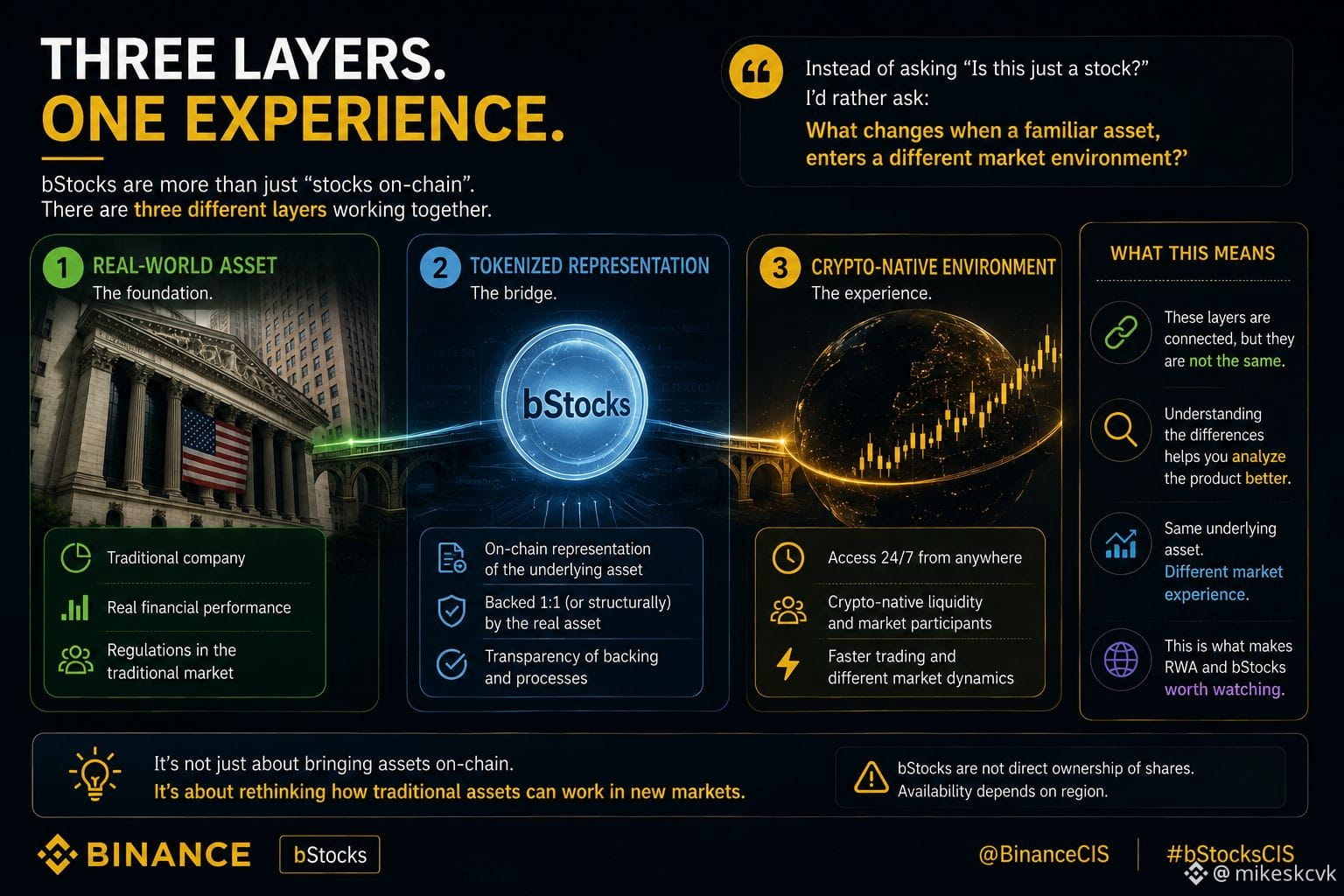
Càng nhìn vào bStocks, tôi càng thấy có ba điều khác nhau đang diễn ra cùng một lúc.
Thứ nhất là tài sản trong thế giới thực.
Tiếp theo là phiên bản biểu diễn dạng token.
Và cuối cùng là môi trường mang tính bản địa của crypto, nơi token có thể được giao dịch.
Ba lớp này có liên kết với nhau, nhưng chúng không phải là cùng một thứ.
Điều đó làm thay đổi cách tôi nhìn nhận về sản phẩm.
Thay vì hỏi:
“Chỉ là một cổ phiếu thôi à?”
Tôi muốn hỏi:
“Khi một tài sản quen thuộc bước vào một môi trường thị trường khác thì điều gì sẽ thay đổi?”
Giờ giao dịch, khả năng tiếp cận, thanh khoản và cách mọi người tương tác với tài sản—tất cả đều có thể trở thành một phần của bức tranh.
Sự thay đổi góc nhìn này với tôi còn hợp lý hơn rất nhiều so với việc chỉ đơn giản đem một token đi so sánh với một cổ phiếu truyền thống.
Cùng một ý tưởng cốt lõi.
Trải nghiệm thị trường khác nhau. 🔎
Đó là lý do khiến không gian này đáng để theo dõi. 🌍@BinanceCIS 😀 #bstockscis
Tôi nghĩ một trong những cách dễ nhất để hiểu sai về cổ phiếu đã được token hóa là chỉ tập trung vào chữ “stock” (cổ phiếu).
Càng nhìn vào bStocks, tôi càng thấy có ba điều khác nhau đang diễn ra cùng một lúc.
Thứ nhất là tài sản trong thế giới thực.
Tiếp theo là phiên bản biểu diễn dạng token.
Và cuối cùng là môi trường mang tính bản địa của crypto, nơi token có thể được giao dịch.
Ba lớp này có liên kết với nhau, nhưng chúng không phải là cùng một thứ.
Điều đó làm thay đổi cách tôi nhìn nhận về sản phẩm.
Thay vì hỏi:
“Chỉ là một cổ phiếu thôi à?”
Tôi muốn hỏi:
“Khi một tài sản quen thuộc bước vào một môi trường thị trường khác thì điều gì sẽ thay đổi?”
Giờ giao dịch, khả năng tiếp cận, thanh khoản và cách mọi người tương tác với tài sản—tất cả đều có thể trở thành một phần của bức tranh.
Sự thay đổi góc nhìn này với tôi còn hợp lý hơn rất nhiều so với việc chỉ đơn giản đem một token đi so sánh với một cổ phiếu truyền thống.
Cùng một ý tưởng cốt lõi.
Trải nghiệm thị trường khác nhau. 🔎
Đó là lý do khiến không gian này đáng để theo dõi. 🌍@BinanceCIS 😀 #bstockscis
Càng nhìn vào bStocks, tôi càng thấy có ba điều khác nhau đang diễn ra cùng một lúc.
Thứ nhất là tài sản trong thế giới thực.
Tiếp theo là phiên bản biểu diễn dạng token.
Và cuối cùng là môi trường mang tính bản địa của crypto, nơi token có thể được giao dịch.
Ba lớp này có liên kết với nhau, nhưng chúng không phải là cùng một thứ.
Điều đó làm thay đổi cách tôi nhìn nhận về sản phẩm.
Thay vì hỏi:
“Chỉ là một cổ phiếu thôi à?”
Tôi muốn hỏi:
“Khi một tài sản quen thuộc bước vào một môi trường thị trường khác thì điều gì sẽ thay đổi?”
Giờ giao dịch, khả năng tiếp cận, thanh khoản và cách mọi người tương tác với tài sản—tất cả đều có thể trở thành một phần của bức tranh.
Sự thay đổi góc nhìn này với tôi còn hợp lý hơn rất nhiều so với việc chỉ đơn giản đem một token đi so sánh với một cổ phiếu truyền thống.
Cùng một ý tưởng cốt lõi.
Trải nghiệm thị trường khác nhau. 🔎
Đó là lý do khiến không gian này đáng để theo dõi. 🌍@BinanceCIS 😀 #bstockscis
73
·
--
Xem bản dịch
I used to think the hardest part of understanding tokenized stocks was the technology.
Honestly, I think it's the terminology.
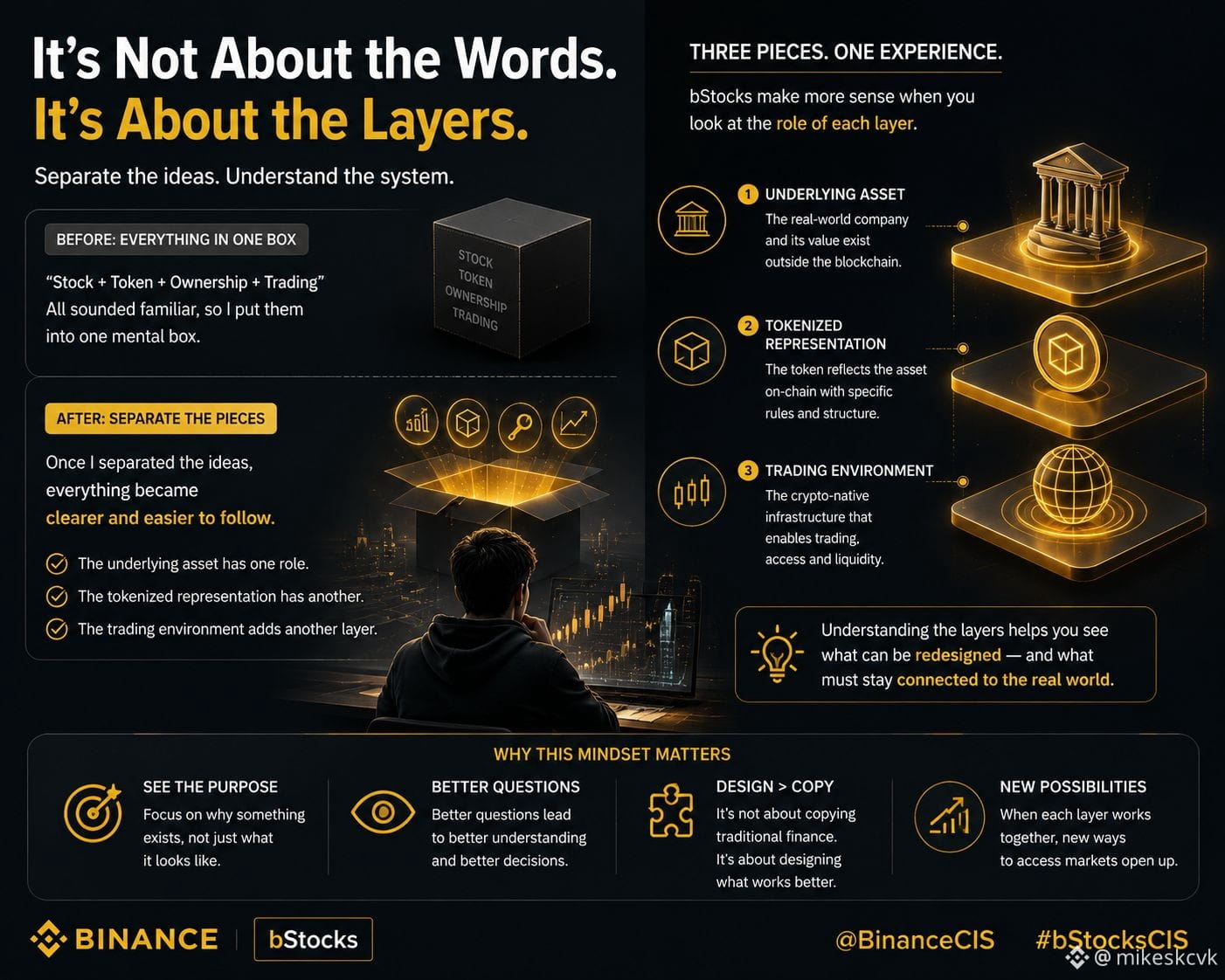
Words like “stock”, “token”, “ownership” and “trading” sound familiar, so it's very easy to put them all into one mental box.
But bStocks made me slow down and separate those ideas.
A tokenized asset isn't interesting just because it looks familiar.
What's interesting is the infrastructure around it.
The underlying asset has one role.
The tokenized representation has another.
And the trading environment adds another layer on top.
Once I started separating those pieces, the whole concept became much easier to follow.
Maybe that's also why RWA is interesting to me.
It's not simply about bringing traditional assets onto blockchain.
It's about figuring out which parts of the old financial experience can be redesigned without losing the connection to the underlying asset.
Still learning, but I definitely look at tokenization differently now. 🔎
@BinanceCIS #bstockscis
I used to think the hardest part of understanding tokenized stocks was the technology.
Honestly, I think it's the terminology.
Words like “stock”, “token”, “ownership” and “trading” sound familiar, so it's very easy to put them all into one mental box.
But bStocks made me slow down and separate those ideas.
A tokenized asset isn't interesting just because it looks familiar.
What's interesting is the infrastructure around it.
The underlying asset has one role.
The tokenized representation has another.
And the trading environment adds another layer on top.
Once I started separating those pieces, the whole concept became much easier to follow.
Maybe that's also why RWA is interesting to me.
It's not simply about bringing traditional assets onto blockchain.
It's about figuring out which parts of the old financial experience can be redesigned without losing the connection to the underlying asset.
Still learning, but I definitely look at tokenization differently now. 🔎
@BinanceCIS #bstockscis
Honestly, I think it's the terminology.
Words like “stock”, “token”, “ownership” and “trading” sound familiar, so it's very easy to put them all into one mental box.
But bStocks made me slow down and separate those ideas.
A tokenized asset isn't interesting just because it looks familiar.
What's interesting is the infrastructure around it.
The underlying asset has one role.
The tokenized representation has another.
And the trading environment adds another layer on top.
Once I started separating those pieces, the whole concept became much easier to follow.
Maybe that's also why RWA is interesting to me.
It's not simply about bringing traditional assets onto blockchain.
It's about figuring out which parts of the old financial experience can be redesigned without losing the connection to the underlying asset.
Still learning, but I definitely look at tokenization differently now. 🔎
@BinanceCIS #bstockscis
92
·
--
Hôm nay tôi đang nghĩ về các bStocks theo một hướng ngược lại.
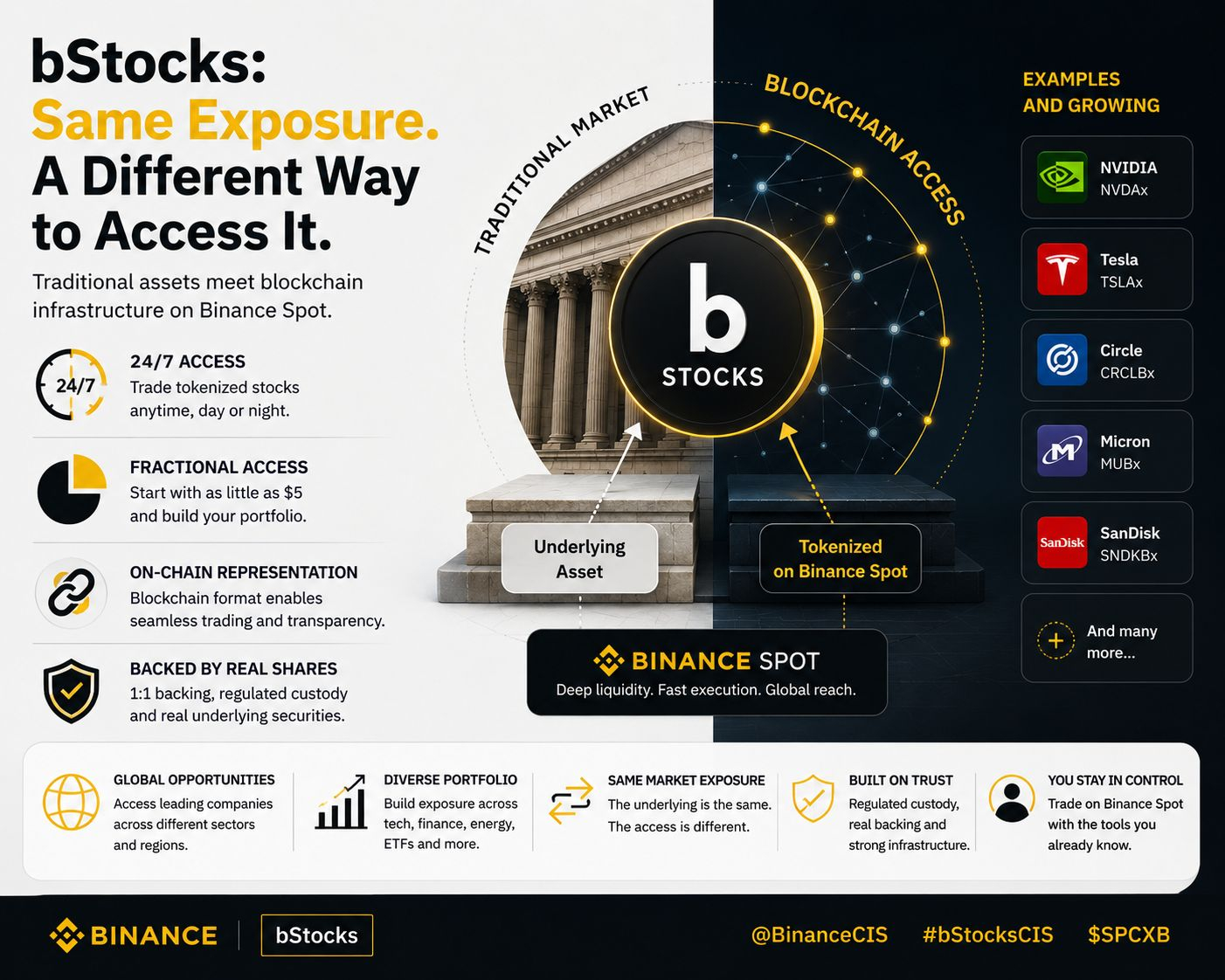
Thay vì hỏi “cổ phiếu nào được token hóa?”, tôi cho rằng câu hỏi hay hơn là “điều gì thay đổi khi cùng một mức độ tiếp xúc thị trường được chuyển sang định dạng dựa trên blockchain?”
Bạn sẽ có một môi trường giao dịch khác, truy cập 24/7 trên Binance Spot, khả năng truy cập theo phần nhỏ và một biểu diễn trên chuỗi — trong khi cấu trúc nền vẫn liên kết trở lại với tài sản truyền thống.
Sự kết hợp đó có lẽ là phần thú vị nhất đối với tôi.
Không phải để thay thế thị trường chứng khoán. Mà là để thử nghiệm một cách tiếp cận khác. 🔎🌍
@BinanceCIS #bStocksCIS $SPCXB
Hôm nay tôi đang nghĩ về các bStocks theo một hướng ngược lại.
Thay vì hỏi “cổ phiếu nào được token hóa?”, tôi cho rằng câu hỏi hay hơn là “điều gì thay đổi khi cùng một mức độ tiếp xúc thị trường được chuyển sang định dạng dựa trên blockchain?”
Bạn sẽ có một môi trường giao dịch khác, truy cập 24/7 trên Binance Spot, khả năng truy cập theo phần nhỏ và một biểu diễn trên chuỗi — trong khi cấu trúc nền vẫn liên kết trở lại với tài sản truyền thống.
Sự kết hợp đó có lẽ là phần thú vị nhất đối với tôi.
Không phải để thay thế thị trường chứng khoán. Mà là để thử nghiệm một cách tiếp cận khác. 🔎🌍
@BinanceCIS #bStocksCIS $SPCXB
Thay vì hỏi “cổ phiếu nào được token hóa?”, tôi cho rằng câu hỏi hay hơn là “điều gì thay đổi khi cùng một mức độ tiếp xúc thị trường được chuyển sang định dạng dựa trên blockchain?”
Bạn sẽ có một môi trường giao dịch khác, truy cập 24/7 trên Binance Spot, khả năng truy cập theo phần nhỏ và một biểu diễn trên chuỗi — trong khi cấu trúc nền vẫn liên kết trở lại với tài sản truyền thống.
Sự kết hợp đó có lẽ là phần thú vị nhất đối với tôi.
Không phải để thay thế thị trường chứng khoán. Mà là để thử nghiệm một cách tiếp cận khác. 🔎🌍
@BinanceCIS #bStocksCIS $SPCXB
162
·
--
Xem bản dịch
Something I found interesting while digging into bStocks is the difference between the asset itself and the way you access it.
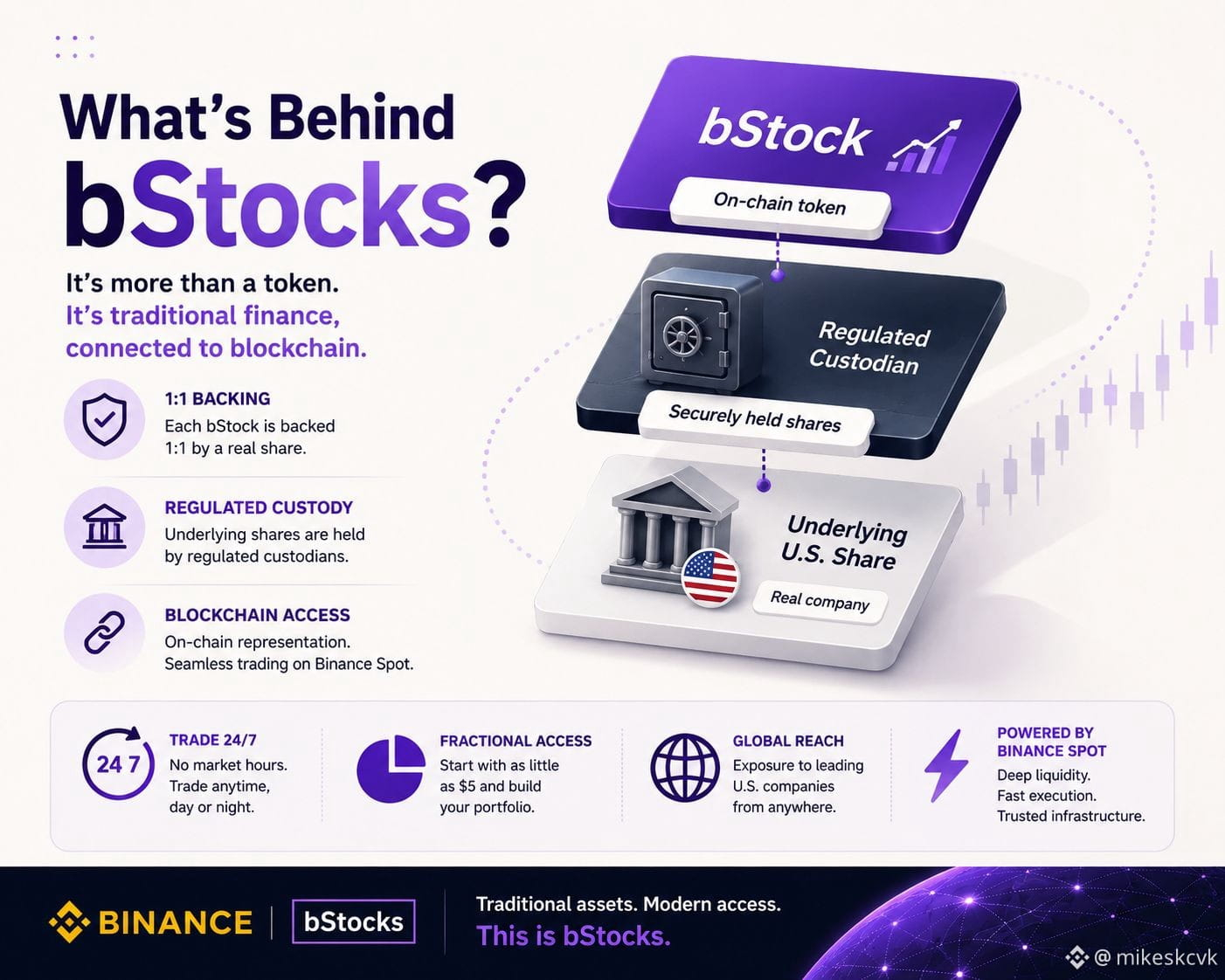
There’s still an underlying security behind the structure, with 1:1 backing and regulated custody. The blockchain part changes the way that exposure is represented and traded.
So I wouldn’t describe bStocks simply as “a stock put on a blockchain”.
There’s quite a bit more going on underneath — custody, tokenization, trading infrastructure and the connection to Binance Spot.
That’s honestly the part I find more interesting than just looking at the price chart. 😅🔎
@BinanceCIS $SPCXB #bstockscis
Something I found interesting while digging into bStocks is the difference between the asset itself and the way you access it.
There’s still an underlying security behind the structure, with 1:1 backing and regulated custody. The blockchain part changes the way that exposure is represented and traded.
So I wouldn’t describe bStocks simply as “a stock put on a blockchain”.
There’s quite a bit more going on underneath — custody, tokenization, trading infrastructure and the connection to Binance Spot.
That’s honestly the part I find more interesting than just looking at the price chart. 😅🔎
@BinanceCIS $SPCXB #bstockscis
There’s still an underlying security behind the structure, with 1:1 backing and regulated custody. The blockchain part changes the way that exposure is represented and traded.
So I wouldn’t describe bStocks simply as “a stock put on a blockchain”.
There’s quite a bit more going on underneath — custody, tokenization, trading infrastructure and the connection to Binance Spot.
That’s honestly the part I find more interesting than just looking at the price chart. 😅🔎
@BinanceCIS $SPCXB #bstockscis
1
114
·
--
Xem bản dịch
I used to think the value of bStocks was only about putting stocks on the blockchain.
After reading more about how they work, I think the real value is the structure behind them.
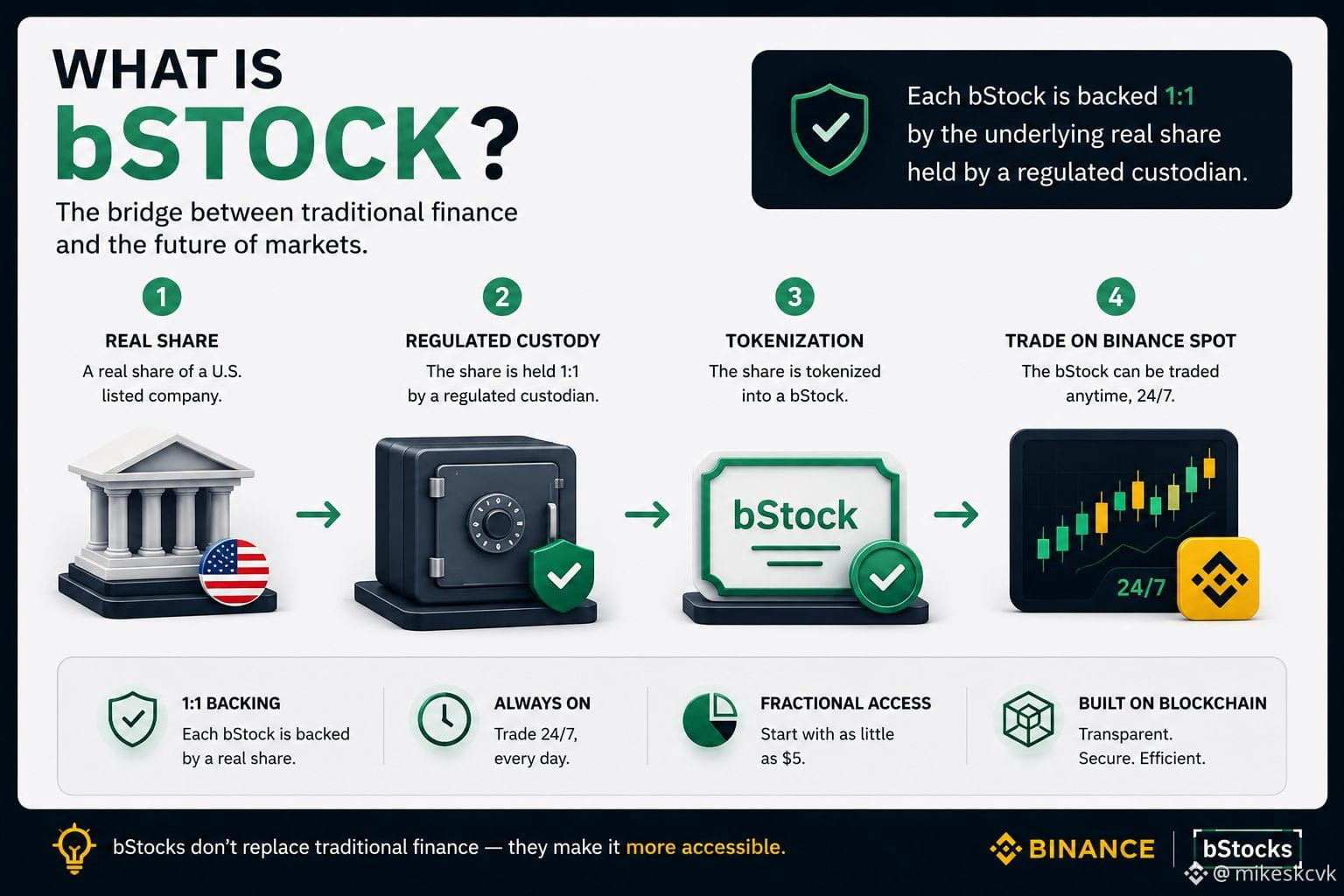
Binance explains that each bStock is backed 1:1 by an underlying share held by a regulated custodian. That connection between traditional finance and blockchain is what makes the concept interesting to me.
Sometimes understanding how a product works is more valuable than watching its price chart.
Have you spent more time learning the mechanics of bStocks, or are you mainly following the market? 📚💭
#bstockscis
I used to think the value of bStocks was only about putting stocks on the blockchain.
After reading more about how they work, I think the real value is the structure behind them.
Binance explains that each bStock is backed 1:1 by an underlying share held by a regulated custodian. That connection between traditional finance and blockchain is what makes the concept interesting to me.
Sometimes understanding how a product works is more valuable than watching its price chart.
Have you spent more time learning the mechanics of bStocks, or are you mainly following the market? 📚💭
#bstockscis
After reading more about how they work, I think the real value is the structure behind them.
Binance explains that each bStock is backed 1:1 by an underlying share held by a regulated custodian. That connection between traditional finance and blockchain is what makes the concept interesting to me.
Sometimes understanding how a product works is more valuable than watching its price chart.
Have you spent more time learning the mechanics of bStocks, or are you mainly following the market? 📚💭
#bstockscis
1
103
·
--
Xem bản dịch
One thing I like about blockchain is that it's not only about crypto anymore.
Projects like bStocks show how technology can be used to represent traditional financial assets in a digital way. Whether this model becomes mainstream or not, it's interesting to watch how finance keeps evolving.
I'm curious to see where tokenization will be in the next few years.
What real-world asset do you think could be tokenized next? 💭🚀
@BinanceCIS $SPCXB #bstockscis
One thing I like about blockchain is that it's not only about crypto anymore.
Projects like bStocks show how technology can be used to represent traditional financial assets in a digital way. Whether this model becomes mainstream or not, it's interesting to watch how finance keeps evolving.
I'm curious to see where tokenization will be in the next few years.
What real-world asset do you think could be tokenized next? 💭🚀
@BinanceCIS $SPCXB #bstockscis
Projects like bStocks show how technology can be used to represent traditional financial assets in a digital way. Whether this model becomes mainstream or not, it's interesting to watch how finance keeps evolving.
I'm curious to see where tokenization will be in the next few years.
What real-world asset do you think could be tokenized next? 💭🚀
@BinanceCIS $SPCXB #bstockscis

1
1
109
·
--
Xem bản dịch
Я помітив цікаву особливість bStocks: найважливіше тут не лише сам актив, а спосіб його представлення.
Токенізація не створює нову компанію і не змінює базову цінну паперу. Вона дозволяє взаємодіяти з активом через блокчейн-інфраструктуру, зберігаючи зв'язок із реальним базовим активом.
Мені здається, саме такі рішення показують, як поступово поєднуються традиційні фінанси та Web3.
Як думаєте, які ще реальні активи можуть бути токенізовані в майбутньому?
@BinanceCIS #bStocksCIS $SPCXB #BinanceSquare
{spot}(SPCXBUSDT)
#bstockscis
Я помітив цікаву особливість bStocks: найважливіше тут не лише сам актив, а спосіб його представлення.
Токенізація не створює нову компанію і не змінює базову цінну паперу. Вона дозволяє взаємодіяти з активом через блокчейн-інфраструктуру, зберігаючи зв'язок із реальним базовим активом.
Мені здається, саме такі рішення показують, як поступово поєднуються традиційні фінанси та Web3.
Як думаєте, які ще реальні активи можуть бути токенізовані в майбутньому?
@BinanceCIS #bStocksCIS $SPCXB #BinanceSquare
#bstockscis
Токенізація не створює нову компанію і не змінює базову цінну паперу. Вона дозволяє взаємодіяти з активом через блокчейн-інфраструктуру, зберігаючи зв'язок із реальним базовим активом.
Мені здається, саме такі рішення показують, як поступово поєднуються традиційні фінанси та Web3.
Як думаєте, які ще реальні активи можуть бути токенізовані в майбутньому?
@BinanceCIS #bStocksCIS $SPCXB #BinanceSquare
#bstockscis

1
1
65
Đăng nhập để khám phá thêm nội dung
Tham gia cùng người dùng tiền mã hóa toàn cầu trên Binance Square
⚡️ Nhận thông tin mới nhất và hữu ích về tiền mã hóa.
💬 Được tin cậy bởi sàn giao dịch tiền mã hóa lớn nhất thế giới.
👍 Khám phá những thông tin chuyên sâu thực tế từ những nhà sáng tạo đã xác minh.
Email / Số điện thoại
Chủ đề thịnh hành
TinFed
72,388 lượt xem
340 đang thảo luận
🔥 #TinFed Xác suất Fed tăng lãi suất đã lên 89% — Sao BTC vẫn chưa sập?
Thị trường gần như đã định giá khả năng FOMC tháng 9 tăng 25bp, vậy tại sao BTC vẫn chưa bị bán tháo?
Vì thị trường không chỉ trade chuyện “có tăng lãi suất hay không”, mà còn trade Fed sẽ nói gì sau đó.
📊 Mình đang nhìn 3 thứ:
① 77K
Đây là vùng phòng thủ quan trọng.
77K còn giữ → mình chưa vội bearish chỉ vì kỳ vọng tăng lãi suất cao.
② 80K
Đây là vị trí phe Bull cần lấy lại.
Break 80K kèm volume → tâm lý có thể cải thiện rõ rệt, mục tiêu tiếp theo 82K–83K.
③ Thông điệp sau FOMC
Đây mới là phần mình quan tâm nhất.
Nếu Fed tăng 25bp nhưng phát biểu không hawkish như thị trường lo ngại, “tin xấu đã được định giá” có thể ngược lại trở thành chất xúc tác cho BTC.
Ngược lại, tăng lãi suất + giọng điệu hawkish → cần cẩn thận với áp lực định giá.
🍑 Plan của mình rất đơn giản:
• 77K giữ → tiếp tục quan sát phe Bull
• 80K breakout → nhìn 82K–83K
• 82K–83K đứng vững → mở lại dư địa tăng
• Mất 77K → ngắn hạn chuyển sang phòng thủ
Mình không hoảng vì con số 89%, cũng không FOMO vì BTC đang hồi.
Chờ dữ liệu. Chờ FOMC. Chờ giá xác nhận.
Không đoán đáy, không đuổi đỉnh.
Quan điểm cá nhân, không phải lời khuyên đầu tư. Quản lý vốn luôn đứng đầu.
Mira CryptoVN
·0 lượt thích
·928 lượt xem
45NgayTuDoTaiChinh
904,826 lượt xem
3,105 đang thảo luận
TheoDõiFOMC
82,029 lượt xem
539 đang thảo luận