
CoinPulseHq
397 Bài đăng

CoinPulseHq
Báo cáo
Chặn người dùng
CoinPulseHQ is an independent digital newsroom covering cryptocurrency, blockchain and artificial intelligence.
3 Đang theo dõi
12 Người theo dõi
18 Đã thích
Bài đăng
·
--
Bài viết
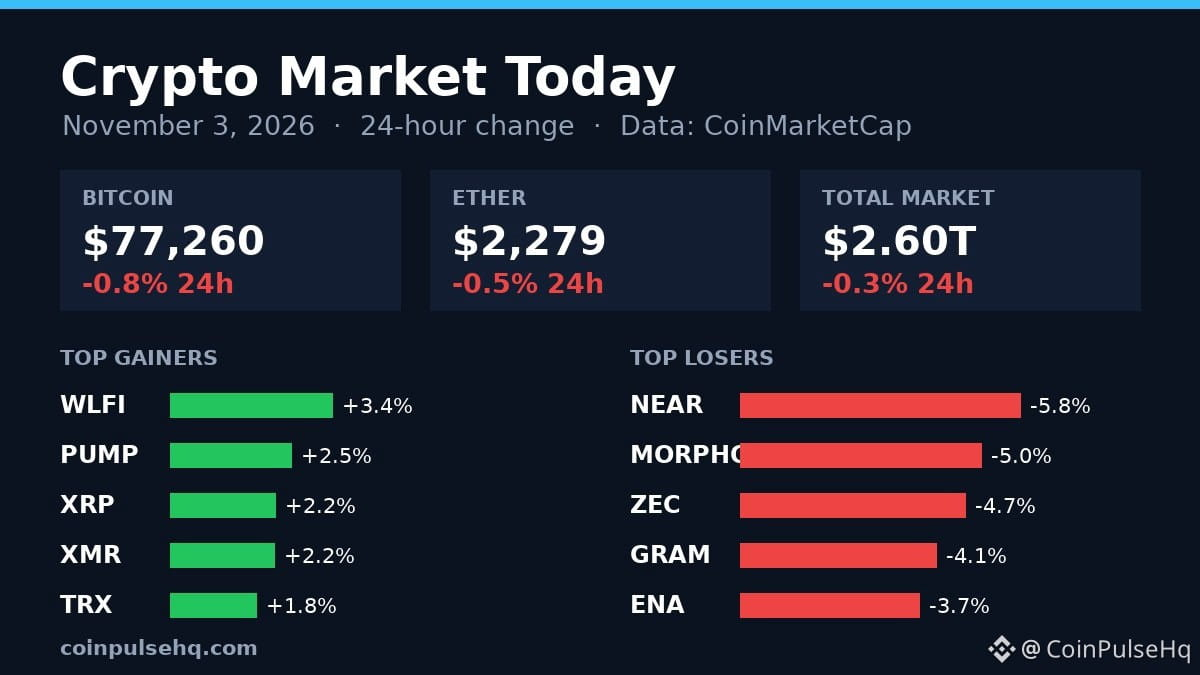
Thị trường tiền mã hóa hôm nay, ngày 3 tháng 11 năm 2026: Bitcoin ổn định quanh mức 77.300 USDThị trường tiền mã hóa hầu như không biến động trong 24 giờ qua. Tổng giá trị thị trường giảm 0,3% xuống còn 2,60 nghìn tỷ USD tính đến 13:00 UTC thứ Ba, ngày 3 tháng 11 năm 2026. Bitcoin được giao dịch ở mức 77.260 USD (-0,8%) và Ether ở mức 2.279 USD (-0,5%). 17 trong số 50 đồng coin lớn nhất tăng giá, và mức biến động trung vị là -0,6%.
Vì sao thị trường tiền mã hóa đi ngang hôm nay? Những con số cho thấy điều gì
• Độ rộng thị trường. Không có xu hướng rõ ràng: 17 trong số 50 đồng coin vốn hóa lớn tăng giá và 33 đồng giảm giá, nên mức tăng ở một số đồng đã bù đắp mức giảm ở những đồng khác.
• Bitcoin so với altcoin. 28 trong số 49 đồng coin vốn hóa lớn còn lại tăng giá tốt hơn Bitcoin, nên vị thế dẫn đầu được chia đều. Tỷ lệ thống trị của Bitcoin ở mức 59,9%, còn Ether tăng tốt hơn Bitcoin 0,4 điểm phần trăm.
Thị trường tiền mã hóa hôm nay, ngày 3 tháng 11 năm 2026: Bitcoin ổn định quanh mức 77.300 USD
Thị trường tiền mã hóa hầu như không biến động trong 24 giờ qua. Tổng giá trị thị trường giảm 0,3% xuống còn 2,60 nghìn tỷ USD tính đến 13:00 UTC thứ Ba, ngày 3 tháng 11 năm 2026. Bitcoin được giao dịch ở mức 77.260 USD (-0,8%) và Ether ở mức 2.279 USD (-0,5%). 17 trong số 50 đồng coin lớn nhất tăng giá, và mức biến động trung vị là -0,6%.
Vì sao thị trường tiền mã hóa đi ngang hôm nay? Những con số cho thấy điều gì
• Độ rộng thị trường. Không có xu hướng rõ ràng: 17 trong số 50 đồng coin vốn hóa lớn tăng giá và 33 đồng giảm giá, nên mức tăng ở một số đồng đã bù đắp mức giảm ở những đồng khác.
• Bitcoin so với altcoin. 28 trong số 49 đồng coin vốn hóa lớn còn lại tăng giá tốt hơn Bitcoin, nên vị thế dẫn đầu được chia đều. Tỷ lệ thống trị của Bitcoin ở mức 59,9%, còn Ether tăng tốt hơn Bitcoin 0,4 điểm phần trăm.
25
·
--
Bài viết
Xem bản dịch
Bitcoin’s $707B loss overhang points to a months-long recoveryRoughly $707 billion of the capital invested in Bitcoin was held at a loss, against about $380 billion in profit, according to AMBCrypto. The outlet reported the figures on November 3, 2026, citing the analyst Darkfost, who tracks the daily average of capital sitting in profit or loss on Bitcoin spot positions.
Darkfost's view, as reported, is that clearing that overhang is a matter of time rather than a single catalyst. Bitcoin would need to trade through a large block of positions bought at higher prices before most of that capital returns to profit, and the analyst expects several months for that to happen. Only then, in that framing, does a market expansion have room to build.
Key facts
• About $707 billion of Bitcoin capital was at a loss, compared with roughly $380 billion in profit, per Darkfost's figures.
• Bitcoin's price fell to a low of $76,541 on Monday, November 2, 2026.
• The 30-day average of active addresses was 629,000, 43% below the December 2024 peak of 1.10 million, according to analyst Axel Adler Jr.
• The 30-day average of daily on-chain transfer volume slipped 5.4% from December 2024, from 865,000 BTC to 819,000 BTC.
• Brazilian exchange Mercado Bitcoin halted transfers after a security incident that drained $40 million, then resumed withdrawals.
Activity is down, but coins still move
The two on-chain readings cited in the report point in different directions. Address activity has contracted sharply: Adler compared the 43% decline from the December 2024 high with 2018, when active addresses fell 50%, from 1.10 million to 547,000, over about three months. The current contraction has stretched across almost two years.
Volume tells a milder story. Even with far fewer addresses in use, the average daily total of BTC moved on-chain was only slightly below the December 2024 level. AMBCrypto's summary of the data is that the coins changing hands remain comparable to that period, even as the number of participants has shrunk.
Sentiment hit by exchange failures
The loss figures landed alongside security trouble at major venues. Mercado Bitcoin stopped transfers after a $40 million drain and has since restored withdrawals, with deposits unaffected throughout. That incident followed the Binance heist by a matter of days, and AMBCrypto described market sentiment as still highly pessimistic.
The $75,000 demand zone, which lines up with the short-term holder cost basis, has become the level swing traders and longer-term holders are watching after the drop to $76,541.
Why it matters
The ratio of capital in loss to capital in profit shapes how rallies behave. Holders who bought near recent highs tend to sell as price returns to their entry point, so each leg upward meets supply from investors trying to get even. That is why recovery from a deep drawdown often takes months of sideways trading rather than a sharp reversal. For long-term holders the practical effect is a market where upside is absorbed gradually, and for newer buyers it means the cost basis of the past year's cohort now functions as resistance.
What to watch
The $75,000 demand zone is the immediate line to monitor; a sustained break below it would push more positions into loss and lengthen the recovery timeline Darkfost described. The daily balance between capital in profit and capital in loss is the metric that would show the overhang starting to clear. This article is not financial advice, and crypto markets are volatile and uncertain.
Originally published on CoinPulseHQ: https://coinpulsehq.com/bitcoin-707-billion-loss-overhang-recovery-months/
Bitcoin’s $707B loss overhang points to a months-long recovery
Roughly $707 billion of the capital invested in Bitcoin was held at a loss, against about $380 billion in profit, according to AMBCrypto. The outlet reported the figures on November 3, 2026, citing the analyst Darkfost, who tracks the daily average of capital sitting in profit or loss on Bitcoin spot positions.
Darkfost's view, as reported, is that clearing that overhang is a matter of time rather than a single catalyst. Bitcoin would need to trade through a large block of positions bought at higher prices before most of that capital returns to profit, and the analyst expects several months for that to happen. Only then, in that framing, does a market expansion have room to build.
Key facts
• About $707 billion of Bitcoin capital was at a loss, compared with roughly $380 billion in profit, per Darkfost's figures.
• Bitcoin's price fell to a low of $76,541 on Monday, November 2, 2026.
• The 30-day average of active addresses was 629,000, 43% below the December 2024 peak of 1.10 million, according to analyst Axel Adler Jr.
• The 30-day average of daily on-chain transfer volume slipped 5.4% from December 2024, from 865,000 BTC to 819,000 BTC.
• Brazilian exchange Mercado Bitcoin halted transfers after a security incident that drained $40 million, then resumed withdrawals.
Activity is down, but coins still move
The two on-chain readings cited in the report point in different directions. Address activity has contracted sharply: Adler compared the 43% decline from the December 2024 high with 2018, when active addresses fell 50%, from 1.10 million to 547,000, over about three months. The current contraction has stretched across almost two years.
Volume tells a milder story. Even with far fewer addresses in use, the average daily total of BTC moved on-chain was only slightly below the December 2024 level. AMBCrypto's summary of the data is that the coins changing hands remain comparable to that period, even as the number of participants has shrunk.
Sentiment hit by exchange failures
The loss figures landed alongside security trouble at major venues. Mercado Bitcoin stopped transfers after a $40 million drain and has since restored withdrawals, with deposits unaffected throughout. That incident followed the Binance heist by a matter of days, and AMBCrypto described market sentiment as still highly pessimistic.
The $75,000 demand zone, which lines up with the short-term holder cost basis, has become the level swing traders and longer-term holders are watching after the drop to $76,541.
Why it matters
The ratio of capital in loss to capital in profit shapes how rallies behave. Holders who bought near recent highs tend to sell as price returns to their entry point, so each leg upward meets supply from investors trying to get even. That is why recovery from a deep drawdown often takes months of sideways trading rather than a sharp reversal. For long-term holders the practical effect is a market where upside is absorbed gradually, and for newer buyers it means the cost basis of the past year's cohort now functions as resistance.
What to watch
The $75,000 demand zone is the immediate line to monitor; a sustained break below it would push more positions into loss and lengthen the recovery timeline Darkfost described. The daily balance between capital in profit and capital in loss is the metric that would show the overhang starting to clear. This article is not financial advice, and crypto markets are volatile and uncertain.
Originally published on CoinPulseHQ: https://coinpulsehq.com/bitcoin-707-billion-loss-overhang-recovery-months/
50
·
--
Bài viết
Xem bản dịch
OKX Adds 13,800 BTC Reserves in Month Binance Lost $6.3BOKX's 49th consecutive proof-of-reserves report showed customer bitcoin balances rising 13,800 BTC to 156,609 BTC in the month to Nov. 1, a 9.66% increase from the Oct. 3 snapshot, according to Bitcoin.com News. At the time of the report those added coins were worth over $1 billion at a bitcoin price near $76,800, and the exchange's full customer stack was valued at roughly $12.04 billion.
The same month ended with Binance losing $6.3 billion to hackers, an event reported by crypto.news. OKX's snapshot window does not break out how much bitcoin arrived after that breach, so the report cannot by itself establish a link between the two.
Key facts
• OKX customer bitcoin rose 13,800 BTC to 156,609 BTC, a 9.66% gain from Oct. 3 to Nov. 1.
• Ether holdings climbed 2.95% to 1.92 million ETH, an increase of 54,879 ETH.
• USDT balances fell 9% to 7.96 billion tokens, roughly 787 million fewer than a month earlier.
• OKX's own token, OKB, slipped 0.08% to 19.68 million.
• Binance suspended and later restored withdrawals after the theft; crypto.news reported it processed $4.649 billion in withdrawals and $1.01 billion in deposits, a net outflow above $3.64 billion.
Where the money leaving Binance went
Bitcoin.com News reported that Binance has shed more than $16.5 billion in tracked assets since the hack, falling from about $144.9 billion on Oct. 29 to about $128.3 billion on Nov. 2. Some of that decline was the theft itself and some was price movement.
Whale Factor data cited in that report showed Binance losing about $4.5 billion over 24 hours while the next 10 exchanges combined took in only about $368 million. Most of the money leaving Binance therefore appears to have gone to self-custody wallets or stayed off exchanges rather than moving to competitors.
The two outlets describe the outflow differently. crypto.news frames its figure as net outflows from the exchange after withdrawal services resumed on Nov. 1, while Bitcoin.com News cites total tracked assets over a longer window. Both point in the same direction but are not directly comparable.
Binance answers with its own reserve proof
Binance co-founder Yi He said the exchange had generated the full zero-knowledge proof for its Oct. 31 snapshot, covering 10 tokens: BTC, ETH, USDT, BNB, SOL, USDC, XRP, USD1, RLUSD and ZEC. Such a proof lets an exchange demonstrate that reserves cover user balances without disclosing individual account data.
Days before that, Binance had said BTC, ETH, XRP and seven other cryptocurrencies were fully backed after the attack. Tether said it froze over $1.5 billion tied to the hack within 30 minutes.
OKX has published monthly reserves since the FTX collapse in late 2022, allowing users to check their own balances against holdings the exchange says cover them at least 1:1. The practice has become a standard trust signal for large venues.
Why it matters
Reserve reports are the main way customers can judge whether an exchange holds what it says it holds, and the contrast between OKX's gains and Binance's losses gives traders a side-by-side comparison in a period of acute stress. Where funds went after the breach also shapes the debate over whether exchange balances are a meaningful safety signal or simply a measure of user confidence that can move quickly.
What to watch
Binance plans new reserve snapshots on Nov. 4, 2026, and OKX's 50th report is due in early December. That report will be the first to cover a full month after the hack and should show whether OKX's bitcoin gains held once the initial panic faded. OKX also faces objections from Nvidia, Costco, Nike and other listed companies over its tokenized stock venture with Intercontinental Exchange.
This article is not financial advice, and crypto markets are volatile and can change quickly.
Originally published on CoinPulseHQ: https://coinpulsehq.com/okx-proof-of-reserves-13800-btc-binance-hack/
OKX Adds 13,800 BTC Reserves in Month Binance Lost $6.3B
OKX's 49th consecutive proof-of-reserves report showed customer bitcoin balances rising 13,800 BTC to 156,609 BTC in the month to Nov. 1, a 9.66% increase from the Oct. 3 snapshot, according to Bitcoin.com News. At the time of the report those added coins were worth over $1 billion at a bitcoin price near $76,800, and the exchange's full customer stack was valued at roughly $12.04 billion.
The same month ended with Binance losing $6.3 billion to hackers, an event reported by crypto.news. OKX's snapshot window does not break out how much bitcoin arrived after that breach, so the report cannot by itself establish a link between the two.
Key facts
• OKX customer bitcoin rose 13,800 BTC to 156,609 BTC, a 9.66% gain from Oct. 3 to Nov. 1.
• Ether holdings climbed 2.95% to 1.92 million ETH, an increase of 54,879 ETH.
• USDT balances fell 9% to 7.96 billion tokens, roughly 787 million fewer than a month earlier.
• OKX's own token, OKB, slipped 0.08% to 19.68 million.
• Binance suspended and later restored withdrawals after the theft; crypto.news reported it processed $4.649 billion in withdrawals and $1.01 billion in deposits, a net outflow above $3.64 billion.
Where the money leaving Binance went
Bitcoin.com News reported that Binance has shed more than $16.5 billion in tracked assets since the hack, falling from about $144.9 billion on Oct. 29 to about $128.3 billion on Nov. 2. Some of that decline was the theft itself and some was price movement.
Whale Factor data cited in that report showed Binance losing about $4.5 billion over 24 hours while the next 10 exchanges combined took in only about $368 million. Most of the money leaving Binance therefore appears to have gone to self-custody wallets or stayed off exchanges rather than moving to competitors.
The two outlets describe the outflow differently. crypto.news frames its figure as net outflows from the exchange after withdrawal services resumed on Nov. 1, while Bitcoin.com News cites total tracked assets over a longer window. Both point in the same direction but are not directly comparable.
Binance answers with its own reserve proof
Binance co-founder Yi He said the exchange had generated the full zero-knowledge proof for its Oct. 31 snapshot, covering 10 tokens: BTC, ETH, USDT, BNB, SOL, USDC, XRP, USD1, RLUSD and ZEC. Such a proof lets an exchange demonstrate that reserves cover user balances without disclosing individual account data.
Days before that, Binance had said BTC, ETH, XRP and seven other cryptocurrencies were fully backed after the attack. Tether said it froze over $1.5 billion tied to the hack within 30 minutes.
OKX has published monthly reserves since the FTX collapse in late 2022, allowing users to check their own balances against holdings the exchange says cover them at least 1:1. The practice has become a standard trust signal for large venues.
Why it matters
Reserve reports are the main way customers can judge whether an exchange holds what it says it holds, and the contrast between OKX's gains and Binance's losses gives traders a side-by-side comparison in a period of acute stress. Where funds went after the breach also shapes the debate over whether exchange balances are a meaningful safety signal or simply a measure of user confidence that can move quickly.
What to watch
Binance plans new reserve snapshots on Nov. 4, 2026, and OKX's 50th report is due in early December. That report will be the first to cover a full month after the hack and should show whether OKX's bitcoin gains held once the initial panic faded. OKX also faces objections from Nvidia, Costco, Nike and other listed companies over its tokenized stock venture with Intercontinental Exchange.
This article is not financial advice, and crypto markets are volatile and can change quickly.
Originally published on CoinPulseHQ: https://coinpulsehq.com/okx-proof-of-reserves-13800-btc-binance-hack/
·
--

Bài viết
Tin tặc Pando Rings chuyển 4,000 ETH qua Tornado CashTheo dữ liệu on-chain do AMBCrypto đưa tin, kẻ đứng sau vụ khai thác lỗ hổng Pando Rings năm 2022 đã gửi 4,000 ETH vào Tornado Cash và để lại 3,548 ETH bên ngoài công cụ trộn tiền này. Các giao dịch diễn ra vào cuối tháng 10 và được đưa tin ngày 2 tháng 11, đánh dấu nỗ lực mới của kẻ khai thác nhằm che giấu số tiền bị đánh cắp, bốn năm sau vụ tấn công.
Dẫn dữ liệu từ Arkham, AMBCrypto mô tả một chuỗi giao dịch trong đó ví này trước tiên đổi khoảng 16.98 triệu đô la Dai lấy 7,548 ETH, sau đó chia số dư thành các khoản gửi nhỏ hơn, mỗi khoản 100 ETH trị giá khoảng 229,000 đô la.
Tin tặc Pando Rings chuyển 4,000 ETH qua Tornado Cash
Theo dữ liệu on-chain do AMBCrypto đưa tin, kẻ đứng sau vụ khai thác lỗ hổng Pando Rings năm 2022 đã gửi 4,000 ETH vào Tornado Cash và để lại 3,548 ETH bên ngoài công cụ trộn tiền này. Các giao dịch diễn ra vào cuối tháng 10 và được đưa tin ngày 2 tháng 11, đánh dấu nỗ lực mới của kẻ khai thác nhằm che giấu số tiền bị đánh cắp, bốn năm sau vụ tấn công.
Dẫn dữ liệu từ Arkham, AMBCrypto mô tả một chuỗi giao dịch trong đó ví này trước tiên đổi khoảng 16.98 triệu đô la Dai lấy 7,548 ETH, sau đó chia số dư thành các khoản gửi nhỏ hơn, mỗi khoản 100 ETH trị giá khoảng 229,000 đô la.
Dẫn dữ liệu từ Arkham, AMBCrypto mô tả một chuỗi giao dịch trong đó ví này trước tiên đổi khoảng 16.98 triệu đô la Dai lấy 7,548 ETH, sau đó chia số dư thành các khoản gửi nhỏ hơn, mỗi khoản 100 ETH trị giá khoảng 229,000 đô la.
119
·
--

Bài viết
Xem bản dịch
RBA raises rates to 4.85%, an 18-year high on AI costsAustralia's central bank lifted its benchmark cash rate by 25 basis points to 4.85% on Tuesday, the highest level in 18 years, as Cointelegraph reported. The Reserve Bank of Australia's board split 6–3 on the decision, with three members favouring a hold at 4.60%, per the RBA's media release.
In its statement, the board said inflation is now expected to stay elevated through much of 2027 and will not fall back into the 2%–3% target band until late 2027, roughly three quarters later than previously forecast. It pointed to higher fuel and commodity prices linked to the Middle East conflict, alongside AI-related investment that it said is driving rapid growth in prices for technology-related goods.
Key facts
• The RBA raised the cash rate by 25 basis points to 4.85% on Tuesday, its highest since November 2008 (CNBC).
• The vote was 6–3, with three board members preferring to keep rates at 4.60% (Cointelegraph).
• CNBC reported the hike was the RBA's fifth this year and matched expectations from economists polled by Reuters.
• Australia's consumer price index rose 4.3% in September, up from 4% in August, per CNBC.
• GDP rose 2.1% in the June quarter from a year earlier, down from 2.5% in the March quarter (CNBC).
AI and energy in the inflation forecast
The RBA framed AI investment as a cost channel rather than a productivity story this time. Its statement singled out technology-related goods prices as a source of upward pressure alongside fuel and commodities.
The US Federal Reserve has run into the same theme. Cointelegraph noted Fed officials have warned that the AI investment boom is adding to price pressures, including for computer equipment and utilities, as set out in a Federal Reserve speech on the topic. The Fed held rates last week, a contrast with Australia's move.
Australian Treasurer Jim Chalmers said the decision was widely anticipated but still hard on households and businesses. CNBC reported that in September, RBA governor Michelle Bullock called inflation "too high," attributing it to higher oil prices from the Iran War and stronger domestic spending, and said further increases would follow if needed.
Precious metals under pressure
The same forces have weighed on gold and silver. Mint reported gold's worst-ever October, with the metal down to ₹1,42,000 per 10 grams on November 1, 2026, including taxes, from ₹1,45,200 on Friday. Silver fell to ₹1,86,000 per kilogram from ₹1,90,200.
International gold dropped below $3,900 an ounce, its lowest since October 2025, according to Trading Economics data cited by Mint. Gaurav Garg of Lemonn told Mint that inflation data and expectations of a December Fed rate hike were reducing demand for non-yielding assets, while Rahul Khetawat of 360 ONE Asset pointed to higher energy prices and hawkish Fed commentary.
Why it matters
Higher Australian rates raise borrowing costs for households and businesses already facing cost-of-living pressure, and the RBA is trying to slow inflation without tipping activity into contraction. Bullock said a recession was not the bank's base case, per CNBC.
For markets, the combination of a hawkish Fed and a fresh RBA hike tightens financial conditions at a time when AI spending is itself being cited as an inflation source — a link that matters for crypto and tech valuations, which tend to react to rate expectations.
What to watch
The next signals are the Fed's December decision, which Mint reported markets expect to be a hike, and Australia's incoming inflation and GDP data as the RBA tests whether its fifth hike of the year is enough.
This article is not financial advice. Markets are volatile and uncertain, and readers should do their own research.
Originally published on CoinPulseHQ: https://coinpulsehq.com/rba-rate-hike-485-18-year-high-ai-inflation/
RBA raises rates to 4.85%, an 18-year high on AI costs
Australia's central bank lifted its benchmark cash rate by 25 basis points to 4.85% on Tuesday, the highest level in 18 years, as Cointelegraph reported. The Reserve Bank of Australia's board split 6–3 on the decision, with three members favouring a hold at 4.60%, per the RBA's media release.
In its statement, the board said inflation is now expected to stay elevated through much of 2027 and will not fall back into the 2%–3% target band until late 2027, roughly three quarters later than previously forecast. It pointed to higher fuel and commodity prices linked to the Middle East conflict, alongside AI-related investment that it said is driving rapid growth in prices for technology-related goods.
Key facts
• The RBA raised the cash rate by 25 basis points to 4.85% on Tuesday, its highest since November 2008 (CNBC).
• The vote was 6–3, with three board members preferring to keep rates at 4.60% (Cointelegraph).
• CNBC reported the hike was the RBA's fifth this year and matched expectations from economists polled by Reuters.
• Australia's consumer price index rose 4.3% in September, up from 4% in August, per CNBC.
• GDP rose 2.1% in the June quarter from a year earlier, down from 2.5% in the March quarter (CNBC).
AI and energy in the inflation forecast
The RBA framed AI investment as a cost channel rather than a productivity story this time. Its statement singled out technology-related goods prices as a source of upward pressure alongside fuel and commodities.
The US Federal Reserve has run into the same theme. Cointelegraph noted Fed officials have warned that the AI investment boom is adding to price pressures, including for computer equipment and utilities, as set out in a Federal Reserve speech on the topic. The Fed held rates last week, a contrast with Australia's move.
Australian Treasurer Jim Chalmers said the decision was widely anticipated but still hard on households and businesses. CNBC reported that in September, RBA governor Michelle Bullock called inflation "too high," attributing it to higher oil prices from the Iran War and stronger domestic spending, and said further increases would follow if needed.
Precious metals under pressure
The same forces have weighed on gold and silver. Mint reported gold's worst-ever October, with the metal down to ₹1,42,000 per 10 grams on November 1, 2026, including taxes, from ₹1,45,200 on Friday. Silver fell to ₹1,86,000 per kilogram from ₹1,90,200.
International gold dropped below $3,900 an ounce, its lowest since October 2025, according to Trading Economics data cited by Mint. Gaurav Garg of Lemonn told Mint that inflation data and expectations of a December Fed rate hike were reducing demand for non-yielding assets, while Rahul Khetawat of 360 ONE Asset pointed to higher energy prices and hawkish Fed commentary.
Why it matters
Higher Australian rates raise borrowing costs for households and businesses already facing cost-of-living pressure, and the RBA is trying to slow inflation without tipping activity into contraction. Bullock said a recession was not the bank's base case, per CNBC.
For markets, the combination of a hawkish Fed and a fresh RBA hike tightens financial conditions at a time when AI spending is itself being cited as an inflation source — a link that matters for crypto and tech valuations, which tend to react to rate expectations.
What to watch
The next signals are the Fed's December decision, which Mint reported markets expect to be a hike, and Australia's incoming inflation and GDP data as the RBA tests whether its fifth hike of the year is enough.
This article is not financial advice. Markets are volatile and uncertain, and readers should do their own research.
Originally published on CoinPulseHQ: https://coinpulsehq.com/rba-rate-hike-485-18-year-high-ai-inflation/
75
·
--
Bài viết
Xem bản dịch
Bitget Opens Morpho Vault to 125 Million Users With 10% APRBitget has launched USDGO Onchain Earn, a product that lets customers put the USDGO stablecoin into a Gauntlet-curated Morpho vault without leaving their exchange accounts, Cointribune reported. The exchange opened the service to a user base of 125 million people and advertises a promotional annual percentage rate of up to 10% that runs through December 3, 2026.
The setup removes the usual steps of moving stablecoins to a self-custody wallet and paying gas fees. When a customer subscribes, Bitget generates a dedicated onchain address and covers the transaction costs, so the experience resembles buying any other exchange product.
Key facts
• Subscriptions go into a Morpho vault whose strategy and risk parameters are managed by Gauntlet; Morph supplies the ecosystem layer and Morpho the lending infrastructure.
• The promotional rate is capped at 5 million USDGO per user, and Bitget said it would confirm the promotion's terms and funding source before launch rather than at announcement.
• USDGO is issued by Anchorage Digital Bank, a federally chartered US digital asset bank supervised by the Office of the Comptroller of the Currency; OSL Group handles branding and distribution, and Bitget is not the issuer.
• In December 2025, Bitget introduced USDT and USDC Onchain Earn through Morpho and Arbitrum, a month after integrating Morph assets into spot trading.
• Morpho reports more than $16 billion in deposits, and Gauntlet curates $1.8 billion in assets.
How the yield and the exits work
The vault earns money by lending on Morpho, so its interest rate moves with utilisation rather than sitting at a fixed level. Bitget also states that returns are not guaranteed. According to the August 31, 2026 USDGO attestation report published by Anchorage, 1,244,426,424 tokens were outstanding against $1,248,950,562 in reserve assets, a surplus of roughly $4.5 million. Money market funds made up 62% of reserves and BlackRock's BUIDL fund another 37%.
Withdrawals carry their own conditions. There is no fixed lock-up period, but redemptions clear only when the vault holds enough liquidity and Morpho can process the request. Flexible access, in other words, does not promise instant access.
What Bitget is trading off
Bitget CEO Gracy Chen framed the launch around accessibility, arguing that users should not have to understand wallets, blockchain transactions or gas fees simply to earn on stablecoins. The technical friction is lower; the financial risk is not. A user who never opens a wallet is still exposed to lending-market conditions, vault liquidity and the terms behind the headline rate.
The move follows Bitget's recent test of an onchain strategy for tokenized stocks, part of a pattern of wrapping onchain finance in exchange-style packaging. The appeal rests on the partners: established DeFi infrastructure sits behind a subscription screen that looks routine to a retail customer.
Why it matters
Centralised exchanges have spent years losing stablecoin balances to onchain lending protocols that pay more. Products like this one let Bitget keep those balances in-house while outsourcing the yield mechanics to Morpho and Gauntlet, and it brings a bank-issued stablecoin into a DeFi lending market that retail users previously reached only through self-custody. For the 125 million customers on the platform, the barrier to entry drops; for regulators watching stablecoin issuance and DeFi lending converge, the arrangement layers a chartered bank, a distribution partner and a curated vault into one consumer product.
What to watch
The first concrete checkpoint is Bitget's confirmation of the promotional rate's terms and funding source before the product goes live, followed by the December 3, 2026 expiry of the 10% offer. What the vault actually pays once the promotion ends, and how quickly redemptions clear when liquidity tightens, will show whether the exchange wrapper lives up to the pitch.
This article is not financial advice. Yields on lending-based products are variable, and crypto markets are volatile and uncertain.
Originally published on CoinPulseHQ: https://coinpulsehq.com/bitget-usdgo-onchain-earn-morpho-vault/
Bitget Opens Morpho Vault to 125 Million Users With 10% APR
Bitget has launched USDGO Onchain Earn, a product that lets customers put the USDGO stablecoin into a Gauntlet-curated Morpho vault without leaving their exchange accounts, Cointribune reported. The exchange opened the service to a user base of 125 million people and advertises a promotional annual percentage rate of up to 10% that runs through December 3, 2026.
The setup removes the usual steps of moving stablecoins to a self-custody wallet and paying gas fees. When a customer subscribes, Bitget generates a dedicated onchain address and covers the transaction costs, so the experience resembles buying any other exchange product.
Key facts
• Subscriptions go into a Morpho vault whose strategy and risk parameters are managed by Gauntlet; Morph supplies the ecosystem layer and Morpho the lending infrastructure.
• The promotional rate is capped at 5 million USDGO per user, and Bitget said it would confirm the promotion's terms and funding source before launch rather than at announcement.
• USDGO is issued by Anchorage Digital Bank, a federally chartered US digital asset bank supervised by the Office of the Comptroller of the Currency; OSL Group handles branding and distribution, and Bitget is not the issuer.
• In December 2025, Bitget introduced USDT and USDC Onchain Earn through Morpho and Arbitrum, a month after integrating Morph assets into spot trading.
• Morpho reports more than $16 billion in deposits, and Gauntlet curates $1.8 billion in assets.
How the yield and the exits work
The vault earns money by lending on Morpho, so its interest rate moves with utilisation rather than sitting at a fixed level. Bitget also states that returns are not guaranteed. According to the August 31, 2026 USDGO attestation report published by Anchorage, 1,244,426,424 tokens were outstanding against $1,248,950,562 in reserve assets, a surplus of roughly $4.5 million. Money market funds made up 62% of reserves and BlackRock's BUIDL fund another 37%.
Withdrawals carry their own conditions. There is no fixed lock-up period, but redemptions clear only when the vault holds enough liquidity and Morpho can process the request. Flexible access, in other words, does not promise instant access.
What Bitget is trading off
Bitget CEO Gracy Chen framed the launch around accessibility, arguing that users should not have to understand wallets, blockchain transactions or gas fees simply to earn on stablecoins. The technical friction is lower; the financial risk is not. A user who never opens a wallet is still exposed to lending-market conditions, vault liquidity and the terms behind the headline rate.
The move follows Bitget's recent test of an onchain strategy for tokenized stocks, part of a pattern of wrapping onchain finance in exchange-style packaging. The appeal rests on the partners: established DeFi infrastructure sits behind a subscription screen that looks routine to a retail customer.
Why it matters
Centralised exchanges have spent years losing stablecoin balances to onchain lending protocols that pay more. Products like this one let Bitget keep those balances in-house while outsourcing the yield mechanics to Morpho and Gauntlet, and it brings a bank-issued stablecoin into a DeFi lending market that retail users previously reached only through self-custody. For the 125 million customers on the platform, the barrier to entry drops; for regulators watching stablecoin issuance and DeFi lending converge, the arrangement layers a chartered bank, a distribution partner and a curated vault into one consumer product.
What to watch
The first concrete checkpoint is Bitget's confirmation of the promotional rate's terms and funding source before the product goes live, followed by the December 3, 2026 expiry of the 10% offer. What the vault actually pays once the promotion ends, and how quickly redemptions clear when liquidity tightens, will show whether the exchange wrapper lives up to the pitch.
This article is not financial advice. Yields on lending-based products are variable, and crypto markets are volatile and uncertain.
Originally published on CoinPulseHQ: https://coinpulsehq.com/bitget-usdgo-onchain-earn-morpho-vault/
MORPHO-1,27%
BLKUS-0,30%
·
--
Bài viết
Xem bản dịch
BTCPay Server urges shutdown after hot wallet drainsBTCPay Server, the free open-source software businesses use to accept Bitcoin, told operators on Sunday to shut down their instances after reports that attackers were emptying hot wallets on affected servers, Decrypt reported. The project posted the warning at 5:25 p.m. ET on November 1, 2026, saying it was receiving reports of hot wallets being swept and asking operators to run its shutdown script until an investigation was complete.
About two hours later, founder Nicolas Dorier said the reports appeared to involve releases older than version 2.4.2 and that the attacker had signed in to affected servers with administrator access. The project then said its investigation had identified an attack vector aimed at instances running version 2.4.1, released on July 23, or older, according to its follow-up update.
Key facts
• BTCPay Server issued its shutdown warning on Sunday, November 1, 2026, at 5:25 p.m. ET.
• The project said the attack vector targeted version 2.4.1, released July 23, or older.
• BTCPay released version 2.4.7 on Thursday as an emergency update fixing one critical and several medium-severity vulnerabilities.
• The flaws in 2.4.7 were surfaced through Anthropic's frontier open-source software scanner.
• Some hosts, including LunaNode, automatically shut down BTCPay instances to stop older versions from being exploited.
Self-hosted software with no central off switch
Because BTCPay is self-hosted, every merchant runs it on their own server and no central operator can disable instances for them. That is why the project resorted to a public call for operators to act themselves.
The risk centers on the optional hot wallet setup, in which a merchant's seed is stored on the internet-connected server so it can sign transactions automatically. BTCPay's own wallet documentation labels the feature "DANGER" and warns that it carries security implications. The project said it had no credible reports of hot wallet drains among users running the latest 2.4.7 release, and it asked anyone affected to send details and logs to its security team.
The emergency update shipped days before the reports surfaced. BTCPay has not said whether the attacks exploited any of the flaws that 2.4.7 fixed, and it has not disclosed how many servers were hit or how much Bitcoin was taken.
A repeat of August's warning
This is the second security scare for the project this year. In August, BTCPay warned that a critical vulnerability in all versions before 2.4.2 was being actively exploited and told users to update or shut down. Supporters later funded a recovery bounty equal to 10% of any stolen funds returned, capped at 3 BTC. The latest incident again points operators toward the same remedy the project has stressed all year: run current software.
Why it matters
Merchants who accept Bitcoin without a custodial processor depend on BTCPay and similar tools to hold and move funds themselves, so a flaw that exposes hot wallets puts business revenue directly at risk. The episode also shows how quickly a self-hosted project must rely on voluntary compliance, since the only lever it has is telling operators what to do. For merchants, the practical contrast is between automated hot wallets and setups that keep keys offline.
What to watch
The next signals are BTCPay's investigation findings, including whether the drains trace back to the vulnerabilities fixed in 2.4.7, and any disclosure of affected server counts or stolen Bitcoin. The project has asked affected operators to submit logs, which may shape that account.
Originally published on CoinPulseHQ: https://coinpulsehq.com/btcpay-server-hot-wallet-drains-shutdown/
BTCPay Server urges shutdown after hot wallet drains
BTCPay Server, the free open-source software businesses use to accept Bitcoin, told operators on Sunday to shut down their instances after reports that attackers were emptying hot wallets on affected servers, Decrypt reported. The project posted the warning at 5:25 p.m. ET on November 1, 2026, saying it was receiving reports of hot wallets being swept and asking operators to run its shutdown script until an investigation was complete.
About two hours later, founder Nicolas Dorier said the reports appeared to involve releases older than version 2.4.2 and that the attacker had signed in to affected servers with administrator access. The project then said its investigation had identified an attack vector aimed at instances running version 2.4.1, released on July 23, or older, according to its follow-up update.
Key facts
• BTCPay Server issued its shutdown warning on Sunday, November 1, 2026, at 5:25 p.m. ET.
• The project said the attack vector targeted version 2.4.1, released July 23, or older.
• BTCPay released version 2.4.7 on Thursday as an emergency update fixing one critical and several medium-severity vulnerabilities.
• The flaws in 2.4.7 were surfaced through Anthropic's frontier open-source software scanner.
• Some hosts, including LunaNode, automatically shut down BTCPay instances to stop older versions from being exploited.
Self-hosted software with no central off switch
Because BTCPay is self-hosted, every merchant runs it on their own server and no central operator can disable instances for them. That is why the project resorted to a public call for operators to act themselves.
The risk centers on the optional hot wallet setup, in which a merchant's seed is stored on the internet-connected server so it can sign transactions automatically. BTCPay's own wallet documentation labels the feature "DANGER" and warns that it carries security implications. The project said it had no credible reports of hot wallet drains among users running the latest 2.4.7 release, and it asked anyone affected to send details and logs to its security team.
The emergency update shipped days before the reports surfaced. BTCPay has not said whether the attacks exploited any of the flaws that 2.4.7 fixed, and it has not disclosed how many servers were hit or how much Bitcoin was taken.
A repeat of August's warning
This is the second security scare for the project this year. In August, BTCPay warned that a critical vulnerability in all versions before 2.4.2 was being actively exploited and told users to update or shut down. Supporters later funded a recovery bounty equal to 10% of any stolen funds returned, capped at 3 BTC. The latest incident again points operators toward the same remedy the project has stressed all year: run current software.
Why it matters
Merchants who accept Bitcoin without a custodial processor depend on BTCPay and similar tools to hold and move funds themselves, so a flaw that exposes hot wallets puts business revenue directly at risk. The episode also shows how quickly a self-hosted project must rely on voluntary compliance, since the only lever it has is telling operators what to do. For merchants, the practical contrast is between automated hot wallets and setups that keep keys offline.
What to watch
The next signals are BTCPay's investigation findings, including whether the drains trace back to the vulnerabilities fixed in 2.4.7, and any disclosure of affected server counts or stolen Bitcoin. The project has asked affected operators to submit logs, which may shape that account.
Originally published on CoinPulseHQ: https://coinpulsehq.com/btcpay-server-hot-wallet-drains-shutdown/
24
·
--
Bài viết
Blob Ethereum được đảm bảo khả dụng trong 18 ngày, chứ không bị xóaCác blob dữ liệu của Ethereum được giao thức đảm bảo khả dụng trong khoảng 18 ngày, nhưng khoảng thời gian đó chưa bao giờ là hạn xóa, và blob đầu tiên của mạng lưới đã chứng minh điều này. Theo Cointribune, vào ngày 27 tháng 10 năm 2026, kho lưu trữ Blobscan vẫn liệt kê ba địa điểm lưu trữ cho một blob được công bố lần đầu vào ngày 13 tháng 3 năm 2024.
Blob đầu tiên đó được đưa vào khối 19,426,589. Dù có kích thước 131,072 byte, báo cáo cho biết chỉ 8,745 byte thực sự được sử dụng. Giao dịch này vẫn hiển thị trên Etherscan dưới dạng mục loại 3, vì vậy tham chiếu đến nó vẫn nằm trong lịch sử vĩnh viễn của chuỗi, còn nội dung thì tùy thuộc vào những ai lưu giữ bản sao.
Blob Ethereum được đảm bảo khả dụng trong 18 ngày, chứ không bị xóa
Các blob dữ liệu của Ethereum được giao thức đảm bảo khả dụng trong khoảng 18 ngày, nhưng khoảng thời gian đó chưa bao giờ là hạn xóa, và blob đầu tiên của mạng lưới đã chứng minh điều này. Theo Cointribune, vào ngày 27 tháng 10 năm 2026, kho lưu trữ Blobscan vẫn liệt kê ba địa điểm lưu trữ cho một blob được công bố lần đầu vào ngày 13 tháng 3 năm 2024.
Blob đầu tiên đó được đưa vào khối 19,426,589. Dù có kích thước 131,072 byte, báo cáo cho biết chỉ 8,745 byte thực sự được sử dụng. Giao dịch này vẫn hiển thị trên Etherscan dưới dạng mục loại 3, vì vậy tham chiếu đến nó vẫn nằm trong lịch sử vĩnh viễn của chuỗi, còn nội dung thì tùy thuộc vào những ai lưu giữ bản sao.
Blob đầu tiên đó được đưa vào khối 19,426,589. Dù có kích thước 131,072 byte, báo cáo cho biết chỉ 8,745 byte thực sự được sử dụng. Giao dịch này vẫn hiển thị trên Etherscan dưới dạng mục loại 3, vì vậy tham chiếu đến nó vẫn nằm trong lịch sử vĩnh viễn của chuỗi, còn nội dung thì tùy thuộc vào những ai lưu giữ bản sao.
70
·
--
Bài viết
Xem bản dịch
Binance SAFU Bitcoin Wallet Falls to 7,500 BTC After Hack PayoutBinance’s emergency Bitcoin wallet held roughly half its prior balance on Monday after the exchange drew on its user protection fund to cover losses from last week's theft, Cointelegraph reported. The Secure Asset Fund for Users (SAFU) address held about 7,500 BTC, worth $583 million, after a transfer of 7,499 BTC confirmed on Saturday. Before the transfer it held around 15,000 BTC. Cointelegraph noted the fund has no stated deadline for being restored.
Key facts
• The SAFU wallet dropped to about 7,500 BTC from roughly 15,000 BTC following the 7,499 BTC transfer.
• The October 29 breach involved about $6.3 billion in cryptocurrency, the largest theft in crypto history; the FBI attributed it to North Korea and named the hackers TraderTraitor.
• Binance said roughly 95% of affected assets had been replenished by November 1, up from 90% the day before.
• Binance's November 2 recovery update said the cryptographic proof for its October 31 snapshot was ready, a day ahead of the previously estimated November 3 completion.
• The snapshot covered ten tokens: Bitcoin, Ether, USDT, BNB, Solana, USDC, XRP, USD1, RLUSD and Zcash, each backed at least 1:1, crypto.news reported.
Proof of reserves goes live for users
Customers holding any of the ten covered assets can now check their balances against the October 31 snapshot through Binance's proof-of-reserves site. The system pairs a Merkle Tree with zk-SNARK proofs: the tree shows a user's balance was recorded, while the proof establishes reserves of at least 1:1 without revealing individual account figures, according to crypto.news. Users must log in and download the open-source verifier from the exchange's official page; the code sits on GitHub and has been independently audited.
SAFU's stated policy calls for the fund to be rebalanced back to $1 billion if market swings push its value below $800 million, but it sets no deadline for topping up money spent after a security incident. Cointelegraph said Binance did not immediately answer questions about the fund's remaining reserves, further deployments or refill plans.
Where the recovery stands
The remaining 5% of affected assets are tokens outside the ten covered in the reserve report. Binance has said these have thin liquidity, making large purchases slow, and is sourcing them through market trades, over-the-counter deals and industry partners. The exchange said it is using its corporate treasury, SAFU and part of its futures insurance fund to cover the shortfall, and that customers will not bear the losses.
Withdrawals resumed in stages on November 1, starting with 15 networks including Bitcoin, Ethereum, BNB Smart Chain, Tron, Solana, XRP Ledger, Arbitrum, Base, Optimism and Avalanche C-Chain. A further phase is due to begin November 3, though the exchange has not announced which tokens and networks it will cover or when each goes live. A second snapshot covering more tokens is set for November 4, with its proof expected to take another 40 to 50 hours to generate.
The two reports differ in timing detail. Cointelegraph described withdrawals as reopening in phases on Sunday, while crypto.news dated the first phase to November 1 and placed the next phase on November 3. Both accounts agree the October 31 snapshot proof arrived ahead of schedule. crypto.news also reported that a compromised DevOps engineer's laptop was identified as a possible entry point, that roughly $3 billion in assets were frozen with industry help, and that Binance plans a detailed post-incident report. Binance has said it will publish that report when its investigation concludes.
Why it matters
SAFU is one of the few publicly disclosed backstops an exchange holds for customer losses, so its halving is a visible measure of how much of this hack Binance is absorbing itself. The proof-of-reserves release shifts part of the verification burden onto users, who can now test the exchange's claims rather than take published totals on trust. For traders, the staged withdrawal reopening is the practical test of whether operations have returned to normal.
What to watch
The November 3 withdrawal phase and the November 4 snapshot will show whether the exchange can keep pace with its own schedule. Two open questions remain: when SAFU returns to its $1 billion target, and which less-liquid tokens still make up the final 5% of unreplaced assets.
Originally published on CoinPulseHQ: https://coinpulsehq.com/binance-safu-bitcoin-halved-reserve-proof/
Binance SAFU Bitcoin Wallet Falls to 7,500 BTC After Hack Payout
Binance’s emergency Bitcoin wallet held roughly half its prior balance on Monday after the exchange drew on its user protection fund to cover losses from last week's theft, Cointelegraph reported. The Secure Asset Fund for Users (SAFU) address held about 7,500 BTC, worth $583 million, after a transfer of 7,499 BTC confirmed on Saturday. Before the transfer it held around 15,000 BTC. Cointelegraph noted the fund has no stated deadline for being restored.
Key facts
• The SAFU wallet dropped to about 7,500 BTC from roughly 15,000 BTC following the 7,499 BTC transfer.
• The October 29 breach involved about $6.3 billion in cryptocurrency, the largest theft in crypto history; the FBI attributed it to North Korea and named the hackers TraderTraitor.
• Binance said roughly 95% of affected assets had been replenished by November 1, up from 90% the day before.
• Binance's November 2 recovery update said the cryptographic proof for its October 31 snapshot was ready, a day ahead of the previously estimated November 3 completion.
• The snapshot covered ten tokens: Bitcoin, Ether, USDT, BNB, Solana, USDC, XRP, USD1, RLUSD and Zcash, each backed at least 1:1, crypto.news reported.
Proof of reserves goes live for users
Customers holding any of the ten covered assets can now check their balances against the October 31 snapshot through Binance's proof-of-reserves site. The system pairs a Merkle Tree with zk-SNARK proofs: the tree shows a user's balance was recorded, while the proof establishes reserves of at least 1:1 without revealing individual account figures, according to crypto.news. Users must log in and download the open-source verifier from the exchange's official page; the code sits on GitHub and has been independently audited.
SAFU's stated policy calls for the fund to be rebalanced back to $1 billion if market swings push its value below $800 million, but it sets no deadline for topping up money spent after a security incident. Cointelegraph said Binance did not immediately answer questions about the fund's remaining reserves, further deployments or refill plans.
Where the recovery stands
The remaining 5% of affected assets are tokens outside the ten covered in the reserve report. Binance has said these have thin liquidity, making large purchases slow, and is sourcing them through market trades, over-the-counter deals and industry partners. The exchange said it is using its corporate treasury, SAFU and part of its futures insurance fund to cover the shortfall, and that customers will not bear the losses.
Withdrawals resumed in stages on November 1, starting with 15 networks including Bitcoin, Ethereum, BNB Smart Chain, Tron, Solana, XRP Ledger, Arbitrum, Base, Optimism and Avalanche C-Chain. A further phase is due to begin November 3, though the exchange has not announced which tokens and networks it will cover or when each goes live. A second snapshot covering more tokens is set for November 4, with its proof expected to take another 40 to 50 hours to generate.
The two reports differ in timing detail. Cointelegraph described withdrawals as reopening in phases on Sunday, while crypto.news dated the first phase to November 1 and placed the next phase on November 3. Both accounts agree the October 31 snapshot proof arrived ahead of schedule. crypto.news also reported that a compromised DevOps engineer's laptop was identified as a possible entry point, that roughly $3 billion in assets were frozen with industry help, and that Binance plans a detailed post-incident report. Binance has said it will publish that report when its investigation concludes.
Why it matters
SAFU is one of the few publicly disclosed backstops an exchange holds for customer losses, so its halving is a visible measure of how much of this hack Binance is absorbing itself. The proof-of-reserves release shifts part of the verification burden onto users, who can now test the exchange's claims rather than take published totals on trust. For traders, the staged withdrawal reopening is the practical test of whether operations have returned to normal.
What to watch
The November 3 withdrawal phase and the November 4 snapshot will show whether the exchange can keep pace with its own schedule. Two open questions remain: when SAFU returns to its $1 billion target, and which less-liquid tokens still make up the final 5% of unreplaced assets.
Originally published on CoinPulseHQ: https://coinpulsehq.com/binance-safu-bitcoin-halved-reserve-proof/
·
--

Bài viết
Tin tặc Binance đổi 46,4 triệu USD Solana bị đánh cắp sang BitcoinTheo Cointelegraph dẫn lời các nhà điều tra blockchain, nhóm hacker đứng sau vụ đánh cắp 6,3 tỷ USD từ Binance đã bắt đầu chuyển đổi Solana bị đánh cắp sang Bitcoin sau khi gần như rút sạch các ví mà chúng dùng để luân chuyển tiền trên Tron. Hôm Chủ nhật, Lookonchain cho biết 486.970 token Solana (SOL), trị giá khoảng 46,4 triệu USD, đã được chuyển đi và đang được hoán đổi sang Bitcoin (BTC) thông qua Relay.
Các token này đến từ số tiền đã thoát khỏi lệnh phong tỏa được áp đặt sau vụ xâm nhập hôm thứ Năm, mà Cointelegraph mô tả là vụ lớn nhất trong lịch sử tiền mã hóa. Các đối tác trong ngành, bao gồm Tether và Circle, đã phong tỏa khoảng 3 tỷ USD tài sản bị đánh cắp, trong khi nhà điều tra SomaXBT ước tính những kẻ tấn công vẫn nắm giữ khoảng 3,5 tỷ USD.
Tin tặc Binance đổi 46,4 triệu USD Solana bị đánh cắp sang Bitcoin
Theo Cointelegraph dẫn lời các nhà điều tra blockchain, nhóm hacker đứng sau vụ đánh cắp 6,3 tỷ USD từ Binance đã bắt đầu chuyển đổi Solana bị đánh cắp sang Bitcoin sau khi gần như rút sạch các ví mà chúng dùng để luân chuyển tiền trên Tron. Hôm Chủ nhật, Lookonchain cho biết 486.970 token Solana (SOL), trị giá khoảng 46,4 triệu USD, đã được chuyển đi và đang được hoán đổi sang Bitcoin (BTC) thông qua Relay.
Các token này đến từ số tiền đã thoát khỏi lệnh phong tỏa được áp đặt sau vụ xâm nhập hôm thứ Năm, mà Cointelegraph mô tả là vụ lớn nhất trong lịch sử tiền mã hóa. Các đối tác trong ngành, bao gồm Tether và Circle, đã phong tỏa khoảng 3 tỷ USD tài sản bị đánh cắp, trong khi nhà điều tra SomaXBT ước tính những kẻ tấn công vẫn nắm giữ khoảng 3,5 tỷ USD.
Các token này đến từ số tiền đã thoát khỏi lệnh phong tỏa được áp đặt sau vụ xâm nhập hôm thứ Năm, mà Cointelegraph mô tả là vụ lớn nhất trong lịch sử tiền mã hóa. Các đối tác trong ngành, bao gồm Tether và Circle, đã phong tỏa khoảng 3 tỷ USD tài sản bị đánh cắp, trong khi nhà điều tra SomaXBT ước tính những kẻ tấn công vẫn nắm giữ khoảng 3,5 tỷ USD.
50
·
--
Bài viết
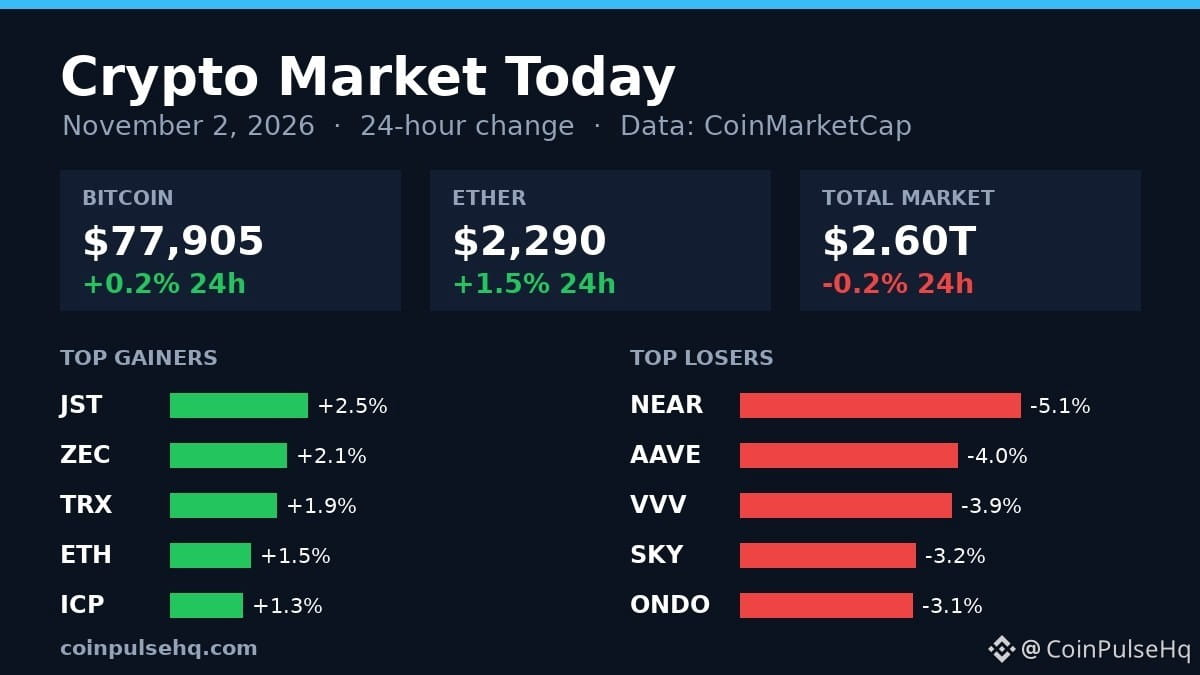
Thị trường tiền mã hóa hôm nay, ngày 2 tháng 11 năm 2026: Bitcoin ổn định quanh mức 77,9K USD khi JUST tăng 3%Thị trường tiền mã hóa hầu như không thay đổi trong 24 giờ qua. Tổng vốn hóa thị trường giảm 0,2%, còn 2,60 nghìn tỷ USD tính đến 13:00 UTC thứ Hai, ngày 2 tháng 11 năm 2026. Bitcoin giao dịch ở mức 77.905 USD (+0,2%) và Ether ở mức 2.290 USD (+1,5%). 17 trong số 50 đồng tiền mã hóa lớn nhất tăng giá, và mức biến động trung vị là -0,6%.
Vì sao thị trường tiền mã hóa đi ngang hôm nay? Các con số cho thấy điều gì
• Độ rộng thị trường. Không có xu hướng rõ ràng: 17 trong số 50 đồng tiền mã hóa lớn tăng giá và 33 đồng giảm giá, nên mức tăng của một số đồng đã bù đắp cho mức giảm của những đồng khác.
• Bitcoin so với altcoin. Chỉ 14 trong số 49 đồng tiền mã hóa lớn còn lại có diễn biến tốt hơn Bitcoin, cho thấy dòng tiền ưu tiên tài sản lớn nhất. Tỷ lệ thống trị của Bitcoin hiện ở mức 59,9%, còn Ether vượt Bitcoin 1,2 điểm phần trăm.
Thị trường tiền mã hóa hôm nay, ngày 2 tháng 11 năm 2026: Bitcoin ổn định quanh mức 77,9K USD khi JUST tăng 3%
Thị trường tiền mã hóa hầu như không thay đổi trong 24 giờ qua. Tổng vốn hóa thị trường giảm 0,2%, còn 2,60 nghìn tỷ USD tính đến 13:00 UTC thứ Hai, ngày 2 tháng 11 năm 2026. Bitcoin giao dịch ở mức 77.905 USD (+0,2%) và Ether ở mức 2.290 USD (+1,5%). 17 trong số 50 đồng tiền mã hóa lớn nhất tăng giá, và mức biến động trung vị là -0,6%.
Vì sao thị trường tiền mã hóa đi ngang hôm nay? Các con số cho thấy điều gì
• Độ rộng thị trường. Không có xu hướng rõ ràng: 17 trong số 50 đồng tiền mã hóa lớn tăng giá và 33 đồng giảm giá, nên mức tăng của một số đồng đã bù đắp cho mức giảm của những đồng khác.
• Bitcoin so với altcoin. Chỉ 14 trong số 49 đồng tiền mã hóa lớn còn lại có diễn biến tốt hơn Bitcoin, cho thấy dòng tiền ưu tiên tài sản lớn nhất. Tỷ lệ thống trị của Bitcoin hiện ở mức 59,9%, còn Ether vượt Bitcoin 1,2 điểm phần trăm.
65
·
--
Bài viết
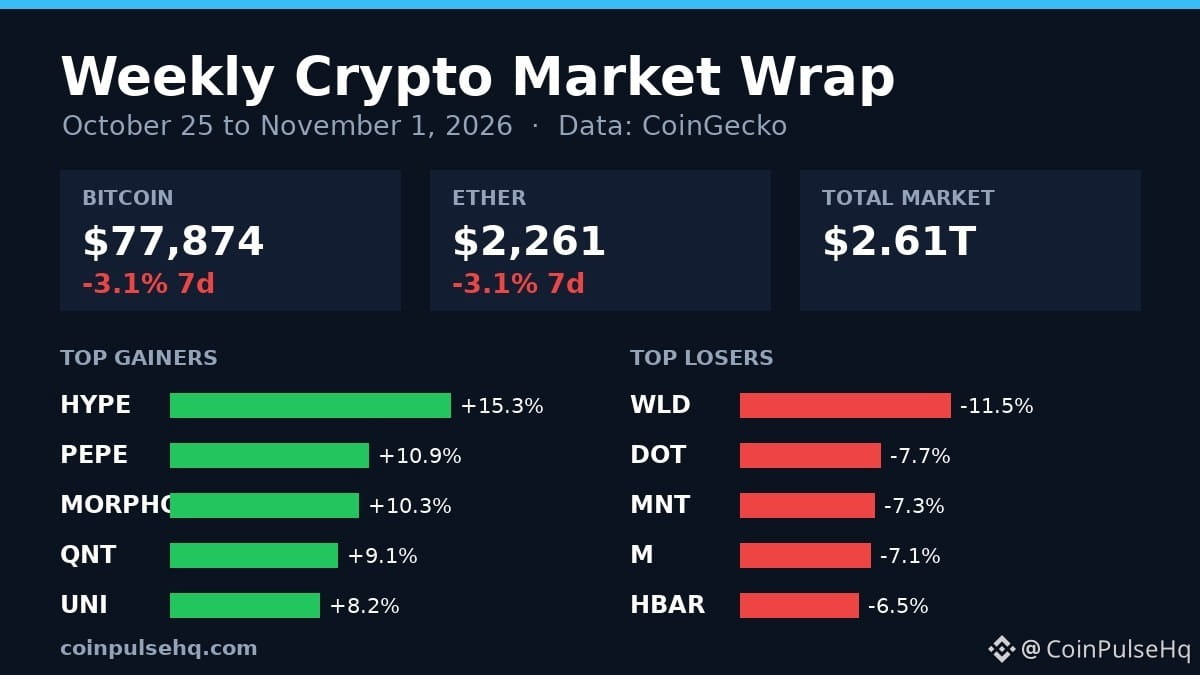
Bitcoin ở mức 77,9 nghìn USD: Những đồng tiền mã hóa tăng và giảm giá trong tuần nàyĐây là một tuần nhìn chung tiêu cực đối với tiền mã hóa. Bitcoin giảm 3,1% trong bảy ngày tính đến ngày 1 tháng 11 năm 2026 và được giao dịch ở mức 77.874 USD khi bản tổng kết này được biên soạn. Có 13 trong số 50 đồng tiền lớn nhất kết thúc tuần trong sắc xanh, với mức biến động trung vị là -1,8%.
Tuần qua qua những con số
• Tổng giá trị thị trường tiền mã hóa: 2,61 nghìn tỷ USD (-2,7% so với bản tổng kết gần nhất ngày 25 tháng 10)
• Khối lượng giao dịch trong 24 giờ: 38,8 tỷ USD
• Tỷ lệ thống trị của Bitcoin: 59,9% (giảm từ 60,1%); Ether chiếm 10,6%
• Bitcoin: 77.874 USD, giảm 3,1% trong tuần và 10,2% trong 30 ngày
• Ether: 2.261 USD, giảm 3,1% trong tuần và 17,9% trong 30 ngày
Bitcoin ở mức 77,9 nghìn USD: Những đồng tiền mã hóa tăng và giảm giá trong tuần này
Đây là một tuần nhìn chung tiêu cực đối với tiền mã hóa. Bitcoin giảm 3,1% trong bảy ngày tính đến ngày 1 tháng 11 năm 2026 và được giao dịch ở mức 77.874 USD khi bản tổng kết này được biên soạn. Có 13 trong số 50 đồng tiền lớn nhất kết thúc tuần trong sắc xanh, với mức biến động trung vị là -1,8%.
Tuần qua qua những con số
• Tổng giá trị thị trường tiền mã hóa: 2,61 nghìn tỷ USD (-2,7% so với bản tổng kết gần nhất ngày 25 tháng 10)
• Khối lượng giao dịch trong 24 giờ: 38,8 tỷ USD
• Tỷ lệ thống trị của Bitcoin: 59,9% (giảm từ 60,1%); Ether chiếm 10,6%
• Bitcoin: 77.874 USD, giảm 3,1% trong tuần và 10,2% trong 30 ngày
• Ether: 2.261 USD, giảm 3,1% trong tuần và 17,9% trong 30 ngày
280
·
--
Bài viết
Peter Schiff xem đợt giảm 3,5% của vàng là vấn đề thanh khoảnTheo Cointribune, vàng giao ngay giảm 141,60 USD, tương đương 3,52%, xuống khoảng 3.879,90 USD/ounce vào ngày 30 tháng 10. Peter Schiff xem đợt giảm này là dấu hiệu của tình trạng thiếu thanh khoản ngắn hạn, chứ không phải sự kết thúc đà tăng của kim loại quý. Viết trên X, Schiff cho biết mức giảm khoảng 150 USD mỗi ngày của vàng và hơn 3 USD của bạc là "nực cười", đồng thời liên hệ chúng với vấn đề thanh khoản có khả năng lan rộng ra các thị trường lớn hơn, theo bài đăng của ông. Ông gọi diễn biến này là món quà bất ngờ dành cho các nhà đầu tư để mua thêm.
Đợt giảm này gây chú ý vì kim loại quý thường thu hút người mua khi tình hình địa chính trị và cổ phiếu trở nên ảm đạm. Lần này, chúng giảm cùng với cổ phiếu và tiền mã hóa: S&P 500 mất 1,8%, xuống còn 7.580,07, đánh dấu phiên giao dịch tệ nhất kể từ tháng 6; Nasdaq Composite giảm 2,9%; còn Intel lao dốc gần 29% sau khi đưa ra dự báo lợi nhuận yếu. Theo Bitcoin.com News, Bitcoin, chịu ảnh hưởng từ vụ trộm 6,3 tỷ USD trên Binance, đã chạm mức thấp nhất trong sáu tuần là 76.368 USD trước khi phục hồi lên trên 77.000 USD.
Peter Schiff xem đợt giảm 3,5% của vàng là vấn đề thanh khoản
Theo Cointribune, vàng giao ngay giảm 141,60 USD, tương đương 3,52%, xuống khoảng 3.879,90 USD/ounce vào ngày 30 tháng 10. Peter Schiff xem đợt giảm này là dấu hiệu của tình trạng thiếu thanh khoản ngắn hạn, chứ không phải sự kết thúc đà tăng của kim loại quý. Viết trên X, Schiff cho biết mức giảm khoảng 150 USD mỗi ngày của vàng và hơn 3 USD của bạc là "nực cười", đồng thời liên hệ chúng với vấn đề thanh khoản có khả năng lan rộng ra các thị trường lớn hơn, theo bài đăng của ông. Ông gọi diễn biến này là món quà bất ngờ dành cho các nhà đầu tư để mua thêm.
Đợt giảm này gây chú ý vì kim loại quý thường thu hút người mua khi tình hình địa chính trị và cổ phiếu trở nên ảm đạm. Lần này, chúng giảm cùng với cổ phiếu và tiền mã hóa: S&P 500 mất 1,8%, xuống còn 7.580,07, đánh dấu phiên giao dịch tệ nhất kể từ tháng 6; Nasdaq Composite giảm 2,9%; còn Intel lao dốc gần 29% sau khi đưa ra dự báo lợi nhuận yếu. Theo Bitcoin.com News, Bitcoin, chịu ảnh hưởng từ vụ trộm 6,3 tỷ USD trên Binance, đã chạm mức thấp nhất trong sáu tuần là 76.368 USD trước khi phục hồi lên trên 77.000 USD.
Đợt giảm này gây chú ý vì kim loại quý thường thu hút người mua khi tình hình địa chính trị và cổ phiếu trở nên ảm đạm. Lần này, chúng giảm cùng với cổ phiếu và tiền mã hóa: S&P 500 mất 1,8%, xuống còn 7.580,07, đánh dấu phiên giao dịch tệ nhất kể từ tháng 6; Nasdaq Composite giảm 2,9%; còn Intel lao dốc gần 29% sau khi đưa ra dự báo lợi nhuận yếu. Theo Bitcoin.com News, Bitcoin, chịu ảnh hưởng từ vụ trộm 6,3 tỷ USD trên Binance, đã chạm mức thấp nhất trong sáu tuần là 76.368 USD trước khi phục hồi lên trên 77.000 USD.
328
·
--

Bài viết
Tether báo lãi 1,5 tỷ USD trong quý III khi dự trữ tăng lên 7,95 tỷ USDTheo AMBCrypto, Tether báo cáo lợi nhuận ròng 1,5 tỷ USD trong quý III năm 2026 và nâng mức dự trữ vượt mức lên 7,95 tỷ USD tính đến ngày 30 tháng 9. Con số này gần gấp đôi khoản dự phòng 4,11 tỷ USD mà đơn vị phát hành stablecoin nắm giữ ba tháng trước đó, dựa trên số liệu công bố trong báo cáo xác nhận hàng quý.
Theo crypto.news, báo cáo xác nhận do công ty kế toán BDO lập và công bố ngày 30 tháng 10 cho biết tổng tài sản dự trữ đạt 191,45 tỷ USD, so với 183,5 tỷ USD nợ phải trả. Trong thông báo, CEO Paolo Ardoino nhấn mạnh chiến lược dự trữ tập trung vào độ tin cậy trong những giai đoạn thị trường căng thẳng.
Tether báo lãi 1,5 tỷ USD trong quý III khi dự trữ tăng lên 7,95 tỷ USD
Theo AMBCrypto, Tether báo cáo lợi nhuận ròng 1,5 tỷ USD trong quý III năm 2026 và nâng mức dự trữ vượt mức lên 7,95 tỷ USD tính đến ngày 30 tháng 9. Con số này gần gấp đôi khoản dự phòng 4,11 tỷ USD mà đơn vị phát hành stablecoin nắm giữ ba tháng trước đó, dựa trên số liệu công bố trong báo cáo xác nhận hàng quý.
Theo crypto.news, báo cáo xác nhận do công ty kế toán BDO lập và công bố ngày 30 tháng 10 cho biết tổng tài sản dự trữ đạt 191,45 tỷ USD, so với 183,5 tỷ USD nợ phải trả. Trong thông báo, CEO Paolo Ardoino nhấn mạnh chiến lược dự trữ tập trung vào độ tin cậy trong những giai đoạn thị trường căng thẳng.
Theo crypto.news, báo cáo xác nhận do công ty kế toán BDO lập và công bố ngày 30 tháng 10 cho biết tổng tài sản dự trữ đạt 191,45 tỷ USD, so với 183,5 tỷ USD nợ phải trả. Trong thông báo, CEO Paolo Ardoino nhấn mạnh chiến lược dự trữ tập trung vào độ tin cậy trong những giai đoạn thị trường căng thẳng.
80
·
--
Bài viết
IMX của Immutable giảm 12% xuống 0,11 USD sau vụ tấn công BinanceTheo AMBCrypto, IMX của Immutable giảm 12% vào ngày 30 tháng 10 năm 2026, giao dịch gần mức 0,11 USD sau khi altcoin này mất ngưỡng hỗ trợ 0,12 USD và có lúc giảm xuống 0,106 USD. Đà giảm diễn ra trong bối cảnh một vụ tấn công Binance gây ra làn sóng bán tháo trên diện rộng đối với các altcoin trên thị trường.
AMBCrypto đưa tin khối lượng giao dịch tăng vọt 218% khi các nhà giao dịch giảm mức độ tiếp xúc, với doanh thu giao dịch trong ngày đạt mức cao nhất trong ba tuần là 5,06 triệu USD.
Thông tin chính
• IMX giảm 12% trong ngày, giao dịch quanh mức 0,11 USD sau khi phá vỡ mốc 0,12 USD và chạm mức 0,106 USD.
• Theo dữ liệu của Coinalyze được AMBCrypto trích dẫn, khối lượng bán hợp đồng vĩnh cửu IMX trên Binance đạt 41 triệu, so với 39 triệu khối lượng mua, trong khi lượng mua ròng hợp đồng vĩnh cửu giảm xuống -6 triệu.
IMX của Immutable giảm 12% xuống 0,11 USD sau vụ tấn công Binance
Theo AMBCrypto, IMX của Immutable giảm 12% vào ngày 30 tháng 10 năm 2026, giao dịch gần mức 0,11 USD sau khi altcoin này mất ngưỡng hỗ trợ 0,12 USD và có lúc giảm xuống 0,106 USD. Đà giảm diễn ra trong bối cảnh một vụ tấn công Binance gây ra làn sóng bán tháo trên diện rộng đối với các altcoin trên thị trường.
AMBCrypto đưa tin khối lượng giao dịch tăng vọt 218% khi các nhà giao dịch giảm mức độ tiếp xúc, với doanh thu giao dịch trong ngày đạt mức cao nhất trong ba tuần là 5,06 triệu USD.
Thông tin chính
• IMX giảm 12% trong ngày, giao dịch quanh mức 0,11 USD sau khi phá vỡ mốc 0,12 USD và chạm mức 0,106 USD.
• Theo dữ liệu của Coinalyze được AMBCrypto trích dẫn, khối lượng bán hợp đồng vĩnh cửu IMX trên Binance đạt 41 triệu, so với 39 triệu khối lượng mua, trong khi lượng mua ròng hợp đồng vĩnh cửu giảm xuống -6 triệu.
73
·
--
Bài viết
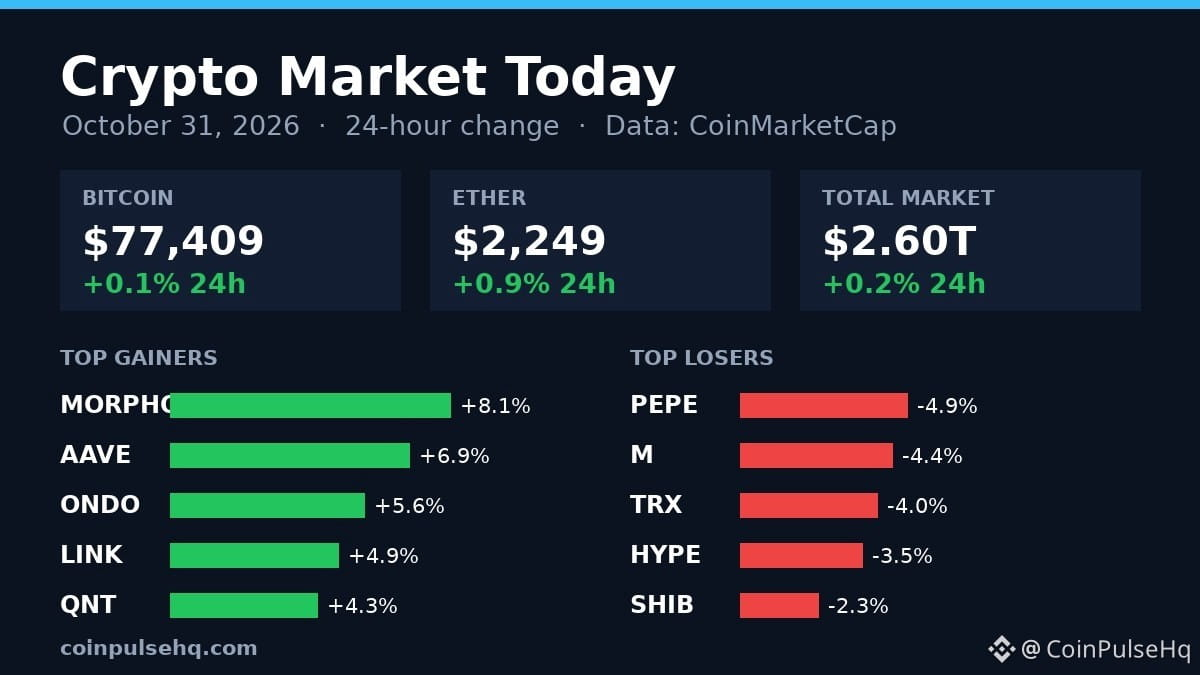
Thị trường tiền mã hóa hôm nay, 31/10/2026: Bitcoin ổn định quanh 77,4 nghìn USD khi Morpho tăng vọt 8%Thị trường tiền mã hóa gần như không đổi trong 24 giờ qua. Tổng giá trị thị trường tăng 0,2%, lên 2,60 nghìn tỷ USD tính đến 13:00 UTC thứ Bảy, ngày 31 tháng 10 năm 2026. Bitcoin được giao dịch ở mức 77.409 USD (+0,1%) và Ether ở mức 2.249 USD (+0,9%). 30 trong số 50 đồng tiền lớn nhất tăng giá, và mức biến động trung vị là +0,3%.
Vì sao thị trường tiền mã hóa đi ngang hôm nay? Các con số cho thấy điều gì
• Độ rộng thị trường. Thị trường không có xu hướng rõ ràng: 30 trong số 50 đồng tiền lớn tăng giá và 20 đồng giảm giá, nên mức tăng của một số đồng đã bù đắp cho mức giảm của những đồng khác.
• Bitcoin so với altcoin. 28 trong số 49 đồng tiền lớn còn lại có hiệu suất tốt hơn Bitcoin, cho thấy vị thế dẫn đầu được chia đều. Tỷ lệ thống trị của Bitcoin là 59,8%, và Ether vượt Bitcoin 0,7 điểm phần trăm.
Thị trường tiền mã hóa hôm nay, 31/10/2026: Bitcoin ổn định quanh 77,4 nghìn USD khi Morpho tăng vọt 8%
Thị trường tiền mã hóa gần như không đổi trong 24 giờ qua. Tổng giá trị thị trường tăng 0,2%, lên 2,60 nghìn tỷ USD tính đến 13:00 UTC thứ Bảy, ngày 31 tháng 10 năm 2026. Bitcoin được giao dịch ở mức 77.409 USD (+0,1%) và Ether ở mức 2.249 USD (+0,9%). 30 trong số 50 đồng tiền lớn nhất tăng giá, và mức biến động trung vị là +0,3%.
Vì sao thị trường tiền mã hóa đi ngang hôm nay? Các con số cho thấy điều gì
• Độ rộng thị trường. Thị trường không có xu hướng rõ ràng: 30 trong số 50 đồng tiền lớn tăng giá và 20 đồng giảm giá, nên mức tăng của một số đồng đã bù đắp cho mức giảm của những đồng khác.
• Bitcoin so với altcoin. 28 trong số 49 đồng tiền lớn còn lại có hiệu suất tốt hơn Bitcoin, cho thấy vị thế dẫn đầu được chia đều. Tỷ lệ thống trị của Bitcoin là 59,8%, và Ether vượt Bitcoin 0,7 điểm phần trăm.
·
--
Bài viết
Vụ tấn công Polymarket khiến hơn 700 tài khoản mất 2,6 triệu USDCointribune đưa tin, Polymarket đã tạm ngừng giao dịch khoảng một giờ vào ngày 29 tháng 10 năm 2026, sau khi một tập lệnh bên thứ ba bị xâm phạm cho phép kẻ tấn công bán các vị thế của người dùng và chuyển tiền của họ mà không được phép. Thiệt hại ước tính ít nhất 2,6 triệu USD trên hơn 700 tài khoản.
Các nhà giao dịch cho biết tài sản bị bán trái phép và số dư bị rút cạn; trong đó, một người dùng nói rằng họ mất 800.000 USD, còn tài khoản của một người khác bị rút sạch 600.000 USD. Polymarket cam kết hoàn trả cho tất cả những người bị ảnh hưởng và cho biết đã chuyển vụ việc cho giới chức Anh.
Vụ tấn công Polymarket khiến hơn 700 tài khoản mất 2,6 triệu USD
Cointribune đưa tin, Polymarket đã tạm ngừng giao dịch khoảng một giờ vào ngày 29 tháng 10 năm 2026, sau khi một tập lệnh bên thứ ba bị xâm phạm cho phép kẻ tấn công bán các vị thế của người dùng và chuyển tiền của họ mà không được phép. Thiệt hại ước tính ít nhất 2,6 triệu USD trên hơn 700 tài khoản.
Các nhà giao dịch cho biết tài sản bị bán trái phép và số dư bị rút cạn; trong đó, một người dùng nói rằng họ mất 800.000 USD, còn tài khoản của một người khác bị rút sạch 600.000 USD. Polymarket cam kết hoàn trả cho tất cả những người bị ảnh hưởng và cho biết đã chuyển vụ việc cho giới chức Anh.
Các nhà giao dịch cho biết tài sản bị bán trái phép và số dư bị rút cạn; trong đó, một người dùng nói rằng họ mất 800.000 USD, còn tài khoản của một người khác bị rút sạch 600.000 USD. Polymarket cam kết hoàn trả cho tất cả những người bị ảnh hưởng và cho biết đã chuyển vụ việc cho giới chức Anh.
7
2.8k
·
--
Bài viết
Coinbase giảm 12,5%, Strategy giảm 6% khi vụ vi phạm tại Binance tác động đến cổ phiếuCác cổ phiếu liên quan đến tiền mã hóa lao dốc vào thứ Sáu, ngày 30 tháng 10 năm 2026, khi vụ vi phạm an ninh trị giá hàng tỷ đô la tại Binance diễn ra cùng lúc với đà giảm của lĩnh vực công nghệ do lo ngại về chi tiêu cho trí tuệ nhân tạo. Bitcoin.com News đưa tin Coinbase giảm hơn 12% và Strategy giảm 6%, dù cả hai công ty đều công bố lợi nhuận hàng quý vào tối hôm trước.
Nguồn tin cho biết bitcoin có lúc giảm về gần 76.000 đô la vào sáng thứ Sáu, trước khi nhích trở lại lên ngay dưới 77.900 đô la, giảm gần 5% trong 24 giờ. Hơn 1,5 tỷ đô la vị thế tiền mã hóa sử dụng đòn bẩy đã bị thanh lý trong khoảng thời gian đó.
Coinbase giảm 12,5%, Strategy giảm 6% khi vụ vi phạm tại Binance tác động đến cổ phiếu
Các cổ phiếu liên quan đến tiền mã hóa lao dốc vào thứ Sáu, ngày 30 tháng 10 năm 2026, khi vụ vi phạm an ninh trị giá hàng tỷ đô la tại Binance diễn ra cùng lúc với đà giảm của lĩnh vực công nghệ do lo ngại về chi tiêu cho trí tuệ nhân tạo. Bitcoin.com News đưa tin Coinbase giảm hơn 12% và Strategy giảm 6%, dù cả hai công ty đều công bố lợi nhuận hàng quý vào tối hôm trước.
Nguồn tin cho biết bitcoin có lúc giảm về gần 76.000 đô la vào sáng thứ Sáu, trước khi nhích trở lại lên ngay dưới 77.900 đô la, giảm gần 5% trong 24 giờ. Hơn 1,5 tỷ đô la vị thế tiền mã hóa sử dụng đòn bẩy đã bị thanh lý trong khoảng thời gian đó.
Nguồn tin cho biết bitcoin có lúc giảm về gần 76.000 đô la vào sáng thứ Sáu, trước khi nhích trở lại lên ngay dưới 77.900 đô la, giảm gần 5% trong 24 giờ. Hơn 1,5 tỷ đô la vị thế tiền mã hóa sử dụng đòn bẩy đã bị thanh lý trong khoảng thời gian đó.
53
·
--
Bài viết
Ethena cho biết khoản phơi nhiễm 8,8 triệu USD với Binance được lưu ký ngoài sànEthena, nhóm đứng sau stablecoin tổng hợp sinh lợi USDe, cho biết tổng mức phơi nhiễm lãi/lỗ chưa thực hiện của họ với Binance vào khoảng 8,8 triệu USD — thấp hơn nhiều so với quỹ dự trữ vượt mức hơn 60 triệu USD của họ — sau một sự cố an ninh tại sàn giao dịch, theo AMBCrypto.
Giao thức này cho biết toàn bộ tài sản bảo chứng cho USDe được lưu ký ngoài chuỗi bởi các đơn vị lưu ký, thay vì trên các sàn giao dịch tập trung. Crypto Briefing đưa tin rằng Ethena lần đầu cảnh báo về một sự cố an ninh tiềm ẩn liên quan đến Binance vào ngày 29 tháng 10 năm 2026, đồng thời cho biết tài sản thế chấp có mức độ phơi nhiễm với sàn được nắm giữ tại các đơn vị cung cấp dịch vụ thanh toán ngoài sàn, trong đó có Copper và Ceffu. Crypto Briefing cũng nêu tên Coinbase trong bài viết của AMBCrypto về các thỏa thuận lưu ký, trong khi AMBCrypto còn nêu Coinbase cùng với Copper và Ceffu.
Ethena cho biết khoản phơi nhiễm 8,8 triệu USD với Binance được lưu ký ngoài sàn
Ethena, nhóm đứng sau stablecoin tổng hợp sinh lợi USDe, cho biết tổng mức phơi nhiễm lãi/lỗ chưa thực hiện của họ với Binance vào khoảng 8,8 triệu USD — thấp hơn nhiều so với quỹ dự trữ vượt mức hơn 60 triệu USD của họ — sau một sự cố an ninh tại sàn giao dịch, theo AMBCrypto.
Giao thức này cho biết toàn bộ tài sản bảo chứng cho USDe được lưu ký ngoài chuỗi bởi các đơn vị lưu ký, thay vì trên các sàn giao dịch tập trung. Crypto Briefing đưa tin rằng Ethena lần đầu cảnh báo về một sự cố an ninh tiềm ẩn liên quan đến Binance vào ngày 29 tháng 10 năm 2026, đồng thời cho biết tài sản thế chấp có mức độ phơi nhiễm với sàn được nắm giữ tại các đơn vị cung cấp dịch vụ thanh toán ngoài sàn, trong đó có Copper và Ceffu. Crypto Briefing cũng nêu tên Coinbase trong bài viết của AMBCrypto về các thỏa thuận lưu ký, trong khi AMBCrypto còn nêu Coinbase cùng với Copper và Ceffu.
Giao thức này cho biết toàn bộ tài sản bảo chứng cho USDe được lưu ký ngoài chuỗi bởi các đơn vị lưu ký, thay vì trên các sàn giao dịch tập trung. Crypto Briefing đưa tin rằng Ethena lần đầu cảnh báo về một sự cố an ninh tiềm ẩn liên quan đến Binance vào ngày 29 tháng 10 năm 2026, đồng thời cho biết tài sản thế chấp có mức độ phơi nhiễm với sàn được nắm giữ tại các đơn vị cung cấp dịch vụ thanh toán ngoài sàn, trong đó có Copper và Ceffu. Crypto Briefing cũng nêu tên Coinbase trong bài viết của AMBCrypto về các thỏa thuận lưu ký, trong khi AMBCrypto còn nêu Coinbase cùng với Copper và Ceffu.
242
·
--
Bài viết
RUNE của THORChain tăng hơn 13% khi tiền từ vụ hack Binance đi quaBitcoinist đưa tin rằng token gốc RUNE của THORChain đã tăng hơn 13%, lên khoảng 0,67 USD vào thứ Sáu từ mức đáy cục bộ 0,59 USD, khi các nhà điều tra theo dõi dòng tiền từ vụ vi phạm an ninh của Binance di chuyển qua giao thức xuyên chuỗi. AMBCrypto cho biết mức tăng trong 24 giờ vượt 15% và mô tả bối cảnh thị trường là tổng vốn hóa đã mất 160 tỷ USD.
Binance ước tính thiệt hại từ vụ vi phạm vào khoảng 6,30 tỷ USD, biến đây thành một trong những vụ trộm tiền mã hóa lớn nhất từng được đưa tin. Bitcoinist cho biết cuộc điều tra sơ bộ của sàn giao dịch chỉ ra khả năng máy tính xách tay của một kỹ sư DevOps bị xâm nhập, có thể đã giúp những kẻ tấn công tiếp cận cơ sở hạ tầng nội bộ và thực hiện các lệnh rút tiền trái phép.
RUNE của THORChain tăng hơn 13% khi tiền từ vụ hack Binance đi qua
Bitcoinist đưa tin rằng token gốc RUNE của THORChain đã tăng hơn 13%, lên khoảng 0,67 USD vào thứ Sáu từ mức đáy cục bộ 0,59 USD, khi các nhà điều tra theo dõi dòng tiền từ vụ vi phạm an ninh của Binance di chuyển qua giao thức xuyên chuỗi. AMBCrypto cho biết mức tăng trong 24 giờ vượt 15% và mô tả bối cảnh thị trường là tổng vốn hóa đã mất 160 tỷ USD.
Binance ước tính thiệt hại từ vụ vi phạm vào khoảng 6,30 tỷ USD, biến đây thành một trong những vụ trộm tiền mã hóa lớn nhất từng được đưa tin. Bitcoinist cho biết cuộc điều tra sơ bộ của sàn giao dịch chỉ ra khả năng máy tính xách tay của một kỹ sư DevOps bị xâm nhập, có thể đã giúp những kẻ tấn công tiếp cận cơ sở hạ tầng nội bộ và thực hiện các lệnh rút tiền trái phép.
Binance ước tính thiệt hại từ vụ vi phạm vào khoảng 6,30 tỷ USD, biến đây thành một trong những vụ trộm tiền mã hóa lớn nhất từng được đưa tin. Bitcoinist cho biết cuộc điều tra sơ bộ của sàn giao dịch chỉ ra khả năng máy tính xách tay của một kỹ sư DevOps bị xâm nhập, có thể đã giúp những kẻ tấn công tiếp cận cơ sở hạ tầng nội bộ và thực hiện các lệnh rút tiền trái phép.
90
Đăng nhập để khám phá thêm nội dung
Tham gia cùng người dùng tiền mã hóa toàn cầu trên Binance Square
⚡️ Nhận thông tin mới nhất và hữu ích về tiền mã hóa.
💬 Được tin cậy bởi sàn giao dịch tiền mã hóa lớn nhất thế giới.
👍 Khám phá những thông tin chuyên sâu thực tế từ những nhà sáng tạo đã xác minh.
Email / Số điện thoại
Chủ đề thịnh hành
TinFed
390,009 lượt xem
1,088 đang thảo luận
Cập nhật cả 2 luôn, hôm nay 3/11/2026 thị trường bị kẹp giữa SOL yếu và FED diều hâu:
SOL hôm nay:
Giá: $91.85 - $93.29, đang quanh $91.5 - $92.3, giảm ∼0.4% - 1.8%, range 24h $91.39 - $94.51
7 ngày -8.5%, 30 ngày -23%
Tin xấu chính:
- ETF rút kỷ lục: 5 phiên gần nhất outflow $63.4M, tuần trước $71.47M là tuần rút lớn nhất từ khi có ETF, tháng 10 rút $143.7M
- Hậu Binance hack $6.3B: Binance bị rút ròng $3.64B sau khi mở lại rút tiền
- Liquidation $15.28M long SOL
Tin tốt đỡ lại:
- RWA trên Solana đạt ATH $5.12B - $5.19B, +17.65% trong 30 ngày
- Doanh thu app Q3 $299M, card spending kỷ lục $141.1M
- Nâng cấp Agave v4.4.0 và Firedancer mainnet v26.10.5 đã release 29/10, Alpenglow protocol giúp finality nhanh hơn
FED hôm nay - quan trọng hơn cho cả crypto:
Đã họp 28/10: FED giữ nguyên lãi suất 3.75% - 4.00%, vote 10-2, 2 người muốn tăng thêm 0.25%
Lãi suất thực tế tuần 26-30/10: Fed funds effective 3.88%, prime 7.00%, discount 4.00%
10-year yield biến động mạnh: từ 5.00% lên 5.05% rồi về 4.94% cuối 30/10
Chủ tịch FED Kevin Warsh phát tín hiệu diều hâu, nói lãi suất sẽ siết mạnh các ngành thâm dụng vốn, thị trường đang pricing khả năng cao tăng 0.25% vào tháng 12
BNY dự báo: thêm 1 lần tăng tháng 12 để giữ uy tín, 2027 thì mù mờ hơn
Hôm nay 3/11 là bầu cử giữa kỳ Mỹ: toàn bộ 435 ghế Hạ viện và 1/3 Thượng viện, market dự đoán Dân chủ có 74% cơ hội lấy Thượng viện, cái này cũng làm dollar và crypto rung lắc
=> Nói ngắn gọn: FED đang tạm pause nhưng không dovish, vẫn có thể tăng tiếp tháng 12 nên crypto bao gồm SOL, BTC đang bị đè risk. SOL đang oversold nhưng nếu FED tăng thì khó hồi mạnh ngay.
#TinFed $SOL
Frog princetrade
·0 lượt thích
·120 lượt xem
TheoDõiFOMC
317,754 lượt xem
1,364 đang thảo luận
BinanceIncidentReport
5,373 lượt xem
228 đang thảo luận