
Binnoreen
31 Bài đăng

Binnoreen
Báo cáo
Chặn người dùng
Web3 Advocate||Web 3 content creator|| passionate about crypto adoption||thread writer||MOD||Certified Crypto Trader @BitkovaHub||intern @TrustChain0||
Giao dịch mở
Trader tần suất thấp
{thời gian} năm
94 Đang theo dõi
45 Người theo dõi
16 Đã thích
Bài đăng
Danh mục đầu tư
Tất cả
Trích dẫn
PINNED
·
--

Bài viết
Xem bản dịch
STON.fi: Inside TON’s Leading AMM DEXAn evidence-based look at the AMM, liquidity architecture, Omniston, governance, security, and the data behind STON.fi’s position on TON.
On a decentralized exchange, the most visible action is simple: a user selects one token, chooses another, enters an amount, and presses Swap.
Behind that button, however, sits a considerably more complicated system.
Liquidity has to be available. Prices have to be calculated. Smart contracts have to coordinate the transaction. Liquidity providers need to receive their share of fees. The system needs to protect users from excessive price movement, while developers need infrastructure capable of supporting thousands of different assets.
On TON, one of the most established systems built around that problem is STON.fi.
STON.fi describes itself as a decentralized automated market maker (AMM) exchange built on the TON blockchain. Independent analytics currently place it ahead of other tracked TON DEXs by both total value locked and recent DEX volume.
But calling something “leading” raises a more useful question:
What exactly makes STON.fi a leader, and what is happening underneath the interface?
To answer that, it is necessary to look beyond the swap screen.
❑ From a one-Jetton AMM to a broader trading infrastructure
STON.fi's history begins with a relatively simple proposition.
The protocol's own historical material identifies November 20, 2022 as the launch of its initial AMM, at a time when the system supported only one Jetton.
Since then, the project has expanded through multiple stages: developer tools and integrations, staking and farming, protocol upgrades, new pool types, governance, and eventually Omniston.
That progression matters because today's STON.fi is not identical to the system that launched in 2022.
The original product was primarily an AMM.
The current ecosystem combines the core AMM with additional infrastructure designed to aggregate liquidity and execute trades across different sources and, increasingly, different blockchains.
That distinction becomes particularly important when looking at trading-volume statistics.
❑The mechanism underneath every swap
At its foundation, an AMM replaces the traditional order book with liquidity pools and mathematical pricing rules.
In an order-book exchange, buyers and sellers place orders and a matching engine determines which orders can be executed.
An AMM works differently.
Liquidity providers deposit assets into a pool. The protocol then uses the pool's reserves to calculate exchange rates.
For STON.fi's original constant-product model, the relationship can be represented as:
x × y = k
where:
x represents the quantity of one asset in the pool;
y represents the quantity of the other;
k is the pool's invariant.
When a trader removes one asset from the pool by swapping into it, the relative reserve of that asset changes. The resulting price therefore changes as well.
This is why a large trade can move the market price inside a pool.
That effect is known as price impact.
It is different from slippage, which describes the difference between the expected execution and the actual execution allowed by the user's transaction settings.
For a beginner, the distinction is important:
Price impact comes from the size of the trade relative to available liquidity.
Slippage protection determines how much execution movement the user is willing to tolerate.
STON.fi's documentation describes these mechanisms as part of its swap and liquidity architecture.
❑ A swap is more than a token exchange
The STON.fi architecture divides responsibilities between several smart-contract components.
The Router serves as the main entry point for interactions. Pool contracts contain the liquidity and perform the AMM calculations. Account contracts are used during certain liquidity operations, while LP Jetton wallets represent liquidity-provider positions.
A simplified swap looks like this:
User wallet → Router → Pool → Router → User wallet
The user sends the input asset to the Router.
The Router communicates with the relevant Pool.
The Pool calculates the exchange according to its pool type and reserves.
The output asset is then returned to the user.
This architecture is particularly relevant on TON because TON uses asynchronous message-based smart-contract interactions rather than simply reproducing the execution model commonly seen on EVM chains.
STON.fi's technical documentation describes the interaction using TON's Jetton transfer and notification mechanisms.
The result is that a swap that looks like one action in the interface can involve several contract-to-contract messages underneath.
❑STON.fi is no longer limited to one AMM formula
One of the easiest mistakes would be to describe STON.fi entirely as a constant-product AMM.
That was the foundation, but the current protocol supports additional pool designs.
STON.fi documentation describes multiple pool types, including:
- Constant Product;
- StableSwap;
- Weighted Constant Product;
- Weighted StableSwap.
Different pool designs are useful for different asset relationships.
A constant-product pool is a general-purpose mechanism.
A stable-oriented pool can be designed for assets expected to trade close to one another.
Weighted pools can assign different proportions to assets rather than treating both sides identically.
This matters because “AMM” is not one single mathematical design.
It is a broader category of automated liquidity systems.
❑ Where the liquidity providers fit in
The other side of every AMM trade is the liquidity provider.
Instead of matching directly with another trader, the trader interacts with liquidity supplied to the pool.
When liquidity is deposited, the provider receives LP tokens representing their position in that pool.
When trading activity generates fees, liquidity providers can receive a portion of those fees according to the pool's fee structure.
STON.fi documents a default total swap fee of 0.3%, with the commonly documented split allocating approximately 0.2% to liquidity providers and 0.1% to the protocol. Pool-level fees can be configured within the protocol's supported parameters.
This is important because liquidity provision is sometimes described simply as “earning yield.”
That description is incomplete.
The underlying return comes from specific mechanisms, primarily trading fees and, where applicable, additional incentive programs.
And the liquidity provider also accepts risks.
One of the most important is impermanent loss.
❑Why providing liquidity is not the same as staking
Staking and liquidity provision are often grouped together because both can produce rewards.
Mechanically, however, they are different.
A person staking a token generally locks or delegates that token under a specific protocol mechanism.
A liquidity provider deposits assets into a trading pool.
The provider's asset proportions can change as traders buy one asset and sell another.
If the external market price changes significantly, the pool can therefore end up holding a different composition of assets than the provider initially deposited.
That difference can produce impermanent loss relative to simply holding the original assets.
STON.fi provides documentation explaining impermanent loss and even maintains an impermanent-loss calculator.
This is one reason the phrase “LP yield” should never be interpreted as risk-free income.
The relevant question is not merely:
How much are the fees?
It is also:
What risks are being taken to earn those fees?
❑ The Router introduces an important security distinction
One of the more interesting details in STON.fi's architecture is that its smart contracts are not all governed in exactly the same way.
The Pool contracts are described as immutable.
The Router, however, is upgradeable.
The official technical documentation describes administrative capabilities around the Router and a timelocked upgrade process. The documented delay gives users and the ecosystem time to observe a proposed Router upgrade rather than having the implementation change instantly.
That distinction matters.
It would be inaccurate to summarize the protocol simply by saying:
«“STON.fi's smart contracts are immutable.”»
A more accurate description is:
STON.fi combines immutable Pool contracts with an upgradeable Router subject to a timelock.
For users evaluating decentralized protocols, this distinction is more useful than a generic statement about decentralization.
It tells us where change can occur and where it cannot.
❑TON is part of the architecture, not merely the network label
STON.fi was built specifically around TON's architecture.
Its token ecosystem relies on Jettons, TON's token standard.
The contracts communicate through TON's asynchronous message system, and the protocol's documentation discusses how its contracts interact through those messages.
This architecture creates engineering differences from EVM-based AMMs.
A developer cannot simply copy an Ethereum AMM contract to TON and expect the same execution model.
The application has to account for TON's asynchronous contract communication and Jetton mechanics.
STON.fi's architecture is therefore better understood as a TON-native implementation of automated liquidity rather than an Ethereum-style AMM simply deployed onto another chain.
❑ Then came Omniston
At some point, building another liquidity pool stopped being enough.
The problem was liquidity fragmentation.
Imagine several DEXs operating on the same blockchain.
One pool may have the best price for one pair.
Another may have deeper liquidity for another pair.
A third liquidity source might be able to quote a better execution price for a large order.
A user who interacts with only one pool cannot automatically see all those possibilities.
This is the problem Omniston is designed to address.
STON.fi describes Omniston as a liquidity aggregation and execution layer based around Request for Quote (RFQ) mechanisms.
Instead of relying exclusively on one AMM pool, the system can obtain quotes from multiple liquidity sources and resolvers.
The result is a different execution model from a conventional AMM swap.
❑ Omniston is not the same thing as the STON.fi AMM
This distinction deserves emphasis.
STON.fi DEX is the AMM.
Omniston is the aggregation/execution layer.
Omniston can access STON.fi liquidity, but it can also interact with other liquidity sources and RFQ resolvers.
That means an Omniston-routed trade should not automatically be interpreted as a trade executed entirely against STON.fi's own AMM liquidity.
This becomes particularly important when examining aggregate volume.
A headline number for STON.fi's trading activity needs to be understood in the context of what the underlying measurement actually counts.
DefiLlama currently defines STON.fi's DEX volume as spot token swaps on the DEX, while its methodology separately defines TVL, fees and protocol revenue.
The distinction between native AMM liquidity and aggregated execution therefore belongs in any serious analysis of STON.fi's scale.
❑Omniston is also changing the cross-chain equation
Cross-chain trading introduces another problem.
Blockchains do not naturally share one state.
Moving assets between networks therefore requires a mechanism for coordinating transactions across separate ledgers.
Omniston's newer architecture uses RFQ-based liquidity discovery combined with Hashed Timelock Contracts (HTLCs) for cross-chain settlement.
In the model described by STON.fi, resolvers compete to fill a user's request. Once a quote is selected, the cross-chain settlement uses paired cryptographic conditions so that the two sides either settle according to the agreed conditions or become refundable after the relevant timelocks expire.
This is materially different from the traditional bridge model in which assets are deposited into a central contract and a representation is issued on another chain.
It also introduces a new set of dependencies.
The system now depends not only on smart-contract correctness, but also on resolver liquidity, quote quality, settlement logic and cross-chain execution.
That does not make the system inherently good or bad.
It simply changes what must be evaluated.
❑ The numbers behind STON.fi's market position
This is where the phrase “leading AMM” can be tested rather than repeated.
At the latest available DefiLlama snapshot used for this article, STON.fi had approximately:
- $26.06 million TVL
- $88.02 million 30-day DEX volume
- $16.84 million 7-day DEX volume
- $1.75 million 24-hour DEX volume
- $8.56 billion cumulative DEX volume
DefiLlama lists TON as the chain accounting for 100% of the tracked TVL.
More importantly, the same dataset provides a common basis for comparison.
DefiLlama currently lists approximately:
- STON.fi — $26.06M TVL
- TONCO — $5.94M
- DeDust — $4.52M
- Megaton Finance — $728K
- Torch — $472K
Those figures are snapshots and can change continuously, but they show that STON.fi currently has a substantial lead in TVL among the listed TON DEX competitors.
The same pattern appears in recent trading volume.
That gives the “leading” description a measurable basis.
But the evidence supports a metric-specific conclusion, not an unlimited one.
It demonstrates leadership in currently tracked liquidity and trading volume.
It does not automatically establish leadership in every possible category, such as developer preference, user satisfaction, decentralization, security, or every measure of active users.
❑ Scale matters, but methodology matters too
There is another reason to avoid using one headline number without context.
STON.fi publishes its own historical statistics, while independent analytics providers calculate their own measurements.
Different systems can produce different cumulative-volume numbers because they can differ in:
- data sources;
- inclusion criteria;
- aggregation methods;
- treatment of routed transactions;
- update timing.
Therefore, if STON.fi reports one cumulative volume and an analytics provider reports another, the difference should not automatically be described as an error.
The appropriate question is:
What does each number actually measure?
That is why the article uses third-party analytics for comparative market measurements and official documentation for protocol mechanics.
❑The STON token is tied to governance as well as incentives
STON is the protocol's native token.
The original whitepaper documented a total supply of 100 million STON, with allocations to the DAO, team and advisors, and investors.
But the original tokenomics document should not be treated as a complete description of the protocol's current economic system.
The protocol has since introduced DAO governance and subsequent governance decisions affecting the use of protocol fees and treasury mechanisms.
The current DAO uses a staking-based governance system.
Users stake STON for a period between three and 24 months and receive an ARKENSTON NFT representing governance voting power.
The DAO currently describes a seven-day discussion period followed by a 14-day voting period. Proposal creation requires at least 240.17 voting power in a single ARKENSTON NFT. Voting power also changes over time according to the governance system's staking and decay mechanics.
This makes STON more than simply a token distributed as an incentive.
It forms part of the protocol's governance mechanism.
❑ But DAO governance does not mean every component is controlled by token holders
This is another distinction worth preserving.
The existence of a DAO does not automatically mean that every technical parameter or smart contract can be changed directly by a token vote.
The governance system has defined powers, while operational and technical authority can remain elsewhere.
For example, the Router's upgradeability remains an architectural consideration independent of the existence of DAO voting.
That means the more accurate question is not:
“Is STON.fi decentralized?”
but:
“Which parts of STON.fi are controlled through which mechanisms?”
That question produces a much more useful picture.
❑ Security: audits reduce uncertainty, not eliminate it
STON.fi's v2 DEX contracts underwent a security review by Trail of Bits in January 2025. Trail of Bits lists the engagement in its public publications repository.
STON.fi also documents additional security measures and a bug-bounty program.
An audit is important because it introduces an independent review of the code.
But an audit is not a guarantee.
Smart-contract systems can contain:
- undiscovered vulnerabilities;
- economic exploits;
- integration risks;
- oracle or pricing risks;
- governance risks;
- upgrade risks;
- operational failures.
Consequently, the responsible statement is:
STON.fi has undergone external security reviews.
It would be inappropriate to convert that into:
STON.fi is completely safe.
No serious smart-contract system can justify the second statement merely from an audit.
❑What the evidence actually says about STON.fi's leadership
After separating the AMM from Omniston, distinguishing official claims from independent measurements, and putting the statistics into a common framework, the evidence is relatively clear.
STON.fi has several characteristics associated with a leading TON AMM:
- It has operated since 2022.
- It has built native TON AMM infrastructure.
- It supports multiple pool designs.
- It has accumulated substantial liquidity.
- It processes significant trading volume.
- It has a large historical transaction footprint.
- It has developed developer and integration tooling.
- It has introduced governance.
- It has expanded into liquidity aggregation through Omniston.
- Independent analytics currently place it ahead of the principal tracked TON DEX competitors by TVL and recent DEX volume.
Those are measurable characteristics.
They do not mean STON.fi is automatically the best choice for every trader or liquidity provider.
They also do not eliminate the risks inherent in AMMs, smart contracts, governance or cross-chain execution.
But they do provide a factual basis for describing STON.fi as a leading AMM on TON, particularly when leadership is measured by current liquidity and trading activity.
❑ The more interesting story is what comes after the AMM
The original problem STON.fi solved was relatively straightforward:
How can TON users exchange tokens without relying on a centralized order book?
The problem the ecosystem faces today is broader:
How can liquidity distributed across different pools, protocols and blockchains be made accessible through a coherent execution layer?
STON.fi's answer has evolved accordingly.
The AMM remains the underlying liquidity mechanism.
Omniston adds aggregation and RFQ-based execution.
The DAO introduces community governance.
Developer tooling extends the protocol into third-party applications.
Cross-chain functionality attempts to make TON liquidity accessible beyond TON itself.
Each layer introduces new capabilities.
Each also introduces new things that need to be evaluated.
That is why STON.fi is more interesting today as a piece of DeFi infrastructure than simply as a screen where users swap one Jetton for another.
❑ Where the evidence stops
A research-based assessment also needs boundaries.
The exact number of active users is difficult to compare consistently across protocols.
The advertised number of supported tokens is not equivalent to the number of actively liquid trading mmarkets.
Current circulating STON supply and remaining unlock schedules require direct on-chain verification rather than relying solely on historical tokenomics documents.
Cross-chain functionality is evolving, and different official materials describe different stages of its rollout.
And while current independent data supports STON.fi's leadership in tracked TON TVL and DEX volume, “leading” should not be interpreted as a universal ranking across every conceivable metric.
Those limitations do not weaken the analysis.
They define what the evidence can actually support.
❑ STON.fi's position is measurable — but the mechanism explains the numbers
$The most useful way to understand STON.fi is not as a claim that it is “the best DEX.”
It is as a layered system.
At the bottom is the AMM, where liquidity pools allow users to trade without a conventional order book.
Around that are the Router and smart-contract architecture, which coordinate interactions with those pools.
Above that are liquidity aggregation and execution systems such as Omniston, designed to search across liquidity sources rather than relying on a single pool.
And around the protocol sits a growing governance and developer ecosystem.
Current data shows that this infrastructure has achieved substantial scale on TON.
But the numbers become meaningful only when the mechanisms behind them are understood.
That is ultimately what the STON.fi story illustrates: the evolution of a simple AMM into a broader attempt to organize fragmented liquidity around TON and, increasingly, across blockchain networks.
The evidence supports calling STON.fi a leading TON AMM by current tracked liquidity and trading volume.
The rest of the claim — security, decentralization, efficiency, user experience, and long-term cross-chain success — requires separate evidence.
And that distinction is precisely where responsible DeFi research should begin.
❑ References
Official Sources
STON.fi — Official Website: https://ston.fi/
STON.fi Documentation:
https://docs.ston.fi/
STON.fi User Guide: https://guide.ston.fi/
STON.fi GitHub: https://github.com/ston-fi
STON.fi Blog: https://blog.ston.fi/
STON.fi DAO: https://dao.ston.fi/
STON.fi DAO Governance: https://dao.ston.fi/about
STONbassadors Program: https://ston.fi/stonbassadors
STON.fi DEX: https://app.ston.fi/swap
Omniston: https://ston.fi/omniston
Research and Analytics
DefiLlama — STON.fi Metrics:
https://defillama.com/protocol/ston.fi
Trail of Bits — Public Security Publications: https://github.com/trailofbits/publications
Technical / Historical Sources
Omniston: TON liquidity in one service — STON.fi Blog: https://blog.ston.fi/stonchronicles-omniston-ton-liquidity-in-one-service/
Cross-chain portfolio rebalancing: HTLC & RFQ — STON.fi Blog: https://blog.ston.fi/cross-chain-portfolio-rebalancing-how-htlc-and-rfq-swaps-work-for-defi-users/
Omniston explained: cross-chain swaps without a bridge — STON.fi Blog: https://blog.ston.fi/omniston-explained-how-cross-chain-swaps-on-ton-work-without-a-bridge/
Technical Documentation
STON.fi Protocol: https://docs.ston.fi/document/user-section/protocol
STON.fi Developer Documentation: https://docs.ston.fi/document
STON.fi Quickstart Guides: https://docs.ston.fi/developer-section/quickstart
STON.fi API Reference: https://docs.ston.fi/developer-section/dex/api/reference
STON.fi v1 Smart Contracts: https://docs.ston.fi/document/developer-section/api-reference-v1
Community / Ambassador Sources
STONbassadors Official Program: https://ston.fi/stonbassadors
STON.fi X: https://x.com/ston_fi
STON.fi Telegram: https://t.me/stonfidex
STON.fi Discord:
https://discord.com/invite/bdmaGV6qUW
STON.fi Reddit: https://www.reddit.com/r/Stonfiers/
Written by Binnoreen
X: Bin_noreen https://x.com/Bin_noreen
Telegram: Binnoreen
https://t.me/binnoreen
STON.fi: Inside TON’s Leading AMM DEX
An evidence-based look at the AMM, liquidity architecture, Omniston, governance, security, and the data behind STON.fi’s position on TON.
On a decentralized exchange, the most visible action is simple: a user selects one token, chooses another, enters an amount, and presses Swap.
Behind that button, however, sits a considerably more complicated system.
Liquidity has to be available. Prices have to be calculated. Smart contracts have to coordinate the transaction. Liquidity providers need to receive their share of fees. The system needs to protect users from excessive price movement, while developers need infrastructure capable of supporting thousands of different assets.
On TON, one of the most established systems built around that problem is STON.fi.
STON.fi describes itself as a decentralized automated market maker (AMM) exchange built on the TON blockchain. Independent analytics currently place it ahead of other tracked TON DEXs by both total value locked and recent DEX volume.
But calling something “leading” raises a more useful question:
What exactly makes STON.fi a leader, and what is happening underneath the interface?
To answer that, it is necessary to look beyond the swap screen.
❑ From a one-Jetton AMM to a broader trading infrastructure
STON.fi's history begins with a relatively simple proposition.
The protocol's own historical material identifies November 20, 2022 as the launch of its initial AMM, at a time when the system supported only one Jetton.
Since then, the project has expanded through multiple stages: developer tools and integrations, staking and farming, protocol upgrades, new pool types, governance, and eventually Omniston.
That progression matters because today's STON.fi is not identical to the system that launched in 2022.
The original product was primarily an AMM.
The current ecosystem combines the core AMM with additional infrastructure designed to aggregate liquidity and execute trades across different sources and, increasingly, different blockchains.
That distinction becomes particularly important when looking at trading-volume statistics.
❑The mechanism underneath every swap
At its foundation, an AMM replaces the traditional order book with liquidity pools and mathematical pricing rules.
In an order-book exchange, buyers and sellers place orders and a matching engine determines which orders can be executed.
An AMM works differently.
Liquidity providers deposit assets into a pool. The protocol then uses the pool's reserves to calculate exchange rates.
For STON.fi's original constant-product model, the relationship can be represented as:
x × y = k
where:
x represents the quantity of one asset in the pool;
y represents the quantity of the other;
k is the pool's invariant.
When a trader removes one asset from the pool by swapping into it, the relative reserve of that asset changes. The resulting price therefore changes as well.
This is why a large trade can move the market price inside a pool.
That effect is known as price impact.
It is different from slippage, which describes the difference between the expected execution and the actual execution allowed by the user's transaction settings.
For a beginner, the distinction is important:
Price impact comes from the size of the trade relative to available liquidity.
Slippage protection determines how much execution movement the user is willing to tolerate.
STON.fi's documentation describes these mechanisms as part of its swap and liquidity architecture.
❑ A swap is more than a token exchange
The STON.fi architecture divides responsibilities between several smart-contract components.
The Router serves as the main entry point for interactions. Pool contracts contain the liquidity and perform the AMM calculations. Account contracts are used during certain liquidity operations, while LP Jetton wallets represent liquidity-provider positions.
A simplified swap looks like this:
User wallet → Router → Pool → Router → User wallet
The user sends the input asset to the Router.
The Router communicates with the relevant Pool.
The Pool calculates the exchange according to its pool type and reserves.
The output asset is then returned to the user.
This architecture is particularly relevant on TON because TON uses asynchronous message-based smart-contract interactions rather than simply reproducing the execution model commonly seen on EVM chains.
STON.fi's technical documentation describes the interaction using TON's Jetton transfer and notification mechanisms.
The result is that a swap that looks like one action in the interface can involve several contract-to-contract messages underneath.
❑STON.fi is no longer limited to one AMM formula
One of the easiest mistakes would be to describe STON.fi entirely as a constant-product AMM.
That was the foundation, but the current protocol supports additional pool designs.
STON.fi documentation describes multiple pool types, including:
- Constant Product;
- StableSwap;
- Weighted Constant Product;
- Weighted StableSwap.
Different pool designs are useful for different asset relationships.
A constant-product pool is a general-purpose mechanism.
A stable-oriented pool can be designed for assets expected to trade close to one another.
Weighted pools can assign different proportions to assets rather than treating both sides identically.
This matters because “AMM” is not one single mathematical design.
It is a broader category of automated liquidity systems.
❑ Where the liquidity providers fit in
The other side of every AMM trade is the liquidity provider.
Instead of matching directly with another trader, the trader interacts with liquidity supplied to the pool.
When liquidity is deposited, the provider receives LP tokens representing their position in that pool.
When trading activity generates fees, liquidity providers can receive a portion of those fees according to the pool's fee structure.
STON.fi documents a default total swap fee of 0.3%, with the commonly documented split allocating approximately 0.2% to liquidity providers and 0.1% to the protocol. Pool-level fees can be configured within the protocol's supported parameters.
This is important because liquidity provision is sometimes described simply as “earning yield.”
That description is incomplete.
The underlying return comes from specific mechanisms, primarily trading fees and, where applicable, additional incentive programs.
And the liquidity provider also accepts risks.
One of the most important is impermanent loss.
❑Why providing liquidity is not the same as staking
Staking and liquidity provision are often grouped together because both can produce rewards.
Mechanically, however, they are different.
A person staking a token generally locks or delegates that token under a specific protocol mechanism.
A liquidity provider deposits assets into a trading pool.
The provider's asset proportions can change as traders buy one asset and sell another.
If the external market price changes significantly, the pool can therefore end up holding a different composition of assets than the provider initially deposited.
That difference can produce impermanent loss relative to simply holding the original assets.
STON.fi provides documentation explaining impermanent loss and even maintains an impermanent-loss calculator.
This is one reason the phrase “LP yield” should never be interpreted as risk-free income.
The relevant question is not merely:
How much are the fees?
It is also:
What risks are being taken to earn those fees?
❑ The Router introduces an important security distinction
One of the more interesting details in STON.fi's architecture is that its smart contracts are not all governed in exactly the same way.
The Pool contracts are described as immutable.
The Router, however, is upgradeable.
The official technical documentation describes administrative capabilities around the Router and a timelocked upgrade process. The documented delay gives users and the ecosystem time to observe a proposed Router upgrade rather than having the implementation change instantly.
That distinction matters.
It would be inaccurate to summarize the protocol simply by saying:
«“STON.fi's smart contracts are immutable.”»
A more accurate description is:
STON.fi combines immutable Pool contracts with an upgradeable Router subject to a timelock.
For users evaluating decentralized protocols, this distinction is more useful than a generic statement about decentralization.
It tells us where change can occur and where it cannot.
❑TON is part of the architecture, not merely the network label
STON.fi was built specifically around TON's architecture.
Its token ecosystem relies on Jettons, TON's token standard.
The contracts communicate through TON's asynchronous message system, and the protocol's documentation discusses how its contracts interact through those messages.
This architecture creates engineering differences from EVM-based AMMs.
A developer cannot simply copy an Ethereum AMM contract to TON and expect the same execution model.
The application has to account for TON's asynchronous contract communication and Jetton mechanics.
STON.fi's architecture is therefore better understood as a TON-native implementation of automated liquidity rather than an Ethereum-style AMM simply deployed onto another chain.
❑ Then came Omniston
At some point, building another liquidity pool stopped being enough.
The problem was liquidity fragmentation.
Imagine several DEXs operating on the same blockchain.
One pool may have the best price for one pair.
Another may have deeper liquidity for another pair.
A third liquidity source might be able to quote a better execution price for a large order.
A user who interacts with only one pool cannot automatically see all those possibilities.
This is the problem Omniston is designed to address.
STON.fi describes Omniston as a liquidity aggregation and execution layer based around Request for Quote (RFQ) mechanisms.
Instead of relying exclusively on one AMM pool, the system can obtain quotes from multiple liquidity sources and resolvers.
The result is a different execution model from a conventional AMM swap.
❑ Omniston is not the same thing as the STON.fi AMM
This distinction deserves emphasis.
STON.fi DEX is the AMM.
Omniston is the aggregation/execution layer.
Omniston can access STON.fi liquidity, but it can also interact with other liquidity sources and RFQ resolvers.
That means an Omniston-routed trade should not automatically be interpreted as a trade executed entirely against STON.fi's own AMM liquidity.
This becomes particularly important when examining aggregate volume.
A headline number for STON.fi's trading activity needs to be understood in the context of what the underlying measurement actually counts.
DefiLlama currently defines STON.fi's DEX volume as spot token swaps on the DEX, while its methodology separately defines TVL, fees and protocol revenue.
The distinction between native AMM liquidity and aggregated execution therefore belongs in any serious analysis of STON.fi's scale.
❑Omniston is also changing the cross-chain equation
Cross-chain trading introduces another problem.
Blockchains do not naturally share one state.
Moving assets between networks therefore requires a mechanism for coordinating transactions across separate ledgers.
Omniston's newer architecture uses RFQ-based liquidity discovery combined with Hashed Timelock Contracts (HTLCs) for cross-chain settlement.
In the model described by STON.fi, resolvers compete to fill a user's request. Once a quote is selected, the cross-chain settlement uses paired cryptographic conditions so that the two sides either settle according to the agreed conditions or become refundable after the relevant timelocks expire.
This is materially different from the traditional bridge model in which assets are deposited into a central contract and a representation is issued on another chain.
It also introduces a new set of dependencies.
The system now depends not only on smart-contract correctness, but also on resolver liquidity, quote quality, settlement logic and cross-chain execution.
That does not make the system inherently good or bad.
It simply changes what must be evaluated.
❑ The numbers behind STON.fi's market position
This is where the phrase “leading AMM” can be tested rather than repeated.
At the latest available DefiLlama snapshot used for this article, STON.fi had approximately:
- $26.06 million TVL
- $88.02 million 30-day DEX volume
- $16.84 million 7-day DEX volume
- $1.75 million 24-hour DEX volume
- $8.56 billion cumulative DEX volume
DefiLlama lists TON as the chain accounting for 100% of the tracked TVL.
More importantly, the same dataset provides a common basis for comparison.
DefiLlama currently lists approximately:
- STON.fi — $26.06M TVL
- TONCO — $5.94M
- DeDust — $4.52M
- Megaton Finance — $728K
- Torch — $472K
Those figures are snapshots and can change continuously, but they show that STON.fi currently has a substantial lead in TVL among the listed TON DEX competitors.
The same pattern appears in recent trading volume.
That gives the “leading” description a measurable basis.
But the evidence supports a metric-specific conclusion, not an unlimited one.
It demonstrates leadership in currently tracked liquidity and trading volume.
It does not automatically establish leadership in every possible category, such as developer preference, user satisfaction, decentralization, security, or every measure of active users.
❑ Scale matters, but methodology matters too
There is another reason to avoid using one headline number without context.
STON.fi publishes its own historical statistics, while independent analytics providers calculate their own measurements.
Different systems can produce different cumulative-volume numbers because they can differ in:
- data sources;
- inclusion criteria;
- aggregation methods;
- treatment of routed transactions;
- update timing.
Therefore, if STON.fi reports one cumulative volume and an analytics provider reports another, the difference should not automatically be described as an error.
The appropriate question is:
What does each number actually measure?
That is why the article uses third-party analytics for comparative market measurements and official documentation for protocol mechanics.
❑The STON token is tied to governance as well as incentives
STON is the protocol's native token.
The original whitepaper documented a total supply of 100 million STON, with allocations to the DAO, team and advisors, and investors.
But the original tokenomics document should not be treated as a complete description of the protocol's current economic system.
The protocol has since introduced DAO governance and subsequent governance decisions affecting the use of protocol fees and treasury mechanisms.
The current DAO uses a staking-based governance system.
Users stake STON for a period between three and 24 months and receive an ARKENSTON NFT representing governance voting power.
The DAO currently describes a seven-day discussion period followed by a 14-day voting period. Proposal creation requires at least 240.17 voting power in a single ARKENSTON NFT. Voting power also changes over time according to the governance system's staking and decay mechanics.
This makes STON more than simply a token distributed as an incentive.
It forms part of the protocol's governance mechanism.
❑ But DAO governance does not mean every component is controlled by token holders
This is another distinction worth preserving.
The existence of a DAO does not automatically mean that every technical parameter or smart contract can be changed directly by a token vote.
The governance system has defined powers, while operational and technical authority can remain elsewhere.
For example, the Router's upgradeability remains an architectural consideration independent of the existence of DAO voting.
That means the more accurate question is not:
“Is STON.fi decentralized?”
but:
“Which parts of STON.fi are controlled through which mechanisms?”
That question produces a much more useful picture.
❑ Security: audits reduce uncertainty, not eliminate it
STON.fi's v2 DEX contracts underwent a security review by Trail of Bits in January 2025. Trail of Bits lists the engagement in its public publications repository.
STON.fi also documents additional security measures and a bug-bounty program.
An audit is important because it introduces an independent review of the code.
But an audit is not a guarantee.
Smart-contract systems can contain:
- undiscovered vulnerabilities;
- economic exploits;
- integration risks;
- oracle or pricing risks;
- governance risks;
- upgrade risks;
- operational failures.
Consequently, the responsible statement is:
STON.fi has undergone external security reviews.
It would be inappropriate to convert that into:
STON.fi is completely safe.
No serious smart-contract system can justify the second statement merely from an audit.
❑What the evidence actually says about STON.fi's leadership
After separating the AMM from Omniston, distinguishing official claims from independent measurements, and putting the statistics into a common framework, the evidence is relatively clear.
STON.fi has several characteristics associated with a leading TON AMM:
- It has operated since 2022.
- It has built native TON AMM infrastructure.
- It supports multiple pool designs.
- It has accumulated substantial liquidity.
- It processes significant trading volume.
- It has a large historical transaction footprint.
- It has developed developer and integration tooling.
- It has introduced governance.
- It has expanded into liquidity aggregation through Omniston.
- Independent analytics currently place it ahead of the principal tracked TON DEX competitors by TVL and recent DEX volume.
Those are measurable characteristics.
They do not mean STON.fi is automatically the best choice for every trader or liquidity provider.
They also do not eliminate the risks inherent in AMMs, smart contracts, governance or cross-chain execution.
But they do provide a factual basis for describing STON.fi as a leading AMM on TON, particularly when leadership is measured by current liquidity and trading activity.
❑ The more interesting story is what comes after the AMM
The original problem STON.fi solved was relatively straightforward:
How can TON users exchange tokens without relying on a centralized order book?
The problem the ecosystem faces today is broader:
How can liquidity distributed across different pools, protocols and blockchains be made accessible through a coherent execution layer?
STON.fi's answer has evolved accordingly.
The AMM remains the underlying liquidity mechanism.
Omniston adds aggregation and RFQ-based execution.
The DAO introduces community governance.
Developer tooling extends the protocol into third-party applications.
Cross-chain functionality attempts to make TON liquidity accessible beyond TON itself.
Each layer introduces new capabilities.
Each also introduces new things that need to be evaluated.
That is why STON.fi is more interesting today as a piece of DeFi infrastructure than simply as a screen where users swap one Jetton for another.
❑ Where the evidence stops
A research-based assessment also needs boundaries.
The exact number of active users is difficult to compare consistently across protocols.
The advertised number of supported tokens is not equivalent to the number of actively liquid trading mmarkets.
Current circulating STON supply and remaining unlock schedules require direct on-chain verification rather than relying solely on historical tokenomics documents.
Cross-chain functionality is evolving, and different official materials describe different stages of its rollout.
And while current independent data supports STON.fi's leadership in tracked TON TVL and DEX volume, “leading” should not be interpreted as a universal ranking across every conceivable metric.
Those limitations do not weaken the analysis.
They define what the evidence can actually support.
❑ STON.fi's position is measurable — but the mechanism explains the numbers
$The most useful way to understand STON.fi is not as a claim that it is “the best DEX.”
It is as a layered system.
At the bottom is the AMM, where liquidity pools allow users to trade without a conventional order book.
Around that are the Router and smart-contract architecture, which coordinate interactions with those pools.
Above that are liquidity aggregation and execution systems such as Omniston, designed to search across liquidity sources rather than relying on a single pool.
And around the protocol sits a growing governance and developer ecosystem.
Current data shows that this infrastructure has achieved substantial scale on TON.
But the numbers become meaningful only when the mechanisms behind them are understood.
That is ultimately what the STON.fi story illustrates: the evolution of a simple AMM into a broader attempt to organize fragmented liquidity around TON and, increasingly, across blockchain networks.
The evidence supports calling STON.fi a leading TON AMM by current tracked liquidity and trading volume.
The rest of the claim — security, decentralization, efficiency, user experience, and long-term cross-chain success — requires separate evidence.
And that distinction is precisely where responsible DeFi research should begin.
❑ References
Official Sources
STON.fi — Official Website: https://ston.fi/
STON.fi Documentation:
https://docs.ston.fi/
STON.fi User Guide: https://guide.ston.fi/
STON.fi GitHub: https://github.com/ston-fi
STON.fi Blog: https://blog.ston.fi/
STON.fi DAO: https://dao.ston.fi/
STON.fi DAO Governance: https://dao.ston.fi/about
STONbassadors Program: https://ston.fi/stonbassadors
STON.fi DEX: https://app.ston.fi/swap
Omniston: https://ston.fi/omniston
Research and Analytics
DefiLlama — STON.fi Metrics:
https://defillama.com/protocol/ston.fi
Trail of Bits — Public Security Publications: https://github.com/trailofbits/publications
Technical / Historical Sources
Omniston: TON liquidity in one service — STON.fi Blog: https://blog.ston.fi/stonchronicles-omniston-ton-liquidity-in-one-service/
Cross-chain portfolio rebalancing: HTLC & RFQ — STON.fi Blog: https://blog.ston.fi/cross-chain-portfolio-rebalancing-how-htlc-and-rfq-swaps-work-for-defi-users/
Omniston explained: cross-chain swaps without a bridge — STON.fi Blog: https://blog.ston.fi/omniston-explained-how-cross-chain-swaps-on-ton-work-without-a-bridge/
Technical Documentation
STON.fi Protocol: https://docs.ston.fi/document/user-section/protocol
STON.fi Developer Documentation: https://docs.ston.fi/document
STON.fi Quickstart Guides: https://docs.ston.fi/developer-section/quickstart
STON.fi API Reference: https://docs.ston.fi/developer-section/dex/api/reference
STON.fi v1 Smart Contracts: https://docs.ston.fi/document/developer-section/api-reference-v1
Community / Ambassador Sources
STONbassadors Official Program: https://ston.fi/stonbassadors
STON.fi X: https://x.com/ston_fi
STON.fi Telegram: https://t.me/stonfidex
STON.fi Discord:
https://discord.com/invite/bdmaGV6qUW
STON.fi Reddit: https://www.reddit.com/r/Stonfiers/
Written by Binnoreen
X: Bin_noreen https://x.com/Bin_noreen
Telegram: Binnoreen
https://t.me/binnoreen
On a decentralized exchange, the most visible action is simple: a user selects one token, chooses another, enters an amount, and presses Swap.
Behind that button, however, sits a considerably more complicated system.
Liquidity has to be available. Prices have to be calculated. Smart contracts have to coordinate the transaction. Liquidity providers need to receive their share of fees. The system needs to protect users from excessive price movement, while developers need infrastructure capable of supporting thousands of different assets.
On TON, one of the most established systems built around that problem is STON.fi.
STON.fi describes itself as a decentralized automated market maker (AMM) exchange built on the TON blockchain. Independent analytics currently place it ahead of other tracked TON DEXs by both total value locked and recent DEX volume.
But calling something “leading” raises a more useful question:
What exactly makes STON.fi a leader, and what is happening underneath the interface?
To answer that, it is necessary to look beyond the swap screen.
❑ From a one-Jetton AMM to a broader trading infrastructure
STON.fi's history begins with a relatively simple proposition.
The protocol's own historical material identifies November 20, 2022 as the launch of its initial AMM, at a time when the system supported only one Jetton.
Since then, the project has expanded through multiple stages: developer tools and integrations, staking and farming, protocol upgrades, new pool types, governance, and eventually Omniston.
That progression matters because today's STON.fi is not identical to the system that launched in 2022.
The original product was primarily an AMM.
The current ecosystem combines the core AMM with additional infrastructure designed to aggregate liquidity and execute trades across different sources and, increasingly, different blockchains.
That distinction becomes particularly important when looking at trading-volume statistics.
❑The mechanism underneath every swap
At its foundation, an AMM replaces the traditional order book with liquidity pools and mathematical pricing rules.
In an order-book exchange, buyers and sellers place orders and a matching engine determines which orders can be executed.
An AMM works differently.
Liquidity providers deposit assets into a pool. The protocol then uses the pool's reserves to calculate exchange rates.
For STON.fi's original constant-product model, the relationship can be represented as:
x × y = k
where:
x represents the quantity of one asset in the pool;
y represents the quantity of the other;
k is the pool's invariant.
When a trader removes one asset from the pool by swapping into it, the relative reserve of that asset changes. The resulting price therefore changes as well.
This is why a large trade can move the market price inside a pool.
That effect is known as price impact.
It is different from slippage, which describes the difference between the expected execution and the actual execution allowed by the user's transaction settings.
For a beginner, the distinction is important:
Price impact comes from the size of the trade relative to available liquidity.
Slippage protection determines how much execution movement the user is willing to tolerate.
STON.fi's documentation describes these mechanisms as part of its swap and liquidity architecture.
❑ A swap is more than a token exchange
The STON.fi architecture divides responsibilities between several smart-contract components.
The Router serves as the main entry point for interactions. Pool contracts contain the liquidity and perform the AMM calculations. Account contracts are used during certain liquidity operations, while LP Jetton wallets represent liquidity-provider positions.
A simplified swap looks like this:
User wallet → Router → Pool → Router → User wallet
The user sends the input asset to the Router.
The Router communicates with the relevant Pool.
The Pool calculates the exchange according to its pool type and reserves.
The output asset is then returned to the user.
This architecture is particularly relevant on TON because TON uses asynchronous message-based smart-contract interactions rather than simply reproducing the execution model commonly seen on EVM chains.
STON.fi's technical documentation describes the interaction using TON's Jetton transfer and notification mechanisms.
The result is that a swap that looks like one action in the interface can involve several contract-to-contract messages underneath.
❑STON.fi is no longer limited to one AMM formula
One of the easiest mistakes would be to describe STON.fi entirely as a constant-product AMM.
That was the foundation, but the current protocol supports additional pool designs.
STON.fi documentation describes multiple pool types, including:
- Constant Product;
- StableSwap;
- Weighted Constant Product;
- Weighted StableSwap.
Different pool designs are useful for different asset relationships.
A constant-product pool is a general-purpose mechanism.
A stable-oriented pool can be designed for assets expected to trade close to one another.
Weighted pools can assign different proportions to assets rather than treating both sides identically.
This matters because “AMM” is not one single mathematical design.
It is a broader category of automated liquidity systems.
❑ Where the liquidity providers fit in
The other side of every AMM trade is the liquidity provider.
Instead of matching directly with another trader, the trader interacts with liquidity supplied to the pool.
When liquidity is deposited, the provider receives LP tokens representing their position in that pool.
When trading activity generates fees, liquidity providers can receive a portion of those fees according to the pool's fee structure.
STON.fi documents a default total swap fee of 0.3%, with the commonly documented split allocating approximately 0.2% to liquidity providers and 0.1% to the protocol. Pool-level fees can be configured within the protocol's supported parameters.
This is important because liquidity provision is sometimes described simply as “earning yield.”
That description is incomplete.
The underlying return comes from specific mechanisms, primarily trading fees and, where applicable, additional incentive programs.
And the liquidity provider also accepts risks.
One of the most important is impermanent loss.
❑Why providing liquidity is not the same as staking
Staking and liquidity provision are often grouped together because both can produce rewards.
Mechanically, however, they are different.
A person staking a token generally locks or delegates that token under a specific protocol mechanism.
A liquidity provider deposits assets into a trading pool.
The provider's asset proportions can change as traders buy one asset and sell another.
If the external market price changes significantly, the pool can therefore end up holding a different composition of assets than the provider initially deposited.
That difference can produce impermanent loss relative to simply holding the original assets.
STON.fi provides documentation explaining impermanent loss and even maintains an impermanent-loss calculator.
This is one reason the phrase “LP yield” should never be interpreted as risk-free income.
The relevant question is not merely:
How much are the fees?
It is also:
What risks are being taken to earn those fees?
❑ The Router introduces an important security distinction
One of the more interesting details in STON.fi's architecture is that its smart contracts are not all governed in exactly the same way.
The Pool contracts are described as immutable.
The Router, however, is upgradeable.
The official technical documentation describes administrative capabilities around the Router and a timelocked upgrade process. The documented delay gives users and the ecosystem time to observe a proposed Router upgrade rather than having the implementation change instantly.
That distinction matters.
It would be inaccurate to summarize the protocol simply by saying:
«“STON.fi's smart contracts are immutable.”»
A more accurate description is:
STON.fi combines immutable Pool contracts with an upgradeable Router subject to a timelock.
For users evaluating decentralized protocols, this distinction is more useful than a generic statement about decentralization.
It tells us where change can occur and where it cannot.
❑TON is part of the architecture, not merely the network label
STON.fi was built specifically around TON's architecture.
Its token ecosystem relies on Jettons, TON's token standard.
The contracts communicate through TON's asynchronous message system, and the protocol's documentation discusses how its contracts interact through those messages.
This architecture creates engineering differences from EVM-based AMMs.
A developer cannot simply copy an Ethereum AMM contract to TON and expect the same execution model.
The application has to account for TON's asynchronous contract communication and Jetton mechanics.
STON.fi's architecture is therefore better understood as a TON-native implementation of automated liquidity rather than an Ethereum-style AMM simply deployed onto another chain.
❑ Then came Omniston
At some point, building another liquidity pool stopped being enough.
The problem was liquidity fragmentation.
Imagine several DEXs operating on the same blockchain.
One pool may have the best price for one pair.
Another may have deeper liquidity for another pair.
A third liquidity source might be able to quote a better execution price for a large order.
A user who interacts with only one pool cannot automatically see all those possibilities.
This is the problem Omniston is designed to address.
STON.fi describes Omniston as a liquidity aggregation and execution layer based around Request for Quote (RFQ) mechanisms.
Instead of relying exclusively on one AMM pool, the system can obtain quotes from multiple liquidity sources and resolvers.
The result is a different execution model from a conventional AMM swap.
❑ Omniston is not the same thing as the STON.fi AMM
This distinction deserves emphasis.
STON.fi DEX is the AMM.
Omniston is the aggregation/execution layer.
Omniston can access STON.fi liquidity, but it can also interact with other liquidity sources and RFQ resolvers.
That means an Omniston-routed trade should not automatically be interpreted as a trade executed entirely against STON.fi's own AMM liquidity.
This becomes particularly important when examining aggregate volume.
A headline number for STON.fi's trading activity needs to be understood in the context of what the underlying measurement actually counts.
DefiLlama currently defines STON.fi's DEX volume as spot token swaps on the DEX, while its methodology separately defines TVL, fees and protocol revenue.
The distinction between native AMM liquidity and aggregated execution therefore belongs in any serious analysis of STON.fi's scale.
❑Omniston is also changing the cross-chain equation
Cross-chain trading introduces another problem.
Blockchains do not naturally share one state.
Moving assets between networks therefore requires a mechanism for coordinating transactions across separate ledgers.
Omniston's newer architecture uses RFQ-based liquidity discovery combined with Hashed Timelock Contracts (HTLCs) for cross-chain settlement.
In the model described by STON.fi, resolvers compete to fill a user's request. Once a quote is selected, the cross-chain settlement uses paired cryptographic conditions so that the two sides either settle according to the agreed conditions or become refundable after the relevant timelocks expire.
This is materially different from the traditional bridge model in which assets are deposited into a central contract and a representation is issued on another chain.
It also introduces a new set of dependencies.
The system now depends not only on smart-contract correctness, but also on resolver liquidity, quote quality, settlement logic and cross-chain execution.
That does not make the system inherently good or bad.
It simply changes what must be evaluated.
❑ The numbers behind STON.fi's market position
This is where the phrase “leading AMM” can be tested rather than repeated.
At the latest available DefiLlama snapshot used for this article, STON.fi had approximately:
- $26.06 million TVL
- $88.02 million 30-day DEX volume
- $16.84 million 7-day DEX volume
- $1.75 million 24-hour DEX volume
- $8.56 billion cumulative DEX volume
DefiLlama lists TON as the chain accounting for 100% of the tracked TVL.
More importantly, the same dataset provides a common basis for comparison.
DefiLlama currently lists approximately:
- STON.fi — $26.06M TVL
- TONCO — $5.94M
- DeDust — $4.52M
- Megaton Finance — $728K
- Torch — $472K
Those figures are snapshots and can change continuously, but they show that STON.fi currently has a substantial lead in TVL among the listed TON DEX competitors.
The same pattern appears in recent trading volume.
That gives the “leading” description a measurable basis.
But the evidence supports a metric-specific conclusion, not an unlimited one.
It demonstrates leadership in currently tracked liquidity and trading volume.
It does not automatically establish leadership in every possible category, such as developer preference, user satisfaction, decentralization, security, or every measure of active users.
❑ Scale matters, but methodology matters too
There is another reason to avoid using one headline number without context.
STON.fi publishes its own historical statistics, while independent analytics providers calculate their own measurements.
Different systems can produce different cumulative-volume numbers because they can differ in:
- data sources;
- inclusion criteria;
- aggregation methods;
- treatment of routed transactions;
- update timing.
Therefore, if STON.fi reports one cumulative volume and an analytics provider reports another, the difference should not automatically be described as an error.
The appropriate question is:
What does each number actually measure?
That is why the article uses third-party analytics for comparative market measurements and official documentation for protocol mechanics.
❑The STON token is tied to governance as well as incentives
STON is the protocol's native token.
The original whitepaper documented a total supply of 100 million STON, with allocations to the DAO, team and advisors, and investors.
But the original tokenomics document should not be treated as a complete description of the protocol's current economic system.
The protocol has since introduced DAO governance and subsequent governance decisions affecting the use of protocol fees and treasury mechanisms.
The current DAO uses a staking-based governance system.
Users stake STON for a period between three and 24 months and receive an ARKENSTON NFT representing governance voting power.
The DAO currently describes a seven-day discussion period followed by a 14-day voting period. Proposal creation requires at least 240.17 voting power in a single ARKENSTON NFT. Voting power also changes over time according to the governance system's staking and decay mechanics.
This makes STON more than simply a token distributed as an incentive.
It forms part of the protocol's governance mechanism.
❑ But DAO governance does not mean every component is controlled by token holders
This is another distinction worth preserving.
The existence of a DAO does not automatically mean that every technical parameter or smart contract can be changed directly by a token vote.
The governance system has defined powers, while operational and technical authority can remain elsewhere.
For example, the Router's upgradeability remains an architectural consideration independent of the existence of DAO voting.
That means the more accurate question is not:
“Is STON.fi decentralized?”
but:
“Which parts of STON.fi are controlled through which mechanisms?”
That question produces a much more useful picture.
❑ Security: audits reduce uncertainty, not eliminate it
STON.fi's v2 DEX contracts underwent a security review by Trail of Bits in January 2025. Trail of Bits lists the engagement in its public publications repository.
STON.fi also documents additional security measures and a bug-bounty program.
An audit is important because it introduces an independent review of the code.
But an audit is not a guarantee.
Smart-contract systems can contain:
- undiscovered vulnerabilities;
- economic exploits;
- integration risks;
- oracle or pricing risks;
- governance risks;
- upgrade risks;
- operational failures.
Consequently, the responsible statement is:
STON.fi has undergone external security reviews.
It would be inappropriate to convert that into:
STON.fi is completely safe.
No serious smart-contract system can justify the second statement merely from an audit.
❑What the evidence actually says about STON.fi's leadership
After separating the AMM from Omniston, distinguishing official claims from independent measurements, and putting the statistics into a common framework, the evidence is relatively clear.
STON.fi has several characteristics associated with a leading TON AMM:
- It has operated since 2022.
- It has built native TON AMM infrastructure.
- It supports multiple pool designs.
- It has accumulated substantial liquidity.
- It processes significant trading volume.
- It has a large historical transaction footprint.
- It has developed developer and integration tooling.
- It has introduced governance.
- It has expanded into liquidity aggregation through Omniston.
- Independent analytics currently place it ahead of the principal tracked TON DEX competitors by TVL and recent DEX volume.
Those are measurable characteristics.
They do not mean STON.fi is automatically the best choice for every trader or liquidity provider.
They also do not eliminate the risks inherent in AMMs, smart contracts, governance or cross-chain execution.
But they do provide a factual basis for describing STON.fi as a leading AMM on TON, particularly when leadership is measured by current liquidity and trading activity.
❑ The more interesting story is what comes after the AMM
The original problem STON.fi solved was relatively straightforward:
How can TON users exchange tokens without relying on a centralized order book?
The problem the ecosystem faces today is broader:
How can liquidity distributed across different pools, protocols and blockchains be made accessible through a coherent execution layer?
STON.fi's answer has evolved accordingly.
The AMM remains the underlying liquidity mechanism.
Omniston adds aggregation and RFQ-based execution.
The DAO introduces community governance.
Developer tooling extends the protocol into third-party applications.
Cross-chain functionality attempts to make TON liquidity accessible beyond TON itself.
Each layer introduces new capabilities.
Each also introduces new things that need to be evaluated.
That is why STON.fi is more interesting today as a piece of DeFi infrastructure than simply as a screen where users swap one Jetton for another.
❑ Where the evidence stops
A research-based assessment also needs boundaries.
The exact number of active users is difficult to compare consistently across protocols.
The advertised number of supported tokens is not equivalent to the number of actively liquid trading mmarkets.
Current circulating STON supply and remaining unlock schedules require direct on-chain verification rather than relying solely on historical tokenomics documents.
Cross-chain functionality is evolving, and different official materials describe different stages of its rollout.
And while current independent data supports STON.fi's leadership in tracked TON TVL and DEX volume, “leading” should not be interpreted as a universal ranking across every conceivable metric.
Those limitations do not weaken the analysis.
They define what the evidence can actually support.
❑ STON.fi's position is measurable — but the mechanism explains the numbers
$The most useful way to understand STON.fi is not as a claim that it is “the best DEX.”
It is as a layered system.
At the bottom is the AMM, where liquidity pools allow users to trade without a conventional order book.
Around that are the Router and smart-contract architecture, which coordinate interactions with those pools.
Above that are liquidity aggregation and execution systems such as Omniston, designed to search across liquidity sources rather than relying on a single pool.
And around the protocol sits a growing governance and developer ecosystem.
Current data shows that this infrastructure has achieved substantial scale on TON.
But the numbers become meaningful only when the mechanisms behind them are understood.
That is ultimately what the STON.fi story illustrates: the evolution of a simple AMM into a broader attempt to organize fragmented liquidity around TON and, increasingly, across blockchain networks.
The evidence supports calling STON.fi a leading TON AMM by current tracked liquidity and trading volume.
The rest of the claim — security, decentralization, efficiency, user experience, and long-term cross-chain success — requires separate evidence.
And that distinction is precisely where responsible DeFi research should begin.
❑ References
Official Sources
STON.fi — Official Website: https://ston.fi/
STON.fi Documentation:
https://docs.ston.fi/
STON.fi User Guide: https://guide.ston.fi/
STON.fi GitHub: https://github.com/ston-fi
STON.fi Blog: https://blog.ston.fi/
STON.fi DAO: https://dao.ston.fi/
STON.fi DAO Governance: https://dao.ston.fi/about
STONbassadors Program: https://ston.fi/stonbassadors
STON.fi DEX: https://app.ston.fi/swap
Omniston: https://ston.fi/omniston
Research and Analytics
DefiLlama — STON.fi Metrics:
https://defillama.com/protocol/ston.fi
Trail of Bits — Public Security Publications: https://github.com/trailofbits/publications
Technical / Historical Sources
Omniston: TON liquidity in one service — STON.fi Blog: https://blog.ston.fi/stonchronicles-omniston-ton-liquidity-in-one-service/
Cross-chain portfolio rebalancing: HTLC & RFQ — STON.fi Blog: https://blog.ston.fi/cross-chain-portfolio-rebalancing-how-htlc-and-rfq-swaps-work-for-defi-users/
Omniston explained: cross-chain swaps without a bridge — STON.fi Blog: https://blog.ston.fi/omniston-explained-how-cross-chain-swaps-on-ton-work-without-a-bridge/
Technical Documentation
STON.fi Protocol: https://docs.ston.fi/document/user-section/protocol
STON.fi Developer Documentation: https://docs.ston.fi/document
STON.fi Quickstart Guides: https://docs.ston.fi/developer-section/quickstart
STON.fi API Reference: https://docs.ston.fi/developer-section/dex/api/reference
STON.fi v1 Smart Contracts: https://docs.ston.fi/document/developer-section/api-reference-v1
Community / Ambassador Sources
STONbassadors Official Program: https://ston.fi/stonbassadors
STON.fi X: https://x.com/ston_fi
STON.fi Telegram: https://t.me/stonfidex
STON.fi Discord:
https://discord.com/invite/bdmaGV6qUW
STON.fi Reddit: https://www.reddit.com/r/Stonfiers/
Written by Binnoreen
X: Bin_noreen https://x.com/Bin_noreen
Telegram: Binnoreen
https://t.me/binnoreen
195
·
--
Xem bản dịch
good explanation
good explanation

Web3 Haidar
·
--
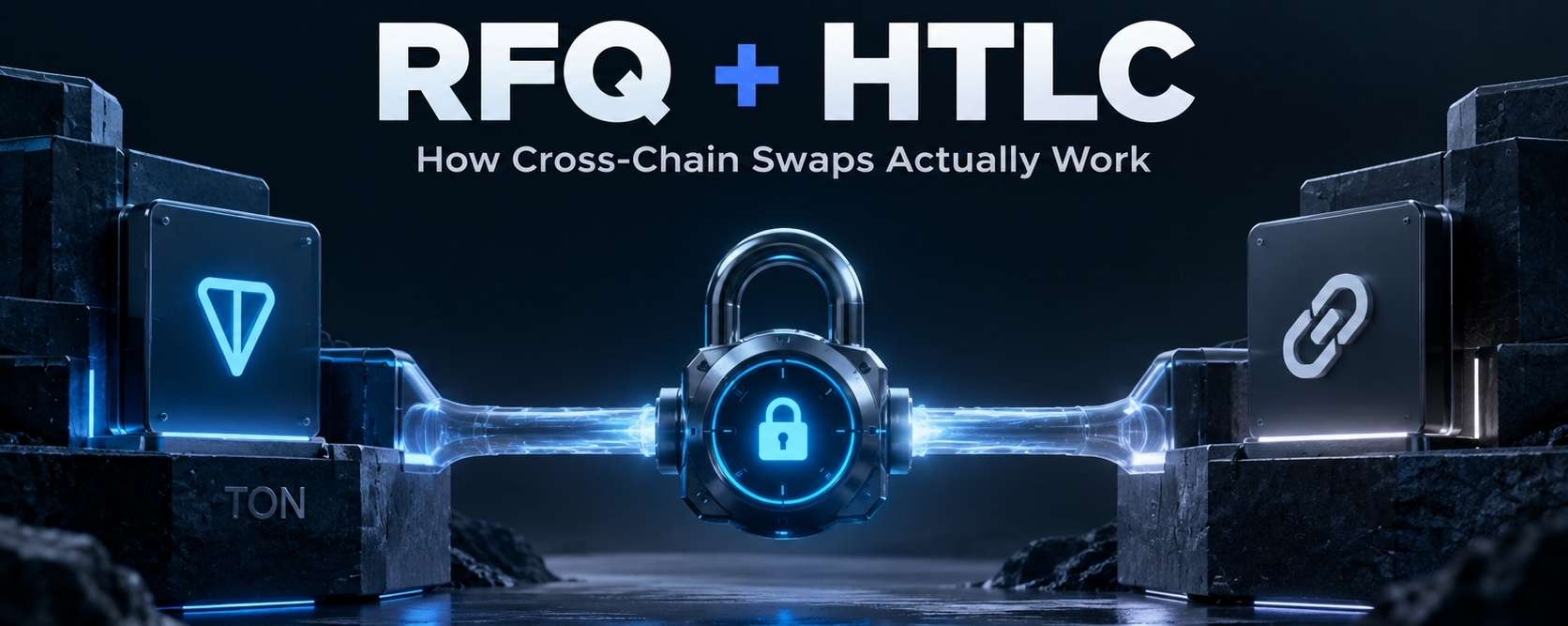
Giải thích RFQ và HTLC: Thực tế các giao dịch hoán đổi xuyên chuỗi hoạt động như thế nào
Tôi đã viết rất nhiều bài báo bao quát Omniston, STON.fi cho các giao dịch xuyên chuỗi, và nói chung là về STON.fi.
Một trong những thuật ngữ mà tôi dùng nhiều nhất là RFQ.
Thuật ngữ khác là HTLC
Tôi đã giải thích chúng nhiều lần khi thảo luận về cách Omniston xử lý các giao dịch hoán đổi xuyên chuỗi, nhưng có một vấn đề: nếu bạn chưa hiểu điều gì đang diễn ra phía sau hậu trường, thì RFQ và HTLC có thể chỉ nghe như hai thuật ngữ crypto phức tạp.
Không phải vậy.
Nói một cách đơn giản, RFQ giúp xác định việc hoán đổi xuyên chuỗi nên được thực hiện như thế nào, trong khi HTLC cung cấp cơ chế để phối hợp việc trao đổi giữa hai blockchain riêng biệt.
Một trong những thuật ngữ mà tôi dùng nhiều nhất là RFQ.
Thuật ngữ khác là HTLC
Tôi đã giải thích chúng nhiều lần khi thảo luận về cách Omniston xử lý các giao dịch hoán đổi xuyên chuỗi, nhưng có một vấn đề: nếu bạn chưa hiểu điều gì đang diễn ra phía sau hậu trường, thì RFQ và HTLC có thể chỉ nghe như hai thuật ngữ crypto phức tạp.
Không phải vậy.
Nói một cách đơn giản, RFQ giúp xác định việc hoán đổi xuyên chuỗi nên được thực hiện như thế nào, trong khi HTLC cung cấp cơ chế để phối hợp việc trao đổi giữa hai blockchain riêng biệt.
·
--

Bài viết
Xem bản dịch
One Swap. Across Chains: What STON.fi Is Actually BuildingCross-chain DeFi often asks users to understand too much infrastructure.Which chain are you on? Do you need a bridge? Which asset arrives on the other side? Where does liquidity come from? What happens if something fails?
STON.fi’s “One Swap. Across Chains” campaign is designed around a simpler user experience, but the campaign itself is more than a reward program. It is also an onboarding layer for STON.fi’s cross-chain product, powered by Omniston.
The important question is therefore not simply “What can I earn?”
It is: “what is STON.fi actually trying to teach users about cross-chain swaps, and what has it already built underneath the campaign?”
❑ The Campaign Starts With a Waitlist, Not a Cross-Chain Reward
The official rules identify the campaign as a marketing campaign organized by STON Limited, beginning with a Waitlist Phase on “1 September 2026 at 00:00 UTC. Participation is free, and the rules explicitly state that it is not an investment offer, lottery, gambling activity or financial product.
The onboarding process requires users to connect a TON wallet and pair the campaign's Telegram bot.
The first 1,000 eligible participants were offered a Priority Passenger Ticket, alongside a 1,000-mile bonus and Priority status in STON.fi's campaign announcement. STON.fi later reported that all 1,000 Priority Passenger Tickets had been claimed on the first day.
There is an important distinction here.
The formal rules define the Priority Passenger Ticket as a campaign identity image, not an NFT and not a Flight Deal. It has no guaranteed monetary value and does not require miles to receive.
The exact future benefits of “Priority status” remain undisclosed. STON.fi's announcement simply says users should watch what the status unlocks next.
❑ Miles Are Points, Not a Token
Miles are the campaign's internal points system.
Users can earn them through active missions such as wallet connections and other campaign activities. The rules make an important distinction between spendable miles and total earned miles.
Spendable miles can eventually be used for Flight Deals, while total earned miles track the user's cumulative campaign activity and do not decrease when spendable miles are used. Miles are not transferable and have no guaranteed cash value.
The campaign interface currently advertises a 1,000-mile waitlist bonus through September 15. It also displays “1,300 miles the moment you're aboard.” That wording deserves caution because the formal rules and launch announcement clearly identify the joining bonus as 1,000 miles.
For an independent reader, the safest interpretation is to treat 1,000 miles as the formally documented joining bonus and not assume the additional 300-mile figure is guaranteed without further clarification.
Flight Classes are another unresolved component. The rules define them as campaign status tiers that may affect access to selected Flight Deals, but current documentation does not establish complete class names, thresholds or benefits.
❑ Behind the Campaign: How Omniston Handles the Swap
The campaign sits on top of Omniston, STON.fi's cross-chain execution layer.
The architecture uses two different mechanisms for two different jobs.
RFQ, or Request for Quote, handles price discovery.
A user requests a cross-chain swap. Resolvers compete by providing executable quotes, and the system selects a route.
HTLCs handle settlement.
Hashed Timelock Contracts create a cryptographic condition linking the two sides of the transaction. According to STON.fi's technical explanation, the source and destination funds are locked in linked contracts. If the required conditions are met, the swap settles; otherwise the relevant funds can be refunded through the timelock mechanism.
This is what STON.fi means by atomic settlement.
The design is intended to avoid a valid outcome where one side completes while the other permanently loses its funds.
❑ Why the Architecture Avoids Wrapped Bridge Assets
Traditional bridge systems commonly lock an asset on one chain and issue a representation of it on another.
Omniston takes a different approach.
According to STON.fi's documentation, resolvers provide destination-side liquidity while the user receives the native asset on the destination chain. The system does not require a shared bridge pool or wrapped representation of the asset.
That does not mean cross-chain swaps become risk-free.
Resolver liquidity, smart-contract execution, blockchain availability and the supported route still matter. The important difference is architectural: Omniston attempts to separate cross-chain execution from the traditional lock-and-mint bridge model.
❑ What Is Still Undisclosed
Several important campaign details remain open.
The complete benefits of Priority status have not been published. Flight Class thresholds and specific Flight Deal requirements are also not fully defined in the current rules. The rules allow STON.fi to modify campaign mechanics, dates, mission requirements and rewards by publishing updates.
That matters because readers should not interpret today's campaign interface as a permanent specification.
The same principle applies to supported chains. STON.fi currently lists TON, TRON, Ethereum, Base, BNB Chain, Polygon, Arbitrum, Avalanche and Robinhood as live on the Omniston page, while noting that more chains are rolling out in phases.
❑ What the Campaign Reveals About STON.fi’s Cross-Chain Direction
The campaign is easiest to understand as a bridge between education and product adoption.
Users are introduced to cross-chain concepts through wallets, missions and miles, while the underlying product is designed to make the actual transaction less dependent on users understanding the infrastructure underneath.
Whether that architecture becomes broadly useful will ultimately depend on factors such as resolver liquidity, route availability, execution reliability and user adoption.
For now, the evidence supports a narrower conclusion:
STON.fi is using the “One Swap. Across Chains” campaign to introduce users to a cross-chain execution system built around RFQ-based resolver competition and HTLC-based atomic settlement.
The rewards are part of the campaign.
The more significant development is the infrastructure underneath them.
❑ References
Official Sources
STON.fi Cross-Chain Campaign
https://cross-chain.ston.fi/
Official Campaign Rules
https://cross-chain.ston.fi/rules
STON.fi Omniston
https://ston.fi/omniston
Omniston Documentation
https://docs.ston.fi/developer-section/omniston
STON.fi Blog
https://blog.ston.fi/
STON.fi X
https://x.com/ston_fi
STON.fi Telegram
https://t.me/stonfidex
Stonbassadors Program
https://ston.fi/stonbassadors
One Swap. Across Chains: What STON.fi Is Actually Building
Cross-chain DeFi often asks users to understand too much infrastructure.Which chain are you on? Do you need a bridge? Which asset arrives on the other side? Where does liquidity come from? What happens if something fails?
STON.fi’s “One Swap. Across Chains” campaign is designed around a simpler user experience, but the campaign itself is more than a reward program. It is also an onboarding layer for STON.fi’s cross-chain product, powered by Omniston.
The important question is therefore not simply “What can I earn?”
It is: “what is STON.fi actually trying to teach users about cross-chain swaps, and what has it already built underneath the campaign?”
❑ The Campaign Starts With a Waitlist, Not a Cross-Chain Reward
The official rules identify the campaign as a marketing campaign organized by STON Limited, beginning with a Waitlist Phase on “1 September 2026 at 00:00 UTC. Participation is free, and the rules explicitly state that it is not an investment offer, lottery, gambling activity or financial product.
The onboarding process requires users to connect a TON wallet and pair the campaign's Telegram bot.
The first 1,000 eligible participants were offered a Priority Passenger Ticket, alongside a 1,000-mile bonus and Priority status in STON.fi's campaign announcement. STON.fi later reported that all 1,000 Priority Passenger Tickets had been claimed on the first day.
There is an important distinction here.
The formal rules define the Priority Passenger Ticket as a campaign identity image, not an NFT and not a Flight Deal. It has no guaranteed monetary value and does not require miles to receive.
The exact future benefits of “Priority status” remain undisclosed. STON.fi's announcement simply says users should watch what the status unlocks next.
❑ Miles Are Points, Not a Token
Miles are the campaign's internal points system.
Users can earn them through active missions such as wallet connections and other campaign activities. The rules make an important distinction between spendable miles and total earned miles.
Spendable miles can eventually be used for Flight Deals, while total earned miles track the user's cumulative campaign activity and do not decrease when spendable miles are used. Miles are not transferable and have no guaranteed cash value.
The campaign interface currently advertises a 1,000-mile waitlist bonus through September 15. It also displays “1,300 miles the moment you're aboard.” That wording deserves caution because the formal rules and launch announcement clearly identify the joining bonus as 1,000 miles.
For an independent reader, the safest interpretation is to treat 1,000 miles as the formally documented joining bonus and not assume the additional 300-mile figure is guaranteed without further clarification.
Flight Classes are another unresolved component. The rules define them as campaign status tiers that may affect access to selected Flight Deals, but current documentation does not establish complete class names, thresholds or benefits.
❑ Behind the Campaign: How Omniston Handles the Swap
The campaign sits on top of Omniston, STON.fi's cross-chain execution layer.
The architecture uses two different mechanisms for two different jobs.
RFQ, or Request for Quote, handles price discovery.
A user requests a cross-chain swap. Resolvers compete by providing executable quotes, and the system selects a route.
HTLCs handle settlement.
Hashed Timelock Contracts create a cryptographic condition linking the two sides of the transaction. According to STON.fi's technical explanation, the source and destination funds are locked in linked contracts. If the required conditions are met, the swap settles; otherwise the relevant funds can be refunded through the timelock mechanism.
This is what STON.fi means by atomic settlement.
The design is intended to avoid a valid outcome where one side completes while the other permanently loses its funds.
❑ Why the Architecture Avoids Wrapped Bridge Assets
Traditional bridge systems commonly lock an asset on one chain and issue a representation of it on another.
Omniston takes a different approach.
According to STON.fi's documentation, resolvers provide destination-side liquidity while the user receives the native asset on the destination chain. The system does not require a shared bridge pool or wrapped representation of the asset.
That does not mean cross-chain swaps become risk-free.
Resolver liquidity, smart-contract execution, blockchain availability and the supported route still matter. The important difference is architectural: Omniston attempts to separate cross-chain execution from the traditional lock-and-mint bridge model.
❑ What Is Still Undisclosed
Several important campaign details remain open.
The complete benefits of Priority status have not been published. Flight Class thresholds and specific Flight Deal requirements are also not fully defined in the current rules. The rules allow STON.fi to modify campaign mechanics, dates, mission requirements and rewards by publishing updates.
That matters because readers should not interpret today's campaign interface as a permanent specification.
The same principle applies to supported chains. STON.fi currently lists TON, TRON, Ethereum, Base, BNB Chain, Polygon, Arbitrum, Avalanche and Robinhood as live on the Omniston page, while noting that more chains are rolling out in phases.
❑ What the Campaign Reveals About STON.fi’s Cross-Chain Direction
The campaign is easiest to understand as a bridge between education and product adoption.
Users are introduced to cross-chain concepts through wallets, missions and miles, while the underlying product is designed to make the actual transaction less dependent on users understanding the infrastructure underneath.
Whether that architecture becomes broadly useful will ultimately depend on factors such as resolver liquidity, route availability, execution reliability and user adoption.
For now, the evidence supports a narrower conclusion:
STON.fi is using the “One Swap. Across Chains” campaign to introduce users to a cross-chain execution system built around RFQ-based resolver competition and HTLC-based atomic settlement.
The rewards are part of the campaign.
The more significant development is the infrastructure underneath them.
❑ References
Official Sources
STON.fi Cross-Chain Campaign
https://cross-chain.ston.fi/
Official Campaign Rules
https://cross-chain.ston.fi/rules
STON.fi Omniston
https://ston.fi/omniston
Omniston Documentation
https://docs.ston.fi/developer-section/omniston
STON.fi Blog
https://blog.ston.fi/
STON.fi X
https://x.com/ston_fi
STON.fi Telegram
https://t.me/stonfidex
Stonbassadors Program
https://ston.fi/stonbassadors
STON.fi’s “One Swap. Across Chains” campaign is designed around a simpler user experience, but the campaign itself is more than a reward program. It is also an onboarding layer for STON.fi’s cross-chain product, powered by Omniston.
The important question is therefore not simply “What can I earn?”
It is: “what is STON.fi actually trying to teach users about cross-chain swaps, and what has it already built underneath the campaign?”
❑ The Campaign Starts With a Waitlist, Not a Cross-Chain Reward
The official rules identify the campaign as a marketing campaign organized by STON Limited, beginning with a Waitlist Phase on “1 September 2026 at 00:00 UTC. Participation is free, and the rules explicitly state that it is not an investment offer, lottery, gambling activity or financial product.
The onboarding process requires users to connect a TON wallet and pair the campaign's Telegram bot.
The first 1,000 eligible participants were offered a Priority Passenger Ticket, alongside a 1,000-mile bonus and Priority status in STON.fi's campaign announcement. STON.fi later reported that all 1,000 Priority Passenger Tickets had been claimed on the first day.
There is an important distinction here.
The formal rules define the Priority Passenger Ticket as a campaign identity image, not an NFT and not a Flight Deal. It has no guaranteed monetary value and does not require miles to receive.
The exact future benefits of “Priority status” remain undisclosed. STON.fi's announcement simply says users should watch what the status unlocks next.
❑ Miles Are Points, Not a Token
Miles are the campaign's internal points system.
Users can earn them through active missions such as wallet connections and other campaign activities. The rules make an important distinction between spendable miles and total earned miles.
Spendable miles can eventually be used for Flight Deals, while total earned miles track the user's cumulative campaign activity and do not decrease when spendable miles are used. Miles are not transferable and have no guaranteed cash value.
The campaign interface currently advertises a 1,000-mile waitlist bonus through September 15. It also displays “1,300 miles the moment you're aboard.” That wording deserves caution because the formal rules and launch announcement clearly identify the joining bonus as 1,000 miles.
For an independent reader, the safest interpretation is to treat 1,000 miles as the formally documented joining bonus and not assume the additional 300-mile figure is guaranteed without further clarification.
Flight Classes are another unresolved component. The rules define them as campaign status tiers that may affect access to selected Flight Deals, but current documentation does not establish complete class names, thresholds or benefits.
❑ Behind the Campaign: How Omniston Handles the Swap
The campaign sits on top of Omniston, STON.fi's cross-chain execution layer.
The architecture uses two different mechanisms for two different jobs.
RFQ, or Request for Quote, handles price discovery.
A user requests a cross-chain swap. Resolvers compete by providing executable quotes, and the system selects a route.
HTLCs handle settlement.
Hashed Timelock Contracts create a cryptographic condition linking the two sides of the transaction. According to STON.fi's technical explanation, the source and destination funds are locked in linked contracts. If the required conditions are met, the swap settles; otherwise the relevant funds can be refunded through the timelock mechanism.
This is what STON.fi means by atomic settlement.
The design is intended to avoid a valid outcome where one side completes while the other permanently loses its funds.
❑ Why the Architecture Avoids Wrapped Bridge Assets
Traditional bridge systems commonly lock an asset on one chain and issue a representation of it on another.
Omniston takes a different approach.
According to STON.fi's documentation, resolvers provide destination-side liquidity while the user receives the native asset on the destination chain. The system does not require a shared bridge pool or wrapped representation of the asset.
That does not mean cross-chain swaps become risk-free.
Resolver liquidity, smart-contract execution, blockchain availability and the supported route still matter. The important difference is architectural: Omniston attempts to separate cross-chain execution from the traditional lock-and-mint bridge model.
❑ What Is Still Undisclosed
Several important campaign details remain open.
The complete benefits of Priority status have not been published. Flight Class thresholds and specific Flight Deal requirements are also not fully defined in the current rules. The rules allow STON.fi to modify campaign mechanics, dates, mission requirements and rewards by publishing updates.
That matters because readers should not interpret today's campaign interface as a permanent specification.
The same principle applies to supported chains. STON.fi currently lists TON, TRON, Ethereum, Base, BNB Chain, Polygon, Arbitrum, Avalanche and Robinhood as live on the Omniston page, while noting that more chains are rolling out in phases.
❑ What the Campaign Reveals About STON.fi’s Cross-Chain Direction
The campaign is easiest to understand as a bridge between education and product adoption.
Users are introduced to cross-chain concepts through wallets, missions and miles, while the underlying product is designed to make the actual transaction less dependent on users understanding the infrastructure underneath.
Whether that architecture becomes broadly useful will ultimately depend on factors such as resolver liquidity, route availability, execution reliability and user adoption.
For now, the evidence supports a narrower conclusion:
STON.fi is using the “One Swap. Across Chains” campaign to introduce users to a cross-chain execution system built around RFQ-based resolver competition and HTLC-based atomic settlement.
The rewards are part of the campaign.
The more significant development is the infrastructure underneath them.
❑ References
Official Sources
STON.fi Cross-Chain Campaign
https://cross-chain.ston.fi/
Official Campaign Rules
https://cross-chain.ston.fi/rules
STON.fi Omniston
https://ston.fi/omniston
Omniston Documentation
https://docs.ston.fi/developer-section/omniston
STON.fi Blog
https://blog.ston.fi/
STON.fi X
https://x.com/ston_fi
STON.fi Telegram
https://t.me/stonfidex
Stonbassadors Program
https://ston.fi/stonbassadors
1
1
132
·
--

Bài viết
Xem bản dịch
xStocks on TON: What Actually Changes When a Stock Becomes a Jetton? A token such as AAPLx can look like an Apple stock position inside a TON wallet. But technically and legally, that description is incomplete.
The important question is not simply whether a stock can be placed on a blockchain. It is what exactly the token represents, who stands behind it, and what happens between the traditional asset and the token in your wallet.
xStocks provide a useful case study because they connect traditional-market exposure with TON's DeFi infrastructure.
❑ The ticker in your wallet is not the stock itself
xStocks are issued by Backed Assets (JE) Limited, not STON.fi. Backed's current legal documentation classifies its products as certificates tracking an underlying asset, under Swiss law.
That distinction matters.
Holding an xStock does not give the holder the same legal position as directly owning the underlying company's ordinary shares. The token represents exposure through a regulated tracker-certificate structure.
So the simplified relationship is:
Underlying security → regulated certificate → blockchain representation → TON Jetton
STON.fi is involved at the DeFi infrastructure layer, not as the issuer.
❑ Follow the asset backwards from TON
STON.fi's technical explanation describes the structure as a series of layers. Backed creates the regulated product against the underlying asset, while custodians hold the relevant traditional-market positions. The product is represented by blockchain tokens, which can then appear on TON as Jettons.
A TON wallet therefore contains the on-chain representation, while the underlying financial assets remain within the traditional custody structure.
This is what makes the term "self-custody" more nuanced than it first appears.
You control the TON Jetton through your wallet keys. You do not personally hold the underlying Apple, Tesla or ETF shares in that wallet.
❑ What does "1:1 backed" actually mean?
Backed and STON.fi describe xStocks as being backed 1:1 by the corresponding underlying assets held with regulated custodians.
This should not be interpreted as "one token equals one ordinary share in every legal respect."
Instead, the important claim is that the tokenized certificate is collateralized against the corresponding underlying position.
That creates another layer of trust beyond the blockchain itself: the issuer, custodians, legal structure and reserve-monitoring system all matter.
❑ Proof of reserves adds an on-chain verification layer
This is where tokenization becomes particularly interesting.
STON.fi says Backed uses Chainlink Proof of Reserve to connect information about off-chain collateral with on-chain data. The mechanism is designed to allow users and protocols to compare the amount of tokens in circulation with reported underlying reserves.
But proof of reserves is not the same thing as eliminating risk.
It does not automatically eliminate issuer risk, custodian failure, smart-contract vulnerabilities, legal disputes or regulatory restrictions. STON.fi itself acknowledges market, issuer, custodian, smart-contract and regulatory risks and warns that investors can lose part or all of their investment.
In other words, PoR provides another verification layer. It is not a guarantee.
❑ Where STON.fi actually fits
STON.fi explicitly states that it does not issue, sell or distribute xStocks and does not act as a broker, dealer, exchange or investment adviser. It describes its role as non-custodial infrastructure on TON that can route swaps into xStocks.
This distinction is important because several different entities perform different jobs:
Backed: issues the tracker certificates.
Custodians: hold the underlying traditional-market assets.
TON: provides the blockchain environment.
STON.fi/Omniston: provides swap-routing and execution infrastructure.
Confusing these roles would give readers the wrong picture of how the system works.
❑ Why xStocks use a different liquidity mechanism
Traditional AMMs depend on public liquidity pools. But STON.fi says xStocks were the first assets to use its escrow execution layer inside Omniston, allowing swaps to access resolver-priced OTC liquidity rather than relying solely on public AMM pools.
The simplified difference is:
AMM: trade against publicly supplied pool liquidity.
Resolver/escrow: obtain a quoted route from a liquidity provider and settle the transaction through an escrow contract.
The escrow model allows direct asset-to-asset execution and on-chain settlement without requiring STON.fi itself to operate an xStock liquidity pool. STON.fi's current xStocks page explicitly says it does not operate xStock trading pairs or liquidity pools.
❑ The 24/7 question is more complicated than it sounds
A blockchain can process transactions around the clock.
The underlying stock market cannot.
That creates an important distinction between blockchain availability and traditional-market price discovery.
STON.fi promotes 24/7 access to xStocks, but users should understand that the underlying securities still belong to traditional financial markets with their own trading hours and market structure.
This makes liquidity, pricing and market conditions important considerations when traditional markets are closed.
❑ What happens to dividends?
xStocks do not simply reproduce the normal dividend-payment experience of a brokerage account.
STON.fi says dividend treatment is determined by Backed and that, under the Backed Base Prospectus, dividend payouts are automatically reinvested into additional tokens. On TON, this is reflected through Scaled UI Jettons (TEP-526).
STON.fi itself does not distribute the dividends.
❑ The restrictions remain
It would therefore be misleading to describe xStocks as completely permissionless global stocks.
STON.fi currently lists restrictions for residents or citizens of the United States, EU/EEA countries, the United Kingdom, Canada, Australia, Belgium and other jurisdictions where tokenized securities are restricted or prohibited.
Older STON.fi material described access without brokerage accounts or KYC, but the current documentation emphasizes eligibility requirements.
The safer conclusion is that self-custody does not mean the removal of financial regulation.
❑ The bigger RWA question
xStocks illustrate what tokenization actually changes.
The blockchain can make an investment instrument transferable through a wallet, composable with DeFi infrastructure and available through blockchain-based settlement.
But tokenization does not make the underlying financial system disappear.
The issuer still matters.
The custodian still matters.
The legal structure still matters.
The underlying market still matters.
And the token still carries technical and regulatory risks.
That is arguably the most important lesson from xStocks on TON: putting an asset on-chain changes how it can be accessed and used, but it does not erase the institutions, legal claims and risks behind the asset.
For readers evaluating tokenized RWAs, the useful question is therefore not simply "Is this a stock on-chain?"
It is:
"What legal instrument am I holding, what backs it, who controls the underlying assets, and what exactly can I verify on-chain?"
That is where the real substance of tokenized assets begins.
❑ References
Official Sources
STON.fixStocks
https://ston.fi/xstocks
How xStocks Actually Work
https://blog.ston.fi/how-xstocks-actually-work-from-real-world-asset-to-ton-jetton/
Escrow Swaps and Omniston
https://blog.ston.fi/escrow-swaps-a-new-execution-layer-inside-omniston/
xStocks: Explore the Tokenized Market
https://blog.ston.fi/xstocks-explore-tokenized-market/
Proof of Reserves
https://blog.ston.fi/proof-of-reserves-why-on-chain-checks-matter-more-than-glossy-decks/
Backed Legal Documentation
https://assets.backed.fi/legal-documentation
Backed Service Providers
https://assets.backed.fi/legal-documentation/service-providers
Backed Products
https://assets.backed.fi/products
xStocks Official Website
https://xstocks.fi/
xStocks Proof of Reserves
https://defi.xstocks.fi/proof-of-reserve
STON.fi Stonbassadors
https://ston.fi/stonbassadors
Research and Technical Sources
Chainlink Proof of Reserve
https://chain.link/proof-of-reserve
Chainlink Tokenized Stocks Explained
https://chain.link/education-hub/tokenized-stocks-equities-explained
Primary Social Sources
STON.fi on X
https://x.com/ston_fi
STON.fi Blog
https://blog.ston.fi/
Community Sources
STON.fi Reddit Community
https://www.reddit.com/r/Stonfiers/
STON.fi Telegram Community
https://t.me/stonfidex
xStocks on TON: What Actually Changes When a Stock Becomes a Jetton?
A token such as AAPLx can look like an Apple stock position inside a TON wallet. But technically and legally, that description is incomplete.
The important question is not simply whether a stock can be placed on a blockchain. It is what exactly the token represents, who stands behind it, and what happens between the traditional asset and the token in your wallet.
xStocks provide a useful case study because they connect traditional-market exposure with TON's DeFi infrastructure.
❑ The ticker in your wallet is not the stock itself
xStocks are issued by Backed Assets (JE) Limited, not STON.fi. Backed's current legal documentation classifies its products as certificates tracking an underlying asset, under Swiss law.
That distinction matters.
Holding an xStock does not give the holder the same legal position as directly owning the underlying company's ordinary shares. The token represents exposure through a regulated tracker-certificate structure.
So the simplified relationship is:
Underlying security → regulated certificate → blockchain representation → TON Jetton
STON.fi is involved at the DeFi infrastructure layer, not as the issuer.
❑ Follow the asset backwards from TON
STON.fi's technical explanation describes the structure as a series of layers. Backed creates the regulated product against the underlying asset, while custodians hold the relevant traditional-market positions. The product is represented by blockchain tokens, which can then appear on TON as Jettons.
A TON wallet therefore contains the on-chain representation, while the underlying financial assets remain within the traditional custody structure.
This is what makes the term "self-custody" more nuanced than it first appears.
You control the TON Jetton through your wallet keys. You do not personally hold the underlying Apple, Tesla or ETF shares in that wallet.
❑ What does "1:1 backed" actually mean?
Backed and STON.fi describe xStocks as being backed 1:1 by the corresponding underlying assets held with regulated custodians.
This should not be interpreted as "one token equals one ordinary share in every legal respect."
Instead, the important claim is that the tokenized certificate is collateralized against the corresponding underlying position.
That creates another layer of trust beyond the blockchain itself: the issuer, custodians, legal structure and reserve-monitoring system all matter.
❑ Proof of reserves adds an on-chain verification layer
This is where tokenization becomes particularly interesting.
STON.fi says Backed uses Chainlink Proof of Reserve to connect information about off-chain collateral with on-chain data. The mechanism is designed to allow users and protocols to compare the amount of tokens in circulation with reported underlying reserves.
But proof of reserves is not the same thing as eliminating risk.
It does not automatically eliminate issuer risk, custodian failure, smart-contract vulnerabilities, legal disputes or regulatory restrictions. STON.fi itself acknowledges market, issuer, custodian, smart-contract and regulatory risks and warns that investors can lose part or all of their investment.
In other words, PoR provides another verification layer. It is not a guarantee.
❑ Where STON.fi actually fits
STON.fi explicitly states that it does not issue, sell or distribute xStocks and does not act as a broker, dealer, exchange or investment adviser. It describes its role as non-custodial infrastructure on TON that can route swaps into xStocks.
This distinction is important because several different entities perform different jobs:
Backed: issues the tracker certificates.
Custodians: hold the underlying traditional-market assets.
TON: provides the blockchain environment.
STON.fi/Omniston: provides swap-routing and execution infrastructure.
Confusing these roles would give readers the wrong picture of how the system works.
❑ Why xStocks use a different liquidity mechanism
Traditional AMMs depend on public liquidity pools. But STON.fi says xStocks were the first assets to use its escrow execution layer inside Omniston, allowing swaps to access resolver-priced OTC liquidity rather than relying solely on public AMM pools.
The simplified difference is:
AMM: trade against publicly supplied pool liquidity.
Resolver/escrow: obtain a quoted route from a liquidity provider and settle the transaction through an escrow contract.
The escrow model allows direct asset-to-asset execution and on-chain settlement without requiring STON.fi itself to operate an xStock liquidity pool. STON.fi's current xStocks page explicitly says it does not operate xStock trading pairs or liquidity pools.
❑ The 24/7 question is more complicated than it sounds
A blockchain can process transactions around the clock.
The underlying stock market cannot.
That creates an important distinction between blockchain availability and traditional-market price discovery.
STON.fi promotes 24/7 access to xStocks, but users should understand that the underlying securities still belong to traditional financial markets with their own trading hours and market structure.
This makes liquidity, pricing and market conditions important considerations when traditional markets are closed.
❑ What happens to dividends?
xStocks do not simply reproduce the normal dividend-payment experience of a brokerage account.
STON.fi says dividend treatment is determined by Backed and that, under the Backed Base Prospectus, dividend payouts are automatically reinvested into additional tokens. On TON, this is reflected through Scaled UI Jettons (TEP-526).
STON.fi itself does not distribute the dividends.
❑ The restrictions remain
It would therefore be misleading to describe xStocks as completely permissionless global stocks.
STON.fi currently lists restrictions for residents or citizens of the United States, EU/EEA countries, the United Kingdom, Canada, Australia, Belgium and other jurisdictions where tokenized securities are restricted or prohibited.
Older STON.fi material described access without brokerage accounts or KYC, but the current documentation emphasizes eligibility requirements.
The safer conclusion is that self-custody does not mean the removal of financial regulation.
❑ The bigger RWA question
xStocks illustrate what tokenization actually changes.
The blockchain can make an investment instrument transferable through a wallet, composable with DeFi infrastructure and available through blockchain-based settlement.
But tokenization does not make the underlying financial system disappear.
The issuer still matters.
The custodian still matters.
The legal structure still matters.
The underlying market still matters.
And the token still carries technical and regulatory risks.
That is arguably the most important lesson from xStocks on TON: putting an asset on-chain changes how it can be accessed and used, but it does not erase the institutions, legal claims and risks behind the asset.
For readers evaluating tokenized RWAs, the useful question is therefore not simply "Is this a stock on-chain?"
It is:
"What legal instrument am I holding, what backs it, who controls the underlying assets, and what exactly can I verify on-chain?"
That is where the real substance of tokenized assets begins.
❑ References
Official Sources
STON.fixStocks
https://ston.fi/xstocks
How xStocks Actually Work
https://blog.ston.fi/how-xstocks-actually-work-from-real-world-asset-to-ton-jetton/
Escrow Swaps and Omniston
https://blog.ston.fi/escrow-swaps-a-new-execution-layer-inside-omniston/
xStocks: Explore the Tokenized Market
https://blog.ston.fi/xstocks-explore-tokenized-market/
Proof of Reserves
https://blog.ston.fi/proof-of-reserves-why-on-chain-checks-matter-more-than-glossy-decks/
Backed Legal Documentation
https://assets.backed.fi/legal-documentation
Backed Service Providers
https://assets.backed.fi/legal-documentation/service-providers
Backed Products
https://assets.backed.fi/products
xStocks Official Website
https://xstocks.fi/
xStocks Proof of Reserves
https://defi.xstocks.fi/proof-of-reserve
STON.fi Stonbassadors
https://ston.fi/stonbassadors
Research and Technical Sources
Chainlink Proof of Reserve
https://chain.link/proof-of-reserve
Chainlink Tokenized Stocks Explained
https://chain.link/education-hub/tokenized-stocks-equities-explained
Primary Social Sources
STON.fi on X
https://x.com/ston_fi
STON.fi Blog
https://blog.ston.fi/
Community Sources
STON.fi Reddit Community
https://www.reddit.com/r/Stonfiers/
STON.fi Telegram Community
https://t.me/stonfidex
The important question is not simply whether a stock can be placed on a blockchain. It is what exactly the token represents, who stands behind it, and what happens between the traditional asset and the token in your wallet.
xStocks provide a useful case study because they connect traditional-market exposure with TON's DeFi infrastructure.
❑ The ticker in your wallet is not the stock itself
xStocks are issued by Backed Assets (JE) Limited, not STON.fi. Backed's current legal documentation classifies its products as certificates tracking an underlying asset, under Swiss law.
That distinction matters.
Holding an xStock does not give the holder the same legal position as directly owning the underlying company's ordinary shares. The token represents exposure through a regulated tracker-certificate structure.
So the simplified relationship is:
Underlying security → regulated certificate → blockchain representation → TON Jetton
STON.fi is involved at the DeFi infrastructure layer, not as the issuer.
❑ Follow the asset backwards from TON
STON.fi's technical explanation describes the structure as a series of layers. Backed creates the regulated product against the underlying asset, while custodians hold the relevant traditional-market positions. The product is represented by blockchain tokens, which can then appear on TON as Jettons.
A TON wallet therefore contains the on-chain representation, while the underlying financial assets remain within the traditional custody structure.
This is what makes the term "self-custody" more nuanced than it first appears.
You control the TON Jetton through your wallet keys. You do not personally hold the underlying Apple, Tesla or ETF shares in that wallet.
❑ What does "1:1 backed" actually mean?
Backed and STON.fi describe xStocks as being backed 1:1 by the corresponding underlying assets held with regulated custodians.
This should not be interpreted as "one token equals one ordinary share in every legal respect."
Instead, the important claim is that the tokenized certificate is collateralized against the corresponding underlying position.
That creates another layer of trust beyond the blockchain itself: the issuer, custodians, legal structure and reserve-monitoring system all matter.
❑ Proof of reserves adds an on-chain verification layer
This is where tokenization becomes particularly interesting.
STON.fi says Backed uses Chainlink Proof of Reserve to connect information about off-chain collateral with on-chain data. The mechanism is designed to allow users and protocols to compare the amount of tokens in circulation with reported underlying reserves.
But proof of reserves is not the same thing as eliminating risk.
It does not automatically eliminate issuer risk, custodian failure, smart-contract vulnerabilities, legal disputes or regulatory restrictions. STON.fi itself acknowledges market, issuer, custodian, smart-contract and regulatory risks and warns that investors can lose part or all of their investment.
In other words, PoR provides another verification layer. It is not a guarantee.
❑ Where STON.fi actually fits
STON.fi explicitly states that it does not issue, sell or distribute xStocks and does not act as a broker, dealer, exchange or investment adviser. It describes its role as non-custodial infrastructure on TON that can route swaps into xStocks.
This distinction is important because several different entities perform different jobs:
Backed: issues the tracker certificates.
Custodians: hold the underlying traditional-market assets.
TON: provides the blockchain environment.
STON.fi/Omniston: provides swap-routing and execution infrastructure.
Confusing these roles would give readers the wrong picture of how the system works.
❑ Why xStocks use a different liquidity mechanism
Traditional AMMs depend on public liquidity pools. But STON.fi says xStocks were the first assets to use its escrow execution layer inside Omniston, allowing swaps to access resolver-priced OTC liquidity rather than relying solely on public AMM pools.
The simplified difference is:
AMM: trade against publicly supplied pool liquidity.
Resolver/escrow: obtain a quoted route from a liquidity provider and settle the transaction through an escrow contract.
The escrow model allows direct asset-to-asset execution and on-chain settlement without requiring STON.fi itself to operate an xStock liquidity pool. STON.fi's current xStocks page explicitly says it does not operate xStock trading pairs or liquidity pools.
❑ The 24/7 question is more complicated than it sounds
A blockchain can process transactions around the clock.
The underlying stock market cannot.
That creates an important distinction between blockchain availability and traditional-market price discovery.
STON.fi promotes 24/7 access to xStocks, but users should understand that the underlying securities still belong to traditional financial markets with their own trading hours and market structure.
This makes liquidity, pricing and market conditions important considerations when traditional markets are closed.
❑ What happens to dividends?
xStocks do not simply reproduce the normal dividend-payment experience of a brokerage account.
STON.fi says dividend treatment is determined by Backed and that, under the Backed Base Prospectus, dividend payouts are automatically reinvested into additional tokens. On TON, this is reflected through Scaled UI Jettons (TEP-526).
STON.fi itself does not distribute the dividends.
❑ The restrictions remain
It would therefore be misleading to describe xStocks as completely permissionless global stocks.
STON.fi currently lists restrictions for residents or citizens of the United States, EU/EEA countries, the United Kingdom, Canada, Australia, Belgium and other jurisdictions where tokenized securities are restricted or prohibited.
Older STON.fi material described access without brokerage accounts or KYC, but the current documentation emphasizes eligibility requirements.
The safer conclusion is that self-custody does not mean the removal of financial regulation.
❑ The bigger RWA question
xStocks illustrate what tokenization actually changes.
The blockchain can make an investment instrument transferable through a wallet, composable with DeFi infrastructure and available through blockchain-based settlement.
But tokenization does not make the underlying financial system disappear.
The issuer still matters.
The custodian still matters.
The legal structure still matters.
The underlying market still matters.
And the token still carries technical and regulatory risks.
That is arguably the most important lesson from xStocks on TON: putting an asset on-chain changes how it can be accessed and used, but it does not erase the institutions, legal claims and risks behind the asset.
For readers evaluating tokenized RWAs, the useful question is therefore not simply "Is this a stock on-chain?"
It is:
"What legal instrument am I holding, what backs it, who controls the underlying assets, and what exactly can I verify on-chain?"
That is where the real substance of tokenized assets begins.
❑ References
Official Sources
STON.fixStocks
https://ston.fi/xstocks
How xStocks Actually Work
https://blog.ston.fi/how-xstocks-actually-work-from-real-world-asset-to-ton-jetton/
Escrow Swaps and Omniston
https://blog.ston.fi/escrow-swaps-a-new-execution-layer-inside-omniston/
xStocks: Explore the Tokenized Market
https://blog.ston.fi/xstocks-explore-tokenized-market/
Proof of Reserves
https://blog.ston.fi/proof-of-reserves-why-on-chain-checks-matter-more-than-glossy-decks/
Backed Legal Documentation
https://assets.backed.fi/legal-documentation
Backed Service Providers
https://assets.backed.fi/legal-documentation/service-providers
Backed Products
https://assets.backed.fi/products
xStocks Official Website
https://xstocks.fi/
xStocks Proof of Reserves
https://defi.xstocks.fi/proof-of-reserve
STON.fi Stonbassadors
https://ston.fi/stonbassadors
Research and Technical Sources
Chainlink Proof of Reserve
https://chain.link/proof-of-reserve
Chainlink Tokenized Stocks Explained
https://chain.link/education-hub/tokenized-stocks-equities-explained
Primary Social Sources
STON.fi on X
https://x.com/ston_fi
STON.fi Blog
https://blog.ston.fi/
Community Sources
STON.fi Reddit Community
https://www.reddit.com/r/Stonfiers/
STON.fi Telegram Community
https://t.me/stonfidex
2
·
--
Xem bản dịch
STON.fi Goes Cross-Chain: What Actually Happens When TON MeetsEVMCross chain swaps are easy to describe and much harder to build.
A user may only see a simple action: choose a token on one blockchain, choose another token on a different blockchain, confirm, and receive the destination asset.
Underneath that interface, however, two independent blockchains must coordinate an exchange without relying on the same ledger, while managing liquidity, execution, fees and failure scenarios.
On June 16, 2026, STON.fi made TON to EVM cross chain swaps available through its dApp. The initial launch connected TON with Ethereum, Base, BNB Chain and Polygon, with a temporary $1,000 per transaction limit.
The important question is therefore not simply whether STON.fi has gone cross chain.
It is how the exchange actually happens.
❑ The technology behind the launch was built before the launch
The June launch was not an isolated feature.
STON.fi's own development history shows Omniston evolving from TON liquidity aggregation into broader execution infrastructure.
In May 2026, Omniston v1beta8 introduced cross chain testing through a sandbox, initially demonstrating TON to Base stablecoin flows. The architecture separated quote discovery, execution coordination, settlement and execution tracking.
That evolution matters because Omniston was originally designed around liquidity aggregation.
Its earlier role was to collect liquidity from multiple sources and find routes for swaps inside TON. The newer architecture adds order settlement, where resolvers can fulfil executable orders across chains.
In other words, the cross chain launch represents an extension of an existing execution system rather than a completely separate bridge product.
❑ A cross chain swap does not necessarily require a bridge
The usual bridge model is relatively straightforward.
An asset is locked or otherwise secured on the source chain. A representation of that asset is then made available on another chain, often as a wrapped token.
Omniston takes a different approach.
STON.fi describes it as a resolver based cross chain execution layer using Hashed Timelock Contracts, or HTLCs. The destination asset remains native to its destination blockchain instead of being created as a wrapped representation by Omniston.
An HTLC combines two conditions:
1. A cryptographic secret must be revealed before the funds can be claimed.
2. If that does not happen within a specified period, the funds can be refunded after the timelock expires.
For a cross chain swap, Omniston links two HTLCs.
One exists on the source chain and another on the destination chain. Both use the same cryptographic condition. When the secret is revealed, the corresponding claims can occur on both sides. If the required condition is not completed, the timelock provides a refund path.
This is the core mechanism behind the claim that the swap can settle atomically.
❑ Where the liquidity comes from
The user does not need to find another person willing to take the opposite side of the trade.
Instead, Omniston uses an RFQ model.
RFQ means Request for Quote.
The user requests a price for a particular asset pair and amount. Resolvers respond with executable quotes. A resolver is effectively a professional liquidity provider or market maker that can provide the destination side of a trade.
The resolver commits its own destination side liquidity.
For example, consider a simplified TON to Ethereum transaction.
A user wants to exchange USDT on TON for USDC on Ethereum.
The user submits the request.
A resolver provides a quote.
The source side is secured through the appropriate HTLC, while the resolver commits the destination USDC through a corresponding HTLC on Ethereum.
The two sides share the same cryptographic condition.
Once the secret is disclosed, the user can claim the destination asset and the resolver can claim the source asset.
The resolver therefore does not simply promise to deliver the destination asset later. Its liquidity is committed as part of the settlement process.
❑ What happens when something goes wrong?
This is where the HTLC architecture becomes important.
Suppose the resolver does not complete its side of the operation.
The intended settlement condition is not fulfilled.
The timelock eventually allows the relevant funds to return.
This creates an important distinction between execution failure and loss of funds.
A failed quote does not necessarily mean that money has already moved. If no resolver provides an acceptable quote, the swap does not need to begin.
Once an order has entered the settlement process, the HTLC mechanism provides the documented refund path if the required secret is not revealed within the permitted period.
However, there is an important technical qualification.
STON.fi's later documentation also describes partial fills for larger orders. An order can be divided into independent sub swaps, each with its own settlement conditions.
So “atomic” should not be interpreted as meaning every large order must always settle as one indivisible transaction.
The more accurate description is that each HTLC linked execution is designed to settle atomically, while larger orders can consist of multiple independently settled portions.
❑ The launch was deliberately limited
At launch, STON.fi supported:
TON
Ethereum
Base
BNB Chain
Polygon
The initial asset selection was heavily focused on stablecoins, including USDT and USDC, with PUSD and USDC on Polygon. STON.fi also introduced a temporary $1,000 per transaction limit.
This should not be confused with the current network expansion.
Later official material documented additional networks and assets, including Arbitrum, Avalanche, TRON, Robinhood Chain and X Layer.
The distinction is important because a current network list should not be presented as though every network was available on June 16.
The launch was a starting point.
❑ Gasless does not mean fee free
Another area that deserves careful explanation is gas.
STON.fi's Omniston documentation describes gasless execution for certain EVM source chain flows.
Instead of the user submitting the on chain transaction directly, the user signs an authorization or order. The resolver can then submit the transaction and pay the blockchain gas cost.
This can remove the need for an EVM user to hold the chain's native gas token for the swap itself.
But it does not mean every part of the process is free.
A token approval can still require gas depending on the wallet, token and execution path. STON.fi also states that gas is still required when TON is the source chain.
So the accurate statement is:
Omniston supports gasless execution scenarios, not universally gasless transactions.
That distinction matters for anyone evaluating the actual user experience.
Security: what has actually been reviewed?
❑ Security claims require another layer of caution.
STON.fi's security documentation references a January 2025 Trail of Bits review of its TON AMM DEX v2. That review concerns the DEX system and should not be presented as a full audit of the entire live cross chain Omniston architecture.
STON.fi also reports a TonTech review of Omniston escrow contracts that found no critical issues. However, the full report is not publicly available according to the project's documentation.
That means the evidence supports saying that specific components have undergone security review.
It does not support saying that the entire cross chain system has been independently proven secure.
The distinction is important because audits and security reviews reduce uncertainty; they do not eliminate it.
❑ The numbers do not yet tell us how big cross chain adoption is
STON.fi currently reports roughly $8 billion in all time volume, $27 million in TVL, 6 million all time swappers and 37 million all time swaps on its website.
Those figures provide context for the wider STON.fi protocol.
They should not, however, be presented as cross chain statistics.
I did not find independently verified data establishing the exact amount of volume, users or transactions generated specifically by the cross chain feature.
That leaves an important research gap.
The launch itself is verifiable.
The scale of adoption is a separate question.
❑ What this changes for TON users
The immediate practical change is access.
A TON user does not necessarily need to leave the STON.fi interface to access assets on supported EVM networks.
Likewise, an EVM user can use the same infrastructure to move into TON based assets where a supported resolver route exists.
For developers, the significance is potentially broader.
Omniston is not described as infrastructure exclusively for the STON.fi interface. STON.fi says the protocol is designed for integration through SDK and API interfaces, allowing wallets, aggregators, exchanges and other DeFi applications to build on top of it.
That means the longer term question is not only how many chains appear inside the STON.fi application.
It is whether resolver based execution can become reusable infrastructure for other applications.
❑ What the evidence establishes, and what remains unanswered
The evidence establishes that STON.fi launched live TON × EVM cross chain swaps in June 2026.
It also establishes the documented architecture: RFQ based quote discovery, resolver supplied liquidity and linked HTLC settlement.
What remains less clear is equally important.
There is no independently verified dataset in the sources reviewed here showing the cross chain feature's total volume, unique users, resolver concentration or failure rate.
The current status of the original $1,000 transaction limit also requires caution because launch and later material reference the limit, while the current documentation does not clearly establish a definitive removal date.
These gaps do not invalidate the technology.
They simply define what can and cannot responsibly be claimed today.
The bigger story
STON.fi's cross chain launch is therefore less about adding a “bridge button” to a DEX and more about changing the execution layer underneath the swap.
The documented architecture combines RFQ for liquidity discovery, resolvers for destination liquidity and HTLCs for conditional settlement.
That approach avoids the need for Omniston itself to mint a wrapped representation of the destination asset.
Whether this architecture can scale to deeper liquidity, larger transaction sizes and broader adoption is an empirical question that future usage data will answer.
For now, the strongest conclusion is narrower:
TON × EVM swaps are live, the mechanism is documented, and the architecture is materially different from a conventional wrapped token bridge. The remaining question is how well that architecture performs at scale.
❑ Reference
STON.fi official websitel
https://reference-url-citation.invalid/15
STON.fi cross chain launch
announcement
https://reference-url-citation.invalid/16
Omniston explained: cross chain swaps and HTLCs
https://reference-url-citation.invalid/17
Omniston v1beta8 and cross chain execution layer
https://reference-url-citation.invalid/18
Omniston gasless execution model
https://reference-url-citation.invalid/19
Omniston resolver documentation
https://reference-url-citation.invalid/20
STON.fi developer documentation
https://reference-url-citation.invalid/21
STON.fi official X account
https://reference-url-citation.invalid/22
STON.fi Ambassador Program
https://reference-url-citation.invalid/23
STONbassador Guide
https://reference-url-citation.invalid/24
Research and Security Sources
Trail of Bits, STON.fi TON AMM DEX v2 security review.
TonTech review of Omniston escrow contracts.
CertiK security monitoring for STON.fi.
HackenProof bug bounty information.
STON.fi Goes Cross-Chain: What Actually Happens When TON MeetsEVM
Cross chain swaps are easy to describe and much harder to build.
A user may only see a simple action: choose a token on one blockchain, choose another token on a different blockchain, confirm, and receive the destination asset.
Underneath that interface, however, two independent blockchains must coordinate an exchange without relying on the same ledger, while managing liquidity, execution, fees and failure scenarios.
On June 16, 2026, STON.fi made TON to EVM cross chain swaps available through its dApp. The initial launch connected TON with Ethereum, Base, BNB Chain and Polygon, with a temporary $1,000 per transaction limit.
The important question is therefore not simply whether STON.fi has gone cross chain.
It is how the exchange actually happens.
❑ The technology behind the launch was built before the launch
The June launch was not an isolated feature.
STON.fi's own development history shows Omniston evolving from TON liquidity aggregation into broader execution infrastructure.
In May 2026, Omniston v1beta8 introduced cross chain testing through a sandbox, initially demonstrating TON to Base stablecoin flows. The architecture separated quote discovery, execution coordination, settlement and execution tracking.
That evolution matters because Omniston was originally designed around liquidity aggregation.
Its earlier role was to collect liquidity from multiple sources and find routes for swaps inside TON. The newer architecture adds order settlement, where resolvers can fulfil executable orders across chains.
In other words, the cross chain launch represents an extension of an existing execution system rather than a completely separate bridge product.
❑ A cross chain swap does not necessarily require a bridge
The usual bridge model is relatively straightforward.
An asset is locked or otherwise secured on the source chain. A representation of that asset is then made available on another chain, often as a wrapped token.
Omniston takes a different approach.
STON.fi describes it as a resolver based cross chain execution layer using Hashed Timelock Contracts, or HTLCs. The destination asset remains native to its destination blockchain instead of being created as a wrapped representation by Omniston.
An HTLC combines two conditions:
1. A cryptographic secret must be revealed before the funds can be claimed.
2. If that does not happen within a specified period, the funds can be refunded after the timelock expires.
For a cross chain swap, Omniston links two HTLCs.
One exists on the source chain and another on the destination chain. Both use the same cryptographic condition. When the secret is revealed, the corresponding claims can occur on both sides. If the required condition is not completed, the timelock provides a refund path.
This is the core mechanism behind the claim that the swap can settle atomically.
❑ Where the liquidity comes from
The user does not need to find another person willing to take the opposite side of the trade.
Instead, Omniston uses an RFQ model.
RFQ means Request for Quote.
The user requests a price for a particular asset pair and amount. Resolvers respond with executable quotes. A resolver is effectively a professional liquidity provider or market maker that can provide the destination side of a trade.
The resolver commits its own destination side liquidity.
For example, consider a simplified TON to Ethereum transaction.
A user wants to exchange USDT on TON for USDC on Ethereum.
The user submits the request.
A resolver provides a quote.
The source side is secured through the appropriate HTLC, while the resolver commits the destination USDC through a corresponding HTLC on Ethereum.
The two sides share the same cryptographic condition.
Once the secret is disclosed, the user can claim the destination asset and the resolver can claim the source asset.
The resolver therefore does not simply promise to deliver the destination asset later. Its liquidity is committed as part of the settlement process.
❑ What happens when something goes wrong?
This is where the HTLC architecture becomes important.
Suppose the resolver does not complete its side of the operation.
The intended settlement condition is not fulfilled.
The timelock eventually allows the relevant funds to return.
This creates an important distinction between execution failure and loss of funds.
A failed quote does not necessarily mean that money has already moved. If no resolver provides an acceptable quote, the swap does not need to begin.
Once an order has entered the settlement process, the HTLC mechanism provides the documented refund path if the required secret is not revealed within the permitted period.
However, there is an important technical qualification.
STON.fi's later documentation also describes partial fills for larger orders. An order can be divided into independent sub swaps, each with its own settlement conditions.
So “atomic” should not be interpreted as meaning every large order must always settle as one indivisible transaction.
The more accurate description is that each HTLC linked execution is designed to settle atomically, while larger orders can consist of multiple independently settled portions.
❑ The launch was deliberately limited
At launch, STON.fi supported:
TON
Ethereum
Base
BNB Chain
Polygon
The initial asset selection was heavily focused on stablecoins, including USDT and USDC, with PUSD and USDC on Polygon. STON.fi also introduced a temporary $1,000 per transaction limit.
This should not be confused with the current network expansion.
Later official material documented additional networks and assets, including Arbitrum, Avalanche, TRON, Robinhood Chain and X Layer.
The distinction is important because a current network list should not be presented as though every network was available on June 16.
The launch was a starting point.
❑ Gasless does not mean fee free
Another area that deserves careful explanation is gas.
STON.fi's Omniston documentation describes gasless execution for certain EVM source chain flows.
Instead of the user submitting the on chain transaction directly, the user signs an authorization or order. The resolver can then submit the transaction and pay the blockchain gas cost.
This can remove the need for an EVM user to hold the chain's native gas token for the swap itself.
But it does not mean every part of the process is free.
A token approval can still require gas depending on the wallet, token and execution path. STON.fi also states that gas is still required when TON is the source chain.
So the accurate statement is:
Omniston supports gasless execution scenarios, not universally gasless transactions.
That distinction matters for anyone evaluating the actual user experience.
Security: what has actually been reviewed?
❑ Security claims require another layer of caution.
STON.fi's security documentation references a January 2025 Trail of Bits review of its TON AMM DEX v2. That review concerns the DEX system and should not be presented as a full audit of the entire live cross chain Omniston architecture.
STON.fi also reports a TonTech review of Omniston escrow contracts that found no critical issues. However, the full report is not publicly available according to the project's documentation.
That means the evidence supports saying that specific components have undergone security review.
It does not support saying that the entire cross chain system has been independently proven secure.
The distinction is important because audits and security reviews reduce uncertainty; they do not eliminate it.
❑ The numbers do not yet tell us how big cross chain adoption is
STON.fi currently reports roughly $8 billion in all time volume, $27 million in TVL, 6 million all time swappers and 37 million all time swaps on its website.
Those figures provide context for the wider STON.fi protocol.
They should not, however, be presented as cross chain statistics.
I did not find independently verified data establishing the exact amount of volume, users or transactions generated specifically by the cross chain feature.
That leaves an important research gap.
The launch itself is verifiable.
The scale of adoption is a separate question.
❑ What this changes for TON users
The immediate practical change is access.
A TON user does not necessarily need to leave the STON.fi interface to access assets on supported EVM networks.
Likewise, an EVM user can use the same infrastructure to move into TON based assets where a supported resolver route exists.
For developers, the significance is potentially broader.
Omniston is not described as infrastructure exclusively for the STON.fi interface. STON.fi says the protocol is designed for integration through SDK and API interfaces, allowing wallets, aggregators, exchanges and other DeFi applications to build on top of it.
That means the longer term question is not only how many chains appear inside the STON.fi application.
It is whether resolver based execution can become reusable infrastructure for other applications.
❑ What the evidence establishes, and what remains unanswered
The evidence establishes that STON.fi launched live TON × EVM cross chain swaps in June 2026.
It also establishes the documented architecture: RFQ based quote discovery, resolver supplied liquidity and linked HTLC settlement.
What remains less clear is equally important.
There is no independently verified dataset in the sources reviewed here showing the cross chain feature's total volume, unique users, resolver concentration or failure rate.
The current status of the original $1,000 transaction limit also requires caution because launch and later material reference the limit, while the current documentation does not clearly establish a definitive removal date.
These gaps do not invalidate the technology.
They simply define what can and cannot responsibly be claimed today.
The bigger story
STON.fi's cross chain launch is therefore less about adding a “bridge button” to a DEX and more about changing the execution layer underneath the swap.
The documented architecture combines RFQ for liquidity discovery, resolvers for destination liquidity and HTLCs for conditional settlement.
That approach avoids the need for Omniston itself to mint a wrapped representation of the destination asset.
Whether this architecture can scale to deeper liquidity, larger transaction sizes and broader adoption is an empirical question that future usage data will answer.
For now, the strongest conclusion is narrower:
TON × EVM swaps are live, the mechanism is documented, and the architecture is materially different from a conventional wrapped token bridge. The remaining question is how well that architecture performs at scale.
❑ Reference
STON.fi official websitel
https://reference-url-citation.invalid/15
STON.fi cross chain launch
announcement
https://reference-url-citation.invalid/16
Omniston explained: cross chain swaps and HTLCs
https://reference-url-citation.invalid/17
Omniston v1beta8 and cross chain execution layer
https://reference-url-citation.invalid/18
Omniston gasless execution model
https://reference-url-citation.invalid/19
Omniston resolver documentation
https://reference-url-citation.invalid/20
STON.fi developer documentation
https://reference-url-citation.invalid/21
STON.fi official X account
https://reference-url-citation.invalid/22
STON.fi Ambassador Program
https://reference-url-citation.invalid/23
STONbassador Guide
https://reference-url-citation.invalid/24
Research and Security Sources
Trail of Bits, STON.fi TON AMM DEX v2 security review.
TonTech review of Omniston escrow contracts.
CertiK security monitoring for STON.fi.
HackenProof bug bounty information.
A user may only see a simple action: choose a token on one blockchain, choose another token on a different blockchain, confirm, and receive the destination asset.
Underneath that interface, however, two independent blockchains must coordinate an exchange without relying on the same ledger, while managing liquidity, execution, fees and failure scenarios.
On June 16, 2026, STON.fi made TON to EVM cross chain swaps available through its dApp. The initial launch connected TON with Ethereum, Base, BNB Chain and Polygon, with a temporary $1,000 per transaction limit.
The important question is therefore not simply whether STON.fi has gone cross chain.
It is how the exchange actually happens.
❑ The technology behind the launch was built before the launch
The June launch was not an isolated feature.
STON.fi's own development history shows Omniston evolving from TON liquidity aggregation into broader execution infrastructure.
In May 2026, Omniston v1beta8 introduced cross chain testing through a sandbox, initially demonstrating TON to Base stablecoin flows. The architecture separated quote discovery, execution coordination, settlement and execution tracking.
That evolution matters because Omniston was originally designed around liquidity aggregation.
Its earlier role was to collect liquidity from multiple sources and find routes for swaps inside TON. The newer architecture adds order settlement, where resolvers can fulfil executable orders across chains.
In other words, the cross chain launch represents an extension of an existing execution system rather than a completely separate bridge product.
❑ A cross chain swap does not necessarily require a bridge
The usual bridge model is relatively straightforward.
An asset is locked or otherwise secured on the source chain. A representation of that asset is then made available on another chain, often as a wrapped token.
Omniston takes a different approach.
STON.fi describes it as a resolver based cross chain execution layer using Hashed Timelock Contracts, or HTLCs. The destination asset remains native to its destination blockchain instead of being created as a wrapped representation by Omniston.
An HTLC combines two conditions:
1. A cryptographic secret must be revealed before the funds can be claimed.
2. If that does not happen within a specified period, the funds can be refunded after the timelock expires.
For a cross chain swap, Omniston links two HTLCs.
One exists on the source chain and another on the destination chain. Both use the same cryptographic condition. When the secret is revealed, the corresponding claims can occur on both sides. If the required condition is not completed, the timelock provides a refund path.
This is the core mechanism behind the claim that the swap can settle atomically.
❑ Where the liquidity comes from
The user does not need to find another person willing to take the opposite side of the trade.
Instead, Omniston uses an RFQ model.
RFQ means Request for Quote.
The user requests a price for a particular asset pair and amount. Resolvers respond with executable quotes. A resolver is effectively a professional liquidity provider or market maker that can provide the destination side of a trade.
The resolver commits its own destination side liquidity.
For example, consider a simplified TON to Ethereum transaction.
A user wants to exchange USDT on TON for USDC on Ethereum.
The user submits the request.
A resolver provides a quote.
The source side is secured through the appropriate HTLC, while the resolver commits the destination USDC through a corresponding HTLC on Ethereum.
The two sides share the same cryptographic condition.
Once the secret is disclosed, the user can claim the destination asset and the resolver can claim the source asset.
The resolver therefore does not simply promise to deliver the destination asset later. Its liquidity is committed as part of the settlement process.
❑ What happens when something goes wrong?
This is where the HTLC architecture becomes important.
Suppose the resolver does not complete its side of the operation.
The intended settlement condition is not fulfilled.
The timelock eventually allows the relevant funds to return.
This creates an important distinction between execution failure and loss of funds.
A failed quote does not necessarily mean that money has already moved. If no resolver provides an acceptable quote, the swap does not need to begin.
Once an order has entered the settlement process, the HTLC mechanism provides the documented refund path if the required secret is not revealed within the permitted period.
However, there is an important technical qualification.
STON.fi's later documentation also describes partial fills for larger orders. An order can be divided into independent sub swaps, each with its own settlement conditions.
So “atomic” should not be interpreted as meaning every large order must always settle as one indivisible transaction.
The more accurate description is that each HTLC linked execution is designed to settle atomically, while larger orders can consist of multiple independently settled portions.
❑ The launch was deliberately limited
At launch, STON.fi supported:
TON
Ethereum
Base
BNB Chain
Polygon
The initial asset selection was heavily focused on stablecoins, including USDT and USDC, with PUSD and USDC on Polygon. STON.fi also introduced a temporary $1,000 per transaction limit.
This should not be confused with the current network expansion.
Later official material documented additional networks and assets, including Arbitrum, Avalanche, TRON, Robinhood Chain and X Layer.
The distinction is important because a current network list should not be presented as though every network was available on June 16.
The launch was a starting point.
❑ Gasless does not mean fee free
Another area that deserves careful explanation is gas.
STON.fi's Omniston documentation describes gasless execution for certain EVM source chain flows.
Instead of the user submitting the on chain transaction directly, the user signs an authorization or order. The resolver can then submit the transaction and pay the blockchain gas cost.
This can remove the need for an EVM user to hold the chain's native gas token for the swap itself.
But it does not mean every part of the process is free.
A token approval can still require gas depending on the wallet, token and execution path. STON.fi also states that gas is still required when TON is the source chain.
So the accurate statement is:
Omniston supports gasless execution scenarios, not universally gasless transactions.
That distinction matters for anyone evaluating the actual user experience.
Security: what has actually been reviewed?
❑ Security claims require another layer of caution.
STON.fi's security documentation references a January 2025 Trail of Bits review of its TON AMM DEX v2. That review concerns the DEX system and should not be presented as a full audit of the entire live cross chain Omniston architecture.
STON.fi also reports a TonTech review of Omniston escrow contracts that found no critical issues. However, the full report is not publicly available according to the project's documentation.
That means the evidence supports saying that specific components have undergone security review.
It does not support saying that the entire cross chain system has been independently proven secure.
The distinction is important because audits and security reviews reduce uncertainty; they do not eliminate it.
❑ The numbers do not yet tell us how big cross chain adoption is
STON.fi currently reports roughly $8 billion in all time volume, $27 million in TVL, 6 million all time swappers and 37 million all time swaps on its website.
Those figures provide context for the wider STON.fi protocol.
They should not, however, be presented as cross chain statistics.
I did not find independently verified data establishing the exact amount of volume, users or transactions generated specifically by the cross chain feature.
That leaves an important research gap.
The launch itself is verifiable.
The scale of adoption is a separate question.
❑ What this changes for TON users
The immediate practical change is access.
A TON user does not necessarily need to leave the STON.fi interface to access assets on supported EVM networks.
Likewise, an EVM user can use the same infrastructure to move into TON based assets where a supported resolver route exists.
For developers, the significance is potentially broader.
Omniston is not described as infrastructure exclusively for the STON.fi interface. STON.fi says the protocol is designed for integration through SDK and API interfaces, allowing wallets, aggregators, exchanges and other DeFi applications to build on top of it.
That means the longer term question is not only how many chains appear inside the STON.fi application.
It is whether resolver based execution can become reusable infrastructure for other applications.
❑ What the evidence establishes, and what remains unanswered
The evidence establishes that STON.fi launched live TON × EVM cross chain swaps in June 2026.
It also establishes the documented architecture: RFQ based quote discovery, resolver supplied liquidity and linked HTLC settlement.
What remains less clear is equally important.
There is no independently verified dataset in the sources reviewed here showing the cross chain feature's total volume, unique users, resolver concentration or failure rate.
The current status of the original $1,000 transaction limit also requires caution because launch and later material reference the limit, while the current documentation does not clearly establish a definitive removal date.
These gaps do not invalidate the technology.
They simply define what can and cannot responsibly be claimed today.
The bigger story
STON.fi's cross chain launch is therefore less about adding a “bridge button” to a DEX and more about changing the execution layer underneath the swap.
The documented architecture combines RFQ for liquidity discovery, resolvers for destination liquidity and HTLCs for conditional settlement.
That approach avoids the need for Omniston itself to mint a wrapped representation of the destination asset.
Whether this architecture can scale to deeper liquidity, larger transaction sizes and broader adoption is an empirical question that future usage data will answer.
For now, the strongest conclusion is narrower:
TON × EVM swaps are live, the mechanism is documented, and the architecture is materially different from a conventional wrapped token bridge. The remaining question is how well that architecture performs at scale.
❑ Reference
STON.fi official websitel
https://reference-url-citation.invalid/15
STON.fi cross chain launch
announcement
https://reference-url-citation.invalid/16
Omniston explained: cross chain swaps and HTLCs
https://reference-url-citation.invalid/17
Omniston v1beta8 and cross chain execution layer
https://reference-url-citation.invalid/18
Omniston gasless execution model
https://reference-url-citation.invalid/19
Omniston resolver documentation
https://reference-url-citation.invalid/20
STON.fi developer documentation
https://reference-url-citation.invalid/21
STON.fi official X account
https://reference-url-citation.invalid/22
STON.fi Ambassador Program
https://reference-url-citation.invalid/23
STONbassador Guide
https://reference-url-citation.invalid/24
Research and Security Sources
Trail of Bits, STON.fi TON AMM DEX v2 security review.
TonTech review of Omniston escrow contracts.
CertiK security monitoring for STON.fi.
HackenProof bug bounty information.
80
·
--

Bài viết
Xem bản dịch
STON.fi’s 14,000 Financially Active Wallets: What the Number Really Tells Us About TON DeFiOn August 20, 2026, STON.fi published a statistic that immediately stood out:
The protocol said it ranked #4 among 100 TON applications by monthly financially active wallets, behind applications including major centralized platforms, and claimed the #1 position among TON DeFi protocols.
The same announcement said approximately 14,000 wallets were financially active on STON.fi during the month.
At first glance, 14,000 looks like a straightforward user-adoption number.
It is not.
The more important question is:
What exactly counts as a financially active wallet?
That question changes how the statistic should be interpreted, and it also reveals something more interesting about how TON DeFi activity is measured.
The $50 rule behind the 14,000
The ranking cited by STON.fi comes from the TON Foundation's TON Applications Activity dashboard on Dune.
The associated Dune query is specifically focused on Financially Active Monthly Wallets, or fMAW.
The methodology is important.
A wallet is considered financially active when it sends more than $50 in value to the smart contracts of an application.
That means the metric is not simply counting every wallet that connects to STON.fi.
It is also not counting the number of transactions.
It is measuring wallet addresses that cross a defined threshold of economic activity.
Consider two wallets.
Wallet A sends $51.
Wallet B sends $50,000.
Under a threshold-based wallet metric, both can contribute one financially active wallet.
The metric therefore tells us something about the breadth of qualifying economic participation, but not how much each wallet actually traded.
That distinction is essential.
14,000 wallets does not mean 14,000 people
There is another important limitation.
The metric counts wallet addresses.
A wallet address is not automatically equivalent to a human being.
One person can control multiple wallets. A wallet can also belong to an organization or automated system.
Therefore, the statement:
“14,000 people used STON.fi”
would go beyond what the evidence establishes.
The more accurate description is:
Approximately 14,000 wallet addresses met the relevant financially active threshold during the measured period.
This may sound like a small wording difference, but in blockchain analytics it is a major one.
Wallet metrics are useful because blockchain addresses are observable on-chain.
But observable addresses are not the same thing as verified human identities.
Why 14,000 looks strange beside STON.fi’s older wallet numbers
Someone familiar with STON.fi's historical announcements may notice something unusual.
The protocol has previously reported much larger active-wallet figures.
For example, STON.fi reported more than 87,000 active wallets and 882,000+ swaps for June 2026.
It has also published older weekly and monthly wallet statistics that reached tens or hundreds of thousands.
At first, this could look like a contradiction.
But the numbers should not automatically be compared as though they measure the same thing.
There are at least three different concepts involved:
Metric| What it measures
Financially active monthly wallets| Wallets crossing the financial-activity threshold
Active wallets| STON.fi's own reported activity metric
Cumulative wallets| Wallet addresses accumulated over a historical period
The period also matters.
A weekly metric, monthly metric and cumulative historical metric answer different questions.
So the difference between 14,000 financially active wallets and a much larger “active-wallet” figure does not by itself demonstrate a decline in STON.fi usage.
It demonstrates why the definition attached to a number matters as much as the number itself.
Fourth among 100 TON applications is not the same as fourth among DeFi protocols
The ranking becomes even more interesting when we look at what is actually being ranked.
The TON Applications Activity dataset covers more than DeFi.
The application categories include areas such as centralized exchanges, decentralized exchanges, bridges, merchants, gaming and liquid staking.
That means the statement:
“#4 among 100 TON applications”
describes a broader application universe.
It should not automatically be translated into:
“STON.fi is the fourth-largest DeFi protocol on TON.”
Those are different claims.
STON.fi separately reported that it was #1 among DeFi protocols on TON by the relevant metric.
That is a narrower comparison.
The distinction matters because centralized exchanges and other non-DeFi applications can appear above or alongside DEXs in the broader TON ranking.
In other words, STON.fi's position is interesting precisely because it is competing for financially active wallet activity within the wider TON application economy.
What the ranking tells us about TON's application economy
The broader ranking provides useful context.
The applications appearing near the top include major centralized platforms as well as TON-native applications.
This means financially active wallet activity on TON is not concentrated exclusively in DeFi.
Users interact with exchanges, wallets, bridges, games, merchants and financial protocols for different reasons.
STON.fi's appearance near the top therefore tells us something specific:
A TON-native DeFi application is attracting enough economically qualifying wallet activity to rank alongside some of the ecosystem's largest applications.
That is meaningful.
But it still does not tell us how many individual humans those wallets represent.
Independent data adds another dimension
Wallet activity is only one way to evaluate a DeFi protocol.
Independent analytics provide two other useful measures:
TVL, or total value locked, tells us roughly how much capital is held in the protocol.
Trading volume tells us how much trading activity passes through it over a specified period.
DeFiLlama's current indexed data places STON.fi at roughly $27 million in TVL and around $99 million in 30-day DEX volume in the latest snapshot available for this research.
Those figures should not be confused with the 14,000-wallet metric.
They answer different questions.
The wallet metric asks:
How many wallet addresses crossed the financial-activity threshold?
TVL asks:
How much capital is currently held in the protocol?
Volume asks:
How much trading activity occurred during the period?
A serious assessment of DeFi adoption needs to keep these dimensions separate.
STON.fi vs DeDust: what the numbers actually show
The comparison with DeDust is useful because both are major TON-native DEXs.
According to the current DeFiLlama DEX data used for this research, STON.fi recorded approximately $99 million in 30-day DEX volume, compared with roughly $33 million for DeDust.
The same dataset places STON.fi's TVL substantially above DeDust's in the current snapshot.
That provides independent evidence that STON.fi is handling significant economic activity within TON's DEX market.
But it does not prove that STON.fi is technologically superior.
Volume does not measure code quality.
TVL does not measure user satisfaction.
Wallet count does not measure retention.
Those are separate questions.
The appropriate conclusion is simply that the available independent metrics show substantial activity and liquidity around STON.fi relative to other TON DEXs.
Why wallets, TVL and volume tell three different stories
Imagine three protocols.
Protocol A has many active wallets but relatively little capital.
Protocol B has fewer wallets but a large amount of liquidity.
Protocol C has moderate wallet activity but extremely high trading volume because the same wallets trade frequently.
Which protocol has the most users?
The available metrics cannot answer that question by themselves.
This is why DeFi research needs multiple dimensions.
Wallet activity
Measures the breadth of qualifying address participation.
TVL
Measures capital deposited in the protocol.
Trading volume
Measures the value of trades occurring over a period.
Transaction activity
Measures how frequently blockchain interactions occur.
None of these is a perfect proxy for human adoption.
Together, however, they provide a much more useful picture.
TON has substantial stablecoin liquidity, but that does not equal DeFi TVL
There is also a broader ecosystem question.
Current DeFiLlama data puts TON's stablecoin market capitalization at roughly $790 million, while TON's DeFi TVL is around $59 million in the same general snapshot.
These figures should not be directly divided to produce a “DeFi adoption rate.”
Stablecoins can sit in wallets, exchanges, payment systems and other applications without being deposited into DeFi.
But the difference highlights an important point:
Having liquidity available on a blockchain is not the same as having that liquidity deployed into DeFi protocols.
For TON, that creates a larger ecosystem question.
How much of the network's available capital actually becomes productive DeFi liquidity?
The 14,000-wallet statistic cannot answer that by itself.
What the 14,000 figure can actually tell us
After examining the metric and the surrounding data, the most defensible interpretation is fairly specific.
The 14,000 figure indicates that approximately 14,000 wallet addresses met the relevant financial-activity condition during the measured period.
That is evidence of meaningful economically qualifying activity.
Combined with independent data showing substantial STON.fi trading volume and TVL, the evidence suggests that STON.fi is not merely appearing in the TON application rankings because of a historical reputation.
There is measurable economic activity happening around the protocol.
But several stronger conclusions remain unsupported.
The number does not prove:
- 14,000 individual people;
- 14,000 long-term users;
- user retention;
- organic adoption;
- profitability;
- user satisfaction;
- technical superiority;
- or permanent market leadership.
Those conclusions would require additional evidence.
The missing metric is often retention
A monthly active-wallet number tells us who qualified during a particular period.
It does not tell us who came back.
That distinction is especially important in DeFi.
Suppose 14,000 wallets qualify in August.
There are several possibilities.
The same wallets could have been active in July and June.
Or most could be new.
Or some could have interacted only once.
The monthly number alone cannot distinguish between these scenarios.
To understand retention, we would need cohort data showing how many wallets return over subsequent periods.
Without that data, “14,000 financially active wallets” should remain an activity statistic, not a retention statistic.
The metric is useful precisely because its limitations are visible
It would be easy to dismiss the 14,000 figure because it does not measure everything.
That would also be a mistake.
Financially active wallets are still a useful analytical metric.
The $50 threshold attempts to distinguish economically meaningful interactions from trivial activity.
It provides a standardized way to compare applications within the same dataset.
And because the ranking covers multiple types of TON applications, it can help reveal where meaningful financial activity is occurring across the ecosystem.
The important thing is not to ask the metric to answer questions it was never designed to answer.
A better way to measure TON DeFi
If the goal is to understand whether TON DeFi is actually growing, a stronger framework would combine several indicators:
1. Financially active wallets
How many addresses cross a meaningful economic-activity threshold?
2. Repeat activity
How many of those addresses return?
3. volume
How much economic activity is taking place?
4. TVL
How much capital is committed to the ecosystem?
5. Liquidity depth
How much capital is actually available for trading without excessive price impact?
6. Transaction activity
How frequently are users interacting with protocols?
7. Protocol distribution
Is activity spread across multiple DeFi applications or concentrated in one?
8. Time series
Are these metrics growing consistently, or are they driven by short-lived events?
That framework gives us a much better picture than any single wallet number.
So, what does STON.fi’s 14,000 actually mean?
The most important part of the August 20 announcement is not simply the number 14,000.
It is the methodology behind it.
STON.fi reported approximately 14,000 financially active monthly wallets and a #4 position among 100 TON applications.
The underlying TON Foundation Dune framework defines financially active wallets using a financial threshold, making the figure different from ordinary active-wallet statistics.
Independent data also shows substantial STON.fi trading volume and TVL within the TON ecosystem.
Taken together, the evidence supports a measured conclusion:
STON.fi has significant economically qualifying activity within TON, and its position in the financially active-wallet ranking is consistent with its substantial activity as a TON DEX.
But the evidence does not justify turning 14,000 wallet addresses into 14,000 people, or turning one ranking into proof of permanent market dominance.
That distinction is important beyond STON.fi.
It is a useful lesson for evaluating DeFi generally:
A statistic becomes meaningful only after we understand what is being counted.
References
Official Sources
STON.fi — August 20, 2026 announcement
(https://x.com/ston_fi/status/2090374865492619548
STON.fi — Official website
https://ston.fi/
STON.fi — Documentation
https://docs.ston.fi/
STON.fi — Guide
https://guide.ston.fi/en/
STON.fi — Stonbassadors Program
https://ston.fi/stonbassadors
STON.fi —
Official Blog
https://blog.ston.fi/
---
TON Foundation / Analytics
TON Applications Activity — Dune
https://dune.com/ton_foundation/application-activity
Financially Active Monthly Wallets — Dune
https://dune.com/queries/4593278/7656787
Independent Research
DeFiLlama — TON
https://defillama.com/chain/ton
DeFiLlama — STON.fi
https://defillama.com/protocol/ston.fi
DeFiLlama — TON DEX Rankings
https://defillama.com/dexs/chain/ton
STON.fi’s 14,000 Financially Active Wallets: What the Number Really Tells Us About TON DeFi
On August 20, 2026, STON.fi published a statistic that immediately stood out:
The protocol said it ranked #4 among 100 TON applications by monthly financially active wallets, behind applications including major centralized platforms, and claimed the #1 position among TON DeFi protocols.
The same announcement said approximately 14,000 wallets were financially active on STON.fi during the month.
At first glance, 14,000 looks like a straightforward user-adoption number.
It is not.
The more important question is:
What exactly counts as a financially active wallet?
That question changes how the statistic should be interpreted, and it also reveals something more interesting about how TON DeFi activity is measured.
The $50 rule behind the 14,000
The ranking cited by STON.fi comes from the TON Foundation's TON Applications Activity dashboard on Dune.
The associated Dune query is specifically focused on Financially Active Monthly Wallets, or fMAW.
The methodology is important.
A wallet is considered financially active when it sends more than $50 in value to the smart contracts of an application.
That means the metric is not simply counting every wallet that connects to STON.fi.
It is also not counting the number of transactions.
It is measuring wallet addresses that cross a defined threshold of economic activity.
Consider two wallets.
Wallet A sends $51.
Wallet B sends $50,000.
Under a threshold-based wallet metric, both can contribute one financially active wallet.
The metric therefore tells us something about the breadth of qualifying economic participation, but not how much each wallet actually traded.
That distinction is essential.
14,000 wallets does not mean 14,000 people
There is another important limitation.
The metric counts wallet addresses.
A wallet address is not automatically equivalent to a human being.
One person can control multiple wallets. A wallet can also belong to an organization or automated system.
Therefore, the statement:
“14,000 people used STON.fi”
would go beyond what the evidence establishes.
The more accurate description is:
Approximately 14,000 wallet addresses met the relevant financially active threshold during the measured period.
This may sound like a small wording difference, but in blockchain analytics it is a major one.
Wallet metrics are useful because blockchain addresses are observable on-chain.
But observable addresses are not the same thing as verified human identities.
Why 14,000 looks strange beside STON.fi’s older wallet numbers
Someone familiar with STON.fi's historical announcements may notice something unusual.
The protocol has previously reported much larger active-wallet figures.
For example, STON.fi reported more than 87,000 active wallets and 882,000+ swaps for June 2026.
It has also published older weekly and monthly wallet statistics that reached tens or hundreds of thousands.
At first, this could look like a contradiction.
But the numbers should not automatically be compared as though they measure the same thing.
There are at least three different concepts involved:
Metric| What it measures
Financially active monthly wallets| Wallets crossing the financial-activity threshold
Active wallets| STON.fi's own reported activity metric
Cumulative wallets| Wallet addresses accumulated over a historical period
The period also matters.
A weekly metric, monthly metric and cumulative historical metric answer different questions.
So the difference between 14,000 financially active wallets and a much larger “active-wallet” figure does not by itself demonstrate a decline in STON.fi usage.
It demonstrates why the definition attached to a number matters as much as the number itself.
Fourth among 100 TON applications is not the same as fourth among DeFi protocols
The ranking becomes even more interesting when we look at what is actually being ranked.
The TON Applications Activity dataset covers more than DeFi.
The application categories include areas such as centralized exchanges, decentralized exchanges, bridges, merchants, gaming and liquid staking.
That means the statement:
“#4 among 100 TON applications”
describes a broader application universe.
It should not automatically be translated into:
“STON.fi is the fourth-largest DeFi protocol on TON.”
Those are different claims.
STON.fi separately reported that it was #1 among DeFi protocols on TON by the relevant metric.
That is a narrower comparison.
The distinction matters because centralized exchanges and other non-DeFi applications can appear above or alongside DEXs in the broader TON ranking.
In other words, STON.fi's position is interesting precisely because it is competing for financially active wallet activity within the wider TON application economy.
What the ranking tells us about TON's application economy
The broader ranking provides useful context.
The applications appearing near the top include major centralized platforms as well as TON-native applications.
This means financially active wallet activity on TON is not concentrated exclusively in DeFi.
Users interact with exchanges, wallets, bridges, games, merchants and financial protocols for different reasons.
STON.fi's appearance near the top therefore tells us something specific:
A TON-native DeFi application is attracting enough economically qualifying wallet activity to rank alongside some of the ecosystem's largest applications.
That is meaningful.
But it still does not tell us how many individual humans those wallets represent.
Independent data adds another dimension
Wallet activity is only one way to evaluate a DeFi protocol.
Independent analytics provide two other useful measures:
TVL, or total value locked, tells us roughly how much capital is held in the protocol.
Trading volume tells us how much trading activity passes through it over a specified period.
DeFiLlama's current indexed data places STON.fi at roughly $27 million in TVL and around $99 million in 30-day DEX volume in the latest snapshot available for this research.
Those figures should not be confused with the 14,000-wallet metric.
They answer different questions.
The wallet metric asks:
How many wallet addresses crossed the financial-activity threshold?
TVL asks:
How much capital is currently held in the protocol?
Volume asks:
How much trading activity occurred during the period?
A serious assessment of DeFi adoption needs to keep these dimensions separate.
STON.fi vs DeDust: what the numbers actually show
The comparison with DeDust is useful because both are major TON-native DEXs.
According to the current DeFiLlama DEX data used for this research, STON.fi recorded approximately $99 million in 30-day DEX volume, compared with roughly $33 million for DeDust.
The same dataset places STON.fi's TVL substantially above DeDust's in the current snapshot.
That provides independent evidence that STON.fi is handling significant economic activity within TON's DEX market.
But it does not prove that STON.fi is technologically superior.
Volume does not measure code quality.
TVL does not measure user satisfaction.
Wallet count does not measure retention.
Those are separate questions.
The appropriate conclusion is simply that the available independent metrics show substantial activity and liquidity around STON.fi relative to other TON DEXs.
Why wallets, TVL and volume tell three different stories
Imagine three protocols.
Protocol A has many active wallets but relatively little capital.
Protocol B has fewer wallets but a large amount of liquidity.
Protocol C has moderate wallet activity but extremely high trading volume because the same wallets trade frequently.
Which protocol has the most users?
The available metrics cannot answer that question by themselves.
This is why DeFi research needs multiple dimensions.
Wallet activity
Measures the breadth of qualifying address participation.
TVL
Measures capital deposited in the protocol.
Trading volume
Measures the value of trades occurring over a period.
Transaction activity
Measures how frequently blockchain interactions occur.
None of these is a perfect proxy for human adoption.
Together, however, they provide a much more useful picture.
TON has substantial stablecoin liquidity, but that does not equal DeFi TVL
There is also a broader ecosystem question.
Current DeFiLlama data puts TON's stablecoin market capitalization at roughly $790 million, while TON's DeFi TVL is around $59 million in the same general snapshot.
These figures should not be directly divided to produce a “DeFi adoption rate.”
Stablecoins can sit in wallets, exchanges, payment systems and other applications without being deposited into DeFi.
But the difference highlights an important point:
Having liquidity available on a blockchain is not the same as having that liquidity deployed into DeFi protocols.
For TON, that creates a larger ecosystem question.
How much of the network's available capital actually becomes productive DeFi liquidity?
The 14,000-wallet statistic cannot answer that by itself.
What the 14,000 figure can actually tell us
After examining the metric and the surrounding data, the most defensible interpretation is fairly specific.
The 14,000 figure indicates that approximately 14,000 wallet addresses met the relevant financial-activity condition during the measured period.
That is evidence of meaningful economically qualifying activity.
Combined with independent data showing substantial STON.fi trading volume and TVL, the evidence suggests that STON.fi is not merely appearing in the TON application rankings because of a historical reputation.
There is measurable economic activity happening around the protocol.
But several stronger conclusions remain unsupported.
The number does not prove:
- 14,000 individual people;
- 14,000 long-term users;
- user retention;
- organic adoption;
- profitability;
- user satisfaction;
- technical superiority;
- or permanent market leadership.
Those conclusions would require additional evidence.
The missing metric is often retention
A monthly active-wallet number tells us who qualified during a particular period.
It does not tell us who came back.
That distinction is especially important in DeFi.
Suppose 14,000 wallets qualify in August.
There are several possibilities.
The same wallets could have been active in July and June.
Or most could be new.
Or some could have interacted only once.
The monthly number alone cannot distinguish between these scenarios.
To understand retention, we would need cohort data showing how many wallets return over subsequent periods.
Without that data, “14,000 financially active wallets” should remain an activity statistic, not a retention statistic.
The metric is useful precisely because its limitations are visible
It would be easy to dismiss the 14,000 figure because it does not measure everything.
That would also be a mistake.
Financially active wallets are still a useful analytical metric.
The $50 threshold attempts to distinguish economically meaningful interactions from trivial activity.
It provides a standardized way to compare applications within the same dataset.
And because the ranking covers multiple types of TON applications, it can help reveal where meaningful financial activity is occurring across the ecosystem.
The important thing is not to ask the metric to answer questions it was never designed to answer.
A better way to measure TON DeFi
If the goal is to understand whether TON DeFi is actually growing, a stronger framework would combine several indicators:
1. Financially active wallets
How many addresses cross a meaningful economic-activity threshold?
2. Repeat activity
How many of those addresses return?
3. volume
How much economic activity is taking place?
4. TVL
How much capital is committed to the ecosystem?
5. Liquidity depth
How much capital is actually available for trading without excessive price impact?
6. Transaction activity
How frequently are users interacting with protocols?
7. Protocol distribution
Is activity spread across multiple DeFi applications or concentrated in one?
8. Time series
Are these metrics growing consistently, or are they driven by short-lived events?
That framework gives us a much better picture than any single wallet number.
So, what does STON.fi’s 14,000 actually mean?
The most important part of the August 20 announcement is not simply the number 14,000.
It is the methodology behind it.
STON.fi reported approximately 14,000 financially active monthly wallets and a #4 position among 100 TON applications.
The underlying TON Foundation Dune framework defines financially active wallets using a financial threshold, making the figure different from ordinary active-wallet statistics.
Independent data also shows substantial STON.fi trading volume and TVL within the TON ecosystem.
Taken together, the evidence supports a measured conclusion:
STON.fi has significant economically qualifying activity within TON, and its position in the financially active-wallet ranking is consistent with its substantial activity as a TON DEX.
But the evidence does not justify turning 14,000 wallet addresses into 14,000 people, or turning one ranking into proof of permanent market dominance.
That distinction is important beyond STON.fi.
It is a useful lesson for evaluating DeFi generally:
A statistic becomes meaningful only after we understand what is being counted.
References
Official Sources
STON.fi — August 20, 2026 announcement
(https://x.com/ston_fi/status/2090374865492619548
STON.fi — Official website
https://ston.fi/
STON.fi — Documentation
https://docs.ston.fi/
STON.fi — Guide
https://guide.ston.fi/en/
STON.fi — Stonbassadors Program
https://ston.fi/stonbassadors
STON.fi —
Official Blog
https://blog.ston.fi/
---
TON Foundation / Analytics
TON Applications Activity — Dune
https://dune.com/ton_foundation/application-activity
Financially Active Monthly Wallets — Dune
https://dune.com/queries/4593278/7656787
Independent Research
DeFiLlama — TON
https://defillama.com/chain/ton
DeFiLlama — STON.fi
https://defillama.com/protocol/ston.fi
DeFiLlama — TON DEX Rankings
https://defillama.com/dexs/chain/ton
The protocol said it ranked #4 among 100 TON applications by monthly financially active wallets, behind applications including major centralized platforms, and claimed the #1 position among TON DeFi protocols.
The same announcement said approximately 14,000 wallets were financially active on STON.fi during the month.
At first glance, 14,000 looks like a straightforward user-adoption number.
It is not.
The more important question is:
What exactly counts as a financially active wallet?
That question changes how the statistic should be interpreted, and it also reveals something more interesting about how TON DeFi activity is measured.
The $50 rule behind the 14,000
The ranking cited by STON.fi comes from the TON Foundation's TON Applications Activity dashboard on Dune.
The associated Dune query is specifically focused on Financially Active Monthly Wallets, or fMAW.
The methodology is important.
A wallet is considered financially active when it sends more than $50 in value to the smart contracts of an application.
That means the metric is not simply counting every wallet that connects to STON.fi.
It is also not counting the number of transactions.
It is measuring wallet addresses that cross a defined threshold of economic activity.
Consider two wallets.
Wallet A sends $51.
Wallet B sends $50,000.
Under a threshold-based wallet metric, both can contribute one financially active wallet.
The metric therefore tells us something about the breadth of qualifying economic participation, but not how much each wallet actually traded.
That distinction is essential.
14,000 wallets does not mean 14,000 people
There is another important limitation.
The metric counts wallet addresses.
A wallet address is not automatically equivalent to a human being.
One person can control multiple wallets. A wallet can also belong to an organization or automated system.
Therefore, the statement:
“14,000 people used STON.fi”
would go beyond what the evidence establishes.
The more accurate description is:
Approximately 14,000 wallet addresses met the relevant financially active threshold during the measured period.
This may sound like a small wording difference, but in blockchain analytics it is a major one.
Wallet metrics are useful because blockchain addresses are observable on-chain.
But observable addresses are not the same thing as verified human identities.
Why 14,000 looks strange beside STON.fi’s older wallet numbers
Someone familiar with STON.fi's historical announcements may notice something unusual.
The protocol has previously reported much larger active-wallet figures.
For example, STON.fi reported more than 87,000 active wallets and 882,000+ swaps for June 2026.
It has also published older weekly and monthly wallet statistics that reached tens or hundreds of thousands.
At first, this could look like a contradiction.
But the numbers should not automatically be compared as though they measure the same thing.
There are at least three different concepts involved:
Metric| What it measures
Financially active monthly wallets| Wallets crossing the financial-activity threshold
Active wallets| STON.fi's own reported activity metric
Cumulative wallets| Wallet addresses accumulated over a historical period
The period also matters.
A weekly metric, monthly metric and cumulative historical metric answer different questions.
So the difference between 14,000 financially active wallets and a much larger “active-wallet” figure does not by itself demonstrate a decline in STON.fi usage.
It demonstrates why the definition attached to a number matters as much as the number itself.
Fourth among 100 TON applications is not the same as fourth among DeFi protocols
The ranking becomes even more interesting when we look at what is actually being ranked.
The TON Applications Activity dataset covers more than DeFi.
The application categories include areas such as centralized exchanges, decentralized exchanges, bridges, merchants, gaming and liquid staking.
That means the statement:
“#4 among 100 TON applications”
describes a broader application universe.
It should not automatically be translated into:
“STON.fi is the fourth-largest DeFi protocol on TON.”
Those are different claims.
STON.fi separately reported that it was #1 among DeFi protocols on TON by the relevant metric.
That is a narrower comparison.
The distinction matters because centralized exchanges and other non-DeFi applications can appear above or alongside DEXs in the broader TON ranking.
In other words, STON.fi's position is interesting precisely because it is competing for financially active wallet activity within the wider TON application economy.
What the ranking tells us about TON's application economy
The broader ranking provides useful context.
The applications appearing near the top include major centralized platforms as well as TON-native applications.
This means financially active wallet activity on TON is not concentrated exclusively in DeFi.
Users interact with exchanges, wallets, bridges, games, merchants and financial protocols for different reasons.
STON.fi's appearance near the top therefore tells us something specific:
A TON-native DeFi application is attracting enough economically qualifying wallet activity to rank alongside some of the ecosystem's largest applications.
That is meaningful.
But it still does not tell us how many individual humans those wallets represent.
Independent data adds another dimension
Wallet activity is only one way to evaluate a DeFi protocol.
Independent analytics provide two other useful measures:
TVL, or total value locked, tells us roughly how much capital is held in the protocol.
Trading volume tells us how much trading activity passes through it over a specified period.
DeFiLlama's current indexed data places STON.fi at roughly $27 million in TVL and around $99 million in 30-day DEX volume in the latest snapshot available for this research.
Those figures should not be confused with the 14,000-wallet metric.
They answer different questions.
The wallet metric asks:
How many wallet addresses crossed the financial-activity threshold?
TVL asks:
How much capital is currently held in the protocol?
Volume asks:
How much trading activity occurred during the period?
A serious assessment of DeFi adoption needs to keep these dimensions separate.
STON.fi vs DeDust: what the numbers actually show
The comparison with DeDust is useful because both are major TON-native DEXs.
According to the current DeFiLlama DEX data used for this research, STON.fi recorded approximately $99 million in 30-day DEX volume, compared with roughly $33 million for DeDust.
The same dataset places STON.fi's TVL substantially above DeDust's in the current snapshot.
That provides independent evidence that STON.fi is handling significant economic activity within TON's DEX market.
But it does not prove that STON.fi is technologically superior.
Volume does not measure code quality.
TVL does not measure user satisfaction.
Wallet count does not measure retention.
Those are separate questions.
The appropriate conclusion is simply that the available independent metrics show substantial activity and liquidity around STON.fi relative to other TON DEXs.
Why wallets, TVL and volume tell three different stories
Imagine three protocols.
Protocol A has many active wallets but relatively little capital.
Protocol B has fewer wallets but a large amount of liquidity.
Protocol C has moderate wallet activity but extremely high trading volume because the same wallets trade frequently.
Which protocol has the most users?
The available metrics cannot answer that question by themselves.
This is why DeFi research needs multiple dimensions.
Wallet activity
Measures the breadth of qualifying address participation.
TVL
Measures capital deposited in the protocol.
Trading volume
Measures the value of trades occurring over a period.
Transaction activity
Measures how frequently blockchain interactions occur.
None of these is a perfect proxy for human adoption.
Together, however, they provide a much more useful picture.
TON has substantial stablecoin liquidity, but that does not equal DeFi TVL
There is also a broader ecosystem question.
Current DeFiLlama data puts TON's stablecoin market capitalization at roughly $790 million, while TON's DeFi TVL is around $59 million in the same general snapshot.
These figures should not be directly divided to produce a “DeFi adoption rate.”
Stablecoins can sit in wallets, exchanges, payment systems and other applications without being deposited into DeFi.
But the difference highlights an important point:
Having liquidity available on a blockchain is not the same as having that liquidity deployed into DeFi protocols.
For TON, that creates a larger ecosystem question.
How much of the network's available capital actually becomes productive DeFi liquidity?
The 14,000-wallet statistic cannot answer that by itself.
What the 14,000 figure can actually tell us
After examining the metric and the surrounding data, the most defensible interpretation is fairly specific.
The 14,000 figure indicates that approximately 14,000 wallet addresses met the relevant financial-activity condition during the measured period.
That is evidence of meaningful economically qualifying activity.
Combined with independent data showing substantial STON.fi trading volume and TVL, the evidence suggests that STON.fi is not merely appearing in the TON application rankings because of a historical reputation.
There is measurable economic activity happening around the protocol.
But several stronger conclusions remain unsupported.
The number does not prove:
- 14,000 individual people;
- 14,000 long-term users;
- user retention;
- organic adoption;
- profitability;
- user satisfaction;
- technical superiority;
- or permanent market leadership.
Those conclusions would require additional evidence.
The missing metric is often retention
A monthly active-wallet number tells us who qualified during a particular period.
It does not tell us who came back.
That distinction is especially important in DeFi.
Suppose 14,000 wallets qualify in August.
There are several possibilities.
The same wallets could have been active in July and June.
Or most could be new.
Or some could have interacted only once.
The monthly number alone cannot distinguish between these scenarios.
To understand retention, we would need cohort data showing how many wallets return over subsequent periods.
Without that data, “14,000 financially active wallets” should remain an activity statistic, not a retention statistic.
The metric is useful precisely because its limitations are visible
It would be easy to dismiss the 14,000 figure because it does not measure everything.
That would also be a mistake.
Financially active wallets are still a useful analytical metric.
The $50 threshold attempts to distinguish economically meaningful interactions from trivial activity.
It provides a standardized way to compare applications within the same dataset.
And because the ranking covers multiple types of TON applications, it can help reveal where meaningful financial activity is occurring across the ecosystem.
The important thing is not to ask the metric to answer questions it was never designed to answer.
A better way to measure TON DeFi
If the goal is to understand whether TON DeFi is actually growing, a stronger framework would combine several indicators:
1. Financially active wallets
How many addresses cross a meaningful economic-activity threshold?
2. Repeat activity
How many of those addresses return?
3. volume
How much economic activity is taking place?
4. TVL
How much capital is committed to the ecosystem?
5. Liquidity depth
How much capital is actually available for trading without excessive price impact?
6. Transaction activity
How frequently are users interacting with protocols?
7. Protocol distribution
Is activity spread across multiple DeFi applications or concentrated in one?
8. Time series
Are these metrics growing consistently, or are they driven by short-lived events?
That framework gives us a much better picture than any single wallet number.
So, what does STON.fi’s 14,000 actually mean?
The most important part of the August 20 announcement is not simply the number 14,000.
It is the methodology behind it.
STON.fi reported approximately 14,000 financially active monthly wallets and a #4 position among 100 TON applications.
The underlying TON Foundation Dune framework defines financially active wallets using a financial threshold, making the figure different from ordinary active-wallet statistics.
Independent data also shows substantial STON.fi trading volume and TVL within the TON ecosystem.
Taken together, the evidence supports a measured conclusion:
STON.fi has significant economically qualifying activity within TON, and its position in the financially active-wallet ranking is consistent with its substantial activity as a TON DEX.
But the evidence does not justify turning 14,000 wallet addresses into 14,000 people, or turning one ranking into proof of permanent market dominance.
That distinction is important beyond STON.fi.
It is a useful lesson for evaluating DeFi generally:
A statistic becomes meaningful only after we understand what is being counted.
References
Official Sources
STON.fi — August 20, 2026 announcement
(https://x.com/ston_fi/status/2090374865492619548
STON.fi — Official website
https://ston.fi/
STON.fi — Documentation
https://docs.ston.fi/
STON.fi — Guide
https://guide.ston.fi/en/
STON.fi — Stonbassadors Program
https://ston.fi/stonbassadors
STON.fi —
Official Blog
https://blog.ston.fi/
---
TON Foundation / Analytics
TON Applications Activity — Dune
https://dune.com/ton_foundation/application-activity
Financially Active Monthly Wallets — Dune
https://dune.com/queries/4593278/7656787
Independent Research
DeFiLlama — TON
https://defillama.com/chain/ton
DeFiLlama — STON.fi
https://defillama.com/protocol/ston.fi
DeFiLlama — TON DEX Rankings
https://defillama.com/dexs/chain/ton
71
·
--
Quyền riêng tư mà không mất tuân thủ
Một điều tôi thấy thú vị về @Dusk_Foundation k là quyền riêng tư không có nghĩa là khiến mọi hoạt động tài chính trở nên hoàn toàn vô hình.
Dusk kết hợp các mô hình giao dịch công khai và bảo mật với việc công bố chọn lọc, cho phép thông tin nhạy cảm vẫn được giữ riêng tư trong khi các bên được ủy quyền vẫn có thể xác minh những gì cần thiết.
Sự khác biệt đó quan trọng đối với tài chính được quản lý, nơi cả tính bảo mật và yêu cầu tuân thủ đều cần thiết.
$DUSK
#dusk $DUSK @Dusk_Foundation
Quyền riêng tư mà không mất tuân thủ
Một điều tôi thấy thú vị về @Dusk k là quyền riêng tư không có nghĩa là khiến mọi hoạt động tài chính trở nên hoàn toàn vô hình.
Dusk kết hợp các mô hình giao dịch công khai và bảo mật với việc công bố chọn lọc, cho phép thông tin nhạy cảm vẫn được giữ riêng tư trong khi các bên được ủy quyền vẫn có thể xác minh những gì cần thiết.
Sự khác biệt đó quan trọng đối với tài chính được quản lý, nơi cả tính bảo mật và yêu cầu tuân thủ đều cần thiết.
$DUSK
#dusk $DUSK @Dusk
Một điều tôi thấy thú vị về @Dusk k là quyền riêng tư không có nghĩa là khiến mọi hoạt động tài chính trở nên hoàn toàn vô hình.
Dusk kết hợp các mô hình giao dịch công khai và bảo mật với việc công bố chọn lọc, cho phép thông tin nhạy cảm vẫn được giữ riêng tư trong khi các bên được ủy quyền vẫn có thể xác minh những gì cần thiết.
Sự khác biệt đó quan trọng đối với tài chính được quản lý, nơi cả tính bảo mật và yêu cầu tuân thủ đều cần thiết.
$DUSK
#dusk $DUSK @Dusk
1
80
·
--
Xem bản dịch
Why Dusk Exists
@Dusk_Foundation is tackling a difficult problem in onchain finance: how do you get blockchain transparency and settlement without exposing every sensitive financial detail publicly?
Its Layer-1 combines confidential transactions, selective disclosure, compliance-focused smart contracts and deterministic settlement for regulated digital assets.
That makes $DUSK interesting to watch beyond the usual RWA narrative. The bigger question is whether this infrastructure can translate into real financial-market activity.
#dusk
#dusk $DUSK @Dusk_Foundation
Why Dusk Exists
@Dusk is tackling a difficult problem in onchain finance: how do you get blockchain transparency and settlement without exposing every sensitive financial detail publicly?
Its Layer-1 combines confidential transactions, selective disclosure, compliance-focused smart contracts and deterministic settlement for regulated digital assets.
That makes $DUSK interesting to watch beyond the usual RWA narrative. The bigger question is whether this infrastructure can translate into real financial-market activity.
#dusk
#dusk $DUSK @Dusk
@Dusk is tackling a difficult problem in onchain finance: how do you get blockchain transparency and settlement without exposing every sensitive financial detail publicly?
Its Layer-1 combines confidential transactions, selective disclosure, compliance-focused smart contracts and deterministic settlement for regulated digital assets.
That makes $DUSK interesting to watch beyond the usual RWA narrative. The bigger question is whether this infrastructure can translate into real financial-market activity.
#dusk
#dusk $DUSK @Dusk
53
·
--
Xem bản dịch
good
good

Femifire
·
--
Làm Thế Nào Bạn Có Thể Phân Biệt Giữa Một Sự Bứt Phá Thực Sự Và Một Sự Bứt Phá Giả Trong Giao Dịch?
Một trong những bài học đắt giá nhất mà tôi đã học được khi làm trader là nhầm lẫn giữa sự bứt phá thực sự và sự bứt phá giả. Ngay từ đầu, tôi đã coi mọi chuyển động vượt qua kháng cự hoặc dưới hỗ trợ như là một sự bứt phá, chỉ để bị mắc kẹt, dừng lỗ, và chứng kiến giá đảo chiều mà không có tôi. Qua thời gian, điều đó trở nên rõ ràng: việc phân biệt đúng điều này là rất quan trọng, bất kể bạn giao dịch crypto, cổ phiếu, forex, hay hợp đồng tương lai.
Sự Bứt Phá Thực Sự Là Gì?
Một sự bứt phá thực sự (chân thật) xảy ra khi giá quyết định di chuyển vượt qua một mức quan trọng, hỗ trợ, kháng cự, đường xu hướng, mức cao/thấp trong phạm vi, hoặc một ranh giới mẫu và giữ vững ở đó. Nó phản ánh một sự thay đổi thực sự trong cung và cầu, nơi một bên rõ ràng kiểm soát.
Sự Bứt Phá Thực Sự Là Gì?
Một sự bứt phá thực sự (chân thật) xảy ra khi giá quyết định di chuyển vượt qua một mức quan trọng, hỗ trợ, kháng cự, đường xu hướng, mức cao/thấp trong phạm vi, hoặc một ranh giới mẫu và giữ vững ở đó. Nó phản ánh một sự thay đổi thực sự trong cung và cầu, nơi một bên rõ ràng kiểm soát.
4
·
--

Bài viết
STON.fi với tư cách là Omniston: Lớp tổng hợp & thực thi xuyên chuỗiTrong phần lớn lịch sử của mình, STON.fi chủ yếu được hiểu như một nhà tạo lập thị trường tự động (AMM) và một sàn giao dịch phi tập trung trên TON.
Mô tả đó vẫn đúng, nhưng nó không còn phản ánh đầy đủ kiến trúc tổng thể.
Hiện nay STON.fi vận hành Omniston như một lớp tổng hợp thanh khoản và thực thi xuyên chuỗi riêng biệt. Thay vì dựa vào một pool AMM duy nhất, Omniston có thể yêu cầu báo giá từ nhiều nguồn thanh khoản, so sánh các lộ trình có thể thực thi và điều phối việc thanh toán. Kiến trúc xuyên chuỗi mới hơn của nó mở rộng mô hình đó vượt ra ngoài TON.
STON.fi với tư cách là Omniston: Lớp tổng hợp & thực thi xuyên chuỗi
Trong phần lớn lịch sử của mình, STON.fi chủ yếu được hiểu như một nhà tạo lập thị trường tự động (AMM) và một sàn giao dịch phi tập trung trên TON.
Mô tả đó vẫn đúng, nhưng nó không còn phản ánh đầy đủ kiến trúc tổng thể.
Hiện nay STON.fi vận hành Omniston như một lớp tổng hợp thanh khoản và thực thi xuyên chuỗi riêng biệt. Thay vì dựa vào một pool AMM duy nhất, Omniston có thể yêu cầu báo giá từ nhiều nguồn thanh khoản, so sánh các lộ trình có thể thực thi và điều phối việc thanh toán. Kiến trúc xuyên chuỗi mới hơn của nó mở rộng mô hình đó vượt ra ngoài TON.
Mô tả đó vẫn đúng, nhưng nó không còn phản ánh đầy đủ kiến trúc tổng thể.
Hiện nay STON.fi vận hành Omniston như một lớp tổng hợp thanh khoản và thực thi xuyên chuỗi riêng biệt. Thay vì dựa vào một pool AMM duy nhất, Omniston có thể yêu cầu báo giá từ nhiều nguồn thanh khoản, so sánh các lộ trình có thể thực thi và điều phối việc thanh toán. Kiến trúc xuyên chuỗi mới hơn của nó mở rộng mô hình đó vượt ra ngoài TON.
1
2
71
·
--
Tăng giá
Đúng một phần
🗿 Tổng hợp hàng tuần
Một tuần làm việc hiệu quả nữa cho hệ sinh thái STON.fi, với các tích hợp hạ tầng mới, các cuộc thảo luận trong ngành và tiếp tục mở ra cơ hội cho các nhà cung cấp thanh khoản.
Đây là những gì đã diễn ra trong tuần này:
1️⃣ Tập trung vào Stablecoins
STON.fi đã tham gia cùng các nhà lãnh đạo trong ngành trong một HSC X Space gần đây để thảo luận về tương lai của stablecoins.
Các chủ đề chính bao gồm:
• Thanh toán xuyên biên giới
• Những cập nhật về quy định
• Tương lai của trải nghiệm người dùng blockchain liền mạch
• Stablecoins đang định hình giai đoạn tiếp theo của DeFi như thế nào
Cuộc thảo luận mang đến những góc nhìn giá trị về hướng đi mà ngành đang tiến tới.
2️⃣ Thêm nhiều dự án đang xây dựng với STON.fi
Hệ sinh thái STONpowered tiếp tục phát triển khi ngày càng nhiều dự án TON tích hợp hạ tầng STON.fi.
Các tích hợp nổi bật trong tuần này bao gồm:
• DTrade — một bot giao dịch được xây dựng cho hệ sinh thái TON.
• Fact Market — một nền tảng biến các nhóm và kênh Telegram thành thị trường dự đoán.
Những tích hợp này cho thấy các nhà phát triển đang sử dụng hạ tầng STON.fi để tạo ra các trải nghiệm Web3 mới.
3️⃣ Cơ hội Farming trong tuần này
Các pool farming nổi bật bao gồm:
• STON/USDT V2
• JETTON/USDT
• JETTON/GRAM
Pool STON/USDT V2 tiếp tục cung cấp Boost Farm APR cho các staker STON đủ điều kiện, trong khi các pool JETTON duy trì phần thưởng farming hàng tháng được nâng cao.
📊 APR Farming đang hoạt động
🔥 USD₮/JETTON → 99%
🔥 TONG/GRAM → 69%
🔥 STON/USD₮ → 15%
📊 Thống kê giao thức AMM
🔥 Khối lượng swap hằng tuần: 14.5M TON ( $23.4M )
🔥 TVL: 17.7M TON ( $28.5M )
🔥 Phần thưởng cho nhà cung cấp thanh khoản đã phân phối: 21,948 TON ( $35,337 )
Khi ngày càng nhiều nhà xây dựng tích hợp hạ tầng STON.fi và hoạt động on-chain tiếp tục tăng trưởng, hệ sinh thái TON đang tiến thêm một bước nữa hướng đến một tương lai DeFi được kết nối và dễ tiếp cận hơn.
$GRAM #DeFi #STONfi
🗿 Tổng hợp hàng tuần
Một tuần làm việc hiệu quả nữa cho hệ sinh thái STON.fi, với các tích hợp hạ tầng mới, các cuộc thảo luận trong ngành và tiếp tục mở ra cơ hội cho các nhà cung cấp thanh khoản.
Đây là những gì đã diễn ra trong tuần này:
1️⃣ Tập trung vào Stablecoins
STON.fi đã tham gia cùng các nhà lãnh đạo trong ngành trong một HSC X Space gần đây để thảo luận về tương lai của stablecoins.
Các chủ đề chính bao gồm:
• Thanh toán xuyên biên giới
• Những cập nhật về quy định
• Tương lai của trải nghiệm người dùng blockchain liền mạch
• Stablecoins đang định hình giai đoạn tiếp theo của DeFi như thế nào
Cuộc thảo luận mang đến những góc nhìn giá trị về hướng đi mà ngành đang tiến tới.
2️⃣ Thêm nhiều dự án đang xây dựng với STON.fi
Hệ sinh thái STONpowered tiếp tục phát triển khi ngày càng nhiều dự án TON tích hợp hạ tầng STON.fi.
Các tích hợp nổi bật trong tuần này bao gồm:
• DTrade — một bot giao dịch được xây dựng cho hệ sinh thái TON.
• Fact Market — một nền tảng biến các nhóm và kênh Telegram thành thị trường dự đoán.
Những tích hợp này cho thấy các nhà phát triển đang sử dụng hạ tầng STON.fi để tạo ra các trải nghiệm Web3 mới.
3️⃣ Cơ hội Farming trong tuần này
Các pool farming nổi bật bao gồm:
• STON/USDT V2
• JETTON/USDT
• JETTON/GRAM
Pool STON/USDT V2 tiếp tục cung cấp Boost Farm APR cho các staker STON đủ điều kiện, trong khi các pool JETTON duy trì phần thưởng farming hàng tháng được nâng cao.
📊 APR Farming đang hoạt động
🔥 USD₮/JETTON → 99%
🔥 TONG/GRAM → 69%
🔥 STON/USD₮ → 15%
📊 Thống kê giao thức AMM
🔥 Khối lượng swap hằng tuần: 14.5M TON ( $23.4M )
🔥 TVL: 17.7M TON ( $28.5M )
🔥 Phần thưởng cho nhà cung cấp thanh khoản đã phân phối: 21,948 TON ( $35,337 )
Khi ngày càng nhiều nhà xây dựng tích hợp hạ tầng STON.fi và hoạt động on-chain tiếp tục tăng trưởng, hệ sinh thái TON đang tiến thêm một bước nữa hướng đến một tương lai DeFi được kết nối và dễ tiếp cận hơn.
$GRAM #DeFi #STONfi
Một tuần làm việc hiệu quả nữa cho hệ sinh thái STON.fi, với các tích hợp hạ tầng mới, các cuộc thảo luận trong ngành và tiếp tục mở ra cơ hội cho các nhà cung cấp thanh khoản.
Đây là những gì đã diễn ra trong tuần này:
1️⃣ Tập trung vào Stablecoins
STON.fi đã tham gia cùng các nhà lãnh đạo trong ngành trong một HSC X Space gần đây để thảo luận về tương lai của stablecoins.
Các chủ đề chính bao gồm:
• Thanh toán xuyên biên giới
• Những cập nhật về quy định
• Tương lai của trải nghiệm người dùng blockchain liền mạch
• Stablecoins đang định hình giai đoạn tiếp theo của DeFi như thế nào
Cuộc thảo luận mang đến những góc nhìn giá trị về hướng đi mà ngành đang tiến tới.
2️⃣ Thêm nhiều dự án đang xây dựng với STON.fi
Hệ sinh thái STONpowered tiếp tục phát triển khi ngày càng nhiều dự án TON tích hợp hạ tầng STON.fi.
Các tích hợp nổi bật trong tuần này bao gồm:
• DTrade — một bot giao dịch được xây dựng cho hệ sinh thái TON.
• Fact Market — một nền tảng biến các nhóm và kênh Telegram thành thị trường dự đoán.
Những tích hợp này cho thấy các nhà phát triển đang sử dụng hạ tầng STON.fi để tạo ra các trải nghiệm Web3 mới.
3️⃣ Cơ hội Farming trong tuần này
Các pool farming nổi bật bao gồm:
• STON/USDT V2
• JETTON/USDT
• JETTON/GRAM
Pool STON/USDT V2 tiếp tục cung cấp Boost Farm APR cho các staker STON đủ điều kiện, trong khi các pool JETTON duy trì phần thưởng farming hàng tháng được nâng cao.
📊 APR Farming đang hoạt động
🔥 USD₮/JETTON → 99%
🔥 TONG/GRAM → 69%
🔥 STON/USD₮ → 15%
📊 Thống kê giao thức AMM
🔥 Khối lượng swap hằng tuần: 14.5M TON ( $23.4M )
🔥 TVL: 17.7M TON ( $28.5M )
🔥 Phần thưởng cho nhà cung cấp thanh khoản đã phân phối: 21,948 TON ( $35,337 )
Khi ngày càng nhiều nhà xây dựng tích hợp hạ tầng STON.fi và hoạt động on-chain tiếp tục tăng trưởng, hệ sinh thái TON đang tiến thêm một bước nữa hướng đến một tương lai DeFi được kết nối và dễ tiếp cận hơn.
$GRAM #DeFi #STONfi

406
·
--

Bài viết
Tổng kết hằng tuầnMột tuần cột mốc tiếp theo cho hệ sinh thái STON.fi, với sự tăng trưởng lớn, khả năng cross-chain được mở rộng và cơ sở hạ tầng mới giúp thúc đẩy bức tranh DeFi trên TON.
🔥 Điểm nhấn hằng tuần
STON.fi hiện đã vượt 35 triệu lượt swap mọi thời đại.
Trong tháng 6 năm 2026, số giao dịch trung bình mỗi ví đạt khoảng 10 giao dịch, phản ánh mức độ tương tác mạnh mẽ của người dùng và mức độ áp dụng ngày càng tăng trên toàn hệ sinh thái.
Cảm ơn tất cả mọi người đã giúp đẩy TON DeFi tiến lên.
Đây là những gì đã diễn ra trong tuần này:
1️⃣ Avalanche và Arbitrum tham gia mạng lưới Cross-Chain
Tổng kết hằng tuần
Một tuần cột mốc tiếp theo cho hệ sinh thái STON.fi, với sự tăng trưởng lớn, khả năng cross-chain được mở rộng và cơ sở hạ tầng mới giúp thúc đẩy bức tranh DeFi trên TON.
🔥 Điểm nhấn hằng tuần
STON.fi hiện đã vượt 35 triệu lượt swap mọi thời đại.
Trong tháng 6 năm 2026, số giao dịch trung bình mỗi ví đạt khoảng 10 giao dịch, phản ánh mức độ tương tác mạnh mẽ của người dùng và mức độ áp dụng ngày càng tăng trên toàn hệ sinh thái.
Cảm ơn tất cả mọi người đã giúp đẩy TON DeFi tiến lên.
Đây là những gì đã diễn ra trong tuần này:
1️⃣ Avalanche và Arbitrum tham gia mạng lưới Cross-Chain
🔥 Điểm nhấn hằng tuần
STON.fi hiện đã vượt 35 triệu lượt swap mọi thời đại.
Trong tháng 6 năm 2026, số giao dịch trung bình mỗi ví đạt khoảng 10 giao dịch, phản ánh mức độ tương tác mạnh mẽ của người dùng và mức độ áp dụng ngày càng tăng trên toàn hệ sinh thái.
Cảm ơn tất cả mọi người đã giúp đẩy TON DeFi tiến lên.
Đây là những gì đã diễn ra trong tuần này:
1️⃣ Avalanche và Arbitrum tham gia mạng lưới Cross-Chain
1
103
·
--
Avalanche và Arbitrum tham gia mạng lưới xuyên chuỗi của STON.fiDeFi xuyên chuỗi đang phát triển, và STON.fi đã thực hiện thêm một bước tiến lớn nhằm làm cho ranh giới giữa các blockchain trở nên gần như vô hình.
Sau khi ra mắt các giao dịch hoán đổi xuyên chuỗi giữa TON và các mạng EVM lớn, STON.fi hiện đã mở rộng mạng của mình bằng việc bổ sung Avalanche và Arbitrum, mang đến cho người dùng nhiều cách hơn để chuyển các stablecoin giữa các hệ sinh thái từ một giao diện duy nhất.
Một hệ sinh thái xuyên chuỗi đang phát triển
Thay vì phải chuyển đổi giữa nhiều cầu nối, ví và ứng dụng phi tập trung, người dùng giờ đây có thể thực hiện trực tiếp các giao dịch hoán đổi stablecoin được hỗ trợ ngay trong ứng dụng STON.fi.
Avalanche và Arbitrum tham gia mạng lưới xuyên chuỗi của STON.fi
DeFi xuyên chuỗi đang phát triển, và STON.fi đã thực hiện thêm một bước tiến lớn nhằm làm cho ranh giới giữa các blockchain trở nên gần như vô hình.
Sau khi ra mắt các giao dịch hoán đổi xuyên chuỗi giữa TON và các mạng EVM lớn, STON.fi hiện đã mở rộng mạng của mình bằng việc bổ sung Avalanche và Arbitrum, mang đến cho người dùng nhiều cách hơn để chuyển các stablecoin giữa các hệ sinh thái từ một giao diện duy nhất.
Một hệ sinh thái xuyên chuỗi đang phát triển
Thay vì phải chuyển đổi giữa nhiều cầu nối, ví và ứng dụng phi tập trung, người dùng giờ đây có thể thực hiện trực tiếp các giao dịch hoán đổi stablecoin được hỗ trợ ngay trong ứng dụng STON.fi.
Sau khi ra mắt các giao dịch hoán đổi xuyên chuỗi giữa TON và các mạng EVM lớn, STON.fi hiện đã mở rộng mạng của mình bằng việc bổ sung Avalanche và Arbitrum, mang đến cho người dùng nhiều cách hơn để chuyển các stablecoin giữa các hệ sinh thái từ một giao diện duy nhất.
Một hệ sinh thái xuyên chuỗi đang phát triển
Thay vì phải chuyển đổi giữa nhiều cầu nối, ví và ứng dụng phi tập trung, người dùng giờ đây có thể thực hiện trực tiếp các giao dịch hoán đổi stablecoin được hỗ trợ ngay trong ứng dụng STON.fi.
128
·
--
Tăng giá
🗿 Mốc mới cho STON.fi
Một thành tựu lớn nữa đối với hệ sinh thái STON.fi.
STON.fi hiện đã vượt mốc 35 triệu giao dịch hoán đổi (all-time swaps), đánh dấu một cột mốc mới trong sự tăng trưởng của TON DeFi.
Để hình dung rõ hơn, nếu đếm từng giao dịch hoán đổi một, theo từng giây, thì sẽ mất hơn cả một năm.
Nhưng câu chuyện thực sự không chỉ nằm ở con số—mà là hoạt động ổn định phía sau nó.
Vào tháng 6 năm 2026, ví trung bình đã thực hiện khoảng 10 giao dịch, cho thấy người dùng không chỉ thử nền tảng một lần. Họ quay trở lại, hoán đổi thêm lần nữa, cung cấp thanh khoản và tích cực tham gia vào hệ sinh thái.
Mốc này phản ánh mức độ áp dụng ngày càng tăng, hoạt động on-chain mạnh mẽ hơn và một cộng đồng tiếp tục vận hành TON DeFi mỗi ngày.
Cảm ơn tất cả mọi người đã hoán đổi, xây dựng, thử nghiệm và ủng hộ STON.fi.
Hành trình vẫn tiếp tục, và còn nhiều mốc quan trọng đang ở phía trước.
#TON #DeFi #STONfi
🗿 Mốc mới cho STON.fi
Một thành tựu lớn nữa đối với hệ sinh thái STON.fi.
STON.fi hiện đã vượt mốc 35 triệu giao dịch hoán đổi (all-time swaps), đánh dấu một cột mốc mới trong sự tăng trưởng của TON DeFi.
Để hình dung rõ hơn, nếu đếm từng giao dịch hoán đổi một, theo từng giây, thì sẽ mất hơn cả một năm.
Nhưng câu chuyện thực sự không chỉ nằm ở con số—mà là hoạt động ổn định phía sau nó.
Vào tháng 6 năm 2026, ví trung bình đã thực hiện khoảng 10 giao dịch, cho thấy người dùng không chỉ thử nền tảng một lần. Họ quay trở lại, hoán đổi thêm lần nữa, cung cấp thanh khoản và tích cực tham gia vào hệ sinh thái.
Mốc này phản ánh mức độ áp dụng ngày càng tăng, hoạt động on-chain mạnh mẽ hơn và một cộng đồng tiếp tục vận hành TON DeFi mỗi ngày.
Cảm ơn tất cả mọi người đã hoán đổi, xây dựng, thử nghiệm và ủng hộ STON.fi.
Hành trình vẫn tiếp tục, và còn nhiều mốc quan trọng đang ở phía trước.
#TON #DeFi #STONfi
Một thành tựu lớn nữa đối với hệ sinh thái STON.fi.
STON.fi hiện đã vượt mốc 35 triệu giao dịch hoán đổi (all-time swaps), đánh dấu một cột mốc mới trong sự tăng trưởng của TON DeFi.
Để hình dung rõ hơn, nếu đếm từng giao dịch hoán đổi một, theo từng giây, thì sẽ mất hơn cả một năm.
Nhưng câu chuyện thực sự không chỉ nằm ở con số—mà là hoạt động ổn định phía sau nó.
Vào tháng 6 năm 2026, ví trung bình đã thực hiện khoảng 10 giao dịch, cho thấy người dùng không chỉ thử nền tảng một lần. Họ quay trở lại, hoán đổi thêm lần nữa, cung cấp thanh khoản và tích cực tham gia vào hệ sinh thái.
Mốc này phản ánh mức độ áp dụng ngày càng tăng, hoạt động on-chain mạnh mẽ hơn và một cộng đồng tiếp tục vận hành TON DeFi mỗi ngày.
Cảm ơn tất cả mọi người đã hoán đổi, xây dựng, thử nghiệm và ủng hộ STON.fi.
Hành trình vẫn tiếp tục, và còn nhiều mốc quan trọng đang ở phía trước.
#TON #DeFi #STONfi

85
·
--
Bản tin quản trị STON.fi DAO
Dưới đây là cập nhật nhanh về hoạt động quản trị mới nhất trong hệ sinh thái STON.fi.
Tính đến ngày 1 tháng 7 năm 2026:
• Các đề xuất đang hoạt động trong giai đoạn bỏ phiếu: 1
Quản trị DAO mang lại cho cộng đồng vai trò trực tiếp trong việc định hình tương lai của giao thức, với các đề xuất được xem xét và bỏ phiếu bởi các thành viên tham gia.
Để cập nhật về các đề xuất và quyết định quản trị mới, hãy theo dõi kênh DAO Updates chuyên biệt để nhận thông báo theo thời gian thực.
Lưu ý: Bản tin này chỉ nhằm mục đích cung cấp thông tin. Dữ liệu được tự động tổng hợp từ giao diện công khai của STON.fi DAO và các nguồn công khai liên quan.
#TON #DAO #STONfi
Bản tin quản trị STON.fi DAO
Dưới đây là cập nhật nhanh về hoạt động quản trị mới nhất trong hệ sinh thái STON.fi.
Tính đến ngày 1 tháng 7 năm 2026:
• Các đề xuất đang hoạt động trong giai đoạn bỏ phiếu: 1
Quản trị DAO mang lại cho cộng đồng vai trò trực tiếp trong việc định hình tương lai của giao thức, với các đề xuất được xem xét và bỏ phiếu bởi các thành viên tham gia.
Để cập nhật về các đề xuất và quyết định quản trị mới, hãy theo dõi kênh DAO Updates chuyên biệt để nhận thông báo theo thời gian thực.
Lưu ý: Bản tin này chỉ nhằm mục đích cung cấp thông tin. Dữ liệu được tự động tổng hợp từ giao diện công khai của STON.fi DAO và các nguồn công khai liên quan.
#TON #DAO #STONfi
Dưới đây là cập nhật nhanh về hoạt động quản trị mới nhất trong hệ sinh thái STON.fi.
Tính đến ngày 1 tháng 7 năm 2026:
• Các đề xuất đang hoạt động trong giai đoạn bỏ phiếu: 1
Quản trị DAO mang lại cho cộng đồng vai trò trực tiếp trong việc định hình tương lai của giao thức, với các đề xuất được xem xét và bỏ phiếu bởi các thành viên tham gia.
Để cập nhật về các đề xuất và quyết định quản trị mới, hãy theo dõi kênh DAO Updates chuyên biệt để nhận thông báo theo thời gian thực.
Lưu ý: Bản tin này chỉ nhằm mục đích cung cấp thông tin. Dữ liệu được tự động tổng hợp từ giao diện công khai của STON.fi DAO và các nguồn công khai liên quan.
#TON #DAO #STONfi

92
·
--
Tăng giá
Toncoin & Token Bridge ngừng hoạt động vào ngày 1 tháng 9 năm 2026
Nếu bạn từng sử dụng Toncoin và Token Bridge, đây là một lời nhắc quan trọng.
Cầu nối tại bridge-v3.ton.org sẽ ngừng hoạt động vĩnh viễn vào ngày 1 tháng 9 năm 2026. Sau ngày đó, việc chuyển khoản xuyên chuỗi thông qua cầu nối sẽ không còn khả dụng.
Để hỗ trợ người dùng di chuyển, toàn bộ các khoản phí chuyển khoản theo tỷ lệ phần trăm đã được miễn trong thời gian rút tiền còn lại.
Dưới đây là những gì bạn cần kiểm tra:
• Bạn đang nắm giữ Toncoin dạng wrapped trên Ethereum hoặc BNB Smart Chain? Hãy chuyển nó trở lại TON.
• Bạn đang nắm giữ jUSDT, jUSDC, jWBTC hoặc các j-token khác trong ví TON của mình? Hãy chuyển chúng trở lại Ethereum trước hạn.
Các địa chỉ pool j-token được hỗ trợ bao gồm:
• jUSDT
• jUSDC
• jWBTC
Vì sao điều này quan trọng
Các oracle của cầu nối bắt đầu rút stake vào tháng 6 năm 2026 và sẽ tiếp tục xử lý các giao dịch chuyển cho đến khi ngừng hoạt động hoàn toàn vào ngày 1 tháng 9. Sau đó, mọi tài sản được cầu nối còn lại sẽ không thể được chuyển qua cầu nối nữa.
Nếu bạn đã từng tương tác với Toncoin Bridge trước đây, thì bây giờ là thời điểm tốt để rà soát ví của mình và hoàn tất mọi chuyển khoản cần thiết trước hạn.
Toncoin & Token Bridge ngừng hoạt động vào ngày 1 tháng 9 năm 2026
Nếu bạn từng sử dụng Toncoin và Token Bridge, đây là một lời nhắc quan trọng.
Cầu nối tại bridge-v3.ton.org sẽ ngừng hoạt động vĩnh viễn vào ngày 1 tháng 9 năm 2026. Sau ngày đó, việc chuyển khoản xuyên chuỗi thông qua cầu nối sẽ không còn khả dụng.
Để hỗ trợ người dùng di chuyển, toàn bộ các khoản phí chuyển khoản theo tỷ lệ phần trăm đã được miễn trong thời gian rút tiền còn lại.
Dưới đây là những gì bạn cần kiểm tra:
• Bạn đang nắm giữ Toncoin dạng wrapped trên Ethereum hoặc BNB Smart Chain? Hãy chuyển nó trở lại TON.
• Bạn đang nắm giữ jUSDT, jUSDC, jWBTC hoặc các j-token khác trong ví TON của mình? Hãy chuyển chúng trở lại Ethereum trước hạn.
Các địa chỉ pool j-token được hỗ trợ bao gồm:
• jUSDT
• jUSDC
• jWBTC
Vì sao điều này quan trọng
Các oracle của cầu nối bắt đầu rút stake vào tháng 6 năm 2026 và sẽ tiếp tục xử lý các giao dịch chuyển cho đến khi ngừng hoạt động hoàn toàn vào ngày 1 tháng 9. Sau đó, mọi tài sản được cầu nối còn lại sẽ không thể được chuyển qua cầu nối nữa.
Nếu bạn đã từng tương tác với Toncoin Bridge trước đây, thì bây giờ là thời điểm tốt để rà soát ví của mình và hoàn tất mọi chuyển khoản cần thiết trước hạn.
Nếu bạn từng sử dụng Toncoin và Token Bridge, đây là một lời nhắc quan trọng.
Cầu nối tại bridge-v3.ton.org sẽ ngừng hoạt động vĩnh viễn vào ngày 1 tháng 9 năm 2026. Sau ngày đó, việc chuyển khoản xuyên chuỗi thông qua cầu nối sẽ không còn khả dụng.
Để hỗ trợ người dùng di chuyển, toàn bộ các khoản phí chuyển khoản theo tỷ lệ phần trăm đã được miễn trong thời gian rút tiền còn lại.
Dưới đây là những gì bạn cần kiểm tra:
• Bạn đang nắm giữ Toncoin dạng wrapped trên Ethereum hoặc BNB Smart Chain? Hãy chuyển nó trở lại TON.
• Bạn đang nắm giữ jUSDT, jUSDC, jWBTC hoặc các j-token khác trong ví TON của mình? Hãy chuyển chúng trở lại Ethereum trước hạn.
Các địa chỉ pool j-token được hỗ trợ bao gồm:
• jUSDT
• jUSDC
• jWBTC
Vì sao điều này quan trọng
Các oracle của cầu nối bắt đầu rút stake vào tháng 6 năm 2026 và sẽ tiếp tục xử lý các giao dịch chuyển cho đến khi ngừng hoạt động hoàn toàn vào ngày 1 tháng 9. Sau đó, mọi tài sản được cầu nối còn lại sẽ không thể được chuyển qua cầu nối nữa.
Nếu bạn đã từng tương tác với Toncoin Bridge trước đây, thì bây giờ là thời điểm tốt để rà soát ví của mình và hoàn tất mọi chuyển khoản cần thiết trước hạn.

72
·
--
Canh tác trên STON.fi: Bản tin hàng tuần
Stonfiers, đây là tổng quan hàng tuần về các pool canh tác đang hoạt động trên toàn bộ giao thức.
STON/USDT
STON là token gốc được tích hợp vào cơ chế cốt lõi của giao thức STON.fi. Pool này vẫn là một trong những mảng hoạt động ổn định nhất trong hệ sinh thái.
Thông tin chính:
Phần thưởng hằng tháng: 10.000 STON
Trạng thái canh tác: đang diễn ra
Token LP: không khóa
Boost Farm APR: đang hoạt động cho đến ngày 30 tháng 6, tối đa hệ số nhân 2x cho các staker STON đủ điều kiện
JETTON/USDT | JETTON/GRAM
JETTON được phát hành bởi JetTon Games, một hệ sinh thái GameFi đa nền tảng trên TON. Các pool này tiếp tục thu hút mức tham gia được gia tăng.
Thông tin chính:
Phần thưởng hằng tháng: 200.000 JETTON cho mỗi farm
Thời gian canh tác: đang diễn ra cho đến ngày 31 tháng 12 năm 2026
Token LP: không khóa
Phần thưởng được Boost: đang hoạt động
STORM/GRAM
STORM là một token gắn liền với một trong những hệ sinh thái DEX vĩnh viễn lớn nhất trên TON. Pool này duy trì hoạt động ổn định và phần thưởng nhất quán.
Thông tin chính:
Phần thưởng hằng ngày: 30.000 STORM
Trạng thái canh tác: đang diễn ra
Token LP: không khóa
Lưu ý quan trọng
Token LP sẽ tự động được cấp khi cung cấp thanh khoản. Luôn xem xét các điều kiện của pool trước khi tham gia và tự đánh giá rủi ro.
Kêu gọi hành động
Khám phá các farm đang hoạt động trên STON.fi và theo dõi điều kiện phần thưởng khi chúng thay đổi.
$TON
Canh tác trên STON.fi: Bản tin hàng tuần
Stonfiers, đây là tổng quan hàng tuần về các pool canh tác đang hoạt động trên toàn bộ giao thức.
STON/USDT
STON là token gốc được tích hợp vào cơ chế cốt lõi của giao thức STON.fi. Pool này vẫn là một trong những mảng hoạt động ổn định nhất trong hệ sinh thái.
Thông tin chính:
Phần thưởng hằng tháng: 10.000 STON
Trạng thái canh tác: đang diễn ra
Token LP: không khóa
Boost Farm APR: đang hoạt động cho đến ngày 30 tháng 6, tối đa hệ số nhân 2x cho các staker STON đủ điều kiện
JETTON/USDT | JETTON/GRAM
JETTON được phát hành bởi JetTon Games, một hệ sinh thái GameFi đa nền tảng trên TON. Các pool này tiếp tục thu hút mức tham gia được gia tăng.
Thông tin chính:
Phần thưởng hằng tháng: 200.000 JETTON cho mỗi farm
Thời gian canh tác: đang diễn ra cho đến ngày 31 tháng 12 năm 2026
Token LP: không khóa
Phần thưởng được Boost: đang hoạt động
STORM/GRAM
STORM là một token gắn liền với một trong những hệ sinh thái DEX vĩnh viễn lớn nhất trên TON. Pool này duy trì hoạt động ổn định và phần thưởng nhất quán.
Thông tin chính:
Phần thưởng hằng ngày: 30.000 STORM
Trạng thái canh tác: đang diễn ra
Token LP: không khóa
Lưu ý quan trọng
Token LP sẽ tự động được cấp khi cung cấp thanh khoản. Luôn xem xét các điều kiện của pool trước khi tham gia và tự đánh giá rủi ro.
Kêu gọi hành động
Khám phá các farm đang hoạt động trên STON.fi và theo dõi điều kiện phần thưởng khi chúng thay đổi.
$TON
Stonfiers, đây là tổng quan hàng tuần về các pool canh tác đang hoạt động trên toàn bộ giao thức.
STON/USDT
STON là token gốc được tích hợp vào cơ chế cốt lõi của giao thức STON.fi. Pool này vẫn là một trong những mảng hoạt động ổn định nhất trong hệ sinh thái.
Thông tin chính:
Phần thưởng hằng tháng: 10.000 STON
Trạng thái canh tác: đang diễn ra
Token LP: không khóa
Boost Farm APR: đang hoạt động cho đến ngày 30 tháng 6, tối đa hệ số nhân 2x cho các staker STON đủ điều kiện
JETTON/USDT | JETTON/GRAM
JETTON được phát hành bởi JetTon Games, một hệ sinh thái GameFi đa nền tảng trên TON. Các pool này tiếp tục thu hút mức tham gia được gia tăng.
Thông tin chính:
Phần thưởng hằng tháng: 200.000 JETTON cho mỗi farm
Thời gian canh tác: đang diễn ra cho đến ngày 31 tháng 12 năm 2026
Token LP: không khóa
Phần thưởng được Boost: đang hoạt động
STORM/GRAM
STORM là một token gắn liền với một trong những hệ sinh thái DEX vĩnh viễn lớn nhất trên TON. Pool này duy trì hoạt động ổn định và phần thưởng nhất quán.
Thông tin chính:
Phần thưởng hằng ngày: 30.000 STORM
Trạng thái canh tác: đang diễn ra
Token LP: không khóa
Lưu ý quan trọng
Token LP sẽ tự động được cấp khi cung cấp thanh khoản. Luôn xem xét các điều kiện của pool trước khi tham gia và tự đánh giá rủi ro.
Kêu gọi hành động
Khám phá các farm đang hoạt động trên STON.fi và theo dõi điều kiện phần thưởng khi chúng thay đổi.
$TON
92
·
--
Tăng giá
🗿 Buổi Trực Tiếp Cross-Chain | Hôm nay lúc 15:00 UTC
STON.fi sẽ phát sóng hôm nay để giải quyết một trong những thách thức lớn nhất chưa được giải quyết của DeFi — trải nghiệm cross-chain.
Các giao dịch cross-chain được thiết kế để đơn giản hóa việc di chuyển tài sản. Đối với hầu hết người dùng, trải nghiệm vẫn còn phân mảnh, thủ công và đầy những bước thừa.
Trong buổi hôm nay, chúng ta sẽ phân tích:
1️⃣ Những điểm ma sát ẩn mà người dùng đã học để chấp nhận
2️⃣ Tại sao các sàn giao dịch tập trung vẫn thống trị việc di chuyển cross-chain
3️⃣ Một dòng chảy cross-chain thực sự liền mạch, gần như vô hình sẽ trông như thế nào
🎁 Thông báo thưởng trực tiếp
Mỗi người tham gia sẽ nhận được quyền truy cập vào một phần thưởng đặc biệt trong suốt buổi phát sóng. Chi tiết và cách đổi thưởng sẽ được công bố trực tiếp.
📅 Ngày 17 tháng 6 · 15:00 UTC
Tham gia trực tiếp trên YouTube hoặc X và trở thành một phần của cuộc thảo luận định hình giai đoạn tiếp theo của DeFi cross-chain.
#TON #DeFi
🗿 Buổi Trực Tiếp Cross-Chain | Hôm nay lúc 15:00 UTC
STON.fi sẽ phát sóng hôm nay để giải quyết một trong những thách thức lớn nhất chưa được giải quyết của DeFi — trải nghiệm cross-chain.
Các giao dịch cross-chain được thiết kế để đơn giản hóa việc di chuyển tài sản. Đối với hầu hết người dùng, trải nghiệm vẫn còn phân mảnh, thủ công và đầy những bước thừa.
Trong buổi hôm nay, chúng ta sẽ phân tích:
1️⃣ Những điểm ma sát ẩn mà người dùng đã học để chấp nhận
2️⃣ Tại sao các sàn giao dịch tập trung vẫn thống trị việc di chuyển cross-chain
3️⃣ Một dòng chảy cross-chain thực sự liền mạch, gần như vô hình sẽ trông như thế nào
🎁 Thông báo thưởng trực tiếp
Mỗi người tham gia sẽ nhận được quyền truy cập vào một phần thưởng đặc biệt trong suốt buổi phát sóng. Chi tiết và cách đổi thưởng sẽ được công bố trực tiếp.
📅 Ngày 17 tháng 6 · 15:00 UTC
Tham gia trực tiếp trên YouTube hoặc X và trở thành một phần của cuộc thảo luận định hình giai đoạn tiếp theo của DeFi cross-chain.
#TON #DeFi
STON.fi sẽ phát sóng hôm nay để giải quyết một trong những thách thức lớn nhất chưa được giải quyết của DeFi — trải nghiệm cross-chain.
Các giao dịch cross-chain được thiết kế để đơn giản hóa việc di chuyển tài sản. Đối với hầu hết người dùng, trải nghiệm vẫn còn phân mảnh, thủ công và đầy những bước thừa.
Trong buổi hôm nay, chúng ta sẽ phân tích:
1️⃣ Những điểm ma sát ẩn mà người dùng đã học để chấp nhận
2️⃣ Tại sao các sàn giao dịch tập trung vẫn thống trị việc di chuyển cross-chain
3️⃣ Một dòng chảy cross-chain thực sự liền mạch, gần như vô hình sẽ trông như thế nào
🎁 Thông báo thưởng trực tiếp
Mỗi người tham gia sẽ nhận được quyền truy cập vào một phần thưởng đặc biệt trong suốt buổi phát sóng. Chi tiết và cách đổi thưởng sẽ được công bố trực tiếp.
📅 Ngày 17 tháng 6 · 15:00 UTC
Tham gia trực tiếp trên YouTube hoặc X và trở thành một phần của cuộc thảo luận định hình giai đoạn tiếp theo của DeFi cross-chain.
#TON #DeFi

1
131
·
--
🗿 STON.fi mở rộng Cross-Chain
Một mốc quan trọng đã đến với STON.fi và toàn bộ hệ sinh thái TON.
Các giao dịch hoán đổi cross-chain giữa TON và những mạng EVM hàng đầu hiện đã hoạt động trực tiếp ngay trong dApp STON.fi, giúp người dùng tiến thêm một bước để có trải nghiệm DeFi đa chuỗi liền mạch.
Lần đầu tiên, người dùng có thể hoán đổi tài sản giữa TON, Ethereum, Base, BNB Chain và Polygon mà không cần dựa vào các bridge riêng lẻ hay chuyển đổi giữa nhiều giao diện khác nhau.
Ví dụ bao gồm:
• USDC trên Base → USDT trên Ethereum
• Tài sản hệ sinh thái TON ↔ tài sản hệ sinh thái EVM
• Bất kỳ cặp kết hợp chuỗi-đến-chuỗi nào được hỗ trợ tại thời điểm ra mắt
Tài sản được hỗ trợ:
• USDT trên TON
• USDT và USDC trên Base
• USDT và USDC trên Ethereum
• USDT và USDC trên BNB Chain
• PUSD và USDC trên Polygon
Tại thời điểm ra mắt, quy mô hoán đổi tạm thời bị giới hạn ở mức $1,000 cho mỗi giao dịch.
Được cung cấp bởi Omniston
Hạ tầng đứng sau các giao dịch hoán đổi cross-chain này là Omniston, giao thức điều phối thực thi và thanh khoản của STON.fi.
Ban đầu được thiết kế như một lớp tổng hợp thanh khoản cho TON, Omniston nay mở rộng khả năng thực thi trên nhiều hệ sinh thái blockchain.
Một trong những lợi thế quan trọng của nó:
Người dùng nhận đúng số lượng hiển thị trên giao diện. Nếu việc thực thi không thể đáp ứng đúng số tiền được báo giá, giao dịch hoán đổi sẽ bị hủy và toàn bộ tiền sẽ được hoàn trả.
Tại sao điều này quan trọng
Tương tác cross-chain trước đây thường đòi hỏi nhiều công cụ, bridge và các bước thao tác thủ công.
STON.fi đang đơn giản hóa trải nghiệm đó bằng cách đưa thanh khoản và việc thực thi vào chung một giao diện, giúp người dùng chuyển giá trị giữa các hệ sinh thái với ít ma sát hơn.
Đây chỉ là bước khởi đầu.
Kỳ vọng sẽ có thêm nhiều chuỗi, nhiều tài sản và nhiều luồng cross-chain hơn khi tầm nhìn đa chuỗi tiếp tục được mở rộng.
#TON #DeFi
🗿 STON.fi mở rộng Cross-Chain
Một mốc quan trọng đã đến với STON.fi và toàn bộ hệ sinh thái TON.
Các giao dịch hoán đổi cross-chain giữa TON và những mạng EVM hàng đầu hiện đã hoạt động trực tiếp ngay trong dApp STON.fi, giúp người dùng tiến thêm một bước để có trải nghiệm DeFi đa chuỗi liền mạch.
Lần đầu tiên, người dùng có thể hoán đổi tài sản giữa TON, Ethereum, Base, BNB Chain và Polygon mà không cần dựa vào các bridge riêng lẻ hay chuyển đổi giữa nhiều giao diện khác nhau.
Ví dụ bao gồm:
• USDC trên Base → USDT trên Ethereum
• Tài sản hệ sinh thái TON ↔ tài sản hệ sinh thái EVM
• Bất kỳ cặp kết hợp chuỗi-đến-chuỗi nào được hỗ trợ tại thời điểm ra mắt
Tài sản được hỗ trợ:
• USDT trên TON
• USDT và USDC trên Base
• USDT và USDC trên Ethereum
• USDT và USDC trên BNB Chain
• PUSD và USDC trên Polygon
Tại thời điểm ra mắt, quy mô hoán đổi tạm thời bị giới hạn ở mức $1,000 cho mỗi giao dịch.
Được cung cấp bởi Omniston
Hạ tầng đứng sau các giao dịch hoán đổi cross-chain này là Omniston, giao thức điều phối thực thi và thanh khoản của STON.fi.
Ban đầu được thiết kế như một lớp tổng hợp thanh khoản cho TON, Omniston nay mở rộng khả năng thực thi trên nhiều hệ sinh thái blockchain.
Một trong những lợi thế quan trọng của nó:
Người dùng nhận đúng số lượng hiển thị trên giao diện. Nếu việc thực thi không thể đáp ứng đúng số tiền được báo giá, giao dịch hoán đổi sẽ bị hủy và toàn bộ tiền sẽ được hoàn trả.
Tại sao điều này quan trọng
Tương tác cross-chain trước đây thường đòi hỏi nhiều công cụ, bridge và các bước thao tác thủ công.
STON.fi đang đơn giản hóa trải nghiệm đó bằng cách đưa thanh khoản và việc thực thi vào chung một giao diện, giúp người dùng chuyển giá trị giữa các hệ sinh thái với ít ma sát hơn.
Đây chỉ là bước khởi đầu.
Kỳ vọng sẽ có thêm nhiều chuỗi, nhiều tài sản và nhiều luồng cross-chain hơn khi tầm nhìn đa chuỗi tiếp tục được mở rộng.
#TON #DeFi
Một mốc quan trọng đã đến với STON.fi và toàn bộ hệ sinh thái TON.
Các giao dịch hoán đổi cross-chain giữa TON và những mạng EVM hàng đầu hiện đã hoạt động trực tiếp ngay trong dApp STON.fi, giúp người dùng tiến thêm một bước để có trải nghiệm DeFi đa chuỗi liền mạch.
Lần đầu tiên, người dùng có thể hoán đổi tài sản giữa TON, Ethereum, Base, BNB Chain và Polygon mà không cần dựa vào các bridge riêng lẻ hay chuyển đổi giữa nhiều giao diện khác nhau.
Ví dụ bao gồm:
• USDC trên Base → USDT trên Ethereum
• Tài sản hệ sinh thái TON ↔ tài sản hệ sinh thái EVM
• Bất kỳ cặp kết hợp chuỗi-đến-chuỗi nào được hỗ trợ tại thời điểm ra mắt
Tài sản được hỗ trợ:
• USDT trên TON
• USDT và USDC trên Base
• USDT và USDC trên Ethereum
• USDT và USDC trên BNB Chain
• PUSD và USDC trên Polygon
Tại thời điểm ra mắt, quy mô hoán đổi tạm thời bị giới hạn ở mức $1,000 cho mỗi giao dịch.
Được cung cấp bởi Omniston
Hạ tầng đứng sau các giao dịch hoán đổi cross-chain này là Omniston, giao thức điều phối thực thi và thanh khoản của STON.fi.
Ban đầu được thiết kế như một lớp tổng hợp thanh khoản cho TON, Omniston nay mở rộng khả năng thực thi trên nhiều hệ sinh thái blockchain.
Một trong những lợi thế quan trọng của nó:
Người dùng nhận đúng số lượng hiển thị trên giao diện. Nếu việc thực thi không thể đáp ứng đúng số tiền được báo giá, giao dịch hoán đổi sẽ bị hủy và toàn bộ tiền sẽ được hoàn trả.
Tại sao điều này quan trọng
Tương tác cross-chain trước đây thường đòi hỏi nhiều công cụ, bridge và các bước thao tác thủ công.
STON.fi đang đơn giản hóa trải nghiệm đó bằng cách đưa thanh khoản và việc thực thi vào chung một giao diện, giúp người dùng chuyển giá trị giữa các hệ sinh thái với ít ma sát hơn.
Đây chỉ là bước khởi đầu.
Kỳ vọng sẽ có thêm nhiều chuỗi, nhiều tài sản và nhiều luồng cross-chain hơn khi tầm nhìn đa chuỗi tiếp tục được mở rộng.
#TON #DeFi

86
Đăng nhập để khám phá thêm nội dung
Tham gia cùng người dùng tiền mã hóa toàn cầu trên Binance Square
⚡️ Nhận thông tin mới nhất và hữu ích về tiền mã hóa.
💬 Được tin cậy bởi sàn giao dịch tiền mã hóa lớn nhất thế giới.
👍 Khám phá những thông tin chuyên sâu thực tế từ những nhà sáng tạo đã xác minh.
Email / Số điện thoại