
AdinaO
216 Postlar

AdinaO
Shikoyat qilish
Foydalanuvchini bloklash
Цікавлюся криптовалютами, трейдингом та сучасними фінансовими технологіями. Постійно навчаюся й розвиваюся у сфері цифрових активів.
Ochiq savdo
Tez-tez savdo qiluvchi
1.5 yil
59 Kuzatilmoqda
56 Kuzatuvchilar
249 Yoqdi
Postlar
Portfel
Barchasi
Iqtiboslar
·
--
Tarjimani ko‘rish
📉 Bitcoin увійшов у вересень. Історія змушує бути обережними
Серпень 2026 року став для Bitcoin одним із найсильніших місяців за тривалий час — BTC зріс приблизно на 25%.
Але тепер починається вересень.
І тут є цікавий момент.
📊 Історично вересень часто називають одним із найслабших місяців для Bitcoin. За даними історичної сезонності з 2014 року, середня динаміка BTC у вересні була негативною.
Зараз Bitcoin також торгується нижче важливого психологічного рівня $80,000.
Але для мене цікавіше не саме питання:
«Чи впаде BTC у вересні?»
А інше:
Чи не починає ринок занадто сильно вірити в історичний сценарій?
Коли всі знають, що вересень historically bearish, ринок може поводитися зовсім інакше.
У крипті найочевидніший сценарій не завжди стає реальністю.
Тому у вересні я б дивилася не лише на ціну BTC, а й на:
🔹 макроекономічні дані США
🔹 рішення ФРС щодо ставок
🔹 приплив капіталу на крипторинок
🔹 поведінку $BTC біля $80K
🔹 чи зможе $ETH та альткоїни зберегти серпневий імпульс
Вересень може стати місяцем корекції.
А може — місяцем, коли Bitcoin зламає одну зі своїх найвідоміших сезонних закономірностей.
📉 Bitcoin увійшов у вересень. Історія змушує бути обережними
Серпень 2026 року став для Bitcoin одним із найсильніших місяців за тривалий час — BTC зріс приблизно на 25%.
Але тепер починається вересень.
І тут є цікавий момент.
📊 Історично вересень часто називають одним із найслабших місяців для Bitcoin. За даними історичної сезонності з 2014 року, середня динаміка BTC у вересні була негативною.
Зараз Bitcoin також торгується нижче важливого психологічного рівня $80,000.
Але для мене цікавіше не саме питання:
«Чи впаде BTC у вересні?»
А інше:
Чи не починає ринок занадто сильно вірити в історичний сценарій?
Коли всі знають, що вересень historically bearish, ринок може поводитися зовсім інакше.
У крипті найочевидніший сценарій не завжди стає реальністю.
Тому у вересні я б дивилася не лише на ціну BTC, а й на:
🔹 макроекономічні дані США
🔹 рішення ФРС щодо ставок
🔹 приплив капіталу на крипторинок
🔹 поведінку $BTC біля $80K
🔹 чи зможе $ETH та альткоїни зберегти серпневий імпульс
Вересень може стати місяцем корекції.
А може — місяцем, коли Bitcoin зламає одну зі своїх найвідоміших сезонних закономірностей.
Серпень 2026 року став для Bitcoin одним із найсильніших місяців за тривалий час — BTC зріс приблизно на 25%.
Але тепер починається вересень.
І тут є цікавий момент.
📊 Історично вересень часто називають одним із найслабших місяців для Bitcoin. За даними історичної сезонності з 2014 року, середня динаміка BTC у вересні була негативною.
Зараз Bitcoin також торгується нижче важливого психологічного рівня $80,000.
Але для мене цікавіше не саме питання:
«Чи впаде BTC у вересні?»
А інше:
Чи не починає ринок занадто сильно вірити в історичний сценарій?
Коли всі знають, що вересень historically bearish, ринок може поводитися зовсім інакше.
У крипті найочевидніший сценарій не завжди стає реальністю.
Тому у вересні я б дивилася не лише на ціну BTC, а й на:
🔹 макроекономічні дані США
🔹 рішення ФРС щодо ставок
🔹 приплив капіталу на крипторинок
🔹 поведінку $BTC біля $80K
🔹 чи зможе $ETH та альткоїни зберегти серпневий імпульс
Вересень може стати місяцем корекції.
А може — місяцем, коли Bitcoin зламає одну зі своїх найвідоміших сезонних закономірностей.
795
·
--
Tarjimani ko‘rish
#termmax
TermMax Has Generated Hundreds of Thousands in Fees. But What Does That Actually Tell Us?
One of the DeFi metrics I find more interesting than APY is:
Fees.
Why?
Because APY can look attractive even when actual demand for a product is limited.
Fees tell us something different:
Users are actually paying to use the protocol.
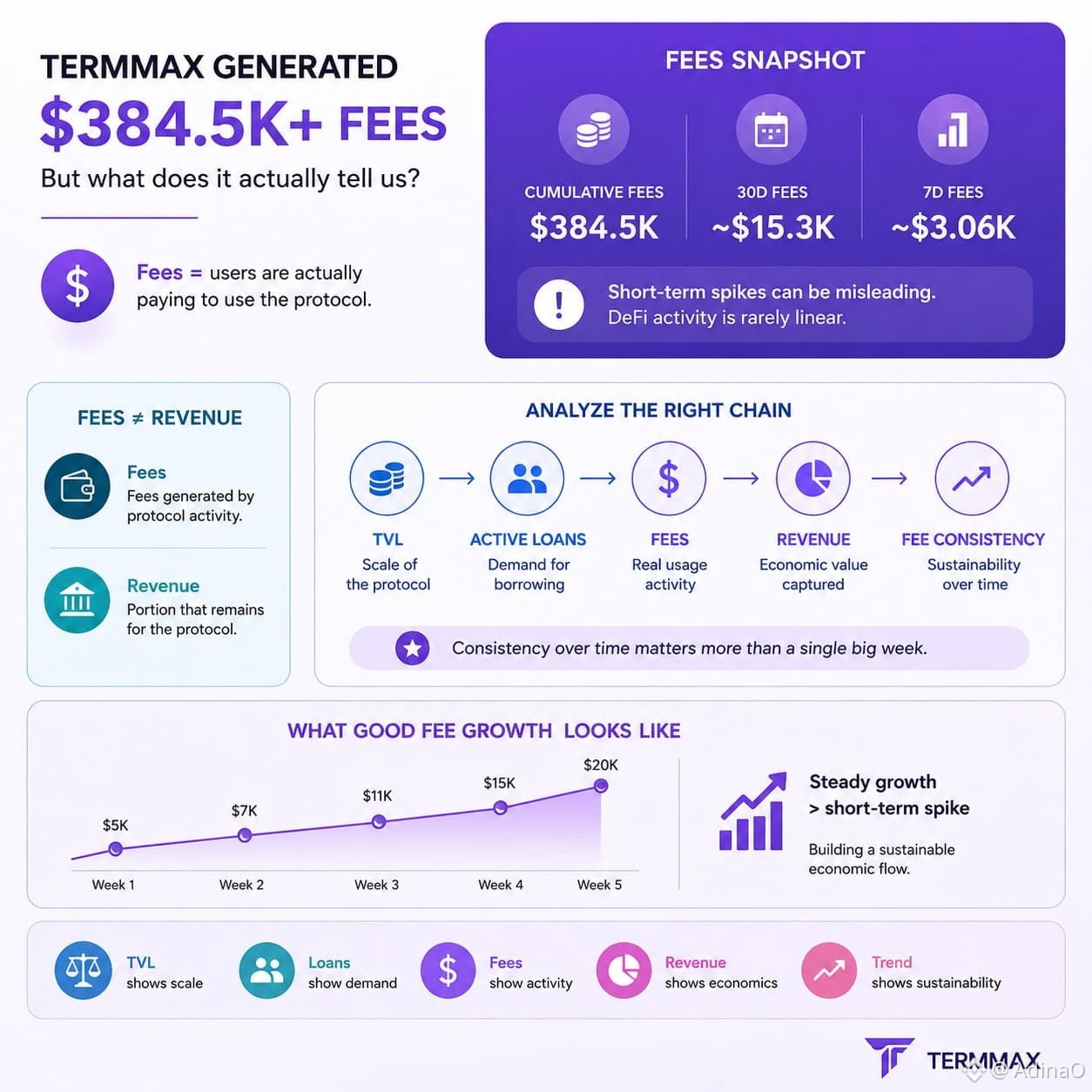
In one earlier DeFiLlama snapshot, TermMax had approximately:
$384.5K cumulative fees
with roughly:
30D: ~$15.3K
7D: ~$3.06K
But there's an important catch.
You can't simply take the latest 7-day figure and assume it represents a new sustainable annual trend.
DeFi activity is rarely linear.
One large market, a few large transactions, or changes in incentives can significantly affect short-term fee generation.
So the better question is:
Is the fee flow becoming more consistent?
For example:
TVL ↑
Active Loans ↑
Fees ↑
This suggests that scale and actual usage are growing together.
But:
TVL ↑
Active Loans →
Fees →
tells a very different story.
The protocol may have attracted more capital without seeing the same increase in demand.
And there's another distinction that matters:
Fees ≠ Revenue
These terms are often confused.
Fees represent the fees generated by protocol activity.
Revenue represents the portion that ultimately accrues to the protocol after applicable distributions.
That's why I'd analyze TermMax through a chain of metrics:
TVL
↓
Active Loans
↓
Fees
↓
Revenue
↓
Fee consistency
The last one may be the most important.
Because:
$15K in monthly fees is just a number.
But something like:
$5K → $7K → $11K → $15K → $20K
would tell a much more interesting story.
It could indicate that the protocol is building a more consistent economic flow rather than simply experiencing a short-term spike.
And that's where I see an interesting question around @termmax :
That's a much more interesting question to me than the APY of a single vault.
TVL shows scale.
Loans show demand.
Fees show activity.
Revenue shows economics.
The trend shows sustainability.
#termmax
TermMax Has Generated Hundreds of Thousands in Fees. But What Does That Actually Tell Us?
One of the DeFi metrics I find more interesting than APY is:
Fees.
Why?
Because APY can look attractive even when actual demand for a product is limited.
Fees tell us something different:
Users are actually paying to use the protocol.
In one earlier DeFiLlama snapshot, TermMax had approximately:
$384.5K cumulative fees
with roughly:
30D: ~$15.3K
7D: ~$3.06K
But there's an important catch.
You can't simply take the latest 7-day figure and assume it represents a new sustainable annual trend.
DeFi activity is rarely linear.
One large market, a few large transactions, or changes in incentives can significantly affect short-term fee generation.
So the better question is:
Is the fee flow becoming more consistent?
For example:
TVL ↑
Active Loans ↑
Fees ↑
This suggests that scale and actual usage are growing together.
But:
TVL ↑
Active Loans →
Fees →
tells a very different story.
The protocol may have attracted more capital without seeing the same increase in demand.
And there's another distinction that matters:
Fees ≠ Revenue
These terms are often confused.
Fees represent the fees generated by protocol activity.
Revenue represents the portion that ultimately accrues to the protocol after applicable distributions.
That's why I'd analyze TermMax through a chain of metrics:
TVL
↓
Active Loans
↓
Fees
↓
Revenue
↓
Fee consistency
The last one may be the most important.
Because:
$15K in monthly fees is just a number.
But something like:
$5K → $7K → $11K → $15K → $20K
would tell a much more interesting story.
It could indicate that the protocol is building a more consistent economic flow rather than simply experiencing a short-term spike.
And that's where I see an interesting question around @TermMax :
That's a much more interesting question to me than the APY of a single vault.
TVL shows scale.
Loans show demand.
Fees show activity.
Revenue shows economics.
The trend shows sustainability.
TermMax Has Generated Hundreds of Thousands in Fees. But What Does That Actually Tell Us?
One of the DeFi metrics I find more interesting than APY is:
Fees.
Why?
Because APY can look attractive even when actual demand for a product is limited.
Fees tell us something different:
Users are actually paying to use the protocol.
In one earlier DeFiLlama snapshot, TermMax had approximately:
$384.5K cumulative fees
with roughly:
30D: ~$15.3K
7D: ~$3.06K
But there's an important catch.
You can't simply take the latest 7-day figure and assume it represents a new sustainable annual trend.
DeFi activity is rarely linear.
One large market, a few large transactions, or changes in incentives can significantly affect short-term fee generation.
So the better question is:
Is the fee flow becoming more consistent?
For example:
TVL ↑
Active Loans ↑
Fees ↑
This suggests that scale and actual usage are growing together.
But:
TVL ↑
Active Loans →
Fees →
tells a very different story.
The protocol may have attracted more capital without seeing the same increase in demand.
And there's another distinction that matters:
Fees ≠ Revenue
These terms are often confused.
Fees represent the fees generated by protocol activity.
Revenue represents the portion that ultimately accrues to the protocol after applicable distributions.
That's why I'd analyze TermMax through a chain of metrics:
TVL
↓
Active Loans
↓
Fees
↓
Revenue
↓
Fee consistency
The last one may be the most important.
Because:
$15K in monthly fees is just a number.
But something like:
$5K → $7K → $11K → $15K → $20K
would tell a much more interesting story.
It could indicate that the protocol is building a more consistent economic flow rather than simply experiencing a short-term spike.
And that's where I see an interesting question around @TermMax :
That's a much more interesting question to me than the APY of a single vault.
TVL shows scale.
Loans show demand.
Fees show activity.
Revenue shows economics.
The trend shows sustainability.
1
78
·
--
Tarjimani ko‘rish
#termmax
How Does the Interest Rate Actually Work in TermMax?
When people see:
Fixed Rate
they might think it's simply an APR that someone chose.
But TermMax's mechanism is more interesting.
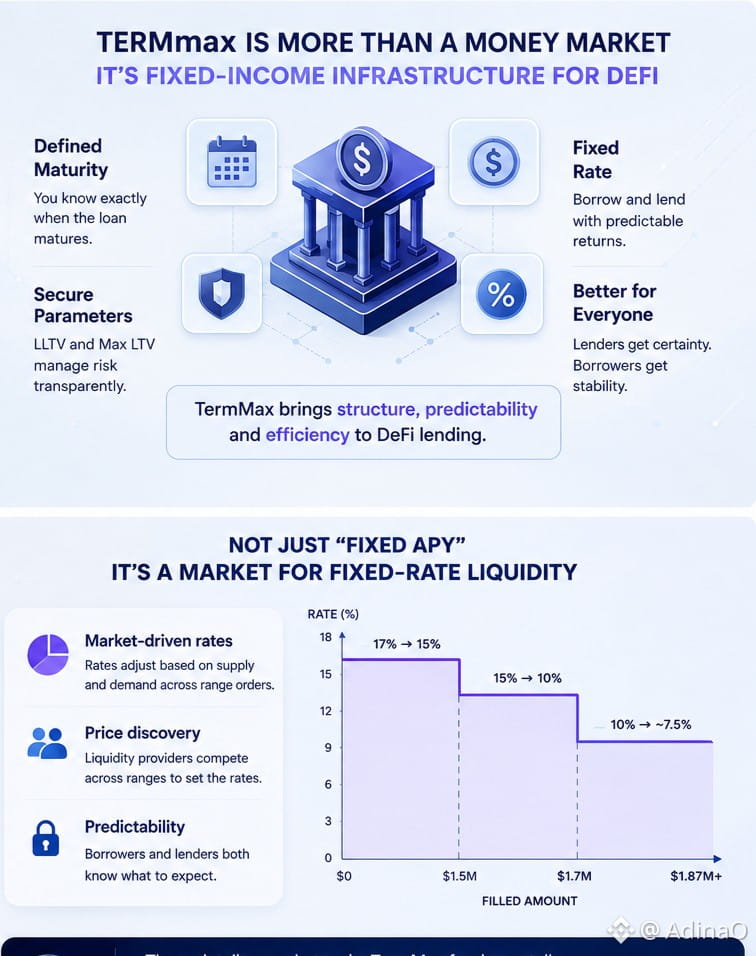
Rates are formed through Range Orders.
A single market can contain multiple range orders, with different rate ranges depending on the amount being filled.
For example, an illustrative structure could look like:
$1.5M → 17% → 15%
$200K → 15% → 10%
$170K → 10% → ~7.5%
In other words, the rate can change as more liquidity is filled.
Think of it as a segmented pricing curve rather than a single fixed APR.
And this is where TermMax gets interesting.
It isn't simply offering a “fixed APY.”
It's creating a market for fixed-rate liquidity, with its own mechanism for price discovery.
For me, these details are what make TermMax fundamentally different from ordinary yield farming.@termmax
#termmax
How Does the Interest Rate Actually Work in TermMax?
When people see:
Fixed Rate
they might think it's simply an APR that someone chose.
But TermMax's mechanism is more interesting.
Rates are formed through Range Orders.
A single market can contain multiple range orders, with different rate ranges depending on the amount being filled.
For example, an illustrative structure could look like:
$1.5M → 17% → 15%
$200K → 15% → 10%
$170K → 10% → ~7.5%
In other words, the rate can change as more liquidity is filled.
Think of it as a segmented pricing curve rather than a single fixed APR.
And this is where TermMax gets interesting.
It isn't simply offering a “fixed APY.”
It's creating a market for fixed-rate liquidity, with its own mechanism for price discovery.
For me, these details are what make TermMax fundamentally different from ordinary yield farming.@TermMax
How Does the Interest Rate Actually Work in TermMax?
When people see:
Fixed Rate
they might think it's simply an APR that someone chose.
But TermMax's mechanism is more interesting.
Rates are formed through Range Orders.
A single market can contain multiple range orders, with different rate ranges depending on the amount being filled.
For example, an illustrative structure could look like:
$1.5M → 17% → 15%
$200K → 15% → 10%
$170K → 10% → ~7.5%
In other words, the rate can change as more liquidity is filled.
Think of it as a segmented pricing curve rather than a single fixed APR.
And this is where TermMax gets interesting.
It isn't simply offering a “fixed APY.”
It's creating a market for fixed-rate liquidity, with its own mechanism for price discovery.
For me, these details are what make TermMax fundamentally different from ordinary yield farming.@TermMax
2
1
65
·
--
Tarjimani ko‘rish
#termmax
“What Did V2 Actually Change?”
TermMax V2 is not just a new website design.
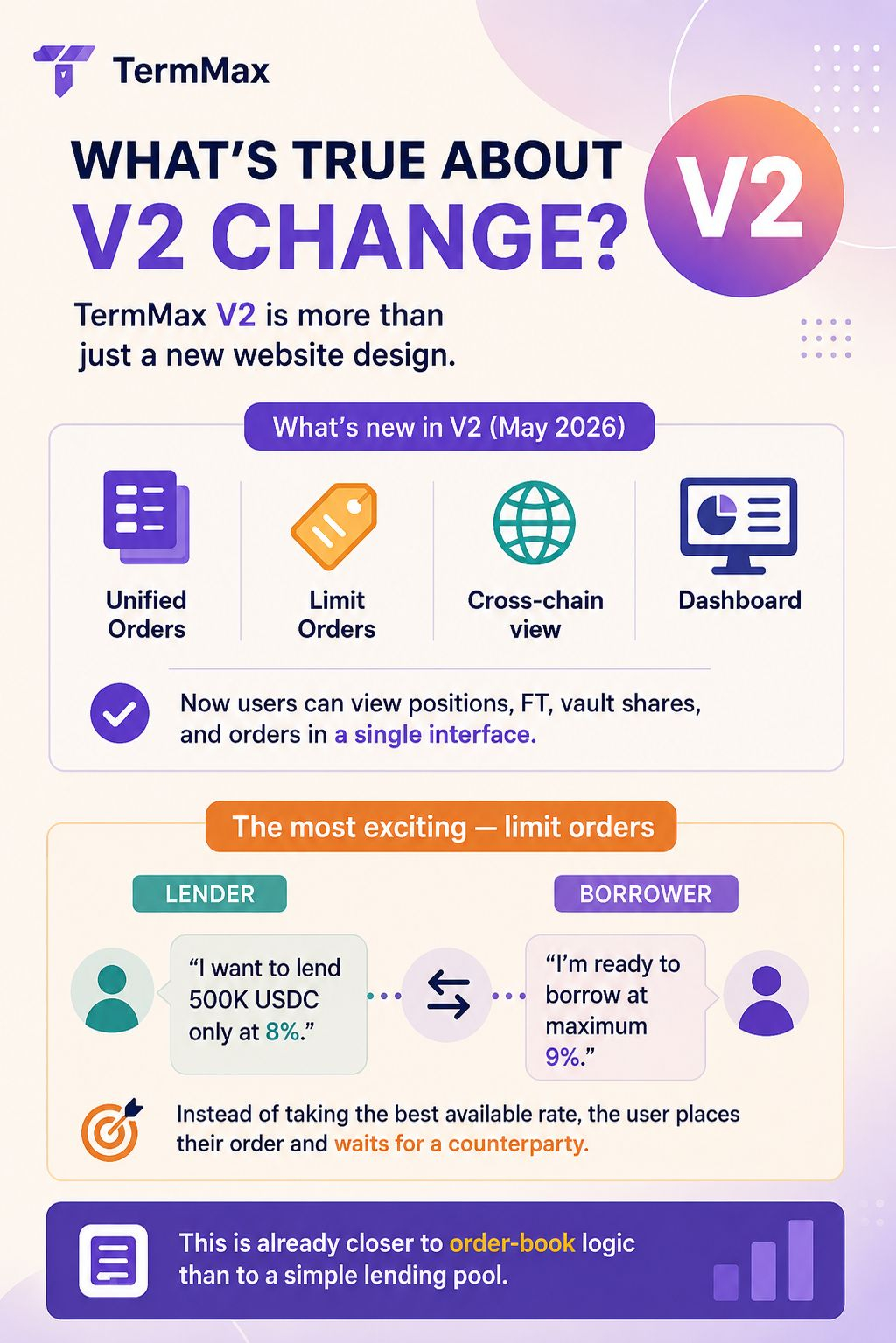
In May 2026, the team launched V2 with:
→ Unified Orders
→ Limit Orders
→ Cross-chain View
→ Dashboard
Now users can see their positions, FT, vault shares, and orders in one interface.
[TermMax Blog – Fixed-Rate DeFi Insights](https://ts.finance/?utm_source=chatgpt.com)
But the most interesting feature for me is limit orders.
For example, a lender can say:
> “I want to lend 500K USDC, but only at 8%.”
A borrower can say:
> “I’m willing to borrow, but only up to 9%.”
Instead of simply accepting an available rate, the user can leave their order waiting for a counterparty.
That makes TermMax look much closer to order-book logic than to a simple lending pool.
@termmax
#termmax
“What Did V2 Actually Change?”
TermMax V2 is not just a new website design.
In May 2026, the team launched V2 with:
→ Unified Orders
→ Limit Orders
→ Cross-chain View
→ Dashboard
Now users can see their positions, FT, vault shares, and orders in one interface.
[TermMax Blog – Fixed-Rate DeFi Insights](https://ts.finance/?utm_source=chatgpt.com)
But the most interesting feature for me is limit orders.
For example, a lender can say:
> “I want to lend 500K USDC, but only at 8%.”
A borrower can say:
> “I’m willing to borrow, but only up to 9%.”
Instead of simply accepting an available rate, the user can leave their order waiting for a counterparty.
That makes TermMax look much closer to order-book logic than to a simple lending pool.
@TermMax
“What Did V2 Actually Change?”
TermMax V2 is not just a new website design.
In May 2026, the team launched V2 with:
→ Unified Orders
→ Limit Orders
→ Cross-chain View
→ Dashboard
Now users can see their positions, FT, vault shares, and orders in one interface.
[TermMax Blog – Fixed-Rate DeFi Insights](https://ts.finance/?utm_source=chatgpt.com)
But the most interesting feature for me is limit orders.
For example, a lender can say:
> “I want to lend 500K USDC, but only at 8%.”
A borrower can say:
> “I’m willing to borrow, but only up to 9%.”
Instead of simply accepting an available rate, the user can leave their order waiting for a counterparty.
That makes TermMax look much closer to order-book logic than to a simple lending pool.
@TermMax
1
69
·
--
#bstockscis
Nega tanish bir tickerimni ko‘rganimdan keyin bStockni darhol sotib olmaslik kerak.
Hatto bu NVIDIA, Tesla yoki Microsoft bo‘lsa ham.
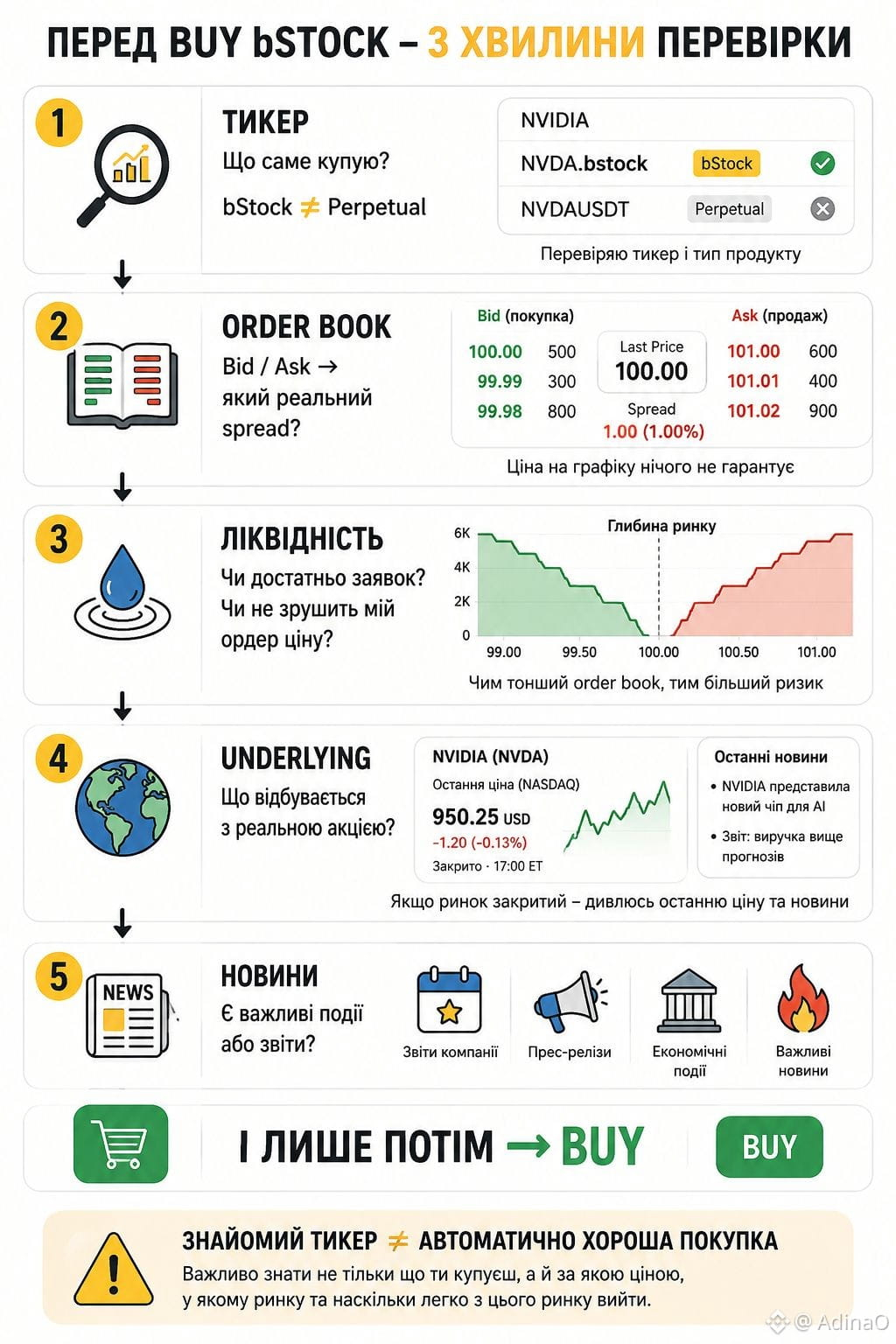
Buy tugmasini bosishdan oldin men 3 daqiqa tekshiraman.
1. Binance’da bitta kompaniya turli instrumentlar orqali taqdim etilishi mumkin.
Shuning uchun men avval ticker va mahsulot turini tekshiraman.
bStock perpetual bilan bir xil emas.
2. Keyin bid va ask’ga qarayman.
Grafikdagi narxning o‘zi hech narsa kafolatlamaydi.
Masalan, sen $100 ko‘raysan.
Lekin sotib olish uchun $101 to‘lashga to‘g‘ri keladi, hoziroq sotish esa faqat $98 bo‘yicha mumkin.
Mana shu farqning ahamiyati bor.
Shuning uchun kirishdan oldin faqat oxirgi narxga emas, order book’ga ham qarayman.
3. Likvidlikni tekshiraman.
Ayniqsa, agar men uchun sotib olish summasi unchalik kichik bo‘lmasa.
Order book qanchalik “ingichka” bo‘lsa, mening buyurtmam narxni o‘zi siljitib yuborish xavfi shunchalik katta bo‘ladi.
Bu yerda kompaniya mashhurligi hech narsa kafolatlamaydi.
Mashhur aksiyami ≠ uning tokenlashtirilgan versiyasi bo‘yicha chuqur bozor.
4. Agar bStock kuchli harakat qilsa, men bilmoqchiman:
hozir real aksiyada nima ro‘y beryapti?
Agar an’anaviy bozor yopiq bo‘lsa — oxirgi mavjud narx va kompaniya bo‘yicha eng yangi yangiliklarni ko‘raman.
5. Mening qisqa algoritmim:
Ticker → instrument turi → order book → spread → likvidlik → underlying → yangiliklar → Buy.
@BinanceCIS #bstocksсis
#bstockscis
Nega tanish bir tickerimni ko‘rganimdan keyin bStockni darhol sotib olmaslik kerak.
Hatto bu NVIDIA, Tesla yoki Microsoft bo‘lsa ham.
Buy tugmasini bosishdan oldin men 3 daqiqa tekshiraman.
1. Binance’da bitta kompaniya turli instrumentlar orqali taqdim etilishi mumkin.
Shuning uchun men avval ticker va mahsulot turini tekshiraman.
bStock perpetual bilan bir xil emas.
2. Keyin bid va ask’ga qarayman.
Grafikdagi narxning o‘zi hech narsa kafolatlamaydi.
Masalan, sen $100 ko‘raysan.
Lekin sotib olish uchun $101 to‘lashga to‘g‘ri keladi, hoziroq sotish esa faqat $98 bo‘yicha mumkin.
Mana shu farqning ahamiyati bor.
Shuning uchun kirishdan oldin faqat oxirgi narxga emas, order book’ga ham qarayman.
3. Likvidlikni tekshiraman.
Ayniqsa, agar men uchun sotib olish summasi unchalik kichik bo‘lmasa.
Order book qanchalik “ingichka” bo‘lsa, mening buyurtmam narxni o‘zi siljitib yuborish xavfi shunchalik katta bo‘ladi.
Bu yerda kompaniya mashhurligi hech narsa kafolatlamaydi.
Mashhur aksiyami ≠ uning tokenlashtirilgan versiyasi bo‘yicha chuqur bozor.
4. Agar bStock kuchli harakat qilsa, men bilmoqchiman:
hozir real aksiyada nima ro‘y beryapti?
Agar an’anaviy bozor yopiq bo‘lsa — oxirgi mavjud narx va kompaniya bo‘yicha eng yangi yangiliklarni ko‘raman.
5. Mening qisqa algoritmim:
Ticker → instrument turi → order book → spread → likvidlik → underlying → yangiliklar → Buy.
@BinanceCIS #bstocksсis
Nega tanish bir tickerimni ko‘rganimdan keyin bStockni darhol sotib olmaslik kerak.
Hatto bu NVIDIA, Tesla yoki Microsoft bo‘lsa ham.
Buy tugmasini bosishdan oldin men 3 daqiqa tekshiraman.
1. Binance’da bitta kompaniya turli instrumentlar orqali taqdim etilishi mumkin.
Shuning uchun men avval ticker va mahsulot turini tekshiraman.
bStock perpetual bilan bir xil emas.
2. Keyin bid va ask’ga qarayman.
Grafikdagi narxning o‘zi hech narsa kafolatlamaydi.
Masalan, sen $100 ko‘raysan.
Lekin sotib olish uchun $101 to‘lashga to‘g‘ri keladi, hoziroq sotish esa faqat $98 bo‘yicha mumkin.
Mana shu farqning ahamiyati bor.
Shuning uchun kirishdan oldin faqat oxirgi narxga emas, order book’ga ham qarayman.
3. Likvidlikni tekshiraman.
Ayniqsa, agar men uchun sotib olish summasi unchalik kichik bo‘lmasa.
Order book qanchalik “ingichka” bo‘lsa, mening buyurtmam narxni o‘zi siljitib yuborish xavfi shunchalik katta bo‘ladi.
Bu yerda kompaniya mashhurligi hech narsa kafolatlamaydi.
Mashhur aksiyami ≠ uning tokenlashtirilgan versiyasi bo‘yicha chuqur bozor.
4. Agar bStock kuchli harakat qilsa, men bilmoqchiman:
hozir real aksiyada nima ro‘y beryapti?
Agar an’anaviy bozor yopiq bo‘lsa — oxirgi mavjud narx va kompaniya bo‘yicha eng yangi yangiliklarni ko‘raman.
5. Mening qisqa algoritmim:
Ticker → instrument turi → order book → spread → likvidlik → underlying → yangiliklar → Buy.
@BinanceCIS #bstocksсis
1
3
181
·
--
Tarjimani ko‘rish
#termmax
I wouldn’t look at TermMax through APY»
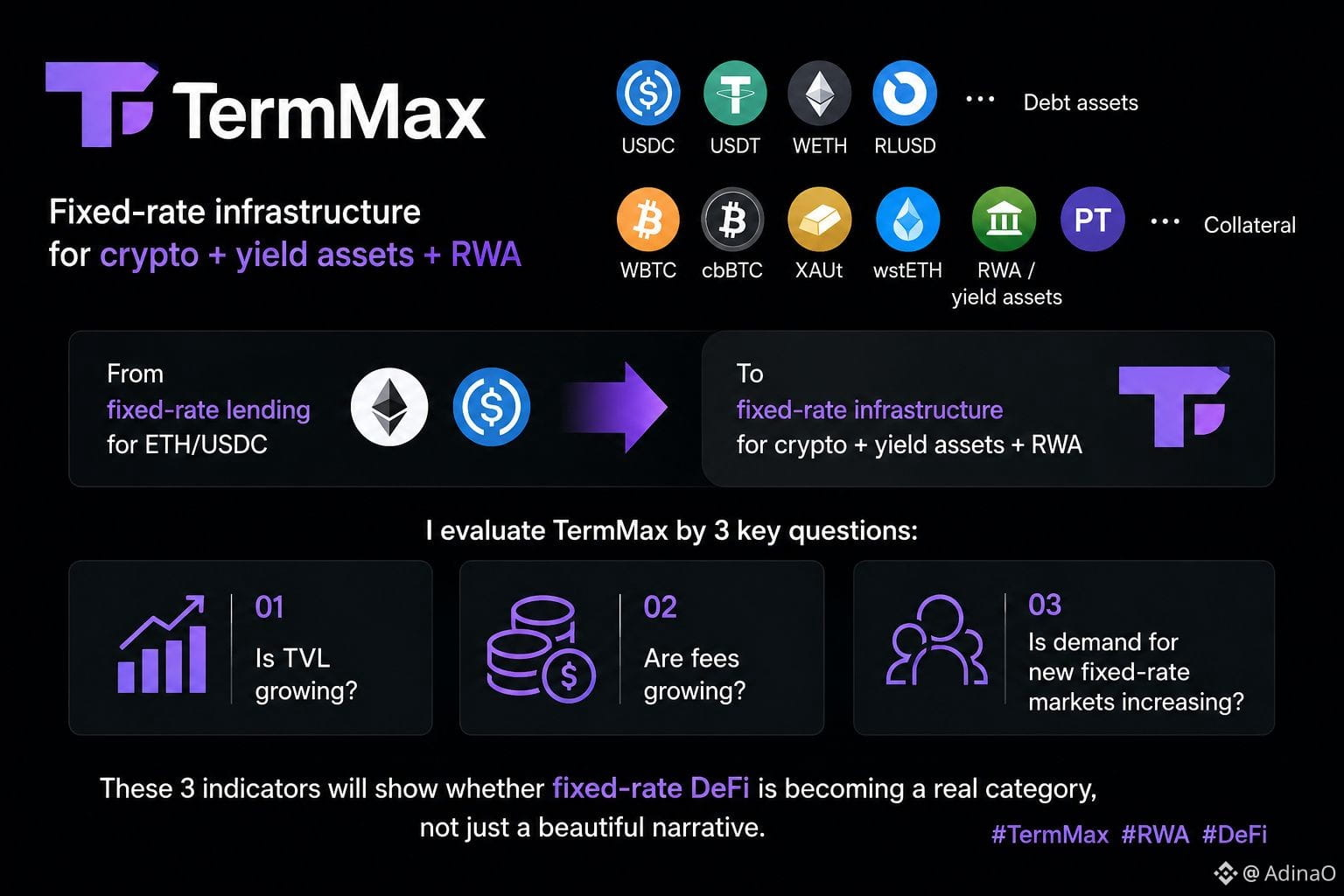
TermMax currently has a wide variety of markets.
For example, the current interface includes USDC, USDT, WETH, $RLUSD and other debt assets, while collateral includes WBTC, cbBTC, XAUt, wstETH, RWA/yield-bearing assets and PT tokens.
This is important.
Because TermMax is gradually moving from:
“fixed-rate lending for ETH/USDC”
to a broader model:
fixed-rate infrastructure for crypto + yield assets + RWA.
For example, current markets already include collateral such as $XAUT
{spot}(XAUTUSDT)
, ynRWAx, USPC and other yield-bearing/RWA assets.
That’s why I would evaluate TermMax based on three questions:
• Is TVL growing?
• Are fees growing?
• Is demand for new fixed-rate markets increasing?
These three indicators will show whether fixed-rate DeFi is becoming a real category rather than just a beautiful narrative
@termmax #TermMax
#termmax
I wouldn’t look at TermMax through APY»
TermMax currently has a wide variety of markets.
For example, the current interface includes USDC, USDT, WETH, $RLUSD and other debt assets, while collateral includes WBTC, cbBTC, XAUt, wstETH, RWA/yield-bearing assets and PT tokens.
This is important.
Because TermMax is gradually moving from:
“fixed-rate lending for ETH/USDC”
to a broader model:
fixed-rate infrastructure for crypto + yield assets + RWA.
For example, current markets already include collateral such as $XAUT
, ynRWAx, USPC and other yield-bearing/RWA assets.
That’s why I would evaluate TermMax based on three questions:
• Is TVL growing?
• Are fees growing?
• Is demand for new fixed-rate markets increasing?
These three indicators will show whether fixed-rate DeFi is becoming a real category rather than just a beautiful narrative
@TermMax #TermMax
I wouldn’t look at TermMax through APY»
TermMax currently has a wide variety of markets.
For example, the current interface includes USDC, USDT, WETH, $RLUSD and other debt assets, while collateral includes WBTC, cbBTC, XAUt, wstETH, RWA/yield-bearing assets and PT tokens.
This is important.
Because TermMax is gradually moving from:
“fixed-rate lending for ETH/USDC”
to a broader model:
fixed-rate infrastructure for crypto + yield assets + RWA.
For example, current markets already include collateral such as $XAUT
, ynRWAx, USPC and other yield-bearing/RWA assets.
That’s why I would evaluate TermMax based on three questions:
• Is TVL growing?
• Are fees growing?
• Is demand for new fixed-rate markets increasing?
These three indicators will show whether fixed-rate DeFi is becoming a real category rather than just a beautiful narrative
@TermMax #TermMax
1
81
·
--
Tarjimani ko‘rish
#termmax
«TVL впав — чи це погано?»
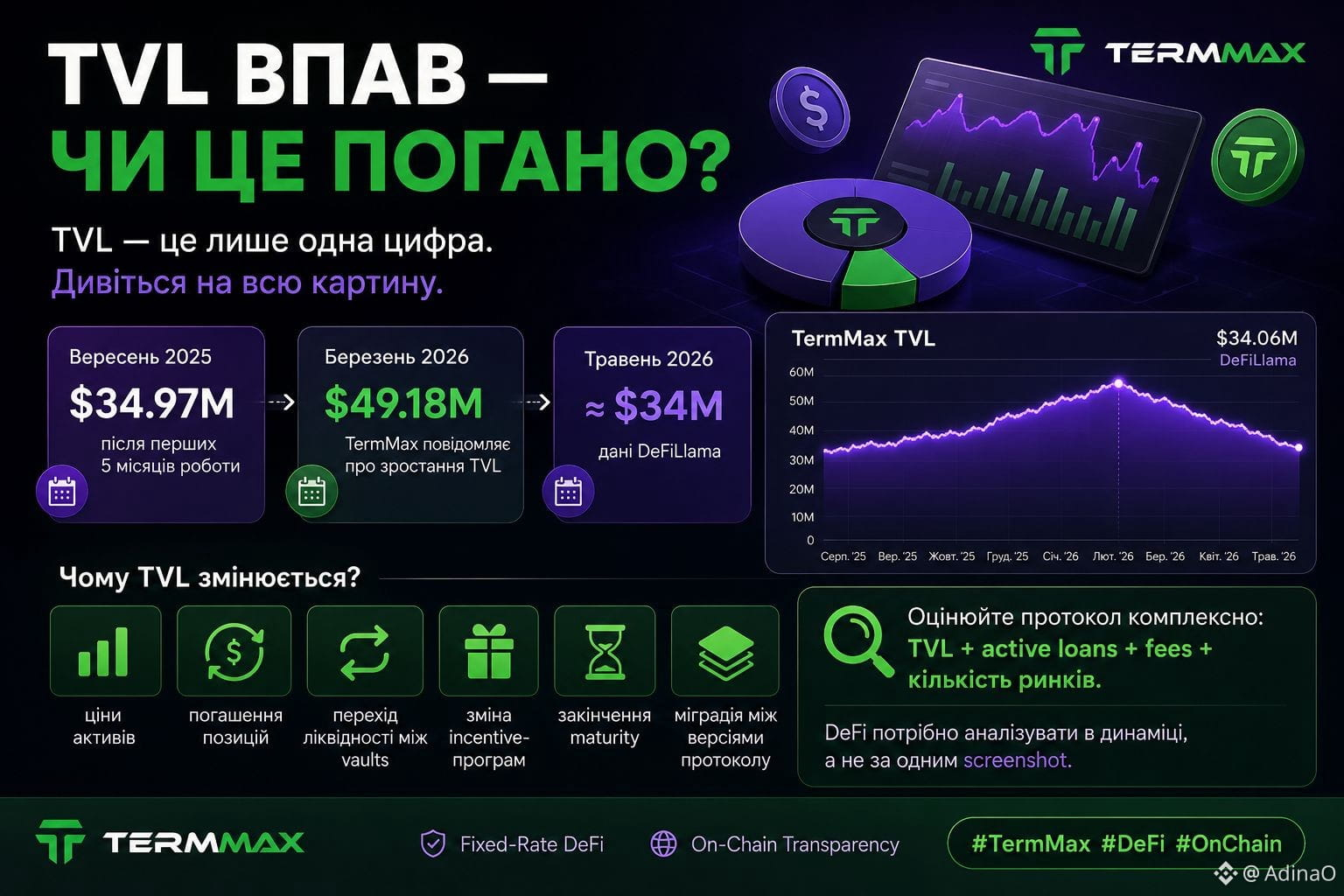
Є цікава річ, яку я помітила під час дослідження TermMax.
У вересні 2025 року команда писала про $34.97 млн TVL після перших 5 місяців роботи.
У березні 2026 року TermMax уже повідомляв про $49.18 млн TVL.
А зараз DeFiLlama показує близько $34 млн. �
TermMax Blog – Fixed-Rate DeFi Insights +2
На перший погляд можна сказати:
«TVL впав — значить протокол втрачає популярність».
Але це занадто простий висновок.
TVL у DeFi змінюється через:
• ціни активів
• погашення позицій
• перехід ліквідності між vaults
• зміну incentive-програм
• закінчення maturity
• міграцію між версіями протоколу.
Тому набагато правильніше дивитися TVL + active loans + fees + кількість ринків одночасно.
І саме тому я б не оцінювала TermMax за однією цифрою.
@termmax #TermMax
#termmax
«TVL впав — чи це погано?»
Є цікава річ, яку я помітила під час дослідження TermMax.
У вересні 2025 року команда писала про $34.97 млн TVL після перших 5 місяців роботи.
У березні 2026 року TermMax уже повідомляв про $49.18 млн TVL.
А зараз DeFiLlama показує близько $34 млн. �
TermMax Blog – Fixed-Rate DeFi Insights +2
На перший погляд можна сказати:
«TVL впав — значить протокол втрачає популярність».
Але це занадто простий висновок.
TVL у DeFi змінюється через:
• ціни активів
• погашення позицій
• перехід ліквідності між vaults
• зміну incentive-програм
• закінчення maturity
• міграцію між версіями протоколу.
Тому набагато правильніше дивитися TVL + active loans + fees + кількість ринків одночасно.
І саме тому я б не оцінювала TermMax за однією цифрою.
@TermMax #TermMax
«TVL впав — чи це погано?»
Є цікава річ, яку я помітила під час дослідження TermMax.
У вересні 2025 року команда писала про $34.97 млн TVL після перших 5 місяців роботи.
У березні 2026 року TermMax уже повідомляв про $49.18 млн TVL.
А зараз DeFiLlama показує близько $34 млн. �
TermMax Blog – Fixed-Rate DeFi Insights +2
На перший погляд можна сказати:
«TVL впав — значить протокол втрачає популярність».
Але це занадто простий висновок.
TVL у DeFi змінюється через:
• ціни активів
• погашення позицій
• перехід ліквідності між vaults
• зміну incentive-програм
• закінчення maturity
• міграцію між версіями протоколу.
Тому набагато правильніше дивитися TVL + active loans + fees + кількість ринків одночасно.
І саме тому я б не оцінювала TermMax за однією цифрою.
@TermMax #TermMax
1
76
·
--
#bstockscis
QCOMB: Siz bilmasdan allaqachon Qualcommdan foydalanayotgan bo‘lishingiz mumkin
Agar siz smartfon ishlatsangiz, hatto buni sezmasdan ham Qualcomm texnologiyasidan foydalanayotgan bo‘lishingiz mumkin.
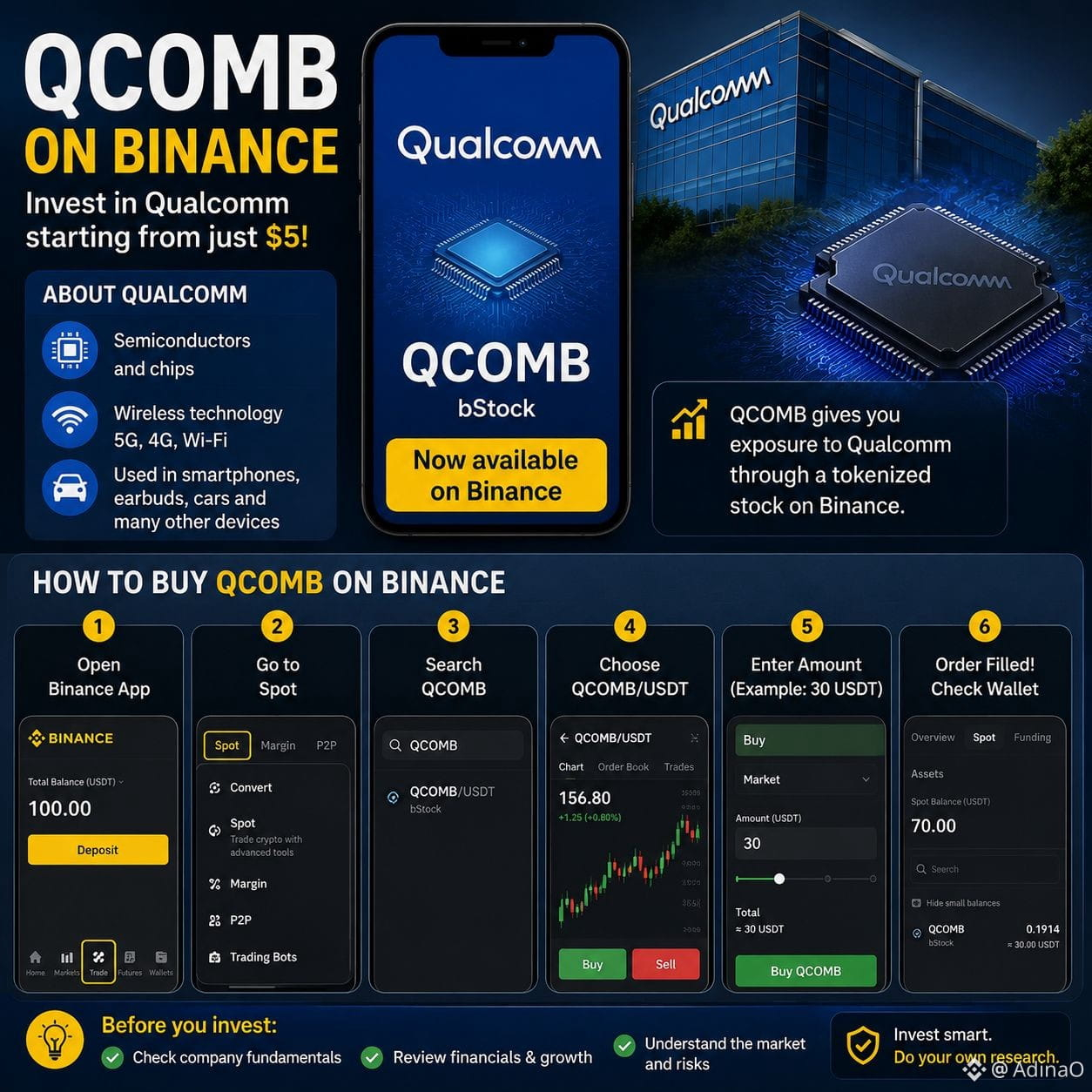
Binancedagi bStock’i — QCOMB.
Qualcomm — 1985-yilda San-Diyegoda tashkil etilgan amerika texnologiya kompaniyasi. Uning aksiyalari Nasdaq birjasida QCOM kodi (ticker) ostida savdolanadi.
Kompaniya simsiz aloqa texnologiyalari, chiplar va patent litsenziyalash bilan mashhur. Uning texnologiyasi mobil qurilmalarda va boshqa ko‘plab ulangan mahsulotlarda qo‘llaniladi.
Endi eng qiziq qismi:
Binance’da QCOMB’ni qanday sotib olish mumkin?
Aytaylik, siz 30$ dan boshlamoqchisiz.
🔹 Spot-ni oching
🔹 $QCOMB ni qidiring
🔹 QCOMB/USDT ni tanlang
🔹 Invest qilmoqchi bo‘lgan summani kiriting
🔹 Market — agar buyurtma hozirgi mavjud bozor narxida bajarilishini xohlasangiz
🔹 Limit — agar o‘z kirish narxingizni belgilamoqchi bo‘lsangiz
Buyurtma to‘ldirilgach, QCOMB Spot pozitsiyangizda paydo bo‘ladi.
Binance 2026-yil iyul oyida Qualcomm (QCOMB) ni bStocks takliflariga qo‘shdi.
Lekin men QCOMB’ni shunchaki shuning uchun sotib olmasdimki:
“Qualcomm chiplar ishlab chiqaradi → smartfonlar hamma joyda → aksiyalar albatta oshadi.”
Sotib olishdan oldin men kompaniya pulni qanday topishini, uning o‘sishini va bozor biznesni hozir qanday baholayotganini ko‘rardim.
bStocks haqida men uchun qiziq tomoni shunda:
Siz kundalik hayotda tanish narsaga qarashingiz mumkin — smartfon, quloqchin, avtomobil yoki boshqa ulangan qurilma — va o‘zingizdan so‘raysiz:
“Men har kuni foydalanadigan texnologiya ortida qaysi kompaniyalar turibdi?”
Ba’zan bu keyinroq o‘rganishga arziydigan kompaniyalarni topish uchun juda yaxshi boshlang‘ich bo‘lishi mumkin.
@BinanceCIS #bstocksсis
#bstockscis
QCOMB: Siz bilmasdan allaqachon Qualcommdan foydalanayotgan bo‘lishingiz mumkin
Agar siz smartfon ishlatsangiz, hatto buni sezmasdan ham Qualcomm texnologiyasidan foydalanayotgan bo‘lishingiz mumkin.
Binancedagi bStock’i — QCOMB.
Qualcomm — 1985-yilda San-Diyegoda tashkil etilgan amerika texnologiya kompaniyasi. Uning aksiyalari Nasdaq birjasida QCOM kodi (ticker) ostida savdolanadi.
Kompaniya simsiz aloqa texnologiyalari, chiplar va patent litsenziyalash bilan mashhur. Uning texnologiyasi mobil qurilmalarda va boshqa ko‘plab ulangan mahsulotlarda qo‘llaniladi.
Endi eng qiziq qismi:
Binance’da QCOMB’ni qanday sotib olish mumkin?
Aytaylik, siz 30$ dan boshlamoqchisiz.
🔹 Spot-ni oching
🔹 $QCOMB ni qidiring
🔹 QCOMB/USDT ni tanlang
🔹 Invest qilmoqchi bo‘lgan summani kiriting
🔹 Market — agar buyurtma hozirgi mavjud bozor narxida bajarilishini xohlasangiz
🔹 Limit — agar o‘z kirish narxingizni belgilamoqchi bo‘lsangiz
Buyurtma to‘ldirilgach, QCOMB Spot pozitsiyangizda paydo bo‘ladi.
Binance 2026-yil iyul oyida Qualcomm (QCOMB) ni bStocks takliflariga qo‘shdi.
Lekin men QCOMB’ni shunchaki shuning uchun sotib olmasdimki:
“Qualcomm chiplar ishlab chiqaradi → smartfonlar hamma joyda → aksiyalar albatta oshadi.”
Sotib olishdan oldin men kompaniya pulni qanday topishini, uning o‘sishini va bozor biznesni hozir qanday baholayotganini ko‘rardim.
bStocks haqida men uchun qiziq tomoni shunda:
Siz kundalik hayotda tanish narsaga qarashingiz mumkin — smartfon, quloqchin, avtomobil yoki boshqa ulangan qurilma — va o‘zingizdan so‘raysiz:
“Men har kuni foydalanadigan texnologiya ortida qaysi kompaniyalar turibdi?”
Ba’zan bu keyinroq o‘rganishga arziydigan kompaniyalarni topish uchun juda yaxshi boshlang‘ich bo‘lishi mumkin.
@BinanceCIS #bstocksсis
QCOMB: Siz bilmasdan allaqachon Qualcommdan foydalanayotgan bo‘lishingiz mumkin
Agar siz smartfon ishlatsangiz, hatto buni sezmasdan ham Qualcomm texnologiyasidan foydalanayotgan bo‘lishingiz mumkin.
Binancedagi bStock’i — QCOMB.
Qualcomm — 1985-yilda San-Diyegoda tashkil etilgan amerika texnologiya kompaniyasi. Uning aksiyalari Nasdaq birjasida QCOM kodi (ticker) ostida savdolanadi.
Kompaniya simsiz aloqa texnologiyalari, chiplar va patent litsenziyalash bilan mashhur. Uning texnologiyasi mobil qurilmalarda va boshqa ko‘plab ulangan mahsulotlarda qo‘llaniladi.
Endi eng qiziq qismi:
Binance’da QCOMB’ni qanday sotib olish mumkin?
Aytaylik, siz 30$ dan boshlamoqchisiz.
🔹 Spot-ni oching
🔹 $QCOMB ni qidiring
🔹 QCOMB/USDT ni tanlang
🔹 Invest qilmoqchi bo‘lgan summani kiriting
🔹 Market — agar buyurtma hozirgi mavjud bozor narxida bajarilishini xohlasangiz
🔹 Limit — agar o‘z kirish narxingizni belgilamoqchi bo‘lsangiz
Buyurtma to‘ldirilgach, QCOMB Spot pozitsiyangizda paydo bo‘ladi.
Binance 2026-yil iyul oyida Qualcomm (QCOMB) ni bStocks takliflariga qo‘shdi.
Lekin men QCOMB’ni shunchaki shuning uchun sotib olmasdimki:
“Qualcomm chiplar ishlab chiqaradi → smartfonlar hamma joyda → aksiyalar albatta oshadi.”
Sotib olishdan oldin men kompaniya pulni qanday topishini, uning o‘sishini va bozor biznesni hozir qanday baholayotganini ko‘rardim.
bStocks haqida men uchun qiziq tomoni shunda:
Siz kundalik hayotda tanish narsaga qarashingiz mumkin — smartfon, quloqchin, avtomobil yoki boshqa ulangan qurilma — va o‘zingizdan so‘raysiz:
“Men har kuni foydalanadigan texnologiya ortida qaysi kompaniyalar turibdi?”
Ba’zan bu keyinroq o‘rganishga arziydigan kompaniyalarni topish uchun juda yaxshi boshlang‘ich bo‘lishi mumkin.
@BinanceCIS #bstocksсis
1
1
87
·
--
#bstockscis
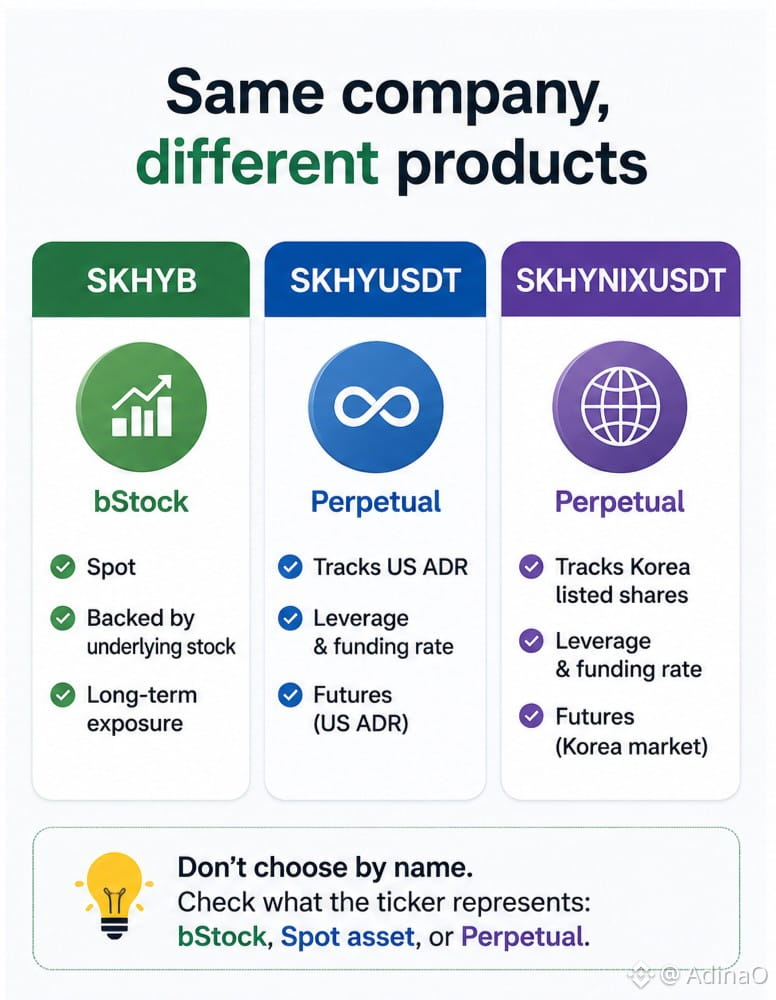
SKHYB, SKHYUSDT va SKHYNIXUSDT: farqi nimada?
Agar siz Binance’da yangisiz va SK Hynix’ni qidirsangiz, osongina adashib qolishingiz mumkin.
Siz quyidagilarni ko‘rishingiz mumkin:
$SKHYB
$SKHY USDT
$SKHYNIX USDT
Va shunday deb o‘ylaysiz:
“Bu uchta bir xil narsani savdo qilishning uchta yo‘li xolos.”
To‘g‘ri emas.
SKHYB — bStock. U Spot’da savdo qiladi va asosiy aksiyaga tayangan bo‘lib, sizga SK Hynix’ga tokenlashtirilgan ta’sirni beradi.
SKHYUSDT — U.S. ADR’ni kuzatadigan perpetual fyuchers shartnomasi. U sizga bStock’ga egalik bermaydi va leverage (kredit yelkasi) hamda funding stavkalari kabi fyuchers mexanikalarini o‘z ichiga oladi.
SKHYNIXUSDT esa yana bir perpetual shartnoma, lekin u Janubiy Koreyada ro‘yxatga olingan SK Hynix aksiyalarini kuzatadi.
Bu muhim nuqtani keltirib chiqaradi:
Bu mahsulotlar turlicha harakatlanishi mumkin.
Nega?
Chunki ular turli ro‘yxatlar va bozorlarga tayanadi: savdo soatlari, valyutalar va mahalliy bozor sharoitlari ham boshqacha.
Shuning uchun, agar men aksiyaga uzoq muddatli tokenlashtirilgan ta’sirni maqsad qilsam, SKHYB’ga qaragan bo‘lardim.
Agar men leverage’li perpetual pozitsiyani ochsam, bu butunlay boshqa strategiya va butunlay boshqa risk darajasi.
Boshlovchilar uchun mening qoidam:
Faqat kompaniya nomini taniganingiz uchun asset tanlamang.
Avvalo tickеr nimani anglatishini tekshiring: bu bStockmi, Spot assetmi yoki perpetual fyuchers shartnomasimi.
Bir kompaniya ≠ bir xil mahsulot.
Va menimcha, birinchi bStock sotib olishdan oldin buni tushunish juda ko‘p keraksiz chalkashliklarning oldini oladi.
@BinanceCIS #bstocksсis
#bstockscis
SKHYB, SKHYUSDT va SKHYNIXUSDT: farqi nimada?
Agar siz Binance’da yangisiz va SK Hynix’ni qidirsangiz, osongina adashib qolishingiz mumkin.
Siz quyidagilarni ko‘rishingiz mumkin:
$SKHYB
$SKHY USDT
$SKHYNIX USDT
Va shunday deb o‘ylaysiz:
“Bu uchta bir xil narsani savdo qilishning uchta yo‘li xolos.”
To‘g‘ri emas.
SKHYB — bStock. U Spot’da savdo qiladi va asosiy aksiyaga tayangan bo‘lib, sizga SK Hynix’ga tokenlashtirilgan ta’sirni beradi.
SKHYUSDT — U.S. ADR’ni kuzatadigan perpetual fyuchers shartnomasi. U sizga bStock’ga egalik bermaydi va leverage (kredit yelkasi) hamda funding stavkalari kabi fyuchers mexanikalarini o‘z ichiga oladi.
SKHYNIXUSDT esa yana bir perpetual shartnoma, lekin u Janubiy Koreyada ro‘yxatga olingan SK Hynix aksiyalarini kuzatadi.
Bu muhim nuqtani keltirib chiqaradi:
Bu mahsulotlar turlicha harakatlanishi mumkin.
Nega?
Chunki ular turli ro‘yxatlar va bozorlarga tayanadi: savdo soatlari, valyutalar va mahalliy bozor sharoitlari ham boshqacha.
Shuning uchun, agar men aksiyaga uzoq muddatli tokenlashtirilgan ta’sirni maqsad qilsam, SKHYB’ga qaragan bo‘lardim.
Agar men leverage’li perpetual pozitsiyani ochsam, bu butunlay boshqa strategiya va butunlay boshqa risk darajasi.
Boshlovchilar uchun mening qoidam:
Faqat kompaniya nomini taniganingiz uchun asset tanlamang.
Avvalo tickеr nimani anglatishini tekshiring: bu bStockmi, Spot assetmi yoki perpetual fyuchers shartnomasimi.
Bir kompaniya ≠ bir xil mahsulot.
Va menimcha, birinchi bStock sotib olishdan oldin buni tushunish juda ko‘p keraksiz chalkashliklarning oldini oladi.
@BinanceCIS #bstocksсis
SKHYB, SKHYUSDT va SKHYNIXUSDT: farqi nimada?
Agar siz Binance’da yangisiz va SK Hynix’ni qidirsangiz, osongina adashib qolishingiz mumkin.
Siz quyidagilarni ko‘rishingiz mumkin:
$SKHYB
$SKHY USDT
$SKHYNIX USDT
Va shunday deb o‘ylaysiz:
“Bu uchta bir xil narsani savdo qilishning uchta yo‘li xolos.”
To‘g‘ri emas.
SKHYB — bStock. U Spot’da savdo qiladi va asosiy aksiyaga tayangan bo‘lib, sizga SK Hynix’ga tokenlashtirilgan ta’sirni beradi.
SKHYUSDT — U.S. ADR’ni kuzatadigan perpetual fyuchers shartnomasi. U sizga bStock’ga egalik bermaydi va leverage (kredit yelkasi) hamda funding stavkalari kabi fyuchers mexanikalarini o‘z ichiga oladi.
SKHYNIXUSDT esa yana bir perpetual shartnoma, lekin u Janubiy Koreyada ro‘yxatga olingan SK Hynix aksiyalarini kuzatadi.
Bu muhim nuqtani keltirib chiqaradi:
Bu mahsulotlar turlicha harakatlanishi mumkin.
Nega?
Chunki ular turli ro‘yxatlar va bozorlarga tayanadi: savdo soatlari, valyutalar va mahalliy bozor sharoitlari ham boshqacha.
Shuning uchun, agar men aksiyaga uzoq muddatli tokenlashtirilgan ta’sirni maqsad qilsam, SKHYB’ga qaragan bo‘lardim.
Agar men leverage’li perpetual pozitsiyani ochsam, bu butunlay boshqa strategiya va butunlay boshqa risk darajasi.
Boshlovchilar uchun mening qoidam:
Faqat kompaniya nomini taniganingiz uchun asset tanlamang.
Avvalo tickеr nimani anglatishini tekshiring: bu bStockmi, Spot assetmi yoki perpetual fyuchers shartnomasimi.
Bir kompaniya ≠ bir xil mahsulot.
Va menimcha, birinchi bStock sotib olishdan oldin buni tushunish juda ko‘p keraksiz chalkashliklarning oldini oladi.
@BinanceCIS #bstocksсis
108
·
--
#bstockscis
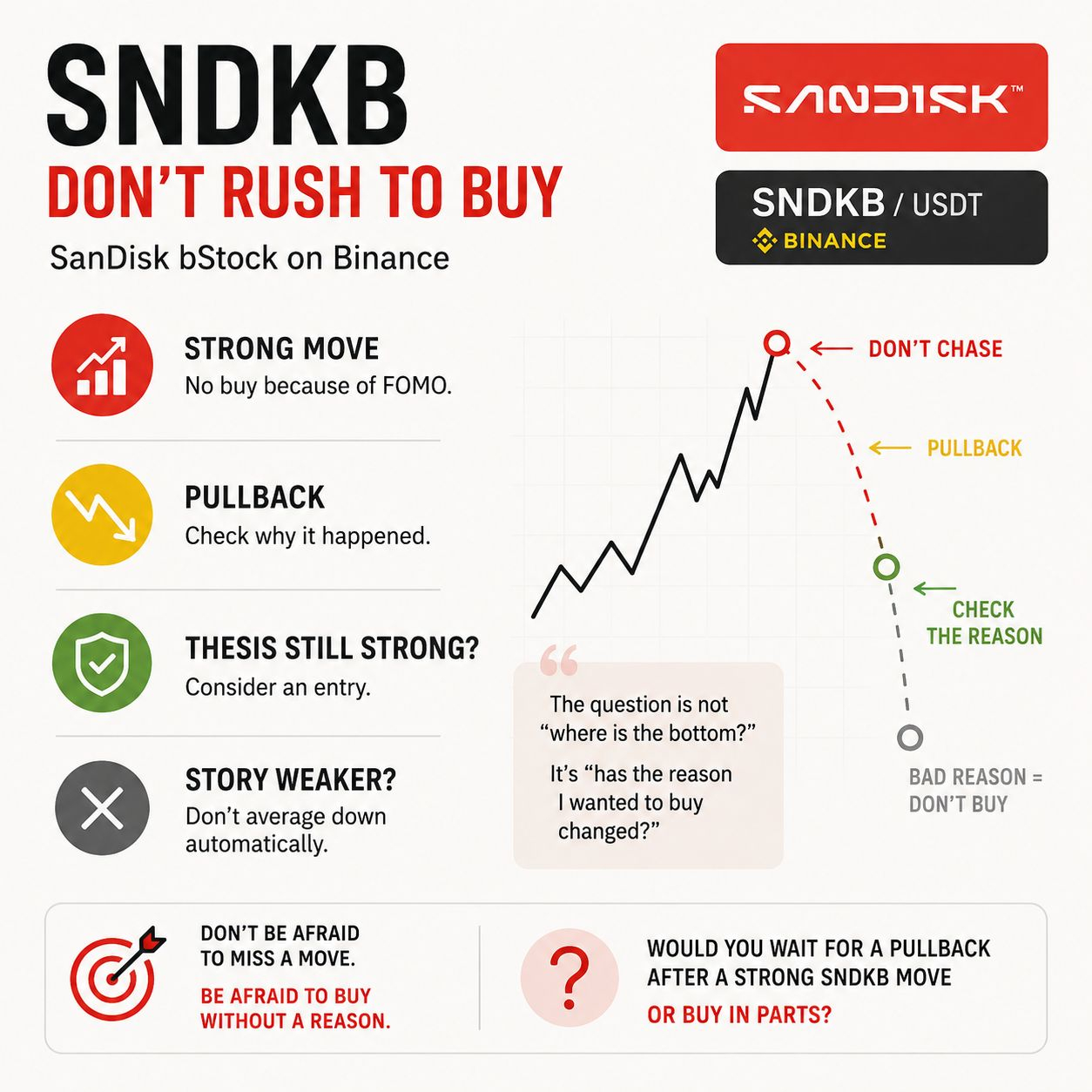
$SNDKB noodatiy ko‘rinadi — aynan shuning uchun ham men uni shoshilinch sotib olishga jur’at etmasdim.
SanDisk hozirda Binance’da mavjud bo‘lgan yana bir bStock.
Lekin oson o‘tkazib yuboriladigan qiziqarli jihat bor.
SNDKB grafigiga qarab kuchli harakatni ko‘rsangiz, juda oson:
“Narx allaqachon harakat qilyapti. Men kiritishim kerak.”
— deb o‘ylab qolish mumkin.
Men buning teskarisini qilardim.
Bunday bStock uchun men oddiy kutish qoidasi belgilab qo‘yaman.
Masalan:
🔹 $SNDKB keskin ko‘tarilsa — men FOMO sababli shunchaki sotib olmayman.
🔹 Narx orqaga qaytsa — orqaga qaytish nima sababdan bo‘lganini tekshiraman.
🔹 Agar biznes va mening dastlabki tezim hali ham kuchli bo‘lsa — kirish (entry) haqida o‘ylayman.
🔹 Agar pasayish kompaniya haqidagi hikoyaning sustlashishi sababli bo‘lsa — men avtomatik ravishda “o‘rtacha narxga tushirish” (average down) qilmayman.
Demak men taxmin qilishga urinmayman:
“Pastki qayerda?”
Men boshqa savolga javob izlayman:
“Men bu bStockni sotib olishni xohlagan sabab o‘zgardimi?”
Bu juda oddiy, lekin juda foydali farq.
Chunki siz SNDKB’ni 20% pasayishdan keyin ham sotib olishingiz mumkin va baribir yomon investitsiya qilishingiz mumkin.
Shuningdek, +10% ko‘tarilishni o‘tkazib yuborib, ancha yaxshi kirish nuqtasini kutib, o‘zingizni ancha xotirjam his qilishingiz mumkin.
Boshlovchi uchun bitta qoidani eslab qolardim:
Harakatni o‘tkazib yuborishdan qo‘rqmang. Aniq sababsiz aktiv sotib olishdan qo‘rqing.
SNDKB kuchli harakatidan keyin retracement (orqaga qaytish)ni kutasizmi, yoki qismlarga bo‘lib sotib olasizmi?
@BinanceCIS #bstocksсis
#bstockscis
$SNDKB noodatiy ko‘rinadi — aynan shuning uchun ham men uni shoshilinch sotib olishga jur’at etmasdim.
SanDisk hozirda Binance’da mavjud bo‘lgan yana bir bStock.
Lekin oson o‘tkazib yuboriladigan qiziqarli jihat bor.
SNDKB grafigiga qarab kuchli harakatni ko‘rsangiz, juda oson:
“Narx allaqachon harakat qilyapti. Men kiritishim kerak.”
— deb o‘ylab qolish mumkin.
Men buning teskarisini qilardim.
Bunday bStock uchun men oddiy kutish qoidasi belgilab qo‘yaman.
Masalan:
🔹 $SNDKB keskin ko‘tarilsa — men FOMO sababli shunchaki sotib olmayman.
🔹 Narx orqaga qaytsa — orqaga qaytish nima sababdan bo‘lganini tekshiraman.
🔹 Agar biznes va mening dastlabki tezim hali ham kuchli bo‘lsa — kirish (entry) haqida o‘ylayman.
🔹 Agar pasayish kompaniya haqidagi hikoyaning sustlashishi sababli bo‘lsa — men avtomatik ravishda “o‘rtacha narxga tushirish” (average down) qilmayman.
Demak men taxmin qilishga urinmayman:
“Pastki qayerda?”
Men boshqa savolga javob izlayman:
“Men bu bStockni sotib olishni xohlagan sabab o‘zgardimi?”
Bu juda oddiy, lekin juda foydali farq.
Chunki siz SNDKB’ni 20% pasayishdan keyin ham sotib olishingiz mumkin va baribir yomon investitsiya qilishingiz mumkin.
Shuningdek, +10% ko‘tarilishni o‘tkazib yuborib, ancha yaxshi kirish nuqtasini kutib, o‘zingizni ancha xotirjam his qilishingiz mumkin.
Boshlovchi uchun bitta qoidani eslab qolardim:
Harakatni o‘tkazib yuborishdan qo‘rqmang. Aniq sababsiz aktiv sotib olishdan qo‘rqing.
SNDKB kuchli harakatidan keyin retracement (orqaga qaytish)ni kutasizmi, yoki qismlarga bo‘lib sotib olasizmi?
@BinanceCIS #bstocksсis
$SNDKB noodatiy ko‘rinadi — aynan shuning uchun ham men uni shoshilinch sotib olishga jur’at etmasdim.
SanDisk hozirda Binance’da mavjud bo‘lgan yana bir bStock.
Lekin oson o‘tkazib yuboriladigan qiziqarli jihat bor.
SNDKB grafigiga qarab kuchli harakatni ko‘rsangiz, juda oson:
“Narx allaqachon harakat qilyapti. Men kiritishim kerak.”
— deb o‘ylab qolish mumkin.
Men buning teskarisini qilardim.
Bunday bStock uchun men oddiy kutish qoidasi belgilab qo‘yaman.
Masalan:
🔹 $SNDKB keskin ko‘tarilsa — men FOMO sababli shunchaki sotib olmayman.
🔹 Narx orqaga qaytsa — orqaga qaytish nima sababdan bo‘lganini tekshiraman.
🔹 Agar biznes va mening dastlabki tezim hali ham kuchli bo‘lsa — kirish (entry) haqida o‘ylayman.
🔹 Agar pasayish kompaniya haqidagi hikoyaning sustlashishi sababli bo‘lsa — men avtomatik ravishda “o‘rtacha narxga tushirish” (average down) qilmayman.
Demak men taxmin qilishga urinmayman:
“Pastki qayerda?”
Men boshqa savolga javob izlayman:
“Men bu bStockni sotib olishni xohlagan sabab o‘zgardimi?”
Bu juda oddiy, lekin juda foydali farq.
Chunki siz SNDKB’ni 20% pasayishdan keyin ham sotib olishingiz mumkin va baribir yomon investitsiya qilishingiz mumkin.
Shuningdek, +10% ko‘tarilishni o‘tkazib yuborib, ancha yaxshi kirish nuqtasini kutib, o‘zingizni ancha xotirjam his qilishingiz mumkin.
Boshlovchi uchun bitta qoidani eslab qolardim:
Harakatni o‘tkazib yuborishdan qo‘rqmang. Aniq sababsiz aktiv sotib olishdan qo‘rqing.
SNDKB kuchli harakatidan keyin retracement (orqaga qaytish)ni kutasizmi, yoki qismlarga bo‘lib sotib olasizmi?
@BinanceCIS #bstocksсis
144
·
--
Tarjimani ko‘rish
#bstockscis
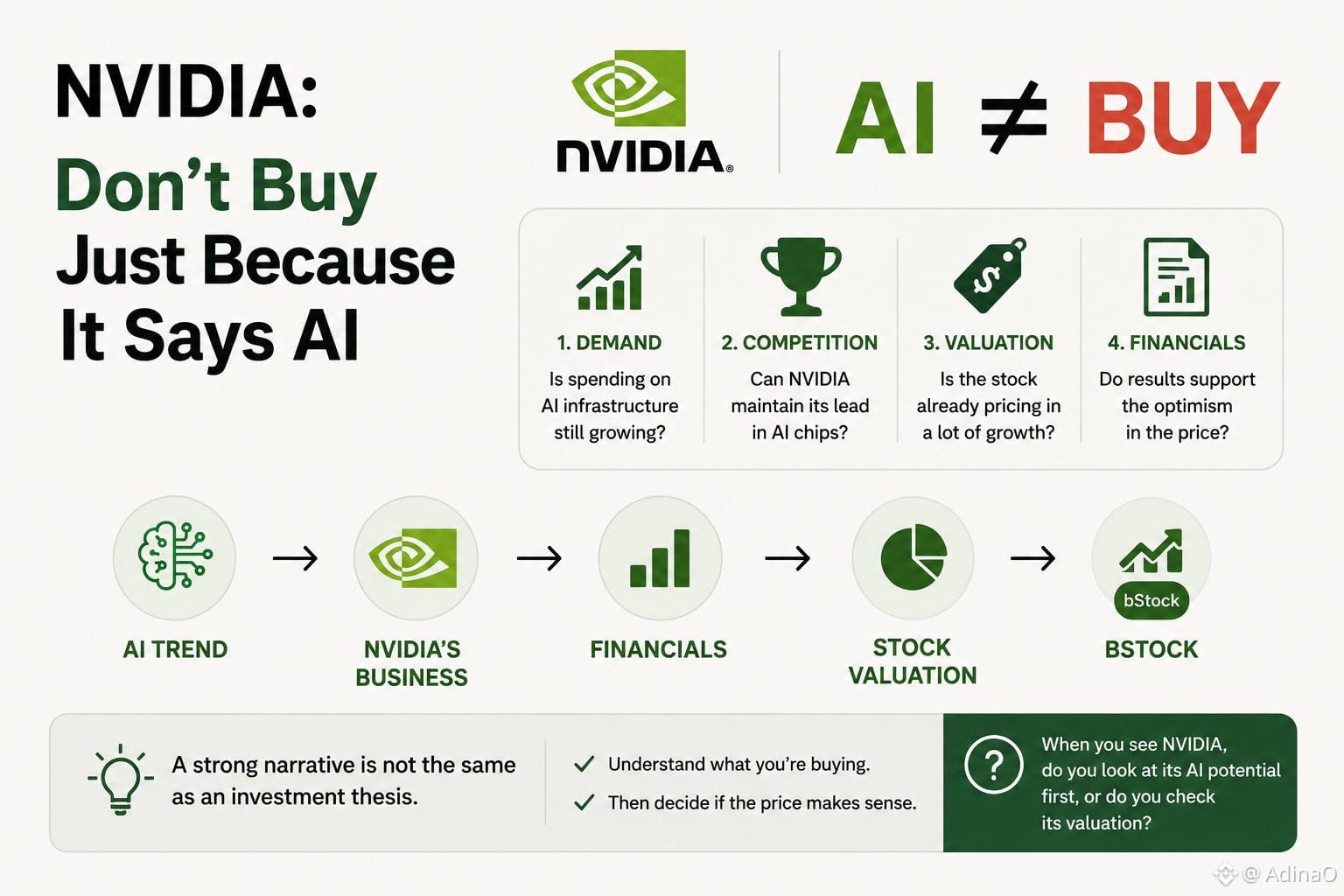
NVIDIA: don’t buy just because it says AI
NVIDIA is probably one of the first companies people think about when they hear AI.
But that’s exactly why I wouldn’t buy an NVIDIA bStock simply because “AI is growing.”
Imagine seeing NVIDIA’s bStock and thinking:
“AI will keep growing → NVIDIA will make more money → the stock should go up.”
The logic sounds simple.
But there are several things between those three points that are worth checking.
1. Demand
Are companies still increasing spending on AI infrastructure?
2. Competition
Can NVIDIA maintain its strong position in AI chips?
3. Valuation
Even a great company can become expensive if the market already expects a lot of growth.
4. Financial results
Are the company’s actual results supporting the optimism already priced into the stock?
Only after looking at these factors would I move to the bStock itself.
So my approach would be:
AI trend → NVIDIA’s business → financials → stock valuation → bStock.
For me, this is an important lesson:
A strong narrative is not the same as an investment thesis.
NVIDIA can be an excellent company, but that doesn’t automatically mean every price is a good entry point.
That’s how I think beginners should approach bStocks:
First understand what you’re buying.
Then decide whether the current price makes sense.
When you see NVIDIA, do you look at its AI potential first, or do you check its valuation
@BinanceCIS #bStokscis $NVDAB
#bstockscis
NVIDIA: don’t buy just because it says AI
NVIDIA is probably one of the first companies people think about when they hear AI.
But that’s exactly why I wouldn’t buy an NVIDIA bStock simply because “AI is growing.”
Imagine seeing NVIDIA’s bStock and thinking:
“AI will keep growing → NVIDIA will make more money → the stock should go up.”
The logic sounds simple.
But there are several things between those three points that are worth checking.
1. Demand
Are companies still increasing spending on AI infrastructure?
2. Competition
Can NVIDIA maintain its strong position in AI chips?
3. Valuation
Even a great company can become expensive if the market already expects a lot of growth.
4. Financial results
Are the company’s actual results supporting the optimism already priced into the stock?
Only after looking at these factors would I move to the bStock itself.
So my approach would be:
AI trend → NVIDIA’s business → financials → stock valuation → bStock.
For me, this is an important lesson:
A strong narrative is not the same as an investment thesis.
NVIDIA can be an excellent company, but that doesn’t automatically mean every price is a good entry point.
That’s how I think beginners should approach bStocks:
First understand what you’re buying.
Then decide whether the current price makes sense.
When you see NVIDIA, do you look at its AI potential first, or do you check its valuation
@BinanceCIS #bStokscis $NVDAB
NVIDIA: don’t buy just because it says AI
NVIDIA is probably one of the first companies people think about when they hear AI.
But that’s exactly why I wouldn’t buy an NVIDIA bStock simply because “AI is growing.”
Imagine seeing NVIDIA’s bStock and thinking:
“AI will keep growing → NVIDIA will make more money → the stock should go up.”
The logic sounds simple.
But there are several things between those three points that are worth checking.
1. Demand
Are companies still increasing spending on AI infrastructure?
2. Competition
Can NVIDIA maintain its strong position in AI chips?
3. Valuation
Even a great company can become expensive if the market already expects a lot of growth.
4. Financial results
Are the company’s actual results supporting the optimism already priced into the stock?
Only after looking at these factors would I move to the bStock itself.
So my approach would be:
AI trend → NVIDIA’s business → financials → stock valuation → bStock.
For me, this is an important lesson:
A strong narrative is not the same as an investment thesis.
NVIDIA can be an excellent company, but that doesn’t automatically mean every price is a good entry point.
That’s how I think beginners should approach bStocks:
First understand what you’re buying.
Then decide whether the current price makes sense.
When you see NVIDIA, do you look at its AI potential first, or do you check its valuation
@BinanceCIS #bStokscis $NVDAB
1
85
·
--
Tarjimani ko‘rish
#bstockscis
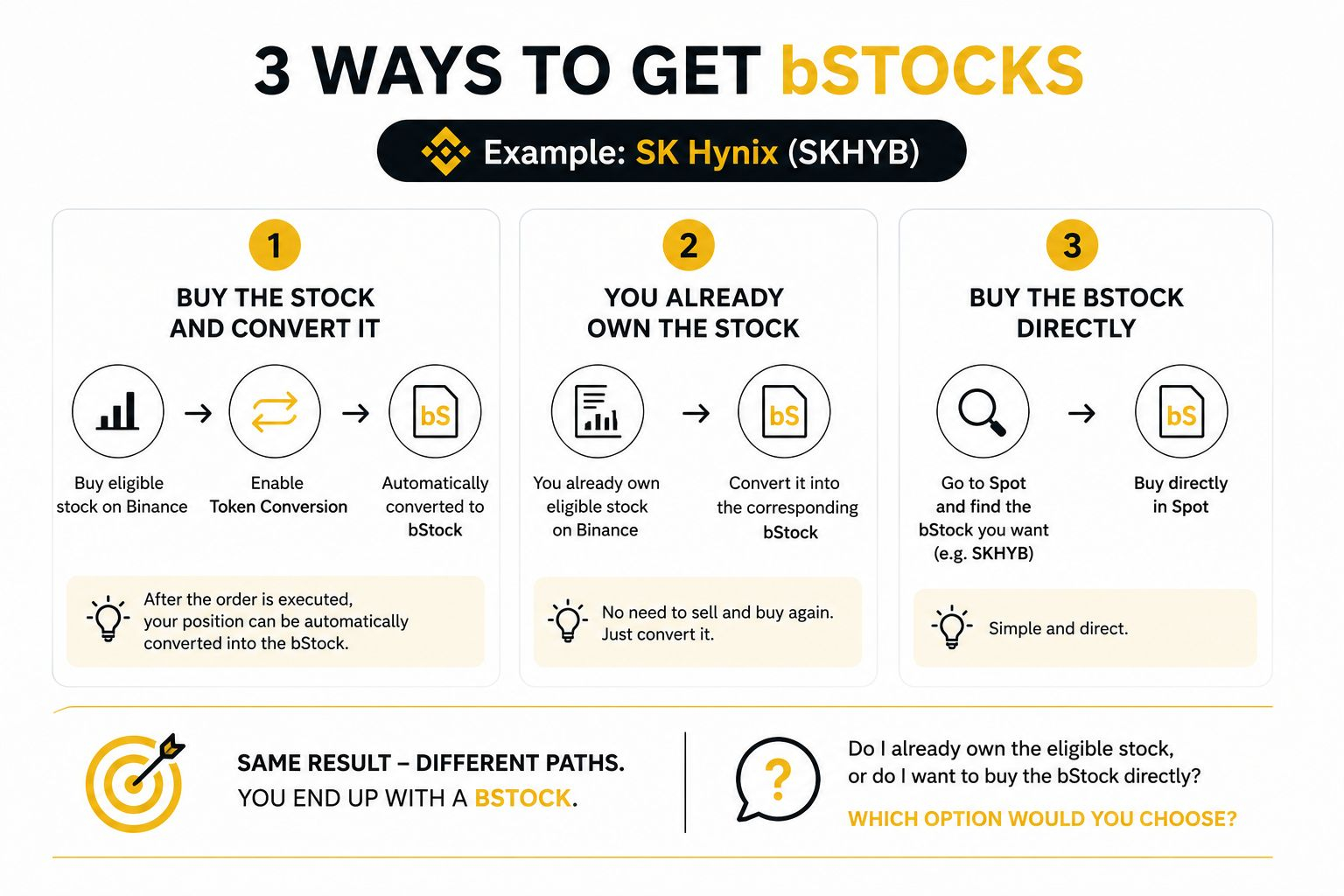
When I first saw bStocks, I thought there was only one way to buy them: find the token in Spot and click Buy.
But the example of SK Hynix made me realize that there are actually several ways.
Let’s say you want to get exposure to SK Hynix.
Option #1 — Buy the stock and convert it.
You buy the eligible stock on Binance and enable Token Conversion. After the order is executed, your position can be automatically converted into the corresponding bStock.
Option #2 — You already own the stock.
For example, you previously bought an eligible stock on Binance. In that case, you don’t necessarily need to sell it and buy the bStock again — you can convert it into the corresponding tokenized asset.
Option #3 — Buy the bStock directly.
You go to Spot, find the bStock you want, for example $SKHYB , and buy it directly.
So the result can be the same — you end up with a bStock, but the way you get there is different.
For beginners, I think this is important because tokenized stocks can sometimes seem like a complicated, separate product.
In reality, Binance allows you to get them in several different ways.
And now, before buying, I would first ask myself:
“Do I already own the eligible stock, or do I want to buy the bStock directly?”
Which option would you choose?
@BinanceCIS #bStokscis
#bstockscis
When I first saw bStocks, I thought there was only one way to buy them: find the token in Spot and click Buy.
But the example of SK Hynix made me realize that there are actually several ways.
Let’s say you want to get exposure to SK Hynix.
Option #1 — Buy the stock and convert it.
You buy the eligible stock on Binance and enable Token Conversion. After the order is executed, your position can be automatically converted into the corresponding bStock.
Option #2 — You already own the stock.
For example, you previously bought an eligible stock on Binance. In that case, you don’t necessarily need to sell it and buy the bStock again — you can convert it into the corresponding tokenized asset.
Option #3 — Buy the bStock directly.
You go to Spot, find the bStock you want, for example $SKHYB , and buy it directly.
So the result can be the same — you end up with a bStock, but the way you get there is different.
For beginners, I think this is important because tokenized stocks can sometimes seem like a complicated, separate product.
In reality, Binance allows you to get them in several different ways.
And now, before buying, I would first ask myself:
“Do I already own the eligible stock, or do I want to buy the bStock directly?”
Which option would you choose?
@BinanceCIS #bStokscis
When I first saw bStocks, I thought there was only one way to buy them: find the token in Spot and click Buy.
But the example of SK Hynix made me realize that there are actually several ways.
Let’s say you want to get exposure to SK Hynix.
Option #1 — Buy the stock and convert it.
You buy the eligible stock on Binance and enable Token Conversion. After the order is executed, your position can be automatically converted into the corresponding bStock.
Option #2 — You already own the stock.
For example, you previously bought an eligible stock on Binance. In that case, you don’t necessarily need to sell it and buy the bStock again — you can convert it into the corresponding tokenized asset.
Option #3 — Buy the bStock directly.
You go to Spot, find the bStock you want, for example $SKHYB , and buy it directly.
So the result can be the same — you end up with a bStock, but the way you get there is different.
For beginners, I think this is important because tokenized stocks can sometimes seem like a complicated, separate product.
In reality, Binance allows you to get them in several different ways.
And now, before buying, I would first ask myself:
“Do I already own the eligible stock, or do I want to buy the bStock directly?”
Which option would you choose?
@BinanceCIS #bStokscis
2
1
314
·
--
Tarjimani ko‘rish
#bstockscis
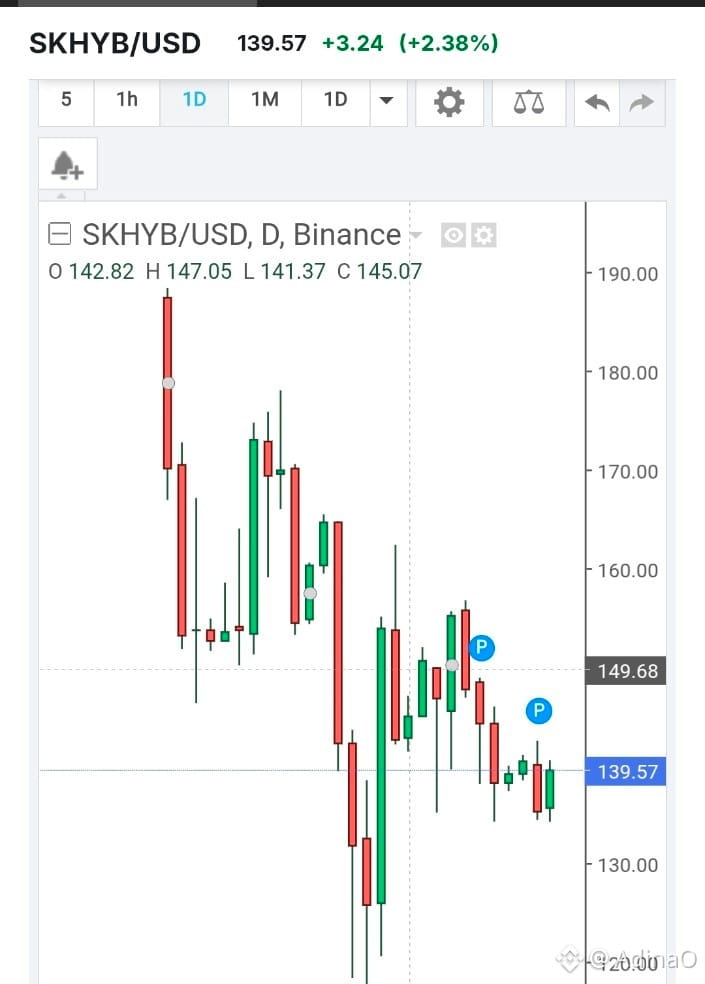
I used to think that if a company’s stock is trading, its bStock should automatically be available too.
But Binance has a separate trading status for each tokenized asset.
And I think this is an important detail.
There is a difference between:
“the bStocks market is open”
and
“this specific bStock is currently available for trading.”
It may sound like a small technical detail, but it shows how different RWA can be from a regular crypto token.
A bStock is connected to a real financial asset, so its lifecycle needs to be monitored separately.
That’s why, before trading a bStock, I would look at more than just its price and volume. I would also check the status of the specific asset.
The more I learn about tokenized assets, the more I realize that the interesting part is often hidden behind the trading screen.
Would you check the asset status before buying a bStock?
@BinanceCIS #bStokscis $SKHYB
#bstockscis
I used to think that if a company’s stock is trading, its bStock should automatically be available too.
But Binance has a separate trading status for each tokenized asset.
And I think this is an important detail.
There is a difference between:
“the bStocks market is open”
and
“this specific bStock is currently available for trading.”
It may sound like a small technical detail, but it shows how different RWA can be from a regular crypto token.
A bStock is connected to a real financial asset, so its lifecycle needs to be monitored separately.
That’s why, before trading a bStock, I would look at more than just its price and volume. I would also check the status of the specific asset.
The more I learn about tokenized assets, the more I realize that the interesting part is often hidden behind the trading screen.
Would you check the asset status before buying a bStock?
@BinanceCIS #bStokscis $SKHYB
I used to think that if a company’s stock is trading, its bStock should automatically be available too.
But Binance has a separate trading status for each tokenized asset.
And I think this is an important detail.
There is a difference between:
“the bStocks market is open”
and
“this specific bStock is currently available for trading.”
It may sound like a small technical detail, but it shows how different RWA can be from a regular crypto token.
A bStock is connected to a real financial asset, so its lifecycle needs to be monitored separately.
That’s why, before trading a bStock, I would look at more than just its price and volume. I would also check the status of the specific asset.
The more I learn about tokenized assets, the more I realize that the interesting part is often hidden behind the trading screen.
Would you check the asset status before buying a bStock?
@BinanceCIS #bStokscis $SKHYB
2
1
71
·
--
Tarjimani ko‘rish
#bstockscis
Згідно з Binance, 73% трейдерів американськими акціями на платформі – з ринків, що розвиваються. Тобто мешканці Азії, Африки, СНД, України виявилися основними користувачами сервісу. Мені це зрозуміло: багато з нас не мали простого доступу до американського ринку через банківські обмеження. bStocks роблять цей доступ легким — достатньо USDT на балансі і декілька кліків в аплікації. Для українського інвестора це означає: не треба відкривати закордонні рахунки чи відстежувати курси валют – все відбувається у звичному інтерфейсі Binance.
@BinanceCIS #bStokscis
#bstockscis
Згідно з Binance, 73% трейдерів американськими акціями на платформі – з ринків, що розвиваються. Тобто мешканці Азії, Африки, СНД, України виявилися основними користувачами сервісу. Мені це зрозуміло: багато з нас не мали простого доступу до американського ринку через банківські обмеження. bStocks роблять цей доступ легким — достатньо USDT на балансі і декілька кліків в аплікації. Для українського інвестора це означає: не треба відкривати закордонні рахунки чи відстежувати курси валют – все відбувається у звичному інтерфейсі Binance.
@BinanceCIS #bStokscis
Згідно з Binance, 73% трейдерів американськими акціями на платформі – з ринків, що розвиваються. Тобто мешканці Азії, Африки, СНД, України виявилися основними користувачами сервісу. Мені це зрозуміло: багато з нас не мали простого доступу до американського ринку через банківські обмеження. bStocks роблять цей доступ легким — достатньо USDT на балансі і декілька кліків в аплікації. Для українського інвестора це означає: не треба відкривати закордонні рахунки чи відстежувати курси валют – все відбувається у звичному інтерфейсі Binance.
@BinanceCIS #bStokscis
2
120
·
--
Tarjimani ko‘rish
#bstockscis
Чому в мене з першого разу не пройшла конвертація NVDAB? 🤔
Я вирішила на практиці перевірити, як працює конвертація NVIDIA у bStock. Першу спробу зробила — але операція не пройшла. Спочатку подумала, що проблема в мене 😅
Пізніше перевірила ще раз — і конвертація NVDAB вже спрацювала.
Тоді я звернула увагу на важливий момент: Binance може тимчасово призупиняти конвертацію під час технічних робіт або обробки корпоративних подій. Тобто невдала спроба не обов’язково означає проблему з акаунтом.
Мій висновок після цього простий: якщо конвертація не проходить, спочатку варто перевірити статус операції та оголошення Binance, а не натискати кнопку десять разів 😅
@BinanceCIS #bStocksCIS $NVDAB
#bstockscis
Чому в мене з першого разу не пройшла конвертація NVDAB? 🤔
Я вирішила на практиці перевірити, як працює конвертація NVIDIA у bStock. Першу спробу зробила — але операція не пройшла. Спочатку подумала, що проблема в мене 😅
Пізніше перевірила ще раз — і конвертація NVDAB вже спрацювала.
Тоді я звернула увагу на важливий момент: Binance може тимчасово призупиняти конвертацію під час технічних робіт або обробки корпоративних подій. Тобто невдала спроба не обов’язково означає проблему з акаунтом.
Мій висновок після цього простий: якщо конвертація не проходить, спочатку варто перевірити статус операції та оголошення Binance, а не натискати кнопку десять разів 😅
@BinanceCIS #bStocksCIS $NVDAB
Чому в мене з першого разу не пройшла конвертація NVDAB? 🤔
Я вирішила на практиці перевірити, як працює конвертація NVIDIA у bStock. Першу спробу зробила — але операція не пройшла. Спочатку подумала, що проблема в мене 😅
Пізніше перевірила ще раз — і конвертація NVDAB вже спрацювала.
Тоді я звернула увагу на важливий момент: Binance може тимчасово призупиняти конвертацію під час технічних робіт або обробки корпоративних подій. Тобто невдала спроба не обов’язково означає проблему з акаунтом.
Мій висновок після цього простий: якщо конвертація не проходить, спочатку варто перевірити статус операції та оголошення Binance, а не натискати кнопку десять разів 😅
@BinanceCIS #bStocksCIS $NVDAB
1
93
·
--
Tarjimani ko‘rish
#bstockscis
Якщо ви тільки починаєте розбиратися в акціях, є одна проста річ, яку варто зрозуміти.
Коли ми говоримо «купити $AAPLB , $TSLAB чи $NVDAB », це не просто купівля якогось тикера. За ним стоїть реальний бізнес. Компанія заробляє гроші, розвивається, конкурує — і все це врешті впливає на ціну її акцій.
Але тут є цікавий момент 👇
Ціна акції не означає, що компанія «стільки коштує» саме зараз. Ринок постійно оцінює її майбутнє. Тому навіть хороша компанія може втратити в ціні, якщо інвестори очікували більшого.
І ось тут стає цікаво з bStocks на Binance.
Замість класичного способу купівлі акцій ми отримуємо токенізований формат, який переносить експозицію на відомі компанії у криптоекосистему.
Тобто сама компанія не змінюється. Змінюється спосіб, у який ми отримуємо доступ до її акцій.
Якщо ви тільки знайомитеся з цією темою, запам’ятайте головне: перш ніж купувати будь-який актив, варто розібратися не лише в його ціні, а й у тому, що саме ви купуєте, чим воно забезпечене і які права дає.
Це просте правило може зекономити новачку багато помилок.
@BinanceCIS
#bstockscis
Якщо ви тільки починаєте розбиратися в акціях, є одна проста річ, яку варто зрозуміти.
Коли ми говоримо «купити $AAPLB , $TSLAB чи $NVDAB », це не просто купівля якогось тикера. За ним стоїть реальний бізнес. Компанія заробляє гроші, розвивається, конкурує — і все це врешті впливає на ціну її акцій.
Але тут є цікавий момент 👇
Ціна акції не означає, що компанія «стільки коштує» саме зараз. Ринок постійно оцінює її майбутнє. Тому навіть хороша компанія може втратити в ціні, якщо інвестори очікували більшого.
І ось тут стає цікаво з bStocks на Binance.
Замість класичного способу купівлі акцій ми отримуємо токенізований формат, який переносить експозицію на відомі компанії у криптоекосистему.
Тобто сама компанія не змінюється. Змінюється спосіб, у який ми отримуємо доступ до її акцій.
Якщо ви тільки знайомитеся з цією темою, запам’ятайте головне: перш ніж купувати будь-який актив, варто розібратися не лише в його ціні, а й у тому, що саме ви купуєте, чим воно забезпечене і які права дає.
Це просте правило може зекономити новачку багато помилок.
@BinanceCIS
Якщо ви тільки починаєте розбиратися в акціях, є одна проста річ, яку варто зрозуміти.
Коли ми говоримо «купити $AAPLB , $TSLAB чи $NVDAB », це не просто купівля якогось тикера. За ним стоїть реальний бізнес. Компанія заробляє гроші, розвивається, конкурує — і все це врешті впливає на ціну її акцій.
Але тут є цікавий момент 👇
Ціна акції не означає, що компанія «стільки коштує» саме зараз. Ринок постійно оцінює її майбутнє. Тому навіть хороша компанія може втратити в ціні, якщо інвестори очікували більшого.
І ось тут стає цікаво з bStocks на Binance.
Замість класичного способу купівлі акцій ми отримуємо токенізований формат, який переносить експозицію на відомі компанії у криптоекосистему.
Тобто сама компанія не змінюється. Змінюється спосіб, у який ми отримуємо доступ до її акцій.
Якщо ви тільки знайомитеся з цією темою, запам’ятайте головне: перш ніж купувати будь-який актив, варто розібратися не лише в його ціні, а й у тому, що саме ви купуєте, чим воно забезпечене і які права дає.
Це просте правило може зекономити новачку багато помилок.
@BinanceCIS
1
105
·
--
Tarjimani ko‘rish
#bstockscis
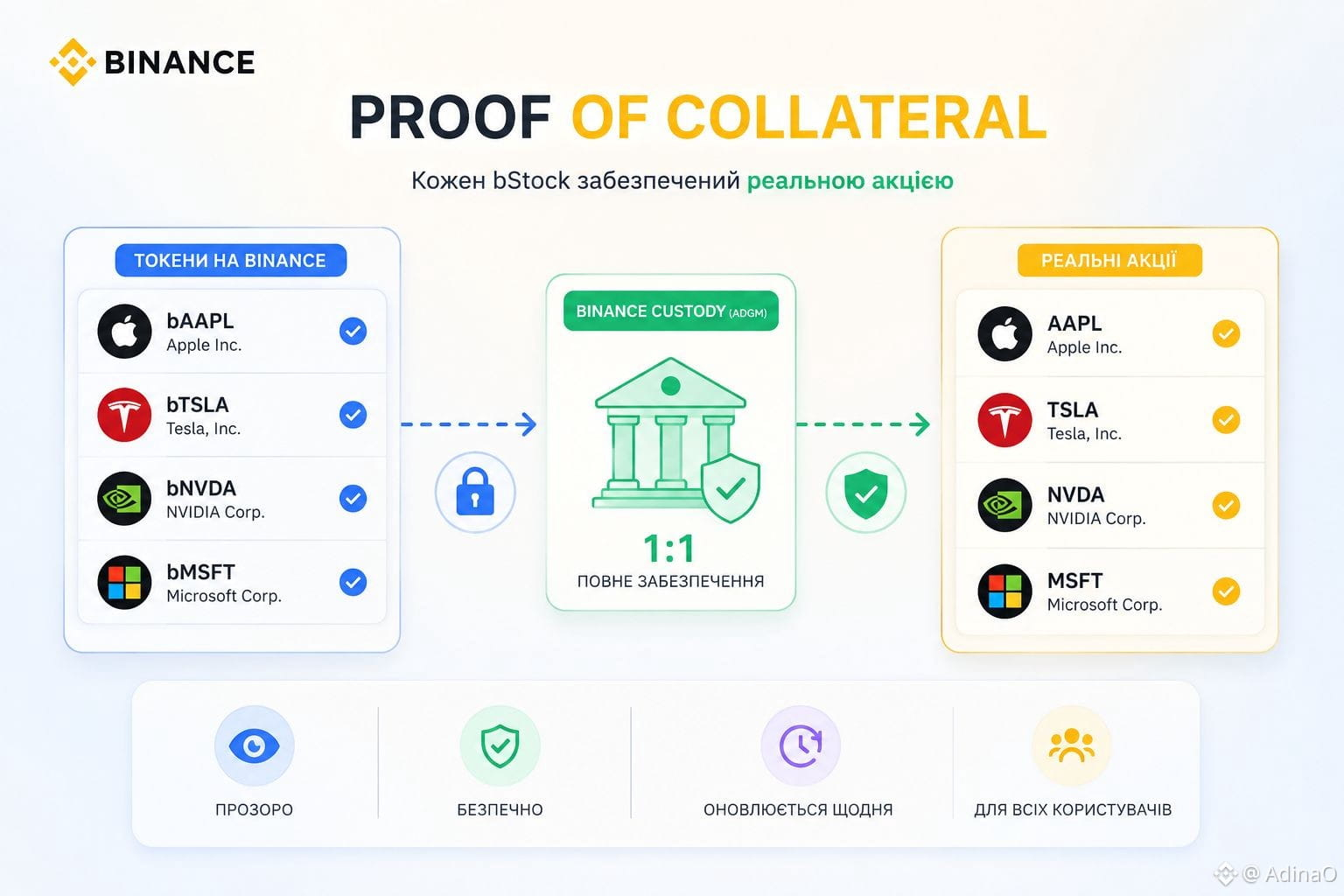
Proof of Collateral на Binance
Binance публічно гарантує, що кожен bStock забезпечений реальною акцією. На Proof of Collateral сторінці можна побачити відповідність токенів і паперів. Це важливий факт для довіри: ви можете самі впевнитися, що за вашим $100 bStocks стоять повноцінні акції в ADGM-контролі. Така прозорість (онлайн-перевірка забезпечення) — новий стандарт, на відміну від звичайних брокерів.
@BinanceCIS #bStokscis
#bstockscis
Proof of Collateral на Binance
Binance публічно гарантує, що кожен bStock забезпечений реальною акцією. На Proof of Collateral сторінці можна побачити відповідність токенів і паперів. Це важливий факт для довіри: ви можете самі впевнитися, що за вашим $100 bStocks стоять повноцінні акції в ADGM-контролі. Така прозорість (онлайн-перевірка забезпечення) — новий стандарт, на відміну від звичайних брокерів.
@BinanceCIS #bStokscis
Proof of Collateral на Binance
Binance публічно гарантує, що кожен bStock забезпечений реальною акцією. На Proof of Collateral сторінці можна побачити відповідність токенів і паперів. Це важливий факт для довіри: ви можете самі впевнитися, що за вашим $100 bStocks стоять повноцінні акції в ADGM-контролі. Така прозорість (онлайн-перевірка забезпечення) — новий стандарт, на відміну від звичайних брокерів.
@BinanceCIS #bStokscis
91
·
--
Tarjimani ko‘rish
#bstockscis @BinanceCIS
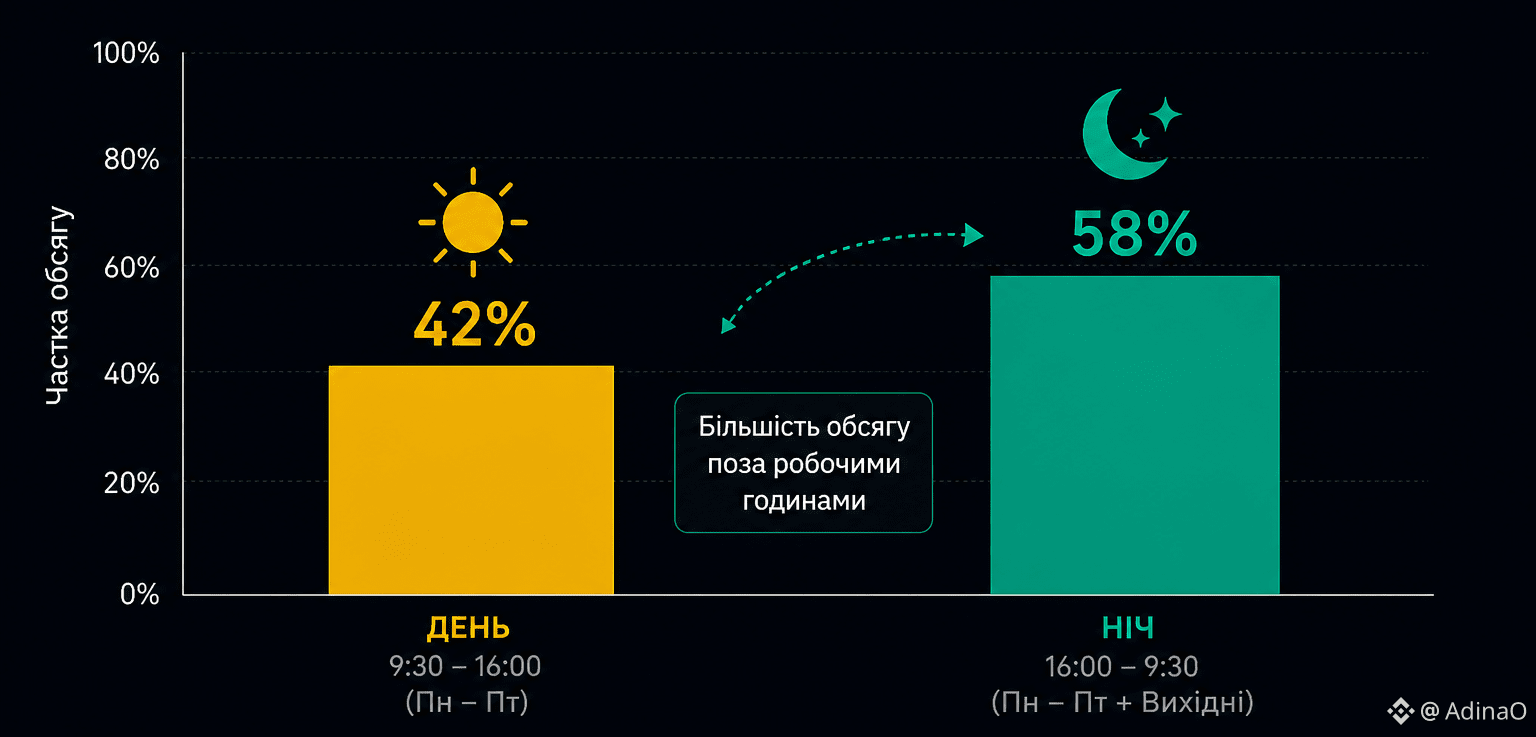
Binance bStocks дають змогу торгувати акціями цілодобово. За даними Binance Research, поза робочими годинами традиційних бірж bStocks становлять більшість обсягу торгів (58% після закриття). Це означає, що під час вихідних чи ночі активність не «заморожена», як на звичайних ринках. Такий режим приносить новий досвід: трейдери можуть реагувати на новини в реальному часі, а не чекати відкриття ринку.
#bstockscis @BinanceCIS
Binance bStocks дають змогу торгувати акціями цілодобово. За даними Binance Research, поза робочими годинами традиційних бірж bStocks становлять більшість обсягу торгів (58% після закриття). Це означає, що під час вихідних чи ночі активність не «заморожена», як на звичайних ринках. Такий режим приносить новий досвід: трейдери можуть реагувати на новини в реальному часі, а не чекати відкриття ринку.
Binance bStocks дають змогу торгувати акціями цілодобово. За даними Binance Research, поза робочими годинами традиційних бірж bStocks становлять більшість обсягу торгів (58% після закриття). Це означає, що під час вихідних чи ночі активність не «заморожена», як на звичайних ринках. Такий режим приносить новий досвід: трейдери можуть реагувати на новини в реальному часі, а не чекати відкриття ринку.
77
·
--
Tarjimani ko‘rish
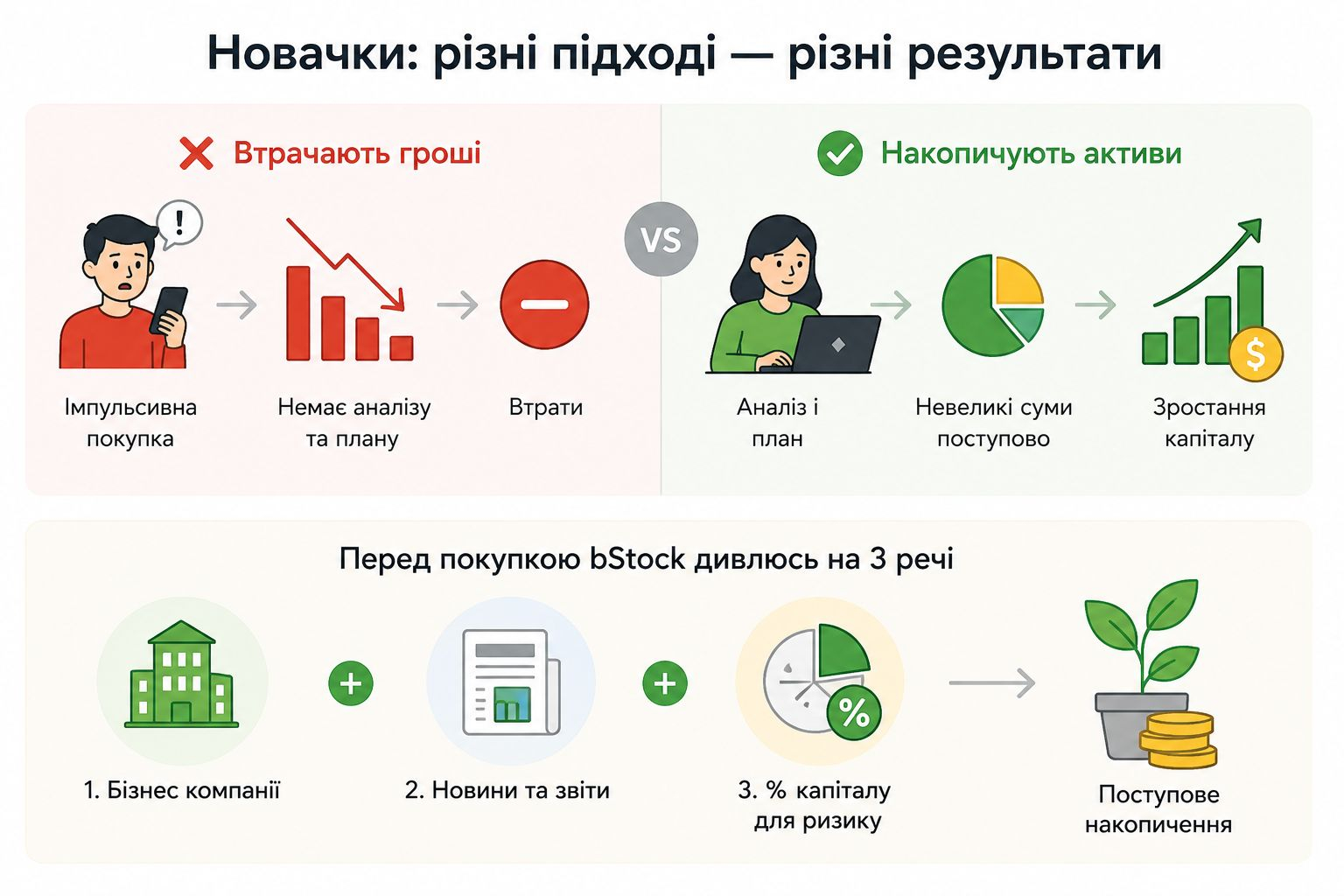
Чому одні новачки швидко втрачають гроші, а інші поступово накопичують активи? 🤔
Вивчаючи Binance bStocks, зрозуміла одну просту річ: купити актив — найпростіше. Складніше зрозуміти, чому саме його варто купувати.
Тепер перед будь-яким bStock я дивлюся лише на три речі:
✔️ чим компанія заробляє;
✔️ чи є важливі новини або звіти;
✔️ якиц відсоток свого капіталу я готова ризикнути.
Наприклад, 96,79% усіх угод з AAPLB були на невеликі суми, що показує: багато користувачів обирають поступовий підхід замість великих одноразових вкладень.
Саме такий підхід я зараз вважаю найрозумнішим.
@BinanceCIS #bStocksCIS
Чому одні новачки швидко втрачають гроші, а інші поступово накопичують активи? 🤔
Вивчаючи Binance bStocks, зрозуміла одну просту річ: купити актив — найпростіше. Складніше зрозуміти, чому саме його варто купувати.
Тепер перед будь-яким bStock я дивлюся лише на три речі:
✔️ чим компанія заробляє;
✔️ чи є важливі новини або звіти;
✔️ якиц відсоток свого капіталу я готова ризикнути.
Наприклад, 96,79% усіх угод з AAPLB були на невеликі суми, що показує: багато користувачів обирають поступовий підхід замість великих одноразових вкладень.
Саме такий підхід я зараз вважаю найрозумнішим.
@BinanceCIS #bStocksCIS
Вивчаючи Binance bStocks, зрозуміла одну просту річ: купити актив — найпростіше. Складніше зрозуміти, чому саме його варто купувати.
Тепер перед будь-яким bStock я дивлюся лише на три речі:
✔️ чим компанія заробляє;
✔️ чи є важливі новини або звіти;
✔️ якиц відсоток свого капіталу я готова ризикнути.
Наприклад, 96,79% усіх угод з AAPLB були на невеликі суми, що показує: багато користувачів обирають поступовий підхід замість великих одноразових вкладень.
Саме такий підхід я зараз вважаю найрозумнішим.
@BinanceCIS #bStocksCIS
90
·
--
Tasdiqlangan
Tarjimani ko‘rish
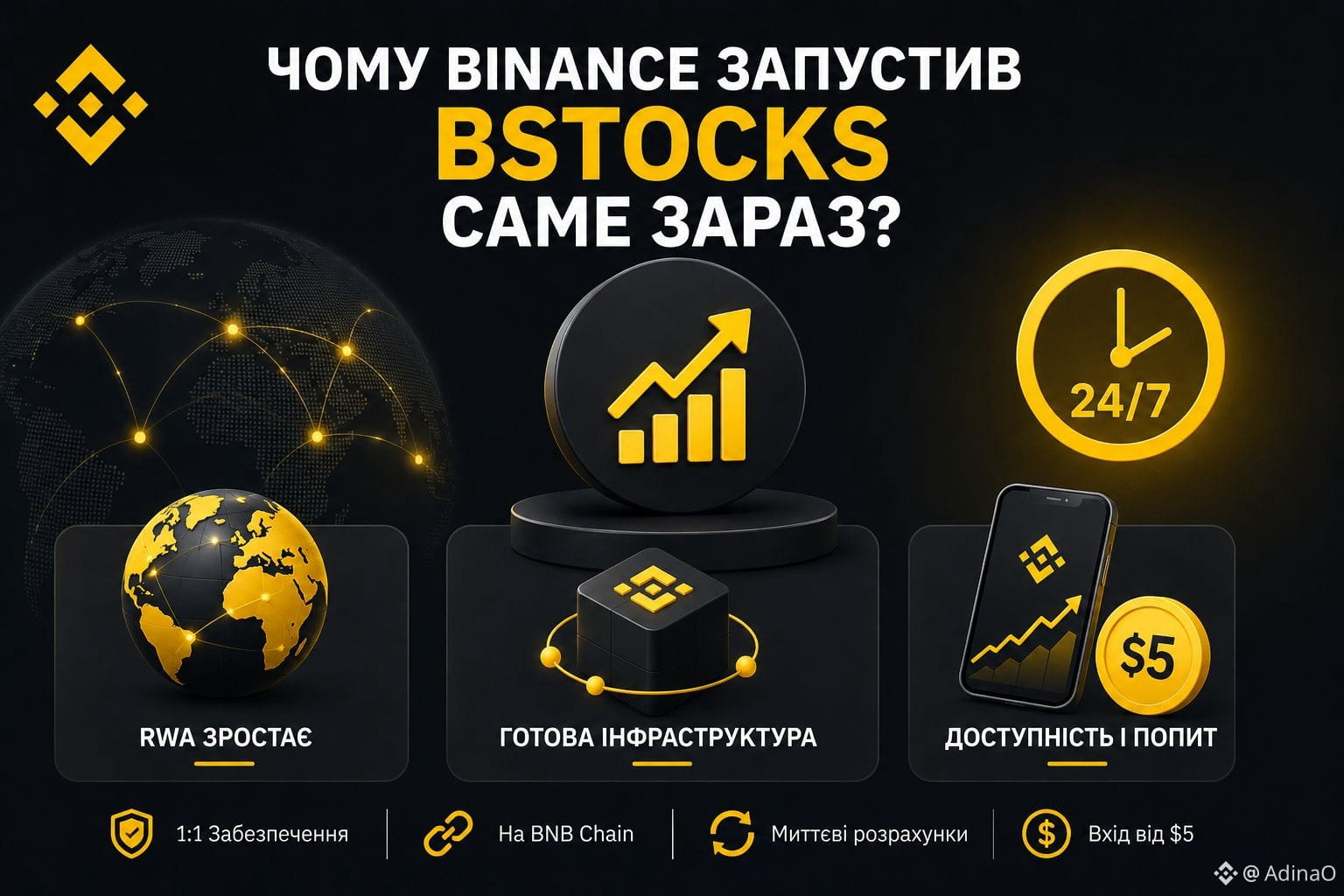
Чому Binance запустив bStocks саме зараз, а не кілька років тому? 🤔
Коли я вперше дізналася про Binance bStocks, одразу виникло це питання. Якщо токенізація існує давно, чому запуск відбувся лише зараз?
Після того як розібралася в темі, для себе виділила три причини:
📌 RWA набрав популярності. Токенізація реальних активів уже не виглядає експериментом — це один із найперспективніших напрямків блокчейн-індустрії.
📌 Інфраструктура стала готовою. bStocks — це токени BEP-20 на BNB Chain, забезпечені реальними акціями у співвідношенні 1:1, з можливістю самостійного зберігання.
📌 Попит на торгівлю 24/7. Крипторинок працює без вихідних, і Binance переніс цей підхід у токенізовані акції. До того ж вхід починається лише від $5, що робить продукт доступнішим.
Мій висновок: Binance не запізнився із запуском. Навпаки, компанія дочекалася моменту, коли розвиток RWA, можливості BNB Chain і попит користувачів збіглися. Саме тому bStocks з'явилися зараз, а не раніше.
А як вважаєте ви — це вдалий момент для запуску Binance bStocks?
@BinanceCIS #bStocksCIS
Чому Binance запустив bStocks саме зараз, а не кілька років тому? 🤔
Коли я вперше дізналася про Binance bStocks, одразу виникло це питання. Якщо токенізація існує давно, чому запуск відбувся лише зараз?
Після того як розібралася в темі, для себе виділила три причини:
📌 RWA набрав популярності. Токенізація реальних активів уже не виглядає експериментом — це один із найперспективніших напрямків блокчейн-індустрії.
📌 Інфраструктура стала готовою. bStocks — це токени BEP-20 на BNB Chain, забезпечені реальними акціями у співвідношенні 1:1, з можливістю самостійного зберігання.
📌 Попит на торгівлю 24/7. Крипторинок працює без вихідних, і Binance переніс цей підхід у токенізовані акції. До того ж вхід починається лише від $5, що робить продукт доступнішим.
Мій висновок: Binance не запізнився із запуском. Навпаки, компанія дочекалася моменту, коли розвиток RWA, можливості BNB Chain і попит користувачів збіглися. Саме тому bStocks з'явилися зараз, а не раніше.
А як вважаєте ви — це вдалий момент для запуску Binance bStocks?
@BinanceCIS #bStocksCIS
Коли я вперше дізналася про Binance bStocks, одразу виникло це питання. Якщо токенізація існує давно, чому запуск відбувся лише зараз?
Після того як розібралася в темі, для себе виділила три причини:
📌 RWA набрав популярності. Токенізація реальних активів уже не виглядає експериментом — це один із найперспективніших напрямків блокчейн-індустрії.
📌 Інфраструктура стала готовою. bStocks — це токени BEP-20 на BNB Chain, забезпечені реальними акціями у співвідношенні 1:1, з можливістю самостійного зберігання.
📌 Попит на торгівлю 24/7. Крипторинок працює без вихідних, і Binance переніс цей підхід у токенізовані акції. До того ж вхід починається лише від $5, що робить продукт доступнішим.
Мій висновок: Binance не запізнився із запуском. Навпаки, компанія дочекалася моменту, коли розвиток RWA, можливості BNB Chain і попит користувачів збіглися. Саме тому bStocks з'явилися зараз, а не раніше.
А як вважаєте ви — це вдалий момент для запуску Binance bStocks?
@BinanceCIS #bStocksCIS
167
Ko‘proq kontentni ko‘rish uchun tizimga kiring
Binance Square'da global kriptovalyuta foydalanuvchilariga qo‘shiling
⚡️ Kriptovalyuta haqida eng so‘nggi va foydali ma’lumotlarni oling.
💬 Dunyoning eng yirik kriptovalyuta birjasi tomonidan ishonchli deb topilgan.
👍 Tasdiqlangan mualliflardan haqiqiy tahlillarni kashf eting.
Email / telefon raqami
Trenddagi mavzular
CircleLaunchesInstitutionalBTCBackedBorrowing
2 marta koʻrilgan
27 muhokama qilmoqda
#CircleLaunchesInstitutionalBTCBackedBorrowing
👀
🚨 ₿ BITCOIN endi yana bir institutsional narativga kirdi
Circle institutsional BTC bilan ta’minlangan qarz olishga qadam qo‘ymoqda — ya’ni muassasalar Bitcoin’ni garov sifatida ishlatib, BTC’ni sotmasdan likvidlikga chiqishi mumkin. 🏦₿💰
🔥 Nega buni kuzatyapman: BTC’ni sotish bosimi kamroq + likvidlikka institutsional kirish ko‘proq = e’tiborda ushlashga arziydigan narativ.
📊 SAVDO RADAR:
$BTC ning ushbu sarlavha atrofidagi reaksiya, hajm va institutsional oqim kayfiyatini kuzating.
Ko‘r-ko‘rona kirish yo‘q.
Tasdiqni kuting → riskni boshqaring → DYOR. ⚠️
👀 #BTC : HOLD, LONGmi yoki WAIT?
#Binance #trading #trade
Shourov Saha-01
·0 ta layk
·23 marta koʻrilgan
BitcoinHits$85K
2,791 marta koʻrilgan
127 muhokama qilmoqda
ZetaChainVotesToMigrateZETAToSolana
2 marta koʻrilgan
19 muhokama qilmoqda