

Georgia Crypto Trader
5.7k Postlar

Georgia Crypto Trader
Shikoyat qilish
Foydalanuvchini bloklash
Crypto Trader & Market Analyst 📊 | Technical Analysis | Market Trends | Risk Management | Sharing insights, not financial advice.
1.1K+ Kuzatilmoqda
13.6K+ Kuzatuvchilar
3.3K+ Yoqdi
Postlar
Barchasi
Iqtiboslar
Jonli
·
--
O‘suvchi
Tarjimani ko‘rish
$AIN
{future}(AINUSDT)
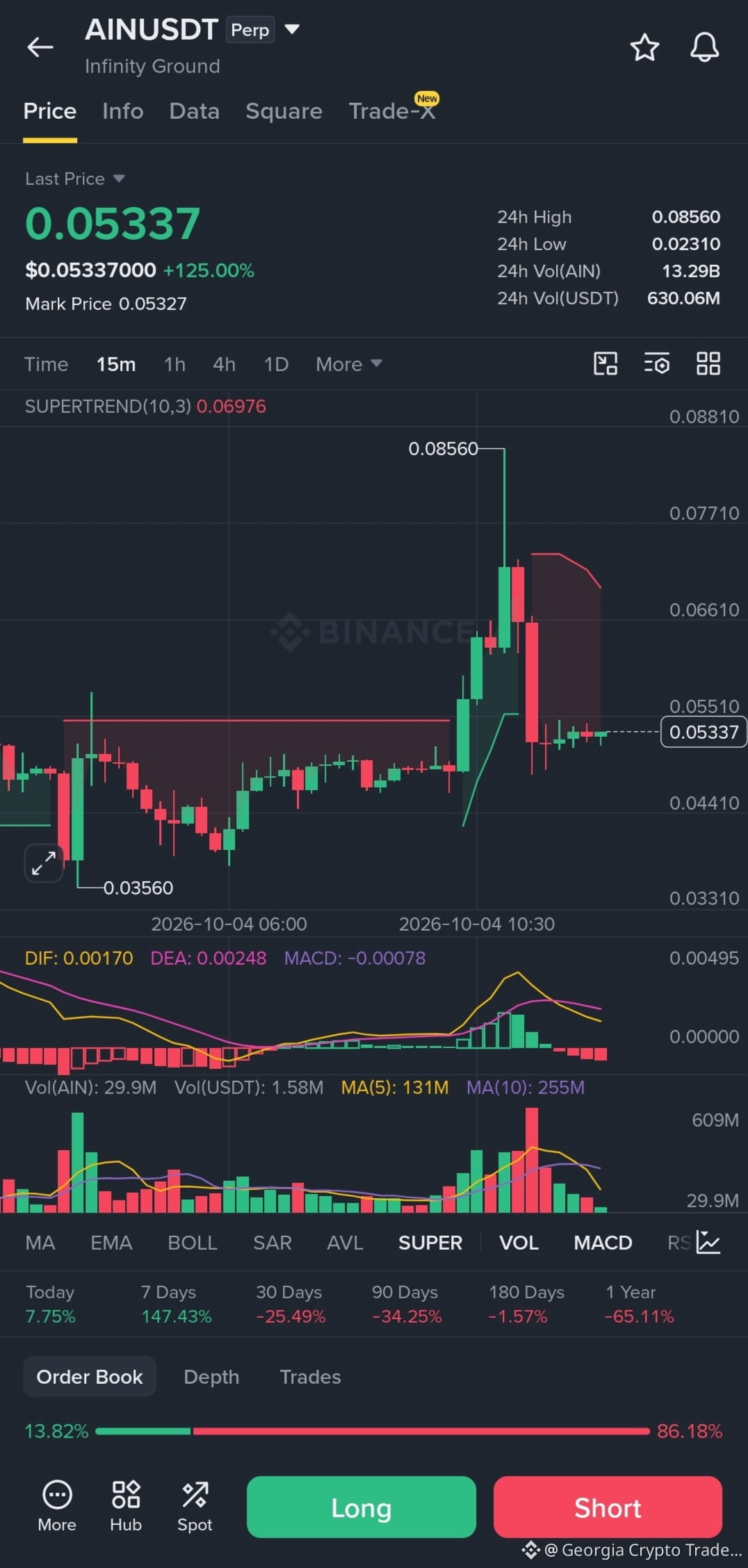
$AIN usdt 15m
long
entry: 0.05150 - 0.05330
tp1: 0.06100
tp2: 0.06900
tp3: 0.08200
sl: 0.04650
swept bottom liquidity and holding above key support zone. looking for bounce back toward recent highs. manage risk properly.
$AIN
$AIN usdt 15m
long
entry: 0.05150 - 0.05330
tp1: 0.06100
tp2: 0.06900
tp3: 0.08200
sl: 0.04650
swept bottom liquidity and holding above key support zone. looking for bounce back toward recent highs. manage risk properly.
$AIN usdt 15m
long
entry: 0.05150 - 0.05330
tp1: 0.06100
tp2: 0.06900
tp3: 0.08200
sl: 0.04650
swept bottom liquidity and holding above key support zone. looking for bounce back toward recent highs. manage risk properly.
363
·
--
O‘suvchi
Tarjimani ko‘rish
#greekpolicebustcryptoscamringarrest17
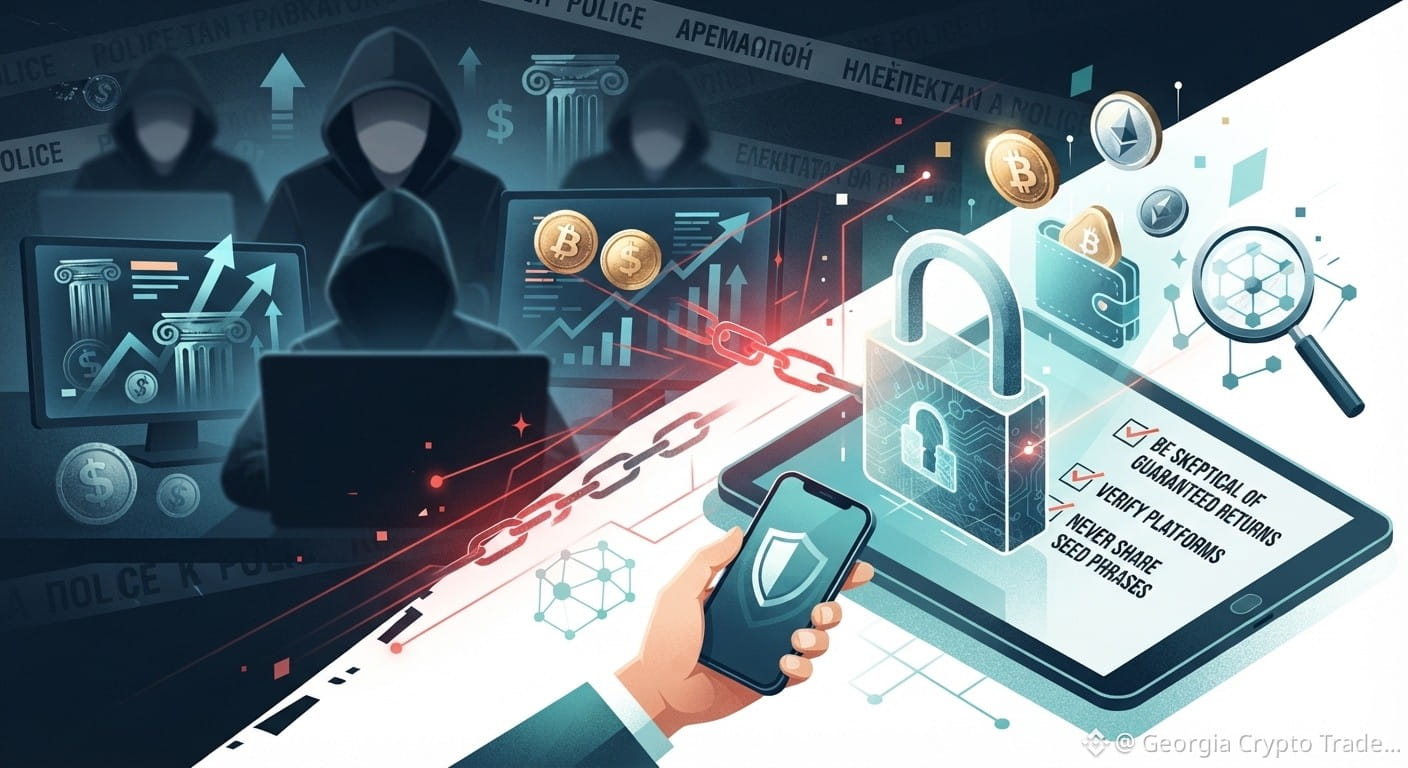
17 arrests in Greece tied to an alleged crypto scam ring are a useful reminder that the biggest risk in this market isn’t always volatility.
Sometimes it’s who you’re trusting with your money.
Scammers continue to use crypto’s popularity to package unrealistic returns, urgency, and fake investment opportunities. The technology may be transparent, but the people operating around it aren’t automatically trustworthy.
For traders, some basic checks still matter:
• Be skeptical of guaranteed or “risk-free” returns
• Verify platforms and the people behind them
• Never share seed phrases or private keys
• Don’t let pressure force a quick deposit
• Remember that many blockchain transactions can’t simply be reversed
Police investigations can shut down individual networks, but that doesn’t remove the underlying problem.
Crypto’s credibility will depend on whether users become better at distinguishing legitimate opportunities from sophisticated promises.
In a market where anyone can advertise an opportunity, verification is still one of the most valuable forms of risk management.
For informational purposes only. Not financial advice.
$ZRO $STG $MUBARAK
{future}(MUBARAKUSDT)
{spot}(STGUSDT)
{future}(ZROUSDT)
#greekpolicebustcryptoscamringarrest17
17 arrests in Greece tied to an alleged crypto scam ring are a useful reminder that the biggest risk in this market isn’t always volatility.
Sometimes it’s who you’re trusting with your money.
Scammers continue to use crypto’s popularity to package unrealistic returns, urgency, and fake investment opportunities. The technology may be transparent, but the people operating around it aren’t automatically trustworthy.
For traders, some basic checks still matter:
• Be skeptical of guaranteed or “risk-free” returns
• Verify platforms and the people behind them
• Never share seed phrases or private keys
• Don’t let pressure force a quick deposit
• Remember that many blockchain transactions can’t simply be reversed
Police investigations can shut down individual networks, but that doesn’t remove the underlying problem.
Crypto’s credibility will depend on whether users become better at distinguishing legitimate opportunities from sophisticated promises.
In a market where anyone can advertise an opportunity, verification is still one of the most valuable forms of risk management.
For informational purposes only. Not financial advice.
$ZRO $STG $MUBARAK
17 arrests in Greece tied to an alleged crypto scam ring are a useful reminder that the biggest risk in this market isn’t always volatility.
Sometimes it’s who you’re trusting with your money.
Scammers continue to use crypto’s popularity to package unrealistic returns, urgency, and fake investment opportunities. The technology may be transparent, but the people operating around it aren’t automatically trustworthy.
For traders, some basic checks still matter:
• Be skeptical of guaranteed or “risk-free” returns
• Verify platforms and the people behind them
• Never share seed phrases or private keys
• Don’t let pressure force a quick deposit
• Remember that many blockchain transactions can’t simply be reversed
Police investigations can shut down individual networks, but that doesn’t remove the underlying problem.
Crypto’s credibility will depend on whether users become better at distinguishing legitimate opportunities from sophisticated promises.
In a market where anyone can advertise an opportunity, verification is still one of the most valuable forms of risk management.
For informational purposes only. Not financial advice.
$ZRO $STG $MUBARAK
11
·
--
O‘suvchi
Tasdiqlangan
Zcash ETF oqimlari bozorga sekinlashish uchun sabab berdi.
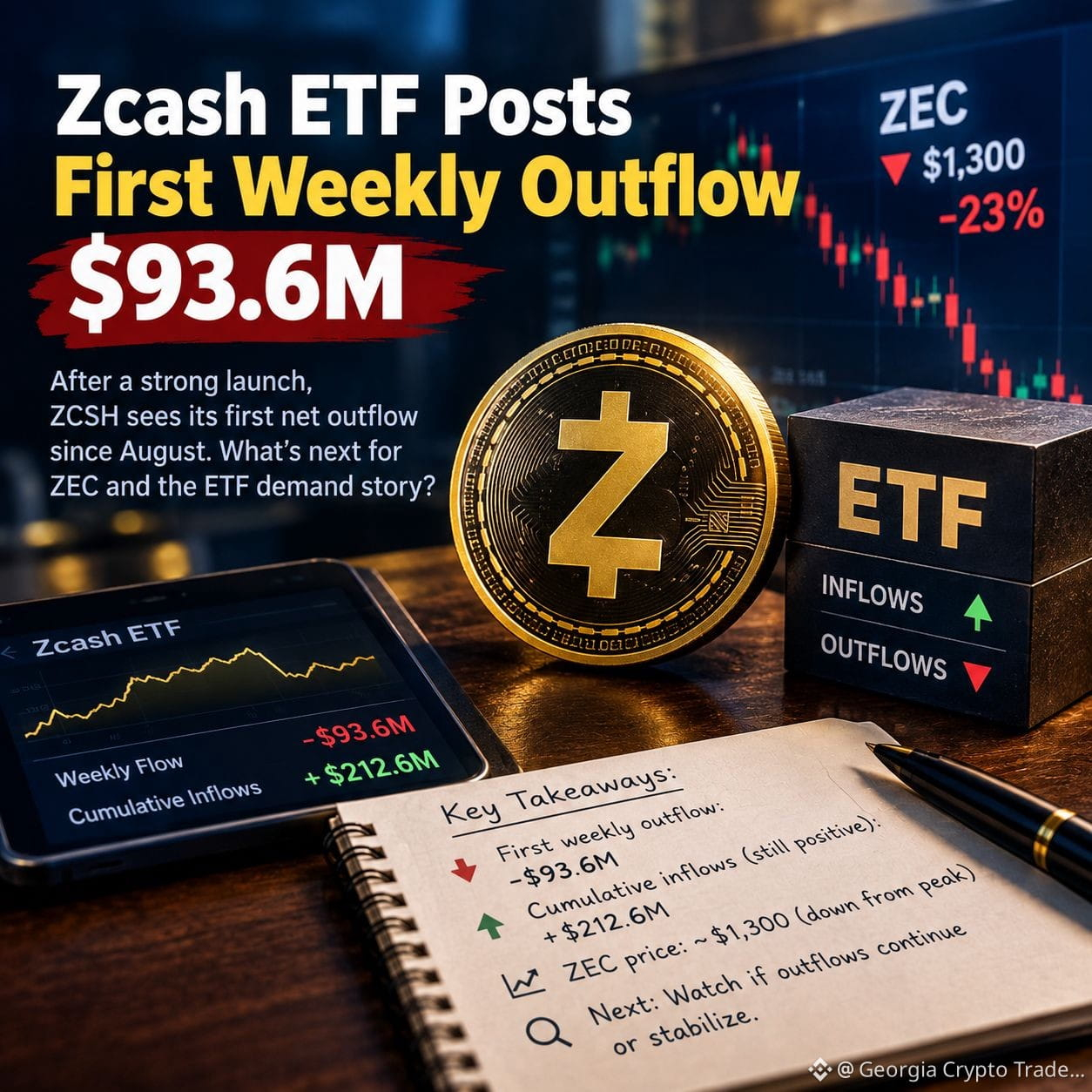
Grayscale’ning ZCSH fondi 2-oktabrda yakunlangan hafta uchun taxminan 93,6 mln dollar sof chiqim qayd etdi — avgust oyida ishga tushirilganidan beri ilk marta salbiy hafta.
Bu ajralib turadi, chunki fond faqat ikki hafta oldin taxminan 98,2 mln dollarni jalb qilgan edi.
Shuning uchun savol faqat 93,6 mln dollar “ayiqona”mi-yo‘qmi emas.
Bu erta ETF talabi barqaror tendensiya o‘rnatish uchun yetarlimi yoki o‘sha talabning bir qismi ZEC’dagi keskin momentum bilan bog‘liqmi — shunda.
ZEC ham sentabr oxiridagi eng yuqori nuqtadan orqaga qaytdi: chiqimlar tezlashgani sari u 1 300 dollar atrofida savdo qilmoqda.
Bir narsani e’tiborda tutish kerak: ZCSH uchun jamlangan sof oqimlar hali ham taxminan 212,6 mln dollarga ijobiy.
Bu esa ETF hikoyasining to‘liq barbod bo‘lishidan ko‘ra, talabdagi muhim “sovitish”ga o‘xshaydi.
Menga esa keyingi bir necha oqim hisobotlari bu bitta haftadan ko‘ra muhimroq.
Agar chiqimlar davom etsa-yu, narx zaifligi ham saqlansa, bozor ZEC’da bo‘lgan rallyning barqarorligini qayta baholayotgandek bo‘lishi mumkin. Agar oqimlar barqarorlashsa, bu oxir-oqibat talab bo‘yicha birinchi haqiqiy sinov bo‘lib chiqishi mumkin.
Bu farqni kuzatish kerak.
$ONE $PUMP $ZAMA
{future}(ZAMAUSDT)
{future}(PUMPUSDT)
{future}(ONEUSDT)
Zcash ETF oqimlari bozorga sekinlashish uchun sabab berdi.
Grayscale’ning ZCSH fondi 2-oktabrda yakunlangan hafta uchun taxminan 93,6 mln dollar sof chiqim qayd etdi — avgust oyida ishga tushirilganidan beri ilk marta salbiy hafta.
Bu ajralib turadi, chunki fond faqat ikki hafta oldin taxminan 98,2 mln dollarni jalb qilgan edi.
Shuning uchun savol faqat 93,6 mln dollar “ayiqona”mi-yo‘qmi emas.
Bu erta ETF talabi barqaror tendensiya o‘rnatish uchun yetarlimi yoki o‘sha talabning bir qismi ZEC’dagi keskin momentum bilan bog‘liqmi — shunda.
ZEC ham sentabr oxiridagi eng yuqori nuqtadan orqaga qaytdi: chiqimlar tezlashgani sari u 1 300 dollar atrofida savdo qilmoqda.
Bir narsani e’tiborda tutish kerak: ZCSH uchun jamlangan sof oqimlar hali ham taxminan 212,6 mln dollarga ijobiy.
Bu esa ETF hikoyasining to‘liq barbod bo‘lishidan ko‘ra, talabdagi muhim “sovitish”ga o‘xshaydi.
Menga esa keyingi bir necha oqim hisobotlari bu bitta haftadan ko‘ra muhimroq.
Agar chiqimlar davom etsa-yu, narx zaifligi ham saqlansa, bozor ZEC’da bo‘lgan rallyning barqarorligini qayta baholayotgandek bo‘lishi mumkin. Agar oqimlar barqarorlashsa, bu oxir-oqibat talab bo‘yicha birinchi haqiqiy sinov bo‘lib chiqishi mumkin.
Bu farqni kuzatish kerak.
$ONE $PUMP $ZAMA
Grayscale’ning ZCSH fondi 2-oktabrda yakunlangan hafta uchun taxminan 93,6 mln dollar sof chiqim qayd etdi — avgust oyida ishga tushirilganidan beri ilk marta salbiy hafta.
Bu ajralib turadi, chunki fond faqat ikki hafta oldin taxminan 98,2 mln dollarni jalb qilgan edi.
Shuning uchun savol faqat 93,6 mln dollar “ayiqona”mi-yo‘qmi emas.
Bu erta ETF talabi barqaror tendensiya o‘rnatish uchun yetarlimi yoki o‘sha talabning bir qismi ZEC’dagi keskin momentum bilan bog‘liqmi — shunda.
ZEC ham sentabr oxiridagi eng yuqori nuqtadan orqaga qaytdi: chiqimlar tezlashgani sari u 1 300 dollar atrofida savdo qilmoqda.
Bir narsani e’tiborda tutish kerak: ZCSH uchun jamlangan sof oqimlar hali ham taxminan 212,6 mln dollarga ijobiy.
Bu esa ETF hikoyasining to‘liq barbod bo‘lishidan ko‘ra, talabdagi muhim “sovitish”ga o‘xshaydi.
Menga esa keyingi bir necha oqim hisobotlari bu bitta haftadan ko‘ra muhimroq.
Agar chiqimlar davom etsa-yu, narx zaifligi ham saqlansa, bozor ZEC’da bo‘lgan rallyning barqarorligini qayta baholayotgandek bo‘lishi mumkin. Agar oqimlar barqarorlashsa, bu oxir-oqibat talab bo‘yicha birinchi haqiqiy sinov bo‘lib chiqishi mumkin.
Bu farqni kuzatish kerak.
$ONE $PUMP $ZAMA
582
·
--
O‘suvchi
#sechaltscryptoetfreviewsamidfundinglapse
SEC AQSHdagi moliyalashtirishdagi uzilish sababli yangi kripto ETFlar bo‘yicha ko‘rib chiqishni to‘xtatib turishi aslida o‘ylagandan ham ko‘ra ko‘proq “yomon” eshitiladigan sarlavhalardan biridir.
Muhim farq: bu rad etish emas, kechiktirish.
Yangi arizalar oddiy ko‘rib chiqish jarayoni bo‘ylab o‘ta olmagani uchun, yaqin muddatdagi ta’sir asosan vaqt va kutilmalarga bog‘liq. Xabarlarga ko‘ra 90 tadan ortiq ariza ko‘rib chiqish navbatida turibdi, shuning uchun moliyalashtirish uzilishi uzoq davom etsa, ortib qolgan navbat sezilarli bo‘lishi mumkin.
Treyderlar uchun: bozor kechikishni qanday narxlashi (baholashi)ga qarang, ETFga bo‘lgan asosiy talab haqidagi hikoya o‘zgardi deb taxmin qilmang.
Amaldagi kripto ETFlar ishlashda davom etadi, biroq ko‘rib chiqilishi kutilayotgan mahsulotlar o‘z muddatlari atrofida ko‘proq noaniqlikka duch keladi.
Bu muhim, chunki ETF narrativlari kripto bozori pozitsioningining katta qismiga aylandi. Kutilgan katalizatorlar orqaga surilsa, fundamental tezis o‘zgarmagan taqdirda ham, qisqa muddatli volatillik oshishi mumkin.
Mening xulosam: bu ko‘proq tezisni buzadigan emas, balki vaqt masalasi ko‘rinadi.
Asosiy qiziq savol — SEC normal ish rejimiga qaytsa, kayfiyat qanchalik tez “reset” bo‘lishi.
$GLMR $STRK $QI
{spot}(QIUSDT)
{future}(STRKUSDT)
{spot}(GLMRUSDT)
#sechaltscryptoetfreviewsamidfundinglapse
SEC AQSHdagi moliyalashtirishdagi uzilish sababli yangi kripto ETFlar bo‘yicha ko‘rib chiqishni to‘xtatib turishi aslida o‘ylagandan ham ko‘ra ko‘proq “yomon” eshitiladigan sarlavhalardan biridir.
Muhim farq: bu rad etish emas, kechiktirish.
Yangi arizalar oddiy ko‘rib chiqish jarayoni bo‘ylab o‘ta olmagani uchun, yaqin muddatdagi ta’sir asosan vaqt va kutilmalarga bog‘liq. Xabarlarga ko‘ra 90 tadan ortiq ariza ko‘rib chiqish navbatida turibdi, shuning uchun moliyalashtirish uzilishi uzoq davom etsa, ortib qolgan navbat sezilarli bo‘lishi mumkin.
Treyderlar uchun: bozor kechikishni qanday narxlashi (baholashi)ga qarang, ETFga bo‘lgan asosiy talab haqidagi hikoya o‘zgardi deb taxmin qilmang.
Amaldagi kripto ETFlar ishlashda davom etadi, biroq ko‘rib chiqilishi kutilayotgan mahsulotlar o‘z muddatlari atrofida ko‘proq noaniqlikka duch keladi.
Bu muhim, chunki ETF narrativlari kripto bozori pozitsioningining katta qismiga aylandi. Kutilgan katalizatorlar orqaga surilsa, fundamental tezis o‘zgarmagan taqdirda ham, qisqa muddatli volatillik oshishi mumkin.
Mening xulosam: bu ko‘proq tezisni buzadigan emas, balki vaqt masalasi ko‘rinadi.
Asosiy qiziq savol — SEC normal ish rejimiga qaytsa, kayfiyat qanchalik tez “reset” bo‘lishi.
$GLMR $STRK $QI
SEC AQSHdagi moliyalashtirishdagi uzilish sababli yangi kripto ETFlar bo‘yicha ko‘rib chiqishni to‘xtatib turishi aslida o‘ylagandan ham ko‘ra ko‘proq “yomon” eshitiladigan sarlavhalardan biridir.
Muhim farq: bu rad etish emas, kechiktirish.
Yangi arizalar oddiy ko‘rib chiqish jarayoni bo‘ylab o‘ta olmagani uchun, yaqin muddatdagi ta’sir asosan vaqt va kutilmalarga bog‘liq. Xabarlarga ko‘ra 90 tadan ortiq ariza ko‘rib chiqish navbatida turibdi, shuning uchun moliyalashtirish uzilishi uzoq davom etsa, ortib qolgan navbat sezilarli bo‘lishi mumkin.
Treyderlar uchun: bozor kechikishni qanday narxlashi (baholashi)ga qarang, ETFga bo‘lgan asosiy talab haqidagi hikoya o‘zgardi deb taxmin qilmang.
Amaldagi kripto ETFlar ishlashda davom etadi, biroq ko‘rib chiqilishi kutilayotgan mahsulotlar o‘z muddatlari atrofida ko‘proq noaniqlikka duch keladi.
Bu muhim, chunki ETF narrativlari kripto bozori pozitsioningining katta qismiga aylandi. Kutilgan katalizatorlar orqaga surilsa, fundamental tezis o‘zgarmagan taqdirda ham, qisqa muddatli volatillik oshishi mumkin.
Mening xulosam: bu ko‘proq tezisni buzadigan emas, balki vaqt masalasi ko‘rinadi.
Asosiy qiziq savol — SEC normal ish rejimiga qaytsa, kayfiyat qanchalik tez “reset” bo‘lishi.
$GLMR $STRK $QI

8
15.8k
·
--
O‘suvchi
Tarjimani ko‘rish
#coldcardtheftinvestigationadvances
🔍 Coldcard Theft Investigation Advances: Key Updates on the 2026 Hardware Wallet Breach
Significant progress has been made in tracking the funds and identifying the actors behind the recent Coldcard hardware wallet exploit. Here’s what the latest on-chain data and investigative reports reveal.
📰 Core News
• 🛡️ The Breach: A firmware vulnerability in Coldcard wallets led to the systematic draining of over 1,700 BTC (estimated at $116M–$130M) across multiple waves.
• 🕵️ Investigation Progress: On-chain tracing indicates that approximately 1,082 BTC from the initial attack remains unmoved in the attacker’s addresses [[7]].
• 🏛️ Law Enforcement Involvement: Investigators found that the theft patterns strongly align with activity from a paid blockchain data service account. Industry analysts note that these leads have been handed to law enforcement, and the identity of the first-wave attacker may already be known [[7]].
📊 Market Impact
• 🔐 Self-Custody Vigilance: This event underscores the critical importance of verifying hardware wallet firmware integrity, sourcing devices directly from manufacturers, and staying updated on security advisories.
• 🔎 On-Chain Analytics Win: The ability to actively trace, tag, and monitor stolen funds demonstrates the maturing effectiveness of blockchain forensic tools in deterring illicit cash-outs.
• ⚖️ Ecosystem Trust: While short-term concern may arise around specific device models, transparent investigations and proactive post-mortems from manufacturers ultimately strengthen long-term industry security standards.
How has this incident influenced your personal self-custody strategy? Do you rely on a single hardware wallet, or have you explored multi-signature setups for added security? Share your thoughts below! 👇
$BTW $TREE $MUBARAK
{future}(MUBARAKUSDT)
{future}(TREEUSDT)
{future}(BTWUSDT)
#coldcardtheftinvestigationadvances
🔍 Coldcard Theft Investigation Advances: Key Updates on the 2026 Hardware Wallet Breach
Significant progress has been made in tracking the funds and identifying the actors behind the recent Coldcard hardware wallet exploit. Here’s what the latest on-chain data and investigative reports reveal.
📰 Core News
• 🛡️ The Breach: A firmware vulnerability in Coldcard wallets led to the systematic draining of over 1,700 BTC (estimated at $116M–$130M) across multiple waves.
• 🕵️ Investigation Progress: On-chain tracing indicates that approximately 1,082 BTC from the initial attack remains unmoved in the attacker’s addresses [[7]].
• 🏛️ Law Enforcement Involvement: Investigators found that the theft patterns strongly align with activity from a paid blockchain data service account. Industry analysts note that these leads have been handed to law enforcement, and the identity of the first-wave attacker may already be known [[7]].
📊 Market Impact
• 🔐 Self-Custody Vigilance: This event underscores the critical importance of verifying hardware wallet firmware integrity, sourcing devices directly from manufacturers, and staying updated on security advisories.
• 🔎 On-Chain Analytics Win: The ability to actively trace, tag, and monitor stolen funds demonstrates the maturing effectiveness of blockchain forensic tools in deterring illicit cash-outs.
• ⚖️ Ecosystem Trust: While short-term concern may arise around specific device models, transparent investigations and proactive post-mortems from manufacturers ultimately strengthen long-term industry security standards.
How has this incident influenced your personal self-custody strategy? Do you rely on a single hardware wallet, or have you explored multi-signature setups for added security? Share your thoughts below! 👇
$BTW $TREE $MUBARAK
🔍 Coldcard Theft Investigation Advances: Key Updates on the 2026 Hardware Wallet Breach
Significant progress has been made in tracking the funds and identifying the actors behind the recent Coldcard hardware wallet exploit. Here’s what the latest on-chain data and investigative reports reveal.
📰 Core News
• 🛡️ The Breach: A firmware vulnerability in Coldcard wallets led to the systematic draining of over 1,700 BTC (estimated at $116M–$130M) across multiple waves.
• 🕵️ Investigation Progress: On-chain tracing indicates that approximately 1,082 BTC from the initial attack remains unmoved in the attacker’s addresses [[7]].
• 🏛️ Law Enforcement Involvement: Investigators found that the theft patterns strongly align with activity from a paid blockchain data service account. Industry analysts note that these leads have been handed to law enforcement, and the identity of the first-wave attacker may already be known [[7]].
📊 Market Impact
• 🔐 Self-Custody Vigilance: This event underscores the critical importance of verifying hardware wallet firmware integrity, sourcing devices directly from manufacturers, and staying updated on security advisories.
• 🔎 On-Chain Analytics Win: The ability to actively trace, tag, and monitor stolen funds demonstrates the maturing effectiveness of blockchain forensic tools in deterring illicit cash-outs.
• ⚖️ Ecosystem Trust: While short-term concern may arise around specific device models, transparent investigations and proactive post-mortems from manufacturers ultimately strengthen long-term industry security standards.
How has this incident influenced your personal self-custody strategy? Do you rely on a single hardware wallet, or have you explored multi-signature setups for added security? Share your thoughts below! 👇
$BTW $TREE $MUBARAK

2
188
·
--
O‘suvchi
Tarjimani ko‘rish
#cryptorally
📈Market Watch: Key Drivers Behind the Current Crypto Rally
The crypto market is showing renewed momentum, with major assets experiencing notable upward movement. Let’s break down the core factors fueling this trend and what it means for the broader ecosystem.
📰 Core News
Recent market data highlights a broad-based uplift across major digital assets, reflecting a shift in market dynamics. This positive price action is primarily supported by three converging factors:
• 🏛️ Regulatory Developments: Progressive legislative discussions are fostering a more defined operational framework for digital assets, reducing long-term uncertainty.
• 🏢 Institutional Integration: Steady participation from traditional finance continues to reinforce market liquidity and overall ecosystem maturity.
• 📊 Macroeconomic Conditions: Shifting global liquidity dynamics and evolving rate expectations are contributing to a cautious but steady return of risk-on sentiment.
📊 Market Impact
• Major Caps (BTC & ETH): As the primary anchors of the market, sustained interest in these assets helps stabilize overall market sentiment and trading volume.
• **Altcoin & DeFi Sectors**: Improved liquidity in major assets often creates a ripple effect, drawing developer and user attention to fundamental projects in decentralized finance and modular infrastructure.
• **Volatility Awareness**: While upward trends are positive, rapid price movements can occasionally trigger short-term volatility and leveraged liquidations, making sound risk management essential for all participants.
In your view, which sector is best positioned to build on this momentum: Layer 1 blockchains, DeFi protocols, or Real-World Assets (RWAs)? Share your analysis in the comments below!
Disclaimer: This is for educational purposes only. Not Financial Advice (NFA). Always Do Your Own Research (DYOR).
$MUBARAK $TREE $HEMI
{future}(HEMIUSDT)
{future}(TREEUSDT)
{future}(MUBARAKUSDT)
#cryptorally
📈Market Watch: Key Drivers Behind the Current Crypto Rally
The crypto market is showing renewed momentum, with major assets experiencing notable upward movement. Let’s break down the core factors fueling this trend and what it means for the broader ecosystem.
📰 Core News
Recent market data highlights a broad-based uplift across major digital assets, reflecting a shift in market dynamics. This positive price action is primarily supported by three converging factors:
• 🏛️ Regulatory Developments: Progressive legislative discussions are fostering a more defined operational framework for digital assets, reducing long-term uncertainty.
• 🏢 Institutional Integration: Steady participation from traditional finance continues to reinforce market liquidity and overall ecosystem maturity.
• 📊 Macroeconomic Conditions: Shifting global liquidity dynamics and evolving rate expectations are contributing to a cautious but steady return of risk-on sentiment.
📊 Market Impact
• Major Caps (BTC & ETH): As the primary anchors of the market, sustained interest in these assets helps stabilize overall market sentiment and trading volume.
• **Altcoin & DeFi Sectors**: Improved liquidity in major assets often creates a ripple effect, drawing developer and user attention to fundamental projects in decentralized finance and modular infrastructure.
• **Volatility Awareness**: While upward trends are positive, rapid price movements can occasionally trigger short-term volatility and leveraged liquidations, making sound risk management essential for all participants.
In your view, which sector is best positioned to build on this momentum: Layer 1 blockchains, DeFi protocols, or Real-World Assets (RWAs)? Share your analysis in the comments below!
Disclaimer: This is for educational purposes only. Not Financial Advice (NFA). Always Do Your Own Research (DYOR).
$MUBARAK $TREE $HEMI
📈Market Watch: Key Drivers Behind the Current Crypto Rally
The crypto market is showing renewed momentum, with major assets experiencing notable upward movement. Let’s break down the core factors fueling this trend and what it means for the broader ecosystem.
📰 Core News
Recent market data highlights a broad-based uplift across major digital assets, reflecting a shift in market dynamics. This positive price action is primarily supported by three converging factors:
• 🏛️ Regulatory Developments: Progressive legislative discussions are fostering a more defined operational framework for digital assets, reducing long-term uncertainty.
• 🏢 Institutional Integration: Steady participation from traditional finance continues to reinforce market liquidity and overall ecosystem maturity.
• 📊 Macroeconomic Conditions: Shifting global liquidity dynamics and evolving rate expectations are contributing to a cautious but steady return of risk-on sentiment.
📊 Market Impact
• Major Caps (BTC & ETH): As the primary anchors of the market, sustained interest in these assets helps stabilize overall market sentiment and trading volume.
• **Altcoin & DeFi Sectors**: Improved liquidity in major assets often creates a ripple effect, drawing developer and user attention to fundamental projects in decentralized finance and modular infrastructure.
• **Volatility Awareness**: While upward trends are positive, rapid price movements can occasionally trigger short-term volatility and leveraged liquidations, making sound risk management essential for all participants.
In your view, which sector is best positioned to build on this momentum: Layer 1 blockchains, DeFi protocols, or Real-World Assets (RWAs)? Share your analysis in the comments below!
Disclaimer: This is for educational purposes only. Not Financial Advice (NFA). Always Do Your Own Research (DYOR).
$MUBARAK $TREE $HEMI

1
1.6k
·
--
O‘suvchi
Tarjimani ko‘rish
$BANK is showing strong upside momentum, with price up 23.70% and holding around $0.0428. $ATM is also moving well, trading at $1.84 with a 21.71% gain, which keeps both names in a clearly bullish short-term spot.
The move looks healthy for now, but the real test is whether this strength can keep holding once the initial burst settles. Who’s watching these two for continuation?
#bank #ATM
{spot}(ATMUSDT)
{future}(BANKUSDT)
$BANK is showing strong upside momentum, with price up 23.70% and holding around $0.0428. $ATM is also moving well, trading at $1.84 with a 21.71% gain, which keeps both names in a clearly bullish short-term spot.
The move looks healthy for now, but the real test is whether this strength can keep holding once the initial burst settles. Who’s watching these two for continuation?
#bank #ATM
The move looks healthy for now, but the real test is whether this strength can keep holding once the initial burst settles. Who’s watching these two for continuation?
#bank #ATM
Bullish
80%
Bearish
20%
15 Ovozlar • Ovoz berish yopildi
1
370
·
--
O‘suvchi
Tarjimani ko‘rish
#baby $BABY @babylonlabs_io
{future}(BABYUSDT)
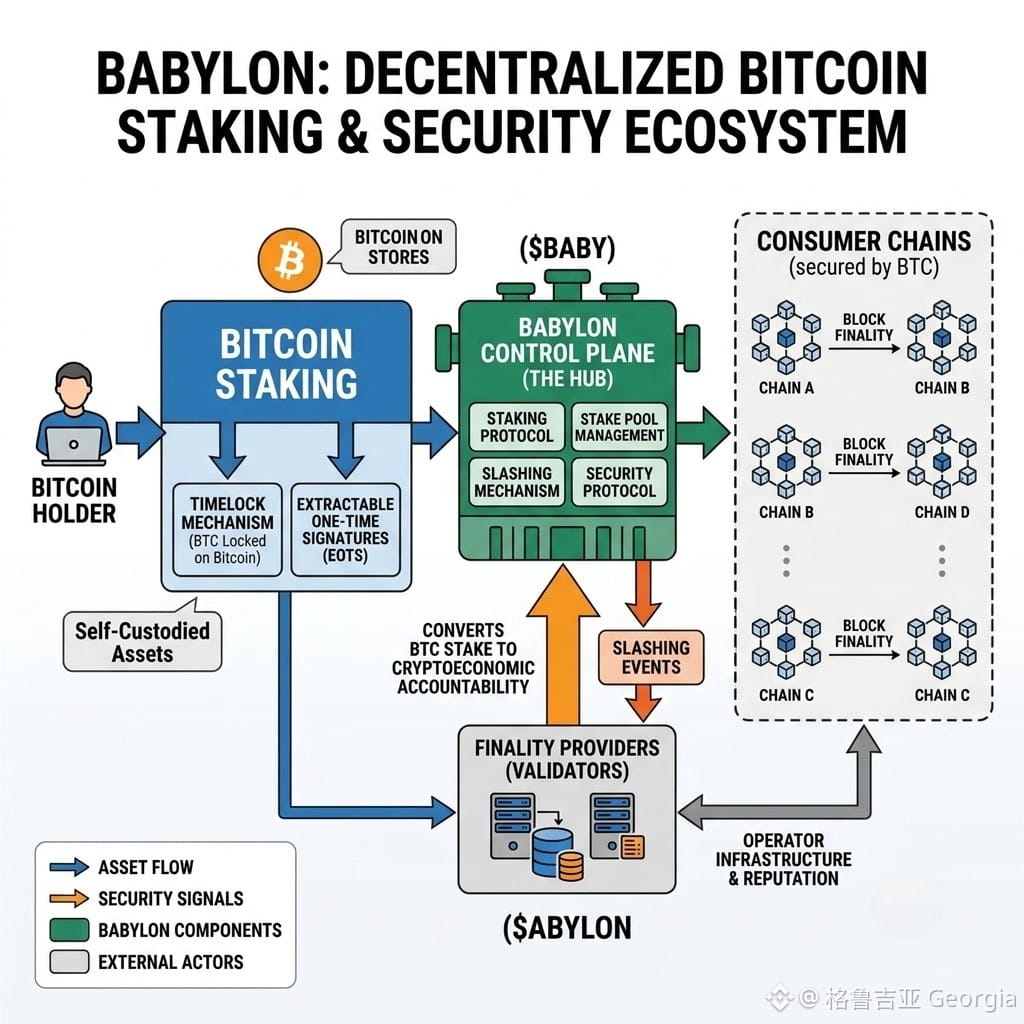
I kept coming back to one question that had very little to do with Bitcoin itself. The harder part of Babylon's design isn't convincing BTC holders to stake. It's convincing people to trust the entities responsible for expressing Bitcoin's economic weight inside another consensus system. That distinction felt much more important after reading through how Finality Providers fit into the architecture.
BTC remains self-custodied but security is not transmitted automatically. Finality Providers are the actors that convert delegated Bitcoin stake into cryptoeconomic accountability for Babylon's finality layer. Their signatures determine whether Bitcoin's locked capital actually influences consensus, and slashing is meant to discourage equivocation. In practice this makes operational reliability almost as valuable as the BTC delegated behind them.
That creates an incentive I don't see discussed often. If applications consistently prefer Finality Providers with the longest uptime strongest infrastructure and deepest reputation delegation may naturally concentrate around a relatively small set of operators. No protocol rule explicitly demands centralization yet market preferences can quietly produce it anyway. The protocol separates custody from validation power but it doesn't necessarily separate validation power from reputation.
That left me wondering whether Babylon's long term decentralization depends less on Bitcoin's distribution and more on whether the ecosystem can continuously produce new credible Finality Providers. If reputation becomes the scarce resource perhaps that's the real security budget the network is managing not just Bitcoin itself.
#baby $BABY @BabylonLabs_io
I kept coming back to one question that had very little to do with Bitcoin itself. The harder part of Babylon's design isn't convincing BTC holders to stake. It's convincing people to trust the entities responsible for expressing Bitcoin's economic weight inside another consensus system. That distinction felt much more important after reading through how Finality Providers fit into the architecture.
BTC remains self-custodied but security is not transmitted automatically. Finality Providers are the actors that convert delegated Bitcoin stake into cryptoeconomic accountability for Babylon's finality layer. Their signatures determine whether Bitcoin's locked capital actually influences consensus, and slashing is meant to discourage equivocation. In practice this makes operational reliability almost as valuable as the BTC delegated behind them.
That creates an incentive I don't see discussed often. If applications consistently prefer Finality Providers with the longest uptime strongest infrastructure and deepest reputation delegation may naturally concentrate around a relatively small set of operators. No protocol rule explicitly demands centralization yet market preferences can quietly produce it anyway. The protocol separates custody from validation power but it doesn't necessarily separate validation power from reputation.
That left me wondering whether Babylon's long term decentralization depends less on Bitcoin's distribution and more on whether the ecosystem can continuously produce new credible Finality Providers. If reputation becomes the scarce resource perhaps that's the real security budget the network is managing not just Bitcoin itself.
I kept coming back to one question that had very little to do with Bitcoin itself. The harder part of Babylon's design isn't convincing BTC holders to stake. It's convincing people to trust the entities responsible for expressing Bitcoin's economic weight inside another consensus system. That distinction felt much more important after reading through how Finality Providers fit into the architecture.
BTC remains self-custodied but security is not transmitted automatically. Finality Providers are the actors that convert delegated Bitcoin stake into cryptoeconomic accountability for Babylon's finality layer. Their signatures determine whether Bitcoin's locked capital actually influences consensus, and slashing is meant to discourage equivocation. In practice this makes operational reliability almost as valuable as the BTC delegated behind them.
That creates an incentive I don't see discussed often. If applications consistently prefer Finality Providers with the longest uptime strongest infrastructure and deepest reputation delegation may naturally concentrate around a relatively small set of operators. No protocol rule explicitly demands centralization yet market preferences can quietly produce it anyway. The protocol separates custody from validation power but it doesn't necessarily separate validation power from reputation.
That left me wondering whether Babylon's long term decentralization depends less on Bitcoin's distribution and more on whether the ecosystem can continuously produce new credible Finality Providers. If reputation becomes the scarce resource perhaps that's the real security budget the network is managing not just Bitcoin itself.
3
2
105
·
--
O‘suvchi
Tarjimani ko‘rish
#baby $BABY @babylonlabs_io
{future}(BABYUSDT)
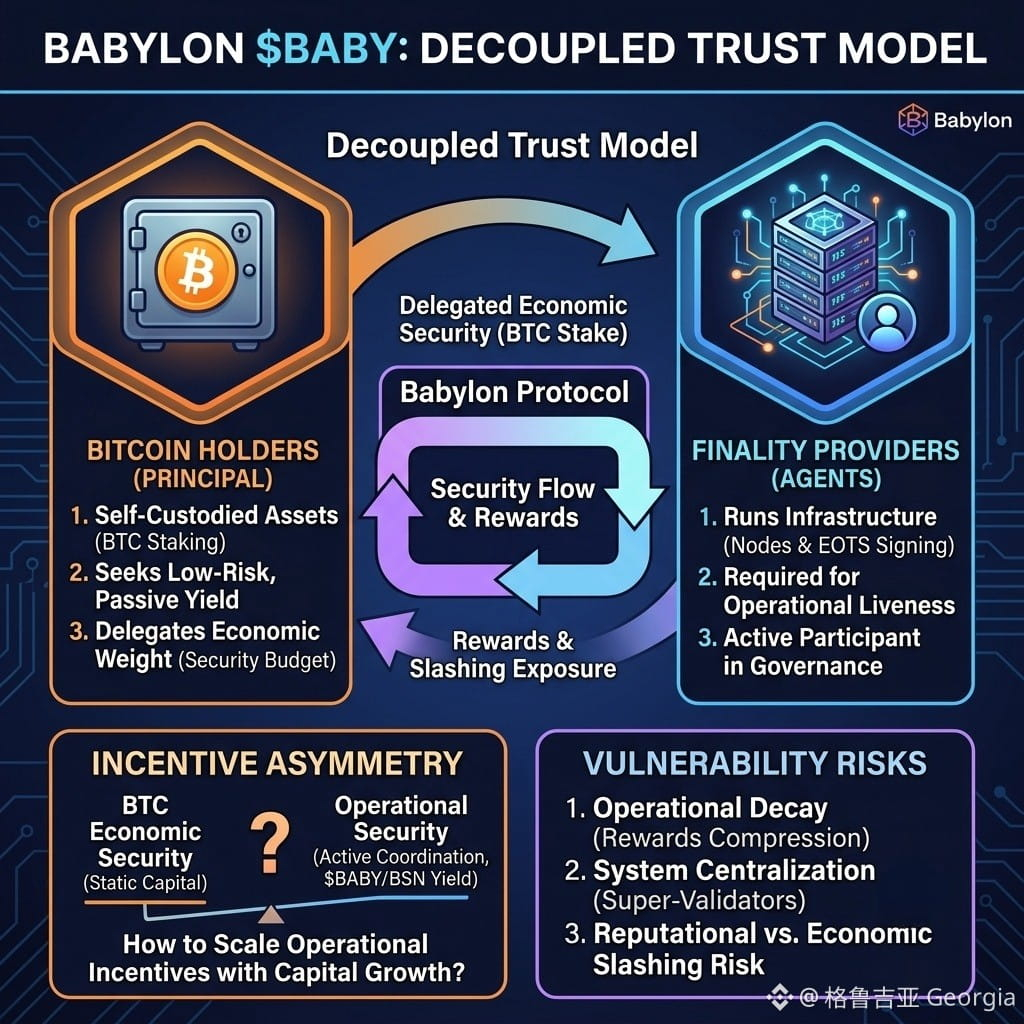
I kept coming back to one question that had less to do with Bitcoin and more to do with coordination. I initially assumed Babylon's hardest problem was importing Bitcoin's economic security into PoS systems. After reading through the architecture more carefully it seemed the more fragile layer might actually be the people and incentives surrounding Finality Providers rather than the BTC itself.
Babylon's design deliberately separates BTC holders from the entities that participate in finality. Bitcoin remains self custodied while Finality Providers sign checkpoints that can be slashable if they violate protocol rules. That separation is elegant because it avoids asking Bitcoin holders to run complex infrastructure. But it also means the protocol depends on an intermediary class whose incentives are only partially backed by Bitcoin's security. Their reputation operational reliability BABY denominated rewards and slashing exposure all become part of the trust model.
That creates an interesting asymmetry. Bitcoin supplies the economic weight, yet the quality of finality depends on actors whose behavior is shaped by a different asset and a different governance system. If BABY incentives become less attractive the protocol doesn't suddenly lose staked BTC but it could gradually lose the diversity and resilience of the participants responsible for finality. Economic security and operational security begin to drift apart rather than reinforce each other.
I wonder if the long term challenge for Babylon isn't attracting more Bitcoin but ensuring that the incentives for Finality Providers continue to scale alongside the value of the security they are expected to represent.
#baby $BABY @BabylonLabs_io
I kept coming back to one question that had less to do with Bitcoin and more to do with coordination. I initially assumed Babylon's hardest problem was importing Bitcoin's economic security into PoS systems. After reading through the architecture more carefully it seemed the more fragile layer might actually be the people and incentives surrounding Finality Providers rather than the BTC itself.
Babylon's design deliberately separates BTC holders from the entities that participate in finality. Bitcoin remains self custodied while Finality Providers sign checkpoints that can be slashable if they violate protocol rules. That separation is elegant because it avoids asking Bitcoin holders to run complex infrastructure. But it also means the protocol depends on an intermediary class whose incentives are only partially backed by Bitcoin's security. Their reputation operational reliability BABY denominated rewards and slashing exposure all become part of the trust model.
That creates an interesting asymmetry. Bitcoin supplies the economic weight, yet the quality of finality depends on actors whose behavior is shaped by a different asset and a different governance system. If BABY incentives become less attractive the protocol doesn't suddenly lose staked BTC but it could gradually lose the diversity and resilience of the participants responsible for finality. Economic security and operational security begin to drift apart rather than reinforce each other.
I wonder if the long term challenge for Babylon isn't attracting more Bitcoin but ensuring that the incentives for Finality Providers continue to scale alongside the value of the security they are expected to represent.
I kept coming back to one question that had less to do with Bitcoin and more to do with coordination. I initially assumed Babylon's hardest problem was importing Bitcoin's economic security into PoS systems. After reading through the architecture more carefully it seemed the more fragile layer might actually be the people and incentives surrounding Finality Providers rather than the BTC itself.
Babylon's design deliberately separates BTC holders from the entities that participate in finality. Bitcoin remains self custodied while Finality Providers sign checkpoints that can be slashable if they violate protocol rules. That separation is elegant because it avoids asking Bitcoin holders to run complex infrastructure. But it also means the protocol depends on an intermediary class whose incentives are only partially backed by Bitcoin's security. Their reputation operational reliability BABY denominated rewards and slashing exposure all become part of the trust model.
That creates an interesting asymmetry. Bitcoin supplies the economic weight, yet the quality of finality depends on actors whose behavior is shaped by a different asset and a different governance system. If BABY incentives become less attractive the protocol doesn't suddenly lose staked BTC but it could gradually lose the diversity and resilience of the participants responsible for finality. Economic security and operational security begin to drift apart rather than reinforce each other.
I wonder if the long term challenge for Babylon isn't attracting more Bitcoin but ensuring that the incentives for Finality Providers continue to scale alongside the value of the security they are expected to represent.
103
·
--
O‘suvchi
Tarjimani ko‘rish
#baby $BABY @babylonlabs_io
{future}(BABYUSDT)
New crypto infrastructure is often judged by how quickly people adopt it. I am not convinced that is the best measure.
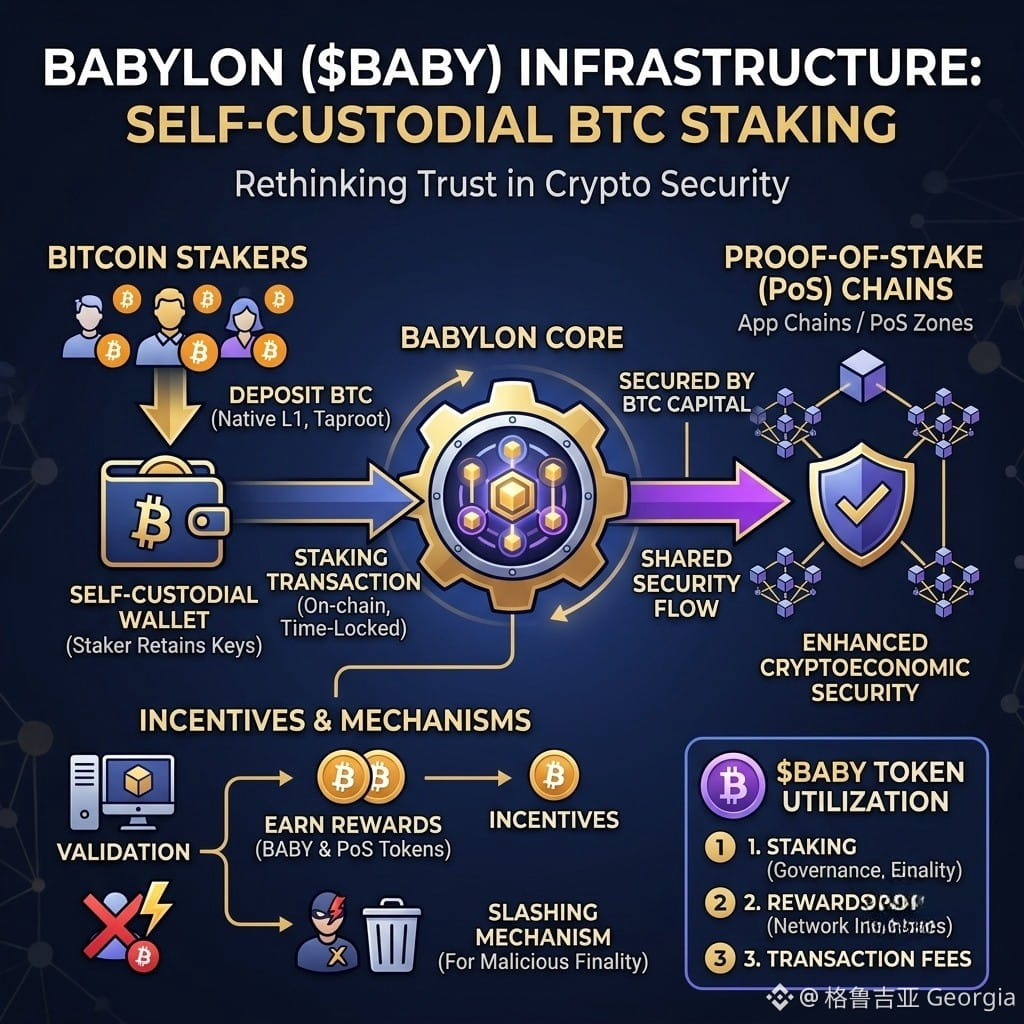
Babylon introduces a way for Bitcoin holders to stake BTC in a self custodial manner allowing Bitcoin's economic security to support Proof of Stake blockchains. It is an ambitious idea but its success may not be visible in the metrics people usually watch first.
Early participation can be driven by curiosity incentives or market conditions. None of those necessarily tell us whether the model has become trusted infrastructure. Real confidence develops much more slowly. It appears when participants continue using a system after the excitement fades and when security matters more than short term rewards.
That is one reason the comparison with custodial Bitcoin models is interesting. Wrapped assets can grow quickly because they reduce friction and fit into existing ecosystems. Babylon takes a different path by prioritizing self custody even if that means adoption could be more gradual.
The pace may look slower but slower does not always mean weaker. Sometimes it reflects a different standard for earning trust.
The most important signal may never be the largest number of deposits or the fastest growth chart. It may simply be whether people still choose the same design when the incentives become ordinary and only the underlying security remains.
#baby $BABY @BabylonLabs_io
New crypto infrastructure is often judged by how quickly people adopt it. I am not convinced that is the best measure.
Babylon introduces a way for Bitcoin holders to stake BTC in a self custodial manner allowing Bitcoin's economic security to support Proof of Stake blockchains. It is an ambitious idea but its success may not be visible in the metrics people usually watch first.
Early participation can be driven by curiosity incentives or market conditions. None of those necessarily tell us whether the model has become trusted infrastructure. Real confidence develops much more slowly. It appears when participants continue using a system after the excitement fades and when security matters more than short term rewards.
That is one reason the comparison with custodial Bitcoin models is interesting. Wrapped assets can grow quickly because they reduce friction and fit into existing ecosystems. Babylon takes a different path by prioritizing self custody even if that means adoption could be more gradual.
The pace may look slower but slower does not always mean weaker. Sometimes it reflects a different standard for earning trust.
The most important signal may never be the largest number of deposits or the fastest growth chart. It may simply be whether people still choose the same design when the incentives become ordinary and only the underlying security remains.
New crypto infrastructure is often judged by how quickly people adopt it. I am not convinced that is the best measure.
Babylon introduces a way for Bitcoin holders to stake BTC in a self custodial manner allowing Bitcoin's economic security to support Proof of Stake blockchains. It is an ambitious idea but its success may not be visible in the metrics people usually watch first.
Early participation can be driven by curiosity incentives or market conditions. None of those necessarily tell us whether the model has become trusted infrastructure. Real confidence develops much more slowly. It appears when participants continue using a system after the excitement fades and when security matters more than short term rewards.
That is one reason the comparison with custodial Bitcoin models is interesting. Wrapped assets can grow quickly because they reduce friction and fit into existing ecosystems. Babylon takes a different path by prioritizing self custody even if that means adoption could be more gradual.
The pace may look slower but slower does not always mean weaker. Sometimes it reflects a different standard for earning trust.
The most important signal may never be the largest number of deposits or the fastest growth chart. It may simply be whether people still choose the same design when the incentives become ordinary and only the underlying security remains.
1
109
·
--
O‘suvchi
Tarjimani ko‘rish
#baby $BABY @babylonlabs_io
{future}(BABYUSDT)
Many people think the value of Bitcoin comes from simply holding it. But what if its next role is not just preserving wealth, but quietly protecting other networks?
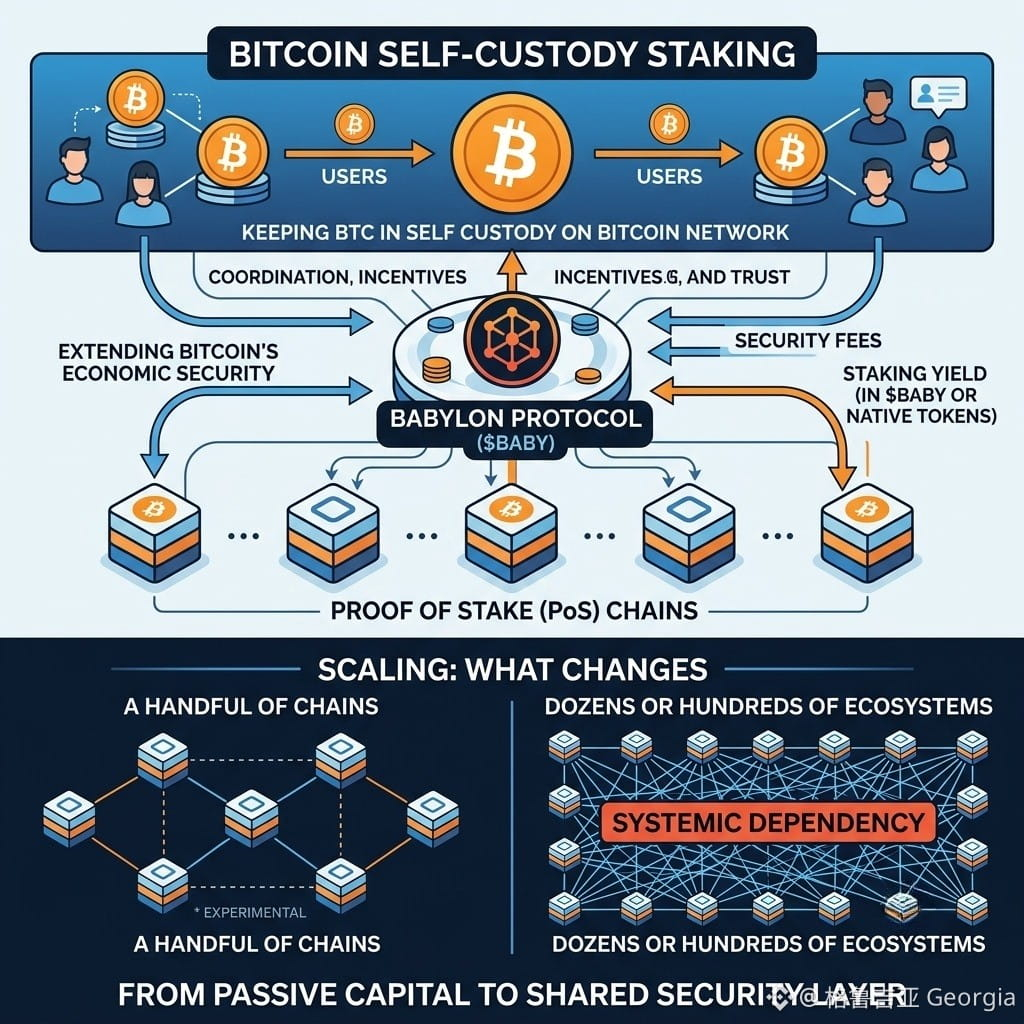
That is the idea Babylon is exploring. It allows Bitcoin holders to stake their BTC while keeping it in self custody on the Bitcoin network, extending Bitcoin's economic security to Proof of Stake chains without turning BTC into a wrapped asset.
The interesting part is not the staking itself. It is what happens if this model becomes widely adopted. Bitcoin stops being passive capital sitting on the sidelines. Instead, it becomes a shared security layer that multiple ecosystems may begin to rely on.
That shift creates new possibilities, but it also changes expectations. As more networks depend on Bitcoin backed security, reliability becomes more important than novelty. A design that works well for a handful of chains may face very different pressures when dozens or even hundreds of ecosystems lean on it at the same time.
Compared with custodial approaches, Babylon keeps ownership closer to the user. But scaling is about more than ownership. It is about whether coordination, incentives, and trust can grow without becoming fragile.
Sometimes the biggest change is not adding a new feature. It is changing what everyone quietly starts depending on.
#baby $BABY @BabylonLabs_io
Many people think the value of Bitcoin comes from simply holding it. But what if its next role is not just preserving wealth, but quietly protecting other networks?
That is the idea Babylon is exploring. It allows Bitcoin holders to stake their BTC while keeping it in self custody on the Bitcoin network, extending Bitcoin's economic security to Proof of Stake chains without turning BTC into a wrapped asset.
The interesting part is not the staking itself. It is what happens if this model becomes widely adopted. Bitcoin stops being passive capital sitting on the sidelines. Instead, it becomes a shared security layer that multiple ecosystems may begin to rely on.
That shift creates new possibilities, but it also changes expectations. As more networks depend on Bitcoin backed security, reliability becomes more important than novelty. A design that works well for a handful of chains may face very different pressures when dozens or even hundreds of ecosystems lean on it at the same time.
Compared with custodial approaches, Babylon keeps ownership closer to the user. But scaling is about more than ownership. It is about whether coordination, incentives, and trust can grow without becoming fragile.
Sometimes the biggest change is not adding a new feature. It is changing what everyone quietly starts depending on.
Many people think the value of Bitcoin comes from simply holding it. But what if its next role is not just preserving wealth, but quietly protecting other networks?
That is the idea Babylon is exploring. It allows Bitcoin holders to stake their BTC while keeping it in self custody on the Bitcoin network, extending Bitcoin's economic security to Proof of Stake chains without turning BTC into a wrapped asset.
The interesting part is not the staking itself. It is what happens if this model becomes widely adopted. Bitcoin stops being passive capital sitting on the sidelines. Instead, it becomes a shared security layer that multiple ecosystems may begin to rely on.
That shift creates new possibilities, but it also changes expectations. As more networks depend on Bitcoin backed security, reliability becomes more important than novelty. A design that works well for a handful of chains may face very different pressures when dozens or even hundreds of ecosystems lean on it at the same time.
Compared with custodial approaches, Babylon keeps ownership closer to the user. But scaling is about more than ownership. It is about whether coordination, incentives, and trust can grow without becoming fragile.
Sometimes the biggest change is not adding a new feature. It is changing what everyone quietly starts depending on.
1
1
90
·
--
O‘suvchi
Tarjimani ko‘rish
#baby $BABY @babylonlabs_io
{future}(BABYUSDT)
Many people think the value of Bitcoin comes from simply holding it. But what if its next role is not just preserving wealth, but quietly protecting other networks?
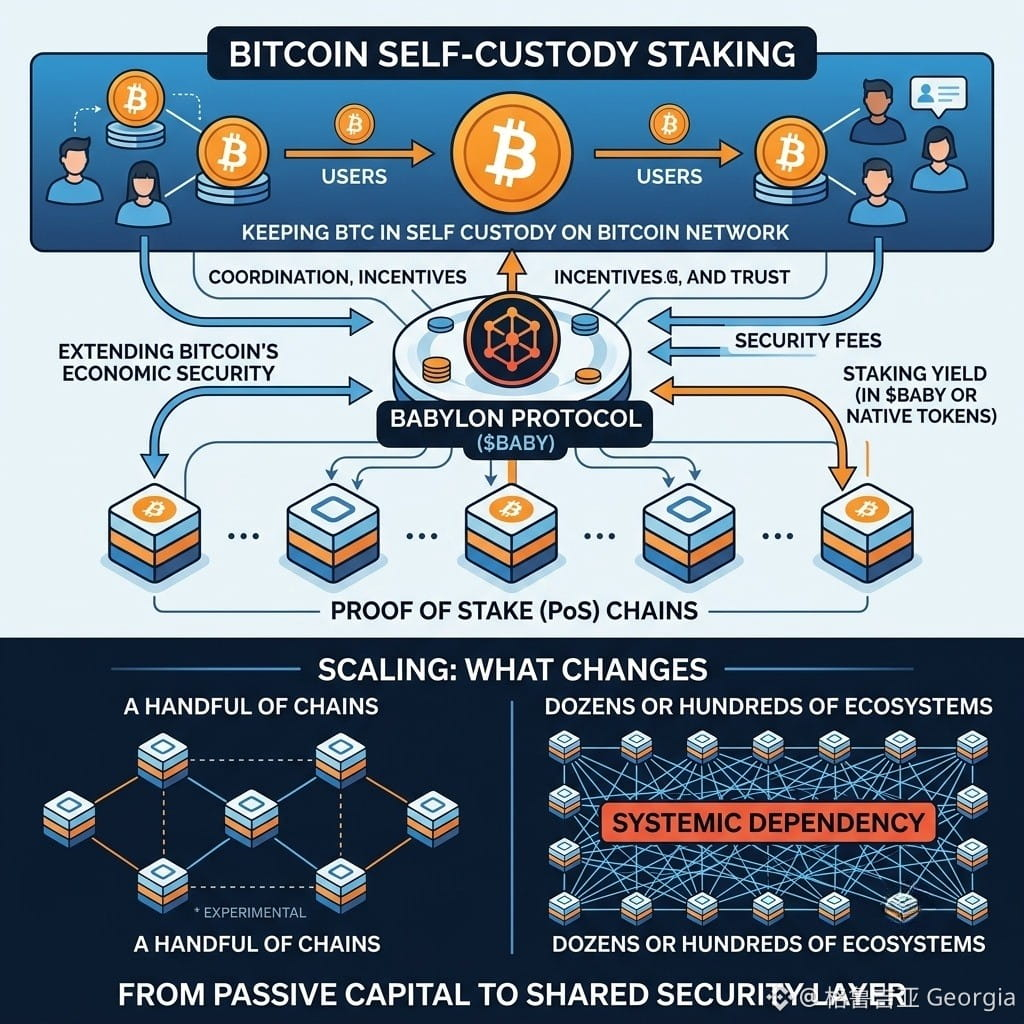
That is the idea Babylon is exploring. It allows Bitcoin holders to stake their BTC while keeping it in self custody on the Bitcoin network extending Bitcoin's economic security to Proof of Stake chains without turning BTC into a wrapped asset.
The interesting part is not the staking itself. It is what happens if this model becomes widely adopted. Bitcoin stops being passive capital sitting on the sidelines. Instead, it becomes a shared security layer that multiple ecosystems may begin to rely on.
That shift creates new possibilities, but it also changes expectations. As more networks depend on Bitcoin backed security reliability becomes more important than novelty. A design that works well for a handful of chains may face very different pressures when dozens or even hundreds of ecosystems lean on it at the same time.
Compared with custodial approaches, Babylon keeps ownership closer to the user. But scaling is about more than ownership. It is about whether coordination incentives, and trust can grow without becoming fragile.
Sometimes the biggest change is not adding a new feature. It is changing what everyone quietly starts depending on.
#baby $BABY @BabylonLabs_io
Many people think the value of Bitcoin comes from simply holding it. But what if its next role is not just preserving wealth, but quietly protecting other networks?
That is the idea Babylon is exploring. It allows Bitcoin holders to stake their BTC while keeping it in self custody on the Bitcoin network extending Bitcoin's economic security to Proof of Stake chains without turning BTC into a wrapped asset.
The interesting part is not the staking itself. It is what happens if this model becomes widely adopted. Bitcoin stops being passive capital sitting on the sidelines. Instead, it becomes a shared security layer that multiple ecosystems may begin to rely on.
That shift creates new possibilities, but it also changes expectations. As more networks depend on Bitcoin backed security reliability becomes more important than novelty. A design that works well for a handful of chains may face very different pressures when dozens or even hundreds of ecosystems lean on it at the same time.
Compared with custodial approaches, Babylon keeps ownership closer to the user. But scaling is about more than ownership. It is about whether coordination incentives, and trust can grow without becoming fragile.
Sometimes the biggest change is not adding a new feature. It is changing what everyone quietly starts depending on.
Many people think the value of Bitcoin comes from simply holding it. But what if its next role is not just preserving wealth, but quietly protecting other networks?
That is the idea Babylon is exploring. It allows Bitcoin holders to stake their BTC while keeping it in self custody on the Bitcoin network extending Bitcoin's economic security to Proof of Stake chains without turning BTC into a wrapped asset.
The interesting part is not the staking itself. It is what happens if this model becomes widely adopted. Bitcoin stops being passive capital sitting on the sidelines. Instead, it becomes a shared security layer that multiple ecosystems may begin to rely on.
That shift creates new possibilities, but it also changes expectations. As more networks depend on Bitcoin backed security reliability becomes more important than novelty. A design that works well for a handful of chains may face very different pressures when dozens or even hundreds of ecosystems lean on it at the same time.
Compared with custodial approaches, Babylon keeps ownership closer to the user. But scaling is about more than ownership. It is about whether coordination incentives, and trust can grow without becoming fragile.
Sometimes the biggest change is not adding a new feature. It is changing what everyone quietly starts depending on.
4
1
111
·
--
O‘suvchi
Tarjimani ko‘rish
#baby $BABY @babylonlabs_io
{future}(BABYUSDT)
People often assume that the value of Bitcoin comes entirely from what it does on its own network. That may have been true for a long time but it no longer feels like the only possibility.
Babylon explores a different idea. It enables self custodial BTC staking directly on the Bitcoin network so Bitcoin can contribute economic security to PoS blockchains without being wrapped or placed under third party custody.
What I find interesting is the gap between what many users expect and what is actually happening.
At first glance it can look like another way to make Bitcoin more productive. But the deeper shift is that Bitcoin is not being transformed into something else. Instead its existing security and economic weight are being treated as resources that other networks can reference without requiring Bitcoin to leave its native environment.
That is a meaningful contrast with custodial models such as wBTC or cbBTC. Those approaches primarily extend Bitcoin's utility by increasing its mobility. Babylon attempts to extend its influence while preserving the original ownership and trust model as much as possible.
Whether that approach ultimately becomes more valuable is still uncertain. Shared security introduces its own complexities and no design is free from tradeoffs.
Still the idea changes how I think about Bitcoin. Perhaps its greatest contribution to the broader crypto ecosystem will not come from moving across chains more efficiently. It may come from allowing other networks to borrow confidence without asking Bitcoin to become anything other than itself.
#baby $BABY @BabylonLabs_io
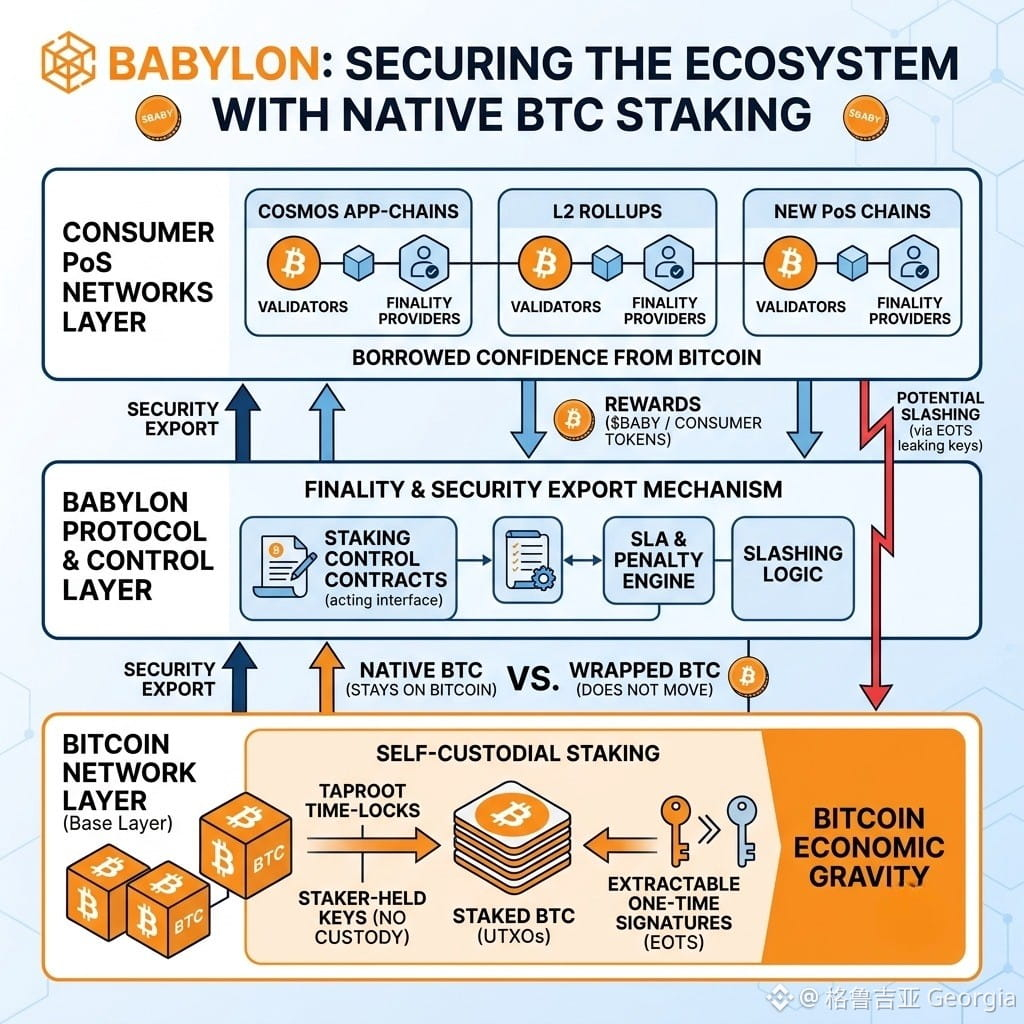
People often assume that the value of Bitcoin comes entirely from what it does on its own network. That may have been true for a long time but it no longer feels like the only possibility.
Babylon explores a different idea. It enables self custodial BTC staking directly on the Bitcoin network so Bitcoin can contribute economic security to PoS blockchains without being wrapped or placed under third party custody.
What I find interesting is the gap between what many users expect and what is actually happening.
At first glance it can look like another way to make Bitcoin more productive. But the deeper shift is that Bitcoin is not being transformed into something else. Instead its existing security and economic weight are being treated as resources that other networks can reference without requiring Bitcoin to leave its native environment.
That is a meaningful contrast with custodial models such as wBTC or cbBTC. Those approaches primarily extend Bitcoin's utility by increasing its mobility. Babylon attempts to extend its influence while preserving the original ownership and trust model as much as possible.
Whether that approach ultimately becomes more valuable is still uncertain. Shared security introduces its own complexities and no design is free from tradeoffs.
Still the idea changes how I think about Bitcoin. Perhaps its greatest contribution to the broader crypto ecosystem will not come from moving across chains more efficiently. It may come from allowing other networks to borrow confidence without asking Bitcoin to become anything other than itself.
People often assume that the value of Bitcoin comes entirely from what it does on its own network. That may have been true for a long time but it no longer feels like the only possibility.
Babylon explores a different idea. It enables self custodial BTC staking directly on the Bitcoin network so Bitcoin can contribute economic security to PoS blockchains without being wrapped or placed under third party custody.
What I find interesting is the gap between what many users expect and what is actually happening.
At first glance it can look like another way to make Bitcoin more productive. But the deeper shift is that Bitcoin is not being transformed into something else. Instead its existing security and economic weight are being treated as resources that other networks can reference without requiring Bitcoin to leave its native environment.
That is a meaningful contrast with custodial models such as wBTC or cbBTC. Those approaches primarily extend Bitcoin's utility by increasing its mobility. Babylon attempts to extend its influence while preserving the original ownership and trust model as much as possible.
Whether that approach ultimately becomes more valuable is still uncertain. Shared security introduces its own complexities and no design is free from tradeoffs.
Still the idea changes how I think about Bitcoin. Perhaps its greatest contribution to the broader crypto ecosystem will not come from moving across chains more efficiently. It may come from allowing other networks to borrow confidence without asking Bitcoin to become anything other than itself.
3
2
144
·
--
O‘suvchi
Tarjimani ko‘rish
#baby $BABY @babylonlabs_io
{future}(BABYUSDT)
People often say Bitcoin is valuable because it stays still. But staying still and staying useful are not the same thing.
That is what makes Babylon worth paying attention to. Instead of asking Bitcoin holders to wrap their assets or hand them to a custodian, it allows self custodial BTC staking on the Bitcoin network to strengthen the security of PoS blockchains.
The interesting part is not that Bitcoin can now play a role beyond being a store of value. It is who benefits from that role. The design quietly shifts Bitcoin from being an isolated asset into a shared source of economic security without requiring ownership to change hands.
That creates a different relationship between networks. PoS chains gain stronger security assumptions, while Bitcoin holders can participate without introducing the custody risks that often come with tokenized BTC. The connection is economic rather than transactional.
Of course this does not remove every compromise. Coordination between different systems is still complex, and stronger security usually comes with stricter rules and slower processes. Simplicity at the user level is not always the same as simplicity underneath.
Compared with custodial models like wBTC or cbBTC Babylon asks users to trust infrastructure less and protocol design more. Whether that becomes the preferred path remains an open question.
Perhaps the bigger shift is not that Bitcoin is earning a role in other ecosystems. It is that security itself is starting to look like a resource that can be shared without giving ownership away.
#baby $BABY @BabylonLabs_io
People often say Bitcoin is valuable because it stays still. But staying still and staying useful are not the same thing.
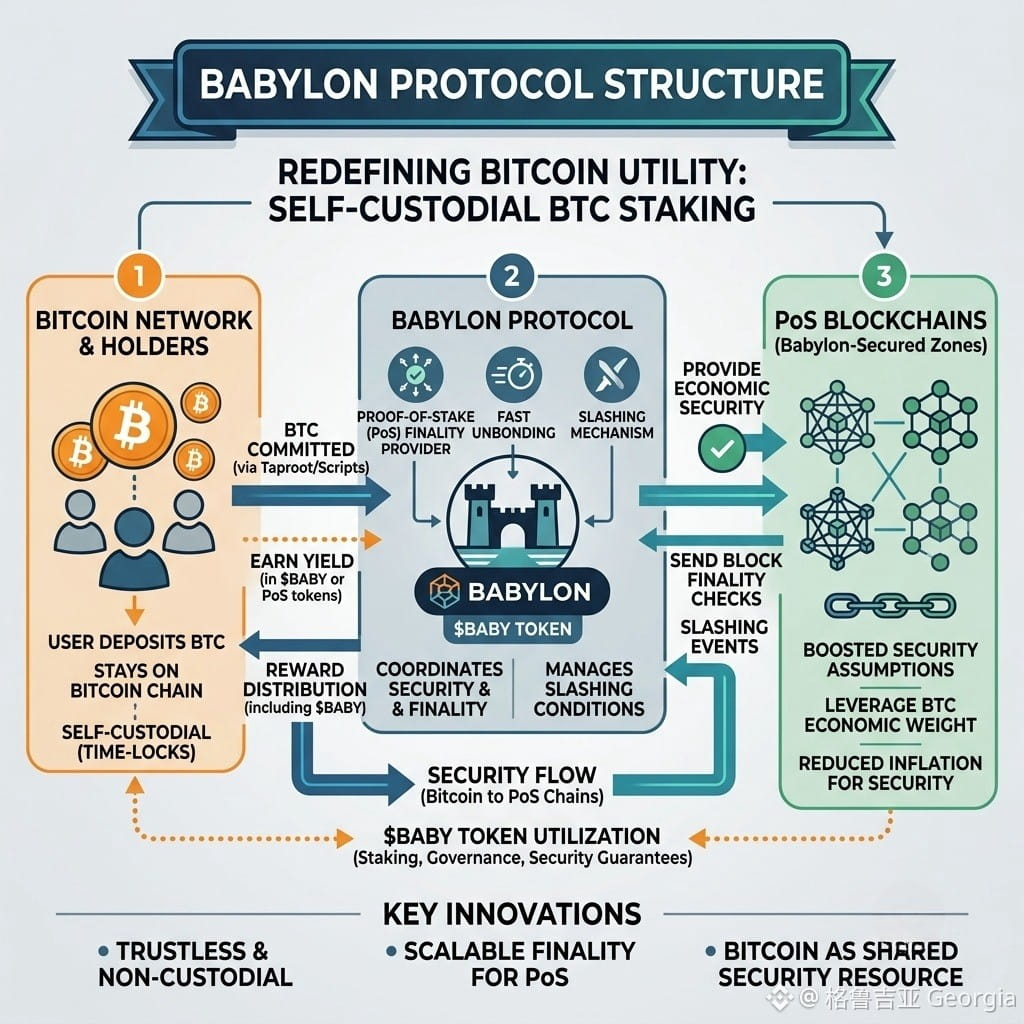
That is what makes Babylon worth paying attention to. Instead of asking Bitcoin holders to wrap their assets or hand them to a custodian, it allows self custodial BTC staking on the Bitcoin network to strengthen the security of PoS blockchains.
The interesting part is not that Bitcoin can now play a role beyond being a store of value. It is who benefits from that role. The design quietly shifts Bitcoin from being an isolated asset into a shared source of economic security without requiring ownership to change hands.
That creates a different relationship between networks. PoS chains gain stronger security assumptions, while Bitcoin holders can participate without introducing the custody risks that often come with tokenized BTC. The connection is economic rather than transactional.
Of course this does not remove every compromise. Coordination between different systems is still complex, and stronger security usually comes with stricter rules and slower processes. Simplicity at the user level is not always the same as simplicity underneath.
Compared with custodial models like wBTC or cbBTC Babylon asks users to trust infrastructure less and protocol design more. Whether that becomes the preferred path remains an open question.
Perhaps the bigger shift is not that Bitcoin is earning a role in other ecosystems. It is that security itself is starting to look like a resource that can be shared without giving ownership away.
People often say Bitcoin is valuable because it stays still. But staying still and staying useful are not the same thing.
That is what makes Babylon worth paying attention to. Instead of asking Bitcoin holders to wrap their assets or hand them to a custodian, it allows self custodial BTC staking on the Bitcoin network to strengthen the security of PoS blockchains.
The interesting part is not that Bitcoin can now play a role beyond being a store of value. It is who benefits from that role. The design quietly shifts Bitcoin from being an isolated asset into a shared source of economic security without requiring ownership to change hands.
That creates a different relationship between networks. PoS chains gain stronger security assumptions, while Bitcoin holders can participate without introducing the custody risks that often come with tokenized BTC. The connection is economic rather than transactional.
Of course this does not remove every compromise. Coordination between different systems is still complex, and stronger security usually comes with stricter rules and slower processes. Simplicity at the user level is not always the same as simplicity underneath.
Compared with custodial models like wBTC or cbBTC Babylon asks users to trust infrastructure less and protocol design more. Whether that becomes the preferred path remains an open question.
Perhaps the bigger shift is not that Bitcoin is earning a role in other ecosystems. It is that security itself is starting to look like a resource that can be shared without giving ownership away.
109
·
--
O‘suvchi
Tarjimani ko‘rish
#baby $BABY @babylonlabs_io
{future}(BABYUSDT)
The longer I follow the evolution of blockchain the more I feel that we've been asking the wrong question. Instead of wondering how to make every network stronger on its own, maybe we should be asking how trust itself can become more useful without becoming more fragile.
That thought surfaced when I spent time reflecting on Babylon. It wasn't the technical architecture that caught my attention but the idea that Bitcoin's economic security could help strengthen Proof of Stake blockchains through self custodial staking while BTC never leaves the Bitcoin network. There is something deeply consistent about that. It preserves the principle that drew many of us to Bitcoin in the first place: ownership remains entirely in the hands of the individual.
Trust is most powerful when it never demands possession.
For years, I assumed idle Bitcoin was simply dormant capital. Now I see another possibility. Maybe an asset can remain exactly where it belongs while its credibility extends beyond its own ecosystem. Participation doesn't necessarily have to mean transferring control.
That perspective has changed the way I think about capital efficiency. It's less about making every coin more active and more about allowing deeply trusted assets to quietly reinforce the security of other networks. If security can become a shared resource while self custody remains untouched I can't help but wonder how that might reshape the relationships between blockchains in the years ahead.
#baby $BABY @BabylonLabs_io
The longer I follow the evolution of blockchain the more I feel that we've been asking the wrong question. Instead of wondering how to make every network stronger on its own, maybe we should be asking how trust itself can become more useful without becoming more fragile.
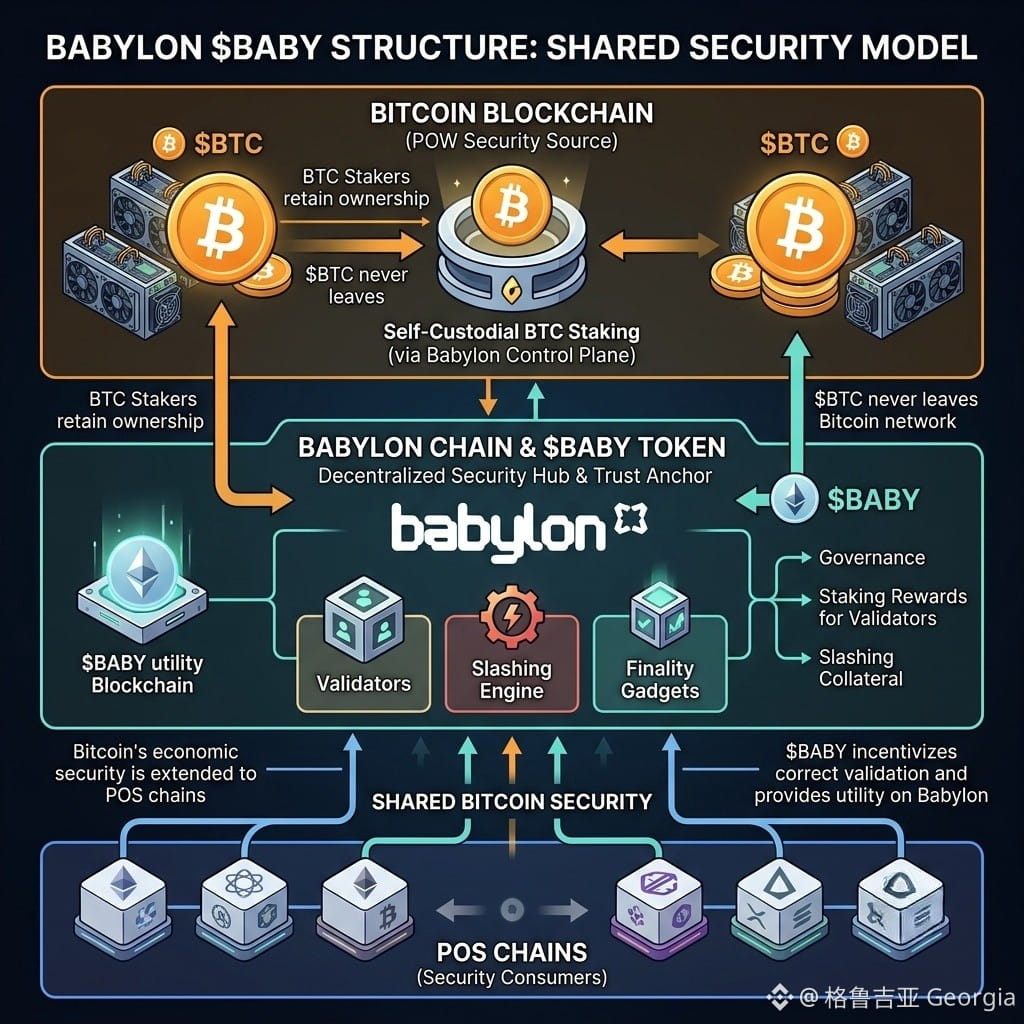
That thought surfaced when I spent time reflecting on Babylon. It wasn't the technical architecture that caught my attention but the idea that Bitcoin's economic security could help strengthen Proof of Stake blockchains through self custodial staking while BTC never leaves the Bitcoin network. There is something deeply consistent about that. It preserves the principle that drew many of us to Bitcoin in the first place: ownership remains entirely in the hands of the individual.
Trust is most powerful when it never demands possession.
For years, I assumed idle Bitcoin was simply dormant capital. Now I see another possibility. Maybe an asset can remain exactly where it belongs while its credibility extends beyond its own ecosystem. Participation doesn't necessarily have to mean transferring control.
That perspective has changed the way I think about capital efficiency. It's less about making every coin more active and more about allowing deeply trusted assets to quietly reinforce the security of other networks. If security can become a shared resource while self custody remains untouched I can't help but wonder how that might reshape the relationships between blockchains in the years ahead.
The longer I follow the evolution of blockchain the more I feel that we've been asking the wrong question. Instead of wondering how to make every network stronger on its own, maybe we should be asking how trust itself can become more useful without becoming more fragile.
That thought surfaced when I spent time reflecting on Babylon. It wasn't the technical architecture that caught my attention but the idea that Bitcoin's economic security could help strengthen Proof of Stake blockchains through self custodial staking while BTC never leaves the Bitcoin network. There is something deeply consistent about that. It preserves the principle that drew many of us to Bitcoin in the first place: ownership remains entirely in the hands of the individual.
Trust is most powerful when it never demands possession.
For years, I assumed idle Bitcoin was simply dormant capital. Now I see another possibility. Maybe an asset can remain exactly where it belongs while its credibility extends beyond its own ecosystem. Participation doesn't necessarily have to mean transferring control.
That perspective has changed the way I think about capital efficiency. It's less about making every coin more active and more about allowing deeply trusted assets to quietly reinforce the security of other networks. If security can become a shared resource while self custody remains untouched I can't help but wonder how that might reshape the relationships between blockchains in the years ahead.
116
·
--
O‘suvchi
Tarjimani ko‘rish
#newt $NEWT #Newt
{future}(NEWTUSDT)
I've started noticing that the older I get in this space the less impressed I am by what systems can promise and the more interested I become in what they're expected to survive.
Markets have a way of exposing the difference.
For years, AI conversations revolved around intelligence. Better models. Better reasoning. Better predictions. Crypto had its own obsession with decentralization and automation. Those stories ran in parallel for a long time, but now they're beginning to overlap in ways that feel. complicated.
An AI generating a strategy doesn't really surprise me anymore. In fact it almost feels inevitable. What still gives me pause is the idea of that same system carrying out decisions without constant human involvement. That's where the real questions begin.
Execution has always been treated like a technical detail when it might actually be the foundation of trust. Permissions verification security, accountability none of those become less important just because the decision maker happens to be software instead of a person.
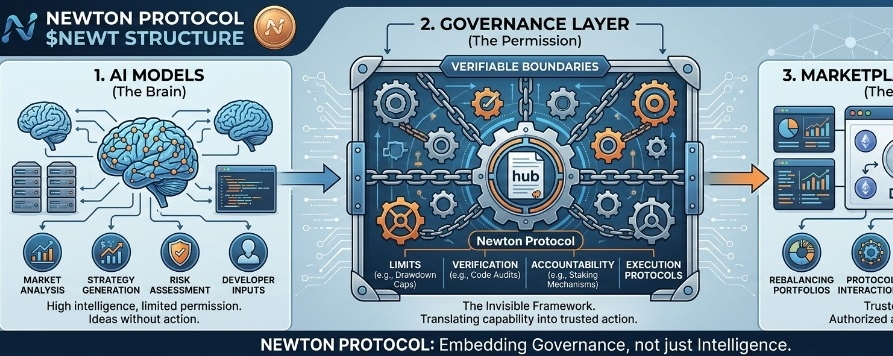
That's probably why Newton Protocol stood out to me. It seems less concerned with making AI appear more intelligent and more focused on the environment where autonomous decisions become real actions. A marketplace for AI strategies is an interesting idea but it also feels like a reminder that intelligence can be copied much faster than trust.
Maybe we've reached the point where smarter agents aren't the difficult part anymore.
Maybe the harder problem is building systems that can keep those agents accountable when conditions stop being predictable. I don't think we've seen enough of that yet and maybe that's the part worth watching most.
#newt $NEWT #Newt
I've started noticing that the older I get in this space the less impressed I am by what systems can promise and the more interested I become in what they're expected to survive.
Markets have a way of exposing the difference.
For years, AI conversations revolved around intelligence. Better models. Better reasoning. Better predictions. Crypto had its own obsession with decentralization and automation. Those stories ran in parallel for a long time, but now they're beginning to overlap in ways that feel. complicated.
An AI generating a strategy doesn't really surprise me anymore. In fact it almost feels inevitable. What still gives me pause is the idea of that same system carrying out decisions without constant human involvement. That's where the real questions begin.
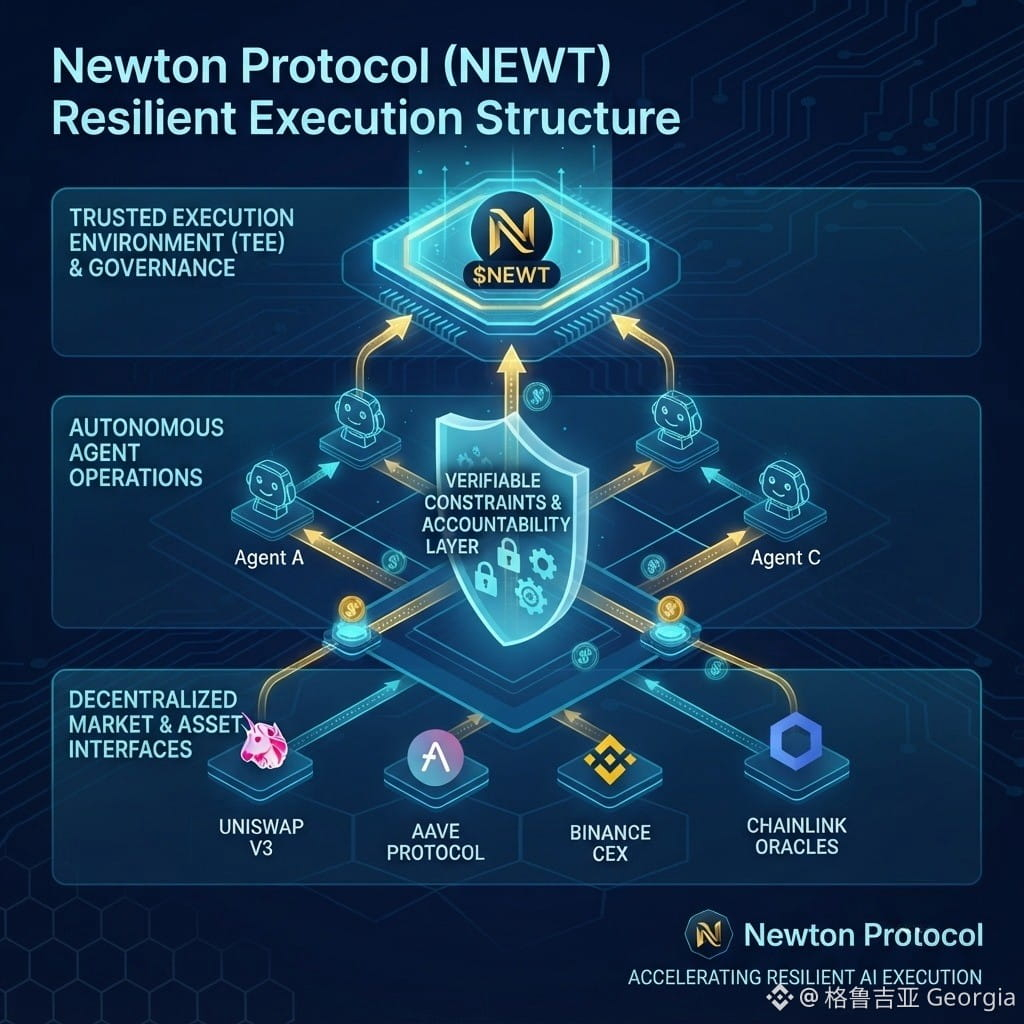
Execution has always been treated like a technical detail when it might actually be the foundation of trust. Permissions verification security, accountability none of those become less important just because the decision maker happens to be software instead of a person.
That's probably why Newton Protocol stood out to me. It seems less concerned with making AI appear more intelligent and more focused on the environment where autonomous decisions become real actions. A marketplace for AI strategies is an interesting idea but it also feels like a reminder that intelligence can be copied much faster than trust.
Maybe we've reached the point where smarter agents aren't the difficult part anymore.
Maybe the harder problem is building systems that can keep those agents accountable when conditions stop being predictable. I don't think we've seen enough of that yet and maybe that's the part worth watching most.
I've started noticing that the older I get in this space the less impressed I am by what systems can promise and the more interested I become in what they're expected to survive.
Markets have a way of exposing the difference.
For years, AI conversations revolved around intelligence. Better models. Better reasoning. Better predictions. Crypto had its own obsession with decentralization and automation. Those stories ran in parallel for a long time, but now they're beginning to overlap in ways that feel. complicated.
An AI generating a strategy doesn't really surprise me anymore. In fact it almost feels inevitable. What still gives me pause is the idea of that same system carrying out decisions without constant human involvement. That's where the real questions begin.
Execution has always been treated like a technical detail when it might actually be the foundation of trust. Permissions verification security, accountability none of those become less important just because the decision maker happens to be software instead of a person.
That's probably why Newton Protocol stood out to me. It seems less concerned with making AI appear more intelligent and more focused on the environment where autonomous decisions become real actions. A marketplace for AI strategies is an interesting idea but it also feels like a reminder that intelligence can be copied much faster than trust.
Maybe we've reached the point where smarter agents aren't the difficult part anymore.
Maybe the harder problem is building systems that can keep those agents accountable when conditions stop being predictable. I don't think we've seen enough of that yet and maybe that's the part worth watching most.
1
1
114
Maqola
Tarjimani ko‘rish
Maybe Intelligence Was Never the Real ThresholdI keep feeling like we're celebrating the wrong milestone.
Not because AI hasn't improved. It clearly has. And not because crypto hasn't built meaningful infrastructure. It has done that too even if it took longer than most people expected.
It's just that after watching both spaces for years I've become careful about confusing capability with readiness.
They're not the same thing.
For a long time the question around AI was simple enough Can it think?
Now that question feels less interesting. Models can analyze markets generate strategies explain their reasoning and often do it faster than any person could. Whether they're always right almost feels secondary.
The question that keeps lingering in my mind is different.
Who gave those ideas permission to become actions?
That feels like a much harder problem.
Once an autonomous agent can move assets, interact with protocols or rebalance a portfolio without someone approving every step we've crossed into a different category of trust. It's no longer about intelligence in isolation. It's about the invisible framework surrounding that intelligence.
Limits.
Verification.
Accountability.
The parts that rarely get attention because they don't make for exciting demos.
That's probably why Newton Protocol has been sitting in the back of my mind. Not because I'm convinced autonomous finance is inevitable but because it seems to acknowledge something that often gets overlooked. Smarter agents alone don't solve much if there's no reliable way to govern how they execute, especially once real value is involved.
The marketplace idea makes that tension even more obvious.
Giving developers a place to deploy and monetize intelligent agents sounds like a logical next step. But marketplaces have always reflected incentives as much as innovation. The best strategy isn't always the most responsible one, and those two things have a habit of drifting apart over time.
Crypto taught me to pay attention to systems instead of promises.
AI is teaching me to pay attention to permissions instead of intelligence.
Maybe the next phase won't be decided by whichever model produces the cleverest strategy.
Maybe it'll depend on whether autonomous systems can be trusted to act within boundaries that remain verifiable even when markets become chaotic and nobody is around to intervene.
I'm still not sure we've answered that question even if we're already moving as though we have.
@NewtonProtocol $NEWT #Newt
{future}(NEWTUSDT)
Maybe Intelligence Was Never the Real Threshold
I keep feeling like we're celebrating the wrong milestone.
Not because AI hasn't improved. It clearly has. And not because crypto hasn't built meaningful infrastructure. It has done that too even if it took longer than most people expected.
It's just that after watching both spaces for years I've become careful about confusing capability with readiness.
They're not the same thing.
For a long time the question around AI was simple enough Can it think?
Now that question feels less interesting. Models can analyze markets generate strategies explain their reasoning and often do it faster than any person could. Whether they're always right almost feels secondary.
The question that keeps lingering in my mind is different.
Who gave those ideas permission to become actions?
That feels like a much harder problem.
Once an autonomous agent can move assets, interact with protocols or rebalance a portfolio without someone approving every step we've crossed into a different category of trust. It's no longer about intelligence in isolation. It's about the invisible framework surrounding that intelligence.
Limits.
Verification.
Accountability.
The parts that rarely get attention because they don't make for exciting demos.
That's probably why Newton Protocol has been sitting in the back of my mind. Not because I'm convinced autonomous finance is inevitable but because it seems to acknowledge something that often gets overlooked. Smarter agents alone don't solve much if there's no reliable way to govern how they execute, especially once real value is involved.
The marketplace idea makes that tension even more obvious.
Giving developers a place to deploy and monetize intelligent agents sounds like a logical next step. But marketplaces have always reflected incentives as much as innovation. The best strategy isn't always the most responsible one, and those two things have a habit of drifting apart over time.
Crypto taught me to pay attention to systems instead of promises.
AI is teaching me to pay attention to permissions instead of intelligence.
Maybe the next phase won't be decided by whichever model produces the cleverest strategy.
Maybe it'll depend on whether autonomous systems can be trusted to act within boundaries that remain verifiable even when markets become chaotic and nobody is around to intervene.
I'm still not sure we've answered that question even if we're already moving as though we have.
@NewtonProtocol $NEWT #Newt
Not because AI hasn't improved. It clearly has. And not because crypto hasn't built meaningful infrastructure. It has done that too even if it took longer than most people expected.
It's just that after watching both spaces for years I've become careful about confusing capability with readiness.
They're not the same thing.
For a long time the question around AI was simple enough Can it think?
Now that question feels less interesting. Models can analyze markets generate strategies explain their reasoning and often do it faster than any person could. Whether they're always right almost feels secondary.
The question that keeps lingering in my mind is different.
Who gave those ideas permission to become actions?
That feels like a much harder problem.
Once an autonomous agent can move assets, interact with protocols or rebalance a portfolio without someone approving every step we've crossed into a different category of trust. It's no longer about intelligence in isolation. It's about the invisible framework surrounding that intelligence.
Limits.
Verification.
Accountability.
The parts that rarely get attention because they don't make for exciting demos.
That's probably why Newton Protocol has been sitting in the back of my mind. Not because I'm convinced autonomous finance is inevitable but because it seems to acknowledge something that often gets overlooked. Smarter agents alone don't solve much if there's no reliable way to govern how they execute, especially once real value is involved.
The marketplace idea makes that tension even more obvious.
Giving developers a place to deploy and monetize intelligent agents sounds like a logical next step. But marketplaces have always reflected incentives as much as innovation. The best strategy isn't always the most responsible one, and those two things have a habit of drifting apart over time.
Crypto taught me to pay attention to systems instead of promises.
AI is teaching me to pay attention to permissions instead of intelligence.
Maybe the next phase won't be decided by whichever model produces the cleverest strategy.
Maybe it'll depend on whether autonomous systems can be trusted to act within boundaries that remain verifiable even when markets become chaotic and nobody is around to intervene.
I'm still not sure we've answered that question even if we're already moving as though we have.
@NewtonProtocol $NEWT #Newt
9
3
117
·
--
O‘suvchi
Tarjimani ko‘rish
#newt $NEWT @NewtonProtocol
{future}(NEWTUSDT)
Newton Protocol ($NEWT) Maybe Execution Was Always the Real Problem
I keep catching myself wondering if we're asking the wrong questions.
For the longest time, AI discussions revolved around capability. Could models reason better? Could they plan predict, adapt? Crypto on the other hand obsessed over settlement transparency and removing the need to trust people. Different conversations, different priorities.
Now they're starting to overlap, and it feels.uncomfortable.
An AI can generate a convincing trading strategy in seconds. That part no longer surprises me. What still gives me pause is everything that happens after the strategy exists. Who decides when it acts? Who verifies that it followed the rules? What happens when markets stop behaving politely?
Those questions seem less glamorous which is probably why they don't get as much attention.
That's partly why Newton Protocol has stayed in the back of my mind. Not because it promises more intelligent agents but because it seems to acknowledge that intelligence without reliable execution doesn't solve much. If autonomous systems are eventually moving assets interacting with protocols and making decisions in real time then the layer that governs those actions might matter more than the model making them.
I've seen enough market cycles to know that infrastructure is easy to ignore when everything is working. It only becomes visible when volatility exposes every shortcut people were willing to accept.
Maybe that's where AI in finance is quietly heading. Less about producing another clever strategy more about proving that every action can be trusted before it ever reaches the chain.
I'm still not convinced we've figured that part out.
And until we do I suspect the smartest agent in the room will always be limited by the system that decides whether it gets to act at all.
#newt $NEWT @NewtonProtocol
Newton Protocol ($NEWT ) Maybe Execution Was Always the Real Problem
I keep catching myself wondering if we're asking the wrong questions.
For the longest time, AI discussions revolved around capability. Could models reason better? Could they plan predict, adapt? Crypto on the other hand obsessed over settlement transparency and removing the need to trust people. Different conversations, different priorities.
Now they're starting to overlap, and it feels.uncomfortable.
An AI can generate a convincing trading strategy in seconds. That part no longer surprises me. What still gives me pause is everything that happens after the strategy exists. Who decides when it acts? Who verifies that it followed the rules? What happens when markets stop behaving politely?
Those questions seem less glamorous which is probably why they don't get as much attention.
That's partly why Newton Protocol has stayed in the back of my mind. Not because it promises more intelligent agents but because it seems to acknowledge that intelligence without reliable execution doesn't solve much. If autonomous systems are eventually moving assets interacting with protocols and making decisions in real time then the layer that governs those actions might matter more than the model making them.
I've seen enough market cycles to know that infrastructure is easy to ignore when everything is working. It only becomes visible when volatility exposes every shortcut people were willing to accept.
Maybe that's where AI in finance is quietly heading. Less about producing another clever strategy more about proving that every action can be trusted before it ever reaches the chain.
I'm still not convinced we've figured that part out.
And until we do I suspect the smartest agent in the room will always be limited by the system that decides whether it gets to act at all.
Newton Protocol ($NEWT ) Maybe Execution Was Always the Real Problem
I keep catching myself wondering if we're asking the wrong questions.
For the longest time, AI discussions revolved around capability. Could models reason better? Could they plan predict, adapt? Crypto on the other hand obsessed over settlement transparency and removing the need to trust people. Different conversations, different priorities.
Now they're starting to overlap, and it feels.uncomfortable.
An AI can generate a convincing trading strategy in seconds. That part no longer surprises me. What still gives me pause is everything that happens after the strategy exists. Who decides when it acts? Who verifies that it followed the rules? What happens when markets stop behaving politely?
Those questions seem less glamorous which is probably why they don't get as much attention.
That's partly why Newton Protocol has stayed in the back of my mind. Not because it promises more intelligent agents but because it seems to acknowledge that intelligence without reliable execution doesn't solve much. If autonomous systems are eventually moving assets interacting with protocols and making decisions in real time then the layer that governs those actions might matter more than the model making them.
I've seen enough market cycles to know that infrastructure is easy to ignore when everything is working. It only becomes visible when volatility exposes every shortcut people were willing to accept.
Maybe that's where AI in finance is quietly heading. Less about producing another clever strategy more about proving that every action can be trusted before it ever reaches the chain.
I'm still not convinced we've figured that part out.
And until we do I suspect the smartest agent in the room will always be limited by the system that decides whether it gets to act at all.
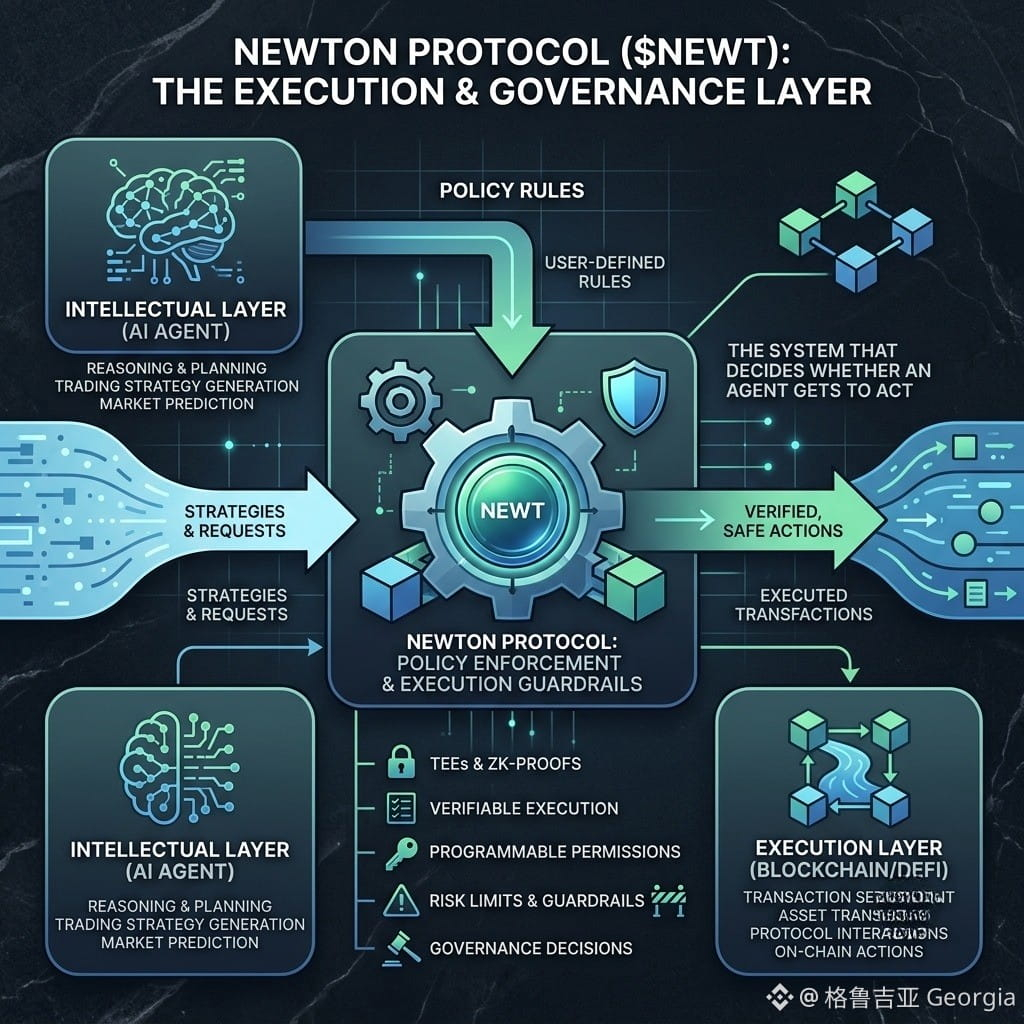
1
83
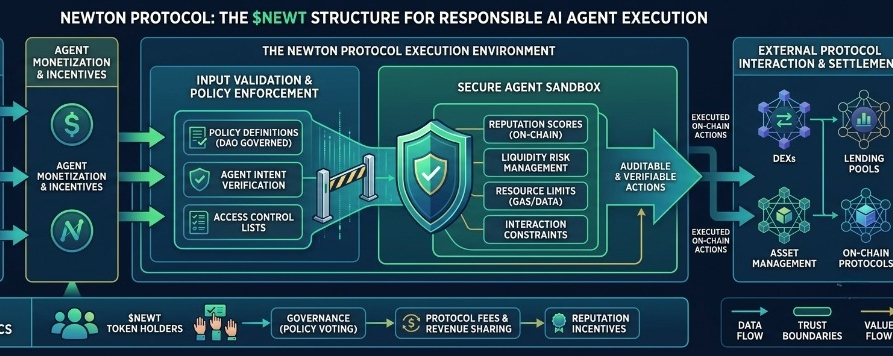
Maqola
Tarjimani ko‘rish
Maybe We're Handing Over Decisions Too EasilyI keep catching myself hesitating whenever people talk about autonomous agents as if the difficult questions have already been answered.
Maybe that's just years of watching technology move faster than the conversations around it.
I've seen crypto spend years trying to reduce the need for trust. I've watched AI spend years trying to make machines better at reasoning. Those were separate journeys for a long time. Now they're starting to overlap and I'm not convinced we've stopped to think about what we're actually combining.
Everyone seems fascinated by what AI can decide.
I'm becoming more interested in what happens after the decision leaves the model.
Delegating judgment is one thing. Delegating execution is something else entirely.
An agent generating an investment idea feels similar to any other piece of software giving suggestions. But the moment it starts interacting with protocols reallocating assets or coordinating multiple on chain actions without constant human approval, it becomes part of a financial system rather than just an observer of one.
That shift feels bigger than people admit.
The strange part is that execution isn't usually what gets attention. It isn't exciting. It's invisible when everything works. But I've been around crypto long enough to know that invisible systems are often the ones carrying the most weight.
They only become visible when markets stop behaving.
That's probably why Newton Protocol stood out to me although I wouldn't say I'm convinced by any of it yet. It seems less focused on convincing people that AI agents should exist and more focused on asking what kind of execution environment those agents need if they're going to participate responsibly at all.
That feels like a healthier question.
The marketplace aspect makes me pause even more. Once developers can deploy and monetize intelligent agents the conversation stops being about algorithms in isolation. It becomes about incentives accountability and whether users can distinguish between something that performs well and something that behaves reliably over time.
Those aren't always the same thing.
Maybe we've spent too long measuring intelligence as the ability to produce better answers.
The harder challenge might be building systems that know how to carry those answers into the real world without asking everyone else to blindly trust what happens in between. And I still don't know if we're closer to solving that than we think.
@NewtonProtocol $NEWT #Newt
{future}(NEWTUSDT)
Maybe We're Handing Over Decisions Too Easily
I keep catching myself hesitating whenever people talk about autonomous agents as if the difficult questions have already been answered.
Maybe that's just years of watching technology move faster than the conversations around it.
I've seen crypto spend years trying to reduce the need for trust. I've watched AI spend years trying to make machines better at reasoning. Those were separate journeys for a long time. Now they're starting to overlap and I'm not convinced we've stopped to think about what we're actually combining.
Everyone seems fascinated by what AI can decide.
I'm becoming more interested in what happens after the decision leaves the model.
Delegating judgment is one thing. Delegating execution is something else entirely.
An agent generating an investment idea feels similar to any other piece of software giving suggestions. But the moment it starts interacting with protocols reallocating assets or coordinating multiple on chain actions without constant human approval, it becomes part of a financial system rather than just an observer of one.
That shift feels bigger than people admit.
The strange part is that execution isn't usually what gets attention. It isn't exciting. It's invisible when everything works. But I've been around crypto long enough to know that invisible systems are often the ones carrying the most weight.
They only become visible when markets stop behaving.
That's probably why Newton Protocol stood out to me although I wouldn't say I'm convinced by any of it yet. It seems less focused on convincing people that AI agents should exist and more focused on asking what kind of execution environment those agents need if they're going to participate responsibly at all.
That feels like a healthier question.
The marketplace aspect makes me pause even more. Once developers can deploy and monetize intelligent agents the conversation stops being about algorithms in isolation. It becomes about incentives accountability and whether users can distinguish between something that performs well and something that behaves reliably over time.
Those aren't always the same thing.
Maybe we've spent too long measuring intelligence as the ability to produce better answers.
The harder challenge might be building systems that know how to carry those answers into the real world without asking everyone else to blindly trust what happens in between. And I still don't know if we're closer to solving that than we think.
@NewtonProtocol $NEWT #Newt
Maybe that's just years of watching technology move faster than the conversations around it.
I've seen crypto spend years trying to reduce the need for trust. I've watched AI spend years trying to make machines better at reasoning. Those were separate journeys for a long time. Now they're starting to overlap and I'm not convinced we've stopped to think about what we're actually combining.
Everyone seems fascinated by what AI can decide.
I'm becoming more interested in what happens after the decision leaves the model.
Delegating judgment is one thing. Delegating execution is something else entirely.
An agent generating an investment idea feels similar to any other piece of software giving suggestions. But the moment it starts interacting with protocols reallocating assets or coordinating multiple on chain actions without constant human approval, it becomes part of a financial system rather than just an observer of one.
That shift feels bigger than people admit.
The strange part is that execution isn't usually what gets attention. It isn't exciting. It's invisible when everything works. But I've been around crypto long enough to know that invisible systems are often the ones carrying the most weight.
They only become visible when markets stop behaving.
That's probably why Newton Protocol stood out to me although I wouldn't say I'm convinced by any of it yet. It seems less focused on convincing people that AI agents should exist and more focused on asking what kind of execution environment those agents need if they're going to participate responsibly at all.
That feels like a healthier question.
The marketplace aspect makes me pause even more. Once developers can deploy and monetize intelligent agents the conversation stops being about algorithms in isolation. It becomes about incentives accountability and whether users can distinguish between something that performs well and something that behaves reliably over time.
Those aren't always the same thing.
Maybe we've spent too long measuring intelligence as the ability to produce better answers.
The harder challenge might be building systems that know how to carry those answers into the real world without asking everyone else to blindly trust what happens in between. And I still don't know if we're closer to solving that than we think.
@NewtonProtocol $NEWT #Newt
19
8
143
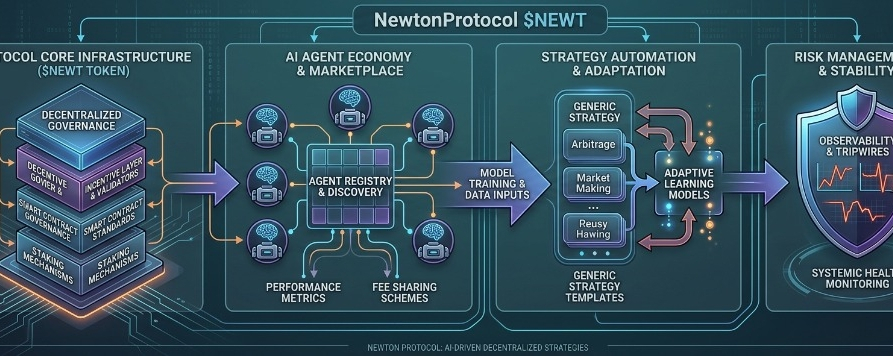
Maqola
Tarjimani ko‘rish
I Can't Decide If AI Makes Crypto More Trustworthy or Just More Difficult to QuestionThe first reaction I had to Newton Protocol wasn't excitement. It was hesitation. Maybe that's unfair but after enough years around crypto hesitation feels more useful than optimism. I've watched too many convincing narratives age badly. Not because they were dishonest but because reality turned out to be less comoperative than the diagrams.
So I found myself reading about it without trying to arrive at a verdict.
What lingered wasn't the idea of AI-driven strategies. That part almost feels inevitable now. Whether we like it or not software is going to make more decisions than people in certain corners of finance. The question that refuses to leave me alone is much quieter.
Who or what do we end up trusting once those decisions become too frequent, too interconnected, and too complex for anyone to meaningfully follow?
That's where my thoughts keep drifting.
Everyone talks about intelligence as though it's the scarce resource. I'm beginning to think dependable infrastructure is the scarcer one. Intelligence can improve. Models can be retrained. But once automated systems begin interacting across decentralized networks, the invisible layers start carrying an enormous amount of responsibility.
Execution isn't just execution anymore.
It's timing. Verification. Recovery when assumptions fail. The ability to keep behaving predictably while everything surrounding it slowly changes.
I've noticed that crypto has a habit of underestimating slow change. We prepare for catastrophic failures because they're easy to imagine. We spend much less time thinking about gradual erosion. Incentives drift. Participants adapt. Developers move on. Governance becomes quieter. None of those events feels important on its own, but together they reshape a protocol until it's operating under conditions nobody originally designed for.
Maybe AI simply accelerates that process.
Or maybe it exposes it.
I keep returning to the idea of a marketplace where developers build and share automated strategies. On one hand, it sounds like a natural direction. Good ideas should probably be easier to discover than they are today. Then another thought interrupts me. Markets don't only reward quality. They reward visibility. They reward confidence. They reward whatever appears successful within the timeframe people are paying attention.
Those aren't always the same thing.
Some strategies survive because they're genuinely robust. Others survive because the difficult conditions haven't arrived yet. That's an uncomfortable distinction, especially when software begins acting with increasing autonomy.
Perhaps that's why Newton Protocol feels less like a product to evaluate and more like a question I haven't answered.
Can decentralized infrastructure remain dependable when the participants using it are no longer just people, but adaptive systems continuously responding to one another?
The edge cases are what interest me most. Not dramatic failures those eventually become obvious but the ordinary moments where tiny compromises accumulate. One optimization here. A shortcut there. Slightly different incentives next year than this year. Before long, the system still functions but for reasons nobody originally expected.
I've seen that happen often enough that I no longer assume technical elegance translates into long term resilience.
So when I think about Newton Protocol, I don't really think about AI or trading first. I think about the quiet machinery underneath everything else. The parts that nobody notices while they're working.
Maybe that's where confidence is actually earned.
Or maybe that's simply where the next set of unanswered questions begins.
@NewtonProtocol $NEWT #Newt
{future}(NEWTUSDT)
I Can't Decide If AI Makes Crypto More Trustworthy or Just More Difficult to Question
The first reaction I had to Newton Protocol wasn't excitement. It was hesitation. Maybe that's unfair but after enough years around crypto hesitation feels more useful than optimism. I've watched too many convincing narratives age badly. Not because they were dishonest but because reality turned out to be less comoperative than the diagrams.
So I found myself reading about it without trying to arrive at a verdict.
What lingered wasn't the idea of AI-driven strategies. That part almost feels inevitable now. Whether we like it or not software is going to make more decisions than people in certain corners of finance. The question that refuses to leave me alone is much quieter.
Who or what do we end up trusting once those decisions become too frequent, too interconnected, and too complex for anyone to meaningfully follow?
That's where my thoughts keep drifting.
Everyone talks about intelligence as though it's the scarce resource. I'm beginning to think dependable infrastructure is the scarcer one. Intelligence can improve. Models can be retrained. But once automated systems begin interacting across decentralized networks, the invisible layers start carrying an enormous amount of responsibility.
Execution isn't just execution anymore.
It's timing. Verification. Recovery when assumptions fail. The ability to keep behaving predictably while everything surrounding it slowly changes.
I've noticed that crypto has a habit of underestimating slow change. We prepare for catastrophic failures because they're easy to imagine. We spend much less time thinking about gradual erosion. Incentives drift. Participants adapt. Developers move on. Governance becomes quieter. None of those events feels important on its own, but together they reshape a protocol until it's operating under conditions nobody originally designed for.
Maybe AI simply accelerates that process.
Or maybe it exposes it.
I keep returning to the idea of a marketplace where developers build and share automated strategies. On one hand, it sounds like a natural direction. Good ideas should probably be easier to discover than they are today. Then another thought interrupts me. Markets don't only reward quality. They reward visibility. They reward confidence. They reward whatever appears successful within the timeframe people are paying attention.
Those aren't always the same thing.
Some strategies survive because they're genuinely robust. Others survive because the difficult conditions haven't arrived yet. That's an uncomfortable distinction, especially when software begins acting with increasing autonomy.
Perhaps that's why Newton Protocol feels less like a product to evaluate and more like a question I haven't answered.
Can decentralized infrastructure remain dependable when the participants using it are no longer just people, but adaptive systems continuously responding to one another?
The edge cases are what interest me most. Not dramatic failures those eventually become obvious but the ordinary moments where tiny compromises accumulate. One optimization here. A shortcut there. Slightly different incentives next year than this year. Before long, the system still functions but for reasons nobody originally expected.
I've seen that happen often enough that I no longer assume technical elegance translates into long term resilience.
So when I think about Newton Protocol, I don't really think about AI or trading first. I think about the quiet machinery underneath everything else. The parts that nobody notices while they're working.
Maybe that's where confidence is actually earned.
Or maybe that's simply where the next set of unanswered questions begins.
@NewtonProtocol $NEWT #Newt
So I found myself reading about it without trying to arrive at a verdict.
What lingered wasn't the idea of AI-driven strategies. That part almost feels inevitable now. Whether we like it or not software is going to make more decisions than people in certain corners of finance. The question that refuses to leave me alone is much quieter.
Who or what do we end up trusting once those decisions become too frequent, too interconnected, and too complex for anyone to meaningfully follow?
That's where my thoughts keep drifting.
Everyone talks about intelligence as though it's the scarce resource. I'm beginning to think dependable infrastructure is the scarcer one. Intelligence can improve. Models can be retrained. But once automated systems begin interacting across decentralized networks, the invisible layers start carrying an enormous amount of responsibility.
Execution isn't just execution anymore.
It's timing. Verification. Recovery when assumptions fail. The ability to keep behaving predictably while everything surrounding it slowly changes.
I've noticed that crypto has a habit of underestimating slow change. We prepare for catastrophic failures because they're easy to imagine. We spend much less time thinking about gradual erosion. Incentives drift. Participants adapt. Developers move on. Governance becomes quieter. None of those events feels important on its own, but together they reshape a protocol until it's operating under conditions nobody originally designed for.
Maybe AI simply accelerates that process.
Or maybe it exposes it.
I keep returning to the idea of a marketplace where developers build and share automated strategies. On one hand, it sounds like a natural direction. Good ideas should probably be easier to discover than they are today. Then another thought interrupts me. Markets don't only reward quality. They reward visibility. They reward confidence. They reward whatever appears successful within the timeframe people are paying attention.
Those aren't always the same thing.
Some strategies survive because they're genuinely robust. Others survive because the difficult conditions haven't arrived yet. That's an uncomfortable distinction, especially when software begins acting with increasing autonomy.
Perhaps that's why Newton Protocol feels less like a product to evaluate and more like a question I haven't answered.
Can decentralized infrastructure remain dependable when the participants using it are no longer just people, but adaptive systems continuously responding to one another?
The edge cases are what interest me most. Not dramatic failures those eventually become obvious but the ordinary moments where tiny compromises accumulate. One optimization here. A shortcut there. Slightly different incentives next year than this year. Before long, the system still functions but for reasons nobody originally expected.
I've seen that happen often enough that I no longer assume technical elegance translates into long term resilience.
So when I think about Newton Protocol, I don't really think about AI or trading first. I think about the quiet machinery underneath everything else. The parts that nobody notices while they're working.
Maybe that's where confidence is actually earned.
Or maybe that's simply where the next set of unanswered questions begins.
@NewtonProtocol $NEWT #Newt
7
3
110
Ko‘proq kontentni ko‘rish uchun tizimga kiring
Binance Square'da global kriptovalyuta foydalanuvchilariga qo‘shiling
⚡️ Kriptovalyuta haqida eng so‘nggi va foydali ma’lumotlarni oling.
💬 Dunyoning eng yirik kriptovalyuta birjasi tomonidan ishonchli deb topilgan.
👍 Tasdiqlangan mualliflardan haqiqiy tahlillarni kashf eting.
Email / telefon raqami
Trenddagi mavzular
BNBSurpasses$790
8,905 marta koʻrilgan
73 muhokama qilmoqda
$BNB strategik uzun reja -> HOZIR DIQQAT
BNB ichki likvidlikni yutib yuborgandan keyin 2 ta kuchli pastlikni yaratdi
Men $815-$830 atrofidagi swing high tomon harakatni kutyapman va yashil qutiga retest qilingandan keyin long qidiryapman
#BNBSurpasses$790 #bnb
Ghost Writer
·4 ta layk
·4.1k marta koʻrilgan
ZamaRises15.99%ToIntradayHigh$0.09
2,901 marta koʻrilgan
64 muhokama qilmoqda
BitcoinSpotETFsDraw$6.34BInflowsInQ3
3,227 marta koʻrilgan
53 muhokama qilmoqda