
#swap_crypto
swap_crypto
3.9M views
1,018 Discussing
Hot
Latest

·
--
Article
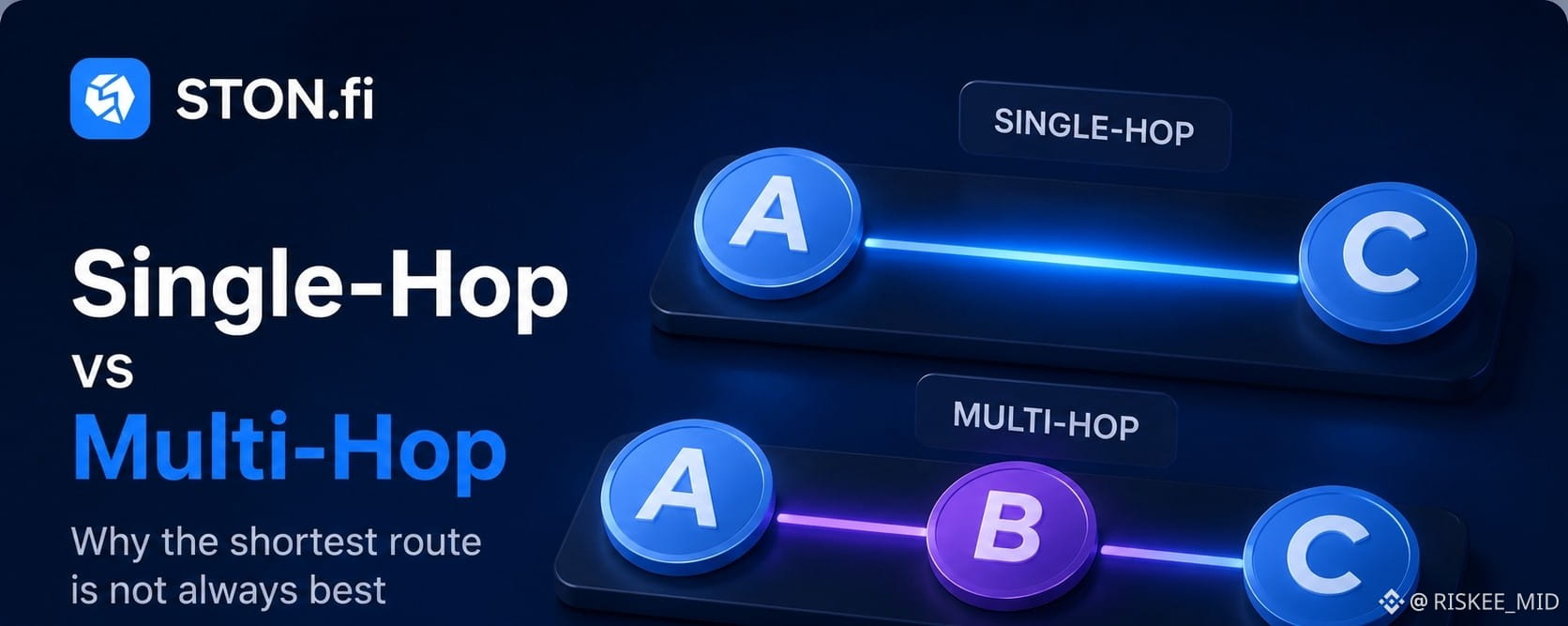
Single-Hop vs Multi-Hop Swaps on STON.fi: Why the Shortest Route Is Not Always BestSingle Hop vs Multi Hop Swaps on STON.fi: Why the Shortest Route Is Not Always Best
In decentralized trading, it is easy to assume that the shortest route must also be the most efficient. A direct swap from Token A to Token C appears simpler than moving through Token B first. Fewer conversions sound like fewer fees, less complexity and better execution.
But in DeFi, simplicity does not automatically mean efficiency.
On STON.fi, a single-hop route can sometimes be the best option, while a multi-hop route can produce a better final result when liquidity is distributed unevenly across pools. The most important question is therefore not “How many hops does this swap use?” but “How much destination token will I actually receive after all relevant costs?”
Understanding this difference helps users evaluate routes more intelligently and avoid choosing a path simply because it looks shorter.
What Is a Hop?
A hop represents one asset-to-asset conversion within a swap route.
A single-hop swap moves directly from Token A to Token C:
Token A → Token C
A multi-hop swap reaches the same destination through one or more intermediate assets:
Token A → Token B → Token C
A route can contain even more conversions when that produces a stronger executable price.
Importantly, hop count refers to the number of asset conversions. It does not mean the number of wallet approvals or separate user interactions. A user may sign a single transaction through a connected wallet interface while the protocol executes a multi-step route on-chain.
This distinction matters because a route that looks complicated from a trading perspective can still be presented as one integrated swap experience.
Why the Direct Route Can Be Worse
The main reason a multi-hop route can outperform a single-hop route is liquidity.
Imagine a direct A/C pool with limited liquidity. A relatively large trade against that pool may move the price significantly, creating substantial price impact. Even though the route contains only one hop, the user could receive fewer destination tokens than expected.
Now imagine that A/B and B/C pools are much deeper.
The route:
A → B → C
may require an additional conversion, but the stronger liquidity available at each stage can reduce the amount of price movement caused by the trade. After accounting for the fees and execution costs of both pools, the multi-hop path may still produce a larger final amount of Token C.
That is the central principle:
Fewer hops do not automatically mean lower total cost.
The economic quality of a route depends on its complete execution, not simply its length.
The Role of Liquidity and Price Impact
Liquidity determines how efficiently a pool can absorb a trade.
When liquidity is deep relative to the size of a swap, trades can generally execute with less price movement. When liquidity is thin, even a moderate transaction can have a noticeable impact on the effective exchange rate.
This creates an important trade-off.
A direct route may have:
One hopOne poolFewer individual swap fees
But it could also have:
Lower liquidityGreater price impactWorse execution for larger orders
A multi-hop route may introduce another pool fee, yet compensate through stronger liquidity and better pricing at each stage.
Therefore, the relevant comparison is not simply the fee charged by each pool. Users should consider the final output after the route has been executed.
Why Fees Alone Are Not Enough
It is tempting to reject a multi-hop route because it contains more conversions and potentially more pool fees. That approach can be misleading.
Suppose a direct swap saves a small amount in fees but suffers significant price impact. A multi-hop route might incur additional fees while still delivering a greater amount of the destination asset.
For example, a direct route could theoretically charge fewer fees but produce 98.5 units of the destination asset, while a two-hop route could cost slightly more in fees but deliver 99.2 units.
From the user's perspective, the second route is economically better.
The goal of routing is not to minimize one isolated cost. It is to maximize the quality of the complete trade execution.
That includes liquidity, fees, price impact and other execution costs.
How STON.fi Handles Route Selection
STON.fi supports more than simply finding a direct pool between two assets.
Its DEX v2 architecture supports chained swaps, allowing routes to move through intermediate assets and work across different v2 Routers where applicable.
This is where Omniston becomes important.
Omniston is enabled by default in the STON.fi dApp and evaluates available liquidity sources to identify executable opportunities. Instead of forcing users to manually determine whether A/C, A/B/C or another route is better, the routing system can compare available paths and select a stronger result.
The key idea is that routing is an optimization problem.
The system is not necessarily looking for the route with the fewest hops. It is looking for a route that can provide the strongest executable outcome under the available market conditions.
Hop Count and Liquidity Sources Are Different
Another important point is that hop count and liquidity-source count are not the same thing.
A route can contain multiple hops while drawing liquidity from different pools or liquidity sources. Conversely, a route with fewer hops may still rely on a pool with poor liquidity for the particular trade size.
This distinction prevents a common misunderstanding: a short route is not automatically a simple or efficient route, and a longer route is not automatically inefficient.
The real question is how effectively the available liquidity is being used to execute the intended trade.
DEX v2 and Chained Swaps
STON.fi DEX v2 supports chained swaps on the same Router as well as routing across different v2 Routers.
That flexibility is significant because liquidity is rarely distributed perfectly across every possible token pair.
For some assets, a direct market may be deep and competitive. For others, liquidity may be concentrated around a common intermediary asset.
A routing system can take advantage of that structure.
Instead of assuming every pair should trade directly, it can consider whether an intermediate asset creates a better path to the final destination.
This is one of the fundamental advantages of intelligent decentralized exchange routing.
What Users Should Actually Check
When evaluating a STON.fi swap, users should pay attention to the final quote, not just the visual simplicity of the route.
Several details are especially important.
Expected Output
The quoted output tells you how much of the destination asset the route is expected to produce.
This is one of the most useful numbers for comparing alternatives.
Minimum Received
The minimum received amount is important because market conditions can change between the quote and execution. It provides a clearer picture of the protection applied to the trade under the chosen slippage settings.
Price Impact
Price impact helps indicate how strongly the trade itself affects the pool price.
A high price impact may signal that the available liquidity is relatively thin for the size of your transaction.
Route Structure
Check whether the swap is direct or uses one or more intermediate assets.
The presence of multiple hops is not automatically a warning sign. What matters is whether the route produces a stronger final result.
Network Execution Costs
Users should also maintain enough native network currency to cover transaction execution requirements.
A highly attractive quote is not useful if the transaction cannot be successfully executed because there is insufficient balance for network costs.
Why Trade Size Matters
Route quality is not fixed.
The same token pair can produce different optimal routes for different trade sizes.
A small swap may fit comfortably inside a direct pool with minimal price impact. A much larger transaction could move that same pool price significantly and make a multi-hop route more attractive.
This means there is no universal rule saying that Token A should always be swapped through Token B.
The optimal route depends on current liquidity conditions, available pools, fees, execution requirements and the size of the order.
A Practical Example
Consider a user swapping Token A for Token C.
The direct route is:
A → C
The alternative route is:
A → B → C
At first glance, the direct route appears superior because it contains only one hop.
However, suppose the A/C pool is relatively shallow. The user's transaction creates meaningful price impact, reducing the amount of Token C received.
Meanwhile, the A/B pool and B/C pool are both deeper. The additional conversion introduces another fee, but the stronger liquidity allows the transaction to execute more efficiently.
The result could be:
Direct route: fewer hops, but lower final output.
Multi-hop route: more hops, but higher final output.
In this situation, choosing the direct route solely because it is shorter would be an economic mistake.
The Broader Lesson About DeFi Routing
This concept extends beyond STON.fi.
Decentralized markets are fragmented. Liquidity can exist across many pools, assets and routing structures. A trader therefore needs more than a simple direct-pair model.
Intelligent routing exists because the best market path is not always obvious from the number of conversions involved.
The purpose of a routing engine is to search through available liquidity and determine how a trade can be executed most effectively.
For users, this means that route length should be treated as information, not as a quality score.
A two-hop or three-hop route is not necessarily worse than a one-hop route. The correct evaluation is based on what the complete route delivers.
Final Takeaway
Single-hop swaps are direct, easy to understand and can be highly efficient when the relevant pool has sufficient liquidity.
Multi-hop swaps introduce additional conversions, but those conversions can unlock deeper liquidity and reduce price impact enough to produce a better overall execution.
On STON.fi, the strongest route is therefore not necessarily the shortest route. With DEX v2's support for chained swaps and Omniston evaluating available liquidity opportunities, route selection can focus on the economic outcome rather than hop count alone.
Before confirming a trade, focus on the numbers that matter most:
Expected output. Minimum received. Price impact. Route structure. Network execution costs.
The practical rule is simple:
Do not ask which route has the fewest hops. Ask which route leaves you with the most destination tokens after all relevant costs.
In decentralized trading, the shortest path may look better on the screen. The best path is the one that executes better for the trade you are actually making.
EXPLORE MORE ON STON.FI HERE
#swap_crypto
Single-Hop vs Multi-Hop Swaps on STON.fi: Why the Shortest Route Is Not Always Best
Single Hop vs Multi Hop Swaps on STON.fi: Why the Shortest Route Is Not Always Best
In decentralized trading, it is easy to assume that the shortest route must also be the most efficient. A direct swap from Token A to Token C appears simpler than moving through Token B first. Fewer conversions sound like fewer fees, less complexity and better execution.
But in DeFi, simplicity does not automatically mean efficiency.
On STON.fi, a single-hop route can sometimes be the best option, while a multi-hop route can produce a better final result when liquidity is distributed unevenly across pools. The most important question is therefore not “How many hops does this swap use?” but “How much destination token will I actually receive after all relevant costs?”
Understanding this difference helps users evaluate routes more intelligently and avoid choosing a path simply because it looks shorter.
What Is a Hop?
A hop represents one asset-to-asset conversion within a swap route.
A single-hop swap moves directly from Token A to Token C:
Token A → Token C
A multi-hop swap reaches the same destination through one or more intermediate assets:
Token A → Token B → Token C
A route can contain even more conversions when that produces a stronger executable price.
Importantly, hop count refers to the number of asset conversions. It does not mean the number of wallet approvals or separate user interactions. A user may sign a single transaction through a connected wallet interface while the protocol executes a multi-step route on-chain.
This distinction matters because a route that looks complicated from a trading perspective can still be presented as one integrated swap experience.
Why the Direct Route Can Be Worse
The main reason a multi-hop route can outperform a single-hop route is liquidity.
Imagine a direct A/C pool with limited liquidity. A relatively large trade against that pool may move the price significantly, creating substantial price impact. Even though the route contains only one hop, the user could receive fewer destination tokens than expected.
Now imagine that A/B and B/C pools are much deeper.
The route:
A → B → C
may require an additional conversion, but the stronger liquidity available at each stage can reduce the amount of price movement caused by the trade. After accounting for the fees and execution costs of both pools, the multi-hop path may still produce a larger final amount of Token C.
That is the central principle:
Fewer hops do not automatically mean lower total cost.
The economic quality of a route depends on its complete execution, not simply its length.
The Role of Liquidity and Price Impact
Liquidity determines how efficiently a pool can absorb a trade.
When liquidity is deep relative to the size of a swap, trades can generally execute with less price movement. When liquidity is thin, even a moderate transaction can have a noticeable impact on the effective exchange rate.
This creates an important trade-off.
A direct route may have:
One hopOne poolFewer individual swap fees
But it could also have:
Lower liquidityGreater price impactWorse execution for larger orders
A multi-hop route may introduce another pool fee, yet compensate through stronger liquidity and better pricing at each stage.
Therefore, the relevant comparison is not simply the fee charged by each pool. Users should consider the final output after the route has been executed.
Why Fees Alone Are Not Enough
It is tempting to reject a multi-hop route because it contains more conversions and potentially more pool fees. That approach can be misleading.
Suppose a direct swap saves a small amount in fees but suffers significant price impact. A multi-hop route might incur additional fees while still delivering a greater amount of the destination asset.
For example, a direct route could theoretically charge fewer fees but produce 98.5 units of the destination asset, while a two-hop route could cost slightly more in fees but deliver 99.2 units.
From the user's perspective, the second route is economically better.
The goal of routing is not to minimize one isolated cost. It is to maximize the quality of the complete trade execution.
That includes liquidity, fees, price impact and other execution costs.
How STON.fi Handles Route Selection
STON.fi supports more than simply finding a direct pool between two assets.
Its DEX v2 architecture supports chained swaps, allowing routes to move through intermediate assets and work across different v2 Routers where applicable.
This is where Omniston becomes important.
Omniston is enabled by default in the STON.fi dApp and evaluates available liquidity sources to identify executable opportunities. Instead of forcing users to manually determine whether A/C, A/B/C or another route is better, the routing system can compare available paths and select a stronger result.
The key idea is that routing is an optimization problem.
The system is not necessarily looking for the route with the fewest hops. It is looking for a route that can provide the strongest executable outcome under the available market conditions.
Hop Count and Liquidity Sources Are Different
Another important point is that hop count and liquidity-source count are not the same thing.
A route can contain multiple hops while drawing liquidity from different pools or liquidity sources. Conversely, a route with fewer hops may still rely on a pool with poor liquidity for the particular trade size.
This distinction prevents a common misunderstanding: a short route is not automatically a simple or efficient route, and a longer route is not automatically inefficient.
The real question is how effectively the available liquidity is being used to execute the intended trade.
DEX v2 and Chained Swaps
STON.fi DEX v2 supports chained swaps on the same Router as well as routing across different v2 Routers.
That flexibility is significant because liquidity is rarely distributed perfectly across every possible token pair.
For some assets, a direct market may be deep and competitive. For others, liquidity may be concentrated around a common intermediary asset.
A routing system can take advantage of that structure.
Instead of assuming every pair should trade directly, it can consider whether an intermediate asset creates a better path to the final destination.
This is one of the fundamental advantages of intelligent decentralized exchange routing.
What Users Should Actually Check
When evaluating a STON.fi swap, users should pay attention to the final quote, not just the visual simplicity of the route.
Several details are especially important.
Expected Output
The quoted output tells you how much of the destination asset the route is expected to produce.
This is one of the most useful numbers for comparing alternatives.
Minimum Received
The minimum received amount is important because market conditions can change between the quote and execution. It provides a clearer picture of the protection applied to the trade under the chosen slippage settings.
Price Impact
Price impact helps indicate how strongly the trade itself affects the pool price.
A high price impact may signal that the available liquidity is relatively thin for the size of your transaction.
Route Structure
Check whether the swap is direct or uses one or more intermediate assets.
The presence of multiple hops is not automatically a warning sign. What matters is whether the route produces a stronger final result.
Network Execution Costs
Users should also maintain enough native network currency to cover transaction execution requirements.
A highly attractive quote is not useful if the transaction cannot be successfully executed because there is insufficient balance for network costs.
Why Trade Size Matters
Route quality is not fixed.
The same token pair can produce different optimal routes for different trade sizes.
A small swap may fit comfortably inside a direct pool with minimal price impact. A much larger transaction could move that same pool price significantly and make a multi-hop route more attractive.
This means there is no universal rule saying that Token A should always be swapped through Token B.
The optimal route depends on current liquidity conditions, available pools, fees, execution requirements and the size of the order.
A Practical Example
Consider a user swapping Token A for Token C.
The direct route is:
A → C
The alternative route is:
A → B → C
At first glance, the direct route appears superior because it contains only one hop.
However, suppose the A/C pool is relatively shallow. The user's transaction creates meaningful price impact, reducing the amount of Token C received.
Meanwhile, the A/B pool and B/C pool are both deeper. The additional conversion introduces another fee, but the stronger liquidity allows the transaction to execute more efficiently.
The result could be:
Direct route: fewer hops, but lower final output.
Multi-hop route: more hops, but higher final output.
In this situation, choosing the direct route solely because it is shorter would be an economic mistake.
The Broader Lesson About DeFi Routing
This concept extends beyond STON.fi.
Decentralized markets are fragmented. Liquidity can exist across many pools, assets and routing structures. A trader therefore needs more than a simple direct-pair model.
Intelligent routing exists because the best market path is not always obvious from the number of conversions involved.
The purpose of a routing engine is to search through available liquidity and determine how a trade can be executed most effectively.
For users, this means that route length should be treated as information, not as a quality score.
A two-hop or three-hop route is not necessarily worse than a one-hop route. The correct evaluation is based on what the complete route delivers.
Final Takeaway
Single-hop swaps are direct, easy to understand and can be highly efficient when the relevant pool has sufficient liquidity.
Multi-hop swaps introduce additional conversions, but those conversions can unlock deeper liquidity and reduce price impact enough to produce a better overall execution.
On STON.fi, the strongest route is therefore not necessarily the shortest route. With DEX v2's support for chained swaps and Omniston evaluating available liquidity opportunities, route selection can focus on the economic outcome rather than hop count alone.
Before confirming a trade, focus on the numbers that matter most:
Expected output. Minimum received. Price impact. Route structure. Network execution costs.
The practical rule is simple:
Do not ask which route has the fewest hops. Ask which route leaves you with the most destination tokens after all relevant costs.
In decentralized trading, the shortest path may look better on the screen. The best path is the one that executes better for the trade you are actually making.
EXPLORE MORE ON STON.FI HERE
#swap_crypto
In decentralized trading, it is easy to assume that the shortest route must also be the most efficient. A direct swap from Token A to Token C appears simpler than moving through Token B first. Fewer conversions sound like fewer fees, less complexity and better execution.
But in DeFi, simplicity does not automatically mean efficiency.
On STON.fi, a single-hop route can sometimes be the best option, while a multi-hop route can produce a better final result when liquidity is distributed unevenly across pools. The most important question is therefore not “How many hops does this swap use?” but “How much destination token will I actually receive after all relevant costs?”
Understanding this difference helps users evaluate routes more intelligently and avoid choosing a path simply because it looks shorter.
What Is a Hop?
A hop represents one asset-to-asset conversion within a swap route.
A single-hop swap moves directly from Token A to Token C:
Token A → Token C
A multi-hop swap reaches the same destination through one or more intermediate assets:
Token A → Token B → Token C
A route can contain even more conversions when that produces a stronger executable price.
Importantly, hop count refers to the number of asset conversions. It does not mean the number of wallet approvals or separate user interactions. A user may sign a single transaction through a connected wallet interface while the protocol executes a multi-step route on-chain.
This distinction matters because a route that looks complicated from a trading perspective can still be presented as one integrated swap experience.
Why the Direct Route Can Be Worse
The main reason a multi-hop route can outperform a single-hop route is liquidity.
Imagine a direct A/C pool with limited liquidity. A relatively large trade against that pool may move the price significantly, creating substantial price impact. Even though the route contains only one hop, the user could receive fewer destination tokens than expected.
Now imagine that A/B and B/C pools are much deeper.
The route:
A → B → C
may require an additional conversion, but the stronger liquidity available at each stage can reduce the amount of price movement caused by the trade. After accounting for the fees and execution costs of both pools, the multi-hop path may still produce a larger final amount of Token C.
That is the central principle:
Fewer hops do not automatically mean lower total cost.
The economic quality of a route depends on its complete execution, not simply its length.
The Role of Liquidity and Price Impact
Liquidity determines how efficiently a pool can absorb a trade.
When liquidity is deep relative to the size of a swap, trades can generally execute with less price movement. When liquidity is thin, even a moderate transaction can have a noticeable impact on the effective exchange rate.
This creates an important trade-off.
A direct route may have:
One hopOne poolFewer individual swap fees
But it could also have:
Lower liquidityGreater price impactWorse execution for larger orders
A multi-hop route may introduce another pool fee, yet compensate through stronger liquidity and better pricing at each stage.
Therefore, the relevant comparison is not simply the fee charged by each pool. Users should consider the final output after the route has been executed.
Why Fees Alone Are Not Enough
It is tempting to reject a multi-hop route because it contains more conversions and potentially more pool fees. That approach can be misleading.
Suppose a direct swap saves a small amount in fees but suffers significant price impact. A multi-hop route might incur additional fees while still delivering a greater amount of the destination asset.
For example, a direct route could theoretically charge fewer fees but produce 98.5 units of the destination asset, while a two-hop route could cost slightly more in fees but deliver 99.2 units.
From the user's perspective, the second route is economically better.
The goal of routing is not to minimize one isolated cost. It is to maximize the quality of the complete trade execution.
That includes liquidity, fees, price impact and other execution costs.
How STON.fi Handles Route Selection
STON.fi supports more than simply finding a direct pool between two assets.
Its DEX v2 architecture supports chained swaps, allowing routes to move through intermediate assets and work across different v2 Routers where applicable.
This is where Omniston becomes important.
Omniston is enabled by default in the STON.fi dApp and evaluates available liquidity sources to identify executable opportunities. Instead of forcing users to manually determine whether A/C, A/B/C or another route is better, the routing system can compare available paths and select a stronger result.
The key idea is that routing is an optimization problem.
The system is not necessarily looking for the route with the fewest hops. It is looking for a route that can provide the strongest executable outcome under the available market conditions.
Hop Count and Liquidity Sources Are Different
Another important point is that hop count and liquidity-source count are not the same thing.
A route can contain multiple hops while drawing liquidity from different pools or liquidity sources. Conversely, a route with fewer hops may still rely on a pool with poor liquidity for the particular trade size.
This distinction prevents a common misunderstanding: a short route is not automatically a simple or efficient route, and a longer route is not automatically inefficient.
The real question is how effectively the available liquidity is being used to execute the intended trade.
DEX v2 and Chained Swaps
STON.fi DEX v2 supports chained swaps on the same Router as well as routing across different v2 Routers.
That flexibility is significant because liquidity is rarely distributed perfectly across every possible token pair.
For some assets, a direct market may be deep and competitive. For others, liquidity may be concentrated around a common intermediary asset.
A routing system can take advantage of that structure.
Instead of assuming every pair should trade directly, it can consider whether an intermediate asset creates a better path to the final destination.
This is one of the fundamental advantages of intelligent decentralized exchange routing.
What Users Should Actually Check
When evaluating a STON.fi swap, users should pay attention to the final quote, not just the visual simplicity of the route.
Several details are especially important.
Expected Output
The quoted output tells you how much of the destination asset the route is expected to produce.
This is one of the most useful numbers for comparing alternatives.
Minimum Received
The minimum received amount is important because market conditions can change between the quote and execution. It provides a clearer picture of the protection applied to the trade under the chosen slippage settings.
Price Impact
Price impact helps indicate how strongly the trade itself affects the pool price.
A high price impact may signal that the available liquidity is relatively thin for the size of your transaction.
Route Structure
Check whether the swap is direct or uses one or more intermediate assets.
The presence of multiple hops is not automatically a warning sign. What matters is whether the route produces a stronger final result.
Network Execution Costs
Users should also maintain enough native network currency to cover transaction execution requirements.
A highly attractive quote is not useful if the transaction cannot be successfully executed because there is insufficient balance for network costs.
Why Trade Size Matters
Route quality is not fixed.
The same token pair can produce different optimal routes for different trade sizes.
A small swap may fit comfortably inside a direct pool with minimal price impact. A much larger transaction could move that same pool price significantly and make a multi-hop route more attractive.
This means there is no universal rule saying that Token A should always be swapped through Token B.
The optimal route depends on current liquidity conditions, available pools, fees, execution requirements and the size of the order.
A Practical Example
Consider a user swapping Token A for Token C.
The direct route is:
A → C
The alternative route is:
A → B → C
At first glance, the direct route appears superior because it contains only one hop.
However, suppose the A/C pool is relatively shallow. The user's transaction creates meaningful price impact, reducing the amount of Token C received.
Meanwhile, the A/B pool and B/C pool are both deeper. The additional conversion introduces another fee, but the stronger liquidity allows the transaction to execute more efficiently.
The result could be:
Direct route: fewer hops, but lower final output.
Multi-hop route: more hops, but higher final output.
In this situation, choosing the direct route solely because it is shorter would be an economic mistake.
The Broader Lesson About DeFi Routing
This concept extends beyond STON.fi.
Decentralized markets are fragmented. Liquidity can exist across many pools, assets and routing structures. A trader therefore needs more than a simple direct-pair model.
Intelligent routing exists because the best market path is not always obvious from the number of conversions involved.
The purpose of a routing engine is to search through available liquidity and determine how a trade can be executed most effectively.
For users, this means that route length should be treated as information, not as a quality score.
A two-hop or three-hop route is not necessarily worse than a one-hop route. The correct evaluation is based on what the complete route delivers.
Final Takeaway
Single-hop swaps are direct, easy to understand and can be highly efficient when the relevant pool has sufficient liquidity.
Multi-hop swaps introduce additional conversions, but those conversions can unlock deeper liquidity and reduce price impact enough to produce a better overall execution.
On STON.fi, the strongest route is therefore not necessarily the shortest route. With DEX v2's support for chained swaps and Omniston evaluating available liquidity opportunities, route selection can focus on the economic outcome rather than hop count alone.
Before confirming a trade, focus on the numbers that matter most:
Expected output. Minimum received. Price impact. Route structure. Network execution costs.
The practical rule is simple:
Do not ask which route has the fewest hops. Ask which route leaves you with the most destination tokens after all relevant costs.
In decentralized trading, the shortest path may look better on the screen. The best path is the one that executes better for the trade you are actually making.
EXPLORE MORE ON STON.FI HERE
#swap_crypto
1
80

·
--
I’ve had the same issue before. If you just need to swap one coin for another, an instant swap service can be much easier than moving funds through multiple exchanges. StealthEX is worth checking for this, especially if you want a simple crypto-to-crypto swap. Just compare the rate and fees before confirming.
#swap_crypto
I’ve had the same issue before. If you just need to swap one coin for another, an instant swap service can be much easier than moving funds through multiple exchanges. StealthEX is worth checking for this, especially if you want a simple crypto-to-crypto swap. Just compare the rate and fees before confirming.
#swap_crypto
#swap_crypto
95

·
--
Article
Here’s Exactly What You’re Actually Paying on STON.fiI thought my cross-chain swap cost almost nothing.
Then I added everything up.
The result?
I paid nearly 3× more than the tiny fee I noticed on the screen.
Not because STON.fi was expensive...
But because I only looked at "one piece"of the total cost.
That mistake completely changed how I approach cross-chain swaps.
If you're moving assets between chains, here's something many beginners don't realize.
Cross-Chain Fees Don't Come as One Bill
Unlike a normal swap, cross-chain transactions are made up of several small costs.
Each one looks harmless.
Together?
They tell a very different story.
That's why the cheapest-looking route isn't always the cheapest one.
1️⃣ Origin Chain Gas
The first fee is paid on the blockchain you're leaving.
Whether that's Ethereum, BNB Chain, Base, or Polygon...
Someone has to process your transaction.
This cost changes depending on network activity.
Ethereum can become expensive during busy periods.
Chains like Base, Polygon, and BNB are usually much cheaper.
2️⃣ Route or Provider Fee
Once your transaction starts moving across chains, a routing service handles the process.
That service earns a small fee for coordinating everything behind the scenes.
It usually looks tiny.
But it's still part of the final cost.
3️⃣ Destination Chain Gas
Many people forget this one.
When your assets arrive on the destination chain, another transaction may be needed to complete the process.
That means...
Another gas fee.
Usually small.
Still real.
4️⃣ Swap Fee
If you're not receiving the exact same asset...
A DEX swap happens somewhere along the route.
For example:
USDT ➜ TON
or
USDT ➜ Jetton
That conversion comes with its own trading fee.
5️⃣ Slippage (The Silent Cost)
This is the one that caught me.
The price moved slightly while my transaction was processing.
Nothing dramatic.
Just enough that I received less than I expected.
Individually it didn't seem like much.
Combined with everything else...
It became the biggest hidden expense.
My New Habit Before Every Cross-Chain Swap
I now check five things before clicking Confirm:
✅ Source-chain gas
✅ Provider fee
✅ Destination gas
✅ Swap fee
✅ Expected slippage
It takes less than a minute.
But it gives me a much more realistic picture of what I'm actually paying.
The Lesson I Learned
Cross-chain swaps aren't expensive because of one large fee.
They're expensive when several small fees quietly stack together.
Understanding where every dollar goes has helped me choose better routes, avoid surprises, and make smarter decisions.
Sometimes saving money isn't about finding a cheaper platform.
It's simply about understanding the full cost before you hit "Swap."
Have you ever completed a cross-chain transaction...
Only to realize later it cost more than you expected?
👇 I'd love to hear which hidden fee surprised you the most.
#swap_crypto #STONfi
Here’s Exactly What You’re Actually Paying on STON.fi
I thought my cross-chain swap cost almost nothing.
Then I added everything up.
The result?
I paid nearly 3× more than the tiny fee I noticed on the screen.
Not because STON.fi was expensive...
But because I only looked at "one piece"of the total cost.
That mistake completely changed how I approach cross-chain swaps.
If you're moving assets between chains, here's something many beginners don't realize.
Cross-Chain Fees Don't Come as One Bill
Unlike a normal swap, cross-chain transactions are made up of several small costs.
Each one looks harmless.
Together?
They tell a very different story.
That's why the cheapest-looking route isn't always the cheapest one.
1️⃣ Origin Chain Gas
The first fee is paid on the blockchain you're leaving.
Whether that's Ethereum, BNB Chain, Base, or Polygon...
Someone has to process your transaction.
This cost changes depending on network activity.
Ethereum can become expensive during busy periods.
Chains like Base, Polygon, and BNB are usually much cheaper.
2️⃣ Route or Provider Fee
Once your transaction starts moving across chains, a routing service handles the process.
That service earns a small fee for coordinating everything behind the scenes.
It usually looks tiny.
But it's still part of the final cost.
3️⃣ Destination Chain Gas
Many people forget this one.
When your assets arrive on the destination chain, another transaction may be needed to complete the process.
That means...
Another gas fee.
Usually small.
Still real.
4️⃣ Swap Fee
If you're not receiving the exact same asset...
A DEX swap happens somewhere along the route.
For example:
USDT ➜ TON
or
USDT ➜ Jetton
That conversion comes with its own trading fee.
5️⃣ Slippage (The Silent Cost)
This is the one that caught me.
The price moved slightly while my transaction was processing.
Nothing dramatic.
Just enough that I received less than I expected.
Individually it didn't seem like much.
Combined with everything else...
It became the biggest hidden expense.
My New Habit Before Every Cross-Chain Swap
I now check five things before clicking Confirm:
✅ Source-chain gas
✅ Provider fee
✅ Destination gas
✅ Swap fee
✅ Expected slippage
It takes less than a minute.
But it gives me a much more realistic picture of what I'm actually paying.
The Lesson I Learned
Cross-chain swaps aren't expensive because of one large fee.
They're expensive when several small fees quietly stack together.
Understanding where every dollar goes has helped me choose better routes, avoid surprises, and make smarter decisions.
Sometimes saving money isn't about finding a cheaper platform.
It's simply about understanding the full cost before you hit "Swap."
Have you ever completed a cross-chain transaction...
Only to realize later it cost more than you expected?
👇 I'd love to hear which hidden fee surprised you the most.
#swap_crypto #STONfi
Then I added everything up.
The result?
I paid nearly 3× more than the tiny fee I noticed on the screen.
Not because STON.fi was expensive...
But because I only looked at "one piece"of the total cost.
That mistake completely changed how I approach cross-chain swaps.
If you're moving assets between chains, here's something many beginners don't realize.
Cross-Chain Fees Don't Come as One Bill
Unlike a normal swap, cross-chain transactions are made up of several small costs.
Each one looks harmless.
Together?
They tell a very different story.
That's why the cheapest-looking route isn't always the cheapest one.
1️⃣ Origin Chain Gas
The first fee is paid on the blockchain you're leaving.
Whether that's Ethereum, BNB Chain, Base, or Polygon...
Someone has to process your transaction.
This cost changes depending on network activity.
Ethereum can become expensive during busy periods.
Chains like Base, Polygon, and BNB are usually much cheaper.
2️⃣ Route or Provider Fee
Once your transaction starts moving across chains, a routing service handles the process.
That service earns a small fee for coordinating everything behind the scenes.
It usually looks tiny.
But it's still part of the final cost.
3️⃣ Destination Chain Gas
Many people forget this one.
When your assets arrive on the destination chain, another transaction may be needed to complete the process.
That means...
Another gas fee.
Usually small.
Still real.
4️⃣ Swap Fee
If you're not receiving the exact same asset...
A DEX swap happens somewhere along the route.
For example:
USDT ➜ TON
or
USDT ➜ Jetton
That conversion comes with its own trading fee.
5️⃣ Slippage (The Silent Cost)
This is the one that caught me.
The price moved slightly while my transaction was processing.
Nothing dramatic.
Just enough that I received less than I expected.
Individually it didn't seem like much.
Combined with everything else...
It became the biggest hidden expense.
My New Habit Before Every Cross-Chain Swap
I now check five things before clicking Confirm:
✅ Source-chain gas
✅ Provider fee
✅ Destination gas
✅ Swap fee
✅ Expected slippage
It takes less than a minute.
But it gives me a much more realistic picture of what I'm actually paying.
The Lesson I Learned
Cross-chain swaps aren't expensive because of one large fee.
They're expensive when several small fees quietly stack together.
Understanding where every dollar goes has helped me choose better routes, avoid surprises, and make smarter decisions.
Sometimes saving money isn't about finding a cheaper platform.
It's simply about understanding the full cost before you hit "Swap."
Have you ever completed a cross-chain transaction...
Only to realize later it cost more than you expected?
👇 I'd love to hear which hidden fee surprised you the most.
#swap_crypto #STONfi
83
·
--
STONfi Improves Token Visibility in TON DeFiSTONfi Improves Token Visibility in TON DeFi
As decentralized finance continues to mature, one of the most overlooked risks for users is not price volatility or network speed, but clarity. Before a transaction is confirmed, users need to understand exactly what asset they are interacting with. STONfi is now addressing that problem more directly by introducing token labels for non-standard assets inside its interface.
This is a meaningful step for the TON ecosystem, especially as the market expands and more token types, liquidity pools, and trading behaviors begin to emerge. In an environment where not every token follows the same mechanics, better visibility is no longer just a convenience. It is a requirement for safer and more informed participation.
Why token clarity matters
At first glance, many tokens may look similar inside a DeFi interface. But on-chain behavior can differ significantly from one asset to another. Some tokens may include transfer taxes, rebasing logic, trading restrictions, or other contract-level rules that affect how they move and how they behave during swaps.
Without clear labeling, users may enter a trade without realizing that the token they are buying or selling has special mechanics that could influence execution, liquidity, or final outcomes. This can create confusion, unexpected results, and a weaker overall trading experience.
STONfi’s new labeling system helps solve that by making non-standard token behavior more visible before a swap happens. That additional layer of transparency gives users a better understanding of what they are dealing with and reduces the chance of interacting with assets blindly.
A better interface for a growing ecosystem
The TON ecosystem is expanding quickly, and with that growth comes greater complexity. More liquidity means more tokens. More tokens means more variation in how assets are designed and managed. As this continues, infrastructure quality becomes just as important as transaction speed or low fees.
STONfi’s update reflects that reality. By improving the interface at the point where users actually make decisions, the platform is helping create a more reliable trading environment. This kind of design improvement matters because DeFi is not only about access to markets. It is also about giving users the information they need to make confident decisions.
Transparency before execution
One of the strongest parts of this update is that it focuses on pre-transaction awareness. In DeFi, the moment before confirmation is critical. Once a trade is executed, the user is already exposed to the asset’s behavior. By labeling tokens directly in the interface, STONfi is helping users pause, assess, and better understand the asset before committing.
That does not only improve usability. It also strengthens trust. When users can clearly see that a token is non-standard, they are better equipped to judge whether the trade fits their expectations and strategy.
Building a more dependable DeFi experience
As TON continues to attract more users and liquidity, tools like this become part of the foundation for long-term growth. A strong DeFi ecosystem is not built only on fast swaps and low costs. It is built on clear execution, good design, and thoughtful risk visibility.
STONfi’s token labeling update contributes to that foundation by making asset behavior easier to recognize and by improving the overall standard of interaction inside TON DeFi. For users, that means a more informed experience. For the ecosystem, it means a step toward higher-quality infrastructure.
Explore swaps and liquidity activity across the TON ecosystem through STONfi at app.ston.fi/swap, and read more about the platform at blog.ston.fi/.
#swap_crypto
STONfi Improves Token Visibility in TON DeFi
STONfi Improves Token Visibility in TON DeFi
As decentralized finance continues to mature, one of the most overlooked risks for users is not price volatility or network speed, but clarity. Before a transaction is confirmed, users need to understand exactly what asset they are interacting with. STONfi is now addressing that problem more directly by introducing token labels for non-standard assets inside its interface.
This is a meaningful step for the TON ecosystem, especially as the market expands and more token types, liquidity pools, and trading behaviors begin to emerge. In an environment where not every token follows the same mechanics, better visibility is no longer just a convenience. It is a requirement for safer and more informed participation.
Why token clarity matters
At first glance, many tokens may look similar inside a DeFi interface. But on-chain behavior can differ significantly from one asset to another. Some tokens may include transfer taxes, rebasing logic, trading restrictions, or other contract-level rules that affect how they move and how they behave during swaps.
Without clear labeling, users may enter a trade without realizing that the token they are buying or selling has special mechanics that could influence execution, liquidity, or final outcomes. This can create confusion, unexpected results, and a weaker overall trading experience.
STONfi’s new labeling system helps solve that by making non-standard token behavior more visible before a swap happens. That additional layer of transparency gives users a better understanding of what they are dealing with and reduces the chance of interacting with assets blindly.
A better interface for a growing ecosystem
The TON ecosystem is expanding quickly, and with that growth comes greater complexity. More liquidity means more tokens. More tokens means more variation in how assets are designed and managed. As this continues, infrastructure quality becomes just as important as transaction speed or low fees.
STONfi’s update reflects that reality. By improving the interface at the point where users actually make decisions, the platform is helping create a more reliable trading environment. This kind of design improvement matters because DeFi is not only about access to markets. It is also about giving users the information they need to make confident decisions.
Transparency before execution
One of the strongest parts of this update is that it focuses on pre-transaction awareness. In DeFi, the moment before confirmation is critical. Once a trade is executed, the user is already exposed to the asset’s behavior. By labeling tokens directly in the interface, STONfi is helping users pause, assess, and better understand the asset before committing.
That does not only improve usability. It also strengthens trust. When users can clearly see that a token is non-standard, they are better equipped to judge whether the trade fits their expectations and strategy.
Building a more dependable DeFi experience
As TON continues to attract more users and liquidity, tools like this become part of the foundation for long-term growth. A strong DeFi ecosystem is not built only on fast swaps and low costs. It is built on clear execution, good design, and thoughtful risk visibility.
STONfi’s token labeling update contributes to that foundation by making asset behavior easier to recognize and by improving the overall standard of interaction inside TON DeFi. For users, that means a more informed experience. For the ecosystem, it means a step toward higher-quality infrastructure.
Explore swaps and liquidity activity across the TON ecosystem through STONfi at app.ston.fi/swap, and read more about the platform at blog.ston.fi/.
#swap_crypto
As decentralized finance continues to mature, one of the most overlooked risks for users is not price volatility or network speed, but clarity. Before a transaction is confirmed, users need to understand exactly what asset they are interacting with. STONfi is now addressing that problem more directly by introducing token labels for non-standard assets inside its interface.
This is a meaningful step for the TON ecosystem, especially as the market expands and more token types, liquidity pools, and trading behaviors begin to emerge. In an environment where not every token follows the same mechanics, better visibility is no longer just a convenience. It is a requirement for safer and more informed participation.
Why token clarity matters
At first glance, many tokens may look similar inside a DeFi interface. But on-chain behavior can differ significantly from one asset to another. Some tokens may include transfer taxes, rebasing logic, trading restrictions, or other contract-level rules that affect how they move and how they behave during swaps.
Without clear labeling, users may enter a trade without realizing that the token they are buying or selling has special mechanics that could influence execution, liquidity, or final outcomes. This can create confusion, unexpected results, and a weaker overall trading experience.
STONfi’s new labeling system helps solve that by making non-standard token behavior more visible before a swap happens. That additional layer of transparency gives users a better understanding of what they are dealing with and reduces the chance of interacting with assets blindly.
A better interface for a growing ecosystem
The TON ecosystem is expanding quickly, and with that growth comes greater complexity. More liquidity means more tokens. More tokens means more variation in how assets are designed and managed. As this continues, infrastructure quality becomes just as important as transaction speed or low fees.
STONfi’s update reflects that reality. By improving the interface at the point where users actually make decisions, the platform is helping create a more reliable trading environment. This kind of design improvement matters because DeFi is not only about access to markets. It is also about giving users the information they need to make confident decisions.
Transparency before execution
One of the strongest parts of this update is that it focuses on pre-transaction awareness. In DeFi, the moment before confirmation is critical. Once a trade is executed, the user is already exposed to the asset’s behavior. By labeling tokens directly in the interface, STONfi is helping users pause, assess, and better understand the asset before committing.
That does not only improve usability. It also strengthens trust. When users can clearly see that a token is non-standard, they are better equipped to judge whether the trade fits their expectations and strategy.
Building a more dependable DeFi experience
As TON continues to attract more users and liquidity, tools like this become part of the foundation for long-term growth. A strong DeFi ecosystem is not built only on fast swaps and low costs. It is built on clear execution, good design, and thoughtful risk visibility.
STONfi’s token labeling update contributes to that foundation by making asset behavior easier to recognize and by improving the overall standard of interaction inside TON DeFi. For users, that means a more informed experience. For the ecosystem, it means a step toward higher-quality infrastructure.
Explore swaps and liquidity activity across the TON ecosystem through STONfi at app.ston.fi/swap, and read more about the platform at blog.ston.fi/.
#swap_crypto
1
132

·
--
Bullish
🚨🚨🚨📣📣GHOSTWASP:
#BitcoinETFsFirstWeeklyInflowInNineWeeks GhostSwap : The anonymous crypto exchange without KYC or registration#swap
The experience on traditional cryptocurrency exchange platforms is often far from simple. You have to create an account, verify your email, submit identity documents, and then wait for approval before setting up two-factor authentication. Between depositing funds and withdrawing to your wallet, the process can take several days before you actually have the asset you want.#swap_crypto
For many users, this journey is completely unnecessary. Not everyone wants to trade on margin or place limit orders. Some just want to swap one cryptocurrency for another, quickly, privately, and without the hassle of creating yet another online account.$METAB
That’s exactly what GhostSwap offers. It’s a non-custodial “instant swap” platform that lets users exchange crypto without creating an account or providing personal information.
The process is disarmingly simple: choose a pair, enter a destination address, send the source coin to a unique deposit address, and receive your new asset—generally in a few minutes. No email, no KYC. Just a swap.
🚨🚨🚨📣📣GHOSTWASP:
#BitcoinETFsFirstWeeklyInflowInNineWeeks GhostSwap : The anonymous crypto exchange without KYC or registration#swap
The experience on traditional cryptocurrency exchange platforms is often far from simple. You have to create an account, verify your email, submit identity documents, and then wait for approval before setting up two-factor authentication. Between depositing funds and withdrawing to your wallet, the process can take several days before you actually have the asset you want.#swap_crypto
For many users, this journey is completely unnecessary. Not everyone wants to trade on margin or place limit orders. Some just want to swap one cryptocurrency for another, quickly, privately, and without the hassle of creating yet another online account.$METAB
That’s exactly what GhostSwap offers. It’s a non-custodial “instant swap” platform that lets users exchange crypto without creating an account or providing personal information.
The process is disarmingly simple: choose a pair, enter a destination address, send the source coin to a unique deposit address, and receive your new asset—generally in a few minutes. No email, no KYC. Just a swap.
#BitcoinETFsFirstWeeklyInflowInNineWeeks GhostSwap : The anonymous crypto exchange without KYC or registration#swap
The experience on traditional cryptocurrency exchange platforms is often far from simple. You have to create an account, verify your email, submit identity documents, and then wait for approval before setting up two-factor authentication. Between depositing funds and withdrawing to your wallet, the process can take several days before you actually have the asset you want.#swap_crypto
For many users, this journey is completely unnecessary. Not everyone wants to trade on margin or place limit orders. Some just want to swap one cryptocurrency for another, quickly, privately, and without the hassle of creating yet another online account.$METAB
That’s exactly what GhostSwap offers. It’s a non-custodial “instant swap” platform that lets users exchange crypto without creating an account or providing personal information.
The process is disarmingly simple: choose a pair, enter a destination address, send the source coin to a unique deposit address, and receive your new asset—generally in a few minutes. No email, no KYC. Just a swap.
1
243
·
--
Article
How STONfi Handles Bounceable and Non-Bounceable Addresses on TONHow STONfi Handles Bounceable and Non-Bounceable Addresses on TON
TON addresses can look different while still pointing to the exact same on-chain account.
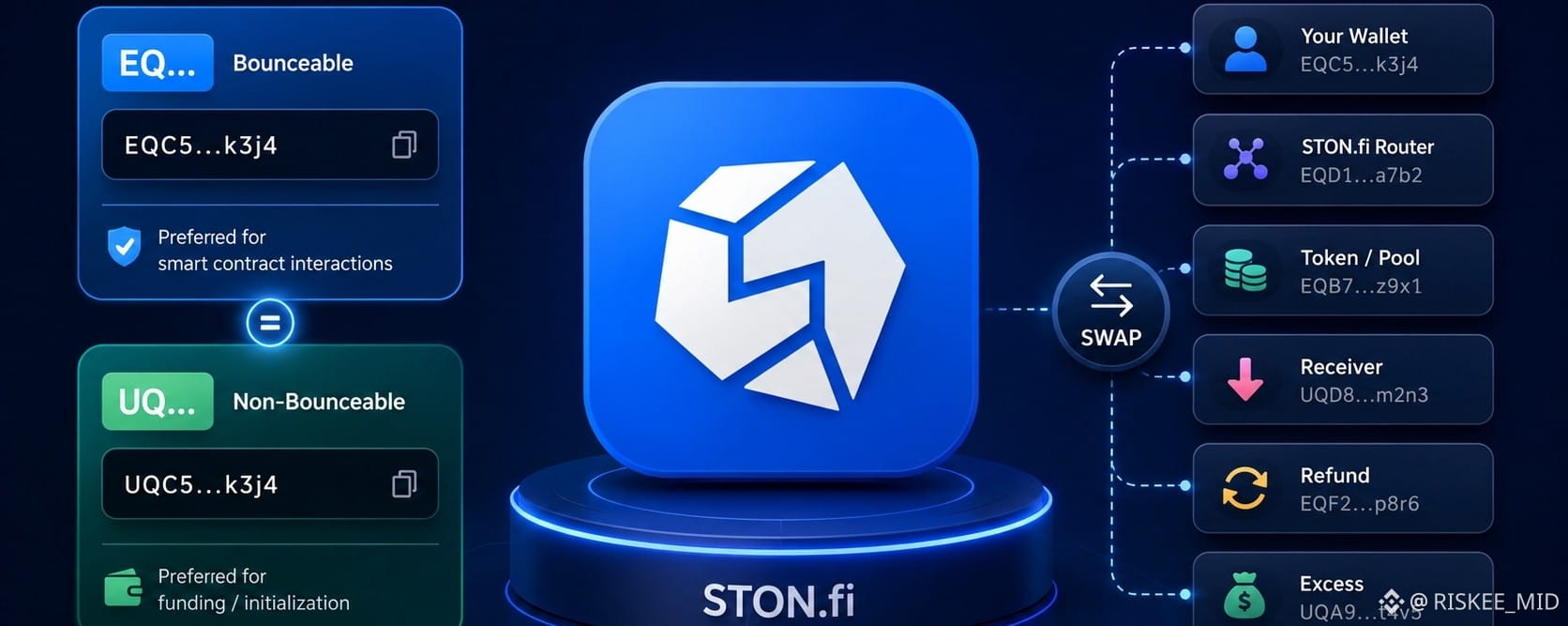
A common example is the difference between an address beginning with EQ... and one beginning with UQ.... The first is the familiar bounceable user-friendly representation, while the second is the non-bounceable representation. Despite the different prefixes, both can identify the same underlying TON account because the account itself is determined by its workchain and 256-bit account identifier. The bounceable or non-bounceable distinction is encoded as metadata in the user-friendly representation rather than creating a different account.
This distinction becomes especially important when interacting with DeFi protocols such as STONfi, where a single swap can involve several TON addresses and multiple layers of contract messages.
Understanding what the address prefix actually means makes it much easier to understand why STONfi can work with different address representations without treating them as different destinations.
The First Important Distinction: Address Identity vs. Message Behavior
The easiest way to understand TON addresses is to separate who the destination is from how a message should behave when it is sent there.
A TON user-friendly address contains several pieces of information. Among them are the workchain identifier, the account identifier, and flags describing how the address is intended to be handled. In particular, the flags encode whether a message should be sent as bounceable or non-bounceable.
That means the visible prefix is not simply an alternative account identifier.
For example:
EQ... → bounceable user friendly representation
UQ... → non-bounceable user friendly representation
When the underlying workchain and account ID are identical, these are two representations of the same account.
TON's own address utilities can convert an address into its raw, bounceable, and non bounceable forms, which is another way of demonstrating that these are different representations of the same underlying destination rather than separate wallets.
This is one of the most important concepts for developers building on TON:
Do not compare the visual prefix when you are trying to determine whether two addresses identify the same account. Parse the address and compare the underlying address components.
What Does “Bounceable” Actually Mean?
Bounceability is fundamentally about message handling.
TON internal messages contain a bounce flag. When a bounceable message is delivered to a destination and processing fails under the conditions where bouncing is supported, the remaining value can be returned toward the sender. TON's smart contract guidelines recommend bounceable messages for most interactions because they provide protection against certain destination or execution failures.
The important point is that an account does not permanently become a “bounceable account” or a “non bounceable account.”
Instead, the user-friendly address representation contains a flag that software can use when constructing the outgoing message.
TON documents the mainnet friendly formats as:
E... for bounceable addressesU... for non-bounceable addresses
The same account can therefore be represented in either form.
So when someone changes an address from EQ... to UQ..., they have not moved funds, created a second wallet, or changed the account itself.
They have changed the friendly representation and associated bounce preference.
Why Does TON Need Non-Bounceable Addresses?
The answer becomes clearer when we consider account initialization.
TON supports contract accounts whose addresses can be determined before the corresponding contract is deployed. A wallet contract, for example, can have a deterministic address derived from its initialization parameters even before the account has been activated on-chain. TON documentation explicitly describes cases where an address exists as a deterministic value while the account itself is still in the nonexist state.
This creates an important funding problem.
Suppose you want to send TON to a wallet whose address is known but whose account has not yet been initialized. A non bounceable message can be used to fund that destination without the value being bounced back simply because the account has not yet been initialized.
This is why non-bounceable representations are especially associated with funding or initializing wallets.
TON's documentation recommends non-bounceable addresses for wallet contracts in situations where the destination may be uninitialized, while bounceable messages are generally preferred for smart contract interactions where failed execution should result in the value being returned.
Wallets on TON Are Smart Contracts
Another concept that sometimes causes confusion is the word “wallet.”
On TON, a wallet is not merely an account label in the same sense as a traditional centralized exchange account. Wallet implementations are smart contracts, and their address can be derived before deployment.
That is why it is possible to know where a wallet will exist before the wallet contract has actually been initialized on chain.
TON's address workflow reflects this distinction. When a wallet application prepares a transfer, it can inspect the destination's account state. TON documentation notes that when a destination is still uninitialized, wallet software can force the outgoing message's bounce field to false, effectively preferring non-bounceable delivery for initialization scenarios. For already initialized destinations, the wallet can use the bounce preference represented by the address.
So the practical behavior is more sophisticated than simply saying:
“EQ always bounces.”
or
“UQ never bounces.”
The prefix provides a message-handling preference, while the wallet application and destination state can also influence how the transaction is constructed.
Where STONfi Fits Into This Model
A STONfi swap is not simply a single transfer from one wallet to another.
A typical swap can involve several addresses and several messages:
Your wallet → STONfi contract/router → token contracts or pools → recipient/refund/excess destinations
Depending on the operation, the transaction can involve addresses for:
Your connected walletJetton master contractsJetton wallet contractsSTONfi routersPool contractsReceiver addressesRefund addressesExcess-address destinations
Each address may appear at a different layer of the transaction.
This matters because the address used as the initial transaction target is not necessarily the same thing as every address carried inside the contract payload.
When a wallet sends a TON Connect transaction, for example, the message itself has a destination address and may contain an arbitrary payload. Contract interaction can then encode additional MsgAddress values inside that payload. TON's own examples show this pattern for token and NFT interactions, where a contract message can contain addresses such as a new owner or an excess destination.
That is the architecture that makes address handling inside a STONfi swap more interesting than a simple “send from A to B” transfer.
The Initial Target Is Only One Part of the Transaction
Consider the beginning of a swap.
Your wallet creates an outbound message whose initial destination is the STONfi contract that should receive and process the request.
The wallet therefore needs a valid destination address for that contract.
Inside the request payload, however, the protocol may also need to know where resulting assets should be delivered, where excess value should be returned, or where a refund should go if a particular operation requires it.
Those addresses are represented as normal TON address values in the contract data.
They are not necessarily interpreted according to the visual prefix that a human happens to see in a wallet interface.
At the protocol level, the important information is the parsed TON address itself and the message semantics associated with how that address is used.
Why STONfi Can Treat EQ... and UQ... as the Same Destination
Imagine the following simplified scenario:
EQxxxxxxxx... and UQxxxxxxxx...
may look like two different strings.
A naïve application might compare them as raw text and conclude that they represent different wallets.
A TON-aware application should instead parse them into their underlying address structure.
Once parsed, the application can identify the common workchain and account identifier.
That is why the correct mental model is:
Different friendly representation ≠ different account.
This principle is particularly important for STONfi because a DeFi application may receive addresses from different wallets, SDKs, exchanges, explorers, or developers. Different tools may display the same account using different friendly representations.
TON even provides official utilities for detecting and unpacking these forms into their underlying components.
What Happens With STONfi's to Parameters?
According to the behavior described for STONfi's SDK starting with v0.5.0, generated to parameters use bounceable representations because these protocol destinations are expected to be initialized contracts that are intended to receive and execute logic.
That design is consistent with TON's broader smart-contract guidance.
TON recommends bounceable messages for smart-contract interactions because, when appropriate, a failed contract interaction can cause the remaining message value to return instead of simply disappearing into an unusable destination.
This does not mean every address involved in a STONfi transaction must visually begin with EQ.
It means that the message and contract interaction should use the appropriate bounce behavior for the role that address plays.
That distinction is crucial.
A protocol contract receiving an operation is different from a wallet account being initialized for the first time.
Receiver, Refund and Excess Addresses
One of the easiest mistakes for developers is to assume that every address in a swap transaction is the same type of destination.
It is not.
A swap can involve different address roles with different purposes.
Receiver
The receiver identifies where the resulting asset should ultimately be delivered.
Refund
A refund address can be used when an operation has to return value to the originating user or another designated destination.
Excess
An excess destination is used for value that remains after the required execution costs or amounts have been handled.
These addresses can travel through the protocol as TON MsgAddress values embedded in payloads.
This is why simply looking at the first address in a wallet transaction does not tell you everything that is happening inside the swap.
Why Builders Should Parse Addresses Instead of Comparing Strings
For developers, this may be the most practical lesson of all.
Do not build logic such as:
if (addressA === addressB)
when those values may be different user-friendly representations.
Instead, parse both values into proper TON Address objects and compare their underlying identity.
Libraries in the TON ecosystem are designed to convert between raw and friendly representations. TON's documentation explicitly describes converting between raw, bounceable, and non-bounceable forms, while security guidance warns developers to handle TON's multiple address representations correctly.
The application should care about:
workchain + account identifier
rather than:
EQ vs UQ
as a text prefix.
This is especially important for indexing, caching, database storage, portfolio tracking, recipient validation, analytics, and protocol integrations.
A Useful Mental Model
The easiest way to remember the entire system is to think of a TON address as having two layers.
Layer 1: The Account
This is the underlying identity:
Workchain + 256-bit account ID
That is what identifies the destination account.
Layer 2: The User-Friendly Representation
This is how that account is encoded for humans and software:
Raw / Bounceable / Non-bounceable / Testnet variants
The friendly representation adds metadata, including bounceability and testnet information, plus a checksum.
Two friendly strings can therefore describe the same underlying account.
That is exactly why an EQ... representation and a UQ... representation should not automatically be treated as two different wallets.
What Users Should Do Before a STONfi Swap
For everyday STONfi users, the safest approach is surprisingly simple.
Use the address supplied by your wallet or trusted TON tooling rather than manually editing prefixes.
Do not change EQ to UQ, or UQ to EQ, just because another application displays the address differently.
More importantly, always verify the actual destination, network, amount, and transaction details before signing.
TON wallets and TON Connect applications already understand user-friendly addresses and their associated behavior. TON Connect documentation, for example, expects user-friendly addresses for transaction messages and provides utilities for rendering the connected wallet address.
In other words, users generally do not need to manually manage bounce flags when using a properly integrated wallet and protocol interface.
What Builders Should Take Away
For developers integrating STONfi or building TON applications, address normalization should be treated as a fundamental part of the integration rather than an edge case.
A robust implementation should:
Parse addresses before comparing them.
Never assume two different strings mean two different accounts.
Preserve workchain information.
The account identifier must be interpreted together with the correct workchain. TON's security guidance specifically recommends validating the address chain when processing addresses.
Understand the difference between an account and a message.
Bounceability describes how a message should behave; it is not a permanent property that creates a second account.
Use bounceable messages for appropriate contract interactions.
Smart-contract operations generally benefit from bounceable delivery when failed execution should return remaining value.
Use non-bounceable delivery where initialization or funding requires it.
New or uninitialized wallet contracts are the classic case.
Let trusted SDKs handle representation details.
The purpose of an SDK is not only to make contract calls easier, but also to reduce the number of low-level address-handling mistakes developers can make.
The Bigger Picture for STONfi
As TON DeFi becomes more sophisticated, transactions increasingly involve multiple contracts rather than a simple wallet-to-wallet transfer.
STONfi swaps are a good example.
A user may only see:
“Swap token A for token B.”
Behind that simple interface, the blockchain may be coordinating wallet messages, routers, Jetton wallets, pool contracts, receiver destinations and value-return mechanisms.
Correct address handling therefore becomes part of the protocol's reliability.
The difference between EQ... and UQ... may look cosmetic to a user, but at the protocol level it represents a meaningful distinction in message construction.
At the same time, that distinction should never obscure the underlying truth:
The prefix does not automatically mean there are two different accounts.
The same TON account can have different user-friendly representations, while the message sent to that account can carry different bounce behavior depending on how the address is encoded and how the transaction is constructed.
Final Takeaway
TON's address system is powerful precisely because it separates account identity from user-facing representation.
An EQ... address and a UQ... address can point to the same underlying account. The important identity is the workchain plus the account identifier; the friendly prefix adds handling information such as bounceability.
For STONfi users, this means you should not worry when a trusted wallet or application presents your address in a different valid form.
For builders, the lesson is even more important:
Parse TON addresses. Normalize them. Compare their underlying identity. And choose bounce behavior according to the role of the destination and the purpose of the message.
Once that model is clear, STONfi's address handling becomes much easier to understand.
The next time you see an EQ... and UQ... address, do not immediately think “two wallets.”
Think:
same possible destination, different representation, different message-handling preference.
That distinction is small at the interface level, but fundamental when building reliable applications on TON.
Explore more on STON.FI app.ston.fi
Read more about STONfi here BLOG.STON.FI
#Wallet #TON #swap_crypto
How STONfi Handles Bounceable and Non-Bounceable Addresses on TON
How STONfi Handles Bounceable and Non-Bounceable Addresses on TON
TON addresses can look different while still pointing to the exact same on-chain account.
A common example is the difference between an address beginning with EQ... and one beginning with UQ.... The first is the familiar bounceable user-friendly representation, while the second is the non-bounceable representation. Despite the different prefixes, both can identify the same underlying TON account because the account itself is determined by its workchain and 256-bit account identifier. The bounceable or non-bounceable distinction is encoded as metadata in the user-friendly representation rather than creating a different account.
This distinction becomes especially important when interacting with DeFi protocols such as STONfi, where a single swap can involve several TON addresses and multiple layers of contract messages.
Understanding what the address prefix actually means makes it much easier to understand why STONfi can work with different address representations without treating them as different destinations.
The First Important Distinction: Address Identity vs. Message Behavior
The easiest way to understand TON addresses is to separate who the destination is from how a message should behave when it is sent there.
A TON user-friendly address contains several pieces of information. Among them are the workchain identifier, the account identifier, and flags describing how the address is intended to be handled. In particular, the flags encode whether a message should be sent as bounceable or non-bounceable.
That means the visible prefix is not simply an alternative account identifier.
For example:
EQ... → bounceable user friendly representation
UQ... → non-bounceable user friendly representation
When the underlying workchain and account ID are identical, these are two representations of the same account.
TON's own address utilities can convert an address into its raw, bounceable, and non bounceable forms, which is another way of demonstrating that these are different representations of the same underlying destination rather than separate wallets.
This is one of the most important concepts for developers building on TON:
Do not compare the visual prefix when you are trying to determine whether two addresses identify the same account. Parse the address and compare the underlying address components.
What Does “Bounceable” Actually Mean?
Bounceability is fundamentally about message handling.
TON internal messages contain a bounce flag. When a bounceable message is delivered to a destination and processing fails under the conditions where bouncing is supported, the remaining value can be returned toward the sender. TON's smart contract guidelines recommend bounceable messages for most interactions because they provide protection against certain destination or execution failures.
The important point is that an account does not permanently become a “bounceable account” or a “non bounceable account.”
Instead, the user-friendly address representation contains a flag that software can use when constructing the outgoing message.
TON documents the mainnet friendly formats as:
E... for bounceable addressesU... for non-bounceable addresses
The same account can therefore be represented in either form.
So when someone changes an address from EQ... to UQ..., they have not moved funds, created a second wallet, or changed the account itself.
They have changed the friendly representation and associated bounce preference.
Why Does TON Need Non-Bounceable Addresses?
The answer becomes clearer when we consider account initialization.
TON supports contract accounts whose addresses can be determined before the corresponding contract is deployed. A wallet contract, for example, can have a deterministic address derived from its initialization parameters even before the account has been activated on-chain. TON documentation explicitly describes cases where an address exists as a deterministic value while the account itself is still in the nonexist state.
This creates an important funding problem.
Suppose you want to send TON to a wallet whose address is known but whose account has not yet been initialized. A non bounceable message can be used to fund that destination without the value being bounced back simply because the account has not yet been initialized.
This is why non-bounceable representations are especially associated with funding or initializing wallets.
TON's documentation recommends non-bounceable addresses for wallet contracts in situations where the destination may be uninitialized, while bounceable messages are generally preferred for smart contract interactions where failed execution should result in the value being returned.
Wallets on TON Are Smart Contracts
Another concept that sometimes causes confusion is the word “wallet.”
On TON, a wallet is not merely an account label in the same sense as a traditional centralized exchange account. Wallet implementations are smart contracts, and their address can be derived before deployment.
That is why it is possible to know where a wallet will exist before the wallet contract has actually been initialized on chain.
TON's address workflow reflects this distinction. When a wallet application prepares a transfer, it can inspect the destination's account state. TON documentation notes that when a destination is still uninitialized, wallet software can force the outgoing message's bounce field to false, effectively preferring non-bounceable delivery for initialization scenarios. For already initialized destinations, the wallet can use the bounce preference represented by the address.
So the practical behavior is more sophisticated than simply saying:
“EQ always bounces.”
or
“UQ never bounces.”
The prefix provides a message-handling preference, while the wallet application and destination state can also influence how the transaction is constructed.
Where STONfi Fits Into This Model
A STONfi swap is not simply a single transfer from one wallet to another.
A typical swap can involve several addresses and several messages:
Your wallet → STONfi contract/router → token contracts or pools → recipient/refund/excess destinations
Depending on the operation, the transaction can involve addresses for:
Your connected walletJetton master contractsJetton wallet contractsSTONfi routersPool contractsReceiver addressesRefund addressesExcess-address destinations
Each address may appear at a different layer of the transaction.
This matters because the address used as the initial transaction target is not necessarily the same thing as every address carried inside the contract payload.
When a wallet sends a TON Connect transaction, for example, the message itself has a destination address and may contain an arbitrary payload. Contract interaction can then encode additional MsgAddress values inside that payload. TON's own examples show this pattern for token and NFT interactions, where a contract message can contain addresses such as a new owner or an excess destination.
That is the architecture that makes address handling inside a STONfi swap more interesting than a simple “send from A to B” transfer.
The Initial Target Is Only One Part of the Transaction
Consider the beginning of a swap.
Your wallet creates an outbound message whose initial destination is the STONfi contract that should receive and process the request.
The wallet therefore needs a valid destination address for that contract.
Inside the request payload, however, the protocol may also need to know where resulting assets should be delivered, where excess value should be returned, or where a refund should go if a particular operation requires it.
Those addresses are represented as normal TON address values in the contract data.
They are not necessarily interpreted according to the visual prefix that a human happens to see in a wallet interface.
At the protocol level, the important information is the parsed TON address itself and the message semantics associated with how that address is used.
Why STONfi Can Treat EQ... and UQ... as the Same Destination
Imagine the following simplified scenario:
EQxxxxxxxx... and UQxxxxxxxx...
may look like two different strings.
A naïve application might compare them as raw text and conclude that they represent different wallets.
A TON-aware application should instead parse them into their underlying address structure.
Once parsed, the application can identify the common workchain and account identifier.
That is why the correct mental model is:
Different friendly representation ≠ different account.
This principle is particularly important for STONfi because a DeFi application may receive addresses from different wallets, SDKs, exchanges, explorers, or developers. Different tools may display the same account using different friendly representations.
TON even provides official utilities for detecting and unpacking these forms into their underlying components.
What Happens With STONfi's to Parameters?
According to the behavior described for STONfi's SDK starting with v0.5.0, generated to parameters use bounceable representations because these protocol destinations are expected to be initialized contracts that are intended to receive and execute logic.
That design is consistent with TON's broader smart-contract guidance.
TON recommends bounceable messages for smart-contract interactions because, when appropriate, a failed contract interaction can cause the remaining message value to return instead of simply disappearing into an unusable destination.
This does not mean every address involved in a STONfi transaction must visually begin with EQ.
It means that the message and contract interaction should use the appropriate bounce behavior for the role that address plays.
That distinction is crucial.
A protocol contract receiving an operation is different from a wallet account being initialized for the first time.
Receiver, Refund and Excess Addresses
One of the easiest mistakes for developers is to assume that every address in a swap transaction is the same type of destination.
It is not.
A swap can involve different address roles with different purposes.
Receiver
The receiver identifies where the resulting asset should ultimately be delivered.
Refund
A refund address can be used when an operation has to return value to the originating user or another designated destination.
Excess
An excess destination is used for value that remains after the required execution costs or amounts have been handled.
These addresses can travel through the protocol as TON MsgAddress values embedded in payloads.
This is why simply looking at the first address in a wallet transaction does not tell you everything that is happening inside the swap.
Why Builders Should Parse Addresses Instead of Comparing Strings
For developers, this may be the most practical lesson of all.
Do not build logic such as:
if (addressA === addressB)
when those values may be different user-friendly representations.
Instead, parse both values into proper TON Address objects and compare their underlying identity.
Libraries in the TON ecosystem are designed to convert between raw and friendly representations. TON's documentation explicitly describes converting between raw, bounceable, and non-bounceable forms, while security guidance warns developers to handle TON's multiple address representations correctly.
The application should care about:
workchain + account identifier
rather than:
EQ vs UQ
as a text prefix.
This is especially important for indexing, caching, database storage, portfolio tracking, recipient validation, analytics, and protocol integrations.
A Useful Mental Model
The easiest way to remember the entire system is to think of a TON address as having two layers.
Layer 1: The Account
This is the underlying identity:
Workchain + 256-bit account ID
That is what identifies the destination account.
Layer 2: The User-Friendly Representation
This is how that account is encoded for humans and software:
Raw / Bounceable / Non-bounceable / Testnet variants
The friendly representation adds metadata, including bounceability and testnet information, plus a checksum.
Two friendly strings can therefore describe the same underlying account.
That is exactly why an EQ... representation and a UQ... representation should not automatically be treated as two different wallets.
What Users Should Do Before a STONfi Swap
For everyday STONfi users, the safest approach is surprisingly simple.
Use the address supplied by your wallet or trusted TON tooling rather than manually editing prefixes.
Do not change EQ to UQ, or UQ to EQ, just because another application displays the address differently.
More importantly, always verify the actual destination, network, amount, and transaction details before signing.
TON wallets and TON Connect applications already understand user-friendly addresses and their associated behavior. TON Connect documentation, for example, expects user-friendly addresses for transaction messages and provides utilities for rendering the connected wallet address.
In other words, users generally do not need to manually manage bounce flags when using a properly integrated wallet and protocol interface.
What Builders Should Take Away
For developers integrating STONfi or building TON applications, address normalization should be treated as a fundamental part of the integration rather than an edge case.
A robust implementation should:
Parse addresses before comparing them.
Never assume two different strings mean two different accounts.
Preserve workchain information.
The account identifier must be interpreted together with the correct workchain. TON's security guidance specifically recommends validating the address chain when processing addresses.
Understand the difference between an account and a message.
Bounceability describes how a message should behave; it is not a permanent property that creates a second account.
Use bounceable messages for appropriate contract interactions.
Smart-contract operations generally benefit from bounceable delivery when failed execution should return remaining value.
Use non-bounceable delivery where initialization or funding requires it.
New or uninitialized wallet contracts are the classic case.
Let trusted SDKs handle representation details.
The purpose of an SDK is not only to make contract calls easier, but also to reduce the number of low-level address-handling mistakes developers can make.
The Bigger Picture for STONfi
As TON DeFi becomes more sophisticated, transactions increasingly involve multiple contracts rather than a simple wallet-to-wallet transfer.
STONfi swaps are a good example.
A user may only see:
“Swap token A for token B.”
Behind that simple interface, the blockchain may be coordinating wallet messages, routers, Jetton wallets, pool contracts, receiver destinations and value-return mechanisms.
Correct address handling therefore becomes part of the protocol's reliability.
The difference between EQ... and UQ... may look cosmetic to a user, but at the protocol level it represents a meaningful distinction in message construction.
At the same time, that distinction should never obscure the underlying truth:
The prefix does not automatically mean there are two different accounts.
The same TON account can have different user-friendly representations, while the message sent to that account can carry different bounce behavior depending on how the address is encoded and how the transaction is constructed.
Final Takeaway
TON's address system is powerful precisely because it separates account identity from user-facing representation.
An EQ... address and a UQ... address can point to the same underlying account. The important identity is the workchain plus the account identifier; the friendly prefix adds handling information such as bounceability.
For STONfi users, this means you should not worry when a trusted wallet or application presents your address in a different valid form.
For builders, the lesson is even more important:
Parse TON addresses. Normalize them. Compare their underlying identity. And choose bounce behavior according to the role of the destination and the purpose of the message.
Once that model is clear, STONfi's address handling becomes much easier to understand.
The next time you see an EQ... and UQ... address, do not immediately think “two wallets.”
Think:
same possible destination, different representation, different message-handling preference.
That distinction is small at the interface level, but fundamental when building reliable applications on TON.
Explore more on STON.FI app.ston.fi
Read more about STONfi here BLOG.STON.FI
#Wallet #TON #swap_crypto
TON addresses can look different while still pointing to the exact same on-chain account.
A common example is the difference between an address beginning with EQ... and one beginning with UQ.... The first is the familiar bounceable user-friendly representation, while the second is the non-bounceable representation. Despite the different prefixes, both can identify the same underlying TON account because the account itself is determined by its workchain and 256-bit account identifier. The bounceable or non-bounceable distinction is encoded as metadata in the user-friendly representation rather than creating a different account.
This distinction becomes especially important when interacting with DeFi protocols such as STONfi, where a single swap can involve several TON addresses and multiple layers of contract messages.
Understanding what the address prefix actually means makes it much easier to understand why STONfi can work with different address representations without treating them as different destinations.
The First Important Distinction: Address Identity vs. Message Behavior
The easiest way to understand TON addresses is to separate who the destination is from how a message should behave when it is sent there.
A TON user-friendly address contains several pieces of information. Among them are the workchain identifier, the account identifier, and flags describing how the address is intended to be handled. In particular, the flags encode whether a message should be sent as bounceable or non-bounceable.
That means the visible prefix is not simply an alternative account identifier.
For example:
EQ... → bounceable user friendly representation
UQ... → non-bounceable user friendly representation
When the underlying workchain and account ID are identical, these are two representations of the same account.
TON's own address utilities can convert an address into its raw, bounceable, and non bounceable forms, which is another way of demonstrating that these are different representations of the same underlying destination rather than separate wallets.
This is one of the most important concepts for developers building on TON:
Do not compare the visual prefix when you are trying to determine whether two addresses identify the same account. Parse the address and compare the underlying address components.
What Does “Bounceable” Actually Mean?
Bounceability is fundamentally about message handling.
TON internal messages contain a bounce flag. When a bounceable message is delivered to a destination and processing fails under the conditions where bouncing is supported, the remaining value can be returned toward the sender. TON's smart contract guidelines recommend bounceable messages for most interactions because they provide protection against certain destination or execution failures.
The important point is that an account does not permanently become a “bounceable account” or a “non bounceable account.”
Instead, the user-friendly address representation contains a flag that software can use when constructing the outgoing message.
TON documents the mainnet friendly formats as:
E... for bounceable addressesU... for non-bounceable addresses
The same account can therefore be represented in either form.
So when someone changes an address from EQ... to UQ..., they have not moved funds, created a second wallet, or changed the account itself.
They have changed the friendly representation and associated bounce preference.
Why Does TON Need Non-Bounceable Addresses?
The answer becomes clearer when we consider account initialization.
TON supports contract accounts whose addresses can be determined before the corresponding contract is deployed. A wallet contract, for example, can have a deterministic address derived from its initialization parameters even before the account has been activated on-chain. TON documentation explicitly describes cases where an address exists as a deterministic value while the account itself is still in the nonexist state.
This creates an important funding problem.
Suppose you want to send TON to a wallet whose address is known but whose account has not yet been initialized. A non bounceable message can be used to fund that destination without the value being bounced back simply because the account has not yet been initialized.
This is why non-bounceable representations are especially associated with funding or initializing wallets.
TON's documentation recommends non-bounceable addresses for wallet contracts in situations where the destination may be uninitialized, while bounceable messages are generally preferred for smart contract interactions where failed execution should result in the value being returned.
Wallets on TON Are Smart Contracts
Another concept that sometimes causes confusion is the word “wallet.”
On TON, a wallet is not merely an account label in the same sense as a traditional centralized exchange account. Wallet implementations are smart contracts, and their address can be derived before deployment.
That is why it is possible to know where a wallet will exist before the wallet contract has actually been initialized on chain.
TON's address workflow reflects this distinction. When a wallet application prepares a transfer, it can inspect the destination's account state. TON documentation notes that when a destination is still uninitialized, wallet software can force the outgoing message's bounce field to false, effectively preferring non-bounceable delivery for initialization scenarios. For already initialized destinations, the wallet can use the bounce preference represented by the address.
So the practical behavior is more sophisticated than simply saying:
“EQ always bounces.”
or
“UQ never bounces.”
The prefix provides a message-handling preference, while the wallet application and destination state can also influence how the transaction is constructed.
Where STONfi Fits Into This Model
A STONfi swap is not simply a single transfer from one wallet to another.
A typical swap can involve several addresses and several messages:
Your wallet → STONfi contract/router → token contracts or pools → recipient/refund/excess destinations
Depending on the operation, the transaction can involve addresses for:
Your connected walletJetton master contractsJetton wallet contractsSTONfi routersPool contractsReceiver addressesRefund addressesExcess-address destinations
Each address may appear at a different layer of the transaction.
This matters because the address used as the initial transaction target is not necessarily the same thing as every address carried inside the contract payload.
When a wallet sends a TON Connect transaction, for example, the message itself has a destination address and may contain an arbitrary payload. Contract interaction can then encode additional MsgAddress values inside that payload. TON's own examples show this pattern for token and NFT interactions, where a contract message can contain addresses such as a new owner or an excess destination.
That is the architecture that makes address handling inside a STONfi swap more interesting than a simple “send from A to B” transfer.
The Initial Target Is Only One Part of the Transaction
Consider the beginning of a swap.
Your wallet creates an outbound message whose initial destination is the STONfi contract that should receive and process the request.
The wallet therefore needs a valid destination address for that contract.
Inside the request payload, however, the protocol may also need to know where resulting assets should be delivered, where excess value should be returned, or where a refund should go if a particular operation requires it.
Those addresses are represented as normal TON address values in the contract data.
They are not necessarily interpreted according to the visual prefix that a human happens to see in a wallet interface.
At the protocol level, the important information is the parsed TON address itself and the message semantics associated with how that address is used.
Why STONfi Can Treat EQ... and UQ... as the Same Destination
Imagine the following simplified scenario:
EQxxxxxxxx... and UQxxxxxxxx...
may look like two different strings.
A naïve application might compare them as raw text and conclude that they represent different wallets.
A TON-aware application should instead parse them into their underlying address structure.
Once parsed, the application can identify the common workchain and account identifier.
That is why the correct mental model is:
Different friendly representation ≠ different account.
This principle is particularly important for STONfi because a DeFi application may receive addresses from different wallets, SDKs, exchanges, explorers, or developers. Different tools may display the same account using different friendly representations.
TON even provides official utilities for detecting and unpacking these forms into their underlying components.
What Happens With STONfi's to Parameters?
According to the behavior described for STONfi's SDK starting with v0.5.0, generated to parameters use bounceable representations because these protocol destinations are expected to be initialized contracts that are intended to receive and execute logic.
That design is consistent with TON's broader smart-contract guidance.
TON recommends bounceable messages for smart-contract interactions because, when appropriate, a failed contract interaction can cause the remaining message value to return instead of simply disappearing into an unusable destination.
This does not mean every address involved in a STONfi transaction must visually begin with EQ.
It means that the message and contract interaction should use the appropriate bounce behavior for the role that address plays.
That distinction is crucial.
A protocol contract receiving an operation is different from a wallet account being initialized for the first time.
Receiver, Refund and Excess Addresses
One of the easiest mistakes for developers is to assume that every address in a swap transaction is the same type of destination.
It is not.
A swap can involve different address roles with different purposes.
Receiver
The receiver identifies where the resulting asset should ultimately be delivered.
Refund
A refund address can be used when an operation has to return value to the originating user or another designated destination.
Excess
An excess destination is used for value that remains after the required execution costs or amounts have been handled.
These addresses can travel through the protocol as TON MsgAddress values embedded in payloads.
This is why simply looking at the first address in a wallet transaction does not tell you everything that is happening inside the swap.
Why Builders Should Parse Addresses Instead of Comparing Strings
For developers, this may be the most practical lesson of all.
Do not build logic such as:
if (addressA === addressB)
when those values may be different user-friendly representations.
Instead, parse both values into proper TON Address objects and compare their underlying identity.
Libraries in the TON ecosystem are designed to convert between raw and friendly representations. TON's documentation explicitly describes converting between raw, bounceable, and non-bounceable forms, while security guidance warns developers to handle TON's multiple address representations correctly.
The application should care about:
workchain + account identifier
rather than:
EQ vs UQ
as a text prefix.
This is especially important for indexing, caching, database storage, portfolio tracking, recipient validation, analytics, and protocol integrations.
A Useful Mental Model
The easiest way to remember the entire system is to think of a TON address as having two layers.
Layer 1: The Account
This is the underlying identity:
Workchain + 256-bit account ID
That is what identifies the destination account.
Layer 2: The User-Friendly Representation
This is how that account is encoded for humans and software:
Raw / Bounceable / Non-bounceable / Testnet variants
The friendly representation adds metadata, including bounceability and testnet information, plus a checksum.
Two friendly strings can therefore describe the same underlying account.
That is exactly why an EQ... representation and a UQ... representation should not automatically be treated as two different wallets.
What Users Should Do Before a STONfi Swap
For everyday STONfi users, the safest approach is surprisingly simple.
Use the address supplied by your wallet or trusted TON tooling rather than manually editing prefixes.
Do not change EQ to UQ, or UQ to EQ, just because another application displays the address differently.
More importantly, always verify the actual destination, network, amount, and transaction details before signing.
TON wallets and TON Connect applications already understand user-friendly addresses and their associated behavior. TON Connect documentation, for example, expects user-friendly addresses for transaction messages and provides utilities for rendering the connected wallet address.
In other words, users generally do not need to manually manage bounce flags when using a properly integrated wallet and protocol interface.
What Builders Should Take Away
For developers integrating STONfi or building TON applications, address normalization should be treated as a fundamental part of the integration rather than an edge case.
A robust implementation should:
Parse addresses before comparing them.
Never assume two different strings mean two different accounts.
Preserve workchain information.
The account identifier must be interpreted together with the correct workchain. TON's security guidance specifically recommends validating the address chain when processing addresses.
Understand the difference between an account and a message.
Bounceability describes how a message should behave; it is not a permanent property that creates a second account.
Use bounceable messages for appropriate contract interactions.
Smart-contract operations generally benefit from bounceable delivery when failed execution should return remaining value.
Use non-bounceable delivery where initialization or funding requires it.
New or uninitialized wallet contracts are the classic case.
Let trusted SDKs handle representation details.
The purpose of an SDK is not only to make contract calls easier, but also to reduce the number of low-level address-handling mistakes developers can make.
The Bigger Picture for STONfi
As TON DeFi becomes more sophisticated, transactions increasingly involve multiple contracts rather than a simple wallet-to-wallet transfer.
STONfi swaps are a good example.
A user may only see:
“Swap token A for token B.”
Behind that simple interface, the blockchain may be coordinating wallet messages, routers, Jetton wallets, pool contracts, receiver destinations and value-return mechanisms.
Correct address handling therefore becomes part of the protocol's reliability.
The difference between EQ... and UQ... may look cosmetic to a user, but at the protocol level it represents a meaningful distinction in message construction.
At the same time, that distinction should never obscure the underlying truth:
The prefix does not automatically mean there are two different accounts.
The same TON account can have different user-friendly representations, while the message sent to that account can carry different bounce behavior depending on how the address is encoded and how the transaction is constructed.
Final Takeaway
TON's address system is powerful precisely because it separates account identity from user-facing representation.
An EQ... address and a UQ... address can point to the same underlying account. The important identity is the workchain plus the account identifier; the friendly prefix adds handling information such as bounceability.
For STONfi users, this means you should not worry when a trusted wallet or application presents your address in a different valid form.
For builders, the lesson is even more important:
Parse TON addresses. Normalize them. Compare their underlying identity. And choose bounce behavior according to the role of the destination and the purpose of the message.
Once that model is clear, STONfi's address handling becomes much easier to understand.
The next time you see an EQ... and UQ... address, do not immediately think “two wallets.”
Think:
same possible destination, different representation, different message-handling preference.
That distinction is small at the interface level, but fundamental when building reliable applications on TON.
Explore more on STON.FI app.ston.fi
Read more about STONfi here BLOG.STON.FI
#Wallet #TON #swap_crypto
1
1
516

·
--
Bullish
THE BEST TECHNOLOGY IS OFTEN THE TECHNOLOGY YOU DON’T NOTICE.
Think about it.
When you send a message, you don’t think about servers.
When you browse the internet, you don’t think about routing protocols.
You just expect it to work.
DeFi should move in the same direction.
Users shouldn’t need to understand:
Which pool has liquidity.
Which route is more efficient.
Which ecosystem they need to navigate.
The experience should feel simple.
But underneath that simplicity is powerful infrastructure.
That’s one reason I’m watching what STON.fi is building.
The goal isn’t just to add more features.
It’s to reduce the complexity users have to deal with.
Because mass adoption won’t come from making DeFi more complicated.
It will come from making complexity invisible.
#STONfi #DeFi #DEX #swap_crypto #Omniston $BTC $PUMP
THE BEST TECHNOLOGY IS OFTEN THE TECHNOLOGY YOU DON’T NOTICE.
Think about it.
When you send a message, you don’t think about servers.
When you browse the internet, you don’t think about routing protocols.
You just expect it to work.
DeFi should move in the same direction.
Users shouldn’t need to understand:
Which pool has liquidity.
Which route is more efficient.
Which ecosystem they need to navigate.
The experience should feel simple.
But underneath that simplicity is powerful infrastructure.
That’s one reason I’m watching what STON.fi is building.
The goal isn’t just to add more features.
It’s to reduce the complexity users have to deal with.
Because mass adoption won’t come from making DeFi more complicated.
It will come from making complexity invisible.
#STONfi #DeFi #DEX #swap_crypto #Omniston $BTC $PUMP
Think about it.
When you send a message, you don’t think about servers.
When you browse the internet, you don’t think about routing protocols.
You just expect it to work.
DeFi should move in the same direction.
Users shouldn’t need to understand:
Which pool has liquidity.
Which route is more efficient.
Which ecosystem they need to navigate.
The experience should feel simple.
But underneath that simplicity is powerful infrastructure.
That’s one reason I’m watching what STON.fi is building.
The goal isn’t just to add more features.
It’s to reduce the complexity users have to deal with.
Because mass adoption won’t come from making DeFi more complicated.
It will come from making complexity invisible.
#STONfi #DeFi #DEX #swap_crypto #Omniston $BTC $PUMP
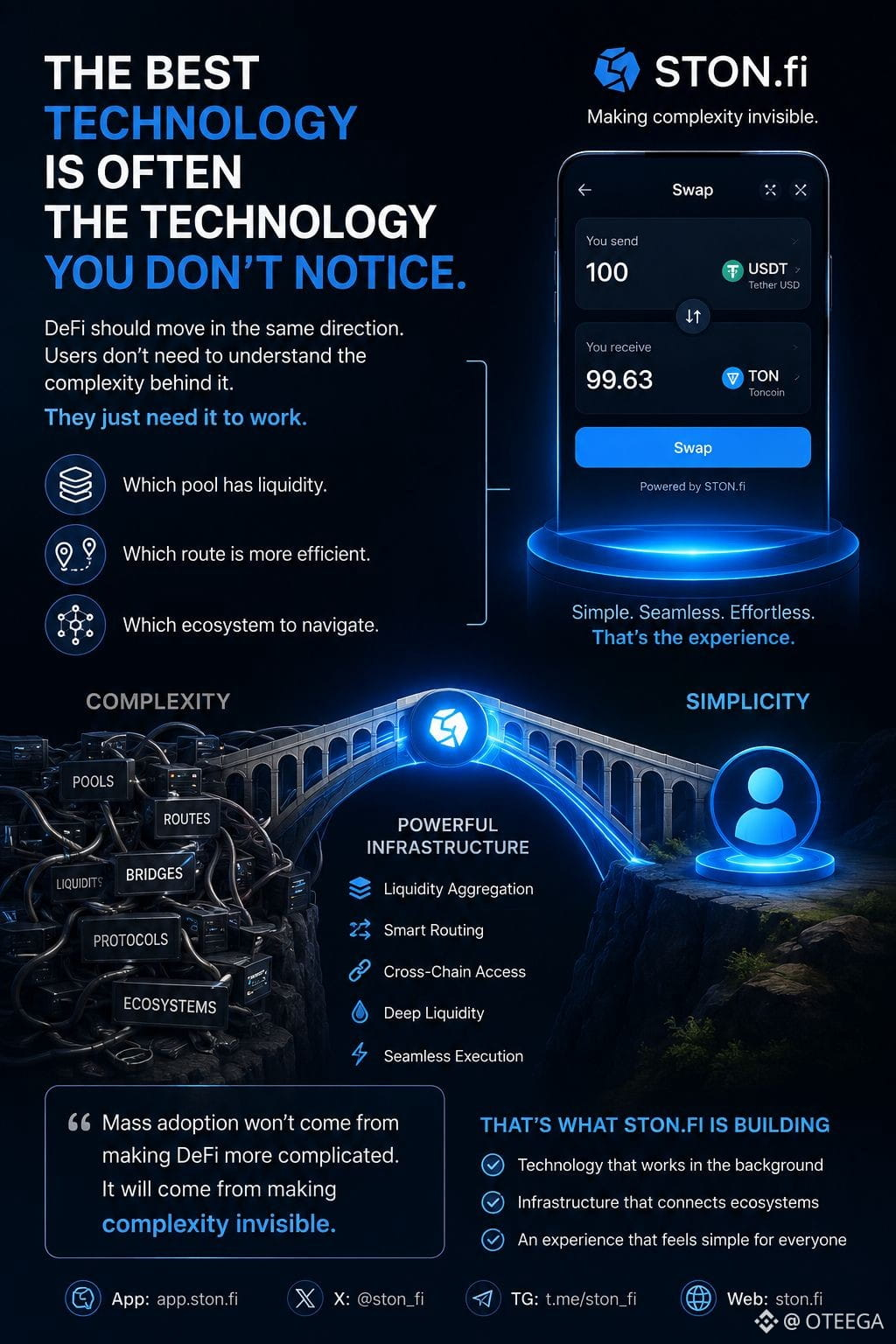
1
1
148

·
--
Many blockchain projects compete by introducing new features.
ORO appears to be asking a different question.
What if the next step for Web3 isn’t adding more functionality, but making existing functionality easier to use?
Blockchain has matured significantly over the years, yet many everyday interactions still require users to understand wallets, approvals, networks, and transaction flows before they can accomplish a simple task.
Some of the areas that continue to slow adoption include:
~ Technical workflows that feel intimidating
~ Too many manual steps for routine transactions
~ Security concerns when approving onchain actions
~ Experiences that prioritize infrastructure over usability
Rather than building around those complexities, ORO is exploring how they can be abstracted away so users can focus on their goals instead of the underlying mechanics.
I think that’s a meaningful direction.
Innovation isn’t only measured by how much technology is added.
Sometimes it’s measured by how much unnecessary complexity can be removed without sacrificing what makes blockchain valuable.
If that balance can be achieved, interacting with decentralized applications could become far more accessible to a wider audience.
I’m interested to see how ORO continues to develop this vision.
𝗪𝗵𝗮𝘁 𝗱𝗼 𝘆𝗼𝘂 𝘁𝗵𝗶𝗻𝗸 𝘄𝗶𝗹𝗹 𝗱𝗲𝗳𝗶𝗻𝗲 𝘁𝗵𝗲 𝗻𝗲𝘅𝘁 𝗽𝗵𝗮𝘀𝗲 𝗼𝗳 𝗪𝗲𝗯𝟯?
~ Simplicity?
~ Better security?
~ More intuitive applications?
~ Greater interoperability?
~ Or something else?
@ask_oro
#ai #swap_crypto #ZIG
Many blockchain projects compete by introducing new features.
ORO appears to be asking a different question.
What if the next step for Web3 isn’t adding more functionality, but making existing functionality easier to use?
Blockchain has matured significantly over the years, yet many everyday interactions still require users to understand wallets, approvals, networks, and transaction flows before they can accomplish a simple task.
Some of the areas that continue to slow adoption include:
~ Technical workflows that feel intimidating
~ Too many manual steps for routine transactions
~ Security concerns when approving onchain actions
~ Experiences that prioritize infrastructure over usability
Rather than building around those complexities, ORO is exploring how they can be abstracted away so users can focus on their goals instead of the underlying mechanics.
I think that’s a meaningful direction.
Innovation isn’t only measured by how much technology is added.
Sometimes it’s measured by how much unnecessary complexity can be removed without sacrificing what makes blockchain valuable.
If that balance can be achieved, interacting with decentralized applications could become far more accessible to a wider audience.
I’m interested to see how ORO continues to develop this vision.
𝗪𝗵𝗮𝘁 𝗱𝗼 𝘆𝗼𝘂 𝘁𝗵𝗶𝗻𝗸 𝘄𝗶𝗹𝗹 𝗱𝗲𝗳𝗶𝗻𝗲 𝘁𝗵𝗲 𝗻𝗲𝘅𝘁 𝗽𝗵𝗮𝘀𝗲 𝗼𝗳 𝗪𝗲𝗯𝟯?
~ Simplicity?
~ Better security?
~ More intuitive applications?
~ Greater interoperability?
~ Or something else?
@ask_oro
#ai #swap_crypto #ZIG
ORO appears to be asking a different question.
What if the next step for Web3 isn’t adding more functionality, but making existing functionality easier to use?
Blockchain has matured significantly over the years, yet many everyday interactions still require users to understand wallets, approvals, networks, and transaction flows before they can accomplish a simple task.
Some of the areas that continue to slow adoption include:
~ Technical workflows that feel intimidating
~ Too many manual steps for routine transactions
~ Security concerns when approving onchain actions
~ Experiences that prioritize infrastructure over usability
Rather than building around those complexities, ORO is exploring how they can be abstracted away so users can focus on their goals instead of the underlying mechanics.
I think that’s a meaningful direction.
Innovation isn’t only measured by how much technology is added.
Sometimes it’s measured by how much unnecessary complexity can be removed without sacrificing what makes blockchain valuable.
If that balance can be achieved, interacting with decentralized applications could become far more accessible to a wider audience.
I’m interested to see how ORO continues to develop this vision.
𝗪𝗵𝗮𝘁 𝗱𝗼 𝘆𝗼𝘂 𝘁𝗵𝗶𝗻𝗸 𝘄𝗶𝗹𝗹 𝗱𝗲𝗳𝗶𝗻𝗲 𝘁𝗵𝗲 𝗻𝗲𝘅𝘁 𝗽𝗵𝗮𝘀𝗲 𝗼𝗳 𝗪𝗲𝗯𝟯?
~ Simplicity?
~ Better security?
~ More intuitive applications?
~ Greater interoperability?
~ Or something else?
@ask_oro
#ai #swap_crypto #ZIG
99
·
--
𝗧𝗵𝗲 𝗗𝗲𝗙𝗶 𝗦𝗲𝘀𝘀𝗶𝗼𝗻 𝗜𝘀 𝗦𝘁𝗶𝗹𝗹 𝗧𝗼𝗼 𝗙𝗿𝗮𝗴𝗺𝗲𝗻𝘁𝗲𝗱
When people talk about improving DeFi, they usually focus on making individual transactions better.
• Faster swaps.
• Lower fees.
• More liquidity.
• Better protocols.
But there’s another problem that gets less attention.
𝗪𝗵𝗮𝘁 𝗵𝗮𝗽𝗽𝗲𝗻𝘀 𝗮𝗳𝘁𝗲𝗿 𝘁𝗵𝗲 𝘁𝗿𝗮𝗻𝘀𝗮𝗰𝘁𝗶𝗼𝗻?
You swap something.
Then you stake.
Later, you want to move funds somewhere else.
Then you need to check what you already have before deciding what to do next.
Each action is treated like a separate event.
That’s not how people normally manage financial activity.
This is one area where ORO has an interesting opportunity.
The more actions a user completes through the same environment, the more useful that environment can become over time.
Your previous activity gives context to what you want to do next.
Your current positions matter.
The networks you’re using matter.
The assets you’re holding matter.
And the next action doesn’t have to begin from zero.
𝗧𝗵𝗮𝘁 𝗰𝗵𝗮𝗻𝗴𝗲𝘀 𝘁𝗵𝗲 𝗶𝗱𝗲𝗮 𝗼𝗳 𝗮 𝗗𝗲𝗙𝗶 𝗮𝗽𝗽.
Instead of being somewhere you visit to complete one transaction, it can become the place where your entire DeFi activity continues.
That’s a much bigger idea than making one swap easier.
It’s about making each interaction connect to the next one.
And as ORO continues adding more protocols and actions, that’s one part of the product I’m interested in watching.
#swap_crypto #zig
𝗧𝗵𝗲 𝗗𝗲𝗙𝗶 𝗦𝗲𝘀𝘀𝗶𝗼𝗻 𝗜𝘀 𝗦𝘁𝗶𝗹𝗹 𝗧𝗼𝗼 𝗙𝗿𝗮𝗴𝗺𝗲𝗻𝘁𝗲𝗱
When people talk about improving DeFi, they usually focus on making individual transactions better.
• Faster swaps.
• Lower fees.
• More liquidity.
• Better protocols.
But there’s another problem that gets less attention.
𝗪𝗵𝗮𝘁 𝗵𝗮𝗽𝗽𝗲𝗻𝘀 𝗮𝗳𝘁𝗲𝗿 𝘁𝗵𝗲 𝘁𝗿𝗮𝗻𝘀𝗮𝗰𝘁𝗶𝗼𝗻?
You swap something.
Then you stake.
Later, you want to move funds somewhere else.
Then you need to check what you already have before deciding what to do next.
Each action is treated like a separate event.
That’s not how people normally manage financial activity.
This is one area where ORO has an interesting opportunity.
The more actions a user completes through the same environment, the more useful that environment can become over time.
Your previous activity gives context to what you want to do next.
Your current positions matter.
The networks you’re using matter.
The assets you’re holding matter.
And the next action doesn’t have to begin from zero.
𝗧𝗵𝗮𝘁 𝗰𝗵𝗮𝗻𝗴𝗲𝘀 𝘁𝗵𝗲 𝗶𝗱𝗲𝗮 𝗼𝗳 𝗮 𝗗𝗲𝗙𝗶 𝗮𝗽𝗽.
Instead of being somewhere you visit to complete one transaction, it can become the place where your entire DeFi activity continues.
That’s a much bigger idea than making one swap easier.
It’s about making each interaction connect to the next one.
And as ORO continues adding more protocols and actions, that’s one part of the product I’m interested in watching.
#swap_crypto #zig
When people talk about improving DeFi, they usually focus on making individual transactions better.
• Faster swaps.
• Lower fees.
• More liquidity.
• Better protocols.
But there’s another problem that gets less attention.
𝗪𝗵𝗮𝘁 𝗵𝗮𝗽𝗽𝗲𝗻𝘀 𝗮𝗳𝘁𝗲𝗿 𝘁𝗵𝗲 𝘁𝗿𝗮𝗻𝘀𝗮𝗰𝘁𝗶𝗼𝗻?
You swap something.
Then you stake.
Later, you want to move funds somewhere else.
Then you need to check what you already have before deciding what to do next.
Each action is treated like a separate event.
That’s not how people normally manage financial activity.
This is one area where ORO has an interesting opportunity.
The more actions a user completes through the same environment, the more useful that environment can become over time.
Your previous activity gives context to what you want to do next.
Your current positions matter.
The networks you’re using matter.
The assets you’re holding matter.
And the next action doesn’t have to begin from zero.
𝗧𝗵𝗮𝘁 𝗰𝗵𝗮𝗻𝗴𝗲𝘀 𝘁𝗵𝗲 𝗶𝗱𝗲𝗮 𝗼𝗳 𝗮 𝗗𝗲𝗙𝗶 𝗮𝗽𝗽.
Instead of being somewhere you visit to complete one transaction, it can become the place where your entire DeFi activity continues.
That’s a much bigger idea than making one swap easier.
It’s about making each interaction connect to the next one.
And as ORO continues adding more protocols and actions, that’s one part of the product I’m interested in watching.
#swap_crypto #zig

1
81

▶️ A year ago, Jupiter was in the top 3 of perpetuals
Now it's sitting at number 16
The Perp DEX market has shifted significantly
All the action is flowing towards Hyperliquid and a few new players
30-day volume:
- Hyperliquid $187B
- Aster, edgeX, Lighter, Grvt, Apex $30 - 60B each
How did Jupiter lose the perp game so quickly?
#DEX #perp #Hyperliquid #swap_crypto #decentralization @CoinDesk @CoinMarketCap_official @Cointelegraph $JUP $ASTER
▶️ A year ago, Jupiter was in the top 3 of perpetuals
Now it's sitting at number 16
The Perp DEX market has shifted significantly
All the action is flowing towards Hyperliquid and a few new players
30-day volume:
- Hyperliquid $187B
- Aster, edgeX, Lighter, Grvt, Apex $30 - 60B each
How did Jupiter lose the perp game so quickly?
#DEX #perp #Hyperliquid #swap_crypto #decentralization @CoinDesk @CoinMarketCap @Cointelegraph $JUP $ASTER
Now it's sitting at number 16
The Perp DEX market has shifted significantly
All the action is flowing towards Hyperliquid and a few new players
30-day volume:
- Hyperliquid $187B
- Aster, edgeX, Lighter, Grvt, Apex $30 - 60B each
How did Jupiter lose the perp game so quickly?
#DEX #perp #Hyperliquid #swap_crypto #decentralization @CoinDesk @CoinMarketCap @Cointelegraph $JUP $ASTER
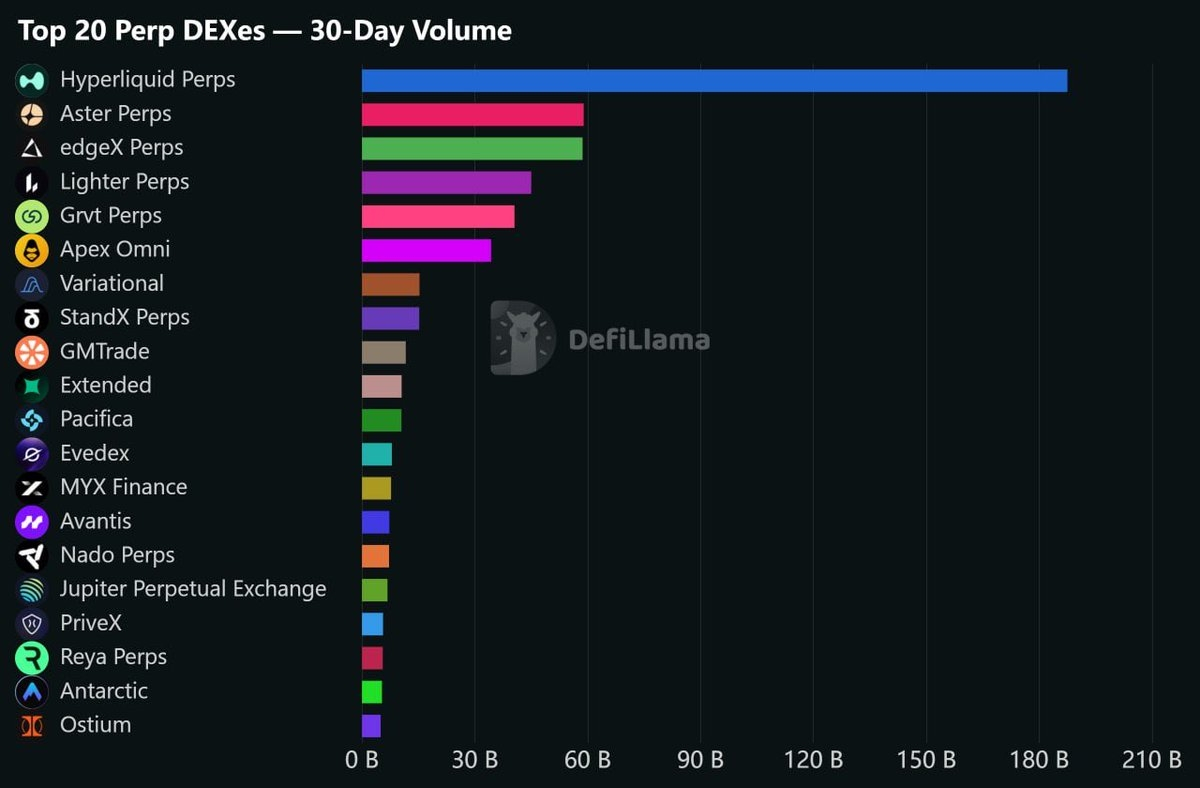
3
532

·
--
Bullish
Even the little bit of $BNB that I use for fees, I swapped it for $BTC hoping it pumps up
#Binance #CHANGE #swap_crypto
Even the little bit of $BNB that I use for fees, I swapped it for $BTC hoping it pumps up
#Binance #CHANGE #swap_crypto
#Binance #CHANGE #swap_crypto
237

Article
What is a SWAP?A swap is a fundamental concept in finance (and crypto) that might sound complex, but the basic idea is straightforward.
👉 A swap is an exchange of cash flows or assets between two parties, under agreed conditions.
🧠 🔄 What is a swap (simple explanation)?
A swap is a contract where:
two parties agree to
exchange something over time
it can be:
money
interest rates
currencies
tokens
👉 It's not a direct buy, it's a structured trade.
📊 🧩 Main types of swaps
1️⃣ 💰 Interest Rate Swap (traditional finance)
What is a SWAP?
A swap is a fundamental concept in finance (and crypto) that might sound complex, but the basic idea is straightforward.
👉 A swap is an exchange of cash flows or assets between two parties, under agreed conditions.
🧠 🔄 What is a swap (simple explanation)?
A swap is a contract where:
two parties agree to
exchange something over time
it can be:
money
interest rates
currencies
tokens
👉 It's not a direct buy, it's a structured trade.
📊 🧩 Main types of swaps
1️⃣ 💰 Interest Rate Swap (traditional finance)
👉 A swap is an exchange of cash flows or assets between two parties, under agreed conditions.
🧠 🔄 What is a swap (simple explanation)?
A swap is a contract where:
two parties agree to
exchange something over time
it can be:
money
interest rates
currencies
tokens
👉 It's not a direct buy, it's a structured trade.
📊 🧩 Main types of swaps
1️⃣ 💰 Interest Rate Swap (traditional finance)
528
·
--
One thing people rarely talk about when it comes to DeFi vaults is that the numbers are only part of the story.
A while ago, I decided to spend some time exploring one of the vaults integrated into ORO.
I expected the usual experience.
❍ TVL.
❍ APY.
❍ Fees.
That’s how most vault interfaces present information.
But that’s not what I found.
The SpaceX Vault already shows the metrics you’d expect.
Deposits are made in USDC.
There’s a 2-day redemption period.
Management, deposit, withdrawal, and performance fees are clearly displayed.
That made me look deeper into what had changed.
The answer wasn’t the vault itself.
➘ Right alongside the vault data, ORO lets users ask questions like “What are the risks?”
➘ It can also explain where the yield comes from or even answer “Does this fit my portfolio?” using the context of the vault being viewed.
Instead of treating research as something users do before opening a vault, ORO brings that research into the experience itself.
Another detail stood out to me.
The strategy is designed to queue USDC until SPCXon, Ondo’s tokenized SpaceX asset, becomes available before automatically deploying capital.
That’s very different from the typical “deposit and earn” vault many users are familiar with.
For anyone who hasn’t explored vaults through ORO yet, the experience feels noticeably different.
❍ The key vault metrics are available at a glance.
❍ The strategy is explained in plain language.
❍ Questions can be explored without leaving the page.
For me, that’s what makes this approach interesting.
ORO isn’t simply changing where people access vaults.
It’s changing how they interact with them by turning the interface into part of the research process.
Today’s SpaceX Vault is one example.
Follow @ask_oro on X to see what ORO brings onchain next.
#AI #swap_crypto #Vault
One thing people rarely talk about when it comes to DeFi vaults is that the numbers are only part of the story.
A while ago, I decided to spend some time exploring one of the vaults integrated into ORO.
I expected the usual experience.
❍ TVL.
❍ APY.
❍ Fees.
That’s how most vault interfaces present information.
But that’s not what I found.
The SpaceX Vault already shows the metrics you’d expect.
Deposits are made in USDC.
There’s a 2-day redemption period.
Management, deposit, withdrawal, and performance fees are clearly displayed.
That made me look deeper into what had changed.
The answer wasn’t the vault itself.
➘ Right alongside the vault data, ORO lets users ask questions like “What are the risks?”
➘ It can also explain where the yield comes from or even answer “Does this fit my portfolio?” using the context of the vault being viewed.
Instead of treating research as something users do before opening a vault, ORO brings that research into the experience itself.
Another detail stood out to me.
The strategy is designed to queue USDC until SPCXon, Ondo’s tokenized SpaceX asset, becomes available before automatically deploying capital.
That’s very different from the typical “deposit and earn” vault many users are familiar with.
For anyone who hasn’t explored vaults through ORO yet, the experience feels noticeably different.
❍ The key vault metrics are available at a glance.
❍ The strategy is explained in plain language.
❍ Questions can be explored without leaving the page.
For me, that’s what makes this approach interesting.
ORO isn’t simply changing where people access vaults.
It’s changing how they interact with them by turning the interface into part of the research process.
Today’s SpaceX Vault is one example.
Follow @ask_oro on X to see what ORO brings onchain next.
#AI #swap_crypto #Vault
A while ago, I decided to spend some time exploring one of the vaults integrated into ORO.
I expected the usual experience.
❍ TVL.
❍ APY.
❍ Fees.
That’s how most vault interfaces present information.
But that’s not what I found.
The SpaceX Vault already shows the metrics you’d expect.
Deposits are made in USDC.
There’s a 2-day redemption period.
Management, deposit, withdrawal, and performance fees are clearly displayed.
That made me look deeper into what had changed.
The answer wasn’t the vault itself.
➘ Right alongside the vault data, ORO lets users ask questions like “What are the risks?”
➘ It can also explain where the yield comes from or even answer “Does this fit my portfolio?” using the context of the vault being viewed.
Instead of treating research as something users do before opening a vault, ORO brings that research into the experience itself.
Another detail stood out to me.
The strategy is designed to queue USDC until SPCXon, Ondo’s tokenized SpaceX asset, becomes available before automatically deploying capital.
That’s very different from the typical “deposit and earn” vault many users are familiar with.
For anyone who hasn’t explored vaults through ORO yet, the experience feels noticeably different.
❍ The key vault metrics are available at a glance.
❍ The strategy is explained in plain language.
❍ Questions can be explored without leaving the page.
For me, that’s what makes this approach interesting.
ORO isn’t simply changing where people access vaults.
It’s changing how they interact with them by turning the interface into part of the research process.
Today’s SpaceX Vault is one example.
Follow @ask_oro on X to see what ORO brings onchain next.
#AI #swap_crypto #Vault
1
49
·
--

Article
The Real Problem In DeFi Is Not Access, It’s Executiongm frens
Meet Thabo, a freelance trader based in Johannesburg.
He earns in crypto, moves between chains, and tries to stay ahead of market shifts.
But every time he wants to act on an opportunity, he runs into the same problem.
Different tools for different actions.
One place for swaps.
Another for bridging.
Another for staking.
Another for checking routes and execution paths.
And none of them talk to each other.
When Thabo wants to move fast, he slows down instead.
Not because the tools are broken.
But because the workflow is fragmented.
That’s the problem ORO is trying to solve.
«𝗧𝗵𝗲 𝗖𝗵𝗮𝗻𝗴𝗲: 𝗙𝗿𝗼𝗺 𝗠𝘂𝗹𝘁𝗶-𝗧𝗼𝗼𝗹 𝗘𝘅𝗲𝗰𝘂𝘁𝗶𝗼𝗻 𝘁𝗼 𝗢𝗻𝗲 𝗙𝗹𝗼𝘄»
Most users still interact with DeFi like a collection of separate systems.
ORO changes that by combining execution into a single interface layer.
Instead of switching between platforms, users interact through one flow where actions are coordinated across chains and liquidity sources.
Swaps, bridging, staking, and routing are no longer separate steps you manually assemble.
They become part of one execution path.
That matters more than it sounds.
Because most inefficiency in DeFi doesn’t come from lack of access.
It comes from fragmentation between tools.
«𝗪𝗵𝗮𝘁 𝗢𝗥𝗢 𝗗𝗼𝗲𝘀 𝗗𝗶𝗳𝗳𝗲𝗿𝗲𝗻𝘁𝗹𝘆»
•➙ Swap execution happens without manually selecting routes or liquidity paths
•➙ Bridging is handled as part of the same flow instead of a separate process
•➙ Staking and vault interactions are integrated into execution, not isolated actions
•➙ Cross-chain activity is abstracted into a single action instead of multiple platforms
This is not about adding more features.
It’s about removing the need to think in steps.
«𝗪𝗵𝘆 𝗧𝗵𝗶𝘀 𝗠𝗮𝘁𝘁𝗲𝗿𝘀»
Most people underestimate how much time is lost not in decision making…
but in switching between tools just to execute a single one.
ORO removes that gap.
Not by changing what users do.
But by changing how many steps it takes to do it.
And once you experience that shift, going back to fragmented execution feels unnecessary.
The system doesn’t feel faster because it is more advanced.
It feels faster because there is less between intent and action.
That is the real change.
https://app.oroswap.org
#OroSwap #swap_crypto #ZIG #ZIGChain
The Real Problem In DeFi Is Not Access, It’s Execution
gm frens
Meet Thabo, a freelance trader based in Johannesburg.
He earns in crypto, moves between chains, and tries to stay ahead of market shifts.
But every time he wants to act on an opportunity, he runs into the same problem.
Different tools for different actions.
One place for swaps.
Another for bridging.
Another for staking.
Another for checking routes and execution paths.
And none of them talk to each other.
When Thabo wants to move fast, he slows down instead.
Not because the tools are broken.
But because the workflow is fragmented.
That’s the problem ORO is trying to solve.
«𝗧𝗵𝗲 𝗖𝗵𝗮𝗻𝗴𝗲: 𝗙𝗿𝗼𝗺 𝗠𝘂𝗹𝘁𝗶-𝗧𝗼𝗼𝗹 𝗘𝘅𝗲𝗰𝘂𝘁𝗶𝗼𝗻 𝘁𝗼 𝗢𝗻𝗲 𝗙𝗹𝗼𝘄»
Most users still interact with DeFi like a collection of separate systems.
ORO changes that by combining execution into a single interface layer.
Instead of switching between platforms, users interact through one flow where actions are coordinated across chains and liquidity sources.
Swaps, bridging, staking, and routing are no longer separate steps you manually assemble.
They become part of one execution path.
That matters more than it sounds.
Because most inefficiency in DeFi doesn’t come from lack of access.
It comes from fragmentation between tools.
«𝗪𝗵𝗮𝘁 𝗢𝗥𝗢 𝗗𝗼𝗲𝘀 𝗗𝗶𝗳𝗳𝗲𝗿𝗲𝗻𝘁𝗹𝘆»
•➙ Swap execution happens without manually selecting routes or liquidity paths
•➙ Bridging is handled as part of the same flow instead of a separate process
•➙ Staking and vault interactions are integrated into execution, not isolated actions
•➙ Cross-chain activity is abstracted into a single action instead of multiple platforms
This is not about adding more features.
It’s about removing the need to think in steps.
«𝗪𝗵𝘆 𝗧𝗵𝗶𝘀 𝗠𝗮𝘁𝘁𝗲𝗿𝘀»
Most people underestimate how much time is lost not in decision making…
but in switching between tools just to execute a single one.
ORO removes that gap.
Not by changing what users do.
But by changing how many steps it takes to do it.
And once you experience that shift, going back to fragmented execution feels unnecessary.
The system doesn’t feel faster because it is more advanced.
It feels faster because there is less between intent and action.
That is the real change.
https://app.oroswap.org
#OroSwap #swap_crypto #ZIG #ZIGChain
Meet Thabo, a freelance trader based in Johannesburg.
He earns in crypto, moves between chains, and tries to stay ahead of market shifts.
But every time he wants to act on an opportunity, he runs into the same problem.
Different tools for different actions.
One place for swaps.
Another for bridging.
Another for staking.
Another for checking routes and execution paths.
And none of them talk to each other.
When Thabo wants to move fast, he slows down instead.
Not because the tools are broken.
But because the workflow is fragmented.
That’s the problem ORO is trying to solve.
«𝗧𝗵𝗲 𝗖𝗵𝗮𝗻𝗴𝗲: 𝗙𝗿𝗼𝗺 𝗠𝘂𝗹𝘁𝗶-𝗧𝗼𝗼𝗹 𝗘𝘅𝗲𝗰𝘂𝘁𝗶𝗼𝗻 𝘁𝗼 𝗢𝗻𝗲 𝗙𝗹𝗼𝘄»
Most users still interact with DeFi like a collection of separate systems.
ORO changes that by combining execution into a single interface layer.
Instead of switching between platforms, users interact through one flow where actions are coordinated across chains and liquidity sources.
Swaps, bridging, staking, and routing are no longer separate steps you manually assemble.
They become part of one execution path.
That matters more than it sounds.
Because most inefficiency in DeFi doesn’t come from lack of access.
It comes from fragmentation between tools.
«𝗪𝗵𝗮𝘁 𝗢𝗥𝗢 𝗗𝗼𝗲𝘀 𝗗𝗶𝗳𝗳𝗲𝗿𝗲𝗻𝘁𝗹𝘆»
•➙ Swap execution happens without manually selecting routes or liquidity paths
•➙ Bridging is handled as part of the same flow instead of a separate process
•➙ Staking and vault interactions are integrated into execution, not isolated actions
•➙ Cross-chain activity is abstracted into a single action instead of multiple platforms
This is not about adding more features.
It’s about removing the need to think in steps.
«𝗪𝗵𝘆 𝗧𝗵𝗶𝘀 𝗠𝗮𝘁𝘁𝗲𝗿𝘀»
Most people underestimate how much time is lost not in decision making…
but in switching between tools just to execute a single one.
ORO removes that gap.
Not by changing what users do.
But by changing how many steps it takes to do it.
And once you experience that shift, going back to fragmented execution feels unnecessary.
The system doesn’t feel faster because it is more advanced.
It feels faster because there is less between intent and action.
That is the real change.
https://app.oroswap.org
#OroSwap #swap_crypto #ZIG #ZIGChain
177
🥷 The Balancer Exploiter has swapped 21,000 $ETH ($48.72M) to buy 617.43 $BTC at a price of $0.0294 over the last 3 days.
The hacker now has only 1,000 ETH ($2.32M) left and is likely to short them as well.
#BTC #ETH #HackerAlert #swap_crypto #Hack @CoinDesk @Cointelegraph @CoinMarketCap_official @Ethereum_official @Bitcoincom @bitcoin
🥷 The Balancer Exploiter has swapped 21,000 $ETH ($48.72M) to buy 617.43 $BTC at a price of $0.0294 over the last 3 days.
The hacker now has only 1,000 ETH ($2.32M) left and is likely to short them as well.
#BTC #ETH #HackerAlert #swap_crypto #Hack @CoinDesk @Cointelegraph @CoinMarketCap @Ethereum @Bitcoin.com @Bitcoin
The hacker now has only 1,000 ETH ($2.32M) left and is likely to short them as well.
#BTC #ETH #HackerAlert #swap_crypto #Hack @CoinDesk @Cointelegraph @CoinMarketCap @Ethereum @Bitcoin.com @Bitcoin
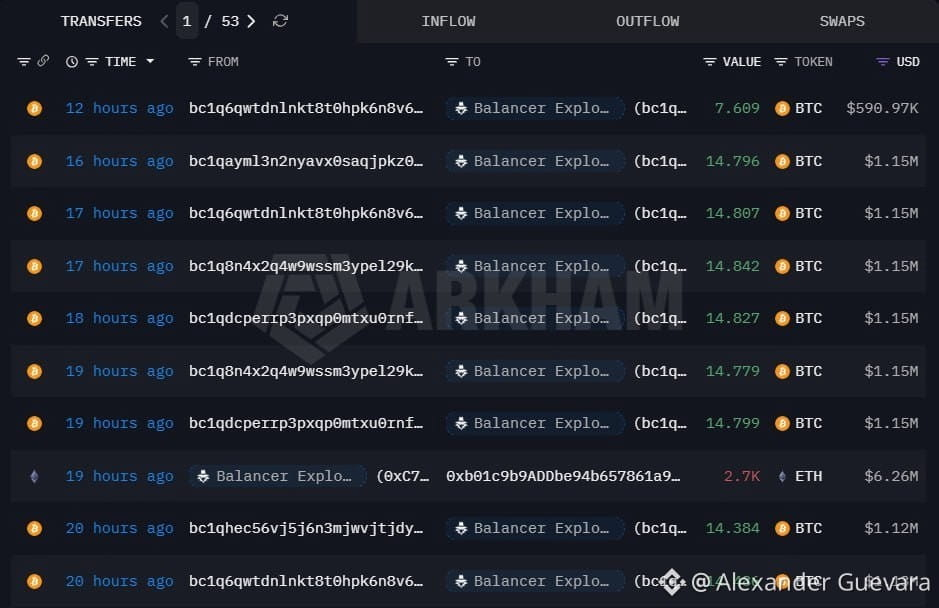
3
353

·
--
Big collapse in currency #MANTA They tried to buy it because after every strong fall there is no doubt that there will be an uprising #bitcoin #swap_crypto
Big collapse in currency #MANTA They tried to buy it because after every strong fall there is no doubt that there will be an uprising #bitcoin #swap_crypto
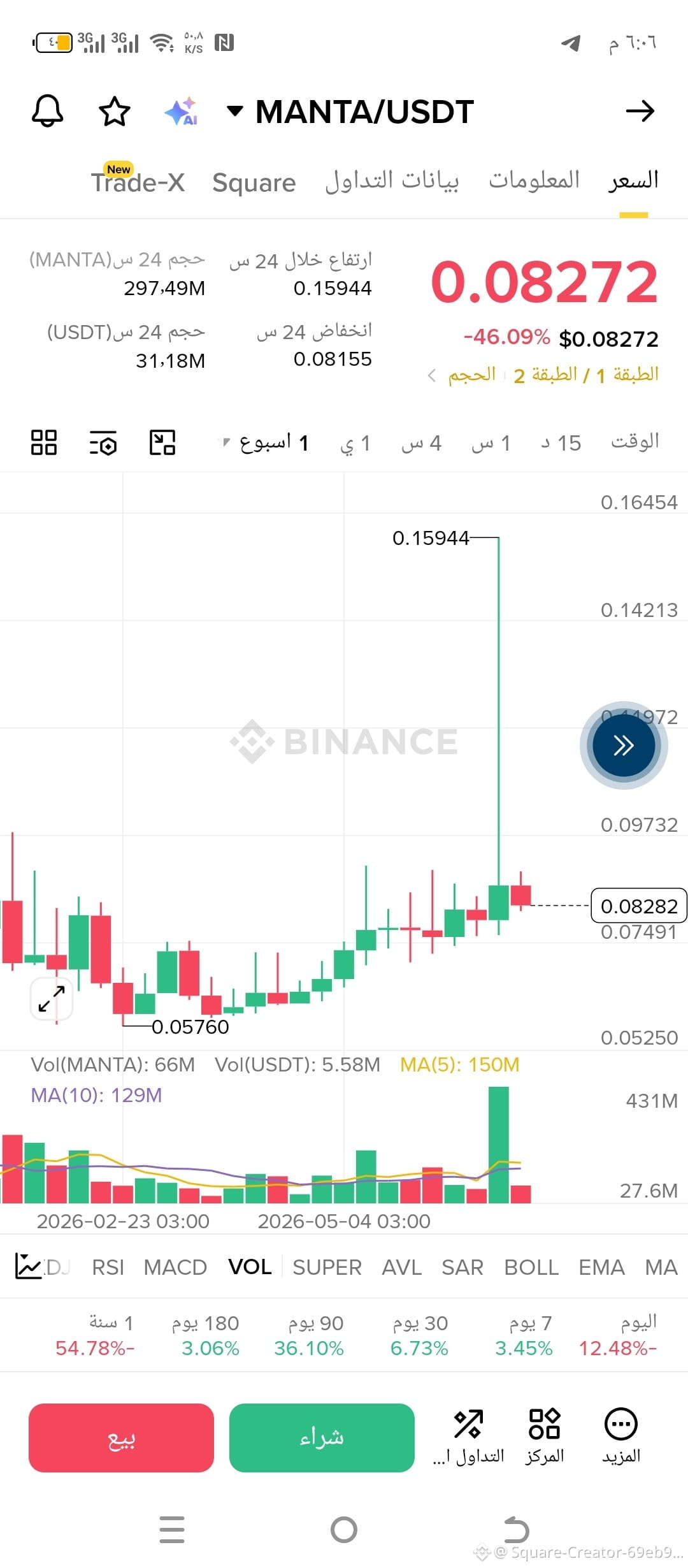
194
Log in to explore more content
Join global crypto users on Binance Square
⚡️ Get latest and useful information about crypto.
💬 Trusted by the world’s largest crypto exchange.
👍 Discover real insights from verified creators.
Email / Phone number
Trending Topics
1
#FedRateWatch
423,096 views
2,338 Discussing
2
#BitcoinSlidesTo$76000
10,634 views
94 Discussing
3
#BitcoinReboundsTo$79K
57,291 views
387 Discussing
4
#StrategyMarketCapPassesFord
22,498 views
534 Discussing
5
#ClarityActOddsHalveOnPolymarket
25,693 views
430 Discussing
6
#US30YTreasuryYieldTops5.40%
19,722 views
309 Discussing
7
#BessentEndorsesFinalClarityActDraft
42,573 views
659 Discussing
8
#ZamaOpens16ConfidentialMorphoVaults
14,761 views
318 Discussing
9
#USDCOnChainVolumeTops$100Trillion
2,247 views
47 Discussing
10
#BitcoinSpotETFsNetInflow$160M
2,878 views
100 Discussing