
#mara
mara
153,068 views
682 Discussing
Hot
Latest


·
--
Bearish
Partly True
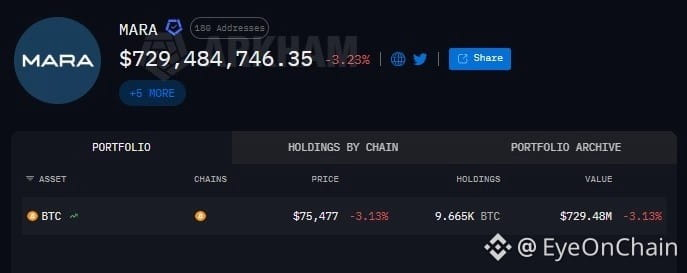
MARA added another $98.6M in $BTC .
Bitcoin miner #MARA holdings just bought another 1,292 BTC, worth around $98.64M, through FalconX about 9 hours ago.
That brings MARA’s total holdings to roughly 9,665 #BTC , currently worth around $729.48M. A nearly $100M BTC buy from a major miner is definitely worth keeping an eye on.
{future}(BTCUSDT)
{spot}(BTCUSDT)
MARA added another $98.6M in $BTC .
Bitcoin miner #MARA holdings just bought another 1,292 BTC, worth around $98.64M, through FalconX about 9 hours ago.
That brings MARA’s total holdings to roughly 9,665 #BTC , currently worth around $729.48M. A nearly $100M BTC buy from a major miner is definitely worth keeping an eye on.
Bitcoin miner #MARA holdings just bought another 1,292 BTC, worth around $98.64M, through FalconX about 9 hours ago.
That brings MARA’s total holdings to roughly 9,665 #BTC , currently worth around $729.48M. A nearly $100M BTC buy from a major miner is definitely worth keeping an eye on.

1
743

·
--
MARA just bought 1,292 BTC, worth nearly $100 million, and directly dumped it in.
Miners hoard coins, and they never look at bearish signals. With electricity and hashing power in hand, this is a bet on supply squeeze after the halving.
On-chain coins are moving from exchanges to mining pools, and the motivation to sell off in the short term is reduced even further.
$BTC #MARA #old veteran
MARA just bought 1,292 BTC, worth nearly $100 million, and directly dumped it in.
Miners hoard coins, and they never look at bearish signals. With electricity and hashing power in hand, this is a bet on supply squeeze after the halving.
On-chain coins are moving from exchanges to mining pools, and the motivation to sell off in the short term is reduced even further.
$BTC #MARA #old veteran
Miners hoard coins, and they never look at bearish signals. With electricity and hashing power in hand, this is a bet on supply squeeze after the halving.
On-chain coins are moving from exchanges to mining pools, and the motivation to sell off in the short term is reduced even further.
$BTC #MARA #old veteran

36

MARA is at the bottom in trading volume; holding short to 0
No talking—straight to the analysis.
💥 MARA #MARA 【Main】
Currently 11.1400, 24h change -6.86%
24h trading value is only $369k—the worst in the whole market
→ Trading volume shrank by 42.2%; bulls have lost their confidence—continue holding short until it reaches 0
Don’t chase rebounds; signs of a weak market
Place short order at 13.3680, risk control line at 14.7048
These are also good opportunities to short:
····
BTR
Current 0.049940, 24h change -0.16%
Entry timing: 0.059928—place a short order; set stop-loss at 10% (0.065921)
····
ACE
Current 0.150910, 24h change -0.68%
Entry timing: 0.181092—place a short order; set stop-loss at 10% (0.199201)
····
⚠️ Small-cap trial; use strict stop-loss—don’t make trades without risk control
#RiskControl
MARA is at the bottom in trading volume; holding short to 0
No talking—straight to the analysis.
💥 MARA #MARA 【Main】
Currently 11.1400, 24h change -6.86%
24h trading value is only $369k—the worst in the whole market
→ Trading volume shrank by 42.2%; bulls have lost their confidence—continue holding short until it reaches 0
Don’t chase rebounds; signs of a weak market
Place short order at 13.3680, risk control line at 14.7048
These are also good opportunities to short:
····
BTR
Current 0.049940, 24h change -0.16%
Entry timing: 0.059928—place a short order; set stop-loss at 10% (0.065921)
····
ACE
Current 0.150910, 24h change -0.68%
Entry timing: 0.181092—place a short order; set stop-loss at 10% (0.199201)
····
⚠️ Small-cap trial; use strict stop-loss—don’t make trades without risk control
#RiskControl
No talking—straight to the analysis.
💥 MARA #MARA 【Main】
Currently 11.1400, 24h change -6.86%
24h trading value is only $369k—the worst in the whole market
→ Trading volume shrank by 42.2%; bulls have lost their confidence—continue holding short until it reaches 0
Don’t chase rebounds; signs of a weak market
Place short order at 13.3680, risk control line at 14.7048
These are also good opportunities to short:
····
BTR
Current 0.049940, 24h change -0.16%
Entry timing: 0.059928—place a short order; set stop-loss at 10% (0.065921)
····
ACE
Current 0.150910, 24h change -0.68%
Entry timing: 0.181092—place a short order; set stop-loss at 10% (0.199201)
····
⚠️ Small-cap trial; use strict stop-loss—don’t make trades without risk control
#RiskControl
10
Trading volume has been steadily shrinking, and short positions should be held; keep watching until 0
First, the conclusion: short.
🔻 $MARA #MARA 【Main】
Current price $11.4900, 24h change -3.85%
24h trading volume is only $211,000—last in the whole market
→ Continuous contraction of volume by 27.4%; funds are withdrawing—keep holding the short until it reaches 0
If it just moves sideways without rising, that’s weakness
You can place a short limit at $13.7880, with stop-loss at $15.1668
These are also good times to short:
$ARK
Current $0.168100, 24h change -2.49%
Entry timing: place a short order at $0.201720, set stop-loss at 10% ($0.221892)
$AKE
Current $0.015603, 24h change +5.58%
Entry timing: place a short order at $0.018724, set stop-loss at 10% ($0.020596)
⚠️ Small capital—test carefully, use strict stop-loss, and don’t trade without risk control
#LiveTradeLog
Trading volume has been steadily shrinking, and short positions should be held; keep watching until 0
First, the conclusion: short.
🔻 $MARA #MARA 【Main】
Current price $11.4900, 24h change -3.85%
24h trading volume is only $211,000—last in the whole market
→ Continuous contraction of volume by 27.4%; funds are withdrawing—keep holding the short until it reaches 0
If it just moves sideways without rising, that’s weakness
You can place a short limit at $13.7880, with stop-loss at $15.1668
These are also good times to short:
$ARK
Current $0.168100, 24h change -2.49%
Entry timing: place a short order at $0.201720, set stop-loss at 10% ($0.221892)
$AKE
Current $0.015603, 24h change +5.58%
Entry timing: place a short order at $0.018724, set stop-loss at 10% ($0.020596)
⚠️ Small capital—test carefully, use strict stop-loss, and don’t trade without risk control
#LiveTradeLog
First, the conclusion: short.
🔻 $MARA #MARA 【Main】
Current price $11.4900, 24h change -3.85%
24h trading volume is only $211,000—last in the whole market
→ Continuous contraction of volume by 27.4%; funds are withdrawing—keep holding the short until it reaches 0
If it just moves sideways without rising, that’s weakness
You can place a short limit at $13.7880, with stop-loss at $15.1668
These are also good times to short:
$ARK
Current $0.168100, 24h change -2.49%
Entry timing: place a short order at $0.201720, set stop-loss at 10% ($0.221892)
$AKE
Current $0.015603, 24h change +5.58%
Entry timing: place a short order at $0.018724, set stop-loss at 10% ($0.020596)
⚠️ Small capital—test carefully, use strict stop-loss, and don’t trade without risk control
#LiveTradeLog
191

·
--
$MARA 24 hours down 4.271%, price 11.43, open interest 10741.07. The price is drifting lower, but OI hasn’t collapsed, which suggests this drop is being hard-held by positions—it’s not a liquidation-driven sudden crash.
Funding rate is 0, and neither side has paid—market sentiment is in a vacuum. Open interest is relatively heavy compared to the price, meaning every point of decline is consuming margin from leveraged long accounts. In this structure, as long as the downward speed doesn’t accelerate, there won’t be panic selling, but the slow grind will keep wearing down the long accounts until some threshold triggers a staggered liquidation.
My view is that the most likely path is continued slow bleeding lower until open interest starts to fall meaningfully—that’s the signal that longs can’t hold anymore. Going short now is essentially betting on this process of longs being slowly ground down.
The strongest counterargument is that BTC suddenly pumps higher and drags the price up, but right now there’s a lack of a trigger point. The second-order effect is that this kind of drifting-down pattern is most damaging to those using high leverage to bet on a rebound, because the cost is slowly eroded by the funding rate and the spread.
My trade plan: short direction, 3x leverage. Stop loss at 12.20 (recent minor high), take profit at 10.50. Position size: 10%. If BTC breaks above 73000 with volume, I’ll accept the loss on this trade.
Trading tags: #TradFi #链上美股 #MARA
Where do you think this thesis is most likely to be wrong?
$MARA 24 hours down 4.271%, price 11.43, open interest 10741.07. The price is drifting lower, but OI hasn’t collapsed, which suggests this drop is being hard-held by positions—it’s not a liquidation-driven sudden crash.
Funding rate is 0, and neither side has paid—market sentiment is in a vacuum. Open interest is relatively heavy compared to the price, meaning every point of decline is consuming margin from leveraged long accounts. In this structure, as long as the downward speed doesn’t accelerate, there won’t be panic selling, but the slow grind will keep wearing down the long accounts until some threshold triggers a staggered liquidation.
My view is that the most likely path is continued slow bleeding lower until open interest starts to fall meaningfully—that’s the signal that longs can’t hold anymore. Going short now is essentially betting on this process of longs being slowly ground down.
The strongest counterargument is that BTC suddenly pumps higher and drags the price up, but right now there’s a lack of a trigger point. The second-order effect is that this kind of drifting-down pattern is most damaging to those using high leverage to bet on a rebound, because the cost is slowly eroded by the funding rate and the spread.
My trade plan: short direction, 3x leverage. Stop loss at 12.20 (recent minor high), take profit at 10.50. Position size: 10%. If BTC breaks above 73000 with volume, I’ll accept the loss on this trade.
Trading tags: #TradFi #链上美股 #MARA
Where do you think this thesis is most likely to be wrong?
Funding rate is 0, and neither side has paid—market sentiment is in a vacuum. Open interest is relatively heavy compared to the price, meaning every point of decline is consuming margin from leveraged long accounts. In this structure, as long as the downward speed doesn’t accelerate, there won’t be panic selling, but the slow grind will keep wearing down the long accounts until some threshold triggers a staggered liquidation.
My view is that the most likely path is continued slow bleeding lower until open interest starts to fall meaningfully—that’s the signal that longs can’t hold anymore. Going short now is essentially betting on this process of longs being slowly ground down.
The strongest counterargument is that BTC suddenly pumps higher and drags the price up, but right now there’s a lack of a trigger point. The second-order effect is that this kind of drifting-down pattern is most damaging to those using high leverage to bet on a rebound, because the cost is slowly eroded by the funding rate and the spread.
My trade plan: short direction, 3x leverage. Stop loss at 12.20 (recent minor high), take profit at 10.50. Position size: 10%. If BTC breaks above 73000 with volume, I’ll accept the loss on this trade.
Trading tags: #TradFi #链上美股 #MARA
Where do you think this thesis is most likely to be wrong?
4
·
--
$MARA 24 hours down 4.27% to close at 11.43. The funding rate is 0, and the open interest is 10,741. Put these three sets of data together—the conclusion is that the market has no clear direction.
A zero funding rate means neither longs nor shorts have to pay the other, so there’s no obvious one-sided overcrowding. The price dips slightly, but open interest doesn’t collapse—this suggests there hasn’t been large-scale stop-outs or short chasing. This isn’t the structure of a trend starting; it’s more like the market is waiting for a signal.
My take: entering long or short right now is basically a guess. The risk-reward ratio isn’t favorable. Seasoned contract traders usually don’t go hard in an environment like this—they wait for price to pick a side on its own.
The counterpoint is: if <MARA> suddenly breaks above 12.0 on heavy volume and the funding rate turns positive, then the short thesis fails and you’d have to chase the long. But right now, I don’t see that happening.
Second-order effect: this kind of sideways range most exhausts retail traders’ patience who chase and kill—washing out the floating profit position (paper gains). Until a high-volume K-line appears and breaks the balance.
So the action is clear: stay on the sidelines. If the price breaks above 12.0 with volume, I’ll get on board for a long with 2x leverage, stop-loss at 11.7, take-profit at 12.8, and use 10% position size. If it breaks below the previous low at 11.2 and the funding rate turns negative, I’ll lightly short—stop-loss at 11.5, take-profit at 10.5. For now, I won’t move.
Trading tag: #TradFi #链上美股 #MARA
Where do you think this set of judgment is most likely to be wrong?
$MARA 24 hours down 4.27% to close at 11.43. The funding rate is 0, and the open interest is 10,741. Put these three sets of data together—the conclusion is that the market has no clear direction.
A zero funding rate means neither longs nor shorts have to pay the other, so there’s no obvious one-sided overcrowding. The price dips slightly, but open interest doesn’t collapse—this suggests there hasn’t been large-scale stop-outs or short chasing. This isn’t the structure of a trend starting; it’s more like the market is waiting for a signal.
My take: entering long or short right now is basically a guess. The risk-reward ratio isn’t favorable. Seasoned contract traders usually don’t go hard in an environment like this—they wait for price to pick a side on its own.
The counterpoint is: if <MARA> suddenly breaks above 12.0 on heavy volume and the funding rate turns positive, then the short thesis fails and you’d have to chase the long. But right now, I don’t see that happening.
Second-order effect: this kind of sideways range most exhausts retail traders’ patience who chase and kill—washing out the floating profit position (paper gains). Until a high-volume K-line appears and breaks the balance.
So the action is clear: stay on the sidelines. If the price breaks above 12.0 with volume, I’ll get on board for a long with 2x leverage, stop-loss at 11.7, take-profit at 12.8, and use 10% position size. If it breaks below the previous low at 11.2 and the funding rate turns negative, I’ll lightly short—stop-loss at 11.5, take-profit at 10.5. For now, I won’t move.
Trading tag: #TradFi #链上美股 #MARA
Where do you think this set of judgment is most likely to be wrong?
A zero funding rate means neither longs nor shorts have to pay the other, so there’s no obvious one-sided overcrowding. The price dips slightly, but open interest doesn’t collapse—this suggests there hasn’t been large-scale stop-outs or short chasing. This isn’t the structure of a trend starting; it’s more like the market is waiting for a signal.
My take: entering long or short right now is basically a guess. The risk-reward ratio isn’t favorable. Seasoned contract traders usually don’t go hard in an environment like this—they wait for price to pick a side on its own.
The counterpoint is: if <MARA> suddenly breaks above 12.0 on heavy volume and the funding rate turns positive, then the short thesis fails and you’d have to chase the long. But right now, I don’t see that happening.
Second-order effect: this kind of sideways range most exhausts retail traders’ patience who chase and kill—washing out the floating profit position (paper gains). Until a high-volume K-line appears and breaks the balance.
So the action is clear: stay on the sidelines. If the price breaks above 12.0 with volume, I’ll get on board for a long with 2x leverage, stop-loss at 11.7, take-profit at 12.8, and use 10% position size. If it breaks below the previous low at 11.2 and the funding rate turns negative, I’ll lightly short—stop-loss at 11.5, take-profit at 10.5. For now, I won’t move.
Trading tag: #TradFi #链上美股 #MARA
Where do you think this set of judgment is most likely to be wrong?
4

·
--
$MARA The latest open interest on Binance’ TradFi perpetual contracts is holding at 10,767.37 contracts. Combined with its current price of 11.97 and the past 24 hours’ drop of -2.126%, this open-interest structure reveals the market’s core dilemma right now: the funding rate has fallen to zero, leaving longs and shorts in a rare balance of agreeing on zero trading costs, yet the price is slowly bleeding.
(Fact) This is a single-signal judgment, and the core basis is only the combination of open interest and the funding rate. (Inference) A funding rate of zero means longs and shorts are not paying fees to each other at the moment, which typically appears in windows when the trend is unclear and both sides lack a strong directional consensus. However, the slight decline in price suggests that shorts have a small emotional edge, but far from having a decisive advantage. Longs might add modestly here to resist, while shorts lack confidence to launch a strong push—leading to open interest getting stuck in a stalemate while the price drifts downward. (View) I believe the current zero-fee + downward drift is a fragile equilibrium, easily broken by external macro variables, rather than a solid bottom structure.
The strongest counterevidence is this: if there is a clear macro tailwind—for example, market expectations for an interest rate cut by the Fed unexpectedly heat up, and risk-on sentiment rises collectively—this low-volatility equilibrium could be broken quickly. The price would then move away from the current zone with a rapid surge, and open interest would expand in sync. The first condition for the judgment to fail is that open interest rises sharply without the price clearly moving up; that would indicate that major capital is absorbing against sentiment, and the current equilibrium thesis may be wrong.
In terms of second-order effects, in this environment, the first to feel uncomfortable are short-term leveraged traders. With no large price swings and no arbitrage space in the funding rate, the costs of positions are relatively transparent—but the slow price erosion will wear down impatient longs. Market liquidity will shift toward other instruments with higher volatility.
My conclusion is: don’t touch it. The current equilibrium doesn’t provide clear odds. If you absolutely must participate, the aggressive strategy is to try going long on the short-term when the price holds above 12.00 and open interest increases noticeably—betting on the pulse after the balance is broken. The conservative strategy is to wait until the funding rate turns directional (into positive or negative territory) and the price breaks above that day’s high before following. The avoidance strategy is to stay completely on the sidelines until open interest or the funding rate provides a clear signal.
Trading tag: #TradFi #链上美股 #MARA
Where do you think this judgment is most likely to be wrong?
$MARA The latest open interest on Binance’ TradFi perpetual contracts is holding at 10,767.37 contracts. Combined with its current price of 11.97 and the past 24 hours’ drop of -2.126%, this open-interest structure reveals the market’s core dilemma right now: the funding rate has fallen to zero, leaving longs and shorts in a rare balance of agreeing on zero trading costs, yet the price is slowly bleeding.
(Fact) This is a single-signal judgment, and the core basis is only the combination of open interest and the funding rate. (Inference) A funding rate of zero means longs and shorts are not paying fees to each other at the moment, which typically appears in windows when the trend is unclear and both sides lack a strong directional consensus. However, the slight decline in price suggests that shorts have a small emotional edge, but far from having a decisive advantage. Longs might add modestly here to resist, while shorts lack confidence to launch a strong push—leading to open interest getting stuck in a stalemate while the price drifts downward. (View) I believe the current zero-fee + downward drift is a fragile equilibrium, easily broken by external macro variables, rather than a solid bottom structure.
The strongest counterevidence is this: if there is a clear macro tailwind—for example, market expectations for an interest rate cut by the Fed unexpectedly heat up, and risk-on sentiment rises collectively—this low-volatility equilibrium could be broken quickly. The price would then move away from the current zone with a rapid surge, and open interest would expand in sync. The first condition for the judgment to fail is that open interest rises sharply without the price clearly moving up; that would indicate that major capital is absorbing against sentiment, and the current equilibrium thesis may be wrong.
In terms of second-order effects, in this environment, the first to feel uncomfortable are short-term leveraged traders. With no large price swings and no arbitrage space in the funding rate, the costs of positions are relatively transparent—but the slow price erosion will wear down impatient longs. Market liquidity will shift toward other instruments with higher volatility.
My conclusion is: don’t touch it. The current equilibrium doesn’t provide clear odds. If you absolutely must participate, the aggressive strategy is to try going long on the short-term when the price holds above 12.00 and open interest increases noticeably—betting on the pulse after the balance is broken. The conservative strategy is to wait until the funding rate turns directional (into positive or negative territory) and the price breaks above that day’s high before following. The avoidance strategy is to stay completely on the sidelines until open interest or the funding rate provides a clear signal.
Trading tag: #TradFi #链上美股 #MARA
Where do you think this judgment is most likely to be wrong?
(Fact) This is a single-signal judgment, and the core basis is only the combination of open interest and the funding rate. (Inference) A funding rate of zero means longs and shorts are not paying fees to each other at the moment, which typically appears in windows when the trend is unclear and both sides lack a strong directional consensus. However, the slight decline in price suggests that shorts have a small emotional edge, but far from having a decisive advantage. Longs might add modestly here to resist, while shorts lack confidence to launch a strong push—leading to open interest getting stuck in a stalemate while the price drifts downward. (View) I believe the current zero-fee + downward drift is a fragile equilibrium, easily broken by external macro variables, rather than a solid bottom structure.
The strongest counterevidence is this: if there is a clear macro tailwind—for example, market expectations for an interest rate cut by the Fed unexpectedly heat up, and risk-on sentiment rises collectively—this low-volatility equilibrium could be broken quickly. The price would then move away from the current zone with a rapid surge, and open interest would expand in sync. The first condition for the judgment to fail is that open interest rises sharply without the price clearly moving up; that would indicate that major capital is absorbing against sentiment, and the current equilibrium thesis may be wrong.
In terms of second-order effects, in this environment, the first to feel uncomfortable are short-term leveraged traders. With no large price swings and no arbitrage space in the funding rate, the costs of positions are relatively transparent—but the slow price erosion will wear down impatient longs. Market liquidity will shift toward other instruments with higher volatility.
My conclusion is: don’t touch it. The current equilibrium doesn’t provide clear odds. If you absolutely must participate, the aggressive strategy is to try going long on the short-term when the price holds above 12.00 and open interest increases noticeably—betting on the pulse after the balance is broken. The conservative strategy is to wait until the funding rate turns directional (into positive or negative territory) and the price breaks above that day’s high before following. The avoidance strategy is to stay completely on the sidelines until open interest or the funding rate provides a clear signal.
Trading tag: #TradFi #链上美股 #MARA
Where do you think this judgment is most likely to be wrong?
15
·
--
$MARA is currently 11.97, down 2.126% over the past 24 hours. The contract data looks very clean: the funding rate is zero, and open interest is just above ten thousand.
A slightly down price paired with a neutral funding rate—this is everything I see today. It doesn’t feel like a faith-driven short pressuring the market; it feels more like longs are retreating, and shorts aren’t interested in opening new positions here either. Both forces are shrinking, leaving a directionless market.
Why is this happening? There’s no visible tradfi news to catalyze any direction. As an on-chain U.S. stock futures contract, the pricing of $MARA depends tightly on Bitcoin spot and overall risk-asset sentiment. When the macro environment lacks clear guidance, capital tends to stop taking positions rather than hard-pick a direction. The funding rate is zero, which means the cost of holding longs and the cost of holding shorts are both zero right now. Nobody has to pay anyone—this is itself a kind of stalemate.
The strongest counter-evidence is that if Bitcoin suddenly breaks out with strong volume, or if there’s positive news tied to mining costs, this balance will be broken immediately. A rapid price spike would force shorts to close, and the funding rate would quickly turn positive. My invalidation conditions are simple: the price holds above 11.97, and the funding rate stays consistently positive.
The second-order effect is that if mining stocks remain in this lukewarm state, crypto funds that are seeking beta will move to other targets faster—like ETFs or even more direct tokens. People holding the $MARA contract will bear the time cost.
So the action is clear: as long as the price hasn’t moved away from around 11.97 and there’s no clear positive/negative shift in the funding rate, I won’t touch it. A contract with no funding-rate advantage, no position heat, and low price volatility isn’t worth spending bullets on.
Aggressive scenario: if it breaks above 12.0 with volume and the funding rate turns positive, you could try a small long position to bet on a sentiment reversal. Conservative scenario: with the current price and funding-rate setup, waiting is the best choice. Avoid scenario: if it drifts down and breaks below 11.90 and the funding rate turns negative, that means shorts start to dominate—stay away for now.
Contrarian take: the market treats mining stocks as a high-beta toy for Bitcoin. But when that beta characteristic temporarily fails due to liquidity drying up, it turns into the most boring asset—there’s no appeal even for shorting it.
Trading tag: #TradFi #链上美股 #MARA
Where do you think this thesis is most likely to be wrong?
$MARA is currently 11.97, down 2.126% over the past 24 hours. The contract data looks very clean: the funding rate is zero, and open interest is just above ten thousand.
A slightly down price paired with a neutral funding rate—this is everything I see today. It doesn’t feel like a faith-driven short pressuring the market; it feels more like longs are retreating, and shorts aren’t interested in opening new positions here either. Both forces are shrinking, leaving a directionless market.
Why is this happening? There’s no visible tradfi news to catalyze any direction. As an on-chain U.S. stock futures contract, the pricing of $MARA depends tightly on Bitcoin spot and overall risk-asset sentiment. When the macro environment lacks clear guidance, capital tends to stop taking positions rather than hard-pick a direction. The funding rate is zero, which means the cost of holding longs and the cost of holding shorts are both zero right now. Nobody has to pay anyone—this is itself a kind of stalemate.
The strongest counter-evidence is that if Bitcoin suddenly breaks out with strong volume, or if there’s positive news tied to mining costs, this balance will be broken immediately. A rapid price spike would force shorts to close, and the funding rate would quickly turn positive. My invalidation conditions are simple: the price holds above 11.97, and the funding rate stays consistently positive.
The second-order effect is that if mining stocks remain in this lukewarm state, crypto funds that are seeking beta will move to other targets faster—like ETFs or even more direct tokens. People holding the $MARA contract will bear the time cost.
So the action is clear: as long as the price hasn’t moved away from around 11.97 and there’s no clear positive/negative shift in the funding rate, I won’t touch it. A contract with no funding-rate advantage, no position heat, and low price volatility isn’t worth spending bullets on.
Aggressive scenario: if it breaks above 12.0 with volume and the funding rate turns positive, you could try a small long position to bet on a sentiment reversal. Conservative scenario: with the current price and funding-rate setup, waiting is the best choice. Avoid scenario: if it drifts down and breaks below 11.90 and the funding rate turns negative, that means shorts start to dominate—stay away for now.
Contrarian take: the market treats mining stocks as a high-beta toy for Bitcoin. But when that beta characteristic temporarily fails due to liquidity drying up, it turns into the most boring asset—there’s no appeal even for shorting it.
Trading tag: #TradFi #链上美股 #MARA
Where do you think this thesis is most likely to be wrong?
A slightly down price paired with a neutral funding rate—this is everything I see today. It doesn’t feel like a faith-driven short pressuring the market; it feels more like longs are retreating, and shorts aren’t interested in opening new positions here either. Both forces are shrinking, leaving a directionless market.
Why is this happening? There’s no visible tradfi news to catalyze any direction. As an on-chain U.S. stock futures contract, the pricing of $MARA depends tightly on Bitcoin spot and overall risk-asset sentiment. When the macro environment lacks clear guidance, capital tends to stop taking positions rather than hard-pick a direction. The funding rate is zero, which means the cost of holding longs and the cost of holding shorts are both zero right now. Nobody has to pay anyone—this is itself a kind of stalemate.
The strongest counter-evidence is that if Bitcoin suddenly breaks out with strong volume, or if there’s positive news tied to mining costs, this balance will be broken immediately. A rapid price spike would force shorts to close, and the funding rate would quickly turn positive. My invalidation conditions are simple: the price holds above 11.97, and the funding rate stays consistently positive.
The second-order effect is that if mining stocks remain in this lukewarm state, crypto funds that are seeking beta will move to other targets faster—like ETFs or even more direct tokens. People holding the $MARA contract will bear the time cost.
So the action is clear: as long as the price hasn’t moved away from around 11.97 and there’s no clear positive/negative shift in the funding rate, I won’t touch it. A contract with no funding-rate advantage, no position heat, and low price volatility isn’t worth spending bullets on.
Aggressive scenario: if it breaks above 12.0 with volume and the funding rate turns positive, you could try a small long position to bet on a sentiment reversal. Conservative scenario: with the current price and funding-rate setup, waiting is the best choice. Avoid scenario: if it drifts down and breaks below 11.90 and the funding rate turns negative, that means shorts start to dominate—stay away for now.
Contrarian take: the market treats mining stocks as a high-beta toy for Bitcoin. But when that beta characteristic temporarily fails due to liquidity drying up, it turns into the most boring asset—there’s no appeal even for shorting it.
Trading tag: #TradFi #链上美股 #MARA
Where do you think this thesis is most likely to be wrong?
89

·
--
$MARA 24 hours up 4.188%, with open interest exceeding 10,000 contracts. The political-level resonance between U.S. stock mining-machine stocks and the crypto market is stronger than most retail investors can perceive.
In an election year, Bitcoin mining’s energy policy and regulatory stances directly affect how the market values compliant hash power. Current open interest is 10,866.35 contracts; the funding rate is zero. This indicates that longs and shorts are temporarily in balance, and the frenzy of leveraged trading has temporarily ebbed. The rise is mainly driven by spot or low-leverage positions, not by short-term speculative overcrowding. This stands in sharp contrast to the extreme funding seen in some pure “sh*tcoin” contracts.
If the political narrative continues, $MARA, as a U.S.-listed mining company, could become a proxy target for traditional funds betting on crypto policy. The risk is that policy execution comes in below expectations, or that a sharp pullback in the Bitcoin price drags down its valuation. If Bitcoin cannot stay above the current key support level, $MARA’s share price and contract price will face synchronized downside pressure.
This is not a place to chase price. I’ll wait for Bitcoin’s weekly close to hold steady, or for the U.S. regulators to issue clearer positive signals, then I’ll initiate a starter position in $MARA on the pullback. Spot holders can continue to observe; derivatives traders should avoid high leverage and wait for directional clarity.
Trading tag: #TradFi #链上美股 #MARA
Where do you think this thesis is most likely to be wrong?
$MARA 24 hours up 4.188%, with open interest exceeding 10,000 contracts. The political-level resonance between U.S. stock mining-machine stocks and the crypto market is stronger than most retail investors can perceive.
In an election year, Bitcoin mining’s energy policy and regulatory stances directly affect how the market values compliant hash power. Current open interest is 10,866.35 contracts; the funding rate is zero. This indicates that longs and shorts are temporarily in balance, and the frenzy of leveraged trading has temporarily ebbed. The rise is mainly driven by spot or low-leverage positions, not by short-term speculative overcrowding. This stands in sharp contrast to the extreme funding seen in some pure “sh*tcoin” contracts.
If the political narrative continues, $MARA , as a U.S.-listed mining company, could become a proxy target for traditional funds betting on crypto policy. The risk is that policy execution comes in below expectations, or that a sharp pullback in the Bitcoin price drags down its valuation. If Bitcoin cannot stay above the current key support level, $MARA ’s share price and contract price will face synchronized downside pressure.
This is not a place to chase price. I’ll wait for Bitcoin’s weekly close to hold steady, or for the U.S. regulators to issue clearer positive signals, then I’ll initiate a starter position in $MARA on the pullback. Spot holders can continue to observe; derivatives traders should avoid high leverage and wait for directional clarity.
Trading tag: #TradFi #链上美股 #MARA
Where do you think this thesis is most likely to be wrong?
In an election year, Bitcoin mining’s energy policy and regulatory stances directly affect how the market values compliant hash power. Current open interest is 10,866.35 contracts; the funding rate is zero. This indicates that longs and shorts are temporarily in balance, and the frenzy of leveraged trading has temporarily ebbed. The rise is mainly driven by spot or low-leverage positions, not by short-term speculative overcrowding. This stands in sharp contrast to the extreme funding seen in some pure “sh*tcoin” contracts.
If the political narrative continues, $MARA , as a U.S.-listed mining company, could become a proxy target for traditional funds betting on crypto policy. The risk is that policy execution comes in below expectations, or that a sharp pullback in the Bitcoin price drags down its valuation. If Bitcoin cannot stay above the current key support level, $MARA ’s share price and contract price will face synchronized downside pressure.
This is not a place to chase price. I’ll wait for Bitcoin’s weekly close to hold steady, or for the U.S. regulators to issue clearer positive signals, then I’ll initiate a starter position in $MARA on the pullback. Spot holders can continue to observe; derivatives traders should avoid high leverage and wait for directional clarity.
Trading tag: #TradFi #链上美股 #MARA
Where do you think this thesis is most likely to be wrong?
10
·
--
$MARA 24 hours上涨 4.188%, the price is 11.94, and political policy expectations are directly moving how mining stocks are priced.
A funding rate of zero suggests that neither the long nor short side is paying a cost; the rise and fall is driven purely by spot action or policy news, not by emotion-driven squeezes in the derivatives market. This rebound is likely betting on regulatory loosening or fiscal support—such as tax incentives or a tilt in energy policy—so that the marginal improvement shows up in the mining cost structure.
But the counter-evidence is strong: the U.S. policy shift is extremely fast, and any negative remarks about cryptocurrencies could cause the entire upside to evaporate overnight. Mining stocks are highly sensitive to political winds; it’s normal for expectations to already be priced in before the good news fully lands.
Next, watch whether on-chain funds follow through. If mining stocks keep strengthening but the Bitcoin price doesn’t move, it means funds are only engaging in policy games in traditional markets, with no inflow into crypto-native assets. This would create sector fragmentation, and people chasing mining stocks could get trapped in a standalone rally.
The invalidation conditions are simple: if the $MARA price breaks below 11.00, or if within 24 hours it turns into a decline, the policy-positive logic is falsified—exit immediately. Don’t chase at the current level. Wait for a pullback toward around 11.5 to try a long, with a stop-loss at 10.8. Treat this as fast in, fast out political trading; don’t apply long-term logic.
Trading tag: #TradFi #链上美股 #MARA
Where do you think this set of judgments is most likely to be wrong?
$MARA 24 hours上涨 4.188%, the price is 11.94, and political policy expectations are directly moving how mining stocks are priced.
A funding rate of zero suggests that neither the long nor short side is paying a cost; the rise and fall is driven purely by spot action or policy news, not by emotion-driven squeezes in the derivatives market. This rebound is likely betting on regulatory loosening or fiscal support—such as tax incentives or a tilt in energy policy—so that the marginal improvement shows up in the mining cost structure.
But the counter-evidence is strong: the U.S. policy shift is extremely fast, and any negative remarks about cryptocurrencies could cause the entire upside to evaporate overnight. Mining stocks are highly sensitive to political winds; it’s normal for expectations to already be priced in before the good news fully lands.
Next, watch whether on-chain funds follow through. If mining stocks keep strengthening but the Bitcoin price doesn’t move, it means funds are only engaging in policy games in traditional markets, with no inflow into crypto-native assets. This would create sector fragmentation, and people chasing mining stocks could get trapped in a standalone rally.
The invalidation conditions are simple: if the $MARA price breaks below 11.00, or if within 24 hours it turns into a decline, the policy-positive logic is falsified—exit immediately. Don’t chase at the current level. Wait for a pullback toward around 11.5 to try a long, with a stop-loss at 10.8. Treat this as fast in, fast out political trading; don’t apply long-term logic.
Trading tag: #TradFi #链上美股 #MARA
Where do you think this set of judgments is most likely to be wrong?
A funding rate of zero suggests that neither the long nor short side is paying a cost; the rise and fall is driven purely by spot action or policy news, not by emotion-driven squeezes in the derivatives market. This rebound is likely betting on regulatory loosening or fiscal support—such as tax incentives or a tilt in energy policy—so that the marginal improvement shows up in the mining cost structure.
But the counter-evidence is strong: the U.S. policy shift is extremely fast, and any negative remarks about cryptocurrencies could cause the entire upside to evaporate overnight. Mining stocks are highly sensitive to political winds; it’s normal for expectations to already be priced in before the good news fully lands.
Next, watch whether on-chain funds follow through. If mining stocks keep strengthening but the Bitcoin price doesn’t move, it means funds are only engaging in policy games in traditional markets, with no inflow into crypto-native assets. This would create sector fragmentation, and people chasing mining stocks could get trapped in a standalone rally.
The invalidation conditions are simple: if the $MARA price breaks below 11.00, or if within 24 hours it turns into a decline, the policy-positive logic is falsified—exit immediately. Don’t chase at the current level. Wait for a pullback toward around 11.5 to try a long, with a stop-loss at 10.8. Treat this as fast in, fast out political trading; don’t apply long-term logic.
Trading tag: #TradFi #链上美股 #MARA
Where do you think this set of judgments is most likely to be wrong?
5
·
--
$MARA Yesterday rose 4.188%, and the funding rate was zero. At this level, longs and shorts aren’t fighting it out—price is rising mainly on external narrative.
Political direction is the driver. Signals from the Trump team’s energy policy about BTC mining stocks are a direct positive. The market has started pricing in expectations that traditional industries will be integrated into the crypto ecosystem. As the most direct bridgehead, Bitcoin mining companies draw liquidity here. A position size of 10,866 lots isn’t crowded; the trading volume of 700,000 indicates active turnover. Price is stuck around the $12 level, and a breakout here requires fresh policy catalysts.
Counterpoint: If electricity-price policies keep changing, or if the Fed turns more hawkish and clamps down on risk appetite, this pool of capital betting on the policy will run faster than anyone.
Next, watch how traditional funds adjust their allocations. If they begin moving crypto-related stocks from speculation into long-term positioning, the valuation anchor of $MARA could be repriced. But the cost side could retaliate at any time—power price volatility is the key.
As long as price doesn’t break below $11.5, the logic of the policy premium remains intact. If it breaks, it means the market has exhausted its patience for the expectations. Currently, you can test in batches; the stop-loss should be placed just below $11.5.
Trading tag: #TradFi #链上美股 #MARA
Where do you think this set of assumptions is most likely to be wrong?
$MARA Yesterday rose 4.188%, and the funding rate was zero. At this level, longs and shorts aren’t fighting it out—price is rising mainly on external narrative.
Political direction is the driver. Signals from the Trump team’s energy policy about BTC mining stocks are a direct positive. The market has started pricing in expectations that traditional industries will be integrated into the crypto ecosystem. As the most direct bridgehead, Bitcoin mining companies draw liquidity here. A position size of 10,866 lots isn’t crowded; the trading volume of 700,000 indicates active turnover. Price is stuck around the $12 level, and a breakout here requires fresh policy catalysts.
Counterpoint: If electricity-price policies keep changing, or if the Fed turns more hawkish and clamps down on risk appetite, this pool of capital betting on the policy will run faster than anyone.
Next, watch how traditional funds adjust their allocations. If they begin moving crypto-related stocks from speculation into long-term positioning, the valuation anchor of $MARA could be repriced. But the cost side could retaliate at any time—power price volatility is the key.
As long as price doesn’t break below $11.5, the logic of the policy premium remains intact. If it breaks, it means the market has exhausted its patience for the expectations. Currently, you can test in batches; the stop-loss should be placed just below $11.5.
Trading tag: #TradFi #链上美股 #MARA
Where do you think this set of assumptions is most likely to be wrong?
Political direction is the driver. Signals from the Trump team’s energy policy about BTC mining stocks are a direct positive. The market has started pricing in expectations that traditional industries will be integrated into the crypto ecosystem. As the most direct bridgehead, Bitcoin mining companies draw liquidity here. A position size of 10,866 lots isn’t crowded; the trading volume of 700,000 indicates active turnover. Price is stuck around the $12 level, and a breakout here requires fresh policy catalysts.
Counterpoint: If electricity-price policies keep changing, or if the Fed turns more hawkish and clamps down on risk appetite, this pool of capital betting on the policy will run faster than anyone.
Next, watch how traditional funds adjust their allocations. If they begin moving crypto-related stocks from speculation into long-term positioning, the valuation anchor of $MARA could be repriced. But the cost side could retaliate at any time—power price volatility is the key.
As long as price doesn’t break below $11.5, the logic of the policy premium remains intact. If it breaks, it means the market has exhausted its patience for the expectations. Currently, you can test in batches; the stop-loss should be placed just below $11.5.
Trading tag: #TradFi #链上美股 #MARA
Where do you think this set of assumptions is most likely to be wrong?
5

$MARA LONG
Will buyers be able to develop an upward move after holding local levels? The bullish sentiment seems quite justified as long as initiative remains with long-position participants. If the trading pace holds, the asset is likely to gradually work through the set targets without any sharp surprises.
➡️Entry point: 12.24
🎯Target 1: 12.35379513 (+0.93%)
🎯Target 2: 12.54759026 (+2.51%)
🎯Target 3: 12.83828296 (+4.89%)
⛔️Stop: 11.8693073 (-3.03%)
⚠️ This is not financial advice. Trade at your own risk. DYOR.
#MARA #TradeStories #MostRecentTrade 📈
$MARA
$MARA LONG
Will buyers be able to develop an upward move after holding local levels? The bullish sentiment seems quite justified as long as initiative remains with long-position participants. If the trading pace holds, the asset is likely to gradually work through the set targets without any sharp surprises.
➡️Entry point: 12.24
🎯Target 1: 12.35379513 (+0.93%)
🎯Target 2: 12.54759026 (+2.51%)
🎯Target 3: 12.83828296 (+4.89%)
⛔️Stop: 11.8693073 (-3.03%)
⚠️ This is not financial advice. Trade at your own risk. DYOR.
#MARA #TradeStories #MostRecentTrade 📈
$MARA
Will buyers be able to develop an upward move after holding local levels? The bullish sentiment seems quite justified as long as initiative remains with long-position participants. If the trading pace holds, the asset is likely to gradually work through the set targets without any sharp surprises.
➡️Entry point: 12.24
🎯Target 1: 12.35379513 (+0.93%)
🎯Target 2: 12.54759026 (+2.51%)
🎯Target 3: 12.83828296 (+4.89%)
⛔️Stop: 11.8693073 (-3.03%)
⚠️ This is not financial advice. Trade at your own risk. DYOR.
#MARA #TradeStories #MostRecentTrade 📈
$MARA
5

·
--
Bullish
$MARA
{future}(MARAUSDT)
LONG TRADE SIGNAL
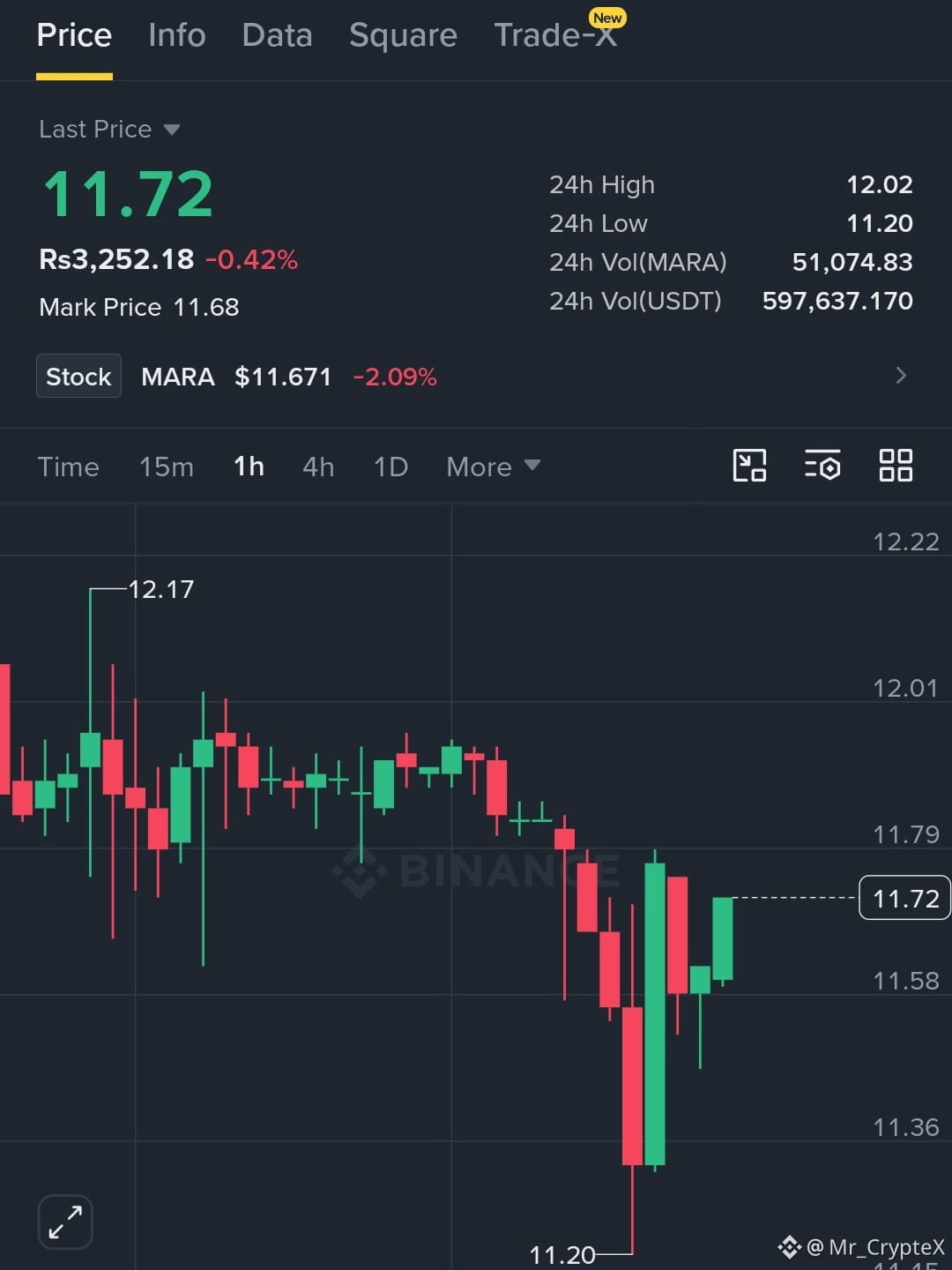
$MARA is holding the 11.20–11.40 support zone after the recent pullback. The candles are showing buyers stepping in near the lower range, and a reclaim of 11.80 could bring fresh momentum toward the 12.00 resistance.
Entry Zone: 11.55–11.75
TP1: 12.00
TP2: 12.20
#MARA #StockTrading
$MARA
LONG TRADE SIGNAL
$MARA is holding the 11.20–11.40 support zone after the recent pullback. The candles are showing buyers stepping in near the lower range, and a reclaim of 11.80 could bring fresh momentum toward the 12.00 resistance.
Entry Zone: 11.55–11.75
TP1: 12.00
TP2: 12.20
#MARA #StockTrading
LONG TRADE SIGNAL
$MARA is holding the 11.20–11.40 support zone after the recent pullback. The candles are showing buyers stepping in near the lower range, and a reclaim of 11.80 could bring fresh momentum toward the 12.00 resistance.
Entry Zone: 11.55–11.75
TP1: 12.00
TP2: 12.20
#MARA #StockTrading
1
12

·
--
The old dog glanced at the data: in the past 24 hours, MARA surged 7.944%, pushing the price to 12.23, and contract open interest also climbed to 10985.54. It’s not exactly a wild rally, but coupled with the funding rate of 0.00000000, it’s got some interesting implications.
You need to understand that a zero funding rate means neither longs nor shorts have to pay the other right now. By the iron law, a funding rate above zero indicates crowded longs; below zero indicates shorts being forced to absorb pressure. At this point, it suggests the leveraged market’s sentiment has just come out of the earlier imbalance. In this MARA upswing, I didn’t see the corresponding shorts being pressured into paying high funding rates to hold their positions. In other words, the selling pressure behind the rise likely isn’t driven by contract-market short liquidations; it looks more like spot buying pushing the price upward. Open interest rises in sync, while the funding rate stays flat—this indicates that among the new entrants, there still aren’t that many people using contracts with leverage to chase the rally. More likely, cautious spot buying and a wait-and-see mood are the main factors.
This is somewhat different from the logic I had in mind for a semiconductor/AI-driven move. MARA’s main business is Bitcoin mining machine hardware; its link to chip demand is relatively limited. This rally feels more like a lagging follow-through after the broader Bitcoin market starts to recover, rather than an “alpha” move within the sector.
So my take is: there are signals of short-term strength for MARA, but the driving logic isn’t strong enough. Funding rate neutrality plus spot-led momentum makes this rally look a bit “well-behaved,” without the kind of frenzy you see from heavy leveraged positions. The strongest counterevidence is this: if Bitcoin’s price pulls back next, a highly correlated asset like MARA will likely fall harder. And with the current zero-funding-rate environment, the contract market isn’t providing any additional cushion. The second-order effect is that if the price keeps going sideways or dips slightly, these new spot buyers become the most unstable chips. Their costs are concentrated around 12.2; breaking below that level could trigger stop-losses.
My action is very clear: I’ll add to the position, but only after the price confirms and holds steady in the current range. Specifically, if MARA can continue consolidating above 12.2 and digest the sell pressure, I’ll add a bit more on the next pullback. But if it drops directly below 12.2 at this current price, I’ll switch to watching from the sidelines. I oppose chasing highs right now, because in a zero-funding-rate environment there’s no forced-short squeeze fuel, so the sustainability of the uptrend is questionable. My stance on position size is cautious—testing with a light allocation only, never betting heavily on a one-way move.
Trading tag: #BinanceFutures #TradFi #USDⓈM #MARA #MARAUSDT $MARA
The old dog glanced at the data: in the past 24 hours, MARA surged 7.944%, pushing the price to 12.23, and contract open interest also climbed to 10985.54. It’s not exactly a wild rally, but coupled with the funding rate of 0.00000000, it’s got some interesting implications.
You need to understand that a zero funding rate means neither longs nor shorts have to pay the other right now. By the iron law, a funding rate above zero indicates crowded longs; below zero indicates shorts being forced to absorb pressure. At this point, it suggests the leveraged market’s sentiment has just come out of the earlier imbalance. In this MARA upswing, I didn’t see the corresponding shorts being pressured into paying high funding rates to hold their positions. In other words, the selling pressure behind the rise likely isn’t driven by contract-market short liquidations; it looks more like spot buying pushing the price upward. Open interest rises in sync, while the funding rate stays flat—this indicates that among the new entrants, there still aren’t that many people using contracts with leverage to chase the rally. More likely, cautious spot buying and a wait-and-see mood are the main factors.
This is somewhat different from the logic I had in mind for a semiconductor/AI-driven move. MARA’s main business is Bitcoin mining machine hardware; its link to chip demand is relatively limited. This rally feels more like a lagging follow-through after the broader Bitcoin market starts to recover, rather than an “alpha” move within the sector.
So my take is: there are signals of short-term strength for MARA, but the driving logic isn’t strong enough. Funding rate neutrality plus spot-led momentum makes this rally look a bit “well-behaved,” without the kind of frenzy you see from heavy leveraged positions. The strongest counterevidence is this: if Bitcoin’s price pulls back next, a highly correlated asset like MARA will likely fall harder. And with the current zero-funding-rate environment, the contract market isn’t providing any additional cushion. The second-order effect is that if the price keeps going sideways or dips slightly, these new spot buyers become the most unstable chips. Their costs are concentrated around 12.2; breaking below that level could trigger stop-losses.
My action is very clear: I’ll add to the position, but only after the price confirms and holds steady in the current range. Specifically, if MARA can continue consolidating above 12.2 and digest the sell pressure, I’ll add a bit more on the next pullback. But if it drops directly below 12.2 at this current price, I’ll switch to watching from the sidelines. I oppose chasing highs right now, because in a zero-funding-rate environment there’s no forced-short squeeze fuel, so the sustainability of the uptrend is questionable. My stance on position size is cautious—testing with a light allocation only, never betting heavily on a one-way move.
Trading tag: #BinanceFutures #TradFi #USDⓈM #MARA #MARAUSDT $MARA
You need to understand that a zero funding rate means neither longs nor shorts have to pay the other right now. By the iron law, a funding rate above zero indicates crowded longs; below zero indicates shorts being forced to absorb pressure. At this point, it suggests the leveraged market’s sentiment has just come out of the earlier imbalance. In this MARA upswing, I didn’t see the corresponding shorts being pressured into paying high funding rates to hold their positions. In other words, the selling pressure behind the rise likely isn’t driven by contract-market short liquidations; it looks more like spot buying pushing the price upward. Open interest rises in sync, while the funding rate stays flat—this indicates that among the new entrants, there still aren’t that many people using contracts with leverage to chase the rally. More likely, cautious spot buying and a wait-and-see mood are the main factors.
This is somewhat different from the logic I had in mind for a semiconductor/AI-driven move. MARA’s main business is Bitcoin mining machine hardware; its link to chip demand is relatively limited. This rally feels more like a lagging follow-through after the broader Bitcoin market starts to recover, rather than an “alpha” move within the sector.
So my take is: there are signals of short-term strength for MARA, but the driving logic isn’t strong enough. Funding rate neutrality plus spot-led momentum makes this rally look a bit “well-behaved,” without the kind of frenzy you see from heavy leveraged positions. The strongest counterevidence is this: if Bitcoin’s price pulls back next, a highly correlated asset like MARA will likely fall harder. And with the current zero-funding-rate environment, the contract market isn’t providing any additional cushion. The second-order effect is that if the price keeps going sideways or dips slightly, these new spot buyers become the most unstable chips. Their costs are concentrated around 12.2; breaking below that level could trigger stop-losses.
My action is very clear: I’ll add to the position, but only after the price confirms and holds steady in the current range. Specifically, if MARA can continue consolidating above 12.2 and digest the sell pressure, I’ll add a bit more on the next pullback. But if it drops directly below 12.2 at this current price, I’ll switch to watching from the sidelines. I oppose chasing highs right now, because in a zero-funding-rate environment there’s no forced-short squeeze fuel, so the sustainability of the uptrend is questionable. My stance on position size is cautious—testing with a light allocation only, never betting heavily on a one-way move.
Trading tag: #BinanceFutures #TradFi #USDⓈM #MARA #MARAUSDT $MARA
19

·
--
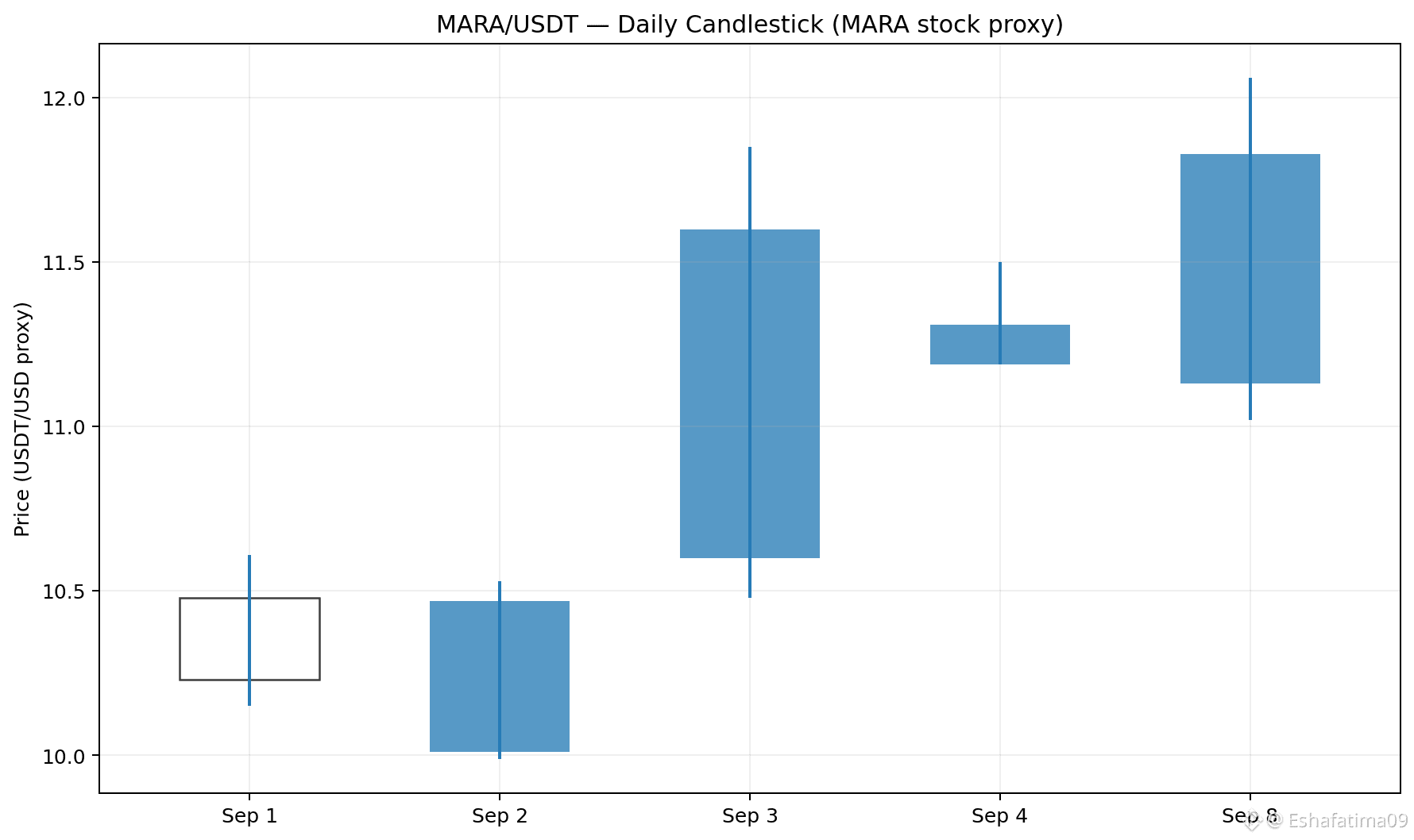
$MARA #MARA MARAUSDT tracks MARA Holdings, a Bitcoin-mining company, and the perpetual market is currently around $11.27 on Binance Futures.
Recent MARA price action has turned short-term bullish: MARA closed around $11.83 on September 8, after rising from $10.23 on September 1. The September 3 candle was particularly strong, closing at $11.60 after reaching $11.85.
🟢 Support: $11.00–$11.20
🟢 Stronger support: $10.45–$10.60
🔴 Resistance: $12.00–$12.10
🔴 Major resistance: $12.30–$12.50
📈 Above $12.10 → bullish continuation possible
📉 Below $11.00 → momentum could weaken
#USStocksCloseLowerIntelRises9%
#DowFallsOver600Points
$MARA #MARA MARAUSDT tracks MARA Holdings, a Bitcoin-mining company, and the perpetual market is currently around $11.27 on Binance Futures.
Recent MARA price action has turned short-term bullish: MARA closed around $11.83 on September 8, after rising from $10.23 on September 1. The September 3 candle was particularly strong, closing at $11.60 after reaching $11.85.
🟢 Support: $11.00–$11.20
🟢 Stronger support: $10.45–$10.60
🔴 Resistance: $12.00–$12.10
🔴 Major resistance: $12.30–$12.50
📈 Above $12.10 → bullish continuation possible
📉 Below $11.00 → momentum could weaken
#USStocksCloseLowerIntelRises9%
#DowFallsOver600Points
Recent MARA price action has turned short-term bullish: MARA closed around $11.83 on September 8, after rising from $10.23 on September 1. The September 3 candle was particularly strong, closing at $11.60 after reaching $11.85.
🟢 Support: $11.00–$11.20
🟢 Stronger support: $10.45–$10.60
🔴 Resistance: $12.00–$12.10
🔴 Major resistance: $12.30–$12.50
📈 Above $12.10 → bullish continuation possible
📉 Below $11.00 → momentum could weaken
#USStocksCloseLowerIntelRises9%
#DowFallsOver600Points
44

·
--
$MARA In the past 24 hours, it’s up 7.162%, and the current price is 11.97, but the contract funding rate is steady at 0. This price increase combined with a zero-fee rate is quite rare.
A zero funding rate means the rally hasn’t triggered FOMO from long positions, so carrying costs haven’t accumulated. This could indicate that buy pressure is coming from spot demand or hedging rather than pure leveraged speculation. Price is rising while the funding rate stays unchanged, which suggests the underlying market is relatively healthy.
On the downside, with a lack of positive funding, there’s less incentive for momentum to strengthen. If the price continues to rise while the funding rate remains at 0, be cautious—especially if the funding rate turns positive. If the price keeps climbing but the funding rate flips to positive, you should watch out for leveraged overheating.
Trading tag: #TradFi #链上美股 #MARA
Where do you think this analysis is most likely to be wrong?
$MARA In the past 24 hours, it’s up 7.162%, and the current price is 11.97, but the contract funding rate is steady at 0. This price increase combined with a zero-fee rate is quite rare.
A zero funding rate means the rally hasn’t triggered FOMO from long positions, so carrying costs haven’t accumulated. This could indicate that buy pressure is coming from spot demand or hedging rather than pure leveraged speculation. Price is rising while the funding rate stays unchanged, which suggests the underlying market is relatively healthy.
On the downside, with a lack of positive funding, there’s less incentive for momentum to strengthen. If the price continues to rise while the funding rate remains at 0, be cautious—especially if the funding rate turns positive. If the price keeps climbing but the funding rate flips to positive, you should watch out for leveraged overheating.
Trading tag: #TradFi #链上美股 #MARA
Where do you think this analysis is most likely to be wrong?
A zero funding rate means the rally hasn’t triggered FOMO from long positions, so carrying costs haven’t accumulated. This could indicate that buy pressure is coming from spot demand or hedging rather than pure leveraged speculation. Price is rising while the funding rate stays unchanged, which suggests the underlying market is relatively healthy.
On the downside, with a lack of positive funding, there’s less incentive for momentum to strengthen. If the price continues to rise while the funding rate remains at 0, be cautious—especially if the funding rate turns positive. If the price keeps climbing but the funding rate flips to positive, you should watch out for leveraged overheating.
Trading tag: #TradFi #链上美股 #MARA
Where do you think this analysis is most likely to be wrong?
25
·
--
$MARA rose 7.162% over the past 24 hours, and is currently trading at 11.97. The funding rate has gone to zero; the open interest is 18,613.91, with little change. This rally lacks follow-through from bullish positioning in the derivatives market, and looks more like an isolated spot-driven move.
I tend to believe this is driven by spot demand rather than being pushed by futures. A steady funding rate means neither side is paying; open interest has not increased meaningfully, suggesting most derivatives traders are on the sidelines. Under this structure, the durability of the uptrend is questionable.
If, going forward, the funding rate quickly turns positive, indicating that longs start to pass the baton, then the logic could change.
Trading tag: #TradFi #链上美股 #MARA
Where do you think this assessment is most likely to be wrong?
$MARA rose 7.162% over the past 24 hours, and is currently trading at 11.97. The funding rate has gone to zero; the open interest is 18,613.91, with little change. This rally lacks follow-through from bullish positioning in the derivatives market, and looks more like an isolated spot-driven move.
I tend to believe this is driven by spot demand rather than being pushed by futures. A steady funding rate means neither side is paying; open interest has not increased meaningfully, suggesting most derivatives traders are on the sidelines. Under this structure, the durability of the uptrend is questionable.
If, going forward, the funding rate quickly turns positive, indicating that longs start to pass the baton, then the logic could change.
Trading tag: #TradFi #链上美股 #MARA
Where do you think this assessment is most likely to be wrong?
I tend to believe this is driven by spot demand rather than being pushed by futures. A steady funding rate means neither side is paying; open interest has not increased meaningfully, suggesting most derivatives traders are on the sidelines. Under this structure, the durability of the uptrend is questionable.
If, going forward, the funding rate quickly turns positive, indicating that longs start to pass the baton, then the logic could change.
Trading tag: #TradFi #链上美股 #MARA
Where do you think this assessment is most likely to be wrong?
4
·
--
$MARA 24 hours up 7.162% to 11.97, funding rate 0.0000. Price is moving upward, but the futures funding rate is neutral—this is common when spot buying is driven by news sentiment and the futures side has not confirmed. If there are no substantial positives afterward, the spot profit-taking could create sell pressure. I’m trying a small long position; stop loss at 11.0; I won’t add until the funding rate turns positive. The invalidation conditions are: price breaks below 10.5 or the funding rate turns negative.
Trading tag: #TradFi #链上美股 #MARA
Where do you think this call is most likely to be wrong?
$MARA 24 hours up 7.162% to 11.97, funding rate 0.0000. Price is moving upward, but the futures funding rate is neutral—this is common when spot buying is driven by news sentiment and the futures side has not confirmed. If there are no substantial positives afterward, the spot profit-taking could create sell pressure. I’m trying a small long position; stop loss at 11.0; I won’t add until the funding rate turns positive. The invalidation conditions are: price breaks below 10.5 or the funding rate turns negative.
Trading tag: #TradFi #链上美股 #MARA
Where do you think this call is most likely to be wrong?
Trading tag: #TradFi #链上美股 #MARA
Where do you think this call is most likely to be wrong?
14
·
--
$funding fee rate has gone to zero. This is not very common in perpetual contracts. During $MARA 24 hours, it rose 5.314%, and the price touched 11.89, but its perpetual contract funding rate is 0. On one side the price is rising, and on the other, neither longs nor shorts are paying each other. I glanced at the open interest: 18565.70. That number itself can’t be directly compared to the price in unit terms, but combined with the zero funding rate, it at least indicates that the current pull-up has not created a situation where longs end up paying shorts.
This angle (M2_semi) should have been a peer comparison on the semiconductor/AI chain, but this time I don’t have other coin data available in hand, which in itself points to a problem: the rally of $MARA did not receive a clear peer-price reaction in the usual semiconductor/AI sentiment sector. Its driver seems more like an isolated event, or a reason to lump it into the vague category called Other. With zero funding rate paired with price rising, my old-dog understanding is that inside the market, long and short forces are at a brief equilibrium point— the uptrend hasn’t immediately caused longs to overheat into paying a premium, and it also implies shorts haven’t been massively squeezed into surrendering and paying. It’s a signal that both sides are still probing, and the positioning structure is relatively neutral. The “fuel” to push upward (funding paid by shorts) isn’t obvious.
So my take is that for $MARA ’s 5.3% rise, we should put a big question mark over its strength and sustainability. It lacks the positive confirmation of the funding rate dimension and looks more like a rise without clearly supported counterparty losses. My plan is: wait. I’ll treat 11.89 as an observation benchmark. If the price can hold around here and even move higher, and at the same time I see whether the funding rate turns into a sustained positive number (which would mean longs are crowded—but also that the rise comes at the cost of confirmation), then I’ll consider trying a small long position. If the price turns down—especially if it falls below 11.89 and the funding rate remains zero or even turns negative—that would mean the upward momentum has quickly fizzled out, and I won’t touch it.
Where is this judgment most likely to be wrong? If $MARA suddenly has undisclosed fundamental news highly related to AI or the semiconductor industry that drives price away from pure contract-battle logic and keeps surging, then my framework fails. Or if the entire crypto market’s risk appetite suddenly spikes, bringing in huge incremental capital indiscriminately, then this single zero-funding-rate signal would be drowned out.
Trading tag: #BinanceFutures #TradFi #USDⓈM #MARA #MARAUSDT $MARA
$funding fee rate has gone to zero. This is not very common in perpetual contracts. During $MARA 24 hours, it rose 5.314%, and the price touched 11.89, but its perpetual contract funding rate is 0. On one side the price is rising, and on the other, neither longs nor shorts are paying each other. I glanced at the open interest: 18565.70. That number itself can’t be directly compared to the price in unit terms, but combined with the zero funding rate, it at least indicates that the current pull-up has not created a situation where longs end up paying shorts.
This angle (M2_semi) should have been a peer comparison on the semiconductor/AI chain, but this time I don’t have other coin data available in hand, which in itself points to a problem: the rally of $MARA did not receive a clear peer-price reaction in the usual semiconductor/AI sentiment sector. Its driver seems more like an isolated event, or a reason to lump it into the vague category called Other. With zero funding rate paired with price rising, my old-dog understanding is that inside the market, long and short forces are at a brief equilibrium point— the uptrend hasn’t immediately caused longs to overheat into paying a premium, and it also implies shorts haven’t been massively squeezed into surrendering and paying. It’s a signal that both sides are still probing, and the positioning structure is relatively neutral. The “fuel” to push upward (funding paid by shorts) isn’t obvious.
So my take is that for $MARA ’s 5.3% rise, we should put a big question mark over its strength and sustainability. It lacks the positive confirmation of the funding rate dimension and looks more like a rise without clearly supported counterparty losses. My plan is: wait. I’ll treat 11.89 as an observation benchmark. If the price can hold around here and even move higher, and at the same time I see whether the funding rate turns into a sustained positive number (which would mean longs are crowded—but also that the rise comes at the cost of confirmation), then I’ll consider trying a small long position. If the price turns down—especially if it falls below 11.89 and the funding rate remains zero or even turns negative—that would mean the upward momentum has quickly fizzled out, and I won’t touch it.
Where is this judgment most likely to be wrong? If $MARA suddenly has undisclosed fundamental news highly related to AI or the semiconductor industry that drives price away from pure contract-battle logic and keeps surging, then my framework fails. Or if the entire crypto market’s risk appetite suddenly spikes, bringing in huge incremental capital indiscriminately, then this single zero-funding-rate signal would be drowned out.
Trading tag: #BinanceFutures #TradFi #USDⓈM #MARA #MARAUSDT $MARA
This angle (M2_semi) should have been a peer comparison on the semiconductor/AI chain, but this time I don’t have other coin data available in hand, which in itself points to a problem: the rally of $MARA did not receive a clear peer-price reaction in the usual semiconductor/AI sentiment sector. Its driver seems more like an isolated event, or a reason to lump it into the vague category called Other. With zero funding rate paired with price rising, my old-dog understanding is that inside the market, long and short forces are at a brief equilibrium point— the uptrend hasn’t immediately caused longs to overheat into paying a premium, and it also implies shorts haven’t been massively squeezed into surrendering and paying. It’s a signal that both sides are still probing, and the positioning structure is relatively neutral. The “fuel” to push upward (funding paid by shorts) isn’t obvious.
So my take is that for $MARA ’s 5.3% rise, we should put a big question mark over its strength and sustainability. It lacks the positive confirmation of the funding rate dimension and looks more like a rise without clearly supported counterparty losses. My plan is: wait. I’ll treat 11.89 as an observation benchmark. If the price can hold around here and even move higher, and at the same time I see whether the funding rate turns into a sustained positive number (which would mean longs are crowded—but also that the rise comes at the cost of confirmation), then I’ll consider trying a small long position. If the price turns down—especially if it falls below 11.89 and the funding rate remains zero or even turns negative—that would mean the upward momentum has quickly fizzled out, and I won’t touch it.
Where is this judgment most likely to be wrong? If $MARA suddenly has undisclosed fundamental news highly related to AI or the semiconductor industry that drives price away from pure contract-battle logic and keeps surging, then my framework fails. Or if the entire crypto market’s risk appetite suddenly spikes, bringing in huge incremental capital indiscriminately, then this single zero-funding-rate signal would be drowned out.
Trading tag: #BinanceFutures #TradFi #USDⓈM #MARA #MARAUSDT $MARA
34
·
--
$MARA 24-hour drop of 1.673%. The funding rate remains positive at 0.00012966, with 18,852.55 open contracts. A slight price dip coexists with a positive funding rate, indicating that longs are still paying for their positions, but unrealized losses have started to appear.
The current contradiction is that the near-term price action of Bitcoin mining stocks like $MARA is becoming increasingly correlated with the U.S. election campaign landscape. As a sector that is highly dependent on policy friendliness, the stock prices implicitly price in expectations for a Trump trade. However, recent election data shows the race is stuck in a stalemate and has not provided a clear positive catalyst, leaving the long capital that bet on policy-friendly outcomes temporarily trapped.
The strongest counterevidence is this: if polling shows a clear reversal—where Trump’s approval rating pulls significantly ahead—his explicit stance supporting crypto could quickly activate policy-sensitive assets like $MARA, squeezing the current shorts. But the second-order effect is that if the election remains in flux, these long positions may be forced to reduce exposure ahead of the policy shift due to continuously accumulating position costs (positive funding), triggering a wave of stop-loss selling.
My view is that $MARA is currently in a waiting zone for election expectations, with longs holding on hard.
Trading tag: #TradFi #链上美股 #MARA
Where do you think this thesis is most likely to be wrong?
$MARA 24-hour drop of 1.673%. The funding rate remains positive at 0.00012966, with 18,852.55 open contracts. A slight price dip coexists with a positive funding rate, indicating that longs are still paying for their positions, but unrealized losses have started to appear.
The current contradiction is that the near-term price action of Bitcoin mining stocks like $MARA is becoming increasingly correlated with the U.S. election campaign landscape. As a sector that is highly dependent on policy friendliness, the stock prices implicitly price in expectations for a Trump trade. However, recent election data shows the race is stuck in a stalemate and has not provided a clear positive catalyst, leaving the long capital that bet on policy-friendly outcomes temporarily trapped.
The strongest counterevidence is this: if polling shows a clear reversal—where Trump’s approval rating pulls significantly ahead—his explicit stance supporting crypto could quickly activate policy-sensitive assets like $MARA , squeezing the current shorts. But the second-order effect is that if the election remains in flux, these long positions may be forced to reduce exposure ahead of the policy shift due to continuously accumulating position costs (positive funding), triggering a wave of stop-loss selling.
My view is that $MARA is currently in a waiting zone for election expectations, with longs holding on hard.
Trading tag: #TradFi #链上美股 #MARA
Where do you think this thesis is most likely to be wrong?
The current contradiction is that the near-term price action of Bitcoin mining stocks like $MARA is becoming increasingly correlated with the U.S. election campaign landscape. As a sector that is highly dependent on policy friendliness, the stock prices implicitly price in expectations for a Trump trade. However, recent election data shows the race is stuck in a stalemate and has not provided a clear positive catalyst, leaving the long capital that bet on policy-friendly outcomes temporarily trapped.
The strongest counterevidence is this: if polling shows a clear reversal—where Trump’s approval rating pulls significantly ahead—his explicit stance supporting crypto could quickly activate policy-sensitive assets like $MARA , squeezing the current shorts. But the second-order effect is that if the election remains in flux, these long positions may be forced to reduce exposure ahead of the policy shift due to continuously accumulating position costs (positive funding), triggering a wave of stop-loss selling.
My view is that $MARA is currently in a waiting zone for election expectations, with longs holding on hard.
Trading tag: #TradFi #链上美股 #MARA
Where do you think this thesis is most likely to be wrong?
13
Log in to explore more content
Join global crypto users on Binance Square
⚡️ Get latest and useful information about crypto.
💬 Trusted by the world’s largest crypto exchange.
👍 Discover real insights from verified creators.
Email / Phone number
Trending Topics
1
#FedRateWatch
719,842 views
3,414 Discussing
2
#ArgentinaCommitsToOECDCryptoReportingBy2029
742 views
48 Discussing
3
#EthereumFallsBelow$2400
1,343 views
43 Discussing
4
#USDTLaunchesOnZamaPrivacyProtocol
0 views
5 Discussing
5
#USSenateBlocksClarityAct
9,726 views
228 Discussing
6
#BitcoinSlidesTo$76000
31,708 views
145 Discussing
7
#BitcoinReboundsTo$79K
65,593 views
420 Discussing
8
#StrategyMarketCapPassesFord
54,005 views
824 Discussing
9
#ClarityActOddsHalveOnPolymarket
89,940 views
741 Discussing
10
#US30YTreasuryYieldTops5.40%
46,770 views
480 Discussing