

#depin
depin
3.8M views
13,947 Discussing
Hot
Latest

·
--
Bullish
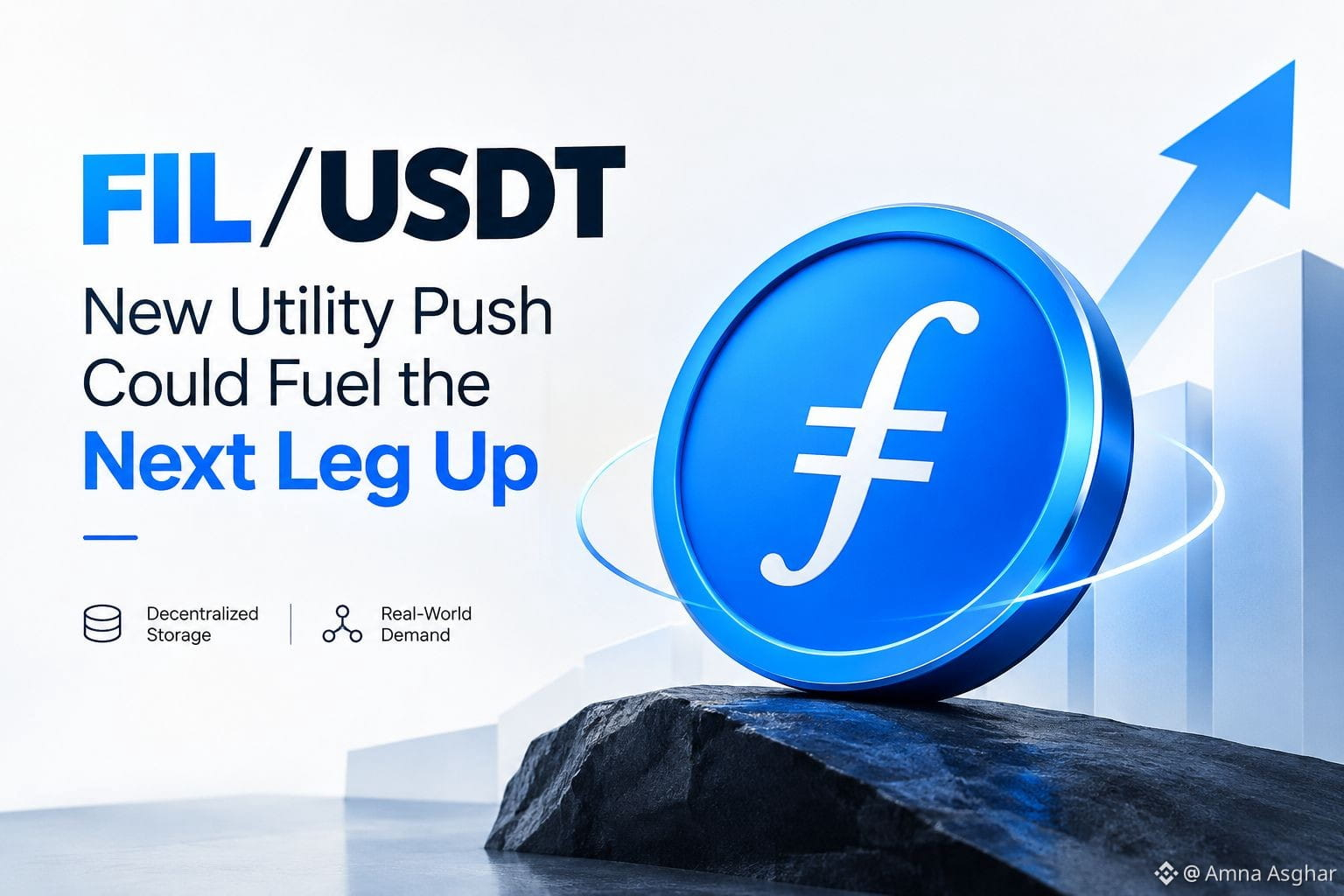
🚀 FIL/USDT: Filecoin’s New Utility Push Could Strengthen the Bullish Case
$FIL is moving beyond the idea of simply providing decentralized storage. Its latest developments are focused on connecting network rewards with real customer demand — a shift that could make FIL more interesting to watch.
On October 19, 2026, Filecoin highlighted its Solstice reward mechanism, designed to direct a growing share of block rewards toward services that attract paying customers. The goal is simple: reward useful activity, not just storage capacity.
Another development worth watching is the launch of a FIL/USD on-chain price feed by RedStone, announced for $FIL mainnet on October 22. Better access to price data can help developers build more advanced smart-contract applications on the Filecoin Virtual Machine.
📈 Why could this be bullish?
• More useful applications could increase demand for Filecoin’s infrastructure.
• Reward changes may improve incentives for providers serving paying customers.
• AI, decentralized storage and programmable applications offer potential growth opportunities.
{future}(FILUSDT)
The trading setup: I would watch whether $FIL can build higher lows, reclaim nearby resistance and confirm a breakout with stronger trading volume. Without a current verified chart, specific entry and target prices would be guesswork.
⚠️ The risk: Better tokenomics and new technology do not guarantee price gains. Weak adoption, broader market weakness or profit-taking could still pressure FIL.
My view: Filecoin has a developing utility-driven story, and the next key test is whether real customer demand translates into sustained network activity and stronger price momentum.
Do you think FIL can turn its new developments into a stronger bullish trend?
#FIL #Filecoin #Crypto #DePIN #BinanceSquare
🚀 FIL/USDT: Filecoin’s New Utility Push Could Strengthen the Bullish Case
$FIL is moving beyond the idea of simply providing decentralized storage. Its latest developments are focused on connecting network rewards with real customer demand — a shift that could make FIL more interesting to watch.
On October 19, 2026, Filecoin highlighted its Solstice reward mechanism, designed to direct a growing share of block rewards toward services that attract paying customers. The goal is simple: reward useful activity, not just storage capacity.
Another development worth watching is the launch of a FIL/USD on-chain price feed by RedStone, announced for $FIL mainnet on October 22. Better access to price data can help developers build more advanced smart-contract applications on the Filecoin Virtual Machine.
📈 Why could this be bullish?
• More useful applications could increase demand for Filecoin’s infrastructure.
• Reward changes may improve incentives for providers serving paying customers.
• AI, decentralized storage and programmable applications offer potential growth opportunities.
The trading setup: I would watch whether $FIL can build higher lows, reclaim nearby resistance and confirm a breakout with stronger trading volume. Without a current verified chart, specific entry and target prices would be guesswork.
⚠️ The risk: Better tokenomics and new technology do not guarantee price gains. Weak adoption, broader market weakness or profit-taking could still pressure FIL.
My view: Filecoin has a developing utility-driven story, and the next key test is whether real customer demand translates into sustained network activity and stronger price momentum.
Do you think FIL can turn its new developments into a stronger bullish trend?
#FIL #Filecoin #Crypto #DePIN #BinanceSquare
282

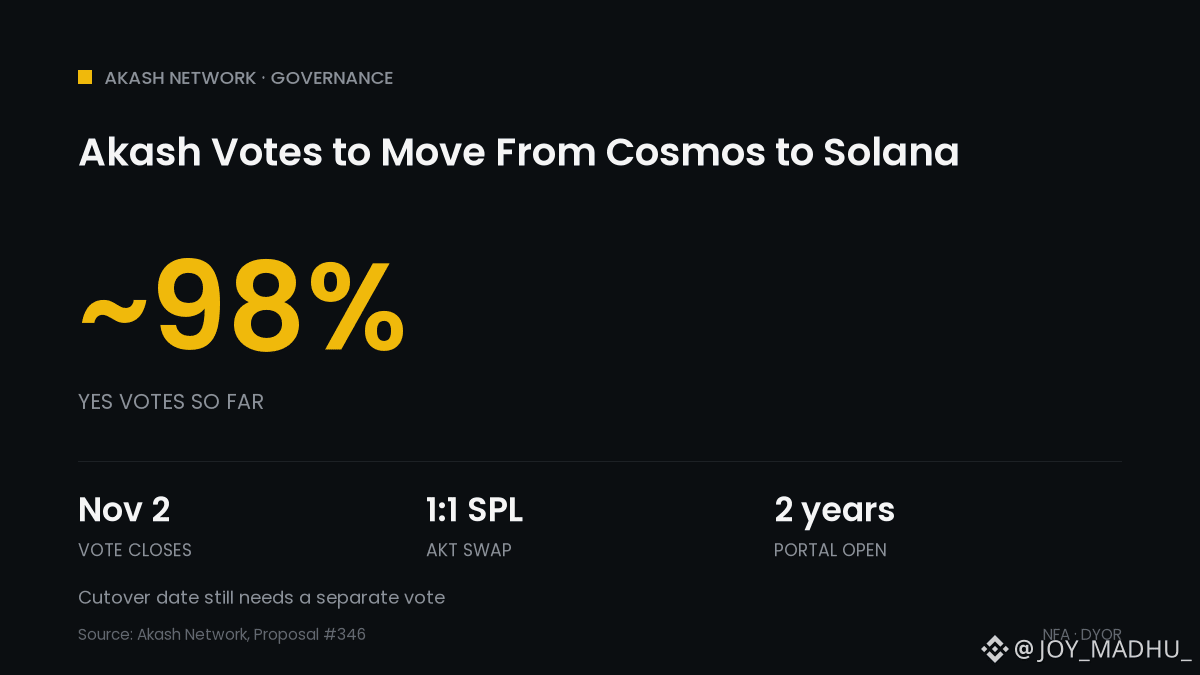
$AKT — AKASH NETWORK EYES A MAJOR MOVE TO SOLANA!Cosmos → Solana: Could this reshape DePIN compute?
Akash Network’s core team has selected Solana as its proposed migration target, aiming to move away from its independent Cosmos chain and rebuild its decentralized compute marketplace on Solana.
🗳️ Governance is the key
Proposal #346 opened on October 26, with voting scheduled to close on November 2, 2026.The proposal requires a 33.4% quorum and majority approval.Early voting showed roughly 98% support, but the vote remains the community’s decision until the voting period ends.
💡 What makes this move interesting?
1:1 migration: The plan is for $AKT to become a Solana SPL token, retaining its ticker, six decimals and total supply.Lower operating costs: Akash estimates that running its marketplace on Solana could cost around 0.075 SOL per day at current activity levels.DePIN connections: Solana already hosts projects such as Helium, Render and io.net, potentially giving Akash access to a broader ecosystem of users and liquidity.
⚠️ Important risks to watch
The migration is not the same as a completed marketplace transition. The token launch is expected to depend on independent security audits, while a separate governance decision will determine the marketplace cutover. Staked $AKT holders may need to complete the stated 21-day unbonding period before migrating.
🔍 What could it mean for $AKT?
A successful migration could improve accessibility and reduce infrastructure costs. However, execution risks, exchange support, migration security and future staking arrangements matter just as much as the headline. A chain move alone does not guarantee a sustained price rally.
📊 My takeaway: This is a major development to monitor for Akash and the wider DePIN sector. Watch the final governance result, audit announcements and official migration instructions before making a move.
Would Solana give $AKT a stronger path to growth, or is leaving Cosmos too big a trade-off? 👇
#Cosmos #DePIN #bianance pick # earning season #BinanceSquare #akashselectssolanaasmigrationtarget
{future}(AKTUSDT)
$AKT — AKASH NETWORK EYES A MAJOR MOVE TO SOLANA!
Cosmos → Solana: Could this reshape DePIN compute?
Akash Network’s core team has selected Solana as its proposed migration target, aiming to move away from its independent Cosmos chain and rebuild its decentralized compute marketplace on Solana.
🗳️ Governance is the key
Proposal #346 opened on October 26, with voting scheduled to close on November 2, 2026.The proposal requires a 33.4% quorum and majority approval.Early voting showed roughly 98% support, but the vote remains the community’s decision until the voting period ends.
💡 What makes this move interesting?
1:1 migration: The plan is for $AKT to become a Solana SPL token, retaining its ticker, six decimals and total supply.Lower operating costs: Akash estimates that running its marketplace on Solana could cost around 0.075 SOL per day at current activity levels.DePIN connections: Solana already hosts projects such as Helium, Render and io.net, potentially giving Akash access to a broader ecosystem of users and liquidity.
⚠️ Important risks to watch
The migration is not the same as a completed marketplace transition. The token launch is expected to depend on independent security audits, while a separate governance decision will determine the marketplace cutover. Staked $AKT holders may need to complete the stated 21-day unbonding period before migrating.
🔍 What could it mean for $AKT ?
A successful migration could improve accessibility and reduce infrastructure costs. However, execution risks, exchange support, migration security and future staking arrangements matter just as much as the headline. A chain move alone does not guarantee a sustained price rally.
📊 My takeaway: This is a major development to monitor for Akash and the wider DePIN sector. Watch the final governance result, audit announcements and official migration instructions before making a move.
Would Solana give $AKT a stronger path to growth, or is leaving Cosmos too big a trade-off? 👇
#Cosmos #DePIN #bianance pick # earning season #BinanceSquare #akashselectssolanaasmigrationtarget
16
·
--
Bullish
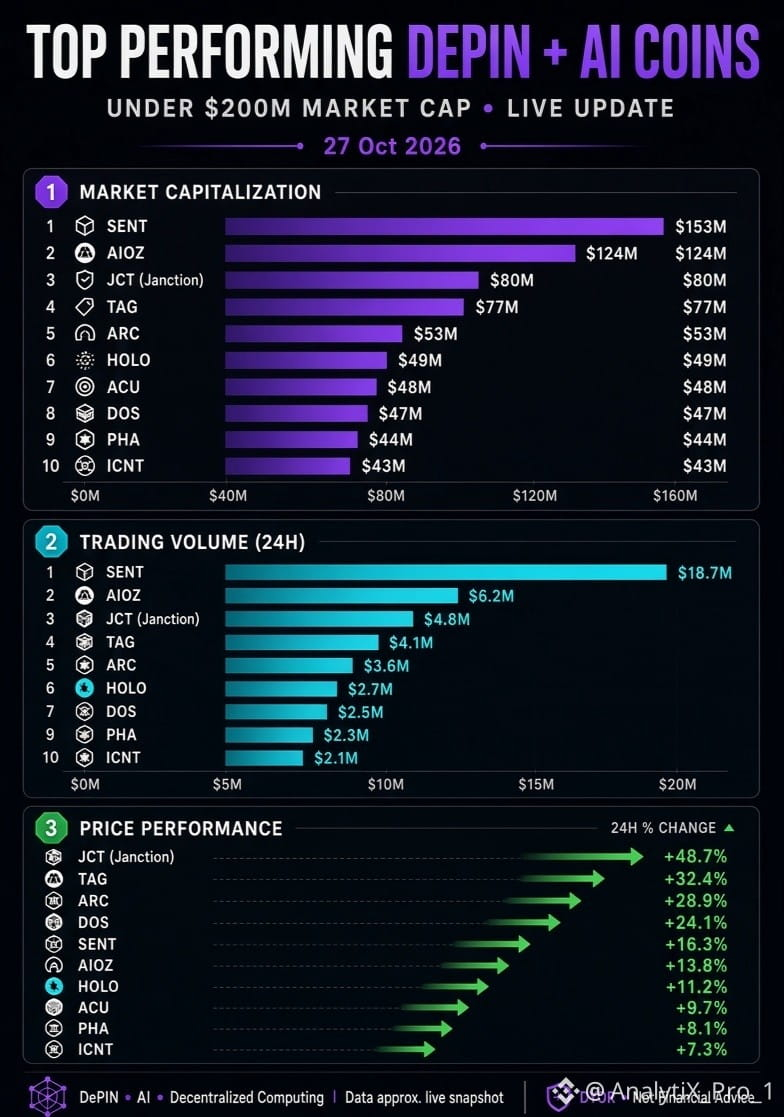
🔴🕺TOP PERFORMING DEPIN + AI COINS
UNDER $200M MARKET CAP
🕒 Research Window: 24H + 7D
📅 Updated: 27 Oct 2026
👀 COINS TO WATCH:
$JCT
{alpha}(560xea37a8de1de2d9d10772eeb569e28bfa5cb17707)
— Clear leader in momentum + volume
$TAG
{alpha}(560x208bf3e7da9639f1eaefa2de78c23396b0682025)
— Strong AI-related mover
$ARC — Solid AI Rig Complex performance
$SENT
{future}(SENTUSDT)
— Highest liquidity name in the group
$ACU / $DOS — Emerging strength
📈 Market Cap Filter: Under $200M
📊 Ranking: Multi-period momentum + relative volume
⚠️ Small-cap crypto assets are highly volatile. Recent gains do not guarantee future performance. Always verify liquidity and do your own research.
🔴🏁DYOR | Not Financial Advice
#DePIN #AirdropAlerts #Crypto_Jobs🎯 #Altcoins! #AnalytixProX
🔴🕺TOP PERFORMING DEPIN + AI COINS
UNDER $200M MARKET CAP
🕒 Research Window: 24H + 7D
📅 Updated: 27 Oct 2026
👀 COINS TO WATCH:
$JCT
— Clear leader in momentum + volume
$TAG
— Strong AI-related mover
$ARC — Solid AI Rig Complex performance
$SENT
— Highest liquidity name in the group
$ACU / $DOS — Emerging strength
📈 Market Cap Filter: Under $200M
📊 Ranking: Multi-period momentum + relative volume
⚠️ Small-cap crypto assets are highly volatile. Recent gains do not guarantee future performance. Always verify liquidity and do your own research.
🔴🏁DYOR | Not Financial Advice
#DePIN #AirdropAlerts #Crypto_Jobs🎯 #Altcoins! #AnalytixProX
551

·
--
#AkashSelectsSolanaAsMigrationTarget
☁️ Akash Plans to Leave Cosmos for Solana
📅 Proposal 346 went live Oct 26, voting closes Nov 2
📊 Early tally: about 98% yes, quorum already reached
🔁 AKT would become an SPL token 1:1, same supply and 6 decimals
🧾 Launch only after two independent audits, about 2-3 weeks after passing
🚪 One-way migration portal stays open for 2 years
⏳ No marketplace cutover date yet: that needs a separate vote
⚠️ Staking rewards end at cutover; the old chain halts 90 days later
Why Solana: ~$0.001 median fees, $15B in stablecoins, and DePIN peers like Helium and Render already settled there.
What it means for crypto: another app-chain trading sovereignty for shared security and liquidity. It's a vote of confidence in Solana, but the Cosmos ecosystem loses a well-known chain.
Should app-chains keep their own chain or move to a big L1? 👇
$SOL $AKT
#CryptoNews #Solana #DePIN #AkashSelectsSolanaAsMigrationTarget
4

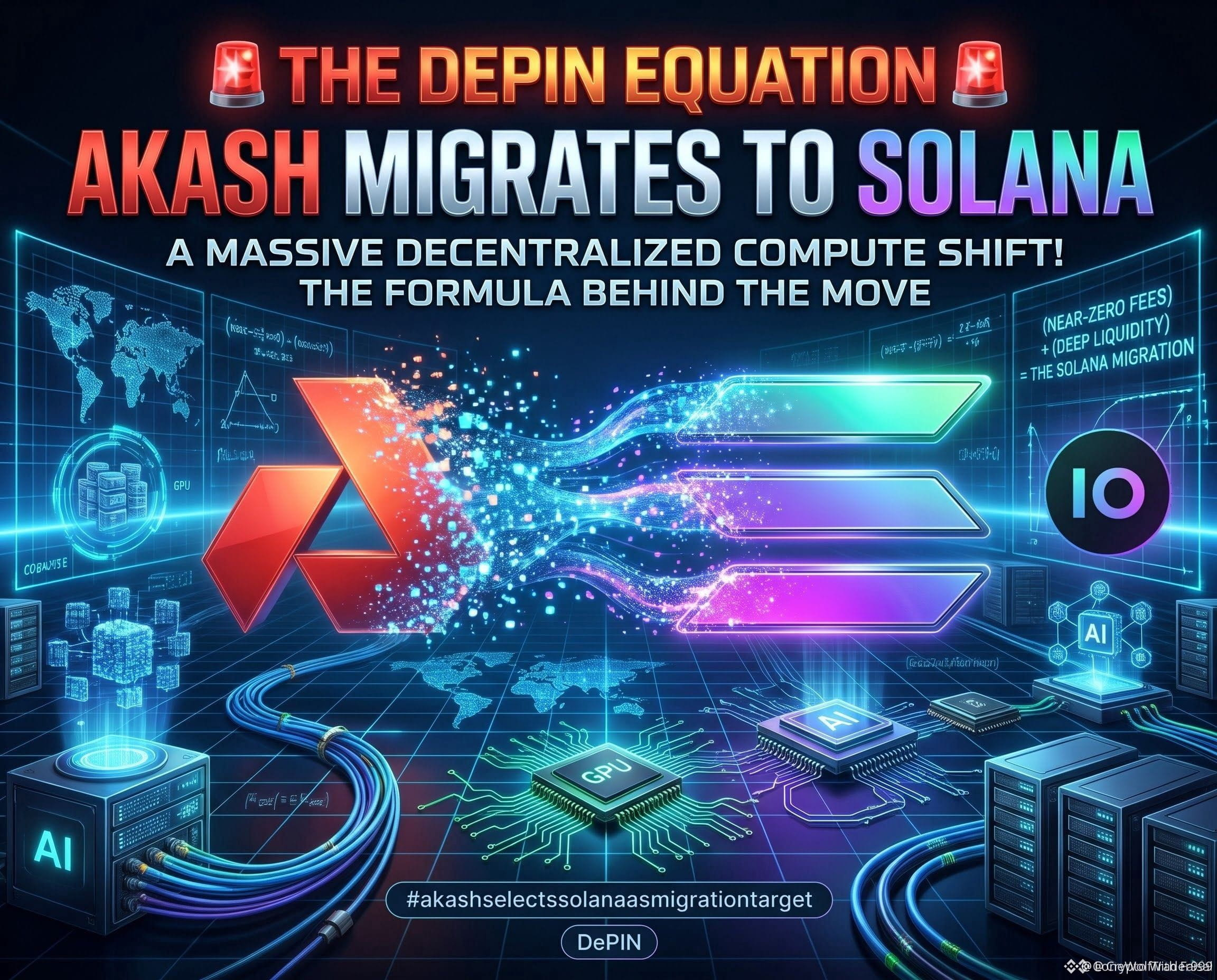
🚀 $AKT MIGRATES TO SOLANA – DEPIN POWER PLAY UNLEASHED 🟢
📊 Akash just locked in a 98% governance vote to abandon Cosmos, swapping to Solana’s ultra‑low‑fee engine. The move plugs directly into a $15B liquidity pool, turning AI GPU rentals into frictionless on‑chain swaps. ⚡
🌊 $AKT becomes an SPL token, instantly surfacing on decentralized exchanges, while $SOL cements its role as the backbone for physical infrastructure. Meanwhile $IO faces a fresh native rival as Akash’s marketplace lands in the same ecosystem. 💡
💬 How will this reshuffle reshape the DePIN battlefield? 👇
⚠️ Not financial advice. Always manage your risk. 🛡️
🏷️ #AKT #DePIN #Solana #Crypto
🔥 💎
10
#AkashSelectsSolanaAsMigrationTarget
🚨 MASSIVE: Akash is leaving Cosmos for Solana! ⚡️
Governance Proposal #346:
• AKT → SPL token 1:1 swap
• 98% support 🔥
• Voting Oct 26 → Nov 2
• 2-year migration portal
• 21-day unstake required
Why?
✓ Lower costs ($0.001 fees)
✓ No single operator
✓ Join SOL DePIN with Helium & Render
Old chain halts after marketplace moves
#AkashSelectsSolanaAsMigrationTarget $AKT $SOL
#AkashNetwork #DePIN #CryptoNews


1
124

·
--
For a long time, decentralized compute sounded good in theory but was hard to use in practice.
For developers and teams building products, the flexibility @fluence offers is a game-changer. You get to build without worrying about the hidden costs and restrictions that come with traditional centralized cloud providers.
Here’s what theyve got👇
1. Zero Egress Fees: Move your data in and out without being charged extra. What you use is what you pay for.
2. Unlimited Bandwidth: No throttling, no surprise bills when your app scales.
3. Open Standards: Built on open protocols, not closed systems. You own your stack.
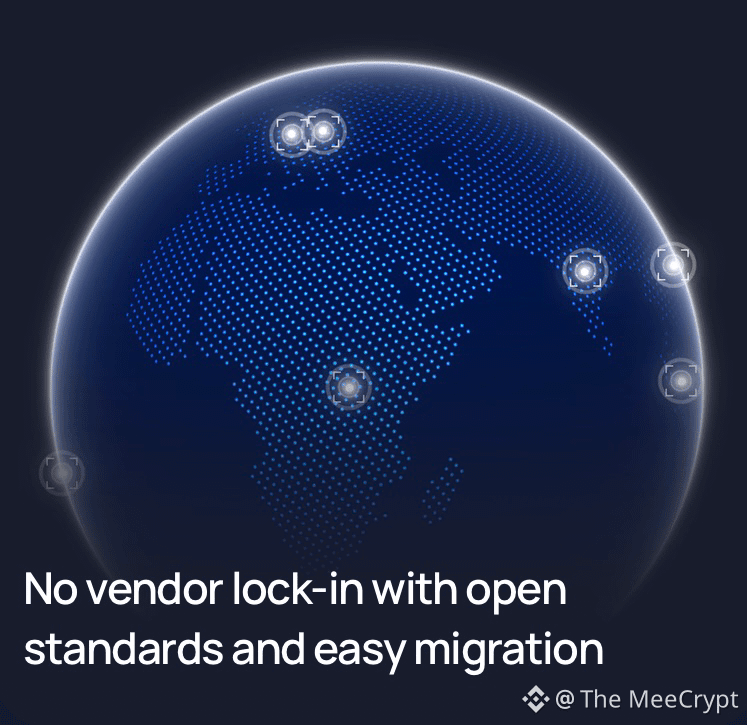
4. Easy Migration & No Vendor Lock-in: Deploy where you want, when you want. Migrate workloads in minutes, not months.
Training models, running inference, storing massive datasets, it all needs scalable, affordable, and flexible infrastructure. Having control over WHERE your workloads run and HOW you scale is no longer a luxury, it's a necessity for any serious builder.
Fluence is giving developers that freedom. The freedom to choose, to scale, and to build without limits.
Builders are already making the switch.
#Fluence #DePIN #DecentralizedCloud #AI
For a long time, decentralized compute sounded good in theory but was hard to use in practice.
For developers and teams building products, the flexibility @Fluence offers is a game-changer. You get to build without worrying about the hidden costs and restrictions that come with traditional centralized cloud providers.
Here’s what theyve got👇
1. Zero Egress Fees: Move your data in and out without being charged extra. What you use is what you pay for.
2. Unlimited Bandwidth: No throttling, no surprise bills when your app scales.
3. Open Standards: Built on open protocols, not closed systems. You own your stack.
4. Easy Migration & No Vendor Lock-in: Deploy where you want, when you want. Migrate workloads in minutes, not months.
Training models, running inference, storing massive datasets, it all needs scalable, affordable, and flexible infrastructure. Having control over WHERE your workloads run and HOW you scale is no longer a luxury, it's a necessity for any serious builder.
Fluence is giving developers that freedom. The freedom to choose, to scale, and to build without limits.
Builders are already making the switch.
#Fluence #DePIN #DecentralizedCloud #AI
70

·
--
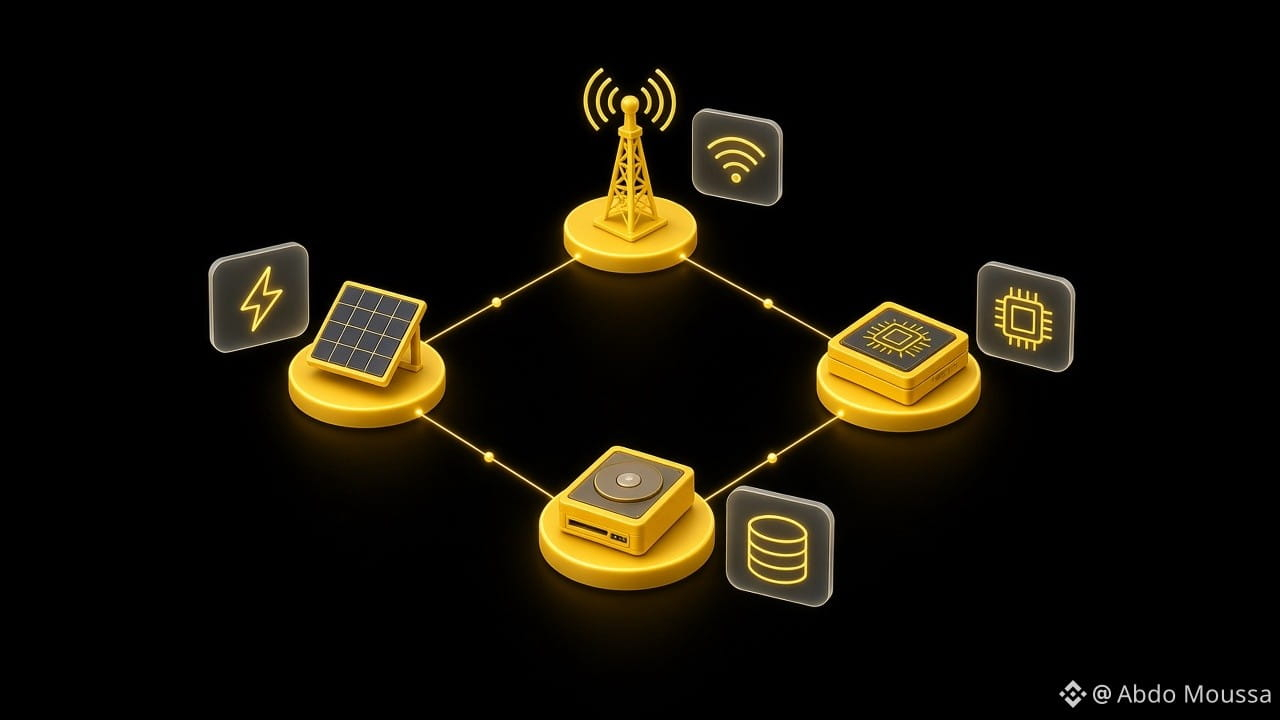
𝗘𝘃𝗲𝗿 𝘄𝗼𝗻𝗱𝗲𝗿𝗲𝗱 𝗵𝗼𝘄 𝗪𝗲𝗯𝟯 𝗽𝗿𝗼𝘁𝗼𝗰𝗼𝗹𝘀 𝗮𝗿𝗲 𝗰𝗿𝗼𝘄𝗱-𝘀𝗼𝘂𝗿𝗰𝗶𝗻𝗴 𝗽𝗵𝘆𝘀𝗶𝗰𝗮𝗹 𝗶𝗻𝗳𝗿𝗮𝘀𝘁𝗿𝘂𝗰𝘁𝘂𝗿𝗲 𝗹𝗶𝗸𝗲 𝟱𝗚 𝗻𝗲𝘁𝘄𝗼𝗿𝗸𝘀, 𝗲𝗻𝗲𝗿𝗴𝘆 𝗴𝗿𝗶𝗱𝘀, 𝗮𝗻𝗱 𝗔𝗜 𝗰𝗼𝗺𝗽𝘂𝘁𝗲 𝗰𝗹𝘂𝘀𝘁𝗲𝗿𝘀? 𝗘𝗻𝘁𝗲𝗿 𝗗𝗲𝗣𝗜𝗡 📡⚡
𝘋𝘳𝘢𝘸𝘪𝘯𝘨 𝘧𝘳𝘰𝘮 𝘧𝘰𝘶𝘯𝘥𝘢𝘵𝘪𝘰𝘯𝘢𝘭 𝘭𝘦𝘴𝘴𝘰𝘯𝘴 𝘰𝘯 #BinanceAcademy, 𝘩𝘦𝘳𝘦 𝘪𝘴 𝘺𝘰𝘶𝘳 𝘲𝘶𝘪𝘤𝘬 𝘪𝘯𝘧𝘳𝘢𝘴𝘵𝘳𝘶𝘤𝘵𝘶𝘳𝘦 𝘣𝘳𝘦𝘢𝘬𝘥𝘰𝘸𝘯:
1️⃣ 𝗪𝗵𝗮𝘁 𝗶𝘀 𝗗𝗲𝗣𝗜𝗡?
• Decentralized Physical Infrastructure Networks use token incentives to coordinate individual hardware providers around the world, helping build open physical networks.
2️⃣ 𝗞𝗲𝘆 𝗥𝗲𝗮𝗹-𝗪𝗼𝗿𝗹𝗱 𝗦𝗲𝗰𝘁𝗼𝗿𝘀:
• Wireless coverage (5G hotspots), decentralized storage, environmental sensor networks, and distributed GPU compute power for AI models.
3️⃣ 𝗖𝗵𝗮𝗹𝗹𝗲𝗻𝗴𝗶𝗻𝗴 𝗖𝗲𝗻𝘁𝗿𝗮𝗹𝗶𝘇𝗲𝗱 𝗠𝗼𝗻𝗼𝗽𝗼𝗹𝗶𝗲𝘀:
• By replacing much of the upfront capital expenditure (CapEx) with token incentives, DePIN can cut infrastructure costs and reduce single points of failure.
⚠️ 𝗥𝗶𝘀𝗸 𝗡𝗼𝘁𝗲:
DePIN participation involves hardware costs, changing token rewards and network adoption risks.
Expand your technical literacy, explore physical Web3 networks 🌐
📖 Learn more on Binance Academy: https://www.binance.com/en/academy/articles/what-is-depin-in-crypto
Crypto involves risk, this is not financial advice, Always DYOR 💡
#DePIN #Web3Infrastructure #CryptoEducation
Follow me for more 💛
2
80

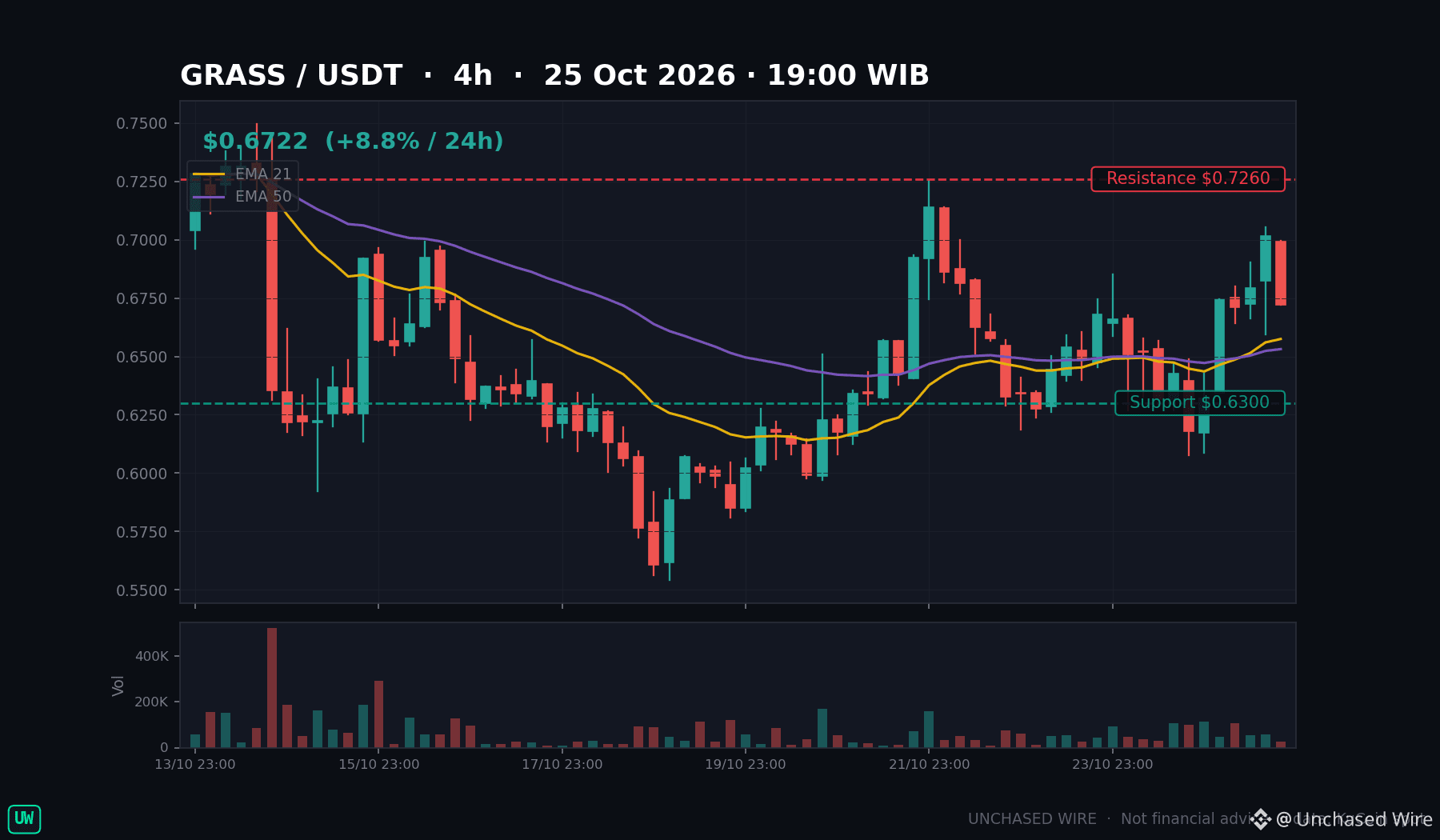
Four higher lows in a week — $GRASS is climbing stairs, not spiking.
I'm watching the structure, not a headline: since the $0.555 low a week ago, every dip has bottomed higher, and price now trades near $0.68, up roughly 8% in 24 hours.
GRASS is the token of a network that pays users for sharing unused internet bandwidth for AI data.
The part that keeps me from getting comfortable: the rise has been steady, not explosive, and $0.726 — the high from the last push — rejected price once already. Momentum this orderly can unwind just as quietly.
Support sits around $0.63, resistance at $0.726. A 4-hour close above $0.726 puts $0.75 in play; a close under $0.61 breaks the staircase and sends it back toward the $0.555 low. Small-cap DePIN volatility — moves like this cut both ways.
Which breaks first: the $0.63 floor or the $0.726 ceiling?
Not financial advice.
$GRASS #Altcoins #GRASS #DePIN #CryptoTrading
15

·
--
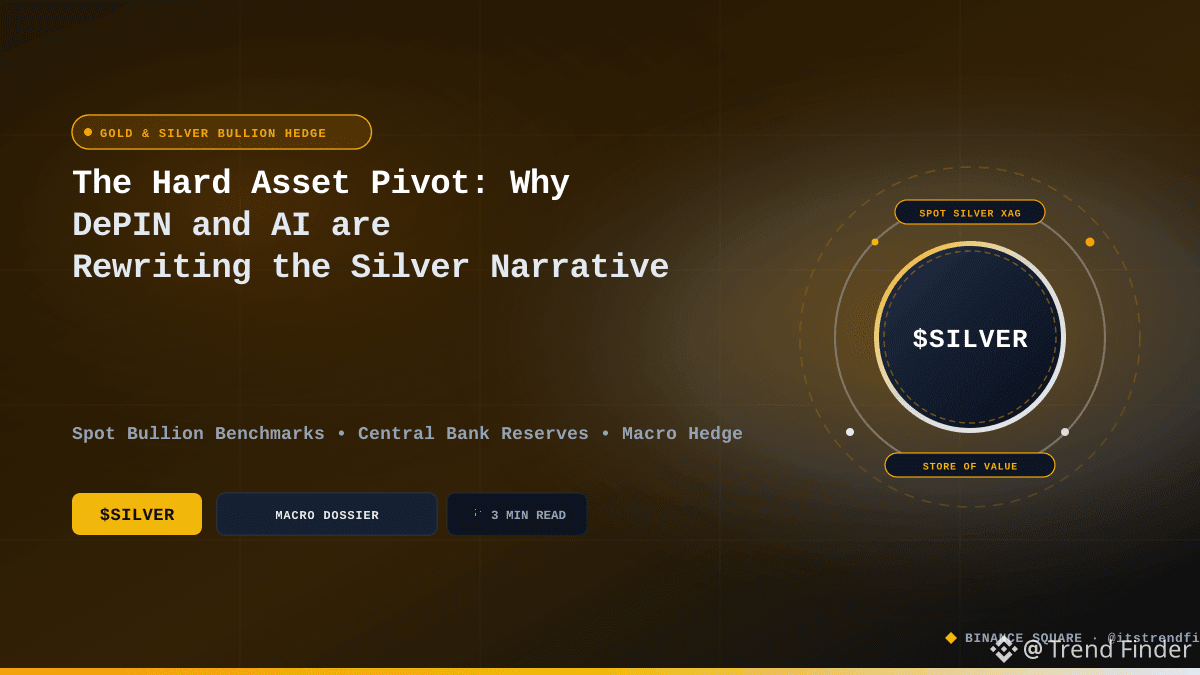
The Hard Asset Pivot: Why DePIN and AI are Rewriting the Silver Narrative
The weekend gap between physical scarcity and digital liquidity is where the real institutional signal hides. While the crowd focuses on minor price fluctuations in speculative alts, the narrative for $SILVER is shifting toward a structural convergence of DePIN and autonomous AI. With spot hovering around 53.796, we are watching the birth of a sophisticated infrastructure layer that handles industrial metals with the precision of a smart contract.
This isn't just about wrapping an asset and calling it a day. The next frontier involves DePIN networks used for real-time verification of physical extraction and supply chain provenance. By deploying autonomous AI agents to monitor these logistical flows, the industry can finally eliminate the valuation latency that has plagued the commodities market for decades. This creates a feedback loop between the physical vault and the on-chain treasury, ensuring that the tokenized asset reflects real-world conditions instantly.
The tokenomics here are fundamentally different from your average inflationary protocol. Assets like PAXG have already set the standard for 1:1 physical backing, but the integration of silver into RWA frameworks adds a layer of industrial utility. With central banks aggressively accumulating reserves and the Gold/Silver Ratio sitting near 68.5, the circulating float of these integrated assets is becoming incredibly tight. We are seeing a move away from simple yield farming toward owning the actual plumbing of the tokenized economy.
As the Dollar Index continues to exert inverse pressure, the need for a digital commodity that can move through decentralized ecosystems without leaving the vault is becoming critical. The question now is whether on-chain liquidity depth is prepared for the wall of institutional capital waiting for these frameworks to standardize. Are you positioned for a cycle backed by hard assets, or are you still chasing the high-beta narrative plays?
#RWA #DePIN
1
11

The Hidden Bottleneck of AI: Why Web3 is the Solution
Everyone is amazed by how fast AI is advancing, but in my computer science studies working with machine learning frameworks, I’ve noticed a massive hidden bottleneck: Compute Power.
Training large AI models requires enormous GPU clusters. Right now, centralized cloud giants control this hardware, making AI development highly expensive and restricted. This is exactly where Web3 steps in to solve the problem.
Decentralized networks like $RNDR are pooling idle GPU power from around the world to create distributed computing grids. Meanwhile, protocols like FET and NEAR are building ecosystems where autonomous AI agents can execute complex on-chain tasks without human intervention. We are shifting from AI owned by centralized tech monopolies to AI powered by decentralized networks.
Will decentralized GPU networks eventually replace traditional cloud servers for AI training? Let me know your technical predictions in the comments! 👇
#DePIN #MachineLearning #Web3 #CryptoTech
$RNDR $FET
274
·
--
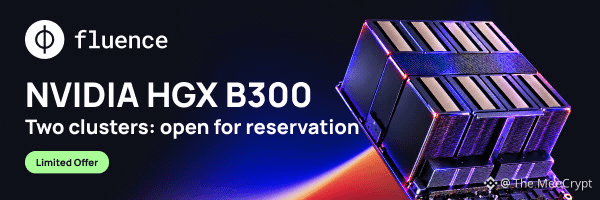
@fluence Updates Its Compute Network With Two New NVIDIA B300 Clusters
Two NVIDIA HGX B300 clusters are now open for reservation through Fluence, bringing more high-performance GPU capacity to its compute network.
Here’s the interesting part:
🇺🇸 Texas: 10 liquid-cooled nodes, with 8 B300 GPUs per node. Each GPU has 288 GB of HBM3E memory, giving each node 2.3 TB of GPU memory. The cluster can be ready within one week of signing.
🇺🇸 Nevada: 6 air-cooled nodes using Aivres KR9288X3 systems with HGX B300 GPUs, expected to be ready on January 1, 2027.
Both options offer dedicated bare-metal infrastructure, full root access, 2 TB of system memory, and 30.72 TB of NVMe storage.
What I find interesting here is the practical side of the update. These aren't just new hardware specifications to read about. Teams can reserve the infrastructure for their own workloads and have direct control over their systems.
As AI workloads become more demanding, I think the infrastructure powering them deserves just as much attention as the applications everyone sees.
Fluence is continuing to build in that space, and I'm curious to see how its compute network develops from here.
#Fluence #AI #DePIN
@Fluence Updates Its Compute Network With Two New NVIDIA B300 Clusters
Two NVIDIA HGX B300 clusters are now open for reservation through Fluence, bringing more high-performance GPU capacity to its compute network.
Here’s the interesting part:
🇺🇸 Texas: 10 liquid-cooled nodes, with 8 B300 GPUs per node. Each GPU has 288 GB of HBM3E memory, giving each node 2.3 TB of GPU memory. The cluster can be ready within one week of signing.
🇺🇸 Nevada: 6 air-cooled nodes using Aivres KR9288X3 systems with HGX B300 GPUs, expected to be ready on January 1, 2027.
Both options offer dedicated bare-metal infrastructure, full root access, 2 TB of system memory, and 30.72 TB of NVMe storage.
What I find interesting here is the practical side of the update. These aren't just new hardware specifications to read about. Teams can reserve the infrastructure for their own workloads and have direct control over their systems.
As AI workloads become more demanding, I think the infrastructure powering them deserves just as much attention as the applications everyone sees.
Fluence is continuing to build in that space, and I'm curious to see how its compute network develops from here.
#Fluence #AI #DePIN
71
·
--
The Sunday Drift: Mapping the Convergence of Doge Liquidity and Autonomous AI Infrastructure
It is nearly 10:00 PM on a Sunday, and while most traders are waiting for the Monday morning volatility, the on-chain data suggests a deeper structural shift is happening away from the spotlight. While the spot price for $DOGE hovers near 0.07558, the real story is found in the migration of liquidity into the RWA and DePIN sectors. We are moving past the era where assets are defined solely by social sentiment and into a phase where utility dictates long-term capital retention.
This weekend research has focused on the intersection of autonomous AI agents and high-velocity settlement layers. These AI scripts require a massive, liquid network to execute micro-transactions without the friction of high gas fees or low depth. Because of its massive circulating float and deep liquidity, DOGE is being increasingly viewed as a viable native settlement currency for decentralized physical infrastructure networks. These DePIN projects, which incentivize hardware node growth, need a bridge between the physical world and the digital ledger that can handle massive scale.
On-chain whale flows over the last 72 hours confirm this macro thesis. We are seeing a steady exodus of supply from centralized exchanges into cold storage. This isn't retail panic; it is the calculated accumulation of entities preparing for the integration of assets into automated ecosystem scripts. Unlike the speculative spikes of previous years, the current movement of funds suggests a desire to trap liquidity in wallets that are interacting with RWA protocols and tokenized gold assets like PAXG.
The traditional narrative says Doge is just for memes, but the data says it is being positioned as a backbone for autonomous agent micro-payments. If these agents become the primary users of on-chain liquidity in the next quarter, how are you adjusting your research to account for non-human transaction volume?
_
#RWA #DePIN

1
3

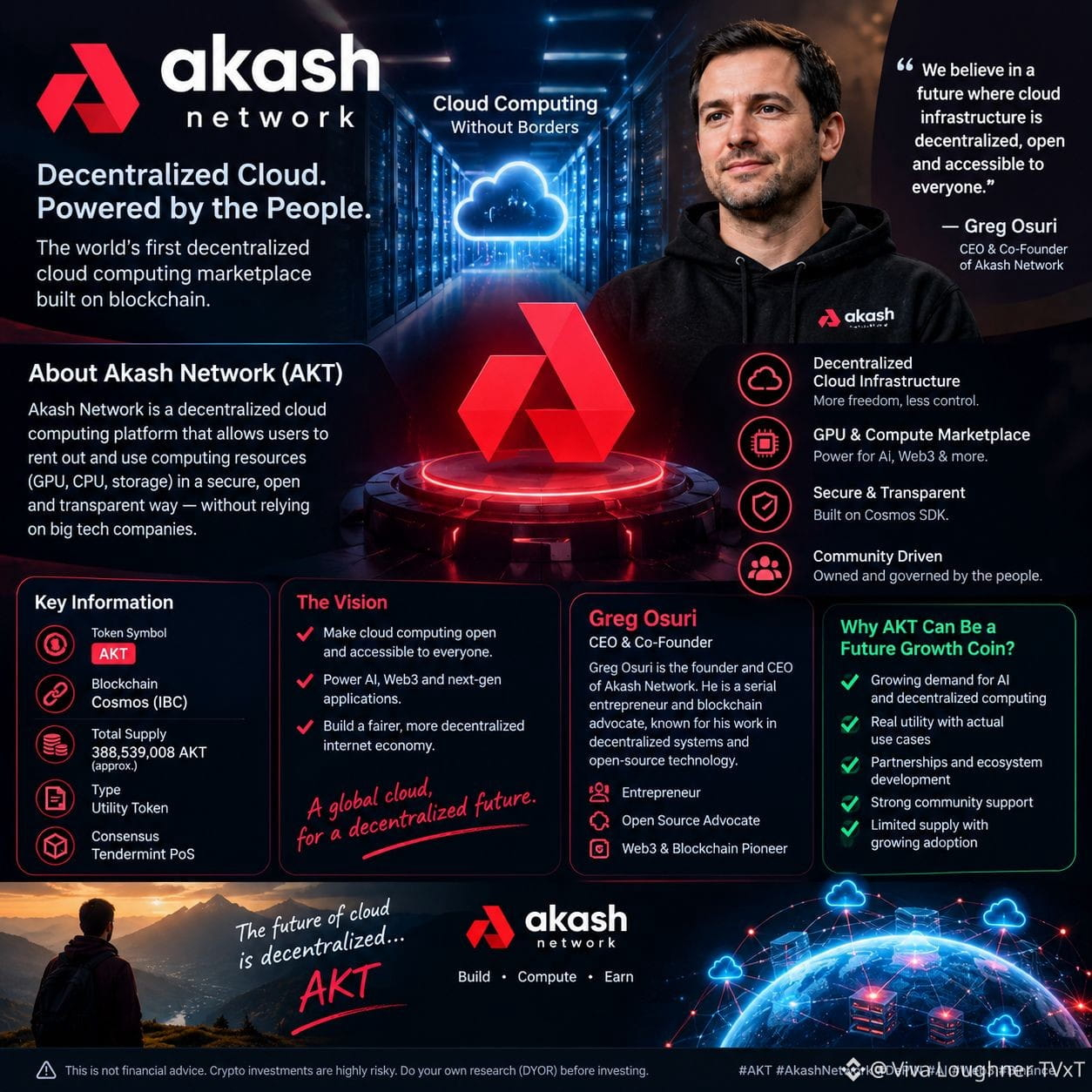
🚀 AKT (Akash Network): A Hidden Opportunity in the AI Infrastructure Sector?
While everyone is watching major crypto coins, AKT deserves attention for its connection to decentralized cloud computing and the growing AI infrastructure market. 🧠☁️
🔍 Why I'm Watching $AKT : 🔹 Decentralized GPU and cloud-computing marketplace. 🔹 Exposure to the AI + DePIN narrative. 🔹 Real-world utility beyond simple speculation. 🔹 Future growth depends on network adoption and actual demand.
📈 Bullish Scenario: Rising demand for decentralized computing, stronger network usage, and increased ecosystem activity could support long-term growth.
⚠️ Key Risks: Token unlocks, competition, weak adoption, and market-wide selling pressure could limit performance.
🎯 My View: AKT is a project worth researching before the next major AI-related crypto cycle. But the real question is whether network demand can translate into sustainable token value.
💬 Can AKT become a major player in decentralized AI infrastructure?
#AKT #AkashNetwork #DePIN #AI #CryptoResearch #Binance
99

·
--
Akash announced plans to migrate to Solana, and multiple projects’ holdings may also share the same settlement layer. If you hold different tokens, are you really diversified?
It’s natural to spread your holdings if you’re worried about betting on a single project. But different projects don’t necessarily mean different underlying dependencies.
On the 26th, Akash announced its choice of Solana and plans to turn its marketplace into an on-chain program. The migration still requires governance approval and an audit, and switching the marketplace will require another vote. Render’s token-burning and rewards mechanisms already run on Solana. If Akash completes its migration, the two projects will have different businesses, but some token operations will depend on the same blockchain.
Sharing an underlying layer can reduce the burden of maintaining a custom chain. But if transactions on that layer are disrupted, related on-chain settlements could also be affected. This does not mean GPU services will go down, nor is it a prediction of an outage.
As of 5 p.m. Hong Kong time, over the full six-hour period SOL fell 0.31% and RENDER fell 0.59%; in the preceding window, they fell 0.05% and 1.40%, respectively. Price movements over the same period do not prove that the market is pricing in the migration.
Holding different tokens can give you exposure to different businesses and diversify business-specific risks, but shared settlement dependencies may remain. If the migration plan changes, reassess based on the actual path—not just the number of tokens you hold.
This content participates in Binance Square’s content-monetization program. The author may receive platform commissions and engagement rewards.
Sources: Official channels of both projects; Binance. Not investment advice. #宏观 #DePIN

162

·
--
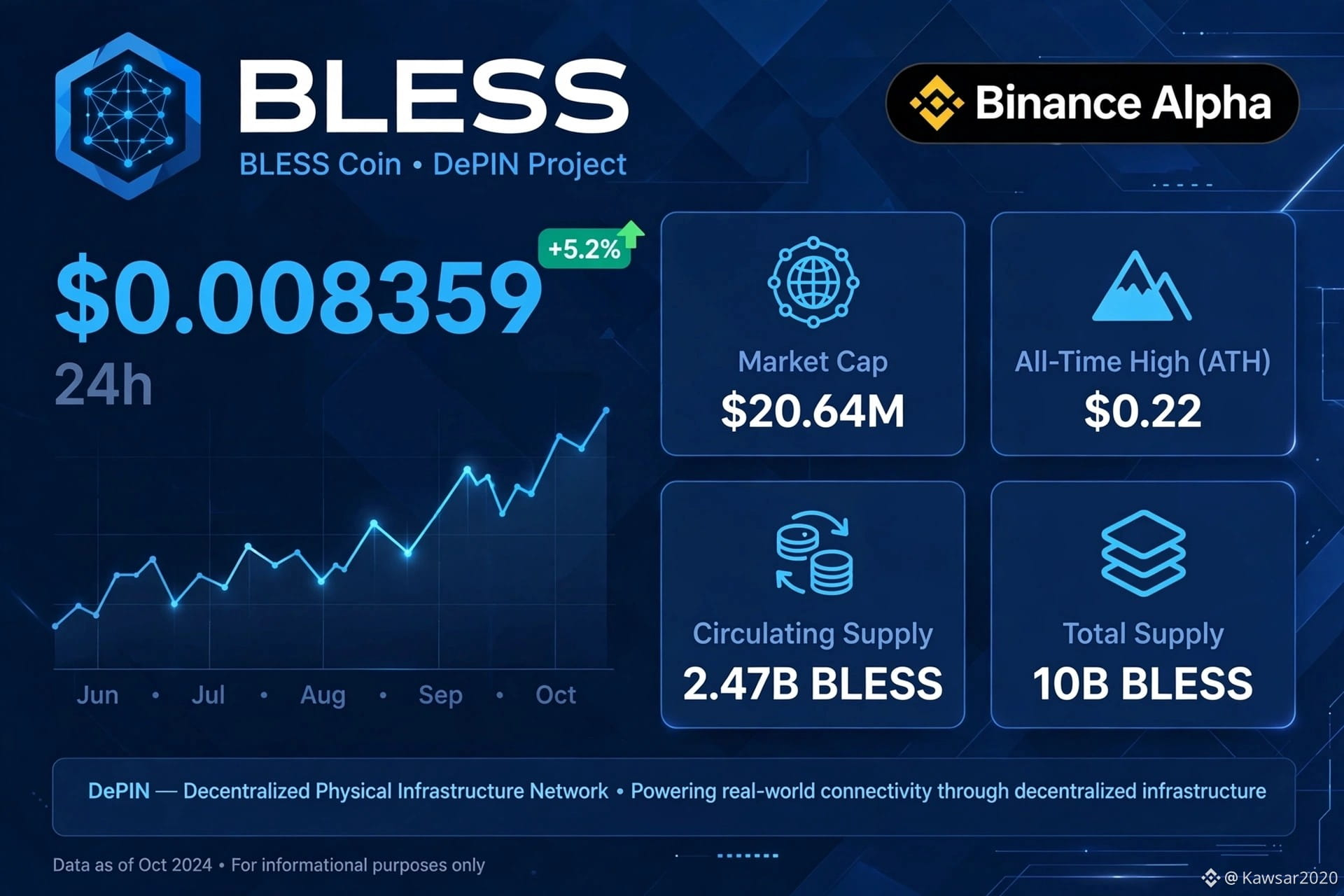
BLESS COIN - Real Update 🚀
$BLESS Price: $0.008359 (+5.2%)
Market Cap: $20.64M
ATH: $0.22 (down 96% from ATH!)
Supply Breakdown:
Circulating: 2.47B / 10B (Only 25% unlocked!)
Total Supply: 10B
Category: DePIN + Binance Alpha Project
Chain: BNB + Solana
My View:
Being 96% down from ATH means it’s near the bottom. Only 25% of the supply is on the market; the remaining 75% is yet to unlock. If the DePIN narrative returns, $0.02 is easily within reach.
Risk: Low cap + high FDV. Check the unlock schedule before holding long term.
Do you hold BLESS? 👇
#BLESS #DePIN #BinanceAlpha #CryptoBD #BinanceSquareFamily
$SOL $PENGU
1
8

·
--
Don’t call it done yet: The vote on Akash moving to $SOL is still openThe voting window hasn’t closed yet, so don’t rush to call it “migration complete.”
DePIN open-source cloud platform Akash posted governance proposal #346 on October 26: it asks $AKT stakers whether they want to leave their own Cosmos chain, akashnet-2, and migrate to the $SOL mainnet. According to Valopers, voting runs until November 2. As of now, about 98.15% are in favor and 1.85% are against, with turnout at around 43% (the 33.4% quorum has been met). The proposal is expected to pass—but its status is still “voting,” not completed. Founder Greg Osuri also said it had “passed by a record margin,” while adding that there’s still a small chance someone could change their vote.
Don’t call it done yet: The vote on Akash moving to $SOL is still open
The voting window hasn’t closed yet, so don’t rush to call it “migration complete.”
DePIN open-source cloud platform Akash posted governance proposal #346 on October 26: it asks $AKT stakers whether they want to leave their own Cosmos chain, akashnet-2, and migrate to the $SOL mainnet. According to Valopers, voting runs until November 2. As of now, about 98.15% are in favor and 1.85% are against, with turnout at around 43% (the 33.4% quorum has been met). The proposal is expected to pass—but its status is still “voting,” not completed. Founder Greg Osuri also said it had “passed by a record margin,” while adding that there’s still a small chance someone could change their vote.
DePIN open-source cloud platform Akash posted governance proposal #346 on October 26: it asks $AKT stakers whether they want to leave their own Cosmos chain, akashnet-2, and migrate to the $SOL mainnet. According to Valopers, voting runs until November 2. As of now, about 98.15% are in favor and 1.85% are against, with turnout at around 43% (the 33.4% quorum has been met). The proposal is expected to pass—but its status is still “voting,” not completed. Founder Greg Osuri also said it had “passed by a record margin,” while adding that there’s still a small chance someone could change their vote.
181


·
--
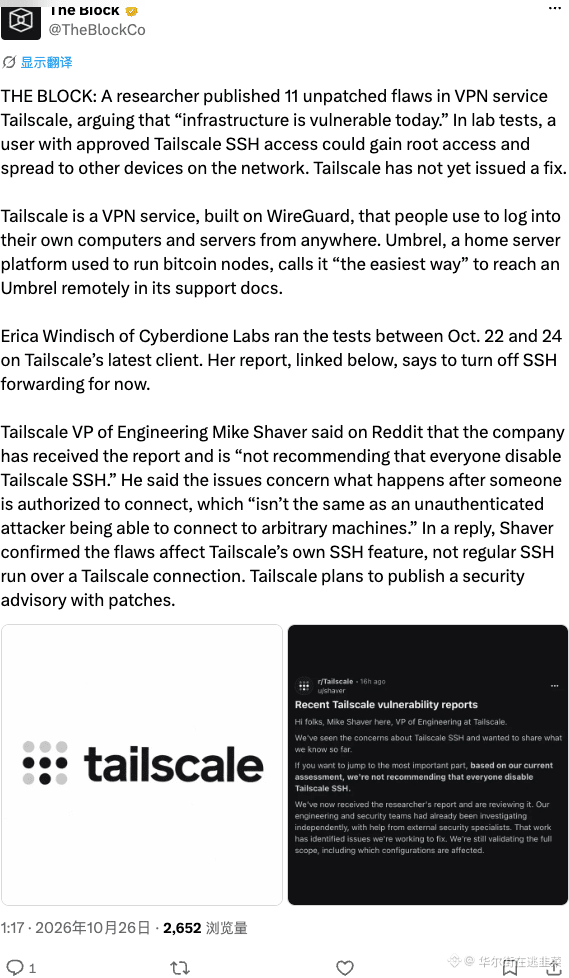
Tailscale disclosed 11 high-severity vulnerabilities. Authorized users could escalate privileges and take over Umbrel, a platform for hosting Bitcoin nodes.
If the infrastructure layer has holes, how is DePIN supposed to work?
The company insists these aren’t unauthenticated attacks and recommends disabling SSH. If you wait too long, you’re toast.
$TAILSCALE $BTC #Security #DePIN
If the infrastructure layer has holes, how is DePIN supposed to work?
The company insists these aren’t unauthenticated attacks and recommends disabling SSH. If you wait too long, you’re toast.
$TAILSCALE $BTC #Security #DePIN
158

·
--
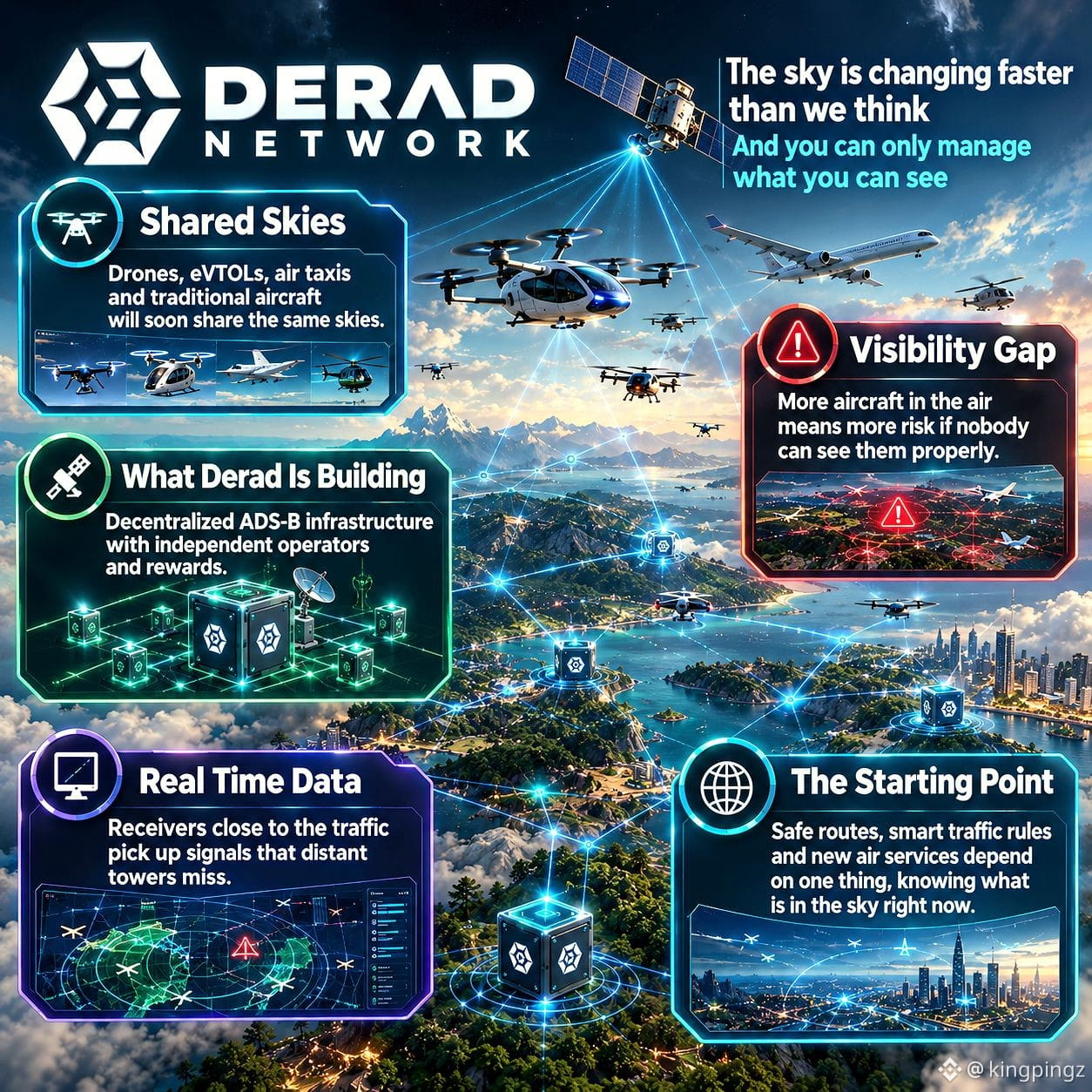
🌫 "𝗧𝗵𝗲 𝘀𝗸𝘆 𝗶𝘀 𝗰𝗵𝗮𝗻𝗴𝗶𝗻𝗴 𝗳𝗮𝘀𝘁𝗲𝗿 𝘁𝗵𝗮𝗻 𝘄𝗲 𝘁𝗵𝗶𝗻𝗸, 𝗔𝗻𝗱 𝘆𝗼𝘂 𝗰𝗮𝗻 𝗼𝗻𝗹𝘆 𝗺𝗮𝗻𝗮𝗴𝗲 𝘄𝗵𝗮𝘁 𝘆𝗼𝘂 𝗰𝗮𝗻 𝘀𝗲𝗲" 🌫
Let's dive into the Derad's network insights below.👇
✈️ 𝗦𝗵𝗮𝗿𝗲𝗱 𝗦𝗸𝗶𝗲𝘀
Drones, eVTOLs, air taxis and traditional aircraft will soon share the same skies. Airspace that once belonged to a few commercial flights is becoming a fast moving mix of very different vehicles with very different needs.
📡 𝗩𝗶𝘀𝗶𝗯𝗶𝗹𝗶𝘁𝘆 𝗚𝗮𝗽
More aircraft in the air means more risk if nobody can see them properly. Low altitude zones and remote regions already have patchy coverage, and a busier sky will only make those weak spots harder to ignore.
🛰️ 𝗪𝗵𝗮𝘁 𝗗𝗲𝗿𝗮𝗱 𝗜𝘀 𝗕𝘂𝗶𝗹𝗱𝗶𝗻𝗴
Derad Network is building decentralized ADS-B infrastructure. Instead of relying on volunteers, independent operators run ground stations and earn rewards for solid coverage, which keeps aircraft signals flowing into one shared network.
🖥️ 𝗥𝗲𝗮𝗹 𝗧𝗶𝗺𝗲 𝗗𝗮𝘁𝗮
Receivers placed close to the traffic pick up signals that distant towers miss. That means real time data from the low and crowded parts of the sky, which is exactly where drones and air taxis will operate.
🌐 𝗧𝗵𝗲 𝗦𝘁𝗮𝗿𝘁𝗶𝗻𝗴 𝗣𝗼𝗶𝗻𝘁
Safe routes, smart traffic rules and new air services all depend on one simple thing, knowing what is in the sky right now. The future of airspace starts there, and Derad is building the foundation for it.
#AI #DePIN #Web3
1
52
Log in to explore more content
Join global crypto users on Binance Square
⚡️ Get latest and useful information about crypto.
💬 Trusted by the world’s largest crypto exchange.
👍 Discover real insights from verified creators.
Email / Phone number
Trending Topics
1
#CanMicrosoftDeliverOnAI
18,524 views
376 Discussing
2
#CanGoogleDefindItsCore
10,516 views
291 Discussing
3
#FOMCWatch
9M views
27,516 Discussing
4
#EthereumDropsBelow$2300
7,885 views
129 Discussing
5
#BitcoinSlipsBelow$80KAgain
22,491 views
95 Discussing
6
#ThailandLaunchesWORPTStablecoinToQRPaymentApp
41,980 views
652 Discussing
7
#StrategySkipsBitcoinPurchasesSpends$205MOnSTRCBuybacks
9,122 views
89 Discussing
8
#BitmineAdds10452ETH
82,151 views
1,032 Discussing
9
#SouthKoreaConsidersEducationTaxOnCryptoExchanges
43,543 views
757 Discussing
10
#OCCUrgesCommunityBanksToEnterStablecoinPayments
33,732 views
533 Discussing