

#chainalysis
chainalysis
85,392 views
335 Discussing
Hot
Latest

·
--
🚨 #security UPDATE: #Chainalysis Breach & #Binance Hack Countermeasures 🚨
🔒 Chainalysis officially confirmed a targeted cyber intrusion using advanced AI-driven agentic techniques.
The breach exposed non-sensitive customer metadata (Names, Emails, and User IDs).
Crucially, there is NO evidence of compromised clear-text passwords, session tokens, or investigation case data.
🛡️ The firm is actively reviewing its platform security alongside external cybersecurity experts.
Chainalysis explicitly verified this incident is entirely isolated and unrelated to the historic Binance exploit.
⚔️ On-Chain Flow Update:
Out of the $6.4 Billion stolen from Binance by North Korea's TraderTraitor group, approximately $2.8 Billion in stablecoins has been successfully frozen on-chain through rapid institutional collaboration.
💡 Keep your assets secure and don't chase the panic.
#CyberSecurity #Chainalysis #BinanceHack #SmartMoney #Web3Security #CryptoIntel $USDT $USDC
$BTC
{spot}(BTCUSDT)
$ETH
{spot}(ETHUSDT)
$USDC
{spot}(USDCUSDT)
🚨 #security UPDATE: #Chainalysis Breach & #Binance Hack Countermeasures 🚨
🔒 Chainalysis officially confirmed a targeted cyber intrusion using advanced AI-driven agentic techniques.
The breach exposed non-sensitive customer metadata (Names, Emails, and User IDs).
Crucially, there is NO evidence of compromised clear-text passwords, session tokens, or investigation case data.
🛡️ The firm is actively reviewing its platform security alongside external cybersecurity experts.
Chainalysis explicitly verified this incident is entirely isolated and unrelated to the historic Binance exploit.
⚔️ On-Chain Flow Update:
Out of the $6.4 Billion stolen from Binance by North Korea's TraderTraitor group, approximately $2.8 Billion in stablecoins has been successfully frozen on-chain through rapid institutional collaboration.
💡 Keep your assets secure and don't chase the panic.
#CyberSecurity #Chainalysis #BinanceHack #SmartMoney #Web3Security #CryptoIntel $USDT $USDC
$BTC
$ETH
$USDC


Good luck 🍀
From OnionSam
98

·
--
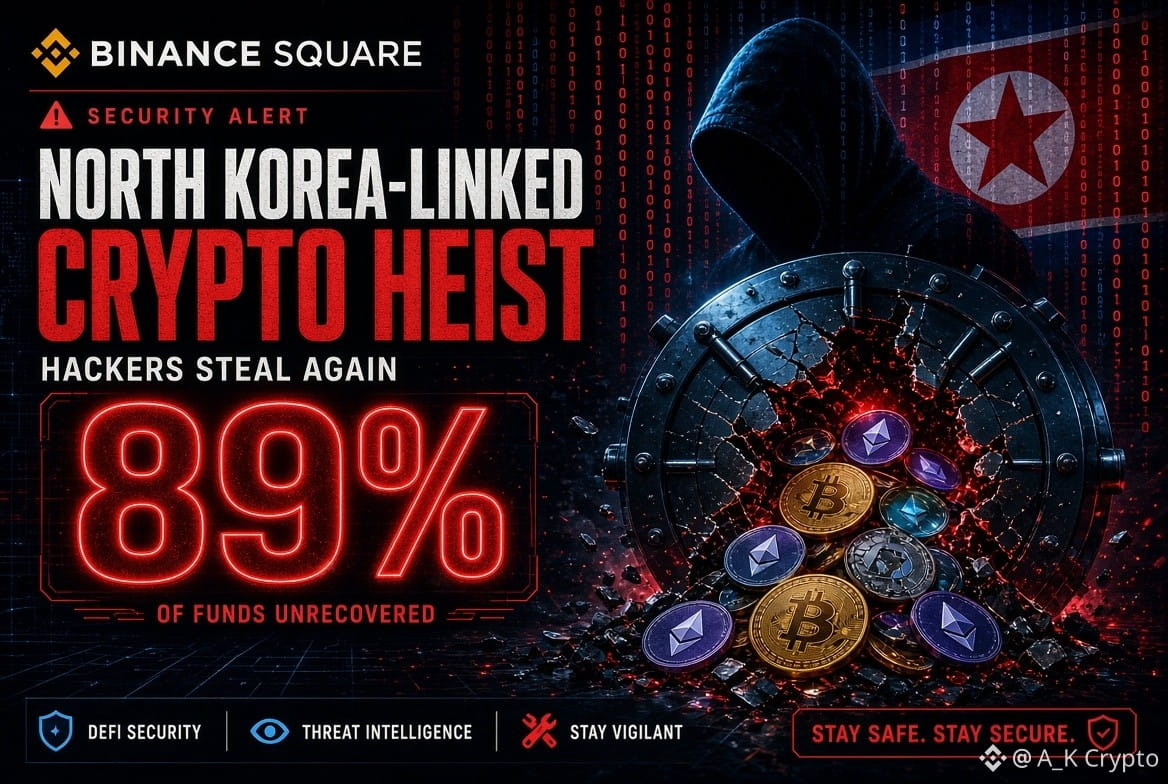
#SuspectedNorthKoreaAttacksAccountForNearly89%OfCryptoHackLosses
🚨 Chainalysis: Suspected North Korea Hacks Account for Nearly 89% of 2026 Crypto Losses
According to Chainalysis data released Oct 30, suspected North Korea-linked attacks made up almost 89% of reported crypto hack losses so far in 2026 — up sharply from just 15% in 2021.
Average loss per DPRK-linked incident jumped from $50.65M (2021) to $185.65M this year.
From 2021 through Oct 29, 2026, these attacks accounted for $13.24B of $22.34B in total reported losses (≈59%).
TRM Labs puts the 2026 share at around 85%.
This dominance highlights how state-sponsored actors have become the primary threat to crypto security. Larger, more sophisticated attacks are draining billions that could otherwise support industry growth. Stronger on-chain monitoring, faster freezes, and better internal controls are essential. The community and exchanges must treat this as a national-security-level risk, not just another crime wave.
#CryptoSecurity #NorthKorea #NorthKoreaMissileProvocations #Chainalysis
102

·
--

Article
A $6.4 billion crypto heist. A 54‑minute race against the freeze button.The $6.4 Billion Heist: How a 54‑Minute Race and a Single Slip‑Up Unmasked North Korea’s Crypto Thieves
A new investigation report from blockchain‑tracking firm Chainalysis has laid out the exact timeline of the Binance hack, revealing who pulled off the largest crypto theft in history, how they got caught while trying to launder the money, and how a frantic 54‑minute sprint stopped them from cashing out nearly half the loot.
Who was behind it?
Chainalysis confirmed that the $6.4 billion drain was carried out by TraderTraitor — a North Korean government hacking group that steals crypto to fund the regime.
Investigators proved the link on 30 October 2026 at 12:30 a.m. ET when the hackers made a critical mistake: they sent part of the stolen Binance coins into the exact same wallets already holding funds from the September 2026 Bitget hack, which was already tied to North Korea.
The 54‑minute race: minute by minute
It all kicked off on 29 October 2026 at 4:20 p.m. ET when roughly $6.4 billion began leaving Binance hot wallets.
On $ETH the attacker used a wallet funded through Tornado Cash to send valid signed permissions that tricked a Binance hot wallet into running the hacker’s own code and emptying itself out.
Once the money was out, the hackers faced a massive problem: Bitcoin and ETH cannot be frozen by any company, but dollar stablecoins like USDT and USDC have an emergency freeze button controlled by their issuers (Tether and Circle).
To beat the freeze, the hacker rushed $500 million** in stolen stablecoins into a trading wallet and spent **20 minutes** swapping **$325 million of stablecoins into $285 million** worth of ETH — willingly losing **$40 million on the trade just to turn freezable dollars into unfreezable ETH.
Just 10 minutes later, the hacker moved the remaining $175 million in stablecoins into temporary wallets to try to outrun the blacklist.
Then, at 5:14 p.m. ET — only 54 minutes after the hack began — stablecoin issuers, law enforcement, and Chainalysis started locking down the wallets, freezing about $2.8 billion before the hackers could swap it.
The new robot trick the hackers are using now
To hide the remaining unfreezable coins, Chainalysis spotted a brand‑new automated program making thousands of transfers in minutes. Instead of sending stolen money straight forward, the software moves coins in circles — back to wallets used earlier in the chain — to confuse human investigators.
Hundreds of new wallets follow one exact robot pattern: first the wallet receives exactly 1 TRX (to pay for network fees), then it receives a batch of stolen funds, and seconds later it forwards the money to the next address.
Key takeaways
1️⃣ Even though $6.4 billion is the largest crypto theft in history, freezing $2.8 billion in under an hour shows that major crypto companies and investigators can now lock down stolen digital dollars faster than hackers can sell them.
2️⃣ While Binance is covering all unrecovered user losses through its SAFU insurance reserve, Chainalysis warns that automated hacking and laundering tools are moving faster than ever meaning exchanges must upgrade how hot wallets approve withdrawals.
The big question: Do you think North Korea will ever be able to cash out the unfreezable Bitcoin and ETH when every exchange is watching their wallets?
$BTC
{spot}(BTCUSDT)
#Chainalysis #CryptoNewss #Ethereum
A $6.4 billion crypto heist. A 54‑minute race against the freeze button.
The $6.4 Billion Heist: How a 54‑Minute Race and a Single Slip‑Up Unmasked North Korea’s Crypto Thieves
A new investigation report from blockchain‑tracking firm Chainalysis has laid out the exact timeline of the Binance hack, revealing who pulled off the largest crypto theft in history, how they got caught while trying to launder the money, and how a frantic 54‑minute sprint stopped them from cashing out nearly half the loot.
Who was behind it?
Chainalysis confirmed that the $6.4 billion drain was carried out by TraderTraitor — a North Korean government hacking group that steals crypto to fund the regime.
Investigators proved the link on 30 October 2026 at 12:30 a.m. ET when the hackers made a critical mistake: they sent part of the stolen Binance coins into the exact same wallets already holding funds from the September 2026 Bitget hack, which was already tied to North Korea.
The 54‑minute race: minute by minute
It all kicked off on 29 October 2026 at 4:20 p.m. ET when roughly $6.4 billion began leaving Binance hot wallets.
On $ETH the attacker used a wallet funded through Tornado Cash to send valid signed permissions that tricked a Binance hot wallet into running the hacker’s own code and emptying itself out.
Once the money was out, the hackers faced a massive problem: Bitcoin and ETH cannot be frozen by any company, but dollar stablecoins like USDT and USDC have an emergency freeze button controlled by their issuers (Tether and Circle).
To beat the freeze, the hacker rushed $500 million** in stolen stablecoins into a trading wallet and spent **20 minutes** swapping **$325 million of stablecoins into $285 million** worth of ETH — willingly losing **$40 million on the trade just to turn freezable dollars into unfreezable ETH.
Just 10 minutes later, the hacker moved the remaining $175 million in stablecoins into temporary wallets to try to outrun the blacklist.
Then, at 5:14 p.m. ET — only 54 minutes after the hack began — stablecoin issuers, law enforcement, and Chainalysis started locking down the wallets, freezing about $2.8 billion before the hackers could swap it.
The new robot trick the hackers are using now
To hide the remaining unfreezable coins, Chainalysis spotted a brand‑new automated program making thousands of transfers in minutes. Instead of sending stolen money straight forward, the software moves coins in circles — back to wallets used earlier in the chain — to confuse human investigators.
Hundreds of new wallets follow one exact robot pattern: first the wallet receives exactly 1 TRX (to pay for network fees), then it receives a batch of stolen funds, and seconds later it forwards the money to the next address.
Key takeaways
1️⃣ Even though $6.4 billion is the largest crypto theft in history, freezing $2.8 billion in under an hour shows that major crypto companies and investigators can now lock down stolen digital dollars faster than hackers can sell them.
2️⃣ While Binance is covering all unrecovered user losses through its SAFU insurance reserve, Chainalysis warns that automated hacking and laundering tools are moving faster than ever meaning exchanges must upgrade how hot wallets approve withdrawals.
The big question: Do you think North Korea will ever be able to cash out the unfreezable Bitcoin and ETH when every exchange is watching their wallets?
$BTC
#Chainalysis #CryptoNewss #Ethereum
1
2
164


·
--
Guys!! On-chain analysis has just nailed down who’s responsible even harder!!!
A post on Chainalysis’s official blog names names: they believe North Korean hacking group TraderTraitor was behind this huge Binance heist. The key evidence is that the stolen Binance funds were mixed on-chain with the batch stolen from Bitget last month (Chainalysis/BBC, Oct. 30–31)~
The money-laundering tactics were pretty intense too: in about 20 minutes, roughly 325 million stablecoins were swapped for around 285 million ETH, specifically to avoid being frozen by issuers. After that, they spotted tens of thousands of automated transfers, with many addresses first receiving exactly 1 TRX before passing the funds along, haha.
CoinGecko has BTC hovering around $77,200 right now, and ETH around $2,240~ Honestly, the president saying it’s “under investigation” is one thing, but on-chain firms have already named names. Don’t take “no official attribution yet” to mean “nothing to see here.” Let’s keep an eye on the freezes and recovery efforts this weekend!!!
Do you put more faith in Chainalysis’s attribution, or would you rather wait for the U.S. government to make it official?
$BTC $ETH
#币安 #Chainalysis #crypto
Padfoot:
链上归因能当线索,不能直接当判决书😂 先核对原始公告,别黑客还没抓到,交易所先被张冠李戴了。
1
2.6k

·
--
A company that hunts hackers got hacked itself 😱
▫️On-chain analytics giant Chainalysis announced: it was breached by an external attacker this month
▫️The attacker used AI agent techniques to gain direct access to internal systems and tools
▫️Customers’ user IDs, names, email addresses, and job-title tags were accessed
▫️The company says it has found no evidence so far that investigation materials, passwords, or MFA keys were leaked, and the breach is unrelated to the Binance theft
In the age of AI hackers, even on-chain detectives aren’t safe 😂
If you got an unexpected password reset notification, would you click it? 👇
#Chainalysis #网络安全 #AI

Padfoot:
这下侦探自己进案卷了😂 陌生重置链接不点,真有事我自己开官网,谁知道对面是客服还是赛博开锁王。
1
1
574

·
--
Chainalysis Customer Data Accessed: The Risk Goes Beyond Passwords
Names, email addresses, and roles within an organization may not be enough to directly steal crypto, but they could make a fake notification seem more convincing.
In an official disclosure on October 30, Chainalysis said an external attacker accessed its systems and internal tools without authorization. The attacker accessed some customers’ user IDs, names, email addresses, and organizational role labels. The company is working to determine which specific records at each organization were involved.
The company also outlined the scope of its investigation: based on current evidence, it has found no indication that investigation content (such as graphs, notes, or cases), transaction or query results, plaintext passwords, multifactor authentication secrets, or user session tokens were accessed without authorization. “No indication” is an interim finding, not an absolute guarantee that there was no impact.
The company also made clear that this incident is unrelated to the recent Binance crypto theft. The two incidents should not be combined into a single attack chain just because they occurred around the same time, and this does not justify concluding that customer funds have been stolen.
For affected users, the more practical step is to guard against targeted phishing attempts: a notification that uses your name and knows your organization is not necessarily trustworthy. The company advises users to watch out for unexpected password reset or authentication prompts, and recommends that organizations that have not yet enabled two-factor authentication do so.
This type of data could increase the risk of targeted phishing, but it does not mean a follow-up attack has already occurred. This post interprets the public disclosure only; it has not checked any personal accounts and does not determine whether your data was involved.
Official statement:
https://www.chainalysis.com/blog/security-incident-october-30/
#热币雷达 #Chainalysis #InformationSecurity
The accompanying image is an original conceptual illustration about data security, not an actual customer record. Not investment advice.

4

·
--
Chainalysis, which tracks illicit crypto funds, was hacked itself.
According to its official blog post on October 30, some customers’ names, email addresses, user IDs, and organizational roles were accessed. So far, there’s no evidence that investigation data, plaintext passwords, MFA keys, or session tokens were accessed without authorization.
What worries me is targeted phishing: scammers who know your name and company can make fake emails look more convincing. Beyond watching $BTC prices rise and fall, verify unusual password resets and login authorizations too. “No evidence so far” doesn’t mean the risk is gone. Keep an eye on the scope of the impact and the forensic findings.
Personal opinion, not investment advice. Which worries you more: losing your coins or having your information leaked?
https://www.chainalysis.com/blog/security-incident-october-30/
#加密安全 #Chainalysis
183

·
--
Chainalysis reported that an external actor accessed internal systems and obtained customer data such as names, emails, and roles. There is no indication that they accessed investigation content or credentials. The firm clarified that it has no connection to the Binance theft.
This comes at a time when the industry is tracking the largest theft in history. The tools we use to follow funds also have attack surfaces.
How does your view of traceability change when the analytics firm itself reports an incident like this?
Source: The Block
#Chainalysis
This comes at a time when the industry is tracking the largest theft in history. The tools we use to follow funds also have attack surfaces.
How does your view of traceability change when the analytics firm itself reports an incident like this?
Source: The Block
#Chainalysis
2
1.1k

·
--
The analytics firm Chainalysis has just confirmed a security incident.
The attackers managed to access non-sensitive user data.
The exposed information includes names, email addresses, and some user IDs.
It’s curious that a company specifically focused on cybersecurity would experience this kind of problem.
Are you surprised this happened at a firm of this caliber?
$BTC #Chainalysis #Cybersecurity
105

Chainalysis hacked, customer data exposed; hacker used 'agentic techniques'
- Chainalysis confirmed that a hacker breached its systems and accessed customers' names and email addresses
- The hacker used "offensive agentic techniques"
- Chainalysis also tracks the multibillion-dollar Binance hack
- The Binance attacker used the Tron protocol to evade stablecoin freezes
#BinanceSquare #CryptoNews #Chainalysis #BNB #TRX USDT
$bnb $trx $usdt
vlikevn Titanbot
Source: The Block
352
Chainalysis hit by security breach
- Chainalysis hired a leading third-party expert to assess security
- The incident affected the world's leading blockchain analytics company
#Chainalysis #Cybersecurity #Blockchain #Crypto
$btc $eth
#vlikevn Titanbot
Source: CoinTelegraph
Chainalysis hit by security breach
- Chainalysis hired a leading third-party expert to assess security
- The incident affected the world's leading blockchain analytics company
#Chainalysis #Cybersecurity #Blockchain #Crypto
$btc $eth
#vlikevn Titanbot
Source: CoinTelegraph
- Chainalysis hired a leading third-party expert to assess security
- The incident affected the world's leading blockchain analytics company
#Chainalysis #Cybersecurity #Blockchain #Crypto
$btc $eth
#vlikevn Titanbot
Source: CoinTelegraph
2
Chainalysis hit by cyberattack, experts call in specialists for support
- Chainalysis hit by a cyberattack
- Hired international third-party experts to conduct a security audit
- Will strengthen its defense systems
#BinanceSquare #CryptoNews #Chainalysis #CyberSecurity
$btc $eth
#vlikevn Titanbot
Source: CoinTelegraph
- Chainalysis hit by a cyberattack
- Hired international third-party experts to conduct a security audit
- Will strengthen its defense systems
#BinanceSquare #CryptoNews #Chainalysis #CyberSecurity
$btc $eth
#vlikevn Titanbot
Source: CoinTelegraph
176

🛡️ Chainalysis, a company specializing in blockchain analysis, announced that it had experienced a cybersecurity incident. According to the available information, the company enlisted world-class independent experts to conduct a comprehensive review of its systems and strengthen its defenses. No further details are available about the nature of the breach or its actual impact on data. It remains unclear whether any sensitive information was leaked or how the incident affected customers. 👀
🔍 This event highlights the importance of regular security testing, even for companies considered leaders in blockchain analytics. The question is: How can companies in the cryptocurrency sector improve their preventive strategies in the face of increasingly sophisticated threats?
Not investment advice.
#أمان_البلوكتشين #Chainalysis #تحليل_سلاسل_الكتل #Write2Earn
25

·
--
Chainalysis Suffers Cyberattack, Raising Fresh Concerns About Trust in On-Chain Analytics
Chainalysis, a key on-chain data provider in the crypto industry, confirmed a cybersecurity incident and has brought in a team of third-party experts to conduct a review. As the incident comes in the wake of the largest hack in Binance’s history, trust in on-chain analytics infrastructure is once again being tested.
According to Cointelegraph, Chainalysis said it had hired “world-class” third-party experts to help review its security systems and strengthen its defenses. This is the company’s first preliminary official statement on the incident. Details such as the source of the attack, the scope of its impact, and whether any data was leaked have not yet been disclosed.
Chainalysis has long provided on-chain tracking and data analytics support to exchanges, regulators, and compliance organizations, making it a key part of the industry’s underlying infrastructure. Any damage to its analytical capabilities or credibility could have implications beyond the company itself—affecting regulatory investigations, the tracking of fund flows, and compliance reviews of platforms.
At this stage, the incident remains at the preliminary statement phase: the company has only confirmed that it has launched an external review, without providing a timeline or conclusions. This means the incident’s actual impact remains highly uncertain, and developments need to be monitored.
At the market level, incidents of this kind usually do not directly affect crypto prices, but they may heighten investor caution about trust in the industry’s security—especially in the wake of Binance’s major hack, which could amplify sentiment-driven reactions. However, there is currently no evidence linking the attack directly to any specific asset or platform.
A countervailing factor is that bringing in third-party experts is itself a mature crisis-response measure, indicating that the company is proactively strengthening its defenses rather than merely reacting. Moreover, demand for on-chain data is structurally resilient over the long term amid tighter regulation, so the short-term impact may not necessarily undermine its position in the industry.
What to watch next: the findings of the third-party review, whether the incident affected specific customers or data, and how market sentiment toward trust in industry security responds. If monitoring overall risk appetite, it is more important to watch whether the incident triggers broader concerns about the on-chain analytics sector than to focus on price movements in any single asset.
observation_type: risk_watch
#Chainalysis #CryptoSecurity
The above is a summary of information and personal analysis, and does not constitute investment advice.
1
Chainalysis suffers cybersecurity incident, hires external experts to reassess its systems
• Chainalysis announced that it had experienced a cybersecurity incident.
• The company hired leading external experts to reassess its security systems and strengthen its defenses.
• The incident comes as the blockchain industry increasingly focuses on cybersecurity.
#BinanceSquare #CryptoNews #Chainalysis
$btc $eth
#vlikevn #Titanbot
Source: CoinTelegraph
176

·
--
Sub-Saharan Africa’s crypto market hits $101 billion as stablecoins take off!
The latest Chainalysis report shows that Sub-Saharan Africa’s crypto market is growing rapidly and has reached $101 billion. South Africa and Nigeria are leading the way, while individuals’ self-custody wallets rank among the world’s top. Are you keeping up with the stablecoin boom?#加密市场 #Chainalysis
The latest Chainalysis report shows that Sub-Saharan Africa’s crypto market is growing rapidly and has reached $101 billion. South Africa and Nigeria are leading the way, while individuals’ self-custody wallets rank among the world’s top. Are you keeping up with the stablecoin boom?#加密市场 #Chainalysis
3
Chainalysis hit by malicious AI cyberattack, customer data exposed
- Blockchain analytics firm Chainalysis confirmed it was targeted in a cyberattack using malicious AI techniques (agentic AI).
- Hackers gained unauthorized access to Chainalysis’s internal systems and tools.
- The exposed data included customer names, email addresses, user IDs, and organizational roles.
- This serious security breach raises cybersecurity risks across the crypto industry.
#BinanceSquare #CryptoNews #Chainalysis #AI #Hack
$btc $eth
vlikevn Titanbot
Source: CoinGape
137

·
--
Latest data from Chainalysis: Nearly 89% of crypto theft losses so far in 2026 are believed to be linked to North Korean hackers, compared with just 15% in 2021.
Individual attacks are getting more severe: The average loss per North Korea-linked incident rose from $50.65 million in 2021 to $185.65 million this year, about 3.7 times higher.
From 2021 through 10/29, the industry lost about $22.34 billion to theft, of which about $13.24 billion was linked to North Korea, or 59%.
This year’s biggest losses were about $6.4 billion stolen from Binance and about $387 million from Bitget in September; Chainalysis attributes both to TraderTraitor. The stolen Binance funds have been mixed on-chain with the Bitget loot.
The hackers also converted $325 million in stablecoins into about $285 million worth of $ETH in around 20 minutes, beating the freeze. $BTC is now about 77076 (-1.1%); $ETH is about 2238.
#朝鲜黑客 #Chainalysis #加密安全 #Binance
67
·
--
Chainalysis got hit itself
Bitcoin News cited the company as saying
Hackers used “offensive agentic technology”
To gain unauthorized access to internal systems and tools
Exposing information such as customer names, email addresses, user IDs, and organizational roles
The company also drew a line
There is currently no evidence that passwords, MFA keys, session tokens,
Or sensitive investigation data were taken
It also said the incident was unrelated to the recent Binance incident involving around $6 billion
An on-chain analytics company breached by AI agents
Shows that both offense and defense are becoming automated
The intelligence industry’s own customer directory has become a target
Anyone with a related account should change their password, enable MFA, and watch out for phishing
A week packed with security incidents
Don’t just keep an eye on exchanges’ hot wallets
Toolchains and third-party services can expose people too
$BTC $ETH
#Chainalysis #安全事件 #AIagents

1
212

·
--
Chainalysis specializes in analyzing other people's on-chain fund flows, but its own internal systems were breached. The company said it discovered in October that external attackers had used “offensive AI agent technology” to gain unauthorized access to its systems and internal tools. The data accessed included platform user IDs, names, email addresses, and organizational roles; there is currently no indication that plaintext passwords, MFA keys, session tokens, or investigation content were exposed. The company is verifying which records were affected and says the incident is unrelated to the Binance theft.
These fields may not seem sensitive, but they’re enough for phishing: knowing which organization an email address belongs to and what position someone holds means the first line of an impersonation email can address them by name.
Next, let’s see how large a scope of impact Chainalysis confirms. Organizations that use it for compliance screening should review their employees’ login logs over the next few days.
#Chainalysis #加密安全 #AI attack
73
Log in to explore more content
Join global crypto users on Binance Square
⚡️ Get latest and useful information about crypto.
💬 Trusted by the world’s largest crypto exchange.
👍 Discover real insights from verified creators.
Email / Phone number
Trending Topics
1
#FBIConfirmsNorthKoreaIsResponsibleForBinanceCryptoHack
3 views
3 Discussing
2
#BinanceSAFUFundTransferCompleted7499BTC
41,614 views
855 Discussing
3
#BinanceRecovery90% of stolen assets
145,163 views
181 Discussing
4
#YiHe:ProofOfReserves:10TokensAt100%Backing
142,555 views
778 Discussing
5
#BackedNotBroken:RichardTengSaysUsersBearNoLoss
44,984 views
488 Discussing
6
#B14gReportsUnauthorizedTransferOfAbout97MCORE
138 views
8 Discussing
7
#USSpotETHETFsPost23StraightDaysOfNetOutflows
3 views
4 Discussing
8
#CZSaysCompensationIsinPlaceUsersAreProtected
130,411 views
1,409 Discussing
9
#IntelHasItsWorstDaySince1974
49,997 views
719 Discussing
10
#TRMCambodianCasinosReceived$1.07BInCrypto
13,832 views
74 Discussing