
#btcpay
btcpay
1,518 views
38 Discussing
Hot
Latest

·
--

Article
BTCPay Server Warns Merchants to Shut Down After Bitcoin Hot Wallet Theft ReportsBTCPay Server has warned merchants and self-hosted payment operators to take their servers offline after reports that attackers were sweeping Bitcoin from connected hot wallets.
The emergency notice, published by the project's official account at approximately 22:25 UTC on November 1, 2026, instructed operators to shut down their BTCPay Server instances while developers investigated the reported compromises.
The incident raises concerns for merchants who use self-hosted Bitcoin payment infrastructure to avoid conventional payment intermediaries. It also highlights a security challenge for open-source software: a vulnerability fix only protects installations that actually receive and apply the update.
At the time of the initial reports, developers had not confirmed how much Bitcoin was stolen, how many merchants were affected or how attackers first gained access.
Developers Tell Operators to Take BTCPay Servers Offline
The project's emergency message reported that hot wallets connected to BTCPay Server installations were being swept by unauthorized attackers.
Operators were told to stop their instances using the ./btcpay-down.sh command until investigators could establish the scope and cause of the incident.
Core contributor Uncle Rockstar Developer reinforced the warning, describing it as an urgent situation and telling operators with hot wallets to shut down their servers.
BTCPay Server is open-source payment software that allows merchants to accept Bitcoin directly, without depending on a conventional payment processor. Businesses can host the software themselves and retain control over their payment infrastructure and wallet arrangements.
That model offers greater operational independence, but it also places responsibility for server maintenance, software updates and wallet security on the operator.
Nicolas Dorier Points to Older Software Versions
BTCPay Server founder Nicolas Dorier later shared preliminary findings that narrowed the investigation toward older installations.
According to Dorier, the affected deployments were running versions released before 2.4.2. Attackers reportedly gained administrator access, with forensic traces pointing toward vulnerabilities present in those earlier releases.
Dorier also indicated that public and demonstration servers running version 2.4.7 had not been attacked.
This distinction is important because it does not point to the latest release as the apparent source of the reported compromises. However, the observation should not be interpreted as proof that every installation running version 2.4.7 is immune to attack.
Investigators had not yet published a complete technical explanation, so the precise entry point and relationship between the reported thefts and previously disclosed flaws remained unresolved.
Earlier Lightning Network Vulnerability Adds Context
The investigation also brings attention to a separate BTCPay Server security issue disclosed in August.
That vulnerability allowed unauthenticated attackers to obtain Lightning Network Daemon (LND) macaroon credentials. These credentials act as authorization tokens that grant access to specific Lightning Network operations.
Developers corrected the issue in version 2.4.2. At the time, they said BTCPay Server's own on-chain wallets were not exposed through that particular vulnerability.
It has not been established whether the November wallet theft reports involve the same weakness, another vulnerability affecting older releases or a combination of security issues.
The distinction matters. A previously patched flaw may help explain exposure in outdated deployments, but it cannot be treated as the confirmed cause without a published forensic report.
Version 2.4.7 Fixed 85 Security Findings Days Before the Incident
The timing of the emergency warning has drawn additional attention because BTCPay Server had released a major security update just three days earlier.
On October 29, 2026, the project released version 2.4.7 following vulnerability reports generated through Anthropic's open-source security scanning initiative.
The update addressed 85 reported findings, broken down as follows:
1 critical13 high-severity52 medium-severity19 low-severity
The findings emerged amid a wider expansion of AI-assisted vulnerability research. In 2026, systems developed by Anthropic, OpenAI and Google demonstrated increasingly advanced capabilities for identifying potential software weaknesses.
Anthropic's scanning initiative reported more than 29,000 candidate vulnerabilities over six months, although only a portion underwent manual review.
The BTCPay Server incident illustrates the difference between finding vulnerabilities and securing software already running in production. A project can publish fixes, but independently operated servers do not update automatically.
An installation that remains on an older release can continue exposing users to weaknesses that developers have already addressed.
Merchants Take Payment Infrastructure Offline
The warning prompted businesses, including Coincards, to take BTCPay Server installations offline.
For merchants, the decision creates an immediate operational trade-off. Keeping a payment server available supports normal transactions, but leaving a potentially compromised hot wallet connected could expose funds to further unauthorized transfers.
Dorier also reiterated the importance of keeping hot-wallet balances limited to amounts operators can afford to lose.
Hot wallets are connected to online systems and are generally used for routine transactions. Their accessibility makes them useful for payment processing, but it also means they require careful security controls and limits on the funds held in them.
The reported incident has therefore renewed attention on wallet exposure, server access permissions, update practices and the separation of operational funds from larger reserves.
The Wider Security Challenge for Self-Hosted Crypto Payments
BTCPay Server's model gives merchants direct control over Bitcoin payments, but self-hosting does not remove the need for continuous security management.
Operators must monitor software releases, apply patches, protect administrator credentials and assess the risks associated with connected wallets. Delayed updates can leave systems exposed even after developers have made a fix available.
AI-assisted security research may increase the speed at which vulnerabilities are discovered and reported. That can improve software security over time, but it also places pressure on maintainers and operators to review findings, release fixes and deploy updates quickly.
The challenge is particularly relevant to open-source infrastructure used by businesses that may not have dedicated security teams. The responsibility for applying a patch can fall on individual merchants or service operators.
Investigation Continues as Losses Remain Unconfirmed
The available updates did not include a confirmed estimate of stolen Bitcoin, a verified count of affected merchants or a complete account of the attack method.
Developers were preparing a fuller explanation, but no definitive incident-specific patch or all-clear had been announced in the supplied updates.
Until investigators publish more details, the relationship between the reported thefts, older software versions, and previously disclosed vulnerabilities remains preliminary.
First published on CryptosNewss.com
#btcpay #bitcoin $BTC
BTCPay Server Warns Merchants to Shut Down After Bitcoin Hot Wallet Theft Reports
BTCPay Server has warned merchants and self-hosted payment operators to take their servers offline after reports that attackers were sweeping Bitcoin from connected hot wallets.
The emergency notice, published by the project's official account at approximately 22:25 UTC on November 1, 2026, instructed operators to shut down their BTCPay Server instances while developers investigated the reported compromises.
The incident raises concerns for merchants who use self-hosted Bitcoin payment infrastructure to avoid conventional payment intermediaries. It also highlights a security challenge for open-source software: a vulnerability fix only protects installations that actually receive and apply the update.
At the time of the initial reports, developers had not confirmed how much Bitcoin was stolen, how many merchants were affected or how attackers first gained access.
Developers Tell Operators to Take BTCPay Servers Offline
The project's emergency message reported that hot wallets connected to BTCPay Server installations were being swept by unauthorized attackers.
Operators were told to stop their instances using the ./btcpay-down.sh command until investigators could establish the scope and cause of the incident.
Core contributor Uncle Rockstar Developer reinforced the warning, describing it as an urgent situation and telling operators with hot wallets to shut down their servers.
BTCPay Server is open-source payment software that allows merchants to accept Bitcoin directly, without depending on a conventional payment processor. Businesses can host the software themselves and retain control over their payment infrastructure and wallet arrangements.
That model offers greater operational independence, but it also places responsibility for server maintenance, software updates and wallet security on the operator.
Nicolas Dorier Points to Older Software Versions
BTCPay Server founder Nicolas Dorier later shared preliminary findings that narrowed the investigation toward older installations.
According to Dorier, the affected deployments were running versions released before 2.4.2. Attackers reportedly gained administrator access, with forensic traces pointing toward vulnerabilities present in those earlier releases.
Dorier also indicated that public and demonstration servers running version 2.4.7 had not been attacked.
This distinction is important because it does not point to the latest release as the apparent source of the reported compromises. However, the observation should not be interpreted as proof that every installation running version 2.4.7 is immune to attack.
Investigators had not yet published a complete technical explanation, so the precise entry point and relationship between the reported thefts and previously disclosed flaws remained unresolved.
Earlier Lightning Network Vulnerability Adds Context
The investigation also brings attention to a separate BTCPay Server security issue disclosed in August.
That vulnerability allowed unauthenticated attackers to obtain Lightning Network Daemon (LND) macaroon credentials. These credentials act as authorization tokens that grant access to specific Lightning Network operations.
Developers corrected the issue in version 2.4.2. At the time, they said BTCPay Server's own on-chain wallets were not exposed through that particular vulnerability.
It has not been established whether the November wallet theft reports involve the same weakness, another vulnerability affecting older releases or a combination of security issues.
The distinction matters. A previously patched flaw may help explain exposure in outdated deployments, but it cannot be treated as the confirmed cause without a published forensic report.
Version 2.4.7 Fixed 85 Security Findings Days Before the Incident
The timing of the emergency warning has drawn additional attention because BTCPay Server had released a major security update just three days earlier.
On October 29, 2026, the project released version 2.4.7 following vulnerability reports generated through Anthropic's open-source security scanning initiative.
The update addressed 85 reported findings, broken down as follows:
1 critical13 high-severity52 medium-severity19 low-severity
The findings emerged amid a wider expansion of AI-assisted vulnerability research. In 2026, systems developed by Anthropic, OpenAI and Google demonstrated increasingly advanced capabilities for identifying potential software weaknesses.
Anthropic's scanning initiative reported more than 29,000 candidate vulnerabilities over six months, although only a portion underwent manual review.
The BTCPay Server incident illustrates the difference between finding vulnerabilities and securing software already running in production. A project can publish fixes, but independently operated servers do not update automatically.
An installation that remains on an older release can continue exposing users to weaknesses that developers have already addressed.
Merchants Take Payment Infrastructure Offline
The warning prompted businesses, including Coincards, to take BTCPay Server installations offline.
For merchants, the decision creates an immediate operational trade-off. Keeping a payment server available supports normal transactions, but leaving a potentially compromised hot wallet connected could expose funds to further unauthorized transfers.
Dorier also reiterated the importance of keeping hot-wallet balances limited to amounts operators can afford to lose.
Hot wallets are connected to online systems and are generally used for routine transactions. Their accessibility makes them useful for payment processing, but it also means they require careful security controls and limits on the funds held in them.
The reported incident has therefore renewed attention on wallet exposure, server access permissions, update practices and the separation of operational funds from larger reserves.
The Wider Security Challenge for Self-Hosted Crypto Payments
BTCPay Server's model gives merchants direct control over Bitcoin payments, but self-hosting does not remove the need for continuous security management.
Operators must monitor software releases, apply patches, protect administrator credentials and assess the risks associated with connected wallets. Delayed updates can leave systems exposed even after developers have made a fix available.
AI-assisted security research may increase the speed at which vulnerabilities are discovered and reported. That can improve software security over time, but it also places pressure on maintainers and operators to review findings, release fixes and deploy updates quickly.
The challenge is particularly relevant to open-source infrastructure used by businesses that may not have dedicated security teams. The responsibility for applying a patch can fall on individual merchants or service operators.
Investigation Continues as Losses Remain Unconfirmed
The available updates did not include a confirmed estimate of stolen Bitcoin, a verified count of affected merchants or a complete account of the attack method.
Developers were preparing a fuller explanation, but no definitive incident-specific patch or all-clear had been announced in the supplied updates.
Until investigators publish more details, the relationship between the reported thefts, older software versions, and previously disclosed vulnerabilities remains preliminary.
First published on CryptosNewss.com
#btcpay #bitcoin $BTC
The emergency notice, published by the project's official account at approximately 22:25 UTC on November 1, 2026, instructed operators to shut down their BTCPay Server instances while developers investigated the reported compromises.
The incident raises concerns for merchants who use self-hosted Bitcoin payment infrastructure to avoid conventional payment intermediaries. It also highlights a security challenge for open-source software: a vulnerability fix only protects installations that actually receive and apply the update.
At the time of the initial reports, developers had not confirmed how much Bitcoin was stolen, how many merchants were affected or how attackers first gained access.
Developers Tell Operators to Take BTCPay Servers Offline
The project's emergency message reported that hot wallets connected to BTCPay Server installations were being swept by unauthorized attackers.
Operators were told to stop their instances using the ./btcpay-down.sh command until investigators could establish the scope and cause of the incident.
Core contributor Uncle Rockstar Developer reinforced the warning, describing it as an urgent situation and telling operators with hot wallets to shut down their servers.
BTCPay Server is open-source payment software that allows merchants to accept Bitcoin directly, without depending on a conventional payment processor. Businesses can host the software themselves and retain control over their payment infrastructure and wallet arrangements.
That model offers greater operational independence, but it also places responsibility for server maintenance, software updates and wallet security on the operator.
Nicolas Dorier Points to Older Software Versions
BTCPay Server founder Nicolas Dorier later shared preliminary findings that narrowed the investigation toward older installations.
According to Dorier, the affected deployments were running versions released before 2.4.2. Attackers reportedly gained administrator access, with forensic traces pointing toward vulnerabilities present in those earlier releases.
Dorier also indicated that public and demonstration servers running version 2.4.7 had not been attacked.
This distinction is important because it does not point to the latest release as the apparent source of the reported compromises. However, the observation should not be interpreted as proof that every installation running version 2.4.7 is immune to attack.
Investigators had not yet published a complete technical explanation, so the precise entry point and relationship between the reported thefts and previously disclosed flaws remained unresolved.
Earlier Lightning Network Vulnerability Adds Context
The investigation also brings attention to a separate BTCPay Server security issue disclosed in August.
That vulnerability allowed unauthenticated attackers to obtain Lightning Network Daemon (LND) macaroon credentials. These credentials act as authorization tokens that grant access to specific Lightning Network operations.
Developers corrected the issue in version 2.4.2. At the time, they said BTCPay Server's own on-chain wallets were not exposed through that particular vulnerability.
It has not been established whether the November wallet theft reports involve the same weakness, another vulnerability affecting older releases or a combination of security issues.
The distinction matters. A previously patched flaw may help explain exposure in outdated deployments, but it cannot be treated as the confirmed cause without a published forensic report.
Version 2.4.7 Fixed 85 Security Findings Days Before the Incident
The timing of the emergency warning has drawn additional attention because BTCPay Server had released a major security update just three days earlier.
On October 29, 2026, the project released version 2.4.7 following vulnerability reports generated through Anthropic's open-source security scanning initiative.
The update addressed 85 reported findings, broken down as follows:
1 critical13 high-severity52 medium-severity19 low-severity
The findings emerged amid a wider expansion of AI-assisted vulnerability research. In 2026, systems developed by Anthropic, OpenAI and Google demonstrated increasingly advanced capabilities for identifying potential software weaknesses.
Anthropic's scanning initiative reported more than 29,000 candidate vulnerabilities over six months, although only a portion underwent manual review.
The BTCPay Server incident illustrates the difference between finding vulnerabilities and securing software already running in production. A project can publish fixes, but independently operated servers do not update automatically.
An installation that remains on an older release can continue exposing users to weaknesses that developers have already addressed.
Merchants Take Payment Infrastructure Offline
The warning prompted businesses, including Coincards, to take BTCPay Server installations offline.
For merchants, the decision creates an immediate operational trade-off. Keeping a payment server available supports normal transactions, but leaving a potentially compromised hot wallet connected could expose funds to further unauthorized transfers.
Dorier also reiterated the importance of keeping hot-wallet balances limited to amounts operators can afford to lose.
Hot wallets are connected to online systems and are generally used for routine transactions. Their accessibility makes them useful for payment processing, but it also means they require careful security controls and limits on the funds held in them.
The reported incident has therefore renewed attention on wallet exposure, server access permissions, update practices and the separation of operational funds from larger reserves.
The Wider Security Challenge for Self-Hosted Crypto Payments
BTCPay Server's model gives merchants direct control over Bitcoin payments, but self-hosting does not remove the need for continuous security management.
Operators must monitor software releases, apply patches, protect administrator credentials and assess the risks associated with connected wallets. Delayed updates can leave systems exposed even after developers have made a fix available.
AI-assisted security research may increase the speed at which vulnerabilities are discovered and reported. That can improve software security over time, but it also places pressure on maintainers and operators to review findings, release fixes and deploy updates quickly.
The challenge is particularly relevant to open-source infrastructure used by businesses that may not have dedicated security teams. The responsibility for applying a patch can fall on individual merchants or service operators.
Investigation Continues as Losses Remain Unconfirmed
The available updates did not include a confirmed estimate of stolen Bitcoin, a verified count of affected merchants or a complete account of the attack method.
Developers were preparing a fuller explanation, but no definitive incident-specific patch or all-clear had been announced in the supplied updates.
Until investigators publish more details, the relationship between the reported thefts, older software versions, and previously disclosed vulnerabilities remains preliminary.
First published on CryptosNewss.com
#btcpay #bitcoin $BTC
1
303

I've been tracking a second security scare this week, and it lands on merchants who run their own Bitcoin payments.
BTCPay Server told operators to shut down their instances while it investigates reports that hot wallets on some self-hosted servers were swept by attackers. Its follow-up narrowed the suspected attack vector to version 2.4.1 or older, with no credible reports of drains on the latest 2.4.7 release. Founder Nicolas Dorier said attackers logged in with administrator privileges on hit servers, though how they got that access is unknown.
No loss total, no count of affected servers and no fix timeline has been disclosed, so I won't dress this up as bigger — or smaller — than the evidence allows. What makes it matter is the design: each merchant hosts their own server, so there is no master switch — every operator acts alone.
If you run BTCPay, or pay through a merchant who does, what would it take for you to trust a hot wallet again after a week like this? DYOR — a developing security story, not a signal.
$BTC #Bitcoin #CryptoNews #BTCPay #WalletSecurity #SecurityAlert
I've been tracking a second security scare this week, and it lands on merchants who run their own Bitcoin payments.
BTCPay Server told operators to shut down their instances while it investigates reports that hot wallets on some self-hosted servers were swept by attackers. Its follow-up narrowed the suspected attack vector to version 2.4.1 or older, with no credible reports of drains on the latest 2.4.7 release. Founder Nicolas Dorier said attackers logged in with administrator privileges on hit servers, though how they got that access is unknown.
No loss total, no count of affected servers and no fix timeline has been disclosed, so I won't dress this up as bigger — or smaller — than the evidence allows. What makes it matter is the design: each merchant hosts their own server, so there is no master switch — every operator acts alone.
If you run BTCPay, or pay through a merchant who does, what would it take for you to trust a hot wallet again after a week like this? DYOR — a developing security story, not a signal.
$BTC #Bitcoin #CryptoNews #BTCPay #WalletSecurity #SecurityAlert
BTCPay Server told operators to shut down their instances while it investigates reports that hot wallets on some self-hosted servers were swept by attackers. Its follow-up narrowed the suspected attack vector to version 2.4.1 or older, with no credible reports of drains on the latest 2.4.7 release. Founder Nicolas Dorier said attackers logged in with administrator privileges on hit servers, though how they got that access is unknown.
No loss total, no count of affected servers and no fix timeline has been disclosed, so I won't dress this up as bigger — or smaller — than the evidence allows. What makes it matter is the design: each merchant hosts their own server, so there is no master switch — every operator acts alone.
If you run BTCPay, or pay through a merchant who does, what would it take for you to trust a hot wallet again after a week like this? DYOR — a developing security story, not a signal.
$BTC #Bitcoin #CryptoNews #BTCPay #WalletSecurity #SecurityAlert
26


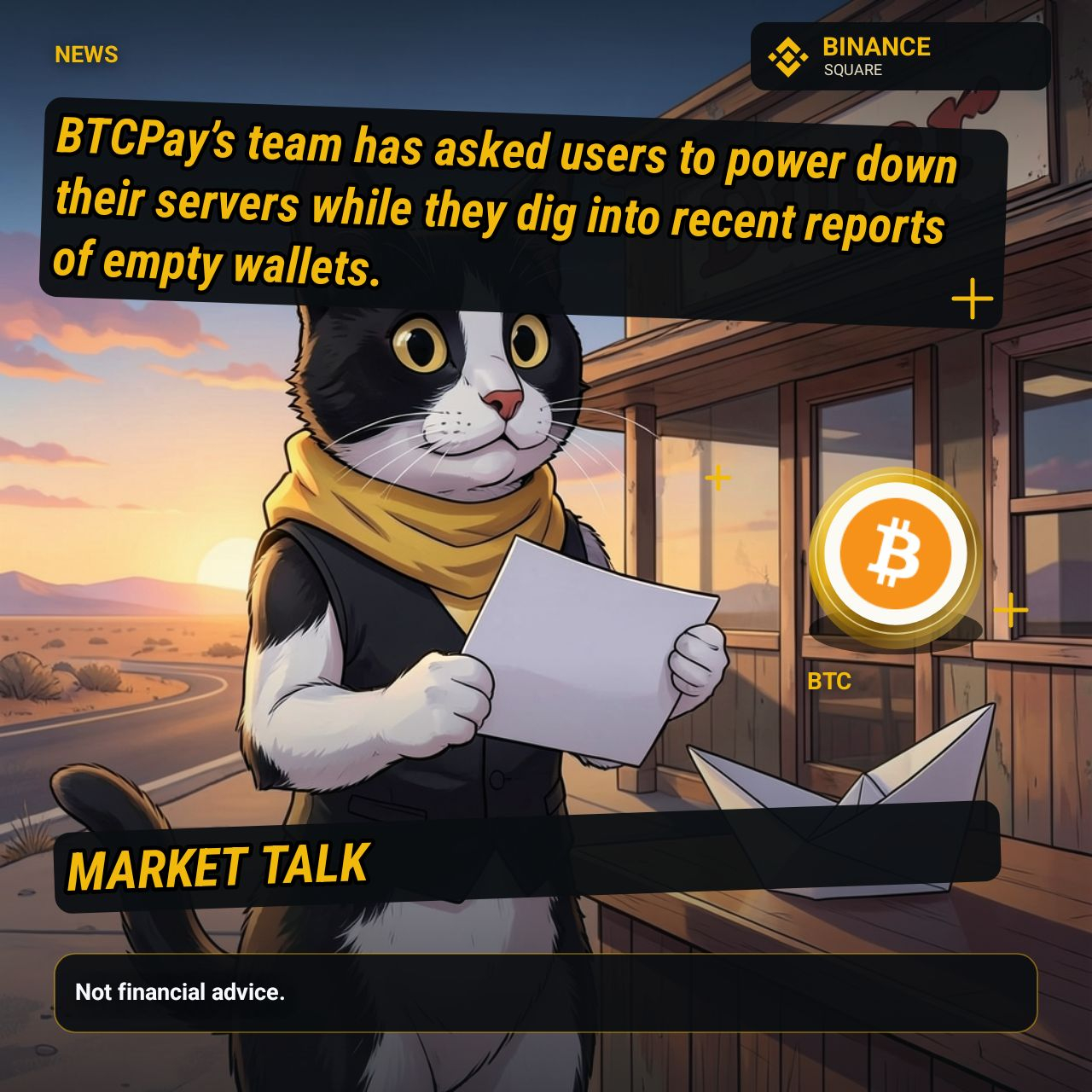
🛑 BTCPay’s team has asked users to power down their servers while they dig into recent reports of empty wallets. The founder notes the incidents seem tied to versions older than 2.4.2, but no loss numbers or fixes have been disclosed yet.
🔍 Why it matters: if the bug affects legacy deployments, merchants still on older releases could face exposure. The open‑source nature means anyone can audit, yet the investigation is ongoing, so the true scope remains unclear.
⚠️ Risk: Until a patch lands, keeping production nodes offline or upgrading to the latest release is the safest bet – otherwise you might inadvertently expose funds to an unverified vulnerability.
Not financial advice.
#BTCPay #BitcoinPayments #CryptoSecurity #Write2Earn
🛑 BTCPay’s team has asked users to power down their servers while they dig into recent reports of empty wallets. The founder notes the incidents seem tied to versions older than 2.4.2, but no loss numbers or fixes have been disclosed yet.
🔍 Why it matters: if the bug affects legacy deployments, merchants still on older releases could face exposure. The open‑source nature means anyone can audit, yet the investigation is ongoing, so the true scope remains unclear.
⚠️ Risk: Until a patch lands, keeping production nodes offline or upgrading to the latest release is the safest bet – otherwise you might inadvertently expose funds to an unverified vulnerability.
Not financial advice.
#BTCPay #BitcoinPayments #CryptoSecurity #Write2Earn
🔍 Why it matters: if the bug affects legacy deployments, merchants still on older releases could face exposure. The open‑source nature means anyone can audit, yet the investigation is ongoing, so the true scope remains unclear.
⚠️ Risk: Until a patch lands, keeping production nodes offline or upgrading to the latest release is the safest bet – otherwise you might inadvertently expose funds to an unverified vulnerability.
Not financial advice.
#BTCPay #BitcoinPayments #CryptoSecurity #Write2Earn
108


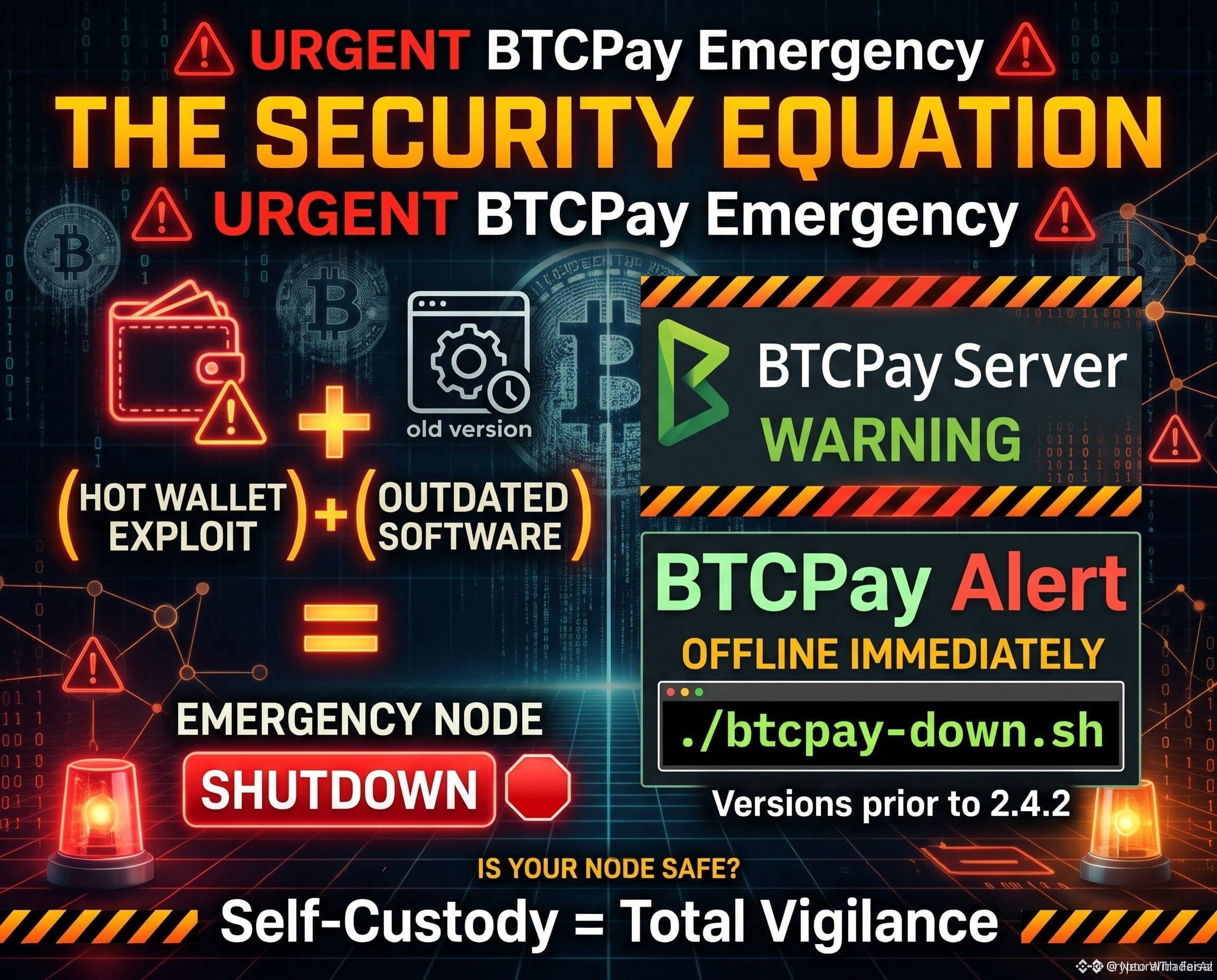
🚨 $BTC EMERGENCY NODE SHUTDOWN ALERT: HOT WALLET BREACH ⚡
Smart‑money scanners flagged an abnormal outflow from BTCPay‑linked hot wallets, a classic liquidity sweep that forces a rapid demand absorption. 📊 The exploit, tied to pre‑2.4.2 code, leveraged stale order blocks to siphon BTC before the network could re‑balance. 🦈
Operators must execute ./btcpay-down.sh now to seal the breach; every minute of delay compounds exposure. 📌 Updating to ≥2.4.2 restores the defensive order‑flow shield and re‑establishes the institutional liquidity buffer. ⚡
💬 Are you running the latest BTCPay version or still on legacy code? 👇
⚠️ Not financial advice. Always manage your risk. 🛡️
🏷️ #BTC #BTCPay #Security #CryptoNews
🚀 🔥
🚨 $BTC EMERGENCY NODE SHUTDOWN ALERT: HOT WALLET BREACH ⚡
Smart‑money scanners flagged an abnormal outflow from BTCPay‑linked hot wallets, a classic liquidity sweep that forces a rapid demand absorption. 📊 The exploit, tied to pre‑2.4.2 code, leveraged stale order blocks to siphon BTC before the network could re‑balance. 🦈
Operators must execute ./btcpay-down.sh now to seal the breach; every minute of delay compounds exposure. 📌 Updating to ≥2.4.2 restores the defensive order‑flow shield and re‑establishes the institutional liquidity buffer. ⚡
💬 Are you running the latest BTCPay version or still on legacy code? 👇
⚠️ Not financial advice. Always manage your risk. 🛡️
🏷️ #BTC #BTCPay #Security #CryptoNews
🚀 🔥
Smart‑money scanners flagged an abnormal outflow from BTCPay‑linked hot wallets, a classic liquidity sweep that forces a rapid demand absorption. 📊 The exploit, tied to pre‑2.4.2 code, leveraged stale order blocks to siphon BTC before the network could re‑balance. 🦈
Operators must execute ./btcpay-down.sh now to seal the breach; every minute of delay compounds exposure. 📌 Updating to ≥2.4.2 restores the defensive order‑flow shield and re‑establishes the institutional liquidity buffer. ⚡
💬 Are you running the latest BTCPay version or still on legacy code? 👇
⚠️ Not financial advice. Always manage your risk. 🛡️
🏷️ #BTC #BTCPay #Security #CryptoNews
🚀 🔥
5

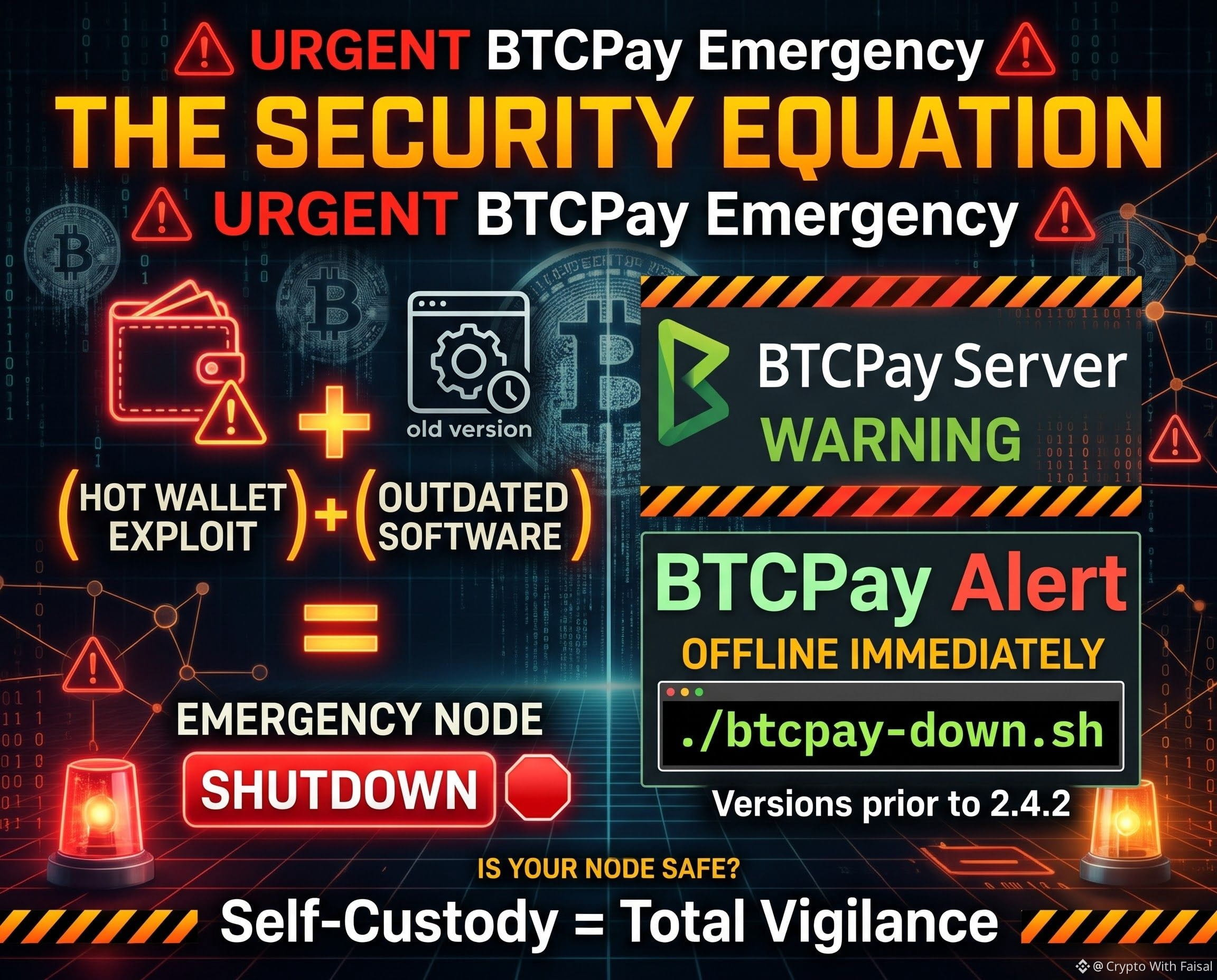
🚨 THE SECURITY EQUATION: BTCPay Emergency 🚨#btcpayserverurgesoperatorstoshutdowninstances Let's break down this urgent crypto alert using pure math 🧮👇
(Hot Wallet Exploit) + (Outdated Software) = Emergency Node Shutdown 🛑
The Asset Input:
(The Catalyst) = BTCPay Server just issued an emergency shutdown warning on Nov 1 after reports surfaced of attackers actively draining Bitcoin from connected hot wallets. The exact cause and full scope of the incident are still under active investigation.
The Key Deliverable:
(The Fallout) ➔ The project strongly urged operators to immediately run the ./btcpay-down.sh command to take their instances offline. The reported compromises have been specifically linked to software versions predating 2.4.2.
The Breakdown:
Self-custody offers ultimate freedom but requires ultimate vigilance. This attack arrived just three days after an AI-assisted security review patched 85 vulnerabilities. If you run independent payment infrastructure, delaying a critical node update can instantly cost you everything.
Are you strictly keeping your self-hosted infrastructure up to date, or is it safer to just stick to cold storage? ❓👇💬
$BTC
{future}(BTCUSDT)
$ETH
{future}(ETHUSDT)
$ZEC
{future}(ZECUSDT)
#Bitcoin #BTCPay #CryptoSecurity #CryptoNews
🚨 THE SECURITY EQUATION: BTCPay Emergency 🚨#btcpayserverurgesoperatorstoshutdowninstances Let's break down this urgent crypto alert using pure math 🧮👇
(Hot Wallet Exploit) + (Outdated Software) = Emergency Node Shutdown 🛑
The Asset Input:
(The Catalyst) = BTCPay Server just issued an emergency shutdown warning on Nov 1 after reports surfaced of attackers actively draining Bitcoin from connected hot wallets. The exact cause and full scope of the incident are still under active investigation.
The Key Deliverable:
(The Fallout) ➔ The project strongly urged operators to immediately run the ./btcpay-down.sh command to take their instances offline. The reported compromises have been specifically linked to software versions predating 2.4.2.
The Breakdown:
Self-custody offers ultimate freedom but requires ultimate vigilance. This attack arrived just three days after an AI-assisted security review patched 85 vulnerabilities. If you run independent payment infrastructure, delaying a critical node update can instantly cost you everything.
Are you strictly keeping your self-hosted infrastructure up to date, or is it safer to just stick to cold storage? ❓👇💬
$BTC
$ETH
$ZEC
#Bitcoin #BTCPay #CryptoSecurity #CryptoNews
(Hot Wallet Exploit) + (Outdated Software) = Emergency Node Shutdown 🛑
The Asset Input:
(The Catalyst) = BTCPay Server just issued an emergency shutdown warning on Nov 1 after reports surfaced of attackers actively draining Bitcoin from connected hot wallets. The exact cause and full scope of the incident are still under active investigation.
The Key Deliverable:
(The Fallout) ➔ The project strongly urged operators to immediately run the ./btcpay-down.sh command to take their instances offline. The reported compromises have been specifically linked to software versions predating 2.4.2.
The Breakdown:
Self-custody offers ultimate freedom but requires ultimate vigilance. This attack arrived just three days after an AI-assisted security review patched 85 vulnerabilities. If you run independent payment infrastructure, delaying a critical node update can instantly cost you everything.
Are you strictly keeping your self-hosted infrastructure up to date, or is it safer to just stick to cold storage? ❓👇💬
$BTC
$ETH
$ZEC
#Bitcoin #BTCPay #CryptoSecurity #CryptoNews
213

Some people are already shouting, “Another exploit—BTC is going to $50K,” over this BTCPay incident. Bro, first figure out what actually got drained.
The official statement says just one thing: hot wallets on multiple self-hosted BTCPay instances were drained without authorization. All operators should immediately run ./btcpay-down.sh to shut down and wait for the investigation results. No loss amount, root cause, affected versions, or patch were provided.
The key words here are “hot wallets.” A BTCPay hot wallet means keeping the seed on a server that’s online 24/7 so it can sign transactions itself. Whoever gets admin access to that machine can move the funds. Merchants using watch-only wallets with just an xpub don’t have any spendable private keys on the server, and BTCPay Lite, which uses an external wallet, was also said to be unaffected.
So this isn’t Bitcoin having a problem; it’s a bunch of small merchants keeping their cash register money in a vault. “Self-custody” doesn’t mean “secure.” Keeping your private keys on a public-facing machine is no different from leaving your wallet at an internet café.
Anyone using an incident with a payment tool to claim BTC will be cut in half either doesn’t understand what’s going on or is trying to trick you into selling at a loss. If you’re actually accepting payments with BTCPay: shut it down first, sweep the funds into a cold wallet, use watch-only for incoming payments from now on, and keep only enough in the hot wallet for change.
#BTCPay #Security
Some people are already shouting, “Another exploit—BTC is going to $50K,” over this BTCPay incident. Bro, first figure out what actually got drained.
The official statement says just one thing: hot wallets on multiple self-hosted BTCPay instances were drained without authorization. All operators should immediately run ./btcpay-down.sh to shut down and wait for the investigation results. No loss amount, root cause, affected versions, or patch were provided.
The key words here are “hot wallets.” A BTCPay hot wallet means keeping the seed on a server that’s online 24/7 so it can sign transactions itself. Whoever gets admin access to that machine can move the funds. Merchants using watch-only wallets with just an xpub don’t have any spendable private keys on the server, and BTCPay Lite, which uses an external wallet, was also said to be unaffected.
So this isn’t Bitcoin having a problem; it’s a bunch of small merchants keeping their cash register money in a vault. “Self-custody” doesn’t mean “secure.” Keeping your private keys on a public-facing machine is no different from leaving your wallet at an internet café.
Anyone using an incident with a payment tool to claim BTC will be cut in half either doesn’t understand what’s going on or is trying to trick you into selling at a loss. If you’re actually accepting payments with BTCPay: shut it down first, sweep the funds into a cold wallet, use watch-only for incoming payments from now on, and keep only enough in the hot wallet for change.
#BTCPay #Security
The official statement says just one thing: hot wallets on multiple self-hosted BTCPay instances were drained without authorization. All operators should immediately run ./btcpay-down.sh to shut down and wait for the investigation results. No loss amount, root cause, affected versions, or patch were provided.
The key words here are “hot wallets.” A BTCPay hot wallet means keeping the seed on a server that’s online 24/7 so it can sign transactions itself. Whoever gets admin access to that machine can move the funds. Merchants using watch-only wallets with just an xpub don’t have any spendable private keys on the server, and BTCPay Lite, which uses an external wallet, was also said to be unaffected.
So this isn’t Bitcoin having a problem; it’s a bunch of small merchants keeping their cash register money in a vault. “Self-custody” doesn’t mean “secure.” Keeping your private keys on a public-facing machine is no different from leaving your wallet at an internet café.
Anyone using an incident with a payment tool to claim BTC will be cut in half either doesn’t understand what’s going on or is trying to trick you into selling at a loss. If you’re actually accepting payments with BTCPay: shut it down first, sweep the funds into a cold wallet, use watch-only for incoming payments from now on, and keep only enough in the hot wallet for change.
#BTCPay #Security
235

·
--
Merchants, don’t sleep yet: BTCPay issues an urgent late-night shutdown warning as hot wallets are being drained
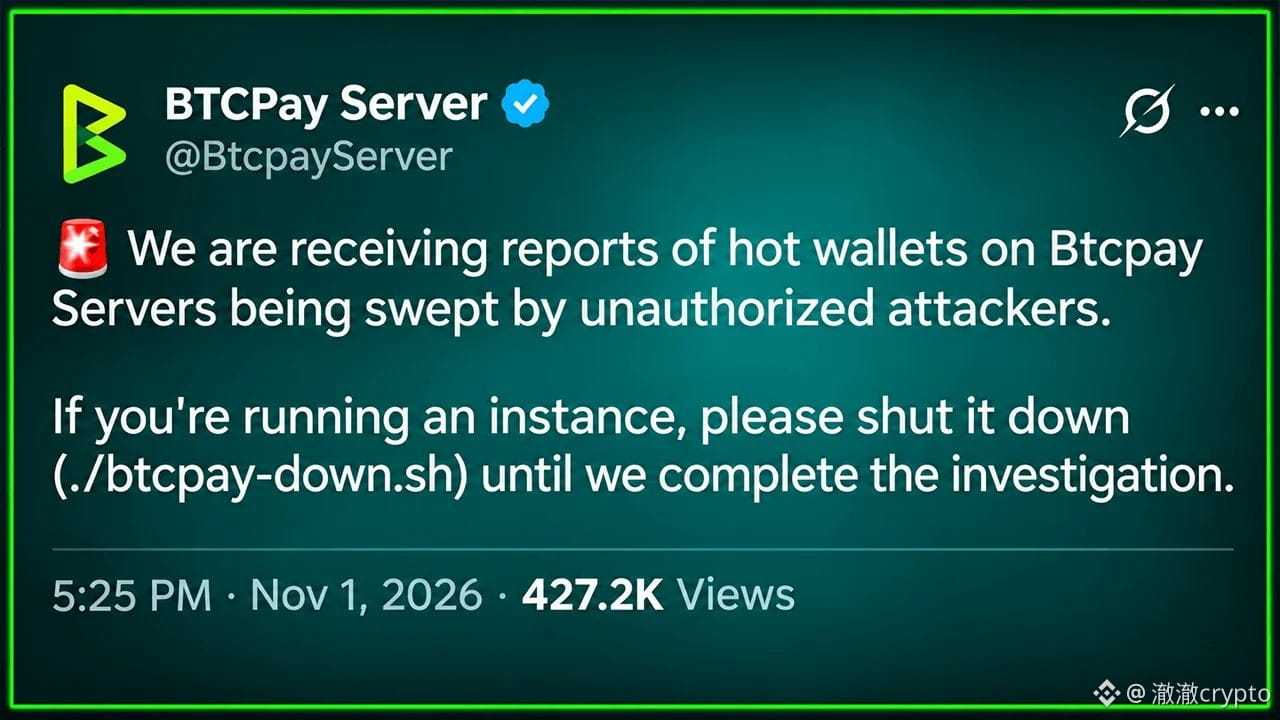
At 22:25 UTC on November 1, BTCPay issued an official warning: an unauthorized attacker was sweeping hot wallets. It urged users to shut down using ./btcpay-down.sh while the investigation was underway.
About two hours later, founder Dorier added that the affected servers were apparently all running versions older than 2.4.2. The attacker had obtained admin privileges, but the method of intrusion was still unclear.
The team’s own servers running 2.4.7 were not affected, but he didn’t say the latest version was necessarily safe. So far, they haven’t disclosed the amount stolen or the number of merchants affected.
What stings most is that patches had already been released, but servers hadn’t been updated: version 2.4.7, released on October 29, fixed 85 issues, and version 2.4.2 from August had also patched an exploited vulnerability. But with self-hosting, no one upgrades for you.
Hot wallet seeds are stored on internet-connected servers to begin with, and BTCPay’s own documentation marks this as DANGER: whoever gets in can transfer the coins out directly.
If you’re running BTCPay, follow the official advice and shut it down for now. Don’t bet on “I’m on the latest version”—wait until the team confirms the intrusion method and provides instructions for restarting.
There’s only one condition that would prove this assessment wrong: an official announcement that the intrusion method has been identified, the affected versions clarified, and the shutdown order lifted.
For self-hosted payments, would you choose a hot wallet for convenience or a cold wallet for peace of mind?
$BTC $ETH $SOL
#BTCPay #BitcoinSecurity
Merchants, don’t sleep yet: BTCPay issues an urgent late-night shutdown warning as hot wallets are being drained
At 22:25 UTC on November 1, BTCPay issued an official warning: an unauthorized attacker was sweeping hot wallets. It urged users to shut down using ./btcpay-down.sh while the investigation was underway.
About two hours later, founder Dorier added that the affected servers were apparently all running versions older than 2.4.2. The attacker had obtained admin privileges, but the method of intrusion was still unclear.
The team’s own servers running 2.4.7 were not affected, but he didn’t say the latest version was necessarily safe. So far, they haven’t disclosed the amount stolen or the number of merchants affected.
What stings most is that patches had already been released, but servers hadn’t been updated: version 2.4.7, released on October 29, fixed 85 issues, and version 2.4.2 from August had also patched an exploited vulnerability. But with self-hosting, no one upgrades for you.
Hot wallet seeds are stored on internet-connected servers to begin with, and BTCPay’s own documentation marks this as DANGER: whoever gets in can transfer the coins out directly.
If you’re running BTCPay, follow the official advice and shut it down for now. Don’t bet on “I’m on the latest version”—wait until the team confirms the intrusion method and provides instructions for restarting.
There’s only one condition that would prove this assessment wrong: an official announcement that the intrusion method has been identified, the affected versions clarified, and the shutdown order lifted.
For self-hosted payments, would you choose a hot wallet for convenience or a cold wallet for peace of mind?
$BTC $ETH $SOL
#BTCPay #BitcoinSecurity
At 22:25 UTC on November 1, BTCPay issued an official warning: an unauthorized attacker was sweeping hot wallets. It urged users to shut down using ./btcpay-down.sh while the investigation was underway.
About two hours later, founder Dorier added that the affected servers were apparently all running versions older than 2.4.2. The attacker had obtained admin privileges, but the method of intrusion was still unclear.
The team’s own servers running 2.4.7 were not affected, but he didn’t say the latest version was necessarily safe. So far, they haven’t disclosed the amount stolen or the number of merchants affected.
What stings most is that patches had already been released, but servers hadn’t been updated: version 2.4.7, released on October 29, fixed 85 issues, and version 2.4.2 from August had also patched an exploited vulnerability. But with self-hosting, no one upgrades for you.
Hot wallet seeds are stored on internet-connected servers to begin with, and BTCPay’s own documentation marks this as DANGER: whoever gets in can transfer the coins out directly.
If you’re running BTCPay, follow the official advice and shut it down for now. Don’t bet on “I’m on the latest version”—wait until the team confirms the intrusion method and provides instructions for restarting.
There’s only one condition that would prove this assessment wrong: an official announcement that the intrusion method has been identified, the affected versions clarified, and the shutdown order lifted.
For self-hosted payments, would you choose a hot wallet for convenience or a cold wallet for peace of mind?
$BTC $ETH $SOL
#BTCPay #BitcoinSecurity
1
483

·
--
【Bitcoin payment tool hacked! Official warning: Shut down your server immediately】
The open-source tool BTCPay Server, used by many merchants to accept Bitcoin, has suffered a hot-wallet theft. Hackers logged in to servers as administrators and transferred the coins directly. The official team has confirmed that versions 2.4.1 and earlier were affected; no thefts have been reported on the latest version, 2.4.7. The amount stolen and number of victims have not yet been announced. If you're still using an older version, upgrade immediately, and don't keep too much money in your hot wallet.
$BTC
#BTCPay #黑客 #WalletSecurity
【Bitcoin payment tool hacked! Official warning: Shut down your server immediately】
The open-source tool BTCPay Server, used by many merchants to accept Bitcoin, has suffered a hot-wallet theft. Hackers logged in to servers as administrators and transferred the coins directly. The official team has confirmed that versions 2.4.1 and earlier were affected; no thefts have been reported on the latest version, 2.4.7. The amount stolen and number of victims have not yet been announced. If you're still using an older version, upgrade immediately, and don't keep too much money in your hot wallet.
$BTC
#BTCPay #黑客 #WalletSecurity
The open-source tool BTCPay Server, used by many merchants to accept Bitcoin, has suffered a hot-wallet theft. Hackers logged in to servers as administrators and transferred the coins directly. The official team has confirmed that versions 2.4.1 and earlier were affected; no thefts have been reported on the latest version, 2.4.7. The amount stolen and number of victims have not yet been announced. If you're still using an older version, upgrade immediately, and don't keep too much money in your hot wallet.
$BTC
#BTCPay #黑客 #WalletSecurity
5

·
--
**SHOCKING! IS YOUR BITCOIN WALLET IN DANGER? BTCPay ISSUES AN URGENT WARNING!**
Crypto community, you definitely won’t want to miss this breaking news—it could directly affect the assets of anyone using self-hosted Bitcoin payment tools!
Here’s a quick summary of the key points you need to know:
* **BTCPay Server**, an open-source project that provides popular Bitcoin payment tools, has issued an **urgent warning** to its users.
* The project is urging its community to **SHUT DOWN THEIR SERVERS IMMEDIATELY** after receiving numerous reports of suspiciously **drained Bitcoin wallets**.
* The project is currently investigating, but its founder says the initial reports appear to be concentrated among BTCPay Server versions earlier than 2.4.2. There is no official estimate of losses or announcement of a specific patch yet.
---
**My personal take:**
This incident is a costly and sobering reminder of the importance of **absolute security** in the crypto space, especially when using open-source tools or managing our own assets. While this news won’t directly affect the price $BTC immediately, it could trigger a temporary wave of concern about Bitcoin payment solutions and self-custody methods.
**The takeaway:** Always prioritize updating your software to the latest version, carefully verify the source of any software, and never let your guard down when it comes to security. For those using BTCPay Server, acting quickly is critical. The market will always favor transparency and the safest solutions!
---
What do you think about this serious security incident? Could this be a strong enough wake-up call for the entire self-custody community? Leave a comment and share your thoughts below!
And don’t forget to **Follow** me on Binance Square for in-depth analysis and the latest breaking news from the crypto market!
\#CryptoNews #TrendingNews $BTC #BTCPay #SecurityAlert
**SHOCKING! IS YOUR BITCOIN WALLET IN DANGER? BTCPay ISSUES AN URGENT WARNING!**
Crypto community, you definitely won’t want to miss this breaking news—it could directly affect the assets of anyone using self-hosted Bitcoin payment tools!
Here’s a quick summary of the key points you need to know:
* **BTCPay Server**, an open-source project that provides popular Bitcoin payment tools, has issued an **urgent warning** to its users.
* The project is urging its community to **SHUT DOWN THEIR SERVERS IMMEDIATELY** after receiving numerous reports of suspiciously **drained Bitcoin wallets**.
* The project is currently investigating, but its founder says the initial reports appear to be concentrated among BTCPay Server versions earlier than 2.4.2. There is no official estimate of losses or announcement of a specific patch yet.
---
**My personal take:**
This incident is a costly and sobering reminder of the importance of **absolute security** in the crypto space, especially when using open-source tools or managing our own assets. While this news won’t directly affect the price $BTC immediately, it could trigger a temporary wave of concern about Bitcoin payment solutions and self-custody methods.
**The takeaway:** Always prioritize updating your software to the latest version, carefully verify the source of any software, and never let your guard down when it comes to security. For those using BTCPay Server, acting quickly is critical. The market will always favor transparency and the safest solutions!
---
What do you think about this serious security incident? Could this be a strong enough wake-up call for the entire self-custody community? Leave a comment and share your thoughts below!
And don’t forget to **Follow** me on Binance Square for in-depth analysis and the latest breaking news from the crypto market!
\#CryptoNews #TrendingNews $BTC #BTCPay #SecurityAlert
Crypto community, you definitely won’t want to miss this breaking news—it could directly affect the assets of anyone using self-hosted Bitcoin payment tools!
Here’s a quick summary of the key points you need to know:
* **BTCPay Server**, an open-source project that provides popular Bitcoin payment tools, has issued an **urgent warning** to its users.
* The project is urging its community to **SHUT DOWN THEIR SERVERS IMMEDIATELY** after receiving numerous reports of suspiciously **drained Bitcoin wallets**.
* The project is currently investigating, but its founder says the initial reports appear to be concentrated among BTCPay Server versions earlier than 2.4.2. There is no official estimate of losses or announcement of a specific patch yet.
---
**My personal take:**
This incident is a costly and sobering reminder of the importance of **absolute security** in the crypto space, especially when using open-source tools or managing our own assets. While this news won’t directly affect the price $BTC immediately, it could trigger a temporary wave of concern about Bitcoin payment solutions and self-custody methods.
**The takeaway:** Always prioritize updating your software to the latest version, carefully verify the source of any software, and never let your guard down when it comes to security. For those using BTCPay Server, acting quickly is critical. The market will always favor transparency and the safest solutions!
---
What do you think about this serious security incident? Could this be a strong enough wake-up call for the entire self-custody community? Leave a comment and share your thoughts below!
And don’t forget to **Follow** me on Binance Square for in-depth analysis and the latest breaking news from the crypto market!
\#CryptoNews #TrendingNews $BTC #BTCPay #SecurityAlert
31

·
--
Came across BTCPay / TokenPost: BTCPay Server, an open-source self-hosted payment tool, has received multiple reports of hot wallets being drained without authorization. On 11/1, the official team urged everyone to first shut down their instances with ./btcpay-down.sh.
Key details: A follow-up investigation narrowed the attack vector to version 2.4.1 (2026-07-23) and earlier; there are no credible reports of theft from users running the latest 2.4.7. The founder said attackers logged in as administrators on affected instances, and investigators are still looking into how they gained access. The amount stolen and number of affected instances have not been disclosed. Hosting providers including LunaNode have automatically shut down older versions.
There was already a wave of attacks in August exploiting an LND credential vulnerability in versions <2.4.2—don’t keep more in a hot wallet than you can afford to lose.
#BTC #安全 #BTCPay
Came across BTCPay / TokenPost: BTCPay Server, an open-source self-hosted payment tool, has received multiple reports of hot wallets being drained without authorization. On 11/1, the official team urged everyone to first shut down their instances with ./btcpay-down.sh.
Key details: A follow-up investigation narrowed the attack vector to version 2.4.1 (2026-07-23) and earlier; there are no credible reports of theft from users running the latest 2.4.7. The founder said attackers logged in as administrators on affected instances, and investigators are still looking into how they gained access. The amount stolen and number of affected instances have not been disclosed. Hosting providers including LunaNode have automatically shut down older versions.
There was already a wave of attacks in August exploiting an LND credential vulnerability in versions <2.4.2—don’t keep more in a hot wallet than you can afford to lose.
#BTC #安全 #BTCPay
Key details: A follow-up investigation narrowed the attack vector to version 2.4.1 (2026-07-23) and earlier; there are no credible reports of theft from users running the latest 2.4.7. The founder said attackers logged in as administrators on affected instances, and investigators are still looking into how they gained access. The amount stolen and number of affected instances have not been disclosed. Hosting providers including LunaNode have automatically shut down older versions.
There was already a wave of attacks in August exploiting an LND credential vulnerability in versions <2.4.2—don’t keep more in a hot wallet than you can afford to lose.
#BTC #安全 #BTCPay
63

·
--
【Market Flash】BTCPay hot wallet drained; official team urges operators to shut down first
Open-source Bitcoin payment system BTCPay Server has issued a warning: after receiving reports from merchants that funds were transferred without authorization from hot wallets on self-hosted servers, the team has asked operators to shut down their servers pending investigation. Preliminary findings point to versions 2.4.1 and earlier; there are no verified reports of victims on version 2.4.7 so far. The amount stolen and number of victims have not yet been disclosed. Have self-hosted merchants checked their versions?
$BTC $ETH $SOL
#市场快讯 #BTCPay #Bitcoin
(Source: ABMedia)
⚠️Risk warning: The above is shared for informational purposes only and does not constitute investment advice. Investing involves risks; please exercise caution.
【Market Flash】BTCPay hot wallet drained; official team urges operators to shut down first
Open-source Bitcoin payment system BTCPay Server has issued a warning: after receiving reports from merchants that funds were transferred without authorization from hot wallets on self-hosted servers, the team has asked operators to shut down their servers pending investigation. Preliminary findings point to versions 2.4.1 and earlier; there are no verified reports of victims on version 2.4.7 so far. The amount stolen and number of victims have not yet been disclosed. Have self-hosted merchants checked their versions?
$BTC $ETH $SOL
#市场快讯 #BTCPay #Bitcoin
(Source: ABMedia)
⚠️Risk warning: The above is shared for informational purposes only and does not constitute investment advice. Investing involves risks; please exercise caution.
Open-source Bitcoin payment system BTCPay Server has issued a warning: after receiving reports from merchants that funds were transferred without authorization from hot wallets on self-hosted servers, the team has asked operators to shut down their servers pending investigation. Preliminary findings point to versions 2.4.1 and earlier; there are no verified reports of victims on version 2.4.7 so far. The amount stolen and number of victims have not yet been disclosed. Have self-hosted merchants checked their versions?
$BTC $ETH $SOL
#市场快讯 #BTCPay #Bitcoin
(Source: ABMedia)
⚠️Risk warning: The above is shared for informational purposes only and does not constitute investment advice. Investing involves risks; please exercise caution.
107

BTCPay Server warns of hot wallet theft risk due to outdated software
- Attackers stole funds from BTCPay Server’s hot wallet due to outdated software.
- Operators are advised to shut down their servers immediately to prevent financial losses.
- The incident highlights the importance of regularly updating software in the cryptocurrency payment ecosystem.
#BinanceSquare #CryptoNews #BTCPay #Security
$btc $eth
#vlikevn Titanbot
Source: CoinTelegraph
BTCPay Server warns of hot wallet theft risk due to outdated software
- Attackers stole funds from BTCPay Server’s hot wallet due to outdated software.
- Operators are advised to shut down their servers immediately to prevent financial losses.
- The incident highlights the importance of regularly updating software in the cryptocurrency payment ecosystem.
#BinanceSquare #CryptoNews #BTCPay #Security
$btc $eth
#vlikevn Titanbot
Source: CoinTelegraph
- Attackers stole funds from BTCPay Server’s hot wallet due to outdated software.
- Operators are advised to shut down their servers immediately to prevent financial losses.
- The incident highlights the importance of regularly updating software in the cryptocurrency payment ecosystem.
#BinanceSquare #CryptoNews #BTCPay #Security
$btc $eth
#vlikevn Titanbot
Source: CoinTelegraph
221

·
--
BTCPay Server warning: outdated hot wallets targeted in attack and drained
Open-source payment infrastructure BTCPay Server has issued a security warning, urging operators to shut down and upgrade immediately. The alert follows reports that nodes running outdated software have been targeted by hackers and had their hot wallet funds drained.
According to Cointelegraph, the BTCPay Server team urged operators to shut down their servers after receiving multiple reports of “unauthorized attackers draining funds.” This was not an ordinary version-update notice, but an emergency response to actual losses already occurring.
Why this matters is that BTCPay Server plays the role of a “self-custodial payment layer” in the crypto ecosystem: many merchants and community nodes rely on it to receive and manage Bitcoin. It does not itself introduce any centralized risk involving private keys, but nodes running outdated software can become clear targets for attackers. The key issue in this incident is not a vulnerability in the protocol layer, but operational security on the systems running it: outdated software and delayed patching left hot wallets exposed to the risk of being deliberately drained.
From a technical perspective, hot wallets are riskier because they need to be online to facilitate payments. If a software endpoint has a known exploitable flaw, attackers can target it and bypass its defenses. The team’s choice of the forceful wording “recommend shutting down” rather than “push a patch” suggests the vulnerability may already be under active exploitation, and waiting for an update window might not be soon enough.
At the market level, this incident is relatively localized and is more an operational security issue affecting a single piece of infrastructure than an industry-wide security crisis. Its direct short-term impact on broader market prices may be limited. However, together with recent hardware wallet incidents involving Trezor and Keystone, it paints a broader picture of payment security: whether it is a software node or a hardware wallet, any endpoint in the self-custody chain can become a point of entry for attackers.
One counterpoint to keep in mind is that this falls under operators’ own responsibility and does not reflect the security of the underlying protocol or the Bitcoin network itself. If amplified, panic could exceed the incident’s actual impact. What remains to be seen is whether the team will disclose more details about affected nodes, the specific path used to exploit the vulnerability, and a clear timeline for recovery and upgrades.
#BTCPay #CryptoSecurity #HotWallet
The above is a compilation of information and personal analysis, and does not constitute investment advice.
I will continue to follow and share updates if there are any significant developments.
BTCPay Server warning: outdated hot wallets targeted in attack and drained
Open-source payment infrastructure BTCPay Server has issued a security warning, urging operators to shut down and upgrade immediately. The alert follows reports that nodes running outdated software have been targeted by hackers and had their hot wallet funds drained.
According to Cointelegraph, the BTCPay Server team urged operators to shut down their servers after receiving multiple reports of “unauthorized attackers draining funds.” This was not an ordinary version-update notice, but an emergency response to actual losses already occurring.
Why this matters is that BTCPay Server plays the role of a “self-custodial payment layer” in the crypto ecosystem: many merchants and community nodes rely on it to receive and manage Bitcoin. It does not itself introduce any centralized risk involving private keys, but nodes running outdated software can become clear targets for attackers. The key issue in this incident is not a vulnerability in the protocol layer, but operational security on the systems running it: outdated software and delayed patching left hot wallets exposed to the risk of being deliberately drained.
From a technical perspective, hot wallets are riskier because they need to be online to facilitate payments. If a software endpoint has a known exploitable flaw, attackers can target it and bypass its defenses. The team’s choice of the forceful wording “recommend shutting down” rather than “push a patch” suggests the vulnerability may already be under active exploitation, and waiting for an update window might not be soon enough.
At the market level, this incident is relatively localized and is more an operational security issue affecting a single piece of infrastructure than an industry-wide security crisis. Its direct short-term impact on broader market prices may be limited. However, together with recent hardware wallet incidents involving Trezor and Keystone, it paints a broader picture of payment security: whether it is a software node or a hardware wallet, any endpoint in the self-custody chain can become a point of entry for attackers.
One counterpoint to keep in mind is that this falls under operators’ own responsibility and does not reflect the security of the underlying protocol or the Bitcoin network itself. If amplified, panic could exceed the incident’s actual impact. What remains to be seen is whether the team will disclose more details about affected nodes, the specific path used to exploit the vulnerability, and a clear timeline for recovery and upgrades.
#BTCPay #CryptoSecurity #HotWallet
The above is a compilation of information and personal analysis, and does not constitute investment advice.
I will continue to follow and share updates if there are any significant developments.
Open-source payment infrastructure BTCPay Server has issued a security warning, urging operators to shut down and upgrade immediately. The alert follows reports that nodes running outdated software have been targeted by hackers and had their hot wallet funds drained.
According to Cointelegraph, the BTCPay Server team urged operators to shut down their servers after receiving multiple reports of “unauthorized attackers draining funds.” This was not an ordinary version-update notice, but an emergency response to actual losses already occurring.
Why this matters is that BTCPay Server plays the role of a “self-custodial payment layer” in the crypto ecosystem: many merchants and community nodes rely on it to receive and manage Bitcoin. It does not itself introduce any centralized risk involving private keys, but nodes running outdated software can become clear targets for attackers. The key issue in this incident is not a vulnerability in the protocol layer, but operational security on the systems running it: outdated software and delayed patching left hot wallets exposed to the risk of being deliberately drained.
From a technical perspective, hot wallets are riskier because they need to be online to facilitate payments. If a software endpoint has a known exploitable flaw, attackers can target it and bypass its defenses. The team’s choice of the forceful wording “recommend shutting down” rather than “push a patch” suggests the vulnerability may already be under active exploitation, and waiting for an update window might not be soon enough.
At the market level, this incident is relatively localized and is more an operational security issue affecting a single piece of infrastructure than an industry-wide security crisis. Its direct short-term impact on broader market prices may be limited. However, together with recent hardware wallet incidents involving Trezor and Keystone, it paints a broader picture of payment security: whether it is a software node or a hardware wallet, any endpoint in the self-custody chain can become a point of entry for attackers.
One counterpoint to keep in mind is that this falls under operators’ own responsibility and does not reflect the security of the underlying protocol or the Bitcoin network itself. If amplified, panic could exceed the incident’s actual impact. What remains to be seen is whether the team will disclose more details about affected nodes, the specific path used to exploit the vulnerability, and a clear timeline for recovery and upgrades.
#BTCPay #CryptoSecurity #HotWallet
The above is a compilation of information and personal analysis, and does not constitute investment advice.
I will continue to follow and share updates if there are any significant developments.
70

·
--
🚨 Binance has just suffered a $6.2 billion theft, and now another bombshell has hit the Bitcoin world: BTCPay Server merchants’ hot wallets have been drained en masse!
📌 What happened
• BTCPay is an open-source tool that helps merchants accept Bitcoin. On Sunday, the project team issued an urgent call: all operators should shut down their servers immediately (./btcpay-down.sh)
• Hot wallets across multiple instances were swept by unauthorized attackers, who gained administrator privileges
• The founder said older versions prior to 2.4.2 appear to be affected, but the vulnerability’s entry point, the amount lost, and a patch have not yet been disclosed
• Merchants have already posted on the forum: “I was preparing my monthly withdrawal and found someone had already withdrawn the funds for me”
📊 Market snapshot
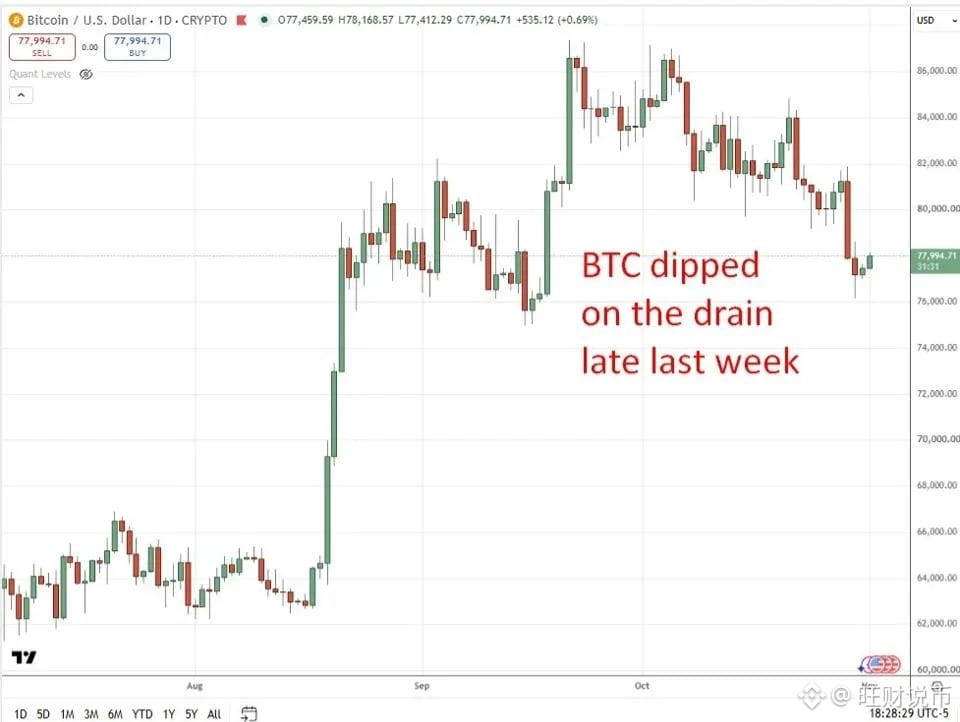
BTC is around $78,400, up 0.8% over 24 hours. The Fear & Greed Index is 37 (Fear). The market has become somewhat desensitized to hacking news, but a series of security incidents is a real risk.
💡 A few reminders
1️⃣ Keep only small, everyday amounts in hot wallets; store larger amounts in cold storage
2️⃣ Keep self-hosted software up to date—don’t put it off
3️⃣ Enable least-privilege access, IP allowlisting, and multi-factor authentication
Do you think this wave of hacks will lead more people to say “don’t self-custody,” or will it instead encourage wider adoption of cold wallets? Share your thoughts in the comments 👇
$BTC $ETH #BTCPay #加密安全 #Binance Square
Personal opinion only; not investment advice
🚨 Binance has just suffered a $6.2 billion theft, and now another bombshell has hit the Bitcoin world: BTCPay Server merchants’ hot wallets have been drained en masse!
📌 What happened
• BTCPay is an open-source tool that helps merchants accept Bitcoin. On Sunday, the project team issued an urgent call: all operators should shut down their servers immediately (./btcpay-down.sh)
• Hot wallets across multiple instances were swept by unauthorized attackers, who gained administrator privileges
• The founder said older versions prior to 2.4.2 appear to be affected, but the vulnerability’s entry point, the amount lost, and a patch have not yet been disclosed
• Merchants have already posted on the forum: “I was preparing my monthly withdrawal and found someone had already withdrawn the funds for me”
📊 Market snapshot
BTC is around $78,400, up 0.8% over 24 hours. The Fear & Greed Index is 37 (Fear). The market has become somewhat desensitized to hacking news, but a series of security incidents is a real risk.
💡 A few reminders
1️⃣ Keep only small, everyday amounts in hot wallets; store larger amounts in cold storage
2️⃣ Keep self-hosted software up to date—don’t put it off
3️⃣ Enable least-privilege access, IP allowlisting, and multi-factor authentication
Do you think this wave of hacks will lead more people to say “don’t self-custody,” or will it instead encourage wider adoption of cold wallets? Share your thoughts in the comments 👇
$BTC $ETH #BTCPay #加密安全 #Binance Square
Personal opinion only; not investment advice
📌 What happened
• BTCPay is an open-source tool that helps merchants accept Bitcoin. On Sunday, the project team issued an urgent call: all operators should shut down their servers immediately (./btcpay-down.sh)
• Hot wallets across multiple instances were swept by unauthorized attackers, who gained administrator privileges
• The founder said older versions prior to 2.4.2 appear to be affected, but the vulnerability’s entry point, the amount lost, and a patch have not yet been disclosed
• Merchants have already posted on the forum: “I was preparing my monthly withdrawal and found someone had already withdrawn the funds for me”
📊 Market snapshot
BTC is around $78,400, up 0.8% over 24 hours. The Fear & Greed Index is 37 (Fear). The market has become somewhat desensitized to hacking news, but a series of security incidents is a real risk.
💡 A few reminders
1️⃣ Keep only small, everyday amounts in hot wallets; store larger amounts in cold storage
2️⃣ Keep self-hosted software up to date—don’t put it off
3️⃣ Enable least-privilege access, IP allowlisting, and multi-factor authentication
Do you think this wave of hacks will lead more people to say “don’t self-custody,” or will it instead encourage wider adoption of cold wallets? Share your thoughts in the comments 👇
$BTC $ETH #BTCPay #加密安全 #Binance Square
Personal opinion only; not investment advice
242

·
--
The self-hosted payment tool BTCPay Server is in trouble: The official team issued an alert at 6:25 a.m. Beijing time this morning, saying hot wallets on multiple servers had been drained by unauthorized attackers. Operators were told to immediately shut down their servers by running ./btcpay-down.sh and wait until the investigation is over before bringing them back online.
Founder Dorier added at 8:28: All affected servers were running versions earlier than 2.4.2. The attackers logged in as administrators, but the entry point has not yet been identified. Public servers running 2.4.7 were not hit.
The official team has not yet disclosed the losses or the number of affected merchants. Merchants using BTCPay to accept $BTC should shut down their servers, upgrade, and move any coins in hot wallets to cold wallets as soon as possible.
$BTC is currently trading at about $78,658, up 1.2% in 24 hours.
#BTCPay #比特币 #CryptoSecurity
The self-hosted payment tool BTCPay Server is in trouble: The official team issued an alert at 6:25 a.m. Beijing time this morning, saying hot wallets on multiple servers had been drained by unauthorized attackers. Operators were told to immediately shut down their servers by running ./btcpay-down.sh and wait until the investigation is over before bringing them back online.
Founder Dorier added at 8:28: All affected servers were running versions earlier than 2.4.2. The attackers logged in as administrators, but the entry point has not yet been identified. Public servers running 2.4.7 were not hit.
The official team has not yet disclosed the losses or the number of affected merchants. Merchants using BTCPay to accept $BTC should shut down their servers, upgrade, and move any coins in hot wallets to cold wallets as soon as possible.
$BTC is currently trading at about $78,658, up 1.2% in 24 hours.
#BTCPay #比特币 #CryptoSecurity
Founder Dorier added at 8:28: All affected servers were running versions earlier than 2.4.2. The attackers logged in as administrators, but the entry point has not yet been identified. Public servers running 2.4.7 were not hit.
The official team has not yet disclosed the losses or the number of affected merchants. Merchants using BTCPay to accept $BTC should shut down their servers, upgrade, and move any coins in hot wallets to cold wallets as soon as possible.
$BTC is currently trading at about $78,658, up 1.2% in 24 hours.
#BTCPay #比特币 #CryptoSecurity
64
This BTCPay incident, to put it plainly, happened because a bunch of merchants hadn't upgraded in three months.
According to Dorier: all the compromised instances so far were running versions older than 2.4.2. The attackers logged into the backend as administrators, but it's still unclear how they got in. Version 2.4.2 was released on August 7, and his own public server, which runs 2.4.7, wasn't affected.
So stop sharing those panic posts claiming "something huge has happened to Bitcoin payments." There's nothing wrong with BTC itself. The problem is the combination of self-hosted servers, funds held in hot wallets, and backends that haven't been updated in ages.
What's even more ridiculous is that the story has been misreported: several accounts wrote that "version 2.4.2 was affected," leaving out the word "older than." That completely reverses the meaning, making people who upgraded to 2.4.2 think they're the ones running a vulnerable version.
Here's another point many people have missed: the intrusion method hasn't been identified, and the team still hasn't said how much was lost or how many merchants were affected. So even if you're already on a newer version, you should shut down for now and wait for an update. Empty your hot wallet, and don't keep accepting payments just because your version number is recent.
"Be your own bank" sounds great, but it also means you have to be your own IT operations and security team. If you don't want to manage server patches, just use a watch-only xpub to accept payments, and keep your private keys off internet-connected machines.
#BTCPay #Bitcoin
This BTCPay incident, to put it plainly, happened because a bunch of merchants hadn't upgraded in three months.
According to Dorier: all the compromised instances so far were running versions older than 2.4.2. The attackers logged into the backend as administrators, but it's still unclear how they got in. Version 2.4.2 was released on August 7, and his own public server, which runs 2.4.7, wasn't affected.
So stop sharing those panic posts claiming "something huge has happened to Bitcoin payments." There's nothing wrong with BTC itself. The problem is the combination of self-hosted servers, funds held in hot wallets, and backends that haven't been updated in ages.
What's even more ridiculous is that the story has been misreported: several accounts wrote that "version 2.4.2 was affected," leaving out the word "older than." That completely reverses the meaning, making people who upgraded to 2.4.2 think they're the ones running a vulnerable version.
Here's another point many people have missed: the intrusion method hasn't been identified, and the team still hasn't said how much was lost or how many merchants were affected. So even if you're already on a newer version, you should shut down for now and wait for an update. Empty your hot wallet, and don't keep accepting payments just because your version number is recent.
"Be your own bank" sounds great, but it also means you have to be your own IT operations and security team. If you don't want to manage server patches, just use a watch-only xpub to accept payments, and keep your private keys off internet-connected machines.
#BTCPay #Bitcoin
According to Dorier: all the compromised instances so far were running versions older than 2.4.2. The attackers logged into the backend as administrators, but it's still unclear how they got in. Version 2.4.2 was released on August 7, and his own public server, which runs 2.4.7, wasn't affected.
So stop sharing those panic posts claiming "something huge has happened to Bitcoin payments." There's nothing wrong with BTC itself. The problem is the combination of self-hosted servers, funds held in hot wallets, and backends that haven't been updated in ages.
What's even more ridiculous is that the story has been misreported: several accounts wrote that "version 2.4.2 was affected," leaving out the word "older than." That completely reverses the meaning, making people who upgraded to 2.4.2 think they're the ones running a vulnerable version.
Here's another point many people have missed: the intrusion method hasn't been identified, and the team still hasn't said how much was lost or how many merchants were affected. So even if you're already on a newer version, you should shut down for now and wait for an update. Empty your hot wallet, and don't keep accepting payments just because your version number is recent.
"Be your own bank" sounds great, but it also means you have to be your own IT operations and security team. If you don't want to manage server patches, just use a watch-only xpub to accept payments, and keep your private keys off internet-connected machines.
#BTCPay #Bitcoin
89

Security alert: Open-source Bitcoin payment processor #BTCPay Server says it has received reports that hot wallet funds were transferred by unauthorized attackers. Officials advise users of all running instances to keep them shut down until the investigation is complete.
If you self-host BTCPay Server, immediately pause the affected services, isolate the server, and review access logs, API keys, and wallet permissions. Don’t trust unofficial patches or assistance offered through private messages. Hot wallets remain connected to the internet, making them more vulnerable to attacks; large sums should be kept in cold wallets and protected with multisig.
#比特币 #cybersecurity
Security alert: Open-source Bitcoin payment processor #BTCPay Server says it has received reports that hot wallet funds were transferred by unauthorized attackers. Officials advise users of all running instances to keep them shut down until the investigation is complete.
If you self-host BTCPay Server, immediately pause the affected services, isolate the server, and review access logs, API keys, and wallet permissions. Don’t trust unofficial patches or assistance offered through private messages. Hot wallets remain connected to the internet, making them more vulnerable to attacks; large sums should be kept in cold wallets and protected with multisig.
#比特币 #cybersecurity
If you self-host BTCPay Server, immediately pause the affected services, isolate the server, and review access logs, API keys, and wallet permissions. Don’t trust unofficial patches or assistance offered through private messages. Hot wallets remain connected to the internet, making them more vulnerable to attacks; large sums should be kept in cold wallets and protected with multisig.
#比特币 #cybersecurity
67

·
--
BTCPay Server emergency alert: Hot wallets on multiple servers are being drained by attackers; official team urges immediate shutdown
- PANews reported on November 2 (citing an official BTCPay Server post on X) that the open-source Bitcoin payment processing software had received reports of unauthorized attackers moving funds from hot wallets on multiple self-hosted instances. The team urged users running instances to immediately shut down their servers by running ./btcpay-down.sh until the investigation is complete.
- The cause of the attack, the number of affected instances, and the scale of losses have not yet been disclosed, and no patch has been released. The shutdown instruction is not limited to any specific version. For context, BTCPay Server released emergency update 2.4.7 on October 29, fixing one critical vulnerability and several medium-severity vulnerabilities. The team has not confirmed whether this attack is related to the previously reported vulnerabilities.
- To be clear: BTCPay Server is self-hosted payment software for merchants, not the Bitcoin network itself. This alert concerns hot wallets on merchants’ own servers; on-chain wallets belonging to ordinary Bitcoin holders are not directly affected by this alert.
- Potential impact: A series of security incidents could heighten concerns about payment infrastructure and weigh on short-term sentiment. However, the scope of this incident is still being verified, so it should not be extrapolated to the entire Bitcoin ecosystem.
My assessment: Neutral in the short term for $BTC , since the incident targets self-hosted payment servers rather than the Bitcoin network itself. However, until the scale of losses is known and the investigation is complete, security concerns may continue to weigh on short-term sentiment.
$BTC
#BTCPay #安全事件 #BitcoinPayments
Source: PANews report on November 2, citing an official BTCPay Server post on X; cross-checked against reports by The Defiant and Cointelegraph.
Tap the tag to view real-time market data: If you use a self-hosted payment service, would you shut it down immediately and check for issues? For reference only; this is not investment advice.
BTCPay Server emergency alert: Hot wallets on multiple servers are being drained by attackers; official team urges immediate shutdown
- PANews reported on November 2 (citing an official BTCPay Server post on X) that the open-source Bitcoin payment processing software had received reports of unauthorized attackers moving funds from hot wallets on multiple self-hosted instances. The team urged users running instances to immediately shut down their servers by running ./btcpay-down.sh until the investigation is complete.
- The cause of the attack, the number of affected instances, and the scale of losses have not yet been disclosed, and no patch has been released. The shutdown instruction is not limited to any specific version. For context, BTCPay Server released emergency update 2.4.7 on October 29, fixing one critical vulnerability and several medium-severity vulnerabilities. The team has not confirmed whether this attack is related to the previously reported vulnerabilities.
- To be clear: BTCPay Server is self-hosted payment software for merchants, not the Bitcoin network itself. This alert concerns hot wallets on merchants’ own servers; on-chain wallets belonging to ordinary Bitcoin holders are not directly affected by this alert.
- Potential impact: A series of security incidents could heighten concerns about payment infrastructure and weigh on short-term sentiment. However, the scope of this incident is still being verified, so it should not be extrapolated to the entire Bitcoin ecosystem.
My assessment: Neutral in the short term for $BTC , since the incident targets self-hosted payment servers rather than the Bitcoin network itself. However, until the scale of losses is known and the investigation is complete, security concerns may continue to weigh on short-term sentiment.
$BTC
#BTCPay #安全事件 #BitcoinPayments
Source: PANews report on November 2, citing an official BTCPay Server post on X; cross-checked against reports by The Defiant and Cointelegraph.
Tap the tag to view real-time market data: If you use a self-hosted payment service, would you shut it down immediately and check for issues? For reference only; this is not investment advice.
- PANews reported on November 2 (citing an official BTCPay Server post on X) that the open-source Bitcoin payment processing software had received reports of unauthorized attackers moving funds from hot wallets on multiple self-hosted instances. The team urged users running instances to immediately shut down their servers by running ./btcpay-down.sh until the investigation is complete.
- The cause of the attack, the number of affected instances, and the scale of losses have not yet been disclosed, and no patch has been released. The shutdown instruction is not limited to any specific version. For context, BTCPay Server released emergency update 2.4.7 on October 29, fixing one critical vulnerability and several medium-severity vulnerabilities. The team has not confirmed whether this attack is related to the previously reported vulnerabilities.
- To be clear: BTCPay Server is self-hosted payment software for merchants, not the Bitcoin network itself. This alert concerns hot wallets on merchants’ own servers; on-chain wallets belonging to ordinary Bitcoin holders are not directly affected by this alert.
- Potential impact: A series of security incidents could heighten concerns about payment infrastructure and weigh on short-term sentiment. However, the scope of this incident is still being verified, so it should not be extrapolated to the entire Bitcoin ecosystem.
My assessment: Neutral in the short term for $BTC , since the incident targets self-hosted payment servers rather than the Bitcoin network itself. However, until the scale of losses is known and the investigation is complete, security concerns may continue to weigh on short-term sentiment.
$BTC
#BTCPay #安全事件 #BitcoinPayments
Source: PANews report on November 2, citing an official BTCPay Server post on X; cross-checked against reports by The Defiant and Cointelegraph.
Tap the tag to view real-time market data: If you use a self-hosted payment service, would you shut it down immediately and check for issues? For reference only; this is not investment advice.
47

·
--
【Market Update】On October 21, PHP patched two critical vulnerabilities that could allow unauthenticated remote code execution. Fixed versions: 8.5.12 / 8.4.27 / 8.3.36 / 8.2.35. Users are urged to upgrade.
The crypto sector is also affected: merchants using BTCPay Server integrated with WooCommerce often run PHP on their checkout websites. Apache mod_php faces the highest risk, and upgrading a plugin is not the same as patching the underlying software.
Clarification: This is only a patch announcement. There is no evidence that the Bitcoin protocol or BTCPay was compromised, and no claims of theft.
Has the platform you use been timely in announcing underlying vulnerabilities? Share your thoughts in the comments.
$BTC $ETH $BNB
#比特币 #网络安全 #BTCPay
(Source: NewsBTC)
⚠️Risk warning: The above is shared for market information purposes only and does not constitute investment advice. Investing involves risk; exercise caution when entering the market.
【Market Update】On October 21, PHP patched two critical vulnerabilities that could allow unauthenticated remote code execution. Fixed versions: 8.5.12 / 8.4.27 / 8.3.36 / 8.2.35. Users are urged to upgrade.
The crypto sector is also affected: merchants using BTCPay Server integrated with WooCommerce often run PHP on their checkout websites. Apache mod_php faces the highest risk, and upgrading a plugin is not the same as patching the underlying software.
Clarification: This is only a patch announcement. There is no evidence that the Bitcoin protocol or BTCPay was compromised, and no claims of theft.
Has the platform you use been timely in announcing underlying vulnerabilities? Share your thoughts in the comments.
$BTC $ETH $BNB
#比特币 #网络安全 #BTCPay
(Source: NewsBTC)
⚠️Risk warning: The above is shared for market information purposes only and does not constitute investment advice. Investing involves risk; exercise caution when entering the market.
The crypto sector is also affected: merchants using BTCPay Server integrated with WooCommerce often run PHP on their checkout websites. Apache mod_php faces the highest risk, and upgrading a plugin is not the same as patching the underlying software.
Clarification: This is only a patch announcement. There is no evidence that the Bitcoin protocol or BTCPay was compromised, and no claims of theft.
Has the platform you use been timely in announcing underlying vulnerabilities? Share your thoughts in the comments.
$BTC $ETH $BNB
#比特币 #网络安全 #BTCPay
(Source: NewsBTC)
⚠️Risk warning: The above is shared for market information purposes only and does not constitute investment advice. Investing involves risk; exercise caution when entering the market.

261
Log in to explore more content
Join global crypto users on Binance Square
⚡️ Get latest and useful information about crypto.
💬 Trusted by the world’s largest crypto exchange.
👍 Discover real insights from verified creators.
Email / Phone number
Trending Topics
1
#BinanceRestores28FiatWithdrawals
25,958 views
496 Discussing
2
#BinanceProcesses$4.65BWithdrawals
72,180 views
312 Discussing
3
#HKMALaunchesSAGEAgenticFinanceProject
60 views
11 Discussing
4
#ETHFalls16.1%InOctober
6,876 views
180 Discussing
5
#BitcoinETFsSee$643MOutflowLargestSinceJune
59 views
8 Discussing
6
#SouthKoreaPlans11%TaxOnUSStockPerpetualFutures
190 views
27 Discussing
7
#BitcoinClosesAbove50WeekMAFor7thStraightWeek
9,929 views
174 Discussing
8
#HongKongEnablesRoundTheClockTokenizedSettlement
744 views
35 Discussing
9
#IndiaRBIAndFIUReviewOverseasCryptoCards
1,809 views
50 Discussing
10
#BitcoinSpotETFsPost$203MWeeklyOutflow
7,373 views
49 Discussing