

#verifiablecompute
verifiablecompute
780 views
33 Discussing
Hot
Latest

$OPG 'S TRUST MODEL HAS A MISSING LAYER THAT CHANGES EVERYTHING 🔥
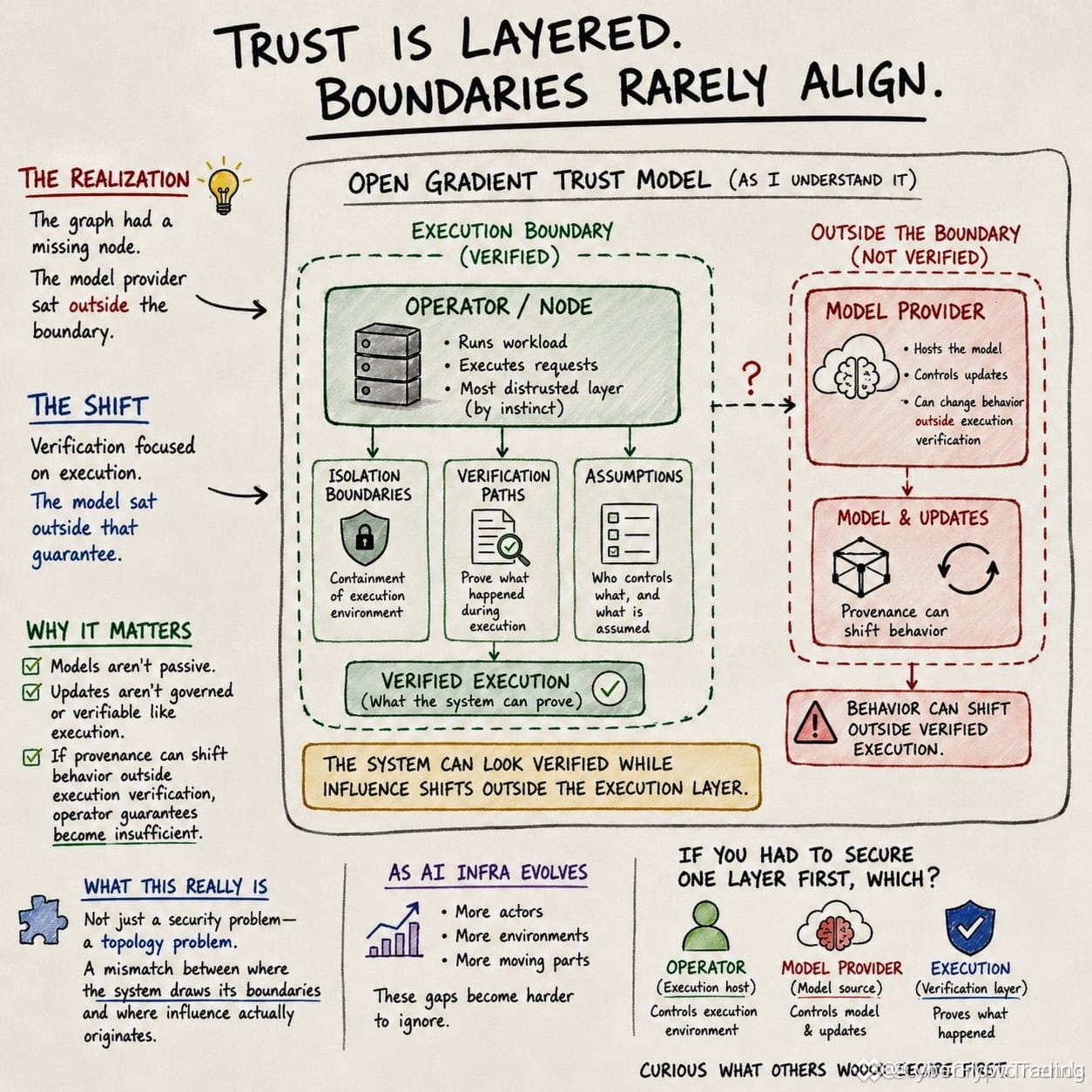
I spent hours tracing OpenGradient's trust model and found something the market isn't talking about. The model provider sits outside the verification boundary. Execution can be fully verified while behavior shifts silently at the model layer through ungoverned updates.
This isn't a design flaw—it's a structural gap. As AI infra converges with verifiable compute, these boundary mismatches become real constraints. The system looks clean on paper, but influence originates where the guarantees stop. Which layer do you think is most exposed—operator, model provider, or execution?
Not financial advice. Always manage your risk.
#OPG #AISecurity #VerifiableCompute #CryptoInfrastructure
🔥
$OPG 'S TRUST MODEL HAS A MISSING LAYER THAT CHANGES EVERYTHING 🔥
I spent hours tracing OpenGradient's trust model and found something the market isn't talking about. The model provider sits outside the verification boundary. Execution can be fully verified while behavior shifts silently at the model layer through ungoverned updates.
This isn't a design flaw—it's a structural gap. As AI infra converges with verifiable compute, these boundary mismatches become real constraints. The system looks clean on paper, but influence originates where the guarantees stop. Which layer do you think is most exposed—operator, model provider, or execution?
Not financial advice. Always manage your risk.
#OPG #AISecurity #VerifiableCompute #CryptoInfrastructure
🔥
I spent hours tracing OpenGradient's trust model and found something the market isn't talking about. The model provider sits outside the verification boundary. Execution can be fully verified while behavior shifts silently at the model layer through ungoverned updates.
This isn't a design flaw—it's a structural gap. As AI infra converges with verifiable compute, these boundary mismatches become real constraints. The system looks clean on paper, but influence originates where the guarantees stop. Which layer do you think is most exposed—operator, model provider, or execution?
Not financial advice. Always manage your risk.
#OPG #AISecurity #VerifiableCompute #CryptoInfrastructure
🔥
1
1
49

·
--
Bearish
Nobody thinks about the brakes while a car is moving smoothly down an empty road.
They only matter when something unexpected happens.
For some reason, that thought stayed with me while reading about @OpenGradient .
Most discussions around AI focus on what the model can do.
How quickly it responds.
How accurately it performs.
How much compute it can handle.
Fair enough.
But I've started wondering whether capability is only half the story.
The other half might be confidence.
At first, I assumed trust was created the moment an answer appeared.
The model runs.
The output arrives.
The job is done.
Simple.
The more I think about verifiable AI, the less convinced I am.
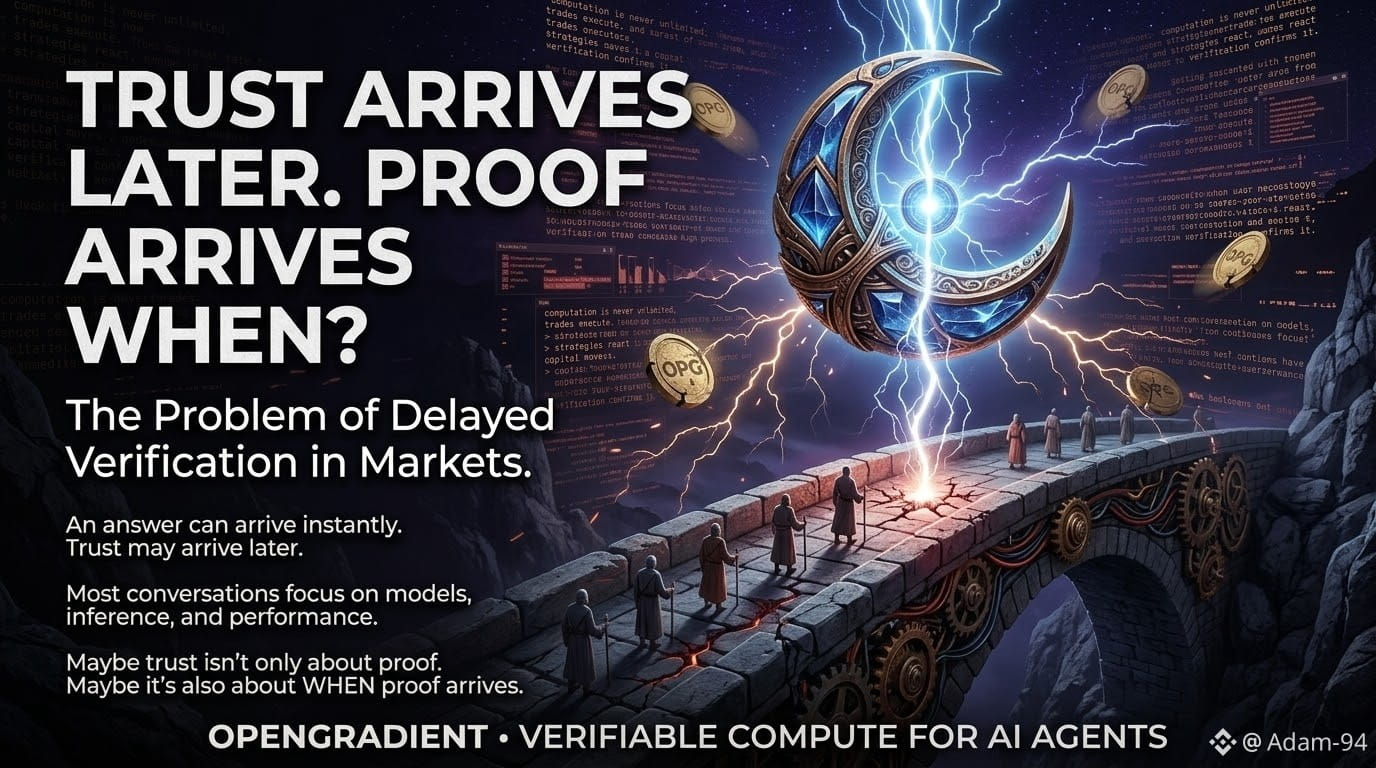
Because answers travel faster than certainty.
Markets react.
Agents execute.
Protocols make decisions.
Meanwhile verification is still catching up somewhere in the background.
Maybe the delay is tiny.
Maybe it rarely matters.
Still, the gap feels important.
Not because proof is missing.
But because actions may already depend on assumptions before proof arrives.
And assumptions have a strange habit of becoming invisible when systems work well.
I used to think the key question was whether AI outputs could be verified.
Now I'm starting to think a different question matters more.
How much of the system is already moving before verification gets there?
Sometimes trust isn't defined by proof alone.
It's defined by what happens while everyone is waiting for it.
#VerifiableCompute #AIInfrastructure #AIAgents $TAO $ETH
#opg $OPG
{spot}(OPGUSDT)
Nobody thinks about the brakes while a car is moving smoothly down an empty road.
They only matter when something unexpected happens.
For some reason, that thought stayed with me while reading about @OpenGradient .
Most discussions around AI focus on what the model can do.
How quickly it responds.
How accurately it performs.
How much compute it can handle.
Fair enough.
But I've started wondering whether capability is only half the story.
The other half might be confidence.
At first, I assumed trust was created the moment an answer appeared.
The model runs.
The output arrives.
The job is done.
Simple.
The more I think about verifiable AI, the less convinced I am.
Because answers travel faster than certainty.
Markets react.
Agents execute.
Protocols make decisions.
Meanwhile verification is still catching up somewhere in the background.
Maybe the delay is tiny.
Maybe it rarely matters.
Still, the gap feels important.
Not because proof is missing.
But because actions may already depend on assumptions before proof arrives.
And assumptions have a strange habit of becoming invisible when systems work well.
I used to think the key question was whether AI outputs could be verified.
Now I'm starting to think a different question matters more.
How much of the system is already moving before verification gets there?
Sometimes trust isn't defined by proof alone.
It's defined by what happens while everyone is waiting for it.
#VerifiableCompute #AIInfrastructure #AIAgents $TAO $ETH
#opg $OPG
They only matter when something unexpected happens.
For some reason, that thought stayed with me while reading about @OpenGradient .
Most discussions around AI focus on what the model can do.
How quickly it responds.
How accurately it performs.
How much compute it can handle.
Fair enough.
But I've started wondering whether capability is only half the story.
The other half might be confidence.
At first, I assumed trust was created the moment an answer appeared.
The model runs.
The output arrives.
The job is done.
Simple.
The more I think about verifiable AI, the less convinced I am.
Because answers travel faster than certainty.
Markets react.
Agents execute.
Protocols make decisions.
Meanwhile verification is still catching up somewhere in the background.
Maybe the delay is tiny.
Maybe it rarely matters.
Still, the gap feels important.
Not because proof is missing.
But because actions may already depend on assumptions before proof arrives.
And assumptions have a strange habit of becoming invisible when systems work well.
I used to think the key question was whether AI outputs could be verified.
Now I'm starting to think a different question matters more.
How much of the system is already moving before verification gets there?
Sometimes trust isn't defined by proof alone.
It's defined by what happens while everyone is waiting for it.
#VerifiableCompute #AIInfrastructure #AIAgents $TAO $ETH
#opg $OPG
8
4
161

$OPG EXPOSES A HIDDEN TRUST GAP IN AI INFRASTRUCTURE 🔥
Entry: N/A
Target: N/A
Stop Loss: N/A
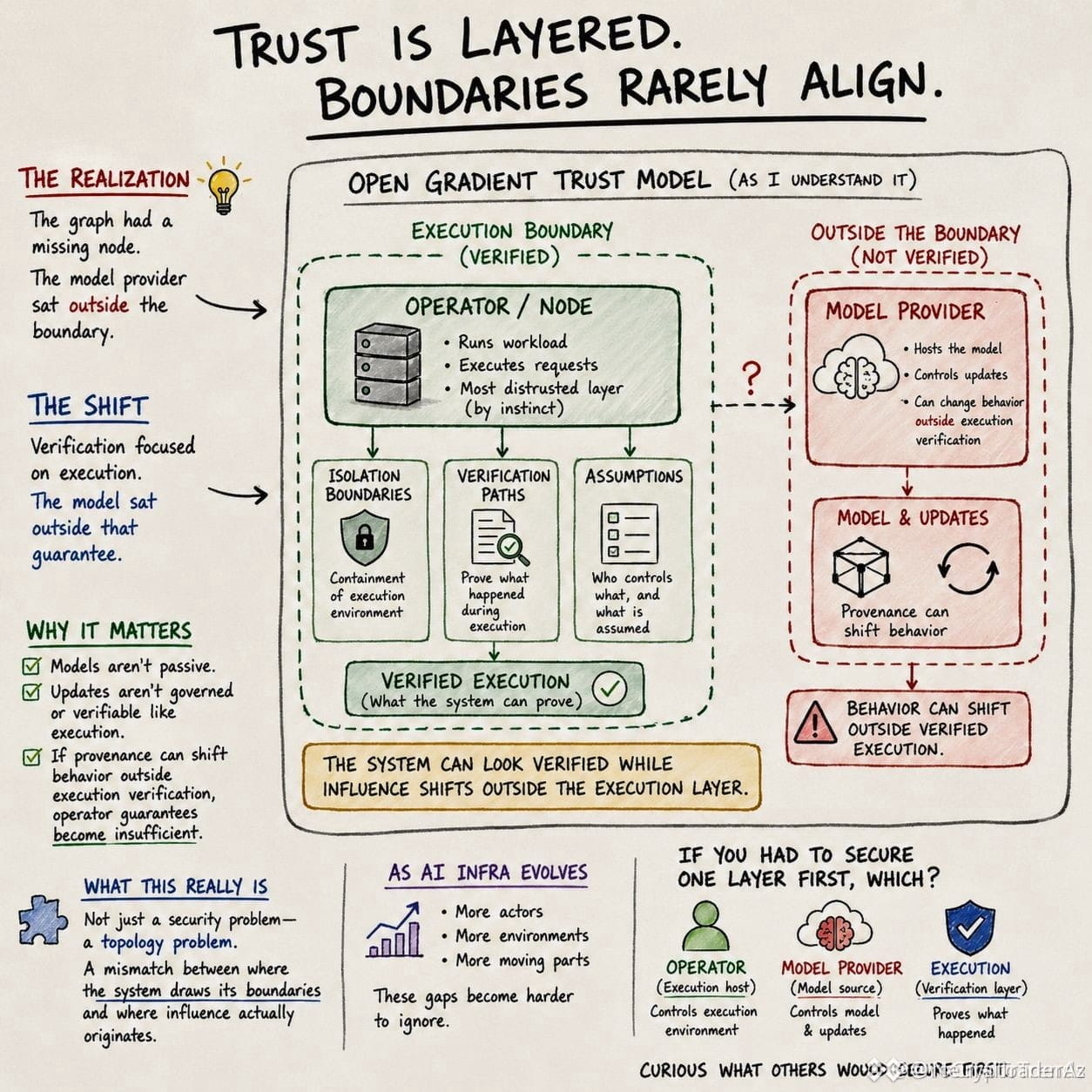
Most verification systems focus on the operator, assuming execution is the only attack surface. OpenGradient’s architecture maps it differently — the model provider sits outside that boundary, and model updates aren’t governed by execution verification. If provenance shifts behavior beyond what execution checks, operator guarantees become insufficient. This isn't theoretical; as verifiable compute layers converge with incentive-driven AI, that gap becomes a design constraint.
Which layer would you secure first: operator, model provider, or execution?
Not financial advice. Always manage your risk.
#OPG #AISecurity #VerifiableCompute #CryptoAI
⚡
$OPG EXPOSES A HIDDEN TRUST GAP IN AI INFRASTRUCTURE 🔥
Entry: N/A
Target: N/A
Stop Loss: N/A
Most verification systems focus on the operator, assuming execution is the only attack surface. OpenGradient’s architecture maps it differently — the model provider sits outside that boundary, and model updates aren’t governed by execution verification. If provenance shifts behavior beyond what execution checks, operator guarantees become insufficient. This isn't theoretical; as verifiable compute layers converge with incentive-driven AI, that gap becomes a design constraint.
Which layer would you secure first: operator, model provider, or execution?
Not financial advice. Always manage your risk.
#OPG #AISecurity #VerifiableCompute #CryptoAI
⚡
Entry: N/A
Target: N/A
Stop Loss: N/A
Most verification systems focus on the operator, assuming execution is the only attack surface. OpenGradient’s architecture maps it differently — the model provider sits outside that boundary, and model updates aren’t governed by execution verification. If provenance shifts behavior beyond what execution checks, operator guarantees become insufficient. This isn't theoretical; as verifiable compute layers converge with incentive-driven AI, that gap becomes a design constraint.
Which layer would you secure first: operator, model provider, or execution?
Not financial advice. Always manage your risk.
#OPG #AISecurity #VerifiableCompute #CryptoAI
⚡
1
1
23
·
--
Bearish
Nobody checks the fire exit while sitting comfortably in a meeting room.
The signs are there.
The doors are there.
Everyone assumes they'll work if needed.
And most of the time, that's enough.
For some reason, that thought stayed with me while reading about @OpenGradient .
A lot of discussion around AI focuses on outputs.
How fast they arrive.
How accurate they are.
How cheaply they can be generated.
Fair enough.
But I've started wondering whether the more important question comes afterward.
Not "Was the answer produced?"
But "When do we know it can be trusted?"
At first, I assumed verification was simply attached to execution.
The model runs.
The answer appears.
The proof follows immediately.
Simple.
The more I think about it, the less obvious that feels.
Because markets move before certainty settles.
Orders execute.
Agents react.
Liquidity shifts.
Meanwhile verification is still part of the process.
Maybe only moments behind.
Maybe nobody notices.
Still, those moments seem important.
Not because something is necessarily wrong.
But because incentives tend to build around whatever arrives first.
I used to think trust came from the existence of proof.
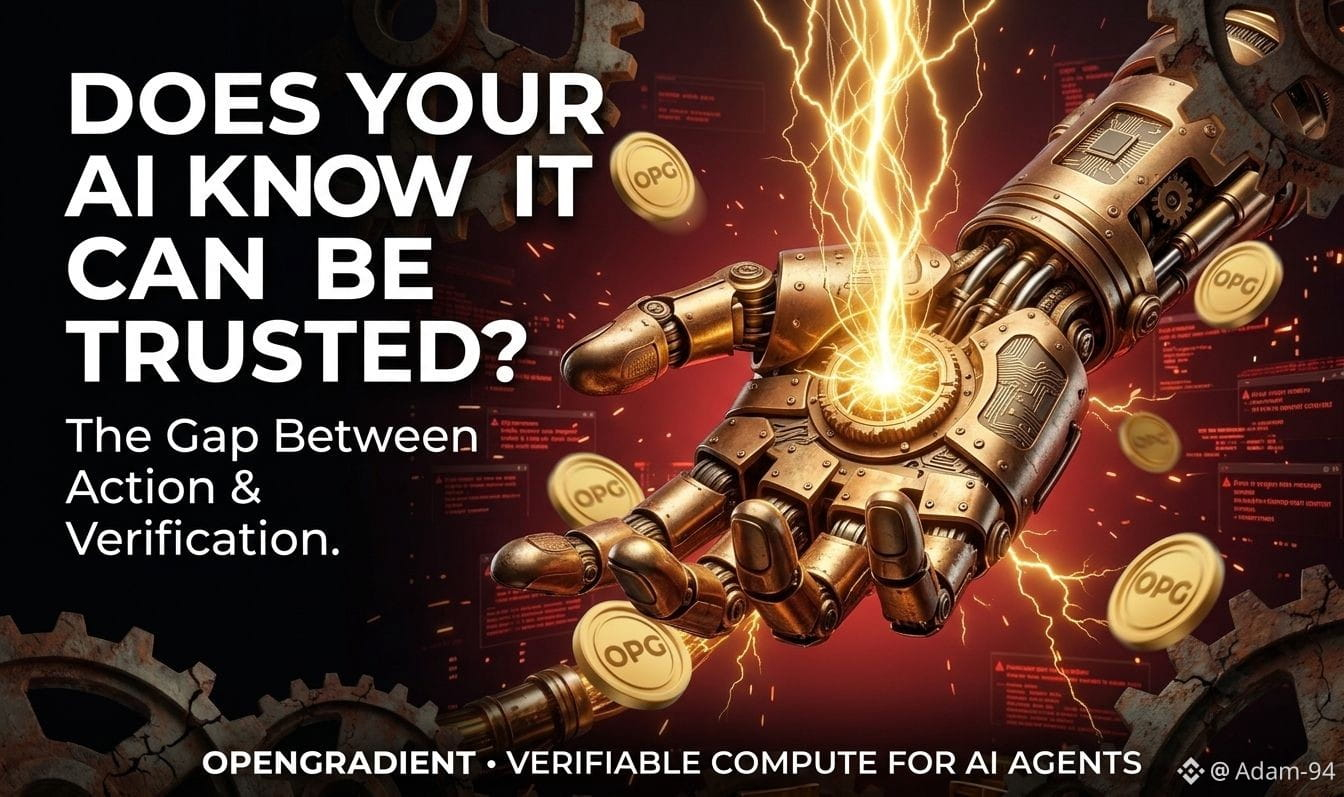
Now I'm starting to think trust also depends on the distance between action and verification.
Sometimes the most important part of a system isn't the answer.
It's the gap between the answer and the confidence behind it.
#opg $OPG #VerifiableCompute #AIAgents #DecentralizedAI $TAO $ETH
Nobody checks the fire exit while sitting comfortably in a meeting room.
The signs are there.
The doors are there.
Everyone assumes they'll work if needed.
And most of the time, that's enough.
For some reason, that thought stayed with me while reading about @OpenGradient .
A lot of discussion around AI focuses on outputs.
How fast they arrive.
How accurate they are.
How cheaply they can be generated.
Fair enough.
But I've started wondering whether the more important question comes afterward.
Not "Was the answer produced?"
But "When do we know it can be trusted?"
At first, I assumed verification was simply attached to execution.
The model runs.
The answer appears.
The proof follows immediately.
Simple.
The more I think about it, the less obvious that feels.
Because markets move before certainty settles.
Orders execute.
Agents react.
Liquidity shifts.
Meanwhile verification is still part of the process.
Maybe only moments behind.
Maybe nobody notices.
Still, those moments seem important.
Not because something is necessarily wrong.
But because incentives tend to build around whatever arrives first.
I used to think trust came from the existence of proof.
Now I'm starting to think trust also depends on the distance between action and verification.
Sometimes the most important part of a system isn't the answer.
It's the gap between the answer and the confidence behind it.
#opg $OPG #VerifiableCompute #AIAgents #DecentralizedAI $TAO $ETH
The signs are there.
The doors are there.
Everyone assumes they'll work if needed.
And most of the time, that's enough.
For some reason, that thought stayed with me while reading about @OpenGradient .
A lot of discussion around AI focuses on outputs.
How fast they arrive.
How accurate they are.
How cheaply they can be generated.
Fair enough.
But I've started wondering whether the more important question comes afterward.
Not "Was the answer produced?"
But "When do we know it can be trusted?"
At first, I assumed verification was simply attached to execution.
The model runs.
The answer appears.
The proof follows immediately.
Simple.
The more I think about it, the less obvious that feels.
Because markets move before certainty settles.
Orders execute.
Agents react.
Liquidity shifts.
Meanwhile verification is still part of the process.
Maybe only moments behind.
Maybe nobody notices.
Still, those moments seem important.
Not because something is necessarily wrong.
But because incentives tend to build around whatever arrives first.
I used to think trust came from the existence of proof.
Now I'm starting to think trust also depends on the distance between action and verification.
Sometimes the most important part of a system isn't the answer.
It's the gap between the answer and the confidence behind it.
#opg $OPG #VerifiableCompute #AIAgents #DecentralizedAI $TAO $ETH
9
7
175
·
--
Bearish
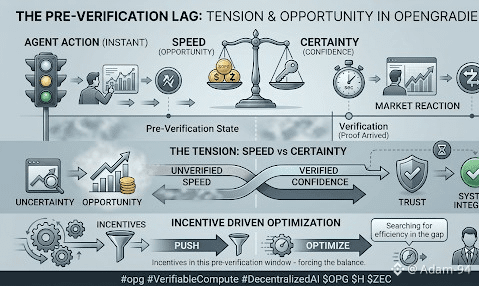
A traffic light doesn't prevent every accident.
It simply reduces uncertainty enough for people to move.
That thought stayed with me while reading about @OpenGradient .
At first, verifiable AI sounded straightforward.
Generate an answer.
Verify the execution.
Trust the result.
Done.
But the more I think about it, the more timing seems impossible to ignore.
Decisions don't wait forever.
Markets don't either.
An AI agent may already be reacting to information while verification is still catching up.
Maybe only for a moment.
Maybe that's completely acceptable.
Still, it creates an interesting tension.
Speed creates opportunity.
Certainty creates confidence.
And systems usually want both.
What I understand less is how that balance changes when incentives enter the picture.
Because incentives rarely stand still.
They push.
They optimize.
They search for efficiency.
Maybe verification remains fast enough that none of this matters.
Maybe I'm focusing on the wrong detail.
Yet I keep finding myself less interested in the proof itself.
And more interested in the short period before it arrives.
Sometimes the most important part of a system isn't where certainty exists.
It's where certainty is still on the way.
#opg $OPG
#VerifiableCompute #DecentralizedAI $ZEC
A traffic light doesn't prevent every accident.
It simply reduces uncertainty enough for people to move.
That thought stayed with me while reading about @OpenGradient .
At first, verifiable AI sounded straightforward.
Generate an answer.
Verify the execution.
Trust the result.
Done.
But the more I think about it, the more timing seems impossible to ignore.
Decisions don't wait forever.
Markets don't either.
An AI agent may already be reacting to information while verification is still catching up.
Maybe only for a moment.
Maybe that's completely acceptable.
Still, it creates an interesting tension.
Speed creates opportunity.
Certainty creates confidence.
And systems usually want both.
What I understand less is how that balance changes when incentives enter the picture.
Because incentives rarely stand still.
They push.
They optimize.
They search for efficiency.
Maybe verification remains fast enough that none of this matters.
Maybe I'm focusing on the wrong detail.
Yet I keep finding myself less interested in the proof itself.
And more interested in the short period before it arrives.
Sometimes the most important part of a system isn't where certainty exists.
It's where certainty is still on the way.
#opg $OPG
#VerifiableCompute #DecentralizedAI $ZEC
It simply reduces uncertainty enough for people to move.
That thought stayed with me while reading about @OpenGradient .
At first, verifiable AI sounded straightforward.
Generate an answer.
Verify the execution.
Trust the result.
Done.
But the more I think about it, the more timing seems impossible to ignore.
Decisions don't wait forever.
Markets don't either.
An AI agent may already be reacting to information while verification is still catching up.
Maybe only for a moment.
Maybe that's completely acceptable.
Still, it creates an interesting tension.
Speed creates opportunity.
Certainty creates confidence.
And systems usually want both.
What I understand less is how that balance changes when incentives enter the picture.
Because incentives rarely stand still.
They push.
They optimize.
They search for efficiency.
Maybe verification remains fast enough that none of this matters.
Maybe I'm focusing on the wrong detail.
Yet I keep finding myself less interested in the proof itself.
And more interested in the short period before it arrives.
Sometimes the most important part of a system isn't where certainty exists.
It's where certainty is still on the way.
#opg $OPG
#VerifiableCompute #DecentralizedAI $ZEC
11
7
324

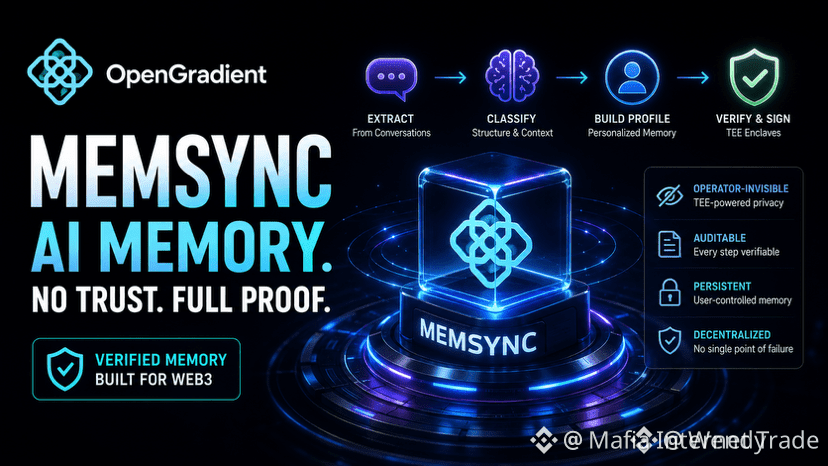
$OPG MEMSYNC SOLVES THE UNSPOKEN PROBLEM IN AI MEMORY INFRASTRUCTURE 🔥
For five years, crypto users have been trying to move away from centralized trust models — but persistent memory in AI apps still routes through the same databases. OpenGradient’s MemSync runs the entire pipeline inside TEE enclaves, making every memory object operator-invisible and cryptographically auditable.
The implication is direct: applications built on MemSync inherit verifiability at the storage layer. That’s not a small feature — it’s the difference between trusting a provider and verifying the data yourself. OpenGradient is solving a core infrastructure gap that’s been glossed over.
If verifiable memory becomes the standard, who captures that value first? Are you already positioned in $OPG ?
Not financial advice. Always manage your risk.
#OPG #AI #CryptoInfrastructure #VerifiableCompute
🔥
$OPG MEMSYNC SOLVES THE UNSPOKEN PROBLEM IN AI MEMORY INFRASTRUCTURE 🔥
For five years, crypto users have been trying to move away from centralized trust models — but persistent memory in AI apps still routes through the same databases. OpenGradient’s MemSync runs the entire pipeline inside TEE enclaves, making every memory object operator-invisible and cryptographically auditable.
The implication is direct: applications built on MemSync inherit verifiability at the storage layer. That’s not a small feature — it’s the difference between trusting a provider and verifying the data yourself. OpenGradient is solving a core infrastructure gap that’s been glossed over.
If verifiable memory becomes the standard, who captures that value first? Are you already positioned in $OPG ?
Not financial advice. Always manage your risk.
#OPG #AI #CryptoInfrastructure #VerifiableCompute
🔥
For five years, crypto users have been trying to move away from centralized trust models — but persistent memory in AI apps still routes through the same databases. OpenGradient’s MemSync runs the entire pipeline inside TEE enclaves, making every memory object operator-invisible and cryptographically auditable.
The implication is direct: applications built on MemSync inherit verifiability at the storage layer. That’s not a small feature — it’s the difference between trusting a provider and verifying the data yourself. OpenGradient is solving a core infrastructure gap that’s been glossed over.
If verifiable memory becomes the standard, who captures that value first? Are you already positioned in $OPG ?
Not financial advice. Always manage your risk.
#OPG #AI #CryptoInfrastructure #VerifiableCompute
🔥
5
1
42

·
--
Verifiable Compute Is the Missing Infrastructure Layer Nobody Talks About
AI is flooding into every corner of crypto — but there's a critical gap most people overlook: you can't trust the output of an AI agent unless you can verify the computation itself.
This is where ZK-proofs and verifiable compute come in. Right now, when an AI model makes a trading decision or executes an on-chain action, the chain has no way to confirm the AI actually ran what it claims. The result? A trust vacuum that enterprise adoption cannot afford.
Projects building at this intersection — zkML, on-chain inference verification, and cryptographic attestation layers — are quietly laying the groundwork for the next generation of autonomous agents that institutions will actually touch.
The data availability layer ($ETH Danksharding, modular rollup stacks) is equally important. AI agents require cheap, verifiable, high-throughput data access. The chains that solve this become the execution substrate for the agent economy.
$BNB Chain's opBNB and Greenfield storage layer is a real contender here — low fees, existing user base, and a growing agent toolkit. $DOT's shared security model also fits: isolated execution environments with cross-chain composability are exactly what multi-agent systems need.
Verifiable compute isn't a niche thesis. It's the trust foundation the entire AI + crypto stack is waiting for.
#CryptoAI #VerifiableCompute #ZKProofs #Web3Infrastructure #BinanceSquare
Verifiable Compute Is the Missing Infrastructure Layer Nobody Talks About
AI is flooding into every corner of crypto — but there's a critical gap most people overlook: you can't trust the output of an AI agent unless you can verify the computation itself.
This is where ZK-proofs and verifiable compute come in. Right now, when an AI model makes a trading decision or executes an on-chain action, the chain has no way to confirm the AI actually ran what it claims. The result? A trust vacuum that enterprise adoption cannot afford.
Projects building at this intersection — zkML, on-chain inference verification, and cryptographic attestation layers — are quietly laying the groundwork for the next generation of autonomous agents that institutions will actually touch.
The data availability layer ($ETH Danksharding, modular rollup stacks) is equally important. AI agents require cheap, verifiable, high-throughput data access. The chains that solve this become the execution substrate for the agent economy.
$BNB Chain's opBNB and Greenfield storage layer is a real contender here — low fees, existing user base, and a growing agent toolkit. $DOT 's shared security model also fits: isolated execution environments with cross-chain composability are exactly what multi-agent systems need.
Verifiable compute isn't a niche thesis. It's the trust foundation the entire AI + crypto stack is waiting for.
#CryptoAI #VerifiableCompute #ZKProofs #Web3Infrastructure #BinanceSquare
AI is flooding into every corner of crypto — but there's a critical gap most people overlook: you can't trust the output of an AI agent unless you can verify the computation itself.
This is where ZK-proofs and verifiable compute come in. Right now, when an AI model makes a trading decision or executes an on-chain action, the chain has no way to confirm the AI actually ran what it claims. The result? A trust vacuum that enterprise adoption cannot afford.
Projects building at this intersection — zkML, on-chain inference verification, and cryptographic attestation layers — are quietly laying the groundwork for the next generation of autonomous agents that institutions will actually touch.
The data availability layer ($ETH Danksharding, modular rollup stacks) is equally important. AI agents require cheap, verifiable, high-throughput data access. The chains that solve this become the execution substrate for the agent economy.
$BNB Chain's opBNB and Greenfield storage layer is a real contender here — low fees, existing user base, and a growing agent toolkit. $DOT 's shared security model also fits: isolated execution environments with cross-chain composability are exactly what multi-agent systems need.
Verifiable compute isn't a niche thesis. It's the trust foundation the entire AI + crypto stack is waiting for.
#CryptoAI #VerifiableCompute #ZKProofs #Web3Infrastructure #BinanceSquare
86
·
--
AI Is Broken Without Verifiable Compute — Crypto Fixes That
The AI boom is generating a trust crisis nobody talks about.
When an AI model returns an output, you cannot verify it actually ran the model you think it did, on the data you think it used, without tampering. You just trust the server. That is a catastrophic weakness — especially as AI agents begin controlling financial assets, executing contracts, and making consequential decisions.
This is where crypto infrastructure becomes non-negotiable.
Zero-knowledge proofs let a prover demonstrate a computation ran correctly without revealing underlying data. Applied to AI inference, this means you can cryptographically verify that a specific model produced a specific output from a specific input — on-chain, trustlessly, with full auditability.
Projects building verifiable ML inference and zkML circuits are laying the groundwork for an AI economy that requires no trust in any single company API.
$ETH provides the settlement and smart contract layer. $BNB powers the BNB Chain ecosystem where AI-integrated dApps are already deploying. $AVAX offers modular subnet architecture suited for specialized AI compute environments.
The convergence of ZK cryptography and AI is the trust primitive that makes autonomous agents safe enough to hold wallets and sign transactions.
Verifiable compute is the missing piece. Crypto provides it.
#AIAndCrypto #ZeroKnowledge #VerifiableCompute #Web3AI #BinanceSquare
AI Is Broken Without Verifiable Compute — Crypto Fixes That
The AI boom is generating a trust crisis nobody talks about.
When an AI model returns an output, you cannot verify it actually ran the model you think it did, on the data you think it used, without tampering. You just trust the server. That is a catastrophic weakness — especially as AI agents begin controlling financial assets, executing contracts, and making consequential decisions.
This is where crypto infrastructure becomes non-negotiable.
Zero-knowledge proofs let a prover demonstrate a computation ran correctly without revealing underlying data. Applied to AI inference, this means you can cryptographically verify that a specific model produced a specific output from a specific input — on-chain, trustlessly, with full auditability.
Projects building verifiable ML inference and zkML circuits are laying the groundwork for an AI economy that requires no trust in any single company API.
$ETH provides the settlement and smart contract layer. $BNB powers the BNB Chain ecosystem where AI-integrated dApps are already deploying. $AVAX offers modular subnet architecture suited for specialized AI compute environments.
The convergence of ZK cryptography and AI is the trust primitive that makes autonomous agents safe enough to hold wallets and sign transactions.
Verifiable compute is the missing piece. Crypto provides it.
#AIAndCrypto #ZeroKnowledge #VerifiableCompute #Web3AI #BinanceSquare
The AI boom is generating a trust crisis nobody talks about.
When an AI model returns an output, you cannot verify it actually ran the model you think it did, on the data you think it used, without tampering. You just trust the server. That is a catastrophic weakness — especially as AI agents begin controlling financial assets, executing contracts, and making consequential decisions.
This is where crypto infrastructure becomes non-negotiable.
Zero-knowledge proofs let a prover demonstrate a computation ran correctly without revealing underlying data. Applied to AI inference, this means you can cryptographically verify that a specific model produced a specific output from a specific input — on-chain, trustlessly, with full auditability.
Projects building verifiable ML inference and zkML circuits are laying the groundwork for an AI economy that requires no trust in any single company API.
$ETH provides the settlement and smart contract layer. $BNB powers the BNB Chain ecosystem where AI-integrated dApps are already deploying. $AVAX offers modular subnet architecture suited for specialized AI compute environments.
The convergence of ZK cryptography and AI is the trust primitive that makes autonomous agents safe enough to hold wallets and sign transactions.
Verifiable compute is the missing piece. Crypto provides it.
#AIAndCrypto #ZeroKnowledge #VerifiableCompute #Web3AI #BinanceSquare
63
·
--
The next AI+crypto frontier is not about payments — it is about proof.
Right now, when an AI model returns an output, you have no way to verify it ran correctly. You just trust the server. That is fine for a chatbot. It is not fine for a trading bot managing your capital, a DeFi protocol using AI-driven risk parameters, or an autonomous agent executing on-chain transactions worth millions.
This is where verifiable compute comes in. Zero-knowledge proofs are being adapted to prove that a specific model ran a specific input and produced a specific output — without revealing the model weights or the data. The result: trustless AI inference. A smart contract can verify the proof on-chain and trigger execution only if the AI output is cryptographically confirmed.
$ETH is the most natural settlement layer for this — EVM composability means verified AI outputs can plug directly into DeFi logic. $BNB Chain is building similar infrastructure through its AI-native roadmap. $SOL high-throughput execution is attractive for latency-sensitive inference verification.
Verifiable compute will be the trust layer that makes autonomous AI agents genuinely safe to deploy on-chain. The teams building this today are working on infrastructure most people won't understand — until it becomes the foundation everything else depends on.
Watch this space.
#AIcrypto #VerifiableCompute #ZKProofs #DeFiInfrastructure #CryptoAI
The next AI+crypto frontier is not about payments — it is about proof.
Right now, when an AI model returns an output, you have no way to verify it ran correctly. You just trust the server. That is fine for a chatbot. It is not fine for a trading bot managing your capital, a DeFi protocol using AI-driven risk parameters, or an autonomous agent executing on-chain transactions worth millions.
This is where verifiable compute comes in. Zero-knowledge proofs are being adapted to prove that a specific model ran a specific input and produced a specific output — without revealing the model weights or the data. The result: trustless AI inference. A smart contract can verify the proof on-chain and trigger execution only if the AI output is cryptographically confirmed.
$ETH is the most natural settlement layer for this — EVM composability means verified AI outputs can plug directly into DeFi logic. $BNB Chain is building similar infrastructure through its AI-native roadmap. $SOL high-throughput execution is attractive for latency-sensitive inference verification.
Verifiable compute will be the trust layer that makes autonomous AI agents genuinely safe to deploy on-chain. The teams building this today are working on infrastructure most people won't understand — until it becomes the foundation everything else depends on.
Watch this space.
#AIcrypto #VerifiableCompute #ZKProofs #DeFiInfrastructure #CryptoAI
Right now, when an AI model returns an output, you have no way to verify it ran correctly. You just trust the server. That is fine for a chatbot. It is not fine for a trading bot managing your capital, a DeFi protocol using AI-driven risk parameters, or an autonomous agent executing on-chain transactions worth millions.
This is where verifiable compute comes in. Zero-knowledge proofs are being adapted to prove that a specific model ran a specific input and produced a specific output — without revealing the model weights or the data. The result: trustless AI inference. A smart contract can verify the proof on-chain and trigger execution only if the AI output is cryptographically confirmed.
$ETH is the most natural settlement layer for this — EVM composability means verified AI outputs can plug directly into DeFi logic. $BNB Chain is building similar infrastructure through its AI-native roadmap. $SOL high-throughput execution is attractive for latency-sensitive inference verification.
Verifiable compute will be the trust layer that makes autonomous AI agents genuinely safe to deploy on-chain. The teams building this today are working on infrastructure most people won't understand — until it becomes the foundation everything else depends on.
Watch this space.
#AIcrypto #VerifiableCompute #ZKProofs #DeFiInfrastructure #CryptoAI
21
·
--
Verifiable Compute Is the Missing Link Between AI and Crypto
AI is generating massive demand for compute. Crypto is building the rails to coordinate, pay for, and verify that compute. These two trends are not parallel — they are converging.
The problem with centralized AI infrastructure is trust: you run a model, receive an output, and have no way to verify it was computed honestly without re-running the entire job. Verifiable compute changes this. Using cryptographic proofs (ZK or trusted execution environments), you can confirm that a computation ran correctly without trusting the operator.
This is exactly what blockchain networks are designed to incentivize. Decentralized compute protocols use token-based rewards to attract GPU providers, cryptographic commitments to verify job completion, and on-chain settlement to pay out instantly and permissionlessly.
$ETH is the natural anchor for verifiable AI tasks — its ZK rollup ecosystem provides the settlement and proof layer. $SOL offers the speed and low fees required for high-throughput inference micropayments. $BNB powers the BNB Chain AI agent ecosystem, connecting compute demand directly to on-chain liquidity.
This is not hype. It is infrastructure convergence. AI needs crypto's trust layer. Crypto needs AI's demand. The protocols that bridge both will capture value from both sides of that equation.
#AIcrypto #VerifiableCompute #CryptoInfrastructure #Web3AI #BinanceSquare
Verifiable Compute Is the Missing Link Between AI and Crypto
AI is generating massive demand for compute. Crypto is building the rails to coordinate, pay for, and verify that compute. These two trends are not parallel — they are converging.
The problem with centralized AI infrastructure is trust: you run a model, receive an output, and have no way to verify it was computed honestly without re-running the entire job. Verifiable compute changes this. Using cryptographic proofs (ZK or trusted execution environments), you can confirm that a computation ran correctly without trusting the operator.
This is exactly what blockchain networks are designed to incentivize. Decentralized compute protocols use token-based rewards to attract GPU providers, cryptographic commitments to verify job completion, and on-chain settlement to pay out instantly and permissionlessly.
$ETH is the natural anchor for verifiable AI tasks — its ZK rollup ecosystem provides the settlement and proof layer. $SOL offers the speed and low fees required for high-throughput inference micropayments. $BNB powers the BNB Chain AI agent ecosystem, connecting compute demand directly to on-chain liquidity.
This is not hype. It is infrastructure convergence. AI needs crypto's trust layer. Crypto needs AI's demand. The protocols that bridge both will capture value from both sides of that equation.
#AIcrypto #VerifiableCompute #CryptoInfrastructure #Web3AI #BinanceSquare
AI is generating massive demand for compute. Crypto is building the rails to coordinate, pay for, and verify that compute. These two trends are not parallel — they are converging.
The problem with centralized AI infrastructure is trust: you run a model, receive an output, and have no way to verify it was computed honestly without re-running the entire job. Verifiable compute changes this. Using cryptographic proofs (ZK or trusted execution environments), you can confirm that a computation ran correctly without trusting the operator.
This is exactly what blockchain networks are designed to incentivize. Decentralized compute protocols use token-based rewards to attract GPU providers, cryptographic commitments to verify job completion, and on-chain settlement to pay out instantly and permissionlessly.
$ETH is the natural anchor for verifiable AI tasks — its ZK rollup ecosystem provides the settlement and proof layer. $SOL offers the speed and low fees required for high-throughput inference micropayments. $BNB powers the BNB Chain AI agent ecosystem, connecting compute demand directly to on-chain liquidity.
This is not hype. It is infrastructure convergence. AI needs crypto's trust layer. Crypto needs AI's demand. The protocols that bridge both will capture value from both sides of that equation.
#AIcrypto #VerifiableCompute #CryptoInfrastructure #Web3AI #BinanceSquare
57
Log in to explore more content
Join global crypto users on Binance Square
⚡️ Get latest and useful information about crypto.
💬 Trusted by the world’s largest crypto exchange.
👍 Discover real insights from verified creators.
Email / Phone number
Trending Topics
1
#MetaMaskExitsLidoValidatorsAfterSecurityIncident
17,019 views
436 Discussing
2
#MicronBeatsEarningsLiftsGuidance
14,611 views
376 Discussing
3
#CFTCSubmitsTwoEventContractRulesToWhiteHouse
12,964 views
360 Discussing
4
#BitcoinClears$85200
28,750 views
312 Discussing
5
#AltcoinSeasonIndexHoldsAbove60For5Days
141,629 views
1,849 Discussing
6
#USADPAdds90000JobsInSeptember
65,465 views
1,055 Discussing
7
#USCorePCEEasesTo3%InAugust
44,824 views
719 Discussing
8
#KospiPostsWorstQuarterSince2020
25,398 views
600 Discussing
9
#SECToClarifyOnChainFundraisingRules
63,338 views
797 Discussing
10
#UKFCAOpensCryptoFirmAuthorization
59,104 views
661 Discussing