

#usjobsmissbadly
usjobsmissbadly
1,978 views
4 Discussing
Hot
Latest

·
--
@NewtonProtocol
#Newt
$NEWT
{future}(NEWTUSDT)
Tokenized Stocks Are Already a Billion Dollar Market. The Rules Just Haven't Caught Up Yet.
I saw this and had to stop scrolling. Tokenized stocks are not a future idea anymore. They are here right now, growing fast, and most people still are not paying attention.
The Numbers Are Real
396,000 holders. $8.9 billion in monthly volume. Holders up 32% in just one month. This is not a small experiment. This is real capital moving onchain, right now. Ondo alone is sitting at $904 million. xStocks at $690 million. These are serious numbers.
Capital Moves First, Rules Come Later
This is the part that really got me. The capital has already found its way onchain. People are not waiting for regulation to figure itself out. They are already trading tokenized stocks, holding them, moving them across wallets. The rules will follow because they have to. The market is not waiting.
Why Newton Matters Here
This is exactly the gap Newton is built for. When you have billions of dollars in tokenized assets moving onchain, you need proper guardrails before things go wrong. Identity checks, spending limits, compliance rules, all enforced before settlement, not after. That is what Newton's policy engine does. It brings the safety layer that this growing market actually needs.
The Bigger Picture
Tokenized stocks crossing a billion dollars is not just a stat. It is proof that traditional finance is moving onchain whether regulators are ready or not. The infrastructure needs to catch up fast
#USJobsMissBadly
#FootballSeason2026
#TLMtopGainer
#BitcoinFalls44%FromJanuaryPeak
{future}(GALAUSDT)
{future}(LINKUSDT)
$FET
As crypto evolves, what will matter more?
@NewtonProtocol
#Newt
$NEWT
Tokenized Stocks Are Already a Billion Dollar Market. The Rules Just Haven't Caught Up Yet.
I saw this and had to stop scrolling. Tokenized stocks are not a future idea anymore. They are here right now, growing fast, and most people still are not paying attention.
The Numbers Are Real
396,000 holders. $8.9 billion in monthly volume. Holders up 32% in just one month. This is not a small experiment. This is real capital moving onchain, right now. Ondo alone is sitting at $904 million. xStocks at $690 million. These are serious numbers.
Capital Moves First, Rules Come Later
This is the part that really got me. The capital has already found its way onchain. People are not waiting for regulation to figure itself out. They are already trading tokenized stocks, holding them, moving them across wallets. The rules will follow because they have to. The market is not waiting.
Why Newton Matters Here
This is exactly the gap Newton is built for. When you have billions of dollars in tokenized assets moving onchain, you need proper guardrails before things go wrong. Identity checks, spending limits, compliance rules, all enforced before settlement, not after. That is what Newton's policy engine does. It brings the safety layer that this growing market actually needs.
The Bigger Picture
Tokenized stocks crossing a billion dollars is not just a stat. It is proof that traditional finance is moving onchain whether regulators are ready or not. The infrastructure needs to catch up fast
#USJobsMissBadly
#FootballSeason2026
#TLMtopGainer
#BitcoinFalls44%FromJanuaryPeak
$FET
As crypto evolves, what will matter more?
#Newt
$NEWT
Tokenized Stocks Are Already a Billion Dollar Market. The Rules Just Haven't Caught Up Yet.
I saw this and had to stop scrolling. Tokenized stocks are not a future idea anymore. They are here right now, growing fast, and most people still are not paying attention.
The Numbers Are Real
396,000 holders. $8.9 billion in monthly volume. Holders up 32% in just one month. This is not a small experiment. This is real capital moving onchain, right now. Ondo alone is sitting at $904 million. xStocks at $690 million. These are serious numbers.
Capital Moves First, Rules Come Later
This is the part that really got me. The capital has already found its way onchain. People are not waiting for regulation to figure itself out. They are already trading tokenized stocks, holding them, moving them across wallets. The rules will follow because they have to. The market is not waiting.
Why Newton Matters Here
This is exactly the gap Newton is built for. When you have billions of dollars in tokenized assets moving onchain, you need proper guardrails before things go wrong. Identity checks, spending limits, compliance rules, all enforced before settlement, not after. That is what Newton's policy engine does. It brings the safety layer that this growing market actually needs.
The Bigger Picture
Tokenized stocks crossing a billion dollars is not just a stat. It is proof that traditional finance is moving onchain whether regulators are ready or not. The infrastructure needs to catch up fast
#USJobsMissBadly
#FootballSeason2026
#TLMtopGainer
#BitcoinFalls44%FromJanuaryPeak
$FET
As crypto evolves, what will matter more?
Faster execution
50%
Cross chain interoperability
0%
Pre transaction authorization
0%
Smarter wallet security
50%
2 votes • Voting closed
23
14
507


·
--
Article
Newton Protocol and the Quiet Work of Making Automation TrustworthyYou know that feeling when you’ve got some real money sitting onchain—whether it’s your own portfolio, a DAO treasury you’re responsible for, or an automated strategy you’re hoping will just work? The tension is always there. You want things to run smoothly without you glued to the screen, but you also don’t want to wake up to a nasty surprise because some agent did something unexpected, an oracle fed bad data, or a condition you didn’t fully think through went wrong. I’ve seen too many versions of this story end badly. Smart contracts sound perfect in theory—immutable and unstoppable—but they’re often rigid as hell. Once the rules are locked in, changing them when markets shift, laws evolve, or new risks appear turns into a painful process. Offchain bots and services patch the automation gap, but they bring back the very trust issues crypto was supposed to solve: opaque operators, potential custody risks, and single points of failure that make institutions (and anyone who’s been burned) nervous. In the end, you get this awkward patchwork where builders move fast, users click approve too quickly, and compliance teams are left piecing together what happened after the damage is done. Settlement might be onchain, but the real checks and balances often feel half-baked.
That’s why the friction feels so stubborn. Early Web3 chased speed and permissionlessness, but it often left policy and risk control as afterthoughts. Rules either get hardcoded into contracts (great until reality changes) or handled offchain by something you have to trust anyway. People being people doesn’t help—teams ship fast and fix later, users chase yields without reading the fine print, and bigger players struggle to get the audit trails and enforceability they need. Every extra check or update adds gas costs and coordination headaches, which quietly shuts out smaller players or more active strategies.
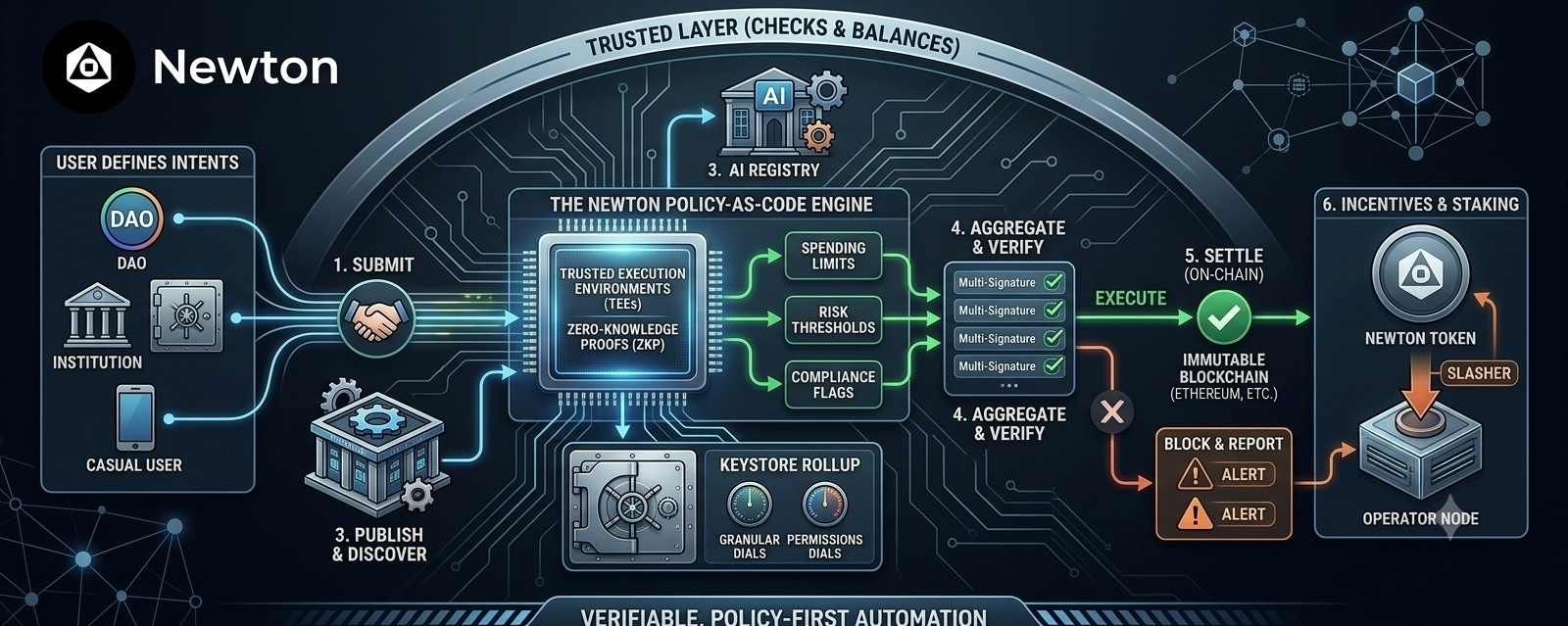
Newton Protocol feels like an attempt to treat this as real infrastructure instead of another flashy narrative. At heart, it adds a policy check before anything executes. Your intents—whether simple trades or complex AI-driven moves—get evaluated against rules you or your DAO actually set. These rules, inspired by policy-as-code thinking like Rego, can handle limits on spending, risk thresholds, compliance flags, or whatever else matters in the moment. It brings together trusted execution environments, zero-knowledge proofs for verification, and staking-based security with slashing. There’s a keystore rollup for managing permissions in a granular, revocable way (no handing over your keys), and a registry where people can publish and discover verifiable automation models. The token helps secure things, pay for usage, and keep incentives aligned.
When it works in practice, it creates this shared layer sitting between what you want to happen and what actually settles onchain. Imagine a treasury operator setting rules that travel across protocols—“only rebalance within these bounds, and only if certain signals look okay”—without having to touch every contract. Or an AI strategy that only fires when conditions are truly met, backed by proof the checks happened. For DAOs and institutions, the appeal is obvious: stopping bad actions before they land, rather than investigating afterward. It could make compliance conversations less painful. Cross-chain stuff gets a bit more structured, though it’s never truly effortless. They’re aiming for decent speed with clever signature aggregation.
I’m still skeptical by nature, though. These policy systems shine in controlled corporate worlds, but throwing them into permissionless chaos brings real headaches—fresh data, operators staying honest under pressure, handling disputes when things get volatile. People don’t suddenly become perfect maintainers; policies can go stale, governance drags, and integration pain might keep this from spreading widely. On the regulatory side, it’s uncertain territory—better traceability is nice, but it could invite questions about who’s really responsible when code acts. The tech risks (concentration among operators, oracle problems, timing issues) mean the real test will be how it holds up when the market gets ugly, not in demos.
It feels most relevant for folks who’ve already tasted the downsides: institutions moving serious money, DAOs with real responsibility, or experienced users tired of the custody-versus-automation dilemma. They tend to appreciate keeping control (easy to revoke permissions) while getting actual boundaries that cut tail risks. Casual users might skip it unless it becomes dead simple and cheap. Over time, the shared approach could save money compared to every project building its own risk systems, especially as the proving tech gets better.
I’ve watched enough of these layers rise and fade to stay measured. Newton has a shot at becoming quiet, reliable infrastructure if it stays decentralized, keeps costs reasonable, and actually makes integrations feel helpful rather than annoying. It stands out because it treats risk and governance as core plumbing problems instead of marketing angles. It could fail if operators centralize, fees or delays scare people off, regulators clamp down on automated delegation, or something simpler solves the same pains better. At the end of the day, its success might come down to whether it cuts down on those “how the hell did this happen” moments without strangling what makes Web3 interesting. After so many spectacular failures, boring reliability might be the real breakthrough.
What would actually make you comfortable handing over real capital to onchain automation—and would a shared, policy-first layer like this finally tip the scale for you?
#USJobsMissBadly
#2026FootballSeason
#TLMtopGainer
#BitcoinFalls44%FromJanuaryPeak
@NewtonProtocol #Newt $NEWT
$GALA
{spot}(NEWTUSDT)
{spot}(GALAUSDT)
$TLM
{spot}(TLMUSDT)
Newton Protocol and the Quiet Work of Making Automation Trustworthy
You know that feeling when you’ve got some real money sitting onchain—whether it’s your own portfolio, a DAO treasury you’re responsible for, or an automated strategy you’re hoping will just work? The tension is always there. You want things to run smoothly without you glued to the screen, but you also don’t want to wake up to a nasty surprise because some agent did something unexpected, an oracle fed bad data, or a condition you didn’t fully think through went wrong. I’ve seen too many versions of this story end badly. Smart contracts sound perfect in theory—immutable and unstoppable—but they’re often rigid as hell. Once the rules are locked in, changing them when markets shift, laws evolve, or new risks appear turns into a painful process. Offchain bots and services patch the automation gap, but they bring back the very trust issues crypto was supposed to solve: opaque operators, potential custody risks, and single points of failure that make institutions (and anyone who’s been burned) nervous. In the end, you get this awkward patchwork where builders move fast, users click approve too quickly, and compliance teams are left piecing together what happened after the damage is done. Settlement might be onchain, but the real checks and balances often feel half-baked.
That’s why the friction feels so stubborn. Early Web3 chased speed and permissionlessness, but it often left policy and risk control as afterthoughts. Rules either get hardcoded into contracts (great until reality changes) or handled offchain by something you have to trust anyway. People being people doesn’t help—teams ship fast and fix later, users chase yields without reading the fine print, and bigger players struggle to get the audit trails and enforceability they need. Every extra check or update adds gas costs and coordination headaches, which quietly shuts out smaller players or more active strategies.
Newton Protocol feels like an attempt to treat this as real infrastructure instead of another flashy narrative. At heart, it adds a policy check before anything executes. Your intents—whether simple trades or complex AI-driven moves—get evaluated against rules you or your DAO actually set. These rules, inspired by policy-as-code thinking like Rego, can handle limits on spending, risk thresholds, compliance flags, or whatever else matters in the moment. It brings together trusted execution environments, zero-knowledge proofs for verification, and staking-based security with slashing. There’s a keystore rollup for managing permissions in a granular, revocable way (no handing over your keys), and a registry where people can publish and discover verifiable automation models. The token helps secure things, pay for usage, and keep incentives aligned.
When it works in practice, it creates this shared layer sitting between what you want to happen and what actually settles onchain. Imagine a treasury operator setting rules that travel across protocols—“only rebalance within these bounds, and only if certain signals look okay”—without having to touch every contract. Or an AI strategy that only fires when conditions are truly met, backed by proof the checks happened. For DAOs and institutions, the appeal is obvious: stopping bad actions before they land, rather than investigating afterward. It could make compliance conversations less painful. Cross-chain stuff gets a bit more structured, though it’s never truly effortless. They’re aiming for decent speed with clever signature aggregation.
I’m still skeptical by nature, though. These policy systems shine in controlled corporate worlds, but throwing them into permissionless chaos brings real headaches—fresh data, operators staying honest under pressure, handling disputes when things get volatile. People don’t suddenly become perfect maintainers; policies can go stale, governance drags, and integration pain might keep this from spreading widely. On the regulatory side, it’s uncertain territory—better traceability is nice, but it could invite questions about who’s really responsible when code acts. The tech risks (concentration among operators, oracle problems, timing issues) mean the real test will be how it holds up when the market gets ugly, not in demos.
It feels most relevant for folks who’ve already tasted the downsides: institutions moving serious money, DAOs with real responsibility, or experienced users tired of the custody-versus-automation dilemma. They tend to appreciate keeping control (easy to revoke permissions) while getting actual boundaries that cut tail risks. Casual users might skip it unless it becomes dead simple and cheap. Over time, the shared approach could save money compared to every project building its own risk systems, especially as the proving tech gets better.
I’ve watched enough of these layers rise and fade to stay measured. Newton has a shot at becoming quiet, reliable infrastructure if it stays decentralized, keeps costs reasonable, and actually makes integrations feel helpful rather than annoying. It stands out because it treats risk and governance as core plumbing problems instead of marketing angles. It could fail if operators centralize, fees or delays scare people off, regulators clamp down on automated delegation, or something simpler solves the same pains better. At the end of the day, its success might come down to whether it cuts down on those “how the hell did this happen” moments without strangling what makes Web3 interesting. After so many spectacular failures, boring reliability might be the real breakthrough.
What would actually make you comfortable handing over real capital to onchain automation—and would a shared, policy-first layer like this finally tip the scale for you?
#USJobsMissBadly
#2026FootballSeason
#TLMtopGainer
#BitcoinFalls44%FromJanuaryPeak
@NewtonProtocol #Newt $NEWT
$GALA
$TLM
That’s why the friction feels so stubborn. Early Web3 chased speed and permissionlessness, but it often left policy and risk control as afterthoughts. Rules either get hardcoded into contracts (great until reality changes) or handled offchain by something you have to trust anyway. People being people doesn’t help—teams ship fast and fix later, users chase yields without reading the fine print, and bigger players struggle to get the audit trails and enforceability they need. Every extra check or update adds gas costs and coordination headaches, which quietly shuts out smaller players or more active strategies.
Newton Protocol feels like an attempt to treat this as real infrastructure instead of another flashy narrative. At heart, it adds a policy check before anything executes. Your intents—whether simple trades or complex AI-driven moves—get evaluated against rules you or your DAO actually set. These rules, inspired by policy-as-code thinking like Rego, can handle limits on spending, risk thresholds, compliance flags, or whatever else matters in the moment. It brings together trusted execution environments, zero-knowledge proofs for verification, and staking-based security with slashing. There’s a keystore rollup for managing permissions in a granular, revocable way (no handing over your keys), and a registry where people can publish and discover verifiable automation models. The token helps secure things, pay for usage, and keep incentives aligned.
When it works in practice, it creates this shared layer sitting between what you want to happen and what actually settles onchain. Imagine a treasury operator setting rules that travel across protocols—“only rebalance within these bounds, and only if certain signals look okay”—without having to touch every contract. Or an AI strategy that only fires when conditions are truly met, backed by proof the checks happened. For DAOs and institutions, the appeal is obvious: stopping bad actions before they land, rather than investigating afterward. It could make compliance conversations less painful. Cross-chain stuff gets a bit more structured, though it’s never truly effortless. They’re aiming for decent speed with clever signature aggregation.
I’m still skeptical by nature, though. These policy systems shine in controlled corporate worlds, but throwing them into permissionless chaos brings real headaches—fresh data, operators staying honest under pressure, handling disputes when things get volatile. People don’t suddenly become perfect maintainers; policies can go stale, governance drags, and integration pain might keep this from spreading widely. On the regulatory side, it’s uncertain territory—better traceability is nice, but it could invite questions about who’s really responsible when code acts. The tech risks (concentration among operators, oracle problems, timing issues) mean the real test will be how it holds up when the market gets ugly, not in demos.
It feels most relevant for folks who’ve already tasted the downsides: institutions moving serious money, DAOs with real responsibility, or experienced users tired of the custody-versus-automation dilemma. They tend to appreciate keeping control (easy to revoke permissions) while getting actual boundaries that cut tail risks. Casual users might skip it unless it becomes dead simple and cheap. Over time, the shared approach could save money compared to every project building its own risk systems, especially as the proving tech gets better.
I’ve watched enough of these layers rise and fade to stay measured. Newton has a shot at becoming quiet, reliable infrastructure if it stays decentralized, keeps costs reasonable, and actually makes integrations feel helpful rather than annoying. It stands out because it treats risk and governance as core plumbing problems instead of marketing angles. It could fail if operators centralize, fees or delays scare people off, regulators clamp down on automated delegation, or something simpler solves the same pains better. At the end of the day, its success might come down to whether it cuts down on those “how the hell did this happen” moments without strangling what makes Web3 interesting. After so many spectacular failures, boring reliability might be the real breakthrough.
What would actually make you comfortable handing over real capital to onchain automation—and would a shared, policy-first layer like this finally tip the scale for you?
#USJobsMissBadly
#2026FootballSeason
#TLMtopGainer
#BitcoinFalls44%FromJanuaryPeak
@NewtonProtocol #Newt $NEWT
$GALA
$TLM
89
48
670

·
--
Article
The Biggest Shift in DeFi Is Happening Before Transactions Even ExecuteLook, I think people are still chasing the wrong thing in DeFi.
Everyone wants faster chains, cheaper transactions, or another stratgy that promses a little more yield. Sure, those things matter. But they don't fix the part that actually breaks when markets get ugly.
That's the part people don't talk about enough.
The real quastion isn't how fast a protocol executes a transaction. It's whether that transaction should've gone through at all.
Think about it. A vault strategy can look perfectly reasonable when you write it. Then a few hours later, collateral prices move, liquidity dries up, or an asset's risk profile changes completely. The smart contract will still execute exactly what you told it to do. It doesn't stop and ask whether the world has changed.
Humans usually fill that gap.
And honestly, that's where things get tricky.
Someone has to notice the change. Someone has to verify the data. Someone has to sign the transaction before the market moves again. I've seen this workflow everywhere, and it works... until it doesn't.
That's why @NewtonProtocol caught my attention.
Not because it's trying to build another chain. We've already got plenty of those. What stood out is the authorization layer that checks predefined policies before a transaction reaches final settlement.
That sounds like a small architectural detail.
I don't think it is.
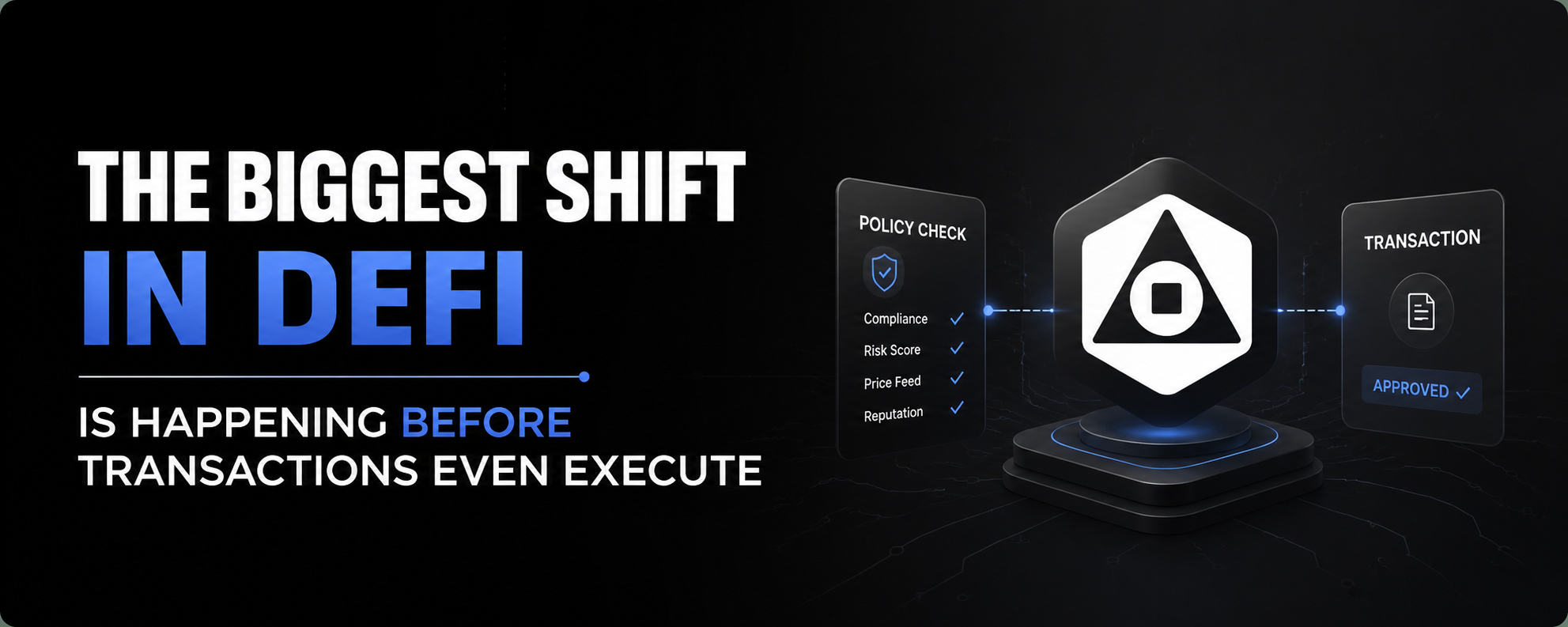
Once policy becomes part of execution, risk management stops living in dashboards, Slack channels, or operating manuals. The protocol starts enforcing the rules itself, using verified market data, risk ratings, wallet reputation, and other trusted inputs before capital moves.
That's a completely different way of thinking about infrastructure.
And that's where I think value is starting to shift.
Reliable data providers aren't just supporting DeFi anymore. They're becoming part of the decision process. Price feeds, risk scores, compliance signals, and reputation data suddenly matter because they influence whether transactions move forward in the first place.
People keep asking when institutions will arrive.
Maybe we've been asking the wrong question.
Institutions already understand automation. What they really care about is whether they can trust automation when everything goes sideways. Can the rules still hold up when markets move faster than people can react?
That's a much harder problem to solve.
I don't think the next phase of DeFi belongs to the protocols that simply execute faster. I think it belongs to the ones that reduce the number of human decisions required during stressful moments because the important checks already happened before execution.
Maybe that doesn't create the loudest headlines.
But I wouldn't be surprised if it becomes one of the biggest reasons serious capital feels comfortable moving onchain over the next few years.
#USJobsMissBadly #Newt
$NEWT
The Biggest Shift in DeFi Is Happening Before Transactions Even Execute
Look, I think people are still chasing the wrong thing in DeFi.
Everyone wants faster chains, cheaper transactions, or another stratgy that promses a little more yield. Sure, those things matter. But they don't fix the part that actually breaks when markets get ugly.
That's the part people don't talk about enough.
The real quastion isn't how fast a protocol executes a transaction. It's whether that transaction should've gone through at all.
Think about it. A vault strategy can look perfectly reasonable when you write it. Then a few hours later, collateral prices move, liquidity dries up, or an asset's risk profile changes completely. The smart contract will still execute exactly what you told it to do. It doesn't stop and ask whether the world has changed.
Humans usually fill that gap.
And honestly, that's where things get tricky.
Someone has to notice the change. Someone has to verify the data. Someone has to sign the transaction before the market moves again. I've seen this workflow everywhere, and it works... until it doesn't.
That's why @NewtonProtocol caught my attention.
Not because it's trying to build another chain. We've already got plenty of those. What stood out is the authorization layer that checks predefined policies before a transaction reaches final settlement.
That sounds like a small architectural detail.
I don't think it is.
Once policy becomes part of execution, risk management stops living in dashboards, Slack channels, or operating manuals. The protocol starts enforcing the rules itself, using verified market data, risk ratings, wallet reputation, and other trusted inputs before capital moves.
That's a completely different way of thinking about infrastructure.
And that's where I think value is starting to shift.
Reliable data providers aren't just supporting DeFi anymore. They're becoming part of the decision process. Price feeds, risk scores, compliance signals, and reputation data suddenly matter because they influence whether transactions move forward in the first place.
People keep asking when institutions will arrive.
Maybe we've been asking the wrong question.
Institutions already understand automation. What they really care about is whether they can trust automation when everything goes sideways. Can the rules still hold up when markets move faster than people can react?
That's a much harder problem to solve.
I don't think the next phase of DeFi belongs to the protocols that simply execute faster. I think it belongs to the ones that reduce the number of human decisions required during stressful moments because the important checks already happened before execution.
Maybe that doesn't create the loudest headlines.
But I wouldn't be surprised if it becomes one of the biggest reasons serious capital feels comfortable moving onchain over the next few years.
#USJobsMissBadly #Newt
$NEWT
Everyone wants faster chains, cheaper transactions, or another stratgy that promses a little more yield. Sure, those things matter. But they don't fix the part that actually breaks when markets get ugly.
That's the part people don't talk about enough.
The real quastion isn't how fast a protocol executes a transaction. It's whether that transaction should've gone through at all.
Think about it. A vault strategy can look perfectly reasonable when you write it. Then a few hours later, collateral prices move, liquidity dries up, or an asset's risk profile changes completely. The smart contract will still execute exactly what you told it to do. It doesn't stop and ask whether the world has changed.
Humans usually fill that gap.
And honestly, that's where things get tricky.
Someone has to notice the change. Someone has to verify the data. Someone has to sign the transaction before the market moves again. I've seen this workflow everywhere, and it works... until it doesn't.
That's why @NewtonProtocol caught my attention.
Not because it's trying to build another chain. We've already got plenty of those. What stood out is the authorization layer that checks predefined policies before a transaction reaches final settlement.
That sounds like a small architectural detail.
I don't think it is.
Once policy becomes part of execution, risk management stops living in dashboards, Slack channels, or operating manuals. The protocol starts enforcing the rules itself, using verified market data, risk ratings, wallet reputation, and other trusted inputs before capital moves.
That's a completely different way of thinking about infrastructure.
And that's where I think value is starting to shift.
Reliable data providers aren't just supporting DeFi anymore. They're becoming part of the decision process. Price feeds, risk scores, compliance signals, and reputation data suddenly matter because they influence whether transactions move forward in the first place.
People keep asking when institutions will arrive.
Maybe we've been asking the wrong question.
Institutions already understand automation. What they really care about is whether they can trust automation when everything goes sideways. Can the rules still hold up when markets move faster than people can react?
That's a much harder problem to solve.
I don't think the next phase of DeFi belongs to the protocols that simply execute faster. I think it belongs to the ones that reduce the number of human decisions required during stressful moments because the important checks already happened before execution.
Maybe that doesn't create the loudest headlines.
But I wouldn't be surprised if it becomes one of the biggest reasons serious capital feels comfortable moving onchain over the next few years.
#USJobsMissBadly #Newt
$NEWT
184
73
5.8k
Log in to explore more content
Join global crypto users on Binance Square
⚡️ Get latest and useful information about crypto.
💬 Trusted by the world’s largest crypto exchange.
👍 Discover real insights from verified creators.
Email / Phone number
Trending Topics
1
#SECHaltsCryptoETFReviewsAmidFundingLapse
62,405 views
707 Discussing
2
#ZcashETFPostsFirstWeeklyOutflow$93.6M
66,242 views
204 Discussing
3
#GreekPoliceBustCryptoScamRingArrest17
219,228 views
1,556 Discussing
4
#BitcoinRejectedAt$87K
170,923 views
258 Discussing
5
#FedOctoberRateHikeOddsFallTo17%
243,657 views
1,724 Discussing
6
#NvidiaHitsRecordHighUp2.4%
168,483 views
1,205 Discussing
7
#CanaryFilesAmendedS1ForPEPEETF
50,478 views
804 Discussing
8
#BitcoinParesGainsAfterRallyTo$86.5K
60,105 views
177 Discussing
9
#CerebrasSinksNearly20%OnReportNvidiaToPowerOpenAI
161,322 views
1,406 Discussing
10
#SECProposesCryptoCustodyRules
220,881 views
1,738 Discussing