

#termmax
termmax
2.1M views
58,837 Discussing
Hot
Latest

·
--
🚀 $TMX Showing Strong Bullish Rebound! 📈
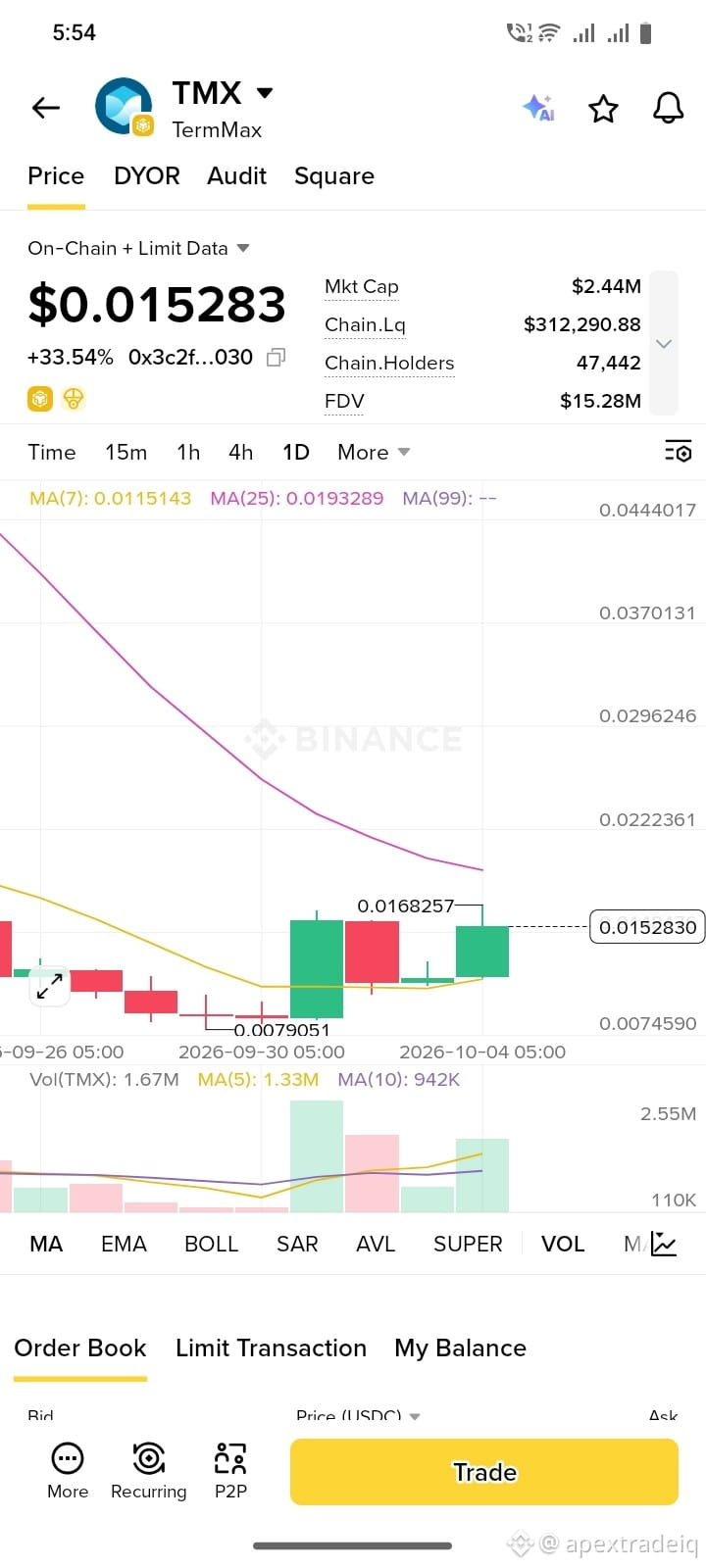
$TMX (TermMax) is gaining momentum, up +33.54% and trading at $0.015283 after bouncing back from its recent low of $0.007905. With a green candle reclaiming key levels above the short-term moving average, buying volume is picking up. Will $TMX push past its recent resistance around $0.0168, or are we heading into a consolidation phase? Always remember to DYOR before opening new positions! 💎✨
#TMX #BinanceSquare #CryptoTrading #TermMax
{alpha}(560x3c2f61f2e27c865981d2e7aaf6b2cdf823030039)
🚀 $TMX Showing Strong Bullish Rebound! 📈
$TMX (TermMax) is gaining momentum, up +33.54% and trading at $0.015283 after bouncing back from its recent low of $0.007905. With a green candle reclaiming key levels above the short-term moving average, buying volume is picking up. Will $TMX push past its recent resistance around $0.0168, or are we heading into a consolidation phase? Always remember to DYOR before opening new positions! 💎✨
#TMX #BinanceSquare #CryptoTrading #TermMax
$TMX (TermMax) is gaining momentum, up +33.54% and trading at $0.015283 after bouncing back from its recent low of $0.007905. With a green candle reclaiming key levels above the short-term moving average, buying volume is picking up. Will $TMX push past its recent resistance around $0.0168, or are we heading into a consolidation phase? Always remember to DYOR before opening new positions! 💎✨
#TMX #BinanceSquare #CryptoTrading #TermMax
427


·
--
Verified
What stands out to me about TermMax is its focus on making borrowing costs more predictable in DeFi. Its fixed-rate borrowing model offers an alternative to the constantly changing interest rates found in many lending protocols.
Features such as one-click leverage and the planned Smart Unwind functionality also highlight an effort to simplify complex DeFi strategies. However, the redemption pool mechanics deserve attention, particularly how underlying assets and leftover collateral may affect FT holders when liquidations fail to recover the full loan.
From a research perspective, TermMax's long-term potential depends on risk management, liquidity, smart contract security and how effectively its features work under volatile market conditions.
$ENJ
{future}(ENJUSDT)
$INJ
{future}(INJUSDT)
$TMX
{alpha}(560x3c2f61f2e27c865981d2e7aaf6b2cdf823030039)
#TermMax
#TMX
#ENJ
#INJ
#NFPWatch
What do you think comes next?
What stands out to me about TermMax is its focus on making borrowing costs more predictable in DeFi. Its fixed-rate borrowing model offers an alternative to the constantly changing interest rates found in many lending protocols.
Features such as one-click leverage and the planned Smart Unwind functionality also highlight an effort to simplify complex DeFi strategies. However, the redemption pool mechanics deserve attention, particularly how underlying assets and leftover collateral may affect FT holders when liquidations fail to recover the full loan.
From a research perspective, TermMax's long-term potential depends on risk management, liquidity, smart contract security and how effectively its features work under volatile market conditions.
$ENJ
$INJ
$TMX
#TermMax
#TMX
#ENJ
#INJ
#NFPWatch
What do you think comes next?
Features such as one-click leverage and the planned Smart Unwind functionality also highlight an effort to simplify complex DeFi strategies. However, the redemption pool mechanics deserve attention, particularly how underlying assets and leftover collateral may affect FT holders when liquidations fail to recover the full loan.
From a research perspective, TermMax's long-term potential depends on risk management, liquidity, smart contract security and how effectively its features work under volatile market conditions.
$ENJ
$INJ
$TMX
#TermMax
#TMX
#ENJ
#INJ
#NFPWatch
What do you think comes next?
🟢 Buyers defend $0.011
57%
🔴 Breakdown below $0.011
9%
⚖️ Sideways consolidation
5%
🚀 Rebound toward $0.013
29%
21 votes • Voting closed
1
4k

·
--
Bullish
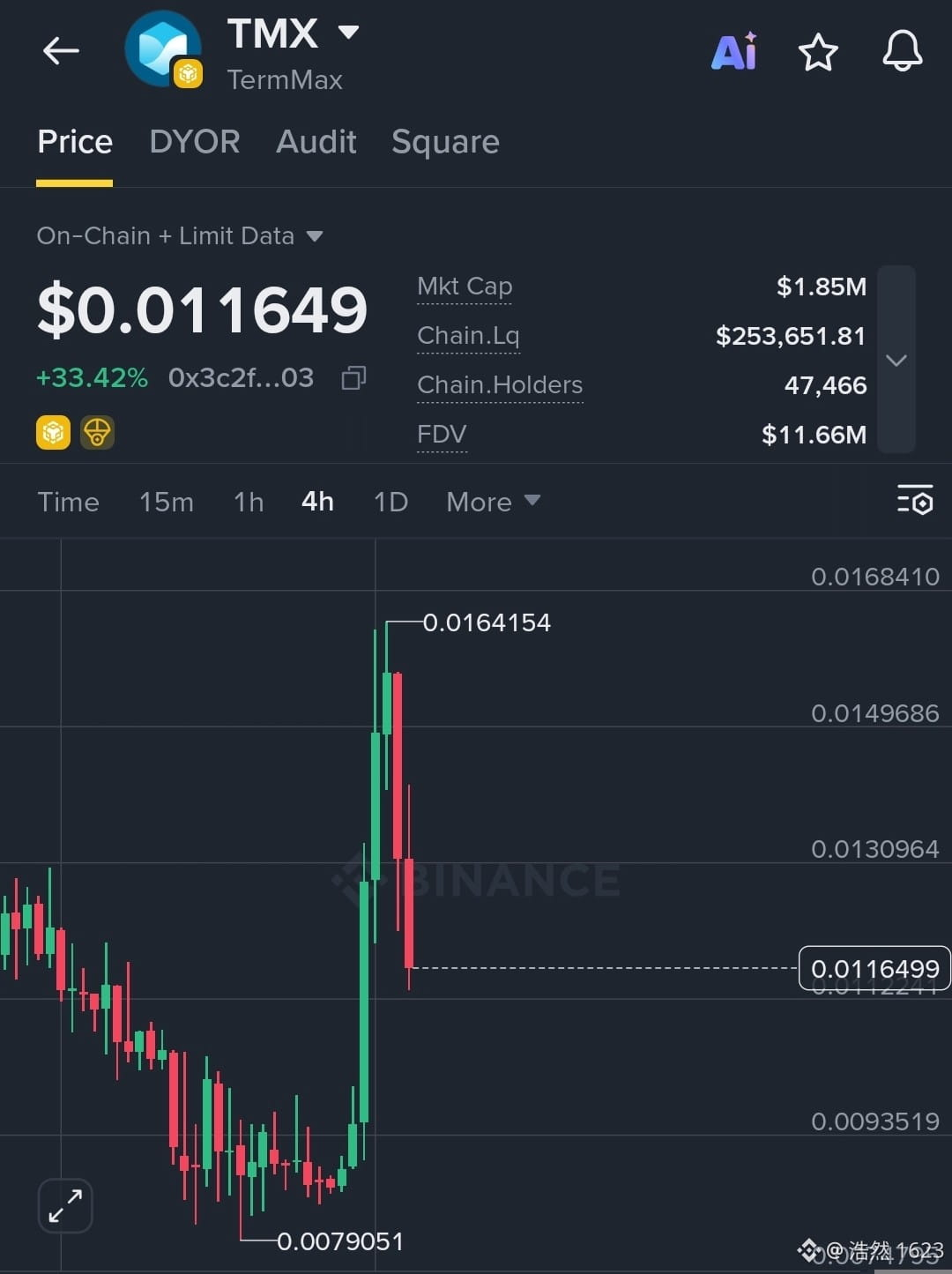
$TMX is showing extreme volatility after local peak around 0.0164, retracing sharply to test support near the 0.0116 level. If price consolidates above this key zone, buyers could attempt a quick recovery back toward previous highs.
Target 1: 0.01300 Target 2: 0.01490 Target 3: 0.01640
#TMX #TermMax #Crypto
$ZEC
{future}(ZECUSDT)
$MOVR
{future}(MOVRUSDT)
{alpha}(560x3c2f61f2e27c865981d2e7aaf6b2cdf823030039)
$TMX is showing extreme volatility after local peak around 0.0164, retracing sharply to test support near the 0.0116 level. If price consolidates above this key zone, buyers could attempt a quick recovery back toward previous highs.
Target 1: 0.01300 Target 2: 0.01490 Target 3: 0.01640
#TMX #TermMax #Crypto
$ZEC
$MOVR
Target 1: 0.01300 Target 2: 0.01490 Target 3: 0.01640
#TMX #TermMax #Crypto
$ZEC
$MOVR
236

#TermMax TermMax is a decentralized finance (DeFi) platform focused on fixed-rate borrowing and lending. It allows users to lock borrowing costs and lending returns for a specific period, making financial planning more predictable. TermMax also offers one-click leveraged strategies and vaults designed to help users earn yield through curated strategies. Its technology uses customizable pricing curves inspired by Uniswap V3 to create flexible fixed-rate markets. The platform supports multiple blockchain networks and is designed to simplify complex DeFi strategies. However, like other DeFi protocols, TermMax involves risks such as smart-contract vulnerabilities, market volatility, liquidation, and potential loss of funds. Users should research the protocol, understand the terms, and assess their risk before
#TermMax TermMax is a decentralized finance (DeFi) platform focused on fixed-rate borrowing and lending. It allows users to lock borrowing costs and lending returns for a specific period, making financial planning more predictable. TermMax also offers one-click leveraged strategies and vaults designed to help users earn yield through curated strategies. Its technology uses customizable pricing curves inspired by Uniswap V3 to create flexible fixed-rate markets. The platform supports multiple blockchain networks and is designed to simplify complex DeFi strategies. However, like other DeFi protocols, TermMax involves risks such as smart-contract vulnerabilities, market volatility, liquidation, and potential loss of funds. Users should research the protocol, understand the terms, and assess their risk before

1
92


·
--
$TMX
🚀 TMX (TermMax) — Binance Update
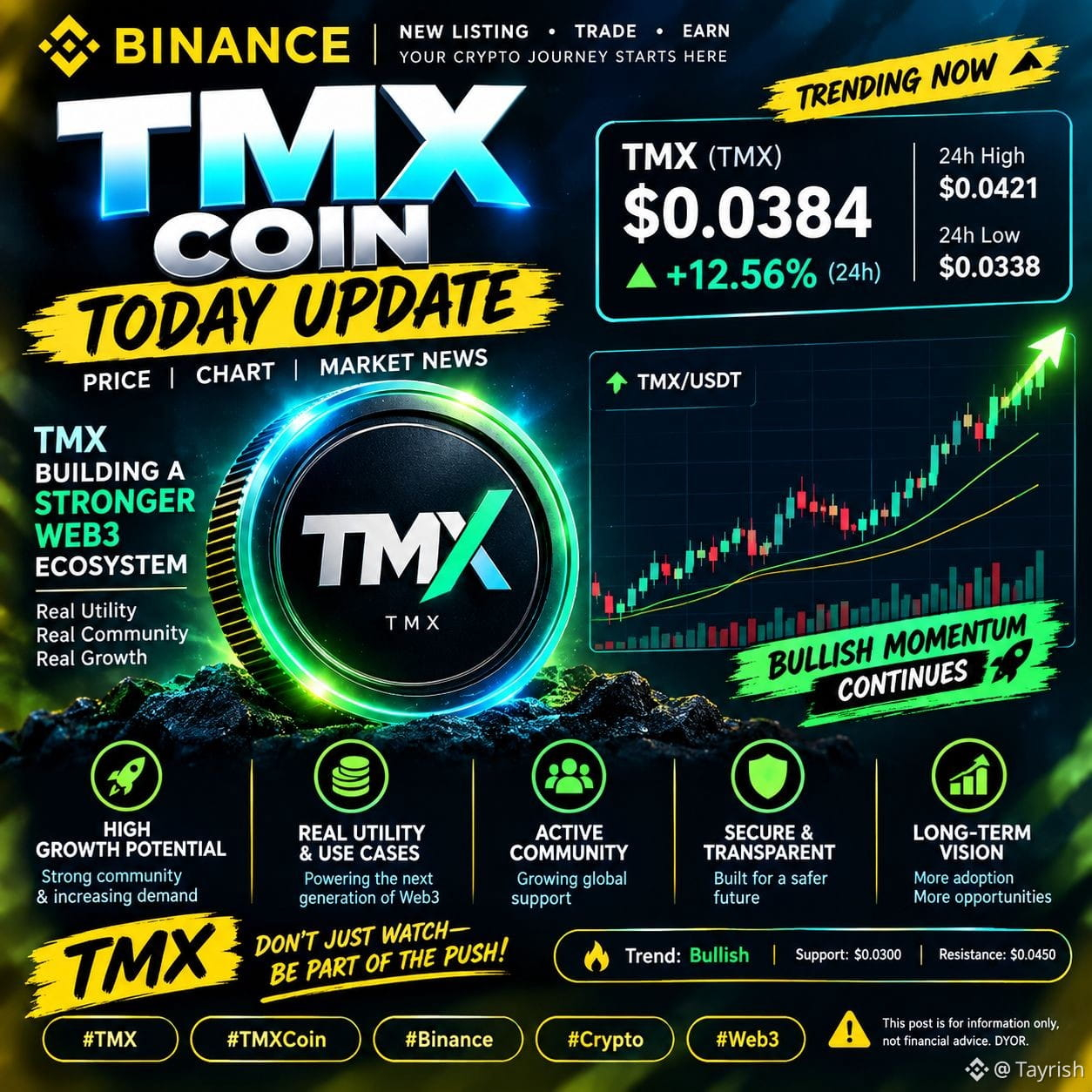
TMX is getting major attention today, with Binance Alpha activity helping drive visibility and trading interest. Binance’s latest data shows TermMax (TMX) around $0.037, with roughly +24% over 24 hours in the latest available reading. �
Binance
🔥 Key update: Binance Wallet launched a TMX trading competition, with the second phase running September 8–15, 2026. This is designed to increase trading activity and user engagement around TMX. �
Binance
📊 Short-term view: Bullish momentum, but HIGH risk.
TMX has experienced extreme volatility recently, so traders should watch volume, support near recent lows, and resistance around recent highs rather than chasing a sudden pump. �
$TMX
⚠️ Risk disclaimer: Crypto prices can change rapidly. This is market commentary for educational purposes, not financial advice. DYOR.
#TMX #TermMax #BinanceAlpha
{alpha}(560x3c2f61f2e27c865981d2e7aaf6b2cdf823030039)
$TMX
🚀 TMX (TermMax) — Binance Update
TMX is getting major attention today, with Binance Alpha activity helping drive visibility and trading interest. Binance’s latest data shows TermMax (TMX) around $0.037, with roughly +24% over 24 hours in the latest available reading. �
Binance
🔥 Key update: Binance Wallet launched a TMX trading competition, with the second phase running September 8–15, 2026. This is designed to increase trading activity and user engagement around TMX. �
Binance
📊 Short-term view: Bullish momentum, but HIGH risk.
TMX has experienced extreme volatility recently, so traders should watch volume, support near recent lows, and resistance around recent highs rather than chasing a sudden pump. �
$TMX
⚠️ Risk disclaimer: Crypto prices can change rapidly. This is market commentary for educational purposes, not financial advice. DYOR.
#TMX #TermMax #BinanceAlpha
🚀 TMX (TermMax) — Binance Update
TMX is getting major attention today, with Binance Alpha activity helping drive visibility and trading interest. Binance’s latest data shows TermMax (TMX) around $0.037, with roughly +24% over 24 hours in the latest available reading. �
Binance
🔥 Key update: Binance Wallet launched a TMX trading competition, with the second phase running September 8–15, 2026. This is designed to increase trading activity and user engagement around TMX. �
Binance
📊 Short-term view: Bullish momentum, but HIGH risk.
TMX has experienced extreme volatility recently, so traders should watch volume, support near recent lows, and resistance around recent highs rather than chasing a sudden pump. �
$TMX
⚠️ Risk disclaimer: Crypto prices can change rapidly. This is market commentary for educational purposes, not financial advice. DYOR.
#TMX #TermMax #BinanceAlpha
3
438
KII and TMX Market Overview: Tracking the Latest Price Action
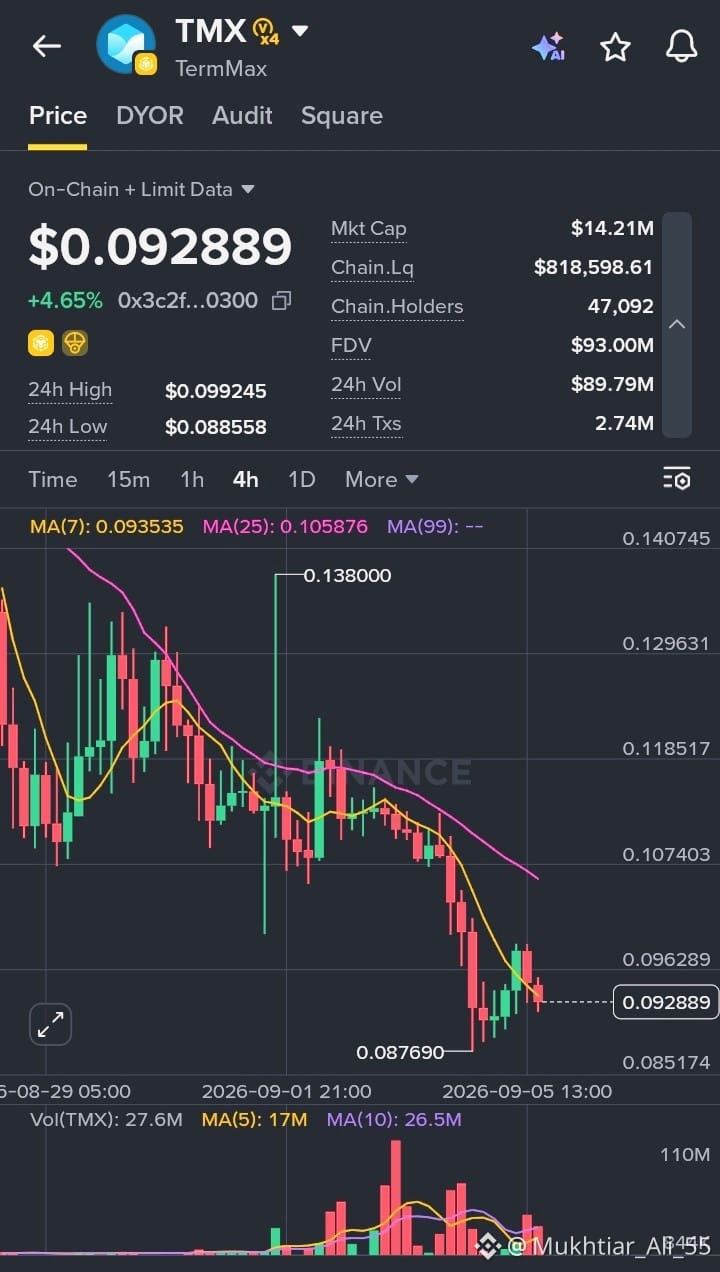
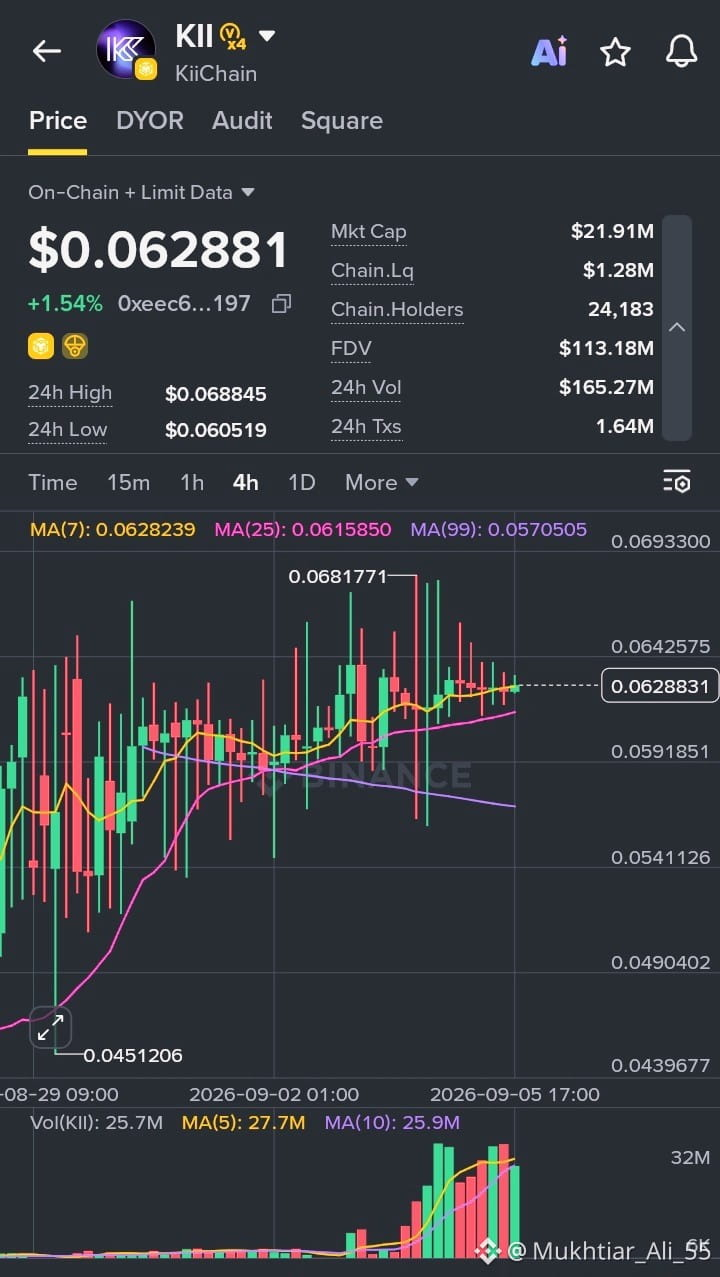
Let’s check out the current on-chain and market data for KII and TMX to see how both assets are performing across the charts.
Starting with KII (KiiChain), the token is currently priced at $0.062881, showing a steady 24-hour gain of +1.54%. It holds a market cap of $21.91M with a fully diluted valuation (FDV) of $113.18M. Trading volume over the past 24 hours is robust at $165.27M, supported by chain liquidity of $1.28M and an active holder count of 24,183. Over the last day, it has traded between a low of $0.060519 and a high of $0.068845.
Moving over to TMX (TermMax), the token is trading at $0.092889, marking a positive 24-hour movement of +4.65%. Its market cap stands at $14.21M alongside an FDV of $93.00M. Trading activity shows a 24-hour volume of $89.79M, with chain liquidity recorded at $818,598.61 and a solid community of 47,092 holders. The price has fluctuated between a 24-hour low of $0.088558 and a high of $0.099245.
Both tokens are showing consistent market engagement as they trade through their current technical ranges.
#CryptoTrading #KiiChain #TermMax #Altcoins #MarketUpdate
$KII
{alpha}(560xeec6574eabba52bac3f0277f2cd5ac7e67197886)
$TMX
{alpha}(560x3c2f61f2e27c865981d2e7aaf6b2cdf823030039)
KII and TMX Market Overview: Tracking the Latest Price Action
Let’s check out the current on-chain and market data for KII and TMX to see how both assets are performing across the charts.
Starting with KII (KiiChain), the token is currently priced at $0.062881, showing a steady 24-hour gain of +1.54%. It holds a market cap of $21.91M with a fully diluted valuation (FDV) of $113.18M. Trading volume over the past 24 hours is robust at $165.27M, supported by chain liquidity of $1.28M and an active holder count of 24,183. Over the last day, it has traded between a low of $0.060519 and a high of $0.068845.
Moving over to TMX (TermMax), the token is trading at $0.092889, marking a positive 24-hour movement of +4.65%. Its market cap stands at $14.21M alongside an FDV of $93.00M. Trading activity shows a 24-hour volume of $89.79M, with chain liquidity recorded at $818,598.61 and a solid community of 47,092 holders. The price has fluctuated between a 24-hour low of $0.088558 and a high of $0.099245.
Both tokens are showing consistent market engagement as they trade through their current technical ranges.
#CryptoTrading #KiiChain #TermMax #Altcoins #MarketUpdate
$KII
$TMX
Let’s check out the current on-chain and market data for KII and TMX to see how both assets are performing across the charts.
Starting with KII (KiiChain), the token is currently priced at $0.062881, showing a steady 24-hour gain of +1.54%. It holds a market cap of $21.91M with a fully diluted valuation (FDV) of $113.18M. Trading volume over the past 24 hours is robust at $165.27M, supported by chain liquidity of $1.28M and an active holder count of 24,183. Over the last day, it has traded between a low of $0.060519 and a high of $0.068845.
Moving over to TMX (TermMax), the token is trading at $0.092889, marking a positive 24-hour movement of +4.65%. Its market cap stands at $14.21M alongside an FDV of $93.00M. Trading activity shows a 24-hour volume of $89.79M, with chain liquidity recorded at $818,598.61 and a solid community of 47,092 holders. The price has fluctuated between a 24-hour low of $0.088558 and a high of $0.099245.
Both tokens are showing consistent market engagement as they trade through their current technical ranges.
#CryptoTrading #KiiChain #TermMax #Altcoins #MarketUpdate
$KII
$TMX
701
·
--
🚀 TermMax (TMX): Volatility Could Be the Opportunity
TermMax (TMX) is trading around $0.104, with intraday volatility keeping traders on alert. Recent data shows TMX has pulled sharply lower from its $0.2043 all-time high, while trading activity remains elevated.
The key zone to watch is $0.105–$0.115. Holding $0.105 could give bulls a chance to reclaim $0.115, followed by $0.13–$0.14. A decisive break below $0.105 would weaken the setup and expose lower support.
With Binance recently highlighting TMX through a $200K trading competition, attention and liquidity could remain elevated.
TMX is volatile — but is this dip setting up the next move? 📈📉
$TMX
{alpha}(560x3c2f61f2e27c865981d2e7aaf6b2cdf823030039)
$ZEC
{future}(ZECUSDT)
$PROM
{future}(PROMUSDT)
#TermMax
#TMX
🗳️ TMX is around $0.104 — what does the chart do next?
🚀 TermMax (TMX): Volatility Could Be the Opportunity
TermMax (TMX) is trading around $0.104, with intraday volatility keeping traders on alert. Recent data shows TMX has pulled sharply lower from its $0.2043 all-time high, while trading activity remains elevated.
The key zone to watch is $0.105–$0.115. Holding $0.105 could give bulls a chance to reclaim $0.115, followed by $0.13–$0.14. A decisive break below $0.105 would weaken the setup and expose lower support.
With Binance recently highlighting TMX through a $200K trading competition, attention and liquidity could remain elevated.
TMX is volatile — but is this dip setting up the next move? 📈📉
$TMX
$ZEC
$PROM
#TermMax
#TMX
🗳️ TMX is around $0.104 — what does the chart do next?
TermMax (TMX) is trading around $0.104, with intraday volatility keeping traders on alert. Recent data shows TMX has pulled sharply lower from its $0.2043 all-time high, while trading activity remains elevated.
The key zone to watch is $0.105–$0.115. Holding $0.105 could give bulls a chance to reclaim $0.115, followed by $0.13–$0.14. A decisive break below $0.105 would weaken the setup and expose lower support.
With Binance recently highlighting TMX through a $200K trading competition, attention and liquidity could remain elevated.
TMX is volatile — but is this dip setting up the next move? 📈📉
$TMX
$ZEC
$PROM
#TermMax
#TMX
🗳️ TMX is around $0.104 — what does the chart do next?
🚀 Break $0.115 → breakout
45%
📈 Reclaim $0.110 → bullish
5%
🐻 Lose $0.101 → sell-off
27%
⚡ Sweep both → volatility
23%
22 votes • Voting closed
2
4.1k

·
--
I recently took another look at $TMX, and I feel that we’re actually in a stage that’s worth paying closer attention to now.
TermMax itself provides fixed-rate lending. In the CoinGecko Fixed Interest category, it’s ranked among the top positions. The protocol has been running for more than a year, with TVL exceeding $90 million, and it has been deployed across 10 EVM chains. Fundamentally, this isn’t something that was put together temporarily just to support a token launch.
Another aspect I care about is the token allocation structure. The team, advisors, and investors collectively hold 46% of the tokens, and all of that has a 12-month cliff. In the near term, what mainly needs to be faced is the linear unlock of the ecosystem portion.
So from the perspective of token price, I’d rather interpret $TMX like this: after the first round of emotion and sell-pressure has already been released, the next question is whether market funds are willing to reprice it based on fundamentals.
Also, TermMax has support from YZi Labs as a strategic investor, more than $90 million in TVL, and 1.5 million+ wallets as a foundation. If the protocol data keeps growing afterward, I think there’s still room for increased attention on $TMX.
Short-term volatility is completely normal. Personally, I’ll keep watching the trading volume and how well buy-side support sustains after $TMX.
⚠️ The above is for personal opinions and information sharing only and does not constitute investment advice. Crypto assets are highly volatile—please do your own research.
#TermMax #TMX #DeFi #Crypto
I recently took another look at $TMX, and I feel that we’re actually in a stage that’s worth paying closer attention to now.
TermMax itself provides fixed-rate lending. In the CoinGecko Fixed Interest category, it’s ranked among the top positions. The protocol has been running for more than a year, with TVL exceeding $90 million, and it has been deployed across 10 EVM chains. Fundamentally, this isn’t something that was put together temporarily just to support a token launch.
Another aspect I care about is the token allocation structure. The team, advisors, and investors collectively hold 46% of the tokens, and all of that has a 12-month cliff. In the near term, what mainly needs to be faced is the linear unlock of the ecosystem portion.
So from the perspective of token price, I’d rather interpret $TMX like this: after the first round of emotion and sell-pressure has already been released, the next question is whether market funds are willing to reprice it based on fundamentals.
Also, TermMax has support from YZi Labs as a strategic investor, more than $90 million in TVL, and 1.5 million+ wallets as a foundation. If the protocol data keeps growing afterward, I think there’s still room for increased attention on $TMX.
Short-term volatility is completely normal. Personally, I’ll keep watching the trading volume and how well buy-side support sustains after $TMX.
⚠️ The above is for personal opinions and information sharing only and does not constitute investment advice. Crypto assets are highly volatile—please do your own research.
#TermMax #TMX #DeFi #Crypto
TermMax itself provides fixed-rate lending. In the CoinGecko Fixed Interest category, it’s ranked among the top positions. The protocol has been running for more than a year, with TVL exceeding $90 million, and it has been deployed across 10 EVM chains. Fundamentally, this isn’t something that was put together temporarily just to support a token launch.
Another aspect I care about is the token allocation structure. The team, advisors, and investors collectively hold 46% of the tokens, and all of that has a 12-month cliff. In the near term, what mainly needs to be faced is the linear unlock of the ecosystem portion.
So from the perspective of token price, I’d rather interpret $TMX like this: after the first round of emotion and sell-pressure has already been released, the next question is whether market funds are willing to reprice it based on fundamentals.
Also, TermMax has support from YZi Labs as a strategic investor, more than $90 million in TVL, and 1.5 million+ wallets as a foundation. If the protocol data keeps growing afterward, I think there’s still room for increased attention on $TMX.
Short-term volatility is completely normal. Personally, I’ll keep watching the trading volume and how well buy-side support sustains after $TMX.
⚠️ The above is for personal opinions and information sharing only and does not constitute investment advice. Crypto assets are highly volatile—please do your own research.
#TermMax #TMX #DeFi #Crypto
1.1k
3
50
1.1k
·
--
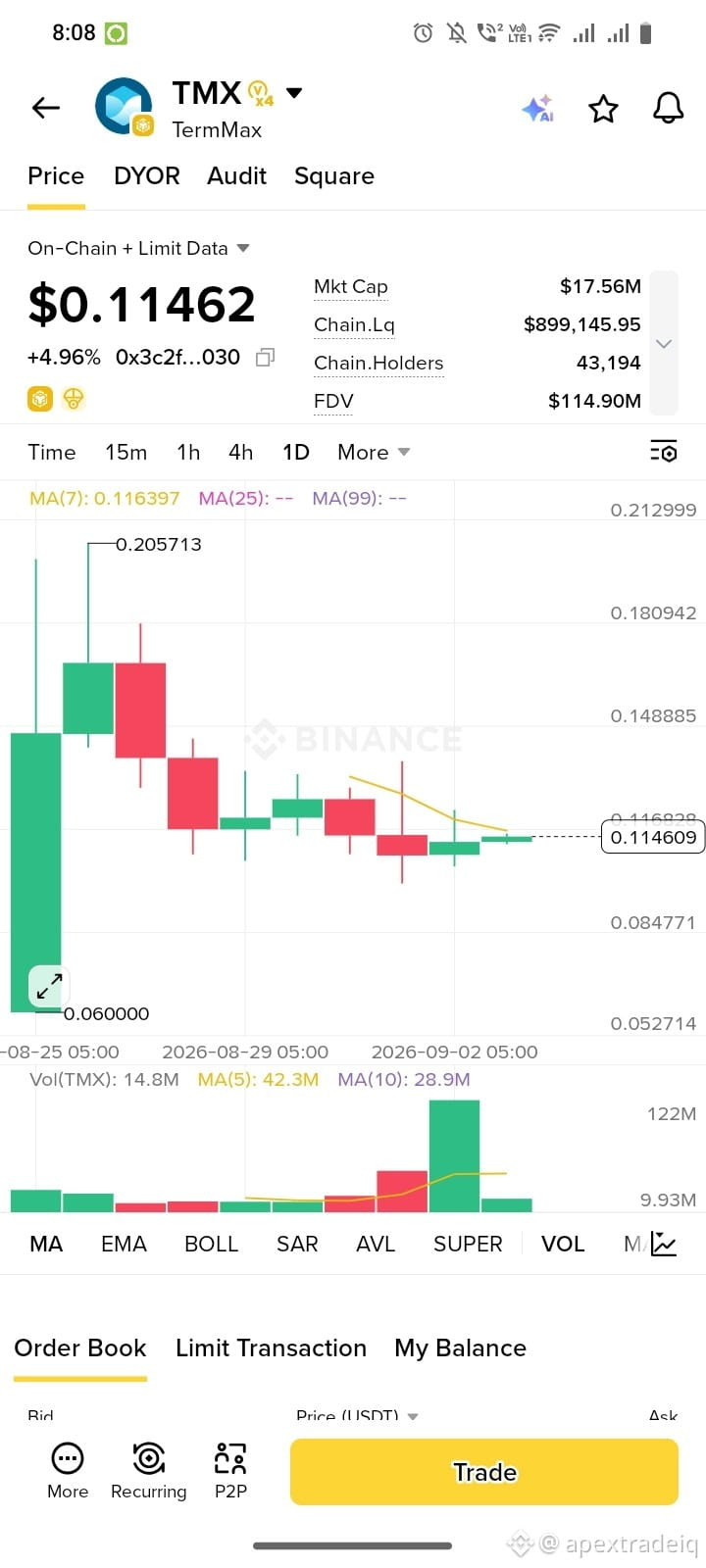
$TMX (TermMax) is quietly building momentum! 🚀 After previously spiking toward $0.2057, the price has consolidated around $0.11462 (+4.96%) with a notable surge in trading volume. Market cap currently stands at $17.56M with total holders reaching 43,194, indicating steady underlying accumulation during this range-bound phase.
With volume picking up and price stabilizing after the recent retracement, do you think $TMX is preparing for a breakout attempt toward $0.150+, or will it continue consolidating in this channel? Share your predictions below! ⁉️
#TMX #TermMax #CryptoTrading #PriceAnalysis #Altcoins #BinanceSquare
$TMX (TermMax) is quietly building momentum! 🚀 After previously spiking toward $0.2057, the price has consolidated around $0.11462 (+4.96%) with a notable surge in trading volume. Market cap currently stands at $17.56M with total holders reaching 43,194, indicating steady underlying accumulation during this range-bound phase.
With volume picking up and price stabilizing after the recent retracement, do you think $TMX is preparing for a breakout attempt toward $0.150+, or will it continue consolidating in this channel? Share your predictions below! ⁉️
#TMX #TermMax #CryptoTrading #PriceAnalysis #Altcoins #BinanceSquare
With volume picking up and price stabilizing after the recent retracement, do you think $TMX is preparing for a breakout attempt toward $0.150+, or will it continue consolidating in this channel? Share your predictions below! ⁉️
#TMX #TermMax #CryptoTrading #PriceAnalysis #Altcoins #BinanceSquare
1
1
38

·
--
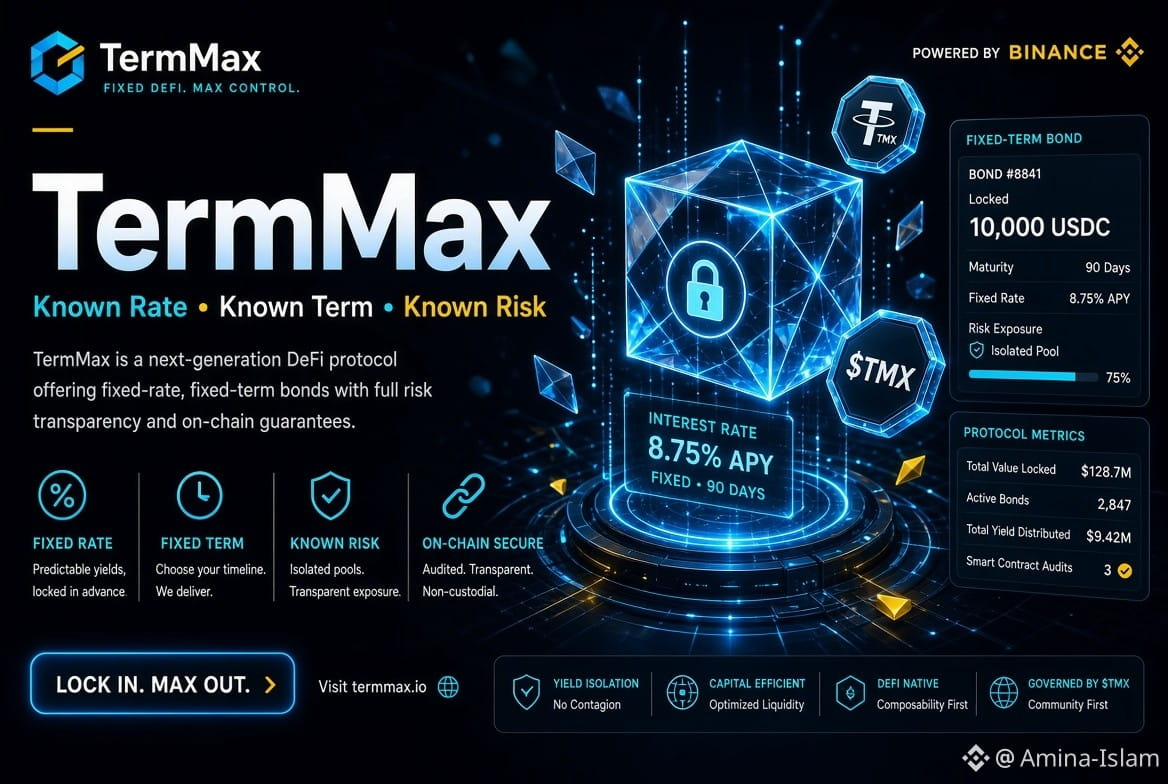
Tired of floating rates that spike when you least expect it? #TermMax solves that. It’s a multi-chain fixed-rate lending, borrowing & options protocol.
The moment you enter a market:
Rate is locked...
Term is locked...
Risk is known...
No more rate ambushes mid-position like on Aave or Morpho.
Why it stands out??
Three-token system (FT + XT) that works like on-chain zero-coupon bonds..
Idle capital auto-routed to Aave/Morpho/Venus so nothing sits idle..
Curated vaults managed by pros (Keyrock, Edge Capital, etc.)..
Live on Ethereum, Base, BNB Chain, Berachain, HyperEVM & more..
$90M+ TVL | 1.5M+ wallets | TGE for $TMX on August 25..
Right now Binance Wallet Booster + CreatorPad is running a joint campaign with 300,000 $TMX up for grabs for top creators (split between Global & Chinese leaderboards).
After that comes the verification window on Aug 24 inside Binance Wallet. Don’t sleep on fixed rates.
Known rate. Known term. Known risk.
#TermMax #TMX #creatorpad @termmax
(Drop your take or questions below ... let’s discuss fixed-rate DeFi!)
Tired of floating rates that spike when you least expect it? #TermMax solves that. It’s a multi-chain fixed-rate lending, borrowing & options protocol.
The moment you enter a market:
Rate is locked...
Term is locked...
Risk is known...
No more rate ambushes mid-position like on Aave or Morpho.
Why it stands out??
Three-token system (FT + XT) that works like on-chain zero-coupon bonds..
Idle capital auto-routed to Aave/Morpho/Venus so nothing sits idle..
Curated vaults managed by pros (Keyrock, Edge Capital, etc.)..
Live on Ethereum, Base, BNB Chain, Berachain, HyperEVM & more..
$90M+ TVL | 1.5M+ wallets | TGE for $TMX on August 25..
Right now Binance Wallet Booster + CreatorPad is running a joint campaign with 300,000 $TMX up for grabs for top creators (split between Global & Chinese leaderboards).
After that comes the verification window on Aug 24 inside Binance Wallet. Don’t sleep on fixed rates.
Known rate. Known term. Known risk.
#TermMax #TMX #creatorpad @TermMax
(Drop your take or questions below ... let’s discuss fixed-rate DeFi!)
The moment you enter a market:
Rate is locked...
Term is locked...
Risk is known...
No more rate ambushes mid-position like on Aave or Morpho.
Why it stands out??
Three-token system (FT + XT) that works like on-chain zero-coupon bonds..
Idle capital auto-routed to Aave/Morpho/Venus so nothing sits idle..
Curated vaults managed by pros (Keyrock, Edge Capital, etc.)..
Live on Ethereum, Base, BNB Chain, Berachain, HyperEVM & more..
$90M+ TVL | 1.5M+ wallets | TGE for $TMX on August 25..
Right now Binance Wallet Booster + CreatorPad is running a joint campaign with 300,000 $TMX up for grabs for top creators (split between Global & Chinese leaderboards).
After that comes the verification window on Aug 24 inside Binance Wallet. Don’t sleep on fixed rates.
Known rate. Known term. Known risk.
#TermMax #TMX #creatorpad @TermMax
(Drop your take or questions below ... let’s discuss fixed-rate DeFi!)

2
5
497

·
--
#termmax @termmax
The more I explore @termmax , the more I think the interesting part of DeFi lending isn’t just the yield.
It’s the structure behind the loan.
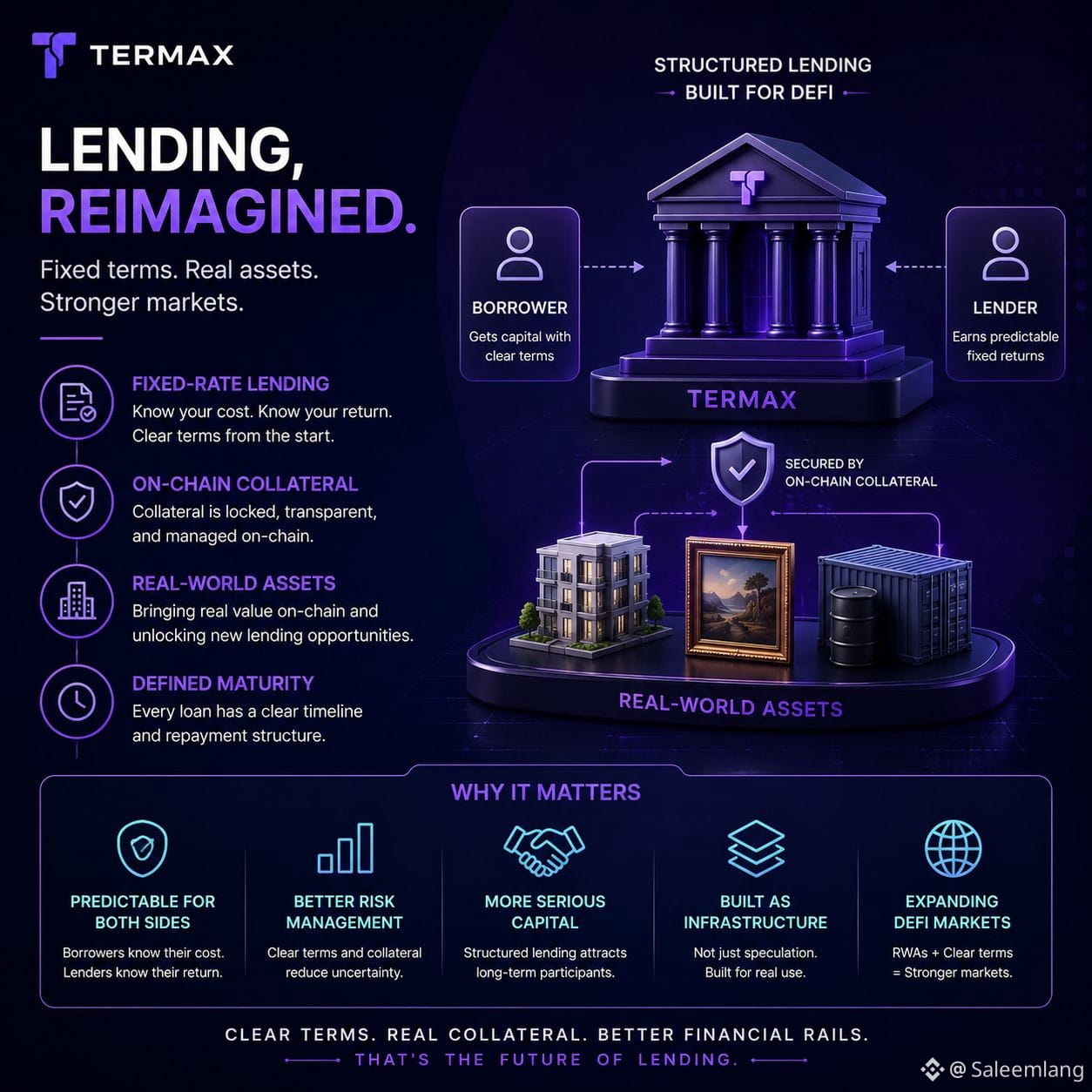
With fixed-rate lending, borrowers can see their cost upfront, while lenders have a clearer view of their expected return and the loan maturity.
That becomes even more important when real-world assets enter the picture.
Tokenizing an asset is only the first step. The real challenge is building a lending system where collateral, terms, maturity, and risk are clearly defined.
That’s why @termmax stands out to me.
It’s not simply trying to put traditional lending on-chain.
It’s exploring how fixed terms + on-chain collateral + RWAs can work together in a more predictable lending market.
For me, that’s where DeFi starts becoming infrastructure—not just speculation.
Clear terms. Real collateral. Better financial rails.
@termmax #DeFi #RWA #Lending #CreatorPad
#termmax @TermMax
The more I explore @TermMax , the more I think the interesting part of DeFi lending isn’t just the yield.
It’s the structure behind the loan.
With fixed-rate lending, borrowers can see their cost upfront, while lenders have a clearer view of their expected return and the loan maturity.
That becomes even more important when real-world assets enter the picture.
Tokenizing an asset is only the first step. The real challenge is building a lending system where collateral, terms, maturity, and risk are clearly defined.
That’s why @TermMax stands out to me.
It’s not simply trying to put traditional lending on-chain.
It’s exploring how fixed terms + on-chain collateral + RWAs can work together in a more predictable lending market.
For me, that’s where DeFi starts becoming infrastructure—not just speculation.
Clear terms. Real collateral. Better financial rails.
@TermMax #DeFi #RWA #Lending #CreatorPad
The more I explore @TermMax , the more I think the interesting part of DeFi lending isn’t just the yield.
It’s the structure behind the loan.
With fixed-rate lending, borrowers can see their cost upfront, while lenders have a clearer view of their expected return and the loan maturity.
That becomes even more important when real-world assets enter the picture.
Tokenizing an asset is only the first step. The real challenge is building a lending system where collateral, terms, maturity, and risk are clearly defined.
That’s why @TermMax stands out to me.
It’s not simply trying to put traditional lending on-chain.
It’s exploring how fixed terms + on-chain collateral + RWAs can work together in a more predictable lending market.
For me, that’s where DeFi starts becoming infrastructure—not just speculation.
Clear terms. Real collateral. Better financial rails.
@TermMax #DeFi #RWA #Lending #CreatorPad
70

·
--
One of those moments that makes all the research, analysis, and posting worth it.
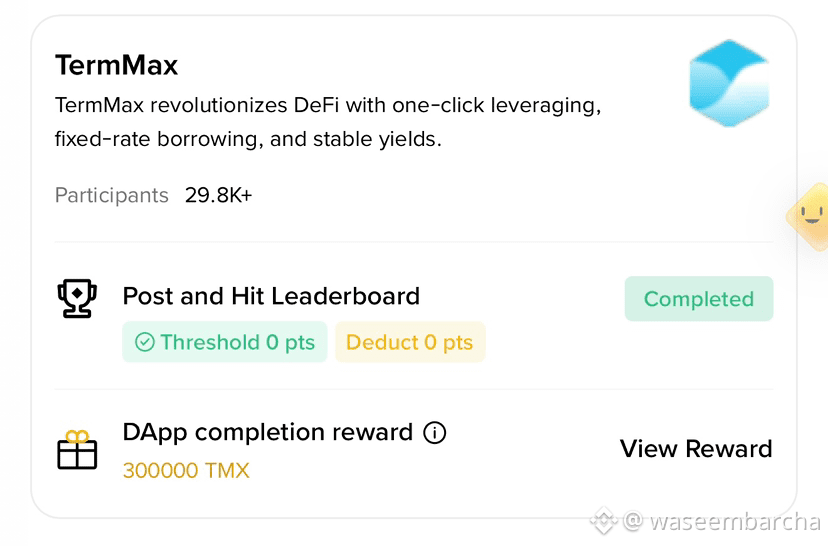
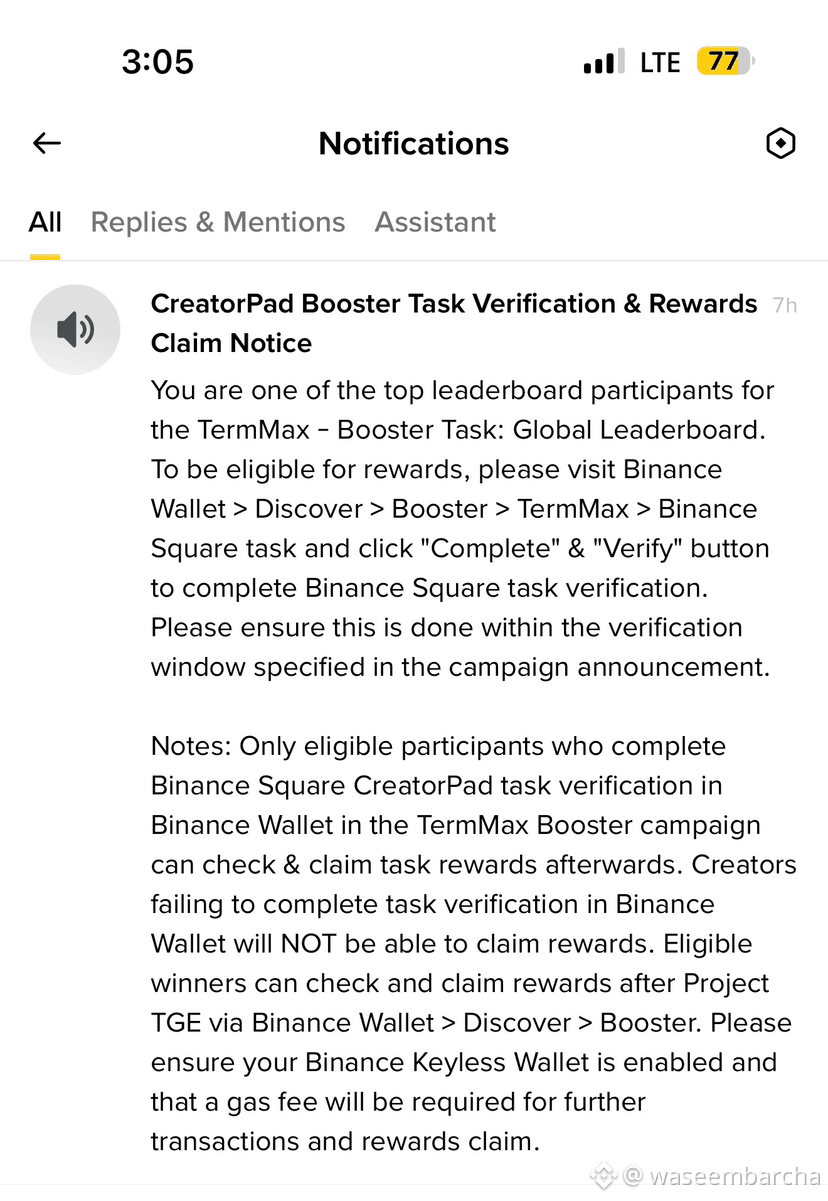
I’m proud to share that I’ve made it to the top leaderboard participants in the TermMax Booster Task on Binance CreatorPad. 🏆
The journey was more than just posting content. I spent time understanding TermMax, from fixed-rate lending and borrowing to its DeFi mechanisms, and tried to share my own research and perspective along the way.
Now the task is marked Completed, with a 300,000 TMX DApp completion reward pool. 🎉
A big milestone for me, and definitely more motivation to keep learning, researching, and creating better content.
Thanks to everyone who engaged with my posts and followed the journey. On to the next one. 🚀
#TermMax #creatorpad
One of those moments that makes all the research, analysis, and posting worth it.
I’m proud to share that I’ve made it to the top leaderboard participants in the TermMax Booster Task on Binance CreatorPad. 🏆
The journey was more than just posting content. I spent time understanding TermMax, from fixed-rate lending and borrowing to its DeFi mechanisms, and tried to share my own research and perspective along the way.
Now the task is marked Completed, with a 300,000 TMX DApp completion reward pool. 🎉
A big milestone for me, and definitely more motivation to keep learning, researching, and creating better content.
Thanks to everyone who engaged with my posts and followed the journey. On to the next one. 🚀
#TermMax #creatorpad
I’m proud to share that I’ve made it to the top leaderboard participants in the TermMax Booster Task on Binance CreatorPad. 🏆
The journey was more than just posting content. I spent time understanding TermMax, from fixed-rate lending and borrowing to its DeFi mechanisms, and tried to share my own research and perspective along the way.
Now the task is marked Completed, with a 300,000 TMX DApp completion reward pool. 🎉
A big milestone for me, and definitely more motivation to keep learning, researching, and creating better content.
Thanks to everyone who engaged with my posts and followed the journey. On to the next one. 🚀
#TermMax #creatorpad
1
413

·
--

Article
Why I’m Paying More Attention to Risk in DeFi#bullish The more I look into TermMax, the more I’m starting to understand why fixed-rate DeFi can be useful 👀
$BTC
In DeFi, I usually find myself checking the APY first. But the problem is that a high rate today doesn’t necessarily mean much tomorrow.
$BNB
That’s where TermMax caught my attention. With fixed-rate borrowing, the rate is known upfront, so there’s less guessing about how the cost might change later.
I also like the idea of simplifying leverage instead of making users go through several different steps just to build a position.
But I think the bigger question is still risk. A fixed rate sounds great, but how does the system perform when the market gets really volatile?
$SOL
That’s probably what I’ll be watching most closely with TermMax.
Would you choose predictable rates over a higher but constantly changing APY? 👀
#TermMax @termmax #TRUMP #news #defi
Why I’m Paying More Attention to Risk in DeFi
#bullish The more I look into TermMax, the more I’m starting to understand why fixed-rate DeFi can be useful 👀
$BTC
In DeFi, I usually find myself checking the APY first. But the problem is that a high rate today doesn’t necessarily mean much tomorrow.
$BNB
That’s where TermMax caught my attention. With fixed-rate borrowing, the rate is known upfront, so there’s less guessing about how the cost might change later.
I also like the idea of simplifying leverage instead of making users go through several different steps just to build a position.
But I think the bigger question is still risk. A fixed rate sounds great, but how does the system perform when the market gets really volatile?
$SOL
That’s probably what I’ll be watching most closely with TermMax.
Would you choose predictable rates over a higher but constantly changing APY? 👀
#TermMax @TermMax #TRUMP #news #defi
$BTC
In DeFi, I usually find myself checking the APY first. But the problem is that a high rate today doesn’t necessarily mean much tomorrow.
$BNB
That’s where TermMax caught my attention. With fixed-rate borrowing, the rate is known upfront, so there’s less guessing about how the cost might change later.
I also like the idea of simplifying leverage instead of making users go through several different steps just to build a position.
But I think the bigger question is still risk. A fixed rate sounds great, but how does the system perform when the market gets really volatile?
$SOL
That’s probably what I’ll be watching most closely with TermMax.
Would you choose predictable rates over a higher but constantly changing APY? 👀
#TermMax @TermMax #TRUMP #news #defi
135

·
--
3 Days Countdown! TermMax TGE is Near, and TMX Airdrop Eligibility Check Is Now Open
Only 3 days remain until the TMX TGE (Token Generation Event) on August 25. The total TMX supply is 1 billion tokens, mainly used for governance, staking rewards, and market-related utility.
TermMax protocol data is currently performing exceptionally well: TVL exceeds $90 million, registered wallets surpass 1.5 million, daily active users are around 90,000, and the peak reached over 170,000. It has been deployed across 10 EVM chains including Ethereum, $BNB Chain, Arbitrum, Base, and Berachain, and has been integrated with leading protocols such as Morpho, Aave, Venus, and Pendle.
Airdrop eligibility checking is officially open. Rewards accumulated earlier through XP, AP, and MP can be claimed 1:1 after the TGE. Some community members report that eligible claimants need to choose a lock-up period themselves. The official intent is to reduce sell pressure around the TGE. We recommend checking eligibility as early as possible and planning your claiming/locking strategy.
Binance Wallet Booster activity will end tonight (Aug 24, 23:59 UTC). The prize pool is 2 million TMX tokens—complete the tasks to participate in the prize share. If you haven’t joined yet, seize the last chance.
In 3 days, the TGE results will be revealed. This project aims to turn fixed-rate into DeFi infrastructure—whether it can deliver a satisfying performance in the secondary market remains to be seen. #TermMax @termmax
3 Days Countdown! TermMax TGE is Near, and TMX Airdrop Eligibility Check Is Now Open
Only 3 days remain until the TMX TGE (Token Generation Event) on August 25. The total TMX supply is 1 billion tokens, mainly used for governance, staking rewards, and market-related utility.
TermMax protocol data is currently performing exceptionally well: TVL exceeds $90 million, registered wallets surpass 1.5 million, daily active users are around 90,000, and the peak reached over 170,000. It has been deployed across 10 EVM chains including Ethereum, $BNB Chain, Arbitrum, Base, and Berachain, and has been integrated with leading protocols such as Morpho, Aave, Venus, and Pendle.
Airdrop eligibility checking is officially open. Rewards accumulated earlier through XP, AP, and MP can be claimed 1:1 after the TGE. Some community members report that eligible claimants need to choose a lock-up period themselves. The official intent is to reduce sell pressure around the TGE. We recommend checking eligibility as early as possible and planning your claiming/locking strategy.
Binance Wallet Booster activity will end tonight (Aug 24, 23:59 UTC). The prize pool is 2 million TMX tokens—complete the tasks to participate in the prize share. If you haven’t joined yet, seize the last chance.
In 3 days, the TGE results will be revealed. This project aims to turn fixed-rate into DeFi infrastructure—whether it can deliver a satisfying performance in the secondary market remains to be seen. #TermMax @TermMax
Only 3 days remain until the TMX TGE (Token Generation Event) on August 25. The total TMX supply is 1 billion tokens, mainly used for governance, staking rewards, and market-related utility.
TermMax protocol data is currently performing exceptionally well: TVL exceeds $90 million, registered wallets surpass 1.5 million, daily active users are around 90,000, and the peak reached over 170,000. It has been deployed across 10 EVM chains including Ethereum, $BNB Chain, Arbitrum, Base, and Berachain, and has been integrated with leading protocols such as Morpho, Aave, Venus, and Pendle.
Airdrop eligibility checking is officially open. Rewards accumulated earlier through XP, AP, and MP can be claimed 1:1 after the TGE. Some community members report that eligible claimants need to choose a lock-up period themselves. The official intent is to reduce sell pressure around the TGE. We recommend checking eligibility as early as possible and planning your claiming/locking strategy.
Binance Wallet Booster activity will end tonight (Aug 24, 23:59 UTC). The prize pool is 2 million TMX tokens—complete the tasks to participate in the prize share. If you haven’t joined yet, seize the last chance.
In 3 days, the TGE results will be revealed. This project aims to turn fixed-rate into DeFi infrastructure—whether it can deliver a satisfying performance in the secondary market remains to be seen. #TermMax @TermMax
186

·
--
Bullish
The campaign is officially closed 👀
Now the farming phase is over, and the allocation checker is live.
After all those points, tasks, and seasons, it’s finally time to see what everyone actually earned.
For me, this is where things get interesting:
Farm → Check allocation → Claim → Decide what comes next.
The campaign may be over, but the real journey is just beginning. 🐬
@termmax allocate the community who support early days.
#TermMax
The campaign is officially closed 👀
Now the farming phase is over, and the allocation checker is live.
After all those points, tasks, and seasons, it’s finally time to see what everyone actually earned.
For me, this is where things get interesting:
Farm → Check allocation → Claim → Decide what comes next.
The campaign may be over, but the real journey is just beginning. 🐬
@TermMax allocate the community who support early days.
#TermMax
Now the farming phase is over, and the allocation checker is live.
After all those points, tasks, and seasons, it’s finally time to see what everyone actually earned.
For me, this is where things get interesting:
Farm → Check allocation → Claim → Decide what comes next.
The campaign may be over, but the real journey is just beginning. 🐬
@TermMax allocate the community who support early days.
#TermMax

1
71


·
--
$ETH #termmax @termmax The Dark Side of the Liquidation Engine: Can TermMax Handle Pin-Price Feeds?
When it comes to liquidation, my first impression of TermMax wasn’t “just another lending protocol.” It’s that it compresses the liquidation path to an unusually short route. Once Aave and Compound trigger liquidations, external liquidators need to race, bid, and absorb gas volatility. That redundancy is amplified in extreme market conditions. Based on testnet liquidation records, the time gap from TermMax triggering liquidation to completion can be kept within roughly two blocks—this is indeed more streamlined than older, established protocols. However, on mainnet, oracle push delays and mempool congestion haven’t been truly exposed yet.
But the issues are also clear. The design of the TERM token’s liquidation incentives is relatively conservative. The discount liquidators receive isn’t as attractive as Aave’s fixed proportion. In a bear market, liquidator motivation may be insufficient, especially for long-tail assets. And if there’s a single-point delay in oracle quotes, the risk of short-term bad debt still remains. This is probably the part of the “automated liquidation” narrative I’m least comfortable with.
To compare with Morpho: Morpho hands liquidation efficiency to the market, with more flexible pool matching. But even then, in extreme market conditions, liquidation congestion can occur. TermMax feels more like it has consolidated liquidation authority at the protocol layer—trading away some decentralization and elastic flexibility for greater determinism. This trade-off isn’t obvious in stable markets; once ETH’s daily volatility exceeds 15%, the difference will be pulled out and tested. Euler v2’s liquidation parameters are more fine-grained, but TermMax is more aggressive in dynamically adjusting the collateralization ratio. In effect, it shifts risk from liquidators to the protocol itself. In deep pinning scenarios, that also means potential bad debt becomes larger.
The current price of the TERM token already includes some “liquidation efficiency premium.” If, after mainnet goes live, the liquidation data doesn’t meet expectations, this premium will likely unwind. I’m inclined to observe the actual liquidation volume during the first major volatility wave rather than buy into the “lossless liquidation” storyline. It’s still too early to talk about token-capture value—the stability of the liquidation module is what matters.
Overall, TermMax’s liquidation design is thoughtful, but it still needs a pressure test to prove itself. It’s not that it’s bad—it’s just not at the point where I can comfortably hand over my position to it.
$ETH #termmax @TermMax The Dark Side of the Liquidation Engine: Can TermMax Handle Pin-Price Feeds?
When it comes to liquidation, my first impression of TermMax wasn’t “just another lending protocol.” It’s that it compresses the liquidation path to an unusually short route. Once Aave and Compound trigger liquidations, external liquidators need to race, bid, and absorb gas volatility. That redundancy is amplified in extreme market conditions. Based on testnet liquidation records, the time gap from TermMax triggering liquidation to completion can be kept within roughly two blocks—this is indeed more streamlined than older, established protocols. However, on mainnet, oracle push delays and mempool congestion haven’t been truly exposed yet.
But the issues are also clear. The design of the TERM token’s liquidation incentives is relatively conservative. The discount liquidators receive isn’t as attractive as Aave’s fixed proportion. In a bear market, liquidator motivation may be insufficient, especially for long-tail assets. And if there’s a single-point delay in oracle quotes, the risk of short-term bad debt still remains. This is probably the part of the “automated liquidation” narrative I’m least comfortable with.
To compare with Morpho: Morpho hands liquidation efficiency to the market, with more flexible pool matching. But even then, in extreme market conditions, liquidation congestion can occur. TermMax feels more like it has consolidated liquidation authority at the protocol layer—trading away some decentralization and elastic flexibility for greater determinism. This trade-off isn’t obvious in stable markets; once ETH’s daily volatility exceeds 15%, the difference will be pulled out and tested. Euler v2’s liquidation parameters are more fine-grained, but TermMax is more aggressive in dynamically adjusting the collateralization ratio. In effect, it shifts risk from liquidators to the protocol itself. In deep pinning scenarios, that also means potential bad debt becomes larger.
The current price of the TERM token already includes some “liquidation efficiency premium.” If, after mainnet goes live, the liquidation data doesn’t meet expectations, this premium will likely unwind. I’m inclined to observe the actual liquidation volume during the first major volatility wave rather than buy into the “lossless liquidation” storyline. It’s still too early to talk about token-capture value—the stability of the liquidation module is what matters.
Overall, TermMax’s liquidation design is thoughtful, but it still needs a pressure test to prove itself. It’s not that it’s bad—it’s just not at the point where I can comfortably hand over my position to it.
When it comes to liquidation, my first impression of TermMax wasn’t “just another lending protocol.” It’s that it compresses the liquidation path to an unusually short route. Once Aave and Compound trigger liquidations, external liquidators need to race, bid, and absorb gas volatility. That redundancy is amplified in extreme market conditions. Based on testnet liquidation records, the time gap from TermMax triggering liquidation to completion can be kept within roughly two blocks—this is indeed more streamlined than older, established protocols. However, on mainnet, oracle push delays and mempool congestion haven’t been truly exposed yet.
But the issues are also clear. The design of the TERM token’s liquidation incentives is relatively conservative. The discount liquidators receive isn’t as attractive as Aave’s fixed proportion. In a bear market, liquidator motivation may be insufficient, especially for long-tail assets. And if there’s a single-point delay in oracle quotes, the risk of short-term bad debt still remains. This is probably the part of the “automated liquidation” narrative I’m least comfortable with.
To compare with Morpho: Morpho hands liquidation efficiency to the market, with more flexible pool matching. But even then, in extreme market conditions, liquidation congestion can occur. TermMax feels more like it has consolidated liquidation authority at the protocol layer—trading away some decentralization and elastic flexibility for greater determinism. This trade-off isn’t obvious in stable markets; once ETH’s daily volatility exceeds 15%, the difference will be pulled out and tested. Euler v2’s liquidation parameters are more fine-grained, but TermMax is more aggressive in dynamically adjusting the collateralization ratio. In effect, it shifts risk from liquidators to the protocol itself. In deep pinning scenarios, that also means potential bad debt becomes larger.
The current price of the TERM token already includes some “liquidation efficiency premium.” If, after mainnet goes live, the liquidation data doesn’t meet expectations, this premium will likely unwind. I’m inclined to observe the actual liquidation volume during the first major volatility wave rather than buy into the “lossless liquidation” storyline. It’s still too early to talk about token-capture value—the stability of the liquidation module is what matters.
Overall, TermMax’s liquidation design is thoughtful, but it still needs a pressure test to prove itself. It’s not that it’s bad—it’s just not at the point where I can comfortably hand over my position to it.
264

@termmax #TermMax
I’ve been looking through TermMax again with the $TMX TGE getting closer, and something slightly different caught my attention this time.
Not really the token. More where the money is actually sitting.
TermMax has reported $90M+ in TVL, while DefiLlama shows closer to $32M, with around $22M in active loans. The numbers probably use different accounting, so I wouldn’t read too much into the gap itself.
But digging through the vaults made me think about TermMax differently.
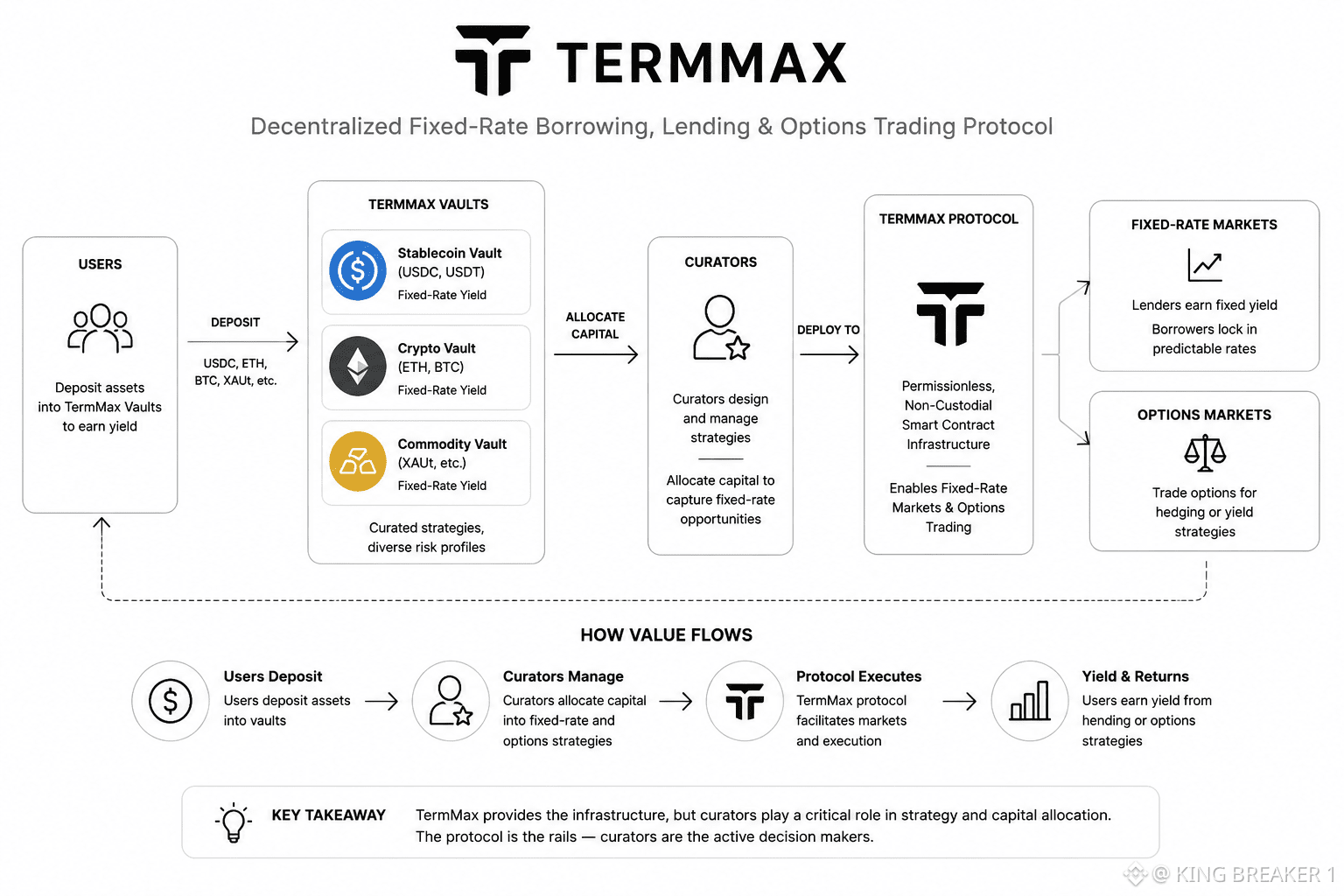
As a user, the experience looks pretty simple: deposit into a vault and earn yield.
Behind that simple deposit, though, someone is still deciding how the capital gets allocated and which opportunities are worth the risk.
That’s the part I initially overlooked.
TermMax can provide the fixed-rate infrastructure, but the curator still has a pretty meaningful role in how deposited capital actually works. In my head, it’s basically: TermMax builds the roads, while curators decide where the money travels.
And with $TMX approaching TGE, I think this gets more interesting.
Points and rewards have obviously given early users another reason to park capital there. Once those incentives start turning into actual tokens, we should get a cleaner signal.
I’m mostly watching what happens after that.
If deposits stick around and borrowing remains healthy, there’s probably genuine demand underneath the incentives.
If capital starts quietly leaving once the rewards are realized… well, that tells a different story.
@TermMax #TermMax
I’ve been looking through TermMax again with the $TMX TGE getting closer, and something slightly different caught my attention this time.
Not really the token. More where the money is actually sitting.
TermMax has reported $90M+ in TVL, while DefiLlama shows closer to $32M, with around $22M in active loans. The numbers probably use different accounting, so I wouldn’t read too much into the gap itself.
But digging through the vaults made me think about TermMax differently.
As a user, the experience looks pretty simple: deposit into a vault and earn yield.
Behind that simple deposit, though, someone is still deciding how the capital gets allocated and which opportunities are worth the risk.
That’s the part I initially overlooked.
TermMax can provide the fixed-rate infrastructure, but the curator still has a pretty meaningful role in how deposited capital actually works. In my head, it’s basically: TermMax builds the roads, while curators decide where the money travels.
And with $TMX approaching TGE, I think this gets more interesting.
Points and rewards have obviously given early users another reason to park capital there. Once those incentives start turning into actual tokens, we should get a cleaner signal.
I’m mostly watching what happens after that.
If deposits stick around and borrowing remains healthy, there’s probably genuine demand underneath the incentives.
If capital starts quietly leaving once the rewards are realized… well, that tells a different story.
I’ve been looking through TermMax again with the $TMX TGE getting closer, and something slightly different caught my attention this time.
Not really the token. More where the money is actually sitting.
TermMax has reported $90M+ in TVL, while DefiLlama shows closer to $32M, with around $22M in active loans. The numbers probably use different accounting, so I wouldn’t read too much into the gap itself.
But digging through the vaults made me think about TermMax differently.
As a user, the experience looks pretty simple: deposit into a vault and earn yield.
Behind that simple deposit, though, someone is still deciding how the capital gets allocated and which opportunities are worth the risk.
That’s the part I initially overlooked.
TermMax can provide the fixed-rate infrastructure, but the curator still has a pretty meaningful role in how deposited capital actually works. In my head, it’s basically: TermMax builds the roads, while curators decide where the money travels.
And with $TMX approaching TGE, I think this gets more interesting.
Points and rewards have obviously given early users another reason to park capital there. Once those incentives start turning into actual tokens, we should get a cleaner signal.
I’m mostly watching what happens after that.
If deposits stick around and borrowing remains healthy, there’s probably genuine demand underneath the incentives.
If capital starts quietly leaving once the rewards are realized… well, that tells a different story.
1
1
221

🚨 TERM MAX ($TMX) — THE QUICK EXPLAINER
Most people think TermMax is just another DeFi lending protocol.
It isn't that simple.
TermMax is building fixed-rate, fixed-term financial markets on-chain.
Here’s the simple breakdown 👇
🔹 Fixed-Rate Lending
Borrowers can lock borrowing costs instead of relying entirely on floating rates.
🔹 FT
Represents a fixed-rate claim that can be redeemed at maturity.
🔹 XT
Represents the financing/interest component of the fixed-term structure.
🔹 GT
Gearing Token — packages collateralized leveraged positions into a tokenized position.
🔹 Leverage
TermMax can simplify complex borrow → swap → collateral loops into a more streamlined transaction.
🔹 Vaults
Users can access managed strategies without manually handling every underlying position.
🔹 Multichain
TermMax is expanding across multiple EVM networks.
🔹 Institutional Direction
With TermPrime and its Canton integration, the project is also targeting larger financial players.
🪙 $TMX
Max supply: 1 BILLION TMX
Main utilities include:
• Governance
• Staking
• Protocol incentives
• Risk/parameter governance
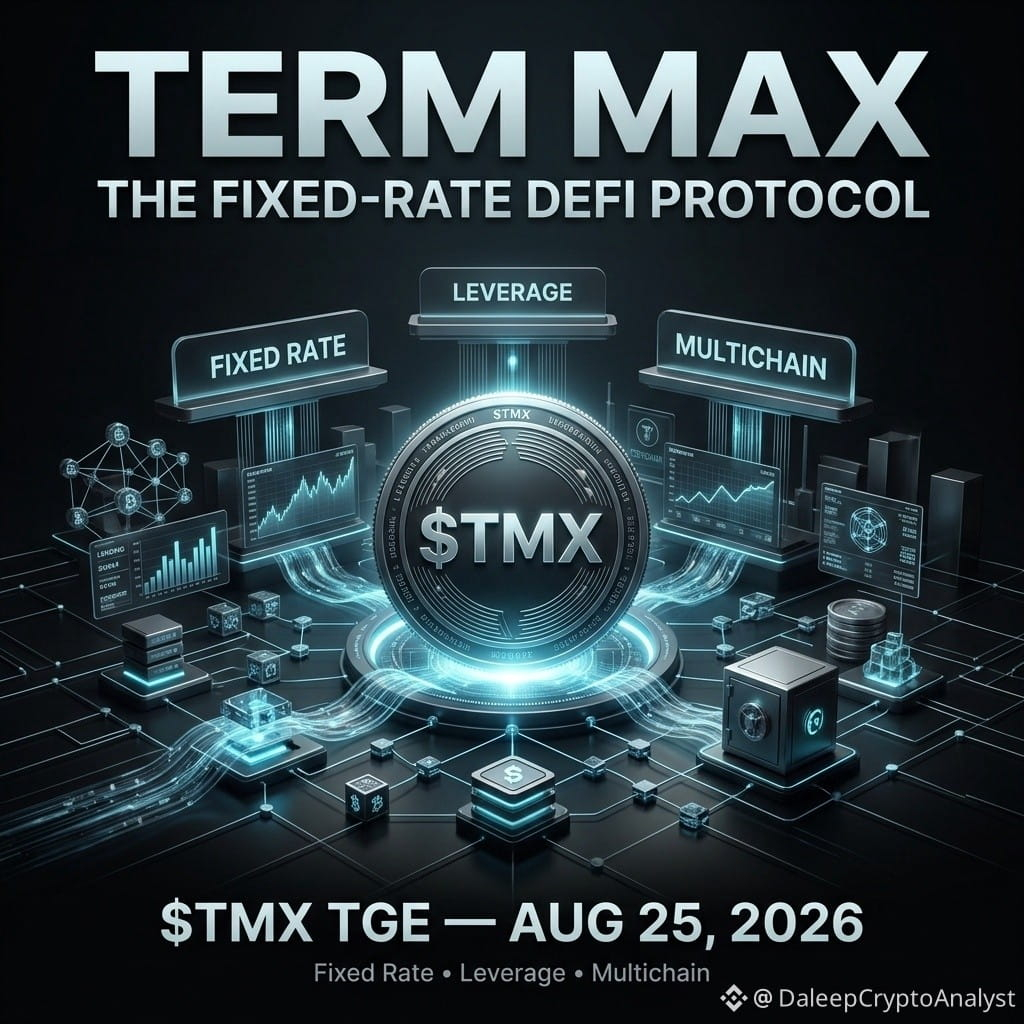
📅 TGE: August 25, 2026
But here's the real question:
Can TermMax turn fixed-rate DeFi into a major financial market?
If YES → $TMX has a strong long-term narrative.
If NO → tokenomics alone won't save it.
Don't just watch the TGE chart. Watch the protocol growth. 👀
#TermMax #TMX #DeFi #TGE @termmax
🚨 TERM MAX ($TMX) — THE QUICK EXPLAINER
Most people think TermMax is just another DeFi lending protocol.
It isn't that simple.
TermMax is building fixed-rate, fixed-term financial markets on-chain.
Here’s the simple breakdown 👇
🔹 Fixed-Rate Lending
Borrowers can lock borrowing costs instead of relying entirely on floating rates.
🔹 FT
Represents a fixed-rate claim that can be redeemed at maturity.
🔹 XT
Represents the financing/interest component of the fixed-term structure.
🔹 GT
Gearing Token — packages collateralized leveraged positions into a tokenized position.
🔹 Leverage
TermMax can simplify complex borrow → swap → collateral loops into a more streamlined transaction.
🔹 Vaults
Users can access managed strategies without manually handling every underlying position.
🔹 Multichain
TermMax is expanding across multiple EVM networks.
🔹 Institutional Direction
With TermPrime and its Canton integration, the project is also targeting larger financial players.
🪙 $TMX
Max supply: 1 BILLION TMX
Main utilities include:
• Governance
• Staking
• Protocol incentives
• Risk/parameter governance
📅 TGE: August 25, 2026
But here's the real question:
Can TermMax turn fixed-rate DeFi into a major financial market?
If YES → $TMX has a strong long-term narrative.
If NO → tokenomics alone won't save it.
Don't just watch the TGE chart. Watch the protocol growth. 👀
#TermMax #TMX #DeFi #TGE @TermMax
Most people think TermMax is just another DeFi lending protocol.
It isn't that simple.
TermMax is building fixed-rate, fixed-term financial markets on-chain.
Here’s the simple breakdown 👇
🔹 Fixed-Rate Lending
Borrowers can lock borrowing costs instead of relying entirely on floating rates.
🔹 FT
Represents a fixed-rate claim that can be redeemed at maturity.
🔹 XT
Represents the financing/interest component of the fixed-term structure.
🔹 GT
Gearing Token — packages collateralized leveraged positions into a tokenized position.
🔹 Leverage
TermMax can simplify complex borrow → swap → collateral loops into a more streamlined transaction.
🔹 Vaults
Users can access managed strategies without manually handling every underlying position.
🔹 Multichain
TermMax is expanding across multiple EVM networks.
🔹 Institutional Direction
With TermPrime and its Canton integration, the project is also targeting larger financial players.
🪙 $TMX
Max supply: 1 BILLION TMX
Main utilities include:
• Governance
• Staking
• Protocol incentives
• Risk/parameter governance
📅 TGE: August 25, 2026
But here's the real question:
Can TermMax turn fixed-rate DeFi into a major financial market?
If YES → $TMX has a strong long-term narrative.
If NO → tokenomics alone won't save it.
Don't just watch the TGE chart. Watch the protocol growth. 👀
#TermMax #TMX #DeFi #TGE @TermMax
64
Log in to explore more content
Join global crypto users on Binance Square
⚡️ Get latest and useful information about crypto.
💬 Trusted by the world’s largest crypto exchange.
👍 Discover real insights from verified creators.
Email / Phone number
Trending Topics
1
#ADAGains10%Above$0.27
6,305 views
132 Discussing
2
#ETHUp70%InQ3ButLiquidityFalls
74,690 views
771 Discussing
3
#EthStakingExitQueueHits2026High
28,519 views
602 Discussing
4
#FedOctoberHoldOdds82.3%
28,644 views
569 Discussing
5
#Nikkei225Jumps2.5%ToThreeMonthHigh
60,989 views
964 Discussing
6
#CircleMints$2.75BUSDCOnSolanaIn7Days
1,087 views
36 Discussing
7
#DriftHackVictimsBeginClaims
146,682 views
1,599 Discussing
8
#SolanaTokenizedStockVolumeTops$4.4BInSeptember
11,719 views
128 Discussing
9
#BitcoinSpotETFsDraw$6.34BInflowsInQ3
47,536 views
257 Discussing
10
#EthereumValidatorExitQueueJumps392%
277,469 views
2,462 Discussing