

#termmax
termmax
2.1M views
58,837 Discussing
Hot
Latest
·
--
🚀 $TMX Showing Strong Bullish Rebound! 📈
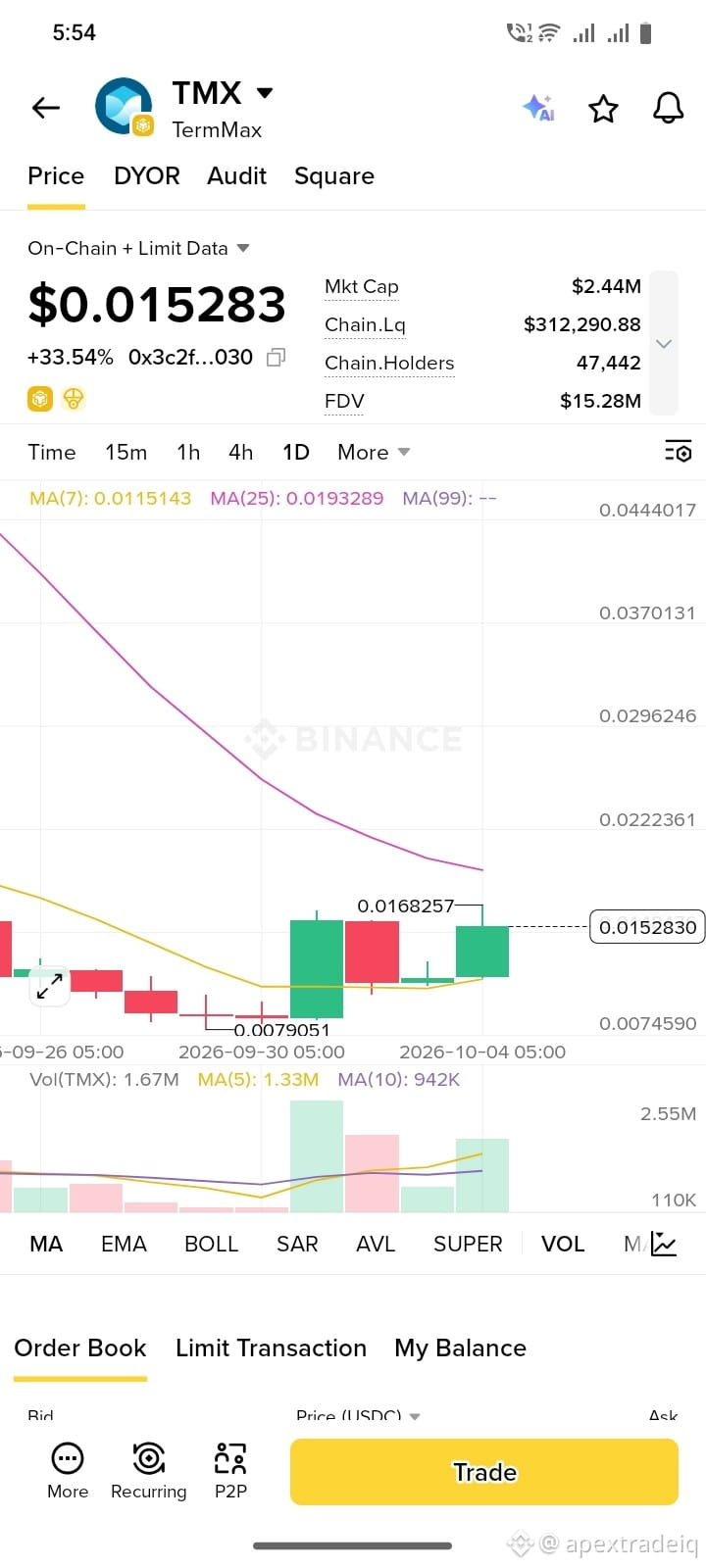
$TMX (TermMax) is gaining momentum, up +33.54% and trading at $0.015283 after bouncing back from its recent low of $0.007905. With a green candle reclaiming key levels above the short-term moving average, buying volume is picking up. Will $TMX push past its recent resistance around $0.0168, or are we heading into a consolidation phase? Always remember to DYOR before opening new positions! 💎✨
#TMX #BinanceSquare #CryptoTrading #TermMax
{alpha}(560x3c2f61f2e27c865981d2e7aaf6b2cdf823030039)
🚀 $TMX Showing Strong Bullish Rebound! 📈
$TMX (TermMax) is gaining momentum, up +33.54% and trading at $0.015283 after bouncing back from its recent low of $0.007905. With a green candle reclaiming key levels above the short-term moving average, buying volume is picking up. Will $TMX push past its recent resistance around $0.0168, or are we heading into a consolidation phase? Always remember to DYOR before opening new positions! 💎✨
#TMX #BinanceSquare #CryptoTrading #TermMax
$TMX (TermMax) is gaining momentum, up +33.54% and trading at $0.015283 after bouncing back from its recent low of $0.007905. With a green candle reclaiming key levels above the short-term moving average, buying volume is picking up. Will $TMX push past its recent resistance around $0.0168, or are we heading into a consolidation phase? Always remember to DYOR before opening new positions! 💎✨
#TMX #BinanceSquare #CryptoTrading #TermMax
422


·
--
Verified
What stands out to me about TermMax is its focus on making borrowing costs more predictable in DeFi. Its fixed-rate borrowing model offers an alternative to the constantly changing interest rates found in many lending protocols.
Features such as one-click leverage and the planned Smart Unwind functionality also highlight an effort to simplify complex DeFi strategies. However, the redemption pool mechanics deserve attention, particularly how underlying assets and leftover collateral may affect FT holders when liquidations fail to recover the full loan.
From a research perspective, TermMax's long-term potential depends on risk management, liquidity, smart contract security and how effectively its features work under volatile market conditions.
$ENJ
{future}(ENJUSDT)
$INJ
{future}(INJUSDT)
$TMX
{alpha}(560x3c2f61f2e27c865981d2e7aaf6b2cdf823030039)
#TermMax
#TMX
#ENJ
#INJ
#NFPWatch
What do you think comes next?
What stands out to me about TermMax is its focus on making borrowing costs more predictable in DeFi. Its fixed-rate borrowing model offers an alternative to the constantly changing interest rates found in many lending protocols.
Features such as one-click leverage and the planned Smart Unwind functionality also highlight an effort to simplify complex DeFi strategies. However, the redemption pool mechanics deserve attention, particularly how underlying assets and leftover collateral may affect FT holders when liquidations fail to recover the full loan.
From a research perspective, TermMax's long-term potential depends on risk management, liquidity, smart contract security and how effectively its features work under volatile market conditions.
$ENJ
$INJ
$TMX
#TermMax
#TMX
#ENJ
#INJ
#NFPWatch
What do you think comes next?
Features such as one-click leverage and the planned Smart Unwind functionality also highlight an effort to simplify complex DeFi strategies. However, the redemption pool mechanics deserve attention, particularly how underlying assets and leftover collateral may affect FT holders when liquidations fail to recover the full loan.
From a research perspective, TermMax's long-term potential depends on risk management, liquidity, smart contract security and how effectively its features work under volatile market conditions.
$ENJ
$INJ
$TMX
#TermMax
#TMX
#ENJ
#INJ
#NFPWatch
What do you think comes next?
🟢 Buyers defend $0.011
57%
🔴 Breakdown below $0.011
9%
⚖️ Sideways consolidation
5%
🚀 Rebound toward $0.013
29%
21 votes • Voting closed
1
4k

·
--
Bullish
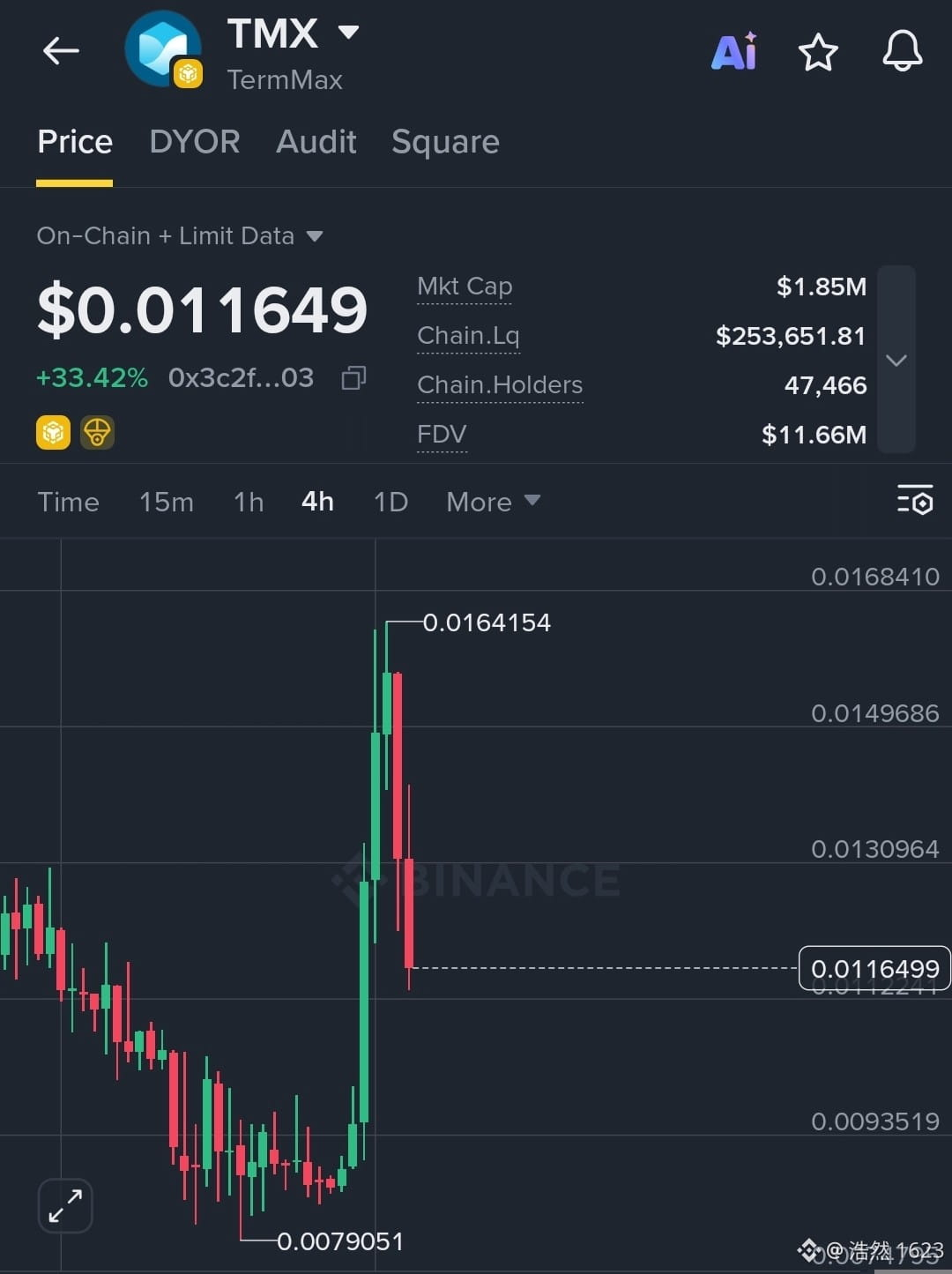
$TMX is showing extreme volatility after local peak around 0.0164, retracing sharply to test support near the 0.0116 level. If price consolidates above this key zone, buyers could attempt a quick recovery back toward previous highs.
Target 1: 0.01300 Target 2: 0.01490 Target 3: 0.01640
#TMX #TermMax #Crypto
$ZEC
{future}(ZECUSDT)
$MOVR
{future}(MOVRUSDT)
{alpha}(560x3c2f61f2e27c865981d2e7aaf6b2cdf823030039)
$TMX is showing extreme volatility after local peak around 0.0164, retracing sharply to test support near the 0.0116 level. If price consolidates above this key zone, buyers could attempt a quick recovery back toward previous highs.
Target 1: 0.01300 Target 2: 0.01490 Target 3: 0.01640
#TMX #TermMax #Crypto
$ZEC
$MOVR
Target 1: 0.01300 Target 2: 0.01490 Target 3: 0.01640
#TMX #TermMax #Crypto
$ZEC
$MOVR
233

#TermMax TermMax is a decentralized finance (DeFi) platform focused on fixed-rate borrowing and lending. It allows users to lock borrowing costs and lending returns for a specific period, making financial planning more predictable. TermMax also offers one-click leveraged strategies and vaults designed to help users earn yield through curated strategies. Its technology uses customizable pricing curves inspired by Uniswap V3 to create flexible fixed-rate markets. The platform supports multiple blockchain networks and is designed to simplify complex DeFi strategies. However, like other DeFi protocols, TermMax involves risks such as smart-contract vulnerabilities, market volatility, liquidation, and potential loss of funds. Users should research the protocol, understand the terms, and assess their risk before
#TermMax TermMax is a decentralized finance (DeFi) platform focused on fixed-rate borrowing and lending. It allows users to lock borrowing costs and lending returns for a specific period, making financial planning more predictable. TermMax also offers one-click leveraged strategies and vaults designed to help users earn yield through curated strategies. Its technology uses customizable pricing curves inspired by Uniswap V3 to create flexible fixed-rate markets. The platform supports multiple blockchain networks and is designed to simplify complex DeFi strategies. However, like other DeFi protocols, TermMax involves risks such as smart-contract vulnerabilities, market volatility, liquidation, and potential loss of funds. Users should research the protocol, understand the terms, and assess their risk before

1
92


·
--
$TMX
🚀 TMX (TermMax) — Binance Update
TMX is getting major attention today, with Binance Alpha activity helping drive visibility and trading interest. Binance’s latest data shows TermMax (TMX) around $0.037, with roughly +24% over 24 hours in the latest available reading. �
Binance
🔥 Key update: Binance Wallet launched a TMX trading competition, with the second phase running September 8–15, 2026. This is designed to increase trading activity and user engagement around TMX. �
Binance
📊 Short-term view: Bullish momentum, but HIGH risk.
TMX has experienced extreme volatility recently, so traders should watch volume, support near recent lows, and resistance around recent highs rather than chasing a sudden pump. �
$TMX
⚠️ Risk disclaimer: Crypto prices can change rapidly. This is market commentary for educational purposes, not financial advice. DYOR.
#TMX #TermMax #BinanceAlpha
{alpha}(560x3c2f61f2e27c865981d2e7aaf6b2cdf823030039)
$TMX
🚀 TMX (TermMax) — Binance Update
TMX is getting major attention today, with Binance Alpha activity helping drive visibility and trading interest. Binance’s latest data shows TermMax (TMX) around $0.037, with roughly +24% over 24 hours in the latest available reading. �
Binance
🔥 Key update: Binance Wallet launched a TMX trading competition, with the second phase running September 8–15, 2026. This is designed to increase trading activity and user engagement around TMX. �
Binance
📊 Short-term view: Bullish momentum, but HIGH risk.
TMX has experienced extreme volatility recently, so traders should watch volume, support near recent lows, and resistance around recent highs rather than chasing a sudden pump. �
$TMX
⚠️ Risk disclaimer: Crypto prices can change rapidly. This is market commentary for educational purposes, not financial advice. DYOR.
#TMX #TermMax #BinanceAlpha
🚀 TMX (TermMax) — Binance Update
TMX is getting major attention today, with Binance Alpha activity helping drive visibility and trading interest. Binance’s latest data shows TermMax (TMX) around $0.037, with roughly +24% over 24 hours in the latest available reading. �
Binance
🔥 Key update: Binance Wallet launched a TMX trading competition, with the second phase running September 8–15, 2026. This is designed to increase trading activity and user engagement around TMX. �
Binance
📊 Short-term view: Bullish momentum, but HIGH risk.
TMX has experienced extreme volatility recently, so traders should watch volume, support near recent lows, and resistance around recent highs rather than chasing a sudden pump. �
$TMX
⚠️ Risk disclaimer: Crypto prices can change rapidly. This is market commentary for educational purposes, not financial advice. DYOR.
#TMX #TermMax #BinanceAlpha
3
438
KII and TMX Market Overview: Tracking the Latest Price Action
Let’s check out the current on-chain and market data for KII and TMX to see how both assets are performing across the charts.
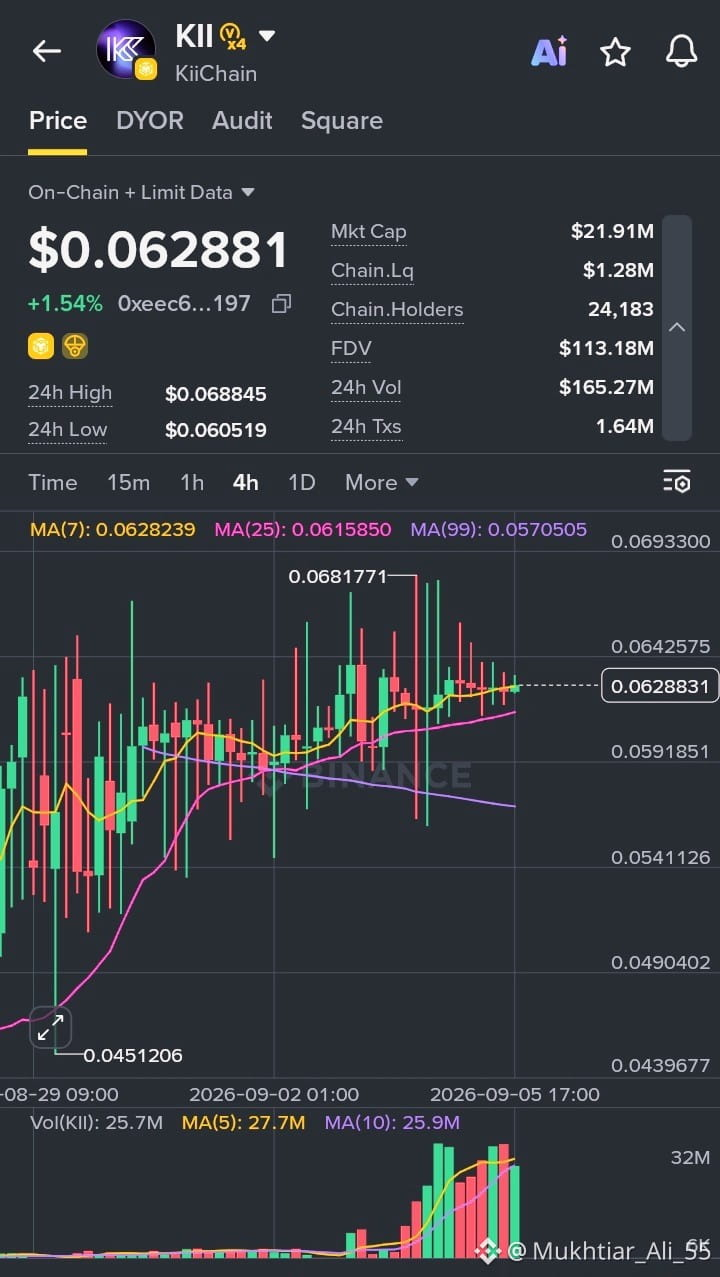
Starting with KII (KiiChain), the token is currently priced at $0.062881, showing a steady 24-hour gain of +1.54%. It holds a market cap of $21.91M with a fully diluted valuation (FDV) of $113.18M. Trading volume over the past 24 hours is robust at $165.27M, supported by chain liquidity of $1.28M and an active holder count of 24,183. Over the last day, it has traded between a low of $0.060519 and a high of $0.068845.
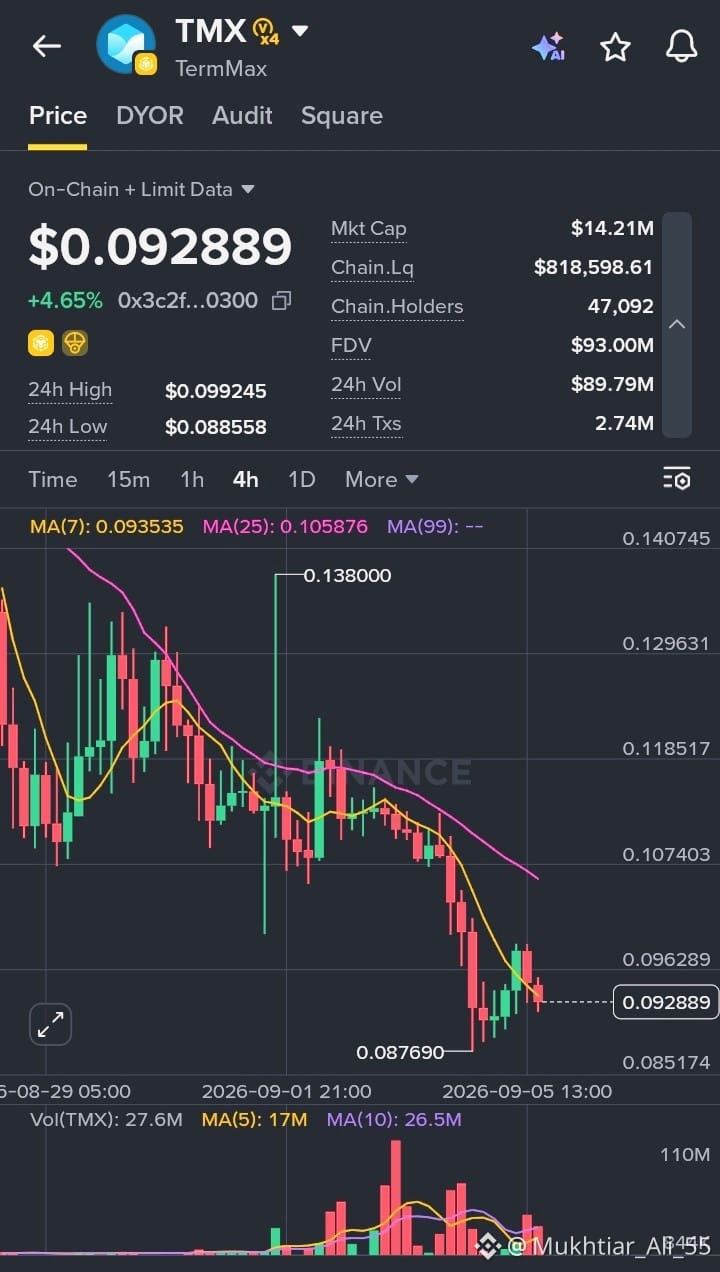
Moving over to TMX (TermMax), the token is trading at $0.092889, marking a positive 24-hour movement of +4.65%. Its market cap stands at $14.21M alongside an FDV of $93.00M. Trading activity shows a 24-hour volume of $89.79M, with chain liquidity recorded at $818,598.61 and a solid community of 47,092 holders. The price has fluctuated between a 24-hour low of $0.088558 and a high of $0.099245.
Both tokens are showing consistent market engagement as they trade through their current technical ranges.
#CryptoTrading #KiiChain #TermMax #Altcoins #MarketUpdate
$KII
{alpha}(560xeec6574eabba52bac3f0277f2cd5ac7e67197886)
$TMX
{alpha}(560x3c2f61f2e27c865981d2e7aaf6b2cdf823030039)
KII and TMX Market Overview: Tracking the Latest Price Action
Let’s check out the current on-chain and market data for KII and TMX to see how both assets are performing across the charts.
Starting with KII (KiiChain), the token is currently priced at $0.062881, showing a steady 24-hour gain of +1.54%. It holds a market cap of $21.91M with a fully diluted valuation (FDV) of $113.18M. Trading volume over the past 24 hours is robust at $165.27M, supported by chain liquidity of $1.28M and an active holder count of 24,183. Over the last day, it has traded between a low of $0.060519 and a high of $0.068845.
Moving over to TMX (TermMax), the token is trading at $0.092889, marking a positive 24-hour movement of +4.65%. Its market cap stands at $14.21M alongside an FDV of $93.00M. Trading activity shows a 24-hour volume of $89.79M, with chain liquidity recorded at $818,598.61 and a solid community of 47,092 holders. The price has fluctuated between a 24-hour low of $0.088558 and a high of $0.099245.
Both tokens are showing consistent market engagement as they trade through their current technical ranges.
#CryptoTrading #KiiChain #TermMax #Altcoins #MarketUpdate
$KII
$TMX
Let’s check out the current on-chain and market data for KII and TMX to see how both assets are performing across the charts.
Starting with KII (KiiChain), the token is currently priced at $0.062881, showing a steady 24-hour gain of +1.54%. It holds a market cap of $21.91M with a fully diluted valuation (FDV) of $113.18M. Trading volume over the past 24 hours is robust at $165.27M, supported by chain liquidity of $1.28M and an active holder count of 24,183. Over the last day, it has traded between a low of $0.060519 and a high of $0.068845.
Moving over to TMX (TermMax), the token is trading at $0.092889, marking a positive 24-hour movement of +4.65%. Its market cap stands at $14.21M alongside an FDV of $93.00M. Trading activity shows a 24-hour volume of $89.79M, with chain liquidity recorded at $818,598.61 and a solid community of 47,092 holders. The price has fluctuated between a 24-hour low of $0.088558 and a high of $0.099245.
Both tokens are showing consistent market engagement as they trade through their current technical ranges.
#CryptoTrading #KiiChain #TermMax #Altcoins #MarketUpdate
$KII
$TMX
701
·
--
🚀 TermMax (TMX): Volatility Could Be the Opportunity
TermMax (TMX) is trading around $0.104, with intraday volatility keeping traders on alert. Recent data shows TMX has pulled sharply lower from its $0.2043 all-time high, while trading activity remains elevated.
The key zone to watch is $0.105–$0.115. Holding $0.105 could give bulls a chance to reclaim $0.115, followed by $0.13–$0.14. A decisive break below $0.105 would weaken the setup and expose lower support.
With Binance recently highlighting TMX through a $200K trading competition, attention and liquidity could remain elevated.
TMX is volatile — but is this dip setting up the next move? 📈📉
$TMX
{alpha}(560x3c2f61f2e27c865981d2e7aaf6b2cdf823030039)
$ZEC
{future}(ZECUSDT)
$PROM
{future}(PROMUSDT)
#TermMax
#TMX
🗳️ TMX is around $0.104 — what does the chart do next?
🚀 TermMax (TMX): Volatility Could Be the Opportunity
TermMax (TMX) is trading around $0.104, with intraday volatility keeping traders on alert. Recent data shows TMX has pulled sharply lower from its $0.2043 all-time high, while trading activity remains elevated.
The key zone to watch is $0.105–$0.115. Holding $0.105 could give bulls a chance to reclaim $0.115, followed by $0.13–$0.14. A decisive break below $0.105 would weaken the setup and expose lower support.
With Binance recently highlighting TMX through a $200K trading competition, attention and liquidity could remain elevated.
TMX is volatile — but is this dip setting up the next move? 📈📉
$TMX
$ZEC
$PROM
#TermMax
#TMX
🗳️ TMX is around $0.104 — what does the chart do next?
TermMax (TMX) is trading around $0.104, with intraday volatility keeping traders on alert. Recent data shows TMX has pulled sharply lower from its $0.2043 all-time high, while trading activity remains elevated.
The key zone to watch is $0.105–$0.115. Holding $0.105 could give bulls a chance to reclaim $0.115, followed by $0.13–$0.14. A decisive break below $0.105 would weaken the setup and expose lower support.
With Binance recently highlighting TMX through a $200K trading competition, attention and liquidity could remain elevated.
TMX is volatile — but is this dip setting up the next move? 📈📉
$TMX
$ZEC
$PROM
#TermMax
#TMX
🗳️ TMX is around $0.104 — what does the chart do next?
🚀 Break $0.115 → breakout
45%
📈 Reclaim $0.110 → bullish
5%
🐻 Lose $0.101 → sell-off
27%
⚡ Sweep both → volatility
23%
22 votes • Voting closed
2
4.1k

·
--
I recently took another look at $TMX, and I feel that we’re actually in a stage that’s worth paying closer attention to now.
TermMax itself provides fixed-rate lending. In the CoinGecko Fixed Interest category, it’s ranked among the top positions. The protocol has been running for more than a year, with TVL exceeding $90 million, and it has been deployed across 10 EVM chains. Fundamentally, this isn’t something that was put together temporarily just to support a token launch.
Another aspect I care about is the token allocation structure. The team, advisors, and investors collectively hold 46% of the tokens, and all of that has a 12-month cliff. In the near term, what mainly needs to be faced is the linear unlock of the ecosystem portion.
So from the perspective of token price, I’d rather interpret $TMX like this: after the first round of emotion and sell-pressure has already been released, the next question is whether market funds are willing to reprice it based on fundamentals.
Also, TermMax has support from YZi Labs as a strategic investor, more than $90 million in TVL, and 1.5 million+ wallets as a foundation. If the protocol data keeps growing afterward, I think there’s still room for increased attention on $TMX.
Short-term volatility is completely normal. Personally, I’ll keep watching the trading volume and how well buy-side support sustains after $TMX.
⚠️ The above is for personal opinions and information sharing only and does not constitute investment advice. Crypto assets are highly volatile—please do your own research.
#TermMax #TMX #DeFi #Crypto
I recently took another look at $TMX, and I feel that we’re actually in a stage that’s worth paying closer attention to now.
TermMax itself provides fixed-rate lending. In the CoinGecko Fixed Interest category, it’s ranked among the top positions. The protocol has been running for more than a year, with TVL exceeding $90 million, and it has been deployed across 10 EVM chains. Fundamentally, this isn’t something that was put together temporarily just to support a token launch.
Another aspect I care about is the token allocation structure. The team, advisors, and investors collectively hold 46% of the tokens, and all of that has a 12-month cliff. In the near term, what mainly needs to be faced is the linear unlock of the ecosystem portion.
So from the perspective of token price, I’d rather interpret $TMX like this: after the first round of emotion and sell-pressure has already been released, the next question is whether market funds are willing to reprice it based on fundamentals.
Also, TermMax has support from YZi Labs as a strategic investor, more than $90 million in TVL, and 1.5 million+ wallets as a foundation. If the protocol data keeps growing afterward, I think there’s still room for increased attention on $TMX.
Short-term volatility is completely normal. Personally, I’ll keep watching the trading volume and how well buy-side support sustains after $TMX.
⚠️ The above is for personal opinions and information sharing only and does not constitute investment advice. Crypto assets are highly volatile—please do your own research.
#TermMax #TMX #DeFi #Crypto
TermMax itself provides fixed-rate lending. In the CoinGecko Fixed Interest category, it’s ranked among the top positions. The protocol has been running for more than a year, with TVL exceeding $90 million, and it has been deployed across 10 EVM chains. Fundamentally, this isn’t something that was put together temporarily just to support a token launch.
Another aspect I care about is the token allocation structure. The team, advisors, and investors collectively hold 46% of the tokens, and all of that has a 12-month cliff. In the near term, what mainly needs to be faced is the linear unlock of the ecosystem portion.
So from the perspective of token price, I’d rather interpret $TMX like this: after the first round of emotion and sell-pressure has already been released, the next question is whether market funds are willing to reprice it based on fundamentals.
Also, TermMax has support from YZi Labs as a strategic investor, more than $90 million in TVL, and 1.5 million+ wallets as a foundation. If the protocol data keeps growing afterward, I think there’s still room for increased attention on $TMX.
Short-term volatility is completely normal. Personally, I’ll keep watching the trading volume and how well buy-side support sustains after $TMX.
⚠️ The above is for personal opinions and information sharing only and does not constitute investment advice. Crypto assets are highly volatile—please do your own research.
#TermMax #TMX #DeFi #Crypto
1.1k
3
50
1.1k
·
--
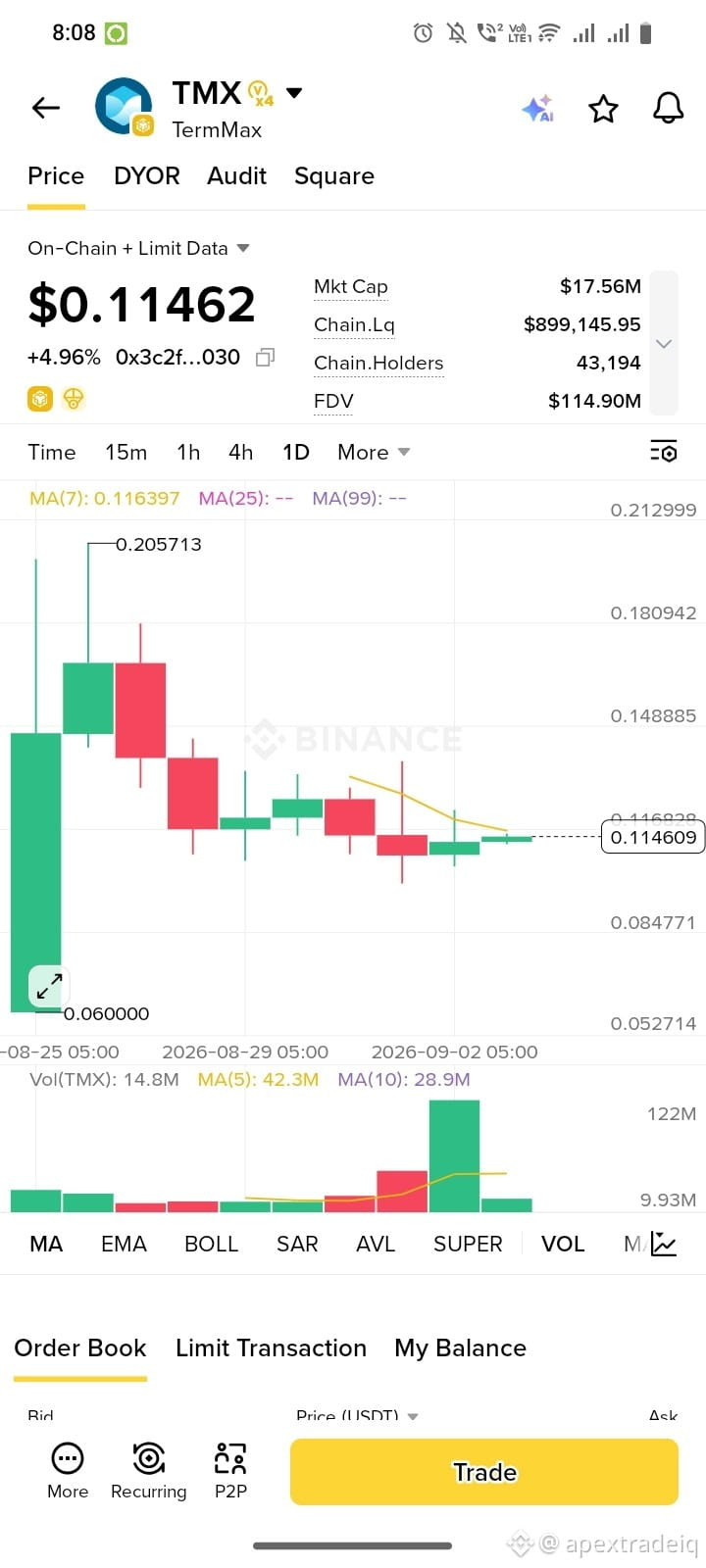
$TMX (TermMax) is quietly building momentum! 🚀 After previously spiking toward $0.2057, the price has consolidated around $0.11462 (+4.96%) with a notable surge in trading volume. Market cap currently stands at $17.56M with total holders reaching 43,194, indicating steady underlying accumulation during this range-bound phase.
With volume picking up and price stabilizing after the recent retracement, do you think $TMX is preparing for a breakout attempt toward $0.150+, or will it continue consolidating in this channel? Share your predictions below! ⁉️
#TMX #TermMax #CryptoTrading #PriceAnalysis #Altcoins #BinanceSquare
$TMX (TermMax) is quietly building momentum! 🚀 After previously spiking toward $0.2057, the price has consolidated around $0.11462 (+4.96%) with a notable surge in trading volume. Market cap currently stands at $17.56M with total holders reaching 43,194, indicating steady underlying accumulation during this range-bound phase.
With volume picking up and price stabilizing after the recent retracement, do you think $TMX is preparing for a breakout attempt toward $0.150+, or will it continue consolidating in this channel? Share your predictions below! ⁉️
#TMX #TermMax #CryptoTrading #PriceAnalysis #Altcoins #BinanceSquare
With volume picking up and price stabilizing after the recent retracement, do you think $TMX is preparing for a breakout attempt toward $0.150+, or will it continue consolidating in this channel? Share your predictions below! ⁉️
#TMX #TermMax #CryptoTrading #PriceAnalysis #Altcoins #BinanceSquare
1
1
38
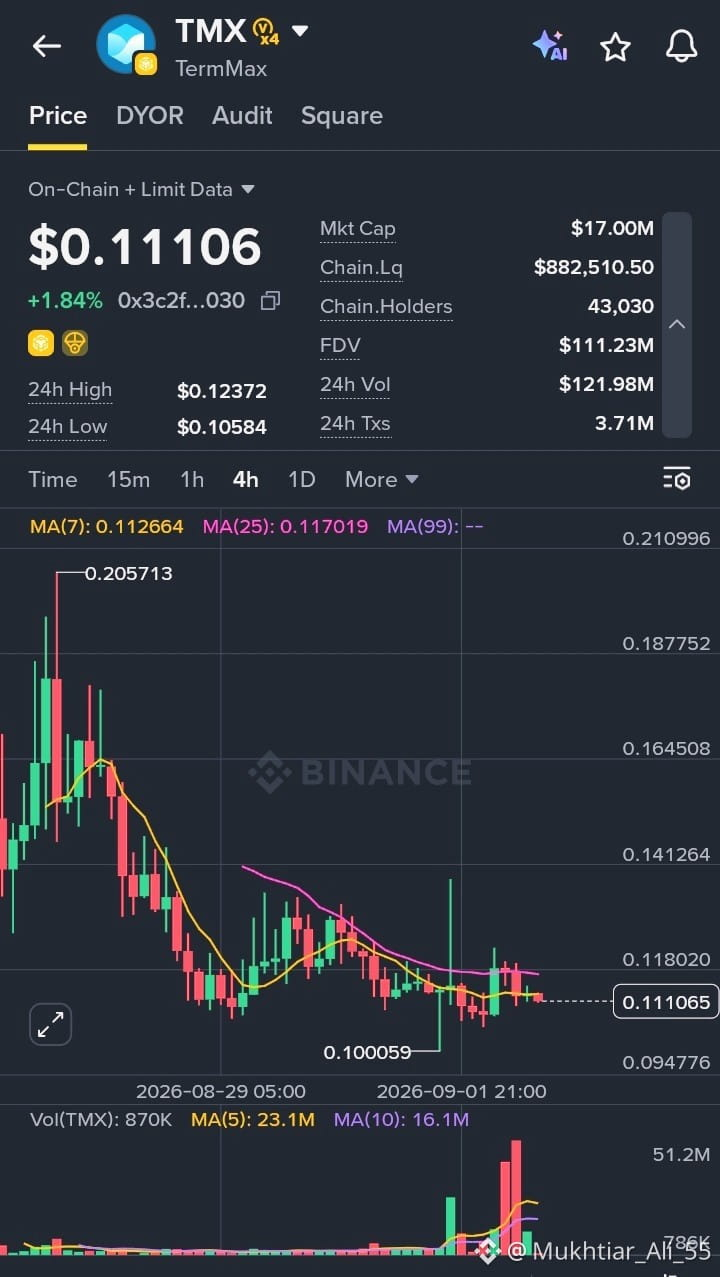
TMX Token On-Chain Review and Price Performance Update
Checking out the latest on-chain and market data for TMX (TermMax) to see how the token is holding up across the charts.
Here is a quick look at the core statistics from the dashboard:
Current Price: Trading at $0.11106, showing a mild gain of +1.84%.
24-Hour Range: Hit a low of $0.10584 and scaled up to a high of $0.12372.
Market Capitalization: Stands at $17.00M, with a Fully Diluted Valuation (FDV) of $111.23M.
Trading Volume & Activity: Recorded a strong 24-hour volume of $121.98M alongside 3.71M total transactions.
Holders & Liquidity: Chain holders currently count at 43,030 with chain liquidity resting at $882,510.50.
Observing how volume holds up around these moving average lines as trading progresses.
#CryptoTrading #Binance #TMX #TermMax #DeFi
$TMX
{alpha}(560x3c2f61f2e27c865981d2e7aaf6b2cdf823030039)
TMX Token On-Chain Review and Price Performance Update
Checking out the latest on-chain and market data for TMX (TermMax) to see how the token is holding up across the charts.
Here is a quick look at the core statistics from the dashboard:
Current Price: Trading at $0.11106, showing a mild gain of +1.84%.
24-Hour Range: Hit a low of $0.10584 and scaled up to a high of $0.12372.
Market Capitalization: Stands at $17.00M, with a Fully Diluted Valuation (FDV) of $111.23M.
Trading Volume & Activity: Recorded a strong 24-hour volume of $121.98M alongside 3.71M total transactions.
Holders & Liquidity: Chain holders currently count at 43,030 with chain liquidity resting at $882,510.50.
Observing how volume holds up around these moving average lines as trading progresses.
#CryptoTrading #Binance #TMX #TermMax #DeFi
$TMX
Checking out the latest on-chain and market data for TMX (TermMax) to see how the token is holding up across the charts.
Here is a quick look at the core statistics from the dashboard:
Current Price: Trading at $0.11106, showing a mild gain of +1.84%.
24-Hour Range: Hit a low of $0.10584 and scaled up to a high of $0.12372.
Market Capitalization: Stands at $17.00M, with a Fully Diluted Valuation (FDV) of $111.23M.
Trading Volume & Activity: Recorded a strong 24-hour volume of $121.98M alongside 3.71M total transactions.
Holders & Liquidity: Chain holders currently count at 43,030 with chain liquidity resting at $882,510.50.
Observing how volume holds up around these moving average lines as trading progresses.
#CryptoTrading #Binance #TMX #TermMax #DeFi
$TMX
262

·
--
Partly True
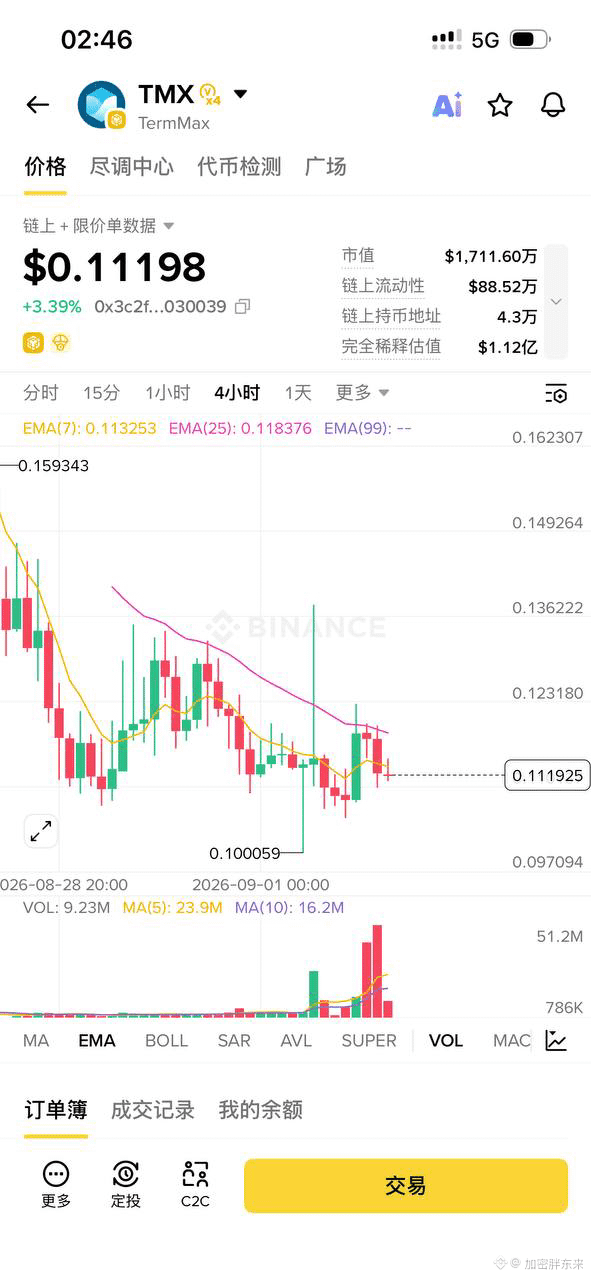
🔥Fellow members of the square, you’re in luck! $TMX is causing trouble again. Whether the order book is tidy or not aside, just take a careful look at the unlocks and the valuation—your heart should tell you something too.
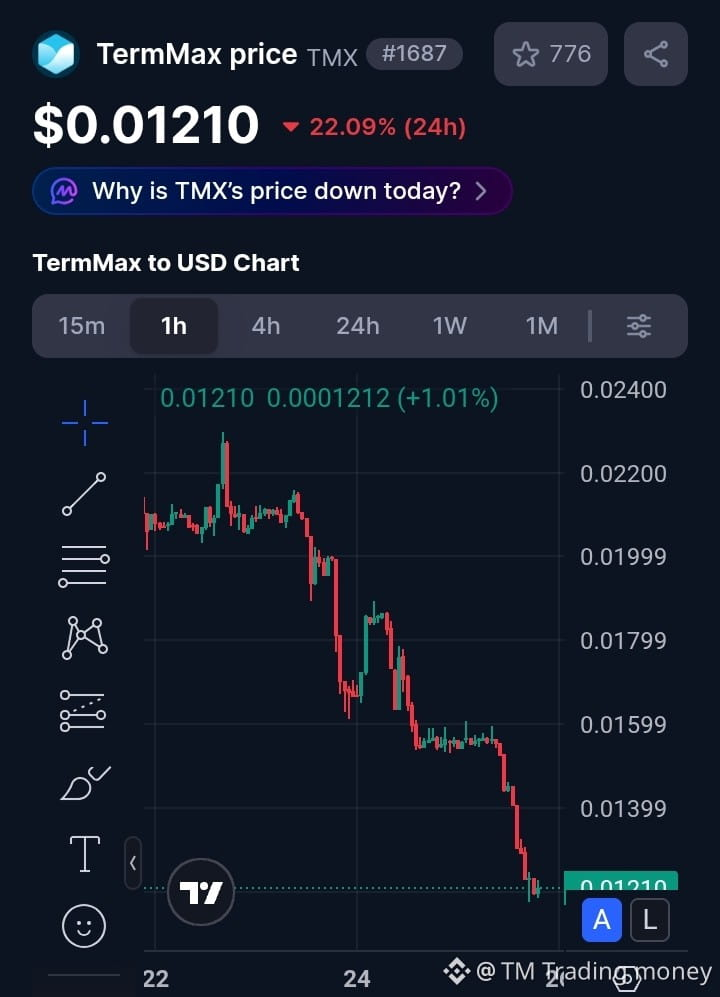
These past two days, public opinion across the whole internet has been one-sidedly blaming token unlocks. I casually checked the token chart— the sell-off logic simply doesn’t hold up.
The biggest portion of the sell pressure hasn’t even been unlocked. That 46% large share held by the team advisors and investors is all in a 12-month cliff period—no tokens can be withdrawn at all right now, and the earliest would be August 2027. What’s being released across the internet now is only ecosystem incentives—about 6.04 million tokens per month. Where would that huge selling pressure come from?
Valuation has been smashed into a deep pit: the fundamentals have basically been erased. TVL is $90 million, while the market cap is only $18 million. The ratio of market cap to TVL is just 0.20 (Pendle is 0.25). Take a good look and weigh it properly.
In the fixed-rate track, there are basically only two players: Pendle and TermMax. The biggest one has a market cap of $300 million. TMX holds a $90 million TVL, yet its market cap is only $18 million—its market cap/TVL has dropped to 0.20. This pricing is basically the same as not accounting for its fundamentals and backing. You tell me—doesn’t that sound harsh?
Mainnet launched in April 2025, spanning 10 chains—1.5 million wallets are using it. Market making and curation are supported by Keyrock and Edge Capital. Last month, YZi Labs even officially announced a strategic investment. No matter how you look at it, the foundation doesn’t look weak.
The market was driven off course by emotions and smashed into this pit—yet the fundamentals haven’t been repriced. What do you think about that?
#Termmax #Dell rises nearly 9% after hours in the US stock market, GitLab up 20%
🔥Fellow members of the square, you’re in luck! $TMX is causing trouble again. Whether the order book is tidy or not aside, just take a careful look at the unlocks and the valuation—your heart should tell you something too.
These past two days, public opinion across the whole internet has been one-sidedly blaming token unlocks. I casually checked the token chart— the sell-off logic simply doesn’t hold up.
The biggest portion of the sell pressure hasn’t even been unlocked. That 46% large share held by the team advisors and investors is all in a 12-month cliff period—no tokens can be withdrawn at all right now, and the earliest would be August 2027. What’s being released across the internet now is only ecosystem incentives—about 6.04 million tokens per month. Where would that huge selling pressure come from?
Valuation has been smashed into a deep pit: the fundamentals have basically been erased. TVL is $90 million, while the market cap is only $18 million. The ratio of market cap to TVL is just 0.20 (Pendle is 0.25). Take a good look and weigh it properly.
In the fixed-rate track, there are basically only two players: Pendle and TermMax. The biggest one has a market cap of $300 million. TMX holds a $90 million TVL, yet its market cap is only $18 million—its market cap/TVL has dropped to 0.20. This pricing is basically the same as not accounting for its fundamentals and backing. You tell me—doesn’t that sound harsh?
Mainnet launched in April 2025, spanning 10 chains—1.5 million wallets are using it. Market making and curation are supported by Keyrock and Edge Capital. Last month, YZi Labs even officially announced a strategic investment. No matter how you look at it, the foundation doesn’t look weak.
The market was driven off course by emotions and smashed into this pit—yet the fundamentals haven’t been repriced. What do you think about that?
#Termmax #Dell rises nearly 9% after hours in the US stock market, GitLab up 20%
These past two days, public opinion across the whole internet has been one-sidedly blaming token unlocks. I casually checked the token chart— the sell-off logic simply doesn’t hold up.
The biggest portion of the sell pressure hasn’t even been unlocked. That 46% large share held by the team advisors and investors is all in a 12-month cliff period—no tokens can be withdrawn at all right now, and the earliest would be August 2027. What’s being released across the internet now is only ecosystem incentives—about 6.04 million tokens per month. Where would that huge selling pressure come from?
Valuation has been smashed into a deep pit: the fundamentals have basically been erased. TVL is $90 million, while the market cap is only $18 million. The ratio of market cap to TVL is just 0.20 (Pendle is 0.25). Take a good look and weigh it properly.
In the fixed-rate track, there are basically only two players: Pendle and TermMax. The biggest one has a market cap of $300 million. TMX holds a $90 million TVL, yet its market cap is only $18 million—its market cap/TVL has dropped to 0.20. This pricing is basically the same as not accounting for its fundamentals and backing. You tell me—doesn’t that sound harsh?
Mainnet launched in April 2025, spanning 10 chains—1.5 million wallets are using it. Market making and curation are supported by Keyrock and Edge Capital. Last month, YZi Labs even officially announced a strategic investment. No matter how you look at it, the foundation doesn’t look weak.
The market was driven off course by emotions and smashed into this pit—yet the fundamentals haven’t been repriced. What do you think about that?
#Termmax #Dell rises nearly 9% after hours in the US stock market, GitLab up 20%
3
910

·
--
#termmax fixed-rate track—Pendle has already captured a fair share of users’ mindshare.
TermMax wants to grab a slice of the pie, so the product has to have something real.
I recently took a close look at TermMax’s three core products: FT, XT, and GT.
FT is a fixed-income certificate. Users buy it at a discount; at maturity it redeems at face value, locking in the yield.
XT is a borrowing certificate, allowing users to lock in the borrowing cost early.
GT is a leveraged certificate, compressing complex cyclic leverage operations into a single token.
From the product logic, this combination is indeed quite complete.
But the problem is that Pendle has already explained the story of “turning principal into fixed income” very clearly, and user habits have already been formed.
If TermMax only becomes a “Pendle alternative,” it will be hard to win users.
It needs differentiated value.
I think the most interesting part of TermMax is its governance mechanism—Curator Vaults.
This isn’t simple voting governance; it’s governance power that directly touches capital allocation.
Different vaults take on different strategies. How funds flow, how risks are distributed, and how yields are split—all of it is brought under this mechanism.
If this really can run, then TermMax wouldn’t just be “another Pendle,” but a fixed-rate protocol with its own distinct character.
But the current issue is: this governance mechanism hasn’t been validated by the market yet.
After TGE, will users actually participate in governance? Can Curator Vaults attract enough capital? These are all unknowns.
So my current stance is: I recognize the product logic, but execution still remains to be seen.
Pendle’s success isn’t based on the whitepaper—it’s driven by real trading volume and protocol revenue.
TermMax is the same.
I’ll observe during the first month after TGE to see the real user retention, trading volume, and protocol revenue.@termmax $BTC
#termmax fixed-rate track—Pendle has already captured a fair share of users’ mindshare.
TermMax wants to grab a slice of the pie, so the product has to have something real.
I recently took a close look at TermMax’s three core products: FT, XT, and GT.
FT is a fixed-income certificate. Users buy it at a discount; at maturity it redeems at face value, locking in the yield.
XT is a borrowing certificate, allowing users to lock in the borrowing cost early.
GT is a leveraged certificate, compressing complex cyclic leverage operations into a single token.
From the product logic, this combination is indeed quite complete.
But the problem is that Pendle has already explained the story of “turning principal into fixed income” very clearly, and user habits have already been formed.
If TermMax only becomes a “Pendle alternative,” it will be hard to win users.
It needs differentiated value.
I think the most interesting part of TermMax is its governance mechanism—Curator Vaults.
This isn’t simple voting governance; it’s governance power that directly touches capital allocation.
Different vaults take on different strategies. How funds flow, how risks are distributed, and how yields are split—all of it is brought under this mechanism.
If this really can run, then TermMax wouldn’t just be “another Pendle,” but a fixed-rate protocol with its own distinct character.
But the current issue is: this governance mechanism hasn’t been validated by the market yet.
After TGE, will users actually participate in governance? Can Curator Vaults attract enough capital? These are all unknowns.
So my current stance is: I recognize the product logic, but execution still remains to be seen.
Pendle’s success isn’t based on the whitepaper—it’s driven by real trading volume and protocol revenue.
TermMax is the same.
I’ll observe during the first month after TGE to see the real user retention, trading volume, and protocol revenue.@TermMax $BTC
TermMax wants to grab a slice of the pie, so the product has to have something real.
I recently took a close look at TermMax’s three core products: FT, XT, and GT.
FT is a fixed-income certificate. Users buy it at a discount; at maturity it redeems at face value, locking in the yield.
XT is a borrowing certificate, allowing users to lock in the borrowing cost early.
GT is a leveraged certificate, compressing complex cyclic leverage operations into a single token.
From the product logic, this combination is indeed quite complete.
But the problem is that Pendle has already explained the story of “turning principal into fixed income” very clearly, and user habits have already been formed.
If TermMax only becomes a “Pendle alternative,” it will be hard to win users.
It needs differentiated value.
I think the most interesting part of TermMax is its governance mechanism—Curator Vaults.
This isn’t simple voting governance; it’s governance power that directly touches capital allocation.
Different vaults take on different strategies. How funds flow, how risks are distributed, and how yields are split—all of it is brought under this mechanism.
If this really can run, then TermMax wouldn’t just be “another Pendle,” but a fixed-rate protocol with its own distinct character.
But the current issue is: this governance mechanism hasn’t been validated by the market yet.
After TGE, will users actually participate in governance? Can Curator Vaults attract enough capital? These are all unknowns.
So my current stance is: I recognize the product logic, but execution still remains to be seen.
Pendle’s success isn’t based on the whitepaper—it’s driven by real trading volume and protocol revenue.
TermMax is the same.
I’ll observe during the first month after TGE to see the real user retention, trading volume, and protocol revenue.@TermMax $BTC
TermMax如何跟Pendle差异化
0%
Curator Vaults机制能成吗
0%
固定利率赛道还有空间吗
0%
治理能真正影响资金吗
0%
0 votes • Voting closed
277

·
--
Bullish
#termmax @termmax Writing
Exploring the future of decentralized finance with @TermMax! Fixed-rate, fixed-term borrowing and lending can bring more clarity and flexibility to crypto users, while options trading adds even more possibilities to the ecosystem. Excited to learn more about this innovative project and its future growth! #TermMax
#termmax @TermMax Writing
Exploring the future of decentralized finance with @TermMax! Fixed-rate, fixed-term borrowing and lending can bring more clarity and flexibility to crypto users, while options trading adds even more possibilities to the ecosystem. Excited to learn more about this innovative project and its future growth! #TermMax
Exploring the future of decentralized finance with @TermMax! Fixed-rate, fixed-term borrowing and lending can bring more clarity and flexibility to crypto users, while options trading adds even more possibilities to the ecosystem. Excited to learn more about this innovative project and its future growth! #TermMax
82

·
--
Today I want to use three time points—before trading, during trading, and after trading—to understand @termmax .
Before trading, the most important thing is to see the conditions clearly. Borrowers need to know the cost of funds; traders who take directional bets need to know how much they are willing to pay in cost for this judgment.
During trading, what really tests whether risk is getting out of control. One aspect of the Call/Put way of thinking that I agree with is that being bullish or bearish doesn’t necessarily require relying on traditional high-leverage positions. Rather than focusing only on the upside potential, I care more whether we can clearly think through the risk boundaries from the very beginning.
After trading, you need to answer another question: what else can this capital be used for next? If you don’t have a clear directional view for the moment, can the assets still enter a scenario where they can generate returns—rather than just staying in the wallet and waiting for the next market opportunity.
Seen this way, I feel TermMax’s value isn’t concentrated in a single feature. Instead, it leaves users choices at different stages.
Market opportunities won’t show up every day, but capital always needs to be managed. Being able to borrow, to trade, and to allocate—while making costs and risks easier to understand—is, in my view, what makes #TermMax worth observing for the long term.
Today I want to use three time points—before trading, during trading, and after trading—to understand @TermMax .
Before trading, the most important thing is to see the conditions clearly. Borrowers need to know the cost of funds; traders who take directional bets need to know how much they are willing to pay in cost for this judgment.
During trading, what really tests whether risk is getting out of control. One aspect of the Call/Put way of thinking that I agree with is that being bullish or bearish doesn’t necessarily require relying on traditional high-leverage positions. Rather than focusing only on the upside potential, I care more whether we can clearly think through the risk boundaries from the very beginning.
After trading, you need to answer another question: what else can this capital be used for next? If you don’t have a clear directional view for the moment, can the assets still enter a scenario where they can generate returns—rather than just staying in the wallet and waiting for the next market opportunity.
Seen this way, I feel TermMax’s value isn’t concentrated in a single feature. Instead, it leaves users choices at different stages.
Market opportunities won’t show up every day, but capital always needs to be managed. Being able to borrow, to trade, and to allocate—while making costs and risks easier to understand—is, in my view, what makes #TermMax worth observing for the long term.
Before trading, the most important thing is to see the conditions clearly. Borrowers need to know the cost of funds; traders who take directional bets need to know how much they are willing to pay in cost for this judgment.
During trading, what really tests whether risk is getting out of control. One aspect of the Call/Put way of thinking that I agree with is that being bullish or bearish doesn’t necessarily require relying on traditional high-leverage positions. Rather than focusing only on the upside potential, I care more whether we can clearly think through the risk boundaries from the very beginning.
After trading, you need to answer another question: what else can this capital be used for next? If you don’t have a clear directional view for the moment, can the assets still enter a scenario where they can generate returns—rather than just staying in the wallet and waiting for the next market opportunity.
Seen this way, I feel TermMax’s value isn’t concentrated in a single feature. Instead, it leaves users choices at different stages.
Market opportunities won’t show up every day, but capital always needs to be managed. Being able to borrow, to trade, and to allocate—while making costs and risks easier to understand—is, in my view, what makes #TermMax worth observing for the long term.
82

·
--
Bullish
Looking for the next evolution in decentralized finance? I’ve been analyzing @TermMax and their vision for fixed-term, fixed-rate yield markets is incredible. They are solving the problem of unpredictable variable APYs by providing a stable and scalable framework for both institutional and retail liquidity. By creating a transparent and capital-efficient marketplace for fixed-term yields, they are building a crucial piece of infrastructure for the future of Web3 finance. Keep a close eye on this project.
#Defi #Kryptonions #YieldFarming #BinanceSquare#termmax @termmax
Looking for the next evolution in decentralized finance? I’ve been analyzing @TermMax and their vision for fixed-term, fixed-rate yield markets is incredible. They are solving the problem of unpredictable variable APYs by providing a stable and scalable framework for both institutional and retail liquidity. By creating a transparent and capital-efficient marketplace for fixed-term yields, they are building a crucial piece of infrastructure for the future of Web3 finance. Keep a close eye on this project.
#Defi #Kryptonions #YieldFarming #BinanceSquare#termmax @TermMax
#Defi #Kryptonions #YieldFarming #BinanceSquare#termmax @TermMax

68

·
--
#termmax Bought 200 USDC worth of the TermMax 60-day market’s XT just to figure out exactly how this thing loses value day by day. When I opened the position, the XT price was 0.041; by the fifth day it was 0.037. In four days it evaporated by 9.7%—the decay rate was even more straightforward than I expected.
XT is the time value of a debt split. The borrower collateralizes assets to mint FT and XT, sells the discounted FT for cash, and the XT flows to the secondary market. 1 unit of FT plus 1 unit of XT equals 1 unit of debt—so the books are always balanced. At maturity, FT redeems at face value, XT goes to zero, with no exceptions, and no one has to do anything malicious.
The logic of buying XT is close to Pendle’s YT: using a small amount of principal to leverage a large notional exposure. You’re betting that the portion where underlying floating yield outperforms the fixed end will be the profit. My $200 corresponds to a notional exposure of about 4,800—so the leverage multiple is a bit over twenty times. On paper, it really does look exciting. $SPCXB
But the direction cuts both ways, and the downside is just as fast. As long as the underlying floating yield remains below the implied fixed rate I locked in at my entry until maturity, XT is a ticket that will deterministically go to zero. I calculated the breakeven: the floating side needs to average above 6.4% for me not to lose money. But right now it’s 5.1%, which means I entered right into a headwind.
In the end, I treated this money as tuition rather than a position. XT isn’t something you buy and hold—it requires you to have a clear view on floating interest rates and be willing to watch the countdown to the maturity date. If you want fixed-income returns, you should buy FT; these two directions are completely opposite, and yet on the interface they’re separated by only one button.
#TermMax @termmax $SNDKB
#termmax Bought 200 USDC worth of the TermMax 60-day market’s XT just to figure out exactly how this thing loses value day by day. When I opened the position, the XT price was 0.041; by the fifth day it was 0.037. In four days it evaporated by 9.7%—the decay rate was even more straightforward than I expected.
XT is the time value of a debt split. The borrower collateralizes assets to mint FT and XT, sells the discounted FT for cash, and the XT flows to the secondary market. 1 unit of FT plus 1 unit of XT equals 1 unit of debt—so the books are always balanced. At maturity, FT redeems at face value, XT goes to zero, with no exceptions, and no one has to do anything malicious.
The logic of buying XT is close to Pendle’s YT: using a small amount of principal to leverage a large notional exposure. You’re betting that the portion where underlying floating yield outperforms the fixed end will be the profit. My $200 corresponds to a notional exposure of about 4,800—so the leverage multiple is a bit over twenty times. On paper, it really does look exciting. $SPCXB
But the direction cuts both ways, and the downside is just as fast. As long as the underlying floating yield remains below the implied fixed rate I locked in at my entry until maturity, XT is a ticket that will deterministically go to zero. I calculated the breakeven: the floating side needs to average above 6.4% for me not to lose money. But right now it’s 5.1%, which means I entered right into a headwind.
In the end, I treated this money as tuition rather than a position. XT isn’t something you buy and hold—it requires you to have a clear view on floating interest rates and be willing to watch the countdown to the maturity date. If you want fixed-income returns, you should buy FT; these two directions are completely opposite, and yet on the interface they’re separated by only one button.
#TermMax @TermMax $SNDKB
XT is the time value of a debt split. The borrower collateralizes assets to mint FT and XT, sells the discounted FT for cash, and the XT flows to the secondary market. 1 unit of FT plus 1 unit of XT equals 1 unit of debt—so the books are always balanced. At maturity, FT redeems at face value, XT goes to zero, with no exceptions, and no one has to do anything malicious.
The logic of buying XT is close to Pendle’s YT: using a small amount of principal to leverage a large notional exposure. You’re betting that the portion where underlying floating yield outperforms the fixed end will be the profit. My $200 corresponds to a notional exposure of about 4,800—so the leverage multiple is a bit over twenty times. On paper, it really does look exciting. $SPCXB
But the direction cuts both ways, and the downside is just as fast. As long as the underlying floating yield remains below the implied fixed rate I locked in at my entry until maturity, XT is a ticket that will deterministically go to zero. I calculated the breakeven: the floating side needs to average above 6.4% for me not to lose money. But right now it’s 5.1%, which means I entered right into a headwind.
In the end, I treated this money as tuition rather than a position. XT isn’t something you buy and hold—it requires you to have a clear view on floating interest rates and be willing to watch the countdown to the maturity date. If you want fixed-income returns, you should buy FT; these two directions are completely opposite, and yet on the interface they’re separated by only one button.
#TermMax @TermMax $SNDKB
XT 每天掉多少
0%
二十倍敞口怎么算
0%
归零点在哪里
100%
1 votes • Voting closed
1
98

·
--
#termmax Rebirth, I opened my eyes—and somehow I went back to the crypto world of 2021!
In my previous life, I founded TermMax, originally a top-tier DeFi protocol. But after a hacker attack and being taken advantage of by big shots, everything ended up at zero—I even jumped to my death.
In this life, I sneered: “TermMax? This time, I’ll remake it myself!”
Using memories from my past life, I timed the launch perfectly for an upgraded TermMax: dynamic interest rates, zero-slippage liquidation, and cross-chain aggregation. The moment the news broke, the whales went berserk, and TVL surpassed one billion in three days.
The VCs who once stepped on me now knelt, begging for investment. I just said, “Get lost,” and smashed right through the floor with the coins they’d locked up.
Exchanges started fawning over me to list the token, and the media went crazy praising “a new god in the crypto world.” Watching my account balance skyrocket from tens of thousands to an astronomical number, I lit a cigar, gazed at the skyrocketing candlestick chart, and smirked: “In this life, TermMax is mine—and the whole crypto world is mine too!”
@termmax $TMX
#termmax Rebirth, I opened my eyes—and somehow I went back to the crypto world of 2021!
In my previous life, I founded TermMax, originally a top-tier DeFi protocol. But after a hacker attack and being taken advantage of by big shots, everything ended up at zero—I even jumped to my death.
In this life, I sneered: “TermMax? This time, I’ll remake it myself!”
Using memories from my past life, I timed the launch perfectly for an upgraded TermMax: dynamic interest rates, zero-slippage liquidation, and cross-chain aggregation. The moment the news broke, the whales went berserk, and TVL surpassed one billion in three days.
The VCs who once stepped on me now knelt, begging for investment. I just said, “Get lost,” and smashed right through the floor with the coins they’d locked up.
Exchanges started fawning over me to list the token, and the media went crazy praising “a new god in the crypto world.” Watching my account balance skyrocket from tens of thousands to an astronomical number, I lit a cigar, gazed at the skyrocketing candlestick chart, and smirked: “In this life, TermMax is mine—and the whole crypto world is mine too!”
@TermMax $TMX
In my previous life, I founded TermMax, originally a top-tier DeFi protocol. But after a hacker attack and being taken advantage of by big shots, everything ended up at zero—I even jumped to my death.
In this life, I sneered: “TermMax? This time, I’ll remake it myself!”
Using memories from my past life, I timed the launch perfectly for an upgraded TermMax: dynamic interest rates, zero-slippage liquidation, and cross-chain aggregation. The moment the news broke, the whales went berserk, and TVL surpassed one billion in three days.
The VCs who once stepped on me now knelt, begging for investment. I just said, “Get lost,” and smashed right through the floor with the coins they’d locked up.
Exchanges started fawning over me to list the token, and the media went crazy praising “a new god in the crypto world.” Watching my account balance skyrocket from tens of thousands to an astronomical number, I lit a cigar, gazed at the skyrocketing candlestick chart, and smirked: “In this life, TermMax is mine—and the whole crypto world is mine too!”
@TermMax $TMX

·
--
#termmax @termmax
I've been spending time exploring different Web3 protocols, and one thing has become clear: understanding how a product works is just as important as following the hype.
Recently, I looked into TermMax Alpha, expecting a typical leveraged trading product with unlimited downside risk. Instead, I found a model where the maximum loss is defined before a trade is even opened. Going Long involves buying a call option, while going Short means buying a put option. Your maximum cost is limited to the premium you pay, making the risk transparent from the start.
What also caught my attention is the use case. New Binance Alpha token listings often don't have perpetual futures immediately, leaving traders with limited ways to gain leveraged exposure. TermMax Alpha aims to bridge that gap by offering options-based exposure from the first day of a token's listing, giving traders another way to express their market view while keeping risk predefined.
Of course, product design is only one part of the equation. Liquidity, active markets, spreads, and execution quality all play an important role in the overall trading experience. These are the factors I'll continue watching as the platform evolves.
For me, the biggest takeaway is simple: before focusing on potential returns, it's worth understanding how the underlying mechanism works. In crypto, informed decisions often outperform emotional ones.
What's your view on options-based trading for newly listed tokens?
{future}(ACEUSDT)
{future}(HEMIUSDT)
{future}(ERAUSDT)
What's the biggest advantage of options-based trading on newly listed tokens?
#termmax @TermMax
I've been spending time exploring different Web3 protocols, and one thing has become clear: understanding how a product works is just as important as following the hype.
Recently, I looked into TermMax Alpha, expecting a typical leveraged trading product with unlimited downside risk. Instead, I found a model where the maximum loss is defined before a trade is even opened. Going Long involves buying a call option, while going Short means buying a put option. Your maximum cost is limited to the premium you pay, making the risk transparent from the start.
What also caught my attention is the use case. New Binance Alpha token listings often don't have perpetual futures immediately, leaving traders with limited ways to gain leveraged exposure. TermMax Alpha aims to bridge that gap by offering options-based exposure from the first day of a token's listing, giving traders another way to express their market view while keeping risk predefined.
Of course, product design is only one part of the equation. Liquidity, active markets, spreads, and execution quality all play an important role in the overall trading experience. These are the factors I'll continue watching as the platform evolves.
For me, the biggest takeaway is simple: before focusing on potential returns, it's worth understanding how the underlying mechanism works. In crypto, informed decisions often outperform emotional ones.
What's your view on options-based trading for newly listed tokens?
What's the biggest advantage of options-based trading on newly listed tokens?
I've been spending time exploring different Web3 protocols, and one thing has become clear: understanding how a product works is just as important as following the hype.
Recently, I looked into TermMax Alpha, expecting a typical leveraged trading product with unlimited downside risk. Instead, I found a model where the maximum loss is defined before a trade is even opened. Going Long involves buying a call option, while going Short means buying a put option. Your maximum cost is limited to the premium you pay, making the risk transparent from the start.
What also caught my attention is the use case. New Binance Alpha token listings often don't have perpetual futures immediately, leaving traders with limited ways to gain leveraged exposure. TermMax Alpha aims to bridge that gap by offering options-based exposure from the first day of a token's listing, giving traders another way to express their market view while keeping risk predefined.
Of course, product design is only one part of the equation. Liquidity, active markets, spreads, and execution quality all play an important role in the overall trading experience. These are the factors I'll continue watching as the platform evolves.
For me, the biggest takeaway is simple: before focusing on potential returns, it's worth understanding how the underlying mechanism works. In crypto, informed decisions often outperform emotional ones.
What's your view on options-based trading for newly listed tokens?
What's the biggest advantage of options-based trading on newly listed tokens?
A.Defined maximum risk
0%
B. Early leveraged exposure
0%
C. More trading flexibility
0%
D. I prefer spot trading
0%
0 votes • Voting closed
25

·
--
#termmax @termmax TermMax is a DeFi project focused on the lending and borrowing market with fixed interest rates, helping users better manage their income and borrowing costs. The project develops products such as lending, borrowing, leverage, and vaults across multiple blockchains. A standout feature of TermMax is its focus on building fixed-income infrastructure for DeFi, while also expanding into RWA and institutional users. The TMX token is used for governance, staking, and incentivizing the ecosystem. This is a noteworthy project within the DeFi and on-chain finance trends.
#termmax @TermMax TermMax is a DeFi project focused on the lending and borrowing market with fixed interest rates, helping users better manage their income and borrowing costs. The project develops products such as lending, borrowing, leverage, and vaults across multiple blockchains. A standout feature of TermMax is its focus on building fixed-income infrastructure for DeFi, while also expanding into RWA and institutional users. The TMX token is used for governance, staking, and incentivizing the ecosystem. This is a noteworthy project within the DeFi and on-chain finance trends.
1
16
Log in to explore more content
Join global crypto users on Binance Square
⚡️ Get latest and useful information about crypto.
💬 Trusted by the world’s largest crypto exchange.
👍 Discover real insights from verified creators.
Email / Phone number
Trending Topics
1
#Nikkei225Jumps2.5%ToThreeMonthHigh
538 views
81 Discussing
2
#DriftHackVictimsBeginClaims
69,282 views
785 Discussing
3
#SolanaTokenizedStockVolumeTops$4.4BInSeptember
7,585 views
80 Discussing
4
#BitcoinSpotETFsDraw$6.34BInflowsInQ3
25,839 views
189 Discussing
5
#EthereumValidatorExitQueueJumps392%
220,578 views
1,824 Discussing
6
#IMFApprovesElSalvador$138MWithBitcoinWaiver
21,069 views
118 Discussing
7
#SECHaltsCryptoETFReviewsAmidFundingLapse
343,699 views
2,531 Discussing
8
#ZcashETFPostsFirstWeeklyOutflow$93.6M
106,606 views
283 Discussing
9
#GreekPoliceBustCryptoScamRingArrest17
471,078 views
3,087 Discussing
10
#BitcoinRejectedAt$87K
243,970 views
357 Discussing