
#stonkfly
stonkfly
98 views
3 Discussing
Hot
Latest

·
--
A fruit fly brain is hooked up to a trading interface, and $BTC also becomes responsive to visual stimuli
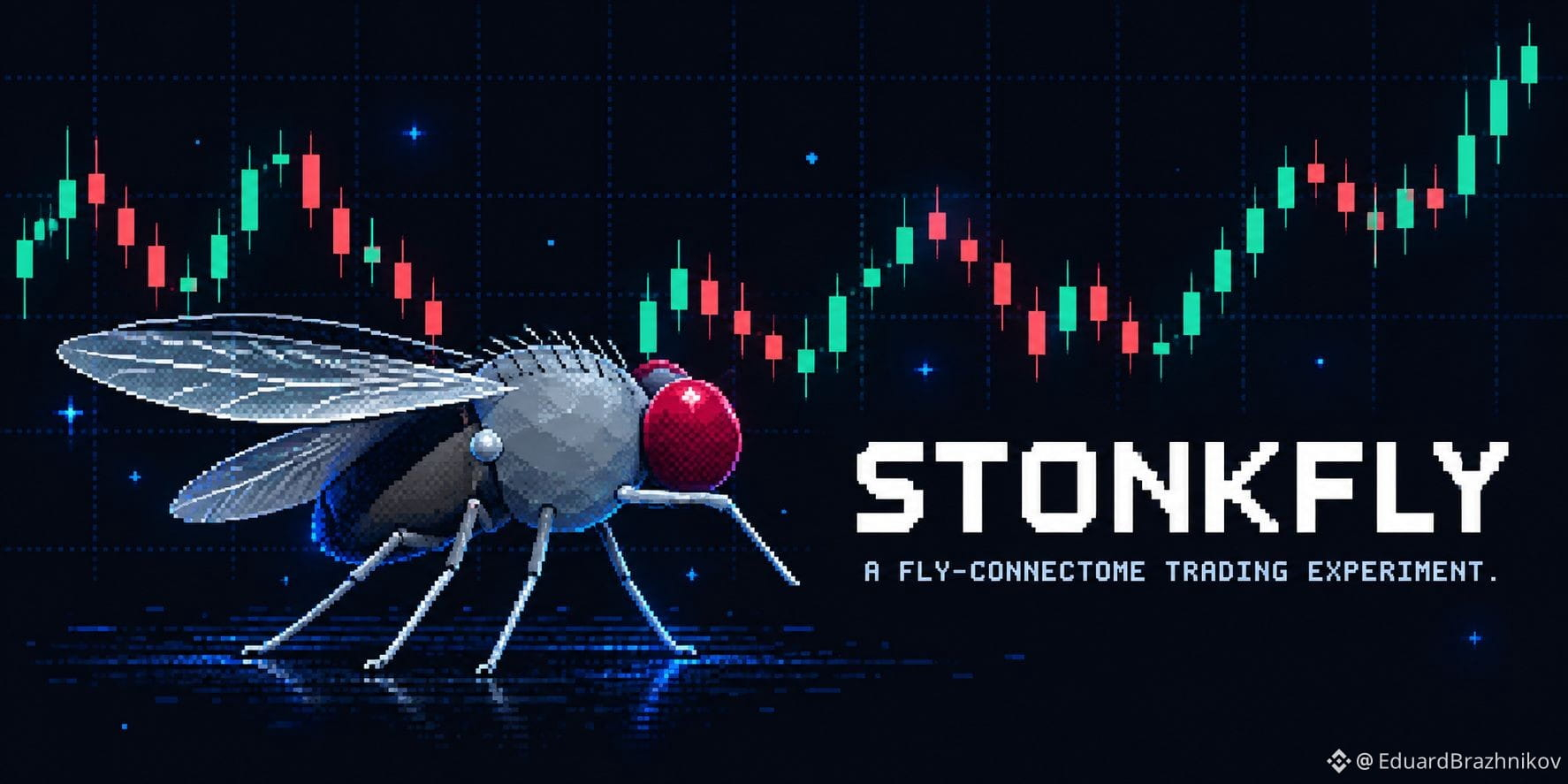
Around September 10, engineer Alex Wormuth open-sourced an experiment called “Stonkfly”: connecting a real fruit fly whole-brain connectome (about 166,000 neurons and more than 20 million connections) to a trading interface, using roughly $100 in principal to let this simulated brain choose between buying, selling, and holding. The tracked assets rotate across $BTC, $ETH , and stablecoins as well as $SOL.
The mechanism is absurd, yet it’s written with real seriousness. The market chart is drawn as a small picture feed and sent to photoreceptor cells instead of directly feeding price numbers. When it profits, dopamine-related circuits get stimulated; when it loses, it receives aversion signals. Even transaction fees are counted as losses. By default it’s mostly paper-trading, with limits per order, daily trade counts, and a drawdown “circuit breaker.” The author himself says: it doesn’t prove that flies can trade crypto.
A few days after the code was released, the same connectome was used by the community for things like “reverse parking and file storage,” restoring a Rubik’s Cube, and even selling ads on the simulated car. This isn’t “flies become sentient”; it’s a cross-over toy where a connectome visualization collides with a trading API. When AI agents start placing orders for people, “biological brain simulation” has also squeezed into crypto meme culture.
#Stonkfly #Aİ
{spot}(BTCUSDT)
Not investment advice
A fruit fly brain is hooked up to a trading interface, and $BTC also becomes responsive to visual stimuli
Around September 10, engineer Alex Wormuth open-sourced an experiment called “Stonkfly”: connecting a real fruit fly whole-brain connectome (about 166,000 neurons and more than 20 million connections) to a trading interface, using roughly $100 in principal to let this simulated brain choose between buying, selling, and holding. The tracked assets rotate across $BTC , $ETH , and stablecoins as well as $SOL.
The mechanism is absurd, yet it’s written with real seriousness. The market chart is drawn as a small picture feed and sent to photoreceptor cells instead of directly feeding price numbers. When it profits, dopamine-related circuits get stimulated; when it loses, it receives aversion signals. Even transaction fees are counted as losses. By default it’s mostly paper-trading, with limits per order, daily trade counts, and a drawdown “circuit breaker.” The author himself says: it doesn’t prove that flies can trade crypto.
A few days after the code was released, the same connectome was used by the community for things like “reverse parking and file storage,” restoring a Rubik’s Cube, and even selling ads on the simulated car. This isn’t “flies become sentient”; it’s a cross-over toy where a connectome visualization collides with a trading API. When AI agents start placing orders for people, “biological brain simulation” has also squeezed into crypto meme culture.
#Stonkfly #Aİ
Not investment advice
Around September 10, engineer Alex Wormuth open-sourced an experiment called “Stonkfly”: connecting a real fruit fly whole-brain connectome (about 166,000 neurons and more than 20 million connections) to a trading interface, using roughly $100 in principal to let this simulated brain choose between buying, selling, and holding. The tracked assets rotate across $BTC , $ETH , and stablecoins as well as $SOL.
The mechanism is absurd, yet it’s written with real seriousness. The market chart is drawn as a small picture feed and sent to photoreceptor cells instead of directly feeding price numbers. When it profits, dopamine-related circuits get stimulated; when it loses, it receives aversion signals. Even transaction fees are counted as losses. By default it’s mostly paper-trading, with limits per order, daily trade counts, and a drawdown “circuit breaker.” The author himself says: it doesn’t prove that flies can trade crypto.
A few days after the code was released, the same connectome was used by the community for things like “reverse parking and file storage,” restoring a Rubik’s Cube, and even selling ads on the simulated car. This isn’t “flies become sentient”; it’s a cross-over toy where a connectome visualization collides with a trading API. When AI agents start placing orders for people, “biological brain simulation” has also squeezed into crypto meme culture.
#Stonkfly #Aİ
Not investment advice

197

The fly’s brain received $100 and started trading $BTC
What happens if you connect a digital model of a fruit fly brain to the market $BTC ?
That’s exactly the experiment launched by Coinbase engineer Alex Wormuth. The Stonkfly project uses a model of the nervous system of a male fruit fly—about 166,700 neurons and 25.6 million connections.
The system receives the BTC-USDC chart as an image and, based on the activity of virtual neurons, makes a decision: Buy, Sell, or Hold.
Profit activates simulated dopamine neurons, while losses trigger signals related to negative reinforcement.
What’s most interesting is that the developer really allocated $100 to the experiment.
However, it’s still too early to call the fly a successful trader: the project’s author directly warns that profitable training and a stable trading strategy have not yet been proven.
But if Bitcoin one day starts trading better thanks to a fly’s brain, the crypto market will get an entirely new level of competition.
#Stonkfly #BTC #cryptotradingpro
The fly’s brain received $100 and started trading $BTC
What happens if you connect a digital model of a fruit fly brain to the market $BTC ?
That’s exactly the experiment launched by Coinbase engineer Alex Wormuth. The Stonkfly project uses a model of the nervous system of a male fruit fly—about 166,700 neurons and 25.6 million connections.
The system receives the BTC-USDC chart as an image and, based on the activity of virtual neurons, makes a decision: Buy, Sell, or Hold.
Profit activates simulated dopamine neurons, while losses trigger signals related to negative reinforcement.
What’s most interesting is that the developer really allocated $100 to the experiment.
However, it’s still too early to call the fly a successful trader: the project’s author directly warns that profitable training and a stable trading strategy have not yet been proven.
But if Bitcoin one day starts trading better thanks to a fly’s brain, the crypto market will get an entirely new level of competition.
#Stonkfly #BTC #cryptotradingpro
What happens if you connect a digital model of a fruit fly brain to the market $BTC ?
That’s exactly the experiment launched by Coinbase engineer Alex Wormuth. The Stonkfly project uses a model of the nervous system of a male fruit fly—about 166,700 neurons and 25.6 million connections.
The system receives the BTC-USDC chart as an image and, based on the activity of virtual neurons, makes a decision: Buy, Sell, or Hold.
Profit activates simulated dopamine neurons, while losses trigger signals related to negative reinforcement.
What’s most interesting is that the developer really allocated $100 to the experiment.
However, it’s still too early to call the fly a successful trader: the project’s author directly warns that profitable training and a stable trading strategy have not yet been proven.
But if Bitcoin one day starts trading better thanks to a fly’s brain, the crypto market will get an entirely new level of competition.
#Stonkfly #BTC #cryptotradingpro
66
Log in to explore more content
Join global crypto users on Binance Square
⚡️ Get latest and useful information about crypto.
💬 Trusted by the world’s largest crypto exchange.
👍 Discover real insights from verified creators.
Email / Phone number
Trending Topics
1
#BitcoinHoldsAbove$77000
3,576 views
116 Discussing
2
#FedHikeOddsRiseTo89%
15,920 views
450 Discussing
3
#BitcoinCrosses$78000
6,413 views
178 Discussing
4
#RLUSDSupplyHitsRecord$2.442B
483 views
16 Discussing
5
#AvalancheIntegratesIntoUAEPassDigitalVault
28,740 views
634 Discussing
6
#UKSeeksViewsOnTokenizingGold
19,940 views
439 Discussing
7
#AnthropicCEOCallsForAISlowdown
186,258 views
2,924 Discussing
8
#RevolutDataLeakReportedlyPostedAttackersThreatenDailyReleases
3,413 views
75 Discussing
9
#BrazilCentralBankRaisesVASPCapitalRequirements
25,645 views
630 Discussing
10
#BitcoinThirdSingleBlockReorgInFourWeeks
66,657 views
1,405 Discussing