
#stablecoinadoption
stablecoinadoption
16,947 views
128 Discussing
Hot
Latest

·
--
Most traders are glued to price charts. Smart money, however, is watching the slow burn of institutional adoption.
Shinhan Financial Group, a South Korean giant, just inked a deal with Visa to build stablecoin payment infrastructure. This isn't just about a new payment rail; it's about unlocking trillions in traditional finance for digital assets. Think of it as the on-ramp to a future where crypto isn't just speculative, but functional. This partnership signals a significant shift, moving stablecoins from niche use cases to mainstream financial services. #StablecoinAdoption #InstitutionalCrypto
What this means is that the foundation for large-scale, regulated stablecoin usage is being quietly laid. As these bridges strengthen, the demand for the underlying assets, and the entire crypto ecosystem, will inevitably grow. We're talking about real, sustained demand from entities that can move billions, not just hype.
Keep a close eye on the development of pilot programs and regulatory clarity around these stablecoin initiatives. #DeFiIntegration
Are you positioned for the next wave of institutional crypto integration, or are you still watching the noise?
Most traders are glued to price charts. Smart money, however, is watching the slow burn of institutional adoption.
Shinhan Financial Group, a South Korean giant, just inked a deal with Visa to build stablecoin payment infrastructure. This isn't just about a new payment rail; it's about unlocking trillions in traditional finance for digital assets. Think of it as the on-ramp to a future where crypto isn't just speculative, but functional. This partnership signals a significant shift, moving stablecoins from niche use cases to mainstream financial services. #StablecoinAdoption #InstitutionalCrypto
What this means is that the foundation for large-scale, regulated stablecoin usage is being quietly laid. As these bridges strengthen, the demand for the underlying assets, and the entire crypto ecosystem, will inevitably grow. We're talking about real, sustained demand from entities that can move billions, not just hype.
Keep a close eye on the development of pilot programs and regulatory clarity around these stablecoin initiatives. #DeFiIntegration
Are you positioned for the next wave of institutional crypto integration, or are you still watching the noise?
Shinhan Financial Group, a South Korean giant, just inked a deal with Visa to build stablecoin payment infrastructure. This isn't just about a new payment rail; it's about unlocking trillions in traditional finance for digital assets. Think of it as the on-ramp to a future where crypto isn't just speculative, but functional. This partnership signals a significant shift, moving stablecoins from niche use cases to mainstream financial services. #StablecoinAdoption #InstitutionalCrypto
What this means is that the foundation for large-scale, regulated stablecoin usage is being quietly laid. As these bridges strengthen, the demand for the underlying assets, and the entire crypto ecosystem, will inevitably grow. We're talking about real, sustained demand from entities that can move billions, not just hype.
Keep a close eye on the development of pilot programs and regulatory clarity around these stablecoin initiatives. #DeFiIntegration
Are you positioned for the next wave of institutional crypto integration, or are you still watching the noise?
3

·
--
Banks have stopped asking if stablecoins belong
Financial institutions are racing to become the secure gateways for existing stablecoins as digital asset volume is projected to explode by 2030.
The banking sector's transformation from skepticism to implementation marks a pivotal moment in digital asset history. Institutions that once dismissed stablecoins are now allocating budgets to integrate tokenized dollars into payment infrastructure. This strategic shift reflects a fundamental recalibration of how Wall Street perceives blockchain technology.
Regulatory clarity from key jurisdictions has dismantled compliance barriers that kept banks on the sidelines. New frameworks for stablecoin issuance and reserves mirror established banking regulations, opening the floodgates for mainstream institutional adoption after years of uncertainty.
This raises critical questions about future payment architecture. Will centralized bank-issued stablecoins dominate transaction volume, or will decentralized protocols maintain their edge through censorship resistance? The answer will determine which players control trillions in digital dollar flows.
Industry observers note institutional momentum has reached critical mass. Capital allocation frameworks now include stablecoin infrastructure as a core portfolio line item, not an experimental R&D project. This seismic shift departs from the cautious wait-and-see posture of 2020-2023.
What's your take on this institutional transformation? Will banks dominate the stablecoin boom or will decentralized alternatives retain their edge? Drop your analysis below. 👇
#StablecoinAdoption #BankingInfrastructure #CryptoPayments
Banks have stopped asking if stablecoins belong
Financial institutions are racing to become the secure gateways for existing stablecoins as digital asset volume is projected to explode by 2030.
The banking sector's transformation from skepticism to implementation marks a pivotal moment in digital asset history. Institutions that once dismissed stablecoins are now allocating budgets to integrate tokenized dollars into payment infrastructure. This strategic shift reflects a fundamental recalibration of how Wall Street perceives blockchain technology.
Regulatory clarity from key jurisdictions has dismantled compliance barriers that kept banks on the sidelines. New frameworks for stablecoin issuance and reserves mirror established banking regulations, opening the floodgates for mainstream institutional adoption after years of uncertainty.
This raises critical questions about future payment architecture. Will centralized bank-issued stablecoins dominate transaction volume, or will decentralized protocols maintain their edge through censorship resistance? The answer will determine which players control trillions in digital dollar flows.
Industry observers note institutional momentum has reached critical mass. Capital allocation frameworks now include stablecoin infrastructure as a core portfolio line item, not an experimental R&D project. This seismic shift departs from the cautious wait-and-see posture of 2020-2023.
What's your take on this institutional transformation? Will banks dominate the stablecoin boom or will decentralized alternatives retain their edge? Drop your analysis below. 👇
#StablecoinAdoption #BankingInfrastructure #CryptoPayments
Financial institutions are racing to become the secure gateways for existing stablecoins as digital asset volume is projected to explode by 2030.
The banking sector's transformation from skepticism to implementation marks a pivotal moment in digital asset history. Institutions that once dismissed stablecoins are now allocating budgets to integrate tokenized dollars into payment infrastructure. This strategic shift reflects a fundamental recalibration of how Wall Street perceives blockchain technology.
Regulatory clarity from key jurisdictions has dismantled compliance barriers that kept banks on the sidelines. New frameworks for stablecoin issuance and reserves mirror established banking regulations, opening the floodgates for mainstream institutional adoption after years of uncertainty.
This raises critical questions about future payment architecture. Will centralized bank-issued stablecoins dominate transaction volume, or will decentralized protocols maintain their edge through censorship resistance? The answer will determine which players control trillions in digital dollar flows.
Industry observers note institutional momentum has reached critical mass. Capital allocation frameworks now include stablecoin infrastructure as a core portfolio line item, not an experimental R&D project. This seismic shift departs from the cautious wait-and-see posture of 2020-2023.
What's your take on this institutional transformation? Will banks dominate the stablecoin boom or will decentralized alternatives retain their edge? Drop your analysis below. 👇
#StablecoinAdoption #BankingInfrastructure #CryptoPayments
17

·
--
While most traders are focused on the impending crypto regulation, smart money is watching the ripple effects on stablecoin adoption.
THE SIGNAL: Japanese logistics company, Nippon Express, is planning to integrate JPYC stablecoin for frequent and quick digital yen payments to thousands of transportation contractors, signaling a significant shift towards DeFi adoption. #JPYC #StablecoinAdoption
THE INTERPRETATION: If this rollout is successful, it could mark the beginning of wider stablecoin use in traditional industries, sparking a new wave of decentralized finance growth. This, in turn, could drive up demand for JPYC and other stablecoins pegged to major fiat currencies.
THE WATCH LIST: Keep a close eye on JPYC/BUSD trading volume, as a surge in adoption and subsequent price action could be imminent. #JPYCvolume
What happens when stablecoins begin to seep into traditional industries, changing the way businesses think about DeFi?
While most traders are focused on the impending crypto regulation, smart money is watching the ripple effects on stablecoin adoption.
THE SIGNAL: Japanese logistics company, Nippon Express, is planning to integrate JPYC stablecoin for frequent and quick digital yen payments to thousands of transportation contractors, signaling a significant shift towards DeFi adoption. #JPYC #StablecoinAdoption
THE INTERPRETATION: If this rollout is successful, it could mark the beginning of wider stablecoin use in traditional industries, sparking a new wave of decentralized finance growth. This, in turn, could drive up demand for JPYC and other stablecoins pegged to major fiat currencies.
THE WATCH LIST: Keep a close eye on JPYC/BUSD trading volume, as a surge in adoption and subsequent price action could be imminent. #JPYCvolume
What happens when stablecoins begin to seep into traditional industries, changing the way businesses think about DeFi?
THE SIGNAL: Japanese logistics company, Nippon Express, is planning to integrate JPYC stablecoin for frequent and quick digital yen payments to thousands of transportation contractors, signaling a significant shift towards DeFi adoption. #JPYC #StablecoinAdoption
THE INTERPRETATION: If this rollout is successful, it could mark the beginning of wider stablecoin use in traditional industries, sparking a new wave of decentralized finance growth. This, in turn, could drive up demand for JPYC and other stablecoins pegged to major fiat currencies.
THE WATCH LIST: Keep a close eye on JPYC/BUSD trading volume, as a surge in adoption and subsequent price action could be imminent. #JPYCvolume
What happens when stablecoins begin to seep into traditional industries, changing the way businesses think about DeFi?
64

💵 Stablecoin Adoption Surge: Tether Reaches 184 Billion Market Cap Milestone
On July 23, 2026, Tether $USDT has reached a market capitalization of $184.06B, cementing stablecoins as the backbone of the crypto economy. Combined with USD Coin $USDC at $73.19B, the stablecoin sector now exceeds $257 billion.
Daily trading volume for the asset alone is $44.04B, representing over 67% of the total market's $65.29B. This dominance reflects stablecoins' role as the primary quote currency, payment rail, and DeFi foundation.
Adoption is accelerating in emerging markets where stablecoins serve as inflation hedges and cross-border payment tools, expanding far beyond crypto trading.
📌 Key Takeaway:
Tether $USDT at $184.06B market cap with $44.04B daily volume demonstrates the foundational role stablecoins play in global crypto adoption.
#StablecoinAdoption #USDT #USDC #CryptoAdoption
#BinanceAlphaAlert
💵 Stablecoin Adoption Surge: Tether Reaches 184 Billion Market Cap Milestone
On July 23, 2026, Tether $USDT has reached a market capitalization of $184.06B, cementing stablecoins as the backbone of the crypto economy. Combined with USD Coin $USDC at $73.19B, the stablecoin sector now exceeds $257 billion.
Daily trading volume for the asset alone is $44.04B, representing over 67% of the total market's $65.29B. This dominance reflects stablecoins' role as the primary quote currency, payment rail, and DeFi foundation.
Adoption is accelerating in emerging markets where stablecoins serve as inflation hedges and cross-border payment tools, expanding far beyond crypto trading.
📌 Key Takeaway:
Tether $USDT at $184.06B market cap with $44.04B daily volume demonstrates the foundational role stablecoins play in global crypto adoption.
#StablecoinAdoption #USDT #USDC #CryptoAdoption
#BinanceAlphaAlert
On July 23, 2026, Tether $USDT has reached a market capitalization of $184.06B, cementing stablecoins as the backbone of the crypto economy. Combined with USD Coin $USDC at $73.19B, the stablecoin sector now exceeds $257 billion.
Daily trading volume for the asset alone is $44.04B, representing over 67% of the total market's $65.29B. This dominance reflects stablecoins' role as the primary quote currency, payment rail, and DeFi foundation.
Adoption is accelerating in emerging markets where stablecoins serve as inflation hedges and cross-border payment tools, expanding far beyond crypto trading.
📌 Key Takeaway:
Tether $USDT at $184.06B market cap with $44.04B daily volume demonstrates the foundational role stablecoins play in global crypto adoption.
#StablecoinAdoption #USDT #USDC #CryptoAdoption
#BinanceAlphaAlert
9

🚨 A 19% drop in stablecoin transfer volume isn't a bearish signal — it's a sign of a maturing market.
This week's stablecoin data reveals a $831B transfer volume, down 19.18% in 30 days, but #stablecoin market cap and holders are still on the rise, with USDT, USDC, and DAI adding billions #cryptomarket.
📊 The bigger picture here is that despite the decline in transfer volume, dollar tokens like USDT, USDC, and DAI continue to compound, with the total stablecoin market cap growing #BitcoinDominanceRisesTo59, and this trend is likely to continue as investors seek low-risk investments.
💡 The lesson is that a drop in stablecoin transfer volume doesn't necessarily mean a drop in demand — it could mean that investors are holding onto their stablecoins, waiting for the right moment to invest #stablecoinadoption, and with $1.1B outflows from Ethena's USDe, it's clear that investors are being cautious.
❓ What's your strategy for navigating the stablecoin market — are you holding, buying, or waiting for confirmation, and how do you think the decline in stablecoin transfer volume will impact the overall crypto market?
🚨 A 19% drop in stablecoin transfer volume isn't a bearish signal — it's a sign of a maturing market.
This week's stablecoin data reveals a $831B transfer volume, down 19.18% in 30 days, but #stablecoin market cap and holders are still on the rise, with USDT, USDC, and DAI adding billions #cryptomarket.
📊 The bigger picture here is that despite the decline in transfer volume, dollar tokens like USDT, USDC, and DAI continue to compound, with the total stablecoin market cap growing #BitcoinDominanceRisesTo59, and this trend is likely to continue as investors seek low-risk investments.
💡 The lesson is that a drop in stablecoin transfer volume doesn't necessarily mean a drop in demand — it could mean that investors are holding onto their stablecoins, waiting for the right moment to invest #stablecoinadoption, and with $1.1B outflows from Ethena's USDe, it's clear that investors are being cautious.
❓ What's your strategy for navigating the stablecoin market — are you holding, buying, or waiting for confirmation, and how do you think the decline in stablecoin transfer volume will impact the overall crypto market?
This week's stablecoin data reveals a $831B transfer volume, down 19.18% in 30 days, but #stablecoin market cap and holders are still on the rise, with USDT, USDC, and DAI adding billions #cryptomarket.
📊 The bigger picture here is that despite the decline in transfer volume, dollar tokens like USDT, USDC, and DAI continue to compound, with the total stablecoin market cap growing #BitcoinDominanceRisesTo59, and this trend is likely to continue as investors seek low-risk investments.
💡 The lesson is that a drop in stablecoin transfer volume doesn't necessarily mean a drop in demand — it could mean that investors are holding onto their stablecoins, waiting for the right moment to invest #stablecoinadoption, and with $1.1B outflows from Ethena's USDe, it's clear that investors are being cautious.
❓ What's your strategy for navigating the stablecoin market — are you holding, buying, or waiting for confirmation, and how do you think the decline in stablecoin transfer volume will impact the overall crypto market?
20

·
--
Verified
Coinbase and Cardless just unveiled a stablecoin-backed credit card.
Let that sink in. You can now get credit backed by on-chain stablecoin collateral — no unsecured approval required.
This is what GENIUS Act infrastructure actually looks like when it leaves the Senate floor and hits the real world. Not just regulation on paper — it is settlement rails turning into Visa-compatible consumer products.
Here's the underappreciated angle: the bottleneck to crypto mass adoption was never price. It was access. Banks could always say no. Crypto doesn't need to ask permission.
$ETH RWA rails, $XRP cross-border stablecoin corridors, $SOL Solana Pay ecosystem — all of them converge on exactly this thesis. The stablecoin layer is quietly becoming the most powerful credit layer on the planet.
We just watched the worst week since FTX and bounced. Now Coinbase is launching credit cards on stablecoin rails.
The bear case requires ignoring all of this.
#StablecoinAdoption #GENIUSAct #CryptoCredit #DeFi #BinanceSquare
Coinbase and Cardless just unveiled a stablecoin-backed credit card.
Let that sink in. You can now get credit backed by on-chain stablecoin collateral — no unsecured approval required.
This is what GENIUS Act infrastructure actually looks like when it leaves the Senate floor and hits the real world. Not just regulation on paper — it is settlement rails turning into Visa-compatible consumer products.
Here's the underappreciated angle: the bottleneck to crypto mass adoption was never price. It was access. Banks could always say no. Crypto doesn't need to ask permission.
$ETH RWA rails, $XRP cross-border stablecoin corridors, $SOL Solana Pay ecosystem — all of them converge on exactly this thesis. The stablecoin layer is quietly becoming the most powerful credit layer on the planet.
We just watched the worst week since FTX and bounced. Now Coinbase is launching credit cards on stablecoin rails.
The bear case requires ignoring all of this.
#StablecoinAdoption #GENIUSAct #CryptoCredit #DeFi #BinanceSquare
Let that sink in. You can now get credit backed by on-chain stablecoin collateral — no unsecured approval required.
This is what GENIUS Act infrastructure actually looks like when it leaves the Senate floor and hits the real world. Not just regulation on paper — it is settlement rails turning into Visa-compatible consumer products.
Here's the underappreciated angle: the bottleneck to crypto mass adoption was never price. It was access. Banks could always say no. Crypto doesn't need to ask permission.
$ETH RWA rails, $XRP cross-border stablecoin corridors, $SOL Solana Pay ecosystem — all of them converge on exactly this thesis. The stablecoin layer is quietly becoming the most powerful credit layer on the planet.
We just watched the worst week since FTX and bounced. Now Coinbase is launching credit cards on stablecoin rails.
The bear case requires ignoring all of this.
#StablecoinAdoption #GENIUSAct #CryptoCredit #DeFi #BinanceSquare
72

Matt Damon is set to speak at Ripple Swell 2026, drawing attention to $RLUSD through Water.org's Get Blue campaign 🚀
The partnership between Ripple and Water.org gives $RLUSD a unique use case as a payments infrastructure, focusing on moving funds across borders with less friction. This collaboration highlights the potential of $RLUSD in supporting practical, real-world applications.
Not financial advice. Manage your risk.
#Ripple #StablecoinAdoption #WaterOrg
❌
Matt Damon is set to speak at Ripple Swell 2026, drawing attention to $RLUSD through Water.org's Get Blue campaign 🚀
The partnership between Ripple and Water.org gives $RLUSD a unique use case as a payments infrastructure, focusing on moving funds across borders with less friction. This collaboration highlights the potential of $RLUSD in supporting practical, real-world applications.
Not financial advice. Manage your risk.
#Ripple #StablecoinAdoption #WaterOrg
❌
The partnership between Ripple and Water.org gives $RLUSD a unique use case as a payments infrastructure, focusing on moving funds across borders with less friction. This collaboration highlights the potential of $RLUSD in supporting practical, real-world applications.
Not financial advice. Manage your risk.
#Ripple #StablecoinAdoption #WaterOrg
❌
19
·
--
Business use of stablecoins set for
The enterprise use case for stablecoins is reaching inflection point. Corporations are discovering that blockchain-based settlement offers tangible advantages over traditional rails — near-instant finality, 24/7 availability, and programmable compliance. These aren't theoretical benefits anymore; they're measured in reduced counterparty risk and lower treasury costs.
Cross-border commerce has historically relied on correspondent banking networks with multi-day settlement windows. Stablecoin infrastructure compresses this to seconds while maintaining audit trails that satisfy compliance teams. The gap between crypto-native efficiency and legacy finance friction becomes impossible to ignore as transaction volumes scale.
Institutional players don't adopt technology on hype; they adopt on ROI. The math here favors early movers who can lock in operational advantages before the market pricing adjusts. Treasury departments are running pilot programs now that will become enterprise standards within 18 months.
What's the biggest blocker to enterprise stablecoin adoption? Regulatory clarity or legacy infrastructure inertia? Drop your take below. 👇
#StablecoinAdoption #BusinessPayments #CryptoInfrastructure
Business use of stablecoins set for
The enterprise use case for stablecoins is reaching inflection point. Corporations are discovering that blockchain-based settlement offers tangible advantages over traditional rails — near-instant finality, 24/7 availability, and programmable compliance. These aren't theoretical benefits anymore; they're measured in reduced counterparty risk and lower treasury costs.
Cross-border commerce has historically relied on correspondent banking networks with multi-day settlement windows. Stablecoin infrastructure compresses this to seconds while maintaining audit trails that satisfy compliance teams. The gap between crypto-native efficiency and legacy finance friction becomes impossible to ignore as transaction volumes scale.
Institutional players don't adopt technology on hype; they adopt on ROI. The math here favors early movers who can lock in operational advantages before the market pricing adjusts. Treasury departments are running pilot programs now that will become enterprise standards within 18 months.
What's the biggest blocker to enterprise stablecoin adoption? Regulatory clarity or legacy infrastructure inertia? Drop your take below. 👇
#StablecoinAdoption #BusinessPayments #CryptoInfrastructure
The enterprise use case for stablecoins is reaching inflection point. Corporations are discovering that blockchain-based settlement offers tangible advantages over traditional rails — near-instant finality, 24/7 availability, and programmable compliance. These aren't theoretical benefits anymore; they're measured in reduced counterparty risk and lower treasury costs.
Cross-border commerce has historically relied on correspondent banking networks with multi-day settlement windows. Stablecoin infrastructure compresses this to seconds while maintaining audit trails that satisfy compliance teams. The gap between crypto-native efficiency and legacy finance friction becomes impossible to ignore as transaction volumes scale.
Institutional players don't adopt technology on hype; they adopt on ROI. The math here favors early movers who can lock in operational advantages before the market pricing adjusts. Treasury departments are running pilot programs now that will become enterprise standards within 18 months.
What's the biggest blocker to enterprise stablecoin adoption? Regulatory clarity or legacy infrastructure inertia? Drop your take below. 👇
#StablecoinAdoption #BusinessPayments #CryptoInfrastructure
12
·
--
GM. While normies slept, Visa was secretly plotting to take over the stablecoin game. They just dropped the "Visa Stablecoin Platform" and it's like, a whole new world of fiat-pegged fun for banks and fintech companies.
THE ALPHA:
This platform lets financial institutions plug their stablecoin payments and treasury operations into Visa's existing network, making it easier for them to get in on the stablecoin action #blockchainforfinancialinstitutions #stablecoinadoption #Visa
The punchline is, stablecoins are no longer just for crypto natives. They're for everyone. And Visa is basically saying, "Hey, you want to play stablecoin, but don't know how? No worries, we got you!" So, what do you think, Binance fam - will this stablecoin platform help bring more crypto adoption to the mainstream?
GM. While normies slept, Visa was secretly plotting to take over the stablecoin game. They just dropped the "Visa Stablecoin Platform" and it's like, a whole new world of fiat-pegged fun for banks and fintech companies.
THE ALPHA:
This platform lets financial institutions plug their stablecoin payments and treasury operations into Visa's existing network, making it easier for them to get in on the stablecoin action #blockchainforfinancialinstitutions #stablecoinadoption #Visa
The punchline is, stablecoins are no longer just for crypto natives. They're for everyone. And Visa is basically saying, "Hey, you want to play stablecoin, but don't know how? No worries, we got you!" So, what do you think, Binance fam - will this stablecoin platform help bring more crypto adoption to the mainstream?
THE ALPHA:
This platform lets financial institutions plug their stablecoin payments and treasury operations into Visa's existing network, making it easier for them to get in on the stablecoin action #blockchainforfinancialinstitutions #stablecoinadoption #Visa
The punchline is, stablecoins are no longer just for crypto natives. They're for everyone. And Visa is basically saying, "Hey, you want to play stablecoin, but don't know how? No worries, we got you!" So, what do you think, Binance fam - will this stablecoin platform help bring more crypto adoption to the mainstream?
22
·
--
Stablecoins are secretly fueling the global economy, and most traders have no idea how to track it.
#DigitalCurrencies #Stablecoins
The signal: BNB Stablecoin Transfers are Spiking on Binance - since the 2023 stablecoin crash, average daily stablecoin transfers have increased by 30% indicating an uptick in global usage and adoption.
#StablecoinAdoption
The interpretation: this sudden surge in stablecoin activity may be indicative of a new wave of global economic transactions bypassing traditional banking systems, potentially benefiting Binance Smart Chain in the long run.
The watch list: monitor USDT/USDC/BUSD on Binance's derivatives market, as increased adoption of these stablecoins could have significant implications for global crypto trade and price movements.
#StablecoinDerivatives
As global payments shift away from banks, will Binance's stablecoin infrastructure propel the platform to new heights?
Stablecoins are secretly fueling the global economy, and most traders have no idea how to track it.
#DigitalCurrencies #Stablecoins
The signal: BNB Stablecoin Transfers are Spiking on Binance - since the 2023 stablecoin crash, average daily stablecoin transfers have increased by 30% indicating an uptick in global usage and adoption.
#StablecoinAdoption
The interpretation: this sudden surge in stablecoin activity may be indicative of a new wave of global economic transactions bypassing traditional banking systems, potentially benefiting Binance Smart Chain in the long run.
The watch list: monitor USDT/USDC/BUSD on Binance's derivatives market, as increased adoption of these stablecoins could have significant implications for global crypto trade and price movements.
#StablecoinDerivatives
As global payments shift away from banks, will Binance's stablecoin infrastructure propel the platform to new heights?
#DigitalCurrencies #Stablecoins
The signal: BNB Stablecoin Transfers are Spiking on Binance - since the 2023 stablecoin crash, average daily stablecoin transfers have increased by 30% indicating an uptick in global usage and adoption.
#StablecoinAdoption
The interpretation: this sudden surge in stablecoin activity may be indicative of a new wave of global economic transactions bypassing traditional banking systems, potentially benefiting Binance Smart Chain in the long run.
The watch list: monitor USDT/USDC/BUSD on Binance's derivatives market, as increased adoption of these stablecoins could have significant implications for global crypto trade and price movements.
#StablecoinDerivatives
As global payments shift away from banks, will Binance's stablecoin infrastructure propel the platform to new heights?
10

·
--
Article
What the World's Next Billion Investors Look Like — and What They're BuyingThe center of gravity in global crypto adoption has moved, and the shift has been large enough that the old assumptions about who a crypto investor is no longer hold. For three consecutive years, Chainalysis has ranked India first in its Global Crypto Adoption Index, ahead of the United States, and the countries filling out the rest of the top ten are overwhelmingly lower-middle and upper-middle income economies — Pakistan, Vietnam, Nigeria, among others. This is not a marginal statistical curiosity. It reflects a population that has already built the habits, the infrastructure, and the financial logic that Western markets are still debating in policy papers.
What distinguishes this cohort from the retail wave that defined crypto's first decade is the reason they hold digital assets at all. In the United States, the story of 2025 was institutional: spot Bitcoin $BTC ETFs, clearer rules under the GENIUS Act, and asset managers building allocation frameworks. In Nigeria, Kenya, Pakistan, and Vietnam, the story is closer to household finance than portfolio theory. Sub-Saharan Africa grew crypto adoption 52% year-over-year, the fastest of any region tracked, and stablecoins accounted for 43% of that on-chain value. That is not a speculative cohort chasing a rally. It is a population using dollar-denominated digital tokens the way a previous generation used a savings account, except the account happens to live on a blockchain rather than inside a commercial bank.
Nigeria illustrates the mechanism most clearly, precisely because its currency has given residents little choice but to look elsewhere. The naira lost more than 60% of its value against the dollar between 2023 and early 2025, and inflation held above 20% through much of that period. Under those conditions, holding a stablecoin is not an ideological statement about decentralization; it is the same defensive instinct that drove dollarization in Latin America decades earlier, executed through a phone rather than a currency exchange counter. The IMF's own assessment of the country, released this year, attributed Nigeria's roughly $59 billion in crypto-asset inflows to exactly this logic: households and small firms using stablecoins to receive remittances and settle payments in minutes, at a fraction of the cost of the formal banking channels that reach only 64% of the population in the first place.
The remittance arithmetic deserves particular attention because it is the clearest evidence that this behavior is rational rather than speculative. Sending $200 to Sub-Saharan Africa through conventional channels costs close to 9% of the transaction's value, well above the global average. Stablecoin transfers, by contrast, typically run between half a percent and one percent. For a Kenyan diaspora that sent more than a trillion shillings home in 2025 alone, that spread is not a rounding error; it is the difference between a remittance system that taxes its users and one that does not. Kenya's position — fifth globally for transactional stablecoin use, built directly on the back of M-Pesa's 34 million mobile money users — makes a further point that is easy to miss. This population did not need to be taught mobile-first finance. It invented it, more than a decade ago, and stablecoins have simply plugged into rails that already existed.
{spot}(BTCUSDT)
Regulators in these markets have started to respond in kind rather than resist. Kenya's Virtual Asset Service Providers Bill, signed into law in October, hands stablecoin issuer licensing to the central bank and exchange supervision to the Capital Markets Authority, while requiring local physical presence and segregated client funds. Nigeria's Investment and Securities Act reclassified digital assets as securities and, in doing so, allowed banks back into a business the central bank had shut them out of in 2021. Neither move resembles the deregulatory posture often associated with crypto-friendly jurisdictions. Both look like conventional financial regulators extending existing frameworks to cover an asset class their citizens had already adopted at scale, whether the rulebook existed or not.
None of this means Bitcoin is absent from the picture — India, Pakistan, and Vietnam still show meaningful centralized exchange and retail trading activity alongside their stablecoin use, and speculative appetite has not disappeared from any of these markets. But the framing of a "next billion investors" narrative built primarily around Bitcoin exposure misreads what the data shows. The defining behavior of this cohort is closer to import-export financing, payroll settlement, and inflation hedging than to directional price bets, and Sub-Saharan Africa's growth rate outpacing every other region while stablecoins carry the largest share of that volume is the clearest signal of which use case is actually driving the numbers.
The more durable implication is about where financial infrastructure gets built next. Wall Street and the City are optimizing an existing system for institutional efficiency — better custody, better settlement, better compliance rails around assets that already have deep, liquid markets. Lagos, Nairobi, Karachi, and Ho Chi Minh City are doing something closer to building a financial system from a weaker starting point, and reaching for whatever tool clears the bar of cost, speed, and access. That the tool happens to be a blockchain-based dollar token is almost incidental. The more interesting fact is that the world's fastest-growing base of crypto users got there by solving a problem, not by following a trend — and that distinction is likely to matter far more than total user counts once this cohort starts allocating beyond stablecoins.
The numbers behind the argument, at a glance:
India: #1 in Chainalysis's Global Crypto Adoption Index for three consecutive years, scoring first across all four sub-indices measuredSub-Saharan Africa: 52% year-over-year growth in crypto adoption — the fastest of any region globally — with stablecoins making up 43% of that on-chain volumeNigeria: ~$59 billion in crypto-asset inflows (July 2023–June 2024, per the IMF), driven largely by a naira that lost over 60% of its value against the dollar between 2023 and early 2025Remittance cost gap: sending $200 to Sub-Saharan Africa costs close to 9% via traditional channels, versus roughly 0.5–1% via stablecoinsKenya: 5th globally for transactional stablecoin use, built on M-Pesa's 34 million mobile money users, with diaspora remittances exceeding 1 trillion shillings in 2025Regulatory response: Kenya's VASP Bill (signed October 2025) and Nigeria's Investment and Securities Act both bring stablecoins under formal central-bank and securities oversight rather than leaving them unregulated
Discussion: If the fastest-growing crypto users on Earth are adopting stablecoins to solve currency instability and remittance costs rather than to speculate on price, does that change how the industry should be measuring "adoption" going forward — user counts and trading volume, or something closer to displaced remittance and banking fees?
#StablecoinAdoption #EmergingMarkets #CryptoRemittances #writetoearn
What the World's Next Billion Investors Look Like — and What They're Buying
The center of gravity in global crypto adoption has moved, and the shift has been large enough that the old assumptions about who a crypto investor is no longer hold. For three consecutive years, Chainalysis has ranked India first in its Global Crypto Adoption Index, ahead of the United States, and the countries filling out the rest of the top ten are overwhelmingly lower-middle and upper-middle income economies — Pakistan, Vietnam, Nigeria, among others. This is not a marginal statistical curiosity. It reflects a population that has already built the habits, the infrastructure, and the financial logic that Western markets are still debating in policy papers.
What distinguishes this cohort from the retail wave that defined crypto's first decade is the reason they hold digital assets at all. In the United States, the story of 2025 was institutional: spot Bitcoin $BTC ETFs, clearer rules under the GENIUS Act, and asset managers building allocation frameworks. In Nigeria, Kenya, Pakistan, and Vietnam, the story is closer to household finance than portfolio theory. Sub-Saharan Africa grew crypto adoption 52% year-over-year, the fastest of any region tracked, and stablecoins accounted for 43% of that on-chain value. That is not a speculative cohort chasing a rally. It is a population using dollar-denominated digital tokens the way a previous generation used a savings account, except the account happens to live on a blockchain rather than inside a commercial bank.
Nigeria illustrates the mechanism most clearly, precisely because its currency has given residents little choice but to look elsewhere. The naira lost more than 60% of its value against the dollar between 2023 and early 2025, and inflation held above 20% through much of that period. Under those conditions, holding a stablecoin is not an ideological statement about decentralization; it is the same defensive instinct that drove dollarization in Latin America decades earlier, executed through a phone rather than a currency exchange counter. The IMF's own assessment of the country, released this year, attributed Nigeria's roughly $59 billion in crypto-asset inflows to exactly this logic: households and small firms using stablecoins to receive remittances and settle payments in minutes, at a fraction of the cost of the formal banking channels that reach only 64% of the population in the first place.
The remittance arithmetic deserves particular attention because it is the clearest evidence that this behavior is rational rather than speculative. Sending $200 to Sub-Saharan Africa through conventional channels costs close to 9% of the transaction's value, well above the global average. Stablecoin transfers, by contrast, typically run between half a percent and one percent. For a Kenyan diaspora that sent more than a trillion shillings home in 2025 alone, that spread is not a rounding error; it is the difference between a remittance system that taxes its users and one that does not. Kenya's position — fifth globally for transactional stablecoin use, built directly on the back of M-Pesa's 34 million mobile money users — makes a further point that is easy to miss. This population did not need to be taught mobile-first finance. It invented it, more than a decade ago, and stablecoins have simply plugged into rails that already existed.
Regulators in these markets have started to respond in kind rather than resist. Kenya's Virtual Asset Service Providers Bill, signed into law in October, hands stablecoin issuer licensing to the central bank and exchange supervision to the Capital Markets Authority, while requiring local physical presence and segregated client funds. Nigeria's Investment and Securities Act reclassified digital assets as securities and, in doing so, allowed banks back into a business the central bank had shut them out of in 2021. Neither move resembles the deregulatory posture often associated with crypto-friendly jurisdictions. Both look like conventional financial regulators extending existing frameworks to cover an asset class their citizens had already adopted at scale, whether the rulebook existed or not.
None of this means Bitcoin is absent from the picture — India, Pakistan, and Vietnam still show meaningful centralized exchange and retail trading activity alongside their stablecoin use, and speculative appetite has not disappeared from any of these markets. But the framing of a "next billion investors" narrative built primarily around Bitcoin exposure misreads what the data shows. The defining behavior of this cohort is closer to import-export financing, payroll settlement, and inflation hedging than to directional price bets, and Sub-Saharan Africa's growth rate outpacing every other region while stablecoins carry the largest share of that volume is the clearest signal of which use case is actually driving the numbers.
The more durable implication is about where financial infrastructure gets built next. Wall Street and the City are optimizing an existing system for institutional efficiency — better custody, better settlement, better compliance rails around assets that already have deep, liquid markets. Lagos, Nairobi, Karachi, and Ho Chi Minh City are doing something closer to building a financial system from a weaker starting point, and reaching for whatever tool clears the bar of cost, speed, and access. That the tool happens to be a blockchain-based dollar token is almost incidental. The more interesting fact is that the world's fastest-growing base of crypto users got there by solving a problem, not by following a trend — and that distinction is likely to matter far more than total user counts once this cohort starts allocating beyond stablecoins.
The numbers behind the argument, at a glance:
India: #1 in Chainalysis's Global Crypto Adoption Index for three consecutive years, scoring first across all four sub-indices measuredSub-Saharan Africa: 52% year-over-year growth in crypto adoption — the fastest of any region globally — with stablecoins making up 43% of that on-chain volumeNigeria: ~$59 billion in crypto-asset inflows (July 2023–June 2024, per the IMF), driven largely by a naira that lost over 60% of its value against the dollar between 2023 and early 2025Remittance cost gap: sending $200 to Sub-Saharan Africa costs close to 9% via traditional channels, versus roughly 0.5–1% via stablecoinsKenya: 5th globally for transactional stablecoin use, built on M-Pesa's 34 million mobile money users, with diaspora remittances exceeding 1 trillion shillings in 2025Regulatory response: Kenya's VASP Bill (signed October 2025) and Nigeria's Investment and Securities Act both bring stablecoins under formal central-bank and securities oversight rather than leaving them unregulated
Discussion: If the fastest-growing crypto users on Earth are adopting stablecoins to solve currency instability and remittance costs rather than to speculate on price, does that change how the industry should be measuring "adoption" going forward — user counts and trading volume, or something closer to displaced remittance and banking fees?
#StablecoinAdoption #EmergingMarkets #CryptoRemittances #writetoearn
What distinguishes this cohort from the retail wave that defined crypto's first decade is the reason they hold digital assets at all. In the United States, the story of 2025 was institutional: spot Bitcoin $BTC ETFs, clearer rules under the GENIUS Act, and asset managers building allocation frameworks. In Nigeria, Kenya, Pakistan, and Vietnam, the story is closer to household finance than portfolio theory. Sub-Saharan Africa grew crypto adoption 52% year-over-year, the fastest of any region tracked, and stablecoins accounted for 43% of that on-chain value. That is not a speculative cohort chasing a rally. It is a population using dollar-denominated digital tokens the way a previous generation used a savings account, except the account happens to live on a blockchain rather than inside a commercial bank.
Nigeria illustrates the mechanism most clearly, precisely because its currency has given residents little choice but to look elsewhere. The naira lost more than 60% of its value against the dollar between 2023 and early 2025, and inflation held above 20% through much of that period. Under those conditions, holding a stablecoin is not an ideological statement about decentralization; it is the same defensive instinct that drove dollarization in Latin America decades earlier, executed through a phone rather than a currency exchange counter. The IMF's own assessment of the country, released this year, attributed Nigeria's roughly $59 billion in crypto-asset inflows to exactly this logic: households and small firms using stablecoins to receive remittances and settle payments in minutes, at a fraction of the cost of the formal banking channels that reach only 64% of the population in the first place.
The remittance arithmetic deserves particular attention because it is the clearest evidence that this behavior is rational rather than speculative. Sending $200 to Sub-Saharan Africa through conventional channels costs close to 9% of the transaction's value, well above the global average. Stablecoin transfers, by contrast, typically run between half a percent and one percent. For a Kenyan diaspora that sent more than a trillion shillings home in 2025 alone, that spread is not a rounding error; it is the difference between a remittance system that taxes its users and one that does not. Kenya's position — fifth globally for transactional stablecoin use, built directly on the back of M-Pesa's 34 million mobile money users — makes a further point that is easy to miss. This population did not need to be taught mobile-first finance. It invented it, more than a decade ago, and stablecoins have simply plugged into rails that already existed.
Regulators in these markets have started to respond in kind rather than resist. Kenya's Virtual Asset Service Providers Bill, signed into law in October, hands stablecoin issuer licensing to the central bank and exchange supervision to the Capital Markets Authority, while requiring local physical presence and segregated client funds. Nigeria's Investment and Securities Act reclassified digital assets as securities and, in doing so, allowed banks back into a business the central bank had shut them out of in 2021. Neither move resembles the deregulatory posture often associated with crypto-friendly jurisdictions. Both look like conventional financial regulators extending existing frameworks to cover an asset class their citizens had already adopted at scale, whether the rulebook existed or not.
None of this means Bitcoin is absent from the picture — India, Pakistan, and Vietnam still show meaningful centralized exchange and retail trading activity alongside their stablecoin use, and speculative appetite has not disappeared from any of these markets. But the framing of a "next billion investors" narrative built primarily around Bitcoin exposure misreads what the data shows. The defining behavior of this cohort is closer to import-export financing, payroll settlement, and inflation hedging than to directional price bets, and Sub-Saharan Africa's growth rate outpacing every other region while stablecoins carry the largest share of that volume is the clearest signal of which use case is actually driving the numbers.
The more durable implication is about where financial infrastructure gets built next. Wall Street and the City are optimizing an existing system for institutional efficiency — better custody, better settlement, better compliance rails around assets that already have deep, liquid markets. Lagos, Nairobi, Karachi, and Ho Chi Minh City are doing something closer to building a financial system from a weaker starting point, and reaching for whatever tool clears the bar of cost, speed, and access. That the tool happens to be a blockchain-based dollar token is almost incidental. The more interesting fact is that the world's fastest-growing base of crypto users got there by solving a problem, not by following a trend — and that distinction is likely to matter far more than total user counts once this cohort starts allocating beyond stablecoins.
The numbers behind the argument, at a glance:
India: #1 in Chainalysis's Global Crypto Adoption Index for three consecutive years, scoring first across all four sub-indices measuredSub-Saharan Africa: 52% year-over-year growth in crypto adoption — the fastest of any region globally — with stablecoins making up 43% of that on-chain volumeNigeria: ~$59 billion in crypto-asset inflows (July 2023–June 2024, per the IMF), driven largely by a naira that lost over 60% of its value against the dollar between 2023 and early 2025Remittance cost gap: sending $200 to Sub-Saharan Africa costs close to 9% via traditional channels, versus roughly 0.5–1% via stablecoinsKenya: 5th globally for transactional stablecoin use, built on M-Pesa's 34 million mobile money users, with diaspora remittances exceeding 1 trillion shillings in 2025Regulatory response: Kenya's VASP Bill (signed October 2025) and Nigeria's Investment and Securities Act both bring stablecoins under formal central-bank and securities oversight rather than leaving them unregulated
Discussion: If the fastest-growing crypto users on Earth are adopting stablecoins to solve currency instability and remittance costs rather than to speculate on price, does that change how the industry should be measuring "adoption" going forward — user counts and trading volume, or something closer to displaced remittance and banking fees?
#StablecoinAdoption #EmergingMarkets #CryptoRemittances #writetoearn
1
64
·
--
Japan's three megabanks are quietly orchestrating a stablecoin symphony, and smart money is taking note. While most traders focus on macro economic indicators, savvy players like me are tuning into the behind-the-scenes chatter between MUFG Bank, Mizuho Bank, and SMBC – who just announced a council to oversee live stablecoin transactions by March 2027.
The Signal: On-chain data reveals a surge in Binance's BUSD volume on the heels of this announcement, potentially signaling market players aligning with the megabanks' strategic moves. We're seeing #BUSDvolume #stablecoin #megabanks in action.
The Interpretation: This indicates increasing support for stablecoins as a legitimate financial tool, possibly reflecting a shift towards decentralized finance (DeFi) adoption and regulatory clarity. As megabanks warm up to the idea, we might witness a new era of stability – and opportunities – in the crypto space.
The Watch List: Monitor MUFG Bank's and Mizuho Bank's balance sheets for any developments on stablecoin integration or treasury management practices. Keep an eye on Mizuho Bank specifically, as its involvement may hold the key to unlocking Japan's DeFi frontier. #stablecoinadoption
What's your next move: Are you prepared to adapt and potentially profit from the evolving landscape of stablecoins and DeFi?
Japan's three megabanks are quietly orchestrating a stablecoin symphony, and smart money is taking note. While most traders focus on macro economic indicators, savvy players like me are tuning into the behind-the-scenes chatter between MUFG Bank, Mizuho Bank, and SMBC – who just announced a council to oversee live stablecoin transactions by March 2027.
The Signal: On-chain data reveals a surge in Binance's BUSD volume on the heels of this announcement, potentially signaling market players aligning with the megabanks' strategic moves. We're seeing #BUSDvolume #stablecoin #megabanks in action.
The Interpretation: This indicates increasing support for stablecoins as a legitimate financial tool, possibly reflecting a shift towards decentralized finance (DeFi) adoption and regulatory clarity. As megabanks warm up to the idea, we might witness a new era of stability – and opportunities – in the crypto space.
The Watch List: Monitor MUFG Bank's and Mizuho Bank's balance sheets for any developments on stablecoin integration or treasury management practices. Keep an eye on Mizuho Bank specifically, as its involvement may hold the key to unlocking Japan's DeFi frontier. #stablecoinadoption
What's your next move: Are you prepared to adapt and potentially profit from the evolving landscape of stablecoins and DeFi?
The Signal: On-chain data reveals a surge in Binance's BUSD volume on the heels of this announcement, potentially signaling market players aligning with the megabanks' strategic moves. We're seeing #BUSDvolume #stablecoin #megabanks in action.
The Interpretation: This indicates increasing support for stablecoins as a legitimate financial tool, possibly reflecting a shift towards decentralized finance (DeFi) adoption and regulatory clarity. As megabanks warm up to the idea, we might witness a new era of stability – and opportunities – in the crypto space.
The Watch List: Monitor MUFG Bank's and Mizuho Bank's balance sheets for any developments on stablecoin integration or treasury management practices. Keep an eye on Mizuho Bank specifically, as its involvement may hold the key to unlocking Japan's DeFi frontier. #stablecoinadoption
What's your next move: Are you prepared to adapt and potentially profit from the evolving landscape of stablecoins and DeFi?
8
🔥 THE FLOOD has started: Western Union is set to rollout its stablecoin USDPT in May, a move that will OBLITERATE traditional money transfer methods.
📊 This HISTORIC move is backed by real numbers: Western Union's CEO Devin McGranahan has stated that the company will focus on expanding adoption and embedding digital assets into its core money movement platform, with a potential user base of millions #StablecoinAdoption #DigitalAssets #MoneyMovement.
💡 The stakes are high: as Western Union enters the stablecoin market, it will likely disrupt the entire money transfer industry, leaving traditional players in the dust #StablecoinDisruption.
❓ Will you be ready to capitalize on this shift, or will you be left behind as the crypto landscape continues to evolve?
🔥 THE FLOOD has started: Western Union is set to rollout its stablecoin USDPT in May, a move that will OBLITERATE traditional money transfer methods.
📊 This HISTORIC move is backed by real numbers: Western Union's CEO Devin McGranahan has stated that the company will focus on expanding adoption and embedding digital assets into its core money movement platform, with a potential user base of millions #StablecoinAdoption #DigitalAssets #MoneyMovement.
💡 The stakes are high: as Western Union enters the stablecoin market, it will likely disrupt the entire money transfer industry, leaving traditional players in the dust #StablecoinDisruption.
❓ Will you be ready to capitalize on this shift, or will you be left behind as the crypto landscape continues to evolve?
📊 This HISTORIC move is backed by real numbers: Western Union's CEO Devin McGranahan has stated that the company will focus on expanding adoption and embedding digital assets into its core money movement platform, with a potential user base of millions #StablecoinAdoption #DigitalAssets #MoneyMovement.
💡 The stakes are high: as Western Union enters the stablecoin market, it will likely disrupt the entire money transfer industry, leaving traditional players in the dust #StablecoinDisruption.
❓ Will you be ready to capitalize on this shift, or will you be left behind as the crypto landscape continues to evolve?
85
·
--
Smart money already knows that the most powerful force in crypto is no longer Bitcoin's price chart, but the quiet shift in corporate adoption. Alex Schultz, Meta's Chief Data Officer, just revealed the secret ingredient that's set to propel us into the next tier of business: agentic commerce.
#Meta #AgenticCommerce #DeFiAdoption
Schultz's statement hints at a seismic change: stablecoins assumed inside Meta's ecosystem. But that's only half the story – the harder problem lies in bringing the rest of the world on board, where crypto's true potential will be unleashed.
The signal here is clear: as corporate giants like Meta integrate stablecoins, we're witnessing a tipping point in DeFi adoption.
The interpretation is that we can expect growing stability and, ultimately, increased mainstream acceptance of digital assets.
Keep a close eye on #stablecoinadoption as a litmus test of the sector's readiness for mass adoption.
What's your next move as the corporate crypto tide shifts?
Smart money already knows that the most powerful force in crypto is no longer Bitcoin's price chart, but the quiet shift in corporate adoption. Alex Schultz, Meta's Chief Data Officer, just revealed the secret ingredient that's set to propel us into the next tier of business: agentic commerce.
#Meta #AgenticCommerce #DeFiAdoption
Schultz's statement hints at a seismic change: stablecoins assumed inside Meta's ecosystem. But that's only half the story – the harder problem lies in bringing the rest of the world on board, where crypto's true potential will be unleashed.
The signal here is clear: as corporate giants like Meta integrate stablecoins, we're witnessing a tipping point in DeFi adoption.
The interpretation is that we can expect growing stability and, ultimately, increased mainstream acceptance of digital assets.
Keep a close eye on #stablecoinadoption as a litmus test of the sector's readiness for mass adoption.
What's your next move as the corporate crypto tide shifts?
#Meta #AgenticCommerce #DeFiAdoption
Schultz's statement hints at a seismic change: stablecoins assumed inside Meta's ecosystem. But that's only half the story – the harder problem lies in bringing the rest of the world on board, where crypto's true potential will be unleashed.
The signal here is clear: as corporate giants like Meta integrate stablecoins, we're witnessing a tipping point in DeFi adoption.
The interpretation is that we can expect growing stability and, ultimately, increased mainstream acceptance of digital assets.
Keep a close eye on #stablecoinadoption as a litmus test of the sector's readiness for mass adoption.
What's your next move as the corporate crypto tide shifts?
35

$ACE JAPAN'S ¥1B STABLECOIN MOVE COULD LAUNCH A NEW WAVE 🚀
A Japanese logistics giant just dropped ¥1 billion into JPYC – a non-USD stablecoin – to pay suppliers. That's real enterprise cash flowing into a local-currency stablecoin, not just speculation.
This kind of real-world adoption is exactly what drives sustainable growth. When big companies start settling with digital dollars (or yen), the infrastructure gets validated. The ripple effects often lift related tokens like $ACE and $PROM as the narrative tightens.
Are you paying attention to the non-USD stablecoin trend or sleeping on it?
Not financial advice. Always manage your risk.
#ACE #StablecoinAdoption #EnterpriseCrypto #CryptoNews #Japan
💎
$ACE JAPAN'S ¥1B STABLECOIN MOVE COULD LAUNCH A NEW WAVE 🚀
A Japanese logistics giant just dropped ¥1 billion into JPYC – a non-USD stablecoin – to pay suppliers. That's real enterprise cash flowing into a local-currency stablecoin, not just speculation.
This kind of real-world adoption is exactly what drives sustainable growth. When big companies start settling with digital dollars (or yen), the infrastructure gets validated. The ripple effects often lift related tokens like $ACE and $PROM as the narrative tightens.
Are you paying attention to the non-USD stablecoin trend or sleeping on it?
Not financial advice. Always manage your risk.
#ACE #StablecoinAdoption #EnterpriseCrypto #CryptoNews #Japan
💎
A Japanese logistics giant just dropped ¥1 billion into JPYC – a non-USD stablecoin – to pay suppliers. That's real enterprise cash flowing into a local-currency stablecoin, not just speculation.
This kind of real-world adoption is exactly what drives sustainable growth. When big companies start settling with digital dollars (or yen), the infrastructure gets validated. The ripple effects often lift related tokens like $ACE and $PROM as the narrative tightens.
Are you paying attention to the non-USD stablecoin trend or sleeping on it?
Not financial advice. Always manage your risk.
#ACE #StablecoinAdoption #EnterpriseCrypto #CryptoNews #Japan
💎

122
💠 Tether Signs Tokenization Deal With Nairobi Securities Exchange: Stablecoin issuer expands African footprint through institutional partnership
On July 29, 2026, $USDT issuer Tether signed a tokenization agreement with the Nairobi Securities Exchange, one of Africa's largest stock markets. The deal aims to bring real-world assets on-chain, opening new liquidity channels across the continent.
Africa's crypto adoption has accelerated as stablecoins provide a hedge against local currency volatility. $USDT, trading at $0.9986 with a market cap of $183.79B, is already widely used for remittances and savings across the region.
The Nairobi partnership signals that emerging-market securities exchanges increasingly view tokenization as a path to broader participation and settlement efficiency.
📌 Key Takeaway:
Tether's partnership with the Nairobi Securities Exchange marks another milestone in real-world asset tokenization and highlights stablecoins' growing role in emerging-market financial infrastructure.
#Tokenization #StablecoinAdoption
#BinanceAlphaAlert
💠 Tether Signs Tokenization Deal With Nairobi Securities Exchange: Stablecoin issuer expands African footprint through institutional partnership
On July 29, 2026, $USDT issuer Tether signed a tokenization agreement with the Nairobi Securities Exchange, one of Africa's largest stock markets. The deal aims to bring real-world assets on-chain, opening new liquidity channels across the continent.
Africa's crypto adoption has accelerated as stablecoins provide a hedge against local currency volatility. $USDT, trading at $0.9986 with a market cap of $183.79B, is already widely used for remittances and savings across the region.
The Nairobi partnership signals that emerging-market securities exchanges increasingly view tokenization as a path to broader participation and settlement efficiency.
📌 Key Takeaway:
Tether's partnership with the Nairobi Securities Exchange marks another milestone in real-world asset tokenization and highlights stablecoins' growing role in emerging-market financial infrastructure.
#Tokenization #StablecoinAdoption
#BinanceAlphaAlert
On July 29, 2026, $USDT issuer Tether signed a tokenization agreement with the Nairobi Securities Exchange, one of Africa's largest stock markets. The deal aims to bring real-world assets on-chain, opening new liquidity channels across the continent.
Africa's crypto adoption has accelerated as stablecoins provide a hedge against local currency volatility. $USDT, trading at $0.9986 with a market cap of $183.79B, is already widely used for remittances and savings across the region.
The Nairobi partnership signals that emerging-market securities exchanges increasingly view tokenization as a path to broader participation and settlement efficiency.
📌 Key Takeaway:
Tether's partnership with the Nairobi Securities Exchange marks another milestone in real-world asset tokenization and highlights stablecoins' growing role in emerging-market financial infrastructure.
#Tokenization #StablecoinAdoption
#BinanceAlphaAlert
8

·
--
Bullish
Verified
🔶@BNB_Chain leads Stablecoin adoption😎ℹ️
Which blockchain is processing the most stablecoin activity today?
ℹ️The answer= might surprise you.🤓
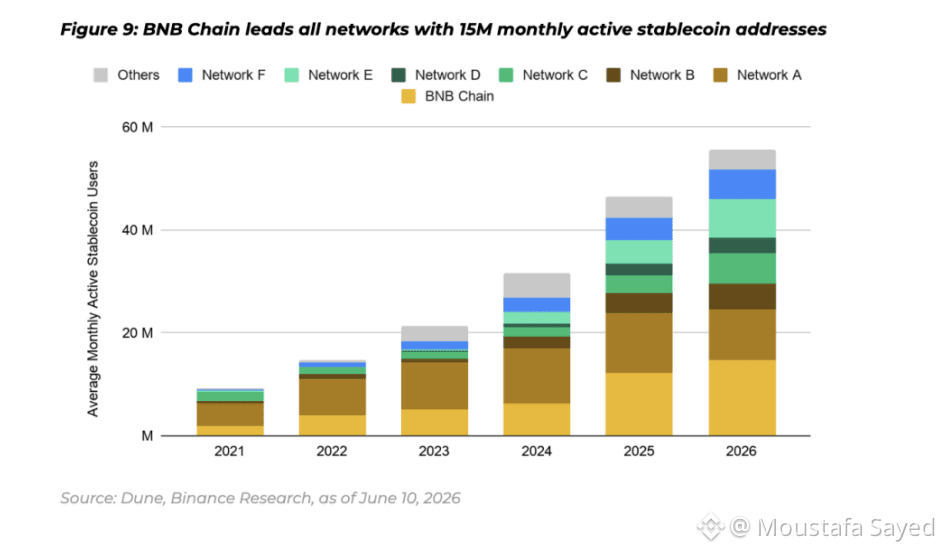
✨According to Binance Research, @BNB_Chain leads all networks in stablecoin transaction activity.
✨
🔸10M daily stablecoin transactions
🔸15M monthly active addresses
🔸24% market share by transaction count
these Numbers Are Reflection Of How Finance future is shaping Up ...The biggest signal isn't just growth.
👏It's real usage.✨
📌Millions of transactions every day show that stablecoins are becoming part of everyday onchain activity.
{spot}(USDCUSDT)
Read the full Binance Research report.💛👇
[Here](https://binance.com/en/research/analysis/stablecoins-transforming-the-financial-landscape?ref=Y1VXX9CE&utm_source=MenaArTelegram&utm_medium=GlobalCommunity&utm_campaign=CommunityPosts)
#StablecoinsReport #StablecoinAdoption #BinanceAngels
🔶@BNB_Chain leads Stablecoin adoption😎ℹ️
Which blockchain is processing the most stablecoin activity today?
ℹ️The answer= might surprise you.🤓
✨According to Binance Research, @BNB_Chain leads all networks in stablecoin transaction activity.
✨
🔸10M daily stablecoin transactions
🔸15M monthly active addresses
🔸24% market share by transaction count
these Numbers Are Reflection Of How Finance future is shaping Up ...The biggest signal isn't just growth.
👏It's real usage.✨
📌Millions of transactions every day show that stablecoins are becoming part of everyday onchain activity.
Read the full Binance Research report.💛👇
Here
#StablecoinsReport #StablecoinAdoption #BinanceAngels
Which blockchain is processing the most stablecoin activity today?
ℹ️The answer= might surprise you.🤓
✨According to Binance Research, @BNB_Chain leads all networks in stablecoin transaction activity.
✨
🔸10M daily stablecoin transactions
🔸15M monthly active addresses
🔸24% market share by transaction count
these Numbers Are Reflection Of How Finance future is shaping Up ...The biggest signal isn't just growth.
👏It's real usage.✨
📌Millions of transactions every day show that stablecoins are becoming part of everyday onchain activity.
Read the full Binance Research report.💛👇
Here
#StablecoinsReport #StablecoinAdoption #BinanceAngels
3
117
·
--
Most traders are focused on BTC charts. Smart money is watching what's happening in countries like Nigeria.
The IMF just flagged Nigeria's stablecoin adoption as a major test for existing monetary and regulatory systems, and warned of digital dollarization risks. This isn't just a regional story; it's a glimpse into the future of money. When a major economy experiences widespread stablecoin use, it forces central banks and governments to react. This pressure cooker environment often leads to regulatory clarity – or crackdowns – which can significantly impact the broader crypto market.
This adoption isn't about speculation; it's about utility. People are using stablecoins for everyday transactions, a sign of deep integration. This real-world demand is a powerful signal that crypto's utility narrative is gaining serious traction, pushing beyond niche adoption.
What this means for price: increased regulatory scrutiny is likely, but also, a precedent is being set. If Nigeria can navigate this, it shows a path forward for other developing economies, potentially unlocking massive new user bases for stablecoins and the broader crypto ecosystem.
Watch the follow-up regulatory statements from Nigeria and other African nations. #StablecoinAdoption #EmergingMarkets #CryptoUtility
How long until major economies face similar stablecoin adoption pressures?
Most traders are focused on BTC charts. Smart money is watching what's happening in countries like Nigeria.
The IMF just flagged Nigeria's stablecoin adoption as a major test for existing monetary and regulatory systems, and warned of digital dollarization risks. This isn't just a regional story; it's a glimpse into the future of money. When a major economy experiences widespread stablecoin use, it forces central banks and governments to react. This pressure cooker environment often leads to regulatory clarity – or crackdowns – which can significantly impact the broader crypto market.
This adoption isn't about speculation; it's about utility. People are using stablecoins for everyday transactions, a sign of deep integration. This real-world demand is a powerful signal that crypto's utility narrative is gaining serious traction, pushing beyond niche adoption.
What this means for price: increased regulatory scrutiny is likely, but also, a precedent is being set. If Nigeria can navigate this, it shows a path forward for other developing economies, potentially unlocking massive new user bases for stablecoins and the broader crypto ecosystem.
Watch the follow-up regulatory statements from Nigeria and other African nations. #StablecoinAdoption #EmergingMarkets #CryptoUtility
How long until major economies face similar stablecoin adoption pressures?
The IMF just flagged Nigeria's stablecoin adoption as a major test for existing monetary and regulatory systems, and warned of digital dollarization risks. This isn't just a regional story; it's a glimpse into the future of money. When a major economy experiences widespread stablecoin use, it forces central banks and governments to react. This pressure cooker environment often leads to regulatory clarity – or crackdowns – which can significantly impact the broader crypto market.
This adoption isn't about speculation; it's about utility. People are using stablecoins for everyday transactions, a sign of deep integration. This real-world demand is a powerful signal that crypto's utility narrative is gaining serious traction, pushing beyond niche adoption.
What this means for price: increased regulatory scrutiny is likely, but also, a precedent is being set. If Nigeria can navigate this, it shows a path forward for other developing economies, potentially unlocking massive new user bases for stablecoins and the broader crypto ecosystem.
Watch the follow-up regulatory statements from Nigeria and other African nations. #StablecoinAdoption #EmergingMarkets #CryptoUtility
How long until major economies face similar stablecoin adoption pressures?
20

Stablecoins now drive 94% of Argentina's crypto volume as users favor digital dollars over the local peso to hedge against economic instability.
#ArgentineMacro #StablecoinAdoption
Stablecoins now drive 94% of Argentina's crypto volume as users favor digital dollars over the local peso to hedge against economic instability.
#ArgentineMacro #StablecoinAdoption
#ArgentineMacro #StablecoinAdoption
1
30

·
--
Bybit integrates into Western Union’s USDPT network, expanding stablecoin reach. Payment providers embrace crypto as liquidity accelerates. #StablecoinAdoption #CryptoPayments
Bybit integrates into Western Union’s USDPT network, expanding stablecoin reach. Payment providers embrace crypto as liquidity accelerates. #StablecoinAdoption #CryptoPayments
82
Log in to explore more content
Join global crypto users on Binance Square
⚡️ Get latest and useful information about crypto.
💬 Trusted by the world’s largest crypto exchange.
👍 Discover real insights from verified creators.
Email / Phone number
Trending Topics
1
#FedRateWatch
831,466 views
3,955 Discussing
2
#BitcoinFalls4%
2,473 views
164 Discussing
3
#SKHynixInTalksToMakeMemoryChipsInUS
166 views
22 Discussing
4
#OpenAIDiscussesNewFundingAt$1.2TValuation
460 views
23 Discussing
5
#ArgentinaCommitsToOECDCryptoReportingBy2029
6,823 views
209 Discussing
6
#EthereumFallsBelow$2400
3,687 views
78 Discussing
7
#USDTLaunchesOnZamaPrivacyProtocol
2,939 views
120 Discussing
8
#USSenateBlocksClarityAct
26,938 views
368 Discussing
9
#BitcoinSlidesTo$76000
36,714 views
162 Discussing
10
#BitcoinReboundsTo$79K
67,866 views
437 Discussing