

#solanastakingnearshaltonroutingerror
solanastakingnearshaltonroutingerror
38,310 views
334 Discussing
Hot
Latest

·
--
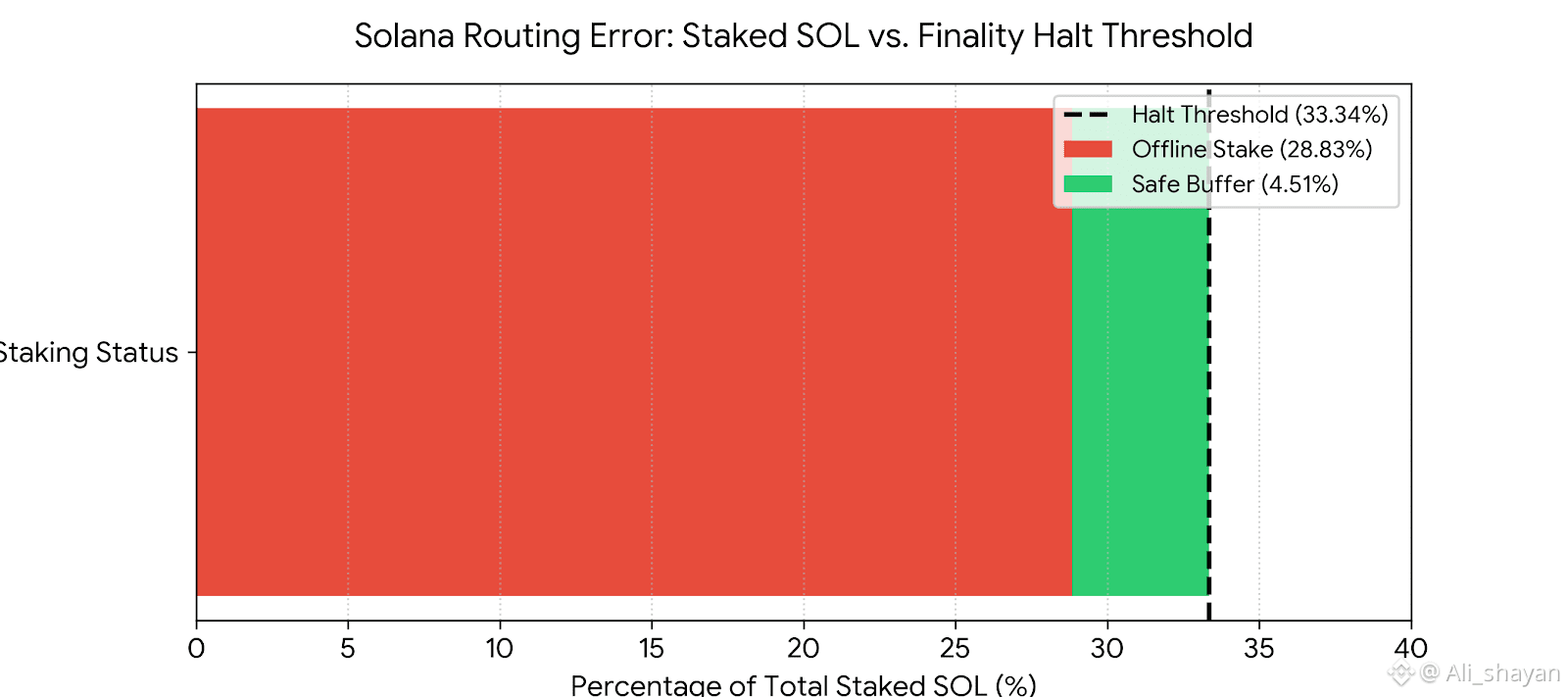
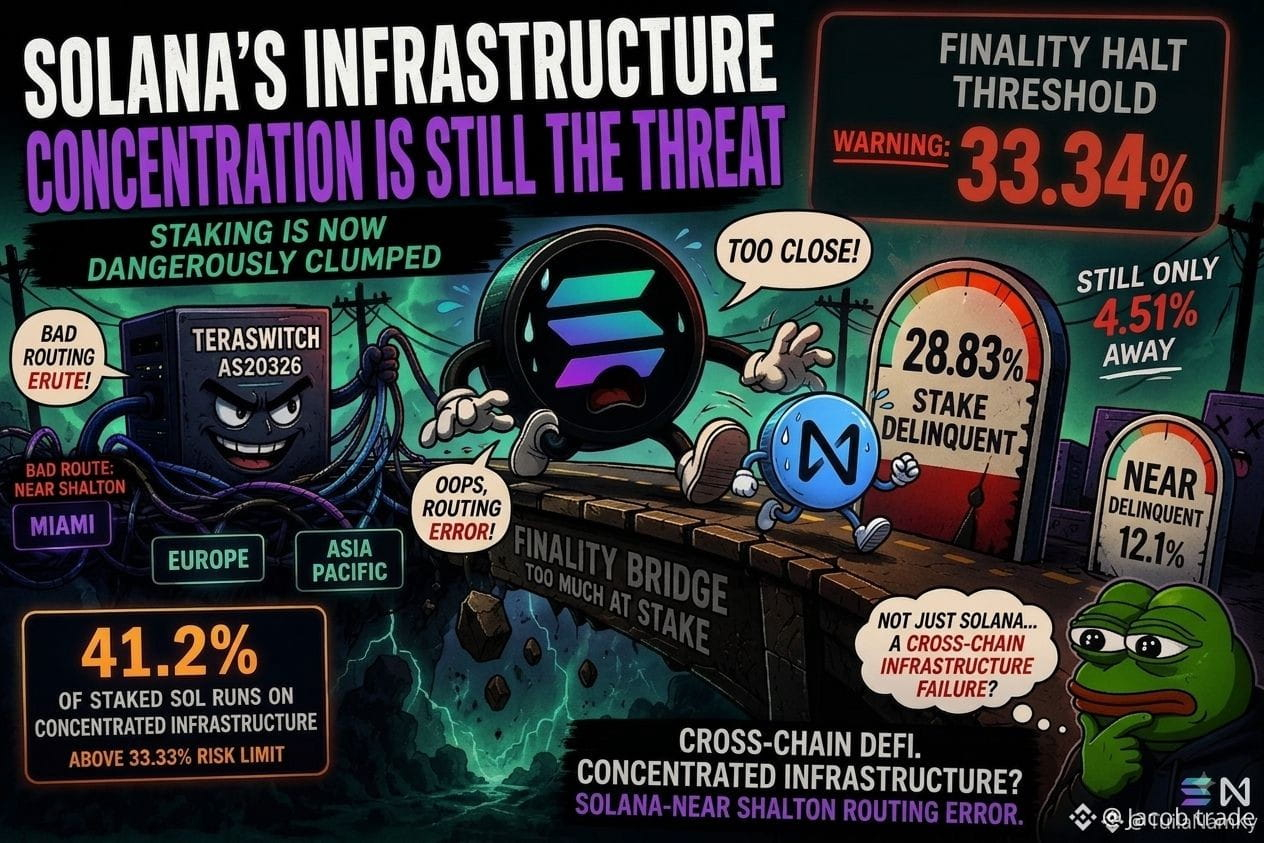
#solanastakingnearshaltonroutingerror A big network problem recently hit Solana. A routing error by an infrastructure provider named Teraswitch caused about 28.8% of all staked SOL to go offline. This sudden drop brought the network very close to the 33.3% danger limit that would completely freeze Solana transactions. Thankfully, engineers fixed the network issue within ten minutes and full service returned shortly after, proving once again that validators need to use different hosting providers to stay safe.
CLICK BELOW TO TRADE : $BTC $APR $SOL
{future}(SOLUSDT)
{alpha}(560x299ad4299da5b2b93fba4c96967b040c7f611099)
{future}(BTCUSDT)
#solanastakingnearshaltonroutingerror A big network problem recently hit Solana. A routing error by an infrastructure provider named Teraswitch caused about 28.8% of all staked SOL to go offline. This sudden drop brought the network very close to the 33.3% danger limit that would completely freeze Solana transactions. Thankfully, engineers fixed the network issue within ten minutes and full service returned shortly after, proving once again that validators need to use different hosting providers to stay safe.
CLICK BELOW TO TRADE : $BTC $APR $SOL
CLICK BELOW TO TRADE : $BTC $APR $SOL
15

·
--
Bullish
#SolanaStakingNearsHaltOnRoutingError
Solana was on the verge of reaching the network suspension threshold after 28.83% of the SOL staked were disconnected.
The incident brought the Solana network close to the 33.34% threshold, beyond which transaction finalization could be interrupted.
The network recovered without reaching that level; the event has reignited interest in validator infrastructure, network centralization, and the resilience of the Solana blockchain.
$NVDAB
{spot}(NVDABUSDT)
$SOL
{spot}(SOLUSDT)
$GOOGL.US
{stock_us}(GOOGL.US)
#SolanaStakingNearsHaltOnRoutingError
Solana was on the verge of reaching the network suspension threshold after 28.83% of the SOL staked were disconnected.
The incident brought the Solana network close to the 33.34% threshold, beyond which transaction finalization could be interrupted.
The network recovered without reaching that level; the event has reignited interest in validator infrastructure, network centralization, and the resilience of the Solana blockchain.
$NVDAB
$SOL
$GOOGL.US
Solana was on the verge of reaching the network suspension threshold after 28.83% of the SOL staked were disconnected.
The incident brought the Solana network close to the 33.34% threshold, beyond which transaction finalization could be interrupted.
The network recovered without reaching that level; the event has reignited interest in validator infrastructure, network centralization, and the resilience of the Solana blockchain.
$NVDAB
$SOL
$GOOGL.US

1
1
261

·
--
Bearish
#solanastakingnearshaltonroutingerror
🚨 SOLANA NEARLY HIT A FINALITY RISK! ⚠️
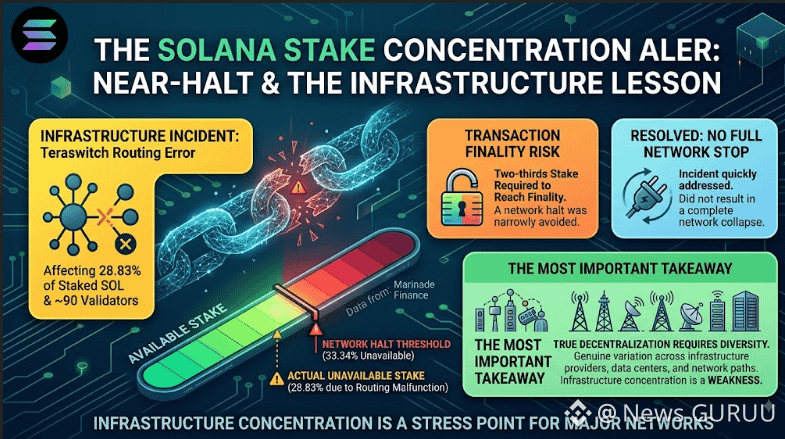
A routing issue at infrastructure provider Teraswitch briefly took ~28.8% of staked SOL offline, affecting around 90 validators. Solana continued operating, but the incident came close to the 33.34% threshold that could threaten transaction finality.
📌 Key takeaway: Validator count alone isn’t enough. Infrastructure and network-path diversity are critical for true decentralization.
🎯 TRADING VIEW: SELL 📉
Short-term risk remains elevated until infrastructure stability is confirmed. Avoid aggressive leverage and watch SOL’s reaction closely.
❓ Does this change your view on SOL? "CLICK ON THE BELOW YELLOW COIN TAG TO GO TO DESIRED TRADING PAGE TO GET BENEFIT TRADE"$SOL
{spot}(SOLUSDT)
#sol #SamsungSKHynixLeadSeoulRally
#solanastakingnearshaltonroutingerror
🚨 SOLANA NEARLY HIT A FINALITY RISK! ⚠️
A routing issue at infrastructure provider Teraswitch briefly took ~28.8% of staked SOL offline, affecting around 90 validators. Solana continued operating, but the incident came close to the 33.34% threshold that could threaten transaction finality.
📌 Key takeaway: Validator count alone isn’t enough. Infrastructure and network-path diversity are critical for true decentralization.
🎯 TRADING VIEW: SELL 📉
Short-term risk remains elevated until infrastructure stability is confirmed. Avoid aggressive leverage and watch SOL’s reaction closely.
❓ Does this change your view on SOL? "CLICK ON THE BELOW YELLOW COIN TAG TO GO TO DESIRED TRADING PAGE TO GET BENEFIT TRADE"$SOL
#sol #SamsungSKHynixLeadSeoulRally
🚨 SOLANA NEARLY HIT A FINALITY RISK! ⚠️
A routing issue at infrastructure provider Teraswitch briefly took ~28.8% of staked SOL offline, affecting around 90 validators. Solana continued operating, but the incident came close to the 33.34% threshold that could threaten transaction finality.
📌 Key takeaway: Validator count alone isn’t enough. Infrastructure and network-path diversity are critical for true decentralization.
🎯 TRADING VIEW: SELL 📉
Short-term risk remains elevated until infrastructure stability is confirmed. Avoid aggressive leverage and watch SOL’s reaction closely.
❓ Does this change your view on SOL? "CLICK ON THE BELOW YELLOW COIN TAG TO GO TO DESIRED TRADING PAGE TO GET BENEFIT TRADE"$SOL
#sol #SamsungSKHynixLeadSeoulRally
2
322

#SolanaStakingNearsHaltOnRoutingError
🚨 Solana Staking Nearly Hit a Halt!
A major routing issue pushed a significant portion of Solana’s staked SOL offline, bringing the network close to its finality-halt threshold. ⚠️
The network kept running, but the incident highlights the importance of validator and infrastructure resilience.
#SolanaStakingNearsHaltOnRoutingError #Solana #SOL
#SolanaStakingNearsHaltOnRoutingError
🚨 Solana Staking Nearly Hit a Halt!
A major routing issue pushed a significant portion of Solana’s staked SOL offline, bringing the network close to its finality-halt threshold. ⚠️
The network kept running, but the incident highlights the importance of validator and infrastructure resilience.
#SolanaStakingNearsHaltOnRoutingError #Solana #SOL
🚨 Solana Staking Nearly Hit a Halt!
A major routing issue pushed a significant portion of Solana’s staked SOL offline, bringing the network close to its finality-halt threshold. ⚠️
The network kept running, but the incident highlights the importance of validator and infrastructure resilience.
#SolanaStakingNearsHaltOnRoutingError #Solana #SOL
133


·
--
Verified
#SolanaStakingNearsHaltOnRoutingError
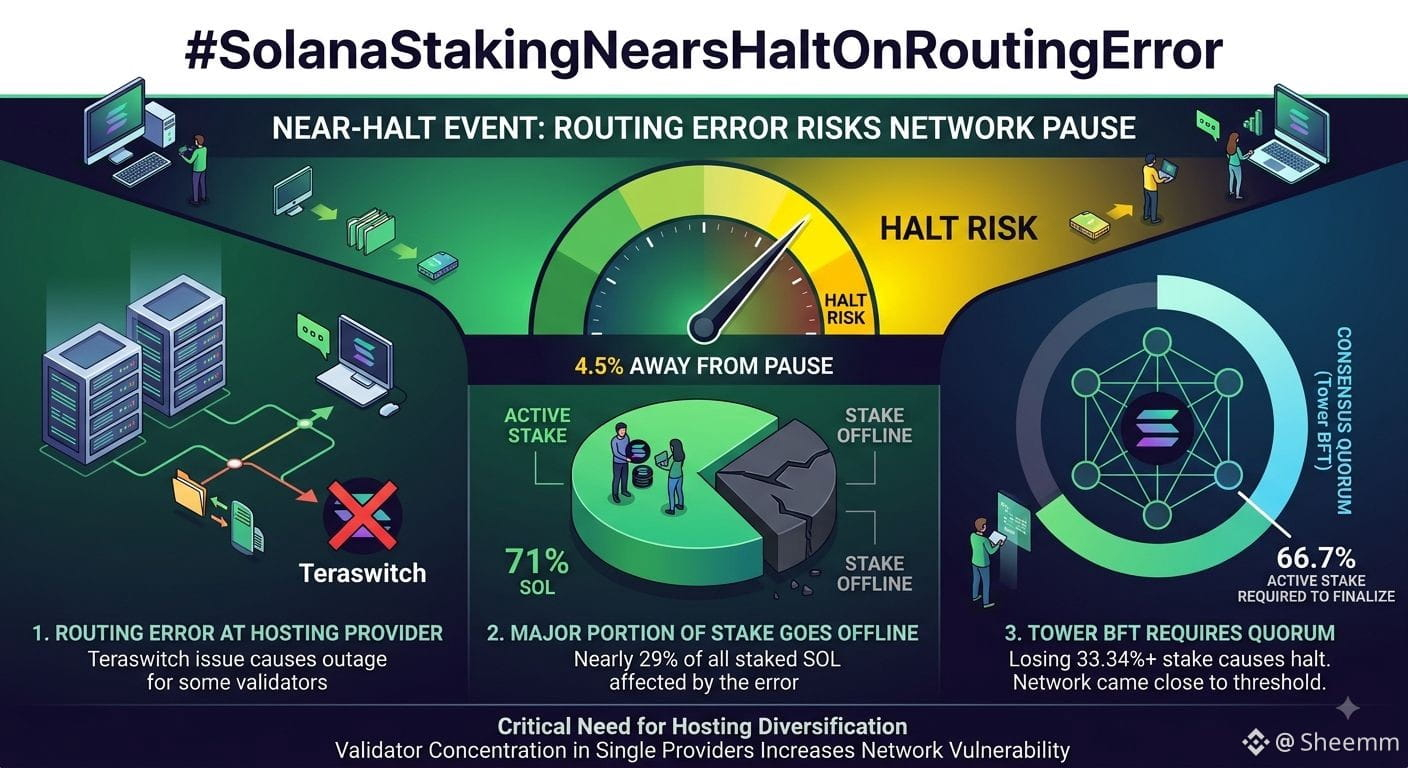
A major network disruption almost brought Solana's transaction finality to a standstill.
A severe routing error at hosting provider Teraswitch sent nearly 29% of all staked SOL dark in minutes.
Because Tower BFT consensus requires ~66.7% active stake to finalize blocks, losing just 33.34% triggers a halt.
The network was only 4.5% away from a full pause before routing was fixed.
This near-miss highlights critical validator concentration risks across hosting infrastructure.
$B $RE $C
#BinanceSquareFamily ❣️
#SolanaStakingNearsHaltOnRoutingError
A major network disruption almost brought Solana's transaction finality to a standstill.
A severe routing error at hosting provider Teraswitch sent nearly 29% of all staked SOL dark in minutes.
Because Tower BFT consensus requires ~66.7% active stake to finalize blocks, losing just 33.34% triggers a halt.
The network was only 4.5% away from a full pause before routing was fixed.
This near-miss highlights critical validator concentration risks across hosting infrastructure.
$B $RE $C
#BinanceSquareFamily ❣️
A major network disruption almost brought Solana's transaction finality to a standstill.
A severe routing error at hosting provider Teraswitch sent nearly 29% of all staked SOL dark in minutes.
Because Tower BFT consensus requires ~66.7% active stake to finalize blocks, losing just 33.34% triggers a halt.
The network was only 4.5% away from a full pause before routing was fixed.
This near-miss highlights critical validator concentration risks across hosting infrastructure.
$B $RE $C
#BinanceSquareFamily ❣️
4
874

·
--
Bearish
Verified
Solana is close to a halt… due to a routing error
Solana (SOL) network experienced a notable incident after a routing malfunction at the infrastructure provider Teraswitch caused roughly 28.83% of the staked SOL to go offline, according to data from Marinade Finance.
What’s more concerning is that Solana needs to have more than two-thirds of its Stake available to reach transaction finality (Finality). If the unavailable Stake percentage had exceeded 33.34%, the network could have stopped finalizing transaction confirmations. In other words, the incident was only about 4.5 percentage points away from that threshold.
📌 The incident affected around 90 validators, but it did not turn into a full network stop, and the routing issue was addressed quickly.
The most important takeaway?
Decentralization isn’t just having a large number of validators; it also requires genuine diversity across infrastructure providers, data centers, and network paths.
This incident doesn’t mean Solana collapsed, but it’s an important reminder that infrastructure concentration can become a weakness even for major networks.
{future}(SOLUSDT)
#SolanaStakingNearsHaltOnRoutingError
Solana is close to a halt… due to a routing error
Solana (SOL) network experienced a notable incident after a routing malfunction at the infrastructure provider Teraswitch caused roughly 28.83% of the staked SOL to go offline, according to data from Marinade Finance.
What’s more concerning is that Solana needs to have more than two-thirds of its Stake available to reach transaction finality (Finality). If the unavailable Stake percentage had exceeded 33.34%, the network could have stopped finalizing transaction confirmations. In other words, the incident was only about 4.5 percentage points away from that threshold.
📌 The incident affected around 90 validators, but it did not turn into a full network stop, and the routing issue was addressed quickly.
The most important takeaway?
Decentralization isn’t just having a large number of validators; it also requires genuine diversity across infrastructure providers, data centers, and network paths.
This incident doesn’t mean Solana collapsed, but it’s an important reminder that infrastructure concentration can become a weakness even for major networks.
#SolanaStakingNearsHaltOnRoutingError
Solana (SOL) network experienced a notable incident after a routing malfunction at the infrastructure provider Teraswitch caused roughly 28.83% of the staked SOL to go offline, according to data from Marinade Finance.
What’s more concerning is that Solana needs to have more than two-thirds of its Stake available to reach transaction finality (Finality). If the unavailable Stake percentage had exceeded 33.34%, the network could have stopped finalizing transaction confirmations. In other words, the incident was only about 4.5 percentage points away from that threshold.
📌 The incident affected around 90 validators, but it did not turn into a full network stop, and the routing issue was addressed quickly.
The most important takeaway?
Decentralization isn’t just having a large number of validators; it also requires genuine diversity across infrastructure providers, data centers, and network paths.
This incident doesn’t mean Solana collapsed, but it’s an important reminder that infrastructure concentration can become a weakness even for major networks.
#SolanaStakingNearsHaltOnRoutingError

5
4.5k

·
--
Verified
#solanastakingnearshaltonroutingerror 🚨
PSA: An update regarding the routing incident of yesterday that affected a subset of Solana validators. Sanctum's validator was not affected. We do not use Teraswitch, the hosting provider whose routing fault caused the loss of connectivity across EU and APAC sites, and our node continued voting throughout the incident window.$SOL $HMSTR $DODO
#solanastakingnearshaltonroutingerror 🚨
PSA: An update regarding the routing incident of yesterday that affected a subset of Solana validators. Sanctum's validator was not affected. We do not use Teraswitch, the hosting provider whose routing fault caused the loss of connectivity across EU and APAC sites, and our node continued voting throughout the incident window.$SOL $HMSTR $DODO
PSA: An update regarding the routing incident of yesterday that affected a subset of Solana validators. Sanctum's validator was not affected. We do not use Teraswitch, the hosting provider whose routing fault caused the loss of connectivity across EU and APAC sites, and our node continued voting throughout the incident window.$SOL $HMSTR $DODO
574
·
--
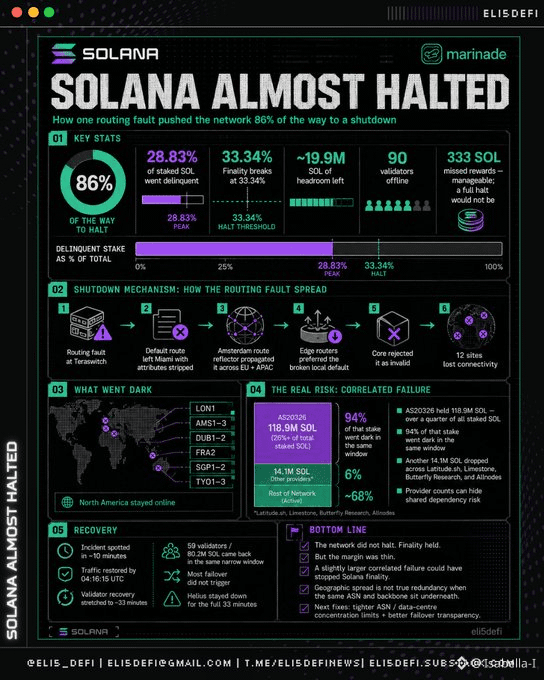
#solanastakingnearshaltonroutingerror Many didn't realize this.
@Solana_Official
came within striking distance of a halt yesterday morning, about 86% of the way there, and it barely registered.
28.83% of staked
$SOL
went delinquent. At 33.34%, finality flatlines.
The trigger was a
routing screw up at
.
A default route slipped out of their Miami site with its attributes wiped. An Amsterdam route reflector then amplified the bad route across every EU and APAC site. Edge routers accepted it as “their” local default and prioritized it. The underlying core refused it as invalid.
Result: twelve sites effectively vanished, London, Amsterdam, Dublin, Frankfurt, Singapore, Tokyo among them. North America didn’t even notice.
Root cause identified in ~10 minutes. Traffic returned by 04:16:15 UTC. Validator recovery took roughly 33 minutes end to end.
Solana’s last true full halt was Feb 2024 and needed five hours to bring back. Yesterday it stayed on the right side of the cliff by a few percentage points, and a few million SOL.$CRV $AVA
#solanastakingnearshaltonroutingerror Many didn't realize this.
@Solana Official
came within striking distance of a halt yesterday morning, about 86% of the way there, and it barely registered.
28.83% of staked
$SOL
went delinquent. At 33.34%, finality flatlines.
The trigger was a
routing screw up at
.
A default route slipped out of their Miami site with its attributes wiped. An Amsterdam route reflector then amplified the bad route across every EU and APAC site. Edge routers accepted it as “their” local default and prioritized it. The underlying core refused it as invalid.
Result: twelve sites effectively vanished, London, Amsterdam, Dublin, Frankfurt, Singapore, Tokyo among them. North America didn’t even notice.
Root cause identified in ~10 minutes. Traffic returned by 04:16:15 UTC. Validator recovery took roughly 33 minutes end to end.
Solana’s last true full halt was Feb 2024 and needed five hours to bring back. Yesterday it stayed on the right side of the cliff by a few percentage points, and a few million SOL.$CRV $AVA
@Solana Official
came within striking distance of a halt yesterday morning, about 86% of the way there, and it barely registered.
28.83% of staked
$SOL
went delinquent. At 33.34%, finality flatlines.
The trigger was a
routing screw up at
.
A default route slipped out of their Miami site with its attributes wiped. An Amsterdam route reflector then amplified the bad route across every EU and APAC site. Edge routers accepted it as “their” local default and prioritized it. The underlying core refused it as invalid.
Result: twelve sites effectively vanished, London, Amsterdam, Dublin, Frankfurt, Singapore, Tokyo among them. North America didn’t even notice.
Root cause identified in ~10 minutes. Traffic returned by 04:16:15 UTC. Validator recovery took roughly 33 minutes end to end.
Solana’s last true full halt was Feb 2024 and needed five hours to bring back. Yesterday it stayed on the right side of the cliff by a few percentage points, and a few million SOL.$CRV $AVA
28
·
--
Bearish
Verified
#solanastakingnearshaltonroutingerror
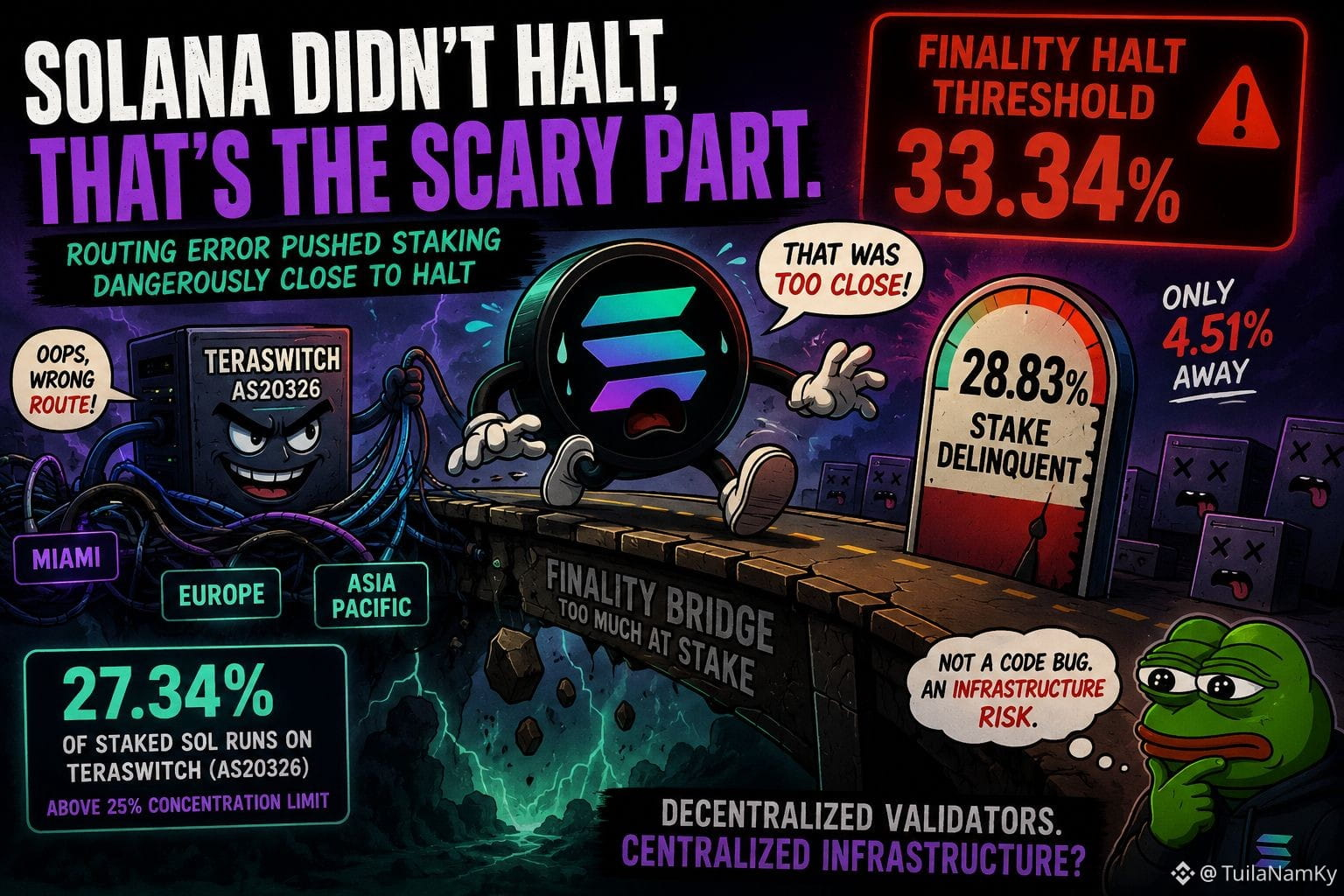
SOLANA DIDN’T HALT — THAT’S THE SCARY PART.
$SOL kept producing blocks. Traders barely noticed. But on Aug. 12, a routing failure at Teraswitch pushed Solana dangerously close to the point where transactions could stop reaching finality.
The numbers tell the story:
28.83% of staked SOL became delinquent.
33.34% is the critical threshold.
Only 4.51 percentage points separated the network from a finality halt.
The incident lasted roughly 33 minutes.
Then comes the twist: this wasn’t a Solana code exploit.
It was infrastructure.
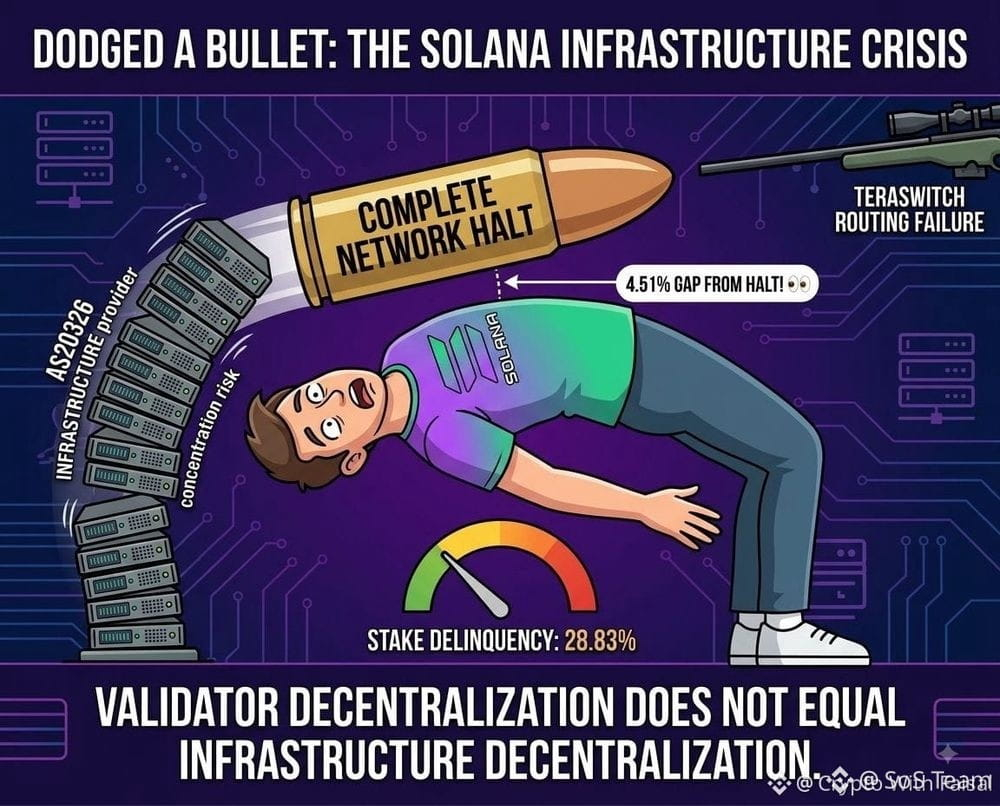
One routing error at Teraswitch cascaded across multiple locations, taking a huge amount of validator stake offline at once. Its AS20326 alone represented roughly 27.34% of Solana’s staked SOL — above the 25% concentration limit designed to reduce this exact type of risk.
That exposes a deeper weakness:
Validator decentralization ≠ infrastructure decentralization.
You can have hundreds of validators, multiple clients and a highly decentralized network — yet still approach a consensus crisis if too much stake depends on infrastructure that can fail together.
The market may have ignored this because nothing actually broke.
But perhaps that’s the lesson.
The biggest threats aren’t always the ones that cause a halt.
They’re the ones that show how close you were to one.
So the real question is:
Is Solana’s next decentralization challenge not its validators — but the infrastructure underneath them?
#SolanaStakingNearsHaltOnRoutingError
#SOL
{future}(SOLUSDT)
#solanastakingnearshaltonroutingerror
SOLANA DIDN’T HALT — THAT’S THE SCARY PART.
$SOL kept producing blocks. Traders barely noticed. But on Aug. 12, a routing failure at Teraswitch pushed Solana dangerously close to the point where transactions could stop reaching finality.
The numbers tell the story:
28.83% of staked SOL became delinquent.
33.34% is the critical threshold.
Only 4.51 percentage points separated the network from a finality halt.
The incident lasted roughly 33 minutes.
Then comes the twist: this wasn’t a Solana code exploit.
It was infrastructure.
One routing error at Teraswitch cascaded across multiple locations, taking a huge amount of validator stake offline at once. Its AS20326 alone represented roughly 27.34% of Solana’s staked SOL — above the 25% concentration limit designed to reduce this exact type of risk.
That exposes a deeper weakness:
Validator decentralization ≠ infrastructure decentralization.
You can have hundreds of validators, multiple clients and a highly decentralized network — yet still approach a consensus crisis if too much stake depends on infrastructure that can fail together.
The market may have ignored this because nothing actually broke.
But perhaps that’s the lesson.
The biggest threats aren’t always the ones that cause a halt.
They’re the ones that show how close you were to one.
So the real question is:
Is Solana’s next decentralization challenge not its validators — but the infrastructure underneath them?
#SolanaStakingNearsHaltOnRoutingError
#SOL
SOLANA DIDN’T HALT — THAT’S THE SCARY PART.
$SOL kept producing blocks. Traders barely noticed. But on Aug. 12, a routing failure at Teraswitch pushed Solana dangerously close to the point where transactions could stop reaching finality.
The numbers tell the story:
28.83% of staked SOL became delinquent.
33.34% is the critical threshold.
Only 4.51 percentage points separated the network from a finality halt.
The incident lasted roughly 33 minutes.
Then comes the twist: this wasn’t a Solana code exploit.
It was infrastructure.
One routing error at Teraswitch cascaded across multiple locations, taking a huge amount of validator stake offline at once. Its AS20326 alone represented roughly 27.34% of Solana’s staked SOL — above the 25% concentration limit designed to reduce this exact type of risk.
That exposes a deeper weakness:
Validator decentralization ≠ infrastructure decentralization.
You can have hundreds of validators, multiple clients and a highly decentralized network — yet still approach a consensus crisis if too much stake depends on infrastructure that can fail together.
The market may have ignored this because nothing actually broke.
But perhaps that’s the lesson.
The biggest threats aren’t always the ones that cause a halt.
They’re the ones that show how close you were to one.
So the real question is:
Is Solana’s next decentralization challenge not its validators — but the infrastructure underneath them?
#SolanaStakingNearsHaltOnRoutingError
#SOL
1
4
10.4k

·
--
Verified
Article
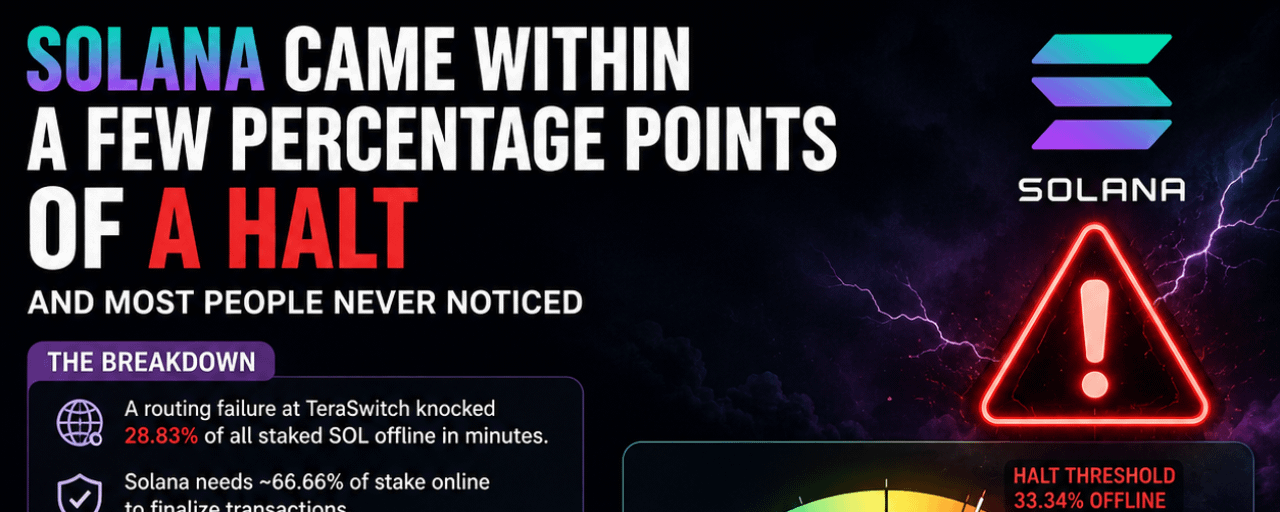
Solana Came Within a Few Percentage Points of a Halt — And Most People Never Noticed#solanastakingnearshaltonroutingerror
Sometimes the scariest moments for a blockchain aren't the ones that make headlines in real time — they're the ones reconstructed afterward.
The breakdown: On Wednesday, a routing failure at TeraSwitch, a hosting provider widely used by Solana validators, knocked 28.83% of all staked SOL offline within minutes. Solana's consensus mechanism requires roughly two-thirds of staked SOL actively participating to finalize transactions — meaning if more than 33.34% goes offline, the network can keep producing blocks but loses the ability to confirm them as final. Wednesday's incident pushed the network to about 86% of the way to that threshold, roughly 4.5 percentage points from the edge. According to staking platform Marinade Finance, which reconstructed the event, the fault traced back to a malformed default route out of TeraSwitch's Miami facility that propagated through an internal relay, cutting off connectivity at 12 data center locations across Europe and Asia-Pacific, including London, Frankfurt, Singapore, and Tokyo. Around 90 validators were affected, and the network recovered within about 33 minutes.
Why it matters: The incident surfaced a concentration risk sitting beneath Solana's protocol layer: a single autonomous system reportedly hosts more than a quarter of all staked SOL, exceeding the Solana Foundation's own recommended 25% cap per network provider, and roughly 94% of that stake went dark at the same time. It's a reminder that decentralization at the validator level doesn't automatically translate into decentralization at the physical infrastructure level — routing, hosting, and network paths can still create single points of failure. It also highlights a distinction worth understanding: Solana didn't actually halt, and its last full block-production outage dates back to February 2024, but "still producing blocks" and "finalizing transactions" aren't quite the same guarantee.
Closing thought: With one hosting provider able to push the network this close to its threshold, does this incident drive real diversification of validator infrastructure going forward — or does the conversation fade once the headlines do?
$TUT
$EDEN
$SOL
{future}(SOLUSDT)
{future}(EDENUSDT)
{future}(TUTUSDT)
Solana Came Within a Few Percentage Points of a Halt — And Most People Never Noticed
#solanastakingnearshaltonroutingerror
Sometimes the scariest moments for a blockchain aren't the ones that make headlines in real time — they're the ones reconstructed afterward.
The breakdown: On Wednesday, a routing failure at TeraSwitch, a hosting provider widely used by Solana validators, knocked 28.83% of all staked SOL offline within minutes. Solana's consensus mechanism requires roughly two-thirds of staked SOL actively participating to finalize transactions — meaning if more than 33.34% goes offline, the network can keep producing blocks but loses the ability to confirm them as final. Wednesday's incident pushed the network to about 86% of the way to that threshold, roughly 4.5 percentage points from the edge. According to staking platform Marinade Finance, which reconstructed the event, the fault traced back to a malformed default route out of TeraSwitch's Miami facility that propagated through an internal relay, cutting off connectivity at 12 data center locations across Europe and Asia-Pacific, including London, Frankfurt, Singapore, and Tokyo. Around 90 validators were affected, and the network recovered within about 33 minutes.
Why it matters: The incident surfaced a concentration risk sitting beneath Solana's protocol layer: a single autonomous system reportedly hosts more than a quarter of all staked SOL, exceeding the Solana Foundation's own recommended 25% cap per network provider, and roughly 94% of that stake went dark at the same time. It's a reminder that decentralization at the validator level doesn't automatically translate into decentralization at the physical infrastructure level — routing, hosting, and network paths can still create single points of failure. It also highlights a distinction worth understanding: Solana didn't actually halt, and its last full block-production outage dates back to February 2024, but "still producing blocks" and "finalizing transactions" aren't quite the same guarantee.
Closing thought: With one hosting provider able to push the network this close to its threshold, does this incident drive real diversification of validator infrastructure going forward — or does the conversation fade once the headlines do?
$TUT
$EDEN
$SOL
Sometimes the scariest moments for a blockchain aren't the ones that make headlines in real time — they're the ones reconstructed afterward.
The breakdown: On Wednesday, a routing failure at TeraSwitch, a hosting provider widely used by Solana validators, knocked 28.83% of all staked SOL offline within minutes. Solana's consensus mechanism requires roughly two-thirds of staked SOL actively participating to finalize transactions — meaning if more than 33.34% goes offline, the network can keep producing blocks but loses the ability to confirm them as final. Wednesday's incident pushed the network to about 86% of the way to that threshold, roughly 4.5 percentage points from the edge. According to staking platform Marinade Finance, which reconstructed the event, the fault traced back to a malformed default route out of TeraSwitch's Miami facility that propagated through an internal relay, cutting off connectivity at 12 data center locations across Europe and Asia-Pacific, including London, Frankfurt, Singapore, and Tokyo. Around 90 validators were affected, and the network recovered within about 33 minutes.
Why it matters: The incident surfaced a concentration risk sitting beneath Solana's protocol layer: a single autonomous system reportedly hosts more than a quarter of all staked SOL, exceeding the Solana Foundation's own recommended 25% cap per network provider, and roughly 94% of that stake went dark at the same time. It's a reminder that decentralization at the validator level doesn't automatically translate into decentralization at the physical infrastructure level — routing, hosting, and network paths can still create single points of failure. It also highlights a distinction worth understanding: Solana didn't actually halt, and its last full block-production outage dates back to February 2024, but "still producing blocks" and "finalizing transactions" aren't quite the same guarantee.
Closing thought: With one hosting provider able to push the network this close to its threshold, does this incident drive real diversification of validator infrastructure going forward — or does the conversation fade once the headlines do?
$TUT
$EDEN
$SOL
2
8
5.5k

#SolanaStakingNearsHaltOnRoutingError Writing
Solana Staking Nears Halt On Routing Error
The Solana network narrowly avoided a transaction finality halt after a routing failure at infrastructure provider Teraswitch caused a large portion of staked SOL to go offline simultaneously. At the peak of the disruption, approximately 28.83% of Solana's staked tokens became inactive, approaching the critical 33.34% threshold at which the network would no longer be able to finalize transactions.
#SolanaStakingNearsHaltOnRoutingError Writing
Solana Staking Nears Halt On Routing Error
The Solana network narrowly avoided a transaction finality halt after a routing failure at infrastructure provider Teraswitch caused a large portion of staked SOL to go offline simultaneously. At the peak of the disruption, approximately 28.83% of Solana's staked tokens became inactive, approaching the critical 33.34% threshold at which the network would no longer be able to finalize transactions.
Solana Staking Nears Halt On Routing Error
The Solana network narrowly avoided a transaction finality halt after a routing failure at infrastructure provider Teraswitch caused a large portion of staked SOL to go offline simultaneously. At the peak of the disruption, approximately 28.83% of Solana's staked tokens became inactive, approaching the critical 33.34% threshold at which the network would no longer be able to finalize transactions.
2
12

·
--
🚨 FATAL ERROR: THE SOLANA-STAKING-NEAR-SHALTON-ROUTING-ERROR BUG IS NUKING YOUR TRANSACTIONS!
LISTEN UP! 💥
If you’re trying to move liquidity, stake your SOL, or route NEAR across networks right now and your screen just slapped you with:
👉#Solanastakingnearshaltonroutingerror 👈
STOP. DO NOT REPEAT THE TRANSACTION. DO NOT PANIC SELL. 🛑
Here is the RAW TRUTH about what’s happening behind the scenes, why your node failed, and how to fix it BEFORE your funds get trapped in mempool limbo! 👇🔥
⚡ WHAT THE HELL JUST HAPPENED?
Let’s break it down at WARP SPEED:
The Bridge Got Twisted: You tried routing cross-chain or through a specialized RPC endpoint (Shalton/Custom Node routing).
The Handshake Failed: Solana’s PoH (Proof of History) and NEAR’s Nightshade sharding spoke two completely different languages at the exact microsecond of your call.
The Buffer Overflow: The Shalton routing layer couldn't resolve the gas/stake delegation parameter → BOOM! System aborted. 💥
⚠️ NO, YOUR FUNDS ARE NOT GONE. But if you keep spamming the transaction, you WILL burn SOL/NEAR on failed gas fees!
🛠️ THE 30-SECOND EMERGENCY FIX
Follow these exact steps RIGHT NOW:
STEP 1: PURGE THE MEMORY
Clear your wallet cache (Phantom / Backpack / Meteor) and disconnect from the dApp immediately.
STEP 2: SWITCH THE RPC NODE
Your current routing path (Shalton endpoint) is congested or dropped the payload. Switch your wallet settings from Default/Shalton to a Public / Alchemy / QuickNode RPC.
STEP 3: SLIPPAGE & GAS ADJUSTMENT
Bump your priority fee up by 0.001 SOL and set slippage to 1.5% - 2%.
🔥 PRO TIP FOR CHADS ONLY
Never route complex cross-chain staking maneuvers during high-volatility spikes without checking network status first.
Solana Status: GREEN 🟢
NEAR Shard Status: GREEN
Shalton Relay: DROPPING PACKETS 🔴 (Switch node NOW!)
🔁 RETWEET & SHARE THIS WITH YOUR DEFI SQUAD BEFORE THEY LOSE THEIR GAS FEES TO THE VOID!
$SOL
$AKE
$COTI
🚨 FATAL ERROR: THE SOLANA-STAKING-NEAR-SHALTON-ROUTING-ERROR BUG IS NUKING YOUR TRANSACTIONS!
LISTEN UP! 💥
If you’re trying to move liquidity, stake your SOL, or route NEAR across networks right now and your screen just slapped you with:
👉#Solanastakingnearshaltonroutingerror 👈
STOP. DO NOT REPEAT THE TRANSACTION. DO NOT PANIC SELL. 🛑
Here is the RAW TRUTH about what’s happening behind the scenes, why your node failed, and how to fix it BEFORE your funds get trapped in mempool limbo! 👇🔥
⚡ WHAT THE HELL JUST HAPPENED?
Let’s break it down at WARP SPEED:
The Bridge Got Twisted: You tried routing cross-chain or through a specialized RPC endpoint (Shalton/Custom Node routing).
The Handshake Failed: Solana’s PoH (Proof of History) and NEAR’s Nightshade sharding spoke two completely different languages at the exact microsecond of your call.
The Buffer Overflow: The Shalton routing layer couldn't resolve the gas/stake delegation parameter → BOOM! System aborted. 💥
⚠️ NO, YOUR FUNDS ARE NOT GONE. But if you keep spamming the transaction, you WILL burn SOL/NEAR on failed gas fees!
🛠️ THE 30-SECOND EMERGENCY FIX
Follow these exact steps RIGHT NOW:
STEP 1: PURGE THE MEMORY
Clear your wallet cache (Phantom / Backpack / Meteor) and disconnect from the dApp immediately.
STEP 2: SWITCH THE RPC NODE
Your current routing path (Shalton endpoint) is congested or dropped the payload. Switch your wallet settings from Default/Shalton to a Public / Alchemy / QuickNode RPC.
STEP 3: SLIPPAGE & GAS ADJUSTMENT
Bump your priority fee up by 0.001 SOL and set slippage to 1.5% - 2%.
🔥 PRO TIP FOR CHADS ONLY
Never route complex cross-chain staking maneuvers during high-volatility spikes without checking network status first.
Solana Status: GREEN 🟢
NEAR Shard Status: GREEN
Shalton Relay: DROPPING PACKETS 🔴 (Switch node NOW!)
🔁 RETWEET & SHARE THIS WITH YOUR DEFI SQUAD BEFORE THEY LOSE THEIR GAS FEES TO THE VOID!
$SOL
$AKE
$COTI
LISTEN UP! 💥
If you’re trying to move liquidity, stake your SOL, or route NEAR across networks right now and your screen just slapped you with:
👉#Solanastakingnearshaltonroutingerror 👈
STOP. DO NOT REPEAT THE TRANSACTION. DO NOT PANIC SELL. 🛑
Here is the RAW TRUTH about what’s happening behind the scenes, why your node failed, and how to fix it BEFORE your funds get trapped in mempool limbo! 👇🔥
⚡ WHAT THE HELL JUST HAPPENED?
Let’s break it down at WARP SPEED:
The Bridge Got Twisted: You tried routing cross-chain or through a specialized RPC endpoint (Shalton/Custom Node routing).
The Handshake Failed: Solana’s PoH (Proof of History) and NEAR’s Nightshade sharding spoke two completely different languages at the exact microsecond of your call.
The Buffer Overflow: The Shalton routing layer couldn't resolve the gas/stake delegation parameter → BOOM! System aborted. 💥
⚠️ NO, YOUR FUNDS ARE NOT GONE. But if you keep spamming the transaction, you WILL burn SOL/NEAR on failed gas fees!
🛠️ THE 30-SECOND EMERGENCY FIX
Follow these exact steps RIGHT NOW:
STEP 1: PURGE THE MEMORY
Clear your wallet cache (Phantom / Backpack / Meteor) and disconnect from the dApp immediately.
STEP 2: SWITCH THE RPC NODE
Your current routing path (Shalton endpoint) is congested or dropped the payload. Switch your wallet settings from Default/Shalton to a Public / Alchemy / QuickNode RPC.
STEP 3: SLIPPAGE & GAS ADJUSTMENT
Bump your priority fee up by 0.001 SOL and set slippage to 1.5% - 2%.
🔥 PRO TIP FOR CHADS ONLY
Never route complex cross-chain staking maneuvers during high-volatility spikes without checking network status first.
Solana Status: GREEN 🟢
NEAR Shard Status: GREEN
Shalton Relay: DROPPING PACKETS 🔴 (Switch node NOW!)
🔁 RETWEET & SHARE THIS WITH YOUR DEFI SQUAD BEFORE THEY LOSE THEIR GAS FEES TO THE VOID!
$SOL
$AKE
$COTI
223

·
--
Why is nobody talking about the real lesson behind Solana staking nearly halting on a routing error?
Most traders only notice infrastructure risk after their entry is underwater. They FOMO into $SOL strength, stake for yield, then act shocked when a technical bottleneck exposes how dependent their position is on smooth validator and routing performance.
My hot take: this is not a “Solana is dead” moment. It is a reminder that staking is not passive income if you do not understand the operational risk. Yield looks clean on the screen, but behind it are validators, routing paths, uptime assumptions, unlock periods, and network coordination.
The actionable move is simple. If you hold $SOL, split your risk instead of staking everything through one route or one validator. Keep some liquidity in $USDT for forced dips, check validator performance before chasing APY, and know your unstaking timeline before volatility hits. The worst plan is needing an exit while your capital is locked.
Also, compare narratives honestly. $ETH staking hitting record levels gets treated like maturity, while Solana staking issues get treated like disaster. Both networks have trade-offs. The market is fearful right now, which means overreactions can create entries, but only for traders who already have a plan.
Are you reducing staking exposure, buying the fear, or waiting for cleaner confirmation on $SOL? #SolanaStakingNearsHaltOnRoutingError #ETHStakingRatioHitsRecord34 #USJulyCPI
Why is nobody talking about the real lesson behind Solana staking nearly halting on a routing error?
Most traders only notice infrastructure risk after their entry is underwater. They FOMO into $SOL strength, stake for yield, then act shocked when a technical bottleneck exposes how dependent their position is on smooth validator and routing performance.
My hot take: this is not a “Solana is dead” moment. It is a reminder that staking is not passive income if you do not understand the operational risk. Yield looks clean on the screen, but behind it are validators, routing paths, uptime assumptions, unlock periods, and network coordination.
The actionable move is simple. If you hold $SOL , split your risk instead of staking everything through one route or one validator. Keep some liquidity in $USDT for forced dips, check validator performance before chasing APY, and know your unstaking timeline before volatility hits. The worst plan is needing an exit while your capital is locked.
Also, compare narratives honestly. $ETH staking hitting record levels gets treated like maturity, while Solana staking issues get treated like disaster. Both networks have trade-offs. The market is fearful right now, which means overreactions can create entries, but only for traders who already have a plan.
Are you reducing staking exposure, buying the fear, or waiting for cleaner confirmation on $SOL ? #SolanaStakingNearsHaltOnRoutingError #ETHStakingRatioHitsRecord34 #USJulyCPI
Most traders only notice infrastructure risk after their entry is underwater. They FOMO into $SOL strength, stake for yield, then act shocked when a technical bottleneck exposes how dependent their position is on smooth validator and routing performance.
My hot take: this is not a “Solana is dead” moment. It is a reminder that staking is not passive income if you do not understand the operational risk. Yield looks clean on the screen, but behind it are validators, routing paths, uptime assumptions, unlock periods, and network coordination.
The actionable move is simple. If you hold $SOL , split your risk instead of staking everything through one route or one validator. Keep some liquidity in $USDT for forced dips, check validator performance before chasing APY, and know your unstaking timeline before volatility hits. The worst plan is needing an exit while your capital is locked.
Also, compare narratives honestly. $ETH staking hitting record levels gets treated like maturity, while Solana staking issues get treated like disaster. Both networks have trade-offs. The market is fearful right now, which means overreactions can create entries, but only for traders who already have a plan.
Are you reducing staking exposure, buying the fear, or waiting for cleaner confirmation on $SOL ? #SolanaStakingNearsHaltOnRoutingError #ETHStakingRatioHitsRecord34 #USJulyCPI
62
·
--
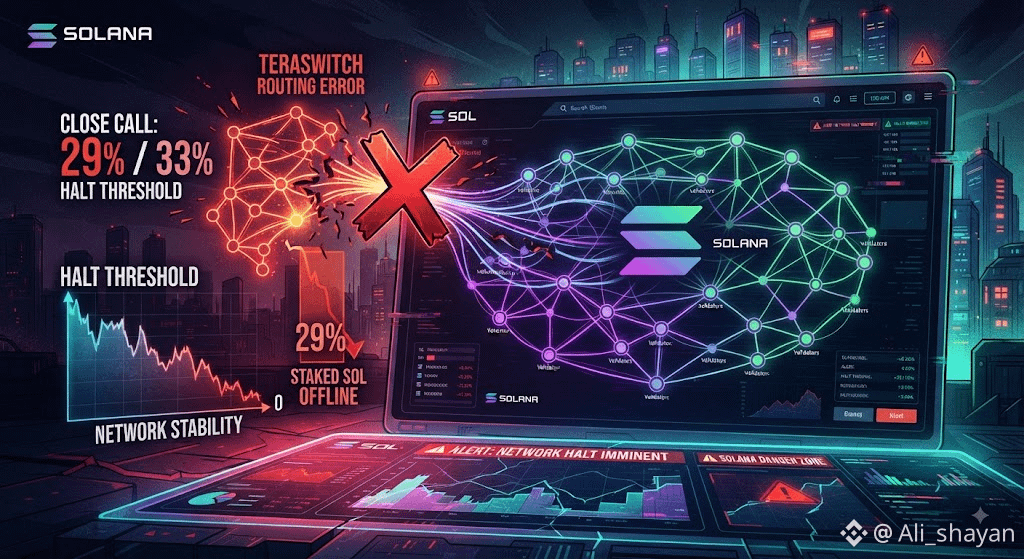
#solanastakingnearshaltonroutingerror A recent routing error by network provider Teraswitch pushed Solana dangerously close to a complete shutdown. The mistake took nearly 29% of all staked SOL offline. Solana needs over 33% of staked tokens to go offline before it completely stops working. This means the network was only a few steps away from freezing. Engineers fixed the routing issue in ten minutes, and normal operations quickly returned, but the close call highlights big risks with validator centralization
CLICK BELOW TO TRADE : $BTC $XRP $SOL
{future}(SOLUSDT)
{future}(XRPUSDT)
{future}(BTCUSDT)
#solanastakingnearshaltonroutingerror A recent routing error by network provider Teraswitch pushed Solana dangerously close to a complete shutdown. The mistake took nearly 29% of all staked SOL offline. Solana needs over 33% of staked tokens to go offline before it completely stops working. This means the network was only a few steps away from freezing. Engineers fixed the routing issue in ten minutes, and normal operations quickly returned, but the close call highlights big risks with validator centralization
CLICK BELOW TO TRADE : $BTC $XRP $SOL
CLICK BELOW TO TRADE : $BTC $XRP $SOL
432
·
--
#solanastakingnearshaltonroutingerror LAST NIGHT YOU COULD'VE LOST ACCESS TO EVERY $SOL YOU OWN
🚨
Not a hack. Not a rug. The chain itself.
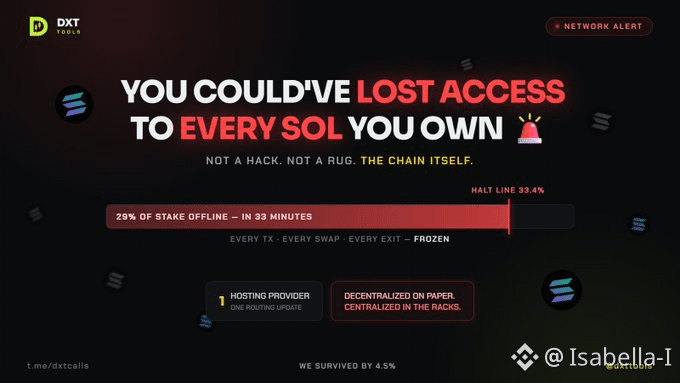
#Solana lost 29% of its staked validators in 33 minutes because ONE hosting provider fumbled a routing
update. At 33.4% the entire network stops finalizing. Every tx. Every swap. Every exit. Frozen.
It got 86% of the way there.
The scariest part: nothing broke through skill. It almost broke through geography. Too many validators, same few server farms.
Decentralization on paper. Centralization in the racks.
We survived by 4.5%. oh
😥$ENSO $2Z
#solanastakingnearshaltonroutingerror LAST NIGHT YOU COULD'VE LOST ACCESS TO EVERY $SOL YOU OWN
🚨
Not a hack. Not a rug. The chain itself.
#Solana lost 29% of its staked validators in 33 minutes because ONE hosting provider fumbled a routing
update. At 33.4% the entire network stops finalizing. Every tx. Every swap. Every exit. Frozen.
It got 86% of the way there.
The scariest part: nothing broke through skill. It almost broke through geography. Too many validators, same few server farms.
Decentralization on paper. Centralization in the racks.
We survived by 4.5%. oh
😥$ENSO $2Z
🚨
Not a hack. Not a rug. The chain itself.
#Solana lost 29% of its staked validators in 33 minutes because ONE hosting provider fumbled a routing
update. At 33.4% the entire network stops finalizing. Every tx. Every swap. Every exit. Frozen.
It got 86% of the way there.
The scariest part: nothing broke through skill. It almost broke through geography. Too many validators, same few server farms.
Decentralization on paper. Centralization in the racks.
We survived by 4.5%. oh
😥$ENSO $2Z
27

🚨🛰️ Solana Narrowly Avoids a Finality Halt
A routing failure at infrastructure provider Teraswitch temporarily pushed 28.83% of staked SOL offline, putting the network close to its 33.34% finality threshold. Around 90 validators were affected, with the disruption lasting roughly 33 minutes.
The incident highlights an important infrastructure risk: validator concentration and backup connectivity can matter just as much as the underlying blockchain protocol.
For spot-focused investors watching $BTC, $BNB and $ETH, the event is another reminder that blockchain reliability is an important part of fundamental analysis.
#solanastakingnearshaltonroutingerror
🚨🛰️ Solana Narrowly Avoids a Finality Halt
A routing failure at infrastructure provider Teraswitch temporarily pushed 28.83% of staked SOL offline, putting the network close to its 33.34% finality threshold. Around 90 validators were affected, with the disruption lasting roughly 33 minutes.
The incident highlights an important infrastructure risk: validator concentration and backup connectivity can matter just as much as the underlying blockchain protocol.
For spot-focused investors watching $BTC, $BNB and $ETH, the event is another reminder that blockchain reliability is an important part of fundamental analysis.
#solanastakingnearshaltonroutingerror
A routing failure at infrastructure provider Teraswitch temporarily pushed 28.83% of staked SOL offline, putting the network close to its 33.34% finality threshold. Around 90 validators were affected, with the disruption lasting roughly 33 minutes.
The incident highlights an important infrastructure risk: validator concentration and backup connectivity can matter just as much as the underlying blockchain protocol.
For spot-focused investors watching $BTC, $BNB and $ETH, the event is another reminder that blockchain reliability is an important part of fundamental analysis.
#solanastakingnearshaltonroutingerror
3
1.5k

·
--
⚡ Network Alert : @Solana_Official narrowly avoided an incident of finality following a routing outage!
A routing incident at infrastructure provider Teraswitch briefly took 28.83% of the $SOL staked amounts offline, pushing the network to 86% of the critical threshold of 33.34%, which would have caused transactions to freeze.
Key takeaways:
Technical impact: About 90 validators were affected for roughly thirty minutes before the infrastructure resolved the issue.
Structural lesson: This episode highlights the risks of validator concentration and the need for better redundancy.
The moment’s tactic: Technical robustness always comes first. Analyze underlying risks and manage your exposures with rigor and discipline. ⚔️🔋
Verification is an automation, discretion protects intent, efficiency validates profit.
#DrYo242 : Your shield in volatility
$HOME $ETHFI
#SolanaStakingNearsHaltOnRoutingError
⚡ Network Alert : @Solana Official narrowly avoided an incident of finality following a routing outage!
A routing incident at infrastructure provider Teraswitch briefly took 28.83% of the $SOL staked amounts offline, pushing the network to 86% of the critical threshold of 33.34%, which would have caused transactions to freeze.
Key takeaways:
Technical impact: About 90 validators were affected for roughly thirty minutes before the infrastructure resolved the issue.
Structural lesson: This episode highlights the risks of validator concentration and the need for better redundancy.
The moment’s tactic: Technical robustness always comes first. Analyze underlying risks and manage your exposures with rigor and discipline. ⚔️🔋
Verification is an automation, discretion protects intent, efficiency validates profit.
#DrYo242 : Your shield in volatility
$HOME $ETHFI
#SolanaStakingNearsHaltOnRoutingError
A routing incident at infrastructure provider Teraswitch briefly took 28.83% of the $SOL staked amounts offline, pushing the network to 86% of the critical threshold of 33.34%, which would have caused transactions to freeze.
Key takeaways:
Technical impact: About 90 validators were affected for roughly thirty minutes before the infrastructure resolved the issue.
Structural lesson: This episode highlights the risks of validator concentration and the need for better redundancy.
The moment’s tactic: Technical robustness always comes first. Analyze underlying risks and manage your exposures with rigor and discipline. ⚔️🔋
Verification is an automation, discretion protects intent, efficiency validates profit.
#DrYo242 : Your shield in volatility
$HOME $ETHFI
#SolanaStakingNearsHaltOnRoutingError

2
6
855

·
--
Verified
#solanastakingnearshaltonroutingerror
🚨 #solanastakingnearshaltonroutingerror shakes the community 🚨
🔥 Almost broke Solana ($SOL): a routing failure on Teraswitch disconnected nearly 29% of staking this Wednesday.
⚠️ The network was left dangerously close to the 33.34% threshold, where finalization would have stopped completely.
💬 Validators and analysts are already calling it the “Routing Error of the year,” while market sentiment swings between panic and opportunity.
📉 $SOL fell 0.47%, but the most loyal holders see it as a test of decentralized resilience.
💪 “More validator diversity = less single point of failure risk,” experts say.
🧠 Conclusion: Solana survived the scare, but the incident makes it clear that even staking giants can stumble.
👀 Bounce back or warning?
💬 Comment with your analysis and tag #solanastakingnearshaltonroutingerror #solanastakingnearshaltonroutingerror toBoy 🔥⚡️
#solanastakingnearshaltonroutingerror
🚨 #solanastakingnearshaltonroutingerror shakes the community 🚨
🔥 Almost broke Solana ($SOL): a routing failure on Teraswitch disconnected nearly 29% of staking this Wednesday.
⚠️ The network was left dangerously close to the 33.34% threshold, where finalization would have stopped completely.
💬 Validators and analysts are already calling it the “Routing Error of the year,” while market sentiment swings between panic and opportunity.
📉 $SOL fell 0.47%, but the most loyal holders see it as a test of decentralized resilience.
💪 “More validator diversity = less single point of failure risk,” experts say.
🧠 Conclusion: Solana survived the scare, but the incident makes it clear that even staking giants can stumble.
👀 Bounce back or warning?
💬 Comment with your analysis and tag #solanastakingnearshaltonroutingerror #solanastakingnearshaltonroutingerror toBoy 🔥⚡️
🚨 #solanastakingnearshaltonroutingerror shakes the community 🚨
🔥 Almost broke Solana ($SOL): a routing failure on Teraswitch disconnected nearly 29% of staking this Wednesday.
⚠️ The network was left dangerously close to the 33.34% threshold, where finalization would have stopped completely.
💬 Validators and analysts are already calling it the “Routing Error of the year,” while market sentiment swings between panic and opportunity.
📉 $SOL fell 0.47%, but the most loyal holders see it as a test of decentralized resilience.
💪 “More validator diversity = less single point of failure risk,” experts say.
🧠 Conclusion: Solana survived the scare, but the incident makes it clear that even staking giants can stumble.
👀 Bounce back or warning?
💬 Comment with your analysis and tag #solanastakingnearshaltonroutingerror #solanastakingnearshaltonroutingerror toBoy 🔥⚡️
1
1
1.6k

Verified
#solanastakingnearshaltonroutingerror
⚠️ SOLANA DODGED A BULLET (AND HARDLY ANYONE NOTICED)
A silent near-miss on Aug 12 exposed the network's biggest hidden vulnerability—and it wasn't a software bug.
The Cold Hard Facts:
28.83% of total staked SOL suddenly went delinquent due to a routing outage at host provider Teraswitch.
33.34% is the critical threshold that triggers a network finality halt.
4.51% was the razor-thin margin separating Solana from a complete freeze during those 33 minutes.
The Underlying Vulnerability:
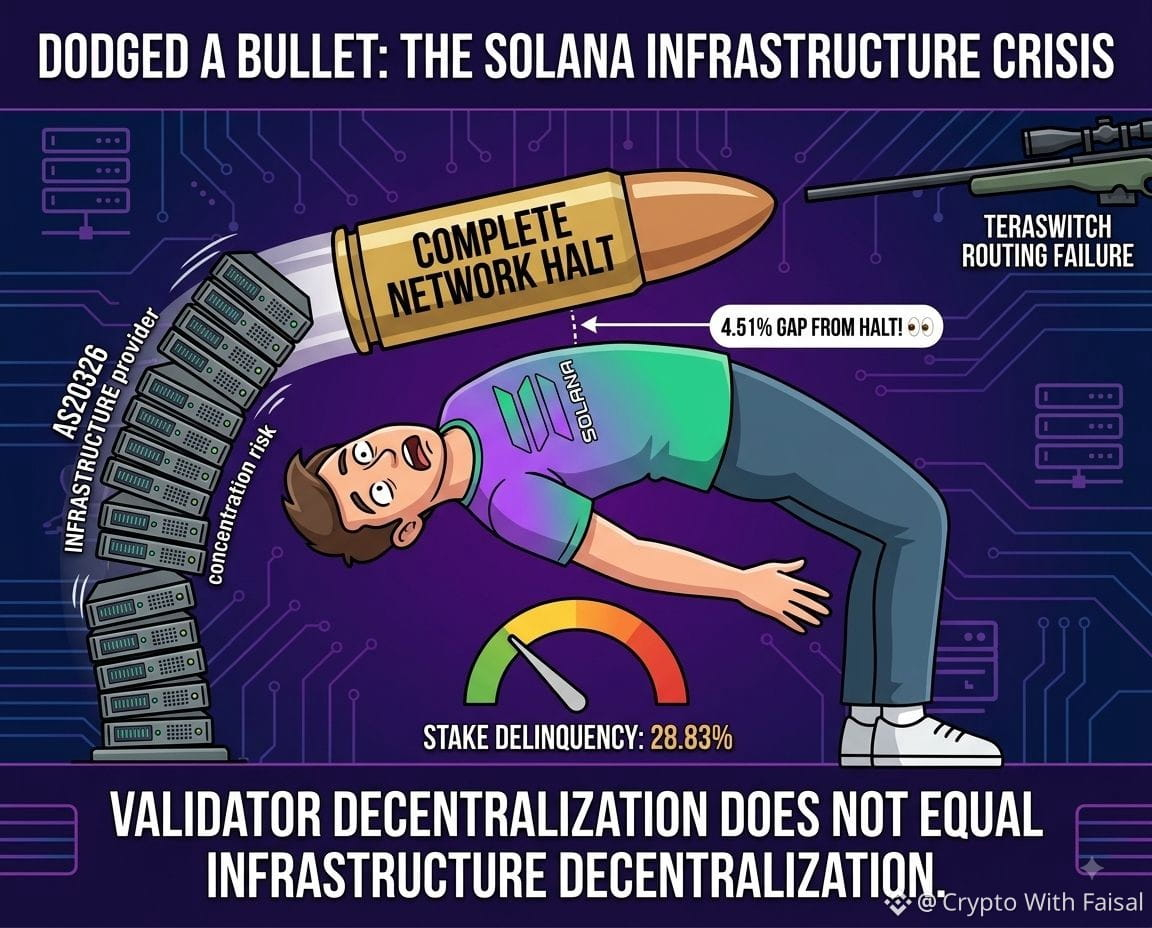
A single infrastructure provider (AS20326) controlled 27.34% of Solana's stake, breaching the 25% safety concentration threshold.
The Hard Truth:
Having thousands of active validators means nothing if they rely on the same physical server hosts and ISP backbones. Validator decentralization DOES NOT equal infrastructure decentralization.
#SolanaStakingNearsHaltOnRoutingError
#solana
$JTO
{future}(JTOUSDT)
$SOL
{future}(SOLUSDT)
$BNSOL
{spot}(BNSOLUSDT)
#solanastakingnearshaltonroutingerror
⚠️ SOLANA DODGED A BULLET (AND HARDLY ANYONE NOTICED)
A silent near-miss on Aug 12 exposed the network's biggest hidden vulnerability—and it wasn't a software bug.
The Cold Hard Facts:
28.83% of total staked SOL suddenly went delinquent due to a routing outage at host provider Teraswitch.
33.34% is the critical threshold that triggers a network finality halt.
4.51% was the razor-thin margin separating Solana from a complete freeze during those 33 minutes.
The Underlying Vulnerability:
A single infrastructure provider (AS20326) controlled 27.34% of Solana's stake, breaching the 25% safety concentration threshold.
The Hard Truth:
Having thousands of active validators means nothing if they rely on the same physical server hosts and ISP backbones. Validator decentralization DOES NOT equal infrastructure decentralization.
#SolanaStakingNearsHaltOnRoutingError
#solana
$JTO
$SOL
$BNSOL
⚠️ SOLANA DODGED A BULLET (AND HARDLY ANYONE NOTICED)
A silent near-miss on Aug 12 exposed the network's biggest hidden vulnerability—and it wasn't a software bug.
The Cold Hard Facts:
28.83% of total staked SOL suddenly went delinquent due to a routing outage at host provider Teraswitch.
33.34% is the critical threshold that triggers a network finality halt.
4.51% was the razor-thin margin separating Solana from a complete freeze during those 33 minutes.
The Underlying Vulnerability:
A single infrastructure provider (AS20326) controlled 27.34% of Solana's stake, breaching the 25% safety concentration threshold.
The Hard Truth:
Having thousands of active validators means nothing if they rely on the same physical server hosts and ISP backbones. Validator decentralization DOES NOT equal infrastructure decentralization.
#SolanaStakingNearsHaltOnRoutingError
#solana
$JTO
$SOL
$BNSOL
4
5.7k
·
--
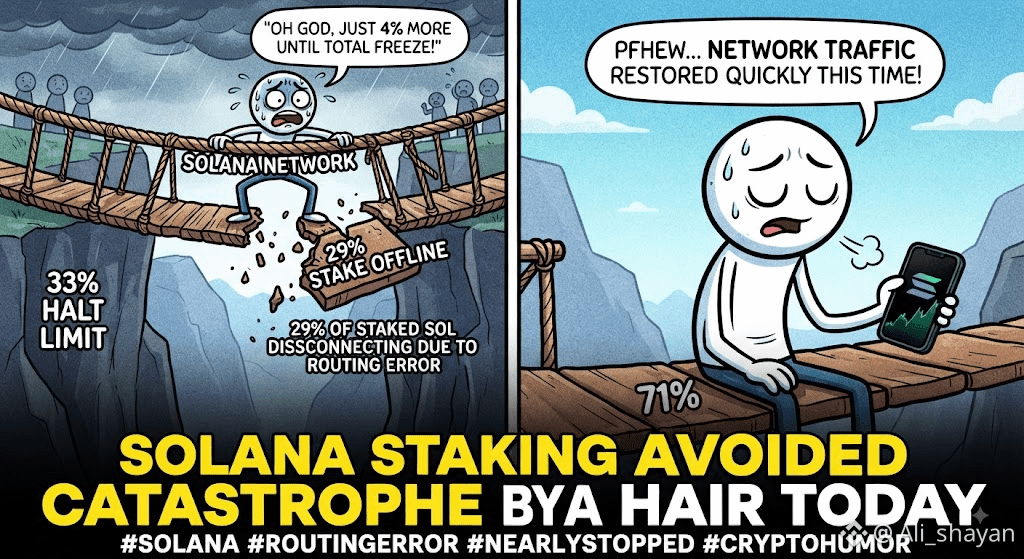
#solanastakingnearshaltonroutingerror A bad routing error from an infrastructure provider recently took nearly 29% of all staked Solana offline. This glitch lasted for a short time and pushed the network dangerously close to the 33% limit that could have frozen all transactions. Normal traffic was restored quickly, but the event showed that too many validators rely on the same network providers. Experts are now looking at ways to fix these safety risks and improve backup systems.
CLICK BELOW TO TRADE : $BTC $DEXE $SOL
{future}(SOLUSDT)
{future}(DEXEUSDT)
{future}(BTCUSDT)
#solanastakingnearshaltonroutingerror A bad routing error from an infrastructure provider recently took nearly 29% of all staked Solana offline. This glitch lasted for a short time and pushed the network dangerously close to the 33% limit that could have frozen all transactions. Normal traffic was restored quickly, but the event showed that too many validators rely on the same network providers. Experts are now looking at ways to fix these safety risks and improve backup systems.
CLICK BELOW TO TRADE : $BTC $DEXE $SOL
CLICK BELOW TO TRADE : $BTC $DEXE $SOL
16
Log in to explore more content
Join global crypto users on Binance Square
⚡️ Get latest and useful information about crypto.
💬 Trusted by the world’s largest crypto exchange.
👍 Discover real insights from verified creators.
Email / Phone number
Trending Topics
1
#GoldFallsTo$4144
0 views
6 Discussing
2
#QNTFallsOver40%FromMorningHigh
2 views
23 Discussing
3
#BitgetCEOConfirms$388MStolenInHack
0 views
3 Discussing
4
#BTCFallsBelow$83000
5,521 views
79 Discussing
5
#BitgetDetailsSecurityIncidentTimeline
1,337 views
98 Discussing
6
#BitcoinSpotETFs$2.39BWeeklyNetInflow
875 views
14 Discussing
7
#FedProposesPaymentStablecoinRules
22,292 views
464 Discussing
8
#ChinaMayLetAlibabaByteDanceBuyNvidiaChips
24,162 views
497 Discussing
9
#USChinaRelease$30BTariffCutProductLists
3,002 views
49 Discussing
10
#SKoreaFSCConsidersVirtualAssetMarketMaker
15,610 views
375 Discussing