

#sofi
sofi
43,740 views
243 Discussing
Hot
Latest

·
--
SoFi begins stablecoin settlement on Mastercard network for program expected to exceed $25 billion in annualized volume $SOFI #SOFI
SoFi begins stablecoin settlement on Mastercard network for program expected to exceed $25 billion in annualized volume $SOFI #SOFI
34
🚀 $SOFI PARTNERS WITH MASTER CARD TO UNLOCK STABLECOIN PAYMENTS 🦈
The $SOFI ‑Mastercard alliance stitches a regulated payment rail directly onto a stablecoin layer, a classic smart‑money liquidity sweep that forces market makers to reprice exposure. 🦈📊 The on‑chain demand curve now intersects a deep pool of institutional cash, turning the stablecoin corridor into a high‑velocity order block.
Expect a measurable uptick in cross‑border flow metrics as the network captures legacy fiat traffic; early‑stage volume spikes on the 4H chart are already echoing a bullish order‑flow divergence. 📈🔍 This structural shift could seed the next wave of risk‑on positioning across the broader crypto ecosystem. 💬 How will this integration reshape your allocation to $SOFI and the stablecoin arena? 👇
⚠️ Not financial advice. Always manage your risk. 🛡️
🏷️ #SOFI #Stablecoin #Payments #SmartMoney #Crypto
🦈 🔥
🚀 $SOFI PARTNERS WITH MASTER CARD TO UNLOCK STABLECOIN PAYMENTS 🦈
The $SOFI ‑Mastercard alliance stitches a regulated payment rail directly onto a stablecoin layer, a classic smart‑money liquidity sweep that forces market makers to reprice exposure. 🦈📊 The on‑chain demand curve now intersects a deep pool of institutional cash, turning the stablecoin corridor into a high‑velocity order block.
Expect a measurable uptick in cross‑border flow metrics as the network captures legacy fiat traffic; early‑stage volume spikes on the 4H chart are already echoing a bullish order‑flow divergence. 📈🔍 This structural shift could seed the next wave of risk‑on positioning across the broader crypto ecosystem. 💬 How will this integration reshape your allocation to $SOFI and the stablecoin arena? 👇
⚠️ Not financial advice. Always manage your risk. 🛡️
🏷️ #SOFI #Stablecoin #Payments #SmartMoney #Crypto
🦈 🔥
The $SOFI ‑Mastercard alliance stitches a regulated payment rail directly onto a stablecoin layer, a classic smart‑money liquidity sweep that forces market makers to reprice exposure. 🦈📊 The on‑chain demand curve now intersects a deep pool of institutional cash, turning the stablecoin corridor into a high‑velocity order block.
Expect a measurable uptick in cross‑border flow metrics as the network captures legacy fiat traffic; early‑stage volume spikes on the 4H chart are already echoing a bullish order‑flow divergence. 📈🔍 This structural shift could seed the next wave of risk‑on positioning across the broader crypto ecosystem. 💬 How will this integration reshape your allocation to $SOFI and the stablecoin arena? 👇
⚠️ Not financial advice. Always manage your risk. 🛡️
🏷️ #SOFI #Stablecoin #Payments #SmartMoney #Crypto
🦈 🔥
13

SoFi migrated its entire card program to blockchain-based settlement, using its stablecoin SoFiUSD, and expects more than $25 billion in annualized volume. The partnership shows that stablecoins can work as alternative settlement rails, reinforcing institutional adoption.
#SoFi #Stablecoin #Blockchain #BinanceSquare #Crypto $TUT
Read more: https://cointelegraph.com/news/sofi-moves-25b-card-program-to-stablecoin-settlement-with-mastercard?utm_source=rss_feed&utm_medium=rss&utm_campaign=rss_partner_inbound
SoFi migrated its entire card program to blockchain-based settlement, using its stablecoin SoFiUSD, and expects more than $25 billion in annualized volume. The partnership shows that stablecoins can work as alternative settlement rails, reinforcing institutional adoption.
#SoFi #Stablecoin #Blockchain #BinanceSquare #Crypto $TUT
Read more: https://cointelegraph.com/news/sofi-moves-25b-card-program-to-stablecoin-settlement-with-mastercard?utm_source=rss_feed&utm_medium=rss&utm_campaign=rss_partner_inbound
#SoFi #Stablecoin #Blockchain #BinanceSquare #Crypto $TUT
Read more: https://cointelegraph.com/news/sofi-moves-25b-card-program-to-stablecoin-settlement-with-mastercard?utm_source=rss_feed&utm_medium=rss&utm_campaign=rss_partner_inbound
SOFIUS+1.20%
1
39

SoFi and Mastercard Launch Stablecoin Payments with SoFiUSD
- SoFi Technologies and Mastercard partner to launch stablecoin payments on SoFi Bank’s debit and credit card programs.
- This brings stablecoin payments via SoFiUSD into Mastercard’s global payments network.
- The move comes after previously supporting stablecoins such as Ripple’s RLUSD and Circle’s USDC.
- SoFi becomes the first bank to enable stablecoin payments on the Mastercard network.
#SoFi #Mastercard #Stablecoin #SoFiUSD #RLUSD USDC CryptoNews BinanceSquare
$rlusd $usdc
vlikevn Titanbot
Source: CoinGape
SoFi and Mastercard Launch Stablecoin Payments with SoFiUSD
- SoFi Technologies and Mastercard partner to launch stablecoin payments on SoFi Bank’s debit and credit card programs.
- This brings stablecoin payments via SoFiUSD into Mastercard’s global payments network.
- The move comes after previously supporting stablecoins such as Ripple’s RLUSD and Circle’s USDC.
- SoFi becomes the first bank to enable stablecoin payments on the Mastercard network.
#SoFi #Mastercard #Stablecoin #SoFiUSD #RLUSD USDC CryptoNews BinanceSquare
$rlusd $usdc
vlikevn Titanbot
Source: CoinGape
- SoFi Technologies and Mastercard partner to launch stablecoin payments on SoFi Bank’s debit and credit card programs.
- This brings stablecoin payments via SoFiUSD into Mastercard’s global payments network.
- The move comes after previously supporting stablecoins such as Ripple’s RLUSD and Circle’s USDC.
- SoFi becomes the first bank to enable stablecoin payments on the Mastercard network.
#SoFi #Mastercard #Stablecoin #SoFiUSD #RLUSD USDC CryptoNews BinanceSquare
$rlusd $usdc
vlikevn Titanbot
Source: CoinGape
20
SoFi launches SoFiUSD stablecoin payments on the Mastercard network, aiming for $25 billion in
- SoFi rolls out live SoFiUSD payments on the Mastercard network.
- The card program targets $25 billion in annual transaction volume.
- The SoFiUSD stablecoin enables fast payments and transfers.
#BinanceSquare #CryptoNews #SoFi #Stablecoin
$sofi
#vlikevn Titanbot
Source: The Block
SoFi launches SoFiUSD stablecoin payments on the Mastercard network, aiming for $25 billion in
- SoFi rolls out live SoFiUSD payments on the Mastercard network.
- The card program targets $25 billion in annual transaction volume.
- The SoFiUSD stablecoin enables fast payments and transfers.
#BinanceSquare #CryptoNews #SoFi #Stablecoin
$sofi
#vlikevn Titanbot
Source: The Block
- SoFi rolls out live SoFiUSD payments on the Mastercard network.
- The card program targets $25 billion in annual transaction volume.
- The SoFiUSD stablecoin enables fast payments and transfers.
#BinanceSquare #CryptoNews #SoFi #Stablecoin
$sofi
#vlikevn Titanbot
Source: The Block
14

·
--
$SOFI 24 hours down 3.114%, quote 17.11, funding rate reset to zero. Behind the pressure on the stock price is the market’s repricing of the Federal Reserve policy cycle and the regulatory environment. Financial technology stocks are sensitive to interest rates, and political shifts directly affect the compliance cost of their business models. The current structure suggests that, in the absence of consensus on the policy front, both long and short sides are choosing to wait; with 47972 open contracts, there has been no panic liquidation. The strongest counterevidence would be an unexpected easing of the regulatory environment or the company delivering results that exceed expectations—both of which would quickly reverse sentiment.
Trading tag: #TradFi #链上美股 #SOFI
Where do you think this assessment is most likely to be wrong?
$SOFI 24 hours down 3.114%, quote 17.11, funding rate reset to zero. Behind the pressure on the stock price is the market’s repricing of the Federal Reserve policy cycle and the regulatory environment. Financial technology stocks are sensitive to interest rates, and political shifts directly affect the compliance cost of their business models. The current structure suggests that, in the absence of consensus on the policy front, both long and short sides are choosing to wait; with 47972 open contracts, there has been no panic liquidation. The strongest counterevidence would be an unexpected easing of the regulatory environment or the company delivering results that exceed expectations—both of which would quickly reverse sentiment.
Trading tag: #TradFi #链上美股 #SOFI
Where do you think this assessment is most likely to be wrong?
Trading tag: #TradFi #链上美股 #SOFI
Where do you think this assessment is most likely to be wrong?
12
·
--
$SOFI 24 hours drops 3.114%, price 17.11; funding rate returns to zero; open interest is 48,000. Political regulatory uncertainty continues to suppress risk appetite for fintech stocks. The zero-fee rate indicates the market is in a wait-and-see mode, lacking a directional bet.
I believe the scrutiny in Washington over digital finance and lending is the primary pressure point on SOFI’s valuation. As long as regulatory prospects remain unclear, the stock is unlikely to receive sustained inflows of capital. If regulatory news turns more negative, highly leveraged longs may be forced to cut positions.
Trading tag: #TradFi #链上美股 #SOFI
Where do you think this assessment is most likely to be wrong?
$SOFI 24 hours drops 3.114%, price 17.11; funding rate returns to zero; open interest is 48,000. Political regulatory uncertainty continues to suppress risk appetite for fintech stocks. The zero-fee rate indicates the market is in a wait-and-see mode, lacking a directional bet.
I believe the scrutiny in Washington over digital finance and lending is the primary pressure point on SOFI’s valuation. As long as regulatory prospects remain unclear, the stock is unlikely to receive sustained inflows of capital. If regulatory news turns more negative, highly leveraged longs may be forced to cut positions.
Trading tag: #TradFi #链上美股 #SOFI
Where do you think this assessment is most likely to be wrong?
I believe the scrutiny in Washington over digital finance and lending is the primary pressure point on SOFI’s valuation. As long as regulatory prospects remain unclear, the stock is unlikely to receive sustained inflows of capital. If regulatory news turns more negative, highly leveraged longs may be forced to cut positions.
Trading tag: #TradFi #链上美股 #SOFI
Where do you think this assessment is most likely to be wrong?
13

The worst-performing contract on the whole network—keep shorting until it goes to zero
Anyone who went up should be taking profit.
★ $SOFI #SOFI 【Main】
Short around $20.6280, stop-loss at $22.6908, test with a small position
Current price $17.1900, 24h change -1.04%
24h trading volume is only $154,000—dead last in the whole market
→ Volume down 23.8%; sell pressure is building—keep the short until it hits 0
If it just moves sideways and doesn’t rise, that’s weakness
These are also good opportunities to short:
---
$MINA
Current $0.086060, 24h change -16.77%
Entry timing: place a short limit at $0.103272, set stop-loss at 10% ($0.113599)
---
$ZEC
Current $1134.80, 24h change +2.32%
Entry timing: place a short limit at $1361.76, set stop-loss at 10% ($1497.94)
---
⚠️ Test with small capital, use strict stop-losses, and don’t trade without risk control
#ContractTrading
The worst-performing contract on the whole network—keep shorting until it goes to zero
Anyone who went up should be taking profit.
★ $SOFI #SOFI 【Main】
Short around $20.6280, stop-loss at $22.6908, test with a small position
Current price $17.1900, 24h change -1.04%
24h trading volume is only $154,000—dead last in the whole market
→ Volume down 23.8%; sell pressure is building—keep the short until it hits 0
If it just moves sideways and doesn’t rise, that’s weakness
These are also good opportunities to short:
---
$MINA
Current $0.086060, 24h change -16.77%
Entry timing: place a short limit at $0.103272, set stop-loss at 10% ($0.113599)
---
$ZEC
Current $1134.80, 24h change +2.32%
Entry timing: place a short limit at $1361.76, set stop-loss at 10% ($1497.94)
---
⚠️ Test with small capital, use strict stop-losses, and don’t trade without risk control
#ContractTrading
Anyone who went up should be taking profit.
★ $SOFI #SOFI 【Main】
Short around $20.6280, stop-loss at $22.6908, test with a small position
Current price $17.1900, 24h change -1.04%
24h trading volume is only $154,000—dead last in the whole market
→ Volume down 23.8%; sell pressure is building—keep the short until it hits 0
If it just moves sideways and doesn’t rise, that’s weakness
These are also good opportunities to short:
---
$MINA
Current $0.086060, 24h change -16.77%
Entry timing: place a short limit at $0.103272, set stop-loss at 10% ($0.113599)
---
$ZEC
Current $1134.80, 24h change +2.32%
Entry timing: place a short limit at $1361.76, set stop-loss at 10% ($1497.94)
---
⚠️ Test with small capital, use strict stop-losses, and don’t trade without risk control
#ContractTrading
123

·
--
The old dog watched the perpetual contract order book for $SOFI . Over the past 24 hours, the price dropped 4.903% to 17.07, yet the funding rate remained locked at zero. The open interest at 41,996.88 was also steady with no meaningful fluctuation. In this kind of price decline where the funding rate doesn’t budge, it’s not very common to see it in on-chain U.S. stock futures contracts. Usually, a big drop would force the funding rate to shift. Now neither longs nor shorts are paying—it's as if the market has been glued in place.
Why does this kind of deadlock happen? From the perspective of on-chain U.S. stock contracts, a zero funding rate means there’s no capital flow between longs and shorts; for now, both sides are in a temporary balance. But the price slipping suggests the actual selling pressure comes from holders actively selling, not from leveraged liquidations. The trading volume at 489428.9324 hasn’t expanded significantly, implying the selling might not be panic-driven, but rather a gradual de-risking. Open interest stays at 41,996.88, indicating existing holders aren’t making large-scale exits—they’re stubbornly holding on and waiting for direction. At the same time, no new money is coming in to buy the dip, so overall liquidity is somewhat cold. This condition is prone to turning into a slow bleed, because there’s no buy-side support.
The old dog’s view is very clear: this is not the time to enter. With the price drifting lower and the funding rate staying neutral, it means the market lacks consensus. The holders are passively waiting. I choose to stand by and not touch it. The trigger conditions are fixed: if the funding rate turns negative and the price falls below 16.95, I’ll close out any small positions, because that would mean the shorts start to gain momentum and could trigger a cascade of liquidations. Conversely, if the funding rate turns positive and the price breaks above 17.15, I’ll consider trying to go long with an extremely light position, betting on a sentiment reversal. My stance is to wait—move only when signals appear.
The strongest counterargument is that someone will say a zero funding rate is a breakout signal and the price could suddenly surge. But the old dog thinks: when the price has already dropped nearly 5% and the funding rate still won’t move, that actually shows that the big players haven’t acted. The retail crowd is just messing around—this kind of indifference makes it even more likely to keep sliding. On the second-order effect: if the deadlock persists, contract liquidity will shrink further. Then when the price moves next time, slippage costs will rise, forcing holders to close at worse prices, which would intensify downward pressure.
Invalidation conditions to wrap up: my assessment is most likely wrong if I ignore a sudden catalyst. If $SOFI ’s price rapidly rallies and recaptures the losses, or if trading volume explodes and the funding rate turns positive—then that would indicate unknown capital has entered, and my decision to wait would be mistaken.
Trading tag: #BinanceFutures #TradFi #USDⓈM #SOFI #SOFIUSDT $SOFI
The old dog watched the perpetual contract order book for $SOFI . Over the past 24 hours, the price dropped 4.903% to 17.07, yet the funding rate remained locked at zero. The open interest at 41,996.88 was also steady with no meaningful fluctuation. In this kind of price decline where the funding rate doesn’t budge, it’s not very common to see it in on-chain U.S. stock futures contracts. Usually, a big drop would force the funding rate to shift. Now neither longs nor shorts are paying—it's as if the market has been glued in place.
Why does this kind of deadlock happen? From the perspective of on-chain U.S. stock contracts, a zero funding rate means there’s no capital flow between longs and shorts; for now, both sides are in a temporary balance. But the price slipping suggests the actual selling pressure comes from holders actively selling, not from leveraged liquidations. The trading volume at 489428.9324 hasn’t expanded significantly, implying the selling might not be panic-driven, but rather a gradual de-risking. Open interest stays at 41,996.88, indicating existing holders aren’t making large-scale exits—they’re stubbornly holding on and waiting for direction. At the same time, no new money is coming in to buy the dip, so overall liquidity is somewhat cold. This condition is prone to turning into a slow bleed, because there’s no buy-side support.
The old dog’s view is very clear: this is not the time to enter. With the price drifting lower and the funding rate staying neutral, it means the market lacks consensus. The holders are passively waiting. I choose to stand by and not touch it. The trigger conditions are fixed: if the funding rate turns negative and the price falls below 16.95, I’ll close out any small positions, because that would mean the shorts start to gain momentum and could trigger a cascade of liquidations. Conversely, if the funding rate turns positive and the price breaks above 17.15, I’ll consider trying to go long with an extremely light position, betting on a sentiment reversal. My stance is to wait—move only when signals appear.
The strongest counterargument is that someone will say a zero funding rate is a breakout signal and the price could suddenly surge. But the old dog thinks: when the price has already dropped nearly 5% and the funding rate still won’t move, that actually shows that the big players haven’t acted. The retail crowd is just messing around—this kind of indifference makes it even more likely to keep sliding. On the second-order effect: if the deadlock persists, contract liquidity will shrink further. Then when the price moves next time, slippage costs will rise, forcing holders to close at worse prices, which would intensify downward pressure.
Invalidation conditions to wrap up: my assessment is most likely wrong if I ignore a sudden catalyst. If $SOFI ’s price rapidly rallies and recaptures the losses, or if trading volume explodes and the funding rate turns positive—then that would indicate unknown capital has entered, and my decision to wait would be mistaken.
Trading tag: #BinanceFutures #TradFi #USDⓈM #SOFI #SOFIUSDT $SOFI
Why does this kind of deadlock happen? From the perspective of on-chain U.S. stock contracts, a zero funding rate means there’s no capital flow between longs and shorts; for now, both sides are in a temporary balance. But the price slipping suggests the actual selling pressure comes from holders actively selling, not from leveraged liquidations. The trading volume at 489428.9324 hasn’t expanded significantly, implying the selling might not be panic-driven, but rather a gradual de-risking. Open interest stays at 41,996.88, indicating existing holders aren’t making large-scale exits—they’re stubbornly holding on and waiting for direction. At the same time, no new money is coming in to buy the dip, so overall liquidity is somewhat cold. This condition is prone to turning into a slow bleed, because there’s no buy-side support.
The old dog’s view is very clear: this is not the time to enter. With the price drifting lower and the funding rate staying neutral, it means the market lacks consensus. The holders are passively waiting. I choose to stand by and not touch it. The trigger conditions are fixed: if the funding rate turns negative and the price falls below 16.95, I’ll close out any small positions, because that would mean the shorts start to gain momentum and could trigger a cascade of liquidations. Conversely, if the funding rate turns positive and the price breaks above 17.15, I’ll consider trying to go long with an extremely light position, betting on a sentiment reversal. My stance is to wait—move only when signals appear.
The strongest counterargument is that someone will say a zero funding rate is a breakout signal and the price could suddenly surge. But the old dog thinks: when the price has already dropped nearly 5% and the funding rate still won’t move, that actually shows that the big players haven’t acted. The retail crowd is just messing around—this kind of indifference makes it even more likely to keep sliding. On the second-order effect: if the deadlock persists, contract liquidity will shrink further. Then when the price moves next time, slippage costs will rise, forcing holders to close at worse prices, which would intensify downward pressure.
Invalidation conditions to wrap up: my assessment is most likely wrong if I ignore a sudden catalyst. If $SOFI ’s price rapidly rallies and recaptures the losses, or if trading volume explodes and the funding rate turns positive—then that would indicate unknown capital has entered, and my decision to wait would be mistaken.
Trading tag: #BinanceFutures #TradFi #USDⓈM #SOFI #SOFIUSDT $SOFI
14
·
--
$SOFI rose 4.279% over the past 24 hours, and is trading at $17.79. A purely online bank stock outperformed the broader market in an election year in the U.S.—behind this is the market’s repricing of policy risk. The funding rate shows 0, and open interest remains around 31,620.65. This setup is very clean, with no signs of squeeze between longs and shorts, suggesting that the rally is being driven by spot capital, not short-term sentiment in the derivatives market.
Why is this happening? Because the direction of financial regulation is changing. Since 2024, the Fed has loosened capital requirements for community banks, and the Biden administration has also been pushing for more scrutiny of mergers and acquisitions involving large banks. This policy mix creates an asymmetric “win” scenario for SOFI—an entity trying to obtain a bank charter and transition from a fintech company into a real bank. The market is betting that more of the regulatory pressure will fall on traditional large banks, leaving challenger banks like SOFI more room to breathe. Price is rising while the funding rate stays flat, which suggests that longs are building positions gradually with spot exposure, not rushing to use leverage.
The strongest counterargument is: if Trump wins the election in November, he previously signaled that he would significantly simplify financial regulation, which sounds like it would benefit the entire sector. The problem is that easing regulation could first favor already scaled traditional banks, which may then use their advantages to quickly absorb market share. SOFI, being a relatively smaller player, may not necessarily benefit in a world with fewer rules but tougher competition. At that point, the pricing logic today—based on policy differences—would be overturned.
The second-order impact would show up in sector rotation. If the narrative about regulatory divergence remains intact, capital will likely keep flowing out of large-bank stocks and into policy-arbitrage plays like SOFI. But this requires continuous confirmation from political signals; once either candidate releases a clear and unified message about easing regulation, this rotation logic would fade quickly.
My view is based on one condition: U.S. politics remains divided and policy uncertainty stays high. If, before the election, clear bipartisan consensus emerges—both sides agreeing that financial regulations need to be loosened—I would immediately exit the long position in SOFI. Currently, the open interest and price do not show extreme optimism, so there is still room.
In terms of action, I’ve built a starter position around $17.5. If the price holds above $18 and open interest rises moderately, I will add. If it breaks below $17 and the funding rate turns negative—indicating shorts are starting to enter and press the market—I will exit the position entirely.
Trading tag: #TradFi #链上美股 #SOFI
Where do you think this line of reasoning is most likely to be wrong?
$SOFI rose 4.279% over the past 24 hours, and is trading at $17.79. A purely online bank stock outperformed the broader market in an election year in the U.S.—behind this is the market’s repricing of policy risk. The funding rate shows 0, and open interest remains around 31,620.65. This setup is very clean, with no signs of squeeze between longs and shorts, suggesting that the rally is being driven by spot capital, not short-term sentiment in the derivatives market.
Why is this happening? Because the direction of financial regulation is changing. Since 2024, the Fed has loosened capital requirements for community banks, and the Biden administration has also been pushing for more scrutiny of mergers and acquisitions involving large banks. This policy mix creates an asymmetric “win” scenario for SOFI—an entity trying to obtain a bank charter and transition from a fintech company into a real bank. The market is betting that more of the regulatory pressure will fall on traditional large banks, leaving challenger banks like SOFI more room to breathe. Price is rising while the funding rate stays flat, which suggests that longs are building positions gradually with spot exposure, not rushing to use leverage.
The strongest counterargument is: if Trump wins the election in November, he previously signaled that he would significantly simplify financial regulation, which sounds like it would benefit the entire sector. The problem is that easing regulation could first favor already scaled traditional banks, which may then use their advantages to quickly absorb market share. SOFI, being a relatively smaller player, may not necessarily benefit in a world with fewer rules but tougher competition. At that point, the pricing logic today—based on policy differences—would be overturned.
The second-order impact would show up in sector rotation. If the narrative about regulatory divergence remains intact, capital will likely keep flowing out of large-bank stocks and into policy-arbitrage plays like SOFI. But this requires continuous confirmation from political signals; once either candidate releases a clear and unified message about easing regulation, this rotation logic would fade quickly.
My view is based on one condition: U.S. politics remains divided and policy uncertainty stays high. If, before the election, clear bipartisan consensus emerges—both sides agreeing that financial regulations need to be loosened—I would immediately exit the long position in SOFI. Currently, the open interest and price do not show extreme optimism, so there is still room.
In terms of action, I’ve built a starter position around $17.5. If the price holds above $18 and open interest rises moderately, I will add. If it breaks below $17 and the funding rate turns negative—indicating shorts are starting to enter and press the market—I will exit the position entirely.
Trading tag: #TradFi #链上美股 #SOFI
Where do you think this line of reasoning is most likely to be wrong?
Why is this happening? Because the direction of financial regulation is changing. Since 2024, the Fed has loosened capital requirements for community banks, and the Biden administration has also been pushing for more scrutiny of mergers and acquisitions involving large banks. This policy mix creates an asymmetric “win” scenario for SOFI—an entity trying to obtain a bank charter and transition from a fintech company into a real bank. The market is betting that more of the regulatory pressure will fall on traditional large banks, leaving challenger banks like SOFI more room to breathe. Price is rising while the funding rate stays flat, which suggests that longs are building positions gradually with spot exposure, not rushing to use leverage.
The strongest counterargument is: if Trump wins the election in November, he previously signaled that he would significantly simplify financial regulation, which sounds like it would benefit the entire sector. The problem is that easing regulation could first favor already scaled traditional banks, which may then use their advantages to quickly absorb market share. SOFI, being a relatively smaller player, may not necessarily benefit in a world with fewer rules but tougher competition. At that point, the pricing logic today—based on policy differences—would be overturned.
The second-order impact would show up in sector rotation. If the narrative about regulatory divergence remains intact, capital will likely keep flowing out of large-bank stocks and into policy-arbitrage plays like SOFI. But this requires continuous confirmation from political signals; once either candidate releases a clear and unified message about easing regulation, this rotation logic would fade quickly.
My view is based on one condition: U.S. politics remains divided and policy uncertainty stays high. If, before the election, clear bipartisan consensus emerges—both sides agreeing that financial regulations need to be loosened—I would immediately exit the long position in SOFI. Currently, the open interest and price do not show extreme optimism, so there is still room.
In terms of action, I’ve built a starter position around $17.5. If the price holds above $18 and open interest rises moderately, I will add. If it breaks below $17 and the funding rate turns negative—indicating shorts are starting to enter and press the market—I will exit the position entirely.
Trading tag: #TradFi #链上美股 #SOFI
Where do you think this line of reasoning is most likely to be wrong?
16
·
--
$SOFI 24 hours rose 4.279%, and the price is holding at 17.79. At the same time, its perpetual contract funding rate is 0.
This zero-fee rate is interesting. As the price moves up, the funding rate doesn’t flip into positive territory as it typically would. Usually, price increases attract more long positions, pushing the funding rate positive so that longs pay shorts. Now the rate is flat, suggesting the bullish chase hasn’t reached overheated levels. Shorts haven’t been visibly squeezed either, and the market hasn’t formed an extreme, one-sided consensus at this price.
Just from the on-chain structure, this looks like a relatively healthy uptrend that hasn’t accumulated excessively high long entry costs.
I view it through a political framework. Regulatory signals in the U.S. financial technology sector have been swinging. Recently, statements have leaned toward easing, which creates room for valuation repair for companies that merge traditional finance with digital finance. For tickers like $SOFI , the stock price is highly sensitive to policy signals. The political narrative provides the script for the move upward, and the contract-market data showing zero funding suggests the script hasn’t been over-priced by speculative capital yet. This is a stage where price leads and derivatives are following, but in a restrained way.
The biggest counter-evidence is simple: if the political winds in Washington shift abruptly, or if there are new legislative developments targeting digital finance, the foundation of this currently mild uptrend would loosen immediately. $SOFI ’s stock price is tightly bound to this kind of macro narrative. The failure condition isn’t a specific price level—it’s whether the political premises supporting the rise change.
The second-order effect is that if the political environment stays favorable, funds may rotate out of already overheated sectors with high rates and into names like $SOFI that still have room in terms of funding-rate buffers. Right now, the cost-battle between longs and shorts here is relatively balanced.
So my observation is: as long as the political narrative hasn’t been disproven, this mild state in the contract market may actually make the rally more sustainable. I’ll treat the current structure as a politically driven beta trend that needs continuous monitoring.
Aggressive: With political warm winds still intact and funding neutral, consider entering on intraday pullbacks to profit from continued upside driven by an expectation gap in policy.
Steady: If you already hold spot or derivatives positions, keep holding. Treat the zero funding rate as a temporary no-stress position signal, and consider trimming only when funding shows a clearly positive change.
Avoid: For investors with low sensitivity to political direction, don’t participate. If you see signs of clear regulatory tightening in Washington—such as statements or proposed actions—exit immediately. That’s the core failure condition.
Trading tag: #TradFi #链上美股 #SOFI
Where do you think this set of judgments is most likely to be wrong?
$SOFI 24 hours rose 4.279%, and the price is holding at 17.79. At the same time, its perpetual contract funding rate is 0.
This zero-fee rate is interesting. As the price moves up, the funding rate doesn’t flip into positive territory as it typically would. Usually, price increases attract more long positions, pushing the funding rate positive so that longs pay shorts. Now the rate is flat, suggesting the bullish chase hasn’t reached overheated levels. Shorts haven’t been visibly squeezed either, and the market hasn’t formed an extreme, one-sided consensus at this price.
Just from the on-chain structure, this looks like a relatively healthy uptrend that hasn’t accumulated excessively high long entry costs.
I view it through a political framework. Regulatory signals in the U.S. financial technology sector have been swinging. Recently, statements have leaned toward easing, which creates room for valuation repair for companies that merge traditional finance with digital finance. For tickers like $SOFI , the stock price is highly sensitive to policy signals. The political narrative provides the script for the move upward, and the contract-market data showing zero funding suggests the script hasn’t been over-priced by speculative capital yet. This is a stage where price leads and derivatives are following, but in a restrained way.
The biggest counter-evidence is simple: if the political winds in Washington shift abruptly, or if there are new legislative developments targeting digital finance, the foundation of this currently mild uptrend would loosen immediately. $SOFI ’s stock price is tightly bound to this kind of macro narrative. The failure condition isn’t a specific price level—it’s whether the political premises supporting the rise change.
The second-order effect is that if the political environment stays favorable, funds may rotate out of already overheated sectors with high rates and into names like $SOFI that still have room in terms of funding-rate buffers. Right now, the cost-battle between longs and shorts here is relatively balanced.
So my observation is: as long as the political narrative hasn’t been disproven, this mild state in the contract market may actually make the rally more sustainable. I’ll treat the current structure as a politically driven beta trend that needs continuous monitoring.
Aggressive: With political warm winds still intact and funding neutral, consider entering on intraday pullbacks to profit from continued upside driven by an expectation gap in policy.
Steady: If you already hold spot or derivatives positions, keep holding. Treat the zero funding rate as a temporary no-stress position signal, and consider trimming only when funding shows a clearly positive change.
Avoid: For investors with low sensitivity to political direction, don’t participate. If you see signs of clear regulatory tightening in Washington—such as statements or proposed actions—exit immediately. That’s the core failure condition.
Trading tag: #TradFi #链上美股 #SOFI
Where do you think this set of judgments is most likely to be wrong?
This zero-fee rate is interesting. As the price moves up, the funding rate doesn’t flip into positive territory as it typically would. Usually, price increases attract more long positions, pushing the funding rate positive so that longs pay shorts. Now the rate is flat, suggesting the bullish chase hasn’t reached overheated levels. Shorts haven’t been visibly squeezed either, and the market hasn’t formed an extreme, one-sided consensus at this price.
Just from the on-chain structure, this looks like a relatively healthy uptrend that hasn’t accumulated excessively high long entry costs.
I view it through a political framework. Regulatory signals in the U.S. financial technology sector have been swinging. Recently, statements have leaned toward easing, which creates room for valuation repair for companies that merge traditional finance with digital finance. For tickers like $SOFI , the stock price is highly sensitive to policy signals. The political narrative provides the script for the move upward, and the contract-market data showing zero funding suggests the script hasn’t been over-priced by speculative capital yet. This is a stage where price leads and derivatives are following, but in a restrained way.
The biggest counter-evidence is simple: if the political winds in Washington shift abruptly, or if there are new legislative developments targeting digital finance, the foundation of this currently mild uptrend would loosen immediately. $SOFI ’s stock price is tightly bound to this kind of macro narrative. The failure condition isn’t a specific price level—it’s whether the political premises supporting the rise change.
The second-order effect is that if the political environment stays favorable, funds may rotate out of already overheated sectors with high rates and into names like $SOFI that still have room in terms of funding-rate buffers. Right now, the cost-battle between longs and shorts here is relatively balanced.
So my observation is: as long as the political narrative hasn’t been disproven, this mild state in the contract market may actually make the rally more sustainable. I’ll treat the current structure as a politically driven beta trend that needs continuous monitoring.
Aggressive: With political warm winds still intact and funding neutral, consider entering on intraday pullbacks to profit from continued upside driven by an expectation gap in policy.
Steady: If you already hold spot or derivatives positions, keep holding. Treat the zero funding rate as a temporary no-stress position signal, and consider trimming only when funding shows a clearly positive change.
Avoid: For investors with low sensitivity to political direction, don’t participate. If you see signs of clear regulatory tightening in Washington—such as statements or proposed actions—exit immediately. That’s the core failure condition.
Trading tag: #TradFi #链上美股 #SOFI
Where do you think this set of judgments is most likely to be wrong?
7
·
--
$SOFI 24 hours up 4.279%, with the price hanging at 17.79. The funding rate is zero, and there are 31,620.65 open contracts. The price surges upward, but the funding rate stays completely unchanged—this kind of divergence has appeared a few times during politically sensitive periods.
Core assessment: Political expectations are suppressing $SOFI’s leveraged enthusiasm; the rally lacks the sustained willingness of long positions to pay for carry.
The evidence chain comes from two dimensions. A 4.279% price rise indicates there is short-term buying pressure, but a zero funding rate means longs are not paying any cost for their positions, and shorts are not either. This resembles the same $SOFI structure during the U.S. election debate season in 2024, when policy uncertainty kept the funding rate stuck at zero for a long time and compressed realized volatility. The 31,620.65 open contracts, converted to roughly $5.62 million, is not large—suggesting the core capital is standing by. Single-signal conclusion: zero funding rate combined with a rising price looks more like short covering than new long entries.
Strongest counterargument: If this week brings news that financial technology regulation is loosened, the funding rate could quickly turn positive, pushing the price to break above 18. Some people in the market believe that as the election season nears its end, policy risk will decline, and $SOFI’s uptrend can continue.
But the second-order effects are even more worth watching. When political uncertainty rises, hedge funds often reduce exposure to policy-sensitive stocks first. For fintech names like $SOFI, if the cost basis is zero and volatility is low, they may be rotated preferentially into defense or infrastructure sectors. If retail investors chase the rally, they could get trapped in a low-volatility “zero funding rate” trap; once policy headwinds turn into realized negatives, liquidity could leave even faster.
Invalidation condition: If $SOFI falls below 17.00, my assessment is invalid. That level corresponds to a high-volume trading area in the recent period; a breakdown would mean political negatives have overwhelmed all buy-side support.
Action: I won’t touch it. Wait until the funding rate moves away from the zero axis. Aggressive scenario: if political positives land and the funding rate turns positive, I go long with 2x leverage; steady scenario: keep the spot position unchanged; avoidance scenario: if price breaks below 17, cut losses and exit. The market ignores how the political cycle drags valuation on fintech stocks, and a zero funding rate is the evidence.
Trading tag: #TradFi #链上美股 #SOFI
Where do you think this set of conclusions is most likely to be wrong?
$SOFI 24 hours up 4.279%, with the price hanging at 17.79. The funding rate is zero, and there are 31,620.65 open contracts. The price surges upward, but the funding rate stays completely unchanged—this kind of divergence has appeared a few times during politically sensitive periods.
Core assessment: Political expectations are suppressing $SOFI ’s leveraged enthusiasm; the rally lacks the sustained willingness of long positions to pay for carry.
The evidence chain comes from two dimensions. A 4.279% price rise indicates there is short-term buying pressure, but a zero funding rate means longs are not paying any cost for their positions, and shorts are not either. This resembles the same $SOFI structure during the U.S. election debate season in 2024, when policy uncertainty kept the funding rate stuck at zero for a long time and compressed realized volatility. The 31,620.65 open contracts, converted to roughly $5.62 million, is not large—suggesting the core capital is standing by. Single-signal conclusion: zero funding rate combined with a rising price looks more like short covering than new long entries.
Strongest counterargument: If this week brings news that financial technology regulation is loosened, the funding rate could quickly turn positive, pushing the price to break above 18. Some people in the market believe that as the election season nears its end, policy risk will decline, and $SOFI ’s uptrend can continue.
But the second-order effects are even more worth watching. When political uncertainty rises, hedge funds often reduce exposure to policy-sensitive stocks first. For fintech names like $SOFI , if the cost basis is zero and volatility is low, they may be rotated preferentially into defense or infrastructure sectors. If retail investors chase the rally, they could get trapped in a low-volatility “zero funding rate” trap; once policy headwinds turn into realized negatives, liquidity could leave even faster.
Invalidation condition: If $SOFI falls below 17.00, my assessment is invalid. That level corresponds to a high-volume trading area in the recent period; a breakdown would mean political negatives have overwhelmed all buy-side support.
Action: I won’t touch it. Wait until the funding rate moves away from the zero axis. Aggressive scenario: if political positives land and the funding rate turns positive, I go long with 2x leverage; steady scenario: keep the spot position unchanged; avoidance scenario: if price breaks below 17, cut losses and exit. The market ignores how the political cycle drags valuation on fintech stocks, and a zero funding rate is the evidence.
Trading tag: #TradFi #链上美股 #SOFI
Where do you think this set of conclusions is most likely to be wrong?
Core assessment: Political expectations are suppressing $SOFI ’s leveraged enthusiasm; the rally lacks the sustained willingness of long positions to pay for carry.
The evidence chain comes from two dimensions. A 4.279% price rise indicates there is short-term buying pressure, but a zero funding rate means longs are not paying any cost for their positions, and shorts are not either. This resembles the same $SOFI structure during the U.S. election debate season in 2024, when policy uncertainty kept the funding rate stuck at zero for a long time and compressed realized volatility. The 31,620.65 open contracts, converted to roughly $5.62 million, is not large—suggesting the core capital is standing by. Single-signal conclusion: zero funding rate combined with a rising price looks more like short covering than new long entries.
Strongest counterargument: If this week brings news that financial technology regulation is loosened, the funding rate could quickly turn positive, pushing the price to break above 18. Some people in the market believe that as the election season nears its end, policy risk will decline, and $SOFI ’s uptrend can continue.
But the second-order effects are even more worth watching. When political uncertainty rises, hedge funds often reduce exposure to policy-sensitive stocks first. For fintech names like $SOFI , if the cost basis is zero and volatility is low, they may be rotated preferentially into defense or infrastructure sectors. If retail investors chase the rally, they could get trapped in a low-volatility “zero funding rate” trap; once policy headwinds turn into realized negatives, liquidity could leave even faster.
Invalidation condition: If $SOFI falls below 17.00, my assessment is invalid. That level corresponds to a high-volume trading area in the recent period; a breakdown would mean political negatives have overwhelmed all buy-side support.
Action: I won’t touch it. Wait until the funding rate moves away from the zero axis. Aggressive scenario: if political positives land and the funding rate turns positive, I go long with 2x leverage; steady scenario: keep the spot position unchanged; avoidance scenario: if price breaks below 17, cut losses and exit. The market ignores how the political cycle drags valuation on fintech stocks, and a zero funding rate is the evidence.
Trading tag: #TradFi #链上美股 #SOFI
Where do you think this set of conclusions is most likely to be wrong?
14

·
--

Article
🏦 ALERT: A U.S. bank just launched its own stablecoin. Is this the end for USDT?💥 BIG NEWS (confirmed by SoFi)
On May 27, 2026, SoFi Bank (USA) launched SoFiUSD, its own stablecoin. It's the first national bank in the U.S. to directly issue a stablecoin to its 15 million customers, operating on the Ethereum and Solana networks.
What's the goal? 24/7 payments, cheap international transfers, and in the future, tokenized deposits with FDIC-insured interest.
👇 Respond with 🏦 if you think this is a before and after
📌 WHAT CHANGES WITH SOFIUSD
🏦 ALERT: A U.S. bank just launched its own stablecoin. Is this the end for USDT?
💥 BIG NEWS (confirmed by SoFi)
On May 27, 2026, SoFi Bank (USA) launched SoFiUSD, its own stablecoin. It's the first national bank in the U.S. to directly issue a stablecoin to its 15 million customers, operating on the Ethereum and Solana networks.
What's the goal? 24/7 payments, cheap international transfers, and in the future, tokenized deposits with FDIC-insured interest.
👇 Respond with 🏦 if you think this is a before and after
📌 WHAT CHANGES WITH SOFIUSD
On May 27, 2026, SoFi Bank (USA) launched SoFiUSD, its own stablecoin. It's the first national bank in the U.S. to directly issue a stablecoin to its 15 million customers, operating on the Ethereum and Solana networks.
What's the goal? 24/7 payments, cheap international transfers, and in the future, tokenized deposits with FDIC-insured interest.
👇 Respond with 🏦 if you think this is a before and after
📌 WHAT CHANGES WITH SOFIUSD
1
131

·
--
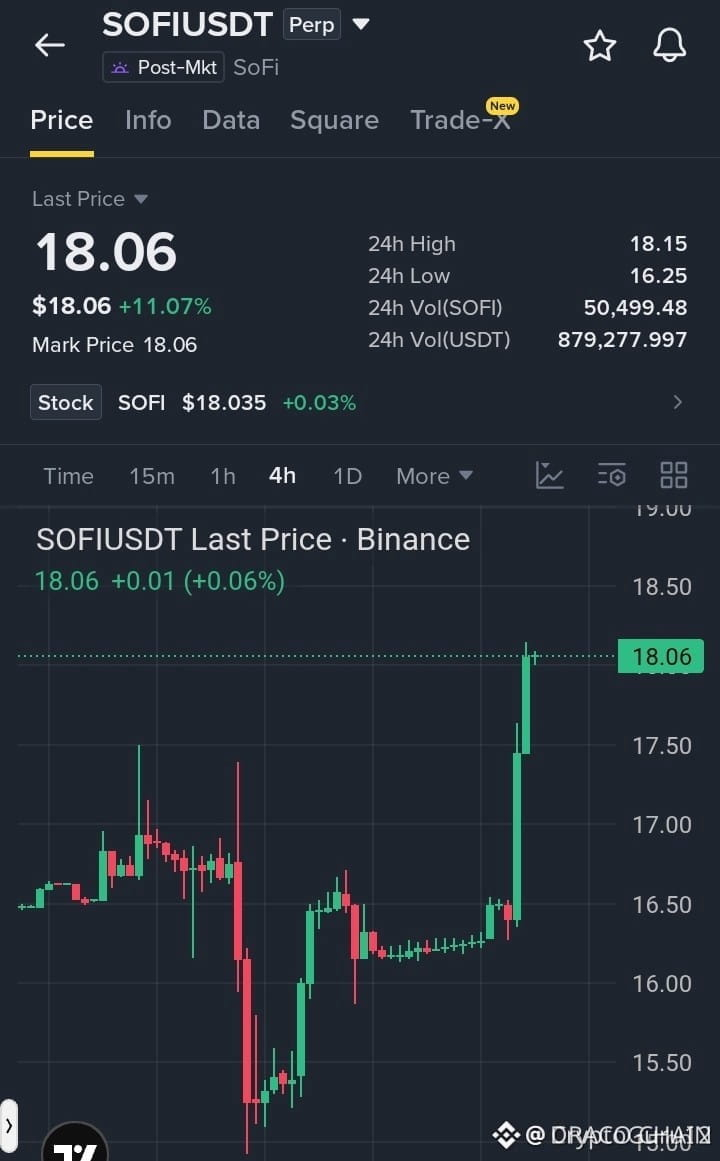
$SOFI BREAKOUT CONFIRMED — DEFEND THIS ZONE AND THE NEXT LEG RUNS! 🚀
Entry: 17.95 – 18.10 ⚡
Target: 18.40 – 19.20 🎯
Stop Loss: 17.50 🛑
💡 The breakout structure on $SOFI is textbook — buyers stepped in with real conviction, and the reaction from that reclaimed zone is the tell. 📊 As long as that supply-turned-demand floor holds, the path of least resistance points higher. This isn't a guessing game; it's price confirming intent.
📌 The laddered targets from 18.40 up to 19.20 offer a sharp risk-to-reward footprint for those who respect the invalidation at 17.50. 🔍 Watch for the first rejection candle to validate momentum before chasing the move.
💬 Are you fading the first touch of resistance for a pullback entry, or riding the breakout with a trailing stop? 👇
⚠️ Not financial advice. Always manage your risk. 🛡️
🏷️ #SOFI #Breakout #LongSetup #Crypto #Momentum
🔥 📈
$SOFI BREAKOUT CONFIRMED — DEFEND THIS ZONE AND THE NEXT LEG RUNS! 🚀
Entry: 17.95 – 18.10 ⚡
Target: 18.40 – 19.20 🎯
Stop Loss: 17.50 🛑
💡 The breakout structure on $SOFI is textbook — buyers stepped in with real conviction, and the reaction from that reclaimed zone is the tell. 📊 As long as that supply-turned-demand floor holds, the path of least resistance points higher. This isn't a guessing game; it's price confirming intent.
📌 The laddered targets from 18.40 up to 19.20 offer a sharp risk-to-reward footprint for those who respect the invalidation at 17.50. 🔍 Watch for the first rejection candle to validate momentum before chasing the move.
💬 Are you fading the first touch of resistance for a pullback entry, or riding the breakout with a trailing stop? 👇
⚠️ Not financial advice. Always manage your risk. 🛡️
🏷️ #SOFI #Breakout #LongSetup #Crypto #Momentum
🔥 📈
Entry: 17.95 – 18.10 ⚡
Target: 18.40 – 19.20 🎯
Stop Loss: 17.50 🛑
💡 The breakout structure on $SOFI is textbook — buyers stepped in with real conviction, and the reaction from that reclaimed zone is the tell. 📊 As long as that supply-turned-demand floor holds, the path of least resistance points higher. This isn't a guessing game; it's price confirming intent.
📌 The laddered targets from 18.40 up to 19.20 offer a sharp risk-to-reward footprint for those who respect the invalidation at 17.50. 🔍 Watch for the first rejection candle to validate momentum before chasing the move.
💬 Are you fading the first touch of resistance for a pullback entry, or riding the breakout with a trailing stop? 👇
⚠️ Not financial advice. Always manage your risk. 🛡️
🏷️ #SOFI #Breakout #LongSetup #Crypto #Momentum
🔥 📈
30

·
--
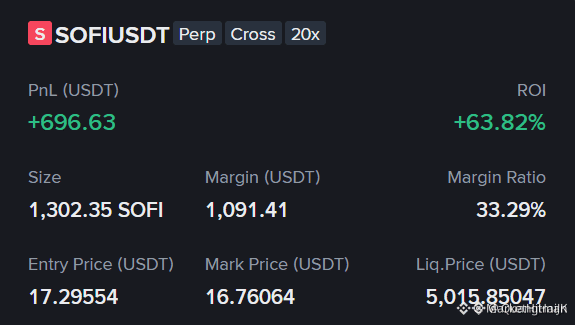
🔴 $SOFI SHORT SETUP WITH INSTITUTIONAL LIQUIDITY BELOW 📉
Entry: 17.2 - 20.6 ⚡
Target 1: 16.0 🎯
Target 2: 15.4 🎯
Target 3: 11.5 🎯
Stop Loss: 22.8 ⚠️
📉 A broad wave of selling pressure swept through risk assets as $BTC and other majors declined, shifting sentiment to a defensive posture. This macro headwind aligns with $SOFI 's structural breakdown — we're eyeing a liquidity sweep into the 16.0 zone, then deeper toward 15.4 and 11.5. 🦈 The order flow shows sellers absorbing bids at the 20-handle, leaving a clear inefficiency below. 📊 Volume divergence on the daily chart confirms weakening bullish momentum.
💡 This is a counter-trend short with defined risk; the 22.8 stop sits just above the last swing high, offering a clean 1:3+ R:R if the macro pressure persists. 💬 Are you watching for a retest of the entry zone or waiting for a decisive breakdown below 17? 👇
⚠️ Not financial advice. Always manage your risk. 🛡️
🏷️ #SOFI #ShortSetup #Bearish #Crypto #Macro
🔴 🎯
🔴 $SOFI SHORT SETUP WITH INSTITUTIONAL LIQUIDITY BELOW 📉
Entry: 17.2 - 20.6 ⚡
Target 1: 16.0 🎯
Target 2: 15.4 🎯
Target 3: 11.5 🎯
Stop Loss: 22.8 ⚠️
📉 A broad wave of selling pressure swept through risk assets as $BTC and other majors declined, shifting sentiment to a defensive posture. This macro headwind aligns with $SOFI 's structural breakdown — we're eyeing a liquidity sweep into the 16.0 zone, then deeper toward 15.4 and 11.5. 🦈 The order flow shows sellers absorbing bids at the 20-handle, leaving a clear inefficiency below. 📊 Volume divergence on the daily chart confirms weakening bullish momentum.
💡 This is a counter-trend short with defined risk; the 22.8 stop sits just above the last swing high, offering a clean 1:3+ R:R if the macro pressure persists. 💬 Are you watching for a retest of the entry zone or waiting for a decisive breakdown below 17? 👇
⚠️ Not financial advice. Always manage your risk. 🛡️
🏷️ #SOFI #ShortSetup #Bearish #Crypto #Macro
🔴 🎯
Entry: 17.2 - 20.6 ⚡
Target 1: 16.0 🎯
Target 2: 15.4 🎯
Target 3: 11.5 🎯
Stop Loss: 22.8 ⚠️
📉 A broad wave of selling pressure swept through risk assets as $BTC and other majors declined, shifting sentiment to a defensive posture. This macro headwind aligns with $SOFI 's structural breakdown — we're eyeing a liquidity sweep into the 16.0 zone, then deeper toward 15.4 and 11.5. 🦈 The order flow shows sellers absorbing bids at the 20-handle, leaving a clear inefficiency below. 📊 Volume divergence on the daily chart confirms weakening bullish momentum.
💡 This is a counter-trend short with defined risk; the 22.8 stop sits just above the last swing high, offering a clean 1:3+ R:R if the macro pressure persists. 💬 Are you watching for a retest of the entry zone or waiting for a decisive breakdown below 17? 👇
⚠️ Not financial advice. Always manage your risk. 🛡️
🏷️ #SOFI #ShortSetup #Bearish #Crypto #Macro
🔴 🎯
84

·
--
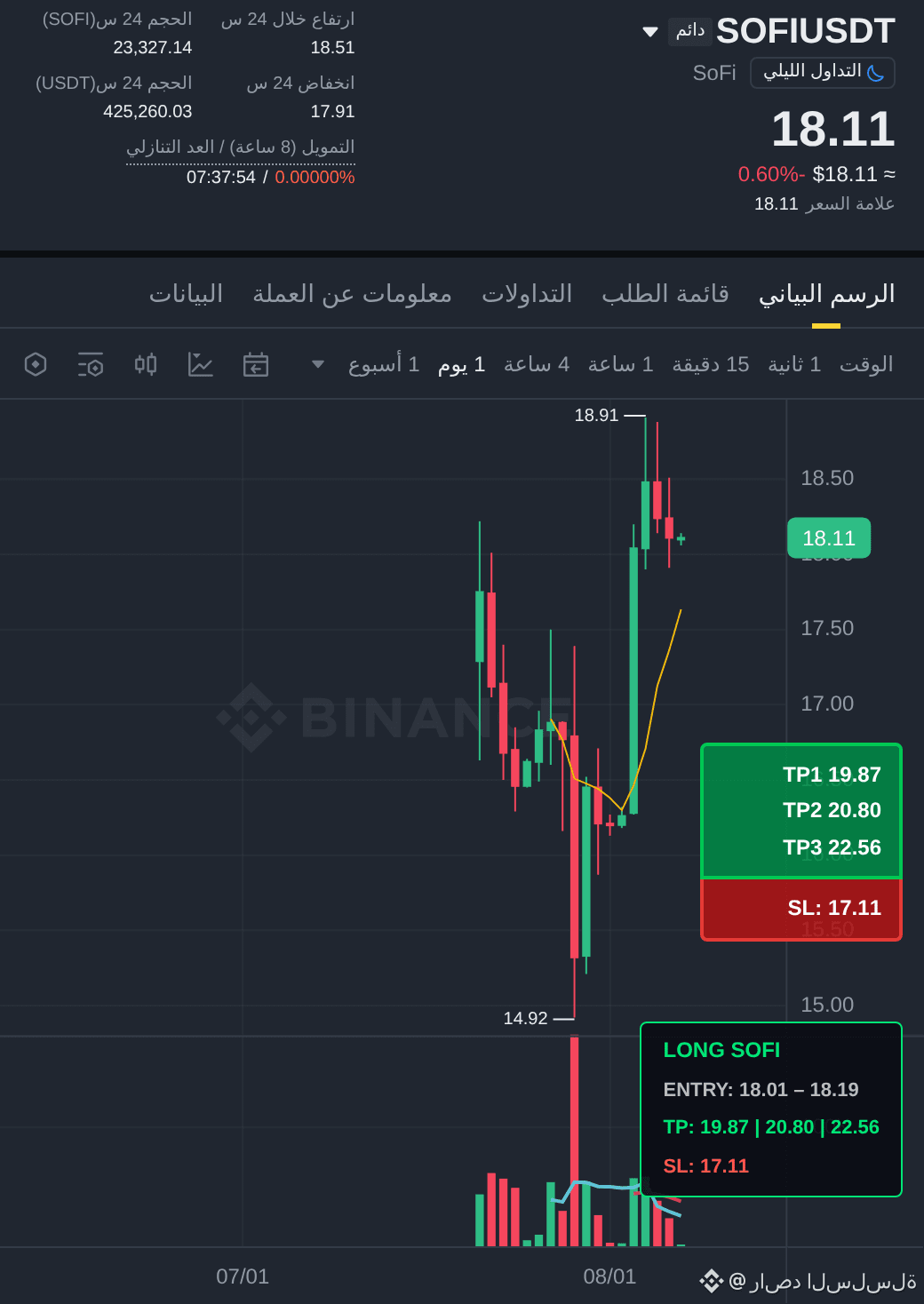
Will it reverse upward $SOFI ? Here’s the signal I’m watching
$SOFI Reversal — 📈 Buy
18.09 | RSI 43 | Volume $427.4K
EMA20: $18.19 | EMA50: $18.16 ✅ Golden cross
📈 Entry: 18.01 – 18.19
🛑 Stop loss: 17.11
🎯 Target 1: 19.87
🎯 Target 2: 20.80
🎯 Target 3: 22.56
Risk is defined. The opportunity is clear. Execute with discipline.
The market is screaming 👈 $SOFI 👉 listen to it now
#SOFI #إشارات_قصيرة #استراتيجية_الشراء
Will it reverse upward $SOFI ? Here’s the signal I’m watching
$SOFI Reversal — 📈 Buy
18.09 | RSI 43 | Volume $427.4K
EMA20: $18.19 | EMA50: $18.16 ✅ Golden cross
📈 Entry: 18.01 – 18.19
🛑 Stop loss: 17.11
🎯 Target 1: 19.87
🎯 Target 2: 20.80
🎯 Target 3: 22.56
Risk is defined. The opportunity is clear. Execute with discipline.
The market is screaming 👈 $SOFI 👉 listen to it now
#SOFI #إشارات_قصيرة #استراتيجية_الشراء
$SOFI Reversal — 📈 Buy
18.09 | RSI 43 | Volume $427.4K
EMA20: $18.19 | EMA50: $18.16 ✅ Golden cross
📈 Entry: 18.01 – 18.19
🛑 Stop loss: 17.11
🎯 Target 1: 19.87
🎯 Target 2: 20.80
🎯 Target 3: 22.56
Risk is defined. The opportunity is clear. Execute with discipline.
The market is screaming 👈 $SOFI 👉 listen to it now
#SOFI #إشارات_قصيرة #استراتيجية_الشراء
72

·
--
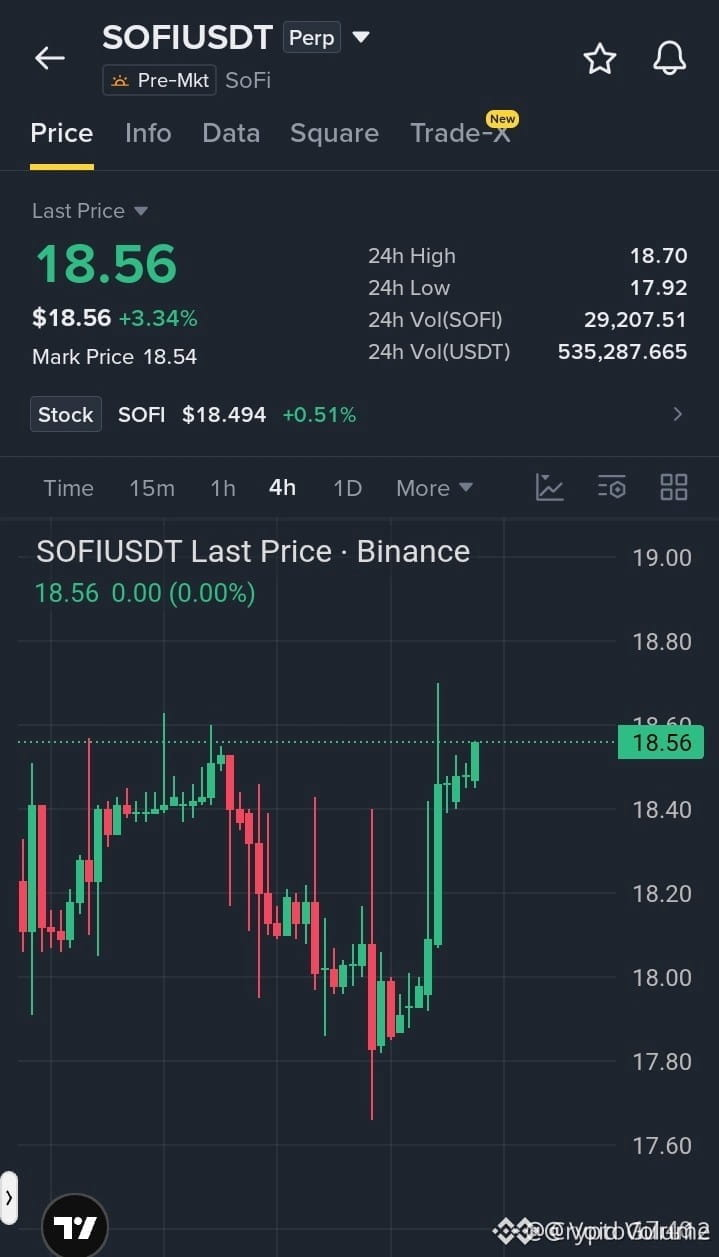
🚨 $SOFI RECOVERS FROM 17.80 — BULLS RECLAIM 18.40 AS HIGHER LOWS HOLD! 📈
Entry: 18.40–18.60 ⚡
Target: 19.50 🚀
Stop Loss: 18.15 ⚠️
📌 The 17.80 lows gave institutional buyers a clean liquidity pool, and the snap reclaim of 18.40 tells the real story. That was a demand zone worth defending, and the market is respecting it with a textbook series of higher lows. 📊
⚡ We're hovering right at 18.55 resistance while momentum builds. A close above this level opens the path toward the 19.10 and 19.50 supply pools, and volume is starting to confirm the move. 💡 The structure stays intact until we lose 18.15, which is also shielding your downside if sellers step in here.
💬 Are you riding the retest of 18.40 or waiting for a breakout confirmation above 18.55? 🤔
⚠️ Not financial advice. Always manage your risk. 🛡️
🏷️ #SOFI #BullishSetup #HigherLows #Breakout #Trading
📈 ⚡
🚨 $SOFI RECOVERS FROM 17.80 — BULLS RECLAIM 18.40 AS HIGHER LOWS HOLD! 📈
Entry: 18.40–18.60 ⚡
Target: 19.50 🚀
Stop Loss: 18.15 ⚠️
📌 The 17.80 lows gave institutional buyers a clean liquidity pool, and the snap reclaim of 18.40 tells the real story. That was a demand zone worth defending, and the market is respecting it with a textbook series of higher lows. 📊
⚡ We're hovering right at 18.55 resistance while momentum builds. A close above this level opens the path toward the 19.10 and 19.50 supply pools, and volume is starting to confirm the move. 💡 The structure stays intact until we lose 18.15, which is also shielding your downside if sellers step in here.
💬 Are you riding the retest of 18.40 or waiting for a breakout confirmation above 18.55? 🤔
⚠️ Not financial advice. Always manage your risk. 🛡️
🏷️ #SOFI #BullishSetup #HigherLows #Breakout #Trading
📈 ⚡
Entry: 18.40–18.60 ⚡
Target: 19.50 🚀
Stop Loss: 18.15 ⚠️
📌 The 17.80 lows gave institutional buyers a clean liquidity pool, and the snap reclaim of 18.40 tells the real story. That was a demand zone worth defending, and the market is respecting it with a textbook series of higher lows. 📊
⚡ We're hovering right at 18.55 resistance while momentum builds. A close above this level opens the path toward the 19.10 and 19.50 supply pools, and volume is starting to confirm the move. 💡 The structure stays intact until we lose 18.15, which is also shielding your downside if sellers step in here.
💬 Are you riding the retest of 18.40 or waiting for a breakout confirmation above 18.55? 🤔
⚠️ Not financial advice. Always manage your risk. 🛡️
🏷️ #SOFI #BullishSetup #HigherLows #Breakout #Trading
📈 ⚡
28
·
--
[M1_mag7]
The old dog glanced at the on-chain contract book. In the past 24 hours, $SOFI has fallen 4.025%, and the current price is hovering at $17.17. As a representative of the fintech sector, this adjustment is milder than most tech stocks, but trading volume is only 360,000 contracts—liquidity isn’t very deep. Compared with the large-cap names in the Mag7, its sector beta doesn’t have a strong anchoring effect.
I think $SOFI is currently in a balanced state where capital is watching and waiting. Funding rates are at zero, meaning neither long nor short sides are willing to pay costs to the counterparty in the futures market—neither side has formed an overwhelming crowd. Open interest at 26,000 contracts also suggests the size of leveraged positions is moderate. Combined with the average analyst target price of $20.23 provided by TipRanks (single source), there is still room between the current price and the consensus target. That may explain why, despite the 4% drop, there hasn’t been a panic-like shift in rates or a sharp reduction in positions on-chain. However, the SoFiUSD stablecoin business it’s pushing is more of a long-term narrative; in the short term, it’s unlikely to provide direct support to the futures price.
Trading tag: #BinanceFutures #TradFi #USDⓈM #SOFI #SOFIUSDT $SOFI
[M1_mag7]
The old dog glanced at the on-chain contract book. In the past 24 hours, $SOFI has fallen 4.025%, and the current price is hovering at $17.17. As a representative of the fintech sector, this adjustment is milder than most tech stocks, but trading volume is only 360,000 contracts—liquidity isn’t very deep. Compared with the large-cap names in the Mag7, its sector beta doesn’t have a strong anchoring effect.
I think $SOFI is currently in a balanced state where capital is watching and waiting. Funding rates are at zero, meaning neither long nor short sides are willing to pay costs to the counterparty in the futures market—neither side has formed an overwhelming crowd. Open interest at 26,000 contracts also suggests the size of leveraged positions is moderate. Combined with the average analyst target price of $20.23 provided by TipRanks (single source), there is still room between the current price and the consensus target. That may explain why, despite the 4% drop, there hasn’t been a panic-like shift in rates or a sharp reduction in positions on-chain. However, the SoFiUSD stablecoin business it’s pushing is more of a long-term narrative; in the short term, it’s unlikely to provide direct support to the futures price.
Trading tag: #BinanceFutures #TradFi #USDⓈM #SOFI #SOFIUSDT $SOFI
The old dog glanced at the on-chain contract book. In the past 24 hours, $SOFI has fallen 4.025%, and the current price is hovering at $17.17. As a representative of the fintech sector, this adjustment is milder than most tech stocks, but trading volume is only 360,000 contracts—liquidity isn’t very deep. Compared with the large-cap names in the Mag7, its sector beta doesn’t have a strong anchoring effect.
I think $SOFI is currently in a balanced state where capital is watching and waiting. Funding rates are at zero, meaning neither long nor short sides are willing to pay costs to the counterparty in the futures market—neither side has formed an overwhelming crowd. Open interest at 26,000 contracts also suggests the size of leveraged positions is moderate. Combined with the average analyst target price of $20.23 provided by TipRanks (single source), there is still room between the current price and the consensus target. That may explain why, despite the 4% drop, there hasn’t been a panic-like shift in rates or a sharp reduction in positions on-chain. However, the SoFiUSD stablecoin business it’s pushing is more of a long-term narrative; in the short term, it’s unlikely to provide direct support to the futures price.
Trading tag: #BinanceFutures #TradFi #USDⓈM #SOFI #SOFIUSDT $SOFI
3

$SOFI down 5.06% to 17.06, funding rate 0, and neither side has taken action. Political events like regulatory rumor weigh on risk appetite, but openInterest 26340 hasn’t liquidated, positions are light. Counter-argument: once the news is out, they may push to squeeze shorts by forcing a rebound. If it breaks below 16.5, stop-loss orders will be concentrated. I’m testing a short with 500 USDT, stop loss at 17.8, take profit at 16.0. If price rises above 18, I’ll exit.
Trading tag: #TradFi #链上美股 #SOFI
Where do you think this judgment is most likely to be wrong?
$SOFI down 5.06% to 17.06, funding rate 0, and neither side has taken action. Political events like regulatory rumor weigh on risk appetite, but openInterest 26340 hasn’t liquidated, positions are light. Counter-argument: once the news is out, they may push to squeeze shorts by forcing a rebound. If it breaks below 16.5, stop-loss orders will be concentrated. I’m testing a short with 500 USDT, stop loss at 17.8, take profit at 16.0. If price rises above 18, I’ll exit.
Trading tag: #TradFi #链上美股 #SOFI
Where do you think this judgment is most likely to be wrong?
Trading tag: #TradFi #链上美股 #SOFI
Where do you think this judgment is most likely to be wrong?
36
·
--
$SOFI 24 hours fell 4.93%, current price 16.97, financing fee rate set to zero. Political policy expectations are the primary driver. The market is likely pricing in possible tighter regulation and fiscal uncertainty, which are weighing on fintech stocks.
Under this setup, a neutral financing fee rate suggests neither side is panicking. But the price drop accompanied by an open position size of 26,664 without any obvious withdrawal means the bulls are holding firm and the bears haven’t really pushed. The strongest counterevidence is that if the two parties send easing signals regarding digital bank regulation, this stock could rebound quickly.
A second-order impact is that capital will continue to flow from growth-oriented fintech into traditional bank stocks.
Trading tag: #TradFi #链上美股 #SOFI
Where do you think this assessment is most likely to be wrong?
$SOFI 24 hours fell 4.93%, current price 16.97, financing fee rate set to zero. Political policy expectations are the primary driver. The market is likely pricing in possible tighter regulation and fiscal uncertainty, which are weighing on fintech stocks.
Under this setup, a neutral financing fee rate suggests neither side is panicking. But the price drop accompanied by an open position size of 26,664 without any obvious withdrawal means the bulls are holding firm and the bears haven’t really pushed. The strongest counterevidence is that if the two parties send easing signals regarding digital bank regulation, this stock could rebound quickly.
A second-order impact is that capital will continue to flow from growth-oriented fintech into traditional bank stocks.
Trading tag: #TradFi #链上美股 #SOFI
Where do you think this assessment is most likely to be wrong?
Under this setup, a neutral financing fee rate suggests neither side is panicking. But the price drop accompanied by an open position size of 26,664 without any obvious withdrawal means the bulls are holding firm and the bears haven’t really pushed. The strongest counterevidence is that if the two parties send easing signals regarding digital bank regulation, this stock could rebound quickly.
A second-order impact is that capital will continue to flow from growth-oriented fintech into traditional bank stocks.
Trading tag: #TradFi #链上美股 #SOFI
Where do you think this assessment is most likely to be wrong?
5
Log in to explore more content
Join global crypto users on Binance Square
⚡️ Get latest and useful information about crypto.
💬 Trusted by the world’s largest crypto exchange.
👍 Discover real insights from verified creators.
Email / Phone number
Trending Topics
1
#BinanceLaunchesBinanceIntelligence
0 views
0 Discussing
2
#EvernorthXRPTreasuryCompletesSPACMerger
54 views
19 Discussing
3
#ADAGains10%Above$0.27
16,195 views
182 Discussing
4
#ETHUp70%InQ3ButLiquidityFalls
181,401 views
1,112 Discussing
5
#EthStakingExitQueueHits2026High
61,849 views
793 Discussing
6
#FedOctoberHoldOdds82.3%
64,704 views
752 Discussing
7
#Nikkei225Jumps2.5%ToThreeMonthHigh
84,747 views
1,115 Discussing
8
#CircleMints$2.75BUSDCOnSolanaIn7Days
2,334 views
52 Discussing
9
#DriftHackVictimsBeginClaims
181,850 views
1,764 Discussing
10
#SolanaTokenizedStockVolumeTops$4.4BInSeptember
13,940 views
133 Discussing