

#securitytokens
securitytokens
8,482 views
49 Discussing
Hot
Latest

·
--
$POLYX at ~$0.028 | MCAP ~$34M | moderate volume. Purpose-built security token chain for regulated RWAs. Clean compliance angle in the tokenization space.
#POLYX #Polymesh #RWA #SecurityTokens
$POLYX at ~$0.028 | MCAP ~$34M | moderate volume. Purpose-built security token chain for regulated RWAs. Clean compliance angle in the tokenization space.
#POLYX #Polymesh #RWA #SecurityTokens
#POLYX #Polymesh #RWA #SecurityTokens
1
51

·
--
Bullish
Verified
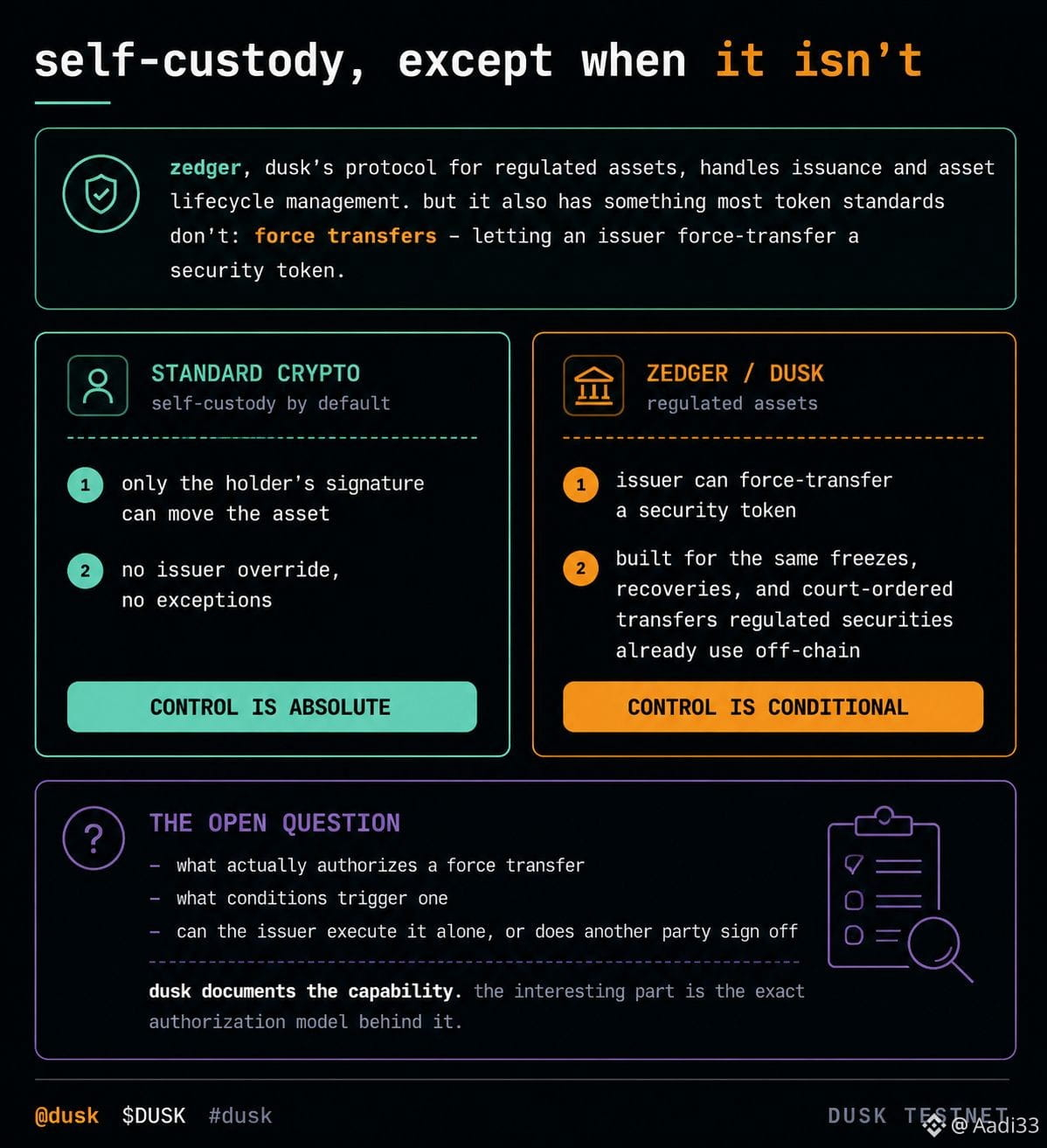
Most crypto runs on one rule: nobody but you can move your funds. dusk breaks that rule on purpose for one asset type.
zedger, dusk's protocol for regulated assets, handles the usual stuff, including issuance and asset lifecycle management. but it also has something most token standards don't: force transfers, letting an issuer force-transfer a security token.
this is what native issuance actually asks for. the whole point of running an asset's lifecycle on-chain instead of just wrapping it is that corporate actions and compliance enforcement have to work the same way they do off-chain, freezes, recoveries, court-ordered transfers. a token that can never be touched by the issuer can't fully reproduce the controls that regulated securities require.
i'm not saying that's a flaw. it's just a different assumption than crypto usually runs on, self-custody as something that can be overridden under defined conditions instead of absolute.
what i'd want to know is what actually authorizes a force transfer, what conditions trigger it, and whether the issuer alone can execute it or another party has to sign off.
dusk documents the capability. the interesting part is the exact authorization model behind it.
@Dusk_Foundation $DUSK #dusk
$ACE #RWA #SecurityTokens #Tokenization
Most crypto runs on one rule: nobody but you can move your funds. dusk breaks that rule on purpose for one asset type.
zedger, dusk's protocol for regulated assets, handles the usual stuff, including issuance and asset lifecycle management. but it also has something most token standards don't: force transfers, letting an issuer force-transfer a security token.
this is what native issuance actually asks for. the whole point of running an asset's lifecycle on-chain instead of just wrapping it is that corporate actions and compliance enforcement have to work the same way they do off-chain, freezes, recoveries, court-ordered transfers. a token that can never be touched by the issuer can't fully reproduce the controls that regulated securities require.
i'm not saying that's a flaw. it's just a different assumption than crypto usually runs on, self-custody as something that can be overridden under defined conditions instead of absolute.
what i'd want to know is what actually authorizes a force transfer, what conditions trigger it, and whether the issuer alone can execute it or another party has to sign off.
dusk documents the capability. the interesting part is the exact authorization model behind it.
@Dusk $DUSK #dusk
$ACE #RWA #SecurityTokens #Tokenization
zedger, dusk's protocol for regulated assets, handles the usual stuff, including issuance and asset lifecycle management. but it also has something most token standards don't: force transfers, letting an issuer force-transfer a security token.
this is what native issuance actually asks for. the whole point of running an asset's lifecycle on-chain instead of just wrapping it is that corporate actions and compliance enforcement have to work the same way they do off-chain, freezes, recoveries, court-ordered transfers. a token that can never be touched by the issuer can't fully reproduce the controls that regulated securities require.
i'm not saying that's a flaw. it's just a different assumption than crypto usually runs on, self-custody as something that can be overridden under defined conditions instead of absolute.
what i'd want to know is what actually authorizes a force transfer, what conditions trigger it, and whether the issuer alone can execute it or another party has to sign off.
dusk documents the capability. the interesting part is the exact authorization model behind it.
@Dusk $DUSK #dusk
$ACE #RWA #SecurityTokens #Tokenization
18
1
15
333

·
--
#KoreaProposesTokenizingStocksAndBonds
🚨 WALL STREET’S NEXT MOVE? KOREA IS PUTTING STOCKS ON-CHAIN. 🇰🇷🔥
South Korea is moving to bring stocks, bonds and funds into its regulated security-token framework, with the first phase planned for February 2027.
Korea’s move shows tokenization is shifting from crypto experiments toward mainstream financial infrastructure. Putting traditional securities on blockchain could improve settlement and create new market structures, but regulation, investor protection and liquidity will matter. If execution matches the roadmap, Korea could become an important testing ground for tokenized capital markets.
#RWA #Tokenization #SecurityTokens #Crypto #Blockchain
#KoreaProposesTokenizingStocksAndBonds
🚨 WALL STREET’S NEXT MOVE? KOREA IS PUTTING STOCKS ON-CHAIN. 🇰🇷🔥
South Korea is moving to bring stocks, bonds and funds into its regulated security-token framework, with the first phase planned for February 2027.
Korea’s move shows tokenization is shifting from crypto experiments toward mainstream financial infrastructure. Putting traditional securities on blockchain could improve settlement and create new market structures, but regulation, investor protection and liquidity will matter. If execution matches the roadmap, Korea could become an important testing ground for tokenized capital markets.
#RWA #Tokenization #SecurityTokens #Crypto #Blockchain
🚨 WALL STREET’S NEXT MOVE? KOREA IS PUTTING STOCKS ON-CHAIN. 🇰🇷🔥
South Korea is moving to bring stocks, bonds and funds into its regulated security-token framework, with the first phase planned for February 2027.
Korea’s move shows tokenization is shifting from crypto experiments toward mainstream financial infrastructure. Putting traditional securities on blockchain could improve settlement and create new market structures, but regulation, investor protection and liquidity will matter. If execution matches the roadmap, Korea could become an important testing ground for tokenized capital markets.
#RWA #Tokenization #SecurityTokens #Crypto #Blockchain

16

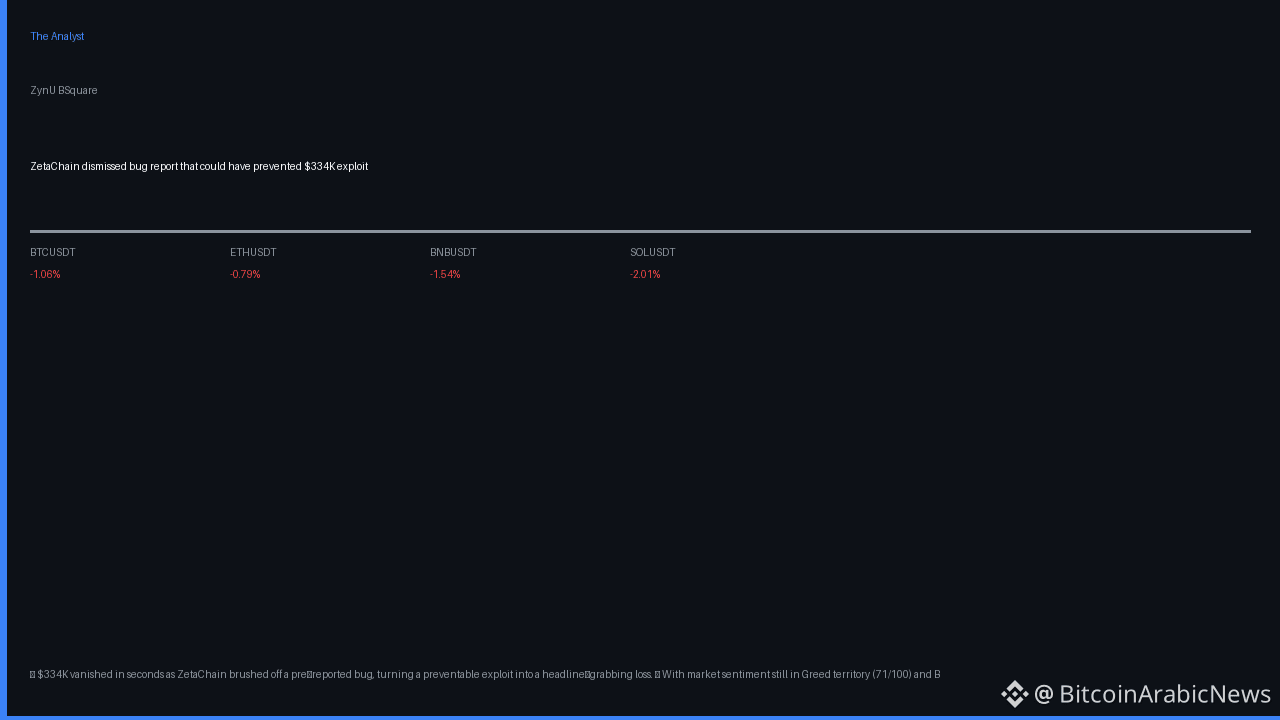
🔥 $334K vanished in seconds as ZetaChain brushed off a pre‑reported bug, turning a preventable exploit into a headline‑grabbing loss.
📊 With market sentiment still in Greed territory (71/100) and BTC slipping to $79,069 (‑1.06% 24h) while futures OI holds at $8.46B, any breach that shakes confidence can tip the delicate risk balance.
💡 Smart money is already recalibrating: top BTC futures traders remain net long at 66.4% despite the dip, and the lingering $334K loss fuels a surge in #SecurityTokens scrutiny, #CrossChain risk assessments, and a renewed #BugBounty appetite across DeFi projects.
🚀 Watch the BTC $78,500 support – a break below it could accelerate margin squeezes, while a clean retest may reaffirm that institutional longs are still in control; the next funding tick (+0.0045%) will be the litmus test for whether the market absorbs the shock.
❓ Are we witnessing a turning point where ignored security signals become the new catalyst for capital flight, or will the long bias in futures absorb the fallout and keep the rally intact?
🔥 $334K vanished in seconds as ZetaChain brushed off a pre‑reported bug, turning a preventable exploit into a headline‑grabbing loss.
📊 With market sentiment still in Greed territory (71/100) and BTC slipping to $79,069 (‑1.06% 24h) while futures OI holds at $8.46B, any breach that shakes confidence can tip the delicate risk balance.
💡 Smart money is already recalibrating: top BTC futures traders remain net long at 66.4% despite the dip, and the lingering $334K loss fuels a surge in #SecurityTokens scrutiny, #CrossChain risk assessments, and a renewed #BugBounty appetite across DeFi projects.
🚀 Watch the BTC $78,500 support – a break below it could accelerate margin squeezes, while a clean retest may reaffirm that institutional longs are still in control; the next funding tick (+0.0045%) will be the litmus test for whether the market absorbs the shock.
❓ Are we witnessing a turning point where ignored security signals become the new catalyst for capital flight, or will the long bias in futures absorb the fallout and keep the rally intact?
📊 With market sentiment still in Greed territory (71/100) and BTC slipping to $79,069 (‑1.06% 24h) while futures OI holds at $8.46B, any breach that shakes confidence can tip the delicate risk balance.
💡 Smart money is already recalibrating: top BTC futures traders remain net long at 66.4% despite the dip, and the lingering $334K loss fuels a surge in #SecurityTokens scrutiny, #CrossChain risk assessments, and a renewed #BugBounty appetite across DeFi projects.
🚀 Watch the BTC $78,500 support – a break below it could accelerate margin squeezes, while a clean retest may reaffirm that institutional longs are still in control; the next funding tick (+0.0045%) will be the litmus test for whether the market absorbs the shock.
❓ Are we witnessing a turning point where ignored security signals become the new catalyst for capital flight, or will the long bias in futures absorb the fallout and keep the rally intact?
36
Log in to explore more content
Join global crypto users on Binance Square
⚡️ Get latest and useful information about crypto.
💬 Trusted by the world’s largest crypto exchange.
👍 Discover real insights from verified creators.
Email / Phone number
Trending Topics
1
#KoreaProposesTokenizingStocksAndBonds
274 views
44 Discussing
2
#MetaMaskExitsLidoValidatorsAfterSecurityIncident
53,908 views
811 Discussing
3
#MicronBeatsEarningsLiftsGuidance
33,929 views
620 Discussing
4
#CFTCSubmitsTwoEventContractRulesToWhiteHouse
24,048 views
533 Discussing
5
#BitcoinClears$85200
33,444 views
342 Discussing
6
#AltcoinSeasonIndexHoldsAbove60For5Days
167,195 views
2,088 Discussing
7
#USADPAdds90000JobsInSeptember
78,758 views
1,192 Discussing
8
#USCorePCEEasesTo3%InAugust
53,585 views
778 Discussing
9
#KospiPostsWorstQuarterSince2020
28,942 views
624 Discussing
10
#SECToClarifyOnChainFundraisingRules
71,276 views
845 Discussing