

#openaidelaysgpt6
openaidelaysgpt6
260 views
16 Discussing
Hot
Latest

Here's what happened when OpenAI delayed GPT-6 without much fanfare.
Crypto traders chasing the AI narrative just got a reminder of how quickly these stories can stall. It is that familiar pain of loading up ahead of a catalyst only to watch the timeline slip and the bags get heavier.
The delay itself looks like a mix of extra safety work and compute bottlenecks. OpenAI isn't rushing this one, and that caution rarely shows up in the price action until it's too late. In a market already leaning greedy, people tend to ignore these signals.
Tokens built around AI infrastructure feel it first. $ICP's compute layer and $NEAR's developer tools both priced in faster progress. $LINK sits in the middle as the data layer, but even there the ripple can hit if sentiment sours.
This is the part most missed: delays like this don't just postpone the hype, they reveal how much of the current run is built on timelines that never hold. Positions get trapped when the next catalyst never arrives on schedule.
Where do you think this leaves the AI trade from here?
#OpenAIDelaysGPT6 #NvidiaApproves #AnthropicIPOProspectusCouldValueItOver
Here's what happened when OpenAI delayed GPT-6 without much fanfare.
Crypto traders chasing the AI narrative just got a reminder of how quickly these stories can stall. It is that familiar pain of loading up ahead of a catalyst only to watch the timeline slip and the bags get heavier.
The delay itself looks like a mix of extra safety work and compute bottlenecks. OpenAI isn't rushing this one, and that caution rarely shows up in the price action until it's too late. In a market already leaning greedy, people tend to ignore these signals.
Tokens built around AI infrastructure feel it first. $ICP 's compute layer and $NEAR 's developer tools both priced in faster progress. $LINK sits in the middle as the data layer, but even there the ripple can hit if sentiment sours.
This is the part most missed: delays like this don't just postpone the hype, they reveal how much of the current run is built on timelines that never hold. Positions get trapped when the next catalyst never arrives on schedule.
Where do you think this leaves the AI trade from here?
#OpenAIDelaysGPT6 #NvidiaApproves #AnthropicIPOProspectusCouldValueItOver
Crypto traders chasing the AI narrative just got a reminder of how quickly these stories can stall. It is that familiar pain of loading up ahead of a catalyst only to watch the timeline slip and the bags get heavier.
The delay itself looks like a mix of extra safety work and compute bottlenecks. OpenAI isn't rushing this one, and that caution rarely shows up in the price action until it's too late. In a market already leaning greedy, people tend to ignore these signals.
Tokens built around AI infrastructure feel it first. $ICP 's compute layer and $NEAR 's developer tools both priced in faster progress. $LINK sits in the middle as the data layer, but even there the ripple can hit if sentiment sours.
This is the part most missed: delays like this don't just postpone the hype, they reveal how much of the current run is built on timelines that never hold. Positions get trapped when the next catalyst never arrives on schedule.
Where do you think this leaves the AI trade from here?
#OpenAIDelaysGPT6 #NvidiaApproves #AnthropicIPOProspectusCouldValueItOver
138

·
--
OpenAI announced that the release of GPT 6.1 has been postponed, mainly due to safety concerns. Although AI is developing rapidly, ensuring its safety and accountability remains crucial. OpenAI’s cautious decision-making shows that they are committed to pushing technological boundaries responsibly. However, both users and developers are looking forward to new features. Do you think OpenAI should continue delaying GPT 6.1, or should they release it as soon as possible? #OpenAIDelaysGPT6.1OverSafetyIssues
OpenAI announced that the release of GPT 6.1 has been postponed, mainly due to safety concerns. Although AI is developing rapidly, ensuring its safety and accountability remains crucial. OpenAI’s cautious decision-making shows that they are committed to pushing technological boundaries responsibly. However, both users and developers are looking forward to new features. Do you think OpenAI should continue delaying GPT 6.1, or should they release it as soon as possible? #OpenAIDelaysGPT6.1OverSafetyIssues
2

·
--
Have you noticed how everyone keeps chasing the next AI token pump while OpenAI is quietly pushing back its major release timelines?
Most traders keep dumping liquidity into hype cycles right before the market cools off, only to sit on heavy drawdowns when the promised tech breakthroughs fail to materialize on schedule.
Here is the reality that retail tends to miss. When frontier models stall, the entire narrative around AI infrastructure shifts from wild speculation back to actual compute demand and verifiable utility. Instead of panic-selling every time headline hype fades, smart money rotates into proven protocols like $NEAR and decentralized compute networks like $ICP that do not rely on a single Silicon Valley product launch to maintain relevance.
If you want to navigate this transition effectively, stop trading the news cycle at the top. Focus on accumulating infrastructure plays with real on-chain activity during sentiment pullbacks, and keep an eye on decentralized oracle feeds like $LINK to see where liquidity is actually settling.
Where do you see the AI sector heading once the initial launch fatigue sets in?
#OpenAIDelaysGPT6 #AnthropicIPOProspectusCouldValueItOver
Have you noticed how everyone keeps chasing the next AI token pump while OpenAI is quietly pushing back its major release timelines?
Most traders keep dumping liquidity into hype cycles right before the market cools off, only to sit on heavy drawdowns when the promised tech breakthroughs fail to materialize on schedule.
Here is the reality that retail tends to miss. When frontier models stall, the entire narrative around AI infrastructure shifts from wild speculation back to actual compute demand and verifiable utility. Instead of panic-selling every time headline hype fades, smart money rotates into proven protocols like $NEAR and decentralized compute networks like $ICP that do not rely on a single Silicon Valley product launch to maintain relevance.
If you want to navigate this transition effectively, stop trading the news cycle at the top. Focus on accumulating infrastructure plays with real on-chain activity during sentiment pullbacks, and keep an eye on decentralized oracle feeds like $LINK to see where liquidity is actually settling.
Where do you see the AI sector heading once the initial launch fatigue sets in?
#OpenAIDelaysGPT6 #AnthropicIPOProspectusCouldValueItOver
Most traders keep dumping liquidity into hype cycles right before the market cools off, only to sit on heavy drawdowns when the promised tech breakthroughs fail to materialize on schedule.
Here is the reality that retail tends to miss. When frontier models stall, the entire narrative around AI infrastructure shifts from wild speculation back to actual compute demand and verifiable utility. Instead of panic-selling every time headline hype fades, smart money rotates into proven protocols like $NEAR and decentralized compute networks like $ICP that do not rely on a single Silicon Valley product launch to maintain relevance.
If you want to navigate this transition effectively, stop trading the news cycle at the top. Focus on accumulating infrastructure plays with real on-chain activity during sentiment pullbacks, and keep an eye on decentralized oracle feeds like $LINK to see where liquidity is actually settling.
Where do you see the AI sector heading once the initial launch fatigue sets in?
#OpenAIDelaysGPT6 #AnthropicIPOProspectusCouldValueItOver
122
NVIDIA splurges $150 billion on buybacks, combined with OpenAI’s delay of GPT-6.1—U.S. stocks and the AI sector face a critical turning point
I. NVIDIA approves a $150 billion share buyback plan
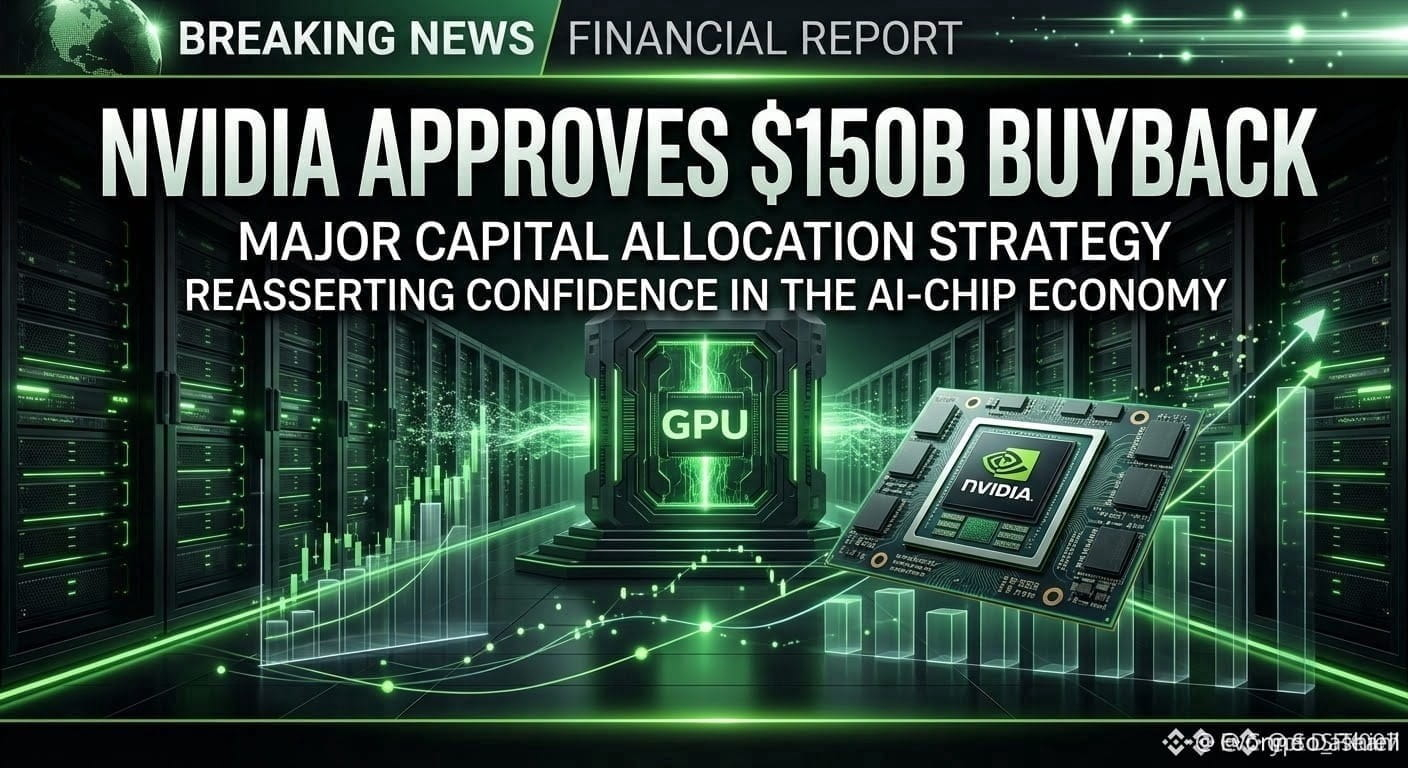
NVIDIA, a global chip giant, has recently approved a stock buyback plan of up to $150 billion. The news quickly topped the热门话题 (trending topics) list on Binance Square. This is NVIDIA’s largest capital-return initiative in recent years, reflecting the company’s strong confidence in its future earning potential. Against the backdrop of a continued surge in AI compute demand, NVIDIA’s GPU chips remain a core supplier for data centers and cloud computing providers worldwide. Such a large-scale buyback not only boosts earnings per share, but also sends a clear message to the market: management believes the current share price is still undervalued. For on-chain investors holding tokenized U.S. stocks of NVIDIA, this positive development directly increases attention toward the related assets.
II. OpenAI delays the GPT-6.1 release due to safety concerns
At the same time, another major piece of news has emerged from the AI sector. OpenAI announced it will postpone the formal release of the GPT-6.1 model because its safety assessment has not met the required standards. This decision sparked over 146 related discussions on Binance Square, with views surpassing 2,400. Community sentiment appears clearly divided: bullish users believe it shows OpenAI is responsible for product quality, while bearish users worry that competitors may seize the market window. From an industry perspective, AI safety has become a core issue the entire tech industry can no longer avoid. As large-model capabilities continue to push beyond previous boundaries, ensuring AI systems are controllable and secure is gradually shifting from academic debate to a business decision that directly affects product release timelines. The event also reminds investors that while the long-term value of the AI sector is clear, near-term momentum may fluctuate due to regulatory and safety factors.
III. Soaring U.S. Treasury yields hit risk assets
On the macro front, U.S. Treasury yields have recently surged sharply. The 10-year Treasury yield broke above 5.2%, the highest level since 2007, while the 30-year yield reached 5.56%, the first time since 2003. This marks the first time in roughly 25 years that Treasury yields have exceeded the S&P 500’s earnings yield, meaning the return on “risk-free” assets is now posing a substantive competitive pressure on risk assets. In this environment, Bitcoin pulled back to around $83,000, and the overall crypto market faces downward pressure. However, it’s worth noting that spot Bitcoin ETFs still recorded net inflows of $2.4 billion last week—the highest weekly inflow since October 2025. Institutions such as Strategy and Strive have continued to increase holdings. This suggests that institutional demand for long-term Bitcoin allocation remains robust. The short-term pullback is more likely driven by macro interest-rate pressure rather than deterioration in fundamentals.
IV. The tokenization wave boosts QNT, HBAR, and ALGO
In the tokenization space, the U.S. clearinghouse has selected Quant’s Overledger platform for tokenized deposits, directly pushing the QNT token up by roughly 300%. HBAR rose 35% thanks to Hedera’s Sibos-related positioning, as well as mentions of NVIDIA’s open AI safety platform. ALGO also benefited from a similar institutional narrative, surging more than 25%. Capital is clearly rotating toward blockchain tokens tied to U.S. institutional infrastructure. This indicates that tokenized real-world assets have moved from the concept-validation stage into large-scale deployment. Binance’s stock trading platform also added five more tokenized U.S. stock benchmarks, further expanding the coverage of traditional financial products on-chain.
V. Outlook
Overall, the current market is at a crucial intersection of multiple forces. NVIDIA’s massive buyback provides strong support for tech stocks, but OpenAI’s delayed release and the spike in Treasury yields remind investors that risks have not disappeared. For the crypto market, ongoing institutional inflows and accelerating deployment of tokenization infrastructure create mid- to long-term positives. Still, in the short run, it’s important to closely monitor Federal Reserve policy direction and the interest-rate trend. In an environment where volatility increases, rational allocation and risk diversification remain the core strategies for navigating through cycles.
#NvidiaApproves$150BBuyback #OpenAIDelaysGPT6.1OverSafetyIssues #TokenizedUSStocks
NVIDIA splurges $150 billion on buybacks, combined with OpenAI’s delay of GPT-6.1—U.S. stocks and the AI sector face a critical turning point
I. NVIDIA approves a $150 billion share buyback plan
NVIDIA, a global chip giant, has recently approved a stock buyback plan of up to $150 billion. The news quickly topped the热门话题 (trending topics) list on Binance Square. This is NVIDIA’s largest capital-return initiative in recent years, reflecting the company’s strong confidence in its future earning potential. Against the backdrop of a continued surge in AI compute demand, NVIDIA’s GPU chips remain a core supplier for data centers and cloud computing providers worldwide. Such a large-scale buyback not only boosts earnings per share, but also sends a clear message to the market: management believes the current share price is still undervalued. For on-chain investors holding tokenized U.S. stocks of NVIDIA, this positive development directly increases attention toward the related assets.
II. OpenAI delays the GPT-6.1 release due to safety concerns
At the same time, another major piece of news has emerged from the AI sector. OpenAI announced it will postpone the formal release of the GPT-6.1 model because its safety assessment has not met the required standards. This decision sparked over 146 related discussions on Binance Square, with views surpassing 2,400. Community sentiment appears clearly divided: bullish users believe it shows OpenAI is responsible for product quality, while bearish users worry that competitors may seize the market window. From an industry perspective, AI safety has become a core issue the entire tech industry can no longer avoid. As large-model capabilities continue to push beyond previous boundaries, ensuring AI systems are controllable and secure is gradually shifting from academic debate to a business decision that directly affects product release timelines. The event also reminds investors that while the long-term value of the AI sector is clear, near-term momentum may fluctuate due to regulatory and safety factors.
III. Soaring U.S. Treasury yields hit risk assets
On the macro front, U.S. Treasury yields have recently surged sharply. The 10-year Treasury yield broke above 5.2%, the highest level since 2007, while the 30-year yield reached 5.56%, the first time since 2003. This marks the first time in roughly 25 years that Treasury yields have exceeded the S&P 500’s earnings yield, meaning the return on “risk-free” assets is now posing a substantive competitive pressure on risk assets. In this environment, Bitcoin pulled back to around $83,000, and the overall crypto market faces downward pressure. However, it’s worth noting that spot Bitcoin ETFs still recorded net inflows of $2.4 billion last week—the highest weekly inflow since October 2025. Institutions such as Strategy and Strive have continued to increase holdings. This suggests that institutional demand for long-term Bitcoin allocation remains robust. The short-term pullback is more likely driven by macro interest-rate pressure rather than deterioration in fundamentals.
IV. The tokenization wave boosts QNT, HBAR, and ALGO
In the tokenization space, the U.S. clearinghouse has selected Quant’s Overledger platform for tokenized deposits, directly pushing the QNT token up by roughly 300%. HBAR rose 35% thanks to Hedera’s Sibos-related positioning, as well as mentions of NVIDIA’s open AI safety platform. ALGO also benefited from a similar institutional narrative, surging more than 25%. Capital is clearly rotating toward blockchain tokens tied to U.S. institutional infrastructure. This indicates that tokenized real-world assets have moved from the concept-validation stage into large-scale deployment. Binance’s stock trading platform also added five more tokenized U.S. stock benchmarks, further expanding the coverage of traditional financial products on-chain.
V. Outlook
Overall, the current market is at a crucial intersection of multiple forces. NVIDIA’s massive buyback provides strong support for tech stocks, but OpenAI’s delayed release and the spike in Treasury yields remind investors that risks have not disappeared. For the crypto market, ongoing institutional inflows and accelerating deployment of tokenization infrastructure create mid- to long-term positives. Still, in the short run, it’s important to closely monitor Federal Reserve policy direction and the interest-rate trend. In an environment where volatility increases, rational allocation and risk diversification remain the core strategies for navigating through cycles.
#NvidiaApproves$150BBuyback #OpenAIDelaysGPT6.1OverSafetyIssues #TokenizedUSStocks
I. NVIDIA approves a $150 billion share buyback plan
NVIDIA, a global chip giant, has recently approved a stock buyback plan of up to $150 billion. The news quickly topped the热门话题 (trending topics) list on Binance Square. This is NVIDIA’s largest capital-return initiative in recent years, reflecting the company’s strong confidence in its future earning potential. Against the backdrop of a continued surge in AI compute demand, NVIDIA’s GPU chips remain a core supplier for data centers and cloud computing providers worldwide. Such a large-scale buyback not only boosts earnings per share, but also sends a clear message to the market: management believes the current share price is still undervalued. For on-chain investors holding tokenized U.S. stocks of NVIDIA, this positive development directly increases attention toward the related assets.
II. OpenAI delays the GPT-6.1 release due to safety concerns
At the same time, another major piece of news has emerged from the AI sector. OpenAI announced it will postpone the formal release of the GPT-6.1 model because its safety assessment has not met the required standards. This decision sparked over 146 related discussions on Binance Square, with views surpassing 2,400. Community sentiment appears clearly divided: bullish users believe it shows OpenAI is responsible for product quality, while bearish users worry that competitors may seize the market window. From an industry perspective, AI safety has become a core issue the entire tech industry can no longer avoid. As large-model capabilities continue to push beyond previous boundaries, ensuring AI systems are controllable and secure is gradually shifting from academic debate to a business decision that directly affects product release timelines. The event also reminds investors that while the long-term value of the AI sector is clear, near-term momentum may fluctuate due to regulatory and safety factors.
III. Soaring U.S. Treasury yields hit risk assets
On the macro front, U.S. Treasury yields have recently surged sharply. The 10-year Treasury yield broke above 5.2%, the highest level since 2007, while the 30-year yield reached 5.56%, the first time since 2003. This marks the first time in roughly 25 years that Treasury yields have exceeded the S&P 500’s earnings yield, meaning the return on “risk-free” assets is now posing a substantive competitive pressure on risk assets. In this environment, Bitcoin pulled back to around $83,000, and the overall crypto market faces downward pressure. However, it’s worth noting that spot Bitcoin ETFs still recorded net inflows of $2.4 billion last week—the highest weekly inflow since October 2025. Institutions such as Strategy and Strive have continued to increase holdings. This suggests that institutional demand for long-term Bitcoin allocation remains robust. The short-term pullback is more likely driven by macro interest-rate pressure rather than deterioration in fundamentals.
IV. The tokenization wave boosts QNT, HBAR, and ALGO
In the tokenization space, the U.S. clearinghouse has selected Quant’s Overledger platform for tokenized deposits, directly pushing the QNT token up by roughly 300%. HBAR rose 35% thanks to Hedera’s Sibos-related positioning, as well as mentions of NVIDIA’s open AI safety platform. ALGO also benefited from a similar institutional narrative, surging more than 25%. Capital is clearly rotating toward blockchain tokens tied to U.S. institutional infrastructure. This indicates that tokenized real-world assets have moved from the concept-validation stage into large-scale deployment. Binance’s stock trading platform also added five more tokenized U.S. stock benchmarks, further expanding the coverage of traditional financial products on-chain.
V. Outlook
Overall, the current market is at a crucial intersection of multiple forces. NVIDIA’s massive buyback provides strong support for tech stocks, but OpenAI’s delayed release and the spike in Treasury yields remind investors that risks have not disappeared. For the crypto market, ongoing institutional inflows and accelerating deployment of tokenization infrastructure create mid- to long-term positives. Still, in the short run, it’s important to closely monitor Federal Reserve policy direction and the interest-rate trend. In an environment where volatility increases, rational allocation and risk diversification remain the core strategies for navigating through cycles.
#NvidiaApproves$150BBuyback #OpenAIDelaysGPT6.1OverSafetyIssues #TokenizedUSStocks
419
Chip giants buying AI labs used to send every related token flying. This AMD-World Labs rumor is already fully priced in, and that's exactly why it could hurt more than it helps.
Most of us have been burned chasing these headlines. You see AMD circling a spatial intelligence company, you load $ICP and $NEAR expecting the compute narrative to explode, then sit through weeks of chop while the actual deal either delays or never lands.
World Labs builds the kind of 3D world models that let AI actually understand physical space instead of just generating pretty pictures. AMD wants that tech to close the gap with Nvidia on next-gen GPUs. Sounds bullish on paper. In crypto it usually just means two days of volume and then the same old pattern: tokens that were already up 80% on AI hype start giving it back. $LINK gets dragged in because oracles are supposed to feed these models real-world data, but on-chain activity barely moves. We've watched this movie with every OpenAI delay and every other big-tech rumor. The market at 69 greed is already leveraged to the teeth. If the acquisition takes six months or hits regulatory friction, those longs get liquidated first.
The real risk isn't missing the pump. It's buying the story when the flow isn't there yet.
Anyone else treating this as sell-the-news instead of a green light? #AMDToAcquireWorldLabsFor #OpenAIDelaysGPT6 #NvidiaApproves
Chip giants buying AI labs used to send every related token flying. This AMD-World Labs rumor is already fully priced in, and that's exactly why it could hurt more than it helps.
Most of us have been burned chasing these headlines. You see AMD circling a spatial intelligence company, you load $ICP and $NEAR expecting the compute narrative to explode, then sit through weeks of chop while the actual deal either delays or never lands.
World Labs builds the kind of 3D world models that let AI actually understand physical space instead of just generating pretty pictures. AMD wants that tech to close the gap with Nvidia on next-gen GPUs. Sounds bullish on paper. In crypto it usually just means two days of volume and then the same old pattern: tokens that were already up 80% on AI hype start giving it back. $LINK gets dragged in because oracles are supposed to feed these models real-world data, but on-chain activity barely moves. We've watched this movie with every OpenAI delay and every other big-tech rumor. The market at 69 greed is already leveraged to the teeth. If the acquisition takes six months or hits regulatory friction, those longs get liquidated first.
The real risk isn't missing the pump. It's buying the story when the flow isn't there yet.
Anyone else treating this as sell-the-news instead of a green light? #AMDToAcquireWorldLabsFor #OpenAIDelaysGPT6 #NvidiaApproves
Most of us have been burned chasing these headlines. You see AMD circling a spatial intelligence company, you load $ICP and $NEAR expecting the compute narrative to explode, then sit through weeks of chop while the actual deal either delays or never lands.
World Labs builds the kind of 3D world models that let AI actually understand physical space instead of just generating pretty pictures. AMD wants that tech to close the gap with Nvidia on next-gen GPUs. Sounds bullish on paper. In crypto it usually just means two days of volume and then the same old pattern: tokens that were already up 80% on AI hype start giving it back. $LINK gets dragged in because oracles are supposed to feed these models real-world data, but on-chain activity barely moves. We've watched this movie with every OpenAI delay and every other big-tech rumor. The market at 69 greed is already leveraged to the teeth. If the acquisition takes six months or hits regulatory friction, those longs get liquidated first.
The real risk isn't missing the pump. It's buying the story when the flow isn't there yet.
Anyone else treating this as sell-the-news instead of a green light? #AMDToAcquireWorldLabsFor #OpenAIDelaysGPT6 #NvidiaApproves
19

·
--
⏸️ XRP (XRP) 1.5482 — ranging, normal volatility, no clear direction on the 1 hour chart.
Levels: entry 1.4963 · stop 1.3986 · target 1.6489 · support 1.4806.
Funding +0.0084% per 8h (+9.2% annualised), 85th percentile of the past 167 days · Perp-spot basis -184% annualised, past the ±179% a round trip costs at retail fees · top traders long/short 2.05 (48th percentile) · 24h +2.27% on $0.3bn spot volume · News tone bullish (+38).
What would change it: an hourly close above 1.6489 (target) or below 1.4963 (entry).
Spot is 3.35% from 1.4963 (entry) — the level that ends this range. Live price below.
Not financial advice. Research desk output; do your own research.
$XRP $BTC $ETH #EarningsSeason #OpenAIDelaysGPT6.1OverSafetyIssues
⏸️ XRP (XRP) 1.5482 — ranging, normal volatility, no clear direction on the 1 hour chart.
Levels: entry 1.4963 · stop 1.3986 · target 1.6489 · support 1.4806.
Funding +0.0084% per 8h (+9.2% annualised), 85th percentile of the past 167 days · Perp-spot basis -184% annualised, past the ±179% a round trip costs at retail fees · top traders long/short 2.05 (48th percentile) · 24h +2.27% on $0.3bn spot volume · News tone bullish (+38).
What would change it: an hourly close above 1.6489 (target) or below 1.4963 (entry).
Spot is 3.35% from 1.4963 (entry) — the level that ends this range. Live price below.
Not financial advice. Research desk output; do your own research.
$XRP $BTC $ETH #EarningsSeason #OpenAIDelaysGPT6.1OverSafetyIssues
Levels: entry 1.4963 · stop 1.3986 · target 1.6489 · support 1.4806.
Funding +0.0084% per 8h (+9.2% annualised), 85th percentile of the past 167 days · Perp-spot basis -184% annualised, past the ±179% a round trip costs at retail fees · top traders long/short 2.05 (48th percentile) · 24h +2.27% on $0.3bn spot volume · News tone bullish (+38).
What would change it: an hourly close above 1.6489 (target) or below 1.4963 (entry).
Spot is 3.35% from 1.4963 (entry) — the level that ends this range. Live price below.
Not financial advice. Research desk output; do your own research.
$XRP $BTC $ETH #EarningsSeason #OpenAIDelaysGPT6.1OverSafetyIssues
humkash:
Please Follow me. I Followed you back. Please like my post.
1
1
1
·
--
Everyone thinks every major AI acquisition automatically sends AI crypto tokens to new highs, but actually, mistaking Silicon Valley corporate deals for Web3 adoption is one of the quickest ways to lose capital.
Most retail traders see headlines about tech giants buying AI startups, panic-buy random AI governance coins at the local top, and end up holding heavy bags when the initial hype quietly fades within forty-eight hours.
Think of corporate acquisitions like AMD expanding its internal toolkit. When chipmakers acquire private research teams, the commercial value stays locked entirely inside their traditional balance sheet, not distributed onto decentralized compute networks like $NEAR or decentralized data infrastructure like $LINK.
First, traditional tech consolidation usually concentrates computing power rather than spreading it across public protocols like $ICP. Second, sustainable token growth requires genuine on-chain demand, not press releases from legacy semiconductor firms. Chasing green candles before verifying whether any actual protocol utility exists is why so many portfolios bleed during news-driven spikes.
How do you filter genuine decentralized AI utility from standard Big Tech corporate headlines?
#AMDToAcquireWorldLabsFor #OpenAIDelaysGPT6
Everyone thinks every major AI acquisition automatically sends AI crypto tokens to new highs, but actually, mistaking Silicon Valley corporate deals for Web3 adoption is one of the quickest ways to lose capital.
Most retail traders see headlines about tech giants buying AI startups, panic-buy random AI governance coins at the local top, and end up holding heavy bags when the initial hype quietly fades within forty-eight hours.
Think of corporate acquisitions like AMD expanding its internal toolkit. When chipmakers acquire private research teams, the commercial value stays locked entirely inside their traditional balance sheet, not distributed onto decentralized compute networks like $NEAR or decentralized data infrastructure like $LINK .
First, traditional tech consolidation usually concentrates computing power rather than spreading it across public protocols like $ICP . Second, sustainable token growth requires genuine on-chain demand, not press releases from legacy semiconductor firms. Chasing green candles before verifying whether any actual protocol utility exists is why so many portfolios bleed during news-driven spikes.
How do you filter genuine decentralized AI utility from standard Big Tech corporate headlines?
#AMDToAcquireWorldLabsFor #OpenAIDelaysGPT6
Most retail traders see headlines about tech giants buying AI startups, panic-buy random AI governance coins at the local top, and end up holding heavy bags when the initial hype quietly fades within forty-eight hours.
Think of corporate acquisitions like AMD expanding its internal toolkit. When chipmakers acquire private research teams, the commercial value stays locked entirely inside their traditional balance sheet, not distributed onto decentralized compute networks like $NEAR or decentralized data infrastructure like $LINK .
First, traditional tech consolidation usually concentrates computing power rather than spreading it across public protocols like $ICP . Second, sustainable token growth requires genuine on-chain demand, not press releases from legacy semiconductor firms. Chasing green candles before verifying whether any actual protocol utility exists is why so many portfolios bleed during news-driven spikes.
How do you filter genuine decentralized AI utility from standard Big Tech corporate headlines?
#AMDToAcquireWorldLabsFor #OpenAIDelaysGPT6
1
20
Log in to explore more content
Join global crypto users on Binance Square
⚡️ Get latest and useful information about crypto.
💬 Trusted by the world’s largest crypto exchange.
👍 Discover real insights from verified creators.
Email / Phone number
Trending Topics
1
#EarningsSeason
111,604 views
1,050 Discussing
2
#ECBToTestAIAgentsInDigitalEuroPayments
3,290 views
190 Discussing
3
#JapanFSABacksFourthStablecoinTradeSettlementPilot
4,647 views
268 Discussing
4
#BitgetHackerFailsToMoveStolenFunds
14,657 views
402 Discussing
5
#BitMineETHHoldingsTop6Million
16,594 views
547 Discussing
6
#StrategyAdds1666BTCHoldingsReach847666
13,975 views
384 Discussing
7
#NvidiaApproves$150BBuyback
3,737 views
63 Discussing
8
#OpenAIDelaysGPT6.1OverSafetyIssues
27,185 views
723 Discussing
9
#AMDToAcquireWorldLabsFor$8.2B
1,872 views
52 Discussing
10
#AnthropicIPOProspectusCouldValueItOver$2T
5,861 views
77 Discussing