

#heminetwork
heminetwork
96,728 views
639 Discussing
Hot
Latest

·
--
Bearish
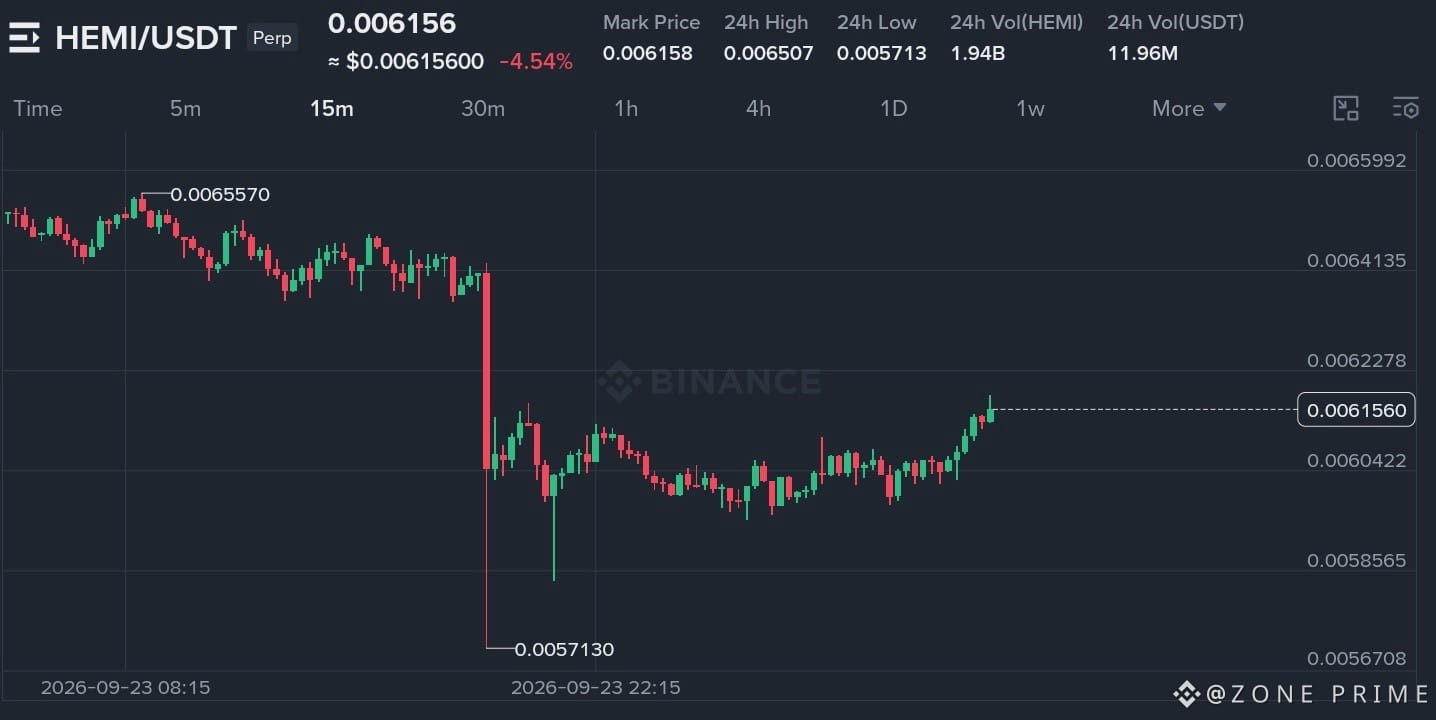
$HEMI /USDT — SHORT SETUP Go Everyone 📉 💯 ✨
Entry: 0.006227 - 0.006413
TP1: 0.006156
TP2: 0.006042
TP3: 0.005713
Stop: 0.006600
The aggressive flush off the 0.006557 peak left substantial sell pressure anchored overhead.
Fading buyer volume expansion on current relief bounces indicates bears remain positioned to defend structural resistance.
#hemi #hemiusdt #heminetwork #crypto #Write2Earn $HEMI
{future}(HEMIUSDT)
$HEMI /USDT — SHORT SETUP Go Everyone 📉 💯 ✨
Entry: 0.006227 - 0.006413
TP1: 0.006156
TP2: 0.006042
TP3: 0.005713
Stop: 0.006600
The aggressive flush off the 0.006557 peak left substantial sell pressure anchored overhead.
Fading buyer volume expansion on current relief bounces indicates bears remain positioned to defend structural resistance.
#hemi #hemiusdt #heminetwork #crypto #Write2Earn $HEMI
Entry: 0.006227 - 0.006413
TP1: 0.006156
TP2: 0.006042
TP3: 0.005713
Stop: 0.006600
The aggressive flush off the 0.006557 peak left substantial sell pressure anchored overhead.
Fading buyer volume expansion on current relief bounces indicates bears remain positioned to defend structural resistance.
#hemi #hemiusdt #heminetwork #crypto #Write2Earn $HEMI
1
206
·
--
Bearish
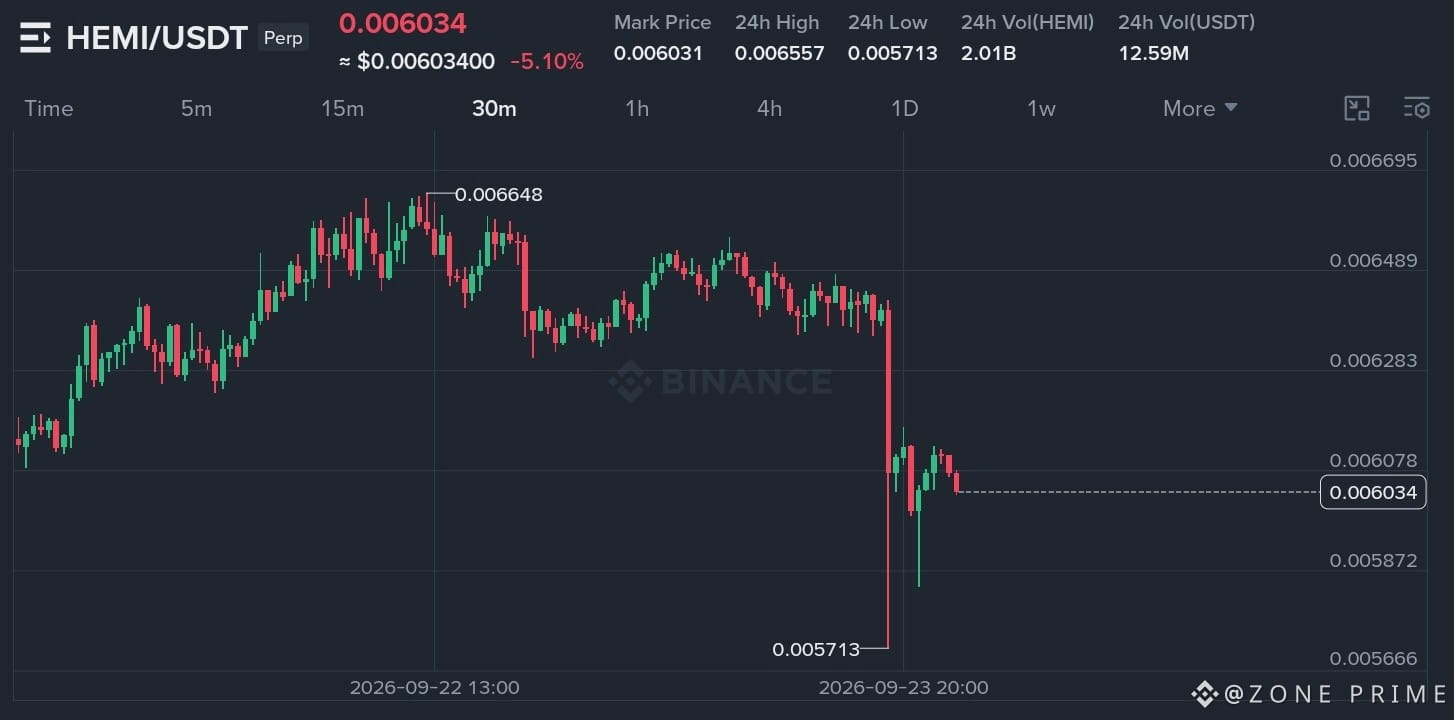
$HEMI /USDT — SHORT SETUP Go Everyone 📉 💯 ✨
Entry: 0.006078 - 0.006283
TP1: 0.006034
TP2: 0.005872
TP3: 0.005713
Stop: 0.006489
The vertical breakdown from the 0.006648 peak leaves significant supply overhang along former support blocks.
Fading buyer delta expansion on current relief bounces keeps the broader trend biased toward another downside retest.
#hemi #hemiusdt #heminetwork #crypto #Write2Earn $HEMI
{future}(HEMIUSDT)
$HEMI /USDT — SHORT SETUP Go Everyone 📉 💯 ✨
Entry: 0.006078 - 0.006283
TP1: 0.006034
TP2: 0.005872
TP3: 0.005713
Stop: 0.006489
The vertical breakdown from the 0.006648 peak leaves significant supply overhang along former support blocks.
Fading buyer delta expansion on current relief bounces keeps the broader trend biased toward another downside retest.
#hemi #hemiusdt #heminetwork #crypto #Write2Earn $HEMI
Entry: 0.006078 - 0.006283
TP1: 0.006034
TP2: 0.005872
TP3: 0.005713
Stop: 0.006489
The vertical breakdown from the 0.006648 peak leaves significant supply overhang along former support blocks.
Fading buyer delta expansion on current relief bounces keeps the broader trend biased toward another downside retest.
#hemi #hemiusdt #heminetwork #crypto #Write2Earn $HEMI
629
·
--
$HEMI supply confusion 🤔
Can anyone explain this?
Before: 977M tokens | ~$8.15M mcap
Now: 2B+ tokens | ~$20M mcap
Price is down but mcap is up, how?
CoinMarketCap shows next big unlock is 26/09/26, so from where did this extra ~1B supply come? Data glitch or real unlock?
If you're tracking HEMI tokenomics, please comment 👇
#HEMI #HemiNetwork #crypto
.
.
$HEMI
$HEMI supply confusion 🤔
Can anyone explain this?
Before: 977M tokens | ~$8.15M mcap
Now: 2B+ tokens | ~$20M mcap
Price is down but mcap is up, how?
CoinMarketCap shows next big unlock is 26/09/26, so from where did this extra ~1B supply come? Data glitch or real unlock?
If you're tracking HEMI tokenomics, please comment 👇
#HEMI #HemiNetwork #crypto
.
.
$HEMI
Can anyone explain this?
Before: 977M tokens | ~$8.15M mcap
Now: 2B+ tokens | ~$20M mcap
Price is down but mcap is up, how?
CoinMarketCap shows next big unlock is 26/09/26, so from where did this extra ~1B supply come? Data glitch or real unlock?
If you're tracking HEMI tokenomics, please comment 👇
#HEMI #HemiNetwork #crypto
.
.
$HEMI
3
412

·
--
Bullish
🚀 $HEMI HEMI — Are you ready for a strong return? 🔥
The HEMI coin of the Hemi Network has become one of the coins worth keeping an eye on, especially with the project’s focus on combining Bitcoin’s strength and security with Ethereum’s programmability.
📊 Current situation:
The price is trading near $0.0112, after a strong wave over the past few weeks. On September 3, HEMI rose by more than 34% in 24 hours, with a clear increase in trading volume. (CoinMarketCap)
⚠️ But after the surge, a strong correction wave followed, and the price is now in a sensitive zone:
🔹 $0.0100 → important support
🔹 $0.0115 → important recovery level
🔹 A breakout of $0.0115 and holding above it could restore positive momentum.
🔹 A break of $0.0100 could open the door to testing lower zones near $0.0090. (CoinMarketCap)
🔥 Why is HEMI interesting?
HEMI aims to build a layer that combines Bitcoin and Ethereum, enabling the use of Bitcoin inside DeFi applications and smart contracts. The HEMI token also has roles in fees, Staking, governance, and network security. (CoinMarketCap)
📌 Important point:
The initial total supply is 10 billion HEMI, with annual emissions stated between 3% and 7%. Therefore, when evaluating the price over the long term, you should monitor token unlocks and circulating supply. (Hemi)
🎯 Summary:
HEMI is a project with a strong story tied to Bitcoin DeFi, but the coin is still highly volatile. The $0.0100–$0.0115 zone will be crucial in determining the next move.
🔥 Do you think HEMI can return to $0.02 and then $0.05?
#HEMI #HemiNetwork #Bitcoin #Crypto
🚀 $HEMI HEMI — Are you ready for a strong return? 🔥
The HEMI coin of the Hemi Network has become one of the coins worth keeping an eye on, especially with the project’s focus on combining Bitcoin’s strength and security with Ethereum’s programmability.
📊 Current situation:
The price is trading near $0.0112, after a strong wave over the past few weeks. On September 3, HEMI rose by more than 34% in 24 hours, with a clear increase in trading volume. (CoinMarketCap)
⚠️ But after the surge, a strong correction wave followed, and the price is now in a sensitive zone:
🔹 $0.0100 → important support
🔹 $0.0115 → important recovery level
🔹 A breakout of $0.0115 and holding above it could restore positive momentum.
🔹 A break of $0.0100 could open the door to testing lower zones near $0.0090. (CoinMarketCap)
🔥 Why is HEMI interesting?
HEMI aims to build a layer that combines Bitcoin and Ethereum, enabling the use of Bitcoin inside DeFi applications and smart contracts. The HEMI token also has roles in fees, Staking, governance, and network security. (CoinMarketCap)
📌 Important point:
The initial total supply is 10 billion HEMI, with annual emissions stated between 3% and 7%. Therefore, when evaluating the price over the long term, you should monitor token unlocks and circulating supply. (Hemi)
🎯 Summary:
HEMI is a project with a strong story tied to Bitcoin DeFi, but the coin is still highly volatile. The $0.0100–$0.0115 zone will be crucial in determining the next move.
🔥 Do you think HEMI can return to $0.02 and then $0.05?
#HEMI #HemiNetwork #Bitcoin #Crypto
The HEMI coin of the Hemi Network has become one of the coins worth keeping an eye on, especially with the project’s focus on combining Bitcoin’s strength and security with Ethereum’s programmability.
📊 Current situation:
The price is trading near $0.0112, after a strong wave over the past few weeks. On September 3, HEMI rose by more than 34% in 24 hours, with a clear increase in trading volume. (CoinMarketCap)
⚠️ But after the surge, a strong correction wave followed, and the price is now in a sensitive zone:
🔹 $0.0100 → important support
🔹 $0.0115 → important recovery level
🔹 A breakout of $0.0115 and holding above it could restore positive momentum.
🔹 A break of $0.0100 could open the door to testing lower zones near $0.0090. (CoinMarketCap)
🔥 Why is HEMI interesting?
HEMI aims to build a layer that combines Bitcoin and Ethereum, enabling the use of Bitcoin inside DeFi applications and smart contracts. The HEMI token also has roles in fees, Staking, governance, and network security. (CoinMarketCap)
📌 Important point:
The initial total supply is 10 billion HEMI, with annual emissions stated between 3% and 7%. Therefore, when evaluating the price over the long term, you should monitor token unlocks and circulating supply. (Hemi)
🎯 Summary:
HEMI is a project with a strong story tied to Bitcoin DeFi, but the coin is still highly volatile. The $0.0100–$0.0115 zone will be crucial in determining the next move.
🔥 Do you think HEMI can return to $0.02 and then $0.05?
#HEMI #HemiNetwork #Bitcoin #Crypto
125

·
--
Bullish
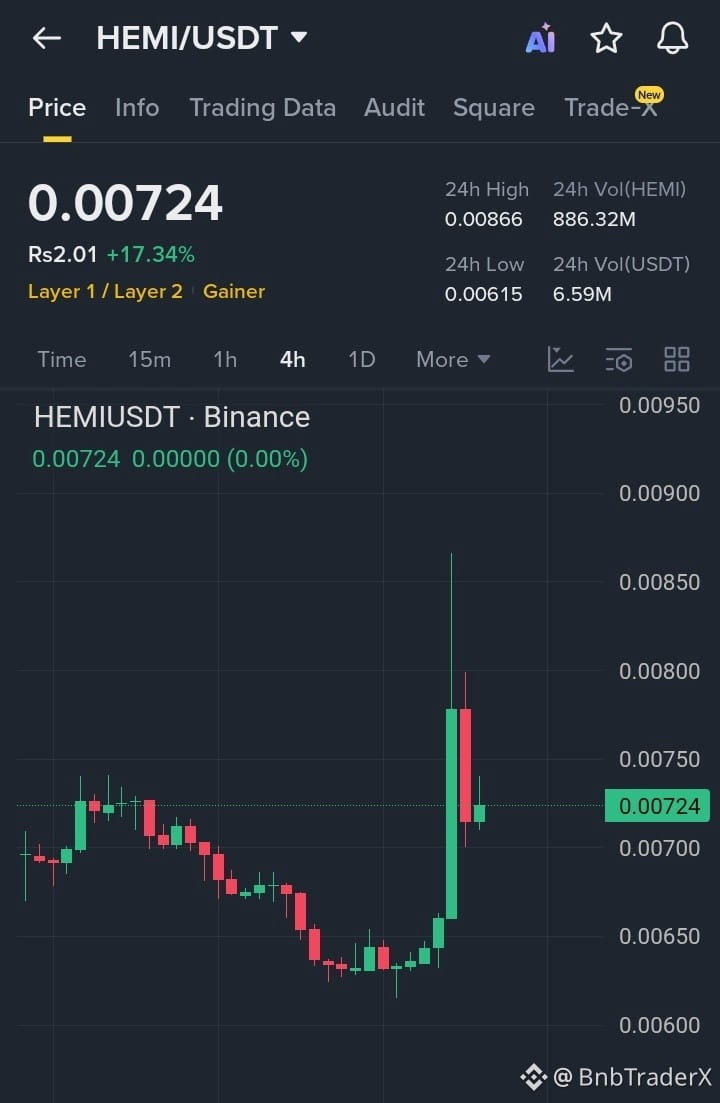
$HEMI is flashing strong signs of a bullish reversal on the 4-hour chart, currently pushing a solid +17.34% gain over the last 24 hours to trade at $0.00724. After navigating a steady downtrend that bottomed out at a 24-hour low of $0.00615, buyers stepped in heavily, sparking a rapid upward surge that spiked to a high of $0.00866.
The price action has since entered a high-volatility retest phase. A sharp pullback candle was immediately met with buying pressure at the $0.00700 psychological level, leaving a clear lower wick that highlights strong support. If $HEMI can comfortably stabilize above this $0.00700–$0.00720 zone and consolidate its volume, it will be well-positioned to launch a second bullish wave to challenge its overhead targets.
{spot}(HEMIUSDT)
Target 1: $0.00820
Target 2: $0.00900
Target 3: $0.00980
#HEMI #HemiNetwork #Binance #CryptoAnalysis
$HEMI is flashing strong signs of a bullish reversal on the 4-hour chart, currently pushing a solid +17.34% gain over the last 24 hours to trade at $0.00724. After navigating a steady downtrend that bottomed out at a 24-hour low of $0.00615, buyers stepped in heavily, sparking a rapid upward surge that spiked to a high of $0.00866.
The price action has since entered a high-volatility retest phase. A sharp pullback candle was immediately met with buying pressure at the $0.00700 psychological level, leaving a clear lower wick that highlights strong support. If $HEMI can comfortably stabilize above this $0.00700–$0.00720 zone and consolidate its volume, it will be well-positioned to launch a second bullish wave to challenge its overhead targets.
Target 1: $0.00820
Target 2: $0.00900
Target 3: $0.00980
#HEMI #HemiNetwork #Binance #CryptoAnalysis
The price action has since entered a high-volatility retest phase. A sharp pullback candle was immediately met with buying pressure at the $0.00700 psychological level, leaving a clear lower wick that highlights strong support. If $HEMI can comfortably stabilize above this $0.00700–$0.00720 zone and consolidate its volume, it will be well-positioned to launch a second bullish wave to challenge its overhead targets.
Target 1: $0.00820
Target 2: $0.00900
Target 3: $0.00980
#HEMI #HemiNetwork #Binance #CryptoAnalysis
105

# HEMI network heat surges: a potential dark horse in the emerging Layer1 track
Recently, the crypto market has started to recover, and the Layer1 sector has continued to heat up. Among them, **HEMI Network** has rapidly gained attention thanks to its unique technical architecture and ecosystem strategy, gradually becoming a focal point for investors. As an emerging public chain project, what exactly makes HEMI stand out? This article takes you deeper into it.
## Technical Architecture: A balance of high performance and compatibility
HEMI Network is positioned as a high-performance Layer1 blockchain, aiming to tackle the “impossible triangle” challenge faced by traditional public chains. In terms of consensus mechanism, HEMI uses an innovative design that achieves high transaction processing efficiency while ensuring decentralized and secure operation.
**Key highlights:**
- **Full EVM compatibility**: Developers can seamlessly migrate Ethereum ecosystem applications, lowering the development barrier
- **Low Gas fees**: Optimized to address pain points caused by high gas costs, improving user experience
- **Cross-chain interoperability**: Supports interactions across multiple chains, laying the foundation for future ecosystem synergy
From a technical parameters perspective, HEMI’s network throughput sits at a mid-to-upper level among comparable projects. For everyday DeFi operations and NFT trading, it is sufficiently smooth.
## Ecosystem Progress: From concept to reality
The value of a public chain ultimately depends on the vibrancy of its ecosystem. Recently, HEMI has sent positive signals regarding ecosystem development:
**Ecosystem development updates:**
- Multiple DeFi protocols have been completed or are planned for deployment, including lending, DEX, and other core tracks
- Fundamental infrastructure such as wallets and browsers is gradually being improved
- Community activity continues to rise, with steady growth in Discord and Twitter followers
It is worth noting that HEMI is still in the early stage of ecosystem expansion. This means the project has significant room for growth, but it also comes with uncertainty. For investors focused on long-term value, the current stage may be an opportunity window.
## Market Performance: The logic behind the surge in hype
HEMI’s recent spike in popularity is not accidental. The main drivers include:
1. **Improving market sentiment**: The overall crypto market is looking better, and capital has begun to focus on value “bargain” areas
2. **Narrative alignment**: The Layer1 track continues to attract attention, and HEMI, as a new entrant, gains visibility
3. **Community-driven momentum**: Ongoing promotion and evangelism by early supporters
At the data level, HEMI’s social media discussion volume and search interest have both shown an upward trend, indicating that market attention is spreading from early adopters to a broader investor base.
## Investment Observations: Opportunities and risks coexist
**Reasons to pay attention:**
- The ecosystem is still early, with substantial development potential
- The technical roadmap has a certain degree of innovation
- The community atmosphere is relatively positive
**Risk alerts:**
- Crypto markets are highly volatile—proper risk management is essential
- Competition among emerging public chains is fierce; whether the ecosystem can continue expanding remains to be seen
- Project development needs time for validation, so it’s not advisable to chase price blindly
## Conclusion
As an emerging public chain project, HEMI Network has demonstrated certain potential in both its technical architecture and ecosystem strategy. With current market hype rising, it reflects investors’ continued attention to the Layer1 sector. However, crypto investing requires staying rational; it’s recommended to thoroughly understand the project’s fundamentals before making investment decisions.
What do you think about the HEMI network? Do you believe in its future development potential? Feel free to discuss in the comments.
---
💬 Interactive topic: Do you think HEMI can stand out in the Layer1 sector?
#HEMI #HemiNetwork #加密货币 #New coin
# HEMI network heat surges: a potential dark horse in the emerging Layer1 track
Recently, the crypto market has started to recover, and the Layer1 sector has continued to heat up. Among them, **HEMI Network** has rapidly gained attention thanks to its unique technical architecture and ecosystem strategy, gradually becoming a focal point for investors. As an emerging public chain project, what exactly makes HEMI stand out? This article takes you deeper into it.
## Technical Architecture: A balance of high performance and compatibility
HEMI Network is positioned as a high-performance Layer1 blockchain, aiming to tackle the “impossible triangle” challenge faced by traditional public chains. In terms of consensus mechanism, HEMI uses an innovative design that achieves high transaction processing efficiency while ensuring decentralized and secure operation.
**Key highlights:**
- **Full EVM compatibility**: Developers can seamlessly migrate Ethereum ecosystem applications, lowering the development barrier
- **Low Gas fees**: Optimized to address pain points caused by high gas costs, improving user experience
- **Cross-chain interoperability**: Supports interactions across multiple chains, laying the foundation for future ecosystem synergy
From a technical parameters perspective, HEMI’s network throughput sits at a mid-to-upper level among comparable projects. For everyday DeFi operations and NFT trading, it is sufficiently smooth.
## Ecosystem Progress: From concept to reality
The value of a public chain ultimately depends on the vibrancy of its ecosystem. Recently, HEMI has sent positive signals regarding ecosystem development:
**Ecosystem development updates:**
- Multiple DeFi protocols have been completed or are planned for deployment, including lending, DEX, and other core tracks
- Fundamental infrastructure such as wallets and browsers is gradually being improved
- Community activity continues to rise, with steady growth in Discord and Twitter followers
It is worth noting that HEMI is still in the early stage of ecosystem expansion. This means the project has significant room for growth, but it also comes with uncertainty. For investors focused on long-term value, the current stage may be an opportunity window.
## Market Performance: The logic behind the surge in hype
HEMI’s recent spike in popularity is not accidental. The main drivers include:
1. **Improving market sentiment**: The overall crypto market is looking better, and capital has begun to focus on value “bargain” areas
2. **Narrative alignment**: The Layer1 track continues to attract attention, and HEMI, as a new entrant, gains visibility
3. **Community-driven momentum**: Ongoing promotion and evangelism by early supporters
At the data level, HEMI’s social media discussion volume and search interest have both shown an upward trend, indicating that market attention is spreading from early adopters to a broader investor base.
## Investment Observations: Opportunities and risks coexist
**Reasons to pay attention:**
- The ecosystem is still early, with substantial development potential
- The technical roadmap has a certain degree of innovation
- The community atmosphere is relatively positive
**Risk alerts:**
- Crypto markets are highly volatile—proper risk management is essential
- Competition among emerging public chains is fierce; whether the ecosystem can continue expanding remains to be seen
- Project development needs time for validation, so it’s not advisable to chase price blindly
## Conclusion
As an emerging public chain project, HEMI Network has demonstrated certain potential in both its technical architecture and ecosystem strategy. With current market hype rising, it reflects investors’ continued attention to the Layer1 sector. However, crypto investing requires staying rational; it’s recommended to thoroughly understand the project’s fundamentals before making investment decisions.
What do you think about the HEMI network? Do you believe in its future development potential? Feel free to discuss in the comments.
---
💬 Interactive topic: Do you think HEMI can stand out in the Layer1 sector?
#HEMI #HemiNetwork #加密货币 #New coin
Recently, the crypto market has started to recover, and the Layer1 sector has continued to heat up. Among them, **HEMI Network** has rapidly gained attention thanks to its unique technical architecture and ecosystem strategy, gradually becoming a focal point for investors. As an emerging public chain project, what exactly makes HEMI stand out? This article takes you deeper into it.
## Technical Architecture: A balance of high performance and compatibility
HEMI Network is positioned as a high-performance Layer1 blockchain, aiming to tackle the “impossible triangle” challenge faced by traditional public chains. In terms of consensus mechanism, HEMI uses an innovative design that achieves high transaction processing efficiency while ensuring decentralized and secure operation.
**Key highlights:**
- **Full EVM compatibility**: Developers can seamlessly migrate Ethereum ecosystem applications, lowering the development barrier
- **Low Gas fees**: Optimized to address pain points caused by high gas costs, improving user experience
- **Cross-chain interoperability**: Supports interactions across multiple chains, laying the foundation for future ecosystem synergy
From a technical parameters perspective, HEMI’s network throughput sits at a mid-to-upper level among comparable projects. For everyday DeFi operations and NFT trading, it is sufficiently smooth.
## Ecosystem Progress: From concept to reality
The value of a public chain ultimately depends on the vibrancy of its ecosystem. Recently, HEMI has sent positive signals regarding ecosystem development:
**Ecosystem development updates:**
- Multiple DeFi protocols have been completed or are planned for deployment, including lending, DEX, and other core tracks
- Fundamental infrastructure such as wallets and browsers is gradually being improved
- Community activity continues to rise, with steady growth in Discord and Twitter followers
It is worth noting that HEMI is still in the early stage of ecosystem expansion. This means the project has significant room for growth, but it also comes with uncertainty. For investors focused on long-term value, the current stage may be an opportunity window.
## Market Performance: The logic behind the surge in hype
HEMI’s recent spike in popularity is not accidental. The main drivers include:
1. **Improving market sentiment**: The overall crypto market is looking better, and capital has begun to focus on value “bargain” areas
2. **Narrative alignment**: The Layer1 track continues to attract attention, and HEMI, as a new entrant, gains visibility
3. **Community-driven momentum**: Ongoing promotion and evangelism by early supporters
At the data level, HEMI’s social media discussion volume and search interest have both shown an upward trend, indicating that market attention is spreading from early adopters to a broader investor base.
## Investment Observations: Opportunities and risks coexist
**Reasons to pay attention:**
- The ecosystem is still early, with substantial development potential
- The technical roadmap has a certain degree of innovation
- The community atmosphere is relatively positive
**Risk alerts:**
- Crypto markets are highly volatile—proper risk management is essential
- Competition among emerging public chains is fierce; whether the ecosystem can continue expanding remains to be seen
- Project development needs time for validation, so it’s not advisable to chase price blindly
## Conclusion
As an emerging public chain project, HEMI Network has demonstrated certain potential in both its technical architecture and ecosystem strategy. With current market hype rising, it reflects investors’ continued attention to the Layer1 sector. However, crypto investing requires staying rational; it’s recommended to thoroughly understand the project’s fundamentals before making investment decisions.
What do you think about the HEMI network? Do you believe in its future development potential? Feel free to discuss in the comments.
---
💬 Interactive topic: Do you think HEMI can stand out in the Layer1 sector?
#HEMI #HemiNetwork #加密货币 #New coin
84
·
--
📊| Today's analysis August 17, 2026$HEMI
The $HEMI coin is currently moving near the $0.0058 area, with a clear improvement in momentum over the last 24 hours. (CoinGecko)
🔹 First support: $0.0055$ – $0.0052$
🔹 Stronger support: $0.0048$ – $0.0046$
🔸 First resistance: $0.0060$
🔸 Next resistance: $0.0064$ – $0.0065$
🚀 A breakout above $0.0065$ with strong trading volume could open the way toward $0.0070$ and then higher levels.
Fundamentally, Hemi focuses on combining Bitcoin security with Ethereum programmability, with use cases related to Bitcoin DeFi. (Hemi)
⚠️ Bearish scenario: A break below $0.0052$ could renew selling pressure and push the price to test the $0.0046$ area.
📌 Conclusion: HEMI is regaining some momentum, but $0.0060$ and then $0.0065$ are the real keys to an upside move. I would not consider the rally confirmed unless resistance is broken with good trading volume.
#HEMI #HemiNetwork #Crypto #Binance #Altcoins
📊| Today's analysis August 17, 2026$HEMI
The $HEMI coin is currently moving near the $0.0058 area, with a clear improvement in momentum over the last 24 hours. (CoinGecko)
🔹 First support: $0.0055$ – $0.0052$
🔹 Stronger support: $0.0048$ – $0.0046$
🔸 First resistance: $0.0060$
🔸 Next resistance: $0.0064$ – $0.0065$
🚀 A breakout above $0.0065$ with strong trading volume could open the way toward $0.0070$ and then higher levels.
Fundamentally, Hemi focuses on combining Bitcoin security with Ethereum programmability, with use cases related to Bitcoin DeFi. (Hemi)
⚠️ Bearish scenario: A break below $0.0052$ could renew selling pressure and push the price to test the $0.0046$ area.
📌 Conclusion: HEMI is regaining some momentum, but $0.0060$ and then $0.0065$ are the real keys to an upside move. I would not consider the rally confirmed unless resistance is broken with good trading volume.
#HEMI #HemiNetwork #Crypto #Binance #Altcoins
The $HEMI coin is currently moving near the $0.0058 area, with a clear improvement in momentum over the last 24 hours. (CoinGecko)
🔹 First support: $0.0055$ – $0.0052$
🔹 Stronger support: $0.0048$ – $0.0046$
🔸 First resistance: $0.0060$
🔸 Next resistance: $0.0064$ – $0.0065$
🚀 A breakout above $0.0065$ with strong trading volume could open the way toward $0.0070$ and then higher levels.
Fundamentally, Hemi focuses on combining Bitcoin security with Ethereum programmability, with use cases related to Bitcoin DeFi. (Hemi)
⚠️ Bearish scenario: A break below $0.0052$ could renew selling pressure and push the price to test the $0.0046$ area.
📌 Conclusion: HEMI is regaining some momentum, but $0.0060$ and then $0.0065$ are the real keys to an upside move. I would not consider the rally confirmed unless resistance is broken with good trading volume.
#HEMI #HemiNetwork #Crypto #Binance #Altcoins
145

·
--
🚀 HEMI explodes by 59% in 24h: the Layer 2 that reconciles Bitcoin and Ethereum enters an accumulation phase ..🚀 HEMI explodes by 59% in 24h: the Layer 2 that reconciles Bitcoin and Ethereum enters an accumulation phase
HEMI token is one of the biggest performers in the market this August 16, 2026. While the crypto market is seeing contrasting moves—ALICE is down 15.62% over the same period—HEMI rockets up 59.63% in 24 hours and hits a new daily high. A breakdown of a move that could mark a structural turning point for this ambitious project.
───
🔍 Hemi Network, what is it?
🚀 HEMI explodes by 59% in 24h: the Layer 2 that reconciles Bitcoin and Ethereum enters an accumulation phase ..
🚀 HEMI explodes by 59% in 24h: the Layer 2 that reconciles Bitcoin and Ethereum enters an accumulation phase
HEMI token is one of the biggest performers in the market this August 16, 2026. While the crypto market is seeing contrasting moves—ALICE is down 15.62% over the same period—HEMI rockets up 59.63% in 24 hours and hits a new daily high. A breakdown of a move that could mark a structural turning point for this ambitious project.
───
🔍 Hemi Network, what is it?
HEMI token is one of the biggest performers in the market this August 16, 2026. While the crypto market is seeing contrasting moves—ALICE is down 15.62% over the same period—HEMI rockets up 59.63% in 24 hours and hits a new daily high. A breakdown of a move that could mark a structural turning point for this ambitious project.
───
🔍 Hemi Network, what is it?
98
# HEMI heat surges and breaks through 100,000! After MUBARAK, is the next 100x coin on the way?
Recently, the focus of heated discussion in the crypto community has shifted again to a new name—HEMI Network. As community engagement has surpassed the 100,000 mark, debate over whether HEMI is the next “100x coin” has grown increasingly intense. Some compare it to MUBARAK, believing that the biggest opportunity of 2024 has already arrived; others remain cautious, saying this might just be another FOMO-driven hype bubble. What is the truth? Let’s examine this debate from multiple angles.
## Community hype and FOMO sentiment
In recent times, the volume of discussions about HEMI on social media has shown explosive growth. The community’s visible anticipation for the “next 100x coin” mirrors the frenzy seen during the earlier surge of MUBARAK. However, history has repeatedly proven that sheer community hype does not equal project value. In the Dogecoin and SHIB rallies of 2021, there was often a huge gap between community hype and actual technical merit.
## Can technical innovation support the hype?
Public information shows that HEMI Network positions itself as a Layer 1 blockchain project focused on interoperability. Its core technical features include:
**1. Cross-chain bridging technology**
HEMI aims to enable seamless asset transfers between different blockchains—an approach that clearly has real market demand. As the multi-chain landscape becomes the norm, the value of cross-chain solutions is becoming more prominent.
**2. Consensus mechanism optimization**
The project claims to use an improved consensus mechanism, with the goal of increasing transaction processing efficiency and lowering Gas fees. If the technology performs as advertised, it could indeed address pain points of mainstream chains like Ethereum.
**3. Developer ecosystem**
The growth of Web3 cannot happen without a thriving developer ecosystem. Whether HEMI can attract enough developers to build on it will be the key test of its long-term value.
That said, it’s worth noting that as of now, HEMI’s mainnet has been live for a short time, and many technical promises have not yet been sufficiently validated in real-world conditions. Overly optimistic expectations may be premature.
## Opportunity or bubble? Think rationally
**Supporters’ view:**
- Early 100x coins often emerge when market attention is relatively low; HEMI’s current heat precisely indicates its potential
- If technical innovation can be implemented, the valuation ceiling may be far higher than expected
- Web3 infrastructure is still in its early stage, and opportunities in this track are huge
**Cautious view:**
- The crypto market is never short of hype cycles; today’s star may be forgotten tomorrow
- The “100x coin” narrative itself is a high-risk label, with very low chances of success
- Projects lacking real-world application scenarios will eventually see their hype fade
## Final thoughts
HEMI’s sudden explosion in popularity undoubtedly reflects the crypto community’s desire for the next wealth formula. However, investing is never just a game of hype. Before making any decision, investors are advised to thoroughly understand the project’s technical architecture, token economics, and team background.
For new technologies, we can stay curious and hopeful; for investment decisions, they must be grounded in adequate research and risk assessment. The 2024 crypto market is full of variables—whether opportunity or bubble, time will ultimately provide the answer.
Let’s stay tuned and wait and see.
---
This article is for informational reference only and does not constitute any investment advice. DYOR (Do Your Own Research).
#HEMI #HemiNetwork #Web3 #Crypto
# HEMI heat surges and breaks through 100,000! After MUBARAK, is the next 100x coin on the way?
Recently, the focus of heated discussion in the crypto community has shifted again to a new name—HEMI Network. As community engagement has surpassed the 100,000 mark, debate over whether HEMI is the next “100x coin” has grown increasingly intense. Some compare it to MUBARAK, believing that the biggest opportunity of 2024 has already arrived; others remain cautious, saying this might just be another FOMO-driven hype bubble. What is the truth? Let’s examine this debate from multiple angles.
## Community hype and FOMO sentiment
In recent times, the volume of discussions about HEMI on social media has shown explosive growth. The community’s visible anticipation for the “next 100x coin” mirrors the frenzy seen during the earlier surge of MUBARAK. However, history has repeatedly proven that sheer community hype does not equal project value. In the Dogecoin and SHIB rallies of 2021, there was often a huge gap between community hype and actual technical merit.
## Can technical innovation support the hype?
Public information shows that HEMI Network positions itself as a Layer 1 blockchain project focused on interoperability. Its core technical features include:
**1. Cross-chain bridging technology**
HEMI aims to enable seamless asset transfers between different blockchains—an approach that clearly has real market demand. As the multi-chain landscape becomes the norm, the value of cross-chain solutions is becoming more prominent.
**2. Consensus mechanism optimization**
The project claims to use an improved consensus mechanism, with the goal of increasing transaction processing efficiency and lowering Gas fees. If the technology performs as advertised, it could indeed address pain points of mainstream chains like Ethereum.
**3. Developer ecosystem**
The growth of Web3 cannot happen without a thriving developer ecosystem. Whether HEMI can attract enough developers to build on it will be the key test of its long-term value.
That said, it’s worth noting that as of now, HEMI’s mainnet has been live for a short time, and many technical promises have not yet been sufficiently validated in real-world conditions. Overly optimistic expectations may be premature.
## Opportunity or bubble? Think rationally
**Supporters’ view:**
- Early 100x coins often emerge when market attention is relatively low; HEMI’s current heat precisely indicates its potential
- If technical innovation can be implemented, the valuation ceiling may be far higher than expected
- Web3 infrastructure is still in its early stage, and opportunities in this track are huge
**Cautious view:**
- The crypto market is never short of hype cycles; today’s star may be forgotten tomorrow
- The “100x coin” narrative itself is a high-risk label, with very low chances of success
- Projects lacking real-world application scenarios will eventually see their hype fade
## Final thoughts
HEMI’s sudden explosion in popularity undoubtedly reflects the crypto community’s desire for the next wealth formula. However, investing is never just a game of hype. Before making any decision, investors are advised to thoroughly understand the project’s technical architecture, token economics, and team background.
For new technologies, we can stay curious and hopeful; for investment decisions, they must be grounded in adequate research and risk assessment. The 2024 crypto market is full of variables—whether opportunity or bubble, time will ultimately provide the answer.
Let’s stay tuned and wait and see.
---
This article is for informational reference only and does not constitute any investment advice. DYOR (Do Your Own Research).
#HEMI #HemiNetwork #Web3 #Crypto
Recently, the focus of heated discussion in the crypto community has shifted again to a new name—HEMI Network. As community engagement has surpassed the 100,000 mark, debate over whether HEMI is the next “100x coin” has grown increasingly intense. Some compare it to MUBARAK, believing that the biggest opportunity of 2024 has already arrived; others remain cautious, saying this might just be another FOMO-driven hype bubble. What is the truth? Let’s examine this debate from multiple angles.
## Community hype and FOMO sentiment
In recent times, the volume of discussions about HEMI on social media has shown explosive growth. The community’s visible anticipation for the “next 100x coin” mirrors the frenzy seen during the earlier surge of MUBARAK. However, history has repeatedly proven that sheer community hype does not equal project value. In the Dogecoin and SHIB rallies of 2021, there was often a huge gap between community hype and actual technical merit.
## Can technical innovation support the hype?
Public information shows that HEMI Network positions itself as a Layer 1 blockchain project focused on interoperability. Its core technical features include:
**1. Cross-chain bridging technology**
HEMI aims to enable seamless asset transfers between different blockchains—an approach that clearly has real market demand. As the multi-chain landscape becomes the norm, the value of cross-chain solutions is becoming more prominent.
**2. Consensus mechanism optimization**
The project claims to use an improved consensus mechanism, with the goal of increasing transaction processing efficiency and lowering Gas fees. If the technology performs as advertised, it could indeed address pain points of mainstream chains like Ethereum.
**3. Developer ecosystem**
The growth of Web3 cannot happen without a thriving developer ecosystem. Whether HEMI can attract enough developers to build on it will be the key test of its long-term value.
That said, it’s worth noting that as of now, HEMI’s mainnet has been live for a short time, and many technical promises have not yet been sufficiently validated in real-world conditions. Overly optimistic expectations may be premature.
## Opportunity or bubble? Think rationally
**Supporters’ view:**
- Early 100x coins often emerge when market attention is relatively low; HEMI’s current heat precisely indicates its potential
- If technical innovation can be implemented, the valuation ceiling may be far higher than expected
- Web3 infrastructure is still in its early stage, and opportunities in this track are huge
**Cautious view:**
- The crypto market is never short of hype cycles; today’s star may be forgotten tomorrow
- The “100x coin” narrative itself is a high-risk label, with very low chances of success
- Projects lacking real-world application scenarios will eventually see their hype fade
## Final thoughts
HEMI’s sudden explosion in popularity undoubtedly reflects the crypto community’s desire for the next wealth formula. However, investing is never just a game of hype. Before making any decision, investors are advised to thoroughly understand the project’s technical architecture, token economics, and team background.
For new technologies, we can stay curious and hopeful; for investment decisions, they must be grounded in adequate research and risk assessment. The 2024 crypto market is full of variables—whether opportunity or bubble, time will ultimately provide the answer.
Let’s stay tuned and wait and see.
---
This article is for informational reference only and does not constitute any investment advice. DYOR (Do Your Own Research).
#HEMI #HemiNetwork #Web3 #Crypto
136

·
--
Bullish
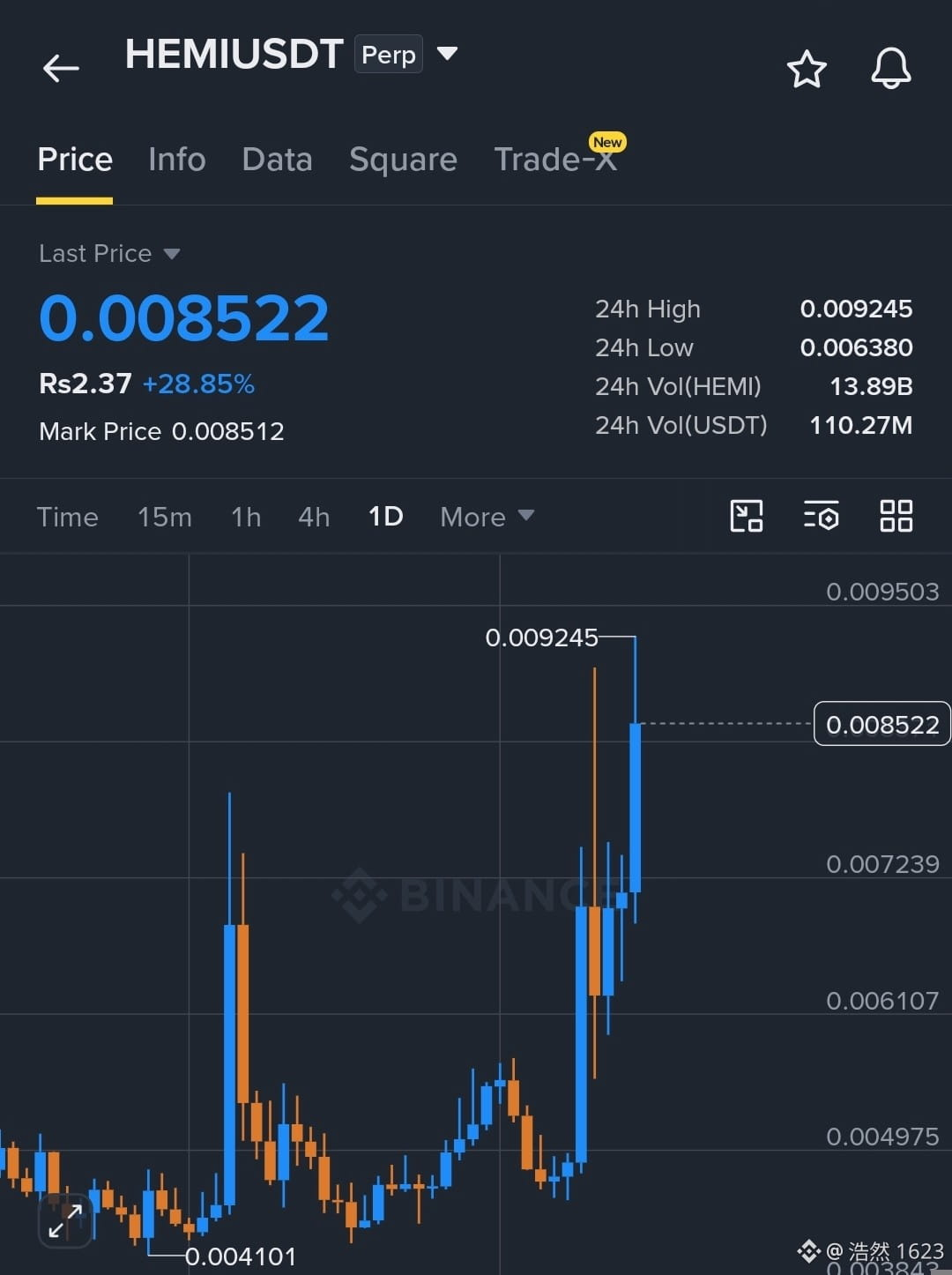
$HEMI is exhibiting powerful bullish momentum on the daily perpetual chart, soaring over +28% after rebounding from its base low near 0.004101. Price action erupted into a massive green candle, driving through overhead levels to touch a peak of 0.009245 before stabilizing around 0.008522. As buying volume accumulates above the 0.007200 support zone, the token remains well-positioned to retest local highs and extend its trajectory toward upper resistance levels.
Target 1: 0.009245
Target 2: 0.009800
Target 3: 0.010500
#HEMI #HemiNetwork #BinanceSquare
$HEMI
{spot}(HEMIUSDT)
$HEMI is exhibiting powerful bullish momentum on the daily perpetual chart, soaring over +28% after rebounding from its base low near 0.004101. Price action erupted into a massive green candle, driving through overhead levels to touch a peak of 0.009245 before stabilizing around 0.008522. As buying volume accumulates above the 0.007200 support zone, the token remains well-positioned to retest local highs and extend its trajectory toward upper resistance levels.
Target 1: 0.009245
Target 2: 0.009800
Target 3: 0.010500
#HEMI #HemiNetwork #BinanceSquare
$HEMI
Target 1: 0.009245
Target 2: 0.009800
Target 3: 0.010500
#HEMI #HemiNetwork #BinanceSquare
$HEMI
65
# HEMI’s Network Hype Keeps Exploding, Social Discussions Hit the Top of the Track—Is This Market Cycle About to Take Off?
Recently, the crypto market has shown a notable phenomenon worth paying attention to: **HEMI**’s network buzz can be described as a “major surge.” Whether on Twitter/X, Telegram, or major crypto forums, HEMI’s discussion volume far surpasses other coins in the same sector. Social media attention continues to climb. What exactly is driving this abnormal spike in hype? Does HEMI truly have the potential to break out with an independent market trend? Today, we’ll dig deeper.
---
## 1. What Is HEMI?
Hemi Network is an innovative project focused on **modular blockchains**. Its goal is to use a unique technical architecture to address the current blockchain challenges related to scalability, interoperability, and developer experience. In simple terms, HEMI aims to build a more efficient and flexible Web3 infrastructure, enabling developers to build high-performance decentralized applications more easily.
Worth noting is that, by design, HEMI integrates several cutting-edge technologies, including **cross-chain interoperability protocols** and a **new consensus mechanism**. These technical highlights help it stand out among many Layer 2 and modular projects.
---
## 2. Behind the High Hype: Three Key Drivers
### 1. Technical Progress and Mainnet Launch Expectations
In recent weeks, the HEMI team has frequently shared technical updates on social media, including stable testnet operations and countdown-style messages for the mainnet launch. Each technical update is accompanied by extensive community discussion. This “continuously releasing good news” cadence keeps the market highly focused on HEMI at all times.
### 2. Rapid Expansion of the Community Ecosystem
Based on data, HEMI’s official social accounts have seen significant follower growth over the past month, and Telegram community activity has reached new highs repeatedly. Many crypto investors and KOLs have started recommending HEMI organically, creating a strong word-of-mouth effect. **Community-driven hype** is often an important early signal that a coin price is about to start moving—and this has been verified multiple times in the crypto market.
### 3. Rising Institutional Attention
Beyond the lively retail community, HEMI has begun to appear on the watchlists of some crypto research institutions. Reports indicate that several leading exchanges are evaluating the possibility of listing HEMI trading pairs. This expectation directly ignites FOMO sentiment in the market.
---
## 3. Why HEMI Deserves Attention
**First, the sector outlook is promising.** Modular blockchains are one of the most growth-potential directions in the current Web3 space. As the Ethereum ecosystem continues to expand and Layer 2 solutions mature, projects like HEMI—focused on modular infrastructure—will directly benefit from industry tailwinds.
**Second, the capital movements behind the hype.** A surge in social discussion volume often means market attention becomes concentrated, and increased attention typically attracts incremental capital. Looking back at history, many coins have gone on to post impressive market performance after social hype began rising. HEMI’s current trajectory shows similarities to these past cases.
**Third, the narrative is clear and easy to tell.** HEMI’s positioning is straightforward: building a high-performance modular blockchain. In today’s market environment, this narrative is highly persuasive. Investors can easily understand and identify with it, making them more willing to hold long term.
---
## 4. Risk Warning
Of course, high hype doesn’t necessarily mean it will go up. The crypto market is highly volatile, so **investments involve risk—be cautious**. Before making any decision, it’s recommended that everyone:
- Thoroughly understand HEMI’s technical whitepaper and economic model
- Pay attention to the team background and development progress
- Manage position sizing—never YOLO driven by FOMO
- Set stop-losses and do proper risk management
---
## Summary
HEMI’s current network hype is absolutely not a coincidence—technical progress, community expansion, and institutional attention combine into the core logic behind this surge. If you’re following the modular blockchain track, HEMI is indeed a project worth continuous observation. However, investing ultimately means turning knowledge into returns—doing your homework is always the first step.
**Do you like HEMI? Share your thoughts in the comments.**
---
#HEMI #HemiNetwork #加密货币 #Web3
# HEMI’s Network Hype Keeps Exploding, Social Discussions Hit the Top of the Track—Is This Market Cycle About to Take Off?
Recently, the crypto market has shown a notable phenomenon worth paying attention to: **HEMI**’s network buzz can be described as a “major surge.” Whether on Twitter/X, Telegram, or major crypto forums, HEMI’s discussion volume far surpasses other coins in the same sector. Social media attention continues to climb. What exactly is driving this abnormal spike in hype? Does HEMI truly have the potential to break out with an independent market trend? Today, we’ll dig deeper.
---
## 1. What Is HEMI?
Hemi Network is an innovative project focused on **modular blockchains**. Its goal is to use a unique technical architecture to address the current blockchain challenges related to scalability, interoperability, and developer experience. In simple terms, HEMI aims to build a more efficient and flexible Web3 infrastructure, enabling developers to build high-performance decentralized applications more easily.
Worth noting is that, by design, HEMI integrates several cutting-edge technologies, including **cross-chain interoperability protocols** and a **new consensus mechanism**. These technical highlights help it stand out among many Layer 2 and modular projects.
---
## 2. Behind the High Hype: Three Key Drivers
### 1. Technical Progress and Mainnet Launch Expectations
In recent weeks, the HEMI team has frequently shared technical updates on social media, including stable testnet operations and countdown-style messages for the mainnet launch. Each technical update is accompanied by extensive community discussion. This “continuously releasing good news” cadence keeps the market highly focused on HEMI at all times.
### 2. Rapid Expansion of the Community Ecosystem
Based on data, HEMI’s official social accounts have seen significant follower growth over the past month, and Telegram community activity has reached new highs repeatedly. Many crypto investors and KOLs have started recommending HEMI organically, creating a strong word-of-mouth effect. **Community-driven hype** is often an important early signal that a coin price is about to start moving—and this has been verified multiple times in the crypto market.
### 3. Rising Institutional Attention
Beyond the lively retail community, HEMI has begun to appear on the watchlists of some crypto research institutions. Reports indicate that several leading exchanges are evaluating the possibility of listing HEMI trading pairs. This expectation directly ignites FOMO sentiment in the market.
---
## 3. Why HEMI Deserves Attention
**First, the sector outlook is promising.** Modular blockchains are one of the most growth-potential directions in the current Web3 space. As the Ethereum ecosystem continues to expand and Layer 2 solutions mature, projects like HEMI—focused on modular infrastructure—will directly benefit from industry tailwinds.
**Second, the capital movements behind the hype.** A surge in social discussion volume often means market attention becomes concentrated, and increased attention typically attracts incremental capital. Looking back at history, many coins have gone on to post impressive market performance after social hype began rising. HEMI’s current trajectory shows similarities to these past cases.
**Third, the narrative is clear and easy to tell.** HEMI’s positioning is straightforward: building a high-performance modular blockchain. In today’s market environment, this narrative is highly persuasive. Investors can easily understand and identify with it, making them more willing to hold long term.
---
## 4. Risk Warning
Of course, high hype doesn’t necessarily mean it will go up. The crypto market is highly volatile, so **investments involve risk—be cautious**. Before making any decision, it’s recommended that everyone:
- Thoroughly understand HEMI’s technical whitepaper and economic model
- Pay attention to the team background and development progress
- Manage position sizing—never YOLO driven by FOMO
- Set stop-losses and do proper risk management
---
## Summary
HEMI’s current network hype is absolutely not a coincidence—technical progress, community expansion, and institutional attention combine into the core logic behind this surge. If you’re following the modular blockchain track, HEMI is indeed a project worth continuous observation. However, investing ultimately means turning knowledge into returns—doing your homework is always the first step.
**Do you like HEMI? Share your thoughts in the comments.**
---
#HEMI #HemiNetwork #加密货币 #Web3
Recently, the crypto market has shown a notable phenomenon worth paying attention to: **HEMI**’s network buzz can be described as a “major surge.” Whether on Twitter/X, Telegram, or major crypto forums, HEMI’s discussion volume far surpasses other coins in the same sector. Social media attention continues to climb. What exactly is driving this abnormal spike in hype? Does HEMI truly have the potential to break out with an independent market trend? Today, we’ll dig deeper.
---
## 1. What Is HEMI?
Hemi Network is an innovative project focused on **modular blockchains**. Its goal is to use a unique technical architecture to address the current blockchain challenges related to scalability, interoperability, and developer experience. In simple terms, HEMI aims to build a more efficient and flexible Web3 infrastructure, enabling developers to build high-performance decentralized applications more easily.
Worth noting is that, by design, HEMI integrates several cutting-edge technologies, including **cross-chain interoperability protocols** and a **new consensus mechanism**. These technical highlights help it stand out among many Layer 2 and modular projects.
---
## 2. Behind the High Hype: Three Key Drivers
### 1. Technical Progress and Mainnet Launch Expectations
In recent weeks, the HEMI team has frequently shared technical updates on social media, including stable testnet operations and countdown-style messages for the mainnet launch. Each technical update is accompanied by extensive community discussion. This “continuously releasing good news” cadence keeps the market highly focused on HEMI at all times.
### 2. Rapid Expansion of the Community Ecosystem
Based on data, HEMI’s official social accounts have seen significant follower growth over the past month, and Telegram community activity has reached new highs repeatedly. Many crypto investors and KOLs have started recommending HEMI organically, creating a strong word-of-mouth effect. **Community-driven hype** is often an important early signal that a coin price is about to start moving—and this has been verified multiple times in the crypto market.
### 3. Rising Institutional Attention
Beyond the lively retail community, HEMI has begun to appear on the watchlists of some crypto research institutions. Reports indicate that several leading exchanges are evaluating the possibility of listing HEMI trading pairs. This expectation directly ignites FOMO sentiment in the market.
---
## 3. Why HEMI Deserves Attention
**First, the sector outlook is promising.** Modular blockchains are one of the most growth-potential directions in the current Web3 space. As the Ethereum ecosystem continues to expand and Layer 2 solutions mature, projects like HEMI—focused on modular infrastructure—will directly benefit from industry tailwinds.
**Second, the capital movements behind the hype.** A surge in social discussion volume often means market attention becomes concentrated, and increased attention typically attracts incremental capital. Looking back at history, many coins have gone on to post impressive market performance after social hype began rising. HEMI’s current trajectory shows similarities to these past cases.
**Third, the narrative is clear and easy to tell.** HEMI’s positioning is straightforward: building a high-performance modular blockchain. In today’s market environment, this narrative is highly persuasive. Investors can easily understand and identify with it, making them more willing to hold long term.
---
## 4. Risk Warning
Of course, high hype doesn’t necessarily mean it will go up. The crypto market is highly volatile, so **investments involve risk—be cautious**. Before making any decision, it’s recommended that everyone:
- Thoroughly understand HEMI’s technical whitepaper and economic model
- Pay attention to the team background and development progress
- Manage position sizing—never YOLO driven by FOMO
- Set stop-losses and do proper risk management
---
## Summary
HEMI’s current network hype is absolutely not a coincidence—technical progress, community expansion, and institutional attention combine into the core logic behind this surge. If you’re following the modular blockchain track, HEMI is indeed a project worth continuous observation. However, investing ultimately means turning knowledge into returns—doing your homework is always the first step.
**Do you like HEMI? Share your thoughts in the comments.**
---
#HEMI #HemiNetwork #加密货币 #Web3
65
·
--
Bullish
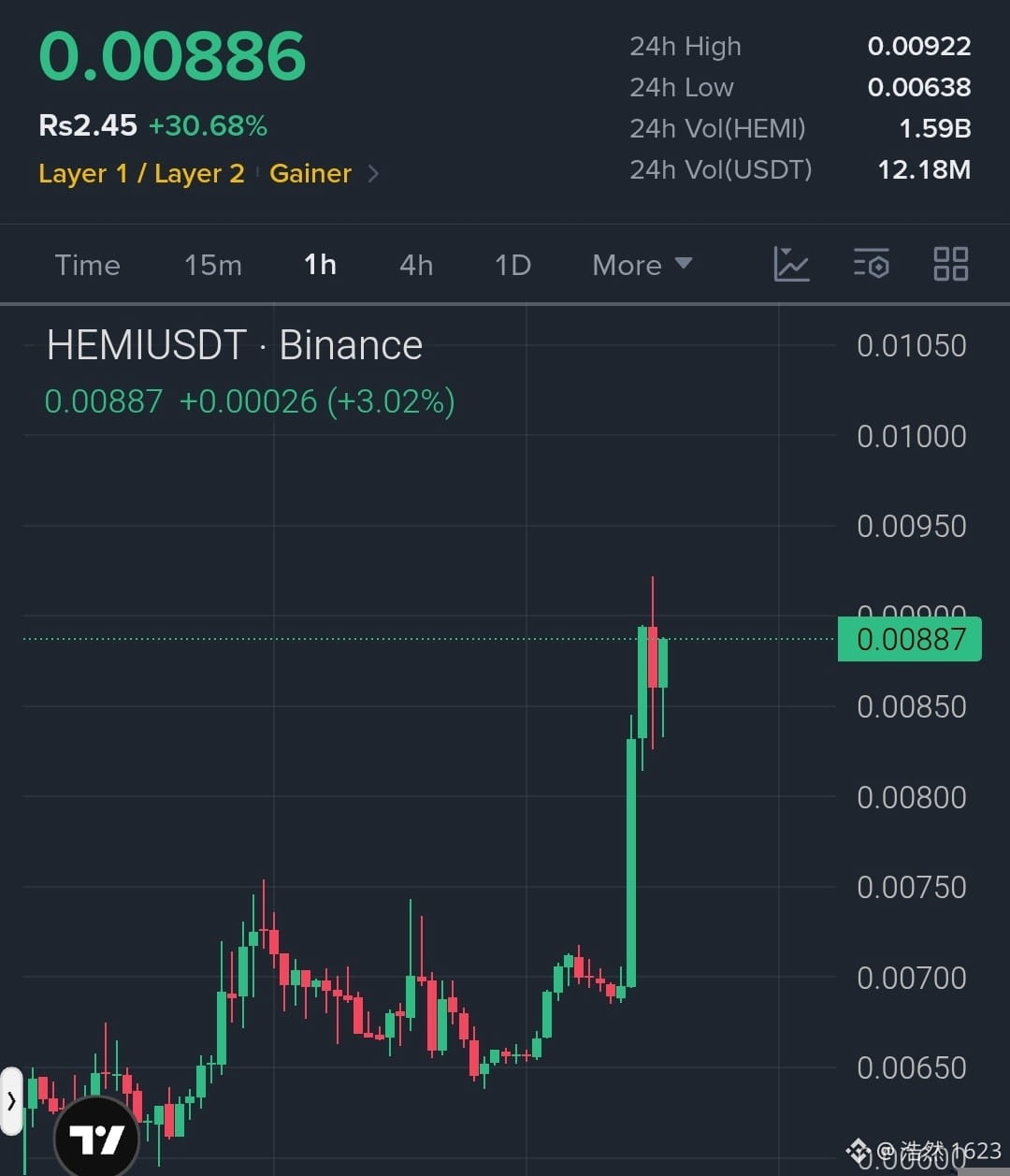
$HEMI is exhibiting a sharp upward breakout on the 1-hour chart after expanding from a baseline low of 0.00638. A strong green impulse candle driven by high volume has pushed price action to a 24-hour peak of 0.00922, representing a overall gain of over +30%. Holding support above the 0.00850 level keeps the bullish momentum intact for another leg up.
Target 1: 0.00922
Target 2: 0.00980
Target 3: 0.01050
#HEMI #HemiNetwork #BinanceSquare
$VELVET
{alpha}(560x8b194370825e37b33373e74a41009161808c1488)
{future}(HEMIUSDT)
$BTW
{alpha}(560x444045b0ee1ee319a660a5e3d604ca0ffa35acaa)
$HEMI is exhibiting a sharp upward breakout on the 1-hour chart after expanding from a baseline low of 0.00638. A strong green impulse candle driven by high volume has pushed price action to a 24-hour peak of 0.00922, representing a overall gain of over +30%. Holding support above the 0.00850 level keeps the bullish momentum intact for another leg up.
Target 1: 0.00922
Target 2: 0.00980
Target 3: 0.01050
#HEMI #HemiNetwork #BinanceSquare
$VELVET
$BTW
Target 1: 0.00922
Target 2: 0.00980
Target 3: 0.01050
#HEMI #HemiNetwork #BinanceSquare
$VELVET
$BTW
1
297

·
--
Bullish
🚨 HEMI $HEMI — THE STORY ISN’T OVER YET 👀
Who remembers my previous HEMI analysis?
A few days ago, I highlighted HEMI because of its low market cap, growing ecosystem, strong partnerships and token distribution.
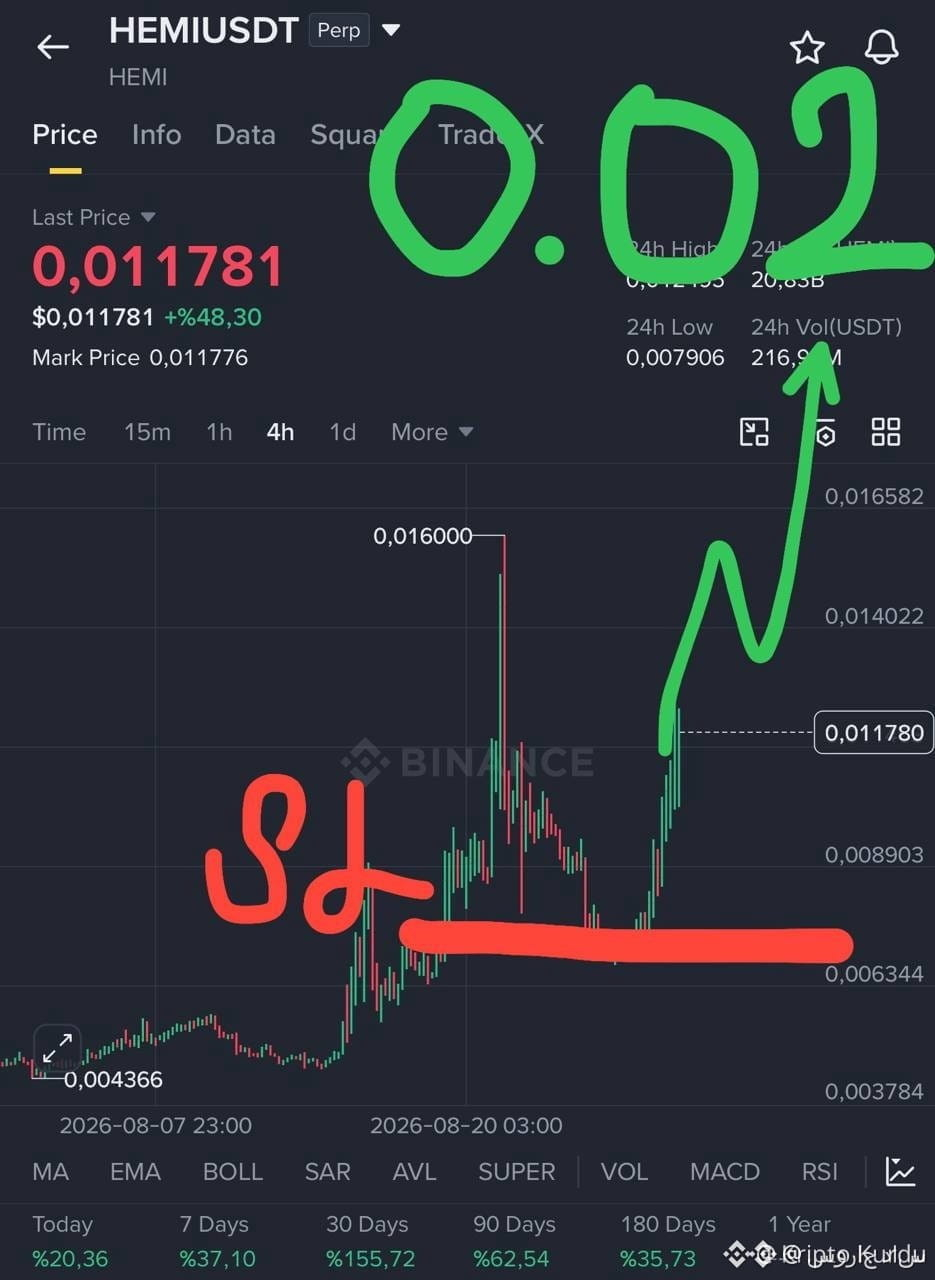
Since then, HEMI delivered a powerful 3X move. 📈
And the interesting part? The project is still trading at a relatively small market cap, while ecosystem development and integrations continue.
🔥 Recent momentum has pushed HEMI sharply higher, but traders should watch today’s scheduled token unlock closely, as additional supply can increase volatility.
My view: the 3X move may not be the end of the story—but risk management comes first.
{spot}(HEMIUSDT)
{spot}(ETHUSDT)
DYOR. Don’t chase green candles. ⚠️
#HemiNetwork #Altcoins #CryptoTrading
🚨 HEMI $HEMI — THE STORY ISN’T OVER YET 👀
Who remembers my previous HEMI analysis?
A few days ago, I highlighted HEMI because of its low market cap, growing ecosystem, strong partnerships and token distribution.
Since then, HEMI delivered a powerful 3X move. 📈
And the interesting part? The project is still trading at a relatively small market cap, while ecosystem development and integrations continue.
🔥 Recent momentum has pushed HEMI sharply higher, but traders should watch today’s scheduled token unlock closely, as additional supply can increase volatility.
My view: the 3X move may not be the end of the story—but risk management comes first.
DYOR. Don’t chase green candles. ⚠️
#HemiNetwork #Altcoins #CryptoTrading
Who remembers my previous HEMI analysis?
A few days ago, I highlighted HEMI because of its low market cap, growing ecosystem, strong partnerships and token distribution.
Since then, HEMI delivered a powerful 3X move. 📈
And the interesting part? The project is still trading at a relatively small market cap, while ecosystem development and integrations continue.
🔥 Recent momentum has pushed HEMI sharply higher, but traders should watch today’s scheduled token unlock closely, as additional supply can increase volatility.
My view: the 3X move may not be the end of the story—but risk management comes first.
DYOR. Don’t chase green candles. ⚠️
#HemiNetwork #Altcoins #CryptoTrading

72
# HEMI’s Network Hype Keeps Rising, Score Breaks 80K+, Can a Two-Layer Architecture Lead the Next DeFi Wave?
## Before We Begin
Recently, the crypto market has continued to fluctuate, but one project has risen against the tide—**HEMI Network**. According to multiple on-chain data platforms, HEMI’s search interest and community activity have been steadily increasing, and its Score once broke through the 80,000 mark, becoming one of the most talked-about public blockchain projects lately. What magic does this relatively unknown project really have? This article will take a deep dive into HEMI’s technical architecture and ecosystem potential, and explore whether it has what it takes to lead the next DeFi wave.
## I. Two-Layer Architecture: A New Balance of Performance and Security
What HEMI is most praised for is its distinctive **two-layer architecture design**. This architecture is not simply a matter of stacking a main chain and a sidechain—it instead adopts an innovative layered consensus mechanism:
**First Layer (L1)**: HEMI’s main chain serves as the security settlement layer, using PoS (Proof of Stake) consensus to ensure network security and decentralization. This layer inherits the security models of Bitcoin and Ethereum, providing a solid security foundation for the entire network.
**Second Layer (L2)**: HEMI’s L2 solution focuses on high-performance computing. By optimizing block production and transaction confirmation processes, it achieves high throughput of thousands of TPS per second. With this design, users can enjoy DeFi convenience without worrying about network congestion or expensive Gas fees.
At its core, this “two-layer parallel” architecture is about finding the optimal answer among **decentralization, security, and scalability**. In a time when the “impossible triangle” has not yet been fully broken, HEMI’s design philosophy undeniably offers a pragmatic technical path.
## II. Cross-Chain Compatibility: The First Step Toward Breaking Free of Silos
If the two-layer architecture is HEMI’s “internal strength,” then **cross-chain compatibility** is its “external strength.”
The current blockchain world is highly fragmented—Ethereum, Solana, and Bitcoin ecosystems each fight their own battle. HEMI has keenly identified this pain point and, through a built-in cross-chain bridging protocol, enables asset interoperability with major public chains. This means:
- Users can directly interact with assets from ecosystems like Ethereum and Solana on the HEMI network
- Developers can deploy cross-chain applications with a lower barrier to entry
- Liquidity is no longer confined to a single chain
This open compatibility strategy, to some extent, echoes Web3’s ultimate vision of “interconnectivity.” When cross-chain costs are low enough and the experience is smooth enough, DeFi’s玩法 will take a qualitative leap.
## III. Community Hype: HEMI’s “Breaking Into the Mainstream” Journey Seen Through Data
No technology can succeed without community support. HEMI’s recent surge in popularity is not accidental—it’s the result of multiple factors working together:
**1. Active developer community**: Since HEMI open-sourced its code, the commit frequency on GitHub has remained steady, and several DApps built on HEMI are being refined in the testnet stage.
**2. Exploding discussion on social media**: Activity on Twitter Spaces and Discord communities continues to rise. Core developers frequently take part in community AMA sessions, sharing technical progress and roadmap updates.
**3. Increasing institutional attention**: Although no top-tier institutions have publicly endorsed it yet, multiple crypto-native funds have already started conducting due diligence on HEMI.
**4. Narrative alignment with hot topics**: The market is currently in the phase of “searching for the next narrative.” HEMI’s “two-layer architecture + cross-chain compatibility” perfectly hits two major trending concepts: “Layer2 scaling” and “cross-chain interoperability.”
When technical strength and market sentiment resonate, rising hype becomes almost inevitable.
## IV. Risk Warning: Cold Thinking Behind the Boom
To be sure, HEMI shows promising potential. But as rational investors, we still need to face the following risks:
**1. Intense competition**: The Layer2 space already has strong rivals like Arbitrum and Optimism. HEMI needs to prove its unique advantages.
**2. Mainnet launch timeline**: HEMI is still in the testnet phase, and the mainnet launch date is not yet determined. This uncertainty needs to be assessed by investors themselves.
**3. Early ecosystem building**: The core of DeFi lies in applications and liquidity. Whether HEMI’s ecosystem can attract enough developers and users still needs time to be validated.
**4. Market volatility risk**: The overall crypto market remains highly volatile, and no project can fully avoid it.
## V. Conclusion: Can HEMI Become a “Dark Horse”?
HEMI’s arrival brings a breath of fresh air to a public blockchain track that has felt somewhat dull. Its two-layer architecture is technically reasonably designed, and its cross-chain compatibility aligns with broader industry development trends. The growing hype reflects the market’s initial recognition of its potential. But whether it can evolve from a “hot project” into a “mainstream public chain” still depends on its real performance after the mainnet launch.
For those interested in HEMI, it’s recommended that you:
- Keep tracking project progress and the mainnet launch timeline
- Deeply understand its technical documentation and economic model
- Participate in testnet interactions to get familiar with the ecosystem in advance
The charm of the crypto world lies in its uncertainty. Perhaps the leader of the next DeFi wave will be a “dark horse” project like HEMI—one that combines technical innovation with lively community momentum.
---
**Tags:** #HEMI #HemiNetwork #加密货币 #blockchain
---
*The above content is for information sharing only and does not constitute any investment advice. Crypto assets are subject to significant volatility, so exercise caution when investing.*
# HEMI’s Network Hype Keeps Rising, Score Breaks 80K+, Can a Two-Layer Architecture Lead the Next DeFi Wave?
## Before We Begin
Recently, the crypto market has continued to fluctuate, but one project has risen against the tide—**HEMI Network**. According to multiple on-chain data platforms, HEMI’s search interest and community activity have been steadily increasing, and its Score once broke through the 80,000 mark, becoming one of the most talked-about public blockchain projects lately. What magic does this relatively unknown project really have? This article will take a deep dive into HEMI’s technical architecture and ecosystem potential, and explore whether it has what it takes to lead the next DeFi wave.
## I. Two-Layer Architecture: A New Balance of Performance and Security
What HEMI is most praised for is its distinctive **two-layer architecture design**. This architecture is not simply a matter of stacking a main chain and a sidechain—it instead adopts an innovative layered consensus mechanism:
**First Layer (L1)**: HEMI’s main chain serves as the security settlement layer, using PoS (Proof of Stake) consensus to ensure network security and decentralization. This layer inherits the security models of Bitcoin and Ethereum, providing a solid security foundation for the entire network.
**Second Layer (L2)**: HEMI’s L2 solution focuses on high-performance computing. By optimizing block production and transaction confirmation processes, it achieves high throughput of thousands of TPS per second. With this design, users can enjoy DeFi convenience without worrying about network congestion or expensive Gas fees.
At its core, this “two-layer parallel” architecture is about finding the optimal answer among **decentralization, security, and scalability**. In a time when the “impossible triangle” has not yet been fully broken, HEMI’s design philosophy undeniably offers a pragmatic technical path.
## II. Cross-Chain Compatibility: The First Step Toward Breaking Free of Silos
If the two-layer architecture is HEMI’s “internal strength,” then **cross-chain compatibility** is its “external strength.”
The current blockchain world is highly fragmented—Ethereum, Solana, and Bitcoin ecosystems each fight their own battle. HEMI has keenly identified this pain point and, through a built-in cross-chain bridging protocol, enables asset interoperability with major public chains. This means:
- Users can directly interact with assets from ecosystems like Ethereum and Solana on the HEMI network
- Developers can deploy cross-chain applications with a lower barrier to entry
- Liquidity is no longer confined to a single chain
This open compatibility strategy, to some extent, echoes Web3’s ultimate vision of “interconnectivity.” When cross-chain costs are low enough and the experience is smooth enough, DeFi’s玩法 will take a qualitative leap.
## III. Community Hype: HEMI’s “Breaking Into the Mainstream” Journey Seen Through Data
No technology can succeed without community support. HEMI’s recent surge in popularity is not accidental—it’s the result of multiple factors working together:
**1. Active developer community**: Since HEMI open-sourced its code, the commit frequency on GitHub has remained steady, and several DApps built on HEMI are being refined in the testnet stage.
**2. Exploding discussion on social media**: Activity on Twitter Spaces and Discord communities continues to rise. Core developers frequently take part in community AMA sessions, sharing technical progress and roadmap updates.
**3. Increasing institutional attention**: Although no top-tier institutions have publicly endorsed it yet, multiple crypto-native funds have already started conducting due diligence on HEMI.
**4. Narrative alignment with hot topics**: The market is currently in the phase of “searching for the next narrative.” HEMI’s “two-layer architecture + cross-chain compatibility” perfectly hits two major trending concepts: “Layer2 scaling” and “cross-chain interoperability.”
When technical strength and market sentiment resonate, rising hype becomes almost inevitable.
## IV. Risk Warning: Cold Thinking Behind the Boom
To be sure, HEMI shows promising potential. But as rational investors, we still need to face the following risks:
**1. Intense competition**: The Layer2 space already has strong rivals like Arbitrum and Optimism. HEMI needs to prove its unique advantages.
**2. Mainnet launch timeline**: HEMI is still in the testnet phase, and the mainnet launch date is not yet determined. This uncertainty needs to be assessed by investors themselves.
**3. Early ecosystem building**: The core of DeFi lies in applications and liquidity. Whether HEMI’s ecosystem can attract enough developers and users still needs time to be validated.
**4. Market volatility risk**: The overall crypto market remains highly volatile, and no project can fully avoid it.
## V. Conclusion: Can HEMI Become a “Dark Horse”?
HEMI’s arrival brings a breath of fresh air to a public blockchain track that has felt somewhat dull. Its two-layer architecture is technically reasonably designed, and its cross-chain compatibility aligns with broader industry development trends. The growing hype reflects the market’s initial recognition of its potential. But whether it can evolve from a “hot project” into a “mainstream public chain” still depends on its real performance after the mainnet launch.
For those interested in HEMI, it’s recommended that you:
- Keep tracking project progress and the mainnet launch timeline
- Deeply understand its technical documentation and economic model
- Participate in testnet interactions to get familiar with the ecosystem in advance
The charm of the crypto world lies in its uncertainty. Perhaps the leader of the next DeFi wave will be a “dark horse” project like HEMI—one that combines technical innovation with lively community momentum.
---
**Tags:** #HEMI #HemiNetwork #加密货币 #blockchain
---
*The above content is for information sharing only and does not constitute any investment advice. Crypto assets are subject to significant volatility, so exercise caution when investing.*
## Before We Begin
Recently, the crypto market has continued to fluctuate, but one project has risen against the tide—**HEMI Network**. According to multiple on-chain data platforms, HEMI’s search interest and community activity have been steadily increasing, and its Score once broke through the 80,000 mark, becoming one of the most talked-about public blockchain projects lately. What magic does this relatively unknown project really have? This article will take a deep dive into HEMI’s technical architecture and ecosystem potential, and explore whether it has what it takes to lead the next DeFi wave.
## I. Two-Layer Architecture: A New Balance of Performance and Security
What HEMI is most praised for is its distinctive **two-layer architecture design**. This architecture is not simply a matter of stacking a main chain and a sidechain—it instead adopts an innovative layered consensus mechanism:
**First Layer (L1)**: HEMI’s main chain serves as the security settlement layer, using PoS (Proof of Stake) consensus to ensure network security and decentralization. This layer inherits the security models of Bitcoin and Ethereum, providing a solid security foundation for the entire network.
**Second Layer (L2)**: HEMI’s L2 solution focuses on high-performance computing. By optimizing block production and transaction confirmation processes, it achieves high throughput of thousands of TPS per second. With this design, users can enjoy DeFi convenience without worrying about network congestion or expensive Gas fees.
At its core, this “two-layer parallel” architecture is about finding the optimal answer among **decentralization, security, and scalability**. In a time when the “impossible triangle” has not yet been fully broken, HEMI’s design philosophy undeniably offers a pragmatic technical path.
## II. Cross-Chain Compatibility: The First Step Toward Breaking Free of Silos
If the two-layer architecture is HEMI’s “internal strength,” then **cross-chain compatibility** is its “external strength.”
The current blockchain world is highly fragmented—Ethereum, Solana, and Bitcoin ecosystems each fight their own battle. HEMI has keenly identified this pain point and, through a built-in cross-chain bridging protocol, enables asset interoperability with major public chains. This means:
- Users can directly interact with assets from ecosystems like Ethereum and Solana on the HEMI network
- Developers can deploy cross-chain applications with a lower barrier to entry
- Liquidity is no longer confined to a single chain
This open compatibility strategy, to some extent, echoes Web3’s ultimate vision of “interconnectivity.” When cross-chain costs are low enough and the experience is smooth enough, DeFi’s玩法 will take a qualitative leap.
## III. Community Hype: HEMI’s “Breaking Into the Mainstream” Journey Seen Through Data
No technology can succeed without community support. HEMI’s recent surge in popularity is not accidental—it’s the result of multiple factors working together:
**1. Active developer community**: Since HEMI open-sourced its code, the commit frequency on GitHub has remained steady, and several DApps built on HEMI are being refined in the testnet stage.
**2. Exploding discussion on social media**: Activity on Twitter Spaces and Discord communities continues to rise. Core developers frequently take part in community AMA sessions, sharing technical progress and roadmap updates.
**3. Increasing institutional attention**: Although no top-tier institutions have publicly endorsed it yet, multiple crypto-native funds have already started conducting due diligence on HEMI.
**4. Narrative alignment with hot topics**: The market is currently in the phase of “searching for the next narrative.” HEMI’s “two-layer architecture + cross-chain compatibility” perfectly hits two major trending concepts: “Layer2 scaling” and “cross-chain interoperability.”
When technical strength and market sentiment resonate, rising hype becomes almost inevitable.
## IV. Risk Warning: Cold Thinking Behind the Boom
To be sure, HEMI shows promising potential. But as rational investors, we still need to face the following risks:
**1. Intense competition**: The Layer2 space already has strong rivals like Arbitrum and Optimism. HEMI needs to prove its unique advantages.
**2. Mainnet launch timeline**: HEMI is still in the testnet phase, and the mainnet launch date is not yet determined. This uncertainty needs to be assessed by investors themselves.
**3. Early ecosystem building**: The core of DeFi lies in applications and liquidity. Whether HEMI’s ecosystem can attract enough developers and users still needs time to be validated.
**4. Market volatility risk**: The overall crypto market remains highly volatile, and no project can fully avoid it.
## V. Conclusion: Can HEMI Become a “Dark Horse”?
HEMI’s arrival brings a breath of fresh air to a public blockchain track that has felt somewhat dull. Its two-layer architecture is technically reasonably designed, and its cross-chain compatibility aligns with broader industry development trends. The growing hype reflects the market’s initial recognition of its potential. But whether it can evolve from a “hot project” into a “mainstream public chain” still depends on its real performance after the mainnet launch.
For those interested in HEMI, it’s recommended that you:
- Keep tracking project progress and the mainnet launch timeline
- Deeply understand its technical documentation and economic model
- Participate in testnet interactions to get familiar with the ecosystem in advance
The charm of the crypto world lies in its uncertainty. Perhaps the leader of the next DeFi wave will be a “dark horse” project like HEMI—one that combines technical innovation with lively community momentum.
---
**Tags:** #HEMI #HemiNetwork #加密货币 #blockchain
---
*The above content is for information sharing only and does not constitute any investment advice. Crypto assets are subject to significant volatility, so exercise caution when investing.*
68
# HEMI Heat Tops the Chart: The Value Logic Behind the Ultra-High Heat of 98715
This week, the crypto market welcomed a “dark horse” — **HEMI**, which surged to the top of the trending chart with an ultra-high heat score of 98715, instantly becoming the focal point of discussion across the community. This number is not just a traffic metric; it reflects the market’s high recognition of HEMI’s network ecosystem and development prospects. Today, let’s take a deep dive into why HEMI has attracted such widespread market attention.
## Technical Architecture: The Underlying Logic of an Innovative Public Chain
HEMI positions itself as a high-performance Layer 1 blockchain, showcasing a distinct innovative approach at the technical level. **Its core highlight is the adoption of a hybrid consensus mechanism**, combining the advantages of Proof of Stake (PoS) and practical Byzantine Fault Tolerance (PBFT). This not only ensures network security but also delivers high transaction processing efficiency.
According to publicly available technical documentation, HEMI’s block confirmation time remains at a relatively low level, which is especially important for DeFi applications and NFT trading scenarios that prioritize a smooth user experience. In addition, HEMI supports EVM compatibility, meaning Ethereum ecosystem developers can migrate to the HEMI network at a lower cost, laying the foundation for rapid ecosystem expansion.
What’s also worth noting is that HEMI has actively explored **cross-chain interoperability**. In the current landscape of multiple chains coexisting, cross-chain bridging capability directly affects a public chain’s “ceiling.” HEMI’s cross-chain protocol design enables assets to move efficiently between different blockchains, attracting many investors and developers focused on liquidity efficiency.
## Ecosystem Layout: Breakthroughs from 0 to 1
Behind the surge in heat is HEMI’s rapid ecosystem growth. Recently, multiple DeFi projects announced deployment on the HEMI network, including decentralized exchanges, lending protocols, and yield aggregators. This trend toward ecosystem diversification shows that the developer community places strong trust in HEMI’s technical capabilities.
**TVL (Total Value Locked)** is a key metric for measuring the health of a public chain ecosystem. HEMI’s TVL is trending steadily upward. Although it still lags behind top-tier public chains, the growth curve indicates strong momentum. Community analysis suggests that as more high-quality projects move in, this metric is likely to continue climbing.
HEMI’s incentive mechanisms are also notable. Its tokenomics design balances rewards for early supporters with the rights of long-term token holders. Through staking rewards and ecosystem incentive programs, it forms a relatively reasonable value-capture model. Such a design helps maintain network stability and token value.
## Market Performance: Resonance Between Heat and Value
The heat ranking of 98715 is not accidental. From market sentiment indicators, HEMI’s social media discussion volume, search index, and community activity have all been trending upward. This heat comes from several factors:
1. **Technical narrative**: The market continues to favor high-performance, low-fee public chains, and HEMI fits this demand well
2. **Wealth effect**: Early participants have gained substantial returns, creating a demonstration effect
3. **Community building**: HEMI’s official team maintains high-frequency interaction with the community, responding promptly to market concerns
From a trading perspective, HEMI’s trading activity and depth have also been improving gradually. Multiple major exchanges have listed HEMI-related trading pairs, giving investors more ways to participate.
## Risk Warning: Stay Rational About the Hype
It’s important to note that high heat often comes with high volatility. Uncertainty still exists in the crypto market, so investors should:
- Conduct risk assessments and don’t invest beyond your risk tolerance
- Focus on the project’s actual progress, not just chasing hype
- Maintain independent judgment and watch out for FOMO emotions
## Outlook: Can HEMI Continue to Lead?
From a long-term perspective, HEMI’s development depends on several key factors: whether ecosystem projects can successfully launch, the ability of the technology to keep iterating, and how well the market environment cooperates. The current level of heat has earned HEMI a valuable opportunity for exposure, but the real test lies in how to convert traffic into sustained value growth.
No matter the outcome, HEMI’s rise once again proves the vitality and possibilities of the crypto market. For investors who care about blockchain technology development, HEMI is a project worth following over time.
---
💬 What do you think about HEMI’s development prospects? Feel free to share your views in the comments.
#HEMI #HEMINetwork #加密货币 #DeFi
# HEMI Heat Tops the Chart: The Value Logic Behind the Ultra-High Heat of 98715
This week, the crypto market welcomed a “dark horse” — **HEMI**, which surged to the top of the trending chart with an ultra-high heat score of 98715, instantly becoming the focal point of discussion across the community. This number is not just a traffic metric; it reflects the market’s high recognition of HEMI’s network ecosystem and development prospects. Today, let’s take a deep dive into why HEMI has attracted such widespread market attention.
## Technical Architecture: The Underlying Logic of an Innovative Public Chain
HEMI positions itself as a high-performance Layer 1 blockchain, showcasing a distinct innovative approach at the technical level. **Its core highlight is the adoption of a hybrid consensus mechanism**, combining the advantages of Proof of Stake (PoS) and practical Byzantine Fault Tolerance (PBFT). This not only ensures network security but also delivers high transaction processing efficiency.
According to publicly available technical documentation, HEMI’s block confirmation time remains at a relatively low level, which is especially important for DeFi applications and NFT trading scenarios that prioritize a smooth user experience. In addition, HEMI supports EVM compatibility, meaning Ethereum ecosystem developers can migrate to the HEMI network at a lower cost, laying the foundation for rapid ecosystem expansion.
What’s also worth noting is that HEMI has actively explored **cross-chain interoperability**. In the current landscape of multiple chains coexisting, cross-chain bridging capability directly affects a public chain’s “ceiling.” HEMI’s cross-chain protocol design enables assets to move efficiently between different blockchains, attracting many investors and developers focused on liquidity efficiency.
## Ecosystem Layout: Breakthroughs from 0 to 1
Behind the surge in heat is HEMI’s rapid ecosystem growth. Recently, multiple DeFi projects announced deployment on the HEMI network, including decentralized exchanges, lending protocols, and yield aggregators. This trend toward ecosystem diversification shows that the developer community places strong trust in HEMI’s technical capabilities.
**TVL (Total Value Locked)** is a key metric for measuring the health of a public chain ecosystem. HEMI’s TVL is trending steadily upward. Although it still lags behind top-tier public chains, the growth curve indicates strong momentum. Community analysis suggests that as more high-quality projects move in, this metric is likely to continue climbing.
HEMI’s incentive mechanisms are also notable. Its tokenomics design balances rewards for early supporters with the rights of long-term token holders. Through staking rewards and ecosystem incentive programs, it forms a relatively reasonable value-capture model. Such a design helps maintain network stability and token value.
## Market Performance: Resonance Between Heat and Value
The heat ranking of 98715 is not accidental. From market sentiment indicators, HEMI’s social media discussion volume, search index, and community activity have all been trending upward. This heat comes from several factors:
1. **Technical narrative**: The market continues to favor high-performance, low-fee public chains, and HEMI fits this demand well
2. **Wealth effect**: Early participants have gained substantial returns, creating a demonstration effect
3. **Community building**: HEMI’s official team maintains high-frequency interaction with the community, responding promptly to market concerns
From a trading perspective, HEMI’s trading activity and depth have also been improving gradually. Multiple major exchanges have listed HEMI-related trading pairs, giving investors more ways to participate.
## Risk Warning: Stay Rational About the Hype
It’s important to note that high heat often comes with high volatility. Uncertainty still exists in the crypto market, so investors should:
- Conduct risk assessments and don’t invest beyond your risk tolerance
- Focus on the project’s actual progress, not just chasing hype
- Maintain independent judgment and watch out for FOMO emotions
## Outlook: Can HEMI Continue to Lead?
From a long-term perspective, HEMI’s development depends on several key factors: whether ecosystem projects can successfully launch, the ability of the technology to keep iterating, and how well the market environment cooperates. The current level of heat has earned HEMI a valuable opportunity for exposure, but the real test lies in how to convert traffic into sustained value growth.
No matter the outcome, HEMI’s rise once again proves the vitality and possibilities of the crypto market. For investors who care about blockchain technology development, HEMI is a project worth following over time.
---
💬 What do you think about HEMI’s development prospects? Feel free to share your views in the comments.
#HEMI #HEMINetwork #加密货币 #DeFi
This week, the crypto market welcomed a “dark horse” — **HEMI**, which surged to the top of the trending chart with an ultra-high heat score of 98715, instantly becoming the focal point of discussion across the community. This number is not just a traffic metric; it reflects the market’s high recognition of HEMI’s network ecosystem and development prospects. Today, let’s take a deep dive into why HEMI has attracted such widespread market attention.
## Technical Architecture: The Underlying Logic of an Innovative Public Chain
HEMI positions itself as a high-performance Layer 1 blockchain, showcasing a distinct innovative approach at the technical level. **Its core highlight is the adoption of a hybrid consensus mechanism**, combining the advantages of Proof of Stake (PoS) and practical Byzantine Fault Tolerance (PBFT). This not only ensures network security but also delivers high transaction processing efficiency.
According to publicly available technical documentation, HEMI’s block confirmation time remains at a relatively low level, which is especially important for DeFi applications and NFT trading scenarios that prioritize a smooth user experience. In addition, HEMI supports EVM compatibility, meaning Ethereum ecosystem developers can migrate to the HEMI network at a lower cost, laying the foundation for rapid ecosystem expansion.
What’s also worth noting is that HEMI has actively explored **cross-chain interoperability**. In the current landscape of multiple chains coexisting, cross-chain bridging capability directly affects a public chain’s “ceiling.” HEMI’s cross-chain protocol design enables assets to move efficiently between different blockchains, attracting many investors and developers focused on liquidity efficiency.
## Ecosystem Layout: Breakthroughs from 0 to 1
Behind the surge in heat is HEMI’s rapid ecosystem growth. Recently, multiple DeFi projects announced deployment on the HEMI network, including decentralized exchanges, lending protocols, and yield aggregators. This trend toward ecosystem diversification shows that the developer community places strong trust in HEMI’s technical capabilities.
**TVL (Total Value Locked)** is a key metric for measuring the health of a public chain ecosystem. HEMI’s TVL is trending steadily upward. Although it still lags behind top-tier public chains, the growth curve indicates strong momentum. Community analysis suggests that as more high-quality projects move in, this metric is likely to continue climbing.
HEMI’s incentive mechanisms are also notable. Its tokenomics design balances rewards for early supporters with the rights of long-term token holders. Through staking rewards and ecosystem incentive programs, it forms a relatively reasonable value-capture model. Such a design helps maintain network stability and token value.
## Market Performance: Resonance Between Heat and Value
The heat ranking of 98715 is not accidental. From market sentiment indicators, HEMI’s social media discussion volume, search index, and community activity have all been trending upward. This heat comes from several factors:
1. **Technical narrative**: The market continues to favor high-performance, low-fee public chains, and HEMI fits this demand well
2. **Wealth effect**: Early participants have gained substantial returns, creating a demonstration effect
3. **Community building**: HEMI’s official team maintains high-frequency interaction with the community, responding promptly to market concerns
From a trading perspective, HEMI’s trading activity and depth have also been improving gradually. Multiple major exchanges have listed HEMI-related trading pairs, giving investors more ways to participate.
## Risk Warning: Stay Rational About the Hype
It’s important to note that high heat often comes with high volatility. Uncertainty still exists in the crypto market, so investors should:
- Conduct risk assessments and don’t invest beyond your risk tolerance
- Focus on the project’s actual progress, not just chasing hype
- Maintain independent judgment and watch out for FOMO emotions
## Outlook: Can HEMI Continue to Lead?
From a long-term perspective, HEMI’s development depends on several key factors: whether ecosystem projects can successfully launch, the ability of the technology to keep iterating, and how well the market environment cooperates. The current level of heat has earned HEMI a valuable opportunity for exposure, but the real test lies in how to convert traffic into sustained value growth.
No matter the outcome, HEMI’s rise once again proves the vitality and possibilities of the crypto market. For investors who care about blockchain technology development, HEMI is a project worth following over time.
---
💬 What do you think about HEMI’s development prospects? Feel free to share your views in the comments.
#HEMI #HEMINetwork #加密货币 #DeFi
82
# HEMI:The rise of a new wave in modular blockchain—an in-depth breakdown of its technology ecosystem and community developments
---
Recently, sentiment in the crypto market has gradually rebounded, and a variety of new projects have emerged one after another. Among them, **HEMI Network** burst into investors’ view like a dark horse. With its unique technical architecture and an active community ecosystem, it quickly became a widely discussed focus within the sector. As a Layer 2 solution built around modular design, what exactly sets HEMI’s technical positioning apart? And what opportunities and risks are embedded in its ecosystem growth? This article will give you a deep analysis.
---
## 1. Technical positioning: innovative practice of modular blockchain
HEMI Network is positioned as the next-generation modular blockchain infrastructure, aiming to build a high-performance, interoperable Web3 ecosystem. Its core technical features are mainly reflected in the following:
**1. Hybrid architecture design**
HEMI adopts an EVM-compatible modular architecture, separating the execution layer, consensus layer, and data availability layer. This design concept is similar to Celestia’s modular idea, but HEMI places greater emphasis on seamless integration with the Ethereum ecosystem. Developers can easily migrate DApps from Ethereum to the HEMI network, benefiting from lower Gas fees and higher TPS.
**2. Parallel operation of zkRollup + Optimistic Rollup**
To balance security and user experience, HEMI uses a hybrid Rollup approach. The zkRollup layer is responsible for final determinism to ensure asset safety, while the Optimistic Rollup layer provides a faster transaction confirmation experience. This “dual-track” model is considered a relatively cutting-edge attempt in the industry.
**3. Native cross-chain bridging capability**
HEMI has an embedded cross-chain communication protocol that supports free movement of assets across multiple chains. This feature means it is not merely a single Layer 2, but could potentially become a bridging layer connecting different blockchain networks.
---
## 2. Ecosystem progress: a rapidly iterating ecosystem map
Beyond the technical architecture, HEMI has also demonstrated strong execution in ecosystem building:
- **TVL growth**: Although the mainnet has been live for a short time, HEMI’s TVL has already surpassed the tens of millions of dollars mark, with a growth rate leading similar projects.
- **Developer incentives**: The official launched a developer Grants program, allocating millions of dollars to support the development of ecosystem applications, covering multiple tracks such as DeFi, NFTs, and GameFi.
- **Strategic partnerships**: According to public information, HEMI has established partnerships with multiple well-known Web3 infrastructure providers, including leading projects in areas such as wallets, oracles, and data analytics.
---
## 3. Community heat: community momentum building for takeoff
Community is one of the key factors behind the success of crypto projects. HEMI shows distinct characteristics in community operations:
**1. Active governance participation**
HEMI adopts a decentralized governance model, allowing token holders to participate in voting on network parameters. Recently, community discussions regarding proposals for ecosystem fund allocation have been extremely hot, reflecting holders’ strong attention to the project’s direction.
**2. Globalized layout**
Although the project team is headquartered in Singapore, HEMI’s community spans multiple regions including North America, Europe, and Southeast Asia. The Discord and Telegram communities are highly active. Daily discussions focus on technical development and ecosystem building—not just price movements—which lays a healthy foundation for the project’s long-term growth.
**3. KOL and media attention**
In the second half of 2024, multiple well-known crypto industry KOLs began to关注 (关注并解读) and interpret HEMI’s technical roadmap. The number of related analysis articles and video content has increased significantly, and market buzz has continued to rise.
---
## 4. Risk warning: take the high heat rationally
Any highly buzzed project comes with risks, and investors should stay rational:
- **Competitive pressure**: The modular blockchain sector is highly competitive. Rivals such as Celestia, Polygon, and Arbitrum are strong, and HEMI must continuously prove itself in both technology and ecosystem.
- **Tokenomics**: Details of HEMI’s tokenomics are still being gradually disclosed. Factors such as token allocation mechanisms and unlock schedules will directly impact secondary market performance.
- **Regulatory uncertainty**: Global crypto regulatory policies remain uncertain, and compliance challenges faced by Layer 2 projects cannot be ignored.
---
## Conclusion
Overall, as one of the hottest new projects in the market recently, HEMI deserves attention for its modular technical architecture, proactive ecosystem layout, and an active community atmosphere. However, behind the high heat there are also competition and risks. Investors should conduct thorough research, implement sound risk control, and closely track project progress and market dynamics.
For Web3 practitioners and long-term observers, HEMI’s development path offers a case worth studying—amid an increasingly crowded modular blockchain landscape, the balance between technological innovation and community governance will become the key factor determining whether a project can break through.
---
**Tags:** #HEMI #HemiNetwork #加密货币 #Web3
# HEMI:The rise of a new wave in modular blockchain—an in-depth breakdown of its technology ecosystem and community developments
---
Recently, sentiment in the crypto market has gradually rebounded, and a variety of new projects have emerged one after another. Among them, **HEMI Network** burst into investors’ view like a dark horse. With its unique technical architecture and an active community ecosystem, it quickly became a widely discussed focus within the sector. As a Layer 2 solution built around modular design, what exactly sets HEMI’s technical positioning apart? And what opportunities and risks are embedded in its ecosystem growth? This article will give you a deep analysis.
---
## 1. Technical positioning: innovative practice of modular blockchain
HEMI Network is positioned as the next-generation modular blockchain infrastructure, aiming to build a high-performance, interoperable Web3 ecosystem. Its core technical features are mainly reflected in the following:
**1. Hybrid architecture design**
HEMI adopts an EVM-compatible modular architecture, separating the execution layer, consensus layer, and data availability layer. This design concept is similar to Celestia’s modular idea, but HEMI places greater emphasis on seamless integration with the Ethereum ecosystem. Developers can easily migrate DApps from Ethereum to the HEMI network, benefiting from lower Gas fees and higher TPS.
**2. Parallel operation of zkRollup + Optimistic Rollup**
To balance security and user experience, HEMI uses a hybrid Rollup approach. The zkRollup layer is responsible for final determinism to ensure asset safety, while the Optimistic Rollup layer provides a faster transaction confirmation experience. This “dual-track” model is considered a relatively cutting-edge attempt in the industry.
**3. Native cross-chain bridging capability**
HEMI has an embedded cross-chain communication protocol that supports free movement of assets across multiple chains. This feature means it is not merely a single Layer 2, but could potentially become a bridging layer connecting different blockchain networks.
---
## 2. Ecosystem progress: a rapidly iterating ecosystem map
Beyond the technical architecture, HEMI has also demonstrated strong execution in ecosystem building:
- **TVL growth**: Although the mainnet has been live for a short time, HEMI’s TVL has already surpassed the tens of millions of dollars mark, with a growth rate leading similar projects.
- **Developer incentives**: The official launched a developer Grants program, allocating millions of dollars to support the development of ecosystem applications, covering multiple tracks such as DeFi, NFTs, and GameFi.
- **Strategic partnerships**: According to public information, HEMI has established partnerships with multiple well-known Web3 infrastructure providers, including leading projects in areas such as wallets, oracles, and data analytics.
---
## 3. Community heat: community momentum building for takeoff
Community is one of the key factors behind the success of crypto projects. HEMI shows distinct characteristics in community operations:
**1. Active governance participation**
HEMI adopts a decentralized governance model, allowing token holders to participate in voting on network parameters. Recently, community discussions regarding proposals for ecosystem fund allocation have been extremely hot, reflecting holders’ strong attention to the project’s direction.
**2. Globalized layout**
Although the project team is headquartered in Singapore, HEMI’s community spans multiple regions including North America, Europe, and Southeast Asia. The Discord and Telegram communities are highly active. Daily discussions focus on technical development and ecosystem building—not just price movements—which lays a healthy foundation for the project’s long-term growth.
**3. KOL and media attention**
In the second half of 2024, multiple well-known crypto industry KOLs began to关注 (关注并解读) and interpret HEMI’s technical roadmap. The number of related analysis articles and video content has increased significantly, and market buzz has continued to rise.
---
## 4. Risk warning: take the high heat rationally
Any highly buzzed project comes with risks, and investors should stay rational:
- **Competitive pressure**: The modular blockchain sector is highly competitive. Rivals such as Celestia, Polygon, and Arbitrum are strong, and HEMI must continuously prove itself in both technology and ecosystem.
- **Tokenomics**: Details of HEMI’s tokenomics are still being gradually disclosed. Factors such as token allocation mechanisms and unlock schedules will directly impact secondary market performance.
- **Regulatory uncertainty**: Global crypto regulatory policies remain uncertain, and compliance challenges faced by Layer 2 projects cannot be ignored.
---
## Conclusion
Overall, as one of the hottest new projects in the market recently, HEMI deserves attention for its modular technical architecture, proactive ecosystem layout, and an active community atmosphere. However, behind the high heat there are also competition and risks. Investors should conduct thorough research, implement sound risk control, and closely track project progress and market dynamics.
For Web3 practitioners and long-term observers, HEMI’s development path offers a case worth studying—amid an increasingly crowded modular blockchain landscape, the balance between technological innovation and community governance will become the key factor determining whether a project can break through.
---
**Tags:** #HEMI #HemiNetwork #加密货币 #Web3
---
Recently, sentiment in the crypto market has gradually rebounded, and a variety of new projects have emerged one after another. Among them, **HEMI Network** burst into investors’ view like a dark horse. With its unique technical architecture and an active community ecosystem, it quickly became a widely discussed focus within the sector. As a Layer 2 solution built around modular design, what exactly sets HEMI’s technical positioning apart? And what opportunities and risks are embedded in its ecosystem growth? This article will give you a deep analysis.
---
## 1. Technical positioning: innovative practice of modular blockchain
HEMI Network is positioned as the next-generation modular blockchain infrastructure, aiming to build a high-performance, interoperable Web3 ecosystem. Its core technical features are mainly reflected in the following:
**1. Hybrid architecture design**
HEMI adopts an EVM-compatible modular architecture, separating the execution layer, consensus layer, and data availability layer. This design concept is similar to Celestia’s modular idea, but HEMI places greater emphasis on seamless integration with the Ethereum ecosystem. Developers can easily migrate DApps from Ethereum to the HEMI network, benefiting from lower Gas fees and higher TPS.
**2. Parallel operation of zkRollup + Optimistic Rollup**
To balance security and user experience, HEMI uses a hybrid Rollup approach. The zkRollup layer is responsible for final determinism to ensure asset safety, while the Optimistic Rollup layer provides a faster transaction confirmation experience. This “dual-track” model is considered a relatively cutting-edge attempt in the industry.
**3. Native cross-chain bridging capability**
HEMI has an embedded cross-chain communication protocol that supports free movement of assets across multiple chains. This feature means it is not merely a single Layer 2, but could potentially become a bridging layer connecting different blockchain networks.
---
## 2. Ecosystem progress: a rapidly iterating ecosystem map
Beyond the technical architecture, HEMI has also demonstrated strong execution in ecosystem building:
- **TVL growth**: Although the mainnet has been live for a short time, HEMI’s TVL has already surpassed the tens of millions of dollars mark, with a growth rate leading similar projects.
- **Developer incentives**: The official launched a developer Grants program, allocating millions of dollars to support the development of ecosystem applications, covering multiple tracks such as DeFi, NFTs, and GameFi.
- **Strategic partnerships**: According to public information, HEMI has established partnerships with multiple well-known Web3 infrastructure providers, including leading projects in areas such as wallets, oracles, and data analytics.
---
## 3. Community heat: community momentum building for takeoff
Community is one of the key factors behind the success of crypto projects. HEMI shows distinct characteristics in community operations:
**1. Active governance participation**
HEMI adopts a decentralized governance model, allowing token holders to participate in voting on network parameters. Recently, community discussions regarding proposals for ecosystem fund allocation have been extremely hot, reflecting holders’ strong attention to the project’s direction.
**2. Globalized layout**
Although the project team is headquartered in Singapore, HEMI’s community spans multiple regions including North America, Europe, and Southeast Asia. The Discord and Telegram communities are highly active. Daily discussions focus on technical development and ecosystem building—not just price movements—which lays a healthy foundation for the project’s long-term growth.
**3. KOL and media attention**
In the second half of 2024, multiple well-known crypto industry KOLs began to关注 (关注并解读) and interpret HEMI’s technical roadmap. The number of related analysis articles and video content has increased significantly, and market buzz has continued to rise.
---
## 4. Risk warning: take the high heat rationally
Any highly buzzed project comes with risks, and investors should stay rational:
- **Competitive pressure**: The modular blockchain sector is highly competitive. Rivals such as Celestia, Polygon, and Arbitrum are strong, and HEMI must continuously prove itself in both technology and ecosystem.
- **Tokenomics**: Details of HEMI’s tokenomics are still being gradually disclosed. Factors such as token allocation mechanisms and unlock schedules will directly impact secondary market performance.
- **Regulatory uncertainty**: Global crypto regulatory policies remain uncertain, and compliance challenges faced by Layer 2 projects cannot be ignored.
---
## Conclusion
Overall, as one of the hottest new projects in the market recently, HEMI deserves attention for its modular technical architecture, proactive ecosystem layout, and an active community atmosphere. However, behind the high heat there are also competition and risks. Investors should conduct thorough research, implement sound risk control, and closely track project progress and market dynamics.
For Web3 practitioners and long-term observers, HEMI’s development path offers a case worth studying—amid an increasingly crowded modular blockchain landscape, the balance between technological innovation and community governance will become the key factor determining whether a project can break through.
---
**Tags:** #HEMI #HemiNetwork #加密货币 #Web3
108
# HEMI:From Technical Breakthroughs to Ecosystem Explosion—Is the Layer2 Sector’s Next Narrative Dark Horse?
If you ask which projects in the 2024–2025 crypto market are absolutely worth watching, HEMI Network definitely deserves a spot on the list. This Layer2 project, powered by a “hybrid consensus” model, is redefining the performance boundaries of blockchains through a distinctive technical path. Today, let’s take a deep dive into HEMI’s technological innovations and ecosystem progress.
## 🔧 Technological Innovation: A Hardcore Attempt to Break the “Impossible Triangle”
In blockchain, there’s an old and familiar saying about the “impossible triangle”—the three properties of decentralization, security, and scalability are difficult to achieve simultaneously. HEMI’s answer is: **a hybrid consensus mechanism**.
**Key Innovations:**
1. **Dual-Chain Architecture + Hybrid Consensus**
HEMI adopts a main chain + side chain design. The main chain uses PoW (Proof of Work) to ensure security and decentralization, while the side chain uses PoS (Proof of Stake) to achieve high TPS. This design enables the network to both preserve resistance to censorship and handle large volumes of transactions.
2. **ECDSA + BLS Signature Aggregation**
This is the key innovation most recognized by the technical community. In traditional blockchains, verifying signatures requires confirming them one by one, which is inefficient. HEMI introduces BLS signature aggregation technology to compress multiple signatures into a single one, improving verification efficiency by several multiples—directly supporting its claimed **2000+ TPS** performance target.
3. **Full EVM Compatibility**
For developers, HEMI is fully compatible with the Ethereum Virtual Machine. That means existing Ethereum DApps can migrate to the HEMI network seamlessly, lowering the barrier to ecosystem expansion.
## 🌱 Ecosystem Development: From Breakthroughs in One Area to Widespread Growth
Even if the technology is impressive, it still needs an ecosystem to validate its value. HEMI’s ecosystem roadmap is accelerating:
**DeFi:** Multiple DEXs and lending protocols have already been deployed on the HEMI network, and TVL (Total Value Locked) is growing steadily.
**NFTs & GameFi:** On-chain NFT minting and game-style applications are starting to emerge. HEMI’s low gas fees are being leveraged here to full effect.
**Developer Community:** The HEMI Grant program continues to provide funding support to high-quality projects, and the global developer community is expanding.
**Cross-Chain Bridges:** Mature cross-chain bridge solutions make it more convenient for assets to enter and exit the HEMI network.
## 💡 Why I Think HEMI Is Worth Paying Attention To
1. **Differentiated Competition:** Unlike most Layer2 projects that simply copy Ethereum, HEMI has original breakthroughs at the consensus layer.
2. **Healthy Token Economics:** Clear token utility and a well-designed staking mechanism.
3. **Market Narrative:** As the Ethereum Layer2 sector remains intensely hot, HEMI has the potential to become a leader in its niche.
Of course, risks also exist: compared to top Layer2 projects, there’s still a gap in the number of ecosystem projects, and it needs ongoing observation to assess its ecosystem appeal.
---
**Summary:** HEMI has proven with solid technical strength that it isn’t a “vaporware token,” but a genuine Layer2 contender with real substance. If you care about the evolution of blockchain technology, or you’re looking for the next project with explosive potential, HEMI deserves to be added to your watchlist.
Do you think HEMI will develop successfully? Feel free to share your views in the comments!
---
#HEMI #HemiNetwork #加密货币 #Blockchain
# HEMI:From Technical Breakthroughs to Ecosystem Explosion—Is the Layer2 Sector’s Next Narrative Dark Horse?
If you ask which projects in the 2024–2025 crypto market are absolutely worth watching, HEMI Network definitely deserves a spot on the list. This Layer2 project, powered by a “hybrid consensus” model, is redefining the performance boundaries of blockchains through a distinctive technical path. Today, let’s take a deep dive into HEMI’s technological innovations and ecosystem progress.
## 🔧 Technological Innovation: A Hardcore Attempt to Break the “Impossible Triangle”
In blockchain, there’s an old and familiar saying about the “impossible triangle”—the three properties of decentralization, security, and scalability are difficult to achieve simultaneously. HEMI’s answer is: **a hybrid consensus mechanism**.
**Key Innovations:**
1. **Dual-Chain Architecture + Hybrid Consensus**
HEMI adopts a main chain + side chain design. The main chain uses PoW (Proof of Work) to ensure security and decentralization, while the side chain uses PoS (Proof of Stake) to achieve high TPS. This design enables the network to both preserve resistance to censorship and handle large volumes of transactions.
2. **ECDSA + BLS Signature Aggregation**
This is the key innovation most recognized by the technical community. In traditional blockchains, verifying signatures requires confirming them one by one, which is inefficient. HEMI introduces BLS signature aggregation technology to compress multiple signatures into a single one, improving verification efficiency by several multiples—directly supporting its claimed **2000+ TPS** performance target.
3. **Full EVM Compatibility**
For developers, HEMI is fully compatible with the Ethereum Virtual Machine. That means existing Ethereum DApps can migrate to the HEMI network seamlessly, lowering the barrier to ecosystem expansion.
## 🌱 Ecosystem Development: From Breakthroughs in One Area to Widespread Growth
Even if the technology is impressive, it still needs an ecosystem to validate its value. HEMI’s ecosystem roadmap is accelerating:
**DeFi:** Multiple DEXs and lending protocols have already been deployed on the HEMI network, and TVL (Total Value Locked) is growing steadily.
**NFTs & GameFi:** On-chain NFT minting and game-style applications are starting to emerge. HEMI’s low gas fees are being leveraged here to full effect.
**Developer Community:** The HEMI Grant program continues to provide funding support to high-quality projects, and the global developer community is expanding.
**Cross-Chain Bridges:** Mature cross-chain bridge solutions make it more convenient for assets to enter and exit the HEMI network.
## 💡 Why I Think HEMI Is Worth Paying Attention To
1. **Differentiated Competition:** Unlike most Layer2 projects that simply copy Ethereum, HEMI has original breakthroughs at the consensus layer.
2. **Healthy Token Economics:** Clear token utility and a well-designed staking mechanism.
3. **Market Narrative:** As the Ethereum Layer2 sector remains intensely hot, HEMI has the potential to become a leader in its niche.
Of course, risks also exist: compared to top Layer2 projects, there’s still a gap in the number of ecosystem projects, and it needs ongoing observation to assess its ecosystem appeal.
---
**Summary:** HEMI has proven with solid technical strength that it isn’t a “vaporware token,” but a genuine Layer2 contender with real substance. If you care about the evolution of blockchain technology, or you’re looking for the next project with explosive potential, HEMI deserves to be added to your watchlist.
Do you think HEMI will develop successfully? Feel free to share your views in the comments!
---
#HEMI #HemiNetwork #加密货币 #Blockchain
If you ask which projects in the 2024–2025 crypto market are absolutely worth watching, HEMI Network definitely deserves a spot on the list. This Layer2 project, powered by a “hybrid consensus” model, is redefining the performance boundaries of blockchains through a distinctive technical path. Today, let’s take a deep dive into HEMI’s technological innovations and ecosystem progress.
## 🔧 Technological Innovation: A Hardcore Attempt to Break the “Impossible Triangle”
In blockchain, there’s an old and familiar saying about the “impossible triangle”—the three properties of decentralization, security, and scalability are difficult to achieve simultaneously. HEMI’s answer is: **a hybrid consensus mechanism**.
**Key Innovations:**
1. **Dual-Chain Architecture + Hybrid Consensus**
HEMI adopts a main chain + side chain design. The main chain uses PoW (Proof of Work) to ensure security and decentralization, while the side chain uses PoS (Proof of Stake) to achieve high TPS. This design enables the network to both preserve resistance to censorship and handle large volumes of transactions.
2. **ECDSA + BLS Signature Aggregation**
This is the key innovation most recognized by the technical community. In traditional blockchains, verifying signatures requires confirming them one by one, which is inefficient. HEMI introduces BLS signature aggregation technology to compress multiple signatures into a single one, improving verification efficiency by several multiples—directly supporting its claimed **2000+ TPS** performance target.
3. **Full EVM Compatibility**
For developers, HEMI is fully compatible with the Ethereum Virtual Machine. That means existing Ethereum DApps can migrate to the HEMI network seamlessly, lowering the barrier to ecosystem expansion.
## 🌱 Ecosystem Development: From Breakthroughs in One Area to Widespread Growth
Even if the technology is impressive, it still needs an ecosystem to validate its value. HEMI’s ecosystem roadmap is accelerating:
**DeFi:** Multiple DEXs and lending protocols have already been deployed on the HEMI network, and TVL (Total Value Locked) is growing steadily.
**NFTs & GameFi:** On-chain NFT minting and game-style applications are starting to emerge. HEMI’s low gas fees are being leveraged here to full effect.
**Developer Community:** The HEMI Grant program continues to provide funding support to high-quality projects, and the global developer community is expanding.
**Cross-Chain Bridges:** Mature cross-chain bridge solutions make it more convenient for assets to enter and exit the HEMI network.
## 💡 Why I Think HEMI Is Worth Paying Attention To
1. **Differentiated Competition:** Unlike most Layer2 projects that simply copy Ethereum, HEMI has original breakthroughs at the consensus layer.
2. **Healthy Token Economics:** Clear token utility and a well-designed staking mechanism.
3. **Market Narrative:** As the Ethereum Layer2 sector remains intensely hot, HEMI has the potential to become a leader in its niche.
Of course, risks also exist: compared to top Layer2 projects, there’s still a gap in the number of ecosystem projects, and it needs ongoing observation to assess its ecosystem appeal.
---
**Summary:** HEMI has proven with solid technical strength that it isn’t a “vaporware token,” but a genuine Layer2 contender with real substance. If you care about the evolution of blockchain technology, or you’re looking for the next project with explosive potential, HEMI deserves to be added to your watchlist.
Do you think HEMI will develop successfully? Feel free to share your views in the comments!
---
#HEMI #HemiNetwork #加密货币 #Blockchain
44

·
--
Bullish
🚀 HEMI/USDT Breakout Plan: Riding the Layer 1/2 Momentum
Entry Zone: 0.01075 – 0.01150 (Looking to enter on minor cooling pullbacks near the dynamic 1h EMA 7 support)
TP 1: 0.01240 (Immediate horizontal resistance level shown on the price axis)
TP 2: 0.01442 (Mid-point target testing the upper historical structural peak range)
TP 3: 0.01598 (Major local resistance high established at the start of the visible chart timeline)
SL: 0.00950 (Positioned safely underneath the dynamic EMA 25 support level to cushion against sudden volatility)
#CryptoTrading #HemiNetwork #TechnicalAnalysis #binance
{future}(HEMIUSDT)
🚀 HEMI/USDT Breakout Plan: Riding the Layer 1/2 Momentum
Entry Zone: 0.01075 – 0.01150 (Looking to enter on minor cooling pullbacks near the dynamic 1h EMA 7 support)
TP 1: 0.01240 (Immediate horizontal resistance level shown on the price axis)
TP 2: 0.01442 (Mid-point target testing the upper historical structural peak range)
TP 3: 0.01598 (Major local resistance high established at the start of the visible chart timeline)
SL: 0.00950 (Positioned safely underneath the dynamic EMA 25 support level to cushion against sudden volatility)
#CryptoTrading #HemiNetwork #TechnicalAnalysis #binance
Entry Zone: 0.01075 – 0.01150 (Looking to enter on minor cooling pullbacks near the dynamic 1h EMA 7 support)
TP 1: 0.01240 (Immediate horizontal resistance level shown on the price axis)
TP 2: 0.01442 (Mid-point target testing the upper historical structural peak range)
TP 3: 0.01598 (Major local resistance high established at the start of the visible chart timeline)
SL: 0.00950 (Positioned safely underneath the dynamic EMA 25 support level to cushion against sudden volatility)
#CryptoTrading #HemiNetwork #TechnicalAnalysis #binance
1
61
# HEMI Leading the Market: The Value Logic Behind Over 100,000 Discussions
Recently, the cryptocurrency market has entered another wave of hot-spot rotation. Among various coins, HEMI has stood out with more than 100,000 discussions, becoming one of the most talked-about focuses in the market in recent times. Such astonishing attention does not arise out of thin air; behind it may lie value logic that investors should analyze in depth.
## Key Drivers Behind the High Attention
HEMI’s ability to attract such high market attention mainly stems from the following factors:
First, **the community’s activity has increased significantly**. According to data, HEMI-related topics have continued to climb in popularity across social platforms. Investors’ interest in it far exceeds that of other projects during the same period. This often indicates that the market holds higher expectations for its potential value.
Second, **innovation expectations at the technical level**. As a new-generation blockchain project, HEMI may introduce differentiated innovations in areas such as the consensus mechanism and network performance. Investors should closely monitor its technical whitepaper and subsequent technology roadmap to determine whether its technical advantages are real and sustainable.
Third, **progress in ecosystem development**. A project’s long-term value largely depends on how its ecosystem develops. Recent updates from HEMI—such as ecosystem expansion and the introduction of partners—are worth tracking closely.
## Investment Value Evaluation Framework
For investors interested in HEMI, it is recommended to assess it from the following dimensions:
**Technical dimension**: Gain a deep understanding of HEMI’s core technical innovations, including its consensus mechanism design, scalability solutions, and security performance. These technical factors will determine the project’s long-term competitiveness.
**Ecosystem dimension**: Pay attention to the number and quality of HEMI’s ecosystem partners, as well as the richness of its application scenarios. A healthy ecosystem is the foundation for a project’s sustainable development.
**Community dimension**: An active and rational community is an important guarantee of a project’s success. Observe the quality of community discussions, how frequently the project team communicates, and how efficiently it addresses issues.
**Team dimension**: Understand the project team’s background, experience, and execution capability. A strong team is a key factor for successful implementation.
## Risk Warning
Although HEMI currently has high momentum, investors still need to stay rational:
1. High attention does not equal high value; market sentiment may be prone to overreaction
2. The cryptocurrency market is highly volatile—investments should be made cautiously after assessing your own risk tolerance
3. Before making any investment decisions, it is essential to conduct thorough research and risk assessment
4. It is recommended to adopt a phased accumulation strategy to avoid large, one-time investments at a single time point
## Conclusion
HEMI’s current market momentum reflects investors’ strong interest in emerging blockchain projects. When evaluating any investment opportunity, it is crucial to stay rational, conduct in-depth analysis, and thoroughly understand the project’s underlying fundamentals. Investors are advised to continuously track HEMI’s technical progress and ecosystem developments, and to make prudent investment decisions based on sufficient understanding.
Market hot-spot rotation happens frequently, with both opportunities and risks coexisting. Only rational investing can help you go steady and far in the cryptocurrency market.
---
*This article is for informational purposes only and does not constitute any investment advice. Investing involves risk; proceed with caution when entering the market.*
#HEMI #HemiNetwork #加密货币 #Blockchain
# HEMI Leading the Market: The Value Logic Behind Over 100,000 Discussions
Recently, the cryptocurrency market has entered another wave of hot-spot rotation. Among various coins, HEMI has stood out with more than 100,000 discussions, becoming one of the most talked-about focuses in the market in recent times. Such astonishing attention does not arise out of thin air; behind it may lie value logic that investors should analyze in depth.
## Key Drivers Behind the High Attention
HEMI’s ability to attract such high market attention mainly stems from the following factors:
First, **the community’s activity has increased significantly**. According to data, HEMI-related topics have continued to climb in popularity across social platforms. Investors’ interest in it far exceeds that of other projects during the same period. This often indicates that the market holds higher expectations for its potential value.
Second, **innovation expectations at the technical level**. As a new-generation blockchain project, HEMI may introduce differentiated innovations in areas such as the consensus mechanism and network performance. Investors should closely monitor its technical whitepaper and subsequent technology roadmap to determine whether its technical advantages are real and sustainable.
Third, **progress in ecosystem development**. A project’s long-term value largely depends on how its ecosystem develops. Recent updates from HEMI—such as ecosystem expansion and the introduction of partners—are worth tracking closely.
## Investment Value Evaluation Framework
For investors interested in HEMI, it is recommended to assess it from the following dimensions:
**Technical dimension**: Gain a deep understanding of HEMI’s core technical innovations, including its consensus mechanism design, scalability solutions, and security performance. These technical factors will determine the project’s long-term competitiveness.
**Ecosystem dimension**: Pay attention to the number and quality of HEMI’s ecosystem partners, as well as the richness of its application scenarios. A healthy ecosystem is the foundation for a project’s sustainable development.
**Community dimension**: An active and rational community is an important guarantee of a project’s success. Observe the quality of community discussions, how frequently the project team communicates, and how efficiently it addresses issues.
**Team dimension**: Understand the project team’s background, experience, and execution capability. A strong team is a key factor for successful implementation.
## Risk Warning
Although HEMI currently has high momentum, investors still need to stay rational:
1. High attention does not equal high value; market sentiment may be prone to overreaction
2. The cryptocurrency market is highly volatile—investments should be made cautiously after assessing your own risk tolerance
3. Before making any investment decisions, it is essential to conduct thorough research and risk assessment
4. It is recommended to adopt a phased accumulation strategy to avoid large, one-time investments at a single time point
## Conclusion
HEMI’s current market momentum reflects investors’ strong interest in emerging blockchain projects. When evaluating any investment opportunity, it is crucial to stay rational, conduct in-depth analysis, and thoroughly understand the project’s underlying fundamentals. Investors are advised to continuously track HEMI’s technical progress and ecosystem developments, and to make prudent investment decisions based on sufficient understanding.
Market hot-spot rotation happens frequently, with both opportunities and risks coexisting. Only rational investing can help you go steady and far in the cryptocurrency market.
---
*This article is for informational purposes only and does not constitute any investment advice. Investing involves risk; proceed with caution when entering the market.*
#HEMI #HemiNetwork #加密货币 #Blockchain
Recently, the cryptocurrency market has entered another wave of hot-spot rotation. Among various coins, HEMI has stood out with more than 100,000 discussions, becoming one of the most talked-about focuses in the market in recent times. Such astonishing attention does not arise out of thin air; behind it may lie value logic that investors should analyze in depth.
## Key Drivers Behind the High Attention
HEMI’s ability to attract such high market attention mainly stems from the following factors:
First, **the community’s activity has increased significantly**. According to data, HEMI-related topics have continued to climb in popularity across social platforms. Investors’ interest in it far exceeds that of other projects during the same period. This often indicates that the market holds higher expectations for its potential value.
Second, **innovation expectations at the technical level**. As a new-generation blockchain project, HEMI may introduce differentiated innovations in areas such as the consensus mechanism and network performance. Investors should closely monitor its technical whitepaper and subsequent technology roadmap to determine whether its technical advantages are real and sustainable.
Third, **progress in ecosystem development**. A project’s long-term value largely depends on how its ecosystem develops. Recent updates from HEMI—such as ecosystem expansion and the introduction of partners—are worth tracking closely.
## Investment Value Evaluation Framework
For investors interested in HEMI, it is recommended to assess it from the following dimensions:
**Technical dimension**: Gain a deep understanding of HEMI’s core technical innovations, including its consensus mechanism design, scalability solutions, and security performance. These technical factors will determine the project’s long-term competitiveness.
**Ecosystem dimension**: Pay attention to the number and quality of HEMI’s ecosystem partners, as well as the richness of its application scenarios. A healthy ecosystem is the foundation for a project’s sustainable development.
**Community dimension**: An active and rational community is an important guarantee of a project’s success. Observe the quality of community discussions, how frequently the project team communicates, and how efficiently it addresses issues.
**Team dimension**: Understand the project team’s background, experience, and execution capability. A strong team is a key factor for successful implementation.
## Risk Warning
Although HEMI currently has high momentum, investors still need to stay rational:
1. High attention does not equal high value; market sentiment may be prone to overreaction
2. The cryptocurrency market is highly volatile—investments should be made cautiously after assessing your own risk tolerance
3. Before making any investment decisions, it is essential to conduct thorough research and risk assessment
4. It is recommended to adopt a phased accumulation strategy to avoid large, one-time investments at a single time point
## Conclusion
HEMI’s current market momentum reflects investors’ strong interest in emerging blockchain projects. When evaluating any investment opportunity, it is crucial to stay rational, conduct in-depth analysis, and thoroughly understand the project’s underlying fundamentals. Investors are advised to continuously track HEMI’s technical progress and ecosystem developments, and to make prudent investment decisions based on sufficient understanding.
Market hot-spot rotation happens frequently, with both opportunities and risks coexisting. Only rational investing can help you go steady and far in the cryptocurrency market.
---
*This article is for informational purposes only and does not constitute any investment advice. Investing involves risk; proceed with caution when entering the market.*
#HEMI #HemiNetwork #加密货币 #Blockchain
100
# HEMI Mass Hype Encryption Community: Technology Breakthroughs and Investment Opportunities Behind 105,000 Discussions
Recently, the crypto community has been swept up by a wave of "HEMI hype." Data shows that the number of discussions related to HEMI has surpassed 105,000, far ahead of other projects from the same period, making it one of the most talked-about cryptocurrencies recently. This is not just a numbers game—behind it reflects Hemi Network’s distinctive technical roadmap and strong community cohesion. Today, let’s take a deep dive into this highly anticipated project.
## Technical Architecture: Breakthrough Innovation Beyond Traditional Design
Hemi Network adopts a dual-layer architecture design, which stands out sharply in today’s competition among public chains. Its core technical features include:
**Modular Execution Layer**: HEMI separates the execution layer from the consensus layer, enabling greater flexibility and scalability. This design allows developers to choose the optimal execution environment according to different application scenarios, significantly lowering the development barrier.
**Cross-Chain Interoperability**: Hemi Network supports cross-chain transfers of various assets, breaking down barriers between different blockchains. For DeFi users, this means it becomes easier to implement asset allocation and arbitrage strategies.
**EVM Compatibility**: For developers in the Ethereum ecosystem, HEMI’s EVM compatibility means extremely low migration costs—many existing DApps can be deployed directly to the Hemi network.
## Community Ecosystem: From "Participants" to "Co-builders"
A discussion surge of 105,000 is absolutely not a coincidence. Hemi Network demonstrates textbook-level execution in community building:
**Incentivized Governance**: Community members can participate in network governance by holding HEMI tokens. This token-economics model effectively drives users’ engagement. Based on the discussion activity around governance proposals, community engagement has been consistently staying high.
**Developer Ecosystem**: Hemi Network has set up a dedicated developer incentive program, attracting a large number of technical talents to join. Currently, multiple innovative projects have been developed based on Hemi Network, forming an initial ecosystem framework.
**Community Education**: The project team continuously delivers high-quality educational content, lowering the learning barrier for ordinary users—this is also an important reason why discussion momentum keeps rising.
## Market Positioning: Breakthrough in a Highly Competitive Public Chain Track
Competition in the public chain sector is intensifying. How does HEMI achieve differentiation? The answer is: "Focus on real-world applications."
Unlike projects that simply pursue TPS numbers, Hemi Network prioritizes solving real problems. Its technical architecture is optimized for actual application scenarios—whether it’s DeFi, NFTs, or GameFi, you can find suitable solutions on the Hemi network.
From market feedback, investors’ attitudes toward HEMI are also worth paying attention to. Multiple well-known crypto funds have included it in their investment portfolios, which to some extent validates the project’s technical value and growth potential.
## Risk Warnings and Investment Suggestions
Of course, every investment involves risks. When considering HEMI, it’s important to keep the following in mind:
1. **The project is still in an early stage of development**: Although the hype is high, ecosystem building takes time, and short-term price volatility is inevitable.
2. **Competitive pressure remains**: With fierce competition in the public chain space, HEMI needs continuous technological innovation to maintain its competitiveness.
3. **Manage your position properly**: It’s recommended to allocate holdings reasonably based on your own risk tolerance—don’t chase the price blindly.
## Conclusion
A discussion surge of 105,000 is the market’s recognition of Hemi Network’s technical value and community vitality. Today, as blockchain technology continues to evolve, projects like HEMI—balancing technological innovation and community building—are worth keeping a close eye on. Whether you’re an investor or an observer, understanding and tracking the development of projects like this can greatly help you grasp trends in the crypto industry.
#HEMI #HemiNetwork #加密货币 #Blockchain
# HEMI Mass Hype Encryption Community: Technology Breakthroughs and Investment Opportunities Behind 105,000 Discussions
Recently, the crypto community has been swept up by a wave of "HEMI hype." Data shows that the number of discussions related to HEMI has surpassed 105,000, far ahead of other projects from the same period, making it one of the most talked-about cryptocurrencies recently. This is not just a numbers game—behind it reflects Hemi Network’s distinctive technical roadmap and strong community cohesion. Today, let’s take a deep dive into this highly anticipated project.
## Technical Architecture: Breakthrough Innovation Beyond Traditional Design
Hemi Network adopts a dual-layer architecture design, which stands out sharply in today’s competition among public chains. Its core technical features include:
**Modular Execution Layer**: HEMI separates the execution layer from the consensus layer, enabling greater flexibility and scalability. This design allows developers to choose the optimal execution environment according to different application scenarios, significantly lowering the development barrier.
**Cross-Chain Interoperability**: Hemi Network supports cross-chain transfers of various assets, breaking down barriers between different blockchains. For DeFi users, this means it becomes easier to implement asset allocation and arbitrage strategies.
**EVM Compatibility**: For developers in the Ethereum ecosystem, HEMI’s EVM compatibility means extremely low migration costs—many existing DApps can be deployed directly to the Hemi network.
## Community Ecosystem: From "Participants" to "Co-builders"
A discussion surge of 105,000 is absolutely not a coincidence. Hemi Network demonstrates textbook-level execution in community building:
**Incentivized Governance**: Community members can participate in network governance by holding HEMI tokens. This token-economics model effectively drives users’ engagement. Based on the discussion activity around governance proposals, community engagement has been consistently staying high.
**Developer Ecosystem**: Hemi Network has set up a dedicated developer incentive program, attracting a large number of technical talents to join. Currently, multiple innovative projects have been developed based on Hemi Network, forming an initial ecosystem framework.
**Community Education**: The project team continuously delivers high-quality educational content, lowering the learning barrier for ordinary users—this is also an important reason why discussion momentum keeps rising.
## Market Positioning: Breakthrough in a Highly Competitive Public Chain Track
Competition in the public chain sector is intensifying. How does HEMI achieve differentiation? The answer is: "Focus on real-world applications."
Unlike projects that simply pursue TPS numbers, Hemi Network prioritizes solving real problems. Its technical architecture is optimized for actual application scenarios—whether it’s DeFi, NFTs, or GameFi, you can find suitable solutions on the Hemi network.
From market feedback, investors’ attitudes toward HEMI are also worth paying attention to. Multiple well-known crypto funds have included it in their investment portfolios, which to some extent validates the project’s technical value and growth potential.
## Risk Warnings and Investment Suggestions
Of course, every investment involves risks. When considering HEMI, it’s important to keep the following in mind:
1. **The project is still in an early stage of development**: Although the hype is high, ecosystem building takes time, and short-term price volatility is inevitable.
2. **Competitive pressure remains**: With fierce competition in the public chain space, HEMI needs continuous technological innovation to maintain its competitiveness.
3. **Manage your position properly**: It’s recommended to allocate holdings reasonably based on your own risk tolerance—don’t chase the price blindly.
## Conclusion
A discussion surge of 105,000 is the market’s recognition of Hemi Network’s technical value and community vitality. Today, as blockchain technology continues to evolve, projects like HEMI—balancing technological innovation and community building—are worth keeping a close eye on. Whether you’re an investor or an observer, understanding and tracking the development of projects like this can greatly help you grasp trends in the crypto industry.
#HEMI #HemiNetwork #加密货币 #Blockchain
Recently, the crypto community has been swept up by a wave of "HEMI hype." Data shows that the number of discussions related to HEMI has surpassed 105,000, far ahead of other projects from the same period, making it one of the most talked-about cryptocurrencies recently. This is not just a numbers game—behind it reflects Hemi Network’s distinctive technical roadmap and strong community cohesion. Today, let’s take a deep dive into this highly anticipated project.
## Technical Architecture: Breakthrough Innovation Beyond Traditional Design
Hemi Network adopts a dual-layer architecture design, which stands out sharply in today’s competition among public chains. Its core technical features include:
**Modular Execution Layer**: HEMI separates the execution layer from the consensus layer, enabling greater flexibility and scalability. This design allows developers to choose the optimal execution environment according to different application scenarios, significantly lowering the development barrier.
**Cross-Chain Interoperability**: Hemi Network supports cross-chain transfers of various assets, breaking down barriers between different blockchains. For DeFi users, this means it becomes easier to implement asset allocation and arbitrage strategies.
**EVM Compatibility**: For developers in the Ethereum ecosystem, HEMI’s EVM compatibility means extremely low migration costs—many existing DApps can be deployed directly to the Hemi network.
## Community Ecosystem: From "Participants" to "Co-builders"
A discussion surge of 105,000 is absolutely not a coincidence. Hemi Network demonstrates textbook-level execution in community building:
**Incentivized Governance**: Community members can participate in network governance by holding HEMI tokens. This token-economics model effectively drives users’ engagement. Based on the discussion activity around governance proposals, community engagement has been consistently staying high.
**Developer Ecosystem**: Hemi Network has set up a dedicated developer incentive program, attracting a large number of technical talents to join. Currently, multiple innovative projects have been developed based on Hemi Network, forming an initial ecosystem framework.
**Community Education**: The project team continuously delivers high-quality educational content, lowering the learning barrier for ordinary users—this is also an important reason why discussion momentum keeps rising.
## Market Positioning: Breakthrough in a Highly Competitive Public Chain Track
Competition in the public chain sector is intensifying. How does HEMI achieve differentiation? The answer is: "Focus on real-world applications."
Unlike projects that simply pursue TPS numbers, Hemi Network prioritizes solving real problems. Its technical architecture is optimized for actual application scenarios—whether it’s DeFi, NFTs, or GameFi, you can find suitable solutions on the Hemi network.
From market feedback, investors’ attitudes toward HEMI are also worth paying attention to. Multiple well-known crypto funds have included it in their investment portfolios, which to some extent validates the project’s technical value and growth potential.
## Risk Warnings and Investment Suggestions
Of course, every investment involves risks. When considering HEMI, it’s important to keep the following in mind:
1. **The project is still in an early stage of development**: Although the hype is high, ecosystem building takes time, and short-term price volatility is inevitable.
2. **Competitive pressure remains**: With fierce competition in the public chain space, HEMI needs continuous technological innovation to maintain its competitiveness.
3. **Manage your position properly**: It’s recommended to allocate holdings reasonably based on your own risk tolerance—don’t chase the price blindly.
## Conclusion
A discussion surge of 105,000 is the market’s recognition of Hemi Network’s technical value and community vitality. Today, as blockchain technology continues to evolve, projects like HEMI—balancing technological innovation and community building—are worth keeping a close eye on. Whether you’re an investor or an observer, understanding and tracking the development of projects like this can greatly help you grasp trends in the crypto industry.
#HEMI #HemiNetwork #加密货币 #Blockchain
1
212
Log in to explore more content
Join global crypto users on Binance Square
⚡️ Get latest and useful information about crypto.
💬 Trusted by the world’s largest crypto exchange.
👍 Discover real insights from verified creators.
Email / Phone number
Trending Topics
1
#DriftHackVictimsBeginClaims
81 views
24 Discussing
2
#SolanaTokenizedStockVolumeTops$4.4BInSeptember
228 views
13 Discussing
3
#BitcoinSpotETFsDraw$6.34BInflowsInQ3
8,184 views
121 Discussing
4
#EthereumValidatorExitQueueJumps392%
158,945 views
1,219 Discussing
5
#IMFApprovesElSalvador$138MWithBitcoinWaiver
15,670 views
76 Discussing
6
#SECHaltsCryptoETFReviewsAmidFundingLapse
296,540 views
2,035 Discussing
7
#ZcashETFPostsFirstWeeklyOutflow$93.6M
100,252 views
259 Discussing
8
#GreekPoliceBustCryptoScamRingArrest17
411,123 views
2,617 Discussing
9
#BitcoinRejectedAt$87K
232,800 views
330 Discussing
10
#FedOctoberRateHikeOddsFallTo17%
426,180 views
2,745 Discussing