

#gracychen
gracychen
20,231 views
13 Discussing
Hot
Latest


·
--
Bullish
I didn’t expect the Bitget situation to raise a debate this serious.
After the reported $387.5M hot-wallet breach, stolen funds were moved through THORChain, putting the protocol in a difficult position.
Now Gracy Chen is publicly asking THORChain to reject swaps involving identified attacker wallets.
And honestly, that changes the conversation.
A permissionless protocol is designed to stay neutral. But when specific wallets are publicly identified as being linked to a hack, does neutrality still mean processing their swaps?
THORChain faced a similar controversy after the $1.46B Bybit hack, when stolen assets were routed through the network.
The uncomfortable question isn’t whether the attacker can be identified.
It’s what happens after they are identified.
That line between permissionless infrastructure and responsibility just got a lot harder to define.
#Bitget #ThorchainDeFi #Crypto #DeFi #GracyChen
I didn’t expect the Bitget situation to raise a debate this serious.
After the reported $387.5M hot-wallet breach, stolen funds were moved through THORChain, putting the protocol in a difficult position.
Now Gracy Chen is publicly asking THORChain to reject swaps involving identified attacker wallets.
And honestly, that changes the conversation.
A permissionless protocol is designed to stay neutral. But when specific wallets are publicly identified as being linked to a hack, does neutrality still mean processing their swaps?
THORChain faced a similar controversy after the $1.46B Bybit hack, when stolen assets were routed through the network.
The uncomfortable question isn’t whether the attacker can be identified.
It’s what happens after they are identified.
That line between permissionless infrastructure and responsibility just got a lot harder to define.
#Bitget #ThorchainDeFi #Crypto #DeFi #GracyChen
After the reported $387.5M hot-wallet breach, stolen funds were moved through THORChain, putting the protocol in a difficult position.
Now Gracy Chen is publicly asking THORChain to reject swaps involving identified attacker wallets.
And honestly, that changes the conversation.
A permissionless protocol is designed to stay neutral. But when specific wallets are publicly identified as being linked to a hack, does neutrality still mean processing their swaps?
THORChain faced a similar controversy after the $1.46B Bybit hack, when stolen assets were routed through the network.
The uncomfortable question isn’t whether the attacker can be identified.
It’s what happens after they are identified.
That line between permissionless infrastructure and responsibility just got a lot harder to define.
#Bitget #ThorchainDeFi #Crypto #DeFi #GracyChen

1
209

·
--
🚨 GRACY CHEN CALLS OUT THORCHAIN! ⚠️🔥
Bitget CEO Gracy Chen is asking THORChain to refuse service to addresses linked to the recent Bitget security breach.
💰 Estimated affected funds: $387.5M
🔍 Attacker wallets are being tracked
⚡ Stolen assets are reportedly moving across-chain
This puts a major spotlight on #crypto security vs. decentralization. 👀
Should known hacker addresses be blocked?
#GracyChen #CryptoSecurity #THORChain #BTC
🚨 GRACY CHEN CALLS OUT THORCHAIN! ⚠️🔥
Bitget CEO Gracy Chen is asking THORChain to refuse service to addresses linked to the recent Bitget security breach.
💰 Estimated affected funds: $387.5M
🔍 Attacker wallets are being tracked
⚡ Stolen assets are reportedly moving across-chain
This puts a major spotlight on #crypto security vs. decentralization. 👀
Should known hacker addresses be blocked?
#GracyChen #CryptoSecurity #THORChain #BTC
Bitget CEO Gracy Chen is asking THORChain to refuse service to addresses linked to the recent Bitget security breach.
💰 Estimated affected funds: $387.5M
🔍 Attacker wallets are being tracked
⚡ Stolen assets are reportedly moving across-chain
This puts a major spotlight on #crypto security vs. decentralization. 👀
Should known hacker addresses be blocked?
#GracyChen #CryptoSecurity #THORChain #BTC

185

·
--
Bullish
THORChain is facing a serious test.
After the reported $387.5M Bitget hot-wallet breach, stolen funds began moving through THORChain. Bitget CEO Gracy Chen is publicly asking THORChain to reject swaps from identified attacker wallets.
This raises the bigger question:
When an attacker wallet is publicly identified, is processing its swaps still neutral — or does it facilitate stolen-fund movement?
THORChain faced a similar debate after the $1.46B Bybit hack.
Permissionless protocols can’t simply “freeze” an account. But once the wallets are known, the real question becomes:
What happens after you identify the attacker?
That’s the debate Bitget has now pushed into the spotlight.
#Bitget #Gracychen
THORChain is facing a serious test.
After the reported $387.5M Bitget hot-wallet breach, stolen funds began moving through THORChain. Bitget CEO Gracy Chen is publicly asking THORChain to reject swaps from identified attacker wallets.
This raises the bigger question:
When an attacker wallet is publicly identified, is processing its swaps still neutral — or does it facilitate stolen-fund movement?
THORChain faced a similar debate after the $1.46B Bybit hack.
Permissionless protocols can’t simply “freeze” an account. But once the wallets are known, the real question becomes:
What happens after you identify the attacker?
That’s the debate Bitget has now pushed into the spotlight.
#Bitget #Gracychen
After the reported $387.5M Bitget hot-wallet breach, stolen funds began moving through THORChain. Bitget CEO Gracy Chen is publicly asking THORChain to reject swaps from identified attacker wallets.
This raises the bigger question:
When an attacker wallet is publicly identified, is processing its swaps still neutral — or does it facilitate stolen-fund movement?
THORChain faced a similar debate after the $1.46B Bybit hack.
Permissionless protocols can’t simply “freeze” an account. But once the wallets are known, the real question becomes:
What happens after you identify the attacker?
That’s the debate Bitget has now pushed into the spotlight.
#Bitget #Gracychen
108

·
--
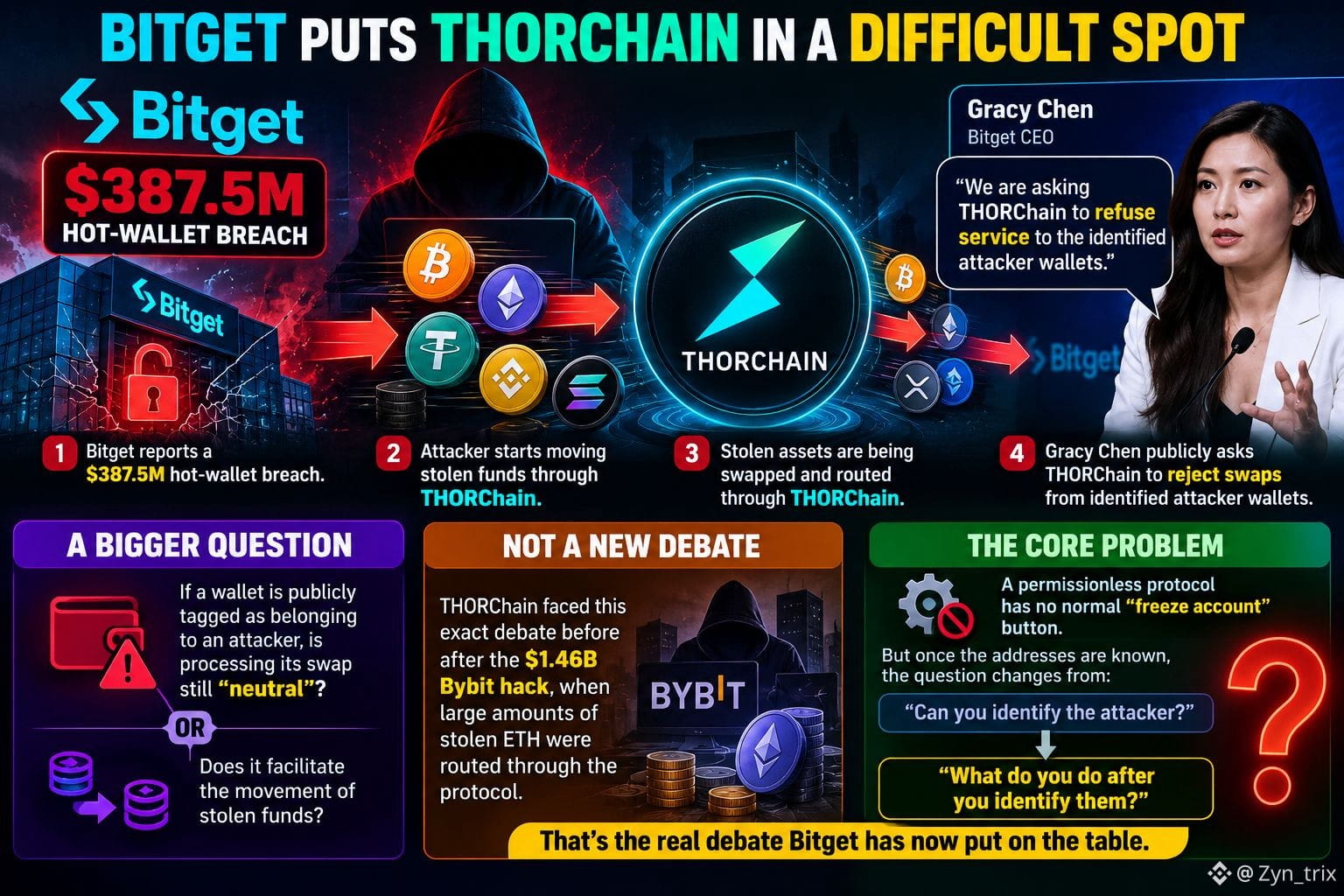
Bitget just put THORChain in a difficult spot.
After the $387.5M Bitget hot-wallet breach, the attacker started moving stolen funds through THORChain.
Gracy Chen is now publicly asking THORChain to refuse service to the identified attacker wallets.
That creates a much bigger question.
If a wallet is publicly tagged as belonging to an attacker, is processing its swap still “neutral”?
Or is it facilitating the movement of stolen funds?
THORChain has faced this exact debate before after the $1.46B Bybit hack, when large amounts of stolen ETH were routed through the protocol.
The core problem is simple.
A permissionless protocol has no normal “freeze account” button.
But once the addresses are known, the question changes from:
“Can you identify the attacker?”
to:
“What do you do after you identify them?”
That is the real debate Bitget has now put on the table.
#Bitget #Gracychen
Bitget just put THORChain in a difficult spot.
After the $387.5M Bitget hot-wallet breach, the attacker started moving stolen funds through THORChain.
Gracy Chen is now publicly asking THORChain to refuse service to the identified attacker wallets.
That creates a much bigger question.
If a wallet is publicly tagged as belonging to an attacker, is processing its swap still “neutral”?
Or is it facilitating the movement of stolen funds?
THORChain has faced this exact debate before after the $1.46B Bybit hack, when large amounts of stolen ETH were routed through the protocol.
The core problem is simple.
A permissionless protocol has no normal “freeze account” button.
But once the addresses are known, the question changes from:
“Can you identify the attacker?”
to:
“What do you do after you identify them?”
That is the real debate Bitget has now put on the table.
#Bitget #Gracychen
After the $387.5M Bitget hot-wallet breach, the attacker started moving stolen funds through THORChain.
Gracy Chen is now publicly asking THORChain to refuse service to the identified attacker wallets.
That creates a much bigger question.
If a wallet is publicly tagged as belonging to an attacker, is processing its swap still “neutral”?
Or is it facilitating the movement of stolen funds?
THORChain has faced this exact debate before after the $1.46B Bybit hack, when large amounts of stolen ETH were routed through the protocol.
The core problem is simple.
A permissionless protocol has no normal “freeze account” button.
But once the addresses are known, the question changes from:
“Can you identify the attacker?”
to:
“What do you do after you identify them?”
That is the real debate Bitget has now put on the table.
#Bitget #Gracychen

cointell:
hi
6
8
62
41.3k

🚨 Decentralization Shouldn’t Become a Safe Zone for Stolen Funds
This situation around #Bitget CEO Gracy Chen and THORChain really caught my attention.
From my point of view, decentralization is one of crypto’s biggest strengths, but there has to be a serious discussion when publicly tracked addresses connected to stolen funds are still able to move assets through decentralized infrastructure.
#GracyChen is calling on THORChain to refuse service to the identified attacker addresses, arguing that decentralization should not be used as protection for known stolen funds.
I understand both sides of this debate. Crypto was built around permissionless access, but at the same time, the industry cannot ignore billions of dollars in hacks and thefts just because the funds move on-chain.
The bigger question is where we draw the line between decentralization and accountability.
For me, better coordination between exchanges, security researchers and decentralized protocols could make crypto safer without destroying the principles that made it valuable in the first place.
This debate could become much bigger than one hack or one protocol. 👀
What do you think — should decentralized protocols block addresses linked to confirmed stolen funds?
$BULLA
$PHA
$龙虾
{future}(龙虾USDT)
{future}(PHAUSDT)
{future}(BULLAUSDT)
🚨 Decentralization Shouldn’t Become a Safe Zone for Stolen Funds
This situation around #Bitget CEO Gracy Chen and THORChain really caught my attention.
From my point of view, decentralization is one of crypto’s biggest strengths, but there has to be a serious discussion when publicly tracked addresses connected to stolen funds are still able to move assets through decentralized infrastructure.
#GracyChen is calling on THORChain to refuse service to the identified attacker addresses, arguing that decentralization should not be used as protection for known stolen funds.
I understand both sides of this debate. Crypto was built around permissionless access, but at the same time, the industry cannot ignore billions of dollars in hacks and thefts just because the funds move on-chain.
The bigger question is where we draw the line between decentralization and accountability.
For me, better coordination between exchanges, security researchers and decentralized protocols could make crypto safer without destroying the principles that made it valuable in the first place.
This debate could become much bigger than one hack or one protocol. 👀
What do you think — should decentralized protocols block addresses linked to confirmed stolen funds?
$BULLA
$PHA
$龙虾
This situation around #Bitget CEO Gracy Chen and THORChain really caught my attention.
From my point of view, decentralization is one of crypto’s biggest strengths, but there has to be a serious discussion when publicly tracked addresses connected to stolen funds are still able to move assets through decentralized infrastructure.
#GracyChen is calling on THORChain to refuse service to the identified attacker addresses, arguing that decentralization should not be used as protection for known stolen funds.
I understand both sides of this debate. Crypto was built around permissionless access, but at the same time, the industry cannot ignore billions of dollars in hacks and thefts just because the funds move on-chain.
The bigger question is where we draw the line between decentralization and accountability.
For me, better coordination between exchanges, security researchers and decentralized protocols could make crypto safer without destroying the principles that made it valuable in the first place.
This debate could become much bigger than one hack or one protocol. 👀
What do you think — should decentralized protocols block addresses linked to confirmed stolen funds?
$BULLA
$PHA
$龙虾

2
437

Article
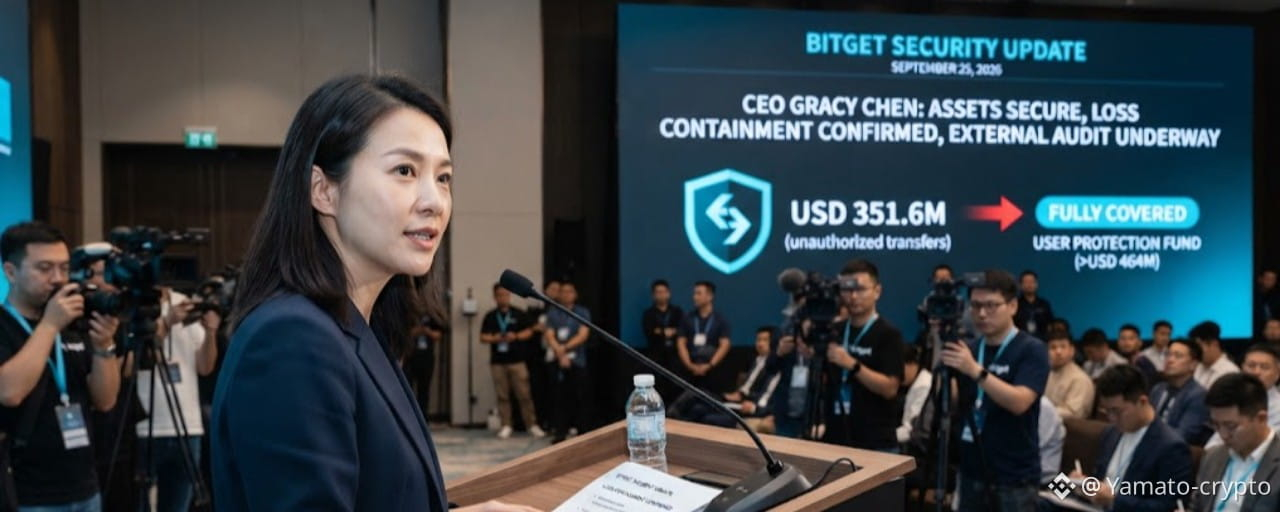
Bitget CEO reveals the vulnerability that allowed the cyberattack.The Bitget exchange recorded unauthorized transfers on Thursday totaling an estimated USD 351.6 million. In response to the cyberattack, the company's CEO, Gracy Chen, revealed the origin of the failure yesterday, September 24, 2026.
"The attacker compromised a critical server in our wallet infrastructure, manipulated transaction logs, and tricked the approval system into transferring the funds," Chen detailed.
The executive pointed out that the vulnerability did not compromise users' private keys, thereby ruling out worst-case scenarios.
Regarding the current status of the incident, the director stated: "Loss containment is confirmed. No further unauthorized transfers are possible." However, she clarified that "the specific method of system intrusion remains under active investigation" and that "a full technical report will follow once confirmed."
Alongside these inquiries, it was determined that the breach involved the outflow of ether $ETH ; avalanche $AVAX ; $BNB
{spot}(BTCUSDT)
{spot}(ETHUSDT)
{spot}(BNBUSDT)
; the stablecoins USDT, USDT0, and USDC; the XAUT token; and other assets, as reported by CriptoNoticias.
Regarding technological recovery efforts, the CEO indicated that multiple technical teams are working simultaneously to repair the system and reinforce its security measures. She also noted that the platform is preparing to resume withdrawals.
However, when addressing operational timelines, the director specified: "We will announce a schedule as soon as one is confirmed—we will not commit to a window we cannot guarantee."
As part of this process, Chen confirmed today, September 25, 2026, the integration of external auditing through collaboration with independent experts from Mandiant and SlowMist. Both specialized teams are conducting a thorough forensic analysis of the attack on the exchange's infrastructure.
Regarding customer assets, the executive provided reassurance: "User balances remain intact, and the Bitget User Protection Fund will cover the platform-level impact caused by this incident." This coverage is viable since the company's reserve fund exceeds USD 464 million, an amount that covers the USD 351.6 million loss without affecting user accounts.
#BitgetSecurity
#GracyChen
#CryptoNews
#CryptoAlert
#bitget
Bitget CEO reveals the vulnerability that allowed the cyberattack.
The Bitget exchange recorded unauthorized transfers on Thursday totaling an estimated USD 351.6 million. In response to the cyberattack, the company's CEO, Gracy Chen, revealed the origin of the failure yesterday, September 24, 2026.
"The attacker compromised a critical server in our wallet infrastructure, manipulated transaction logs, and tricked the approval system into transferring the funds," Chen detailed.
The executive pointed out that the vulnerability did not compromise users' private keys, thereby ruling out worst-case scenarios.
Regarding the current status of the incident, the director stated: "Loss containment is confirmed. No further unauthorized transfers are possible." However, she clarified that "the specific method of system intrusion remains under active investigation" and that "a full technical report will follow once confirmed."
Alongside these inquiries, it was determined that the breach involved the outflow of ether $ETH ; avalanche $AVAX ; $BNB
; the stablecoins USDT, USDT0, and USDC; the XAUT token; and other assets, as reported by CriptoNoticias.
Regarding technological recovery efforts, the CEO indicated that multiple technical teams are working simultaneously to repair the system and reinforce its security measures. She also noted that the platform is preparing to resume withdrawals.
However, when addressing operational timelines, the director specified: "We will announce a schedule as soon as one is confirmed—we will not commit to a window we cannot guarantee."
As part of this process, Chen confirmed today, September 25, 2026, the integration of external auditing through collaboration with independent experts from Mandiant and SlowMist. Both specialized teams are conducting a thorough forensic analysis of the attack on the exchange's infrastructure.
Regarding customer assets, the executive provided reassurance: "User balances remain intact, and the Bitget User Protection Fund will cover the platform-level impact caused by this incident." This coverage is viable since the company's reserve fund exceeds USD 464 million, an amount that covers the USD 351.6 million loss without affecting user accounts.
#BitgetSecurity
#GracyChen
#CryptoNews
#CryptoAlert
#bitget
"The attacker compromised a critical server in our wallet infrastructure, manipulated transaction logs, and tricked the approval system into transferring the funds," Chen detailed.
The executive pointed out that the vulnerability did not compromise users' private keys, thereby ruling out worst-case scenarios.
Regarding the current status of the incident, the director stated: "Loss containment is confirmed. No further unauthorized transfers are possible." However, she clarified that "the specific method of system intrusion remains under active investigation" and that "a full technical report will follow once confirmed."
Alongside these inquiries, it was determined that the breach involved the outflow of ether $ETH ; avalanche $AVAX ; $BNB
; the stablecoins USDT, USDT0, and USDC; the XAUT token; and other assets, as reported by CriptoNoticias.
Regarding technological recovery efforts, the CEO indicated that multiple technical teams are working simultaneously to repair the system and reinforce its security measures. She also noted that the platform is preparing to resume withdrawals.
However, when addressing operational timelines, the director specified: "We will announce a schedule as soon as one is confirmed—we will not commit to a window we cannot guarantee."
As part of this process, Chen confirmed today, September 25, 2026, the integration of external auditing through collaboration with independent experts from Mandiant and SlowMist. Both specialized teams are conducting a thorough forensic analysis of the attack on the exchange's infrastructure.
Regarding customer assets, the executive provided reassurance: "User balances remain intact, and the Bitget User Protection Fund will cover the platform-level impact caused by this incident." This coverage is viable since the company's reserve fund exceeds USD 464 million, an amount that covers the USD 351.6 million loss without affecting user accounts.
#BitgetSecurity
#GracyChen
#CryptoNews
#CryptoAlert
#bitget
257
Log in to explore more content
Join global crypto users on Binance Square
⚡️ Get latest and useful information about crypto.
💬 Trusted by the world’s largest crypto exchange.
👍 Discover real insights from verified creators.
Email / Phone number
Trending Topics
1
#SKoreaFSCConsidersVirtualAssetMarketMaker
0 views
0 Discussing
2
#ChinaIndustrialProfitGrowthSlowsFourthMonth
460 views
47 Discussing
3
#BitwiseFilesFinalNEARSpotETFProspectus
97,225 views
1,516 Discussing
4
#BitgetHackerMoves$83MStolenXRP
35,264 views
169 Discussing
5
#SOLSpotETFWeeklyInflow$188M
23,034 views
135 Discussing
6
#DogecoinETFsPostBiggestWeekSinceLaunch
59,688 views
1,026 Discussing
7
#StrategyStriveAdd2305BitcoinThisWeek
152,621 views
2,233 Discussing
8
#TrumpRejectsIranHormuzReopening
131,385 views
1,683 Discussing
9
#CircleTetherFreezeBitgetHackerWallet
110,999 views
1,540 Discussing
10
#SECSaysTokenBuybacksNotAutoSecurities
75,775 views
918 Discussing