
#eip8198
eip8198
347 views
4 Discussing
Hot
Latest

·
--
📰 Ethereum wants to speed things up this time, but not by directly cutting 12 seconds down to 10 seconds in one hard step. EIP-8198, also known as Quick Slots, aims first to remove the hardcoded “block production time is fixed at 12 seconds” in the client, and then shorten it gradually based on network conditions. Every adjustment must be tested and reached consensus on separately.
🔥 What’s interesting about this approach is that it first builds in “safe adjustability,” rather than trying to run all the way to the limit in a single jump. Carl Beekhuizen wrote the proposal in March this year, and Barnabé Monnot submitted it to core developers on August 6, with the intent to include it in the Hegotá upgrade.
Honestly, saving 2 seconds on mainnet doesn’t sound that dramatic, but in DeFi it has a very direct impact. Over the past 30 days, Ethereum mainnet DEX trading volume was about $41.25 billion. Once the block interval is shortened, price updates happen more frequently, the stale-quote window narrows, and the settlement risk and slippage pressure borne by arbitrageurs also decrease.
💡 It matters for ordinary users too. For applications that rely on Chainlink VRF and also require waiting for an additional 3 block confirmations, reducing each block by 2 seconds means the whole process saves 6 seconds. For continuous purchases and back-to-back transactions, this difference won’t be just psychological reassurance.
👀 Even more crucial is resistance to manipulation: with a 12-second block, there are only 5 inclusion opportunities per minute; with a 10-second block, that increases to 6. As Ethereum tries to preserve decentralization and credible neutrality, while pushing the confirmation experience forward by one step, do you think starting with a drop from 12 seconds to 10 seconds is stable enough?
#以太坊 #EIP8198 #DeFi #blockchain upgrade
📰 Ethereum wants to speed things up this time, but not by directly cutting 12 seconds down to 10 seconds in one hard step. EIP-8198, also known as Quick Slots, aims first to remove the hardcoded “block production time is fixed at 12 seconds” in the client, and then shorten it gradually based on network conditions. Every adjustment must be tested and reached consensus on separately.
🔥 What’s interesting about this approach is that it first builds in “safe adjustability,” rather than trying to run all the way to the limit in a single jump. Carl Beekhuizen wrote the proposal in March this year, and Barnabé Monnot submitted it to core developers on August 6, with the intent to include it in the Hegotá upgrade.
Honestly, saving 2 seconds on mainnet doesn’t sound that dramatic, but in DeFi it has a very direct impact. Over the past 30 days, Ethereum mainnet DEX trading volume was about $41.25 billion. Once the block interval is shortened, price updates happen more frequently, the stale-quote window narrows, and the settlement risk and slippage pressure borne by arbitrageurs also decrease.
💡 It matters for ordinary users too. For applications that rely on Chainlink VRF and also require waiting for an additional 3 block confirmations, reducing each block by 2 seconds means the whole process saves 6 seconds. For continuous purchases and back-to-back transactions, this difference won’t be just psychological reassurance.
👀 Even more crucial is resistance to manipulation: with a 12-second block, there are only 5 inclusion opportunities per minute; with a 10-second block, that increases to 6. As Ethereum tries to preserve decentralization and credible neutrality, while pushing the confirmation experience forward by one step, do you think starting with a drop from 12 seconds to 10 seconds is stable enough?
#以太坊 #EIP8198 #DeFi #blockchain upgrade
🔥 What’s interesting about this approach is that it first builds in “safe adjustability,” rather than trying to run all the way to the limit in a single jump. Carl Beekhuizen wrote the proposal in March this year, and Barnabé Monnot submitted it to core developers on August 6, with the intent to include it in the Hegotá upgrade.
Honestly, saving 2 seconds on mainnet doesn’t sound that dramatic, but in DeFi it has a very direct impact. Over the past 30 days, Ethereum mainnet DEX trading volume was about $41.25 billion. Once the block interval is shortened, price updates happen more frequently, the stale-quote window narrows, and the settlement risk and slippage pressure borne by arbitrageurs also decrease.
💡 It matters for ordinary users too. For applications that rely on Chainlink VRF and also require waiting for an additional 3 block confirmations, reducing each block by 2 seconds means the whole process saves 6 seconds. For continuous purchases and back-to-back transactions, this difference won’t be just psychological reassurance.
👀 Even more crucial is resistance to manipulation: with a 12-second block, there are only 5 inclusion opportunities per minute; with a 10-second block, that increases to 6. As Ethereum tries to preserve decentralization and credible neutrality, while pushing the confirmation experience forward by one step, do you think starting with a drop from 12 seconds to 10 seconds is stable enough?
#以太坊 #EIP8198 #DeFi #blockchain upgrade
182

·
--
Bullish
30D trade $ETH 50 USDT
⚡️ Ethereum is approaching a new step toward faster performance
A recent survey from Ethlabs, including 20 votes from the Ethereum ecosystem, showed broad support for EIP-8198 as part of the Hegotá upgrade, with endorsements from names like Lido, Ethena, Flashbots, and Ondo.
The idea? ⏱️
Reduce slot time from 12 to 10 seconds, with the possibility of building a more flexible speed system in the future.
The goal isn’t speed alone, but improving the network experience and confirmations while maintaining stability and decentralization.
A technical development worth following as Hegotá nears. ⚡️
$ETH $ONDO $ENA
#Ethereum #EIP8198 #HEGOTA
⚡️ Ethereum is approaching a new step toward faster performance
A recent survey from Ethlabs, including 20 votes from the Ethereum ecosystem, showed broad support for EIP-8198 as part of the Hegotá upgrade, with endorsements from names like Lido, Ethena, Flashbots, and Ondo.
The idea? ⏱️
Reduce slot time from 12 to 10 seconds, with the possibility of building a more flexible speed system in the future.
The goal isn’t speed alone, but improving the network experience and confirmations while maintaining stability and decentralization.
A technical development worth following as Hegotá nears. ⚡️
$ETH $ONDO $ENA
#Ethereum #EIP8198 #HEGOTA
A recent survey from Ethlabs, including 20 votes from the Ethereum ecosystem, showed broad support for EIP-8198 as part of the Hegotá upgrade, with endorsements from names like Lido, Ethena, Flashbots, and Ondo.
The idea? ⏱️
Reduce slot time from 12 to 10 seconds, with the possibility of building a more flexible speed system in the future.
The goal isn’t speed alone, but improving the network experience and confirmations while maintaining stability and decentralization.
A technical development worth following as Hegotá nears. ⚡️
$ETH $ONDO $ENA
#Ethereum #EIP8198 #HEGOTA
1
316

·
--
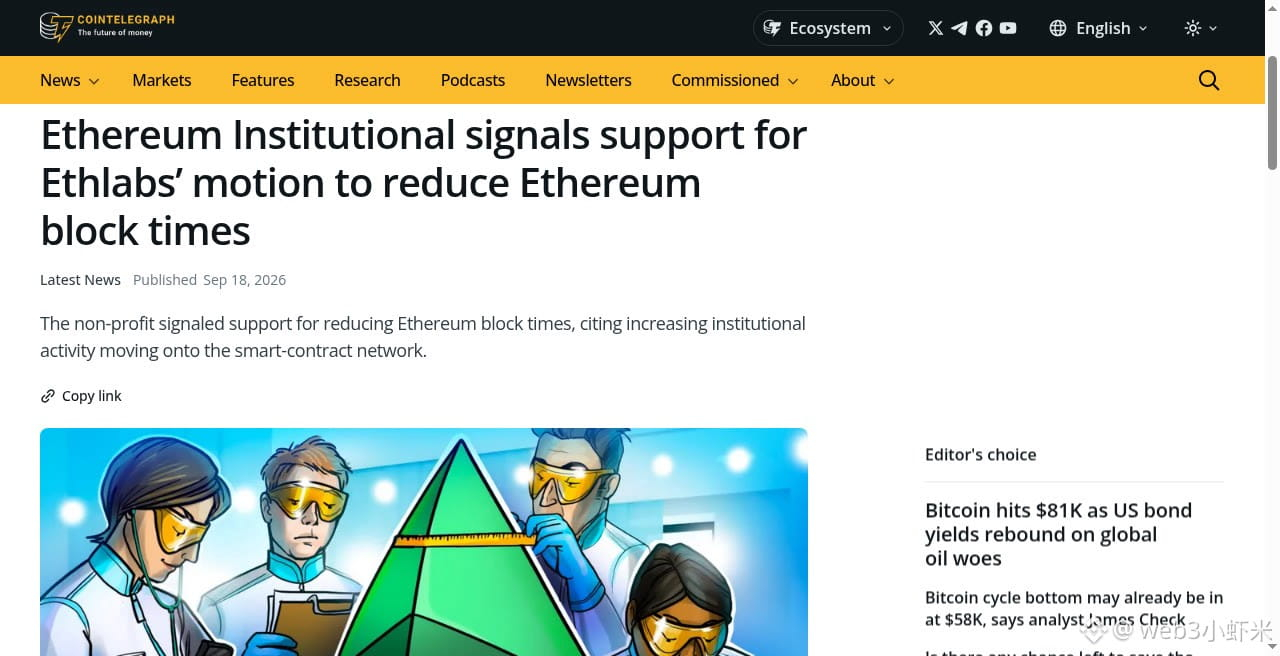
Just刷到了:Ethereum Institutional publicly supports Ethlabs’ EIP-8198 (Quick Slots). The slogan is very straightforward—Make Ethereum faster.
The core idea is to change block production from a fixed 12 seconds to a configurable setting, with the first target roughly bringing it down to about 10 seconds. The reason is that once institutional funds are on-chain, confirmation speed and the freshness of market quotes become more critical. The proposal is being inserted into the upcoming Hegotá upgrade, and it still needs to pass realization, testing, and final approval from the core development team—not already live.
$ETH #以太坊 #EIP8198
Just刷到了:Ethereum Institutional publicly supports Ethlabs’ EIP-8198 (Quick Slots). The slogan is very straightforward—Make Ethereum faster.
The core idea is to change block production from a fixed 12 seconds to a configurable setting, with the first target roughly bringing it down to about 10 seconds. The reason is that once institutional funds are on-chain, confirmation speed and the freshness of market quotes become more critical. The proposal is being inserted into the upcoming Hegotá upgrade, and it still needs to pass realization, testing, and final approval from the core development team—not already live.
$ETH #以太坊 #EIP8198
The core idea is to change block production from a fixed 12 seconds to a configurable setting, with the first target roughly bringing it down to about 10 seconds. The reason is that once institutional funds are on-chain, confirmation speed and the freshness of market quotes become more critical. The proposal is being inserted into the upcoming Hegotá upgrade, and it still needs to pass realization, testing, and final approval from the core development team—not already live.
$ETH #以太坊 #EIP8198
275
Log in to explore more content
Join global crypto users on Binance Square
⚡️ Get latest and useful information about crypto.
💬 Trusted by the world’s largest crypto exchange.
👍 Discover real insights from verified creators.
Email / Phone number
Trending Topics
1
#BOJRaisesRatesTo31YearHigh
13,327 views
426 Discussing
2
#BuffettStepsDownAsBerkshireChairman
2,322 views
128 Discussing
3
#XRPExchangeReservesHitSevenYearLow
4,937 views
174 Discussing
4
#HKCompletesFirstHKDStablecoinUseCase
32,403 views
721 Discussing
5
#VietnamPlansFirstCryptoLicensesIn2026
23,924 views
496 Discussing
6
#BTCBreaks80K
265,290 views
3,942 Discussing
7
#BitcoinMarketCapTopsTesla
40,022 views
817 Discussing
8
#SOLJumpsAbout10%
53,716 views
849 Discussing
9
#EthereumReclaims$2600
4,589 views
98 Discussing
10
#LineraShutsDownAfterFundraisingFallsShort
14,060 views
230 Discussing