

#dafi
dafi
2,618 views
30 Discussing
Hot
Latest

·
--
Most traders still treat a DEX like a CEX with extra steps.
That is the wrong mental model.
A real DEX is infrastructure. The product is not the swap screen. The product is whether liquidity can move, whether fees stay understandable, and whether a user can see risk before they click confirm.
This is why STONfi’s new “What is DEX” educational project is more useful than another generic campaign post. Too many people farm APY without knowing what APY actually measures. Too many people provide liquidity without understanding impermanent loss. Too many people hear “cross-chain” and assume it is the same thing as “multi-chain.” It is not.
Multi-chain means the same protocol exists in several places. Cross-chain means value can move between those places without the user becoming the bridge. That difference matters when you are moving USDT across TON, TRON, Ethereum or Base and wondering why a “simple send” suddenly turns into a routing problem.
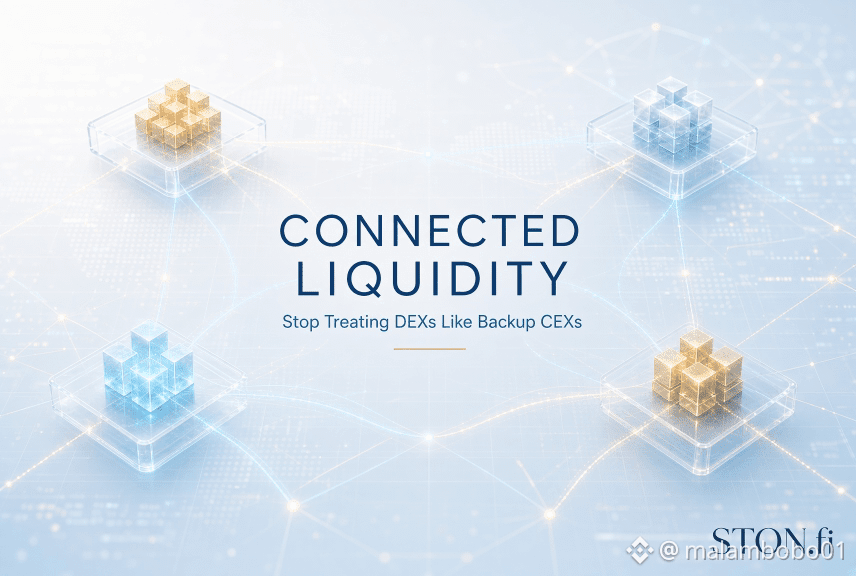
Connected liquidity is the next real upgrade in DeFi. Isolated pools create fake depth. They look liquid until you try to size into them. When wallets and DEXs start coordinating across networks — Keeper evolving from a TON-native wallet into a multichain one is a good example — the market gets cleaner. Less wrapping theater. Less hidden price impact. More honest execution.
Education plus working rails is the combination that survives a full cycle. Everything else is just another announcement with a banner.
If you are using DEXs this year, learn the mechanics first. Then swap. Not the other way around. $BTC $GRAM $ETH
#Dafi #TON #CrossChain #Web3 #STONfi
Most traders still treat a DEX like a CEX with extra steps.
That is the wrong mental model.
A real DEX is infrastructure. The product is not the swap screen. The product is whether liquidity can move, whether fees stay understandable, and whether a user can see risk before they click confirm.
This is why STONfi’s new “What is DEX” educational project is more useful than another generic campaign post. Too many people farm APY without knowing what APY actually measures. Too many people provide liquidity without understanding impermanent loss. Too many people hear “cross-chain” and assume it is the same thing as “multi-chain.” It is not.
Multi-chain means the same protocol exists in several places. Cross-chain means value can move between those places without the user becoming the bridge. That difference matters when you are moving USDT across TON, TRON, Ethereum or Base and wondering why a “simple send” suddenly turns into a routing problem.
Connected liquidity is the next real upgrade in DeFi. Isolated pools create fake depth. They look liquid until you try to size into them. When wallets and DEXs start coordinating across networks — Keeper evolving from a TON-native wallet into a multichain one is a good example — the market gets cleaner. Less wrapping theater. Less hidden price impact. More honest execution.
Education plus working rails is the combination that survives a full cycle. Everything else is just another announcement with a banner.
If you are using DEXs this year, learn the mechanics first. Then swap. Not the other way around. $BTC $GRAM $ETH
#Dafi #TON #CrossChain #Web3 #STONfi
That is the wrong mental model.
A real DEX is infrastructure. The product is not the swap screen. The product is whether liquidity can move, whether fees stay understandable, and whether a user can see risk before they click confirm.
This is why STONfi’s new “What is DEX” educational project is more useful than another generic campaign post. Too many people farm APY without knowing what APY actually measures. Too many people provide liquidity without understanding impermanent loss. Too many people hear “cross-chain” and assume it is the same thing as “multi-chain.” It is not.
Multi-chain means the same protocol exists in several places. Cross-chain means value can move between those places without the user becoming the bridge. That difference matters when you are moving USDT across TON, TRON, Ethereum or Base and wondering why a “simple send” suddenly turns into a routing problem.
Connected liquidity is the next real upgrade in DeFi. Isolated pools create fake depth. They look liquid until you try to size into them. When wallets and DEXs start coordinating across networks — Keeper evolving from a TON-native wallet into a multichain one is a good example — the market gets cleaner. Less wrapping theater. Less hidden price impact. More honest execution.
Education plus working rails is the combination that survives a full cycle. Everything else is just another announcement with a banner.
If you are using DEXs this year, learn the mechanics first. Then swap. Not the other way around. $BTC $GRAM $ETH
#Dafi #TON #CrossChain #Web3 #STONfi
167

·
--
$OPN caught my attention once again, but this time I'm not chasing it.
The first move already paid well, and that chapter is closed.
Now it's all about patience, watching how the next structure forms and waiting for a level that offers a better risk-to-reward setup.
Not every opportunity is found in buying. Sometimes it's found in waiting.
For now, $OPN stays on the watchlist. 👀📈
#crypto #trading #Dafi #OPNUSD
$OPN caught my attention once again, but this time I'm not chasing it.
The first move already paid well, and that chapter is closed.
Now it's all about patience, watching how the next structure forms and waiting for a level that offers a better risk-to-reward setup.
Not every opportunity is found in buying. Sometimes it's found in waiting.
For now, $OPN stays on the watchlist. 👀📈
#crypto #trading #Dafi #OPNUSD
The first move already paid well, and that chapter is closed.
Now it's all about patience, watching how the next structure forms and waiting for a level that offers a better risk-to-reward setup.
Not every opportunity is found in buying. Sometimes it's found in waiting.
For now, $OPN stays on the watchlist. 👀📈
#crypto #trading #Dafi #OPNUSD
2
366

·
--
162

·
--
Bearish
$NMR 📌 #NMR
💡 Numeraire (NMR) is the native token that supports Numerai, the AI and data science-backed hedge fund. Unlike traditional investment models, Numerai collects financial models from thousands of data scientists around the world.
🔑 Why NMR is important:
📊 Integration of AI + crypto: Merging machine learning with blockchain-based incentives
🌍 Global collaboration: Data scientists compete and contribute to models for better strategies
🔒 Guaranteed trust: Participants stake NMR on predictions, linking accuracy to rewards
🚀 Disruptive vision: Building a decentralized AI-backed hedge fund
✨ With NMR, data + decentralization = smarter finance. It’s more than just a token - it’s a bridge between innovation in AI and crypto economies.
💬 Do you think AI-backed crypto like NMR can redefine financial markets? Share your thoughts ⬇️
#Binance #Web3 #DaFi
$NMR 📌 #NMR
💡 Numeraire (NMR) is the native token that supports Numerai, the AI and data science-backed hedge fund. Unlike traditional investment models, Numerai collects financial models from thousands of data scientists around the world.
🔑 Why NMR is important:
📊 Integration of AI + crypto: Merging machine learning with blockchain-based incentives
🌍 Global collaboration: Data scientists compete and contribute to models for better strategies
🔒 Guaranteed trust: Participants stake NMR on predictions, linking accuracy to rewards
🚀 Disruptive vision: Building a decentralized AI-backed hedge fund
✨ With NMR, data + decentralization = smarter finance. It’s more than just a token - it’s a bridge between innovation in AI and crypto economies.
💬 Do you think AI-backed crypto like NMR can redefine financial markets? Share your thoughts ⬇️
#Binance #Web3 #DaFi
💡 Numeraire (NMR) is the native token that supports Numerai, the AI and data science-backed hedge fund. Unlike traditional investment models, Numerai collects financial models from thousands of data scientists around the world.
🔑 Why NMR is important:
📊 Integration of AI + crypto: Merging machine learning with blockchain-based incentives
🌍 Global collaboration: Data scientists compete and contribute to models for better strategies
🔒 Guaranteed trust: Participants stake NMR on predictions, linking accuracy to rewards
🚀 Disruptive vision: Building a decentralized AI-backed hedge fund
✨ With NMR, data + decentralization = smarter finance. It’s more than just a token - it’s a bridge between innovation in AI and crypto economies.
💬 Do you think AI-backed crypto like NMR can redefine financial markets? Share your thoughts ⬇️
#Binance #Web3 #DaFi
1
129
Log in to explore more content
Join global crypto users on Binance Square
⚡️ Get latest and useful information about crypto.
💬 Trusted by the world’s largest crypto exchange.
👍 Discover real insights from verified creators.
Email / Phone number
Trending Topics
1
#EarningsSeason
89,041 views
861 Discussing
2
#ECBToTestAIAgentsInDigitalEuroPayments
504 views
93 Discussing
3
#JapanFSABacksFourthStablecoinTradeSettlementPilot
2,803 views
196 Discussing
4
#BitgetHackerFailsToMoveStolenFunds
11,106 views
330 Discussing
5
#BitMineETHHoldingsTop6Million
13,560 views
492 Discussing
6
#StrategyAdds1666BTCHoldingsReach847666
11,976 views
342 Discussing
7
#NvidiaApproves$150BBuyback
3,526 views
62 Discussing
8
#OpenAIDelaysGPT6.1OverSafetyIssues
24,723 views
681 Discussing
9
#AMDToAcquireWorldLabsFor$8.2B
1,741 views
52 Discussing
10
#AnthropicIPOProspectusCouldValueItOver$2T
5,636 views
75 Discussing