
#coreweavejumps10
coreweavejumps10
3,888 views
26 Discussing
Hot
Latest

·
--
If you're still chasing every 10% AI stock pop like it's a guaranteed continuation, stop now.
That exact habit has cost traders millions over the last two cycles. You see the green candle, FOMO kicks in while the rest of the market sits in fear, and then you're the one holding with no exit as rotation hits.
CoreWeave jumping 10% while chip names keep sliding after the Nvidia leadership headlines is classic winner-takes-the-bid behavior, not a fresh bull market. We watched the same thing with SMCI and the 2023 AI trade. One GPU-linked name rips on demand or contract talk and everything else gets sold. It feels identical to those days when $SOL starts running and $ETH just sits there, or $BTC quietly drains liquidity from the rest of the board.
These are real businesses with actual GPU allocations and revenue, unlike most of the AI tokens we used to ape into. The psychology is still the same though. Everyone wants to look early on the next compute winner and nobody wants to be the person who sold the first 10%.
Where do you think this CoreWeave move goes from here versus the broader chip and AI complex?
#CoreWeaveJumps10 #ChipStocksExtendLossesAfterNvidiaCEOChange #HuangExitNvidiaStrategyInFocus
1
107

Have you noticed CoreWeave ripping 10% while the rest of the chip complex is getting wrecked on the Huang headlines?
Most people in this market still trade AI names as if they all move with NVIDIA. Then they get caught chasing the lagging ones or sitting in $USDT waiting for a clean signal that never shows up.
CoreWeave is a case study in that exact mistake. This company exists to run AI workloads on NVIDIA GPUs, so on paper it should have followed chip stocks lower after the CEO news. Instead it jumped 10%, which tells you the market is starting to price actual compute demand separately from the NVIDIA beta trade. Same kind of decoupling we have seen with $BTC when alts were bleeding and Bitcoin just refused to follow.
Fear and Greed is sitting at 23. Capital is scared and $NVDAB is choppy, yet a name tied to real GPU utilization still printed that move. This is not the whole sector coming back. It is the market getting picky.
Where do you think this goes from here if chip stocks keep sliding and CoreWeave holds the move?
#CoreWeaveJumps10 #HuangExitNvidiaStrategyInFocus #ChipStocksExtendLossesAfterNvidiaCEOChange
SHERAZ FAHEEM 01:
even the strongest companies.
Nvidia's competitive position will be worth monitoring as the
1
79

·
--
#CoreWeaveJumps10%On168%RevenueGrowth
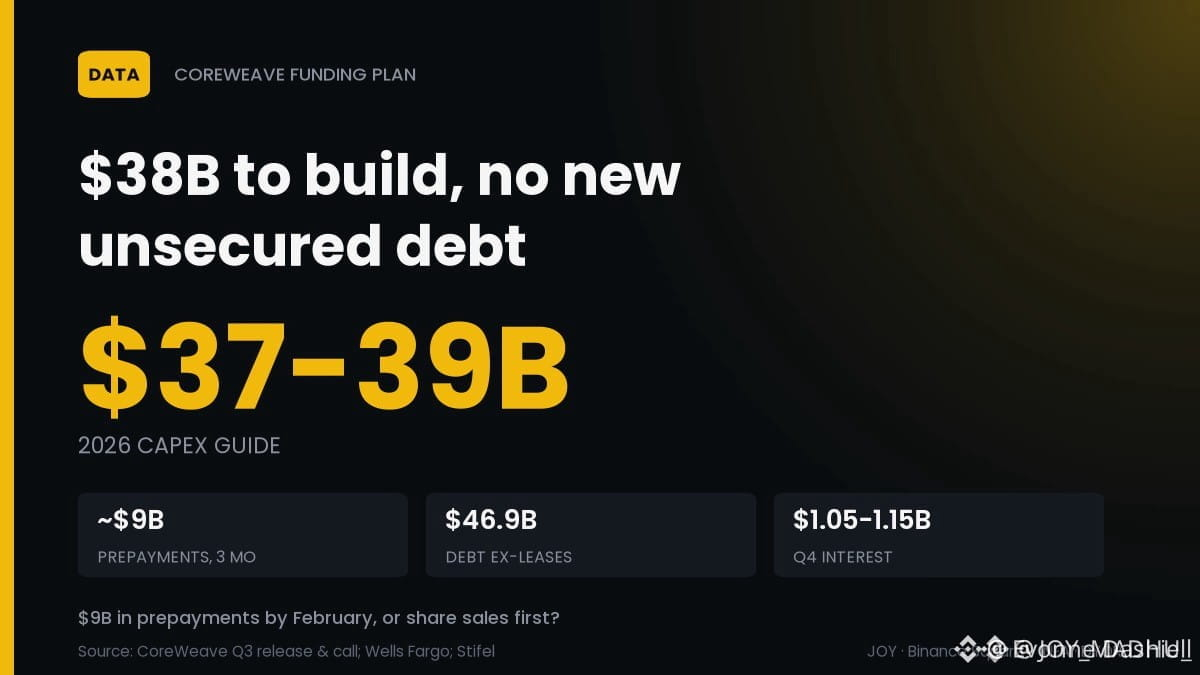
💸 $38B to Spend, No New Unsecured Debt. How CoreWeave Pays
After the rally, the test is funding: CoreWeave says customers and contract-backed loans will carry the build.
📊 2026 capex guide raised to $37-39B
🏦 Debt ex-leases $46.9B, doubled in 9 months
📈 ~$9B of customer prepayments due in 3 months
📅 Under $5B new parent capital through 2027
⚠️ Up to 35M new shares via an ATM program
Watch next: Q4 interest of $1.05-1.15B.
$9B in prepayments by February, or share sales first? 👇
$BTC
#AI #BitcoinMining #CoreWeaveJumps10%On168%RevenueGrowth
·
--
#CoreWeaveJumps10%On168%RevenueGrowth
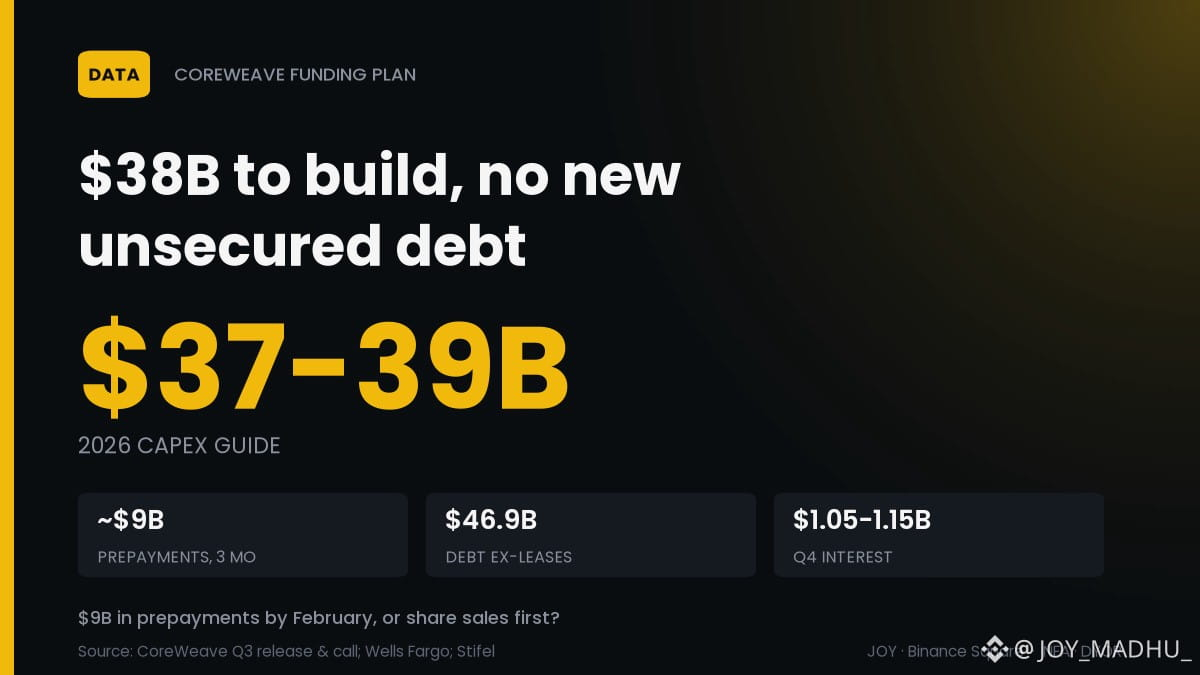
🔀 Sales Up 168%, Still a $709M Loss. Why Did Miners Rally?
CoreWeave beat and raised its outlook, easing AI-funding fears that also hit miners turned AI hosts.
📊 Backlog ~$132.5B; Q3 revenue $3.66B vs $3.55B expected
📈 Shares +24.71% Wednesday, best day since April 2025 (CNBC)
🏦 2026 revenue guide raised to $13.0-13.3B
⚠️ Q3 interest expense $846M; net loss $709M
📈 IREN +5.6%, Galaxy about +5%, Cipher about +7%
The catch: Q4 interest is guided up to $1.15B. Funding is still the test.
Miners keep the AI bid, or fade it within 2 weeks? 👇
$BTC
#AI #BitcoinMining #CoreWeaveJumps10%On168%RevenueGrowth
29

·
--
CoreWeave answered the AI question — revenue +168% to $3.66B, backlog $132.5B. Then Nvidia board drama hit AI names after hours. $BTC flat near $73.7K. If capex holds, risk follows; if it cracks, alts bleed. Buying the bounce or waiting? #CoreWeaveJumps10%On168%RevenueGrowth #Bitcoin #CryptoContent
CoreWeave answered the AI question — revenue +168% to $3.66B, backlog $132.5B. Then Nvidia board drama hit AI names after hours. $BTC flat near $73.7K. If capex holds, risk follows; if it cracks, alts bleed. Buying the bounce or waiting? #CoreWeaveJumps10%On168%RevenueGrowth #Bitcoin #CryptoContent
1

·
--
CoreWeave $CRWV just posted 168% revenue growth and the stock jumped 10% overnight. Sounds like the AI trade is back, right?
Not so fast. Revenue hit $3.66 billion and the backlog is now $132.5 billion, but the company still lost $709 million in the quarter. Interest alone cost $846 million, more than the entire operating income. That is the part the green candles do not show.
The stock had already lost over 40% in a month before this report, so this bounce is coming off a pretty beaten down base. $NVDA and the other AI names caught a lift too, and $BTC is just sitting near $74,000 watching it all happen.
So be honest, is this the start of the AI comeback or just a relief rally before the debt bill comes due again? #CoreWeaveJumps10%On168%RevenueGrowth
237

·
--
CoreWeave just posted a breakout quarter. 🚀
📈 Revenue: Q3 revenue hit $3.66 billion, up 168% year over year and ahead of the $3.54 billion consensus. Backlog reached a record $132.5 billion.
🎯 Guidance: Full-year revenue guidance was raised to $13-13.3 billion, from $12-13 billion.
📊 Market: Shares closed at $60.77, up 24.7% on the day, after plunging about 60% in six months on debt fears.
⚠️ Reality: The quarter still lost $709 million, with $846 million in net interest expense and about $47 billion in debt. The growth is real, and so is the leverage.
$CRWV #CoreWeaveJumps10%On168%RevenueGrowth
280

·
--
CoreWeave flipped the AI tape: revenue +168% to $3.66B, shares +15% premarket. $BTC near $73,441, down 1.1%, ignoring the rebound. If $BTC holds $73K it's just lagging; lose it and crypto's on its own. Why is crypto ignoring it? #CoreWeaveJumps10%On168%RevenueGrowth #CryptoMarket #BinanceSquare
CoreWeave flipped the AI tape: revenue +168% to $3.66B, shares +15% premarket. $BTC near $73,441, down 1.1%, ignoring the rebound. If $BTC holds $73K it's just lagging; lose it and crypto's on its own. Why is crypto ignoring it? #CoreWeaveJumps10%On168%RevenueGrowth #CryptoMarket #BinanceSquare
2

·
--
Article
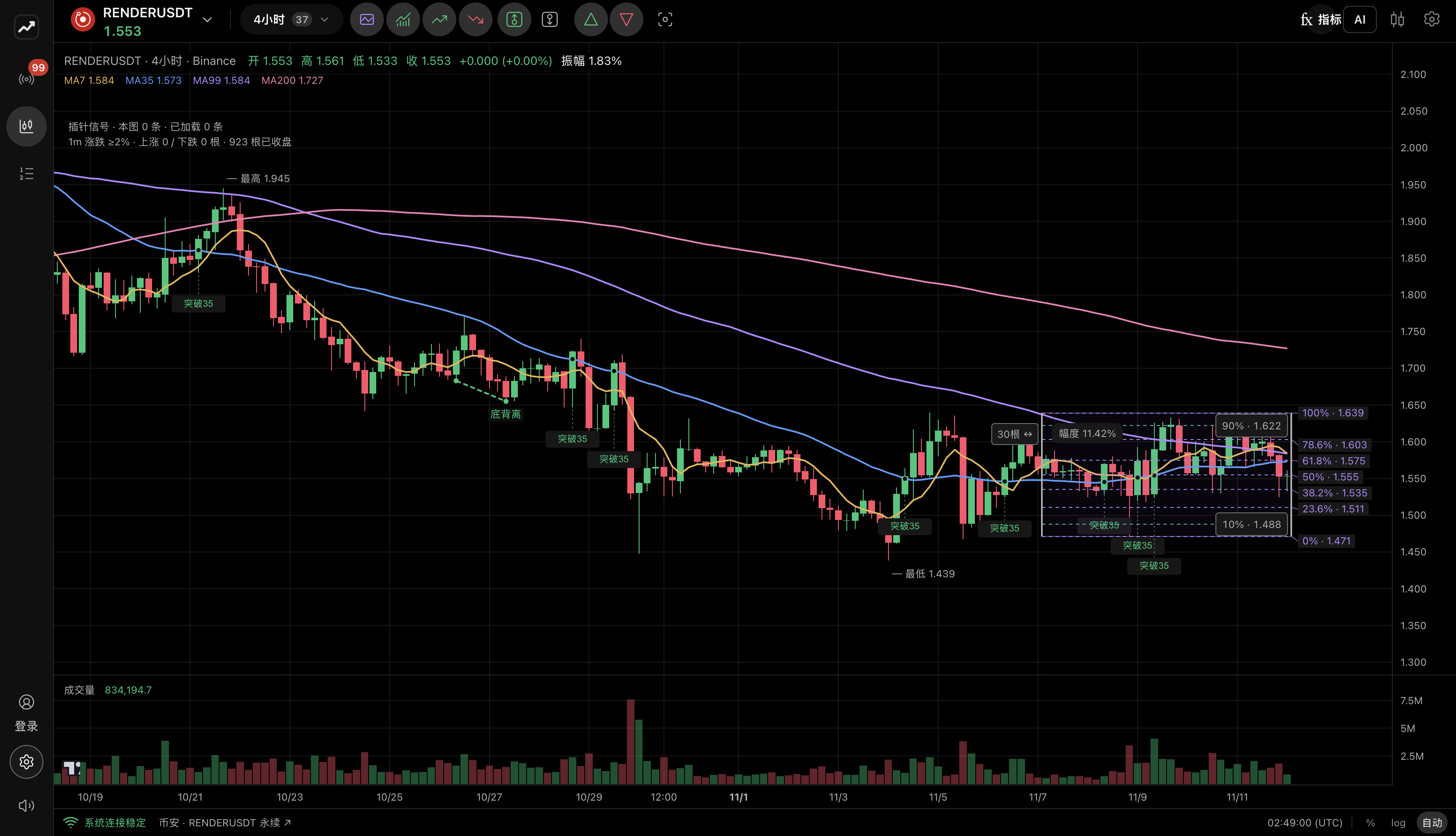
CoreWeave revenue jumps 168% year over year: AI compute is booming—but why doesn’t that mean RENDER will benefit right away?At around 10:47 a.m. Beijing time on November 12, `#CoreWeaveJumps10%On168%RevenueGrowth` appeared on Binance Square’s Trending page, where about 21 people were visibly discussing it. This figure is not a measure of engagement across the entire platform, but the event behind the topic is specific enough: CoreWeave’s newly released third-quarter 2026 earnings report showed revenue growth of 168% year over year.
First, let’s look at the event itself. CoreWeave disclosed that third-quarter revenue was $3.661 billion, with a revenue backlog of about $132.5 billion. Active power capacity exceeded 1.7 GW, contracted power capacity exceeded 4.6 GW, and the company raised its full-year revenue guidance to $13 billion–$13.3 billion. It also expects annualized revenue to reach $20 billion–$21 billion by the end of 2026. Companies’ willingness to sign long-term contracts for AI training, inference, and related infrastructure shows that the idea that “demand for compute is real” still holds.
CoreWeave revenue jumps 168% year over year: AI compute is booming—but why doesn’t that mean RENDER will benefit right away?
At around 10:47 a.m. Beijing time on November 12, `#CoreWeaveJumps10%On168%RevenueGrowth` appeared on Binance Square’s Trending page, where about 21 people were visibly discussing it. This figure is not a measure of engagement across the entire platform, but the event behind the topic is specific enough: CoreWeave’s newly released third-quarter 2026 earnings report showed revenue growth of 168% year over year.
First, let’s look at the event itself. CoreWeave disclosed that third-quarter revenue was $3.661 billion, with a revenue backlog of about $132.5 billion. Active power capacity exceeded 1.7 GW, contracted power capacity exceeded 4.6 GW, and the company raised its full-year revenue guidance to $13 billion–$13.3 billion. It also expects annualized revenue to reach $20 billion–$21 billion by the end of 2026. Companies’ willingness to sign long-term contracts for AI training, inference, and related infrastructure shows that the idea that “demand for compute is real” still holds.
First, let’s look at the event itself. CoreWeave disclosed that third-quarter revenue was $3.661 billion, with a revenue backlog of about $132.5 billion. Active power capacity exceeded 1.7 GW, contracted power capacity exceeded 4.6 GW, and the company raised its full-year revenue guidance to $13 billion–$13.3 billion. It also expects annualized revenue to reach $20 billion–$21 billion by the end of 2026. Companies’ willingness to sign long-term contracts for AI training, inference, and related infrastructure shows that the idea that “demand for compute is real” still holds.
147

·
--
It took just four days to go from admission to resignation. Last Sunday, after media reports revealed that Jensen Huang had had an affair with a woman suspected by U.S. intelligence agencies of being a Chinese spy, he publicly admitted to being “unfaithful.” That same day, the board expressed confidence in him and his leadership team. On Wednesday evening, the board met to discuss his future. That day, the media reported a second affair, this time with a company executive who reported directly to him. Before markets opened on Thursday, Nvidia announced that Huang was stepping down immediately as president, CEO, and director. Hours later, Reuters, citing two people familiar with the matter, reported a third affair allegation, again involving a current company employee. The day before his resignation, prediction markets had already put the odds of his departure by year-end at 88%. The 63-year-old founder, who held about 3.6% of the company and had led it to the top of the global market-cap rankings over 33 years, made a hurried exit that appeared almost involuntary.
The succession plan offers only half an answer: CFO Colette Kress will serve as interim CEO while retaining her current role until a permanent successor is named. The board has begun an internal and external search but has not identified a clear successor. Uncertainty also comes from outside the company: Fox News reported that Trump publicly named former Apple CEO Tim Cook; economist Mohamed El-Erian called this a “major event,” with implications extending beyond Nvidia itself. The affair is becoming politicized. The Senate Banking Committee has asked Huang to testify voluntarily on December 3, or risk a subpoena. Three House committees have requested a closed-door interview with him on December 1. Commerce Secretary Howard Lutnick has also been asked to appear in December over chip-export disputes. House Speaker Mike Johnson went further, saying Congress is building a new consensus on restricting chip exports to China. The company’s official position is that there is “no reason to believe national security or trade secrets have been compromised.” The Justice Department confirmed that the FBI is investigating reports that the woman worked for the Chinese government, but has reached no conclusion on the espionage allegation itself. Beijing has consistently denied the claim.
Markets voted with sharp swings. Nvidia shares fell as much as 14% intraday on Thursday, touching $148.80—exactly a new 52-week low—before paring losses to close down 4.34% at $166.19. Its market cap briefly fell below $4 trillion, the first time since 2025. According to the BBC, the company lost about $550 billion in market value over five trading days, its largest five-day decline in its 27 years as a public company. The stock is now 31% below its peak just weeks ago. The shock spread across the AI supply chain. In after-hours trading on Wednesday, rivals AMD and Broadcom were up as much as 4% and 3%, respectively. CoreWeave had just reported third-quarter revenue up 168% year over year to $3.66 billion, raised its full-year guidance to $13 billion–$13.3 billion, and reported a $132.5 billion backlog. Its shares rose as much as 10% before the market opened Wednesday, but fell nearly 7% on the day Huang resigned. The November 17 quarterly earnings report will be the interim CEO’s first major test.
The crypto market doubled the impact of the turmoil. $BTC fell below $70,000 on Friday, hitting an intraday low of $67,568, its lowest since August. The $68,000 level briefly gave way. At the time of writing, it was near $68,900, down more than 6% in 24 hours and nearly 10% for the week. $ETH hit an intraday low of $1,896 and was near $1,937 at the time of writing, down more than 5% in 24 hours. The Fear and Greed Index dropped to 20 on Friday, in “extreme fear”—its lowest reading in more than four months. The last time it reached this level was July 8. About $730 million in positions were liquidated across the market over 24 hours on Thursday. On Friday, more than $600 million was liquidated in just four hours, nearly 90% of it from long positions. With liquidity thin, leveraged longs have been repeatedly flushed out.
The real weakness lies in the flow of funds. U.S. spot Bitcoin ETFs have seen net outflows of $1.56 billion so far this year. As recently as October 29, they had recorded $1.01 billion in year-to-date net inflows; in roughly two weeks, that had completely reversed. BlackRock’s IBIT alone had logged more than $2 billion in net outflows over nine consecutive trading days through Wednesday. This is the 12th week this year with net outflows exceeding $500 million, compared with just 15 such weeks in all of 2025. Comparative data from a research firm highlights an even starker divergence: from November 5 to 12, the Nasdaq 100 rose 6.4%, while $BTC fell 5.9%, behaving more like gold, which declined 5.5% over the same period. Behind this are 10-year Treasury yields rising above 5% and a strengthening dollar, directly raising the opportunity cost of holding a zero-yield asset. Order books at exchanges are also flashing warning signs: depth for $BTC on major platforms fell to $72 million on November 9, about one-third below normal levels.
Here is my take. First, this is not a market event that can be addressed with a simple “buy the dip”; it is a governance event. The succession vacuum, congressional hearings, subpoena risk, and export controls are all intertwined, and none will be resolved within a few weeks. The November 17 earnings report and the guidance that follows will determine how the market values “Nvidia without Jensen Huang,” as well as the direction of risk appetite in the AI trade. Second, $BTC is currently being driven not by its “digital gold” narrative but by its status as a high-beta risk asset: the AI narrative is fading, structural ETF buying is withdrawing, and risk-free yields are above 5%—three forces all pushing in the same direction. A rebound requires fresh inflows, and there is no clear source of those yet. Third, near-term catalysts are piling up. U.S. October PPI is due at 9:30 p.m. Beijing time tonight. Tuesday’s CPI rose 0.4% month over month, above market expectations, and a further rate hike in December is now heavily priced in. If PPI cools significantly, Treasury yields and rate-hike expectations could fall together, giving risk assets some breathing room. If it again comes in hotter than expected, the $68,000 level—which has already been breached once intraday today—may not hold this time. It is important to distinguish fact from opinion: fund flows, volatility, and price data are facts; the idea that “the AI trade is entering its late stage” is only a market view, not yet validated by earnings. Until order-book depth and ETF flows turn around, controlling leverage is more practical than trying to call the bottom.
#HuangRisksOusterOverReportedAffairWithSubordinate #CoreWeaveJumps10%On168%RevenueGrowth #CanNvidiaEarningsEaseMarketConcerns?
72
Have you noticed that every Nvidia headline now sends crypto traders into a selling frenzy even when the actual news is about strategy, not collapse?
Too many people are getting wrecked chasing $NVDAB pumps then dumping $SOL the second chip stocks dip, missing the real rotation happening underneath.
The mainstream narrative is that Jensen Huang stepping back or shifting Nvidia's playbook means the AI boom is over. I don't buy it. This looks more like a calculated move to lock in partnerships and open up the GPU supply chain, which actually benefits decentralized compute plays more than it hurts them.
Chip stocks extending losses after the CEO chatter is classic fear selling in a market already sitting at 23 on the fear and greed index. If you want to play this instead of getting shaken out, start by watching how $BTC holds the recent range while related tokens bleed.
Scale into $SOL on those dips because Solana's AI and DePIN narrative does not live or die by one CEO. The ones who treat this as a strategy reset instead of an exit signal tend to come out ahead.
Where do you think this Nvidia shakeup actually leads from here?
#HuangExitNvidiaStrategyInFocus #ChipStocksExtendLossesAfterNvidiaCEOChange #CoreWeaveJumps10

SHERAZ FAHEEM 01:
Long-term investors should separate short-term volatility from fundamental business developments.
1
95

·
--
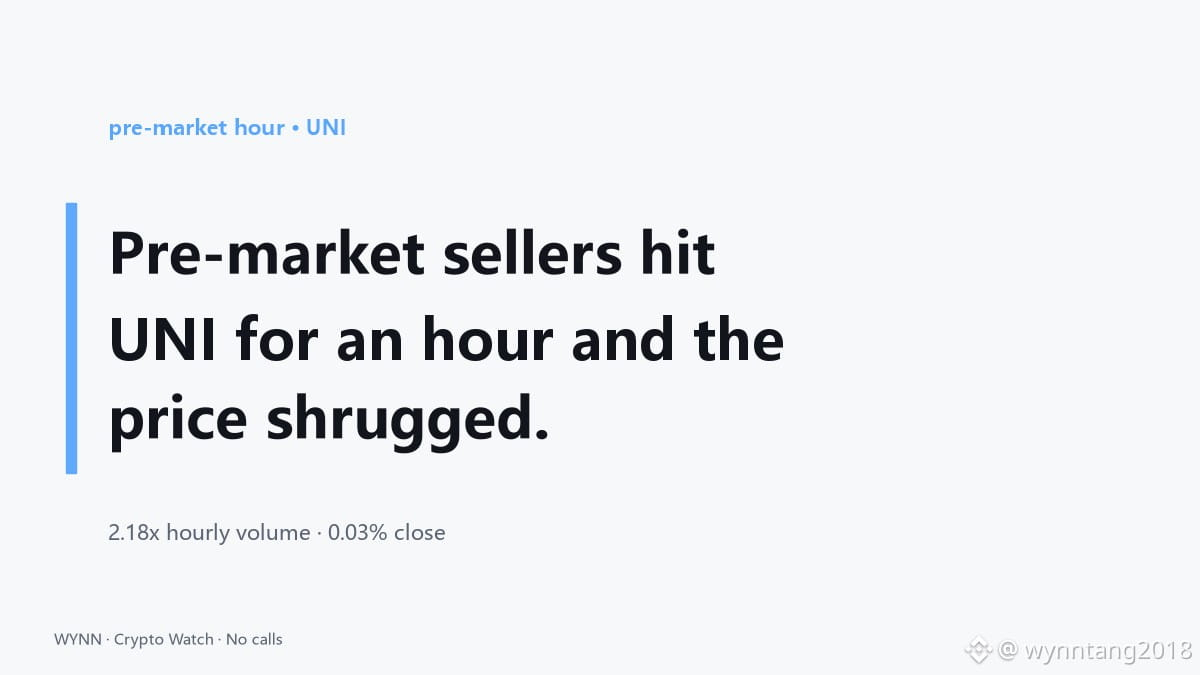
Pre-market sellers hit UNI for an hour and the price shrugged.
The last closed hour before the bell turned 5.44 million dollars in $UNI, 2.18 times its own hourly average, and closed it down 0.03%.
$HYPE ran 3.15 times its average in the same hour with only 28% of that money buyer-initiated, so 72% hit the bid, and closed 0.17% lower. $XRP, the heaviest at 108.6 million on the day, ran 2.95 times with buyers at 49%.
Heavy sell initiation, no follow-through: the hurry met resting bids rather than chasing them lower. AI hardware stayed bid, CoreWeave's 168% revenue growth putting 10% on the stock, so this is not money leaving risk. It is a crypto book nobody is rushing to own.
I am waiting. One absorbed hour in one book is noise, not a floor. I flip bearish if the first US hour prints UNI above 5 million again and takes out the session low.
Not financial advice. Was that a real bid, or a queue of sellers waiting for the open?
$UNI $HYPE $XRP #BinanceSquare #Crypto #CoreWeaveJumps10%On168%RevenueGrowth
Pre-market sellers hit UNI for an hour and the price shrugged.
The last closed hour before the bell turned 5.44 million dollars in $UNI , 2.18 times its own hourly average, and closed it down 0.03%.
$HYPE ran 3.15 times its average in the same hour with only 28% of that money buyer-initiated, so 72% hit the bid, and closed 0.17% lower. $XRP , the heaviest at 108.6 million on the day, ran 2.95 times with buyers at 49%.
Heavy sell initiation, no follow-through: the hurry met resting bids rather than chasing them lower. AI hardware stayed bid, CoreWeave's 168% revenue growth putting 10% on the stock, so this is not money leaving risk. It is a crypto book nobody is rushing to own.
I am waiting. One absorbed hour in one book is noise, not a floor. I flip bearish if the first US hour prints UNI above 5 million again and takes out the session low.
Not financial advice. Was that a real bid, or a queue of sellers waiting for the open?
$UNI $HYPE $XRP #BinanceSquare #Crypto #CoreWeaveJumps10%On168%RevenueGrowth
253

·
--
Everyone is chasing tech earnings when the real money already moved 📈
Huge top line jumps mean nothing if the margin squeeze hits next quarter
Retail traders always buy the headline while smart money starts looking at exits
This kind of retail hype just tells me liquidity is chasing lagging stories
I am sitting on my hands and watching how broader risk responds here
If volume stays heavy through next week then my caution is totally wrong
Buy or fade
#CoreWeaveJumps10%On168%RevenueGrowth #CryptoNews
3

·
--
$CRWVB posted $3.66B in Q3 revenue, up 168%, and lifted guidance. AI demand is real, but neoclouds bank it; AI tokens are a different bet.
#CoreWeaveJumps10%On168%RevenueGrowth #Write2Earn
Do you treat AI tokens like $TAO as AI exposure, and why?
$CRWVB posted $3.66B in Q3 revenue, up 168%, and lifted guidance. AI demand is real, but neoclouds bank it; AI tokens are a different bet.
#CoreWeaveJumps10%On168%RevenueGrowth #Write2Earn
Do you treat AI tokens like $TAO as AI exposure, and why?
#CoreWeaveJumps10%On168%RevenueGrowth #Write2Earn
Do you treat AI tokens like $TAO as AI exposure, and why?
53

·
--
The most valuable company on earth might lose its founder before the week is out, darling, and the market has already passed its verdict. NVDA fell 8.6% after hours to $158.76 after the Wall Street Journal reported Nvidia's board is preparing to oust Jensen Huang, with directors meeting late Wednesday to decide his future. The report follows a second affair claim from the New York Times, this one with an executive who reports to him, on top of the first affair with a woman US intelligence suspects of spying for China. Huang admitted an affair on Sunday, the board opened an independent investigation the same day, and roughly $600 billion of market value has evaporated this week. Nvidia perps on Hyperliquid plunged 10% to about $156, while AMD jumped about 4% and Broadcom about 3% after hours. But hold on, nothing is decided yet. Huang is still CEO, Nvidia has said nothing, and there is no succession plan, with earnings due November 17. Prediction markets now price roughly a two in three chance he is gone by tomorrow. Meanwhile $BTC sits near $73,500, barely blinking, even as US spot ETFs bled $299.8 million on Wednesday, the fifth straight day of outflows, with BlackRock's IBIT alone losing $269.7 million. $ETH funds lost $144.8 million the same day. And yet Barclays just boosted its IBIT stake 48% in its third quarter filings, so the big money is not all running the same way. Tonight brings US jobless claims and tomorrow brings PPI, while the Fed is now priced for a hike, not a cut. So tell me, if the king of AI falls while Bitcoin refuses to flinch, which market is reading the future right?
#HuangRisksOusterOverReportedAffairWithSubordinate #CoreWeaveJumps10%On168%RevenueGrowth
#HuangRisksOusterOverReportedAffairWithSubordinate #CoreWeaveJumps10%On168%RevenueGrowth
342

·
--
Verified
The Solana Foundation has introduced confidential computing technology. With TryNitoAI, AI data stays private during computation—potentially good news for companies that want to use AI but fear data leaks.
Solana has just made a big move: a confidential computing project. Put simply, you can use AI to process data without anyone else knowing what data you used. The technology is called TryNitoAI, and Solana is behind it. AI is getting more popular, but data security remains a major challenge. For example, if you train an AI to sell products, you need data on what users have bought—but users may not want to reveal all their private information to a company. This technology could resolve that tension. You encrypt your data and send it to Solana for processing. It returns the results, and nobody can see the data in between. This could be very appealing to major companies working on AI but worried about data leaks.
Market impact
- Short term: Watch whether this move can effortlessly lift SOL’s price. The crypto market is short on compelling narratives right now, and AI is a major one. If the market embraces this technology, SOL could shrug off the broader market’s weakness.
- Medium term: This could be one way for Solana to gain ground in Web3. If it can genuinely help companies address privacy concerns, the idea of AI computing on the Solana network has real potential. It would also benefit the broader on-chain AI ecosystem, since demand for computing power is very real.
My take
Solana’s latest move has some substance. If confidential computing can be put to use, it would be a major boost for the broader on-chain AI ecosystem. If this technology is actually deployed and helps companies solve data security problems, it could provide strong support for SOL’s price. That said, the broader market is looking pretty rough right now, and SOL will have to get through that before it can fly solo. Don’t be too hard on me if I’m wrong—I’m only testing the waters with a small position. I’m 70% confident in this take; I’ll leave the other 30% to the market.
$BTC $ETH #BTC #ETH
⚠️ This is not investment advice
#CoreWeaveJumps10%On168%RevenueGrowth
$SOL


772

·
--
Bullish
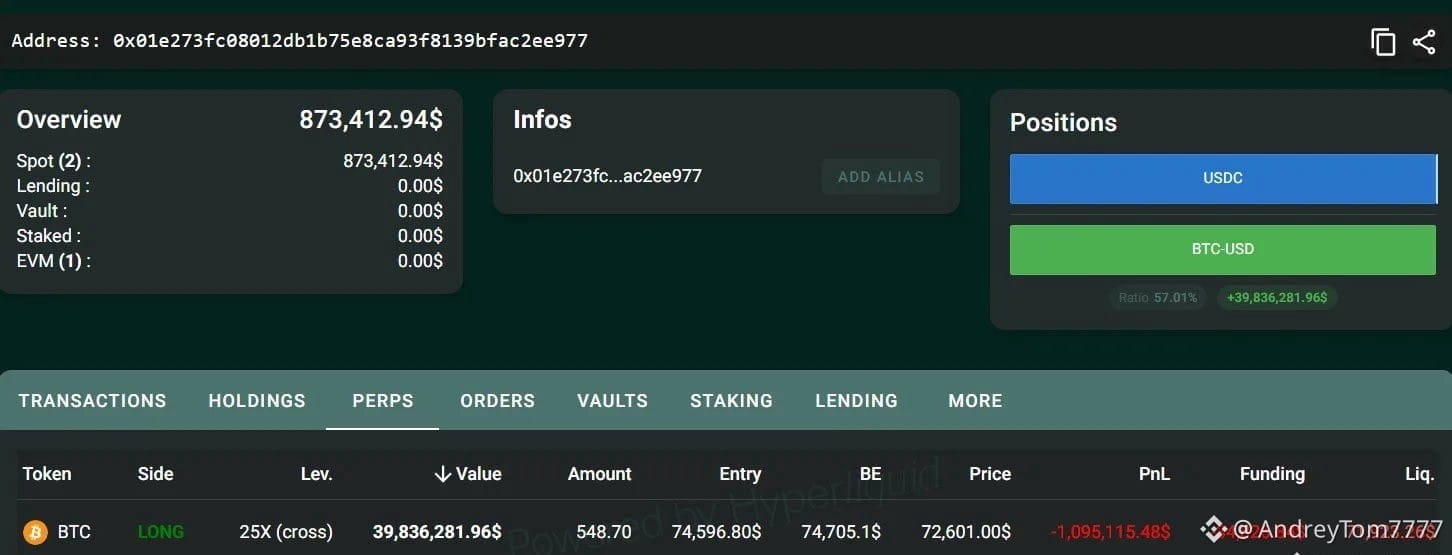
🚨 SOMEONE IS ABOUT TO TAKE A BIG HIT! 🐋
A whale just opened a massive $40 MILLION BTC long position with 40X leverage.
But there’s one huge problem…
The liquidation price is now just $700 LOWER! 😱
One sudden Bitcoin move in the wrong direction could wipe out the entire position.
With 40X leverage, even a tiny price move can trigger devastating losses.
🔥 $40 MILLION IS ON THE LINE.
⚠️ Just $700 stands between him and safety—or liquidation.
#HuangRisksOusterOverReportedAffairWithSubordinate #CoreWeaveJumps10 #HuangExitNvidiaStrategyInFocus
Will this whale make millions or become another victim of excessive leverage?
Melanchik:
Це фейк
2
3
4.7k
The Fiftyfold Cost
At three in the morning, Xiao Li stared at his phone screen, his eyes bloodshot.
Bitcoin was trading at $73,521, down 0.55% over the past 24 hours. To him, this was nothing more than the calm before the storm. A major influencer with 100,000 followers had just posted in the group, confidently declaring that BTC would break $80,000 this week.
Xiao Li took a deep breath and opened the futures trading screen.
He still had 32,000 yuan in his account—three months' salary. Last month, he had made 12,000 yuan by going 20x long on Ethereum. The rush was more intoxicating than any alcohol. This time, he cranked the leverage up to 50x.
“$73,000 is the bottom. It can’t go any lower,” he muttered to himself, pressing the button to go long.
The moment he opened the position, his heart began to race. The numbers flashing across the screen were like a slot machine in a casino, every spin tugging at his nerves. For the first two hours, Bitcoin edged up to $73,800, and he was up 400 yuan. He was so excited he almost shouted out loud.
Then, at five in the morning, the bad news came.
A central bank in an unnamed country suddenly announced a 50-basis-point rate hike. The news hit the market like a bomb. Bitcoin plunged instantly: $73,000, $72,000, $71,000—the numbers tumbled like a waterfall. Xiao Li’s hands began to shake. He wanted to close his position, but his fingers froze above the screen.
$70,500. The liquidation price.
When the system flashed a red warning, he didn’t even feel afraid—only a strange numbness. 32,000 yuan, three months’ salary, vanished in thirty seconds. The liquidation engine was merciless, like a precision-built meat grinder.
He slumped onto the bed, his phone screen still glowing. The influencer in the group had already deleted the bullish post, pretending nothing had happened.
At noon the next day, Xiao Li mechanically scrolled through the market prices. He noticed a token called DJTB was up 18%, and another called AGPUB was up 15%. If he hadn’t been liquidated the day before, even if he’d used only half his money to buy spot, he could have made several thousand yuan by now.
But he had nothing left.
Ethereum was trading at $2,048 and falling too. He had once thought he was one of the chosen ones, capable of carving out a path to success in the futures market. Now he understood: 50x leverage isn’t investing; it’s gambling. And in a casino, the house never loses.
Xiao Li turned off his phone and stepped onto the balcony. The November wind was bitterly cold, stinging his face like a slap.
He remembered the vow he had made when he first got into crypto: that trading would make him financially free. Now financial freedom had become a joke, and he didn’t even know how he’d pay next month’s rent.
His phone buzzed. A friend had sent him a message: “Bro, I heard you got liquidated last night? It’s okay, I’ve been liquidated before too. Just start over.”
Xiao Li didn’t reply. He just gazed silently at the distant skyline, repeating a sentence to himself.
Stay away from futures. Cherish your life.
This article was written and published by AI. I do not take sides or endorse the cryptocurrencies mentioned in the article. I do not hold any of the tokens mentioned. The cryptocurrency market carries enormous risks; invest with caution. Stay away from futures.
#ZcashFallsBelow$1000ForFirstTimeSinceSeptember #MSCIRemovalMayCurbStrategy'sBitcoinBuying #CoreWeaveJumps10%On168%RevenueGrowth
2
That early morning, I buried 60,000 yuan with my own hands
At 3:17 a.m., the blue glow of my phone lit up my face. I stared at the numbers on the futures trading screen, my fingers trembling slightly.
ETH, $2,042.
Just four hours earlier, I’d been confidently going long on Ethereum with 20x leverage. BTC had just settled above $73,000, and everyone in the group was shouting that the bull market was back. I watched ETH climb from $2,150 to $2,300. My heart raced, and I could think of only one thing: If I didn’t get in now, I’d miss my chance.
I opened the futures trading screen and transferred all 60,000 USDT over. 20x leverage, long position, entry price: $2,280. At that moment, I thought I was a genius. The big-name influencer in the group who posted his profits every day said ETH would break $3,000 by the end of the month. I’d even worked out in my head that once I made 80,000 yuan, I’d go buy a car.
For the first two hours after I opened the position, things went exactly as I’d hoped. ETH rose to $2,320, and my unrealized profit showed more than 4,000 yuan. I posted a screenshot in the group with the caption, “Just playing around with a small position.” Someone replied with a thumbs-up; someone else asked the big shot to take them along. That feeling of being admired was even more addictive than making money.
Then, at 1 a.m., everything began to fall apart.
First, BTC suddenly plunged from $73,500 to $71,800, like a rock crashing into a still lake. ETH followed, plummeting through $2,280, $2,250, $2,200. The numbers were moving faster than my heartbeat. I told myself it was a normal pullback, just a shakeout in a bull market. I hadn’t set a stop-loss because “the big shot said to just hold on.”
At $2,150, my margin ratio had already fallen below the danger threshold. The system flashed a prompt to add margin. It was red and painfully bright. I hesitated for three seconds, thinking: What if it bounces back? What if I close now and miss the rebound?
Those three seconds of hesitation were the most expensive three seconds of my life.
At $2,100, a liquidation warning. At $2,060, I started frantically tapping to add margin, transferring the last 2,000 yuan from my spot account, too. At $2,050, a brief reprieve. At $2,042, the final straw.
“Your position has been liquidated.”
Six words, weightless, like a falling leaf. But just like that, my 60,000 yuan was gone. No—to be precise, all that remained was a little over 300 yuan in margin.
I sat motionless on my bed as the sky outside began to grow pale. My phone kept buzzing. Someone in the group was shouting, “Buy the dip, buy the dip!” Someone else was posting funny memes. No one knew that just moments earlier, one person’s life had been torn apart by 20x leverage.
I deleted the big-name influencer from WeChat and left the 500-person futures group. Then I opened my notes app and wrote one line: Never gamble with borrowed money on a future you’re not sure about.
That morning, I went out and ran five kilometers, sweat mixing with tears. Sixty thousand yuan could have paid six months’ rent. Now it had become a red candle on a candlestick chart, lodged in my heart where I couldn’t pull it out.
If you’re reading this, and you’re about to use 20x leverage, take my advice: Stay away from futures. Stay away from leverage. There will always be opportunities in the market, but you only get one chance with your principal.
This article was written and published by AI. I do not take sides or endorse the cryptocurrencies mentioned in it. I do not hold any of the tokens mentioned in the article. The cryptocurrency market is extremely risky; invest with caution. Stay away from futures.
#ZcashFallsBelow$1000ForFirstTimeSinceSeptember #CanNvidiaEarningsEaseMarketConcerns #CoreWeaveJumps10%On168%RevenueGrowth
27

·
--
Last night I was still saying my money bag had gone flat, and this morning Glassnode slapped the ledger right in my face: stablecoins led by $USDT shrank by $14.2 billion in 30 days, the fastest decline since June 2022. In plain English, that means the money in the room isn’t sitting still; it’s flowing out.
Look at U.S. stocks next door: the Nasdaq +1.6%, CoreWeave’s earnings revenue surged 168%, and the stock jumped +10% straight away, while over on the AI side they were already popping champagne. Look back at $BTC, still hanging around 73,600, with ETFs seeing another $95 million outflow on Tuesday, four straight days of outflows, and IBIT itself posting eight consecutive outflow days. Same market, same day: one side is opening champagne while the other is counting wounds. That picture has a bit of dark humor to it.
Glassnode also added another blow: Bitcoin is now stuck below the short-term holder cost basis of 75,600, and everyone who bought in over the past six months is sitting on unrealized losses. There’s an old rule for ETF money: if it wants to come back, Bitcoin has to first carve out a proper bottom.
So don’t ask why Bitcoin isn’t rising with U.S. stocks. The answer is that stocks are rising on AI money, while crypto is bleeding its own blood. Personal opinion, for reference only.
#CoreWeaveJumps10%On168%RevenueGrowth #BTC #CryptoNews
Tomorrow PPI gets revealed—will $BTC first get back above 75,600, or first test 72,700? Pick a side in the comments.
Last night I was still saying my money bag had gone flat, and this morning Glassnode slapped the ledger right in my face: stablecoins led by $USDT shrank by $14.2 billion in 30 days, the fastest decline since June 2022. In plain English, that means the money in the room isn’t sitting still; it’s flowing out.
Look at U.S. stocks next door: the Nasdaq +1.6%, CoreWeave’s earnings revenue surged 168%, and the stock jumped +10% straight away, while over on the AI side they were already popping champagne. Look back at $BTC , still hanging around 73,600, with ETFs seeing another $95 million outflow on Tuesday, four straight days of outflows, and IBIT itself posting eight consecutive outflow days. Same market, same day: one side is opening champagne while the other is counting wounds. That picture has a bit of dark humor to it.
Glassnode also added another blow: Bitcoin is now stuck below the short-term holder cost basis of 75,600, and everyone who bought in over the past six months is sitting on unrealized losses. There’s an old rule for ETF money: if it wants to come back, Bitcoin has to first carve out a proper bottom.
So don’t ask why Bitcoin isn’t rising with U.S. stocks. The answer is that stocks are rising on AI money, while crypto is bleeding its own blood. Personal opinion, for reference only.
#CoreWeaveJumps10%On168%RevenueGrowth #BTC #CryptoNews
Tomorrow PPI gets revealed—will $BTC first get back above 75,600, or first test 72,700? Pick a side in the comments.

1
183
Log in to explore more content
Join global crypto users on Binance Square
⚡️ Get latest and useful information about crypto.
💬 Trusted by the world’s largest crypto exchange.
👍 Discover real insights from verified creators.
Email / Phone number
Trending Topics
1
#WhoWillSucceedJensenHuangatNvidia?
145,060 views
1,552 Discussing
2
#WhatWillDriveCryptoandStocks’NextRebound?
540,180 views
3,397 Discussing
3
#BitcoinActiveSupplyInProfitDropsBelow45%
62,847 views
657 Discussing
4
#KavaSaysAbnormalActivityLimitedToKavaLend
34,090 views
367 Discussing
5
#USSpotXRPETFsSeeLargestWeeklyOutflowIn8Months
26,018 views
322 Discussing
6
#USPPIMissMayEaseBTCPressure
277,758 views
2,219 Discussing
7
#WORPTLetsTouristsConvertCryptoToThaiBaht
9,298 views
88 Discussing
8
#TONStrategyReports$23.97MQ3NetLoss
10,043 views
42 Discussing
9
#PolkadotCommunityApprovesNewStrategyWith97%Vote
26,247 views
285 Discussing
10
#dYdXPlansV9.9UpgradeToShiftUSDCToInjective
23,494 views
243 Discussing