

#coldcardwalletlossesexceed115m
coldcardwalletlossesexceed115m
261 views
6 Discussing
Hot
Latest

·
--
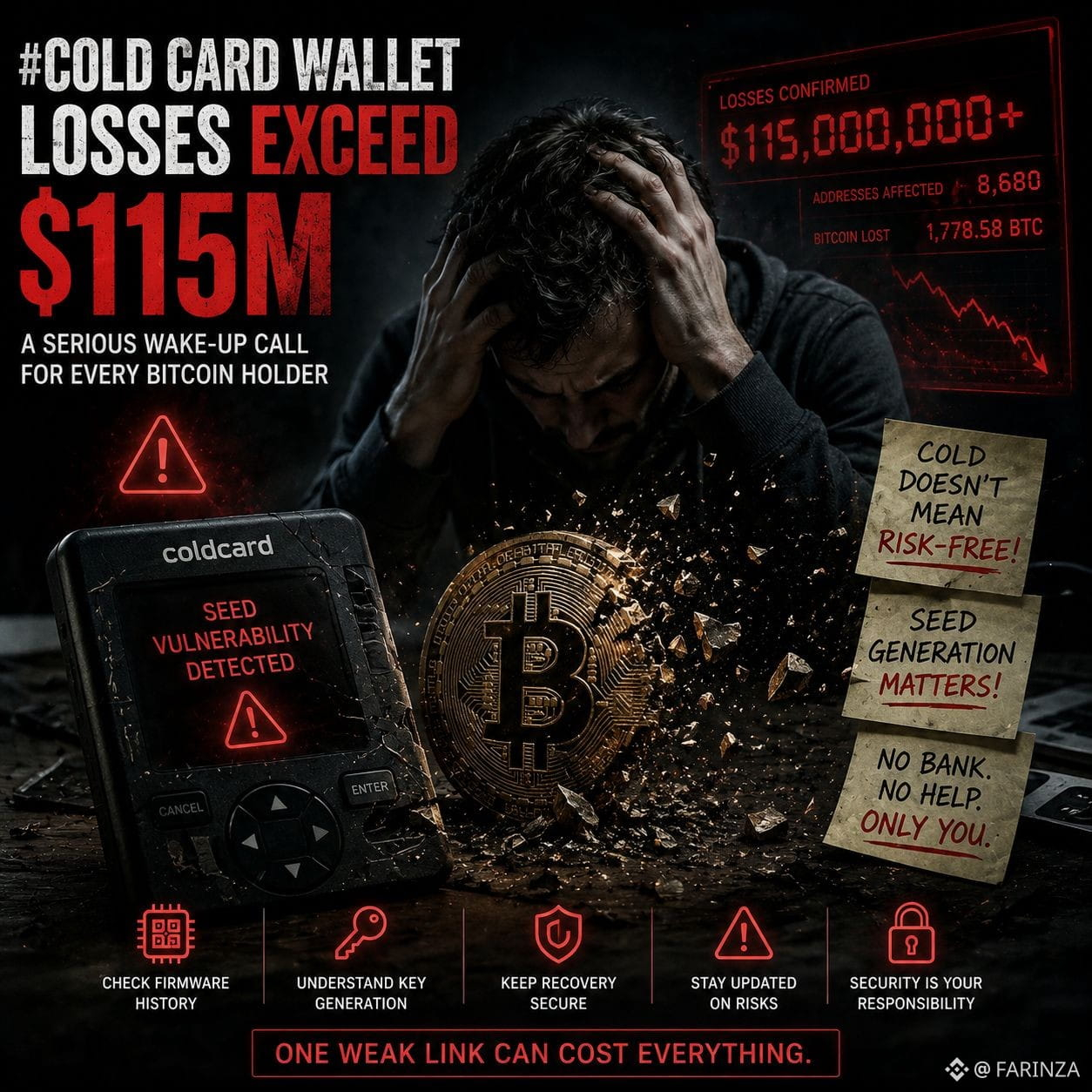
#ColdcardWalletLossesExceed115M
$115M+ gone is a serious wake-up call. 🚨
What stands out to me isn’t just the amount lost. It’s the fact that a wallet can sit offline and still have problems if something went wrong when the seed was created in the first place.
That’s the part people often forget about self-custody.
Cold wallet ≠ automatically safe.
Before trusting a wallet with serious money, I’d want to know:
• How were the keys generated?
• Was the firmware affected by any known issues?
• Is an old seed still safe after an update?
• Do I actually understand the recovery process?
With Bitcoin, there’s no bank to call when something goes wrong.
Your security is only as strong as the weakest part of your setup.
#Bitcoin #BTC #CryptoSecurity #SelfCustody
#ColdcardWalletLossesExceed115M
$115M+ gone is a serious wake-up call. 🚨
What stands out to me isn’t just the amount lost. It’s the fact that a wallet can sit offline and still have problems if something went wrong when the seed was created in the first place.
That’s the part people often forget about self-custody.
Cold wallet ≠ automatically safe.
Before trusting a wallet with serious money, I’d want to know:
• How were the keys generated?
• Was the firmware affected by any known issues?
• Is an old seed still safe after an update?
• Do I actually understand the recovery process?
With Bitcoin, there’s no bank to call when something goes wrong.
Your security is only as strong as the weakest part of your setup.
#Bitcoin #BTC #CryptoSecurity #SelfCustody
$115M+ gone is a serious wake-up call. 🚨
What stands out to me isn’t just the amount lost. It’s the fact that a wallet can sit offline and still have problems if something went wrong when the seed was created in the first place.
That’s the part people often forget about self-custody.
Cold wallet ≠ automatically safe.
Before trusting a wallet with serious money, I’d want to know:
• How were the keys generated?
• Was the firmware affected by any known issues?
• Is an old seed still safe after an update?
• Do I actually understand the recovery process?
With Bitcoin, there’s no bank to call when something goes wrong.
Your security is only as strong as the weakest part of your setup.
#Bitcoin #BTC #CryptoSecurity #SelfCustody
75

·
--
Article
Coldcard Wallet Hack: $115M Bitcoin Loss Exposes the Hidden Risks of Cold Storage#ColdcardWalletLossesExceed115M
Coldcard Wallet Hack: $115M Bitcoin Loss Exposes Cold Storage Risks
$EDEN , $RED ,$HEMI
{spot}(EDENUSDT)
{spot}(HEMIUSDT)
{spot}(REDUSDT)
Offline Doesn't Mean Unbreakable
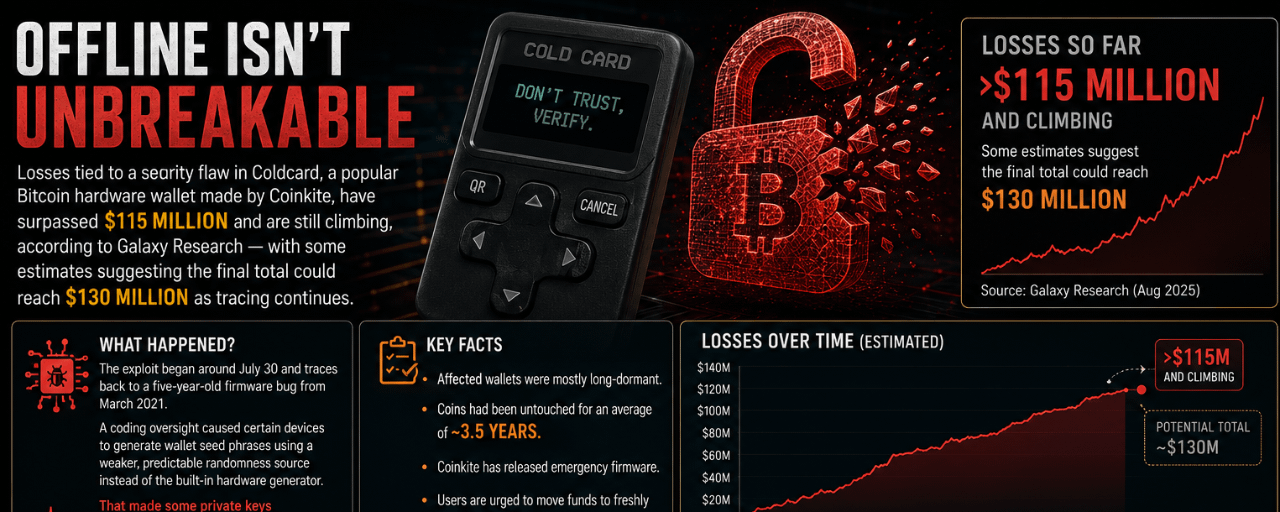
Cold storage is considered one of the safest ways to protect Bitcoin. But a major vulnerability involving Coldcard hardware wallets from Coinkite is showing that even offline devices can have serious security weaknesses.
$115 Million in Reported Losses
According to Galaxy Research, losses linked to the flaw have surpassed $115 million, with estimates potentially reaching $130 million as researchers continue tracing the stolen funds.
A 2021 Firmware Bug
The issue reportedly dates back to a March 2021 firmware bug that caused certain devices to use weaker, predictable randomness when generating wallet seeds.
That could make some private keys mathematically guessable, meaning attackers wouldn't necessarily need phishing, malware, or physical access to the device.
Dormant Wallets Were Targeted
One of the most alarming details is that many affected wallets had been inactive for years. The stolen Bitcoin reportedly sat untouched for an average of around 3.5 years.
Coinkite has released emergency firmware and advised affected users to move funds to newly generated wallets.
Can the Bitcoin Be Recovered?
There is some hope because a large portion of the stolen Bitcoin remains traceable on-chain. Researchers can follow the movement of the funds across Bitcoin addresses.
However, traceable doesn't necessarily mean recoverable. Where the funds move next could determine whether they can eventually be frozen or recovered.
The Bigger Lesson
This incident highlights a crucial rule of crypto security:
Offline doesn't automatically mean unbreakable.
Secure randomness, reliable firmware, and proper key generation are just as important as keeping a wallet disconnected from the internet.
For Bitcoin holders, cold storage remains powerful—but every layer of security matters.
DYOR. Not financial advice.
Coldcard Wallet Hack: $115M Bitcoin Loss Exposes the Hidden Risks of Cold Storage
#ColdcardWalletLossesExceed115M
Coldcard Wallet Hack: $115M Bitcoin Loss Exposes Cold Storage Risks
$EDEN , $RED ,$HEMI
Offline Doesn't Mean Unbreakable
Cold storage is considered one of the safest ways to protect Bitcoin. But a major vulnerability involving Coldcard hardware wallets from Coinkite is showing that even offline devices can have serious security weaknesses.
$115 Million in Reported Losses
According to Galaxy Research, losses linked to the flaw have surpassed $115 million, with estimates potentially reaching $130 million as researchers continue tracing the stolen funds.
A 2021 Firmware Bug
The issue reportedly dates back to a March 2021 firmware bug that caused certain devices to use weaker, predictable randomness when generating wallet seeds.
That could make some private keys mathematically guessable, meaning attackers wouldn't necessarily need phishing, malware, or physical access to the device.
Dormant Wallets Were Targeted
One of the most alarming details is that many affected wallets had been inactive for years. The stolen Bitcoin reportedly sat untouched for an average of around 3.5 years.
Coinkite has released emergency firmware and advised affected users to move funds to newly generated wallets.
Can the Bitcoin Be Recovered?
There is some hope because a large portion of the stolen Bitcoin remains traceable on-chain. Researchers can follow the movement of the funds across Bitcoin addresses.
However, traceable doesn't necessarily mean recoverable. Where the funds move next could determine whether they can eventually be frozen or recovered.
The Bigger Lesson
This incident highlights a crucial rule of crypto security:
Offline doesn't automatically mean unbreakable.
Secure randomness, reliable firmware, and proper key generation are just as important as keeping a wallet disconnected from the internet.
For Bitcoin holders, cold storage remains powerful—but every layer of security matters.
DYOR. Not financial advice.
Coldcard Wallet Hack: $115M Bitcoin Loss Exposes Cold Storage Risks
$EDEN , $RED ,$HEMI
Offline Doesn't Mean Unbreakable
Cold storage is considered one of the safest ways to protect Bitcoin. But a major vulnerability involving Coldcard hardware wallets from Coinkite is showing that even offline devices can have serious security weaknesses.
$115 Million in Reported Losses
According to Galaxy Research, losses linked to the flaw have surpassed $115 million, with estimates potentially reaching $130 million as researchers continue tracing the stolen funds.
A 2021 Firmware Bug
The issue reportedly dates back to a March 2021 firmware bug that caused certain devices to use weaker, predictable randomness when generating wallet seeds.
That could make some private keys mathematically guessable, meaning attackers wouldn't necessarily need phishing, malware, or physical access to the device.
Dormant Wallets Were Targeted
One of the most alarming details is that many affected wallets had been inactive for years. The stolen Bitcoin reportedly sat untouched for an average of around 3.5 years.
Coinkite has released emergency firmware and advised affected users to move funds to newly generated wallets.
Can the Bitcoin Be Recovered?
There is some hope because a large portion of the stolen Bitcoin remains traceable on-chain. Researchers can follow the movement of the funds across Bitcoin addresses.
However, traceable doesn't necessarily mean recoverable. Where the funds move next could determine whether they can eventually be frozen or recovered.
The Bigger Lesson
This incident highlights a crucial rule of crypto security:
Offline doesn't automatically mean unbreakable.
Secure randomness, reliable firmware, and proper key generation are just as important as keeping a wallet disconnected from the internet.
For Bitcoin holders, cold storage remains powerful—but every layer of security matters.
DYOR. Not financial advice.
1
85

#ColdcardWalletLossesExceed115M
🚨 $115M+ in Bitcoin gone.
A major Coldcard hardware-wallet exploit has reportedly drained more than $115 million worth of BTC, exposing a serious lesson: even “cold” storage can have security risks if the underlying firmware has a vulnerability. Galaxy Research has linked the theft to a flaw affecting wallet seed generation.
🔐 Crypto security isn’t just about where you store your coins — it’s also about how securely the wallet generates and protects your keys.
$BTC
{spot}(BTCUSDT)
$ETH
{spot}(ETHUSDT)
$SOL
{spot}(SOLUSDT)
#VIXFallsTo2026Low #cybersecurity #bitcoin
#ColdcardWalletLossesExceed115M
🚨 $115M+ in Bitcoin gone.
A major Coldcard hardware-wallet exploit has reportedly drained more than $115 million worth of BTC, exposing a serious lesson: even “cold” storage can have security risks if the underlying firmware has a vulnerability. Galaxy Research has linked the theft to a flaw affecting wallet seed generation.
🔐 Crypto security isn’t just about where you store your coins — it’s also about how securely the wallet generates and protects your keys.
$BTC
$ETH
$SOL
#VIXFallsTo2026Low #cybersecurity #bitcoin
🚨 $115M+ in Bitcoin gone.
A major Coldcard hardware-wallet exploit has reportedly drained more than $115 million worth of BTC, exposing a serious lesson: even “cold” storage can have security risks if the underlying firmware has a vulnerability. Galaxy Research has linked the theft to a flaw affecting wallet seed generation.
🔐 Crypto security isn’t just about where you store your coins — it’s also about how securely the wallet generates and protects your keys.
$BTC
$ETH
$SOL
#VIXFallsTo2026Low #cybersecurity #bitcoin

14

·
--
#ColdcardWalletLossesExceed115M
#Coldcard
#AlvinKan
Coldcard is it fixed??
😳😳😳🤨🤨😳🤨😳🤨😳🤨😳🤨😳🤨 we're continuing this movie after the loss of more than 115 M dollars!! 🤮🤮🤮🤮🤮🤮🤮
$BTC
$ETH
#ColdcardWalletLossesExceed115M
#Coldcard
#AlvinKan
Coldcard is it fixed??
😳😳😳🤨🤨😳🤨😳🤨😳🤨😳🤨😳🤨 we're continuing this movie after the loss of more than 115 M dollars!! 🤮🤮🤮🤮🤮🤮🤮
$BTC
$ETH
#Coldcard
#AlvinKan
Coldcard is it fixed??
😳😳😳🤨🤨😳🤨😳🤨😳🤨😳🤨😳🤨 we're continuing this movie after the loss of more than 115 M dollars!! 🤮🤮🤮🤮🤮🤮🤮
$BTC
$ETH

1
468
Log in to explore more content
Join global crypto users on Binance Square
⚡️ Get latest and useful information about crypto.
💬 Trusted by the world’s largest crypto exchange.
👍 Discover real insights from verified creators.
Email / Phone number
Trending Topics
1
#BitcoinParesGainsAfterRallyTo$86.5K
15,945 views
70 Discussing
2
#CerebrasSinksNearly20%OnReportNvidiaToPowerOpenAI
28,103 views
355 Discussing
3
#SECProposesCryptoCustodyRules
56,193 views
528 Discussing
4
#SECApproves3xLongCryptoCommodityETPs
41,046 views
407 Discussing
5
#MASKHitsRecordMarketCapAbove$35M
151 views
26 Discussing
6
#G7PlansToReleaseUpTo100MBarrelsOilDiesel
35,243 views
404 Discussing
7
#ICBASuesOCCOverCryptoBankCharters
26,571 views
279 Discussing
8
#USStocksCloseHigherOnWeakJobsData
26,935 views
226 Discussing
9
#AnchorageReportedlyCuts17%Workforce
5,953 views
89 Discussing
10
#NFPWatch
11M views
19,763 Discussing