

#bitcointargets2026openat
bitcointargets2026openat
350 views
31 Discussing
Hot
Latest

·
--
🚨 BTC IS KNOCKING ON $87,570 — BUT IT CAN'T BREAK THE WALL! ⚠️
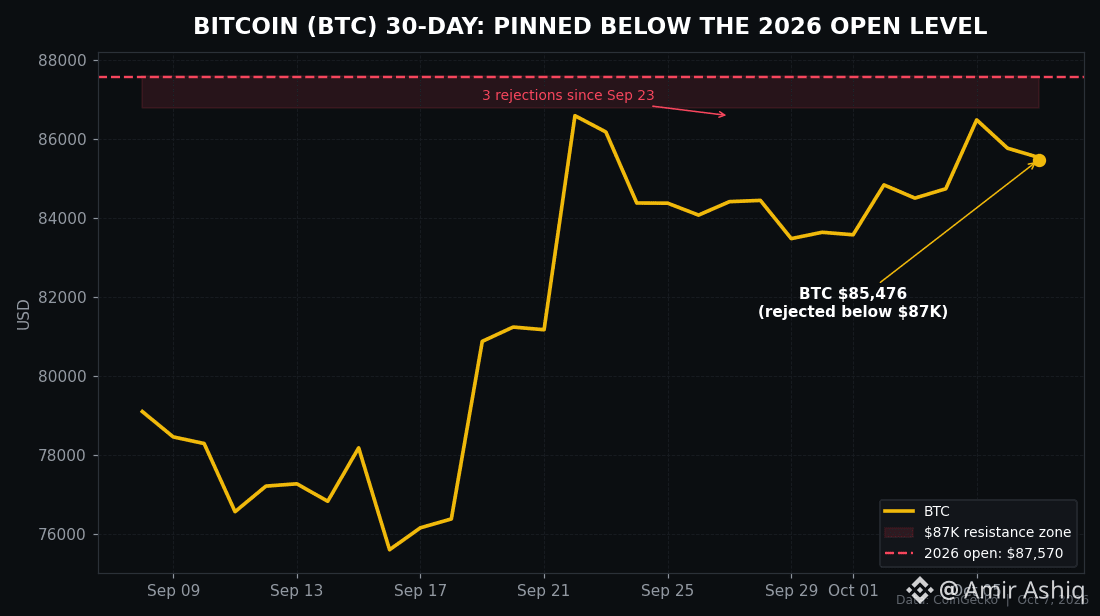
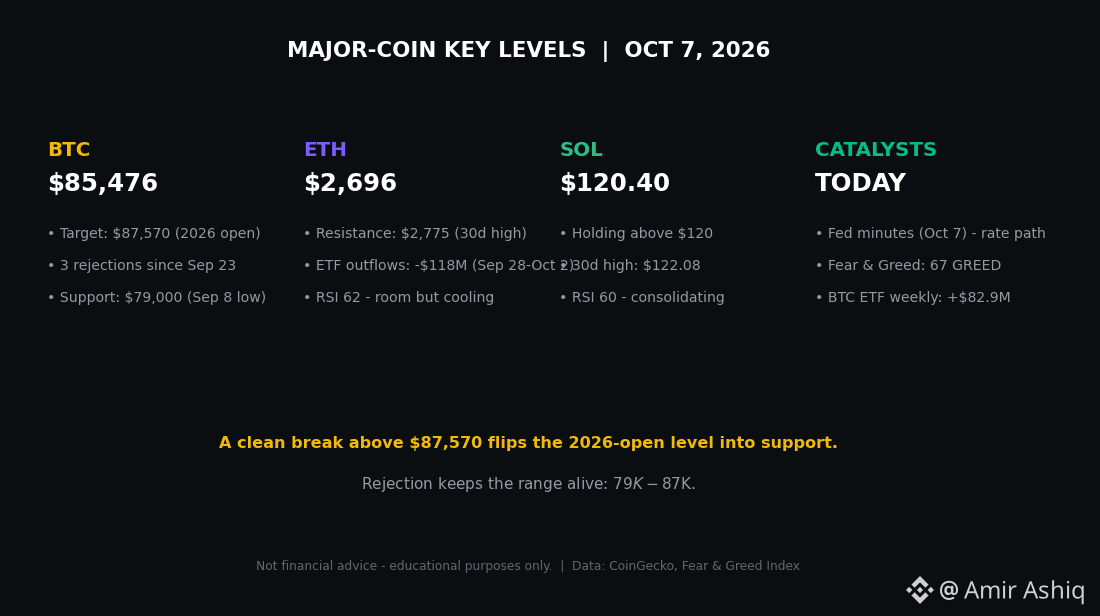
Bitcoin is trading at $85,476 today — just 3% below the $87,570 level where it opened 2026. This is now the third rejection at $87K since September 23.
Here's the catch:
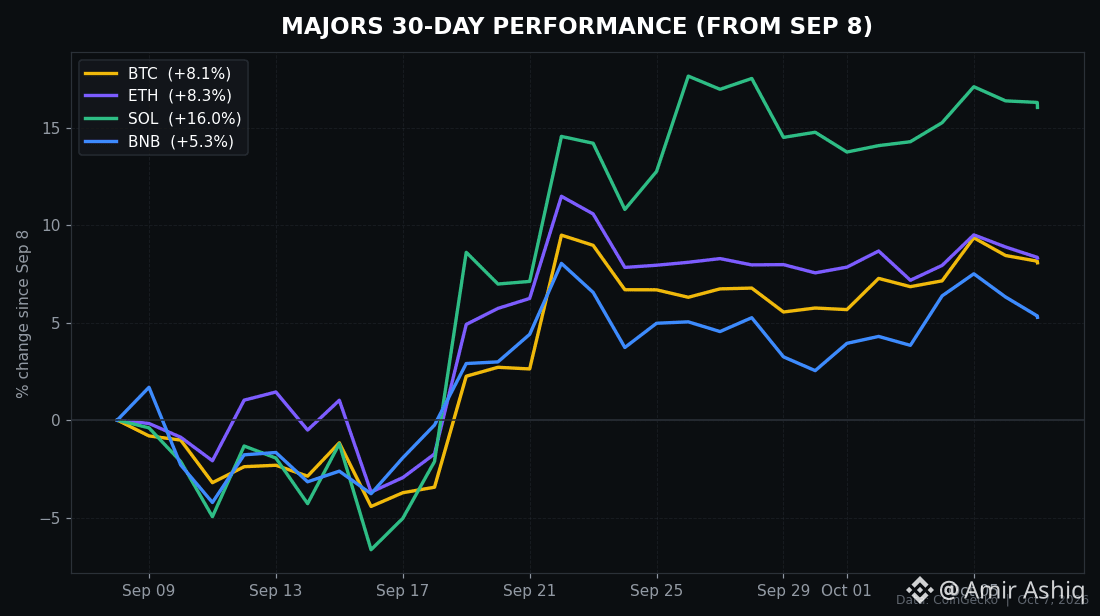
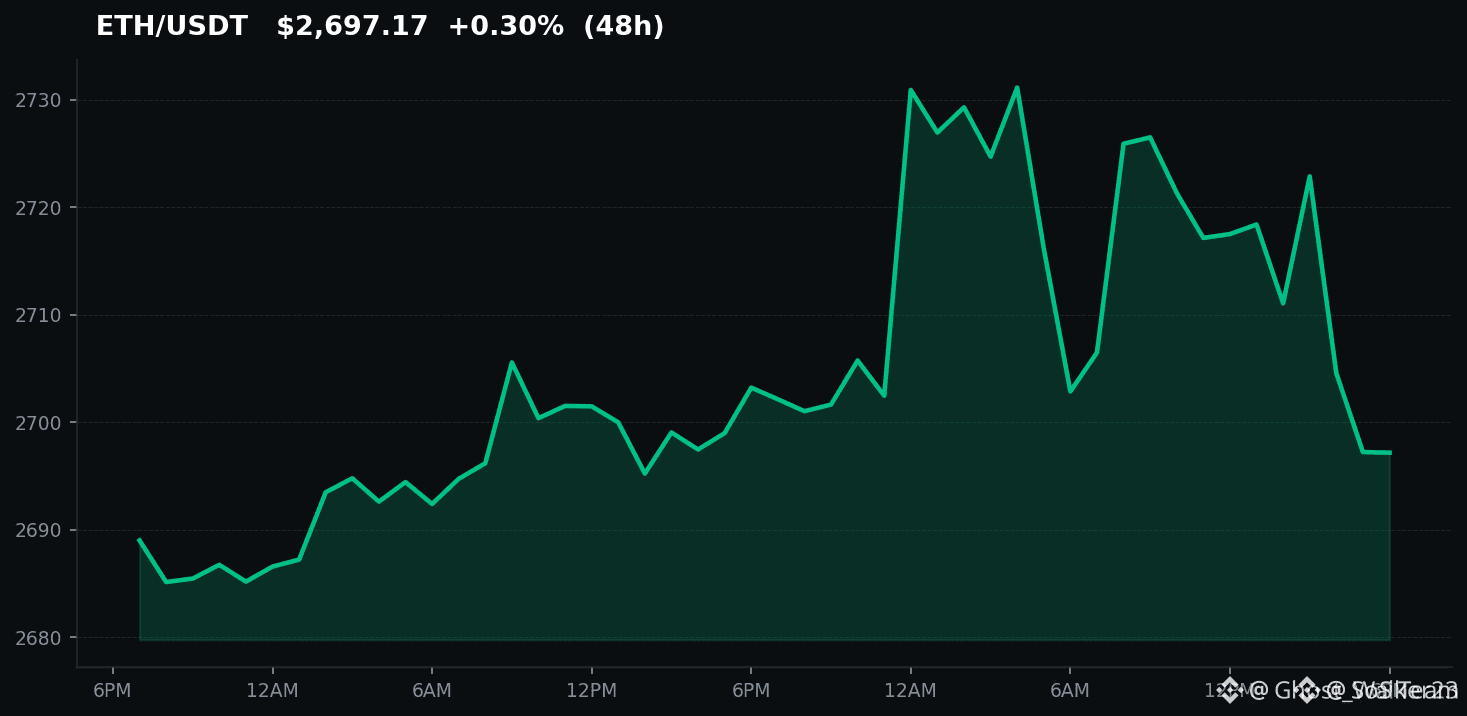
📉 BTC slid from its 30-day high of $86,597 while ETH ($2,696) and SOL ($120.40) are both fading too.
📊 Ethereum spot ETFs posted -$118M in outflows last week; BTC ETF weekly buying slowed to just +$82.9M.
⚠️ The Fed minutes drop TODAY — one hawkish line on rates can unwind this entire setup.
Thinner volume into a macro event = outsized wicks in both directions.
A clean break above $87,570 flips the 2026-open level into support and opens a real Q4 breakout. Another rejection keeps the $79K–$87K range alive — and range tops are where late longs get trapped.
Will today finally be the day $87K falls? 👀
Not financial advice — educational purposes only.
#BitcoinTargets2026OpenAt$87570 #Bitcoin #crypto
$BTC $ETH $SOL
🚨 BTC IS KNOCKING ON $87,570 — BUT IT CAN'T BREAK THE WALL! ⚠️
Bitcoin is trading at $85,476 today — just 3% below the $87,570 level where it opened 2026. This is now the third rejection at $87K since September 23.
Here's the catch:
📉 BTC slid from its 30-day high of $86,597 while ETH ($2,696) and SOL ($120.40) are both fading too.
📊 Ethereum spot ETFs posted -$118M in outflows last week; BTC ETF weekly buying slowed to just +$82.9M.
⚠️ The Fed minutes drop TODAY — one hawkish line on rates can unwind this entire setup.
Thinner volume into a macro event = outsized wicks in both directions.
A clean break above $87,570 flips the 2026-open level into support and opens a real Q4 breakout. Another rejection keeps the $79K–$87K range alive — and range tops are where late longs get trapped.
Will today finally be the day $87K falls? 👀
Not financial advice — educational purposes only.
#BitcoinTargets2026OpenAt$87570 #Bitcoin #crypto
$BTC $ETH $SOL
Bitcoin is trading at $85,476 today — just 3% below the $87,570 level where it opened 2026. This is now the third rejection at $87K since September 23.
Here's the catch:
📉 BTC slid from its 30-day high of $86,597 while ETH ($2,696) and SOL ($120.40) are both fading too.
📊 Ethereum spot ETFs posted -$118M in outflows last week; BTC ETF weekly buying slowed to just +$82.9M.
⚠️ The Fed minutes drop TODAY — one hawkish line on rates can unwind this entire setup.
Thinner volume into a macro event = outsized wicks in both directions.
A clean break above $87,570 flips the 2026-open level into support and opens a real Q4 breakout. Another rejection keeps the $79K–$87K range alive — and range tops are where late longs get trapped.
Will today finally be the day $87K falls? 👀
Not financial advice — educational purposes only.
#BitcoinTargets2026OpenAt$87570 #Bitcoin #crypto
$BTC $ETH $SOL
119

·
--
everyone thinks those $btc 2026 price targets are basically a done deal after etfs and the last two halvings... but actually most of the people posting those numbers won't even be around to see them.
that's the trap. you size up like 150k is already printed then a 40% dump takes you out before the thesis even has time to breathe.
i've seen this movie before. 2021 the timeline was screaming 100k by christmas and then we spent 18 months underwater while every model just got pushed out another year. same energy right now with these 2026 numbers.
look at the tape. greed is sitting at 67 and $btc just got rejected at the highs again. those institutional models assume smooth etf flows and zero black swans. they do not price in you getting liquidated because you treated a two year forecast like a trade. ngl ser the ones stacking $usdt quietly might actually be playing this cleaner than the max long crowd.
this isn't bearish. it's just not confusing a long term case study with a short term position. $eth already ran while half of everyone is still waiting for some official 2026 greenlight. the people who make it there are the ones who don't blow up on the way.
where do you think this actually goes if we chop for another six months?
#BitcoinTargets2026OpenAt #BitcoinRejectedAt #ETHUp70
everyone thinks those $btc 2026 price targets are basically a done deal after etfs and the last two halvings... but actually most of the people posting those numbers won't even be around to see them.
that's the trap. you size up like 150k is already printed then a 40% dump takes you out before the thesis even has time to breathe.
i've seen this movie before. 2021 the timeline was screaming 100k by christmas and then we spent 18 months underwater while every model just got pushed out another year. same energy right now with these 2026 numbers.
look at the tape. greed is sitting at 67 and $btc just got rejected at the highs again. those institutional models assume smooth etf flows and zero black swans. they do not price in you getting liquidated because you treated a two year forecast like a trade. ngl ser the ones stacking $usdt quietly might actually be playing this cleaner than the max long crowd.
this isn't bearish. it's just not confusing a long term case study with a short term position. $eth already ran while half of everyone is still waiting for some official 2026 greenlight. the people who make it there are the ones who don't blow up on the way.
where do you think this actually goes if we chop for another six months?
#BitcoinTargets2026OpenAt #BitcoinRejectedAt #ETHUp70
that's the trap. you size up like 150k is already printed then a 40% dump takes you out before the thesis even has time to breathe.
i've seen this movie before. 2021 the timeline was screaming 100k by christmas and then we spent 18 months underwater while every model just got pushed out another year. same energy right now with these 2026 numbers.
look at the tape. greed is sitting at 67 and $btc just got rejected at the highs again. those institutional models assume smooth etf flows and zero black swans. they do not price in you getting liquidated because you treated a two year forecast like a trade. ngl ser the ones stacking $usdt quietly might actually be playing this cleaner than the max long crowd.
this isn't bearish. it's just not confusing a long term case study with a short term position. $eth already ran while half of everyone is still waiting for some official 2026 greenlight. the people who make it there are the ones who don't blow up on the way.
where do you think this actually goes if we chop for another six months?
#BitcoinTargets2026OpenAt #BitcoinRejectedAt #ETHUp70

5


Bitcoin is capturing attention with projections pointing towards an opening price of $87,570 in 2026. This ambitious target suggests a significant bullish sentiment among market observers, anticipating substantial growth in the coming years. Such forecasts often stem from analysis of historical halving cycles, increasing institutional adoption, and the evolving narrative of Bitcoin as a digital store of value. While these targets represent optimistic outlooks, they also highlight the inherent volatility and speculative nature of the cryptocurrency market. Investors should conduct thorough research and consider their risk tolerance before making any decisions based on such predictions.
Disclaimer: This content is for informational purposes only and does not constitute financial advice.
#BitcoinTargets2026OpenAt$87570 $BTC
Bitcoin is capturing attention with projections pointing towards an opening price of $87,570 in 2026. This ambitious target suggests a significant bullish sentiment among market observers, anticipating substantial growth in the coming years. Such forecasts often stem from analysis of historical halving cycles, increasing institutional adoption, and the evolving narrative of Bitcoin as a digital store of value. While these targets represent optimistic outlooks, they also highlight the inherent volatility and speculative nature of the cryptocurrency market. Investors should conduct thorough research and consider their risk tolerance before making any decisions based on such predictions.
Disclaimer: This content is for informational purposes only and does not constitute financial advice.
#BitcoinTargets2026OpenAt$87570 $BTC
Disclaimer: This content is for informational purposes only and does not constitute financial advice.
#BitcoinTargets2026OpenAt$87570 $BTC
26

The brutal truth about market cycle targets is that most traders don't lose money because they were wrong on direction, but because they anchored their entire net worth to an arbitrary calendar date.
Right now, with greed sitting around 67, the anxiety of missing the next parabolic move is making people force trades on low-liquidity pairs or park capital in idle $USDT out of pure indecision. We convince ourselves that reaching the next benchmark will finally make taking profit easy, yet history shows the emotional pressure only intensifies at major psychological levels.
I watched the exact same playbook unfold in late 2017 and again in 2021. When everyone fixates on where $BTC will open in the next macro cycle, smart money quietly builds positions without the need to time a single exact candle. Meanwhile, capital rotates rapidly through legacy networks like $ETC before retail even realizes the liquidity tide is shifting.
Survival in this market has never been about predicting the exact opening print of a future year, but having an execution plan when the greed index blinds the crowd.
Are you positioning around macro timeframes or still trying to catch every micro move along the way?
#BitcoinTargets2026OpenAt #BitcoinRejectedAt
The brutal truth about market cycle targets is that most traders don't lose money because they were wrong on direction, but because they anchored their entire net worth to an arbitrary calendar date.
Right now, with greed sitting around 67, the anxiety of missing the next parabolic move is making people force trades on low-liquidity pairs or park capital in idle $USDT out of pure indecision. We convince ourselves that reaching the next benchmark will finally make taking profit easy, yet history shows the emotional pressure only intensifies at major psychological levels.
I watched the exact same playbook unfold in late 2017 and again in 2021. When everyone fixates on where $BTC will open in the next macro cycle, smart money quietly builds positions without the need to time a single exact candle. Meanwhile, capital rotates rapidly through legacy networks like $ETC before retail even realizes the liquidity tide is shifting.
Survival in this market has never been about predicting the exact opening print of a future year, but having an execution plan when the greed index blinds the crowd.
Are you positioning around macro timeframes or still trying to catch every micro move along the way?
#BitcoinTargets2026OpenAt #BitcoinRejectedAt
Right now, with greed sitting around 67, the anxiety of missing the next parabolic move is making people force trades on low-liquidity pairs or park capital in idle $USDT out of pure indecision. We convince ourselves that reaching the next benchmark will finally make taking profit easy, yet history shows the emotional pressure only intensifies at major psychological levels.
I watched the exact same playbook unfold in late 2017 and again in 2021. When everyone fixates on where $BTC will open in the next macro cycle, smart money quietly builds positions without the need to time a single exact candle. Meanwhile, capital rotates rapidly through legacy networks like $ETC before retail even realizes the liquidity tide is shifting.
Survival in this market has never been about predicting the exact opening print of a future year, but having an execution plan when the greed index blinds the crowd.
Are you positioning around macro timeframes or still trying to catch every micro move along the way?
#BitcoinTargets2026OpenAt #BitcoinRejectedAt

10

Picture this: you are juggling five different analytics tabs, watching order books flicker, and trying to decipher whether a sudden price spike is genuine volume or just another liquidity trap.
Most traders end up losing money not because they lack passion, but because they are constantly drowning in noisy data and entering positions five minutes too late. When information is fragmented across dozens of complex dashboards, retail investors usually end up holding the bag while faster players front-run the actionable insights.
The rollout of Binance Intelligence feels very similar to the early days when on-chain analytics first went mainstream. Back in previous cycles, tracking wallet movements or sentiment shifts required specialized technical setups. Having deep market analytics and pattern recognition integrated directly into the core trading interface changes the dynamic, much like when real-time order flow data became accessible to everyday holders of $BNB and $BTC.
When retail gets access to structured intelligence directly at the point of execution, the edge shifts from who has the fastest raw data feeds to who can actually interpret market context better. We saw a similar maturation curve with $ETH analytics years ago, where better data transparency gradually reduced blind FOMO and forced traders to develop disciplined risk management.
Do you think integrated intelligence tools will actually level the playing field for retail traders, or will sophisticated algorithms always stay one step ahead?
#BinanceLaunchesBinanceIntelligence #BitcoinTargets2026OpenAt #ETHUp70
Picture this: you are juggling five different analytics tabs, watching order books flicker, and trying to decipher whether a sudden price spike is genuine volume or just another liquidity trap.
Most traders end up losing money not because they lack passion, but because they are constantly drowning in noisy data and entering positions five minutes too late. When information is fragmented across dozens of complex dashboards, retail investors usually end up holding the bag while faster players front-run the actionable insights.
The rollout of Binance Intelligence feels very similar to the early days when on-chain analytics first went mainstream. Back in previous cycles, tracking wallet movements or sentiment shifts required specialized technical setups. Having deep market analytics and pattern recognition integrated directly into the core trading interface changes the dynamic, much like when real-time order flow data became accessible to everyday holders of $BNB and $BTC .
When retail gets access to structured intelligence directly at the point of execution, the edge shifts from who has the fastest raw data feeds to who can actually interpret market context better. We saw a similar maturation curve with $ETH analytics years ago, where better data transparency gradually reduced blind FOMO and forced traders to develop disciplined risk management.
Do you think integrated intelligence tools will actually level the playing field for retail traders, or will sophisticated algorithms always stay one step ahead?
#BinanceLaunchesBinanceIntelligence #BitcoinTargets2026OpenAt #ETHUp70
Most traders end up losing money not because they lack passion, but because they are constantly drowning in noisy data and entering positions five minutes too late. When information is fragmented across dozens of complex dashboards, retail investors usually end up holding the bag while faster players front-run the actionable insights.
The rollout of Binance Intelligence feels very similar to the early days when on-chain analytics first went mainstream. Back in previous cycles, tracking wallet movements or sentiment shifts required specialized technical setups. Having deep market analytics and pattern recognition integrated directly into the core trading interface changes the dynamic, much like when real-time order flow data became accessible to everyday holders of $BNB and $BTC .
When retail gets access to structured intelligence directly at the point of execution, the edge shifts from who has the fastest raw data feeds to who can actually interpret market context better. We saw a similar maturation curve with $ETH analytics years ago, where better data transparency gradually reduced blind FOMO and forced traders to develop disciplined risk management.
Do you think integrated intelligence tools will actually level the playing field for retail traders, or will sophisticated algorithms always stay one step ahead?
#BinanceLaunchesBinanceIntelligence #BitcoinTargets2026OpenAt #ETHUp70

1
198
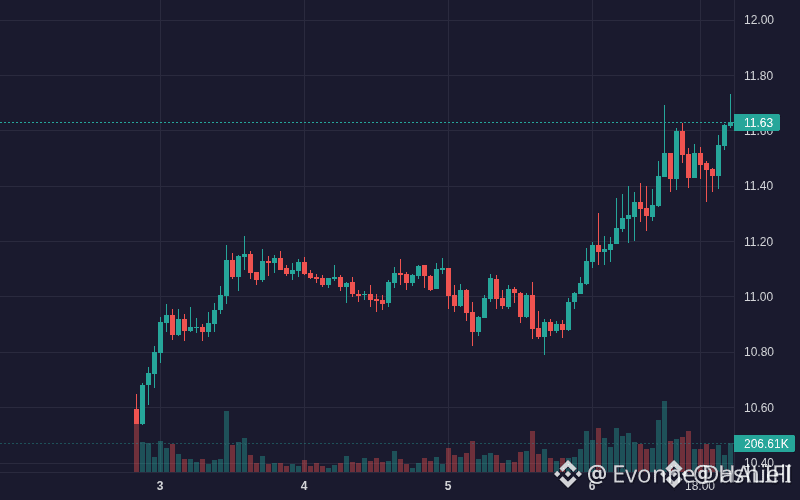
Why is nobody talking about how most traders are actively setting themselves up to be exit liquidity right now?
With the market index sitting deep in greed territory, the instinct to chase green candles on $ETH is hitting fever pitch, leaving retail investors constantly trapped at local tops while watching their capital evaporate on sudden pullbacks.
The mainstream narrative wants you to market-buy the breakout blindly, but that is precisely how portfolios bleed out. Instead of chasing price spikes, your first step should be defining clear invalidation levels below major support and taking partial profits into strength while keeping a core position. If you want sustainable gains, rotate focus toward assets showing structural accumulation like $ETC or consolidate cashflow into $USDT rather than going all-in at resistance.
Execution discipline beats excitement every single cycle, and surviving a trending rally comes down to scaling entries systematically instead of reacting emotionally.
Where do you think we head from here?
#ETHUp70 #BitcoinTargets2026OpenAt
Why is nobody talking about how most traders are actively setting themselves up to be exit liquidity right now?
With the market index sitting deep in greed territory, the instinct to chase green candles on $ETH is hitting fever pitch, leaving retail investors constantly trapped at local tops while watching their capital evaporate on sudden pullbacks.
The mainstream narrative wants you to market-buy the breakout blindly, but that is precisely how portfolios bleed out. Instead of chasing price spikes, your first step should be defining clear invalidation levels below major support and taking partial profits into strength while keeping a core position. If you want sustainable gains, rotate focus toward assets showing structural accumulation like $ETC or consolidate cashflow into $USDT rather than going all-in at resistance.
Execution discipline beats excitement every single cycle, and surviving a trending rally comes down to scaling entries systematically instead of reacting emotionally.
Where do you think we head from here?
#ETHUp70 #BitcoinTargets2026OpenAt
With the market index sitting deep in greed territory, the instinct to chase green candles on $ETH is hitting fever pitch, leaving retail investors constantly trapped at local tops while watching their capital evaporate on sudden pullbacks.
The mainstream narrative wants you to market-buy the breakout blindly, but that is precisely how portfolios bleed out. Instead of chasing price spikes, your first step should be defining clear invalidation levels below major support and taking partial profits into strength while keeping a core position. If you want sustainable gains, rotate focus toward assets showing structural accumulation like $ETC or consolidate cashflow into $USDT rather than going all-in at resistance.
Execution discipline beats excitement every single cycle, and surviving a trending rally comes down to scaling entries systematically instead of reacting emotionally.
Where do you think we head from here?
#ETHUp70 #BitcoinTargets2026OpenAt
55
·
--
Most crypto treasury plays that go public through a SPAC end up trading at a severe discount to their underlying net asset value within six months.
Retail traders usually rush in thinking a corporate treasury vehicle creates permanent spot demand, only to get caught on the wrong side of private investor unlock schedules. It is a painful way to lose capital when excitement blinds you to the actual dilution mechanics.
When an entity wraps an $XRP reserve inside a public equity shell, the headlines sound bullish because traditional money can gain exposure without direct custody. But public wrappers carry sponsor warrants, PIPE financing terms, and management fees that retail rarely digs into. If market momentum slows, arbitrage desks will actively short the public vehicle while hedging with spot $BTC or $USDT, crushing the premium and draining upside long before public market buyers catch on.
We have seen this structure play out repeatedly with corporate balance sheet pivots. Corporate backing is an interesting milestone, but relying on structured equity deals often shifts structural downside directly onto retail when financing covenants get triggered.
Are corporate treasury wrappers actually building sustainable liquidity, or are they just designing cleaner exit routes for private funds?
#EvernorthXRPTreasuryCompletesSPACMerger #BitcoinTargets2026OpenAt
Most crypto treasury plays that go public through a SPAC end up trading at a severe discount to their underlying net asset value within six months.
Retail traders usually rush in thinking a corporate treasury vehicle creates permanent spot demand, only to get caught on the wrong side of private investor unlock schedules. It is a painful way to lose capital when excitement blinds you to the actual dilution mechanics.
When an entity wraps an $XRP reserve inside a public equity shell, the headlines sound bullish because traditional money can gain exposure without direct custody. But public wrappers carry sponsor warrants, PIPE financing terms, and management fees that retail rarely digs into. If market momentum slows, arbitrage desks will actively short the public vehicle while hedging with spot $BTC or $USDT, crushing the premium and draining upside long before public market buyers catch on.
We have seen this structure play out repeatedly with corporate balance sheet pivots. Corporate backing is an interesting milestone, but relying on structured equity deals often shifts structural downside directly onto retail when financing covenants get triggered.
Are corporate treasury wrappers actually building sustainable liquidity, or are they just designing cleaner exit routes for private funds?
#EvernorthXRPTreasuryCompletesSPACMerger #BitcoinTargets2026OpenAt
Retail traders usually rush in thinking a corporate treasury vehicle creates permanent spot demand, only to get caught on the wrong side of private investor unlock schedules. It is a painful way to lose capital when excitement blinds you to the actual dilution mechanics.
When an entity wraps an $XRP reserve inside a public equity shell, the headlines sound bullish because traditional money can gain exposure without direct custody. But public wrappers carry sponsor warrants, PIPE financing terms, and management fees that retail rarely digs into. If market momentum slows, arbitrage desks will actively short the public vehicle while hedging with spot $BTC or $USDT, crushing the premium and draining upside long before public market buyers catch on.
We have seen this structure play out repeatedly with corporate balance sheet pivots. Corporate backing is an interesting milestone, but relying on structured equity deals often shifts structural downside directly onto retail when financing covenants get triggered.
Are corporate treasury wrappers actually building sustainable liquidity, or are they just designing cleaner exit routes for private funds?
#EvernorthXRPTreasuryCompletesSPACMerger #BitcoinTargets2026OpenAt

14

·
--
$OPEN looks dead right now while everyone chases that absurd macro target
Volume sits at 1.6M and the range is pinned tight near 0.11940
Most traders waste hours waiting for a macro breakout that might take years
Smart positioning means ignoring the noise and watching real liquidity instead
I am sitting on my hands until the range breaks clean
A sudden push past 0.12200 with heavy volume proves my read wrong immediately
Open $OPEN and set an alert at that level
Agree or no
#BitcoinTargets2026OpenAt$87570 #OPEN
$OPEN looks dead right now while everyone chases that absurd macro target
Volume sits at 1.6M and the range is pinned tight near 0.11940
Most traders waste hours waiting for a macro breakout that might take years
Smart positioning means ignoring the noise and watching real liquidity instead
I am sitting on my hands until the range breaks clean
A sudden push past 0.12200 with heavy volume proves my read wrong immediately
Open $OPEN and set an alert at that level
Agree or no
#BitcoinTargets2026OpenAt$87570 #OPEN
Volume sits at 1.6M and the range is pinned tight near 0.11940
Most traders waste hours waiting for a macro breakout that might take years
Smart positioning means ignoring the noise and watching real liquidity instead
I am sitting on my hands until the range breaks clean
A sudden push past 0.12200 with heavy volume proves my read wrong immediately
Open $OPEN and set an alert at that level
Agree or no
#BitcoinTargets2026OpenAt$87570 #OPEN
3
·
--
If you're still treating this rally like a standard altcoin season pump, stop now.
Most traders end up round-tripping their entire portfolio because they buy the vertical green candle and completely miss the rotation window. With Greed sitting at 67, the urge to chase every green percentage is real, but history has a funny way of punishing late liquidity.
We have seen this movie before. Back during the early 2021 run, $ETH started outperforming while $BTC held steady, pulling capital straight out of legacy assets like $ETC before the broader market caught up. The structure today looks remarkably familiar: large-cap momentum consolidating power while older momentum names watch from the sidelines.
The real difference this cycle is where that capital chooses to park next. When the primary asset pushes seventy percent off the lows, it usually forces a harsh liquidity vacuum before any real rotation trickles down to mid-caps.
Are you taking profits on this leg up, or betting on a full breakout into fresh highs?
#ETHUp70 #BitcoinTargets2026OpenAt
If you're still treating this rally like a standard altcoin season pump, stop now.
Most traders end up round-tripping their entire portfolio because they buy the vertical green candle and completely miss the rotation window. With Greed sitting at 67, the urge to chase every green percentage is real, but history has a funny way of punishing late liquidity.
We have seen this movie before. Back during the early 2021 run, $ETH started outperforming while $BTC held steady, pulling capital straight out of legacy assets like $ETC before the broader market caught up. The structure today looks remarkably familiar: large-cap momentum consolidating power while older momentum names watch from the sidelines.
The real difference this cycle is where that capital chooses to park next. When the primary asset pushes seventy percent off the lows, it usually forces a harsh liquidity vacuum before any real rotation trickles down to mid-caps.
Are you taking profits on this leg up, or betting on a full breakout into fresh highs?
#ETHUp70 #BitcoinTargets2026OpenAt
Most traders end up round-tripping their entire portfolio because they buy the vertical green candle and completely miss the rotation window. With Greed sitting at 67, the urge to chase every green percentage is real, but history has a funny way of punishing late liquidity.
We have seen this movie before. Back during the early 2021 run, $ETH started outperforming while $BTC held steady, pulling capital straight out of legacy assets like $ETC before the broader market caught up. The structure today looks remarkably familiar: large-cap momentum consolidating power while older momentum names watch from the sidelines.
The real difference this cycle is where that capital chooses to park next. When the primary asset pushes seventy percent off the lows, it usually forces a harsh liquidity vacuum before any real rotation trickles down to mid-caps.
Are you taking profits on this leg up, or betting on a full breakout into fresh highs?
#ETHUp70 #BitcoinTargets2026OpenAt
72
·
--
If you're still waiting on the sidelines for institutional treasury buying to slow down, stop now.
Retail traders keep getting chopped up trying to time short-term pullbacks, completely missing the bigger macro accumulation. Watching massive balance sheet buys while sitting parked in $USDT hoping for a deeper discount is how most portfolios end up underperforming.
News just broke that Strive added another 2,000 $BTC to their corporate reserves. Skeptics argue that corporate treasury strategies are simply creating an artificial bubble and overleveraging balance sheets into volatile assets. They believe this copycat playbook will backfire the moment broader market momentum cools off.
I disagree with that cautious stance. When institutions convert cash reserves into sovereign digital assets, they remove circulating supply with multi-year holding horizons. These aren't speculative leveraged positions looking to flip intraday resistance; they establish structural price floors that compound over time.
Do you think corporate balance sheet adoption is a sustainable macro catalyst, or are these companies taking on unnecessary balance sheet risk?
#StriveBuys2000BTCFor #StrategyMarketCapSurpassesRumble #BitcoinTargets2026OpenAt
If you're still waiting on the sidelines for institutional treasury buying to slow down, stop now.
Retail traders keep getting chopped up trying to time short-term pullbacks, completely missing the bigger macro accumulation. Watching massive balance sheet buys while sitting parked in $USDT hoping for a deeper discount is how most portfolios end up underperforming.
News just broke that Strive added another 2,000 $BTC to their corporate reserves. Skeptics argue that corporate treasury strategies are simply creating an artificial bubble and overleveraging balance sheets into volatile assets. They believe this copycat playbook will backfire the moment broader market momentum cools off.
I disagree with that cautious stance. When institutions convert cash reserves into sovereign digital assets, they remove circulating supply with multi-year holding horizons. These aren't speculative leveraged positions looking to flip intraday resistance; they establish structural price floors that compound over time.
Do you think corporate balance sheet adoption is a sustainable macro catalyst, or are these companies taking on unnecessary balance sheet risk?
#StriveBuys2000BTCFor #StrategyMarketCapSurpassesRumble #BitcoinTargets2026OpenAt
Retail traders keep getting chopped up trying to time short-term pullbacks, completely missing the bigger macro accumulation. Watching massive balance sheet buys while sitting parked in $USDT hoping for a deeper discount is how most portfolios end up underperforming.
News just broke that Strive added another 2,000 $BTC to their corporate reserves. Skeptics argue that corporate treasury strategies are simply creating an artificial bubble and overleveraging balance sheets into volatile assets. They believe this copycat playbook will backfire the moment broader market momentum cools off.
I disagree with that cautious stance. When institutions convert cash reserves into sovereign digital assets, they remove circulating supply with multi-year holding horizons. These aren't speculative leveraged positions looking to flip intraday resistance; they establish structural price floors that compound over time.
Do you think corporate balance sheet adoption is a sustainable macro catalyst, or are these companies taking on unnecessary balance sheet risk?
#StriveBuys2000BTCFor #StrategyMarketCapSurpassesRumble #BitcoinTargets2026OpenAt

11
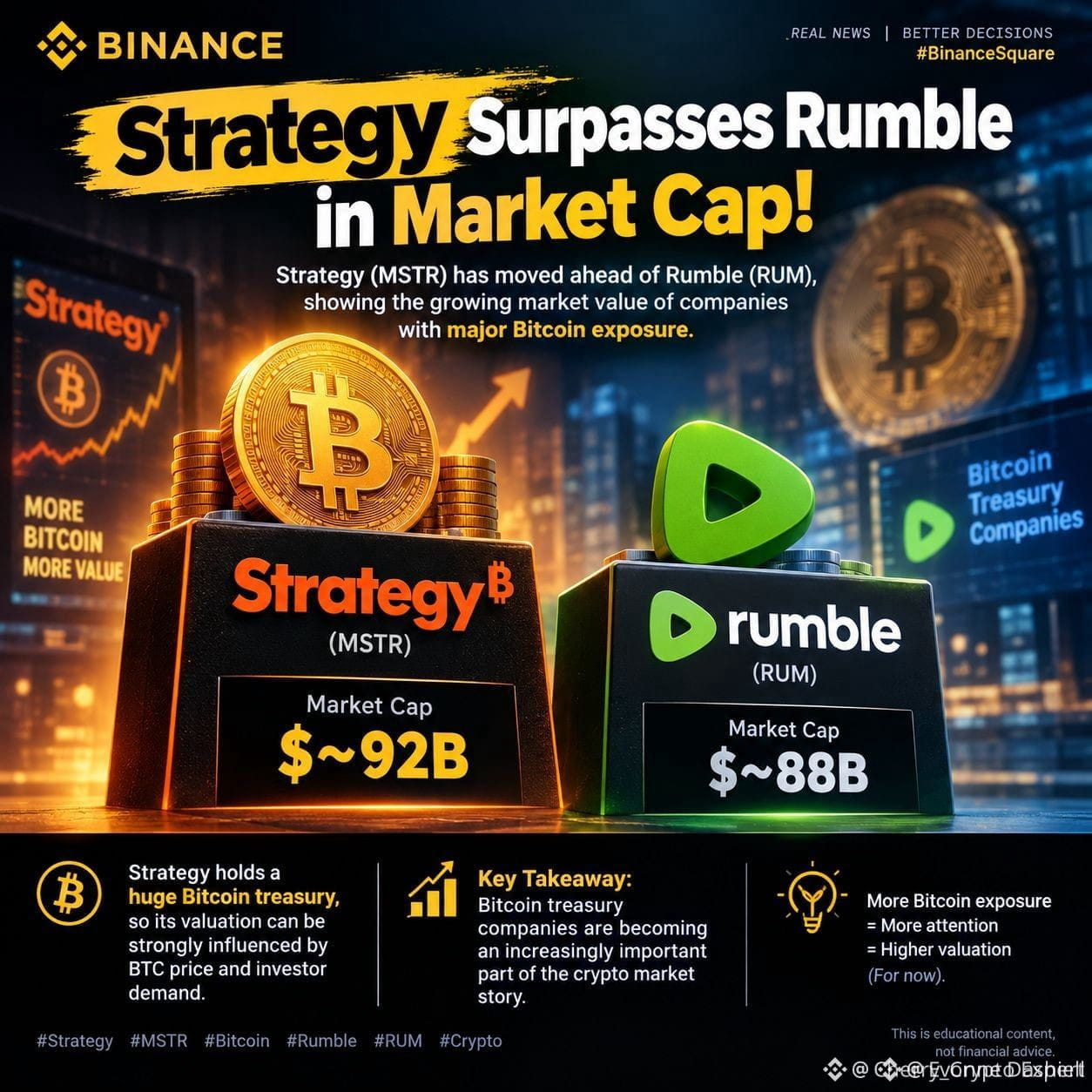
Have you noticed that Strategy's market cap just surpassed Rumble while everyone else is glued to altcoin charts?
Traders keep getting wrecked chasing pumps they can't time. They FOMO buy the latest moves only to watch them reverse without knowing when to exit.
This is a perfect case study in what actually works. Strategy didn't need a flashy product or viral video platform. They just kept stacking $BTC through every cycle and now their valuation has overtaken Rumble.
In a market sitting at 67 on the greed index, everyone is searching $USDT like it's the only safe harbor left. This example shows corporate Bitcoin strategy quietly winning over traditional names.
The mainstream still thinks you need the next big narrative to outperform. They miss that simple accumulation beats most of these rotations. $ETH has been running too, but the real signal sits in these Bitcoin treasury plays.
Where do you think this goes from here?
#StrategyMarketCapSurpassesRumble #ETHUp70 #BitcoinTargets2026OpenAt
Have you noticed that Strategy's market cap just surpassed Rumble while everyone else is glued to altcoin charts?
Traders keep getting wrecked chasing pumps they can't time. They FOMO buy the latest moves only to watch them reverse without knowing when to exit.
This is a perfect case study in what actually works. Strategy didn't need a flashy product or viral video platform. They just kept stacking $BTC through every cycle and now their valuation has overtaken Rumble.
In a market sitting at 67 on the greed index, everyone is searching $USDT like it's the only safe harbor left. This example shows corporate Bitcoin strategy quietly winning over traditional names.
The mainstream still thinks you need the next big narrative to outperform. They miss that simple accumulation beats most of these rotations. $ETH has been running too, but the real signal sits in these Bitcoin treasury plays.
Where do you think this goes from here?
#StrategyMarketCapSurpassesRumble #ETHUp70 #BitcoinTargets2026OpenAt
Traders keep getting wrecked chasing pumps they can't time. They FOMO buy the latest moves only to watch them reverse without knowing when to exit.
This is a perfect case study in what actually works. Strategy didn't need a flashy product or viral video platform. They just kept stacking $BTC through every cycle and now their valuation has overtaken Rumble.
In a market sitting at 67 on the greed index, everyone is searching $USDT like it's the only safe harbor left. This example shows corporate Bitcoin strategy quietly winning over traditional names.
The mainstream still thinks you need the next big narrative to outperform. They miss that simple accumulation beats most of these rotations. $ETH has been running too, but the real signal sits in these Bitcoin treasury plays.
Where do you think this goes from here?
#StrategyMarketCapSurpassesRumble #ETHUp70 #BitcoinTargets2026OpenAt
32
·
--
If you are still evaluating corporate crypto treasuries purely like standard tech stocks, you are making an expensive miscalculation.
Too many investors FOMO into company equities hoping for amplified returns, only to get trapped by massive dilution and premium collapse when market volatility hits. Missing direct asset upside while taking double the downside risk is how retail accounts quietly bleed out.
The milestone of Strategy flipping Rumble in market capitalization highlights the widening divide between conventional digital media plays and aggressive balance-sheet accumulation. While critics argue that buying equity loaded with debt is an unnecessary detour when you can simply hold spot $BTC directly, institutional flow tells a completely different story. Wall Street clearly wants regulated corporate leverage rather than pure custodial holdings, funneling liquidity away from traditional platforms.
Even as liquidity pools in stable assets like $USDT, the macro playbook is shifting toward aggressive treasury reserves. Companies using capital markets to accumulate hard assets are consistently outvaluing businesses that rely strictly on operational cash flow.
Do you prefer holding the underlying asset directly or riding corporate treasury equities for leverage?
#StrategyMarketCapSurpassesRumble #StriveBuys2000BTCFor #BitcoinTargets2026OpenAt
If you are still evaluating corporate crypto treasuries purely like standard tech stocks, you are making an expensive miscalculation.
Too many investors FOMO into company equities hoping for amplified returns, only to get trapped by massive dilution and premium collapse when market volatility hits. Missing direct asset upside while taking double the downside risk is how retail accounts quietly bleed out.
The milestone of Strategy flipping Rumble in market capitalization highlights the widening divide between conventional digital media plays and aggressive balance-sheet accumulation. While critics argue that buying equity loaded with debt is an unnecessary detour when you can simply hold spot $BTC directly, institutional flow tells a completely different story. Wall Street clearly wants regulated corporate leverage rather than pure custodial holdings, funneling liquidity away from traditional platforms.
Even as liquidity pools in stable assets like $USDT, the macro playbook is shifting toward aggressive treasury reserves. Companies using capital markets to accumulate hard assets are consistently outvaluing businesses that rely strictly on operational cash flow.
Do you prefer holding the underlying asset directly or riding corporate treasury equities for leverage?
#StrategyMarketCapSurpassesRumble #StriveBuys2000BTCFor #BitcoinTargets2026OpenAt
Too many investors FOMO into company equities hoping for amplified returns, only to get trapped by massive dilution and premium collapse when market volatility hits. Missing direct asset upside while taking double the downside risk is how retail accounts quietly bleed out.
The milestone of Strategy flipping Rumble in market capitalization highlights the widening divide between conventional digital media plays and aggressive balance-sheet accumulation. While critics argue that buying equity loaded with debt is an unnecessary detour when you can simply hold spot $BTC directly, institutional flow tells a completely different story. Wall Street clearly wants regulated corporate leverage rather than pure custodial holdings, funneling liquidity away from traditional platforms.
Even as liquidity pools in stable assets like $USDT, the macro playbook is shifting toward aggressive treasury reserves. Companies using capital markets to accumulate hard assets are consistently outvaluing businesses that rely strictly on operational cash flow.
Do you prefer holding the underlying asset directly or riding corporate treasury equities for leverage?
#StrategyMarketCapSurpassesRumble #StriveBuys2000BTCFor #BitcoinTargets2026OpenAt

19
·
--
$OPEN is a dead trade until people stop talking about macro targets
Everyone is staring at charts years out instead of trading the range right now
At zero point one two dollars down two percent today the movement is just noise
We sit in the zero point one one to zero point one two channel with thin volume
I am sitting on my hands waiting for a real break before touching $OPEN
A surge past the top of today range without a retrace proves me wrong instantly
Bullish or bearish
#BitcoinTargets2026OpenAt$87570 #OPEN
$OPEN is a dead trade until people stop talking about macro targets
Everyone is staring at charts years out instead of trading the range right now
At zero point one two dollars down two percent today the movement is just noise
We sit in the zero point one one to zero point one two channel with thin volume
I am sitting on my hands waiting for a real break before touching $OPEN
A surge past the top of today range without a retrace proves me wrong instantly
Bullish or bearish
#BitcoinTargets2026OpenAt$87570 #OPEN
Everyone is staring at charts years out instead of trading the range right now
At zero point one two dollars down two percent today the movement is just noise
We sit in the zero point one one to zero point one two channel with thin volume
I am sitting on my hands waiting for a real break before touching $OPEN
A surge past the top of today range without a retrace proves me wrong instantly
Bullish or bearish
#BitcoinTargets2026OpenAt$87570 #OPEN
5

🚀 BTC Future Market — The Next Big Move?
₿ Bitcoin’s next move could define the next chapter of the crypto market.
The future isn’t guaranteed—but one thing is certain: volatility creates opportunities.
📈 If BTC breaks major resistance → bullish momentum could accelerate.
📉 If BTC loses key support → a deeper correction may follow.
Smart traders don’t chase green candles or panic during red candles. They watch market structure, volume, liquidity and momentum before making decisions.
🔥 The real question:
Will Bitcoin surprise the market again?
Stay alert. Do your own research. Never risk more than you can afford to lose.
#bitcoin #BTC #Binance #Crypto#CryptoMarket #BitcoinPrice #BTCUSDT #Trading #CryptoTrading #Web3 #Blockchain #Altcoins #HODL #BitcoinTargets2026OpenAt OpenAt$87570
🚀 BTC Future Market — The Next Big Move?
₿ Bitcoin’s next move could define the next chapter of the crypto market.
The future isn’t guaranteed—but one thing is certain: volatility creates opportunities.
📈 If BTC breaks major resistance → bullish momentum could accelerate.
📉 If BTC loses key support → a deeper correction may follow.
Smart traders don’t chase green candles or panic during red candles. They watch market structure, volume, liquidity and momentum before making decisions.
🔥 The real question:
Will Bitcoin surprise the market again?
Stay alert. Do your own research. Never risk more than you can afford to lose.
#bitcoin #BTC #Binance #Crypto#CryptoMarket #BitcoinPrice #BTCUSDT #Trading #CryptoTrading #Web3 #Blockchain #Altcoins #HODL #BitcoinTargets2026OpenAt OpenAt$87570
₿ Bitcoin’s next move could define the next chapter of the crypto market.
The future isn’t guaranteed—but one thing is certain: volatility creates opportunities.
📈 If BTC breaks major resistance → bullish momentum could accelerate.
📉 If BTC loses key support → a deeper correction may follow.
Smart traders don’t chase green candles or panic during red candles. They watch market structure, volume, liquidity and momentum before making decisions.
🔥 The real question:
Will Bitcoin surprise the market again?
Stay alert. Do your own research. Never risk more than you can afford to lose.
#bitcoin #BTC #Binance #Crypto#CryptoMarket #BitcoinPrice #BTCUSDT #Trading #CryptoTrading #Web3 #Blockchain #Altcoins #HODL #BitcoinTargets2026OpenAt OpenAt$87570

1
140
Binance Lists Four U.S. Stock Perpetual Contracts, Accelerating the Tokenized U.S. Stock Market
I. The Boundary Between Traditional Finance and the Crypto World Is Blurring
In October 2026, Binance announced the launch of four USD-margined perpetual contracts, with StablecoinX (USDE), Viking Therapeutics (VKTX), McDonald’s (MCD), and Akamai (AKAM) as the underlying assets, and leverage of up to 20x. The move marks a key step by the world’s largest crypto exchange into the tokenization of traditional stocks.
VKTX, a biotech stock that has recently attracted attention because of the GLP-1 weight-loss drug sector, is now available as a tokenized contract, allowing retail investors to gain exposure to U.S. stocks around the clock through crypto infrastructure. McDonald’s and Akamai represent the traditional consumer and technology sectors, further expanding Binance’s reach in TradFi. For global investors, this means they are no longer restricted by U.S. stock market trading hours and can take long or short positions in traditional stocks at any time.
II. U.S. Treasury Yields Surge, Putting Pressure on the Crypto Market
Meanwhile, the yield on 10-year U.S. Treasury bonds climbed to nearly 5.35%, a 24-year high, directly triggering selling pressure on risk assets. Spot Bitcoin ETFs recorded net outflows of approximately $89.9 million on October 5, ending a two-day streak of net inflows. Bitcoin fell below the $86,000 level, down approximately 32% from its all-time high of $126,210 set in October 2025.
The surge in Treasury yields is putting the crypto market under pressure in two ways. On the one hand, higher risk-free rates weaken the appeal of non-yielding assets such as Bitcoin. On the other, in a high-yield environment, institutional capital tends to favor fixed-income products, reducing its willingness to allocate to high-risk assets. Market data shows that Bitcoin’s correlation with U.S. stocks has strengthened again, significantly limiting its near-term upside.
III. Regulatory Framework Takes Shape, Accelerating Institutional Adoption
On the regulatory front, the U.S. Commodity Futures Trading Commission proposed a federal registration framework for crypto exchanges, introducing the Regulation CTX and CAM rules to create a voluntary federal registration pathway for crypto exchanges offering retail leverage and margin trading. The measure fills a regulatory gap amid the legislative vacuum left by the failure of the CLARITY Act to pass, signaling a shift by U.S. regulators from a reactive approach to proactively setting rules for the crypto industry.
Meanwhile, the U.S. Securities and Exchange Commission approved six 3x leveraged Bitcoin and Ethereum futures ETFs, signaling growing regulatory openness to leveraged crypto products. The Winklevoss twins also filed an S-1 application with the SEC for a spot Zcash ETF, planning to list it on Nasdaq with a low 0.25% fee and directly challenge the market position of Grayscale’s existing product.
IV. Solana Teams Up with JPMorgan, Bringing On-Chain Settlement into the Institutional Era
The Solana Foundation launched an open-source DvP (delivery-versus-payment) custody program, enabling atomic, second-level on-chain settlement for banks and financial institutions. JPMorgan participated in designing the institutional-grade settlement architecture for the initiative, marking the deep involvement of traditional financial giants in building blockchain infrastructure. The transition from proof of concept to a live production environment means that mainstream financial institutions have recognized the viability of blockchain as the underlying technology for financial settlement.
V. Market Outlook
Overall, the market is caught between traditional finance’s accelerating embrace of crypto infrastructure and ongoing macroeconomic headwinds. Binance’s launch of U.S. stock perpetual contracts and the gradual clarification of regulatory frameworks provide a solid foundation for the industry’s long-term development. In the short term, however, elevated Treasury yields and ETF outflows remain significant concerns. Investors should closely monitor Federal Reserve policy and inflation data, while looking for structural opportunities amid volatility. The expansion of tokenized U.S. stocks could become an important bridge connecting traditional capital markets and the crypto world.
#BinanceLaunchesBinanceIntelligence #BitcoinTargets2026OpenAt$87570 #TokenizedUSStocks
Binance Lists Four U.S. Stock Perpetual Contracts, Accelerating the Tokenized U.S. Stock Market
I. The Boundary Between Traditional Finance and the Crypto World Is Blurring
In October 2026, Binance announced the launch of four USD-margined perpetual contracts, with StablecoinX (USDE), Viking Therapeutics (VKTX), McDonald’s (MCD), and Akamai (AKAM) as the underlying assets, and leverage of up to 20x. The move marks a key step by the world’s largest crypto exchange into the tokenization of traditional stocks.
VKTX, a biotech stock that has recently attracted attention because of the GLP-1 weight-loss drug sector, is now available as a tokenized contract, allowing retail investors to gain exposure to U.S. stocks around the clock through crypto infrastructure. McDonald’s and Akamai represent the traditional consumer and technology sectors, further expanding Binance’s reach in TradFi. For global investors, this means they are no longer restricted by U.S. stock market trading hours and can take long or short positions in traditional stocks at any time.
II. U.S. Treasury Yields Surge, Putting Pressure on the Crypto Market
Meanwhile, the yield on 10-year U.S. Treasury bonds climbed to nearly 5.35%, a 24-year high, directly triggering selling pressure on risk assets. Spot Bitcoin ETFs recorded net outflows of approximately $89.9 million on October 5, ending a two-day streak of net inflows. Bitcoin fell below the $86,000 level, down approximately 32% from its all-time high of $126,210 set in October 2025.
The surge in Treasury yields is putting the crypto market under pressure in two ways. On the one hand, higher risk-free rates weaken the appeal of non-yielding assets such as Bitcoin. On the other, in a high-yield environment, institutional capital tends to favor fixed-income products, reducing its willingness to allocate to high-risk assets. Market data shows that Bitcoin’s correlation with U.S. stocks has strengthened again, significantly limiting its near-term upside.
III. Regulatory Framework Takes Shape, Accelerating Institutional Adoption
On the regulatory front, the U.S. Commodity Futures Trading Commission proposed a federal registration framework for crypto exchanges, introducing the Regulation CTX and CAM rules to create a voluntary federal registration pathway for crypto exchanges offering retail leverage and margin trading. The measure fills a regulatory gap amid the legislative vacuum left by the failure of the CLARITY Act to pass, signaling a shift by U.S. regulators from a reactive approach to proactively setting rules for the crypto industry.
Meanwhile, the U.S. Securities and Exchange Commission approved six 3x leveraged Bitcoin and Ethereum futures ETFs, signaling growing regulatory openness to leveraged crypto products. The Winklevoss twins also filed an S-1 application with the SEC for a spot Zcash ETF, planning to list it on Nasdaq with a low 0.25% fee and directly challenge the market position of Grayscale’s existing product.
IV. Solana Teams Up with JPMorgan, Bringing On-Chain Settlement into the Institutional Era
The Solana Foundation launched an open-source DvP (delivery-versus-payment) custody program, enabling atomic, second-level on-chain settlement for banks and financial institutions. JPMorgan participated in designing the institutional-grade settlement architecture for the initiative, marking the deep involvement of traditional financial giants in building blockchain infrastructure. The transition from proof of concept to a live production environment means that mainstream financial institutions have recognized the viability of blockchain as the underlying technology for financial settlement.
V. Market Outlook
Overall, the market is caught between traditional finance’s accelerating embrace of crypto infrastructure and ongoing macroeconomic headwinds. Binance’s launch of U.S. stock perpetual contracts and the gradual clarification of regulatory frameworks provide a solid foundation for the industry’s long-term development. In the short term, however, elevated Treasury yields and ETF outflows remain significant concerns. Investors should closely monitor Federal Reserve policy and inflation data, while looking for structural opportunities amid volatility. The expansion of tokenized U.S. stocks could become an important bridge connecting traditional capital markets and the crypto world.
#BinanceLaunchesBinanceIntelligence #BitcoinTargets2026OpenAt$87570 #TokenizedUSStocks
I. The Boundary Between Traditional Finance and the Crypto World Is Blurring
In October 2026, Binance announced the launch of four USD-margined perpetual contracts, with StablecoinX (USDE), Viking Therapeutics (VKTX), McDonald’s (MCD), and Akamai (AKAM) as the underlying assets, and leverage of up to 20x. The move marks a key step by the world’s largest crypto exchange into the tokenization of traditional stocks.
VKTX, a biotech stock that has recently attracted attention because of the GLP-1 weight-loss drug sector, is now available as a tokenized contract, allowing retail investors to gain exposure to U.S. stocks around the clock through crypto infrastructure. McDonald’s and Akamai represent the traditional consumer and technology sectors, further expanding Binance’s reach in TradFi. For global investors, this means they are no longer restricted by U.S. stock market trading hours and can take long or short positions in traditional stocks at any time.
II. U.S. Treasury Yields Surge, Putting Pressure on the Crypto Market
Meanwhile, the yield on 10-year U.S. Treasury bonds climbed to nearly 5.35%, a 24-year high, directly triggering selling pressure on risk assets. Spot Bitcoin ETFs recorded net outflows of approximately $89.9 million on October 5, ending a two-day streak of net inflows. Bitcoin fell below the $86,000 level, down approximately 32% from its all-time high of $126,210 set in October 2025.
The surge in Treasury yields is putting the crypto market under pressure in two ways. On the one hand, higher risk-free rates weaken the appeal of non-yielding assets such as Bitcoin. On the other, in a high-yield environment, institutional capital tends to favor fixed-income products, reducing its willingness to allocate to high-risk assets. Market data shows that Bitcoin’s correlation with U.S. stocks has strengthened again, significantly limiting its near-term upside.
III. Regulatory Framework Takes Shape, Accelerating Institutional Adoption
On the regulatory front, the U.S. Commodity Futures Trading Commission proposed a federal registration framework for crypto exchanges, introducing the Regulation CTX and CAM rules to create a voluntary federal registration pathway for crypto exchanges offering retail leverage and margin trading. The measure fills a regulatory gap amid the legislative vacuum left by the failure of the CLARITY Act to pass, signaling a shift by U.S. regulators from a reactive approach to proactively setting rules for the crypto industry.
Meanwhile, the U.S. Securities and Exchange Commission approved six 3x leveraged Bitcoin and Ethereum futures ETFs, signaling growing regulatory openness to leveraged crypto products. The Winklevoss twins also filed an S-1 application with the SEC for a spot Zcash ETF, planning to list it on Nasdaq with a low 0.25% fee and directly challenge the market position of Grayscale’s existing product.
IV. Solana Teams Up with JPMorgan, Bringing On-Chain Settlement into the Institutional Era
The Solana Foundation launched an open-source DvP (delivery-versus-payment) custody program, enabling atomic, second-level on-chain settlement for banks and financial institutions. JPMorgan participated in designing the institutional-grade settlement architecture for the initiative, marking the deep involvement of traditional financial giants in building blockchain infrastructure. The transition from proof of concept to a live production environment means that mainstream financial institutions have recognized the viability of blockchain as the underlying technology for financial settlement.
V. Market Outlook
Overall, the market is caught between traditional finance’s accelerating embrace of crypto infrastructure and ongoing macroeconomic headwinds. Binance’s launch of U.S. stock perpetual contracts and the gradual clarification of regulatory frameworks provide a solid foundation for the industry’s long-term development. In the short term, however, elevated Treasury yields and ETF outflows remain significant concerns. Investors should closely monitor Federal Reserve policy and inflation data, while looking for structural opportunities amid volatility. The expansion of tokenized U.S. stocks could become an important bridge connecting traditional capital markets and the crypto world.
#BinanceLaunchesBinanceIntelligence #BitcoinTargets2026OpenAt$87570 #TokenizedUSStocks
8

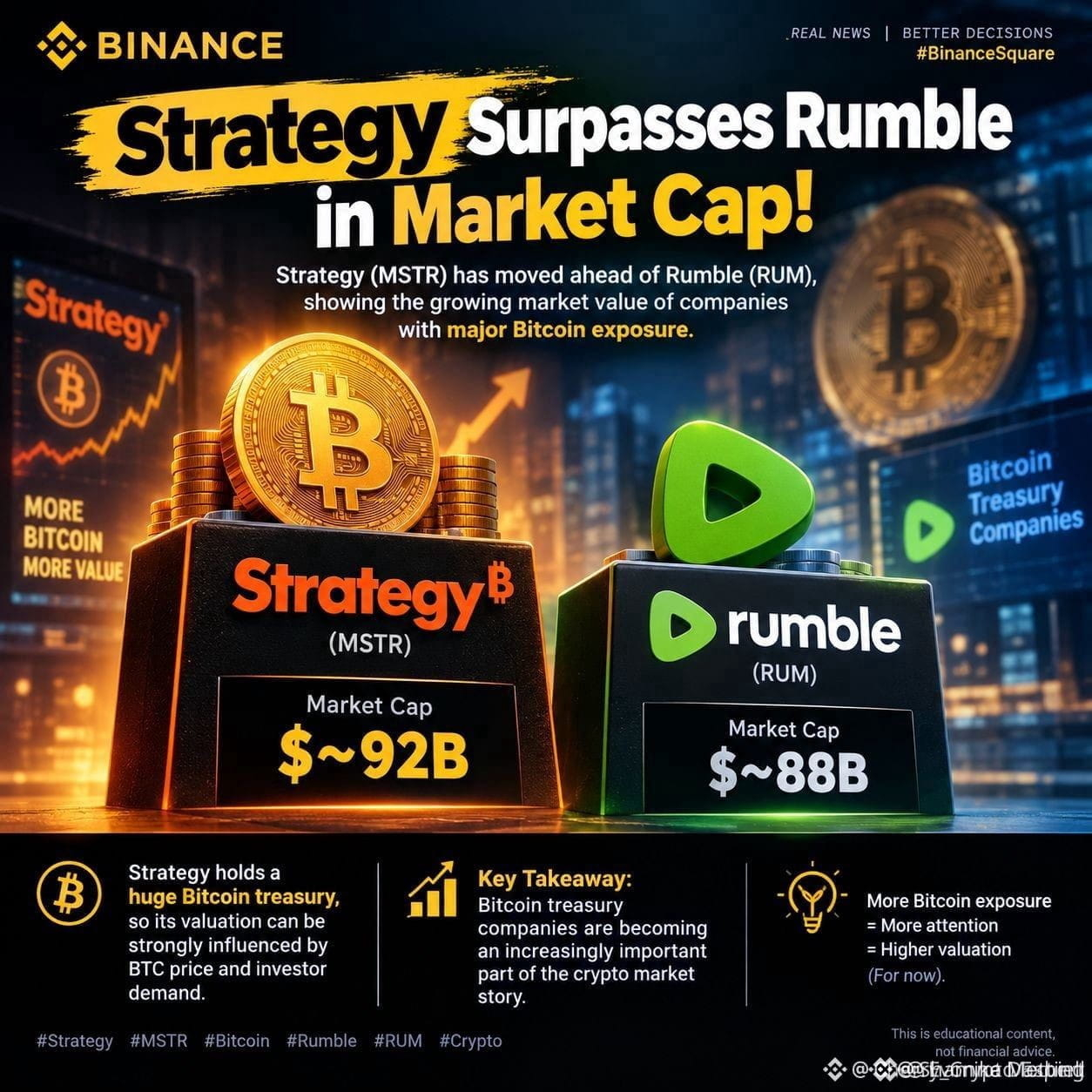
Have you noticed that Strategy’s market cap has just surpassed Rumble’s while everyone is busy watching altcoin charts?
Traders keep taking losses as they chase rallies they can’t time. They buy out of fear of missing the latest moves, then watch them reverse without knowing when to get out.
This is a perfect case study of what actually works. Strategy didn’t need a flashy product or a viral video platform. It simply kept accumulating $BTC through every cycle, and now its valuation has surpassed Rumble’s.
In a market where the Fear and Greed Index is at 67, everyone is looking for $USDT as if it were the only safe haven left. This example shows how companies with a Bitcoin strategy are quietly outperforming traditional names.
The mainstream still thinks you need the next big narrative to outperform the market. They don’t realize that simple accumulation beats most of this asset-hopping. $ETH keeps rising too, but the real signal lies in these Bitcoin treasury investments.
Where do you think things will go from here?
Please follow
#StrategyMarketCapSurpassesRumble #ETHUp70 #BitcoinTargets2026OpenAt
Have you noticed that Strategy’s market cap has just surpassed Rumble’s while everyone is busy watching altcoin charts?
Traders keep taking losses as they chase rallies they can’t time. They buy out of fear of missing the latest moves, then watch them reverse without knowing when to get out.
This is a perfect case study of what actually works. Strategy didn’t need a flashy product or a viral video platform. It simply kept accumulating $BTC through every cycle, and now its valuation has surpassed Rumble’s.
In a market where the Fear and Greed Index is at 67, everyone is looking for $USDT as if it were the only safe haven left. This example shows how companies with a Bitcoin strategy are quietly outperforming traditional names.
The mainstream still thinks you need the next big narrative to outperform the market. They don’t realize that simple accumulation beats most of this asset-hopping. $ETH keeps rising too, but the real signal lies in these Bitcoin treasury investments.
Where do you think things will go from here?
Please follow
#StrategyMarketCapSurpassesRumble #ETHUp70 #BitcoinTargets2026OpenAt
Traders keep taking losses as they chase rallies they can’t time. They buy out of fear of missing the latest moves, then watch them reverse without knowing when to get out.
This is a perfect case study of what actually works. Strategy didn’t need a flashy product or a viral video platform. It simply kept accumulating $BTC through every cycle, and now its valuation has surpassed Rumble’s.
In a market where the Fear and Greed Index is at 67, everyone is looking for $USDT as if it were the only safe haven left. This example shows how companies with a Bitcoin strategy are quietly outperforming traditional names.
The mainstream still thinks you need the next big narrative to outperform the market. They don’t realize that simple accumulation beats most of this asset-hopping. $ETH keeps rising too, but the real signal lies in these Bitcoin treasury investments.
Where do you think things will go from here?
Please follow
#StrategyMarketCapSurpassesRumble #ETHUp70 #BitcoinTargets2026OpenAt
27
The Deep Integration of U.S. Stocks and Crypto Markets Is Accelerating: Binance Launches U.S. Stock Perpetual Contracts, SEC Approves 3x Leveraged Crypto ETFs
I. Binance Launches Four U.S. Stock Perpetual Contracts, Further Upgrading the Bridge Between TradFi and Crypto
Binance recently announced the launch of four USDT-margined perpetual contracts covering the stablecoin yield token USDE, biotechnology stock Viking Therapeutics (VKTX), fast-food giant McDonald’s (MCD), and cloud computing company Akamai (AKAM), with leverage of up to 20x. The move marks an important step toward deeper integration between traditional U.S. stock assets and crypto trading infrastructure.
In the past, retail investors seeking exposure to U.S. stocks had to trade through traditional brokerages during market hours. Now, Binance’s perpetual contracts let users trade assets linked to U.S. stocks around the clock, without being limited by the New York Stock Exchange’s opening hours. For investors in Asian and European time zones, this means greater flexibility and more trading opportunities.
Strategically, Binance is systematically building a comprehensive derivatives platform spanning cryptocurrencies, commodities, and U.S. stock indices. This direction aligns with the global trend among exchanges to break down barriers between asset classes and offer users a one-stop trading experience.
II. SEC Approves 3x Leveraged Bitcoin and Ethereum ETFs, Signaling a Clear Shift in Regulatory Attitudes
On October 2, the U.S. Securities and Exchange Commission approved six 3x leveraged ETFs, including products tracking Bitcoin and Ethereum. This marks the first time U.S. crypto funds have exceeded the 2x leverage limit, making it a milestone development.
Although these products still need to await effective registration statements before they can begin trading, the approval itself sends a clear signal: U.S. regulators are becoming more receptive to leveraged exposure to crypto assets. The market had generally viewed the SEC as cautious toward highly leveraged crypto products, and this approval has upended that expectation.
Notably, approval of 3x leveraged ETFs also means that both institutional and retail investors can gain amplified exposure to crypto assets through traditional financial products, further advancing the institutionalization of the crypto market.
III. Bitcoin ETFs See Outflows as Rising Treasury Yields Weigh on Risk Appetite
Despite a steady stream of regulatory tailwinds, U.S. spot Bitcoin ETFs recorded net outflows of approximately $89.9 million on October 5, ending a two-day run of net inflows. Among all the products, only BlackRock’s IBIT continued to see net inflows.
Bitcoin fluctuated around $86,000, still 32% below its all-time high of $126,210 set last year. The main macroeconomic factor behind this was the U.S. 10-year Treasury yield climbing to around 5.35%, a 24-year high. The high-interest-rate environment has significantly diminished the appeal of risk assets.
However, corporate buying continues. Companies such as Strategy and Strive are continuing to increase their Bitcoin holdings, showing that long-term holders’ confidence in crypto assets’ fundamentals remains intact. The divergence between short-term fund flows and long-term holdings reflects the market’s competing forces across different time horizons.
IV. The Tokenized U.S. Stock Ecosystem Continues to Expand, with On-Chain Trading Emerging as a New Trend
The range of tokenized U.S. stock products on Binance’s Web3 platform continues to grow. Available tokenized assets include the Emerging Markets ETF (EEM), Moderna (MRNA), Lincoln Electric (LIN), and several others, spanning stocks, ETFs, and other categories.
The key advantage of tokenized U.S. stocks is that they map the rights associated with traditional securities onto a blockchain, enabling around-the-clock trading, instant settlement, and global accessibility. For investors in emerging markets, this means they can gain exposure to U.S. stocks without opening an account with a U.S. brokerage, substantially lowering the barrier to entry.
Meanwhile, the DvP settlement tool launched by the Solana Foundation has received support from JPMorgan. This open-source atomic settlement program allows banks, custodians, and exchanges to complete securities settlement in seconds, providing a standardized solution for traditional financial institutions to connect to blockchain infrastructure.
V. Regulatory Easing and Framework Development Proceed in Parallel, Opening a Policy Window for the Crypto Industry
The U.S. Financial Crimes Enforcement Network (FinCEN) recently withdrew two long-pending crypto regulatory proposals, including recordkeeping requirements for transfers involving self-hosted wallets and restrictions on mixing services. The decision reflects the current U.S. government’s broader push toward regulatory easing.
Meanwhile, the Commodity Futures Trading Commission (CFTC) has proposed a federal framework for regulating crypto exchanges, seeking to oversee leveraged and margin crypto trading within its existing authority. However, spot markets are excluded, and without support from congressional legislation, the CFTC cannot require crypto assets to be traded exclusively on registered platforms.
Overall, U.S. crypto regulation is currently characterized by a combination of easing restrictions and building institutions. On the one hand, excessively stringent proposals are being withdrawn, reducing the industry’s compliance burden. On the other, new regulatory frameworks are gradually taking shape, providing institutional safeguards for the market’s long-term, healthy development.
#BinanceLaunchesBinanceIntelligence #BitcoinTargets2026OpenAt$87570 #TokenizedUSStocks
The Deep Integration of U.S. Stocks and Crypto Markets Is Accelerating: Binance Launches U.S. Stock Perpetual Contracts, SEC Approves 3x Leveraged Crypto ETFs
I. Binance Launches Four U.S. Stock Perpetual Contracts, Further Upgrading the Bridge Between TradFi and Crypto
Binance recently announced the launch of four USDT-margined perpetual contracts covering the stablecoin yield token USDE, biotechnology stock Viking Therapeutics (VKTX), fast-food giant McDonald’s (MCD), and cloud computing company Akamai (AKAM), with leverage of up to 20x. The move marks an important step toward deeper integration between traditional U.S. stock assets and crypto trading infrastructure.
In the past, retail investors seeking exposure to U.S. stocks had to trade through traditional brokerages during market hours. Now, Binance’s perpetual contracts let users trade assets linked to U.S. stocks around the clock, without being limited by the New York Stock Exchange’s opening hours. For investors in Asian and European time zones, this means greater flexibility and more trading opportunities.
Strategically, Binance is systematically building a comprehensive derivatives platform spanning cryptocurrencies, commodities, and U.S. stock indices. This direction aligns with the global trend among exchanges to break down barriers between asset classes and offer users a one-stop trading experience.
II. SEC Approves 3x Leveraged Bitcoin and Ethereum ETFs, Signaling a Clear Shift in Regulatory Attitudes
On October 2, the U.S. Securities and Exchange Commission approved six 3x leveraged ETFs, including products tracking Bitcoin and Ethereum. This marks the first time U.S. crypto funds have exceeded the 2x leverage limit, making it a milestone development.
Although these products still need to await effective registration statements before they can begin trading, the approval itself sends a clear signal: U.S. regulators are becoming more receptive to leveraged exposure to crypto assets. The market had generally viewed the SEC as cautious toward highly leveraged crypto products, and this approval has upended that expectation.
Notably, approval of 3x leveraged ETFs also means that both institutional and retail investors can gain amplified exposure to crypto assets through traditional financial products, further advancing the institutionalization of the crypto market.
III. Bitcoin ETFs See Outflows as Rising Treasury Yields Weigh on Risk Appetite
Despite a steady stream of regulatory tailwinds, U.S. spot Bitcoin ETFs recorded net outflows of approximately $89.9 million on October 5, ending a two-day run of net inflows. Among all the products, only BlackRock’s IBIT continued to see net inflows.
Bitcoin fluctuated around $86,000, still 32% below its all-time high of $126,210 set last year. The main macroeconomic factor behind this was the U.S. 10-year Treasury yield climbing to around 5.35%, a 24-year high. The high-interest-rate environment has significantly diminished the appeal of risk assets.
However, corporate buying continues. Companies such as Strategy and Strive are continuing to increase their Bitcoin holdings, showing that long-term holders’ confidence in crypto assets’ fundamentals remains intact. The divergence between short-term fund flows and long-term holdings reflects the market’s competing forces across different time horizons.
IV. The Tokenized U.S. Stock Ecosystem Continues to Expand, with On-Chain Trading Emerging as a New Trend
The range of tokenized U.S. stock products on Binance’s Web3 platform continues to grow. Available tokenized assets include the Emerging Markets ETF (EEM), Moderna (MRNA), Lincoln Electric (LIN), and several others, spanning stocks, ETFs, and other categories.
The key advantage of tokenized U.S. stocks is that they map the rights associated with traditional securities onto a blockchain, enabling around-the-clock trading, instant settlement, and global accessibility. For investors in emerging markets, this means they can gain exposure to U.S. stocks without opening an account with a U.S. brokerage, substantially lowering the barrier to entry.
Meanwhile, the DvP settlement tool launched by the Solana Foundation has received support from JPMorgan. This open-source atomic settlement program allows banks, custodians, and exchanges to complete securities settlement in seconds, providing a standardized solution for traditional financial institutions to connect to blockchain infrastructure.
V. Regulatory Easing and Framework Development Proceed in Parallel, Opening a Policy Window for the Crypto Industry
The U.S. Financial Crimes Enforcement Network (FinCEN) recently withdrew two long-pending crypto regulatory proposals, including recordkeeping requirements for transfers involving self-hosted wallets and restrictions on mixing services. The decision reflects the current U.S. government’s broader push toward regulatory easing.
Meanwhile, the Commodity Futures Trading Commission (CFTC) has proposed a federal framework for regulating crypto exchanges, seeking to oversee leveraged and margin crypto trading within its existing authority. However, spot markets are excluded, and without support from congressional legislation, the CFTC cannot require crypto assets to be traded exclusively on registered platforms.
Overall, U.S. crypto regulation is currently characterized by a combination of easing restrictions and building institutions. On the one hand, excessively stringent proposals are being withdrawn, reducing the industry’s compliance burden. On the other, new regulatory frameworks are gradually taking shape, providing institutional safeguards for the market’s long-term, healthy development.
#BinanceLaunchesBinanceIntelligence #BitcoinTargets2026OpenAt$87570 #TokenizedUSStocks
I. Binance Launches Four U.S. Stock Perpetual Contracts, Further Upgrading the Bridge Between TradFi and Crypto
Binance recently announced the launch of four USDT-margined perpetual contracts covering the stablecoin yield token USDE, biotechnology stock Viking Therapeutics (VKTX), fast-food giant McDonald’s (MCD), and cloud computing company Akamai (AKAM), with leverage of up to 20x. The move marks an important step toward deeper integration between traditional U.S. stock assets and crypto trading infrastructure.
In the past, retail investors seeking exposure to U.S. stocks had to trade through traditional brokerages during market hours. Now, Binance’s perpetual contracts let users trade assets linked to U.S. stocks around the clock, without being limited by the New York Stock Exchange’s opening hours. For investors in Asian and European time zones, this means greater flexibility and more trading opportunities.
Strategically, Binance is systematically building a comprehensive derivatives platform spanning cryptocurrencies, commodities, and U.S. stock indices. This direction aligns with the global trend among exchanges to break down barriers between asset classes and offer users a one-stop trading experience.
II. SEC Approves 3x Leveraged Bitcoin and Ethereum ETFs, Signaling a Clear Shift in Regulatory Attitudes
On October 2, the U.S. Securities and Exchange Commission approved six 3x leveraged ETFs, including products tracking Bitcoin and Ethereum. This marks the first time U.S. crypto funds have exceeded the 2x leverage limit, making it a milestone development.
Although these products still need to await effective registration statements before they can begin trading, the approval itself sends a clear signal: U.S. regulators are becoming more receptive to leveraged exposure to crypto assets. The market had generally viewed the SEC as cautious toward highly leveraged crypto products, and this approval has upended that expectation.
Notably, approval of 3x leveraged ETFs also means that both institutional and retail investors can gain amplified exposure to crypto assets through traditional financial products, further advancing the institutionalization of the crypto market.
III. Bitcoin ETFs See Outflows as Rising Treasury Yields Weigh on Risk Appetite
Despite a steady stream of regulatory tailwinds, U.S. spot Bitcoin ETFs recorded net outflows of approximately $89.9 million on October 5, ending a two-day run of net inflows. Among all the products, only BlackRock’s IBIT continued to see net inflows.
Bitcoin fluctuated around $86,000, still 32% below its all-time high of $126,210 set last year. The main macroeconomic factor behind this was the U.S. 10-year Treasury yield climbing to around 5.35%, a 24-year high. The high-interest-rate environment has significantly diminished the appeal of risk assets.
However, corporate buying continues. Companies such as Strategy and Strive are continuing to increase their Bitcoin holdings, showing that long-term holders’ confidence in crypto assets’ fundamentals remains intact. The divergence between short-term fund flows and long-term holdings reflects the market’s competing forces across different time horizons.
IV. The Tokenized U.S. Stock Ecosystem Continues to Expand, with On-Chain Trading Emerging as a New Trend
The range of tokenized U.S. stock products on Binance’s Web3 platform continues to grow. Available tokenized assets include the Emerging Markets ETF (EEM), Moderna (MRNA), Lincoln Electric (LIN), and several others, spanning stocks, ETFs, and other categories.
The key advantage of tokenized U.S. stocks is that they map the rights associated with traditional securities onto a blockchain, enabling around-the-clock trading, instant settlement, and global accessibility. For investors in emerging markets, this means they can gain exposure to U.S. stocks without opening an account with a U.S. brokerage, substantially lowering the barrier to entry.
Meanwhile, the DvP settlement tool launched by the Solana Foundation has received support from JPMorgan. This open-source atomic settlement program allows banks, custodians, and exchanges to complete securities settlement in seconds, providing a standardized solution for traditional financial institutions to connect to blockchain infrastructure.
V. Regulatory Easing and Framework Development Proceed in Parallel, Opening a Policy Window for the Crypto Industry
The U.S. Financial Crimes Enforcement Network (FinCEN) recently withdrew two long-pending crypto regulatory proposals, including recordkeeping requirements for transfers involving self-hosted wallets and restrictions on mixing services. The decision reflects the current U.S. government’s broader push toward regulatory easing.
Meanwhile, the Commodity Futures Trading Commission (CFTC) has proposed a federal framework for regulating crypto exchanges, seeking to oversee leveraged and margin crypto trading within its existing authority. However, spot markets are excluded, and without support from congressional legislation, the CFTC cannot require crypto assets to be traded exclusively on registered platforms.
Overall, U.S. crypto regulation is currently characterized by a combination of easing restrictions and building institutions. On the one hand, excessively stringent proposals are being withdrawn, reducing the industry’s compliance burden. On the other, new regulatory frameworks are gradually taking shape, providing institutional safeguards for the market’s long-term, healthy development.
#BinanceLaunchesBinanceIntelligence #BitcoinTargets2026OpenAt$87570 #TokenizedUSStocks
138
AI and Crypto Deeply Converge: Binance Intelligence Launch Leads Industry Transformation, Tokenized U.S. Stocks Gain Wider Reach
I. AI Trading Tools Move Into Full-Scale Use, Bringing the Crypto Industry Into a New Era of Intelligence
In October 2026, Binance, the world’s leading crypto asset trading platform, officially launched Binance Intelligence, a new suite of AI products. The launch marks the beginning of a substantive phase in the deep integration of the crypto industry and artificial intelligence. The suite includes three core products: Binance AI, available free to all users; Binance AI Pro, which can turn natural language into executable strategies; and Binance Agent OS, designed specifically for developers.
The launch of this product lineup is a milestone. Binance AI combines chart analysis, news, social data, on-chain analytics, and research tools, providing traders with one-stop support for intelligent decision-making through a generative user interface. Binance AI Pro goes a step further: users can simply describe a trading idea in natural language, and the system will automatically generate an executable trading strategy, significantly lowering the technical barrier to quantitative trading. For developers, Binance Agent OS provides the infrastructure for building AI applications and could give rise to a wave of innovative crypto AI applications.
Market reaction has been strong. The topic BinanceLaunchesBinanceIntelligence quickly gained traction on Square, generating more than 3,100 posts and surpassing 410,000 views, reflecting users’ keen interest in AI trading tools. As the crypto market grows increasingly complex, wider adoption of AI tools will help everyday investors better navigate market volatility and make more rational investment decisions.
II. Tokenized U.S. Stocks Continue to Expand, Accelerating the Blurring of Boundaries Between Traditional Finance and Crypto
At the same time, Binance has taken an important step forward in tokenized U.S. stocks. The platform has added four U.S. stock perpetual contracts: Viking Therapeutics (VKTX), McDonald’s (MCD), Akamai (AKAM), and StablecoinX (USDE), with leverage of up to 20x. This means crypto users around the world can now gain exposure to traditional U.S. stock assets around the clock through crypto infrastructure.
The rapid development of tokenized U.S. stocks is reshaping the investment landscape. The traditional U.S. stock market is constrained by trading hours, geographic restrictions, and account-opening requirements, making it difficult for many global investors to participate conveniently. Tokenization maps U.S. stock assets onto the blockchain, enabling 24/7 trading, global access, and lower barriers to entry. On-chain data shows that multiple tokenized U.S. stocks, including Moderna (MRNA) and Linde (LIN), are already circulating on-chain, spanning traditional sectors such as pharmaceuticals and industrials.
Notably, trading activity in tokenized U.S. stock perpetual contracts is also rising rapidly. Data shows that trading volumes for related pairs continue to grow, reflecting strong market acceptance of these innovative products. The boundaries between traditional finance and the crypto world are blurring at an accelerating pace, and future investment markets will place greater emphasis on asset liquidity and accessibility.
III. Regulatory Environment Continues to Improve, Creating Historic Opportunities for the Crypto Industry
Alongside product and technological innovation, the U.S. regulatory environment is also changing in a positive direction. The U.S. Securities and Exchange Commission (SEC) recently approved the first three leveraged Bitcoin and Ethereum ETFs, marking the first time U.S. crypto funds have exceeded the 2x leverage cap and signaling regulators’ growing openness to crypto assets. Although the products must still complete registration procedures before officially launching, this approval will undoubtedly attract more institutional investors to the crypto market, potentially driving up derivatives trading volumes and market volatility.
More broadly, the U.S. Financial Crimes Enforcement Network (FinCEN) formally withdrew two long-pending crypto regulatory proposals: the 2020 reporting rule for non-custodial wallets and the 2023 special measures concerning crypto mixers. This regulatory easing reduces the compliance burden on self-custody users and DeFi protocols, and reflects the current government’s policy direction toward deregulating digital assets.
In addition, the U.S. Commodity Futures Trading Commission (CFTC) has begun a formal rulemaking process for crypto markets, proposing the Regulation CTX and CAM frameworks to create a federal registration pathway for crypto exchanges. Together, these regulatory developments create a favorable environment for the crypto industry and lay the institutional groundwork for future innovation and growth.
IV. Market Outlook: A New Paradigm for Crypto Investing, Driven by AI
Taken together, the launch of Binance Intelligence, the expansion of tokenized U.S. stocks, and the improving regulatory environment paint a new picture of the crypto industry’s development. The deep application of AI is changing how people trade, enabling more investors to make better decisions with the help of intelligent tools. Tokenization is breaking down the barriers of traditional finance, making global asset investing more convenient and efficient. Meanwhile, gradually clarifying regulations provide support for the industry’s long-term, healthy development.
Looking ahead, there is good reason to believe that the convergence of AI and crypto will give rise to more innovative products and business models. From intelligent trading strategies to automated risk management, and from tokenized assets to decentralized finance, the crypto industry is undergoing profound change. For investors, embracing these changes and actively learning to use new tools and acquire new knowledge will be key to staying competitive in this rapidly evolving market.
#BinanceLaunchesBinanceIntelligence #BitcoinTargets2026OpenAt$87570 #TokenizedUSStocks
AI and Crypto Deeply Converge: Binance Intelligence Launch Leads Industry Transformation, Tokenized U.S. Stocks Gain Wider Reach
I. AI Trading Tools Move Into Full-Scale Use, Bringing the Crypto Industry Into a New Era of Intelligence
In October 2026, Binance, the world’s leading crypto asset trading platform, officially launched Binance Intelligence, a new suite of AI products. The launch marks the beginning of a substantive phase in the deep integration of the crypto industry and artificial intelligence. The suite includes three core products: Binance AI, available free to all users; Binance AI Pro, which can turn natural language into executable strategies; and Binance Agent OS, designed specifically for developers.
The launch of this product lineup is a milestone. Binance AI combines chart analysis, news, social data, on-chain analytics, and research tools, providing traders with one-stop support for intelligent decision-making through a generative user interface. Binance AI Pro goes a step further: users can simply describe a trading idea in natural language, and the system will automatically generate an executable trading strategy, significantly lowering the technical barrier to quantitative trading. For developers, Binance Agent OS provides the infrastructure for building AI applications and could give rise to a wave of innovative crypto AI applications.
Market reaction has been strong. The topic BinanceLaunchesBinanceIntelligence quickly gained traction on Square, generating more than 3,100 posts and surpassing 410,000 views, reflecting users’ keen interest in AI trading tools. As the crypto market grows increasingly complex, wider adoption of AI tools will help everyday investors better navigate market volatility and make more rational investment decisions.
II. Tokenized U.S. Stocks Continue to Expand, Accelerating the Blurring of Boundaries Between Traditional Finance and Crypto
At the same time, Binance has taken an important step forward in tokenized U.S. stocks. The platform has added four U.S. stock perpetual contracts: Viking Therapeutics (VKTX), McDonald’s (MCD), Akamai (AKAM), and StablecoinX (USDE), with leverage of up to 20x. This means crypto users around the world can now gain exposure to traditional U.S. stock assets around the clock through crypto infrastructure.
The rapid development of tokenized U.S. stocks is reshaping the investment landscape. The traditional U.S. stock market is constrained by trading hours, geographic restrictions, and account-opening requirements, making it difficult for many global investors to participate conveniently. Tokenization maps U.S. stock assets onto the blockchain, enabling 24/7 trading, global access, and lower barriers to entry. On-chain data shows that multiple tokenized U.S. stocks, including Moderna (MRNA) and Linde (LIN), are already circulating on-chain, spanning traditional sectors such as pharmaceuticals and industrials.
Notably, trading activity in tokenized U.S. stock perpetual contracts is also rising rapidly. Data shows that trading volumes for related pairs continue to grow, reflecting strong market acceptance of these innovative products. The boundaries between traditional finance and the crypto world are blurring at an accelerating pace, and future investment markets will place greater emphasis on asset liquidity and accessibility.
III. Regulatory Environment Continues to Improve, Creating Historic Opportunities for the Crypto Industry
Alongside product and technological innovation, the U.S. regulatory environment is also changing in a positive direction. The U.S. Securities and Exchange Commission (SEC) recently approved the first three leveraged Bitcoin and Ethereum ETFs, marking the first time U.S. crypto funds have exceeded the 2x leverage cap and signaling regulators’ growing openness to crypto assets. Although the products must still complete registration procedures before officially launching, this approval will undoubtedly attract more institutional investors to the crypto market, potentially driving up derivatives trading volumes and market volatility.
More broadly, the U.S. Financial Crimes Enforcement Network (FinCEN) formally withdrew two long-pending crypto regulatory proposals: the 2020 reporting rule for non-custodial wallets and the 2023 special measures concerning crypto mixers. This regulatory easing reduces the compliance burden on self-custody users and DeFi protocols, and reflects the current government’s policy direction toward deregulating digital assets.
In addition, the U.S. Commodity Futures Trading Commission (CFTC) has begun a formal rulemaking process for crypto markets, proposing the Regulation CTX and CAM frameworks to create a federal registration pathway for crypto exchanges. Together, these regulatory developments create a favorable environment for the crypto industry and lay the institutional groundwork for future innovation and growth.
IV. Market Outlook: A New Paradigm for Crypto Investing, Driven by AI
Taken together, the launch of Binance Intelligence, the expansion of tokenized U.S. stocks, and the improving regulatory environment paint a new picture of the crypto industry’s development. The deep application of AI is changing how people trade, enabling more investors to make better decisions with the help of intelligent tools. Tokenization is breaking down the barriers of traditional finance, making global asset investing more convenient and efficient. Meanwhile, gradually clarifying regulations provide support for the industry’s long-term, healthy development.
Looking ahead, there is good reason to believe that the convergence of AI and crypto will give rise to more innovative products and business models. From intelligent trading strategies to automated risk management, and from tokenized assets to decentralized finance, the crypto industry is undergoing profound change. For investors, embracing these changes and actively learning to use new tools and acquire new knowledge will be key to staying competitive in this rapidly evolving market.
#BinanceLaunchesBinanceIntelligence #BitcoinTargets2026OpenAt$87570 #TokenizedUSStocks
I. AI Trading Tools Move Into Full-Scale Use, Bringing the Crypto Industry Into a New Era of Intelligence
In October 2026, Binance, the world’s leading crypto asset trading platform, officially launched Binance Intelligence, a new suite of AI products. The launch marks the beginning of a substantive phase in the deep integration of the crypto industry and artificial intelligence. The suite includes three core products: Binance AI, available free to all users; Binance AI Pro, which can turn natural language into executable strategies; and Binance Agent OS, designed specifically for developers.
The launch of this product lineup is a milestone. Binance AI combines chart analysis, news, social data, on-chain analytics, and research tools, providing traders with one-stop support for intelligent decision-making through a generative user interface. Binance AI Pro goes a step further: users can simply describe a trading idea in natural language, and the system will automatically generate an executable trading strategy, significantly lowering the technical barrier to quantitative trading. For developers, Binance Agent OS provides the infrastructure for building AI applications and could give rise to a wave of innovative crypto AI applications.
Market reaction has been strong. The topic BinanceLaunchesBinanceIntelligence quickly gained traction on Square, generating more than 3,100 posts and surpassing 410,000 views, reflecting users’ keen interest in AI trading tools. As the crypto market grows increasingly complex, wider adoption of AI tools will help everyday investors better navigate market volatility and make more rational investment decisions.
II. Tokenized U.S. Stocks Continue to Expand, Accelerating the Blurring of Boundaries Between Traditional Finance and Crypto
At the same time, Binance has taken an important step forward in tokenized U.S. stocks. The platform has added four U.S. stock perpetual contracts: Viking Therapeutics (VKTX), McDonald’s (MCD), Akamai (AKAM), and StablecoinX (USDE), with leverage of up to 20x. This means crypto users around the world can now gain exposure to traditional U.S. stock assets around the clock through crypto infrastructure.
The rapid development of tokenized U.S. stocks is reshaping the investment landscape. The traditional U.S. stock market is constrained by trading hours, geographic restrictions, and account-opening requirements, making it difficult for many global investors to participate conveniently. Tokenization maps U.S. stock assets onto the blockchain, enabling 24/7 trading, global access, and lower barriers to entry. On-chain data shows that multiple tokenized U.S. stocks, including Moderna (MRNA) and Linde (LIN), are already circulating on-chain, spanning traditional sectors such as pharmaceuticals and industrials.
Notably, trading activity in tokenized U.S. stock perpetual contracts is also rising rapidly. Data shows that trading volumes for related pairs continue to grow, reflecting strong market acceptance of these innovative products. The boundaries between traditional finance and the crypto world are blurring at an accelerating pace, and future investment markets will place greater emphasis on asset liquidity and accessibility.
III. Regulatory Environment Continues to Improve, Creating Historic Opportunities for the Crypto Industry
Alongside product and technological innovation, the U.S. regulatory environment is also changing in a positive direction. The U.S. Securities and Exchange Commission (SEC) recently approved the first three leveraged Bitcoin and Ethereum ETFs, marking the first time U.S. crypto funds have exceeded the 2x leverage cap and signaling regulators’ growing openness to crypto assets. Although the products must still complete registration procedures before officially launching, this approval will undoubtedly attract more institutional investors to the crypto market, potentially driving up derivatives trading volumes and market volatility.
More broadly, the U.S. Financial Crimes Enforcement Network (FinCEN) formally withdrew two long-pending crypto regulatory proposals: the 2020 reporting rule for non-custodial wallets and the 2023 special measures concerning crypto mixers. This regulatory easing reduces the compliance burden on self-custody users and DeFi protocols, and reflects the current government’s policy direction toward deregulating digital assets.
In addition, the U.S. Commodity Futures Trading Commission (CFTC) has begun a formal rulemaking process for crypto markets, proposing the Regulation CTX and CAM frameworks to create a federal registration pathway for crypto exchanges. Together, these regulatory developments create a favorable environment for the crypto industry and lay the institutional groundwork for future innovation and growth.
IV. Market Outlook: A New Paradigm for Crypto Investing, Driven by AI
Taken together, the launch of Binance Intelligence, the expansion of tokenized U.S. stocks, and the improving regulatory environment paint a new picture of the crypto industry’s development. The deep application of AI is changing how people trade, enabling more investors to make better decisions with the help of intelligent tools. Tokenization is breaking down the barriers of traditional finance, making global asset investing more convenient and efficient. Meanwhile, gradually clarifying regulations provide support for the industry’s long-term, healthy development.
Looking ahead, there is good reason to believe that the convergence of AI and crypto will give rise to more innovative products and business models. From intelligent trading strategies to automated risk management, and from tokenized assets to decentralized finance, the crypto industry is undergoing profound change. For investors, embracing these changes and actively learning to use new tools and acquire new knowledge will be key to staying competitive in this rapidly evolving market.
#BinanceLaunchesBinanceIntelligence #BitcoinTargets2026OpenAt$87570 #TokenizedUSStocks
9
Binance Launches AI Suite, Crypto Regulations See Major Easing, Tokenized US Stocks Become the Next Big Trend
October 6, 2026 — The global cryptocurrency market is seeing a wave of positive developments. From the full rollout of AI trading tools, to a shift in US regulators’ attitudes toward the crypto industry, to growing interest in tokenized US stocks, a series of major announcements is reshaping the industry. This article takes an in-depth look at current market developments from three perspectives.
I. Binance Intelligence Suite Goes Live, Bringing AI Trading to the Masses
Binance has officially launched an AI product suite called Binance Intelligence, featuring three core tools. First is Binance AI, available free to all users, giving everyday investors access to intelligent analysis. Next is Binance AI Pro, which can turn natural language directly into actionable trading strategies, significantly lowering the barrier to quantitative trading. Third is Binance Agent OS, an infrastructure platform that enables developers to build AI applications.
The suite brings together chart analysis, news, social data, on-chain analytics, and research tools, offering users a one-stop intelligent trading experience through a generative interface. Data from Binance Square shows that the related topic BinanceLaunchesBinanceIntelligence received more than 280,000 views and 2,300 mentions in a short time, demonstrating strong market interest in AI trading tools.
This move marks Binance’s transition from a traditional exchange to an AI-native trading platform. As artificial intelligence becomes deeply integrated into the trading process, the information gap between retail investors and institutions may narrow further.
II. US Regulatory Environment Continues to Improve, Bringing Policy Tailwinds for the Crypto Industry
On October 2, the US Securities and Exchange Commission approved six 3x leveraged ETF products, including funds tracking Bitcoin and Ethereum. This marks the first time US crypto funds have exceeded the 2x leverage cap. Although the products have not yet officially begun trading, the approval signals that regulators are becoming more open to crypto products that amplify risk exposure, potentially attracting more institutional and individual investment.
Meanwhile, the US Treasury Department’s Financial Crimes Enforcement Network officially withdrew two long-contested proposals: the 2020 rule on reporting transactions involving unhosted wallets and the 2023 rule on special measures for crypto mixers. Officials said the proposals were withdrawn because they could suppress legitimate privacy activities. This decision significantly eases compliance burdens for self-custody users and DeFi protocols, and is a substantial boost for the development of privacy-protecting tools across the crypto ecosystem.
In addition, Fairshake, a crypto-focused political action committee funded by Coinbase, Ripple, and a16z, announced its support for 32 House candidates, pledging more than $100 million to advance pro-crypto legislation. The crypto industry’s political influence continues to grow ahead of the 2026 midterm elections.
III. Tokenized US Stocks and Traditional Finance Move Closer Together
With participation from JPMorgan, the Solana Foundation has launched the Solana DvP settlement system, an open-source delivery-versus-payment solution that can atomically settle tokenized assets and payments in seconds. The initiative positions SOL as an important infrastructure layer for traditional finance and could accelerate institutional adoption of on-chain asset tokenization.
In terms of market interest, Bitcoin was mentioned nearly 20,000 times over the past 24 hours, BNB nearly 18,000 times, and SOL close to 12,000 times. Overall market sentiment is bullish, with notably more bullish than bearish commentary on Bitcoin. However, investors should note that the yield on 10-year US Treasuries has climbed to around 5.32%–5.35%, a multi-year high. This puts some pressure on non-yielding assets, and investors should keep an eye on potential macroeconomic risks.
Overall, the growing adoption of AI tools, an improving regulatory environment, and the deepening convergence of traditional finance and blockchain are jointly ushering the crypto market into a new phase of development. For investors, staying on top of trends, managing risk, and participating rationally remain key strategies for navigating market cycles.
#BinanceLaunchesBinanceIntelligence #BitcoinTargets2026OpenAt$87570 #TokenizedUSStocks
Binance Launches AI Suite, Crypto Regulations See Major Easing, Tokenized US Stocks Become the Next Big Trend
October 6, 2026 — The global cryptocurrency market is seeing a wave of positive developments. From the full rollout of AI trading tools, to a shift in US regulators’ attitudes toward the crypto industry, to growing interest in tokenized US stocks, a series of major announcements is reshaping the industry. This article takes an in-depth look at current market developments from three perspectives.
I. Binance Intelligence Suite Goes Live, Bringing AI Trading to the Masses
Binance has officially launched an AI product suite called Binance Intelligence, featuring three core tools. First is Binance AI, available free to all users, giving everyday investors access to intelligent analysis. Next is Binance AI Pro, which can turn natural language directly into actionable trading strategies, significantly lowering the barrier to quantitative trading. Third is Binance Agent OS, an infrastructure platform that enables developers to build AI applications.
The suite brings together chart analysis, news, social data, on-chain analytics, and research tools, offering users a one-stop intelligent trading experience through a generative interface. Data from Binance Square shows that the related topic BinanceLaunchesBinanceIntelligence received more than 280,000 views and 2,300 mentions in a short time, demonstrating strong market interest in AI trading tools.
This move marks Binance’s transition from a traditional exchange to an AI-native trading platform. As artificial intelligence becomes deeply integrated into the trading process, the information gap between retail investors and institutions may narrow further.
II. US Regulatory Environment Continues to Improve, Bringing Policy Tailwinds for the Crypto Industry
On October 2, the US Securities and Exchange Commission approved six 3x leveraged ETF products, including funds tracking Bitcoin and Ethereum. This marks the first time US crypto funds have exceeded the 2x leverage cap. Although the products have not yet officially begun trading, the approval signals that regulators are becoming more open to crypto products that amplify risk exposure, potentially attracting more institutional and individual investment.
Meanwhile, the US Treasury Department’s Financial Crimes Enforcement Network officially withdrew two long-contested proposals: the 2020 rule on reporting transactions involving unhosted wallets and the 2023 rule on special measures for crypto mixers. Officials said the proposals were withdrawn because they could suppress legitimate privacy activities. This decision significantly eases compliance burdens for self-custody users and DeFi protocols, and is a substantial boost for the development of privacy-protecting tools across the crypto ecosystem.
In addition, Fairshake, a crypto-focused political action committee funded by Coinbase, Ripple, and a16z, announced its support for 32 House candidates, pledging more than $100 million to advance pro-crypto legislation. The crypto industry’s political influence continues to grow ahead of the 2026 midterm elections.
III. Tokenized US Stocks and Traditional Finance Move Closer Together
With participation from JPMorgan, the Solana Foundation has launched the Solana DvP settlement system, an open-source delivery-versus-payment solution that can atomically settle tokenized assets and payments in seconds. The initiative positions SOL as an important infrastructure layer for traditional finance and could accelerate institutional adoption of on-chain asset tokenization.
In terms of market interest, Bitcoin was mentioned nearly 20,000 times over the past 24 hours, BNB nearly 18,000 times, and SOL close to 12,000 times. Overall market sentiment is bullish, with notably more bullish than bearish commentary on Bitcoin. However, investors should note that the yield on 10-year US Treasuries has climbed to around 5.32%–5.35%, a multi-year high. This puts some pressure on non-yielding assets, and investors should keep an eye on potential macroeconomic risks.
Overall, the growing adoption of AI tools, an improving regulatory environment, and the deepening convergence of traditional finance and blockchain are jointly ushering the crypto market into a new phase of development. For investors, staying on top of trends, managing risk, and participating rationally remain key strategies for navigating market cycles.
#BinanceLaunchesBinanceIntelligence #BitcoinTargets2026OpenAt$87570 #TokenizedUSStocks
October 6, 2026 — The global cryptocurrency market is seeing a wave of positive developments. From the full rollout of AI trading tools, to a shift in US regulators’ attitudes toward the crypto industry, to growing interest in tokenized US stocks, a series of major announcements is reshaping the industry. This article takes an in-depth look at current market developments from three perspectives.
I. Binance Intelligence Suite Goes Live, Bringing AI Trading to the Masses
Binance has officially launched an AI product suite called Binance Intelligence, featuring three core tools. First is Binance AI, available free to all users, giving everyday investors access to intelligent analysis. Next is Binance AI Pro, which can turn natural language directly into actionable trading strategies, significantly lowering the barrier to quantitative trading. Third is Binance Agent OS, an infrastructure platform that enables developers to build AI applications.
The suite brings together chart analysis, news, social data, on-chain analytics, and research tools, offering users a one-stop intelligent trading experience through a generative interface. Data from Binance Square shows that the related topic BinanceLaunchesBinanceIntelligence received more than 280,000 views and 2,300 mentions in a short time, demonstrating strong market interest in AI trading tools.
This move marks Binance’s transition from a traditional exchange to an AI-native trading platform. As artificial intelligence becomes deeply integrated into the trading process, the information gap between retail investors and institutions may narrow further.
II. US Regulatory Environment Continues to Improve, Bringing Policy Tailwinds for the Crypto Industry
On October 2, the US Securities and Exchange Commission approved six 3x leveraged ETF products, including funds tracking Bitcoin and Ethereum. This marks the first time US crypto funds have exceeded the 2x leverage cap. Although the products have not yet officially begun trading, the approval signals that regulators are becoming more open to crypto products that amplify risk exposure, potentially attracting more institutional and individual investment.
Meanwhile, the US Treasury Department’s Financial Crimes Enforcement Network officially withdrew two long-contested proposals: the 2020 rule on reporting transactions involving unhosted wallets and the 2023 rule on special measures for crypto mixers. Officials said the proposals were withdrawn because they could suppress legitimate privacy activities. This decision significantly eases compliance burdens for self-custody users and DeFi protocols, and is a substantial boost for the development of privacy-protecting tools across the crypto ecosystem.
In addition, Fairshake, a crypto-focused political action committee funded by Coinbase, Ripple, and a16z, announced its support for 32 House candidates, pledging more than $100 million to advance pro-crypto legislation. The crypto industry’s political influence continues to grow ahead of the 2026 midterm elections.
III. Tokenized US Stocks and Traditional Finance Move Closer Together
With participation from JPMorgan, the Solana Foundation has launched the Solana DvP settlement system, an open-source delivery-versus-payment solution that can atomically settle tokenized assets and payments in seconds. The initiative positions SOL as an important infrastructure layer for traditional finance and could accelerate institutional adoption of on-chain asset tokenization.
In terms of market interest, Bitcoin was mentioned nearly 20,000 times over the past 24 hours, BNB nearly 18,000 times, and SOL close to 12,000 times. Overall market sentiment is bullish, with notably more bullish than bearish commentary on Bitcoin. However, investors should note that the yield on 10-year US Treasuries has climbed to around 5.32%–5.35%, a multi-year high. This puts some pressure on non-yielding assets, and investors should keep an eye on potential macroeconomic risks.
Overall, the growing adoption of AI tools, an improving regulatory environment, and the deepening convergence of traditional finance and blockchain are jointly ushering the crypto market into a new phase of development. For investors, staying on top of trends, managing risk, and participating rationally remain key strategies for navigating market cycles.
#BinanceLaunchesBinanceIntelligence #BitcoinTargets2026OpenAt$87570 #TokenizedUSStocks
9
Log in to explore more content
Join global crypto users on Binance Square
⚡️ Get latest and useful information about crypto.
💬 Trusted by the world’s largest crypto exchange.
👍 Discover real insights from verified creators.
Email / Phone number
Trending Topics
1
#BinanceLaunchesBinanceIntelligence
550,398 views
3,527 Discussing
2
#BitcoinTargets2026OpenAt$87570
4,919 views
107 Discussing
3
#BitcoinRejectedAt$87KThirdTime
3,749 views
82 Discussing
4
#StrategyMarketCapSurpassesRumble
26,513 views
610 Discussing
5
#StriveBuys2000BTCFor$169M
16,418 views
150 Discussing
6
#EvernorthXRPTreasuryCompletesSPACMerger
214,909 views
1,814 Discussing
7
#ADAGains10%Above$0.27
76,288 views
265 Discussing
8
#ETHUp70%InQ3ButLiquidityFalls
415,848 views
2,785 Discussing
9
#EthStakingExitQueueHits2026High
180,482 views
1,809 Discussing
10
#FedOctoberHoldOdds82.3%
205,293 views
1,754 Discussing