

Smart Trading X
682 පෝස්ටු

Smart Trading X
වාර්තා කරන්න
පරිශීලක අවහිර කරන්න
විවෘත වෙළෙඳාම
අධි-සංඛ්යාත වෙළෙන්දා
{වේලාව} වසර
288 හඹා යමින්
271 හඹා යන්නන්
1.0K+ කැමති විය
පෝස්ටු
ආයෝජන කළඹ
සියල්ල
උපුටා දැක්වීම්
ලිපිය
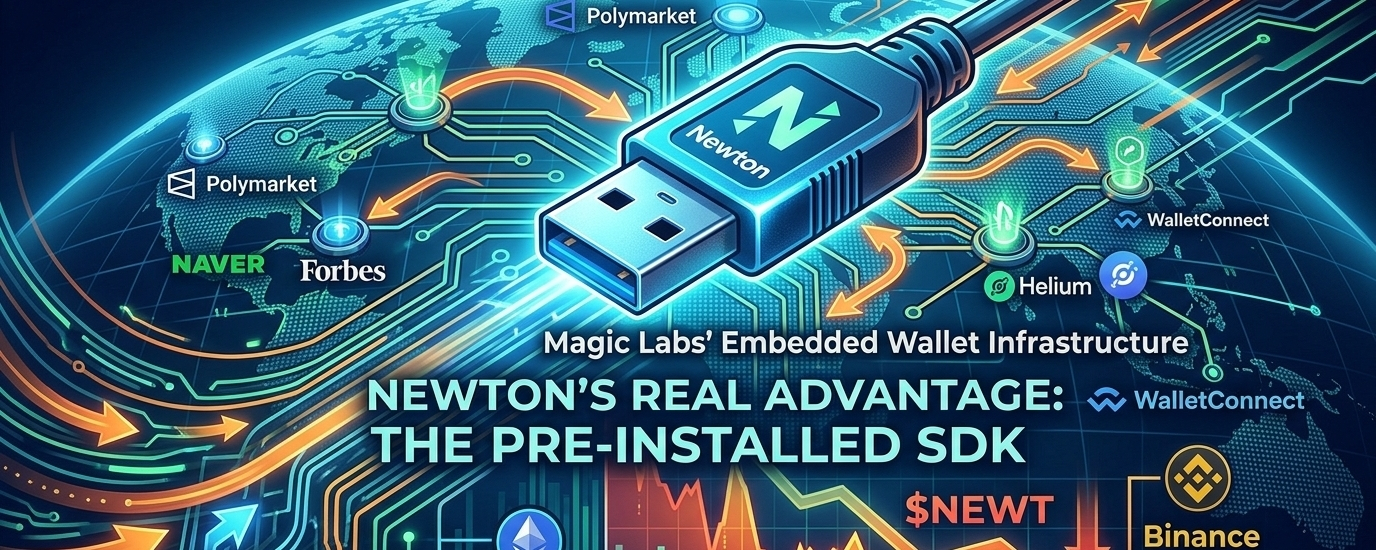
Newton's Real Advantage Isn't the Tech — It's Who Already Has the SDK InstalledMost new protocols spend their first years just getting anyone to install anything. Newton skipped that part.
Magic Labs — the company behind Newton — has spent seven years building embedded wallet infrastructure that's already live inside more than 50 million wallets and 200,000 developer accounts, powering products like Polymarket, WalletConnect, Helium, Naver, and Forbes. When Magic rolled Newton's compliance SDK out to that network in November 2025, it wasn't launching into an empty market hoping developers would show up. It was flipping a switch inside apps that already had Magic's code running in production.
That's a genuinely different distribution problem than most protocols face, and it's probably the real reason PayPal Ventures, DCG, and Polygon backed this before there was a working mainnet to point to — they weren't betting on an idea, they were betting on a company that already had the pipes laid.
But "the SDK is already installed" and "the SDK's new features are actually being used" are two different claims, and only one of them is confirmed. Having Newton's policy engine sitting inside an app Polymarket or Naver already ships doesn't mean either company has flipped it on for real transactions yet. Integration announcements measure reach. They don't measure adoption.
Worth remembering too — the token side of this story didn't mirror the distribution story at all. Despite launching with Coinbase and Binance listings already lined up, a rare advantage most tokens never get, NEWT dropped sharply right out of the gate. Existing distribution got Newton into rooms other protocols spend years trying to reach. It didn't buy immunity from the same volatility every other new token faces.
So the honest read is split: Newton starts with a distribution head start almost nothing else in this space has. Whether that turns into actual policy checks running on real transactions, inside apps people already use, is still open — and it's a more interesting thing to track than the price chart.
@NewtonProtocol $NEWT #Newt
Newton's Real Advantage Isn't the Tech — It's Who Already Has the SDK Installed
Most new protocols spend their first years just getting anyone to install anything. Newton skipped that part.
Magic Labs — the company behind Newton — has spent seven years building embedded wallet infrastructure that's already live inside more than 50 million wallets and 200,000 developer accounts, powering products like Polymarket, WalletConnect, Helium, Naver, and Forbes. When Magic rolled Newton's compliance SDK out to that network in November 2025, it wasn't launching into an empty market hoping developers would show up. It was flipping a switch inside apps that already had Magic's code running in production.
That's a genuinely different distribution problem than most protocols face, and it's probably the real reason PayPal Ventures, DCG, and Polygon backed this before there was a working mainnet to point to — they weren't betting on an idea, they were betting on a company that already had the pipes laid.
But "the SDK is already installed" and "the SDK's new features are actually being used" are two different claims, and only one of them is confirmed. Having Newton's policy engine sitting inside an app Polymarket or Naver already ships doesn't mean either company has flipped it on for real transactions yet. Integration announcements measure reach. They don't measure adoption.
Worth remembering too — the token side of this story didn't mirror the distribution story at all. Despite launching with Coinbase and Binance listings already lined up, a rare advantage most tokens never get, NEWT dropped sharply right out of the gate. Existing distribution got Newton into rooms other protocols spend years trying to reach. It didn't buy immunity from the same volatility every other new token faces.
So the honest read is split: Newton starts with a distribution head start almost nothing else in this space has. Whether that turns into actual policy checks running on real transactions, inside apps people already use, is still open — and it's a more interesting thing to track than the price chart.
@NewtonProtocol $NEWT #Newt
Magic Labs — the company behind Newton — has spent seven years building embedded wallet infrastructure that's already live inside more than 50 million wallets and 200,000 developer accounts, powering products like Polymarket, WalletConnect, Helium, Naver, and Forbes. When Magic rolled Newton's compliance SDK out to that network in November 2025, it wasn't launching into an empty market hoping developers would show up. It was flipping a switch inside apps that already had Magic's code running in production.
That's a genuinely different distribution problem than most protocols face, and it's probably the real reason PayPal Ventures, DCG, and Polygon backed this before there was a working mainnet to point to — they weren't betting on an idea, they were betting on a company that already had the pipes laid.
But "the SDK is already installed" and "the SDK's new features are actually being used" are two different claims, and only one of them is confirmed. Having Newton's policy engine sitting inside an app Polymarket or Naver already ships doesn't mean either company has flipped it on for real transactions yet. Integration announcements measure reach. They don't measure adoption.
Worth remembering too — the token side of this story didn't mirror the distribution story at all. Despite launching with Coinbase and Binance listings already lined up, a rare advantage most tokens never get, NEWT dropped sharply right out of the gate. Existing distribution got Newton into rooms other protocols spend years trying to reach. It didn't buy immunity from the same volatility every other new token faces.
So the honest read is split: Newton starts with a distribution head start almost nothing else in this space has. Whether that turns into actual policy checks running on real transactions, inside apps people already use, is still open — and it's a more interesting thing to track than the price chart.
@NewtonProtocol $NEWT #Newt
18
5
150
·
--
උසබ තත්ත්වය
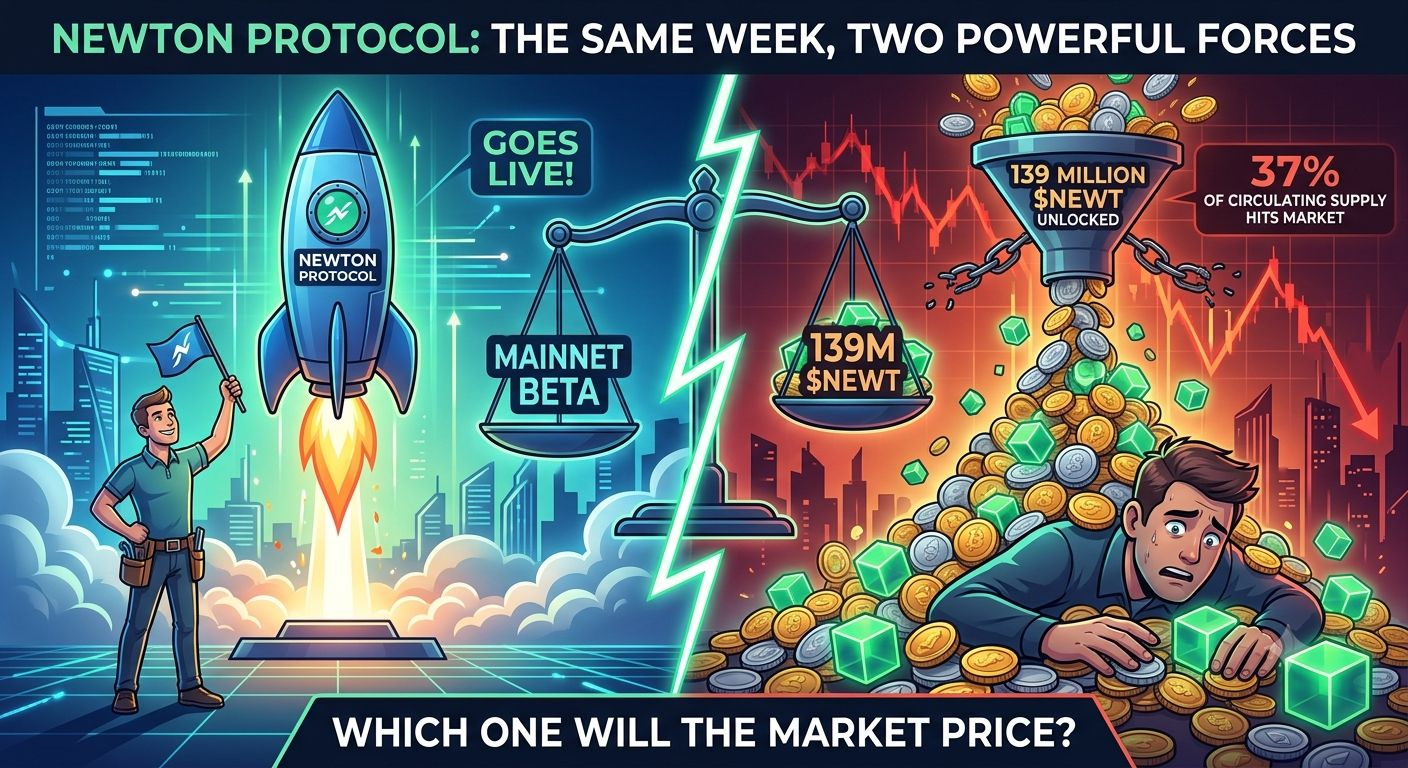
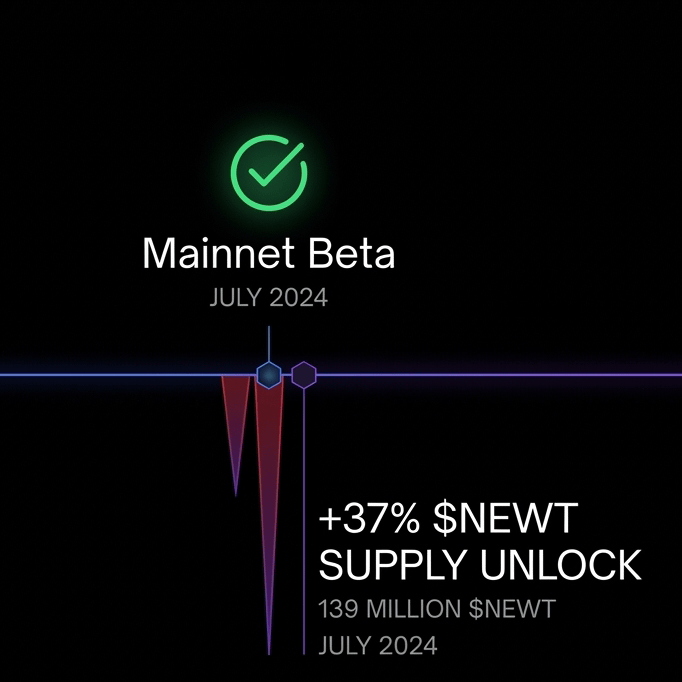
Same week Newton's mainnet beta actually went live, roughly 139 million $NEWT also unlocked — about 37% of circulating supply hitting the market in one shot. Real product progress and a massive supply jump landed in the same seven days. Worth tracking which one the market ends up pricing, because right now it's pricing both at once.
@NewtonProtocol $NEWT
{future}(NEWTUSDT)
#Newt
Same week Newton's mainnet beta actually went live, roughly 139 million $NEWT also unlocked — about 37% of circulating supply hitting the market in one shot. Real product progress and a massive supply jump landed in the same seven days. Worth tracking which one the market ends up pricing, because right now it's pricing both at once.
@NewtonProtocol $NEWT
#Newt
@NewtonProtocol $NEWT
#Newt
9
125
ලිපිය
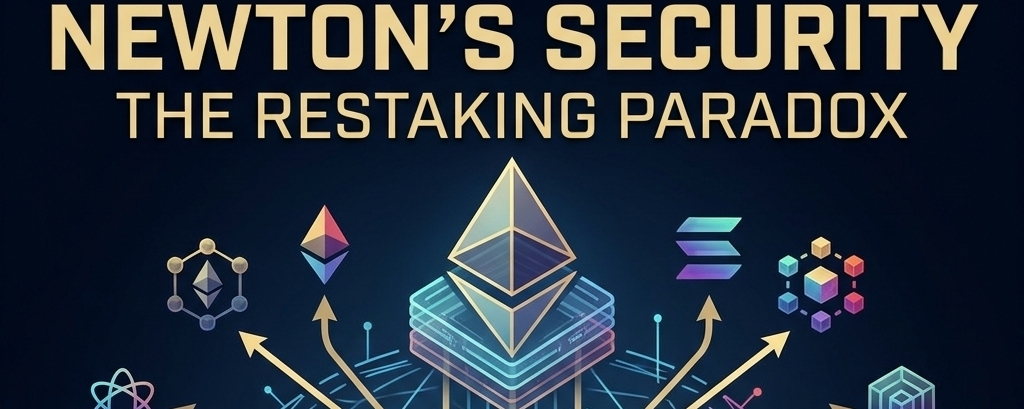
Newton's Security Doesn't Come From Newton — It Comes From Whoever Else Its Operators Are Working FoSomething easy to skip past in Newton's design: the protocol didn't build its own validator economy. Its operator network runs on restaked ETH through EigenLayer, meaning Newton is renting Ethereum's existing security budget rather than bootstrapping a new one. That's a genuinely smart, capital-efficient choice — it's the entire reason restaking exists as a category.
It also comes with a tradeoff that predates Newton by years and applies to every service built this way, not just this one. Restaked operators rarely secure a single AVS. The same ETH gets pointed at several services at once, because that's how an operator earns multiple yield streams off one deposit. EigenLayer's own original design docs flagged the resulting math directly: if a set of operators is restaked across several services simultaneously, the total profit available from misbehaving across all of them at once can exceed the slashing penalty tied to any one service alone — including whichever one you happen to be depending on.
That's not a flaw unique to Newton. It's the standard shape of shared restaked security, inherited the moment Newton chose EigenLayer over building its own operator set. What it means practically: "how secure is Newton's operator network" isn't just a headcount or a stake total. It's also whatever else that same operator set is committed to elsewhere, and whether Newton's slashing conditions are the ones that actually bite hardest if something goes wrong.
Worth remembering too — slashing on EigenLayer only became a live, enforceable mechanism in 2025. The penalty side of this entire model is barely past its first year of real operation, running underneath a protocol now being pitched to institutions as the enforcement layer for compliance-grade transactions.
None of this makes the design wrong. Renting proven security instead of building unproven security from scratch is usually the right call. It just means "verifiable" and "secure" are doing more work in Newton's pitch than a quick read suggests.
@NewtonProtocol $NEWT #Newt
Newton's Security Doesn't Come From Newton — It Comes From Whoever Else Its Operators Are Working Fo
Something easy to skip past in Newton's design: the protocol didn't build its own validator economy. Its operator network runs on restaked ETH through EigenLayer, meaning Newton is renting Ethereum's existing security budget rather than bootstrapping a new one. That's a genuinely smart, capital-efficient choice — it's the entire reason restaking exists as a category.
It also comes with a tradeoff that predates Newton by years and applies to every service built this way, not just this one. Restaked operators rarely secure a single AVS. The same ETH gets pointed at several services at once, because that's how an operator earns multiple yield streams off one deposit. EigenLayer's own original design docs flagged the resulting math directly: if a set of operators is restaked across several services simultaneously, the total profit available from misbehaving across all of them at once can exceed the slashing penalty tied to any one service alone — including whichever one you happen to be depending on.
That's not a flaw unique to Newton. It's the standard shape of shared restaked security, inherited the moment Newton chose EigenLayer over building its own operator set. What it means practically: "how secure is Newton's operator network" isn't just a headcount or a stake total. It's also whatever else that same operator set is committed to elsewhere, and whether Newton's slashing conditions are the ones that actually bite hardest if something goes wrong.
Worth remembering too — slashing on EigenLayer only became a live, enforceable mechanism in 2025. The penalty side of this entire model is barely past its first year of real operation, running underneath a protocol now being pitched to institutions as the enforcement layer for compliance-grade transactions.
None of this makes the design wrong. Renting proven security instead of building unproven security from scratch is usually the right call. It just means "verifiable" and "secure" are doing more work in Newton's pitch than a quick read suggests.
@NewtonProtocol $NEWT #Newt
It also comes with a tradeoff that predates Newton by years and applies to every service built this way, not just this one. Restaked operators rarely secure a single AVS. The same ETH gets pointed at several services at once, because that's how an operator earns multiple yield streams off one deposit. EigenLayer's own original design docs flagged the resulting math directly: if a set of operators is restaked across several services simultaneously, the total profit available from misbehaving across all of them at once can exceed the slashing penalty tied to any one service alone — including whichever one you happen to be depending on.
That's not a flaw unique to Newton. It's the standard shape of shared restaked security, inherited the moment Newton chose EigenLayer over building its own operator set. What it means practically: "how secure is Newton's operator network" isn't just a headcount or a stake total. It's also whatever else that same operator set is committed to elsewhere, and whether Newton's slashing conditions are the ones that actually bite hardest if something goes wrong.
Worth remembering too — slashing on EigenLayer only became a live, enforceable mechanism in 2025. The penalty side of this entire model is barely past its first year of real operation, running underneath a protocol now being pitched to institutions as the enforcement layer for compliance-grade transactions.
None of this makes the design wrong. Renting proven security instead of building unproven security from scratch is usually the right call. It just means "verifiable" and "secure" are doing more work in Newton's pitch than a quick read suggests.
@NewtonProtocol $NEWT #Newt
2
115
·
--
උසබ තත්ත්වය
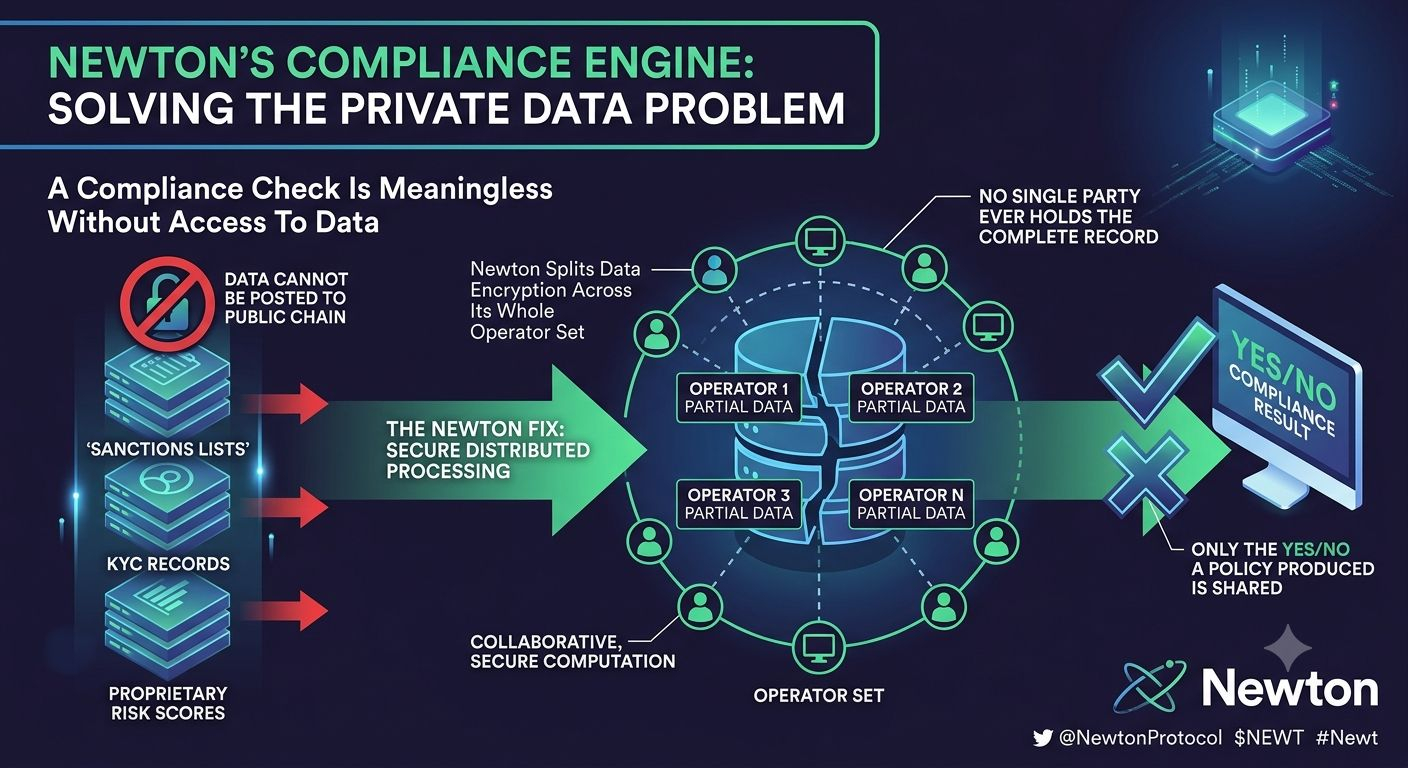
Everyone talks about Newton's policy engine. Fewer talk about the actual hard problem underneath it: the data that makes a compliance check meaningful — sanctions lists, KYC records, proprietary risk scores — is exactly the data nobody can post to a public chain. Newton's fix is splitting that data's encryption across its whole operator set, so no single party ever holds the complete record, only the yes/no a policy produced. Quiet detail, does a lot of work.
@NewtonProtocol $NEWT #Newt
Everyone talks about Newton's policy engine. Fewer talk about the actual hard problem underneath it: the data that makes a compliance check meaningful — sanctions lists, KYC records, proprietary risk scores — is exactly the data nobody can post to a public chain. Newton's fix is splitting that data's encryption across its whole operator set, so no single party ever holds the complete record, only the yes/no a policy produced. Quiet detail, does a lot of work.
@NewtonProtocol $NEWT #Newt
@NewtonProtocol $NEWT #Newt
3
1
120
සත්යායනය කළ
ලිපිය
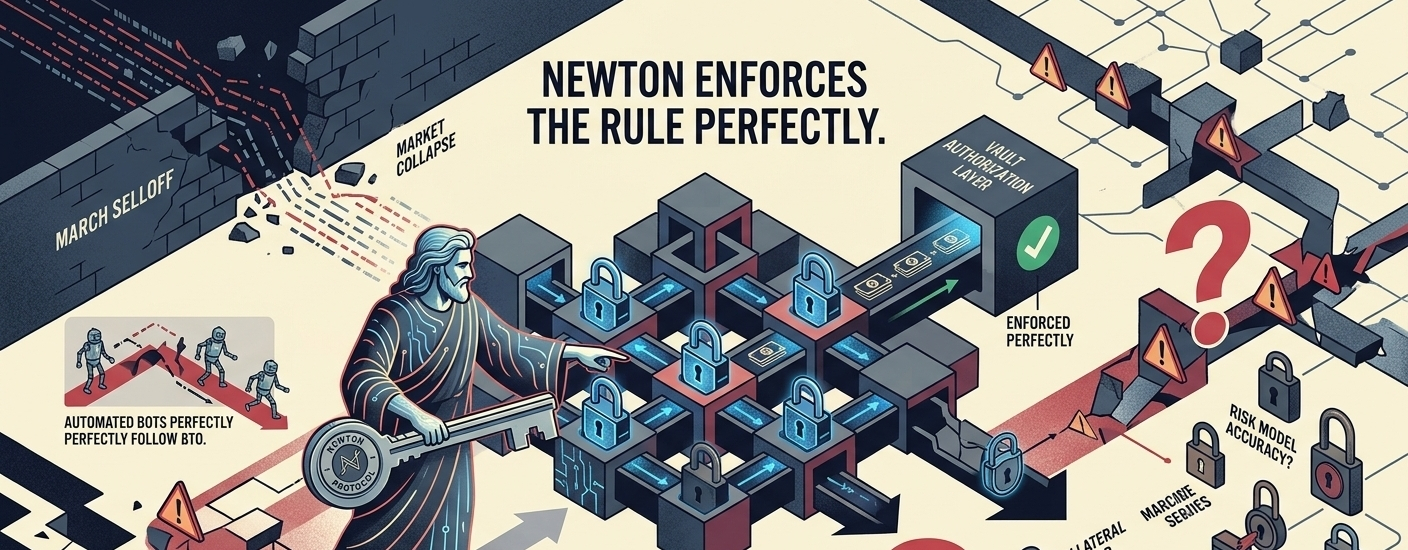
Newton Enforces the Rule Perfectly. Nobody Checks If the Rule Was Good.Newton's own launch materials include a small, telling detail. Explaining why the authorization layer exists, Magic Labs' co-founder pointed to a March market selloff where automated allocation bots kept feeding capital into a collapsing position — not because the bots malfunctioned, but because they executed exactly the rules they'd been given. That's the problem Newton solves: once a curator writes a rule, Newton makes sure it's actually followed, every time, before a transaction settles.
It's a real problem. It's also only half of one.
VaultKit — the SDK curators use to wire Newton's policy checks into a vault — is explicitly built to be neutral about the rules themselves. Any data provider, risk firm, or compliance vendor can publish a policy pack, and curators pick which ones to trust. Newton isn't in the business of judging whether a curator's collateral floor is set sensibly, whether a counterparty list is complete, or whether a risk model accounts for a move like the one in March. It checks whether the rule was followed. It says nothing about whether the rule was any good.
This isn't a problem Newton invented — it's the same one building across curated DeFi vaults generally, on Morpho, Euler, and elsewhere, where curator networks now concentrate the decisions that actually matter while the base protocol just guarantees the plumbing underneath works. Researchers tracking this shift have flagged the same worry: a small set of curators making similar calls creates exactly the kind of concentrated, correlated risk traditional finance spent decades building oversight around.
What Newton changes is subtle but real: it moves the failure mode from "the rule got bypassed" to "the rule was followed perfectly and was still wrong." A cryptographic receipt proving a policy ran exactly as written is genuinely useful to hand a regulator. It's a much less useful thing to hand a depositor trying to judge whether the curator behind their vault actually knew what they were doing.
Depositors are still underwriting a curator's judgment. Newton just makes sure that judgment, good or bad, gets carried out to the letter.
@NewtonProtocol $NEWT #Newt #newt #Newtcoin #NewtonProtocol #newton
Newton Enforces the Rule Perfectly. Nobody Checks If the Rule Was Good.
Newton's own launch materials include a small, telling detail. Explaining why the authorization layer exists, Magic Labs' co-founder pointed to a March market selloff where automated allocation bots kept feeding capital into a collapsing position — not because the bots malfunctioned, but because they executed exactly the rules they'd been given. That's the problem Newton solves: once a curator writes a rule, Newton makes sure it's actually followed, every time, before a transaction settles.
It's a real problem. It's also only half of one.
VaultKit — the SDK curators use to wire Newton's policy checks into a vault — is explicitly built to be neutral about the rules themselves. Any data provider, risk firm, or compliance vendor can publish a policy pack, and curators pick which ones to trust. Newton isn't in the business of judging whether a curator's collateral floor is set sensibly, whether a counterparty list is complete, or whether a risk model accounts for a move like the one in March. It checks whether the rule was followed. It says nothing about whether the rule was any good.
This isn't a problem Newton invented — it's the same one building across curated DeFi vaults generally, on Morpho, Euler, and elsewhere, where curator networks now concentrate the decisions that actually matter while the base protocol just guarantees the plumbing underneath works. Researchers tracking this shift have flagged the same worry: a small set of curators making similar calls creates exactly the kind of concentrated, correlated risk traditional finance spent decades building oversight around.
What Newton changes is subtle but real: it moves the failure mode from "the rule got bypassed" to "the rule was followed perfectly and was still wrong." A cryptographic receipt proving a policy ran exactly as written is genuinely useful to hand a regulator. It's a much less useful thing to hand a depositor trying to judge whether the curator behind their vault actually knew what they were doing.
Depositors are still underwriting a curator's judgment. Newton just makes sure that judgment, good or bad, gets carried out to the letter.
@NewtonProtocol $NEWT #Newt #newt #Newtcoin #NewtonProtocol #newton
It's a real problem. It's also only half of one.
VaultKit — the SDK curators use to wire Newton's policy checks into a vault — is explicitly built to be neutral about the rules themselves. Any data provider, risk firm, or compliance vendor can publish a policy pack, and curators pick which ones to trust. Newton isn't in the business of judging whether a curator's collateral floor is set sensibly, whether a counterparty list is complete, or whether a risk model accounts for a move like the one in March. It checks whether the rule was followed. It says nothing about whether the rule was any good.
This isn't a problem Newton invented — it's the same one building across curated DeFi vaults generally, on Morpho, Euler, and elsewhere, where curator networks now concentrate the decisions that actually matter while the base protocol just guarantees the plumbing underneath works. Researchers tracking this shift have flagged the same worry: a small set of curators making similar calls creates exactly the kind of concentrated, correlated risk traditional finance spent decades building oversight around.
What Newton changes is subtle but real: it moves the failure mode from "the rule got bypassed" to "the rule was followed perfectly and was still wrong." A cryptographic receipt proving a policy ran exactly as written is genuinely useful to hand a regulator. It's a much less useful thing to hand a depositor trying to judge whether the curator behind their vault actually knew what they were doing.
Depositors are still underwriting a curator's judgment. Newton just makes sure that judgment, good or bad, gets carried out to the letter.
@NewtonProtocol $NEWT #Newt #newt #Newtcoin #NewtonProtocol #newton
10
2
117
Newton's mainnet beta shipped with five different data partners plugged into its policy engine — Chainalysis Hexagate, RedStone, Credora, vaults.fyi, and Webacy — each covering a different piece of what "verifiable compliance" actually needs to check. Genuinely curious which one you think institutions will lean on hardest once real capital starts moving through Vaults.
Poll question: Which Newton launch partner matters most for institutional adoption?
@NewtonProtocol $NEWT #newt
#SECToProposeCryptoRule #JapanBondYieldHits30YearHigh #BinanceTurns9 #TreasuryCommerceVieForBitcoinReserveControl
$EVAA
{alpha}(560xaa036928c9c0df07d525b55ea8ee690bb5a628c1)
$AGLD
{spot}(AGLDUSDT)
{spot}(HMSTRUSDT)
Newton's mainnet beta shipped with five different data partners plugged into its policy engine — Chainalysis Hexagate, RedStone, Credora, vaults.fyi, and Webacy — each covering a different piece of what "verifiable compliance" actually needs to check. Genuinely curious which one you think institutions will lean on hardest once real capital starts moving through Vaults.
Poll question: Which Newton launch partner matters most for institutional adoption?
@NewtonProtocol $NEWT #newt
#SECToProposeCryptoRule #JapanBondYieldHits30YearHigh #BinanceTurns9 #TreasuryCommerceVieForBitcoinReserveControl
$EVAA
$AGLD
Poll question: Which Newton launch partner matters most for institutional adoption?
@NewtonProtocol $NEWT #newt
#SECToProposeCryptoRule #JapanBondYieldHits30YearHigh #BinanceTurns9 #TreasuryCommerceVieForBitcoinReserveControl
$EVAA
$AGLD
👉Chainalysis Hexagate 🤔
0%
👉RedStone (price feeds)🤑
0%
👉Credora(credit/risk rating🥇
0%
👉Webacy (wallet reputation)🎁
0%
0 ඡන්ද • ඡන්දය අවසන්
6
3
214

ලිපිය
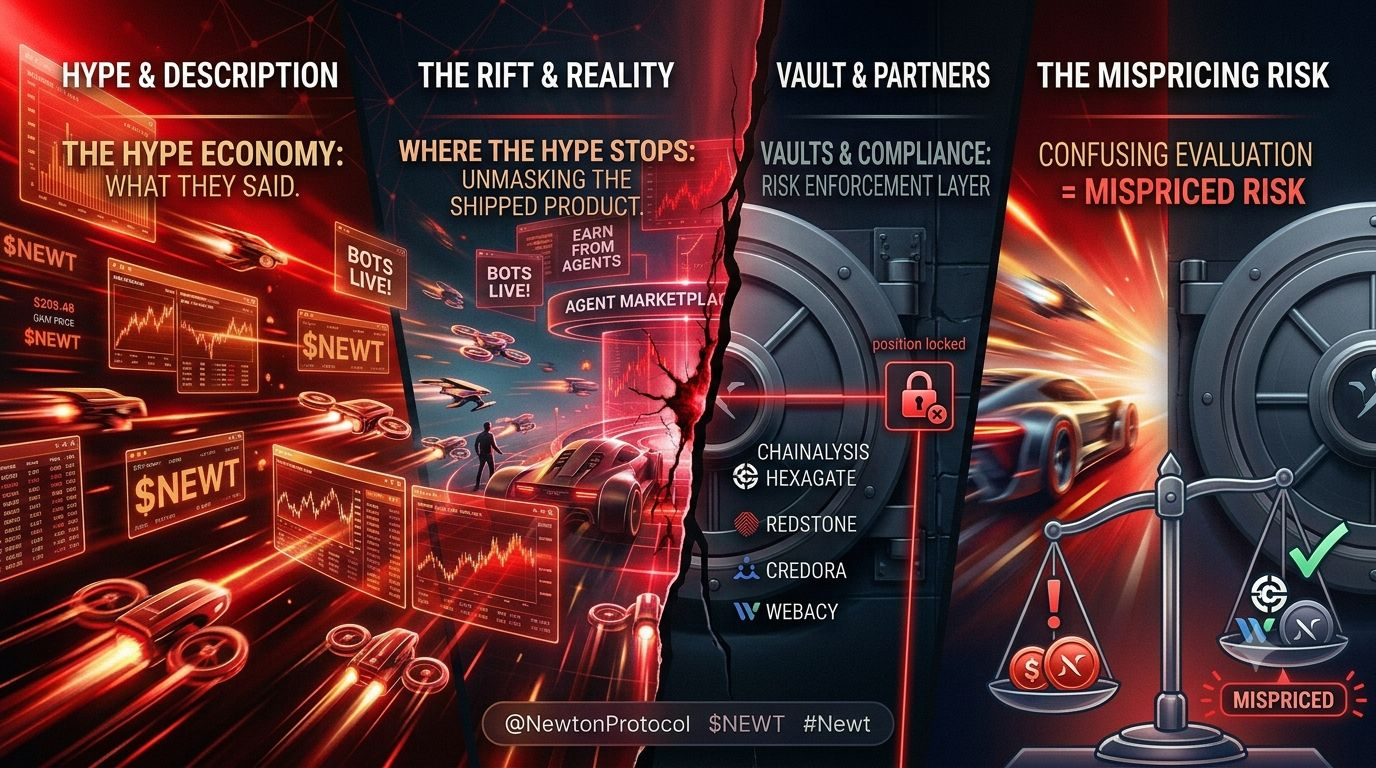
The Newton Everyone's Describing Isn't the One That ShippedScroll through enough Square posts about Newton Protocol and a pattern shows up fast: most describe it as an AI agent marketplace, a rollup built for automated trading bots. Then go read what actually went live on June 23.
Mainnet beta shipped Vaults:
a curator sets a rule — say, a collateral ratio floor — Newton's operator network checks live transactions against it, and if the rule is breached, the position gets locked or liquidated automatically, with a cryptographic receipt proving why it happened. The launch partners back that up: Chainalysis Hexagate for sanctions screening, RedStone for price feeds, Credora for risk ratings, vaults.fyi for vault health, Webacy for wallet reputation. That's a compliance and risk-enforcement layer. There's also one live automation feature — a Recurring Buy agent.
What isn't live yet is the actual "agent marketplace" — the place where outside developers publish, discover, and get paid for autonomous agents. Newton's own roadmap lists that as upcoming, not shipped.
None of this makes the project weaker — infrastructure usually ships boring-first, exciting-later. But it means two different things are being priced under one name right now: a live, narrow compliance engine, and an unreleased agent economy. Confuse which one you're evaluating, and you'll misprice both the risk and the opportunity.
@NewtonProtocol $NEWT #Newt
#BTCSharpeRatioFallsToLowestSince2022 #HongKongCompletesFirstGoldTradeSettlement #GoldRetreatsFromTwoWeekHigh
The Newton Everyone's Describing Isn't the One That Shipped
Scroll through enough Square posts about Newton Protocol and a pattern shows up fast: most describe it as an AI agent marketplace, a rollup built for automated trading bots. Then go read what actually went live on June 23.
Mainnet beta shipped Vaults:
a curator sets a rule — say, a collateral ratio floor — Newton's operator network checks live transactions against it, and if the rule is breached, the position gets locked or liquidated automatically, with a cryptographic receipt proving why it happened. The launch partners back that up: Chainalysis Hexagate for sanctions screening, RedStone for price feeds, Credora for risk ratings, vaults.fyi for vault health, Webacy for wallet reputation. That's a compliance and risk-enforcement layer. There's also one live automation feature — a Recurring Buy agent.
What isn't live yet is the actual "agent marketplace" — the place where outside developers publish, discover, and get paid for autonomous agents. Newton's own roadmap lists that as upcoming, not shipped.
None of this makes the project weaker — infrastructure usually ships boring-first, exciting-later. But it means two different things are being priced under one name right now: a live, narrow compliance engine, and an unreleased agent economy. Confuse which one you're evaluating, and you'll misprice both the risk and the opportunity.
@NewtonProtocol $NEWT #Newt
#BTCSharpeRatioFallsToLowestSince2022 #HongKongCompletesFirstGoldTradeSettlement #GoldRetreatsFromTwoWeekHigh
Mainnet beta shipped Vaults:
a curator sets a rule — say, a collateral ratio floor — Newton's operator network checks live transactions against it, and if the rule is breached, the position gets locked or liquidated automatically, with a cryptographic receipt proving why it happened. The launch partners back that up: Chainalysis Hexagate for sanctions screening, RedStone for price feeds, Credora for risk ratings, vaults.fyi for vault health, Webacy for wallet reputation. That's a compliance and risk-enforcement layer. There's also one live automation feature — a Recurring Buy agent.
What isn't live yet is the actual "agent marketplace" — the place where outside developers publish, discover, and get paid for autonomous agents. Newton's own roadmap lists that as upcoming, not shipped.
None of this makes the project weaker — infrastructure usually ships boring-first, exciting-later. But it means two different things are being priced under one name right now: a live, narrow compliance engine, and an unreleased agent economy. Confuse which one you're evaluating, and you'll misprice both the risk and the opportunity.
@NewtonProtocol $NEWT #Newt
#BTCSharpeRatioFallsToLowestSince2022 #HongKongCompletesFirstGoldTradeSettlement #GoldRetreatsFromTwoWeekHigh
5
153
·
--
උසබ තත්ත්වය
🧠 Stop letting lazy crypto marketing fool you.
Every new protocol loves to plaster "Secured by EigenLayer" across their page to get instant hype and credibility. But a protocol doesn’t just passively borrow security like a tenant borrows a landlord's reputation.
Real infrastructure primitives like Newton Protocol ($NEWT)*operate entirely蒙 differently. As an Actively Validated Service (AVS), node operators must explicitly opt in and stake their own $NEWT tokens directly against the strict rules of Newton's pre-transaction policy engine.
If an operator colludes or attempts to let fraudulent data pass through the execution sandbox, their staked NEWT is directly in the game to get slashed.
The headline total value locked (TVL) of a network means nothing if capital isn't actively committed to those exact slashing conditions. True economic deterrents require real consequences.
As the market filters out speculative noise, utility tokens built on cryptographic verifiability and hard economic security floors—like $NEWT anchoring itself as a structural infrastructure baseline—are what define the real architecture of 2026.
👇 Are you investing based on flashy marketing buzzwords, or are you looking at actual operator slashing conditions? Drop your take in the comments!
@NewtonProtocol #Newt $NEWT #EigenLayer #AVS #CryptoInfrastructure #Web3Security
🧠 Stop letting lazy crypto marketing fool you.
Every new protocol loves to plaster "Secured by EigenLayer" across their page to get instant hype and credibility. But a protocol doesn’t just passively borrow security like a tenant borrows a landlord's reputation.
Real infrastructure primitives like Newton Protocol ($NEWT )*operate entirely蒙 differently. As an Actively Validated Service (AVS), node operators must explicitly opt in and stake their own $NEWT tokens directly against the strict rules of Newton's pre-transaction policy engine.
If an operator colludes or attempts to let fraudulent data pass through the execution sandbox, their staked NEWT is directly in the game to get slashed.
The headline total value locked (TVL) of a network means nothing if capital isn't actively committed to those exact slashing conditions. True economic deterrents require real consequences.
As the market filters out speculative noise, utility tokens built on cryptographic verifiability and hard economic security floors—like $NEWT anchoring itself as a structural infrastructure baseline—are what define the real architecture of 2026.
👇 Are you investing based on flashy marketing buzzwords, or are you looking at actual operator slashing conditions? Drop your take in the comments!
@NewtonProtocol #Newt $NEWT #EigenLayer #AVS #CryptoInfrastructure #Web3Security
Every new protocol loves to plaster "Secured by EigenLayer" across their page to get instant hype and credibility. But a protocol doesn’t just passively borrow security like a tenant borrows a landlord's reputation.
Real infrastructure primitives like Newton Protocol ($NEWT )*operate entirely蒙 differently. As an Actively Validated Service (AVS), node operators must explicitly opt in and stake their own $NEWT tokens directly against the strict rules of Newton's pre-transaction policy engine.
If an operator colludes or attempts to let fraudulent data pass through the execution sandbox, their staked NEWT is directly in the game to get slashed.
The headline total value locked (TVL) of a network means nothing if capital isn't actively committed to those exact slashing conditions. True economic deterrents require real consequences.
As the market filters out speculative noise, utility tokens built on cryptographic verifiability and hard economic security floors—like $NEWT anchoring itself as a structural infrastructure baseline—are what define the real architecture of 2026.
👇 Are you investing based on flashy marketing buzzwords, or are you looking at actual operator slashing conditions? Drop your take in the comments!
@NewtonProtocol #Newt $NEWT #EigenLayer #AVS #CryptoInfrastructure #Web3Security
11
5
153

ලිපිය
Follow the Money: Visualizing Capital Flow in the Newton Protocol EcosystemWhen you want to understand the true long-term potential of a blockchain network, you have to look past short-term speculation and follow the actual movement of money. In the current Web3 landscape, institutional capital is steadily migrating toward real-world utility, and this is where the Newton Protocol establishes its foundational value. Traditional finance institutions are aggressively exploring the tokenization of Real World Assets (RWAs), trying to bring massive asset classes like mortgage bonds, real estate, and physical gold onto the blockchain. To do this safely, these institutions require an ultra-secure, highly compliant, and robust gateway network. This is exactly where $NEWT shifts from a simple speculative asset into a mandatory operational asset. Every institution executing these large-scale compliance actions must utilize the token as the underlying gas and access token. This institutional ingress creates a non-speculative, permanent floor demand for the token, establishing a clear line where institutional money flows directly into network utility.
Once capital successfully enters an ecosystem, the secondary phase of the money flow relies on structural security and scarcity mechanics. This brings us directly to the smart money dynamics governing the network. The Newton network is secured through an advanced, robust staking model that fundamentally changes exchange liquidity. Node operators, validators, and long-term ecosystem believers choose to commit and lock up their $NEWT tokens into the core Staking Engine. By doing so, they validate transactions, protect the network from vulnerabilities, and in return, earn ongoing staking rewards funded by native protocol yields. This specific mechanism perfectly aligns the financial interests of large-scale token holders with the overall health of the blockchain. From a market perspective, this process pulls significant portions of the active circulating supply out of open markets and locks it away into secure smart contracts. As the infrastructure handles more operations, tracking the rising percentage of staked supply serves as a direct indicator of investor conviction and structural asset scarcity.
The third major capital driver inside this architecture introduces high-velocity, automated volume. The modern market is rapidly shifting away from slow, manual execution toward automated Web3 systems. Newton Protocol features secure, isolated execution environments that empower AI Agents to autonomously manage complex capital strategies. Imagine an intelligent software agent instantly reacting to sudden market anomalies to rebalance multi-asset portfolios across decentralized exchanges, route liquidity to high-yield lending protocols, or hedge risks in real time. Because these automated agents never sleep, they generate an entirely new paradigm of transaction velocity. Every single automated choice, cross-chain bridge, or portfolio adjustment executed by an AI agent generates essential network compute fees. This isn't emotional retail trading that dries up during market lulls; it is programmatic, continuous network volume. This steady operational flow guarantees that the utilization of $NEWT for processing and compute execution remains active around the clock.
Ultimately, these distinct financial paths converge to form a powerful, self-sustaining loop known as the Virtuous Cycle of Value. When you analyze the complete picture—starting from institutional RWA onboarding, moving through secure long-term validator staking, and compounding via high-velocity AI agent transactions—you realize that every component feeds back into the network's growth. The transaction fees generated by active protocol processing do not just vanish; they are dynamically recirculated to strengthen the network. Portions are allocated directly to fund the ecosystem developer grants, which attracts innovative teams to deploy next-generation dApps on the Mainnet Beta. Additionally, strategic token burning mechanisms help sustainably manage the overall economics over time. As more developers build and more applications launch, user utility expands exponentially. This expanding utility draws fresh capital back to the network entry point, restarting the entire process at a much larger scale. If you want to find lasting value in Web3, stop looking at temporary social media hype: follow the utility, follow the infrastructure, and follow the money.
#Newt @NewtonProtocol $NEWT
Follow the Money: Visualizing Capital Flow in the Newton Protocol Ecosystem
When you want to understand the true long-term potential of a blockchain network, you have to look past short-term speculation and follow the actual movement of money. In the current Web3 landscape, institutional capital is steadily migrating toward real-world utility, and this is where the Newton Protocol establishes its foundational value. Traditional finance institutions are aggressively exploring the tokenization of Real World Assets (RWAs), trying to bring massive asset classes like mortgage bonds, real estate, and physical gold onto the blockchain. To do this safely, these institutions require an ultra-secure, highly compliant, and robust gateway network. This is exactly where $NEWT shifts from a simple speculative asset into a mandatory operational asset. Every institution executing these large-scale compliance actions must utilize the token as the underlying gas and access token. This institutional ingress creates a non-speculative, permanent floor demand for the token, establishing a clear line where institutional money flows directly into network utility.
Once capital successfully enters an ecosystem, the secondary phase of the money flow relies on structural security and scarcity mechanics. This brings us directly to the smart money dynamics governing the network. The Newton network is secured through an advanced, robust staking model that fundamentally changes exchange liquidity. Node operators, validators, and long-term ecosystem believers choose to commit and lock up their $NEWT tokens into the core Staking Engine. By doing so, they validate transactions, protect the network from vulnerabilities, and in return, earn ongoing staking rewards funded by native protocol yields. This specific mechanism perfectly aligns the financial interests of large-scale token holders with the overall health of the blockchain. From a market perspective, this process pulls significant portions of the active circulating supply out of open markets and locks it away into secure smart contracts. As the infrastructure handles more operations, tracking the rising percentage of staked supply serves as a direct indicator of investor conviction and structural asset scarcity.
The third major capital driver inside this architecture introduces high-velocity, automated volume. The modern market is rapidly shifting away from slow, manual execution toward automated Web3 systems. Newton Protocol features secure, isolated execution environments that empower AI Agents to autonomously manage complex capital strategies. Imagine an intelligent software agent instantly reacting to sudden market anomalies to rebalance multi-asset portfolios across decentralized exchanges, route liquidity to high-yield lending protocols, or hedge risks in real time. Because these automated agents never sleep, they generate an entirely new paradigm of transaction velocity. Every single automated choice, cross-chain bridge, or portfolio adjustment executed by an AI agent generates essential network compute fees. This isn't emotional retail trading that dries up during market lulls; it is programmatic, continuous network volume. This steady operational flow guarantees that the utilization of $NEWT for processing and compute execution remains active around the clock.
Ultimately, these distinct financial paths converge to form a powerful, self-sustaining loop known as the Virtuous Cycle of Value. When you analyze the complete picture—starting from institutional RWA onboarding, moving through secure long-term validator staking, and compounding via high-velocity AI agent transactions—you realize that every component feeds back into the network's growth. The transaction fees generated by active protocol processing do not just vanish; they are dynamically recirculated to strengthen the network. Portions are allocated directly to fund the ecosystem developer grants, which attracts innovative teams to deploy next-generation dApps on the Mainnet Beta. Additionally, strategic token burning mechanisms help sustainably manage the overall economics over time. As more developers build and more applications launch, user utility expands exponentially. This expanding utility draws fresh capital back to the network entry point, restarting the entire process at a much larger scale. If you want to find lasting value in Web3, stop looking at temporary social media hype: follow the utility, follow the infrastructure, and follow the money.
#Newt @NewtonProtocol $NEWT
Once capital successfully enters an ecosystem, the secondary phase of the money flow relies on structural security and scarcity mechanics. This brings us directly to the smart money dynamics governing the network. The Newton network is secured through an advanced, robust staking model that fundamentally changes exchange liquidity. Node operators, validators, and long-term ecosystem believers choose to commit and lock up their $NEWT tokens into the core Staking Engine. By doing so, they validate transactions, protect the network from vulnerabilities, and in return, earn ongoing staking rewards funded by native protocol yields. This specific mechanism perfectly aligns the financial interests of large-scale token holders with the overall health of the blockchain. From a market perspective, this process pulls significant portions of the active circulating supply out of open markets and locks it away into secure smart contracts. As the infrastructure handles more operations, tracking the rising percentage of staked supply serves as a direct indicator of investor conviction and structural asset scarcity.
The third major capital driver inside this architecture introduces high-velocity, automated volume. The modern market is rapidly shifting away from slow, manual execution toward automated Web3 systems. Newton Protocol features secure, isolated execution environments that empower AI Agents to autonomously manage complex capital strategies. Imagine an intelligent software agent instantly reacting to sudden market anomalies to rebalance multi-asset portfolios across decentralized exchanges, route liquidity to high-yield lending protocols, or hedge risks in real time. Because these automated agents never sleep, they generate an entirely new paradigm of transaction velocity. Every single automated choice, cross-chain bridge, or portfolio adjustment executed by an AI agent generates essential network compute fees. This isn't emotional retail trading that dries up during market lulls; it is programmatic, continuous network volume. This steady operational flow guarantees that the utilization of $NEWT for processing and compute execution remains active around the clock.
Ultimately, these distinct financial paths converge to form a powerful, self-sustaining loop known as the Virtuous Cycle of Value. When you analyze the complete picture—starting from institutional RWA onboarding, moving through secure long-term validator staking, and compounding via high-velocity AI agent transactions—you realize that every component feeds back into the network's growth. The transaction fees generated by active protocol processing do not just vanish; they are dynamically recirculated to strengthen the network. Portions are allocated directly to fund the ecosystem developer grants, which attracts innovative teams to deploy next-generation dApps on the Mainnet Beta. Additionally, strategic token burning mechanisms help sustainably manage the overall economics over time. As more developers build and more applications launch, user utility expands exponentially. This expanding utility draws fresh capital back to the network entry point, restarting the entire process at a much larger scale. If you want to find lasting value in Web3, stop looking at temporary social media hype: follow the utility, follow the infrastructure, and follow the money.
#Newt @NewtonProtocol $NEWT
5
4
97
·
--
උසබ තත්ත්වය
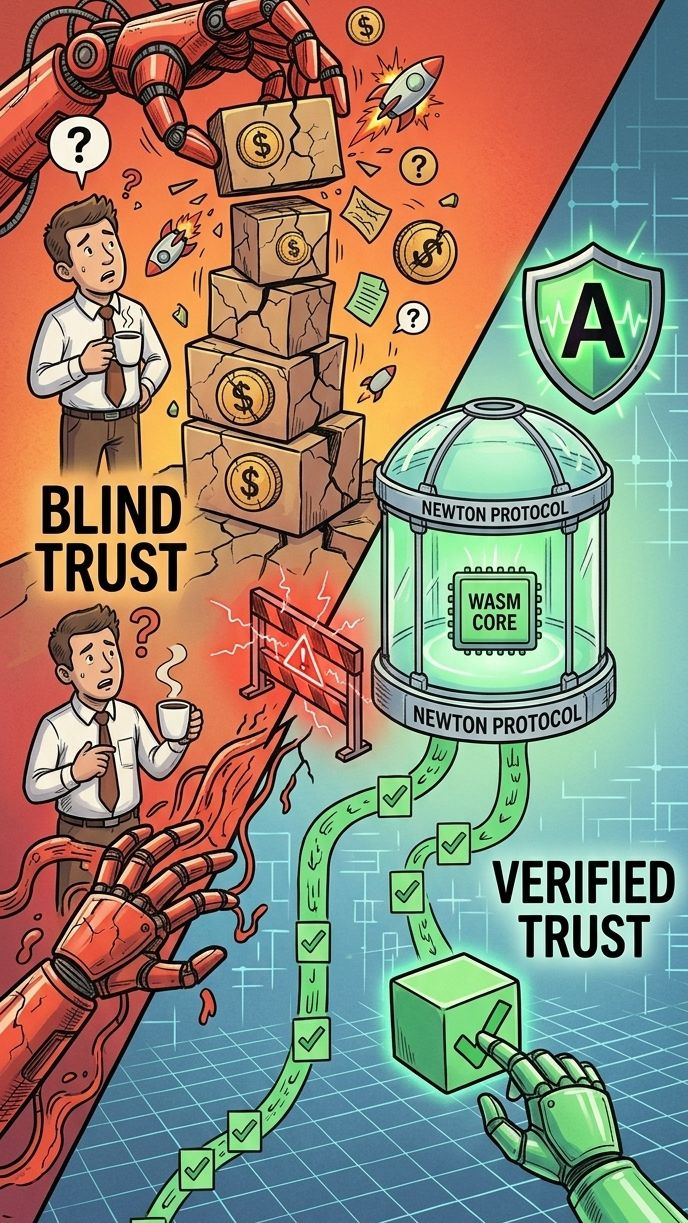
🤖 Can we genuinely trust AI agents to manage our Web3 capital? 💸
Every day, autonomous agents are becoming more deeply integrated into blockchain execution. They can scan markets, calculate risk, and execute trades in milliseconds. Speed is easy. But what happens when market incentives shift violently or an unpredictable anomaly occurs?
Blindly trusting automated systems we barely understand is the biggest hidden risk in crypto today.
Real sustainability isn't about how fast an AI can trade—it’s about whether its decisions are verifiable when conditions get chaotic. This is the exact architectural bottleneck that @NewtonProtocol is tackling head-on.
By creating a decentralized framework that turns automated execution into verifiable accountability, they ensure that AI developers don't just build persuasive agents, but provably secure ones.
In a world moving rapidly toward total automation, the protocols that win won't just offer speed; they will be the ones that preserve trust when confidence is tested.
👇 Would you let a fully autonomous AI agent manage your portfolio without a verification layer? Let’s talk in the comments! Like, follow, and share to spread the word!
@NewtonProtocol l #Newt $NEWT #AIAgents #Web3Security #CryptoTrust $SYN
{future}(SYNUSDT)
$RE
{future}(REUSDT)
🤖 Can we genuinely trust AI agents to manage our Web3 capital? 💸
Every day, autonomous agents are becoming more deeply integrated into blockchain execution. They can scan markets, calculate risk, and execute trades in milliseconds. Speed is easy. But what happens when market incentives shift violently or an unpredictable anomaly occurs?
Blindly trusting automated systems we barely understand is the biggest hidden risk in crypto today.
Real sustainability isn't about how fast an AI can trade—it’s about whether its decisions are verifiable when conditions get chaotic. This is the exact architectural bottleneck that @NewtonProtocol is tackling head-on.
By creating a decentralized framework that turns automated execution into verifiable accountability, they ensure that AI developers don't just build persuasive agents, but provably secure ones.
In a world moving rapidly toward total automation, the protocols that win won't just offer speed; they will be the ones that preserve trust when confidence is tested.
👇 Would you let a fully autonomous AI agent manage your portfolio without a verification layer? Let’s talk in the comments! Like, follow, and share to spread the word!
@NewtonProtocol l #Newt $NEWT #AIAgents #Web3Security #CryptoTrust $SYN
$RE
Every day, autonomous agents are becoming more deeply integrated into blockchain execution. They can scan markets, calculate risk, and execute trades in milliseconds. Speed is easy. But what happens when market incentives shift violently or an unpredictable anomaly occurs?
Blindly trusting automated systems we barely understand is the biggest hidden risk in crypto today.
Real sustainability isn't about how fast an AI can trade—it’s about whether its decisions are verifiable when conditions get chaotic. This is the exact architectural bottleneck that @NewtonProtocol is tackling head-on.
By creating a decentralized framework that turns automated execution into verifiable accountability, they ensure that AI developers don't just build persuasive agents, but provably secure ones.
In a world moving rapidly toward total automation, the protocols that win won't just offer speed; they will be the ones that preserve trust when confidence is tested.
👇 Would you let a fully autonomous AI agent manage your portfolio without a verification layer? Let’s talk in the comments! Like, follow, and share to spread the word!
@NewtonProtocol l #Newt $NEWT #AIAgents #Web3Security #CryptoTrust $SYN
$RE
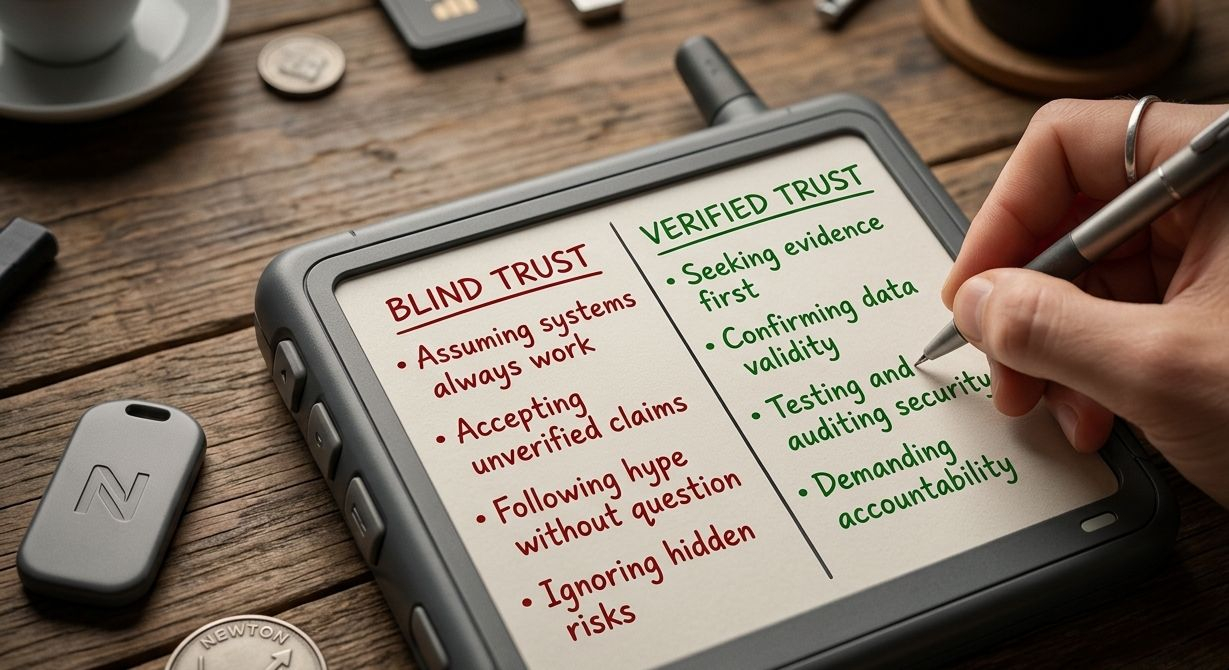
25
9
296
ලිපිය
Part 1: The Evolution of Web3 Infrastructure—The Imperative of Pre-Transaction AuthorizationFor over a decade, the core narrative dominating the blockchain development space has been centered entirely around scalability, raw execution speed, and the reduction of gas fees. Layer 1 and Layer 2 networks have fought a continuous war to handle more transactions per second, processing state transitions faster than ever before. However, this intense focus on speed has left a glaring, highly dangerous vulnerability wide open in the decentralized ecosystem: the lack of an intelligent, natively integrated decision layer.
Traditional smart contracts operate on a purely binary, blind execution model. They excel at processing deterministic code—if X happens, then execute Y—but they are entirely incapable of analyzing contextual safety or verifying compliance before a transaction is finalized. A smart contract cannot inherently ask, "Is this transaction safe, compliant, or economically sound to approve in the first place?" It simply moves assets from point A to point B because the cryptographic signature matches, even if that movement results in a massive protocol exploit, a regulatory violation, or an catastrophic liquidity drain.
The launch of the Newton Mainnet Beta marks a fundamental, architectural shift in how modern blockchain environments handle this exact gap. Instead of forcing networks to rely on retroactive, post-transaction monitoring tools that only alert developers after an exploit has already stripped a vault of its funds, Newton Protocol introduces the paradigm of true Compliance-as-Code.
Newton functions natively as an Actively Validated Service (AVS), operating as a highly secure, decentralized authorization layer that sits squarely between a user’s initial intent and the final on-chain execution. This ensures that every single transactional request must pass through a strict, customizable gauntlet of programmatic policies before it can ever alter the state of the ledger.
Rather than demanding that developers migrate their existing codebases to entirely new, isolated blockchains or undergo exhaustive overhauls of their current decentralized applications (dApps), Newton is designed to integrate seamlessly right before the point of settlement. By compiling complex operational and regulatory policies into highly optimized WebAssembly (WASM) components, developers are empowered to hardcode precise business logic directly into the foundation of the execution layer.
Whether an enterprise needs to enforce strict daily spending limits, cross-reference wallet addresses against dynamic sanctions screenings, or run real-time counterparty risk assessments, Newton ensures these checks are completely un-bypassable. If a transaction fails to clear these cryptographic hurdles, it simply never happens, effectively eradicating a massive spectrum of smart contract vulnerabilities at the root.
Part 2: Under the Hood of VaultKit—Wasmtime Isolation and Secure Data Routing
To truly understand how this compliance infrastructure operates under heavy production loads, we have to look beneath the surface at the core architecture running on the Newton Mainnet Beta. One of the most significant toolkits handed to developers with this rollout is the VaultKit SDK. This software development kit allows teams to build highly advanced, programmable transaction policies specifically designed to manage dynamic liquidity pools, structured yield strategies, and decentralized vaults.
When an asset management dApp handles million-dollar positions, a standard collateral check or price reference is entirely insufficient if the underlying oracle or data feed can be manipulated via flash loans or sudden oracle pricing anomalies. VaultKit fundamentally changes this dynamic by forcing the system to evaluate real-time, real-world conditions completely off-chain before allowing any settlement to finalize on-chain.
The technical magic behind this system relies heavily on the strict implementation of sandboxed Wasmtime execution environments. Newton operators run oracle components inside an incredibly secure, isolated runtime. The primary purpose of this design choice is absolute isolation: the sandbox explicitly blocks any outgoing requests directed at private network ranges, loopback addresses, or link-local addresses. This completely cuts off the ability for a compromised or poorly written policy oracle to probe internal operator networks or create unauthorized backdoors.
If an oracle needs to fetch data from an external API, that endpoint must be explicitly public. To guarantee complete input safety, all incoming data streams are rigorously validated against a declared, unalterable JSON schema. Any malformed inputs, anomalous structures, or unexpected formatting variations are instantly caught and rejected before the code can even begin to execute.
Furthermore, Newton’s architecture handles runtime anomalies with extreme precision. If an external execution failure occurs, the network documents this specific condition as a `DataProviderError`. This distinction is incredibly vital for developers: instead of producing an arbitrary, ambiguous policy denial that leaves users and smart contracts confused, the system identifies that the evaluation environment itself encountered an issue, allowing the application to halt or reroute safely.
By pulling in highly resistant, verified data feeds from premier partners like RedStone for price manipulation defense, alongside institutional risk parameters from Credora, VaultKit transforms passive smart contracts into highly defensive, self-aware execution engines.
Part 3: The Premium Primitive—Why Technological Utility Governs the $NEWT Ecosystem
In the fast-moving landscape of digital assets, market hype and speculative narratives frequently overshadow tangible, structural utility. However, history has proven that the crypto protocols that survive and dominate over multi-year cycles are those that become irreplaceable structural primitives for the industry. The strongest security infrastructure is inherently designed to be invisible—quietly protecting billions of dollars in total value locked (TVL), preventing multi-million dollar hacks, and ensuring regulatory compliance completely behind the scenes without interrupting the user experience.
As the broader ecosystem of integrated dApps, algorithmic stablecoins, cross-chain bridges, and autonomous AI agents continues to expand at a rapid clip, the structural demand for verifiable, high-throughput policy enforcement is scaling exponentially. Automated agents and institutional capital pools cannot afford to operate in environments where code logic is brittle or exposed to external off-chain data manipulation.
When looking closely at the current market metrics, with the native utility token $NEWT consistently consolidating and holding its ground firmly around the 0.10000 level, seasoned market analysts look past short-term price fluctuations and focus entirely on the underlying technological fundamentals. Newton is not designed to be a temporary speculative instrument fueled by superficial marketing campaigns; it is built to serve as a core, institutional-grade security layer for the entire Web3 space.
The structural design of the token economy directly rewards long-term ecosystem participants. Within the Newton architecture, NEWT serves multiple critical, high-utility functions: it acts as the primary staking mechanism required by node operators to secure the Actively Validated Service (AVS) layer, it is utilized directly to process protocol transaction fees for every policy evaluation run by the sandbox, and it governs the future architectural updates of the decentralized network.
The successful transition from a theoretical whitepaper concept to a live, battle-tested mainnet enforcement layer serves as a massive milestone. By proving that off-chain data can influence on-chain authorization without compromising decentralization or network security, Newton Protocol is laying down the definitive blueprint for the future of enterprise-grade decentralized finance.
---
💬 How do you think pre-transaction authorization will reshape the battle against DeFi exploits? Let's get a technical debate started in the comments below! Don't forget to like, follow, and share for more deep-dive architectural breakdowns.
@NewtonProtocol #Newt $NEWT #ComplianceAsCode #DeFi #Web3 #BlockchainSecurity #MainnetBeta
Part 1: The Evolution of Web3 Infrastructure—The Imperative of Pre-Transaction Authorization
For over a decade, the core narrative dominating the blockchain development space has been centered entirely around scalability, raw execution speed, and the reduction of gas fees. Layer 1 and Layer 2 networks have fought a continuous war to handle more transactions per second, processing state transitions faster than ever before. However, this intense focus on speed has left a glaring, highly dangerous vulnerability wide open in the decentralized ecosystem: the lack of an intelligent, natively integrated decision layer.
Traditional smart contracts operate on a purely binary, blind execution model. They excel at processing deterministic code—if X happens, then execute Y—but they are entirely incapable of analyzing contextual safety or verifying compliance before a transaction is finalized. A smart contract cannot inherently ask, "Is this transaction safe, compliant, or economically sound to approve in the first place?" It simply moves assets from point A to point B because the cryptographic signature matches, even if that movement results in a massive protocol exploit, a regulatory violation, or an catastrophic liquidity drain.
The launch of the Newton Mainnet Beta marks a fundamental, architectural shift in how modern blockchain environments handle this exact gap. Instead of forcing networks to rely on retroactive, post-transaction monitoring tools that only alert developers after an exploit has already stripped a vault of its funds, Newton Protocol introduces the paradigm of true Compliance-as-Code.
Newton functions natively as an Actively Validated Service (AVS), operating as a highly secure, decentralized authorization layer that sits squarely between a user’s initial intent and the final on-chain execution. This ensures that every single transactional request must pass through a strict, customizable gauntlet of programmatic policies before it can ever alter the state of the ledger.
Rather than demanding that developers migrate their existing codebases to entirely new, isolated blockchains or undergo exhaustive overhauls of their current decentralized applications (dApps), Newton is designed to integrate seamlessly right before the point of settlement. By compiling complex operational and regulatory policies into highly optimized WebAssembly (WASM) components, developers are empowered to hardcode precise business logic directly into the foundation of the execution layer.
Whether an enterprise needs to enforce strict daily spending limits, cross-reference wallet addresses against dynamic sanctions screenings, or run real-time counterparty risk assessments, Newton ensures these checks are completely un-bypassable. If a transaction fails to clear these cryptographic hurdles, it simply never happens, effectively eradicating a massive spectrum of smart contract vulnerabilities at the root.
Part 2: Under the Hood of VaultKit—Wasmtime Isolation and Secure Data Routing
To truly understand how this compliance infrastructure operates under heavy production loads, we have to look beneath the surface at the core architecture running on the Newton Mainnet Beta. One of the most significant toolkits handed to developers with this rollout is the VaultKit SDK. This software development kit allows teams to build highly advanced, programmable transaction policies specifically designed to manage dynamic liquidity pools, structured yield strategies, and decentralized vaults.
When an asset management dApp handles million-dollar positions, a standard collateral check or price reference is entirely insufficient if the underlying oracle or data feed can be manipulated via flash loans or sudden oracle pricing anomalies. VaultKit fundamentally changes this dynamic by forcing the system to evaluate real-time, real-world conditions completely off-chain before allowing any settlement to finalize on-chain.
The technical magic behind this system relies heavily on the strict implementation of sandboxed Wasmtime execution environments. Newton operators run oracle components inside an incredibly secure, isolated runtime. The primary purpose of this design choice is absolute isolation: the sandbox explicitly blocks any outgoing requests directed at private network ranges, loopback addresses, or link-local addresses. This completely cuts off the ability for a compromised or poorly written policy oracle to probe internal operator networks or create unauthorized backdoors.
If an oracle needs to fetch data from an external API, that endpoint must be explicitly public. To guarantee complete input safety, all incoming data streams are rigorously validated against a declared, unalterable JSON schema. Any malformed inputs, anomalous structures, or unexpected formatting variations are instantly caught and rejected before the code can even begin to execute.
Furthermore, Newton’s architecture handles runtime anomalies with extreme precision. If an external execution failure occurs, the network documents this specific condition as a `DataProviderError`. This distinction is incredibly vital for developers: instead of producing an arbitrary, ambiguous policy denial that leaves users and smart contracts confused, the system identifies that the evaluation environment itself encountered an issue, allowing the application to halt or reroute safely.
By pulling in highly resistant, verified data feeds from premier partners like RedStone for price manipulation defense, alongside institutional risk parameters from Credora, VaultKit transforms passive smart contracts into highly defensive, self-aware execution engines.
Part 3: The Premium Primitive—Why Technological Utility Governs the $NEWT Ecosystem
In the fast-moving landscape of digital assets, market hype and speculative narratives frequently overshadow tangible, structural utility. However, history has proven that the crypto protocols that survive and dominate over multi-year cycles are those that become irreplaceable structural primitives for the industry. The strongest security infrastructure is inherently designed to be invisible—quietly protecting billions of dollars in total value locked (TVL), preventing multi-million dollar hacks, and ensuring regulatory compliance completely behind the scenes without interrupting the user experience.
As the broader ecosystem of integrated dApps, algorithmic stablecoins, cross-chain bridges, and autonomous AI agents continues to expand at a rapid clip, the structural demand for verifiable, high-throughput policy enforcement is scaling exponentially. Automated agents and institutional capital pools cannot afford to operate in environments where code logic is brittle or exposed to external off-chain data manipulation.
When looking closely at the current market metrics, with the native utility token $NEWT consistently consolidating and holding its ground firmly around the 0.10000 level, seasoned market analysts look past short-term price fluctuations and focus entirely on the underlying technological fundamentals. Newton is not designed to be a temporary speculative instrument fueled by superficial marketing campaigns; it is built to serve as a core, institutional-grade security layer for the entire Web3 space.
The structural design of the token economy directly rewards long-term ecosystem participants. Within the Newton architecture, NEWT serves multiple critical, high-utility functions: it acts as the primary staking mechanism required by node operators to secure the Actively Validated Service (AVS) layer, it is utilized directly to process protocol transaction fees for every policy evaluation run by the sandbox, and it governs the future architectural updates of the decentralized network.
The successful transition from a theoretical whitepaper concept to a live, battle-tested mainnet enforcement layer serves as a massive milestone. By proving that off-chain data can influence on-chain authorization without compromising decentralization or network security, Newton Protocol is laying down the definitive blueprint for the future of enterprise-grade decentralized finance.
---
💬 How do you think pre-transaction authorization will reshape the battle against DeFi exploits? Let's get a technical debate started in the comments below! Don't forget to like, follow, and share for more deep-dive architectural breakdowns.
@NewtonProtocol #Newt $NEWT #ComplianceAsCode #DeFi #Web3 #BlockchainSecurity #MainnetBeta
Traditional smart contracts operate on a purely binary, blind execution model. They excel at processing deterministic code—if X happens, then execute Y—but they are entirely incapable of analyzing contextual safety or verifying compliance before a transaction is finalized. A smart contract cannot inherently ask, "Is this transaction safe, compliant, or economically sound to approve in the first place?" It simply moves assets from point A to point B because the cryptographic signature matches, even if that movement results in a massive protocol exploit, a regulatory violation, or an catastrophic liquidity drain.
The launch of the Newton Mainnet Beta marks a fundamental, architectural shift in how modern blockchain environments handle this exact gap. Instead of forcing networks to rely on retroactive, post-transaction monitoring tools that only alert developers after an exploit has already stripped a vault of its funds, Newton Protocol introduces the paradigm of true Compliance-as-Code.
Newton functions natively as an Actively Validated Service (AVS), operating as a highly secure, decentralized authorization layer that sits squarely between a user’s initial intent and the final on-chain execution. This ensures that every single transactional request must pass through a strict, customizable gauntlet of programmatic policies before it can ever alter the state of the ledger.
Rather than demanding that developers migrate their existing codebases to entirely new, isolated blockchains or undergo exhaustive overhauls of their current decentralized applications (dApps), Newton is designed to integrate seamlessly right before the point of settlement. By compiling complex operational and regulatory policies into highly optimized WebAssembly (WASM) components, developers are empowered to hardcode precise business logic directly into the foundation of the execution layer.
Whether an enterprise needs to enforce strict daily spending limits, cross-reference wallet addresses against dynamic sanctions screenings, or run real-time counterparty risk assessments, Newton ensures these checks are completely un-bypassable. If a transaction fails to clear these cryptographic hurdles, it simply never happens, effectively eradicating a massive spectrum of smart contract vulnerabilities at the root.
Part 2: Under the Hood of VaultKit—Wasmtime Isolation and Secure Data Routing
To truly understand how this compliance infrastructure operates under heavy production loads, we have to look beneath the surface at the core architecture running on the Newton Mainnet Beta. One of the most significant toolkits handed to developers with this rollout is the VaultKit SDK. This software development kit allows teams to build highly advanced, programmable transaction policies specifically designed to manage dynamic liquidity pools, structured yield strategies, and decentralized vaults.
When an asset management dApp handles million-dollar positions, a standard collateral check or price reference is entirely insufficient if the underlying oracle or data feed can be manipulated via flash loans or sudden oracle pricing anomalies. VaultKit fundamentally changes this dynamic by forcing the system to evaluate real-time, real-world conditions completely off-chain before allowing any settlement to finalize on-chain.
The technical magic behind this system relies heavily on the strict implementation of sandboxed Wasmtime execution environments. Newton operators run oracle components inside an incredibly secure, isolated runtime. The primary purpose of this design choice is absolute isolation: the sandbox explicitly blocks any outgoing requests directed at private network ranges, loopback addresses, or link-local addresses. This completely cuts off the ability for a compromised or poorly written policy oracle to probe internal operator networks or create unauthorized backdoors.
If an oracle needs to fetch data from an external API, that endpoint must be explicitly public. To guarantee complete input safety, all incoming data streams are rigorously validated against a declared, unalterable JSON schema. Any malformed inputs, anomalous structures, or unexpected formatting variations are instantly caught and rejected before the code can even begin to execute.
Furthermore, Newton’s architecture handles runtime anomalies with extreme precision. If an external execution failure occurs, the network documents this specific condition as a `DataProviderError`. This distinction is incredibly vital for developers: instead of producing an arbitrary, ambiguous policy denial that leaves users and smart contracts confused, the system identifies that the evaluation environment itself encountered an issue, allowing the application to halt or reroute safely.
By pulling in highly resistant, verified data feeds from premier partners like RedStone for price manipulation defense, alongside institutional risk parameters from Credora, VaultKit transforms passive smart contracts into highly defensive, self-aware execution engines.
Part 3: The Premium Primitive—Why Technological Utility Governs the $NEWT Ecosystem
In the fast-moving landscape of digital assets, market hype and speculative narratives frequently overshadow tangible, structural utility. However, history has proven that the crypto protocols that survive and dominate over multi-year cycles are those that become irreplaceable structural primitives for the industry. The strongest security infrastructure is inherently designed to be invisible—quietly protecting billions of dollars in total value locked (TVL), preventing multi-million dollar hacks, and ensuring regulatory compliance completely behind the scenes without interrupting the user experience.
As the broader ecosystem of integrated dApps, algorithmic stablecoins, cross-chain bridges, and autonomous AI agents continues to expand at a rapid clip, the structural demand for verifiable, high-throughput policy enforcement is scaling exponentially. Automated agents and institutional capital pools cannot afford to operate in environments where code logic is brittle or exposed to external off-chain data manipulation.
When looking closely at the current market metrics, with the native utility token $NEWT consistently consolidating and holding its ground firmly around the 0.10000 level, seasoned market analysts look past short-term price fluctuations and focus entirely on the underlying technological fundamentals. Newton is not designed to be a temporary speculative instrument fueled by superficial marketing campaigns; it is built to serve as a core, institutional-grade security layer for the entire Web3 space.
The structural design of the token economy directly rewards long-term ecosystem participants. Within the Newton architecture, NEWT serves multiple critical, high-utility functions: it acts as the primary staking mechanism required by node operators to secure the Actively Validated Service (AVS) layer, it is utilized directly to process protocol transaction fees for every policy evaluation run by the sandbox, and it governs the future architectural updates of the decentralized network.
The successful transition from a theoretical whitepaper concept to a live, battle-tested mainnet enforcement layer serves as a massive milestone. By proving that off-chain data can influence on-chain authorization without compromising decentralization or network security, Newton Protocol is laying down the definitive blueprint for the future of enterprise-grade decentralized finance.
---
💬 How do you think pre-transaction authorization will reshape the battle against DeFi exploits? Let's get a technical debate started in the comments below! Don't forget to like, follow, and share for more deep-dive architectural breakdowns.
@NewtonProtocol #Newt $NEWT #ComplianceAsCode #DeFi #Web3 #BlockchainSecurity #MainnetBeta
26
7
121
·
--
උසබ තත්ත්වය
🔥 Stop chasing random pumps. Let's talk real blockchain utility. 🔥
While the market searches for the next big narrative, smart developers are quietly tracking structural shifts. Look closely at what is happening with the @NewtonProtocol Mainnet Beta right now. 🚀
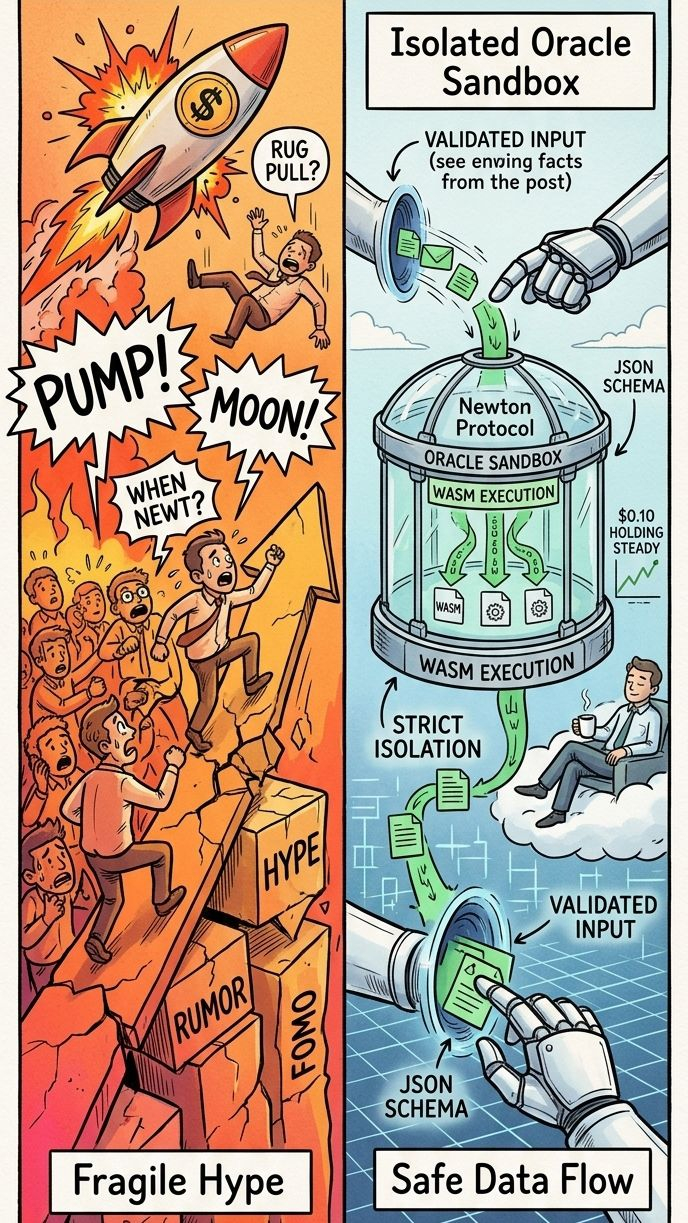
Security isn’t just a feature anymore—it’s the entire game. By enforcing an isolated Oracle Sandbox, the network completely locks down off-chain vulnerabilities.
💡 Quick Facts:
WASM-compiled components keep execution secure.
Strict isolation blocks dangerous loopbacks and private network ranges.
Inputs are checked before submission using strict JSON schemas.
Relocating trust to secure, public-facing gateways is how decentralized architecture scales without breaking. With the token holding steady around the $0.10 mark, utility is what sets real tech apart from temporary hype. 💎
👇 What’s your take on isolated execution environments? Drop a comment below, follow for more tech breakdowns, and share this post!
@NewtonProtocol #Newt #CryptoUtility #Mainnet
$NEWT
{future}(NEWTUSDT)
$M
{future}(MUSDT)
$PUMPBTC
{future}(PUMPBTCUSDT)
🔥 Stop chasing random pumps. Let's talk real blockchain utility. 🔥
While the market searches for the next big narrative, smart developers are quietly tracking structural shifts. Look closely at what is happening with the @NewtonProtocol Mainnet Beta right now. 🚀
Security isn’t just a feature anymore—it’s the entire game. By enforcing an isolated Oracle Sandbox, the network completely locks down off-chain vulnerabilities.
💡 Quick Facts:
WASM-compiled components keep execution secure.
Strict isolation blocks dangerous loopbacks and private network ranges.
Inputs are checked before submission using strict JSON schemas.
Relocating trust to secure, public-facing gateways is how decentralized architecture scales without breaking. With the token holding steady around the $0.10 mark, utility is what sets real tech apart from temporary hype. 💎
👇 What’s your take on isolated execution environments? Drop a comment below, follow for more tech breakdowns, and share this post!
@NewtonProtocol #Newt #CryptoUtility #Mainnet
$NEWT
$M
$PUMPBTC
While the market searches for the next big narrative, smart developers are quietly tracking structural shifts. Look closely at what is happening with the @NewtonProtocol Mainnet Beta right now. 🚀
Security isn’t just a feature anymore—it’s the entire game. By enforcing an isolated Oracle Sandbox, the network completely locks down off-chain vulnerabilities.
💡 Quick Facts:
WASM-compiled components keep execution secure.
Strict isolation blocks dangerous loopbacks and private network ranges.
Inputs are checked before submission using strict JSON schemas.
Relocating trust to secure, public-facing gateways is how decentralized architecture scales without breaking. With the token holding steady around the $0.10 mark, utility is what sets real tech apart from temporary hype. 💎
👇 What’s your take on isolated execution environments? Drop a comment below, follow for more tech breakdowns, and share this post!
@NewtonProtocol #Newt #CryptoUtility #Mainnet
$NEWT
$M
$PUMPBTC
23
8
544
·
--
උසබ තත්ත්වය
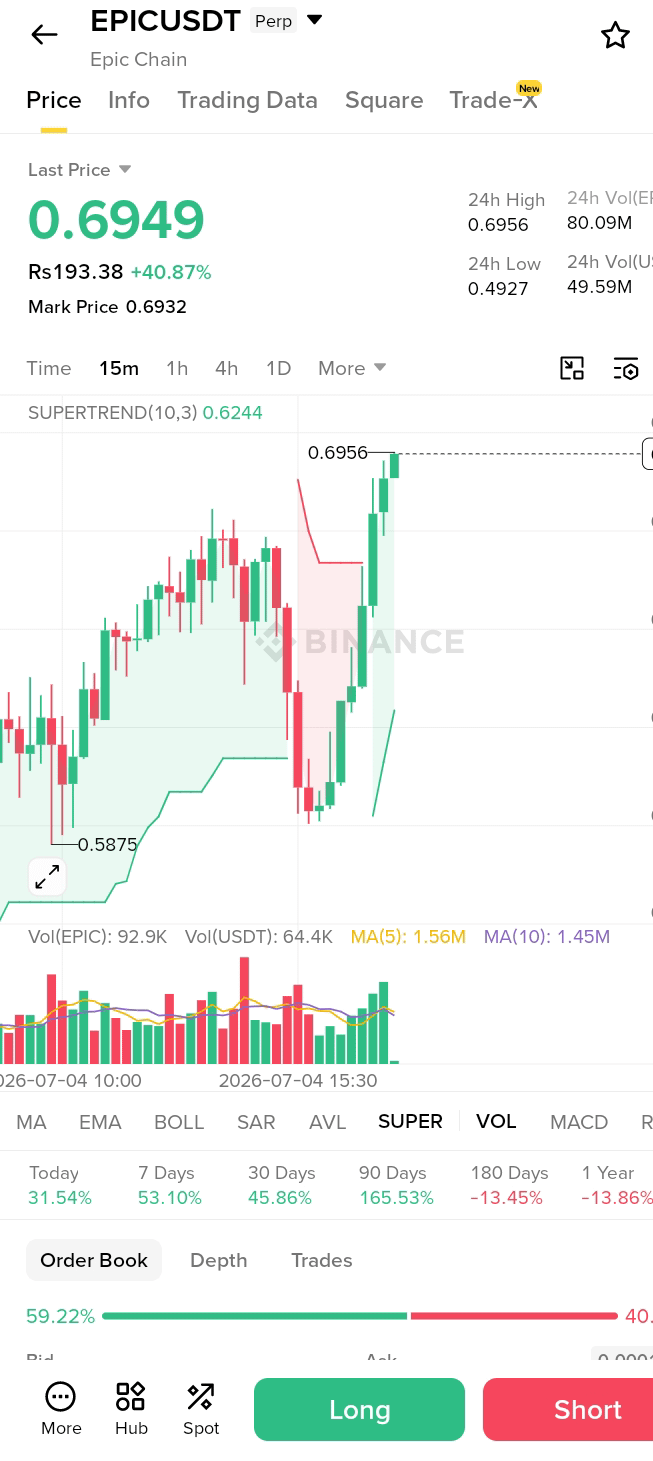
🚀 EPIC is just getting started!
I told you earlier that $EPIC
{future}(EPICUSDT)
was going to make a big move, and it looks like that call is playing out. 🔥
❌ Don't rush to close your trade. 💎 In my view, the bigger move may still be ahead.
🎯 Target Zone: $0.80 → $1.50
Stay patient, manage your risk, and don't let emotions make your decisions.
Who's still holding EPIC? Drop a 🚀 in the comments!
#EPIC #Crypto #Trading #Altcoins #CryptoTrading #Bullish
🚀 EPIC is just getting started!
I told you earlier that $EPIC
was going to make a big move, and it looks like that call is playing out. 🔥
❌ Don't rush to close your trade. 💎 In my view, the bigger move may still be ahead.
🎯 Target Zone: $0.80 → $1.50
Stay patient, manage your risk, and don't let emotions make your decisions.
Who's still holding EPIC? Drop a 🚀 in the comments!
#EPIC #Crypto #Trading #Altcoins #CryptoTrading #Bullish
I told you earlier that $EPIC
was going to make a big move, and it looks like that call is playing out. 🔥
❌ Don't rush to close your trade. 💎 In my view, the bigger move may still be ahead.
🎯 Target Zone: $0.80 → $1.50
Stay patient, manage your risk, and don't let emotions make your decisions.
Who's still holding EPIC? Drop a 🚀 in the comments!
#EPIC #Crypto #Trading #Altcoins #CryptoTrading #Bullish
2
86
ලිපිය
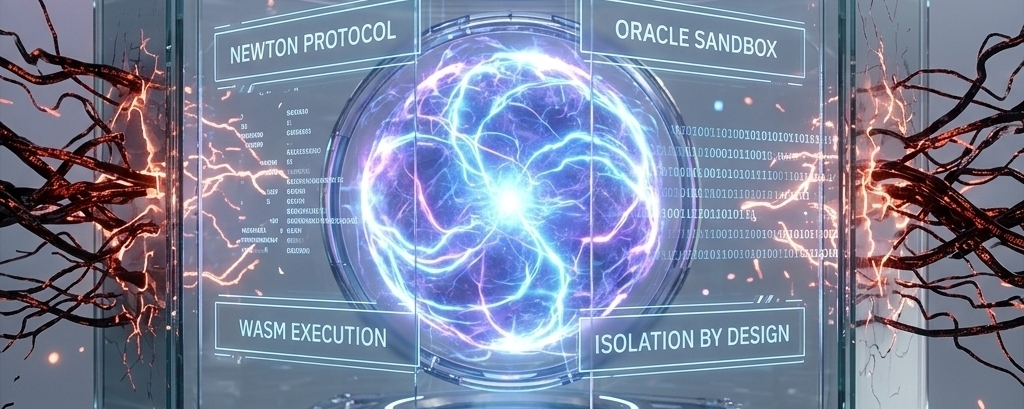
Rethinking Blockchain Security: How Newton Protocol's Sandbox Isolates RiskBringing off-chain data into on-chain environments has always been a security tightrope. But with the rollout of the Newton Mainnet Beta, we are seeing a fundamental shift in how developers handle this vulnerability. At the heart of this shift is a system that doesn't just manage risk—it isolates it by design.
Let's break down how this works. Instead of giving off-chain code free rein, the network compiles PolicyData oracles into isolated WebAssembly (WASM) components. When an operator executes this component, it runs within a highly secure, sandboxed Wasmtime environment.
The true brilliance of this design lies in what the oracle is explicitly forbidden to do. The sandbox strictly blocks requests to private network ranges, loopback addresses, and link-local addresses. If an oracle needs to call an HTTP endpoint, that endpoint absolutely must be public. Furthermore, inputs are strictly validated against a declared JSON schema, catching malformed data and rejecting it before it even enters the system.
However, it’s crucial to understand that this security boundary doesn't magically erase trust—it simply relocates it. While the execution environment is highly protected from the oracle itself, developers must still ensure that the public gateways feeding data into the sandbox are robust. The code is constrained, but the applications built around it must still make intelligent decisions about which public services to trust.
As the ecosystem expands and with $NEWT currently trading around the $0.10 mark, the focus on clean, secure integrations is more important than ever. This architecture forces developers to think critically about their dependencies, ultimately leading to stronger, more resilient on-chain authorizations.
Are you building on the mainnet yet?
@NewtonProtocol #Newt
$NEWT
{future}(NEWTUSDT)
$EPIC
{future}(EPICUSDT)
#BitcoinFallsOver50%FromOctoberHigh #GillibrandCallsForDigitalAssetEthicsBan #BitcoinReboundsAbove$61K #RevolutToDelistUSDT
Rethinking Blockchain Security: How Newton Protocol's Sandbox Isolates Risk
Bringing off-chain data into on-chain environments has always been a security tightrope. But with the rollout of the Newton Mainnet Beta, we are seeing a fundamental shift in how developers handle this vulnerability. At the heart of this shift is a system that doesn't just manage risk—it isolates it by design.
Let's break down how this works. Instead of giving off-chain code free rein, the network compiles PolicyData oracles into isolated WebAssembly (WASM) components. When an operator executes this component, it runs within a highly secure, sandboxed Wasmtime environment.
The true brilliance of this design lies in what the oracle is explicitly forbidden to do. The sandbox strictly blocks requests to private network ranges, loopback addresses, and link-local addresses. If an oracle needs to call an HTTP endpoint, that endpoint absolutely must be public. Furthermore, inputs are strictly validated against a declared JSON schema, catching malformed data and rejecting it before it even enters the system.
However, it’s crucial to understand that this security boundary doesn't magically erase trust—it simply relocates it. While the execution environment is highly protected from the oracle itself, developers must still ensure that the public gateways feeding data into the sandbox are robust. The code is constrained, but the applications built around it must still make intelligent decisions about which public services to trust.
As the ecosystem expands and with $NEWT currently trading around the $0.10 mark, the focus on clean, secure integrations is more important than ever. This architecture forces developers to think critically about their dependencies, ultimately leading to stronger, more resilient on-chain authorizations.
Are you building on the mainnet yet?
@NewtonProtocol #Newt
$NEWT
$EPIC
#BitcoinFallsOver50%FromOctoberHigh #GillibrandCallsForDigitalAssetEthicsBan #BitcoinReboundsAbove$61K #RevolutToDelistUSDT
Let's break down how this works. Instead of giving off-chain code free rein, the network compiles PolicyData oracles into isolated WebAssembly (WASM) components. When an operator executes this component, it runs within a highly secure, sandboxed Wasmtime environment.
The true brilliance of this design lies in what the oracle is explicitly forbidden to do. The sandbox strictly blocks requests to private network ranges, loopback addresses, and link-local addresses. If an oracle needs to call an HTTP endpoint, that endpoint absolutely must be public. Furthermore, inputs are strictly validated against a declared JSON schema, catching malformed data and rejecting it before it even enters the system.
However, it’s crucial to understand that this security boundary doesn't magically erase trust—it simply relocates it. While the execution environment is highly protected from the oracle itself, developers must still ensure that the public gateways feeding data into the sandbox are robust. The code is constrained, but the applications built around it must still make intelligent decisions about which public services to trust.
As the ecosystem expands and with $NEWT currently trading around the $0.10 mark, the focus on clean, secure integrations is more important than ever. This architecture forces developers to think critically about their dependencies, ultimately leading to stronger, more resilient on-chain authorizations.
Are you building on the mainnet yet?
@NewtonProtocol #Newt
$NEWT
$EPIC
#BitcoinFallsOver50%FromOctoberHigh #GillibrandCallsForDigitalAssetEthicsBan #BitcoinReboundsAbove$61K #RevolutToDelistUSDT
9
5
64
·
--
උසබ තත්ත්වය
🚨 NEW TRADE ALERT 🚨
I just opened a LONG position on $EPIC
{future}(EPICUSDT)
📈🔥
✅ Coin: EPIC 📊 Position: LONG
If you're following my trades, check your own analysis and manage your risk before entering.
Let's see where this move goes. 🚀
#EPIC #Crypto #Trading #Long #CryptoTrading #TradeAlert
🚨 NEW TRADE ALERT 🚨
I just opened a LONG position on $EPIC
📈🔥
✅ Coin: EPIC 📊 Position: LONG
If you're following my trades, check your own analysis and manage your risk before entering.
Let's see where this move goes. 🚀
#EPIC #Crypto #Trading #Long #CryptoTrading #TradeAlert
I just opened a LONG position on $EPIC
📈🔥
✅ Coin: EPIC 📊 Position: LONG
If you're following my trades, check your own analysis and manage your risk before entering.
Let's see where this move goes. 🚀
#EPIC #Crypto #Trading #Long #CryptoTrading #TradeAlert
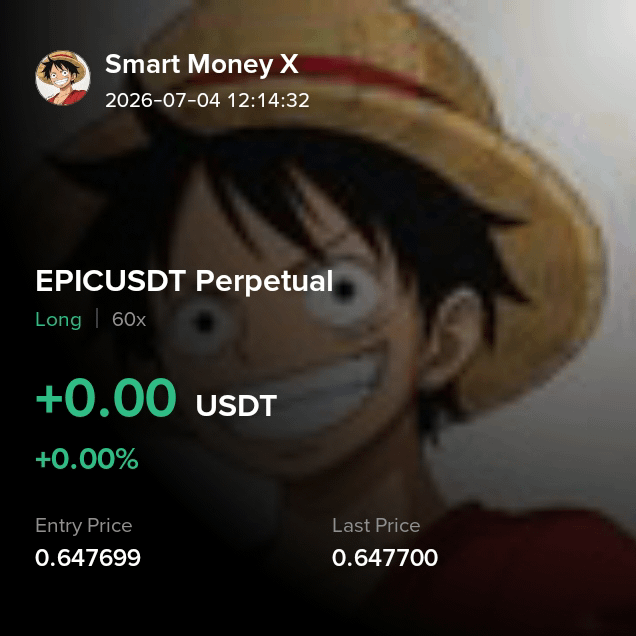
2
181
·
--
උසබ තත්ත්වය
The Tech Behind the Token 📊
When analyzing new ecosystems, looking at active development environments tells you more than chart hype. The Newton Mainnet Beta isn't just a conceptual idea; it’s an active testbed for refined transaction execution paths. By removing single-node bottlenecks, @NewtonProtocol is quietly building a highly secure alternative for next-gen developers. Tracking $NEWT utility metrics closely to see how adoption scales throughout this active campaign phase.
#Newt #CryptoCommunity #BinanceSquareCreator #TechUpdate
The Tech Behind the Token 📊
When analyzing new ecosystems, looking at active development environments tells you more than chart hype. The Newton Mainnet Beta isn't just a conceptual idea; it’s an active testbed for refined transaction execution paths. By removing single-node bottlenecks, @NewtonProtocol is quietly building a highly secure alternative for next-gen developers. Tracking $NEWT utility metrics closely to see how adoption scales throughout this active campaign phase.
#Newt #CryptoCommunity #BinanceSquareCreator #TechUpdate
When analyzing new ecosystems, looking at active development environments tells you more than chart hype. The Newton Mainnet Beta isn't just a conceptual idea; it’s an active testbed for refined transaction execution paths. By removing single-node bottlenecks, @NewtonProtocol is quietly building a highly secure alternative for next-gen developers. Tracking $NEWT utility metrics closely to see how adoption scales throughout this active campaign phase.
#Newt #CryptoCommunity #BinanceSquareCreator #TechUpdate

13
4
144
·
--
උසබ තත්ත්වය
A lot of people are asking if I'm closing this trade or waiting for more profit.
My opinion: I'm holding for now because I believe there's still upside, but I'm watching the market closely. If momentum weakens, I'll secure profits instead of getting greedy.
Remember: This is just my personal view, not financial advice. Always manage your risk and take profits according to your own plan.
$HMSTR
{future}(HMSTRUSDT)
A lot of people are asking if I'm closing this trade or waiting for more profit.
My opinion: I'm holding for now because I believe there's still upside, but I'm watching the market closely. If momentum weakens, I'll secure profits instead of getting greedy.
Remember: This is just my personal view, not financial advice. Always manage your risk and take profits according to your own plan.
$HMSTR
My opinion: I'm holding for now because I believe there's still upside, but I'm watching the market closely. If momentum weakens, I'll secure profits instead of getting greedy.
Remember: This is just my personal view, not financial advice. Always manage your risk and take profits according to your own plan.
$HMSTR
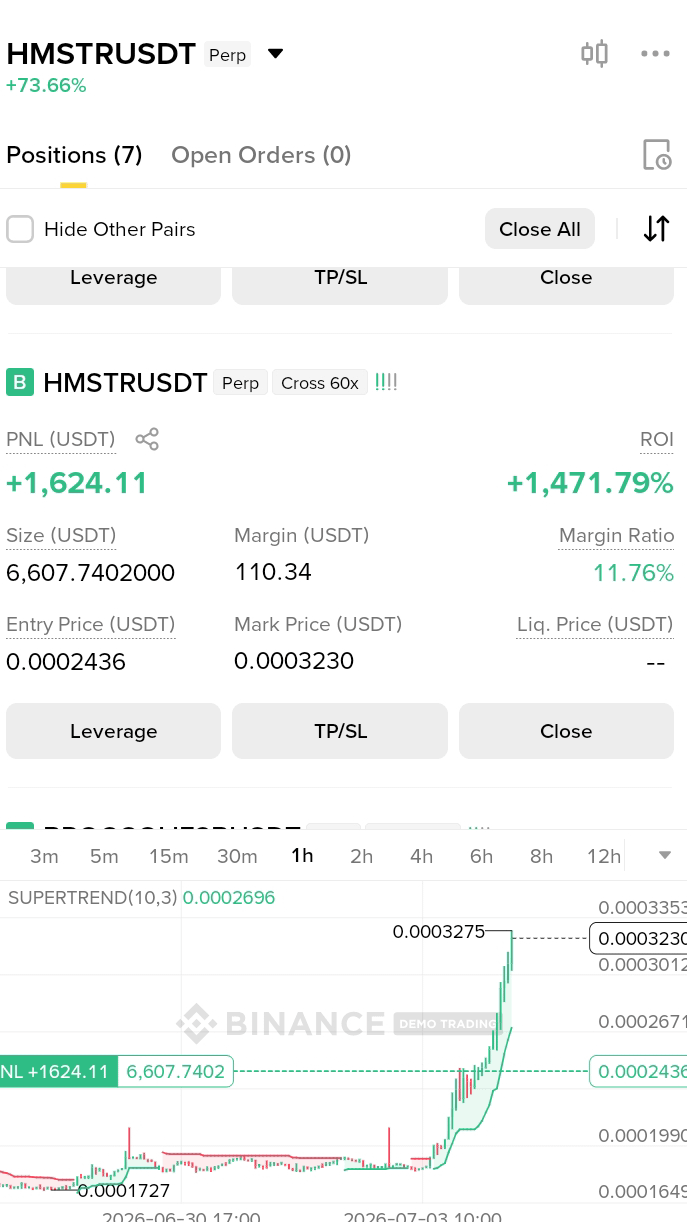
1
506
🚨 Huge Congratulations to everyone who followed my calls! 🎉
🔥 My $MAGMA
{future}(MAGMAUSDT)
trade pumped over 600% 🔥 My second call $HMSTR
{future}(HMSTRUSDT)
surged more than 500%
Massive profits for everyone who trusted the setup! 📈💰
If you're new here, hit Follow now. My trading momentum is just getting started, and tomorrow's results will speak for themselves.
Don't miss the next big move. 🚀 #Crypto #Trading #MAGMA #HMSIR #CryptoGains
🚨 Huge Congratulations to everyone who followed my calls! 🎉
🔥 My $MAGMA
trade pumped over 600% 🔥 My second call $HMSTR
surged more than 500%
Massive profits for everyone who trusted the setup! 📈💰
If you're new here, hit Follow now. My trading momentum is just getting started, and tomorrow's results will speak for themselves.
Don't miss the next big move. 🚀 #Crypto #Trading #MAGMA #HMSIR #CryptoGains
🔥 My $MAGMA
trade pumped over 600% 🔥 My second call $HMSTR
surged more than 500%
Massive profits for everyone who trusted the setup! 📈💰
If you're new here, hit Follow now. My trading momentum is just getting started, and tomorrow's results will speak for themselves.
Don't miss the next big move. 🚀 #Crypto #Trading #MAGMA #HMSIR #CryptoGains
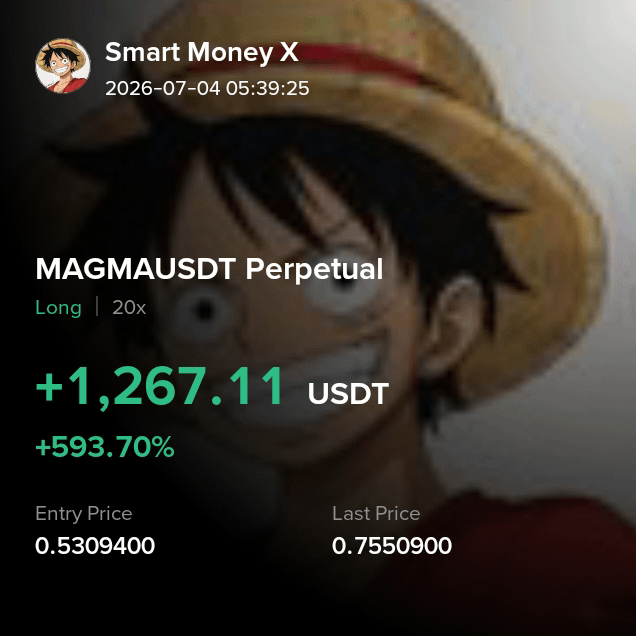
1
237
⚠️ New trade setup is ready.$HMSTR
{future}(HMSTRUSDT)
I'm sharing it, but I'm not confident enough in this one.
I'd rather you skip this trade and wait for a higher-confidence setup. Protecting your capital is more important than forcing a trade.
Stay patient—I'll update you when I find a better opportunity. 📊🤝
⚠️ New trade setup is ready.$HMSTR
I'm sharing it, but I'm not confident enough in this one.
I'd rather you skip this trade and wait for a higher-confidence setup. Protecting your capital is more important than forcing a trade.
Stay patient—I'll update you when I find a better opportunity. 📊🤝
I'm sharing it, but I'm not confident enough in this one.
I'd rather you skip this trade and wait for a higher-confidence setup. Protecting your capital is more important than forcing a trade.
Stay patient—I'll update you when I find a better opportunity. 📊🤝
1
106
🎯 Finally, I closed my $MAGMA position! ✅
💰 Profit: $88
If you followed my call, comment below: 📈 How much profit did you make?
More trade setups are coming soon. Stay tuned! 🚀
🎯 Finally, I closed my $MAGMA position! ✅
💰 Profit: $88
If you followed my call, comment below: 📈 How much profit did you make?
More trade setups are coming soon. Stay tuned! 🚀
💰 Profit: $88
If you followed my call, comment below: 📈 How much profit did you make?
More trade setups are coming soon. Stay tuned! 🚀
2
472
තවත් අන්තර්ගතයන් ගවේෂණය කිරීමට ඇතුල් වන්න
Binance චතුරශ්රය හි ගෝලීය ක්රිප්ටෝ පරිශීලකයින් හා එක්වන්න
⚡️ ක්රිප්ටෝ පිළිබඳ නවතම සහ ප්රයෝජනවත් තොරතුරු ලබා ගන්න.
💬 ලොව විශාලතම ක්රිප්ටෝ හුවමාරුව මගින් විශ්වාස කෙරේ.
👍 සත්යායනය කරන ලද නිර්මාණකරුවන්ගෙන් සැබෑ විදසුන් සොයා ගන්න.
විද්යුත් තැපෑල / දුරකථන අංකය
නැගී එන මාතෘකා
BinancePick
3.2M නැරඹීම්
158,390 සාකච්ඡා කරමින්
Join #EarningsSeason: Predict Earnings on Binance Pick, Share Your Take on Binance Square!
Binance Square Official
·413 කැමත්ත දැක්වීම්
·344.1k නැරඹීම්
EarningsSeason
5.4M නැරඹීම්
26,317 සාකච්ඡා කරමින්
BitmineAdds10452ETH
259 නැරඹීම්
26 සාකච්ඡා කරමින්