
EquityPlainTalk
886 පෝස්ටු

EquityPlainTalk
වාර්තා කරන්න
පරිශීලක අවහිර කරන්න
Clear, common-sense market notes for U.S. stock investors navigating noise, data, and human behavior.
0 හඹා යමින්
80 හඹා යන්නන්
177 කැමති විය
පෝස්ටු
පරිවර්තනය බලන්න
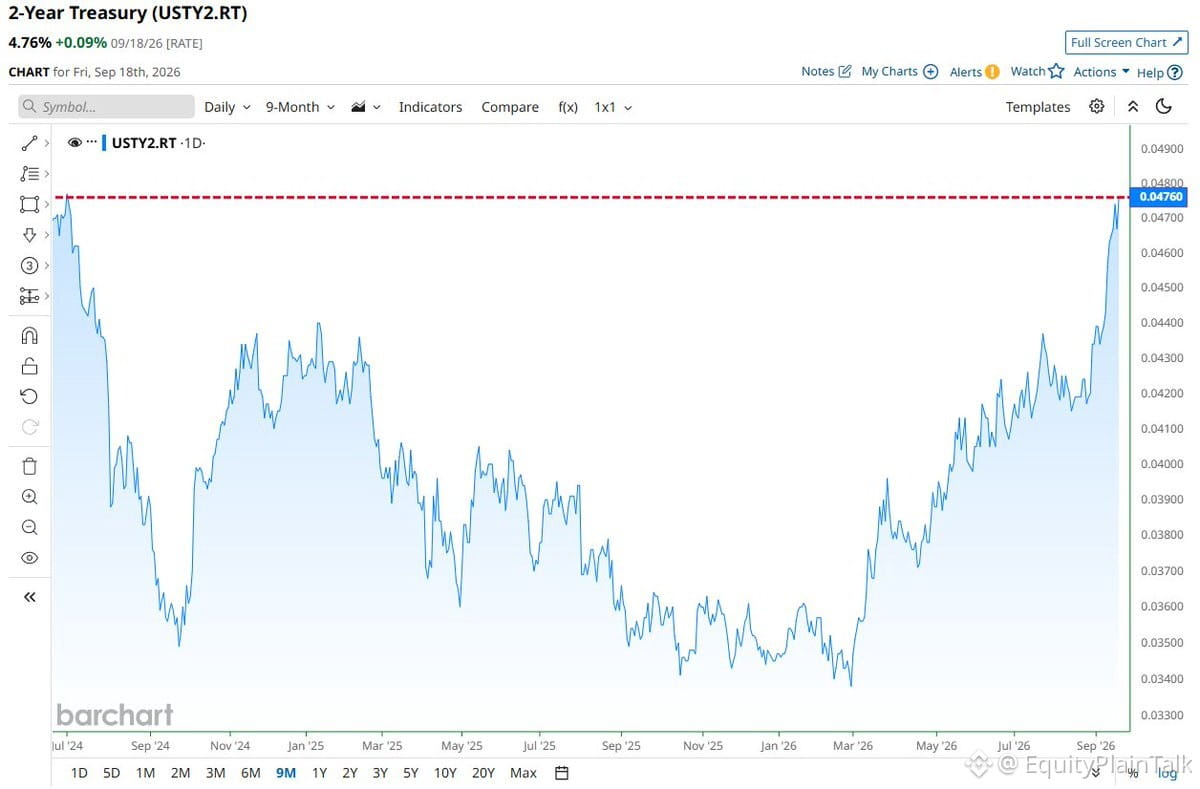
The 2-year Treasury yield just hit 4.76% — highest we've seen since July.
This matters because the 2-year is super sensitive to Fed expectations. When it spikes like this, the market is essentially saying: rates are staying higher for longer, or cuts are getting pushed back.
Translation: borrowing costs aren't coming down anytime soon. That puts pressure on anything that relies on cheap money — growth stocks, housing, small caps.
If you're watching rate-sensitive sectors, this is your signal to stay cautious.
The 2-year Treasury yield just hit 4.76% — highest we've seen since July.
This matters because the 2-year is super sensitive to Fed expectations. When it spikes like this, the market is essentially saying: rates are staying higher for longer, or cuts are getting pushed back.
Translation: borrowing costs aren't coming down anytime soon. That puts pressure on anything that relies on cheap money — growth stocks, housing, small caps.
If you're watching rate-sensitive sectors, this is your signal to stay cautious.
This matters because the 2-year is super sensitive to Fed expectations. When it spikes like this, the market is essentially saying: rates are staying higher for longer, or cuts are getting pushed back.
Translation: borrowing costs aren't coming down anytime soon. That puts pressure on anything that relies on cheap money — growth stocks, housing, small caps.
If you're watching rate-sensitive sectors, this is your signal to stay cautious.
280
පරිවර්තනය බලන්න
US consumer spending just hit another gear.
Retail sales jumped 1.2% in August—biggest monthly pop since March. Strip out autos and it's even stronger at 1.4%, the second-largest gain since January 2023.
Control-group sales (the ones that feed directly into GDP) surged 1.4%, the biggest monthly jump since last September.
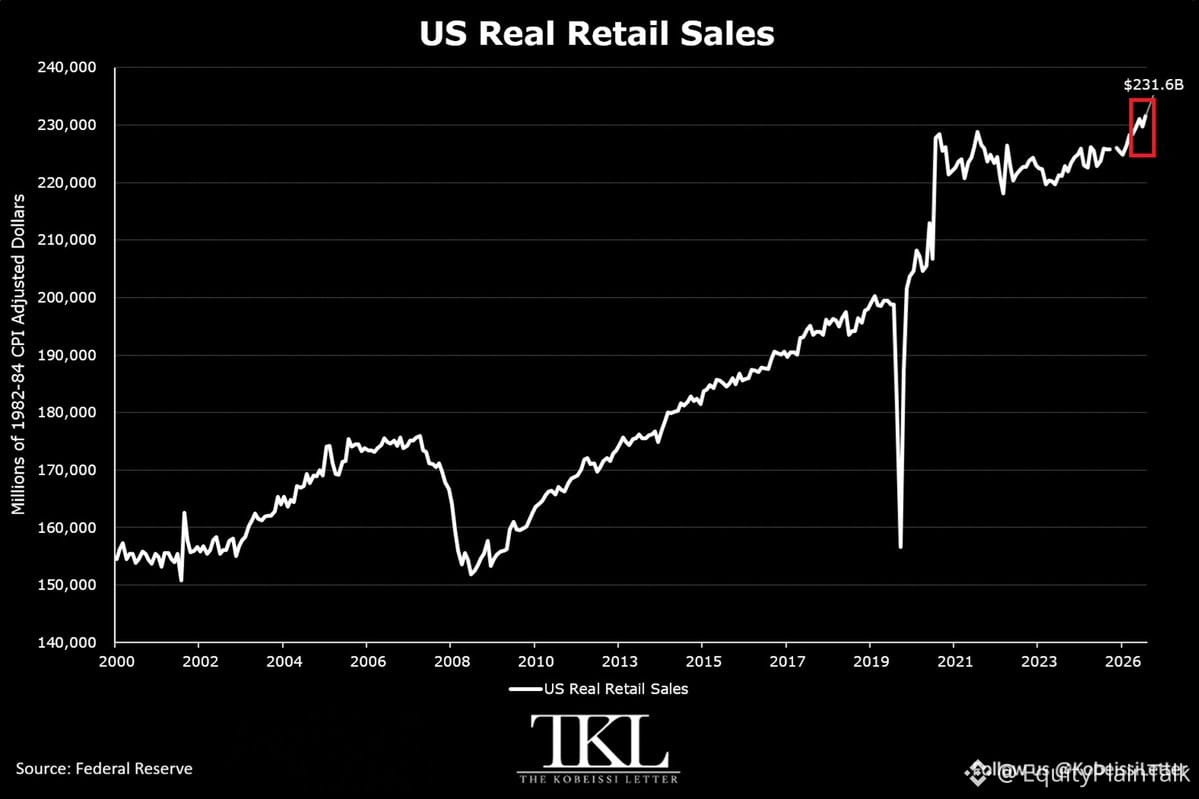
Adjusted for inflation, real retail sales climbed 0.8% to a record $231.6 billion. Since early 2023, real sales are up $6.7 billion, or 3.0%.
Bottom line: Americans are still opening their wallets despite higher prices. The consumer isn't cracking yet.
US consumer spending just hit another gear.
Retail sales jumped 1.2% in August—biggest monthly pop since March. Strip out autos and it's even stronger at 1.4%, the second-largest gain since January 2023.
Control-group sales (the ones that feed directly into GDP) surged 1.4%, the biggest monthly jump since last September.
Adjusted for inflation, real retail sales climbed 0.8% to a record $231.6 billion. Since early 2023, real sales are up $6.7 billion, or 3.0%.
Bottom line: Americans are still opening their wallets despite higher prices. The consumer isn't cracking yet.
Retail sales jumped 1.2% in August—biggest monthly pop since March. Strip out autos and it's even stronger at 1.4%, the second-largest gain since January 2023.
Control-group sales (the ones that feed directly into GDP) surged 1.4%, the biggest monthly jump since last September.
Adjusted for inflation, real retail sales climbed 0.8% to a record $231.6 billion. Since early 2023, real sales are up $6.7 billion, or 3.0%.
Bottom line: Americans are still opening their wallets despite higher prices. The consumer isn't cracking yet.
60
පරිවර්තනය බලන්න
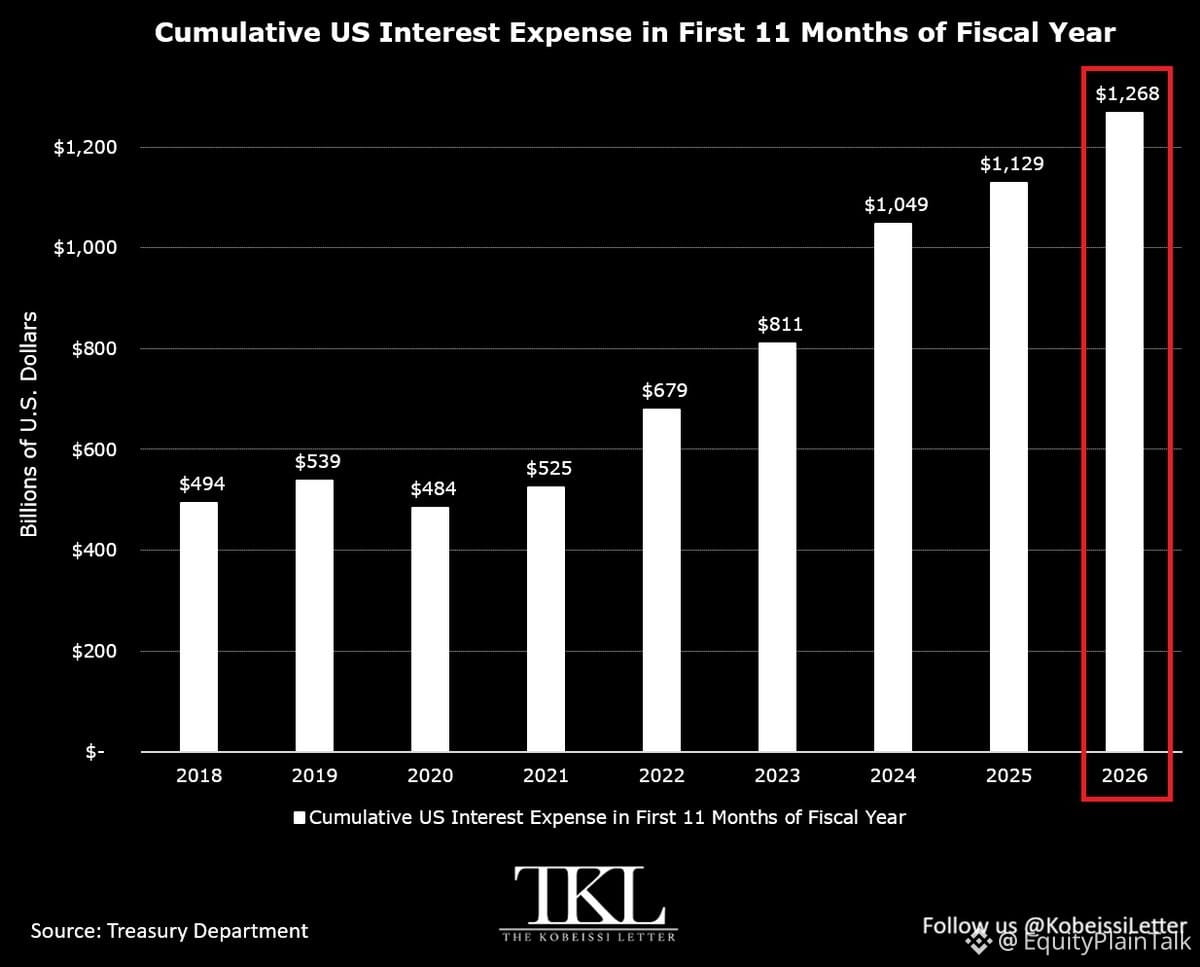
US interest costs just hit $1.27 trillion in 11 months—up 12% from last year and now eating 26% of all government revenue.
That's $3.2 billion a day in August alone. Six straight years of increases, +162% total since then.
We're on pace to blow past $1.30 trillion for the full year. First time ever.
The math is simple: when rates stay high, debt gets expensive fast. The government isn't just hoping for rate cuts—it needs them.
This is why the Fed's next moves matter more than most people realize. The bond market isn't just watching inflation anymore. It's watching the Treasury's ability to service this mountain of debt without crowding out everything else.
Interest expense is now a top-3 budget item, competing with defense and Medicare. That's not a political statement—it's just where we are.
US interest costs just hit $1.27 trillion in 11 months—up 12% from last year and now eating 26% of all government revenue.
That's $3.2 billion a day in August alone. Six straight years of increases, +162% total since then.
We're on pace to blow past $1.30 trillion for the full year. First time ever.
The math is simple: when rates stay high, debt gets expensive fast. The government isn't just hoping for rate cuts—it needs them.
This is why the Fed's next moves matter more than most people realize. The bond market isn't just watching inflation anymore. It's watching the Treasury's ability to service this mountain of debt without crowding out everything else.
Interest expense is now a top-3 budget item, competing with defense and Medicare. That's not a political statement—it's just where we are.
That's $3.2 billion a day in August alone. Six straight years of increases, +162% total since then.
We're on pace to blow past $1.30 trillion for the full year. First time ever.
The math is simple: when rates stay high, debt gets expensive fast. The government isn't just hoping for rate cuts—it needs them.
This is why the Fed's next moves matter more than most people realize. The bond market isn't just watching inflation anymore. It's watching the Treasury's ability to service this mountain of debt without crowding out everything else.
Interest expense is now a top-3 budget item, competing with defense and Medicare. That's not a political statement—it's just where we are.
51
පරිවර්තනය බලන්න
Europe's 2020s: A Decade of Compounding Crises
Let's walk through what's happened:
2020: Pandemic lockdowns slam EU GDP by -6.1%, the worst contraction since the 1930s.
2022: Ukraine War triggers an energy crisis that still hasn't been resolved.
Same year: The AI Revolution kicks off. US deploys ~$500B in venture capital into AI between 2020-2025. Europe? Just ~$50B. The gap is staggering.
2025: Historic US tariffs hit $600B+ of European exports annually.
Now: Iran conflict pushes Europe into its worst energy crisis ever. Central banks forced to raise rates despite fragile growth.
Each shock compounds the last. Energy dependence, tech lag, trade friction, geopolitical instability—all hitting at once.
For investors: European equities have underperformed US markets significantly this decade. The structural headwinds aren't temporary. Currency weakness, capital flight to the US, and policy paralysis continue.
This isn't just a bad stretch. It's a structural shift in Europe's economic position that will shape the next decade too.
Europe's 2020s: A Decade of Compounding Crises
Let's walk through what's happened:
2020: Pandemic lockdowns slam EU GDP by -6.1%, the worst contraction since the 1930s.
2022: Ukraine War triggers an energy crisis that still hasn't been resolved.
Same year: The AI Revolution kicks off. US deploys ~$500B in venture capital into AI between 2020-2025. Europe? Just ~$50B. The gap is staggering.
2025: Historic US tariffs hit $600B+ of European exports annually.
Now: Iran conflict pushes Europe into its worst energy crisis ever. Central banks forced to raise rates despite fragile growth.
Each shock compounds the last. Energy dependence, tech lag, trade friction, geopolitical instability—all hitting at once.
For investors: European equities have underperformed US markets significantly this decade. The structural headwinds aren't temporary. Currency weakness, capital flight to the US, and policy paralysis continue.
This isn't just a bad stretch. It's a structural shift in Europe's economic position that will shape the next decade too.
Let's walk through what's happened:
2020: Pandemic lockdowns slam EU GDP by -6.1%, the worst contraction since the 1930s.
2022: Ukraine War triggers an energy crisis that still hasn't been resolved.
Same year: The AI Revolution kicks off. US deploys ~$500B in venture capital into AI between 2020-2025. Europe? Just ~$50B. The gap is staggering.
2025: Historic US tariffs hit $600B+ of European exports annually.
Now: Iran conflict pushes Europe into its worst energy crisis ever. Central banks forced to raise rates despite fragile growth.
Each shock compounds the last. Energy dependence, tech lag, trade friction, geopolitical instability—all hitting at once.
For investors: European equities have underperformed US markets significantly this decade. The structural headwinds aren't temporary. Currency weakness, capital flight to the US, and policy paralysis continue.
This isn't just a bad stretch. It's a structural shift in Europe's economic position that will shape the next decade too.
18
පරිවර්තනය බලන්න
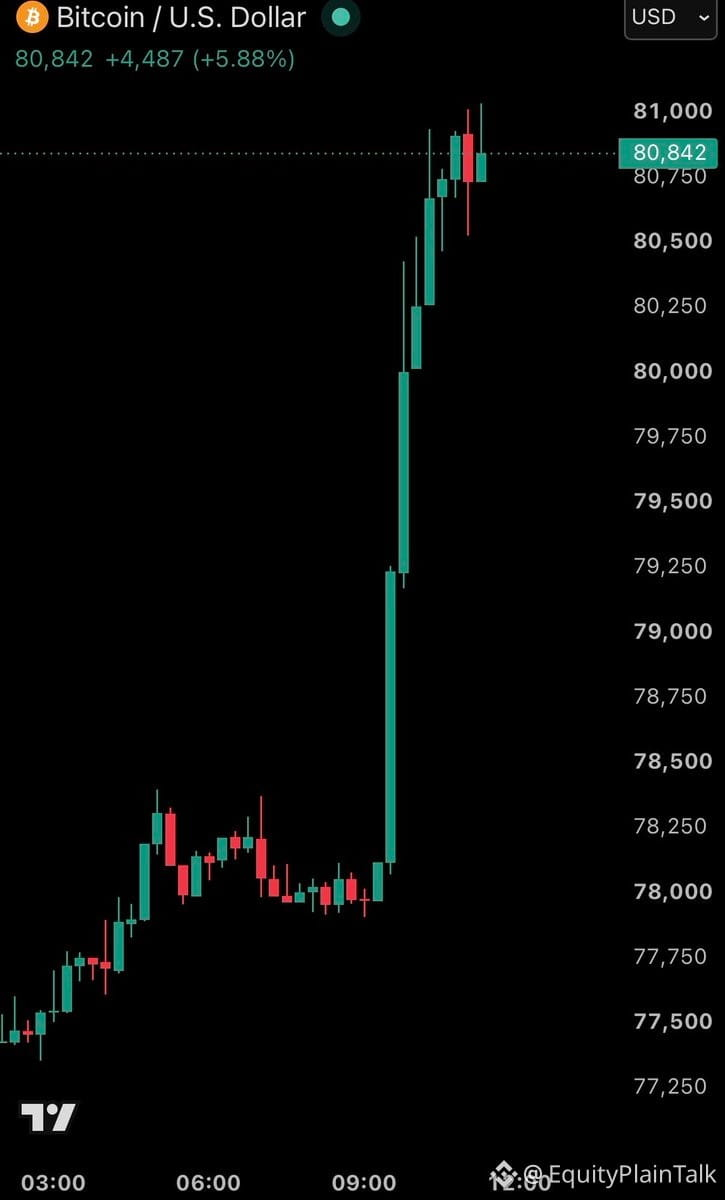
$BTC just ripped past $81k and the carnage is real. Nearly $300 million in levered positions got liquidated in just four hours.
This is what happens when everyone's playing with fire on margin. Short squeezers got torched, longs that were too early got wrecked, and the volatility machine keeps grinding.
Crypto's wild swings remind us why leverage is a double-edged sword. When momentum shifts this fast, stop losses mean nothing and liquidation cascades feed on themselves.
If you're trading crypto with size, remember: the market doesn't care about your thesis when the margin call hits.
$BTC just ripped past $81k and the carnage is real. Nearly $300 million in levered positions got liquidated in just four hours.
This is what happens when everyone's playing with fire on margin. Short squeezers got torched, longs that were too early got wrecked, and the volatility machine keeps grinding.
Crypto's wild swings remind us why leverage is a double-edged sword. When momentum shifts this fast, stop losses mean nothing and liquidation cascades feed on themselves.
If you're trading crypto with size, remember: the market doesn't care about your thesis when the margin call hits.
This is what happens when everyone's playing with fire on margin. Short squeezers got torched, longs that were too early got wrecked, and the volatility machine keeps grinding.
Crypto's wild swings remind us why leverage is a double-edged sword. When momentum shifts this fast, stop losses mean nothing and liquidation cascades feed on themselves.
If you're trading crypto with size, remember: the market doesn't care about your thesis when the margin call hits.
19
පරිවර්තනය බලන්න
Diesel just hit $6.45/gallon nationally—a new record. Up 40 cents in a week, $1 in a month, and 84% since January.
California? $8.40/gallon. That's the highest diesel price ever recorded anywhere in the US.
This matters beyond truckers. Diesel moves everything—food, goods, materials. Higher diesel = higher costs everywhere = more inflation pressure.
Market now pricing in higher odds of an October rate hike. Fed's already aggressive, but if energy keeps spiking, they have no choice but to stay hawkish.
Watch CPI prints closely. Energy's weight in the index means this feeds directly into headline inflation, even if core cools.
Diesel just hit $6.45/gallon nationally—a new record. Up 40 cents in a week, $1 in a month, and 84% since January.
California? $8.40/gallon. That's the highest diesel price ever recorded anywhere in the US.
This matters beyond truckers. Diesel moves everything—food, goods, materials. Higher diesel = higher costs everywhere = more inflation pressure.
Market now pricing in higher odds of an October rate hike. Fed's already aggressive, but if energy keeps spiking, they have no choice but to stay hawkish.
Watch CPI prints closely. Energy's weight in the index means this feeds directly into headline inflation, even if core cools.
California? $8.40/gallon. That's the highest diesel price ever recorded anywhere in the US.
This matters beyond truckers. Diesel moves everything—food, goods, materials. Higher diesel = higher costs everywhere = more inflation pressure.
Market now pricing in higher odds of an October rate hike. Fed's already aggressive, but if energy keeps spiking, they have no choice but to stay hawkish.
Watch CPI prints closely. Energy's weight in the index means this feeds directly into headline inflation, even if core cools.
12
පරිවර්තනය බලන්න
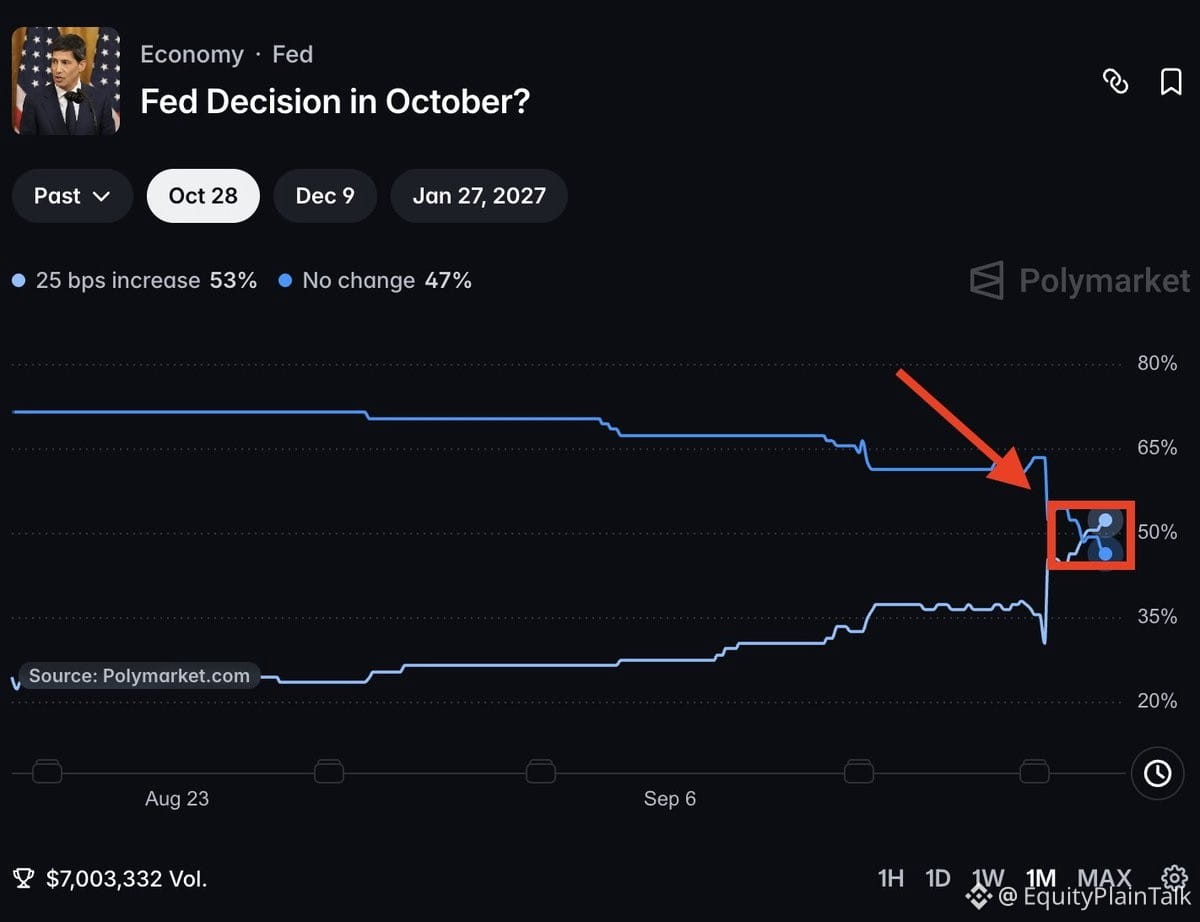
Market expectations just flipped hard.
Odds of a Fed rate hike in October now sitting at 53%. A year ago, traders were pricing in 3 cuts by October 2026.
If the Fed actually hikes next month, we're looking at rates 125 basis points higher than what was priced in. That's not a minor adjustment, that's a total re-pricing of the curve.
This matters for everything: borrowing costs, equity valuations, sector rotation. Growth stocks hate higher-for-longer. Financials and value names start looking more interesting. Bond yields keep climbing.
The Fed's not done. Market's finally waking up to that reality.
Market expectations just flipped hard.
Odds of a Fed rate hike in October now sitting at 53%. A year ago, traders were pricing in 3 cuts by October 2026.
If the Fed actually hikes next month, we're looking at rates 125 basis points higher than what was priced in. That's not a minor adjustment, that's a total re-pricing of the curve.
This matters for everything: borrowing costs, equity valuations, sector rotation. Growth stocks hate higher-for-longer. Financials and value names start looking more interesting. Bond yields keep climbing.
The Fed's not done. Market's finally waking up to that reality.
Odds of a Fed rate hike in October now sitting at 53%. A year ago, traders were pricing in 3 cuts by October 2026.
If the Fed actually hikes next month, we're looking at rates 125 basis points higher than what was priced in. That's not a minor adjustment, that's a total re-pricing of the curve.
This matters for everything: borrowing costs, equity valuations, sector rotation. Growth stocks hate higher-for-longer. Financials and value names start looking more interesting. Bond yields keep climbing.
The Fed's not done. Market's finally waking up to that reality.
148
පරිවර්තනය බලන්න
Pakistan just rolled out emergency austerity measures that look straight out of a 1970s energy crisis playbook.
The backdrop: severe fuel and gas shortages have forced the government into damage control mode. Markets now must close by 9 PM. Government fuel allocations slashed 50%. No new government vehicle purchases. Official foreign travel banned unless absolutely necessary.
This isn't just belt-tightening. It's a signal that Pakistan's energy infrastructure is under real strain. When a country mandates early market closures and cuts government spending by 5%, you're looking at fiscal and supply-side stress converging.
For context: Pakistan imports most of its energy. Global oil prices, currency weakness, and geopolitical tensions (Iran conflict now 202 days in) all squeeze import capacity. The result? Rationing measures that directly impact economic activity and consumer behavior.
What matters for markets: Energy crises in emerging economies often precede currency pressure, inflation spikes, and reduced import demand. Pakistan's moves suggest liquidity is tight and reserves are under pressure. Watch for ripple effects on regional trade flows and commodity demand.
Bottom line: When governments start mandating shop closing times and banning official dinners, the situation is more serious than headlines suggest. Energy access remains the ultimate constraint on economic growth.
Pakistan just rolled out emergency austerity measures that look straight out of a 1970s energy crisis playbook.
The backdrop: severe fuel and gas shortages have forced the government into damage control mode. Markets now must close by 9 PM. Government fuel allocations slashed 50%. No new government vehicle purchases. Official foreign travel banned unless absolutely necessary.
This isn't just belt-tightening. It's a signal that Pakistan's energy infrastructure is under real strain. When a country mandates early market closures and cuts government spending by 5%, you're looking at fiscal and supply-side stress converging.
For context: Pakistan imports most of its energy. Global oil prices, currency weakness, and geopolitical tensions (Iran conflict now 202 days in) all squeeze import capacity. The result? Rationing measures that directly impact economic activity and consumer behavior.
What matters for markets: Energy crises in emerging economies often precede currency pressure, inflation spikes, and reduced import demand. Pakistan's moves suggest liquidity is tight and reserves are under pressure. Watch for ripple effects on regional trade flows and commodity demand.
Bottom line: When governments start mandating shop closing times and banning official dinners, the situation is more serious than headlines suggest. Energy access remains the ultimate constraint on economic growth.
The backdrop: severe fuel and gas shortages have forced the government into damage control mode. Markets now must close by 9 PM. Government fuel allocations slashed 50%. No new government vehicle purchases. Official foreign travel banned unless absolutely necessary.
This isn't just belt-tightening. It's a signal that Pakistan's energy infrastructure is under real strain. When a country mandates early market closures and cuts government spending by 5%, you're looking at fiscal and supply-side stress converging.
For context: Pakistan imports most of its energy. Global oil prices, currency weakness, and geopolitical tensions (Iran conflict now 202 days in) all squeeze import capacity. The result? Rationing measures that directly impact economic activity and consumer behavior.
What matters for markets: Energy crises in emerging economies often precede currency pressure, inflation spikes, and reduced import demand. Pakistan's moves suggest liquidity is tight and reserves are under pressure. Watch for ripple effects on regional trade flows and commodity demand.
Bottom line: When governments start mandating shop closing times and banning official dinners, the situation is more serious than headlines suggest. Energy access remains the ultimate constraint on economic growth.
7
පරිවර්තනය බලන්න
Saudi Arabia just told European refiners: zero crude next month. No oil. None.
This isn't a reduction. It's a full stop. The East-West pipeline shutdown means term contracts—those "guaranteed" monthly flows—are worthless right now.
Europe was importing 577k barrels/day from the Saudis before this. That supply just vanished overnight.
Energy prices in Europe were already fragile. Now they're dealing with a total cutoff from one of their key suppliers. Refiners scrambling. Governments on edge.
This is what supply shocks look like in real time. No warning. No cushion. Just gone.
Energy markets don't care about your hedges when physical barrels disappear.
Saudi Arabia just told European refiners: zero crude next month. No oil. None.
This isn't a reduction. It's a full stop. The East-West pipeline shutdown means term contracts—those "guaranteed" monthly flows—are worthless right now.
Europe was importing 577k barrels/day from the Saudis before this. That supply just vanished overnight.
Energy prices in Europe were already fragile. Now they're dealing with a total cutoff from one of their key suppliers. Refiners scrambling. Governments on edge.
This is what supply shocks look like in real time. No warning. No cushion. Just gone.
Energy markets don't care about your hedges when physical barrels disappear.
This isn't a reduction. It's a full stop. The East-West pipeline shutdown means term contracts—those "guaranteed" monthly flows—are worthless right now.
Europe was importing 577k barrels/day from the Saudis before this. That supply just vanished overnight.
Energy prices in Europe were already fragile. Now they're dealing with a total cutoff from one of their key suppliers. Refiners scrambling. Governments on edge.
This is what supply shocks look like in real time. No warning. No cushion. Just gone.
Energy markets don't care about your hedges when physical barrels disappear.
491
පරිවර්තනය බලන්න
Warren Buffett stepping down as Berkshire Chairman is massive. End of an era.
This isn't just about one company. Buffett *is* the face of value investing for most retail investors. His letters, his discipline, his long-term thinking shaped how millions think about markets.
Berkshire's been preparing for this—Greg Abel's been the heir apparent for years. But markets hate uncertainty around iconic leadership transitions.
Watch $BRK.B closely. Short-term volatility is likely as the Street digests this. Long-term, Berkshire's culture and portfolio are built to outlast any single person. But sentiment matters, especially for a stock that trades partly on trust in management.
This also raises questions about succession across other legendary CEO-led companies. Who's next? What happens when the founder *is* the moat?
Warren Buffett stepping down as Berkshire Chairman is massive. End of an era.
This isn't just about one company. Buffett *is* the face of value investing for most retail investors. His letters, his discipline, his long-term thinking shaped how millions think about markets.
Berkshire's been preparing for this—Greg Abel's been the heir apparent for years. But markets hate uncertainty around iconic leadership transitions.
Watch $BRK.B closely. Short-term volatility is likely as the Street digests this. Long-term, Berkshire's culture and portfolio are built to outlast any single person. But sentiment matters, especially for a stock that trades partly on trust in management.
This also raises questions about succession across other legendary CEO-led companies. Who's next? What happens when the founder *is* the moat?
This isn't just about one company. Buffett *is* the face of value investing for most retail investors. His letters, his discipline, his long-term thinking shaped how millions think about markets.
Berkshire's been preparing for this—Greg Abel's been the heir apparent for years. But markets hate uncertainty around iconic leadership transitions.
Watch $BRK.B closely. Short-term volatility is likely as the Street digests this. Long-term, Berkshire's culture and portfolio are built to outlast any single person. But sentiment matters, especially for a stock that trades partly on trust in management.
This also raises questions about succession across other legendary CEO-led companies. Who's next? What happens when the founder *is* the moat?

34
පරිවර්තනය බලන්න
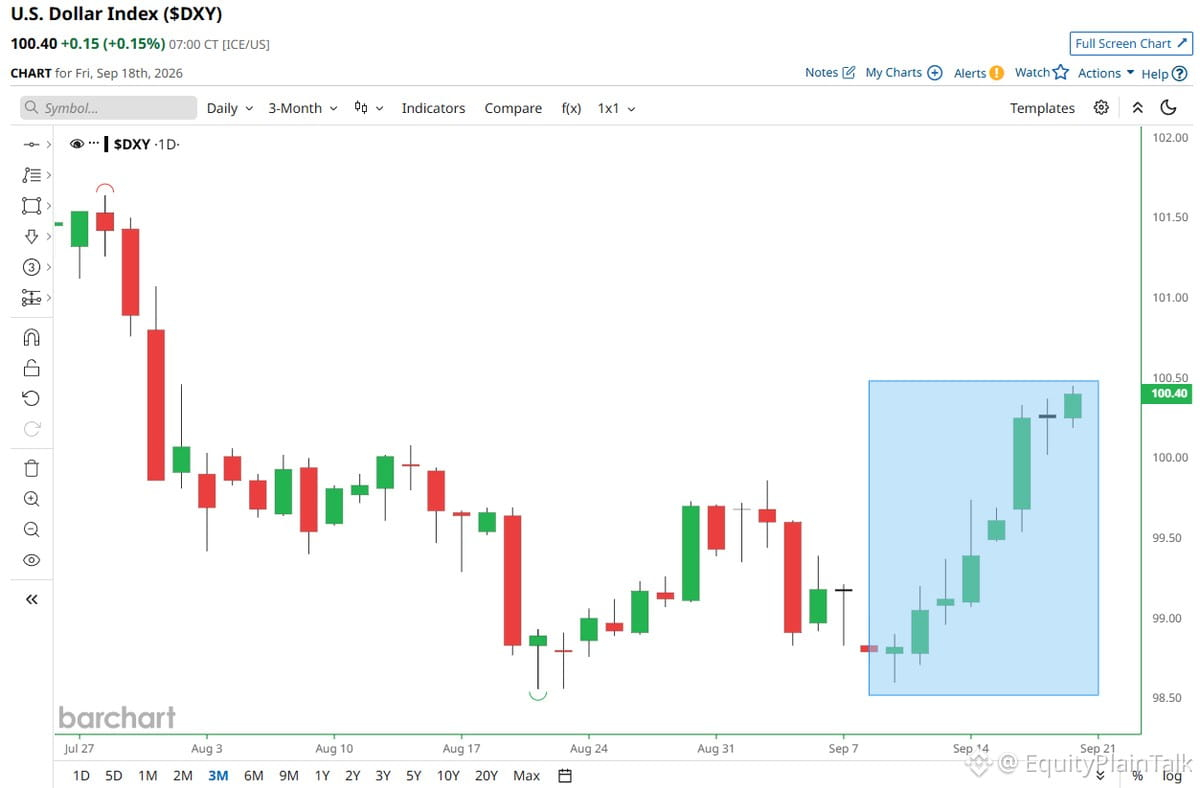
The $DXY just hit its highest level since July and hasn't closed red in 8 straight sessions.
That's the kind of momentum that doesn't happen by accident. Strong dollar = tighter financial conditions globally. Watch how this pressures emerging markets, commodities priced in dollars, and U.S. exporters.
If this run continues, it'll show up in earnings guidance and Fed policy expectations soon enough.
The $DXY just hit its highest level since July and hasn't closed red in 8 straight sessions.
That's the kind of momentum that doesn't happen by accident. Strong dollar = tighter financial conditions globally. Watch how this pressures emerging markets, commodities priced in dollars, and U.S. exporters.
If this run continues, it'll show up in earnings guidance and Fed policy expectations soon enough.
That's the kind of momentum that doesn't happen by accident. Strong dollar = tighter financial conditions globally. Watch how this pressures emerging markets, commodities priced in dollars, and U.S. exporters.
If this run continues, it'll show up in earnings guidance and Fed policy expectations soon enough.
16
පරිවර්තනය බලන්න
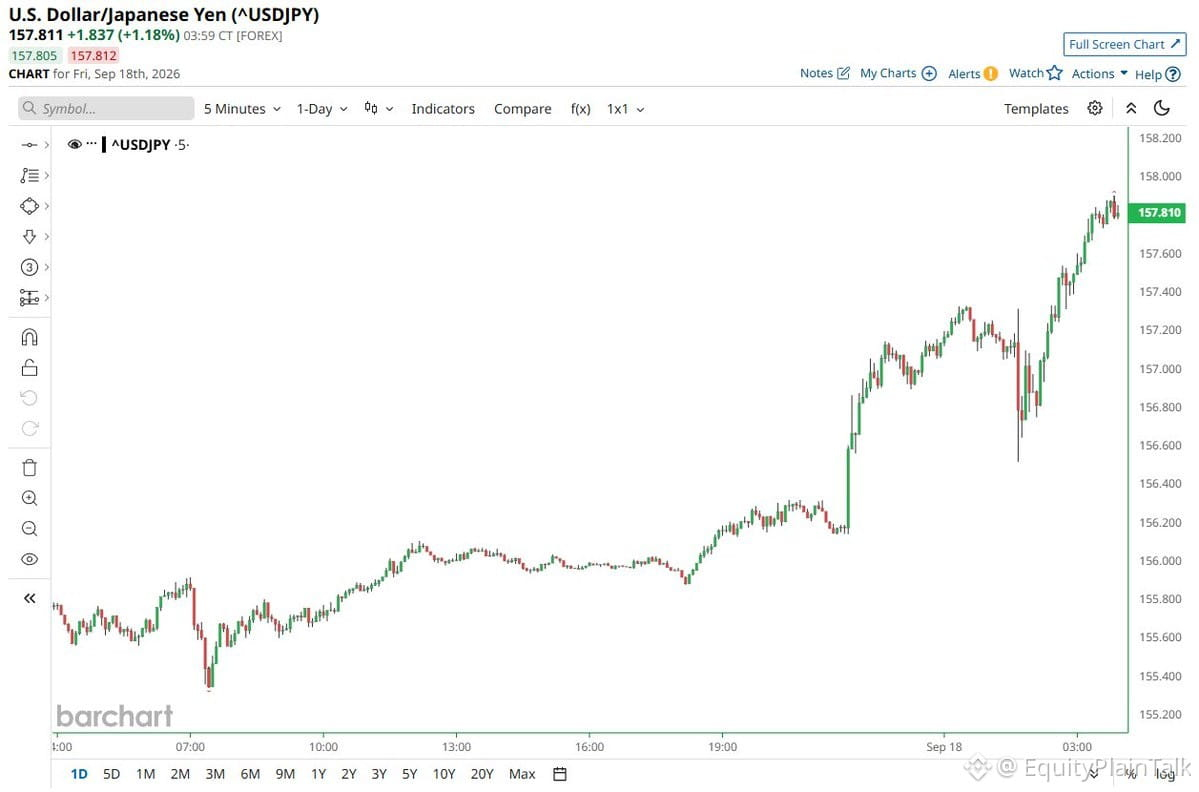
The Japanese Yen is taking a beating tonight.
This matters for U.S. markets. A weaker yen typically means:
• Japanese investors pulling back from U.S. bonds
• Pressure on Treasury yields
• Potential ripple effects on tech stocks and rate-sensitive sectors
Keep an eye on $USD/JPY levels and how this plays into the Fed's rate outlook. Currency moves like this don't happen in a vacuum.
The Japanese Yen is taking a beating tonight.
This matters for U.S. markets. A weaker yen typically means:
• Japanese investors pulling back from U.S. bonds
• Pressure on Treasury yields
• Potential ripple effects on tech stocks and rate-sensitive sectors
Keep an eye on $USD/JPY levels and how this plays into the Fed's rate outlook. Currency moves like this don't happen in a vacuum.
This matters for U.S. markets. A weaker yen typically means:
• Japanese investors pulling back from U.S. bonds
• Pressure on Treasury yields
• Potential ripple effects on tech stocks and rate-sensitive sectors
Keep an eye on $USD/JPY levels and how this plays into the Fed's rate outlook. Currency moves like this don't happen in a vacuum.
6
පරිවර්තනය බලන්න
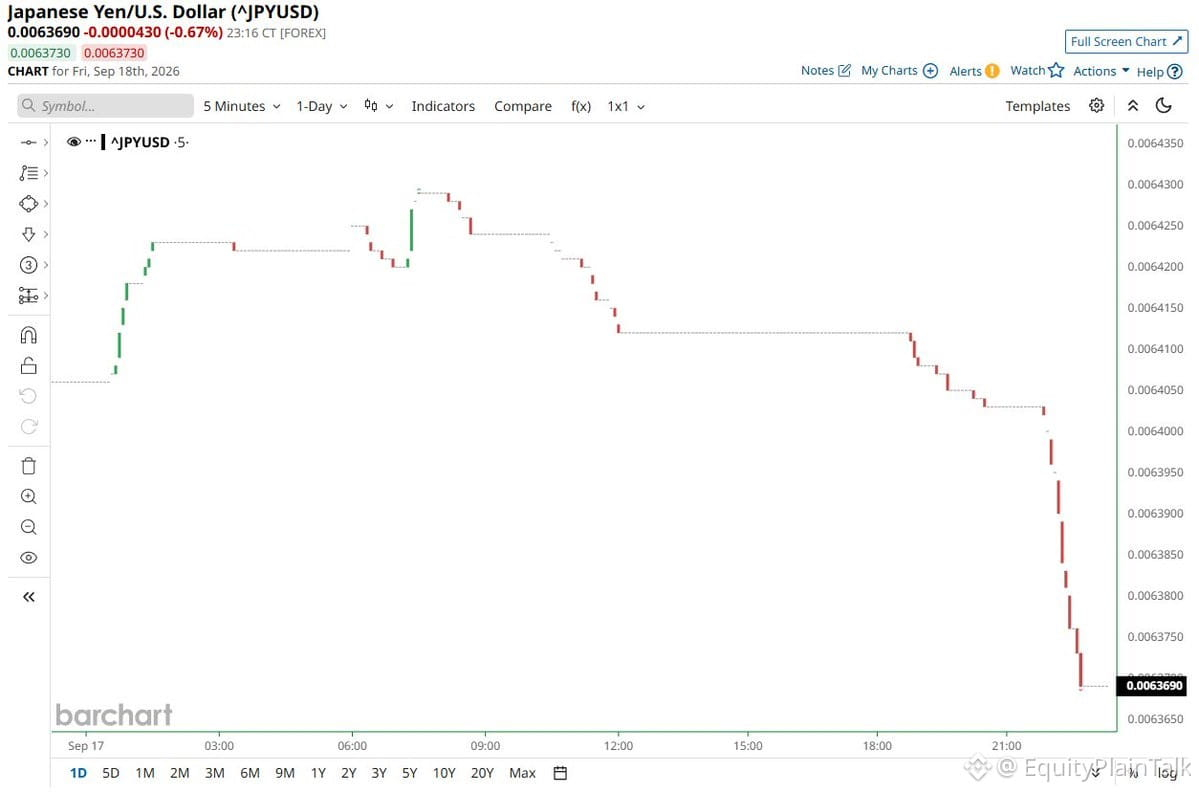
Yen just fell off a cliff.
This matters more than people think. When the yen weakens this fast, it usually means one of two things: either Japan's running out of patience trying to defend it, or traders are betting big that rate differentials with the U.S. will stay wide for longer.
Watch the ripple effects—weak yen props up Japanese exporters like Toyota and Sony, but it also makes imports more expensive and can trigger inflation concerns domestically.
If this continues, we might see intervention threats from the BOJ or Ministry of Finance. They've done it before when USD/JPY got too spicy.
For U.S. markets: a weaker yen often correlates with risk-on sentiment and can support equities short-term, but it also signals potential stress in global currency markets. Keep an eye on this.
Yen just fell off a cliff.
This matters more than people think. When the yen weakens this fast, it usually means one of two things: either Japan's running out of patience trying to defend it, or traders are betting big that rate differentials with the U.S. will stay wide for longer.
Watch the ripple effects—weak yen props up Japanese exporters like Toyota and Sony, but it also makes imports more expensive and can trigger inflation concerns domestically.
If this continues, we might see intervention threats from the BOJ or Ministry of Finance. They've done it before when USD/JPY got too spicy.
For U.S. markets: a weaker yen often correlates with risk-on sentiment and can support equities short-term, but it also signals potential stress in global currency markets. Keep an eye on this.
This matters more than people think. When the yen weakens this fast, it usually means one of two things: either Japan's running out of patience trying to defend it, or traders are betting big that rate differentials with the U.S. will stay wide for longer.
Watch the ripple effects—weak yen props up Japanese exporters like Toyota and Sony, but it also makes imports more expensive and can trigger inflation concerns domestically.
If this continues, we might see intervention threats from the BOJ or Ministry of Finance. They've done it before when USD/JPY got too spicy.
For U.S. markets: a weaker yen often correlates with risk-on sentiment and can support equities short-term, but it also signals potential stress in global currency markets. Keep an eye on this.
5
පරිවර්තනය බලන්න
Exxon just shut down a major Midwest refinery producing 11 million gallons of gas and diesel daily due to outage issues.
Timing couldn't be worse. Diesel prices are already up nearly 90% this year, and we're entering peak demand season.
Expect diesel to push toward $7/gallon soon. This will ripple through shipping costs, food prices, and basically everything that moves by truck.
Watch transportation stocks, energy names like $XOM, and consumer staples. Higher diesel = higher input costs across the board.
If this outage drags on, inflation pressures come right back into focus.
Exxon just shut down a major Midwest refinery producing 11 million gallons of gas and diesel daily due to outage issues.
Timing couldn't be worse. Diesel prices are already up nearly 90% this year, and we're entering peak demand season.
Expect diesel to push toward $7/gallon soon. This will ripple through shipping costs, food prices, and basically everything that moves by truck.
Watch transportation stocks, energy names like $XOM, and consumer staples. Higher diesel = higher input costs across the board.
If this outage drags on, inflation pressures come right back into focus.
Timing couldn't be worse. Diesel prices are already up nearly 90% this year, and we're entering peak demand season.
Expect diesel to push toward $7/gallon soon. This will ripple through shipping costs, food prices, and basically everything that moves by truck.
Watch transportation stocks, energy names like $XOM, and consumer staples. Higher diesel = higher input costs across the board.
If this outage drags on, inflation pressures come right back into focus.
72
සත්යායනය කළ
ජපාන බැංකුව 25bp අනුපාත ඉහළ දැමුවා—1995 සිට ඉහළම මට්ටම. 1990 සිට ඔවුන්ගේ වේගවත්ම දත්ත තද කිරීමේ වේගය මෙයයි.
දැන් ඔවුන් ද සියල්ලන් මෙන්ම උද්ධමනයට එරෙහිව සටන් කරනවා. ජපානයේ ශුන්ය අනුපාත යුගය නිල වශයෙන් අවසන්.
ගෝලීය තද කිරීමේ චක්රය නැවත මේසය මත. මෙම වෙනස මුදල් වෙළඳපොළවල් සහ කැරී ට්රේඩ්ස් හරහා කෙසේ බලපායිද බලන්න. යෙන් මුළුමනින්ම උච්චාවචනය වෙලා තියෙනවා, මේක දේවල් සන්සුන් නොකරයි.
ජපානය අනුපාත ඉහළ දැමුවොත්, උද්ධමන පීඩනයෙන් කවර මධ්යම බැංකුවකටවත් ආරක්ෂාවක් නැහැ.
ජපාන බැංකුව 25bp අනුපාත ඉහළ දැමුවා—1995 සිට ඉහළම මට්ටම. 1990 සිට ඔවුන්ගේ වේගවත්ම දත්ත තද කිරීමේ වේගය මෙයයි.
දැන් ඔවුන් ද සියල්ලන් මෙන්ම උද්ධමනයට එරෙහිව සටන් කරනවා. ජපානයේ ශුන්ය අනුපාත යුගය නිල වශයෙන් අවසන්.
ගෝලීය තද කිරීමේ චක්රය නැවත මේසය මත. මෙම වෙනස මුදල් වෙළඳපොළවල් සහ කැරී ට්රේඩ්ස් හරහා කෙසේ බලපායිද බලන්න. යෙන් මුළුමනින්ම උච්චාවචනය වෙලා තියෙනවා, මේක දේවල් සන්සුන් නොකරයි.
ජපානය අනුපාත ඉහළ දැමුවොත්, උද්ධමන පීඩනයෙන් කවර මධ්යම බැංකුවකටවත් ආරක්ෂාවක් නැහැ.
දැන් ඔවුන් ද සියල්ලන් මෙන්ම උද්ධමනයට එරෙහිව සටන් කරනවා. ජපානයේ ශුන්ය අනුපාත යුගය නිල වශයෙන් අවසන්.
ගෝලීය තද කිරීමේ චක්රය නැවත මේසය මත. මෙම වෙනස මුදල් වෙළඳපොළවල් සහ කැරී ට්රේඩ්ස් හරහා කෙසේ බලපායිද බලන්න. යෙන් මුළුමනින්ම උච්චාවචනය වෙලා තියෙනවා, මේක දේවල් සන්සුන් නොකරයි.
ජපානය අනුපාත ඉහළ දැමුවොත්, උද්ධමන පීඩනයෙන් කවර මධ්යම බැංකුවකටවත් ආරක්ෂාවක් නැහැ.
2
4k
පරිවර්තනය බලන්න
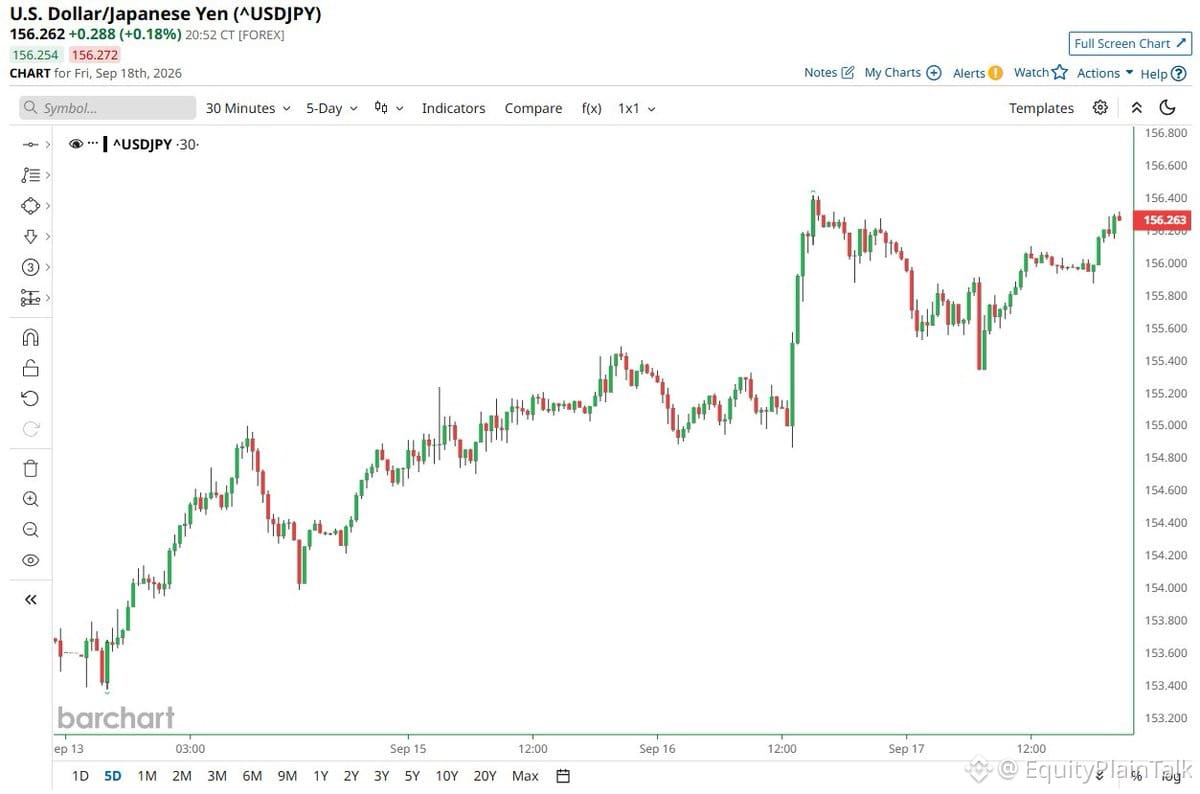
Yen sliding against the dollar again. Same pattern we've seen before—when it weakens too fast, intervention talk starts. Markets watching if Japan's finance minister steps in like last time. Currency moves like this ripple through everything: exporters get a boost, importers feel the squeeze, and carry trades get more attractive. The exchange rate dance continues.
Yen sliding against the dollar again. Same pattern we've seen before—when it weakens too fast, intervention talk starts. Markets watching if Japan's finance minister steps in like last time. Currency moves like this ripple through everything: exporters get a boost, importers feel the squeeze, and carry trades get more attractive. The exchange rate dance continues.
1
280
පරිවර්තනය බලන්න
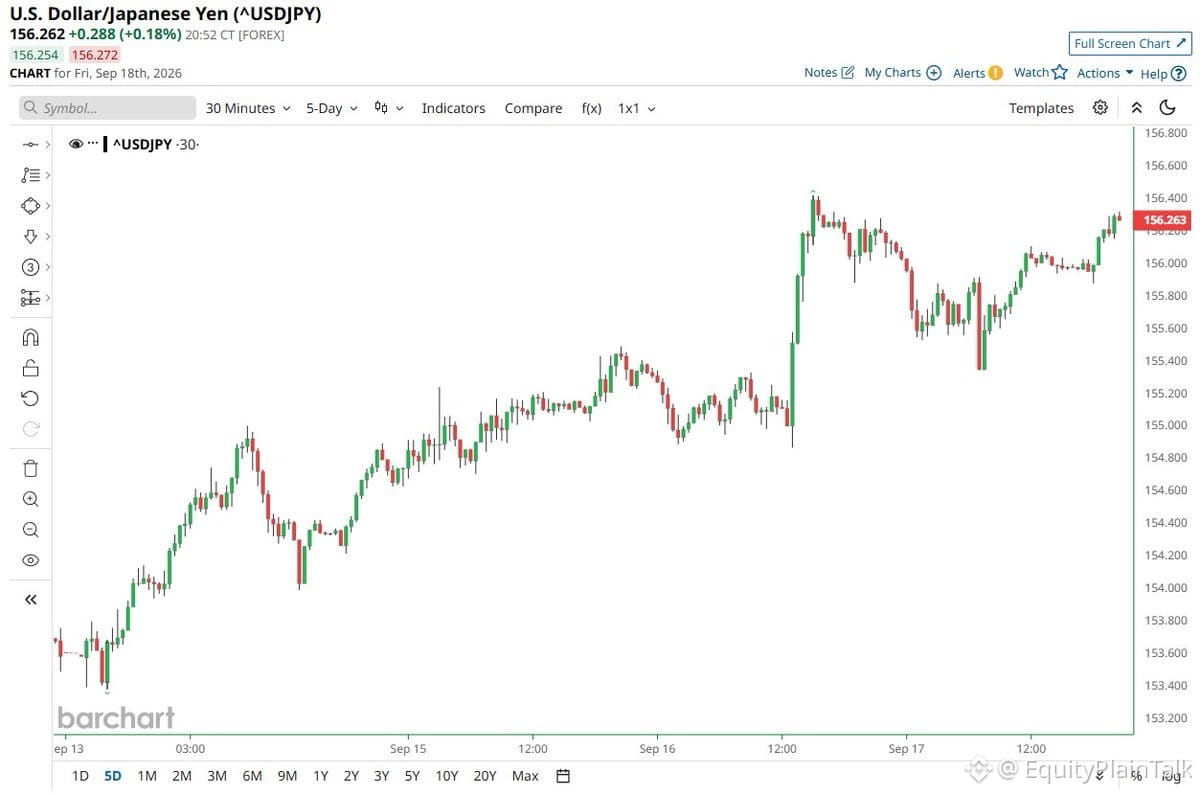
Yen gaining ground vs the dollar again. Watch this closely – when the yen strengthens, it often signals risk-off flows as Japanese investors pull money back home. This can pressure U.S. equities, especially growth stocks that benefited from a weak yen environment. Currency moves matter more than most retail investors realize.
Yen gaining ground vs the dollar again. Watch this closely – when the yen strengthens, it often signals risk-off flows as Japanese investors pull money back home. This can pressure U.S. equities, especially growth stocks that benefited from a weak yen environment. Currency moves matter more than most retail investors realize.
188
පරිවර්තනය බලන්න
Big money is quietly stepping back.
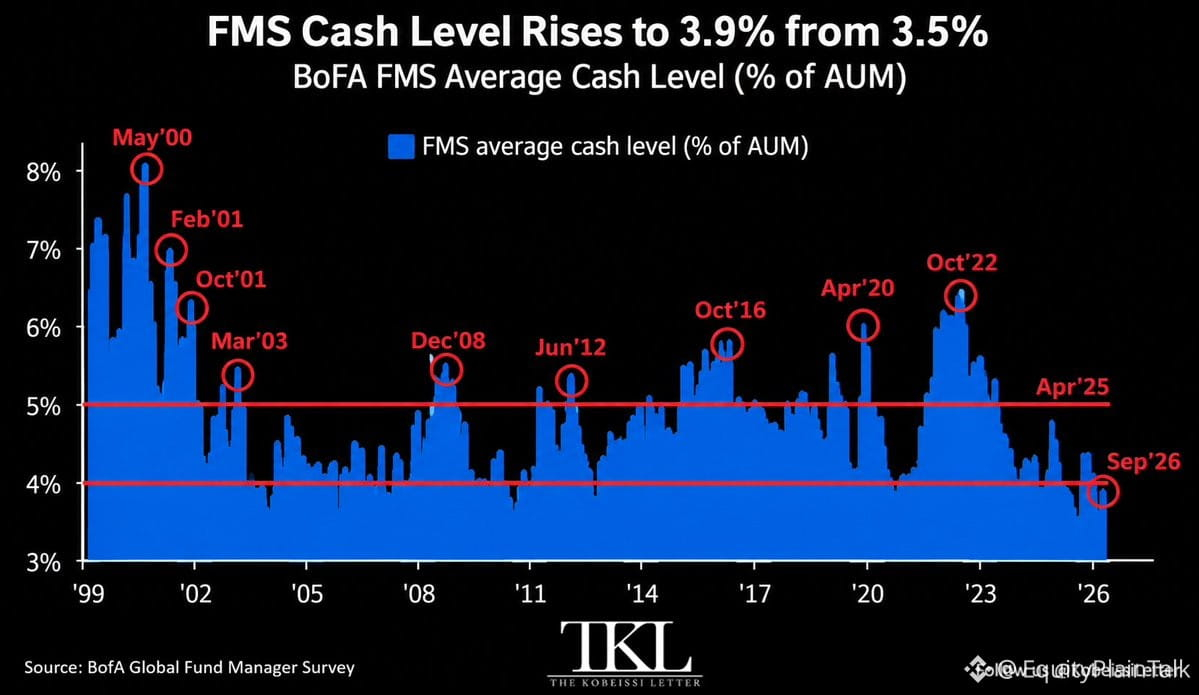
BofA surveyed 170 fund managers overseeing $470B. Cash allocations jumped to 3.9% in the latest month, the biggest increase since March. That's up from 3.5% in early August, which was near the lowest level in 26 years.
Meanwhile, equity exposure dropped. Only 49% are now overweight stocks, down from 56% last month. And 48% are underweight bonds, the highest since May 2022. That's 17 straight months of underweighting fixed income, matching the longest streak since 2022.
Half of those surveyed think the Treasury buyback program won't move yields at all.
This isn't panic. It's profit-taking. After a strong rally, institutions are locking in gains and raising dry powder. When the big players start holding more cash, it's worth paying attention to what comes next.
Big money is quietly stepping back.
BofA surveyed 170 fund managers overseeing $470B. Cash allocations jumped to 3.9% in the latest month, the biggest increase since March. That's up from 3.5% in early August, which was near the lowest level in 26 years.
Meanwhile, equity exposure dropped. Only 49% are now overweight stocks, down from 56% last month. And 48% are underweight bonds, the highest since May 2022. That's 17 straight months of underweighting fixed income, matching the longest streak since 2022.
Half of those surveyed think the Treasury buyback program won't move yields at all.
This isn't panic. It's profit-taking. After a strong rally, institutions are locking in gains and raising dry powder. When the big players start holding more cash, it's worth paying attention to what comes next.
BofA surveyed 170 fund managers overseeing $470B. Cash allocations jumped to 3.9% in the latest month, the biggest increase since March. That's up from 3.5% in early August, which was near the lowest level in 26 years.
Meanwhile, equity exposure dropped. Only 49% are now overweight stocks, down from 56% last month. And 48% are underweight bonds, the highest since May 2022. That's 17 straight months of underweighting fixed income, matching the longest streak since 2022.
Half of those surveyed think the Treasury buyback program won't move yields at all.
This isn't panic. It's profit-taking. After a strong rally, institutions are locking in gains and raising dry powder. When the big players start holding more cash, it's worth paying attention to what comes next.
340
පරිවර්තනය බලන්න
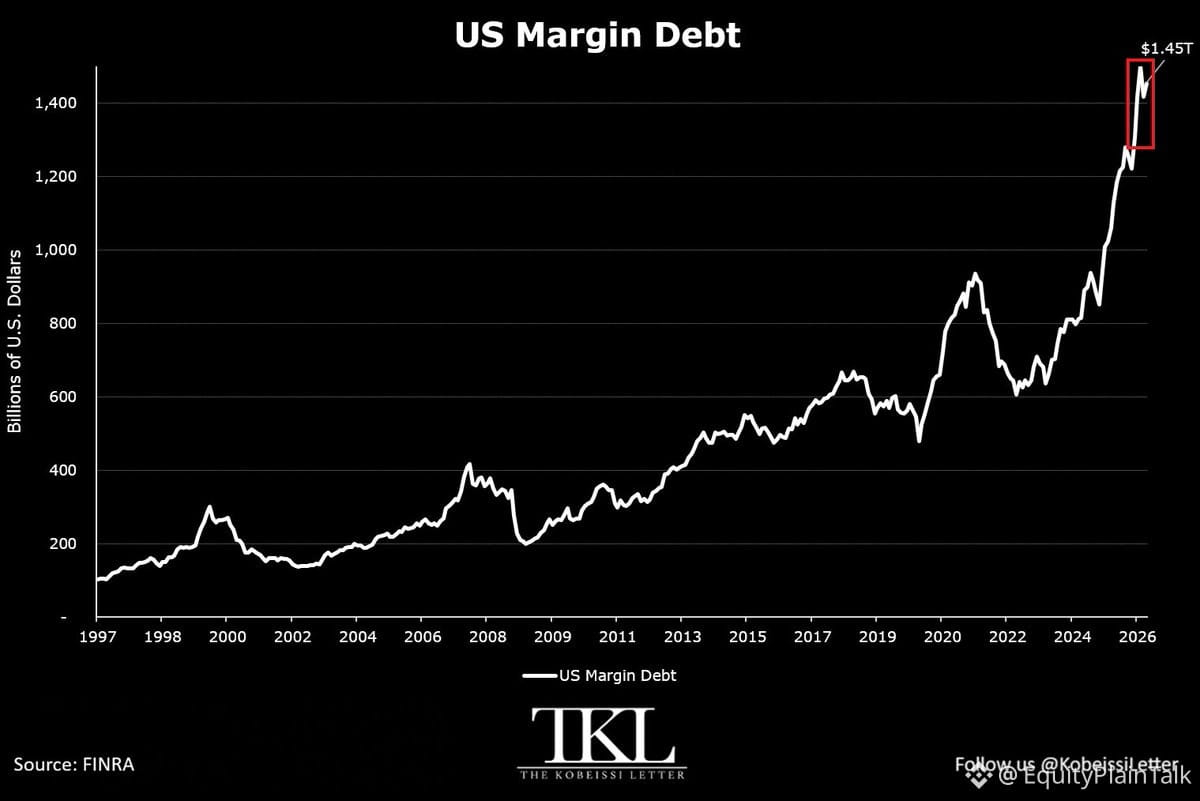
Margin debt just hit $1.45 trillion in August — up $37 billion in one month and the second-highest level ever recorded.
Year-to-date, investors have borrowed an extra $228 billion (+19%). Since the end of 2022, margin debt has exploded by $847 billion, a 140% surge.
Here's the kicker: that's way faster than the $SPY, which is up 98% over the same stretch.
Margin debt as a percentage of GDP? Now at a record 4.5%. That's higher than the 2021 peak (3.6%) and the 2000 Dot-Com Bubble (2.8%).
Investors are borrowing more aggressively than they did at two of the most frothy market tops in modern history.
Leverage is a double-edged sword. It amplifies gains on the way up, but it can force selling fast when things turn. Worth watching closely.
Margin debt just hit $1.45 trillion in August — up $37 billion in one month and the second-highest level ever recorded.
Year-to-date, investors have borrowed an extra $228 billion (+19%). Since the end of 2022, margin debt has exploded by $847 billion, a 140% surge.
Here's the kicker: that's way faster than the $SPY, which is up 98% over the same stretch.
Margin debt as a percentage of GDP? Now at a record 4.5%. That's higher than the 2021 peak (3.6%) and the 2000 Dot-Com Bubble (2.8%).
Investors are borrowing more aggressively than they did at two of the most frothy market tops in modern history.
Leverage is a double-edged sword. It amplifies gains on the way up, but it can force selling fast when things turn. Worth watching closely.
Year-to-date, investors have borrowed an extra $228 billion (+19%). Since the end of 2022, margin debt has exploded by $847 billion, a 140% surge.
Here's the kicker: that's way faster than the $SPY, which is up 98% over the same stretch.
Margin debt as a percentage of GDP? Now at a record 4.5%. That's higher than the 2021 peak (3.6%) and the 2000 Dot-Com Bubble (2.8%).
Investors are borrowing more aggressively than they did at two of the most frothy market tops in modern history.
Leverage is a double-edged sword. It amplifies gains on the way up, but it can force selling fast when things turn. Worth watching closely.
24
පරිවර්තනය බලන්න
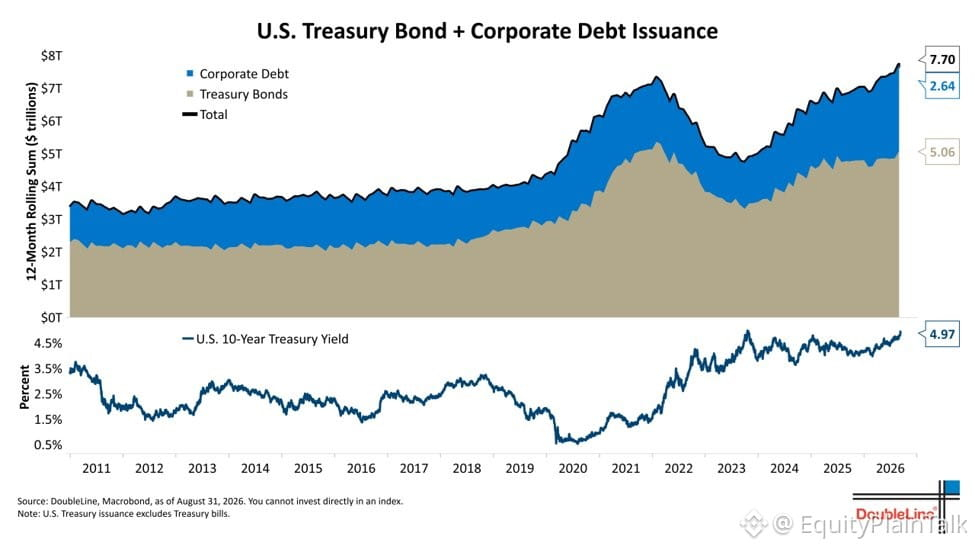
The bond market is getting crowded.
US Treasury issuance (ex T-bills) hit $5.06 trillion over the last 12 months — highest since 2021. Corporate debt issuance hit a record $2.64 trillion in the same period. Combined, that's $7.70 trillion in fresh debt hitting the market.
What's driving corporate issuance? AI.
AI-related firms issued $109 billion in bonds in 2025 (up 541% YoY), then another $194 billion in H1 2026 (up 78%). These companies are funding massive capex cycles — data centers, chips, infrastructure.
Meanwhile, the government is running historically high deficits. So you've got corporate America and the US Treasury both competing for the same pool of capital.
This isn't happening in a vacuum. Long-term yields are already being pushed higher by inflation, Fed policy, and growth expectations. Now add supply pressure on top.
The takeaway: bond yields aren't just about the Fed anymore. They're about supply, demand, and who's willing to pay up for capital. And right now, everyone's lining up.
The bond market is getting crowded.
US Treasury issuance (ex T-bills) hit $5.06 trillion over the last 12 months — highest since 2021. Corporate debt issuance hit a record $2.64 trillion in the same period. Combined, that's $7.70 trillion in fresh debt hitting the market.
What's driving corporate issuance? AI.
AI-related firms issued $109 billion in bonds in 2025 (up 541% YoY), then another $194 billion in H1 2026 (up 78%). These companies are funding massive capex cycles — data centers, chips, infrastructure.
Meanwhile, the government is running historically high deficits. So you've got corporate America and the US Treasury both competing for the same pool of capital.
This isn't happening in a vacuum. Long-term yields are already being pushed higher by inflation, Fed policy, and growth expectations. Now add supply pressure on top.
The takeaway: bond yields aren't just about the Fed anymore. They're about supply, demand, and who's willing to pay up for capital. And right now, everyone's lining up.
US Treasury issuance (ex T-bills) hit $5.06 trillion over the last 12 months — highest since 2021. Corporate debt issuance hit a record $2.64 trillion in the same period. Combined, that's $7.70 trillion in fresh debt hitting the market.
What's driving corporate issuance? AI.
AI-related firms issued $109 billion in bonds in 2025 (up 541% YoY), then another $194 billion in H1 2026 (up 78%). These companies are funding massive capex cycles — data centers, chips, infrastructure.
Meanwhile, the government is running historically high deficits. So you've got corporate America and the US Treasury both competing for the same pool of capital.
This isn't happening in a vacuum. Long-term yields are already being pushed higher by inflation, Fed policy, and growth expectations. Now add supply pressure on top.
The takeaway: bond yields aren't just about the Fed anymore. They're about supply, demand, and who's willing to pay up for capital. And right now, everyone's lining up.
39
තවත් අන්තර්ගතයන් ගවේෂණය කිරීමට ඇතුල් වන්න
Binance චතුරශ්රය හි ගෝලීය ක්රිප්ටෝ පරිශීලකයින් හා එක්වන්න
⚡️ ක්රිප්ටෝ පිළිබඳ නවතම සහ ප්රයෝජනවත් තොරතුරු ලබා ගන්න.
💬 ලොව විශාලතම ක්රිප්ටෝ හුවමාරුව මගින් විශ්වාස කෙරේ.
👍 සත්යායනය කරන ලද නිර්මාණකරුවන්ගෙන් සැබෑ විදසුන් සොයා ගන්න.
විද්යුත් තැපෑල / දුරකථන අංකය
නැගී එන මාතෘකා
BTCBreaks80K
179,957 views
2,950 සාකච්ඡා කරමින්
🚨₿ $BTC නැවත $80K නැවත ලබාගනී — ඒත් ඇත්ත සටන දැන්මයි! 🔥👀
#Bitcoin මීට මෑත පටන් වෙළෙඳපොළ මනෝභාවය යළි වර්ධනය වෙද්දී $80,000 ඉක්මවා, ආසන්න වශයෙන් $80,703 දක්වා ඉහළ ගොස් ඇත—අනුපාත ඉහළ දැමීම සහ නියාමන සම්බන්ධ අවධානය තිබුණත්.
MarketWatch
+1
💥 BREAKOUT එකක්ද නැත්නම් TRAP එකක්ද?
දැන් $80K මට්ටම වෙළෙන්දන් නිරීක්ෂණය කළ යුතු ප්රධාන කලාපයයි. ශක්තිමත් අඛණ්ඩතාව momentum පවත්වාගත හැකි අතර, ලාභ තක්සේරු කිරීම, leverage, සහ මැක්රෝ ආර්ථික අස්ථිරතාව තියුණු ආපස් හැරීම් උත්පාදනය කළ හැක.
🌊 රිපල් EFFECT:
₿ BTC හි momentum එක ETH සහ altcoin මනෝභාවයට බලපෑමක් ඇති කළ හැකි නමුත්, පුළුල් rally එකක් අනිවාර්ය නැහැ.
🎯 ප්රධාන ප්රශ්නය: බිට්කොයින් තම ඊළඟ ප්රධාන පියවරට සූදානම් වෙයිද, නැත්නම් වෙළෙඳපොළ මුලින්ම ගැඹුරු correction එකක් ඉල්ලයිද?
🔥 ඉටිපන්දම පස්සේ දිවන්න එපා — VOLUME, LIQUIDITY සහ MARKET STRUCTURE බලන්න!
👑 MFI CRYPTO 🚀
💬 ඊළඟට BTC $85K ඉහළටද? නැත්නම් අනපේක්ෂිත pullback එකක්ද?
#Bitcoin #BTC #Crypto #Altcoins #Ethereum #Trading #Binance #MFiCrypto
#btcbreaks80k
MFI crypto
·5 කැමත්ත දැක්වීම්
·2.9k views
比特币突破8万
119,827 views
352 සාකච්ඡා කරමින්
BitcoinMarketCapTopsTesla
9,121 views
392 සාකච්ඡා කරමින්