
BlockScopeHQ
9 පෝස්ටු

BlockScopeHQ
වාර්තා කරන්න
පරිශීලක අවහිර කරන්න
7 හඹා යමින්
1 හඹා යන්නන්
0 කැමති විය
පෝස්ටු
·
--
A mixed day in the market. Here's what caught my eye 👀
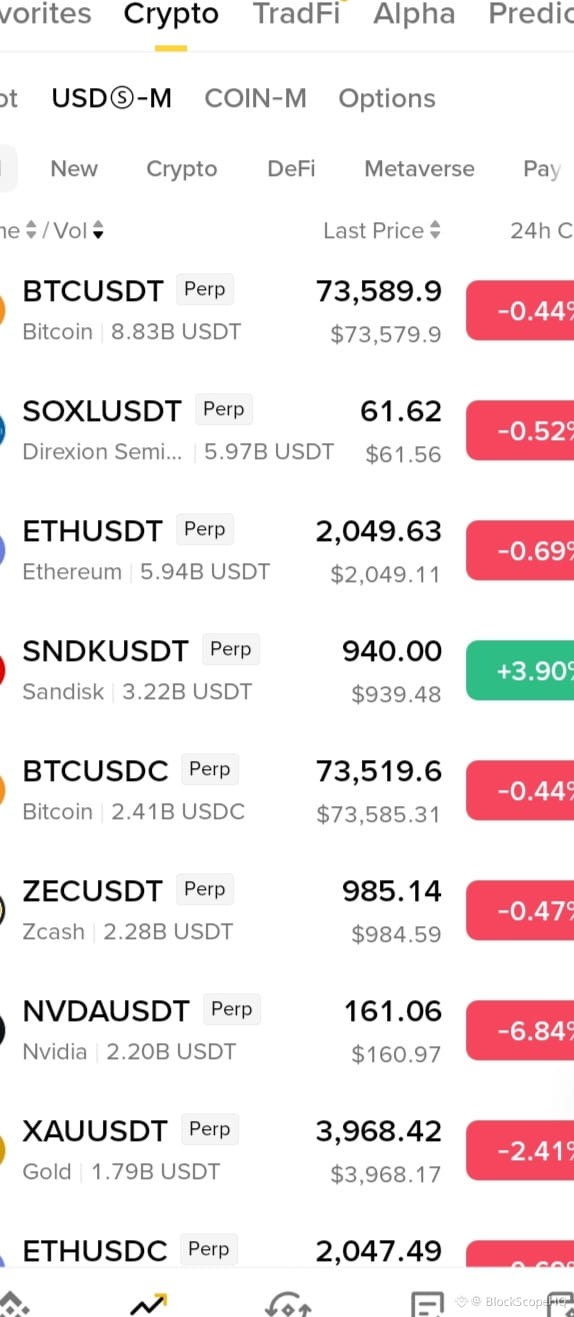
I was checking the Binance market today and noticed something interesting.
Bitcoin is slightly down, sitting around $73,589, and Ethereum is also in the red at around $2,049.
But not everything is moving in the same direction.
SNDK is up 3.90%, while NVDA has dropped 6.84%. Gold is also down 2.41% on this screen.
Honestly, I find these differences interesting. Even when the overall market looks weak, some assets still manage to move higher.
I'll be keeping an eye on how things develop from here.
What are you watching most closely right now — BTC, ETH, or the wider market?
Prices are from my Binance screenshot, not live updates.
#Bitcoin #Ethereum #CryptoMarket #MarketWatch
60
·
--

ලිපිය
New to Cryptocurrency? Read This Before Buying Your First Bitcoin (Beginner's Guide)Everyone talks about Bitcoin. Some people talk about Ethereum, others discuss crypto trading, and everywhere you look, someone seems to be making money in the crypto market.
But here's a question: Do most beginners actually understand what they're getting into?
If you're new to cryptocurrency, you might have the same questions I had when I first started exploring this space.
What is Bitcoin? How does blockchain work? Why do people need crypto wallets? And where does the value of these digital assets come from?
I think these are much better questions to ask before thinking about buying your first cryptocurrency.
So let's break everything down without making it unnecessarily complicated.
1. What Is Cryptocurrency, Really?
Let's start with the basics.
Cryptocurrency is a digital asset that operates using cryptographic technology and, in many cases, blockchain networks.
Unlike money held in a traditional bank account, some cryptocurrencies allow people to transfer value directly through a network without relying on a bank to process every transaction.
Bitcoin ($BTC) is the most well-known example.
But here's something many beginners don't realize: cryptocurrency isn't just one type of digital money.
Different projects have different purposes. Some focus on payments, some support financial applications, and others power entire blockchain ecosystems.
That's why understanding a project matters more than simply knowing its price.
2. What Is Blockchain and Why Does It Matter?
You've probably heard the word blockchain everywhere in crypto discussions.
But what does it actually mean?
Imagine a digital record book that keeps track of transactions. Instead of one organization controlling that record, copies can be maintained and verified by computers across a network.
When transactions are confirmed, they can be added to blocks that connect to previous blocks.
That's the basic idea behind blockchain.
What makes this interesting is that blockchain technology can provide transparency, verification and a way to coordinate activity without relying entirely on one central authority.
And it's not limited to cryptocurrency. Developers are exploring blockchain for many other applications too.
3. Bitcoin vs Ethereum: What's the Difference?
This is one of the first things every crypto beginner should understand.
Bitcoin and Ethereum are both major names in the industry, but they weren't designed to do exactly the same thing.
Bitcoin ($BTC)
Bitcoin was introduced as a peer-to-peer electronic payment system.
Today, many investors also view it as a potential long-term store of value.
One of its most recognized features is its fixed maximum supply of 21 million coins.
Ethereum ($ETH)
Ethereum takes a different approach.
It provides a platform where developers can build applications using smart contracts.
These applications are used in decentralized finance, digital assets and many other blockchain-based services.
Here's a simple way to remember it:
Bitcoin focuses primarily on digital money, while Ethereum provides infrastructure for programmable blockchain applications.
Both are important, but they serve different purposes.
4. What Is a Cryptocurrency Wallet?
If you want to use crypto, you'll eventually need to understand wallets.
A cryptocurrency wallet helps you manage your digital assets and interact with blockchain networks.
There are two important terms to remember:
- Public address: Similar to an account number. You can share it with someone who wants to send you crypto.
- Private key or recovery phrase: This gives control over your wallet. Keep it private.
One thing I really want beginners to understand: never share your recovery phrase with anyone.
Not with someone claiming to be customer support, not with someone promising to double your crypto, and not with strangers online.
If someone gets access to your recovery phrase, they may be able to take control of your funds.
5. Why Does the Cryptocurrency Market Keep Going Up and Down?
You've probably seen Bitcoin rise dramatically and then lose value within a short period.
Why does that happen?
Crypto prices are influenced by several things:
- Supply and demand.
- Investor confidence and market sentiment.
- Government regulations.
- Interest rates and economic conditions.
- Institutional investment.
- Technology developments and adoption.
Sometimes positive news creates excitement. Other times, uncertainty causes investors to become cautious.
But there's no magic indicator that can predict every market move.
That's why following market developments and understanding risk is so important.
6. Is Cryptocurrency Safe for Beginners?
Let's be honest. Crypto isn't risk-free.
There are real opportunities in this industry, but there are also serious risks.
For example:
- Prices can fall sharply.
- Fake investment schemes can target beginners.
- Some crypto projects have little real value.
- Sending funds to the wrong address can result in permanent loss.
- Losing access to your private keys can mean losing your assets.
My advice is to learn how everything works before putting money into the market.
Never invest money you cannot afford to lose, and don't trust someone just because they show screenshots of big profits.
7. How Should You Start Learning Cryptocurrency?
If I were starting from zero today, I wouldn't rush to buy ten different coins.
I'd follow a simple learning path:
Step 1: Understand Bitcoin and why it was created.
Step 2: Learn the basics of blockchain technology.
Step 3: Understand Ethereum and smart contracts.
Step 4: Learn about crypto wallets and security.
Step 5: Understand stablecoins such as USDT.
Step 6: Study market movements, trading risks and basic market analysis.
You don't need to master everything immediately. Learning consistently is much more useful than following every trending coin.
Final Thoughts: Learn Before You Invest
Cryptocurrency is an interesting industry, and there's a lot happening beyond daily price movements.
Blockchain technology, digital ownership, decentralized applications and new financial systems are all part of a much bigger conversation.
But I believe beginners should focus on understanding the industry before focusing on potential profits.
You don't need to become an expert overnight. Start with Bitcoin, understand blockchain, explore Ethereum and gradually build your knowledge.
That's exactly what we're trying to do at BlockScope: make crypto easier to understand through clear explanations, market insights and useful research.
Let's Talk
If you're new to cryptocurrency, I'd genuinely like to know:
What's the most confusing thing about crypto for you right now?
1. Bitcoin and how it works?
2. Blockchain technology?
3. Crypto wallets and security?
4. Trading and understanding charts?
Leave your answer in the comments. It might become the subject of our next beginner guide.
Disclaimer: This article is for educational purposes only. It is not financial or investment advice.
#CryptoForBeginners #bitcoin #Ethereum #blockchain #BinanceSquare
New to Cryptocurrency? Read This Before Buying Your First Bitcoin (Beginner's Guide)
Everyone talks about Bitcoin. Some people talk about Ethereum, others discuss crypto trading, and everywhere you look, someone seems to be making money in the crypto market.
But here's a question: Do most beginners actually understand what they're getting into?
If you're new to cryptocurrency, you might have the same questions I had when I first started exploring this space.
What is Bitcoin? How does blockchain work? Why do people need crypto wallets? And where does the value of these digital assets come from?
I think these are much better questions to ask before thinking about buying your first cryptocurrency.
So let's break everything down without making it unnecessarily complicated.
1. What Is Cryptocurrency, Really?
Let's start with the basics.
Cryptocurrency is a digital asset that operates using cryptographic technology and, in many cases, blockchain networks.
Unlike money held in a traditional bank account, some cryptocurrencies allow people to transfer value directly through a network without relying on a bank to process every transaction.
Bitcoin ($BTC) is the most well-known example.
But here's something many beginners don't realize: cryptocurrency isn't just one type of digital money.
Different projects have different purposes. Some focus on payments, some support financial applications, and others power entire blockchain ecosystems.
That's why understanding a project matters more than simply knowing its price.
2. What Is Blockchain and Why Does It Matter?
You've probably heard the word blockchain everywhere in crypto discussions.
But what does it actually mean?
Imagine a digital record book that keeps track of transactions. Instead of one organization controlling that record, copies can be maintained and verified by computers across a network.
When transactions are confirmed, they can be added to blocks that connect to previous blocks.
That's the basic idea behind blockchain.
What makes this interesting is that blockchain technology can provide transparency, verification and a way to coordinate activity without relying entirely on one central authority.
And it's not limited to cryptocurrency. Developers are exploring blockchain for many other applications too.
3. Bitcoin vs Ethereum: What's the Difference?
This is one of the first things every crypto beginner should understand.
Bitcoin and Ethereum are both major names in the industry, but they weren't designed to do exactly the same thing.
Bitcoin ($BTC)
Bitcoin was introduced as a peer-to-peer electronic payment system.
Today, many investors also view it as a potential long-term store of value.
One of its most recognized features is its fixed maximum supply of 21 million coins.
Ethereum ($ETH)
Ethereum takes a different approach.
It provides a platform where developers can build applications using smart contracts.
These applications are used in decentralized finance, digital assets and many other blockchain-based services.
Here's a simple way to remember it:
Bitcoin focuses primarily on digital money, while Ethereum provides infrastructure for programmable blockchain applications.
Both are important, but they serve different purposes.
4. What Is a Cryptocurrency Wallet?
If you want to use crypto, you'll eventually need to understand wallets.
A cryptocurrency wallet helps you manage your digital assets and interact with blockchain networks.
There are two important terms to remember:
- Public address: Similar to an account number. You can share it with someone who wants to send you crypto.
- Private key or recovery phrase: This gives control over your wallet. Keep it private.
One thing I really want beginners to understand: never share your recovery phrase with anyone.
Not with someone claiming to be customer support, not with someone promising to double your crypto, and not with strangers online.
If someone gets access to your recovery phrase, they may be able to take control of your funds.
5. Why Does the Cryptocurrency Market Keep Going Up and Down?
You've probably seen Bitcoin rise dramatically and then lose value within a short period.
Why does that happen?
Crypto prices are influenced by several things:
- Supply and demand.
- Investor confidence and market sentiment.
- Government regulations.
- Interest rates and economic conditions.
- Institutional investment.
- Technology developments and adoption.
Sometimes positive news creates excitement. Other times, uncertainty causes investors to become cautious.
But there's no magic indicator that can predict every market move.
That's why following market developments and understanding risk is so important.
6. Is Cryptocurrency Safe for Beginners?
Let's be honest. Crypto isn't risk-free.
There are real opportunities in this industry, but there are also serious risks.
For example:
- Prices can fall sharply.
- Fake investment schemes can target beginners.
- Some crypto projects have little real value.
- Sending funds to the wrong address can result in permanent loss.
- Losing access to your private keys can mean losing your assets.
My advice is to learn how everything works before putting money into the market.
Never invest money you cannot afford to lose, and don't trust someone just because they show screenshots of big profits.
7. How Should You Start Learning Cryptocurrency?
If I were starting from zero today, I wouldn't rush to buy ten different coins.
I'd follow a simple learning path:
Step 1: Understand Bitcoin and why it was created.
Step 2: Learn the basics of blockchain technology.
Step 3: Understand Ethereum and smart contracts.
Step 4: Learn about crypto wallets and security.
Step 5: Understand stablecoins such as USDT.
Step 6: Study market movements, trading risks and basic market analysis.
You don't need to master everything immediately. Learning consistently is much more useful than following every trending coin.
Final Thoughts: Learn Before You Invest
Cryptocurrency is an interesting industry, and there's a lot happening beyond daily price movements.
Blockchain technology, digital ownership, decentralized applications and new financial systems are all part of a much bigger conversation.
But I believe beginners should focus on understanding the industry before focusing on potential profits.
You don't need to become an expert overnight. Start with Bitcoin, understand blockchain, explore Ethereum and gradually build your knowledge.
That's exactly what we're trying to do at BlockScope: make crypto easier to understand through clear explanations, market insights and useful research.
Let's Talk
If you're new to cryptocurrency, I'd genuinely like to know:
What's the most confusing thing about crypto for you right now?
1. Bitcoin and how it works?
2. Blockchain technology?
3. Crypto wallets and security?
4. Trading and understanding charts?
Leave your answer in the comments. It might become the subject of our next beginner guide.
Disclaimer: This article is for educational purposes only. It is not financial or investment advice.
#CryptoForBeginners #bitcoin #Ethereum #blockchain #BinanceSquare
26
·
--
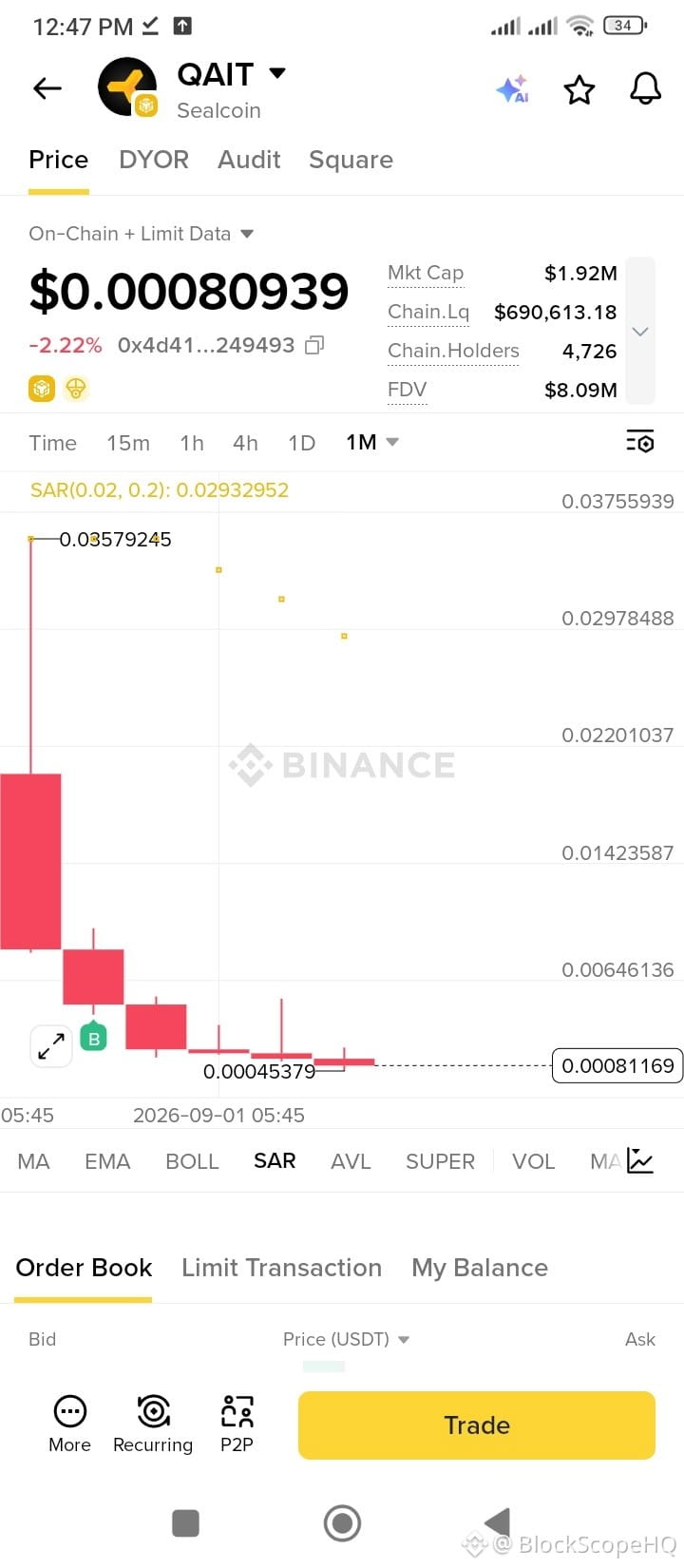
$QAIT: Is the market losing interest, or is this a potential recovery zone?
Looking at this monthly chart for QAIT (Sealcoin), one thing stands out: the token has fallen significantly from its earlier highs.
The price is currently around $0.00081, while the chart shows an earlier low near $0.00045.
A few things are worth watching:
- Can buyers defend the recent low?
- Is trading activity starting to increase?
- Can the price build a stronger base before any potential recovery?
A lower price doesn't automatically mean an asset is undervalued. Volume, liquidity and project development matter too.
What do you think about QAIT? Is it worth watching, or would you stay away for now?
#cryptooinsigts #Sealcoin #cryptouniverseofficial #Altcoins! #BinanceSquare
7
·
--
Ethereum is more than just a cryptocurrency.
When I first started learning about Ethereum, I thought it was simply another coin like Bitcoin. But the more I learned, the more interesting it became.
Ethereum allows developers to build applications using smart contracts. This is one reason it's become such an important part of DeFi, NFTs and many other blockchain projects.
Of course, Ethereum still has challenges, including network fees, competition and scalability.
But I think its biggest strength is what people can actually build on top of it.
What do you think: will Ethereum remain one of the most important blockchain networks over the next five years?
#Ethereum #ETH #DeFi #BlockchainTechnology #BinanceSquare
5
·
--
One thing that makes Bitcoin different is its limited supply.
There will only ever be 21 million Bitcoin. That's part of what makes $BTC interesting to so many people.
Unlike traditional currencies, Bitcoin has a fixed maximum supply written into its protocol.
But here's something worth thinking about: limited supply alone doesn't guarantee a higher price. Demand, adoption, market conditions and investor confidence still matter.
I think Bitcoin's supply limit is one of its most interesting features, but it's only one part of the bigger picture.
Do you think Bitcoin's 21 million limit is its biggest strength?
#Bitcoin #BTC #CryptoEducation #Blockchain #BinanceSquare
44
·
--
I've noticed that stablecoins don't get nearly as much attention as Bitcoin or Ethereum, but they're actually a big part of how the crypto market works.
Think about it. Crypto prices can change very quickly. Sometimes people want to step away from that volatility without leaving the crypto ecosystem completely.
That's where stablecoins come in.
Coins like $USDT are designed to stay close to the value of the US dollar. People use them to trade, transfer funds and access different services in crypto.
Of course, stablecoins aren't completely risk-free. Their reserves, reliability and regulation still matter.
Personally, I think stablecoins are one of the most practical parts of crypto, even if they're not the most exciting.
What's your opinion? Are stablecoins underrated?
#Stablecoins #USDT #CryptoEducation #Blockchain #BinanceSquare
28
·
--
I've always found Ethereum interesting for one reason: it's much more than just another cryptocurrency.
Bitcoin introduced people to decentralized money. Ethereum took things in a different direction by allowing developers to build applications directly on a blockchain.
Think about what that means.
People can create financial services, digital marketplaces and applications without relying entirely on traditional intermediaries.
That's where smart contracts come in. They automatically execute transactions when certain conditions are met.
Of course, Ethereum isn't perfect. High transaction fees, network competition and scalability remain important challenges.
But there's a reason developers and major companies continue paying attention to it.
Do you think Ethereum will remain one of the most important blockchain networks over the next five years?
I'd genuinely like to hear your thoughts.
#Ethereum #ETH #Blockchain
75
·
--
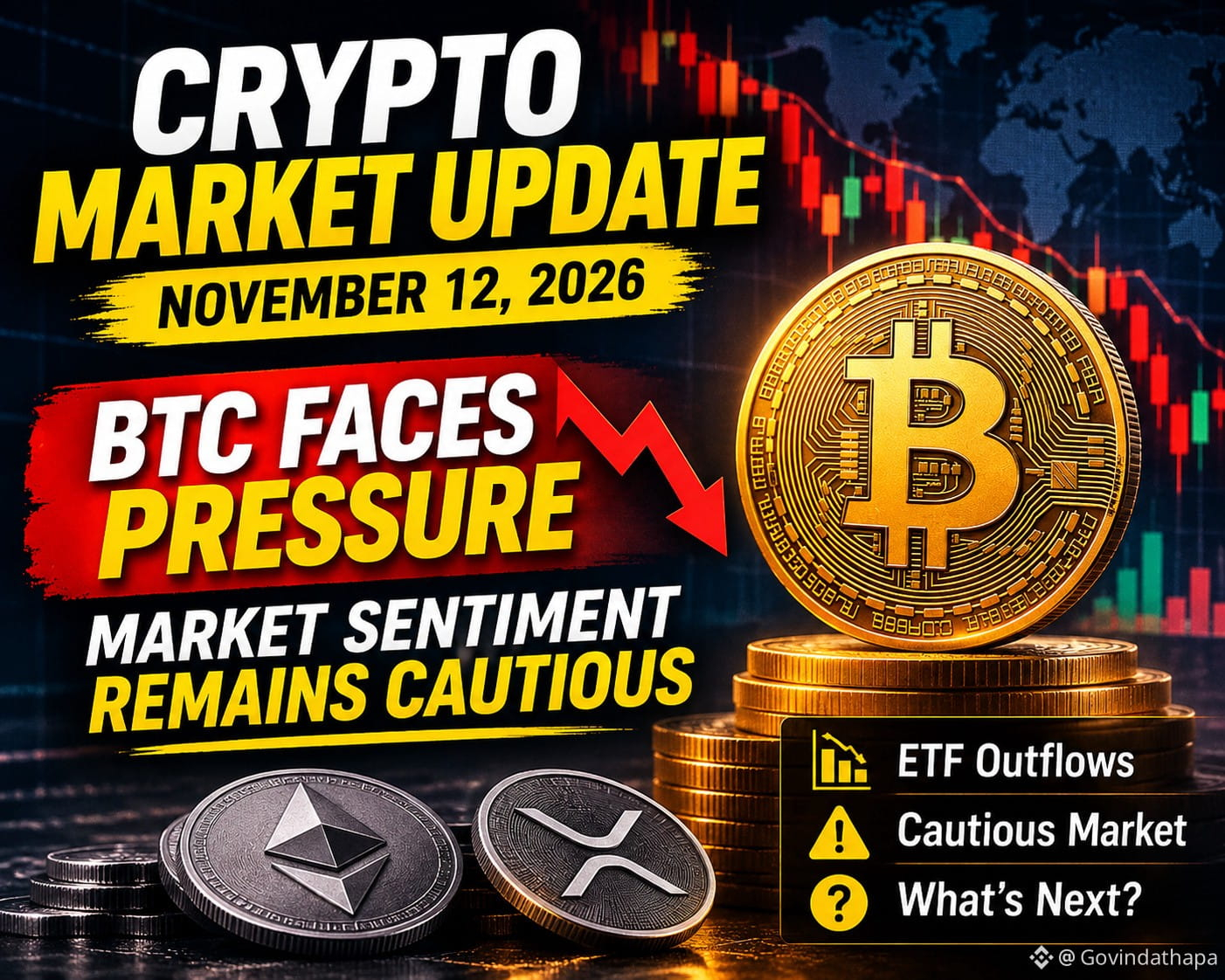
📉 CRYPTO MARKET UPDATE — NOVEMBER 12
Bitcoin is facing renewed pressure as uncertainty spreads across the cryptocurrency market.
Here are three things crypto traders are watching today:
🔸 Bitcoin (BTC): Price is hovering around the $73,000 region, with traders watching for signs of stability.
🔸 Ethereum (ETH): Bearish sentiment and recent weekly losses continue to weigh on market confidence.
🔸 Market sentiment: Bitcoin ETF outflows and negative social sentiment suggest investors remain cautious.
What happens next?
The market needs stronger buying momentum to establish a convincing recovery. Until then, volatility remains a major risk.
Are we seeing a temporary correction or the beginning of a deeper bearish trend?
Share your thoughts below.
#Bitcoin #Ethereum #CryptoMarket #BTC #Binance
81
තවත් අන්තර්ගතයන් ගවේෂණය කිරීමට ඇතුල් වන්න
Binance චතුරශ්රය හි ගෝලීය ක්රිප්ටෝ පරිශීලකයින් හා එක්වන්න
⚡️ ක්රිප්ටෝ පිළිබඳ නවතම සහ ප්රයෝජනවත් තොරතුරු ලබා ගන්න.
💬 ලොව විශාලතම ක්රිප්ටෝ හුවමාරුව මගින් විශ්වාස කෙරේ.
👍 සත්යායනය කරන ලද නිර්මාණකරුවන්ගෙන් සැබෑ විදසුන් සොයා ගන්න.
විද්යුත් තැපෑල / දුරකථන අංකය
නැගී එන මාතෘකා
HuangRisksOusterOverReportedAffairWithSubordinate
28,779 නැරඹීම්
476 සාකච්ඡා කරමින්
Nvidia Board Meets to Decide Jensen Huang's Future as Crisis Deepens
Binance News
·25 කැමත්ත දැක්වීම්
·27k නැරඹීම්
AnthropicRejectsIPODelayValuationinQuestion
470,966 නැරඹීම්
3,922 සාකච්ඡා කරමින්
CoreWeaveJumps10%On168%RevenueGrowth
65,941 නැරඹීම්
883 සාකච්ඡා කරමින්