

#gpu
gpu
171,473 views
463 සාකච්ඡා කරමින්
උණුසුම්
නවතම

·
--
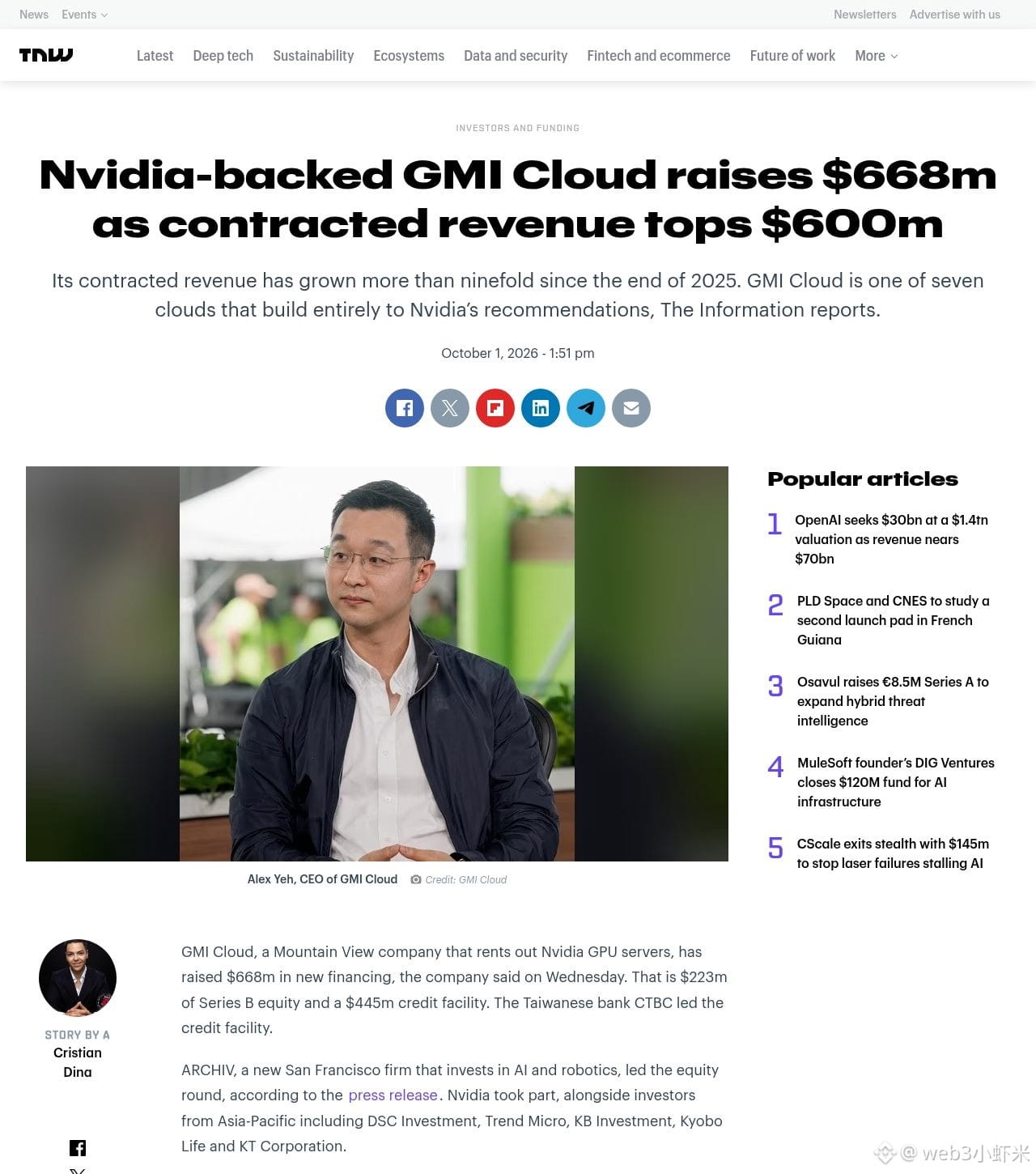
刷到 The Next Web:Nvidia 参投的 GMI Cloud 刚融了约 6.68 亿美元——其中 Series B 股权约 2.23 亿(ARCHIV 领投),另有 CTBC 牵头约 4.45 亿信贷额度。
公司称签约年经常性收入(contracted ARR)已超约 6 亿美元,较 2025 年底涨了 9 倍以上;推理平台每周大约处理 4 万亿 tokens。钱会用来扩美国、台湾和亚太的 GPU 产能。客户里有 Fireworks、OpenRouter、Nous Research 等。
《信息报》还写过,它是少数完全按 Nvidia 规范建云的七家里之一。算力这口井还在往下打,而且越打越深。
#AI #GPU #GMICloud $NVDA
刷到 The Next Web:Nvidia 参投的 GMI Cloud 刚融了约 6.68 亿美元——其中 Series B 股权约 2.23 亿(ARCHIV 领投),另有 CTBC 牵头约 4.45 亿信贷额度。
公司称签约年经常性收入(contracted ARR)已超约 6 亿美元,较 2025 年底涨了 9 倍以上;推理平台每周大约处理 4 万亿 tokens。钱会用来扩美国、台湾和亚太的 GPU 产能。客户里有 Fireworks、OpenRouter、Nous Research 等。
《信息报》还写过,它是少数完全按 Nvidia 规范建云的七家里之一。算力这口井还在往下打,而且越打越深。
#AI #GPU #GMICloud $NVDA
公司称签约年经常性收入(contracted ARR)已超约 6 亿美元,较 2025 年底涨了 9 倍以上;推理平台每周大约处理 4 万亿 tokens。钱会用来扩美国、台湾和亚太的 GPU 产能。客户里有 Fireworks、OpenRouter、Nous Research 等。
《信息报》还写过,它是少数完全按 Nvidia 规范建云的七家里之一。算力这口井还在往下打,而且越打越深。
#AI #GPU #GMICloud $NVDA
44

·
--
Why Nvidia (NVDA) stock Continues to surgeNvidia's ($NVDA.US ) stock continues to climb primarily due to its near-monopoly on the high-performance computing hardware powering generative AI.
Key drivers include:
• Unprecedented Data Center Demand: Cloud providers and AI developers continue to buy Nvidia’s GPUs faster than suppliers can manufacture them, consistently beating revenue expectations.
• The CUDA Software Moat: Developers build AI software on Nvidia’s proprietary CUDA architecture, making it difficult and costly for customers to switch to competing chips.
• High Pricing Power & Margins: Because its hardware is the industry benchmark, Nvidia commands high gross margins across its enterprise and data center segments.
• Capital Returns: Aggressive share buybacks and rising dividend payouts continue to attract institutional investors
#NVDA #GPU #AI
Why Nvidia (NVDA) stock Continues to surge
Nvidia's ($NVDA.US ) stock continues to climb primarily due to its near-monopoly on the high-performance computing hardware powering generative AI.
Key drivers include:
• Unprecedented Data Center Demand: Cloud providers and AI developers continue to buy Nvidia’s GPUs faster than suppliers can manufacture them, consistently beating revenue expectations.
• The CUDA Software Moat: Developers build AI software on Nvidia’s proprietary CUDA architecture, making it difficult and costly for customers to switch to competing chips.
• High Pricing Power & Margins: Because its hardware is the industry benchmark, Nvidia commands high gross margins across its enterprise and data center segments.
• Capital Returns: Aggressive share buybacks and rising dividend payouts continue to attract institutional investors
#NVDA #GPU #AI
Key drivers include:
• Unprecedented Data Center Demand: Cloud providers and AI developers continue to buy Nvidia’s GPUs faster than suppliers can manufacture them, consistently beating revenue expectations.
• The CUDA Software Moat: Developers build AI software on Nvidia’s proprietary CUDA architecture, making it difficult and costly for customers to switch to competing chips.
• High Pricing Power & Margins: Because its hardware is the industry benchmark, Nvidia commands high gross margins across its enterprise and data center segments.
• Capital Returns: Aggressive share buybacks and rising dividend payouts continue to attract institutional investors
#NVDA #GPU #AI
NVDA+0.26%
NVDAUS+1.45%
2
2
188


·
--
🚨 $BTC AI GPU SUPPLY SHOCK IS LOADING FOR 2027
📌 The RTX 60 timeline confirms the market obsession with compute is not cooling. If RTX 50 demand already overwhelmed supply, Rubin-era GPUs could become a 🦈 liquidity magnet for AI, compute, and speculative hardware cycles.
For $BTC , this matters because risk appetite often tracks next-gen infrastructure narratives. 👇 Do you think AI hardware scarcity fuels the next bull leg, or is this just retail FOMO with a new badge?
⚠️ Not financial advice. Always manage your risk. 🛡️
🏷️ #BTC #AI #GPU #Crypto #Narrative
💎
🚨 $BTC AI GPU SUPPLY SHOCK IS LOADING FOR 2027
📌 The RTX 60 timeline confirms the market obsession with compute is not cooling. If RTX 50 demand already overwhelmed supply, Rubin-era GPUs could become a 🦈 liquidity magnet for AI, compute, and speculative hardware cycles.
For $BTC , this matters because risk appetite often tracks next-gen infrastructure narratives. 👇 Do you think AI hardware scarcity fuels the next bull leg, or is this just retail FOMO with a new badge?
⚠️ Not financial advice. Always manage your risk. 🛡️
🏷️ #BTC #AI #GPU #Crypto #Narrative
💎
📌 The RTX 60 timeline confirms the market obsession with compute is not cooling. If RTX 50 demand already overwhelmed supply, Rubin-era GPUs could become a 🦈 liquidity magnet for AI, compute, and speculative hardware cycles.
For $BTC , this matters because risk appetite often tracks next-gen infrastructure narratives. 👇 Do you think AI hardware scarcity fuels the next bull leg, or is this just retail FOMO with a new badge?
⚠️ Not financial advice. Always manage your risk. 🛡️
🏷️ #BTC #AI #GPU #Crypto #Narrative
💎
38
·
--
🚨 خبر | شركة Cornelis تجمع 205 ملايين دولار لمنافسة Nvidia في شبكات الذكاء الاصطناعي
أعلنت شركة Cornelis المتخصصة في تقنيات شبكات الذكاء الاصطناعي عن إتمام جولة تمويل بقيمة 205 ملايين دولار بقيادة IAG Capital Partners.
الشركة، التي انفصلت عن Intel عام 2020، تطور تقنيات تساعد شرائح الذكاء الاصطناعي على التواصل بكفاءة أكبر، وأطلقت منتج Active Compute Fabric لمعالجة مشكلة هدر وقت وحدات GPU أثناء انتظار وصول البيانات.
وتعتمد Cornelis على بنية شبكات مفتوحة تتيح للعملاء استخدام مجموعة متنوعة من وحدات GPU والمسرّعات، في محاولة لمنافسة منظومة Nvidia المغلقة نسبيًا والمُحسّنة حول عتادها وبرمجياتها.
📌 Cipher Vault: المنافسة في بنية الذكاء الاصطناعي لم تعد تتركز على قوة الـGPU فقط، بل تمتد إلى الشبكات ونقل البيانات وكفاءة البنية التحتية بالكامل.
#AI #Nvidia #GPU #Tech #Crypto
🚨 خبر | شركة Cornelis تجمع 205 ملايين دولار لمنافسة Nvidia في شبكات الذكاء الاصطناعي
أعلنت شركة Cornelis المتخصصة في تقنيات شبكات الذكاء الاصطناعي عن إتمام جولة تمويل بقيمة 205 ملايين دولار بقيادة IAG Capital Partners.
الشركة، التي انفصلت عن Intel عام 2020، تطور تقنيات تساعد شرائح الذكاء الاصطناعي على التواصل بكفاءة أكبر، وأطلقت منتج Active Compute Fabric لمعالجة مشكلة هدر وقت وحدات GPU أثناء انتظار وصول البيانات.
وتعتمد Cornelis على بنية شبكات مفتوحة تتيح للعملاء استخدام مجموعة متنوعة من وحدات GPU والمسرّعات، في محاولة لمنافسة منظومة Nvidia المغلقة نسبيًا والمُحسّنة حول عتادها وبرمجياتها.
📌 Cipher Vault: المنافسة في بنية الذكاء الاصطناعي لم تعد تتركز على قوة الـGPU فقط، بل تمتد إلى الشبكات ونقل البيانات وكفاءة البنية التحتية بالكامل.
#AI #Nvidia #GPU #Tech #Crypto
أعلنت شركة Cornelis المتخصصة في تقنيات شبكات الذكاء الاصطناعي عن إتمام جولة تمويل بقيمة 205 ملايين دولار بقيادة IAG Capital Partners.
الشركة، التي انفصلت عن Intel عام 2020، تطور تقنيات تساعد شرائح الذكاء الاصطناعي على التواصل بكفاءة أكبر، وأطلقت منتج Active Compute Fabric لمعالجة مشكلة هدر وقت وحدات GPU أثناء انتظار وصول البيانات.
وتعتمد Cornelis على بنية شبكات مفتوحة تتيح للعملاء استخدام مجموعة متنوعة من وحدات GPU والمسرّعات، في محاولة لمنافسة منظومة Nvidia المغلقة نسبيًا والمُحسّنة حول عتادها وبرمجياتها.
📌 Cipher Vault: المنافسة في بنية الذكاء الاصطناعي لم تعد تتركز على قوة الـGPU فقط، بل تمتد إلى الشبكات ونقل البيانات وكفاءة البنية التحتية بالكامل.
#AI #Nvidia #GPU #Tech #Crypto
1
87

🚀 $RNDR SURGES AS GPU DEMAND SKYROCKETS FROM CHINA'S NEW LISTING! 🟢
📊 The STAR Market debut of a domestic GPU powerhouse is lighting up the AI‑compute narrative, and smart money is already channeling liquidity into $RNDR as the sector’s growth engine. 🌊 Whales are snapping up the token, betting the upcoming hardware boom will fuel on‑chain rendering demand. ⚡ Volume spikes on the 4H chart echo a classic liquidity sweep, hinting that the next upward thrust could be imminent.
💬 Are you positioning $RNDR to ride the GPU renaissance, or waiting for the next wave of institutional inflow? 👇
⚠️ Not financial advice. Always manage your risk. 🛡️
🏷️ #RNDR #GPU #BullishSetup #Crypto
🔥 💎
🚀 $RNDR SURGES AS GPU DEMAND SKYROCKETS FROM CHINA'S NEW LISTING! 🟢
📊 The STAR Market debut of a domestic GPU powerhouse is lighting up the AI‑compute narrative, and smart money is already channeling liquidity into $RNDR as the sector’s growth engine. 🌊 Whales are snapping up the token, betting the upcoming hardware boom will fuel on‑chain rendering demand. ⚡ Volume spikes on the 4H chart echo a classic liquidity sweep, hinting that the next upward thrust could be imminent.
💬 Are you positioning $RNDR to ride the GPU renaissance, or waiting for the next wave of institutional inflow? 👇
⚠️ Not financial advice. Always manage your risk. 🛡️
🏷️ #RNDR #GPU #BullishSetup #Crypto
🔥 💎
📊 The STAR Market debut of a domestic GPU powerhouse is lighting up the AI‑compute narrative, and smart money is already channeling liquidity into $RNDR as the sector’s growth engine. 🌊 Whales are snapping up the token, betting the upcoming hardware boom will fuel on‑chain rendering demand. ⚡ Volume spikes on the 4H chart echo a classic liquidity sweep, hinting that the next upward thrust could be imminent.
💬 Are you positioning $RNDR to ride the GPU renaissance, or waiting for the next wave of institutional inflow? 👇
⚠️ Not financial advice. Always manage your risk. 🛡️
🏷️ #RNDR #GPU #BullishSetup #Crypto
🔥 💎
118

·
--
📰 Pantera Capital 最近把一个挺有意思的判断摆出来:算力正在经历金融化早期阶段,未来 5-10 年,可能像电力、原油一样,变成支撑 AI 经济运行的大宗商品。
🔥 现在的 GPU 交易其实还很“土”。虽然已经有 SF Compute、Vast AI、Runpod 这类平台,但大量真实交易仍然靠社群聊天、场外经纪商和定制化双边协议完成,离成熟市场还有距离。
💡 文章拿电力市场做了类比:硬件对应电网,算力服务商对应运营商,具体 GPU 集群则对应节点。H100、H200、B200、B300 这些不同型号,不会共用一个价格;时间、地点和库存情况,也都会影响最终报价。
👀 难点也很明显。算力不像标准化原油,型号、时间、地理位置都会造成差异,而且目前没有像电力市场那样的强制行情披露,基准指数和动态价格怎么建立,仍然要靠订单簿和交易数据慢慢磨出来。
说实话,算力市场最后会不会真的走向商品化,关键还是看推理需求能不能持续扩大。文中估算,每花费 100 美元购买 Token,约 45 美元流向即时调用平台,50 美元流向云厂商和 GPU 资源层,剩下 5 美元给路由层。你觉得算力会成为 AI 时代的新石油吗?
#算力 #AI基础设施 #GPU #加密市场
📰 Pantera Capital 最近把一个挺有意思的判断摆出来:算力正在经历金融化早期阶段,未来 5-10 年,可能像电力、原油一样,变成支撑 AI 经济运行的大宗商品。
🔥 现在的 GPU 交易其实还很“土”。虽然已经有 SF Compute、Vast AI、Runpod 这类平台,但大量真实交易仍然靠社群聊天、场外经纪商和定制化双边协议完成,离成熟市场还有距离。
💡 文章拿电力市场做了类比:硬件对应电网,算力服务商对应运营商,具体 GPU 集群则对应节点。H100、H200、B200、B300 这些不同型号,不会共用一个价格;时间、地点和库存情况,也都会影响最终报价。
👀 难点也很明显。算力不像标准化原油,型号、时间、地理位置都会造成差异,而且目前没有像电力市场那样的强制行情披露,基准指数和动态价格怎么建立,仍然要靠订单簿和交易数据慢慢磨出来。
说实话,算力市场最后会不会真的走向商品化,关键还是看推理需求能不能持续扩大。文中估算,每花费 100 美元购买 Token,约 45 美元流向即时调用平台,50 美元流向云厂商和 GPU 资源层,剩下 5 美元给路由层。你觉得算力会成为 AI 时代的新石油吗?
#算力 #AI基础设施 #GPU #加密市场
🔥 现在的 GPU 交易其实还很“土”。虽然已经有 SF Compute、Vast AI、Runpod 这类平台,但大量真实交易仍然靠社群聊天、场外经纪商和定制化双边协议完成,离成熟市场还有距离。
💡 文章拿电力市场做了类比:硬件对应电网,算力服务商对应运营商,具体 GPU 集群则对应节点。H100、H200、B200、B300 这些不同型号,不会共用一个价格;时间、地点和库存情况,也都会影响最终报价。
👀 难点也很明显。算力不像标准化原油,型号、时间、地理位置都会造成差异,而且目前没有像电力市场那样的强制行情披露,基准指数和动态价格怎么建立,仍然要靠订单簿和交易数据慢慢磨出来。
说实话,算力市场最后会不会真的走向商品化,关键还是看推理需求能不能持续扩大。文中估算,每花费 100 美元购买 Token,约 45 美元流向即时调用平台,50 美元流向云厂商和 GPU 资源层,剩下 5 美元给路由层。你觉得算力会成为 AI 时代的新石油吗?
#算力 #AI基础设施 #GPU #加密市场

51
·
--
📰 算力这门生意,可能正在复刻30年前电力市场的金融化路径。Pantera Capital合伙人Jay Yu的判断是,GPU算力正在从群聊、场外经纪商和双边协议撮合,走向标准化定价、指数化交易。
🔥 这个类比挺有意思:电力市场是“电网运营商—节点”,算力市场则是“硬件厂商—集群”。以前大家谈的是租哪张卡、租多久,现在已经有人尝试把算力做成可定价、可交割、可交易的大宗商品资产。
👀 相关环节其实已经冒出来了。SF Compute、Runpod和Compute Exchange在做物理交割,Ornn、Silicon Data提供算力指数,Liquid Compute、Architect则切入衍生品,外面还叠出了借贷和合成稳定币产品。
💡 更大胆的说法是,英伟达正在扮演算力市场的“央行”。它能通过新品发布节奏影响旧硬件折旧,还承诺向云服务商提供,被Jay Yu形容为“最后贷款人”。
🤔 说实话,算力从租赁资源变成金融资产,机会确实多了,但定价权也可能进一步集中。你觉得下一步最先跑出来的,会是算力指数、衍生品交易所,还是算力抵押借贷?
#AI算力 #GPU #英伟达 #Web3
📰 算力这门生意,可能正在复刻30年前电力市场的金融化路径。Pantera Capital合伙人Jay Yu的判断是,GPU算力正在从群聊、场外经纪商和双边协议撮合,走向标准化定价、指数化交易。
🔥 这个类比挺有意思:电力市场是“电网运营商—节点”,算力市场则是“硬件厂商—集群”。以前大家谈的是租哪张卡、租多久,现在已经有人尝试把算力做成可定价、可交割、可交易的大宗商品资产。
👀 相关环节其实已经冒出来了。SF Compute、Runpod和Compute Exchange在做物理交割,Ornn、Silicon Data提供算力指数,Liquid Compute、Architect则切入衍生品,外面还叠出了借贷和合成稳定币产品。
💡 更大胆的说法是,英伟达正在扮演算力市场的“央行”。它能通过新品发布节奏影响旧硬件折旧,还承诺向云服务商提供,被Jay Yu形容为“最后贷款人”。
🤔 说实话,算力从租赁资源变成金融资产,机会确实多了,但定价权也可能进一步集中。你觉得下一步最先跑出来的,会是算力指数、衍生品交易所,还是算力抵押借贷?
#AI算力 #GPU #英伟达 #Web3
🔥 这个类比挺有意思:电力市场是“电网运营商—节点”,算力市场则是“硬件厂商—集群”。以前大家谈的是租哪张卡、租多久,现在已经有人尝试把算力做成可定价、可交割、可交易的大宗商品资产。
👀 相关环节其实已经冒出来了。SF Compute、Runpod和Compute Exchange在做物理交割,Ornn、Silicon Data提供算力指数,Liquid Compute、Architect则切入衍生品,外面还叠出了借贷和合成稳定币产品。
💡 更大胆的说法是,英伟达正在扮演算力市场的“央行”。它能通过新品发布节奏影响旧硬件折旧,还承诺向云服务商提供,被Jay Yu形容为“最后贷款人”。
🤔 说实话,算力从租赁资源变成金融资产,机会确实多了,但定价权也可能进一步集中。你觉得下一步最先跑出来的,会是算力指数、衍生品交易所,还是算力抵押借贷?
#AI算力 #GPU #英伟达 #Web3

15

·
--
1.你觉得 AI 算力会成为下一个值得关注的交易类别吗?为什么?
我认为AI算力会是非常值得跟踪的交易大类,但它属于实物基础设施类的另类交易标的。
过去AI投资分两条线:AI代币(情绪驱动)、AI股票(公司盈利驱动)。而算力是AI产业的底层生产资料,大模型训练、推理、AI应用全部离不开GPU租赁。
算力价格直接反映真实行业供需:AI需求爆发、芯片缺货时算力租金上涨;产能释放、新芯片迭代,算力租金就会回落。
但要注意,它不是简单的投机标的,价格会受实体供应链、云厂商资本开支影响,和币圈、股票的驱动逻辑不一样,属于新的赛道。
2.相比 AI Token / AI Stocks,直接交易 GPU 算力价格对交易员有什么不同?
1. AI Token:高度受情绪、叙事、炒作驱动,很多项目没有真实业务,波动极大,容易受消息面与资金盘影响,基本面很弱。
2. AI Stocks(如英伟达):交易的是企业估值,除了算力供需,还要看公司财报、毛利率、市场竞争、宏观利率,股价会提前预期未来业绩。
3. GPU算力合约:交易的是当下GPU租赁的现货租金价格,直接锚定行业真实供需。
- 优点:绕开公司股价的估值泡沫,直接博弈算力的紧缺/过剩;
- 缺点:盘前阶段流动性有限,没有真实现货做锚定,价格容易被资金扰动,同时受实体供应链变化的滞后影响。
#AI算力 #GPU
1.你觉得 AI 算力会成为下一个值得关注的交易类别吗?为什么?
我认为AI算力会是非常值得跟踪的交易大类,但它属于实物基础设施类的另类交易标的。
过去AI投资分两条线:AI代币(情绪驱动)、AI股票(公司盈利驱动)。而算力是AI产业的底层生产资料,大模型训练、推理、AI应用全部离不开GPU租赁。
算力价格直接反映真实行业供需:AI需求爆发、芯片缺货时算力租金上涨;产能释放、新芯片迭代,算力租金就会回落。
但要注意,它不是简单的投机标的,价格会受实体供应链、云厂商资本开支影响,和币圈、股票的驱动逻辑不一样,属于新的赛道。
2.相比 AI Token / AI Stocks,直接交易 GPU 算力价格对交易员有什么不同?
1. AI Token:高度受情绪、叙事、炒作驱动,很多项目没有真实业务,波动极大,容易受消息面与资金盘影响,基本面很弱。
2. AI Stocks(如英伟达):交易的是企业估值,除了算力供需,还要看公司财报、毛利率、市场竞争、宏观利率,股价会提前预期未来业绩。
3. GPU算力合约:交易的是当下GPU租赁的现货租金价格,直接锚定行业真实供需。
- 优点:绕开公司股价的估值泡沫,直接博弈算力的紧缺/过剩;
- 缺点:盘前阶段流动性有限,没有真实现货做锚定,价格容易被资金扰动,同时受实体供应链变化的滞后影响。
#AI算力 #GPU
我认为AI算力会是非常值得跟踪的交易大类,但它属于实物基础设施类的另类交易标的。
过去AI投资分两条线:AI代币(情绪驱动)、AI股票(公司盈利驱动)。而算力是AI产业的底层生产资料,大模型训练、推理、AI应用全部离不开GPU租赁。
算力价格直接反映真实行业供需:AI需求爆发、芯片缺货时算力租金上涨;产能释放、新芯片迭代,算力租金就会回落。
但要注意,它不是简单的投机标的,价格会受实体供应链、云厂商资本开支影响,和币圈、股票的驱动逻辑不一样,属于新的赛道。
2.相比 AI Token / AI Stocks,直接交易 GPU 算力价格对交易员有什么不同?
1. AI Token:高度受情绪、叙事、炒作驱动,很多项目没有真实业务,波动极大,容易受消息面与资金盘影响,基本面很弱。
2. AI Stocks(如英伟达):交易的是企业估值,除了算力供需,还要看公司财报、毛利率、市场竞争、宏观利率,股价会提前预期未来业绩。
3. GPU算力合约:交易的是当下GPU租赁的现货租金价格,直接锚定行业真实供需。
- 优点:绕开公司股价的估值泡沫,直接博弈算力的紧缺/过剩;
- 缺点:盘前阶段流动性有限,没有真实现货做锚定,价格容易被资金扰动,同时受实体供应链变化的滞后影响。
#AI算力 #GPU
1
155

·
--
Arthur Hayes 再次出手🔥
Flop Labs 宣布正在构建 GPU 算力交易所,AI 代理可购买 GPU 算力用于自主挖矿与验证,验证者通过重新执行计算来确认定价公允。
这意味着:AI 代理不仅能在链上交易,还能自主获取并调度 GPU 算力——去中心化 AI 基础设施的雏形正在浮现。
Arthur 的眼光,一如既往让人兴奋。#AI #GPU
Arthur Hayes 再次出手🔥
Flop Labs 宣布正在构建 GPU 算力交易所,AI 代理可购买 GPU 算力用于自主挖矿与验证,验证者通过重新执行计算来确认定价公允。
这意味着:AI 代理不仅能在链上交易,还能自主获取并调度 GPU 算力——去中心化 AI 基础设施的雏形正在浮现。
Arthur 的眼光,一如既往让人兴奋。#AI #GPU
Flop Labs 宣布正在构建 GPU 算力交易所,AI 代理可购买 GPU 算力用于自主挖矿与验证,验证者通过重新执行计算来确认定价公允。
这意味着:AI 代理不仅能在链上交易,还能自主获取并调度 GPU 算力——去中心化 AI 基础设施的雏形正在浮现。
Arthur 的眼光,一如既往让人兴奋。#AI #GPU
19

·
--
🌐 #Aethir (ATH): Decentralized GPU Infrastructure
Artificial Intelligence continues to drive demand for high-performance computing. Aethir is building decentralized GPU cloud infrastructure that aims to support AI training, cloud gaming, and enterprise computing.
As AI adoption accelerates, projects offering scalable GPU resources may receive increased attention from both developers and enterprises. Important indicators include ecosystem partnerships, enterprise adoption, node growth, and technological development.
Rather than focusing only on short-term price action, investors often evaluate whether a project is solving a real-world infrastructure problem.
DYOR. Educational content only.
#Aethir #GPU #Blockchain #BinanceSquare
🌐 #Aethir (ATH): Decentralized GPU Infrastructure
Artificial Intelligence continues to drive demand for high-performance computing. Aethir is building decentralized GPU cloud infrastructure that aims to support AI training, cloud gaming, and enterprise computing.
As AI adoption accelerates, projects offering scalable GPU resources may receive increased attention from both developers and enterprises. Important indicators include ecosystem partnerships, enterprise adoption, node growth, and technological development.
Rather than focusing only on short-term price action, investors often evaluate whether a project is solving a real-world infrastructure problem.
DYOR. Educational content only.
#Aethir #GPU #Blockchain #BinanceSquare
Artificial Intelligence continues to drive demand for high-performance computing. Aethir is building decentralized GPU cloud infrastructure that aims to support AI training, cloud gaming, and enterprise computing.
As AI adoption accelerates, projects offering scalable GPU resources may receive increased attention from both developers and enterprises. Important indicators include ecosystem partnerships, enterprise adoption, node growth, and technological development.
Rather than focusing only on short-term price action, investors often evaluate whether a project is solving a real-world infrastructure problem.
DYOR. Educational content only.
#Aethir #GPU #Blockchain #BinanceSquare

153

·
--
1、背景
今日市场围绕“H100等高端GPU租赁价格反弹、现货算力偏紧”展开讨论。但斌的判断,核心指向并非简单的短期涨价,而是高端算力正在进入“结构性稀缺”阶段。当前需求端不再只靠大模型训练拉动,AI Agent、量化交易、推理服务等更偏持续运营类场景,正在成为新增刚需。尤其对机构而言,算力已从可选投入转向基础生产资料,价格敏感度下降,这使得GPU租赁市场的弹性明显减弱。🤖
2、核心分析
从供给看,H100属于高性能通用算力资产,采购周期、部署周期、机房配套、电力与网络资源都会限制短期扩容速度。即使市场有新增资本进入,也很难迅速缓解高端卡的紧缺状态。因此,价格反弹并不只是情绪推动,更反映出高端算力供给释放偏慢。
从需求看,本轮上行更值得关注的地方在于“需求质量”提升。AI Agent需要稳定推理与多任务并发,量化交易则更重视低延迟与连续计算能力,这类客户通常更看重资源可得性和服务稳定性,而非单纯压低租赁价格。换言之,需求端正在从“试验性采购”转向“运营性锁定”,这会强化优质算力资源的溢价。
此外,市场低估的并非算力总量,而是可直接用于高价值场景的高端算力比例。中低端GPU未必能替代H100在训练、推理效率和能耗比上的优势,因此“有卡”和“有可用高端卡”是两回事。这也是结构性稀缺成立的关键。
3、市场影响
对AI产业链而言,高端GPU价格走强,可能继续利好算力租赁、IDC、液冷、服务器整机与高速互联等细分方向。对于依赖外部算力的初创团队,成本压力会上升,行业或进一步向头部平台集中。对二级市场资金来说,若高端算力紧张持续,相关概念的估值逻辑可能从“主题驱动”切换为“业绩验证驱动”。
对加密市场而言,这一变化同样值得关注。AI与量化交易对算力的争夺,可能提升GPU、算力网络、分布式计算等赛道的讨论热度。但投资者也需保持客观:算力价格上涨并不必然传导为所有相关代币或概念普涨,真正受益的仍是具备资源整合、交付能力和稳定需求订单的项目。
4、结论
综合来看,今日这则消息释放的信号是:高端GPU市场正在从周期性波动,逐步转向供需错配下的结构性紧张。若AI应用继续落地、机构需求维持刚性,算力价格中枢可能仍具支撑。短期看,市场关注点将集中在现货供给恢复速度;中期看,谁能掌握稳定高端算力,谁就更可能在AI商业化竞争中占据主动。📈
#AI #GPU #crypto
1、背景
今日市场围绕“H100等高端GPU租赁价格反弹、现货算力偏紧”展开讨论。但斌的判断,核心指向并非简单的短期涨价,而是高端算力正在进入“结构性稀缺”阶段。当前需求端不再只靠大模型训练拉动,AI Agent、量化交易、推理服务等更偏持续运营类场景,正在成为新增刚需。尤其对机构而言,算力已从可选投入转向基础生产资料,价格敏感度下降,这使得GPU租赁市场的弹性明显减弱。🤖
2、核心分析
从供给看,H100属于高性能通用算力资产,采购周期、部署周期、机房配套、电力与网络资源都会限制短期扩容速度。即使市场有新增资本进入,也很难迅速缓解高端卡的紧缺状态。因此,价格反弹并不只是情绪推动,更反映出高端算力供给释放偏慢。
从需求看,本轮上行更值得关注的地方在于“需求质量”提升。AI Agent需要稳定推理与多任务并发,量化交易则更重视低延迟与连续计算能力,这类客户通常更看重资源可得性和服务稳定性,而非单纯压低租赁价格。换言之,需求端正在从“试验性采购”转向“运营性锁定”,这会强化优质算力资源的溢价。
此外,市场低估的并非算力总量,而是可直接用于高价值场景的高端算力比例。中低端GPU未必能替代H100在训练、推理效率和能耗比上的优势,因此“有卡”和“有可用高端卡”是两回事。这也是结构性稀缺成立的关键。
3、市场影响
对AI产业链而言,高端GPU价格走强,可能继续利好算力租赁、IDC、液冷、服务器整机与高速互联等细分方向。对于依赖外部算力的初创团队,成本压力会上升,行业或进一步向头部平台集中。对二级市场资金来说,若高端算力紧张持续,相关概念的估值逻辑可能从“主题驱动”切换为“业绩验证驱动”。
对加密市场而言,这一变化同样值得关注。AI与量化交易对算力的争夺,可能提升GPU、算力网络、分布式计算等赛道的讨论热度。但投资者也需保持客观:算力价格上涨并不必然传导为所有相关代币或概念普涨,真正受益的仍是具备资源整合、交付能力和稳定需求订单的项目。
4、结论
综合来看,今日这则消息释放的信号是:高端GPU市场正在从周期性波动,逐步转向供需错配下的结构性紧张。若AI应用继续落地、机构需求维持刚性,算力价格中枢可能仍具支撑。短期看,市场关注点将集中在现货供给恢复速度;中期看,谁能掌握稳定高端算力,谁就更可能在AI商业化竞争中占据主动。📈
#AI #GPU #crypto
今日市场围绕“H100等高端GPU租赁价格反弹、现货算力偏紧”展开讨论。但斌的判断,核心指向并非简单的短期涨价,而是高端算力正在进入“结构性稀缺”阶段。当前需求端不再只靠大模型训练拉动,AI Agent、量化交易、推理服务等更偏持续运营类场景,正在成为新增刚需。尤其对机构而言,算力已从可选投入转向基础生产资料,价格敏感度下降,这使得GPU租赁市场的弹性明显减弱。🤖
2、核心分析
从供给看,H100属于高性能通用算力资产,采购周期、部署周期、机房配套、电力与网络资源都会限制短期扩容速度。即使市场有新增资本进入,也很难迅速缓解高端卡的紧缺状态。因此,价格反弹并不只是情绪推动,更反映出高端算力供给释放偏慢。
从需求看,本轮上行更值得关注的地方在于“需求质量”提升。AI Agent需要稳定推理与多任务并发,量化交易则更重视低延迟与连续计算能力,这类客户通常更看重资源可得性和服务稳定性,而非单纯压低租赁价格。换言之,需求端正在从“试验性采购”转向“运营性锁定”,这会强化优质算力资源的溢价。
此外,市场低估的并非算力总量,而是可直接用于高价值场景的高端算力比例。中低端GPU未必能替代H100在训练、推理效率和能耗比上的优势,因此“有卡”和“有可用高端卡”是两回事。这也是结构性稀缺成立的关键。
3、市场影响
对AI产业链而言,高端GPU价格走强,可能继续利好算力租赁、IDC、液冷、服务器整机与高速互联等细分方向。对于依赖外部算力的初创团队,成本压力会上升,行业或进一步向头部平台集中。对二级市场资金来说,若高端算力紧张持续,相关概念的估值逻辑可能从“主题驱动”切换为“业绩验证驱动”。
对加密市场而言,这一变化同样值得关注。AI与量化交易对算力的争夺,可能提升GPU、算力网络、分布式计算等赛道的讨论热度。但投资者也需保持客观:算力价格上涨并不必然传导为所有相关代币或概念普涨,真正受益的仍是具备资源整合、交付能力和稳定需求订单的项目。
4、结论
综合来看,今日这则消息释放的信号是:高端GPU市场正在从周期性波动,逐步转向供需错配下的结构性紧张。若AI应用继续落地、机构需求维持刚性,算力价格中枢可能仍具支撑。短期看,市场关注点将集中在现货供给恢复速度;中期看,谁能掌握稳定高端算力,谁就更可能在AI商业化竞争中占据主动。📈
#AI #GPU #crypto
19

·
--
哥伦比亚大学隔着5000英里,用HIVE在巴拉圭的A40老卡远程训练AI,性能居然能追平H100。老矿工手里这批“电子垃圾”突然就香了,股价直接两位数蹿升。远程低成本算力这叙事要是跑通,矿场变AI工厂的梦又能多续几天。不过A40战未来还是噱头,得看下一波订单跟不跟得上。 #AI #GPU $HIVE
{future}(HIVEUSDT)
哥伦比亚大学隔着5000英里,用HIVE在巴拉圭的A40老卡远程训练AI,性能居然能追平H100。老矿工手里这批“电子垃圾”突然就香了,股价直接两位数蹿升。远程低成本算力这叙事要是跑通,矿场变AI工厂的梦又能多续几天。不过A40战未来还是噱头,得看下一波订单跟不跟得上。 #AI #GPU $HIVE

95

සත්යායනය කළ
🔥 LATEST: Intercontinental Exchange expands deeper into AI markets ⚡🤖
What is happening?
• ICE, parent company of the New York Stock Exchange, plans to launch computing power futures $ZEC
• Contracts tied to GPU and AI infrastructure costs $WLD
• Would create tradable markets around AI compute demand $LTC
• AI infrastructure increasingly becoming a financial asset class
What this suggests:
• AI compute is evolving into a strategic commodity
• Financial markets preparing for massive AI infrastructure growth
• GPU scarcity and compute pricing becoming hedgeable risks
Context:
• AI companies face soaring demand for chips, cloud capacity, and electricity
• Futures markets could help firms manage volatility in compute costs similar to energy or commodities
📊 Market takeaway:
Bullish for the AI infrastructure narrative. The creation of compute futures signals Wall Street increasingly views AI processing power as core economic infrastructure with long-term institutional demand.
#ICE #AI #GPU
🔥 LATEST: Intercontinental Exchange expands deeper into AI markets ⚡🤖
What is happening?
• ICE, parent company of the New York Stock Exchange, plans to launch computing power futures $ZEC
• Contracts tied to GPU and AI infrastructure costs $WLD
• Would create tradable markets around AI compute demand $LTC
• AI infrastructure increasingly becoming a financial asset class
What this suggests:
• AI compute is evolving into a strategic commodity
• Financial markets preparing for massive AI infrastructure growth
• GPU scarcity and compute pricing becoming hedgeable risks
Context:
• AI companies face soaring demand for chips, cloud capacity, and electricity
• Futures markets could help firms manage volatility in compute costs similar to energy or commodities
📊 Market takeaway:
Bullish for the AI infrastructure narrative. The creation of compute futures signals Wall Street increasingly views AI processing power as core economic infrastructure with long-term institutional demand.
#ICE #AI #GPU
What is happening?
• ICE, parent company of the New York Stock Exchange, plans to launch computing power futures $ZEC
• Contracts tied to GPU and AI infrastructure costs $WLD
• Would create tradable markets around AI compute demand $LTC
• AI infrastructure increasingly becoming a financial asset class
What this suggests:
• AI compute is evolving into a strategic commodity
• Financial markets preparing for massive AI infrastructure growth
• GPU scarcity and compute pricing becoming hedgeable risks
Context:
• AI companies face soaring demand for chips, cloud capacity, and electricity
• Futures markets could help firms manage volatility in compute costs similar to energy or commodities
📊 Market takeaway:
Bullish for the AI infrastructure narrative. The creation of compute futures signals Wall Street increasingly views AI processing power as core economic infrastructure with long-term institutional demand.
#ICE #AI #GPU

1.8k

·
--
$RNDR DROPS AS GPU RENTAL PRICES FALL – AI ADOPTION DRIVES COMPUTE DEMAND 🔥
The recent data from Silicon Data shows a clear pattern: low-cost open-source models are driving down H100 GPU spot rental prices and pushing token price indexes lower.
However, this is not a sign of weakening AI demand. In fact, the migration to efficient models is increasing overall computational consumption, which sustains high-end GPU needs. The market is repricing short-term sentiment while the underlying trend remains bullish for compute assets.
Are you treating this dip as a buying opportunity or waiting for clearer support?
Not financial advice. Always manage your risk.
#RNDR #AITokens #GPU #CryptoAnalysis
🔥
$RNDR DROPS AS GPU RENTAL PRICES FALL – AI ADOPTION DRIVES COMPUTE DEMAND 🔥
The recent data from Silicon Data shows a clear pattern: low-cost open-source models are driving down H100 GPU spot rental prices and pushing token price indexes lower.
However, this is not a sign of weakening AI demand. In fact, the migration to efficient models is increasing overall computational consumption, which sustains high-end GPU needs. The market is repricing short-term sentiment while the underlying trend remains bullish for compute assets.
Are you treating this dip as a buying opportunity or waiting for clearer support?
Not financial advice. Always manage your risk.
#RNDR #AITokens #GPU #CryptoAnalysis
🔥
The recent data from Silicon Data shows a clear pattern: low-cost open-source models are driving down H100 GPU spot rental prices and pushing token price indexes lower.
However, this is not a sign of weakening AI demand. In fact, the migration to efficient models is increasing overall computational consumption, which sustains high-end GPU needs. The market is repricing short-term sentiment while the underlying trend remains bullish for compute assets.
Are you treating this dip as a buying opportunity or waiting for clearer support?
Not financial advice. Always manage your risk.
#RNDR #AITokens #GPU #CryptoAnalysis
🔥
67

·
--
ලිපිය
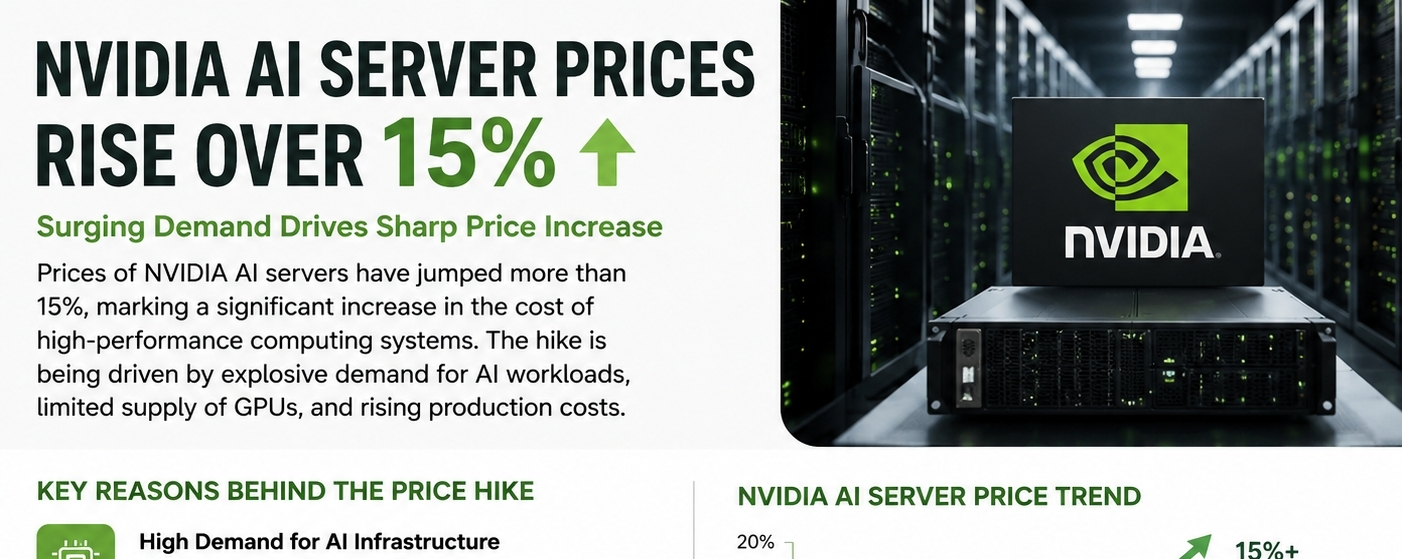
NVIDIA AI Server Prices Rise Over 15%NVIDIA is reportedly preparing to raise prices for AI servers by more than 15% in many cases
The higher prices are expected to affect systems using NVIDIA’s latest Vera Rubin and Grace Blackwell platforms. The new pricing is expected to apply to systems shipped in early 2027, with the exact increase depending on the chip generation and memory configuration
This could make AI infrastructure more expensive for major technology companies and data-center operators. At the same time, the move shows how strong demand for AI computing continues to put pressure on the supply of advanced hardware and memory$ETH
What I’m Watching 👀
NVIDIA’s upcoming earnings report on August 26 could give the market more clues about AI demand, server costs, and the company’s future growth$BNB
For now, the key story is simple: AI demand remains strong, but the cost of building AI infrastructure is rising$NVDA.US
{stock_us}(NVDA.US)
#navida #AI #ArtificialInteligence #GPU
NVIDIA AI Server Prices Rise Over 15%
NVIDIA is reportedly preparing to raise prices for AI servers by more than 15% in many cases
The higher prices are expected to affect systems using NVIDIA’s latest Vera Rubin and Grace Blackwell platforms. The new pricing is expected to apply to systems shipped in early 2027, with the exact increase depending on the chip generation and memory configuration
This could make AI infrastructure more expensive for major technology companies and data-center operators. At the same time, the move shows how strong demand for AI computing continues to put pressure on the supply of advanced hardware and memory$ETH
What I’m Watching 👀
NVIDIA’s upcoming earnings report on August 26 could give the market more clues about AI demand, server costs, and the company’s future growth$BNB
For now, the key story is simple: AI demand remains strong, but the cost of building AI infrastructure is rising$NVDA.US
#navida #AI #ArtificialInteligence #GPU
The higher prices are expected to affect systems using NVIDIA’s latest Vera Rubin and Grace Blackwell platforms. The new pricing is expected to apply to systems shipped in early 2027, with the exact increase depending on the chip generation and memory configuration
This could make AI infrastructure more expensive for major technology companies and data-center operators. At the same time, the move shows how strong demand for AI computing continues to put pressure on the supply of advanced hardware and memory$ETH
What I’m Watching 👀
NVIDIA’s upcoming earnings report on August 26 could give the market more clues about AI demand, server costs, and the company’s future growth$BNB
For now, the key story is simple: AI demand remains strong, but the cost of building AI infrastructure is rising$NVDA.US
#navida #AI #ArtificialInteligence #GPU
NVDAUS+1.45%
1
66

·
--

ලිපිය
What Is Janction (JCT)?Training and running AI models requires significant computing power, and access to that power is typically controlled by a small number of large cloud providers. Janction aims to change this by aggregating idle GPU resources from around the world and making them available through a blockchain-based marketplace.
This article explains what Janction is, how its technology works, the role of the JCT token, and its listing on Binance Alpha and Binance Futures.
What Is Janction? Janction is a distributed AI computing network that describes itself as the first Layer 2 to provide verifiable, synergic, and scalable AI services. It is built on Arbitrum, an Ethereum Layer 2 scaling solution, and is incubated by Jasmy Corporation, a Japanese data infrastructure company.
Instead of relying on centralized cloud providers such as AWS or Google Cloud, Janction aggregates GPUs from multiple sources, including personal computers, data centers, and other hardware, and makes that capacity available to AI teams and developers.
Janction is designed as a scalable web of blockchains that supports distributed AI multi-party collaboration and resource sharing. It provides underlying infrastructure for computing power trading, data trading, resource scheduling, verification, consensus, and security. Key elements such as AI models, GPU computing power, data feeding, and data labeling are all integrated into Janction for co-processing.
How Does Janction Work? Janction addresses a few core technical challenges that arise when building a distributed, trustless AI computing network:
Resource scheduling and management The Janction cluster GPU pool is a system for managing and allocating multiple GPU resources to support large-scale parallel computing. The system handles task scheduling, load balancing, resource security and isolation, fault recovery, and cost optimization. A key component is the colocation and arithmetic routing layer, which manages how GPU clusters are mixed and matched for different workloads.Data acquisition Janction can source data from both on-chain and off-chain environments. The platform compensates data providers fairly for their contributions, supporting a range of data types required for AI model training and inference.Proof of workload To build a credibly neutral computing network, Janction needs a way to verify that AI computation has been performed as promised. Its proof-of-workload mechanism provides on-chain verification of computing tasks, enabling financial incentives to be distributed fairly to GPU providers. This is conceptually related to how zero-knowledge rollups verify computation without revealing underlying data.Incentive and gaming mechanism Multiple roles participate in Janction's computing tasks, including data providers, data annotators, GPU providers, and AI model providers. Janction uses the Vickrey-Clarke-Groves mechanism (used in game theory) and workload correlation functions to price contributions fairly and ensure that all participants are incentivized to complete their required tasks.Privacy As data privacy regulations tighten globally, Janction integrates privacy-preserving techniques to enable AI model training and inference without creating data silos or exposing personal information. Jasmy's Sovereign Data Protocol is designed to align with the EU’s General Data Protection Regulation (GDPR).
Janction Use Cases Janction currently supports the following AI workloads through its GPU network:
AI image generation: text-to-image generation for designers, advertisers, and social apps.
Speech-to-text and text-to-speech: automated subtitles, AI customer service, podcast narration.
Video enhancement and processing: 4K/8K upscaling, noise reduction, slow-motion smoothing, and old film restoration.
Object detection and image analysis: security surveillance, industrial defect detection, and autonomous driving support.
Private LLM hosting: organizations can run ChatGPT-style AI models privately within their own infrastructure, reducing costs and meeting compliance requirements for regulated industries such as finance, healthcare, and government.
What Is JCT? JCT is the native token of the Janction network. It functions as the medium of exchange for computing power transactions, incentivizes GPU providers, and enables governance participation. The total supply of JCT is 50 billion tokens.
The token distribution follows a deflationary model with a structured vesting schedule designed to limit early sell pressure. The initial circulating supply at launch was approximately 12.7% of the total supply (around 6.35 billion tokens), unlocked for liquidity, community, and airdrop purposes. Full token circulation is expected by 2028.
JCT On Binance Alpha and Binance Futures Janction (JCT) was listed on Binance Alpha on November 10, 2025, and Binance Futures also launched the JCTUSDT Perpetual Contract with up to 40x leverage on the same day.
FAQ What problem does Janction solve? Janction addresses the high cost and centralized control of AI computing power. Training and running AI models typically requires expensive GPU infrastructure managed by a small number of cloud providers. Janction aggregates idle GPUs from multiple sources into a shared marketplace, aiming to reduce AI compute costs significantly while distributing the economic benefits to hardware contributors.
What is the Janction GPU Marketplace? The Janction GPU Marketplace is a decentralized platform where GPU owners can contribute their idle computing capacity in exchange for JCT token rewards. AI developers and teams can then access this pooled capacity for inference, training, and other AI workloads. The marketplace aims to provide unlimited GPU capacity at lower costs by aggregating hardware from many independent providers.
What blockchain is Janction built on? Janction is built on Arbitrum, an Ethereum Layer 2 network. Using Arbitrum allows Janction to process high transaction volumes at low fees, which is necessary for the frequent micropayments made to GPU node operators. Jasmy Corporation's data infrastructure also integrates with Janction for privacy-preserving AI data handling.
What is JCT used for? JCT is the native currency of the Janction network. It is used to pay for GPU computing tasks, reward data providers and node operators, and participate in protocol governance. The token has a total supply of 50 billion and launched on Binance Alpha in November 2025.
How is AI computation verified on Janction? Janction uses a proof-of-workload mechanism that provides on-chain verification of AI computing tasks. This allows the network to confirm that GPU providers have performed the work they were paid for, and to distribute rewards accordingly. The system is designed to be trustless, meaning no central authority needs to verify the computation.
#GPU #JCT #JCTUSDT
$BTC
{future}(BTCUSDT)
$ETH
{future}(ETHUSDT)
$JCT
{future}(JCTUSDT)
What Is Janction (JCT)?
Training and running AI models requires significant computing power, and access to that power is typically controlled by a small number of large cloud providers. Janction aims to change this by aggregating idle GPU resources from around the world and making them available through a blockchain-based marketplace.
This article explains what Janction is, how its technology works, the role of the JCT token, and its listing on Binance Alpha and Binance Futures.
What Is Janction? Janction is a distributed AI computing network that describes itself as the first Layer 2 to provide verifiable, synergic, and scalable AI services. It is built on Arbitrum, an Ethereum Layer 2 scaling solution, and is incubated by Jasmy Corporation, a Japanese data infrastructure company.
Instead of relying on centralized cloud providers such as AWS or Google Cloud, Janction aggregates GPUs from multiple sources, including personal computers, data centers, and other hardware, and makes that capacity available to AI teams and developers.
Janction is designed as a scalable web of blockchains that supports distributed AI multi-party collaboration and resource sharing. It provides underlying infrastructure for computing power trading, data trading, resource scheduling, verification, consensus, and security. Key elements such as AI models, GPU computing power, data feeding, and data labeling are all integrated into Janction for co-processing.
How Does Janction Work? Janction addresses a few core technical challenges that arise when building a distributed, trustless AI computing network:
Resource scheduling and management The Janction cluster GPU pool is a system for managing and allocating multiple GPU resources to support large-scale parallel computing. The system handles task scheduling, load balancing, resource security and isolation, fault recovery, and cost optimization. A key component is the colocation and arithmetic routing layer, which manages how GPU clusters are mixed and matched for different workloads.Data acquisition Janction can source data from both on-chain and off-chain environments. The platform compensates data providers fairly for their contributions, supporting a range of data types required for AI model training and inference.Proof of workload To build a credibly neutral computing network, Janction needs a way to verify that AI computation has been performed as promised. Its proof-of-workload mechanism provides on-chain verification of computing tasks, enabling financial incentives to be distributed fairly to GPU providers. This is conceptually related to how zero-knowledge rollups verify computation without revealing underlying data.Incentive and gaming mechanism Multiple roles participate in Janction's computing tasks, including data providers, data annotators, GPU providers, and AI model providers. Janction uses the Vickrey-Clarke-Groves mechanism (used in game theory) and workload correlation functions to price contributions fairly and ensure that all participants are incentivized to complete their required tasks.Privacy As data privacy regulations tighten globally, Janction integrates privacy-preserving techniques to enable AI model training and inference without creating data silos or exposing personal information. Jasmy's Sovereign Data Protocol is designed to align with the EU’s General Data Protection Regulation (GDPR).
Janction Use Cases Janction currently supports the following AI workloads through its GPU network:
AI image generation: text-to-image generation for designers, advertisers, and social apps.
Speech-to-text and text-to-speech: automated subtitles, AI customer service, podcast narration.
Video enhancement and processing: 4K/8K upscaling, noise reduction, slow-motion smoothing, and old film restoration.
Object detection and image analysis: security surveillance, industrial defect detection, and autonomous driving support.
Private LLM hosting: organizations can run ChatGPT-style AI models privately within their own infrastructure, reducing costs and meeting compliance requirements for regulated industries such as finance, healthcare, and government.
What Is JCT? JCT is the native token of the Janction network. It functions as the medium of exchange for computing power transactions, incentivizes GPU providers, and enables governance participation. The total supply of JCT is 50 billion tokens.
The token distribution follows a deflationary model with a structured vesting schedule designed to limit early sell pressure. The initial circulating supply at launch was approximately 12.7% of the total supply (around 6.35 billion tokens), unlocked for liquidity, community, and airdrop purposes. Full token circulation is expected by 2028.
JCT On Binance Alpha and Binance Futures Janction (JCT) was listed on Binance Alpha on November 10, 2025, and Binance Futures also launched the JCTUSDT Perpetual Contract with up to 40x leverage on the same day.
FAQ What problem does Janction solve? Janction addresses the high cost and centralized control of AI computing power. Training and running AI models typically requires expensive GPU infrastructure managed by a small number of cloud providers. Janction aggregates idle GPUs from multiple sources into a shared marketplace, aiming to reduce AI compute costs significantly while distributing the economic benefits to hardware contributors.
What is the Janction GPU Marketplace? The Janction GPU Marketplace is a decentralized platform where GPU owners can contribute their idle computing capacity in exchange for JCT token rewards. AI developers and teams can then access this pooled capacity for inference, training, and other AI workloads. The marketplace aims to provide unlimited GPU capacity at lower costs by aggregating hardware from many independent providers.
What blockchain is Janction built on? Janction is built on Arbitrum, an Ethereum Layer 2 network. Using Arbitrum allows Janction to process high transaction volumes at low fees, which is necessary for the frequent micropayments made to GPU node operators. Jasmy Corporation's data infrastructure also integrates with Janction for privacy-preserving AI data handling.
What is JCT used for? JCT is the native currency of the Janction network. It is used to pay for GPU computing tasks, reward data providers and node operators, and participate in protocol governance. The token has a total supply of 50 billion and launched on Binance Alpha in November 2025.
How is AI computation verified on Janction? Janction uses a proof-of-workload mechanism that provides on-chain verification of AI computing tasks. This allows the network to confirm that GPU providers have performed the work they were paid for, and to distribute rewards accordingly. The system is designed to be trustless, meaning no central authority needs to verify the computation.
#GPU #JCT #JCTUSDT
$BTC
$ETH
$JCT
This article explains what Janction is, how its technology works, the role of the JCT token, and its listing on Binance Alpha and Binance Futures.
What Is Janction? Janction is a distributed AI computing network that describes itself as the first Layer 2 to provide verifiable, synergic, and scalable AI services. It is built on Arbitrum, an Ethereum Layer 2 scaling solution, and is incubated by Jasmy Corporation, a Japanese data infrastructure company.
Instead of relying on centralized cloud providers such as AWS or Google Cloud, Janction aggregates GPUs from multiple sources, including personal computers, data centers, and other hardware, and makes that capacity available to AI teams and developers.
Janction is designed as a scalable web of blockchains that supports distributed AI multi-party collaboration and resource sharing. It provides underlying infrastructure for computing power trading, data trading, resource scheduling, verification, consensus, and security. Key elements such as AI models, GPU computing power, data feeding, and data labeling are all integrated into Janction for co-processing.
How Does Janction Work? Janction addresses a few core technical challenges that arise when building a distributed, trustless AI computing network:
Resource scheduling and management The Janction cluster GPU pool is a system for managing and allocating multiple GPU resources to support large-scale parallel computing. The system handles task scheduling, load balancing, resource security and isolation, fault recovery, and cost optimization. A key component is the colocation and arithmetic routing layer, which manages how GPU clusters are mixed and matched for different workloads.Data acquisition Janction can source data from both on-chain and off-chain environments. The platform compensates data providers fairly for their contributions, supporting a range of data types required for AI model training and inference.Proof of workload To build a credibly neutral computing network, Janction needs a way to verify that AI computation has been performed as promised. Its proof-of-workload mechanism provides on-chain verification of computing tasks, enabling financial incentives to be distributed fairly to GPU providers. This is conceptually related to how zero-knowledge rollups verify computation without revealing underlying data.Incentive and gaming mechanism Multiple roles participate in Janction's computing tasks, including data providers, data annotators, GPU providers, and AI model providers. Janction uses the Vickrey-Clarke-Groves mechanism (used in game theory) and workload correlation functions to price contributions fairly and ensure that all participants are incentivized to complete their required tasks.Privacy As data privacy regulations tighten globally, Janction integrates privacy-preserving techniques to enable AI model training and inference without creating data silos or exposing personal information. Jasmy's Sovereign Data Protocol is designed to align with the EU’s General Data Protection Regulation (GDPR).
Janction Use Cases Janction currently supports the following AI workloads through its GPU network:
AI image generation: text-to-image generation for designers, advertisers, and social apps.
Speech-to-text and text-to-speech: automated subtitles, AI customer service, podcast narration.
Video enhancement and processing: 4K/8K upscaling, noise reduction, slow-motion smoothing, and old film restoration.
Object detection and image analysis: security surveillance, industrial defect detection, and autonomous driving support.
Private LLM hosting: organizations can run ChatGPT-style AI models privately within their own infrastructure, reducing costs and meeting compliance requirements for regulated industries such as finance, healthcare, and government.
What Is JCT? JCT is the native token of the Janction network. It functions as the medium of exchange for computing power transactions, incentivizes GPU providers, and enables governance participation. The total supply of JCT is 50 billion tokens.
The token distribution follows a deflationary model with a structured vesting schedule designed to limit early sell pressure. The initial circulating supply at launch was approximately 12.7% of the total supply (around 6.35 billion tokens), unlocked for liquidity, community, and airdrop purposes. Full token circulation is expected by 2028.
JCT On Binance Alpha and Binance Futures Janction (JCT) was listed on Binance Alpha on November 10, 2025, and Binance Futures also launched the JCTUSDT Perpetual Contract with up to 40x leverage on the same day.
FAQ What problem does Janction solve? Janction addresses the high cost and centralized control of AI computing power. Training and running AI models typically requires expensive GPU infrastructure managed by a small number of cloud providers. Janction aggregates idle GPUs from multiple sources into a shared marketplace, aiming to reduce AI compute costs significantly while distributing the economic benefits to hardware contributors.
What is the Janction GPU Marketplace? The Janction GPU Marketplace is a decentralized platform where GPU owners can contribute their idle computing capacity in exchange for JCT token rewards. AI developers and teams can then access this pooled capacity for inference, training, and other AI workloads. The marketplace aims to provide unlimited GPU capacity at lower costs by aggregating hardware from many independent providers.
What blockchain is Janction built on? Janction is built on Arbitrum, an Ethereum Layer 2 network. Using Arbitrum allows Janction to process high transaction volumes at low fees, which is necessary for the frequent micropayments made to GPU node operators. Jasmy Corporation's data infrastructure also integrates with Janction for privacy-preserving AI data handling.
What is JCT used for? JCT is the native currency of the Janction network. It is used to pay for GPU computing tasks, reward data providers and node operators, and participate in protocol governance. The token has a total supply of 50 billion and launched on Binance Alpha in November 2025.
How is AI computation verified on Janction? Janction uses a proof-of-workload mechanism that provides on-chain verification of AI computing tasks. This allows the network to confirm that GPU providers have performed the work they were paid for, and to distribute rewards accordingly. The system is designed to be trustless, meaning no central authority needs to verify the computation.
#GPU #JCT #JCTUSDT
$BTC
$ETH
$JCT
1
165
·
--
🤖 #io.net (IO): Powering AI With Decentralized Compute
As AI applications continue to grow, demand for distributed computing resources is increasing. io.net aims to connect unused GPU resources into a decentralized compute network that can support AI startups, researchers, and developers.
The project's long-term outlook will depend on real-world adoption, infrastructure reliability, ecosystem partnerships, and network utilization. Monitoring these fundamentals may provide better insights than focusing only on short-term market sentiment.
Always verify information through official project updates and conduct independent research.
DYOR. This is not financial advice.
#ioNet #GPU #Web3 #BinanceSquare
🤖 #io.net (IO): Powering AI With Decentralized Compute
As AI applications continue to grow, demand for distributed computing resources is increasing. io.net aims to connect unused GPU resources into a decentralized compute network that can support AI startups, researchers, and developers.
The project's long-term outlook will depend on real-world adoption, infrastructure reliability, ecosystem partnerships, and network utilization. Monitoring these fundamentals may provide better insights than focusing only on short-term market sentiment.
Always verify information through official project updates and conduct independent research.
DYOR. This is not financial advice.
#ioNet #GPU #Web3 #BinanceSquare
As AI applications continue to grow, demand for distributed computing resources is increasing. io.net aims to connect unused GPU resources into a decentralized compute network that can support AI startups, researchers, and developers.
The project's long-term outlook will depend on real-world adoption, infrastructure reliability, ecosystem partnerships, and network utilization. Monitoring these fundamentals may provide better insights than focusing only on short-term market sentiment.
Always verify information through official project updates and conduct independent research.
DYOR. This is not financial advice.
#ioNet #GPU #Web3 #BinanceSquare

130

·
--
@fluence Brings Decentralized GPU Compute to AI Builders
GPU access has become the biggest bottleneck in AI right now, not ideas, not talent, just getting your hands on enough compute without paying hyperscaler prices. Fluence, a leading DePIN platform, is going after that problem directly.
Fluence already runs a decentralized "cloudless" alternative to AWS and Google Cloud, letting developers rent servers from a global network of independent providers instead of one company. That CPU marketplace had generated over $1M in annual revenue and saved customers millions versus traditional cloud pricing. Now they're doing the same thing for GPUs.
Developers can deploy GPU containers, VMs, or bare metal depending on what they need, all running through smart contracts that handle pricing and payments automatically, with providers required to stake collateral and meet reliability standards before joining the network. The result: enterprise-grade GPU access at up to 85% lower cost than the big clouds.
It's backed by real infrastructure too, enterprise-grade data centers with GDPR, ISO 27001, and SOC2 compliance, expanding GPU supply. As co-founder Evgeny Ponomarev put it, the goal is simple: remove the scarcity and cost barriers gating AI teams from the compute they need.
Bottom line, Fluence is betting the same decentralization playbook that worked for cloud CPUs can now fix the GPU shortage too. Worth watching.
#DePIN #Ai #GPU
@Fluence Brings Decentralized GPU Compute to AI Builders
GPU access has become the biggest bottleneck in AI right now, not ideas, not talent, just getting your hands on enough compute without paying hyperscaler prices. Fluence, a leading DePIN platform, is going after that problem directly.
Fluence already runs a decentralized "cloudless" alternative to AWS and Google Cloud, letting developers rent servers from a global network of independent providers instead of one company. That CPU marketplace had generated over $1M in annual revenue and saved customers millions versus traditional cloud pricing. Now they're doing the same thing for GPUs.
Developers can deploy GPU containers, VMs, or bare metal depending on what they need, all running through smart contracts that handle pricing and payments automatically, with providers required to stake collateral and meet reliability standards before joining the network. The result: enterprise-grade GPU access at up to 85% lower cost than the big clouds.
It's backed by real infrastructure too, enterprise-grade data centers with GDPR, ISO 27001, and SOC2 compliance, expanding GPU supply. As co-founder Evgeny Ponomarev put it, the goal is simple: remove the scarcity and cost barriers gating AI teams from the compute they need.
Bottom line, Fluence is betting the same decentralization playbook that worked for cloud CPUs can now fix the GPU shortage too. Worth watching.
#DePIN #Ai #GPU
GPU access has become the biggest bottleneck in AI right now, not ideas, not talent, just getting your hands on enough compute without paying hyperscaler prices. Fluence, a leading DePIN platform, is going after that problem directly.
Fluence already runs a decentralized "cloudless" alternative to AWS and Google Cloud, letting developers rent servers from a global network of independent providers instead of one company. That CPU marketplace had generated over $1M in annual revenue and saved customers millions versus traditional cloud pricing. Now they're doing the same thing for GPUs.
Developers can deploy GPU containers, VMs, or bare metal depending on what they need, all running through smart contracts that handle pricing and payments automatically, with providers required to stake collateral and meet reliability standards before joining the network. The result: enterprise-grade GPU access at up to 85% lower cost than the big clouds.
It's backed by real infrastructure too, enterprise-grade data centers with GDPR, ISO 27001, and SOC2 compliance, expanding GPU supply. As co-founder Evgeny Ponomarev put it, the goal is simple: remove the scarcity and cost barriers gating AI teams from the compute they need.
Bottom line, Fluence is betting the same decentralization playbook that worked for cloud CPUs can now fix the GPU shortage too. Worth watching.
#DePIN #Ai #GPU

135

·
--
🚀 AI computing is getting cheaper
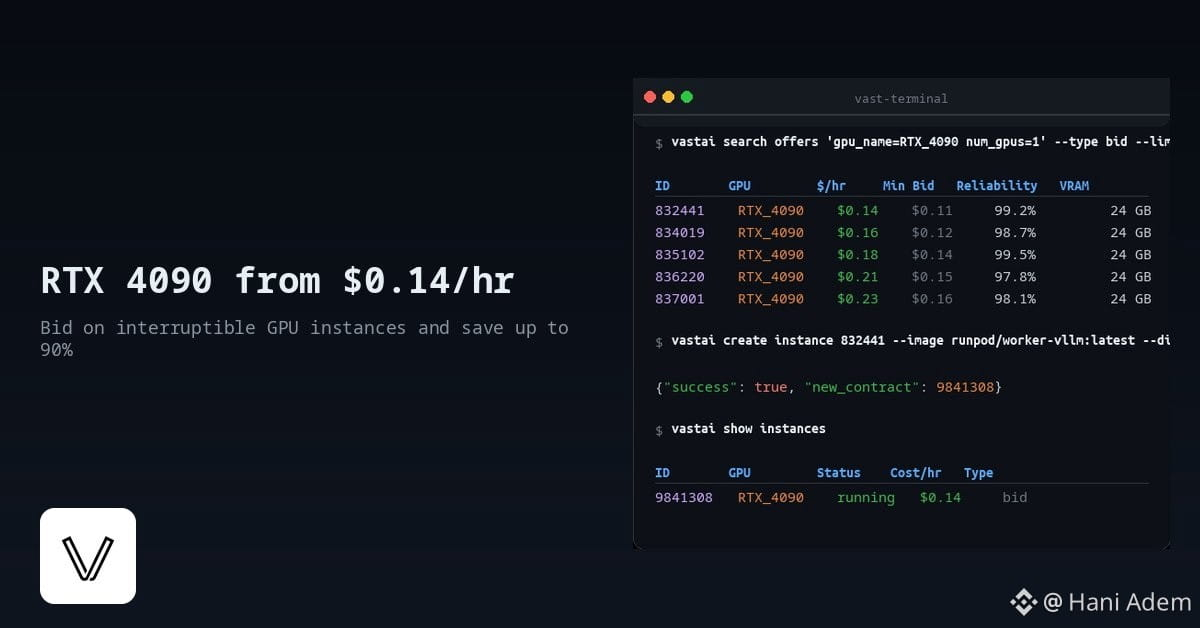
RTX 4090 GPU access is now being offered from around $0.14/hour for AI workloads such as inference, evaluations, and fine-tuning.
Lower computing costs could help more people build and run AI applications. 🤖
Do you think cheaper GPU infrastructure will accelerate AI adoption?
#AI #crypt #BİNANCE #Technology #GPU
🚀 AI computing is getting cheaper
RTX 4090 GPU access is now being offered from around $0.14/hour for AI workloads such as inference, evaluations, and fine-tuning.
Lower computing costs could help more people build and run AI applications. 🤖
Do you think cheaper GPU infrastructure will accelerate AI adoption?
#AI #crypt #BİNANCE #Technology #GPU
RTX 4090 GPU access is now being offered from around $0.14/hour for AI workloads such as inference, evaluations, and fine-tuning.
Lower computing costs could help more people build and run AI applications. 🤖
Do you think cheaper GPU infrastructure will accelerate AI adoption?
#AI #crypt #BİNANCE #Technology #GPU
1
79
තවත් අන්තර්ගතයන් ගවේෂණය කිරීමට ඇතුල් වන්න
Binance චතුරශ්රය හි ගෝලීය ක්රිප්ටෝ පරිශීලකයින් හා එක්වන්න
⚡️ ක්රිප්ටෝ පිළිබඳ නවතම සහ ප්රයෝජනවත් තොරතුරු ලබා ගන්න.
💬 ලොව විශාලතම ක්රිප්ටෝ හුවමාරුව මගින් විශ්වාස කෙරේ.
👍 සත්යායනය කරන ලද නිර්මාණකරුවන්ගෙන් සැබෑ විදසුන් සොයා ගන්න.
විද්යුත් තැපෑල / දුරකථන අංකය
නැගී එන මාතෘකා
1
#ZcashETFPostsFirstWeeklyOutflow$93.6M
30,251 views
89 සාකච්ඡා කරමින්
2
#GreekPoliceBustCryptoScamRingArrest17
53,443 views
551 සාකච්ඡා කරමින්
3
#BitcoinRejectedAt$87K
111,618 views
148 සාකච්ඡා කරමින්
4
#FedOctoberRateHikeOddsFallTo17%
83,990 views
852 සාකච්ඡා කරමින්
5
#NvidiaHitsRecordHighUp2.4%
54,010 views
604 සාකච්ඡා කරමින්
6
#CanaryFilesAmendedS1ForPEPEETF
15,929 views
416 සාකච්ඡා කරමින්
7
#USRussiaUkraineTalksReportedlyIncludeLukoilOilDeal
25,710 views
419 සාකච්ඡා කරමින්
8
#BitcoinParesGainsAfterRallyTo$86.5K
45,832 views
159 සාකච්ඡා කරමින්
9
#CerebrasSinksNearly20%OnReportNvidiaToPowerOpenAI
109,716 views
1,062 සාකච්ඡා කරමින්
10
#SECProposesCryptoCustodyRules
147,309 views
1,330 සාකච්ඡා කරමින්