
#celo
celo
713,166 නැරඹීම්
4,016 සාකච්ඡා කරමින්
උණුසුම්
නවතම


·
--
ලිපිය
Celo: 20M Wallets, a $0.059 Token and the Gap Between ThemCelo says it has 20 million wallets. The token trades at $0.059, about 6% above its all-time low. Both facts are true, and that is the story.
I think Celo's usage is real. But the token only wins when that usage turns into fees and buybacks. Until then, users are happy and holders are waiting.
I spent days in Celo's docs, its governance forum and live market data. This article is part explainer and part field notes from that research.
Celo in One Minute
The simplest way I can put it: Celo is a blockchain built for payments from a phone. It began in 2020 as its own chain. On 26 March 2025 it became a Layer 2 on Ethereum.
A Layer 2 is a faster, cheaper chain that borrows Ethereum's security. Celo's target users are people who want digital dollars or local currency.
How Celo Is Built
I break it into four layers:
Apps and wallets, like MiniPay.Celo L2, which runs Ethereum-style smart contracts with a block every 1 second.EigenDA, which stores transaction data cheaply.Ethereum, which does the final settlement.
The result is a typical fee under one cent.
What Happens When Someone Sends Money
This is the flow I traced:
The user holds a stablecoin.The user pays the fee in that same coin. No CELO needed.The sequencer puts the payment in a block in about a second.The data goes to EigenDA and Ethereum seals it.
One honest note. A single sequencer orders transactions today. Celo says decentralized sequencing is planned, not live.
Mento: Where Local Coins Come From
The part I found most useful to understand is Mento, Celo's own stablecoin protocol. It mints 15 stablecoins, and the dollar one, USDm, is about 86% of supply. Celo as a whole has 30+ fiat-linked coins.
Mento's reserve holds other issuers' stablecoins plus CELO, stETH and ETH. Those last three are 28.9% of holdings (DIA, 2 October 2026).
The CELO Token
Here is how I read the token:
Max supply is fixed at 1 billion. About 610M circulates.400M is released over time as epoch rewards.It has four jobs: governance, lock and vote, default gas, and reserve collateral.
The catch: users do not need CELO to use Celo.
Where the Fees Go
So the token needs another reason to be bought. That reason is CELOccelerate, approved in 2026 with about 97% of votes.
Net sequencer revenue buys CELO on the open market.That CELO goes to a Community Fund run by holders.Holders vote to hold, reinvest or burn it.
Burning is not automatic. A forum post says a vote to burn the first year's 1.749M CELO was rejected.
My Real Numbers
Here is the data I tracked on 20 and 21 November, with nothing rounded up.
Price about $0.059, market cap about $36MFully diluted value about $59M, circulating supply 610M7-day move: down 9.7%All-time low $0.0557, all-time high $9.82Value locked about $8.3MReported buybacks: about 9.1M CELO by 10 October, around 1.5% of circulating supply
What the Chart Did
On 14 November CELO fell 10.7% in one day, from about $0.0662 to $0.0591. It has not touched $0.066 since. Every bounce stalled near $0.061.
Spot is thin. Binance CELO/USDT spot did about $172K in 24 hours when I checked. Perps volume is around 25 times spot. So futures push this chart.
The Gap: Usage vs Token
This is the gap I keep coming back to. The story is loud: MiniPay is moving 20M+ wallets to Stripe's Privy, Tether's USAT is live, and agent payments are coming. The token is quiet: $36M market cap and $8.3M locked.
The reported buyback pace was 600K CELO in a week. At $0.059 that is about $35K.
Who Celo Helps
Users: sub-cent fees, 1-second payments, local currency, no seed phrase in MiniPay.Builders: Ethereum code runs here, and MiniPay brings an audience.Ethereum: a payments L2 with real users.CELO holders: a vote, staking rewards, and buybacks if they scale.
What Surprised Me, and What Could Be Better
What surprised me:
You never need CELO to use Celo.20M activated wallets against about 700K daily users (December 2025).How small the buyback is next to the story.
What could be better:
Regular, public buyback reports. A forum thread already asks for them.A date for decentralized sequencing.Clear active-user numbers.
None of these break the idea. They are gaps I only saw after reading closely.
Risks I Take Seriously
One sequencer. A single party orders blocks today.Opera. 160M CELO was approved. That is 16% of max supply, about $9.4M at today's price. Its voting power is capped at 10% of staked CELO.Weak token demand. Buybacks are tiny next to the market cap.Reserve exposure. Mento's reserve holds volatile assets, including CELO.Unlock on 28 November. I could not confirm its size.
Three Paths From $0.059
Here are the levels I am watching:
Bull: reclaim $0.0660, +12%, market cap about $40M. Next is $0.0677, +15%.Range: $0.0569 to $0.0610 while spot stays thin.Bear: lose $0.0557, the all-time low, 6% away. There is no chart history below it.{future}(CELOUSDT)
Quick FAQ
Do I need CELO to use Celo? No. Fees can be paid in stablecoins.Is Celo its own chain? No. It has been an Ethereum L2 since March 2025.Does the token burn? Not automatically. Holders vote.Are the user numbers verified? No. Celo and Opera report them.
Why I Trust These Numbers
Every number here comes from public sources: Celo's docs and forum, CoinGecko, DIA, MiniPay's Q2 2026 update and The Block. Nothing is estimated or rounded up to look better.
User counts are self-reported by Celo and Opera, and I say so. Market numbers are snapshots and can move 10% in a day.
Celo proves people will use stablecoins on a phone. Whether that makes the token worth more is still open.
Do not judge a chain by its wallet count. Judge it by what its token earns.
If you hold CELO or use MiniPay, tell me in the comments how you see it.
This is my personal research and not financial advice. No price predictions, no trading signals.
#Celo #CELOUSDT $CELO @Binance_Square_Official @celo
Celo: 20M Wallets, a $0.059 Token and the Gap Between Them
Celo says it has 20 million wallets. The token trades at $0.059, about 6% above its all-time low. Both facts are true, and that is the story.
I think Celo's usage is real. But the token only wins when that usage turns into fees and buybacks. Until then, users are happy and holders are waiting.
I spent days in Celo's docs, its governance forum and live market data. This article is part explainer and part field notes from that research.
Celo in One Minute
The simplest way I can put it: Celo is a blockchain built for payments from a phone. It began in 2020 as its own chain. On 26 March 2025 it became a Layer 2 on Ethereum.
A Layer 2 is a faster, cheaper chain that borrows Ethereum's security. Celo's target users are people who want digital dollars or local currency.
How Celo Is Built
I break it into four layers:
Apps and wallets, like MiniPay.Celo L2, which runs Ethereum-style smart contracts with a block every 1 second.EigenDA, which stores transaction data cheaply.Ethereum, which does the final settlement.
The result is a typical fee under one cent.
What Happens When Someone Sends Money
This is the flow I traced:
The user holds a stablecoin.The user pays the fee in that same coin. No CELO needed.The sequencer puts the payment in a block in about a second.The data goes to EigenDA and Ethereum seals it.
One honest note. A single sequencer orders transactions today. Celo says decentralized sequencing is planned, not live.
Mento: Where Local Coins Come From
The part I found most useful to understand is Mento, Celo's own stablecoin protocol. It mints 15 stablecoins, and the dollar one, USDm, is about 86% of supply. Celo as a whole has 30+ fiat-linked coins.
Mento's reserve holds other issuers' stablecoins plus CELO, stETH and ETH. Those last three are 28.9% of holdings (DIA, 2 October 2026).
The CELO Token
Here is how I read the token:
Max supply is fixed at 1 billion. About 610M circulates.400M is released over time as epoch rewards.It has four jobs: governance, lock and vote, default gas, and reserve collateral.
The catch: users do not need CELO to use Celo.
Where the Fees Go
So the token needs another reason to be bought. That reason is CELOccelerate, approved in 2026 with about 97% of votes.
Net sequencer revenue buys CELO on the open market.That CELO goes to a Community Fund run by holders.Holders vote to hold, reinvest or burn it.
Burning is not automatic. A forum post says a vote to burn the first year's 1.749M CELO was rejected.
My Real Numbers
Here is the data I tracked on 20 and 21 November, with nothing rounded up.
Price about $0.059, market cap about $36MFully diluted value about $59M, circulating supply 610M7-day move: down 9.7%All-time low $0.0557, all-time high $9.82Value locked about $8.3MReported buybacks: about 9.1M CELO by 10 October, around 1.5% of circulating supply
What the Chart Did
On 14 November CELO fell 10.7% in one day, from about $0.0662 to $0.0591. It has not touched $0.066 since. Every bounce stalled near $0.061.
Spot is thin. Binance CELO/USDT spot did about $172K in 24 hours when I checked. Perps volume is around 25 times spot. So futures push this chart.
The Gap: Usage vs Token
This is the gap I keep coming back to. The story is loud: MiniPay is moving 20M+ wallets to Stripe's Privy, Tether's USAT is live, and agent payments are coming. The token is quiet: $36M market cap and $8.3M locked.
The reported buyback pace was 600K CELO in a week. At $0.059 that is about $35K.
Who Celo Helps
Users: sub-cent fees, 1-second payments, local currency, no seed phrase in MiniPay.Builders: Ethereum code runs here, and MiniPay brings an audience.Ethereum: a payments L2 with real users.CELO holders: a vote, staking rewards, and buybacks if they scale.
What Surprised Me, and What Could Be Better
What surprised me:
You never need CELO to use Celo.20M activated wallets against about 700K daily users (December 2025).How small the buyback is next to the story.
What could be better:
Regular, public buyback reports. A forum thread already asks for them.A date for decentralized sequencing.Clear active-user numbers.
None of these break the idea. They are gaps I only saw after reading closely.
Risks I Take Seriously
One sequencer. A single party orders blocks today.Opera. 160M CELO was approved. That is 16% of max supply, about $9.4M at today's price. Its voting power is capped at 10% of staked CELO.Weak token demand. Buybacks are tiny next to the market cap.Reserve exposure. Mento's reserve holds volatile assets, including CELO.Unlock on 28 November. I could not confirm its size.
Three Paths From $0.059
Here are the levels I am watching:
Bull: reclaim $0.0660, +12%, market cap about $40M. Next is $0.0677, +15%.Range: $0.0569 to $0.0610 while spot stays thin.Bear: lose $0.0557, the all-time low, 6% away. There is no chart history below it.Quick FAQ
Do I need CELO to use Celo? No. Fees can be paid in stablecoins.Is Celo its own chain? No. It has been an Ethereum L2 since March 2025.Does the token burn? Not automatically. Holders vote.Are the user numbers verified? No. Celo and Opera report them.
Why I Trust These Numbers
Every number here comes from public sources: Celo's docs and forum, CoinGecko, DIA, MiniPay's Q2 2026 update and The Block. Nothing is estimated or rounded up to look better.
User counts are self-reported by Celo and Opera, and I say so. Market numbers are snapshots and can move 10% in a day.
Celo proves people will use stablecoins on a phone. Whether that makes the token worth more is still open.
Do not judge a chain by its wallet count. Judge it by what its token earns.
If you hold CELO or use MiniPay, tell me in the comments how you see it.
This is my personal research and not financial advice. No price predictions, no trading signals.
#Celo #CELOUSDT $CELO @Binance Square Official @celo
x mee:
celo token holder is only 3
3
1
19
3.8k

·
--

ලිපිය
Celo Doesn't Have a Tech Problem. It Has a Distribution Problem. Here's Why That's Good News.Ask most people what makes a blockchain win, and they will say speed, low fees or high TPS.
Celo's story points to something different: the chain that wins is the one that puts crypto where people already are.
With the CELO Trading Festival 2026 running from November 20 to December 20, it is a good time to look at Celo beyond the price chart and ask a simple question: what is this network actually trying to become?
1. The problem Celo started with
Most blockchains were built by crypto people for crypto people. To use them, you need a desktop wallet, a long hex address, a native token for gas, and a fair amount of patience.
Celo started from the opposite end. Founded in 2017 by Rene Reinsberg, Marek Olszewski and Sep Kamvar, the project asked a simple question: what if a smartphone was all anyone needed to access financial services?
That question shaped three ideas that still define the network: financial inclusion, mobile-first accessibility, and affordable global payments.
It is not the most exciting pitch in a bull market. But it is one of the few that is aimed at billions of potential users instead of millions of traders.
2. Stablecoins first, not as an afterthought
Celo launched its mainnet on April 22, 2020 as an independent Layer 1 with Proof of Stake. Just two months later, in June 2020, it introduced cUSD, a dollar-pegged stablecoin.
That order matters. Many chains launch first and look for use cases later. Celo launched with a clear use case: digital dollars that regular people can send without worrying about price swings.
The stablecoin line kept growing:
- April 2021: cEUR, a euro-denominated stablecoin, arrived. Around the same time, Deutsche Telekom's T-Systems MMS joined as a validator.
- January 2022: cREAL, a Brazilian real stablecoin, launched.
The pattern is clear. Celo kept building money for different regions, not just another dollar token. For anyone who earns, saves or sends money in a local currency, that is a far more practical idea than "buy this token and wait."
3. The big shift: from Layer 1 to Ethereum Layer 2
In July 2023, cLabs proposed moving Celo from its own Layer 1 to an Ethereum Layer 2. The reasoning was straightforward. Ethereum had built the deepest ecosystem of developers, applications, liquidity and tooling. Competing alone meant rebuilding all of that. Joining it meant inheriting it.
The community approved the move in 2024. The architecture was built on the OP Stack, with EigenDA selected for data availability.
On March 26, 2025, Celo officially became an Ethereum Layer 2. The migration kept the existing network state and transaction history, so the ecosystem did not have to start from zero.
Why this matters: Celo no longer has to prove it can be fast or cheap on its own. It can focus on what it was always about, which is payments and real usage, while leaning on Ethereum for security and ecosystem depth.
4. Fee abstraction: the quiet feature that removes the biggest wall
Anyone who has onboarded a friend into crypto knows the first wall: "You need to buy the native token before you can do anything."
Celo supports fee abstraction, which lets users pay eligible transaction fees with supported stablecoins and other approved assets. For a new user holding digital dollars, that means one less confusing step before their first transaction.
It sounds small. In practice, onboarding friction is where most new users quit. Removing a step there is worth more than another speed benchmark.
5. MiniPay: crypto inside an app people already trust
One of the strongest examples of Celo's approach is MiniPay, a self-custodial stablecoin wallet developed by Opera.
The key idea is distribution. Instead of asking people to download a crypto app and learn a new world, MiniPay lives inside a product people already use and trust. Stablecoin payments simply appear as a feature.
That is the real lesson. Crypto adoption rarely comes from people "entering crypto." It comes from crypto quietly showing up inside something familiar.
6. Where the CELO token fits
It is important to understand the token correctly:
- Governance: CELO holders can take part in network governance through the applicable mechanisms.
- Staking and security: CELO has played a role in staking and validator economics, and these roles evolved after the Layer 2 migration.
- Network fees: CELO can be used for transaction fees, while fee abstraction also allows supported stablecoins.
One more point that new users often miss: CELO is a volatile asset. It is not the same as cUSD or any other stablecoin. Mixing the two up is a common beginner mistake.
7. The honest bear case
No project deserves a one-sided story, so here are the real challenges:
- Adoption is hard to prove. Payments and remittances are a slow business, and growth does not always show up as loud headlines.
- Competition is intense. Many chains and wallets are chasing stablecoin payments and emerging markets.
- Layer 2 is crowded. Being part of Ethereum's ecosystem gives Celo benefits, but it also puts it in a crowded field.
- The vision must become habit. A mobile-first design only matters if people actually use it every week.
Celo's future depends on ecosystem adoption, developer activity, stablecoin usage and its ability to deliver useful financial applications. That is the honest scorecard.
8. What I'm watching
Instead of price alone, I am tracking:
- Stablecoin activity on Celo
- MiniPay adoption across new markets
- Real apps, not just wallets, building on the Layer 2
- Developer growth after the migration
If these numbers keep improving, the thesis gets stronger. If they stall, no amount of narrative will save it.
My take
Most chains compete for traders and developers. Celo is betting on everyday users who want to send, save and spend digital dollars from a phone. That is a slower game and it is harder to show on a chart.
But if blockchain really reaches billions of people, it probably will not happen through the chain with the best benchmark. It will happen through the one that makes crypto feel invisible.
That is why I see Celo less as a "trading story" and more as a distribution experiment. The CELO Trading Festival is a good reason to study it. Just remember that trading volume is not profit, and every trade carries risk.
Risk check: This post is for educational purposes only and is not financial advice. Always do your own research and verify details on the official campaign page.
Question for you: if you never had to buy a gas token to use crypto, would you use it every day? Tell me in the comments. 👇
$CELO #CELO #CeloEcosystem #Binance #CELOTradingFestival #Web3
Celo Doesn't Have a Tech Problem. It Has a Distribution Problem. Here's Why That's Good News.
Ask most people what makes a blockchain win, and they will say speed, low fees or high TPS.
Celo's story points to something different: the chain that wins is the one that puts crypto where people already are.
With the CELO Trading Festival 2026 running from November 20 to December 20, it is a good time to look at Celo beyond the price chart and ask a simple question: what is this network actually trying to become?
1. The problem Celo started with
Most blockchains were built by crypto people for crypto people. To use them, you need a desktop wallet, a long hex address, a native token for gas, and a fair amount of patience.
Celo started from the opposite end. Founded in 2017 by Rene Reinsberg, Marek Olszewski and Sep Kamvar, the project asked a simple question: what if a smartphone was all anyone needed to access financial services?
That question shaped three ideas that still define the network: financial inclusion, mobile-first accessibility, and affordable global payments.
It is not the most exciting pitch in a bull market. But it is one of the few that is aimed at billions of potential users instead of millions of traders.
2. Stablecoins first, not as an afterthought
Celo launched its mainnet on April 22, 2020 as an independent Layer 1 with Proof of Stake. Just two months later, in June 2020, it introduced cUSD, a dollar-pegged stablecoin.
That order matters. Many chains launch first and look for use cases later. Celo launched with a clear use case: digital dollars that regular people can send without worrying about price swings.
The stablecoin line kept growing:
- April 2021: cEUR, a euro-denominated stablecoin, arrived. Around the same time, Deutsche Telekom's T-Systems MMS joined as a validator.
- January 2022: cREAL, a Brazilian real stablecoin, launched.
The pattern is clear. Celo kept building money for different regions, not just another dollar token. For anyone who earns, saves or sends money in a local currency, that is a far more practical idea than "buy this token and wait."
3. The big shift: from Layer 1 to Ethereum Layer 2
In July 2023, cLabs proposed moving Celo from its own Layer 1 to an Ethereum Layer 2. The reasoning was straightforward. Ethereum had built the deepest ecosystem of developers, applications, liquidity and tooling. Competing alone meant rebuilding all of that. Joining it meant inheriting it.
The community approved the move in 2024. The architecture was built on the OP Stack, with EigenDA selected for data availability.
On March 26, 2025, Celo officially became an Ethereum Layer 2. The migration kept the existing network state and transaction history, so the ecosystem did not have to start from zero.
Why this matters: Celo no longer has to prove it can be fast or cheap on its own. It can focus on what it was always about, which is payments and real usage, while leaning on Ethereum for security and ecosystem depth.
4. Fee abstraction: the quiet feature that removes the biggest wall
Anyone who has onboarded a friend into crypto knows the first wall: "You need to buy the native token before you can do anything."
Celo supports fee abstraction, which lets users pay eligible transaction fees with supported stablecoins and other approved assets. For a new user holding digital dollars, that means one less confusing step before their first transaction.
It sounds small. In practice, onboarding friction is where most new users quit. Removing a step there is worth more than another speed benchmark.
5. MiniPay: crypto inside an app people already trust
One of the strongest examples of Celo's approach is MiniPay, a self-custodial stablecoin wallet developed by Opera.
The key idea is distribution. Instead of asking people to download a crypto app and learn a new world, MiniPay lives inside a product people already use and trust. Stablecoin payments simply appear as a feature.
That is the real lesson. Crypto adoption rarely comes from people "entering crypto." It comes from crypto quietly showing up inside something familiar.
6. Where the CELO token fits
It is important to understand the token correctly:
- Governance: CELO holders can take part in network governance through the applicable mechanisms.
- Staking and security: CELO has played a role in staking and validator economics, and these roles evolved after the Layer 2 migration.
- Network fees: CELO can be used for transaction fees, while fee abstraction also allows supported stablecoins.
One more point that new users often miss: CELO is a volatile asset. It is not the same as cUSD or any other stablecoin. Mixing the two up is a common beginner mistake.
7. The honest bear case
No project deserves a one-sided story, so here are the real challenges:
- Adoption is hard to prove. Payments and remittances are a slow business, and growth does not always show up as loud headlines.
- Competition is intense. Many chains and wallets are chasing stablecoin payments and emerging markets.
- Layer 2 is crowded. Being part of Ethereum's ecosystem gives Celo benefits, but it also puts it in a crowded field.
- The vision must become habit. A mobile-first design only matters if people actually use it every week.
Celo's future depends on ecosystem adoption, developer activity, stablecoin usage and its ability to deliver useful financial applications. That is the honest scorecard.
8. What I'm watching
Instead of price alone, I am tracking:
- Stablecoin activity on Celo
- MiniPay adoption across new markets
- Real apps, not just wallets, building on the Layer 2
- Developer growth after the migration
If these numbers keep improving, the thesis gets stronger. If they stall, no amount of narrative will save it.
My take
Most chains compete for traders and developers. Celo is betting on everyday users who want to send, save and spend digital dollars from a phone. That is a slower game and it is harder to show on a chart.
But if blockchain really reaches billions of people, it probably will not happen through the chain with the best benchmark. It will happen through the one that makes crypto feel invisible.
That is why I see Celo less as a "trading story" and more as a distribution experiment. The CELO Trading Festival is a good reason to study it. Just remember that trading volume is not profit, and every trade carries risk.
Risk check: This post is for educational purposes only and is not financial advice. Always do your own research and verify details on the official campaign page.
Question for you: if you never had to buy a gas token to use crypto, would you use it every day? Tell me in the comments. 👇
$CELO #CELO #CeloEcosystem #Binance #CELOTradingFestival #Web3
61

#Celo đang xây dựng một hệ sinh thái thanh toán trong thế giới thực, nhắm đến hàng tỷ người dùng sử dụng smartphone.
Hiện tại, người dùng ở rất nhiều quốc gia, đặc biệt là tại Châu Phi có thể sử dụng hệ thống của Celo để thanh toán các chi phí hàng ngày như mua cà phê, đồ ăn sáng, tạp hoá,… với phí giao dịch cực kì thấp.
Nếu dự án này thành công thì Celo không khác gì một ngân hàng xuyên lục địa với hàng trăm triệu người dùng thanh toán hàng ngày.
Một dự án với tầm nhìn dài hạn và giá trị thực như vậy nhưng lại đang được định giá vốn hoá chỉ hơn $30M liệu có đang quá thấp?
Đây là cơ hội lớn hay là nỗi sợ của thời đại??
Hãy tự mình tìm hiểu trước khi đưa ra quyết định đầu tư $CELO nhé.
117

·
--
සත්යායනය කළ
ලිපිය
CELO: The Complete Journey – From a Mobile-First Blockchain to Ethereum Layer 2Why was Celo created, what problem does it solve, and why did it move to Ethereum? Let's understand the technology behind this project.
Imagine a worker living in Africa who wants to receive money from Europe. Traditional international transfers can involve banks, intermediaries, conversion fees and waiting periods.
Now imagine sending digital dollars directly through a smartphone, with low transaction costs and without complicated banking infrastructure.
This is the kind of problem Celo was designed to address.
But Celo's story is much bigger than just sending cryptocurrency.
1. The Beginning: Why was Celo created?
Celo's journey began in 2017, with founders Rene Reinsberg, Marek Olszewski and Sep Kamvar.
At that time, blockchain technology was gaining attention, but everyday adoption remained difficult.
Bitcoin introduced decentralized digital money, while Ethereum introduced programmable blockchain applications. However, making these technologies accessible to ordinary smartphone users was still a challenge.
Celo wanted to approach this problem differently.
Its original vision was built around three important ideas:
1. Financial inclusion.
2. Mobile-first blockchain accessibility.
3. Affordable global payments.
The team wanted to create financial infrastructure that could work for people who might not have access to traditional banking services.
The main idea was simple: Your smartphone should be enough to access digital financial services.
2. 2020: Celo Mainnet officially launched
On April 22, 2020, Celo launched its mainnet as an independent Layer 1 blockchain.
It introduced a Proof of Stake consensus mechanism and an architecture designed for fast, affordable transactions.
But why was this important?
Because Celo was not trying to become another Bitcoin.
It wanted to make blockchain useful for everyday financial activities.
In June 2020, Celo introduced cUSD, also known as Celo Dollar.
This was a dollar-pegged stablecoin designed to reduce the price volatility associated with cryptocurrencies.
For example:
If someone wanted to transfer approximately $100 digitally, using a dollar-pegged stablecoin could be more predictable than sending a volatile asset like BTC.
This became one of the foundations of Celo's payment-focused ecosystem.
3. 2021–2022: Expansion beyond the US dollar
Celo understood that financial inclusion could not depend on a single currency.
Different countries have different financial systems and local currencies.
So its ecosystem expanded.
cEUR: A euro-pegged stablecoin introduced in 2021.
cREAL: A Brazilian real-pegged stablecoin introduced in 2022.
This was an important development because it showed that Celo was thinking beyond cryptocurrency trading.
Its objective was to support local-currency digital payments and financial applications.
The broader vision was to make digital money accessible across different economies.
4. Understanding Celo's Technology
Let's understand what makes Celo different.
A. Proof of Stake
Celo originally used Proof of Stake to secure its Layer 1 blockchain.
Instead of relying on energy-intensive mining, validators participate in securing the network through a staking-based consensus mechanism.
B. EVM Compatibility
Celo supports Ethereum Virtual Machine compatibility.
This allows developers familiar with Ethereum tools and smart contracts to build applications in the Celo ecosystem.
C. Low-cost transactions
Payment networks need transactions to be affordable.
Imagine paying $2 for a small digital service but spending another $3 on network fees.
That would make everyday payments impractical.
Celo focuses on keeping transaction costs low, making smaller payments more realistic.
D. Mobile-first architecture
Celo's original design emphasized smartphone accessibility, including user-friendly wallet experiences and easier payment interactions.
These features reflect its original mission of bringing financial services to more people.
5. 2023–2024: Why did Celo decide to become Ethereum Layer 2?
This is probably the most important chapter in Celo's history.
Initially, Celo operated as an independent Layer 1 blockchain.
However, operating an independent blockchain also meant maintaining its own infrastructure, security arrangements and developer ecosystem.
Celo recognized an opportunity to become more closely integrated with Ethereum.
In July 2023, the Layer 2 migration proposal was introduced.
In May 2024, the Celo community approved the transition.
But what exactly is Layer 2?
Think about Ethereum as a major financial infrastructure network.
When too many transactions compete for limited blockspace, fees and congestion can become challenges.
Layer 2 networks process transactions through additional infrastructure while connecting back to Ethereum for important security and settlement functions.
This can help expand transaction capacity without requiring every transaction to be processed directly on Ethereum Layer 1.
Why did Celo make this move?
- Stronger alignment with Ethereum.
- Access to a larger developer ecosystem.
- Better interoperability opportunities.
- Improved scalability.
- Continued focus on affordable payments.
It was a strategic decision to combine Celo's payment-focused vision with Ethereum's growing Layer 2 ecosystem.
6. March 26, 2025: Celo officially became Ethereum Layer 2
Celo completed its migration on March 26, 2025.
It adopted the Optimism OP Stack and integrated EigenDA for data availability.
This was not simply a new branding exercise.
It was a major technical transformation.
The migration preserved the existing network state and ecosystem while changing the underlying architecture.
The network also introduced important improvements:
- Approximately one-second block times.
- Ethereum interoperability.
- New bridging infrastructure.
- Fee abstraction.
- Support for paying network fees using supported ERC-20 assets.
One particularly interesting feature is fee abstraction.
Traditionally, blockchain users often need to hold a network's native token to pay transaction fees.
Celo's architecture allows supported stablecoins and other ERC-20 assets to be used for gas payments.
This reduces friction for ordinary users.
Important: Becoming an Ethereum Layer 2 does not mean Celo is identical to Ethereum. It has its own architecture, execution environment and ecosystem.
7. MiniPay: Connecting blockchain with real people
Now let's discuss one of the most interesting parts of the Celo ecosystem.
MiniPay is a stablecoin wallet developed by Opera and built on Celo.
It launched in 2023, initially targeting smartphone users in Africa.
Why is MiniPay important?
Because blockchain adoption does not happen simply because a network has good technology.
People need applications they can actually use.
MiniPay focuses on:
- Sending and receiving stablecoins.
- Mobile-friendly wallet access.
- Everyday digital payments.
- Access to third-party financial services.
- Easier onboarding.
A major November 19, 2026 update:
MiniPay announced an upgrade of its 20 million activated wallets to Privy wallet infrastructure, owned by Stripe.
According to the announcement, MiniPay had also processed over 600 million transactions across more than 70 countries.
These are wallet activation figures, not necessarily 20 million unique active users.
This is an important distinction when evaluating adoption.
8. 2026: Celo's next direction – AI Agent Payments
Here is where the story becomes particularly interesting.
AI agents are evolving beyond answering questions.
In the future, they may independently purchase services, access data, pay for APIs and complete digital tasks on behalf of their users.
But there is a problem.
How can an AI agent pay for a service without requiring a human to manually complete every transaction?
This is where stablecoin payment infrastructure becomes interesting.
Celo introduced its native x402 facilitator in July 2026.
The x402 payment standard enables internet services to request payments through HTTP payment flows.
For example:
Imagine an AI agent that needs access to a paid data API.
1. The agent requests the service.
2. The service requests payment.
3. The agent authorizes a stablecoin payment.
4. The payment is settled onchain.
5. The agent receives access to the service.
Celo is building infrastructure to support these types of transactions.
In September 2026, its x402 facilitator added support for local-currency agent payments, including Argentine Peso, Brazilian Real and Colombian Peso stablecoins.
In October 2026, Celo also launched the buy marketplace, where agents can purchase more than 700 services using supported stablecoins.
This means Celo is exploring two major financial markets:
Human-to-human payments and machine-to-machine payments.
That is a significant development to watch.
9. What is the actual utility of the CELO token?
Now comes the most important question for crypto investors.
If the Celo ecosystem grows, does that automatically mean the CELO token price will increase?
Not necessarily.
We must understand the difference between network adoption and token value.
CELO is the native asset of the network.
Its important roles include:
- Governance participation.
- Staking and validator economics.
- Network-level utility.
- Participation in the broader Celo ecosystem.
However, Celo also allows users to pay transaction fees using supported stablecoins.
This means network activity does not automatically translate into direct demand for CELO for every transaction.
Investors should therefore examine token supply, distribution, staking economics, governance and actual value capture rather than assuming that more transactions always mean a higher token price.
10. What could drive Celo's future growth?
I see five areas worth monitoring.
1. Stablecoin adoption
If more people use digital dollars and local-currency stablecoins for everyday payments, Celo could benefit from its payment-focused infrastructure.
2. MiniPay expansion
Wallet adoption, repeat usage, transaction activity and successful financial integrations will be important indicators.
3. Ethereum ecosystem
Its Layer 2 positioning gives Celo opportunities to connect with Ethereum developers, applications and liquidity.
4. AI Agent Economy
Automated payments could become an emerging use case. Celo's x402 and MPP infrastructure is positioning the ecosystem for this opportunity.
5. Global financial applications
Remittances, onchain foreign exchange, DeFi and local-currency payment applications could create additional demand for its infrastructure.
11. Risks investors should not ignore
Every blockchain project faces challenges.
Celo must compete with Ethereum Layer 2 networks, Solana and other payment-focused blockchain ecosystems.
Other risks include:
- Stablecoin regulatory uncertainty.
- Competition from traditional payment providers.
- Dependence on real-world user adoption.
- Liquidity and stablecoin issuer risks.
- Smart contract and bridge vulnerabilities.
- Token value capture and supply-related risks.
A growing ecosystem does not guarantee a profitable investment.
My Final Research Perspective
When I look at Celo's complete journey, I see a project that has evolved significantly.
It started with a mobile-first financial inclusion vision.
It launched an independent Layer 1 blockchain.
It expanded into stablecoins and local-currency payments.
It then transitioned into an Ethereum Layer 2.
Now it is exploring stablecoin payments, global financial applications and AI-agent transactions.
But I believe the most important question is not how many features a blockchain announces.
It is how many people actually use its infrastructure, how frequently they use it and whether that activity creates sustainable economic value.
The future of blockchain may not be determined only by speculation. It may also be determined by how useful the technology becomes in everyday life.
Let's discuss:
1. Can Celo become an important global stablecoin payment network?
2. Will MiniPay help bring millions of new users into Web3?
3. Can AI-agent payments become a meaningful source of blockchain activity?
4. Does Celo's Layer 2 transformation give it a stronger long-term position?
What is your opinion about Celo's future?
$CELO
{future}(CELOUSDT)
#CELO @celo
CELO: The Complete Journey – From a Mobile-First Blockchain to Ethereum Layer 2
Why was Celo created, what problem does it solve, and why did it move to Ethereum? Let's understand the technology behind this project.
Imagine a worker living in Africa who wants to receive money from Europe. Traditional international transfers can involve banks, intermediaries, conversion fees and waiting periods.
Now imagine sending digital dollars directly through a smartphone, with low transaction costs and without complicated banking infrastructure.
This is the kind of problem Celo was designed to address.
But Celo's story is much bigger than just sending cryptocurrency.
1. The Beginning: Why was Celo created?
Celo's journey began in 2017, with founders Rene Reinsberg, Marek Olszewski and Sep Kamvar.
At that time, blockchain technology was gaining attention, but everyday adoption remained difficult.
Bitcoin introduced decentralized digital money, while Ethereum introduced programmable blockchain applications. However, making these technologies accessible to ordinary smartphone users was still a challenge.
Celo wanted to approach this problem differently.
Its original vision was built around three important ideas:
1. Financial inclusion.
2. Mobile-first blockchain accessibility.
3. Affordable global payments.
The team wanted to create financial infrastructure that could work for people who might not have access to traditional banking services.
The main idea was simple: Your smartphone should be enough to access digital financial services.
2. 2020: Celo Mainnet officially launched
On April 22, 2020, Celo launched its mainnet as an independent Layer 1 blockchain.
It introduced a Proof of Stake consensus mechanism and an architecture designed for fast, affordable transactions.
But why was this important?
Because Celo was not trying to become another Bitcoin.
It wanted to make blockchain useful for everyday financial activities.
In June 2020, Celo introduced cUSD, also known as Celo Dollar.
This was a dollar-pegged stablecoin designed to reduce the price volatility associated with cryptocurrencies.
For example:
If someone wanted to transfer approximately $100 digitally, using a dollar-pegged stablecoin could be more predictable than sending a volatile asset like BTC.
This became one of the foundations of Celo's payment-focused ecosystem.
3. 2021–2022: Expansion beyond the US dollar
Celo understood that financial inclusion could not depend on a single currency.
Different countries have different financial systems and local currencies.
So its ecosystem expanded.
cEUR: A euro-pegged stablecoin introduced in 2021.
cREAL: A Brazilian real-pegged stablecoin introduced in 2022.
This was an important development because it showed that Celo was thinking beyond cryptocurrency trading.
Its objective was to support local-currency digital payments and financial applications.
The broader vision was to make digital money accessible across different economies.
4. Understanding Celo's Technology
Let's understand what makes Celo different.
A. Proof of Stake
Celo originally used Proof of Stake to secure its Layer 1 blockchain.
Instead of relying on energy-intensive mining, validators participate in securing the network through a staking-based consensus mechanism.
B. EVM Compatibility
Celo supports Ethereum Virtual Machine compatibility.
This allows developers familiar with Ethereum tools and smart contracts to build applications in the Celo ecosystem.
C. Low-cost transactions
Payment networks need transactions to be affordable.
Imagine paying $2 for a small digital service but spending another $3 on network fees.
That would make everyday payments impractical.
Celo focuses on keeping transaction costs low, making smaller payments more realistic.
D. Mobile-first architecture
Celo's original design emphasized smartphone accessibility, including user-friendly wallet experiences and easier payment interactions.
These features reflect its original mission of bringing financial services to more people.
5. 2023–2024: Why did Celo decide to become Ethereum Layer 2?
This is probably the most important chapter in Celo's history.
Initially, Celo operated as an independent Layer 1 blockchain.
However, operating an independent blockchain also meant maintaining its own infrastructure, security arrangements and developer ecosystem.
Celo recognized an opportunity to become more closely integrated with Ethereum.
In July 2023, the Layer 2 migration proposal was introduced.
In May 2024, the Celo community approved the transition.
But what exactly is Layer 2?
Think about Ethereum as a major financial infrastructure network.
When too many transactions compete for limited blockspace, fees and congestion can become challenges.
Layer 2 networks process transactions through additional infrastructure while connecting back to Ethereum for important security and settlement functions.
This can help expand transaction capacity without requiring every transaction to be processed directly on Ethereum Layer 1.
Why did Celo make this move?
- Stronger alignment with Ethereum.
- Access to a larger developer ecosystem.
- Better interoperability opportunities.
- Improved scalability.
- Continued focus on affordable payments.
It was a strategic decision to combine Celo's payment-focused vision with Ethereum's growing Layer 2 ecosystem.
6. March 26, 2025: Celo officially became Ethereum Layer 2
Celo completed its migration on March 26, 2025.
It adopted the Optimism OP Stack and integrated EigenDA for data availability.
This was not simply a new branding exercise.
It was a major technical transformation.
The migration preserved the existing network state and ecosystem while changing the underlying architecture.
The network also introduced important improvements:
- Approximately one-second block times.
- Ethereum interoperability.
- New bridging infrastructure.
- Fee abstraction.
- Support for paying network fees using supported ERC-20 assets.
One particularly interesting feature is fee abstraction.
Traditionally, blockchain users often need to hold a network's native token to pay transaction fees.
Celo's architecture allows supported stablecoins and other ERC-20 assets to be used for gas payments.
This reduces friction for ordinary users.
Important: Becoming an Ethereum Layer 2 does not mean Celo is identical to Ethereum. It has its own architecture, execution environment and ecosystem.
7. MiniPay: Connecting blockchain with real people
Now let's discuss one of the most interesting parts of the Celo ecosystem.
MiniPay is a stablecoin wallet developed by Opera and built on Celo.
It launched in 2023, initially targeting smartphone users in Africa.
Why is MiniPay important?
Because blockchain adoption does not happen simply because a network has good technology.
People need applications they can actually use.
MiniPay focuses on:
- Sending and receiving stablecoins.
- Mobile-friendly wallet access.
- Everyday digital payments.
- Access to third-party financial services.
- Easier onboarding.
A major November 19, 2026 update:
MiniPay announced an upgrade of its 20 million activated wallets to Privy wallet infrastructure, owned by Stripe.
According to the announcement, MiniPay had also processed over 600 million transactions across more than 70 countries.
These are wallet activation figures, not necessarily 20 million unique active users.
This is an important distinction when evaluating adoption.
8. 2026: Celo's next direction – AI Agent Payments
Here is where the story becomes particularly interesting.
AI agents are evolving beyond answering questions.
In the future, they may independently purchase services, access data, pay for APIs and complete digital tasks on behalf of their users.
But there is a problem.
How can an AI agent pay for a service without requiring a human to manually complete every transaction?
This is where stablecoin payment infrastructure becomes interesting.
Celo introduced its native x402 facilitator in July 2026.
The x402 payment standard enables internet services to request payments through HTTP payment flows.
For example:
Imagine an AI agent that needs access to a paid data API.
1. The agent requests the service.
2. The service requests payment.
3. The agent authorizes a stablecoin payment.
4. The payment is settled onchain.
5. The agent receives access to the service.
Celo is building infrastructure to support these types of transactions.
In September 2026, its x402 facilitator added support for local-currency agent payments, including Argentine Peso, Brazilian Real and Colombian Peso stablecoins.
In October 2026, Celo also launched the buy marketplace, where agents can purchase more than 700 services using supported stablecoins.
This means Celo is exploring two major financial markets:
Human-to-human payments and machine-to-machine payments.
That is a significant development to watch.
9. What is the actual utility of the CELO token?
Now comes the most important question for crypto investors.
If the Celo ecosystem grows, does that automatically mean the CELO token price will increase?
Not necessarily.
We must understand the difference between network adoption and token value.
CELO is the native asset of the network.
Its important roles include:
- Governance participation.
- Staking and validator economics.
- Network-level utility.
- Participation in the broader Celo ecosystem.
However, Celo also allows users to pay transaction fees using supported stablecoins.
This means network activity does not automatically translate into direct demand for CELO for every transaction.
Investors should therefore examine token supply, distribution, staking economics, governance and actual value capture rather than assuming that more transactions always mean a higher token price.
10. What could drive Celo's future growth?
I see five areas worth monitoring.
1. Stablecoin adoption
If more people use digital dollars and local-currency stablecoins for everyday payments, Celo could benefit from its payment-focused infrastructure.
2. MiniPay expansion
Wallet adoption, repeat usage, transaction activity and successful financial integrations will be important indicators.
3. Ethereum ecosystem
Its Layer 2 positioning gives Celo opportunities to connect with Ethereum developers, applications and liquidity.
4. AI Agent Economy
Automated payments could become an emerging use case. Celo's x402 and MPP infrastructure is positioning the ecosystem for this opportunity.
5. Global financial applications
Remittances, onchain foreign exchange, DeFi and local-currency payment applications could create additional demand for its infrastructure.
11. Risks investors should not ignore
Every blockchain project faces challenges.
Celo must compete with Ethereum Layer 2 networks, Solana and other payment-focused blockchain ecosystems.
Other risks include:
- Stablecoin regulatory uncertainty.
- Competition from traditional payment providers.
- Dependence on real-world user adoption.
- Liquidity and stablecoin issuer risks.
- Smart contract and bridge vulnerabilities.
- Token value capture and supply-related risks.
A growing ecosystem does not guarantee a profitable investment.
My Final Research Perspective
When I look at Celo's complete journey, I see a project that has evolved significantly.
It started with a mobile-first financial inclusion vision.
It launched an independent Layer 1 blockchain.
It expanded into stablecoins and local-currency payments.
It then transitioned into an Ethereum Layer 2.
Now it is exploring stablecoin payments, global financial applications and AI-agent transactions.
But I believe the most important question is not how many features a blockchain announces.
It is how many people actually use its infrastructure, how frequently they use it and whether that activity creates sustainable economic value.
The future of blockchain may not be determined only by speculation. It may also be determined by how useful the technology becomes in everyday life.
Let's discuss:
1. Can Celo become an important global stablecoin payment network?
2. Will MiniPay help bring millions of new users into Web3?
3. Can AI-agent payments become a meaningful source of blockchain activity?
4. Does Celo's Layer 2 transformation give it a stronger long-term position?
What is your opinion about Celo's future?
$CELO
#CELO @celo
Ali Ansari fx:
Celo is making crypto more accessible by focusing on real-world payments. Low fees, fast transfers, and smartphone-based access can help people send money across borders more easily. 🚀
13
1
19
388

·
--
ලිපිය
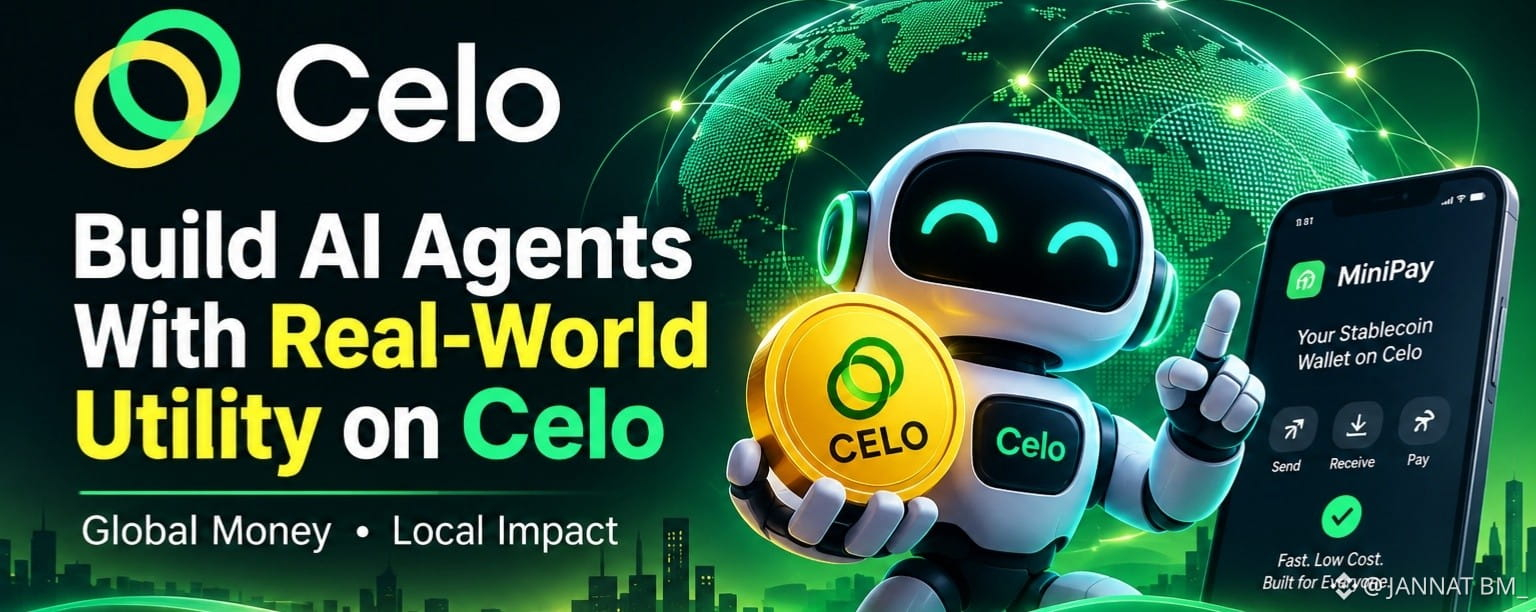
BUILD AI AGENTS WITH REALWORLD UTILITY ON CELOHmm Really, what makes an AI agent genuinely useful in crypto?
I think that’s becoming a more important question than simply asking how intelligent an agent is or how many tasks it can automate. An agent that can answer questions is useful, sure, but an agent that can actually move money, pay for services, interact with applications, and operate without someone manually approving every small step could change how people use blockchain.
This is where Celo caught my attention.
Celo seems to be positioning itself around something much more practical than just being another blockchain competing for attention. Its focus is connecting global money with local markets, financial platforms, currencies, and payment services. That idea becomes even more interesting when you look at it through the lens of AI agents. of crose, Most AI agents today still feel disconnected from the financial world. They can process information, make decisions, and automate workflows, but the moment a task requires an actual payment or an onchain transaction, things get more complicated. You need wallets, permissions, transaction infrastructure, gas, and a system that can operate reliably without making every interaction unnecessarily expensive.
And honestly, this is one area where blockchain infrastructure could make a difference🤔
Celo is an Ethereum Layer 2 built on the OP Stack, with average block times around one second and typical transaction fees below $0.01 according to its documentation. The website also lists an average gas fee of around $0.0002. If those costs remain consistently low, it makes small automated transactions far more practical. An AI agent paying for an API request, completing a task, sending a small payment, or interacting with another service doesn't need to worry about expensive transaction overhead every time it does something.
ability to pay gas using stablecoins is another part I find interesting. Celo supports gas payments using tokens such as USDT, USDC, USA₮ and USDm. For someone building AI agents, that removes an unnecessary layer of complexity. Instead of having to understand a separate gas token just to execute an operation, an agent could work with the same stablecoin balance it already uses for payments.
That might sound like a small improvement, but small friction points become significant when an automated system performs hundreds or thousands of operations. hmm, infrastructure behind Celo is also worth looking at. Its stack includes OP Stack technology, EigenDA v2 for data availability, and zkEVM capbilities through Succinct SP1. These aren't just names to put on a technical page. They address different parts of the system, including scaling, data availability, and verifiable execution. The real question is how effectively these components work together as applications and agent activity grow. Really, numbers on Celo's ecosystem also caught my eye. The information provided lists more than 1.5 billion total transactions, around 443K daily active users, $6.2 billion in monthly stablecoin volume, approximately 156 million CELO holders, and $261 million in total value secured. Those figures suggest the network is being used beyond a purely speculative environment, particularly around stablecoin activity and payments. Of course, transaction numbers alone don't tell us how many users are genuinely active or how much activity is sustainable, but they do give some context for the infrastructure agents could potentially use.
And then there is MiniPay.
A wallet with over 20 million wallet activations creates a different opportunity for developers. Instead of building an AI agent that only works for crypto-native users, developers could potentially create tools connected to payment experiences that are already familiar to people. The recent updates mentioned on Celo's website, including MiniPay's move toward Privy wallet infrastructure and stablecoin purchases using Link by Stripe for users in Europe and the US, are particularly interesting in this context.
It makes me wonder whether the next wave of AI adoption in crypto will actually come from agents that people barely notice. An agent that helps someone manage payments, purchase services, handle repetitive financial tasks, or interact with local payment systems might be more useful than another chatbot with a complicated dashboard.
Celo's documentation is already pointing builders toward agent wallets, x402 and MPP payment protocols, and ERC-8004 onchain identities. That combination starts to make the idea of autonomous ecnomic agents feel less abstract. An agent could potentially have an identity, hold funds, pay for resources, and interact with other services through programmable infrastructure.
Still, there is a lot to prove. Giving an AI access to a wallet introduces real risks around permissions, mistakes, security, and financial accountability. Low fees and fast transactions solve only part of the problem. The agent itself needs reliable safeguards, and users need a clear way to control what it can and cannot do. That is probably where I would focus most of my attention as this ecosystem develops.
Celo doesn't need every AI agent to become some futuristic autonomous machine. The more interesting outcome might be much simpler: agents that quietly handle useful financial tasks, make small payments, connect services, and save people time without making blockchain feel like another thing they have to learn. If Celo can make that experience reliable, accessible, and affordable, then building AI agents with realworld utility might become more than just another narrative in the crypto market. It could become an actual use case people return to every day.
And that's the part I think is worth watching. Not how many AI agents get launched, but how many actually become useful enough that people keep using them...🤔
@celo #CELO $CELO
{future}(CELOUSDT)
@BinanceTG
BUILD AI AGENTS WITH REALWORLD UTILITY ON CELO
Hmm Really, what makes an AI agent genuinely useful in crypto?
I think that’s becoming a more important question than simply asking how intelligent an agent is or how many tasks it can automate. An agent that can answer questions is useful, sure, but an agent that can actually move money, pay for services, interact with applications, and operate without someone manually approving every small step could change how people use blockchain.
This is where Celo caught my attention.
Celo seems to be positioning itself around something much more practical than just being another blockchain competing for attention. Its focus is connecting global money with local markets, financial platforms, currencies, and payment services. That idea becomes even more interesting when you look at it through the lens of AI agents. of crose, Most AI agents today still feel disconnected from the financial world. They can process information, make decisions, and automate workflows, but the moment a task requires an actual payment or an onchain transaction, things get more complicated. You need wallets, permissions, transaction infrastructure, gas, and a system that can operate reliably without making every interaction unnecessarily expensive.
And honestly, this is one area where blockchain infrastructure could make a difference🤔
Celo is an Ethereum Layer 2 built on the OP Stack, with average block times around one second and typical transaction fees below $0.01 according to its documentation. The website also lists an average gas fee of around $0.0002. If those costs remain consistently low, it makes small automated transactions far more practical. An AI agent paying for an API request, completing a task, sending a small payment, or interacting with another service doesn't need to worry about expensive transaction overhead every time it does something.
ability to pay gas using stablecoins is another part I find interesting. Celo supports gas payments using tokens such as USDT, USDC, USA₮ and USDm. For someone building AI agents, that removes an unnecessary layer of complexity. Instead of having to understand a separate gas token just to execute an operation, an agent could work with the same stablecoin balance it already uses for payments.
That might sound like a small improvement, but small friction points become significant when an automated system performs hundreds or thousands of operations. hmm, infrastructure behind Celo is also worth looking at. Its stack includes OP Stack technology, EigenDA v2 for data availability, and zkEVM capbilities through Succinct SP1. These aren't just names to put on a technical page. They address different parts of the system, including scaling, data availability, and verifiable execution. The real question is how effectively these components work together as applications and agent activity grow. Really, numbers on Celo's ecosystem also caught my eye. The information provided lists more than 1.5 billion total transactions, around 443K daily active users, $6.2 billion in monthly stablecoin volume, approximately 156 million CELO holders, and $261 million in total value secured. Those figures suggest the network is being used beyond a purely speculative environment, particularly around stablecoin activity and payments. Of course, transaction numbers alone don't tell us how many users are genuinely active or how much activity is sustainable, but they do give some context for the infrastructure agents could potentially use.
And then there is MiniPay.
A wallet with over 20 million wallet activations creates a different opportunity for developers. Instead of building an AI agent that only works for crypto-native users, developers could potentially create tools connected to payment experiences that are already familiar to people. The recent updates mentioned on Celo's website, including MiniPay's move toward Privy wallet infrastructure and stablecoin purchases using Link by Stripe for users in Europe and the US, are particularly interesting in this context.
It makes me wonder whether the next wave of AI adoption in crypto will actually come from agents that people barely notice. An agent that helps someone manage payments, purchase services, handle repetitive financial tasks, or interact with local payment systems might be more useful than another chatbot with a complicated dashboard.
Celo's documentation is already pointing builders toward agent wallets, x402 and MPP payment protocols, and ERC-8004 onchain identities. That combination starts to make the idea of autonomous ecnomic agents feel less abstract. An agent could potentially have an identity, hold funds, pay for resources, and interact with other services through programmable infrastructure.
Still, there is a lot to prove. Giving an AI access to a wallet introduces real risks around permissions, mistakes, security, and financial accountability. Low fees and fast transactions solve only part of the problem. The agent itself needs reliable safeguards, and users need a clear way to control what it can and cannot do. That is probably where I would focus most of my attention as this ecosystem develops.
Celo doesn't need every AI agent to become some futuristic autonomous machine. The more interesting outcome might be much simpler: agents that quietly handle useful financial tasks, make small payments, connect services, and save people time without making blockchain feel like another thing they have to learn. If Celo can make that experience reliable, accessible, and affordable, then building AI agents with realworld utility might become more than just another narrative in the crypto market. It could become an actual use case people return to every day.
And that's the part I think is worth watching. Not how many AI agents get launched, but how many actually become useful enough that people keep using them...🤔
@celo #CELO $CELO
@Binance TG Community
1
71

·
--
උසබ තත්ත්වය
🚀 CELO: perkembangan ekosistem dan kondisi harga
Celo berfokus pada pembayaran digital dan penggunaan stablecoin. Kabar terbaru datang dari MiniPay, dompet stablecoin di jaringan Celo dengan lebih dari 20 juta aktivasi. MiniPay mengumumkan peningkatan infrastruktur dompetnya menggunakan Privy, milik Stripe. Peluncurannya akan dilakukan bertahap.
Namun, pertumbuhan jumlah dompet belum tentu langsung meningkatkan permintaan token CELO. Perlu dilihat apakah penggunaan jaringan dan stablecoin ikut bertambah.
📊 Pada snapshot Binance 21 November pukul 04.59 UTC, CELO tercatat sekitar $0,0525, turun 6,7% dalam 24 jam. Perhatikan perkembangan harga, aktivitas jaringan, dan likuiditas—aset kripto tetap berisiko dan volatil.
Menurut kalian, apakah pertumbuhan MiniPay bisa mendorong penggunaan Celo secara berkelanjutan?
$CELO
#CELO #Celo #Crypto #Altcoin #Binance #AMCx
98
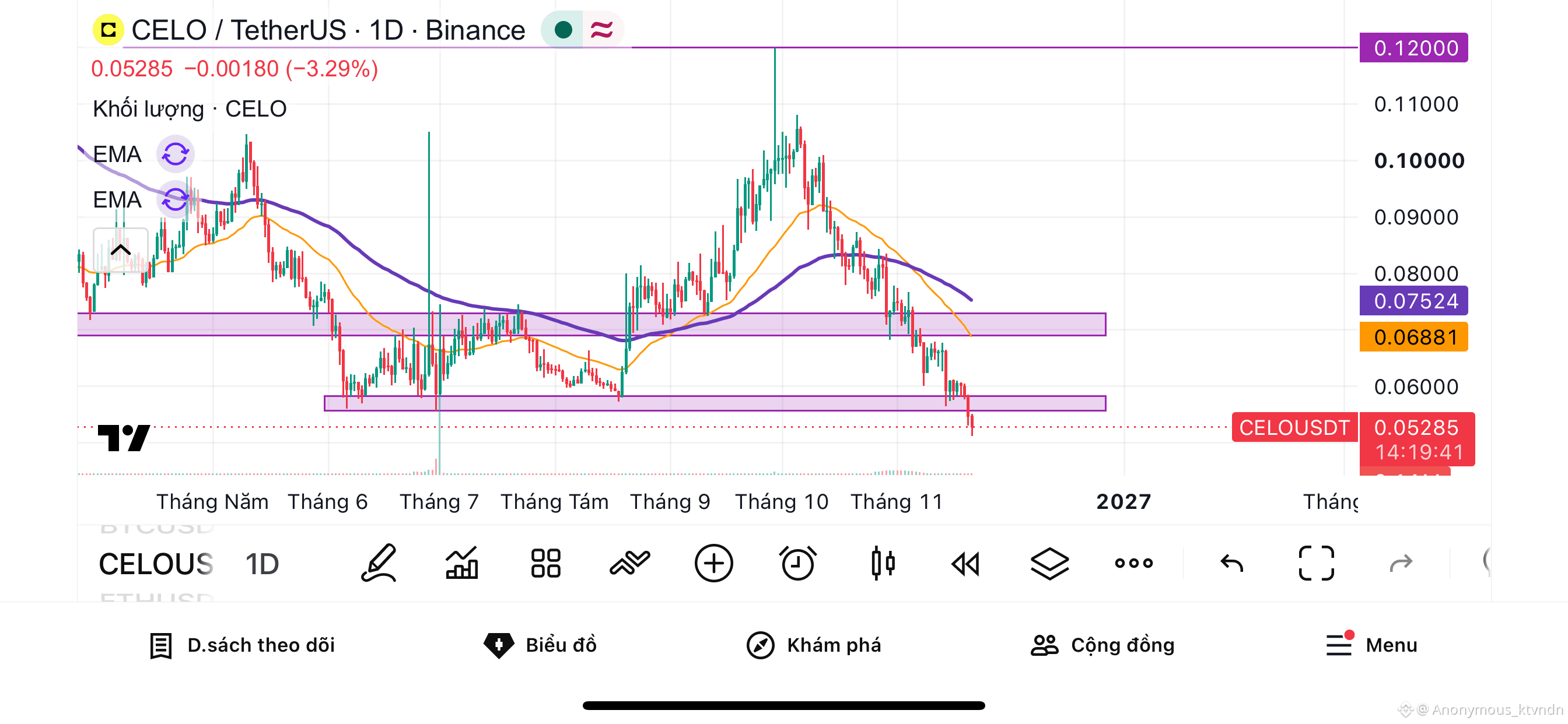
Sau một đợt sụt giảm dài như vậy thì sẽ có tỉ lệ rất cao $CELO sẽ tạo một pha fake break-out và hồi về ema34.
Đợt hồi này có thể về vùng 0.06x.
Nếu trade thì mình sẽ canh vùng này để giao dịch, nhưng là holder dài hạn nên mình chỉ quan sát đợi cơ hội gom thêm.
Đây là nhận định cá nhân, không phải lời khuyên đầu tư. Hãy tự tìm hiểu trước khi xuống tiền
#celo
Đợt hồi này có thể về vùng 0.06x.
Nếu trade thì mình sẽ canh vùng này để giao dịch, nhưng là holder dài hạn nên mình chỉ quan sát đợi cơ hội gom thêm.
Đây là nhận định cá nhân, không phải lời khuyên đầu tư. Hãy tự tìm hiểu trước khi xuống tiền
#celo
298

·
--
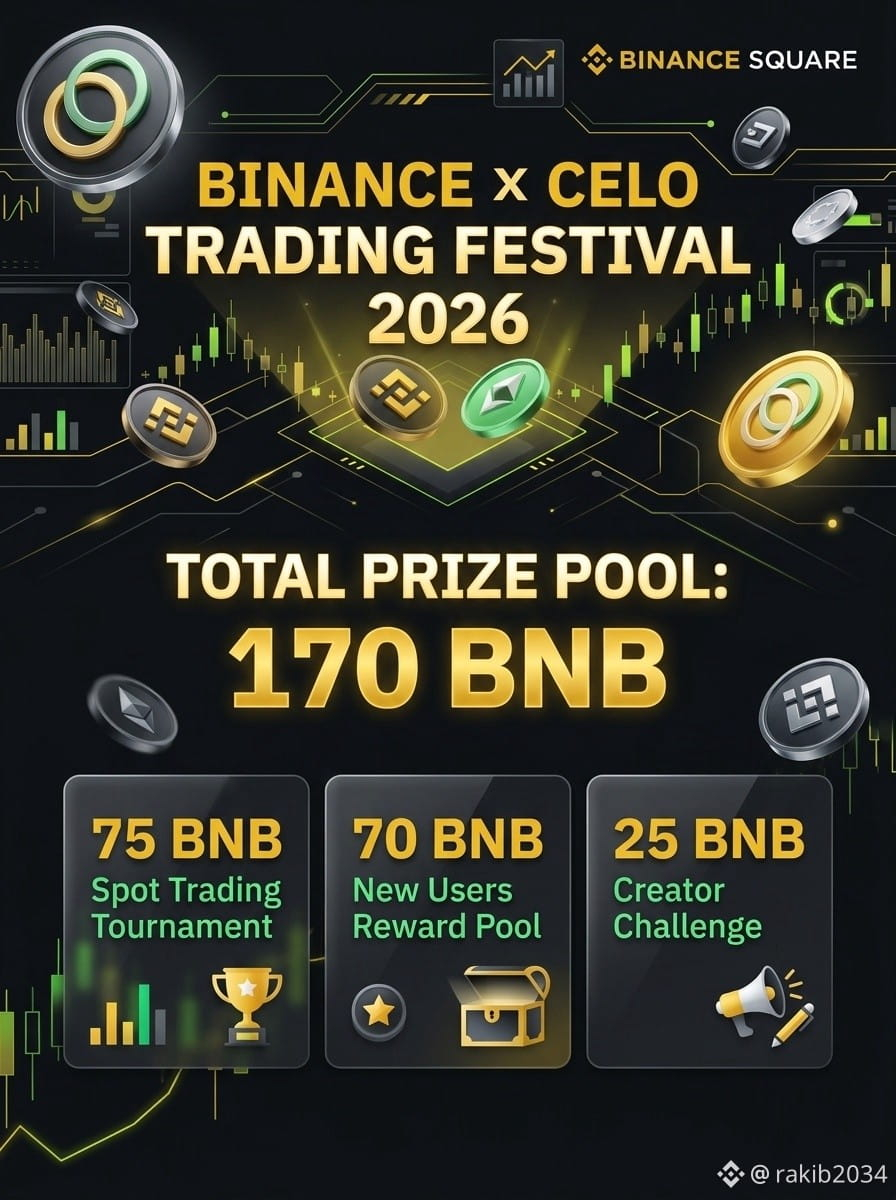
🚀 The Binance x Celo Trading Festival 2026 is Live! Grab Your Share of 170 BNB! 💰🔥
Binance and Celo ($CELO) have teamed up to bring an exciting trading campaign with massive rewards for traders, new users, and content creators!
🎁 Total Prize Pool: 170 BNB
🔹 75 BNB (Spot Trading Tournament): Compete on the leaderboard by trading $CELO on Spot and climb the ranks.
🔹 70 BNB (New Users Reward Pool): Special welcome rewards for new Binance users who register and start trading.
🔹 25 BNB (Creator Challenge): Create engaging content on Binance Square and social media to win from the creator pool!
✅ How to Participate:
1️⃣ Visit the official event page and click [Register / Join Now] before you start trading.
2️⃣ Trade the CELO/USDT pair on Binance Spot to boost your trading volume.
3️⃣ Share quality posts about $CELO and this festival to participate in the Creator Challenge!
👉 Join the Event Here: [Insert Your Referral / Event Link Here]
Don't miss out on this golden opportunity! Who else is joining the tournament? Drop your thoughts in the comments below! 👇
CELO BNB #Binance #CELO #TradingCompetitions #BinanceSquare #CryptoRewards
(Disclaimer: Cryptocurrency trading is subject to high market risk. Please review the official terms and conditions before participating. DYOR.)
1
427

·
--
🚨 Honestly, $CELO is one of those coins I keep coming back to.
Tether's USAT just went live on it, and Ripio launched stablecoins with free on/off-ramps. Real payments, real users.
840K daily actives isn't small either.
Everyone's busy chasing memes while this keeps building quietly. 👀
Do you think $CELO is underrated right now, or am I just being biased? Tell me below 👇
#CELO #CryptoTrading @celo
DYOR | NFA
1
326

·
--
170 BNB Prize Pool Up for Grabs!
Binance is running a massive $CELO campaign right now! Whether you're trading $CELO on Spot, just joining Binance, or creating content as an affiliate, there's a share of 170 $BNB waiting.
Don't forget to register before trading! Who's joining this one? 👇
#Binance #CELO #BNB
Binance is running a massive $CELO campaign right now! Whether you're trading $CELO on Spot, just joining Binance, or creating content as an affiliate, there's a share of 170 $BNB waiting.
Don't forget to register before trading! Who's joining this one? 👇
#Binance #CELO #BNB


Binance TG Community
·
--
CELO x Binance – CELO Trading Festival | Up to 170 BNB in Rewards!
Binance is teaming up with the Celo Foundation for a special campaign with 3 ways to participate and earn BNB rewards! https://www.binance.com/en/activity/trading-competition/ExCELOTradingFestival2026
Join here
📅 Campaign Period: November 20, 2026, 10:00 UTC – December 20, 2026, 10:00 UTC.
🔥 PROMO A – Trade & Earn | Up to 75 BNB Trade CELO/USDT on Binance Spot, reach at least 500 USDT in trading volume and compete for a share of the dynamic prize pool. Registration required!
🎁 PROMO B – Welcome Rewards | 70 BNB New Binance users can earn up to 0.0171 BNB by completing KYC, purchasing the required amount of CELO and holding it in Simple Earn for 3 full days.
⭐️ PROMO C – Creator Challenge | 25 BNB Create original content about Celo and get rewarded!
Top 50 creators: 0.34 BNB each.
All qualified affiliates: Share an additional 8 BNB pool equally.
Who can join? Registered Binance Affiliates with at least 5,000 followers in eligible regions.
📝 Ready to participate? Publish your content and submit it here
📌 Important: Campaign eligibility and regional restrictions apply. Rewards are distributed as BNB token vouchers. Full terms and conditions apply.
🔥 Trade CELO. Welcome new users. Create content. Share up to 170 BNB!
If you are not a Binance Affiliate yet, but you have a community over 5K users , drop us a comment in this comment section on Binance square if you are interested to join our affiliate program.
$CELO @celo

120

·
--

ලිපිය
单日新增79.2K持币用户霸榜全链!Celo的稳定币“虹吸效应”正在加剧单日新增79.2K持币用户霸榜全链!Celo的稳定币“虹吸效应”正在加剧
在加密大盘依然处于极度恐慌和流动性紧缩的当下,Celo却在链上底层数据上踩下了油门。
根据RWA Foundation引用的Token Terminal最新数据,在过去的24小时内,Celo网络新增了79,200名稳定币持有者,高居全链第一!这个数据不仅远超老牌支付网络(BNB Chain +51.1K,Tron等),更是将以太坊(+16.4K)和Solana(+21.2K)甩在了身后。
专家视角带你拆解,这79.2K新增用户的背后,藏着怎样恐怖的“虹吸效应”:
第一,分发管道的全面爆发。 单日近8万人的新增,绝不是靠传统的“空投猎人”能刷出来的。这背后是MiniPay庞大的自然流量,以及近期接入Stripe Link一键入金后,欧美市场法币通道被打通的直接结果。当买稳定币变得像网购一样简单,用户的涌入就是爆发式的。
第二,真实的“抗通胀”与“支付”刚需。 这些新增的稳定币用户,不是来炒Meme币的。在拉美、非洲等高通胀地区,获取美元稳定币是保全资产的刚需;而在欧美,极低的Gas费(0.0003美元)让日常微支付成为可能。Celo在这一赛道上的差异化定位,正在形成极强的网络效应。
第三,飞轮的燃料正在加速累积。 代币经济学飞轮的核心是:用户越多,链上稳定币交易越频繁,产生的Gas费和排序器收入就越多;而这些真实收入,将程序化地转化为回购CELO的子弹。单日8万人的涌入,就是这个飞轮最好的燃料。
专家视角的总结: 我们常说“价格会骗人,但数据不会”。虽然CELO的价格受制于宏观流动性,在底部苦苦挣扎,但其底层的采用数据却在逆风狂奔。当这种“基本面向上、价格向下”的背离达到极致时,往往孕育着中长期的重估机会。当然,宏观压制仍在,短期切勿盲目上高杠杆。
互动时间:单日新增8万人登顶全链,你认为这种真实的需求爆发,能在未来转化为CELO代币的价值重估吗?评论区留下你的判断!👇
$CELO
{spot}(CELOUSDT)
#CELO #稳定币 #RWA #基本面分析 #风险管理
(免责声明:以上内容仅为公开市场数据与生态信息客观整理,不构成任何投资建议。加密市场风险极高,请根据自身风险承受能力谨慎决策。)
单日新增79.2K持币用户霸榜全链!Celo的稳定币“虹吸效应”正在加剧
单日新增79.2K持币用户霸榜全链!Celo的稳定币“虹吸效应”正在加剧
在加密大盘依然处于极度恐慌和流动性紧缩的当下,Celo却在链上底层数据上踩下了油门。
根据RWA Foundation引用的Token Terminal最新数据,在过去的24小时内,Celo网络新增了79,200名稳定币持有者,高居全链第一!这个数据不仅远超老牌支付网络(BNB Chain +51.1K,Tron等),更是将以太坊(+16.4K)和Solana(+21.2K)甩在了身后。
专家视角带你拆解,这79.2K新增用户的背后,藏着怎样恐怖的“虹吸效应”:
第一,分发管道的全面爆发。 单日近8万人的新增,绝不是靠传统的“空投猎人”能刷出来的。这背后是MiniPay庞大的自然流量,以及近期接入Stripe Link一键入金后,欧美市场法币通道被打通的直接结果。当买稳定币变得像网购一样简单,用户的涌入就是爆发式的。
第二,真实的“抗通胀”与“支付”刚需。 这些新增的稳定币用户,不是来炒Meme币的。在拉美、非洲等高通胀地区,获取美元稳定币是保全资产的刚需;而在欧美,极低的Gas费(0.0003美元)让日常微支付成为可能。Celo在这一赛道上的差异化定位,正在形成极强的网络效应。
第三,飞轮的燃料正在加速累积。 代币经济学飞轮的核心是:用户越多,链上稳定币交易越频繁,产生的Gas费和排序器收入就越多;而这些真实收入,将程序化地转化为回购CELO的子弹。单日8万人的涌入,就是这个飞轮最好的燃料。
专家视角的总结: 我们常说“价格会骗人,但数据不会”。虽然CELO的价格受制于宏观流动性,在底部苦苦挣扎,但其底层的采用数据却在逆风狂奔。当这种“基本面向上、价格向下”的背离达到极致时,往往孕育着中长期的重估机会。当然,宏观压制仍在,短期切勿盲目上高杠杆。
互动时间:单日新增8万人登顶全链,你认为这种真实的需求爆发,能在未来转化为CELO代币的价值重估吗?评论区留下你的判断!👇
$CELO
#CELO #稳定币 #RWA #基本面分析 #风险管理
(免责声明:以上内容仅为公开市场数据与生态信息客观整理,不构成任何投资建议。加密市场风险极高,请根据自身风险承受能力谨慎决策。)
255
·
--
සත්යායනය කළ
ලිපිය
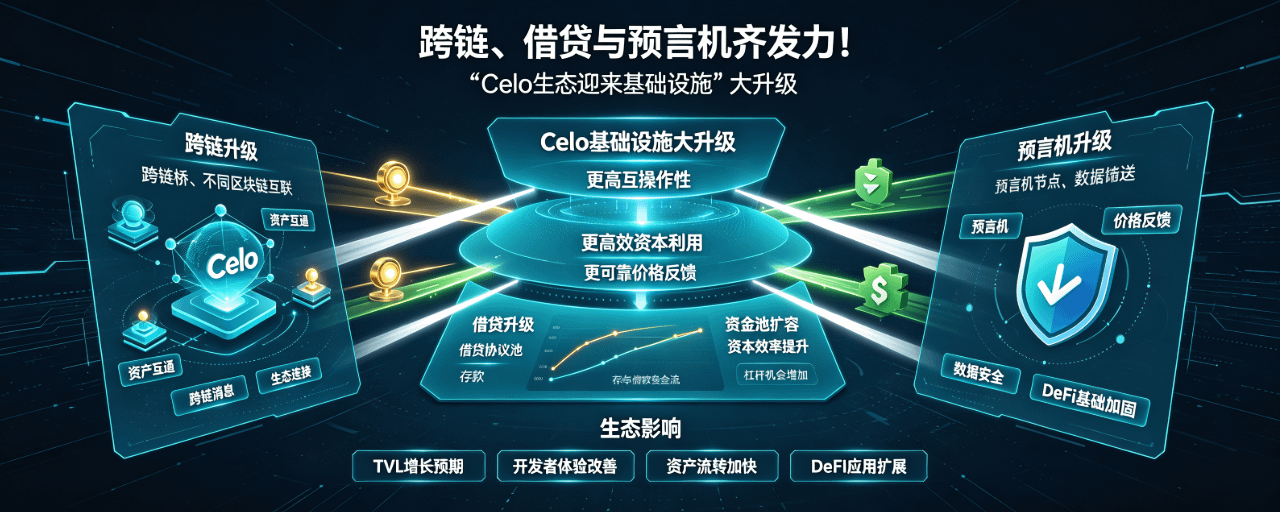
跨链、借贷与预言机齐发力!Celo生态迎来基础设施“大升级”在代币价格于底部震荡的同时,Celo生态的基础设施建设却迎来了密集的爆发期。近期,三大重磅进展悄悄落地,正在为网络的长期繁荣夯实底座。
第一,Aave V3部署提案开启,巨量流动性即将注入。
Aave社区已正式开启在Celo上部署Aave V3的ARFC提案投票。如果提案通过,将支持CELO、USDC、USDT等资产作为抵押品。更引人注目的是,Celo基金会及生态合作伙伴承诺将提供高达300万美元的激励,这无疑将极大丰富Celo的DeFi借贷生态。
第二,Chainlink CCIP正式上线,跨链安全再升级。
Chainlink的跨链互操作性协议(CCIP)已在Celo主网正式上线。这意味着Celo生态能够获得顶级的跨链安全性和多种代币转移机制,为未来连接更多主流公链资产铺平了道路。
第三,预言机与链上声誉双管齐下。
Celo已成功上线Band V3去中心化数据网络,进一步提升了链上数据的可靠性与速度。同时,网络也集成了RubyScore,用户现在可以通过真实的链上活动来积累自己的声誉分数,为未来更多信用类DeFi应用打下基础。
专家视角总结:
大盘的弱势掩盖了这些底层基建的进展。但公链的长期价值,恰恰取决于其DeFi底层深度(如Aave的接入)和跨链互通能力(如CCIP的上线)。当这些“慢变量”积累到一定程度时,其生态的飞轮效应自然会显现。
互动时间:在这三大基础设施升级中,你最看好哪一个对Celo生态资金的吸引作用?评论区聊聊!👇
$CELO #CELO #AAVE #Chainlink #defi #风险管理
(免责声明:以上内容仅为公开市场数据与生态信息客观整理,不构成任何投资建议。加密市场风险极高,请根据自身风险承受能力谨慎决策。)
跨链、借贷与预言机齐发力!Celo生态迎来基础设施“大升级”
在代币价格于底部震荡的同时,Celo生态的基础设施建设却迎来了密集的爆发期。近期,三大重磅进展悄悄落地,正在为网络的长期繁荣夯实底座。
第一,Aave V3部署提案开启,巨量流动性即将注入。
Aave社区已正式开启在Celo上部署Aave V3的ARFC提案投票。如果提案通过,将支持CELO、USDC、USDT等资产作为抵押品。更引人注目的是,Celo基金会及生态合作伙伴承诺将提供高达300万美元的激励,这无疑将极大丰富Celo的DeFi借贷生态。
第二,Chainlink CCIP正式上线,跨链安全再升级。
Chainlink的跨链互操作性协议(CCIP)已在Celo主网正式上线。这意味着Celo生态能够获得顶级的跨链安全性和多种代币转移机制,为未来连接更多主流公链资产铺平了道路。
第三,预言机与链上声誉双管齐下。
Celo已成功上线Band V3去中心化数据网络,进一步提升了链上数据的可靠性与速度。同时,网络也集成了RubyScore,用户现在可以通过真实的链上活动来积累自己的声誉分数,为未来更多信用类DeFi应用打下基础。
专家视角总结:
大盘的弱势掩盖了这些底层基建的进展。但公链的长期价值,恰恰取决于其DeFi底层深度(如Aave的接入)和跨链互通能力(如CCIP的上线)。当这些“慢变量”积累到一定程度时,其生态的飞轮效应自然会显现。
互动时间:在这三大基础设施升级中,你最看好哪一个对Celo生态资金的吸引作用?评论区聊聊!👇
$CELO #CELO #AAVE #Chainlink #defi #风险管理
(免责声明:以上内容仅为公开市场数据与生态信息客观整理,不构成任何投资建议。加密市场风险极高,请根据自身风险承受能力谨慎决策。)
1
716

·
--
🔍 $CELO — Can Buyers Build Momentum?
$CELO is a token worth keeping on the watchlist as market participants look for signs of a stronger recovery.
The key thing to watch is whether buyers can maintain momentum and push the price above nearby resistance levels.
A strong breakout with increasing volume could improve the bullish outlook, while rejection may lead to another period of consolidation.
Personally, I'd rather wait for confirmation than chase a sudden move.
What do you think about $CELO right now?
#CELO #CryptoMarket #Altcoins
1
2
255
·
--
සත්යායනය කළ
ලිපිය
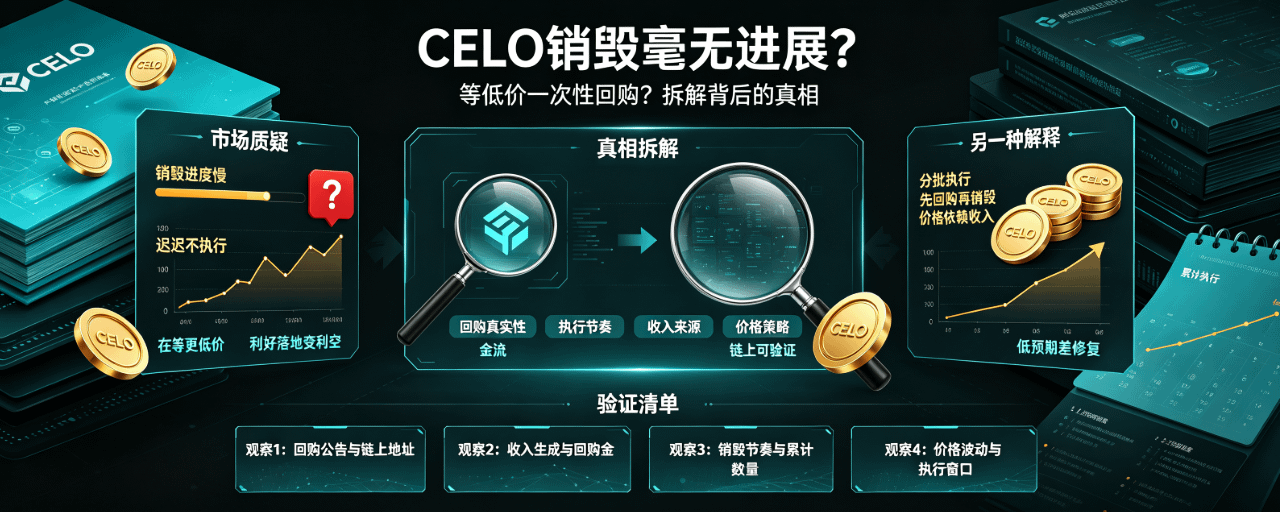
CELO销毁毫无进展?等低价一次性回购?拆解背后的真相近期社区里有一种声音:CELO的回购销毁是不是停滞了?是不是项目方在刻意隐瞒,想等价格更低时一次性抄底买入?作为关注链上数据的观察者,我们需要把“回购”和“销毁”这两个概念彻底厘清。
第一,回购并没有停滞,它一直在真实运行。
CELOccelerate机制落地后,协议将100%的净排序器收入和稳定币Gas费,程序化地用于在公开市场回购CELO。数据是透明的:目前累计回购量已达约910万枚,最近一周依然在持续买入约60万枚。所以,根本不存在“零进展”或“刻意不买”的情况。回购的引擎一直都在转,只是受限于当前链上日均几千美元的费用基数,绝对体量还不算大。
第二,销毁为何没落地?因为它卡在治理流程里。
社区确实在推进“将未来25%收入用于永久销毁”的提案。但截至11月中旬,该提案仍在走技术准备流程。它需要完成代码合并(PR)、确认临时治理提案编号、并满足1万枚CELO的链上提交门槛,才能进入最终的投票环节。这完全是由于去中心化治理的严谨性造成的程序延迟,并非项目方在搞暗箱操作。
第三,不存在“等低价一次性回购”的阴谋。
CELO的回购是程序化、高频执行的,这是公开的链上动作,无法造假。至于销毁,必须等治理投票通过才能触发。项目方无法单方面决定哪天突然砸盘抄底。
专家视角的总结:
在去中心化治理中,提案从讨论到落地本就需要时间。对于社区而言,与其猜测阴谋论,不如盯紧真实的链上数据:一是观察回购的持续频率是否稳定,二是等待销毁提案正式通过并产生可验证的销毁记录。只有在链上看到真金白银的燃烧,才是真正价值捕获的开始。
互动时间:你认为对于代币经济模型,是细水长流的持续回购好,还是集中力量的大额销毁好?评论区聊聊!👇
$CELO #CELO #代币回购 #销毁机制 #治理提案 #风险管理
(免责声明:以上内容仅为公开链上数据与治理动态客观整理,不构成任何投资建议。加密市场风险极高,请根据自身风险承受能力谨慎决策。)
CELO销毁毫无进展?等低价一次性回购?拆解背后的真相
近期社区里有一种声音:CELO的回购销毁是不是停滞了?是不是项目方在刻意隐瞒,想等价格更低时一次性抄底买入?作为关注链上数据的观察者,我们需要把“回购”和“销毁”这两个概念彻底厘清。
第一,回购并没有停滞,它一直在真实运行。
CELOccelerate机制落地后,协议将100%的净排序器收入和稳定币Gas费,程序化地用于在公开市场回购CELO。数据是透明的:目前累计回购量已达约910万枚,最近一周依然在持续买入约60万枚。所以,根本不存在“零进展”或“刻意不买”的情况。回购的引擎一直都在转,只是受限于当前链上日均几千美元的费用基数,绝对体量还不算大。
第二,销毁为何没落地?因为它卡在治理流程里。
社区确实在推进“将未来25%收入用于永久销毁”的提案。但截至11月中旬,该提案仍在走技术准备流程。它需要完成代码合并(PR)、确认临时治理提案编号、并满足1万枚CELO的链上提交门槛,才能进入最终的投票环节。这完全是由于去中心化治理的严谨性造成的程序延迟,并非项目方在搞暗箱操作。
第三,不存在“等低价一次性回购”的阴谋。
CELO的回购是程序化、高频执行的,这是公开的链上动作,无法造假。至于销毁,必须等治理投票通过才能触发。项目方无法单方面决定哪天突然砸盘抄底。
专家视角的总结:
在去中心化治理中,提案从讨论到落地本就需要时间。对于社区而言,与其猜测阴谋论,不如盯紧真实的链上数据:一是观察回购的持续频率是否稳定,二是等待销毁提案正式通过并产生可验证的销毁记录。只有在链上看到真金白银的燃烧,才是真正价值捕获的开始。
互动时间:你认为对于代币经济模型,是细水长流的持续回购好,还是集中力量的大额销毁好?评论区聊聊!👇
$CELO #CELO #代币回购 #销毁机制 #治理提案 #风险管理
(免责声明:以上内容仅为公开链上数据与治理动态客观整理,不构成任何投资建议。加密市场风险极高,请根据自身风险承受能力谨慎决策。)
737


·
--
🚨 CELO: IS $CELO SHOWING SIGNS OF LIFE? 👀🔥
What if one of the most overlooked altcoins is quietly preparing for its next big move?
Look at the monthly chart! 📊
After years of declining from its historic highs, CELO is trading around $0.059, and recent volume activity is catching my attention.
Could this be the early stage of accumulation before the next major market cycle?
🐋 Is smart money positioning early?
📈 Is CELO preparing for a long-term recovery?
💎 Or is this another false signal?
I'm watching the volume, moving averages, and key breakout levels closely.
Drop your prediction👇
#CELO $CELO
{spot}(CELOUSDT)
🚨 CELO: IS $CELO SHOWING SIGNS OF LIFE? 👀🔥
What if one of the most overlooked altcoins is quietly preparing for its next big move?
Look at the monthly chart! 📊
After years of declining from its historic highs, CELO is trading around $0.059, and recent volume activity is catching my attention.
Could this be the early stage of accumulation before the next major market cycle?
🐋 Is smart money positioning early?
📈 Is CELO preparing for a long-term recovery?
💎 Or is this another false signal?
I'm watching the volume, moving averages, and key breakout levels closely.
Drop your prediction👇
#CELO $CELO
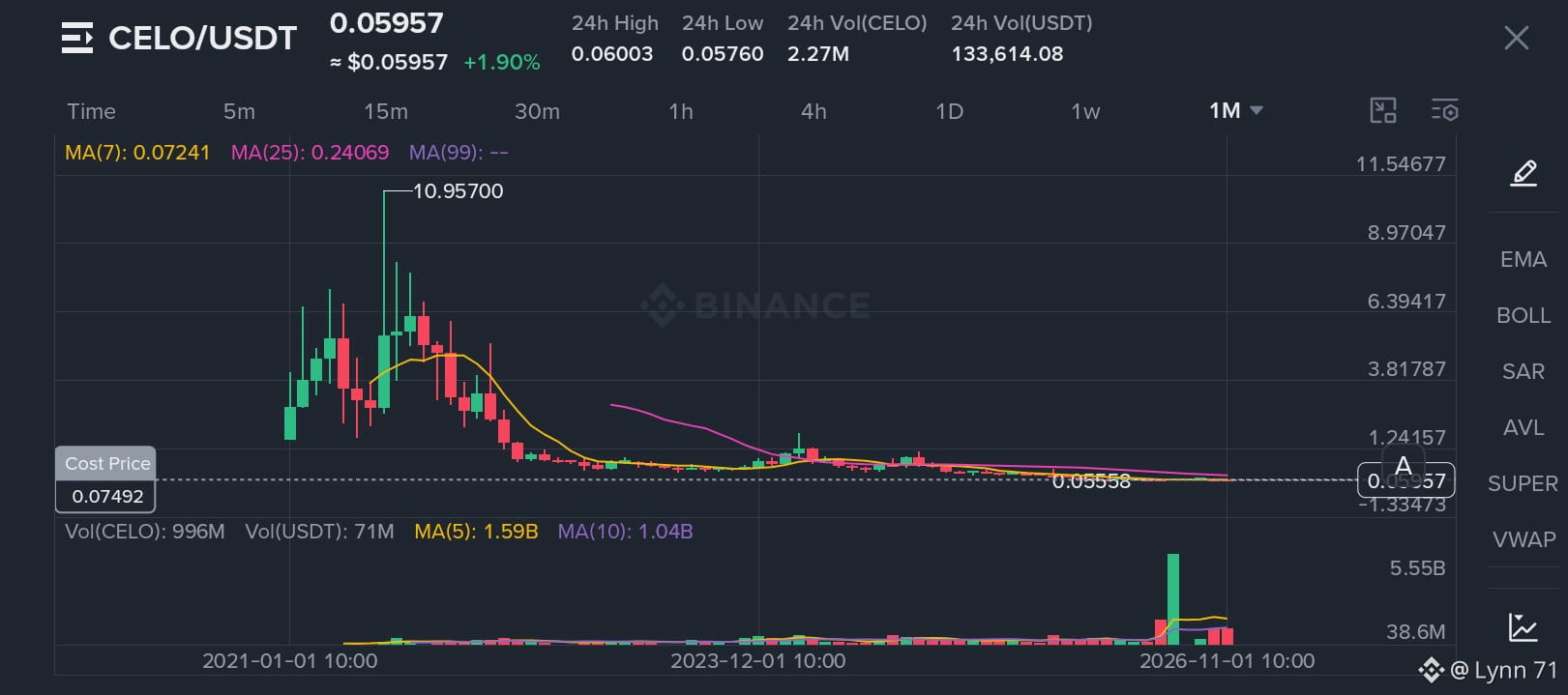
130
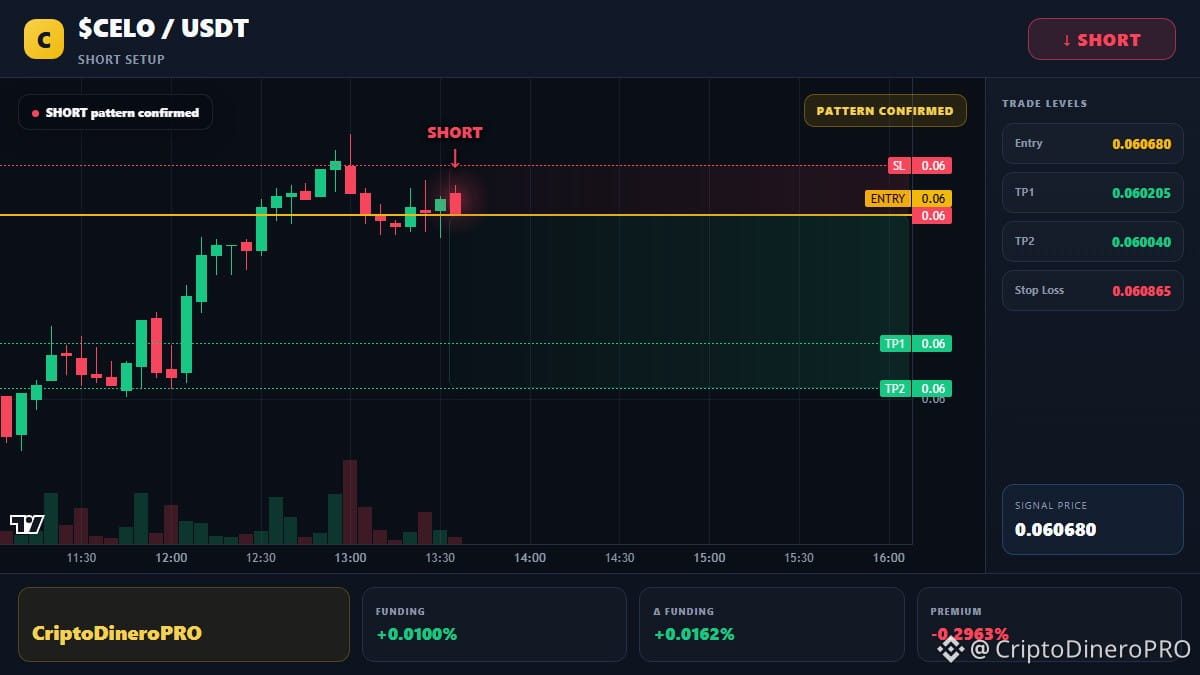

·
--
උසබ තත්ත්වය
$CELO is showing strength from support, with buyers gradually taking control and momentum building for a potential continuation move.
Entry: 0.06620–0.06680
TP1: 0.06776
TP2: 0.06802
TP3: 0.06950
SL: 0.06462
Buy and Trade $FIL
#CELO $ZEC
{future}(ZECUSDT)
{future}(FILUSDT)
{future}(CELOUSDT)
$CELO is showing strength from support, with buyers gradually taking control and momentum building for a potential continuation move.
Entry: 0.06620–0.06680
TP1: 0.06776
TP2: 0.06802
TP3: 0.06950
SL: 0.06462
Buy and Trade $FIL
#CELO $ZEC
Entry: 0.06620–0.06680
TP1: 0.06776
TP2: 0.06802
TP3: 0.06950
SL: 0.06462
Buy and Trade $FIL
#CELO $ZEC
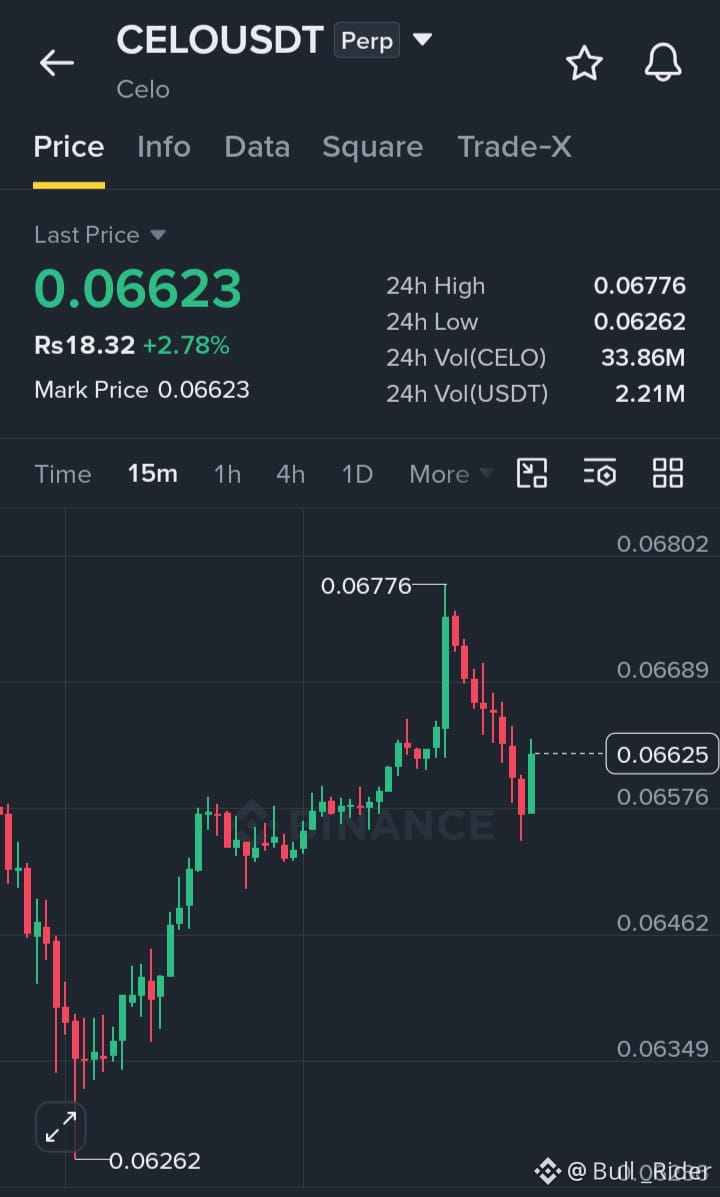
1
99

CELO: the chain built for a billion phones is now worth 6 cents. 📱😅
Spot: $CELO $0.065, -3.4% today, -29% this month, -70% over the last year. RSI 34.6 — weak zone, sitting right on support $0.0647. Resistance $0.0672.
The funny part? Celo actually works — it's an Ethereum L2 now, with $175M in stablecoins on-chain. The tech showed up. The price didn't.
$BTC isn't helping either: $71,800, -3.3% today, below its 200-day average, 5th straight day of ETF outflows.
Verdict: spot watchlist only — wait for $0.0647 to hold before touching it.
Not financial advice. DYOR.
#CELO #Crypto #Altcoins
91

·
--
$CELO 🌍 CELO ECOSYSTEM PULSE: Buybacks, AI Services, & Navigating Market Shocks! ⚡📊
Binancians, let's zoom in on what’s happening with $CELO as the broader crypto market navigates a cautious sentiment phase! While macro conditions bring short-term friction, structural changes and ecosystem utility are keeping the community talking. Here is the latest deep-dive breakdown:
🔄 Tokenomics & Buybacks in Play:
Revenue Driven: Celo’s network upgrade model channels net sequencer revenue and stablecoin gas fees directly toward ongoing $CELO repurchases, acting as a structural counterweight during broader market pullbacks. 🛡️
Supply & Demand Balance: With millions of tokens repurchased since the overhaul, holders are closely tracking how network growth impacts long-term token value capture.
🤖 Real-World & AI Utility Expansion:
AI Services Marketplace: The integration of services tailored for AI agents settling in stablecoins marks a strategic push into emerging Web3 infrastructure.
The Adoption Equation: While stablecoin transactions drive active network utility, the core focus remains on how on-chain activity translates into sustained fee-capture for the ecosystem.
📉 Technical Outlook & Market Context:
Key Zones: Trading near local ranges around the $0.065 – $0.066 zone, CELO is experiencing a period of high-alert observation as traders watch macro market conditions and crucial support levels.
Rebound Potential: Analysts are eyeing whether ongoing buybacks and increasing marketplace traction can ignite a bullish reversal toward key overhead resistance levels.
Are you accumulating it for the long-term Web3 and AI narrative, or watching from the sidelines for confirmation? Drop your thoughts below! 👇💬✨
{spot}(CELOUSDT)
#CELO #Binance #CryptoAnalysis #Web3 #BinanceSquare
$CELO 🌍 CELO ECOSYSTEM PULSE: Buybacks, AI Services, & Navigating Market Shocks! ⚡📊
Binancians, let's zoom in on what’s happening with $CELO as the broader crypto market navigates a cautious sentiment phase! While macro conditions bring short-term friction, structural changes and ecosystem utility are keeping the community talking. Here is the latest deep-dive breakdown:
🔄 Tokenomics & Buybacks in Play:
Revenue Driven: Celo’s network upgrade model channels net sequencer revenue and stablecoin gas fees directly toward ongoing $CELO repurchases, acting as a structural counterweight during broader market pullbacks. 🛡️
Supply & Demand Balance: With millions of tokens repurchased since the overhaul, holders are closely tracking how network growth impacts long-term token value capture.
🤖 Real-World & AI Utility Expansion:
AI Services Marketplace: The integration of services tailored for AI agents settling in stablecoins marks a strategic push into emerging Web3 infrastructure.
The Adoption Equation: While stablecoin transactions drive active network utility, the core focus remains on how on-chain activity translates into sustained fee-capture for the ecosystem.
📉 Technical Outlook & Market Context:
Key Zones: Trading near local ranges around the $0.065 – $0.066 zone, CELO is experiencing a period of high-alert observation as traders watch macro market conditions and crucial support levels.
Rebound Potential: Analysts are eyeing whether ongoing buybacks and increasing marketplace traction can ignite a bullish reversal toward key overhead resistance levels.
Are you accumulating it for the long-term Web3 and AI narrative, or watching from the sidelines for confirmation? Drop your thoughts below! 👇💬✨
#CELO #Binance #CryptoAnalysis #Web3 #BinanceSquare
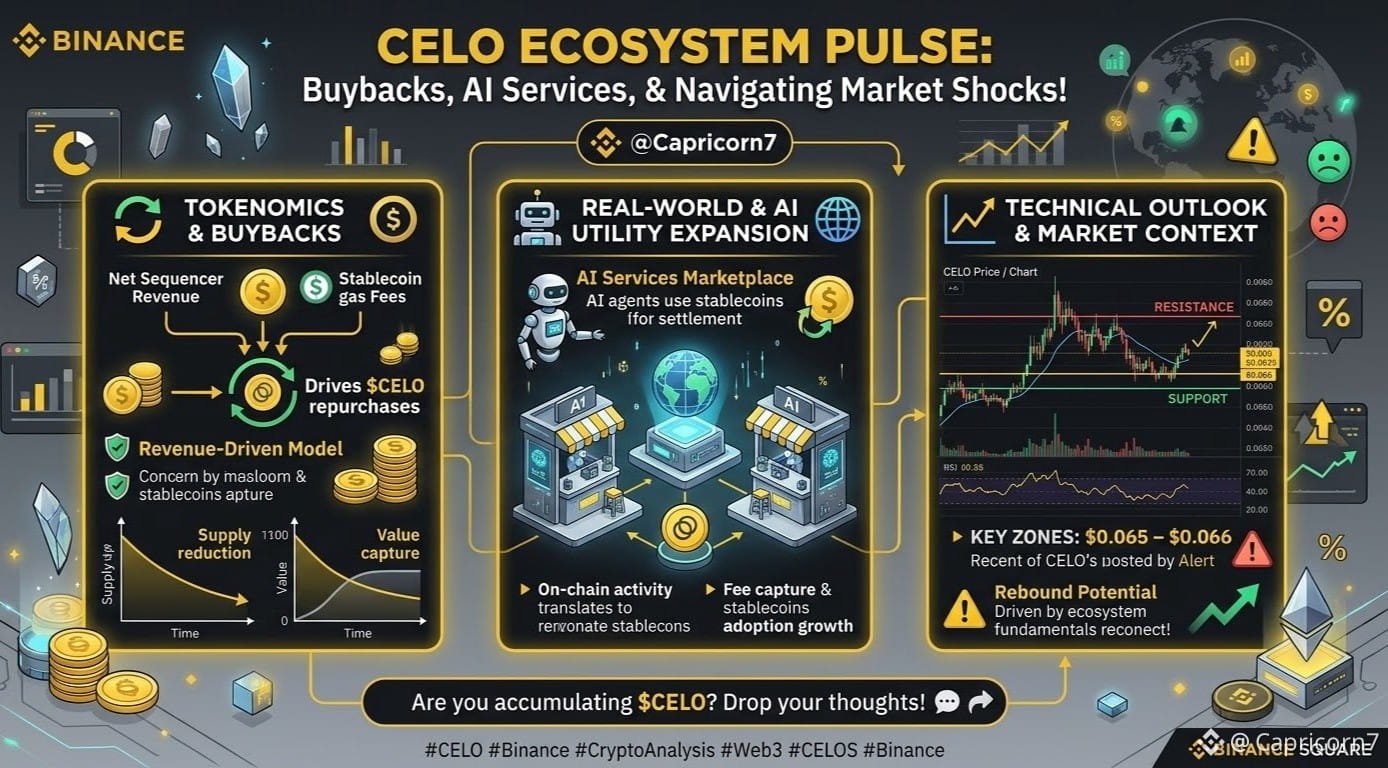
1
2
8
457
තවත් අන්තර්ගතයන් ගවේෂණය කිරීමට ඇතුල් වන්න
Binance චතුරශ්රය හි ගෝලීය ක්රිප්ටෝ පරිශීලකයින් හා එක්වන්න
⚡️ ක්රිප්ටෝ පිළිබඳ නවතම සහ ප්රයෝජනවත් තොරතුරු ලබා ගන්න.
💬 ලොව විශාලතම ක්රිප්ටෝ හුවමාරුව මගින් විශ්වාස කෙරේ.
👍 සත්යායනය කරන ලද නිර්මාණකරුවන්ගෙන් සැබෑ විදසුන් සොයා ගන්න.
විද්යුත් තැපෑල / දුරකථන අංකය
නැගී එන මාතෘකා
1
#NvidiaLoses$2.7TrillionInMonthAndAHalf
8,880 නැරඹීම්
89 සාකච්ඡා කරමින්
2
#CanBTCReboundAfterFallingBelow60K?
647,612 නැරඹීම්
2,756 සාකච්ඡා කරමින්
3
#GlobalStocksFaceLongestLosingStreakSince2023
230,023 නැරඹීම්
1,876 සාකච්ඡා කරමින්
4
#BlackRockIBITPostsRecord$541MSingleDayOutflow
23,715 නැරඹීම්
74 සාකච්ඡා කරමින්
5
#AnthropicPlungesTowardIPOPriceonDay2
114,507 නැරඹීම්
1,120 සාකච්ඡා කරමින්
6
#TwentyOneCapitalAdds172.25BTC
49,919 නැරඹීම්
596 සාකච්ඡා කරමින්
7
#HKBillWouldExcludeTokenizedDepositsFromVirtualAssets
5,756 නැරඹීම්
48 සාකච්ඡා කරමින්
8
#BNBDropsBelow540USDTWith8.46%DailyDecline
64,750 නැරඹීම්
590 සාකච්ඡා කරමින්
9
#HKBillProposesHK$100KFineForUnauthorizedCryptoTitles
2,196 නැරඹීම්
21 සාකච්ඡා කරමින්
10
#BitMineFaces$10.1BUnrealizedETHLoss
4,443 නැරඹීම්
25 සාකච්ඡා කරමින්