



Is my money safe on Binance? It's an important question for anyone investing or trading cryptocurrency.
Binance uses multiple safeguards, including Proof of Reserves (PoR), the Secure Asset Fund for Users (SAFU), AI-powered risk detection, and account security features.
However, no cryptocurrency exchange is entirely risk-free. Understanding how these protections work—and their limitations—can help you make informed decisions about your assets.
On October 30, 2026, Binance reported a major security incident with an estimated financial impact of approximately $6.3 billion. The exchange stated that it would cover all losses using SAFU and company funds. This incident highlights the importance of understanding both exchange security measures and financial protection mechanisms.
How Does Binance Protect Customer Funds?
Binance uses multiple layers of security to reduce risks associated with cyberattacks, fraud, and unauthorized transactions.
Key safeguards include:
Wallet security: Hot wallets support transactions, while cold wallets help keep assets offline.
Account protection: Two-factor authentication (2FA), passkeys where supported, and other verification methods help prevent unauthorized access.
Withdrawal controls: Security checks help identify suspicious transfers.
AI-powered monitoring: Automated systems analyze transactions and account behavior to detect potential fraud.
Proof of Reserves: Cryptographic verification helps users check whether their balances are included in published reserve reports.
SAFU fund: An emergency reserve designed to cover eligible losses from certain security incidents.
These measures reduce risk, but users should also secure their accounts, avoid phishing links, and never share passwords or authentication codes.
What Is Binance's Proof of Reserves and How Does It Work?
Proof of Reserves (PoR) is a verification system designed to help demonstrate whether an exchange holds sufficient cryptocurrency assets to back its customers' reported balances.
Binance uses cryptographic techniques, including Merkle trees and zero-knowledge proofs, to support verification while protecting individual account information.
Users can check the official Binance Proof of Reserves page.
How Does Proof of Reserves Work?
The process generally involves three steps:
Record customer balances: Customer balances are included in a snapshot used to calculate reported liabilities.
Verify reserves: The exchange provides information about cryptocurrency assets held in its wallets.
Enable verification: Cryptographic proofs allow users to check whether their balances were included in the published report.
Why Is Proof of Reserves Important?
PoR improves transparency and helps users verify their account inclusion instead of relying entirely on an exchange's statements.
However, Proof of Reserves is not a complete financial audit or a guarantee against insolvency. A snapshot reflects a particular point in time, and its reliability depends on the assets, liabilities, and verification methods covered.
Users should review the report's date, scope, and methodology when assessing an exchange's financial position.
What Is Binance's SAFU Fund and How Does It Protect Users?
The Secure Asset Fund for Users (SAFU) is an emergency reserve established by Binance in July 2018 to help protect users against eligible losses from certain security incidents.
Binance originally funded SAFU by allocating a portion of its trading fees. In February 2026, Binance reported that the fund held approximately $1 billion in cryptocurrency assets, although its market value can fluctuate.
How Does SAFU Work?
SAFU provides a financial resource that Binance can use to compensate eligible users following qualifying security incidents.
However, it is not unlimited insurance, and compensation is not automatically guaranteed for every type of loss.
What Happened During the 2019 Binance Hack?
In May 2019, Binance reported a security breach involving approximately 7,000 BTC, worth around $40 million at the time. The exchange committed to covering the losses through SAFU, ensuring that affected users would not bear the financial impact.
SAFU vs. Proof of Reserves
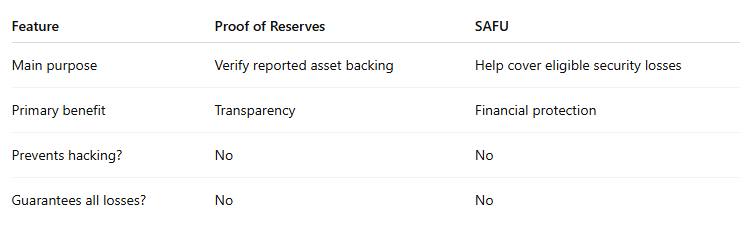
In simple terms, Proof of Reserves helps users assess asset backing, while SAFU provides financial resources for eligible losses.
How Does Binance Use AI and Security Technology to Protect User Assets?
Cryptocurrency exchanges face threats such as phishing, account takeovers, fraudulent transactions, and sophisticated scams.
AI can help security teams analyze large amounts of activity and identify suspicious patterns.
Binance has reported using more than 100 dedicated AI models in its financial crime prevention systems. According to the company, its AI-assisted risk systems helped protect more than eight million users and prevent approximately $4.6 billion in potential losses during the first half of 2026.
AI and security technology support several functions:
Fraud detection: Identifying unusual transaction patterns and potentially fraudulent behavior.
Real-time monitoring: Flagging suspicious activity for additional checks.
Identity verification: Helping detect suspicious documents and possible identity fraud.
Scam detection: Identifying patterns associated with phishing and fraudulent activity.
Incident response: Supporting investigations alongside security professionals.
AI can improve threat detection, but it cannot prevent every attack. Users should continue practicing good security habits.
What Happens to My Assets if a Crypto Exchange Becomes Insolvent?
Exchange insolvency occurs when a business cannot meet its financial obligations or its liabilities exceed its assets, depending on the applicable legal framework.
If a cryptocurrency exchange becomes insolvent, users may experience withdrawal restrictions, delays, or a formal process for recovering assets.
Are Customer Assets Automatically Returned?
Not necessarily. The outcome depends on the exchange's financial condition, custody arrangements, applicable laws, and contractual terms.
Proof of Reserves provides useful information about asset backing at a particular time, but it does not guarantee immediate withdrawals or full recovery in every insolvency scenario.
How Can You Reduce Exchange Risk?
Consider these practical steps:
Keep only the cryptocurrency you need for trading on an exchange.
Consider self-custody for long-term holdings, while protecting your private keys and recovery phrase.
Review Proof of Reserves reports and their limitations.
Enable 2FA or passkeys where available.
Use unique passwords and secure your email account.
Avoid suspicious links and never share wallet recovery phrases.
Consider diversifying your exposure instead of keeping all assets on one platform.
Self-custody also carries risks, including lost recovery phrases and malicious transactions. The goal is to understand the trade-offs and choose an appropriate level of protection.
Frequently Asked Questions
Is my money safe on Binance?
Binance uses Proof of Reserves, SAFU, account security controls, and AI-assisted risk monitoring to protect customer assets. These measures reduce risks, but no centralized exchange is completely risk-free. Users should review current reserve reports, enable security features, and understand the limitations of available protections.
What happens to my money if Binance shuts down?
The outcome would depend on Binance's financial condition, custody arrangements, applicable laws, and any insolvency proceedings. Users could face withdrawal restrictions or a claims process. Proof of Reserves does not guarantee that all assets will be returned immediately.
What security measures does Binance use to prevent unauthorized transactions?
Binance uses authentication methods, withdrawal controls, transaction monitoring, and automated fraud detection. Users can strengthen protection by enabling 2FA, using unique passwords, and avoiding phishing attempts.
How is Binance's SAFU fund different from Proof of Reserves?
Proof of Reserves helps users verify reported asset backing. SAFU is an emergency fund intended to cover eligible losses from certain security incidents. They serve different purposes and do not guarantee protection against every risk.
Does Binance reimburse users if funds are stolen in a hack?
Binance has SAFU to help compensate eligible users for certain security-related losses, but reimbursement is not automatically guaranteed in every case.
In May 2019, Binance committed to covering approximately $40 million in losses following a security breach involving 7,000 BTC.
On October 30, 2026, Binance reported a security incident with an estimated financial impact of approximately $6.3 billion and stated that it would cover all losses using SAFU and company funds. The exchange also reported that approximately $3 billion in affected assets had been frozen on-chain.
Users should consult official Binance announcements for updates and contact Binance Support if they believe they qualify for compensation.
Final Thoughts: How Should You Evaluate Binance's Security?
Binance offers multiple safeguards designed to protect customer assets. Proof of Reserves supports transparency, SAFU provides an emergency financial resource, and AI-powered systems help detect suspicious activity.
However, each has limitations. Reserve verification does not guarantee solvency, SAFU does not promise reimbursement for every loss, and AI cannot prevent every attack.
The reported incident on October 30, 2026, reinforces why users should evaluate not only an exchange's security features but also its incident response, financial commitments, and updated reserve disclosures.
The smartest approach is to verify rather than assume: review available reserve information, secure your account, understand exchange custody risks, and avoid keeping more assets on a platform than necessary.
#SAFU🙏 #Hack #LazarusGroup #ProofOfReserves #Binance


